Cambridge A Level Business (for first examination in 2016) 9609 — 2023 May/June Paper 4 · Variant 2
9609/42/M/J/23 · 2 questions · 40 marks · ≈45 min
The question paper and its mark scheme, free to read here and free to download. This is Cambridge’s own paper, exactly as it was sat.
Question paper4 pages
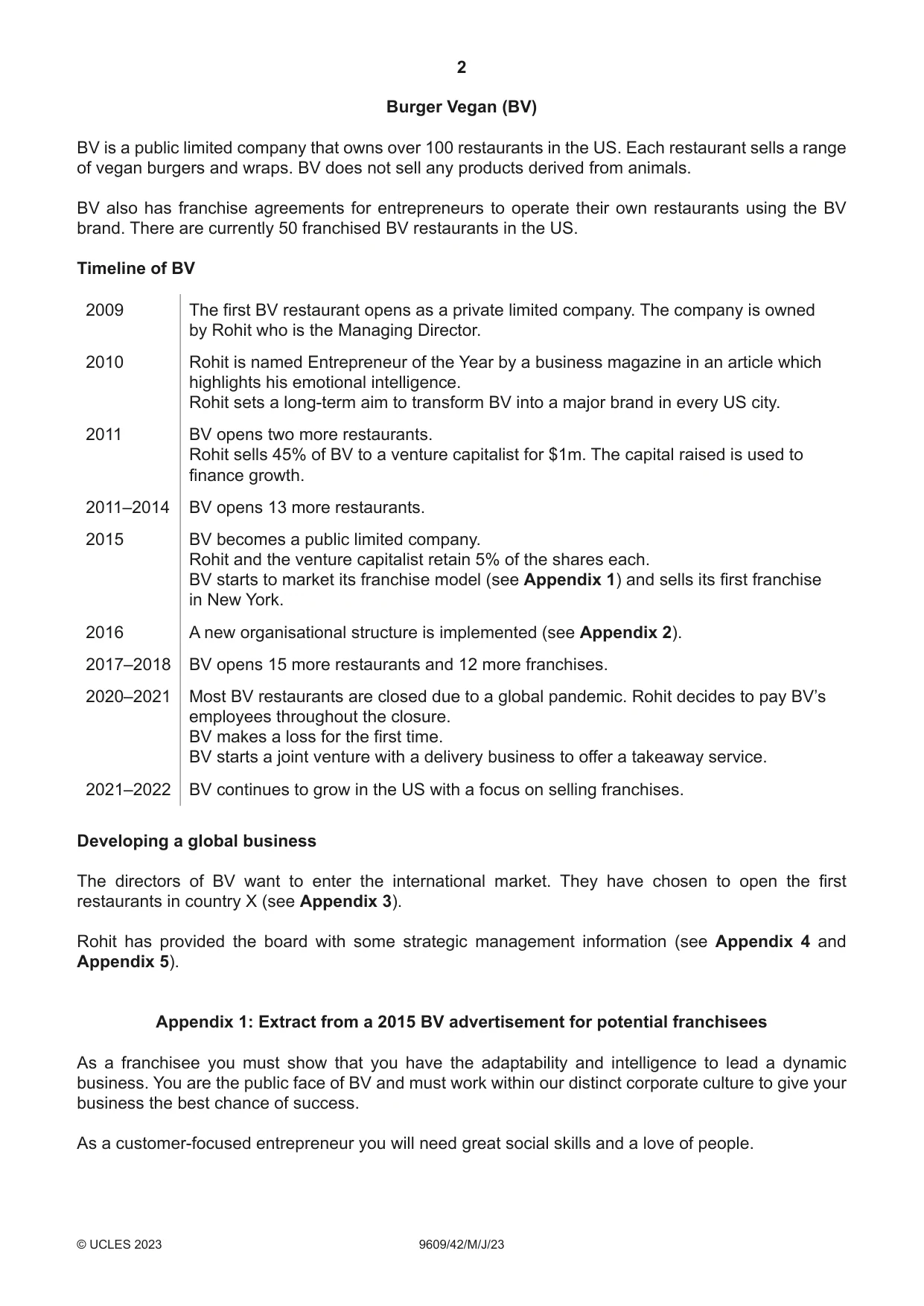
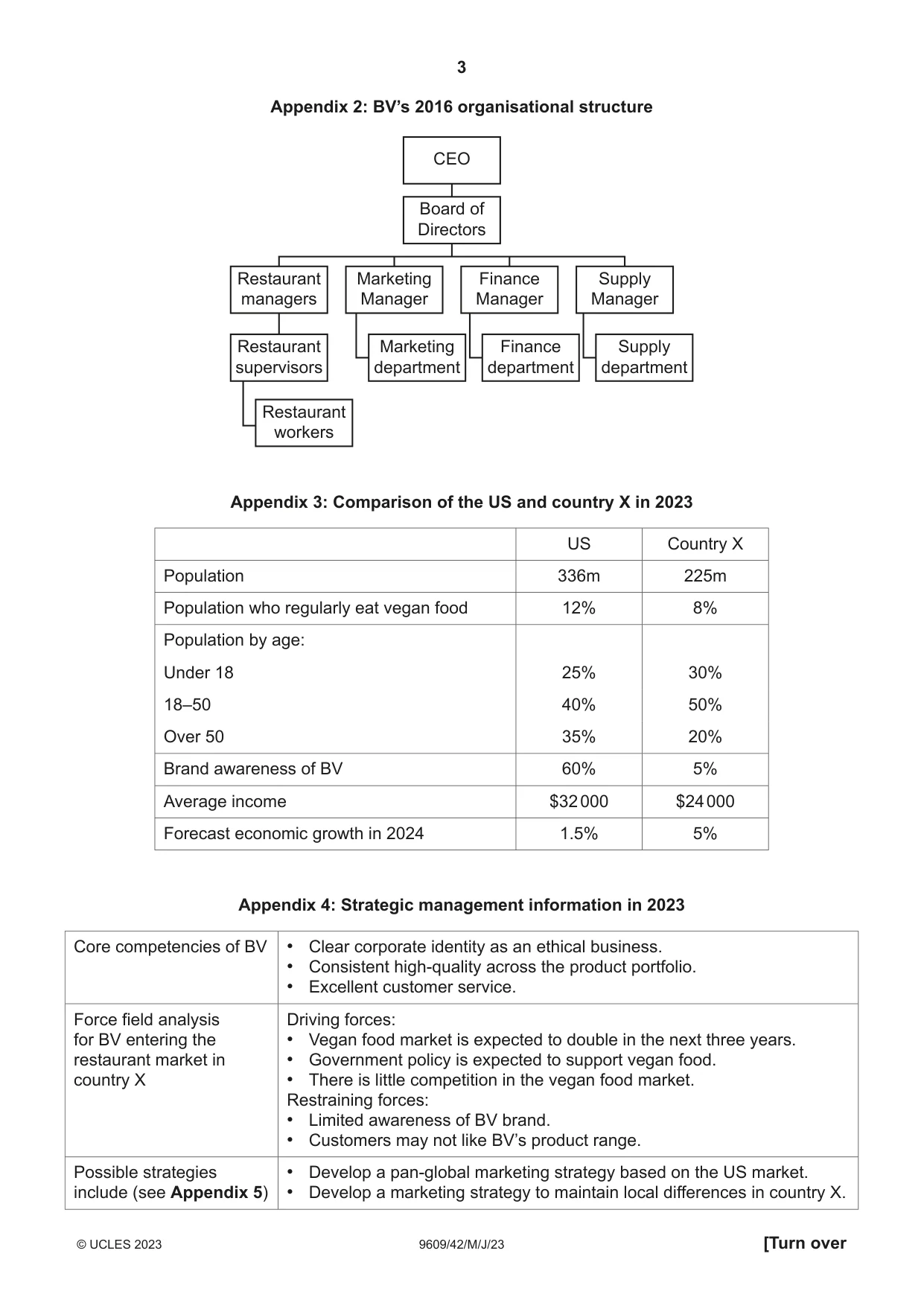
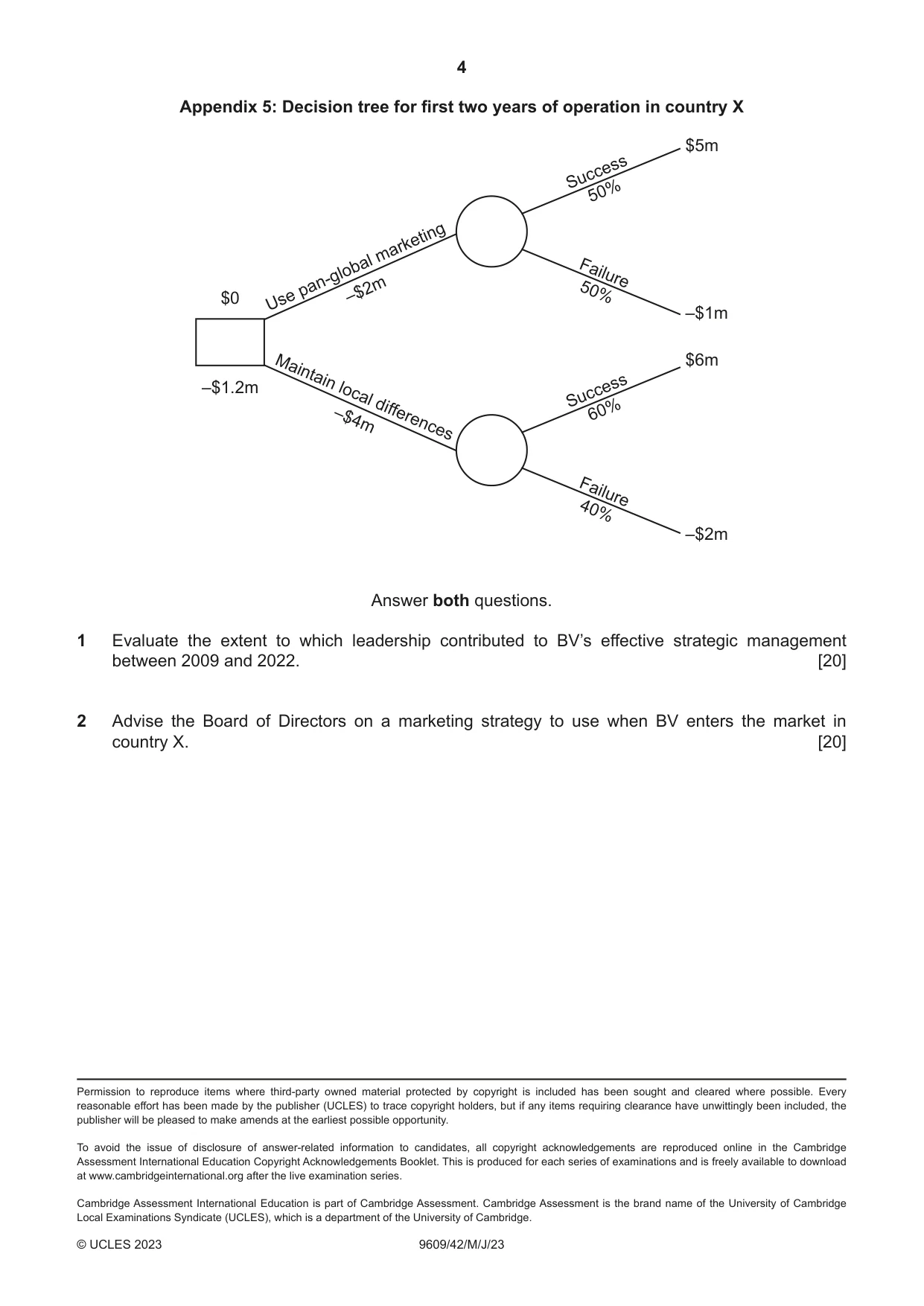
Mark scheme18 pages
Answers below. Sit the paper first if you are practising.
Questions as text
Q1 · Evaluate the extent to which leadership contributed to BV’s effective strategic…
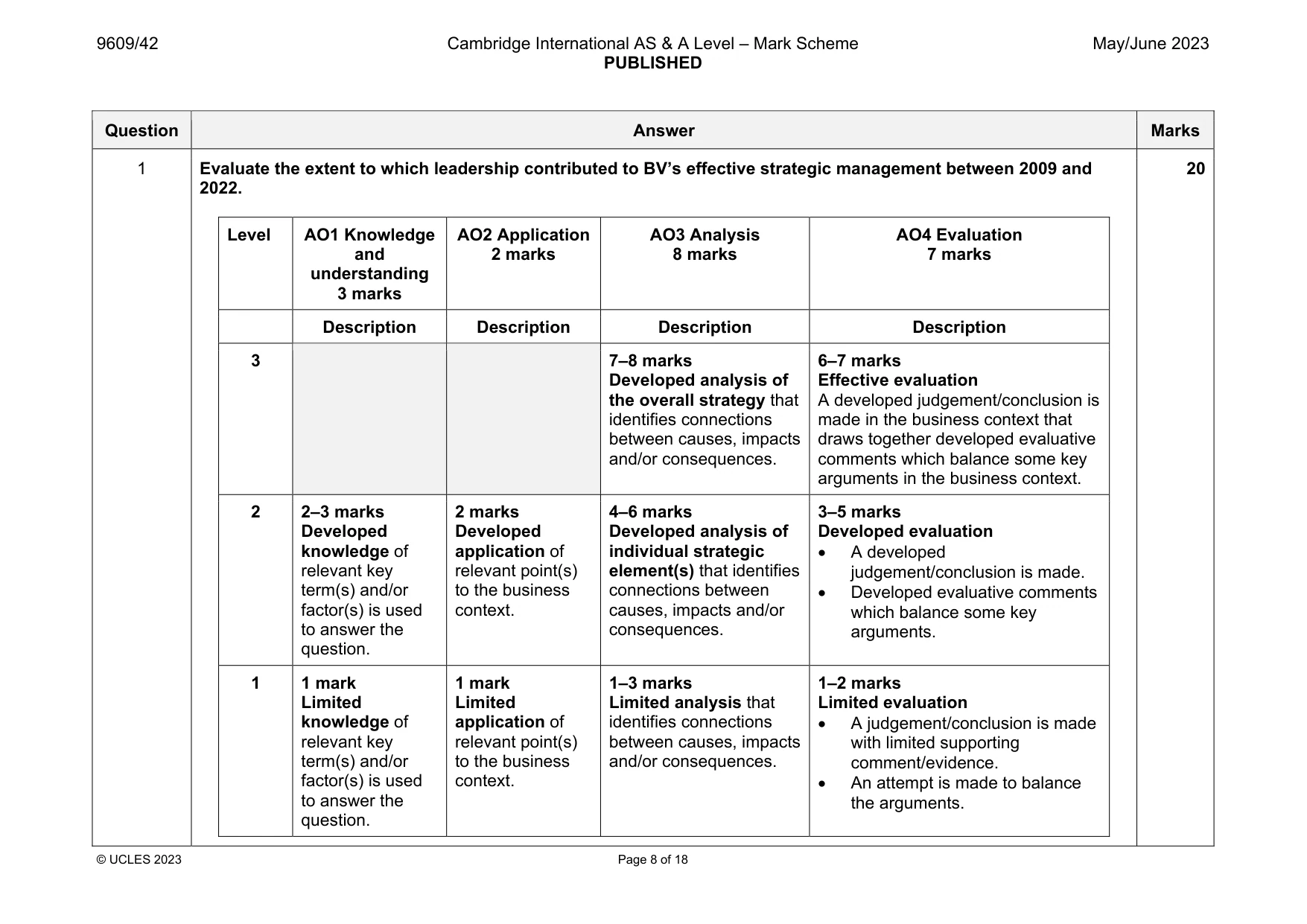
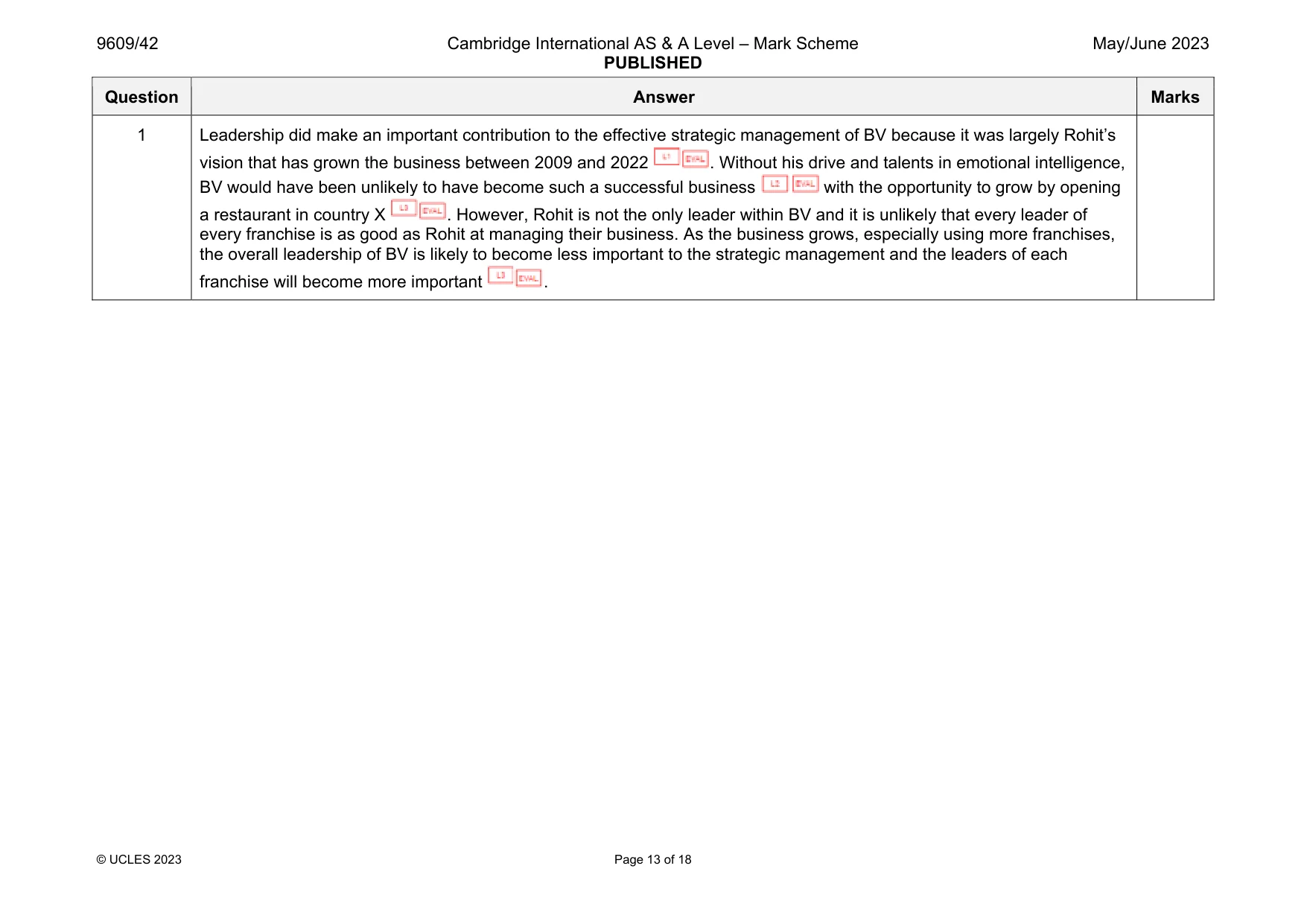
1 Evaluate the extent to which leadership contributed to BV’s effective strategic management between 2009 and 2022. [20]
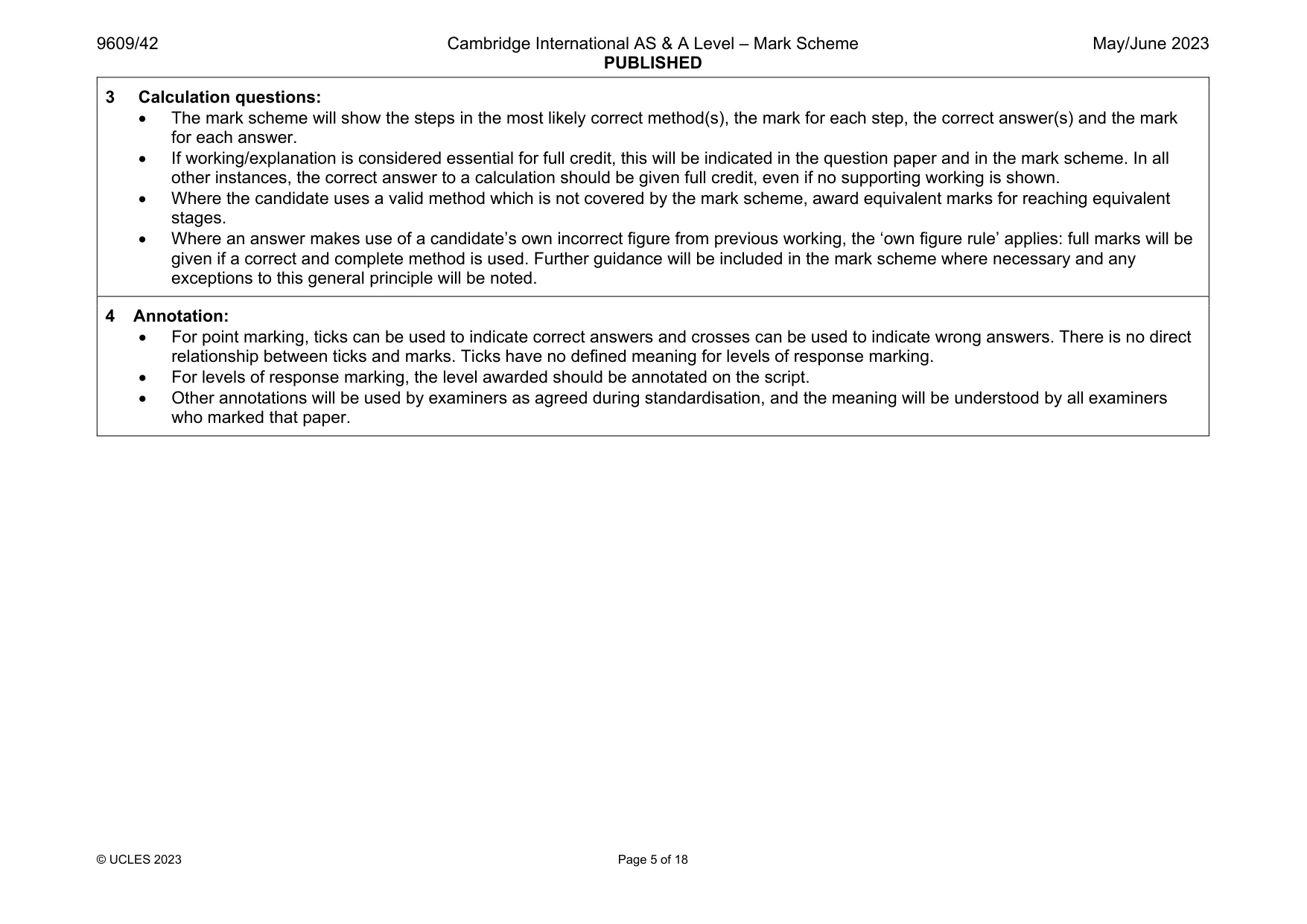
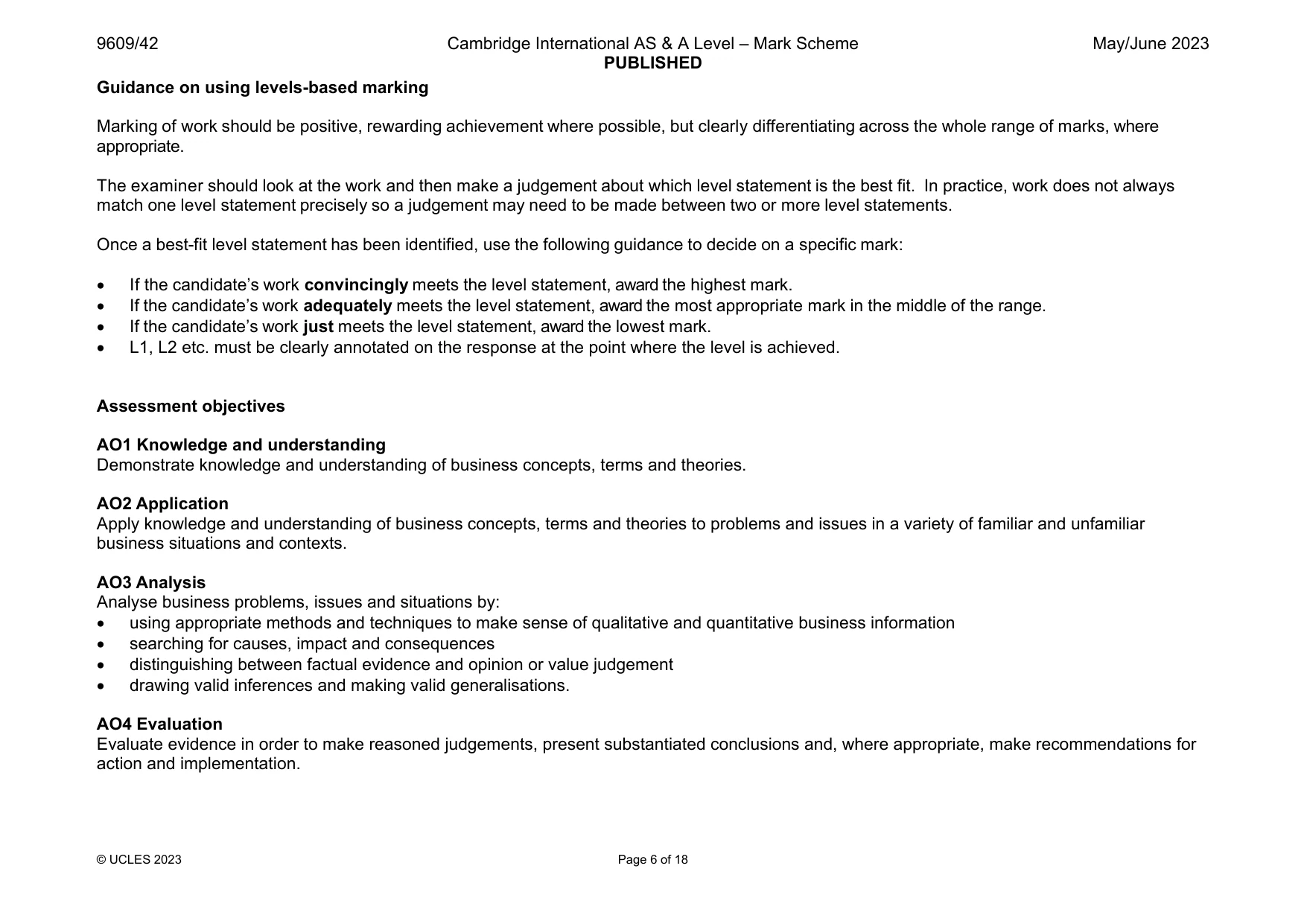
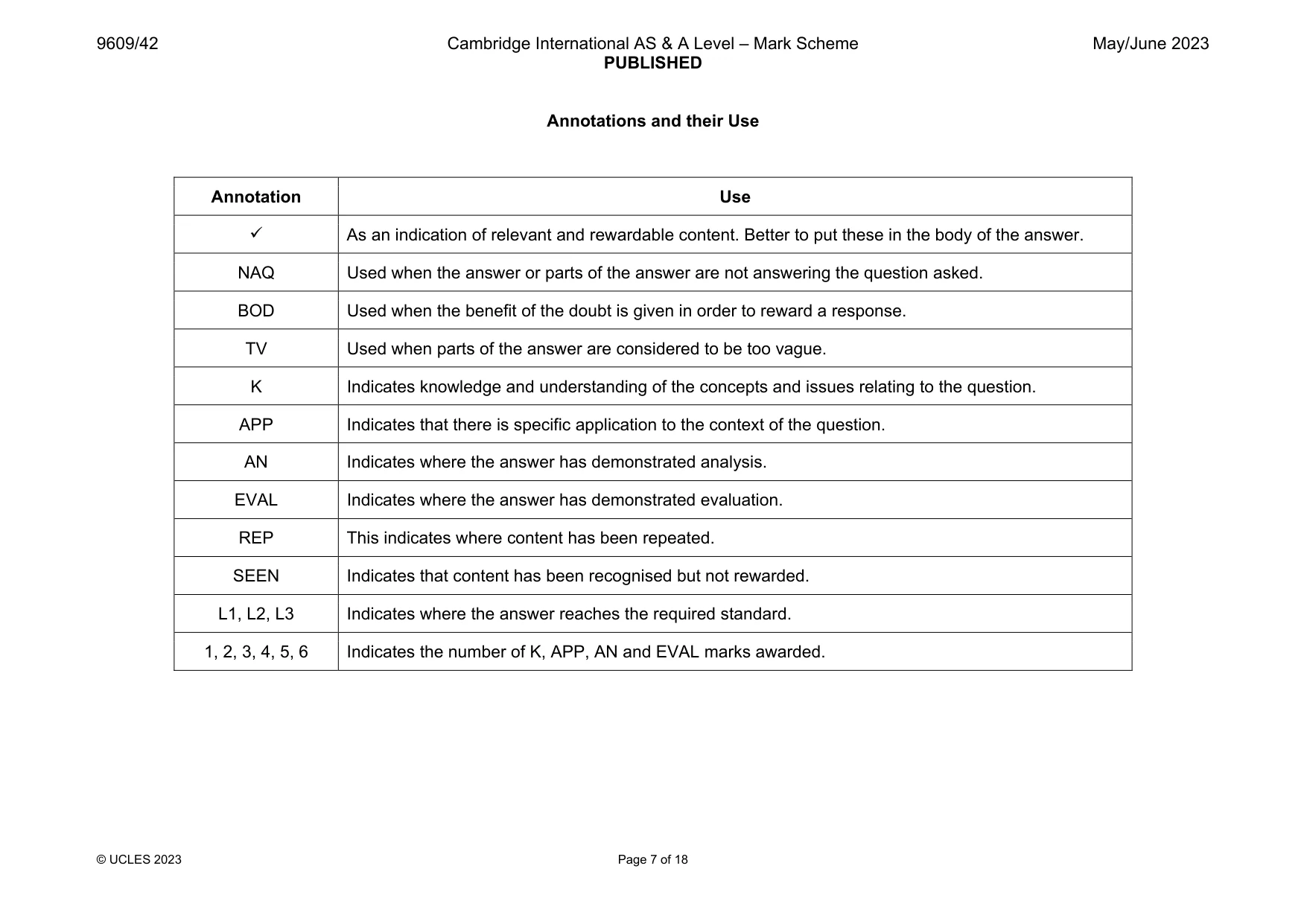
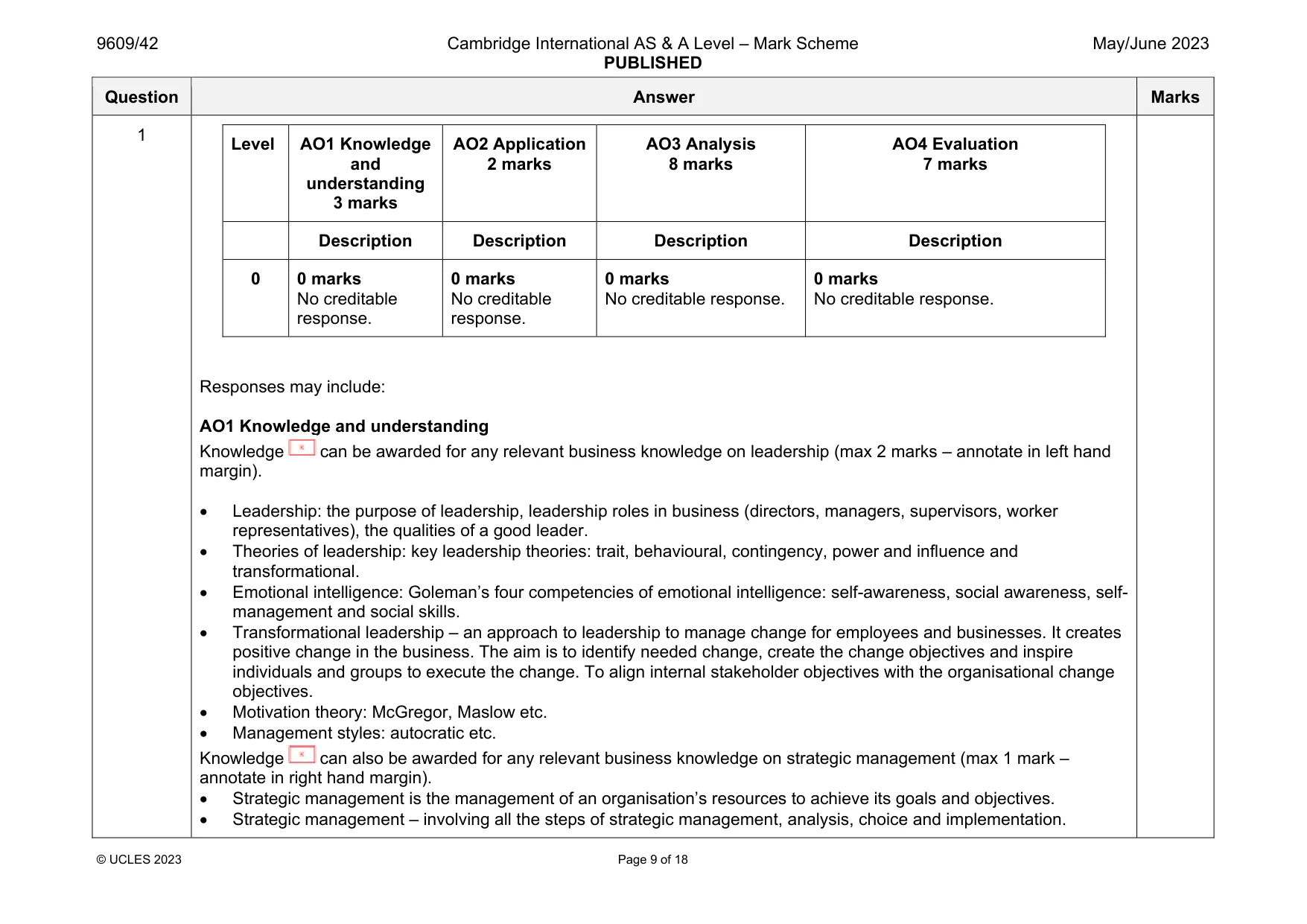
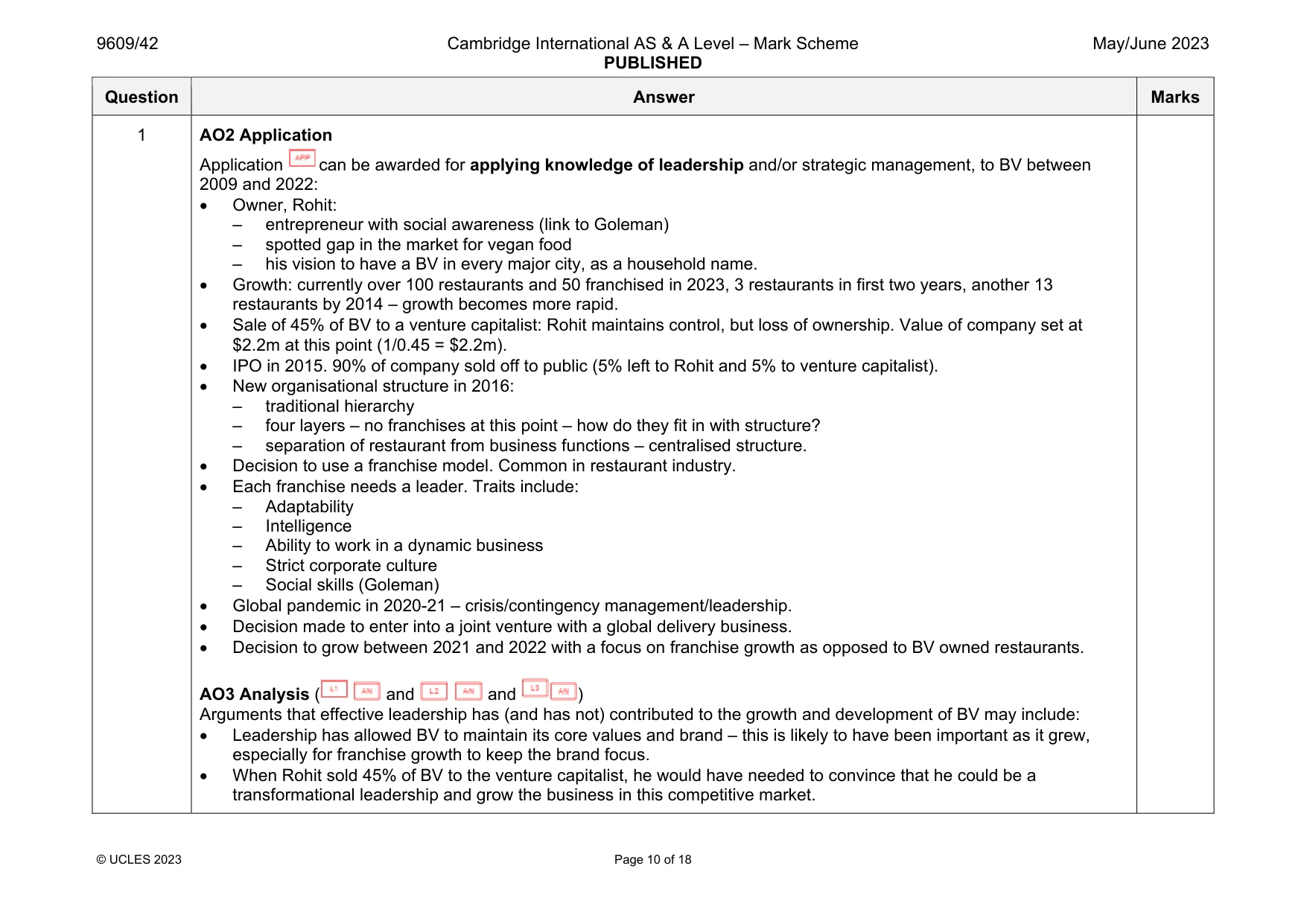
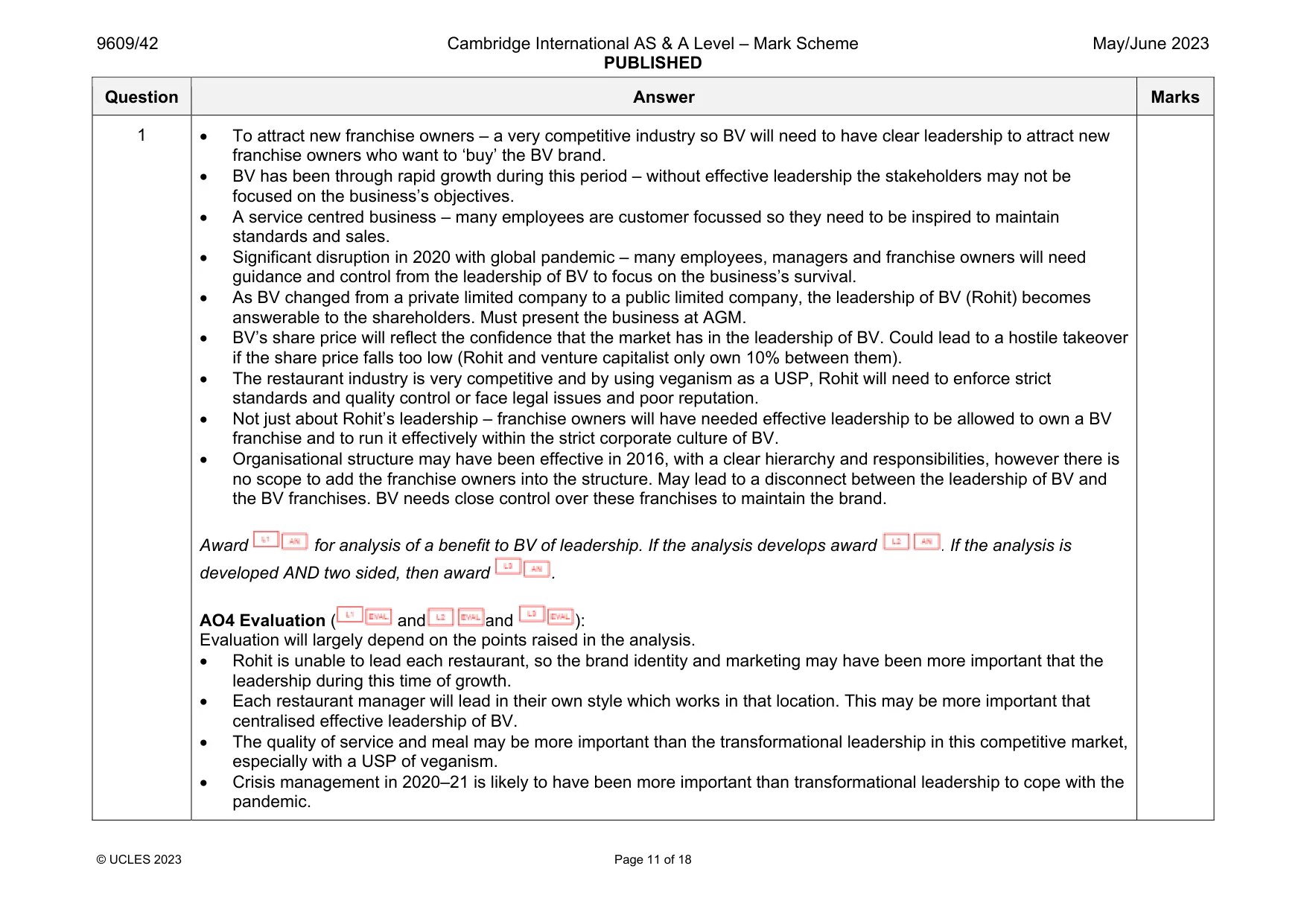
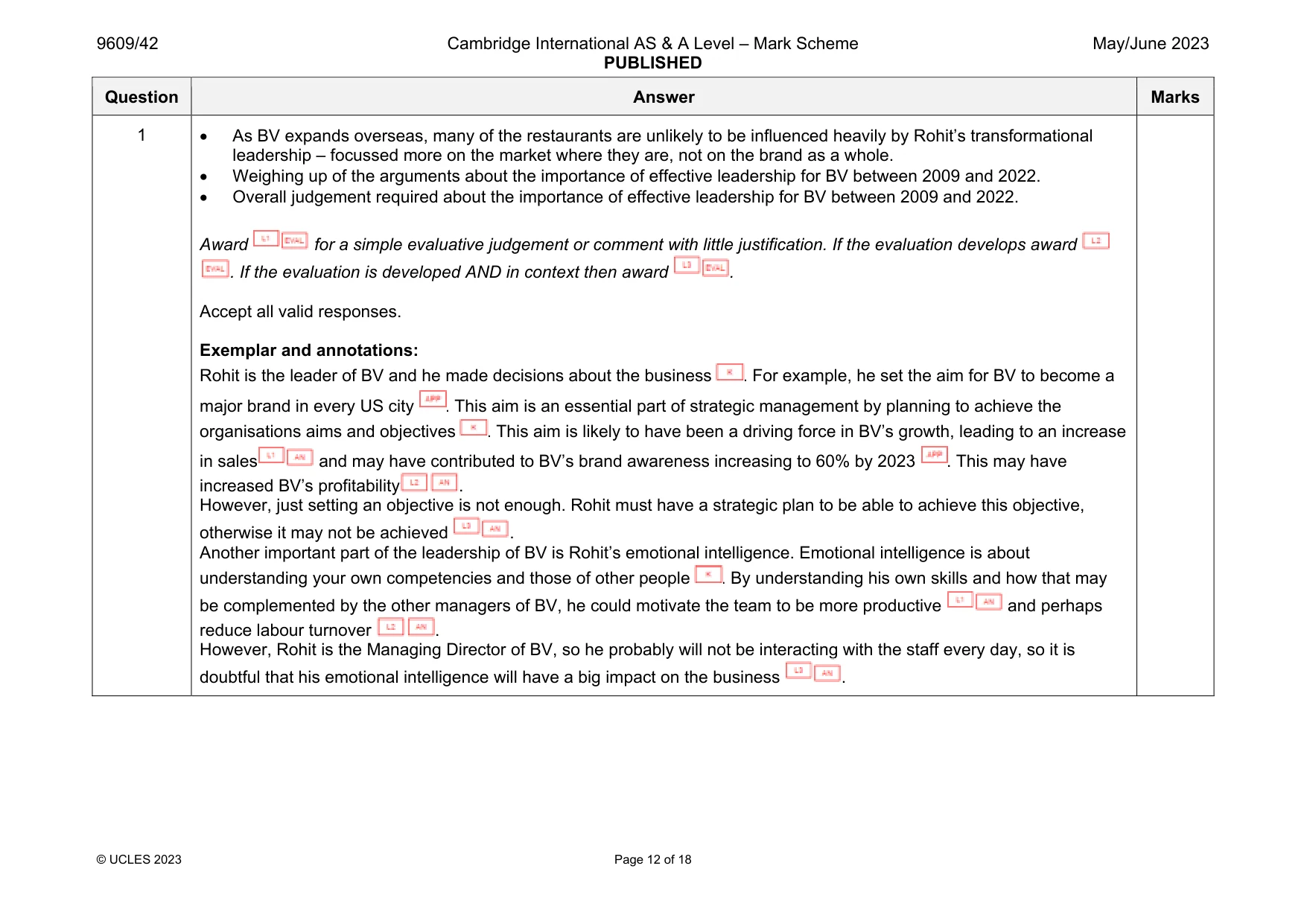
Mark scheme: 1 Evaluate the extent to which leadership contributed to BV’s effective strategic management between 2009 and 2022. Level AO1 Knowledge and understanding 3 marks AO2 Application 2 marks AO3 Analysis 8 marks AO4 Evaluation 7 marks Description Description Description Description 3 7–8 marks Developed analysis of the overall strategy that identifies connections between causes, impacts and/or consequences. 6–7 marks Effective evaluation A developed judgement/conclusion is made in the business context that draws together developed evaluative comments which balance some key arguments in the business context. 2 2–3 marks Developed knowledge of relevant key term(s) and/or factor(s) is used to answer the question. 2 marks Developed application of relevant point(s) to the business context. 4–6 marks Developed analysis of individual strategic element(s) that identifies connections between causes, impacts and/or consequences. 3–5 marks Developed evaluation A developed judgement/conclusion is made. Developed evaluative comments which balance some key arguments. 1 1 mark Limited knowledge of relevant key term(s) and/or factor(s) is used to answer the question. 1 mark Limited application of relevant point(s) to the business context. 1–3 marks Limited analysis that identifies connections between causes, impacts and/or consequences. 1–2 marks Limited evaluation A judgement/conclusion is made with limited supporting comment/evidence. An attempt is made to balance the arguments. 20 Question Answer Marks 1 Level AO1 Knowledge and understanding 3 marks AO2 Application 2 marks AO3 Analysis 8 marks AO4 Evaluation 7 marks Description Description Description Description 0 0 marks No creditable response. 0 marks No creditable response. 0 marks No creditable response. 0 marks No creditable response. Responses may include: AO1 Knowledge and understanding Knowledge can be awarded for any relevant business knowledge on leadership (max 2 marks – annotate in left hand margin). Leadership: the purpose of leadership, leadership roles in business (directors, managers, supervisors, worker representatives), the qualities of a good leader. Theories of leadership: key leadership theories: trait, behavioural, contingency, power and influence and transformational. Emotional intelligence: Goleman’s four competencies of emotional intelligence: self-awareness, social awareness, self- management and social skills. Transformational leadership – an approach to leadership to manage change for employees and businesses. It creates positive change in the business. The aim is to identify needed change, create the change objectives and inspire individuals and groups to execute the change. To align internal stakeholder objectives with the organisational change objectives. Motivation theory: McGregor, Maslow etc. Management styles: autocratic etc. Knowledge can also be awarded for any relevant business knowledge on strategic management (max 1 mark – annotate in right hand margin). Strategic management is the management of an organisation’s resources to achieve its goals and objectives. Strategic management – involving all the steps of strategic management, analysis, choice and implementation. Question Answer Marks 1 AO2 Application Application can be awarded for applying knowledge of leadership and/or strategic management, to BV between 2009 and 2022: Owner, Rohit: – entrepreneur with social awareness (link to Goleman) – spotted gap in the market for vegan food – his vision to have a BV in every major city, as a household name. Growth: currently over 100 restaurants and 50 franchised in 2023, 3 restaurants in first two years, another 13 restaurants by 2014 – growth becomes more rapid. Sale of 45% of BV to a venture capitalist: Rohit maintains control, but loss of ownership. Value of company set at $2.2m at this point (1/0.45 = $2.2m). IPO in 2015. 90% of company sold off to public (5% left to Rohit and 5% to venture capitalist). New organisational structure in 2016: – traditional hierarchy – four layers – no franchises at this point – how do they fit in with structure? – separation of restaurant from business functions – centralised structure. Decision to use a franchise model. Common in restaurant industry. Each franchise needs a leader. Traits include: – Adaptability – Intelligence – Ability to work in a dynamic business – Strict corporate culture – Social skills (Goleman) Global pandemic in 2020-21 – crisis/contingency management/leadership. Decision made to enter into a joint venture with a global delivery business. Decision to grow between 2021 and 2022 with a focus on franchise growth as opposed to BV owned restaurants. AO3 Analysis ( and and ) Arguments that effective leadership has (and has not) contributed to the growth and development of BV may include: Leadership has allowed BV to maintain its core values and brand – this is likely to have been important as it grew, especially for franchise growth to keep the brand focus. When Rohit sold 45% of BV to the venture capitalist, he would have needed to convince that he could be a transformational leadership and grow the business in this competitive market. Question Answer Marks 1 To attract new franchise owners – a very competitive industry so BV will need to have clear leadership to attract new franchise owners who want to ‘buy’ the BV brand. BV has been through rapid growth during this period – without effective leadership the stakeholders may not be focused on the business’s objectives. A service centred business – many employees are customer focussed so they need to be inspired to maintain standards and sales. Significant disruption in 2020 with global pandemic – many employees, managers and franchise owners will need guidance and control from the leadership of BV to focus on the business’s survival. As BV changed from a private limited company to a public limited company, the leadership of BV (Rohit) becomes answerable to the shareholders. Must present the business at AGM. BV’s share price will reflect the confidence that the market has in the leadership of BV. Could lead to a hostile takeover if the share price falls too low (Rohit and venture capitalist only own 10% between them). The restaurant industry is very competitive and by using veganism as a USP, Rohit will need to enforce strict standards and quality control or face legal issues and poor reputation. Not just about Rohit’s leadership – franchise owners will have needed effective leadership to be allowed to own a BV franchise and to run it effectively within the strict corporate culture of BV. Organisational structure may have been effective in 2016, with a clear hierarchy and responsibilities, however there is no scope to add the franchise owners into the structure. May lead to a disconnect between the leadership of BV and the BV franchises. BV needs close control over these franchises to maintain the brand. Award for analysis of a benefit to BV of leadership. If the analysis develops award . If the analysis is developed AND two sided, then award . AO4 Evaluation ( and and ): Evaluation will largely depend on the points raised in the analysis. Rohit is unable to lead each restaurant, so the brand identity and marketing may have been more important that the leadership during this time of growth. Each restaurant manager will lead in their own style which works in that location. This may be more important that centralised effective leadership of BV. The quality of service and meal may be more important than the transformational leadership in this competitive market, especially with a USP of veganism. Crisis management in 2020–21 is likely to have been more important than transformational leadership to cope with the pandemic. Question Answer Marks 1 As BV expands overseas, many of the restaurants are unlikely to be influenced heavily by Rohit’s transformational leadership – focussed more on the market where they are, not on the brand as a whole. Weighing up of the arguments about the importance of effective leadership for BV between 2009 and 2022. Overall judgement required about the importance of effective leadership for BV between 2009 and 2022. Award for a simple evaluative judgement or comment with little justification. If the evaluation develops award . If the evaluation is developed AND in context then award . Accept all valid responses. Exemplar and annotations: Rohit is the leader of BV and he made decisions about the business . For example, he set the aim for BV to become a major brand in every US city . This aim is an essential part of strategic management by planning to achieve the organisations aims and objectives . This aim is likely to have been a driving force in BV’s growth, leading to an increase in sales and may have contributed to BV’s brand awareness increasing to 60% by 2023 . This may have increased BV’s profitability . However, just setting an objective is not enough. Rohit must have a strategic plan to be able to achieve this objective, otherwise it may not be achieved . Another important part of the leadership of BV is Rohit’s emotional intelligence. Emotional intelligence is about understanding your own competencies and those of other people . By understanding his own skills and how that may be complemented by the other managers of BV, he could motivate the team to be more productive and perhaps reduce labour turnover . However, Rohit is the Managing Director of BV, so he probably will not be interacting with the staff every day, so it is doubtful that his emotional intelligence will have a big impact on the business . Question Answer Marks 1 Leadership did make an important contribution to the effective strategic management of BV because it was largely Rohit’s vision that has grown the business between 2009 and 2022 . Without his drive and talents in emotional intelligence, BV would have been unlikely to have become such a successful business with the opportunity to grow by opening a restaurant in country X . However, Rohit is not the only leader within BV and it is unlikely that every leader of every franchise is as good as Rohit at managing their business. As the business grows, especially using more franchises, the overall leadership of BV is likely to become less important to the strategic management and the leaders of each franchise will become more important .
Q2 · Advise the Board of Directors on a marketing strategy to use when BV enters the market in…
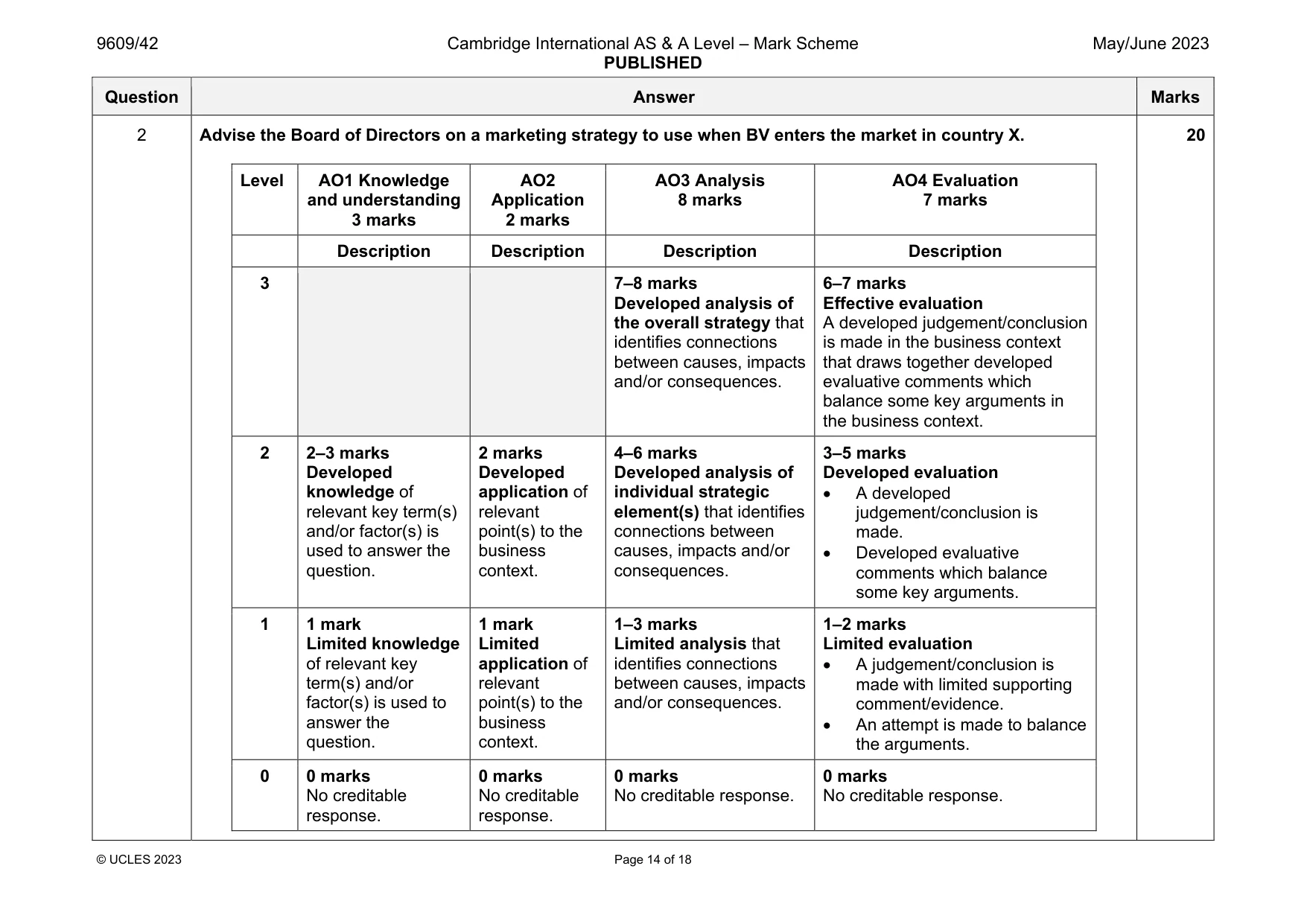
2 Advise the Board of Directors on a marketing strategy to use when BV enters the market in country X. [20]
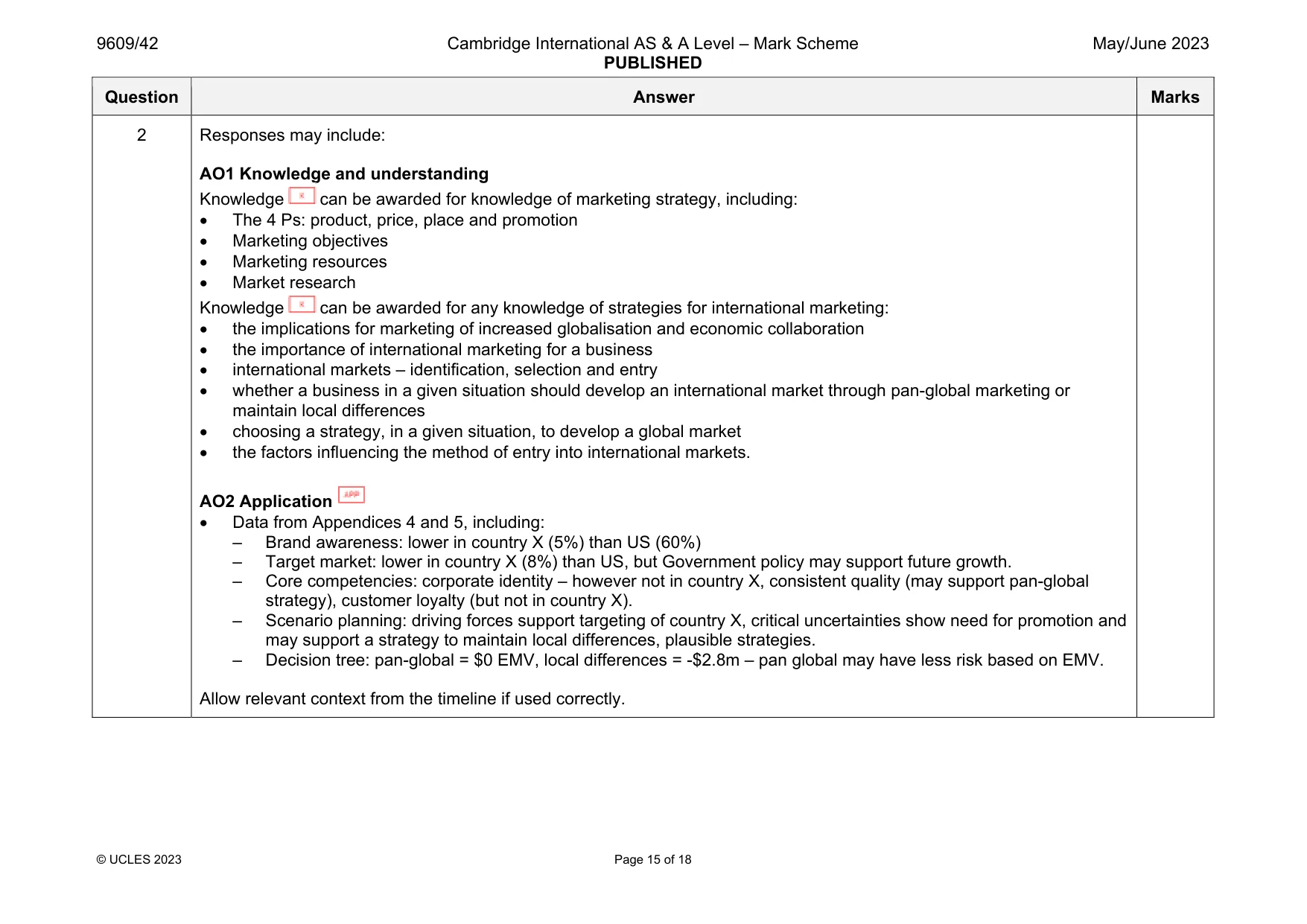
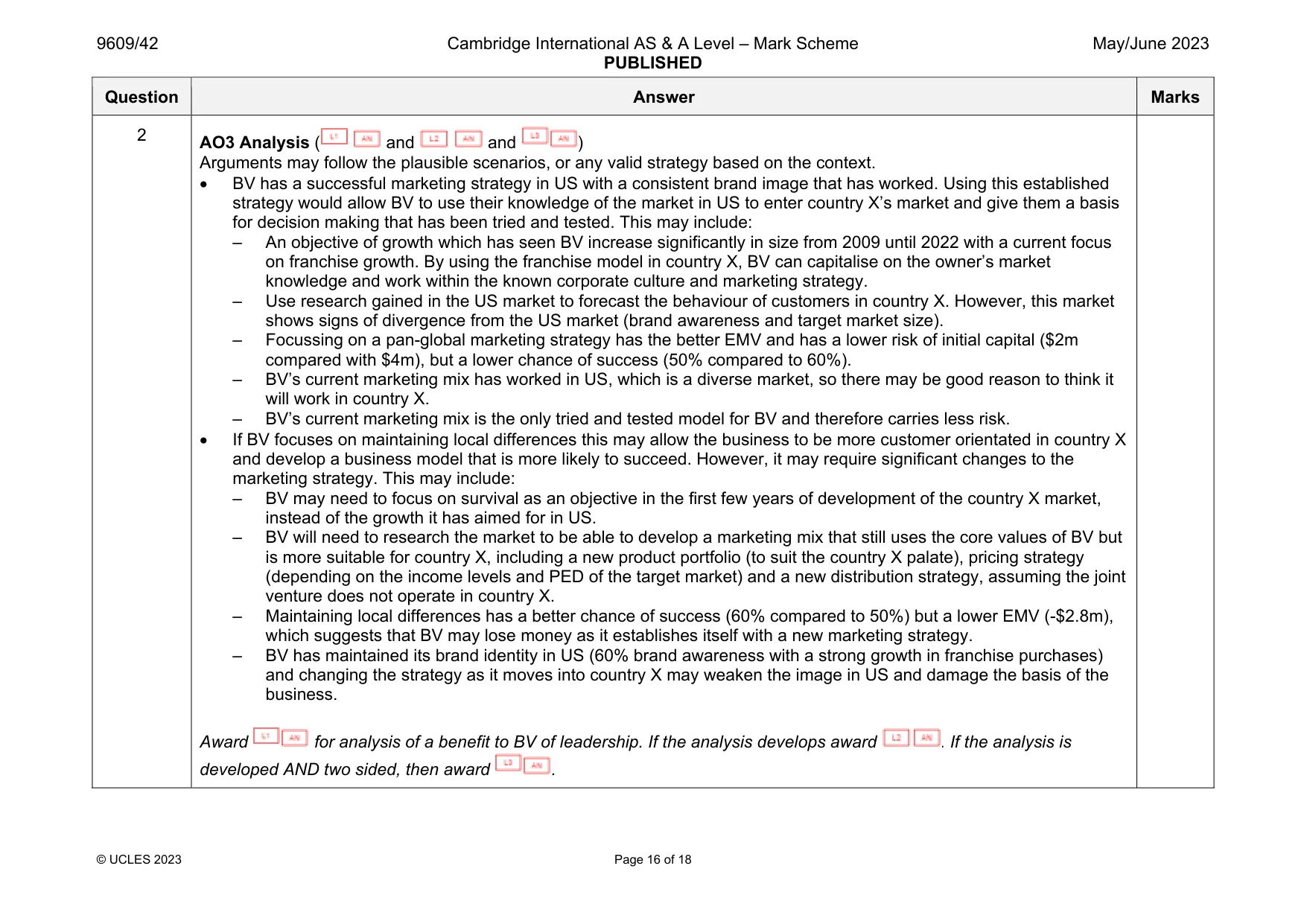
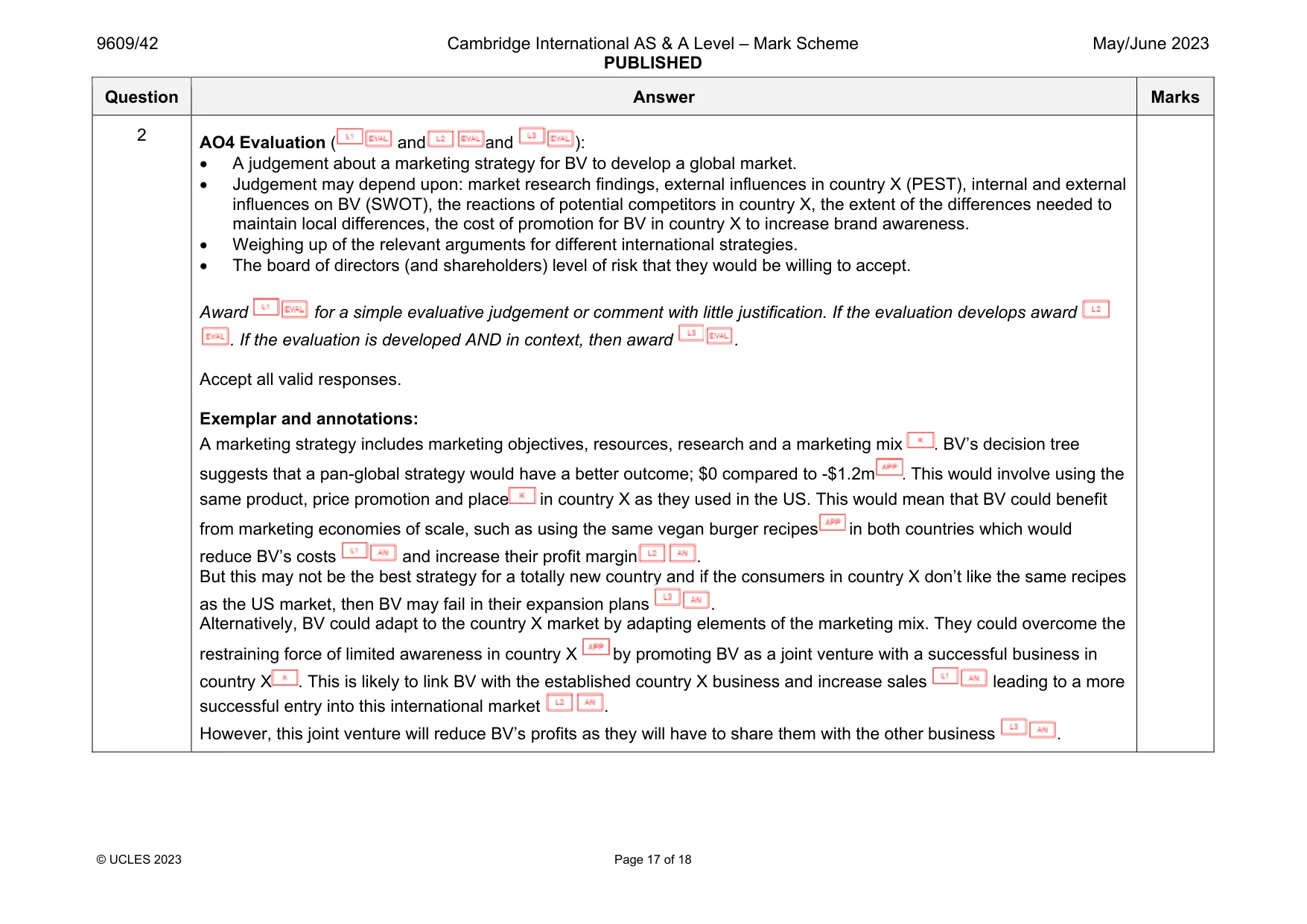
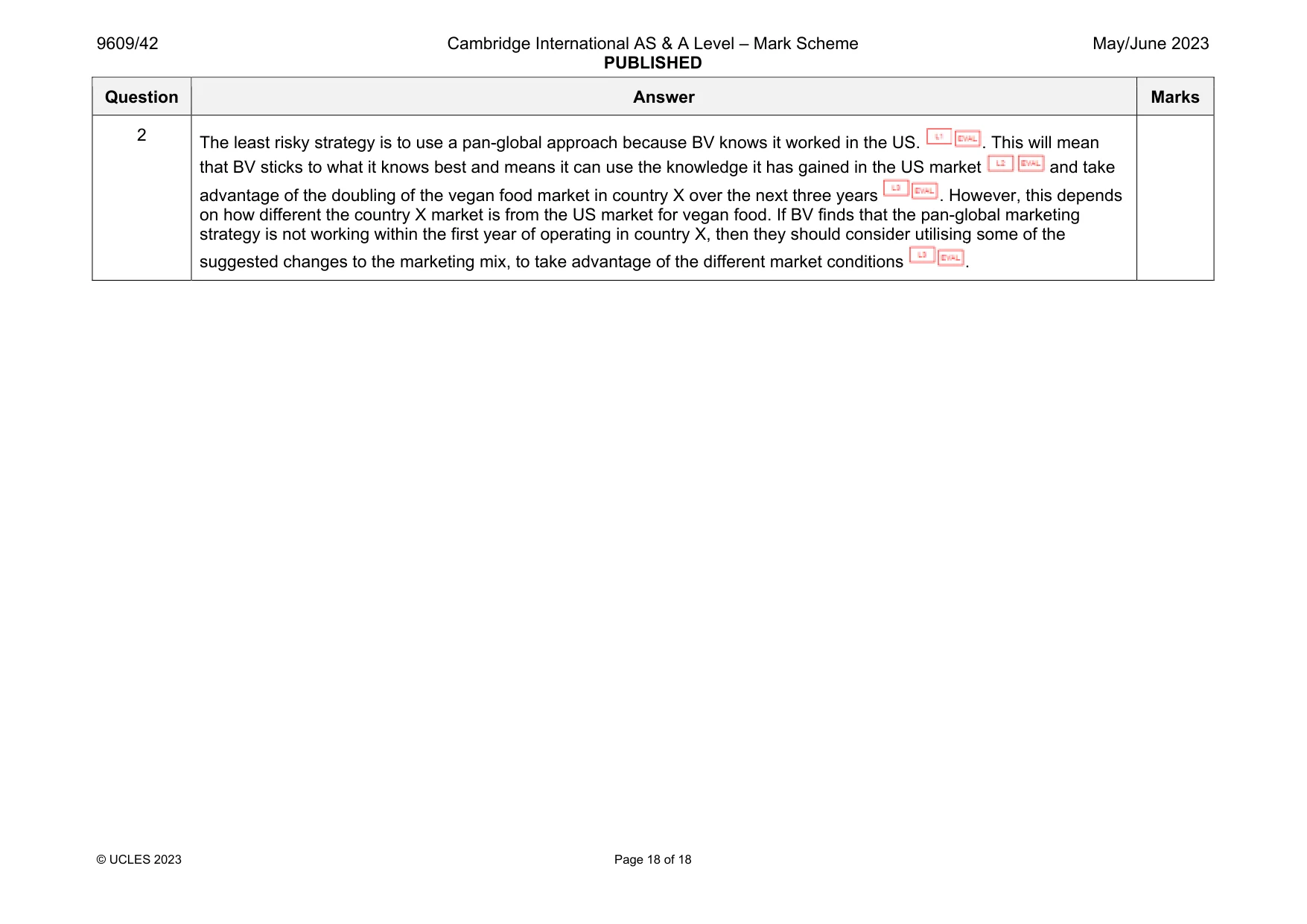
Mark scheme: 2 Advise the Board of Directors on a marketing strategy to use when BV enters the market in country X. Level AO1 Knowledge and understanding 3 marks AO2 Application 2 marks AO3 Analysis 8 marks AO4 Evaluation 7 marks Description Description Description Description 3 7–8 marks Developed analysis of the overall strategy that identifies connections between causes, impacts and/or consequences. 6–7 marks Effective evaluation A developed judgement/conclusion is made in the business context that draws together developed evaluative comments which balance some key arguments in the business context. 2 2–3 marks Developed knowledge of relevant key term(s) and/or factor(s) is used to answer the question. 2 marks Developed application of relevant point(s) to the business context. 4–6 marks Developed analysis of individual strategic element(s) that identifies connections between causes, impacts and/or consequences. 3–5 marks Developed evaluation A developed judgement/conclusion is made. Developed evaluative comments which balance some key arguments. 1 1 mark Limited knowledge of relevant key term(s) and/or factor(s) is used to answer the question. 1 mark Limited application of relevant point(s) to the business context. 1–3 marks Limited analysis that identifies connections between causes, impacts and/or consequences. 1–2 marks Limited evaluation A judgement/conclusion is made with limited supporting comment/evidence. An attempt is made to balance the arguments. 0 0 marks No creditable response. 0 marks No creditable response. 0 marks No creditable response. 0 marks No creditable response. 20 Question Answer Marks 2 Responses may include: AO1 Knowledge and understanding Knowledge can be awarded for knowledge of marketing strategy, including: The 4 Ps: product, price, place and promotion Marketing objectives Marketing resources Market research Knowledge can be awarded for any knowledge of strategies for international marketing: the implications for marketing of increased globalisation and economic collaboration the importance of international marketing for a business international markets – identification, selection and entry whether a business in a given situation should develop an international market through pan-global marketing or maintain local differences choosing a strategy, in a given situation, to develop a global market the factors influencing the method of entry into international markets. AO2 Application Data from Appendices 4 and 5, including: – Brand awareness: lower in country X (5%) than US (60%) – Target market: lower in country X (8%) than US, but Government policy may support future growth. – Core competencies: corporate identity – however not in country X, consistent quality (may support pan-global strategy), customer loyalty (but not in country X). – Scenario planning: driving forces support targeting of country X, critical uncertainties show need for promotion and may support a strategy to maintain local differences, plausible strategies. – Decision tree: pan-global = $0 EMV, local differences = -$2.8m – pan global may have less risk based on EMV. Allow relevant context from the timeline if used correctly. Question Answer Marks 2 AO3 Analysis ( and and ) Arguments may follow the plausible scenarios, or any valid strategy based on the context. BV has a successful marketing strategy in US with a consistent brand image that has worked. Using this established strategy would allow BV to use their knowledge of the market in US to enter country X’s market and give them a basis for decision making that has been tried and tested. This may include: – An objective of growth which has seen BV increase significantly in size from 2009 until 2022 with a current focus on franchise growth. By using the franchise model in country X, BV can capitalise on the owner’s market knowledge and work within the known corporate culture and marketing strategy. – Use research gained in the US market to forecast the behaviour of customers in country X. However, this market shows signs of divergence from the US market (brand awareness and target market size). – Focussing on a pan-global marketing strategy has the better EMV and has a lower risk of initial capital ($2m compared with $4m), but a lower chance of success (50% compared to 60%). – BV’s current marketing mix has worked in US, which is a diverse market, so there may be good reason to think it will work in country X. – BV’s current marketing mix is the only tried and tested model for BV and therefore carries less risk. If BV focuses on maintaining local differences this may allow the business to be more customer orientated in country X and develop a business model that is more likely to succeed. However, it may require significant changes to the marketing strategy. This may include: – BV may need to focus on survival as an objective in the first few years of development of the country X market, instead of the growth it has aimed for in US. – BV will need to research the market to be able to develop a marketing mix that still uses the core values of BV but is more suitable for country X, including a new product portfolio (to suit the country X palate), pricing strategy (depending on the income levels and PED of the target market) and a new distribution strategy, assuming the joint venture does not operate in country X. – Maintaining local differences has a better chance of success (60% compared to 50%) but a lower EMV (-$2.8m), which suggests that BV may lose money as it establishes itself with a new marketing strategy. – BV has maintained its brand identity in US (60% brand awareness with a strong growth in franchise purchases) and changing the strategy as it moves into country X may weaken the image in US and damage the basis of the business. Award for analysis of a benefit to BV of leadership. If the analysis develops award . If the analysis is developed AND two sided, then award . Question Answer Marks 2 AO4 Evaluation ( and and ): A judgement about a marketing strategy for BV to develop a global market. Judgement may depend upon: market research findings, external influences in country X (PEST), internal and external influences on BV (SWOT), the reactions of potential competitors in country X, the extent of the differences needed to maintain local differences, the cost of promotion for BV in country X to increase brand awareness. Weighing up of the relevant arguments for different international strategies. The board of directors (and shareholders) level of risk that they would be willing to accept. Award for a simple evaluative judgement or comment with little justification. If the evaluation develops award . If the evaluation is developed AND in context, then award . Accept all valid responses. Exemplar and annotations: A marketing strategy includes marketing objectives, resources, research and a marketing mix . BV’s decision tree suggests that a pan-global strategy would have a better outcome; $0 compared to -$1.2m . This would involve using the same product, price promotion and place in country X as they used in the US. This would mean that BV could benefit from marketing economies of scale, such as using the same vegan burger recipes in both countries which would reduce BV’s costs and increase their profit margin . But this may not be the best strategy for a totally new country and if the consumers in country X don’t like the same recipes as the US market, then BV may fail in their expansion plans . Alternatively, BV could adapt to the country X market by adapting elements of the marketing mix. They could overcome the restraining force of limited awareness in country X by promoting BV as a joint venture with a successful business in country X . This is likely to link BV with the established country X business and increase sales leading to a more successful entry into this international market . However, this joint venture will reduce BV’s profits as they will have to share them with the other business . Question Answer Marks 2 The least risky strategy is to use a pan-global approach because BV knows it worked in the US. . This will mean that BV sticks to what it knows best and means it can use the knowledge it has gained in the US market and take advantage of the doubling of the vegan food market in country X over the next three years . However, this depends on how different the country X market is from the US market for vegan food. If BV finds that the pan-global marketing strategy is not working within the first year of operating in country X, then they should consider utilising some of the suggested changes to the marketing mix, to take advantage of the different market conditions .
What was in this paper
The subtopics covered by these 2 questions, and how many questions each got. Open one in a new tab to see every Cambridge question on it.
What you needed in this session
Cambridge’s own grade thresholds for 2023 May/June, Paper 4 · Variant 2. A higher threshold means an easier paper — the bar moves with how the cohort did.