Cambridge A Level Business (for first examination in 2016) 9609 — 2021 Oct/Nov Paper 3 · Variant 2
9609/32/O/N/21 · 100 marks · ≈113 min
The question paper and its mark scheme, free to read here and free to download. This is Cambridge’s own paper, exactly as it was sat.
Question paper20 pages


















Mark scheme22 pages
Answers below. Sit the paper first if you are practising.


Paper as text
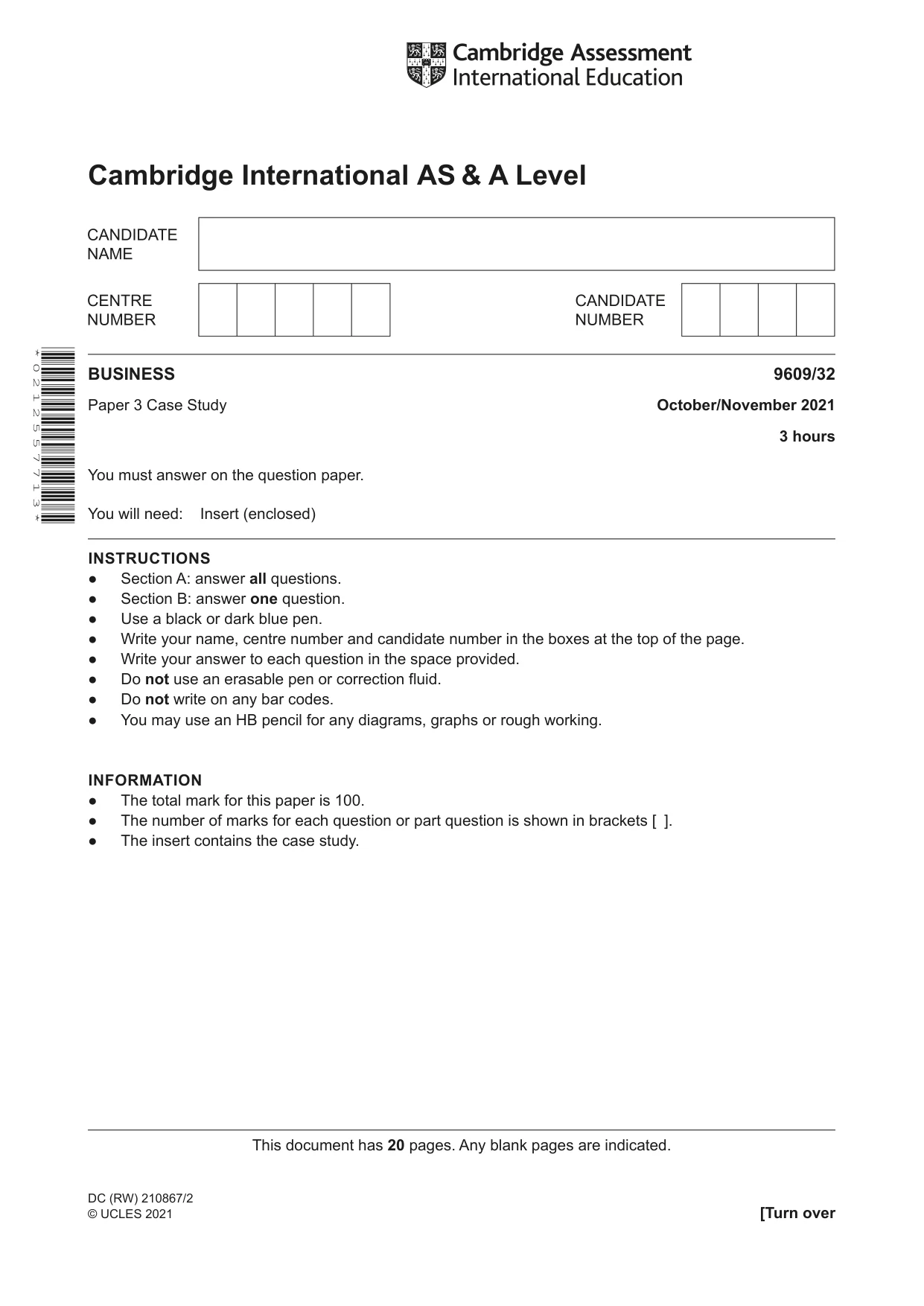
Question paper, page 1
This document has 20 pages. Any blank pages are indicated. DC (RW) 210867/2 © UCLES 2021 [Turn over * 0 2 1 2 5 5 7 7 1 3 * BUSINESS 9609/32 Paper 3 Case Study October/November 2021 3 hours You must answer on the question paper. You will need: Insert (enclosed) INSTRUCTIONS ● Section A: answer all questions. ● Section B: answer one question. ● Use a black or dark blue pen. ● Write your name, centre number and candidate number in the boxes at the top of the page. ● Write your answer to each question in the space provided. ● Do not use an erasable pen or correction fluid. ● Do not write on any bar codes. ● You may use an HB pencil for any diagrams, graphs or rough working. INFORMATION ● The total mark for this paper is 100. ● The number of marks for each question or part question is shown in brackets [ ]. ● The insert contains the case study. Cambridge International AS & A Level
Question paper, page 2
2 9609/32/O/N/21 © UCLES 2021 Answer all questions in Section A and answer one question in Section B. You are advised to spend no more than 40 minutes on Section B. Section A Answer all questions in this section. 1 Analyse the benefits of changing to a decentralised organisational structure as AC continues to expand. … … … … … … … … … … … … … … … … … … … … … … …
Question paper, page 3
3 9609/32/O/N/21 © UCLES 2021 [Turn over … … … … … … … … … … … … … … … … … … … … … … … … … … … … [10]
Question paper, page 4
4 9609/32/O/N/21 © UCLES 2021 2 (a) Refer to Table 1. Calculate for 2021 the: (i) return on capital employed (ROCE) … … … … … … … … … … … … [4] (ii) gearing ratio … … … … … … … … … [3] (iii) current ratio. … … … … … … [2]
Question paper, page 5
5 9609/32/O/N/21 © UCLES 2021 [Turn over (b) You may refer to your results from 2(a) and other information. Evaluate whether Omar and his family should convert the business to a public limited company (plc). … … … … … … … … … … … … … … … … … … … … … … … … … … …
Question paper, page 6
6 9609/32/O/N/21 © UCLES 2021 … … … … … … … … … … … … … … … … … … … … … … … … … … … … [12]
Question paper, page 7
7 9609/32/O/N/21 © UCLES 2021 [Turn over 3 Recommend a possible marketing strategy for AC to enter the consumer fitness equipment market. Justify your recommendation. … … … … … … … … … … … … … … … … … … … … … … … … … … …
Question paper, page 8
8 9609/32/O/N/21 © UCLES 2021 … … … … … … … … … … … … … … … … … … … … … … … … … … … …
Question paper, page 9
9 9609/32/O/N/21 © UCLES 2021 [Turn over … … … … … … … … … … … … … … … … … … … … … … … … … … … … [16]
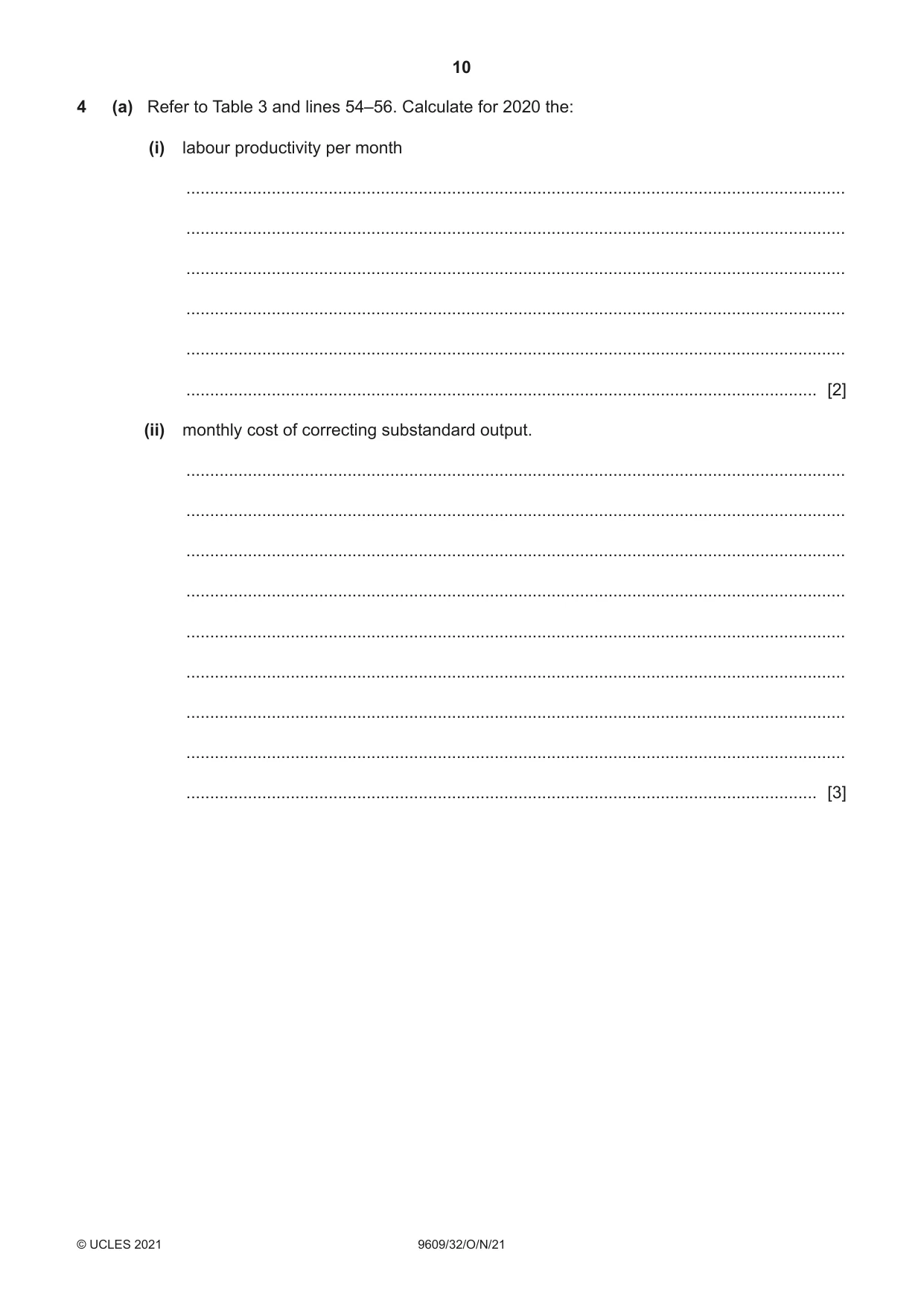
Question paper, page 10
10 9609/32/O/N/21 © UCLES 2021 4 (a) Refer to Table 3 and lines 54–56. Calculate for 2020 the: (i) labour productivity per month … … … … … … [2] (ii) monthly cost of correcting substandard output. … … … … … … … … … [3]
Question paper, page 11
11 9609/32/O/N/21 © UCLES 2021 [Turn over (b) Evaluate whether the introduction of Total Quality Management (TQM) will be sufficient to solve the problems faced in the factory. … … … … … … … … … … … … … … … … … … … … … … … … … … …
Question paper, page 12
12 9609/32/O/N/21 © UCLES 2021 … … … … … … … … … … … … … … … … … … … … … … … … … … … … [12]
Question paper, page 13
13 9609/32/O/N/21 © UCLES 2021 [Turn over 5 Evaluate the likely impact on AC’s future profitability of the forecast economic changes in Appendix 1. … … … … … … … … … … … … … … … … … … … … … … … … … … …
Question paper, page 14
14 9609/32/O/N/21 © UCLES 2021 … … … … … … … … … … … … … … … … … … … … … … … … … … … …
Question paper, page 15
15 9609/32/O/N/21 © UCLES 2021 [Turn over … … … … … … … … … … … … … … … … … … … … … … … … … … … … [16]
Question paper, page 16
16 9609/32/O/N/21 © UCLES 2021 Section B Answer one question in this section. 6 Evaluate whether the use of the techniques in Appendix 2 will eliminate risk for AC when choosing a growth strategy. 7 Evaluate the importance of developing a change culture to the successful implementation of option 2. Write the question number here: … … … … … … … … … … … … … … … … … … … … … … …
Question paper, page 17
17 9609/32/O/N/21 © UCLES 2021 [Turn over … … … … … … … … … … … … … … … … … … … … … … … … … … … …
Question paper, page 18
18 9609/32/O/N/21 © UCLES 2021 … … … … … … … … … … … … … … … … … … … … … … … … … … … …
Question paper, page 19
19 9609/32/O/N/21 © UCLES 2021 … … … … … … … … … … … … … … … … … … … … … … … … … … … … [20]
Question paper, page 20
20 9609/32/O/N/21 © UCLES 2021 Permission to reproduce items where third-party owned material protected by copyright is included has been sought and cleared where possible. Every reasonable effort has been made by the publisher (UCLES) to trace copyright holders, but if any items requiring clearance have unwittingly been included, the publisher will be pleased to make amends at the earliest possible opportunity. To avoid the issue of disclosure of answer-related information to candidates, all copyright acknowledgements are reproduced online in the Cambridge Assessment International Education Copyright Acknowledgements Booklet. This is produced for each series of examinations and is freely available to download at www.cambridgeinternational.org after the live examination series. Cambridge Assessment International Education is part of the Cambridge Assessment Group. Cambridge Assessment is the brand name of the University of Cambridge Local Examinations Syndicate (UCLES), which itself is a department of the University of Cambridge. BLANK PAGE
Mark scheme, page 1
This document consists of 22 printed pages. © UCLES 2021 [Turn over Cambridge International AS & A Level BUSINESS 9609/32 Paper 3 Case Study October/November 2021 MARK SCHEME Maximum Mark: 100 Published This mark scheme is published as an aid to teachers and candidates, to indicate the requirements of the examination. It shows the basis on which Examiners were instructed to award marks. It does not indicate the details of the discussions that took place at an Examiners’ meeting before marking began, which would have considered the acceptability of alternative answers. Mark schemes should be read in conjunction with the question paper and the Principal Examiner Report for Teachers. Cambridge International will not enter into discussions about these mark schemes. Cambridge International is publishing the mark schemes for the October/November 2021 series for most Cambridge IGCSE™, Cambridge International A and AS Level components and some Cambridge O Level components.
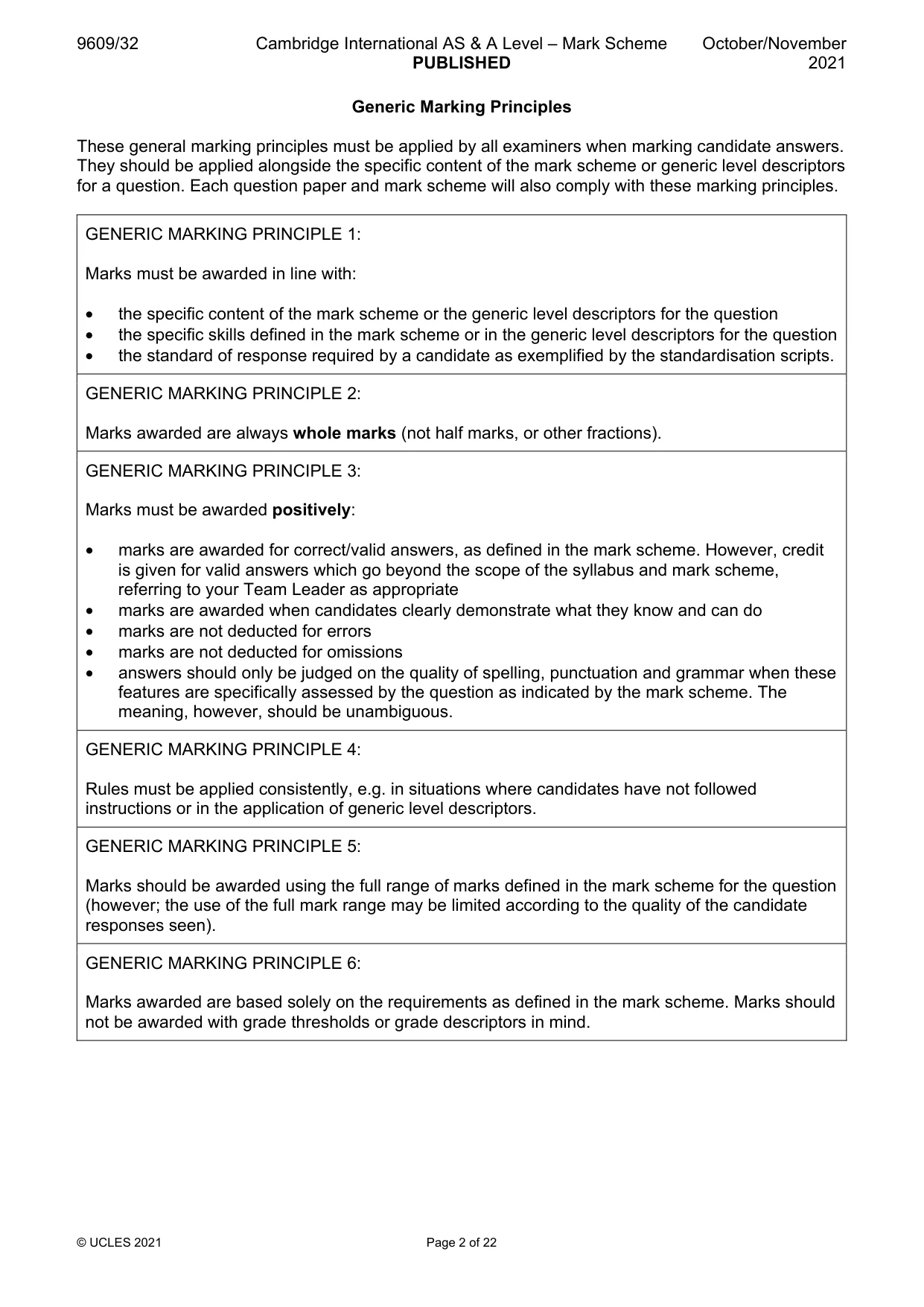
Mark scheme, page 2
9609/32 Cambridge International AS & A Level – Mark Scheme PUBLISHED October/November 2021 © UCLES 2021 Page 2 of 22 Generic Marking Principles These general marking principles must be applied by all examiners when marking candidate answers. They should be applied alongside the specific content of the mark scheme or generic level descriptors for a question. Each question paper and mark scheme will also comply with these marking principles. GENERIC MARKING PRINCIPLE 1: Marks must be awarded in line with: • the specific content of the mark scheme or the generic level descriptors for the question • the specific skills defined in the mark scheme or in the generic level descriptors for the question • the standard of response required by a candidate as exemplified by the standardisation scripts. GENERIC MARKING PRINCIPLE 2: Marks awarded are always whole marks (not half marks, or other fractions). GENERIC MARKING PRINCIPLE 3: Marks must be awarded positively: • marks are awarded for correct/valid answers, as defined in the mark scheme. However, credit is given for valid answers which go beyond the scope of the syllabus and mark scheme, referring to your Team Leader as appropriate • marks are awarded when candidates clearly demonstrate what they know and can do • marks are not deducted for errors • marks are not deducted for omissions • answers should only be judged on the quality of spelling, punctuation and grammar when these features are specifically assessed by the question as indicated by the mark scheme. The meaning, however, should be unambiguous. GENERIC MARKING PRINCIPLE 4: Rules must be applied consistently, e.g. in situations where candidates have not followed instructions or in the application of generic level descriptors. GENERIC MARKING PRINCIPLE 5: Marks should be awarded using the full range of marks defined in the mark scheme for the question (however; the use of the full mark range may be limited according to the quality of the candidate responses seen). GENERIC MARKING PRINCIPLE 6: Marks awarded are based solely on the requirements as defined in the mark scheme. Marks should not be awarded with grade thresholds or grade descriptors in mind.
Mark scheme, page 3
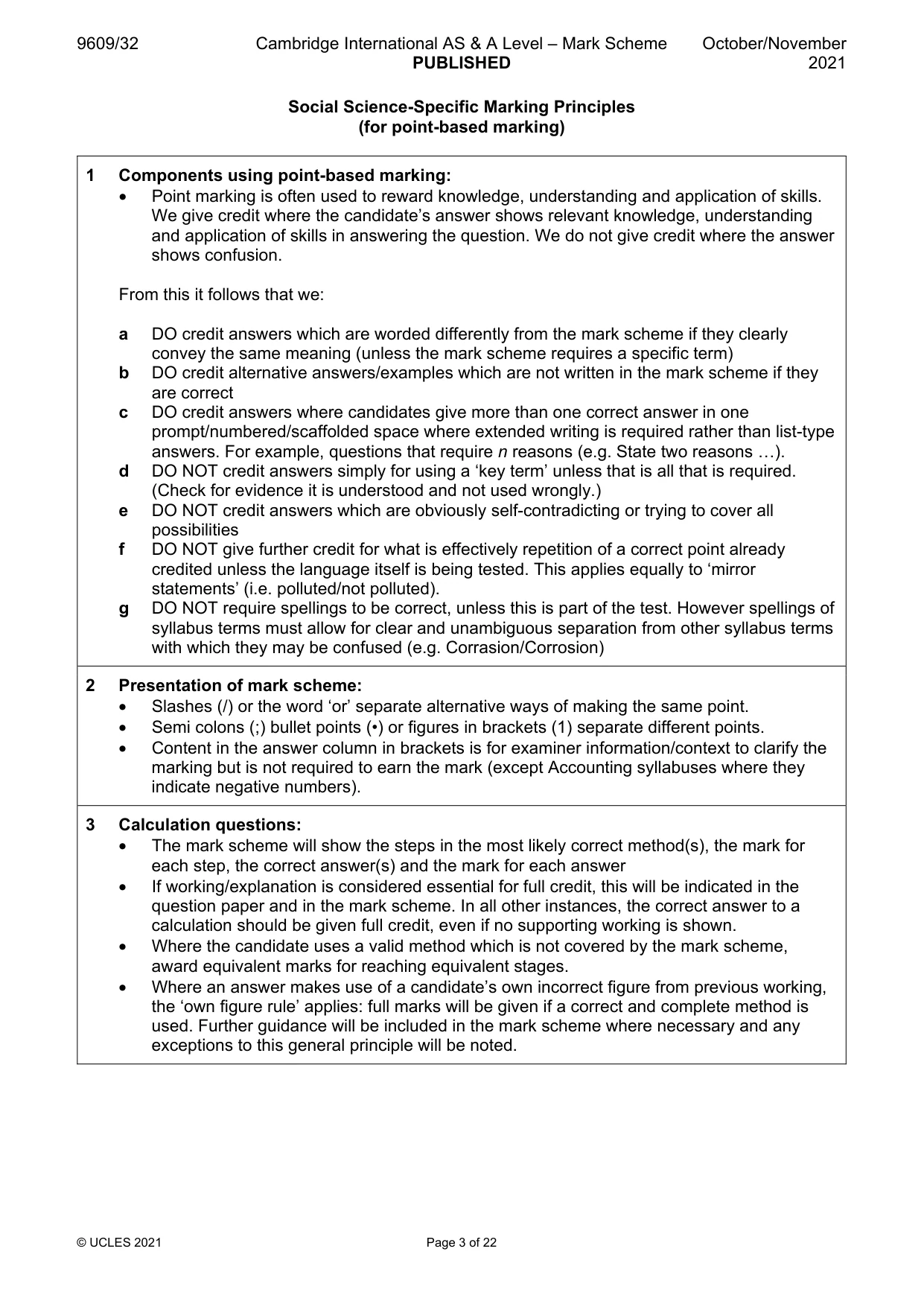
9609/32 Cambridge International AS & A Level – Mark Scheme PUBLISHED October/November 2021 © UCLES 2021 Page 3 of 22 Social Science-Specific Marking Principles (for point-based marking) 1 Components using point-based marking: • Point marking is often used to reward knowledge, understanding and application of skills. We give credit where the candidate’s answer shows relevant knowledge, understanding and application of skills in answering the question. We do not give credit where the answer shows confusion. From this it follows that we: a DO credit answers which are worded differently from the mark scheme if they clearly convey the same meaning (unless the mark scheme requires a specific term) b DO credit alternative answers/examples which are not written in the mark scheme if they are correct c DO credit answers where candidates give more than one correct answer in one prompt/numbered/scaffolded space where extended writing is required rather than list-type answers. For example, questions that require n reasons (e.g. State two reasons …). d DO NOT credit answers simply for using a ‘key term’ unless that is all that is required. (Check for evidence it is understood and not used wrongly.) e DO NOT credit answers which are obviously self-contradicting or trying to cover all possibilities f DO NOT give further credit for what is effectively repetition of a correct point already credited unless the language itself is being tested. This applies equally to ‘mirror statements’ (i.e. polluted/not polluted). g DO NOT require spellings to be correct, unless this is part of the test. However spellings of syllabus terms must allow for clear and unambiguous separation from other syllabus terms with which they may be confused (e.g. Corrasion/Corrosion) 2 Presentation of mark scheme: • Slashes (/) or the word ‘or’ separate alternative ways of making the same point. • Semi colons (;) bullet points (•) or figures in brackets (1) separate different points. • Content in the answer column in brackets is for examiner information/context to clarify the marking but is not required to earn the mark (except Accounting syllabuses where they indicate negative numbers). 3 Calculation questions: • The mark scheme will show the steps in the most likely correct method(s), the mark for each step, the correct answer(s) and the mark for each answer • If working/explanation is considered essential for full credit, this will be indicated in the question paper and in the mark scheme. In all other instances, the correct answer to a calculation should be given full credit, even if no supporting working is shown. • Where the candidate uses a valid method which is not covered by the mark scheme, award equivalent marks for reaching equivalent stages. • Where an answer makes use of a candidate’s own incorrect figure from previous working, the ‘own figure rule’ applies: full marks will be given if a correct and complete method is used. Further guidance will be included in the mark scheme where necessary and any exceptions to this general principle will be noted.
Mark scheme, page 4
9609/32 Cambridge International AS & A Level – Mark Scheme PUBLISHED October/November 2021 © UCLES 2021 Page 4 of 22 4 Annotation: • For point marking, ticks can be used to indicate correct answers and crosses can be used to indicate wrong answers. There is no direct relationship between ticks and marks. Ticks have no defined meaning for levels of response marking. • For levels of response marking, the level awarded should be annotated on the script. • Other annotations will be used by examiners as agreed during standardisation, and the meaning will be understood by all examiners who marked that paper.
Mark scheme, page 5
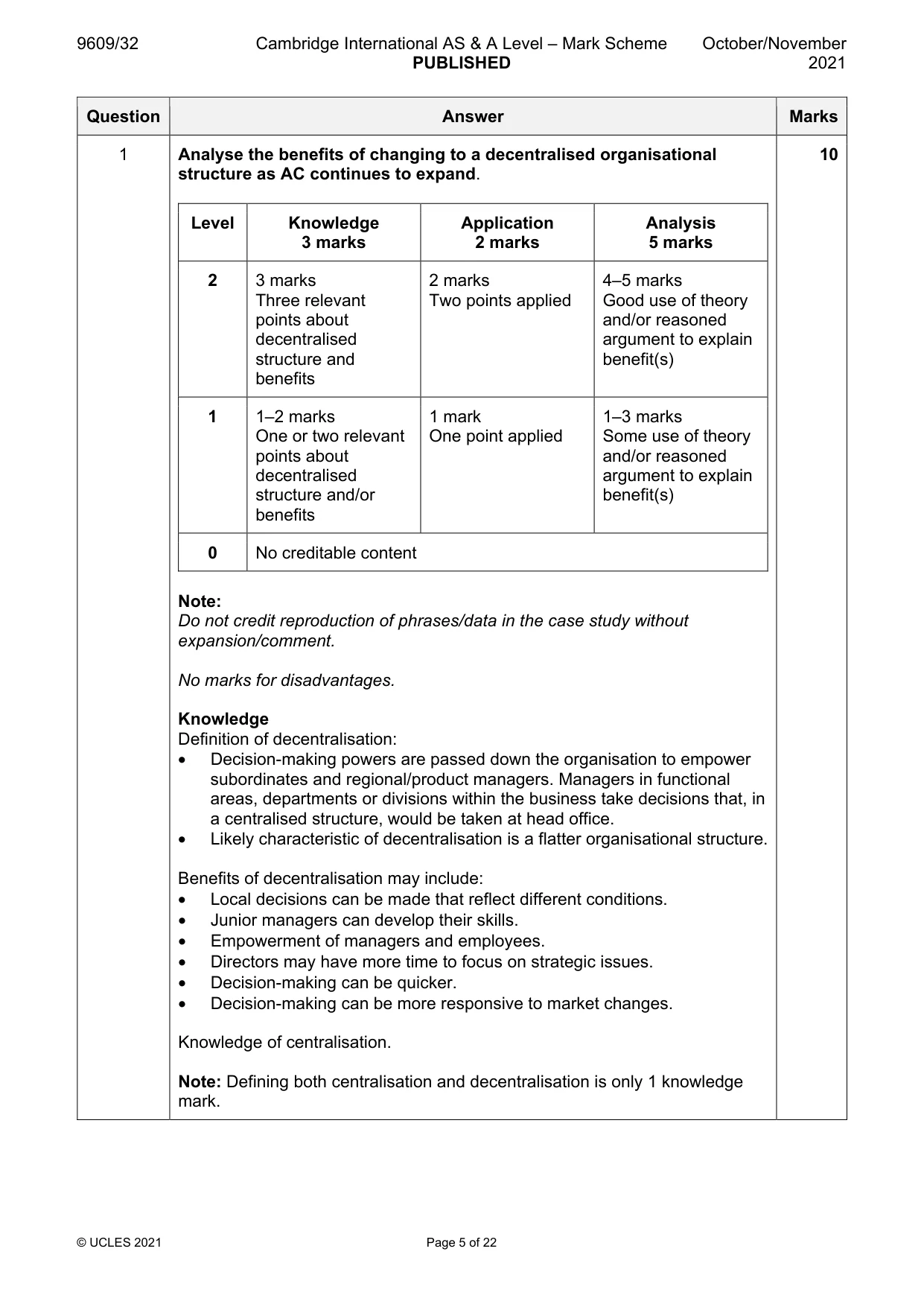
9609/32 Cambridge International AS & A Level – Mark Scheme PUBLISHED October/November 2021 © UCLES 2021 Page 5 of 22 Question Answer Marks 1 Analyse the benefits of changing to a decentralised organisational structure as AC continues to expand. Level Knowledge 3 marks Application 2 marks Analysis 5 marks 2 3 marks Three relevant points about decentralised structure and benefits 2 marks Two points applied 4–5 marks Good use of theory and/or reasoned argument to explain benefit(s) 1 1–2 marks One or two relevant points about decentralised structure and/or benefits 1 mark One point applied 1–3 marks Some use of theory and/or reasoned argument to explain benefit(s) 0 No creditable content Note: Do not credit reproduction of phrases/data in the case study without expansion/comment. No marks for disadvantages. Knowledge Definition of decentralisation: • Decision-making powers are passed down the organisation to empower subordinates and regional/product managers. Managers in functional areas, departments or divisions within the business take decisions that, in a centralised structure, would be taken at head office. • Likely characteristic of decentralisation is a flatter organisational structure. Benefits of decentralisation may include: • Local decisions can be made that reflect different conditions. • Junior managers can develop their skills. • Empowerment of managers and employees. • Directors may have more time to focus on strategic issues. • Decision-making can be quicker. • Decision-making can be more responsive to market changes. Knowledge of centralisation. Note: Defining both centralisation and decentralisation is only 1 knowledge mark. 10
Mark scheme, page 6
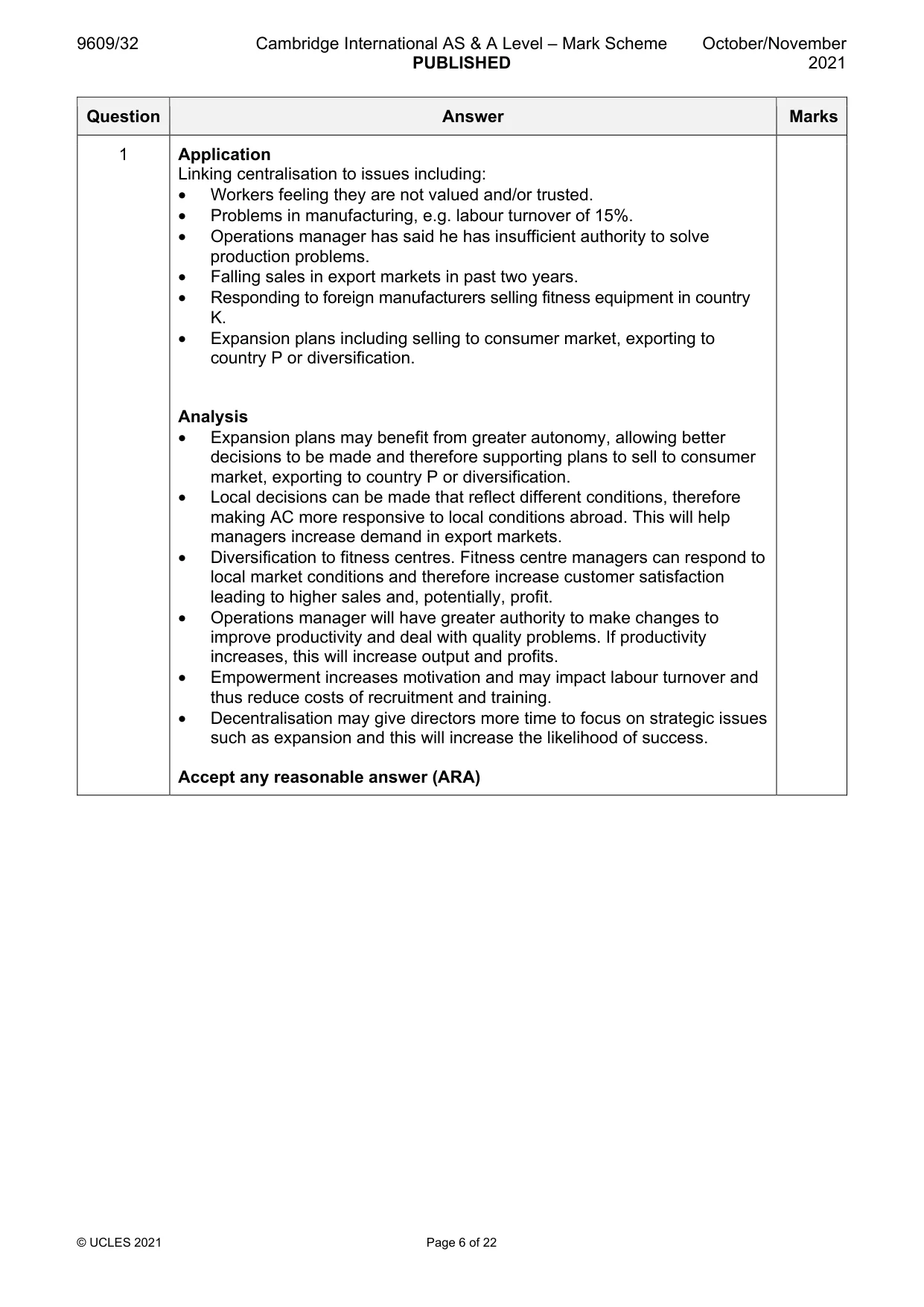
9609/32 Cambridge International AS & A Level – Mark Scheme PUBLISHED October/November 2021 © UCLES 2021 Page 6 of 22 Question Answer Marks 1 Application Linking centralisation to issues including: • Workers feeling they are not valued and/or trusted. • Problems in manufacturing, e.g. labour turnover of 15%. • Operations manager has said he has insufficient authority to solve production problems. • Falling sales in export markets in past two years. • Responding to foreign manufacturers selling fitness equipment in country K. • Expansion plans including selling to consumer market, exporting to country P or diversification. Analysis • Expansion plans may benefit from greater autonomy, allowing better decisions to be made and therefore supporting plans to sell to consumer market, exporting to country P or diversification. • Local decisions can be made that reflect different conditions, therefore making AC more responsive to local conditions abroad. This will help managers increase demand in export markets. • Diversification to fitness centres. Fitness centre managers can respond to local market conditions and therefore increase customer satisfaction leading to higher sales and, potentially, profit. • Operations manager will have greater authority to make changes to improve productivity and deal with quality problems. If productivity increases, this will increase output and profits. • Empowerment increases motivation and may impact labour turnover and thus reduce costs of recruitment and training. • Decentralisation may give directors more time to focus on strategic issues such as expansion and this will increase the likelihood of success. Accept any reasonable answer (ARA)
Mark scheme, page 7
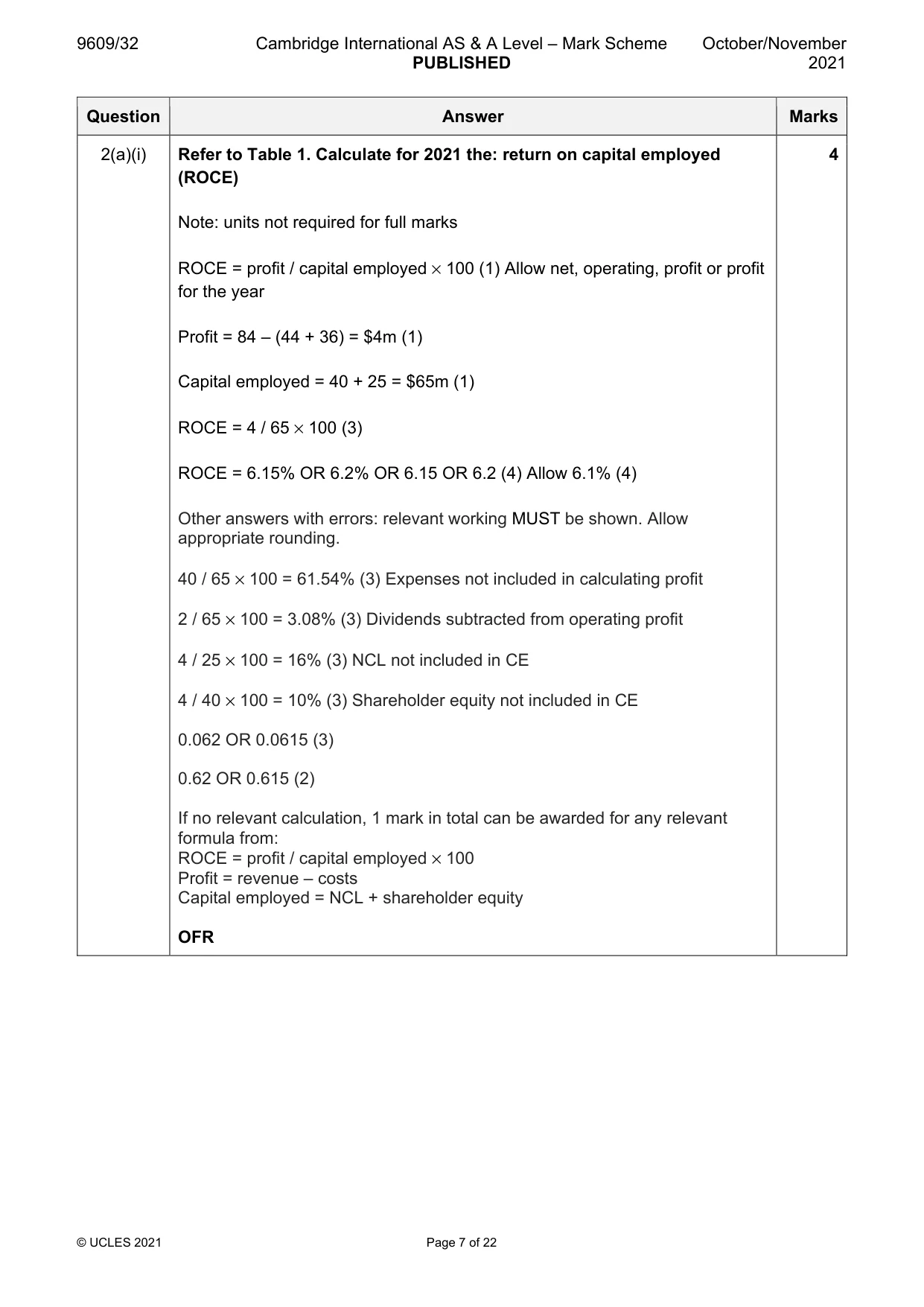
9609/32 Cambridge International AS & A Level – Mark Scheme PUBLISHED October/November 2021 © UCLES 2021 Page 7 of 22 Question Answer Marks 2(a)(i) Refer to Table 1. Calculate for 2021 the: return on capital employed (ROCE) Note: units not required for full marks ROCE = profit / capital employed × 100 (1) Allow net, operating, profit or profit for the year Profit = 84 – (44 + 36) = $4m (1) Capital employed = 40 + 25 = $65m (1) ROCE = 4 / 65 × 100 (3) ROCE = 6.15% OR 6.2% OR 6.15 OR 6.2 (4) Allow 6.1% (4) Other answers with errors: relevant working MUST be shown. Allow appropriate rounding. 40 / 65 × 100 = 61.54% (3) Expenses not included in calculating profit 2 / 65 × 100 = 3.08% (3) Dividends subtracted from operating profit 4 / 25 × 100 = 16% (3) NCL not included in CE 4 / 40 × 100 = 10% (3) Shareholder equity not included in CE 0.062 OR 0.0615 (3) 0.62 OR 0.615 (2) If no relevant calculation, 1 mark in total can be awarded for any relevant formula from: ROCE = profit / capital employed × 100 Profit = revenue – costs Capital employed = NCL + shareholder equity OFR 4
Mark scheme, page 8
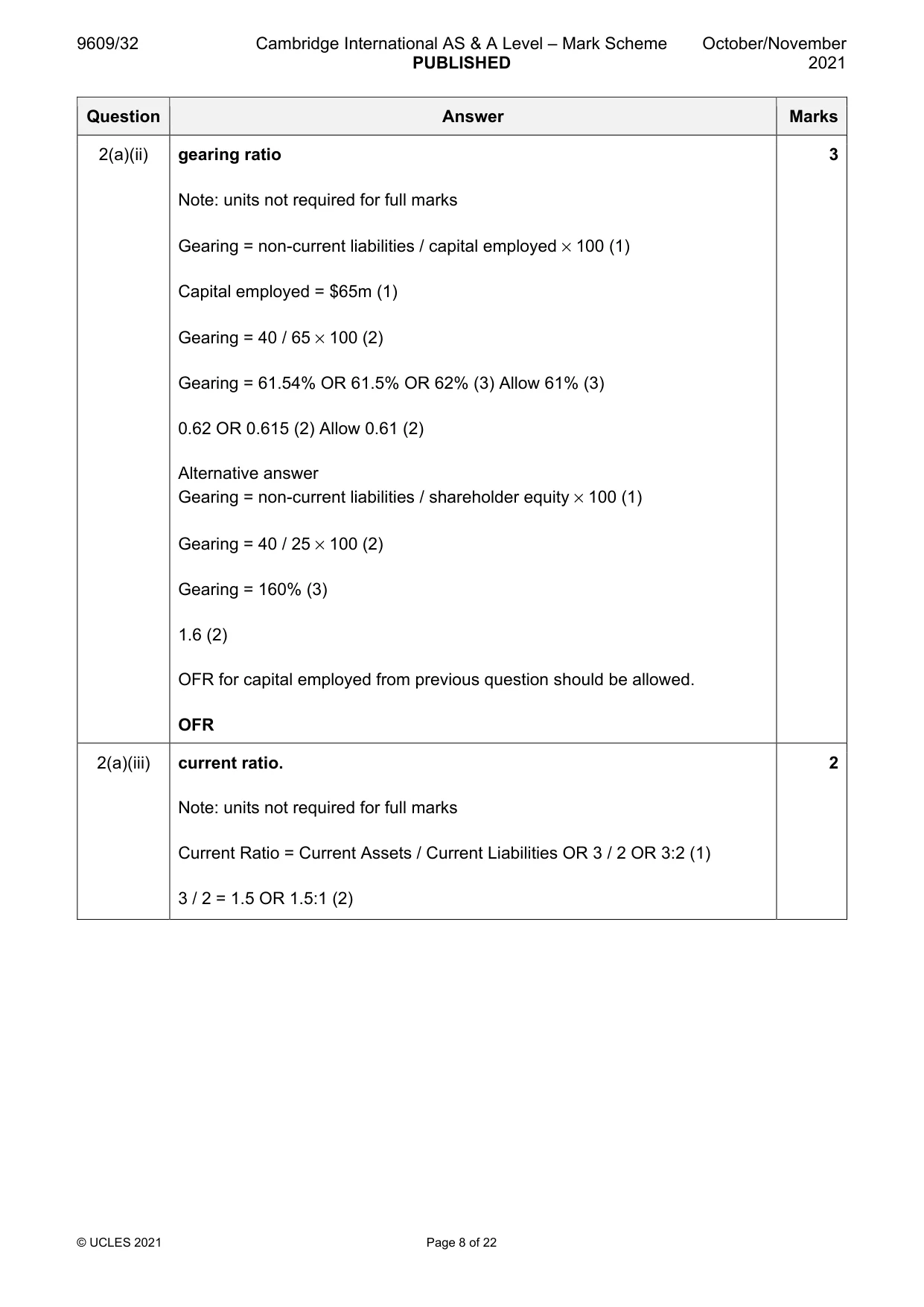
9609/32 Cambridge International AS & A Level – Mark Scheme PUBLISHED October/November 2021 © UCLES 2021 Page 8 of 22 Question Answer Marks 2(a)(ii) gearing ratio Note: units not required for full marks Gearing = non-current liabilities / capital employed × 100 (1) Capital employed = $65m (1) Gearing = 40 / 65 × 100 (2) Gearing = 61.54% OR 61.5% OR 62% (3) Allow 61% (3) 0.62 OR 0.615 (2) Allow 0.61 (2) Alternative answer Gearing = non-current liabilities / shareholder equity × 100 (1) Gearing = 40 / 25 × 100 (2) Gearing = 160% (3) 1.6 (2) OFR for capital employed from previous question should be allowed. OFR 3 2(a)(iii) current ratio. Note: units not required for full marks Current Ratio = Current Assets / Current Liabilities OR 3 / 2 OR 3:2 (1) 3 / 2 = 1.5 OR 1.5:1 (2) 2
Mark scheme, page 9
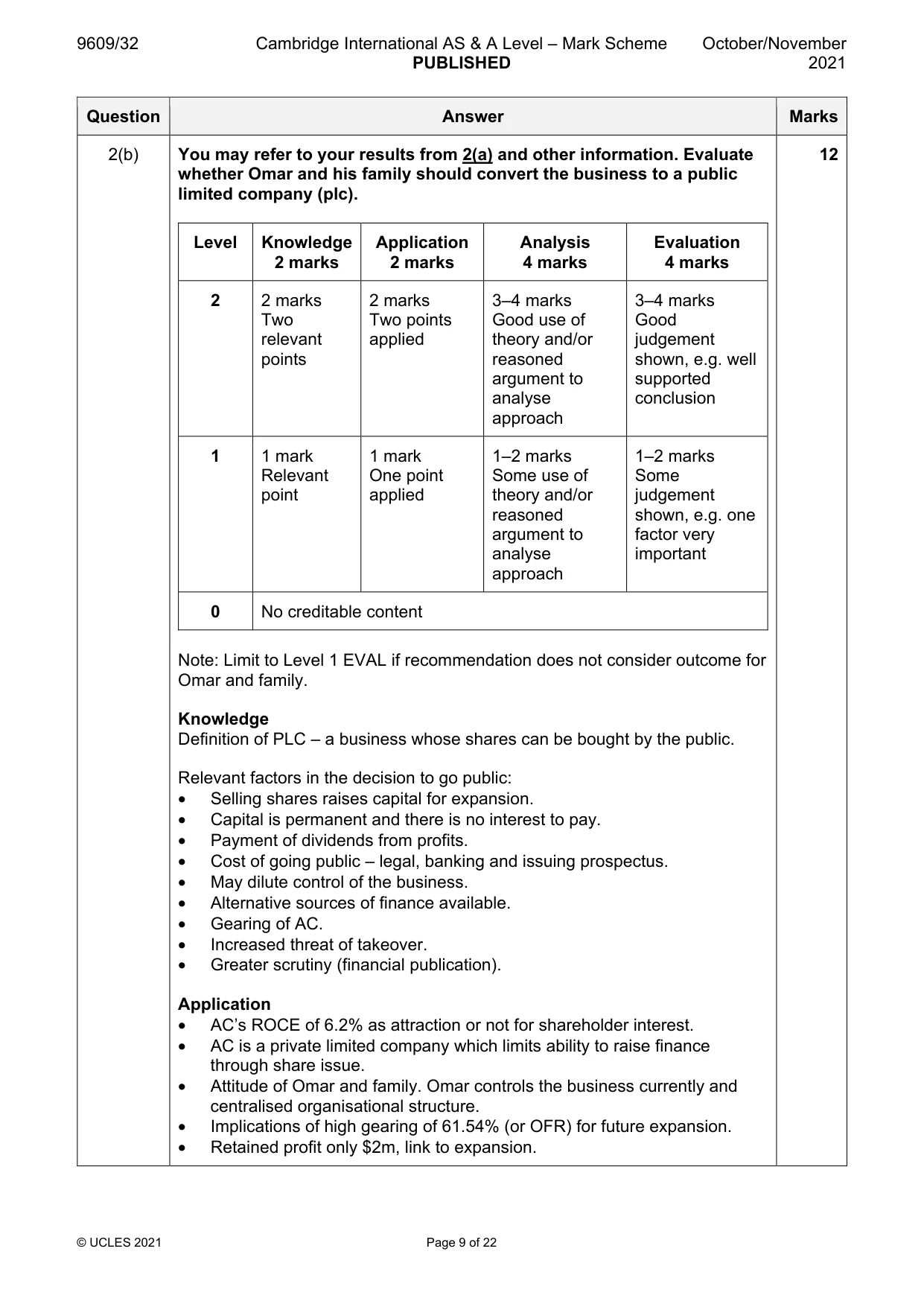
9609/32 Cambridge International AS & A Level – Mark Scheme PUBLISHED October/November 2021 © UCLES 2021 Page 9 of 22 Question Answer Marks 2(b) You may refer to your results from 2(a) and other information. Evaluate whether Omar and his family should convert the business to a public limited company (plc). Level Knowledge 2 marks Application 2 marks Analysis 4 marks Evaluation 4 marks 2 2 marks Two relevant points 2 marks Two points applied 3–4 marks Good use of theory and/or reasoned argument to analyse approach 3–4 marks Good judgement shown, e.g. well supported conclusion 1 1 mark Relevant point 1 mark One point applied 1–2 marks Some use of theory and/or reasoned argument to analyse approach 1–2 marks Some judgement shown, e.g. one factor very important 0 No creditable content Note: Limit to Level 1 EVAL if recommendation does not consider outcome for Omar and family. Knowledge Definition of PLC – a business whose shares can be bought by the public. Relevant factors in the decision to go public: • Selling shares raises capital for expansion. • Capital is permanent and there is no interest to pay. • Payment of dividends from profits. • Cost of going public – legal, banking and issuing prospectus. • May dilute control of the business. • Alternative sources of finance available. • Gearing of AC. • Increased threat of takeover. • Greater scrutiny (financial publication). Application • AC’s ROCE of 6.2% as attraction or not for shareholder interest. • AC is a private limited company which limits ability to raise finance through share issue. • Attitude of Omar and family. Omar controls the business currently and centralised organisational structure. • Implications of high gearing of 61.54% (or OFR) for future expansion. • Retained profit only $2m, link to expansion. 12
Mark scheme, page 10
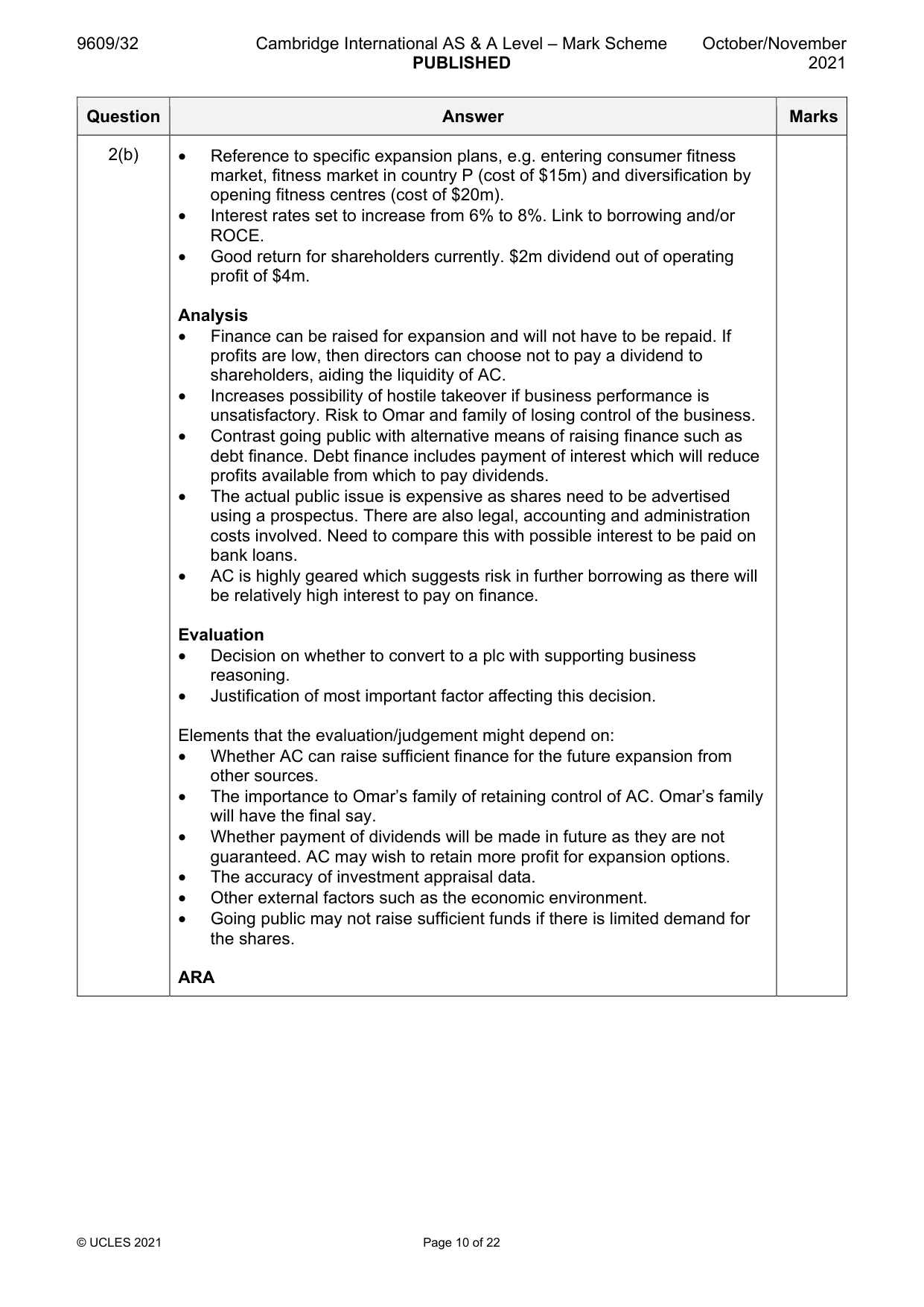
9609/32 Cambridge International AS & A Level – Mark Scheme PUBLISHED October/November 2021 © UCLES 2021 Page 10 of 22 Question Answer Marks 2(b) • Reference to specific expansion plans, e.g. entering consumer fitness market, fitness market in country P (cost of $15m) and diversification by opening fitness centres (cost of $20m). • Interest rates set to increase from 6% to 8%. Link to borrowing and/or ROCE. • Good return for shareholders currently. $2m dividend out of operating profit of $4m. Analysis • Finance can be raised for expansion and will not have to be repaid. If profits are low, then directors can choose not to pay a dividend to shareholders, aiding the liquidity of AC. • Increases possibility of hostile takeover if business performance is unsatisfactory. Risk to Omar and family of losing control of the business. • Contrast going public with alternative means of raising finance such as debt finance. Debt finance includes payment of interest which will reduce profits available from which to pay dividends. • The actual public issue is expensive as shares need to be advertised using a prospectus. There are also legal, accounting and administration costs involved. Need to compare this with possible interest to be paid on bank loans. • AC is highly geared which suggests risk in further borrowing as there will be relatively high interest to pay on finance. Evaluation • Decision on whether to convert to a plc with supporting business reasoning. • Justification of most important factor affecting this decision. Elements that the evaluation/judgement might depend on: • Whether AC can raise sufficient finance for the future expansion from other sources. • The importance to Omar’s family of retaining control of AC. Omar’s family will have the final say. • Whether payment of dividends will be made in future as they are not guaranteed. AC may wish to retain more profit for expansion options. • The accuracy of investment appraisal data. • Other external factors such as the economic environment. • Going public may not raise sufficient funds if there is limited demand for the shares. ARA
Mark scheme, page 11
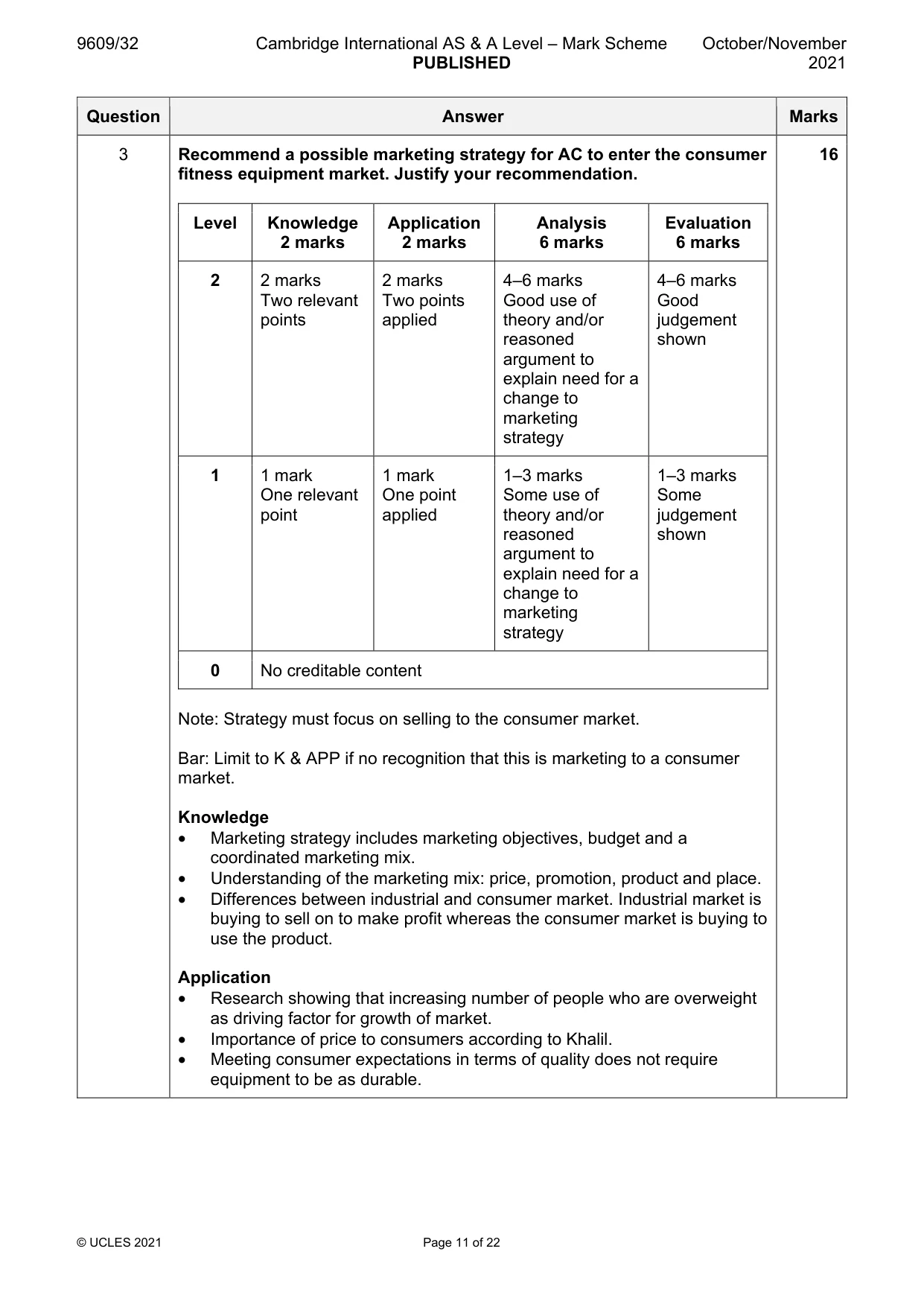
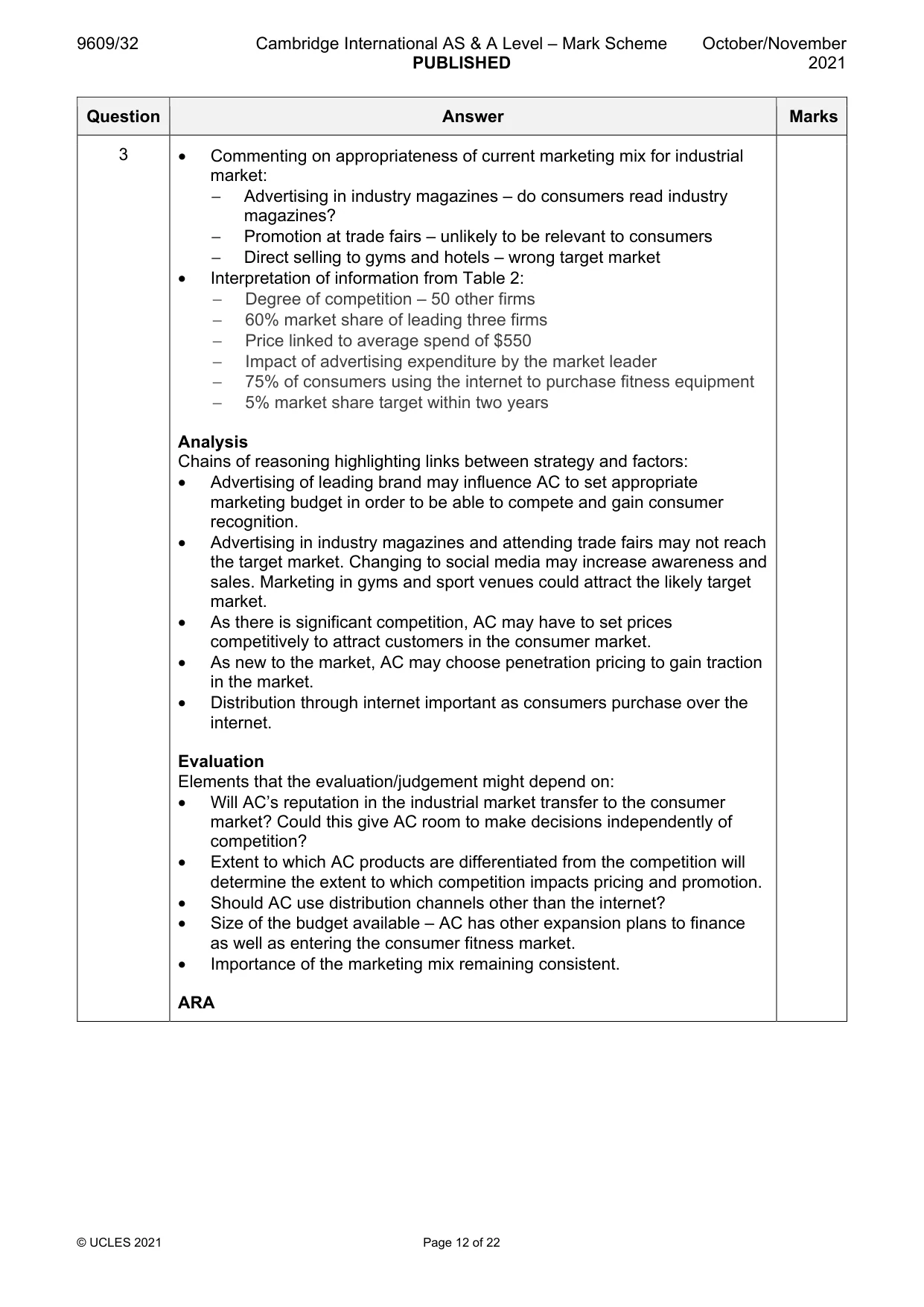
9609/32 Cambridge International AS & A Level – Mark Scheme PUBLISHED October/November 2021 © UCLES 2021 Page 11 of 22 Question Answer Marks 3 Recommend a possible marketing strategy for AC to enter the consumer fitness equipment market. Justify your recommendation. Level Knowledge 2 marks Application 2 marks Analysis 6 marks Evaluation 6 marks 2 2 marks Two relevant points 2 marks Two points applied 4–6 marks Good use of theory and/or reasoned argument to explain need for a change to marketing strategy 4–6 marks Good judgement shown 1 1 mark One relevant point 1 mark One point applied 1–3 marks Some use of theory and/or reasoned argument to explain need for a change to marketing strategy 1–3 marks Some judgement shown 0 No creditable content Note: Strategy must focus on selling to the consumer market. Bar: Limit to K & APP if no recognition that this is marketing to a consumer market. Knowledge • Marketing strategy includes marketing objectives, budget and a coordinated marketing mix. • Understanding of the marketing mix: price, promotion, product and place. • Differences between industrial and consumer market. Industrial market is buying to sell on to make profit whereas the consumer market is buying to use the product. Application • Research showing that increasing number of people who are overweight as driving factor for growth of market. • Importance of price to consumers according to Khalil. • Meeting consumer expectations in terms of quality does not require equipment to be as durable. 16
Mark scheme, page 12
9609/32 Cambridge International AS & A Level – Mark Scheme PUBLISHED October/November 2021 © UCLES 2021 Page 12 of 22 Question Answer Marks 3 • Commenting on appropriateness of current marketing mix for industrial market: − Advertising in industry magazines – do consumers read industry magazines? − Promotion at trade fairs – unlikely to be relevant to consumers − Direct selling to gyms and hotels – wrong target market • Interpretation of information from Table 2: − Degree of competition – 50 other firms − 60% market share of leading three firms − Price linked to average spend of $550 − Impact of advertising expenditure by the market leader − 75% of consumers using the internet to purchase fitness equipment − 5% market share target within two years Analysis Chains of reasoning highlighting links between strategy and factors: • Advertising of leading brand may influence AC to set appropriate marketing budget in order to be able to compete and gain consumer recognition. • Advertising in industry magazines and attending trade fairs may not reach the target market. Changing to social media may increase awareness and sales. Marketing in gyms and sport venues could attract the likely target market. • As there is significant competition, AC may have to set prices competitively to attract customers in the consumer market. • As new to the market, AC may choose penetration pricing to gain traction in the market. • Distribution through internet important as consumers purchase over the internet. Evaluation Elements that the evaluation/judgement might depend on: • Will AC’s reputation in the industrial market transfer to the consumer market? Could this give AC room to make decisions independently of competition? • Extent to which AC products are differentiated from the competition will determine the extent to which competition impacts pricing and promotion. • Should AC use distribution channels other than the internet? • Size of the budget available – AC has other expansion plans to finance as well as entering the consumer fitness market. • Importance of the marketing mix remaining consistent. ARA
Mark scheme, page 13
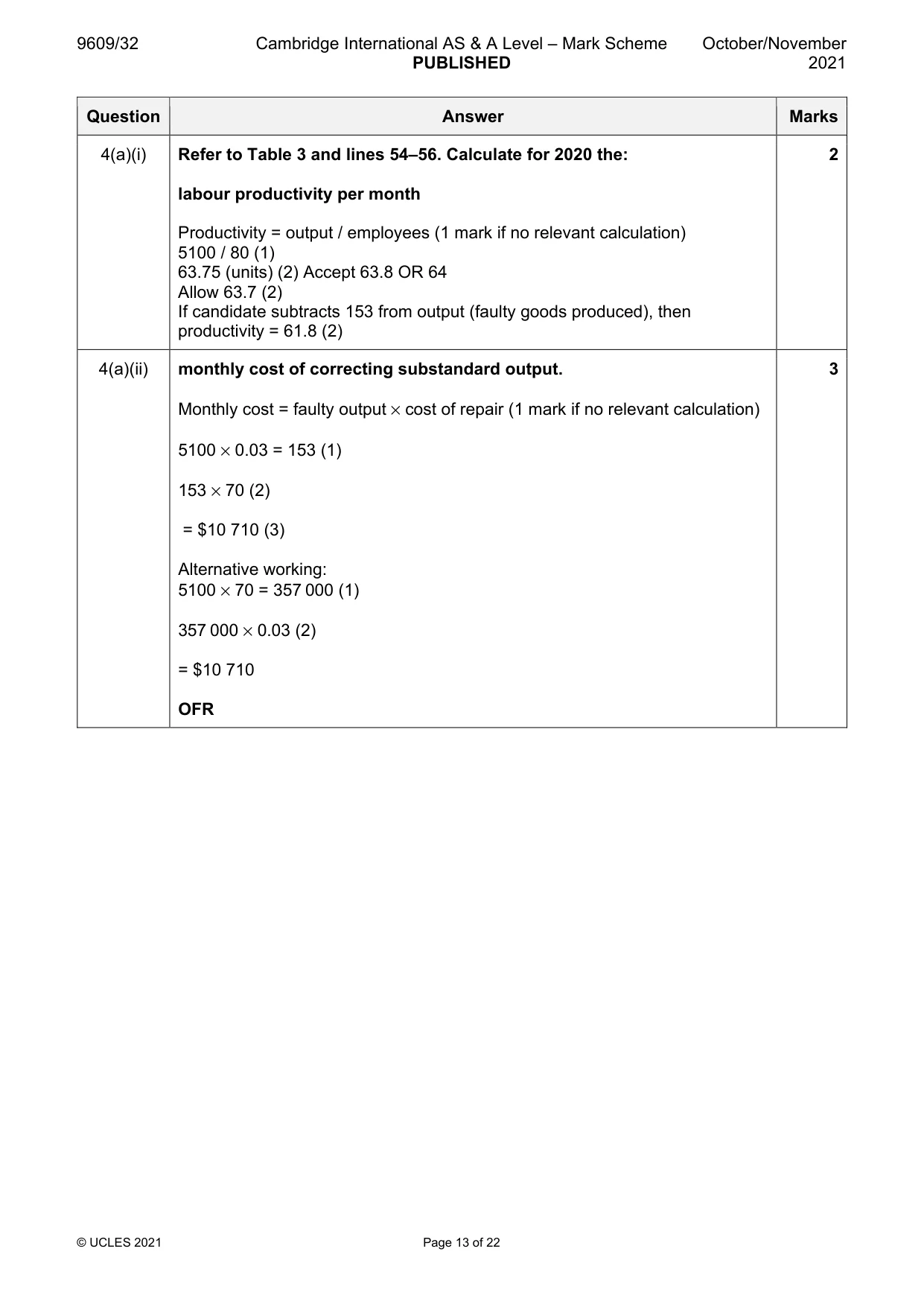
9609/32 Cambridge International AS & A Level – Mark Scheme PUBLISHED October/November 2021 © UCLES 2021 Page 13 of 22 Question Answer Marks 4(a)(i) Refer to Table 3 and lines 54–56. Calculate for 2020 the: labour productivity per month Productivity = output / employees (1 mark if no relevant calculation) 5100 / 80 (1) 63.75 (units) (2) Accept 63.8 OR 64 Allow 63.7 (2) If candidate subtracts 153 from output (faulty goods produced), then productivity = 61.8 (2) 2 4(a)(ii) monthly cost of correcting substandard output. Monthly cost = faulty output × cost of repair (1 mark if no relevant calculation) 5100 × 0.03 = 153 (1) 153 × 70 (2) = $10 710 (3) Alternative working: 5100 × 70 = 357 000 (1) 357 000 × 0.03 (2) = $10 710 OFR 3
Mark scheme, page 14
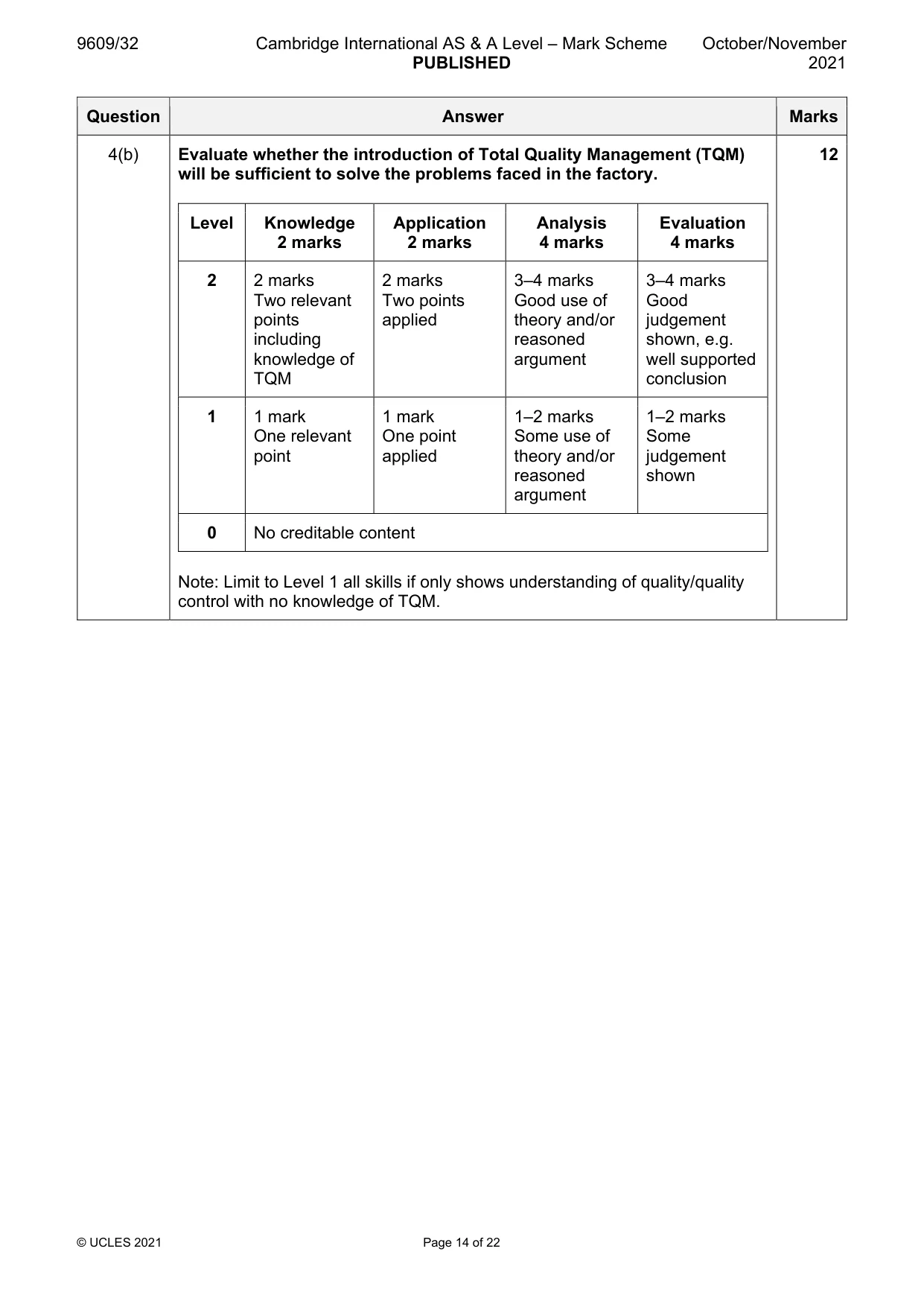
9609/32 Cambridge International AS & A Level – Mark Scheme PUBLISHED October/November 2021 © UCLES 2021 Page 14 of 22 Question Answer Marks 4(b) Evaluate whether the introduction of Total Quality Management (TQM) will be sufficient to solve the problems faced in the factory. Level Knowledge 2 marks Application 2 marks Analysis 4 marks Evaluation 4 marks 2 2 marks Two relevant points including knowledge of TQM 2 marks Two points applied 3–4 marks Good use of theory and/or reasoned argument 3–4 marks Good judgement shown, e.g. well supported conclusion 1 1 mark One relevant point 1 mark One point applied 1–2 marks Some use of theory and/or reasoned argument 1–2 marks Some judgement shown 0 No creditable content Note: Limit to Level 1 all skills if only shows understanding of quality/quality control with no knowledge of TQM. 12
Mark scheme, page 15
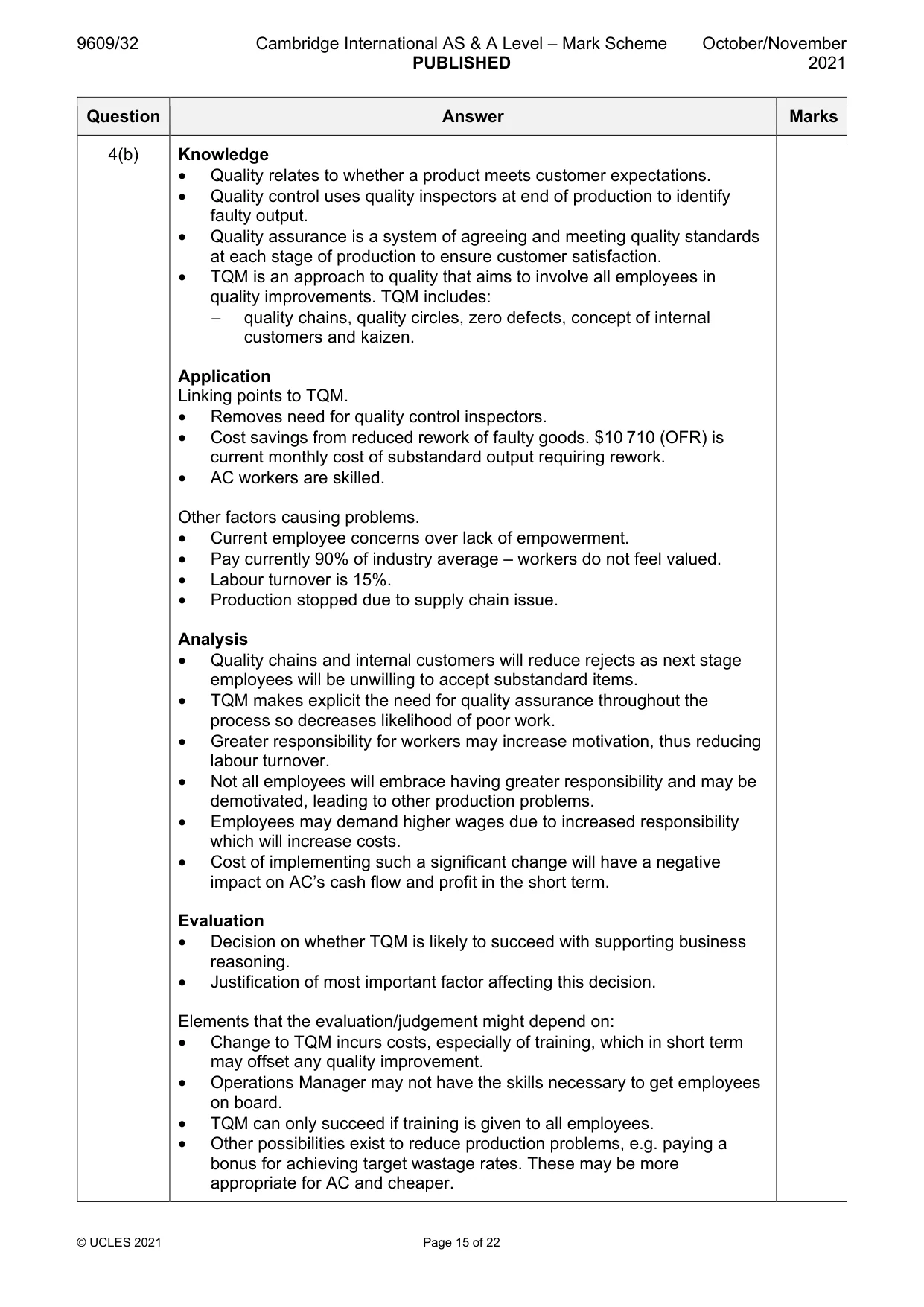
9609/32 Cambridge International AS & A Level – Mark Scheme PUBLISHED October/November 2021 © UCLES 2021 Page 15 of 22 Question Answer Marks 4(b) Knowledge • Quality relates to whether a product meets customer expectations. • Quality control uses quality inspectors at end of production to identify faulty output. • Quality assurance is a system of agreeing and meeting quality standards at each stage of production to ensure customer satisfaction. • TQM is an approach to quality that aims to involve all employees in quality improvements. TQM includes: − quality chains, quality circles, zero defects, concept of internal customers and kaizen. Application Linking points to TQM. • Removes need for quality control inspectors. • Cost savings from reduced rework of faulty goods. $10 710 (OFR) is current monthly cost of substandard output requiring rework. • AC workers are skilled. Other factors causing problems. • Current employee concerns over lack of empowerment. • Pay currently 90% of industry average – workers do not feel valued. • Labour turnover is 15%. • Production stopped due to supply chain issue. Analysis • Quality chains and internal customers will reduce rejects as next stage employees will be unwilling to accept substandard items. • TQM makes explicit the need for quality assurance throughout the process so decreases likelihood of poor work. • Greater responsibility for workers may increase motivation, thus reducing labour turnover. • Not all employees will embrace having greater responsibility and may be demotivated, leading to other production problems. • Employees may demand higher wages due to increased responsibility which will increase costs. • Cost of implementing such a significant change will have a negative impact on AC’s cash flow and profit in the short term. Evaluation • Decision on whether TQM is likely to succeed with supporting business reasoning. • Justification of most important factor affecting this decision. Elements that the evaluation/judgement might depend on: • Change to TQM incurs costs, especially of training, which in short term may offset any quality improvement. • Operations Manager may not have the skills necessary to get employees on board. • TQM can only succeed if training is given to all employees. • Other possibilities exist to reduce production problems, e.g. paying a bonus for achieving target wastage rates. These may be more appropriate for AC and cheaper.
Mark scheme, page 16
9609/32 Cambridge International AS & A Level – Mark Scheme PUBLISHED October/November 2021 © UCLES 2021 Page 16 of 22 Question Answer Marks 4(b) • Significant change in culture so may be difficult to implement. • Other factors causing the poor performance in the factory. • In the short term, implementation may make things worse as adjustments are made. In the long term, it should improve quality. • Other approaches may be necessary to deal with labour turnover and problems, e.g. pay.
Mark scheme, page 17
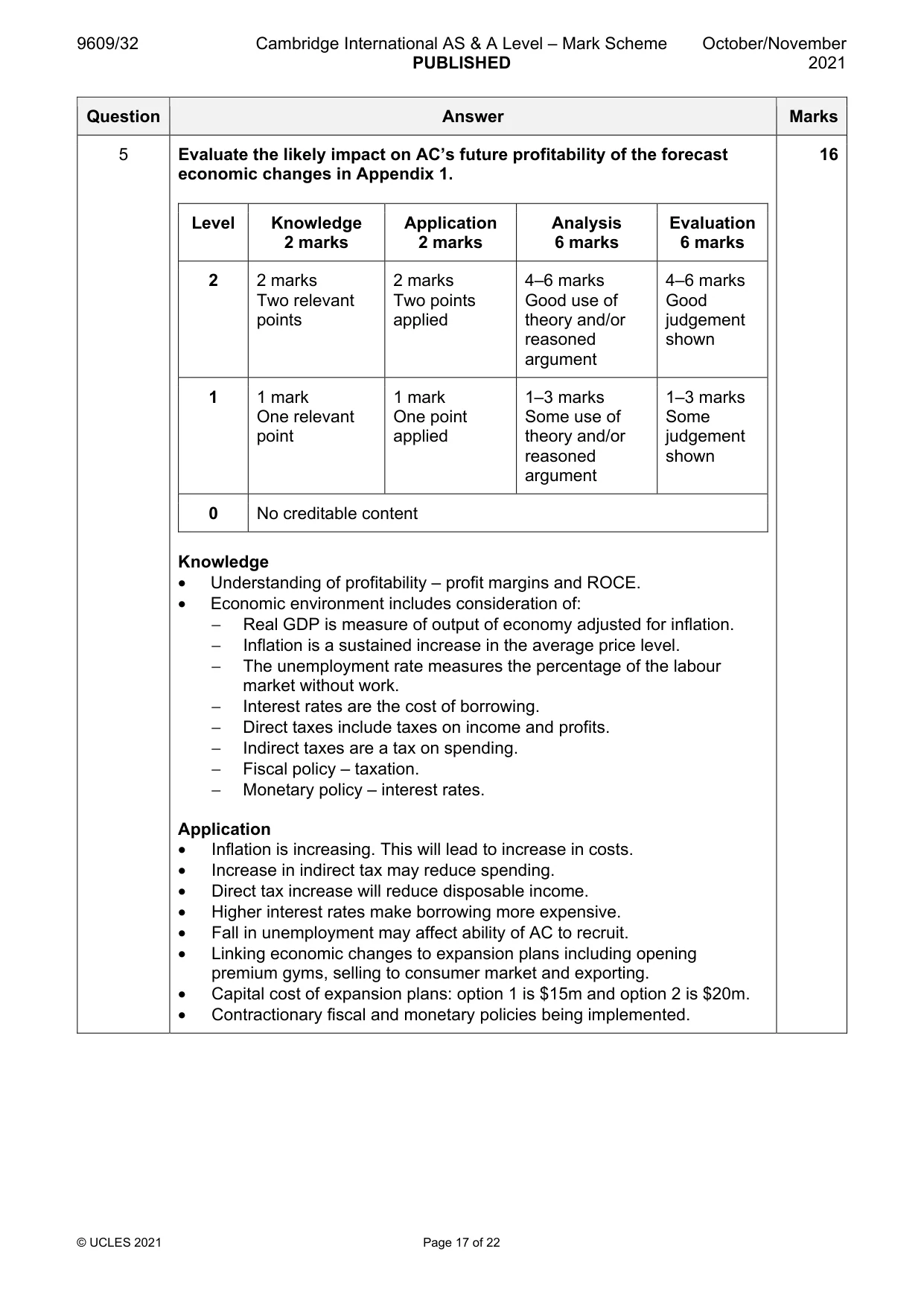
9609/32 Cambridge International AS & A Level – Mark Scheme PUBLISHED October/November 2021 © UCLES 2021 Page 17 of 22 Question Answer Marks 5 Evaluate the likely impact on AC’s future profitability of the forecast economic changes in Appendix 1. Level Knowledge 2 marks Application 2 marks Analysis 6 marks Evaluation 6 marks 2 2 marks Two relevant points 2 marks Two points applied 4–6 marks Good use of theory and/or reasoned argument 4–6 marks Good judgement shown 1 1 mark One relevant point 1 mark One point applied 1–3 marks Some use of theory and/or reasoned argument 1–3 marks Some judgement shown 0 No creditable content Knowledge • Understanding of profitability – profit margins and ROCE. • Economic environment includes consideration of: − Real GDP is measure of output of economy adjusted for inflation. − Inflation is a sustained increase in the average price level. − The unemployment rate measures the percentage of the labour market without work. − Interest rates are the cost of borrowing. − Direct taxes include taxes on income and profits. − Indirect taxes are a tax on spending. − Fiscal policy – taxation. − Monetary policy – interest rates. Application • Inflation is increasing. This will lead to increase in costs. • Increase in indirect tax may reduce spending. • Direct tax increase will reduce disposable income. • Higher interest rates make borrowing more expensive. • Fall in unemployment may affect ability of AC to recruit. • Linking economic changes to expansion plans including opening premium gyms, selling to consumer market and exporting. • Capital cost of expansion plans: option 1 is $15m and option 2 is $20m. • Contractionary fiscal and monetary policies being implemented. 16
Mark scheme, page 18
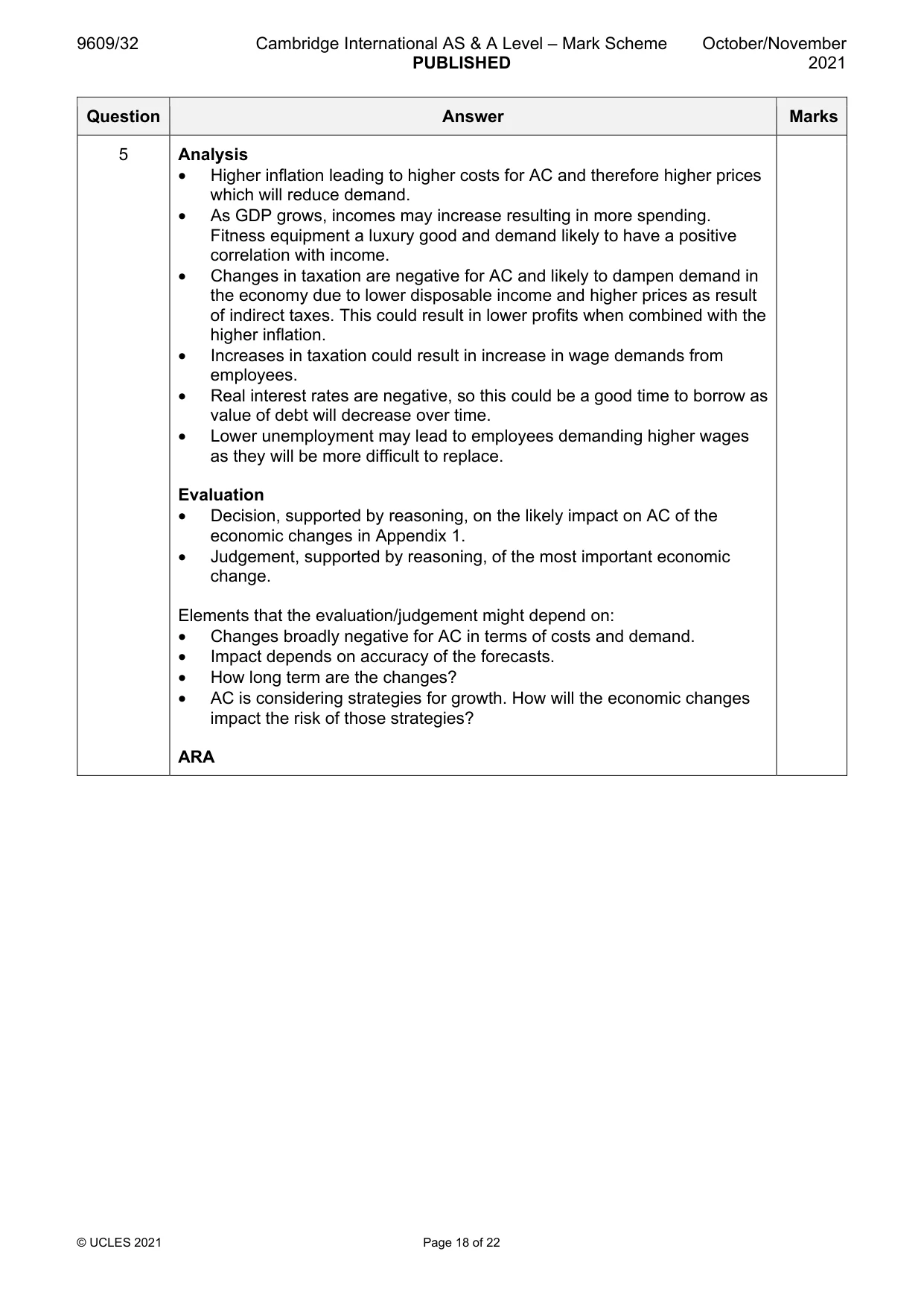
9609/32 Cambridge International AS & A Level – Mark Scheme PUBLISHED October/November 2021 © UCLES 2021 Page 18 of 22 Question Answer Marks 5 Analysis • Higher inflation leading to higher costs for AC and therefore higher prices which will reduce demand. • As GDP grows, incomes may increase resulting in more spending. Fitness equipment a luxury good and demand likely to have a positive correlation with income. • Changes in taxation are negative for AC and likely to dampen demand in the economy due to lower disposable income and higher prices as result of indirect taxes. This could result in lower profits when combined with the higher inflation. • Increases in taxation could result in increase in wage demands from employees. • Real interest rates are negative, so this could be a good time to borrow as value of debt will decrease over time. • Lower unemployment may lead to employees demanding higher wages as they will be more difficult to replace. Evaluation • Decision, supported by reasoning, on the likely impact on AC of the economic changes in Appendix 1. • Judgement, supported by reasoning, of the most important economic change. Elements that the evaluation/judgement might depend on: • Changes broadly negative for AC in terms of costs and demand. • Impact depends on accuracy of the forecasts. • How long term are the changes? • AC is considering strategies for growth. How will the economic changes impact the risk of those strategies? ARA
Mark scheme, page 19
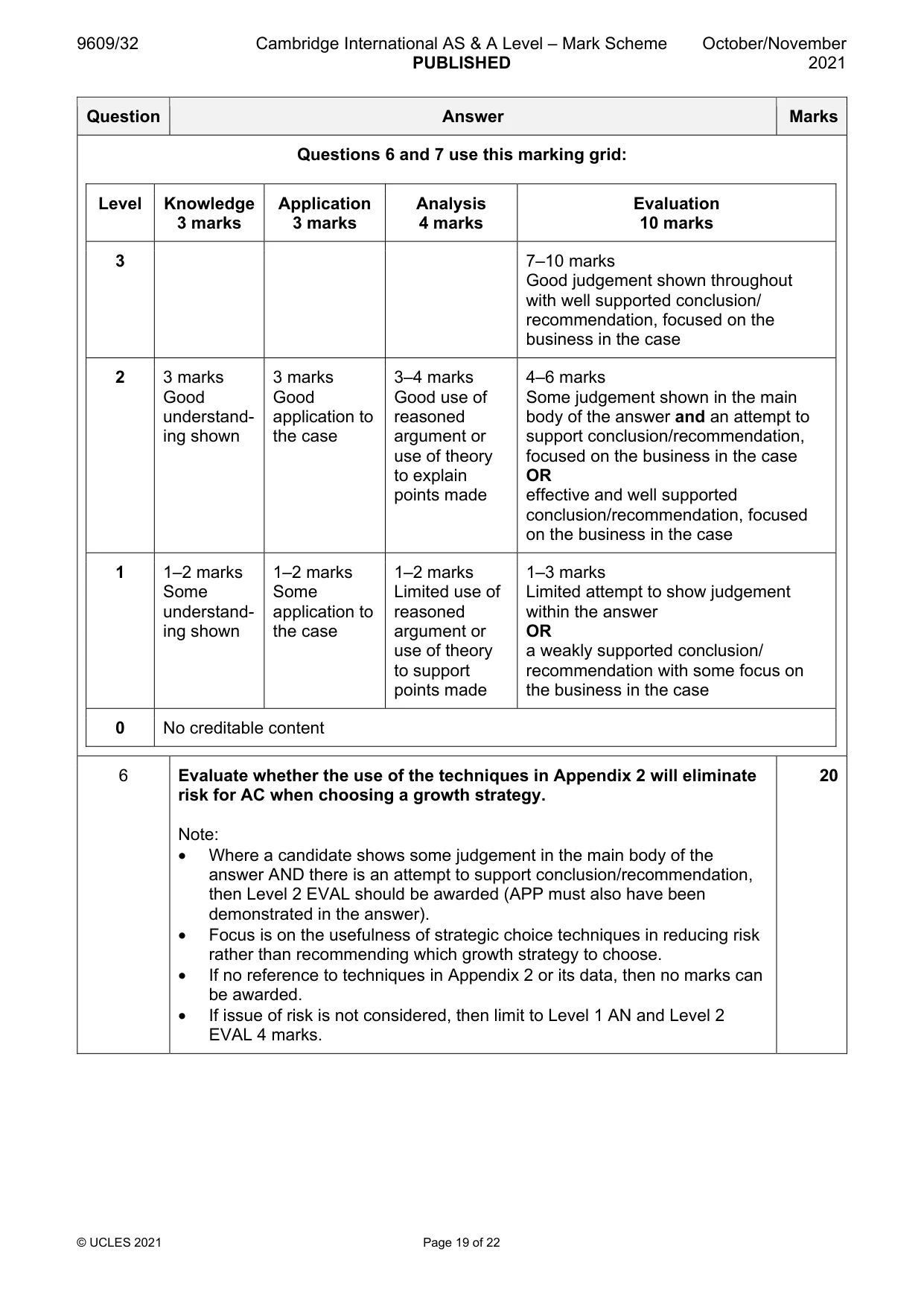
9609/32 Cambridge International AS & A Level – Mark Scheme PUBLISHED October/November 2021 © UCLES 2021 Page 19 of 22 Question Answer Marks Questions 6 and 7 use this marking grid: Level Knowledge 3 marks Application 3 marks Analysis 4 marks Evaluation 10 marks 3 7–10 marks Good judgement shown throughout with well supported conclusion/ recommendation, focused on the business in the case 2 3 marks Good understand- ing shown 3 marks Good application to the case 3–4 marks Good use of reasoned argument or use of theory to explain points made 4–6 marks Some judgement shown in the main body of the answer and an attempt to support conclusion/recommendation, focused on the business in the case OR effective and well supported conclusion/recommendation, focused on the business in the case 1 1–2 marks Some understand- ing shown 1–2 marks Some application to the case 1–2 marks Limited use of reasoned argument or use of theory to support points made 1–3 marks Limited attempt to show judgement within the answer OR a weakly supported conclusion/ recommendation with some focus on the business in the case 0 No creditable content 6 Evaluate whether the use of the techniques in Appendix 2 will eliminate risk for AC when choosing a growth strategy. Note: • Where a candidate shows some judgement in the main body of the answer AND there is an attempt to support conclusion/recommendation, then Level 2 EVAL should be awarded (APP must also have been demonstrated in the answer). • Focus is on the usefulness of strategic choice techniques in reducing risk rather than recommending which growth strategy to choose. • If no reference to techniques in Appendix 2 or its data, then no marks can be awarded. • If issue of risk is not considered, then limit to Level 1 AN and Level 2 EVAL 4 marks. 20
Mark scheme, page 20
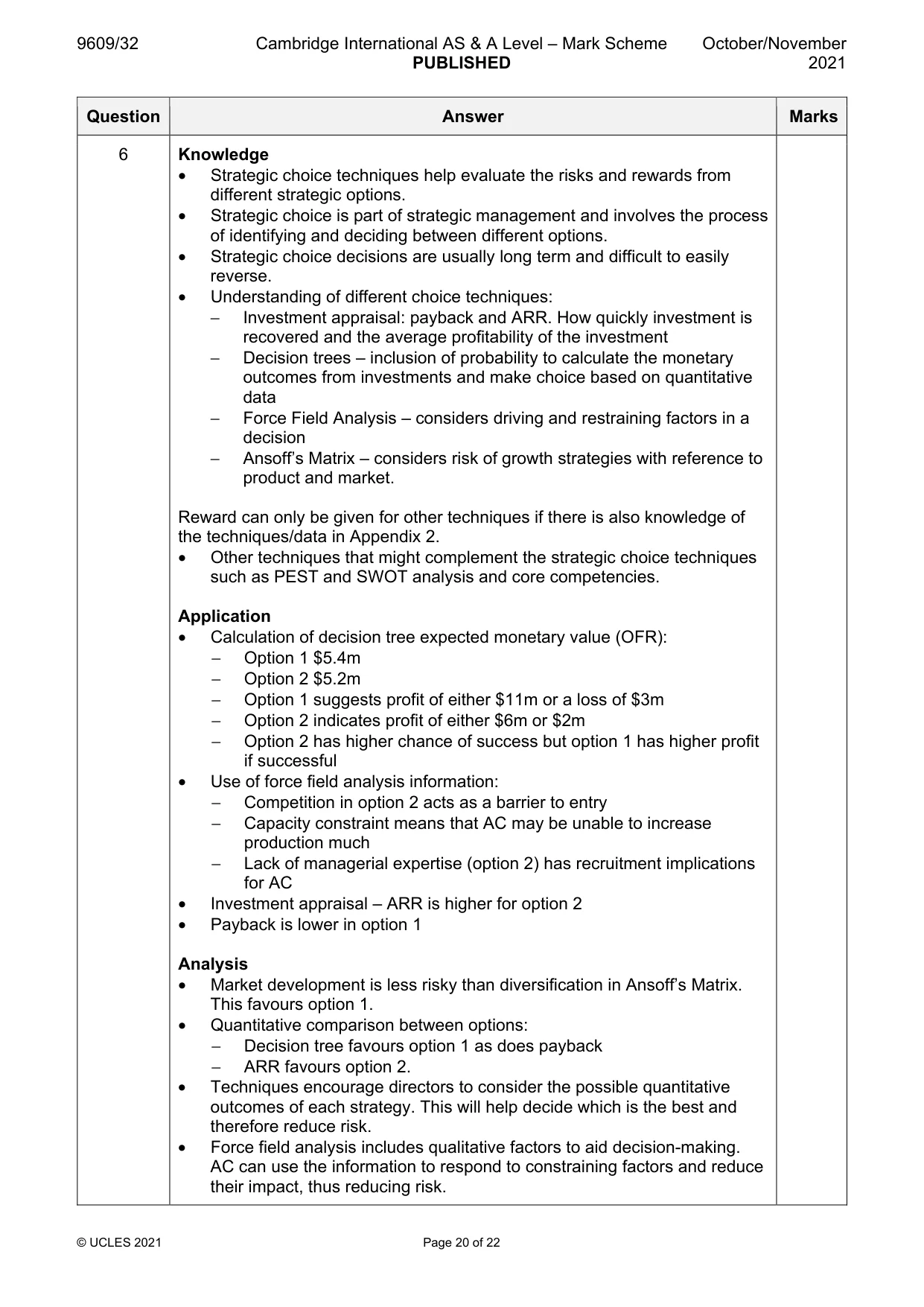
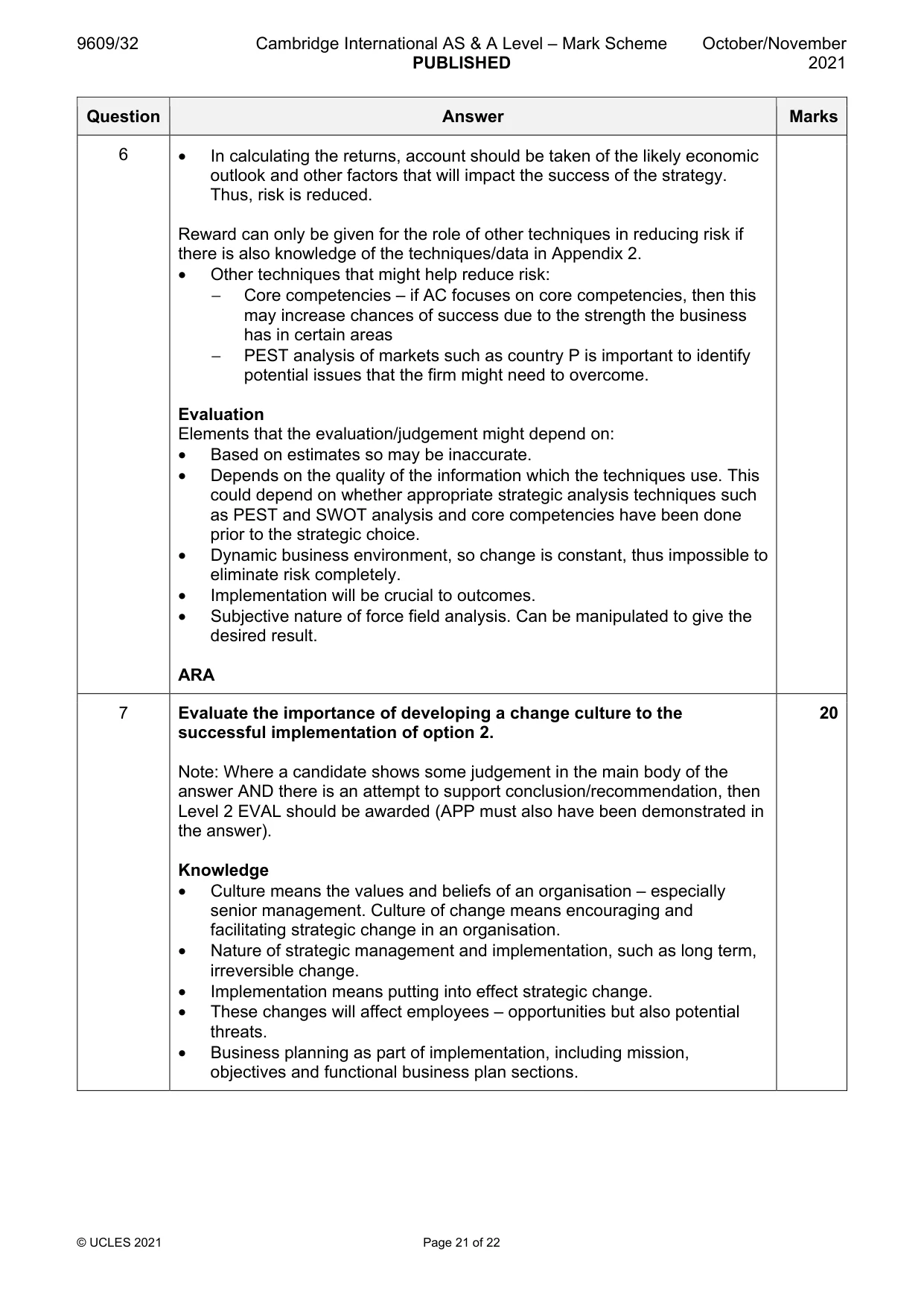
9609/32 Cambridge International AS & A Level – Mark Scheme PUBLISHED October/November 2021 © UCLES 2021 Page 20 of 22 Question Answer Marks 6 Knowledge • Strategic choice techniques help evaluate the risks and rewards from different strategic options. • Strategic choice is part of strategic management and involves the process of identifying and deciding between different options. • Strategic choice decisions are usually long term and difficult to easily reverse. • Understanding of different choice techniques: − Investment appraisal: payback and ARR. How quickly investment is recovered and the average profitability of the investment − Decision trees – inclusion of probability to calculate the monetary outcomes from investments and make choice based on quantitative data − Force Field Analysis – considers driving and restraining factors in a decision − Ansoff’s Matrix – considers risk of growth strategies with reference to product and market. Reward can only be given for other techniques if there is also knowledge of the techniques/data in Appendix 2. • Other techniques that might complement the strategic choice techniques such as PEST and SWOT analysis and core competencies. Application • Calculation of decision tree expected monetary value (OFR): − Option 1 $5.4m − Option 2 $5.2m − Option 1 suggests profit of either $11m or a loss of $3m − Option 2 indicates profit of either $6m or $2m − Option 2 has higher chance of success but option 1 has higher profit if successful • Use of force field analysis information: − Competition in option 2 acts as a barrier to entry − Capacity constraint means that AC may be unable to increase production much − Lack of managerial expertise (option 2) has recruitment implications for AC • Investment appraisal – ARR is higher for option 2 • Payback is lower in option 1 Analysis • Market development is less risky than diversification in Ansoff’s Matrix. This favours option 1. • Quantitative comparison between options: − Decision tree favours option 1 as does payback − ARR favours option 2. • Techniques encourage directors to consider the possible quantitative outcomes of each strategy. This will help decide which is the best and therefore reduce risk. • Force field analysis includes qualitative factors to aid decision-making. AC can use the information to respond to constraining factors and reduce their impact, thus reducing risk.
Mark scheme, page 21
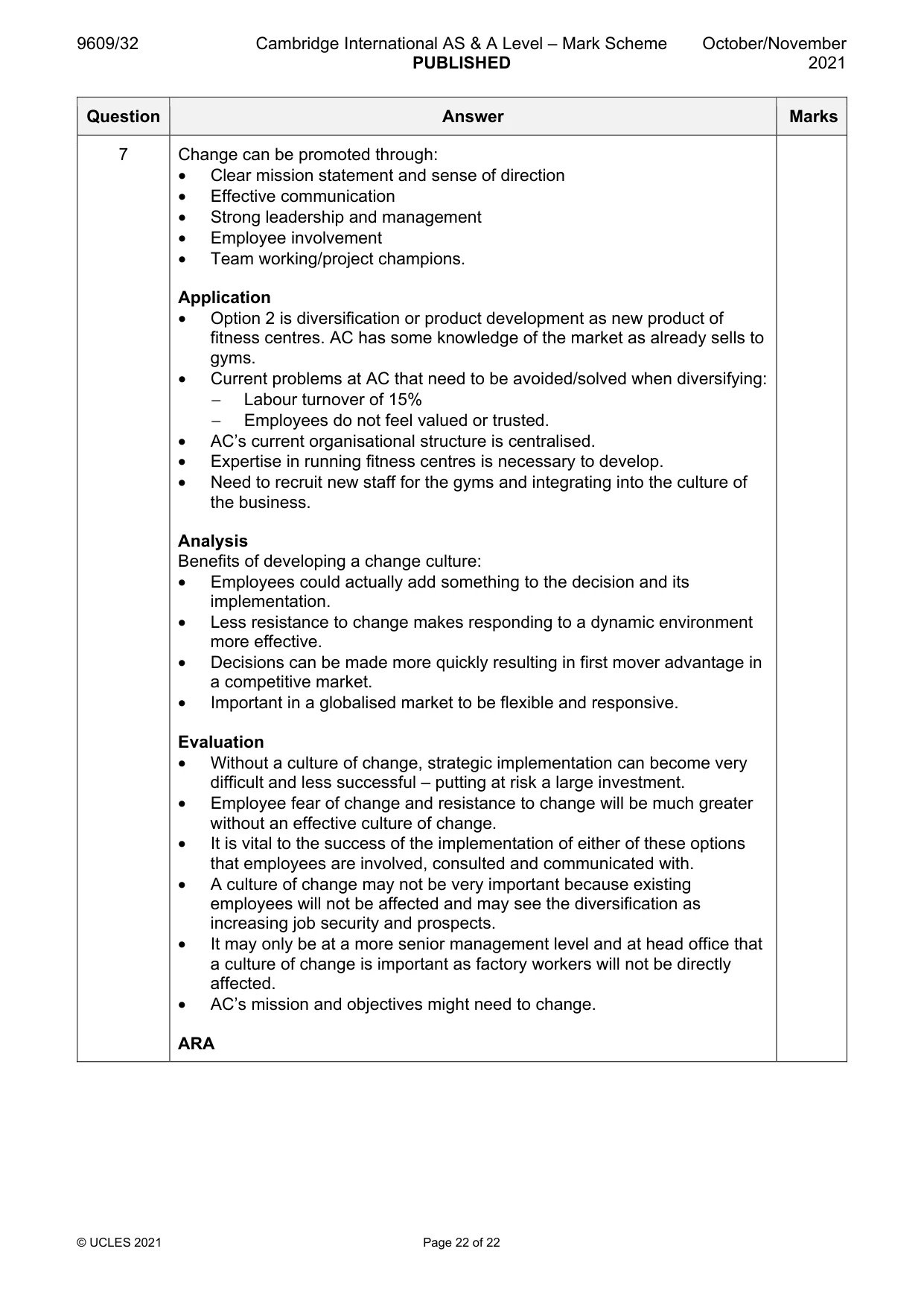
9609/32 Cambridge International AS & A Level – Mark Scheme PUBLISHED October/November 2021 © UCLES 2021 Page 21 of 22 Question Answer Marks 6 • In calculating the returns, account should be taken of the likely economic outlook and other factors that will impact the success of the strategy. Thus, risk is reduced. Reward can only be given for the role of other techniques in reducing risk if there is also knowledge of the techniques/data in Appendix 2. • Other techniques that might help reduce risk: − Core competencies – if AC focuses on core competencies, then this may increase chances of success due to the strength the business has in certain areas − PEST analysis of markets such as country P is important to identify potential issues that the firm might need to overcome. Evaluation Elements that the evaluation/judgement might depend on: • Based on estimates so may be inaccurate. • Depends on the quality of the information which the techniques use. This could depend on whether appropriate strategic analysis techniques such as PEST and SWOT analysis and core competencies have been done prior to the strategic choice. • Dynamic business environment, so change is constant, thus impossible to eliminate risk completely. • Implementation will be crucial to outcomes. • Subjective nature of force field analysis. Can be manipulated to give the desired result. ARA 7 Evaluate the importance of developing a change culture to the successful implementation of option 2. Note: Where a candidate shows some judgement in the main body of the answer AND there is an attempt to support conclusion/recommendation, then Level 2 EVAL should be awarded (APP must also have been demonstrated in the answer). Knowledge • Culture means the values and beliefs of an organisation – especially senior management. Culture of change means encouraging and facilitating strategic change in an organisation. • Nature of strategic management and implementation, such as long term, irreversible change. • Implementation means putting into effect strategic change. • These changes will affect employees – opportunities but also potential threats. • Business planning as part of implementation, including mission, objectives and functional business plan sections. 20
Mark scheme, page 22
9609/32 Cambridge International AS & A Level – Mark Scheme PUBLISHED October/November 2021 © UCLES 2021 Page 22 of 22 Question Answer Marks 7 Change can be promoted through: • Clear mission statement and sense of direction • Effective communication • Strong leadership and management • Employee involvement • Team working/project champions. Application • Option 2 is diversification or product development as new product of fitness centres. AC has some knowledge of the market as already sells to gyms. • Current problems at AC that need to be avoided/solved when diversifying: − Labour turnover of 15% − Employees do not feel valued or trusted. • AC’s current organisational structure is centralised. • Expertise in running fitness centres is necessary to develop. • Need to recruit new staff for the gyms and integrating into the culture of the business. Analysis Benefits of developing a change culture: • Employees could actually add something to the decision and its implementation. • Less resistance to change makes responding to a dynamic environment more effective. • Decisions can be made more quickly resulting in first mover advantage in a competitive market. • Important in a globalised market to be flexible and responsive. Evaluation • Without a culture of change, strategic implementation can become very difficult and less successful – putting at risk a large investment. • Employee fear of change and resistance to change will be much greater without an effective culture of change. • It is vital to the success of the implementation of either of these options that employees are involved, consulted and communicated with. • A culture of change may not be very important because existing employees will not be affected and may see the diversification as increasing job security and prospects. • It may only be at a more senior management level and at head office that a culture of change is important as factory workers will not be directly affected. • AC’s mission and objectives might need to change. ARA
What you needed in this session
Cambridge’s own grade thresholds for 2021 Oct/Nov, Paper 3 · Variant 2. A higher threshold means an easier paper — the bar moves with how the cohort did.