Cambridge A Level Business (for first examination in 2016) 9609 — 2021 Oct/Nov Paper 3 · Variant 1
9609/31/O/N/21 · 100 marks · ≈113 min
The question paper and its mark scheme, free to read here and free to download. This is Cambridge’s own paper, exactly as it was sat.
Question paper20 pages

















Mark scheme21 pages
Answers below. Sit the paper first if you are practising.


Paper as text
Question paper, page 1
This document has 20 pages. Any blank pages are indicated. Cambridge International AS & A Level BUSINESS 9609/31 Paper 3 Case Study October/November 2021 3 hours You must answer on the question paper. You will need: Insert (enclosed) INSTRUCTIONS ● Section A: answer all questions. ● Section B: answer one question. ● Use a black or dark blue pen. ● Write your name, centre number and candidate number in the boxes at the top of the page. ● Write your answer to each question in the space provided. ● Do not use an erasable pen or correction fluid. ● Do not write on any bar codes. ● You may use an HB pencil for any diagrams, graphs or rough working. INFORMATION ● The total mark for this paper is 100. ● The number of marks for each question or part question is shown in brackets [ ]. ● The insert contains the case study. * 4 1 6 3 5 1 8 1 0 0 * DC (CJ) 210865/2 © UCLES 2021 [Turn over
Question paper, page 2
2 9609/31/O/N/21 © UCLES 2021 Answer all questions in Section A and answer one question in Section B. You are advised to spend no more than 40 minutes on Section B. Section A Answer all questions in this section. 1 Analyse the advantages to FF of the privatisation of the electricity and water industries. … … … … … … … … … … … … … … … … … … … … … … …
Question paper, page 3
3 9609/31/O/N/21 © UCLES 2021 [Turn over … … … … … … … … … … … … … … … … … … … … … … … … … … … … [10]
Question paper, page 4
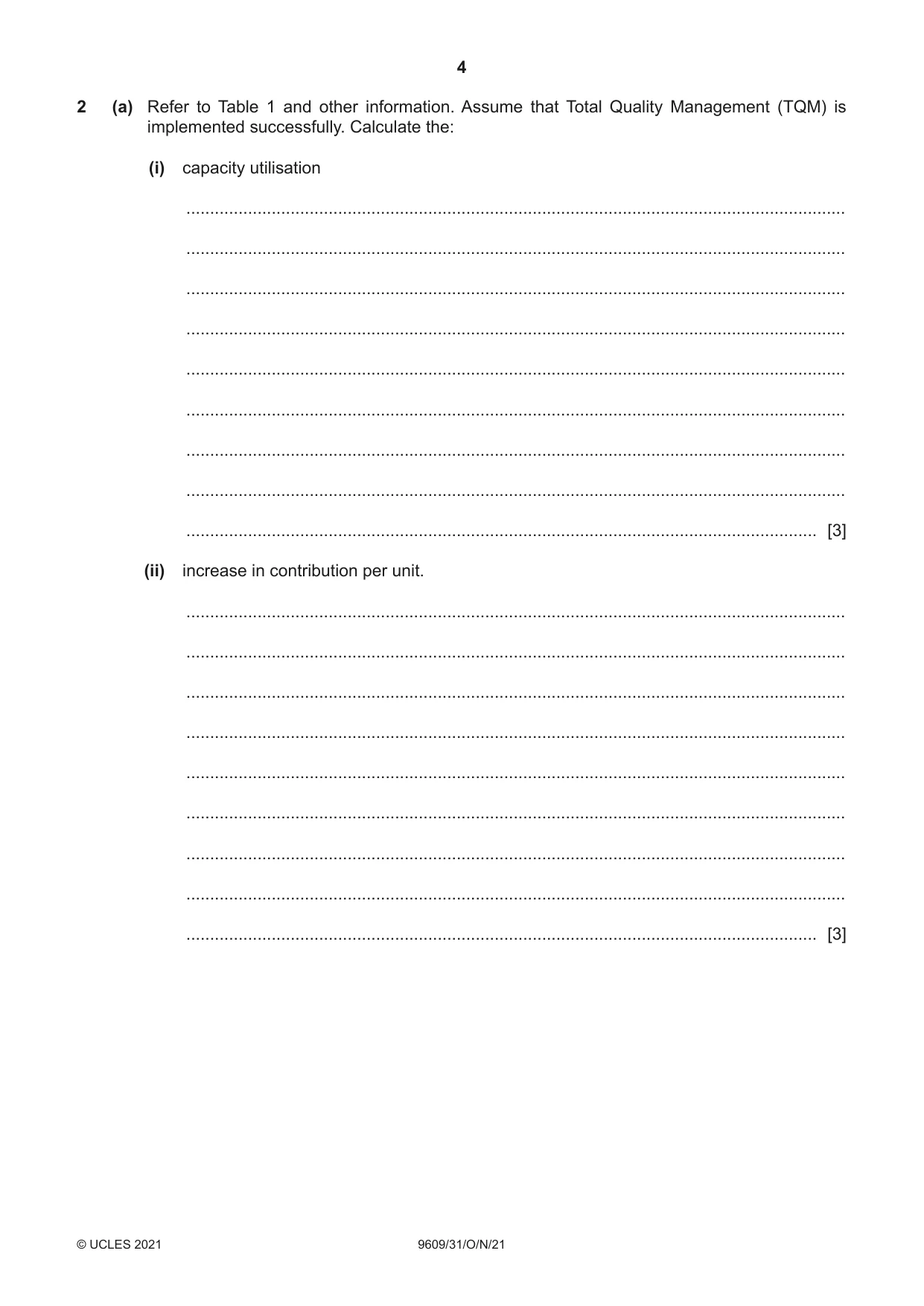
4 9609/31/O/N/21 © UCLES 2021 2 (a) Refer to Table 1 and other information. Assume that Total Quality Management (TQM) is implemented successfully. Calculate the: (i) capacity utilisation … … … … … … … … … [3] (ii) increase in contribution per unit. … … … … … … … … … [3]
Question paper, page 5
5 9609/31/O/N/21 © UCLES 2021 [Turn over (b) Evaluate whether total quality management (TQM) is sufficient to solve FF’s production problems. … … … … … … … … … … … … … … … … … … … … … … … … … … …
Question paper, page 6
6 9609/31/O/N/21 © UCLES 2021 … … … … … … … … … … … … … … … … … … … … … … … … … … … … [12]
Question paper, page 7
7 9609/31/O/N/21 © UCLES 2021 [Turn over 3 Evaluate the most effective way that FF’s directors could improve communication between line managers and employees. … … … … … … … … … … … … … … … … … … … … … … … … … … …
Question paper, page 8
8 9609/31/O/N/21 © UCLES 2021 … … … … … … … … … … … … … … … … … … … … … … … … … … … …
Question paper, page 9
9 9609/31/O/N/21 © UCLES 2021 [Turn over … … … … … … … … … … … … … … … … … … … … … … … … … … … … [16]
Question paper, page 10
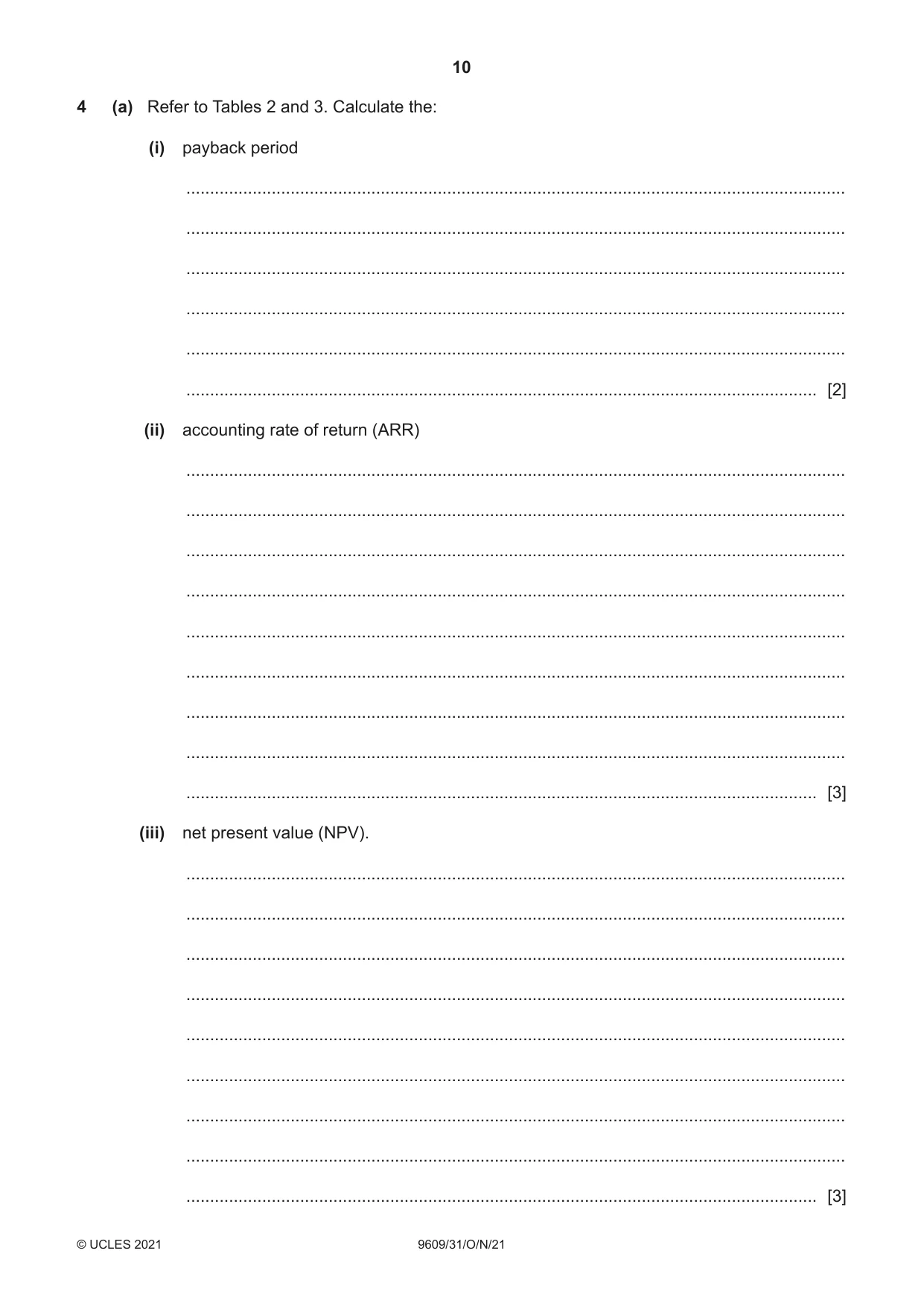
10 9609/31/O/N/21 © UCLES 2021 4 (a) Refer to Tables 2 and 3. Calculate the: (i) payback period … … … … … … [2] (ii) accounting rate of return (ARR) … … … … … … … … … [3] (iii) net present value (NPV). … … … … … … … … … [3]
Question paper, page 11
11 9609/31/O/N/21 © UCLES 2021 [Turn over (b) You may refer to your answers to 4(a) and any other information. Recommend whether FF should invest in buying 3D printers. Justify your recommendation. … … … … … … … … … … … … … … … … … … … … … … … … … …
Question paper, page 12
12 9609/31/O/N/21 © UCLES 2021 … … … … … … … … … … … … … … … … … … … … … … … … … … … … [12]
Question paper, page 13
13 9609/31/O/N/21 © UCLES 2021 [Turn over 5 Evaluate the importance to FF of following the product development process before adding metal glasses frames to its product range. … … … … … … … … … … … … … … … … … … … … … … … … … … …
Question paper, page 14
14 9609/31/O/N/21 © UCLES 2021 … … … … … … … … … … … … … … … … … … … … … … … … … … … …
Question paper, page 15
15 9609/31/O/N/21 © UCLES 2021 [Turn over … … … … … … … … … … … … … … … … … … … … … … … … … … … … [16]
Question paper, page 16
16 9609/31/O/N/21 © UCLES 2021 Section B Answer one question in this section. 6 Evaluate the strategic choice techniques FF’s directors could use when making the decision whether to enter the Asia Pacific retail glasses market. 7 Evaluate the importance of change management techniques to the successful introduction of team working at FF. Write the question number here: … … … … … … … … … … … … … … … … … … … … … … …
Question paper, page 17
17 9609/31/O/N/21 © UCLES 2021 [Turn over … … … … … … … … … … … … … … … … … … … … … … … … … … … …
Question paper, page 18
18 9609/31/O/N/21 © UCLES 2021 … … … … … … … … … … … … … … … … … … … … … … … … … … … …
Question paper, page 19
19 9609/31/O/N/21 © UCLES 2021 … … … … … … … … … … … … … … … … … … … … … … … … … … … … [20]
Question paper, page 20
20 9609/31/O/N/21 © UCLES 2021 Permission to reproduce items where third-party owned material protected by copyright is included has been sought and cleared where possible. Every reasonable effort has been made by the publisher (UCLES) to trace copyright holders, but if any items requiring clearance have unwittingly been included, the publisher will be pleased to make amends at the earliest possible opportunity. To avoid the issue of disclosure of answer-related information to candidates, all copyright acknowledgements are reproduced online in the Cambridge Assessment International Education Copyright Acknowledgements Booklet. This is produced for each series of examinations and is freely available to download at www.cambridgeinternational.org after the live examination series. Cambridge Assessment International Education is part of the Cambridge Assessment Group. Cambridge Assessment is the brand name of the University of Cambridge Local Examinations Syndicate (UCLES), which itself is a department of the University of Cambridge. BLANK PAGE
Mark scheme, page 1
This document consists of 21 printed pages. © UCLES 2021 [Turn over Cambridge International AS & A Level BUSINESS 9609/31 Paper 3 Case Study October/November 2021 MARK SCHEME Maximum Mark: 60 Published This mark scheme is published as an aid to teachers and candidates, to indicate the requirements of the examination. It shows the basis on which Examiners were instructed to award marks. It does not indicate the details of the discussions that took place at an Examiners’ meeting before marking began, which would have considered the acceptability of alternative answers. Mark schemes should be read in conjunction with the question paper and the Principal Examiner Report for teachers. Cambridge international will not enter into discussions about these mark schemes. Cambridge International is publishing the mark schemes for the October/November 2021 series for most Cambridge IGCSE™, Cambridge International A and AS Level components and some Cambridge O Level components.
Mark scheme, page 2
9609/31 Cambridge International AS & A Level – Mark Scheme PUBLISHED October/November 2021 © UCLES 2021 Page 2 of 21 Generic Marking Principles These general marking principles must be applied by all examiners when marking candidate answers. They should be applied alongside the specific content of the mark scheme or generic level descriptors for a question. Each question paper and mark scheme will also comply with these marking principles. GENERIC MARKING PRINCIPLE 1: Marks must be awarded in line with: • the specific content of the mark scheme or the generic level descriptors for the question • the specific skills defined in the mark scheme or in the generic level descriptors for the question • the standard of response required by a candidate as exemplified by the standardisation scripts. GENERIC MARKING PRINCIPLE 2: Marks awarded are always whole marks (not half marks, or other fractions). GENERIC MARKING PRINCIPLE 3: Marks must be awarded positively: • marks are awarded for correct/valid answers, as defined in the mark scheme. However, credit is given for valid answers which go beyond the scope of the syllabus and mark scheme, referring to your Team Leader as appropriate • marks are awarded when candidates clearly demonstrate what they know and can do • marks are not deducted for errors • marks are not deducted for omissions • answers should only be judged on the quality of spelling, punctuation and grammar when these features are specifically assessed by the question as indicated by the mark scheme. The meaning, however, should be unambiguous. GENERIC MARKING PRINCIPLE 4: Rules must be applied consistently, e.g. in situations where candidates have not followed instructions or in the application of generic level descriptors. GENERIC MARKING PRINCIPLE 5: Marks should be awarded using the full range of marks defined in the mark scheme for the question (however; the use of the full mark range may be limited according to the quality of the candidate responses seen). GENERIC MARKING PRINCIPLE 6: Marks awarded are based solely on the requirements as defined in the mark scheme. Marks should not be awarded with grade thresholds or grade descriptors in mind.
Mark scheme, page 3
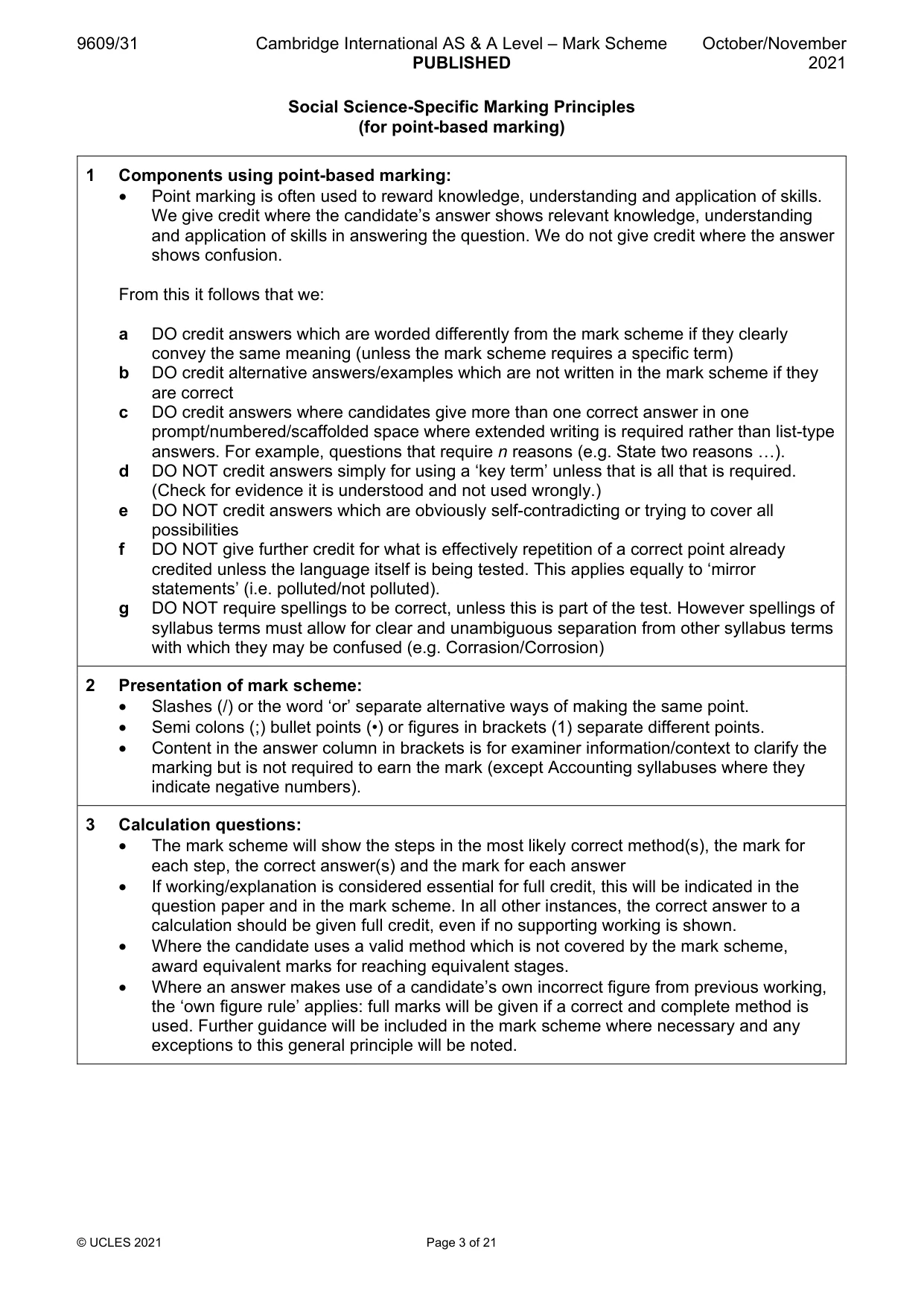
9609/31 Cambridge International AS & A Level – Mark Scheme PUBLISHED October/November 2021 © UCLES 2021 Page 3 of 21 Social Science-Specific Marking Principles (for point-based marking) 1 Components using point-based marking: • Point marking is often used to reward knowledge, understanding and application of skills. We give credit where the candidate’s answer shows relevant knowledge, understanding and application of skills in answering the question. We do not give credit where the answer shows confusion. From this it follows that we: a DO credit answers which are worded differently from the mark scheme if they clearly convey the same meaning (unless the mark scheme requires a specific term) b DO credit alternative answers/examples which are not written in the mark scheme if they are correct c DO credit answers where candidates give more than one correct answer in one prompt/numbered/scaffolded space where extended writing is required rather than list-type answers. For example, questions that require n reasons (e.g. State two reasons …). d DO NOT credit answers simply for using a ‘key term’ unless that is all that is required. (Check for evidence it is understood and not used wrongly.) e DO NOT credit answers which are obviously self-contradicting or trying to cover all possibilities f DO NOT give further credit for what is effectively repetition of a correct point already credited unless the language itself is being tested. This applies equally to ‘mirror statements’ (i.e. polluted/not polluted). g DO NOT require spellings to be correct, unless this is part of the test. However spellings of syllabus terms must allow for clear and unambiguous separation from other syllabus terms with which they may be confused (e.g. Corrasion/Corrosion) 2 Presentation of mark scheme: • Slashes (/) or the word ‘or’ separate alternative ways of making the same point. • Semi colons (;) bullet points (•) or figures in brackets (1) separate different points. • Content in the answer column in brackets is for examiner information/context to clarify the marking but is not required to earn the mark (except Accounting syllabuses where they indicate negative numbers). 3 Calculation questions: • The mark scheme will show the steps in the most likely correct method(s), the mark for each step, the correct answer(s) and the mark for each answer • If working/explanation is considered essential for full credit, this will be indicated in the question paper and in the mark scheme. In all other instances, the correct answer to a calculation should be given full credit, even if no supporting working is shown. • Where the candidate uses a valid method which is not covered by the mark scheme, award equivalent marks for reaching equivalent stages. • Where an answer makes use of a candidate’s own incorrect figure from previous working, the ‘own figure rule’ applies: full marks will be given if a correct and complete method is used. Further guidance will be included in the mark scheme where necessary and any exceptions to this general principle will be noted.
Mark scheme, page 4
9609/31 Cambridge International AS & A Level – Mark Scheme PUBLISHED October/November 2021 © UCLES 2021 Page 4 of 21 4 Annotation: • For point marking, ticks can be used to indicate correct answers and crosses can be used to indicate wrong answers. There is no direct relationship between ticks and marks. Ticks have no defined meaning for levels of response marking. • For levels of response marking, the level awarded should be annotated on the script. • Other annotations will be used by examiners as agreed during standardisation, and the meaning will be understood by all examiners who marked that paper.
Mark scheme, page 5
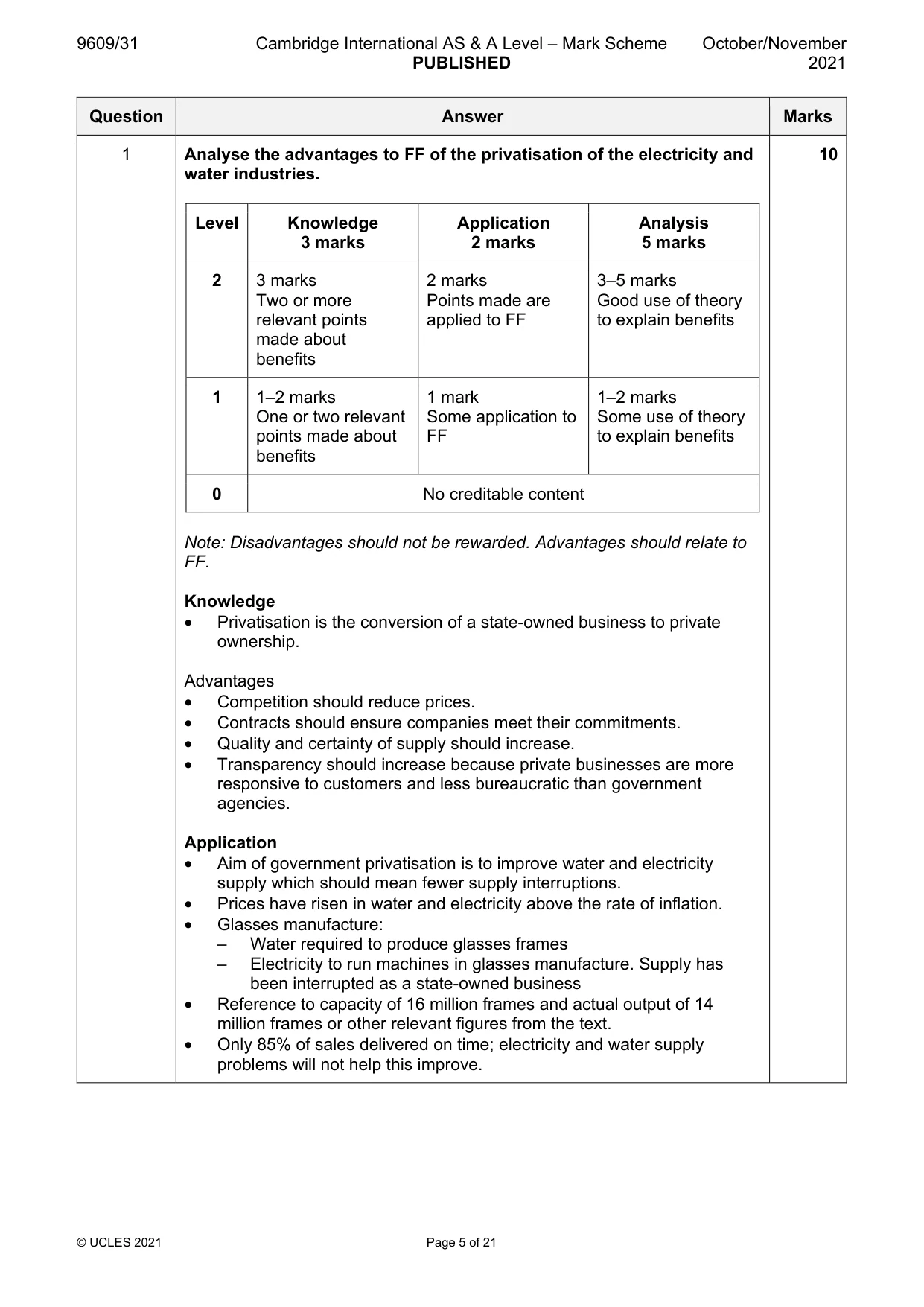
9609/31 Cambridge International AS & A Level – Mark Scheme PUBLISHED October/November 2021 © UCLES 2021 Page 5 of 21 Question Answer Marks 1 Analyse the advantages to FF of the privatisation of the electricity and water industries. Level Knowledge 3 marks Application 2 marks Analysis 5 marks 2 3 marks Two or more relevant points made about benefits 2 marks Points made are applied to FF 3–5 marks Good use of theory to explain benefits 1 1–2 marks One or two relevant points made about benefits 1 mark Some application to FF 1–2 marks Some use of theory to explain benefits 0 No creditable content Note: Disadvantages should not be rewarded. Advantages should relate to FF. Knowledge • Privatisation is the conversion of a state-owned business to private ownership. Advantages • Competition should reduce prices. • Contracts should ensure companies meet their commitments. • Quality and certainty of supply should increase. • Transparency should increase because private businesses are more responsive to customers and less bureaucratic than government agencies. Application • Aim of government privatisation is to improve water and electricity supply which should mean fewer supply interruptions. • Prices have risen in water and electricity above the rate of inflation. • Glasses manufacture: – Water required to produce glasses frames – Electricity to run machines in glasses manufacture. Supply has been interrupted as a state-owned business • Reference to capacity of 16 million frames and actual output of 14 million frames or other relevant figures from the text. • Only 85% of sales delivered on time; electricity and water supply problems will not help this improve. 10
Mark scheme, page 6
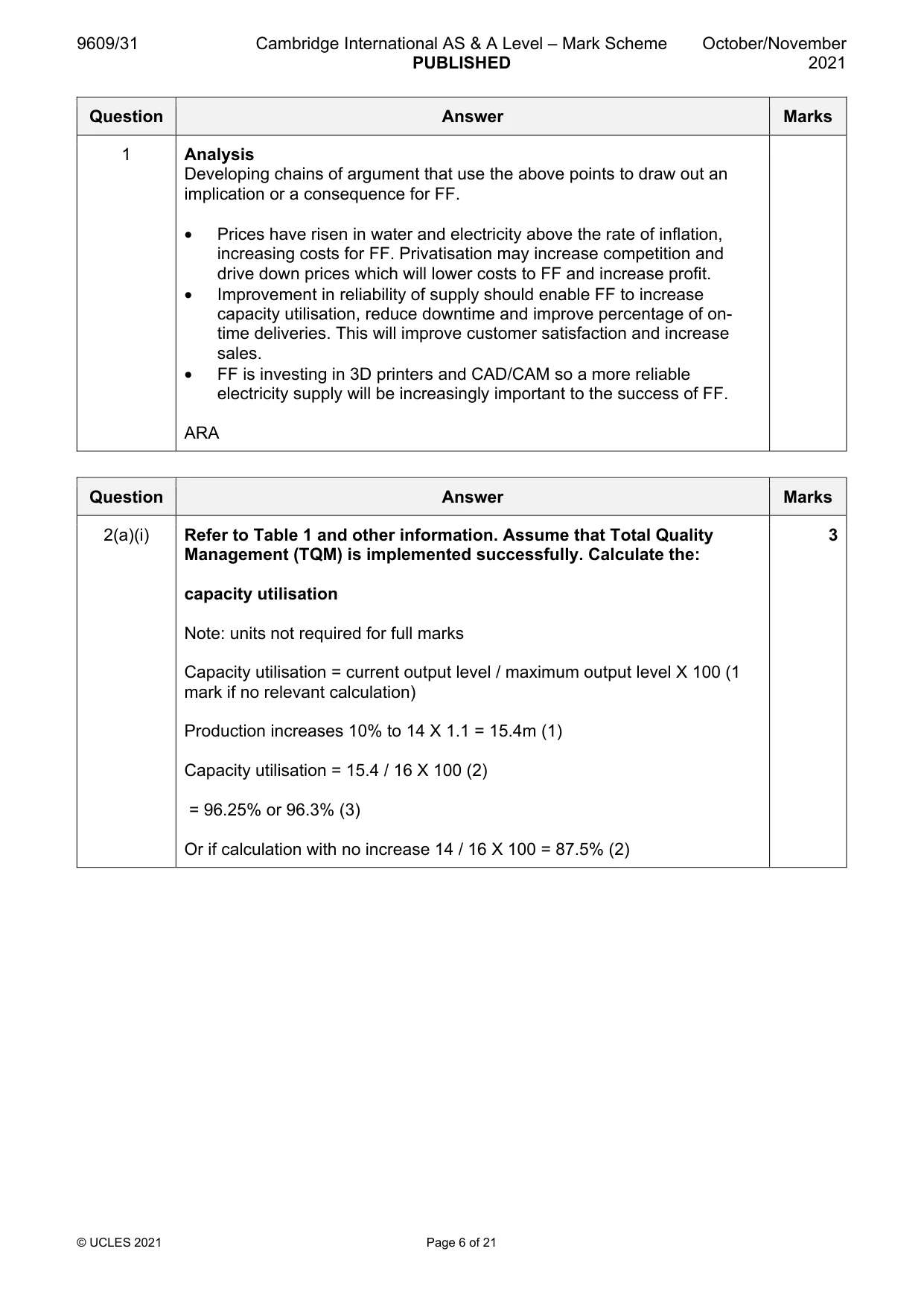
9609/31 Cambridge International AS & A Level – Mark Scheme PUBLISHED October/November 2021 © UCLES 2021 Page 6 of 21 Question Answer Marks 1 Analysis Developing chains of argument that use the above points to draw out an implication or a consequence for FF. • Prices have risen in water and electricity above the rate of inflation, increasing costs for FF. Privatisation may increase competition and drive down prices which will lower costs to FF and increase profit. • Improvement in reliability of supply should enable FF to increase capacity utilisation, reduce downtime and improve percentage of on- time deliveries. This will improve customer satisfaction and increase sales. • FF is investing in 3D printers and CAD/CAM so a more reliable electricity supply will be increasingly important to the success of FF. ARA Question Answer Marks 2(a)(i) Refer to Table 1 and other information. Assume that Total Quality Management (TQM) is implemented successfully. Calculate the: capacity utilisation Note: units not required for full marks Capacity utilisation = current output level / maximum output level X 100 (1 mark if no relevant calculation) Production increases 10% to 14 X 1.1 = 15.4m (1) Capacity utilisation = 15.4 / 16 X 100 (2) = 96.25% or 96.3% (3) Or if calculation with no increase 14 / 16 X 100 = 87.5% (2) 3
Mark scheme, page 7
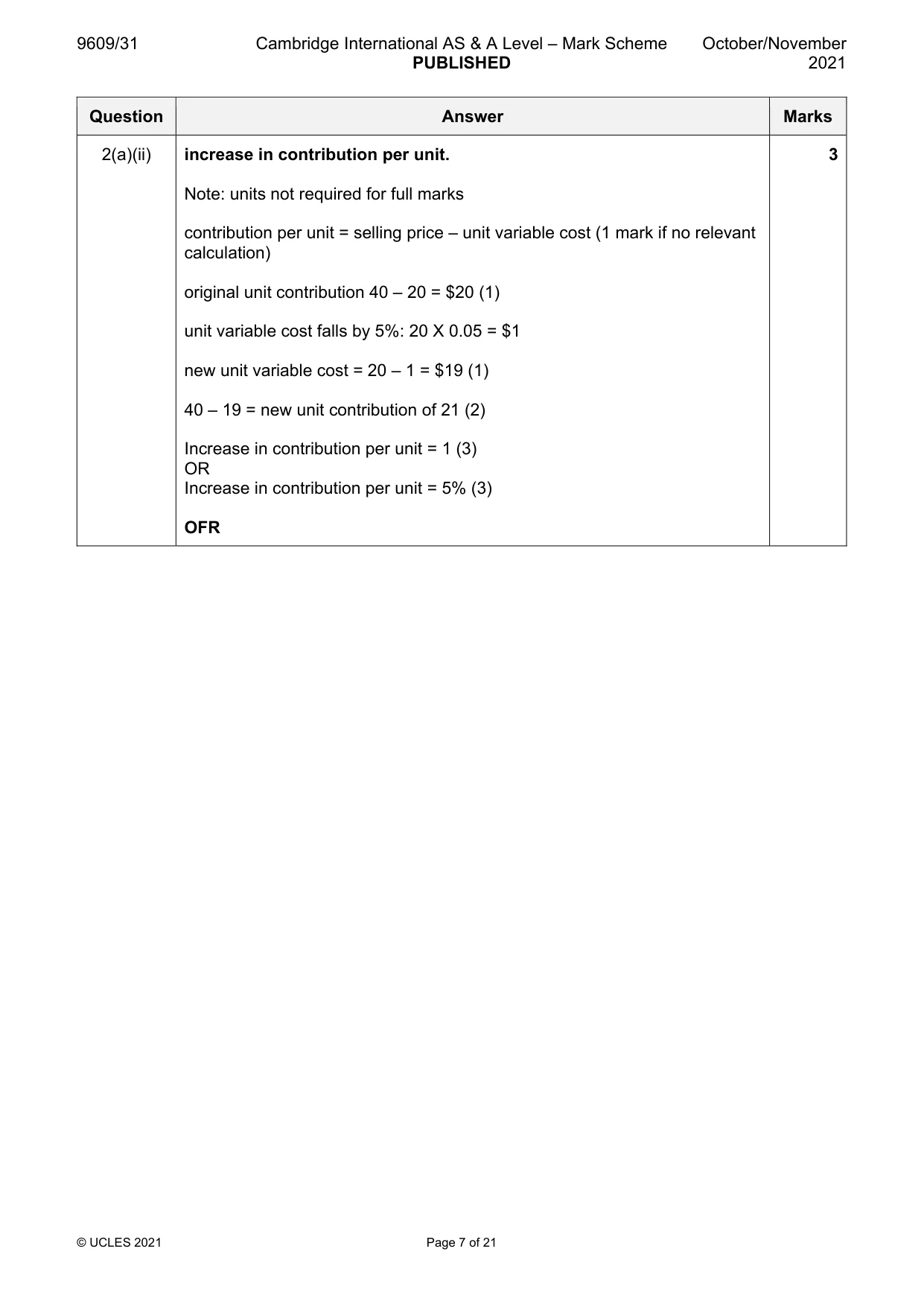
9609/31 Cambridge International AS & A Level – Mark Scheme PUBLISHED October/November 2021 © UCLES 2021 Page 7 of 21 Question Answer Marks 2(a)(ii) increase in contribution per unit. Note: units not required for full marks contribution per unit = selling price – unit variable cost (1 mark if no relevant calculation) original unit contribution 40 – 20 = $20 (1) unit variable cost falls by 5%: 20 X 0.05 = $1 new unit variable cost = 20 – 1 = $19 (1) 40 – 19 = new unit contribution of 21 (2) Increase in contribution per unit = 1 (3) OR Increase in contribution per unit = 5% (3) OFR 3
Mark scheme, page 8
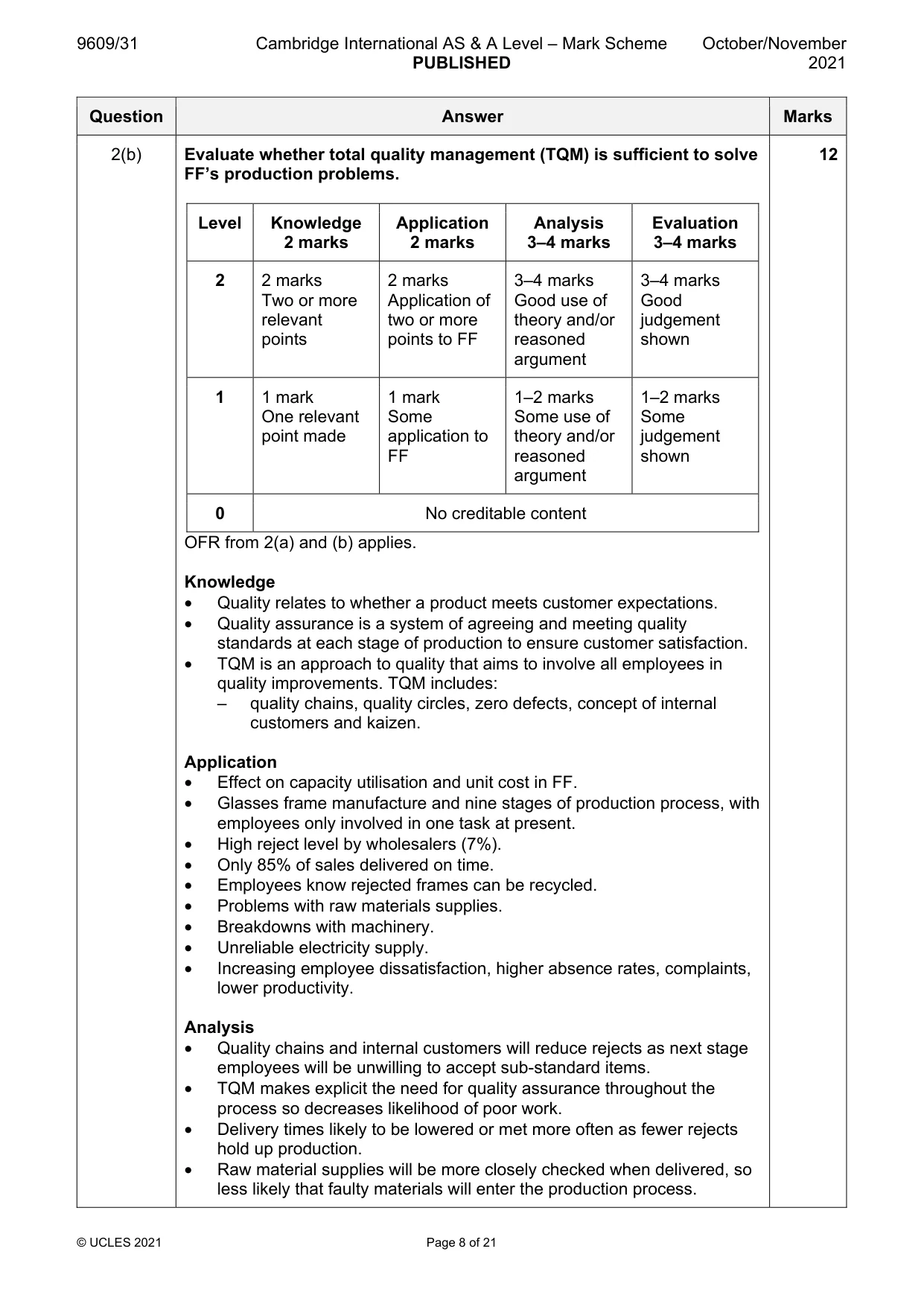
9609/31 Cambridge International AS & A Level – Mark Scheme PUBLISHED October/November 2021 © UCLES 2021 Page 8 of 21 Question Answer Marks 2(b) Evaluate whether total quality management (TQM) is sufficient to solve FF’s production problems. Level Knowledge 2 marks Application 2 marks Analysis 3–4 marks Evaluation 3–4 marks 2 2 marks Two or more relevant points 2 marks Application of two or more points to FF 3–4 marks Good use of theory and/or reasoned argument 3–4 marks Good judgement shown 1 1 mark One relevant point made 1 mark Some application to FF 1–2 marks Some use of theory and/or reasoned argument 1–2 marks Some judgement shown 0 No creditable content OFR from 2(a) and (b) applies. Knowledge • Quality relates to whether a product meets customer expectations. • Quality assurance is a system of agreeing and meeting quality standards at each stage of production to ensure customer satisfaction. • TQM is an approach to quality that aims to involve all employees in quality improvements. TQM includes: – quality chains, quality circles, zero defects, concept of internal customers and kaizen. Application • Effect on capacity utilisation and unit cost in FF. • Glasses frame manufacture and nine stages of production process, with employees only involved in one task at present. • High reject level by wholesalers (7%). • Only 85% of sales delivered on time. • Employees know rejected frames can be recycled. • Problems with raw materials supplies. • Breakdowns with machinery. • Unreliable electricity supply. • Increasing employee dissatisfaction, higher absence rates, complaints, lower productivity. Analysis • Quality chains and internal customers will reduce rejects as next stage employees will be unwilling to accept sub-standard items. • TQM makes explicit the need for quality assurance throughout the process so decreases likelihood of poor work. • Delivery times likely to be lowered or met more often as fewer rejects hold up production. • Raw material supplies will be more closely checked when delivered, so less likely that faulty materials will enter the production process. 12
Mark scheme, page 9
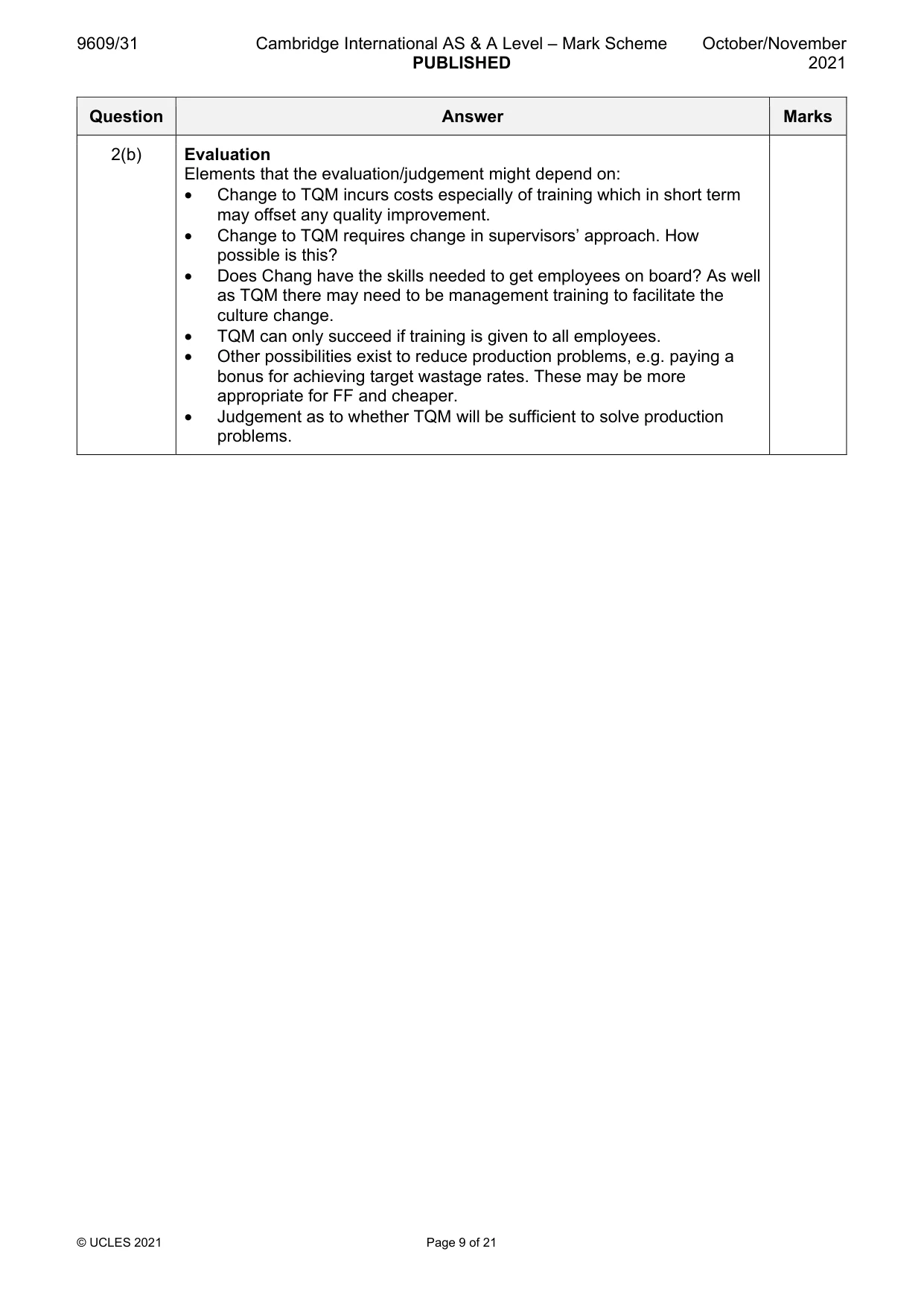
9609/31 Cambridge International AS & A Level – Mark Scheme PUBLISHED October/November 2021 © UCLES 2021 Page 9 of 21 Question Answer Marks 2(b) Evaluation Elements that the evaluation/judgement might depend on: • Change to TQM incurs costs especially of training which in short term may offset any quality improvement. • Change to TQM requires change in supervisors’ approach. How possible is this? • Does Chang have the skills needed to get employees on board? As well as TQM there may need to be management training to facilitate the culture change. • TQM can only succeed if training is given to all employees. • Other possibilities exist to reduce production problems, e.g. paying a bonus for achieving target wastage rates. These may be more appropriate for FF and cheaper. • Judgement as to whether TQM will be sufficient to solve production problems.
Mark scheme, page 10
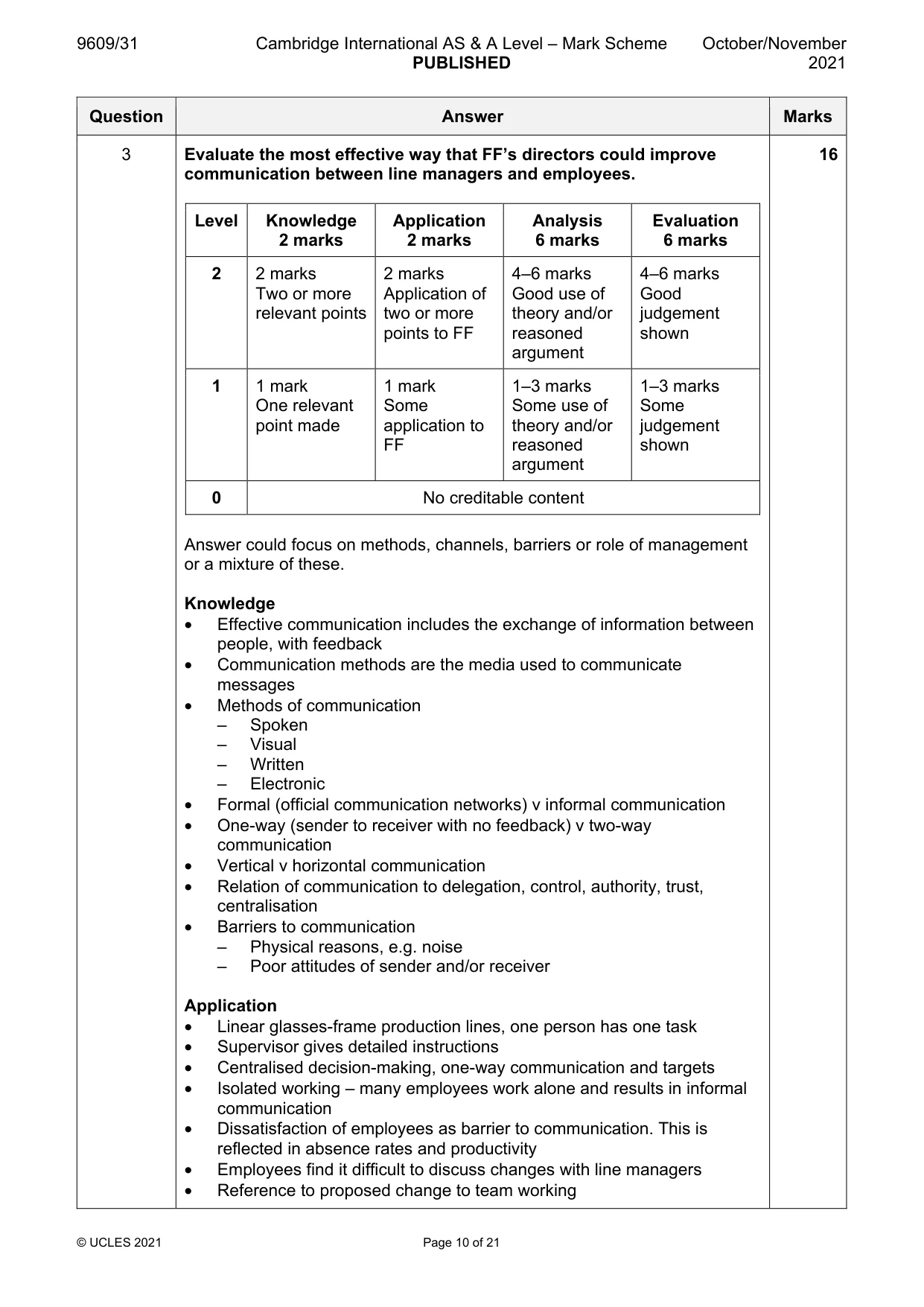
9609/31 Cambridge International AS & A Level – Mark Scheme PUBLISHED October/November 2021 © UCLES 2021 Page 10 of 21 Question Answer Marks 3 Evaluate the most effective way that FF’s directors could improve communication between line managers and employees. Level Knowledge 2 marks Application 2 marks Analysis 6 marks Evaluation 6 marks 2 2 marks Two or more relevant points 2 marks Application of two or more points to FF 4–6 marks Good use of theory and/or reasoned argument 4–6 marks Good judgement shown 1 1 mark One relevant point made 1 mark Some application to FF 1–3 marks Some use of theory and/or reasoned argument 1–3 marks Some judgement shown 0 No creditable content Answer could focus on methods, channels, barriers or role of management or a mixture of these. Knowledge • Effective communication includes the exchange of information between people, with feedback • Communication methods are the media used to communicate messages • Methods of communication – Spoken – Visual – Written – Electronic • Formal (official communication networks) v informal communication • One-way (sender to receiver with no feedback) v two-way communication • Vertical v horizontal communication • Relation of communication to delegation, control, authority, trust, centralisation • Barriers to communication – Physical reasons, e.g. noise – Poor attitudes of sender and/or receiver Application • Linear glasses-frame production lines, one person has one task • Supervisor gives detailed instructions • Centralised decision-making, one-way communication and targets • Isolated working – many employees work alone and results in informal communication • Dissatisfaction of employees as barrier to communication. This is reflected in absence rates and productivity • Employees find it difficult to discuss changes with line managers • Reference to proposed change to team working 16
Mark scheme, page 11
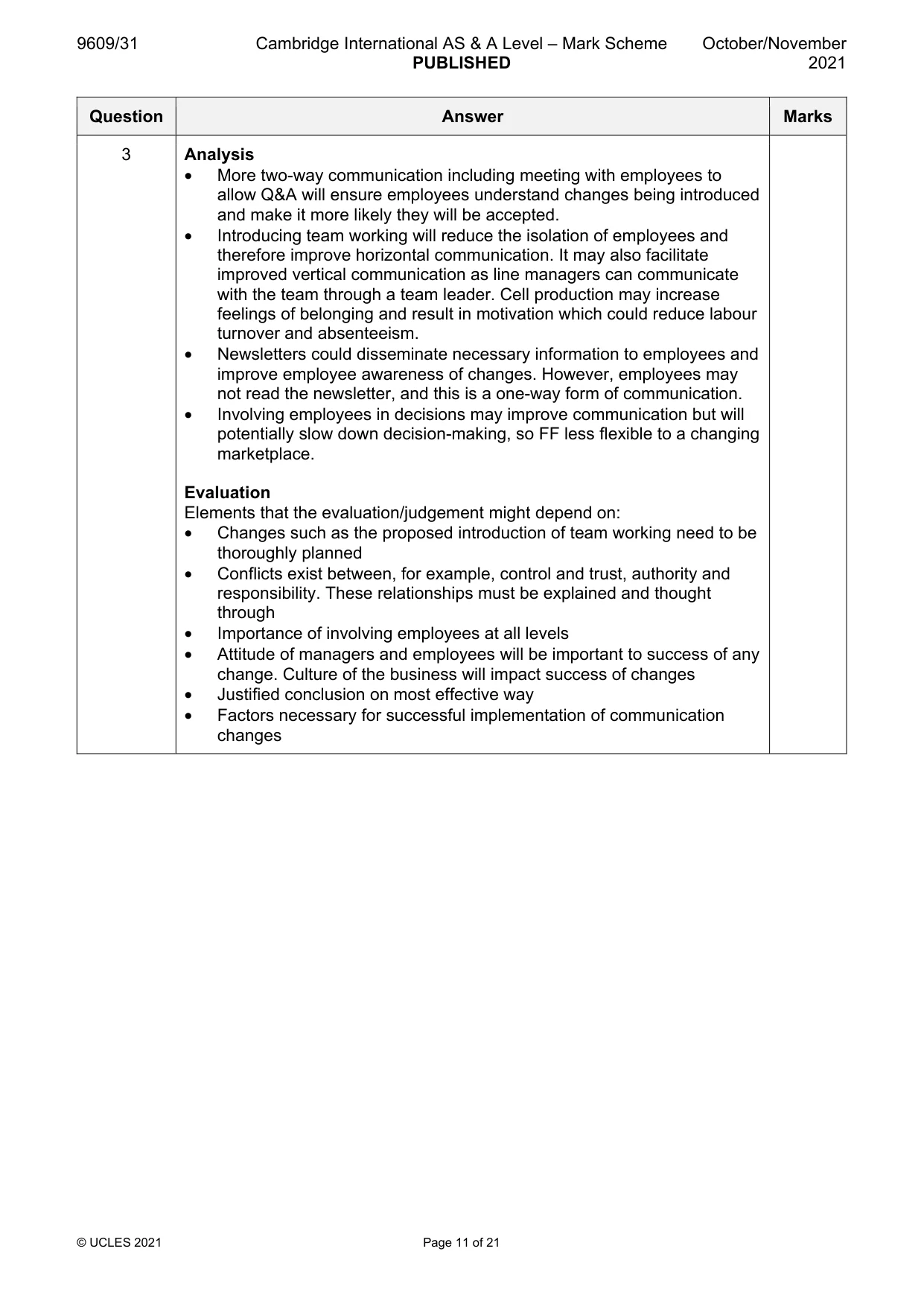
9609/31 Cambridge International AS & A Level – Mark Scheme PUBLISHED October/November 2021 © UCLES 2021 Page 11 of 21 Question Answer Marks 3 Analysis • More two-way communication including meeting with employees to allow Q&A will ensure employees understand changes being introduced and make it more likely they will be accepted. • Introducing team working will reduce the isolation of employees and therefore improve horizontal communication. It may also facilitate improved vertical communication as line managers can communicate with the team through a team leader. Cell production may increase feelings of belonging and result in motivation which could reduce labour turnover and absenteeism. • Newsletters could disseminate necessary information to employees and improve employee awareness of changes. However, employees may not read the newsletter, and this is a one-way form of communication. • Involving employees in decisions may improve communication but will potentially slow down decision-making, so FF less flexible to a changing marketplace. Evaluation Elements that the evaluation/judgement might depend on: • Changes such as the proposed introduction of team working need to be thoroughly planned • Conflicts exist between, for example, control and trust, authority and responsibility. These relationships must be explained and thought through • Importance of involving employees at all levels • Attitude of managers and employees will be important to success of any change. Culture of the business will impact success of changes • Justified conclusion on most effective way • Factors necessary for successful implementation of communication changes
Mark scheme, page 12
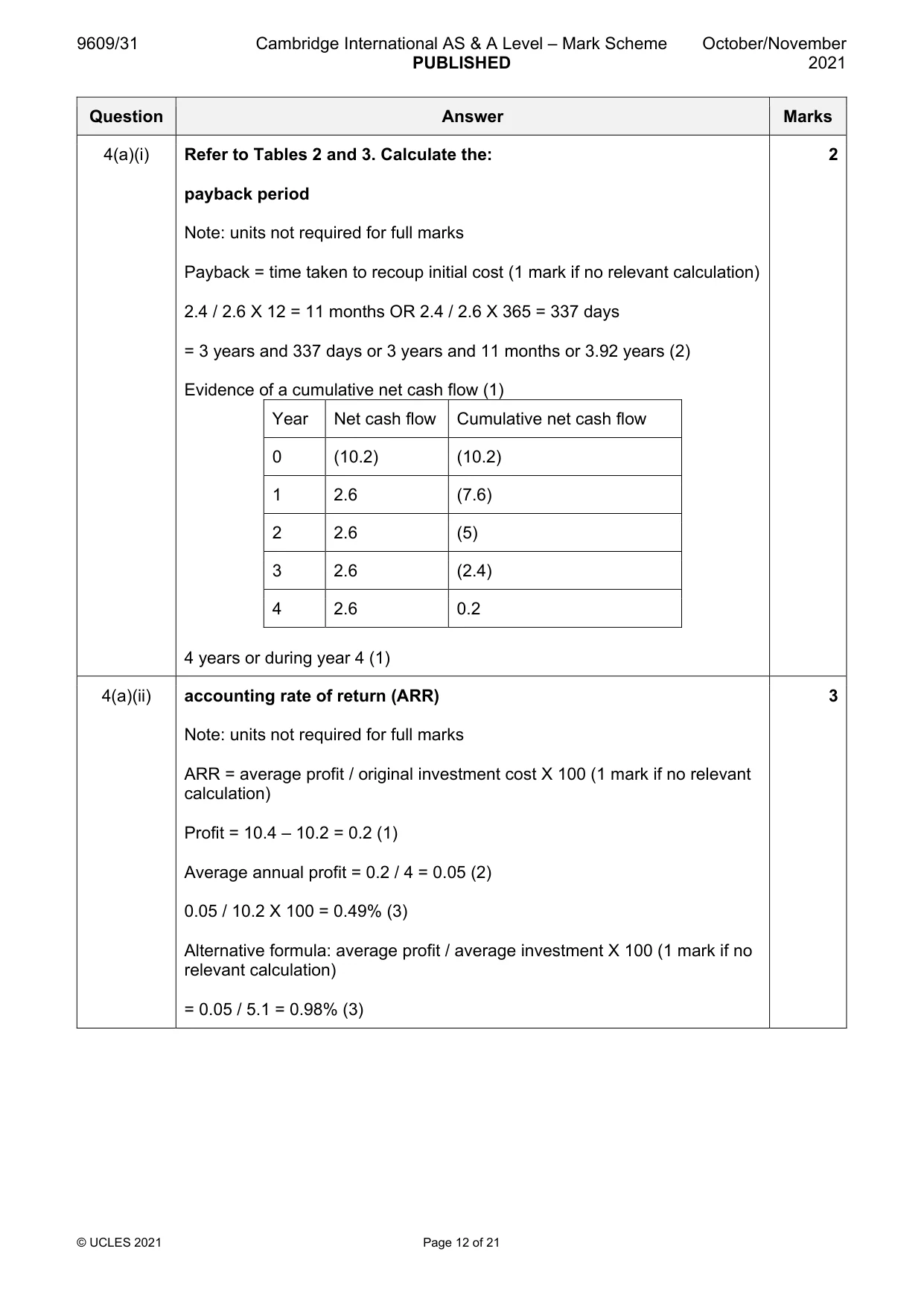
9609/31 Cambridge International AS & A Level – Mark Scheme PUBLISHED October/November 2021 © UCLES 2021 Page 12 of 21 Question Answer Marks 4(a)(i) Refer to Tables 2 and 3. Calculate the: payback period Note: units not required for full marks Payback = time taken to recoup initial cost (1 mark if no relevant calculation) 2.4 / 2.6 X 12 = 11 months OR 2.4 / 2.6 X 365 = 337 days = 3 years and 337 days or 3 years and 11 months or 3.92 years (2) Evidence of a cumulative net cash flow (1) Year Net cash flow Cumulative net cash flow 0 (10.2) (10.2) 1 2.6 (7.6) 2 2.6 (5) 3 2.6 (2.4) 4 2.6 0.2 4 years or during year 4 (1) 2 4(a)(ii) accounting rate of return (ARR) Note: units not required for full marks ARR = average profit / original investment cost X 100 (1 mark if no relevant calculation) Profit = 10.4 – 10.2 = 0.2 (1) Average annual profit = 0.2 / 4 = 0.05 (2) 0.05 / 10.2 X 100 = 0.49% (3) Alternative formula: average profit / average investment X 100 (1 mark if no relevant calculation) = 0.05 / 5.1 = 0.98% (3) 3
Mark scheme, page 13
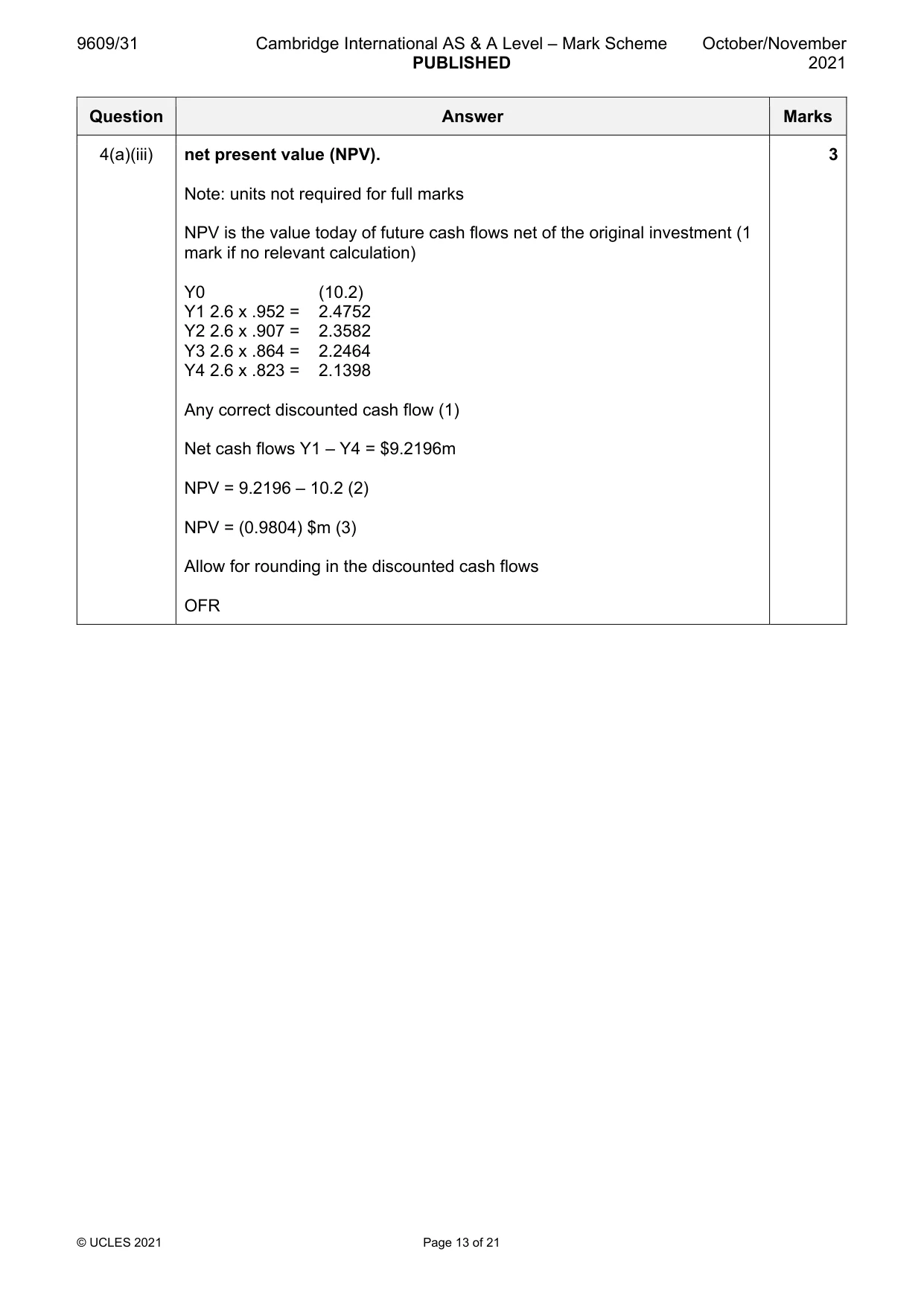
9609/31 Cambridge International AS & A Level – Mark Scheme PUBLISHED October/November 2021 © UCLES 2021 Page 13 of 21 Question Answer Marks 4(a)(iii) net present value (NPV). Note: units not required for full marks NPV is the value today of future cash flows net of the original investment (1 mark if no relevant calculation) Y0 (10.2) Y1 2.6 x .952 = 2.4752 Y2 2.6 x .907 = 2.3582 Y3 2.6 x .864 = 2.2464 Y4 2.6 x .823 = 2.1398 Any correct discounted cash flow (1) Net cash flows Y1 – Y4 = $9.2196m NPV = 9.2196 – 10.2 (2) NPV = (0.9804) $m (3) Allow for rounding in the discounted cash flows OFR 3
Mark scheme, page 14
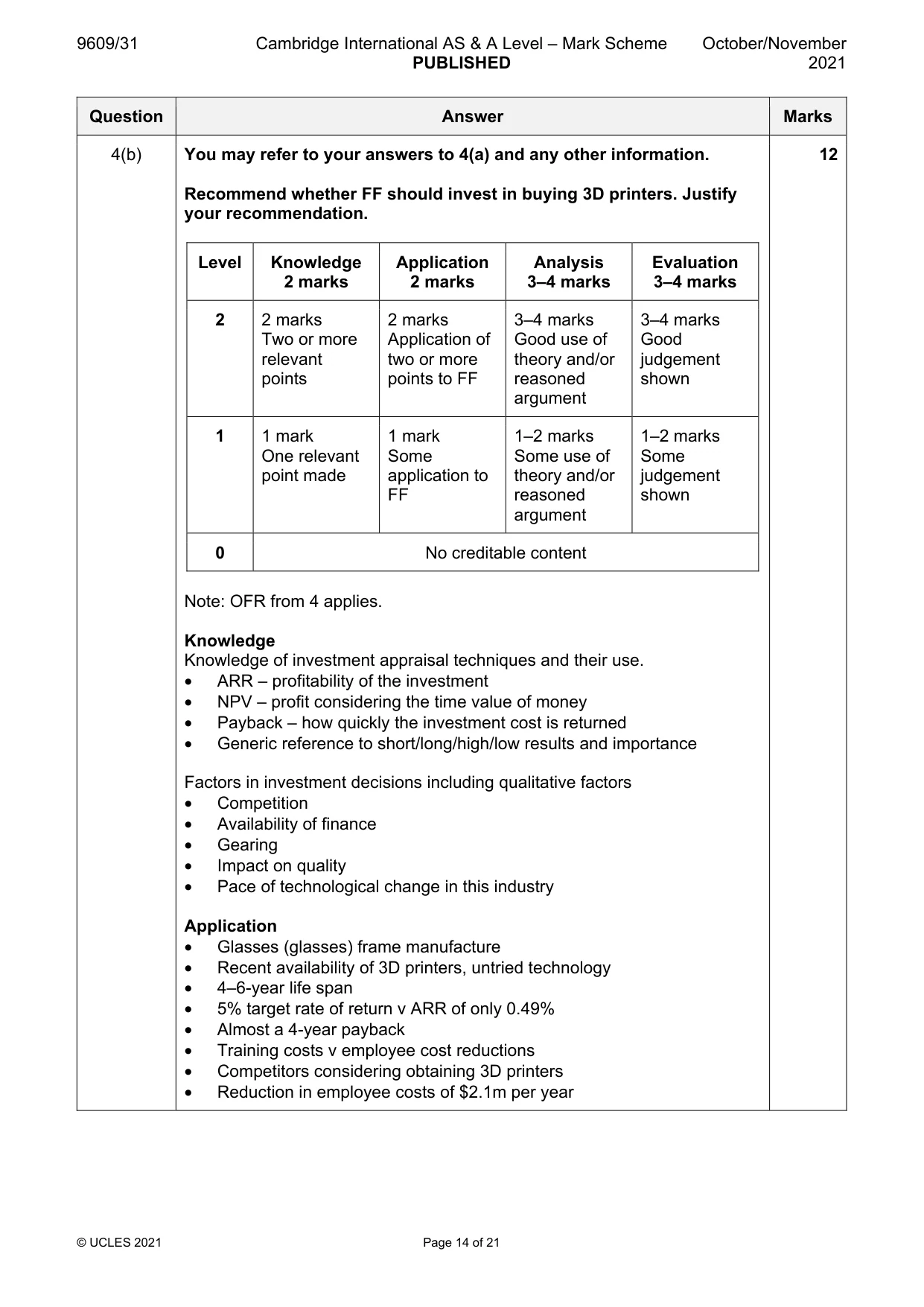
9609/31 Cambridge International AS & A Level – Mark Scheme PUBLISHED October/November 2021 © UCLES 2021 Page 14 of 21 Question Answer Marks 4(b) You may refer to your answers to 4(a) and any other information. Recommend whether FF should invest in buying 3D printers. Justify your recommendation. Level Knowledge 2 marks Application 2 marks Analysis 3–4 marks Evaluation 3–4 marks 2 2 marks Two or more relevant points 2 marks Application of two or more points to FF 3–4 marks Good use of theory and/or reasoned argument 3–4 marks Good judgement shown 1 1 mark One relevant point made 1 mark Some application to FF 1–2 marks Some use of theory and/or reasoned argument 1–2 marks Some judgement shown 0 No creditable content Note: OFR from 4 applies. Knowledge Knowledge of investment appraisal techniques and their use. • ARR – profitability of the investment • NPV – profit considering the time value of money • Payback – how quickly the investment cost is returned • Generic reference to short/long/high/low results and importance Factors in investment decisions including qualitative factors • Competition • Availability of finance • Gearing • Impact on quality • Pace of technological change in this industry Application • Glasses (glasses) frame manufacture • Recent availability of 3D printers, untried technology • 4–6-year life span • 5% target rate of return v ARR of only 0.49% • Almost a 4-year payback • Training costs v employee cost reductions • Competitors considering obtaining 3D printers • Reduction in employee costs of $2.1m per year 12
Mark scheme, page 15
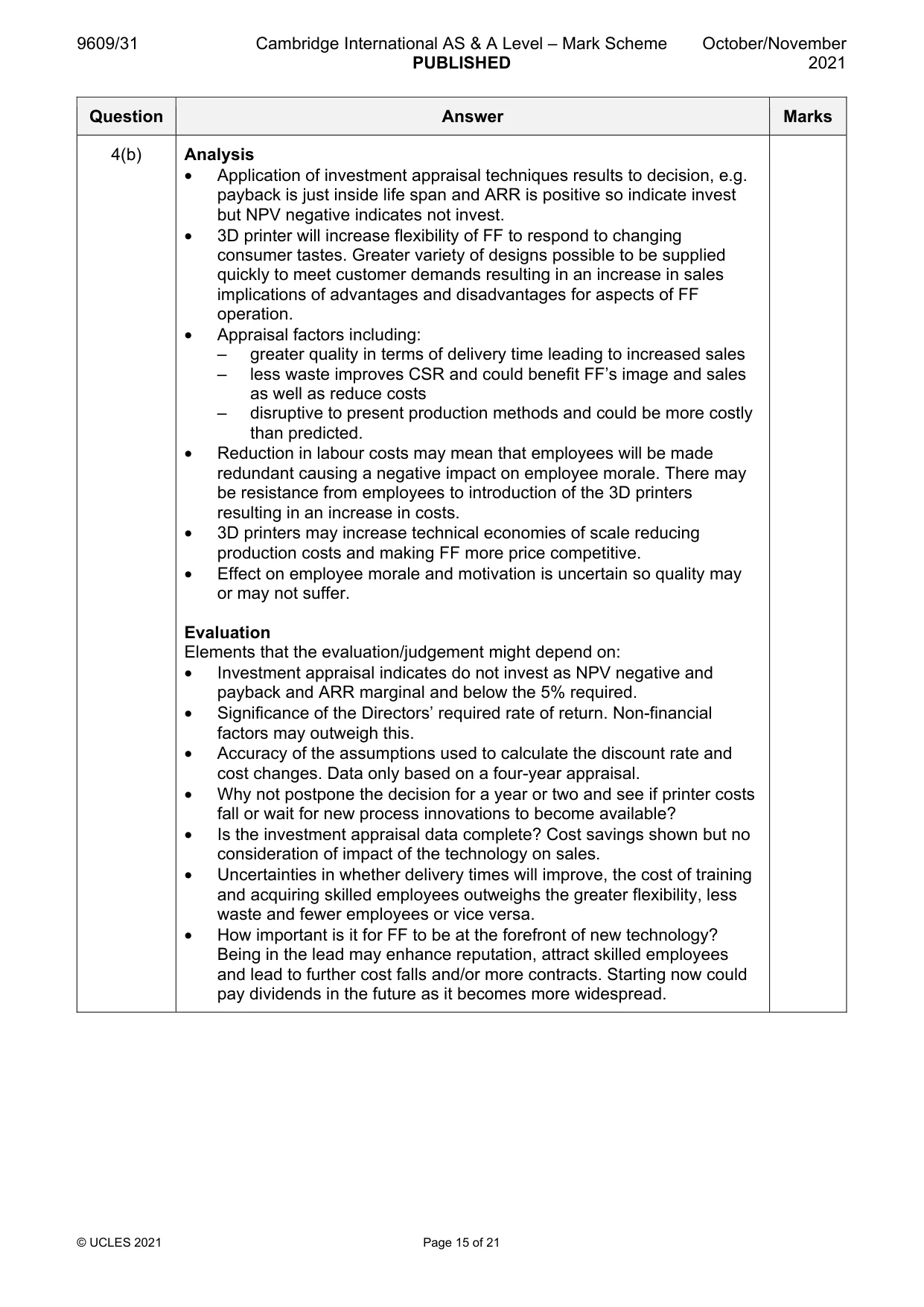
9609/31 Cambridge International AS & A Level – Mark Scheme PUBLISHED October/November 2021 © UCLES 2021 Page 15 of 21 Question Answer Marks 4(b) Analysis • Application of investment appraisal techniques results to decision, e.g. payback is just inside life span and ARR is positive so indicate invest but NPV negative indicates not invest. • 3D printer will increase flexibility of FF to respond to changing consumer tastes. Greater variety of designs possible to be supplied quickly to meet customer demands resulting in an increase in sales implications of advantages and disadvantages for aspects of FF operation. • Appraisal factors including: – greater quality in terms of delivery time leading to increased sales – less waste improves CSR and could benefit FF’s image and sales as well as reduce costs – disruptive to present production methods and could be more costly than predicted. • Reduction in labour costs may mean that employees will be made redundant causing a negative impact on employee morale. There may be resistance from employees to introduction of the 3D printers resulting in an increase in costs. • 3D printers may increase technical economies of scale reducing production costs and making FF more price competitive. • Effect on employee morale and motivation is uncertain so quality may or may not suffer. Evaluation Elements that the evaluation/judgement might depend on: • Investment appraisal indicates do not invest as NPV negative and payback and ARR marginal and below the 5% required. • Significance of the Directors’ required rate of return. Non-financial factors may outweigh this. • Accuracy of the assumptions used to calculate the discount rate and cost changes. Data only based on a four-year appraisal. • Why not postpone the decision for a year or two and see if printer costs fall or wait for new process innovations to become available? • Is the investment appraisal data complete? Cost savings shown but no consideration of impact of the technology on sales. • Uncertainties in whether delivery times will improve, the cost of training and acquiring skilled employees outweighs the greater flexibility, less waste and fewer employees or vice versa. • How important is it for FF to be at the forefront of new technology? Being in the lead may enhance reputation, attract skilled employees and lead to further cost falls and/or more contracts. Starting now could pay dividends in the future as it becomes more widespread.
Mark scheme, page 16
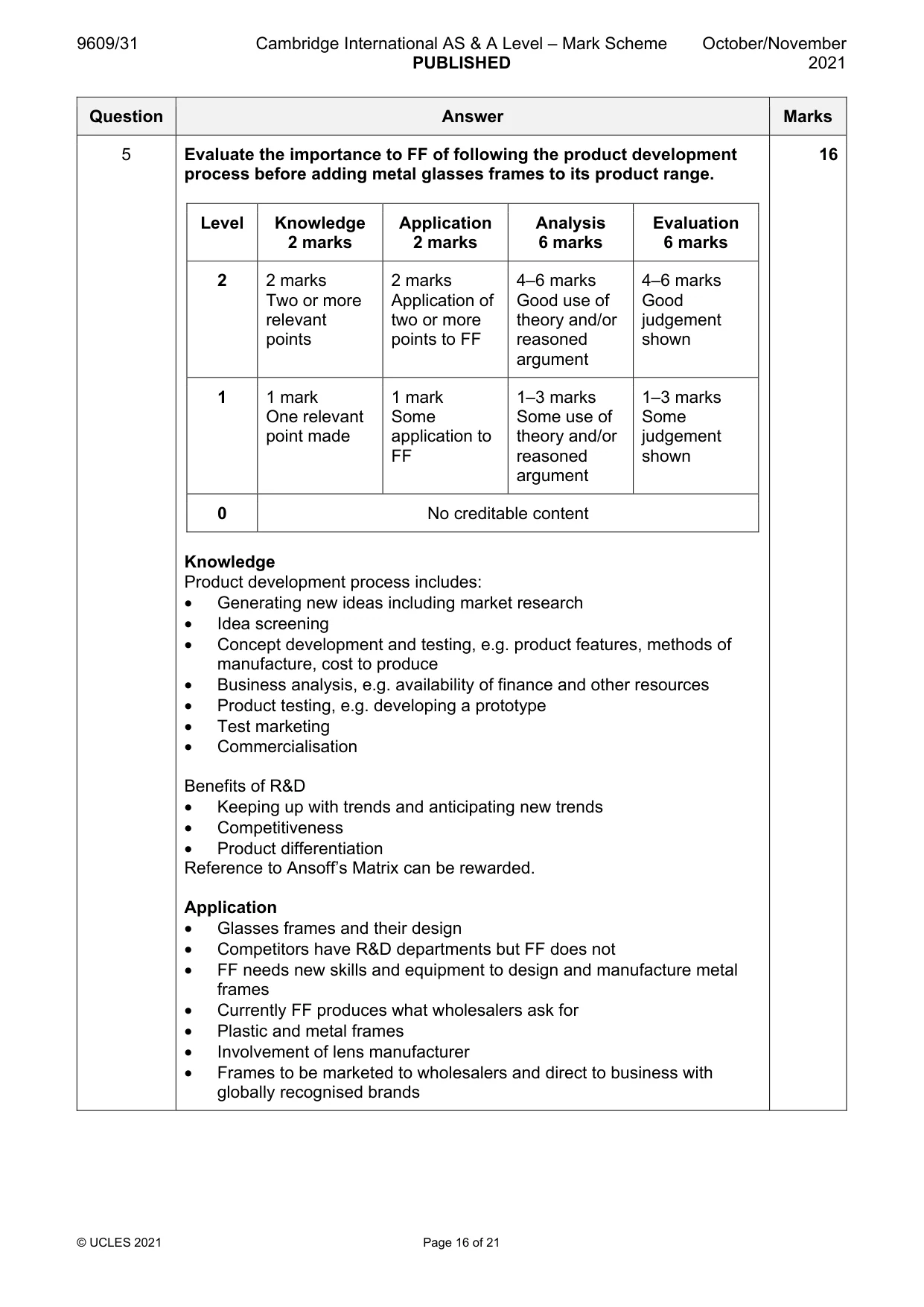
9609/31 Cambridge International AS & A Level – Mark Scheme PUBLISHED October/November 2021 © UCLES 2021 Page 16 of 21 Question Answer Marks 5 Evaluate the importance to FF of following the product development process before adding metal glasses frames to its product range. Level Knowledge 2 marks Application 2 marks Analysis 6 marks Evaluation 6 marks 2 2 marks Two or more relevant points 2 marks Application of two or more points to FF 4–6 marks Good use of theory and/or reasoned argument 4–6 marks Good judgement shown 1 1 mark One relevant point made 1 mark Some application to FF 1–3 marks Some use of theory and/or reasoned argument 1–3 marks Some judgement shown 0 No creditable content Knowledge Product development process includes: • Generating new ideas including market research • Idea screening • Concept development and testing, e.g. product features, methods of manufacture, cost to produce • Business analysis, e.g. availability of finance and other resources • Product testing, e.g. developing a prototype • Test marketing • Commercialisation Benefits of R&D • Keeping up with trends and anticipating new trends • Competitiveness • Product differentiation Reference to Ansoff’s Matrix can be rewarded. Application • Glasses frames and their design • Competitors have R&D departments but FF does not • FF needs new skills and equipment to design and manufacture metal frames • Currently FF produces what wholesalers ask for • Plastic and metal frames • Involvement of lens manufacturer • Frames to be marketed to wholesalers and direct to business with globally recognised brands 16
Mark scheme, page 17
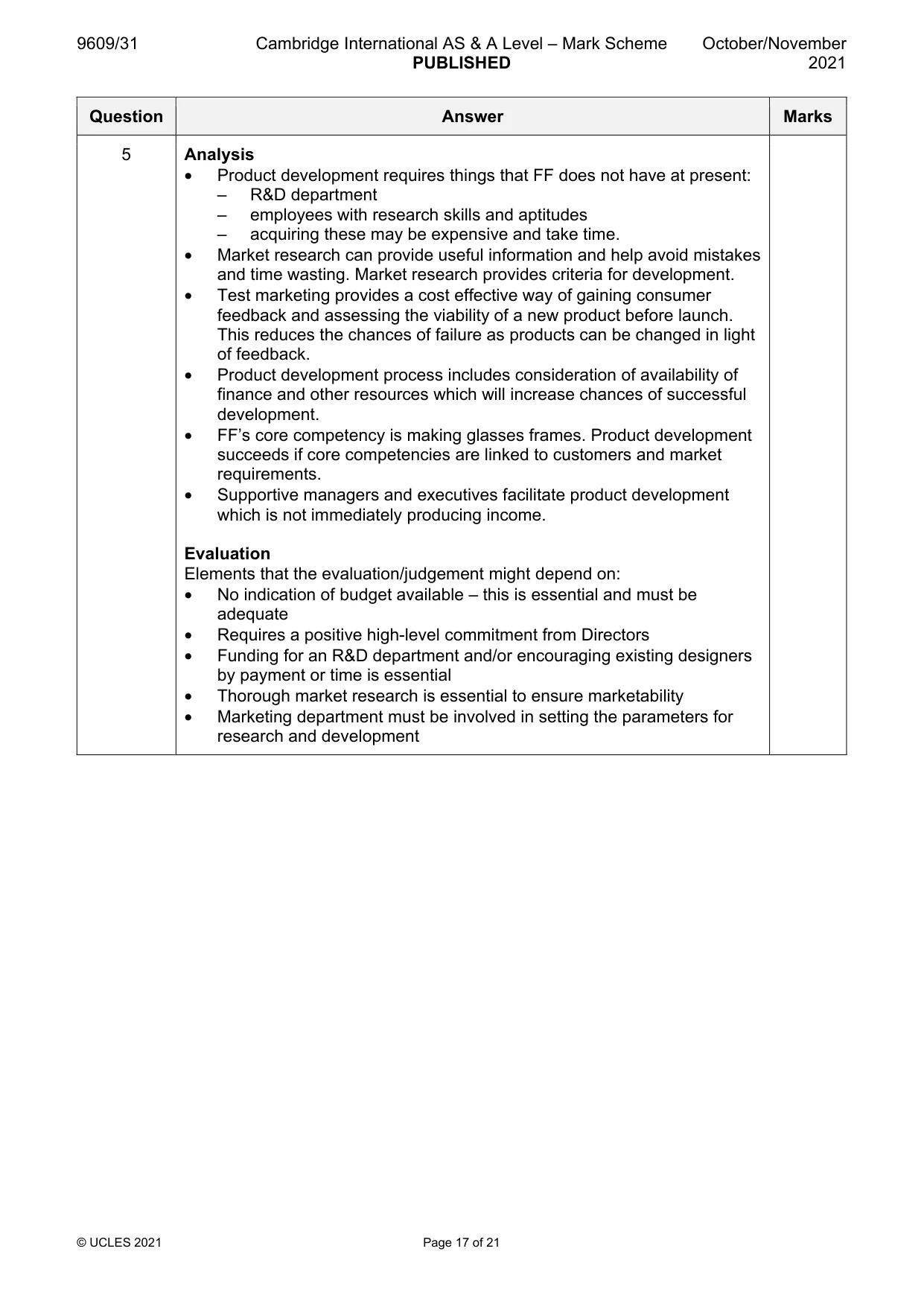
9609/31 Cambridge International AS & A Level – Mark Scheme PUBLISHED October/November 2021 © UCLES 2021 Page 17 of 21 Question Answer Marks 5 Analysis • Product development requires things that FF does not have at present: – R&D department – employees with research skills and aptitudes – acquiring these may be expensive and take time. • Market research can provide useful information and help avoid mistakes and time wasting. Market research provides criteria for development. • Test marketing provides a cost effective way of gaining consumer feedback and assessing the viability of a new product before launch. This reduces the chances of failure as products can be changed in light of feedback. • Product development process includes consideration of availability of finance and other resources which will increase chances of successful development. • FF’s core competency is making glasses frames. Product development succeeds if core competencies are linked to customers and market requirements. • Supportive managers and executives facilitate product development which is not immediately producing income. Evaluation Elements that the evaluation/judgement might depend on: • No indication of budget available – this is essential and must be adequate • Requires a positive high-level commitment from Directors • Funding for an R&D department and/or encouraging existing designers by payment or time is essential • Thorough market research is essential to ensure marketability • Marketing department must be involved in setting the parameters for research and development
Mark scheme, page 18
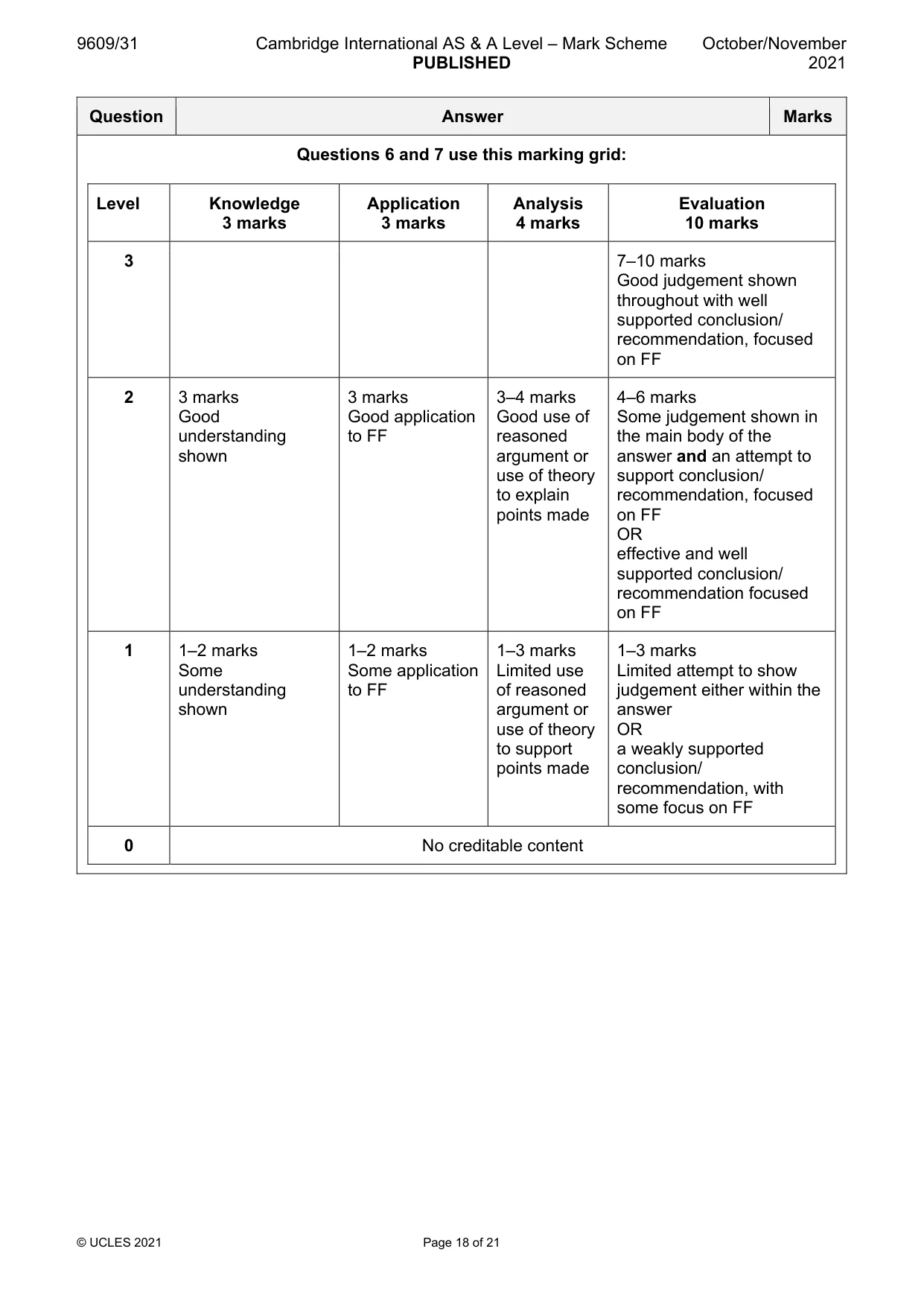
9609/31 Cambridge International AS & A Level – Mark Scheme PUBLISHED October/November 2021 © UCLES 2021 Page 18 of 21 Question Answer Marks Questions 6 and 7 use this marking grid: Level Knowledge 3 marks Application 3 marks Analysis 4 marks Evaluation 10 marks 3 7–10 marks Good judgement shown throughout with well supported conclusion/ recommendation, focused on FF 2 3 marks Good understanding shown 3 marks Good application to FF 3–4 marks Good use of reasoned argument or use of theory to explain points made 4–6 marks Some judgement shown in the main body of the answer and an attempt to support conclusion/ recommendation, focused on FF OR effective and well supported conclusion/ recommendation focused on FF 1 1–2 marks Some understanding shown 1–2 marks Some application to FF 1–3 marks Limited use of reasoned argument or use of theory to support points made 1–3 marks Limited attempt to show judgement either within the answer OR a weakly supported conclusion/ recommendation, with some focus on FF 0 No creditable content
Mark scheme, page 19
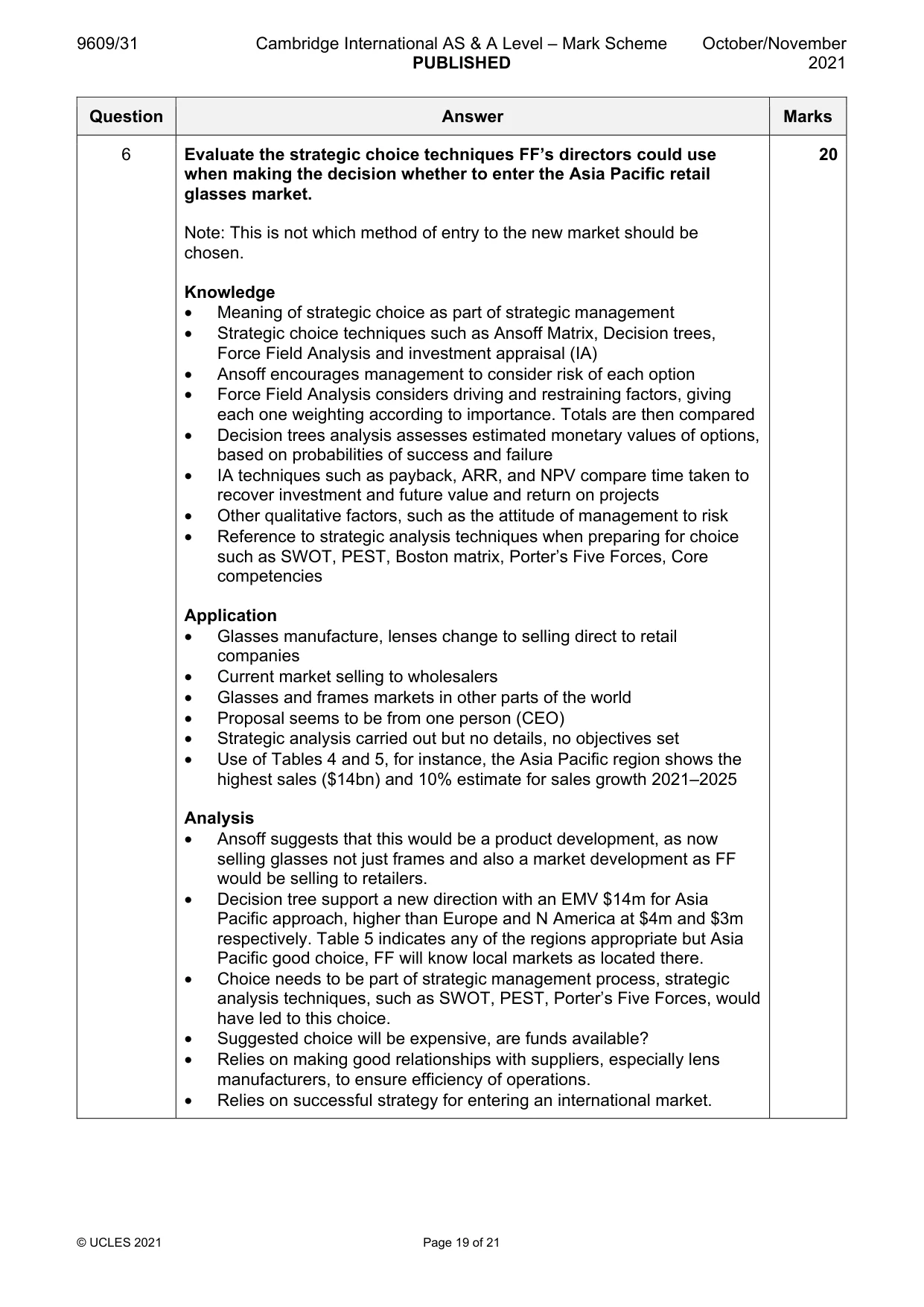
9609/31 Cambridge International AS & A Level – Mark Scheme PUBLISHED October/November 2021 © UCLES 2021 Page 19 of 21 Question Answer Marks 6 Evaluate the strategic choice techniques FF’s directors could use when making the decision whether to enter the Asia Pacific retail glasses market. Note: This is not which method of entry to the new market should be chosen. Knowledge • Meaning of strategic choice as part of strategic management • Strategic choice techniques such as Ansoff Matrix, Decision trees, Force Field Analysis and investment appraisal (IA) • Ansoff encourages management to consider risk of each option • Force Field Analysis considers driving and restraining factors, giving each one weighting according to importance. Totals are then compared • Decision trees analysis assesses estimated monetary values of options, based on probabilities of success and failure • IA techniques such as payback, ARR, and NPV compare time taken to recover investment and future value and return on projects • Other qualitative factors, such as the attitude of management to risk • Reference to strategic analysis techniques when preparing for choice such as SWOT, PEST, Boston matrix, Porter’s Five Forces, Core competencies Application • Glasses manufacture, lenses change to selling direct to retail companies • Current market selling to wholesalers • Glasses and frames markets in other parts of the world • Proposal seems to be from one person (CEO) • Strategic analysis carried out but no details, no objectives set • Use of Tables 4 and 5, for instance, the Asia Pacific region shows the highest sales ($14bn) and 10% estimate for sales growth 2021–2025 Analysis • Ansoff suggests that this would be a product development, as now selling glasses not just frames and also a market development as FF would be selling to retailers. • Decision tree support a new direction with an EMV $14m for Asia Pacific approach, higher than Europe and N America at $4m and $3m respectively. Table 5 indicates any of the regions appropriate but Asia Pacific good choice, FF will know local markets as located there. • Choice needs to be part of strategic management process, strategic analysis techniques, such as SWOT, PEST, Porter’s Five Forces, would have led to this choice. • Suggested choice will be expensive, are funds available? • Relies on making good relationships with suppliers, especially lens manufacturers, to ensure efficiency of operations. • Relies on successful strategy for entering an international market. 20
Mark scheme, page 20
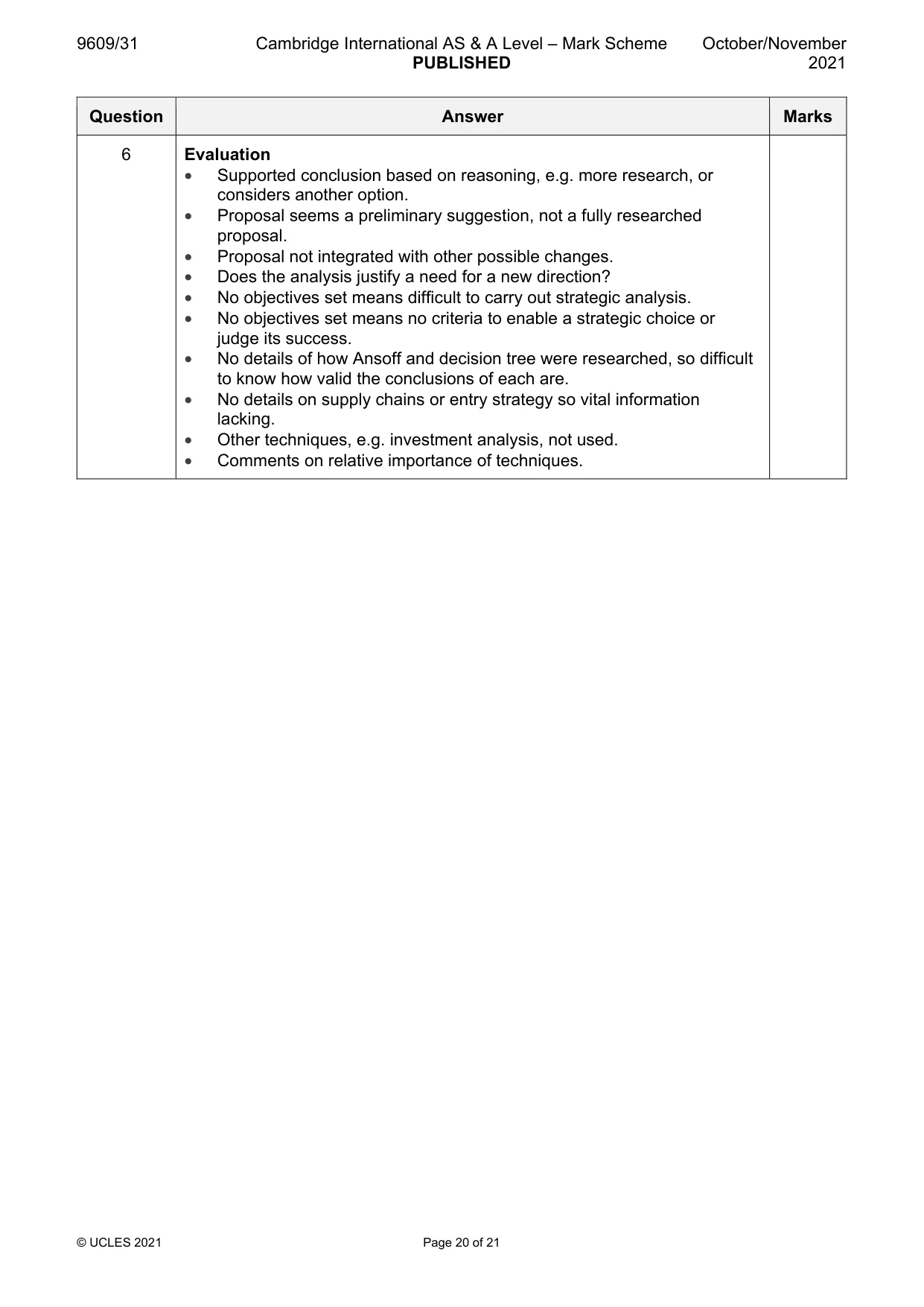
9609/31 Cambridge International AS & A Level – Mark Scheme PUBLISHED October/November 2021 © UCLES 2021 Page 20 of 21 Question Answer Marks 6 Evaluation • Supported conclusion based on reasoning, e.g. more research, or considers another option. • Proposal seems a preliminary suggestion, not a fully researched proposal. • Proposal not integrated with other possible changes. • Does the analysis justify a need for a new direction? • No objectives set means difficult to carry out strategic analysis. • No objectives set means no criteria to enable a strategic choice or judge its success. • No details of how Ansoff and decision tree were researched, so difficult to know how valid the conclusions of each are. • No details on supply chains or entry strategy so vital information lacking. • Other techniques, e.g. investment analysis, not used. • Comments on relative importance of techniques.
Mark scheme, page 21
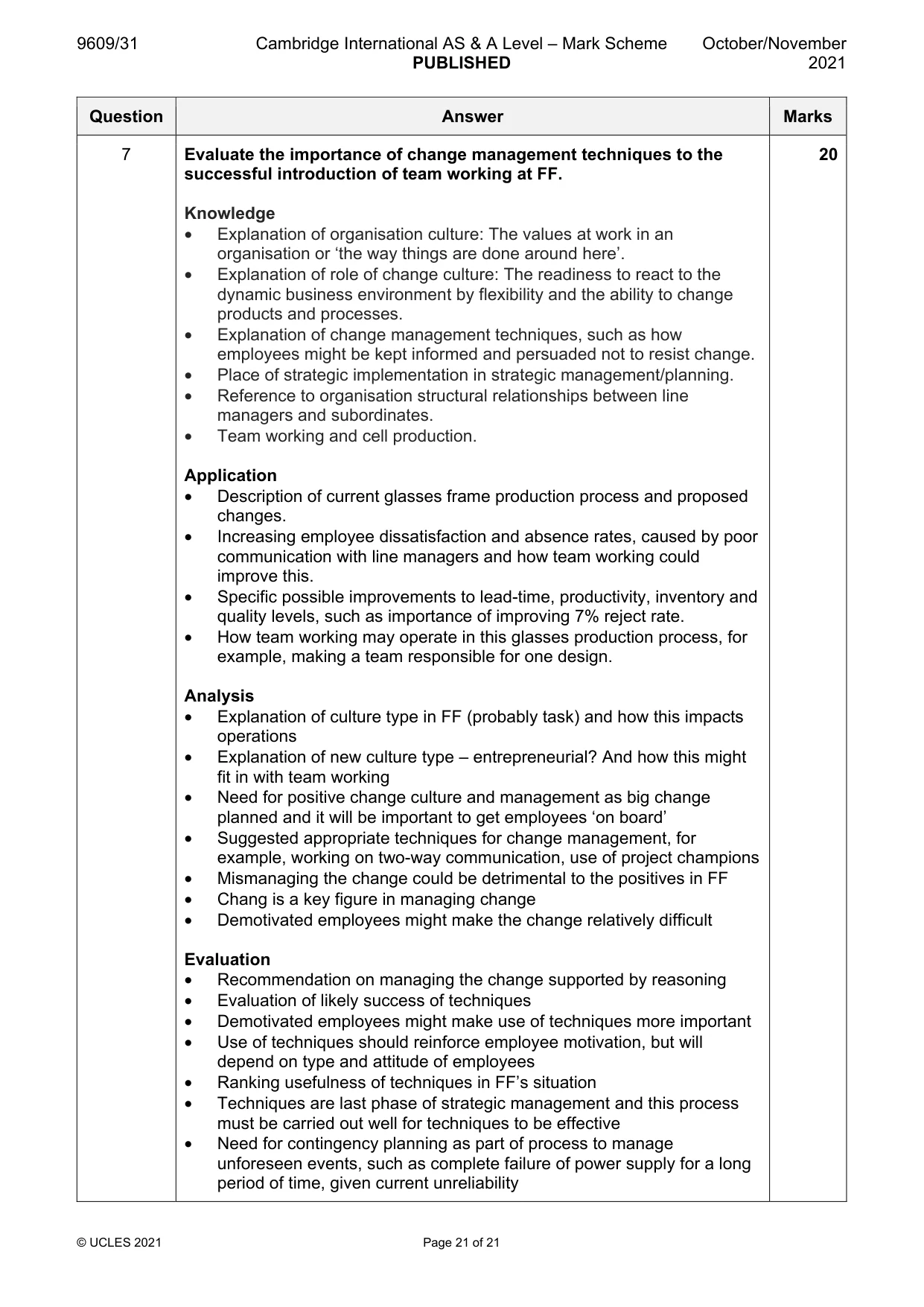
9609/31 Cambridge International AS & A Level – Mark Scheme PUBLISHED October/November 2021 © UCLES 2021 Page 21 of 21 Question Answer Marks 7 Evaluate the importance of change management techniques to the successful introduction of team working at FF. Knowledge • Explanation of organisation culture: The values at work in an organisation or ‘the way things are done around here’. • Explanation of role of change culture: The readiness to react to the dynamic business environment by flexibility and the ability to change products and processes. • Explanation of change management techniques, such as how employees might be kept informed and persuaded not to resist change. • Place of strategic implementation in strategic management/planning. • Reference to organisation structural relationships between line managers and subordinates. • Team working and cell production. Application • Description of current glasses frame production process and proposed changes. • Increasing employee dissatisfaction and absence rates, caused by poor communication with line managers and how team working could improve this. • Specific possible improvements to lead-time, productivity, inventory and quality levels, such as importance of improving 7% reject rate. • How team working may operate in this glasses production process, for example, making a team responsible for one design. Analysis • Explanation of culture type in FF (probably task) and how this impacts operations • Explanation of new culture type – entrepreneurial? And how this might fit in with team working • Need for positive change culture and management as big change planned and it will be important to get employees ‘on board’ • Suggested appropriate techniques for change management, for example, working on two-way communication, use of project champions • Mismanaging the change could be detrimental to the positives in FF • Chang is a key figure in managing change • Demotivated employees might make the change relatively difficult Evaluation • Recommendation on managing the change supported by reasoning • Evaluation of likely success of techniques • Demotivated employees might make use of techniques more important • Use of techniques should reinforce employee motivation, but will depend on type and attitude of employees • Ranking usefulness of techniques in FF’s situation • Techniques are last phase of strategic management and this process must be carried out well for techniques to be effective • Need for contingency planning as part of process to manage unforeseen events, such as complete failure of power supply for a long period of time, given current unreliability 20
What you needed in this session
Cambridge’s own grade thresholds for 2021 Oct/Nov, Paper 3 · Variant 1. A higher threshold means an easier paper — the bar moves with how the cohort did.