Cambridge A Level Biology 9700 — 2015 Oct/Nov Paper 3 · Variant 3
9700/33/O/N/15 · 40 marks · ≈45 min
The question paper and its mark scheme, free to read here and free to download. This is Cambridge’s own paper, exactly as it was sat.
Question paper12 pages

Mark scheme4 pages
Answers below. Sit the paper first if you are practising.
Paper as text
Question paper, page 1
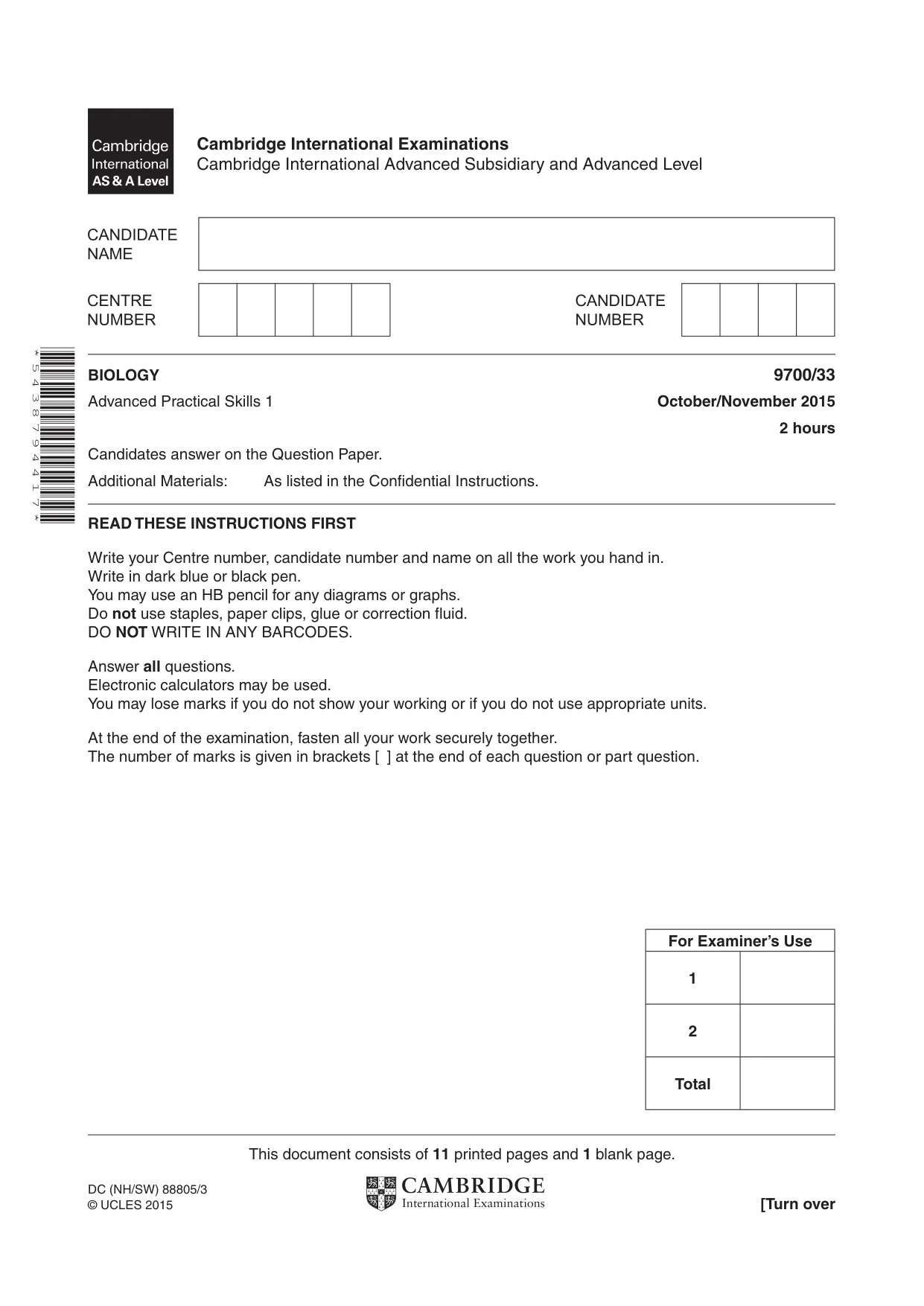
This document consists of 11 printed pages and 1 blank page. DC (NH/SW) 88805/3 © UCLES 2015 [Turn over * 5 4 3 8 7 9 4 4 1 7 * Cambridge International Examinations Cambridge International Advanced Subsidiary and Advanced Level BIOLOGY 9700/33 Advanced Practical Skills 1 October/November 2015 2 hours Candidates answer on the Question Paper. Additional Materials: As listed in the Confidential Instructions. READ THESE INSTRUCTIONS FIRST Write your Centre number, candidate number and name on all the work you hand in. Write in dark blue or black pen. You may use an HB pencil for any diagrams or graphs. Do not use staples, paper clips, glue or correction fluid. DO NOT WRITE IN ANY BARCODES. Answer all questions. Electronic calculators may be used. You may lose marks if you do not show your working or if you do not use appropriate units. At the end of the examination, fasten all your work securely together. The number of marks is given in brackets [ ] at the end of each question or part question. For Examiner’s Use 1 2 Total
Question paper, page 2
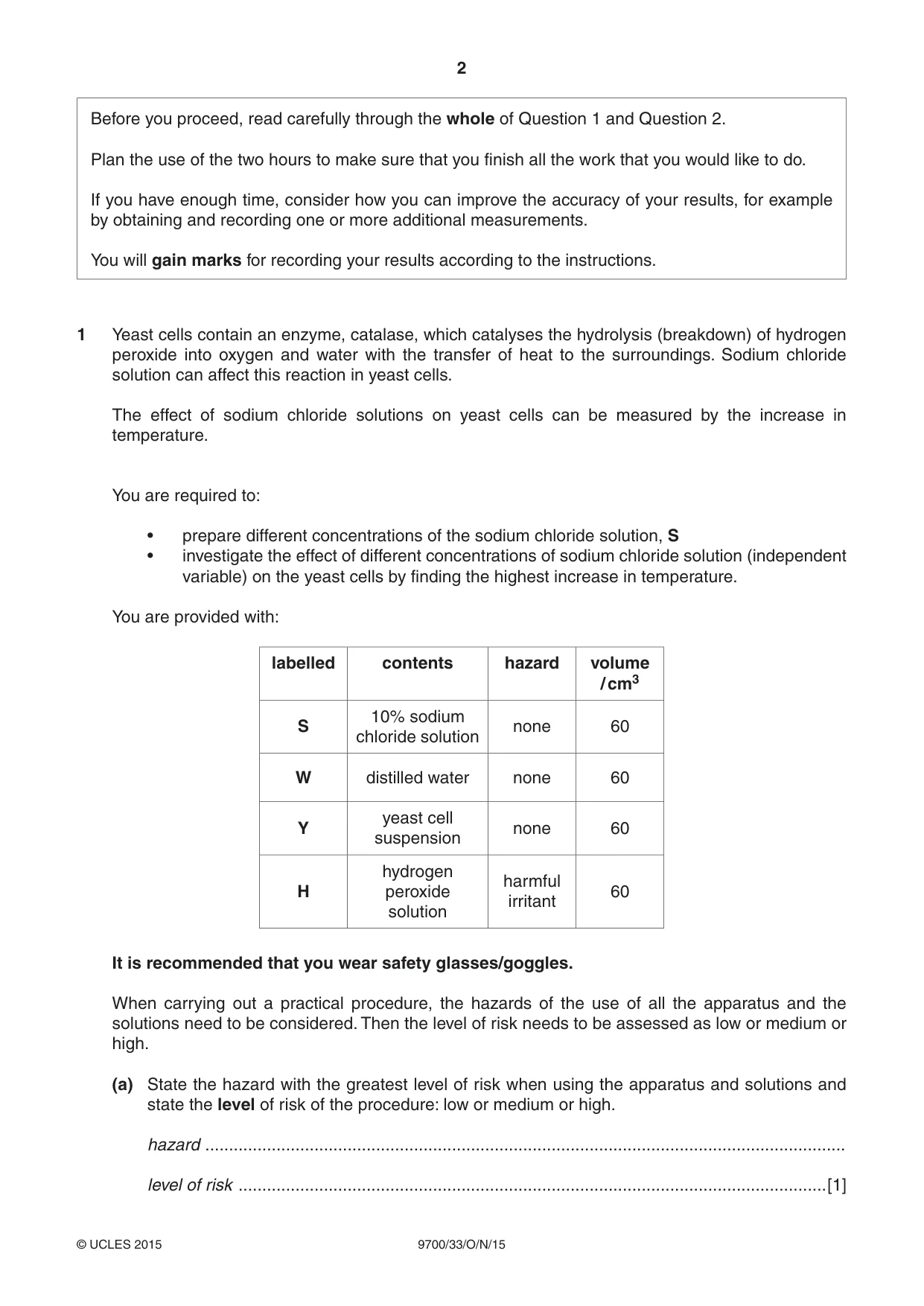
2 9700/33/O/N/15 © UCLES 2015 Before you proceed, read carefully through the whole of Question 1 and Question 2. Plan the use of the two hours to make sure that you finish all the work that you would like to do. If you have enough time, consider how you can improve the accuracy of your results, for example by obtaining and recording one or more additional measurements. You will gain marks for recording your results according to the instructions. 1 Yeast cells contain an enzyme, catalase, which catalyses the hydrolysis (breakdown) of hydrogen peroxide into oxygen and water with the transfer of heat to the surroundings. Sodium chloride solution can affect this reaction in yeast cells. The effect of sodium chloride solutions on yeast cells can be measured by the increase in temperature. You are required to: • prepare different concentrations of the sodium chloride solution, S • investigate the effect of different concentrations of sodium chloride solution (independent variable) on the yeast cells by finding the highest increase in temperature. You are provided with: labelled contents hazard volume / cm3 S 10% sodium chloride solution none 60 W distilled water none 60 Y yeast cell suspension none 60 H hydrogen peroxide solution harmful irritant 60 It is recommended that you wear safety glasses/goggles. When carrying out a practical procedure, the hazards of the use of all the apparatus and the solutions need to be considered. Then the level of risk needs to be assessed as low or medium or high. (a) State the hazard with the greatest level of risk when using the apparatus and solutions and state the level of risk of the procedure: low or medium or high. hazard … level of risk …[1]
Question paper, page 3
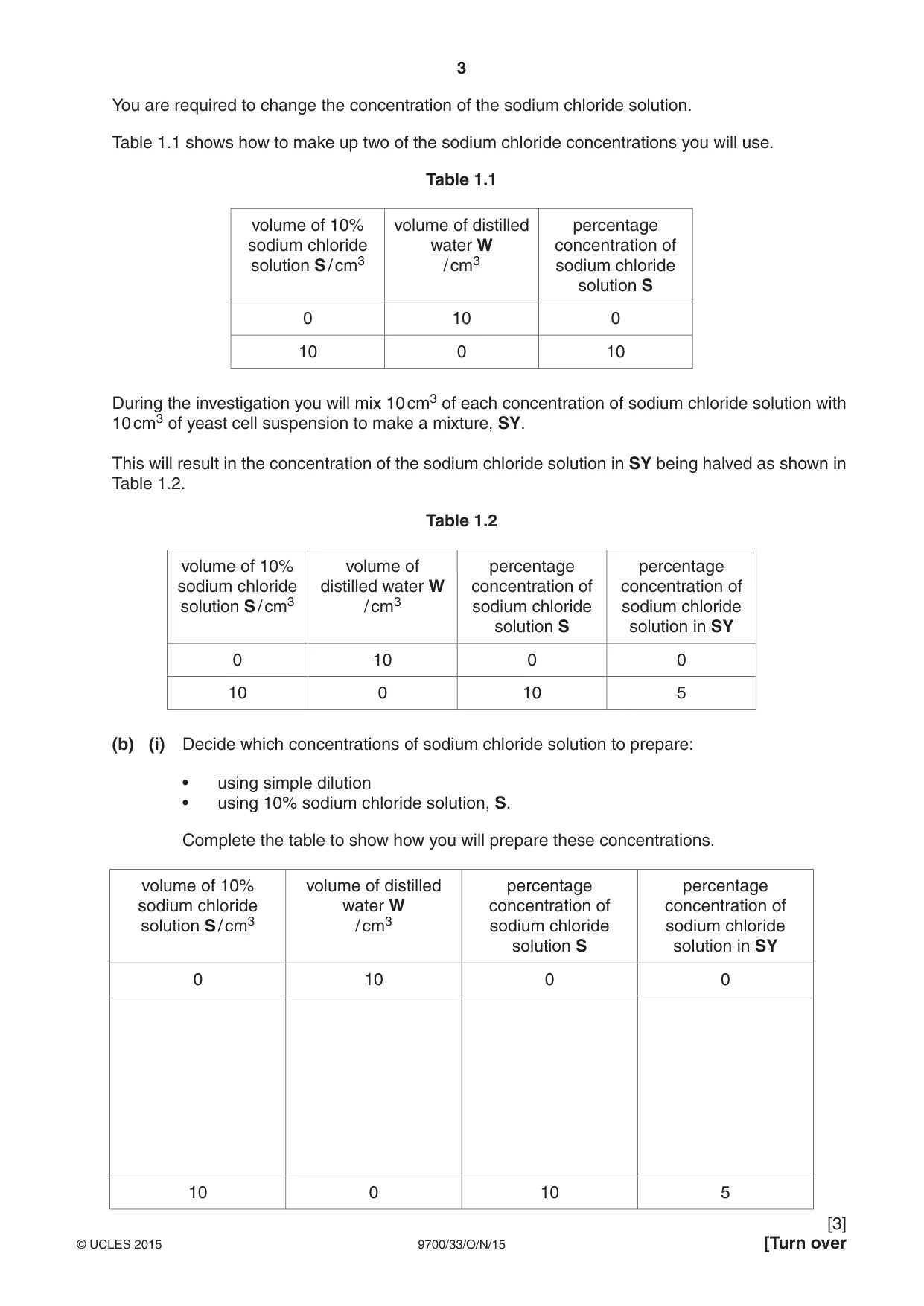
3 9700/33/O/N/15 © UCLES 2015 [Turn over You are required to change the concentration of the sodium chloride solution. Table 1.1 shows how to make up two of the sodium chloride concentrations you will use. Table 1.1 volume of 10% sodium chloride solution S / cm3 volume of distilled water W / cm3 percentage concentration of sodium chloride solution S 0 10 0 10 0 10 During the investigation you will mix 10 cm3 of each concentration of sodium chloride solution with 10 cm3 of yeast cell suspension to make a mixture, SY. This will result in the concentration of the sodium chloride solution in SY being halved as shown in Table 1.2. Table 1.2 volume of 10% sodium chloride solution S / cm3 volume of distilled water W / cm3 percentage concentration of sodium chloride solution S percentage concentration of sodium chloride solution in SY 0 10 0 0 10 0 10 5 (b) (i) Decide which concentrations of sodium chloride solution to prepare: • using simple dilution • using 10% sodium chloride solution, S. Complete the table to show how you will prepare these concentrations. volume of 10% sodium chloride solution S / cm3 volume of distilled water W / cm3 percentage concentration of sodium chloride solution S percentage concentration of sodium chloride solution in SY 0 10 0 0 10 0 10 5 [3]
Question paper, page 4
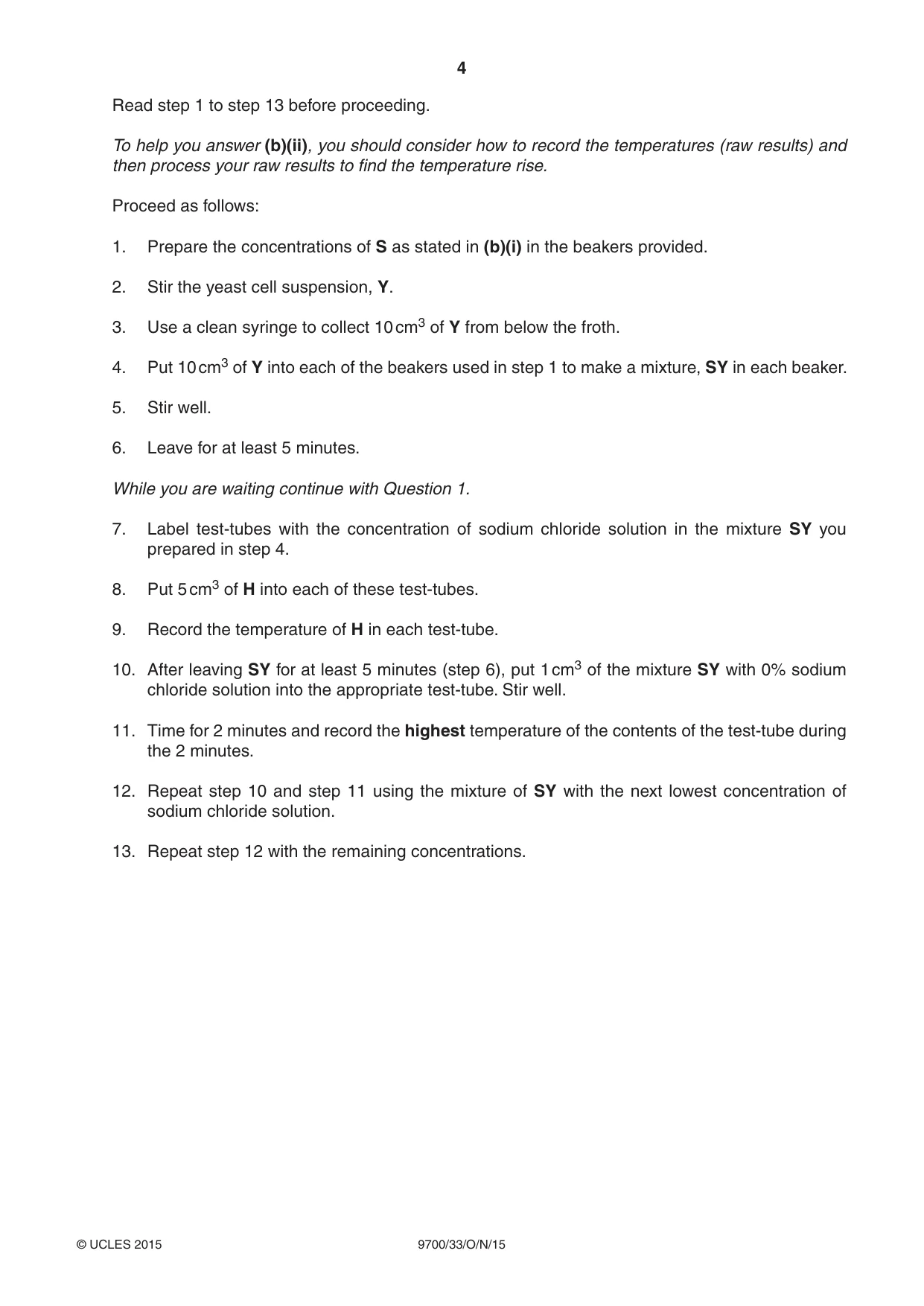
4 9700/33/O/N/15 © UCLES 2015 Read step 1 to step 13 before proceeding. To help you answer (b)(ii), you should consider how to record the temperatures (raw results) and then process your raw results to find the temperature rise. Proceed as follows: 1. Prepare the concentrations of S as stated in (b)(i) in the beakers provided. 2. Stir the yeast cell suspension, Y. 3. Use a clean syringe to collect 10 cm3 of Y from below the froth. 4. Put 10 cm3 of Y into each of the beakers used in step 1 to make a mixture, SY in each beaker. 5. Stir well. 6. Leave for at least 5 minutes. While you are waiting continue with Question 1. 7. Label test-tubes with the concentration of sodium chloride solution in the mixture SY you prepared in step 4. 8. Put 5 cm3 of H into each of these test-tubes. 9. Record the temperature of H in each test-tube. 10. After leaving SY for at least 5 minutes (step 6), put 1 cm3 of the mixture SY with 0% sodium chloride solution into the appropriate test-tube. Stir well. 11. Time for 2 minutes and record the highest temperature of the contents of the test-tube during the 2 minutes. 12. Repeat step 10 and step 11 using the mixture of SY with the next lowest concentration of sodium chloride solution. 13. Repeat step 12 with the remaining concentrations.
Question paper, page 5
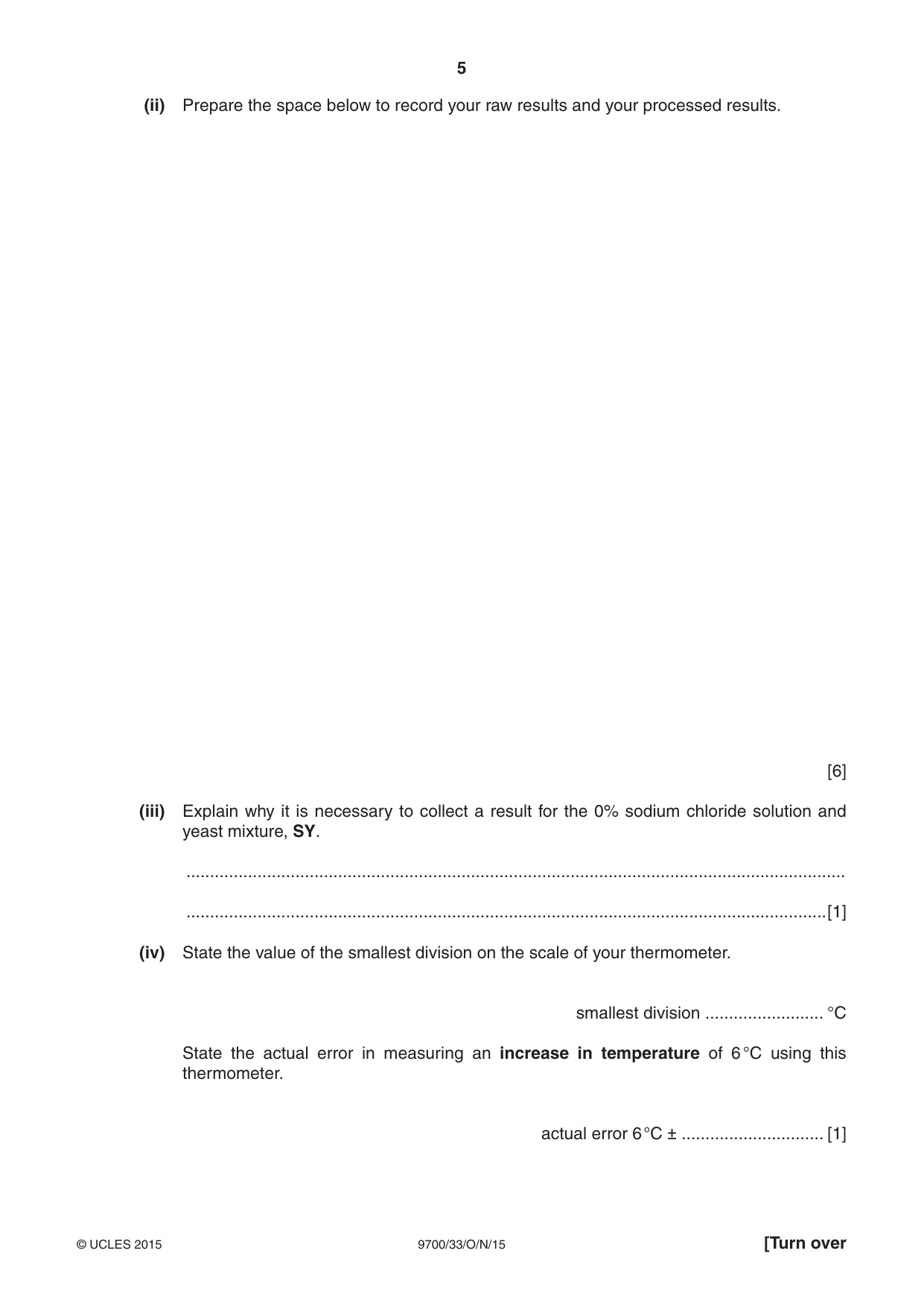
5 9700/33/O/N/15 © UCLES 2015 [Turn over (ii) Prepare the space below to record your raw results and your processed results. [6] (iii) Explain why it is necessary to collect a result for the 0% sodium chloride solution and yeast mixture, SY. … …[1] (iv) State the value of the smallest division on the scale of your thermometer. smallest division … °C State the actual error in measuring an increase in temperature of 6 °C using this thermometer. actual error 6 °C ± … [1]
Question paper, page 6
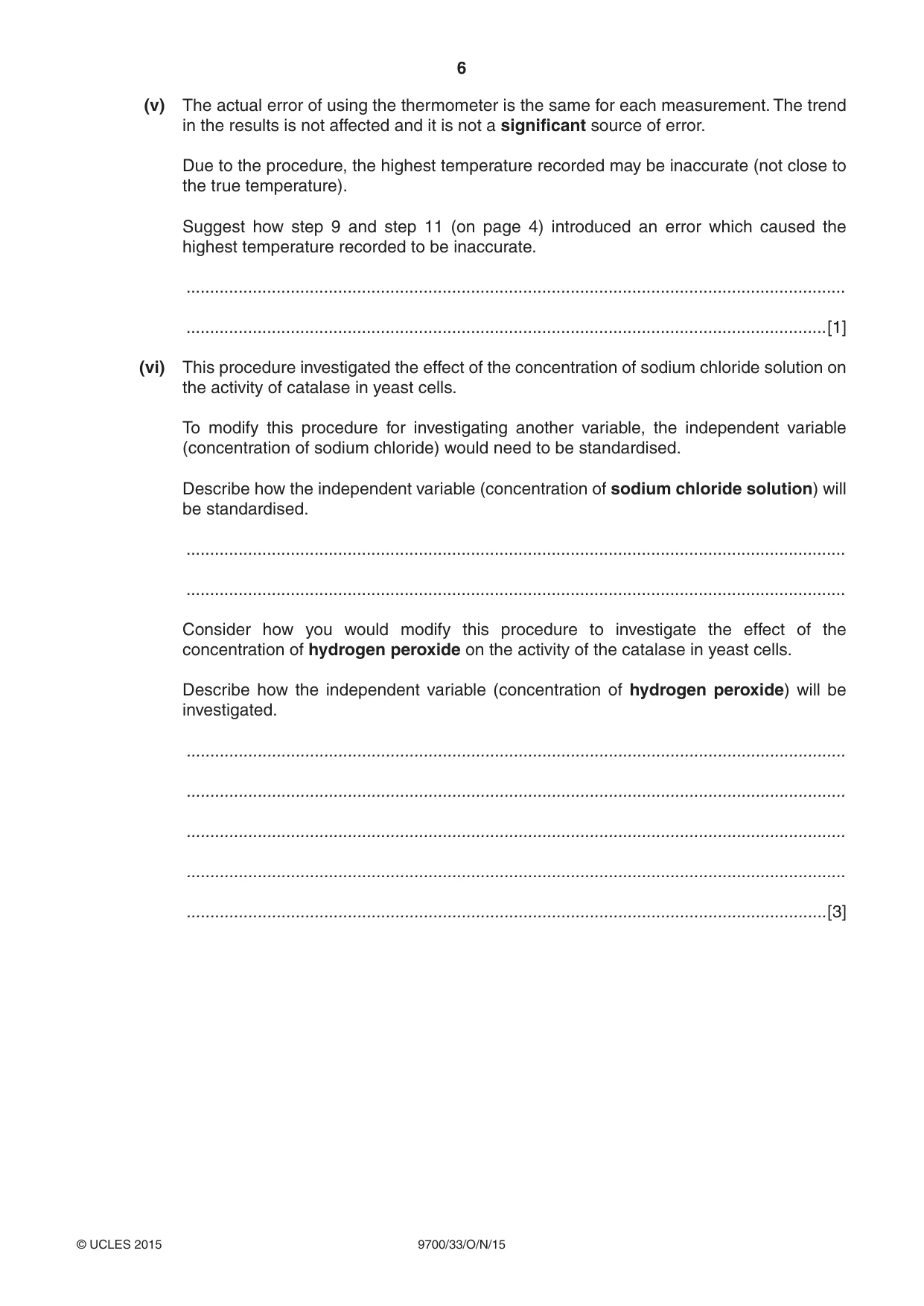
6 9700/33/O/N/15 © UCLES 2015 (v) The actual error of using the thermometer is the same for each measurement. The trend in the results is not affected and it is not a significant source of error. Due to the procedure, the highest temperature recorded may be inaccurate (not close to the true temperature). Suggest how step 9 and step 11 (on page 4) introduced an error which caused the highest temperature recorded to be inaccurate. … …[1] (vi) This procedure investigated the effect of the concentration of sodium chloride solution on the activity of catalase in yeast cells. To modify this procedure for investigating another variable, the independent variable (concentration of sodium chloride) would need to be standardised. Describe how the independent variable (concentration of sodium chloride solution) will be standardised. … … Consider how you would modify this procedure to investigate the effect of the concentration of hydrogen peroxide on the activity of the catalase in yeast cells. Describe how the independent variable (concentration of hydrogen peroxide) will be investigated. … … … … …[3]
Question paper, page 7
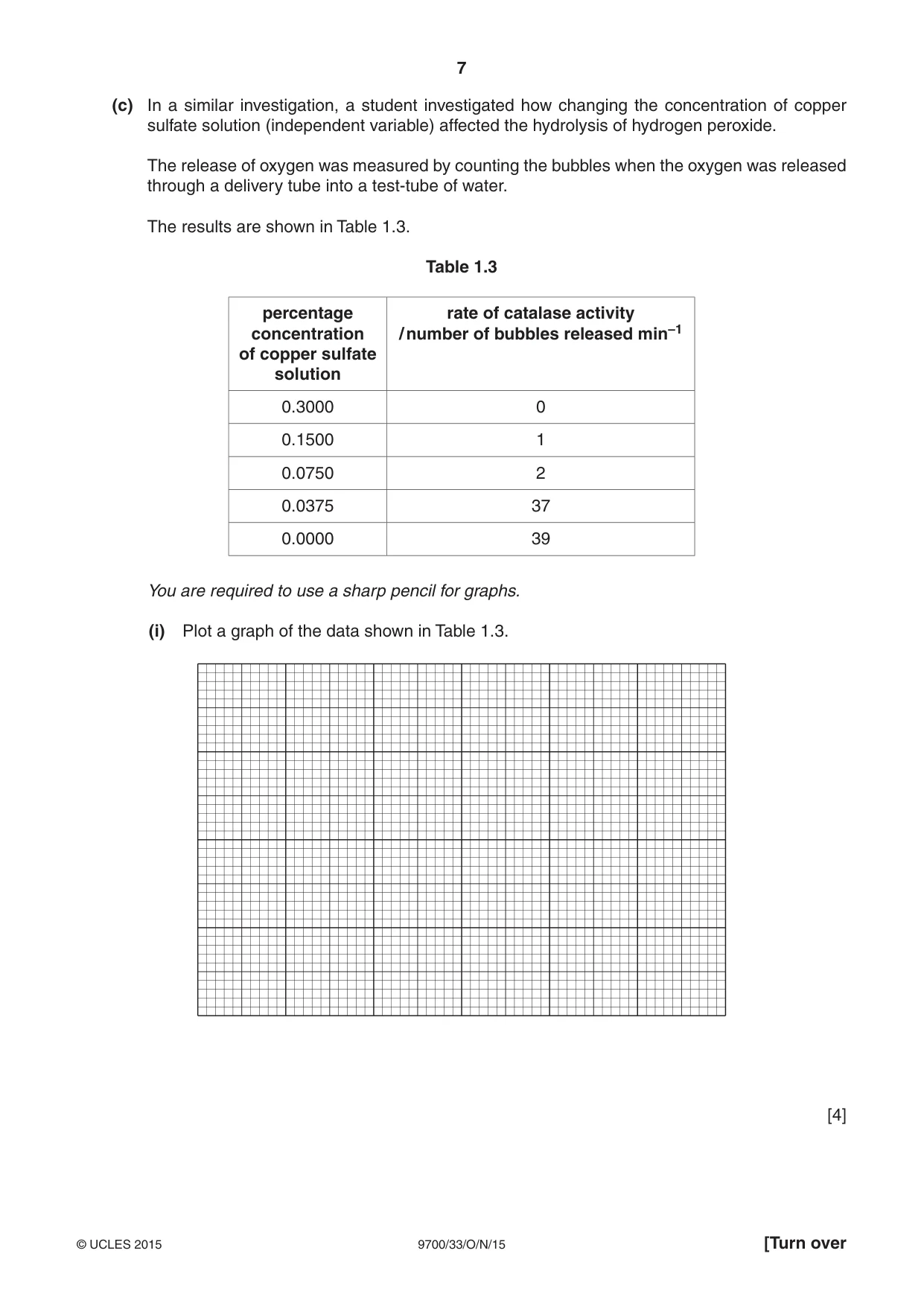
7 9700/33/O/N/15 © UCLES 2015 [Turn over (c) In a similar investigation, a student investigated how changing the concentration of copper sulfate solution (independent variable) affected the hydrolysis of hydrogen peroxide. The release of oxygen was measured by counting the bubbles when the oxygen was released through a delivery tube into a test-tube of water. The results are shown in Table 1.3. Table 1.3 percentage concentration of copper sulfate solution rate of catalase activity / number of bubbles released min–1 0.3000 0 0.1500 1 0.0750 2 0.0375 37 0.0000 39 You are required to use a sharp pencil for graphs. (i) Plot a graph of the data shown in Table 1.3. [4]
Question paper, page 8
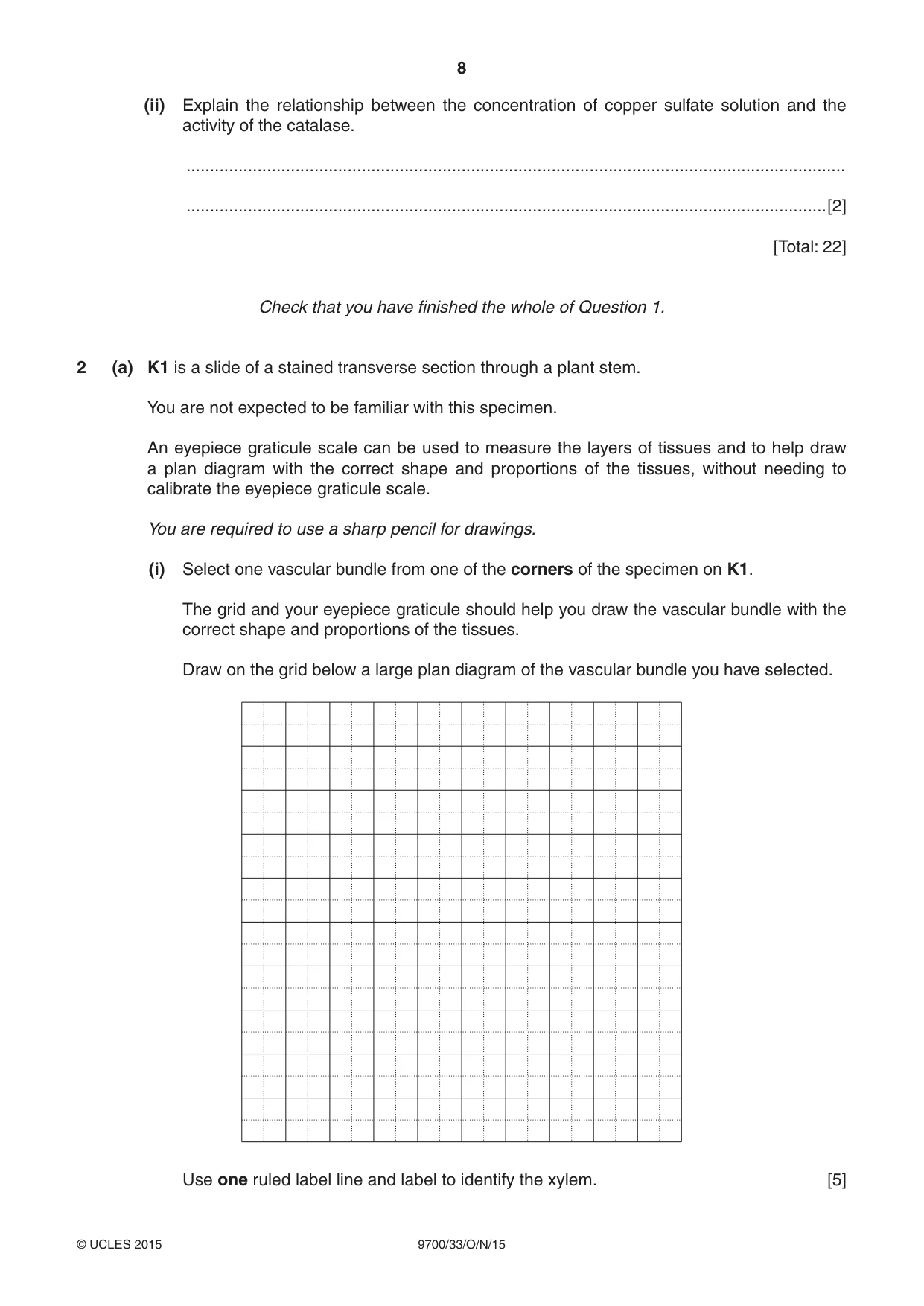
8 9700/33/O/N/15 © UCLES 2015 (ii) Explain the relationship between the concentration of copper sulfate solution and the activity of the catalase. … …[2] [Total: 22] Check that you have finished the whole of Question 1. 2 (a) K1 is a slide of a stained transverse section through a plant stem. You are not expected to be familiar with this specimen. An eyepiece graticule scale can be used to measure the layers of tissues and to help draw a plan diagram with the correct shape and proportions of the tissues, without needing to calibrate the eyepiece graticule scale. You are required to use a sharp pencil for drawings. (i) Select one vascular bundle from one of the corners of the specimen on K1. The grid and your eyepiece graticule should help you draw the vascular bundle with the correct shape and proportions of the tissues. Draw on the grid below a large plan diagram of the vascular bundle you have selected. Use one ruled label line and label to identify the xylem. [5]
Question paper, page 9
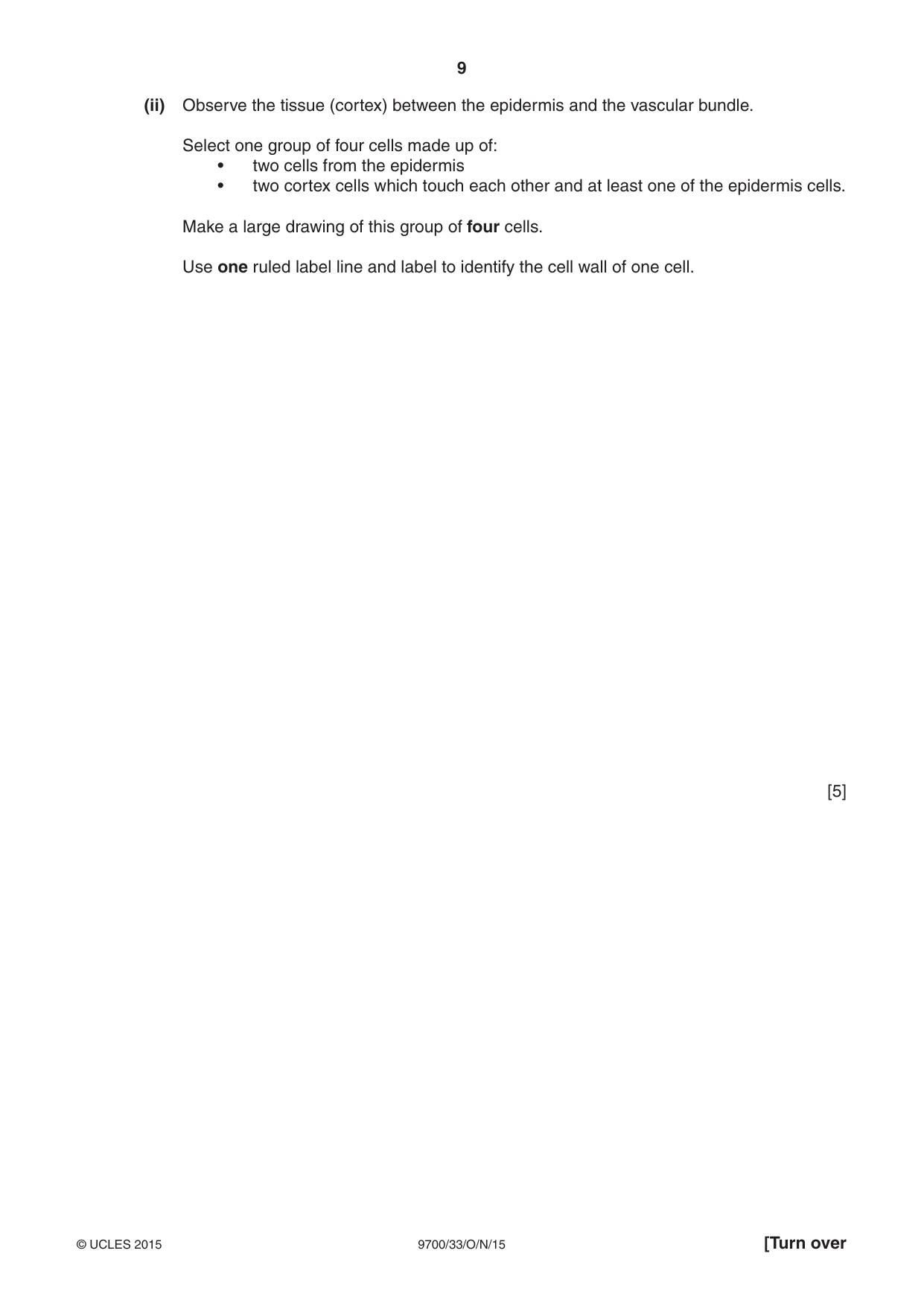
9 9700/33/O/N/15 © UCLES 2015 [Turn over (ii) Observe the tissue (cortex) between the epidermis and the vascular bundle. Select one group of four cells made up of: • two cells from the epidermis • two cortex cells which touch each other and at least one of the epidermis cells. Make a large drawing of this group of four cells. Use one ruled label line and label to identify the cell wall of one cell. [5]
Question paper, page 10
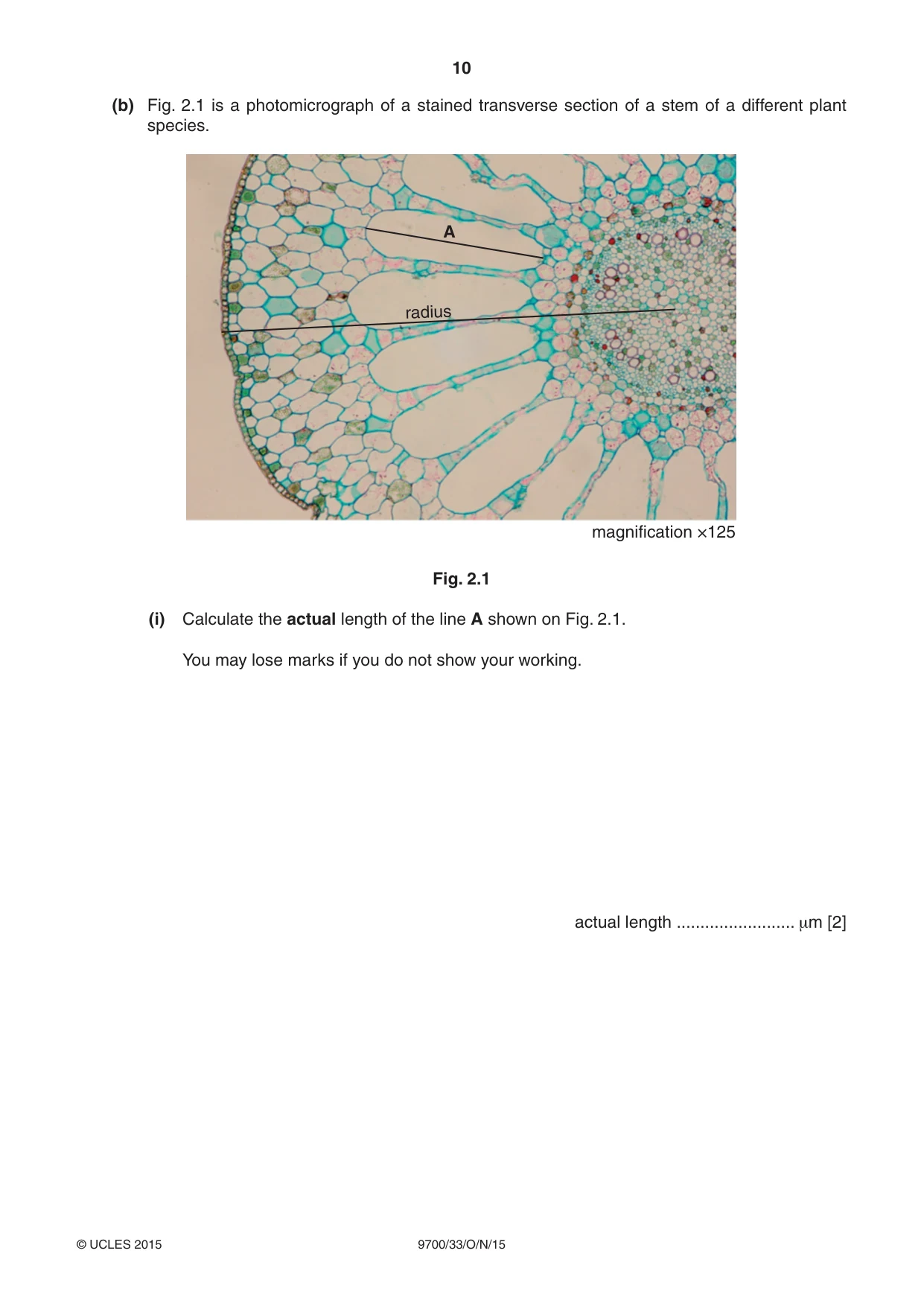
10 9700/33/O/N/15 © UCLES 2015 (b) Fig. 2.1 is a photomicrograph of a stained transverse section of a stem of a different plant species. A radius magnification ×125 Fig. 2.1 (i) Calculate the actual length of the line A shown on Fig. 2.1. You may lose marks if you do not show your working. actual length … μm [2]
Question paper, page 11
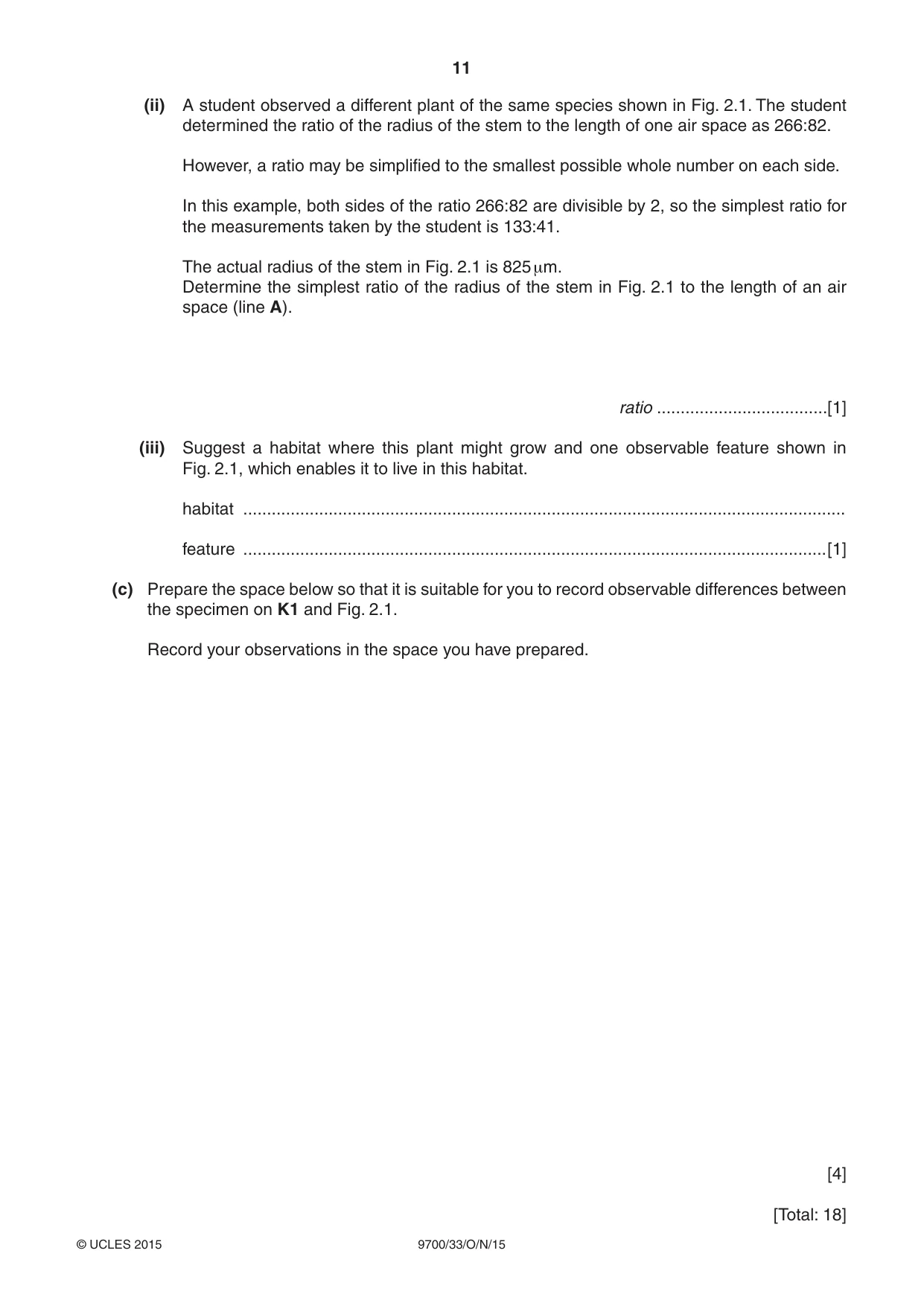
11 9700/33/O/N/15 © UCLES 2015 (ii) A student observed a different plant of the same species shown in Fig. 2.1. The student determined the ratio of the radius of the stem to the length of one air space as 266:82. However, a ratio may be simplified to the smallest possible whole number on each side. In this example, both sides of the ratio 266:82 are divisible by 2, so the simplest ratio for the measurements taken by the student is 133:41. The actual radius of the stem in Fig. 2.1 is 825 μm. Determine the simplest ratio of the radius of the stem in Fig. 2.1 to the length of an air space (line A). ratio …[1] (iii) Suggest a habitat where this plant might grow and one observable feature shown in Fig. 2.1, which enables it to live in this habitat. habitat … feature …[1] (c) Prepare the space below so that it is suitable for you to record observable differences between the specimen on K1 and Fig. 2.1. Record your observations in the space you have prepared. [4] [Total: 18]
Question paper, page 12
12 9700/33/O/N/15 © UCLES 2015 BLANK PAGE Permission to reproduce items where third-party owned material protected by copyright is included has been sought and cleared where possible. Every reasonable effort has been made by the publisher (UCLES) to trace copyright holders, but if any items requiring clearance have unwittingly been included, the publisher will be pleased to make amends at the earliest possible opportunity. To avoid the issue of disclosure of answer-related information to candidates, all copyright acknowledgements are reproduced online in the Cambridge International Examinations Copyright Acknowledgements Booklet. This is produced for each series of examinations and is freely available to download at www.cie.org.uk after the live examination series. Cambridge International Examinations is part of the Cambridge Assessment Group. Cambridge Assessment is the brand name of University of Cambridge Local Examinations Syndicate (UCLES), which is itself a department of the University of Cambridge.
Mark scheme, page 1
® IGCSE is the registered trademark of Cambridge International Examinations. CAMBRIDGE INTERNATIONAL EXAMINATIONS Cambridge International Advanced Subsidiary and Advanced Level MARK SCHEME for the October/November 2015 series 9700 BIOLOGY 9700/33 Paper 3 (Advanced Practical Skills 1), maximum raw mark 40 This mark scheme is published as an aid to teachers and candidates, to indicate the requirements of the examination. It shows the basis on which Examiners were instructed to award marks. It does not indicate the details of the discussions that took place at an Examiners’ meeting before marking began, which would have considered the acceptability of alternative answers. Mark schemes should be read in conjunction with the question paper and the Principal Examiner Report for Teachers. Cambridge will not enter into discussions about these mark schemes. Cambridge is publishing the mark schemes for the October/November 2015 series for most Cambridge IGCSE®, Cambridge International A and AS Level components and some Cambridge O Level components.
Mark scheme, page 2
Page 2 Mark Scheme Syllabus Paper Cambridge International AS/A Level – October/November 2015 9700 33 © Cambridge International Examinations 2015 Mark scheme abbreviations: ; separates marking points / alternative answers for the same point R reject A accept (for answers correctly cued by the question, or by extra guidance) AW alternative wording (where responses vary more than usual) underline actual word given must be used by candidate (grammatical variants accepted) max indicates the maximum number of marks that can be given ora or reverse argument mp marking point (with relevant number) ecf error carried forward I ignore
Mark scheme, page 3
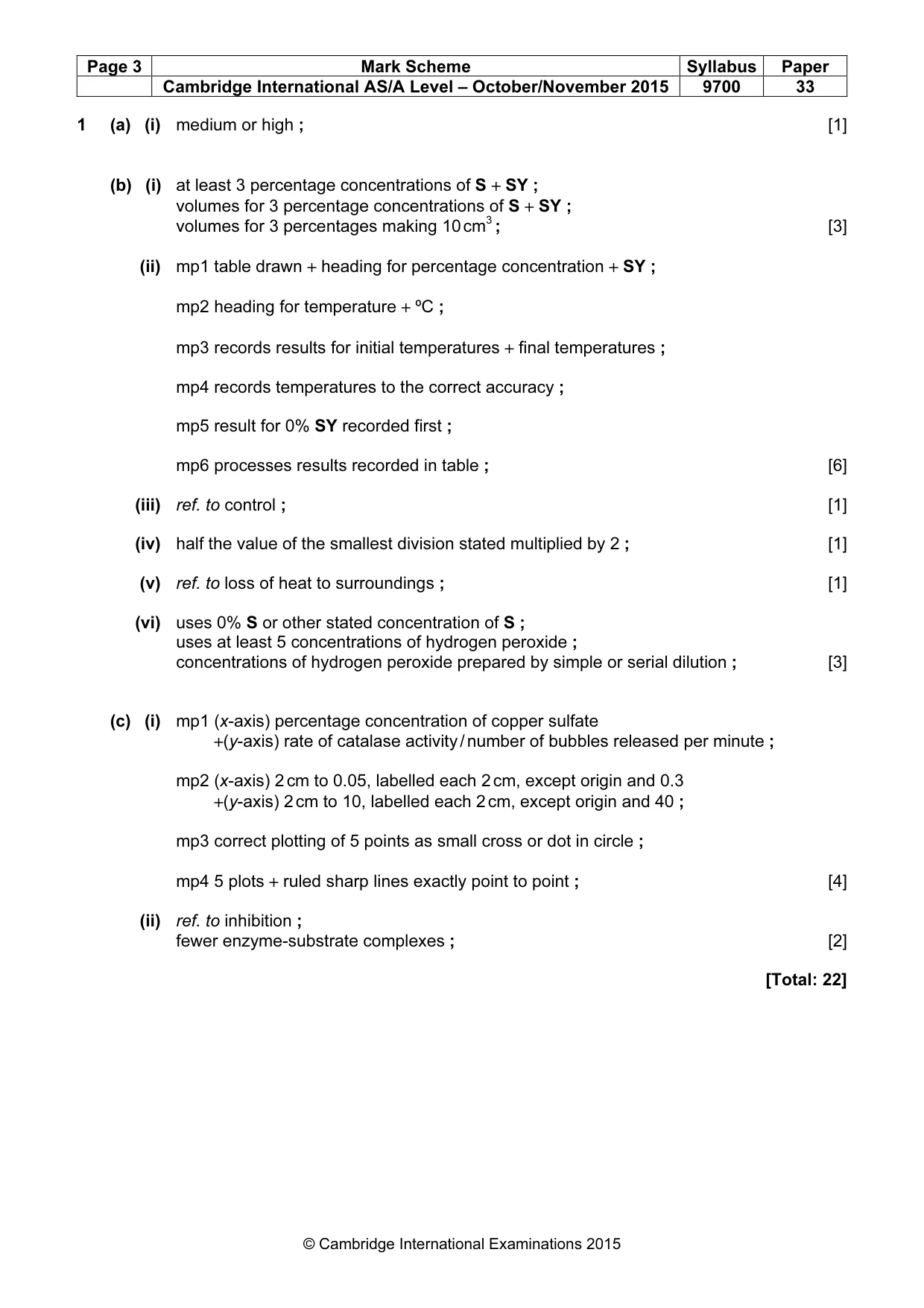
Page 3 Mark Scheme Syllabus Paper Cambridge International AS/A Level – October/November 2015 9700 33 © Cambridge International Examinations 2015 1 (a) (i) medium or high ; [1] (b) (i) at least 3 percentage concentrations of S + SY ; volumes for 3 percentage concentrations of S + SY ; volumes for 3 percentages making 10 cm3 ; [3] (ii) mp1 table drawn + heading for percentage concentration + SY ; mp2 heading for temperature + ºC ; mp3 records results for initial temperatures + final temperatures ; mp4 records temperatures to the correct accuracy ; mp5 result for 0% SY recorded first ; mp6 processes results recorded in table ; [6] (iii) ref. to control ; [1] (iv) half the value of the smallest division stated multiplied by 2 ; [1] (v) ref. to loss of heat to surroundings ; [1] (vi) uses 0% S or other stated concentration of S ; uses at least 5 concentrations of hydrogen peroxide ; concentrations of hydrogen peroxide prepared by simple or serial dilution ; [3] (c) (i) mp1 (x-axis) percentage concentration of copper sulfate +(y-axis) rate of catalase activity / number of bubbles released per minute ; mp2 (x-axis) 2 cm to 0.05, labelled each 2 cm, except origin and 0.3 +(y-axis) 2 cm to 10, labelled each 2 cm, except origin and 40 ; mp3 correct plotting of 5 points as small cross or dot in circle ; mp4 5 plots + ruled sharp lines exactly point to point ; [4] (ii) ref. to inhibition ; fewer enzyme-substrate complexes ; [2] [Total: 22]
Mark scheme, page 4
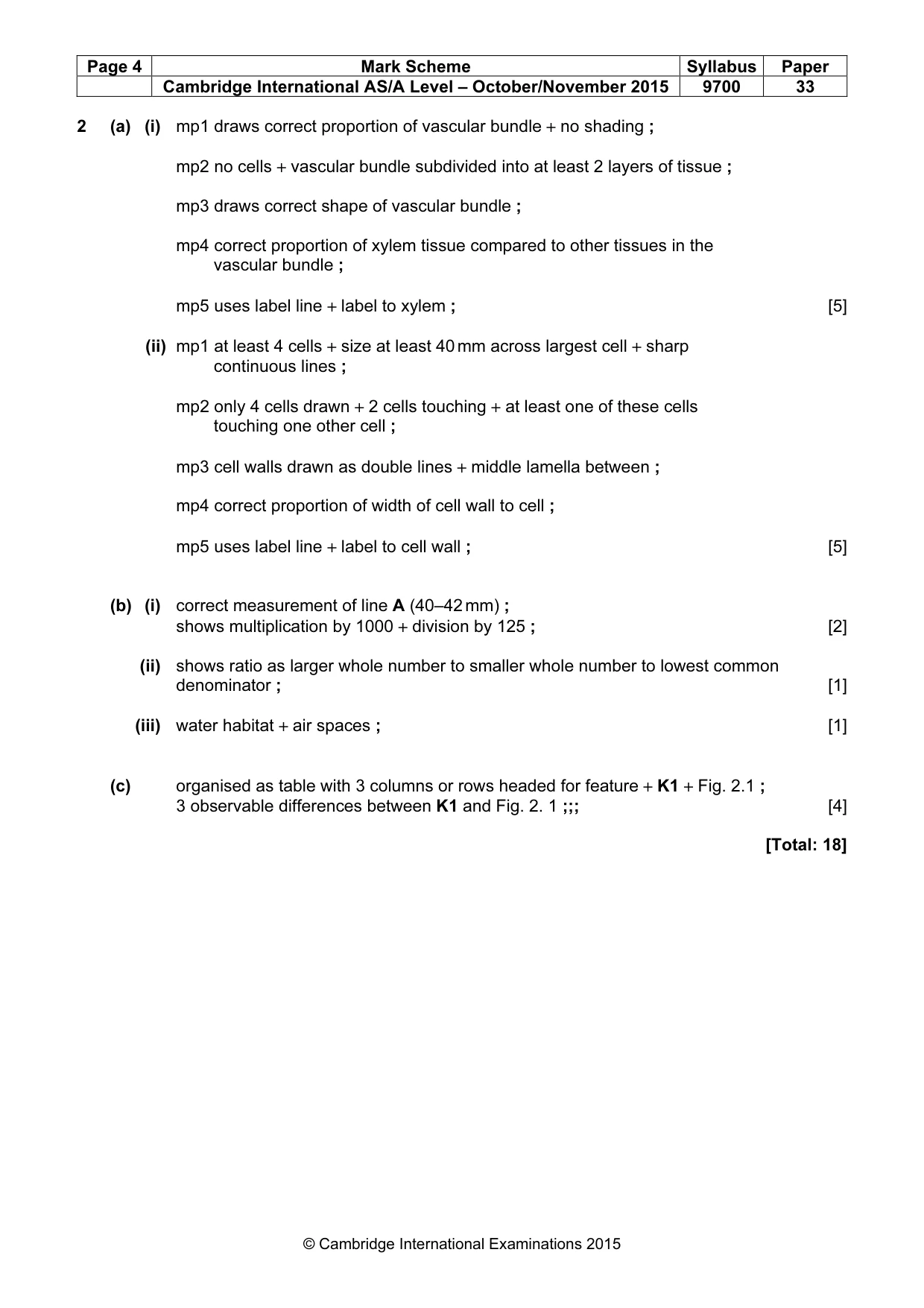
Page 4 Mark Scheme Syllabus Paper Cambridge International AS/A Level – October/November 2015 9700 33 © Cambridge International Examinations 2015 2 (a) (i) mp1 draws correct proportion of vascular bundle + no shading ; mp2 no cells + vascular bundle subdivided into at least 2 layers of tissue ; mp3 draws correct shape of vascular bundle ; mp4 correct proportion of xylem tissue compared to other tissues in the vascular bundle ; mp5 uses label line + label to xylem ; [5] (ii) mp1 at least 4 cells + size at least 40 mm across largest cell + sharp continuous lines ; mp2 only 4 cells drawn + 2 cells touching + at least one of these cells touching one other cell ; mp3 cell walls drawn as double lines + middle lamella between ; mp4 correct proportion of width of cell wall to cell ; mp5 uses label line + label to cell wall ; [5] (b) (i) correct measurement of line A (40–42 mm) ; shows multiplication by 1000 + division by 125 ; [2] (ii) shows ratio as larger whole number to smaller whole number to lowest common denominator ; [1] (iii) water habitat + air spaces ; [1] (c) organised as table with 3 columns or rows headed for feature + K1 + Fig. 2.1 ; 3 observable differences between K1 and Fig. 2. 1 ;;; [4] [Total: 18]
What you needed in this session
Cambridge’s own grade thresholds for 2015 Oct/Nov, Paper 3 · Variant 3. A higher threshold means an easier paper — the bar moves with how the cohort did.