Cambridge A Level Biblical Studies 9484 — 2025 May/June Paper 1 · Variant 2
9484/12/M/J/25 · 50 marks · 90 min
The question paper and its mark scheme, free to read here and free to download. This is Cambridge’s own paper, exactly as it was sat.
Question paper4 pages

Mark scheme19 pages
Answers below. Sit the paper first if you are practising.
Paper as text
Question paper, page 1
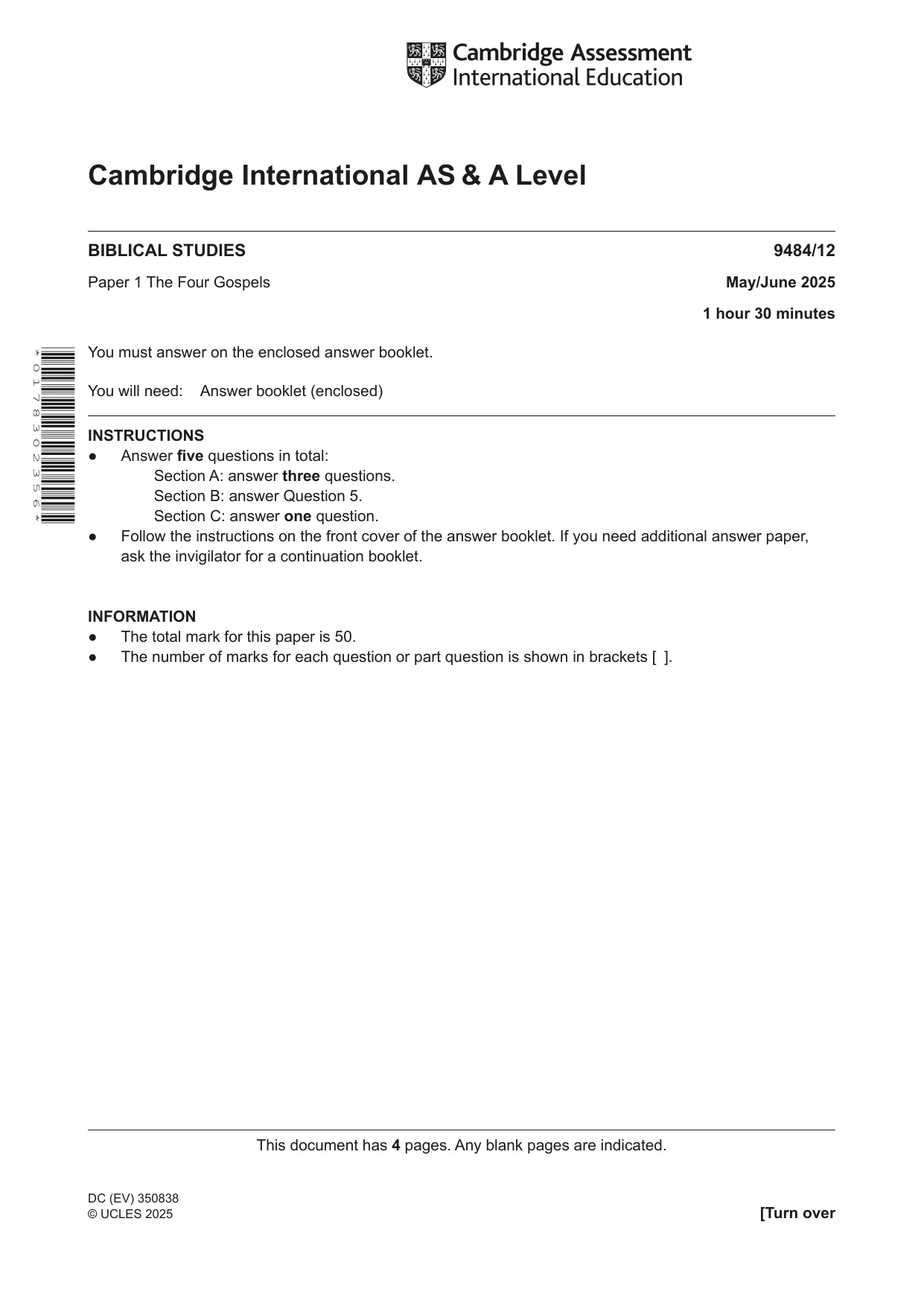
This document has 4 pages. Any blank pages are indicated. [Turn over Cambridge International AS & A Level * 0 1 7 8 3 0 2 3 5 6 * DC (EV) 350838 © UCLES 2025 BIBLICAL STUDIES 9484/12 Paper 1 The Four Gospels May/June 2025 1 hour 30 minutes You must answer on the enclosed answer booklet. You will need: Answer booklet (enclosed) INSTRUCTIONS ● Answer five questions in total: Section A: answer three questions. Section B: answer Question 5. Section C: answer one question. ● Follow the instructions on the front cover of the answer booklet. If you need additional answer paper, ask the invigilator for a continuation booklet. INFORMATION ● The total mark for this paper is 50. ● The number of marks for each question or part question is shown in brackets [ ].
Question paper, page 2
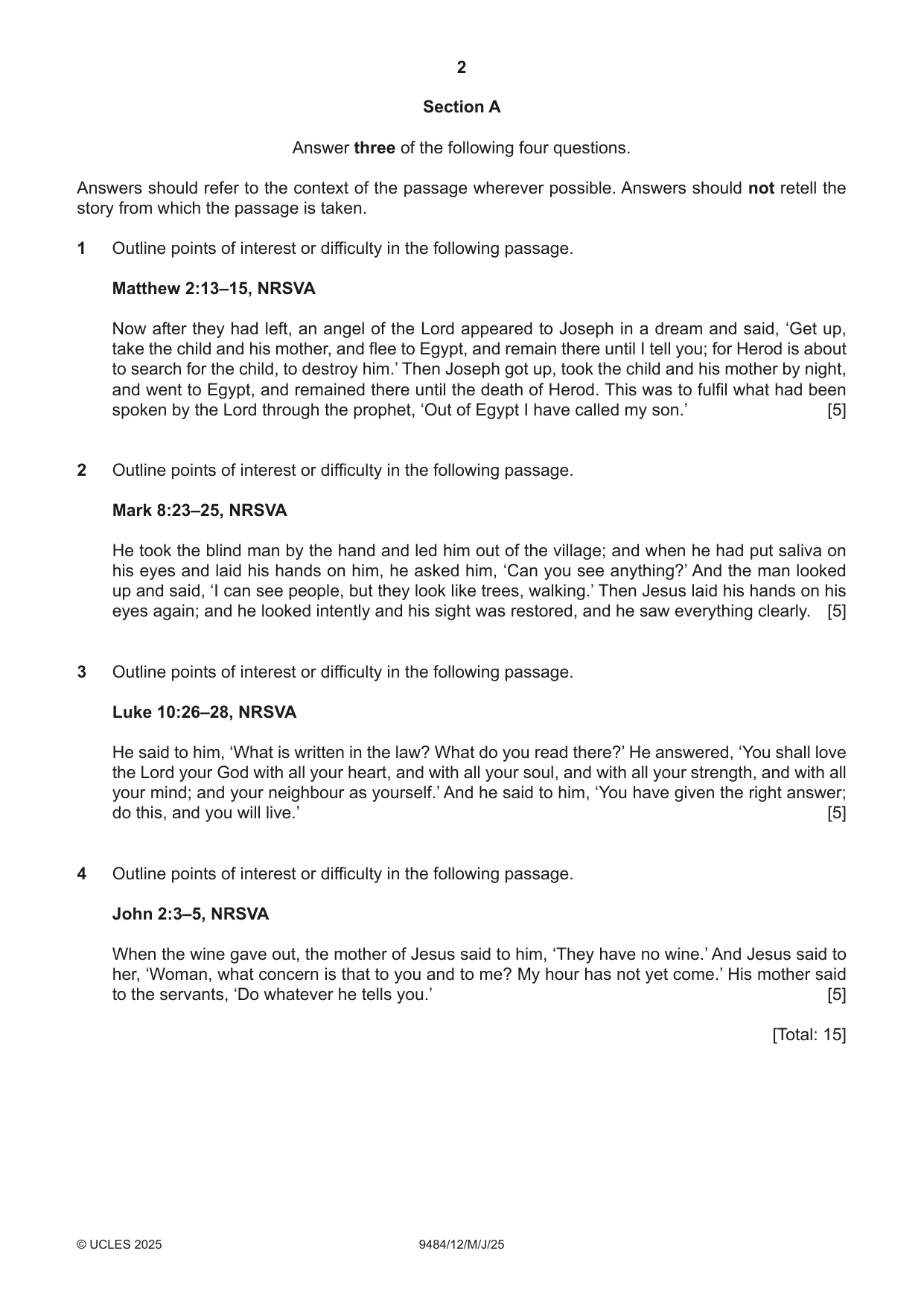
2 9484/12/M/J/25 © UCLES 2025 Section A Answer three of the following four questions. Answers should refer to the context of the passage wherever possible. Answers should not retell the story from which the passage is taken. 1 Outline points of interest or difficulty in the following passage. Matthew 2:13–15, NRSVA Now after they had left, an angel of the Lord appeared to Joseph in a dream and said, ‘Get up, take the child and his mother, and flee to Egypt, and remain there until I tell you; for Herod is about to search for the child, to destroy him.’ Then Joseph got up, took the child and his mother by night, and went to Egypt, and remained there until the death of Herod. This was to fulfil what had been spoken by the Lord through the prophet, ‘Out of Egypt I have called my son.’ [5] 2 Outline points of interest or difficulty in the following passage. Mark 8:23–25, NRSVA He took the blind man by the hand and led him out of the village; and when he had put saliva on his eyes and laid his hands on him, he asked him, ‘Can you see anything?’ And the man looked up and said, ‘I can see people, but they look like trees, walking.’ Then Jesus laid his hands on his eyes again; and he looked intently and his sight was restored, and he saw everything clearly. [5] 3 Outline points of interest or difficulty in the following passage. Luke 10:26–28, NRSVA He said to him, ‘What is written in the law? What do you read there?’ He answered, ‘You shall love the Lord your God with all your heart, and with all your soul, and with all your strength, and with all your mind; and your neighbour as yourself.’ And he said to him, ‘You have given the right answer; do this, and you will live.’ [5] 4 Outline points of interest or difficulty in the following passage. John 2:3–5, NRSVA When the wine gave out, the mother of Jesus said to him, ‘They have no wine.’ And Jesus said to her, ‘Woman, what concern is that to you and to me? My hour has not yet come.’ His mother said to the servants, ‘Do whatever he tells you.’ [5] [Total: 15]
Question paper, page 3
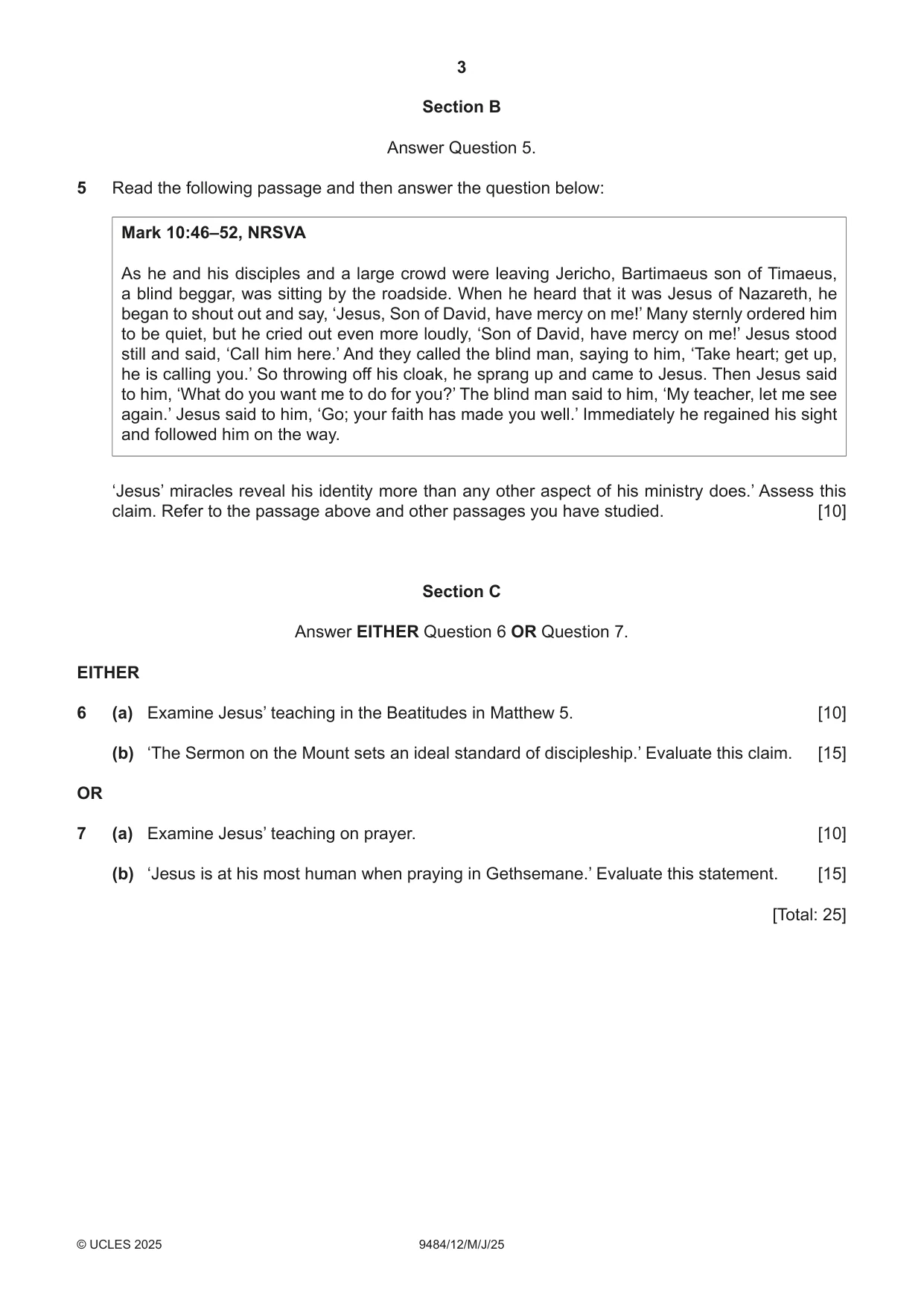
3 9484/12/M/J/25 © UCLES 2025 Section B Answer Question 5. 5 Read the following passage and then answer the question below: Mark 10:46–52, NRSVA As he and his disciples and a large crowd were leaving Jericho, Bartimaeus son of Timaeus, a blind beggar, was sitting by the roadside. When he heard that it was Jesus of Nazareth, he began to shout out and say, ‘Jesus, Son of David, have mercy on me!’ Many sternly ordered him to be quiet, but he cried out even more loudly, ‘Son of David, have mercy on me!’ Jesus stood still and said, ‘Call him here.’ And they called the blind man, saying to him, ‘Take heart; get up, he is calling you.’ So throwing off his cloak, he sprang up and came to Jesus. Then Jesus said to him, ‘What do you want me to do for you?’ The blind man said to him, ‘My teacher, let me see again.’ Jesus said to him, ‘Go; your faith has made you well.’ Immediately he regained his sight and followed him on the way. ‘Jesus’ miracles reveal his identity more than any other aspect of his ministry does.’ Assess this claim. Refer to the passage above and other passages you have studied. [10] Section C Answer EITHER Question 6 OR Question 7. EITHER 6 (a) Examine Jesus’ teaching in the Beatitudes in Matthew 5. [10] (b) ‘The Sermon on the Mount sets an ideal standard of discipleship.’ Evaluate this claim. [15] OR 7 (a) Examine Jesus’ teaching on prayer. [10] (b) ‘Jesus is at his most human when praying in Gethsemane.’ Evaluate this statement. [15] [Total: 25]
Question paper, page 4
4 9484/12/M/J/25 © UCLES 2025 Permission to reproduce items where third-party owned material protected by copyright is included has been sought and cleared where possible. Every reasonable effort has been made by the publisher (UCLES) to trace copyright holders, but if any items requiring clearance have unwittingly been included, the publisher will be pleased to make amends at the earliest possible opportunity. To avoid the issue of disclosure of answer-related information to candidates, all copyright acknowledgements are reproduced online in the Cambridge Assessment International Education Copyright Acknowledgements Booklet. This is produced for each series of examinations and is freely available to download at www.cambridgeinternational.org after the live examination series. Cambridge Assessment International Education is part of Cambridge Assessment. Cambridge Assessment is the brand name of the University of Cambridge Local Examinations Syndicate (UCLES), which is a department of the University of Cambridge. BLANK PAGE
Mark scheme, page 1
This document consists of 19 printed pages. © Cambridge University Press & Assessment 2025 [Turn over Cambridge International AS & A Level BIBLICAL STUDIES 9484/12 Paper 1 The Four Gospels May/June 2025 MARK SCHEME Maximum Mark: 50 Published This mark scheme is published as an aid to teachers and candidates, to indicate the requirements of the examination. It shows the basis on which Examiners were instructed to award marks. It does not indicate the details of the discussions that took place at an Examiners’ meeting before marking began, which would have considered the acceptability of alternative answers. Mark schemes should be read in conjunction with the question paper and the Principal Examiner Report for Teachers. Cambridge International will not enter into discussions about these mark schemes. Cambridge International is publishing the mark schemes for the May/June 2025 series for most Cambridge IGCSE, Cambridge International A and AS Level components, and some Cambridge O Level components.
Mark scheme, page 2
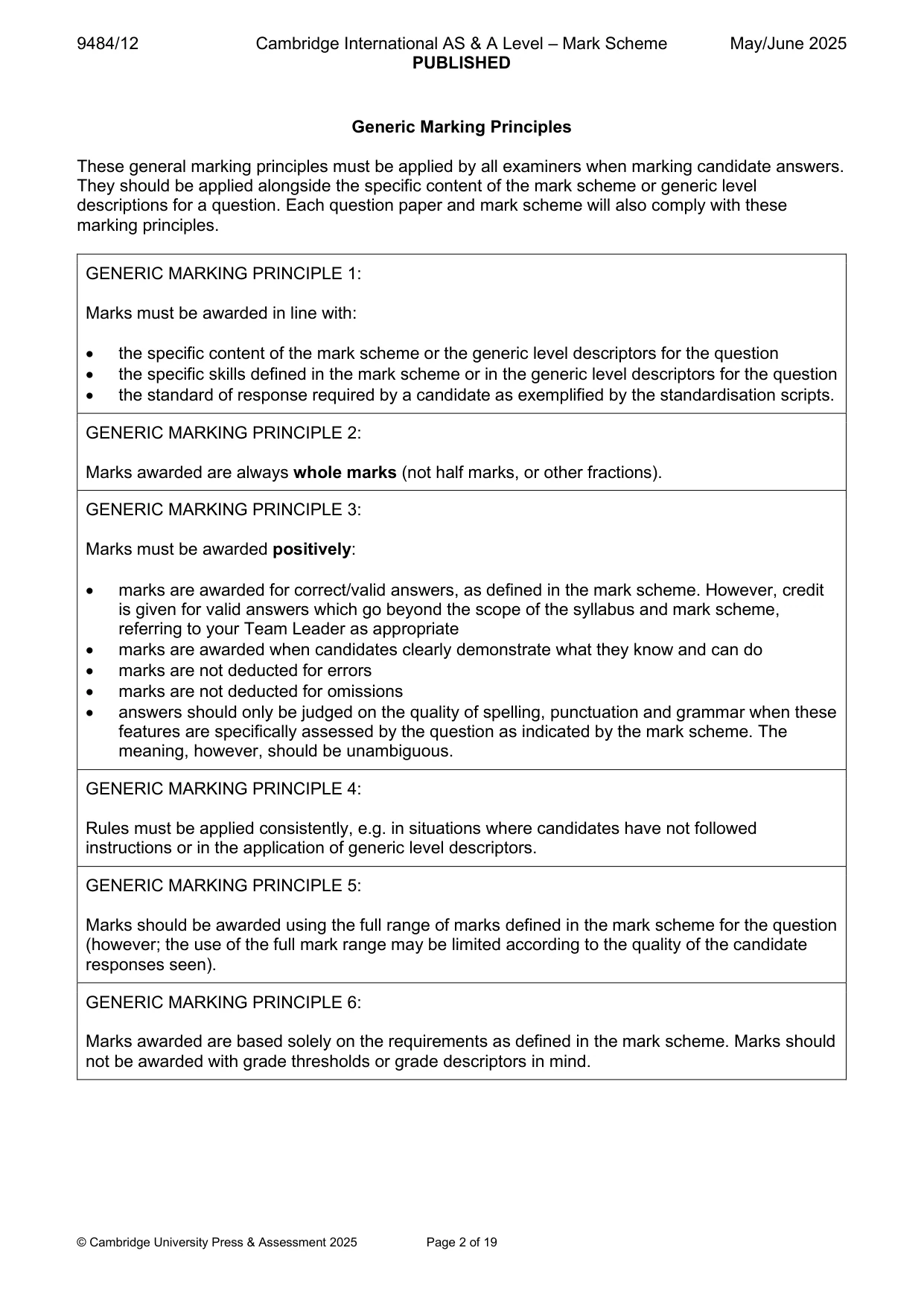
9484/12 Cambridge International AS & A Level – Mark Scheme PUBLISHED May/June 2025 © Cambridge University Press & Assessment 2025 Page 2 of 19 Generic Marking Principles These general marking principles must be applied by all examiners when marking candidate answers. They should be applied alongside the specific content of the mark scheme or generic level descriptions for a question. Each question paper and mark scheme will also comply with these marking principles. GENERIC MARKING PRINCIPLE 1: Marks must be awarded in line with: • the specific content of the mark scheme or the generic level descriptors for the question • the specific skills defined in the mark scheme or in the generic level descriptors for the question • the standard of response required by a candidate as exemplified by the standardisation scripts. GENERIC MARKING PRINCIPLE 2: Marks awarded are always whole marks (not half marks, or other fractions). GENERIC MARKING PRINCIPLE 3: Marks must be awarded positively: • marks are awarded for correct/valid answers, as defined in the mark scheme. However, credit is given for valid answers which go beyond the scope of the syllabus and mark scheme, referring to your Team Leader as appropriate • marks are awarded when candidates clearly demonstrate what they know and can do • marks are not deducted for errors • marks are not deducted for omissions • answers should only be judged on the quality of spelling, punctuation and grammar when these features are specifically assessed by the question as indicated by the mark scheme. The meaning, however, should be unambiguous. GENERIC MARKING PRINCIPLE 4: Rules must be applied consistently, e.g. in situations where candidates have not followed instructions or in the application of generic level descriptors. GENERIC MARKING PRINCIPLE 5: Marks should be awarded using the full range of marks defined in the mark scheme for the question (however; the use of the full mark range may be limited according to the quality of the candidate responses seen). GENERIC MARKING PRINCIPLE 6: Marks awarded are based solely on the requirements as defined in the mark scheme. Marks should not be awarded with grade thresholds or grade descriptors in mind.
Mark scheme, page 3
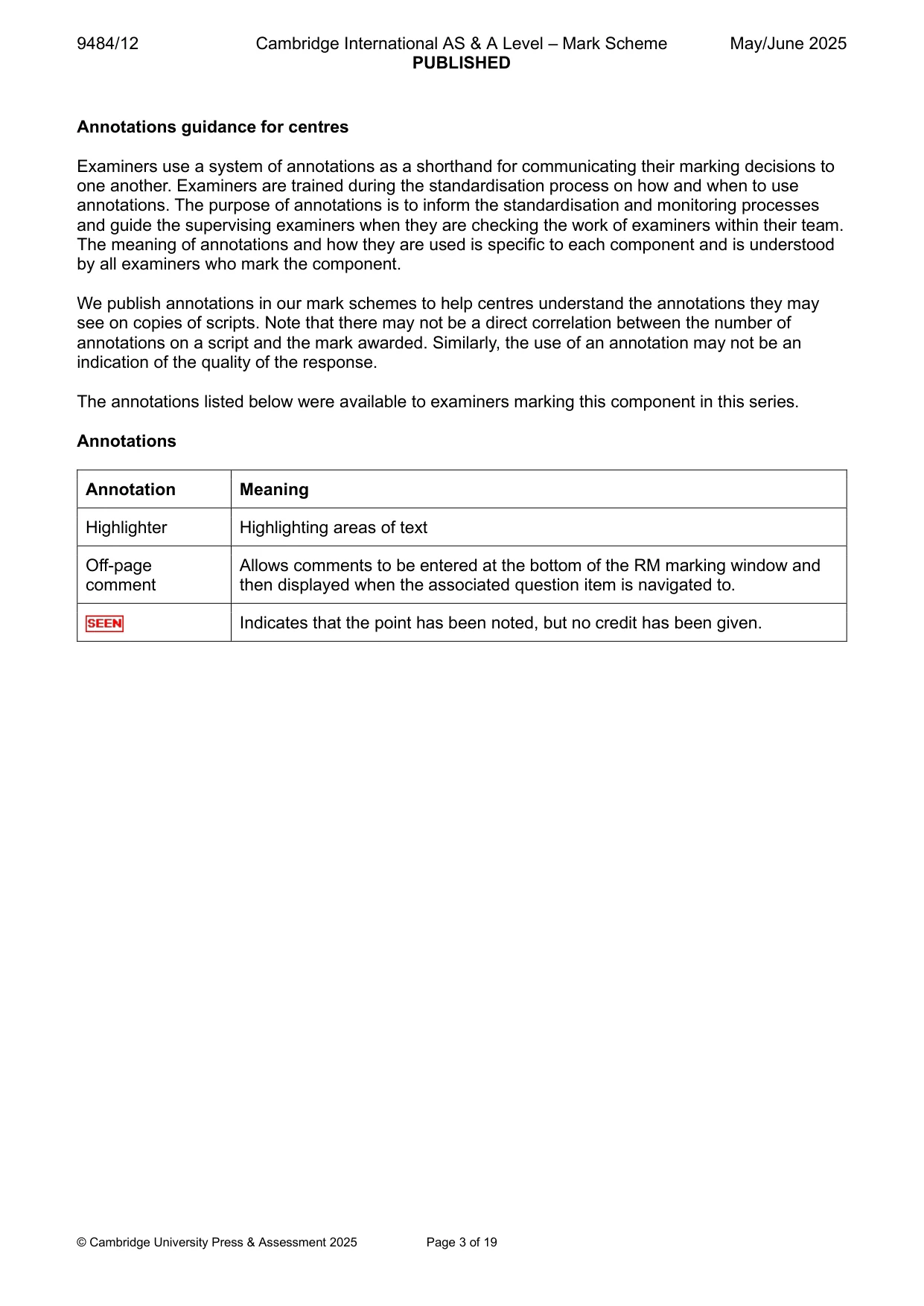
9484/12 Cambridge International AS & A Level – Mark Scheme PUBLISHED May/June 2025 © Cambridge University Press & Assessment 2025 Page 3 of 19 Annotations guidance for centres Examiners use a system of annotations as a shorthand for communicating their marking decisions to one another. Examiners are trained during the standardisation process on how and when to use annotations. The purpose of annotations is to inform the standardisation and monitoring processes and guide the supervising examiners when they are checking the work of examiners within their team. The meaning of annotations and how they are used is specific to each component and is understood by all examiners who mark the component. We publish annotations in our mark schemes to help centres understand the annotations they may see on copies of scripts. Note that there may not be a direct correlation between the number of annotations on a script and the mark awarded. Similarly, the use of an annotation may not be an indication of the quality of the response. The annotations listed below were available to examiners marking this component in this series. Annotations Annotation Meaning Highlighter Highlighting areas of text Off-page comment Allows comments to be entered at the bottom of the RM marking window and then displayed when the associated question item is navigated to. Indicates that the point has been noted, but no credit has been given.
Mark scheme, page 4
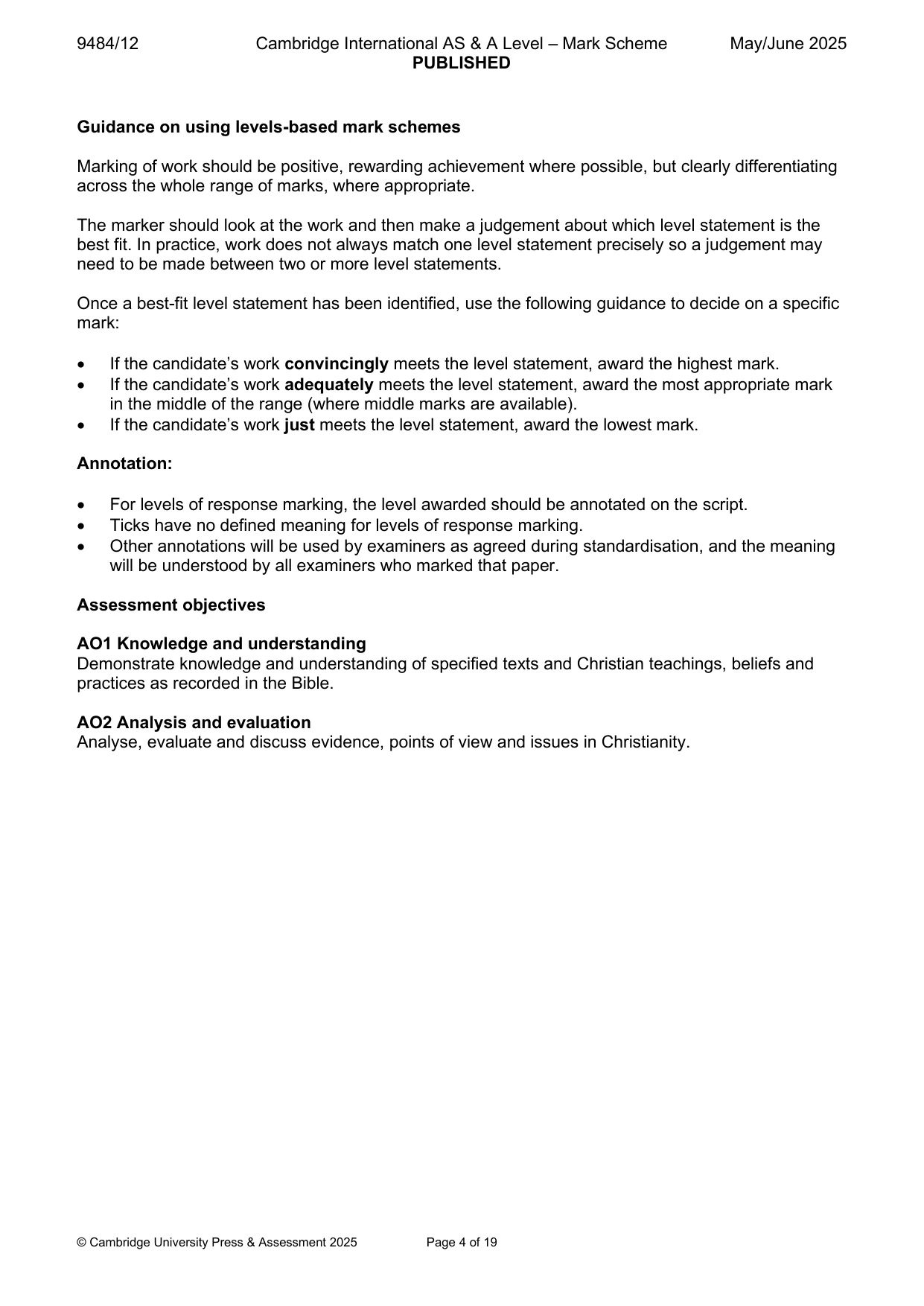
9484/12 Cambridge International AS & A Level – Mark Scheme PUBLISHED May/June 2025 © Cambridge University Press & Assessment 2025 Page 4 of 19 Guidance on using levels-based mark schemes Marking of work should be positive, rewarding achievement where possible, but clearly differentiating across the whole range of marks, where appropriate. The marker should look at the work and then make a judgement about which level statement is the best fit. In practice, work does not always match one level statement precisely so a judgement may need to be made between two or more level statements. Once a best-fit level statement has been identified, use the following guidance to decide on a specific mark: • If the candidate’s work convincingly meets the level statement, award the highest mark. • If the candidate’s work adequately meets the level statement, award the most appropriate mark in the middle of the range (where middle marks are available). • If the candidate’s work just meets the level statement, award the lowest mark. Annotation: • For levels of response marking, the level awarded should be annotated on the script. • Ticks have no defined meaning for levels of response marking. • Other annotations will be used by examiners as agreed during standardisation, and the meaning will be understood by all examiners who marked that paper. Assessment objectives AO1 Knowledge and understanding Demonstrate knowledge and understanding of specified texts and Christian teachings, beliefs and practices as recorded in the Bible. AO2 Analysis and evaluation Analyse, evaluate and discuss evidence, points of view and issues in Christianity.
Mark scheme, page 5
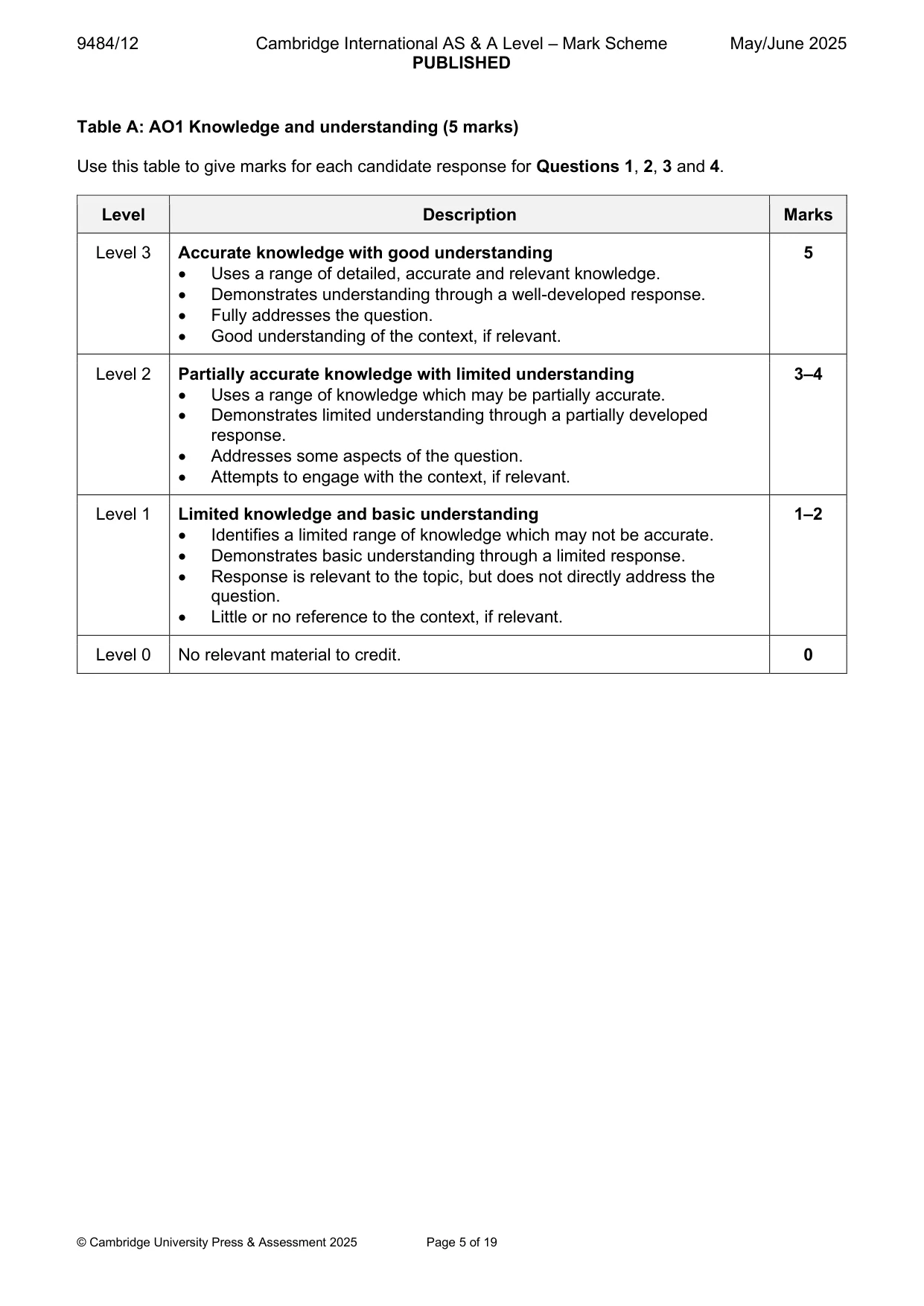
9484/12 Cambridge International AS & A Level – Mark Scheme PUBLISHED May/June 2025 © Cambridge University Press & Assessment 2025 Page 5 of 19 Table A: AO1 Knowledge and understanding (5 marks) Use this table to give marks for each candidate response for Questions 1, 2, 3 and 4. Level Description Marks Level 3 Accurate knowledge with good understanding • Uses a range of detailed, accurate and relevant knowledge. • Demonstrates understanding through a well-developed response. • Fully addresses the question. • Good understanding of the context, if relevant. 5 Level 2 Partially accurate knowledge with limited understanding • Uses a range of knowledge which may be partially accurate. • Demonstrates limited understanding through a partially developed response. • Addresses some aspects of the question. • Attempts to engage with the context, if relevant. 3–4 Level 1 Limited knowledge and basic understanding • Identifies a limited range of knowledge which may not be accurate. • Demonstrates basic understanding through a limited response. • Response is relevant to the topic, but does not directly address the question. • Little or no reference to the context, if relevant. 1–2 Level 0 No relevant material to credit. 0
Mark scheme, page 6
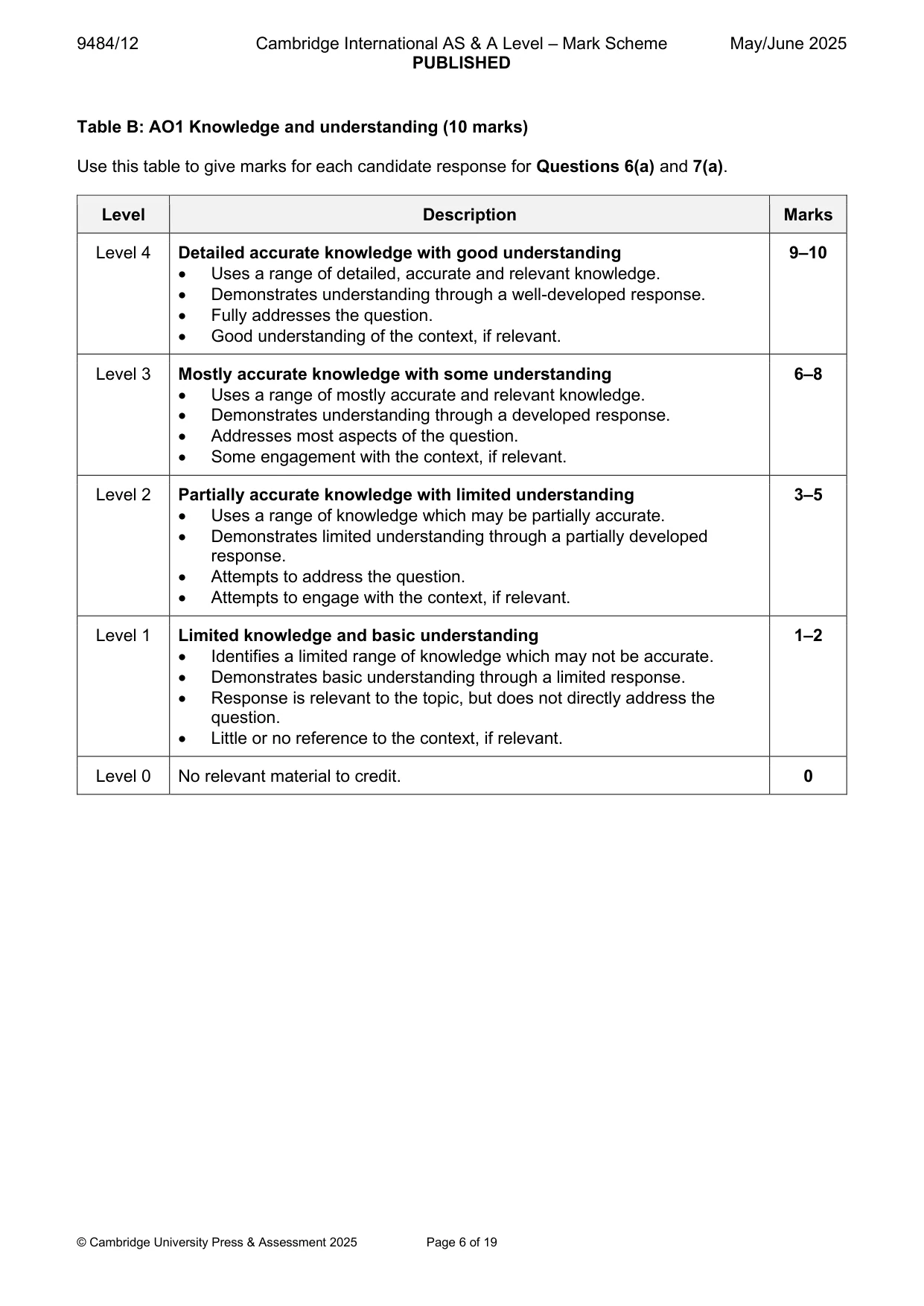
9484/12 Cambridge International AS & A Level – Mark Scheme PUBLISHED May/June 2025 © Cambridge University Press & Assessment 2025 Page 6 of 19 Table B: AO1 Knowledge and understanding (10 marks) Use this table to give marks for each candidate response for Questions 6(a) and 7(a). Level Description Marks Level 4 Detailed accurate knowledge with good understanding • Uses a range of detailed, accurate and relevant knowledge. • Demonstrates understanding through a well-developed response. • Fully addresses the question. • Good understanding of the context, if relevant. 9–10 Level 3 Mostly accurate knowledge with some understanding • Uses a range of mostly accurate and relevant knowledge. • Demonstrates understanding through a developed response. • Addresses most aspects of the question. • Some engagement with the context, if relevant. 6–8 Level 2 Partially accurate knowledge with limited understanding • Uses a range of knowledge which may be partially accurate. • Demonstrates limited understanding through a partially developed response. • Attempts to address the question. • Attempts to engage with the context, if relevant. 3–5 Level 1 Limited knowledge and basic understanding • Identifies a limited range of knowledge which may not be accurate. • Demonstrates basic understanding through a limited response. • Response is relevant to the topic, but does not directly address the question. • Little or no reference to the context, if relevant. 1–2 Level 0 No relevant material to credit. 0
Mark scheme, page 7
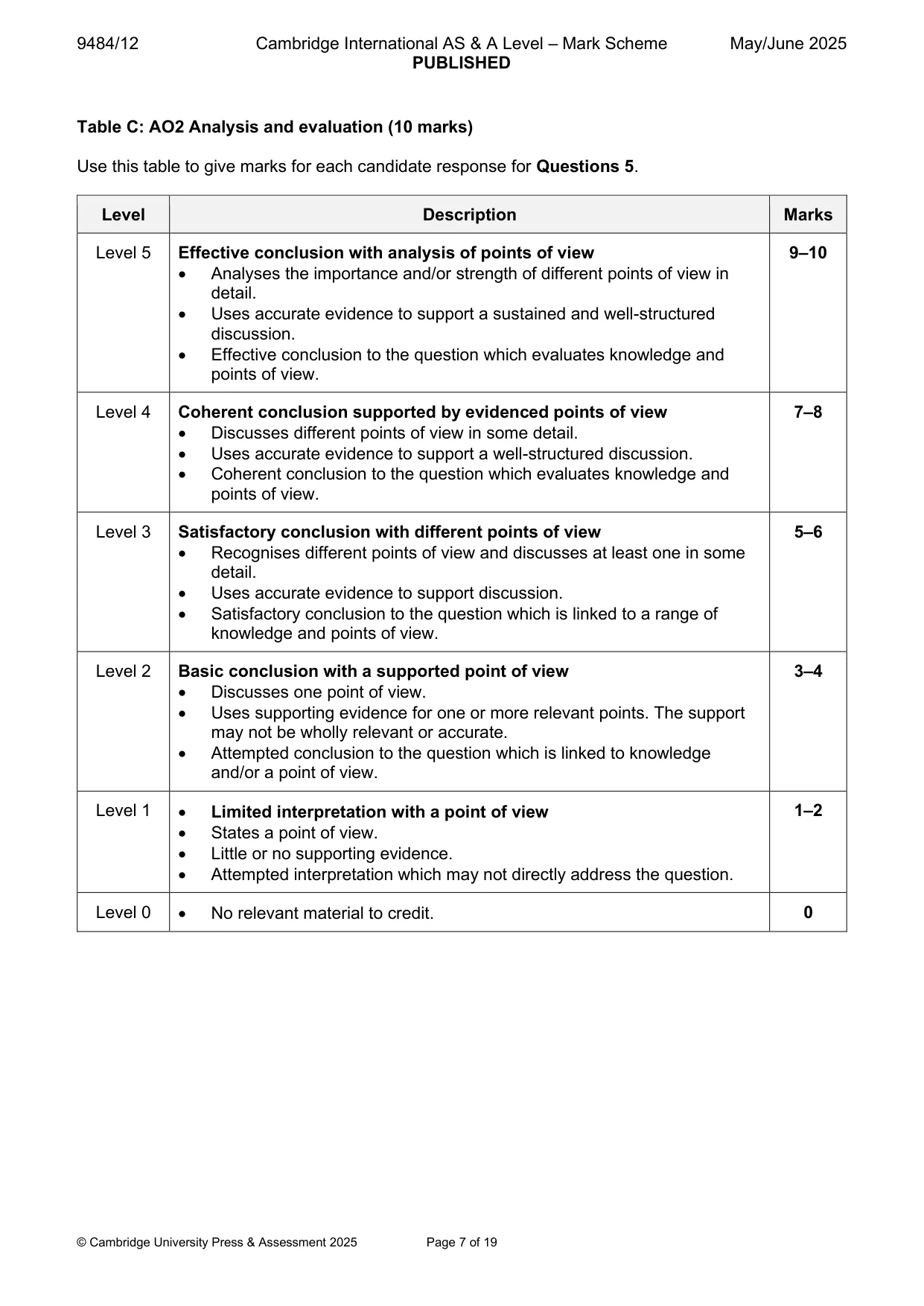
9484/12 Cambridge International AS & A Level – Mark Scheme PUBLISHED May/June 2025 © Cambridge University Press & Assessment 2025 Page 7 of 19 Table C: AO2 Analysis and evaluation (10 marks) Use this table to give marks for each candidate response for Questions 5. Level Description Marks Level 5 Effective conclusion with analysis of points of view • Analyses the importance and/or strength of different points of view in detail. • Uses accurate evidence to support a sustained and well-structured discussion. • Effective conclusion to the question which evaluates knowledge and points of view. 9–10 Level 4 Coherent conclusion supported by evidenced points of view • Discusses different points of view in some detail. • Uses accurate evidence to support a well-structured discussion. • Coherent conclusion to the question which evaluates knowledge and points of view. 7–8 Level 3 Satisfactory conclusion with different points of view • Recognises different points of view and discusses at least one in some detail. • Uses accurate evidence to support discussion. • Satisfactory conclusion to the question which is linked to a range of knowledge and points of view. 5–6 Level 2 Basic conclusion with a supported point of view • Discusses one point of view. • Uses supporting evidence for one or more relevant points. The support may not be wholly relevant or accurate. • Attempted conclusion to the question which is linked to knowledge and/or a point of view. 3–4 Level 1 • Limited interpretation with a point of view • States a point of view. • Little or no supporting evidence. • Attempted interpretation which may not directly address the question. 1–2 Level 0 • No relevant material to credit. 0
Mark scheme, page 8
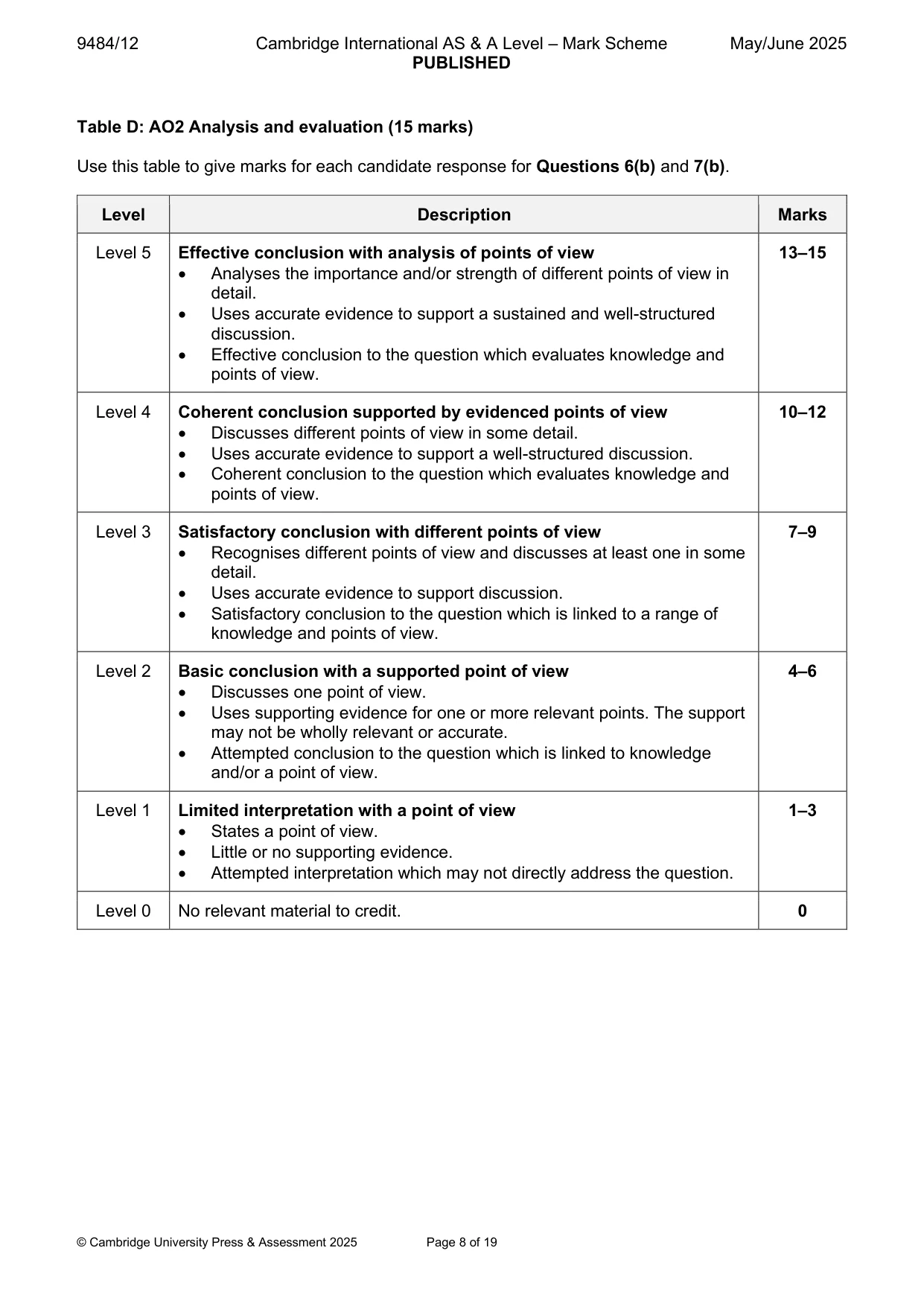
9484/12 Cambridge International AS & A Level – Mark Scheme PUBLISHED May/June 2025 © Cambridge University Press & Assessment 2025 Page 8 of 19 Table D: AO2 Analysis and evaluation (15 marks) Use this table to give marks for each candidate response for Questions 6(b) and 7(b). Level Description Marks Level 5 Effective conclusion with analysis of points of view • Analyses the importance and/or strength of different points of view in detail. • Uses accurate evidence to support a sustained and well-structured discussion. • Effective conclusion to the question which evaluates knowledge and points of view. 13–15 Level 4 Coherent conclusion supported by evidenced points of view • Discusses different points of view in some detail. • Uses accurate evidence to support a well-structured discussion. • Coherent conclusion to the question which evaluates knowledge and points of view. 10–12 Level 3 Satisfactory conclusion with different points of view • Recognises different points of view and discusses at least one in some detail. • Uses accurate evidence to support discussion. • Satisfactory conclusion to the question which is linked to a range of knowledge and points of view. 7–9 Level 2 Basic conclusion with a supported point of view • Discusses one point of view. • Uses supporting evidence for one or more relevant points. The support may not be wholly relevant or accurate. • Attempted conclusion to the question which is linked to knowledge and/or a point of view. 4–6 Level 1 Limited interpretation with a point of view • States a point of view. • Little or no supporting evidence. • Attempted interpretation which may not directly address the question. 1–3 Level 0 No relevant material to credit. 0
Mark scheme, page 9
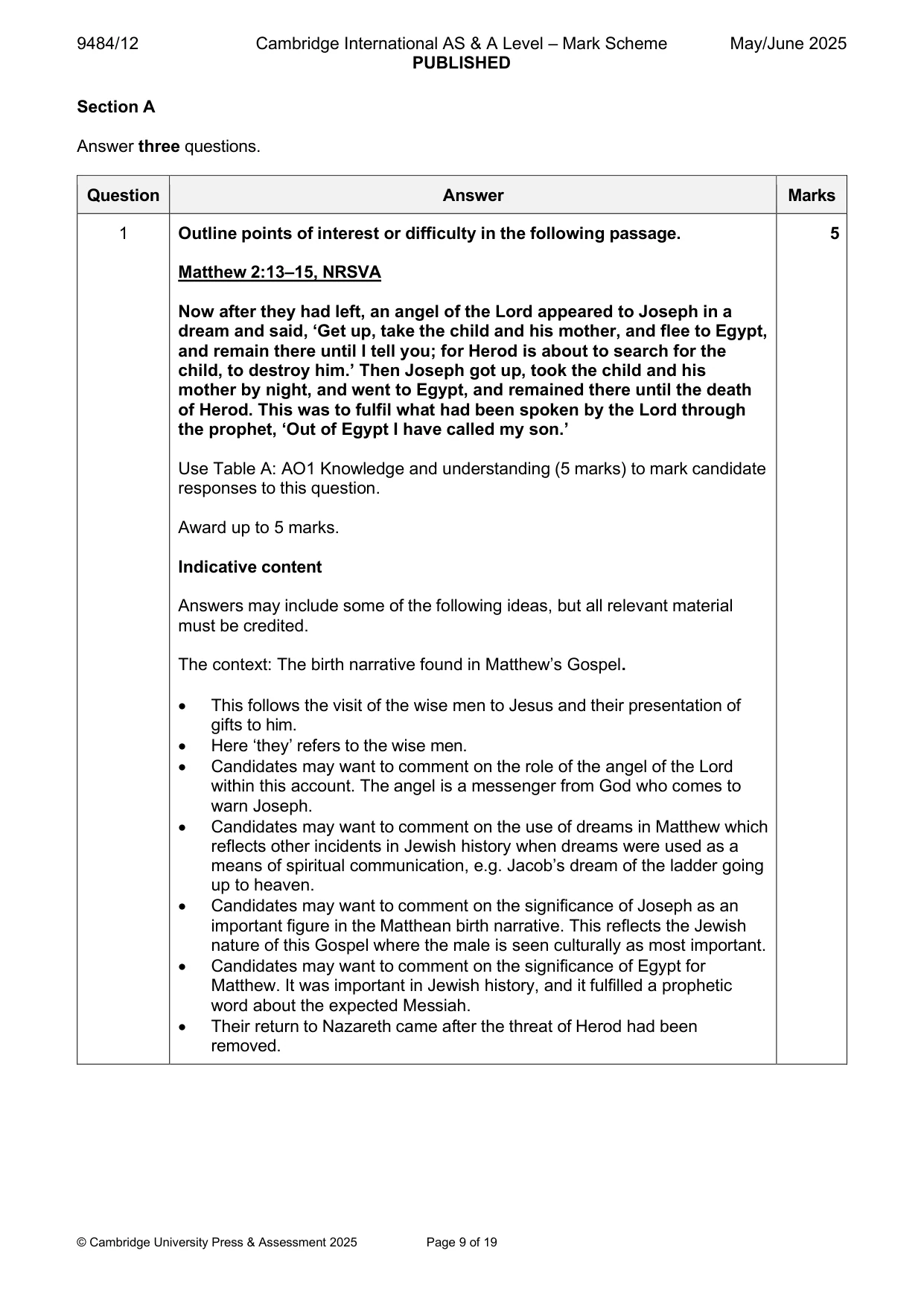
9484/12 Cambridge International AS & A Level – Mark Scheme PUBLISHED May/June 2025 © Cambridge University Press & Assessment 2025 Page 9 of 19 Section A Answer three questions. Question Answer Marks 1 Outline points of interest or difficulty in the following passage. Matthew 2:13–15, NRSVA Now after they had left, an angel of the Lord appeared to Joseph in a dream and said, ‘Get up, take the child and his mother, and flee to Egypt, and remain there until I tell you; for Herod is about to search for the child, to destroy him.’ Then Joseph got up, took the child and his mother by night, and went to Egypt, and remained there until the death of Herod. This was to fulfil what had been spoken by the Lord through the prophet, ‘Out of Egypt I have called my son.’ Use Table A: AO1 Knowledge and understanding (5 marks) to mark candidate responses to this question. Award up to 5 marks. Indicative content Answers may include some of the following ideas, but all relevant material must be credited. The context: The birth narrative found in Matthew’s Gospel. • This follows the visit of the wise men to Jesus and their presentation of gifts to him. • Here ‘they’ refers to the wise men. • Candidates may want to comment on the role of the angel of the Lord within this account. The angel is a messenger from God who comes to warn Joseph. • Candidates may want to comment on the use of dreams in Matthew which reflects other incidents in Jewish history when dreams were used as a means of spiritual communication, e.g. Jacob’s dream of the ladder going up to heaven. • Candidates may want to comment on the significance of Joseph as an important figure in the Matthean birth narrative. This reflects the Jewish nature of this Gospel where the male is seen culturally as most important. • Candidates may want to comment on the significance of Egypt for Matthew. It was important in Jewish history, and it fulfilled a prophetic word about the expected Messiah. • Their return to Nazareth came after the threat of Herod had been removed. 5
Mark scheme, page 10
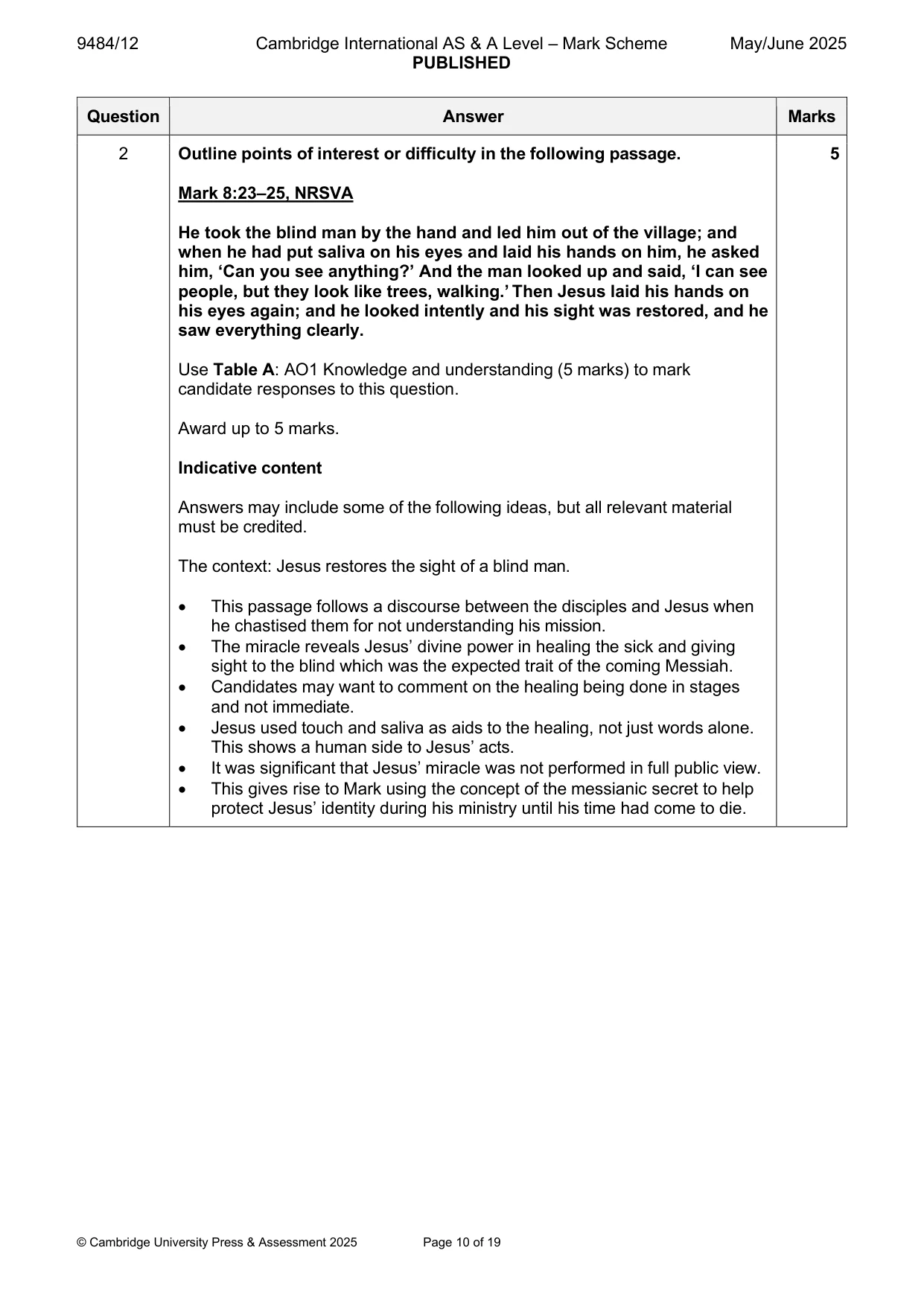
9484/12 Cambridge International AS & A Level – Mark Scheme PUBLISHED May/June 2025 © Cambridge University Press & Assessment 2025 Page 10 of 19 Question Answer Marks 2 Outline points of interest or difficulty in the following passage. Mark 8:23–25, NRSVA He took the blind man by the hand and led him out of the village; and when he had put saliva on his eyes and laid his hands on him, he asked him, ‘Can you see anything?’ And the man looked up and said, ‘I can see people, but they look like trees, walking.’ Then Jesus laid his hands on his eyes again; and he looked intently and his sight was restored, and he saw everything clearly. Use Table A: AO1 Knowledge and understanding (5 marks) to mark candidate responses to this question. Award up to 5 marks. Indicative content Answers may include some of the following ideas, but all relevant material must be credited. The context: Jesus restores the sight of a blind man. • This passage follows a discourse between the disciples and Jesus when he chastised them for not understanding his mission. • The miracle reveals Jesus’ divine power in healing the sick and giving sight to the blind which was the expected trait of the coming Messiah. • Candidates may want to comment on the healing being done in stages and not immediate. • Jesus used touch and saliva as aids to the healing, not just words alone. This shows a human side to Jesus’ acts. • It was significant that Jesus’ miracle was not performed in full public view. • This gives rise to Mark using the concept of the messianic secret to help protect Jesus’ identity during his ministry until his time had come to die. 5
Mark scheme, page 11
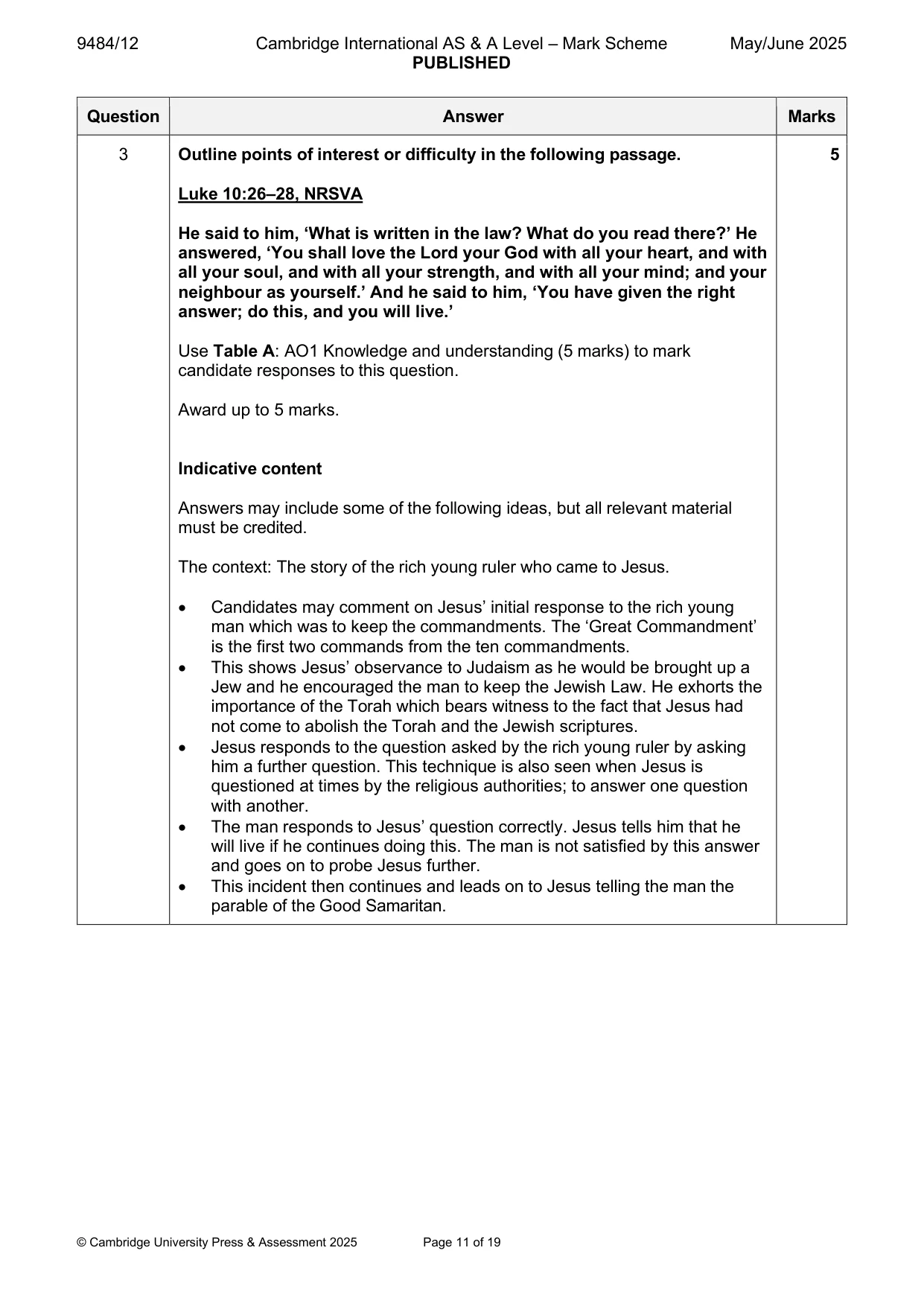
9484/12 Cambridge International AS & A Level – Mark Scheme PUBLISHED May/June 2025 © Cambridge University Press & Assessment 2025 Page 11 of 19 Question Answer Marks 3 Outline points of interest or difficulty in the following passage. Luke 10:26–28, NRSVA He said to him, ‘What is written in the law? What do you read there?’ He answered, ‘You shall love the Lord your God with all your heart, and with all your soul, and with all your strength, and with all your mind; and your neighbour as yourself.’ And he said to him, ‘You have given the right answer; do this, and you will live.’ Use Table A: AO1 Knowledge and understanding (5 marks) to mark candidate responses to this question. Award up to 5 marks. Indicative content Answers may include some of the following ideas, but all relevant material must be credited. The context: The story of the rich young ruler who came to Jesus. • Candidates may comment on Jesus’ initial response to the rich young man which was to keep the commandments. The ‘Great Commandment’ is the first two commands from the ten commandments. • This shows Jesus’ observance to Judaism as he would be brought up a Jew and he encouraged the man to keep the Jewish Law. He exhorts the importance of the Torah which bears witness to the fact that Jesus had not come to abolish the Torah and the Jewish scriptures. • Jesus responds to the question asked by the rich young ruler by asking him a further question. This technique is also seen when Jesus is questioned at times by the religious authorities; to answer one question with another. • The man responds to Jesus’ question correctly. Jesus tells him that he will live if he continues doing this. The man is not satisfied by this answer and goes on to probe Jesus further. • This incident then continues and leads on to Jesus telling the man the parable of the Good Samaritan. 5
Mark scheme, page 12
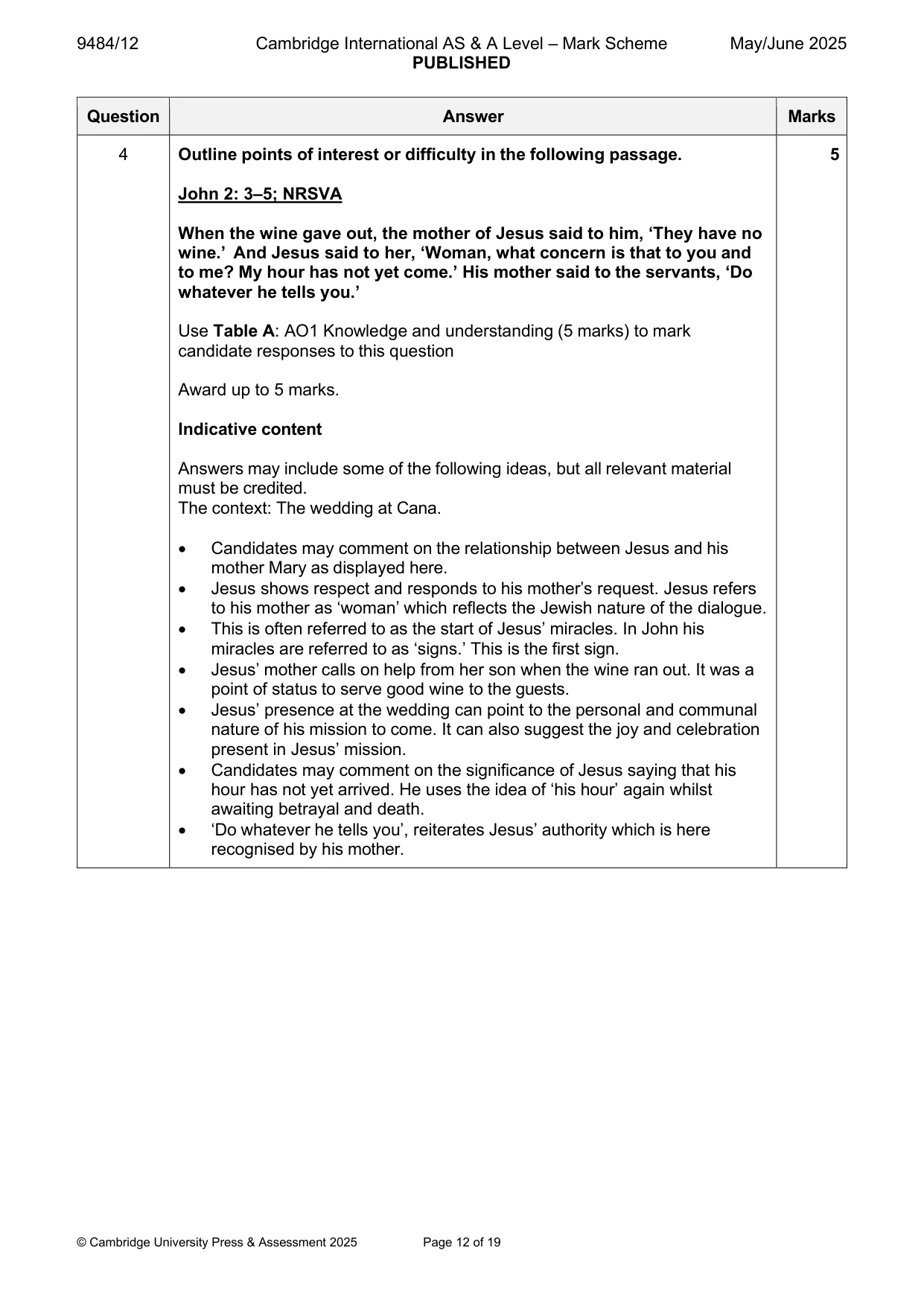
9484/12 Cambridge International AS & A Level – Mark Scheme PUBLISHED May/June 2025 © Cambridge University Press & Assessment 2025 Page 12 of 19 Question Answer Marks 4 Outline points of interest or difficulty in the following passage. John 2: 3–5; NRSVA When the wine gave out, the mother of Jesus said to him, ‘They have no wine.’ And Jesus said to her, ‘Woman, what concern is that to you and to me? My hour has not yet come.’ His mother said to the servants, ‘Do whatever he tells you.’ Use Table A: AO1 Knowledge and understanding (5 marks) to mark candidate responses to this question Award up to 5 marks. Indicative content Answers may include some of the following ideas, but all relevant material must be credited. The context: The wedding at Cana. • Candidates may comment on the relationship between Jesus and his mother Mary as displayed here. • Jesus shows respect and responds to his mother’s request. Jesus refers to his mother as ‘woman’ which reflects the Jewish nature of the dialogue. • This is often referred to as the start of Jesus’ miracles. In John his miracles are referred to as ‘signs.’ This is the first sign. • Jesus’ mother calls on help from her son when the wine ran out. It was a point of status to serve good wine to the guests. • Jesus’ presence at the wedding can point to the personal and communal nature of his mission to come. It can also suggest the joy and celebration present in Jesus’ mission. • Candidates may comment on the significance of Jesus saying that his hour has not yet arrived. He uses the idea of ‘his hour’ again whilst awaiting betrayal and death. • ‘Do whatever he tells you’, reiterates Jesus’ authority which is here recognised by his mother. 5
Mark scheme, page 13
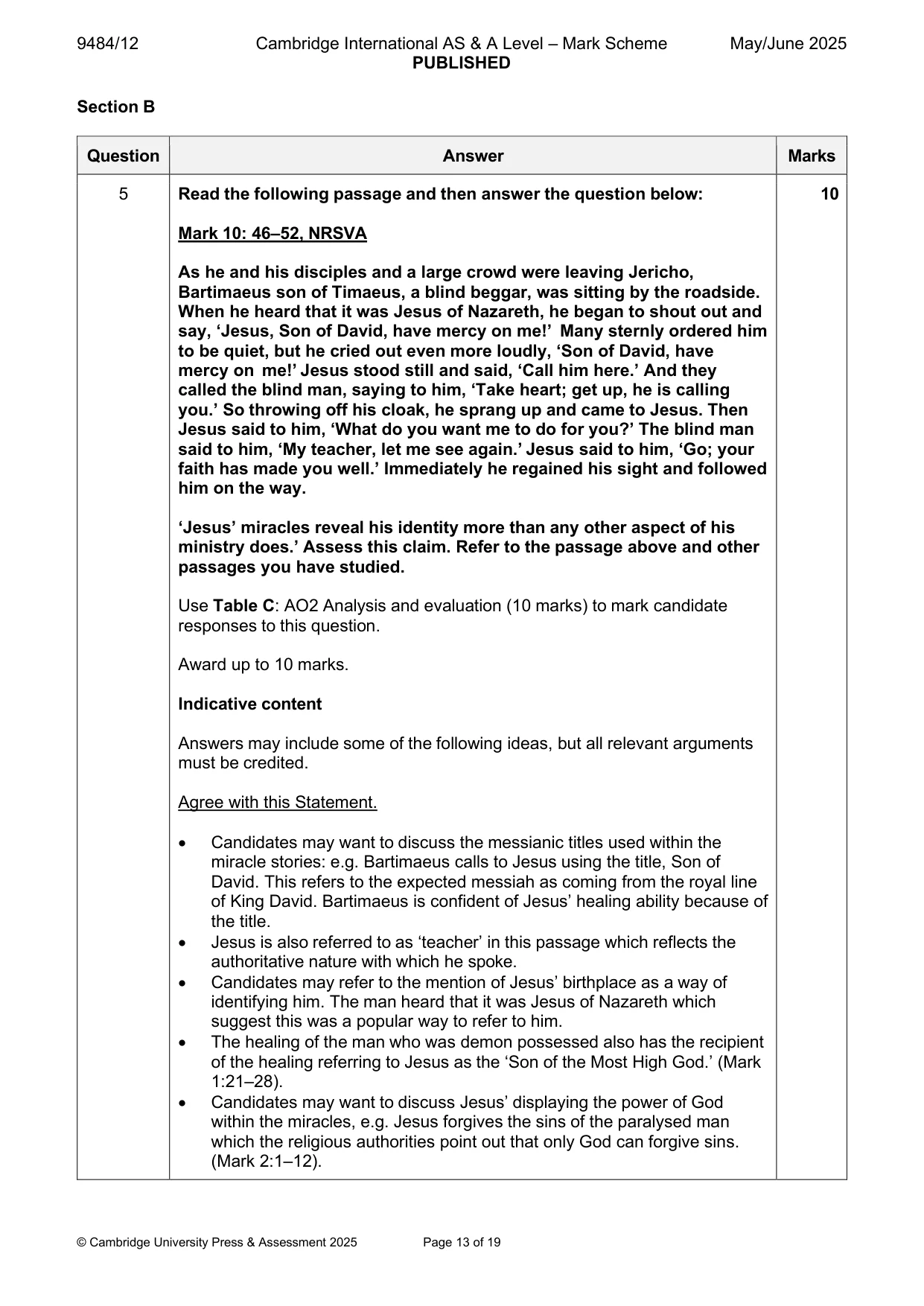
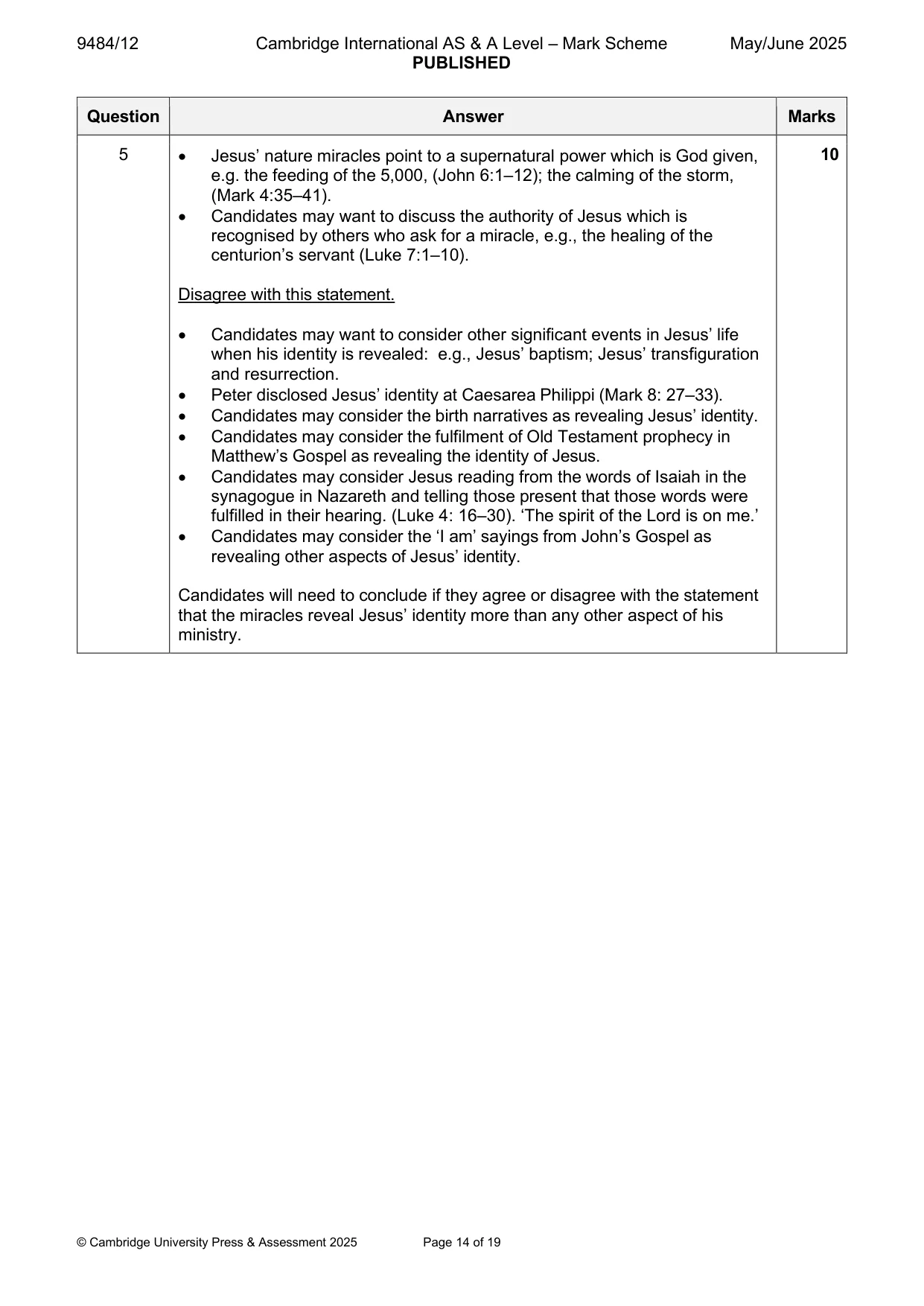
9484/12 Cambridge International AS & A Level – Mark Scheme PUBLISHED May/June 2025 © Cambridge University Press & Assessment 2025 Page 13 of 19 Section B Question Answer Marks 5 Read the following passage and then answer the question below: Mark 10: 46–52, NRSVA As he and his disciples and a large crowd were leaving Jericho, Bartimaeus son of Timaeus, a blind beggar, was sitting by the roadside. When he heard that it was Jesus of Nazareth, he began to shout out and say, ‘Jesus, Son of David, have mercy on me!’ Many sternly ordered him to be quiet, but he cried out even more loudly, ‘Son of David, have mercy on me!’ Jesus stood still and said, ‘Call him here.’ And they called the blind man, saying to him, ‘Take heart; get up, he is calling you.’ So throwing off his cloak, he sprang up and came to Jesus. Then Jesus said to him, ‘What do you want me to do for you?’ The blind man said to him, ‘My teacher, let me see again.’ Jesus said to him, ‘Go; your faith has made you well.’ Immediately he regained his sight and followed him on the way. ‘Jesus’ miracles reveal his identity more than any other aspect of his ministry does.’ Assess this claim. Refer to the passage above and other passages you have studied. Use Table C: AO2 Analysis and evaluation (10 marks) to mark candidate responses to this question. Award up to 10 marks. Indicative content Answers may include some of the following ideas, but all relevant arguments must be credited. Agree with this Statement. • Candidates may want to discuss the messianic titles used within the miracle stories: e.g. Bartimaeus calls to Jesus using the title, Son of David. This refers to the expected messiah as coming from the royal line of King David. Bartimaeus is confident of Jesus’ healing ability because of the title. • Jesus is also referred to as ‘teacher’ in this passage which reflects the authoritative nature with which he spoke. • Candidates may refer to the mention of Jesus’ birthplace as a way of identifying him. The man heard that it was Jesus of Nazareth which suggest this was a popular way to refer to him. • The healing of the man who was demon possessed also has the recipient of the healing referring to Jesus as the ‘Son of the Most High God.’ (Mark 1:21–28). • Candidates may want to discuss Jesus’ displaying the power of God within the miracles, e.g. Jesus forgives the sins of the paralysed man which the religious authorities point out that only God can forgive sins. (Mark 2:1–12). 10
Mark scheme, page 14
9484/12 Cambridge International AS & A Level – Mark Scheme PUBLISHED May/June 2025 © Cambridge University Press & Assessment 2025 Page 14 of 19 Question Answer Marks 5 • Jesus’ nature miracles point to a supernatural power which is God given, e.g. the feeding of the 5,000, (John 6:1–12); the calming of the storm, (Mark 4:35–41). • Candidates may want to discuss the authority of Jesus which is recognised by others who ask for a miracle, e.g., the healing of the centurion’s servant (Luke 7:1–10). Disagree with this statement. • Candidates may want to consider other significant events in Jesus’ life when his identity is revealed: e.g., Jesus’ baptism; Jesus’ transfiguration and resurrection. • Peter disclosed Jesus’ identity at Caesarea Philippi (Mark 8: 27–33). • Candidates may consider the birth narratives as revealing Jesus’ identity. • Candidates may consider the fulfilment of Old Testament prophecy in Matthew’s Gospel as revealing the identity of Jesus. • Candidates may consider Jesus reading from the words of Isaiah in the synagogue in Nazareth and telling those present that those words were fulfilled in their hearing. (Luke 4: 16–30). ‘The spirit of the Lord is on me.’ • Candidates may consider the ‘I am’ sayings from John’s Gospel as revealing other aspects of Jesus’ identity. Candidates will need to conclude if they agree or disagree with the statement that the miracles reveal Jesus’ identity more than any other aspect of his ministry. 10
Mark scheme, page 15
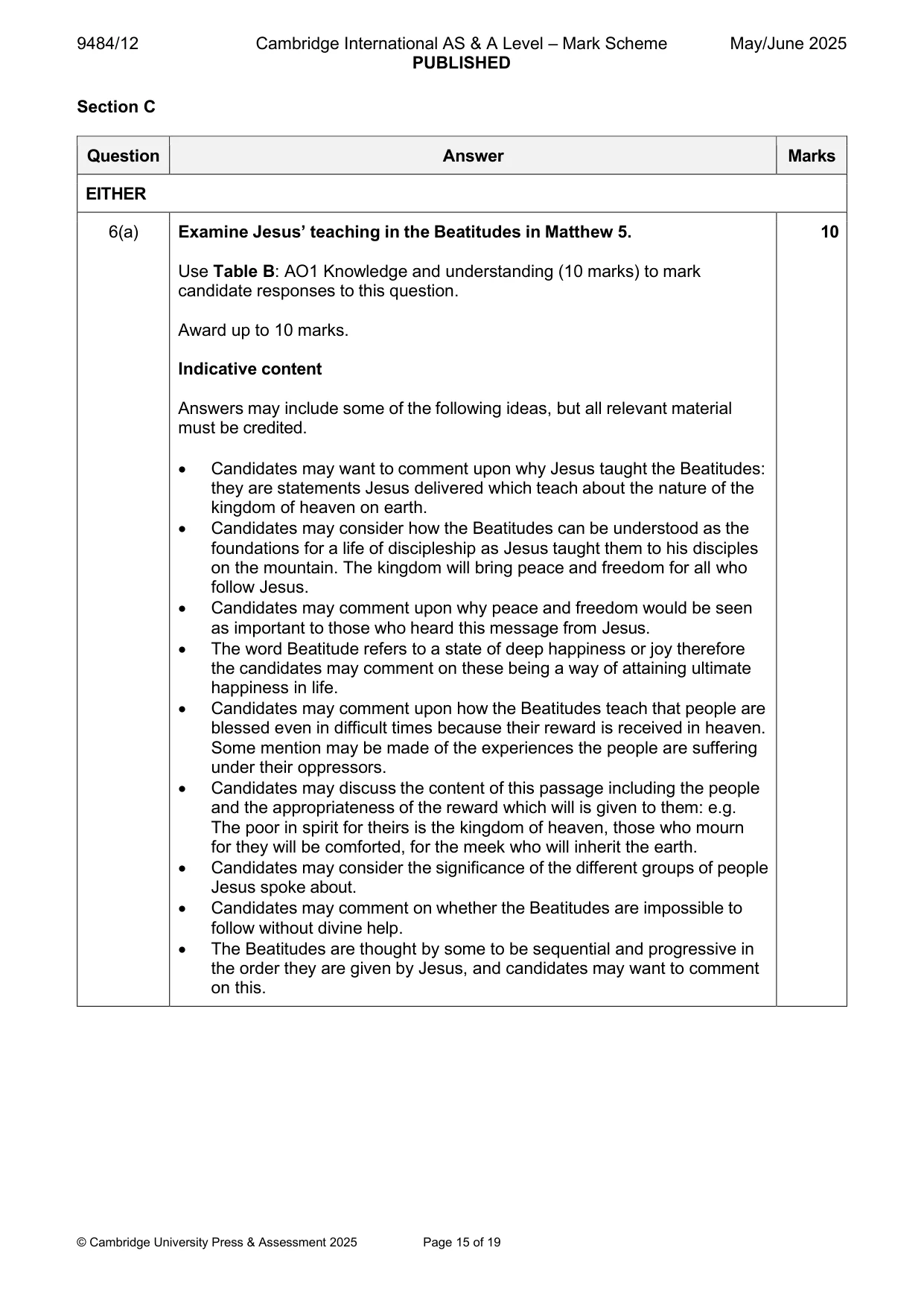
9484/12 Cambridge International AS & A Level – Mark Scheme PUBLISHED May/June 2025 © Cambridge University Press & Assessment 2025 Page 15 of 19 Section C Question Answer Marks EITHER 6(a) Examine Jesus’ teaching in the Beatitudes in Matthew 5. Use Table B: AO1 Knowledge and understanding (10 marks) to mark candidate responses to this question. Award up to 10 marks. Indicative content Answers may include some of the following ideas, but all relevant material must be credited. • Candidates may want to comment upon why Jesus taught the Beatitudes: they are statements Jesus delivered which teach about the nature of the kingdom of heaven on earth. • Candidates may consider how the Beatitudes can be understood as the foundations for a life of discipleship as Jesus taught them to his disciples on the mountain. The kingdom will bring peace and freedom for all who follow Jesus. • Candidates may comment upon why peace and freedom would be seen as important to those who heard this message from Jesus. • The word Beatitude refers to a state of deep happiness or joy therefore the candidates may comment on these being a way of attaining ultimate happiness in life. • Candidates may comment upon how the Beatitudes teach that people are blessed even in difficult times because their reward is received in heaven. Some mention may be made of the experiences the people are suffering under their oppressors. • Candidates may discuss the content of this passage including the people and the appropriateness of the reward which will is given to them: e.g. The poor in spirit for theirs is the kingdom of heaven, those who mourn for they will be comforted, for the meek who will inherit the earth. • Candidates may consider the significance of the different groups of people Jesus spoke about. • Candidates may comment on whether the Beatitudes are impossible to follow without divine help. • The Beatitudes are thought by some to be sequential and progressive in the order they are given by Jesus, and candidates may want to comment on this. 10
Mark scheme, page 16
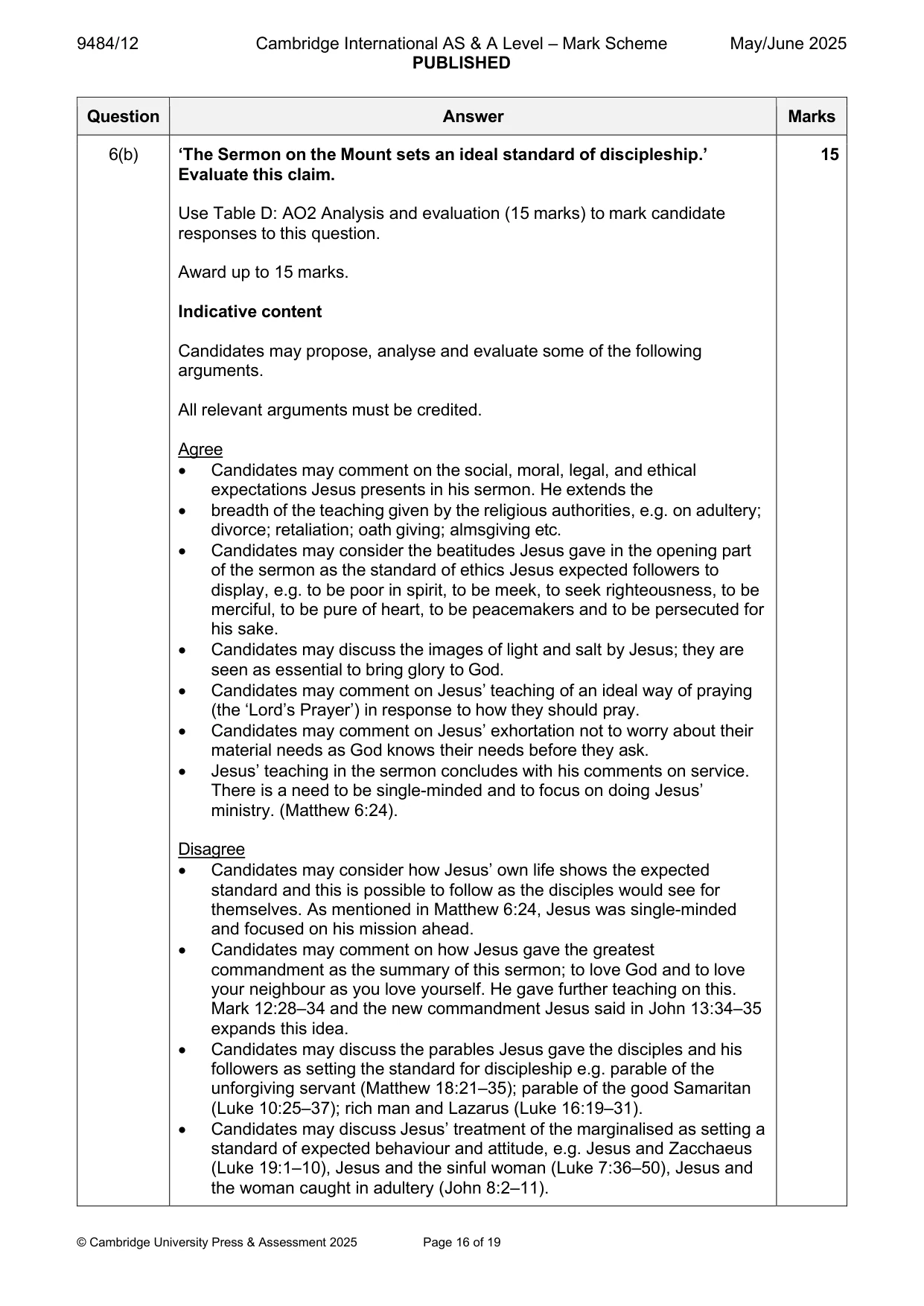
9484/12 Cambridge International AS & A Level – Mark Scheme PUBLISHED May/June 2025 © Cambridge University Press & Assessment 2025 Page 16 of 19 Question Answer Marks 6(b) ‘The Sermon on the Mount sets an ideal standard of discipleship.’ Evaluate this claim. Use Table D: AO2 Analysis and evaluation (15 marks) to mark candidate responses to this question. Award up to 15 marks. Indicative content Candidates may propose, analyse and evaluate some of the following arguments. All relevant arguments must be credited. Agree • Candidates may comment on the social, moral, legal, and ethical expectations Jesus presents in his sermon. He extends the • breadth of the teaching given by the religious authorities, e.g. on adultery; divorce; retaliation; oath giving; almsgiving etc. • Candidates may consider the beatitudes Jesus gave in the opening part of the sermon as the standard of ethics Jesus expected followers to display, e.g. to be poor in spirit, to be meek, to seek righteousness, to be merciful, to be pure of heart, to be peacemakers and to be persecuted for his sake. • Candidates may discuss the images of light and salt by Jesus; they are seen as essential to bring glory to God. • Candidates may comment on Jesus’ teaching of an ideal way of praying (the ‘Lord’s Prayer’) in response to how they should pray. • Candidates may comment on Jesus’ exhortation not to worry about their material needs as God knows their needs before they ask. • Jesus’ teaching in the sermon concludes with his comments on service. There is a need to be single-minded and to focus on doing Jesus’ ministry. (Matthew 6:24). Disagree • Candidates may consider how Jesus’ own life shows the expected standard and this is possible to follow as the disciples would see for themselves. As mentioned in Matthew 6:24, Jesus was single-minded and focused on his mission ahead. • Candidates may comment on how Jesus gave the greatest commandment as the summary of this sermon; to love God and to love your neighbour as you love yourself. He gave further teaching on this. Mark 12:28–34 and the new commandment Jesus said in John 13:34–35 expands this idea. • Candidates may discuss the parables Jesus gave the disciples and his followers as setting the standard for discipleship e.g. parable of the unforgiving servant (Matthew 18:21–35); parable of the good Samaritan (Luke 10:25–37); rich man and Lazarus (Luke 16:19–31). • Candidates may discuss Jesus’ treatment of the marginalised as setting a standard of expected behaviour and attitude, e.g. Jesus and Zacchaeus (Luke 19:1–10), Jesus and the sinful woman (Luke 7:36–50), Jesus and the woman caught in adultery (John 8:2–11). 15
Mark scheme, page 17
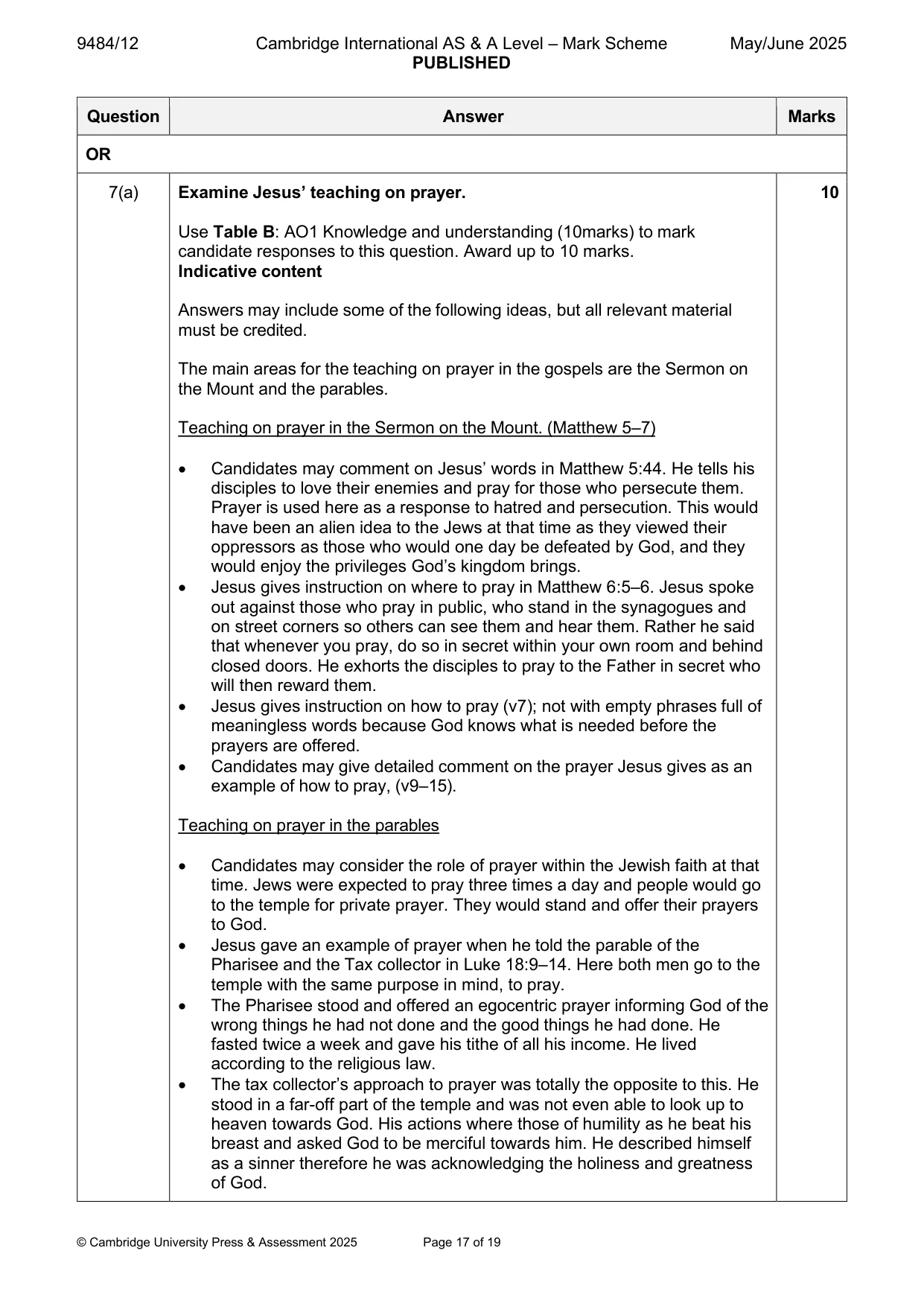
9484/12 Cambridge International AS & A Level – Mark Scheme PUBLISHED May/June 2025 © Cambridge University Press & Assessment 2025 Page 17 of 19 Question Answer Marks OR 7(a) Examine Jesus’ teaching on prayer. Use Table B: AO1 Knowledge and understanding (10marks) to mark candidate responses to this question. Award up to 10 marks. Indicative content Answers may include some of the following ideas, but all relevant material must be credited. The main areas for the teaching on prayer in the gospels are the Sermon on the Mount and the parables. Teaching on prayer in the Sermon on the Mount. (Matthew 5–7) • Candidates may comment on Jesus’ words in Matthew 5:44. He tells his disciples to love their enemies and pray for those who persecute them. Prayer is used here as a response to hatred and persecution. This would have been an alien idea to the Jews at that time as they viewed their oppressors as those who would one day be defeated by God, and they would enjoy the privileges God’s kingdom brings. • Jesus gives instruction on where to pray in Matthew 6:5–6. Jesus spoke out against those who pray in public, who stand in the synagogues and on street corners so others can see them and hear them. Rather he said that whenever you pray, do so in secret within your own room and behind closed doors. He exhorts the disciples to pray to the Father in secret who will then reward them. • Jesus gives instruction on how to pray (v7); not with empty phrases full of meaningless words because God knows what is needed before the prayers are offered. • Candidates may give detailed comment on the prayer Jesus gives as an example of how to pray, (v9–15). Teaching on prayer in the parables • Candidates may consider the role of prayer within the Jewish faith at that time. Jews were expected to pray three times a day and people would go to the temple for private prayer. They would stand and offer their prayers to God. • Jesus gave an example of prayer when he told the parable of the Pharisee and the Tax collector in Luke 18:9–14. Here both men go to the temple with the same purpose in mind, to pray. • The Pharisee stood and offered an egocentric prayer informing God of the wrong things he had not done and the good things he had done. He fasted twice a week and gave his tithe of all his income. He lived according to the religious law. • The tax collector’s approach to prayer was totally the opposite to this. He stood in a far-off part of the temple and was not even able to look up to heaven towards God. His actions where those of humility as he beat his breast and asked God to be merciful towards him. He described himself as a sinner therefore he was acknowledging the holiness and greatness of God. 10
Mark scheme, page 18
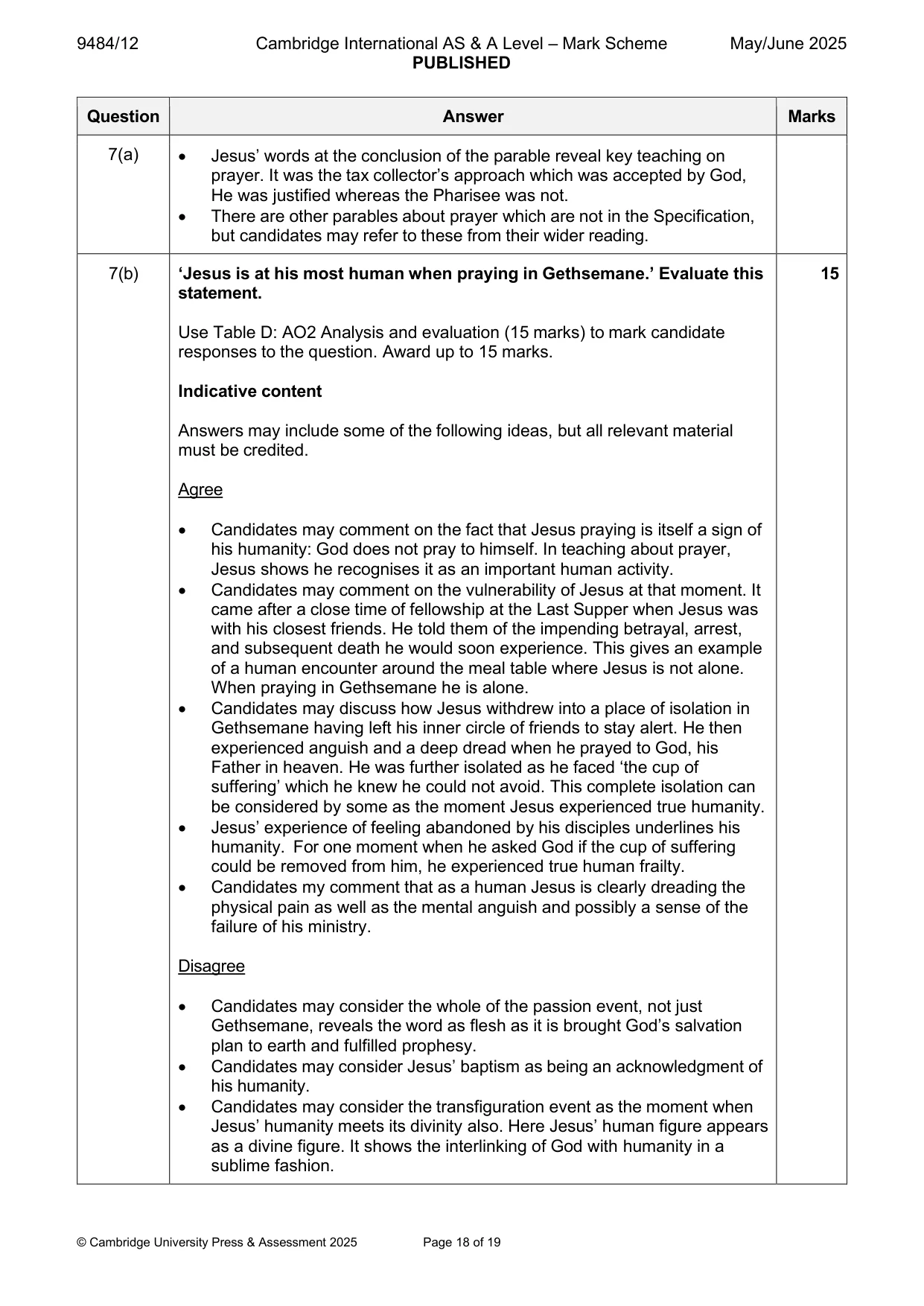
9484/12 Cambridge International AS & A Level – Mark Scheme PUBLISHED May/June 2025 © Cambridge University Press & Assessment 2025 Page 18 of 19 Question Answer Marks 7(a) • Jesus’ words at the conclusion of the parable reveal key teaching on prayer. It was the tax collector’s approach which was accepted by God, He was justified whereas the Pharisee was not. • There are other parables about prayer which are not in the Specification, but candidates may refer to these from their wider reading. 7(b) ‘Jesus is at his most human when praying in Gethsemane.’ Evaluate this statement. Use Table D: AO2 Analysis and evaluation (15 marks) to mark candidate responses to the question. Award up to 15 marks. Indicative content Answers may include some of the following ideas, but all relevant material must be credited. Agree • Candidates may comment on the fact that Jesus praying is itself a sign of his humanity: God does not pray to himself. In teaching about prayer, Jesus shows he recognises it as an important human activity. • Candidates may comment on the vulnerability of Jesus at that moment. It came after a close time of fellowship at the Last Supper when Jesus was with his closest friends. He told them of the impending betrayal, arrest, and subsequent death he would soon experience. This gives an example of a human encounter around the meal table where Jesus is not alone. When praying in Gethsemane he is alone. • Candidates may discuss how Jesus withdrew into a place of isolation in Gethsemane having left his inner circle of friends to stay alert. He then experienced anguish and a deep dread when he prayed to God, his Father in heaven. He was further isolated as he faced ‘the cup of suffering’ which he knew he could not avoid. This complete isolation can be considered by some as the moment Jesus experienced true humanity. • Jesus’ experience of feeling abandoned by his disciples underlines his humanity. For one moment when he asked God if the cup of suffering could be removed from him, he experienced true human frailty. • Candidates my comment that as a human Jesus is clearly dreading the physical pain as well as the mental anguish and possibly a sense of the failure of his ministry. Disagree • Candidates may consider the whole of the passion event, not just Gethsemane, reveals the word as flesh as it is brought God’s salvation plan to earth and fulfilled prophesy. • Candidates may consider Jesus’ baptism as being an acknowledgment of his humanity. • Candidates may consider the transfiguration event as the moment when Jesus’ humanity meets its divinity also. Here Jesus’ human figure appears as a divine figure. It shows the interlinking of God with humanity in a sublime fashion. 15
Mark scheme, page 19
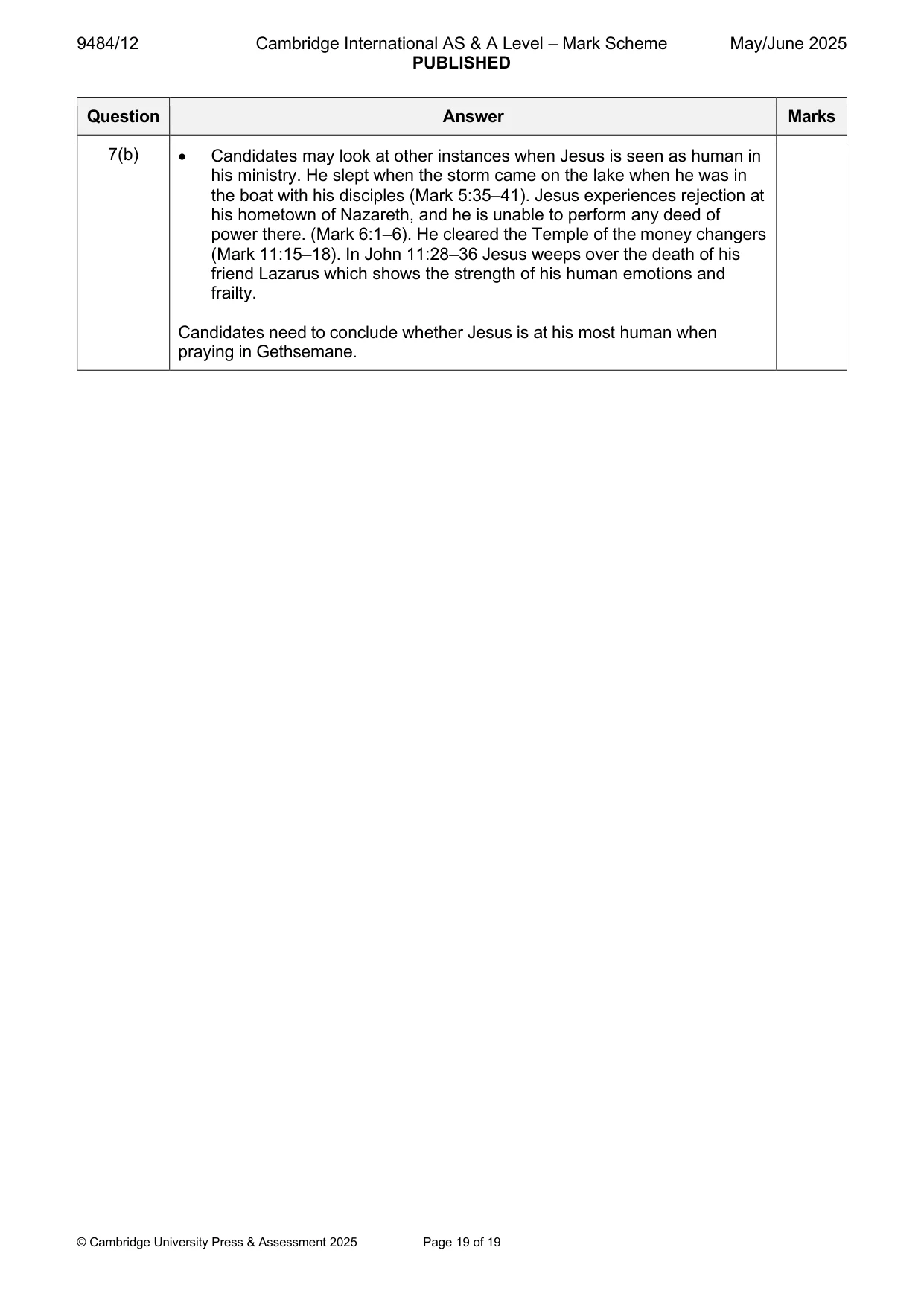
9484/12 Cambridge International AS & A Level – Mark Scheme PUBLISHED May/June 2025 © Cambridge University Press & Assessment 2025 Page 19 of 19 Question Answer Marks 7(b) • Candidates may look at other instances when Jesus is seen as human in his ministry. He slept when the storm came on the lake when he was in the boat with his disciples (Mark 5:35–41). Jesus experiences rejection at his hometown of Nazareth, and he is unable to perform any deed of power there. (Mark 6:1–6). He cleared the Temple of the money changers (Mark 11:15–18). In John 11:28–36 Jesus weeps over the death of his friend Lazarus which shows the strength of his human emotions and frailty. Candidates need to conclude whether Jesus is at his most human when praying in Gethsemane.
What you needed in this session
Cambridge’s own grade thresholds for 2025 May/June, Paper 1 · Variant 2. A higher threshold means an easier paper — the bar moves with how the cohort did.