Cambridge A Level Biblical Studies 9484 — 2023 May/June Paper 1 · Variant 2
9484/12/M/J/23 · 50 marks · ≈56 min
The question paper and its mark scheme, free to read here and free to download. This is Cambridge’s own paper, exactly as it was sat.
Question paper4 pages

Mark scheme22 pages
Answers below. Sit the paper first if you are practising.
Paper as text
Question paper, page 1
This document has 4 pages. Any blank pages are indicated. [Turn over Cambridge International AS & A Level DC (CE) 322912/1 © UCLES 2023 * 6 7 9 7 7 4 4 3 5 2 * BIBLICAL STUDIES 9484/12 Paper 1 The Four Gospels May/June 2023 1 hour 30 minutes You must answer on the enclosed answer booklet. You will need: Answer booklet (enclosed) INSTRUCTIONS ● Answer five questions in total: Section A: answer three questions. Section B: answer Question 5. Section C: answer one question. ● Follow the instructions on the front cover of the answer booklet. If you need additional answer paper, ask the invigilator for a continuation booklet. INFORMATION ● The total mark for this paper is 50. ● The number of marks for each question or part question is shown in brackets [ ].
Question paper, page 2
2 9484/12/M/J/23 © UCLES 2023 Section A Answer three of the following four questions. Answers should refer to the context of the passage wherever possible. Answers should not retell the story from which the passage is taken. 1 Outline points of interest or difficulty in the following passage. Matthew 2:1–3; NRSVA In the time of King Herod, after Jesus was born in Bethlehem of Judea, wise men from the East came to Jerusalem, asking, ‘Where is the child who has been born king of the Jews? For we observed his star at its rising, and have come to pay him homage.’ When King Herod heard this, he was frightened, and all Jerusalem with him… [5] 2 Outline points of interest or difficulty in the following passage. Mark 2:13–14; NRSVA Jesus went out again beside the lake; the whole crowd gathered around him, and he taught them. As he was walking along, he saw Levi son of Alphaeus sitting at the tax booth, and he said to him, ‘Follow me.’ And he got up and followed him. [5] 3 Outline points of interest or difficulty in the following passage. Luke 22:55–56; NRSVA When they had kindled a fire in the middle of the courtyard and sat down together, Peter sat among them. Then a servant-girl, seeing him in the firelight, stared at him and said, ‘This man also was with him.’ [5] 4 Outline points of interest or difficulty in the following passage. John 13:12–14; NRSVA After he had washed their feet, had put on his robe, and had returned to the table, he said to them, ‘Do you know what I have done to you? You call me Teacher and Lord—and you are right, for that is what I am. So if I, your Lord and Teacher, have washed your feet, you also ought to wash one another’s feet. [5] [Total: 15]
Question paper, page 3
3 9484/12/M/J/23 © UCLES 2023 Section B Answer Question 5. 5 Read the following passage and then answer the question below: Mark 6:34–44 NRSVA As he went ashore, he saw a great crowd; and he had compassion for them, because they were like sheep without a shepherd; and he began to teach them many things. When it grew late, his disciples came to him and said, ‘This is a deserted place, and the hour is now very late; send them away so that they may go into the surrounding country and villages and buy something for themselves to eat.’ But he answered them, ‘You give them something to eat.’ They said to him, ‘Are we to go and buy two hundred denarii worth of bread, and give it to them to eat?’ And he said to them, ‘How many loaves have you? Go and see.’ When they had found out, they said, ‘Five, and two fish.’ Then he ordered them to get all the people to sit down in groups on the green grass. So they sat down in groups of hundreds and of fifties. Taking the five loaves and the two fish, he looked up to heaven, and blessed and broke the loaves, and gave them to his disciples to set before the people; and he divided the two fish among them all. And all ate and were filled; and they took up twelve baskets full of broken pieces and of the fish. Those who had eaten the loaves numbered five thousand men. ‘Jesus did miracles only to show compassion for people.’ Assess the truth of this statement. Refer to the passage above and other passages you have studied. [10] Section C Answer EITHER Question 6 OR Question 7. EITHER 6 (a) Examine similarities and differences between accounts of Jesus’ resurrection appearances found in the gospels of Luke and John. [10] (b) ‘The purpose of Jesus’ appearances after his death was to prove his resurrection.’ Evaluate this statement. [15] OR 7 (a) Examine the accounts of Jesus’ rejection in Nazareth. [10] (b) ‘The religious authorities were responsible for Jesus’ death.’ Evaluate this claim. [15] [Total: 25]
Question paper, page 4
4 9484/12/M/J/23 © UCLES 2023 Permission to reproduce items where third-party owned material protected by copyright is included has been sought and cleared where possible. Every reasonable effort has been made by the publisher (UCLES) to trace copyright holders, but if any items requiring clearance have unwittingly been included, the publisher will be pleased to make amends at the earliest possible opportunity. To avoid the issue of disclosure of answer-related information to candidates, all copyright acknowledgements are reproduced online in the Cambridge Assessment International Education Copyright Acknowledgements Booklet. This is produced for each series of examinations and is freely available to download at www.cambridgeinternational.org after the live examination series. Cambridge Assessment International Education is part of Cambridge Assessment. Cambridge Assessment is the brand name of the University of Cambridge Local Examinations Syndicate (UCLES), which is a department of the University of Cambridge. BLANK PAGE
Mark scheme, page 1
This document consists of 22 printed pages. © UCLES 2023 [Turn over Cambridge International AS & A Level BIBLICAL STUDIES 9484/12 Paper 1 The Four Gospels May/June 2023 MARK SCHEME Maximum Mark: 50 Published This mark scheme is published as an aid to teachers and candidates, to indicate the requirements of the examination. It shows the basis on which Examiners were instructed to award marks. It does not indicate the details of the discussions that took place at an Examiners’ meeting before marking began, which would have considered the acceptability of alternative answers. Mark schemes should be read in conjunction with the question paper and the Principal Examiner Report for Teachers. Cambridge International will not enter into discussions about these mark schemes. Cambridge International is publishing the mark schemes for the May/June 2023 series for most Cambridge IGCSE, Cambridge International A and AS Level and Cambridge Pre-U components, and some Cambridge O Level components.
Mark scheme, page 2
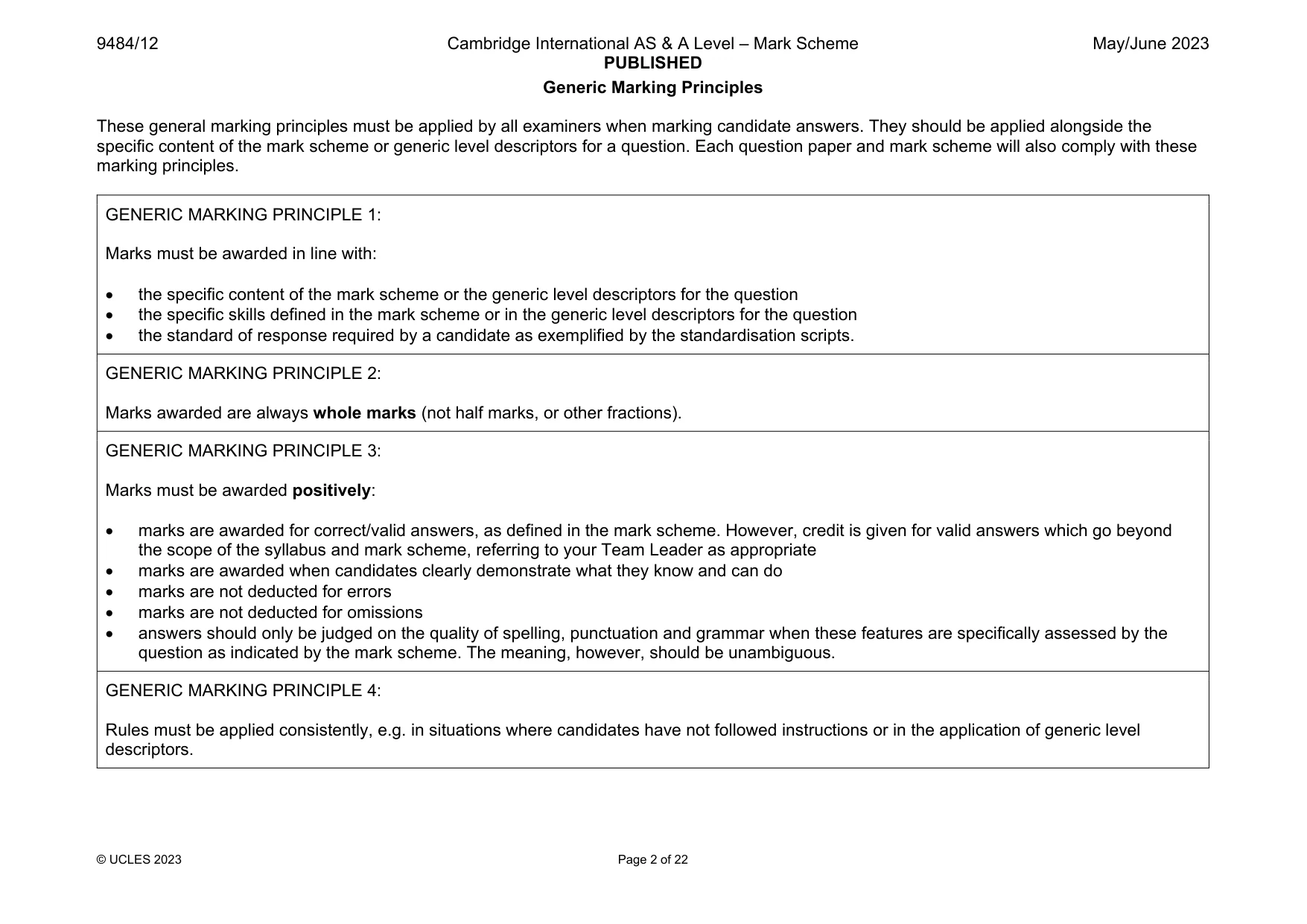
9484/12 Cambridge International AS & A Level – Mark Scheme PUBLISHED May/June 2023 © UCLES 2023 Page 2 of 22 Generic Marking Principles These general marking principles must be applied by all examiners when marking candidate answers. They should be applied alongside the specific content of the mark scheme or generic level descriptors for a question. Each question paper and mark scheme will also comply with these marking principles. GENERIC MARKING PRINCIPLE 1: Marks must be awarded in line with: the specific content of the mark scheme or the generic level descriptors for the question the specific skills defined in the mark scheme or in the generic level descriptors for the question the standard of response required by a candidate as exemplified by the standardisation scripts. GENERIC MARKING PRINCIPLE 2: Marks awarded are always whole marks (not half marks, or other fractions). GENERIC MARKING PRINCIPLE 3: Marks must be awarded positively: marks are awarded for correct/valid answers, as defined in the mark scheme. However, credit is given for valid answers which go beyond the scope of the syllabus and mark scheme, referring to your Team Leader as appropriate marks are awarded when candidates clearly demonstrate what they know and can do marks are not deducted for errors marks are not deducted for omissions answers should only be judged on the quality of spelling, punctuation and grammar when these features are specifically assessed by the question as indicated by the mark scheme. The meaning, however, should be unambiguous. GENERIC MARKING PRINCIPLE 4: Rules must be applied consistently, e.g. in situations where candidates have not followed instructions or in the application of generic level descriptors.
Mark scheme, page 3
9484/12 Cambridge International AS & A Level – Mark Scheme PUBLISHED May/June 2023 © UCLES 2023 Page 3 of 22 GENERIC MARKING PRINCIPLE 5: Marks should be awarded using the full range of marks defined in the mark scheme for the question (however; the use of the full mark range may be limited according to the quality of the candidate responses seen). GENERIC MARKING PRINCIPLE 6: Marks awarded are based solely on the requirements as defined in the mark scheme. Marks should not be awarded with grade thresholds or grade descriptors in mind.
Mark scheme, page 4
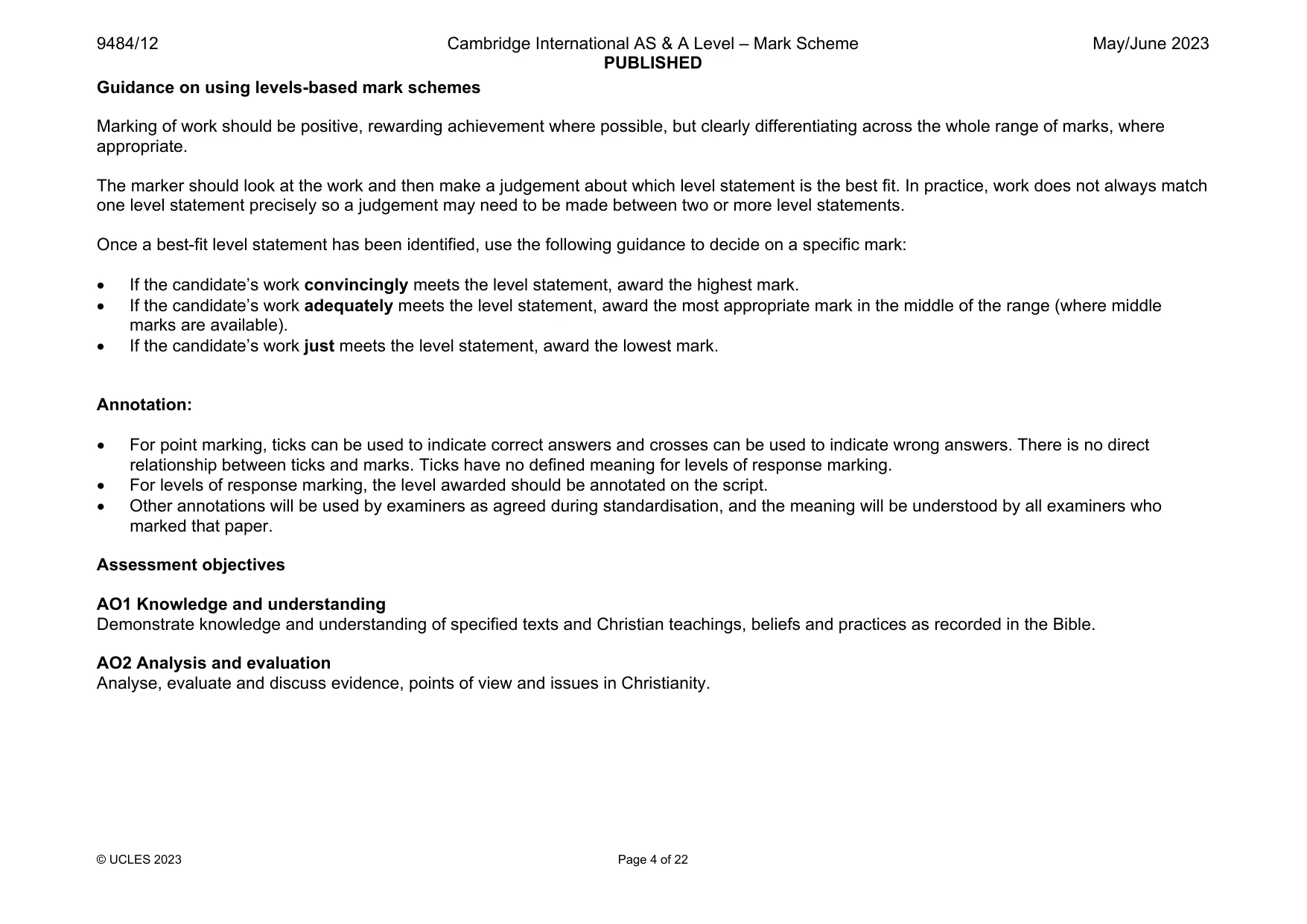
9484/12 Cambridge International AS & A Level – Mark Scheme PUBLISHED May/June 2023 © UCLES 2023 Page 4 of 22 Guidance on using levels-based mark schemes Marking of work should be positive, rewarding achievement where possible, but clearly differentiating across the whole range of marks, where appropriate. The marker should look at the work and then make a judgement about which level statement is the best fit. In practice, work does not always match one level statement precisely so a judgement may need to be made between two or more level statements. Once a best-fit level statement has been identified, use the following guidance to decide on a specific mark: If the candidate’s work convincingly meets the level statement, award the highest mark. If the candidate’s work adequately meets the level statement, award the most appropriate mark in the middle of the range (where middle marks are available). If the candidate’s work just meets the level statement, award the lowest mark. Annotation: For point marking, ticks can be used to indicate correct answers and crosses can be used to indicate wrong answers. There is no direct relationship between ticks and marks. Ticks have no defined meaning for levels of response marking. For levels of response marking, the level awarded should be annotated on the script. Other annotations will be used by examiners as agreed during standardisation, and the meaning will be understood by all examiners who marked that paper. Assessment objectives AO1 Knowledge and understanding Demonstrate knowledge and understanding of specified texts and Christian teachings, beliefs and practices as recorded in the Bible. AO2 Analysis and evaluation Analyse, evaluate and discuss evidence, points of view and issues in Christianity.
Mark scheme, page 5
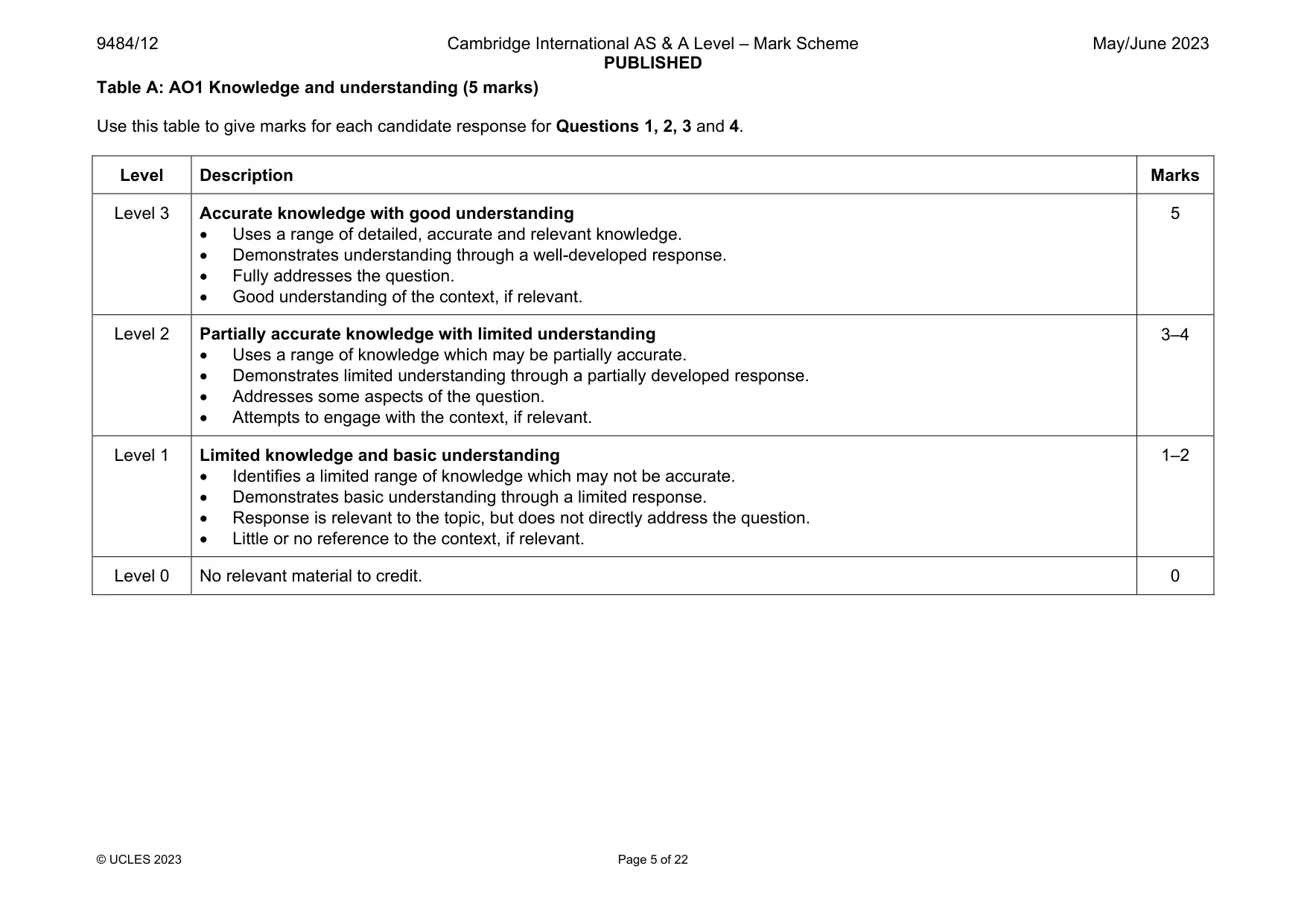
9484/12 Cambridge International AS & A Level – Mark Scheme PUBLISHED May/June 2023 © UCLES 2023 Page 5 of 22 Table A: AO1 Knowledge and understanding (5 marks) Use this table to give marks for each candidate response for Questions 1, 2, 3 and 4. Level Description Marks Level 3 Accurate knowledge with good understanding Uses a range of detailed, accurate and relevant knowledge. Demonstrates understanding through a well-developed response. Fully addresses the question. Good understanding of the context, if relevant. 5 Level 2 Partially accurate knowledge with limited understanding Uses a range of knowledge which may be partially accurate. Demonstrates limited understanding through a partially developed response. Addresses some aspects of the question. Attempts to engage with the context, if relevant. 3–4 Level 1 Limited knowledge and basic understanding Identifies a limited range of knowledge which may not be accurate. Demonstrates basic understanding through a limited response. Response is relevant to the topic, but does not directly address the question. Little or no reference to the context, if relevant. 1–2 Level 0 No relevant material to credit. 0
Mark scheme, page 6
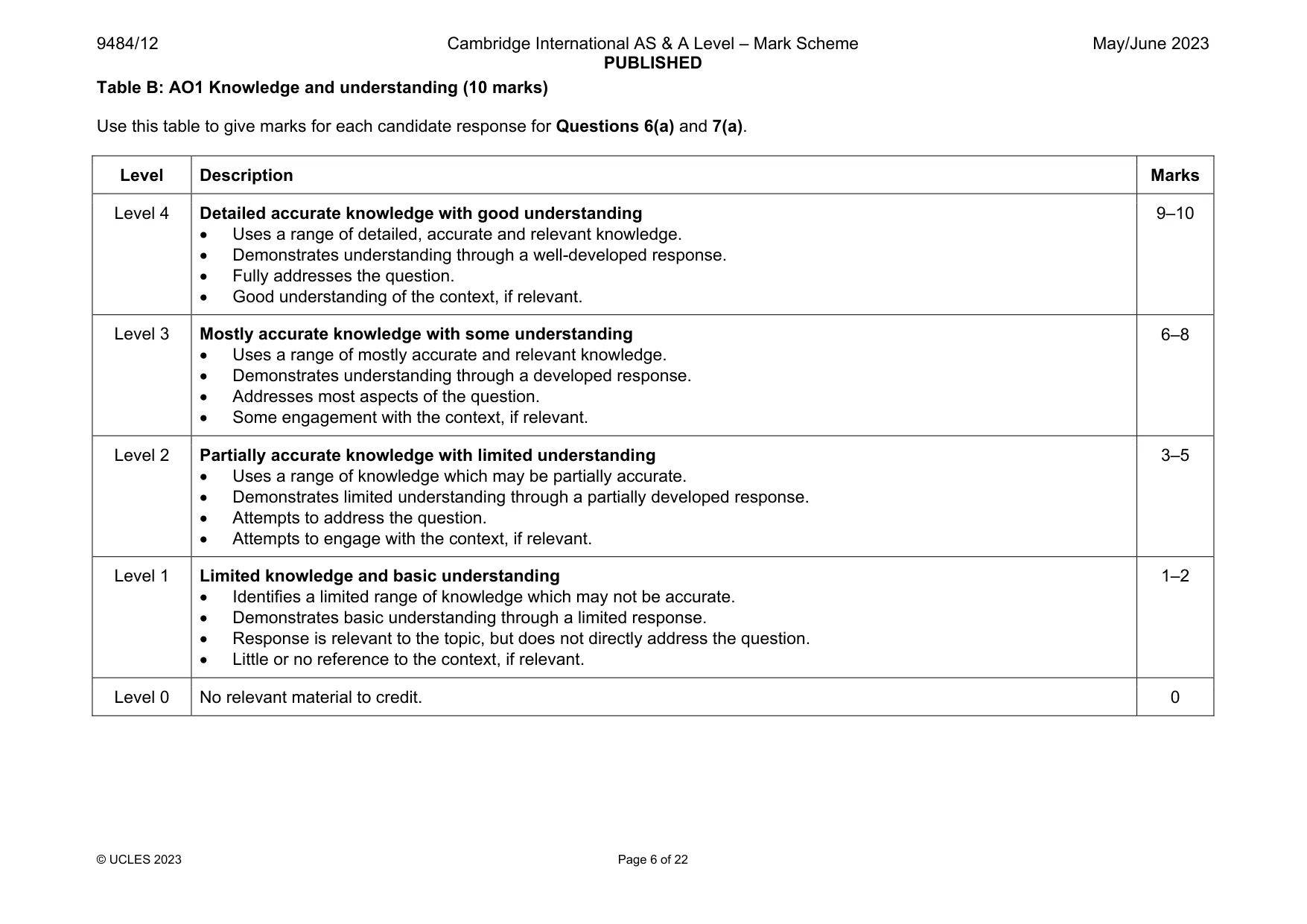
9484/12 Cambridge International AS & A Level – Mark Scheme PUBLISHED May/June 2023 © UCLES 2023 Page 6 of 22 Table B: AO1 Knowledge and understanding (10 marks) Use this table to give marks for each candidate response for Questions 6(a) and 7(a). Level Description Marks Level 4 Detailed accurate knowledge with good understanding Uses a range of detailed, accurate and relevant knowledge. Demonstrates understanding through a well-developed response. Fully addresses the question. Good understanding of the context, if relevant. 9–10 Level 3 Mostly accurate knowledge with some understanding Uses a range of mostly accurate and relevant knowledge. Demonstrates understanding through a developed response. Addresses most aspects of the question. Some engagement with the context, if relevant. 6–8 Level 2 Partially accurate knowledge with limited understanding Uses a range of knowledge which may be partially accurate. Demonstrates limited understanding through a partially developed response. Attempts to address the question. Attempts to engage with the context, if relevant. 3–5 Level 1 Limited knowledge and basic understanding Identifies a limited range of knowledge which may not be accurate. Demonstrates basic understanding through a limited response. Response is relevant to the topic, but does not directly address the question. Little or no reference to the context, if relevant. 1–2 Level 0 No relevant material to credit. 0
Mark scheme, page 7
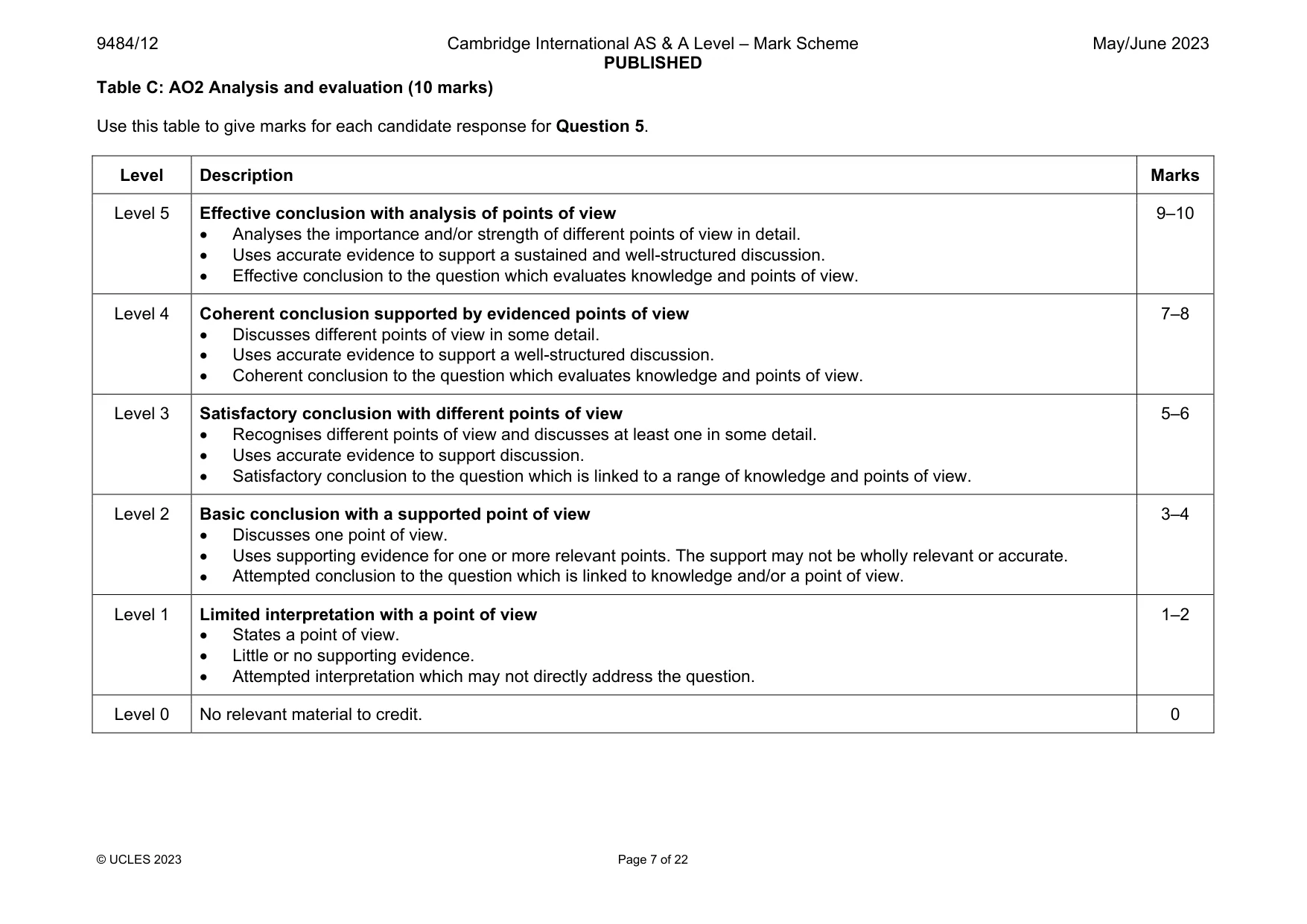
9484/12 Cambridge International AS & A Level – Mark Scheme PUBLISHED May/June 2023 © UCLES 2023 Page 7 of 22 Table C: AO2 Analysis and evaluation (10 marks) Use this table to give marks for each candidate response for Question 5. Level Description Marks Level 5 Effective conclusion with analysis of points of view Analyses the importance and/or strength of different points of view in detail. Uses accurate evidence to support a sustained and well-structured discussion. Effective conclusion to the question which evaluates knowledge and points of view. 9–10 Level 4 Coherent conclusion supported by evidenced points of view Discusses different points of view in some detail. Uses accurate evidence to support a well-structured discussion. Coherent conclusion to the question which evaluates knowledge and points of view. 7–8 Level 3 Satisfactory conclusion with different points of view Recognises different points of view and discusses at least one in some detail. Uses accurate evidence to support discussion. Satisfactory conclusion to the question which is linked to a range of knowledge and points of view. 5–6 Level 2 Basic conclusion with a supported point of view Discusses one point of view. Uses supporting evidence for one or more relevant points. The support may not be wholly relevant or accurate. Attempted conclusion to the question which is linked to knowledge and/or a point of view. 3–4 Level 1 Limited interpretation with a point of view States a point of view. Little or no supporting evidence. Attempted interpretation which may not directly address the question. 1–2 Level 0 No relevant material to credit. 0
Mark scheme, page 8
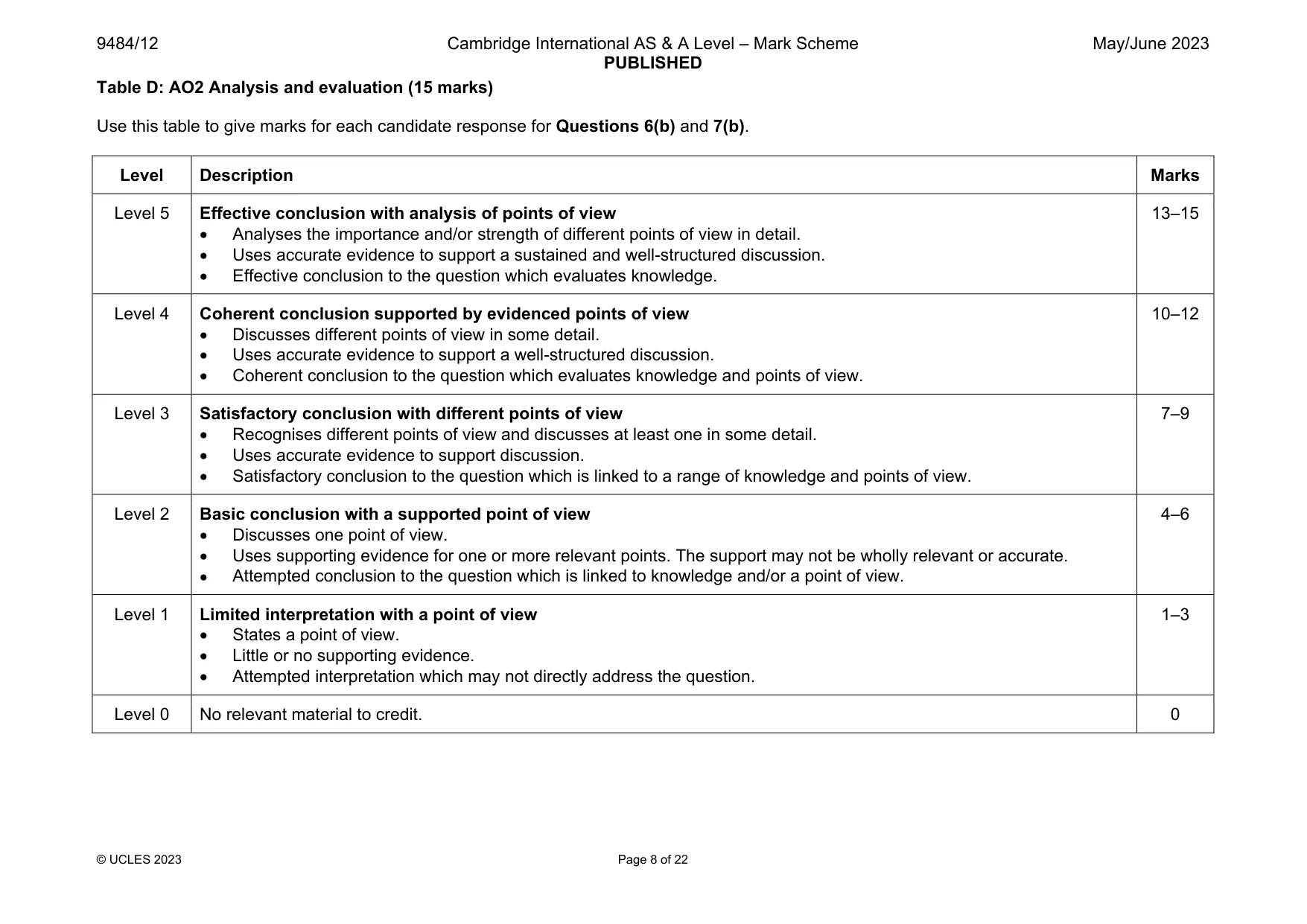
9484/12 Cambridge International AS & A Level – Mark Scheme PUBLISHED May/June 2023 © UCLES 2023 Page 8 of 22 Table D: AO2 Analysis and evaluation (15 marks) Use this table to give marks for each candidate response for Questions 6(b) and 7(b). Level Description Marks Level 5 Effective conclusion with analysis of points of view Analyses the importance and/or strength of different points of view in detail. Uses accurate evidence to support a sustained and well-structured discussion. Effective conclusion to the question which evaluates knowledge. 13–15 Level 4 Coherent conclusion supported by evidenced points of view Discusses different points of view in some detail. Uses accurate evidence to support a well-structured discussion. Coherent conclusion to the question which evaluates knowledge and points of view. 10–12 Level 3 Satisfactory conclusion with different points of view Recognises different points of view and discusses at least one in some detail. Uses accurate evidence to support discussion. Satisfactory conclusion to the question which is linked to a range of knowledge and points of view. 7–9 Level 2 Basic conclusion with a supported point of view Discusses one point of view. Uses supporting evidence for one or more relevant points. The support may not be wholly relevant or accurate. Attempted conclusion to the question which is linked to knowledge and/or a point of view. 4–6 Level 1 Limited interpretation with a point of view States a point of view. Little or no supporting evidence. Attempted interpretation which may not directly address the question. 1–3 Level 0 No relevant material to credit. 0
Mark scheme, page 9
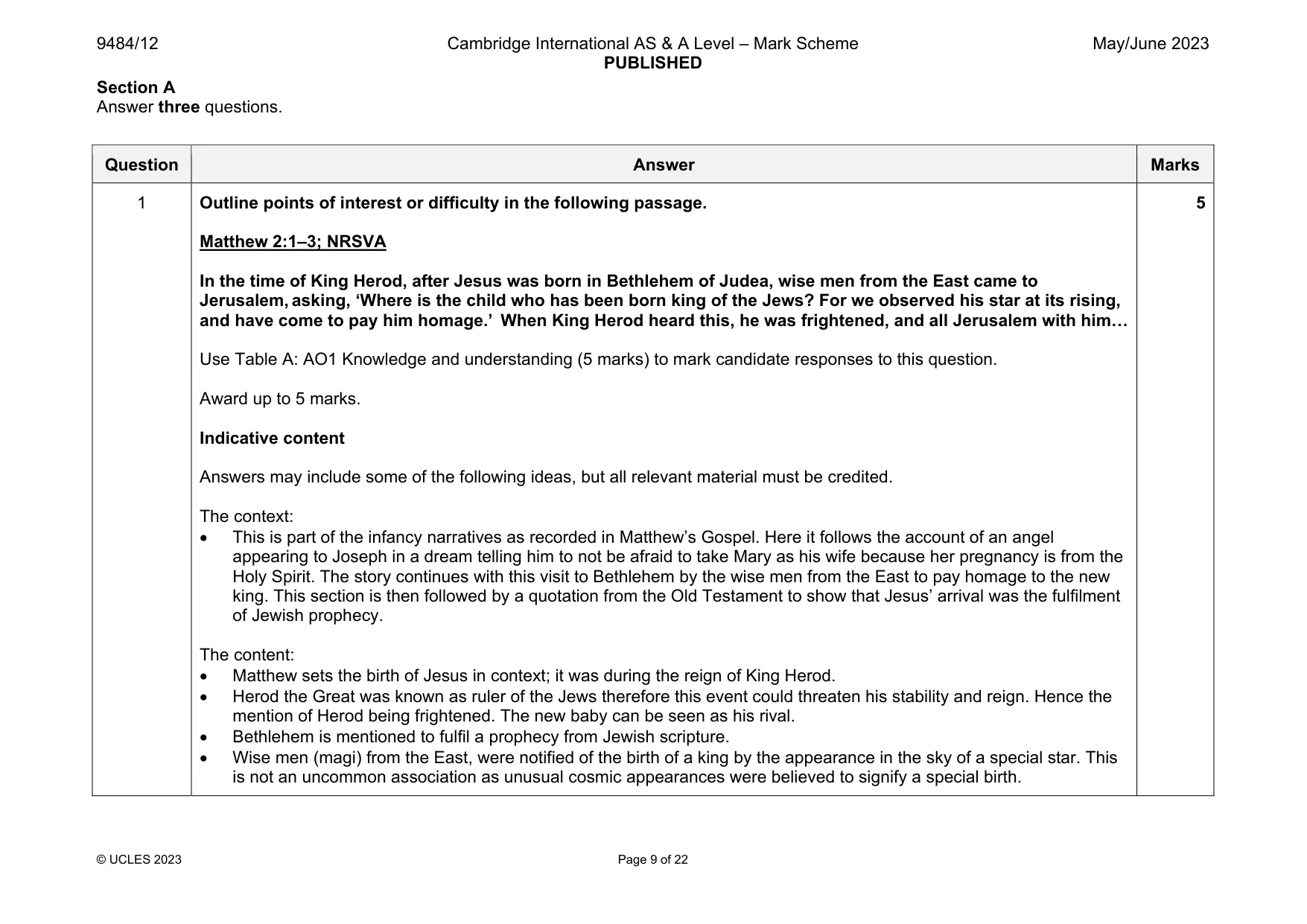
9484/12 Cambridge International AS & A Level – Mark Scheme PUBLISHED May/June 2023 © UCLES 2023 Page 9 of 22 Section A Answer three questions. Question Answer Marks 1 Outline points of interest or difficulty in the following passage. Matthew 2:1–3; NRSVA In the time of King Herod, after Jesus was born in Bethlehem of Judea, wise men from the East came to Jerusalem, asking, ‘Where is the child who has been born king of the Jews? For we observed his star at its rising, and have come to pay him homage.’ When King Herod heard this, he was frightened, and all Jerusalem with him… Use Table A: AO1 Knowledge and understanding (5 marks) to mark candidate responses to this question. Award up to 5 marks. Indicative content Answers may include some of the following ideas, but all relevant material must be credited. The context: This is part of the infancy narratives as recorded in Matthew’s Gospel. Here it follows the account of an angel appearing to Joseph in a dream telling him to not be afraid to take Mary as his wife because her pregnancy is from the Holy Spirit. The story continues with this visit to Bethlehem by the wise men from the East to pay homage to the new king. This section is then followed by a quotation from the Old Testament to show that Jesus’ arrival was the fulfilment of Jewish prophecy. The content: Matthew sets the birth of Jesus in context; it was during the reign of King Herod. Herod the Great was known as ruler of the Jews therefore this event could threaten his stability and reign. Hence the mention of Herod being frightened. The new baby can be seen as his rival. Bethlehem is mentioned to fulfil a prophecy from Jewish scripture. Wise men (magi) from the East, were notified of the birth of a king by the appearance in the sky of a special star. This is not an uncommon association as unusual cosmic appearances were believed to signify a special birth. 5
Mark scheme, page 10
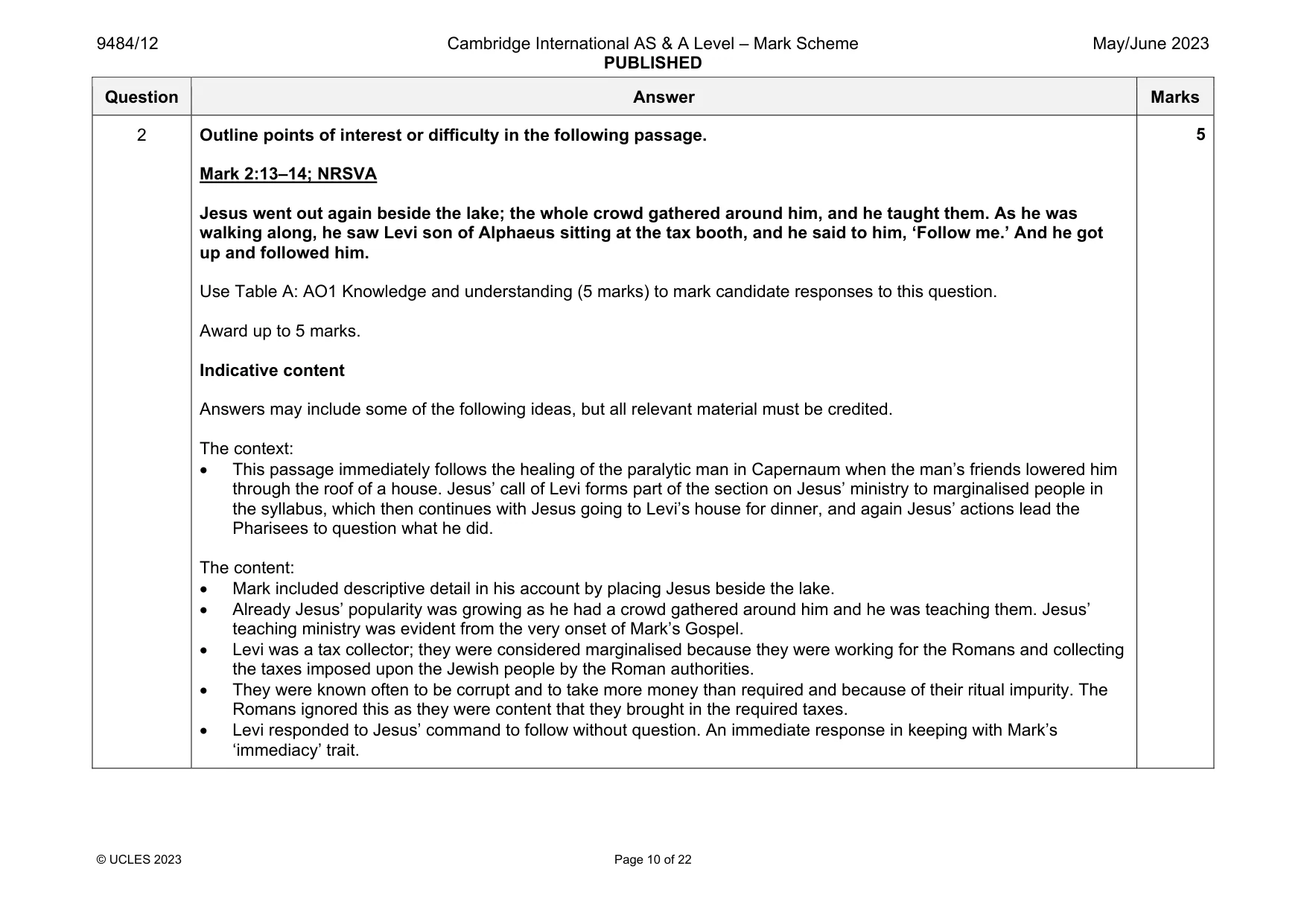
9484/12 Cambridge International AS & A Level – Mark Scheme PUBLISHED May/June 2023 © UCLES 2023 Page 10 of 22 Question Answer Marks 2 Outline points of interest or difficulty in the following passage. Mark 2:13–14; NRSVA Jesus went out again beside the lake; the whole crowd gathered around him, and he taught them. As he was walking along, he saw Levi son of Alphaeus sitting at the tax booth, and he said to him, ‘Follow me.’ And he got up and followed him. Use Table A: AO1 Knowledge and understanding (5 marks) to mark candidate responses to this question. Award up to 5 marks. Indicative content Answers may include some of the following ideas, but all relevant material must be credited. The context: This passage immediately follows the healing of the paralytic man in Capernaum when the man’s friends lowered him through the roof of a house. Jesus’ call of Levi forms part of the section on Jesus’ ministry to marginalised people in the syllabus, which then continues with Jesus going to Levi’s house for dinner, and again Jesus’ actions lead the Pharisees to question what he did. The content: Mark included descriptive detail in his account by placing Jesus beside the lake. Already Jesus’ popularity was growing as he had a crowd gathered around him and he was teaching them. Jesus’ teaching ministry was evident from the very onset of Mark’s Gospel. Levi was a tax collector; they were considered marginalised because they were working for the Romans and collecting the taxes imposed upon the Jewish people by the Roman authorities. They were known often to be corrupt and to take more money than required and because of their ritual impurity. The Romans ignored this as they were content that they brought in the required taxes. Levi responded to Jesus’ command to follow without question. An immediate response in keeping with Mark’s ‘immediacy’ trait. 5
Mark scheme, page 11
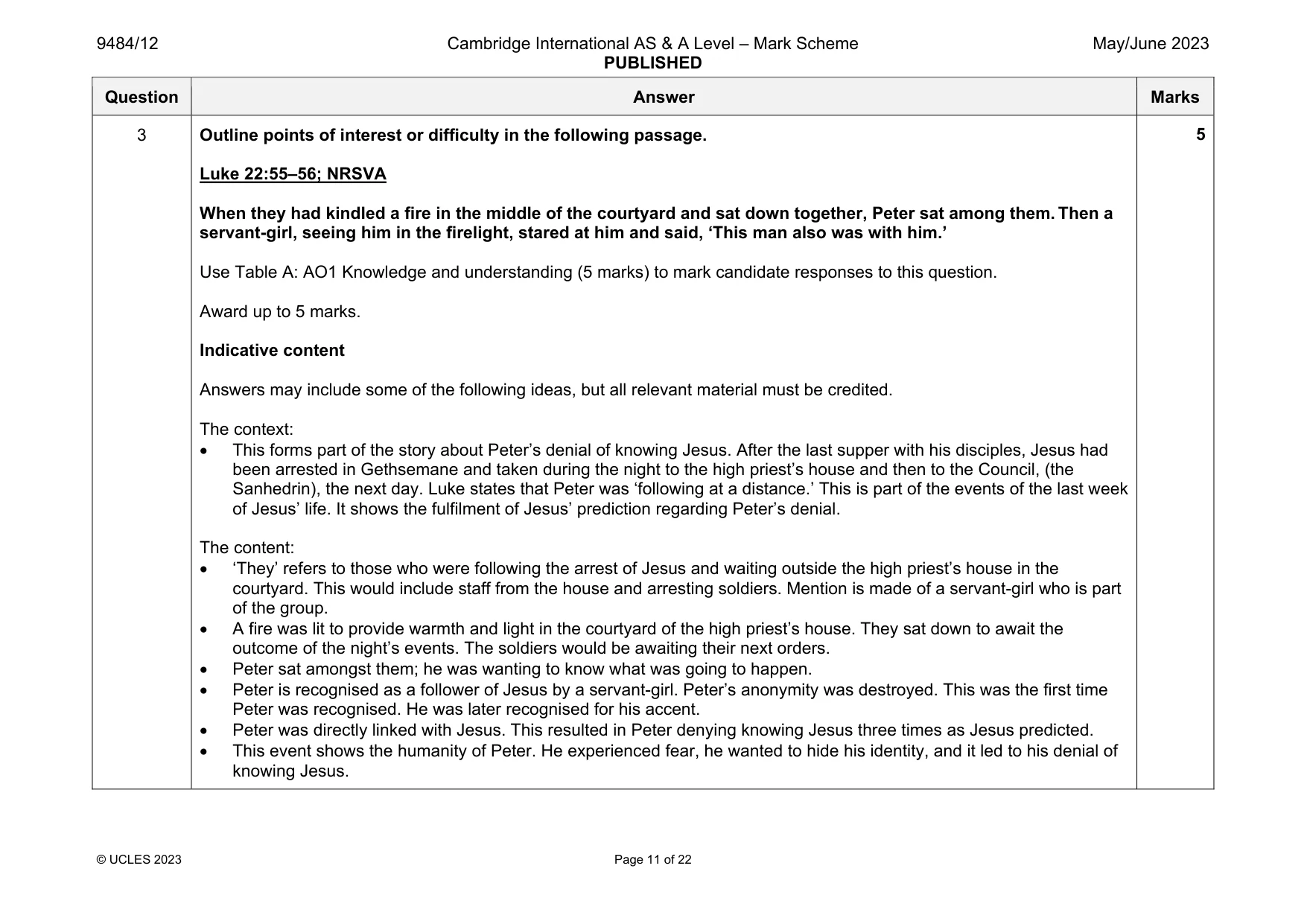
9484/12 Cambridge International AS & A Level – Mark Scheme PUBLISHED May/June 2023 © UCLES 2023 Page 11 of 22 Question Answer Marks 3 Outline points of interest or difficulty in the following passage. Luke 22:55–56; NRSVA When they had kindled a fire in the middle of the courtyard and sat down together, Peter sat among them. Then a servant-girl, seeing him in the firelight, stared at him and said, ‘This man also was with him.’ Use Table A: AO1 Knowledge and understanding (5 marks) to mark candidate responses to this question. Award up to 5 marks. Indicative content Answers may include some of the following ideas, but all relevant material must be credited. The context: This forms part of the story about Peter’s denial of knowing Jesus. After the last supper with his disciples, Jesus had been arrested in Gethsemane and taken during the night to the high priest’s house and then to the Council, (the Sanhedrin), the next day. Luke states that Peter was ‘following at a distance.’ This is part of the events of the last week of Jesus’ life. It shows the fulfilment of Jesus’ prediction regarding Peter’s denial. The content: ‘They’ refers to those who were following the arrest of Jesus and waiting outside the high priest’s house in the courtyard. This would include staff from the house and arresting soldiers. Mention is made of a servant-girl who is part of the group. A fire was lit to provide warmth and light in the courtyard of the high priest’s house. They sat down to await the outcome of the night’s events. The soldiers would be awaiting their next orders. Peter sat amongst them; he was wanting to know what was going to happen. Peter is recognised as a follower of Jesus by a servant-girl. Peter’s anonymity was destroyed. This was the first time Peter was recognised. He was later recognised for his accent. Peter was directly linked with Jesus. This resulted in Peter denying knowing Jesus three times as Jesus predicted. This event shows the humanity of Peter. He experienced fear, he wanted to hide his identity, and it led to his denial of knowing Jesus. 5
Mark scheme, page 12
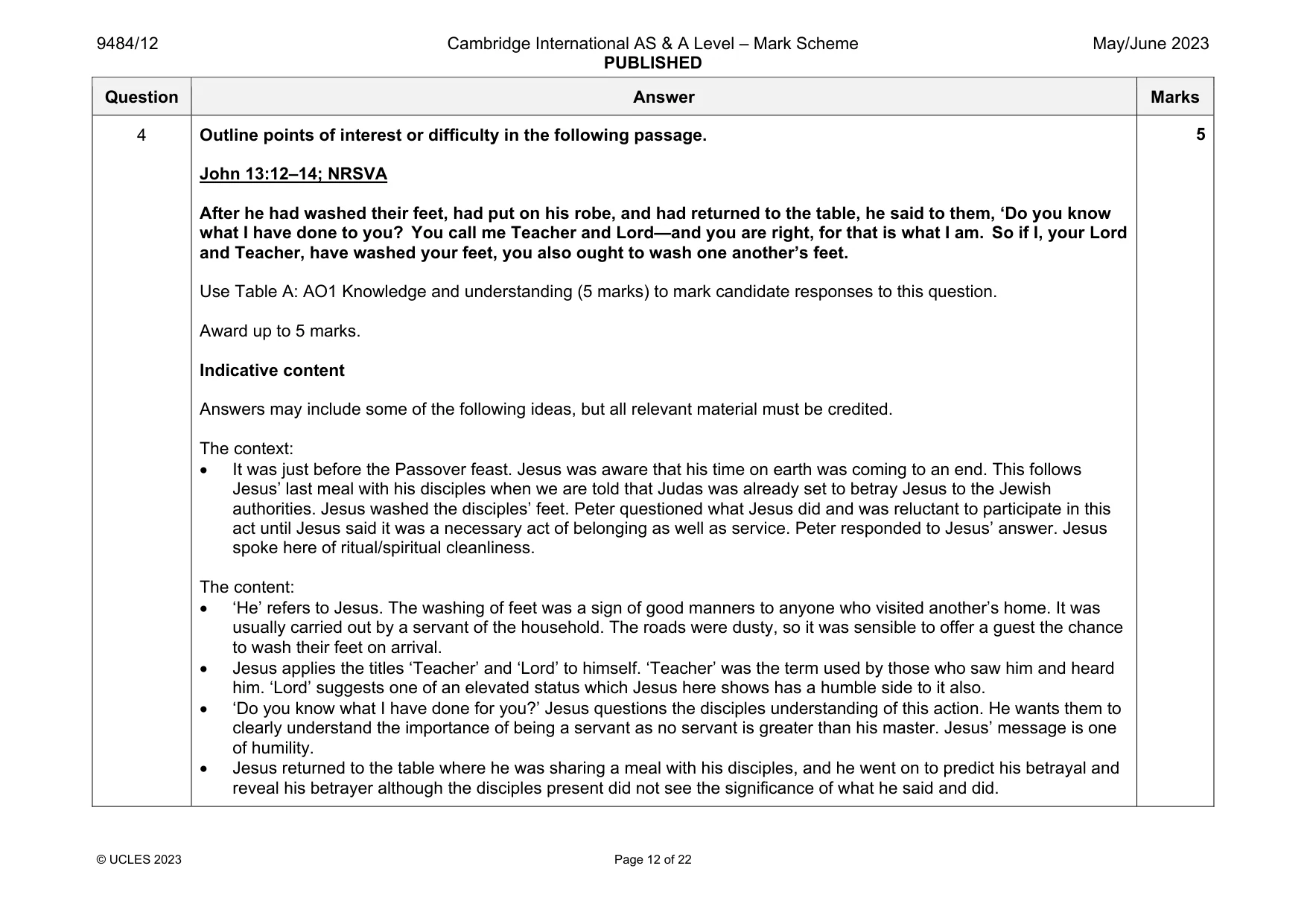
9484/12 Cambridge International AS & A Level – Mark Scheme PUBLISHED May/June 2023 © UCLES 2023 Page 12 of 22 Question Answer Marks 4 Outline points of interest or difficulty in the following passage. John 13:12–14; NRSVA After he had washed their feet, had put on his robe, and had returned to the table, he said to them, ‘Do you know what I have done to you? You call me Teacher and Lord—and you are right, for that is what I am. So if I, your Lord and Teacher, have washed your feet, you also ought to wash one another’s feet. Use Table A: AO1 Knowledge and understanding (5 marks) to mark candidate responses to this question. Award up to 5 marks. Indicative content Answers may include some of the following ideas, but all relevant material must be credited. The context: It was just before the Passover feast. Jesus was aware that his time on earth was coming to an end. This follows Jesus’ last meal with his disciples when we are told that Judas was already set to betray Jesus to the Jewish authorities. Jesus washed the disciples’ feet. Peter questioned what Jesus did and was reluctant to participate in this act until Jesus said it was a necessary act of belonging as well as service. Peter responded to Jesus’ answer. Jesus spoke here of ritual/spiritual cleanliness. The content: ‘He’ refers to Jesus. The washing of feet was a sign of good manners to anyone who visited another’s home. It was usually carried out by a servant of the household. The roads were dusty, so it was sensible to offer a guest the chance to wash their feet on arrival. Jesus applies the titles ‘Teacher’ and ‘Lord’ to himself. ‘Teacher’ was the term used by those who saw him and heard him. ‘Lord’ suggests one of an elevated status which Jesus here shows has a humble side to it also. ‘Do you know what I have done for you?’ Jesus questions the disciples understanding of this action. He wants them to clearly understand the importance of being a servant as no servant is greater than his master. Jesus’ message is one of humility. Jesus returned to the table where he was sharing a meal with his disciples, and he went on to predict his betrayal and reveal his betrayer although the disciples present did not see the significance of what he said and did. 5
Mark scheme, page 13
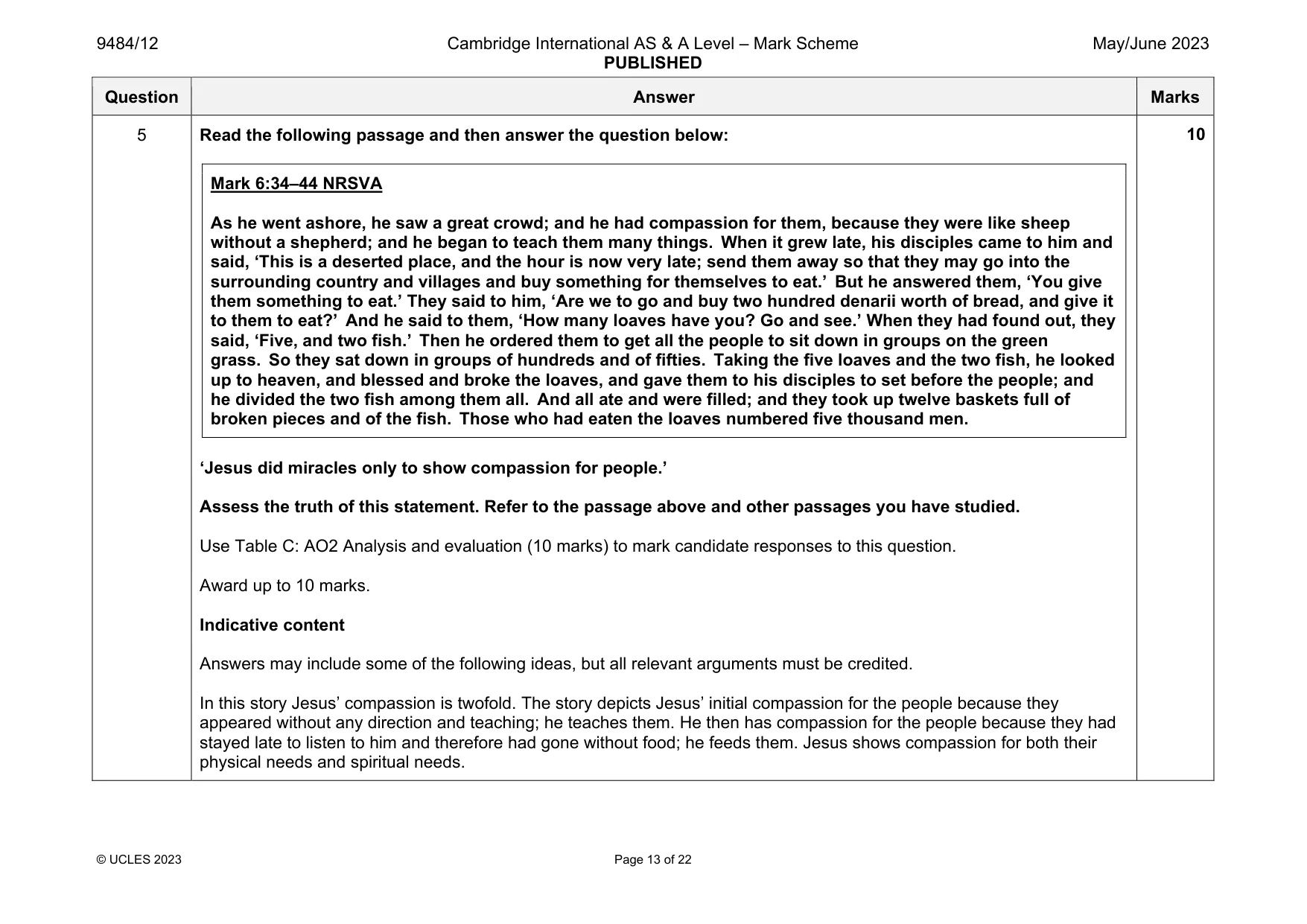
9484/12 Cambridge International AS & A Level – Mark Scheme PUBLISHED May/June 2023 © UCLES 2023 Page 13 of 22 Question Answer Marks 5 Read the following passage and then answer the question below: Mark 6:34–44 NRSVA As he went ashore, he saw a great crowd; and he had compassion for them, because they were like sheep without a shepherd; and he began to teach them many things. When it grew late, his disciples came to him and said, ‘This is a deserted place, and the hour is now very late; send them away so that they may go into the surrounding country and villages and buy something for themselves to eat.’ But he answered them, ‘You give them something to eat.’ They said to him, ‘Are we to go and buy two hundred denarii worth of bread, and give it to them to eat?’ And he said to them, ‘How many loaves have you? Go and see.’ When they had found out, they said, ‘Five, and two fish.’ Then he ordered them to get all the people to sit down in groups on the green grass. So they sat down in groups of hundreds and of fifties. Taking the five loaves and the two fish, he looked up to heaven, and blessed and broke the loaves, and gave them to his disciples to set before the people; and he divided the two fish among them all. And all ate and were filled; and they took up twelve baskets full of broken pieces and of the fish. Those who had eaten the loaves numbered five thousand men. ‘Jesus did miracles only to show compassion for people.’ Assess the truth of this statement. Refer to the passage above and other passages you have studied. Use Table C: AO2 Analysis and evaluation (10 marks) to mark candidate responses to this question. Award up to 10 marks. Indicative content Answers may include some of the following ideas, but all relevant arguments must be credited. In this story Jesus’ compassion is twofold. The story depicts Jesus’ initial compassion for the people because they appeared without any direction and teaching; he teaches them. He then has compassion for the people because they had stayed late to listen to him and therefore had gone without food; he feeds them. Jesus shows compassion for both their physical needs and spiritual needs. 10
Mark scheme, page 14
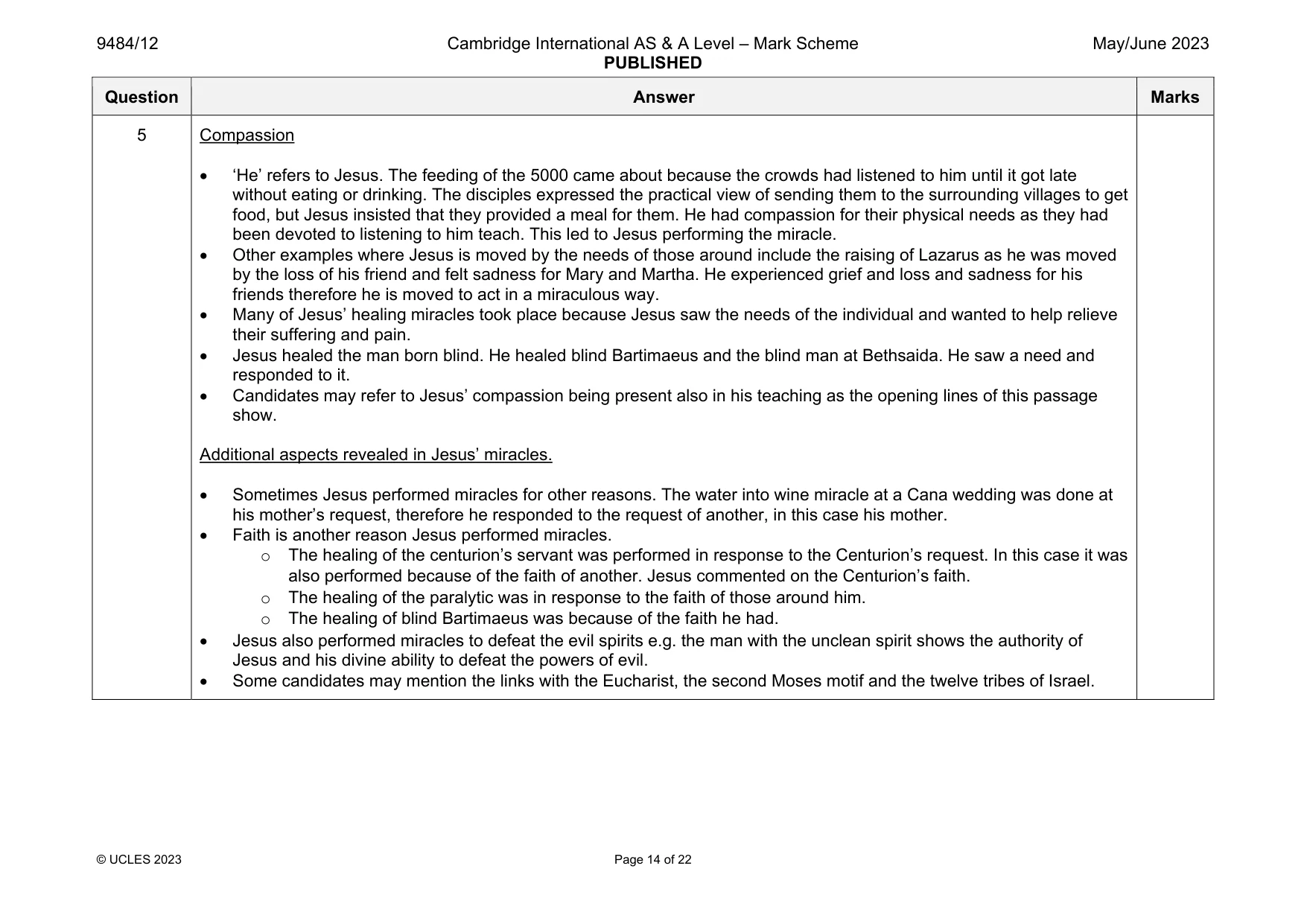
9484/12 Cambridge International AS & A Level – Mark Scheme PUBLISHED May/June 2023 © UCLES 2023 Page 14 of 22 Question Answer Marks 5 Compassion ‘He’ refers to Jesus. The feeding of the 5000 came about because the crowds had listened to him until it got late without eating or drinking. The disciples expressed the practical view of sending them to the surrounding villages to get food, but Jesus insisted that they provided a meal for them. He had compassion for their physical needs as they had been devoted to listening to him teach. This led to Jesus performing the miracle. Other examples where Jesus is moved by the needs of those around include the raising of Lazarus as he was moved by the loss of his friend and felt sadness for Mary and Martha. He experienced grief and loss and sadness for his friends therefore he is moved to act in a miraculous way. Many of Jesus’ healing miracles took place because Jesus saw the needs of the individual and wanted to help relieve their suffering and pain. Jesus healed the man born blind. He healed blind Bartimaeus and the blind man at Bethsaida. He saw a need and responded to it. Candidates may refer to Jesus’ compassion being present also in his teaching as the opening lines of this passage show. Additional aspects revealed in Jesus’ miracles. Sometimes Jesus performed miracles for other reasons. The water into wine miracle at a Cana wedding was done at his mother’s request, therefore he responded to the request of another, in this case his mother. Faith is another reason Jesus performed miracles. o The healing of the centurion’s servant was performed in response to the Centurion’s request. In this case it was also performed because of the faith of another. Jesus commented on the Centurion’s faith. o The healing of the paralytic was in response to the faith of those around him. o The healing of blind Bartimaeus was because of the faith he had. Jesus also performed miracles to defeat the evil spirits e.g. the man with the unclean spirit shows the authority of Jesus and his divine ability to defeat the powers of evil. Some candidates may mention the links with the Eucharist, the second Moses motif and the twelve tribes of Israel.
Mark scheme, page 15
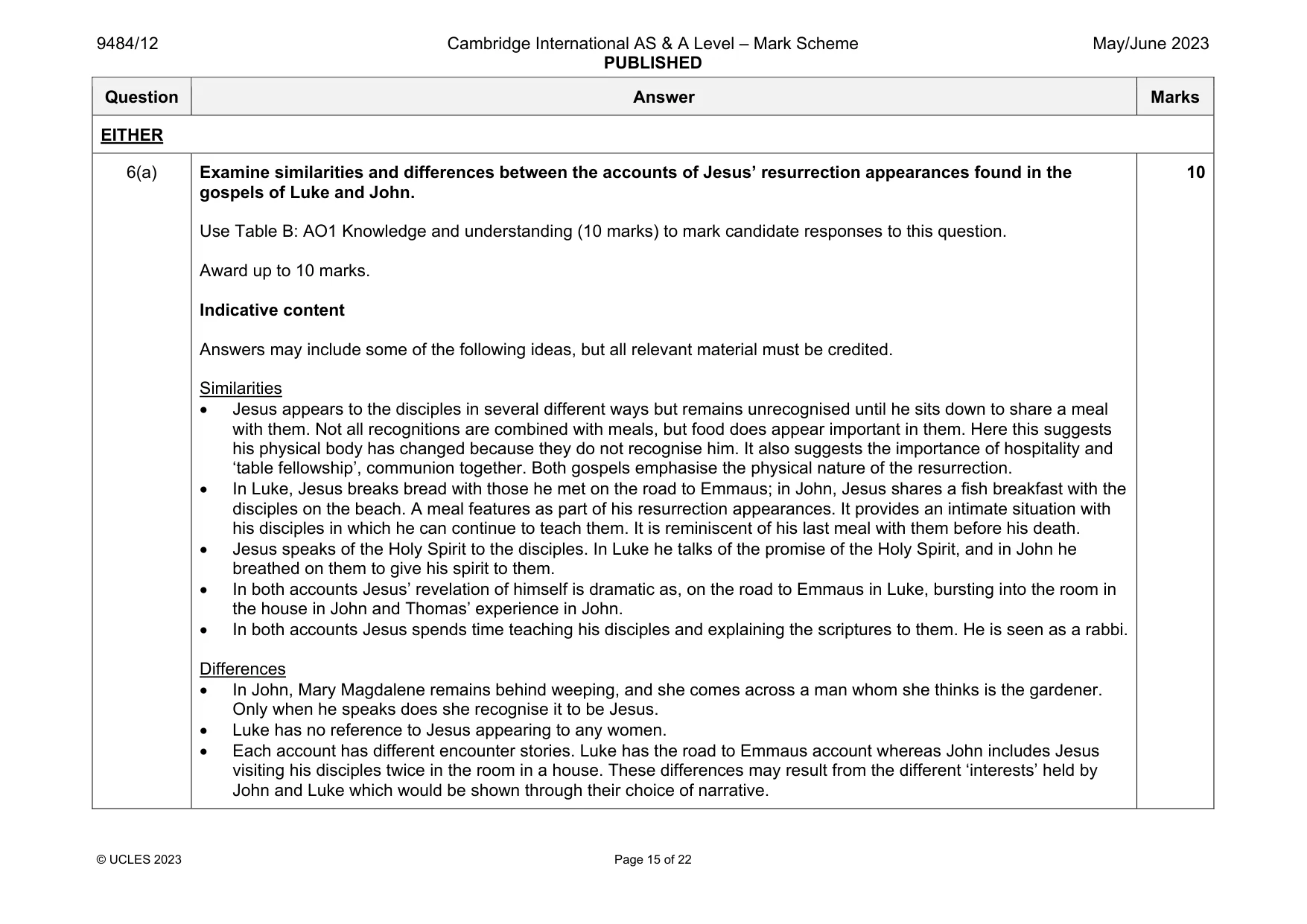
9484/12 Cambridge International AS & A Level – Mark Scheme PUBLISHED May/June 2023 © UCLES 2023 Page 15 of 22 Question Answer Marks EITHER 6(a) Examine similarities and differences between the accounts of Jesus’ resurrection appearances found in the gospels of Luke and John. Use Table B: AO1 Knowledge and understanding (10 marks) to mark candidate responses to this question. Award up to 10 marks. Indicative content Answers may include some of the following ideas, but all relevant material must be credited. Similarities Jesus appears to the disciples in several different ways but remains unrecognised until he sits down to share a meal with them. Not all recognitions are combined with meals, but food does appear important in them. Here this suggests his physical body has changed because they do not recognise him. It also suggests the importance of hospitality and ‘table fellowship’, communion together. Both gospels emphasise the physical nature of the resurrection. In Luke, Jesus breaks bread with those he met on the road to Emmaus; in John, Jesus shares a fish breakfast with the disciples on the beach. A meal features as part of his resurrection appearances. It provides an intimate situation with his disciples in which he can continue to teach them. It is reminiscent of his last meal with them before his death. Jesus speaks of the Holy Spirit to the disciples. In Luke he talks of the promise of the Holy Spirit, and in John he breathed on them to give his spirit to them. In both accounts Jesus’ revelation of himself is dramatic as, on the road to Emmaus in Luke, bursting into the room in the house in John and Thomas’ experience in John. In both accounts Jesus spends time teaching his disciples and explaining the scriptures to them. He is seen as a rabbi. Differences In John, Mary Magdalene remains behind weeping, and she comes across a man whom she thinks is the gardener. Only when he speaks does she recognise it to be Jesus. Luke has no reference to Jesus appearing to any women. Each account has different encounter stories. Luke has the road to Emmaus account whereas John includes Jesus visiting his disciples twice in the room in a house. These differences may result from the different ‘interests’ held by John and Luke which would be shown through their choice of narrative. 10
Mark scheme, page 16
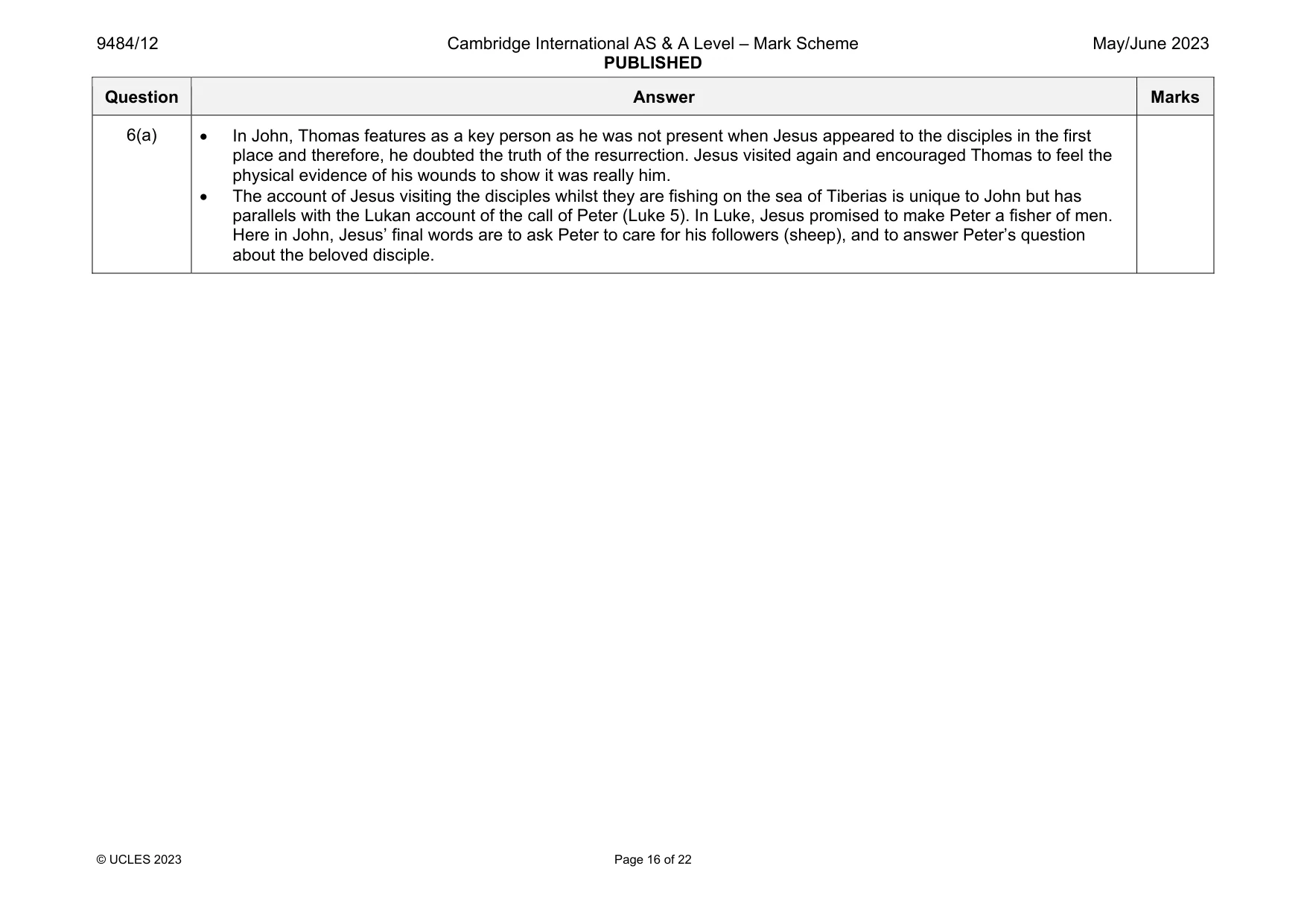
9484/12 Cambridge International AS & A Level – Mark Scheme PUBLISHED May/June 2023 © UCLES 2023 Page 16 of 22 Question Answer Marks 6(a) In John, Thomas features as a key person as he was not present when Jesus appeared to the disciples in the first place and therefore, he doubted the truth of the resurrection. Jesus visited again and encouraged Thomas to feel the physical evidence of his wounds to show it was really him. The account of Jesus visiting the disciples whilst they are fishing on the sea of Tiberias is unique to John but has parallels with the Lukan account of the call of Peter (Luke 5). In Luke, Jesus promised to make Peter a fisher of men. Here in John, Jesus’ final words are to ask Peter to care for his followers (sheep), and to answer Peter’s question about the beloved disciple.
Mark scheme, page 17
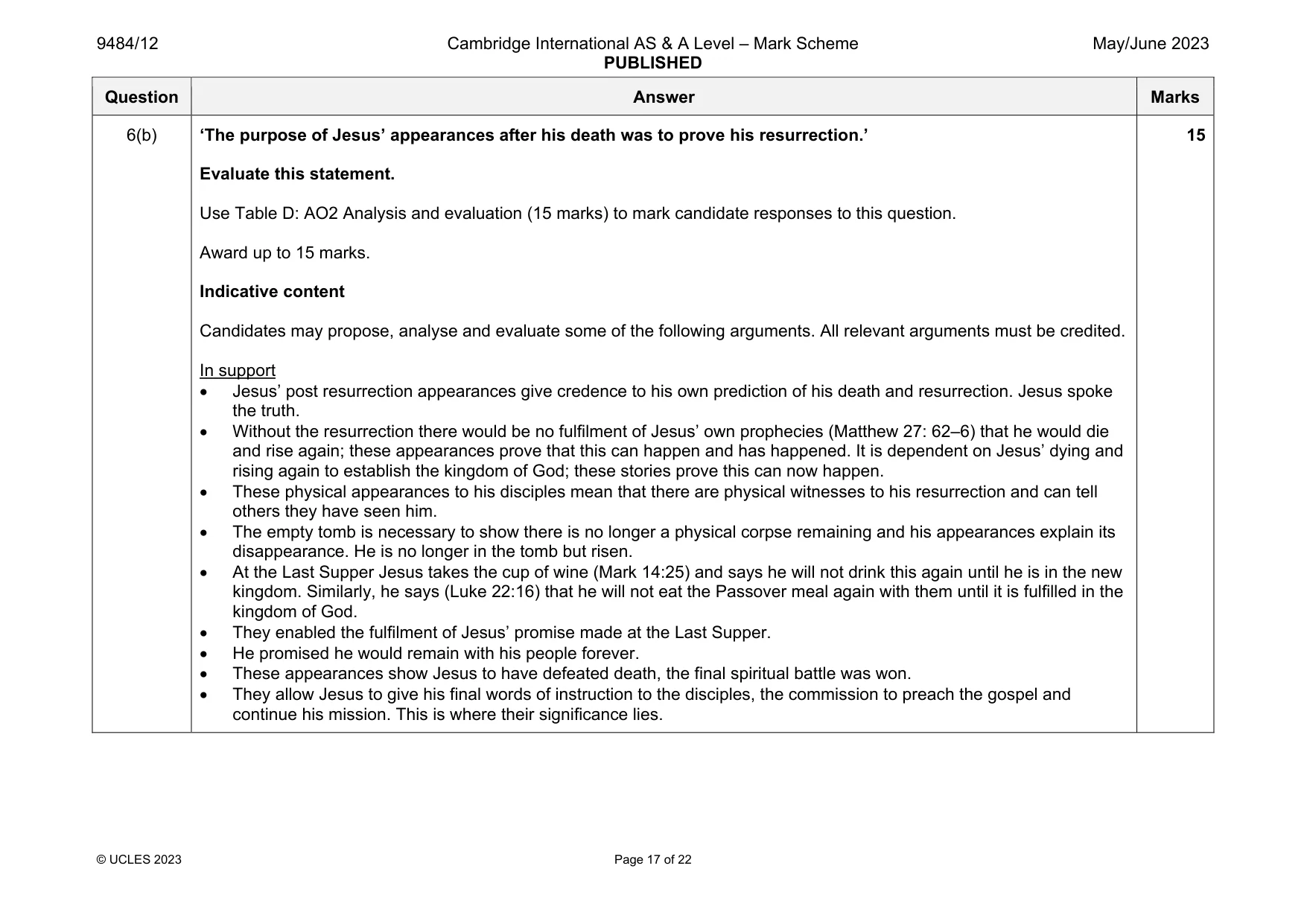
9484/12 Cambridge International AS & A Level – Mark Scheme PUBLISHED May/June 2023 © UCLES 2023 Page 17 of 22 Question Answer Marks 6(b) ‘The purpose of Jesus’ appearances after his death was to prove his resurrection.’ Evaluate this statement. Use Table D: AO2 Analysis and evaluation (15 marks) to mark candidate responses to this question. Award up to 15 marks. Indicative content Candidates may propose, analyse and evaluate some of the following arguments. All relevant arguments must be credited. In support Jesus’ post resurrection appearances give credence to his own prediction of his death and resurrection. Jesus spoke the truth. Without the resurrection there would be no fulfilment of Jesus’ own prophecies (Matthew 27: 62–6) that he would die and rise again; these appearances prove that this can happen and has happened. It is dependent on Jesus’ dying and rising again to establish the kingdom of God; these stories prove this can now happen. These physical appearances to his disciples mean that there are physical witnesses to his resurrection and can tell others they have seen him. The empty tomb is necessary to show there is no longer a physical corpse remaining and his appearances explain its disappearance. He is no longer in the tomb but risen. At the Last Supper Jesus takes the cup of wine (Mark 14:25) and says he will not drink this again until he is in the new kingdom. Similarly, he says (Luke 22:16) that he will not eat the Passover meal again with them until it is fulfilled in the kingdom of God. They enabled the fulfilment of Jesus’ promise made at the Last Supper. He promised he would remain with his people forever. These appearances show Jesus to have defeated death, the final spiritual battle was won. They allow Jesus to give his final words of instruction to the disciples, the commission to preach the gospel and continue his mission. This is where their significance lies. 15
Mark scheme, page 18
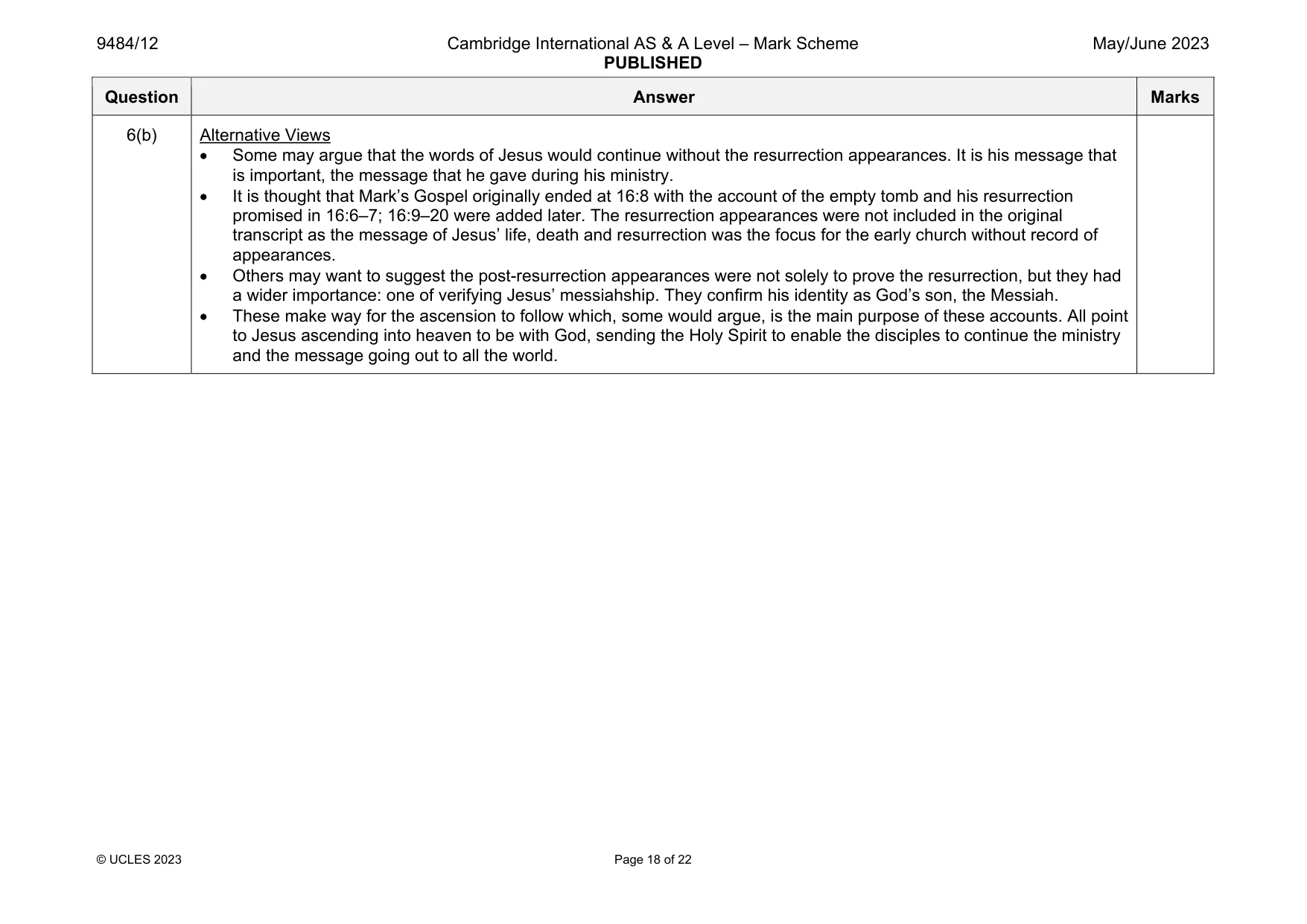
9484/12 Cambridge International AS & A Level – Mark Scheme PUBLISHED May/June 2023 © UCLES 2023 Page 18 of 22 Question Answer Marks 6(b) Alternative Views Some may argue that the words of Jesus would continue without the resurrection appearances. It is his message that is important, the message that he gave during his ministry. It is thought that Mark’s Gospel originally ended at 16:8 with the account of the empty tomb and his resurrection promised in 16:6–7; 16:9–20 were added later. The resurrection appearances were not included in the original transcript as the message of Jesus’ life, death and resurrection was the focus for the early church without record of appearances. Others may want to suggest the post-resurrection appearances were not solely to prove the resurrection, but they had a wider importance: one of verifying Jesus’ messiahship. They confirm his identity as God’s son, the Messiah. These make way for the ascension to follow which, some would argue, is the main purpose of these accounts. All point to Jesus ascending into heaven to be with God, sending the Holy Spirit to enable the disciples to continue the ministry and the message going out to all the world.
Mark scheme, page 19
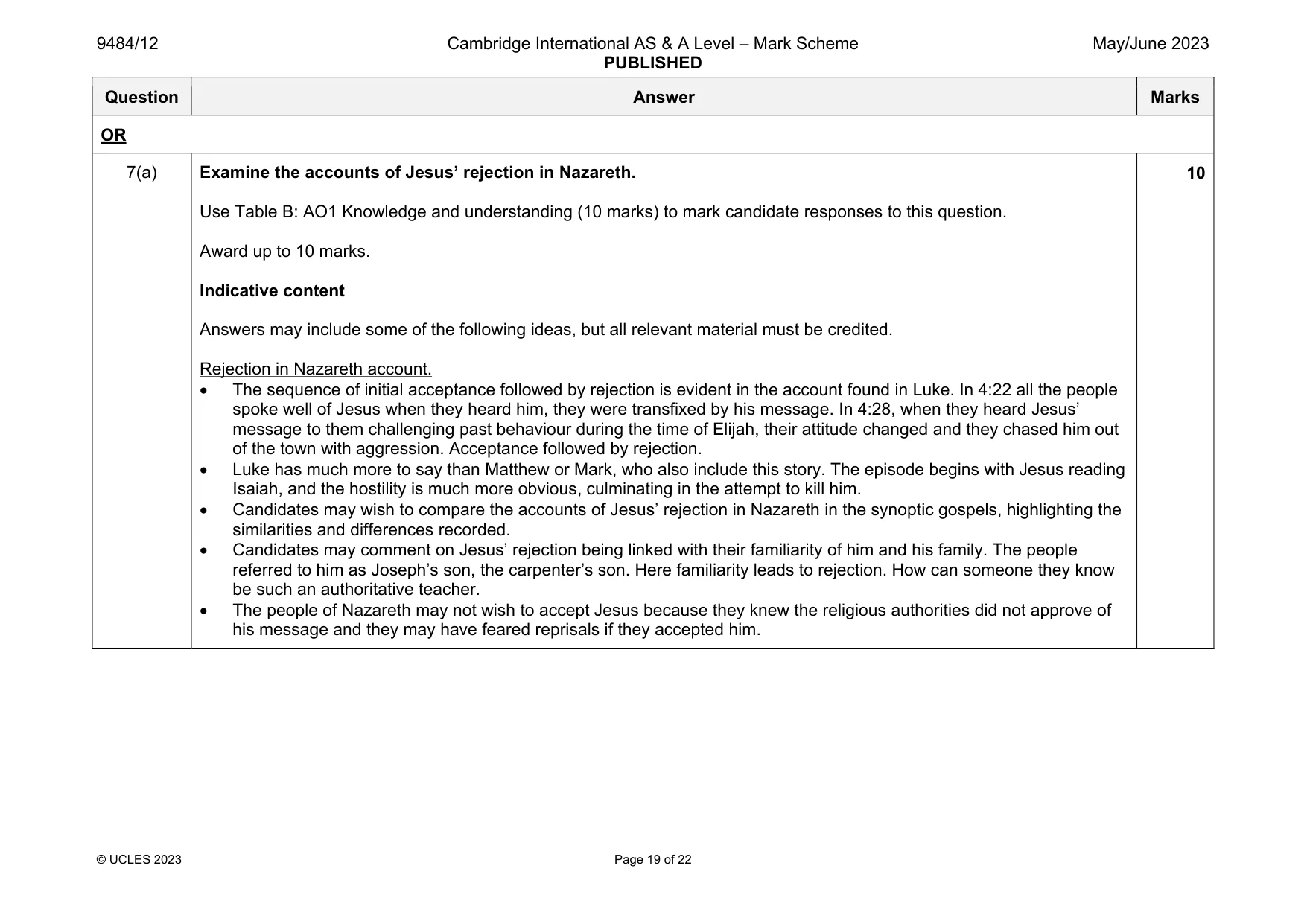
9484/12 Cambridge International AS & A Level – Mark Scheme PUBLISHED May/June 2023 © UCLES 2023 Page 19 of 22 Question Answer Marks OR 7(a) Examine the accounts of Jesus’ rejection in Nazareth. Use Table B: AO1 Knowledge and understanding (10 marks) to mark candidate responses to this question. Award up to 10 marks. Indicative content Answers may include some of the following ideas, but all relevant material must be credited. Rejection in Nazareth account. The sequence of initial acceptance followed by rejection is evident in the account found in Luke. In 4:22 all the people spoke well of Jesus when they heard him, they were transfixed by his message. In 4:28, when they heard Jesus’ message to them challenging past behaviour during the time of Elijah, their attitude changed and they chased him out of the town with aggression. Acceptance followed by rejection. Luke has much more to say than Matthew or Mark, who also include this story. The episode begins with Jesus reading Isaiah, and the hostility is much more obvious, culminating in the attempt to kill him. Candidates may wish to compare the accounts of Jesus’ rejection in Nazareth in the synoptic gospels, highlighting the similarities and differences recorded. Candidates may comment on Jesus’ rejection being linked with their familiarity of him and his family. The people referred to him as Joseph’s son, the carpenter’s son. Here familiarity leads to rejection. How can someone they know be such an authoritative teacher. The people of Nazareth may not wish to accept Jesus because they knew the religious authorities did not approve of his message and they may have feared reprisals if they accepted him. 10
Mark scheme, page 20
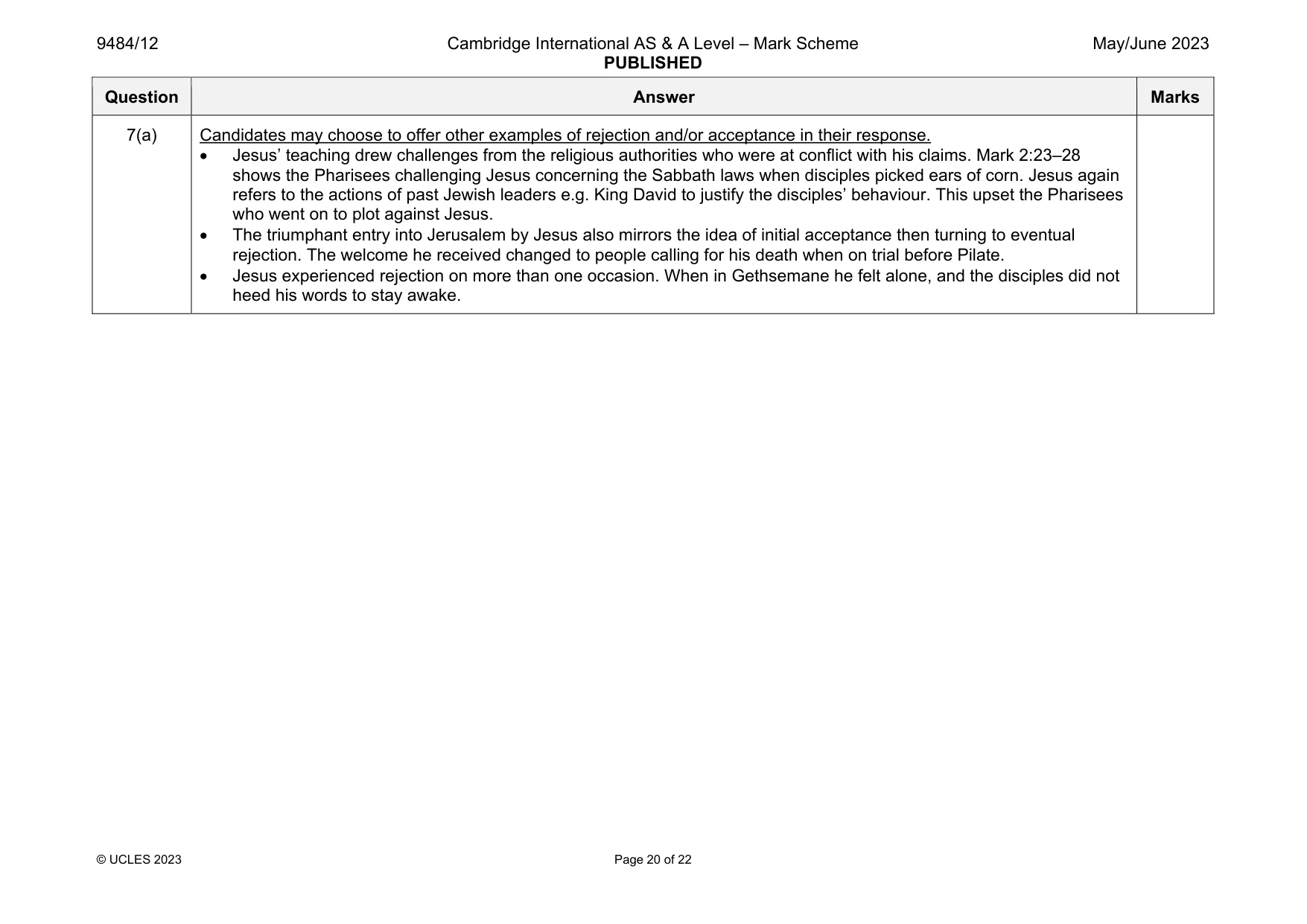
9484/12 Cambridge International AS & A Level – Mark Scheme PUBLISHED May/June 2023 © UCLES 2023 Page 20 of 22 Question Answer Marks 7(a) Candidates may choose to offer other examples of rejection and/or acceptance in their response. Jesus’ teaching drew challenges from the religious authorities who were at conflict with his claims. Mark 2:23–28 shows the Pharisees challenging Jesus concerning the Sabbath laws when disciples picked ears of corn. Jesus again refers to the actions of past Jewish leaders e.g. King David to justify the disciples’ behaviour. This upset the Pharisees who went on to plot against Jesus. The triumphant entry into Jerusalem by Jesus also mirrors the idea of initial acceptance then turning to eventual rejection. The welcome he received changed to people calling for his death when on trial before Pilate. Jesus experienced rejection on more than one occasion. When in Gethsemane he felt alone, and the disciples did not heed his words to stay awake.
Mark scheme, page 21
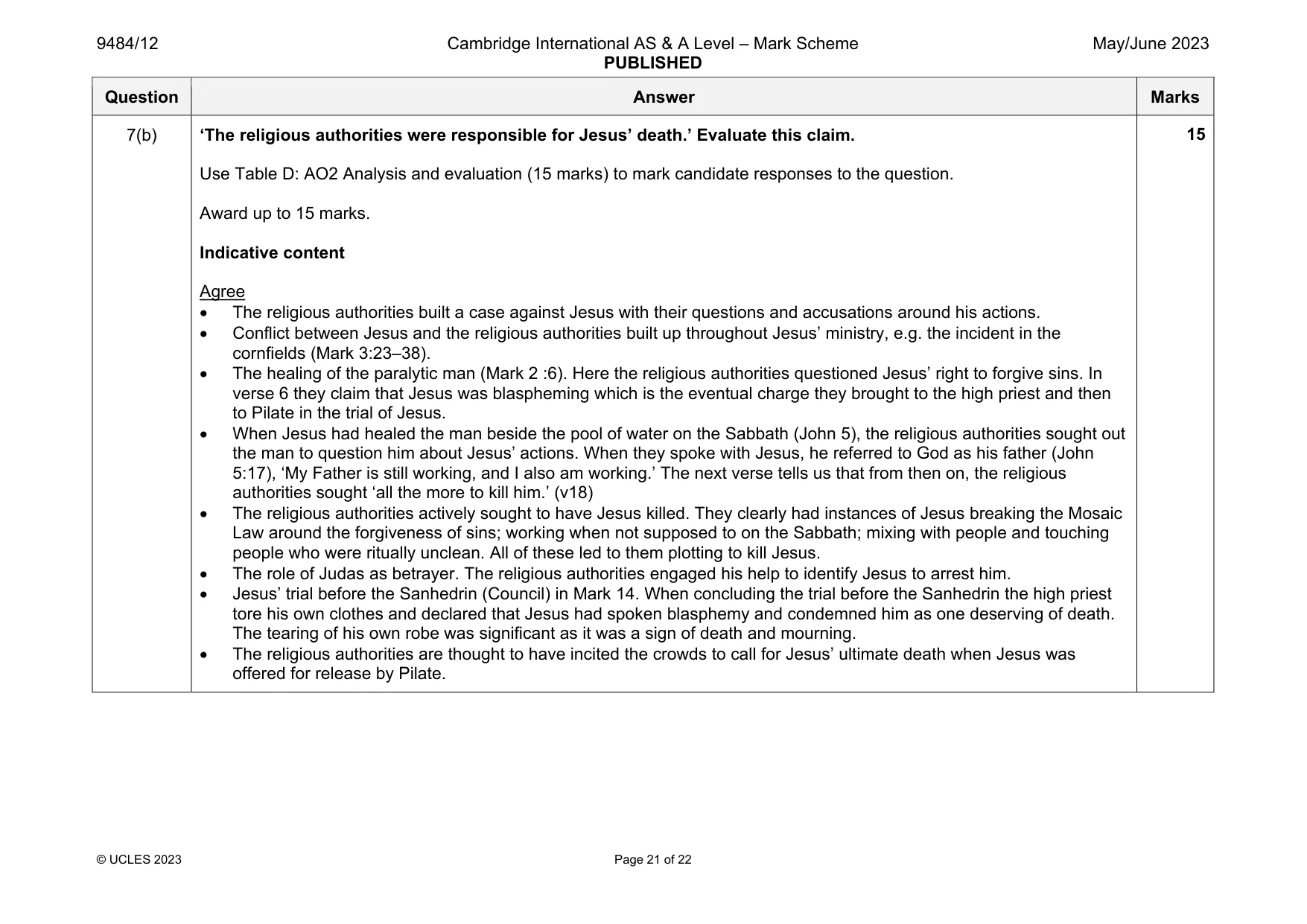
9484/12 Cambridge International AS & A Level – Mark Scheme PUBLISHED May/June 2023 © UCLES 2023 Page 21 of 22 Question Answer Marks 7(b) ‘The religious authorities were responsible for Jesus’ death.’ Evaluate this claim. Use Table D: AO2 Analysis and evaluation (15 marks) to mark candidate responses to the question. Award up to 15 marks. Indicative content Agree The religious authorities built a case against Jesus with their questions and accusations around his actions. Conflict between Jesus and the religious authorities built up throughout Jesus’ ministry, e.g. the incident in the cornfields (Mark 3:23–38). The healing of the paralytic man (Mark 2 :6). Here the religious authorities questioned Jesus’ right to forgive sins. In verse 6 they claim that Jesus was blaspheming which is the eventual charge they brought to the high priest and then to Pilate in the trial of Jesus. When Jesus had healed the man beside the pool of water on the Sabbath (John 5), the religious authorities sought out the man to question him about Jesus’ actions. When they spoke with Jesus, he referred to God as his father (John 5:17), ‘My Father is still working, and I also am working.’ The next verse tells us that from then on, the religious authorities sought ‘all the more to kill him.’ (v18) The religious authorities actively sought to have Jesus killed. They clearly had instances of Jesus breaking the Mosaic Law around the forgiveness of sins; working when not supposed to on the Sabbath; mixing with people and touching people who were ritually unclean. All of these led to them plotting to kill Jesus. The role of Judas as betrayer. The religious authorities engaged his help to identify Jesus to arrest him. Jesus’ trial before the Sanhedrin (Council) in Mark 14. When concluding the trial before the Sanhedrin the high priest tore his own clothes and declared that Jesus had spoken blasphemy and condemned him as one deserving of death. The tearing of his own robe was significant as it was a sign of death and mourning. The religious authorities are thought to have incited the crowds to call for Jesus’ ultimate death when Jesus was offered for release by Pilate. 15
Mark scheme, page 22
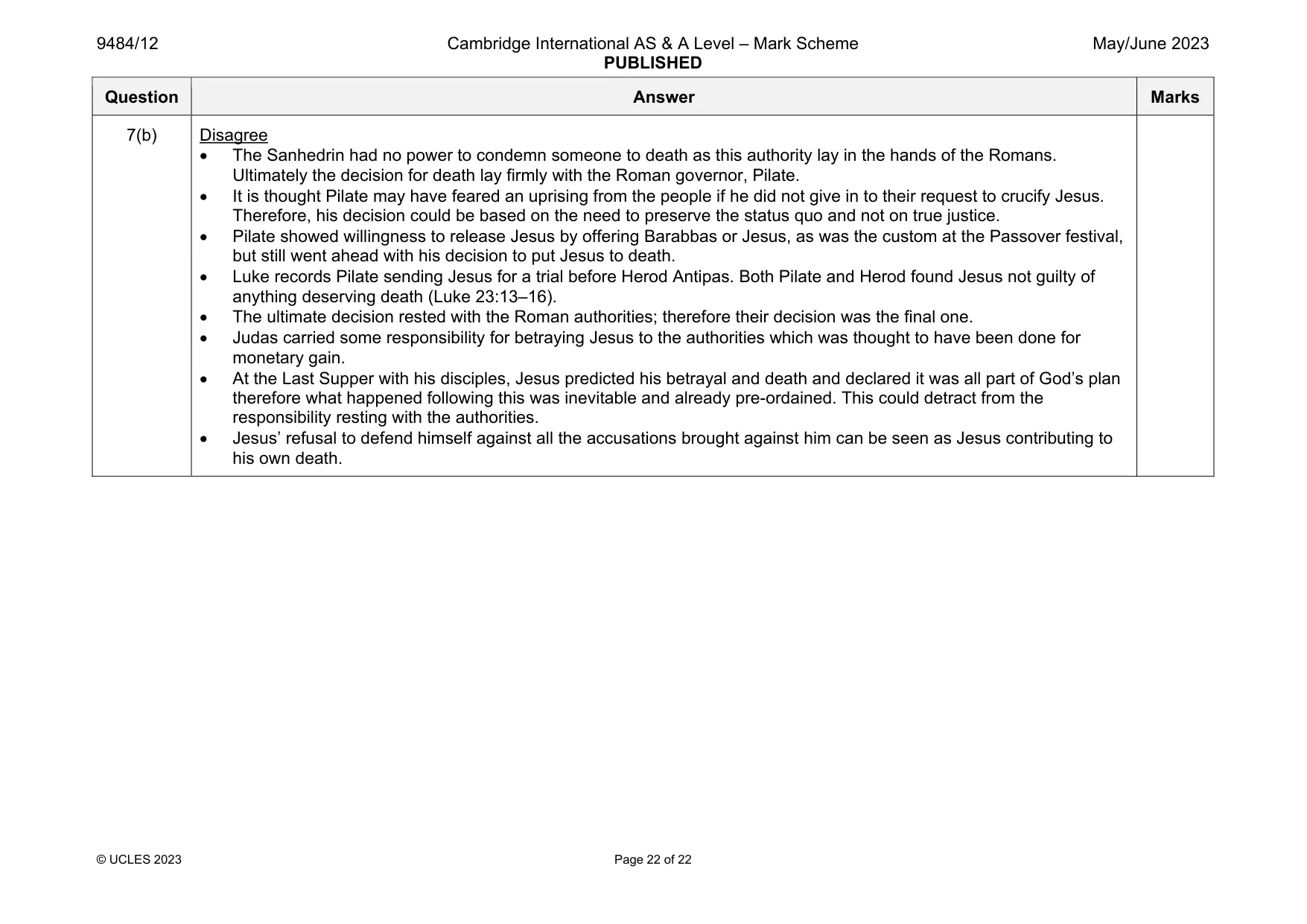
9484/12 Cambridge International AS & A Level – Mark Scheme PUBLISHED May/June 2023 © UCLES 2023 Page 22 of 22 Question Answer Marks 7(b) Disagree The Sanhedrin had no power to condemn someone to death as this authority lay in the hands of the Romans. Ultimately the decision for death lay firmly with the Roman governor, Pilate. It is thought Pilate may have feared an uprising from the people if he did not give in to their request to crucify Jesus. Therefore, his decision could be based on the need to preserve the status quo and not on true justice. Pilate showed willingness to release Jesus by offering Barabbas or Jesus, as was the custom at the Passover festival, but still went ahead with his decision to put Jesus to death. Luke records Pilate sending Jesus for a trial before Herod Antipas. Both Pilate and Herod found Jesus not guilty of anything deserving death (Luke 23:13–16). The ultimate decision rested with the Roman authorities; therefore their decision was the final one. Judas carried some responsibility for betraying Jesus to the authorities which was thought to have been done for monetary gain. At the Last Supper with his disciples, Jesus predicted his betrayal and death and declared it was all part of God’s plan therefore what happened following this was inevitable and already pre-ordained. This could detract from the responsibility resting with the authorities. Jesus’ refusal to defend himself against all the accusations brought against him can be seen as Jesus contributing to his own death.
What you needed in this session
Cambridge’s own grade thresholds for 2023 May/June, Paper 1 · Variant 2. A higher threshold means an easier paper — the bar moves with how the cohort did.