Cambridge A Level Biblical Studies 9484 — 2023 Oct/Nov Paper 1 · Variant 2
9484/12/O/N/23 · 50 marks · ≈56 min
The question paper and its mark scheme, free to read here and free to download. This is Cambridge’s own paper, exactly as it was sat.
Question paper4 pages

Mark scheme21 pages
Answers below. Sit the paper first if you are practising.

Paper as text
Question paper, page 1
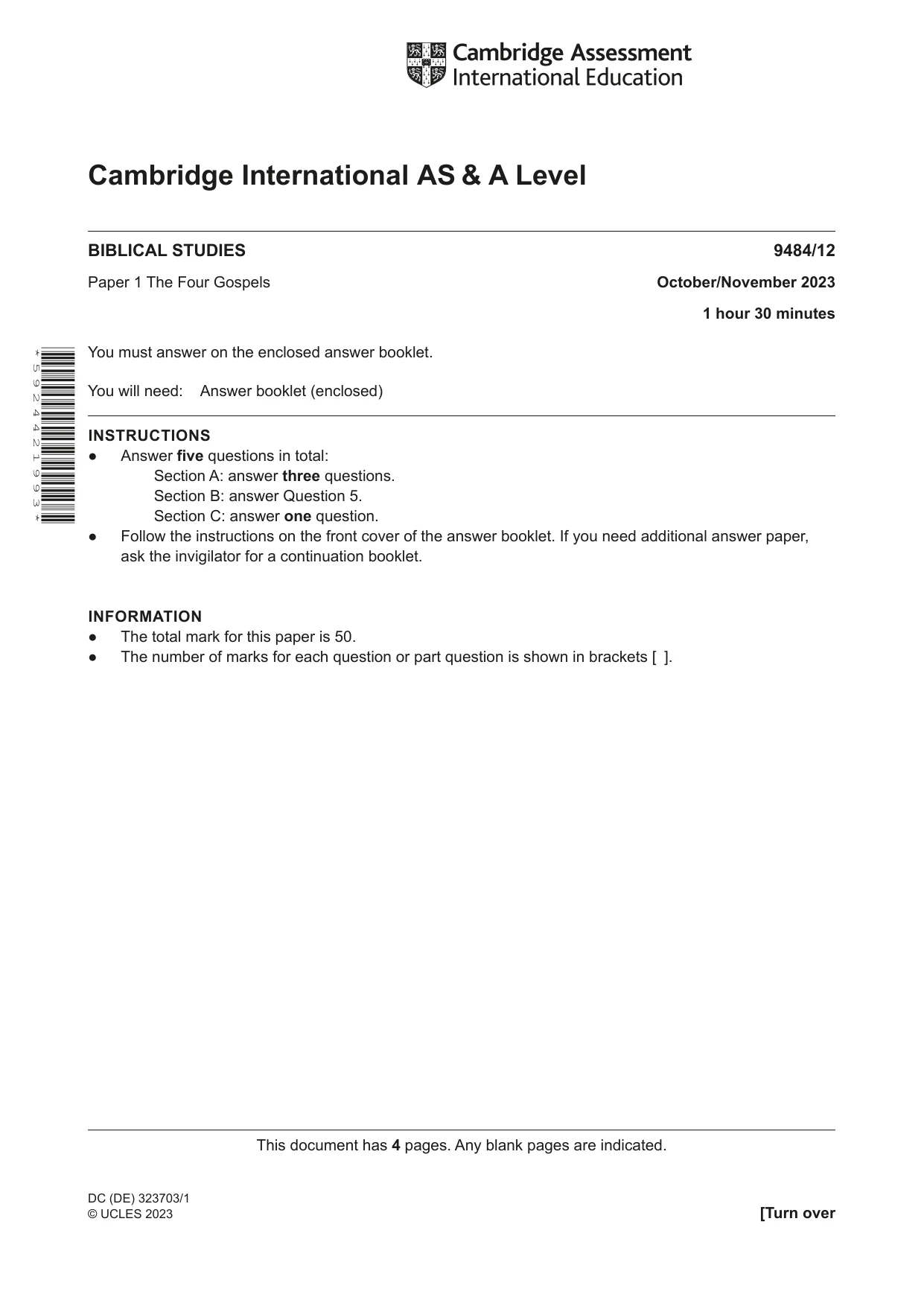
This document has 4 pages. Any blank pages are indicated. [Turn over * 5 9 2 4 4 2 1 9 9 3 * Cambridge International AS & A Level DC (DE) 323703/1 © UCLES 2023 BIBLICAL STUDIES 9484/12 Paper 1 The Four Gospels October/November 2023 1 hour 30 minutes You must answer on the enclosed answer booklet. You will need: Answer booklet (enclosed) INSTRUCTIONS ● Answer five questions in total: Section A: answer three questions. Section B: answer Question 5. Section C: answer one question. ● Follow the instructions on the front cover of the answer booklet. If you need additional answer paper, ask the invigilator for a continuation booklet. INFORMATION ● The total mark for this paper is 50. ● The number of marks for each question or part question is shown in brackets [ ].
Question paper, page 2
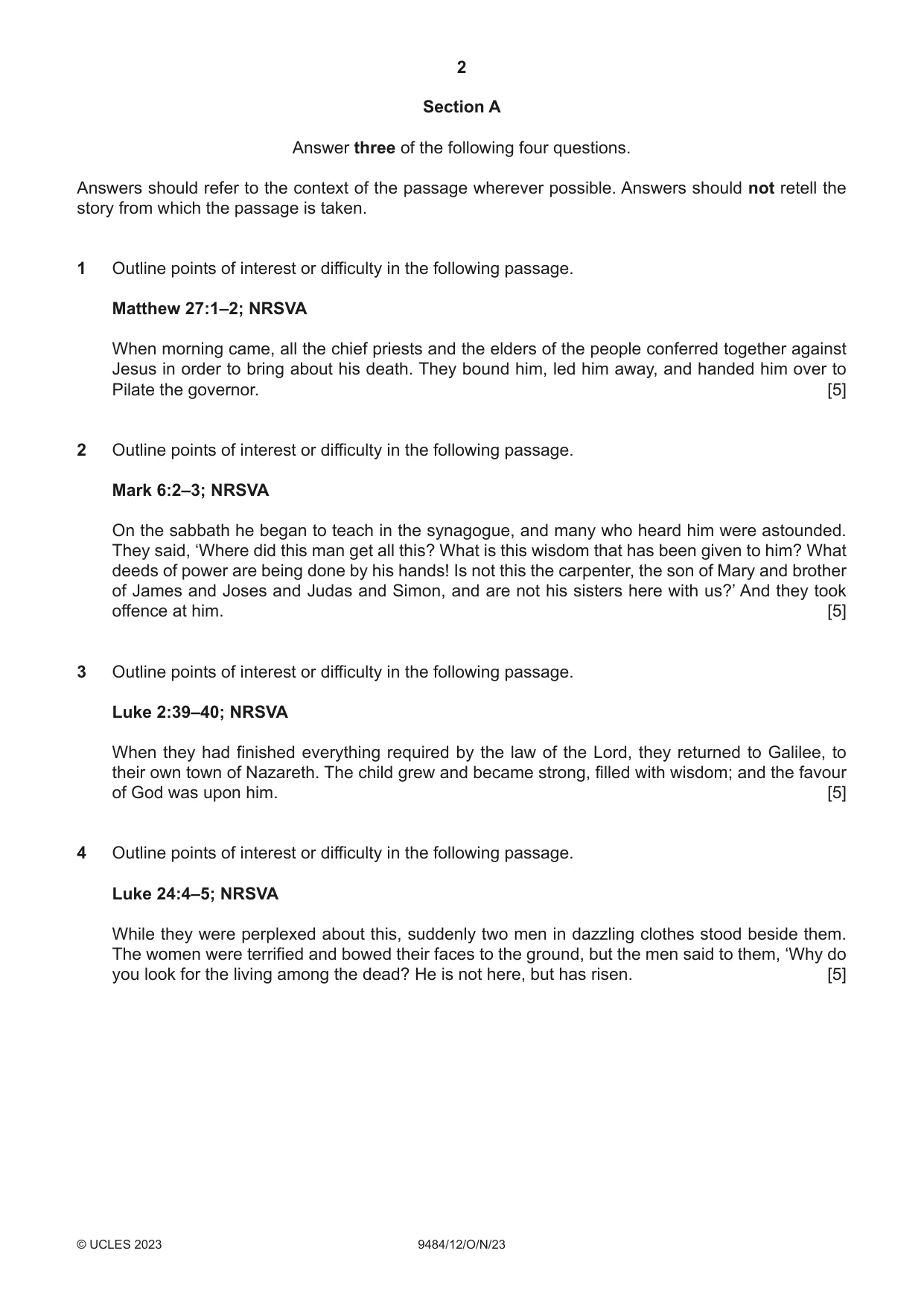
2 9484/12/O/N/23 © UCLES 2023 Section A Answer three of the following four questions. Answers should refer to the context of the passage wherever possible. Answers should not retell the story from which the passage is taken. 1 Outline points of interest or difficulty in the following passage. Matthew 27:1–2; NRSVA When morning came, all the chief priests and the elders of the people conferred together against Jesus in order to bring about his death. They bound him, led him away, and handed him over to Pilate the governor. [5] 2 Outline points of interest or difficulty in the following passage. Mark 6:2–3; NRSVA On the sabbath he began to teach in the synagogue, and many who heard him were astounded. They said, ‘Where did this man get all this? What is this wisdom that has been given to him? What deeds of power are being done by his hands! Is not this the carpenter, the son of Mary and brother of James and Joses and Judas and Simon, and are not his sisters here with us?’ And they took offence at him. [5] 3 Outline points of interest or difficulty in the following passage. Luke 2:39–40; NRSVA When they had finished everything required by the law of the Lord, they returned to Galilee, to their own town of Nazareth. The child grew and became strong, filled with wisdom; and the favour of God was upon him. [5] 4 Outline points of interest or difficulty in the following passage. Luke 24:4–5; NRSVA While they were perplexed about this, suddenly two men in dazzling clothes stood beside them. The women were terrified and bowed their faces to the ground, but the men said to them, ‘Why do you look for the living among the dead? He is not here, but has risen. [5]
Question paper, page 3
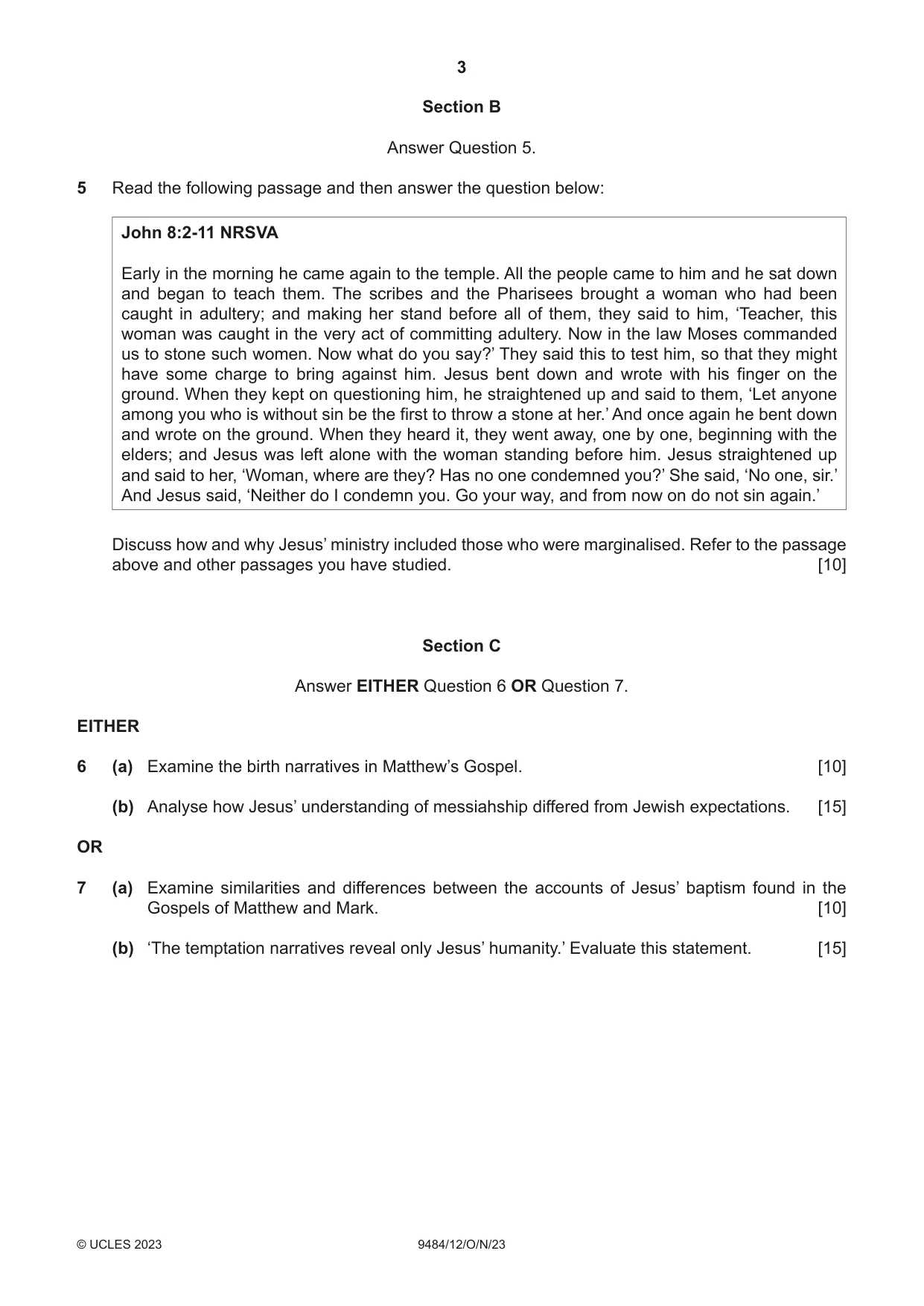
3 9484/12/O/N/23 © UCLES 2023 Section B Answer Question 5. 5 Read the following passage and then answer the question below: John 8:2-11 NRSVA Early in the morning he came again to the temple. All the people came to him and he sat down and began to teach them. The scribes and the Pharisees brought a woman who had been caught in adultery; and making her stand before all of them, they said to him, ‘Teacher, this woman was caught in the very act of committing adultery. Now in the law Moses commanded us to stone such women. Now what do you say?’ They said this to test him, so that they might have some charge to bring against him. Jesus bent down and wrote with his finger on the ground. When they kept on questioning him, he straightened up and said to them, ‘Let anyone among you who is without sin be the first to throw a stone at her.’ And once again he bent down and wrote on the ground. When they heard it, they went away, one by one, beginning with the elders; and Jesus was left alone with the woman standing before him. Jesus straightened up and said to her, ‘Woman, where are they? Has no one condemned you?’ She said, ‘No one, sir.’ And Jesus said, ‘Neither do I condemn you. Go your way, and from now on do not sin again.’ Discuss how and why Jesus’ ministry included those who were marginalised. Refer to the passage above and other passages you have studied. [10] Section C Answer EITHER Question 6 OR Question 7. EITHER 6 (a) Examine the birth narratives in Matthew’s Gospel. [10] (b) Analyse how Jesus’ understanding of messiahship differed from Jewish expectations. [15] OR 7 (a) Examine similarities and differences between the accounts of Jesus’ baptism found in the Gospels of Matthew and Mark. [10] (b) ‘The temptation narratives reveal only Jesus’ humanity.’ Evaluate this statement. [15]
Question paper, page 4
4 9484/12/O/N/23 © UCLES 2023 Permission to reproduce items where third-party owned material protected by copyright is included has been sought and cleared where possible. Every reasonable effort has been made by the publisher (UCLES) to trace copyright holders, but if any items requiring clearance have unwittingly been included, the publisher will be pleased to make amends at the earliest possible opportunity. To avoid the issue of disclosure of answer-related information to candidates, all copyright acknowledgements are reproduced online in the Cambridge Assessment International Education Copyright Acknowledgements Booklet. This is produced for each series of examinations and is freely available to download at www.cambridgeinternational.org after the live examination series. Cambridge Assessment International Education is part of Cambridge Assessment. Cambridge Assessment is the brand name of the University of Cambridge Local Examinations Syndicate (UCLES), which is a department of the University of Cambridge. BLANK PAGE
Mark scheme, page 1
This document consists of 21 printed pages. © UCLES 2023 [Turn over Cambridge International AS & A Level BIBLICAL STUDIES 9484/12 Paper 1 The Four Gospels October/November 2023 MARK SCHEME Maximum Mark: 50 Published This mark scheme is published as an aid to teachers and candidates, to indicate the requirements of the examination. It shows the basis on which Examiners were instructed to award marks. It does not indicate the details of the discussions that took place at an Examiners’ meeting before marking began, which would have considered the acceptability of alternative answers. Mark schemes should be read in conjunction with the question paper and the Principal Examiner Report for Teachers. Cambridge International will not enter into discussions about these mark schemes. Cambridge International is publishing the mark schemes for the October/November 2023 series for most Cambridge IGCSE, Cambridge International A and AS Level components, and some Cambridge O Level components.
Mark scheme, page 2
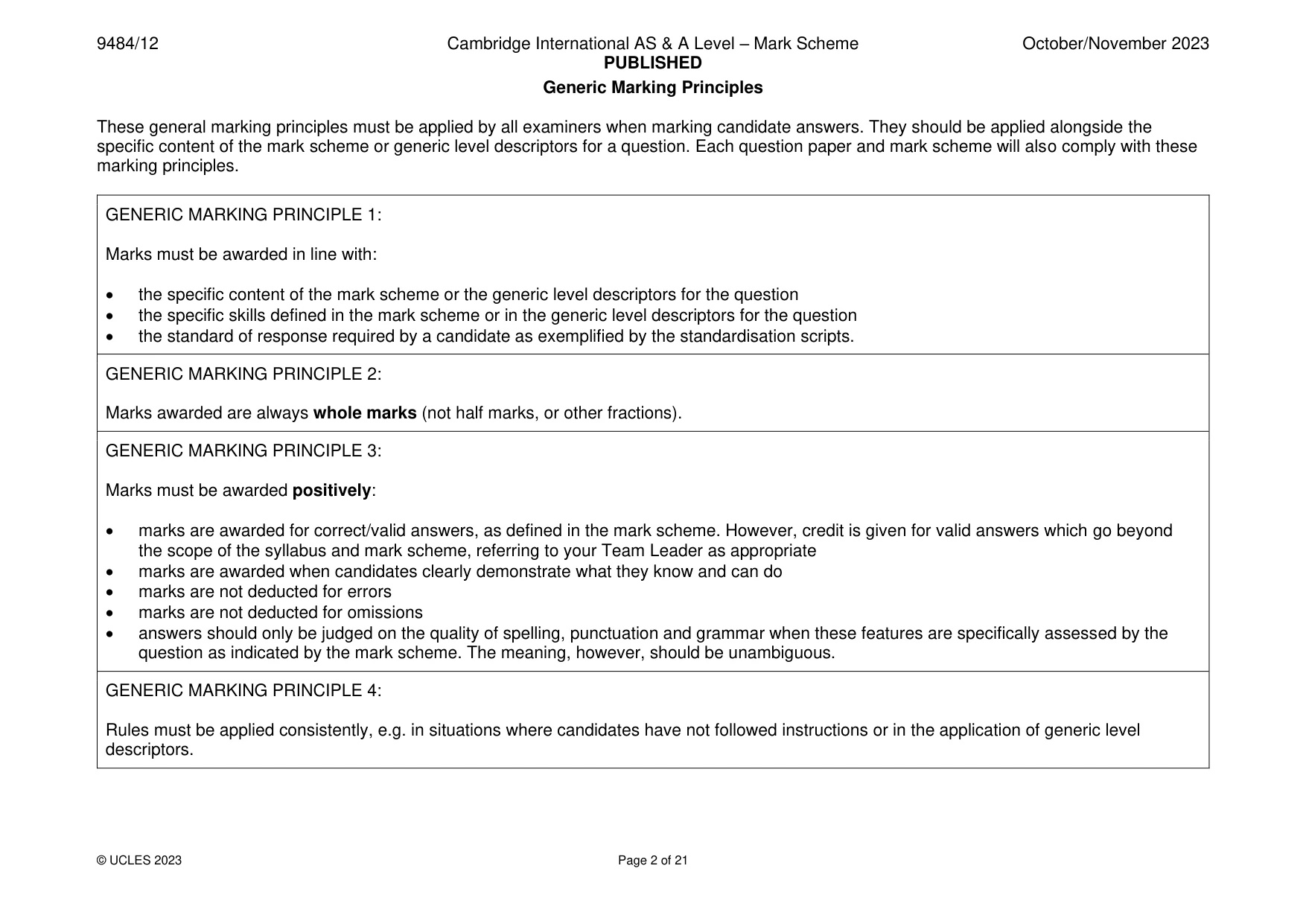
9484/12 Cambridge International AS & A Level – Mark Scheme PUBLISHED October/November 2023 © UCLES 2023 Page 2 of 21 Generic Marking Principles These general marking principles must be applied by all examiners when marking candidate answers. They should be applied alongside the specific content of the mark scheme or generic level descriptors for a question. Each question paper and mark scheme will also comply with these marking principles. GENERIC MARKING PRINCIPLE 1: Marks must be awarded in line with: • the specific content of the mark scheme or the generic level descriptors for the question • the specific skills defined in the mark scheme or in the generic level descriptors for the question • the standard of response required by a candidate as exemplified by the standardisation scripts. GENERIC MARKING PRINCIPLE 2: Marks awarded are always whole marks (not half marks, or other fractions). GENERIC MARKING PRINCIPLE 3: Marks must be awarded positively: • marks are awarded for correct/valid answers, as defined in the mark scheme. However, credit is given for valid answers which go beyond the scope of the syllabus and mark scheme, referring to your Team Leader as appropriate • marks are awarded when candidates clearly demonstrate what they know and can do • marks are not deducted for errors • marks are not deducted for omissions • answers should only be judged on the quality of spelling, punctuation and grammar when these features are specifically assessed by the question as indicated by the mark scheme. The meaning, however, should be unambiguous. GENERIC MARKING PRINCIPLE 4: Rules must be applied consistently, e.g. in situations where candidates have not followed instructions or in the application of generic level descriptors.
Mark scheme, page 3
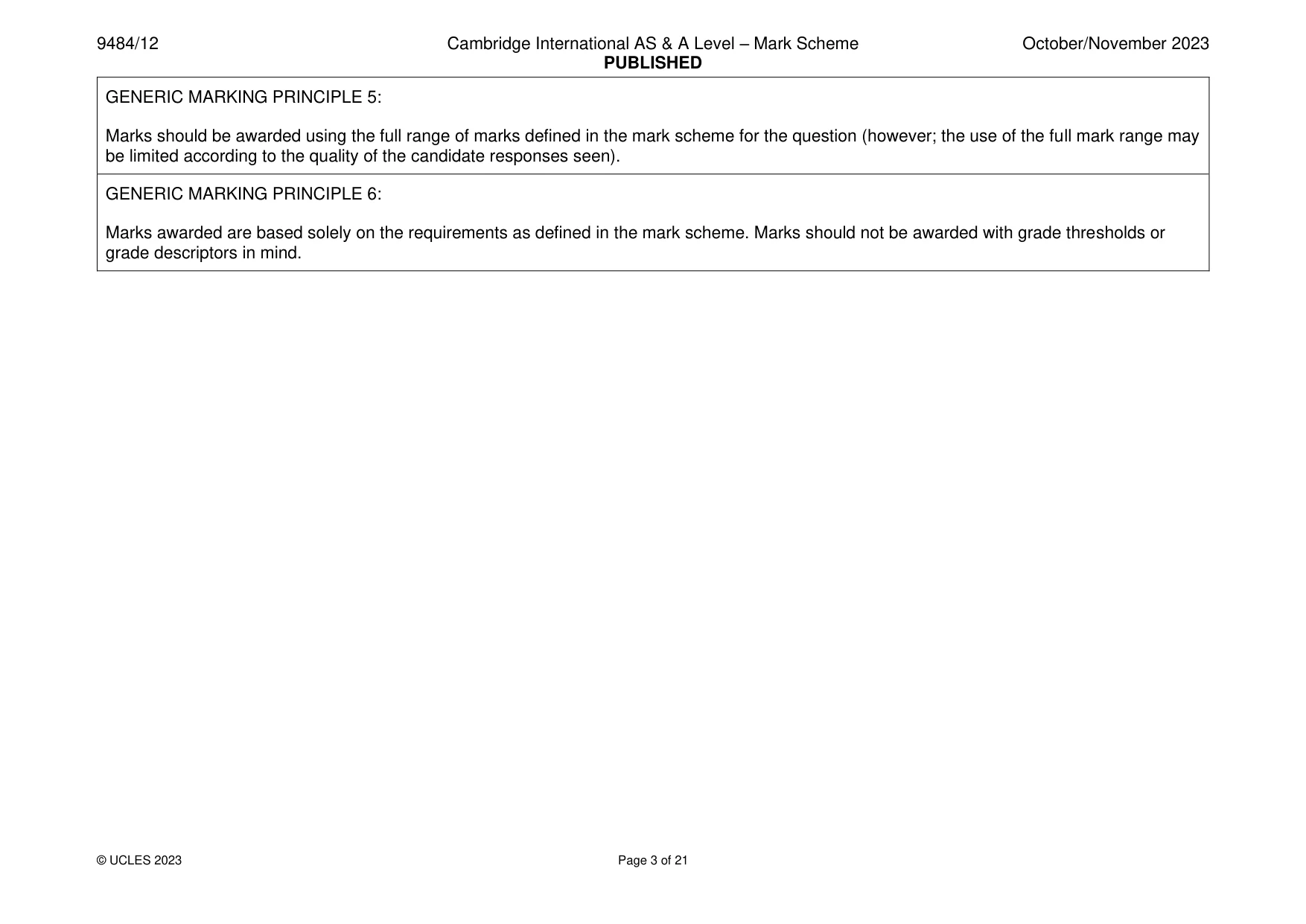
9484/12 Cambridge International AS & A Level – Mark Scheme PUBLISHED October/November 2023 © UCLES 2023 Page 3 of 21 GENERIC MARKING PRINCIPLE 5: Marks should be awarded using the full range of marks defined in the mark scheme for the question (however; the use of the full mark range may be limited according to the quality of the candidate responses seen). GENERIC MARKING PRINCIPLE 6: Marks awarded are based solely on the requirements as defined in the mark scheme. Marks should not be awarded with grade thresholds or grade descriptors in mind.
Mark scheme, page 4
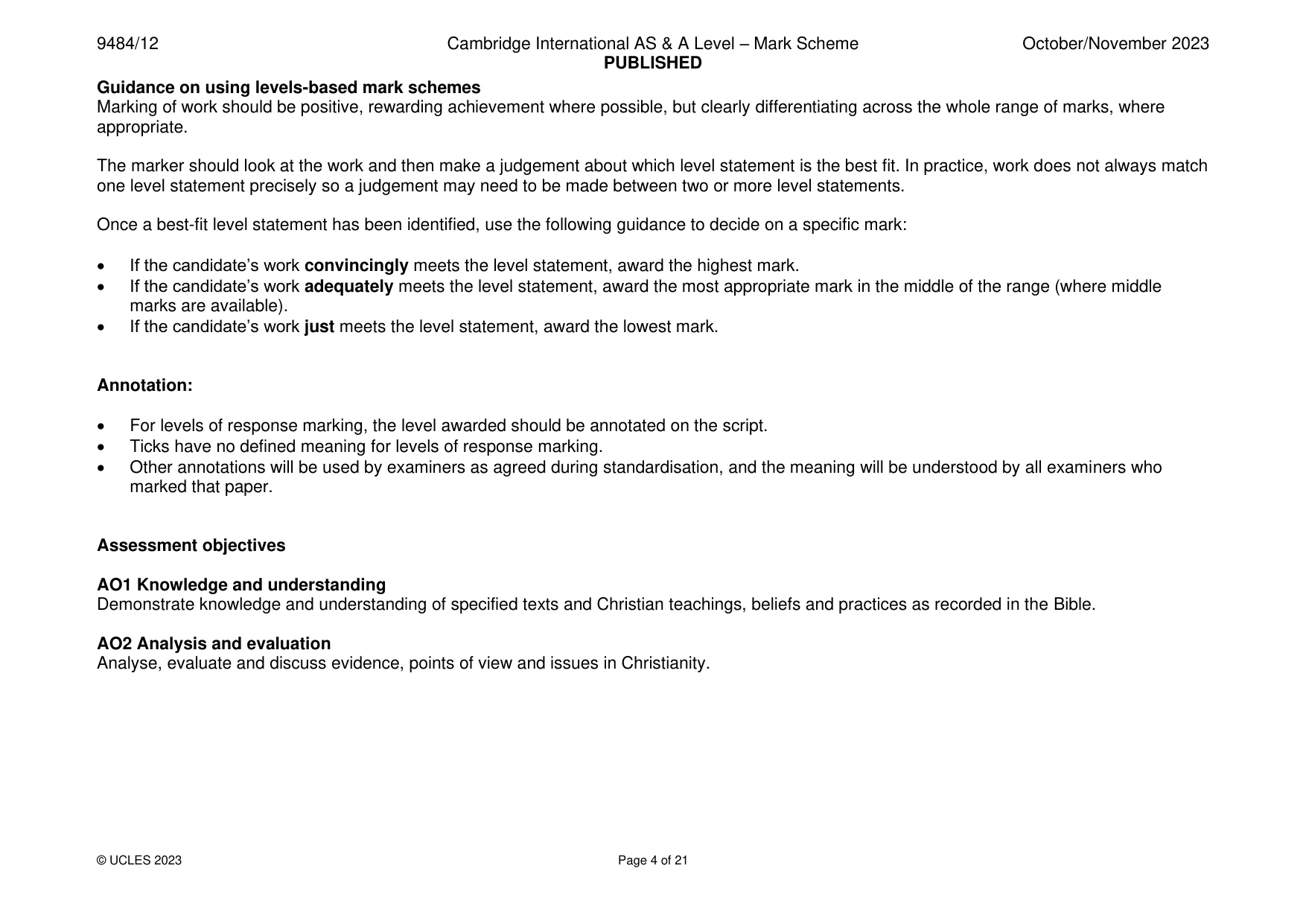
9484/12 Cambridge International AS & A Level – Mark Scheme PUBLISHED October/November 2023 © UCLES 2023 Page 4 of 21 Guidance on using levels-based mark schemes Marking of work should be positive, rewarding achievement where possible, but clearly differentiating across the whole range of marks, where appropriate. The marker should look at the work and then make a judgement about which level statement is the best fit. In practice, work does not always match one level statement precisely so a judgement may need to be made between two or more level statements. Once a best-fit level statement has been identified, use the following guidance to decide on a specific mark: • If the candidate’s work convincingly meets the level statement, award the highest mark. • If the candidate’s work adequately meets the level statement, award the most appropriate mark in the middle of the range (where middle marks are available). • If the candidate’s work just meets the level statement, award the lowest mark. Annotation: • For levels of response marking, the level awarded should be annotated on the script. • Ticks have no defined meaning for levels of response marking. • Other annotations will be used by examiners as agreed during standardisation, and the meaning will be understood by all examiners who marked that paper. Assessment objectives AO1 Knowledge and understanding Demonstrate knowledge and understanding of specified texts and Christian teachings, beliefs and practices as recorded in the Bible. AO2 Analysis and evaluation Analyse, evaluate and discuss evidence, points of view and issues in Christianity.
Mark scheme, page 5
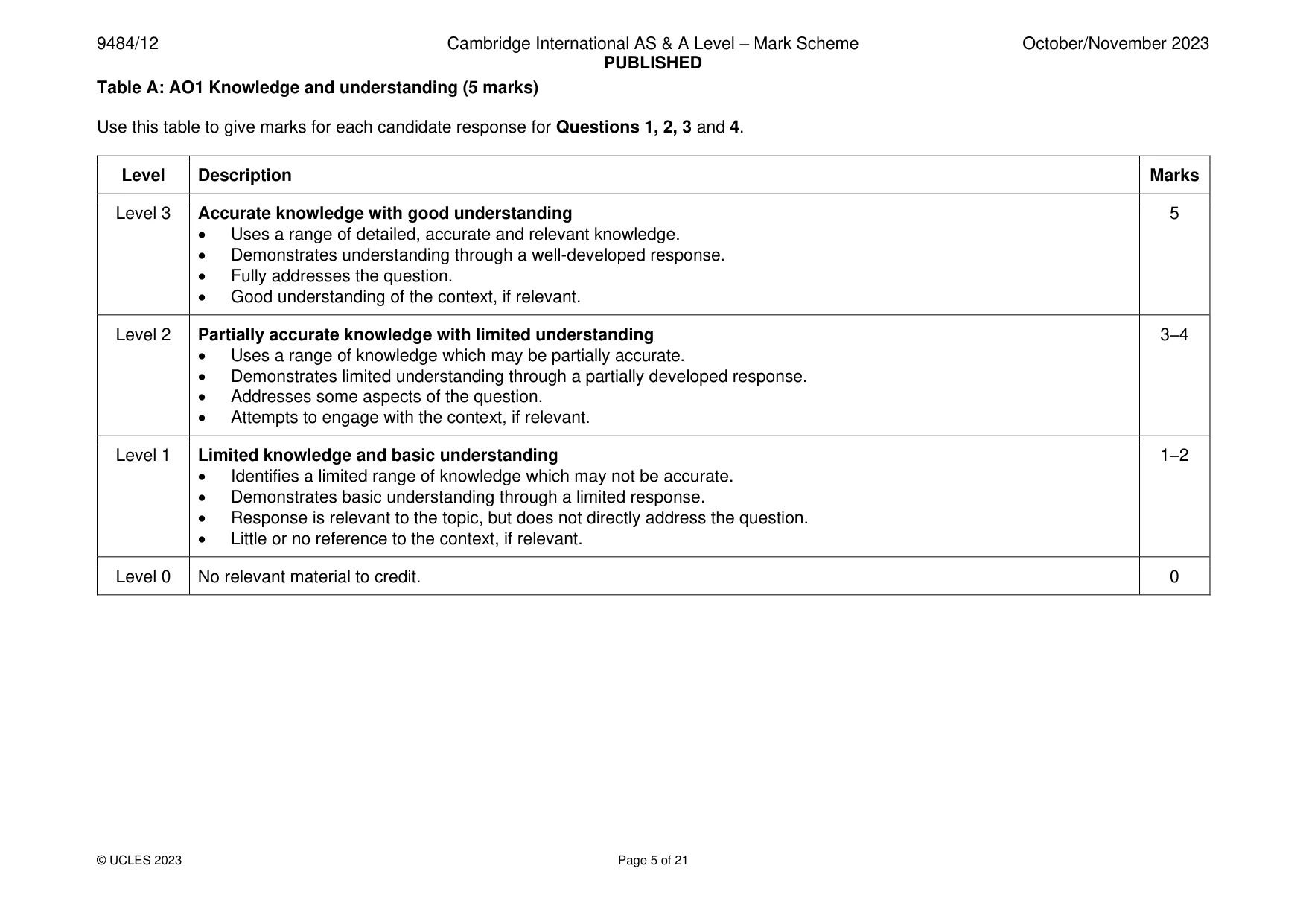
9484/12 Cambridge International AS & A Level – Mark Scheme PUBLISHED October/November 2023 © UCLES 2023 Page 5 of 21 Table A: AO1 Knowledge and understanding (5 marks) Use this table to give marks for each candidate response for Questions 1, 2, 3 and 4. Level Description Marks Level 3 Accurate knowledge with good understanding • Uses a range of detailed, accurate and relevant knowledge. • Demonstrates understanding through a well-developed response. • Fully addresses the question. • Good understanding of the context, if relevant. 5 Level 2 Partially accurate knowledge with limited understanding • Uses a range of knowledge which may be partially accurate. • Demonstrates limited understanding through a partially developed response. • Addresses some aspects of the question. • Attempts to engage with the context, if relevant. 3–4 Level 1 Limited knowledge and basic understanding • Identifies a limited range of knowledge which may not be accurate. • Demonstrates basic understanding through a limited response. • Response is relevant to the topic, but does not directly address the question. • Little or no reference to the context, if relevant. 1–2 Level 0 No relevant material to credit. 0
Mark scheme, page 6
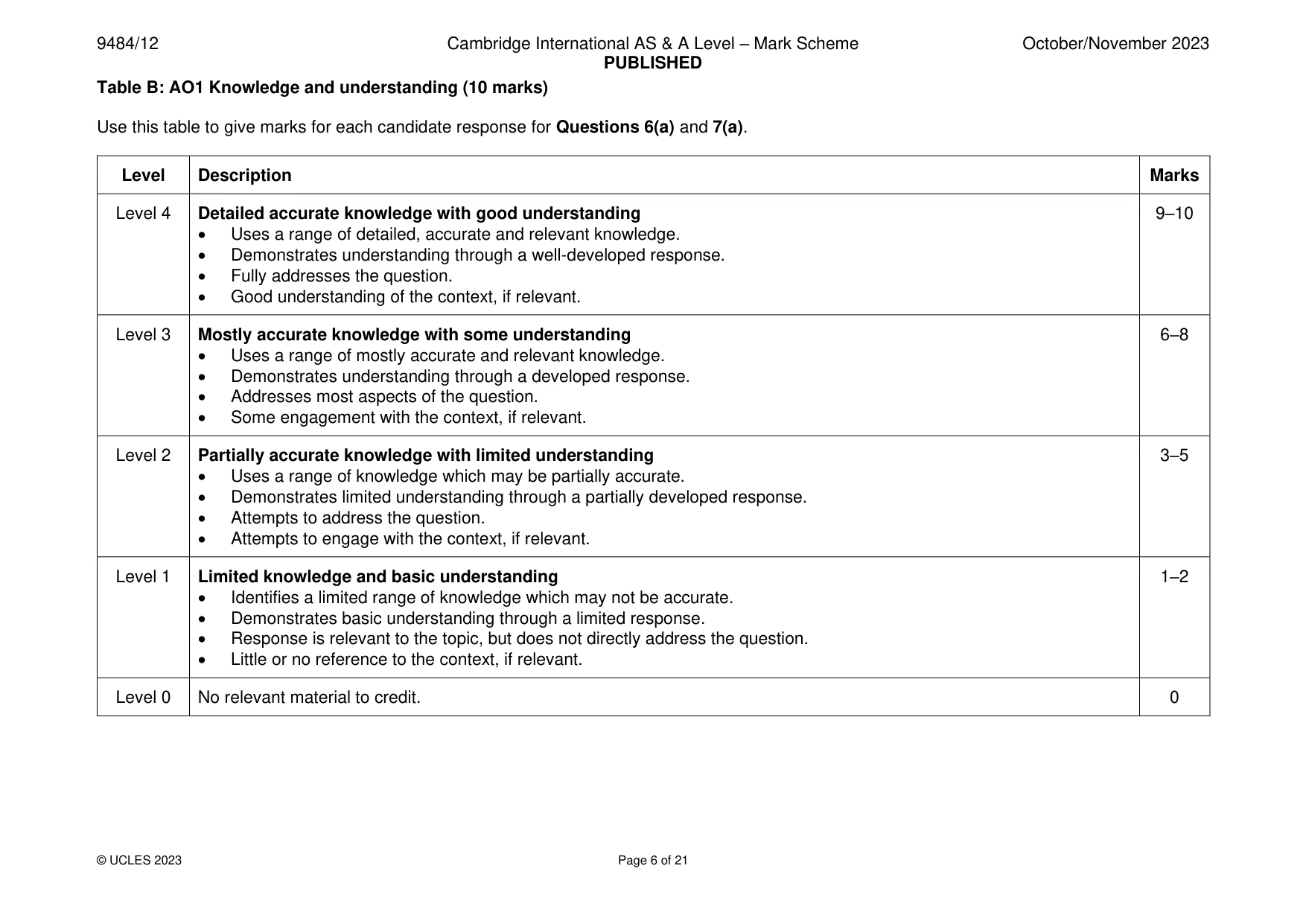
9484/12 Cambridge International AS & A Level – Mark Scheme PUBLISHED October/November 2023 © UCLES 2023 Page 6 of 21 Table B: AO1 Knowledge and understanding (10 marks) Use this table to give marks for each candidate response for Questions 6(a) and 7(a). Level Description Marks Level 4 Detailed accurate knowledge with good understanding • Uses a range of detailed, accurate and relevant knowledge. • Demonstrates understanding through a well-developed response. • Fully addresses the question. • Good understanding of the context, if relevant. 9–10 Level 3 Mostly accurate knowledge with some understanding • Uses a range of mostly accurate and relevant knowledge. • Demonstrates understanding through a developed response. • Addresses most aspects of the question. • Some engagement with the context, if relevant. 6–8 Level 2 Partially accurate knowledge with limited understanding • Uses a range of knowledge which may be partially accurate. • Demonstrates limited understanding through a partially developed response. • Attempts to address the question. • Attempts to engage with the context, if relevant. 3–5 Level 1 Limited knowledge and basic understanding • Identifies a limited range of knowledge which may not be accurate. • Demonstrates basic understanding through a limited response. • Response is relevant to the topic, but does not directly address the question. • Little or no reference to the context, if relevant. 1–2 Level 0 No relevant material to credit. 0
Mark scheme, page 7
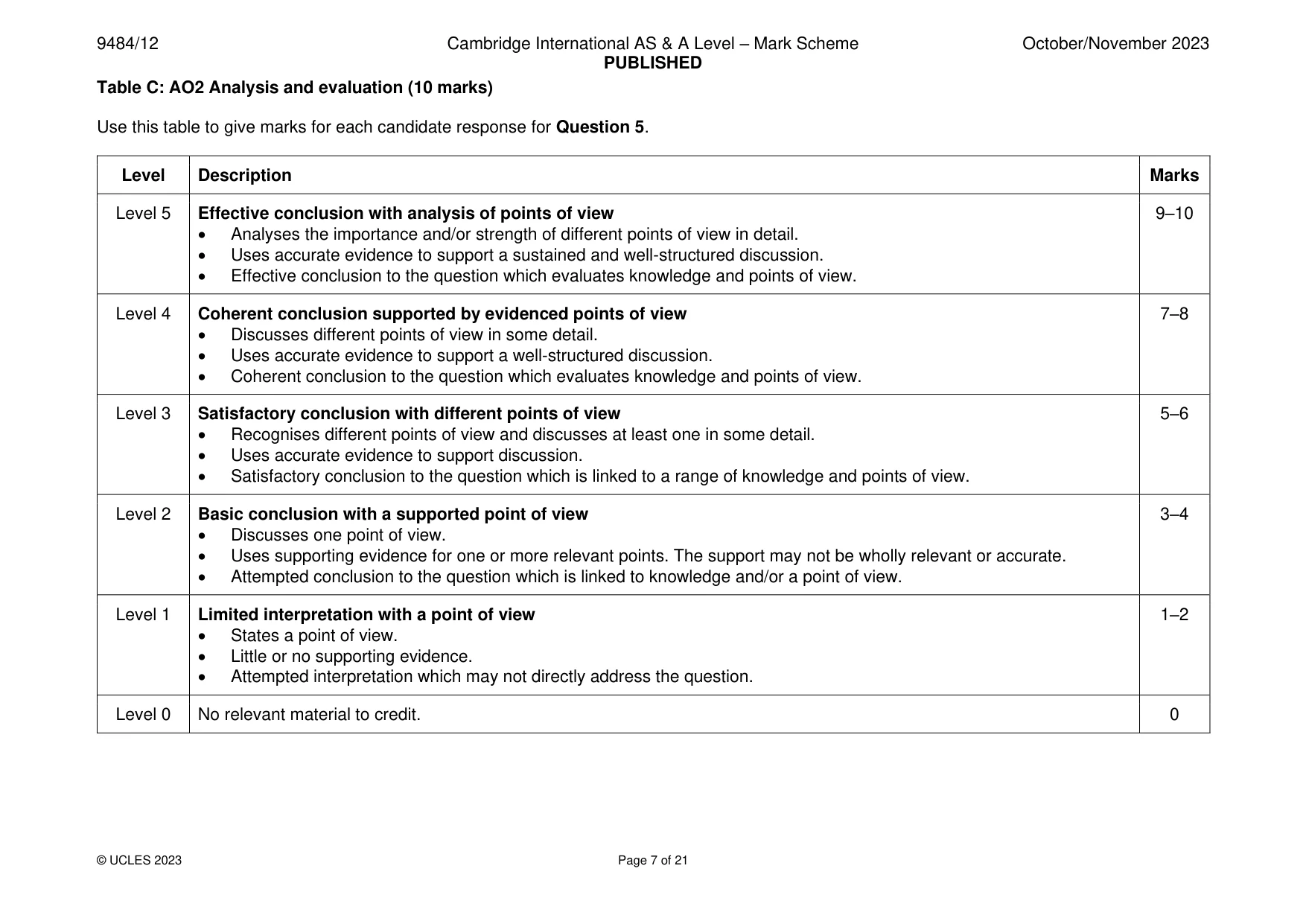
9484/12 Cambridge International AS & A Level – Mark Scheme PUBLISHED October/November 2023 © UCLES 2023 Page 7 of 21 Table C: AO2 Analysis and evaluation (10 marks) Use this table to give marks for each candidate response for Question 5. Level Description Marks Level 5 Effective conclusion with analysis of points of view • Analyses the importance and/or strength of different points of view in detail. • Uses accurate evidence to support a sustained and well-structured discussion. • Effective conclusion to the question which evaluates knowledge and points of view. 9–10 Level 4 Coherent conclusion supported by evidenced points of view • Discusses different points of view in some detail. • Uses accurate evidence to support a well-structured discussion. • Coherent conclusion to the question which evaluates knowledge and points of view. 7–8 Level 3 Satisfactory conclusion with different points of view • Recognises different points of view and discusses at least one in some detail. • Uses accurate evidence to support discussion. • Satisfactory conclusion to the question which is linked to a range of knowledge and points of view. 5–6 Level 2 Basic conclusion with a supported point of view • Discusses one point of view. • Uses supporting evidence for one or more relevant points. The support may not be wholly relevant or accurate. • Attempted conclusion to the question which is linked to knowledge and/or a point of view. 3–4 Level 1 Limited interpretation with a point of view • States a point of view. • Little or no supporting evidence. • Attempted interpretation which may not directly address the question. 1–2 Level 0 No relevant material to credit. 0
Mark scheme, page 8
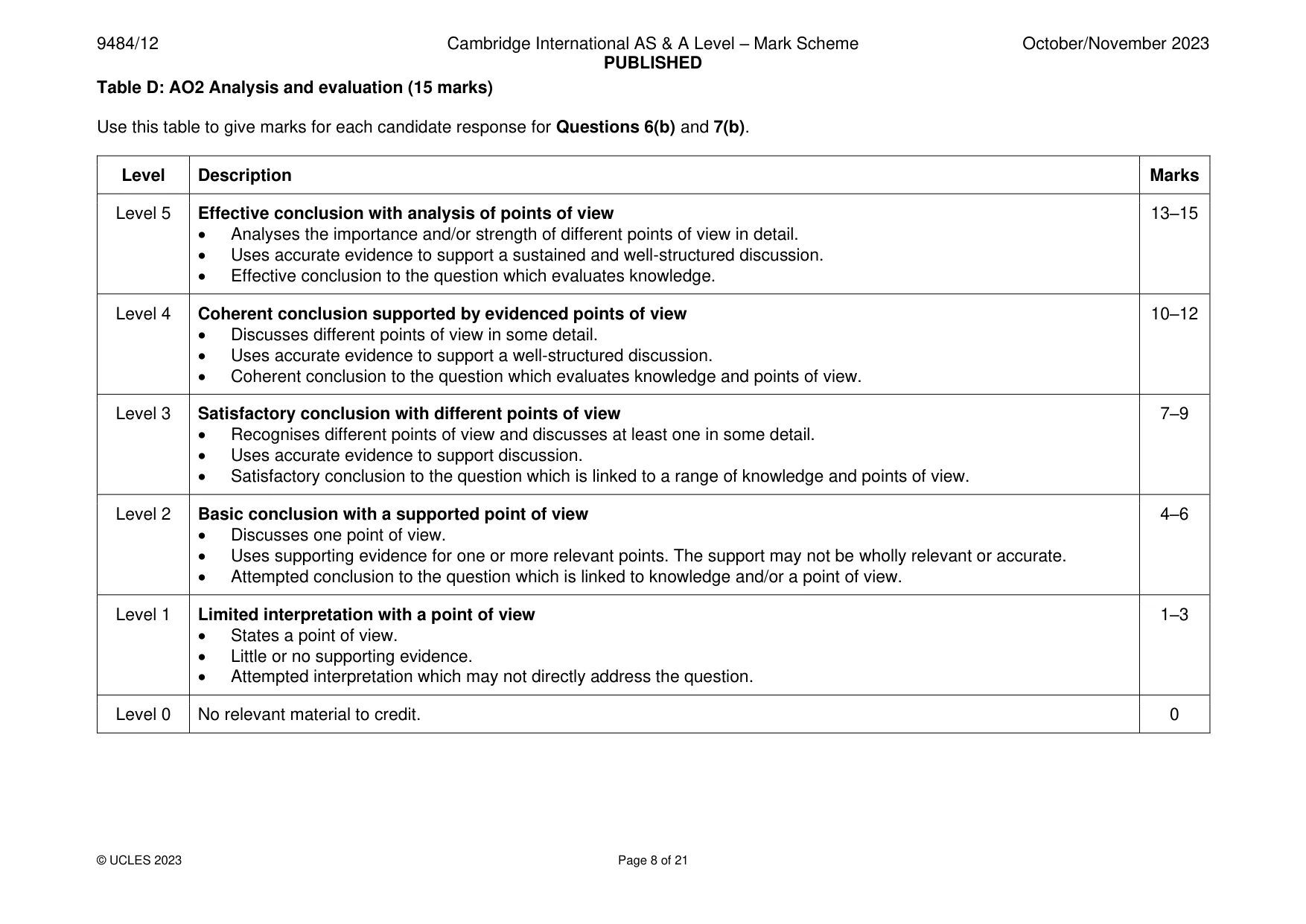
9484/12 Cambridge International AS & A Level – Mark Scheme PUBLISHED October/November 2023 © UCLES 2023 Page 8 of 21 Table D: AO2 Analysis and evaluation (15 marks) Use this table to give marks for each candidate response for Questions 6(b) and 7(b). Level Description Marks Level 5 Effective conclusion with analysis of points of view • Analyses the importance and/or strength of different points of view in detail. • Uses accurate evidence to support a sustained and well-structured discussion. • Effective conclusion to the question which evaluates knowledge. 13–15 Level 4 Coherent conclusion supported by evidenced points of view • Discusses different points of view in some detail. • Uses accurate evidence to support a well-structured discussion. • Coherent conclusion to the question which evaluates knowledge and points of view. 10–12 Level 3 Satisfactory conclusion with different points of view • Recognises different points of view and discusses at least one in some detail. • Uses accurate evidence to support discussion. • Satisfactory conclusion to the question which is linked to a range of knowledge and points of view. 7–9 Level 2 Basic conclusion with a supported point of view • Discusses one point of view. • Uses supporting evidence for one or more relevant points. The support may not be wholly relevant or accurate. • Attempted conclusion to the question which is linked to knowledge and/or a point of view. 4–6 Level 1 Limited interpretation with a point of view • States a point of view. • Little or no supporting evidence. • Attempted interpretation which may not directly address the question. 1–3 Level 0 No relevant material to credit. 0
Mark scheme, page 9
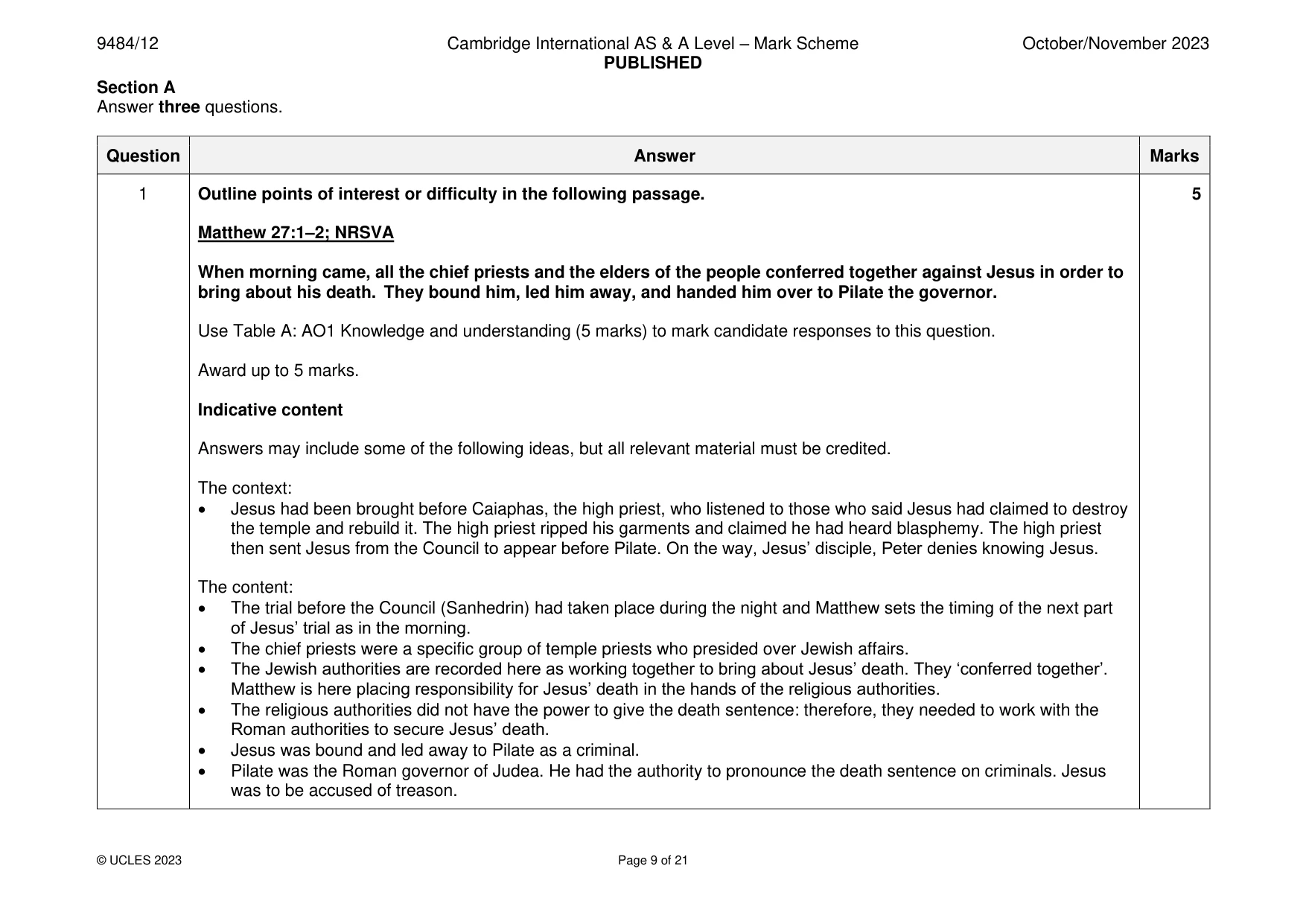
9484/12 Cambridge International AS & A Level – Mark Scheme PUBLISHED October/November 2023 © UCLES 2023 Page 9 of 21 Section A Answer three questions. Question Answer Marks 1 Outline points of interest or difficulty in the following passage. Matthew 27:1–2; NRSVA When morning came, all the chief priests and the elders of the people conferred together against Jesus in order to bring about his death. They bound him, led him away, and handed him over to Pilate the governor. Use Table A: AO1 Knowledge and understanding (5 marks) to mark candidate responses to this question. Award up to 5 marks. Indicative content Answers may include some of the following ideas, but all relevant material must be credited. The context: • Jesus had been brought before Caiaphas, the high priest, who listened to those who said Jesus had claimed to destroy the temple and rebuild it. The high priest ripped his garments and claimed he had heard blasphemy. The high priest then sent Jesus from the Council to appear before Pilate. On the way, Jesus’ disciple, Peter denies knowing Jesus. The content: • The trial before the Council (Sanhedrin) had taken place during the night and Matthew sets the timing of the next part of Jesus’ trial as in the morning. • The chief priests were a specific group of temple priests who presided over Jewish affairs. • The Jewish authorities are recorded here as working together to bring about Jesus’ death. They ‘conferred together’. Matthew is here placing responsibility for Jesus’ death in the hands of the religious authorities. • The religious authorities did not have the power to give the death sentence: therefore, they needed to work with the Roman authorities to secure Jesus’ death. • Jesus was bound and led away to Pilate as a criminal. • Pilate was the Roman governor of Judea. He had the authority to pronounce the death sentence on criminals. Jesus was to be accused of treason. 5
Mark scheme, page 10
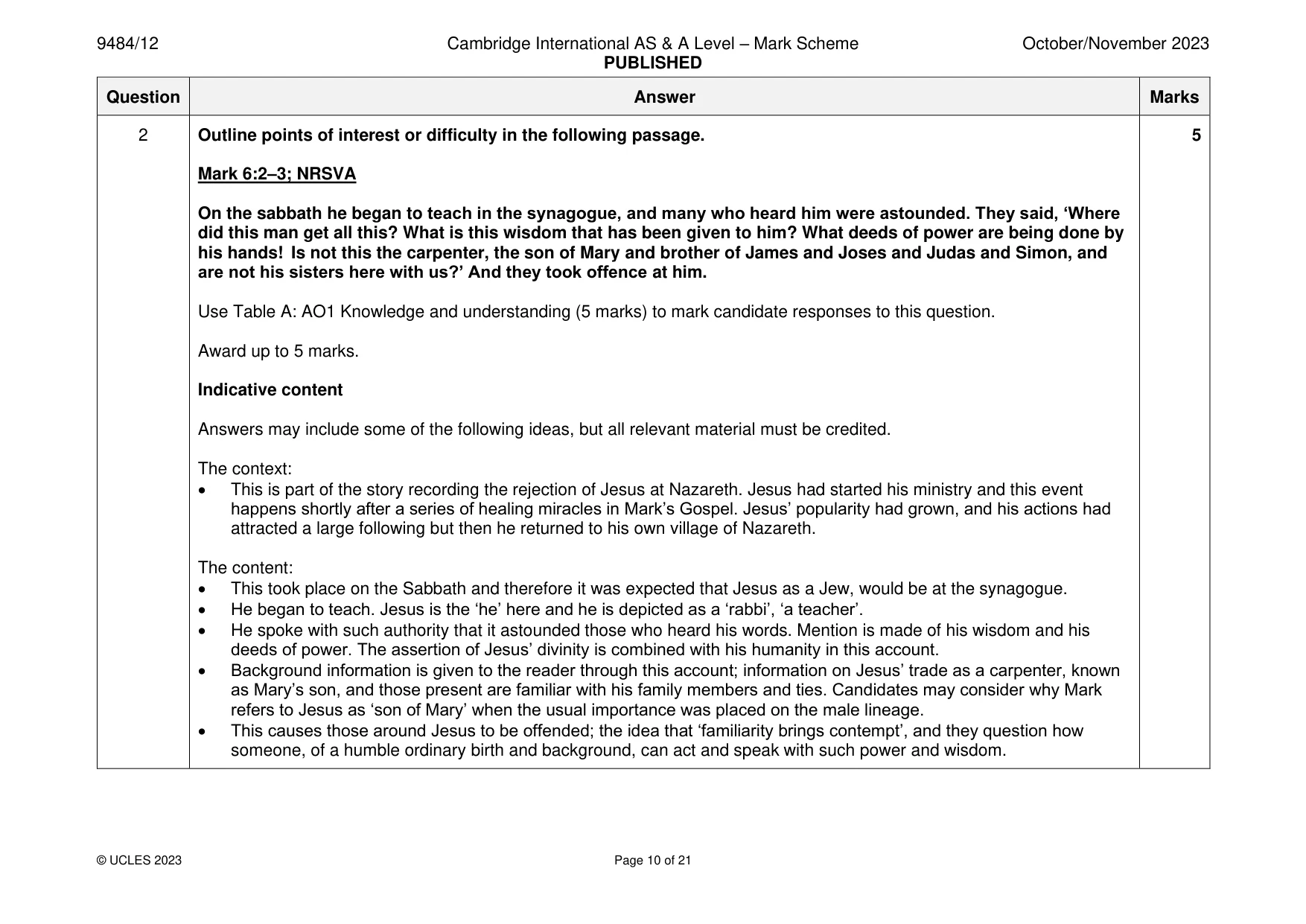
9484/12 Cambridge International AS & A Level – Mark Scheme PUBLISHED October/November 2023 © UCLES 2023 Page 10 of 21 Question Answer Marks 2 Outline points of interest or difficulty in the following passage. Mark 6:2–3; NRSVA On the sabbath he began to teach in the synagogue, and many who heard him were astounded. They said, ‘Where did this man get all this? What is this wisdom that has been given to him? What deeds of power are being done by his hands! Is not this the carpenter, the son of Mary and brother of James and Joses and Judas and Simon, and are not his sisters here with us?’ And they took offence at him. Use Table A: AO1 Knowledge and understanding (5 marks) to mark candidate responses to this question. Award up to 5 marks. Indicative content Answers may include some of the following ideas, but all relevant material must be credited. The context: • This is part of the story recording the rejection of Jesus at Nazareth. Jesus had started his ministry and this event happens shortly after a series of healing miracles in Mark’s Gospel. Jesus’ popularity had grown, and his actions had attracted a large following but then he returned to his own village of Nazareth. The content: • This took place on the Sabbath and therefore it was expected that Jesus as a Jew, would be at the synagogue. • He began to teach. Jesus is the ‘he’ here and he is depicted as a ‘rabbi’, ‘a teacher’. • He spoke with such authority that it astounded those who heard his words. Mention is made of his wisdom and his deeds of power. The assertion of Jesus’ divinity is combined with his humanity in this account. • Background information is given to the reader through this account; information on Jesus’ trade as a carpenter, known as Mary’s son, and those present are familiar with his family members and ties. Candidates may consider why Mark refers to Jesus as ‘son of Mary’ when the usual importance was placed on the male lineage. • This causes those around Jesus to be offended; the idea that ‘familiarity brings contempt’, and they question how someone, of a humble ordinary birth and background, can act and speak with such power and wisdom. 5
Mark scheme, page 11
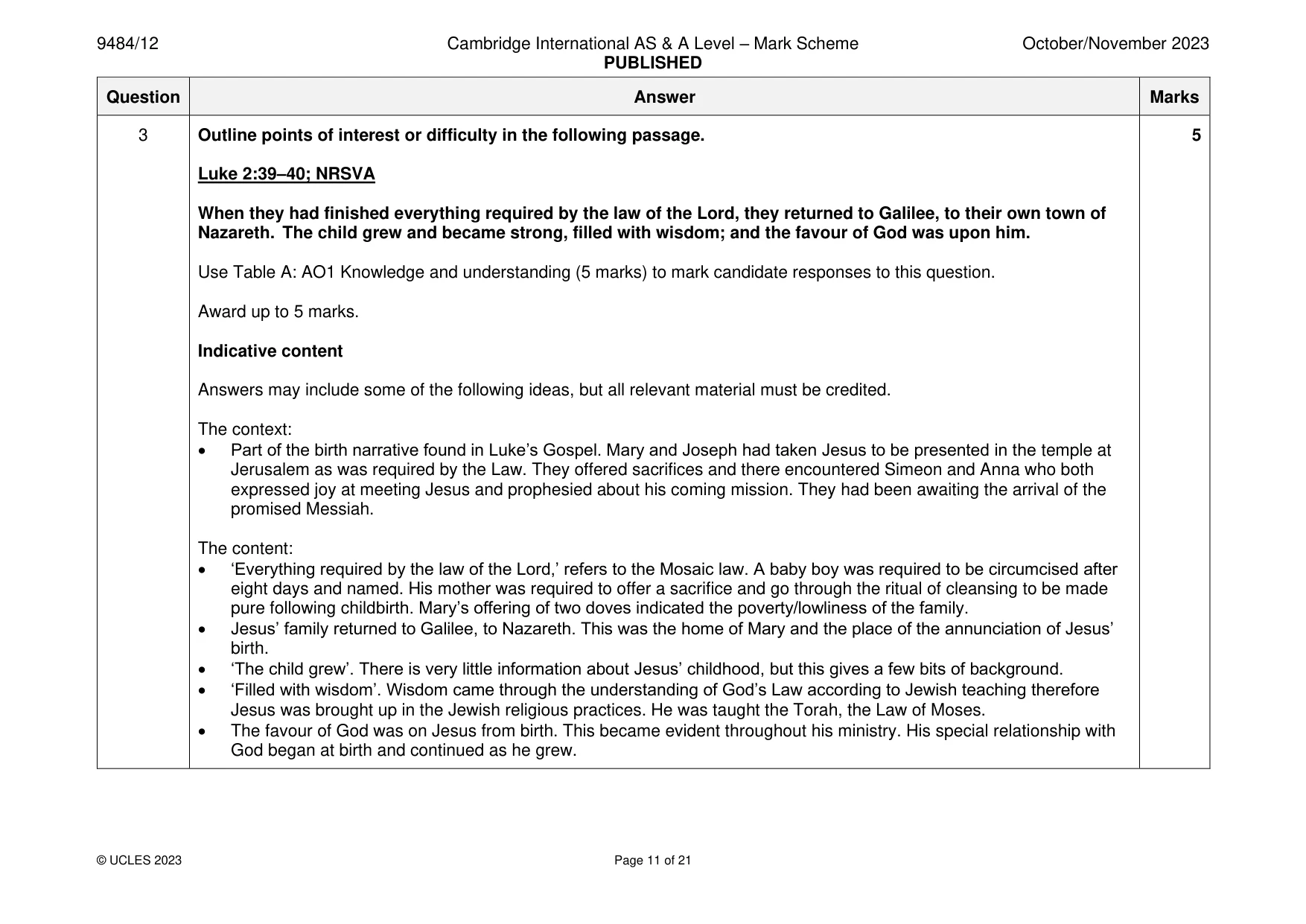
9484/12 Cambridge International AS & A Level – Mark Scheme PUBLISHED October/November 2023 © UCLES 2023 Page 11 of 21 Question Answer Marks 3 Outline points of interest or difficulty in the following passage. Luke 2:39–40; NRSVA When they had finished everything required by the law of the Lord, they returned to Galilee, to their own town of Nazareth. The child grew and became strong, filled with wisdom; and the favour of God was upon him. Use Table A: AO1 Knowledge and understanding (5 marks) to mark candidate responses to this question. Award up to 5 marks. Indicative content Answers may include some of the following ideas, but all relevant material must be credited. The context: • Part of the birth narrative found in Luke’s Gospel. Mary and Joseph had taken Jesus to be presented in the temple at Jerusalem as was required by the Law. They offered sacrifices and there encountered Simeon and Anna who both expressed joy at meeting Jesus and prophesied about his coming mission. They had been awaiting the arrival of the promised Messiah. The content: • ‘Everything required by the law of the Lord,’ refers to the Mosaic law. A baby boy was required to be circumcised after eight days and named. His mother was required to offer a sacrifice and go through the ritual of cleansing to be made pure following childbirth. Mary’s offering of two doves indicated the poverty/lowliness of the family. • Jesus’ family returned to Galilee, to Nazareth. This was the home of Mary and the place of the annunciation of Jesus’ birth. • ‘The child grew’. There is very little information about Jesus’ childhood, but this gives a few bits of background. • ‘Filled with wisdom’. Wisdom came through the understanding of God’s Law according to Jewish teaching therefore Jesus was brought up in the Jewish religious practices. He was taught the Torah, the Law of Moses. • The favour of God was on Jesus from birth. This became evident throughout his ministry. His special relationship with God began at birth and continued as he grew. 5
Mark scheme, page 12
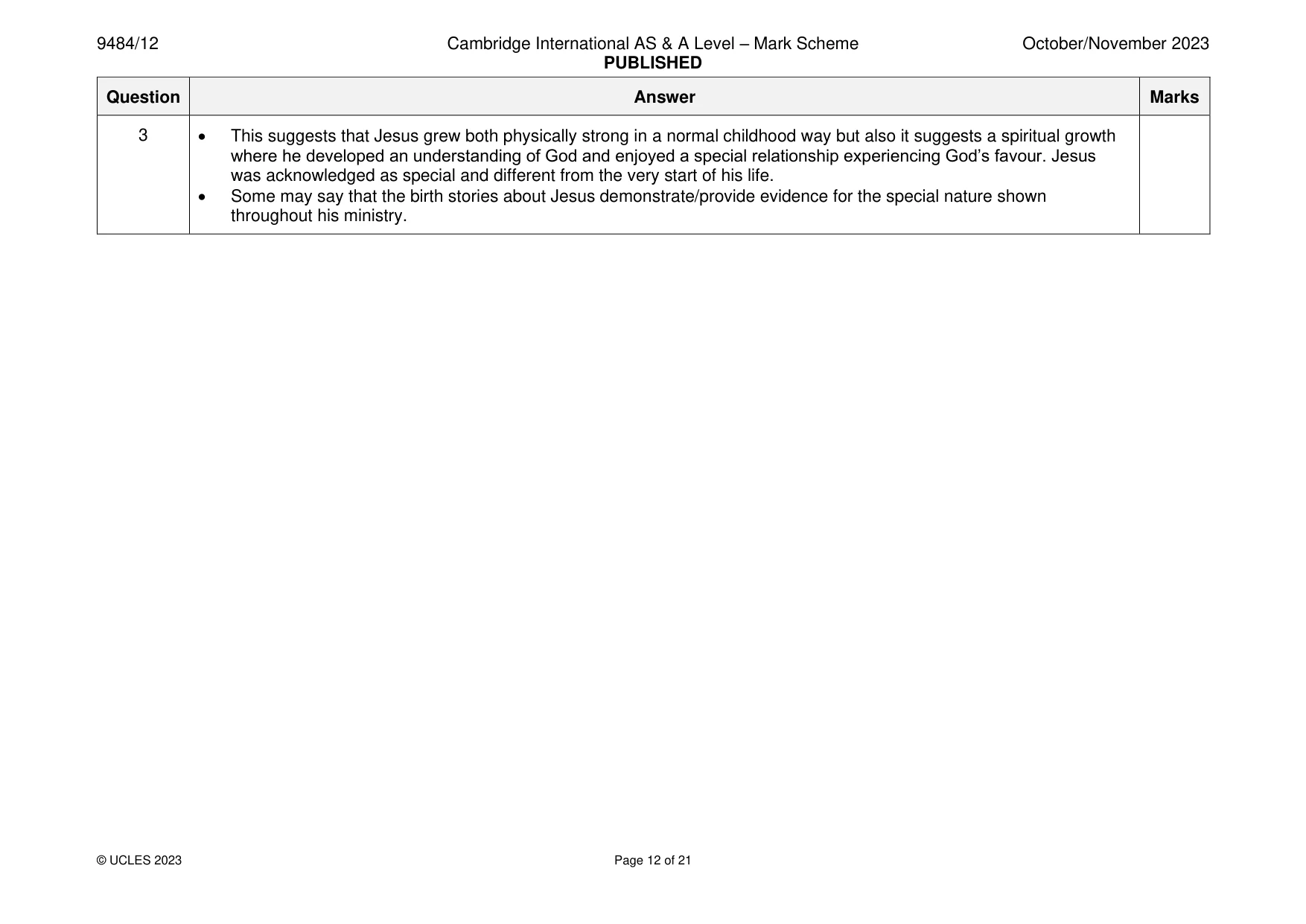
9484/12 Cambridge International AS & A Level – Mark Scheme PUBLISHED October/November 2023 © UCLES 2023 Page 12 of 21 Question Answer Marks 3 • This suggests that Jesus grew both physically strong in a normal childhood way but also it suggests a spiritual growth where he developed an understanding of God and enjoyed a special relationship experiencing God’s favour. Jesus was acknowledged as special and different from the very start of his life. • Some may say that the birth stories about Jesus demonstrate/provide evidence for the special nature shown throughout his ministry.
Mark scheme, page 13
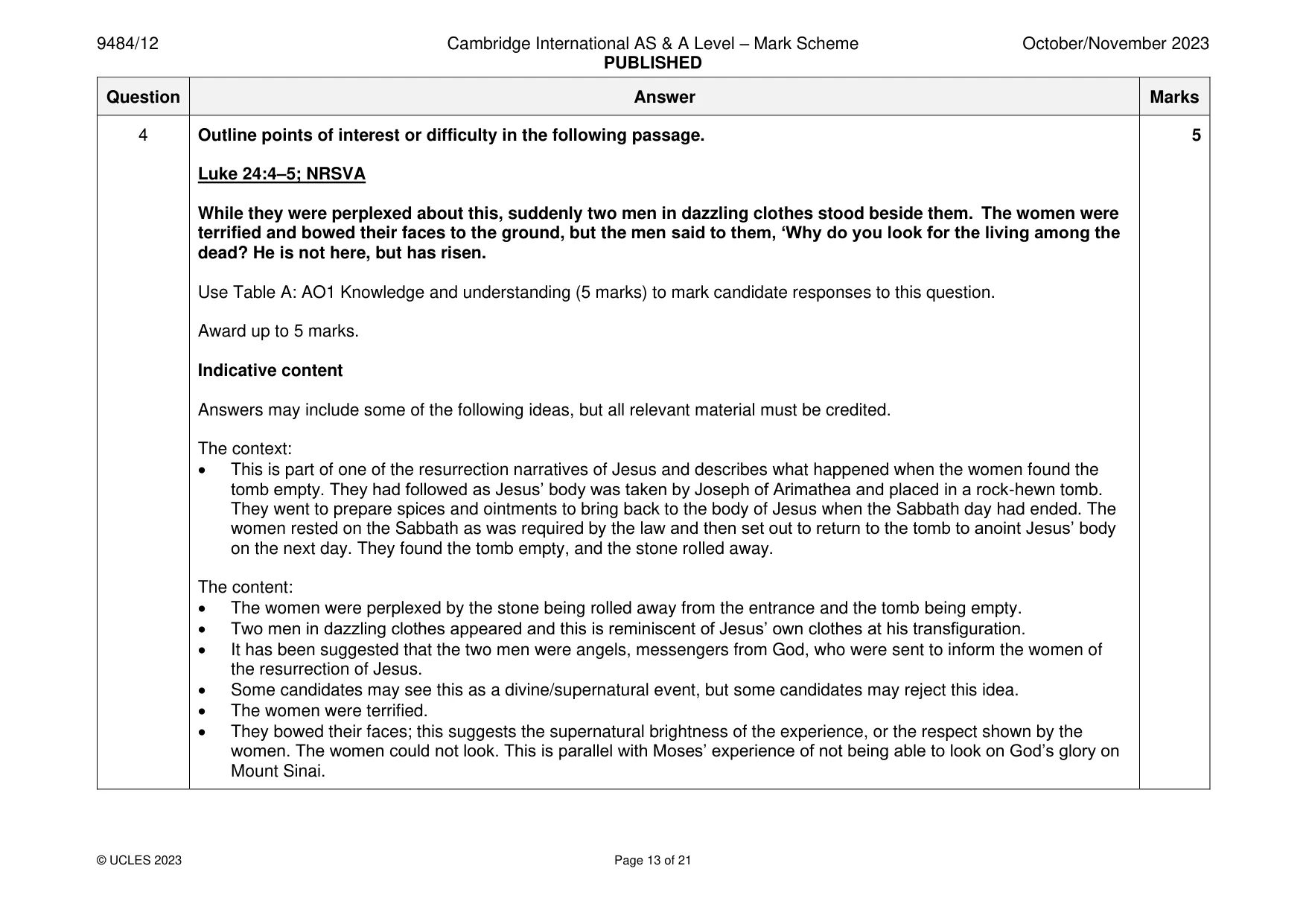
9484/12 Cambridge International AS & A Level – Mark Scheme PUBLISHED October/November 2023 © UCLES 2023 Page 13 of 21 Question Answer Marks 4 Outline points of interest or difficulty in the following passage. Luke 24:4–5; NRSVA While they were perplexed about this, suddenly two men in dazzling clothes stood beside them. The women were terrified and bowed their faces to the ground, but the men said to them, ‘Why do you look for the living among the dead? He is not here, but has risen. Use Table A: AO1 Knowledge and understanding (5 marks) to mark candidate responses to this question. Award up to 5 marks. Indicative content Answers may include some of the following ideas, but all relevant material must be credited. The context: • This is part of one of the resurrection narratives of Jesus and describes what happened when the women found the tomb empty. They had followed as Jesus’ body was taken by Joseph of Arimathea and placed in a rock-hewn tomb. They went to prepare spices and ointments to bring back to the body of Jesus when the Sabbath day had ended. The women rested on the Sabbath as was required by the law and then set out to return to the tomb to anoint Jesus’ body on the next day. They found the tomb empty, and the stone rolled away. The content: • The women were perplexed by the stone being rolled away from the entrance and the tomb being empty. • Two men in dazzling clothes appeared and this is reminiscent of Jesus’ own clothes at his transfiguration. • It has been suggested that the two men were angels, messengers from God, who were sent to inform the women of the resurrection of Jesus. • Some candidates may see this as a divine/supernatural event, but some candidates may reject this idea. • The women were terrified. • They bowed their faces; this suggests the supernatural brightness of the experience, or the respect shown by the women. The women could not look. This is parallel with Moses’ experience of not being able to look on God’s glory on Mount Sinai. 5
Mark scheme, page 14
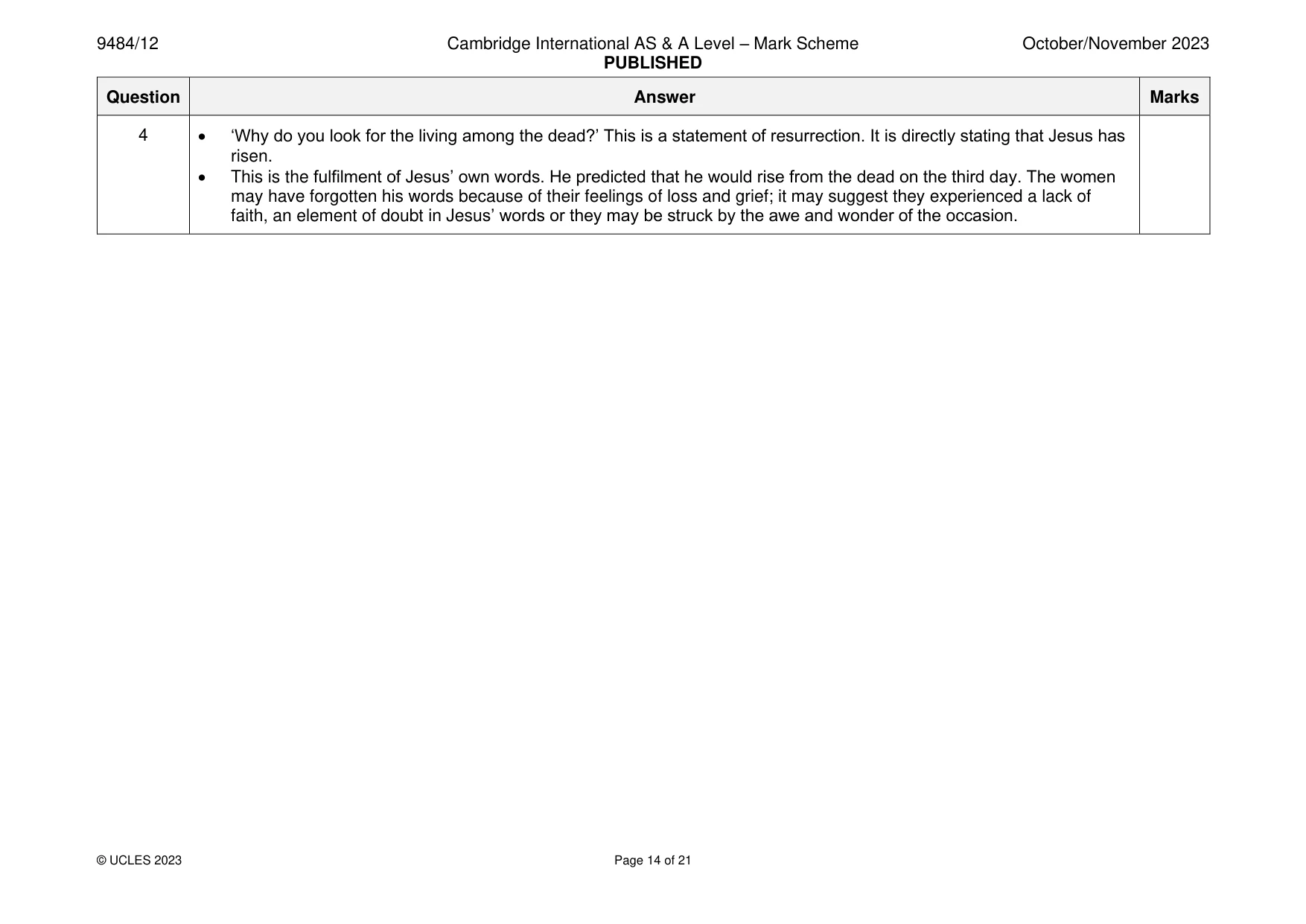
9484/12 Cambridge International AS & A Level – Mark Scheme PUBLISHED October/November 2023 © UCLES 2023 Page 14 of 21 Question Answer Marks 4 • ‘Why do you look for the living among the dead?’ This is a statement of resurrection. It is directly stating that Jesus has risen. • This is the fulfilment of Jesus’ own words. He predicted that he would rise from the dead on the third day. The women may have forgotten his words because of their feelings of loss and grief; it may suggest they experienced a lack of faith, an element of doubt in Jesus’ words or they may be struck by the awe and wonder of the occasion.
Mark scheme, page 15
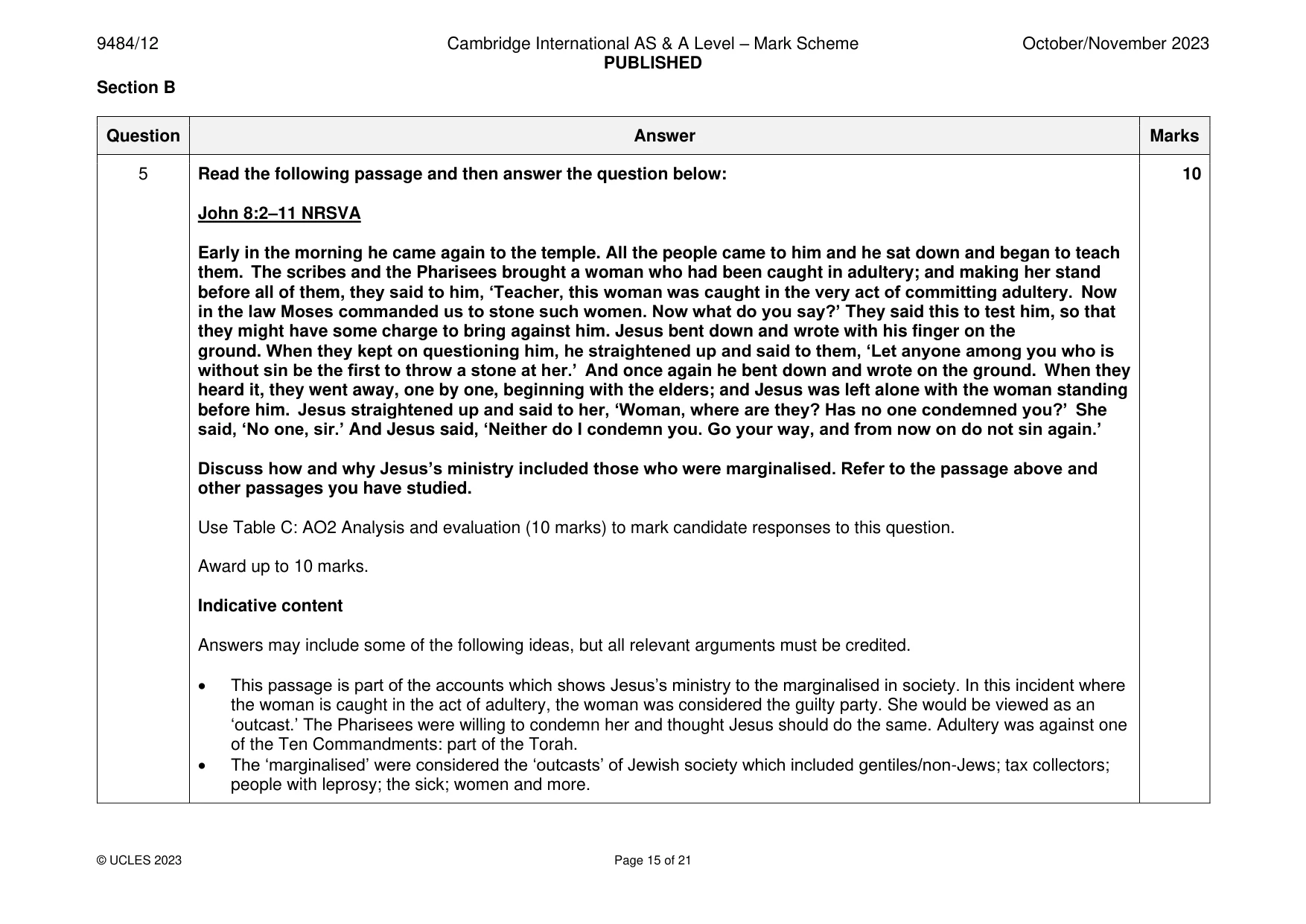
9484/12 Cambridge International AS & A Level – Mark Scheme PUBLISHED October/November 2023 © UCLES 2023 Page 15 of 21 Section B Question Answer Marks 5 Read the following passage and then answer the question below: John 8:2–11 NRSVA Early in the morning he came again to the temple. All the people came to him and he sat down and began to teach them. The scribes and the Pharisees brought a woman who had been caught in adultery; and making her stand before all of them, they said to him, ‘Teacher, this woman was caught in the very act of committing adultery. Now in the law Moses commanded us to stone such women. Now what do you say?’ They said this to test him, so that they might have some charge to bring against him. Jesus bent down and wrote with his finger on the ground. When they kept on questioning him, he straightened up and said to them, ‘Let anyone among you who is without sin be the first to throw a stone at her.’ And once again he bent down and wrote on the ground. When they heard it, they went away, one by one, beginning with the elders; and Jesus was left alone with the woman standing before him. Jesus straightened up and said to her, ‘Woman, where are they? Has no one condemned you?’ She said, ‘No one, sir.’ And Jesus said, ‘Neither do I condemn you. Go your way, and from now on do not sin again.’ Discuss how and why Jesus’s ministry included those who were marginalised. Refer to the passage above and other passages you have studied. Use Table C: AO2 Analysis and evaluation (10 marks) to mark candidate responses to this question. Award up to 10 marks. Indicative content Answers may include some of the following ideas, but all relevant arguments must be credited. • This passage is part of the accounts which shows Jesus’s ministry to the marginalised in society. In this incident where the woman is caught in the act of adultery, the woman was considered the guilty party. She would be viewed as an ‘outcast.’ The Pharisees were willing to condemn her and thought Jesus should do the same. Adultery was against one of the Ten Commandments: part of the Torah. • The ‘marginalised’ were considered the ‘outcasts’ of Jewish society which included gentiles/non-Jews; tax collectors; people with leprosy; the sick; women and more. 10
Mark scheme, page 16
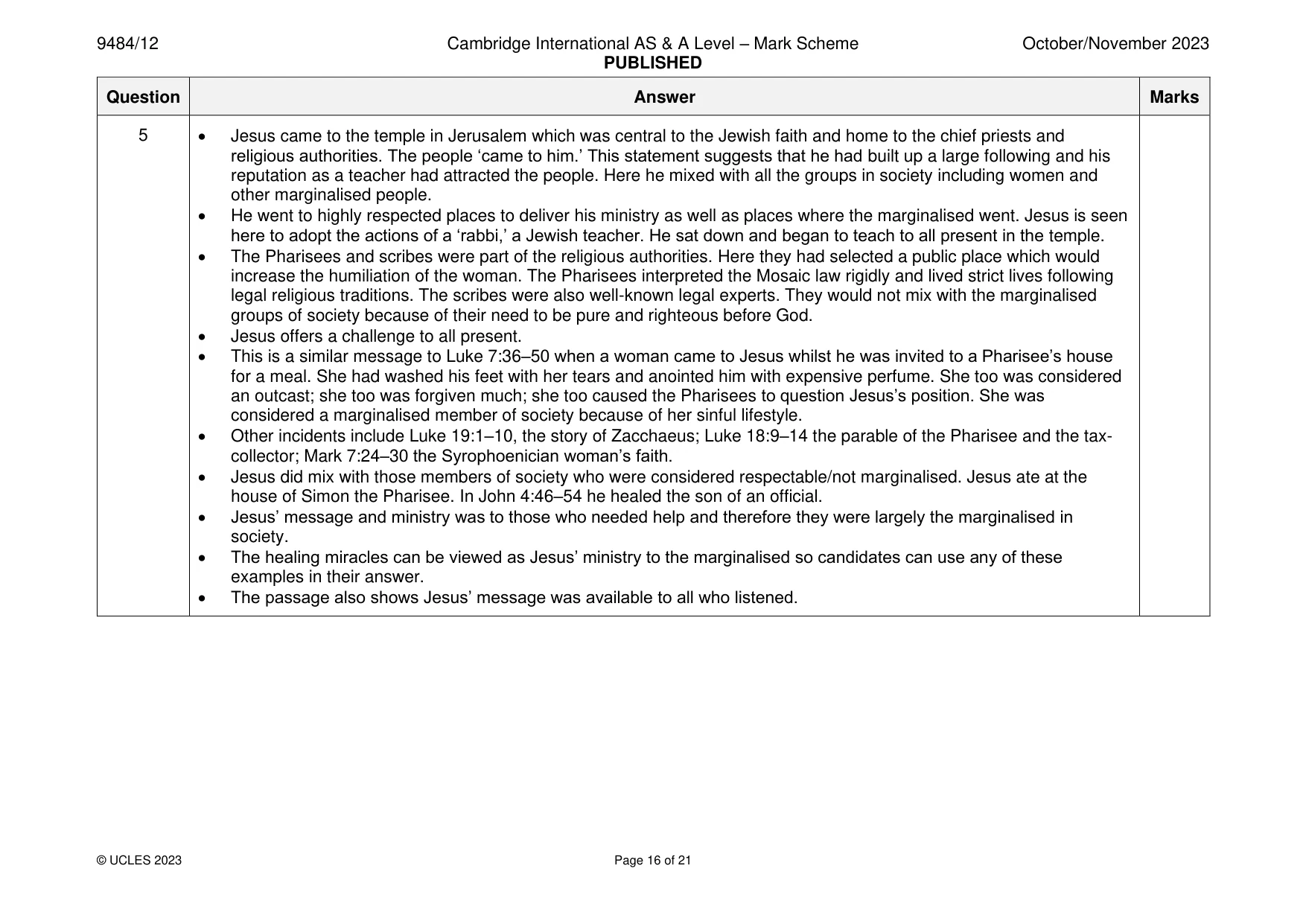
9484/12 Cambridge International AS & A Level – Mark Scheme PUBLISHED October/November 2023 © UCLES 2023 Page 16 of 21 Question Answer Marks 5 • Jesus came to the temple in Jerusalem which was central to the Jewish faith and home to the chief priests and religious authorities. The people ‘came to him.’ This statement suggests that he had built up a large following and his reputation as a teacher had attracted the people. Here he mixed with all the groups in society including women and other marginalised people. • He went to highly respected places to deliver his ministry as well as places where the marginalised went. Jesus is seen here to adopt the actions of a ‘rabbi,’ a Jewish teacher. He sat down and began to teach to all present in the temple. • The Pharisees and scribes were part of the religious authorities. Here they had selected a public place which would increase the humiliation of the woman. The Pharisees interpreted the Mosaic law rigidly and lived strict lives following legal religious traditions. The scribes were also well-known legal experts. They would not mix with the marginalised groups of society because of their need to be pure and righteous before God. • Jesus offers a challenge to all present. • This is a similar message to Luke 7:36–50 when a woman came to Jesus whilst he was invited to a Pharisee’s house for a meal. She had washed his feet with her tears and anointed him with expensive perfume. She too was considered an outcast; she too was forgiven much; she too caused the Pharisees to question Jesus’s position. She was considered a marginalised member of society because of her sinful lifestyle. • Other incidents include Luke 19:1–10, the story of Zacchaeus; Luke 18:9–14 the parable of the Pharisee and the tax- collector; Mark 7:24–30 the Syrophoenician woman’s faith. • Jesus did mix with those members of society who were considered respectable/not marginalised. Jesus ate at the house of Simon the Pharisee. In John 4:46–54 he healed the son of an official. • Jesus’ message and ministry was to those who needed help and therefore they were largely the marginalised in society. • The healing miracles can be viewed as Jesus’ ministry to the marginalised so candidates can use any of these examples in their answer. • The passage also shows Jesus’ message was available to all who listened.
Mark scheme, page 17
9484/12 Cambridge International AS & A Level – Mark Scheme PUBLISHED October/November 2023 © UCLES 2023 Page 17 of 21 Question Answer Marks EITHER 6(a) Examine the birth narratives in Matthew’s Gospel. Use Table B: AO1 Knowledge and understanding (10 marks) to mark candidate responses to this question. Award up to 10 marks. Indicative content Answers may include some of the following ideas, but all relevant material must be credited. • Matthew gives Joseph a lead role in the birth narratives unlike Luke’s narrative. • Matthew gives a lot of information about the relationship between Joseph and Mary: – they were engaged but not living together. – Joseph considered ending the relationship because Mary was pregnant, and it was not his child. – Joseph was afraid of public disgrace because of Mary’s pregnancy. • An angel of the Lord visited Joseph to explain Mary’s pregnancy and later to warn him to take Mary and the baby and flee to Egypt. • Candidates who give background information about the use of dreams and the presence of angels, as found in Jewish scripture, will be credited but this is not essential to gain high marks. • There are five references to Old Testament prophecies in Jesus’s birth stories in Matthew’s Gospel. These are known as ‘proof texts.’ They seek to use the words of the prophets to verify Jesus’ identity as the expected Messiah: 1:22–23; 2:6; 2:15; 2:18; 2:23. • These verses were deliberately chosen by Matthew to verify Jesus as the prophesied Messiah, who was expected by the Jewish people and had been prophesied by the Old Testament prophets. • Matthew includes these references to show that Jesus fulfils the goal of the Old Testament revelation of God. God revealed himself to his people through Jewish history and the prophets and now he is being revealed through Jesus. • Matthew may be defending Christianity against the claim that it had abandoned the Jewish scriptures. • Matthew included the information about the visit of the wise men (magi), first to Herod (the Great) and then to the baby. They followed a special star which signified the special nature of the child’s birth, and they offered gifts which reinforced this further. 10
Mark scheme, page 18
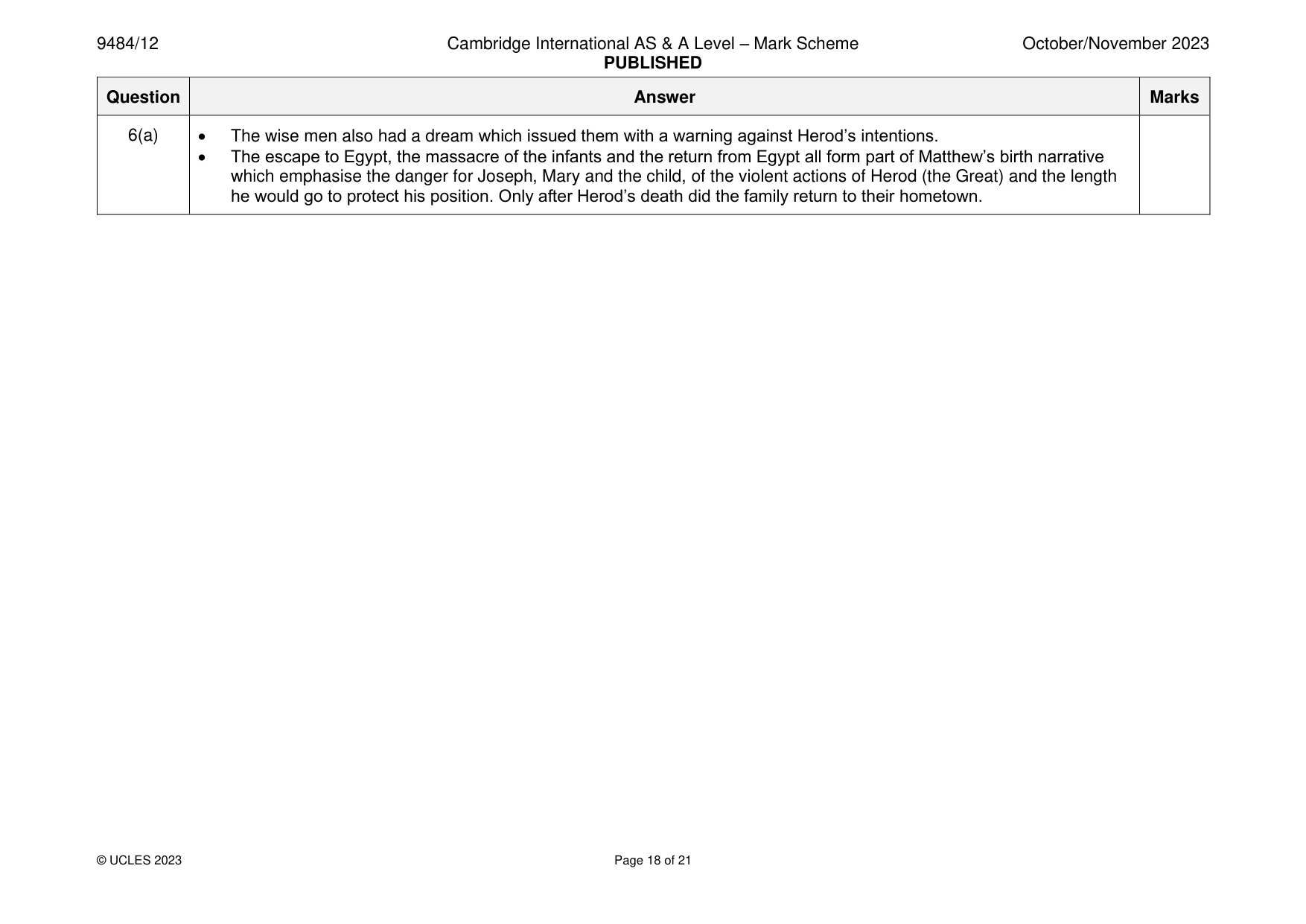
9484/12 Cambridge International AS & A Level – Mark Scheme PUBLISHED October/November 2023 © UCLES 2023 Page 18 of 21 Question Answer Marks 6(a) • The wise men also had a dream which issued them with a warning against Herod’s intentions. • The escape to Egypt, the massacre of the infants and the return from Egypt all form part of Matthew’s birth narrative which emphasise the danger for Joseph, Mary and the child, of the violent actions of Herod (the Great) and the length he would go to protect his position. Only after Herod’s death did the family return to their hometown.
Mark scheme, page 19
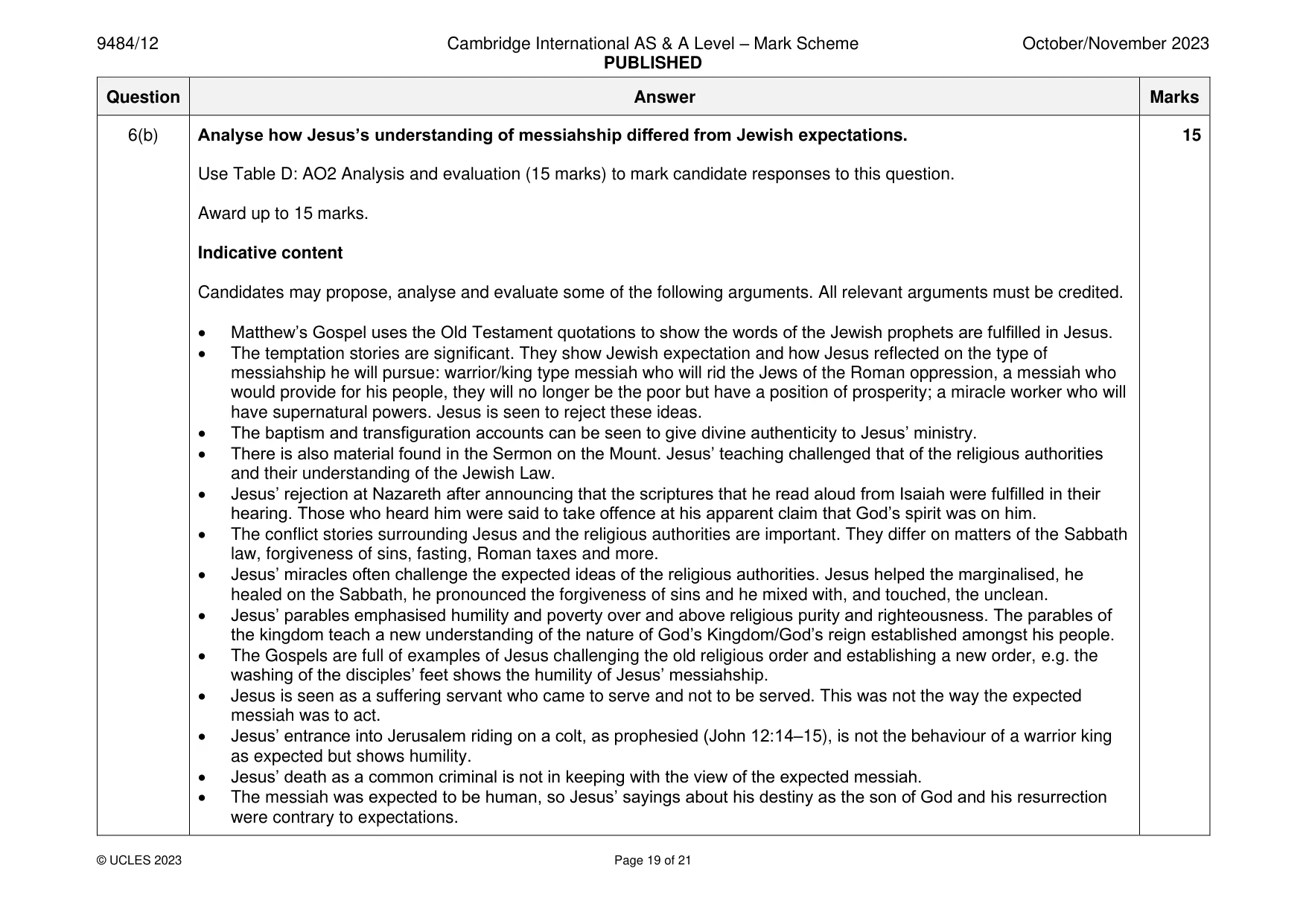
9484/12 Cambridge International AS & A Level – Mark Scheme PUBLISHED October/November 2023 © UCLES 2023 Page 19 of 21 Question Answer Marks 6(b) Analyse how Jesus’s understanding of messiahship differed from Jewish expectations. Use Table D: AO2 Analysis and evaluation (15 marks) to mark candidate responses to this question. Award up to 15 marks. Indicative content Candidates may propose, analyse and evaluate some of the following arguments. All relevant arguments must be credited. • Matthew’s Gospel uses the Old Testament quotations to show the words of the Jewish prophets are fulfilled in Jesus. • The temptation stories are significant. They show Jewish expectation and how Jesus reflected on the type of messiahship he will pursue: warrior/king type messiah who will rid the Jews of the Roman oppression, a messiah who would provide for his people, they will no longer be the poor but have a position of prosperity; a miracle worker who will have supernatural powers. Jesus is seen to reject these ideas. • The baptism and transfiguration accounts can be seen to give divine authenticity to Jesus’ ministry. • There is also material found in the Sermon on the Mount. Jesus’ teaching challenged that of the religious authorities and their understanding of the Jewish Law. • Jesus’ rejection at Nazareth after announcing that the scriptures that he read aloud from Isaiah were fulfilled in their hearing. Those who heard him were said to take offence at his apparent claim that God’s spirit was on him. • The conflict stories surrounding Jesus and the religious authorities are important. They differ on matters of the Sabbath law, forgiveness of sins, fasting, Roman taxes and more. • Jesus’ miracles often challenge the expected ideas of the religious authorities. Jesus helped the marginalised, he healed on the Sabbath, he pronounced the forgiveness of sins and he mixed with, and touched, the unclean. • Jesus’ parables emphasised humility and poverty over and above religious purity and righteousness. The parables of the kingdom teach a new understanding of the nature of God’s Kingdom/God’s reign established amongst his people. • The Gospels are full of examples of Jesus challenging the old religious order and establishing a new order, e.g. the washing of the disciples’ feet shows the humility of Jesus’ messiahship. • Jesus is seen as a suffering servant who came to serve and not to be served. This was not the way the expected messiah was to act. • Jesus’ entrance into Jerusalem riding on a colt, as prophesied (John 12:14–15), is not the behaviour of a warrior king as expected but shows humility. • Jesus’ death as a common criminal is not in keeping with the view of the expected messiah. • The messiah was expected to be human, so Jesus’ sayings about his destiny as the son of God and his resurrection were contrary to expectations. 15
Mark scheme, page 20
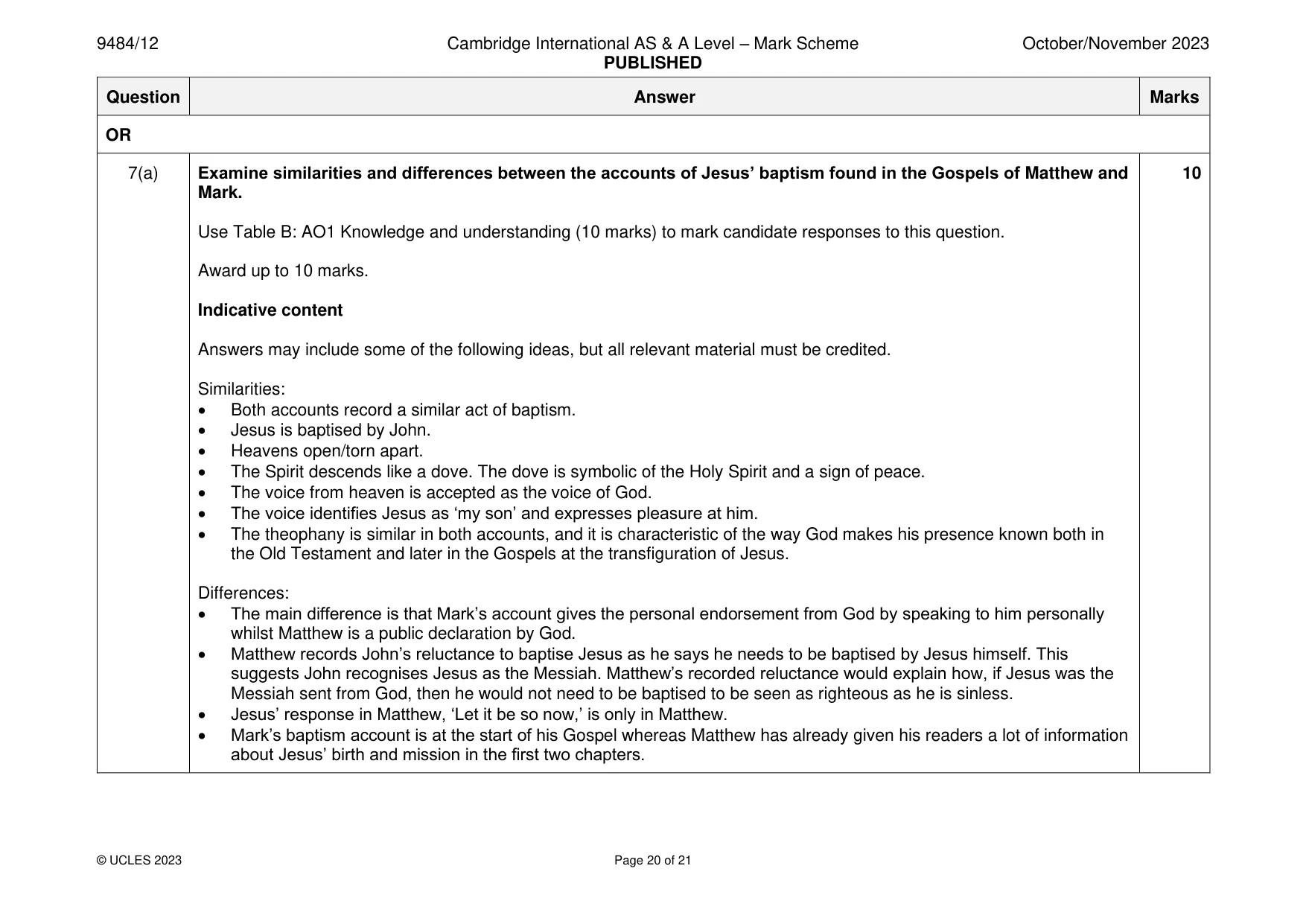
9484/12 Cambridge International AS & A Level – Mark Scheme PUBLISHED October/November 2023 © UCLES 2023 Page 20 of 21 Question Answer Marks OR 7(a) Examine similarities and differences between the accounts of Jesus’ baptism found in the Gospels of Matthew and Mark. Use Table B: AO1 Knowledge and understanding (10 marks) to mark candidate responses to this question. Award up to 10 marks. Indicative content Answers may include some of the following ideas, but all relevant material must be credited. Similarities: • Both accounts record a similar act of baptism. • Jesus is baptised by John. • Heavens open/torn apart. • The Spirit descends like a dove. The dove is symbolic of the Holy Spirit and a sign of peace. • The voice from heaven is accepted as the voice of God. • The voice identifies Jesus as ‘my son’ and expresses pleasure at him. • The theophany is similar in both accounts, and it is characteristic of the way God makes his presence known both in the Old Testament and later in the Gospels at the transfiguration of Jesus. Differences: • The main difference is that Mark’s account gives the personal endorsement from God by speaking to him personally whilst Matthew is a public declaration by God. • Matthew records John’s reluctance to baptise Jesus as he says he needs to be baptised by Jesus himself. This suggests John recognises Jesus as the Messiah. Matthew’s recorded reluctance would explain how, if Jesus was the Messiah sent from God, then he would not need to be baptised to be seen as righteous as he is sinless. • Jesus’ response in Matthew, ‘Let it be so now,’ is only in Matthew. • Mark’s baptism account is at the start of his Gospel whereas Matthew has already given his readers a lot of information about Jesus’ birth and mission in the first two chapters. 10
Mark scheme, page 21
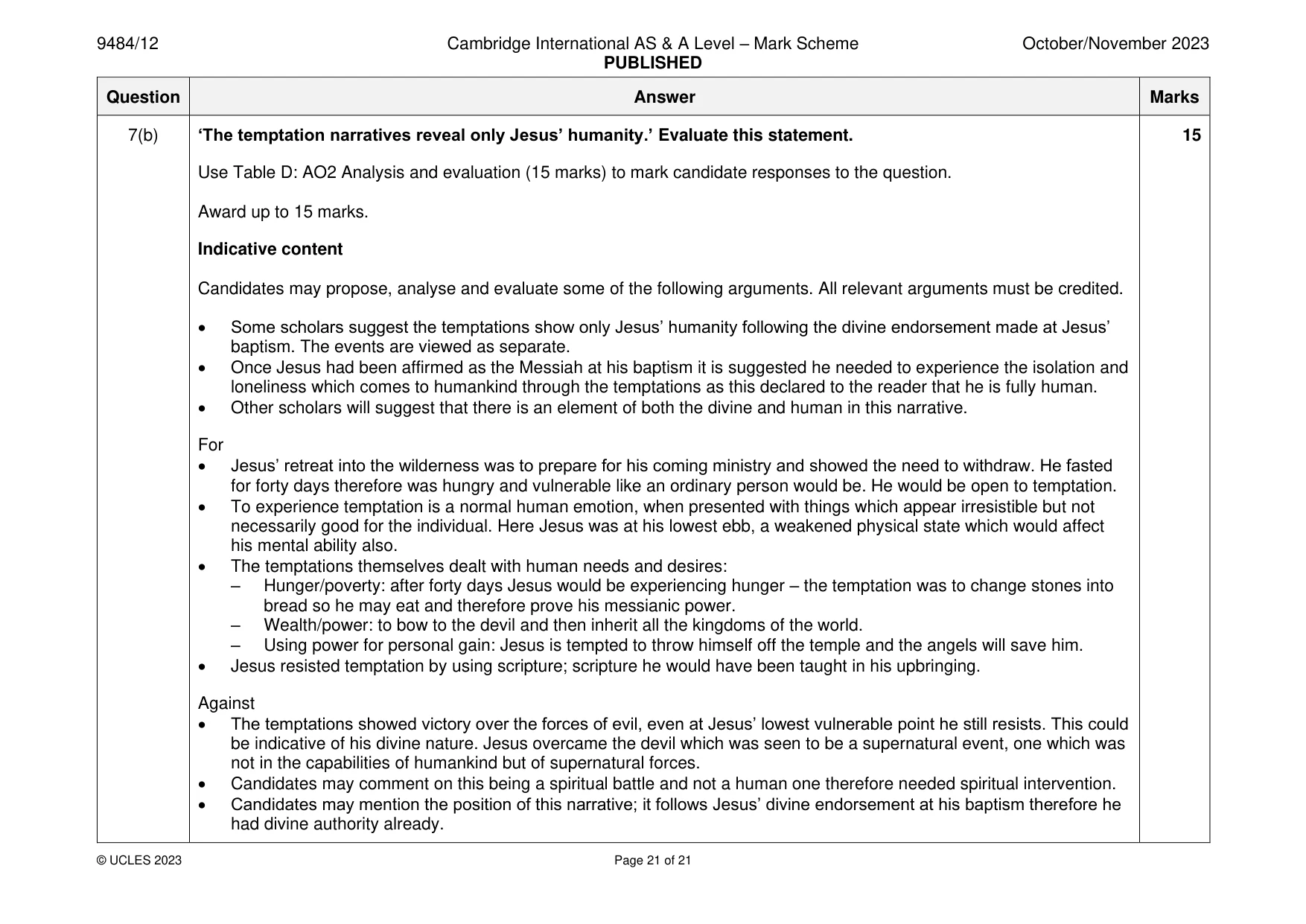
9484/12 Cambridge International AS & A Level – Mark Scheme PUBLISHED October/November 2023 © UCLES 2023 Page 21 of 21 Question Answer Marks 7(b) ‘The temptation narratives reveal only Jesus’ humanity.’ Evaluate this statement. Use Table D: AO2 Analysis and evaluation (15 marks) to mark candidate responses to the question. Award up to 15 marks. Indicative content Candidates may propose, analyse and evaluate some of the following arguments. All relevant arguments must be credited. • Some scholars suggest the temptations show only Jesus’ humanity following the divine endorsement made at Jesus’ baptism. The events are viewed as separate. • Once Jesus had been affirmed as the Messiah at his baptism it is suggested he needed to experience the isolation and loneliness which comes to humankind through the temptations as this declared to the reader that he is fully human. • Other scholars will suggest that there is an element of both the divine and human in this narrative. For • Jesus’ retreat into the wilderness was to prepare for his coming ministry and showed the need to withdraw. He fasted for forty days therefore was hungry and vulnerable like an ordinary person would be. He would be open to temptation. • To experience temptation is a normal human emotion, when presented with things which appear irresistible but not necessarily good for the individual. Here Jesus was at his lowest ebb, a weakened physical state which would affect his mental ability also. • The temptations themselves dealt with human needs and desires: – Hunger/poverty: after forty days Jesus would be experiencing hunger – the temptation was to change stones into bread so he may eat and therefore prove his messianic power. – Wealth/power: to bow to the devil and then inherit all the kingdoms of the world. – Using power for personal gain: Jesus is tempted to throw himself off the temple and the angels will save him. • Jesus resisted temptation by using scripture; scripture he would have been taught in his upbringing. Against • The temptations showed victory over the forces of evil, even at Jesus’ lowest vulnerable point he still resists. This could be indicative of his divine nature. Jesus overcame the devil which was seen to be a supernatural event, one which was not in the capabilities of humankind but of supernatural forces. • Candidates may comment on this being a spiritual battle and not a human one therefore needed spiritual intervention. • Candidates may mention the position of this narrative; it follows Jesus’ divine endorsement at his baptism therefore he had divine authority already. 15
What you needed in this session
Cambridge’s own grade thresholds for 2023 Oct/Nov, Paper 1 · Variant 2. A higher threshold means an easier paper — the bar moves with how the cohort did.