Cambridge A Level Applied Information and Communication Technology 9713 — 2014 Oct/Nov Paper 3 · Variant 2
9713/32/O/N/14 · 80 marks · ≈90 min
The question paper and its mark scheme, free to read here and free to download. This is Cambridge’s own paper, exactly as it was sat.
Question paper16 pages




Mark scheme7 pages
Answers below. Sit the paper first if you are practising.
Paper as text
Question paper, page 1
This document consists of 14 printed pages and 2 blank pages. DC (NF) 100063 © UCLES 2014 [Turn over * 7 4 5 6 6 5 1 1 4 7 * APPLIED INFORMATION AND COMMUNICATION TECHNOLOGY 9713/32 Paper 3 October/November 2014 1 hour 15 minutes Candidates answer on the Question Paper. No additional materials are required. READ THESE INSTRUCTIONS FIRST Write your Centre number, candidate number and name on all the work you hand in. Write in dark blue or black pen. Do not use staples, paper clips, glue or correction fluid. You may use an HB pencil for any diagrams, graphs or rough working. DO NOT WRITE IN ANY BARCODES. Answer all questions. The number of marks is given in brackets [ ] at the end of each question or part question. The businesses described in this paper are entirely fictitious. Cambridge International Examinations Cambridge International Advanced Level
Question paper, page 2
2 9713/32/O/N/14 © UCLES 2014 Scenario 1 Questions 1, 2, 3, 4 and 5 International Exploration & Mining (IEM) is a multi-national company specialising in mineral prospecting. Fergal is employed by the company as an inspector to visit and inspect geological sites in search of deposits of mineral ores. Fergal takes a laptop computer when visiting a potential site and uses it to record his findings. IEM has created an expert system for use by their inspectors and geologists who can access it using the Internet and the company network. He uses his own knowledge and the company’s expert system to predict the likelihood of a particular mineral ore being found in the location. Fergal connects the laptop to the company network using the Internet to send back his findings and to keep in regular contact with the company and other inspectors. The company also uses Fergal’s findings and those of its other inspectors and geologists to construct computer models to predict where mineral ore deposits might be found.
Question paper, page 3
3 9713/32/O/N/14 © UCLES 2014 [Turn over 1 (a) Describe how the facts in the knowledge base of the company’s expert system would have been obtained. … … … … … … … …[4] (b) Give two examples of the input data that would be needed from Fergal for use by the company’s expert system. 1 … … 2 … …[2]
Question paper, page 4
4 9713/32/O/N/14 © UCLES 2014 2 Discuss the advantages and disadvantages to the inspectors of using an expert system for mineral prospecting. … … … … … … … … … … … … … … … … … … … … … … … …[8]
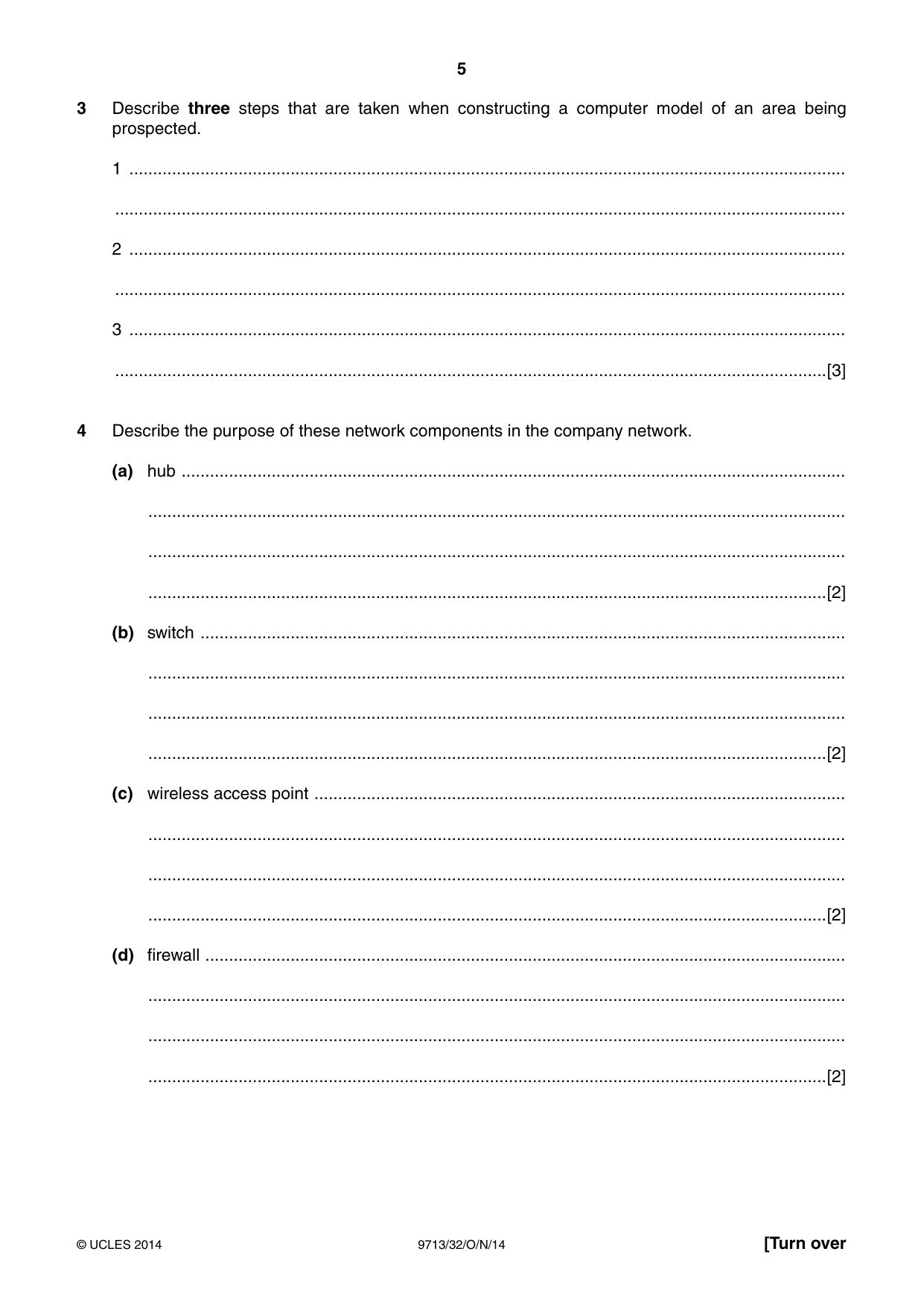
Question paper, page 5
5 9713/32/O/N/14 © UCLES 2014 [Turn over 3 Describe three steps that are taken when constructing a computer model of an area being prospected. 1 … … 2 … … 3 … …[3] 4 Describe the purpose of these network components in the company network. (a) hub … … … …[2] (b) switch … … … …[2] (c) wireless access point … … … …[2] (d) firewall … … … …[2]
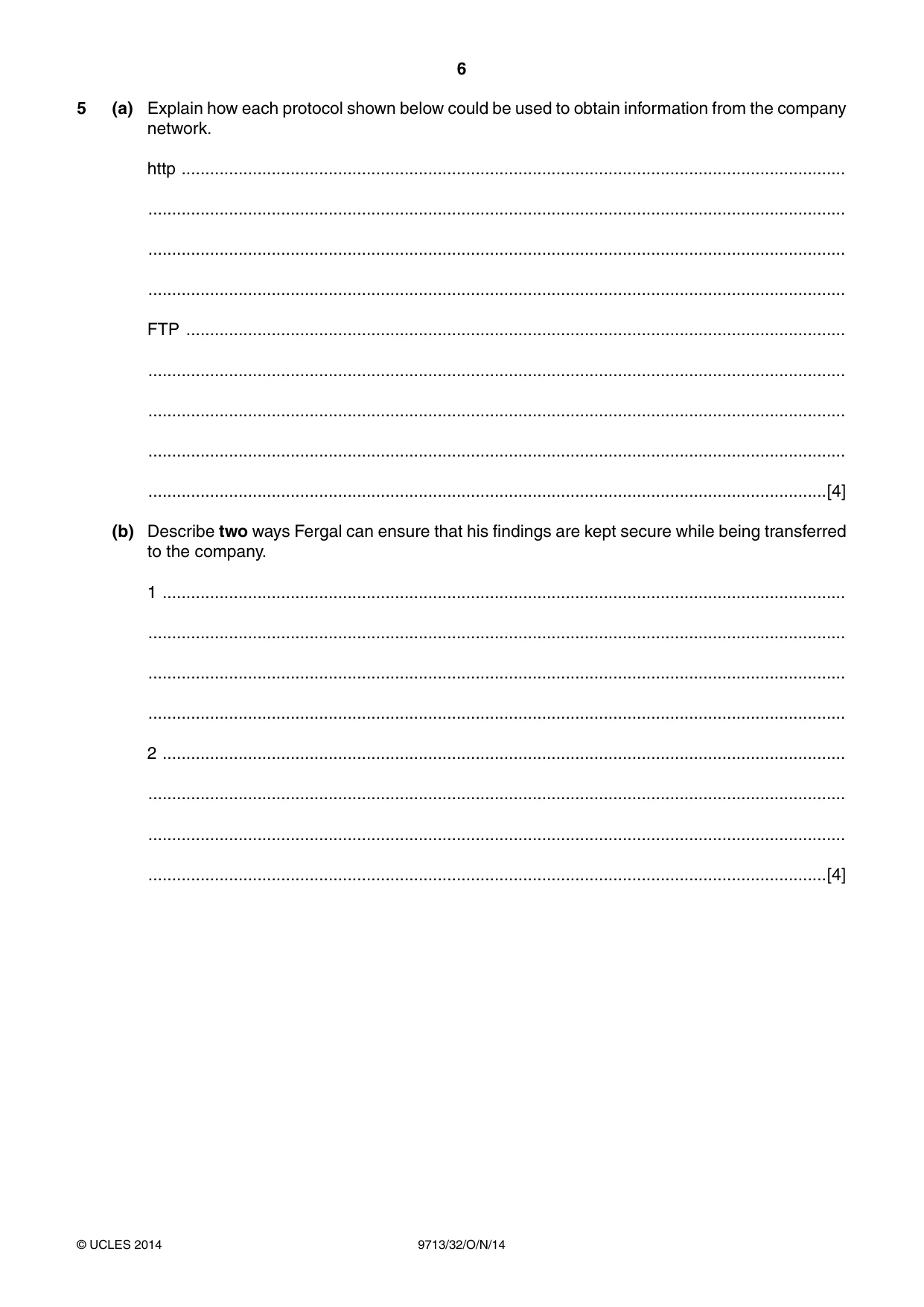
Question paper, page 6
6 9713/32/O/N/14 © UCLES 2014 5 (a) Explain how each protocol shown below could be used to obtain information from the company network. http … … … … FTP … … … … …[4] (b) Describe two ways Fergal can ensure that his findings are kept secure while being transferred to the company. 1 … … … … 2 … … … …[4]
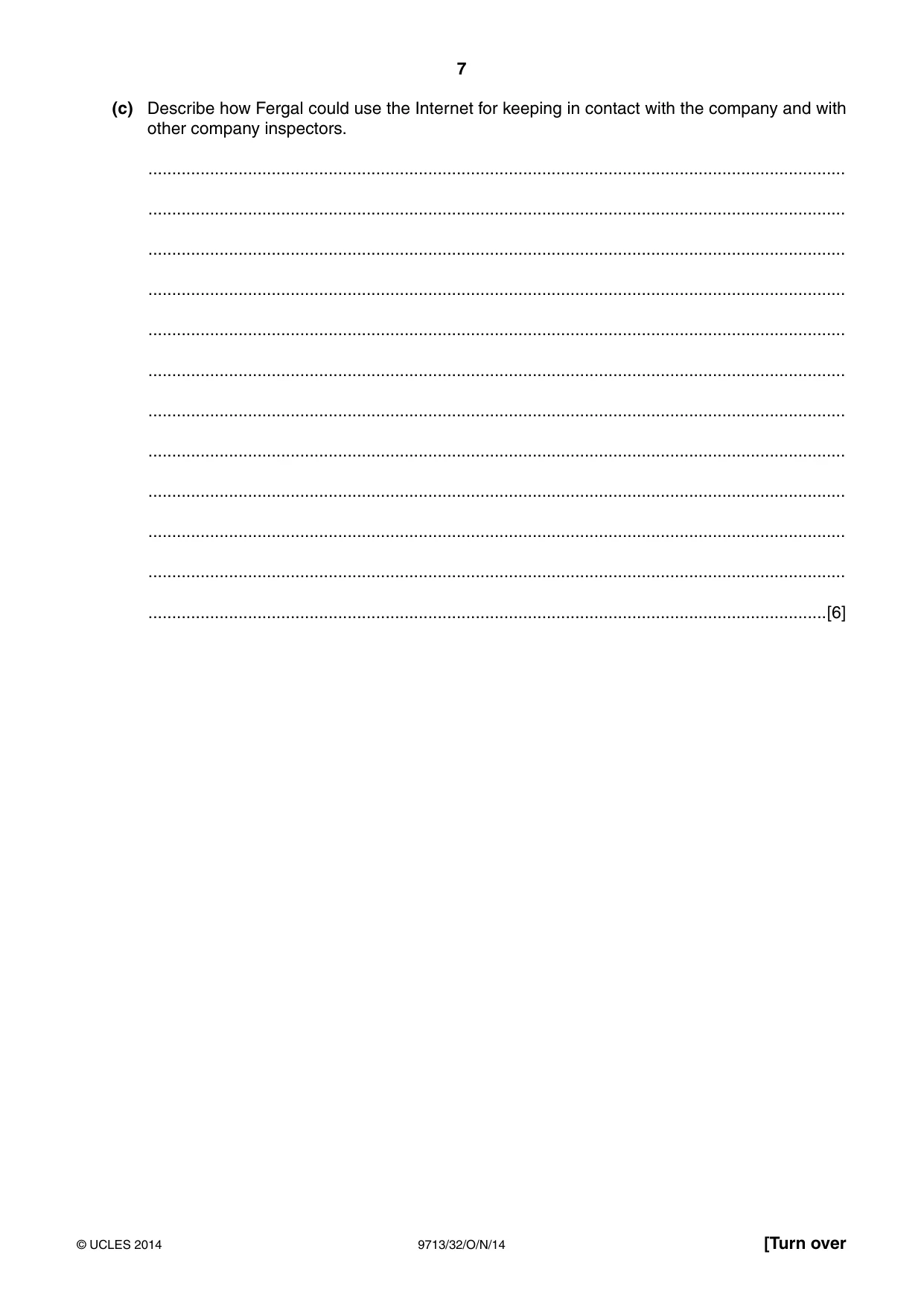
Question paper, page 7
7 9713/32/O/N/14 © UCLES 2014 [Turn over (c) Describe how Fergal could use the Internet for keeping in contact with the company and with other company inspectors. … … … … … … … … … … … …[6]
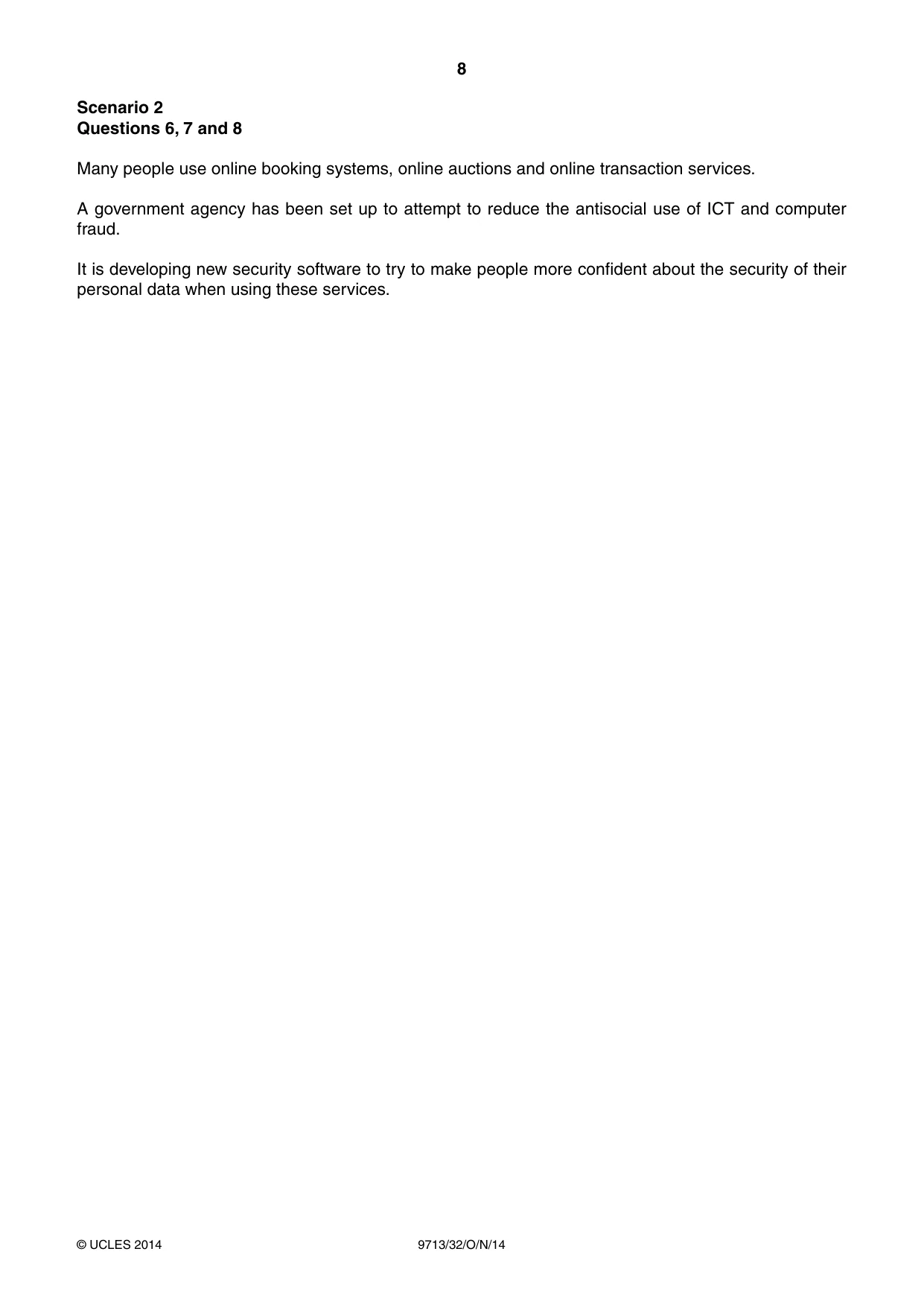
Question paper, page 8
8 9713/32/O/N/14 © UCLES 2014 Scenario 2 Questions 6, 7 and 8 Many people use online booking systems, online auctions and online transaction services. A government agency has been set up to attempt to reduce the antisocial use of ICT and computer fraud. It is developing new security software to try to make people more confident about the security of their personal data when using these services.
Question paper, page 9
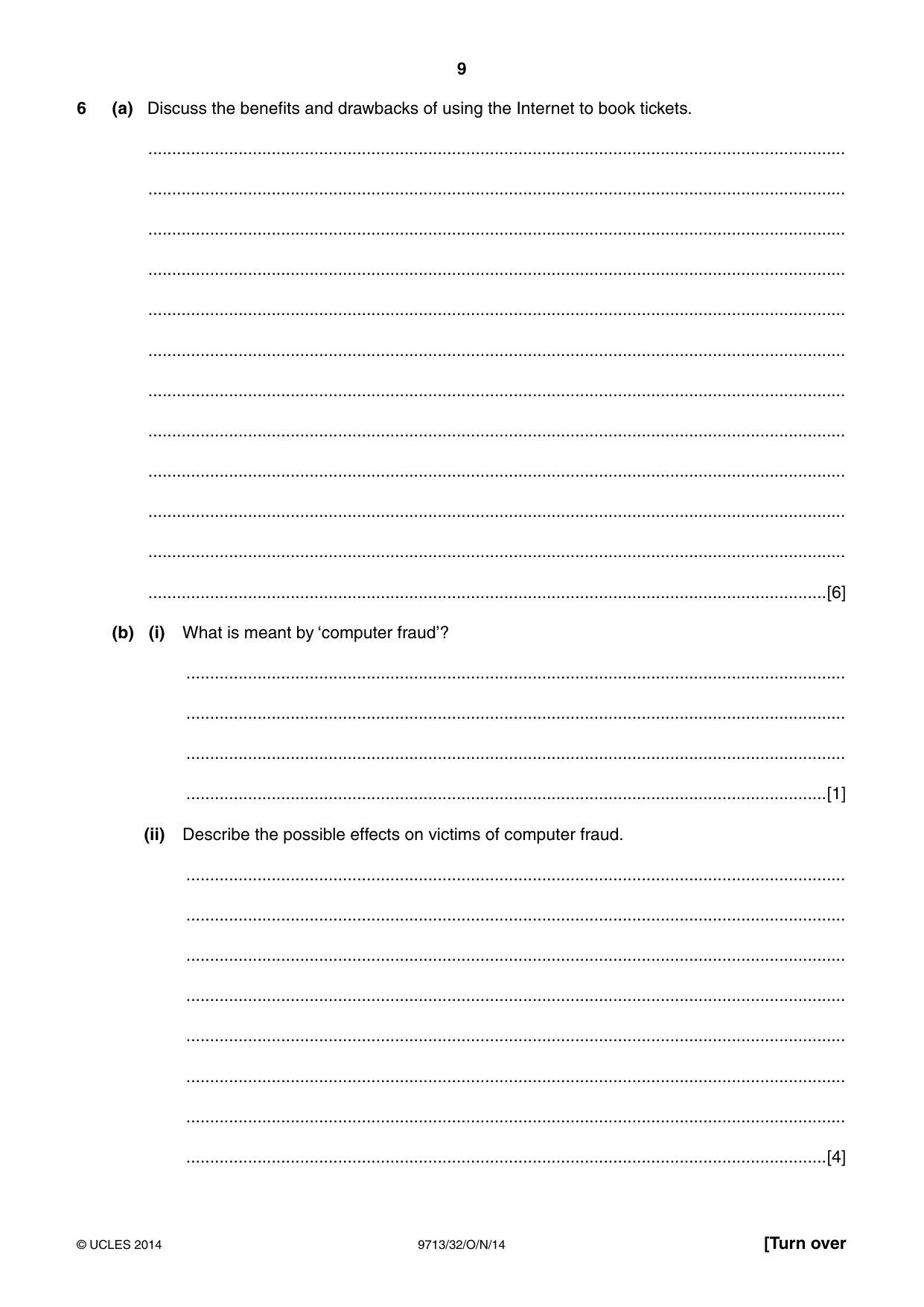
9 9713/32/O/N/14 © UCLES 2014 [Turn over 6 (a) Discuss the benefits and drawbacks of using the Internet to book tickets. … … … … … … … … … … … …[6] (b) (i) What is meant by ‘computer fraud’? … … … …[1] (ii) Describe the possible effects on victims of computer fraud. … … … … … … … …[4]
Question paper, page 10
10 9713/32/O/N/14 © UCLES 2014 7 Describe, with examples, what is meant by ‘antisocial use of ICT’. … … … … … … … … … … … … … … … … … … … … … … … …[8]
Question paper, page 11
11 9713/32/O/N/14 © UCLES 2014 [Turn over 8 Describe how timeline software would help the agency when creating its new security software. … … … …[2]
Question paper, page 12
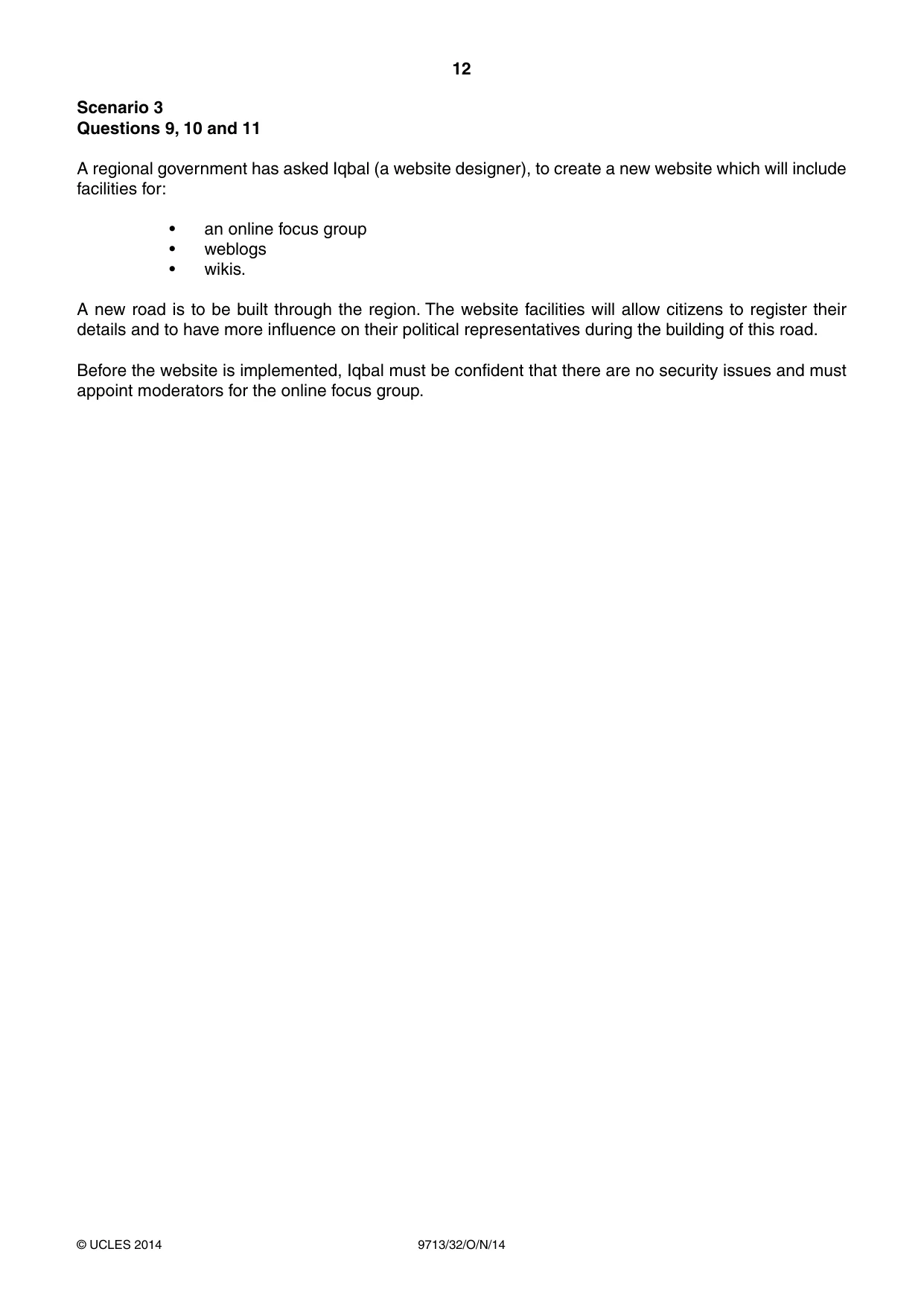
12 9713/32/O/N/14 © UCLES 2014 Scenario 3 Questions 9, 10 and 11 A regional government has asked Iqbal (a website designer), to create a new website which will include facilities for: • an online focus group • weblogs • wikis. A new road is to be built through the region. The website facilities will allow citizens to register their details and to have more influence on their political representatives during the building of this road. Before the website is implemented, Iqbal must be confident that there are no security issues and must appoint moderators for the online focus group.
Question paper, page 13
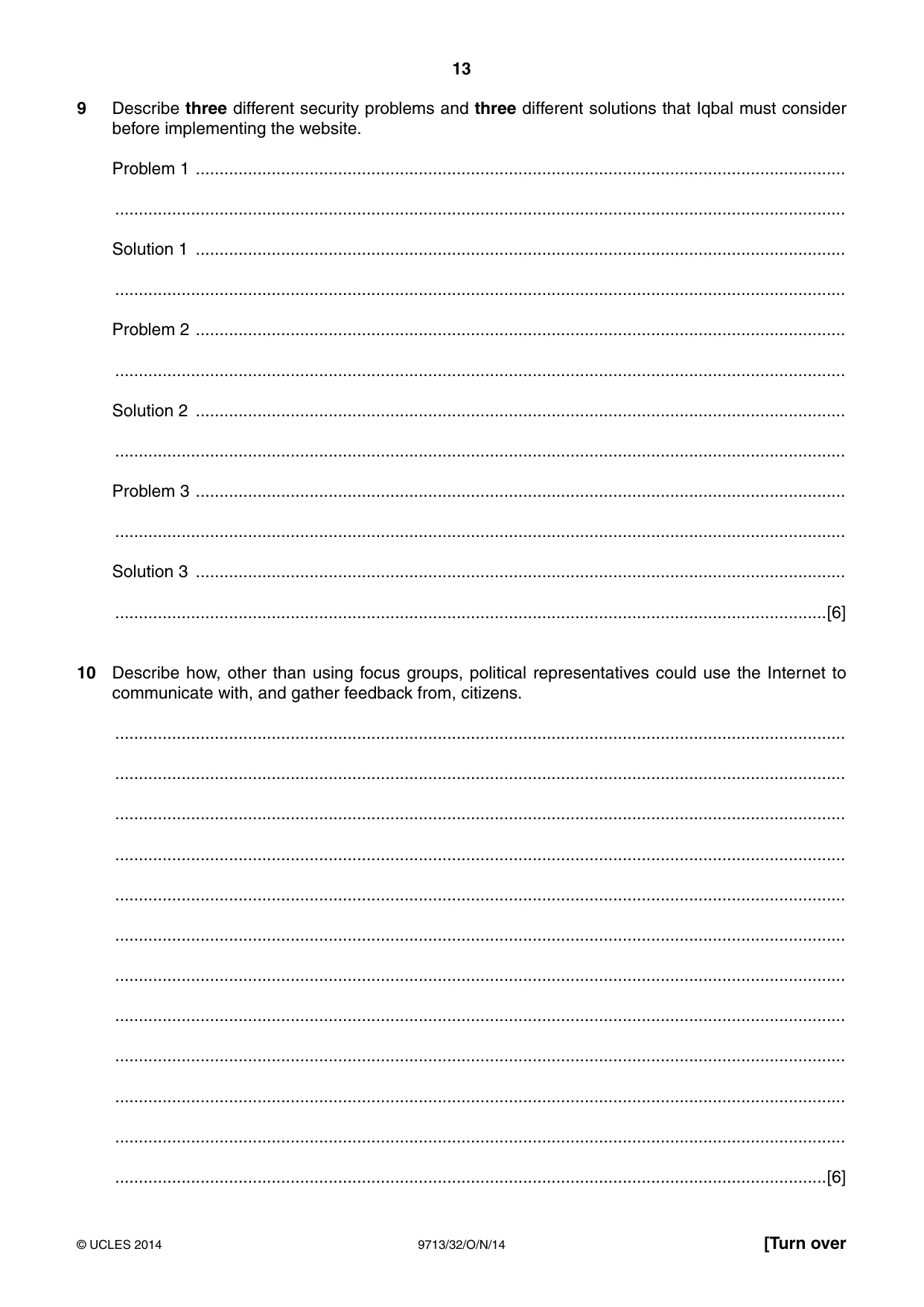
13 9713/32/O/N/14 © UCLES 2014 [Turn over 9 Describe three different security problems and three different solutions that Iqbal must consider before implementing the website. Problem 1 … … Solution 1 … … Problem 2 … … Solution 2 … … Problem 3 … … Solution 3 … …[6] 10 Describe how, other than using focus groups, political representatives could use the Internet to communicate with, and gather feedback from, citizens. … … … … … … … … … … … …[6]
Question paper, page 14
14 9713/32/O/N/14 © UCLES 2014 11 Iqbal will also organise an online focus group to discuss the building of the new road. (a) Describe how an online focus group could be organised. … … … …[2] (b) Discuss the advantages and disadvantages of using an online focus group to find out what people think about the plans for the road. … … … … … … … … … … … …[6]
Question paper, page 15
15 9713/32/O/N/14 © UCLES 2014 BLANK PAGE
Question paper, page 16
16 9713/32/O/N/14 © UCLES 2014 BLANK PAGE Permission to reproduce items where third-party owned material protected by copyright is included has been sought and cleared where possible. Every reasonable effort has been made by the publisher (UCLES) to trace copyright holders, but if any items requiring clearance have unwittingly been included, the publisher will be pleased to make amends at the earliest possible opportunity. Cambridge International Examinations is part of the Cambridge Assessment Group. Cambridge Assessment is the brand name of University of Cambridge Local Examinations Syndicate (UCLES), which is itself a department of the University of Cambridge.
Mark scheme, page 1
® IGCSE is the registered trademark of Cambridge International Examinations. CAMBRIDGE INTERNATIONAL EXAMINATIONS Cambridge International Advanced Subsidiary and Advanced Level MARK SCHEME for the October/November 2014 series 9713 APPLIED INFORMATION AND COMMUNICATION TECHNOLOGY 9713/32 Paper 3 (Written B), maximum raw mark 80 This mark scheme is published as an aid to teachers and candidates, to indicate the requirements of the examination. It shows the basis on which Examiners were instructed to award marks. It does not indicate the details of the discussions that took place at an Examiners’ meeting before marking began, which would have considered the acceptability of alternative answers. Mark schemes should be read in conjunction with the question paper and the Principal Examiner Report for Teachers. Cambridge will not enter into discussions about these mark schemes. Cambridge is publishing the mark schemes for the October/November 2014 series for most Cambridge IGCSE®, Cambridge International A and AS Level components and some Cambridge O Level components.
Mark scheme, page 2
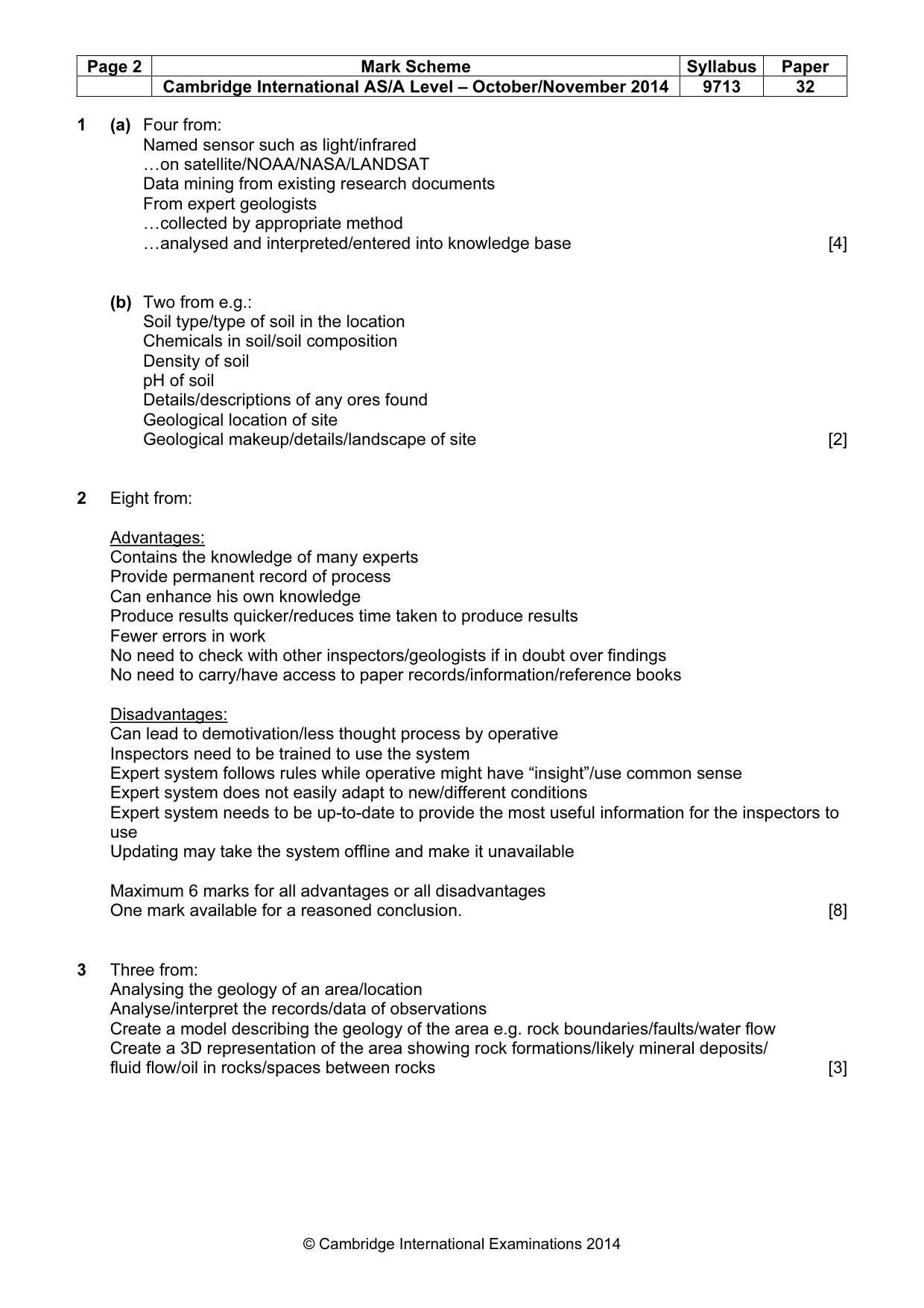
Page 2 Mark Scheme Syllabus Paper Cambridge International AS/A Level – October/November 2014 9713 32 © Cambridge International Examinations 2014 1 (a) Four from: Named sensor such as light/infrared …on satellite/NOAA/NASA/LANDSAT Data mining from existing research documents From expert geologists …collected by appropriate method …analysed and interpreted/entered into knowledge base [4] (b) Two from e.g.: Soil type/type of soil in the location Chemicals in soil/soil composition Density of soil pH of soil Details/descriptions of any ores found Geological location of site Geological makeup/details/landscape of site [2] 2 Eight from: Advantages: Contains the knowledge of many experts Provide permanent record of process Can enhance his own knowledge Produce results quicker/reduces time taken to produce results Fewer errors in work No need to check with other inspectors/geologists if in doubt over findings No need to carry/have access to paper records/information/reference books Disadvantages: Can lead to demotivation/less thought process by operative Inspectors need to be trained to use the system Expert system follows rules while operative might have “insight”/use common sense Expert system does not easily adapt to new/different conditions Expert system needs to be up-to-date to provide the most useful information for the inspectors to use Updating may take the system offline and make it unavailable Maximum 6 marks for all advantages or all disadvantages One mark available for a reasoned conclusion. [8] 3 Three from: Analysing the geology of an area/location Analyse/interpret the records/data of observations Create a model describing the geology of the area e.g. rock boundaries/faults/water flow Create a 3D representation of the area showing rock formations/likely mineral deposits/ fluid flow/oil in rocks/spaces between rocks [3]
Mark scheme, page 3
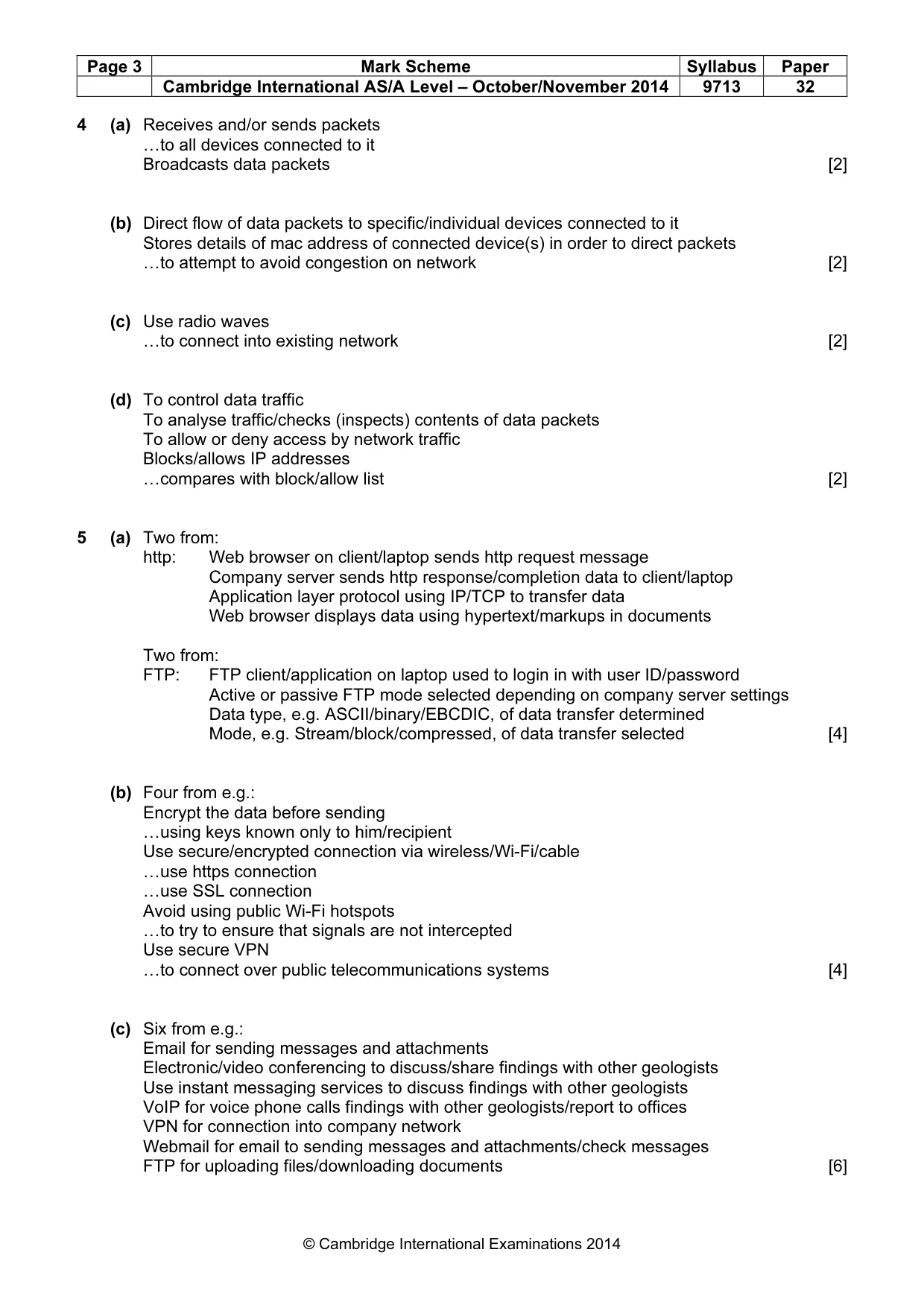
Page 3 Mark Scheme Syllabus Paper Cambridge International AS/A Level – October/November 2014 9713 32 © Cambridge International Examinations 2014 4 (a) Receives and/or sends packets …to all devices connected to it Broadcasts data packets [2] (b) Direct flow of data packets to specific/individual devices connected to it Stores details of mac address of connected device(s) in order to direct packets …to attempt to avoid congestion on network [2] (c) Use radio waves …to connect into existing network [2] (d) To control data traffic To analyse traffic/checks (inspects) contents of data packets To allow or deny access by network traffic Blocks/allows IP addresses …compares with block/allow list [2] 5 (a) Two from: http: Web browser on client/laptop sends http request message Company server sends http response/completion data to client/laptop Application layer protocol using IP/TCP to transfer data Web browser displays data using hypertext/markups in documents Two from: FTP: FTP client/application on laptop used to login in with user ID/password Active or passive FTP mode selected depending on company server settings Data type, e.g. ASCII/binary/EBCDIC, of data transfer determined Mode, e.g. Stream/block/compressed, of data transfer selected [4] (b) Four from e.g.: Encrypt the data before sending …using keys known only to him/recipient Use secure/encrypted connection via wireless/Wi-Fi/cable …use https connection …use SSL connection Avoid using public Wi-Fi hotspots …to try to ensure that signals are not intercepted Use secure VPN …to connect over public telecommunications systems [4] (c) Six from e.g.: Email for sending messages and attachments Electronic/video conferencing to discuss/share findings with other geologists Use instant messaging services to discuss findings with other geologists VoIP for voice phone calls findings with other geologists/report to offices VPN for connection into company network Webmail for email to sending messages and attachments/check messages FTP for uploading files/downloading documents [6]
Mark scheme, page 4
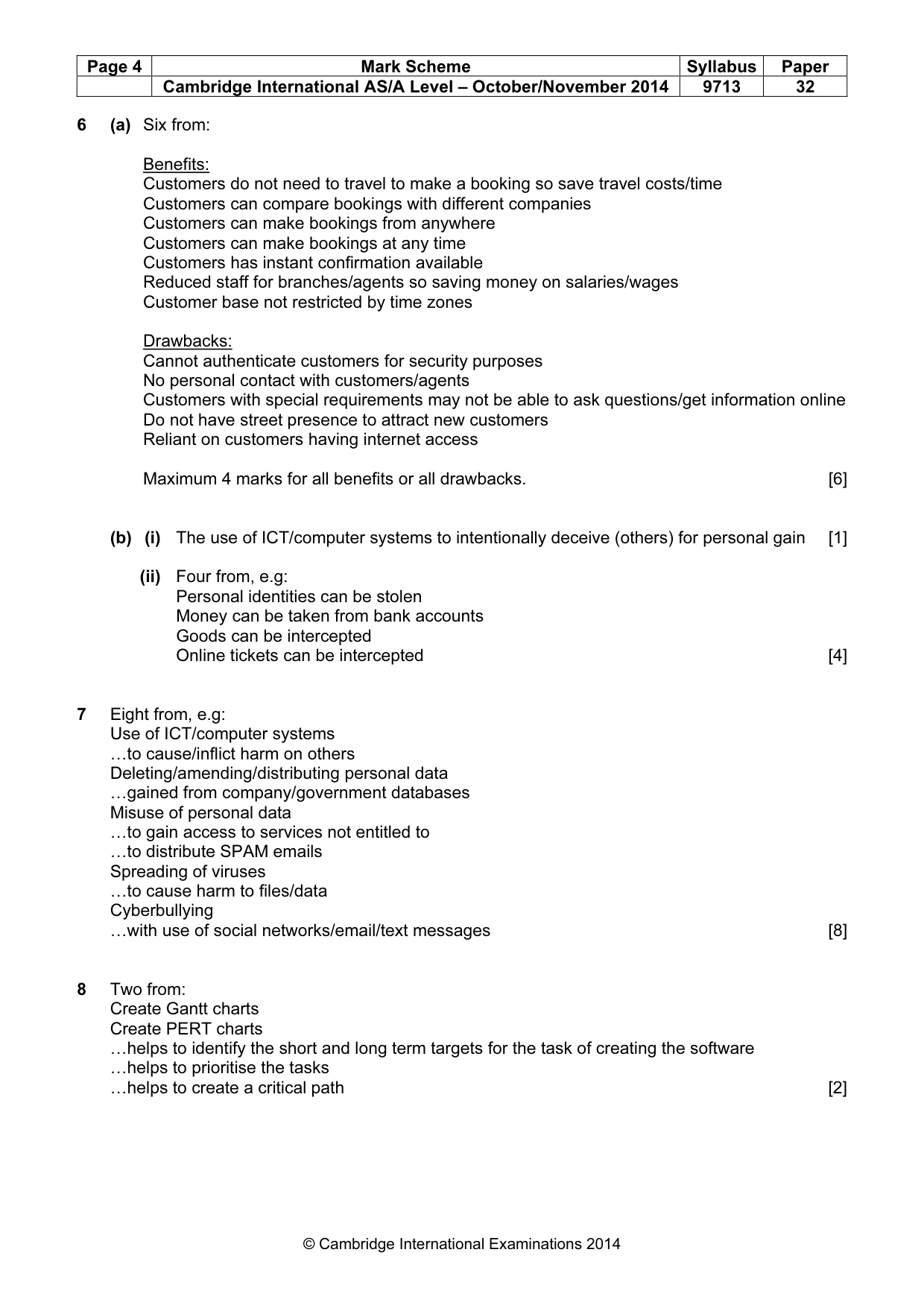
Page 4 Mark Scheme Syllabus Paper Cambridge International AS/A Level – October/November 2014 9713 32 © Cambridge International Examinations 2014 6 (a) Six from: Benefits: Customers do not need to travel to make a booking so save travel costs/time Customers can compare bookings with different companies Customers can make bookings from anywhere Customers can make bookings at any time Customers has instant confirmation available Reduced staff for branches/agents so saving money on salaries/wages Customer base not restricted by time zones Drawbacks: Cannot authenticate customers for security purposes No personal contact with customers/agents Customers with special requirements may not be able to ask questions/get information online Do not have street presence to attract new customers Reliant on customers having internet access Maximum 4 marks for all benefits or all drawbacks. [6] (b) (i) The use of ICT/computer systems to intentionally deceive (others) for personal gain [1] (ii) Four from, e.g: Personal identities can be stolen Money can be taken from bank accounts Goods can be intercepted Online tickets can be intercepted [4] 7 Eight from, e.g: Use of ICT/computer systems …to cause/inflict harm on others Deleting/amending/distributing personal data …gained from company/government databases Misuse of personal data …to gain access to services not entitled to …to distribute SPAM emails Spreading of viruses …to cause harm to files/data Cyberbullying …with use of social networks/email/text messages [8] 8 Two from: Create Gantt charts Create PERT charts …helps to identify the short and long term targets for the task of creating the software …helps to prioritise the tasks …helps to create a critical path [2]
Mark scheme, page 5
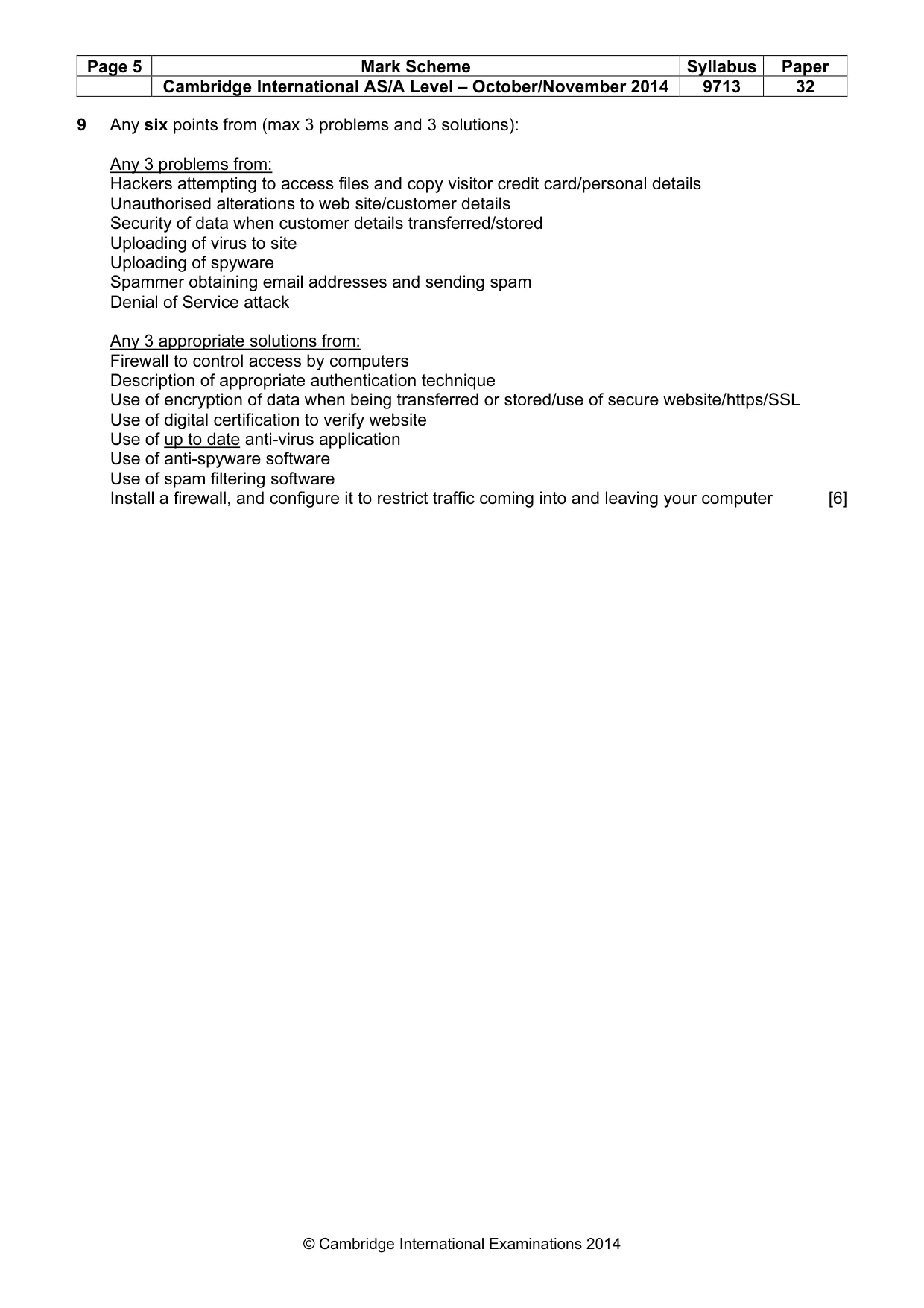
Page 5 Mark Scheme Syllabus Paper Cambridge International AS/A Level – October/November 2014 9713 32 © Cambridge International Examinations 2014 9 Any six points from (max 3 problems and 3 solutions): Any 3 problems from: Hackers attempting to access files and copy visitor credit card/personal details Unauthorised alterations to web site/customer details Security of data when customer details transferred/stored Uploading of virus to site Uploading of spyware Spammer obtaining email addresses and sending spam Denial of Service attack Any 3 appropriate solutions from: Firewall to control access by computers Description of appropriate authentication technique Use of encryption of data when being transferred or stored/use of secure website/https/SSL Use of digital certification to verify website Use of up to date anti-virus application Use of anti-spyware software Use of spam filtering software Install a firewall, and configure it to restrict traffic coming into and leaving your computer [6]
Mark scheme, page 6
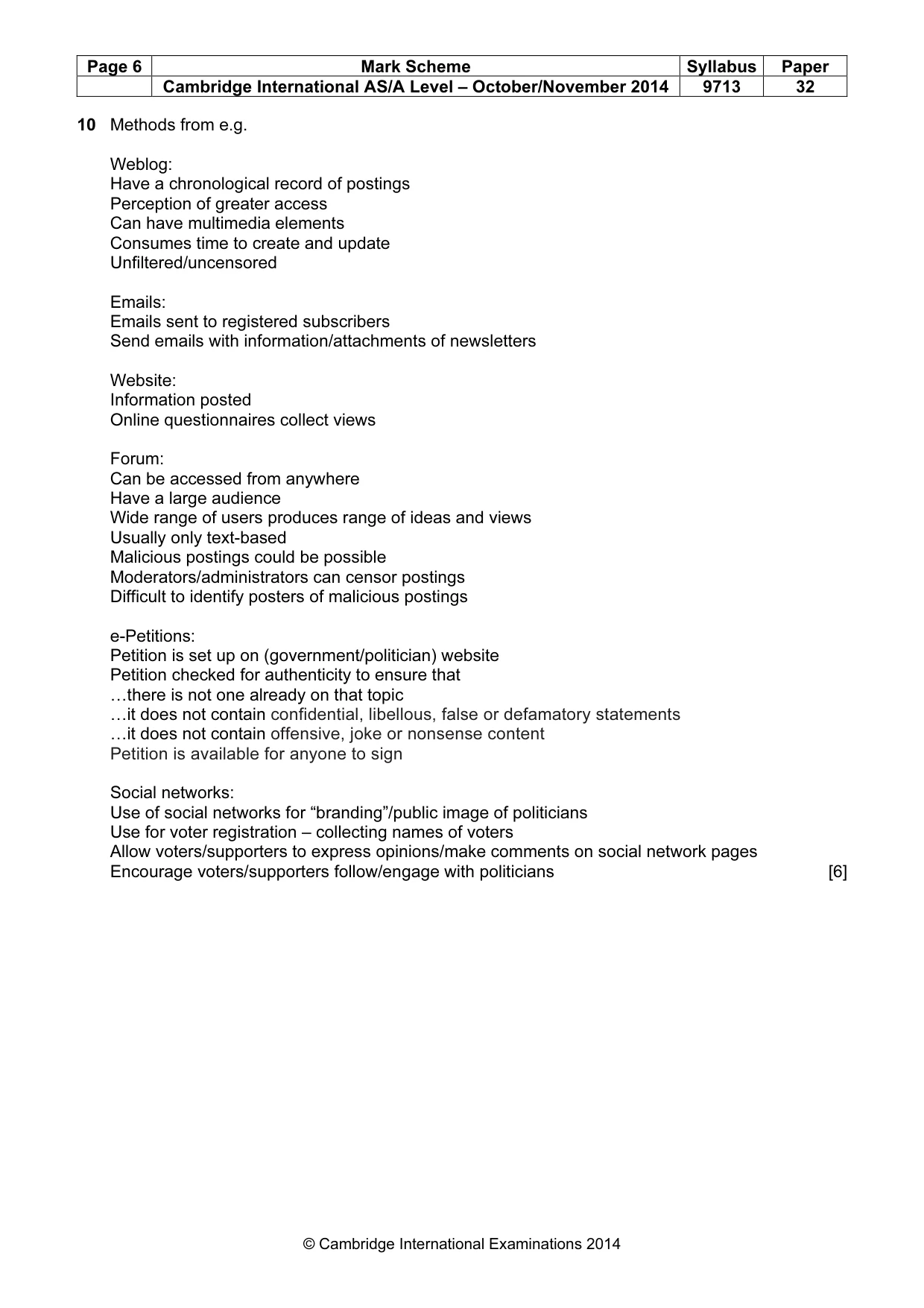
Page 6 Mark Scheme Syllabus Paper Cambridge International AS/A Level – October/November 2014 9713 32 © Cambridge International Examinations 2014 10 Methods from e.g. Weblog: Have a chronological record of postings Perception of greater access Can have multimedia elements Consumes time to create and update Unfiltered/uncensored Emails: Emails sent to registered subscribers Send emails with information/attachments of newsletters Website: Information posted Online questionnaires collect views Forum: Can be accessed from anywhere Have a large audience Wide range of users produces range of ideas and views Usually only text-based Malicious postings could be possible Moderators/administrators can censor postings Difficult to identify posters of malicious postings e-Petitions: Petition is set up on (government/politician) website Petition checked for authenticity to ensure that …there is not one already on that topic …it does not contain confidential, libellous, false or defamatory statements …it does not contain offensive, joke or nonsense content Petition is available for anyone to sign Social networks: Use of social networks for “branding”/public image of politicians Use for voter registration – collecting names of voters Allow voters/supporters to express opinions/make comments on social network pages Encourage voters/supporters follow/engage with politicians [6]
Mark scheme, page 7
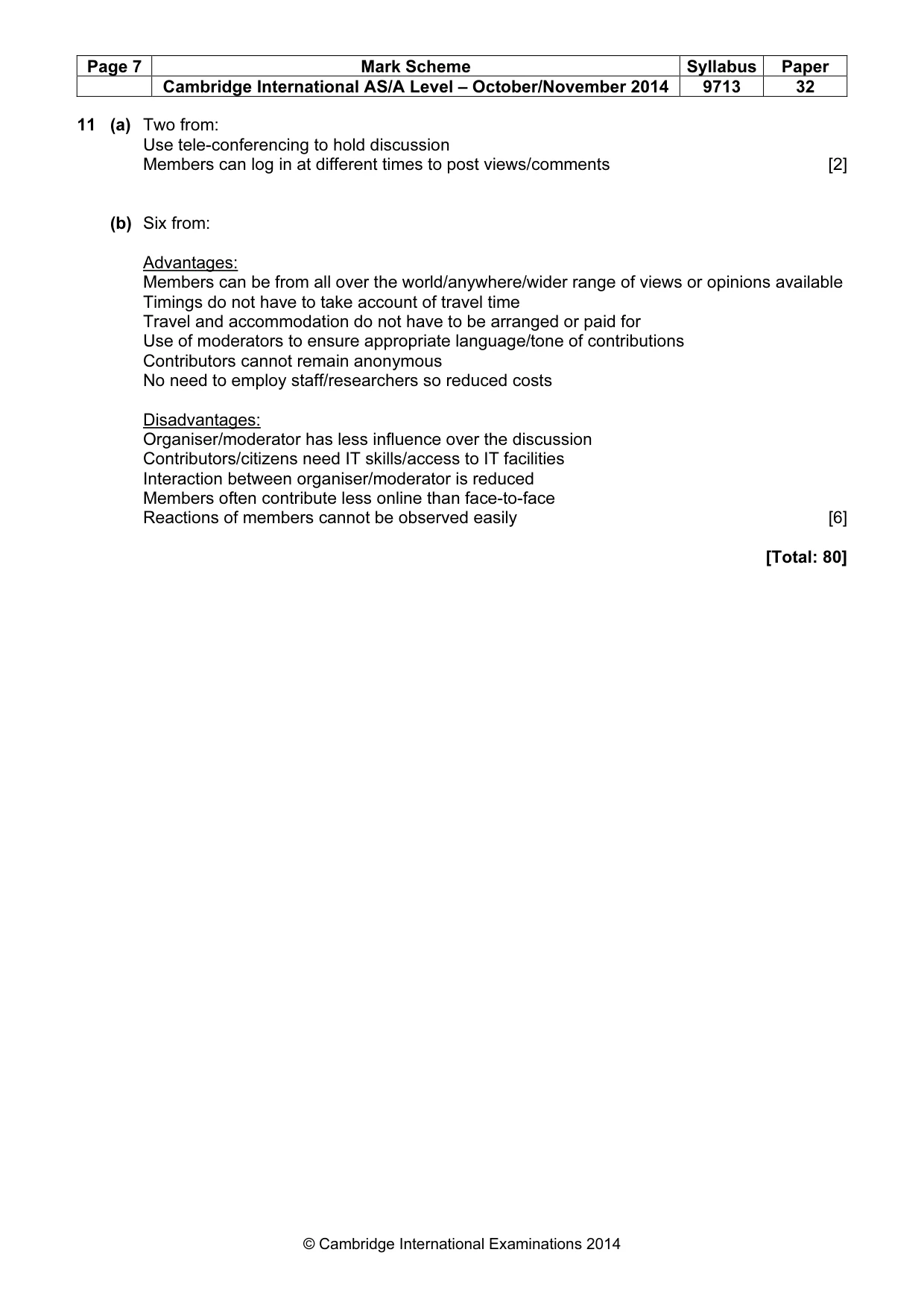
Page 7 Mark Scheme Syllabus Paper Cambridge International AS/A Level – October/November 2014 9713 32 © Cambridge International Examinations 2014 11 (a) Two from: Use tele-conferencing to hold discussion Members can log in at different times to post views/comments [2] (b) Six from: Advantages: Members can be from all over the world/anywhere/wider range of views or opinions available Timings do not have to take account of travel time Travel and accommodation do not have to be arranged or paid for Use of moderators to ensure appropriate language/tone of contributions Contributors cannot remain anonymous No need to employ staff/researchers so reduced costs Disadvantages: Organiser/moderator has less influence over the discussion Contributors/citizens need IT skills/access to IT facilities Interaction between organiser/moderator is reduced Members often contribute less online than face-to-face Reactions of members cannot be observed easily [6] [Total: 80]
What you needed in this session
Cambridge’s own grade thresholds for 2014 Oct/Nov, Paper 3 · Variant 2. A higher threshold means an easier paper — the bar moves with how the cohort did.