Cambridge A Level Applied Information and Communication Technology 9713 — 2013 Oct/Nov Paper 3 · Variant 3
9713/33/O/N/13 · 80 marks · ≈90 min
The question paper and its mark scheme, free to read here and free to download. This is Cambridge’s own paper, exactly as it was sat.
Question paper16 pages


Mark scheme6 pages
Answers below. Sit the paper first if you are practising.
Paper as text
Question paper, page 1
This document consists of 14 printed pages and 2 blank pages. IB13 11_9713_33/FP © UCLES 2013 [Turn over *4462048415* UNIVERSITY OF CAMBRIDGE INTERNATIONAL EXAMINATIONS General Certificate of Education Advanced Level APPLIED INFORMATION AND COMMUNICATION TECHNOLOGY 9713/33 Paper 3 October/November 2013 1 hour 15 minutes Candidates answer on the Question Paper. No additional materials are required. READ THESE INSTRUCTIONS FIRST Write your Centre number, candidate number and name on all the work you hand in. Write in dark blue or black pen. Do not use staples, paper clips, highlighters, glue or correction fluid. You may use a pencil for any diagrams, graphs or rough working. DO NOT WRITE IN ANY BARCODES. Answer all questions. The number of marks is given in brackets [ ] at the end of each question or part question. The businesses described in this paper are entirely fictitious.
Question paper, page 2
2 © UCLES 2013 9713/33/O/N/13 For Examiner's Use Scenario 1 Questions 1 to 5 Farm-ware is a company that manufactures and sells farm tools such as spades and forks. Mai is the project manager who is overseeing the development of new CAD software that will be used to design a new range of farm tools. The software engineers who are creating the new CAD software work in different parts of the world. Mai uses VoIP to keep in contact with each of the software engineers. Mai also uses video-conferencing to hold group meetings with all of his software engineers because a face-to-face meeting would require the engineers to travel by air to a central venue. The company sells the tools through stores around the world. It supplies the stores from a central warehouse. The company has a computer network which hosts the company website, the warehouse stock control system and the stock database.
Question paper, page 3
3 © UCLES 2013 9713/33/O/N/13 [Turn over For Examiner's Use 1 (a) (i) Describe four benefits of using CAD in designing farm tools. 1 2 3 4 [4] (ii) Describe the use of one specialist input device and of one specialist output device used in CAD when designing the farm tools. Input device Output device [4]
Question paper, page 4
4 © UCLES 2013 9713/33/O/N/13 For Examiner's Use (b) Describe six ways Mai would use a project management approach to plan and monitor the development of the new CAD software. 1 2 3 4 5 6 [6]
Question paper, page 5
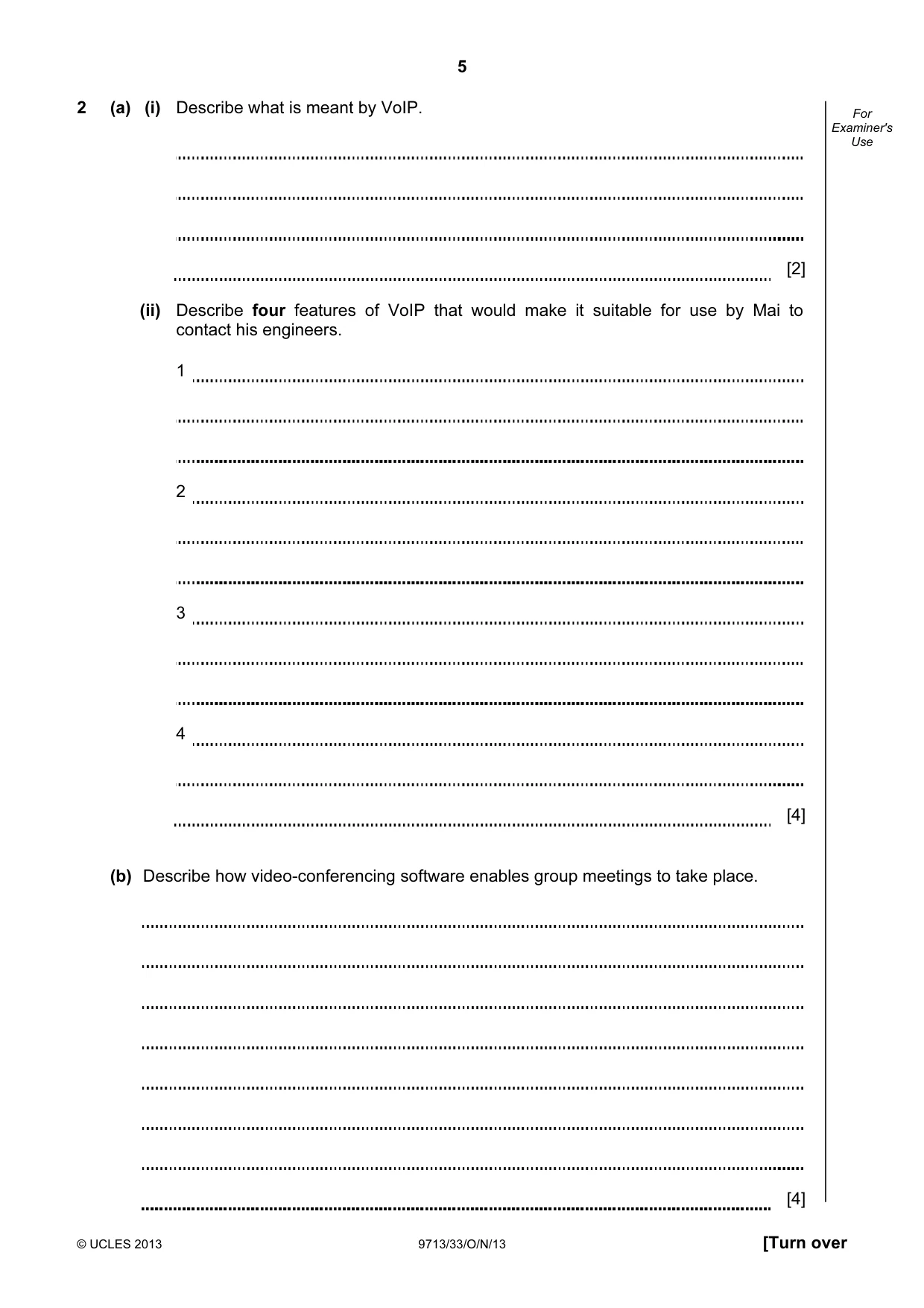
5 © UCLES 2013 9713/33/O/N/13 [Turn over For Examiner's Use 2 (a) (i) Describe what is meant by VoIP. [2] (ii) Describe four features of VoIP that would make it suitable for use by Mai to contact his engineers. 1 2 3 4 [4] (b) Describe how video-conferencing software enables group meetings to take place. [4]
Question paper, page 6
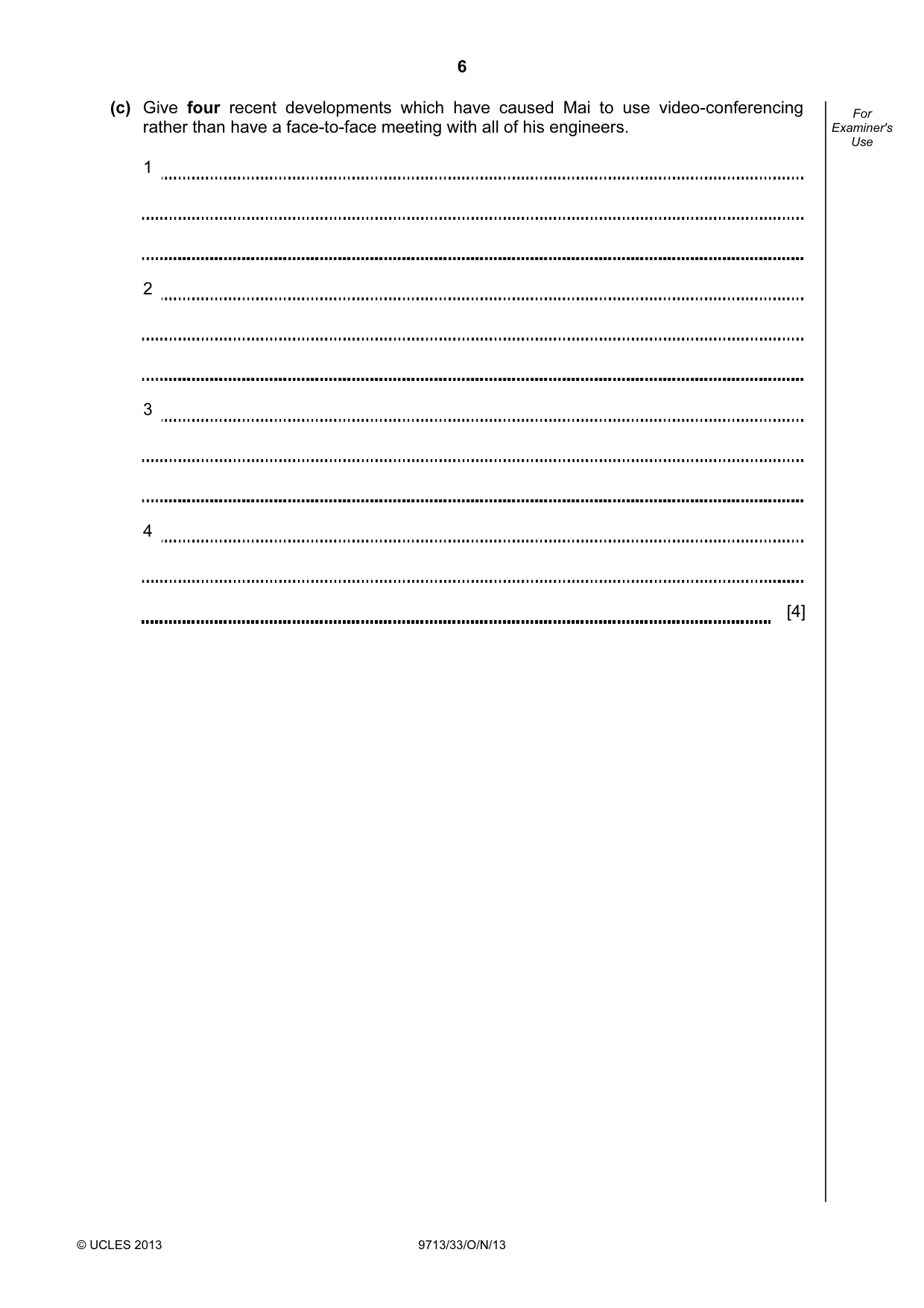
6 © UCLES 2013 9713/33/O/N/13 For Examiner's Use (c) Give four recent developments which have caused Mai to use video-conferencing rather than have a face-to-face meeting with all of his engineers. 1 2 3 4 [4]
Question paper, page 7
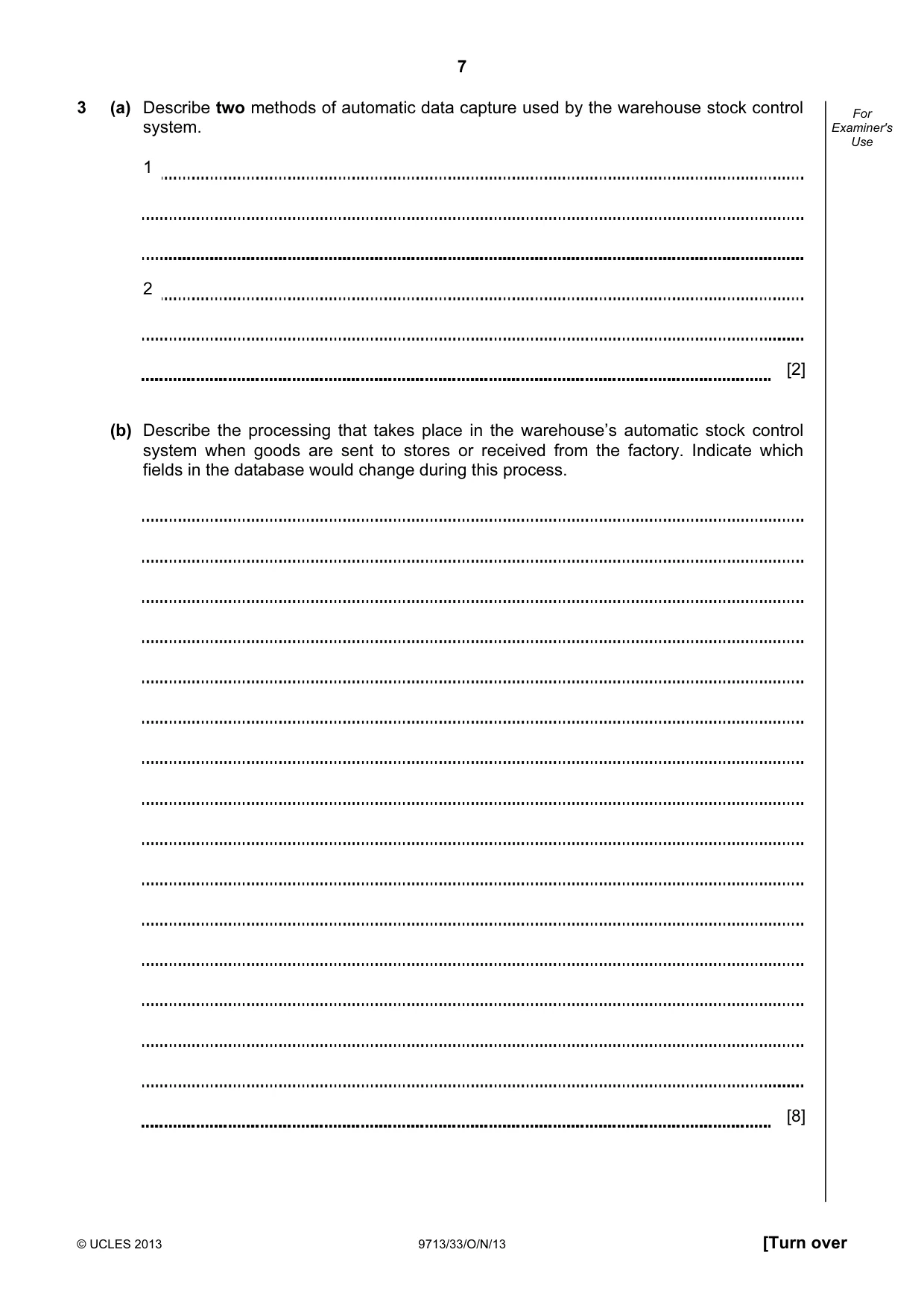
7 © UCLES 2013 9713/33/O/N/13 [Turn over For Examiner's Use 3 (a) Describe two methods of automatic data capture used by the warehouse stock control system. 1 2 [2] (b) Describe the processing that takes place in the warehouse’s automatic stock control system when goods are sent to stores or received from the factory. Indicate which fields in the database would change during this process. [8]
Question paper, page 8
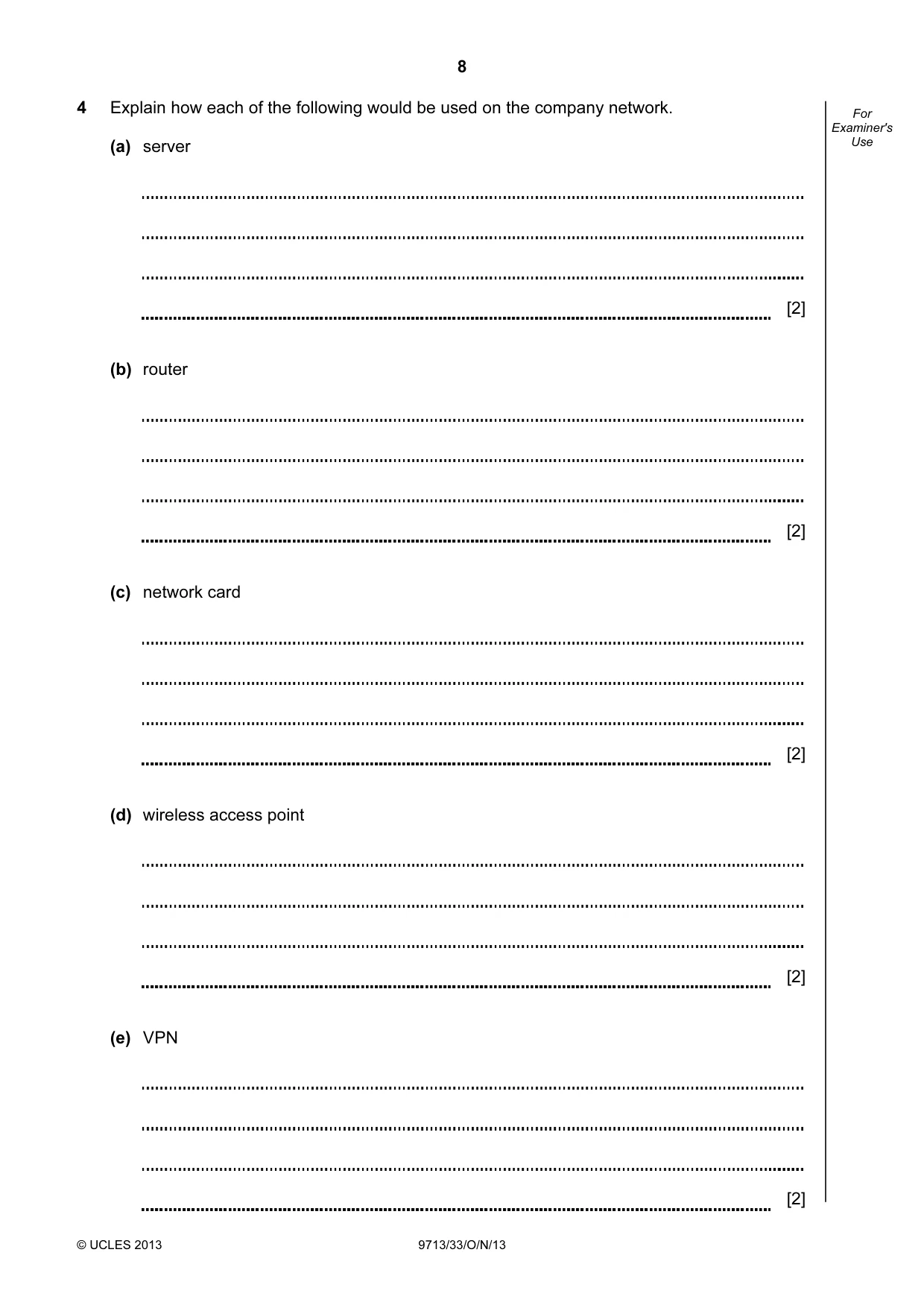
8 © UCLES 2013 9713/33/O/N/13 For Examiner's Use 4 Explain how each of the following would be used on the company network. (a) server [2] (b) router [2] (c) network card [2] (d) wireless access point [2] (e) VPN [2]
Question paper, page 9
9 © UCLES 2013 9713/33/O/N/13 [Turn over For Examiner's Use 5 Identify four protocols that would be used on the company network and explain the function of each. 1 2 3 4 [8]
Question paper, page 10
10 © UCLES 2013 9713/33/O/N/13 For Examiner's Use Scenario 2 Questions 6 and 7 Transcorporation TV is a television channel that broadcasts weather reports and forecasts via satellite. Transcorporation TV uses weather satellites and weather stations to collect data. Transcorporation TV uses ICT to collect, store, and analyse the data. ICT is used to produce reports for use by the TV channel’s weather forecasters in their broadcasts.
Question paper, page 11
11 © UCLES 2013 9713/33/O/N/13 [Turn over For Examiner's Use 6 (a) Describe four ways in which ICT is used to automatically collect and record the weather data. 1 2 3 4 [4] (b) Describe three ways in which ICT is used to analyse and present the weather data. 1 2 3 [3]
Question paper, page 12
12 © UCLES 2013 9713/33/O/N/13 For Examiner's Use 7 (a) Describe how television programmes are transmitted from the television station to the viewer’s satellite receiver box to be processed for display on the TV set. [4] (b) Explain why some viewers may not be able to see the programmes even though they are being received by their satellite receiver box. [3]
Question paper, page 13
13 © UCLES 2013 9713/33/O/N/13 [Turn over For Examiner's Use Scenario 3 Question 8 Trefor is considering replacing his television set with a home entertainment system connected to his personal computer. He wants to view television programmes and listen to music. He also wants to view videos and listen to music downloaded from the Internet but is worried about the possibility of viruses affecting his computer system. To try and protect his system he will install and use anti-virus software.
Question paper, page 14
14 © UCLES 2013 9713/33/O/N/13 For Examiner's Use 8 (a) Explain what a computer virus is and how a virus might cause damage to Trefor’s computer system. [3] (b) Describe how anti-virus software would detect viruses. [4] (c) Describe three media sources that the entertainment system could use to play music to Trefor. 1 2 3 [3]
Question paper, page 15
15 © UCLES 2013 9713/33/O/N/13 BLANK PAGE
Question paper, page 16
16 Permission to reproduce items where third-party owned material protected by copyright is included has been sought and cleared where possible. Every reasonable effort has been made by the publisher (UCLES) to trace copyright holders, but if any items requiring clearance have unwittingly been included, the publisher will be pleased to make amends at the earliest possible opportunity. University of Cambridge International Examinations is part of the Cambridge Assessment Group. Cambridge Assessment is the brand name of University of Cambridge Local Examinations Syndicate (UCLES), which is itself a department of the University of Cambridge. © UCLES 2013 9713/33/O/N/13 BLANK PAGE
Mark scheme, page 1
CAMBRIDGE INTERNATIONAL EXAMINATIONS GCE Advanced Subsidiary Level and GCE Advanced Level MARK SCHEME for the October/November 2013 series 9713 APPLIED INFORMATION AND COMMUNICATION TECHNOLOGY 9713/33 Paper 3 (Written B), maximum raw mark 80 This mark scheme is published as an aid to teachers and candidates, to indicate the requirements of the examination. It shows the basis on which Examiners were instructed to award marks. It does not indicate the details of the discussions that took place at an Examiners’ meeting before marking began, which would have considered the acceptability of alternative answers. Mark schemes should be read in conjunction with the question paper and the Principal Examiner Report for Teachers. Cambridge will not enter into discussions about these mark schemes. Cambridge is publishing the mark schemes for the October/November 2013 series for most IGCSE, GCE Advanced Level and Advanced Subsidiary Level components and some Ordinary Level components.
Mark scheme, page 2
Page 2 Mark Scheme Syllabus Paper GCE A LEVEL – October/November 2013 9713 33 © Cambridge International Examinations 2013 1 (a) (i) Four descriptions of benefits from: Any designer can access the design from anywhere/other offices so designs can be created more quickly/reviewed Designs are easily edited/altered so no need to redraw Designs are accurate/precise with no human errors Use of libraries of shapes/items so no need to redraw Accurate measurements on drawings for use in e.g. cost analysis Assist in calculating costs for production runs Can be used to output to 3D printers to print models/prototypes [4] (ii) One Input device from e.g.: Scanner to input/capture images of drawings Light pen to draw shapes on screen Tracker ball to move pointer Graphics tablet to draw shapes/designs One output device from e.g.: Graph plotter to produce hard copy of designs High resolution screen (e.g. LCD) to display drawings/designs 3D printer to produce model/scale model of design [4] (b) Six from: Uses critical path method/Gantt/PERT charts finding optimum time to be spent on individual stages/find end date Critical path specifies the order in which tasks must be completed PERT charts specifies the order in which tasks are completed Gantt charts help to show progress of individual tasks Event chain diagrams for visualising multiple events Software helps identify progress made in each task Software helps with daily and weekly planning Identifying progress/lack of progress helps with planning future tasks/Milestones identified such as module completion Some tasks can be done in parallel such as work on different modules Other tasks must be done in sequence such as linking modules Number of workers/cost of each stage identified - to monitor cost/organise work force Use of alarms if stage is late and warning director/ project manager report progress at suitable intervals Use of calendar software plus appropriate use [6] 2 (a) (i) Two from: Voice over Internet Protocol Use of computer networks Other Internet services are compatible e.g. file exchange and audio conferencing to carry voice/audio conversations Can be computer-based or connected to ordinary telephones Allows automatic routing of calls/answering services [2]
Mark scheme, page 3
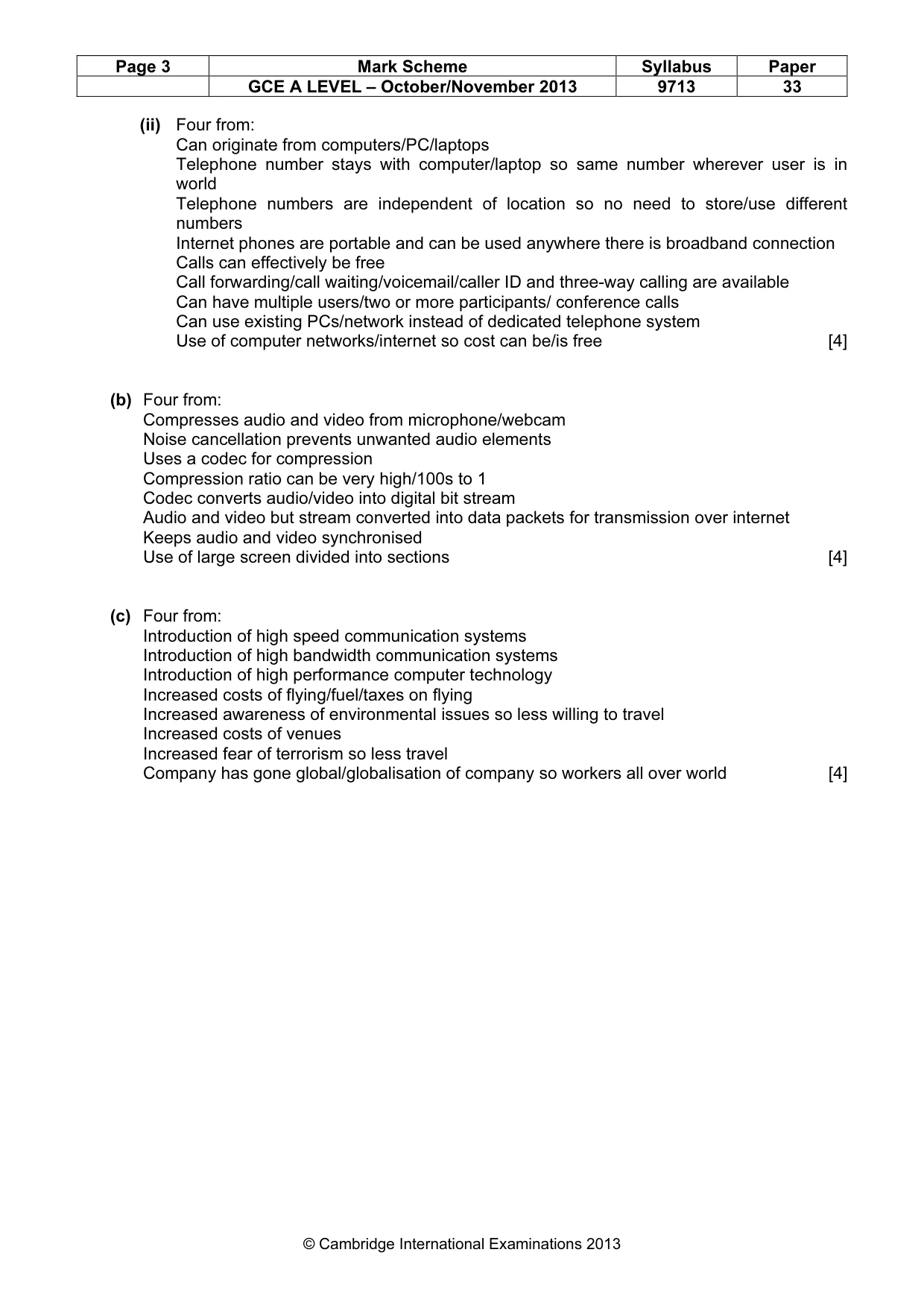
Page 3 Mark Scheme Syllabus Paper GCE A LEVEL – October/November 2013 9713 33 © Cambridge International Examinations 2013 (ii) Four from: Can originate from computers/PC/laptops Telephone number stays with computer/laptop so same number wherever user is in world Telephone numbers are independent of location so no need to store/use different numbers Internet phones are portable and can be used anywhere there is broadband connection Calls can effectively be free Call forwarding/call waiting/voicemail/caller ID and three-way calling are available Can have multiple users/two or more participants/ conference calls Can use existing PCs/network instead of dedicated telephone system Use of computer networks/internet so cost can be/is free [4] (b) Four from: Compresses audio and video from microphone/webcam Noise cancellation prevents unwanted audio elements Uses a codec for compression Compression ratio can be very high/100s to 1 Codec converts audio/video into digital bit stream Audio and video but stream converted into data packets for transmission over internet Keeps audio and video synchronised Use of large screen divided into sections [4] (c) Four from: Introduction of high speed communication systems Introduction of high bandwidth communication systems Introduction of high performance computer technology Increased costs of flying/fuel/taxes on flying Increased awareness of environmental issues so less willing to travel Increased costs of venues Increased fear of terrorism so less travel Company has gone global/globalisation of company so workers all over world [4]
Mark scheme, page 4
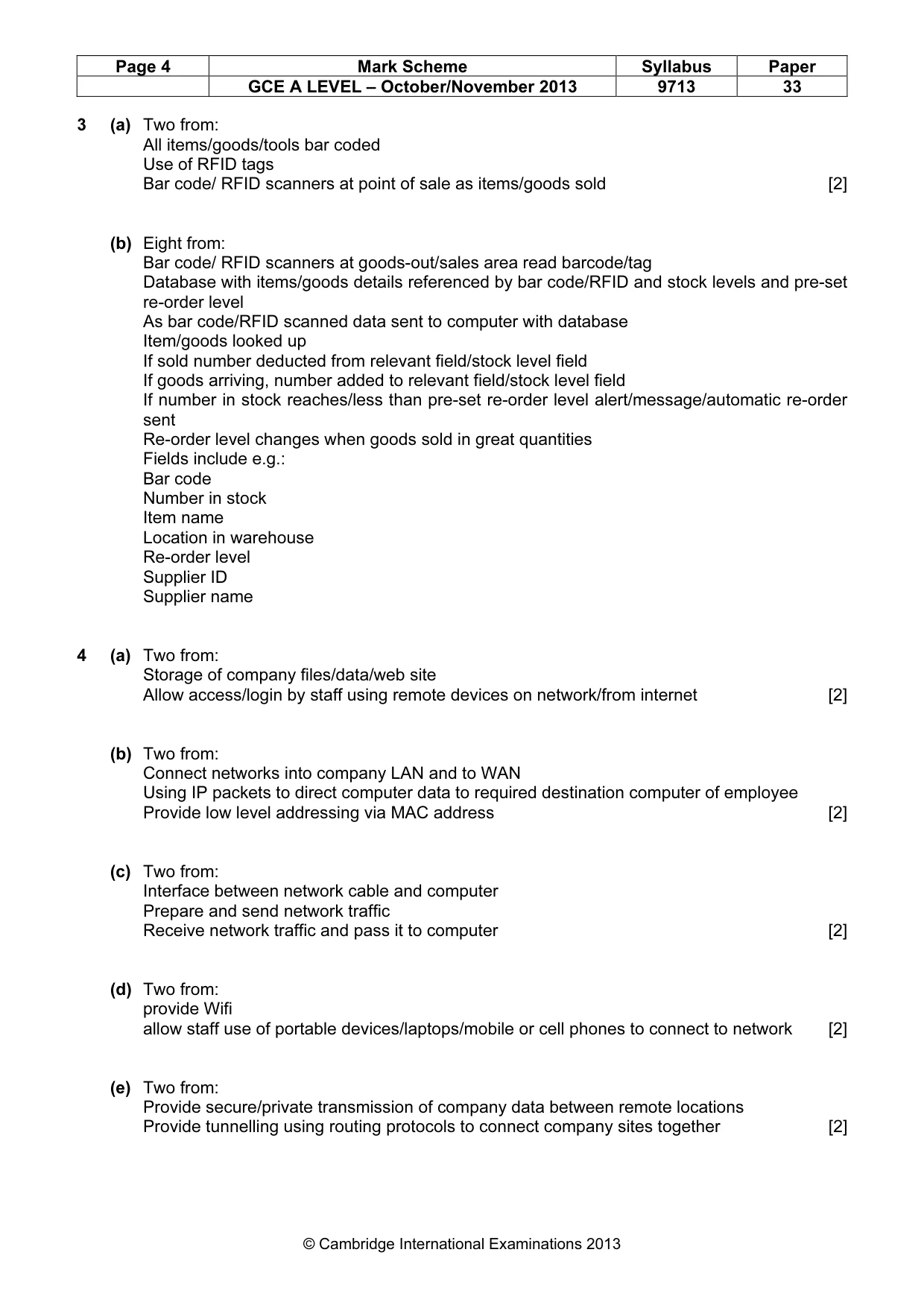
Page 4 Mark Scheme Syllabus Paper GCE A LEVEL – October/November 2013 9713 33 © Cambridge International Examinations 2013 3 (a) Two from: All items/goods/tools bar coded Use of RFID tags Bar code/ RFID scanners at point of sale as items/goods sold [2] (b) Eight from: Bar code/ RFID scanners at goods-out/sales area read barcode/tag Database with items/goods details referenced by bar code/RFID and stock levels and pre-set re-order level As bar code/RFID scanned data sent to computer with database Item/goods looked up If sold number deducted from relevant field/stock level field If goods arriving, number added to relevant field/stock level field If number in stock reaches/less than pre-set re-order level alert/message/automatic re-order sent Re-order level changes when goods sold in great quantities Fields include e.g.: Bar code Number in stock Item name Location in warehouse Re-order level Supplier ID Supplier name 4 (a) Two from: Storage of company files/data/web site Allow access/login by staff using remote devices on network/from internet [2] (b) Two from: Connect networks into company LAN and to WAN Using IP packets to direct computer data to required destination computer of employee Provide low level addressing via MAC address [2] (c) Two from: Interface between network cable and computer Prepare and send network traffic Receive network traffic and pass it to computer [2] (d) Two from: provide Wifi allow staff use of portable devices/laptops/mobile or cell phones to connect to network [2] (e) Two from: Provide secure/private transmission of company data between remote locations Provide tunnelling using routing protocols to connect company sites together [2]
Mark scheme, page 5
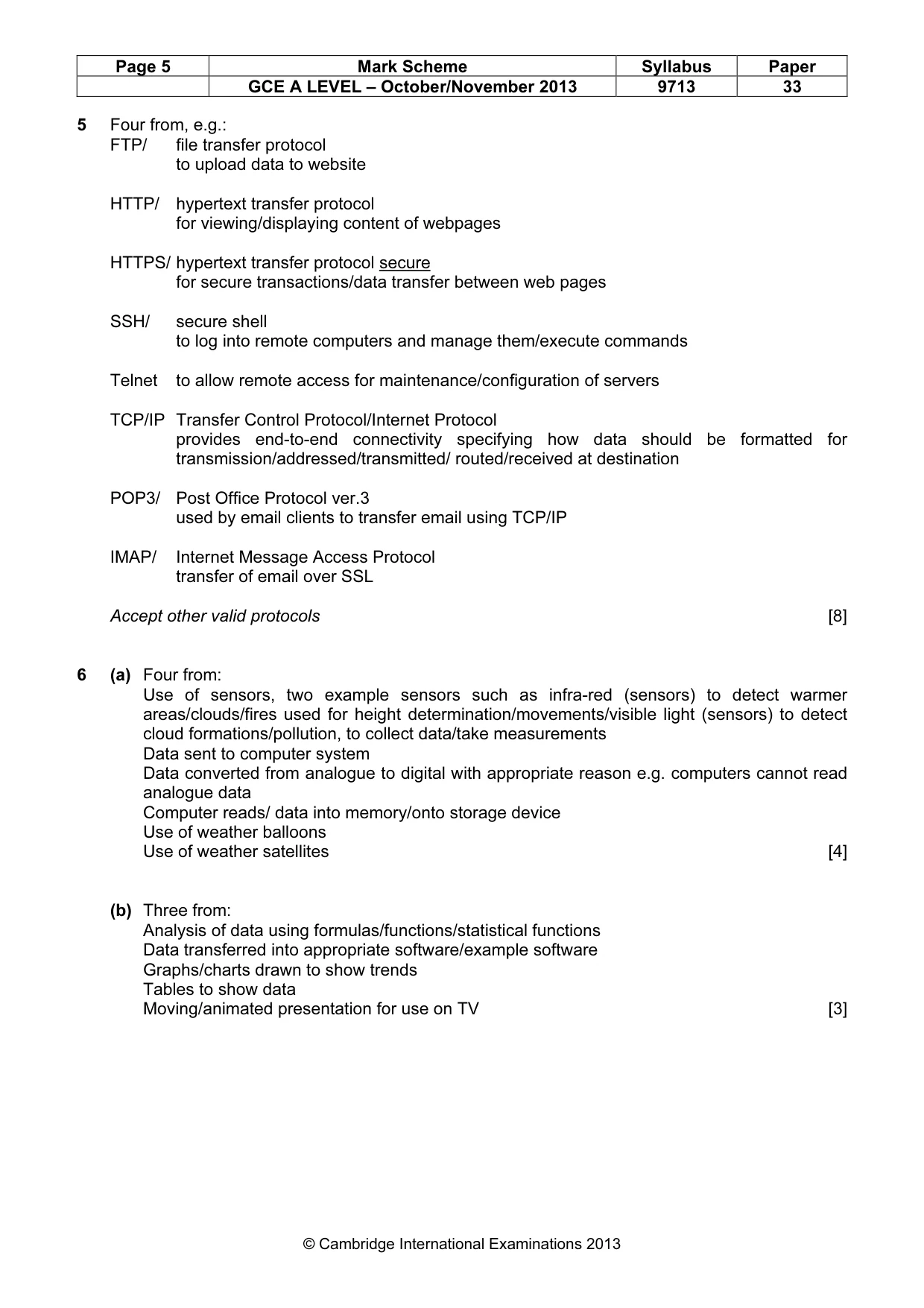
Page 5 Mark Scheme Syllabus Paper GCE A LEVEL – October/November 2013 9713 33 © Cambridge International Examinations 2013 5 Four from, e.g.: FTP/ file transfer protocol to upload data to website HTTP/ hypertext transfer protocol for viewing/displaying content of webpages HTTPS/ hypertext transfer protocol secure for secure transactions/data transfer between web pages SSH/ secure shell to log into remote computers and manage them/execute commands Telnet to allow remote access for maintenance/configuration of servers TCP/IP Transfer Control Protocol/Internet Protocol provides end-to-end connectivity specifying how data should be formatted for transmission/addressed/transmitted/ routed/received at destination POP3/ Post Office Protocol ver.3 used by email clients to transfer email using TCP/IP IMAP/ Internet Message Access Protocol transfer of email over SSL Accept other valid protocols [8] 6 (a) Four from: Use of sensors, two example sensors such as infra-red (sensors) to detect warmer areas/clouds/fires used for height determination/movements/visible light (sensors) to detect cloud formations/pollution, to collect data/take measurements Data sent to computer system Data converted from analogue to digital with appropriate reason e.g. computers cannot read analogue data Computer reads/ data into memory/onto storage device Use of weather balloons Use of weather satellites [4] (b) Three from: Analysis of data using formulas/functions/statistical functions Data transferred into appropriate software/example software Graphs/charts drawn to show trends Tables to show data Moving/animated presentation for use on TV [3]
Mark scheme, page 6
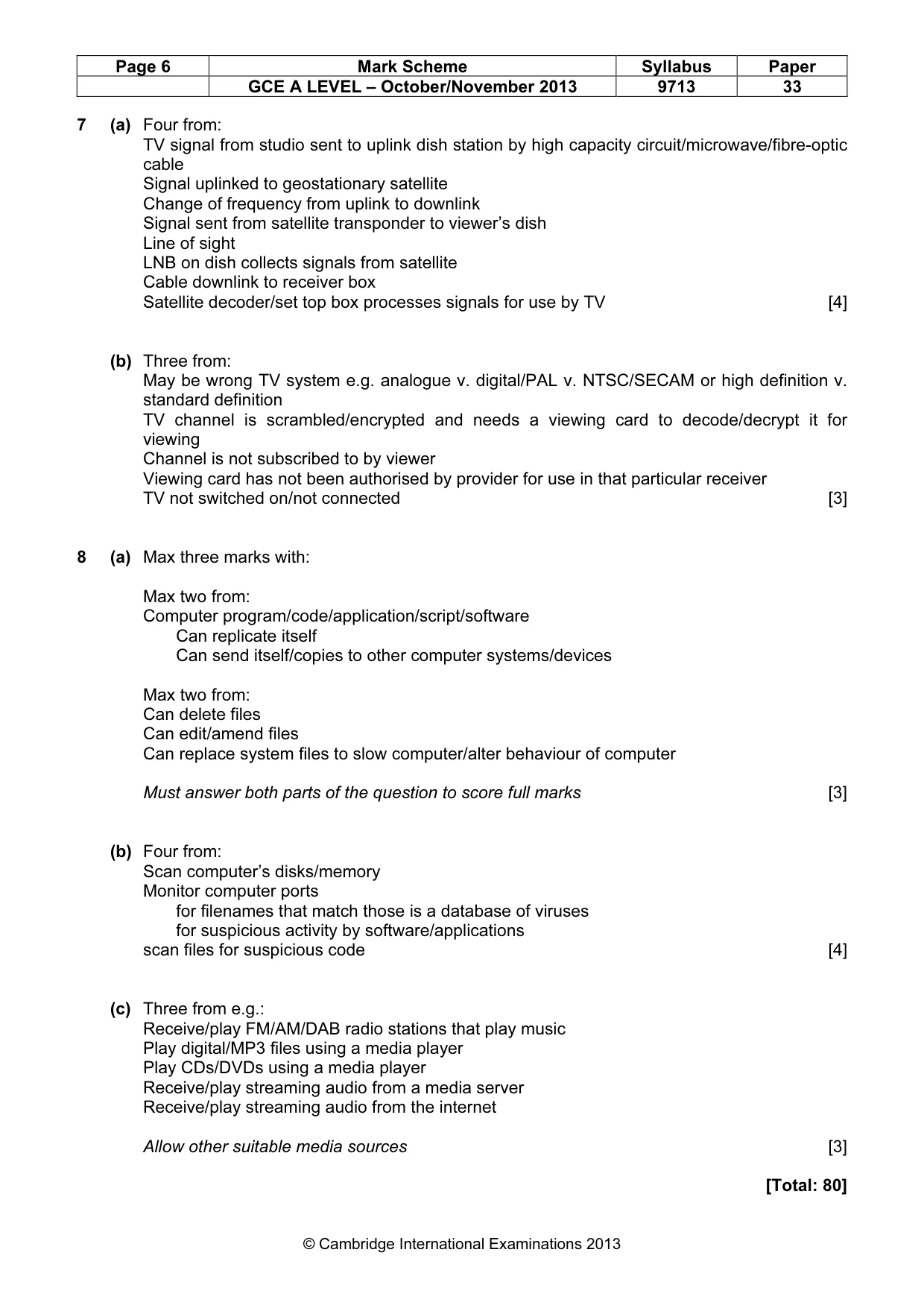
Page 6 Mark Scheme Syllabus Paper GCE A LEVEL – October/November 2013 9713 33 © Cambridge International Examinations 2013 7 (a) Four from: TV signal from studio sent to uplink dish station by high capacity circuit/microwave/fibre-optic cable Signal uplinked to geostationary satellite Change of frequency from uplink to downlink Signal sent from satellite transponder to viewer’s dish Line of sight LNB on dish collects signals from satellite Cable downlink to receiver box Satellite decoder/set top box processes signals for use by TV [4] (b) Three from: May be wrong TV system e.g. analogue v. digital/PAL v. NTSC/SECAM or high definition v. standard definition TV channel is scrambled/encrypted and needs a viewing card to decode/decrypt it for viewing Channel is not subscribed to by viewer Viewing card has not been authorised by provider for use in that particular receiver TV not switched on/not connected [3] 8 (a) Max three marks with: Max two from: Computer program/code/application/script/software Can replicate itself Can send itself/copies to other computer systems/devices Max two from: Can delete files Can edit/amend files Can replace system files to slow computer/alter behaviour of computer Must answer both parts of the question to score full marks [3] (b) Four from: Scan computer’s disks/memory Monitor computer ports for filenames that match those is a database of viruses for suspicious activity by software/applications scan files for suspicious code [4] (c) Three from e.g.: Receive/play FM/AM/DAB radio stations that play music Play digital/MP3 files using a media player Play CDs/DVDs using a media player Receive/play streaming audio from a media server Receive/play streaming audio from the internet Allow other suitable media sources [3] [Total: 80]
What you needed in this session
Cambridge’s own grade thresholds for 2013 Oct/Nov, Paper 3 · Variant 3. A higher threshold means an easier paper — the bar moves with how the cohort did.