Cambridge A Level Applied Information and Communication Technology 9713 — 2013 May/June Paper 1 · Variant 1
9713/11/M/J/13 · 80 marks · ≈90 min
The question paper and its mark scheme, free to read here and free to download. This is Cambridge’s own paper, exactly as it was sat.
Question paper16 pages






Mark scheme6 pages
Answers below. Sit the paper first if you are practising.
Paper as text
Question paper, page 1
This document consists of 16 printed pages. IB13 06_9713_11/2RP © UCLES 2013 [Turn over *9550276980* UNIVERSITY OF CAMBRIDGE INTERNATIONAL EXAMINATIONS General Certificate of Education Advanced Level APPLIED INFORMATION AND COMMUNICATION TECHNOLOGY 9713/11 Paper 1 May/June 2013 1 hour 15 minutes Candidates answer on the Question Paper. No additional materials are required. READ THESE INSTRUCTIONS FIRST Write your Centre number, candidate number and name on all the work you hand in. Write in dark blue or black pen. Do not use staples, paper clips, highlighters, glue or correction fluid. You may use a pencil for any diagrams, graphs or rough working. DO NOT WRITE IN ANY BARCODES. Answer all questions. The number of marks is given in brackets [ ] at the end of each question or part question. The businesses described in this paper are entirely fictitious.
Question paper, page 2
2 © UCLES 2013 9713/11/M/J/13 For Examiner's Use Scenario 1 Questions 1 and 2 The North Siberia Motor Company is a manufacturer of cars and vans. It has a modern factory and a computerised production line in Verkhoyansk. Robot arms are used in the manufacture of each car. Temperatures are very low most of the year, but it still gets very warm in summer. An air conditioning system has to be used to maintain a constant temperature. In addition to its normal components the system also has heating elements. A Programmable Logic Controller (PLC) uses a PID algorithm to control the air conditioning system.
Question paper, page 3
3 © UCLES 2013 9713/11/M/J/13 [Turn over For Examiner's Use 1 (a) Describe, using examples from the scenario, the difference between discrete process control and continuous process control. [6] (b) Describe how a PLC would use a PID algorithm to maintain a constant temperature in the air conditioning system. [6]
Question paper, page 4
4 © UCLES 2013 9713/11/M/J/13 For Examiner's Use 2 (a) Name two end effectors which would be attached to the robot arms for the holding of car body parts. 1 2 [2] (b) Name and describe the role of three end effectors used in the painting process. 1 2 3 [6]
Question paper, page 5
5 © UCLES 2013 9713/11/M/J/13 [Turn over For Examiner's Use (c) Programmers can use sensors when programming robot arms to carry out a task when assembling a car. Describe four of the steps to carry out the programming of the arm. 1 2 3 4 [4] (d) Describe four costs to the company of introducing robotic arms. 1 2 3 4 [4]
Question paper, page 6
6 © UCLES 2013 9713/11/M/J/13 For Examiner's Use (e) Describe two benefits to the workers caused by the company using robotic arms. 1 2 [2]
Question paper, page 7
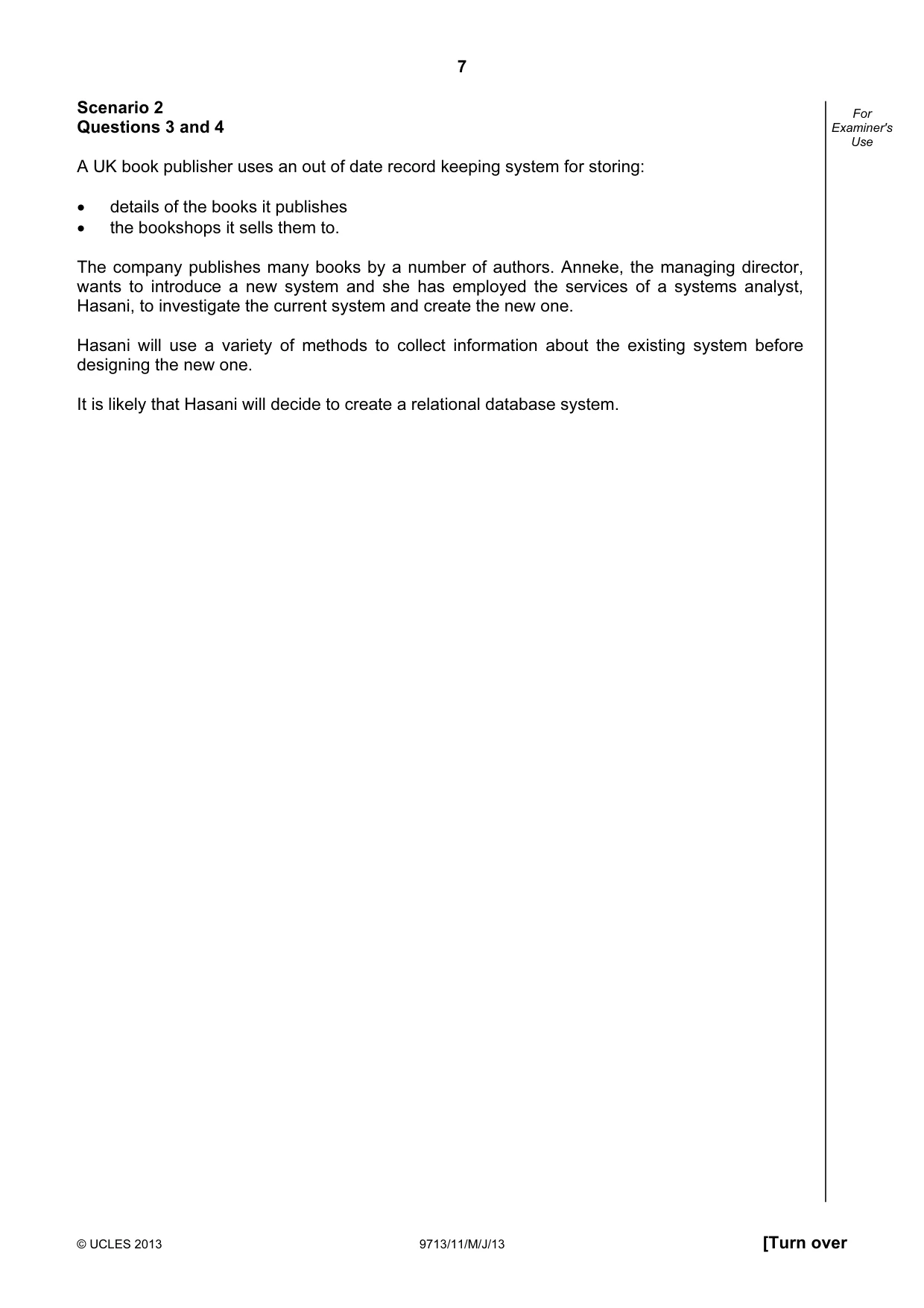
7 © UCLES 2013 9713/11/M/J/13 [Turn over For Examiner's Use Scenario 2 Questions 3 and 4 A UK book publisher uses an out of date record keeping system for storing: • details of the books it publishes • the bookshops it sells them to. The company publishes many books by a number of authors. Anneke, the managing director, wants to introduce a new system and she has employed the services of a systems analyst, Hasani, to investigate the current system and create the new one. Hasani will use a variety of methods to collect information about the existing system before designing the new one. It is likely that Hasani will decide to create a relational database system.
Question paper, page 8
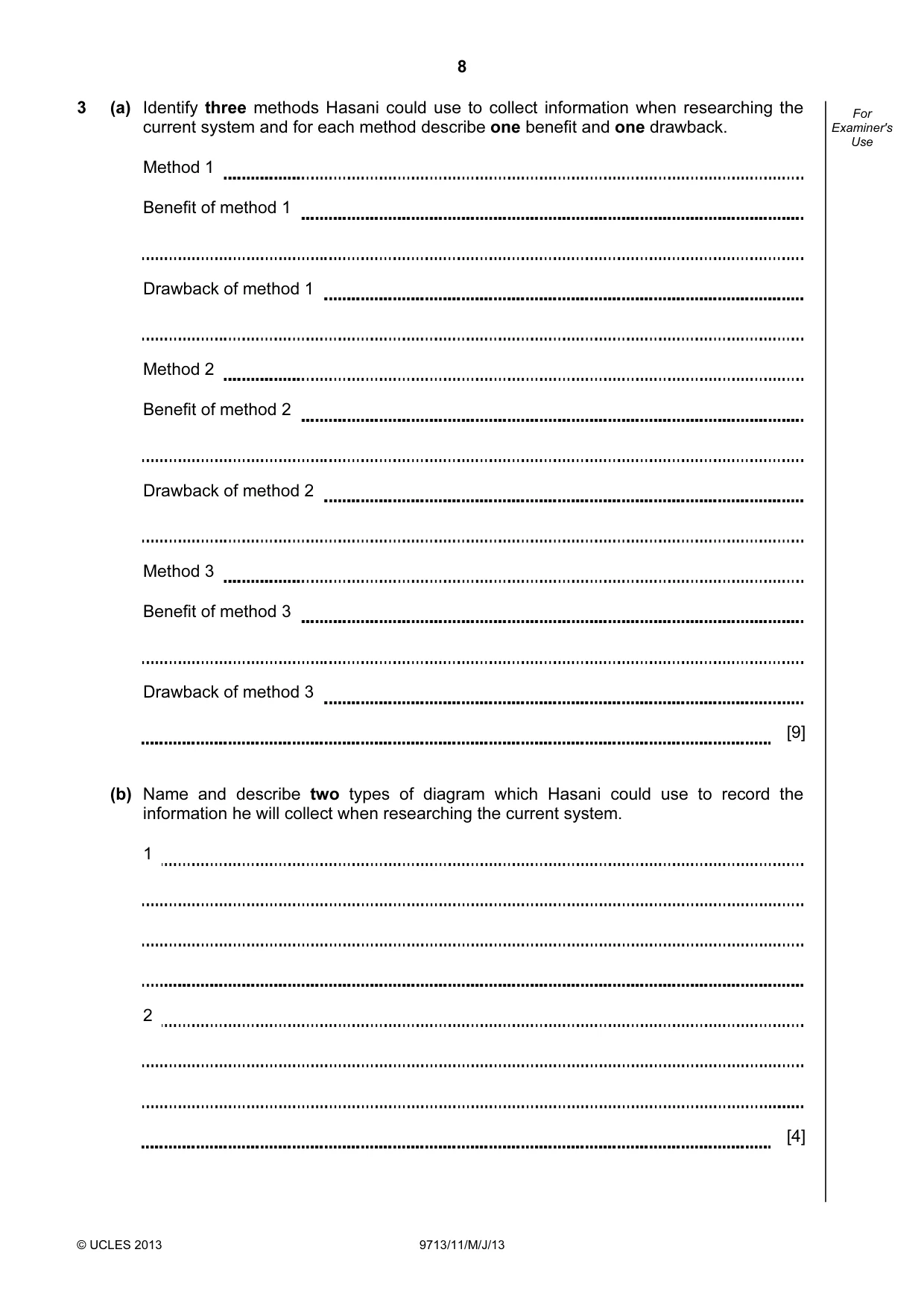
8 © UCLES 2013 9713/11/M/J/13 For Examiner's Use 3 (a) Identify three methods Hasani could use to collect information when researching the current system and for each method describe one benefit and one drawback. Method 1 Benefit of method 1 Drawback of method 1 Method 2 Benefit of method 2 Drawback of method 2 Method 3 Benefit of method 3 Drawback of method 3 [9] (b) Name and describe two types of diagram which Hasani could use to record the information he will collect when researching the current system. 1 2 [4]
Question paper, page 9
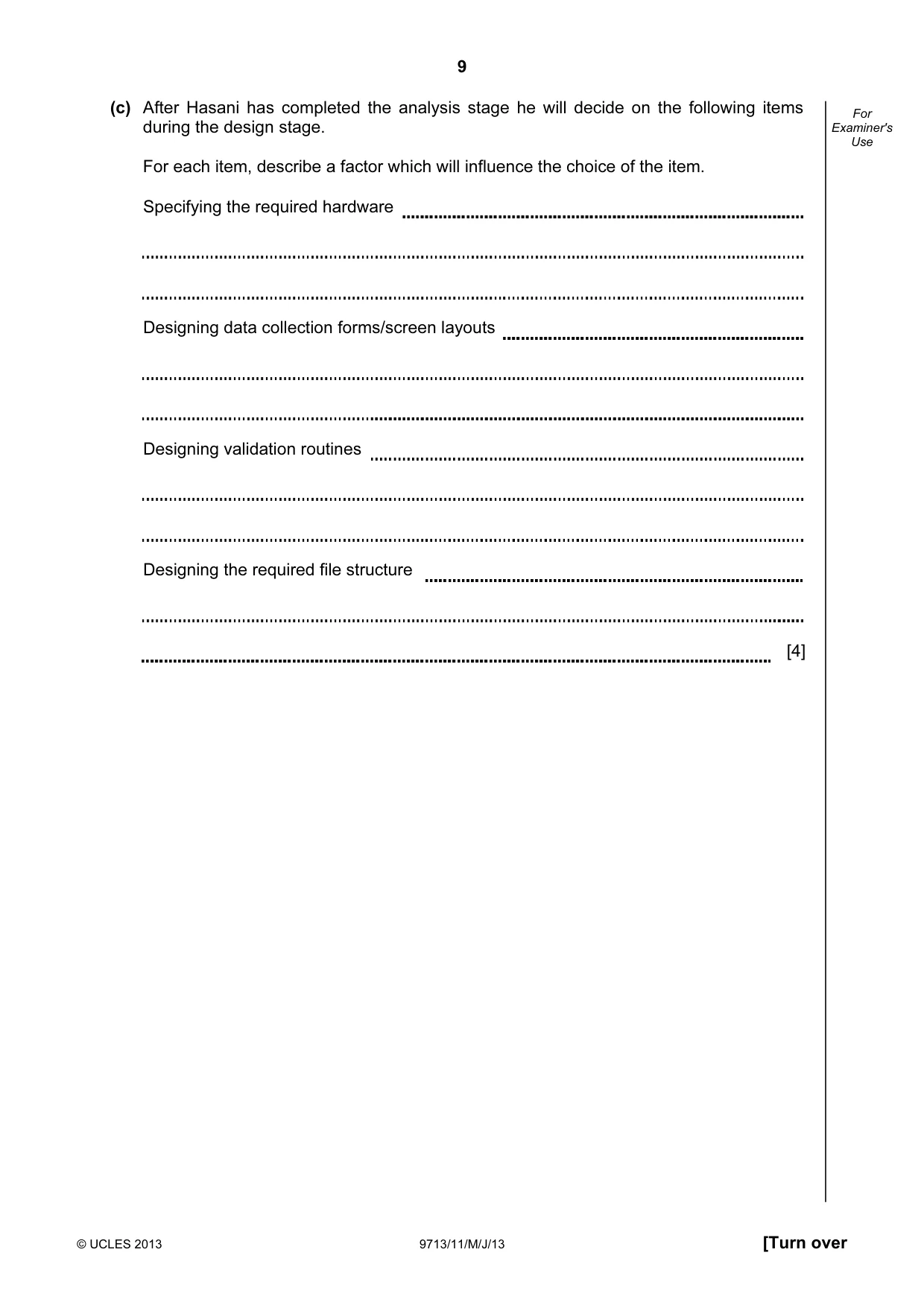
9 © UCLES 2013 9713/11/M/J/13 [Turn over For Examiner's Use (c) After Hasani has completed the analysis stage he will decide on the following items during the design stage. For each item, describe a factor which will influence the choice of the item. Specifying the required hardware Designing data collection forms/screen layouts Designing validation routines Designing the required file structure [4]
Question paper, page 10
10 © UCLES 2013 9713/11/M/J/13 For Examiner's Use 4 (a) Using this scenario describe what is meant by a key field. [2] (b) Describe how the key field will be used in the creation of a relational database. [3] (c) Give three reasons why a relational database would be better than two separate flat files. 1 2 3 [3]
Question paper, page 11
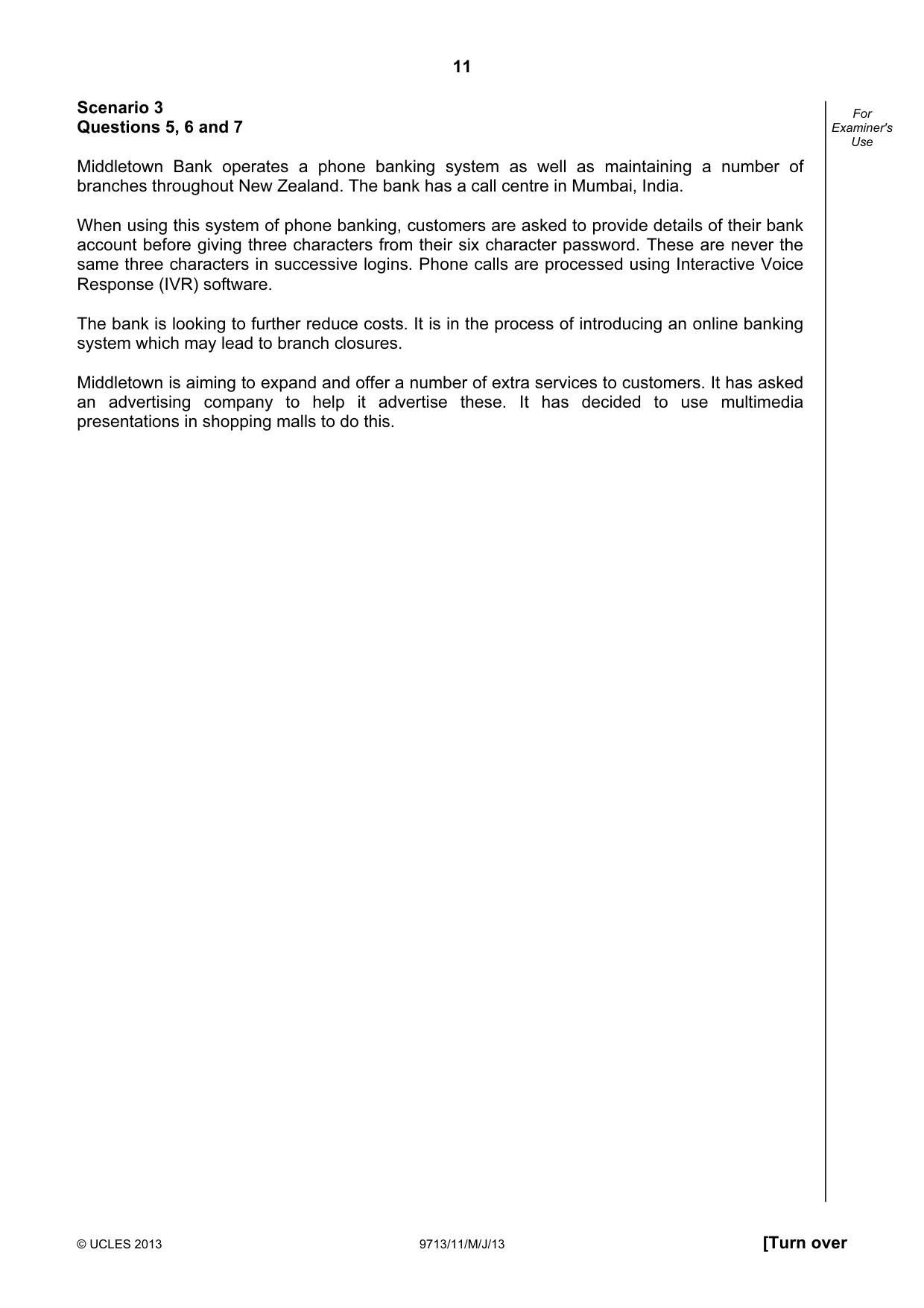
11 © UCLES 2013 9713/11/M/J/13 [Turn over For Examiner's Use Scenario 3 Questions 5, 6 and 7 Middletown Bank operates a phone banking system as well as maintaining a number of branches throughout New Zealand. The bank has a call centre in Mumbai, India. When using this system of phone banking, customers are asked to provide details of their bank account before giving three characters from their six character password. These are never the same three characters in successive logins. Phone calls are processed using Interactive Voice Response (IVR) software. The bank is looking to further reduce costs. It is in the process of introducing an online banking system which may lead to branch closures. Middletown is aiming to expand and offer a number of extra services to customers. It has asked an advertising company to help it advertise these. It has decided to use multimedia presentations in shopping malls to do this.
Question paper, page 12
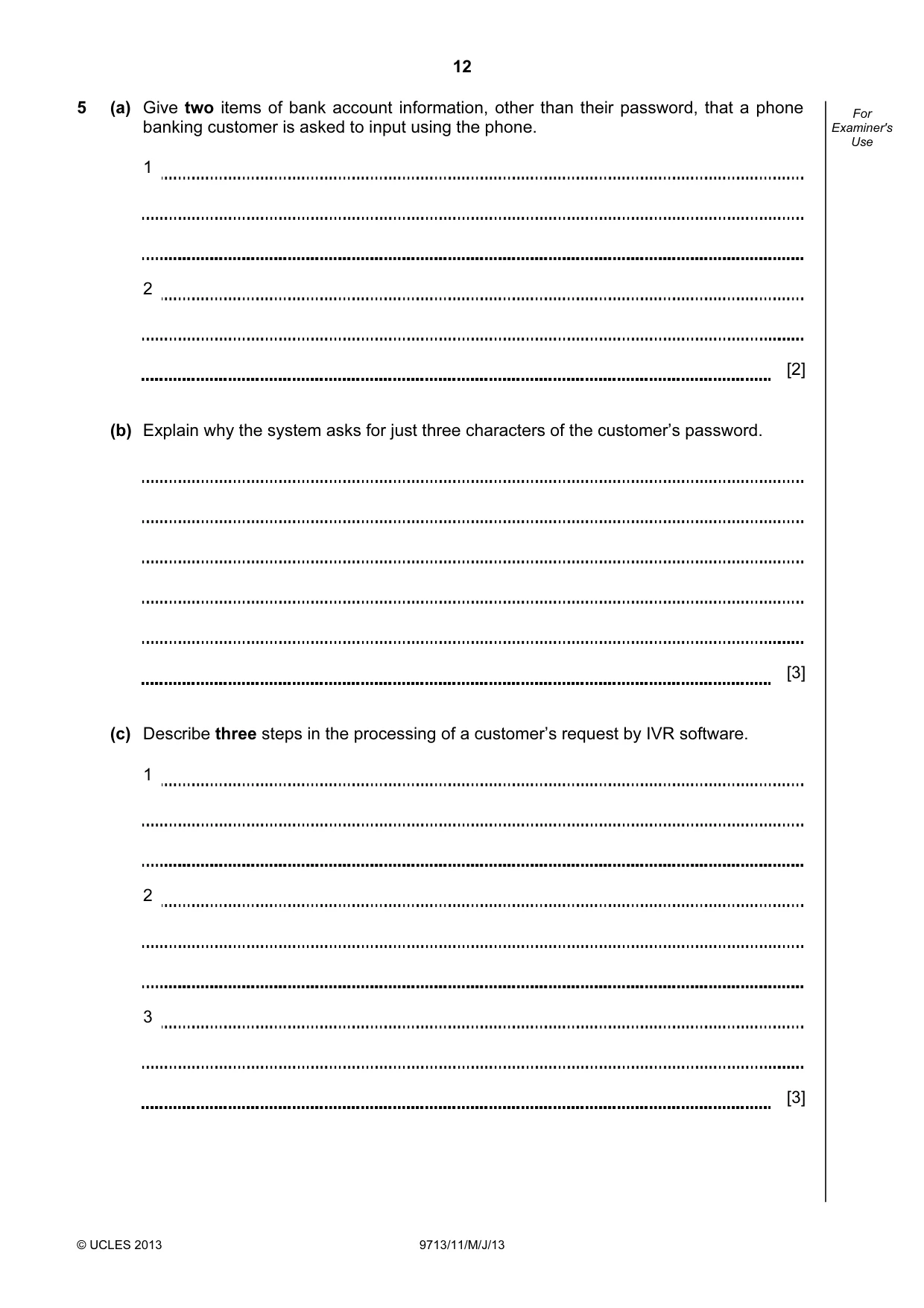
12 © UCLES 2013 9713/11/M/J/13 For Examiner's Use 5 (a) Give two items of bank account information, other than their password, that a phone banking customer is asked to input using the phone. 1 2 [2] (b) Explain why the system asks for just three characters of the customer’s password. [3] (c) Describe three steps in the processing of a customer’s request by IVR software. 1 2 3 [3]
Question paper, page 13
13 © UCLES 2013 9713/11/M/J/13 [Turn over For Examiner's Use (d) Give two reasons why a customer might not be satisfied with the phone service. 1 2 [2]
Question paper, page 14
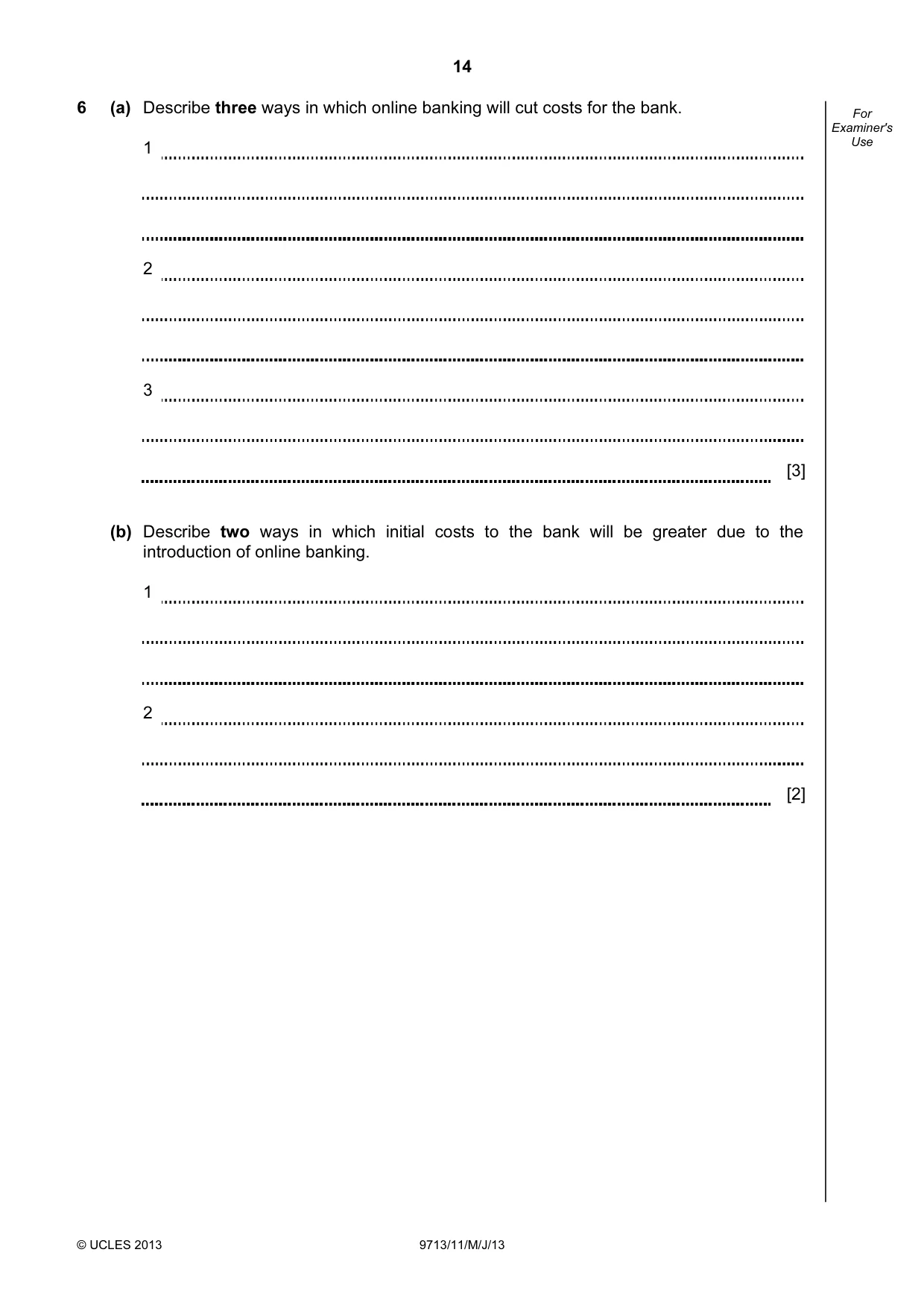
14 © UCLES 2013 9713/11/M/J/13 For Examiner's Use 6 (a) Describe three ways in which online banking will cut costs for the bank. 1 2 3 [3] (b) Describe two ways in which initial costs to the bank will be greater due to the introduction of online banking. 1 2 [2]
Question paper, page 15
15 © UCLES 2013 9713/11/M/J/13 [Turn over For Examiner's Use (c) Apart from not having to travel to the local branch of their bank, describe four benefits to the customer of online banking. 1 2 3 4 [4]
Question paper, page 16
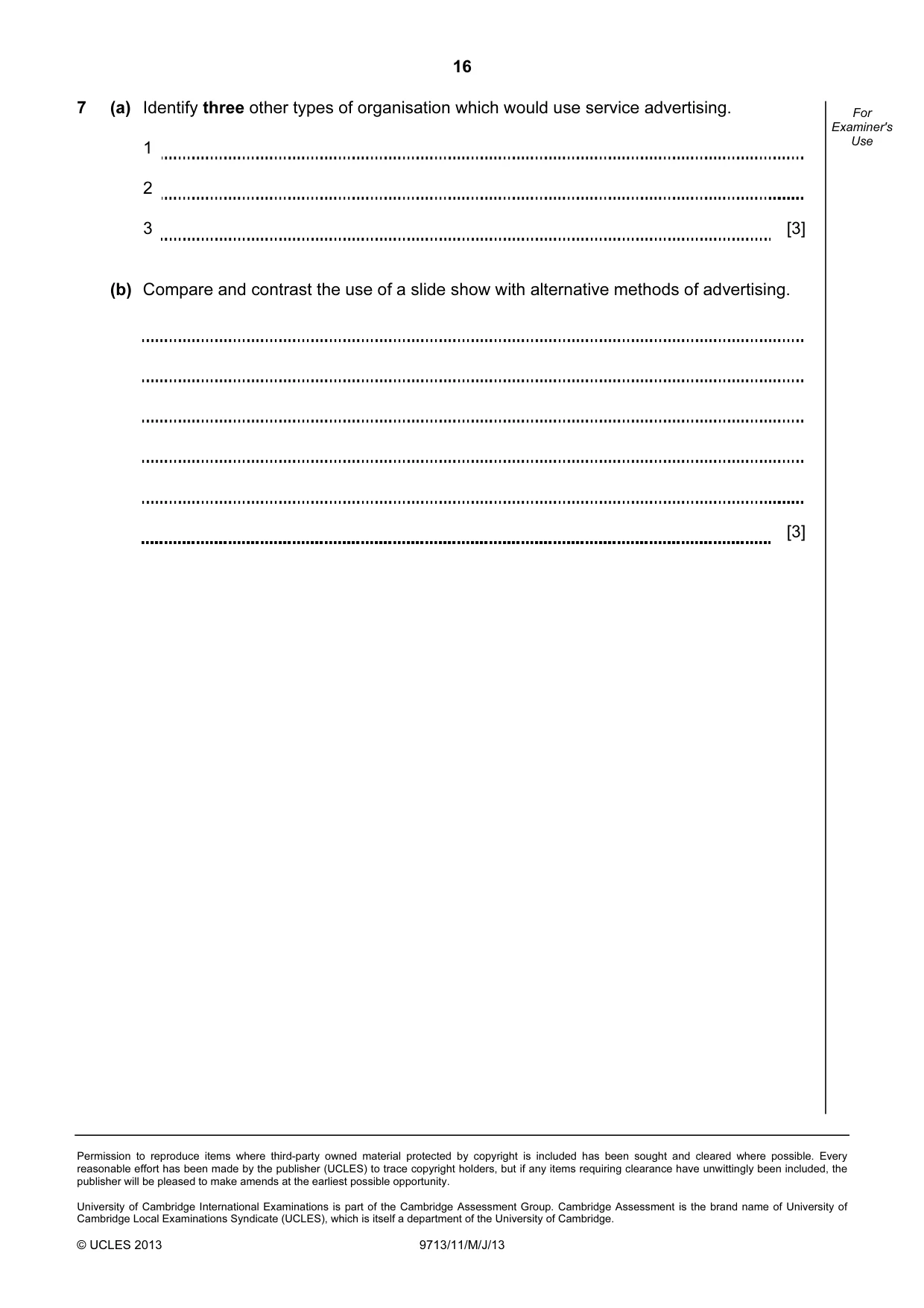
16 Permission to reproduce items where third-party owned material protected by copyright is included has been sought and cleared where possible. Every reasonable effort has been made by the publisher (UCLES) to trace copyright holders, but if any items requiring clearance have unwittingly been included, the publisher will be pleased to make amends at the earliest possible opportunity. University of Cambridge International Examinations is part of the Cambridge Assessment Group. Cambridge Assessment is the brand name of University of Cambridge Local Examinations Syndicate (UCLES), which is itself a department of the University of Cambridge. © UCLES 2013 9713/11/M/J/13 For Examiner's Use 7 (a) Identify three other types of organisation which would use service advertising. 1 2 3 [3] (b) Compare and contrast the use of a slide show with alternative methods of advertising. [3]
Mark scheme, page 1
CAMBRIDGE INTERNATIONAL EXAMINATIONS GCE Advanced Subsidiary Level and GCE Advanced Level MARK SCHEME for the May/June 2013 series 9713 APPLIED INFORMATION AND COMMUNICATION TECHNOLOGY 9713/11 Paper 1 (Written A), maximum raw mark 80 This mark scheme is published as an aid to teachers and candidates, to indicate the requirements of the examination. It shows the basis on which Examiners were instructed to award marks. It does not indicate the details of the discussions that took place at an Examiners’ meeting before marking began, which would have considered the acceptability of alternative answers. Mark schemes should be read in conjunction with the question paper and the Principal Examiner Report for Teachers. Cambridge will not enter into discussions about these mark schemes. Cambridge is publishing the mark schemes for the May/June 2013 series for most IGCSE, GCE Advanced Level and Advanced Subsidiary Level components and some Ordinary Level components.
Mark scheme, page 2
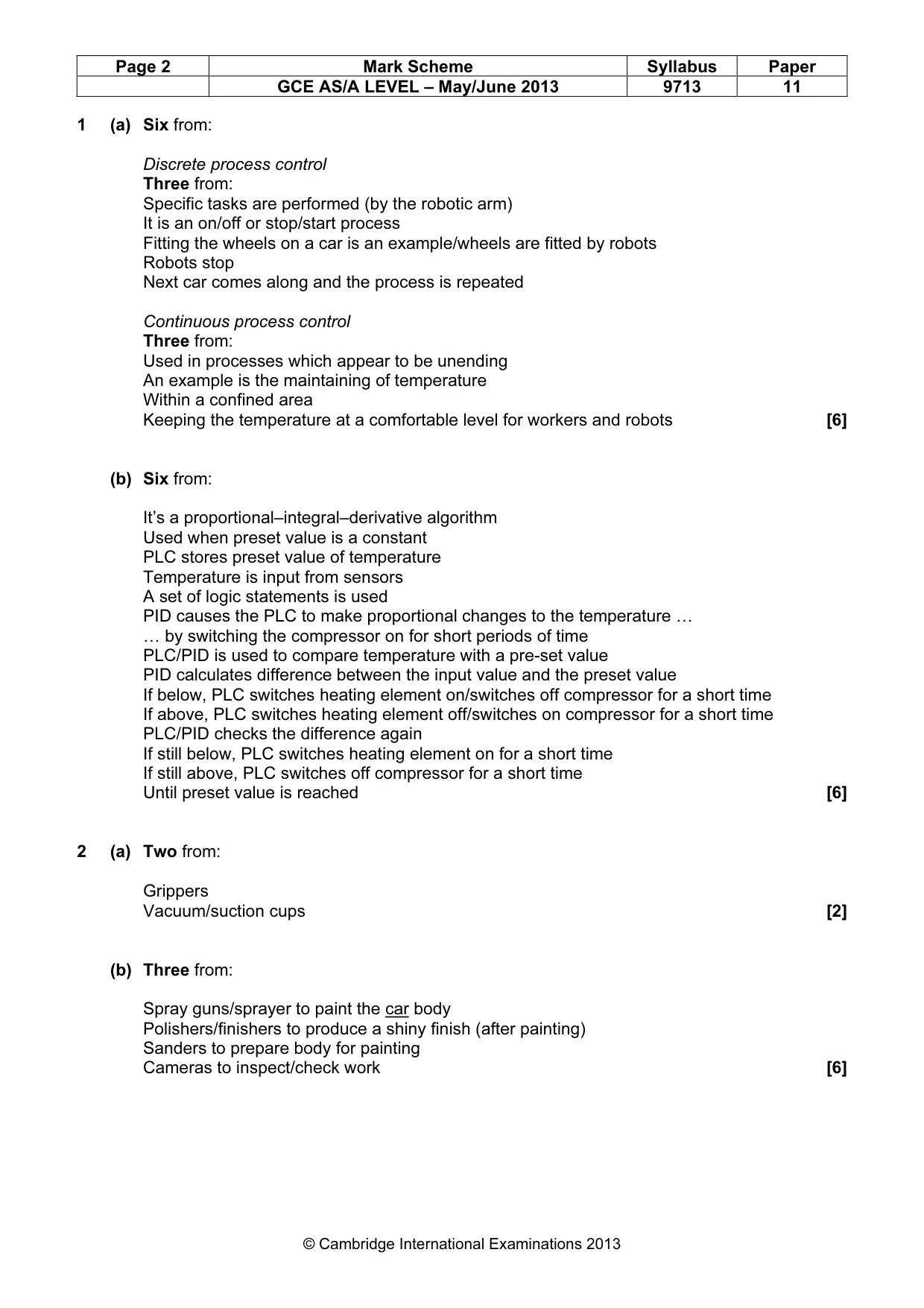
Page 2 Mark Scheme Syllabus Paper GCE AS/A LEVEL – May/June 2013 9713 11 © Cambridge International Examinations 2013 1 (a) Six from: Discrete process control Three from: Specific tasks are performed (by the robotic arm) It is an on/off or stop/start process Fitting the wheels on a car is an example/wheels are fitted by robots Robots stop Next car comes along and the process is repeated Continuous process control Three from: Used in processes which appear to be unending An example is the maintaining of temperature Within a confined area Keeping the temperature at a comfortable level for workers and robots [6] (b) Six from: It’s a proportional–integral–derivative algorithm Used when preset value is a constant PLC stores preset value of temperature Temperature is input from sensors A set of logic statements is used PID causes the PLC to make proportional changes to the temperature … … by switching the compressor on for short periods of time PLC/PID is used to compare temperature with a pre-set value PID calculates difference between the input value and the preset value If below, PLC switches heating element on/switches off compressor for a short time If above, PLC switches heating element off/switches on compressor for a short time PLC/PID checks the difference again If still below, PLC switches heating element on for a short time If still above, PLC switches off compressor for a short time Until preset value is reached [6] 2 (a) Two from: Grippers Vacuum/suction cups [2] (b) Three from: Spray guns/sprayer to paint the car body Polishers/finishers to produce a shiny finish (after painting) Sanders to prepare body for painting Cameras to inspect/check work [6]
Mark scheme, page 3
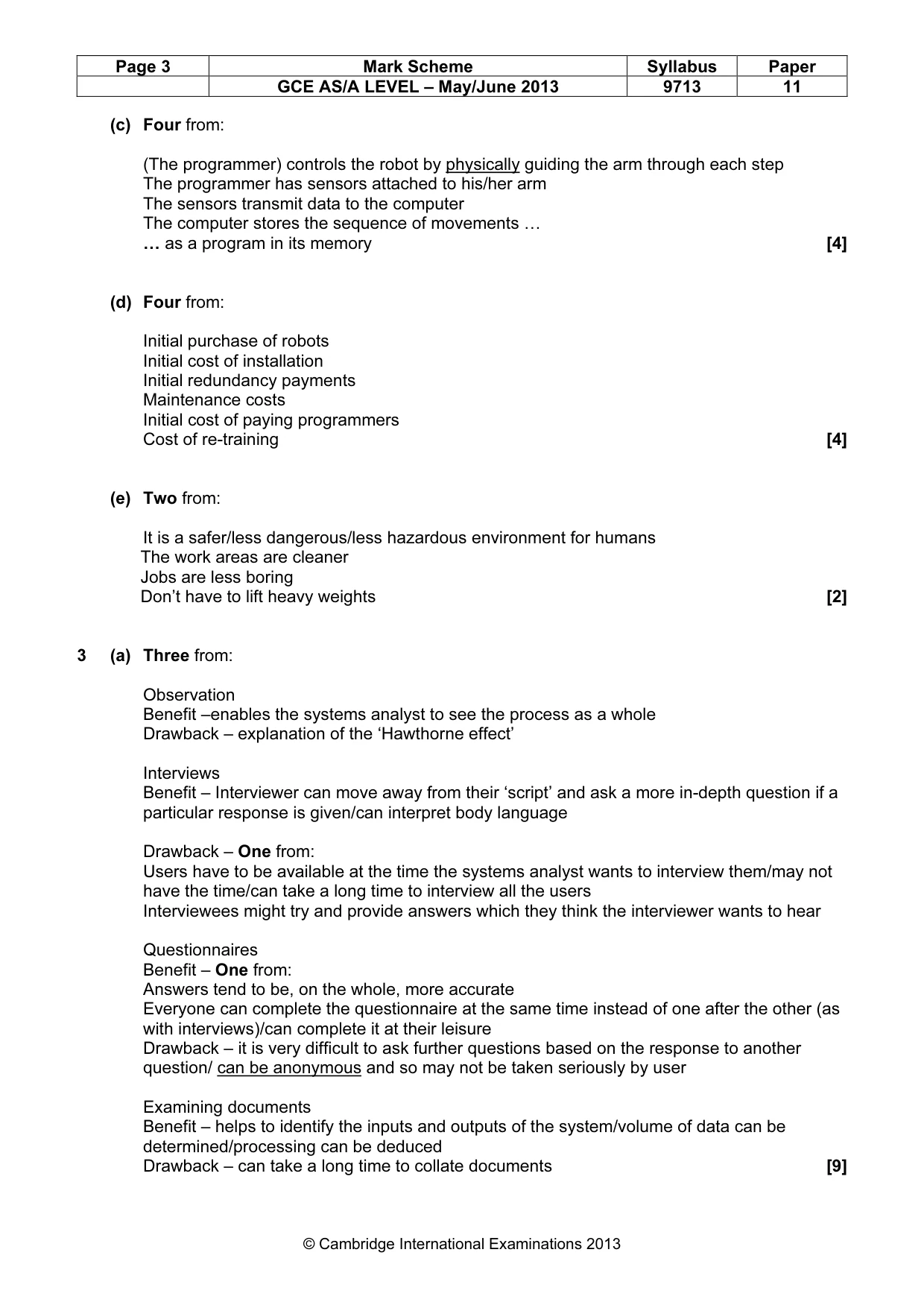
Page 3 Mark Scheme Syllabus Paper GCE AS/A LEVEL – May/June 2013 9713 11 © Cambridge International Examinations 2013 (c) Four from: (The programmer) controls the robot by physically guiding the arm through each step The programmer has sensors attached to his/her arm The sensors transmit data to the computer The computer stores the sequence of movements … … as a program in its memory [4] (d) Four from: Initial purchase of robots Initial cost of installation Initial redundancy payments Maintenance costs Initial cost of paying programmers Cost of re-training [4] (e) Two from: It is a safer/less dangerous/less hazardous environment for humans The work areas are cleaner Jobs are less boring Don’t have to lift heavy weights [2] 3 (a) Three from: Observation Benefit –enables the systems analyst to see the process as a whole Drawback – explanation of the ‘Hawthorne effect’ Interviews Benefit – Interviewer can move away from their ‘script’ and ask a more in-depth question if a particular response is given/can interpret body language Drawback – One from: Users have to be available at the time the systems analyst wants to interview them/may not have the time/can take a long time to interview all the users Interviewees might try and provide answers which they think the interviewer wants to hear Questionnaires Benefit – One from: Answers tend to be, on the whole, more accurate Everyone can complete the questionnaire at the same time instead of one after the other (as with interviews)/can complete it at their leisure Drawback – it is very difficult to ask further questions based on the response to another question/ can be anonymous and so may not be taken seriously by user Examining documents Benefit – helps to identify the inputs and outputs of the system/volume of data can be determined/processing can be deduced Drawback – can take a long time to collate documents [9]
Mark scheme, page 4
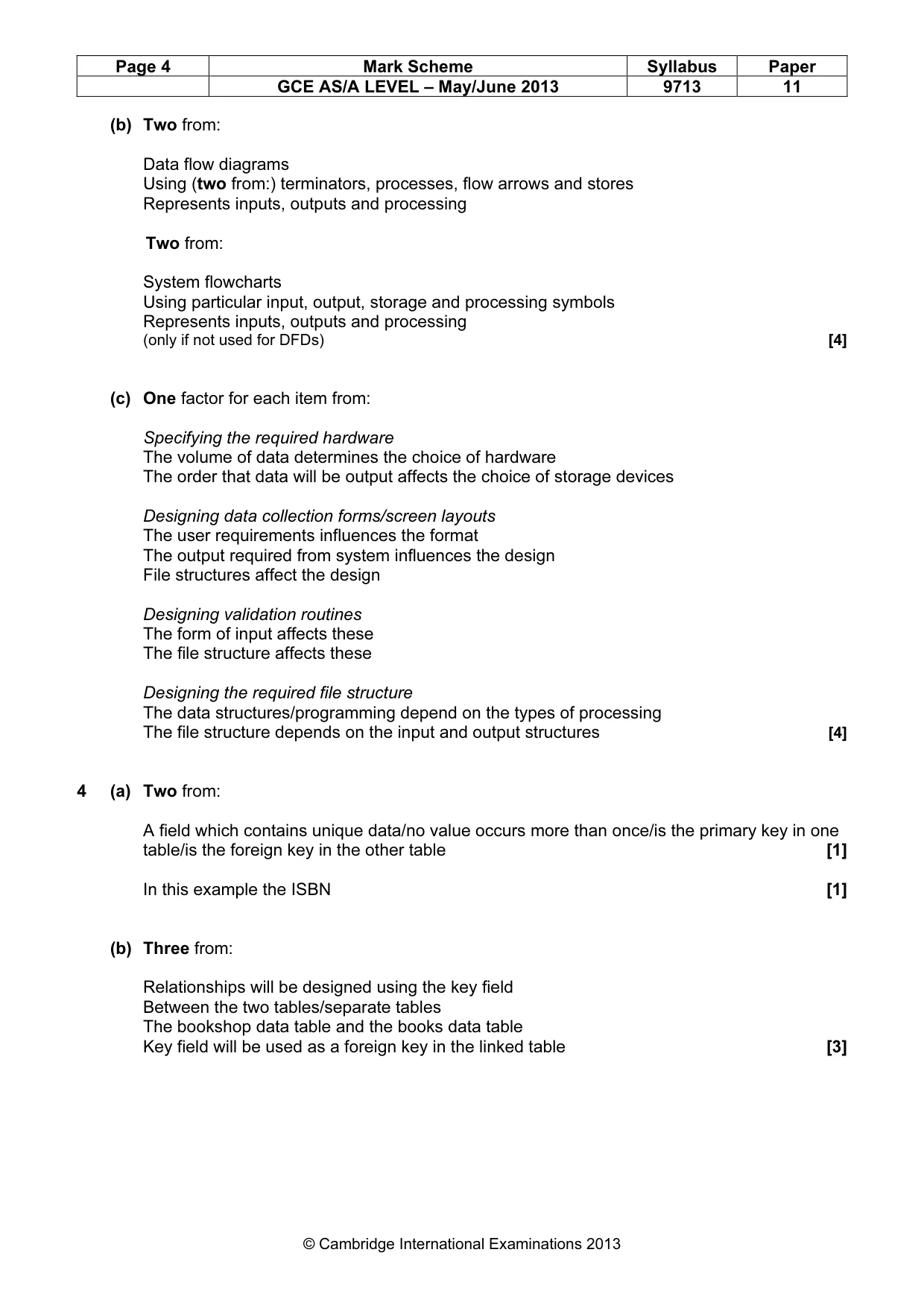
Page 4 Mark Scheme Syllabus Paper GCE AS/A LEVEL – May/June 2013 9713 11 © Cambridge International Examinations 2013 (b) Two from: Data flow diagrams Using (two from:) terminators, processes, flow arrows and stores Represents inputs, outputs and processing Two from: System flowcharts Using particular input, output, storage and processing symbols Represents inputs, outputs and processing (only if not used for DFDs) [4] (c) One factor for each item from: Specifying the required hardware The volume of data determines the choice of hardware The order that data will be output affects the choice of storage devices Designing data collection forms/screen layouts The user requirements influences the format The output required from system influences the design File structures affect the design Designing validation routines The form of input affects these The file structure affects these Designing the required file structure The data structures/programming depend on the types of processing The file structure depends on the input and output structures [4] 4 (a) Two from: A field which contains unique data/no value occurs more than once/is the primary key in one table/is the foreign key in the other table [1] In this example the ISBN [1] (b) Three from: Relationships will be designed using the key field Between the two tables/separate tables The bookshop data table and the books data table Key field will be used as a foreign key in the linked table [3]
Mark scheme, page 5
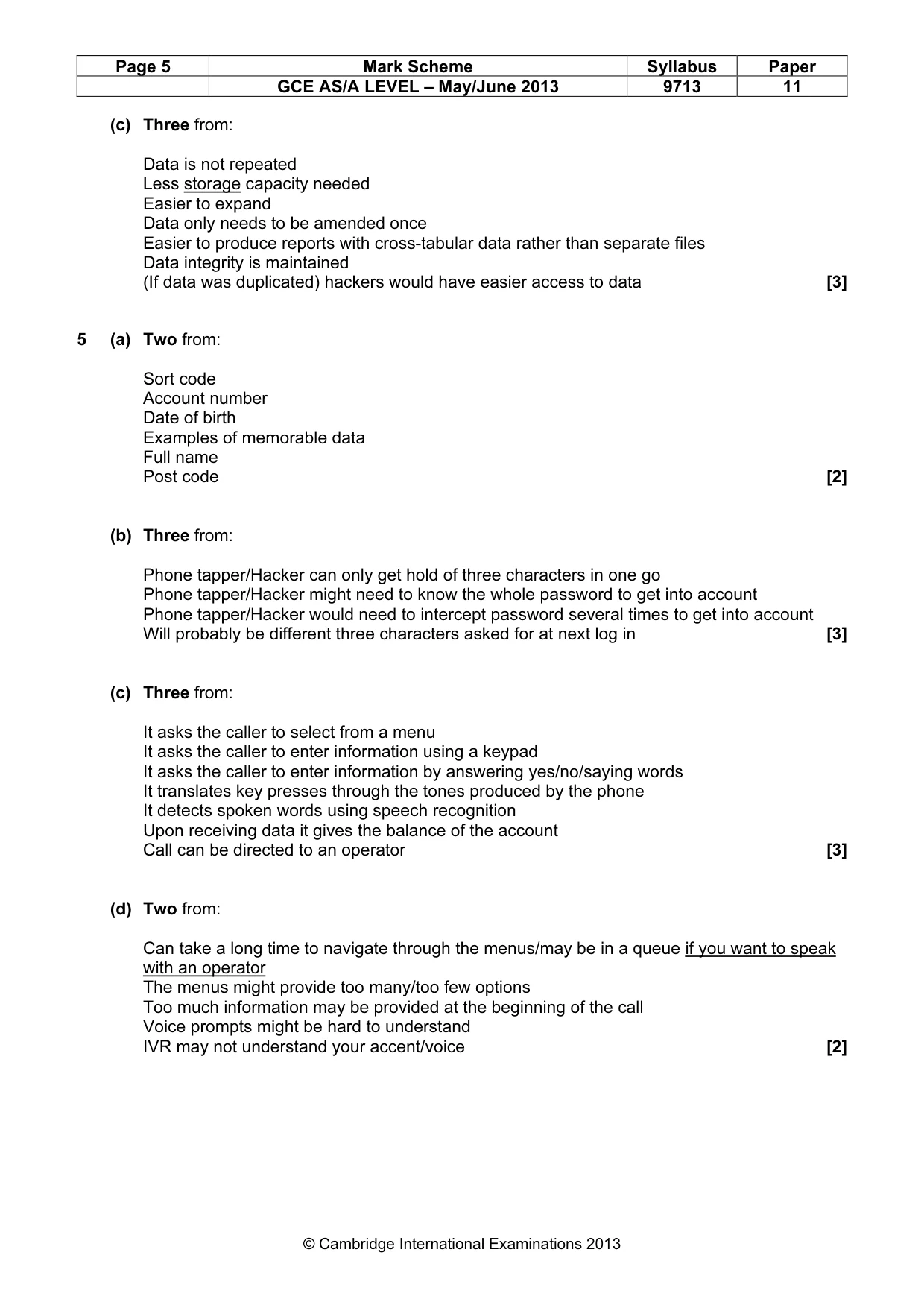
Page 5 Mark Scheme Syllabus Paper GCE AS/A LEVEL – May/June 2013 9713 11 © Cambridge International Examinations 2013 (c) Three from: Data is not repeated Less storage capacity needed Easier to expand Data only needs to be amended once Easier to produce reports with cross-tabular data rather than separate files Data integrity is maintained (If data was duplicated) hackers would have easier access to data [3] 5 (a) Two from: Sort code Account number Date of birth Examples of memorable data Full name Post code [2] (b) Three from: Phone tapper/Hacker can only get hold of three characters in one go Phone tapper/Hacker might need to know the whole password to get into account Phone tapper/Hacker would need to intercept password several times to get into account Will probably be different three characters asked for at next log in [3] (c) Three from: It asks the caller to select from a menu It asks the caller to enter information using a keypad It asks the caller to enter information by answering yes/no/saying words It translates key presses through the tones produced by the phone It detects spoken words using speech recognition Upon receiving data it gives the balance of the account Call can be directed to an operator [3] (d) Two from: Can take a long time to navigate through the menus/may be in a queue if you want to speak with an operator The menus might provide too many/too few options Too much information may be provided at the beginning of the call Voice prompts might be hard to understand IVR may not understand your accent/voice [2]
Mark scheme, page 6
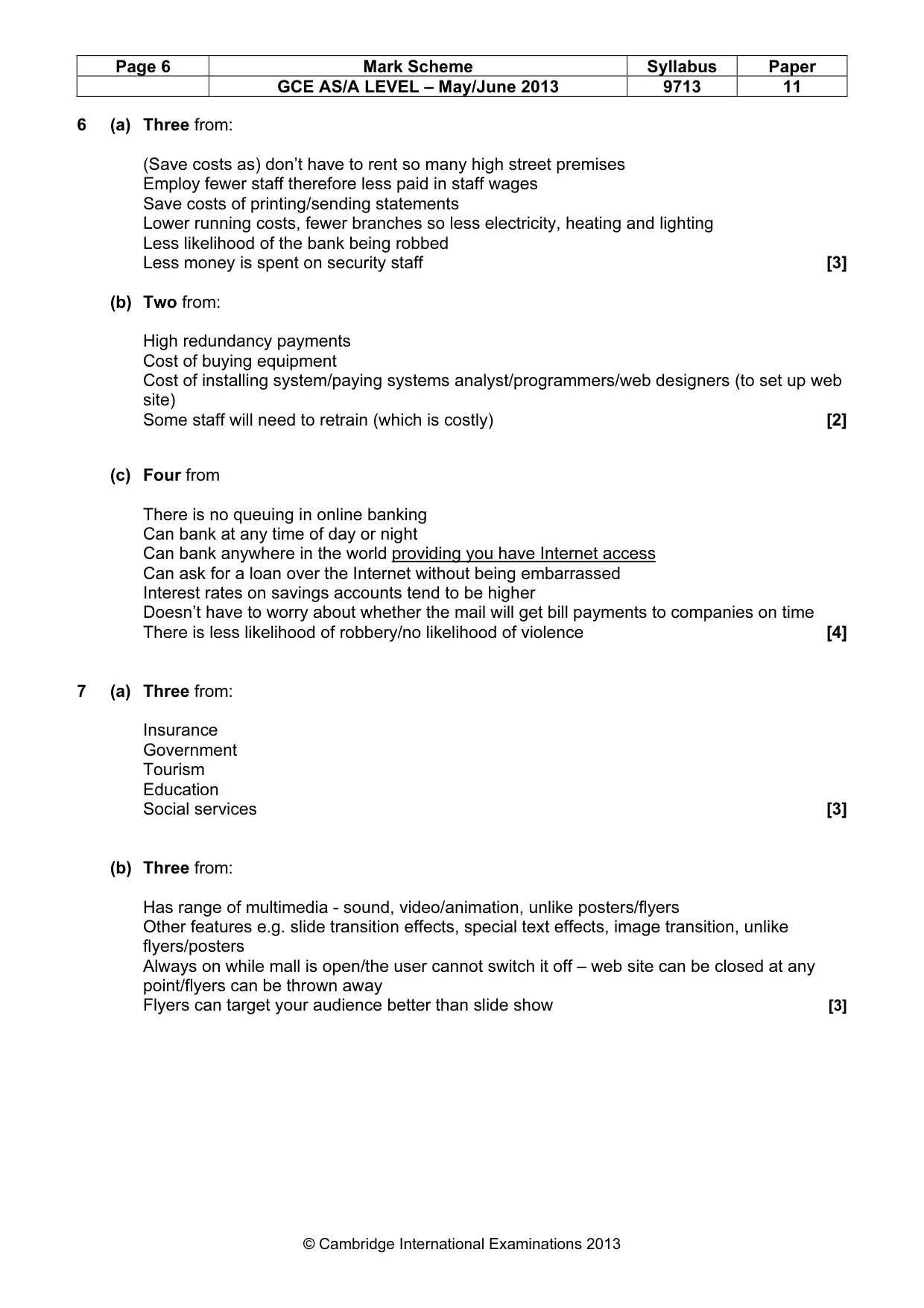
Page 6 Mark Scheme Syllabus Paper GCE AS/A LEVEL – May/June 2013 9713 11 © Cambridge International Examinations 2013 6 (a) Three from: (Save costs as) don’t have to rent so many high street premises Employ fewer staff therefore less paid in staff wages Save costs of printing/sending statements Lower running costs, fewer branches so less electricity, heating and lighting Less likelihood of the bank being robbed Less money is spent on security staff [3] (b) Two from: High redundancy payments Cost of buying equipment Cost of installing system/paying systems analyst/programmers/web designers (to set up web site) Some staff will need to retrain (which is costly) [2] (c) Four from There is no queuing in online banking Can bank at any time of day or night Can bank anywhere in the world providing you have Internet access Can ask for a loan over the Internet without being embarrassed Interest rates on savings accounts tend to be higher Doesn’t have to worry about whether the mail will get bill payments to companies on time There is less likelihood of robbery/no likelihood of violence [4] 7 (a) Three from: Insurance Government Tourism Education Social services [3] (b) Three from: Has range of multimedia - sound, video/animation, unlike posters/flyers Other features e.g. slide transition effects, special text effects, image transition, unlike flyers/posters Always on while mall is open/the user cannot switch it off – web site can be closed at any point/flyers can be thrown away Flyers can target your audience better than slide show [3]
What you needed in this session
Cambridge’s own grade thresholds for 2013 May/June, Paper 1 · Variant 1. A higher threshold means an easier paper — the bar moves with how the cohort did.