Cambridge A Level Applied Information and Communication Technology 9713 — 2011 May/June Paper 3 · Variant 2
9713/32/M/J/11 · 80 marks · ≈90 min
The question paper and its mark scheme, free to read here and free to download. This is Cambridge’s own paper, exactly as it was sat.
Question paper20 pages














Mark scheme7 pages
Answers below. Sit the paper first if you are practising.
Paper as text
Question paper, page 1
This document consists of 18 printed pages and 2 blank pages. IB11 06_9713_32/FP © UCLES 2011 [Turn over *1129510520* UNIVERSITY OF CAMBRIDGE INTERNATIONAL EXAMINATIONS General Certificate of Education Advanced Level APPLIED INFORMATION AND COMMUNICATION TECHNOLOGY 9713/32 Paper 3 May/June 2011 1 hour 15 minutes Candidates answer on the Question Paper. No additional materials are required. READ THESE INSTRUCTIONS FIRST Write your Centre number, candidate number and name on all the work you hand in. Write in dark blue or black pen. Do not use staples, paper clips, highlighters, glue or correction fluid. You may use a pencil for any diagrams, graphs or rough working. DO NOT WRITE IN ANY BARCODES. Answer all questions. The number of marks is given in brackets [ ] at the end of each question or part question. The businesses described in this paper are entirely fictitious.
Question paper, page 2
2 © UCLES 2011 9713/32/M/J/11 For Examiner's Use Scenario 1 Questions 1 and 2 Popular Individual Electronics Ltd (PIE) is an electronics company that is going to develop a new home entertainment system. PIE needs to undertake market research before they produce a prototype which can then be approved for production. The project manager, Derek, has to consider the technical features and produce a financial model. There are a number of teams involved in producing the prototype, including a hardware development team and a software development team.
Question paper, page 3
3 © UCLES 2011 9713/32/M/J/11 [Turn over For Examiner's Use 1 (a) Describe how each of these pieces of hardware will be used in the home entertainment system. (i) MP3 [2] (ii) USB port [2] (iii) Secure Digital Memory card [2]
Question paper, page 4
4 © UCLES 2011 9713/32/M/J/11 For Examiner's Use (b) Explain how the company would assess the market for its new product by using computer-assisted telephone interviewing. [4] (c) Explain how ICT would be used to analyse the results from this research. [3]
Question paper, page 5
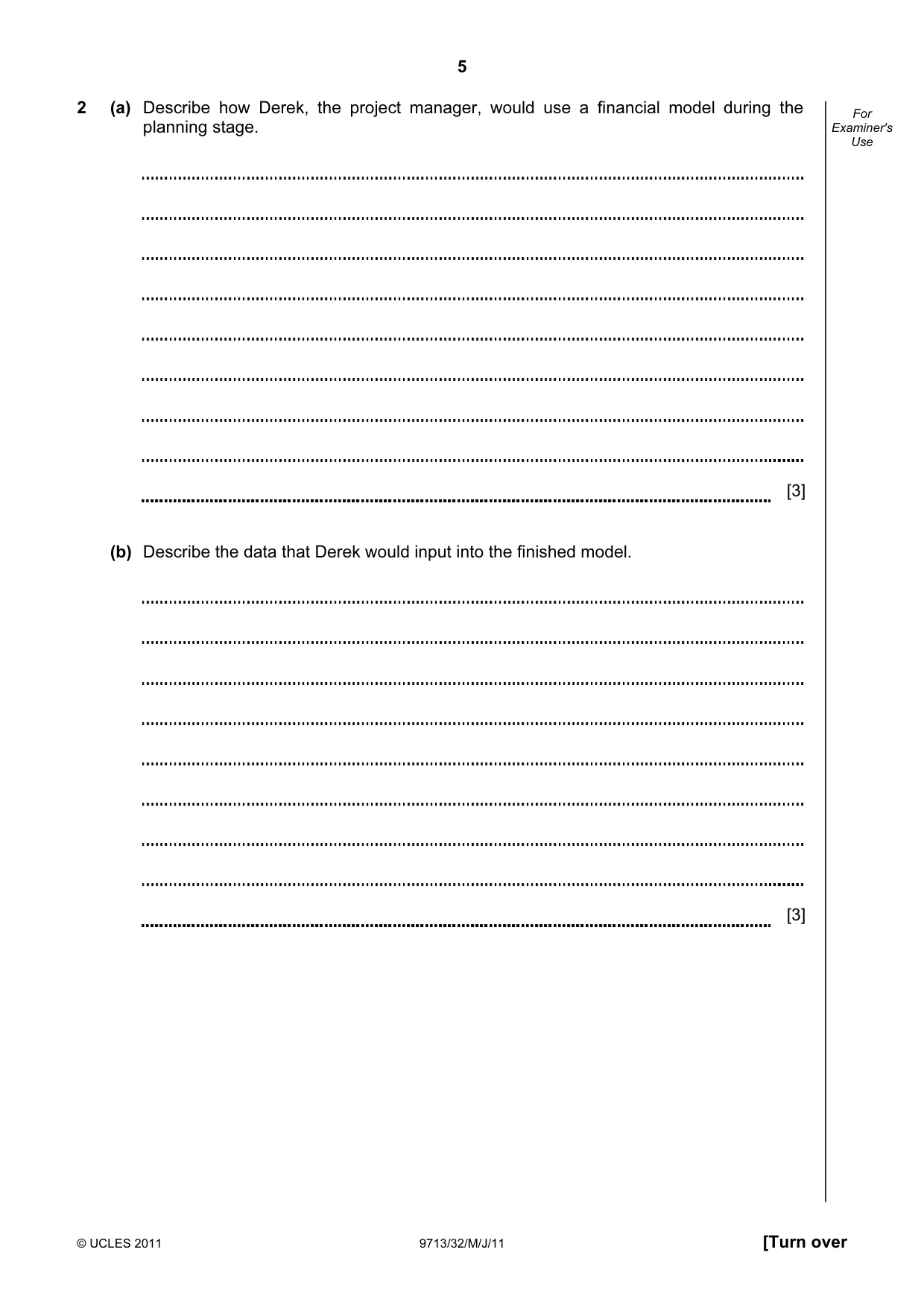
5 © UCLES 2011 9713/32/M/J/11 [Turn over For Examiner's Use 2 (a) Describe how Derek, the project manager, would use a financial model during the planning stage. [3] (b) Describe the data that Derek would input into the finished model. [3]
Question paper, page 6
6 © UCLES 2011 9713/32/M/J/11 For Examiner's Use (c) Explain how project management tools could be used to monitor the progress in producing the prototype home entertainment system. [4]
Question paper, page 7
7 © UCLES 2011 9713/32/M/J/11 [Turn over For Examiner's Use Scenario 2 Questions 3, 4, 5 and 6 The Bank of Smalltown has branches all over the world. It uses an intranet for the transfer of information between branches. Customers are concerned about the security of their personal data held in the bank’s computer systems. When a customer applies for a bank loan an expert system is used to see if the loan can be approved. The bank has a website for online banking. The bank uses video conferencing suites for communication. It wishes to support schools by providing the basic hardware and software to enable them to communicate with the bank and with each other using video conferencing.
Question paper, page 8
8 © UCLES 2011 9713/32/M/J/11 For Examiner's Use 3 (a) Describe four ways that the intranet would be used. [4] (b) Describe the concerns that the customers may have in relation to computer fraud. [4]
Question paper, page 9
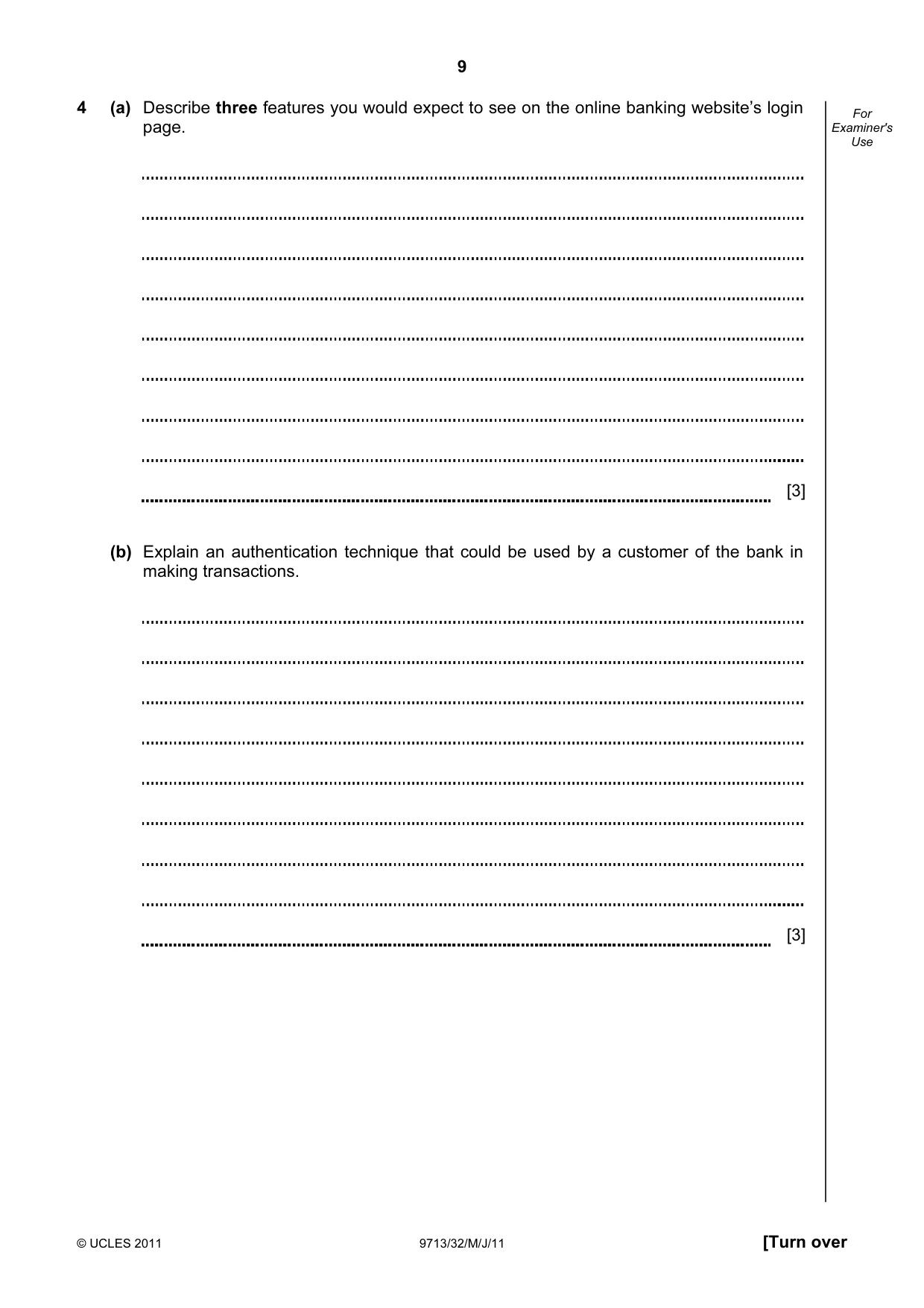
9 © UCLES 2011 9713/32/M/J/11 [Turn over For Examiner's Use 4 (a) Describe three features you would expect to see on the online banking website’s login page. [3] (b) Explain an authentication technique that could be used by a customer of the bank in making transactions. [3]
Question paper, page 10
10 © UCLES 2011 9713/32/M/J/11 For Examiner's Use (c) Describe what is meant by each of the following and explain why the bank uses them in its business. (i) VPN [3] (ii) VOIP [3]
Question paper, page 11
11 © UCLES 2011 9713/32/M/J/11 [Turn over For Examiner's Use (iii) Proxy servers [3]
Question paper, page 12
12 © UCLES 2011 9713/32/M/J/11 For Examiner's Use 5 The bank uses video conferencing suites to arrange meetings between groups of directors in different countries. The schools use their video conferencing facilities to allow groups of students to communicate with students at other schools. Compare and contrast these two different uses of video conferencing. [8]
Question paper, page 13
13 © UCLES 2011 9713/32/M/J/11 [Turn over For Examiner's Use 6 Explain why the use of the expert system for approving a loan would benefit the bank. [3]
Question paper, page 14
14 © UCLES 2011 9713/32/M/J/11 For Examiner's Use Scenario 3 Questions 7, 8 and 9 A Local Government Authority uses ICT in many ways. One of these is a website to provide the residents with up-to-date information. The authority is concerned about the digital divide.
Question paper, page 15
15 © UCLES 2011 9713/32/M/J/11 [Turn over For Examiner's Use 7 Describe what the residents would use the website for. [6]
Question paper, page 16
16 © UCLES 2011 9713/32/M/J/11 For Examiner's Use 8 (a) Explain how technical developments in ICT are reducing the digital divide among the residents. [5]
Question paper, page 17
17 © UCLES 2011 9713/32/M/J/11 [Turn over For Examiner's Use (b) Describe how the Local Government Authority could educate residents in order to reduce the digital divide. [4]
Question paper, page 18
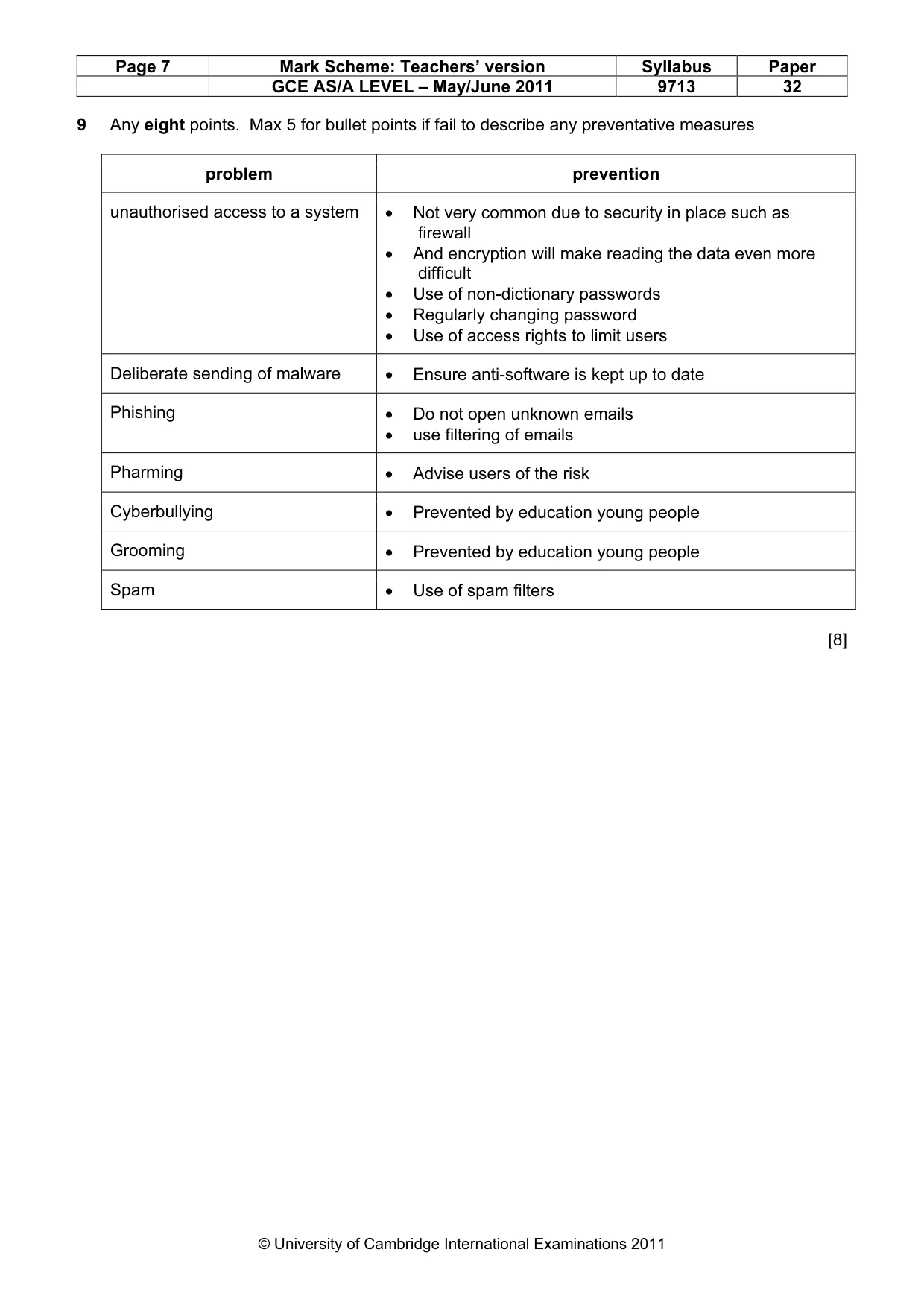
18 © UCLES 2011 9713/32/M/J/11 For Examiner's Use 9 The Local Government Authority is concerned about anti-social behaviour when using ICT. Give examples of this type of behaviour and describe how they may be prevented. [8]
Question paper, page 19
19 © UCLES 2011 9713/32/M/J/11 BLANK PAGE
Question paper, page 20
20 Permission to reproduce items where third-party owned material protected by copyright is included has been sought and cleared where possible. Every reasonable effort has been made by the publisher (UCLES) to trace copyright holders, but if any items requiring clearance have unwittingly been included, the publisher will be pleased to make amends at the earliest possible opportunity. University of Cambridge International Examinations is part of the Cambridge Assessment Group. Cambridge Assessment is the brand name of University of Cambridge Local Examinations Syndicate (UCLES), which is itself a department of the University of Cambridge. © UCLES 2011 9713/32/M/J/11 BLANK PAGE
Mark scheme, page 1
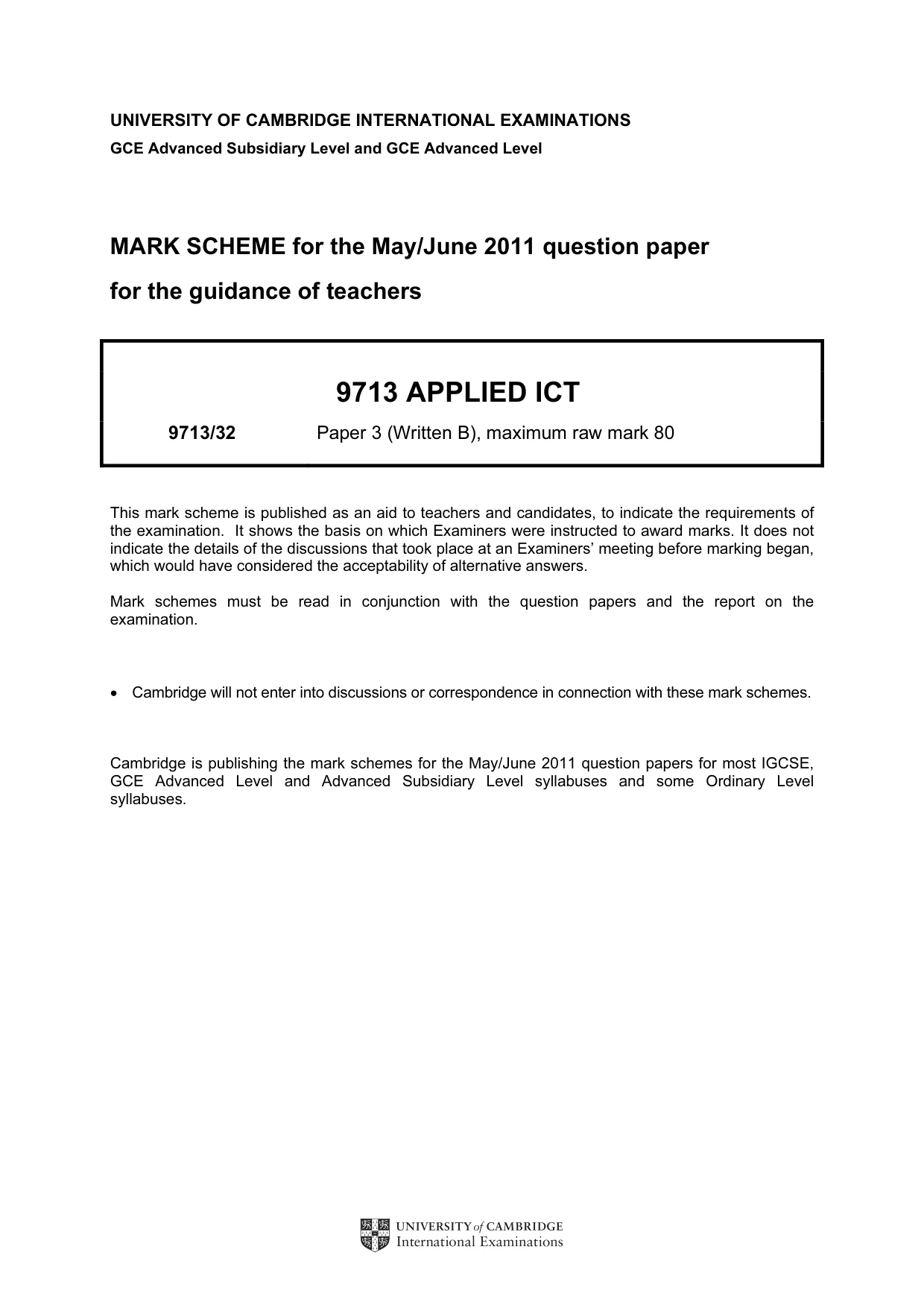
UNIVERSITY OF CAMBRIDGE INTERNATIONAL EXAMINATIONS GCE Advanced Subsidiary Level and GCE Advanced Level MARK SCHEME for the May/June 2011 question paper for the guidance of teachers 9713 APPLIED ICT 9713/32 Paper 3 (Written B), maximum raw mark 80 This mark scheme is published as an aid to teachers and candidates, to indicate the requirements of the examination. It shows the basis on which Examiners were instructed to award marks. It does not indicate the details of the discussions that took place at an Examiners’ meeting before marking began, which would have considered the acceptability of alternative answers. Mark schemes must be read in conjunction with the question papers and the report on the examination. • Cambridge will not enter into discussions or correspondence in connection with these mark schemes. Cambridge is publishing the mark schemes for the May/June 2011 question papers for most IGCSE, GCE Advanced Level and Advanced Subsidiary Level syllabuses and some Ordinary Level syllabuses.
Mark scheme, page 2
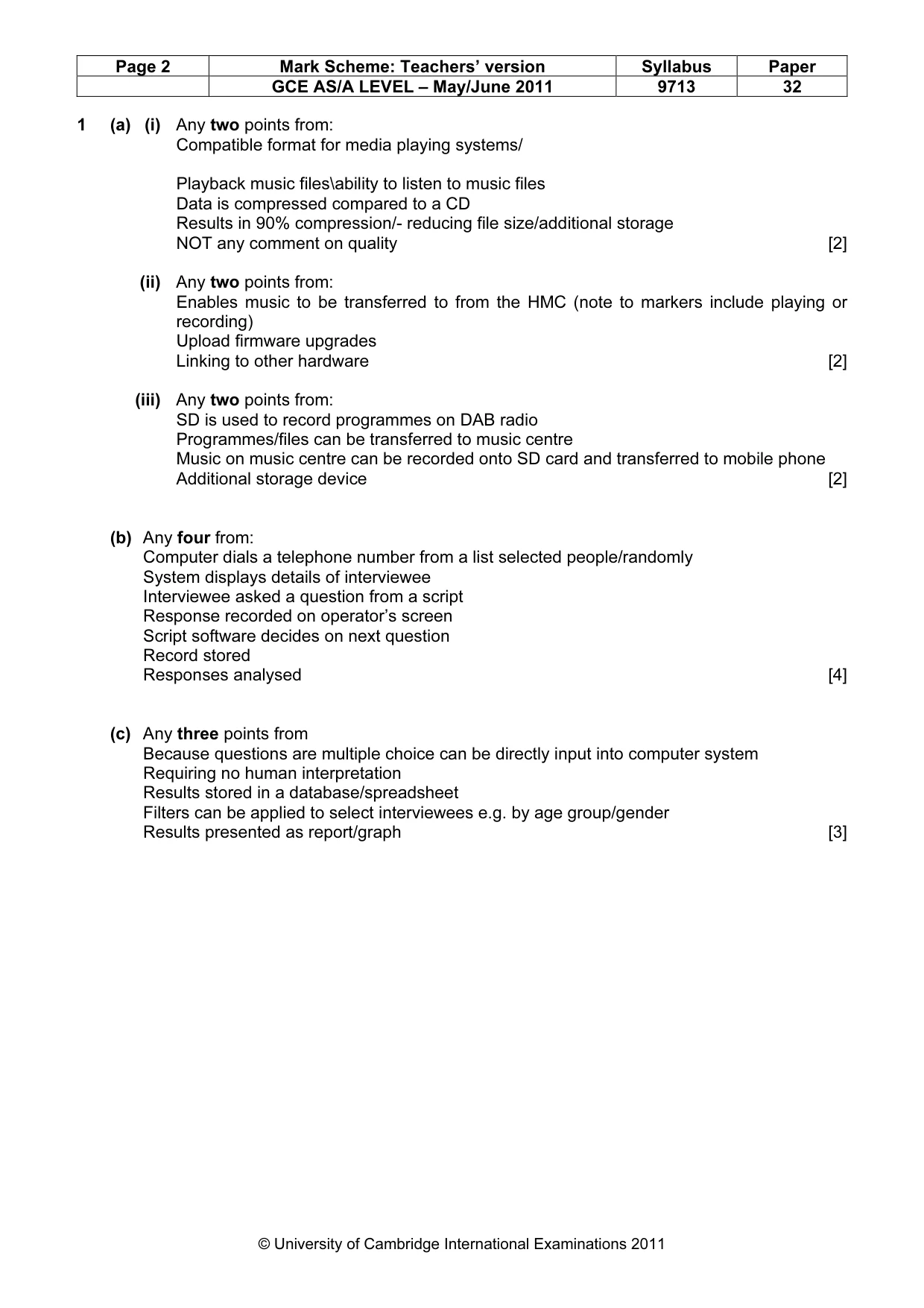
Page 2 Mark Scheme: Teachers’ version Syllabus Paper GCE AS/A LEVEL – May/June 2011 9713 32 © University of Cambridge International Examinations 2011 1 (a) (i) Any two points from: Compatible format for media playing systems/ Playback music files\ability to listen to music files Data is compressed compared to a CD Results in 90% compression/- reducing file size/additional storage NOT any comment on quality [2] (ii) Any two points from: Enables music to be transferred to from the HMC (note to markers include playing or recording) Upload firmware upgrades Linking to other hardware [2] (iii) Any two points from: SD is used to record programmes on DAB radio Programmes/files can be transferred to music centre Music on music centre can be recorded onto SD card and transferred to mobile phone Additional storage device [2] (b) Any four from: Computer dials a telephone number from a list selected people/randomly System displays details of interviewee Interviewee asked a question from a script Response recorded on operator’s screen Script software decides on next question Record stored Responses analysed [4] (c) Any three points from Because questions are multiple choice can be directly input into computer system Requiring no human interpretation Results stored in a database/spreadsheet Filters can be applied to select interviewees e.g. by age group/gender Results presented as report/graph [3]
Mark scheme, page 3
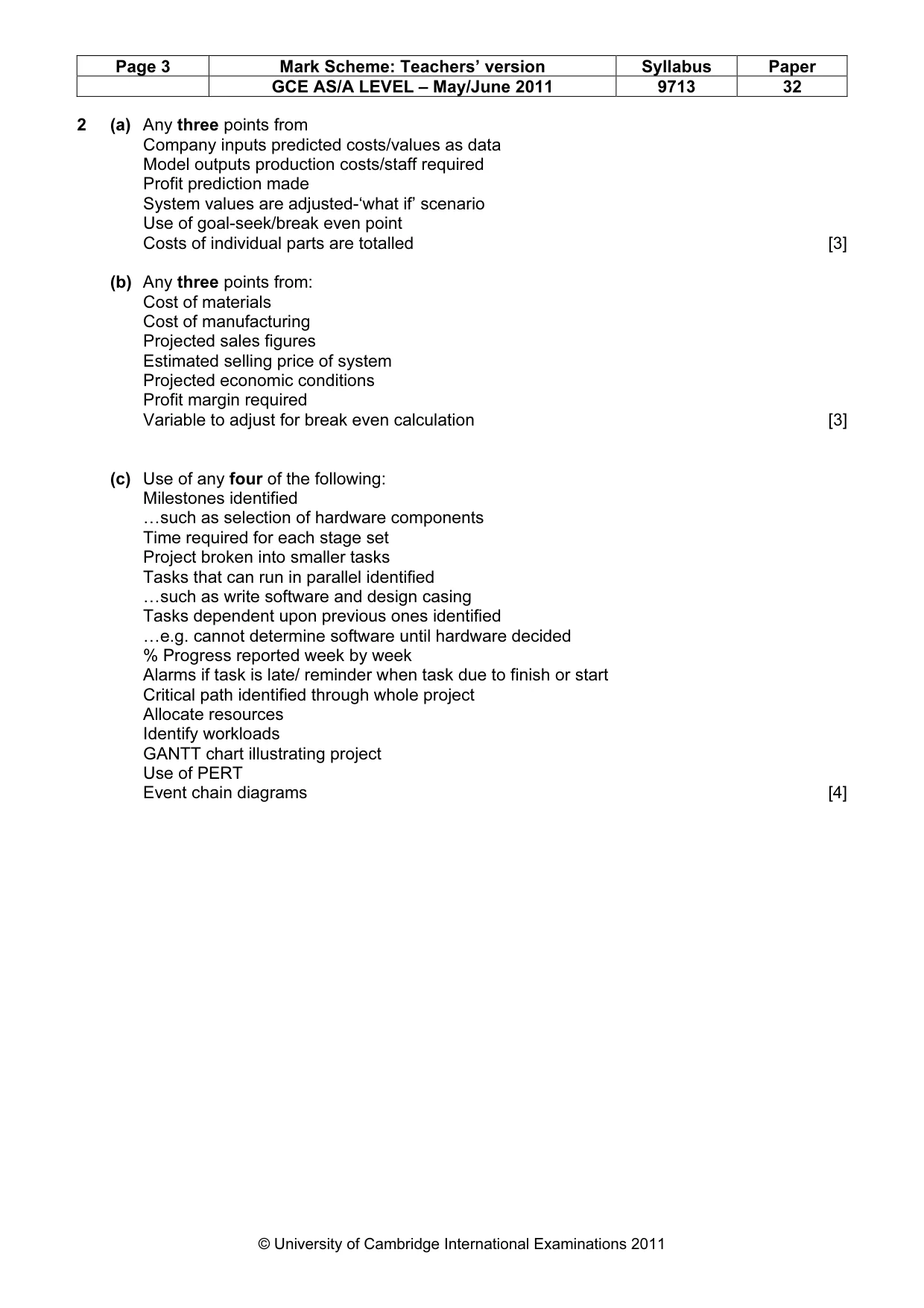
Page 3 Mark Scheme: Teachers’ version Syllabus Paper GCE AS/A LEVEL – May/June 2011 9713 32 © University of Cambridge International Examinations 2011 2 (a) Any three points from Company inputs predicted costs/values as data Model outputs production costs/staff required Profit prediction made System values are adjusted-‘what if’ scenario Use of goal-seek/break even point Costs of individual parts are totalled [3] (b) Any three points from: Cost of materials Cost of manufacturing Projected sales figures Estimated selling price of system Projected economic conditions Profit margin required Variable to adjust for break even calculation [3] (c) Use of any four of the following: Milestones identified …such as selection of hardware components Time required for each stage set Project broken into smaller tasks Tasks that can run in parallel identified …such as write software and design casing Tasks dependent upon previous ones identified …e.g. cannot determine software until hardware decided % Progress reported week by week Alarms if task is late/ reminder when task due to finish or start Critical path identified through whole project Allocate resources Identify workloads GANTT chart illustrating project Use of PERT Event chain diagrams [4]
Mark scheme, page 4
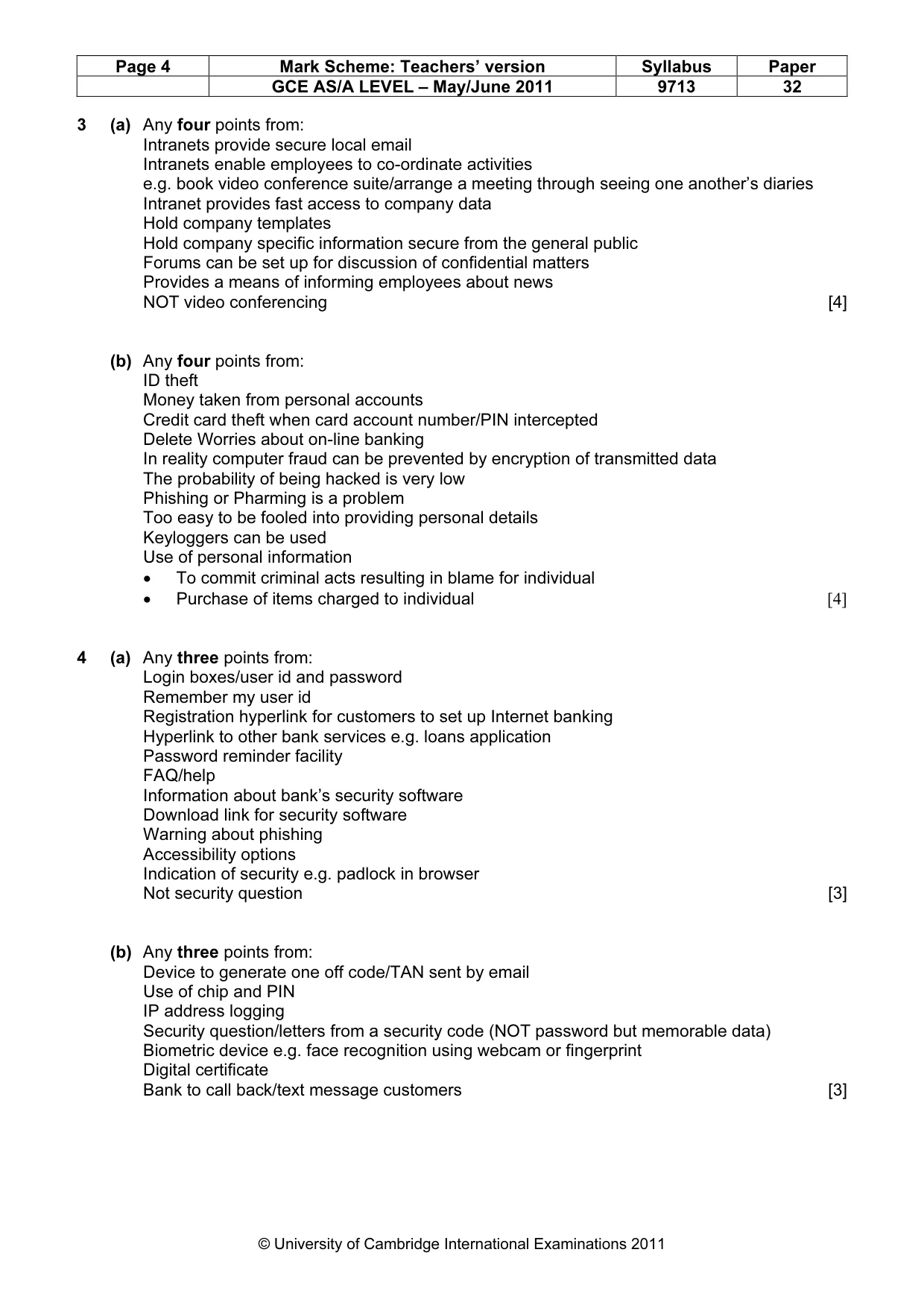
Page 4 Mark Scheme: Teachers’ version Syllabus Paper GCE AS/A LEVEL – May/June 2011 9713 32 © University of Cambridge International Examinations 2011 3 (a) Any four points from: Intranets provide secure local email Intranets enable employees to co-ordinate activities e.g. book video conference suite/arrange a meeting through seeing one another’s diaries Intranet provides fast access to company data Hold company templates Hold company specific information secure from the general public Forums can be set up for discussion of confidential matters Provides a means of informing employees about news NOT video conferencing [4] (b) Any four points from: ID theft Money taken from personal accounts Credit card theft when card account number/PIN intercepted Delete Worries about on-line banking In reality computer fraud can be prevented by encryption of transmitted data The probability of being hacked is very low Phishing or Pharming is a problem Too easy to be fooled into providing personal details Keyloggers can be used Use of personal information • To commit criminal acts resulting in blame for individual • Purchase of items charged to individual [4] 4 (a) Any three points from: Login boxes/user id and password Remember my user id Registration hyperlink for customers to set up Internet banking Hyperlink to other bank services e.g. loans application Password reminder facility FAQ/help Information about bank’s security software Download link for security software Warning about phishing Accessibility options Indication of security e.g. padlock in browser Not security question [3] (b) Any three points from: Device to generate one off code/TAN sent by email Use of chip and PIN IP address logging Security question/letters from a security code (NOT password but memorable data) Biometric device e.g. face recognition using webcam or fingerprint Digital certificate Bank to call back/text message customers [3]
Mark scheme, page 5
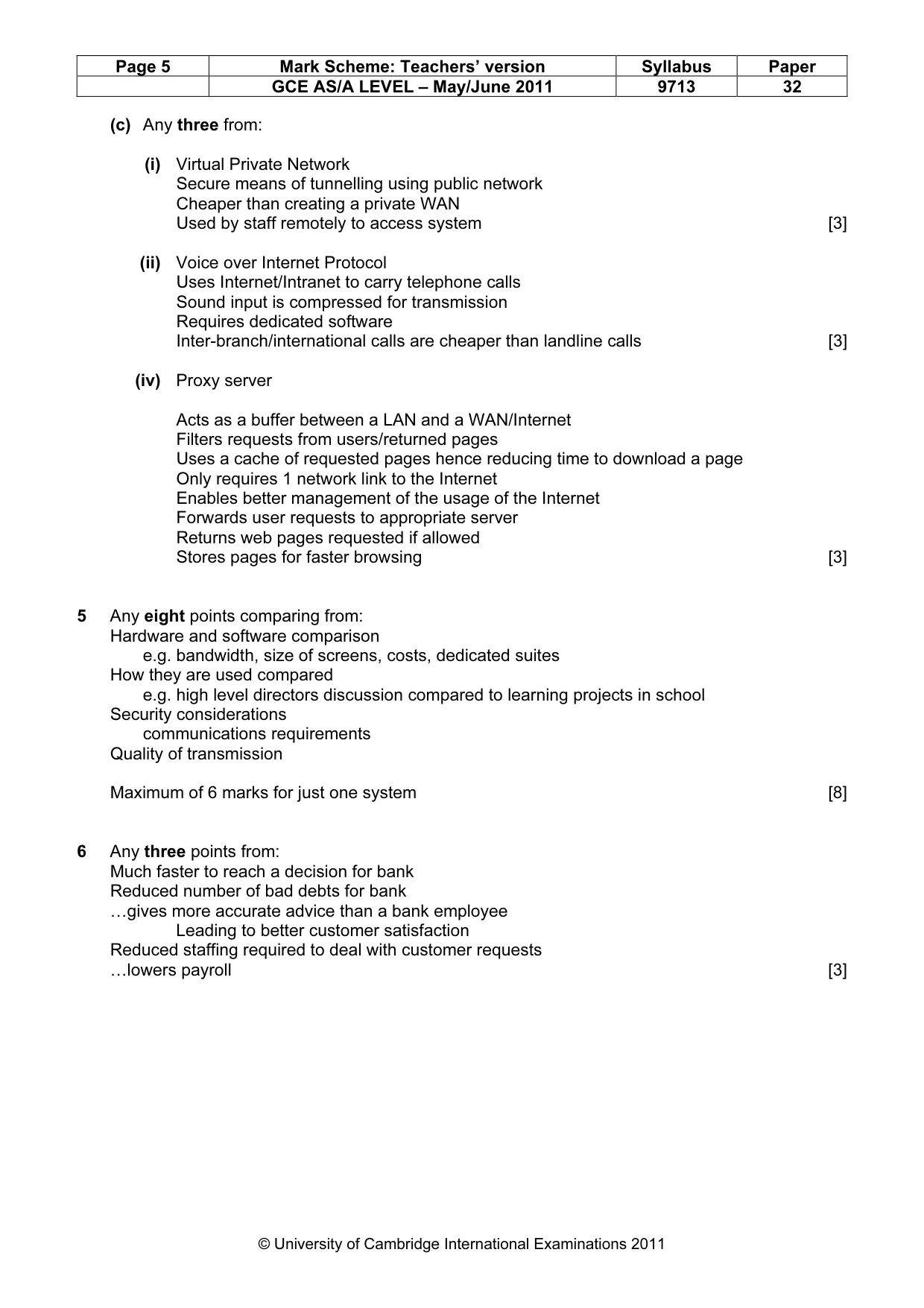
Page 5 Mark Scheme: Teachers’ version Syllabus Paper GCE AS/A LEVEL – May/June 2011 9713 32 © University of Cambridge International Examinations 2011 (c) Any three from: (i) Virtual Private Network Secure means of tunnelling using public network Cheaper than creating a private WAN Used by staff remotely to access system [3] (ii) Voice over Internet Protocol Uses Internet/Intranet to carry telephone calls Sound input is compressed for transmission Requires dedicated software Inter-branch/international calls are cheaper than landline calls [3] (iv) Proxy server Acts as a buffer between a LAN and a WAN/Internet Filters requests from users/returned pages Uses a cache of requested pages hence reducing time to download a page Only requires 1 network link to the Internet Enables better management of the usage of the Internet Forwards user requests to appropriate server Returns web pages requested if allowed Stores pages for faster browsing [3] 5 Any eight points comparing from: Hardware and software comparison e.g. bandwidth, size of screens, costs, dedicated suites How they are used compared e.g. high level directors discussion compared to learning projects in school Security considerations communications requirements Quality of transmission Maximum of 6 marks for just one system [8] 6 Any three points from: Much faster to reach a decision for bank Reduced number of bad debts for bank …gives more accurate advice than a bank employee Leading to better customer satisfaction Reduced staffing required to deal with customer requests …lowers payroll [3]
Mark scheme, page 6
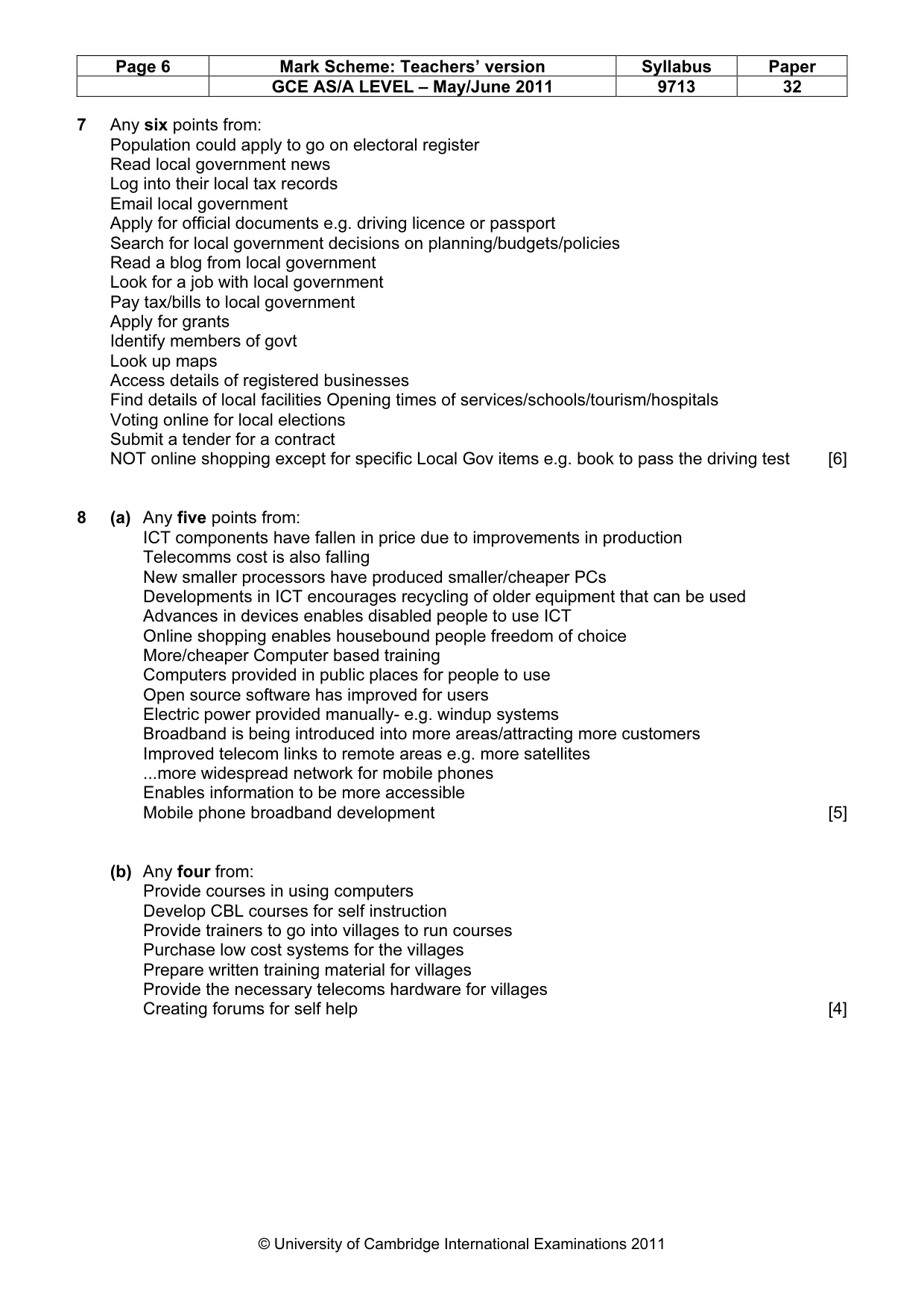
Page 6 Mark Scheme: Teachers’ version Syllabus Paper GCE AS/A LEVEL – May/June 2011 9713 32 © University of Cambridge International Examinations 2011 7 Any six points from: Population could apply to go on electoral register Read local government news Log into their local tax records Email local government Apply for official documents e.g. driving licence or passport Search for local government decisions on planning/budgets/policies Read a blog from local government Look for a job with local government Pay tax/bills to local government Apply for grants Identify members of govt Look up maps Access details of registered businesses Find details of local facilities Opening times of services/schools/tourism/hospitals Voting online for local elections Submit a tender for a contract NOT online shopping except for specific Local Gov items e.g. book to pass the driving test [6] 8 (a) Any five points from: ICT components have fallen in price due to improvements in production Telecomms cost is also falling New smaller processors have produced smaller/cheaper PCs Developments in ICT encourages recycling of older equipment that can be used Advances in devices enables disabled people to use ICT Online shopping enables housebound people freedom of choice More/cheaper Computer based training Computers provided in public places for people to use Open source software has improved for users Electric power provided manually- e.g. windup systems Broadband is being introduced into more areas/attracting more customers Improved telecom links to remote areas e.g. more satellites ...more widespread network for mobile phones Enables information to be more accessible Mobile phone broadband development [5] (b) Any four from: Provide courses in using computers Develop CBL courses for self instruction Provide trainers to go into villages to run courses Purchase low cost systems for the villages Prepare written training material for villages Provide the necessary telecoms hardware for villages Creating forums for self help [4]
Mark scheme, page 7
Page 7 Mark Scheme: Teachers’ version Syllabus Paper GCE AS/A LEVEL – May/June 2011 9713 32 © University of Cambridge International Examinations 2011 9 Any eight points. Max 5 for bullet points if fail to describe any preventative measures problem prevention unauthorised access to a system • Not very common due to security in place such as firewall • And encryption will make reading the data even more difficult • Use of non-dictionary passwords • Regularly changing password • Use of access rights to limit users Deliberate sending of malware • Ensure anti-software is kept up to date Phishing • Do not open unknown emails • use filtering of emails Pharming • Advise users of the risk Cyberbullying • Prevented by education young people Grooming • Prevented by education young people Spam • Use of spam filters [8]
What you needed in this session
Cambridge’s own grade thresholds for 2011 May/June, Paper 3 · Variant 2. A higher threshold means an easier paper — the bar moves with how the cohort did.