Cambridge A Level Applied Information and Communication Technology 9713 — 2010 Oct/Nov Paper 3 · Variant 1
9713/31/O/N/10 · 80 marks · ≈90 min
The question paper and its mark scheme, free to read here and free to download. This is Cambridge’s own paper, exactly as it was sat.
Question paper20 pages











Mark scheme7 pages
Answers below. Sit the paper first if you are practising.
Paper as text
Question paper, page 1
This document consists of 18 printed pages and 2 blank pages. IB10 11_9713_31/2RP © UCLES 2010 [Turn over *1035975101* UNIVERSITY OF CAMBRIDGE INTERNATIONAL EXAMINATIONS General Certificate of Education Advanced Level APPLIED INFORMATION AND COMMUNICATION TECHNOLOGY 9713/31 Paper 3 October/November 2010 1 hour 15 minutes Candidates answer on the Question Paper. No additional materials are required READ THESE INSTRUCTIONS FIRST Write your Centre number, candidate number and name on all the work you hand in. Write in dark blue or black pen. Do not use staples, paper clips, highlighters, glue or correction fluid. You may use a pencil for any diagrams, graphs or rough working. DO NOT WRITE IN ANY BARCODES. Answer all questions. The number of marks is given in brackets [ ] at the end of each question or part question. The businesses described in this paper are entirely fictitious.
Question paper, page 2
2 © UCLES 2010 9713/31/O/N/10 For Examiner's Use Scenario 1 Questions 1 to 3 Braemart Supermarkets are a multinational company. They use bar codes for stock control and finding prices and product information at point of sale terminals (POS) in each of their stores. The company is concerned about the cost of stock being wasted. They are looking into a ‘just- in-time’ system for stocking the stores. Their Cairo store has used computer simulations to determine the number of checkouts required to minimise customer waiting times. The supermarket staff are trained on a regular basis regarding new procedures and new technologies.
Question paper, page 3
3 © UCLES 2010 9713/31/O/N/10 [Turn over For Examiner's Use 1 (a) Describe how the stock file is updated using information from the bar codes. [5]
Question paper, page 4
4 © UCLES 2010 9713/31/O/N/10 For Examiner's Use (b) Describe how a ‘just-in-time’ system would work. [5]
Question paper, page 5
5 © UCLES 2010 9713/31/O/N/10 [Turn over For Examiner's Use 2 The number of checkouts needed in the Cairo store was determined by a computer simulation. (a) Describe how the data is collected for use in the simulation. [3] (b) What information would be required by Braemart to enable this simulation to be carried out? [3]
Question paper, page 6
6 © UCLES 2010 9713/31/O/N/10 For Examiner's Use 3 Braemart use computer-based systems to train their staff. (a) Describe how computers can be used to train staff. [5]
Question paper, page 7
7 © UCLES 2010 9713/31/O/N/10 [Turn over For Examiner's Use (b) Describe four disadvantages of computer-based training when compared to conventional “classroom” training. [4]
Question paper, page 8
8 © UCLES 2010 9713/31/O/N/10 For Examiner's Use Scenario 2 Questions 4 to 6 The Asian International Insurance Company (AIIC) uses an expert system. Their insurance advisors use it to conduct risk assessments on customers. The company is developing new products. They need to do some research to find out if a market exists for these new products. AIIC’s products are listed on a global insurance website which enables customers to choose the best insurance for their needs. Since the head office is in a very hot country, an air conditioning system is installed which is fully computer-controlled.
Question paper, page 9
9 © UCLES 2010 9713/31/O/N/10 [Turn over For Examiner's Use 4 (a) Describe how this expert system can be used. [4] (b) Describe the project management tools that are available to the company when developing new products to a time scale and to budget. [4]
Question paper, page 10
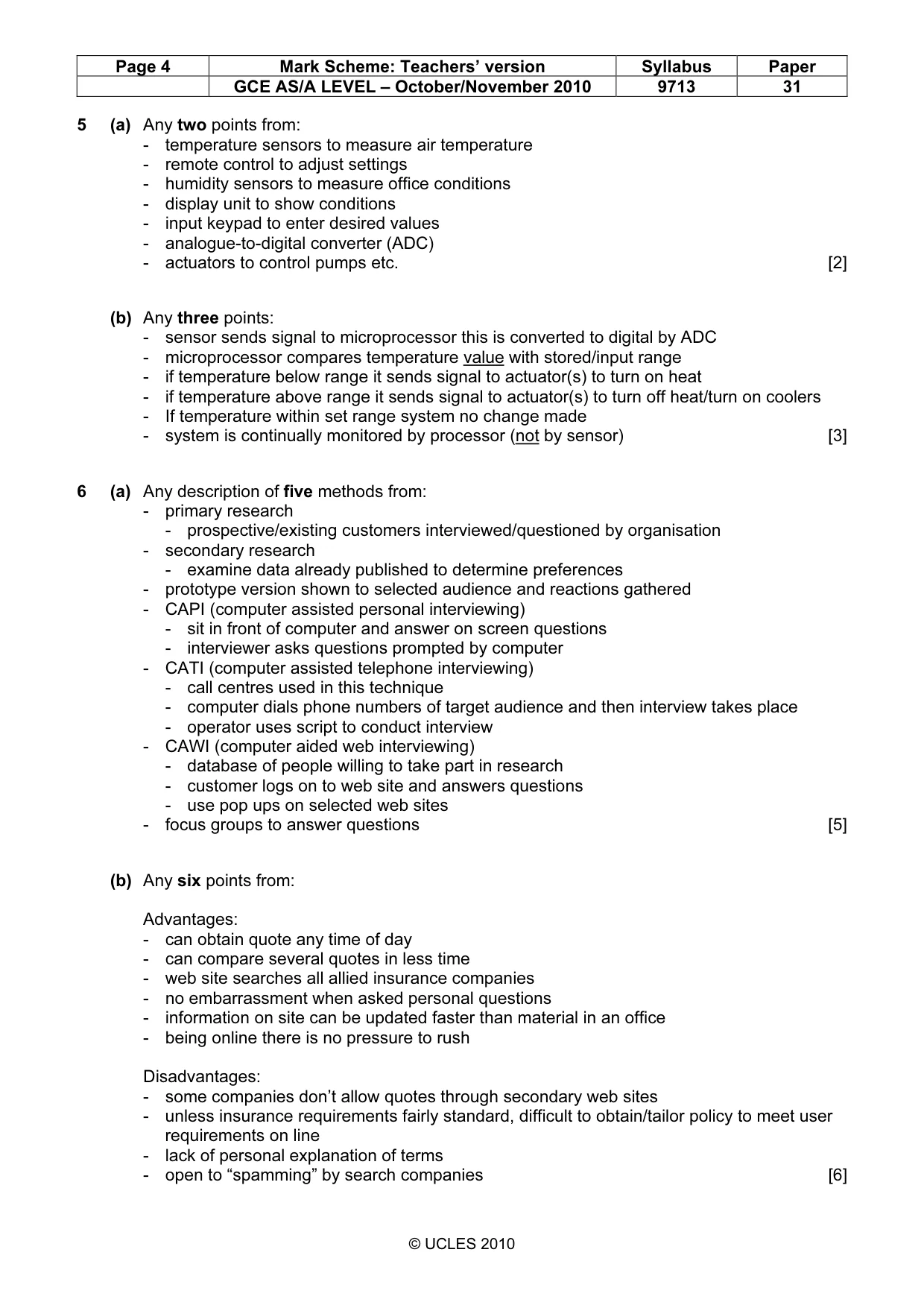
10 © UCLES 2010 9713/31/O/N/10 For Examiner's Use 5 The air conditioning system in the office is controlled by a computer system. (a) Describe the hardware needed to allow control of the air conditioning system. [2] (b) Explain how the computer and hardware interact to enable effective control of the air conditioning system in the office. [3]
Question paper, page 11
11 © UCLES 2010 9713/31/O/N/10 [Turn over For Examiner's Use 6 (a) Describe methods used by AIIC to carry out market research on new insurance policies which would be made available online. [5]
Question paper, page 12
12 © UCLES 2010 9713/31/O/N/10 For Examiner's Use (b) Discuss the advantages and disadvantages to customers of having an online facility to choose insurance policies. [6]
Question paper, page 13
13 © UCLES 2010 9713/31/O/N/10 [Turn over For Examiner's Use Scenario 3 Questions 7 to 8 A passport office has an intranet to enable internal communications. They also have a website where customers can get information and also fill out forms (e.g. passport applications). The intranet links into the website. The data transferred is sometimes subject to corruption and must be checked. One method which is used by the passport office is parity checking. The passport office has invested in the latest technology to allow reliable customer services and ensure good network security.
Question paper, page 14
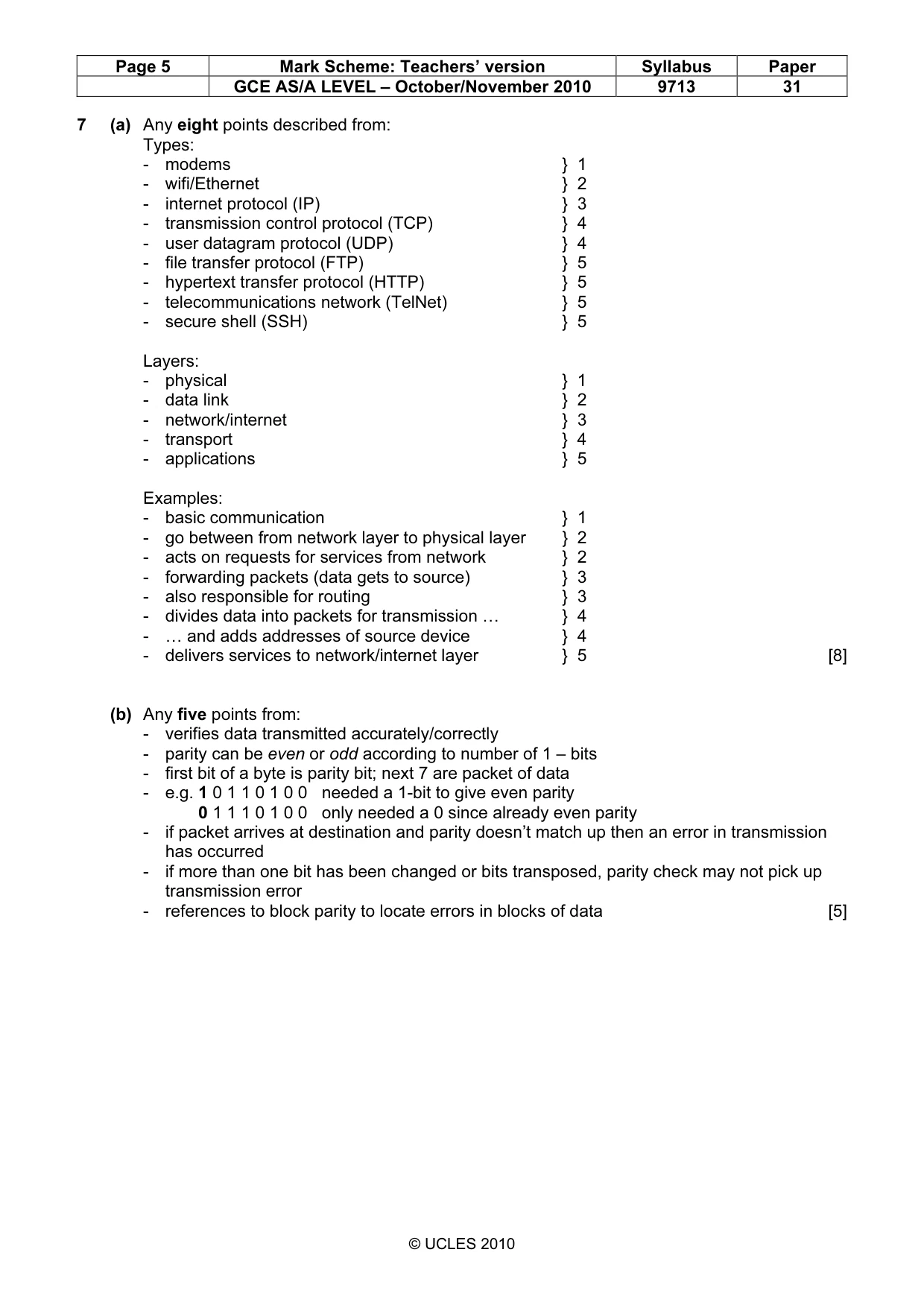
14 © UCLES 2010 9713/31/O/N/10 For Examiner's Use 7 Customers can access information over the internet which involves the transfer of data to and from a central server. (a) Describe the network protocols needed to transfer data in this situation. Your answer should include references to types of protocol, communication layers and give examples. [8]
Question paper, page 15
15 © UCLES 2010 9713/31/O/N/10 [Turn over For Examiner's Use (b) Describe the process of parity checking. [5]
Question paper, page 16
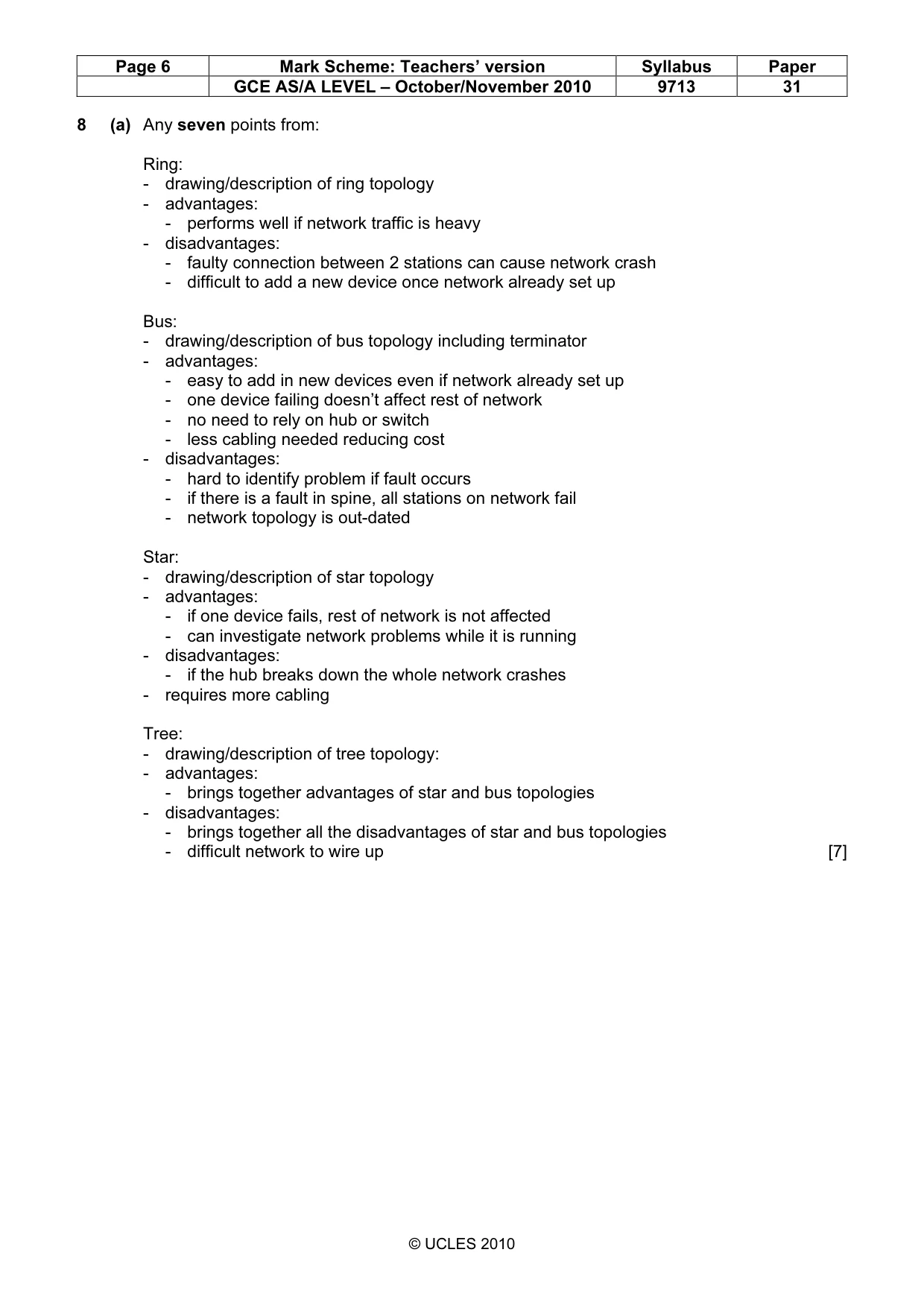
16 © UCLES 2010 9713/31/O/N/10 For Examiner's Use 8 (a) Discuss the advantages and disadvantages of common LAN topologies. [7]
Question paper, page 17
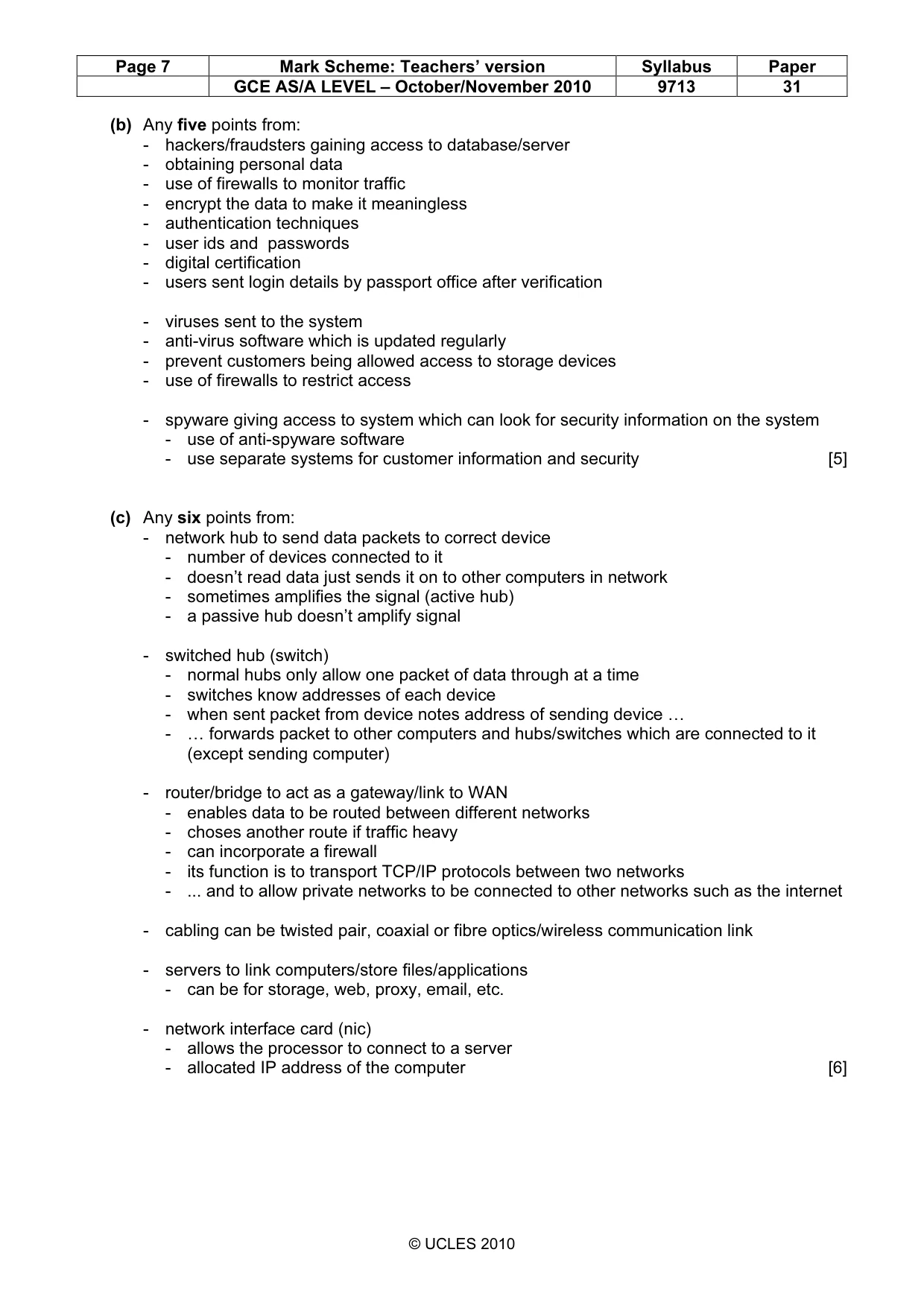
17 © UCLES 2010 9713/31/O/N/10 [Turn over For Examiner's Use (b) Describe possible network security risks and ways to minimise or remove these. [5]
Question paper, page 18
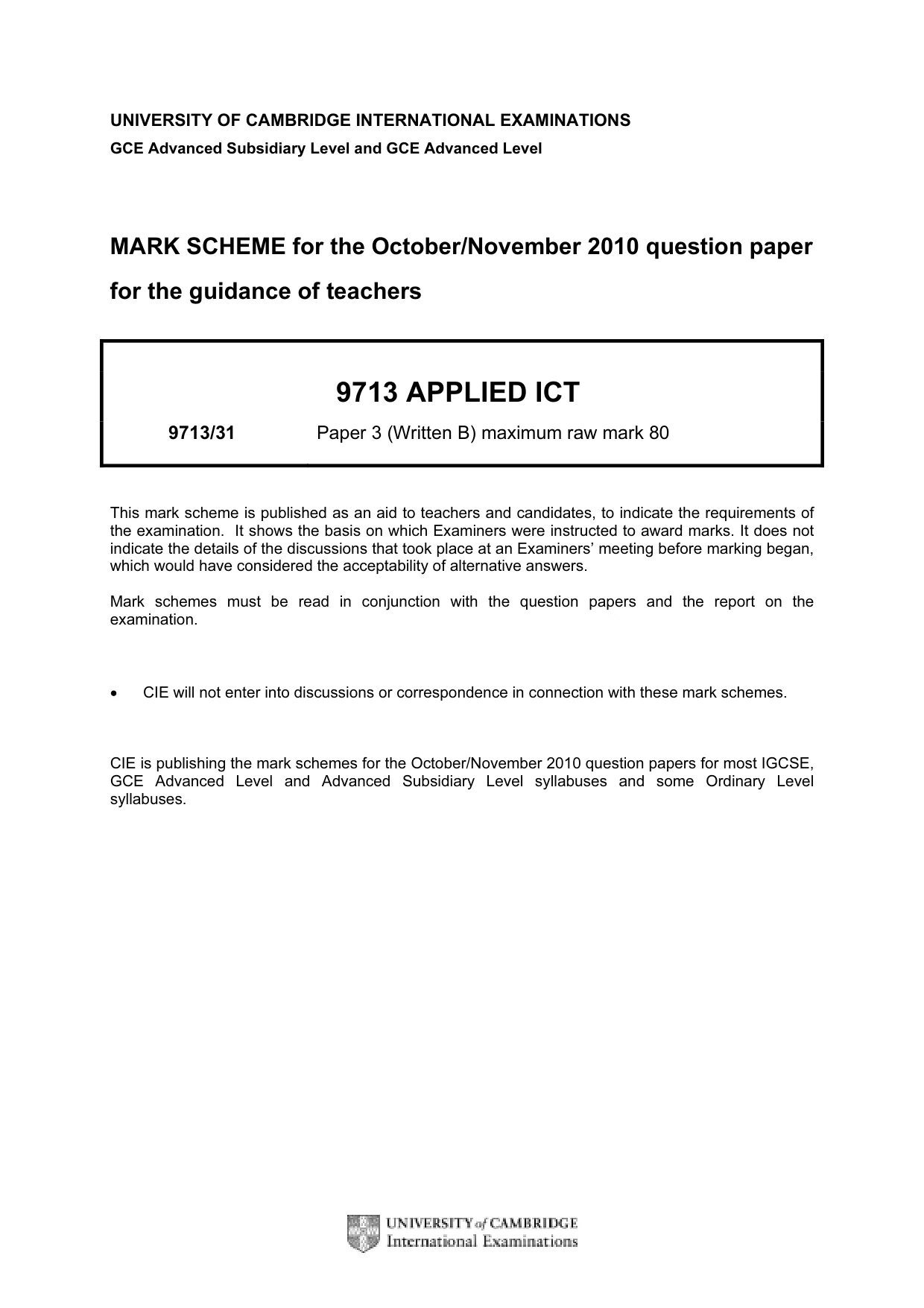
18 © UCLES 2010 9713/31/O/N/10 For Examiner's Use (c) Describe the hardware needed to connect computers together to form LANs and WANs. [6]
Question paper, page 20
20 Permission to reproduce items where third-party owned material protected by copyright is included has been sought and cleared where possible. Every reasonable effort has been made by the publisher (UCLES) to trace copyright holders, but if any items requiring clearance have unwittingly been included, the publisher will be pleased to make amends at the earliest possible opportunity. University of Cambridge International Examinations is part of the Cambridge Assessment Group. Cambridge Assessment is the brand name of University of Cambridge Local Examinations Syndicate (UCLES), which is itself a department of the University of Cambridge. 9713/31/O/N/10 BLANK PAGE
Mark scheme, page 1
UNIVERSITY OF CAMBRIDGE INTERNATIONAL EXAMINATIONS GCE Advanced Subsidiary Level and GCE Advanced Level MARK SCHEME for the October/November 2010 question paper for the guidance of teachers 9713 APPLIED ICT 9713/31 Paper 3 (Written B) maximum raw mark 80 This mark scheme is published as an aid to teachers and candidates, to indicate the requirements of the examination. It shows the basis on which Examiners were instructed to award marks. It does not indicate the details of the discussions that took place at an Examiners’ meeting before marking began, which would have considered the acceptability of alternative answers. Mark schemes must be read in conjunction with the question papers and the report on the examination. • CIE will not enter into discussions or correspondence in connection with these mark schemes. CIE is publishing the mark schemes for the October/November 2010 question papers for most IGCSE, GCE Advanced Level and Advanced Subsidiary Level syllabuses and some Ordinary Level syllabuses.
Mark scheme, page 2
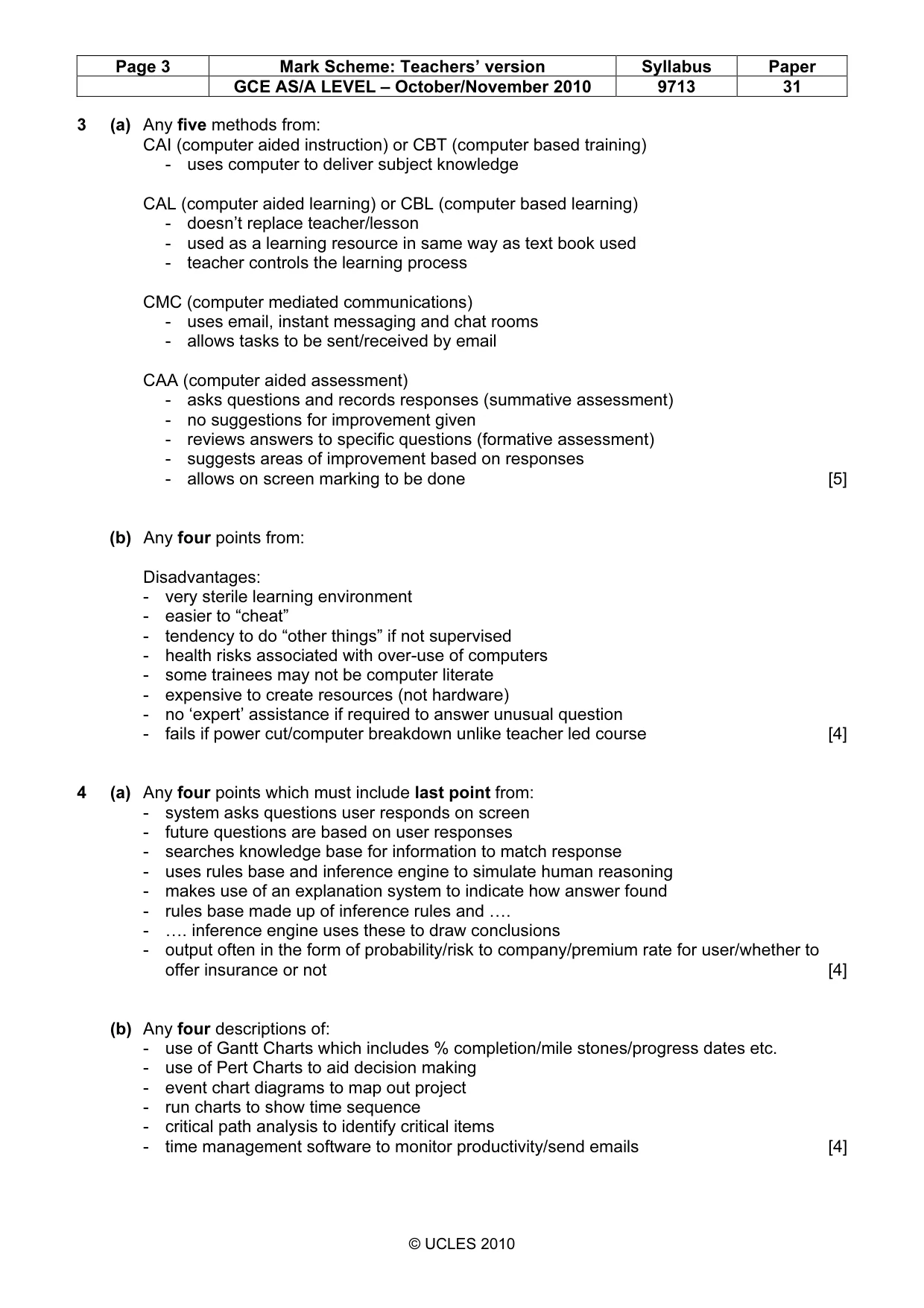
Page 2 Mark Scheme: Teachers’ version Syllabus Paper GCE AS/A LEVEL – October/November 2010 9713 31 © UCLES 2010 1 (a) Any five points from: - bar code is read at the POS terminal - bar code is unique identifier of the product and the key field in stock file/database - bar code number is searched for on file until matching record found - number of that item is stock is reduced by 1 and system checks value against minimum stock level - if min stock level reached/below then system automatically re-orders - automatic printout of orders/sends message to suppliers - when new goods arrive, bar codes allow update of number in stock [5] (b) Any five points from: - when re-order required supplier is notified automatically - quantity required in order - date and time to be delivered - stock control program determines these values - based on past sales trends - and predicted sales determined by external factors e.g. weather forecast/TV schedule - unable to cope with sudden increased demand [5] 2 (a) Any three points from: - information gathered from a shop already using new system - data gathered at different times of the day - data gathered on different days of the week - customers are interviewed after processing/observer watch the customers being served - POS records examined to find data - a number of till operators/customers sampled for questionnaire - sensors/data loggers count and time customers [3] (b) Any three points from: - number of customers at a given time of day - number of tills/checkouts - number of items per customer throughout the day - time taken to serve a customer - as a function of number of items [3]
Mark scheme, page 3
Page 3 Mark Scheme: Teachers’ version Syllabus Paper GCE AS/A LEVEL – October/November 2010 9713 31 © UCLES 2010 3 (a) Any five methods from: CAI (computer aided instruction) or CBT (computer based training) - uses computer to deliver subject knowledge CAL (computer aided learning) or CBL (computer based learning) - doesn’t replace teacher/lesson - used as a learning resource in same way as text book used - teacher controls the learning process CMC (computer mediated communications) - uses email, instant messaging and chat rooms - allows tasks to be sent/received by email CAA (computer aided assessment) - asks questions and records responses (summative assessment) - no suggestions for improvement given - reviews answers to specific questions (formative assessment) - suggests areas of improvement based on responses - allows on screen marking to be done [5] (b) Any four points from: Disadvantages: - very sterile learning environment - easier to “cheat” - tendency to do “other things” if not supervised - health risks associated with over-use of computers - some trainees may not be computer literate - expensive to create resources (not hardware) - no ‘expert’ assistance if required to answer unusual question - fails if power cut/computer breakdown unlike teacher led course [4] 4 (a) Any four points which must include last point from: - system asks questions user responds on screen - future questions are based on user responses - searches knowledge base for information to match response - uses rules base and inference engine to simulate human reasoning - makes use of an explanation system to indicate how answer found - rules base made up of inference rules and …. - …. inference engine uses these to draw conclusions - output often in the form of probability/risk to company/premium rate for user/whether to offer insurance or not [4] (b) Any four descriptions of: - use of Gantt Charts which includes % completion/mile stones/progress dates etc. - use of Pert Charts to aid decision making - event chart diagrams to map out project - run charts to show time sequence - critical path analysis to identify critical items - time management software to monitor productivity/send emails [4]
Mark scheme, page 4
Page 4 Mark Scheme: Teachers’ version Syllabus Paper GCE AS/A LEVEL – October/November 2010 9713 31 © UCLES 2010 5 (a) Any two points from: - temperature sensors to measure air temperature - remote control to adjust settings - humidity sensors to measure office conditions - display unit to show conditions - input keypad to enter desired values - analogue-to-digital converter (ADC) - actuators to control pumps etc. [2] (b) Any three points: - sensor sends signal to microprocessor this is converted to digital by ADC - microprocessor compares temperature value with stored/input range - if temperature below range it sends signal to actuator(s) to turn on heat - if temperature above range it sends signal to actuator(s) to turn off heat/turn on coolers - If temperature within set range system no change made - system is continually monitored by processor (not by sensor) [3] 6 (a) Any description of five methods from: - primary research - prospective/existing customers interviewed/questioned by organisation - secondary research - examine data already published to determine preferences - prototype version shown to selected audience and reactions gathered - CAPI (computer assisted personal interviewing) - sit in front of computer and answer on screen questions - interviewer asks questions prompted by computer - CATI (computer assisted telephone interviewing) - call centres used in this technique - computer dials phone numbers of target audience and then interview takes place - operator uses script to conduct interview - CAWI (computer aided web interviewing) - database of people willing to take part in research - customer logs on to web site and answers questions - use pop ups on selected web sites - focus groups to answer questions [5] (b) Any six points from: Advantages: - can obtain quote any time of day - can compare several quotes in less time - web site searches all allied insurance companies - no embarrassment when asked personal questions - information on site can be updated faster than material in an office - being online there is no pressure to rush Disadvantages: - some companies don’t allow quotes through secondary web sites - unless insurance requirements fairly standard, difficult to obtain/tailor policy to meet user requirements on line - lack of personal explanation of terms - open to “spamming” by search companies [6]
Mark scheme, page 5
Page 5 Mark Scheme: Teachers’ version Syllabus Paper GCE AS/A LEVEL – October/November 2010 9713 31 © UCLES 2010 7 (a) Any eight points described from: Types: - modems } 1 - wifi/Ethernet } 2 - internet protocol (IP) } 3 - transmission control protocol (TCP) } 4 - user datagram protocol (UDP) } 4 - file transfer protocol (FTP) } 5 - hypertext transfer protocol (HTTP) } 5 - telecommunications network (TelNet) } 5 - secure shell (SSH) } 5 Layers: - physical } 1 - data link } 2 - network/internet } 3 - transport } 4 - applications } 5 Examples: - basic communication } 1 - go between from network layer to physical layer } 2 - acts on requests for services from network } 2 - forwarding packets (data gets to source) } 3 - also responsible for routing } 3 - divides data into packets for transmission … } 4 - … and adds addresses of source device } 4 - delivers services to network/internet layer } 5 [8] (b) Any five points from: - verifies data transmitted accurately/correctly - parity can be even or odd according to number of 1 – bits - first bit of a byte is parity bit; next 7 are packet of data - e.g. 1 0 1 1 0 1 0 0 needed a 1-bit to give even parity 0 1 1 1 0 1 0 0 only needed a 0 since already even parity - if packet arrives at destination and parity doesn’t match up then an error in transmission has occurred - if more than one bit has been changed or bits transposed, parity check may not pick up transmission error - references to block parity to locate errors in blocks of data [5]
Mark scheme, page 6
Page 6 Mark Scheme: Teachers’ version Syllabus Paper GCE AS/A LEVEL – October/November 2010 9713 31 © UCLES 2010 8 (a) Any seven points from: Ring: - drawing/description of ring topology - advantages: - performs well if network traffic is heavy - disadvantages: - faulty connection between 2 stations can cause network crash - difficult to add a new device once network already set up Bus: - drawing/description of bus topology including terminator - advantages: - easy to add in new devices even if network already set up - one device failing doesn’t affect rest of network - no need to rely on hub or switch - less cabling needed reducing cost - disadvantages: - hard to identify problem if fault occurs - if there is a fault in spine, all stations on network fail - network topology is out-dated Star: - drawing/description of star topology - advantages: - if one device fails, rest of network is not affected - can investigate network problems while it is running - disadvantages: - if the hub breaks down the whole network crashes - requires more cabling Tree: - drawing/description of tree topology: - advantages: - brings together advantages of star and bus topologies - disadvantages: - brings together all the disadvantages of star and bus topologies - difficult network to wire up [7]
Mark scheme, page 7
Page 7 Mark Scheme: Teachers’ version Syllabus Paper GCE AS/A LEVEL – October/November 2010 9713 31 © UCLES 2010 (b) Any five points from: - hackers/fraudsters gaining access to database/server - obtaining personal data - use of firewalls to monitor traffic - encrypt the data to make it meaningless - authentication techniques - user ids and passwords - digital certification - users sent login details by passport office after verification - viruses sent to the system - anti-virus software which is updated regularly - prevent customers being allowed access to storage devices - use of firewalls to restrict access - spyware giving access to system which can look for security information on the system - use of anti-spyware software - use separate systems for customer information and security [5] (c) Any six points from: - network hub to send data packets to correct device - number of devices connected to it - doesn’t read data just sends it on to other computers in network - sometimes amplifies the signal (active hub) - a passive hub doesn’t amplify signal - switched hub (switch) - normal hubs only allow one packet of data through at a time - switches know addresses of each device - when sent packet from device notes address of sending device … - … forwards packet to other computers and hubs/switches which are connected to it (except sending computer) - router/bridge to act as a gateway/link to WAN - enables data to be routed between different networks - choses another route if traffic heavy - can incorporate a firewall - its function is to transport TCP/IP protocols between two networks - ... and to allow private networks to be connected to other networks such as the internet - cabling can be twisted pair, coaxial or fibre optics/wireless communication link - servers to link computers/store files/applications - can be for storage, web, proxy, email, etc. - network interface card (nic) - allows the processor to connect to a server - allocated IP address of the computer [6]
What you needed in this session
Cambridge’s own grade thresholds for 2010 Oct/Nov, Paper 3 · Variant 1. A higher threshold means an easier paper — the bar moves with how the cohort did.