Cambridge A Level Applied Information and Communication Technology 9713 — 2009 Oct/Nov Paper 1 · Variant 1
9713/11/O/N/09 · 80 marks · ≈90 min
The question paper and its mark scheme, free to read here and free to download. This is Cambridge’s own paper, exactly as it was sat.
Question paper16 pages


Mark scheme7 pages
Answers below. Sit the paper first if you are practising.
Paper as text
Question paper, page 1
This document consists of 13 printed pages and 3 blank pages. IB09 11_9713_01/5RP © UCLES 2009 [Turn over *5901419547* UNIVERSITY OF CAMBRIDGE INTERNATIONAL EXAMINATIONS General Certificate of Education Advanced Level APPLIED INFORMATION AND COMMUNICATION TECHNOLOGY 9713/01 Paper 1 October/November 2009 1 hour and 15 minutes Candidates answer on the Question Paper. No additional materials are required. READ THESE INSTRUCTIONS FIRST Write your Centre number, candidate number and name on all the work you hand in. Write in dark blue or black pen. Do not use staples, paper clips, highlighters, glue or correction fluid. You may use a pencil for any diagrams, graphs or rough working. DO NOT WRITE IN ANY BARCODES Answer all questions. The number of marks is given in brackets [ ] at the end of each question or part question. The businesses described in this paper are entirely fictitious.
Question paper, page 2
2 © UCLES 2009 9713/01/O/N/09 Scenario 1 Questions 1 and 2 White Nile Foods in Cairo manufactures pre-packed meals. The company has a large-scale food mixer to mix the ingredients. The mixture is then moved to the production line where individual containers are filled and a lid and label is placed on each container. The containers are then moved to the refrigeration plant for storage prior to transportation. The company would like to use ICT to produce advertising materials to publicise its new range of products.
Question paper, page 3
3 © UCLES 2009 9713/01/O/N/09 [Turn over For Examiner's Use 1 (a) Describe the process control which is used in: (i) the food mixing process [2] (ii) the food packing process. [2] (b) Describe the role of the microprocessor in the refrigeration process. [6]
Question paper, page 4
4 © UCLES 2009 9713/01/O/N/09 For Examiner's Use 2 Discuss two ways in which the company could advertise its products, indicating the role of ICT for each method. [8]
Question paper, page 5
5 © UCLES 2009 9713/01/O/N/09 [Turn over Scenario 2 Questions 3, 4 and 5 Roundabout Food Shops is a national chain of supermarkets in India. The head office is in New Delhi though the supermarkets are distributed throughout India. It already has its own website where customers can find out where their local store is and can see what products are stocked. Roundabout Food Shops wants to develop its website so that customers can order their shopping online and have it delivered to their home. It has employed a number of designers to develop the website. They will work in groups developing different aspects of the website. They will need to operate a call centre so that if customers have problems with the website they can contact the company about it.
Question paper, page 6
6 © UCLES 2009 9713/01/O/N/09 For Examiner's Use 3 (a) Describe how time management software can help the designers to organise the development of the website. [6] (b) Describe the security measures that the designers will need to include to prevent personal data being used by unauthorised users. [4]
Question paper, page 7
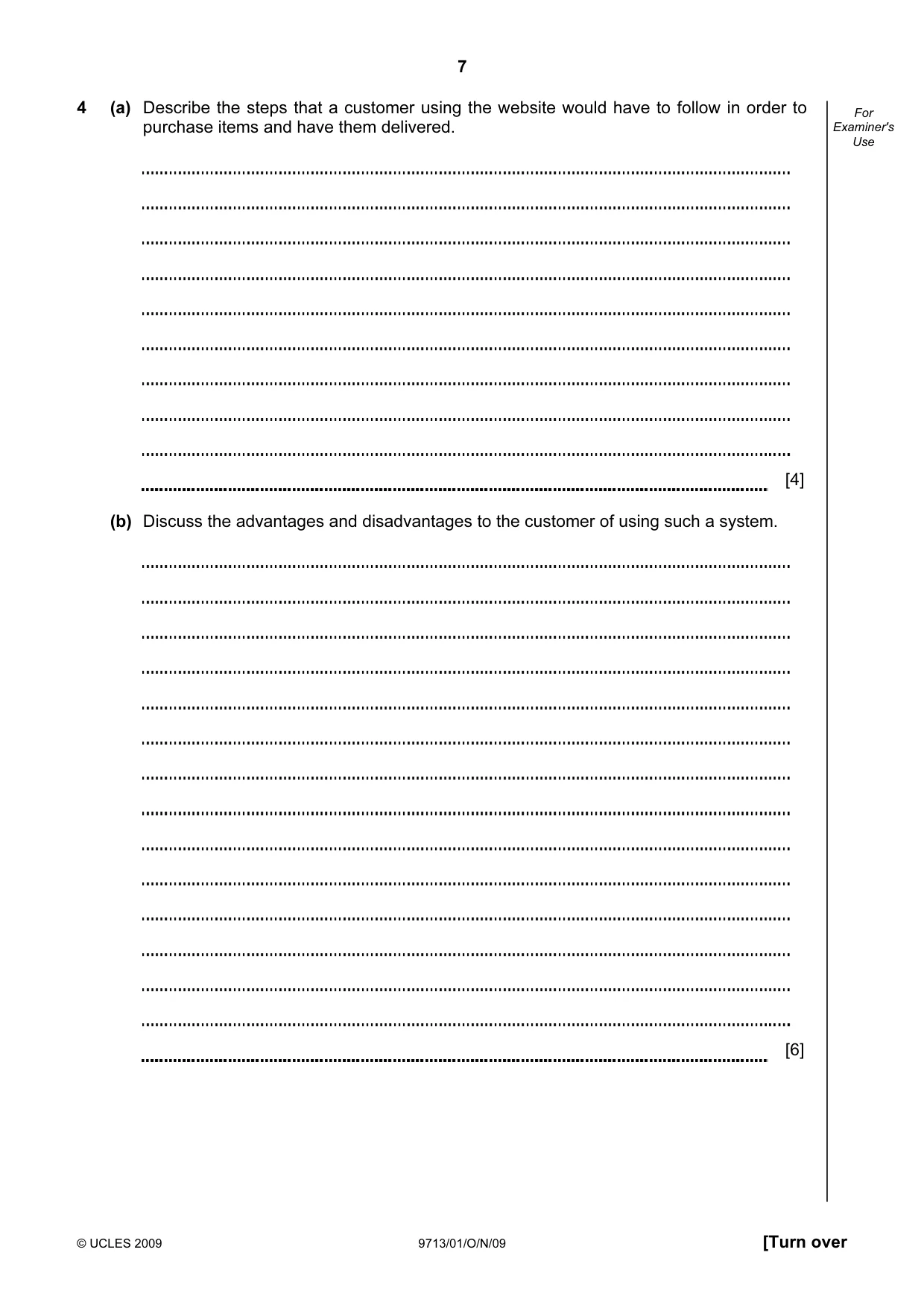
7 © UCLES 2009 9713/01/O/N/09 [Turn over For Examiner's Use 4 (a) Describe the steps that a customer using the website would have to follow in order to purchase items and have them delivered. [4] (b) Discuss the advantages and disadvantages to the customer of using such a system. [6]
Question paper, page 8
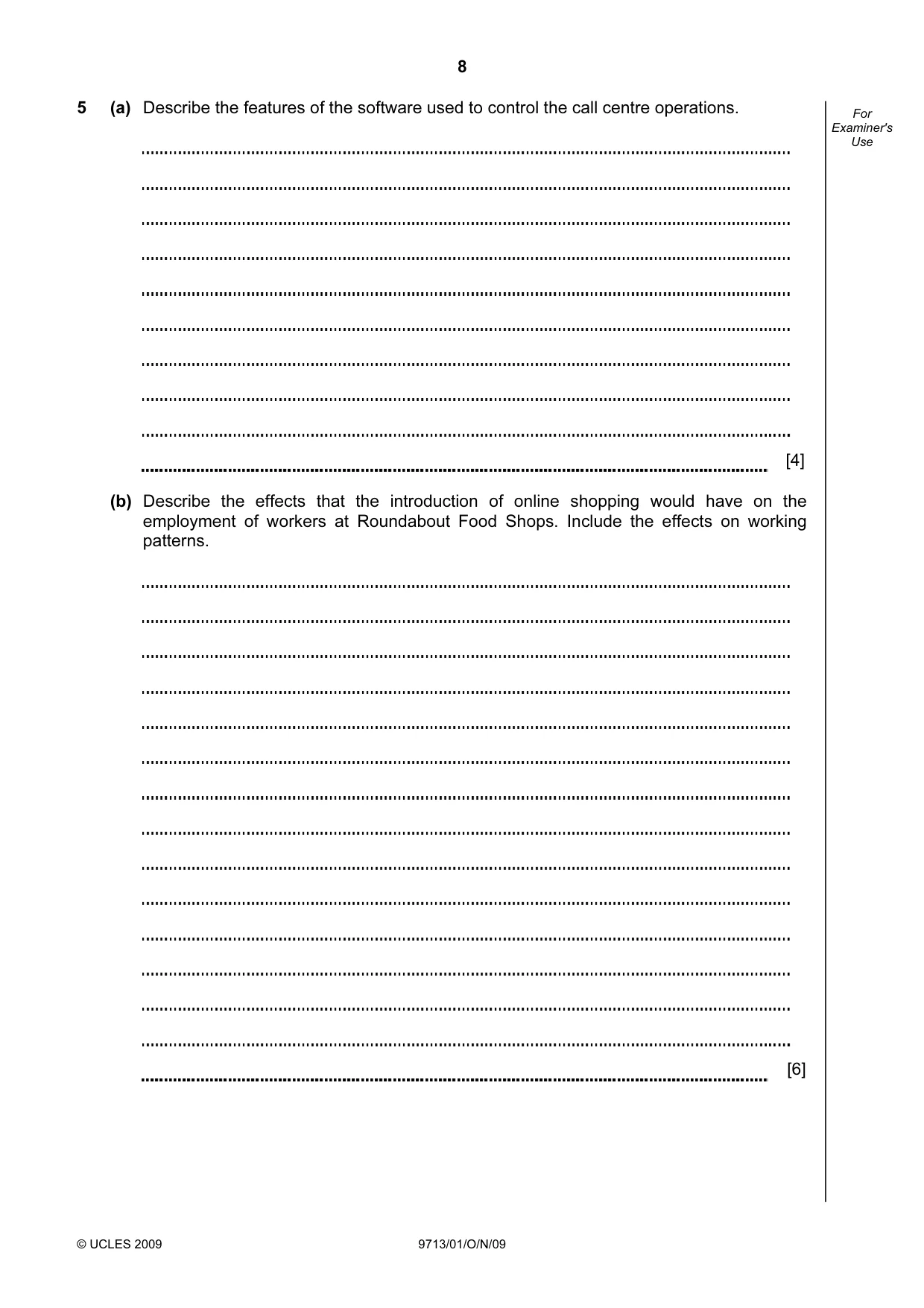
8 © UCLES 2009 9713/01/O/N/09 For Examiner's Use 5 (a) Describe the features of the software used to control the call centre operations. [4] (b) Describe the effects that the introduction of online shopping would have on the employment of workers at Roundabout Food Shops. Include the effects on working patterns. [6]
Question paper, page 9
9 © UCLES 2009 9713/01/O/N/09 [Turn over Scenario 3 Questions 6 and 7 Rajvinder Uppal is the manager of a book publishing company. The company uses an outdated record keeping system for storing details of the books they publish. Rajvinder wants to introduce a more modern system. She has employed the services of a systems analyst, Vikram Patel, to investigate the current system and create a new one. Vikram will use a variety of methods to collect information about the existing system.
Question paper, page 10
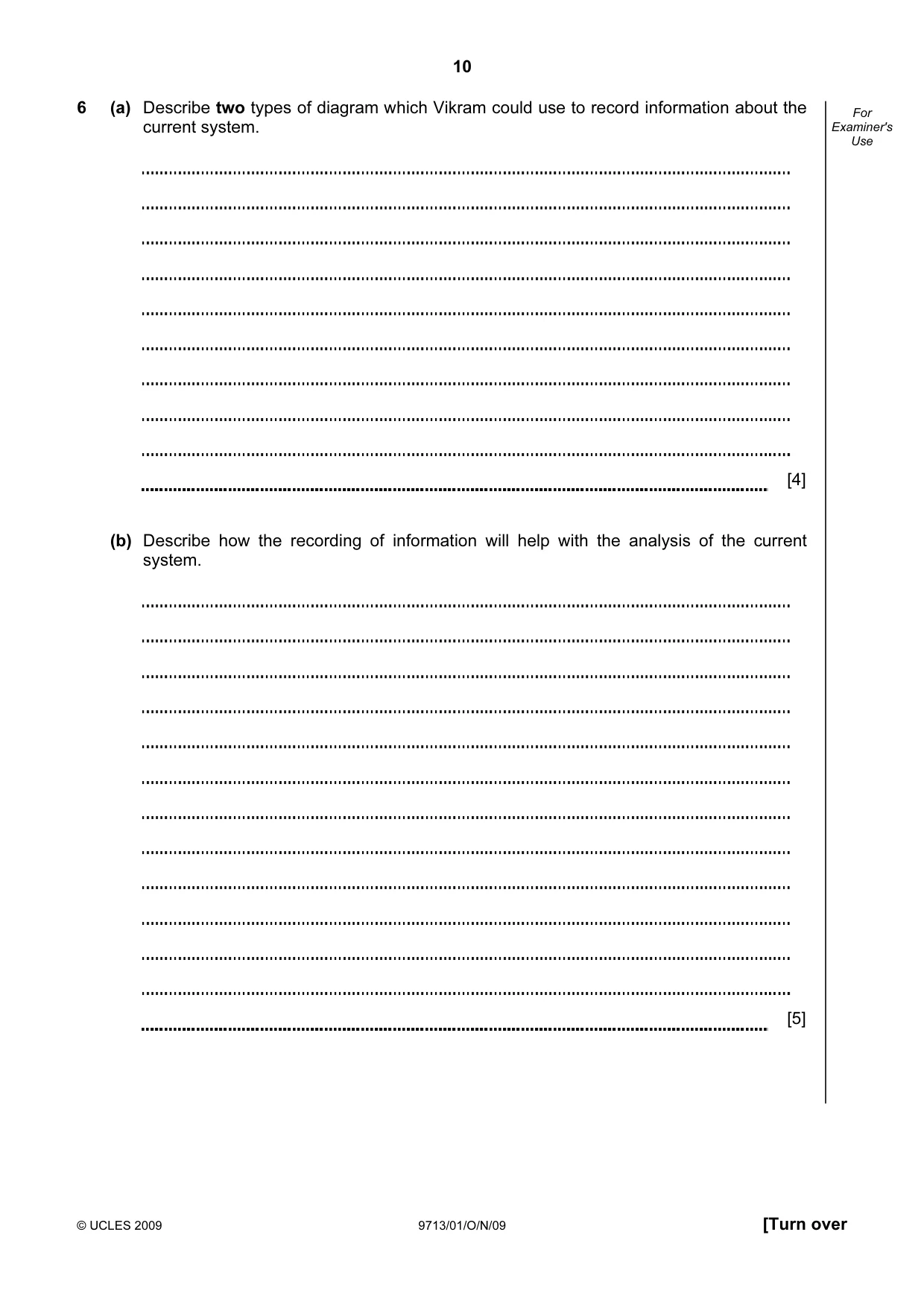
10 © UCLES 2009 9713/01/O/N/09 [Turn over For Examiner's Use 6 (a) Describe two types of diagram which Vikram could use to record information about the current system. [4] (b) Describe how the recording of information will help with the analysis of the current system. [5]
Question paper, page 11
11 © UCLES 2009 9713/01/O/N/09 [Turn over For Examiner's Use (c) Describe how Vikram will identify the information requirements for a new system. [2]
Question paper, page 12
12 © UCLES 2009 9713/01/O/N/09 [Turn over For Examiner's Use 7 (a) Describe the factors which will influence Vikram when designing the input and output layouts. [6] (b) After the system has been developed it will need to be implemented. Discuss the different methods which could be used. [6]
Question paper, page 13
13 © UCLES 2009 9713/01/O/N/09 [Turn over For Examiner's Use (c) Describe how the data will be organised on the database to allow Rajvinder to access a book record quickly. [4] (d) After the system has been implemented Vikram will need to evaluate it. Describe the process of evaluation. [5]
Question paper, page 14
14 © UCLES 2009 9713/01/O/N/09 [Turn over For Examiner's Use Blank Page
Question paper, page 15
15 © UCLES 2009 9713/01/O/N/09 [Turn over For Examiner's Use Blank Page
Question paper, page 16
16 Permission to reproduce items where third-party owned material protected by copyright is included has been sought and cleared where possible. Every reasonable effort has been made by the publisher (UCLES) to trace copyright holders, but if any items requiring clearance have unwittingly been included, the publisher will be pleased to make amends at the earliest possible opportunity. University of Cambridge International Examinations is part of the Cambridge Assessment Group. Cambridge Assessment is the brand name of University of Cambridge Local Examinations Syndicate (UCLES), which is itself a department of the University of Cambridge. 9713/01/O/N/09 For Examiner's Use Blank Page
Mark scheme, page 1
UNIVERSITY OF CAMBRIDGE INTERNATIONAL EXAMINATIONS GCE Advanced Subsidiary Level and GCE Advanced Level MARK SCHEME for the October/November 2009 question paper for the guidance of teachers 9713 APPLIED ICT 9713/01 Paper 1 (Written A), maximum raw mark 80 This mark scheme is published as an aid to teachers and candidates, to indicate the requirements of the examination. It shows the basis on which Examiners were instructed to award marks. It does not indicate the details of the discussions that took place at an Examiners’ meeting before marking began, which would have considered the acceptability of alternative answers. Mark schemes must be read in conjunction with the question papers and the report on the examination. • CIE will not enter into discussions or correspondence in connection with these mark schemes. CIE is publishing the mark schemes for the October/November 2009 question papers for most IGCSE, GCE Advanced Level and Advanced Subsidiary Level syllabuses and some Ordinary Level syllabuses.
Mark scheme, page 2
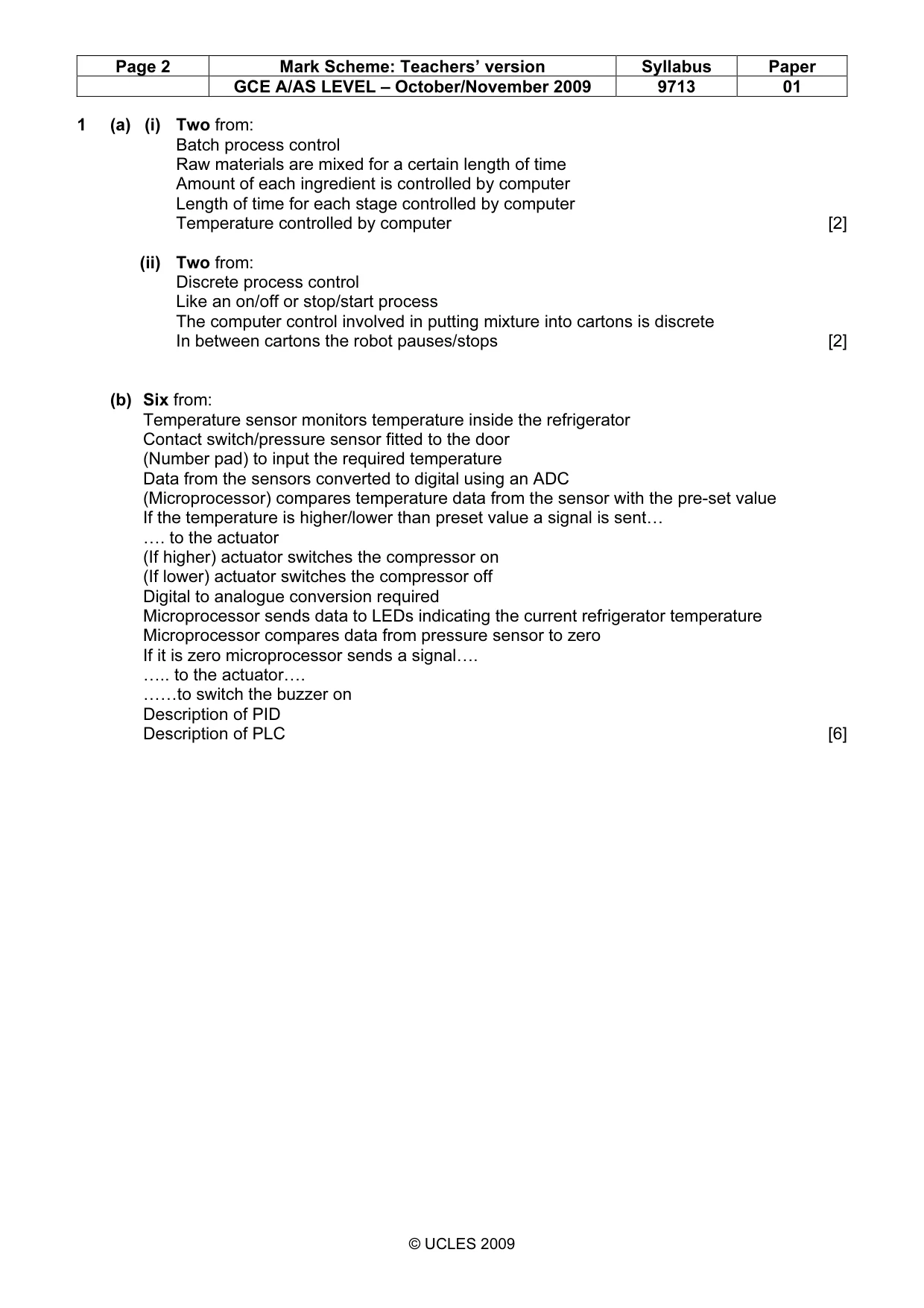
Page 2 Mark Scheme: Teachers’ version Syllabus Paper GCE A/AS LEVEL – October/November 2009 9713 01 © UCLES 2009 1 (a) (i) Two from: Batch process control Raw materials are mixed for a certain length of time Amount of each ingredient is controlled by computer Length of time for each stage controlled by computer Temperature controlled by computer [2] (ii) Two from: Discrete process control Like an on/off or stop/start process The computer control involved in putting mixture into cartons is discrete In between cartons the robot pauses/stops [2] (b) Six from: Temperature sensor monitors temperature inside the refrigerator Contact switch/pressure sensor fitted to the door (Number pad) to input the required temperature Data from the sensors converted to digital using an ADC (Microprocessor) compares temperature data from the sensor with the pre-set value If the temperature is higher/lower than preset value a signal is sent… …. to the actuator (If higher) actuator switches the compressor on (If lower) actuator switches the compressor off Digital to analogue conversion required Microprocessor sends data to LEDs indicating the current refrigerator temperature Microprocessor compares data from pressure sensor to zero If it is zero microprocessor sends a signal…. ….. to the actuator…. ……to switch the buzzer on Description of PID Description of PLC [6]
Mark scheme, page 3
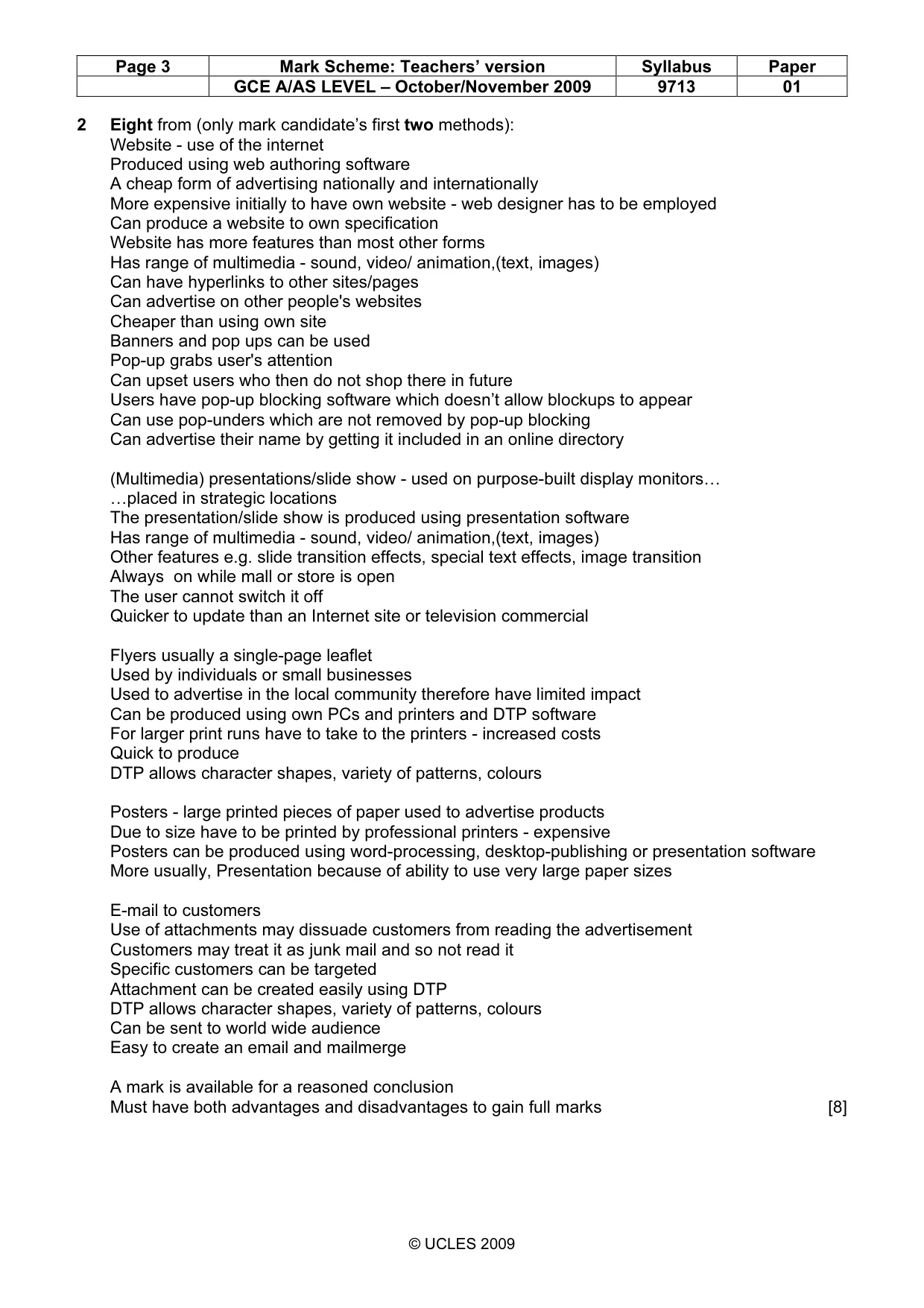
Page 3 Mark Scheme: Teachers’ version Syllabus Paper GCE A/AS LEVEL – October/November 2009 9713 01 © UCLES 2009 2 Eight from (only mark candidate’s first two methods): Website - use of the internet Produced using web authoring software A cheap form of advertising nationally and internationally More expensive initially to have own website - web designer has to be employed Can produce a website to own specification Website has more features than most other forms Has range of multimedia - sound, video/ animation,(text, images) Can have hyperlinks to other sites/pages Can advertise on other people's websites Cheaper than using own site Banners and pop ups can be used Pop-up grabs user's attention Can upset users who then do not shop there in future Users have pop-up blocking software which doesn’t allow blockups to appear Can use pop-unders which are not removed by pop-up blocking Can advertise their name by getting it included in an online directory (Multimedia) presentations/slide show - used on purpose-built display monitors… …placed in strategic locations The presentation/slide show is produced using presentation software Has range of multimedia - sound, video/ animation,(text, images) Other features e.g. slide transition effects, special text effects, image transition Always on while mall or store is open The user cannot switch it off Quicker to update than an Internet site or television commercial Flyers usually a single-page leaflet Used by individuals or small businesses Used to advertise in the local community therefore have limited impact Can be produced using own PCs and printers and DTP software For larger print runs have to take to the printers - increased costs Quick to produce DTP allows character shapes, variety of patterns, colours Posters - large printed pieces of paper used to advertise products Due to size have to be printed by professional printers - expensive Posters can be produced using word-processing, desktop-publishing or presentation software More usually, Presentation because of ability to use very large paper sizes E-mail to customers Use of attachments may dissuade customers from reading the advertisement Customers may treat it as junk mail and so not read it Specific customers can be targeted Attachment can be created easily using DTP DTP allows character shapes, variety of patterns, colours Can be sent to world wide audience Easy to create an email and mailmerge A mark is available for a reasoned conclusion Must have both advantages and disadvantages to gain full marks [8]
Mark scheme, page 4
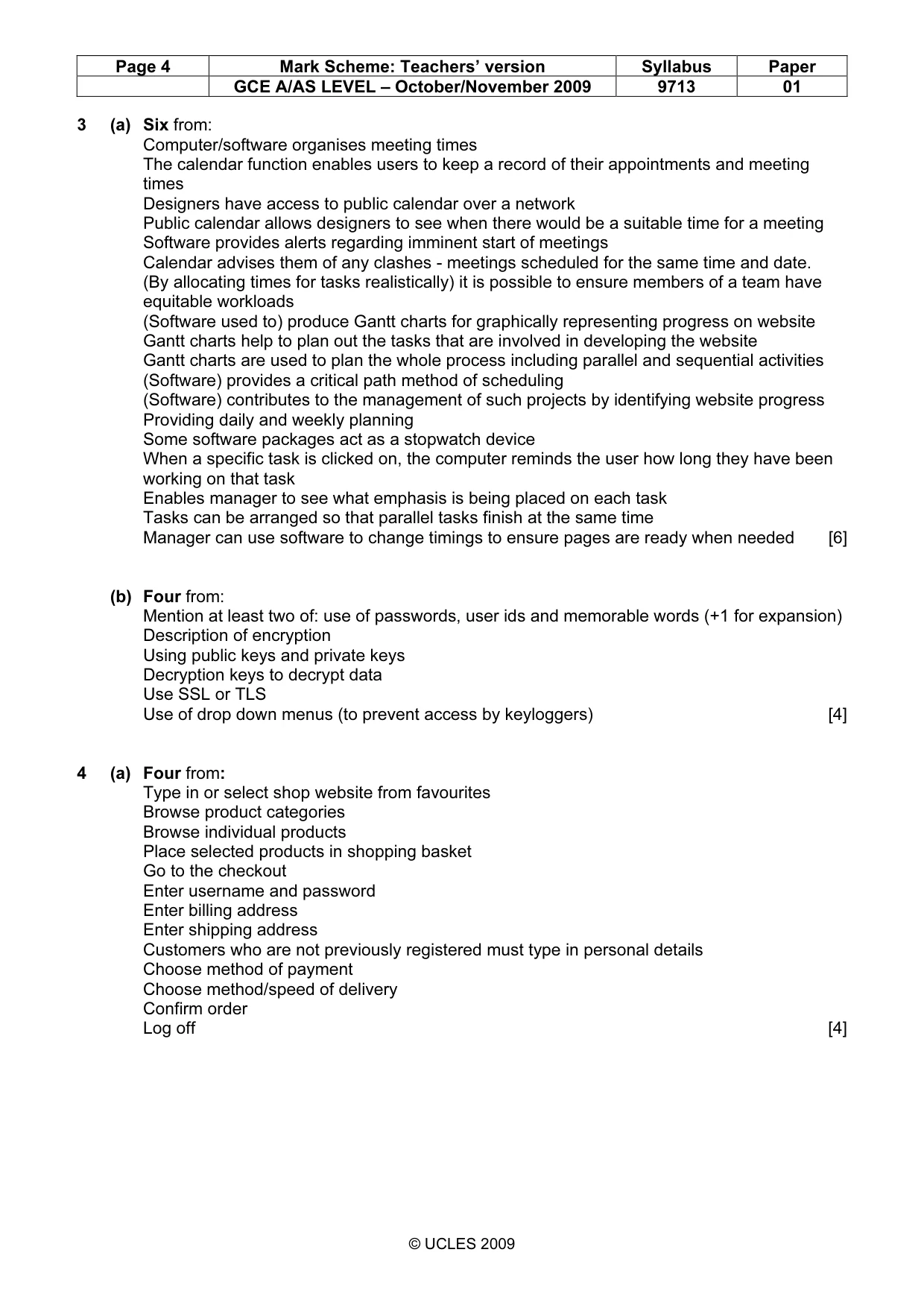
Page 4 Mark Scheme: Teachers’ version Syllabus Paper GCE A/AS LEVEL – October/November 2009 9713 01 © UCLES 2009 3 (a) Six from: Computer/software organises meeting times The calendar function enables users to keep a record of their appointments and meeting times Designers have access to public calendar over a network Public calendar allows designers to see when there would be a suitable time for a meeting Software provides alerts regarding imminent start of meetings Calendar advises them of any clashes - meetings scheduled for the same time and date. (By allocating times for tasks realistically) it is possible to ensure members of a team have equitable workloads (Software used to) produce Gantt charts for graphically representing progress on website Gantt charts help to plan out the tasks that are involved in developing the website Gantt charts are used to plan the whole process including parallel and sequential activities (Software) provides a critical path method of scheduling (Software) contributes to the management of such projects by identifying website progress Providing daily and weekly planning Some software packages act as a stopwatch device When a specific task is clicked on, the computer reminds the user how long they have been working on that task Enables manager to see what emphasis is being placed on each task Tasks can be arranged so that parallel tasks finish at the same time Manager can use software to change timings to ensure pages are ready when needed [6] (b) Four from: Mention at least two of: use of passwords, user ids and memorable words (+1 for expansion) Description of encryption Using public keys and private keys Decryption keys to decrypt data Use SSL or TLS Use of drop down menus (to prevent access by keyloggers) [4] 4 (a) Four from: Type in or select shop website from favourites Browse product categories Browse individual products Place selected products in shopping basket Go to the checkout Enter username and password Enter billing address Enter shipping address Customers who are not previously registered must type in personal details Choose method of payment Choose method/speed of delivery Confirm order Log off [4]
Mark scheme, page 5
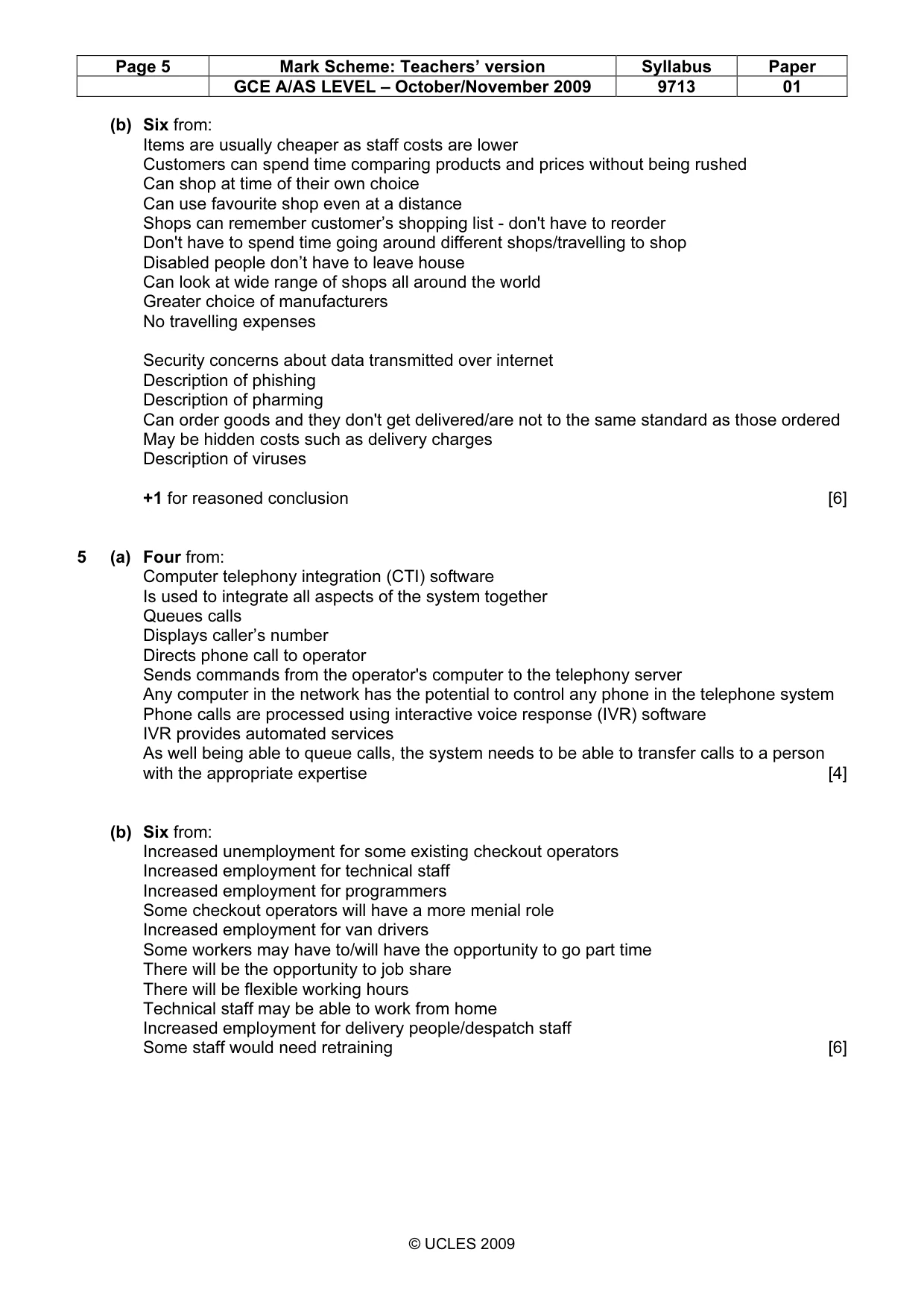
Page 5 Mark Scheme: Teachers’ version Syllabus Paper GCE A/AS LEVEL – October/November 2009 9713 01 © UCLES 2009 (b) Six from: Items are usually cheaper as staff costs are lower Customers can spend time comparing products and prices without being rushed Can shop at time of their own choice Can use favourite shop even at a distance Shops can remember customer’s shopping list - don't have to reorder Don't have to spend time going around different shops/travelling to shop Disabled people don’t have to leave house Can look at wide range of shops all around the world Greater choice of manufacturers No travelling expenses Security concerns about data transmitted over internet Description of phishing Description of pharming Can order goods and they don't get delivered/are not to the same standard as those ordered May be hidden costs such as delivery charges Description of viruses +1 for reasoned conclusion [6] 5 (a) Four from: Computer telephony integration (CTI) software Is used to integrate all aspects of the system together Queues calls Displays caller’s number Directs phone call to operator Sends commands from the operator's computer to the telephony server Any computer in the network has the potential to control any phone in the telephone system Phone calls are processed using interactive voice response (IVR) software IVR provides automated services As well being able to queue calls, the system needs to be able to transfer calls to a person with the appropriate expertise [4] (b) Six from: Increased unemployment for some existing checkout operators Increased employment for technical staff Increased employment for programmers Some checkout operators will have a more menial role Increased employment for van drivers Some workers may have to/will have the opportunity to go part time There will be the opportunity to job share There will be flexible working hours Technical staff may be able to work from home Increased employment for delivery people/despatch staff Some staff would need retraining [6]
Mark scheme, page 6
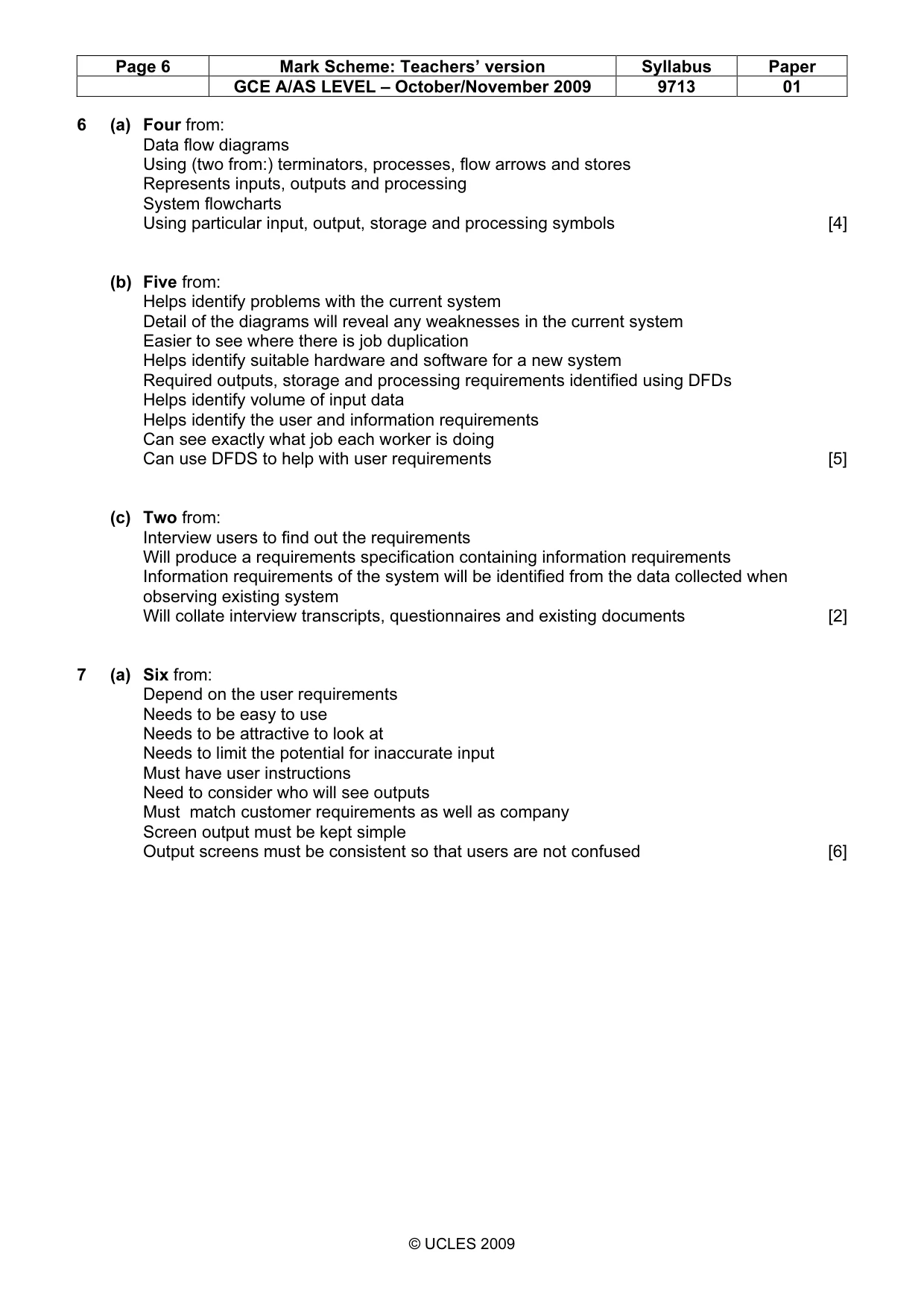
Page 6 Mark Scheme: Teachers’ version Syllabus Paper GCE A/AS LEVEL – October/November 2009 9713 01 © UCLES 2009 6 (a) Four from: Data flow diagrams Using (two from:) terminators, processes, flow arrows and stores Represents inputs, outputs and processing System flowcharts Using particular input, output, storage and processing symbols [4] (b) Five from: Helps identify problems with the current system Detail of the diagrams will reveal any weaknesses in the current system Easier to see where there is job duplication Helps identify suitable hardware and software for a new system Required outputs, storage and processing requirements identified using DFDs Helps identify volume of input data Helps identify the user and information requirements Can see exactly what job each worker is doing Can use DFDS to help with user requirements [5] (c) Two from: Interview users to find out the requirements Will produce a requirements specification containing information requirements Information requirements of the system will be identified from the data collected when observing existing system Will collate interview transcripts, questionnaires and existing documents [2] 7 (a) Six from: Depend on the user requirements Needs to be easy to use Needs to be attractive to look at Needs to limit the potential for inaccurate input Must have user instructions Need to consider who will see outputs Must match customer requirements as well as company Screen output must be kept simple Output screens must be consistent so that users are not confused [6]
Mark scheme, page 7
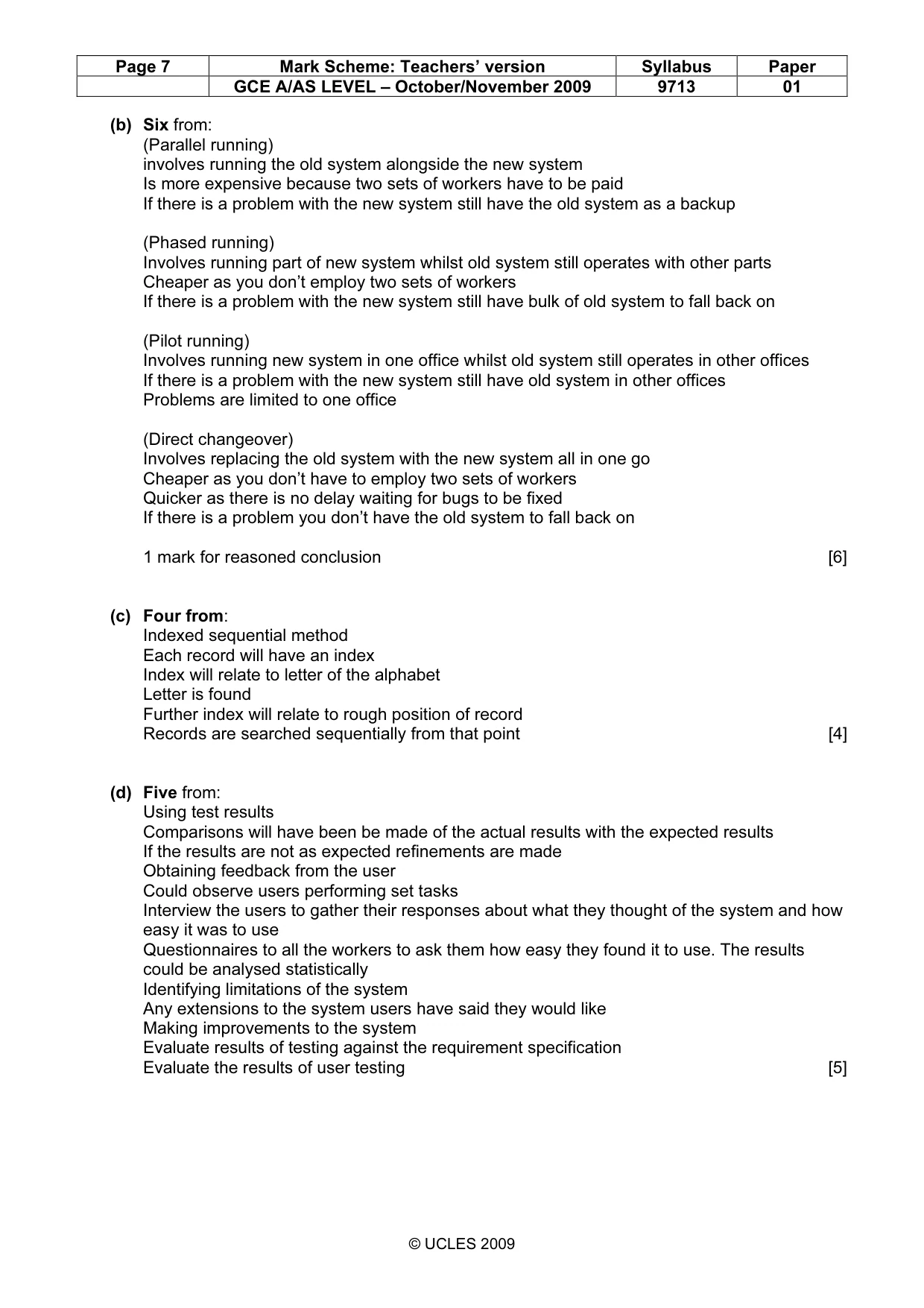
Page 7 Mark Scheme: Teachers’ version Syllabus Paper GCE A/AS LEVEL – October/November 2009 9713 01 © UCLES 2009 (b) Six from: (Parallel running) involves running the old system alongside the new system Is more expensive because two sets of workers have to be paid If there is a problem with the new system still have the old system as a backup (Phased running) Involves running part of new system whilst old system still operates with other parts Cheaper as you don’t employ two sets of workers If there is a problem with the new system still have bulk of old system to fall back on (Pilot running) Involves running new system in one office whilst old system still operates in other offices If there is a problem with the new system still have old system in other offices Problems are limited to one office (Direct changeover) Involves replacing the old system with the new system all in one go Cheaper as you don’t have to employ two sets of workers Quicker as there is no delay waiting for bugs to be fixed If there is a problem you don’t have the old system to fall back on 1 mark for reasoned conclusion [6] (c) Four from: Indexed sequential method Each record will have an index Index will relate to letter of the alphabet Letter is found Further index will relate to rough position of record Records are searched sequentially from that point [4] (d) Five from: Using test results Comparisons will have been be made of the actual results with the expected results If the results are not as expected refinements are made Obtaining feedback from the user Could observe users performing set tasks Interview the users to gather their responses about what they thought of the system and how easy it was to use Questionnaires to all the workers to ask them how easy they found it to use. The results could be analysed statistically Identifying limitations of the system Any extensions to the system users have said they would like Making improvements to the system Evaluate results of testing against the requirement specification Evaluate the results of user testing [5]
What you needed in this session
Cambridge’s own grade thresholds for 2009 Oct/Nov, Paper 1 · Variant 1. A higher threshold means an easier paper — the bar moves with how the cohort did.