Cambridge A Level Applied Information and Communication Technology 9713 — 2009 May/June Paper 1 · Variant 1
9713/11/M/J/09 · 80 marks · ≈90 min
The question paper and its mark scheme, free to read here and free to download. This is Cambridge’s own paper, exactly as it was sat.
Question paper12 pages



Mark scheme7 pages
Answers below. Sit the paper first if you are practising.
Paper as text
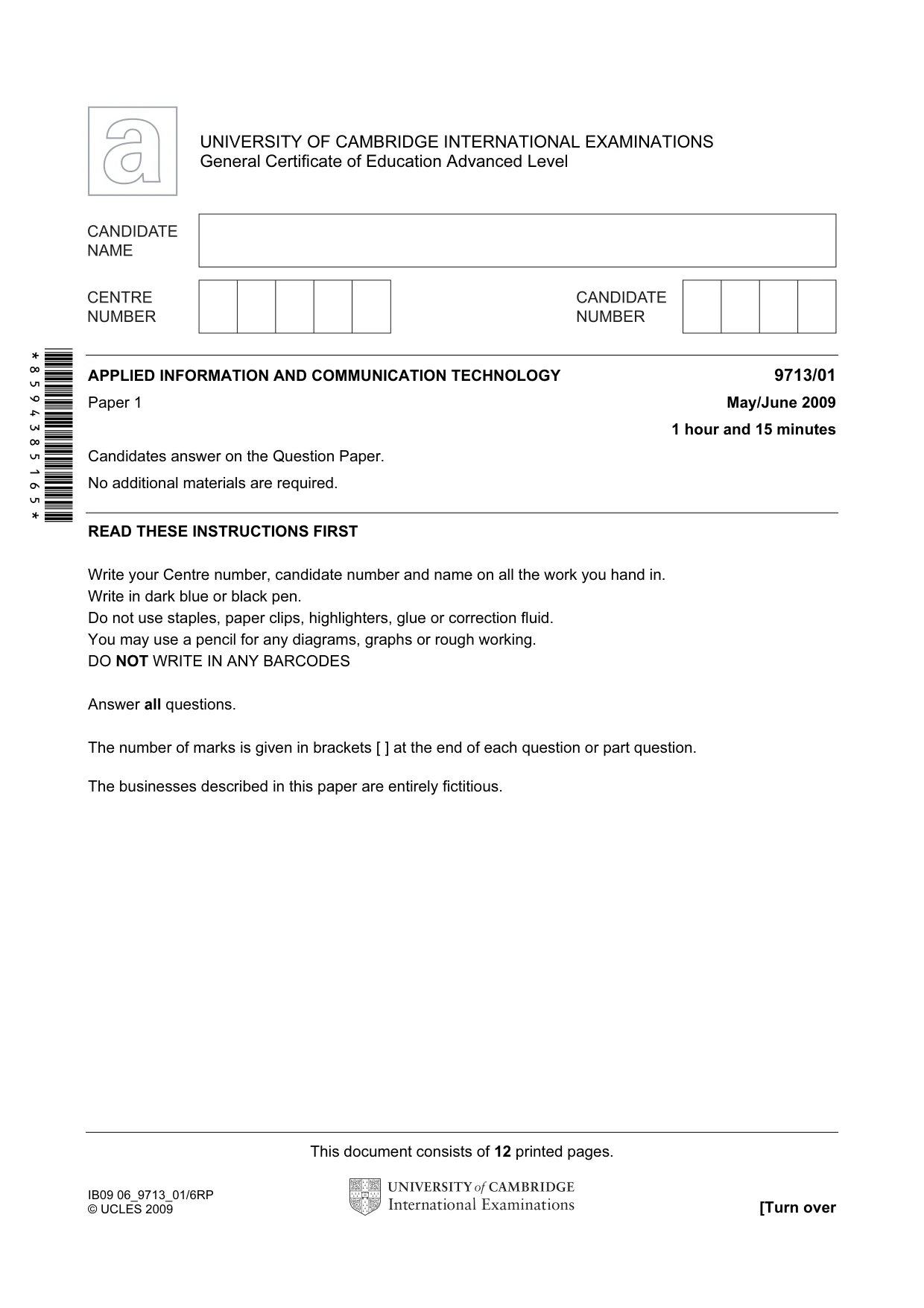
Question paper, page 1
This document consists of 12 printed pages. IB09 06_9713_01/6RP © UCLES 2009 [Turn over *8594385165* UNIVERSITY OF CAMBRIDGE INTERNATIONAL EXAMINATIONS General Certificate of Education Advanced Level APPLIED INFORMATION AND COMMUNICATION TECHNOLOGY 9713/01 Paper 1 May/June 2009 1 hour and 15 minutes Candidates answer on the Question Paper. No additional materials are required. READ THESE INSTRUCTIONS FIRST Write your Centre number, candidate number and name on all the work you hand in. Write in dark blue or black pen. Do not use staples, paper clips, highlighters, glue or correction fluid. You may use a pencil for any diagrams, graphs or rough working. DO NOT WRITE IN ANY BARCODES Answer all questions. The number of marks is given in brackets [ ] at the end of each question or part question. The businesses described in this paper are entirely fictitious.
Question paper, page 2
2 © UCLES 2009 9713/01/M/J/09 Scenario 1 Questions 1 and 2 Midtown Bank in the UK operates an online banking system. Some customers have had difficulties when using this system and so the bank has introduced phone banking. The bank has a call centre in Mumbai, India. When using phone banking, customers are asked to provide the same personal details as when using the online system. Customers are asked to provide three characters from their password. These are never the same three characters in successive logins. The bank stores a lot of personal information about its customers.
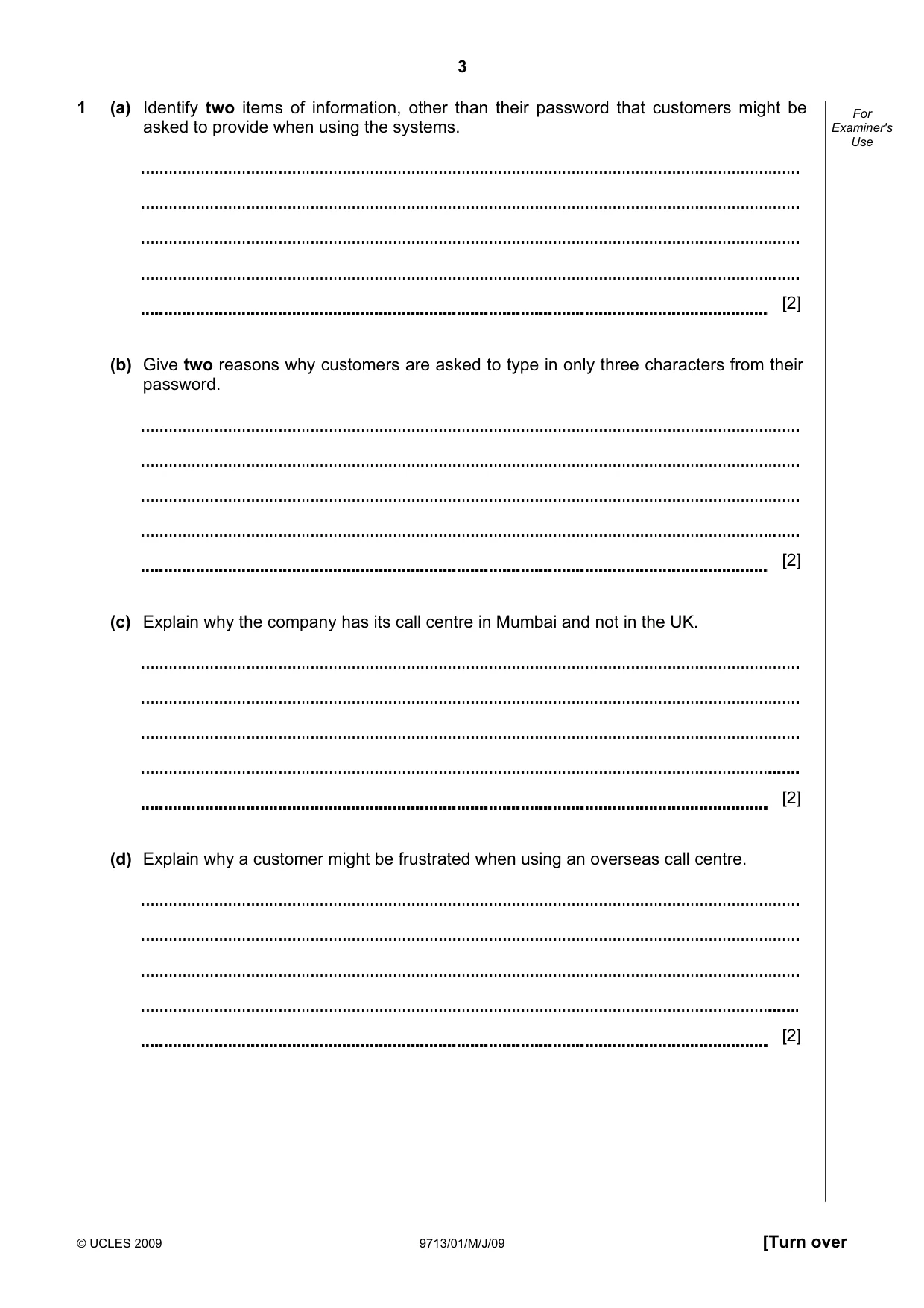
Question paper, page 3
3 © UCLES 2009 9713/01/M/J/09 [Turn over For Examiner's Use 1 (a) Identify two items of information, other than their password that customers might be asked to provide when using the systems. [2] (b) Give two reasons why customers are asked to type in only three characters from their password. [2] (c) Explain why the company has its call centre in Mumbai and not in the UK. [2] (d) Explain why a customer might be frustrated when using an overseas call centre. [2]
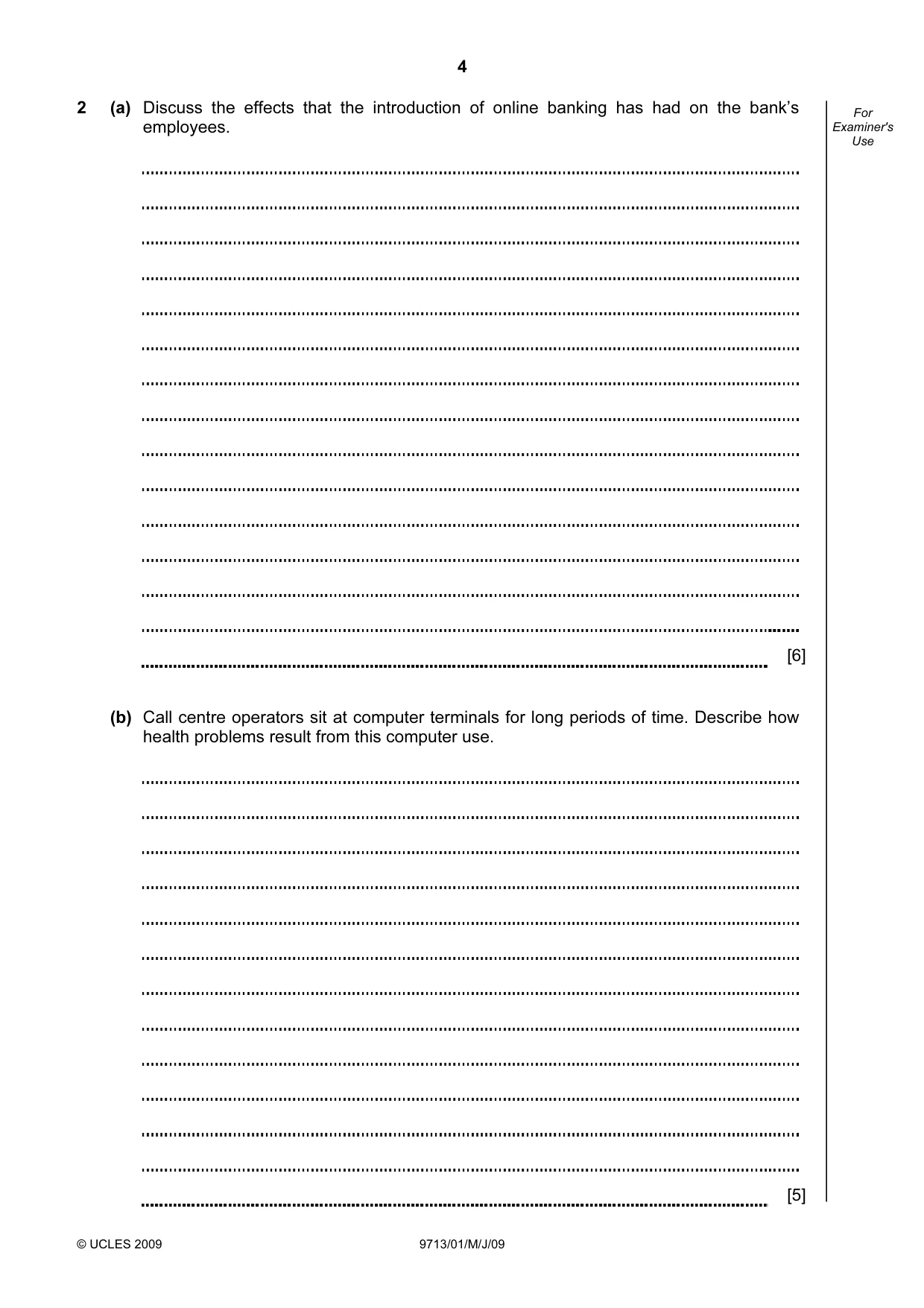
Question paper, page 4
4 © UCLES 2009 9713/01/M/J/09 For Examiner's Use 2 (a) Discuss the effects that the introduction of online banking has had on the bank’s employees. [6] (b) Call centre operators sit at computer terminals for long periods of time. Describe how health problems result from this computer use. [5]
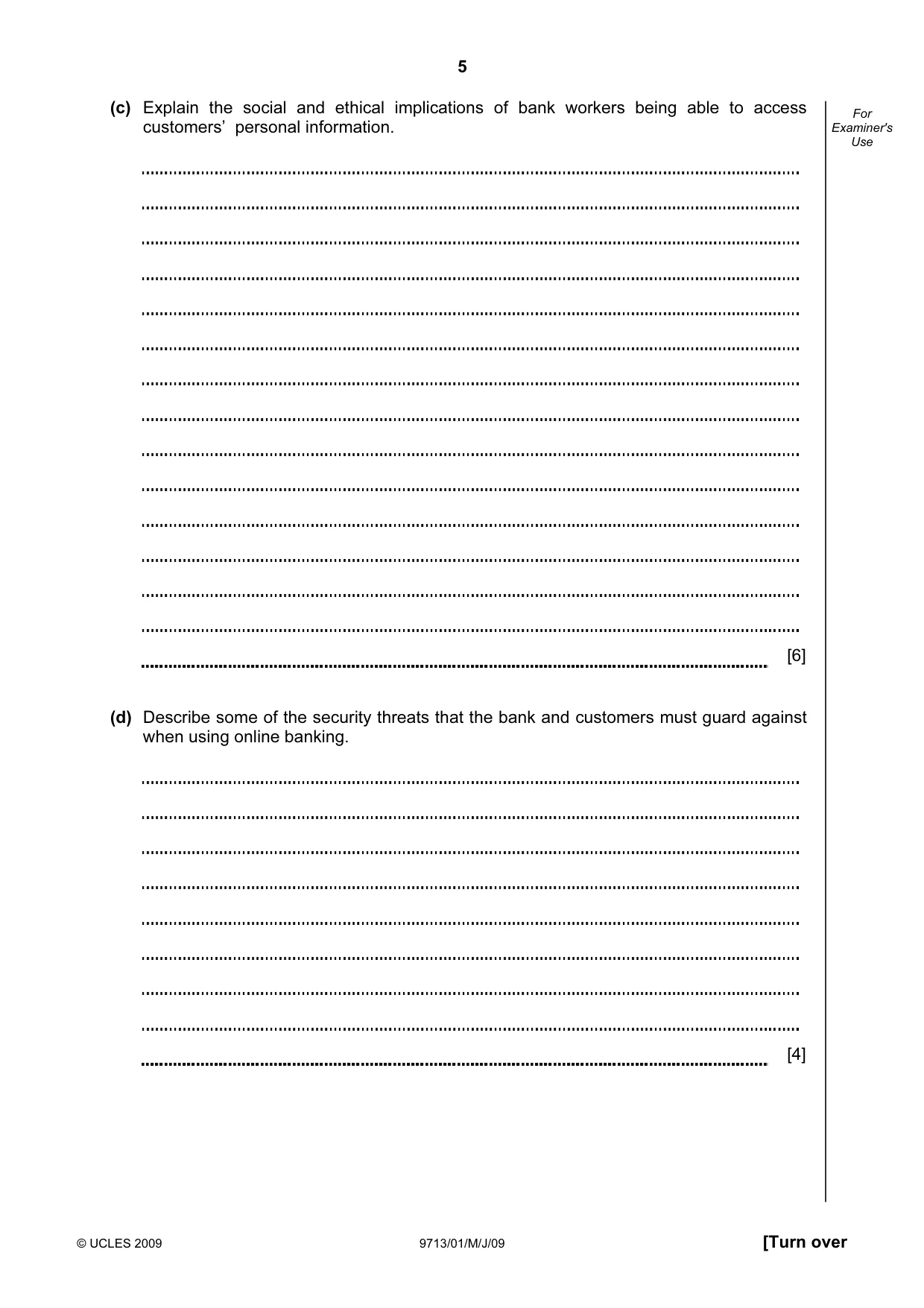
Question paper, page 5
5 © UCLES 2009 9713/01/M/J/09 [Turn over For Examiner's Use (c) Explain the social and ethical implications of bank workers being able to access customers’ personal information. [6] (d) Describe some of the security threats that the bank and customers must guard against when using online banking. [4]
Question paper, page 6
6 © UCLES 2009 9713/01/M/J/09 Scenario 2 Questions 3 and 4 The July 23rd Hospital in Cairo is improving its existing computer system to make it more efficient. They currently have separate systems for storing: • staff records • payroll records. One single database is required which will store all this data. A systems analyst is being employed to analyse the existing system and then design a new system.
Question paper, page 7
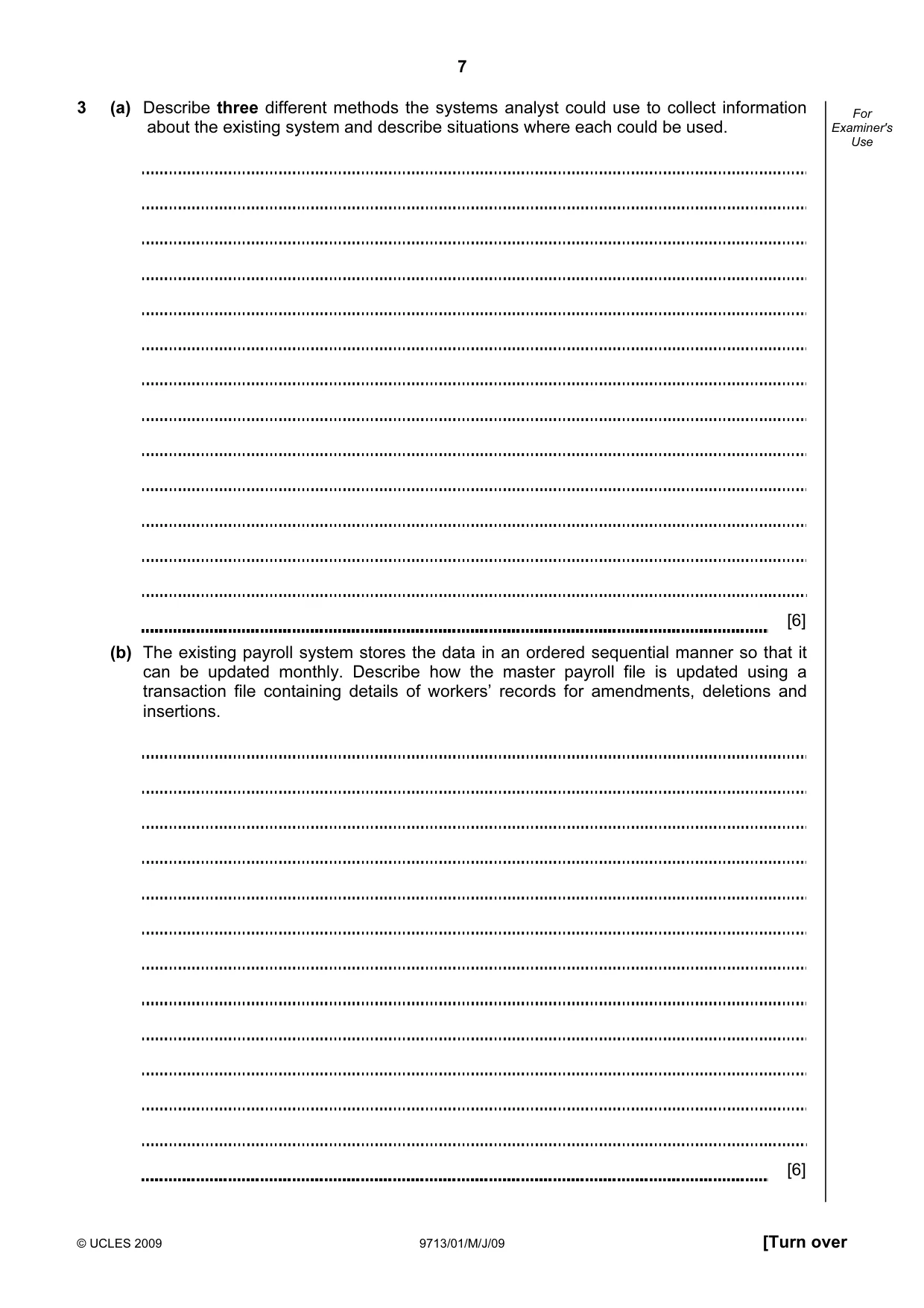
7 © UCLES 2009 9713/01/M/J/09 [Turn over For Examiner's Use 3 (a) Describe three different methods the systems analyst could use to collect information about the existing system and describe situations where each could be used. [6] (b) The existing payroll system stores the data in an ordered sequential manner so that it can be updated monthly. Describe how the master payroll file is updated using a transaction file containing details of workers’ records for amendments, deletions and insertions. [6]
Question paper, page 8
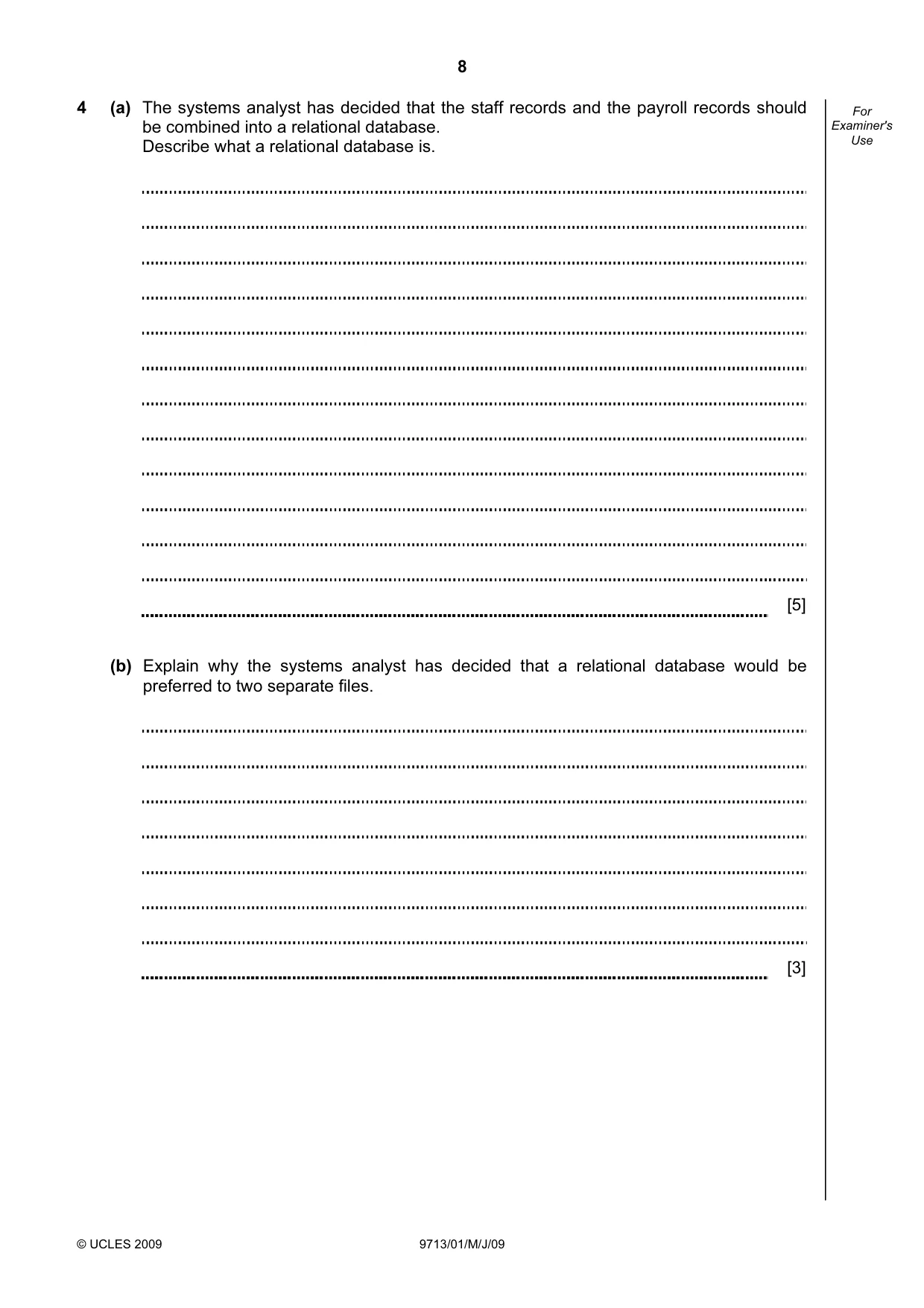
8 © UCLES 2009 9713/01/M/J/09 For Examiner's Use 4 (a) The systems analyst has decided that the staff records and the payroll records should be combined into a relational database. Describe what a relational database is. [5] (b) Explain why the systems analyst has decided that a relational database would be preferred to two separate files. [3]
Question paper, page 9
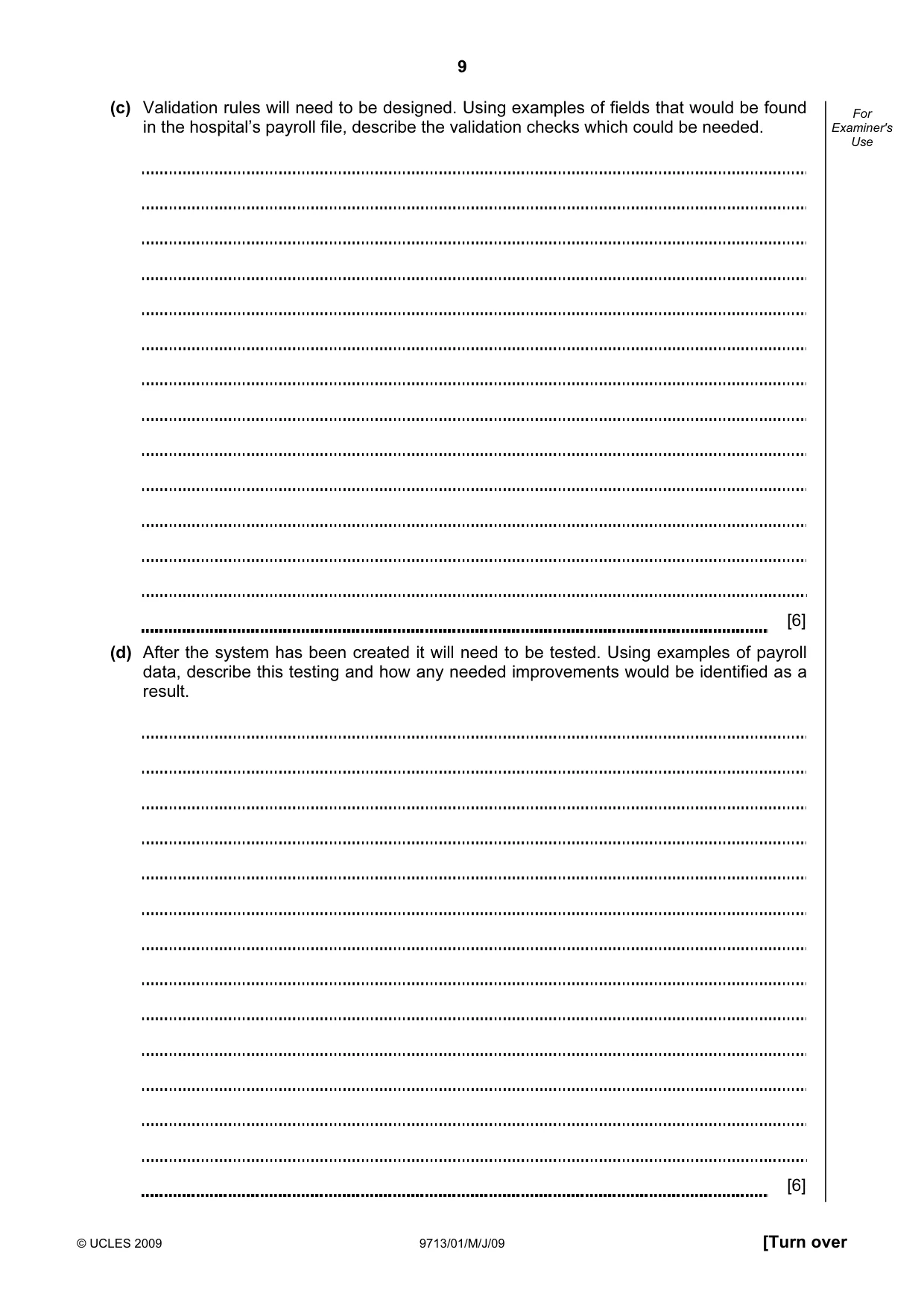
9 © UCLES 2009 9713/01/M/J/09 [Turn over For Examiner's Use (c) Validation rules will need to be designed. Using examples of fields that would be found in the hospital’s payroll file, describe the validation checks which could be needed. [6] (d) After the system has been created it will need to be tested. Using examples of payroll data, describe this testing and how any needed improvements would be identified as a result. [6]
Question paper, page 10
10 © UCLES 2009 9713/01/M/J/09 Scenario 3 Question 5 East African Motors manufacture cars in Nairobi. Their factory is fully automated using robot arms to assemble cars. The main car sales showrooms are in Nairobi and Mombasa in Kenya, Kampala in Uganda and Dar es Salaam in Tanzania. Their head office is in Nairobi. Often the sales people feel that certain updates should be made to the website by the company’s programmers. However as many of the programmers work from home they can sometimes be difficult to contact. The sales people have suggested that the company provide the programmers with appropriate video conferencing equipment. This would enable them to hold regular meetings with the programmers.
Question paper, page 11
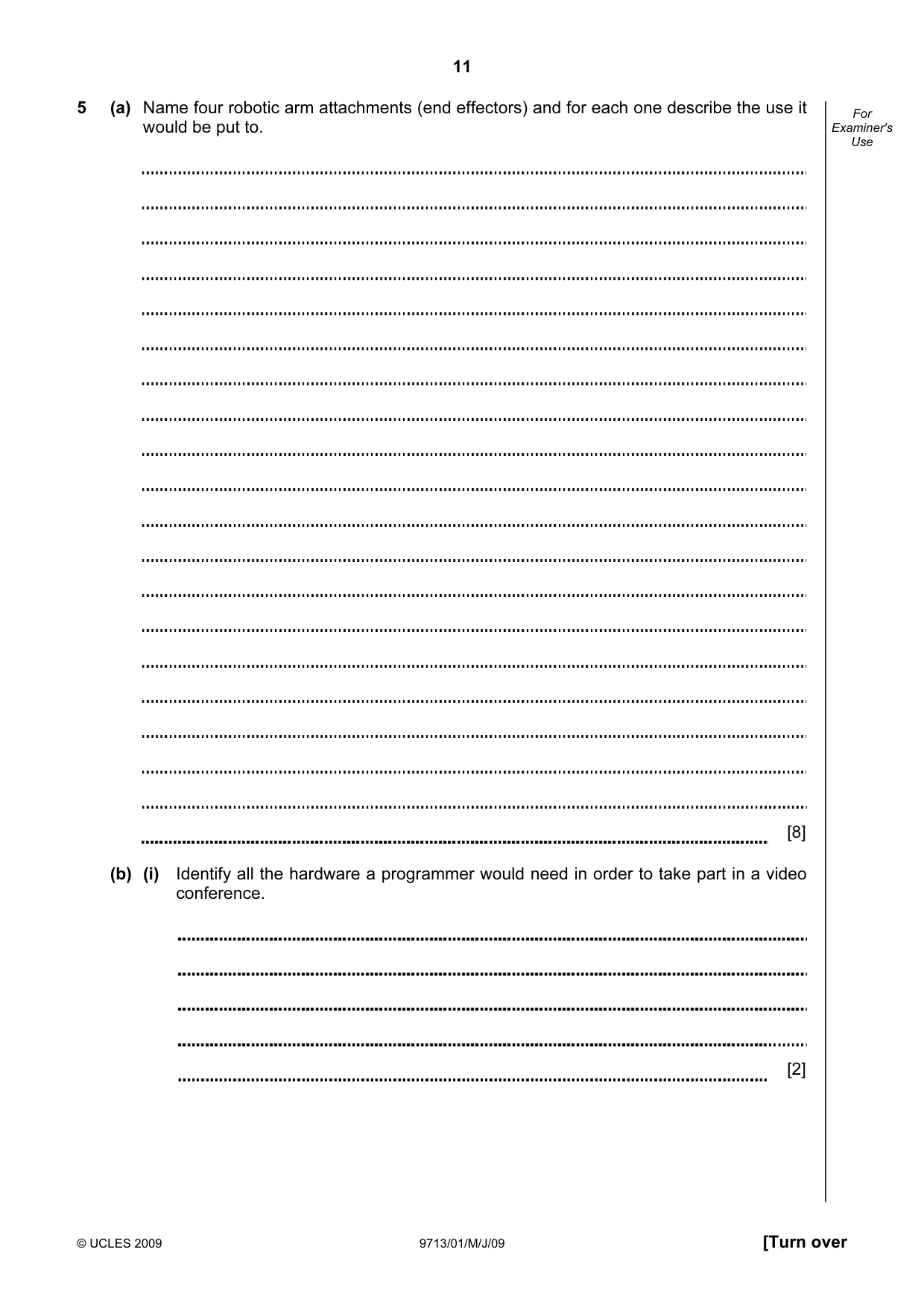
11 © UCLES 2009 9713/01/M/J/09 [Turn over For Examiner's Use 5 (a) Name four robotic arm attachments (end effectors) and for each one describe the use it would be put to. [8] (b) (i) Identify all the hardware a programmer would need in order to take part in a video conference. [2]
Question paper, page 12
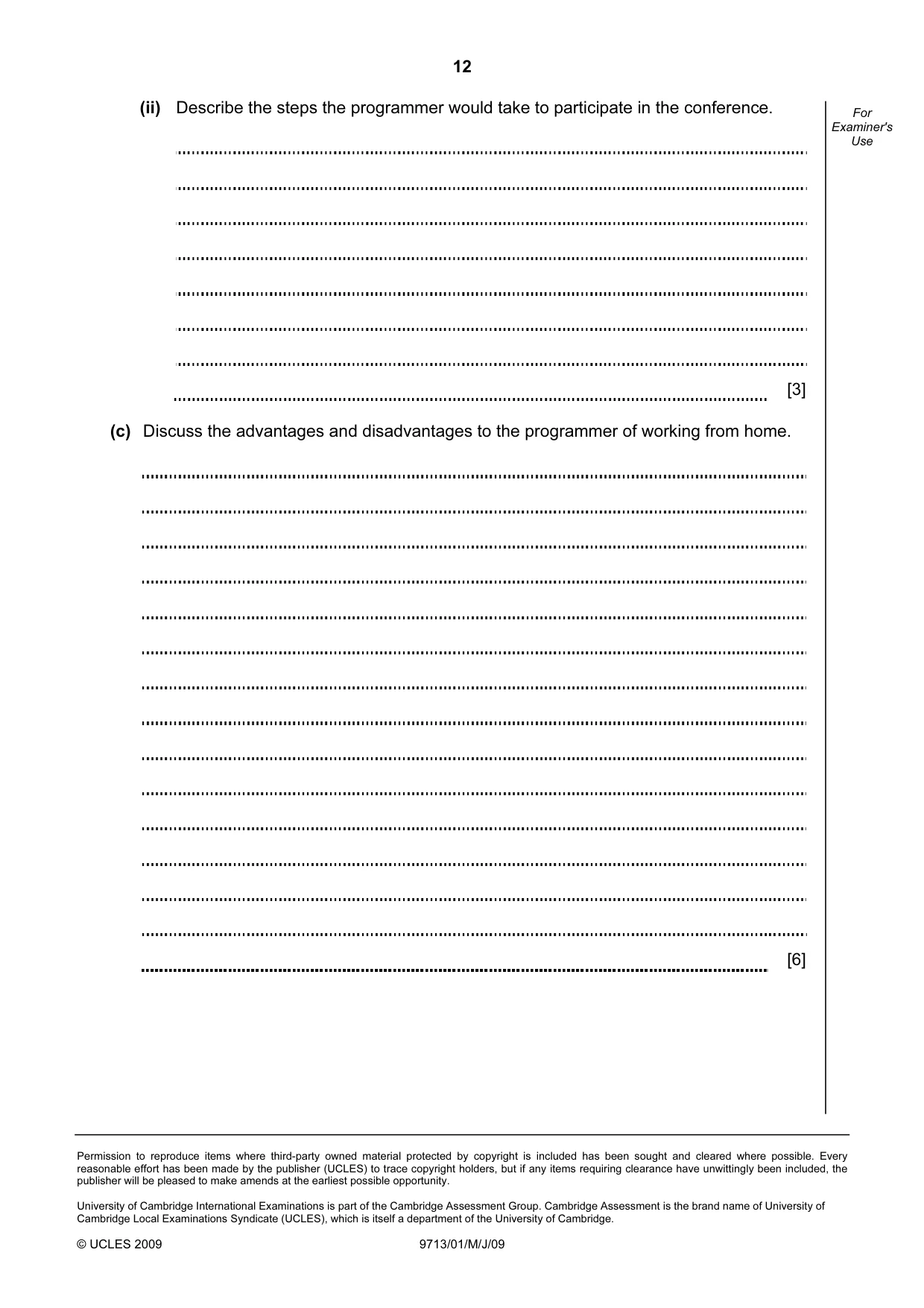
12 Permission to reproduce items where third-party owned material protected by copyright is included has been sought and cleared where possible. Every reasonable effort has been made by the publisher (UCLES) to trace copyright holders, but if any items requiring clearance have unwittingly been included, the publisher will be pleased to make amends at the earliest possible opportunity. University of Cambridge International Examinations is part of the Cambridge Assessment Group. Cambridge Assessment is the brand name of University of Cambridge Local Examinations Syndicate (UCLES), which is itself a department of the University of Cambridge. © UCLES 2009 9713/01/M/J/09 For Examiner's Use (ii) Describe the steps the programmer would take to participate in the conference. [3] (c) Discuss the advantages and disadvantages to the programmer of working from home. [6]
Mark scheme, page 1
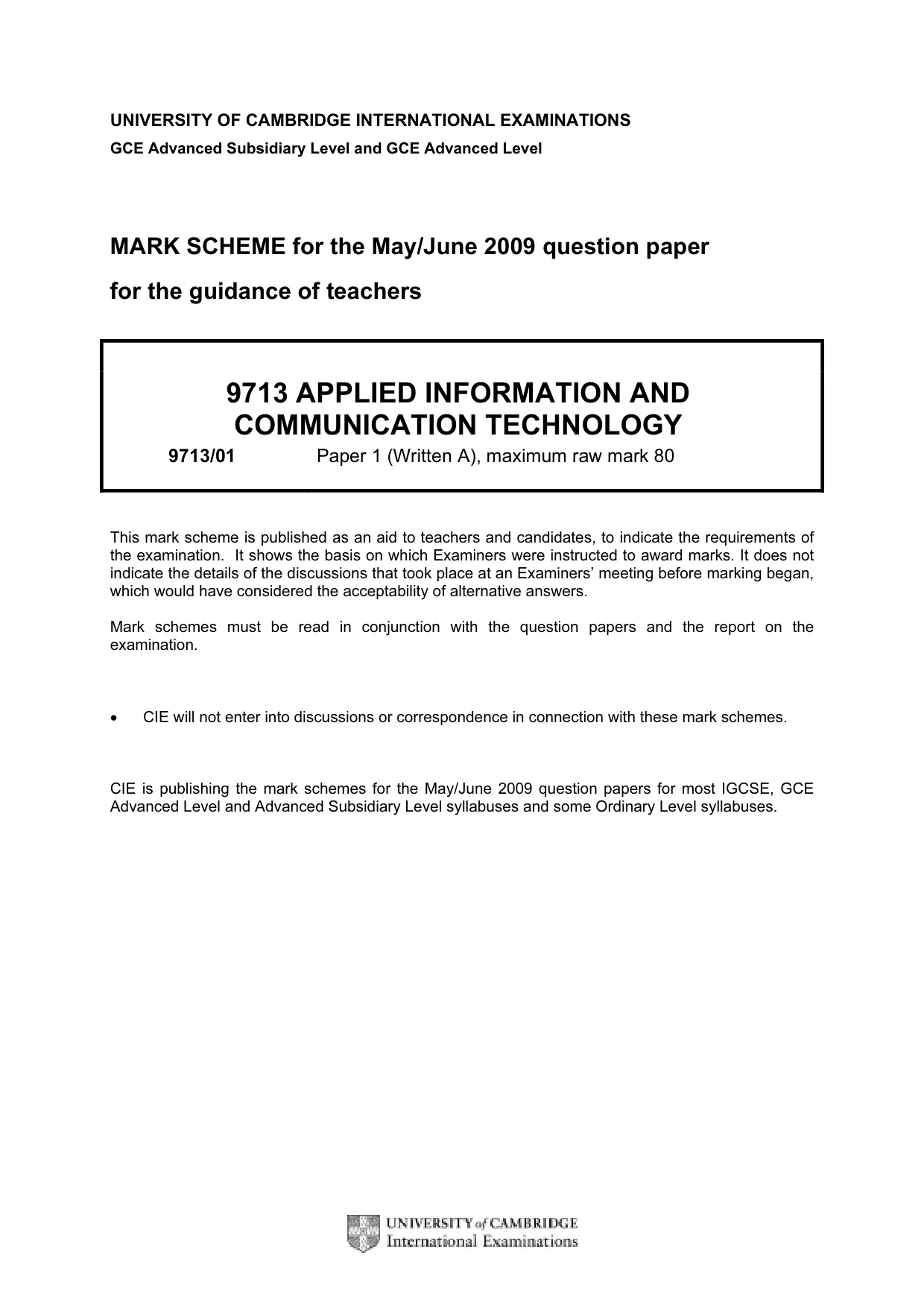
UNIVERSITY OF CAMBRIDGE INTERNATIONAL EXAMINATIONS GCE Advanced Subsidiary Level and GCE Advanced Level MARK SCHEME for the May/June 2009 question paper for the guidance of teachers 9713 APPLIED INFORMATION AND COMMUNICATION TECHNOLOGY 9713/01 Paper 1 (Written A), maximum raw mark 80 This mark scheme is published as an aid to teachers and candidates, to indicate the requirements of the examination. It shows the basis on which Examiners were instructed to award marks. It does not indicate the details of the discussions that took place at an Examiners’ meeting before marking began, which would have considered the acceptability of alternative answers. Mark schemes must be read in conjunction with the question papers and the report on the examination. • CIE will not enter into discussions or correspondence in connection with these mark schemes. CIE is publishing the mark schemes for the May/June 2009 question papers for most IGCSE, GCE Advanced Level and Advanced Subsidiary Level syllabuses and some Ordinary Level syllabuses.
Mark scheme, page 2
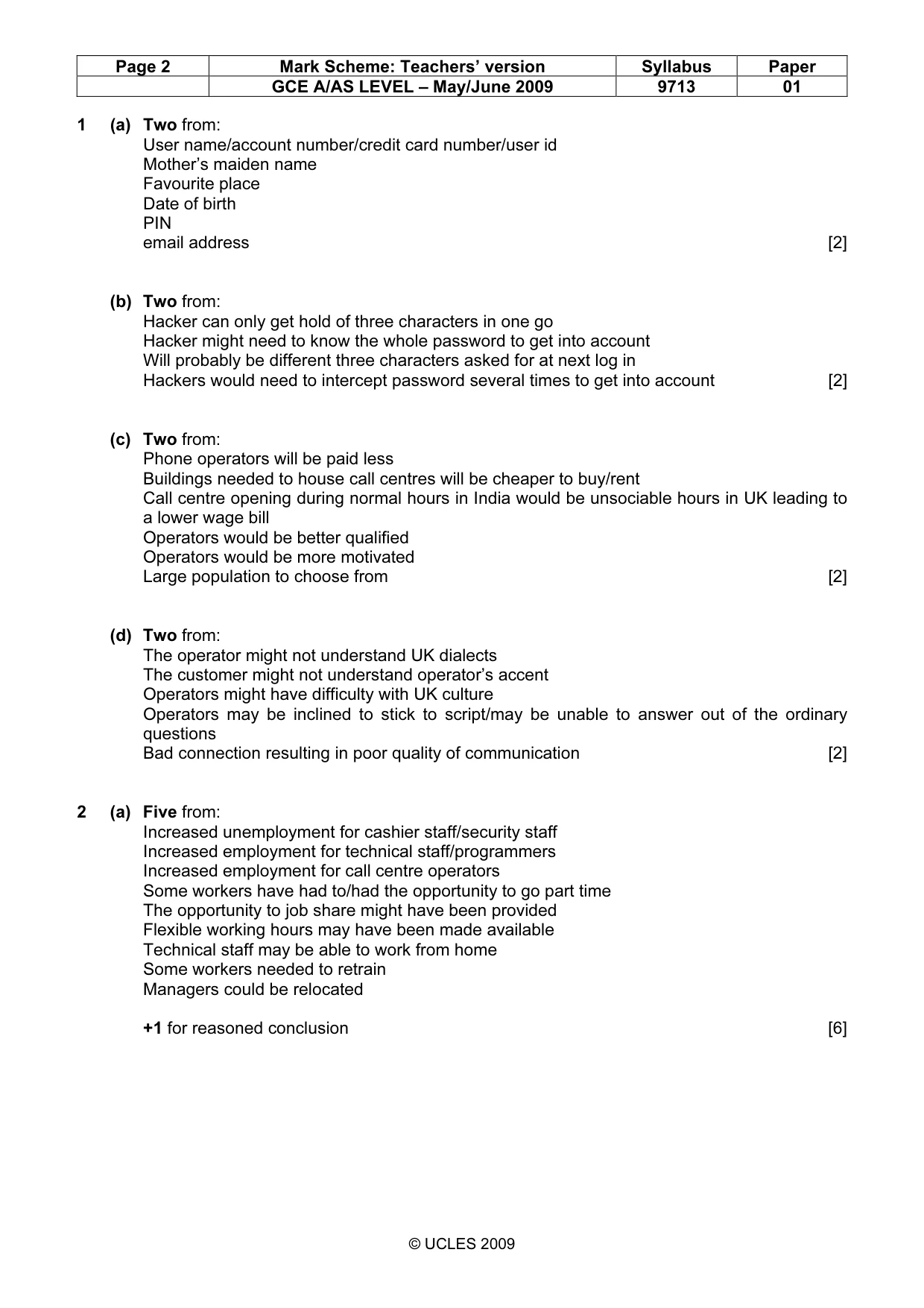
Page 2 Mark Scheme: Teachers’ version Syllabus Paper GCE A/AS LEVEL – May/June 2009 9713 01 © UCLES 2009 1 (a) Two from: User name/account number/credit card number/user id Mother’s maiden name Favourite place Date of birth PIN email address [2] (b) Two from: Hacker can only get hold of three characters in one go Hacker might need to know the whole password to get into account Will probably be different three characters asked for at next log in Hackers would need to intercept password several times to get into account [2] (c) Two from: Phone operators will be paid less Buildings needed to house call centres will be cheaper to buy/rent Call centre opening during normal hours in India would be unsociable hours in UK leading to a lower wage bill Operators would be better qualified Operators would be more motivated Large population to choose from [2] (d) Two from: The operator might not understand UK dialects The customer might not understand operator’s accent Operators might have difficulty with UK culture Operators may be inclined to stick to script/may be unable to answer out of the ordinary questions Bad connection resulting in poor quality of communication [2] 2 (a) Five from: Increased unemployment for cashier staff/security staff Increased employment for technical staff/programmers Increased employment for call centre operators Some workers have had to/had the opportunity to go part time The opportunity to job share might have been provided Flexible working hours may have been made available Technical staff may be able to work from home Some workers needed to retrain Managers could be relocated +1 for reasoned conclusion [6]
Mark scheme, page 3
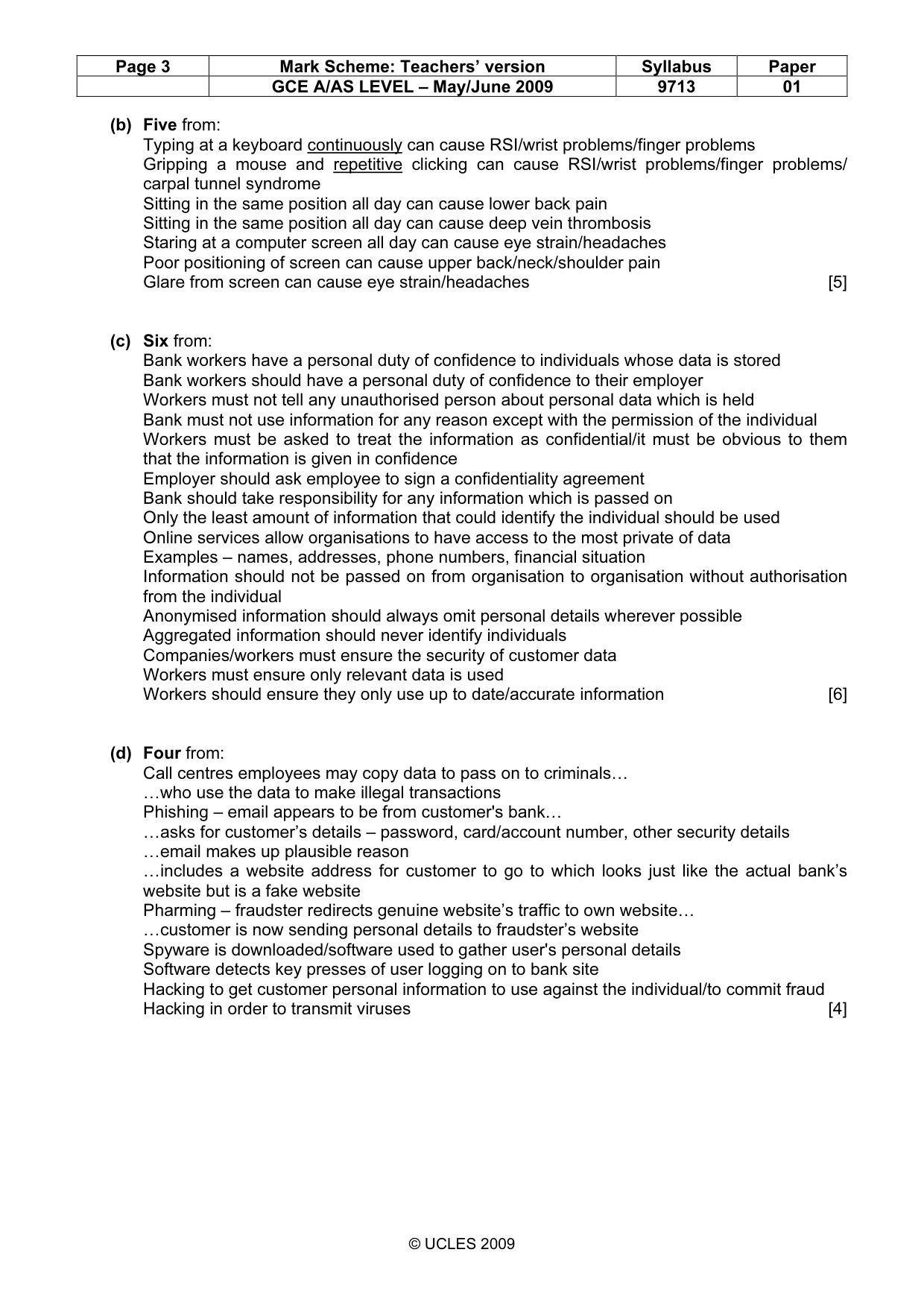
Page 3 Mark Scheme: Teachers’ version Syllabus Paper GCE A/AS LEVEL – May/June 2009 9713 01 © UCLES 2009 (b) Five from: Typing at a keyboard continuously can cause RSI/wrist problems/finger problems Gripping a mouse and repetitive clicking can cause RSI/wrist problems/finger problems/ carpal tunnel syndrome Sitting in the same position all day can cause lower back pain Sitting in the same position all day can cause deep vein thrombosis Staring at a computer screen all day can cause eye strain/headaches Poor positioning of screen can cause upper back/neck/shoulder pain Glare from screen can cause eye strain/headaches [5] (c) Six from: Bank workers have a personal duty of confidence to individuals whose data is stored Bank workers should have a personal duty of confidence to their employer Workers must not tell any unauthorised person about personal data which is held Bank must not use information for any reason except with the permission of the individual Workers must be asked to treat the information as confidential/it must be obvious to them that the information is given in confidence Employer should ask employee to sign a confidentiality agreement Bank should take responsibility for any information which is passed on Only the least amount of information that could identify the individual should be used Online services allow organisations to have access to the most private of data Examples – names, addresses, phone numbers, financial situation Information should not be passed on from organisation to organisation without authorisation from the individual Anonymised information should always omit personal details wherever possible Aggregated information should never identify individuals Companies/workers must ensure the security of customer data Workers must ensure only relevant data is used Workers should ensure they only use up to date/accurate information [6] (d) Four from: Call centres employees may copy data to pass on to criminals… …who use the data to make illegal transactions Phishing – email appears to be from customer's bank… …asks for customer’s details – password, card/account number, other security details …email makes up plausible reason …includes a website address for customer to go to which looks just like the actual bank’s website but is a fake website Pharming – fraudster redirects genuine website’s traffic to own website… …customer is now sending personal details to fraudster’s website Spyware is downloaded/software used to gather user's personal details Software detects key presses of user logging on to bank site Hacking to get customer personal information to use against the individual/to commit fraud Hacking in order to transmit viruses [4]
Mark scheme, page 4
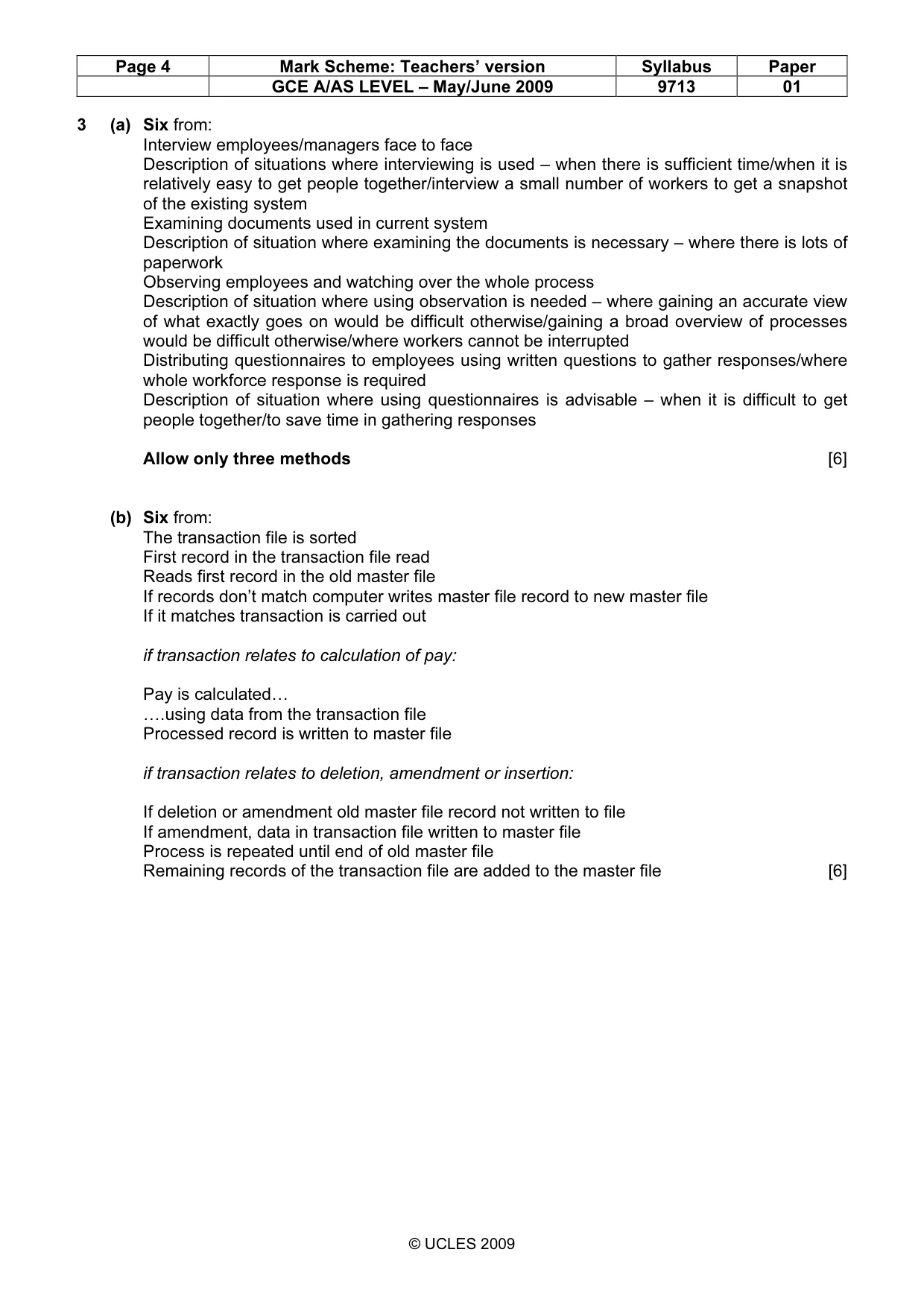
Page 4 Mark Scheme: Teachers’ version Syllabus Paper GCE A/AS LEVEL – May/June 2009 9713 01 © UCLES 2009 3 (a) Six from: Interview employees/managers face to face Description of situations where interviewing is used – when there is sufficient time/when it is relatively easy to get people together/interview a small number of workers to get a snapshot of the existing system Examining documents used in current system Description of situation where examining the documents is necessary – where there is lots of paperwork Observing employees and watching over the whole process Description of situation where using observation is needed – where gaining an accurate view of what exactly goes on would be difficult otherwise/gaining a broad overview of processes would be difficult otherwise/where workers cannot be interrupted Distributing questionnaires to employees using written questions to gather responses/where whole workforce response is required Description of situation where using questionnaires is advisable – when it is difficult to get people together/to save time in gathering responses Allow only three methods [6] (b) Six from: The transaction file is sorted First record in the transaction file read Reads first record in the old master file If records don’t match computer writes master file record to new master file If it matches transaction is carried out if transaction relates to calculation of pay: Pay is calculated… ….using data from the transaction file Processed record is written to master file if transaction relates to deletion, amendment or insertion: If deletion or amendment old master file record not written to file If amendment, data in transaction file written to master file Process is repeated until end of old master file Remaining records of the transaction file are added to the master file [6]
Mark scheme, page 5
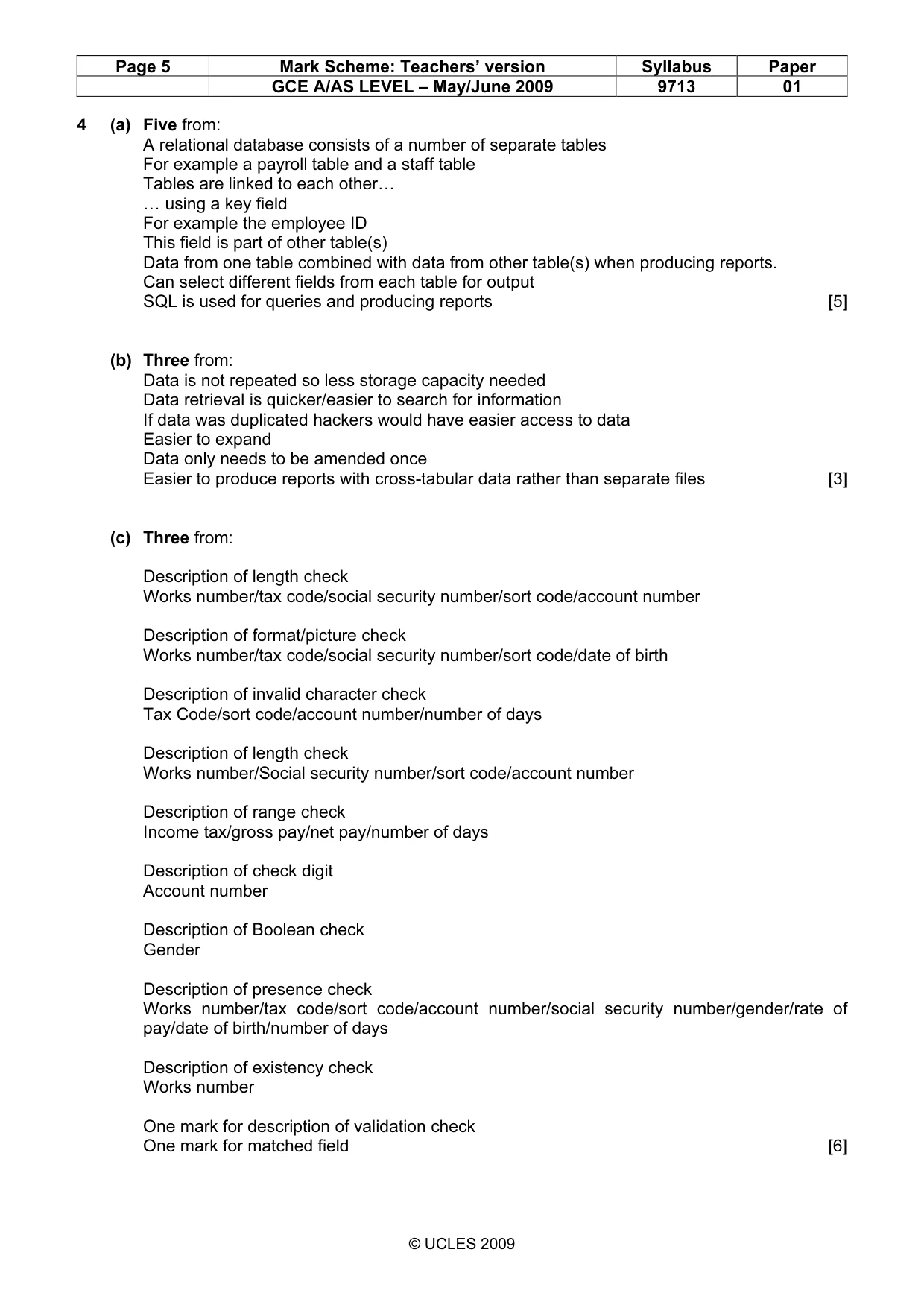
Page 5 Mark Scheme: Teachers’ version Syllabus Paper GCE A/AS LEVEL – May/June 2009 9713 01 © UCLES 2009 4 (a) Five from: A relational database consists of a number of separate tables For example a payroll table and a staff table Tables are linked to each other… … using a key field For example the employee ID This field is part of other table(s) Data from one table combined with data from other table(s) when producing reports. Can select different fields from each table for output SQL is used for queries and producing reports [5] (b) Three from: Data is not repeated so less storage capacity needed Data retrieval is quicker/easier to search for information If data was duplicated hackers would have easier access to data Easier to expand Data only needs to be amended once Easier to produce reports with cross-tabular data rather than separate files [3] (c) Three from: Description of length check Works number/tax code/social security number/sort code/account number Description of format/picture check Works number/tax code/social security number/sort code/date of birth Description of invalid character check Tax Code/sort code/account number/number of days Description of length check Works number/Social security number/sort code/account number Description of range check Income tax/gross pay/net pay/number of days Description of check digit Account number Description of Boolean check Gender Description of presence check Works number/tax code/sort code/account number/social security number/gender/rate of pay/date of birth/number of days Description of existency check Works number One mark for description of validation check One mark for matched field [6]
Mark scheme, page 6
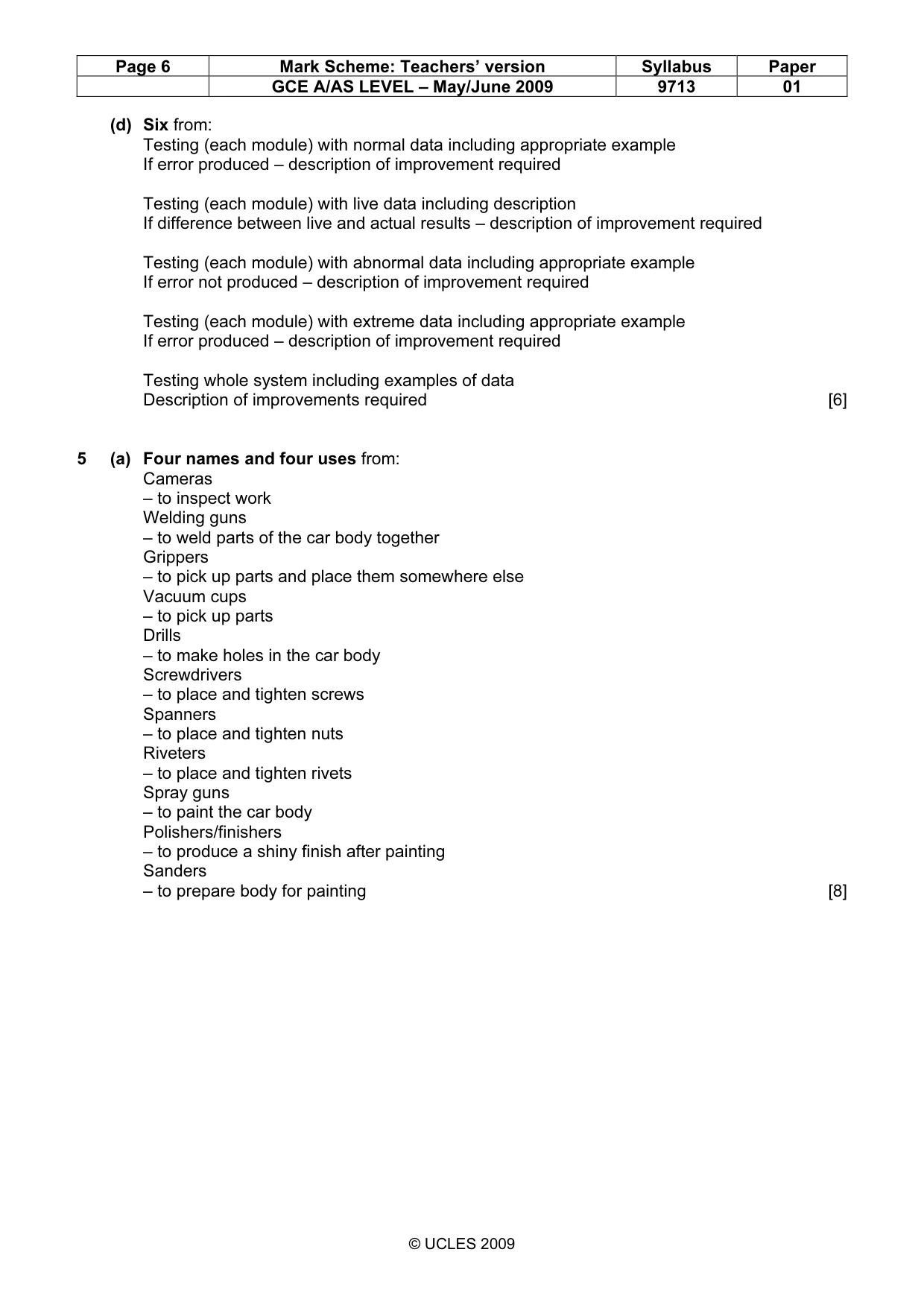
Page 6 Mark Scheme: Teachers’ version Syllabus Paper GCE A/AS LEVEL – May/June 2009 9713 01 © UCLES 2009 (d) Six from: Testing (each module) with normal data including appropriate example If error produced – description of improvement required Testing (each module) with live data including description If difference between live and actual results – description of improvement required Testing (each module) with abnormal data including appropriate example If error not produced – description of improvement required Testing (each module) with extreme data including appropriate example If error produced – description of improvement required Testing whole system including examples of data Description of improvements required [6] 5 (a) Four names and four uses from: Cameras – to inspect work Welding guns – to weld parts of the car body together Grippers – to pick up parts and place them somewhere else Vacuum cups – to pick up parts Drills – to make holes in the car body Screwdrivers – to place and tighten screws Spanners – to place and tighten nuts Riveters – to place and tighten rivets Spray guns – to paint the car body Polishers/finishers – to produce a shiny finish after painting Sanders – to prepare body for painting [8]
Mark scheme, page 7
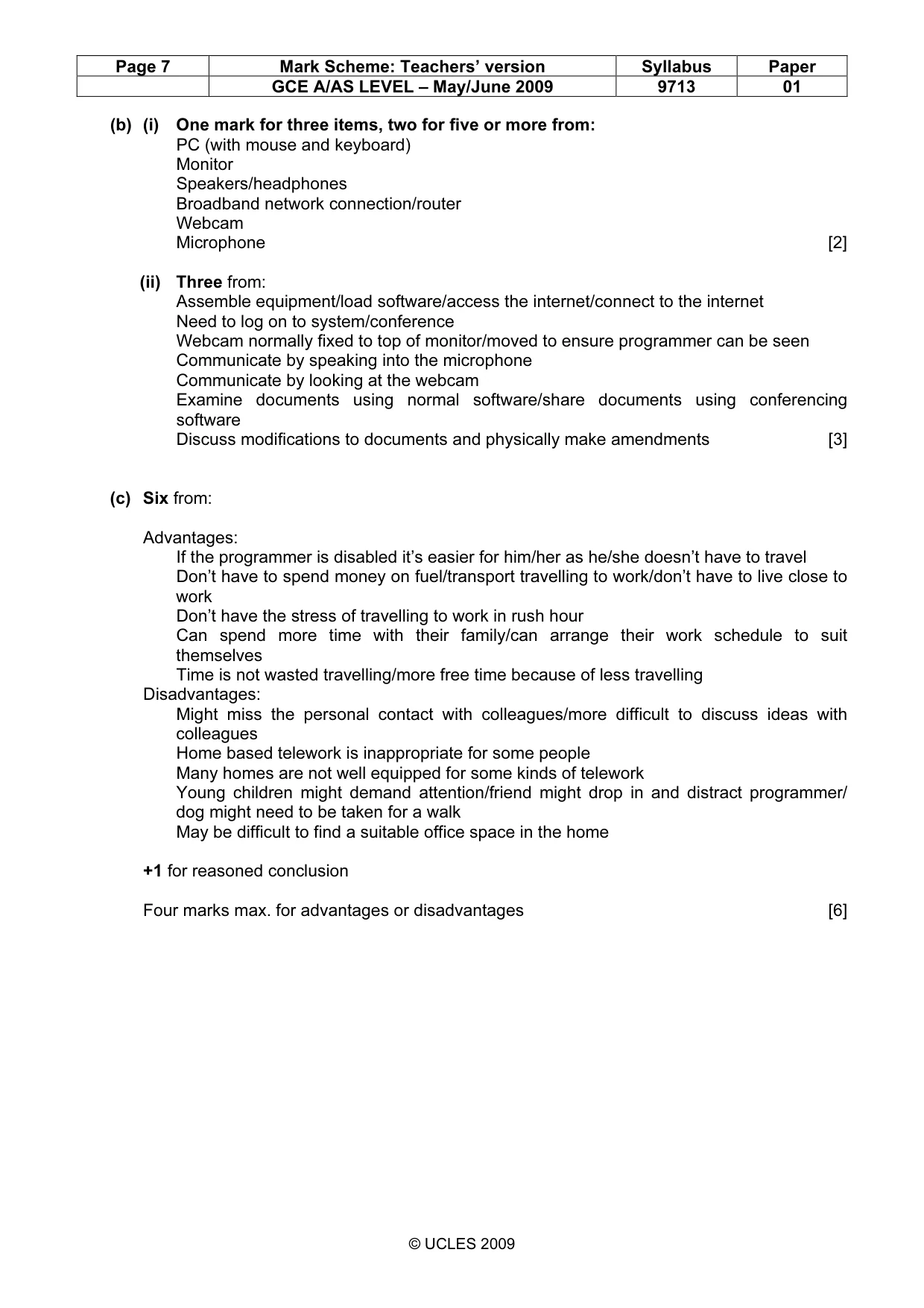
Page 7 Mark Scheme: Teachers’ version Syllabus Paper GCE A/AS LEVEL – May/June 2009 9713 01 © UCLES 2009 (b) (i) One mark for three items, two for five or more from: PC (with mouse and keyboard) Monitor Speakers/headphones Broadband network connection/router Webcam Microphone [2] (ii) Three from: Assemble equipment/load software/access the internet/connect to the internet Need to log on to system/conference Webcam normally fixed to top of monitor/moved to ensure programmer can be seen Communicate by speaking into the microphone Communicate by looking at the webcam Examine documents using normal software/share documents using conferencing software Discuss modifications to documents and physically make amendments [3] (c) Six from: Advantages: If the programmer is disabled it’s easier for him/her as he/she doesn’t have to travel Don’t have to spend money on fuel/transport travelling to work/don’t have to live close to work Don’t have the stress of travelling to work in rush hour Can spend more time with their family/can arrange their work schedule to suit themselves Time is not wasted travelling/more free time because of less travelling Disadvantages: Might miss the personal contact with colleagues/more difficult to discuss ideas with colleagues Home based telework is inappropriate for some people Many homes are not well equipped for some kinds of telework Young children might demand attention/friend might drop in and distract programmer/ dog might need to be taken for a walk May be difficult to find a suitable office space in the home +1 for reasoned conclusion Four marks max. for advantages or disadvantages [6]
What you needed in this session
Cambridge’s own grade thresholds for 2009 May/June, Paper 1 · Variant 1. A higher threshold means an easier paper — the bar moves with how the cohort did.