Cambridge A Level Applied Information and Communication Technology 9713 — 2008 Oct/Nov Paper 3 · Variant 1
9713/31/O/N/08 · 80 marks · ≈90 min
The question paper and its mark scheme, free to read here and free to download. This is Cambridge’s own paper, exactly as it was sat.
Question paper12 pages

Mark scheme7 pages
Answers below. Sit the paper first if you are practising.
Paper as text
Question paper, page 1
This document consists of 11 printed pages and 1 blank page. IB08 11_9713_03/3RP © UCLES 2008 [Turn over *8302090522* UNIVERSITY OF CAMBRIDGE INTERNATIONAL EXAMINATIONS General Certificate of Education Advanced Level APPLIED INFORMATION AND COMMUNICATION TECHNOLOGY 9713/03 Paper 3 October/November 2008 1 hour 15 minutes Candidates answer on the Question Paper. No additional materials are required READ THESE INSTRUCTIONS FIRST Write your Centre number, candidate number and name on all the work you hand in. Write in dark blue or black pen. Do not use staples, paper clips, highlighters, glue or correction fluid. You may use a pencil for any diagrams, graphs or rough working. DO NOT WRITE IN ANY BARCODES Answer all questions. The number of marks is given in brackets [ ] at the end of each question or part question.
Question paper, page 2
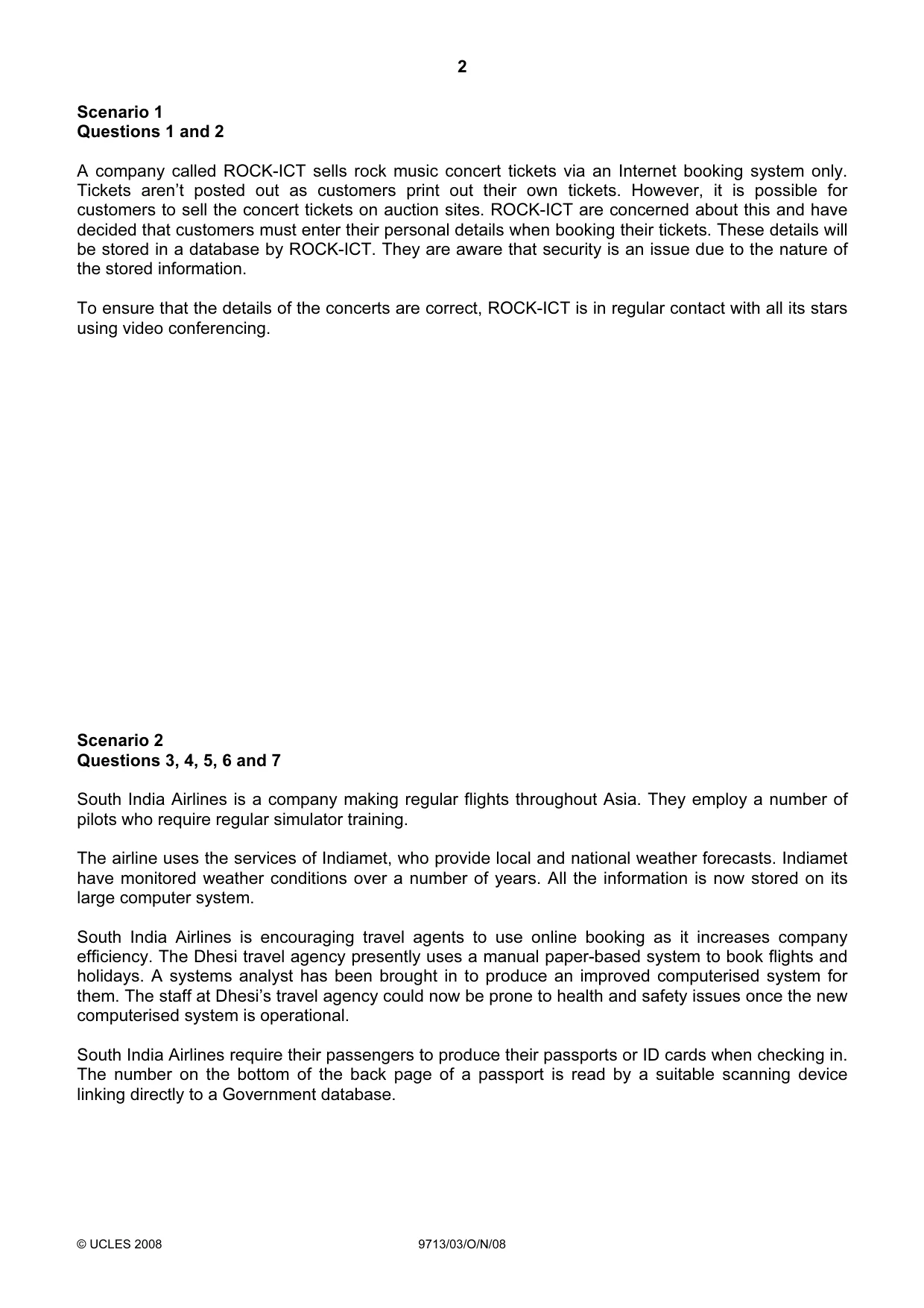
2 © UCLES 2008 9713/03/O/N/08 Scenario 1 Questions 1 and 2 A company called ROCK-ICT sells rock music concert tickets via an Internet booking system only. Tickets aren’t posted out as customers print out their own tickets. However, it is possible for customers to sell the concert tickets on auction sites. ROCK-ICT are concerned about this and have decided that customers must enter their personal details when booking their tickets. These details will be stored in a database by ROCK-ICT. They are aware that security is an issue due to the nature of the stored information. To ensure that the details of the concerts are correct, ROCK-ICT is in regular contact with all its stars using video conferencing. Scenario 2 Questions 3, 4, 5, 6 and 7 South India Airlines is a company making regular flights throughout Asia. They employ a number of pilots who require regular simulator training. The airline uses the services of Indiamet, who provide local and national weather forecasts. Indiamet have monitored weather conditions over a number of years. All the information is now stored on its large computer system. South India Airlines is encouraging travel agents to use online booking as it increases company efficiency. The Dhesi travel agency presently uses a manual paper-based system to book flights and holidays. A systems analyst has been brought in to produce an improved computerised system for them. The staff at Dhesi’s travel agency could now be prone to health and safety issues once the new computerised system is operational. South India Airlines require their passengers to produce their passports or ID cards when checking in. The number on the bottom of the back page of a passport is read by a suitable scanning device linking directly to a Government database.
Question paper, page 3
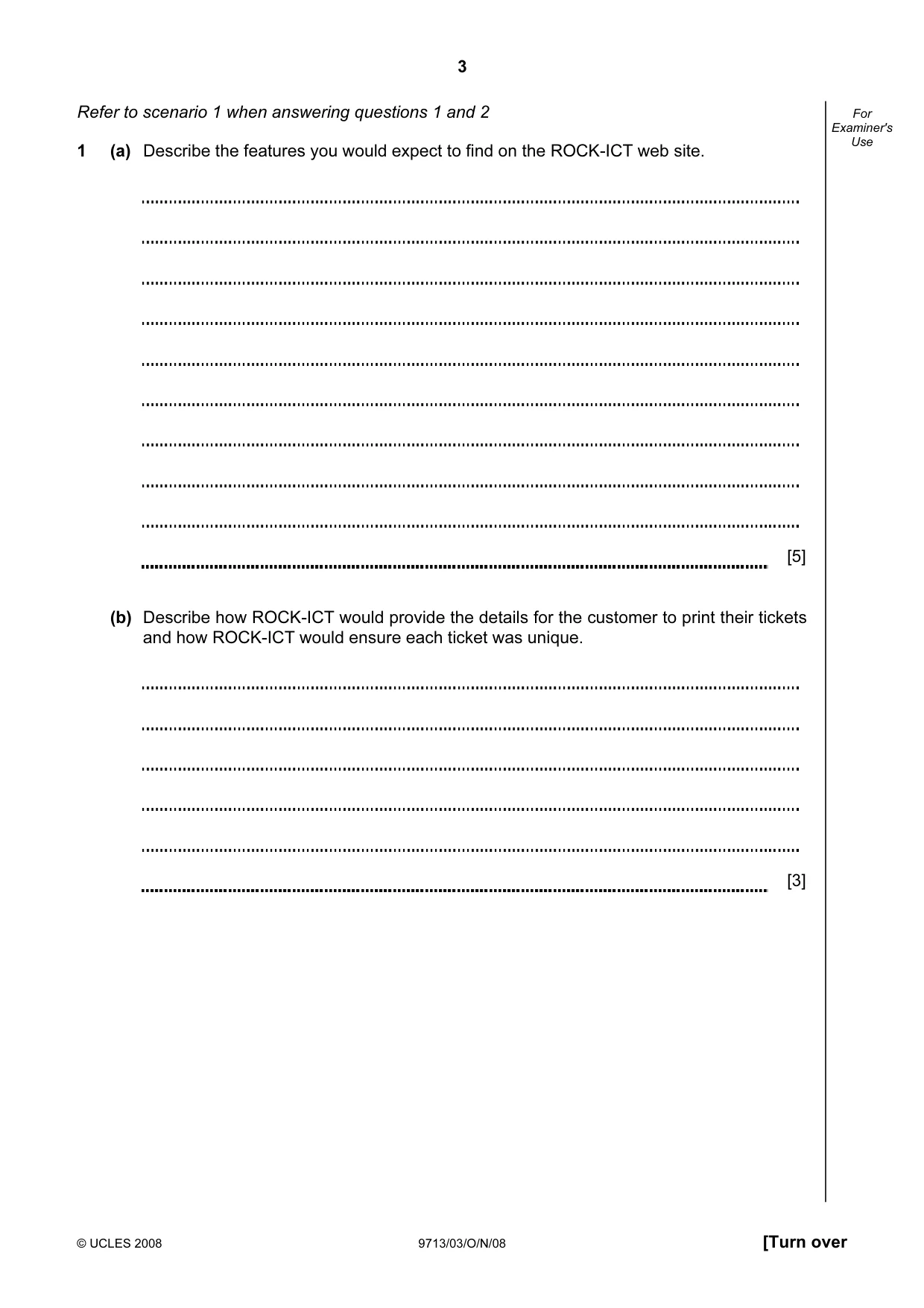
3 © UCLES 2008 9713/03/O/N/08 [Turn over For Examiner's Use Refer to scenario 1 when answering questions 1 and 2 1 (a) Describe the features you would expect to find on the ROCK-ICT web site. [5] (b) Describe how ROCK-ICT would provide the details for the customer to print their tickets and how ROCK-ICT would ensure each ticket was unique. [3]
Question paper, page 4
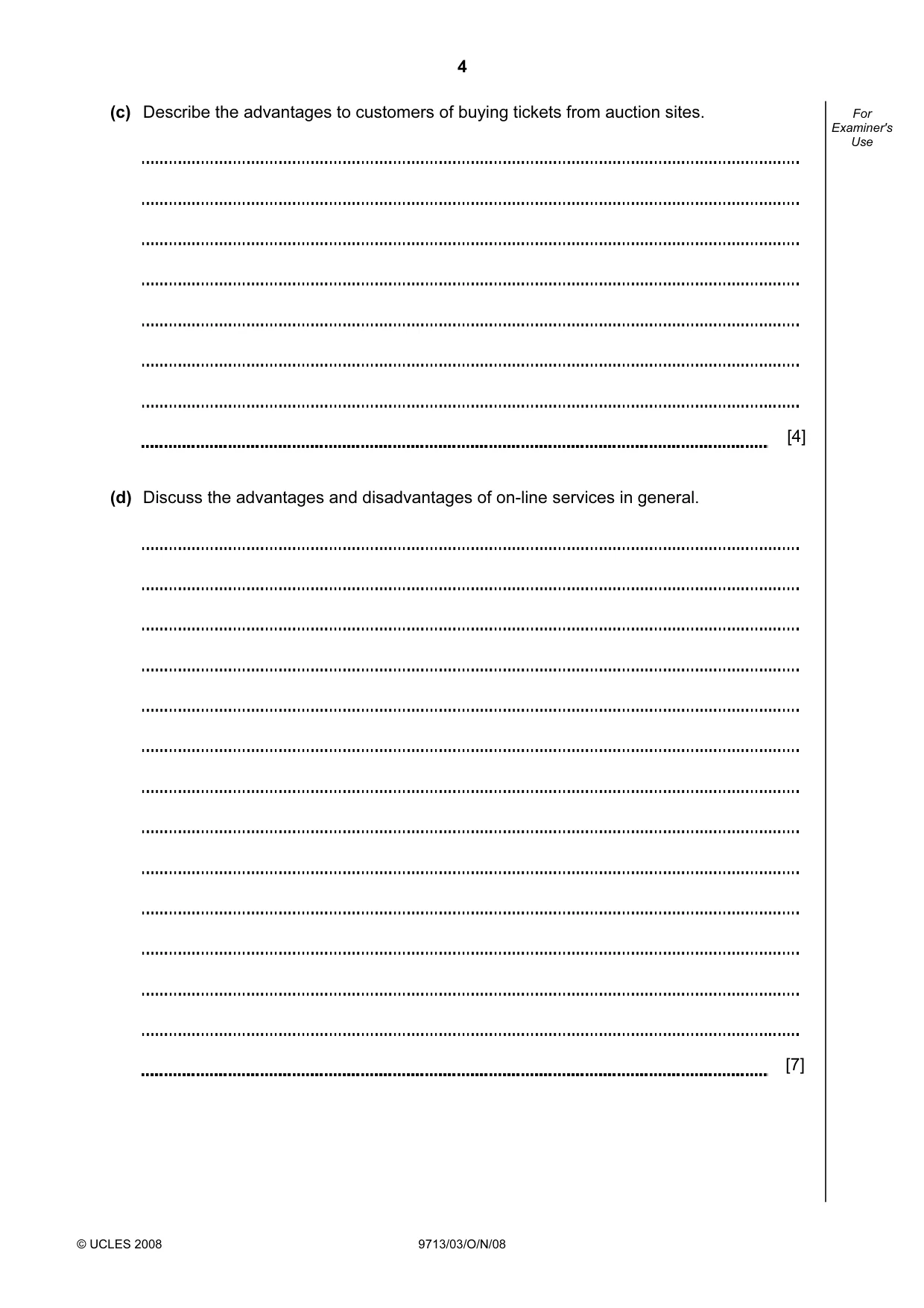
4 © UCLES 2008 9713/03/O/N/08 For Examiner's Use (c) Describe the advantages to customers of buying tickets from auction sites. [4] (d) Discuss the advantages and disadvantages of on-line services in general. [7]
Question paper, page 5
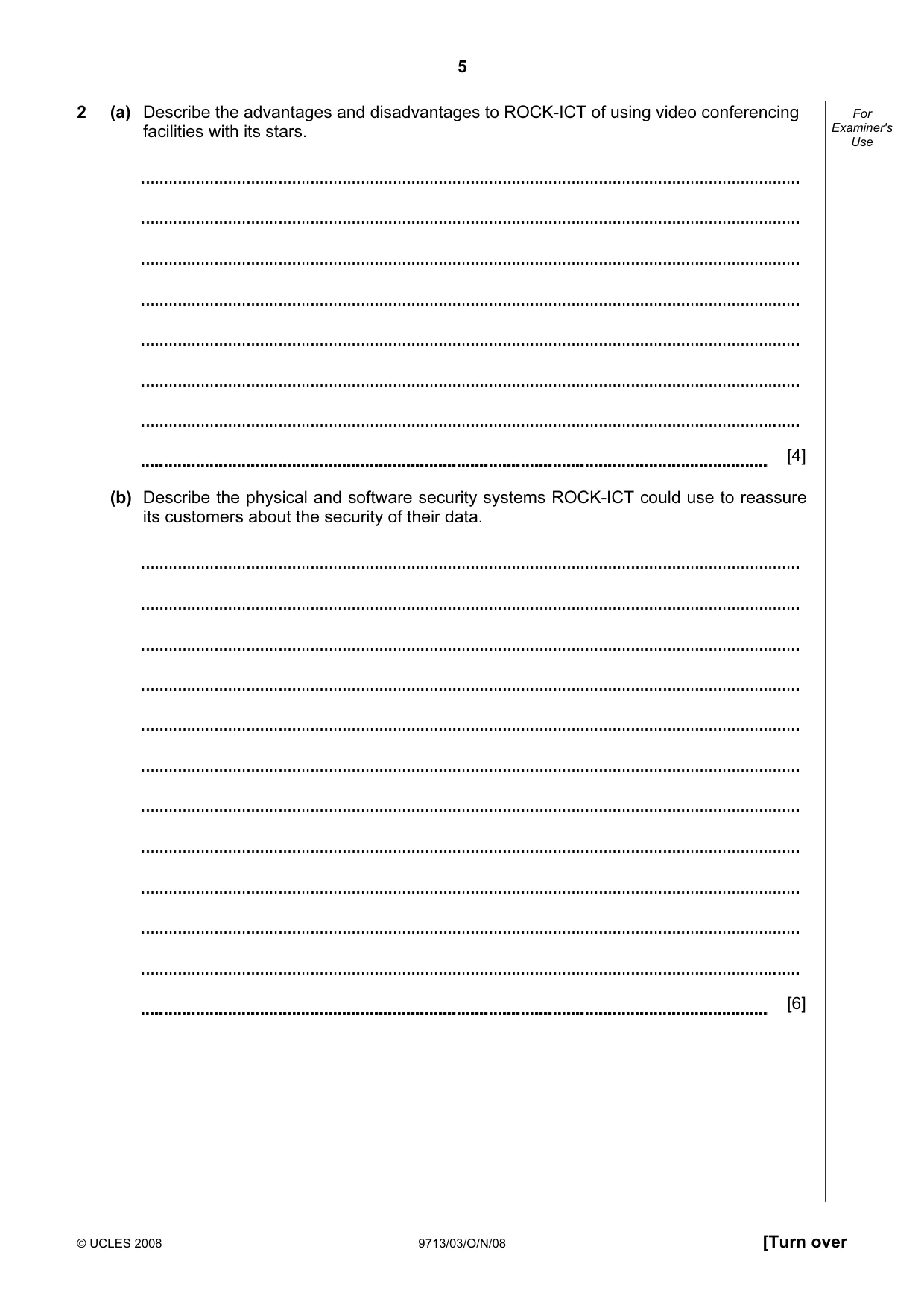
5 © UCLES 2008 9713/03/O/N/08 [Turn over For Examiner's Use 2 (a) Describe the advantages and disadvantages to ROCK-ICT of using video conferencing facilities with its stars. [4] (b) Describe the physical and software security systems ROCK-ICT could use to reassure its customers about the security of their data. [6]
Question paper, page 6
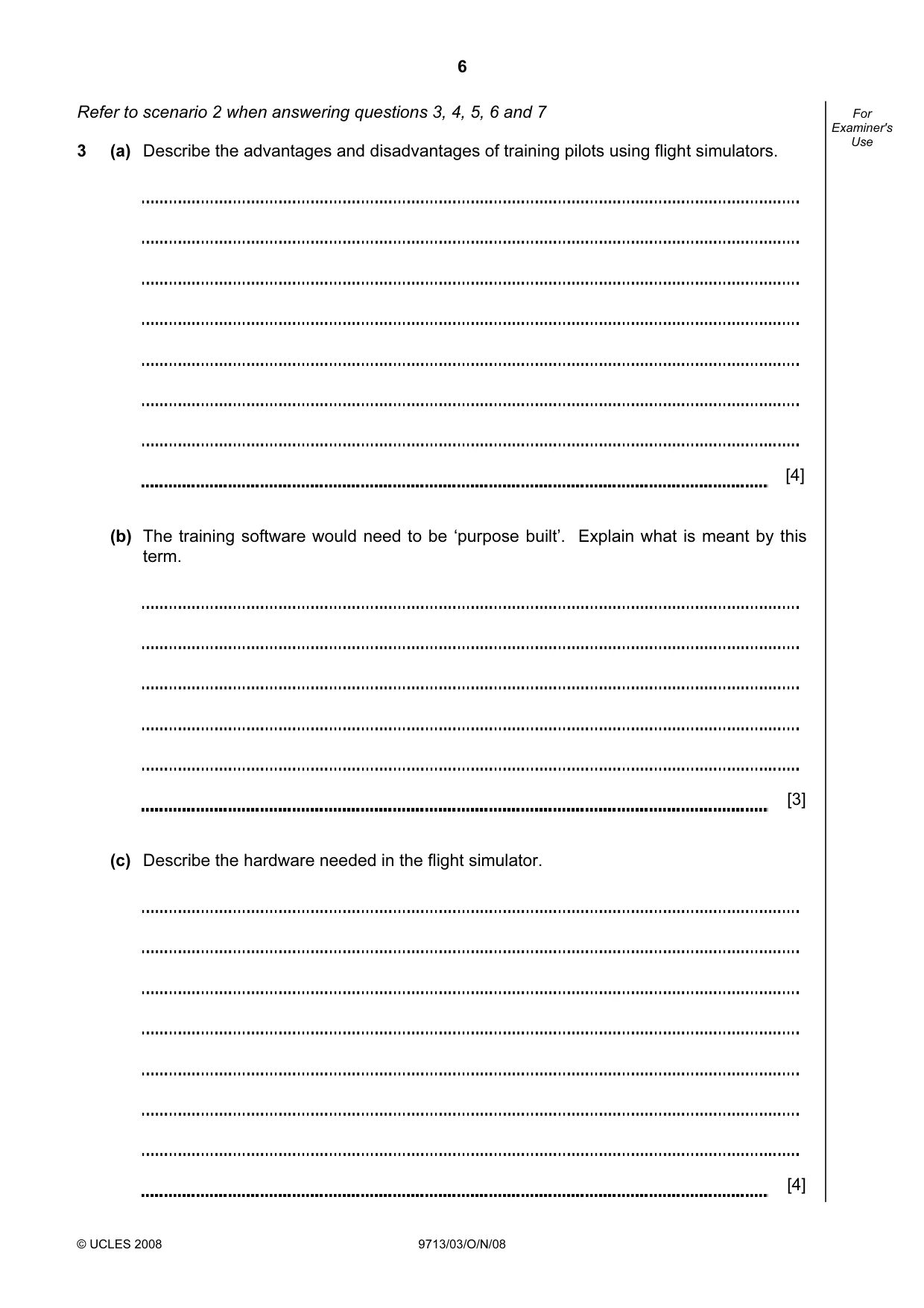
6 © UCLES 2008 9713/03/O/N/08 For Examiner's Use Refer to scenario 2 when answering questions 3, 4, 5, 6 and 7 3 (a) Describe the advantages and disadvantages of training pilots using flight simulators. [4] (b) The training software would need to be ‘purpose built’. Explain what is meant by this term. [3] (c) Describe the hardware needed in the flight simulator. [4]
Question paper, page 7
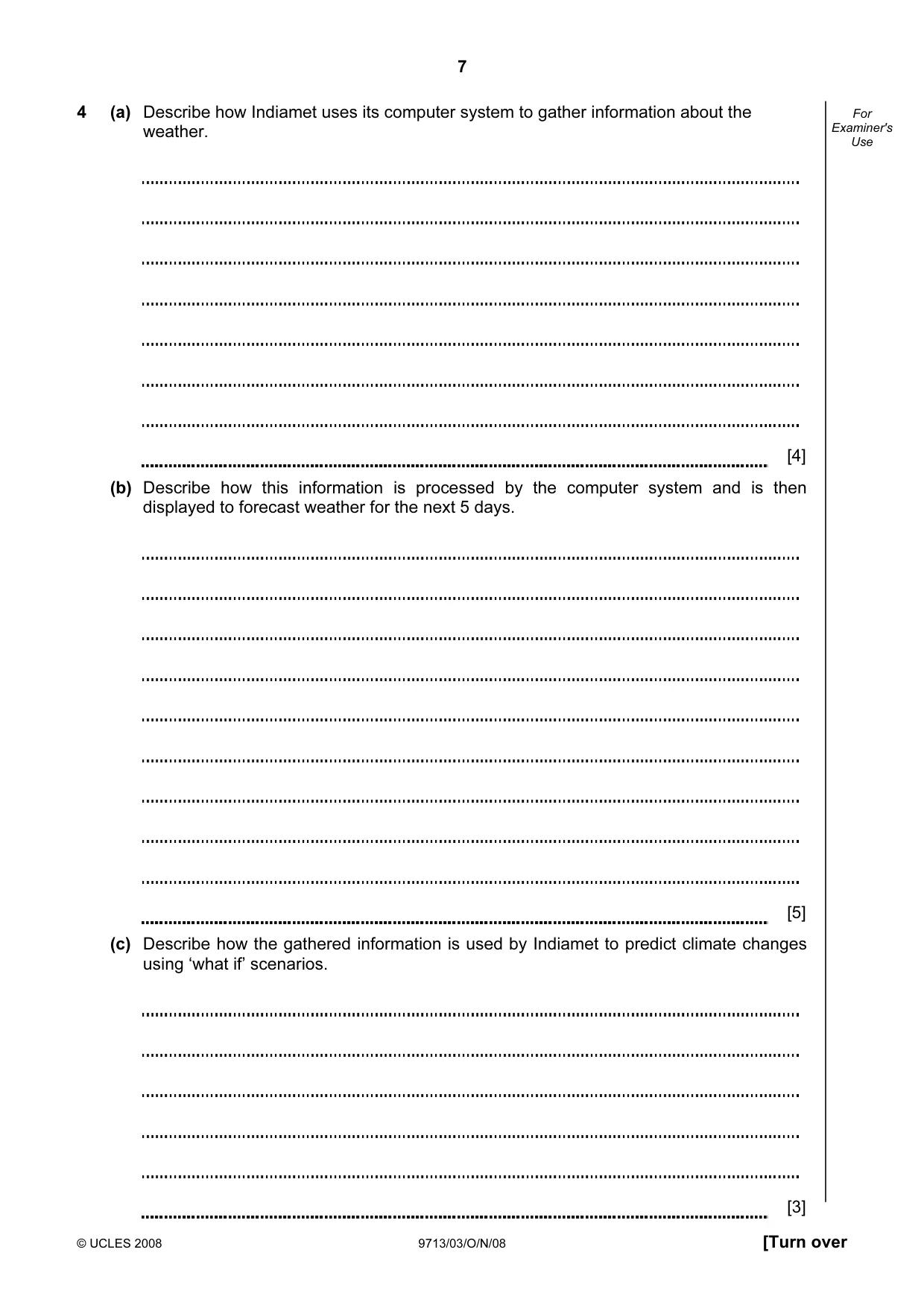
7 © UCLES 2008 9713/03/O/N/08 [Turn over For Examiner's Use 4 (a) Describe how Indiamet uses its computer system to gather information about the weather. [4] (b) Describe how this information is processed by the computer system and is then displayed to forecast weather for the next 5 days. [5] (c) Describe how the gathered information is used by Indiamet to predict climate changes using ‘what if’ scenarios. [3]
Question paper, page 8
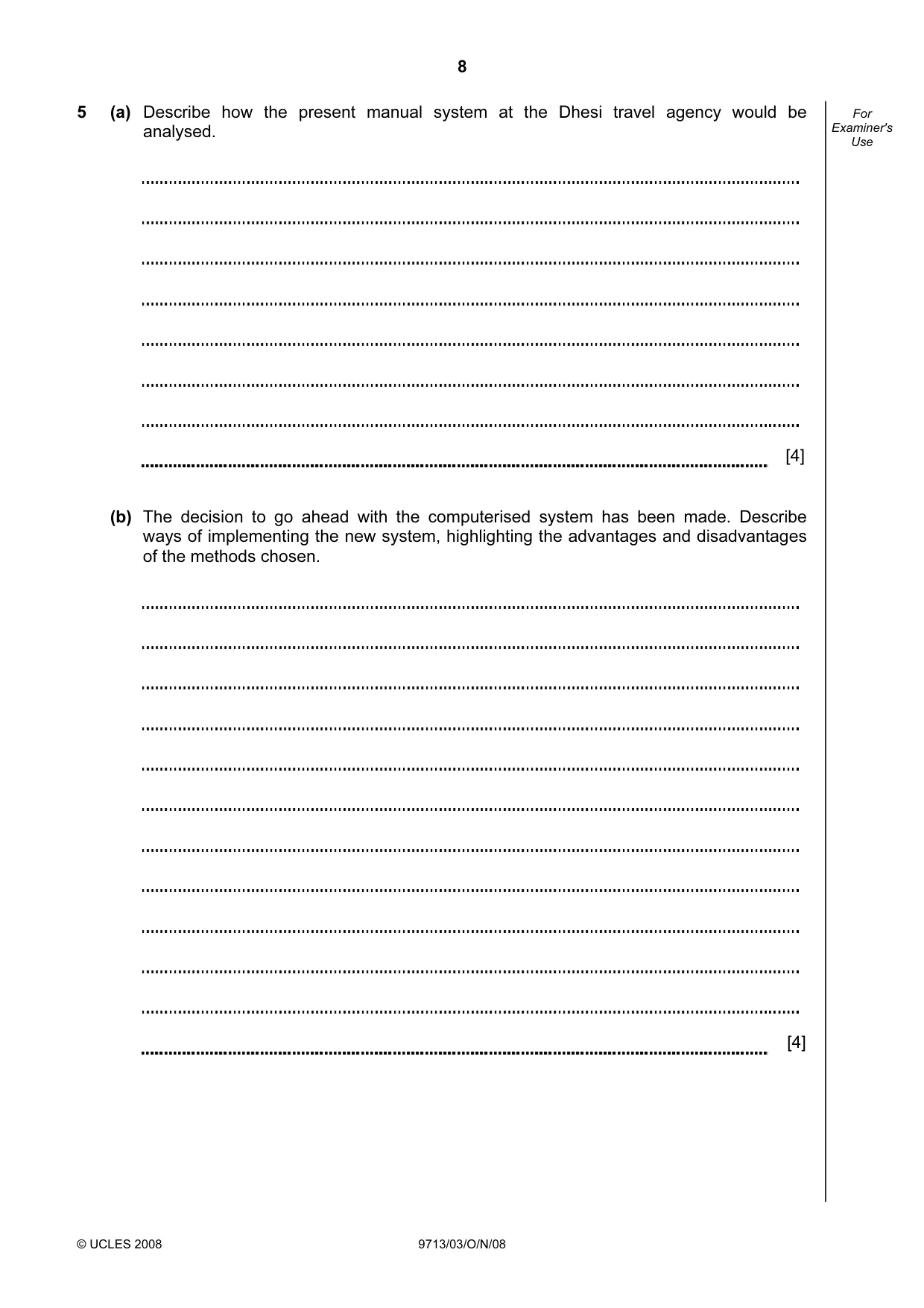
8 © UCLES 2008 9713/03/O/N/08 For Examiner's Use 5 (a) Describe how the present manual system at the Dhesi travel agency would be analysed. [4] (b) The decision to go ahead with the computerised system has been made. Describe ways of implementing the new system, highlighting the advantages and disadvantages of the methods chosen. [4]
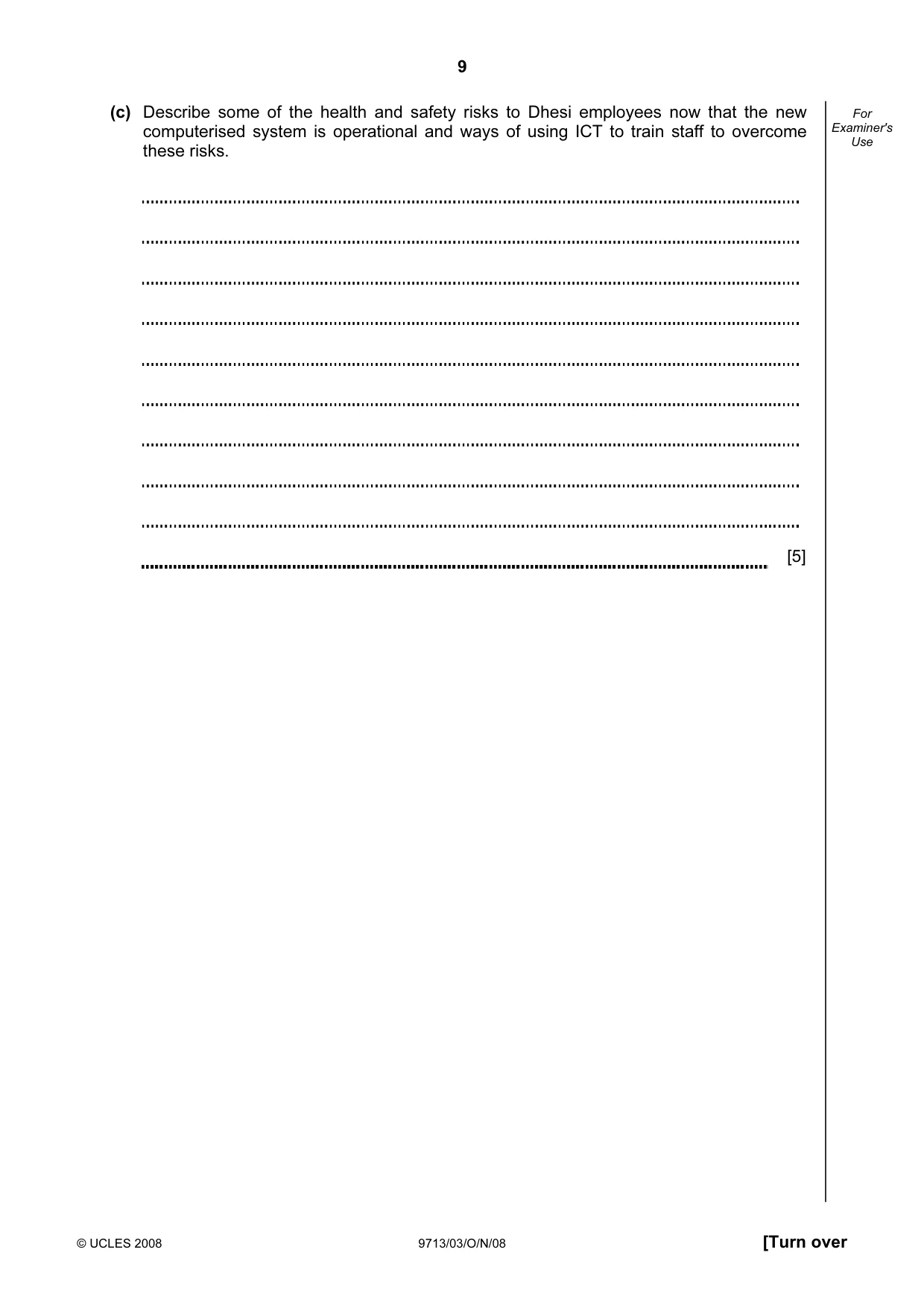
Question paper, page 9
9 © UCLES 2008 9713/03/O/N/08 [Turn over For Examiner's Use (c) Describe some of the health and safety risks to Dhesi employees now that the new computerised system is operational and ways of using ICT to train staff to overcome these risks. [5]
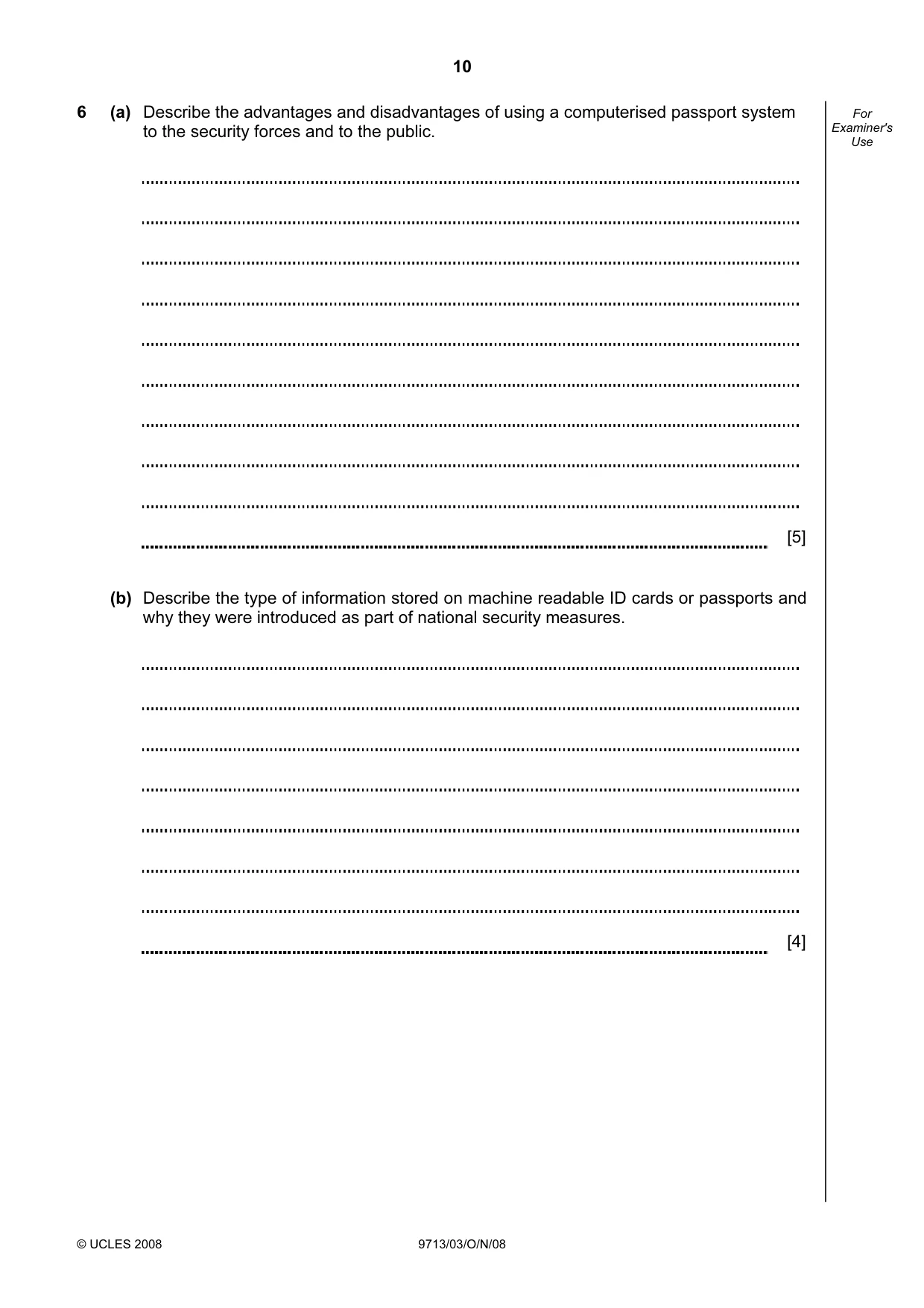
Question paper, page 10
10 © UCLES 2008 9713/03/O/N/08 For Examiner's Use 6 (a) Describe the advantages and disadvantages of using a computerised passport system to the security forces and to the public. [5] (b) Describe the type of information stored on machine readable ID cards or passports and why they were introduced as part of national security measures. [4]
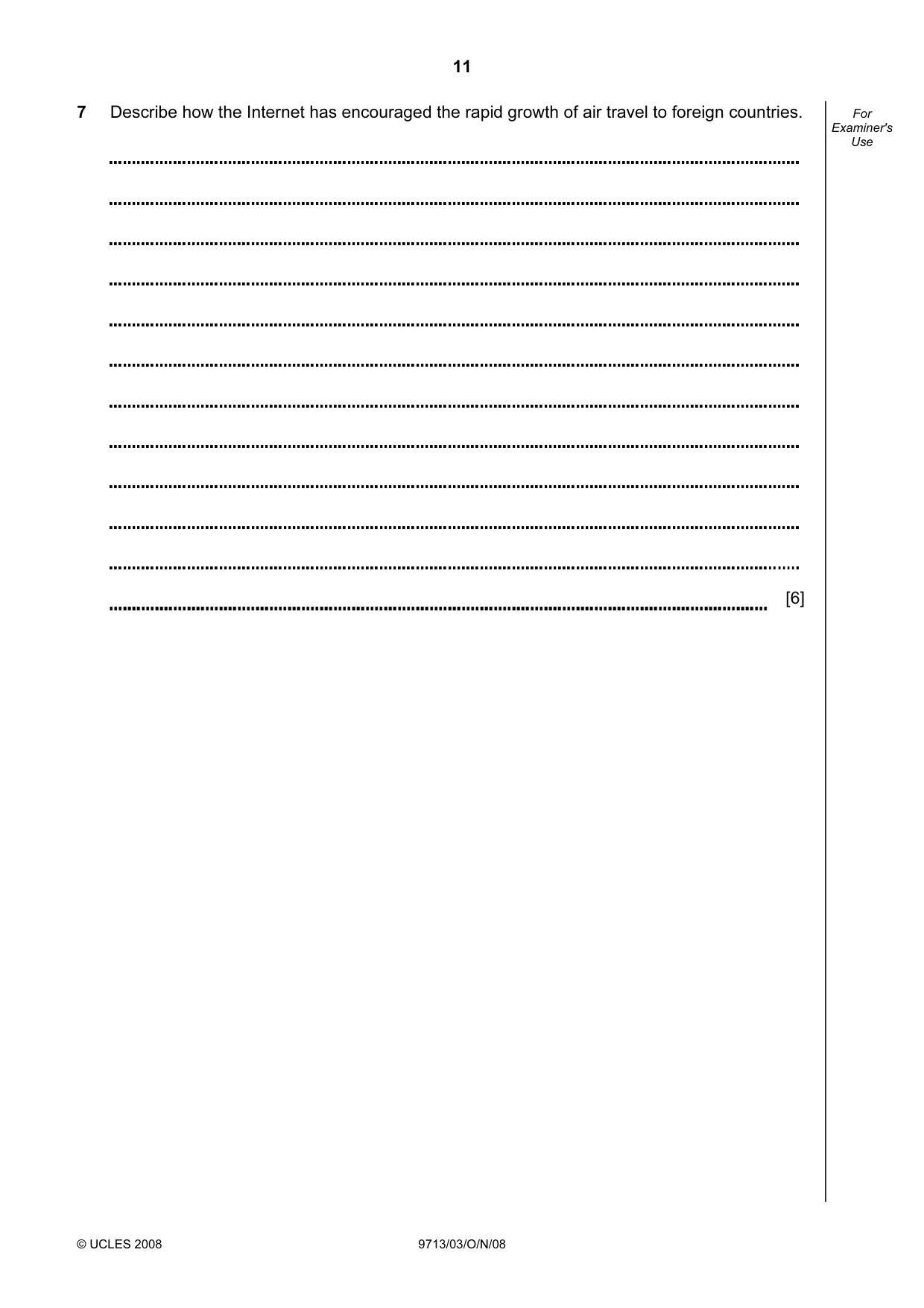
Question paper, page 11
11 © UCLES 2008 9713/03/O/N/08 For Examiner's Use 7 Describe how the Internet has encouraged the rapid growth of air travel to foreign countries. [6]
Question paper, page 12
12 Permission to reproduce items where third-party owned material protected by copyright is included has been sought and cleared where possible. Every reasonable effort has been made by the publisher (UCLES) to trace copyright holders, but if any items requiring clearance have unwittingly been included, the publisher will be pleased to make amends at the earliest possible opportunity. University of Cambridge International Examinations is part of the Cambridge Assessment Group. Cambridge Assessment is the brand name of University of Cambridge Local Examinations Syndicate (UCLES), which is itself a department of the University of Cambridge. 9713/03/O/N/08 BLANK PAGE
Mark scheme, page 1
UNIVERSITY OF CAMBRIDGE INTERNATIONAL EXAMINATIONS GCE Advanced Subsidiary Level and GCE Advanced Level MARK SCHEME for the October/November 2008 question paper 9713 APPLIED ICT 9713/03 Paper 3 (Written B), maximum raw mark 80 This mark scheme is published as an aid to teachers and candidates, to indicate the requirements of the examination. It shows the basis on which Examiners were instructed to award marks. It does not indicate the details of the discussions that took place at an Examiners’ meeting before marking began. All Examiners are instructed that alternative correct answers and unexpected approaches in candidates’ scripts must be given marks that fairly reflect the relevant knowledge and skills demonstrated. Mark schemes must be read in conjunction with the question papers and the report on the examination. • CIE will not enter into discussions or correspondence in connection with these mark schemes. CIE is publishing the mark schemes for the October/November 2008 question papers for most IGCSE, GCE Advanced Level and Advanced Subsidiary Level syllabuses and some Ordinary Level syllabuses.
Mark scheme, page 2
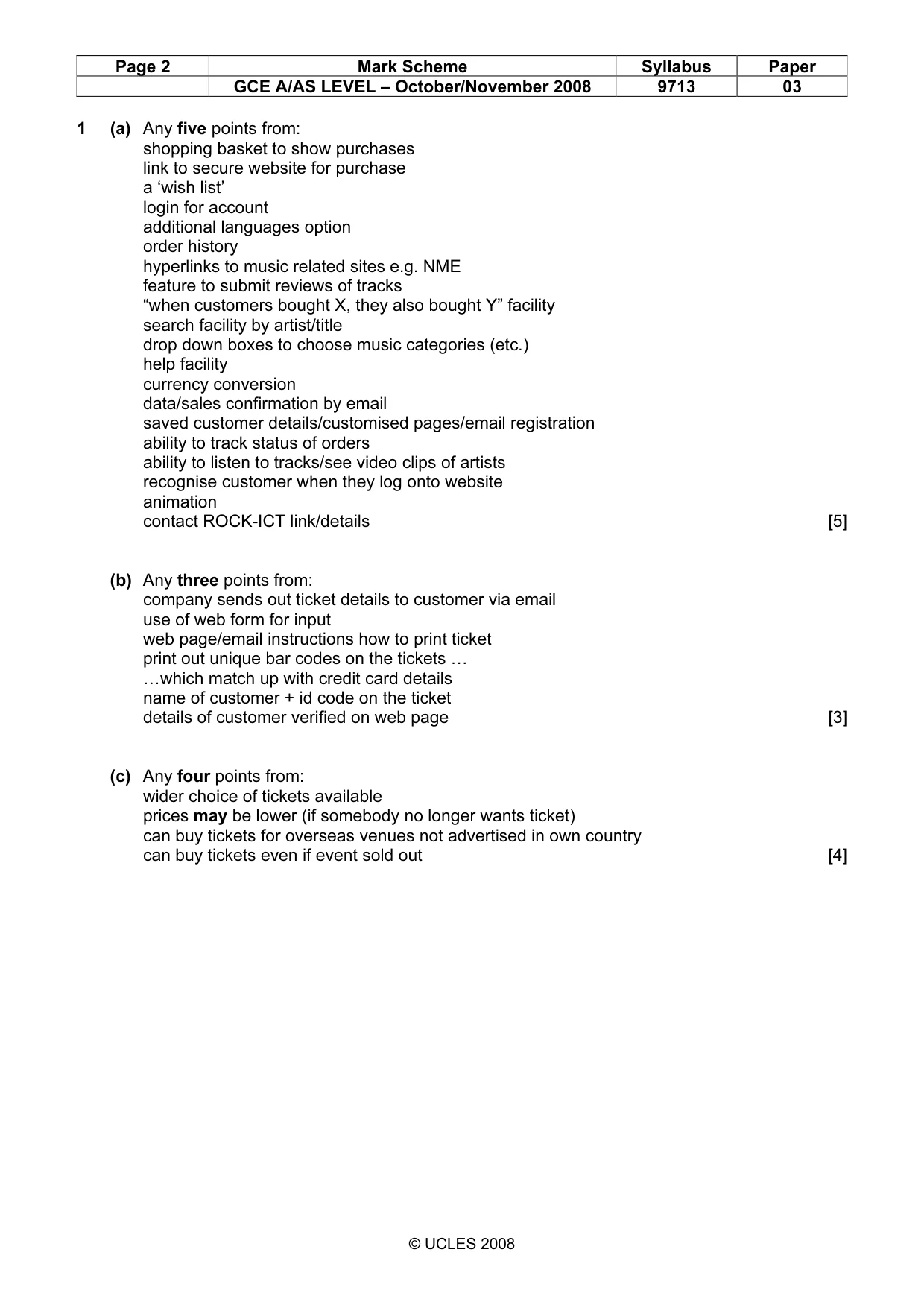
Page 2 Mark Scheme Syllabus Paper GCE A/AS LEVEL – October/November 2008 9713 03 © UCLES 2008 1 (a) Any five points from: shopping basket to show purchases link to secure website for purchase a ‘wish list’ login for account additional languages option order history hyperlinks to music related sites e.g. NME feature to submit reviews of tracks “when customers bought X, they also bought Y” facility search facility by artist/title drop down boxes to choose music categories (etc.) help facility currency conversion data/sales confirmation by email saved customer details/customised pages/email registration ability to track status of orders ability to listen to tracks/see video clips of artists recognise customer when they log onto website animation contact ROCK-ICT link/details [5] (b) Any three points from: company sends out ticket details to customer via email use of web form for input web page/email instructions how to print ticket print out unique bar codes on the tickets … …which match up with credit card details name of customer + id code on the ticket details of customer verified on web page [3] (c) Any four points from: wider choice of tickets available prices may be lower (if somebody no longer wants ticket) can buy tickets for overseas venues not advertised in own country can buy tickets even if event sold out [4]
Mark scheme, page 3
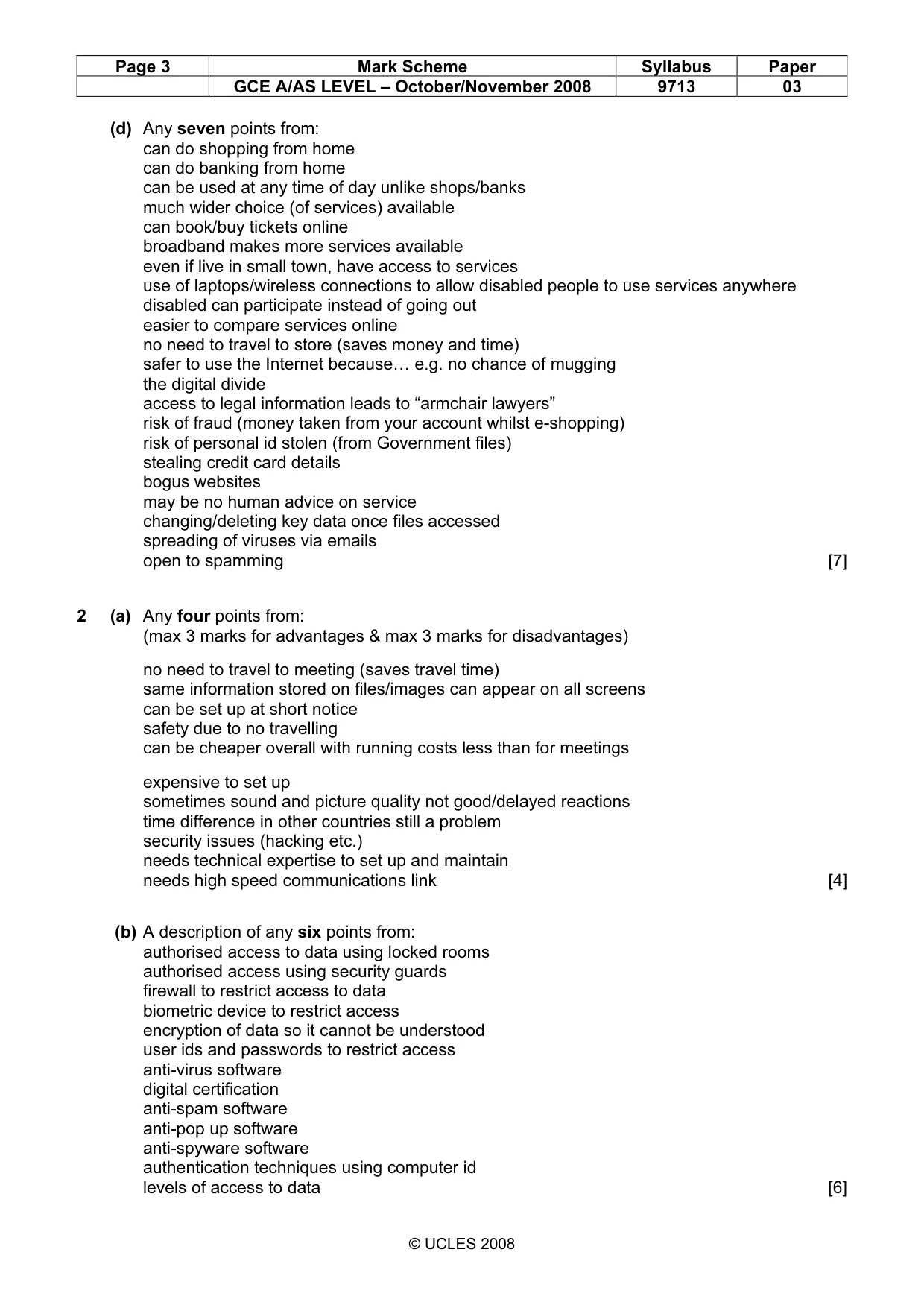
Page 3 Mark Scheme Syllabus Paper GCE A/AS LEVEL – October/November 2008 9713 03 © UCLES 2008 (d) Any seven points from: can do shopping from home can do banking from home can be used at any time of day unlike shops/banks much wider choice (of services) available can book/buy tickets online broadband makes more services available even if live in small town, have access to services use of laptops/wireless connections to allow disabled people to use services anywhere disabled can participate instead of going out easier to compare services online no need to travel to store (saves money and time) safer to use the Internet because… e.g. no chance of mugging the digital divide access to legal information leads to “armchair lawyers” risk of fraud (money taken from your account whilst e-shopping) risk of personal id stolen (from Government files) stealing credit card details bogus websites may be no human advice on service changing/deleting key data once files accessed spreading of viruses via emails open to spamming [7] 2 (a) Any four points from: (max 3 marks for advantages & max 3 marks for disadvantages) no need to travel to meeting (saves travel time) same information stored on files/images can appear on all screens can be set up at short notice safety due to no travelling can be cheaper overall with running costs less than for meetings expensive to set up sometimes sound and picture quality not good/delayed reactions time difference in other countries still a problem security issues (hacking etc.) needs technical expertise to set up and maintain needs high speed communications link [4] (b) A description of any six points from: authorised access to data using locked rooms authorised access using security guards firewall to restrict access to data biometric device to restrict access encryption of data so it cannot be understood user ids and passwords to restrict access anti-virus software digital certification anti-spam software anti-pop up software anti-spyware software authentication techniques using computer id levels of access to data [6]
Mark scheme, page 4
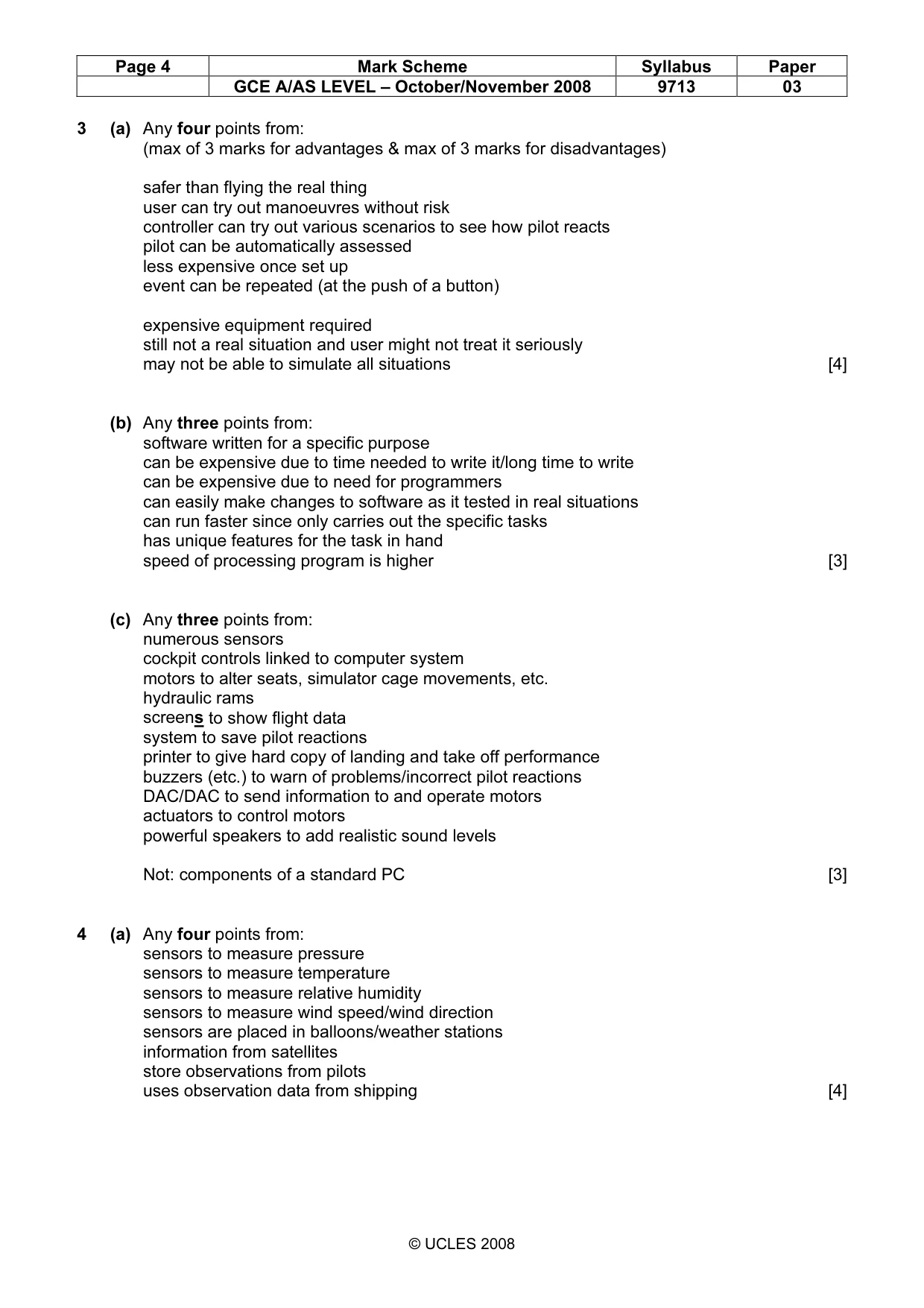
Page 4 Mark Scheme Syllabus Paper GCE A/AS LEVEL – October/November 2008 9713 03 © UCLES 2008 3 (a) Any four points from: (max of 3 marks for advantages & max of 3 marks for disadvantages) safer than flying the real thing user can try out manoeuvres without risk controller can try out various scenarios to see how pilot reacts pilot can be automatically assessed less expensive once set up event can be repeated (at the push of a button) expensive equipment required still not a real situation and user might not treat it seriously may not be able to simulate all situations [4] (b) Any three points from: software written for a specific purpose can be expensive due to time needed to write it/long time to write can be expensive due to need for programmers can easily make changes to software as it tested in real situations can run faster since only carries out the specific tasks has unique features for the task in hand speed of processing program is higher [3] (c) Any three points from: numerous sensors cockpit controls linked to computer system motors to alter seats, simulator cage movements, etc. hydraulic rams screens to show flight data system to save pilot reactions printer to give hard copy of landing and take off performance buzzers (etc.) to warn of problems/incorrect pilot reactions DAC/DAC to send information to and operate motors actuators to control motors powerful speakers to add realistic sound levels Not: components of a standard PC [3] 4 (a) Any four points from: sensors to measure pressure sensors to measure temperature sensors to measure relative humidity sensors to measure wind speed/wind direction sensors are placed in balloons/weather stations information from satellites store observations from pilots uses observation data from shipping [4]
Mark scheme, page 5
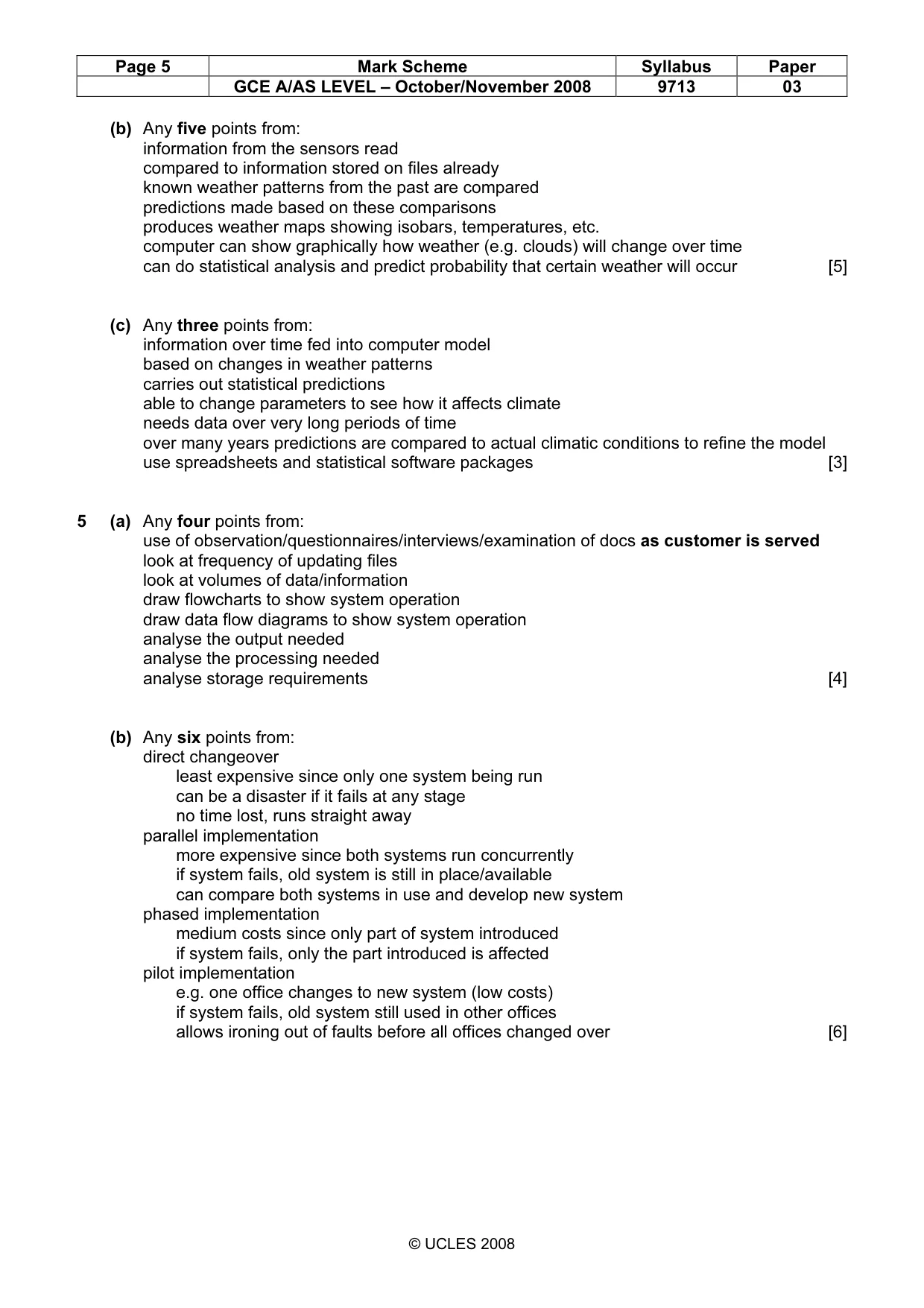
Page 5 Mark Scheme Syllabus Paper GCE A/AS LEVEL – October/November 2008 9713 03 © UCLES 2008 (b) Any five points from: information from the sensors read compared to information stored on files already known weather patterns from the past are compared predictions made based on these comparisons produces weather maps showing isobars, temperatures, etc. computer can show graphically how weather (e.g. clouds) will change over time can do statistical analysis and predict probability that certain weather will occur [5] (c) Any three points from: information over time fed into computer model based on changes in weather patterns carries out statistical predictions able to change parameters to see how it affects climate needs data over very long periods of time over many years predictions are compared to actual climatic conditions to refine the model use spreadsheets and statistical software packages [3] 5 (a) Any four points from: use of observation/questionnaires/interviews/examination of docs as customer is served look at frequency of updating files look at volumes of data/information draw flowcharts to show system operation draw data flow diagrams to show system operation analyse the output needed analyse the processing needed analyse storage requirements [4] (b) Any six points from: direct changeover least expensive since only one system being run can be a disaster if it fails at any stage no time lost, runs straight away parallel implementation more expensive since both systems run concurrently if system fails, old system is still in place/available can compare both systems in use and develop new system phased implementation medium costs since only part of system introduced if system fails, only the part introduced is affected pilot implementation e.g. one office changes to new system (low costs) if system fails, old system still used in other offices allows ironing out of faults before all offices changed over [6]
Mark scheme, page 6
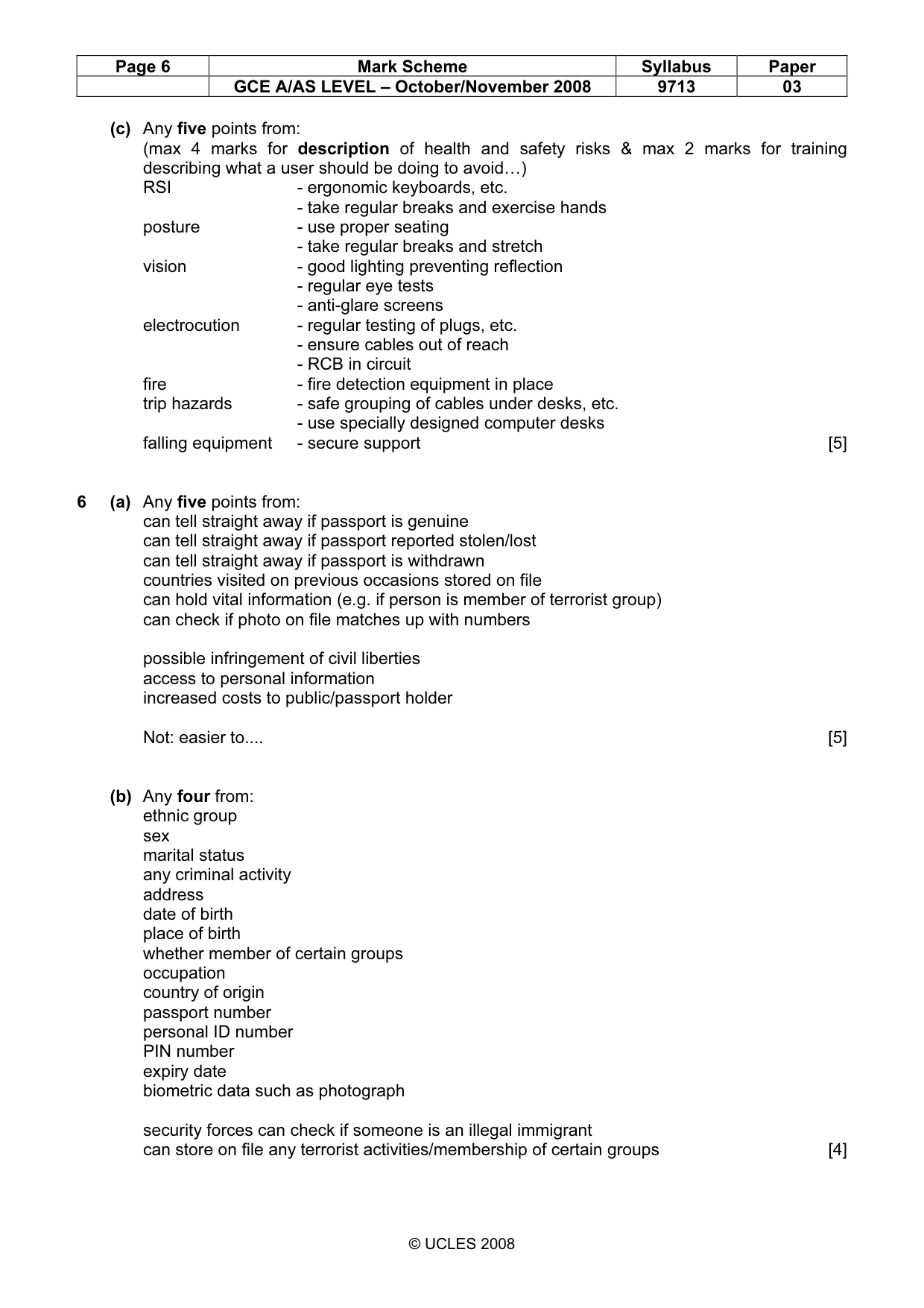
Page 6 Mark Scheme Syllabus Paper GCE A/AS LEVEL – October/November 2008 9713 03 © UCLES 2008 (c) Any five points from: (max 4 marks for description of health and safety risks & max 2 marks for training describing what a user should be doing to avoid…) RSI - ergonomic keyboards, etc. - take regular breaks and exercise hands posture - use proper seating - take regular breaks and stretch vision - good lighting preventing reflection - regular eye tests - anti-glare screens electrocution - regular testing of plugs, etc. - ensure cables out of reach - RCB in circuit fire - fire detection equipment in place trip hazards - safe grouping of cables under desks, etc. - use specially designed computer desks falling equipment - secure support [5] 6 (a) Any five points from: can tell straight away if passport is genuine can tell straight away if passport reported stolen/lost can tell straight away if passport is withdrawn countries visited on previous occasions stored on file can hold vital information (e.g. if person is member of terrorist group) can check if photo on file matches up with numbers possible infringement of civil liberties access to personal information increased costs to public/passport holder Not: easier to… [5] (b) Any four from: ethnic group sex marital status any criminal activity address date of birth place of birth whether member of certain groups occupation country of origin passport number personal ID number PIN number expiry date biometric data such as photograph security forces can check if someone is an illegal immigrant can store on file any terrorist activities/membership of certain groups [4]
Mark scheme, page 7
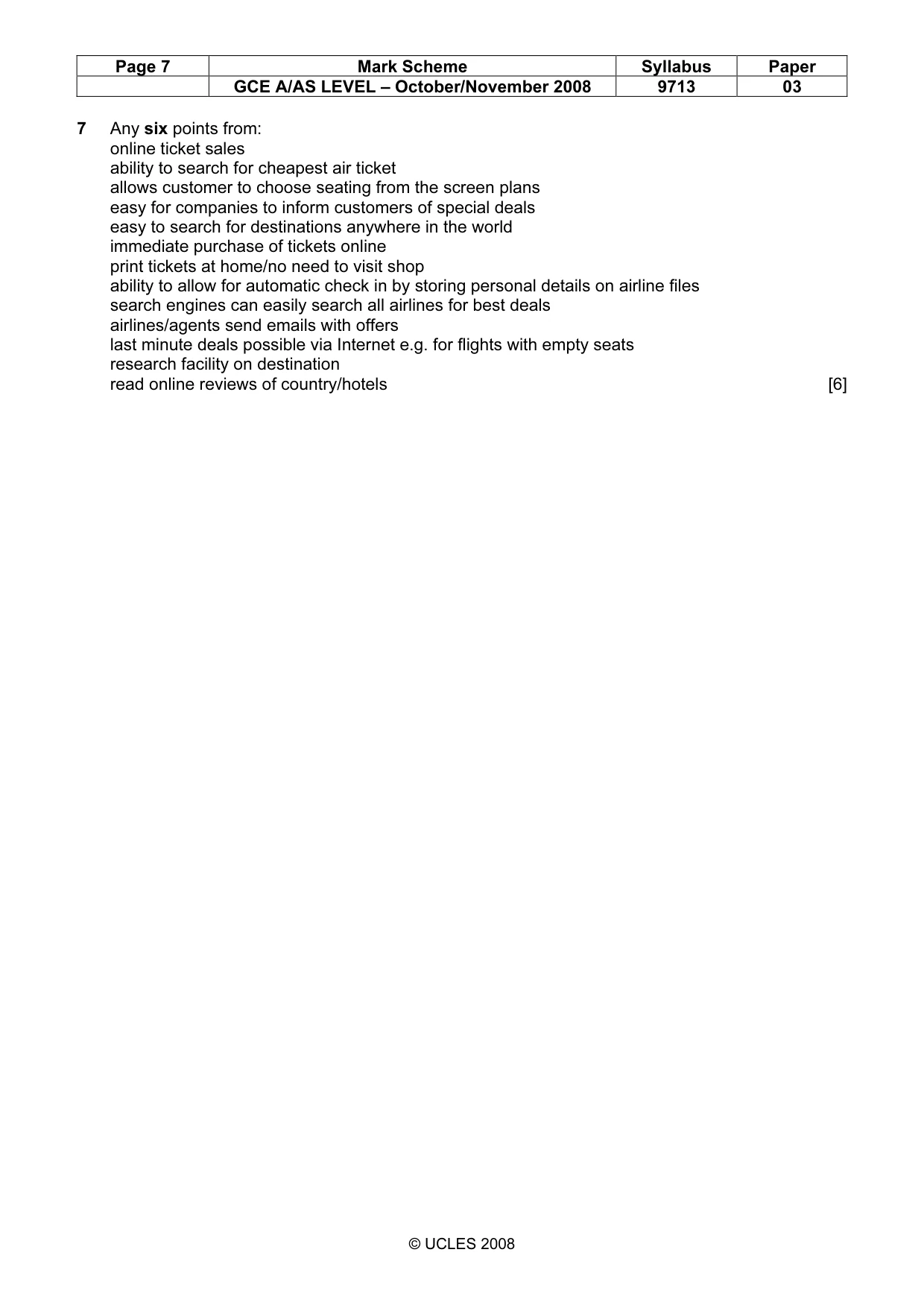
Page 7 Mark Scheme Syllabus Paper GCE A/AS LEVEL – October/November 2008 9713 03 © UCLES 2008 7 Any six points from: online ticket sales ability to search for cheapest air ticket allows customer to choose seating from the screen plans easy for companies to inform customers of special deals easy to search for destinations anywhere in the world immediate purchase of tickets online print tickets at home/no need to visit shop ability to allow for automatic check in by storing personal details on airline files search engines can easily search all airlines for best deals airlines/agents send emails with offers last minute deals possible via Internet e.g. for flights with empty seats research facility on destination read online reviews of country/hotels [6]
What you needed in this session
Cambridge’s own grade thresholds for 2008 Oct/Nov, Paper 3 · Variant 1. A higher threshold means an easier paper — the bar moves with how the cohort did.