Cambridge A Level Applied Information and Communication Technology 9713 — 2008 Oct/Nov Paper 1 · Variant 1
9713/11/O/N/08 · 80 marks · ≈90 min
The question paper and its mark scheme, free to read here and free to download. This is Cambridge’s own paper, exactly as it was sat.
Question paper12 pages

Mark scheme6 pages
Answers below. Sit the paper first if you are practising.
Paper as text
Question paper, page 1
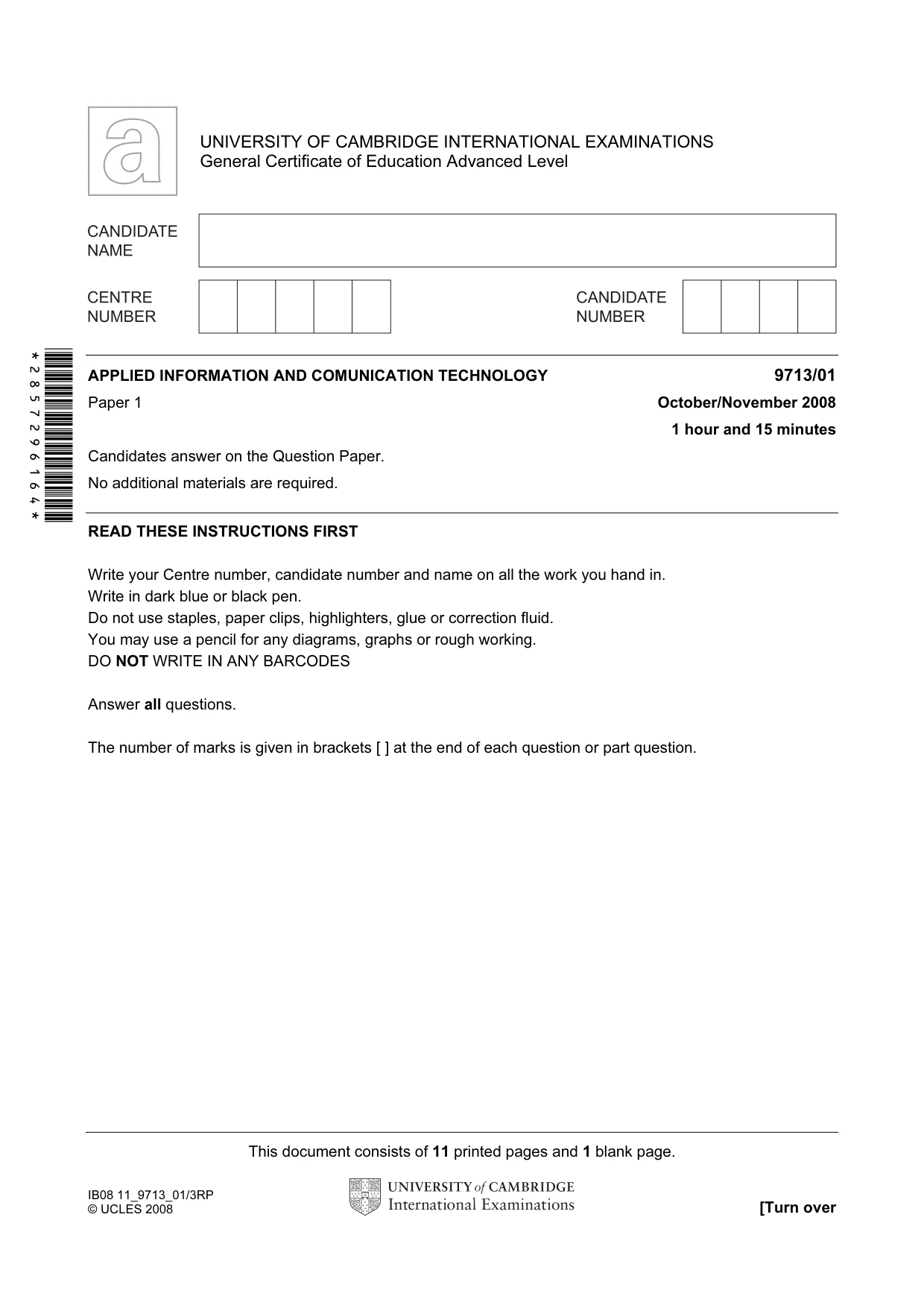
This document consists of 11 printed pages and 1 blank page. IB08 11_9713_01/3RP © UCLES 2008 [Turn over *2857296164* UNIVERSITY OF CAMBRIDGE INTERNATIONAL EXAMINATIONS General Certificate of Education Advanced Level APPLIED INFORMATION AND COMUNICATION TECHNOLOGY 9713/01 Paper 1 October/November 2008 1 hour and 15 minutes Candidates answer on the Question Paper. No additional materials are required. READ THESE INSTRUCTIONS FIRST Write your Centre number, candidate number and name on all the work you hand in. Write in dark blue or black pen. Do not use staples, paper clips, highlighters, glue or correction fluid. You may use a pencil for any diagrams, graphs or rough working. DO NOT WRITE IN ANY BARCODES Answer all questions. The number of marks is given in brackets [ ] at the end of each question or part question.
Question paper, page 2
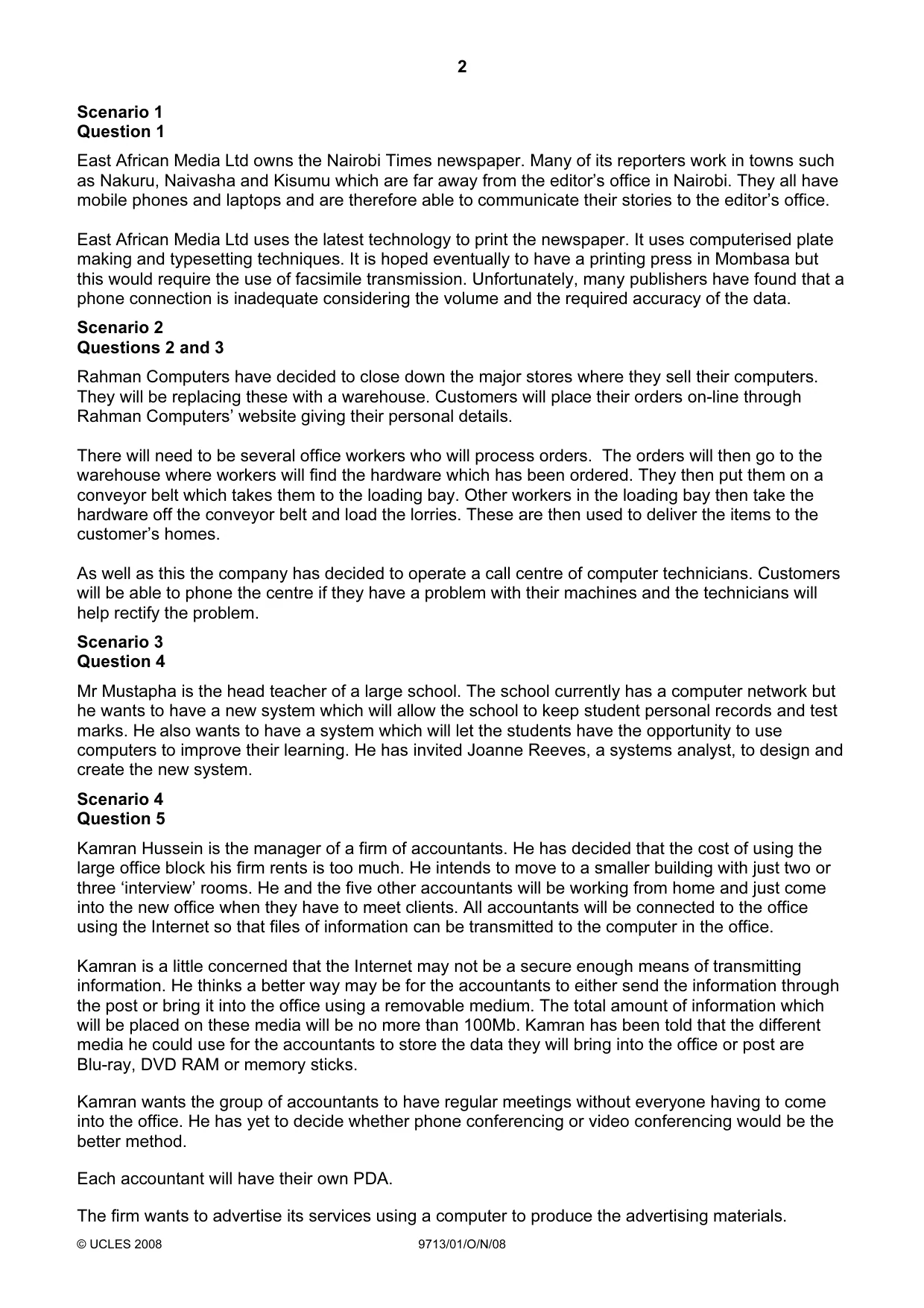
2 © UCLES 2008 9713/01/O/N/08 Scenario 1 Question 1 East African Media Ltd owns the Nairobi Times newspaper. Many of its reporters work in towns such as Nakuru, Naivasha and Kisumu which are far away from the editor’s office in Nairobi. They all have mobile phones and laptops and are therefore able to communicate their stories to the editor’s office. East African Media Ltd uses the latest technology to print the newspaper. It uses computerised plate making and typesetting techniques. It is hoped eventually to have a printing press in Mombasa but this would require the use of facsimile transmission. Unfortunately, many publishers have found that a phone connection is inadequate considering the volume and the required accuracy of the data. Scenario 2 Questions 2 and 3 Rahman Computers have decided to close down the major stores where they sell their computers. They will be replacing these with a warehouse. Customers will place their orders on-line through Rahman Computers’ website giving their personal details. There will need to be several office workers who will process orders. The orders will then go to the warehouse where workers will find the hardware which has been ordered. They then put them on a conveyor belt which takes them to the loading bay. Other workers in the loading bay then take the hardware off the conveyor belt and load the lorries. These are then used to deliver the items to the customer’s homes. As well as this the company has decided to operate a call centre of computer technicians. Customers will be able to phone the centre if they have a problem with their machines and the technicians will help rectify the problem. Scenario 3 Question 4 Mr Mustapha is the head teacher of a large school. The school currently has a computer network but he wants to have a new system which will allow the school to keep student personal records and test marks. He also wants to have a system which will let the students have the opportunity to use computers to improve their learning. He has invited Joanne Reeves, a systems analyst, to design and create the new system. Scenario 4 Question 5 Kamran Hussein is the manager of a firm of accountants. He has decided that the cost of using the large office block his firm rents is too much. He intends to move to a smaller building with just two or three ‘interview’ rooms. He and the five other accountants will be working from home and just come into the new office when they have to meet clients. All accountants will be connected to the office using the Internet so that files of information can be transmitted to the computer in the office. Kamran is a little concerned that the Internet may not be a secure enough means of transmitting information. He thinks a better way may be for the accountants to either send the information through the post or bring it into the office using a removable medium. The total amount of information which will be placed on these media will be no more than 100Mb. Kamran has been told that the different media he could use for the accountants to store the data they will bring into the office or post are Blu-ray, DVD RAM or memory sticks. Kamran wants the group of accountants to have regular meetings without everyone having to come into the office. He has yet to decide whether phone conferencing or video conferencing would be the better method. Each accountant will have their own PDA. The firm wants to advertise its services using a computer to produce the advertising materials.
Question paper, page 3
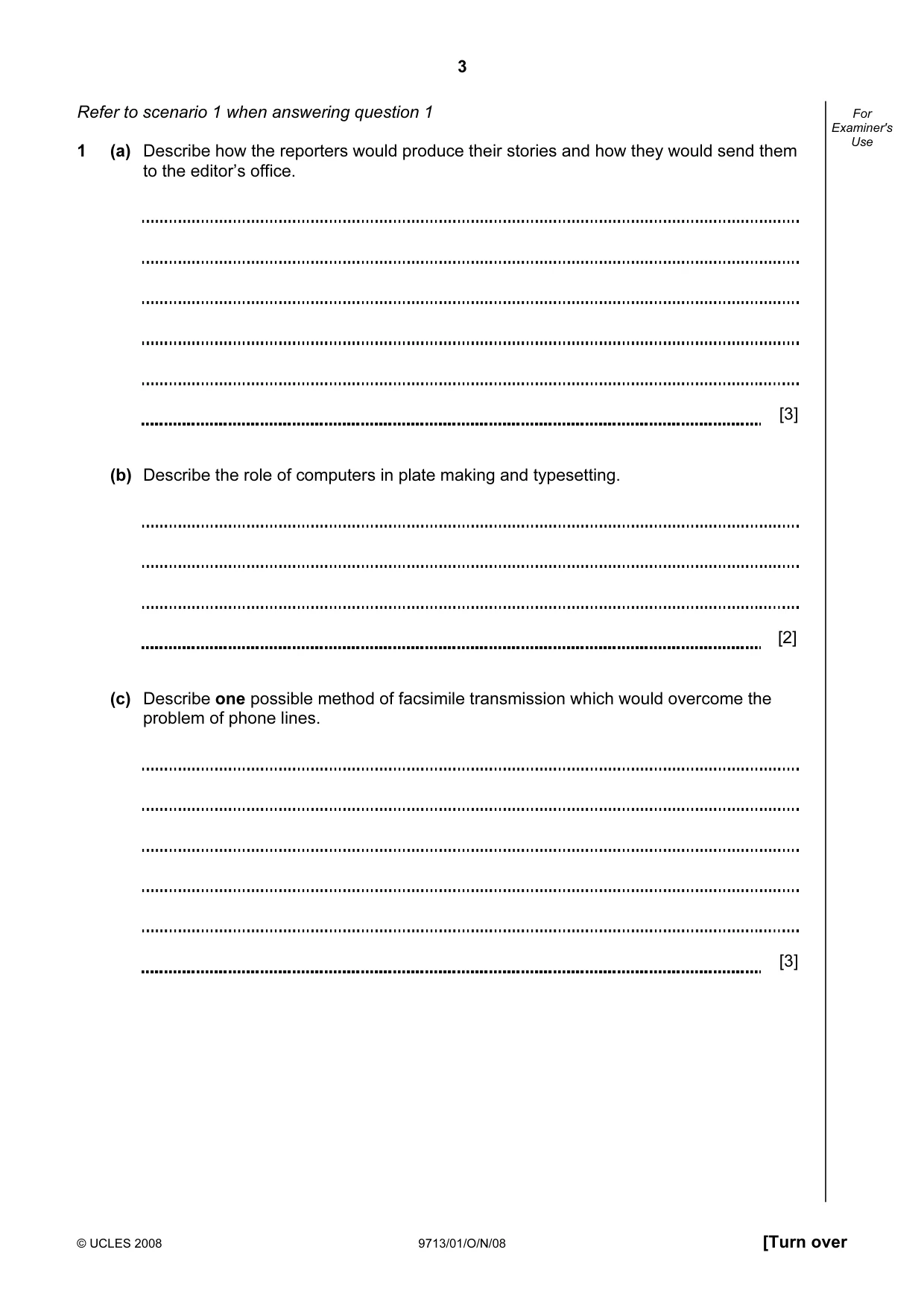
3 © UCLES 2008 9713/01/O/N/08 [Turn over For Examiner's Use Refer to scenario 1 when answering question 1 1 (a) Describe how the reporters would produce their stories and how they would send them to the editor’s office. [3] (b) Describe the role of computers in plate making and typesetting. [2] (c) Describe one possible method of facsimile transmission which would overcome the problem of phone lines. [3]
Question paper, page 4
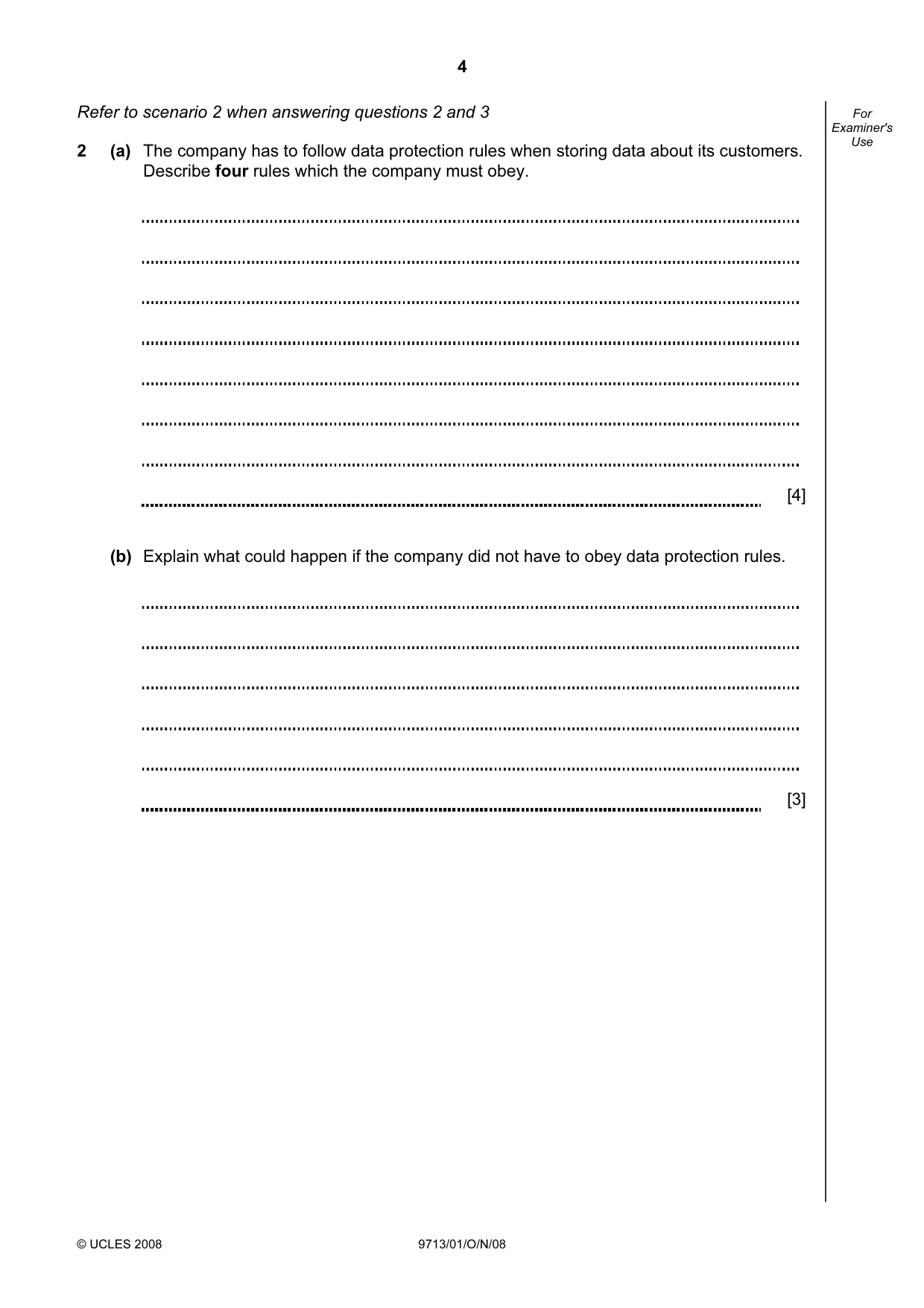
4 © UCLES 2008 9713/01/O/N/08 For Examiner's Use Refer to scenario 2 when answering questions 2 and 3 2 (a) The company has to follow data protection rules when storing data about its customers. Describe four rules which the company must obey. [4] (b) Explain what could happen if the company did not have to obey data protection rules. [3]
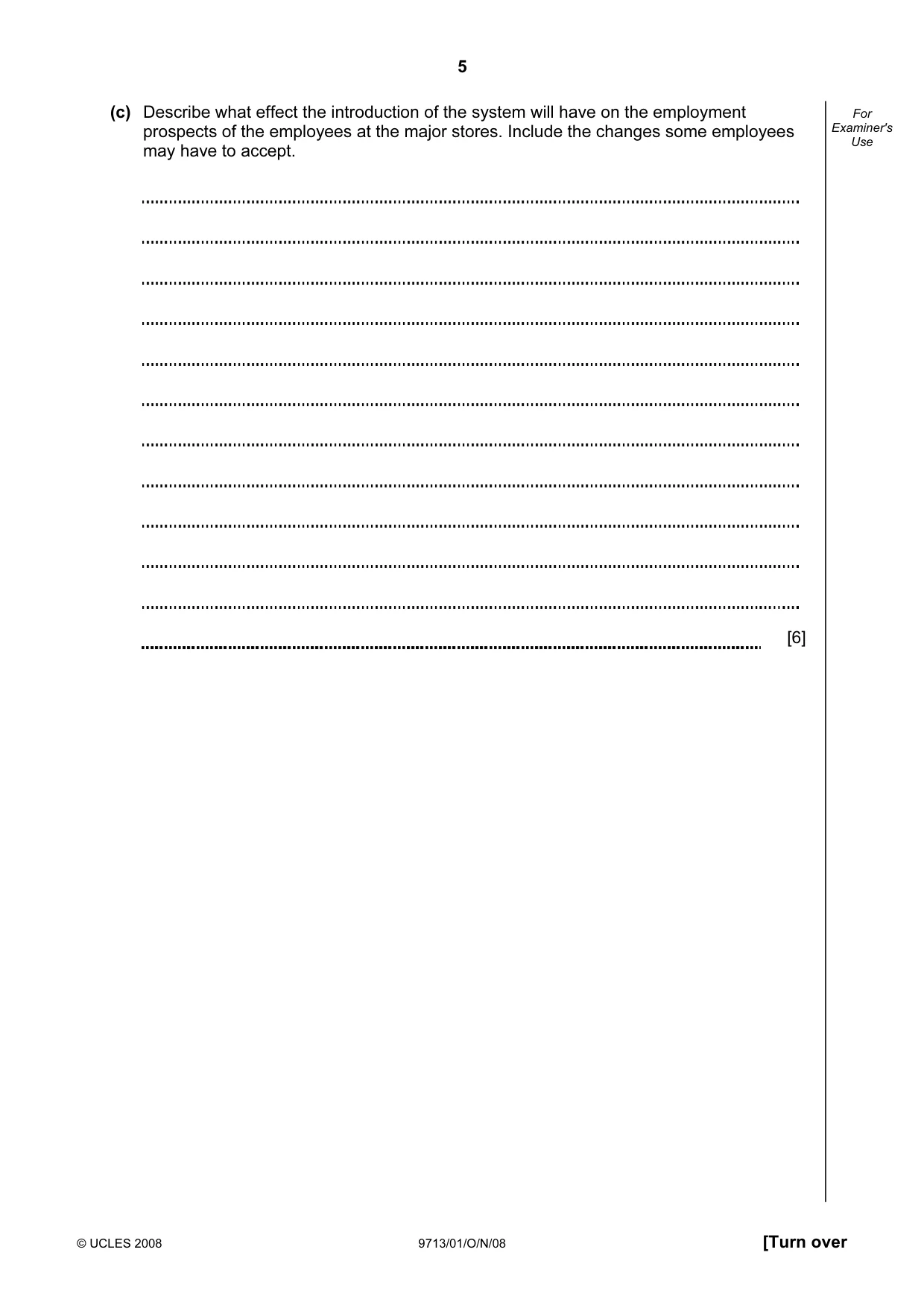
Question paper, page 5
5 © UCLES 2008 9713/01/O/N/08 [Turn over For Examiner's Use (c) Describe what effect the introduction of the system will have on the employment prospects of the employees at the major stores. Include the changes some employees may have to accept. [6]
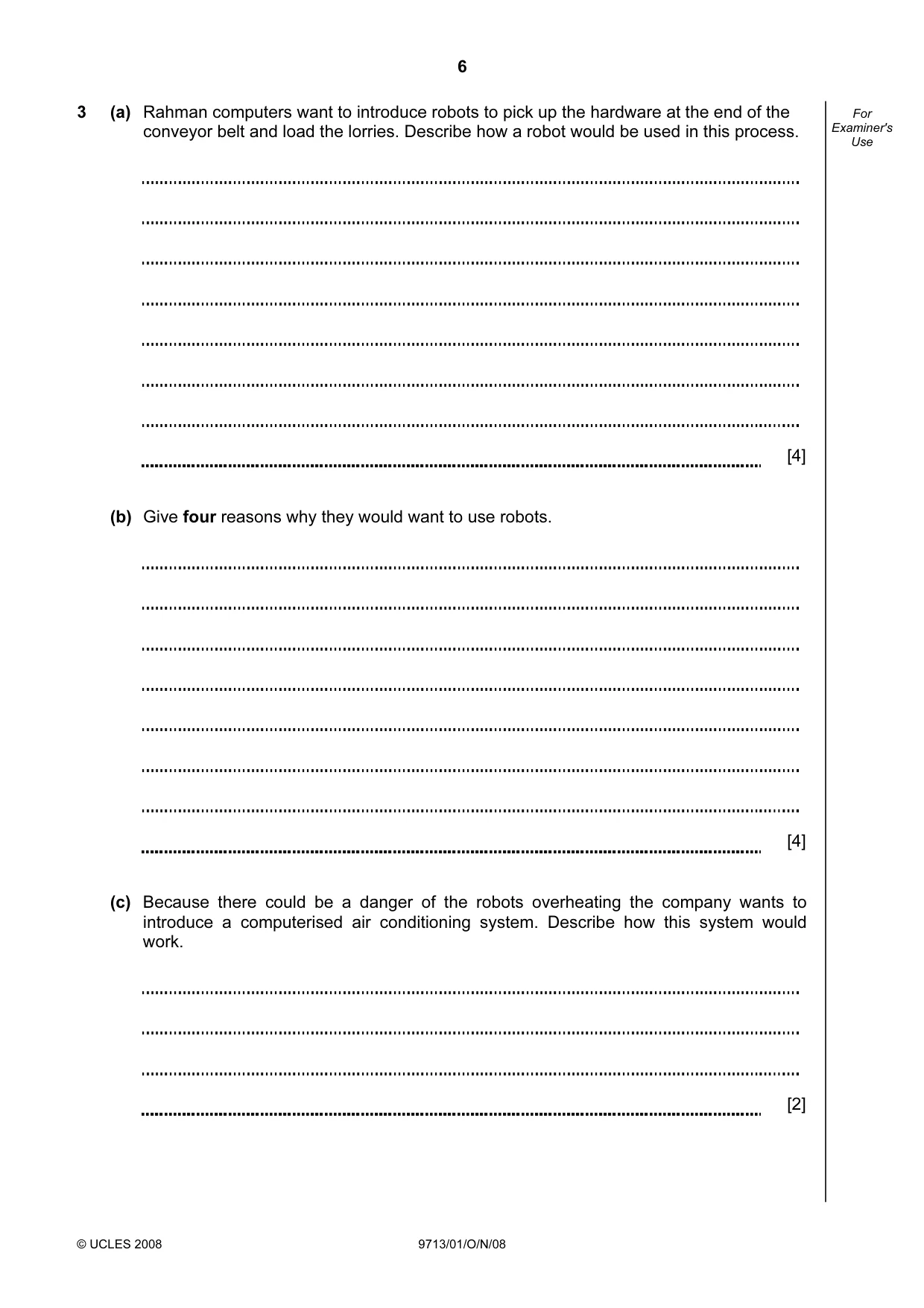
Question paper, page 6
6 © UCLES 2008 9713/01/O/N/08 For Examiner's Use 3 (a) Rahman computers want to introduce robots to pick up the hardware at the end of the conveyor belt and load the lorries. Describe how a robot would be used in this process. [4] (b) Give four reasons why they would want to use robots. [4] (c) Because there could be a danger of the robots overheating the company wants to introduce a computerised air conditioning system. Describe how this system would work. [2]
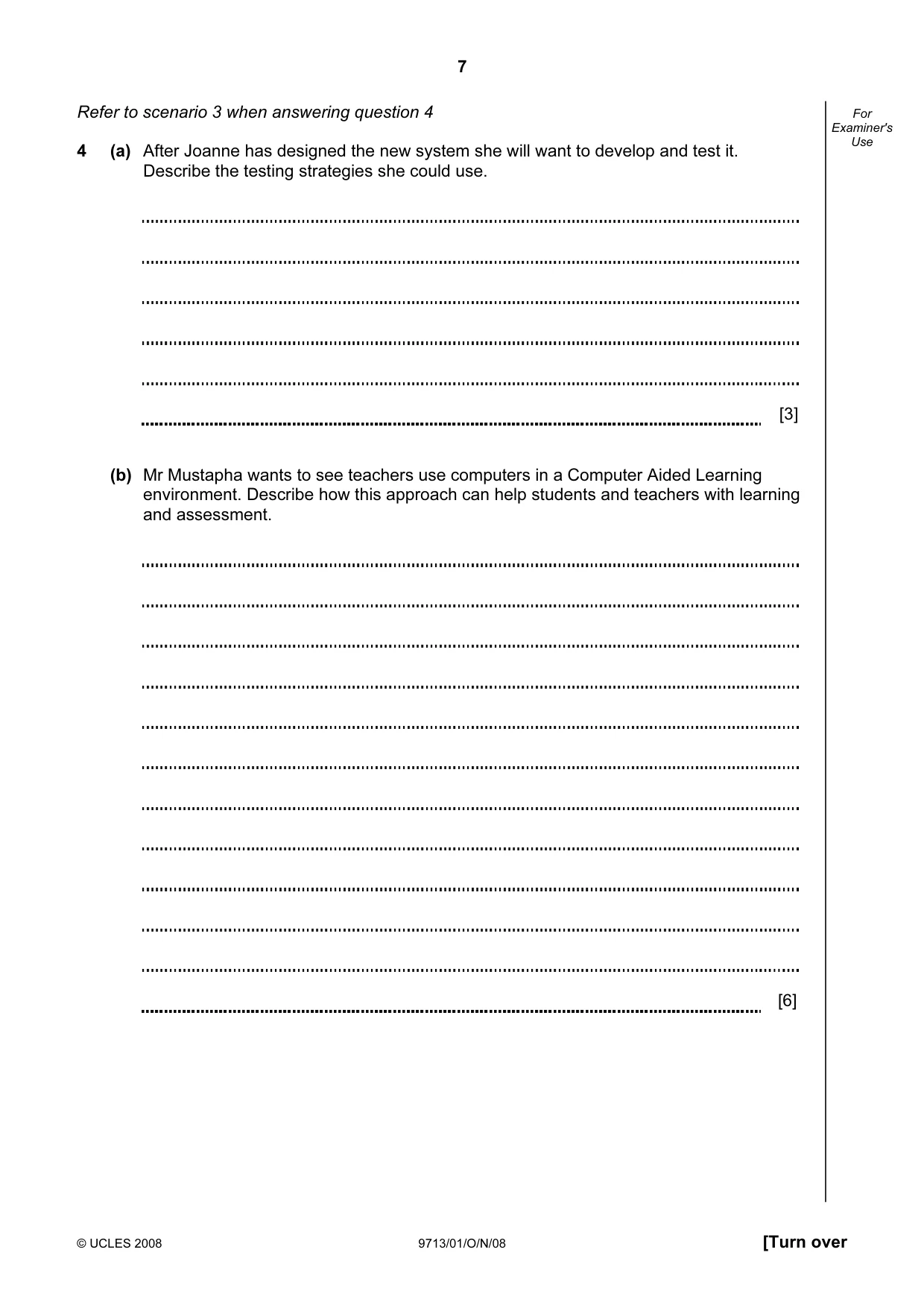
Question paper, page 7
7 © UCLES 2008 9713/01/O/N/08 [Turn over For Examiner's Use Refer to scenario 3 when answering question 4 4 (a) After Joanne has designed the new system she will want to develop and test it. Describe the testing strategies she could use. [3] (b) Mr Mustapha wants to see teachers use computers in a Computer Aided Learning environment. Describe how this approach can help students and teachers with learning and assessment. [6]
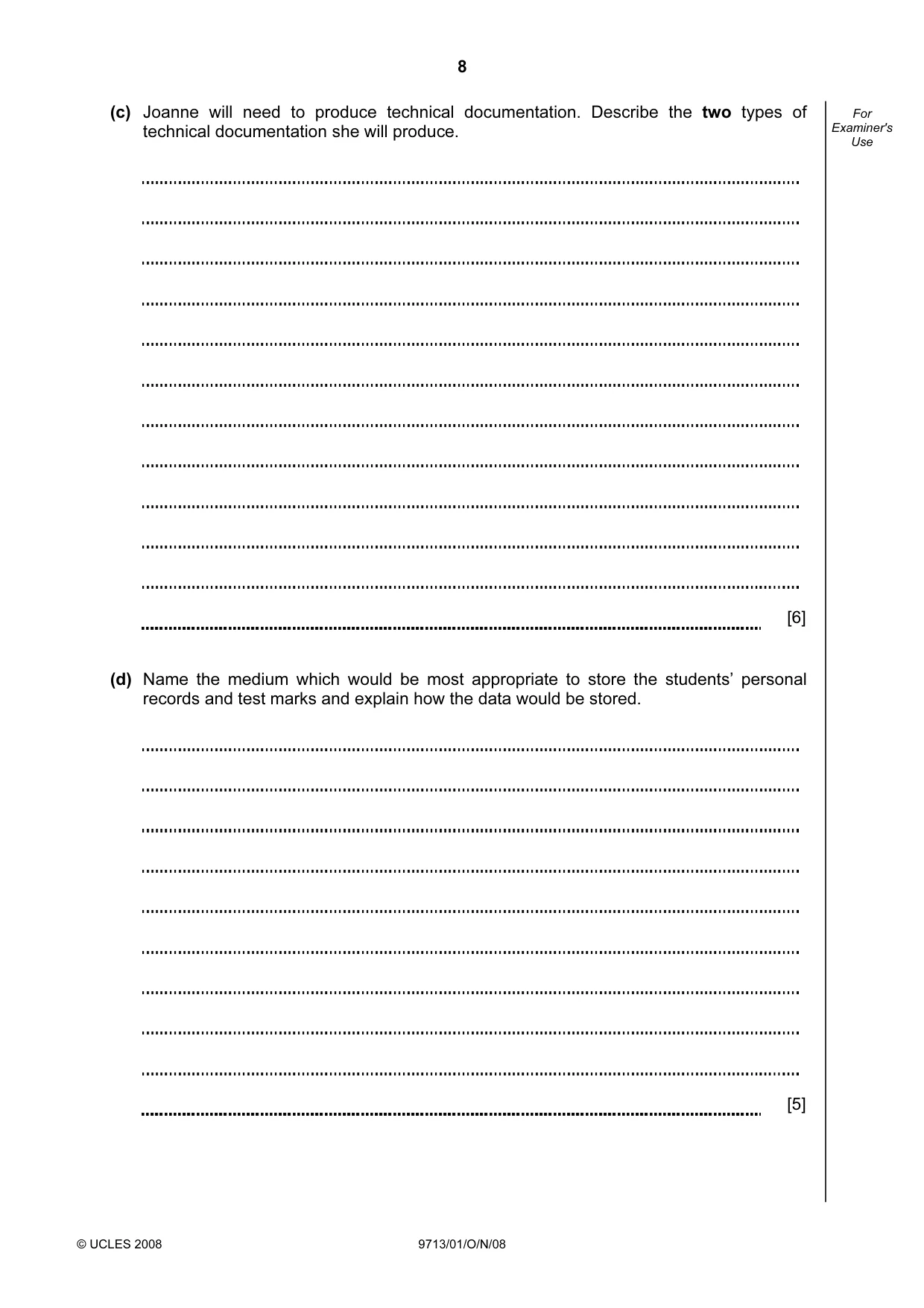
Question paper, page 8
8 © UCLES 2008 9713/01/O/N/08 For Examiner's Use (c) Joanne will need to produce technical documentation. Describe the two types of technical documentation she will produce. [6] (d) Name the medium which would be most appropriate to store the students’ personal records and test marks and explain how the data would be stored. [5]
Question paper, page 9
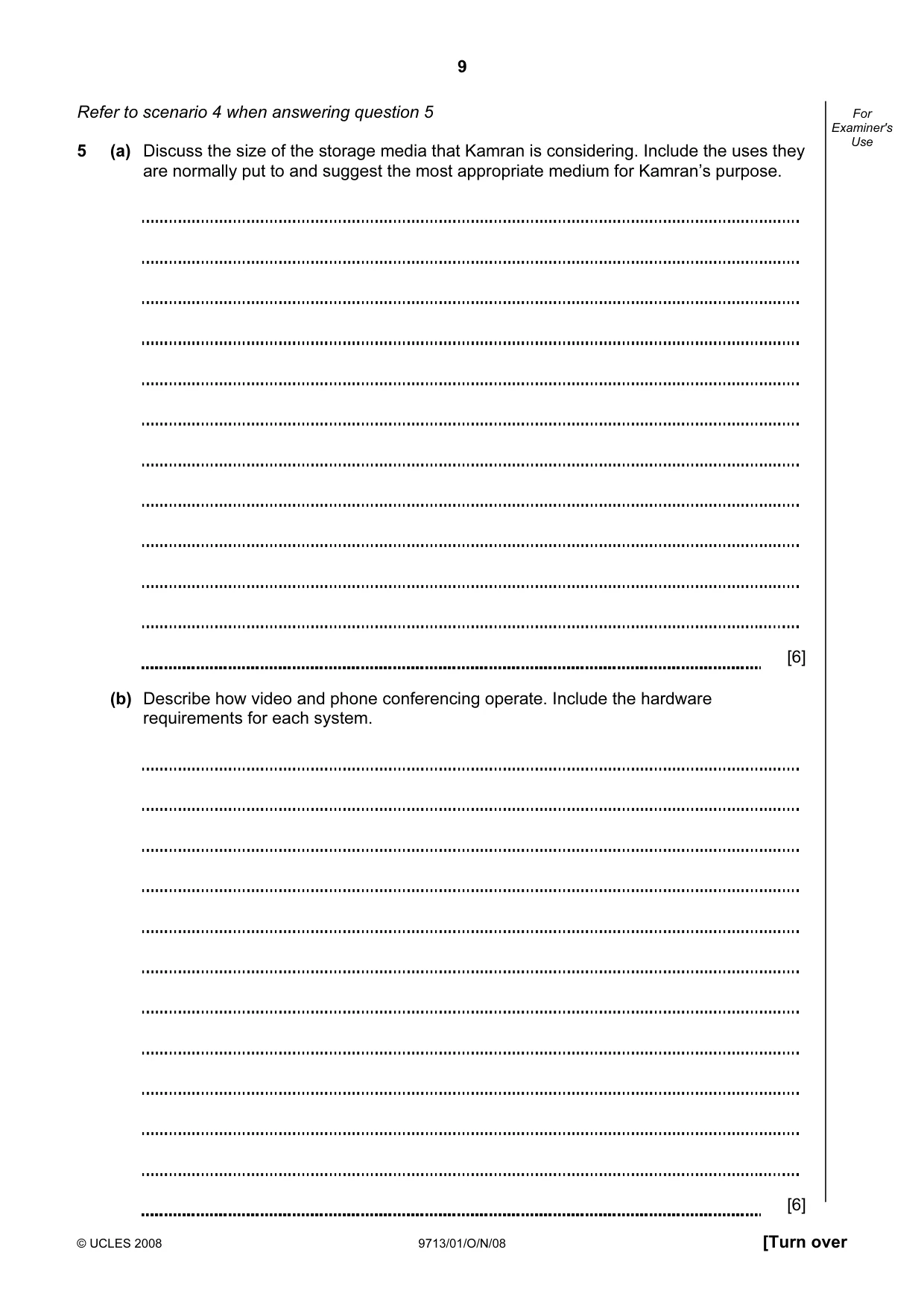
9 © UCLES 2008 9713/01/O/N/08 [Turn over For Examiner's Use Refer to scenario 4 when answering question 5 5 (a) Discuss the size of the storage media that Kamran is considering. Include the uses they are normally put to and suggest the most appropriate medium for Kamran’s purpose. [6] (b) Describe how video and phone conferencing operate. Include the hardware requirements for each system. [6]
Question paper, page 10
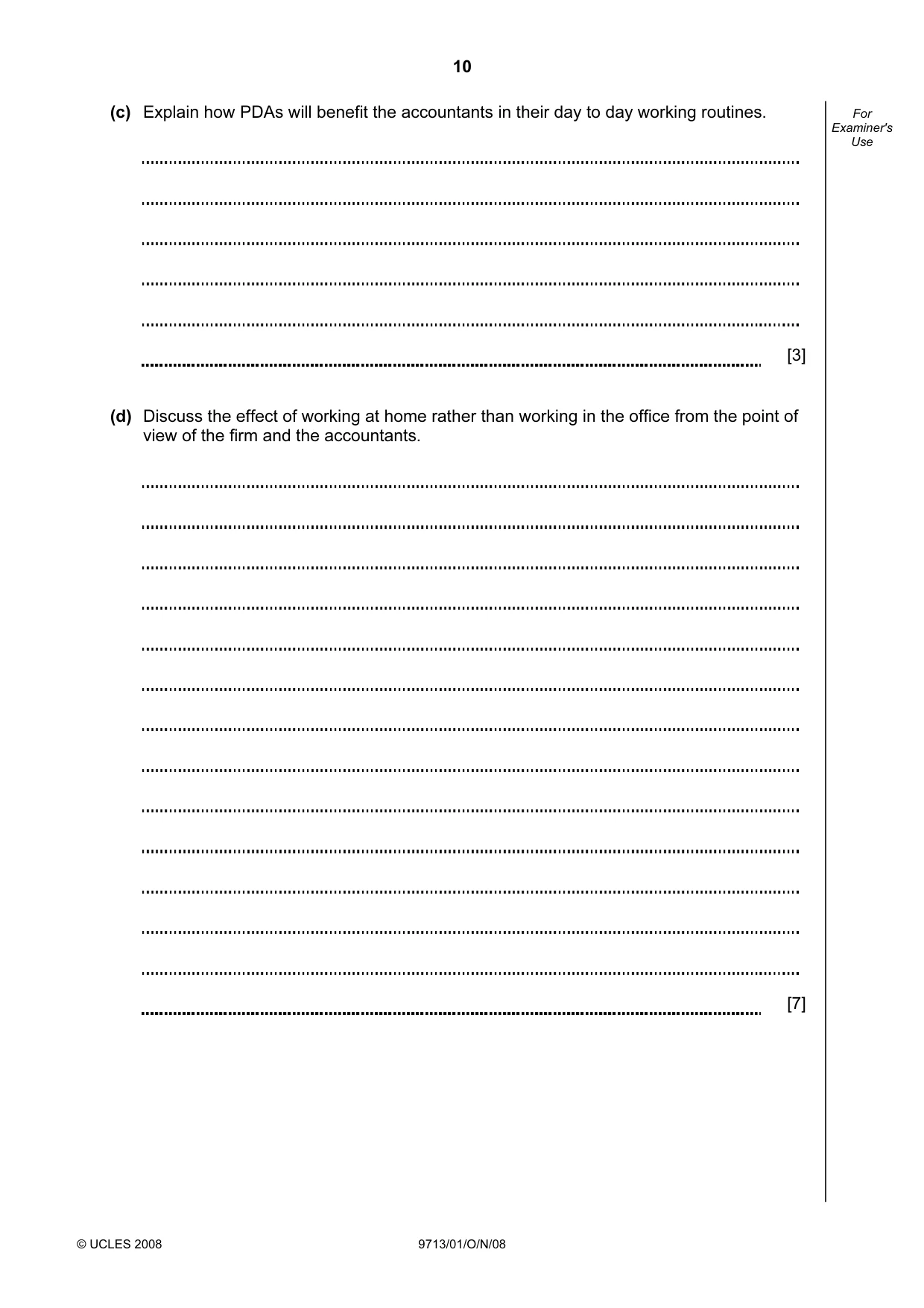
10 © UCLES 2008 9713/01/O/N/08 For Examiner's Use (c) Explain how PDAs will benefit the accountants in their day to day working routines. [3] (d) Discuss the effect of working at home rather than working in the office from the point of view of the firm and the accountants. [7]
Question paper, page 11
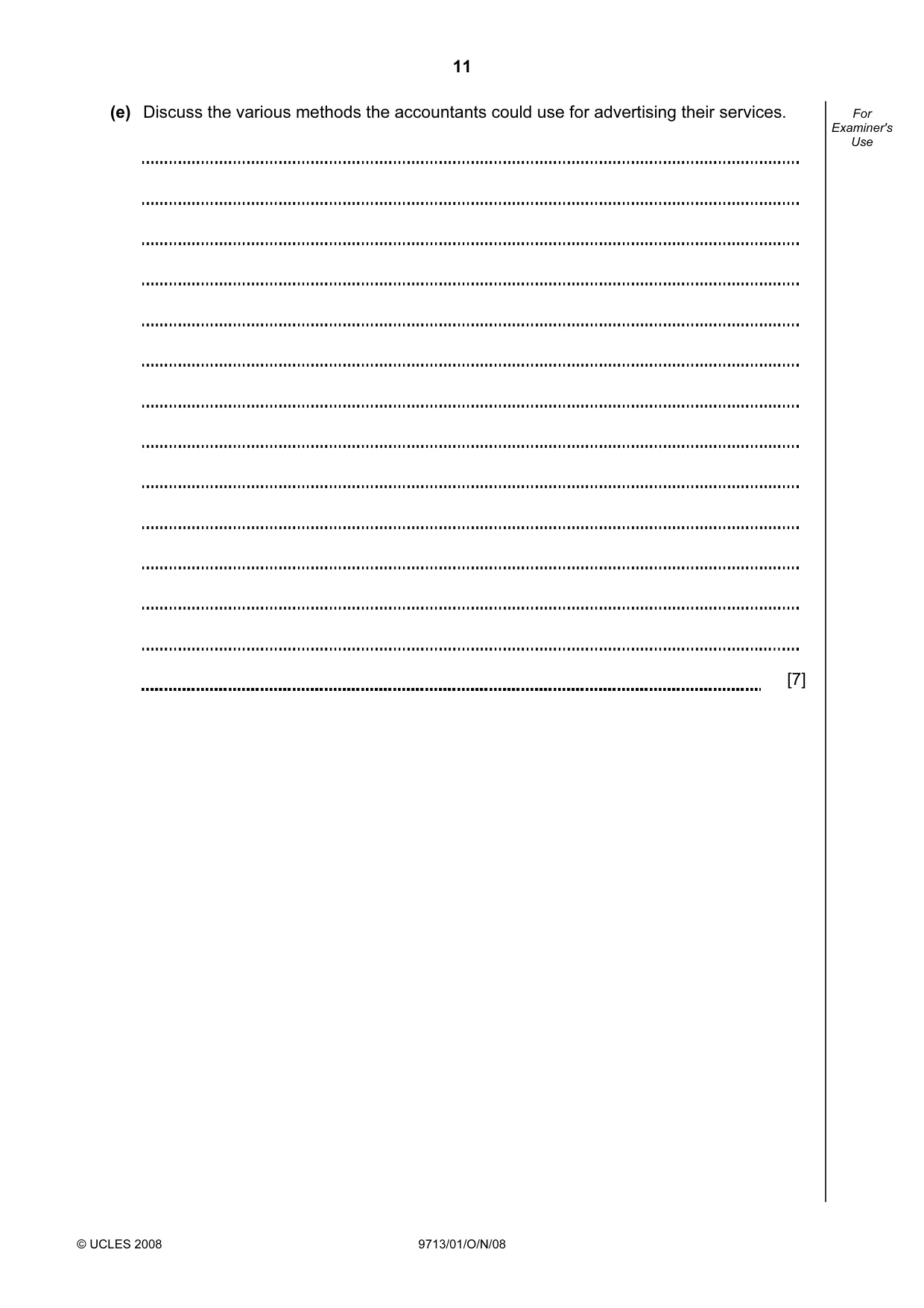
11 © UCLES 2008 9713/01/O/N/08 For Examiner's Use (e) Discuss the various methods the accountants could use for advertising their services. [7]
Question paper, page 12
12 Permission to reproduce items where third-party owned material protected by copyright is included has been sought and cleared where possible. Every reasonable effort has been made by the publisher (UCLES) to trace copyright holders, but if any items requiring clearance have unwittingly been included, the publisher will be pleased to make amends at the earliest possible opportunity. University of Cambridge International Examinations is part of the Cambridge Assessment Group. Cambridge Assessment is the brand name of University of Cambridge Local Examinations Syndicate (UCLES), which is itself a department of the University of Cambridge. 9713/01/O/N/08 BLANK PAGE
Mark scheme, page 1
UNIVERSITY OF CAMBRIDGE INTERNATIONAL EXAMINATIONS GCE Advanced Subsidiary Level and GCE Advanced Level MARK SCHEME for the October/November 2008 question paper 9713 APPLIED ICT 9713/01 Paper 1 (Written A), maximum raw mark 80 This mark scheme is published as an aid to teachers and candidates, to indicate the requirements of the examination. It shows the basis on which Examiners were instructed to award marks. It does not indicate the details of the discussions that took place at an Examiners’ meeting before marking began. All Examiners are instructed that alternative correct answers and unexpected approaches in candidates’ scripts must be given marks that fairly reflect the relevant knowledge and skills demonstrated. Mark schemes must be read in conjunction with the question papers and the report on the examination. • CIE will not enter into discussions or correspondence in connection with these mark schemes. CIE is publishing the mark schemes for the October/November 2008 question papers for most IGCSE, GCE Advanced Level and Advanced Subsidiary Level syllabuses and some Ordinary Level syllabuses.
Mark scheme, page 2
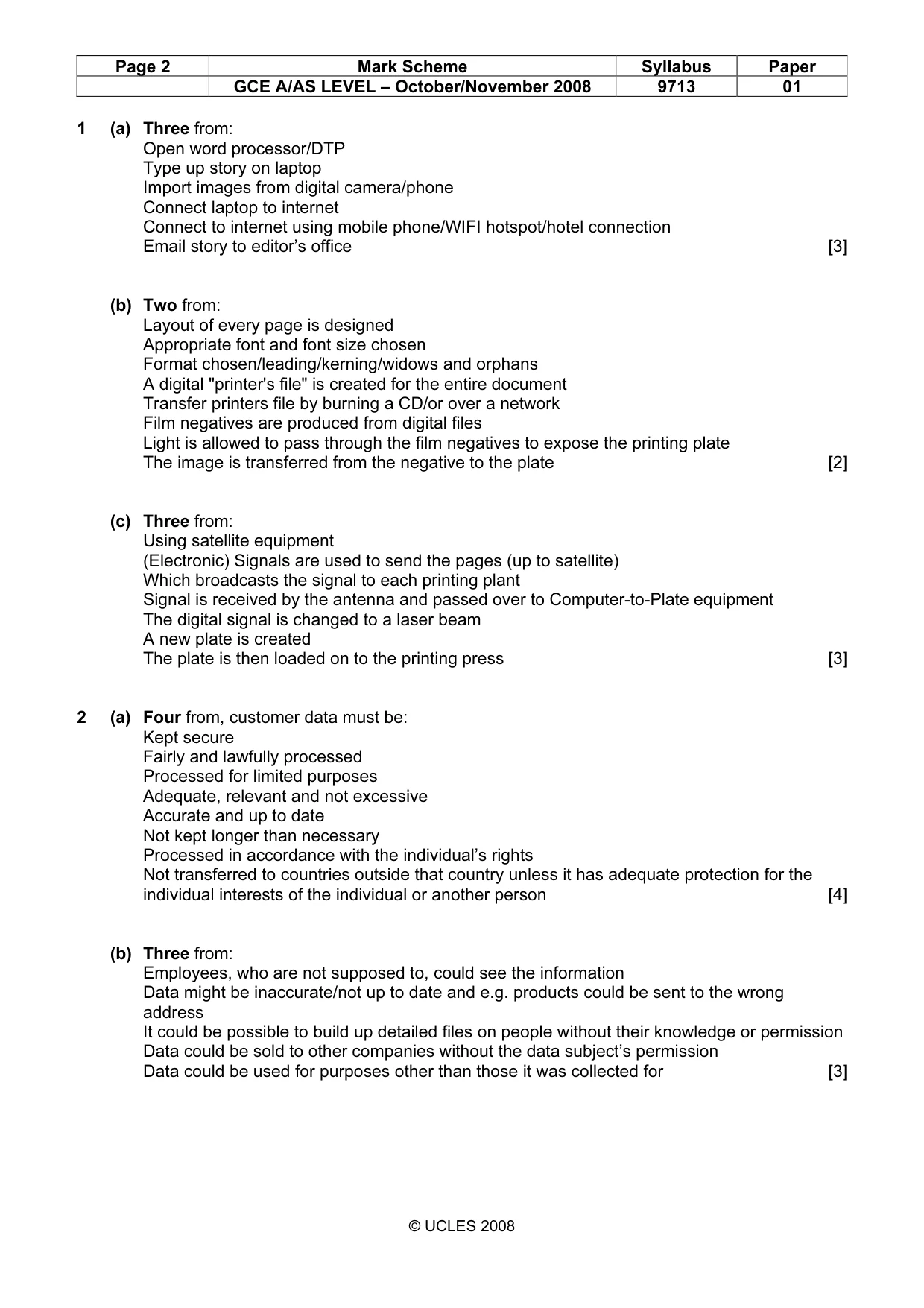
Page 2 Mark Scheme Syllabus Paper GCE A/AS LEVEL – October/November 2008 9713 01 © UCLES 2008 1 (a) Three from: Open word processor/DTP Type up story on laptop Import images from digital camera/phone Connect laptop to internet Connect to internet using mobile phone/WIFI hotspot/hotel connection Email story to editor’s office [3] (b) Two from: Layout of every page is designed Appropriate font and font size chosen Format chosen/leading/kerning/widows and orphans A digital "printer's file" is created for the entire document Transfer printers file by burning a CD/or over a network Film negatives are produced from digital files Light is allowed to pass through the film negatives to expose the printing plate The image is transferred from the negative to the plate [2] (c) Three from: Using satellite equipment (Electronic) Signals are used to send the pages (up to satellite) Which broadcasts the signal to each printing plant Signal is received by the antenna and passed over to Computer-to-Plate equipment The digital signal is changed to a laser beam A new plate is created The plate is then loaded on to the printing press [3] 2 (a) Four from, customer data must be: Kept secure Fairly and lawfully processed Processed for limited purposes Adequate, relevant and not excessive Accurate and up to date Not kept longer than necessary Processed in accordance with the individual’s rights Not transferred to countries outside that country unless it has adequate protection for the individual interests of the individual or another person [4] (b) Three from: Employees, who are not supposed to, could see the information Data might be inaccurate/not up to date and e.g. products could be sent to the wrong address It could be possible to build up detailed files on people without their knowledge or permission Data could be sold to other companies without the data subject’s permission Data could be used for purposes other than those it was collected for [3]
Mark scheme, page 3
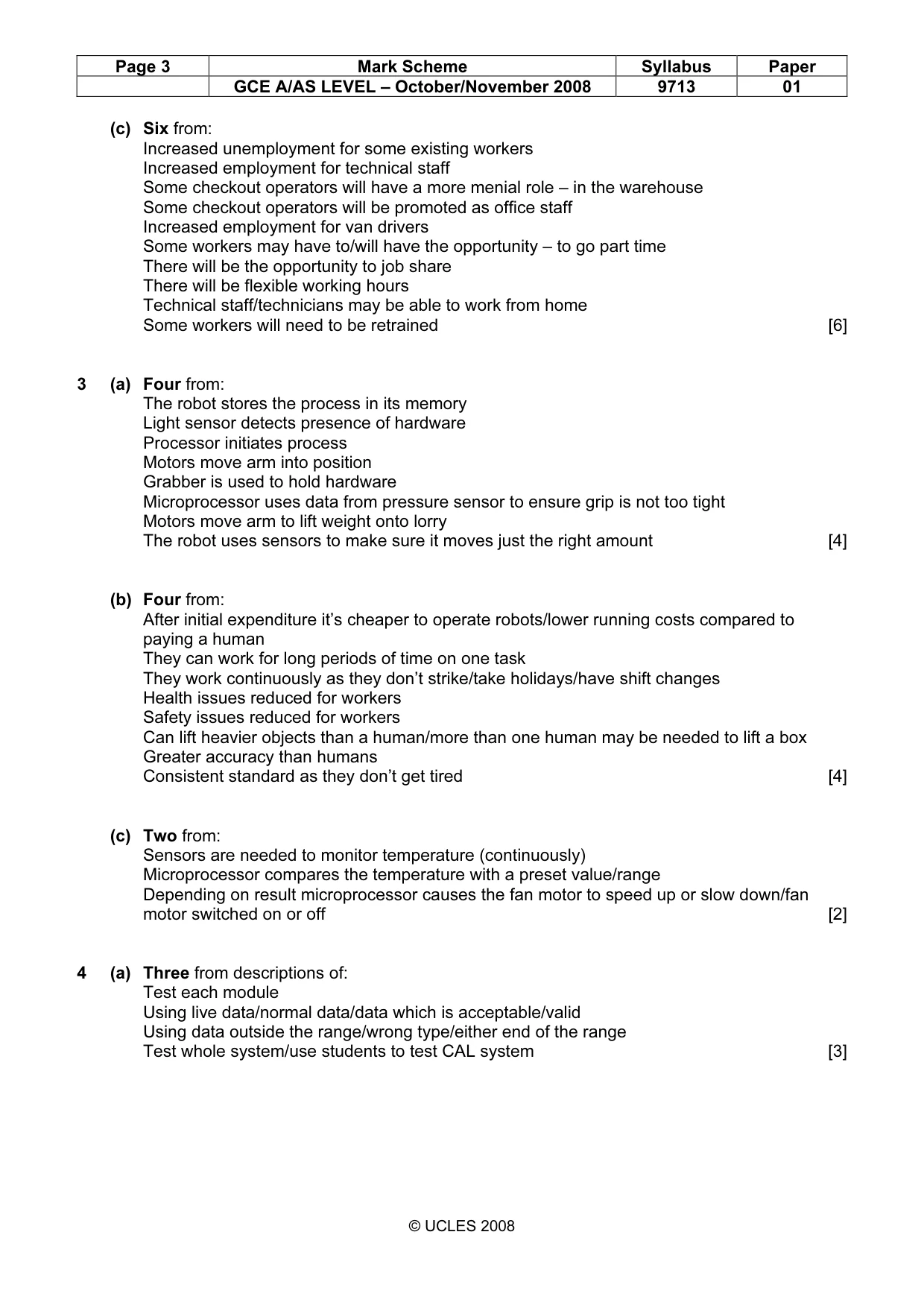
Page 3 Mark Scheme Syllabus Paper GCE A/AS LEVEL – October/November 2008 9713 01 © UCLES 2008 (c) Six from: Increased unemployment for some existing workers Increased employment for technical staff Some checkout operators will have a more menial role – in the warehouse Some checkout operators will be promoted as office staff Increased employment for van drivers Some workers may have to/will have the opportunity – to go part time There will be the opportunity to job share There will be flexible working hours Technical staff/technicians may be able to work from home Some workers will need to be retrained [6] 3 (a) Four from: The robot stores the process in its memory Light sensor detects presence of hardware Processor initiates process Motors move arm into position Grabber is used to hold hardware Microprocessor uses data from pressure sensor to ensure grip is not too tight Motors move arm to lift weight onto lorry The robot uses sensors to make sure it moves just the right amount [4] (b) Four from: After initial expenditure it’s cheaper to operate robots/lower running costs compared to paying a human They can work for long periods of time on one task They work continuously as they don’t strike/take holidays/have shift changes Health issues reduced for workers Safety issues reduced for workers Can lift heavier objects than a human/more than one human may be needed to lift a box Greater accuracy than humans Consistent standard as they don’t get tired [4] (c) Two from: Sensors are needed to monitor temperature (continuously) Microprocessor compares the temperature with a preset value/range Depending on result microprocessor causes the fan motor to speed up or slow down/fan motor switched on or off [2] 4 (a) Three from descriptions of: Test each module Using live data/normal data/data which is acceptable/valid Using data outside the range/wrong type/either end of the range Test whole system/use students to test CAL system [3]
Mark scheme, page 4
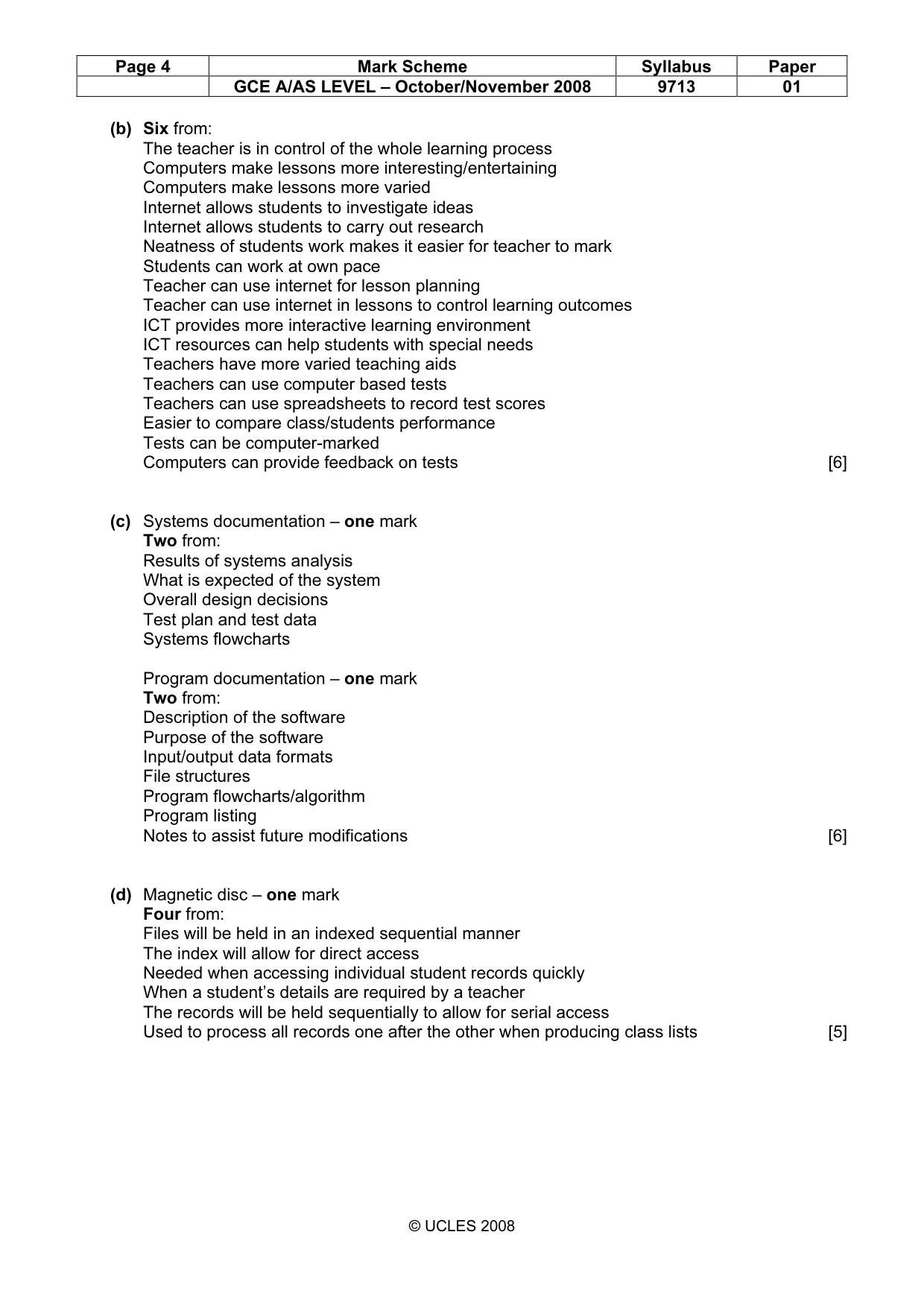
Page 4 Mark Scheme Syllabus Paper GCE A/AS LEVEL – October/November 2008 9713 01 © UCLES 2008 (b) Six from: The teacher is in control of the whole learning process Computers make lessons more interesting/entertaining Computers make lessons more varied Internet allows students to investigate ideas Internet allows students to carry out research Neatness of students work makes it easier for teacher to mark Students can work at own pace Teacher can use internet for lesson planning Teacher can use internet in lessons to control learning outcomes ICT provides more interactive learning environment ICT resources can help students with special needs Teachers have more varied teaching aids Teachers can use computer based tests Teachers can use spreadsheets to record test scores Easier to compare class/students performance Tests can be computer-marked Computers can provide feedback on tests [6] (c) Systems documentation – one mark Two from: Results of systems analysis What is expected of the system Overall design decisions Test plan and test data Systems flowcharts Program documentation – one mark Two from: Description of the software Purpose of the software Input/output data formats File structures Program flowcharts/algorithm Program listing Notes to assist future modifications [6] (d) Magnetic disc – one mark Four from: Files will be held in an indexed sequential manner The index will allow for direct access Needed when accessing individual student records quickly When a student’s details are required by a teacher The records will be held sequentially to allow for serial access Used to process all records one after the other when producing class lists [5]
Mark scheme, page 5
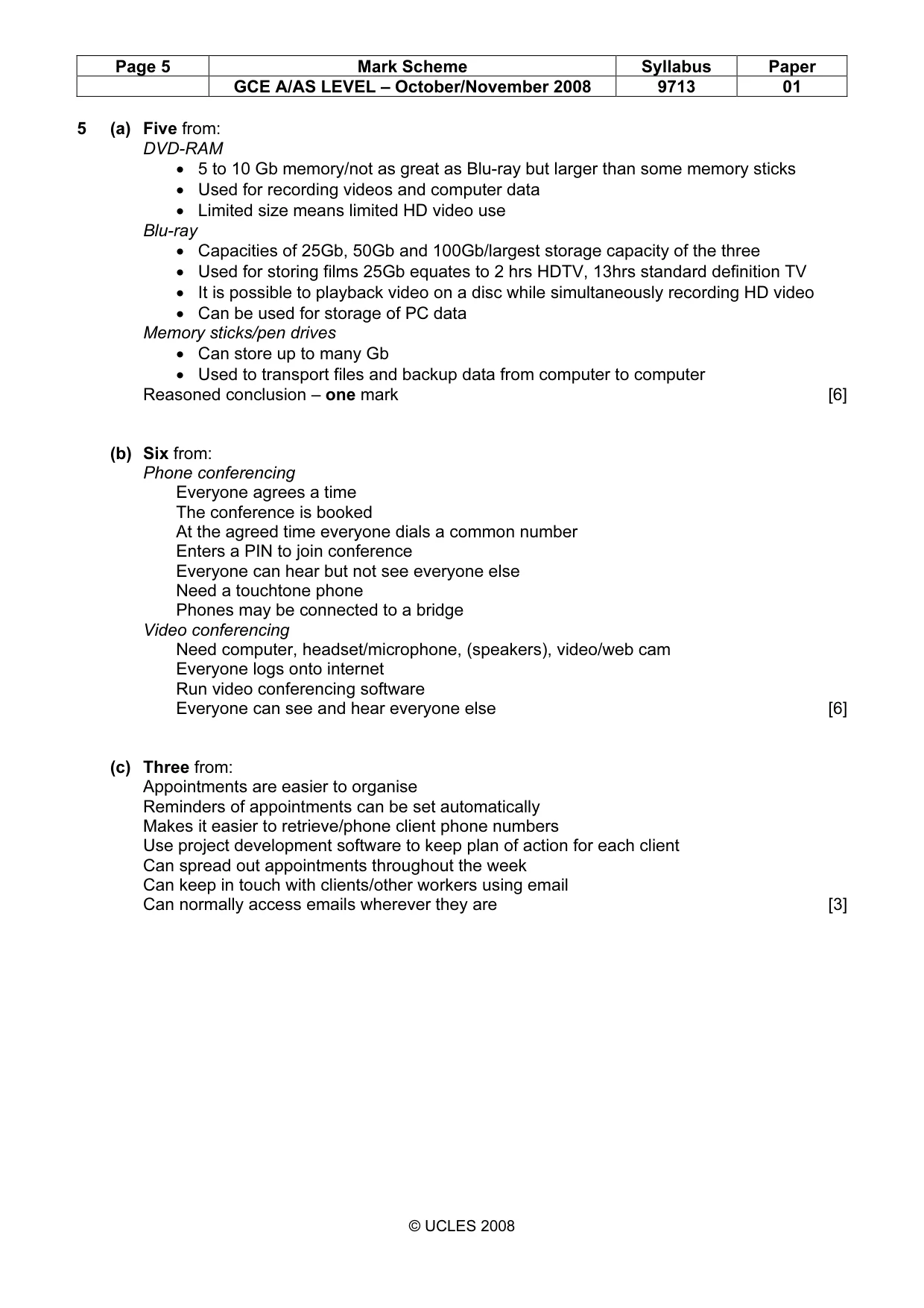
Page 5 Mark Scheme Syllabus Paper GCE A/AS LEVEL – October/November 2008 9713 01 © UCLES 2008 5 (a) Five from: DVD-RAM • 5 to 10 Gb memory/not as great as Blu-ray but larger than some memory sticks • Used for recording videos and computer data • Limited size means limited HD video use Blu-ray • Capacities of 25Gb, 50Gb and 100Gb/largest storage capacity of the three • Used for storing films 25Gb equates to 2 hrs HDTV, 13hrs standard definition TV • It is possible to playback video on a disc while simultaneously recording HD video • Can be used for storage of PC data Memory sticks/pen drives • Can store up to many Gb • Used to transport files and backup data from computer to computer Reasoned conclusion – one mark [6] (b) Six from: Phone conferencing Everyone agrees a time The conference is booked At the agreed time everyone dials a common number Enters a PIN to join conference Everyone can hear but not see everyone else Need a touchtone phone Phones may be connected to a bridge Video conferencing Need computer, headset/microphone, (speakers), video/web cam Everyone logs onto internet Run video conferencing software Everyone can see and hear everyone else [6] (c) Three from: Appointments are easier to organise Reminders of appointments can be set automatically Makes it easier to retrieve/phone client phone numbers Use project development software to keep plan of action for each client Can spread out appointments throughout the week Can keep in touch with clients/other workers using email Can normally access emails wherever they are [3]
Mark scheme, page 6
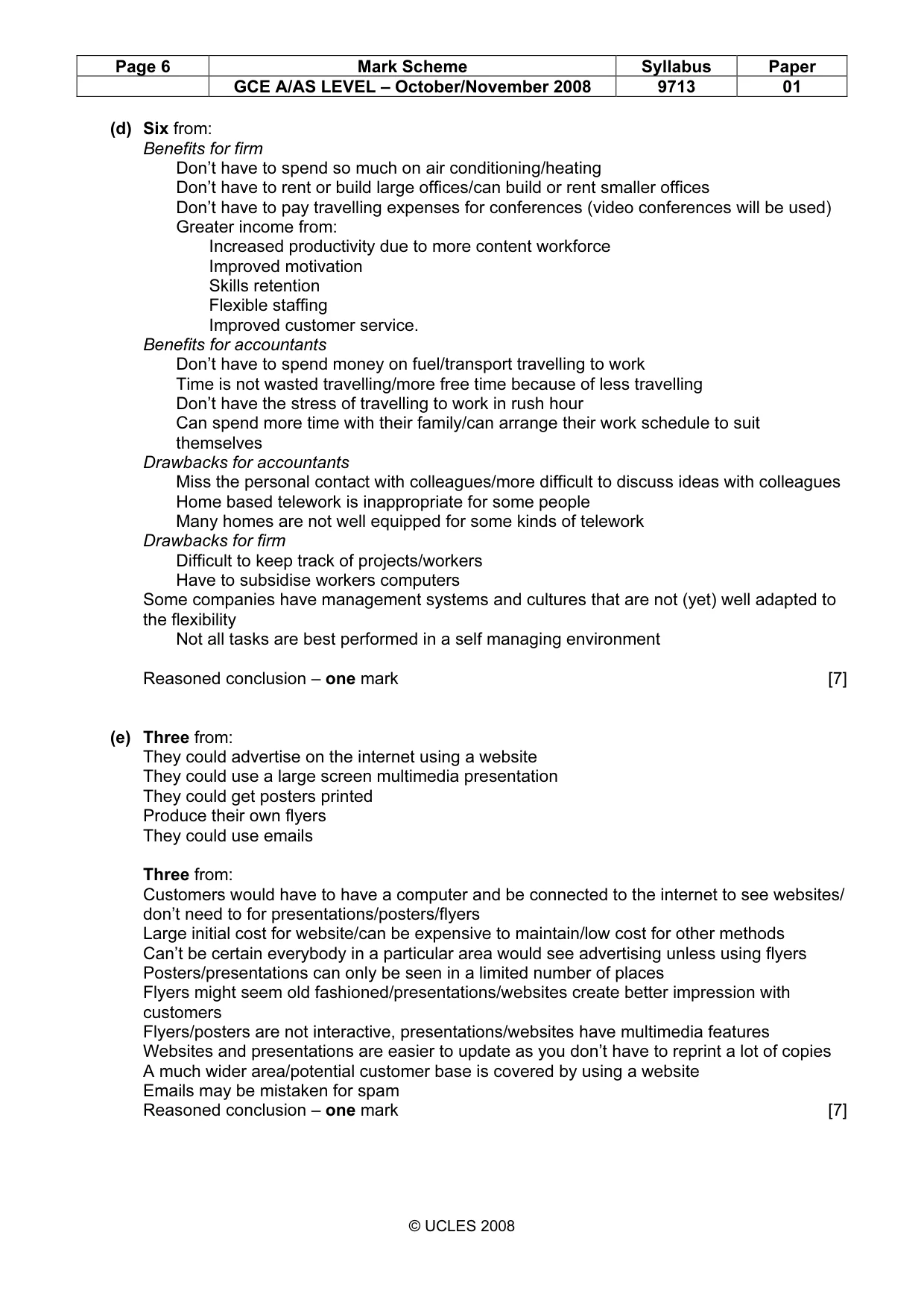
Page 6 Mark Scheme Syllabus Paper GCE A/AS LEVEL – October/November 2008 9713 01 © UCLES 2008 (d) Six from: Benefits for firm Don’t have to spend so much on air conditioning/heating Don’t have to rent or build large offices/can build or rent smaller offices Don’t have to pay travelling expenses for conferences (video conferences will be used) Greater income from: Increased productivity due to more content workforce Improved motivation Skills retention Flexible staffing Improved customer service. Benefits for accountants Don’t have to spend money on fuel/transport travelling to work Time is not wasted travelling/more free time because of less travelling Don’t have the stress of travelling to work in rush hour Can spend more time with their family/can arrange their work schedule to suit themselves Drawbacks for accountants Miss the personal contact with colleagues/more difficult to discuss ideas with colleagues Home based telework is inappropriate for some people Many homes are not well equipped for some kinds of telework Drawbacks for firm Difficult to keep track of projects/workers Have to subsidise workers computers Some companies have management systems and cultures that are not (yet) well adapted to the flexibility Not all tasks are best performed in a self managing environment Reasoned conclusion – one mark [7] (e) Three from: They could advertise on the internet using a website They could use a large screen multimedia presentation They could get posters printed Produce their own flyers They could use emails Three from: Customers would have to have a computer and be connected to the internet to see websites/ don’t need to for presentations/posters/flyers Large initial cost for website/can be expensive to maintain/low cost for other methods Can’t be certain everybody in a particular area would see advertising unless using flyers Posters/presentations can only be seen in a limited number of places Flyers might seem old fashioned/presentations/websites create better impression with customers Flyers/posters are not interactive, presentations/websites have multimedia features Websites and presentations are easier to update as you don’t have to reprint a lot of copies A much wider area/potential customer base is covered by using a website Emails may be mistaken for spam Reasoned conclusion – one mark [7]
What you needed in this session
Cambridge’s own grade thresholds for 2008 Oct/Nov, Paper 1 · Variant 1. A higher threshold means an easier paper — the bar moves with how the cohort did.