Cambridge A Level Afrikaans 9679 — 2019 Oct/Nov Paper 4 · Variant 1
9679/41/O/N/19 · 75 marks · ≈84 min
The question paper and its mark scheme, free to read here and free to download. This is Cambridge’s own paper, exactly as it was sat.
Question paper8 pages



Mark scheme4 pages
Answers below. Sit the paper first if you are practising.
Paper as text
Question paper, page 1
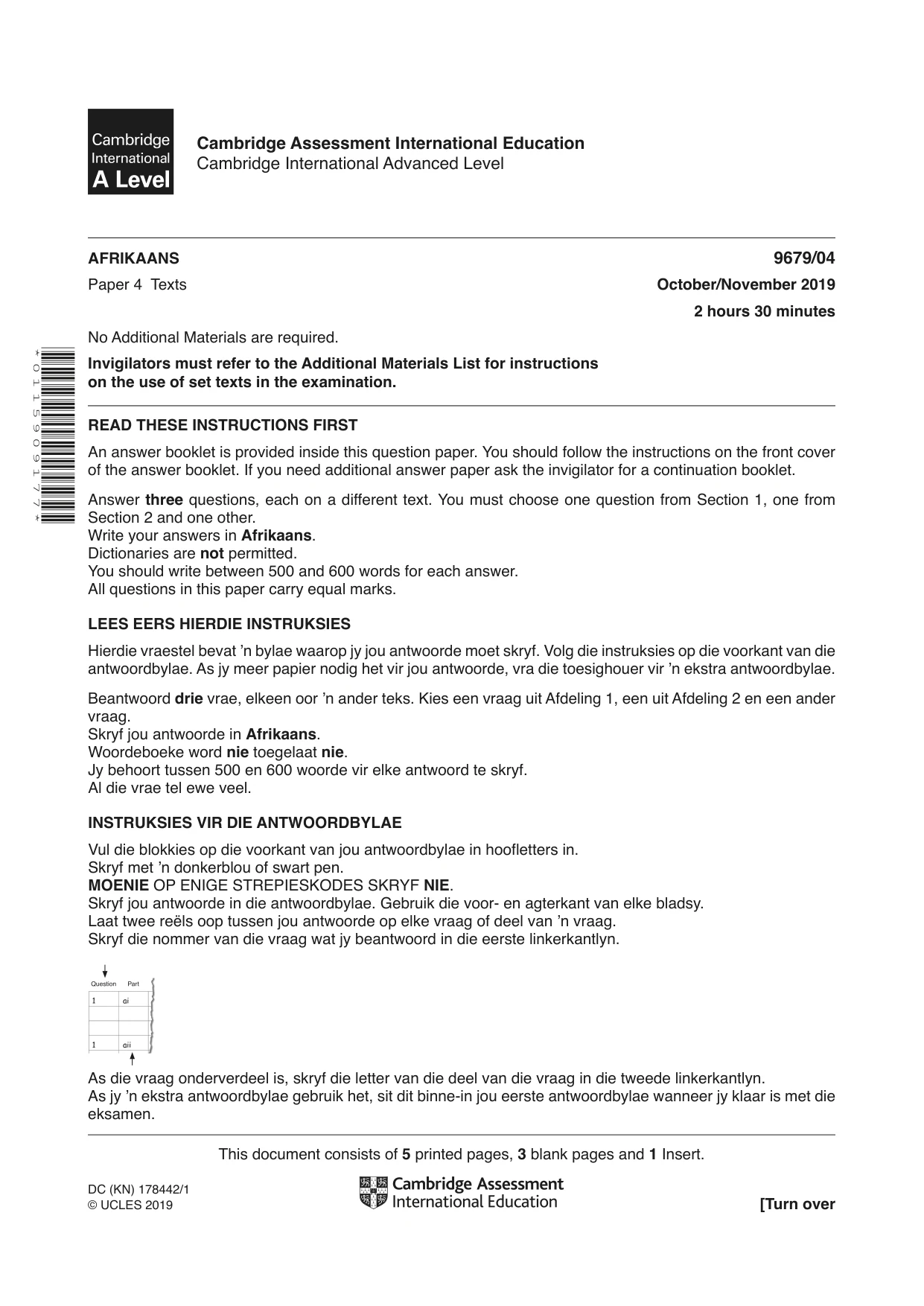
This document consists of 5 printed pages, 3 blank pages and 1 Insert. DC (KN) 178442/1 © UCLES 2019 [Turn over Cambridge Assessment International Education Cambridge International Advanced Level * 0 1 1 5 9 0 9 1 7 7 * AFRIKAANS 9679/04 Paper 4 Texts October/November 2019 2 hours 30 minutes No Additional Materials are required. Invigilators must refer to the Additional Materials List for instructions on the use of set texts in the examination. READ THESE INSTRUCTIONS FIRST An answer booklet is provided inside this question paper. You should follow the instructions on the front cover of the answer booklet. If you need additional answer paper ask the invigilator for a continuation booklet. Answer three questions, each on a different text. You must choose one question from Section 1, one from Section 2 and one other. Write your answers in Afrikaans. Dictionaries are not permitted. You should write between 500 and 600 words for each answer. All questions in this paper carry equal marks. LEES EERS HIERDIE INSTRUKSIES Hierdie vraestel bevat ’n bylae waarop jy jou antwoorde moet skryf. Volg die instruksies op die voorkant van die antwoordbylae. As jy meer papier nodig het vir jou antwoorde, vra die toesighouer vir ’n ekstra antwoordbylae. Beantwoord drie vrae, elkeen oor ’n ander teks. Kies een vraag uit Afdeling 1, een uit Afdeling 2 en een ander vraag. Skryf jou antwoorde in Afrikaans. Woordeboeke word nie toegelaat nie. Jy behoort tussen 500 en 600 woorde vir elke antwoord te skryf. Al die vrae tel ewe veel. INSTRUKSIES VIR DIE ANTWOORDBYLAE Vul die blokkies op die voorkant van jou antwoordbylae in hoofletters in. Skryf met ’n donkerblou of swart pen. MOENIE OP ENIGE STREPIESKODES SKRYF NIE. Skryf jou antwoorde in die antwoordbylae. Gebruik die voor- en agterkant van elke bladsy. Laat twee reëls oop tussen jou antwoorde op elke vraag of deel van ’n vraag. Skryf die nommer van die vraag wat jy beantwoord in die eerste linkerkantlyn. As die vraag onderverdeel is, skryf die letter van die deel van die vraag in die tweede linkerkantlyn. As jy ’n ekstra antwoordbylae gebruik het, sit dit binne-in jou eerste antwoordbylae wanneer jy klaar is met die eksamen.
Question paper, page 2
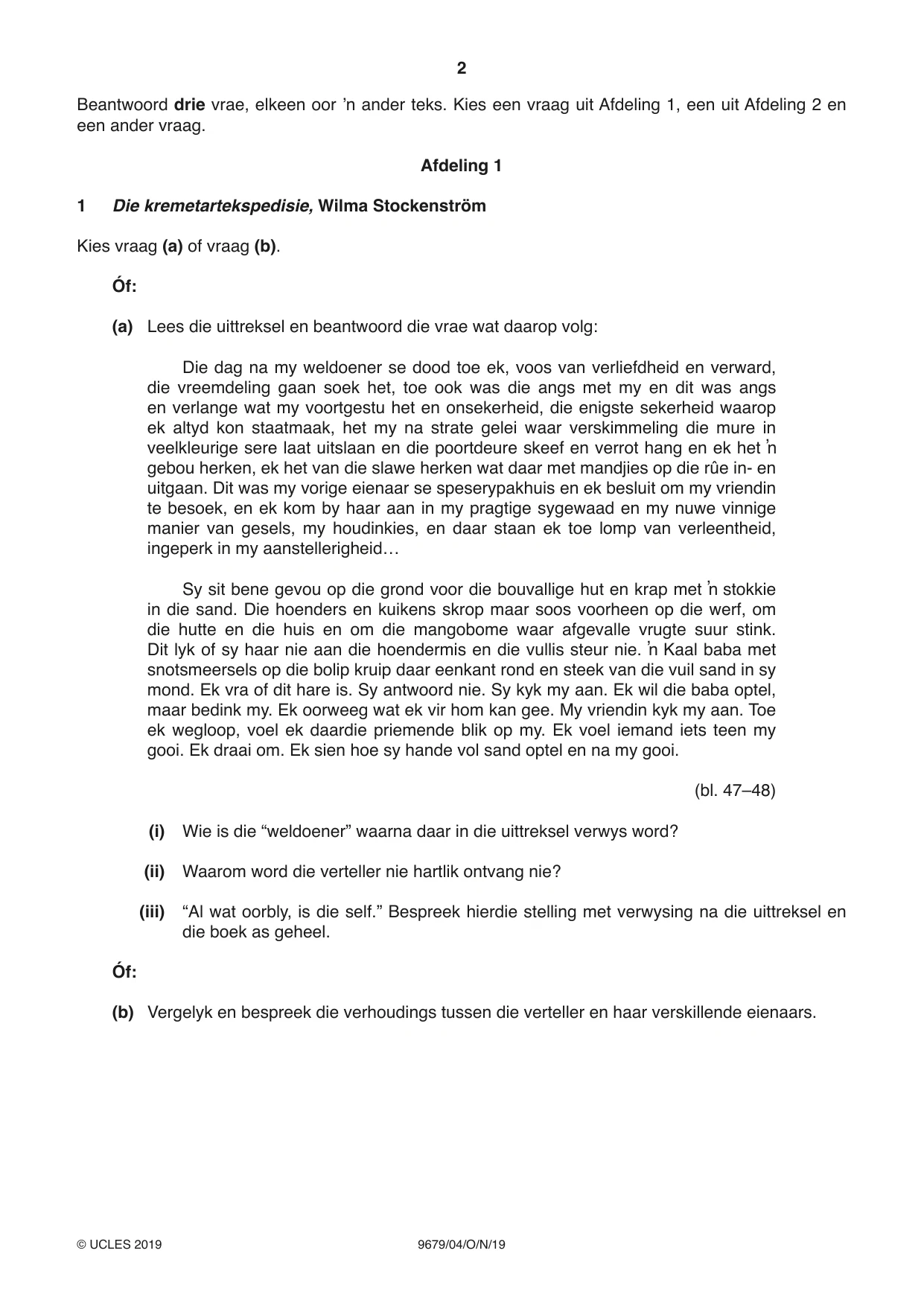
2 9679/04/O/N/19 © UCLES 2019 Beantwoord drie vrae, elkeen oor ’n ander teks. Kies een vraag uit Afdeling 1, een uit Afdeling 2 en een ander vraag. Afdeling 1 1 Die kremetartekspedisie, Wilma Stockenström Kies vraag (a) of vraag (b). Óf: (a) Lees die uittreksel en beantwoord die vrae wat daarop volg: Die dag na my weldoener se dood toe ek, voos van verliefdheid en verward, die vreemdeling gaan soek het, toe ook was die angs met my en dit was angs en verlange wat my voortgestu het en onsekerheid, die enigste sekerheid waarop ek altyd kon staatmaak, het my na strate gelei waar verskimmeling die mure in veelkleurige sere laat uitslaan en die poortdeure skeef en verrot hang en ek het ʼn gebou herken, ek het van die slawe herken wat daar met mandjies op die rûe in- en uitgaan. Dit was my vorige eienaar se speserypakhuis en ek besluit om my vriendin te besoek, en ek kom by haar aan in my pragtige sygewaad en my nuwe vinnige manier van gesels, my houdinkies, en daar staan ek toe lomp van verleentheid, ingeperk in my aanstellerigheid… Sy sit bene gevou op die grond voor die bouvallige hut en krap met ʼn stokkie in die sand. Die hoenders en kuikens skrop maar soos voorheen op die werf, om die hutte en die huis en om die mangobome waar afgevalle vrugte suur stink. Dit lyk of sy haar nie aan die hoendermis en die vullis steur nie. ʼn Kaal baba met snotsmeersels op die bolip kruip daar eenkant rond en steek van die vuil sand in sy mond. Ek vra of dit hare is. Sy antwoord nie. Sy kyk my aan. Ek wil die baba optel, maar bedink my. Ek oorweeg wat ek vir hom kan gee. My vriendin kyk my aan. Toe ek wegloop, voel ek daardie priemende blik op my. Ek voel iemand iets teen my gooi. Ek draai om. Ek sien hoe sy hande vol sand optel en na my gooi. (bl. 47–48) (i) Wie is die “weldoener” waarna daar in die uittreksel verwys word? (ii) Waarom word die verteller nie hartlik ontvang nie? (iii) “Al wat oorbly, is die self.” Bespreek hierdie stelling met verwysing na die uittreksel en die boek as geheel. Óf: (b) Vergelyk en bespreek die verhoudings tussen die verteller en haar verskillende eienaars.
Question paper, page 3
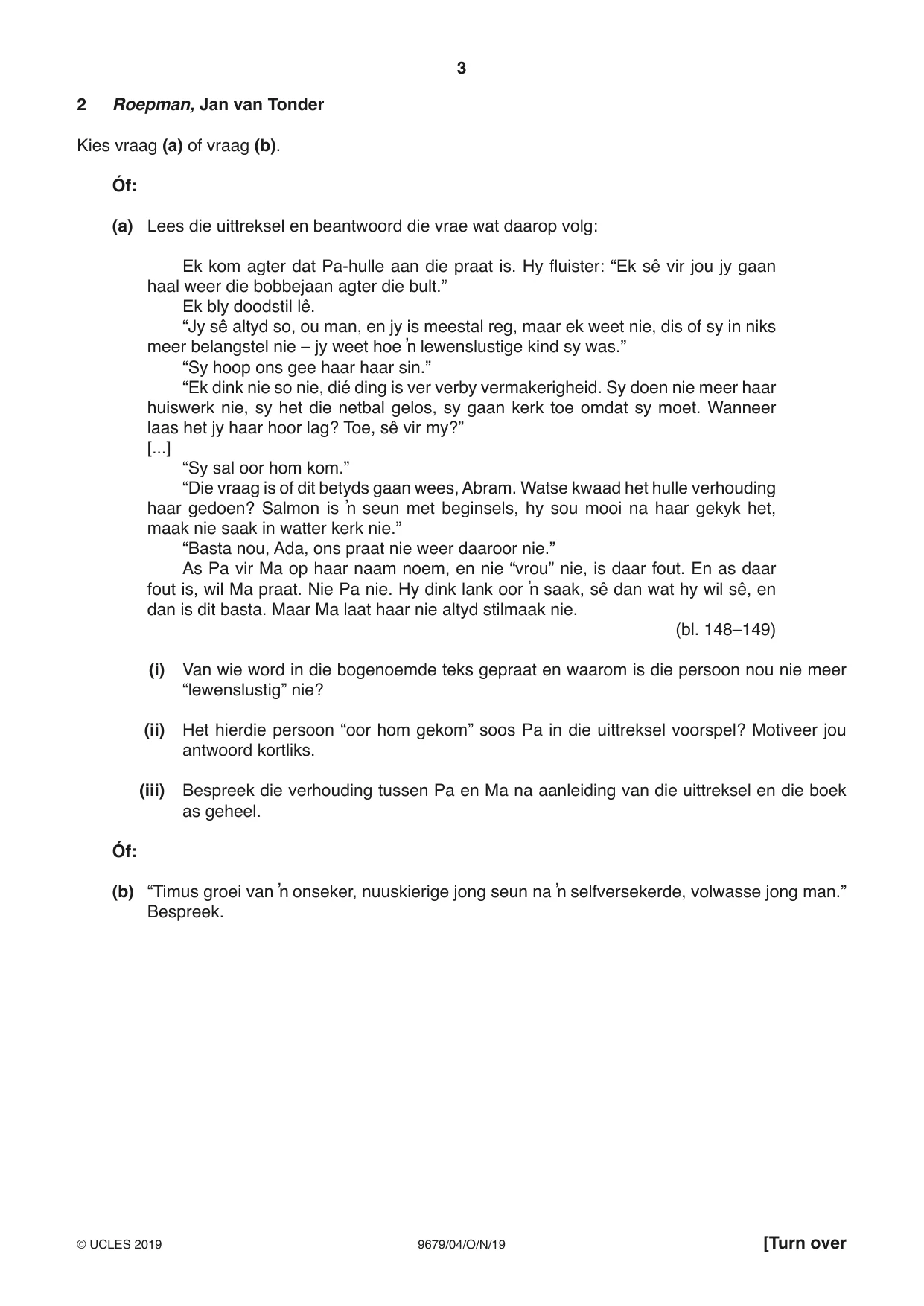
3 9679/04/O/N/19 © UCLES 2019 [Turn over 2 Roepman, Jan van Tonder Kies vraag (a) of vraag (b). Óf: (a) Lees die uittreksel en beantwoord die vrae wat daarop volg: Ek kom agter dat Pa-hulle aan die praat is. Hy fluister: “Ek sê vir jou jy gaan haal weer die bobbejaan agter die bult.” Ek bly doodstil lê. “Jy sê altyd so, ou man, en jy is meestal reg, maar ek weet nie, dis of sy in niks meer belangstel nie – jy weet hoe ʼn lewenslustige kind sy was.” “Sy hoop ons gee haar haar sin.” “Ek dink nie so nie, dié ding is ver verby vermakerigheid. Sy doen nie meer haar huiswerk nie, sy het die netbal gelos, sy gaan kerk toe omdat sy moet. Wanneer laas het jy haar hoor lag? Toe, sê vir my?” [...] “Sy sal oor hom kom.” “Die vraag is of dit betyds gaan wees, Abram. Watse kwaad het hulle verhouding haar gedoen? Salmon is ʼn seun met beginsels, hy sou mooi na haar gekyk het, maak nie saak in watter kerk nie.” “Basta nou, Ada, ons praat nie weer daaroor nie.” As Pa vir Ma op haar naam noem, en nie “vrou” nie, is daar fout. En as daar fout is, wil Ma praat. Nie Pa nie. Hy dink lank oor ʼn saak, sê dan wat hy wil sê, en dan is dit basta. Maar Ma laat haar nie altyd stilmaak nie. (bl. 148–149) (i) Van wie word in die bogenoemde teks gepraat en waarom is die persoon nou nie meer “lewenslustig” nie? (ii) Het hierdie persoon “oor hom gekom” soos Pa in die uittreksel voorspel? Motiveer jou antwoord kortliks. (iii) Bespreek die verhouding tussen Pa en Ma na aanleiding van die uittreksel en die boek as geheel. Óf: (b) “Timus groei van ʼn onseker, nuuskierige jong seun na ʼn selfversekerde, volwasse jong man.” Bespreek.
Question paper, page 4
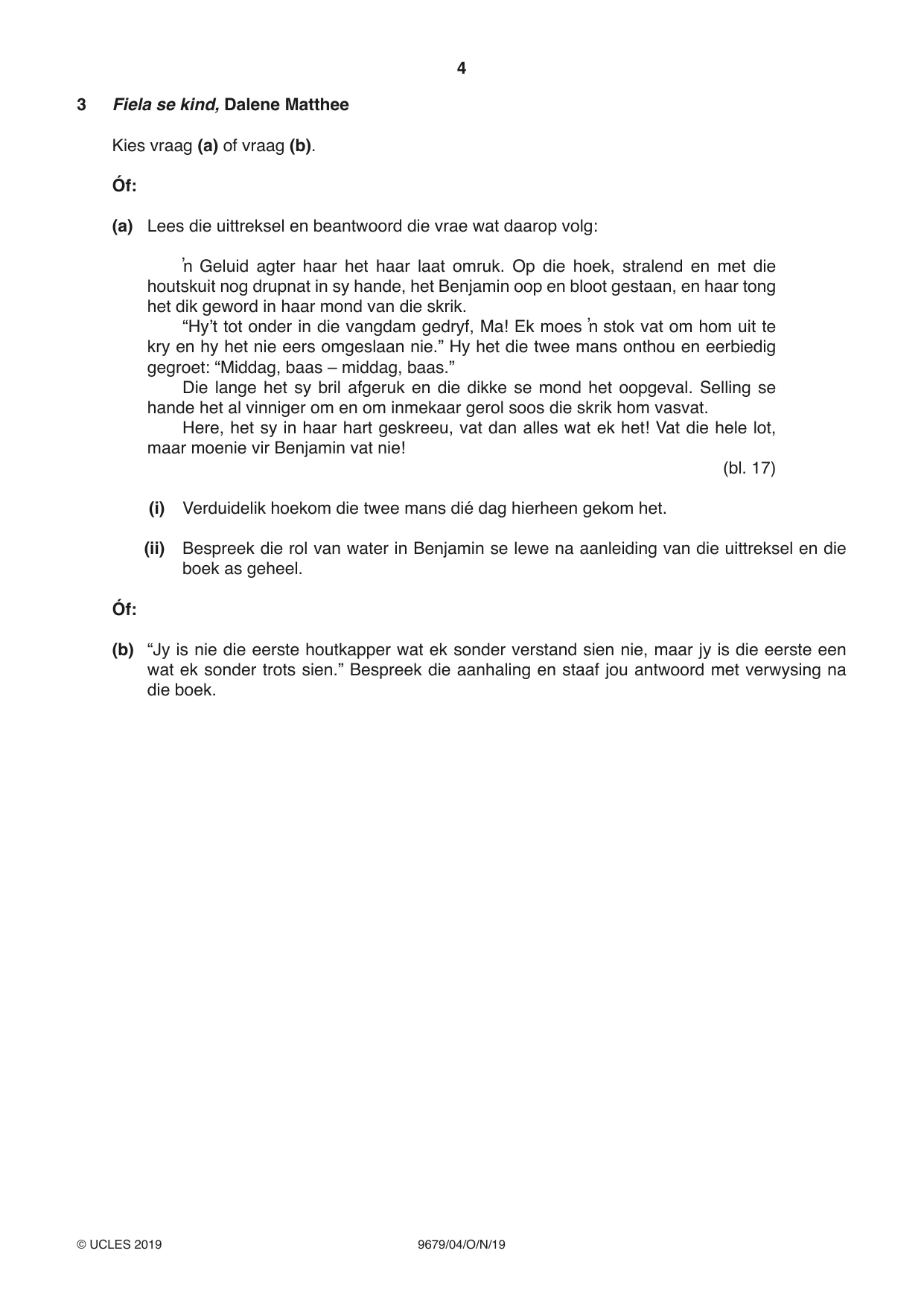
4 9679/04/O/N/19 © UCLES 2019 3 Fiela se kind, Dalene Matthee Kies vraag (a) of vraag (b). Óf: (a) Lees die uittreksel en beantwoord die vrae wat daarop volg: ʼn Geluid agter haar het haar laat omruk. Op die hoek, stralend en met die houtskuit nog drupnat in sy hande, het Benjamin oop en bloot gestaan, en haar tong het dik geword in haar mond van die skrik. “Hy’t tot onder in die vangdam gedryf, Ma! Ek moes ʼn stok vat om hom uit te kry en hy het nie eers omgeslaan nie.” Hy het die twee mans onthou en eerbiedig gegroet: “Middag, baas – middag, baas.” Die lange het sy bril afgeruk en die dikke se mond het oopgeval. Selling se hande het al vinniger om en om inmekaar gerol soos die skrik hom vasvat. Here, het sy in haar hart geskreeu, vat dan alles wat ek het! Vat die hele lot, maar moenie vir Benjamin vat nie! (bl. 17) (i) Verduidelik hoekom die twee mans dié dag hierheen gekom het. (ii) Bespreek die rol van water in Benjamin se lewe na aanleiding van die uittreksel en die boek as geheel. Óf: (b) “Jy is nie die eerste houtkapper wat ek sonder verstand sien nie, maar jy is die eerste een wat ek sonder trots sien.” Bespreek die aanhaling en staaf jou antwoord met verwysing na die boek.
Question paper, page 5
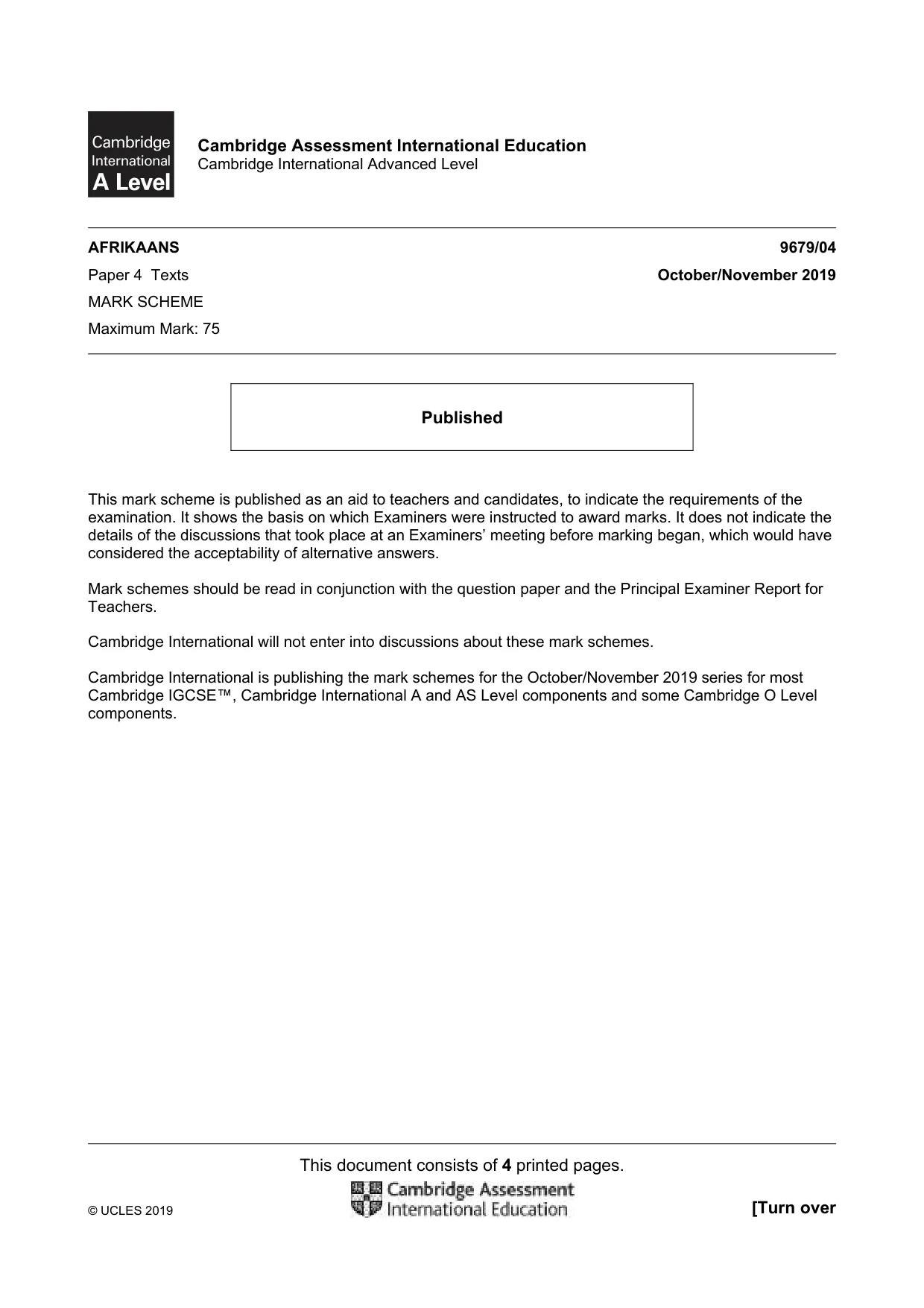
5 9679/04/O/N/19 © UCLES 2019 Afdeling 2 4 Die groot anders-maak, Jan Rabie Kies vraag (a) of vraag (b). Óf: (a) “Die roman beeld die einde van die Khoi-kultuur en lewenswyse uit.” Bespreek. Óf: (b) “Maar hy kan nie die sagte smeking in die ou oë weerstaan nie.” Evalueer die verhouding tussen Damoeb en Oasib in die roman. 5 Mirakel, Reza de Wet Kies vraag (a) of vraag (b). Óf: (a) “Die aansluiting by die toneelgeselskap bied slegs ʼn tydelike ontvlugting vir Abel.” Bespreek hierdie stelling. Óf: (b) “Die belangrikste tema in die toneelstuk is die magsverhoudings tussen mense.” Tot watter mate stem jy saam met hierdie stelling? 6 Siener in die suburbs, PG du Plessis Kies vraag (a) of vraag (b). Óf: (a) Analiseer en bespreek die titel met verwysing na die toneelstuk. Óf: (b) “Ek het jou geglo toe ons klein was en saam gesit en speel het ons bly anderkant die spoor en Ma is getroud … ek het saam met jou gehoop.” Bespreek Tjokkie en Tiemie se verhouding met verwysing na hierdie aanhaling en die toneelstuk as geheel.
Question paper, page 6
6 9679/04/O/N/19 © UCLES 2019 BLANK PAGE
Question paper, page 7
7 9679/04/O/N/19 © UCLES 2019 BLANK PAGE
Question paper, page 8
8 9679/04/O/N/19 © UCLES 2019 Permission to reproduce items where third-party owned material protected by copyright is included has been sought and cleared where possible. Every reasonable effort has been made by the publisher (UCLES) to trace copyright holders, but if any items requiring clearance have unwittingly been included, the publisher will be pleased to make amends at the earliest possible opportunity. To avoid the issue of disclosure of answer-related information to candidates, all copyright acknowledgements are reproduced online in the Cambridge Assessment International Education Copyright Acknowledgements Booklet. This is produced for each series of examinations and is freely available to download at www.cambridgeinternational.org after the live examination series. Cambridge Assessment International Education is part of the Cambridge Assessment Group. Cambridge Assessment is the brand name of the University of Cambridge Local Examinations Syndicate (UCLES), which itself is a department of the University of Cambridge. BLANK PAGE
Mark scheme, page 1
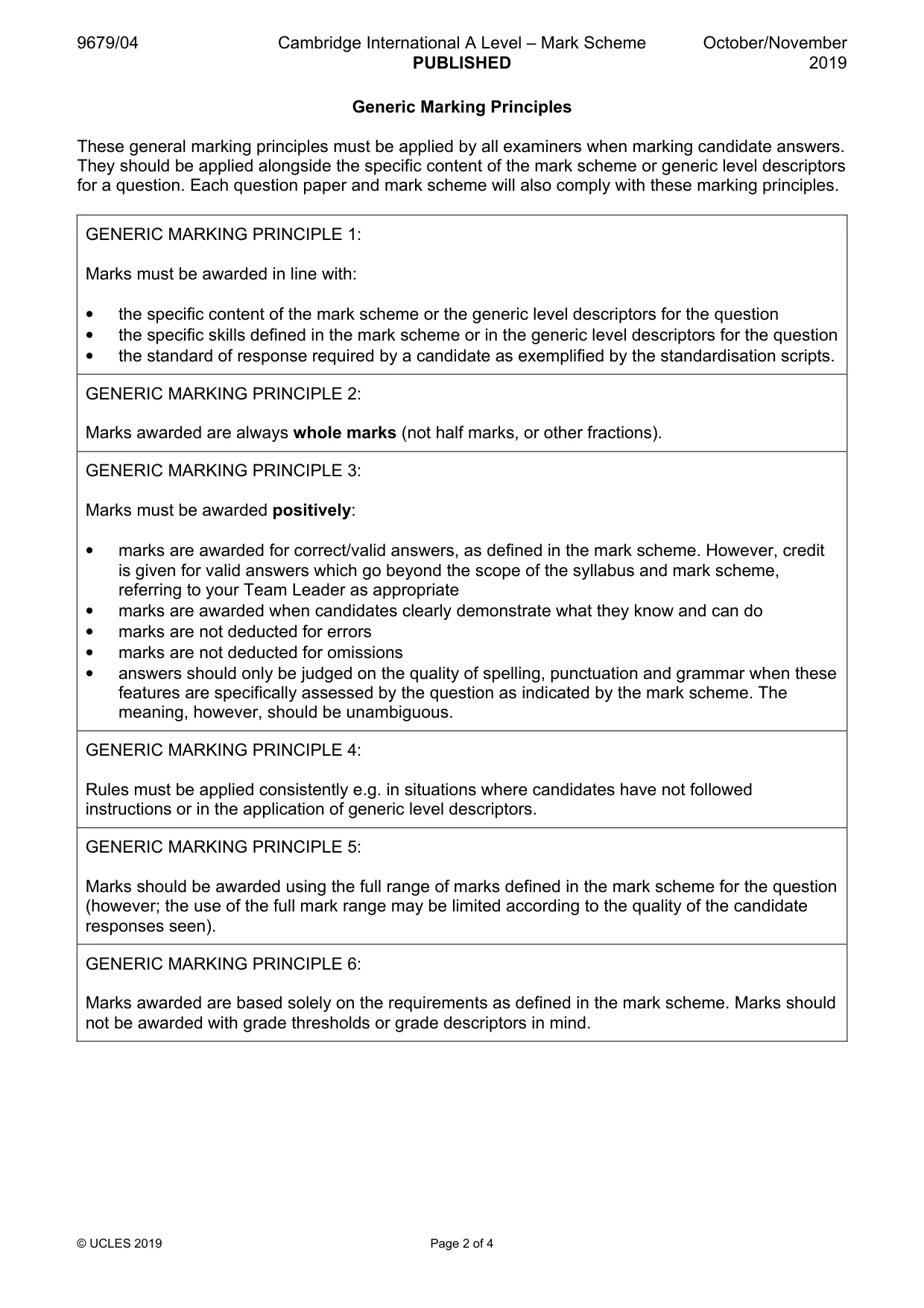
This document consists of 4 printed pages. © UCLES 2019 [Turn over Cambridge Assessment International Education Cambridge International Advanced Level AFRIKAANS 9679/04 Paper 4 Texts October/November 2019 MARK SCHEME Maximum Mark: 75 Published This mark scheme is published as an aid to teachers and candidates, to indicate the requirements of the examination. It shows the basis on which Examiners were instructed to award marks. It does not indicate the details of the discussions that took place at an Examiners’ meeting before marking began, which would have considered the acceptability of alternative answers. Mark schemes should be read in conjunction with the question paper and the Principal Examiner Report for Teachers. Cambridge International will not enter into discussions about these mark schemes. Cambridge International is publishing the mark schemes for the October/November 2019 series for most Cambridge IGCSE™, Cambridge International A and AS Level components and some Cambridge O Level components.
Mark scheme, page 2
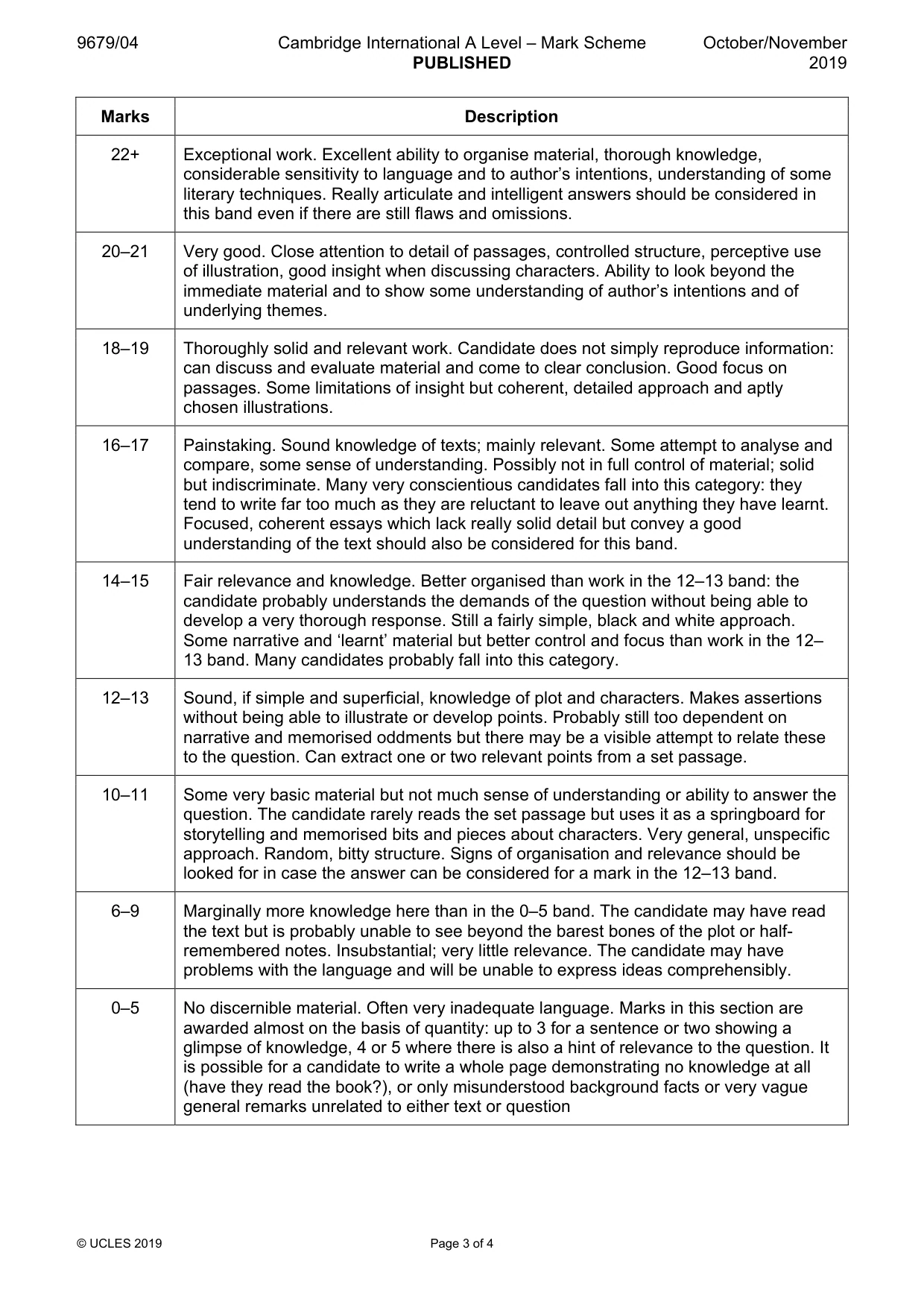
9679/04 Cambridge International A Level – Mark Scheme PUBLISHED October/November 2019 © UCLES 2019 Page 2 of 4 Generic Marking Principles These general marking principles must be applied by all examiners when marking candidate answers. They should be applied alongside the specific content of the mark scheme or generic level descriptors for a question. Each question paper and mark scheme will also comply with these marking principles. GENERIC MARKING PRINCIPLE 1: Marks must be awarded in line with: • the specific content of the mark scheme or the generic level descriptors for the question • the specific skills defined in the mark scheme or in the generic level descriptors for the question • the standard of response required by a candidate as exemplified by the standardisation scripts. GENERIC MARKING PRINCIPLE 2: Marks awarded are always whole marks (not half marks, or other fractions). GENERIC MARKING PRINCIPLE 3: Marks must be awarded positively: • marks are awarded for correct/valid answers, as defined in the mark scheme. However, credit is given for valid answers which go beyond the scope of the syllabus and mark scheme, referring to your Team Leader as appropriate • marks are awarded when candidates clearly demonstrate what they know and can do • marks are not deducted for errors • marks are not deducted for omissions • answers should only be judged on the quality of spelling, punctuation and grammar when these features are specifically assessed by the question as indicated by the mark scheme. The meaning, however, should be unambiguous. GENERIC MARKING PRINCIPLE 4: Rules must be applied consistently e.g. in situations where candidates have not followed instructions or in the application of generic level descriptors. GENERIC MARKING PRINCIPLE 5: Marks should be awarded using the full range of marks defined in the mark scheme for the question (however; the use of the full mark range may be limited according to the quality of the candidate responses seen). GENERIC MARKING PRINCIPLE 6: Marks awarded are based solely on the requirements as defined in the mark scheme. Marks should not be awarded with grade thresholds or grade descriptors in mind.
Mark scheme, page 3
9679/04 Cambridge International A Level – Mark Scheme PUBLISHED October/November 2019 © UCLES 2019 Page 3 of 4 Marks Description 22+ Exceptional work. Excellent ability to organise material, thorough knowledge, considerable sensitivity to language and to author’s intentions, understanding of some literary techniques. Really articulate and intelligent answers should be considered in this band even if there are still flaws and omissions. 20–21 Very good. Close attention to detail of passages, controlled structure, perceptive use of illustration, good insight when discussing characters. Ability to look beyond the immediate material and to show some understanding of author’s intentions and of underlying themes. 18–19 Thoroughly solid and relevant work. Candidate does not simply reproduce information: can discuss and evaluate material and come to clear conclusion. Good focus on passages. Some limitations of insight but coherent, detailed approach and aptly chosen illustrations. 16–17 Painstaking. Sound knowledge of texts; mainly relevant. Some attempt to analyse and compare, some sense of understanding. Possibly not in full control of material; solid but indiscriminate. Many very conscientious candidates fall into this category: they tend to write far too much as they are reluctant to leave out anything they have learnt. Focused, coherent essays which lack really solid detail but convey a good understanding of the text should also be considered for this band. 14–15 Fair relevance and knowledge. Better organised than work in the 12–13 band: the candidate probably understands the demands of the question without being able to develop a very thorough response. Still a fairly simple, black and white approach. Some narrative and ‘learnt’ material but better control and focus than work in the 12– 13 band. Many candidates probably fall into this category. 12–13 Sound, if simple and superficial, knowledge of plot and characters. Makes assertions without being able to illustrate or develop points. Probably still too dependent on narrative and memorised oddments but there may be a visible attempt to relate these to the question. Can extract one or two relevant points from a set passage. 10–11 Some very basic material but not much sense of understanding or ability to answer the question. The candidate rarely reads the set passage but uses it as a springboard for storytelling and memorised bits and pieces about characters. Very general, unspecific approach. Random, bitty structure. Signs of organisation and relevance should be looked for in case the answer can be considered for a mark in the 12–13 band. 6–9 Marginally more knowledge here than in the 0–5 band. The candidate may have read the text but is probably unable to see beyond the barest bones of the plot or half- remembered notes. Insubstantial; very little relevance. The candidate may have problems with the language and will be unable to express ideas comprehensibly. 0–5 No discernible material. Often very inadequate language. Marks in this section are awarded almost on the basis of quantity: up to 3 for a sentence or two showing a glimpse of knowledge, 4 or 5 where there is also a hint of relevance to the question. It is possible for a candidate to write a whole page demonstrating no knowledge at all (have they read the book?), or only misunderstood background facts or very vague general remarks unrelated to either text or question
Mark scheme, page 4
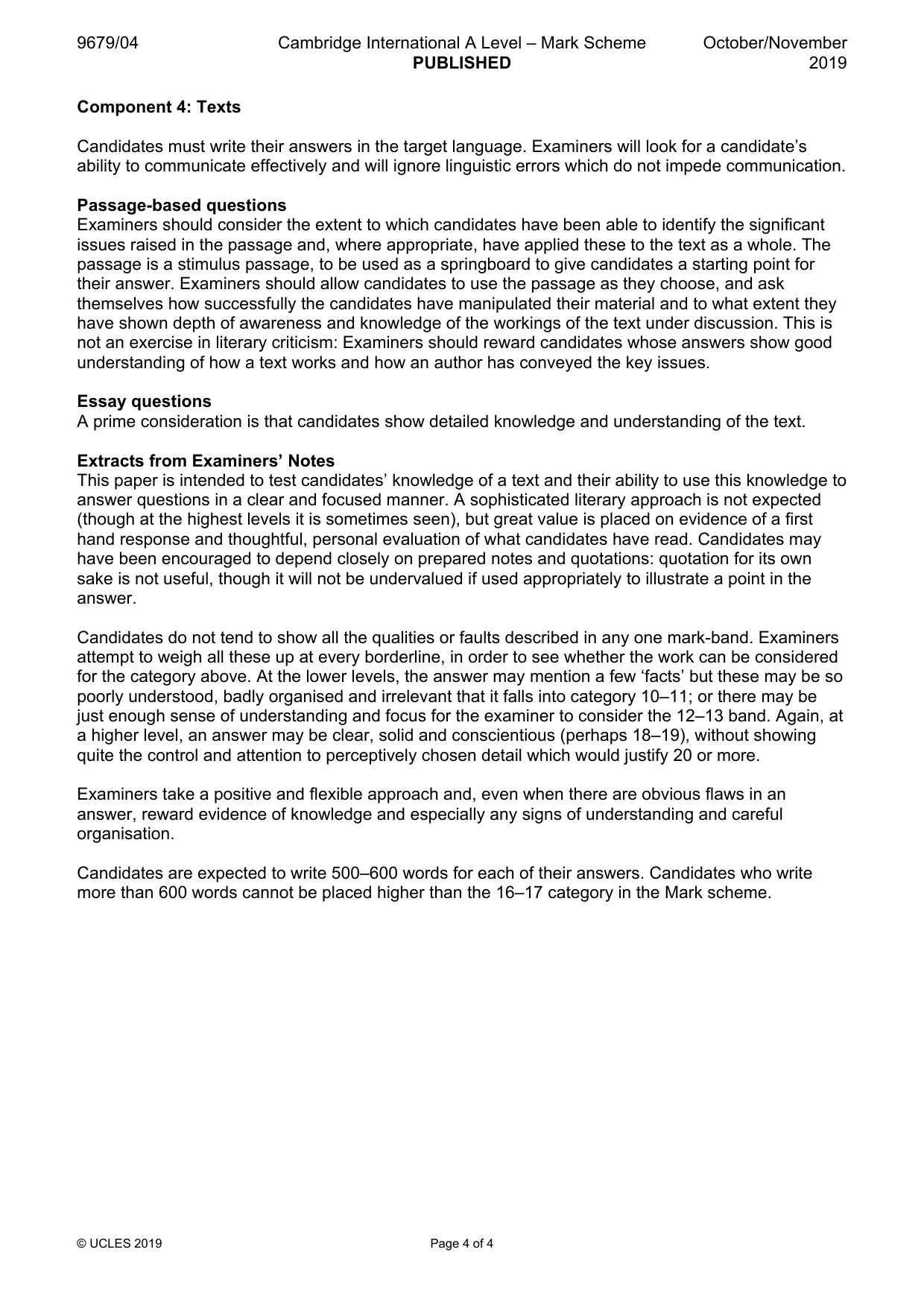
9679/04 Cambridge International A Level – Mark Scheme PUBLISHED October/November 2019 © UCLES 2019 Page 4 of 4 Component 4: Texts Candidates must write their answers in the target language. Examiners will look for a candidate’s ability to communicate effectively and will ignore linguistic errors which do not impede communication. Passage-based questions Examiners should consider the extent to which candidates have been able to identify the significant issues raised in the passage and, where appropriate, have applied these to the text as a whole. The passage is a stimulus passage, to be used as a springboard to give candidates a starting point for their answer. Examiners should allow candidates to use the passage as they choose, and ask themselves how successfully the candidates have manipulated their material and to what extent they have shown depth of awareness and knowledge of the workings of the text under discussion. This is not an exercise in literary criticism: Examiners should reward candidates whose answers show good understanding of how a text works and how an author has conveyed the key issues. Essay questions A prime consideration is that candidates show detailed knowledge and understanding of the text. Extracts from Examiners’ Notes This paper is intended to test candidates’ knowledge of a text and their ability to use this knowledge to answer questions in a clear and focused manner. A sophisticated literary approach is not expected (though at the highest levels it is sometimes seen), but great value is placed on evidence of a first hand response and thoughtful, personal evaluation of what candidates have read. Candidates may have been encouraged to depend closely on prepared notes and quotations: quotation for its own sake is not useful, though it will not be undervalued if used appropriately to illustrate a point in the answer. Candidates do not tend to show all the qualities or faults described in any one mark-band. Examiners attempt to weigh all these up at every borderline, in order to see whether the work can be considered for the category above. At the lower levels, the answer may mention a few ‘facts’ but these may be so poorly understood, badly organised and irrelevant that it falls into category 10–11; or there may be just enough sense of understanding and focus for the examiner to consider the 12–13 band. Again, at a higher level, an answer may be clear, solid and conscientious (perhaps 18–19), without showing quite the control and attention to perceptively chosen detail which would justify 20 or more. Examiners take a positive and flexible approach and, even when there are obvious flaws in an answer, reward evidence of knowledge and especially any signs of understanding and careful organisation. Candidates are expected to write 500–600 words for each of their answers. Candidates who write more than 600 words cannot be placed higher than the 16–17 category in the Mark scheme.
What you needed in this session
Cambridge’s own grade thresholds for 2019 Oct/Nov, Paper 4 · Variant 1. A higher threshold means an easier paper — the bar moves with how the cohort did.