Cambridge A Level Accounting 9706 — 2020 May/June Paper 3 · Variant 3
9706/33/M/J/20
The question paper and its mark scheme, free to read here and free to download. This is Cambridge’s own paper, exactly as it was sat.
Question paper28 pages


Mark scheme15 pages
Answers below. Sit the paper first if you are practising.
Paper as text
Question paper, page 1
Cambridge International AS & A Level * 0 5 3 5 4 2 8 4 4 5 * This document has 28 pages. Blank pages are indicated. DC (JC) 181771/4 © UCLES 2020 [Turn over ACCOUNTING 9706/33 Paper 3 Structured Questions May/June 2020 3 hours You must answer on the question paper. You will need: Insert (enclosed) INSTRUCTIONS ● Answer all questions. ● Use a black or dark blue pen. ● Write your name, centre number and candidate number in the boxes at the top of the page. ● Write your answer to each question in the space provided. ● Do not use an erasable pen or correction fluid. ● Do not write on any bar codes. ● You may use an HB pencil for any diagrams, graphs or rough working. ● You may use a calculator. ● International accounting terms and formats should be used as appropriate. ● You should show your workings. INFORMATION ● The total mark for this paper is 150. ● The number of marks for each question or part question is shown in brackets [ ]. ● The insert contains all of the required information and questions.
Question paper, page 2
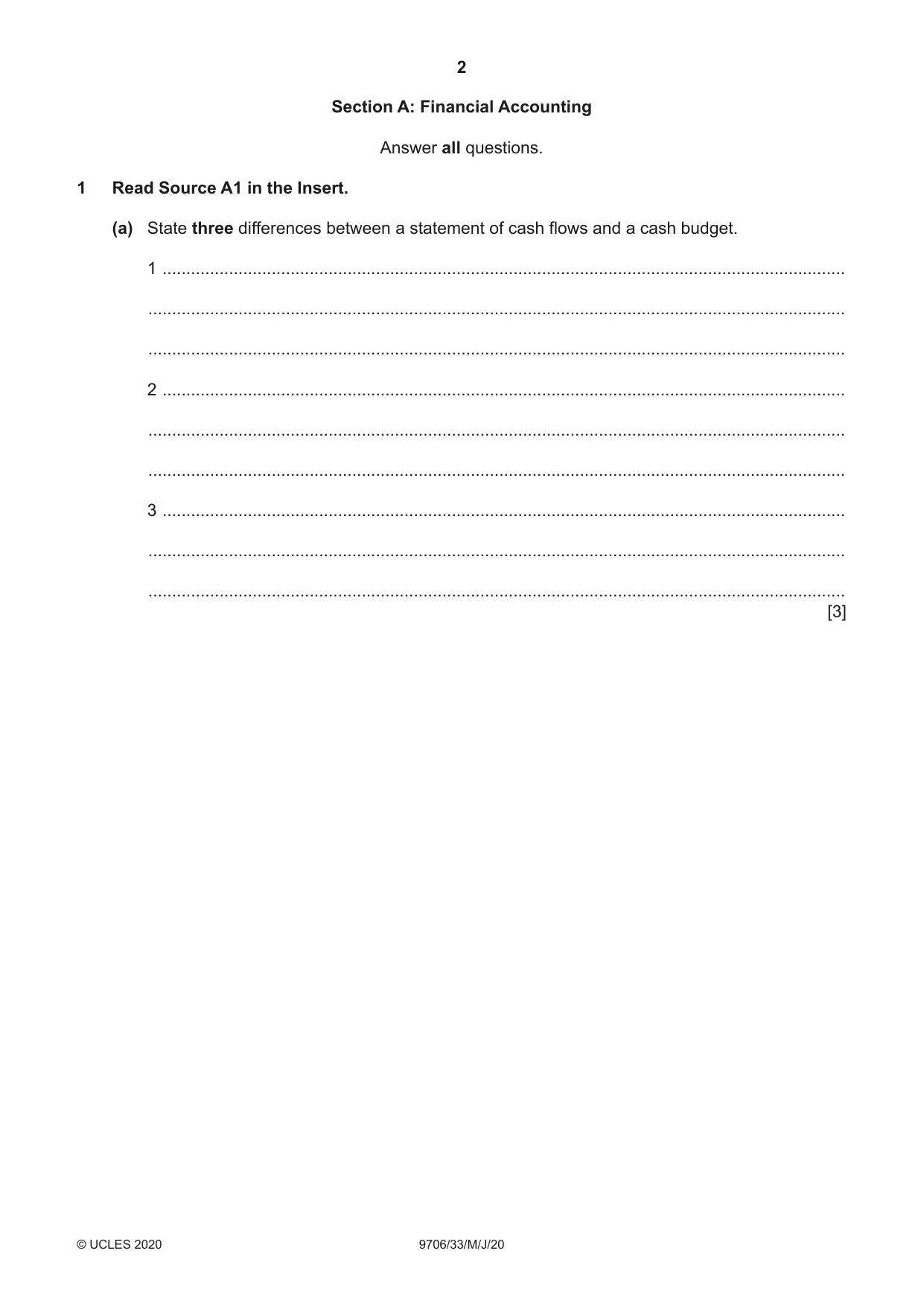
2 9706/33/M/J/20 © UCLES 2020 Section A: Financial Accounting Answer all questions. 1 Read Source A1 in the Insert. (a) State three differences between a statement of cash flows and a cash budget. 1 … … … 2 … … … 3 … … … [3]
Question paper, page 3
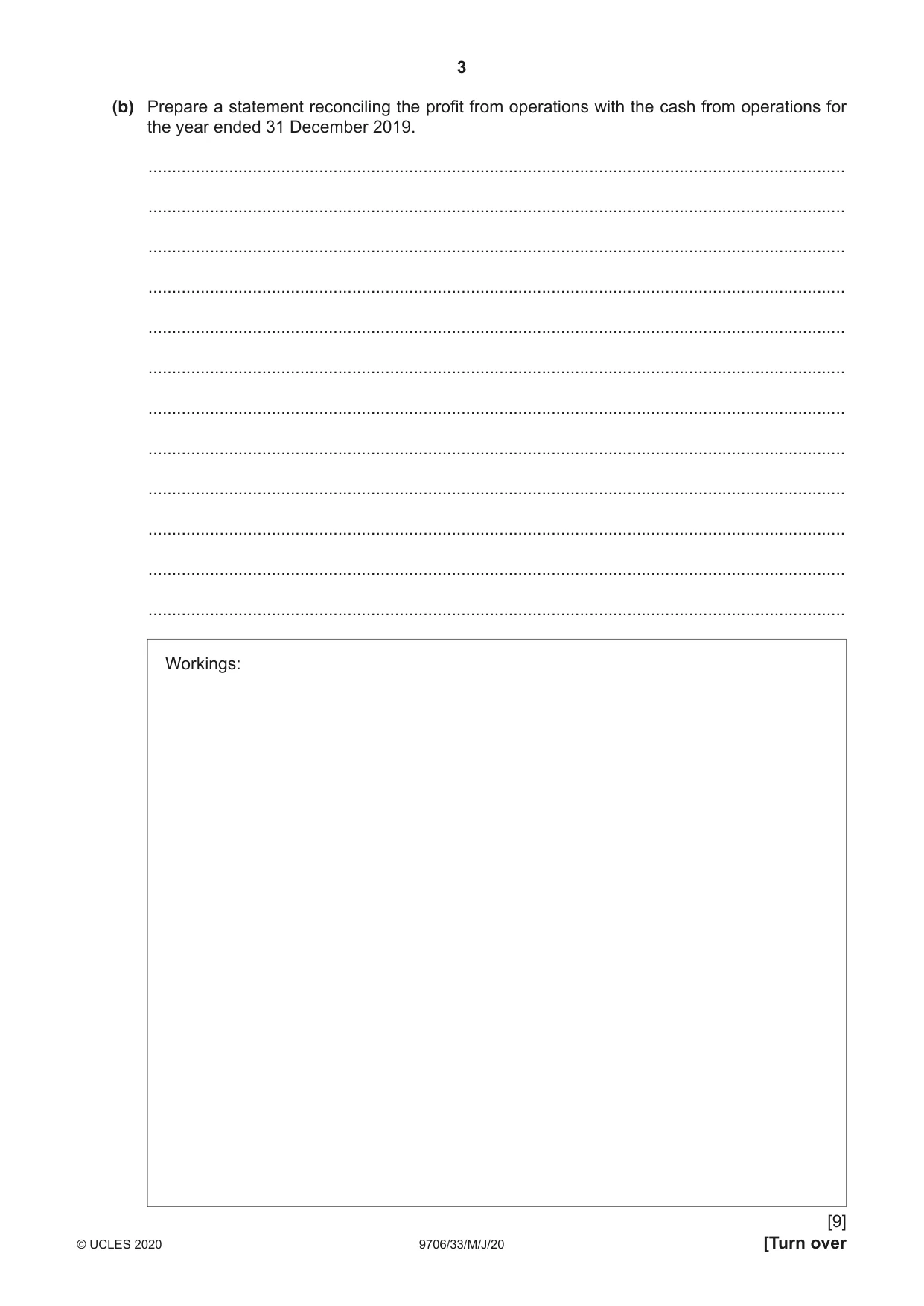
3 9706/33/M/J/20 © UCLES 2020 [Turn over (b) Prepare a statement reconciling the profit from operations with the cash from operations for the year ended 31 December 2019. … … … … … … … … … … … … Workings: [9]
Question paper, page 4
4 9706/33/M/J/20 © UCLES 2020 (c) Prepare a statement of cash flows for the year ended 31 December 2019. Start your answer with cash from operations from (b). … … … … … … … … … … … … … … … … … … … … … … … … … … … [7]
Question paper, page 5
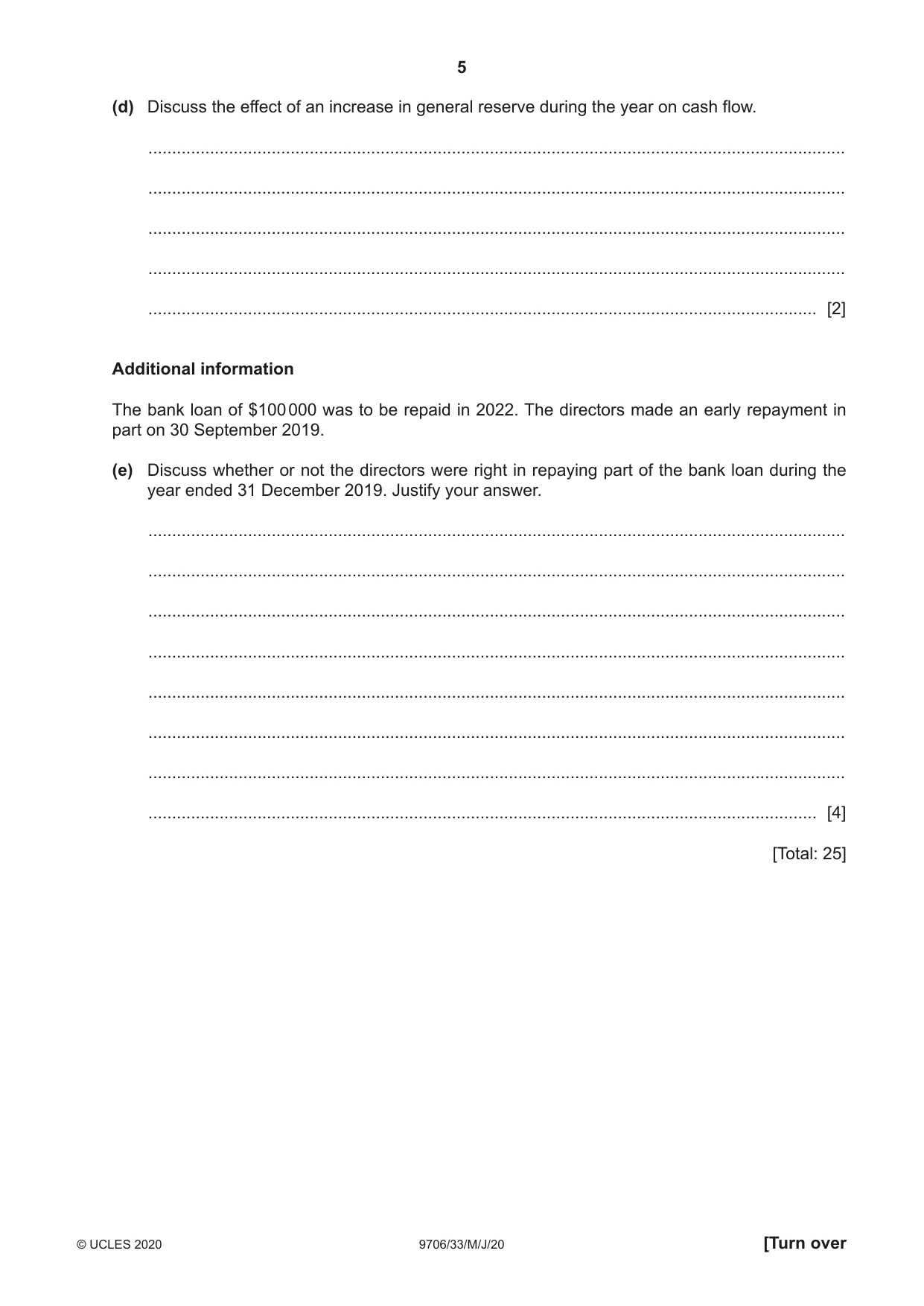
5 9706/33/M/J/20 © UCLES 2020 [Turn over (d) Discuss the effect of an increase in general reserve during the year on cash flow. … … … … … [2] Additional information The bank loan of $100 000 was to be repaid in 2022. The directors made an early repayment in part on 30 September 2019. (e) Discuss whether or not the directors were right in repaying part of the bank loan during the year ended 31 December 2019. Justify your answer. … … … … … … … … [4] [Total: 25]
Question paper, page 6
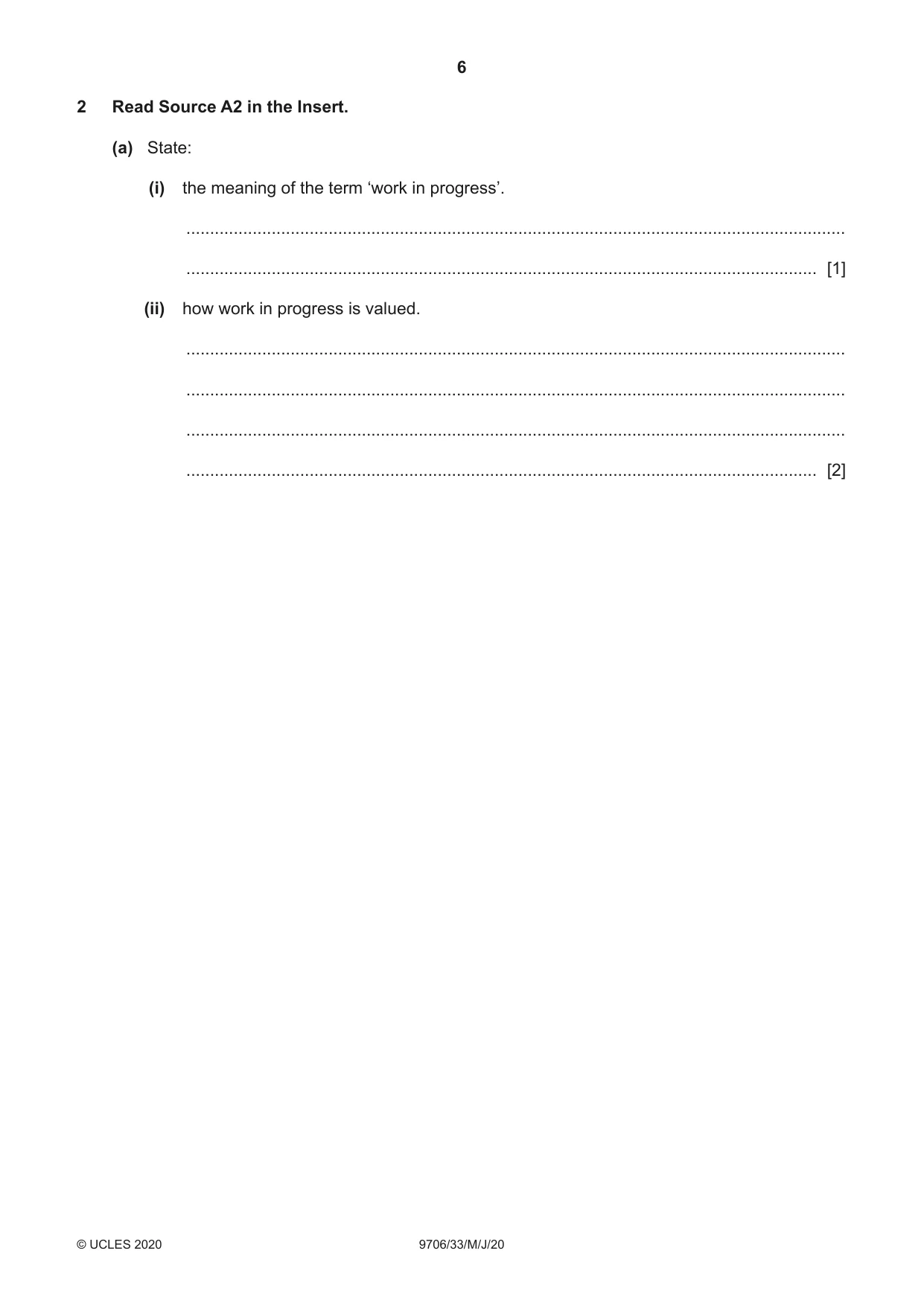
6 9706/33/M/J/20 © UCLES 2020 2 Read Source A2 in the Insert. (a) State: (i) the meaning of the term ‘work in progress’. … … [1] (ii) how work in progress is valued. … … … … [2]
Question paper, page 7
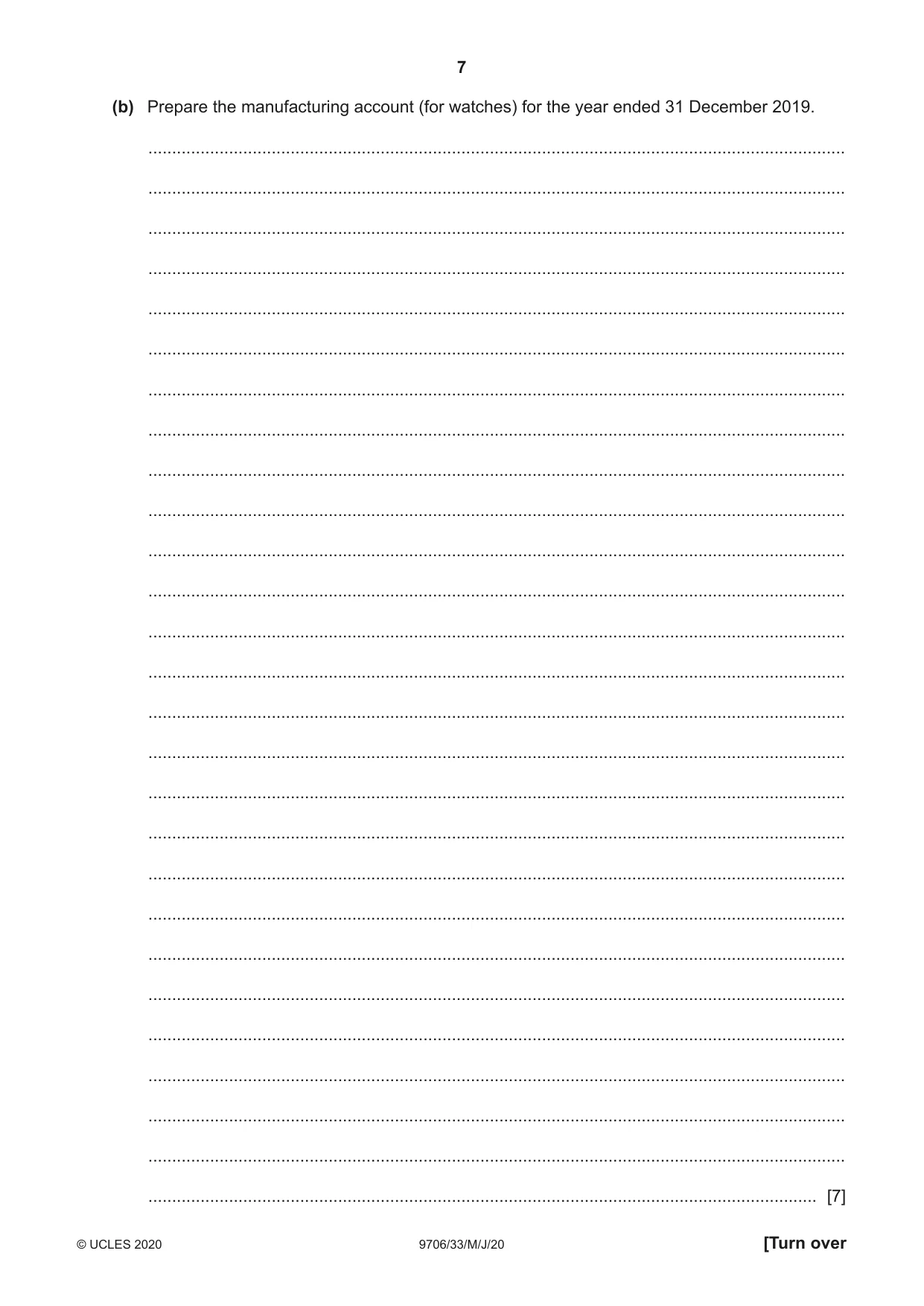
7 9706/33/M/J/20 © UCLES 2020 [Turn over (b) Prepare the manufacturing account (for watches) for the year ended 31 December 2019. … … … … … … … … … … … … … … … … … … … … … … … … … … … [7]
Question paper, page 8
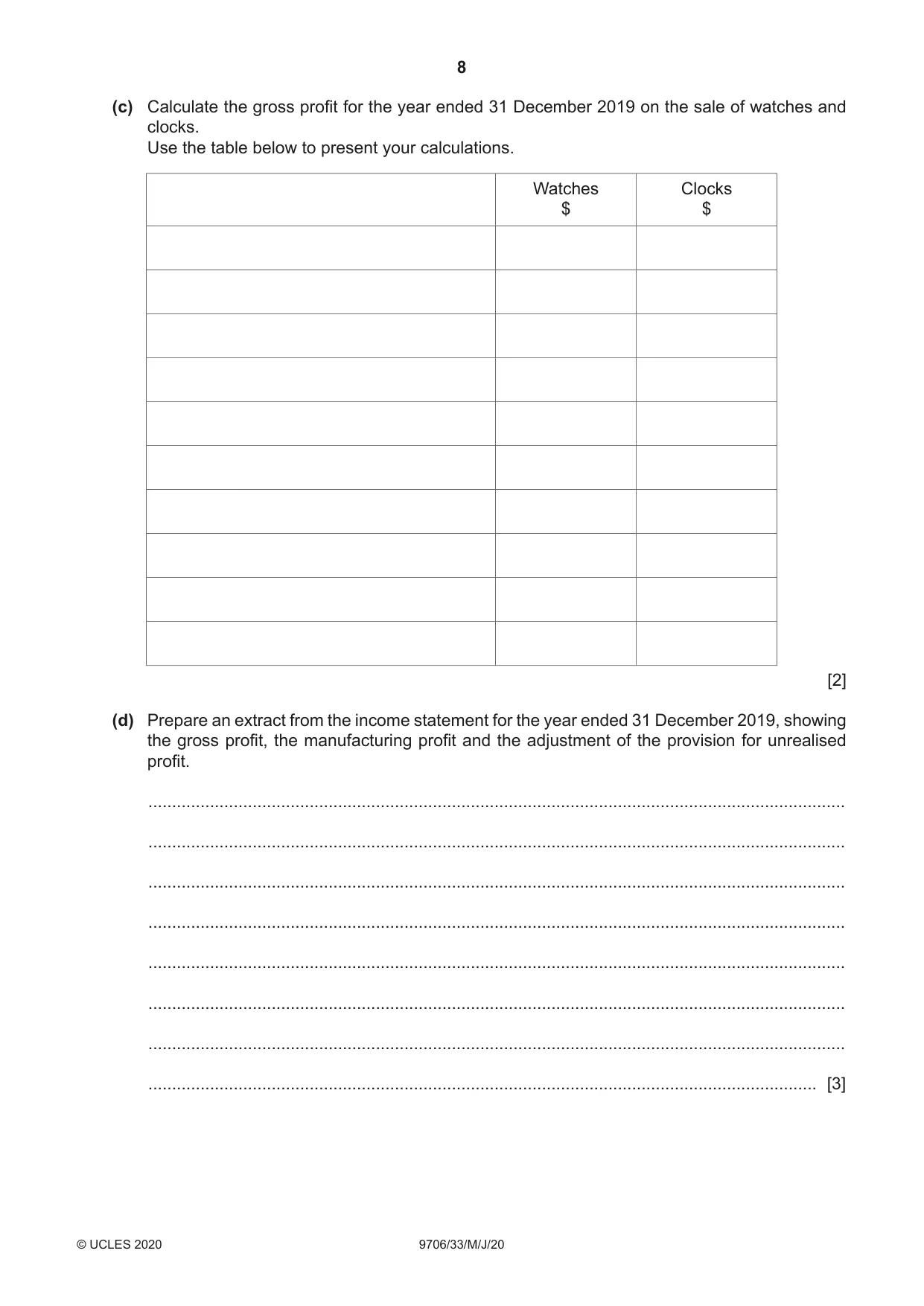
8 9706/33/M/J/20 © UCLES 2020 (c) Calculate the gross profit for the year ended 31 December 2019 on the sale of watches and clocks. Use the table below to present your calculations. Watches $ Clocks $ [2] (d) Prepare an extract from the income statement for the year ended 31 December 2019, showing the gross profit, the manufacturing profit and the adjustment of the provision for unrealised profit. … … … … … … … … [3]
Question paper, page 9
9 9706/33/M/J/20 © UCLES 2020 [Turn over (e) Explain the accounting treatment in the income statement and the statement of financial position of the provision for unrealised profit. Support your answer with reference to the accounting concepts. … … … … … … … … … … [5] Additional information The directors are considering whether they should stop selling watches and sell only clocks in the future. (f) Advise the directors whether they should sell only clocks in the future. Justify your answer with reference to your calculations in (c) and (d). … … … … … … … … … … [5] [Total: 25]
Question paper, page 10
10 9706/33/M/J/20 © UCLES 2020 3 Read Source A3 in the Insert. (a) Calculate the purchase consideration payable by X Limited. … … … … … … … … … … … … [4]
Question paper, page 11
11 9706/33/M/J/20 © UCLES 2020 [Turn over (b) Prepare the realisation account. … … … … … … … … … … … … … … … [7]
Question paper, page 12
12 9706/33/M/J/20 © UCLES 2020 Additional information It was agreed that the allocation of X Limited’s shares to the partners and the final settlement by the partners to or from the partnership bank account will go through the partners’ capital accounts. (c) Prepare partners’ capital accounts in a columnar form. … … … … … … … … … … … … … … [6]
Question paper, page 13
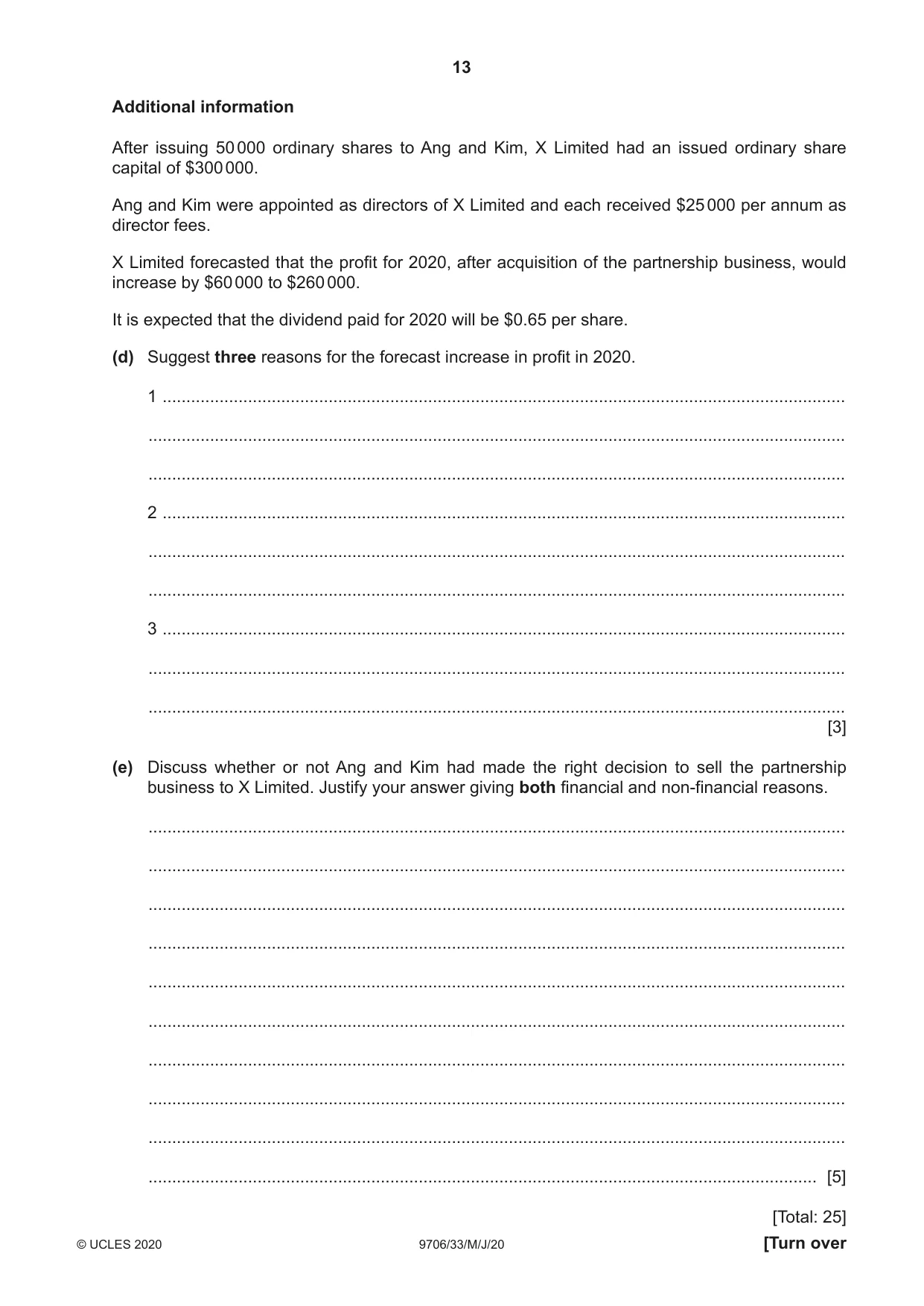
13 9706/33/M/J/20 © UCLES 2020 [Turn over Additional information After issuing 50 000 ordinary shares to Ang and Kim, X Limited had an issued ordinary share capital of $300 000. Ang and Kim were appointed as directors of X Limited and each received $25 000 per annum as director fees. X Limited forecasted that the profit for 2020, after acquisition of the partnership business, would increase by $60 000 to $260 000. It is expected that the dividend paid for 2020 will be $0.65 per share. (d) Suggest three reasons for the forecast increase in profit in 2020. 1 … … … 2 … … … 3 … … … [3] (e) Discuss whether or not Ang and Kim had made the right decision to sell the partnership business to X Limited. Justify your answer giving both financial and non-financial reasons. … … … … … … … … … … [5] [Total: 25]
Question paper, page 14
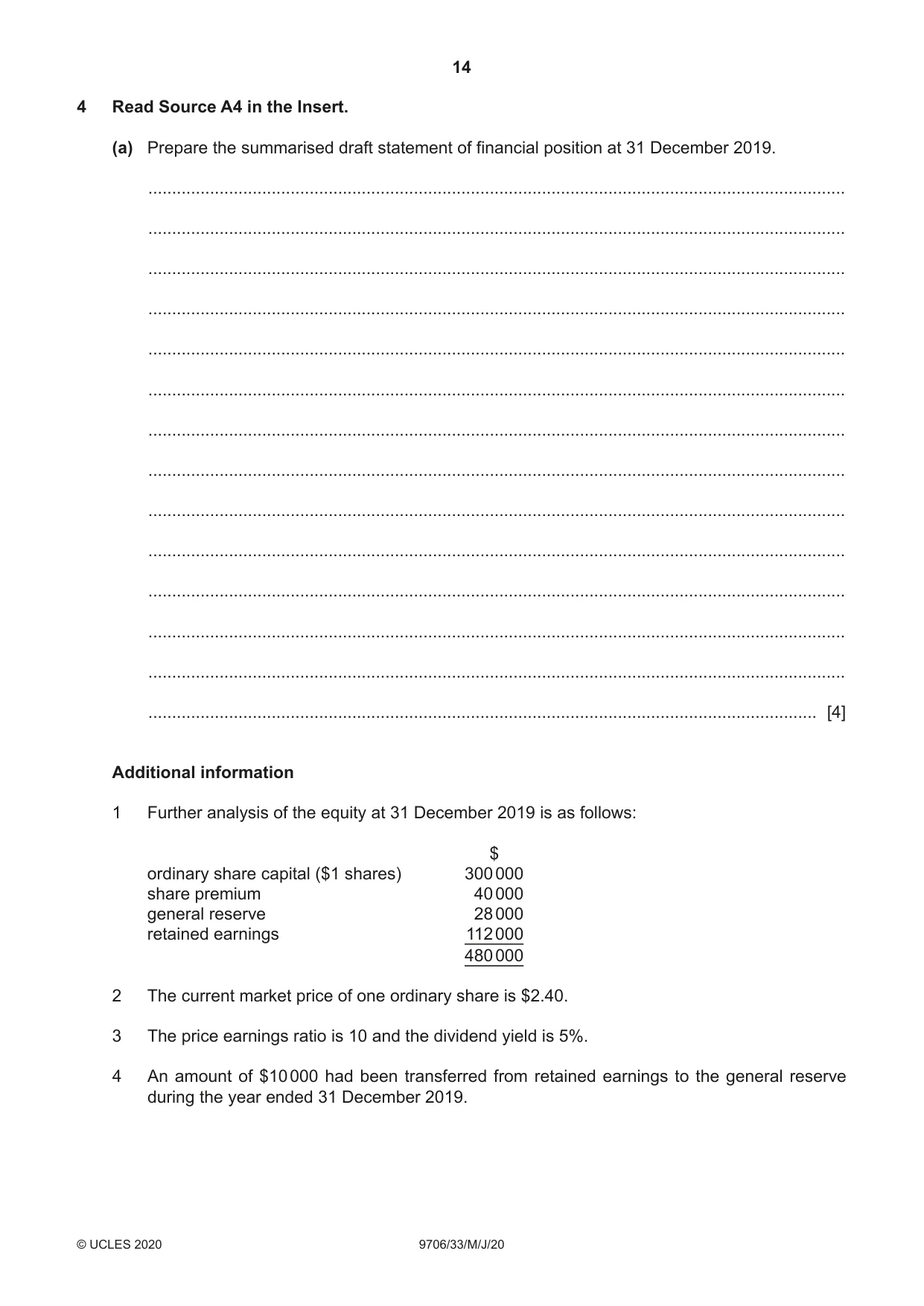
14 9706/33/M/J/20 © UCLES 2020 4 Read Source A4 in the Insert. (a) Prepare the summarised draft statement of financial position at 31 December 2019. … … … … … … … … … … … … … … [4] Additional information 1 Further analysis of the equity at 31 December 2019 is as follows: $ ordinary share capital ($1 shares) 300 000 share premium 40 000 general reserve 28 000 retained earnings 112 000 480 000 2 The current market price of one ordinary share is $2.40. 3 The price earnings ratio is 10 and the dividend yield is 5%. 4 An amount of $10 000 had been transferred from retained earnings to the general reserve during the year ended 31 December 2019.
Question paper, page 15
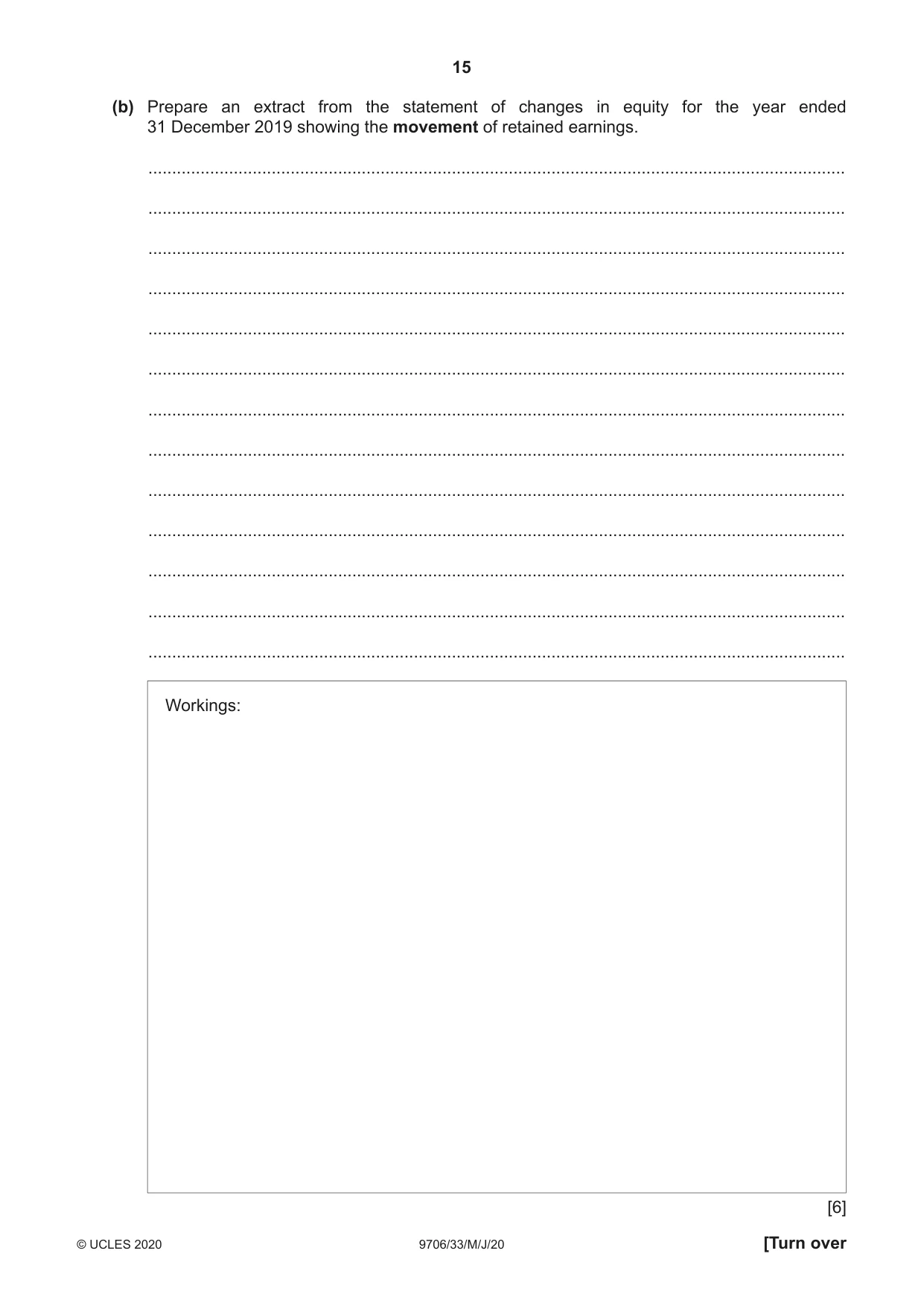
15 9706/33/M/J/20 © UCLES 2020 [Turn over (b) Prepare an extract from the statement of changes in equity for the year ended 31 December 2019 showing the movement of retained earnings. … … … … … … … … … … … … … Workings: [6]
Question paper, page 16
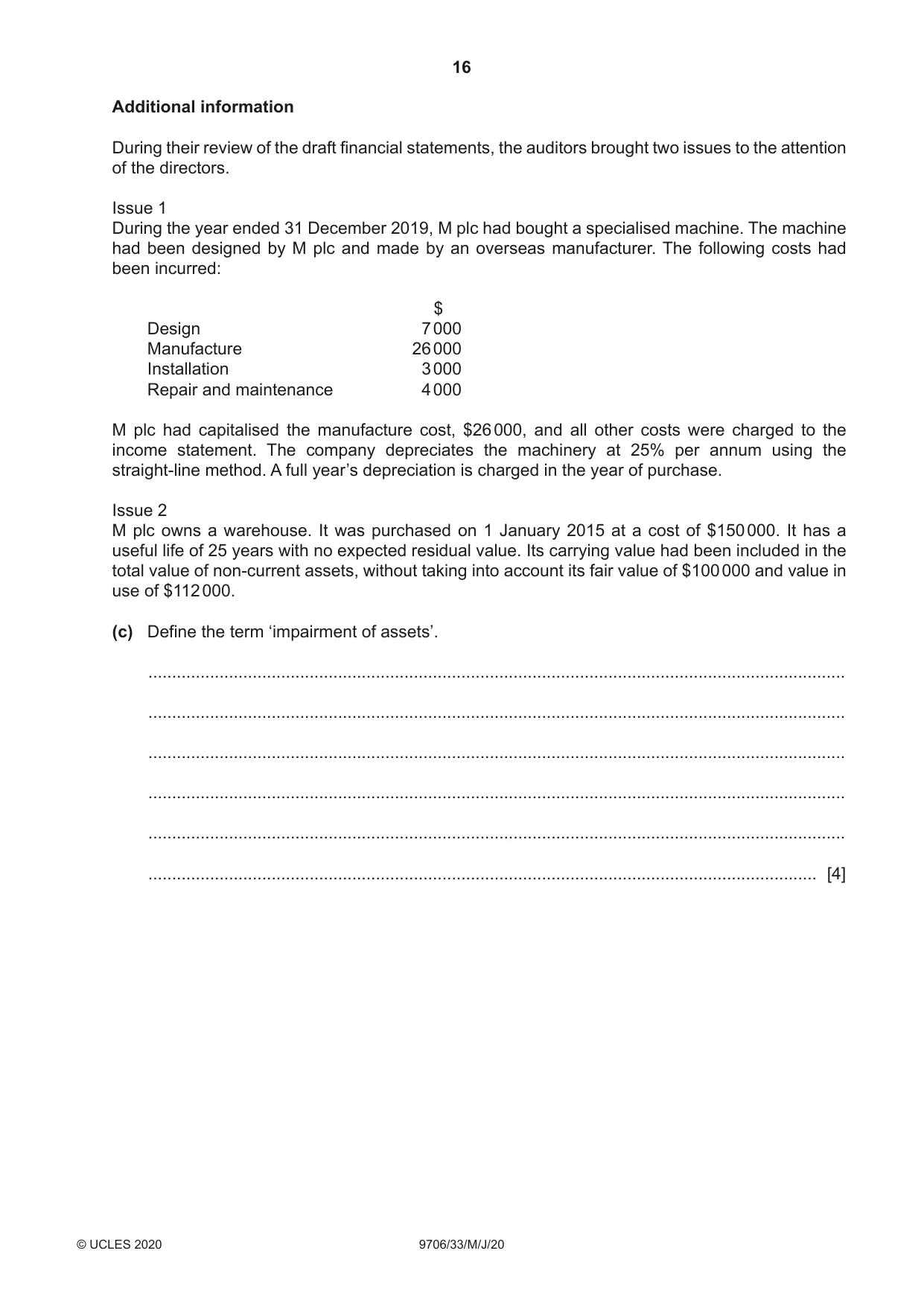
16 9706/33/M/J/20 © UCLES 2020 Additional information During their review of the draft financial statements, the auditors brought two issues to the attention of the directors. Issue 1 During the year ended 31 December 2019, M plc had bought a specialised machine. The machine had been designed by M plc and made by an overseas manufacturer. The following costs had been incurred: $ Design 7 000 Manufacture 26 000 Installation 3 000 Repair and maintenance 4 000 M plc had capitalised the manufacture cost, $26 000, and all other costs were charged to the income statement. The company depreciates the machinery at 25% per annum using the straight-line method. A full year’s depreciation is charged in the year of purchase. Issue 2 M plc owns a warehouse. It was purchased on 1 January 2015 at a cost of $150 000. It has a useful life of 25 years with no expected residual value. Its carrying value had been included in the total value of non-current assets, without taking into account its fair value of $100 000 and value in use of $112 000. (c) Define the term ‘impairment of assets’. … … … … … … [4]
Question paper, page 17
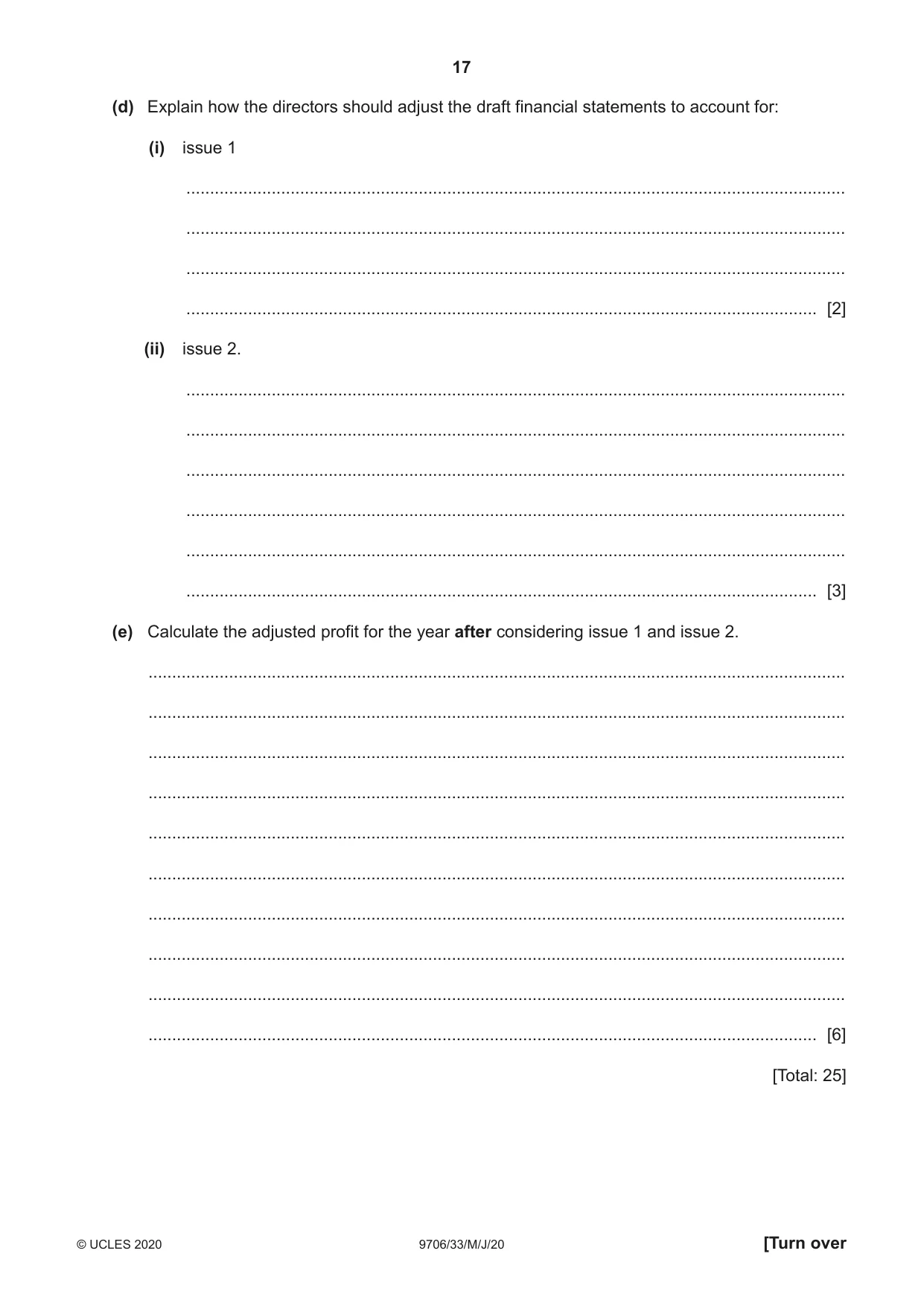
17 9706/33/M/J/20 © UCLES 2020 [Turn over (d) Explain how the directors should adjust the draft financial statements to account for: (i) issue 1 … … … … [2] (ii) issue 2. … … … … … … [3] (e) Calculate the adjusted profit for the year after considering issue 1 and issue 2. … … … … … … … … … … [6] [Total: 25]
Question paper, page 18
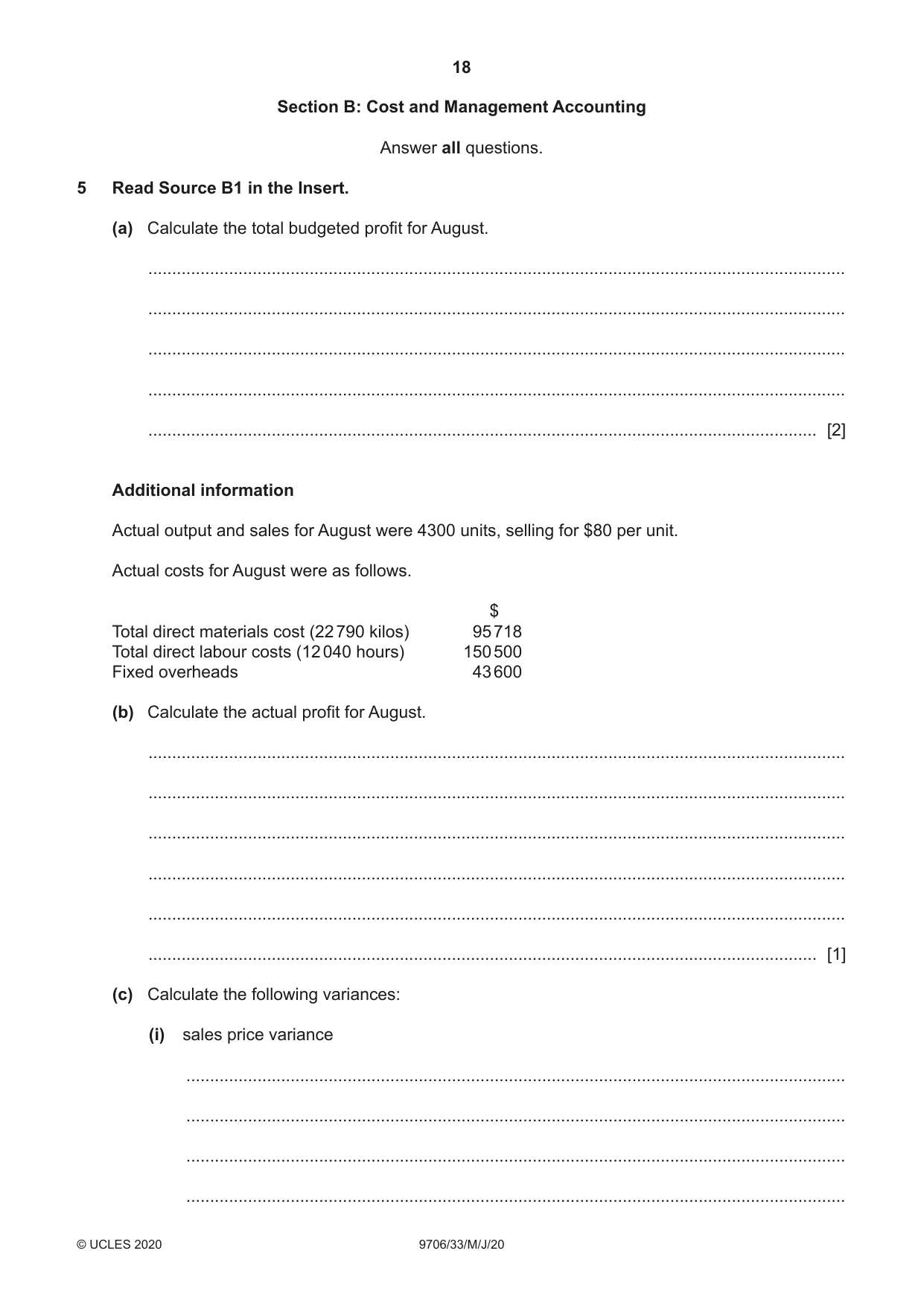
18 9706/33/M/J/20 © UCLES 2020 Section B: Cost and Management Accounting Answer all questions. 5 Read Source B1 in the Insert. (a) Calculate the total budgeted profit for August. … … … … … [2] Additional information Actual output and sales for August were 4300 units, selling for $80 per unit. Actual costs for August were as follows. $ Total direct materials cost (22 790 kilos) 95 718 Total direct labour costs (12 040 hours) 150 500 Fixed overheads 43 600 (b) Calculate the actual profit for August. … … … … … … [1] (c) Calculate the following variances: (i) sales price variance … … … …
Question paper, page 19
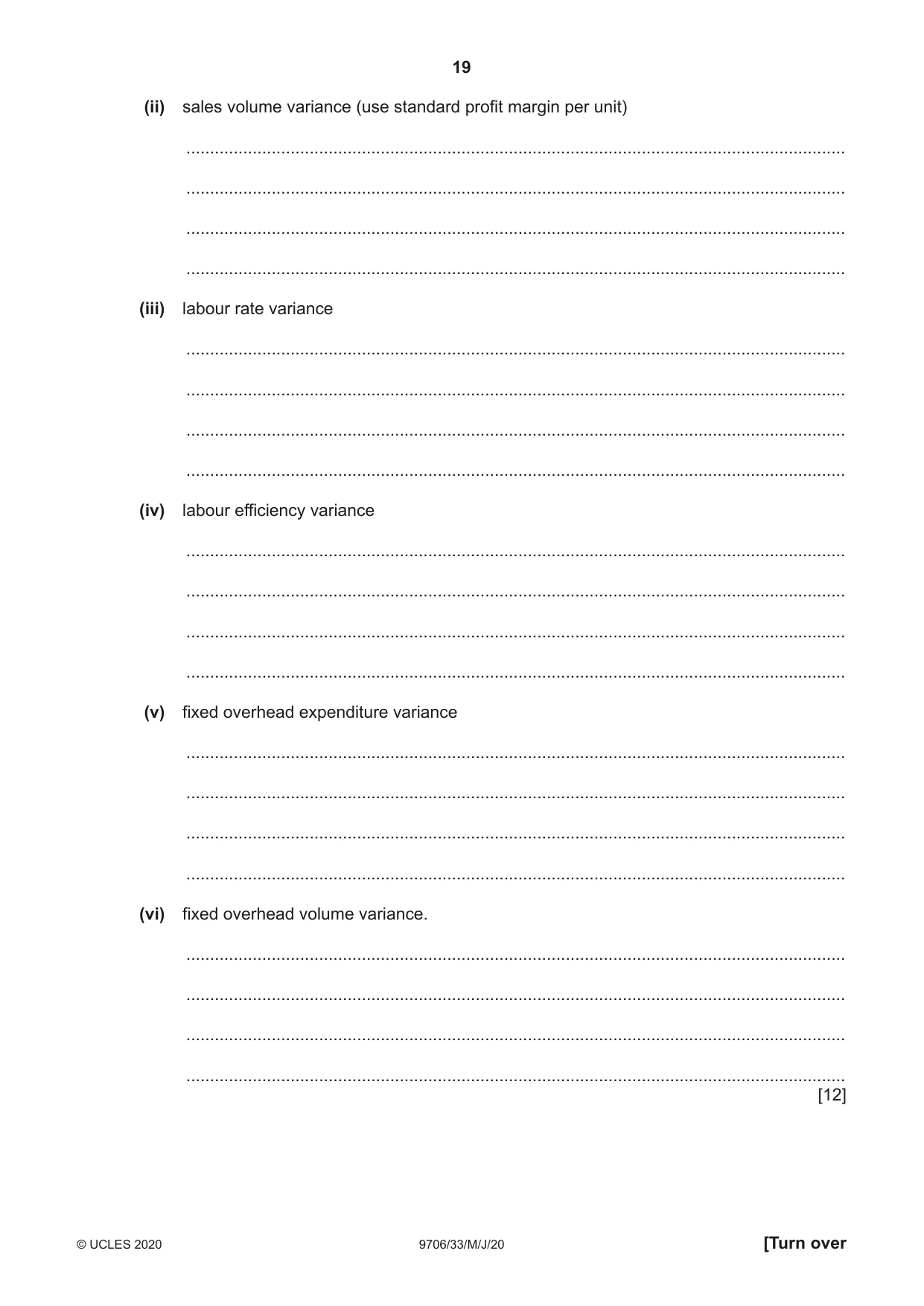
19 9706/33/M/J/20 © UCLES 2020 [Turn over (ii) sales volume variance (use standard profit margin per unit) … … … … (iii) labour rate variance … … … … (iv) labour efficiency variance … … … … (v) fixed overhead expenditure variance … … … … (vi) fixed overhead volume variance. … … … … [12]
Question paper, page 20
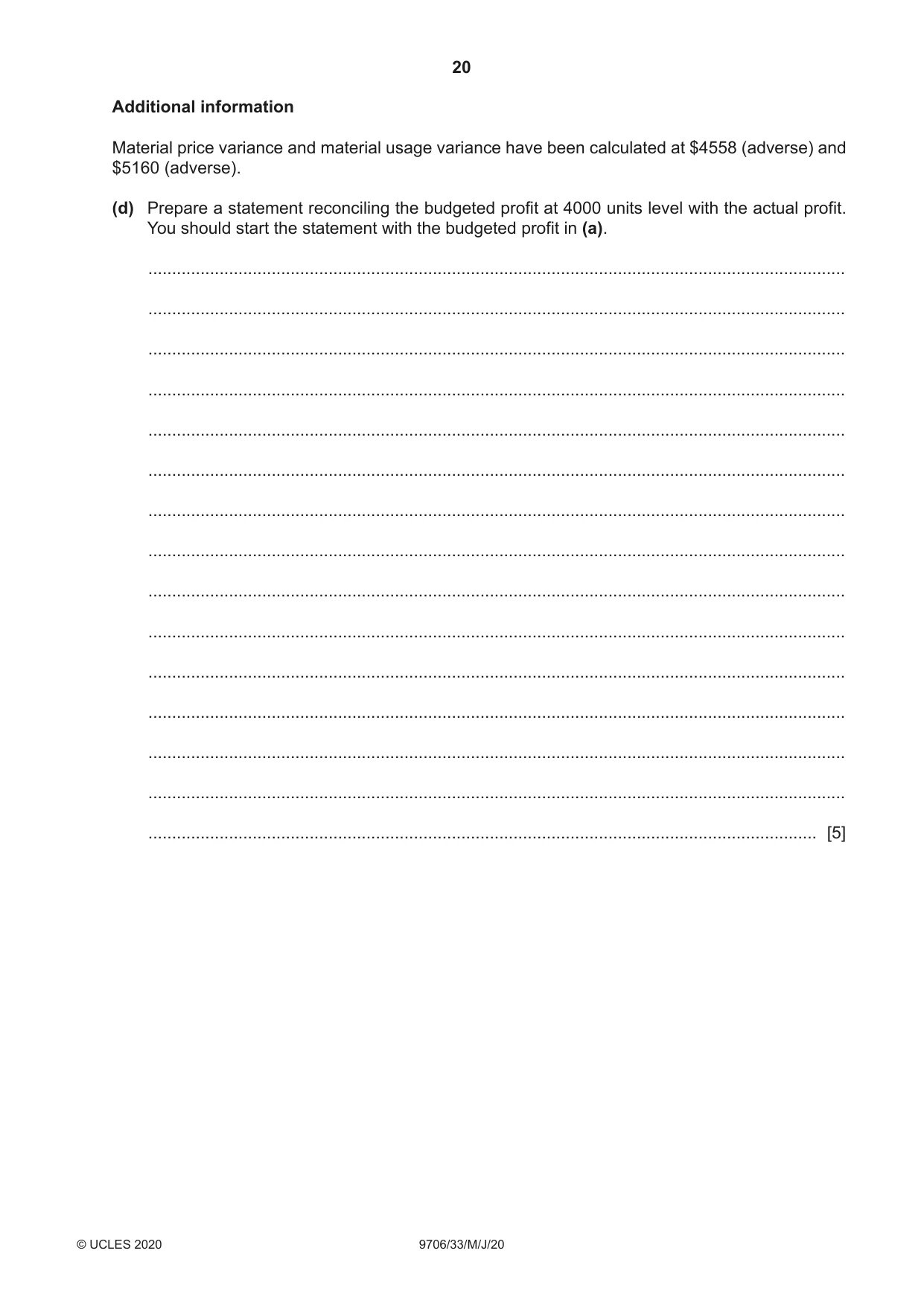
20 9706/33/M/J/20 © UCLES 2020 Additional information Material price variance and material usage variance have been calculated at $4558 (adverse) and $5160 (adverse). (d) Prepare a statement reconciling the budgeted profit at 4000 units level with the actual profit. You should start the statement with the budgeted profit in (a). … … … … … … … … … … … … … … … [5]
Question paper, page 21
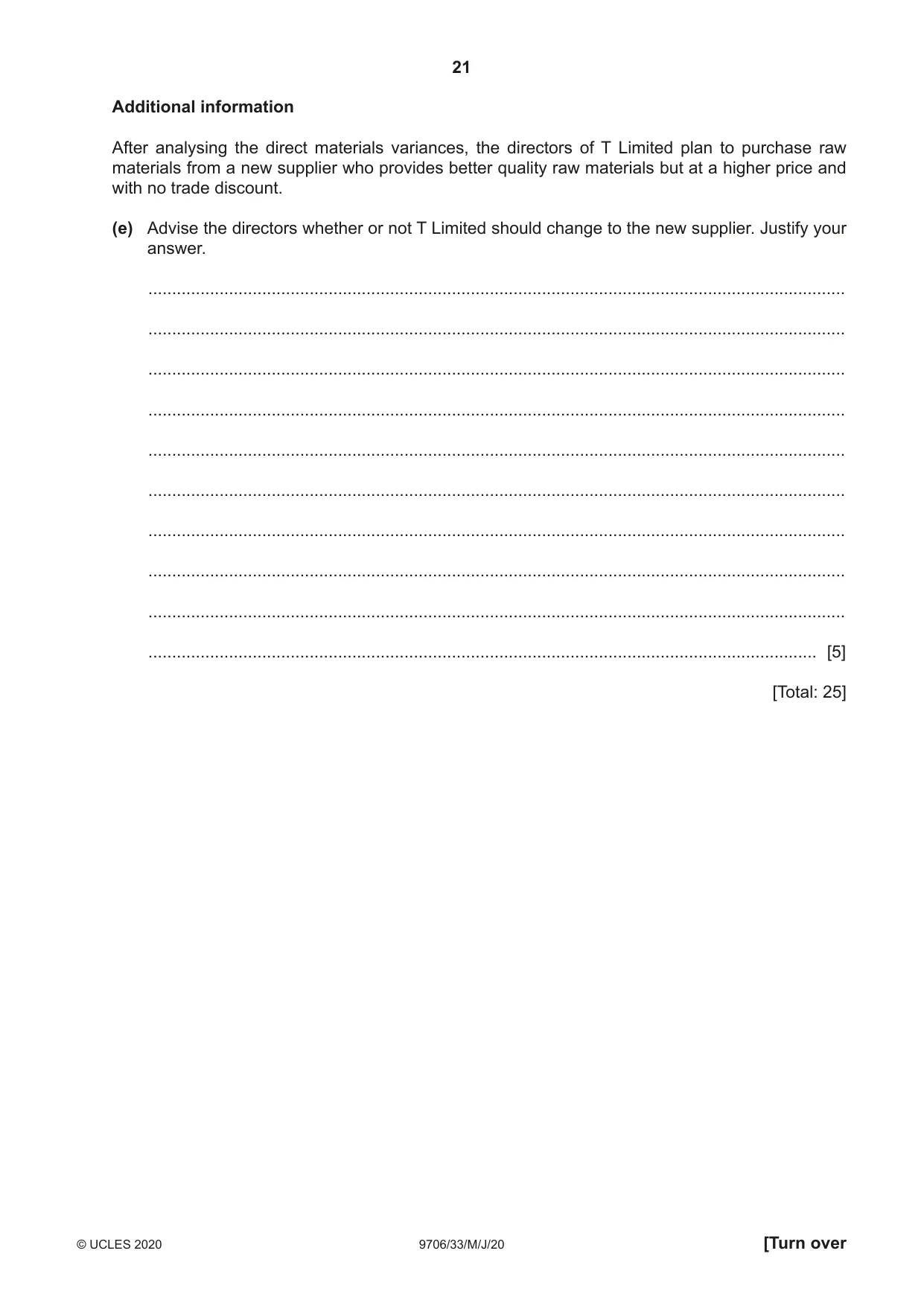
21 9706/33/M/J/20 © UCLES 2020 [Turn over Additional information After analysing the direct materials variances, the directors of T Limited plan to purchase raw materials from a new supplier who provides better quality raw materials but at a higher price and with no trade discount. (e) Advise the directors whether or not T Limited should change to the new supplier. Justify your answer. … … … … … … … … … … [5] [Total: 25]
Question paper, page 22
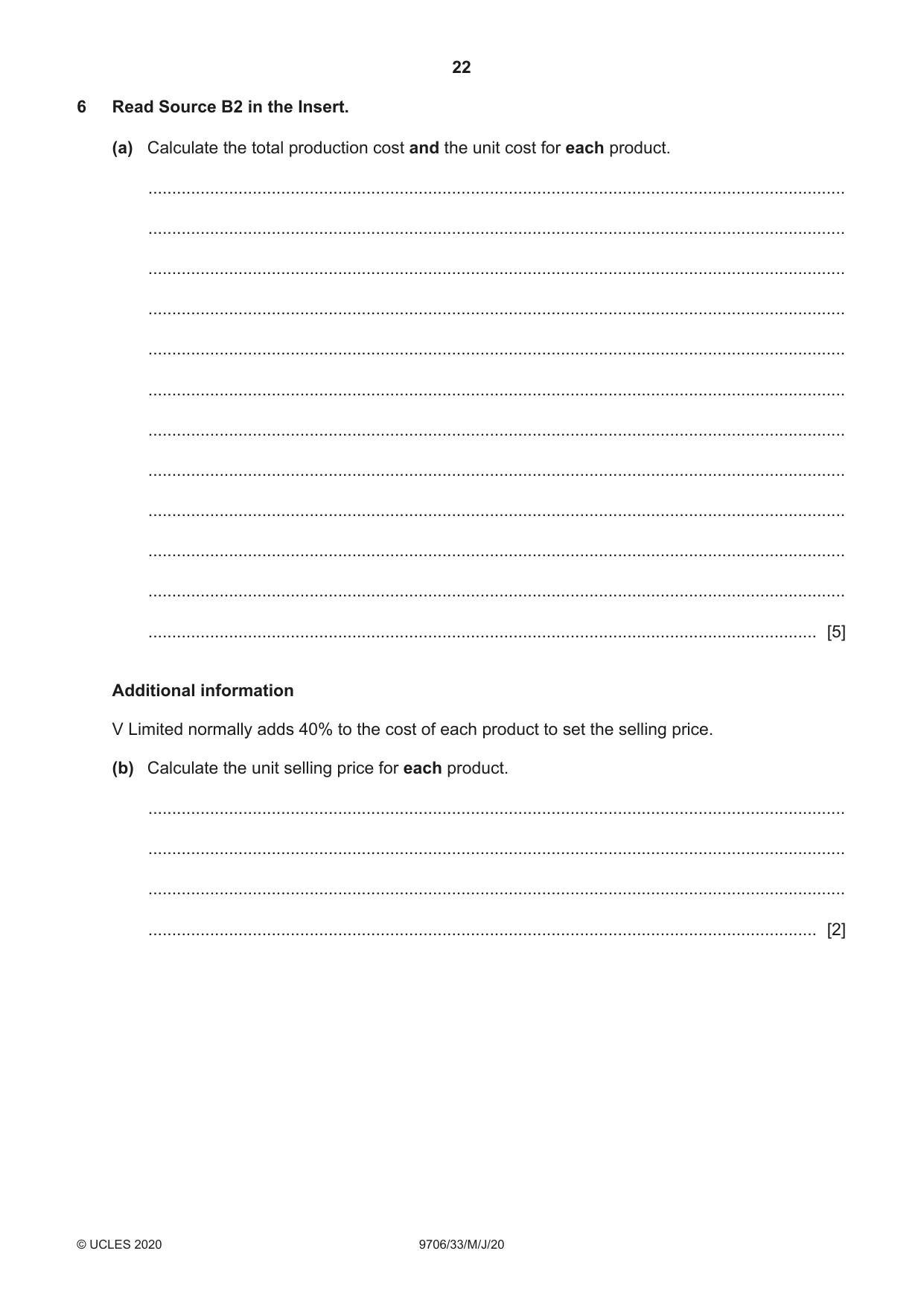
22 9706/33/M/J/20 © UCLES 2020 6 Read Source B2 in the Insert. (a) Calculate the total production cost and the unit cost for each product. … … … … … … … … … … … … [5] Additional information V Limited normally adds 40% to the cost of each product to set the selling price. (b) Calculate the unit selling price for each product. … … … … [2]
Question paper, page 23
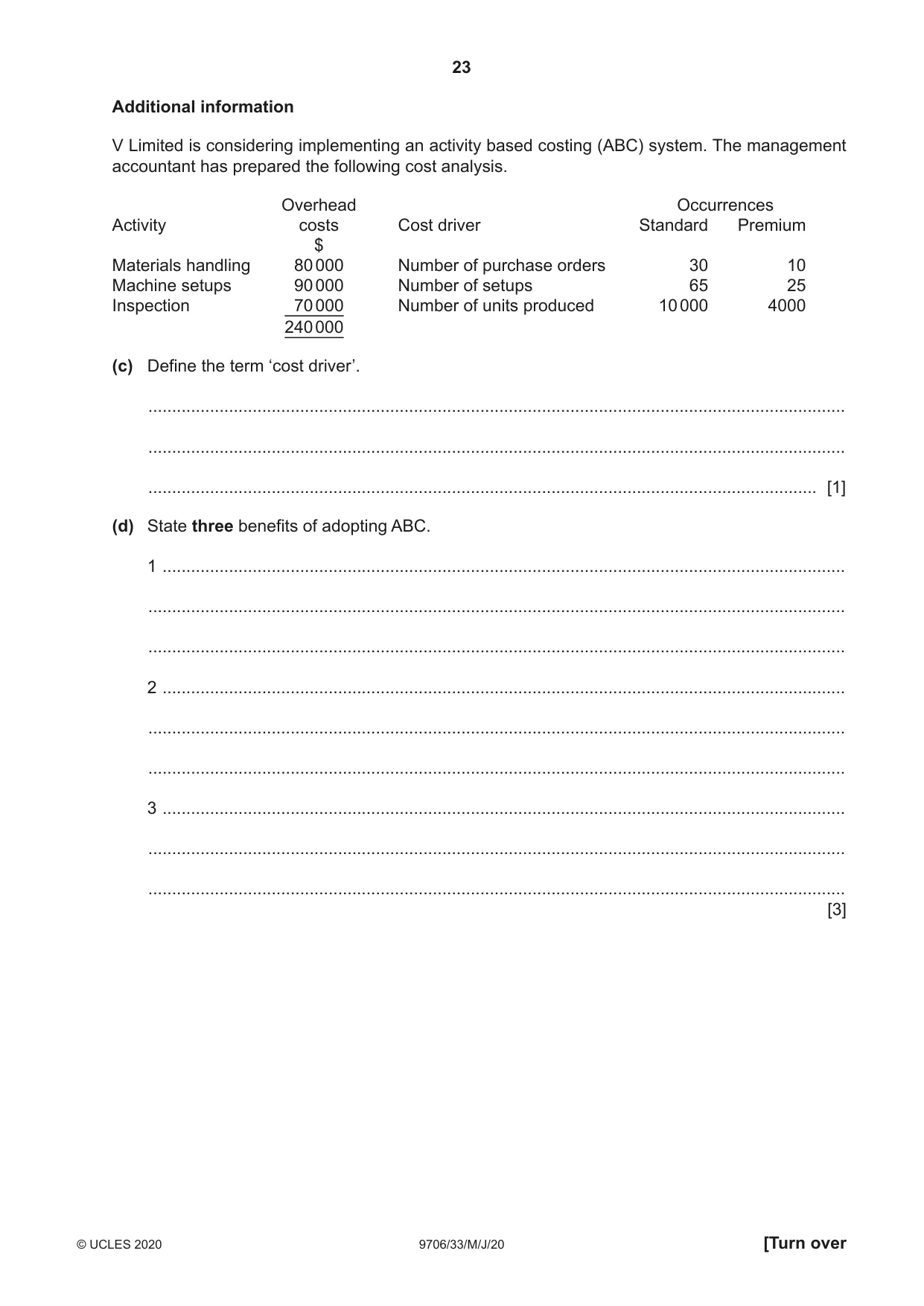
23 9706/33/M/J/20 © UCLES 2020 [Turn over Additional information V Limited is considering implementing an activity based costing (ABC) system. The management accountant has prepared the following cost analysis. Overhead Occurrences Activity costs Cost driver Standard Premium $ Materials handling 80 000 Number of purchase orders 30 10 Machine setups 90 000 Number of setups 65 25 Inspection 70 000 Number of units produced 10 000 4000 240 000 (c) Define the term ‘cost driver’. … … … [1] (d) State three benefits of adopting ABC. 1 … … … 2 … … … 3 … … … [3]
Question paper, page 24
24 9706/33/M/J/20 © UCLES 2020 (e) Calculate the total production cost and unit cost for each product if ABC is used. … … … … … … … … … … … … … Workings: [5]
Question paper, page 25
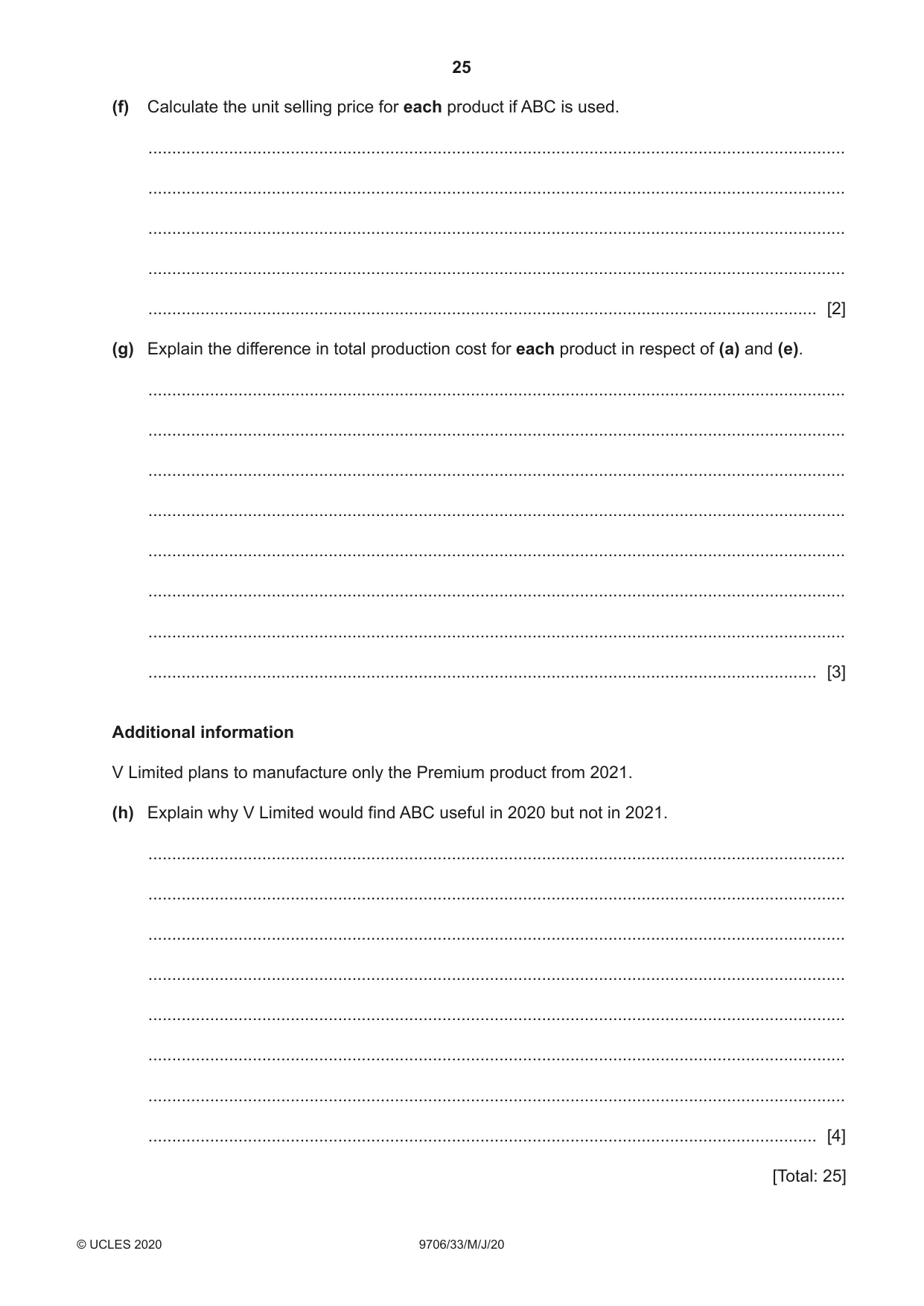
25 9706/33/M/J/20 © UCLES 2020 (f) Calculate the unit selling price for each product if ABC is used. … … … … … [2] (g) Explain the difference in total production cost for each product in respect of (a) and (e). … … … … … … … … [3] Additional information V Limited plans to manufacture only the Premium product from 2021. (h) Explain why V Limited would find ABC useful in 2020 but not in 2021. … … … … … … … … [4] [Total: 25]
Question paper, page 26
26 9706/33/M/J/20 © UCLES 2020 BLANK PAGE
Question paper, page 27
27 9706/33/M/J/20 © UCLES 2020 BLANK PAGE
Question paper, page 28
28 9706/33/M/J/20 © UCLES 2020 Permission to reproduce items where third-party owned material protected by copyright is included has been sought and cleared where possible. Every reasonable effort has been made by the publisher (UCLES) to trace copyright holders, but if any items requiring clearance have unwittingly been included, the publisher will be pleased to make amends at the earliest possible opportunity. To avoid the issue of disclosure of answer-related information to candidates, all copyright acknowledgements are reproduced online in the Cambridge Assessment International Education Copyright Acknowledgements Booklet. This is produced for each series of examinations and is freely available to download at www.cambridgeinternational.org after the live examination series. Cambridge Assessment International Education is part of the Cambridge Assessment Group. Cambridge Assessment is the brand name of the University of Cambridge Local Examinations Syndicate (UCLES), which itself is a department of the University of Cambridge. BLANK PAGE
Mark scheme, page 1
This document consists of 15 printed pages. © UCLES 2020 [Turn over Cambridge International AS & A Level ACCOUNTING 9706/33 Paper 3 Structured Questions May/June 2020 MARK SCHEME Maximum Mark: 150 Published Students did not sit exam papers in the June 2020 series due to the Covid-19 global pandemic. This mark scheme is published to support teachers and students and should be read together with the question paper. It shows the requirements of the exam. The answer column of the mark scheme shows the proposed basis on which Examiners would award marks for this exam. Where appropriate, this column also provides the most likely acceptable alternative responses expected from students. Examiners usually review the mark scheme after they have seen student responses and update the mark scheme if appropriate. In the June series, Examiners were unable to consider the acceptability of alternative responses, as there were no student responses to consider. Mark schemes should usually be read together with the Principal Examiner Report for Teachers. However, because students did not sit exam papers, there is no Principal Examiner Report for Teachers for the June 2020 series. Cambridge International will not enter into discussions about these mark schemes. Cambridge International is publishing the mark schemes for the June 2020 series for most Cambridge IGCSE™ and Cambridge International A & AS Level components, and some Cambridge O Level components.
Mark scheme, page 2
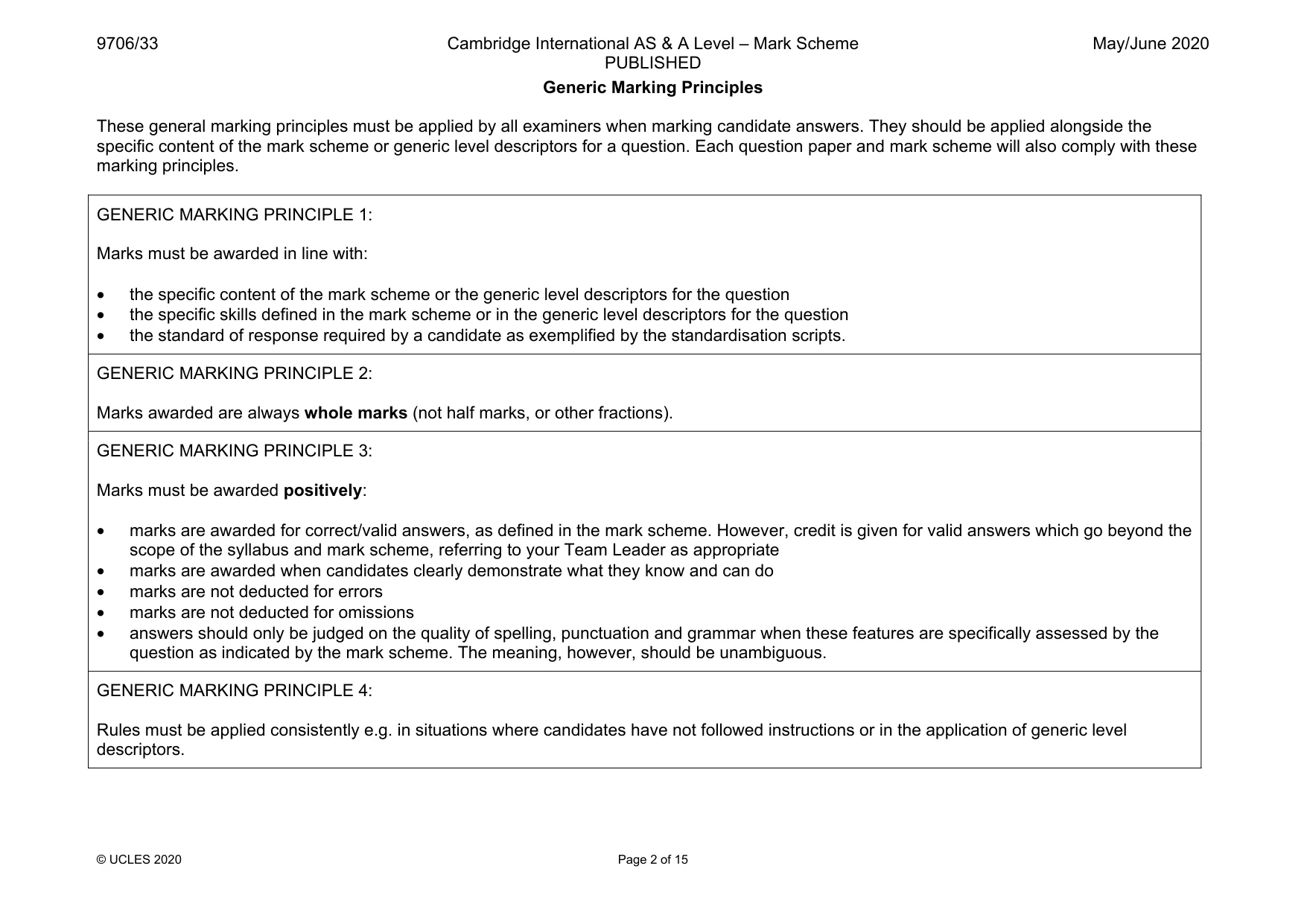
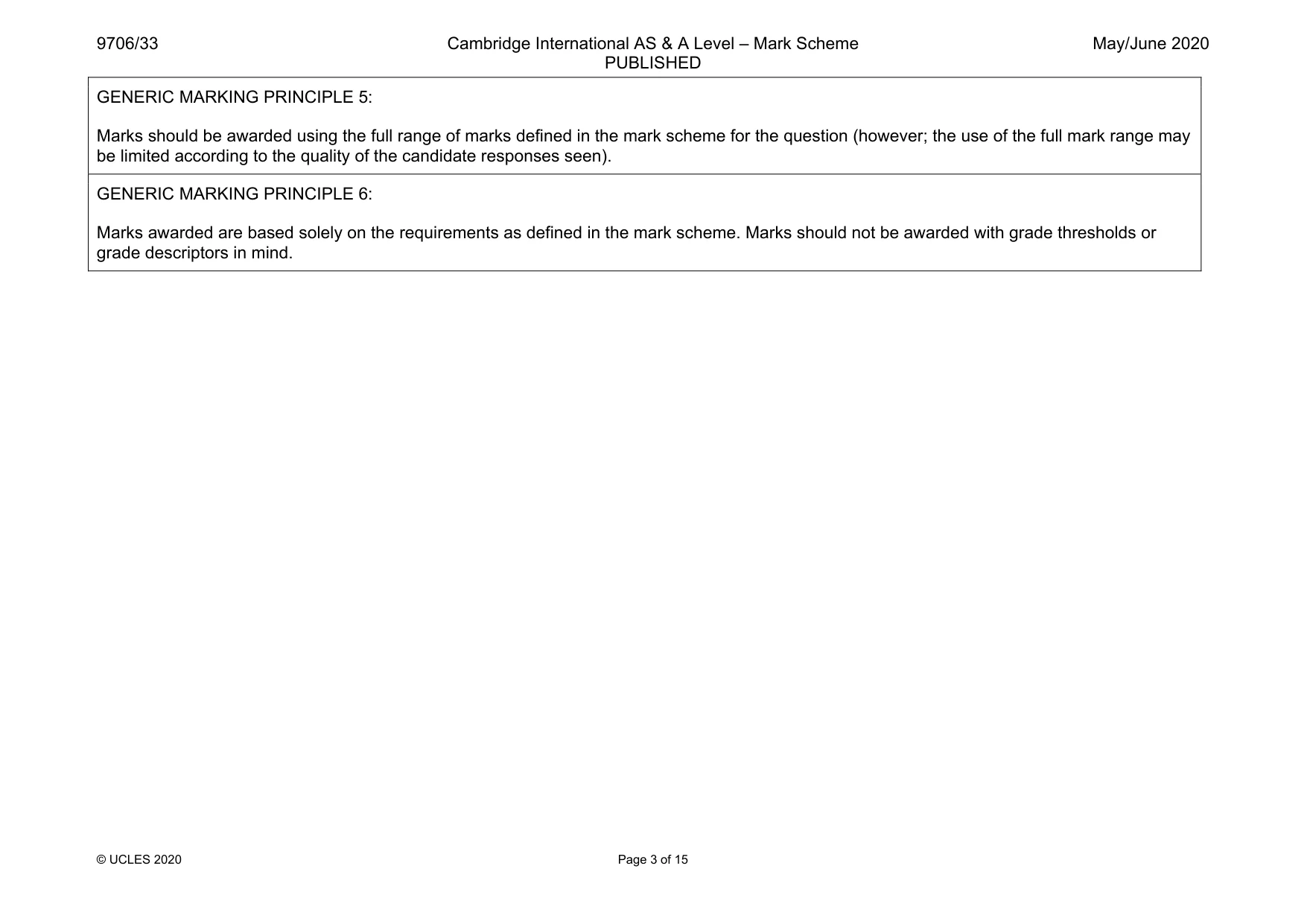
9706/33 Cambridge International AS & A Level – Mark Scheme PUBLISHED May/June 2020 © UCLES 2020 Page 2 of 15 Generic Marking Principles These general marking principles must be applied by all examiners when marking candidate answers. They should be applied alongside the specific content of the mark scheme or generic level descriptors for a question. Each question paper and mark scheme will also comply with these marking principles. GENERIC MARKING PRINCIPLE 1: Marks must be awarded in line with: • the specific content of the mark scheme or the generic level descriptors for the question • the specific skills defined in the mark scheme or in the generic level descriptors for the question • the standard of response required by a candidate as exemplified by the standardisation scripts. GENERIC MARKING PRINCIPLE 2: Marks awarded are always whole marks (not half marks, or other fractions). GENERIC MARKING PRINCIPLE 3: Marks must be awarded positively: • marks are awarded for correct/valid answers, as defined in the mark scheme. However, credit is given for valid answers which go beyond the scope of the syllabus and mark scheme, referring to your Team Leader as appropriate • marks are awarded when candidates clearly demonstrate what they know and can do • marks are not deducted for errors • marks are not deducted for omissions • answers should only be judged on the quality of spelling, punctuation and grammar when these features are specifically assessed by the question as indicated by the mark scheme. The meaning, however, should be unambiguous. GENERIC MARKING PRINCIPLE 4: Rules must be applied consistently e.g. in situations where candidates have not followed instructions or in the application of generic level descriptors.
Mark scheme, page 3
9706/33 Cambridge International AS & A Level – Mark Scheme PUBLISHED May/June 2020 © UCLES 2020 Page 3 of 15 GENERIC MARKING PRINCIPLE 5: Marks should be awarded using the full range of marks defined in the mark scheme for the question (however; the use of the full mark range may be limited according to the quality of the candidate responses seen). GENERIC MARKING PRINCIPLE 6: Marks awarded are based solely on the requirements as defined in the mark scheme. Marks should not be awarded with grade thresholds or grade descriptors in mind.
Mark scheme, page 4
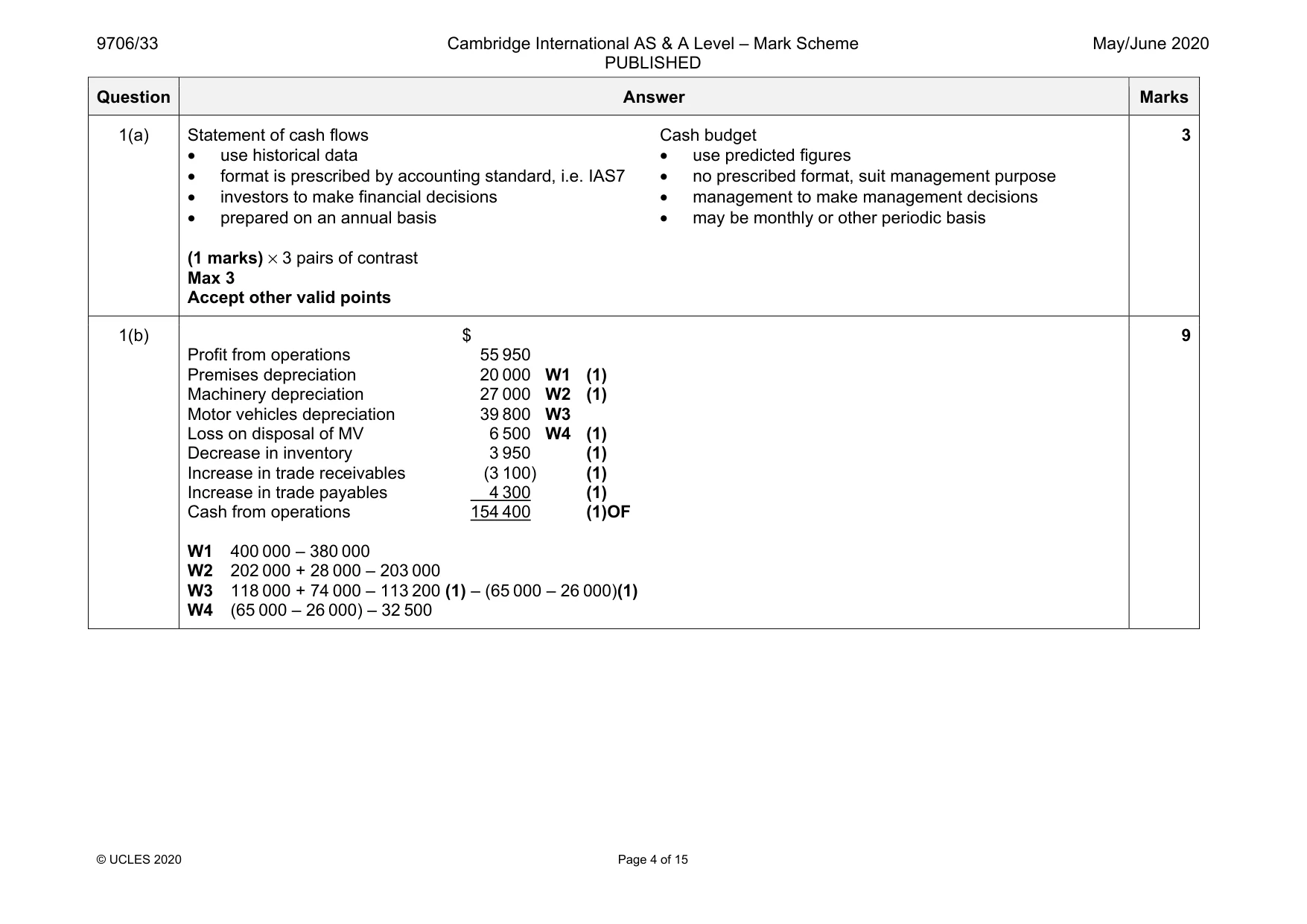
9706/33 Cambridge International AS & A Level – Mark Scheme PUBLISHED May/June 2020 © UCLES 2020 Page 4 of 15 Question Answer Marks 1(a) Statement of cash flows Cash budget • use historical data • use predicted figures • format is prescribed by accounting standard, i.e. IAS7 • no prescribed format, suit management purpose • investors to make financial decisions • prepared on an annual basis • management to make management decisions • may be monthly or other periodic basis (1 marks) × 3 pairs of contrast Max 3 Accept other valid points 3 1(b) $ Profit from operations 55 950 Premises depreciation 20 000 W1 (1) Machinery depreciation 27 000 W2 (1) Motor vehicles depreciation 39 800 W3 Loss on disposal of MV 6 500 W4 (1) Decrease in inventory 3 950 (1) Increase in trade receivables (3 100) (1) Increase in trade payables 4 300 (1) Cash from operations 154 400 (1)OF W1 400 000 – 380 000 W2 202 000 + 28 000 – 203 000 W3 118 000 + 74 000 – 113 200 (1) – (65 000 – 26 000)(1) W4 (65 000 – 26 000) – 32 500 9
Mark scheme, page 5
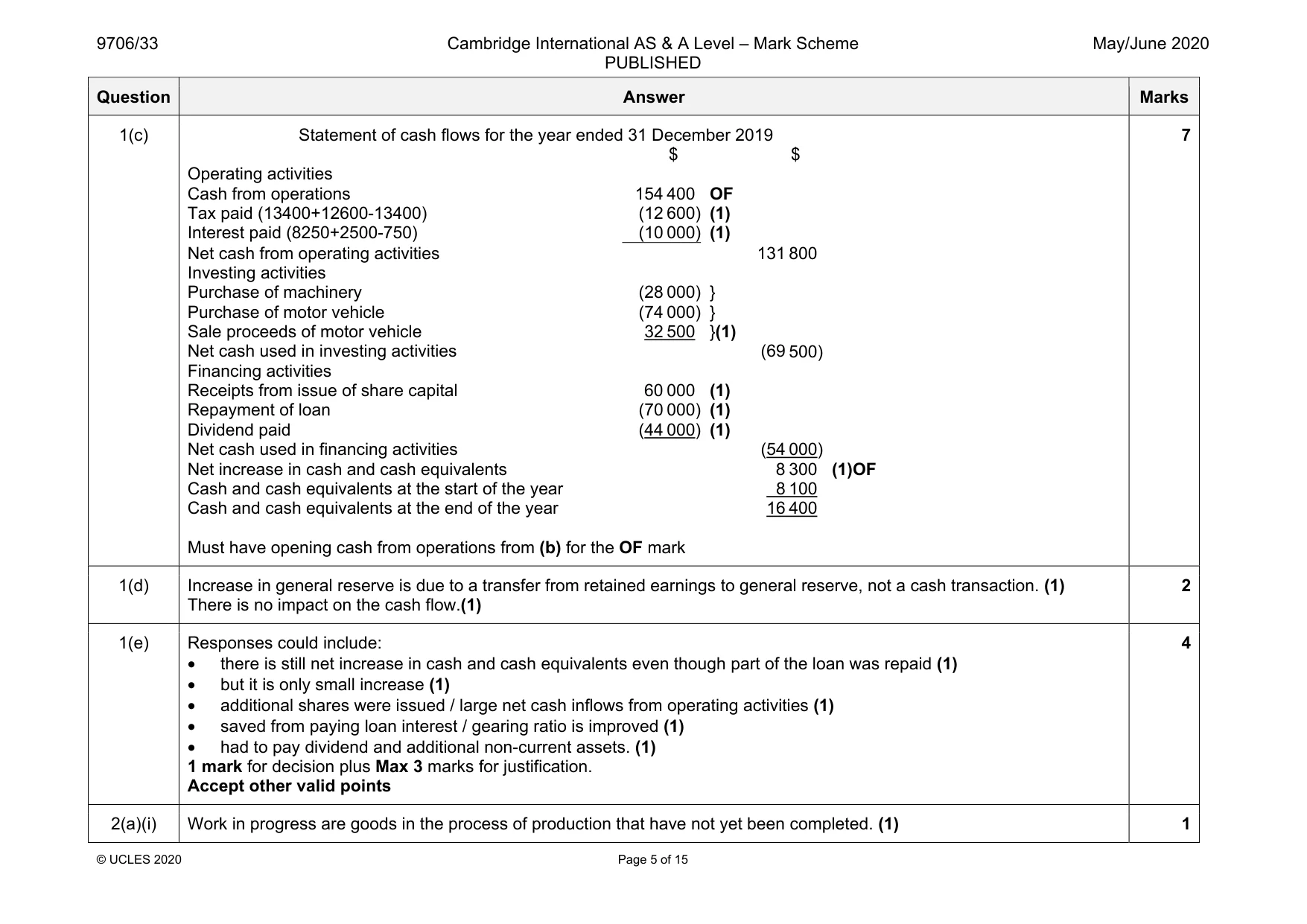
9706/33 Cambridge International AS & A Level – Mark Scheme PUBLISHED May/June 2020 © UCLES 2020 Page 5 of 15 Question Answer Marks 1(c) Statement of cash flows for the year ended 31 December 2019 $ $ Operating activities Cash from operations 154 400 OF Tax paid (13400+12600-13400) (12 600) (1) Interest paid (8250+2500-750) (10 000) (1) Net cash from operating activities 131 800 Investing activities Purchase of machinery (28 000) } Purchase of motor vehicle (74 000) } Sale proceeds of motor vehicle 32 500 }(1) Net cash used in investing activities (69 500) Financing activities Receipts from issue of share capital 60 000 (1) Repayment of loan (70 000) (1) Dividend paid (44 000) (1) Net cash used in financing activities (54 000) Net increase in cash and cash equivalents 8 300 (1)OF Cash and cash equivalents at the start of the year 8 100 Cash and cash equivalents at the end of the year 16 400 Must have opening cash from operations from (b) for the OF mark 7 1(d) Increase in general reserve is due to a transfer from retained earnings to general reserve, not a cash transaction. (1) There is no impact on the cash flow.(1) 2 1(e) Responses could include: • there is still net increase in cash and cash equivalents even though part of the loan was repaid (1) • but it is only small increase (1) • additional shares were issued / large net cash inflows from operating activities (1) • saved from paying loan interest / gearing ratio is improved (1) • had to pay dividend and additional non-current assets. (1) 1 mark for decision plus Max 3 marks for justification. Accept other valid points 4 2(a)(i) Work in progress are goods in the process of production that have not yet been completed. (1) 1
Mark scheme, page 6
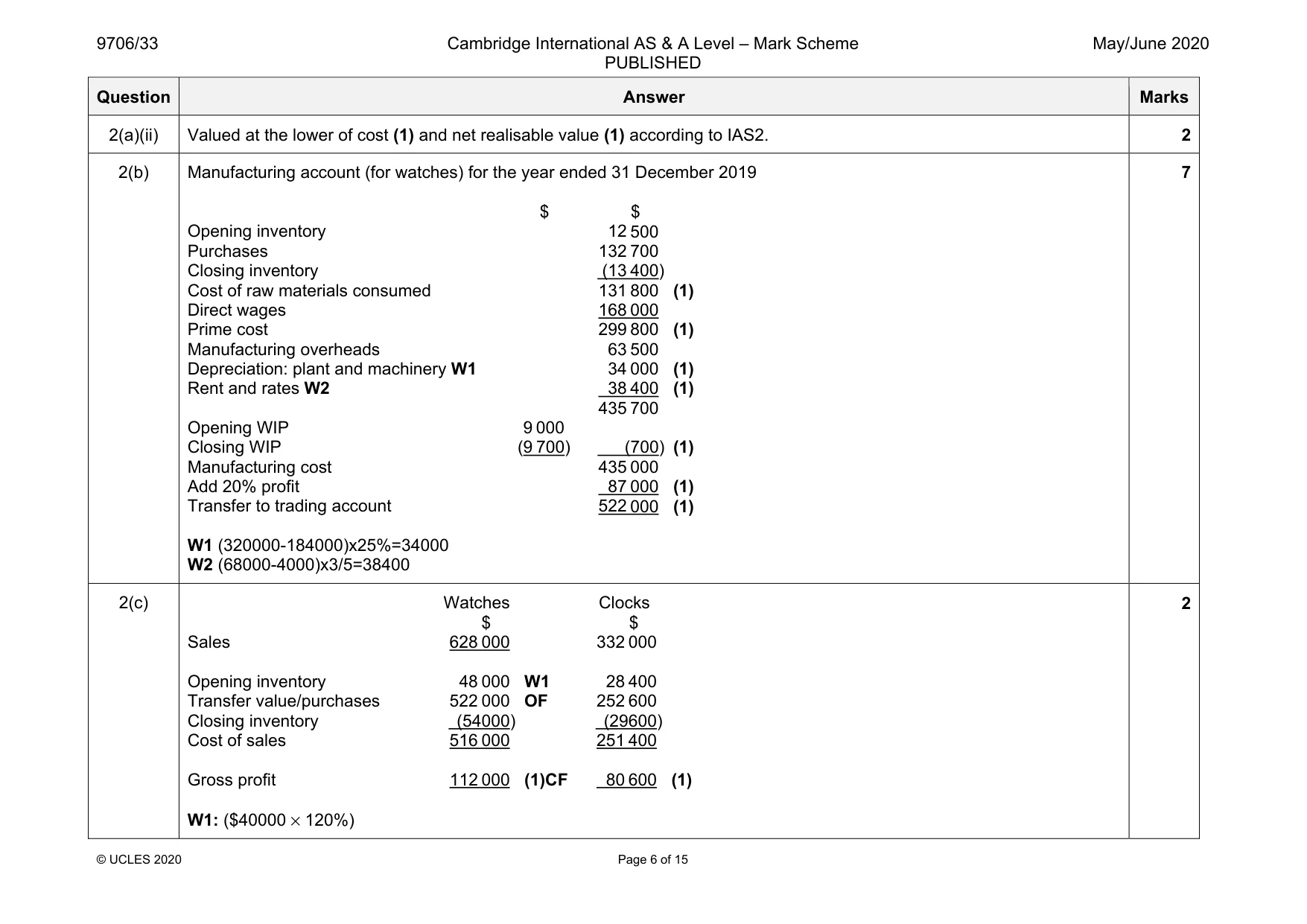
9706/33 Cambridge International AS & A Level – Mark Scheme PUBLISHED May/June 2020 © UCLES 2020 Page 6 of 15 Question Answer Marks 2(a)(ii) Valued at the lower of cost (1) and net realisable value (1) according to IAS2. 2 2(b) Manufacturing account (for watches) for the year ended 31 December 2019 $ $ Opening inventory 12 500 Purchases 132 700 Closing inventory (13 400) Cost of raw materials consumed 131 800 (1) Direct wages 168 000 Prime cost 299 800 (1) Manufacturing overheads 63 500 Depreciation: plant and machinery W1 34 000 (1) Rent and rates W2 38 400 (1) 435 700 Opening WIP 9 000 Closing WIP (9 700) (700) (1) Manufacturing cost 435 000 Add 20% profit 87 000 (1) Transfer to trading account 522 000 (1) W1 (320000-184000)x25%=34000 W2 (68000-4000)x3/5=38400 7 2(c) Watches Clocks $ $ Sales 628 000 332 000 Opening inventory 48 000 W1 28 400 Transfer value/purchases 522 000 OF 252 600 Closing inventory (54000) (29600) Cost of sales 516 000 251 400 Gross profit 112 000 (1)CF 80 600 (1) W1: ($40000 × 120%) 2
Mark scheme, page 7
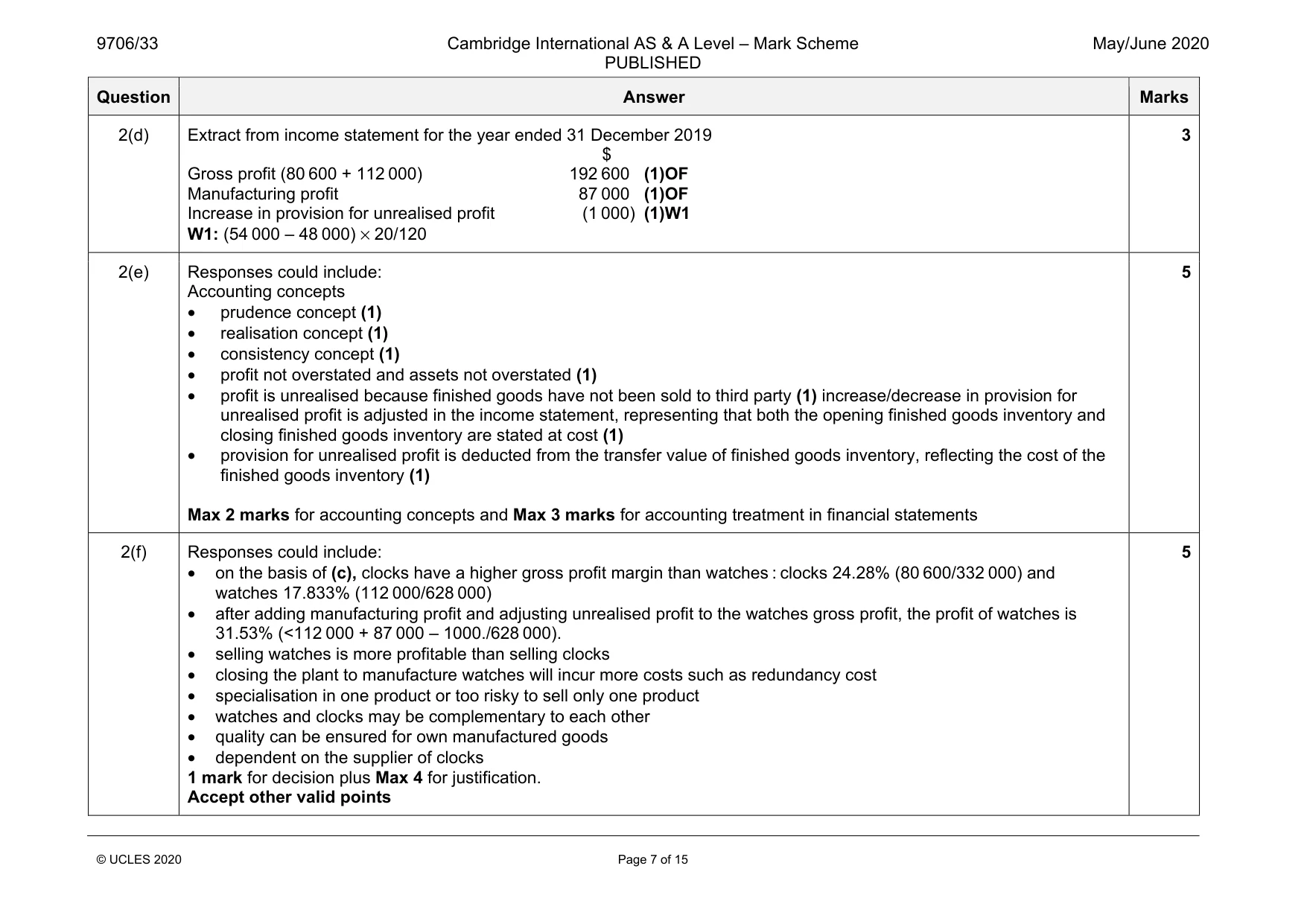
9706/33 Cambridge International AS & A Level – Mark Scheme PUBLISHED May/June 2020 © UCLES 2020 Page 7 of 15 Question Answer Marks 2(d) Extract from income statement for the year ended 31 December 2019 $ Gross profit (80 600 + 112 000) 192 600 (1)OF Manufacturing profit 87 000 (1)OF Increase in provision for unrealised profit (1 000) (1)W1 W1: (54 000 – 48 000) × 20/120 3 2(e) Responses could include: Accounting concepts • prudence concept (1) • realisation concept (1) • consistency concept (1) • profit not overstated and assets not overstated (1) • profit is unrealised because finished goods have not been sold to third party (1) increase/decrease in provision for unrealised profit is adjusted in the income statement, representing that both the opening finished goods inventory and closing finished goods inventory are stated at cost (1) • provision for unrealised profit is deducted from the transfer value of finished goods inventory, reflecting the cost of the finished goods inventory (1) Max 2 marks for accounting concepts and Max 3 marks for accounting treatment in financial statements 5 2(f) Responses could include: • on the basis of (c), clocks have a higher gross profit margin than watches : clocks 24.28% (80 600/332 000) and watches 17.833% (112 000/628 000) • after adding manufacturing profit and adjusting unrealised profit to the watches gross profit, the profit of watches is 31.53% (<112 000 + 87 000 – 1000./628 000). • selling watches is more profitable than selling clocks • closing the plant to manufacture watches will incur more costs such as redundancy cost • specialisation in one product or too risky to sell only one product • watches and clocks may be complementary to each other • quality can be ensured for own manufactured goods • dependent on the supplier of clocks 1 mark for decision plus Max 4 for justification. Accept other valid points 5
Mark scheme, page 8
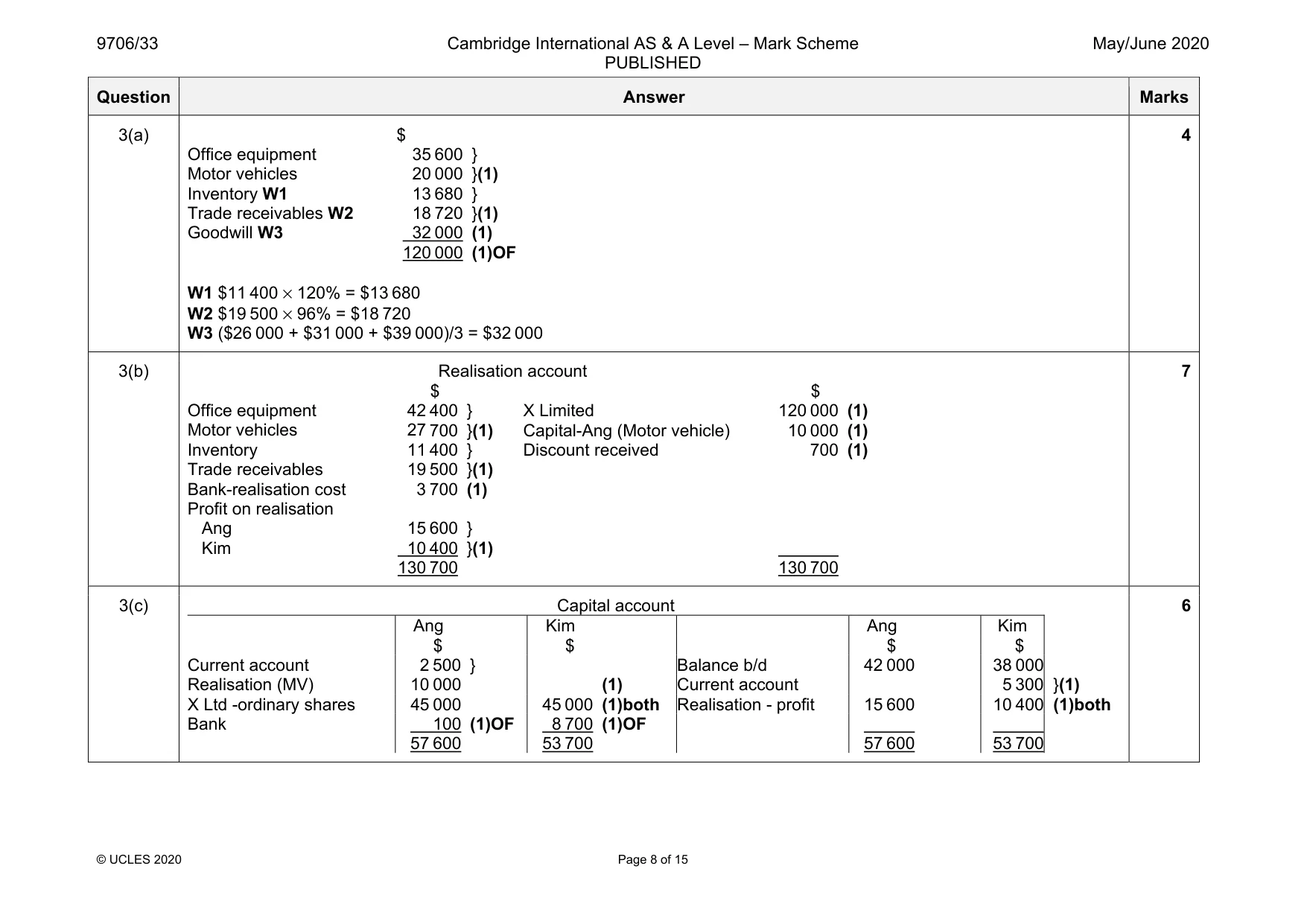
9706/33 Cambridge International AS & A Level – Mark Scheme PUBLISHED May/June 2020 © UCLES 2020 Page 8 of 15 Question Answer Marks 3(a) $ Office equipment 35 600 } Motor vehicles 20 000 }(1) Inventory W1 13 680 } Trade receivables W2 18 720 }(1) Goodwill W3 32 000 (1) 120 000 (1)OF W1 $11 400 × 120% = $13 680 W2 $19 500 × 96% = $18 720 W3 ($26 000 + $31 000 + $39 000)/3 = $32 000 4 3(b) Realisation account $ $ Office equipment 42 400 } X Limited 120 000 (1) Motor vehicles 27 700 }(1) Capital-Ang (Motor vehicle) 10 000 (1) Inventory 11 400 } Discount received 700 (1) Trade receivables 19 500 }(1) Bank-realisation cost 3 700 (1) Profit on realisation Ang 15 600 } Kim 10 400 }(1) 130 700 130 700 130 700 7 3(c) Capital account Ang Kim Ang Kim $ $ $ $ Current account 2 500 } Balance b/d 42 000 38 000 Realisation (MV) 10 000 (1) Current account 5 300 }(1) X Ltd -ordinary shares 45 000 45 000 (1)both Realisation - profit 15 600 10 400 (1)both Bank 100 (1)OF 8 700 (1)OF 57 600 53 700 57 600 53 700 57 600 53 700 6
Mark scheme, page 9
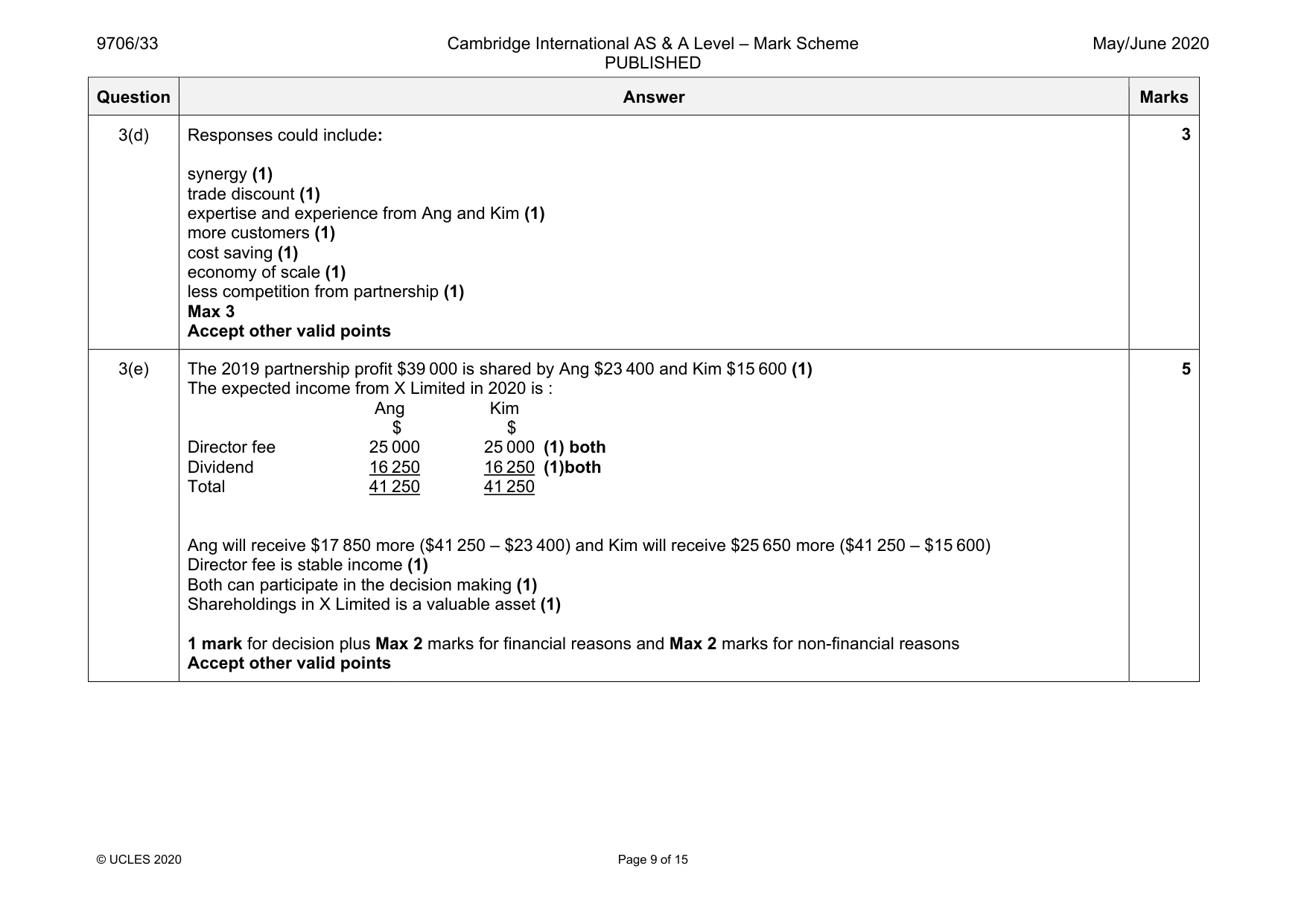
9706/33 Cambridge International AS & A Level – Mark Scheme PUBLISHED May/June 2020 © UCLES 2020 Page 9 of 15 Question Answer Marks 3(d) Responses could include: synergy (1) trade discount (1) expertise and experience from Ang and Kim (1) more customers (1) cost saving (1) economy of scale (1) less competition from partnership (1) Max 3 Accept other valid points 3 3(e) The 2019 partnership profit $39 000 is shared by Ang $23 400 and Kim $15 600 (1) The expected income from X Limited in 2020 is : Ang Kim $ $ Director fee 25 000 25 000 (1) both Dividend 16 250 16 250 (1)both Total 41 250 41 250 Ang will receive $17 850 more ($41 250 – $23 400) and Kim will receive $25 650 more ($41 250 – $15 600) Director fee is stable income (1) Both can participate in the decision making (1) Shareholdings in X Limited is a valuable asset (1) 1 mark for decision plus Max 2 marks for financial reasons and Max 2 marks for non-financial reasons Accept other valid points 5
Mark scheme, page 10
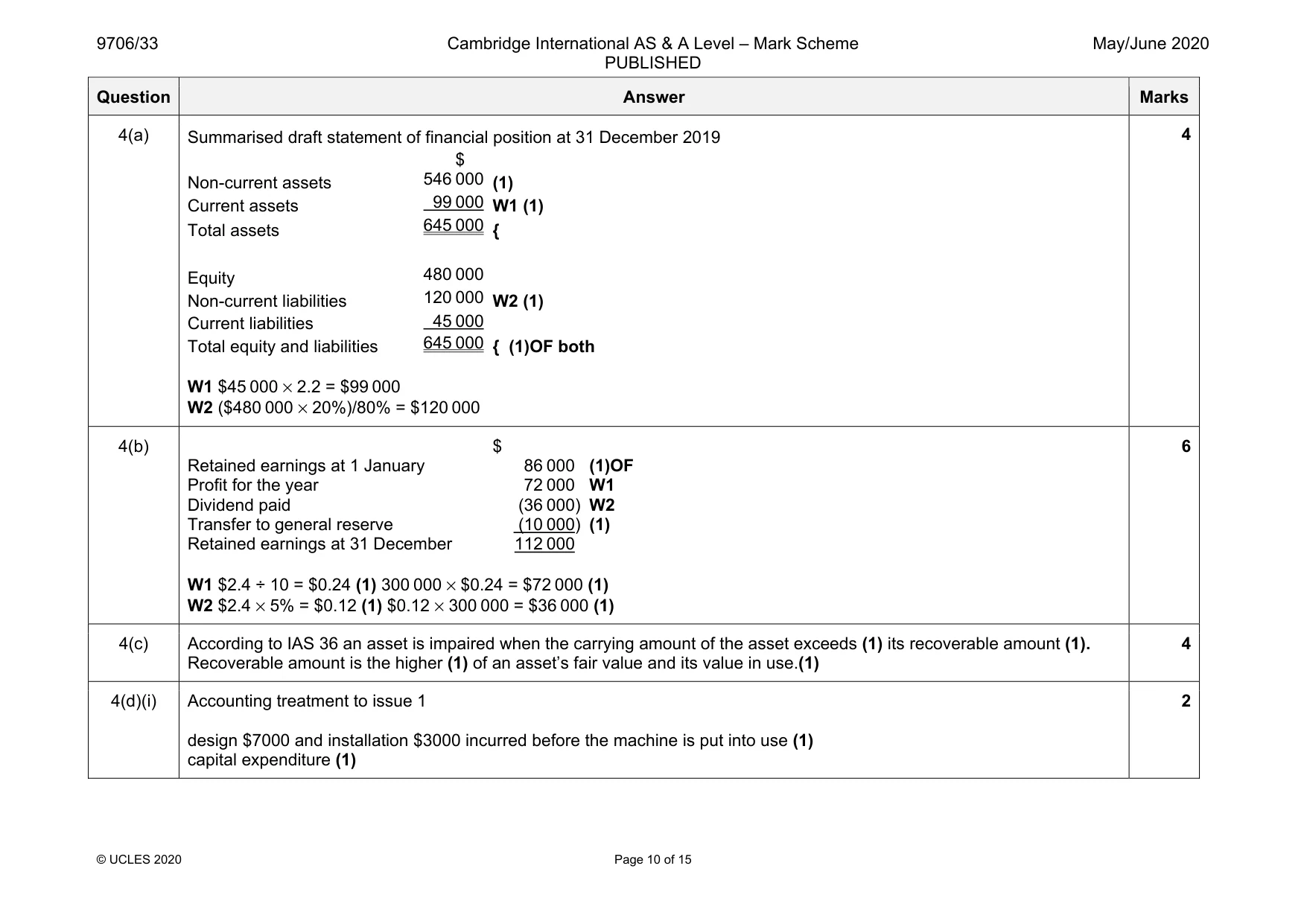
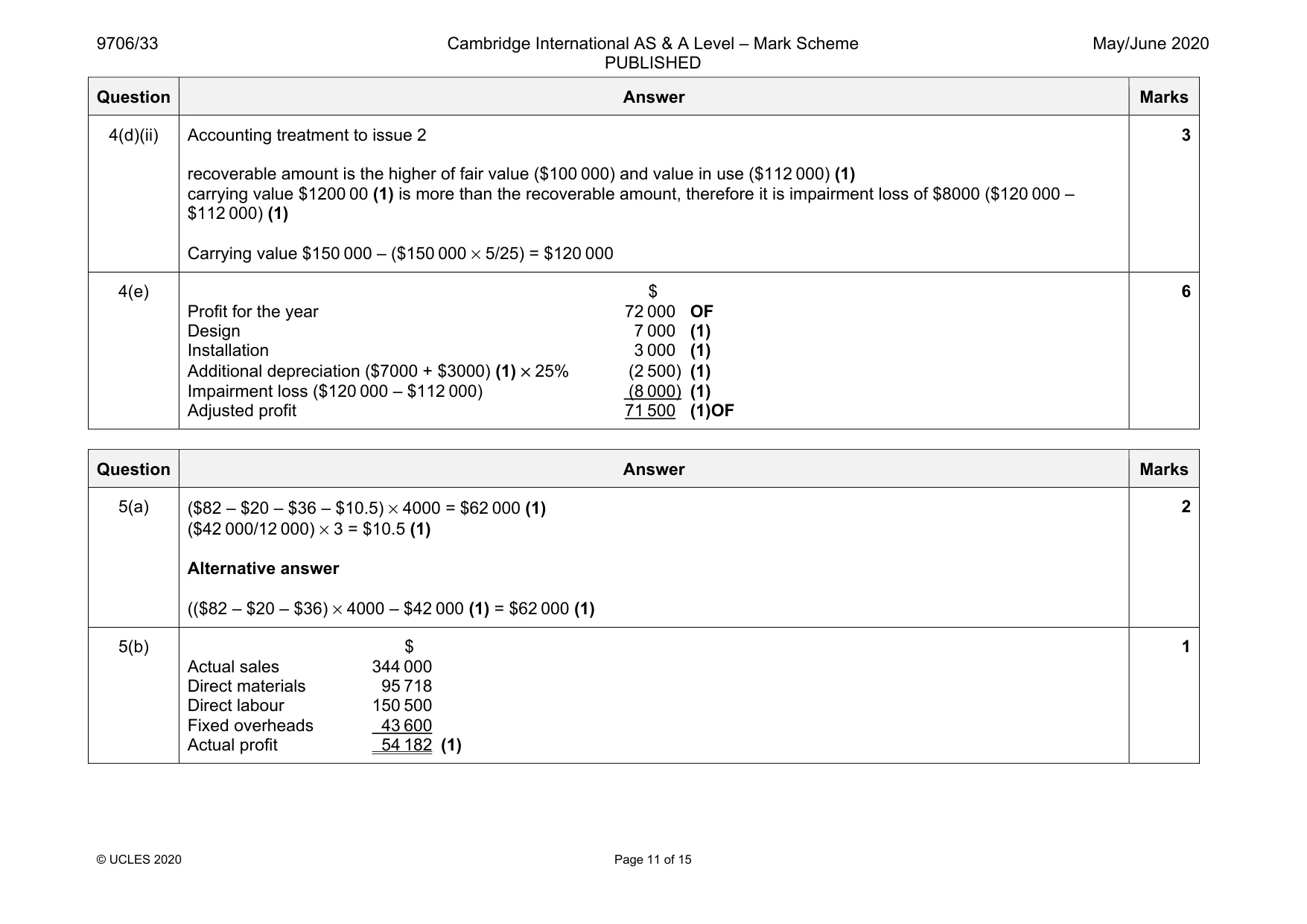
9706/33 Cambridge International AS & A Level – Mark Scheme PUBLISHED May/June 2020 © UCLES 2020 Page 10 of 15 Question Answer Marks 4(a) Summarised draft statement of financial position at 31 December 2019 $ Non-current assets 546 000 (1) Current assets 99 000 W1 (1) Total assets 645 000 { Equity 480 000 Non-current liabilities 120 000 W2 (1) Current liabilities 45 000 Total equity and liabilities 645 000 { (1)OF both W1 $45 000 × 2.2 = $99 000 W2 ($480 000 × 20%)/80% = $120 000 4 4(b) $ Retained earnings at 1 January 86 000 (1)OF Profit for the year 72 000 W1 Dividend paid (36 000) W2 Transfer to general reserve (10 000) (1) Retained earnings at 31 December 112 000 W1 $2.4 ÷ 10 = $0.24 (1) 300 000 × $0.24 = $72 000 (1) W2 $2.4 × 5% = $0.12 (1) $0.12 × 300 000 = $36 000 (1) 6 4(c) According to IAS 36 an asset is impaired when the carrying amount of the asset exceeds (1) its recoverable amount (1). Recoverable amount is the higher (1) of an asset’s fair value and its value in use.(1) 4 4(d)(i) Accounting treatment to issue 1 design $7000 and installation $3000 incurred before the machine is put into use (1) capital expenditure (1) 2
Mark scheme, page 11
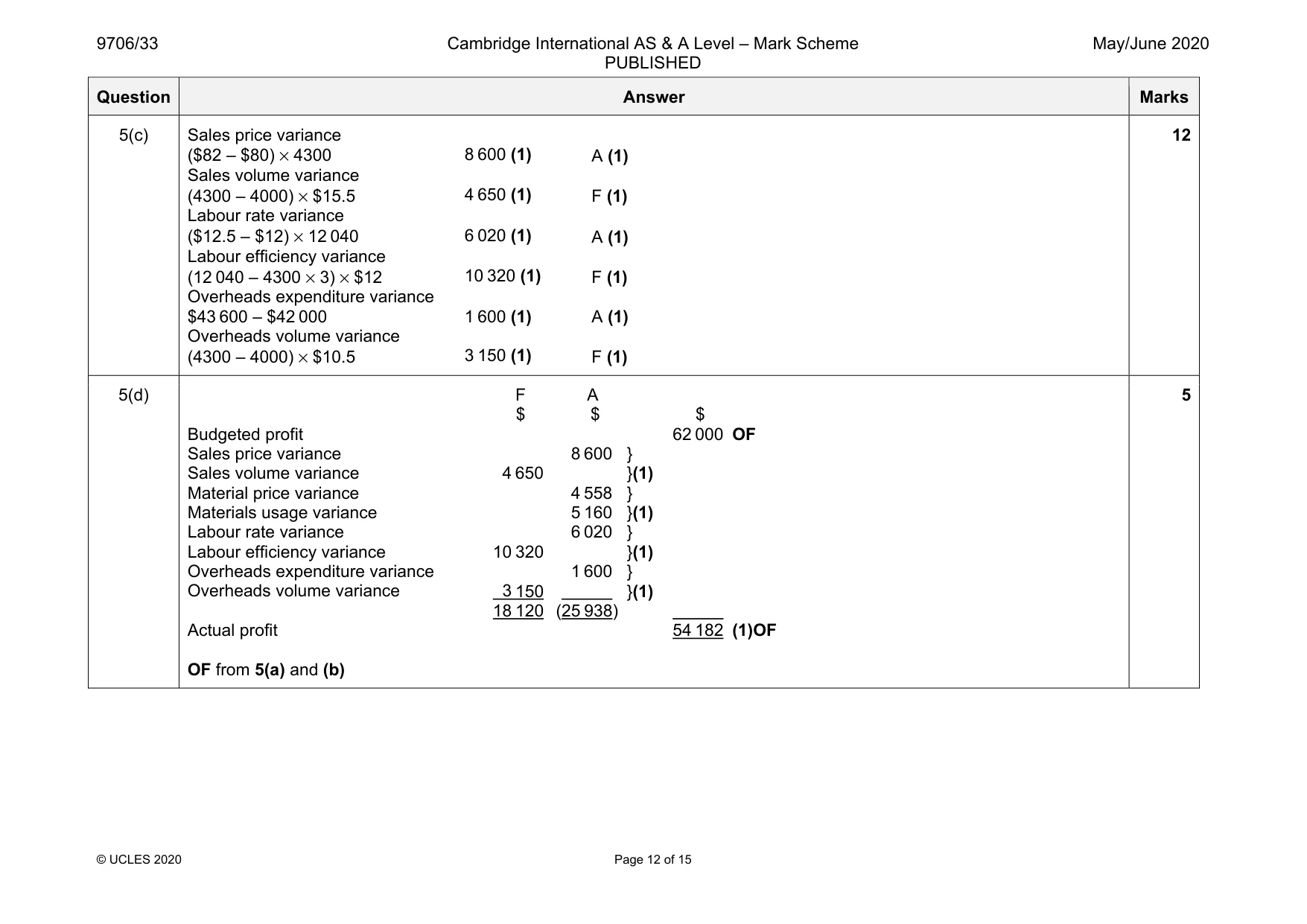
9706/33 Cambridge International AS & A Level – Mark Scheme PUBLISHED May/June 2020 © UCLES 2020 Page 11 of 15 Question Answer Marks 4(d)(ii) Accounting treatment to issue 2 recoverable amount is the higher of fair value ($100 000) and value in use ($112 000) (1) carrying value $1200 00 (1) is more than the recoverable amount, therefore it is impairment loss of $8000 ($120 000 – $112 000) (1) Carrying value $150 000 – ($150 000 × 5/25) = $120 000 3 4(e) $ Profit for the year 72 000 OF Design 7 000 (1) Installation 3 000 (1) Additional depreciation ($7000 + $3000) (1) × 25% (2 500) (1) Impairment loss ($120 000 – $112 000) (8 000) (1) Adjusted profit 71 500 (1)OF 6 Question Answer Marks 5(a) ($82 – $20 – $36 – $10.5) × 4000 = $62 000 (1) ($42 000/12 000) × 3 = $10.5 (1) Alternative answer (($82 – $20 – $36) × 4000 – $42 000 (1) = $62 000 (1) 2 5(b) $ Actual sales 344 000 Direct materials 95 718 Direct labour 150 500 Fixed overheads 43 600 Actual profit 54 182 (1) 1
Mark scheme, page 12
9706/33 Cambridge International AS & A Level – Mark Scheme PUBLISHED May/June 2020 © UCLES 2020 Page 12 of 15 Question Answer Marks 5(c) Sales price variance ($82 – $80) × 4300 8 600 (1) A (1) Sales volume variance (4300 – 4000) × $15.5 4 650 (1) F (1) Labour rate variance ($12.5 – $12) × 12 040 6 020 (1) A (1) Labour efficiency variance (12 040 – 4300 × 3) × $12 10 320 (1) F (1) Overheads expenditure variance $43 600 – $42 000 1 600 (1) A (1) Overheads volume variance (4300 – 4000) × $10.5 3 150 (1) F (1) 12 5(d) F A $ $ $ Budgeted profit 62 000 OF Sales price variance 8 600 } Sales volume variance 4 650 }(1) Material price variance 4 558 } Materials usage variance 5 160 }(1) Labour rate variance 6 020 } Labour efficiency variance 10 320 }(1) Overheads expenditure variance 1 600 } Overheads volume variance 3 150 25 938 }(1) 18 120 (25 938) 54 182 Actual profit 54 182 (1)OF OF from 5(a) and (b) 5
Mark scheme, page 13
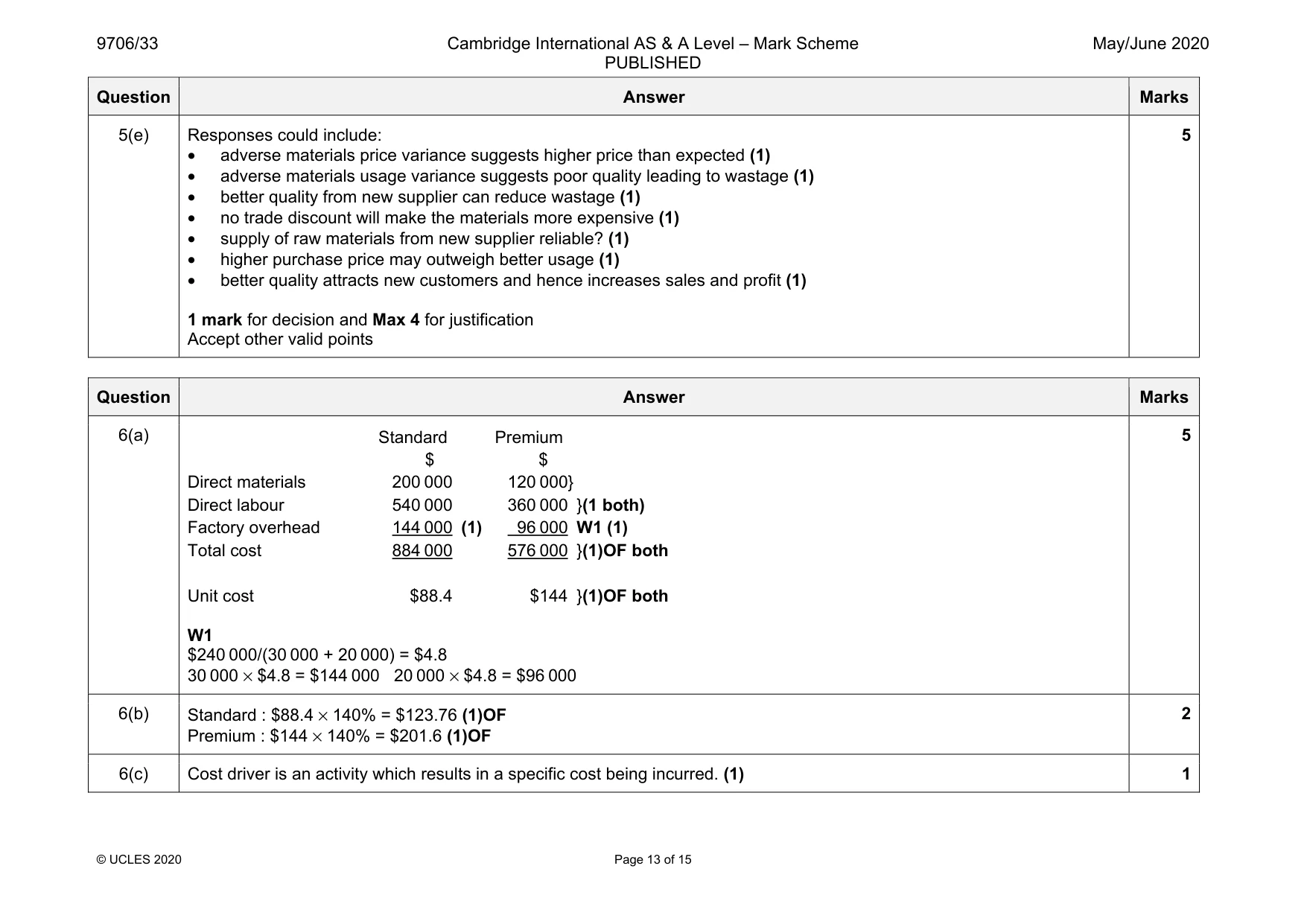
9706/33 Cambridge International AS & A Level – Mark Scheme PUBLISHED May/June 2020 © UCLES 2020 Page 13 of 15 Question Answer Marks 5(e) Responses could include: • adverse materials price variance suggests higher price than expected (1) • adverse materials usage variance suggests poor quality leading to wastage (1) • better quality from new supplier can reduce wastage (1) • no trade discount will make the materials more expensive (1) • supply of raw materials from new supplier reliable? (1) • higher purchase price may outweigh better usage (1) • better quality attracts new customers and hence increases sales and profit (1) 1 mark for decision and Max 4 for justification Accept other valid points 5 Question Answer Marks 6(a) Standard Premium $ $ Direct materials 200 000 120 000} Direct labour 540 000 360 000 }(1 both) Factory overhead 144 000 (1) 96 000 W1 (1) Total cost 884 000 576 000 }(1)OF both Unit cost $88.4 $144 }(1)OF both W1 $240 000/(30 000 + 20 000) = $4.8 30 000 × $4.8 = $144 000 20 000 × $4.8 = $96 000 5 6(b) Standard : $88.4 × 140% = $123.76 (1)OF Premium : $144 × 140% = $201.6 (1)OF 2 6(c) Cost driver is an activity which results in a specific cost being incurred. (1) 1
Mark scheme, page 14
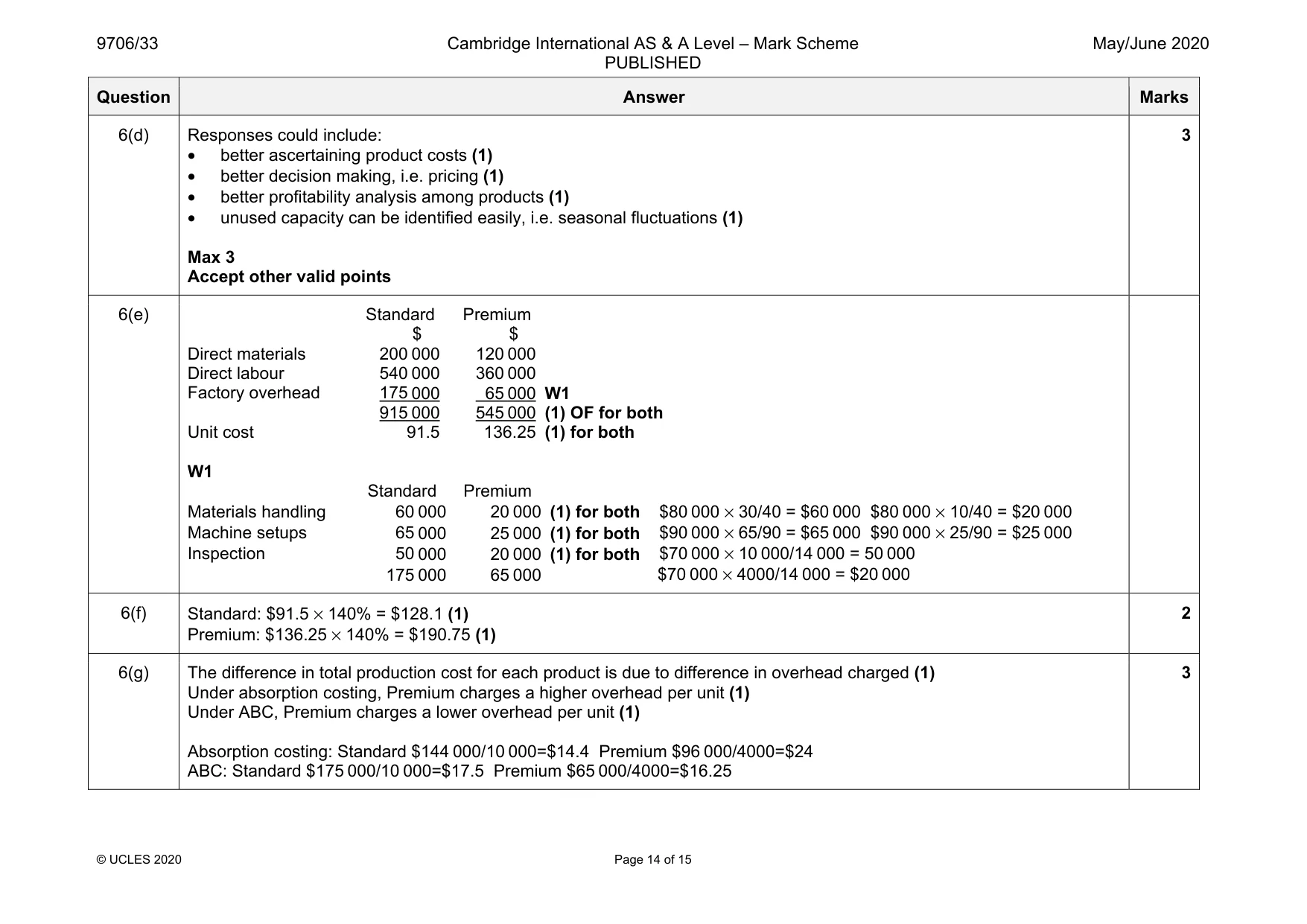
9706/33 Cambridge International AS & A Level – Mark Scheme PUBLISHED May/June 2020 © UCLES 2020 Page 14 of 15 Question Answer Marks 6(d) Responses could include: • better ascertaining product costs (1) • better decision making, i.e. pricing (1) • better profitability analysis among products (1) • unused capacity can be identified easily, i.e. seasonal fluctuations (1) Max 3 Accept other valid points 3 6(e) Standard Premium $ $ Direct materials 200 000 120 000 Direct labour 540 000 360 000 Factory overhead 175 000 65 000 W1 915 000 545 000 (1) OF for both Unit cost 91.5 136.25 (1) for both W1 Standard Premium Materials handling 60 000 20 000 (1) for both $80 000 × 30/40 = $60 000 $80 000 × 10/40 = $20 000 Machine setups 65 000 25 000 (1) for both $90 000 × 65/90 = $65 000 $90 000 × 25/90 = $25 000 Inspection 50 000 20 000 (1) for both $70 000 × 10 000/14 000 = 50 000 175 000 65 000 $70 000 × 4000/14 000 = $20 000 6(f) Standard: $91.5 × 140% = $128.1 (1) Premium: $136.25 × 140% = $190.75 (1) 2 6(g) The difference in total production cost for each product is due to difference in overhead charged (1) Under absorption costing, Premium charges a higher overhead per unit (1) Under ABC, Premium charges a lower overhead per unit (1) Absorption costing: Standard $144 000/10 000=$14.4 Premium $96 000/4000=$24 ABC: Standard $175 000/10 000=$17.5 Premium $65 000/4000=$16.25 3
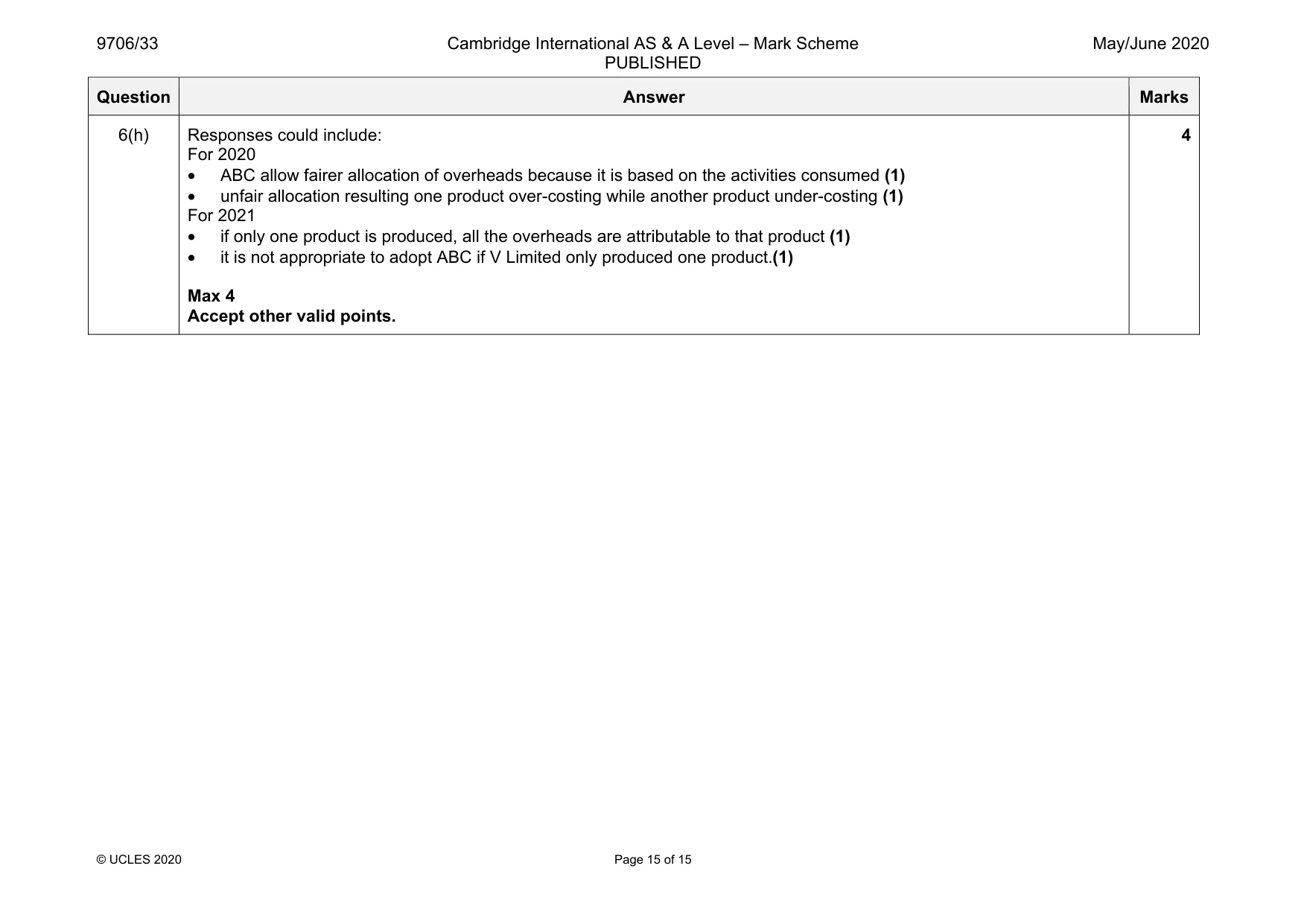
Mark scheme, page 15
9706/33 Cambridge International AS & A Level – Mark Scheme PUBLISHED May/June 2020 © UCLES 2020 Page 15 of 15 Question Answer Marks 6(h) Responses could include: For 2020 • ABC allow fairer allocation of overheads because it is based on the activities consumed (1) • unfair allocation resulting one product over-costing while another product under-costing (1) For 2021 • if only one product is produced, all the overheads are attributable to that product (1) • it is not appropriate to adopt ABC if V Limited only produced one product.(1) Max 4 Accept other valid points. 4