Cambridge A Level Accounting 9706 — 2020 May/June Paper 3 · Variant 2
9706/32/M/J/20
The question paper and its mark scheme, free to read here and free to download. This is Cambridge’s own paper, exactly as it was sat.
Question paper24 pages


Mark scheme16 pages
Answers below. Sit the paper first if you are practising.
Paper as text
Question paper, page 1
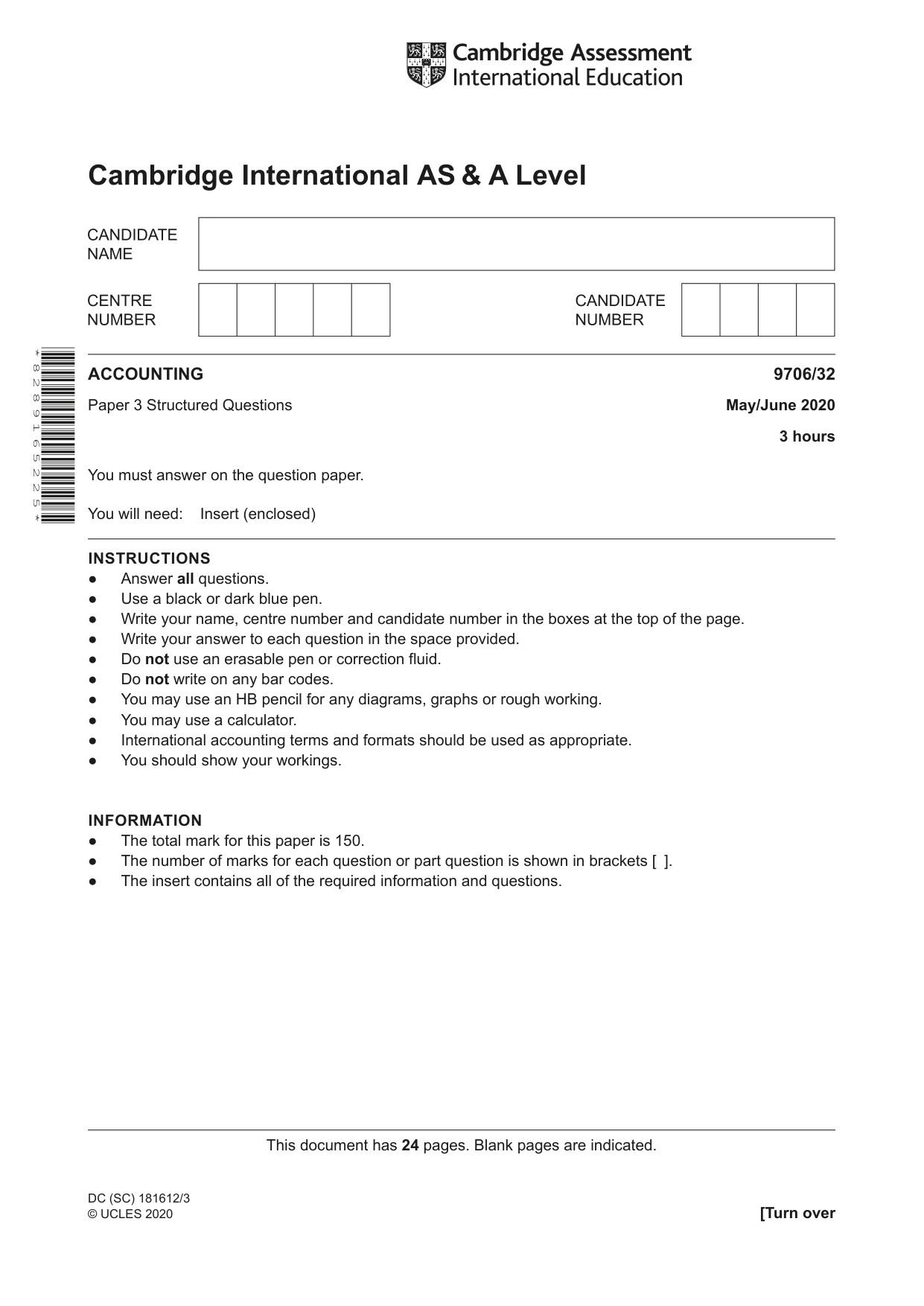
Cambridge International AS & A Level This document has 24 pages. Blank pages are indicated. ACCOUNTING 9706/32 Paper 3 Structured Questions May/June 2020 3 hours You must answer on the question paper. You will need: Insert (enclosed) INSTRUCTIONS ● Answer all questions. ● Use a black or dark blue pen. ● Write your name, centre number and candidate number in the boxes at the top of the page. ● Write your answer to each question in the space provided. ● Do not use an erasable pen or correction fluid. ● Do not write on any bar codes. ● You may use an HB pencil for any diagrams, graphs or rough working. ● You may use a calculator. ● International accounting terms and formats should be used as appropriate. ● You should show your workings. INFORMATION ● The total mark for this paper is 150. ● The number of marks for each question or part question is shown in brackets [ ]. ● The insert contains all of the required information and questions. * 8 2 8 9 1 6 5 2 2 5 * DC (SC) 181612/3 © UCLES 2020 [Turn over
Question paper, page 2
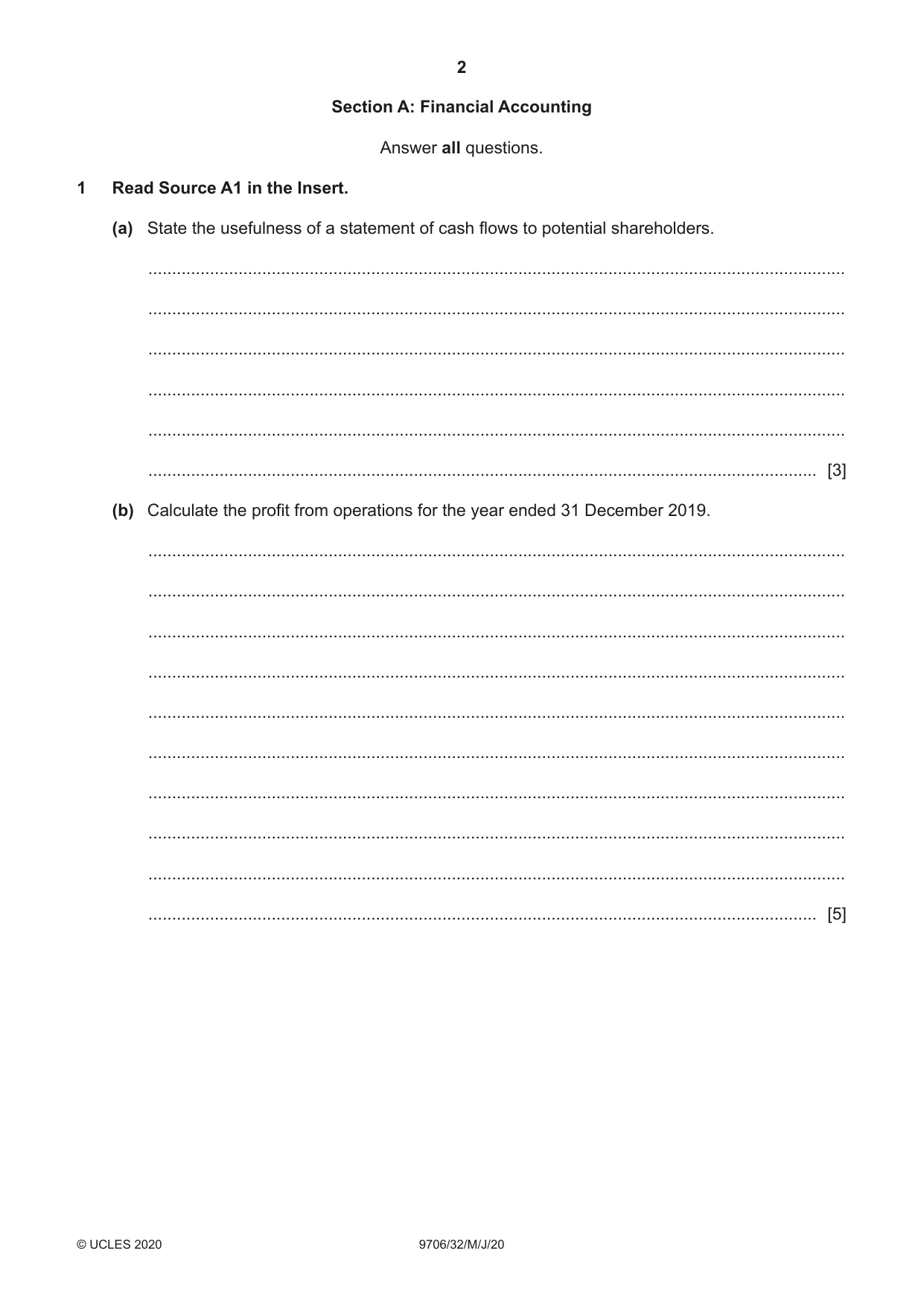
2 9706/32/M/J/20 © UCLES 2020 Section A: Financial Accounting Answer all questions. 1 Read Source A1 in the Insert. (a) State the usefulness of a statement of cash flows to potential shareholders. … … … … … … [3] (b) Calculate the profit from operations for the year ended 31 December 2019. … … … … … … … … … … [5]
Question paper, page 3
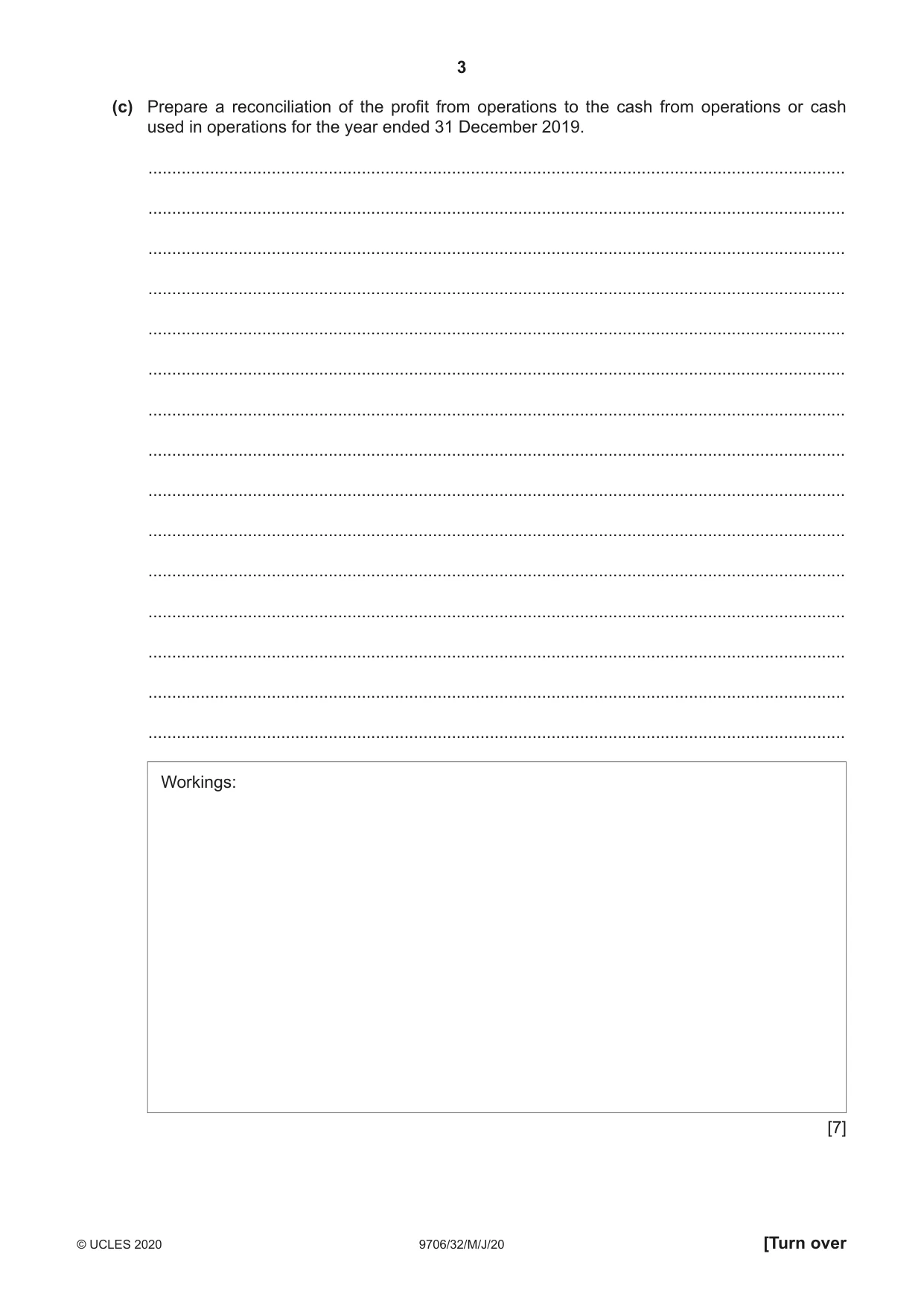
3 9706/32/M/J/20 © UCLES 2020 [Turn over (c) Prepare a reconciliation of the profit from operations to the cash from operations or cash used in operations for the year ended 31 December 2019. … … … … … … … … … … … … … … … Workings: [7]
Question paper, page 4
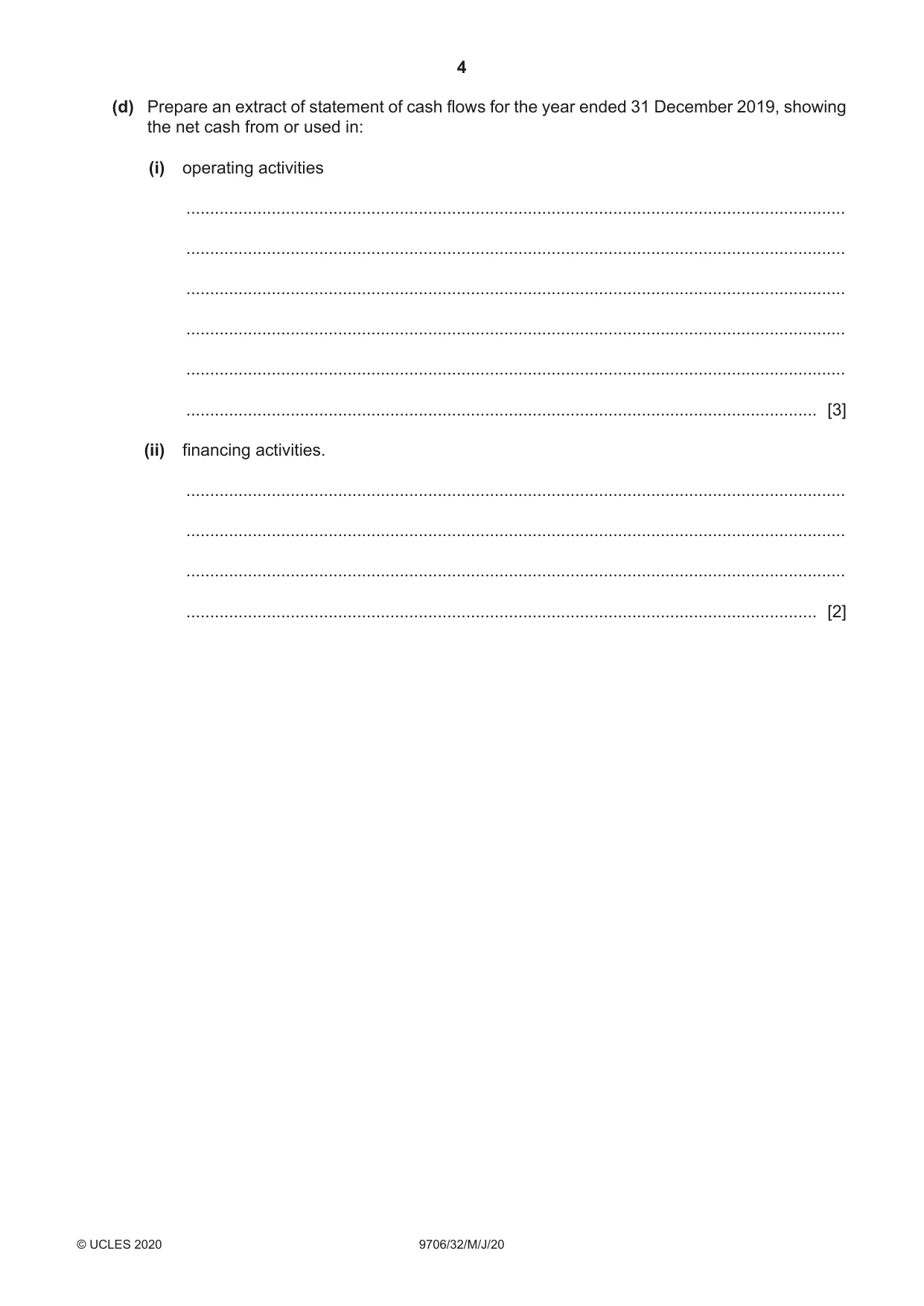
4 9706/32/M/J/20 © UCLES 2020 (d) Prepare an extract of statement of cash flows for the year ended 31 December 2019, showing the net cash from or used in: (i) operating activities … … … … … … [3] (ii) financing activities. … … … … [2]
Question paper, page 5
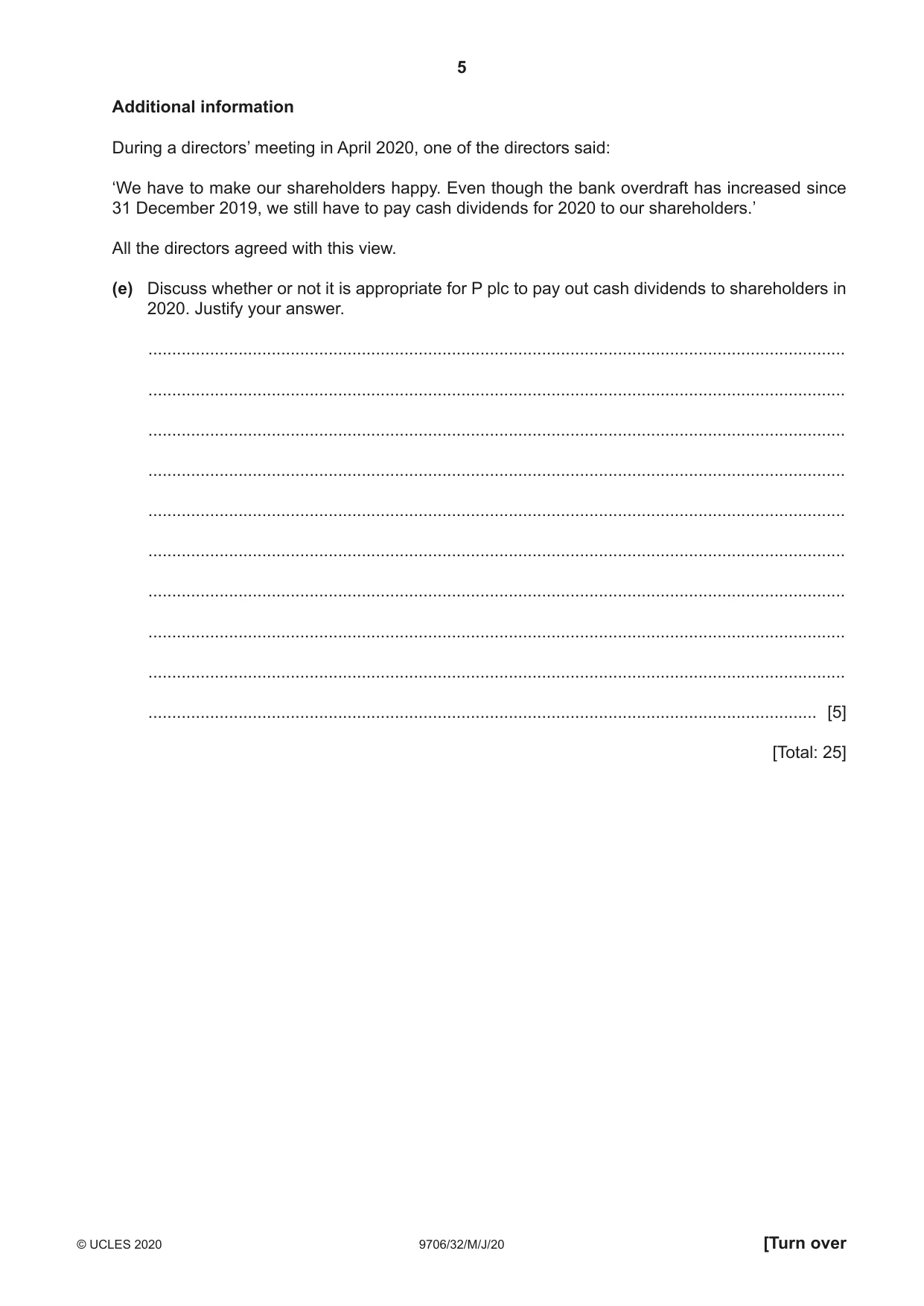
5 9706/32/M/J/20 © UCLES 2020 [Turn over Additional information During a directors’ meeting in April 2020, one of the directors said: ‘We have to make our shareholders happy. Even though the bank overdraft has increased since 31 December 2019, we still have to pay cash dividends for 2020 to our shareholders.’ All the directors agreed with this view. (e) Discuss whether or not it is appropriate for P plc to pay out cash dividends to shareholders in 2020. Justify your answer. … … … … … … … … … … [5] [Total: 25]
Question paper, page 6
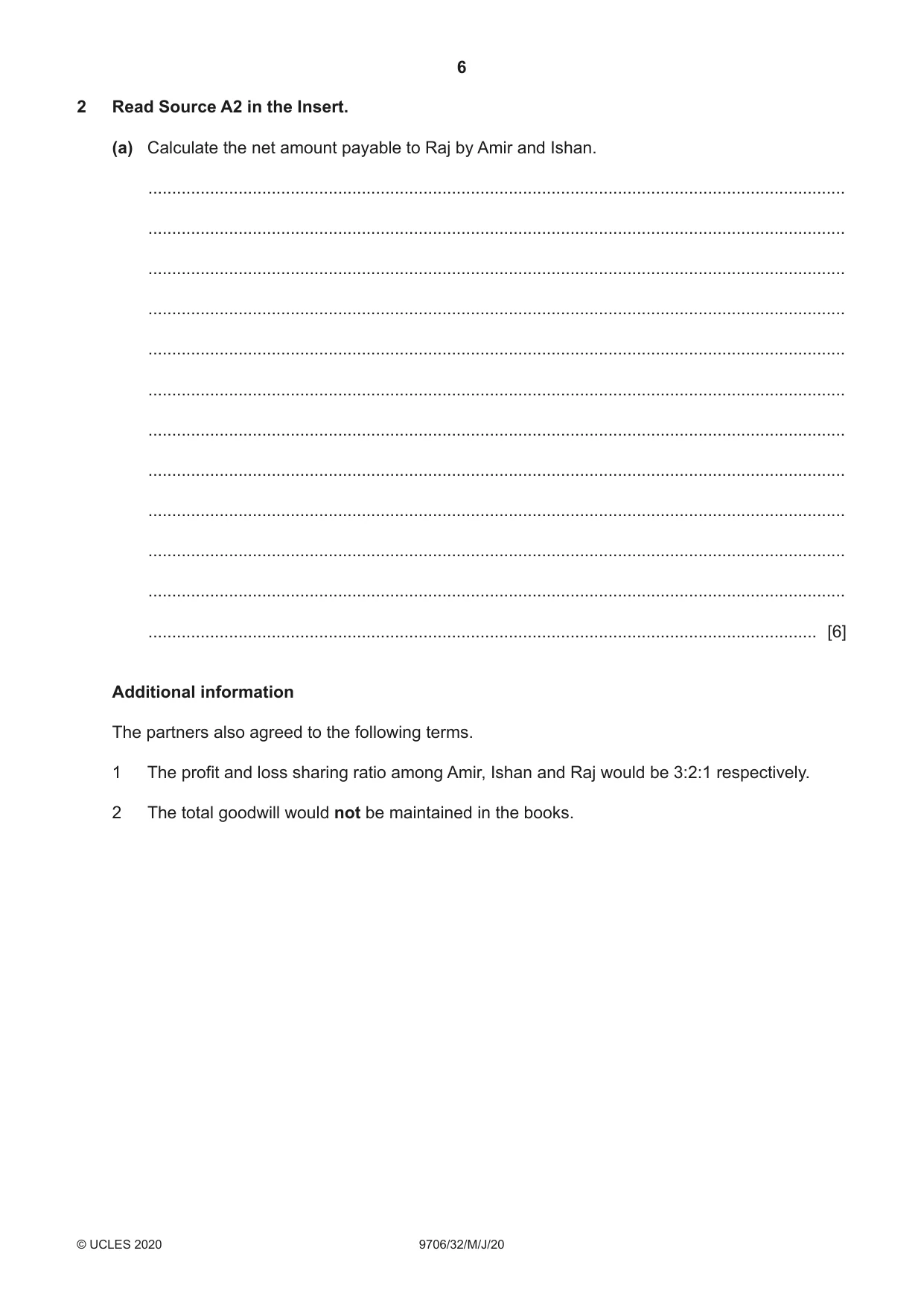
6 9706/32/M/J/20 © UCLES 2020 2 Read Source A2 in the Insert. (a) Calculate the net amount payable to Raj by Amir and Ishan. … … … … … … … … … … … … [6] Additional information The partners also agreed to the following terms. 1 The profit and loss sharing ratio among Amir, Ishan and Raj would be 3:2:1 respectively. 2 The total goodwill would not be maintained in the books.
Question paper, page 7
7 9706/32/M/J/20 © UCLES 2020 [Turn over (b) Prepare the statement of financial position of the new partnership on 1 July 2019. Use the space on the next page for your workings. … … … … … … … … … … … … … … … … … … … … … … … … … … …
Question paper, page 8
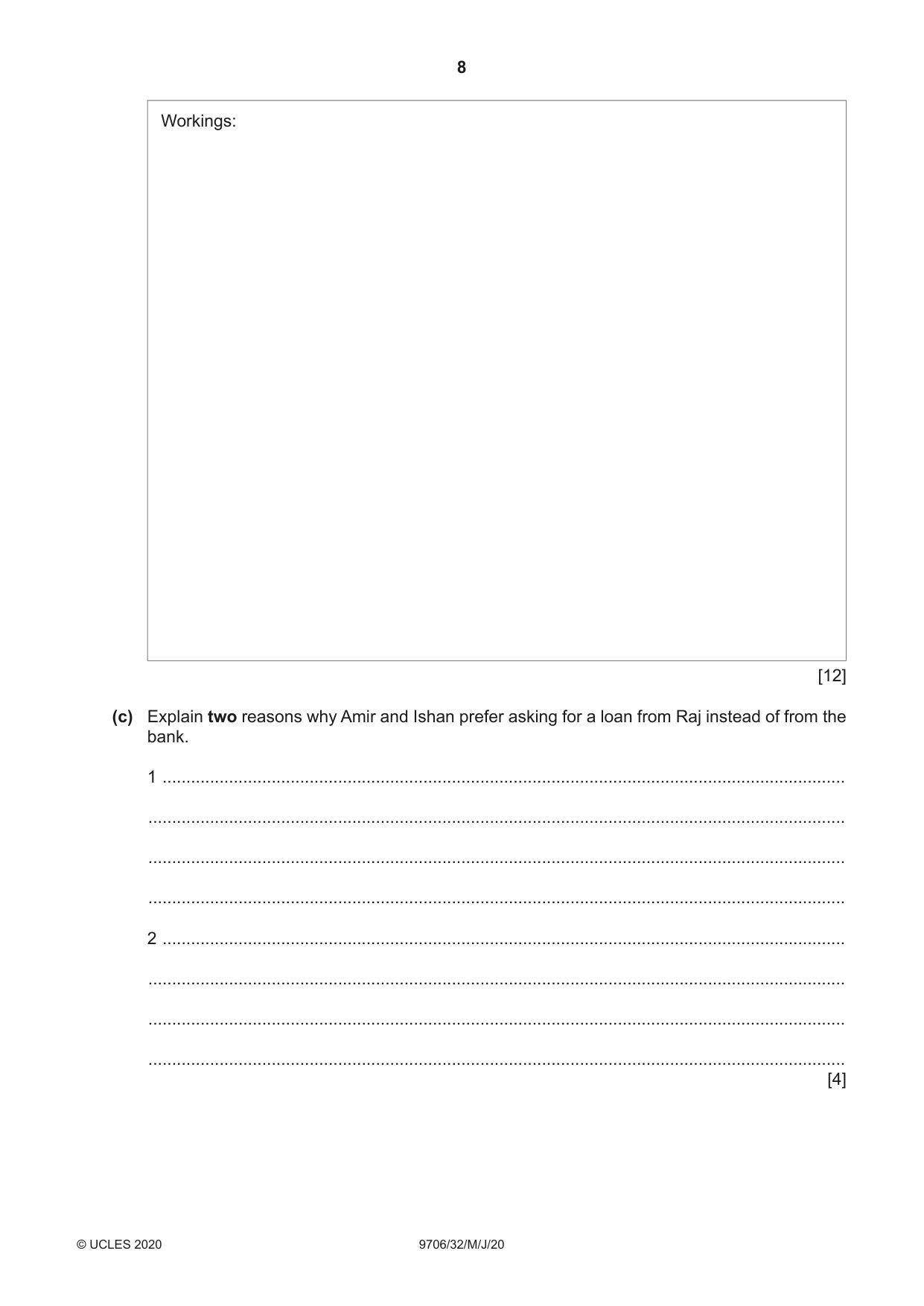
8 9706/32/M/J/20 © UCLES 2020 Workings: [12] (c) Explain two reasons why Amir and Ishan prefer asking for a loan from Raj instead of from the bank. 1 … … … … 2 … … … … [4]
Question paper, page 9
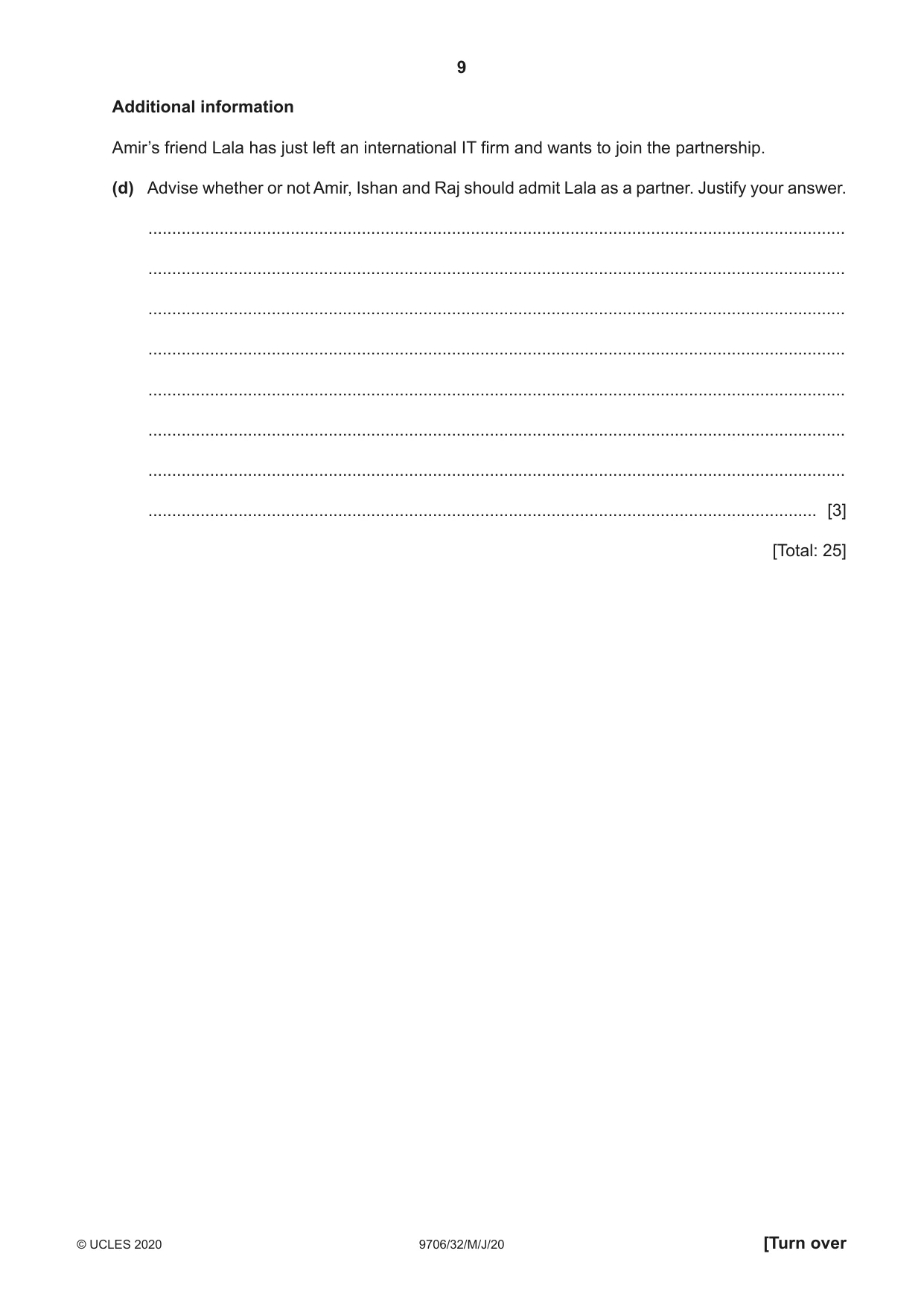
9 9706/32/M/J/20 © UCLES 2020 [Turn over Additional information Amir’s friend Lala has just left an international IT firm and wants to join the partnership. (d) Advise whether or not Amir, Ishan and Raj should admit Lala as a partner. Justify your answer. … … … … … … … … [3] [Total: 25]
Question paper, page 10
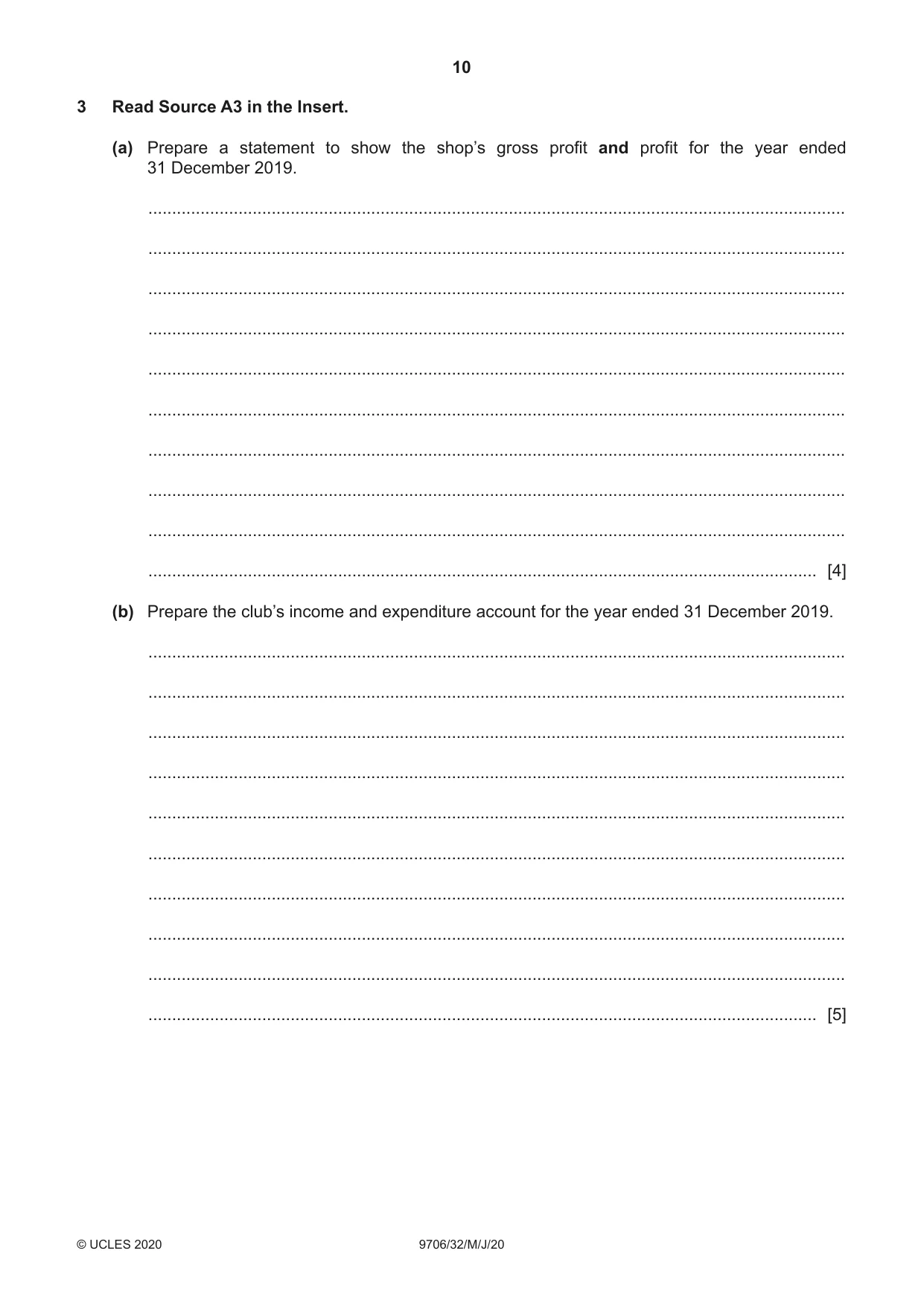
10 9706/32/M/J/20 © UCLES 2020 3 Read Source A3 in the Insert. (a) Prepare a statement to show the shop’s gross profit and profit for the year ended 31 December 2019. … … … … … … … … … … [4] (b) Prepare the club’s income and expenditure account for the year ended 31 December 2019. … … … … … … … … … … [5]
Question paper, page 11
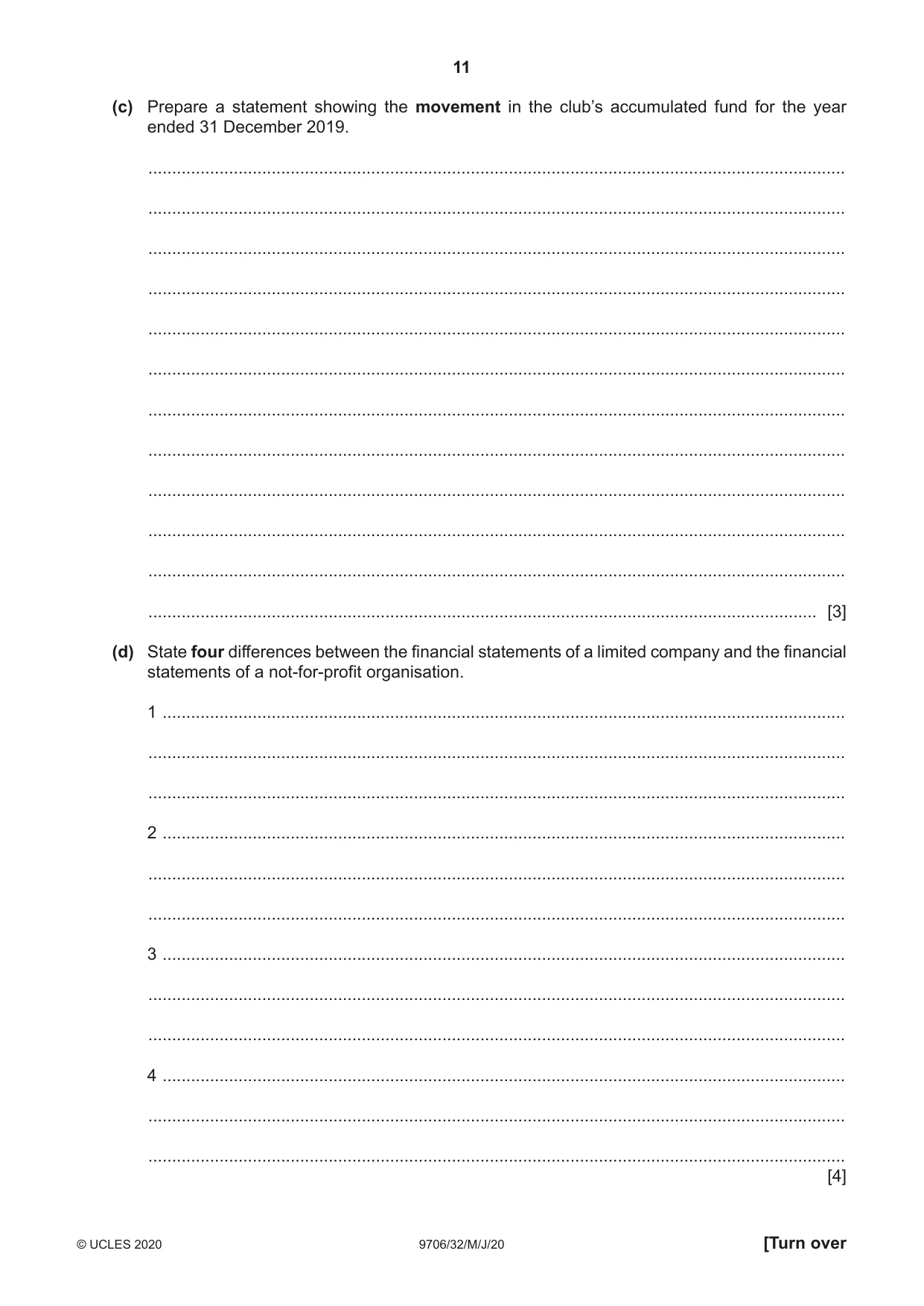
11 9706/32/M/J/20 © UCLES 2020 [Turn over (c) Prepare a statement showing the movement in the club’s accumulated fund for the year ended 31 December 2019. … … … … … … … … … … … … [3] (d) State four differences between the financial statements of a limited company and the financial statements of a not-for-profit organisation. 1 … … … 2 … … … 3 … … … 4 … … … [4]
Question paper, page 12
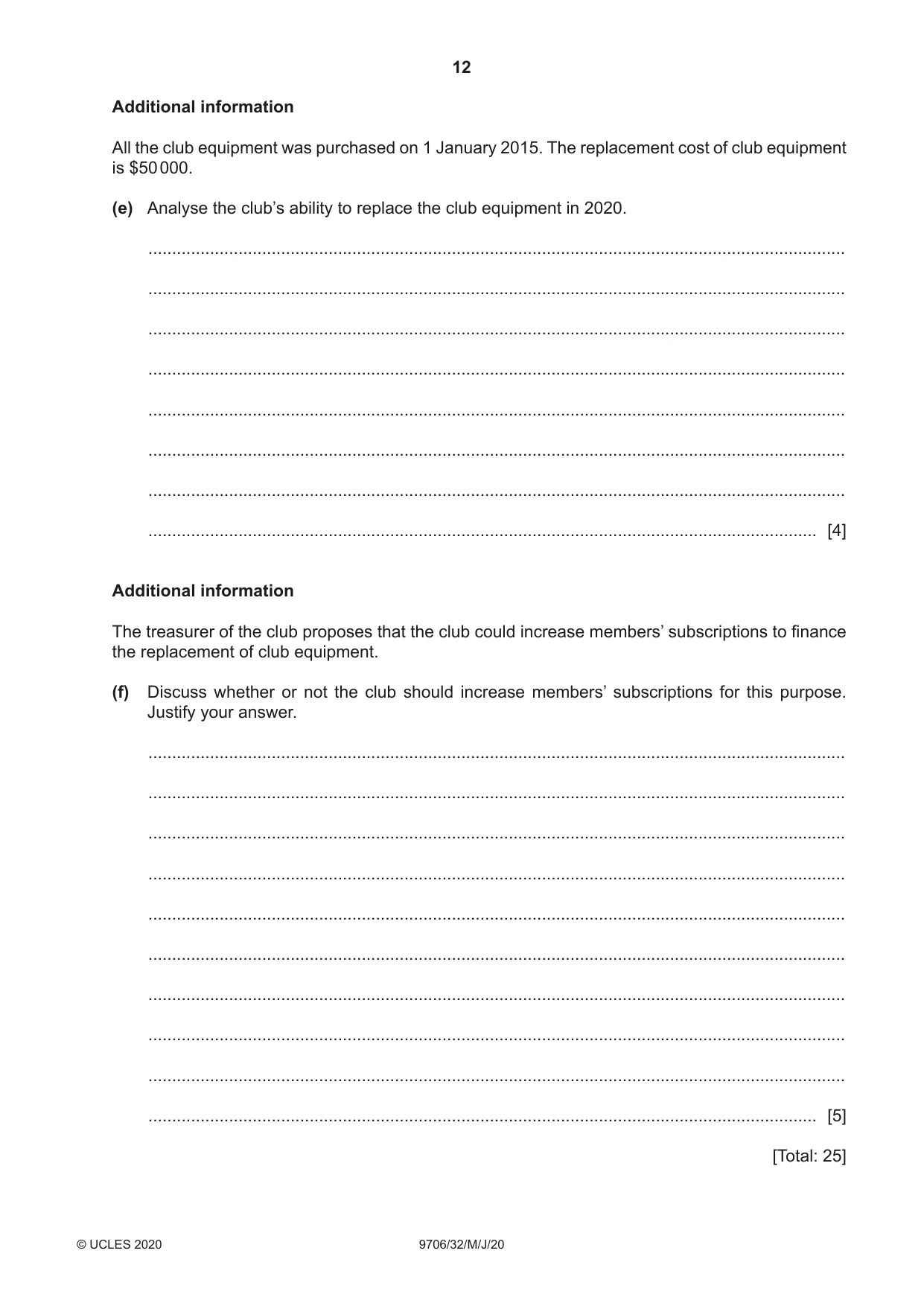
12 9706/32/M/J/20 © UCLES 2020 Additional information All the club equipment was purchased on 1 January 2015. The replacement cost of club equipment is $50 000. (e) Analyse the club’s ability to replace the club equipment in 2020. … … … … … … … … [4] Additional information The treasurer of the club proposes that the club could increase members’ subscriptions to finance the replacement of club equipment. (f) Discuss whether or not the club should increase members’ subscriptions for this purpose. Justify your answer. … … … … … … … … … … [5] [Total: 25]
Question paper, page 13
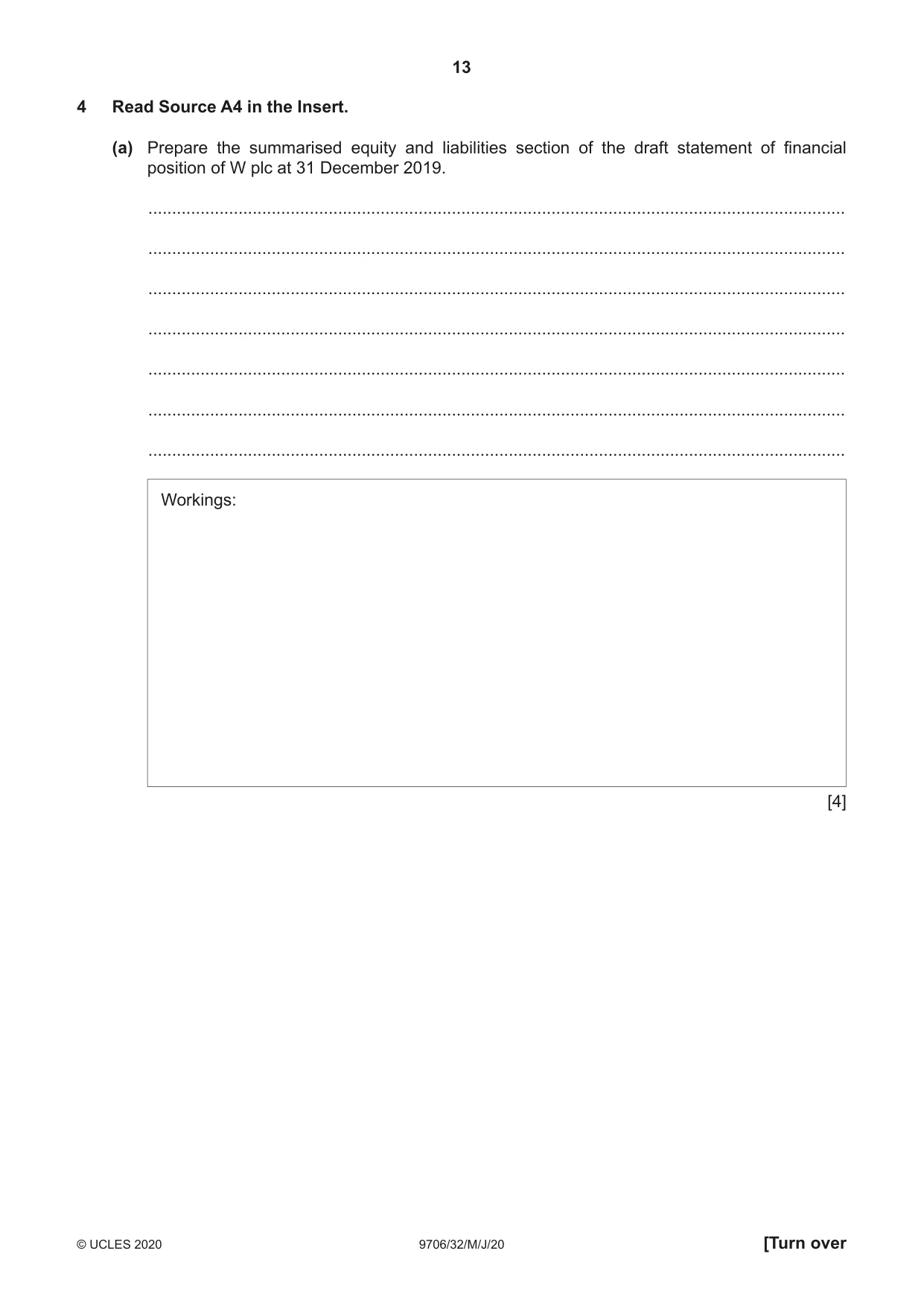
13 9706/32/M/J/20 © UCLES 2020 [Turn over 4 Read Source A4 in the Insert. (a) Prepare the summarised equity and liabilities section of the draft statement of financial position of W plc at 31 December 2019. … … … … … … … Workings: [4]
Question paper, page 14
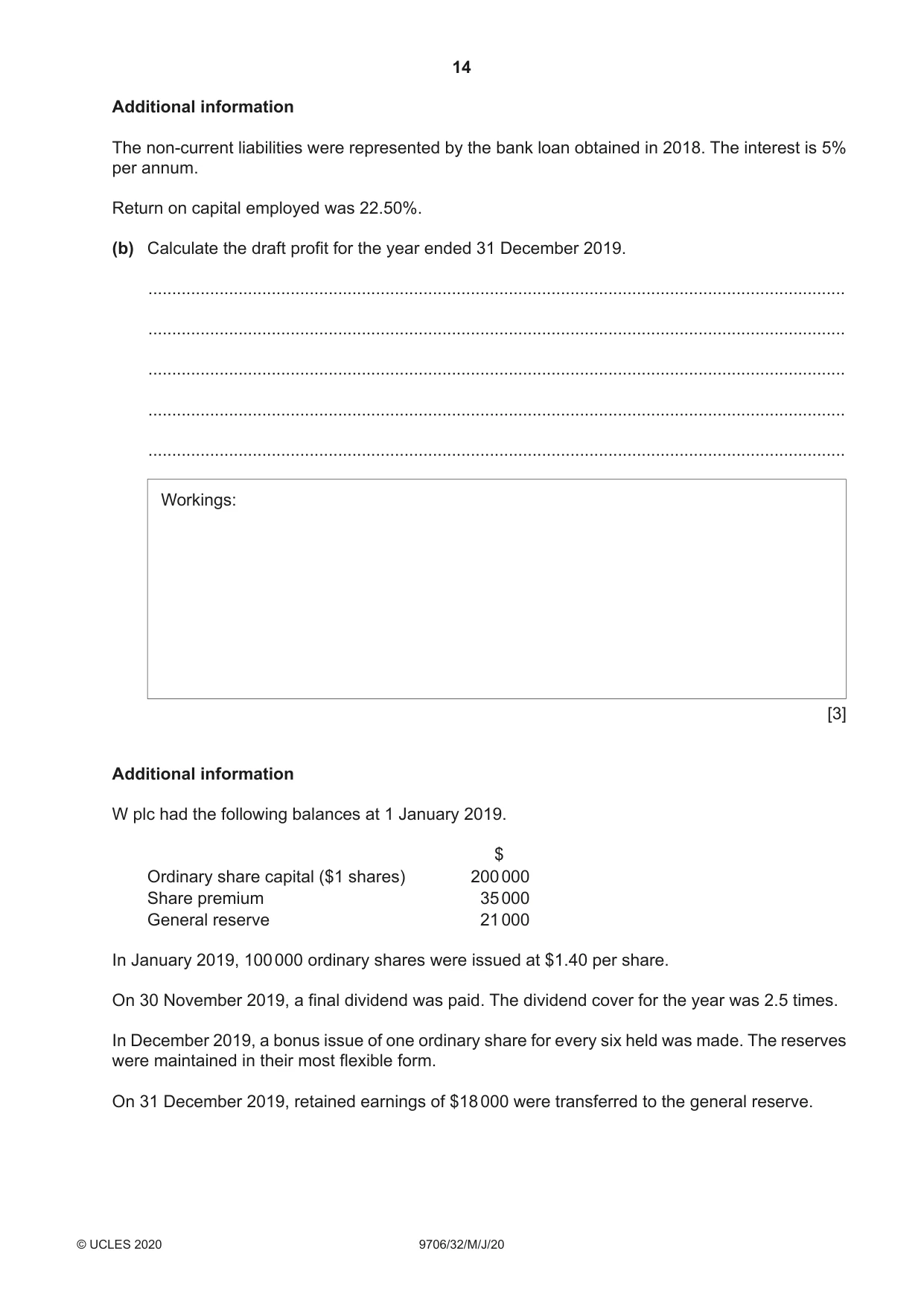
14 9706/32/M/J/20 © UCLES 2020 Additional information The non-current liabilities were represented by the bank loan obtained in 2018. The interest is 5% per annum. Return on capital employed was 22.50%. (b) Calculate the draft profit for the year ended 31 December 2019. … … … … … Workings: [3] Additional information W plc had the following balances at 1 January 2019. $ Ordinary share capital ($1 shares) 200 000 Share premium 35 000 General reserve 21 000 In January 2019, 100 000 ordinary shares were issued at $1.40 per share. On 30 November 2019, a final dividend was paid. The dividend cover for the year was 2.5 times. In December 2019, a bonus issue of one ordinary share for every six held was made. The reserves were maintained in their most flexible form. On 31 December 2019, retained earnings of $18 000 were transferred to the general reserve.
Question paper, page 15
15 9706/32/M/J/20 © UCLES 2020 [Turn over (c) Prepare the draft statement of changes in equity for the year ended 31 December 2019. The total column is not required. … … … … … … … … … … … … … … … … … … … Workings: [10]
Question paper, page 16
16 9706/32/M/J/20 © UCLES 2020 Additional information On 18 January 2020, before the draft financial statements were presented to the auditors, it was found that one of the customers, owing $8000 at 31 December 2019, had been declared bankrupt. (d) Define the meaning of the terms ‘adjusting events’ and ‘non-adjusting events’ according to IAS 10. … … … … … … … … [4] (e) Explain the appropriate accounting treatment of the amount of $8000 owed by a customer declared bankrupt at 31 December 2019. … … … … … … … … [4] [Total: 25]
Question paper, page 17
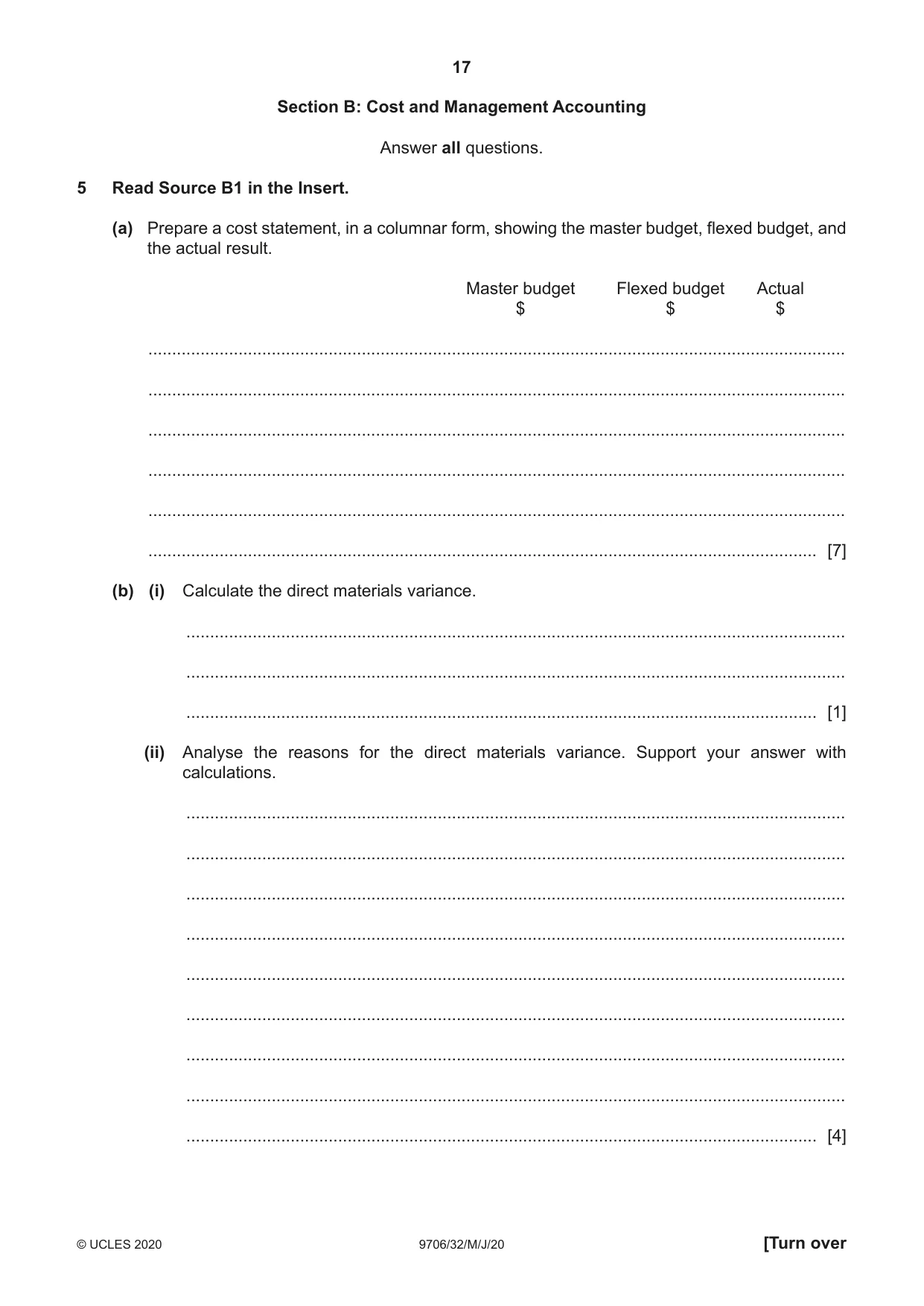
17 9706/32/M/J/20 © UCLES 2020 [Turn over Section B: Cost and Management Accounting Answer all questions. 5 Read Source B1 in the Insert. (a) Prepare a cost statement, in a columnar form, showing the master budget, flexed budget, and the actual result. Master budget Flexed budget Actual $ $ $ … … … … … … [7] (b) (i) Calculate the direct materials variance. … … … [1] (ii) Analyse the reasons for the direct materials variance. Support your answer with calculations. … … … … … … … … … [4]
Question paper, page 18
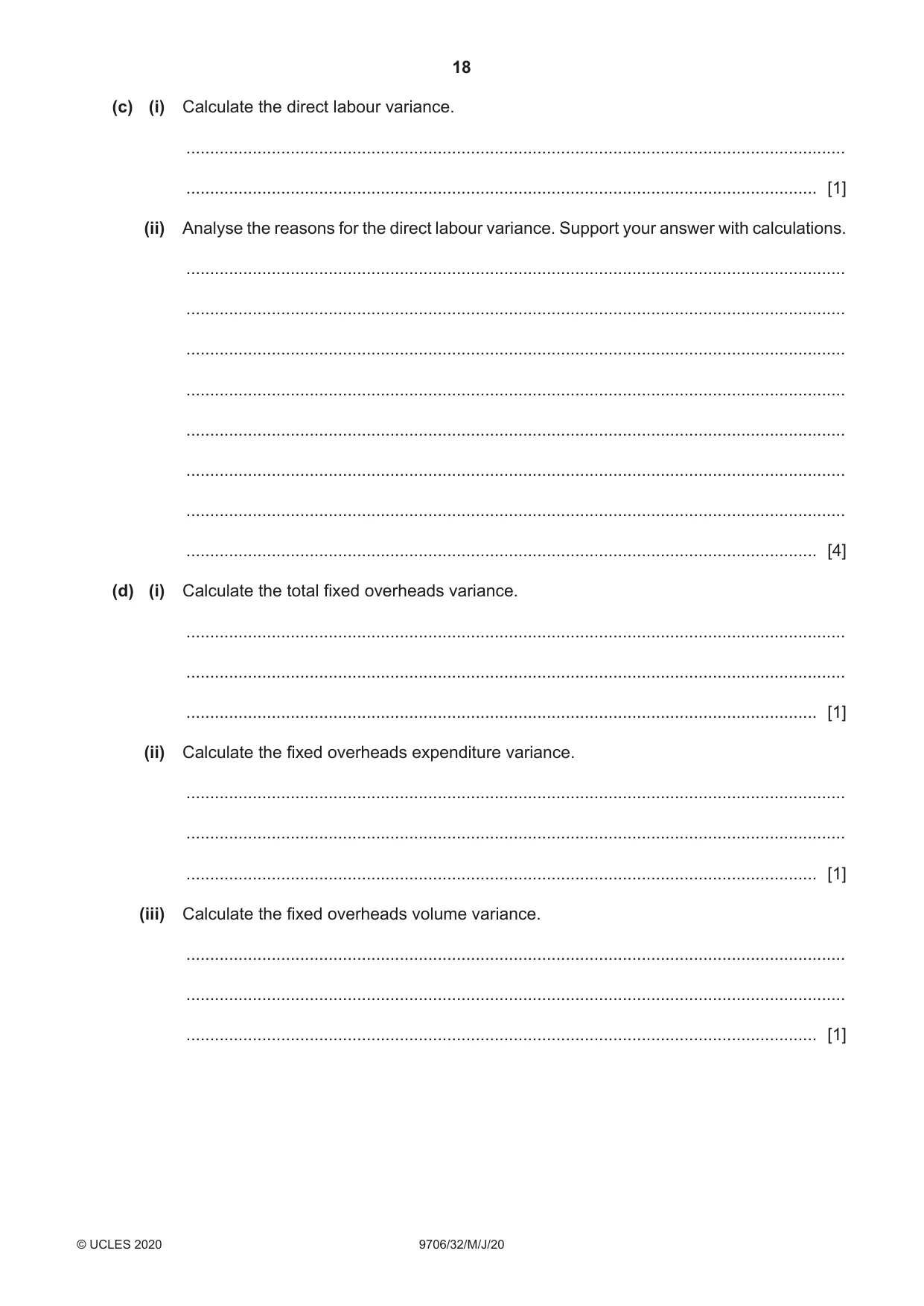
18 9706/32/M/J/20 © UCLES 2020 (c) (i) Calculate the direct labour variance. … … [1] (ii) Analyse the reasons for the direct labour variance. Support your answer with calculations. … … … … … … … … [4] (d) (i) Calculate the total fixed overheads variance. … … … [1] (ii) Calculate the fixed overheads expenditure variance. … … … [1] (iii) Calculate the fixed overheads volume variance. … … … [1]
Question paper, page 19
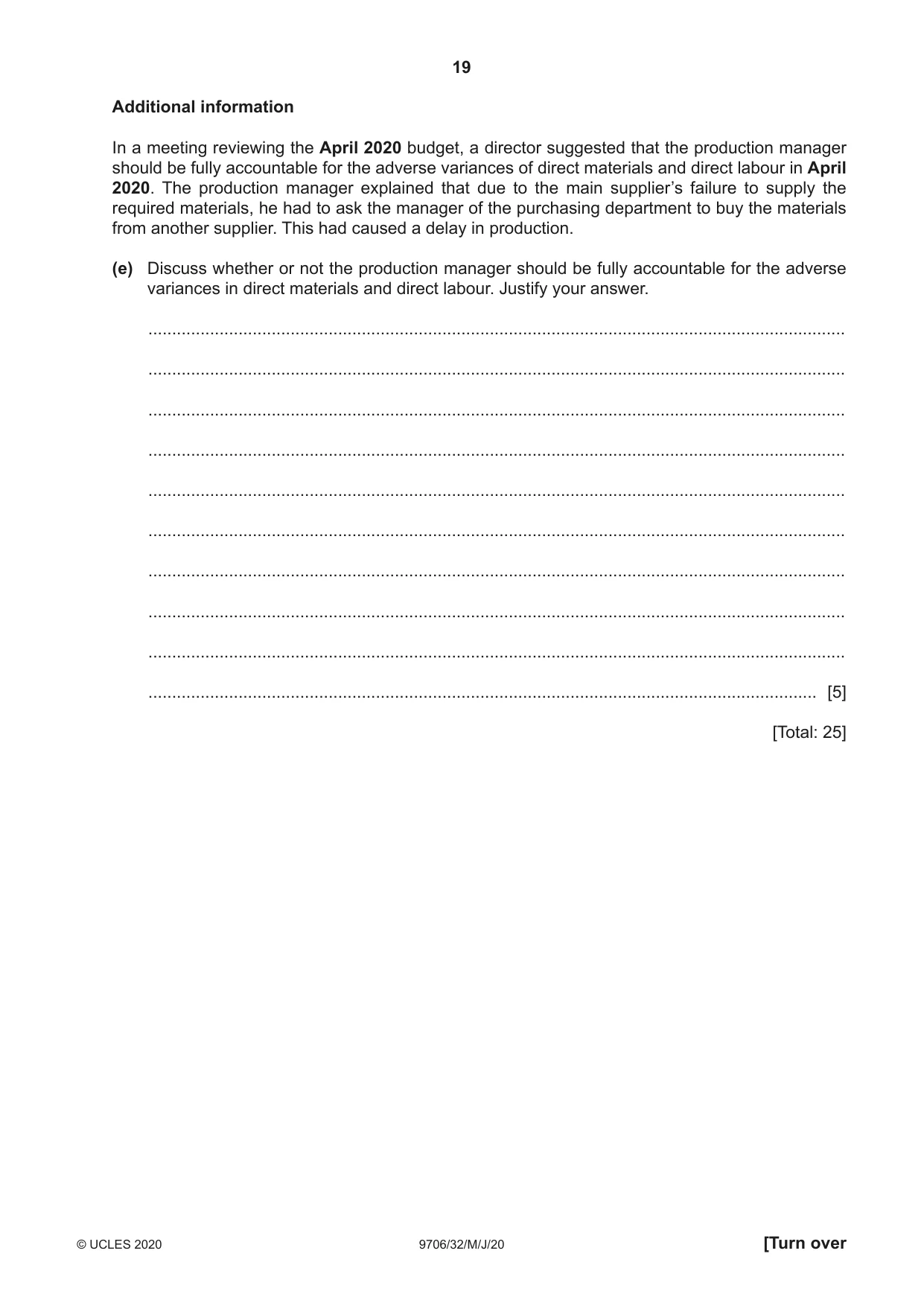
19 9706/32/M/J/20 © UCLES 2020 [Turn over Additional information In a meeting reviewing the April 2020 budget, a director suggested that the production manager should be fully accountable for the adverse variances of direct materials and direct labour in April 2020. The production manager explained that due to the main supplier’s failure to supply the required materials, he had to ask the manager of the purchasing department to buy the materials from another supplier. This had caused a delay in production. (e) Discuss whether or not the production manager should be fully accountable for the adverse variances in direct materials and direct labour. Justify your answer. … … … … … … … … … … [5] [Total: 25]
Question paper, page 20
20 9706/32/M/J/20 © UCLES 2020 6 Read Source B2 in the Insert. (a) Prepare a cash budget for each of the months of March and April. … … … … … … … … … … … … … … … … … … … … … … … … … …
Question paper, page 21
21 9706/32/M/J/20 © UCLES 2020 [Turn over Workings: [13]
Question paper, page 22
22 9706/32/M/J/20 © UCLES 2020 (b) Explain two purposes of preparing a monthly cash budget. 1 … … … 2 … … … [4] (c) Assess whether the budgeted April sales will achieve or exceed the break-even point. … … … … … … [4] Additional information The directors are considering measures to improve the company’s cash position. (d) Explain to what extent making sales exceeding the break-even point will improve the company’s cash position. … … … … … … … … [4] [Total: 25]
Question paper, page 23
23 9706/32/M/J/20 © UCLES 2020 BLANK PAGE
Question paper, page 24
24 9706/32/M/J/20 © UCLES 2020 Permission to reproduce items where third-party owned material protected by copyright is included has been sought and cleared where possible. Every reasonable effort has been made by the publisher (UCLES) to trace copyright holders, but if any items requiring clearance have unwittingly been included, the publisher will be pleased to make amends at the earliest possible opportunity. To avoid the issue of disclosure of answer-related information to candidates, all copyright acknowledgements are reproduced online in the Cambridge Assessment International Education Copyright Acknowledgements Booklet. This is produced for each series of examinations and is freely available to download at www.cambridgeinternational.org after the live examination series. Cambridge Assessment International Education is part of the Cambridge Assessment Group. Cambridge Assessment is the brand name of the University of Cambridge Local Examinations Syndicate (UCLES), which itself is a department of the University of Cambridge. BLANK PAGE
Mark scheme, page 1
This document consists of 16 printed pages. © UCLES 2020 [Turn over Cambridge International AS & A Level ACCOUNTING 9706/32 Paper 3 Structured Questions May/June 2020 MARK SCHEME Maximum Mark: 150 Published Students did not sit exam papers in the June 2020 series due to the Covid-19 global pandemic. This mark scheme is published to support teachers and students and should be read together with the question paper. It shows the requirements of the exam. The answer column of the mark scheme shows the proposed basis on which Examiners would award marks for this exam. Where appropriate, this column also provides the most likely acceptable alternative responses expected from students. Examiners usually review the mark scheme after they have seen student responses and update the mark scheme if appropriate. In the June series, Examiners were unable to consider the acceptability of alternative responses, as there were no student responses to consider. Mark schemes should usually be read together with the Principal Examiner Report for Teachers. However, because students did not sit exam papers, there is no Principal Examiner Report for Teachers for the June 2020 series. Cambridge International will not enter into discussions about these mark schemes. Cambridge International is publishing the mark schemes for the June 2020 series for most Cambridge IGCSE™ and Cambridge International A & AS Level components, and some Cambridge O Level components.
Mark scheme, page 2
9706/32 Cambridge International AS & A Level – Mark Scheme PUBLISHED May/June 2020 © UCLES 2020 Page 2 of 16 Generic Marking Principles These general marking principles must be applied by all examiners when marking candidate answers. They should be applied alongside the specific content of the mark scheme or generic level descriptors for a question. Each question paper and mark scheme will also comply with these marking principles. GENERIC MARKING PRINCIPLE 1: Marks must be awarded in line with: • the specific content of the mark scheme or the generic level descriptors for the question • the specific skills defined in the mark scheme or in the generic level descriptors for the question • the standard of response required by a candidate as exemplified by the standardisation scripts. GENERIC MARKING PRINCIPLE 2: Marks awarded are always whole marks (not half marks, or other fractions). GENERIC MARKING PRINCIPLE 3: Marks must be awarded positively: • marks are awarded for correct/valid answers, as defined in the mark scheme. However, credit is given for valid answers which go beyond the scope of the syllabus and mark scheme, referring to your Team Leader as appropriate • marks are awarded when candidates clearly demonstrate what they know and can do • marks are not deducted for errors • marks are not deducted for omissions • answers should only be judged on the quality of spelling, punctuation and grammar when these features are specifically assessed by the question as indicated by the mark scheme. The meaning, however, should be unambiguous. GENERIC MARKING PRINCIPLE 4: Rules must be applied consistently e.g. in situations where candidates have not followed instructions or in the application of generic level descriptors.
Mark scheme, page 3
9706/32 Cambridge International AS & A Level – Mark Scheme PUBLISHED May/June 2020 © UCLES 2020 Page 3 of 16 GENERIC MARKING PRINCIPLE 5: Marks should be awarded using the full range of marks defined in the mark scheme for the question (however; the use of the full mark range may be limited according to the quality of the candidate responses seen). GENERIC MARKING PRINCIPLE 6: Marks awarded are based solely on the requirements as defined in the mark scheme. Marks should not be awarded with grade thresholds or grade descriptors in mind.
Mark scheme, page 4
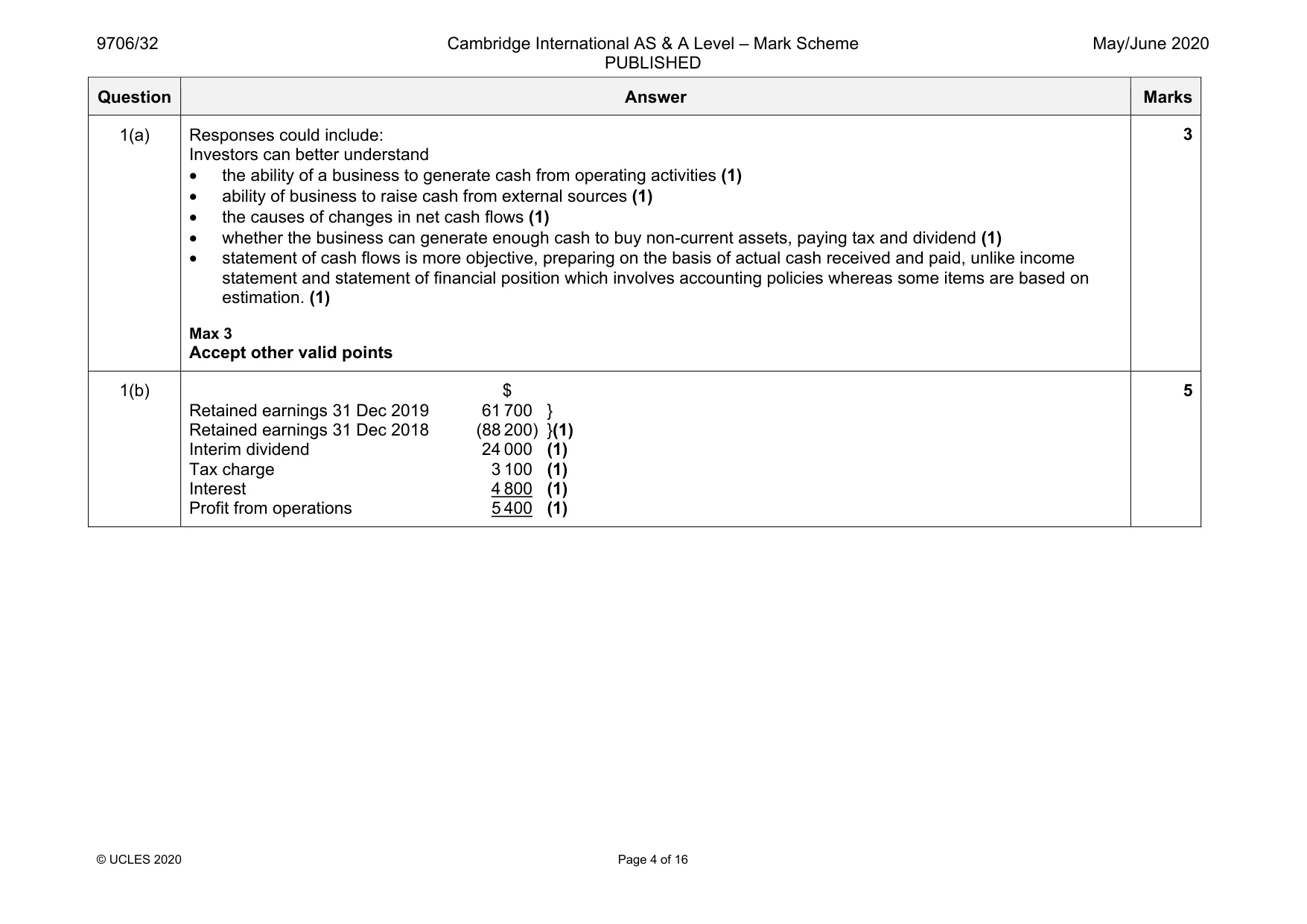
9706/32 Cambridge International AS & A Level – Mark Scheme PUBLISHED May/June 2020 © UCLES 2020 Page 4 of 16 Question Answer Marks 1(a) Responses could include: Investors can better understand • the ability of a business to generate cash from operating activities (1) • ability of business to raise cash from external sources (1) • the causes of changes in net cash flows (1) • whether the business can generate enough cash to buy non-current assets, paying tax and dividend (1) • statement of cash flows is more objective, preparing on the basis of actual cash received and paid, unlike income statement and statement of financial position which involves accounting policies whereas some items are based on estimation. (1) Max 3 Accept other valid points 3 1(b) $ Retained earnings 31 Dec 2019 61 700 } Retained earnings 31 Dec 2018 (88 200) }(1) Interim dividend 24 000 (1) Tax charge 3 100 (1) Interest 4 800 (1) Profit from operations 5 400 (1) 5
Mark scheme, page 5
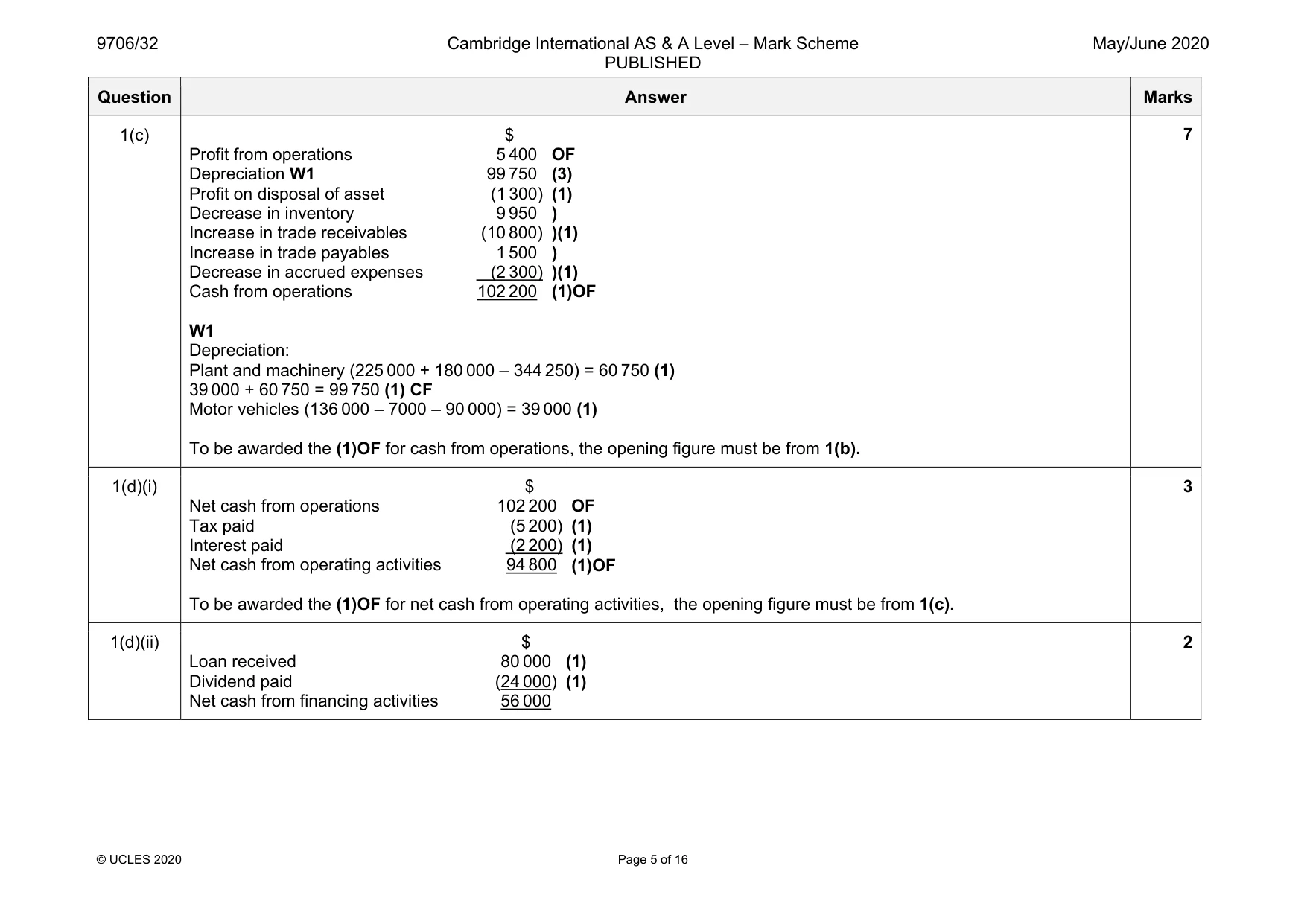
9706/32 Cambridge International AS & A Level – Mark Scheme PUBLISHED May/June 2020 © UCLES 2020 Page 5 of 16 Question Answer Marks 1(c) $ Profit from operations 5 400 OF Depreciation W1 99 750 (3) Profit on disposal of asset (1 300) (1) Decrease in inventory 9 950 ) Increase in trade receivables (10 800) )(1) Increase in trade payables 1 500 ) Decrease in accrued expenses (2 300) )(1) Cash from operations 102 200 (1)OF W1 Depreciation: Plant and machinery (225 000 + 180 000 – 344 250) = 60 750 (1) 39 000 + 60 750 = 99 750 (1) CF Motor vehicles (136 000 – 7000 – 90 000) = 39 000 (1) To be awarded the (1)OF for cash from operations, the opening figure must be from 1(b). 7 1(d)(i) $ Net cash from operations 102 200 OF Tax paid (5 200) (1) Interest paid (2 200) (1) Net cash from operating activities 94 800 (1)OF To be awarded the (1)OF for net cash from operating activities, the opening figure must be from 1(c). 3 1(d)(ii) $ Loan received 80 000 (1) Dividend paid (24 000) (1) Net cash from financing activities 56 000 2
Mark scheme, page 6
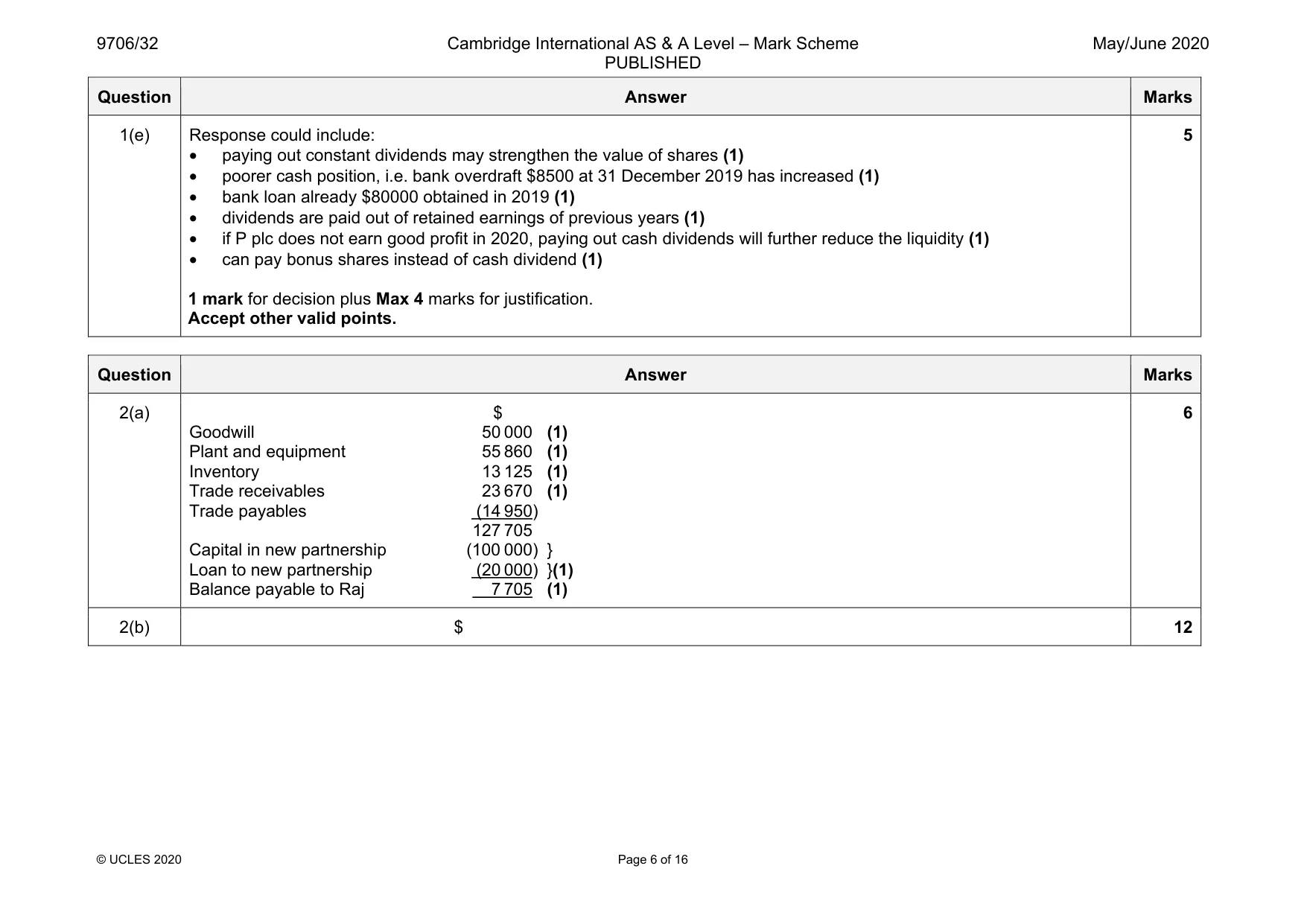
9706/32 Cambridge International AS & A Level – Mark Scheme PUBLISHED May/June 2020 © UCLES 2020 Page 6 of 16 Question Answer Marks 1(e) Response could include: • paying out constant dividends may strengthen the value of shares (1) • poorer cash position, i.e. bank overdraft $8500 at 31 December 2019 has increased (1) • bank loan already $80000 obtained in 2019 (1) • dividends are paid out of retained earnings of previous years (1) • if P plc does not earn good profit in 2020, paying out cash dividends will further reduce the liquidity (1) • can pay bonus shares instead of cash dividend (1) 1 mark for decision plus Max 4 marks for justification. Accept other valid points. 5 Question Answer Marks 2(a) $ Goodwill 50 000 (1) Plant and equipment 55 860 (1) Inventory 13 125 (1) Trade receivables 23 670 (1) Trade payables (14 950) 127 705 Capital in new partnership (100 000) } Loan to new partnership (20 000) }(1) Balance payable to Raj 7 705 (1) 6 2(b) $ 12
Mark scheme, page 7
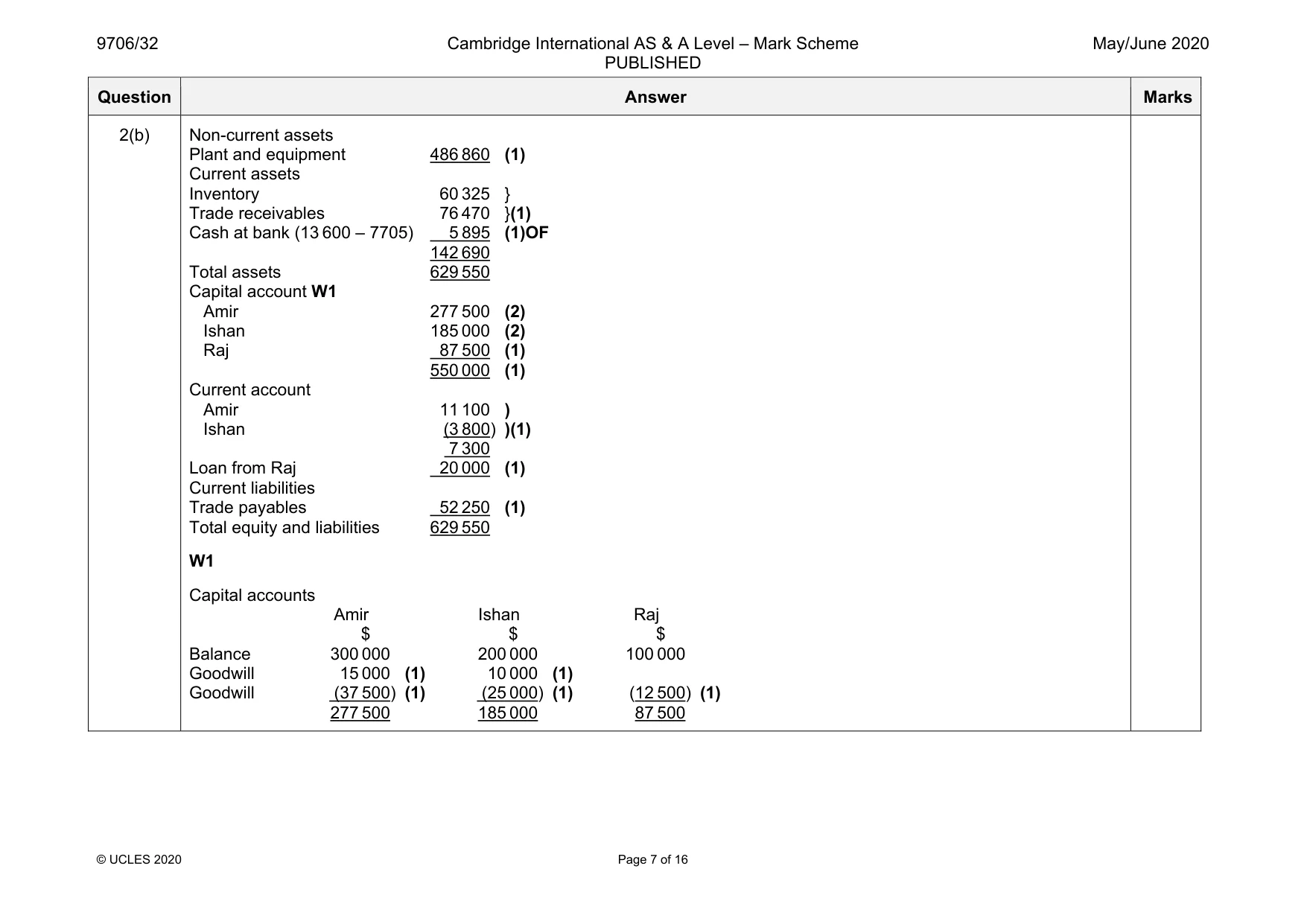
9706/32 Cambridge International AS & A Level – Mark Scheme PUBLISHED May/June 2020 © UCLES 2020 Page 7 of 16 Question Answer Marks 2(b) Non-current assets Plant and equipment 486 860 (1) Current assets Inventory 60 325 } Trade receivables 76 470 }(1) Cash at bank (13 600 – 7705) 5 895 (1)OF 142 690 Total assets 629 550 Capital account W1 Amir 277 500 (2) Ishan 185 000 (2) Raj 87 500 (1) 550 000 (1) Current account Amir 11 100 ) Ishan (3 800) )(1) 7 300 Loan from Raj 20 000 (1) Current liabilities Trade payables 52 250 (1) Total equity and liabilities 629 550 W1 Capital accounts Amir Ishan Raj $ $ $ Balance 300 000 200 000 100 000 Goodwill 15 000 (1) 10 000 (1) Goodwill (37 500) (1) (25 000) (1) (12 500) (1) 277 500 185 000 87 500
Mark scheme, page 8
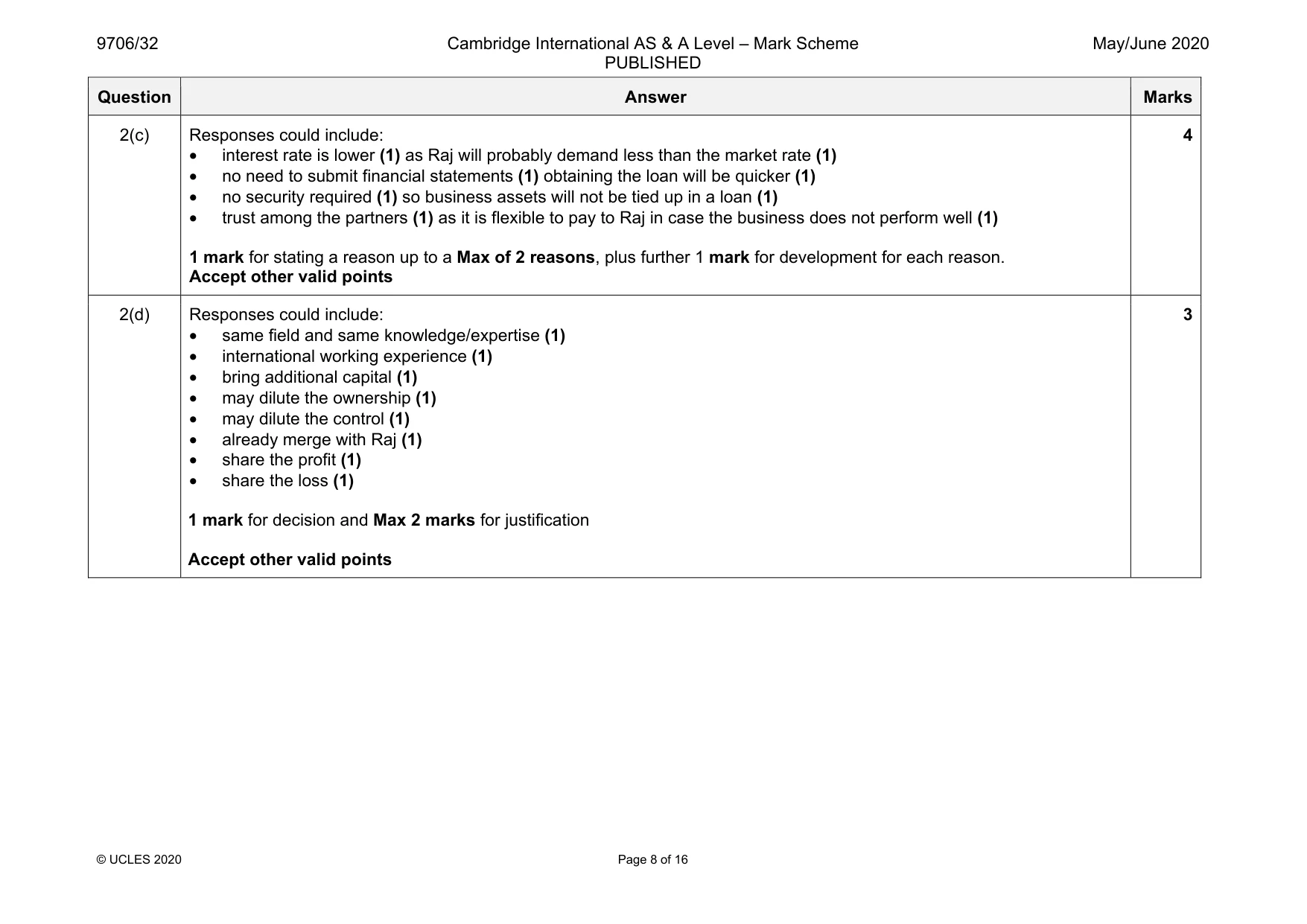
9706/32 Cambridge International AS & A Level – Mark Scheme PUBLISHED May/June 2020 © UCLES 2020 Page 8 of 16 Question Answer Marks 2(c) Responses could include: • interest rate is lower (1) as Raj will probably demand less than the market rate (1) • no need to submit financial statements (1) obtaining the loan will be quicker (1) • no security required (1) so business assets will not be tied up in a loan (1) • trust among the partners (1) as it is flexible to pay to Raj in case the business does not perform well (1) 1 mark for stating a reason up to a Max of 2 reasons, plus further 1 mark for development for each reason. Accept other valid points 4 2(d) Responses could include: • same field and same knowledge/expertise (1) • international working experience (1) • bring additional capital (1) • may dilute the ownership (1) • may dilute the control (1) • already merge with Raj (1) • share the profit (1) • share the loss (1) 1 mark for decision and Max 2 marks for justification Accept other valid points 3
Mark scheme, page 9
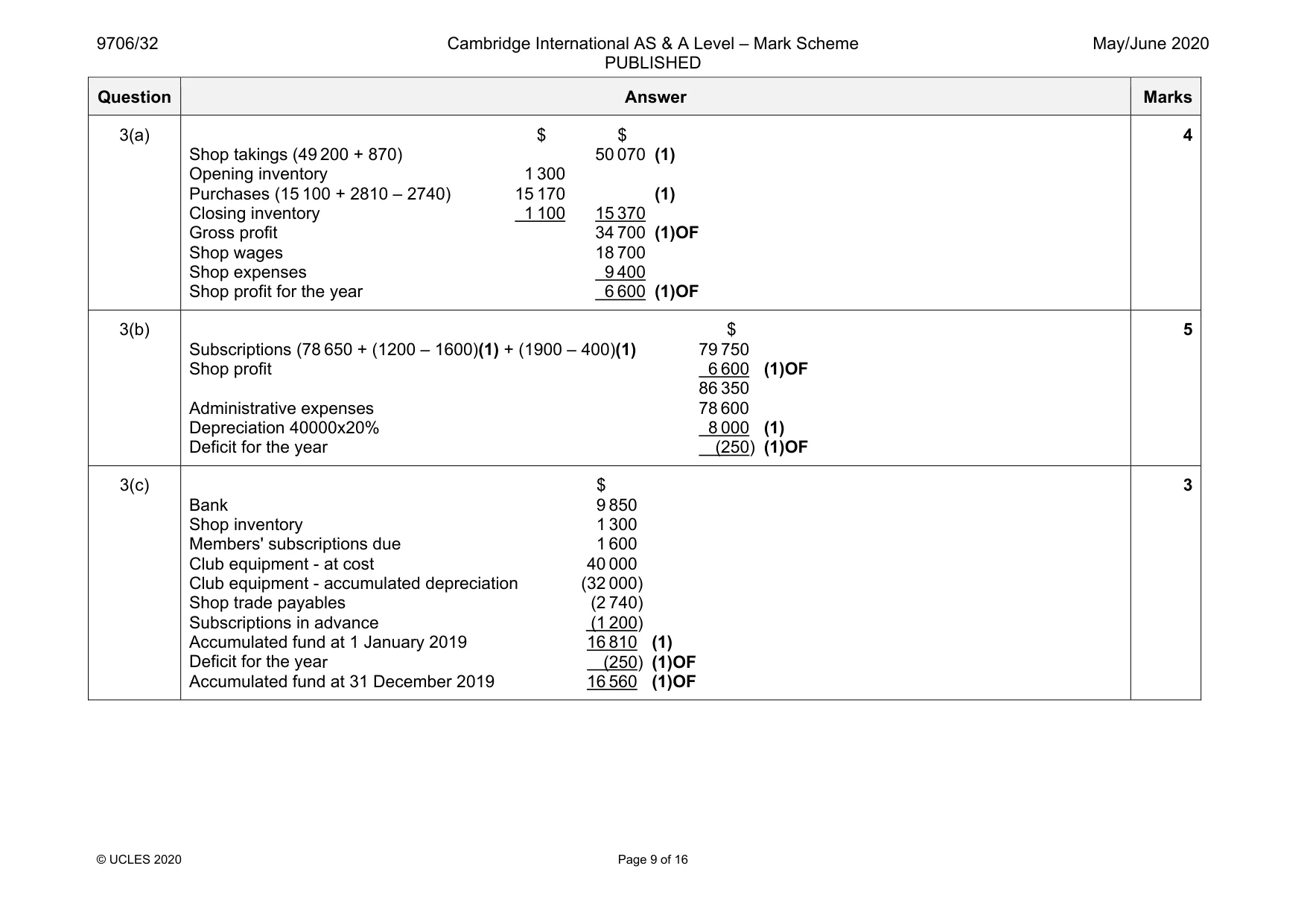
9706/32 Cambridge International AS & A Level – Mark Scheme PUBLISHED May/June 2020 © UCLES 2020 Page 9 of 16 Question Answer Marks 3(a) $ $ Shop takings (49 200 + 870) 50 070 (1) Opening inventory 1 300 Purchases (15 100 + 2810 – 2740) 15 170 (1) Closing inventory 1 100 15 370 Gross profit 34 700 (1)OF Shop wages 18 700 Shop expenses 9 400 Shop profit for the year 6 600 (1)OF 4 3(b) $ Subscriptions (78 650 + (1200 – 1600)(1) + (1900 – 400)(1) 79 750 Shop profit 6 600 (1)OF 86 350 Administrative expenses 78 600 Depreciation 40000x20% 8 000 (1) Deficit for the year (250) (1)OF 5 3(c) $ Bank 9 850 Shop inventory 1 300 Members' subscriptions due 1 600 Club equipment - at cost 40 000 Club equipment - accumulated depreciation (32 000) Shop trade payables (2 740) Subscriptions in advance (1 200) Accumulated fund at 1 January 2019 16 810 (1) Deficit for the year (250) (1)OF Accumulated fund at 31 December 2019 16 560 (1)OF 3
Mark scheme, page 10
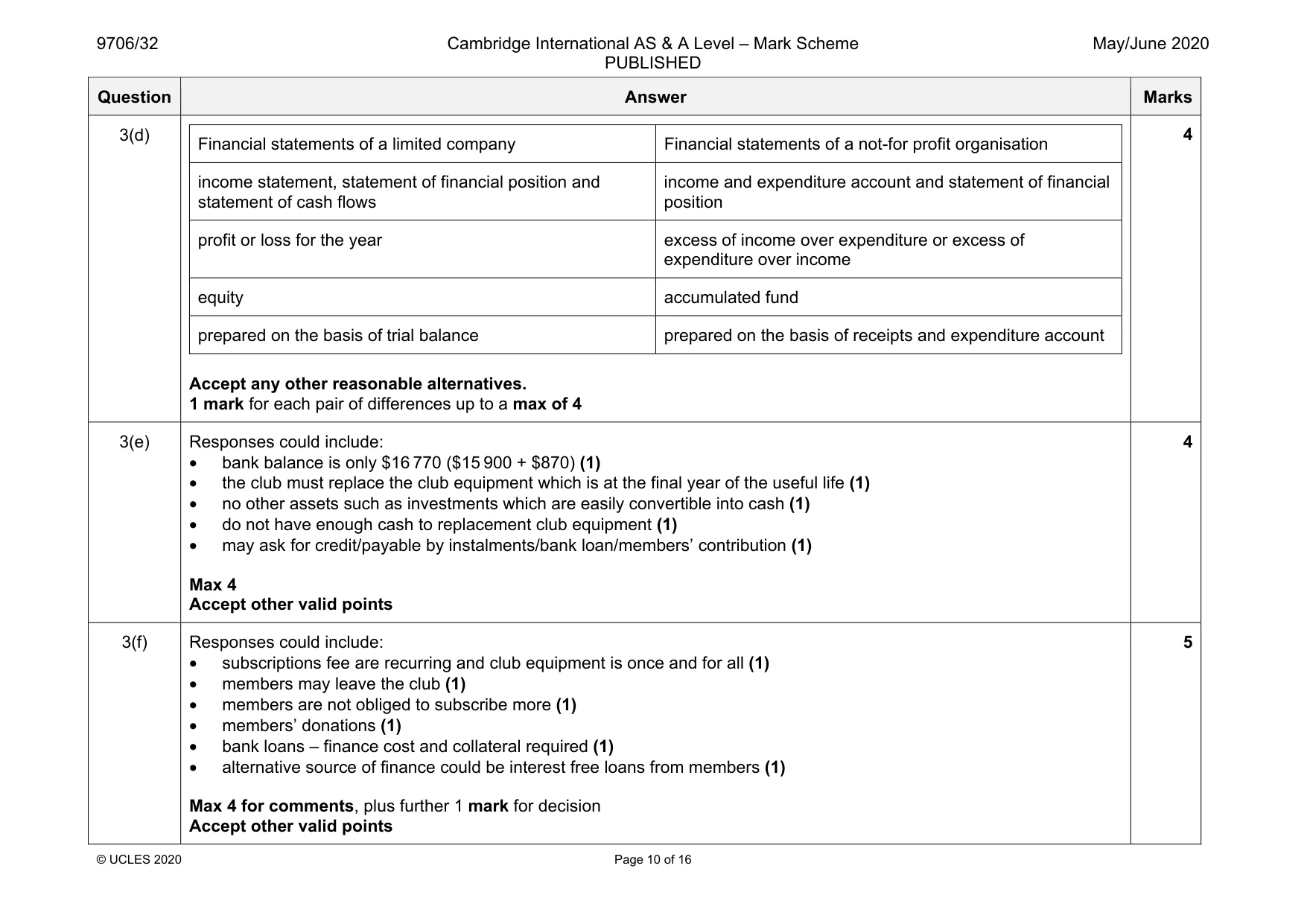
9706/32 Cambridge International AS & A Level – Mark Scheme PUBLISHED May/June 2020 © UCLES 2020 Page 10 of 16 Question Answer Marks 3(d) Financial statements of a limited company Financial statements of a not-for profit organisation income statement, statement of financial position and statement of cash flows income and expenditure account and statement of financial position profit or loss for the year excess of income over expenditure or excess of expenditure over income equity accumulated fund prepared on the basis of trial balance prepared on the basis of receipts and expenditure account Accept any other reasonable alternatives. 1 mark for each pair of differences up to a max of 4 4 3(e) Responses could include: • bank balance is only $16 770 ($15 900 + $870) (1) • the club must replace the club equipment which is at the final year of the useful life (1) • no other assets such as investments which are easily convertible into cash (1) • do not have enough cash to replacement club equipment (1) • may ask for credit/payable by instalments/bank loan/members’ contribution (1) Max 4 Accept other valid points 4 3(f) Responses could include: • subscriptions fee are recurring and club equipment is once and for all (1) • members may leave the club (1) • members are not obliged to subscribe more (1) • members’ donations (1) • bank loans – finance cost and collateral required (1) • alternative source of finance could be interest free loans from members (1) Max 4 for comments, plus further 1 mark for decision Accept other valid points 5
Mark scheme, page 11
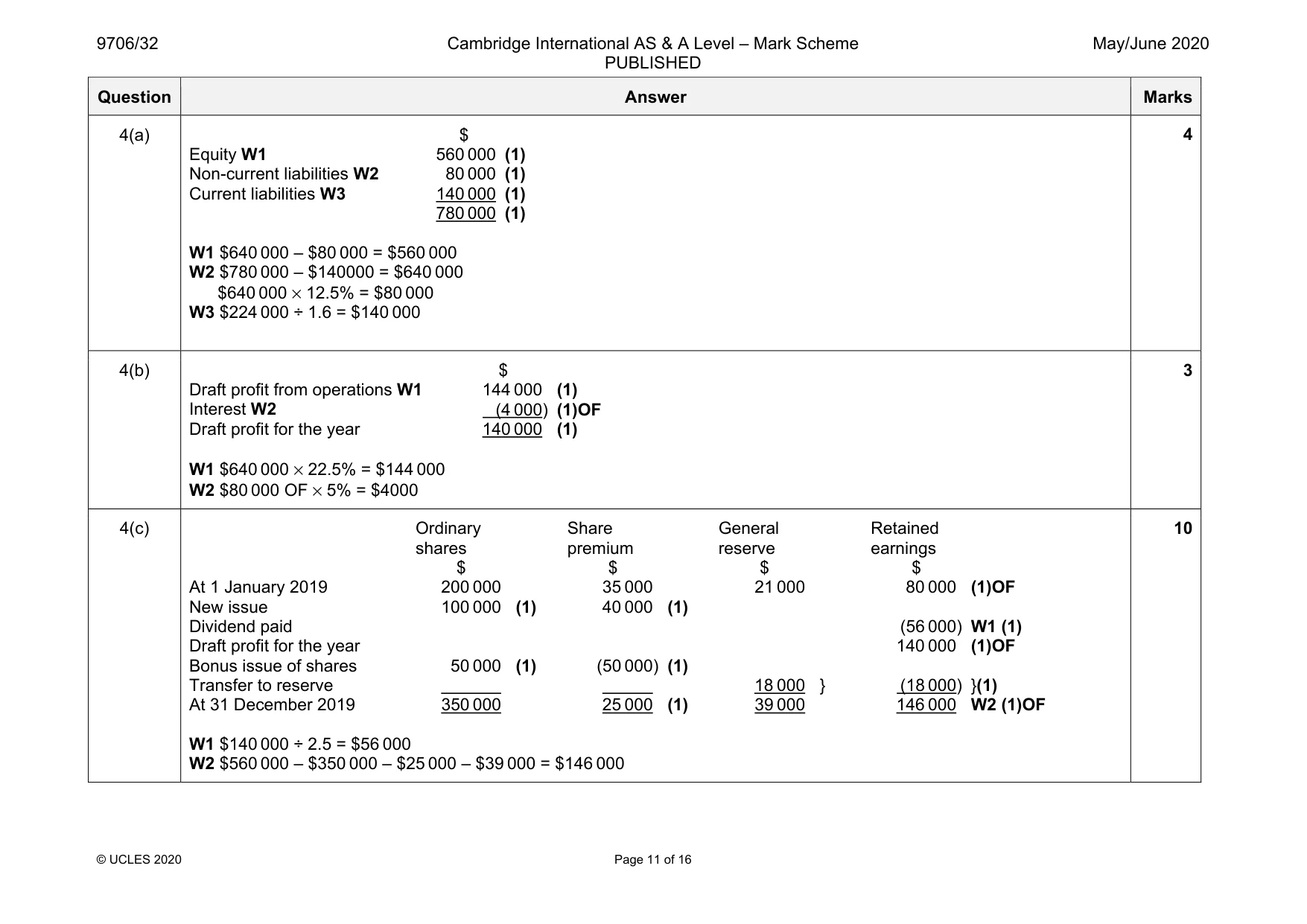
9706/32 Cambridge International AS & A Level – Mark Scheme PUBLISHED May/June 2020 © UCLES 2020 Page 11 of 16 Question Answer Marks 4(a) $ Equity W1 560 000 (1) Non-current liabilities W2 80 000 (1) Current liabilities W3 140 000 (1) 780 000 (1) W1 $640 000 – $80 000 = $560 000 W2 $780 000 – $140000 = $640 000 $640 000 × 12.5% = $80 000 W3 $224 000 ÷ 1.6 = $140 000 4 4(b) $ Draft profit from operations W1 144 000 (1) Interest W2 (4 000) (1)OF Draft profit for the year 140 000 (1) W1 $640 000 × 22.5% = $144 000 W2 $80 000 OF × 5% = $4000 3 4(c) Ordinary Share General Retained shares premium reserve earnings $ $ $ $ At 1 January 2019 200 000 35 000 21 000 80 000 (1)OF New issue 100 000 (1) 40 000 (1) Dividend paid (56 000) W1 (1) Draft profit for the year 140 000 (1)OF Bonus issue of shares 50 000 (1) (50 000) (1) Transfer to reserve 350 000 25 000 18 000 } (18 000) }(1) At 31 December 2019 350 000 25 000 (1) 39 000 146 000 W2 (1)OF W1 $140 000 ÷ 2.5 = $56 000 W2 $560 000 – $350 000 – $25 000 – $39 000 = $146 000 10
Mark scheme, page 12
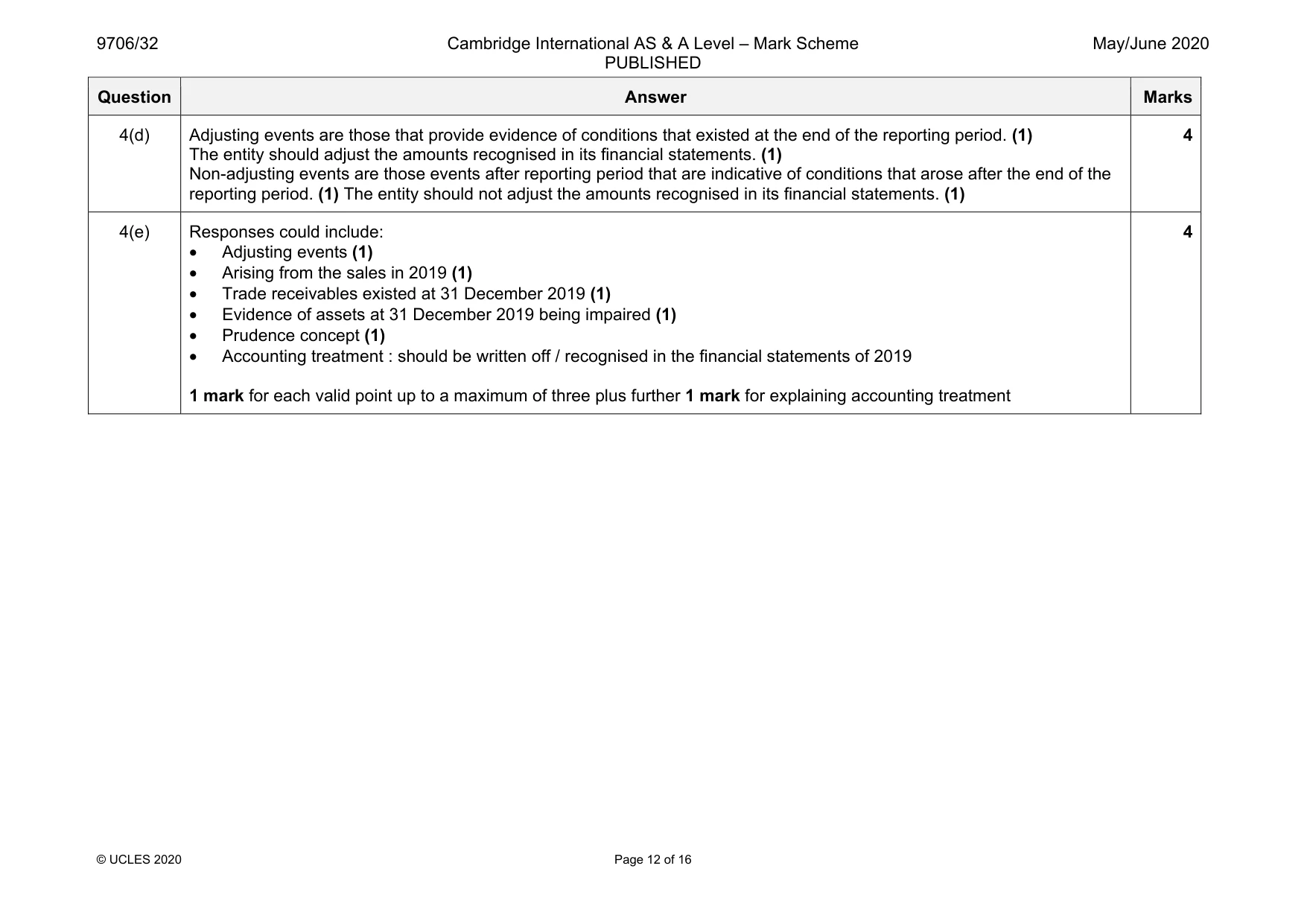
9706/32 Cambridge International AS & A Level – Mark Scheme PUBLISHED May/June 2020 © UCLES 2020 Page 12 of 16 Question Answer Marks 4(d) Adjusting events are those that provide evidence of conditions that existed at the end of the reporting period. (1) The entity should adjust the amounts recognised in its financial statements. (1) Non-adjusting events are those events after reporting period that are indicative of conditions that arose after the end of the reporting period. (1) The entity should not adjust the amounts recognised in its financial statements. (1) 4 4(e) Responses could include: • Adjusting events (1) • Arising from the sales in 2019 (1) • Trade receivables existed at 31 December 2019 (1) • Evidence of assets at 31 December 2019 being impaired (1) • Prudence concept (1) • Accounting treatment : should be written off / recognised in the financial statements of 2019 1 mark for each valid point up to a maximum of three plus further 1 mark for explaining accounting treatment 4
Mark scheme, page 13
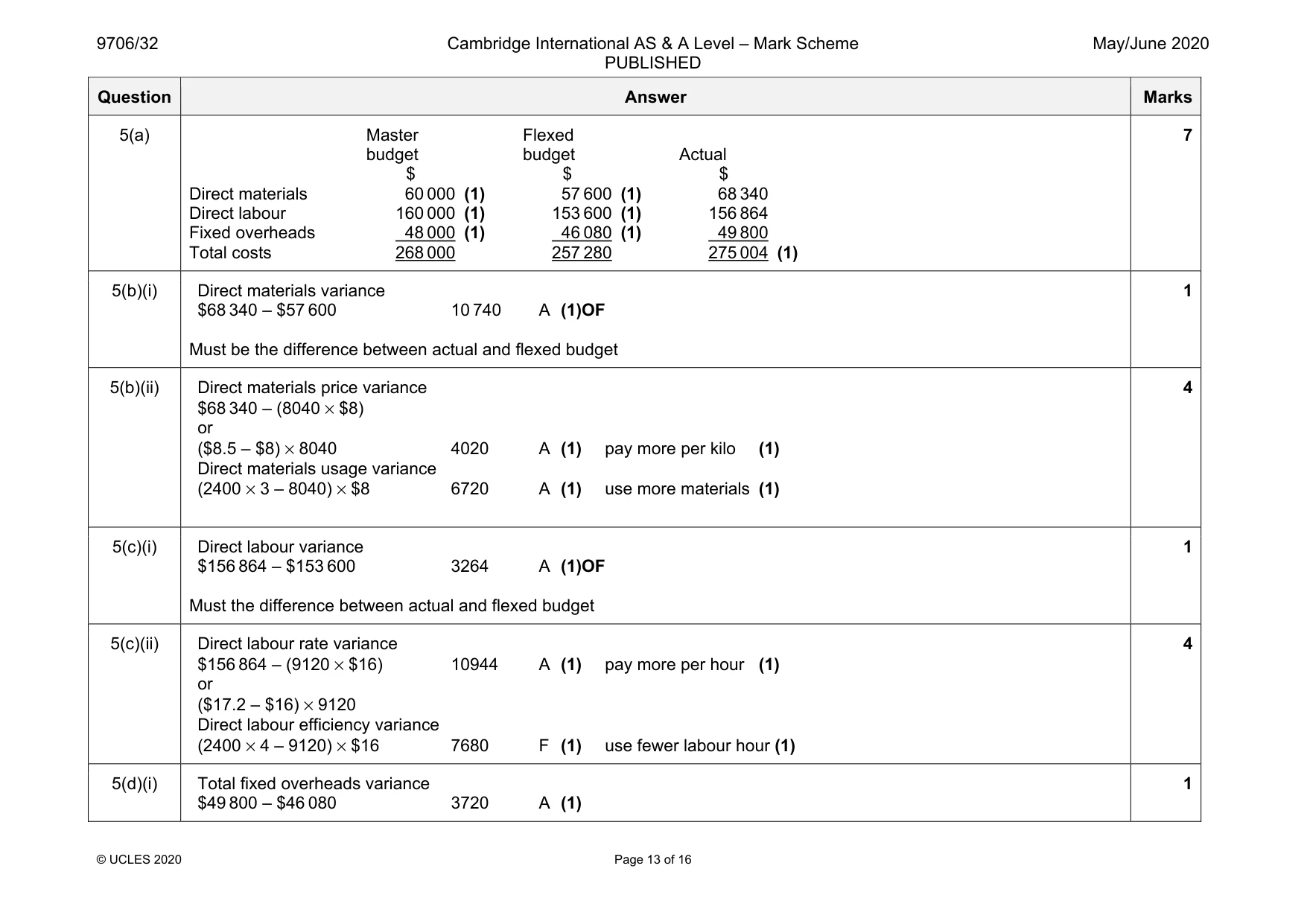
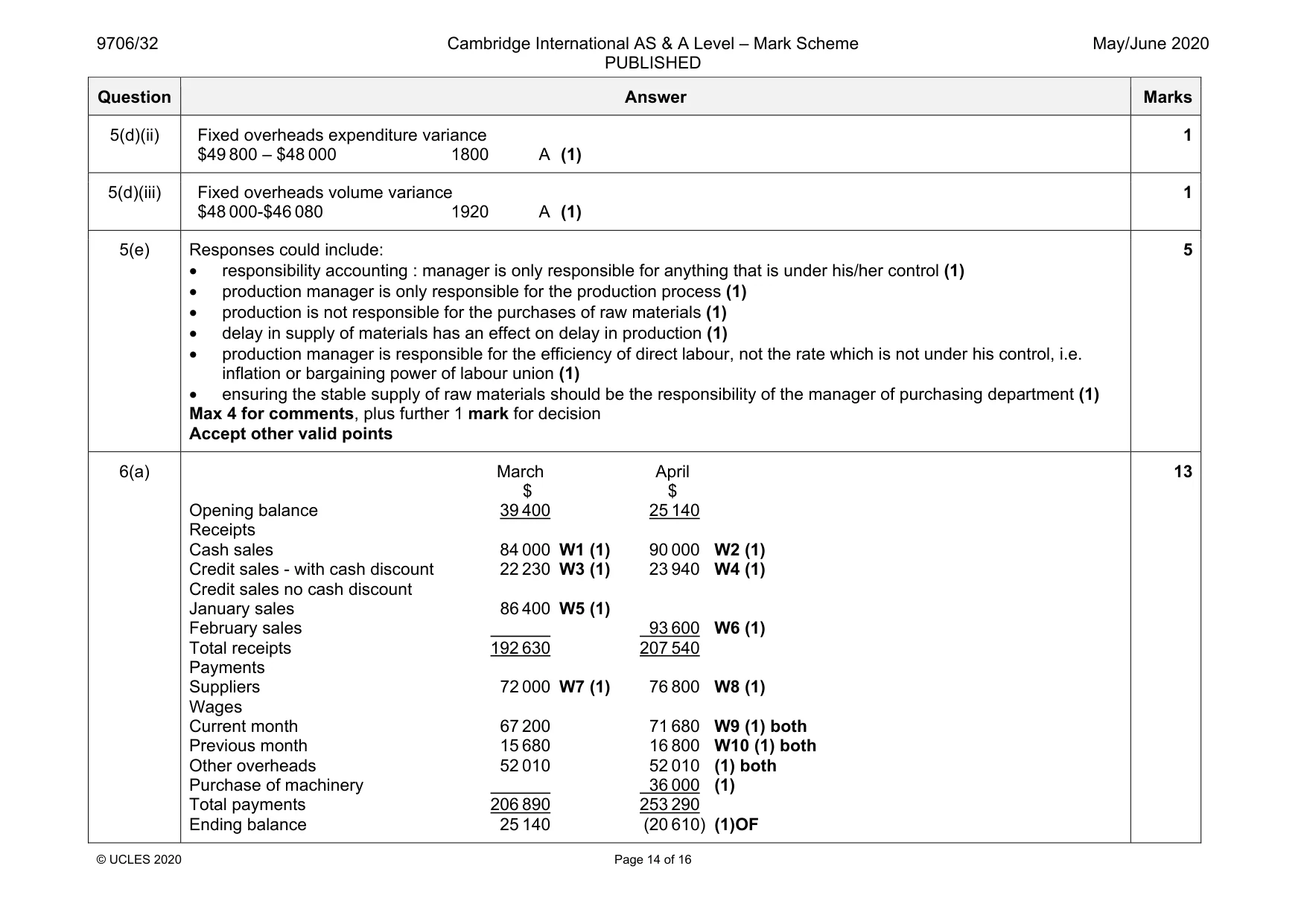
9706/32 Cambridge International AS & A Level – Mark Scheme PUBLISHED May/June 2020 © UCLES 2020 Page 13 of 16 Question Answer Marks 5(a) Master Flexed budget budget Actual $ $ $ Direct materials 60 000 (1) 57 600 (1) 68 340 Direct labour 160 000 (1) 153 600 (1) 156 864 Fixed overheads 48 000 (1) 46 080 (1) 49 800 Total costs 268 000 257 280 275 004 (1) 7 5(b)(i) Direct materials variance $68 340 – $57 600 10 740 A (1)OF Must be the difference between actual and flexed budget 1 5(b)(ii) Direct materials price variance $68 340 – (8040 × $8) or ($8.5 – $8) × 8040 4020 A (1) pay more per kilo (1) Direct materials usage variance (2400 × 3 – 8040) × $8 6720 A (1) use more materials (1) 4 5(c)(i) Direct labour variance $156 864 – $153 600 3264 A (1)OF Must the difference between actual and flexed budget 1 5(c)(ii) Direct labour rate variance $156 864 – (9120 × $16) 10944 A (1) pay more per hour (1) or ($17.2 – $16) × 9120 Direct labour efficiency variance (2400 × 4 – 9120) × $16 7680 F (1) use fewer labour hour (1) 4 5(d)(i) Total fixed overheads variance $49 800 – $46 080 3720 A (1) 1
Mark scheme, page 14
9706/32 Cambridge International AS & A Level – Mark Scheme PUBLISHED May/June 2020 © UCLES 2020 Page 14 of 16 Question Answer Marks 5(d)(ii) Fixed overheads expenditure variance $49 800 – $48 000 1800 A (1) 1 5(d)(iii) Fixed overheads volume variance $48 000-$46 080 1920 A (1) 1 5(e) Responses could include: • responsibility accounting : manager is only responsible for anything that is under his/her control (1) • production manager is only responsible for the production process (1) • production is not responsible for the purchases of raw materials (1) • delay in supply of materials has an effect on delay in production (1) • production manager is responsible for the efficiency of direct labour, not the rate which is not under his control, i.e. inflation or bargaining power of labour union (1) • ensuring the stable supply of raw materials should be the responsibility of the manager of purchasing department (1) Max 4 for comments, plus further 1 mark for decision Accept other valid points 5 6(a) March April $ $ Opening balance 39 400 25 140 Receipts Cash sales 84 000 W1 (1) 90 000 W2 (1) Credit sales - with cash discount 22 230 W3 (1) 23 940 W4 (1) Credit sales no cash discount January sales 86 400 W5 (1) February sales 192 630 93 600 W6 (1) Total receipts 192 630 207 540 Payments Suppliers 72 000 W7 (1) 76 800 W8 (1) Wages Current month 67 200 71 680 W9 (1) both Previous month 15 680 16 800 W10 (1) both Other overheads 52 010 52 010 (1) both Purchase of machinery 206 890 36 000 (1) Total payments 206 890 253 290 Ending balance 25 140 (20 610) (1)OF 13
Mark scheme, page 15
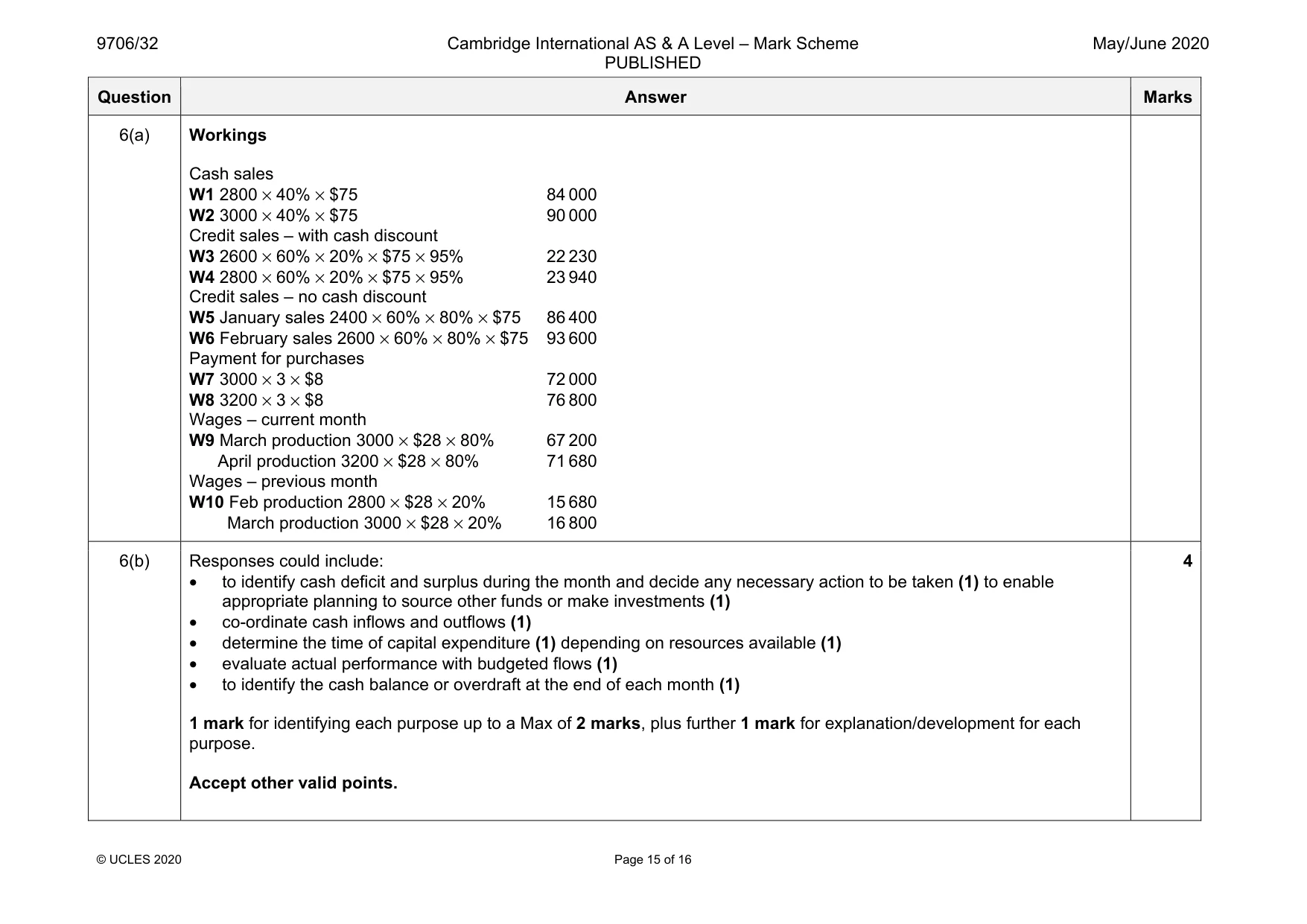
9706/32 Cambridge International AS & A Level – Mark Scheme PUBLISHED May/June 2020 © UCLES 2020 Page 15 of 16 Question Answer Marks 6(a) Workings Cash sales W1 2800 × 40% × $75 84 000 W2 3000 × 40% × $75 90 000 Credit sales – with cash discount W3 2600 × 60% × 20% × $75 × 95% 22 230 W4 2800 × 60% × 20% × $75 × 95% 23 940 Credit sales – no cash discount W5 January sales 2400 × 60% × 80% × $75 86 400 W6 February sales 2600 × 60% × 80% × $75 93 600 Payment for purchases W7 3000 × 3 × $8 72 000 W8 3200 × 3 × $8 76 800 Wages – current month W9 March production 3000 × $28 × 80% 67 200 April production 3200 × $28 × 80% 71 680 Wages – previous month W10 Feb production 2800 × $28 × 20% 15 680 March production 3000 × $28 × 20% 16 800 6(b) Responses could include: • to identify cash deficit and surplus during the month and decide any necessary action to be taken (1) to enable appropriate planning to source other funds or make investments (1) • co-ordinate cash inflows and outflows (1) • determine the time of capital expenditure (1) depending on resources available (1) • evaluate actual performance with budgeted flows (1) • to identify the cash balance or overdraft at the end of each month (1) 1 mark for identifying each purpose up to a Max of 2 marks, plus further 1 mark for explanation/development for each purpose. Accept other valid points. 4
Mark scheme, page 16
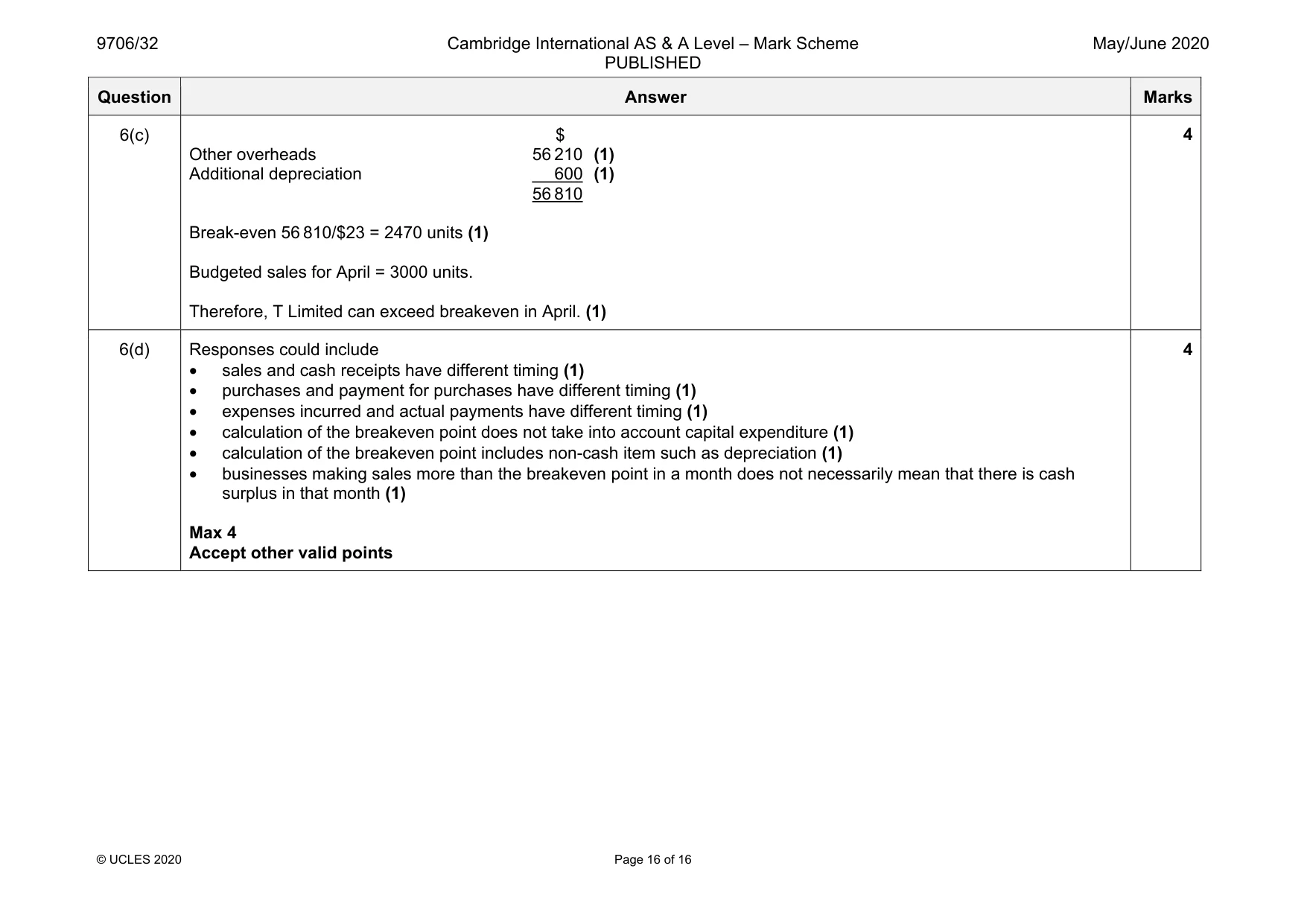
9706/32 Cambridge International AS & A Level – Mark Scheme PUBLISHED May/June 2020 © UCLES 2020 Page 16 of 16 Question Answer Marks 6(c) $ Other overheads 56 210 (1) Additional depreciation 600 (1) 56 810 Break-even 56 810/$23 = 2470 units (1) Budgeted sales for April = 3000 units. Therefore, T Limited can exceed breakeven in April. (1) 4 6(d) Responses could include • sales and cash receipts have different timing (1) • purchases and payment for purchases have different timing (1) • expenses incurred and actual payments have different timing (1) • calculation of the breakeven point does not take into account capital expenditure (1) • calculation of the breakeven point includes non-cash item such as depreciation (1) • businesses making sales more than the breakeven point in a month does not necessarily mean that there is cash surplus in that month (1) Max 4 Accept other valid points 4