Cambridge A Level Accounting 9706 — 2017 Oct/Nov Paper 3 · Variant 3
9706/33/O/N/17 · 150 marks · ≈169 min
The question paper and its mark scheme, free to read here and free to download. This is Cambridge’s own paper, exactly as it was sat.
Question paper12 pages

Mark scheme12 pages
Answers below. Sit the paper first if you are practising.
Paper as text
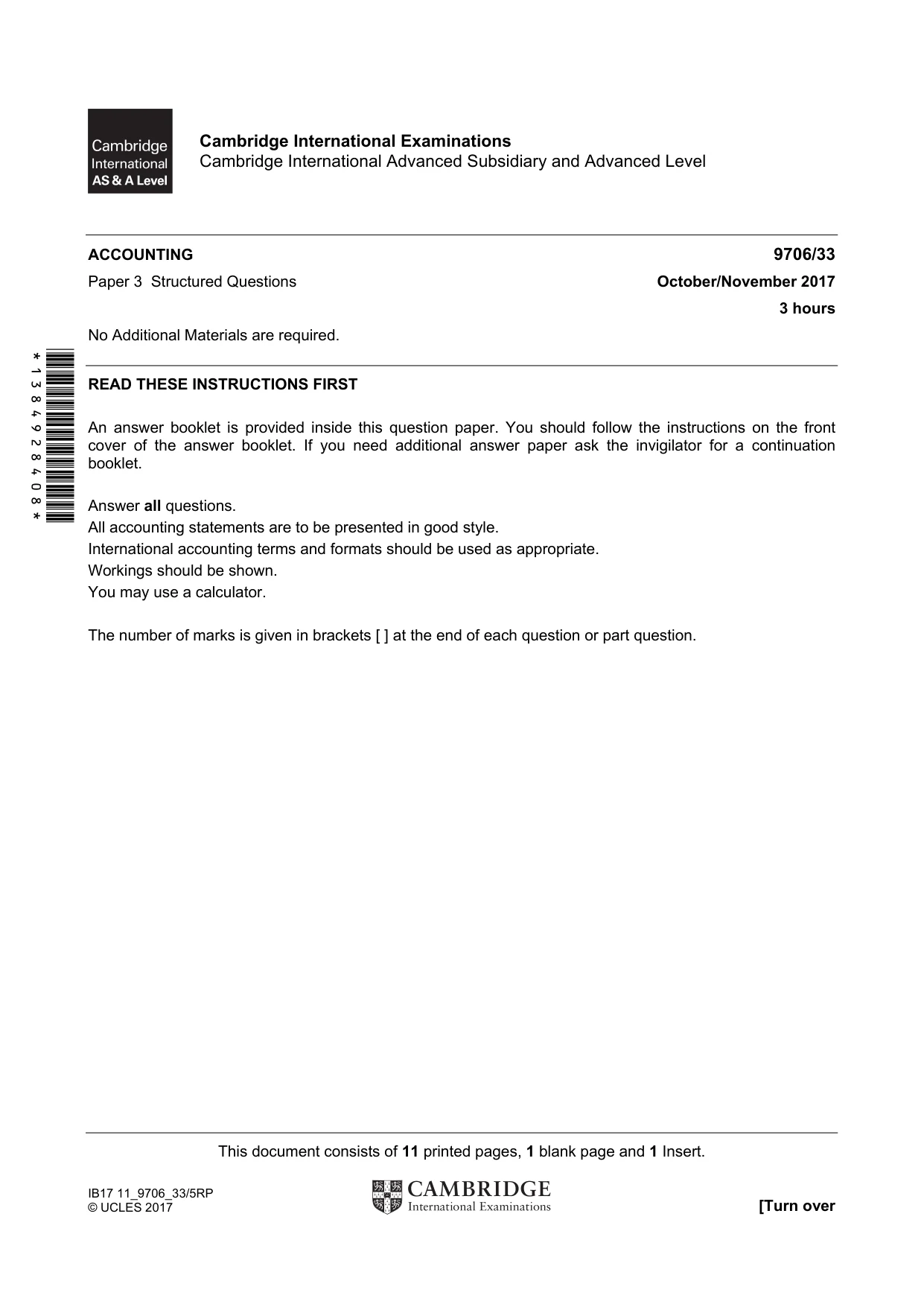
Question paper, page 1
This document consists of 11 printed pages, 1 blank page and 1 Insert. IB17 11_9706_33/5RP © UCLES 2017 [Turn over Cambridge International Examinations Cambridge International Advanced Subsidiary and Advanced Level ACCOUNTING 9706/33 Paper 3 Structured Questions October/November 2017 3 hours No Additional Materials are required. READ THESE INSTRUCTIONS FIRST An answer booklet is provided inside this question paper. You should follow the instructions on the front cover of the answer booklet. If you need additional answer paper ask the invigilator for a continuation booklet. Answer all questions. All accounting statements are to be presented in good style. International accounting terms and formats should be used as appropriate. Workings should be shown. You may use a calculator. The number of marks is given in brackets [ ] at the end of each question or part question.
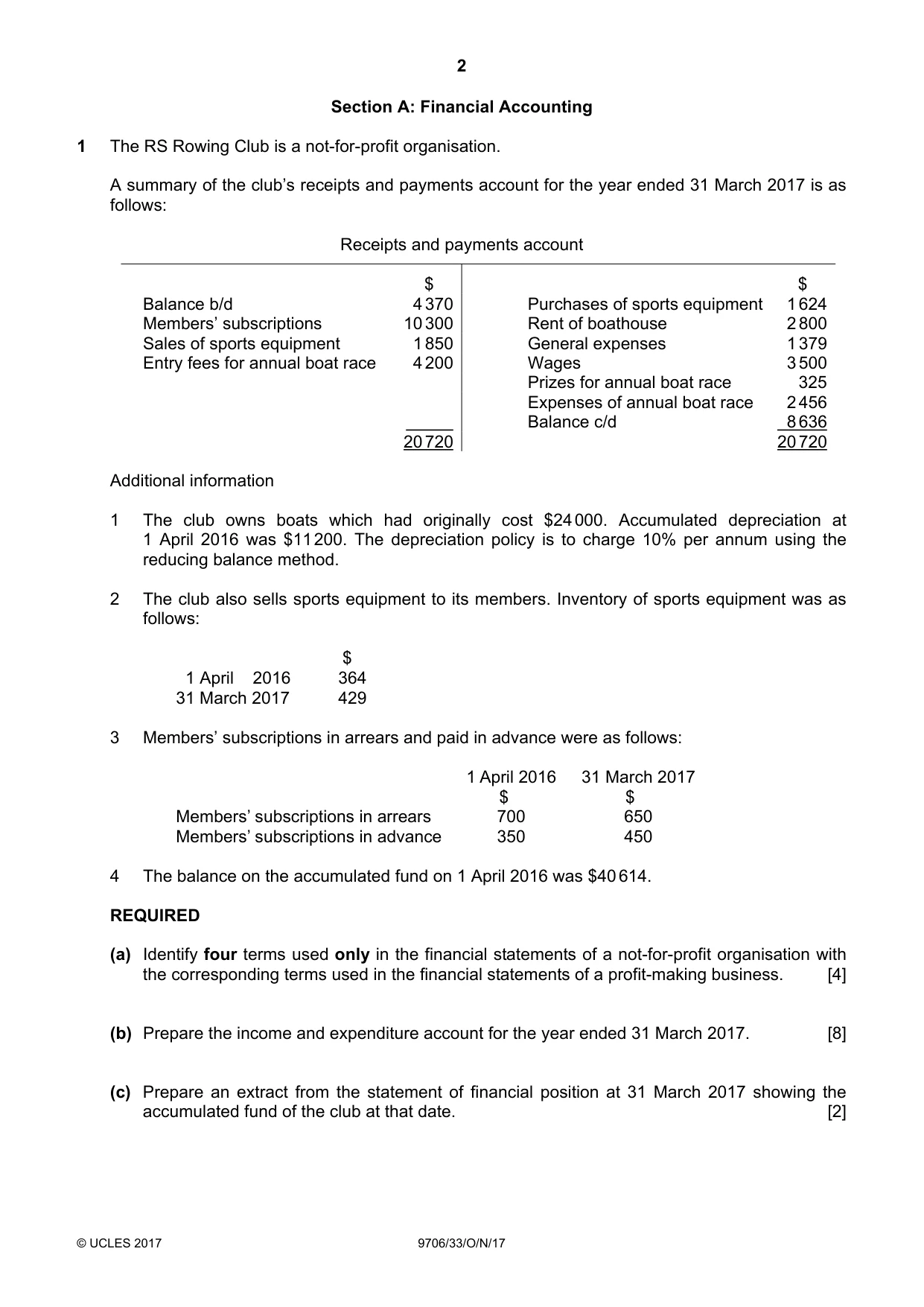
Question paper, page 2
2 © UCLES 2017 9706/33/O/N/17 Section A: Financial Accounting 1 The RS Rowing Club is a not-for-profit organisation. A summary of the club’s receipts and payments account for the year ended 31 March 2017 is as follows: Receipts and payments account $ $ Balance b/d 4 370 Purchases of sports equipment 1 624 Members’ subscriptions 10 300 Rent of boathouse 2 800 Sales of sports equipment 1 850 General expenses 1 379 Entry fees for annual boat race 4 200 Wages 3 500 Prizes for annual boat race 325 Expenses of annual boat race 2 456 Balance c/d 8 636 20 720 20 720 Additional information 1 The club owns boats which had originally cost $24 000. Accumulated depreciation at 1 April 2016 was $11 200. The depreciation policy is to charge 10% per annum using the reducing balance method. 2 The club also sells sports equipment to its members. Inventory of sports equipment was as follows: $ 1 April 2016 364 31 March 2017 429 3 Members’ subscriptions in arrears and paid in advance were as follows: 1 April 2016 31 March 2017 $ $ Members’ subscriptions in arrears 700 650 Members’ subscriptions in advance 350 450 4 The balance on the accumulated fund on 1 April 2016 was $40 614. REQUIRED (a) Identify four terms used only in the financial statements of a not-for-profit organisation with the corresponding terms used in the financial statements of a profit-making business. [4] (b) Prepare the income and expenditure account for the year ended 31 March 2017. [8] (c) Prepare an extract from the statement of financial position at 31 March 2017 showing the accumulated fund of the club at that date. [2]
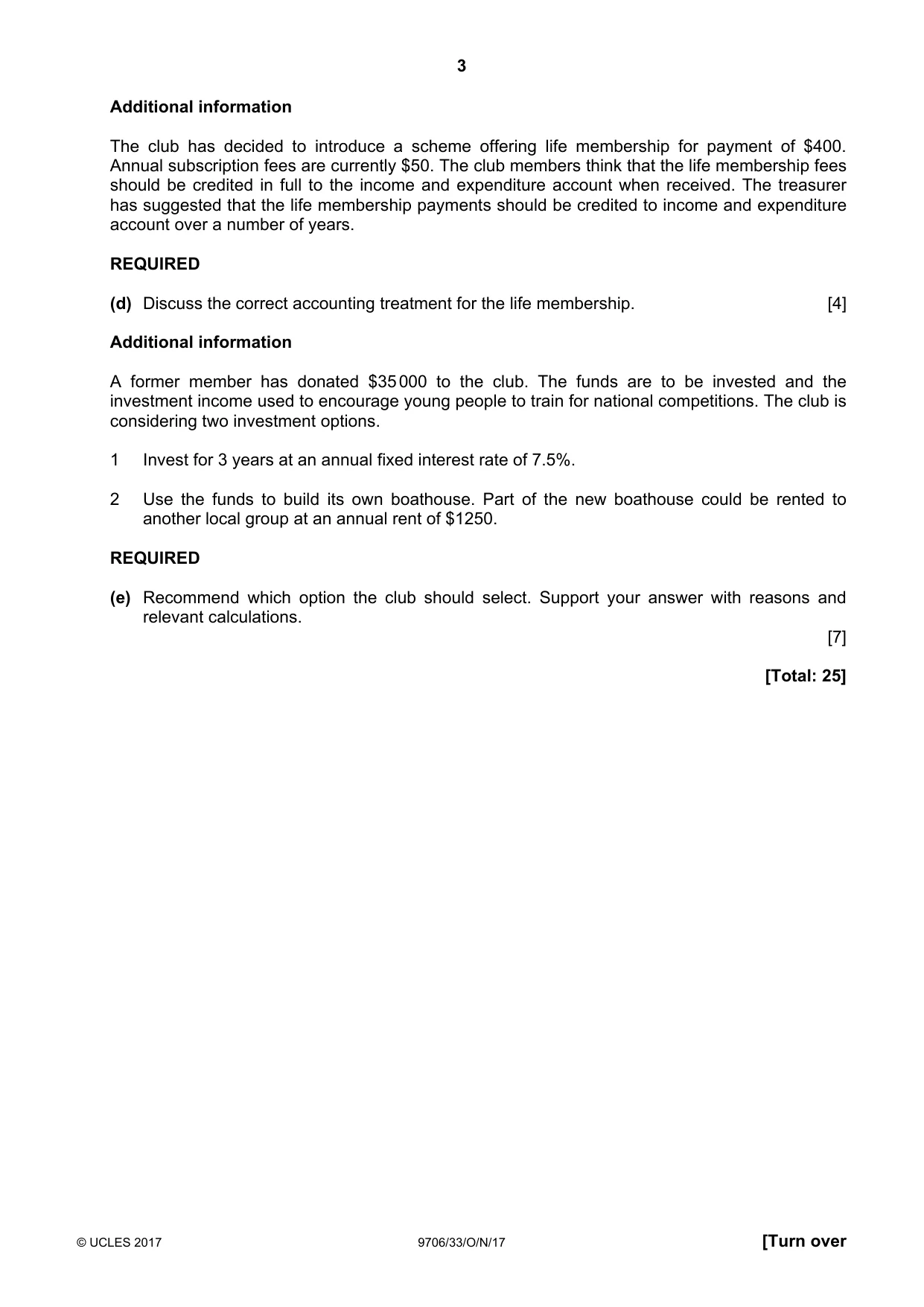
Question paper, page 3
3 © UCLES 2017 9706/33/O/N/17 [Turn over Additional information The club has decided to introduce a scheme offering life membership for payment of $400. Annual subscription fees are currently $50. The club members think that the life membership fees should be credited in full to the income and expenditure account when received. The treasurer has suggested that the life membership payments should be credited to income and expenditure account over a number of years. REQUIRED (d) Discuss the correct accounting treatment for the life membership. [4] Additional information A former member has donated $35 000 to the club. The funds are to be invested and the investment income used to encourage young people to train for national competitions. The club is considering two investment options. 1 Invest for 3 years at an annual fixed interest rate of 7.5%. 2 Use the funds to build its own boathouse. Part of the new boathouse could be rented to another local group at an annual rent of $1250. REQUIRED (e) Recommend which option the club should select. Support your answer with reasons and relevant calculations. [7] [Total: 25]
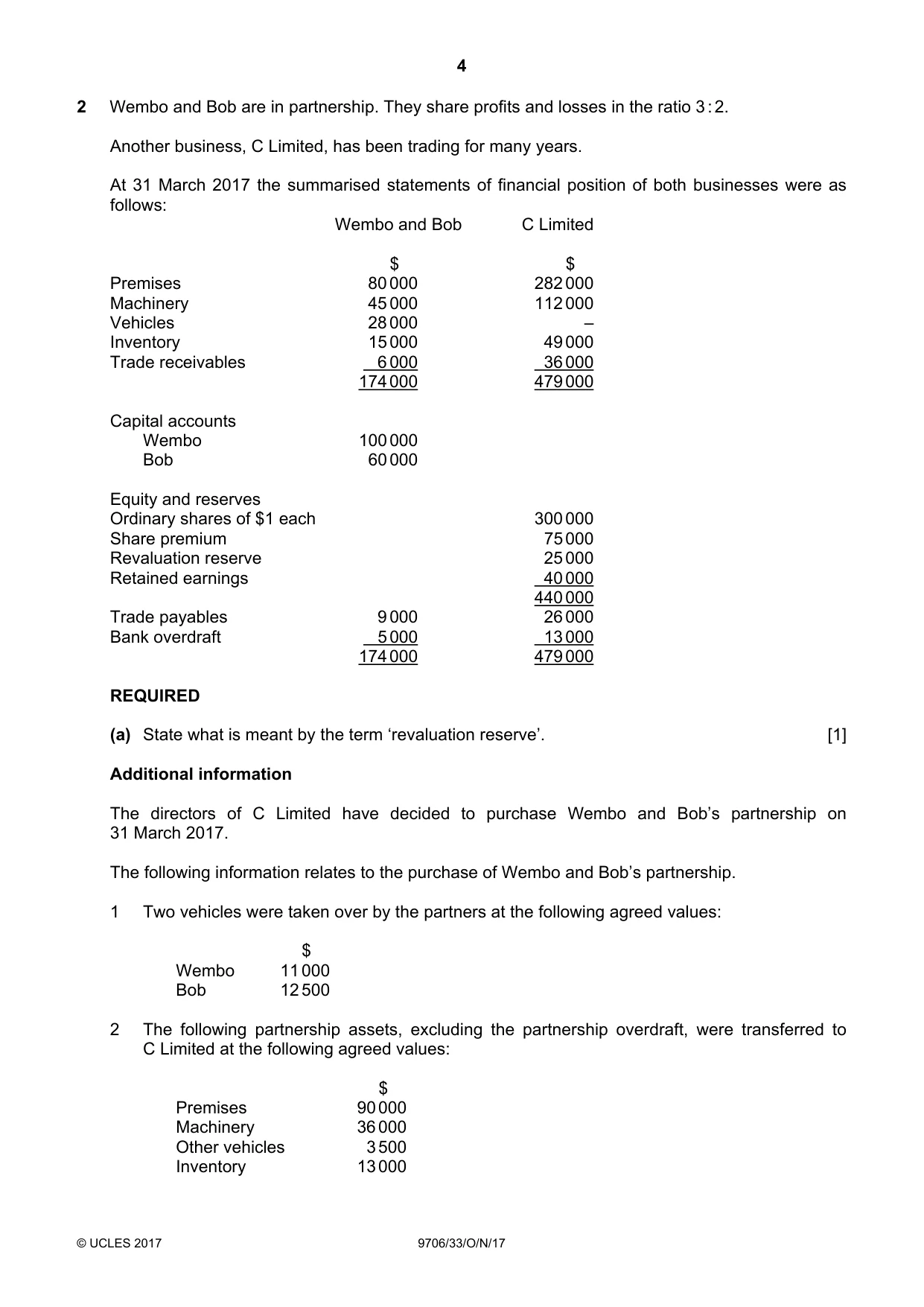
Question paper, page 4
4 © UCLES 2017 9706/33/O/N/17 2 Wembo and Bob are in partnership. They share profits and losses in the ratio 3 : 2. Another business, C Limited, has been trading for many years. At 31 March 2017 the summarised statements of financial position of both businesses were as follows: Wembo and Bob C Limited $ $ Premises 80 000 282 000 Machinery 45 000 112 000 Vehicles 28 000 – Inventory 15 000 49 000 Trade receivables 6 000 36 000 174 000 479 000 Capital accounts Wembo 100 000 Bob 60 000 Equity and reserves Ordinary shares of $1 each 300 000 Share premium 75 000 Revaluation reserve 25 000 Retained earnings 40 000 440 000 Trade payables 9 000 26 000 Bank overdraft 5 000 13 000 174 000 479 000 REQUIRED (a) State what is meant by the term ‘revaluation reserve’. [1] Additional information The directors of C Limited have decided to purchase Wembo and Bob’s partnership on 31 March 2017. The following information relates to the purchase of Wembo and Bob’s partnership. 1 Two vehicles were taken over by the partners at the following agreed values: $ Wembo 11 000 Bob 12 500 2 The following partnership assets, excluding the partnership overdraft, were transferred to C Limited at the following agreed values: $ Premises 90 000 Machinery 36 000 Other vehicles 3 500 Inventory 13 000
Question paper, page 5
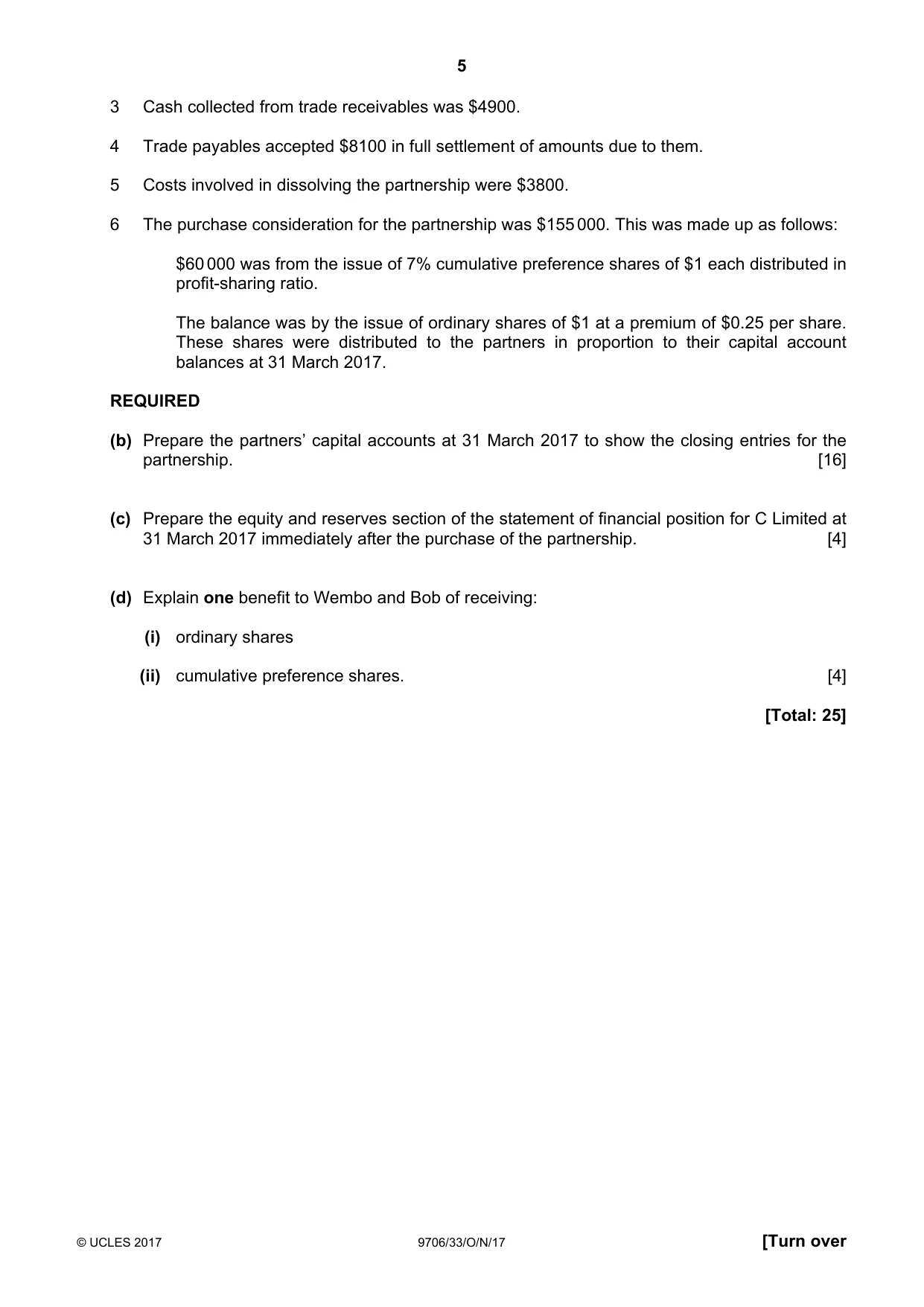
5 © UCLES 2017 9706/33/O/N/17 [Turn over 3 Cash collected from trade receivables was $4900. 4 Trade payables accepted $8100 in full settlement of amounts due to them. 5 Costs involved in dissolving the partnership were $3800. 6 The purchase consideration for the partnership was $155 000. This was made up as follows: $60 000 was from the issue of 7% cumulative preference shares of $1 each distributed in profit-sharing ratio. The balance was by the issue of ordinary shares of $1 at a premium of $0.25 per share. These shares were distributed to the partners in proportion to their capital account balances at 31 March 2017. REQUIRED (b) Prepare the partners’ capital accounts at 31 March 2017 to show the closing entries for the partnership. [16] (c) Prepare the equity and reserves section of the statement of financial position for C Limited at 31 March 2017 immediately after the purchase of the partnership. [4] (d) Explain one benefit to Wembo and Bob of receiving: (i) ordinary shares (ii) cumulative preference shares. [4] [Total: 25]
Question paper, page 6
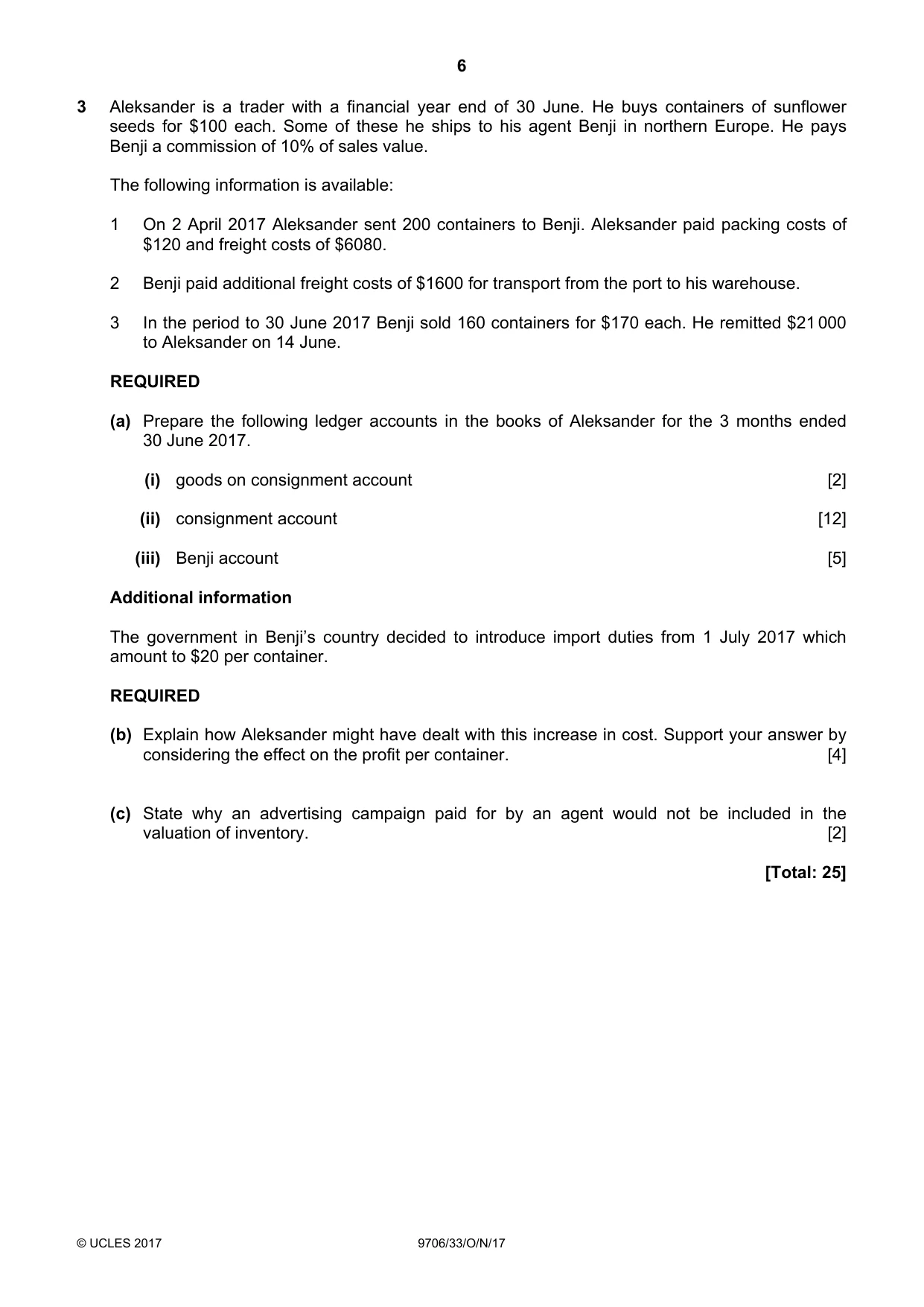
6 © UCLES 2017 9706/33/O/N/17 3 Aleksander is a trader with a financial year end of 30 June. He buys containers of sunflower seeds for $100 each. Some of these he ships to his agent Benji in northern Europe. He pays Benji a commission of 10% of sales value. The following information is available: 1 On 2 April 2017 Aleksander sent 200 containers to Benji. Aleksander paid packing costs of $120 and freight costs of $6080. 2 Benji paid additional freight costs of $1600 for transport from the port to his warehouse. 3 In the period to 30 June 2017 Benji sold 160 containers for $170 each. He remitted $21 000 to Aleksander on 14 June. REQUIRED (a) Prepare the following ledger accounts in the books of Aleksander for the 3 months ended 30 June 2017. (i) goods on consignment account [2] (ii) consignment account [12] (iii) Benji account [5] Additional information The government in Benji’s country decided to introduce import duties from 1 July 2017 which amount to $20 per container. REQUIRED (b) Explain how Aleksander might have dealt with this increase in cost. Support your answer by considering the effect on the profit per container. [4] (c) State why an advertising campaign paid for by an agent would not be included in the valuation of inventory. [2] [Total: 25]
Question paper, page 7
7 © UCLES 2017 9706/33/O/N/17 [Turn over Question 4 is on the next page.
Question paper, page 8
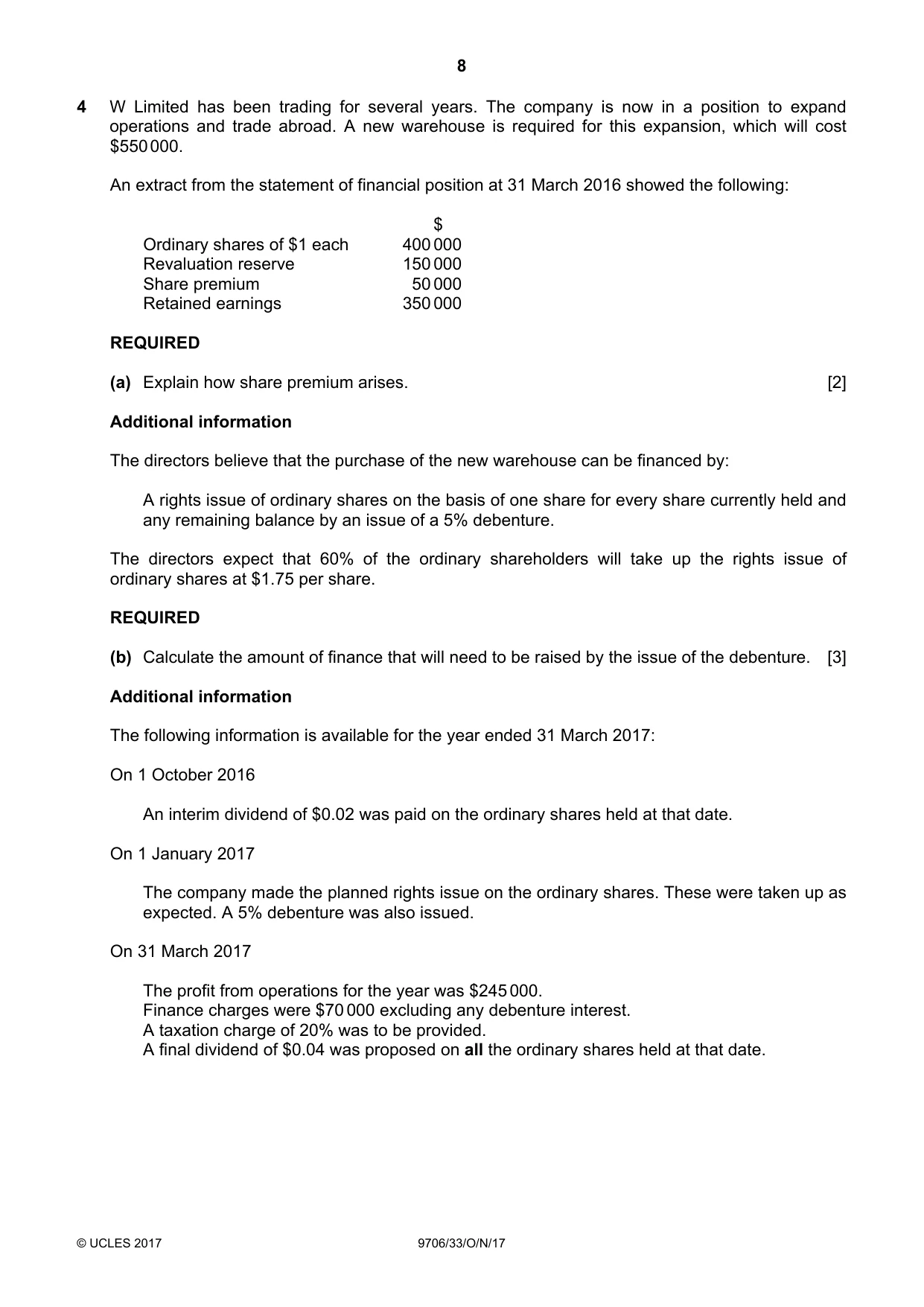
8 © UCLES 2017 9706/33/O/N/17 4 W Limited has been trading for several years. The company is now in a position to expand operations and trade abroad. A new warehouse is required for this expansion, which will cost $550 000. An extract from the statement of financial position at 31 March 2016 showed the following: $ Ordinary shares of $1 each 400 000 Revaluation reserve 150 000 Share premium 50 000 Retained earnings 350 000 REQUIRED (a) Explain how share premium arises. [2] Additional information The directors believe that the purchase of the new warehouse can be financed by: A rights issue of ordinary shares on the basis of one share for every share currently held and any remaining balance by an issue of a 5% debenture. The directors expect that 60% of the ordinary shareholders will take up the rights issue of ordinary shares at $1.75 per share. REQUIRED (b) Calculate the amount of finance that will need to be raised by the issue of the debenture. [3] Additional information The following information is available for the year ended 31 March 2017: On 1 October 2016 An interim dividend of $0.02 was paid on the ordinary shares held at that date. On 1 January 2017 The company made the planned rights issue on the ordinary shares. These were taken up as expected. A 5% debenture was also issued. On 31 March 2017 The profit from operations for the year was $245 000. Finance charges were $70 000 excluding any debenture interest. A taxation charge of 20% was to be provided. A final dividend of $0.04 was proposed on all the ordinary shares held at that date.
Question paper, page 9
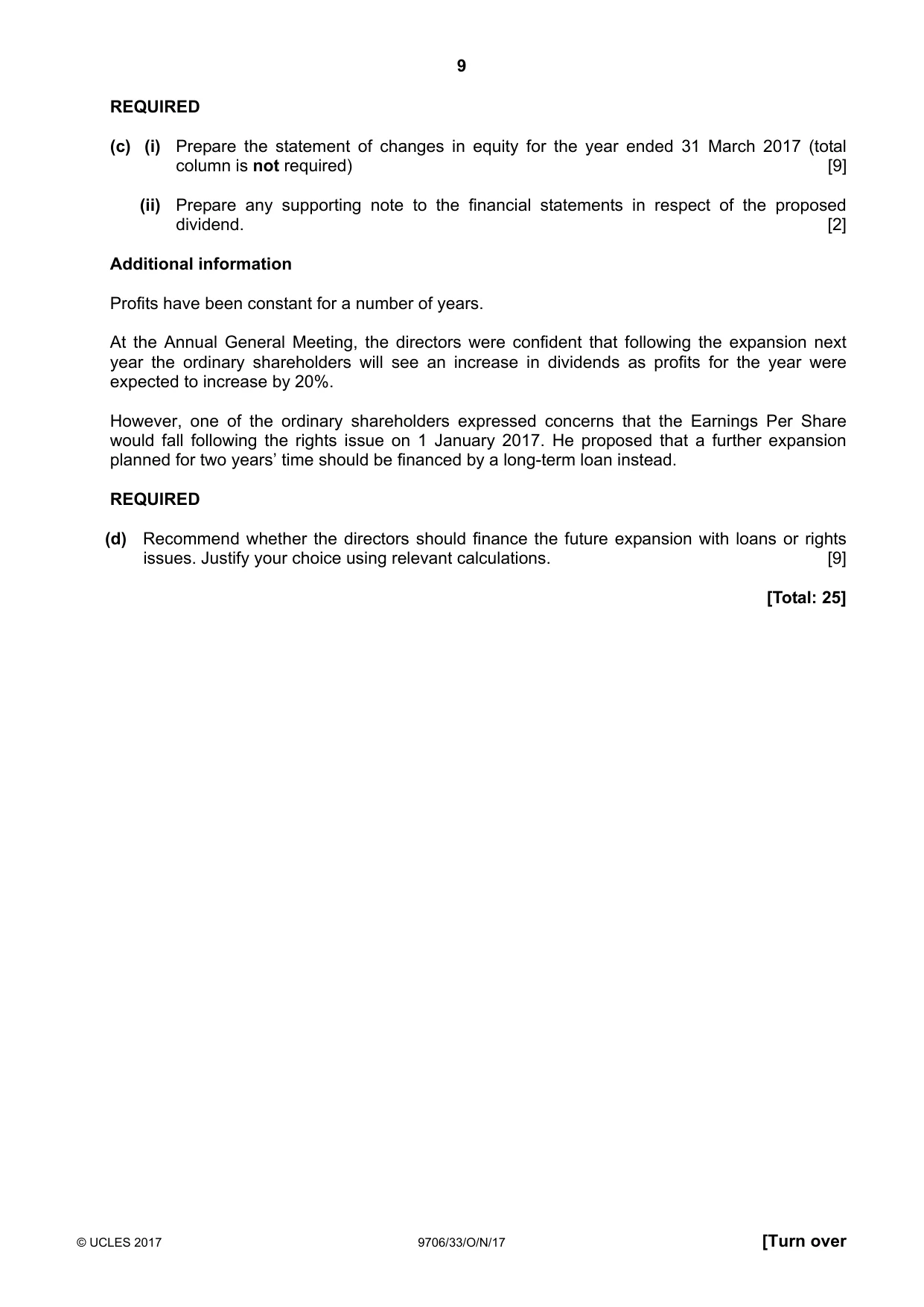
9 © UCLES 2017 9706/33/O/N/17 [Turn over REQUIRED (c) (i) Prepare the statement of changes in equity for the year ended 31 March 2017 (total column is not required) [9] (ii) Prepare any supporting note to the financial statements in respect of the proposed dividend. [2] Additional information Profits have been constant for a number of years. At the Annual General Meeting, the directors were confident that following the expansion next year the ordinary shareholders will see an increase in dividends as profits for the year were expected to increase by 20%. However, one of the ordinary shareholders expressed concerns that the Earnings Per Share would fall following the rights issue on 1 January 2017. He proposed that a further expansion planned for two years’ time should be financed by a long-term loan instead. REQUIRED (d) Recommend whether the directors should finance the future expansion with loans or rights issues. Justify your choice using relevant calculations. [9] [Total: 25]
Question paper, page 10
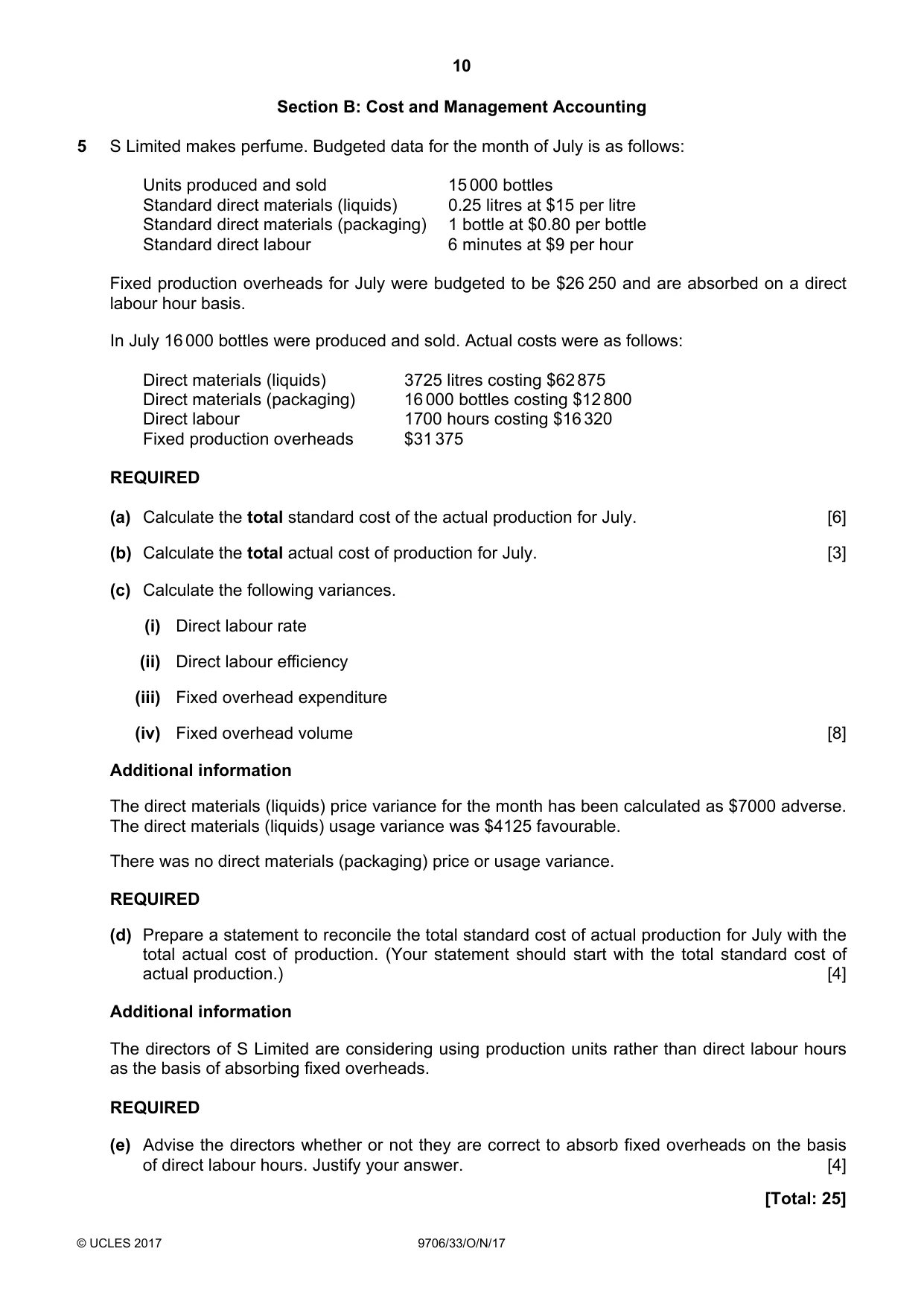
10 © UCLES 2017 9706/33/O/N/17 Section B: Cost and Management Accounting 5 S Limited makes perfume. Budgeted data for the month of July is as follows: Units produced and sold 15 000 bottles Standard direct materials (liquids) 0.25 litres at $15 per litre Standard direct materials (packaging) 1 bottle at $0.80 per bottle Standard direct labour 6 minutes at $9 per hour Fixed production overheads for July were budgeted to be $26 250 and are absorbed on a direct labour hour basis. In July 16 000 bottles were produced and sold. Actual costs were as follows: Direct materials (liquids) 3725 litres costing $62 875 Direct materials (packaging) 16 000 bottles costing $12 800 Direct labour 1700 hours costing $16 320 Fixed production overheads $31 375 REQUIRED (a) Calculate the total standard cost of the actual production for July. [6] (b) Calculate the total actual cost of production for July. [3] (c) Calculate the following variances. (i) Direct labour rate (ii) Direct labour efficiency (iii) Fixed overhead expenditure (iv) Fixed overhead volume [8] Additional information The direct materials (liquids) price variance for the month has been calculated as $7000 adverse. The direct materials (liquids) usage variance was $4125 favourable. There was no direct materials (packaging) price or usage variance. REQUIRED (d) Prepare a statement to reconcile the total standard cost of actual production for July with the total actual cost of production. (Your statement should start with the total standard cost of actual production.) [4] Additional information The directors of S Limited are considering using production units rather than direct labour hours as the basis of absorbing fixed overheads. REQUIRED (e) Advise the directors whether or not they are correct to absorb fixed overheads on the basis of direct labour hours. Justify your answer. [4] [Total: 25]
Question paper, page 11
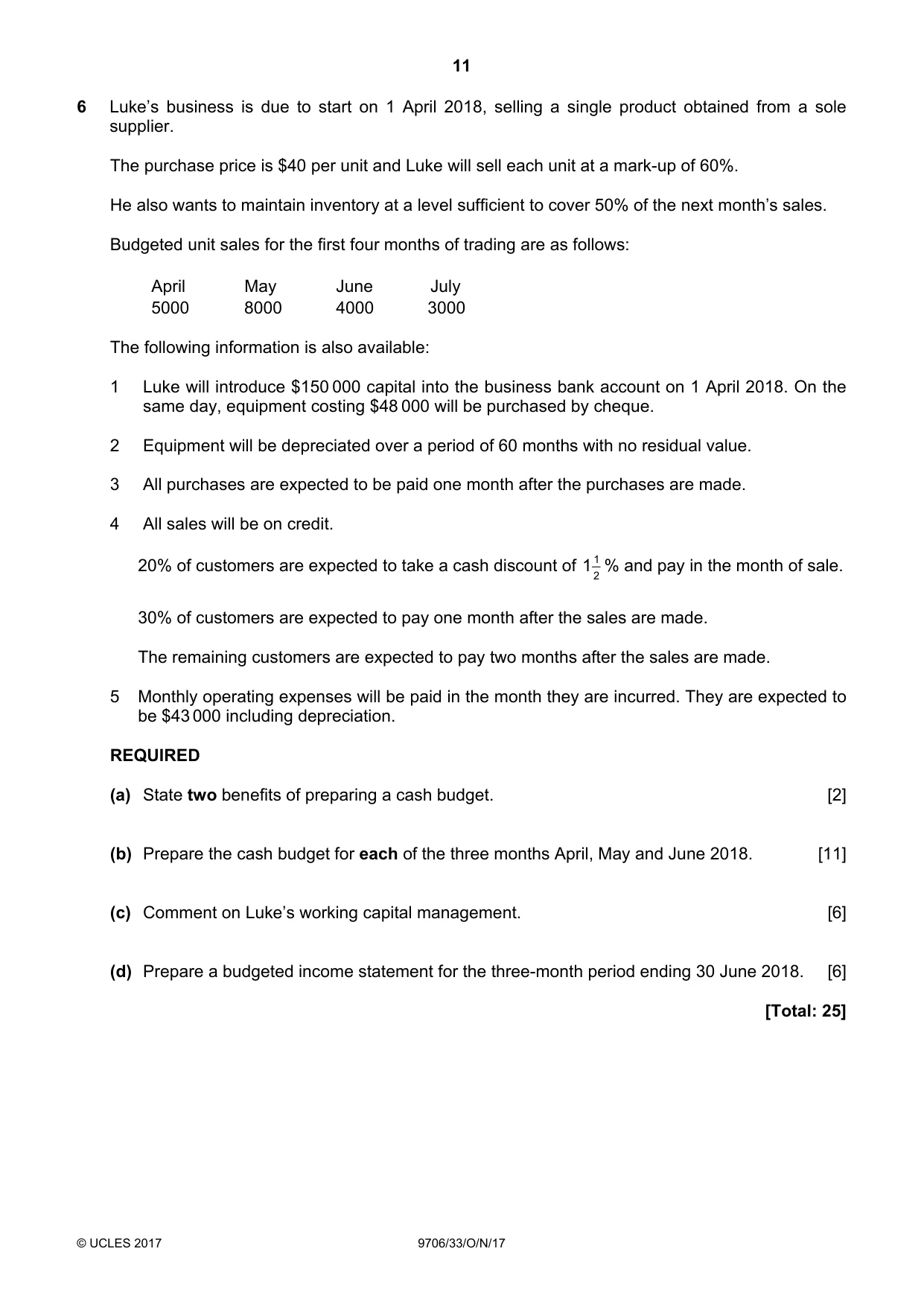
11 © UCLES 2017 9706/33/O/N/17 6 Luke’s business is due to start on 1 April 2018, selling a single product obtained from a sole supplier. The purchase price is $40 per unit and Luke will sell each unit at a mark-up of 60%. He also wants to maintain inventory at a level sufficient to cover 50% of the next month’s sales. Budgeted unit sales for the first four months of trading are as follows: April May June July 5000 8000 4000 3000 The following information is also available: 1 Luke will introduce $150 000 capital into the business bank account on 1 April 2018. On the same day, equipment costing $48 000 will be purchased by cheque. 2 Equipment will be depreciated over a period of 60 months with no residual value. 3 All purchases are expected to be paid one month after the purchases are made. 4 All sales will be on credit. 20% of customers are expected to take a cash discount of 2 1 1 % and pay in the month of sale. 30% of customers are expected to pay one month after the sales are made. The remaining customers are expected to pay two months after the sales are made. 5 Monthly operating expenses will be paid in the month they are incurred. They are expected to be $43 000 including depreciation. REQUIRED (a) State two benefits of preparing a cash budget. [2] (b) Prepare the cash budget for each of the three months April, May and June 2018. [11] (c) Comment on Luke’s working capital management. [6] (d) Prepare a budgeted income statement for the three-month period ending 30 June 2018. [6] [Total: 25]
Question paper, page 12
12 Permission to reproduce items where third-party owned material protected by copyright is included has been sought and cleared where possible. Every reasonable effort has been made by the publisher (UCLES) to trace copyright holders, but if any items requiring clearance have unwittingly been included, the publisher will be pleased to make amends at the earliest possible opportunity. To avoid the issue of disclosure of answer-related information to candidates, all copyright acknowledgements are reproduced online in the Cambridge International Examinations Copyright Acknowledgements Booklet. This is produced for each series of examinations and is freely available to download at www.cie.org.uk after the live examination series. Cambridge International Examinations is part of the Cambridge Assessment Group. Cambridge Assessment is the brand name of University of Cambridge Local Examinations Syndicate (UCLES), which is itself a department of the University of Cambridge. © UCLES 2017 9706/33/O/N/17 BLANK PAGE
Mark scheme, page 1
® IGCSE is a registered trademark. This document consists of 12 printed pages. © UCLES 2017 [Turn over Cambridge Assessment International Education Cambridge International Advanced Subsidiary and Advanced Level ACCOUNTING 9706/33 Paper 3 Structured Questions October/November 2017 MARK SCHEME Maximum Mark: 150 Published This mark scheme is published as an aid to teachers and candidates, to indicate the requirements of the examination. It shows the basis on which Examiners were instructed to award marks. It does not indicate the details of the discussions that took place at an Examiners’ meeting before marking began, which would have considered the acceptability of alternative answers. Mark schemes should be read in conjunction with the question paper and the Principal Examiner Report for Teachers. Cambridge International will not enter into discussions about these mark schemes. Cambridge International is publishing the mark schemes for the October/November 2017 series for most Cambridge IGCSE®, Cambridge International A and AS Level components and some Cambridge O Level components.
Mark scheme, page 2
9706/33 Cambridge International AS/A Level – Mark Scheme PUBLISHED October/November 2017 © UCLES 2017 Page 2 of 12 Question Answer Marks 1(a) Not-for-profit Profit-making Subscriptions Sales revenue Income and expenditure account Income statement Accumulated fund Capital / Equity Receipts and payments account Bank account Surplus of income over expenditure Profit Excess of expenditure over income Loss (1 mark) × four differences 4 1(b) RS Rowing Club Income and Expenditure Account for the year ended 31 March 2017 $ $ $ Members’ subscriptions W1 10 150 (3) Profit on sale of sports equipment W2 291 (2) Regatta Entry fees 4 200 Regatta expenses 2 456 Prizes 325 (2 781) 1 419 (1) 11 860 Less expenses Rent 2 800 General expenses 1 379 Wages of boatman 3 500 Depreciation of boats and equipment 1 280 (1) (8 959) Surplus of income over expenditure 2 901 (1) (OF) W1: Members’ subscriptions 10 300 + (350 + 650) (1) – (700 + 450) (1) = 10 150 (1) (OF) 8
Mark scheme, page 3
9706/33 Cambridge International AS/A Level – Mark Scheme PUBLISHED October/November 2017 © UCLES 2017 Page 3 of 12 Question Answer Marks 1(b) W2 Sale of sports equipment $ $ Sales 1 850 Opening inventory 364 Purchases 1 624 Closing inventory (429) (1 559) (1) Profit transferred to income and expenditure account 291 (1)OF 1(c) RS Rowing Club Extract from statement of financial position at 31 March 2017 $ Accumulated fund at 1 April 2016 40 614 Surplus of income over expenditure 2 901 (1)OF Accumulated fund at 31 March 2017 43 515 (1)OF 2 1(d) The club will receive one-off payments from members, however in accordance with the matching concept, this should not be credited in full to the income and expenditure account as it is not earned in the period received. The income should therefore be spread over an appropriate period to match funds received with the benefits provided to members. The payments received will be represented as a credit in the statement of financial position as deferred income. The club should transfer amounts to the income and expenditure account from the deferred income account in equal instalments over a period it can determine as reasonable. This may depend on the profile of the members and expected use, but should not be for a lengthy period of time. As the lifetime fee is $400 and the normal annual membership is $50, it might seem appropriate to transfer the amounts in equal instalments over 8 years. (1 mark) for each valid point to a max of 4 marks. 4
Mark scheme, page 4
9706/33 Cambridge International AS/A Level – Mark Scheme PUBLISHED October/November 2017 © UCLES 2017 Page 4 of 12 Question Answer Marks 1(e) Investment at fixed interest rate – annual income $2625. (1) Build a boat-house – annual rental income $1250, rent saved on old premises $2 800, total extra income $4050 (2) However, if the investment at fixed interest rate is chosen, after 3 years the funds will be available for other investments which may be more attractive. Building a property is a long term commitment which cannot be changed and may incur other costs, such as maintenance. On purely financial grounds, the club should use the funds to build the new boat-house. (3 marks for calculations, 3 marks for reasons, 1 for recommendation). 7 Question Answer Marks 2(a) A revaluation reserve arises when non-current assets are revalued at an amount greater than their current net book value. 1 2(b) Wembo and Bob capital accounts W B W B Vehicles 11 000 (1) both 12 500 Balance b/d 100 000 (1) both 60 000 Preference shares 36 000 (1) 24 000 (1) Bank W3 2 475 (1)OF 9 525 (1)OF Ordinary shares 59 375 (1) 35 625 (1) Goodwill W1 7 500 (1)* 5 000 (1)* Loss in realisation W2 3 600 (1)* 2 400 (1)* 109 975 74 525 109 975 74 525 W1 90 000 + 36 000 + 3 500 + 13 000 = 142 500 – 155 000 = 12 500 (1) goodwill W2 142 500 + 4 900 – 8 100 – 3 800 + 11 000 + 12 500 = 159 000 – 165 000 (1) = 6 000 (1) loss on realisation * if the loss and goodwill are combined as a single entry, the figures will be 3 900 (2) and 2 600 (2), both on the credit side. W3 –5 000 + 4 900 – 8 100 – 3 800 = –12 000 bank (1) 16
Mark scheme, page 5
9706/33 Cambridge International AS/A Level – Mark Scheme PUBLISHED October/November 2017 © UCLES 2017 Page 5 of 12 Question Answer Marks 2(c) Extract from the statement of financial position for Chantelle Limited at 31 March 2018 $ Equity and reserves ordinary shares (300 000 + 76 000) 376 000 (1) preference shares 60 000 (1) Share premium (19 000 + 75 000) 94 000 (1) Revaluation reserve 25 000 (1) both Retained earnings 40 000 * Total equity 595 000 4 2(d)(i) 2(d)(ii) Ordinary shares The dividend on ordinary shares is variable and dependent on the levels of profit (1) so has greater reward when the profits are high. (1) Possible involvement of Wembo and Bob in managing the company through voting rights (1) Max 2 Preference shares Whereas cumulative preference shares have a fixed dividend of $4 200 per year, (1) which if profits are low one year will be paid the next. (1) So limited risk. (1) Max 2 4 Question Answer Marks 3(a)(i) Aleksander Goods on consignment account 2017 $ 2017 $ Jun 30 Income statement 20 000 (1) Apr 2 Consignment account 20 000 (1) 2
Mark scheme, page 6
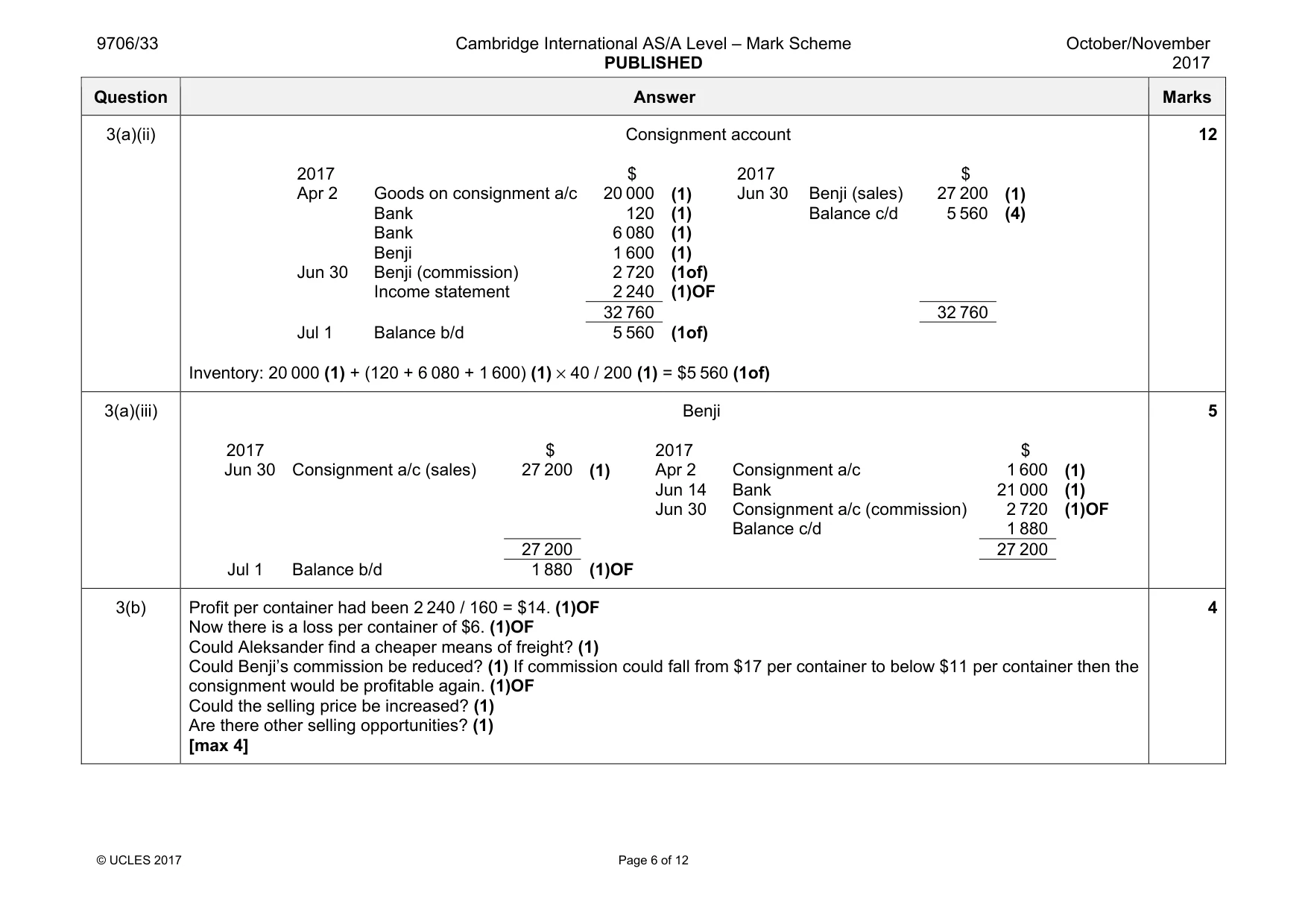
9706/33 Cambridge International AS/A Level – Mark Scheme PUBLISHED October/November 2017 © UCLES 2017 Page 6 of 12 Question Answer Marks 3(a)(ii) Consignment account 2017 $ 2017 $ Apr 2 Goods on consignment a/c 20 000 (1) Jun 30 Benji (sales) 27 200 (1) Bank 120 (1) Balance c/d 5 560 (4) Bank 6 080 (1) Benji 1 600 (1) Jun 30 Benji (commission) 2 720 (1of) Income statement 2 240 (1)OF 32 760 32 760 Jul 1 Balance b/d 5 560 (1of) Inventory: 20 000 (1) + (120 + 6 080 + 1 600) (1) × 40 / 200 (1) = $5 560 (1of) 12 3(a)(iii) Benji 2017 $ 2017 $ Jun 30 Consignment a/c (sales) 27 200 (1) Apr 2 Consignment a/c 1 600 (1) Jun 14 Bank 21 000 (1) Jun 30 Consignment a/c (commission) 2 720 (1)OF Balance c/d 1 880 27 200 27 200 Jul 1 Balance b/d 1 880 (1)OF 5 3(b) Profit per container had been 2 240 / 160 = $14. (1)OF Now there is a loss per container of $6. (1)OF Could Aleksander find a cheaper means of freight? (1) Could Benji’s commission be reduced? (1) If commission could fall from $17 per container to below $11 per container then the consignment would be profitable again. (1)OF Could the selling price be increased? (1) Are there other selling opportunities? (1) [max 4] 4
Mark scheme, page 7
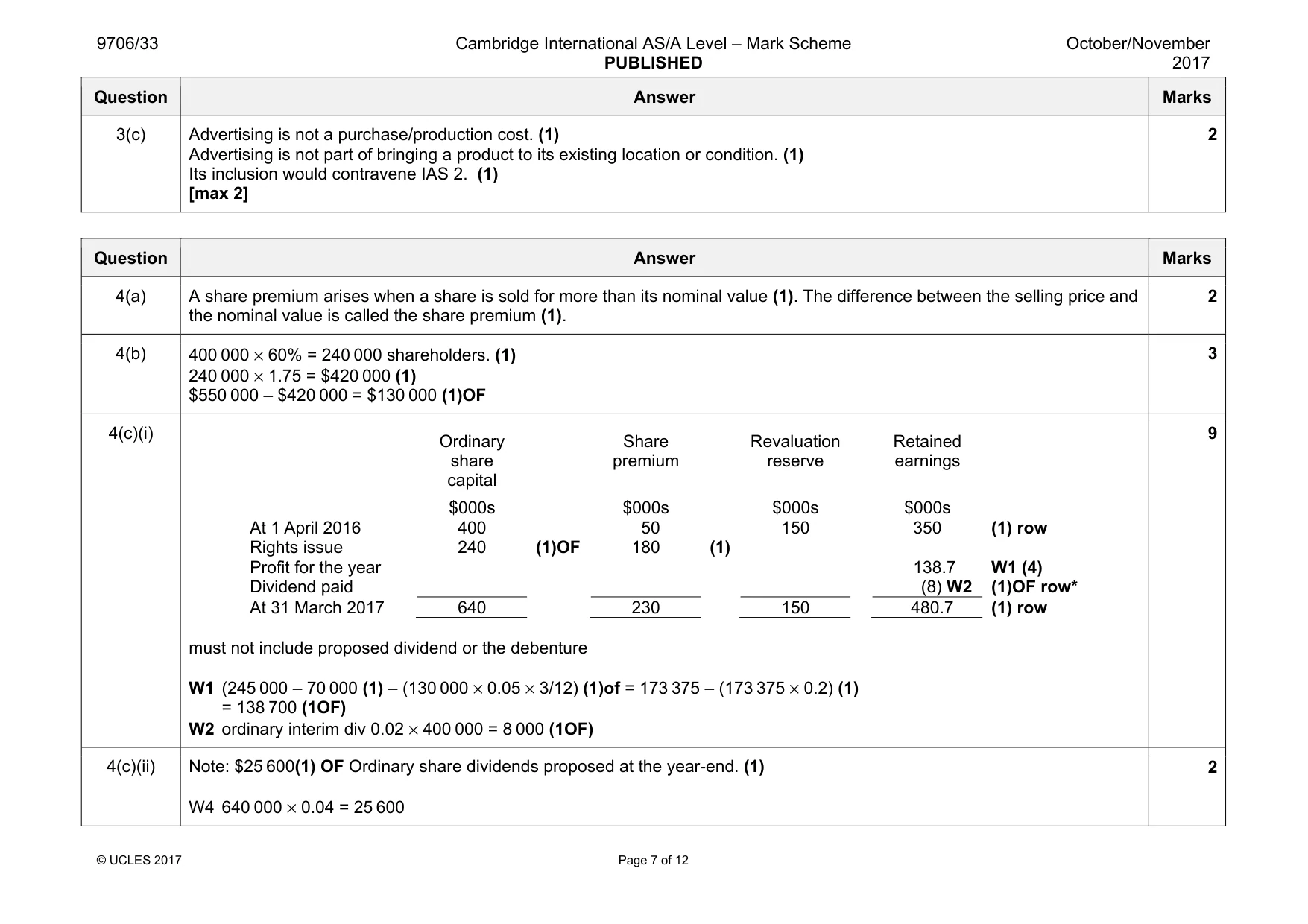
9706/33 Cambridge International AS/A Level – Mark Scheme PUBLISHED October/November 2017 © UCLES 2017 Page 7 of 12 Question Answer Marks 3(c) Advertising is not a purchase/production cost. (1) Advertising is not part of bringing a product to its existing location or condition. (1) Its inclusion would contravene IAS 2. (1) [max 2] 2 Question Answer Marks 4(a) A share premium arises when a share is sold for more than its nominal value (1). The difference between the selling price and the nominal value is called the share premium (1). 2 4(b) 400 000 × 60% = 240 000 shareholders. (1) 240 000 × 1.75 = $420 000 (1) $550 000 – $420 000 = $130 000 (1)OF 3 4(c)(i) Ordinary share capital Share premium Revaluation reserve Retained earnings $000s $000s $000s $000s At 1 April 2016 400 50 150 350 (1) row Rights issue 240 (1)OF 180 (1) Profit for the year 138.7 W1 (4) Dividend paid (8) W2 (1)OF row* At 31 March 2017 640 230 150 480.7 (1) row must not include proposed dividend or the debenture W1 (245 000 – 70 000 (1) – (130 000 × 0.05 × 3/12) (1)of = 173 375 – (173 375 × 0.2) (1) = 138 700 (1OF) W2 ordinary interim div 0.02 × 400 000 = 8 000 (1OF) 9 4(c)(ii) Note: $25 600(1) OF Ordinary share dividends proposed at the year-end. (1) W4 640 000 × 0.04 = 25 600 2
Mark scheme, page 8
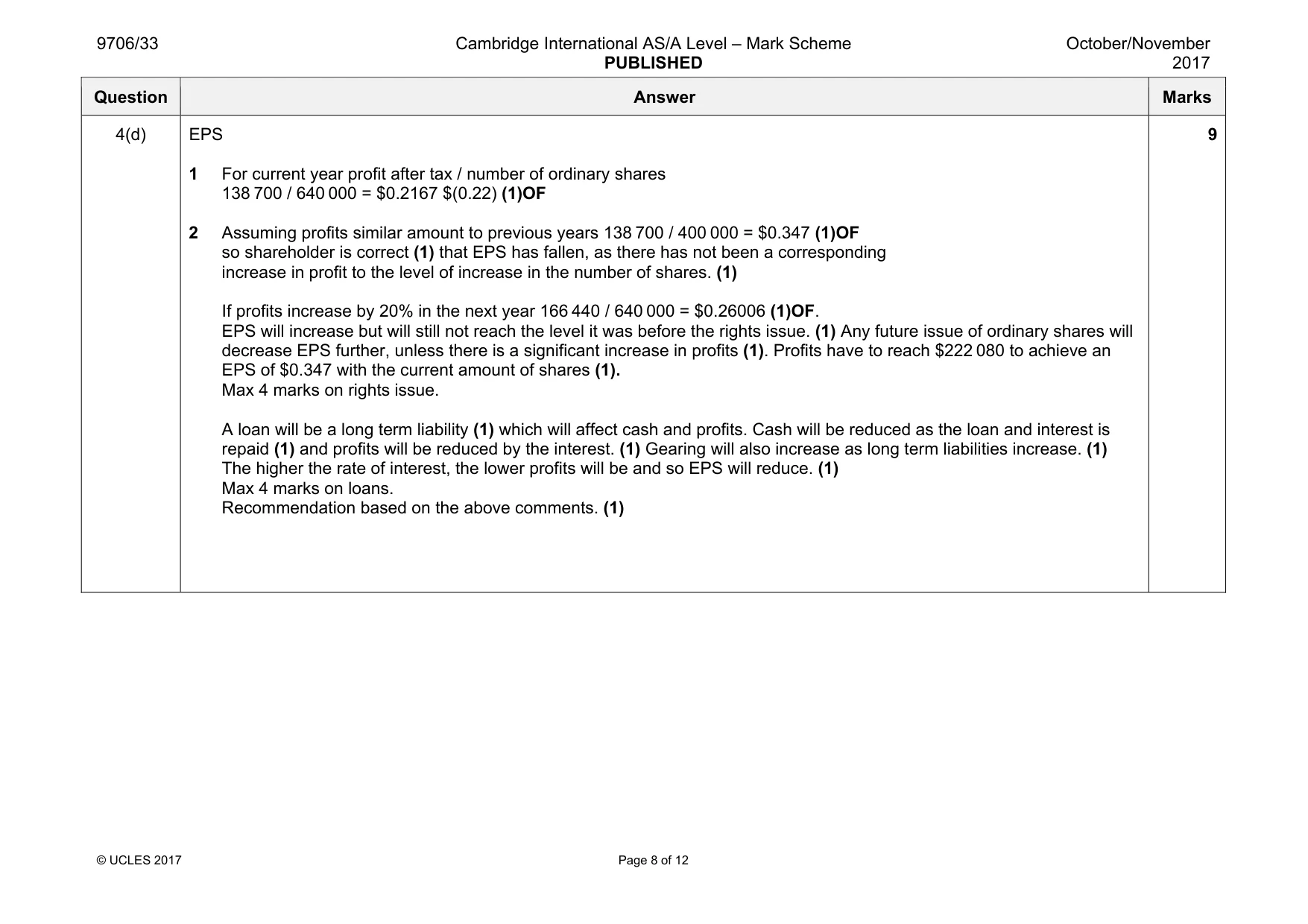
9706/33 Cambridge International AS/A Level – Mark Scheme PUBLISHED October/November 2017 © UCLES 2017 Page 8 of 12 Question Answer Marks 4(d) EPS 1 For current year profit after tax / number of ordinary shares 138 700 / 640 000 = $0.2167 $(0.22) (1)OF 2 Assuming profits similar amount to previous years 138 700 / 400 000 = $0.347 (1)OF so shareholder is correct (1) that EPS has fallen, as there has not been a corresponding increase in profit to the level of increase in the number of shares. (1) If profits increase by 20% in the next year 166 440 / 640 000 = $0.26006 (1)OF. EPS will increase but will still not reach the level it was before the rights issue. (1) Any future issue of ordinary shares will decrease EPS further, unless there is a significant increase in profits (1). Profits have to reach $222 080 to achieve an EPS of $0.347 with the current amount of shares (1). Max 4 marks on rights issue. A loan will be a long term liability (1) which will affect cash and profits. Cash will be reduced as the loan and interest is repaid (1) and profits will be reduced by the interest. (1) Gearing will also increase as long term liabilities increase. (1) The higher the rate of interest, the lower profits will be and so EPS will reduce. (1) Max 4 marks on loans. Recommendation based on the above comments. (1) 9
Mark scheme, page 9
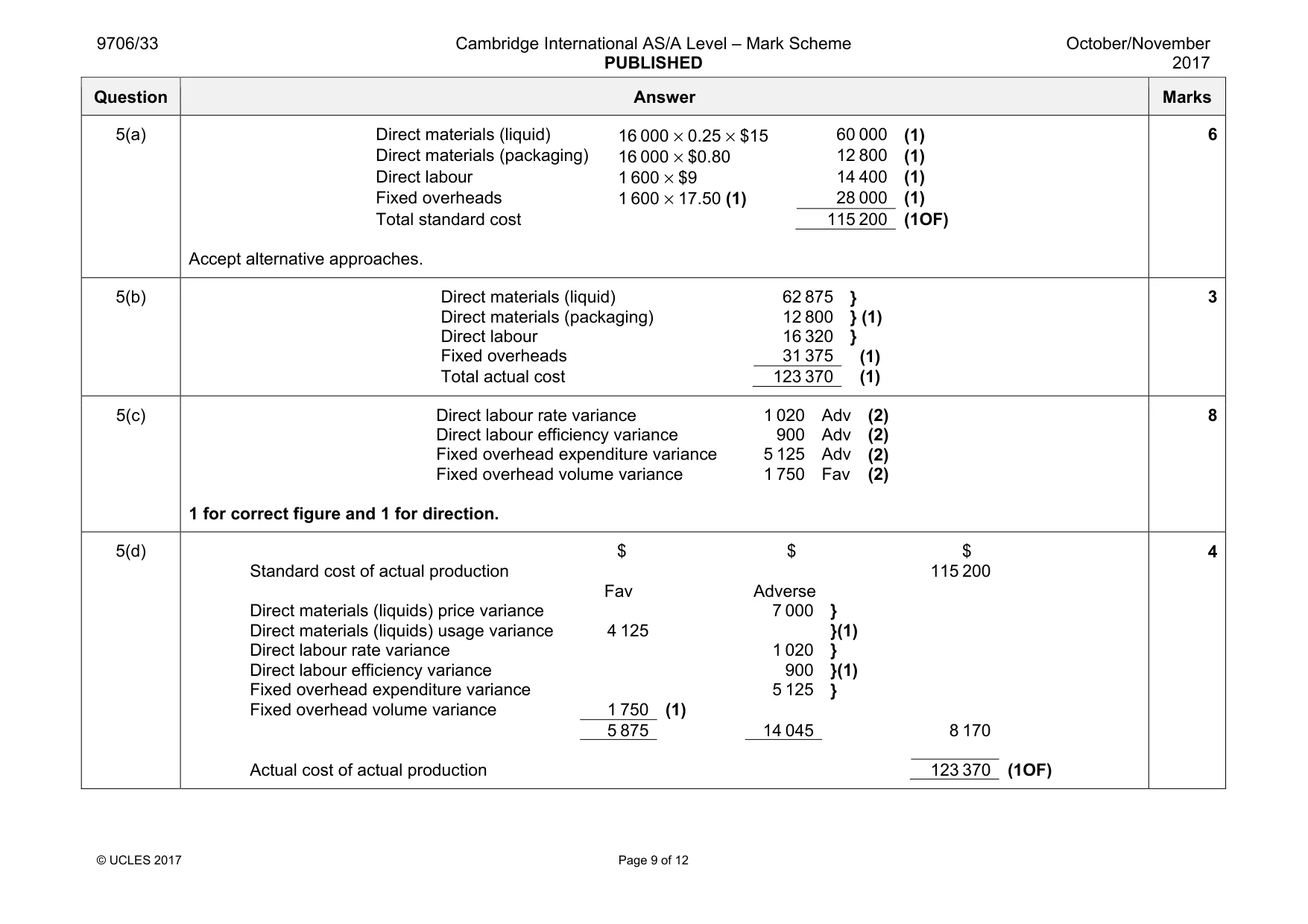
9706/33 Cambridge International AS/A Level – Mark Scheme PUBLISHED October/November 2017 © UCLES 2017 Page 9 of 12 Question Answer Marks 5(a) Direct materials (liquid) 16 000 × 0.25 × $15 60 000 (1) Direct materials (packaging) 16 000 × $0.80 12 800 (1) Direct labour 1 600 × $9 14 400 (1) Fixed overheads 1 600 × 17.50 (1) 28 000 (1) Total standard cost 115 200 (1OF) Accept alternative approaches. 6 5(b) Direct materials (liquid) 62 875 } Direct materials (packaging) 12 800 } (1) Direct labour 16 320 } Fixed overheads 31 375 (1) Total actual cost 123 370 (1) 3 5(c) Direct labour rate variance 1 020 Adv (2) Direct labour efficiency variance 900 Adv (2) Fixed overhead expenditure variance 5 125 Adv (2) Fixed overhead volume variance 1 750 Fav (2) 1 for correct figure and 1 for direction. 8 5(d) $ $ $ Standard cost of actual production 115 200 Fav Adverse Direct materials (liquids) price variance 7 000 } Direct materials (liquids) usage variance 4 125 }(1) Direct labour rate variance 1 020 } Direct labour efficiency variance 900 }(1) Fixed overhead expenditure variance 5 125 } Fixed overhead volume variance 1 750 (1) 5 875 14 045 8 170 Actual cost of actual production 123 370 (1OF) 4
Mark scheme, page 10
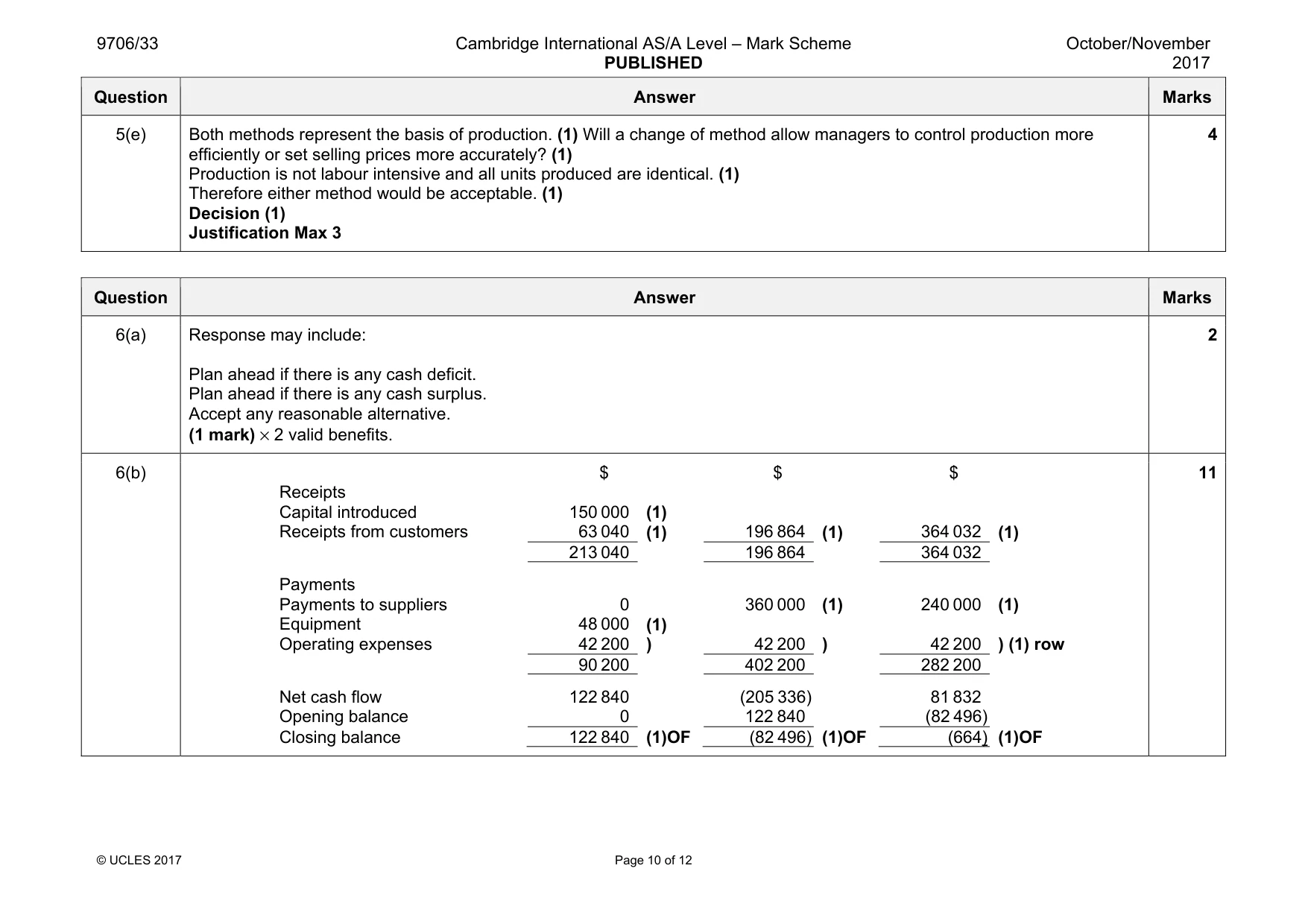
9706/33 Cambridge International AS/A Level – Mark Scheme PUBLISHED October/November 2017 © UCLES 2017 Page 10 of 12 Question Answer Marks 5(e) Both methods represent the basis of production. (1) Will a change of method allow managers to control production more efficiently or set selling prices more accurately? (1) Production is not labour intensive and all units produced are identical. (1) Therefore either method would be acceptable. (1) Decision (1) Justification Max 3 4 Question Answer Marks 6(a) Response may include: Plan ahead if there is any cash deficit. Plan ahead if there is any cash surplus. Accept any reasonable alternative. (1 mark) × 2 valid benefits. 2 6(b) $ $ $ Receipts Capital introduced 150 000 (1) Receipts from customers 63 040 (1) 196 864 (1) 364 032 (1) 213 040 196 864 364 032 Payments Payments to suppliers 0 360 000 (1) 240 000 (1) Equipment 48 000 (1) Operating expenses 42 200 ) 42 200 ) 42 200 ) (1) row 90 200 402 200 282 200 Net cash flow 122 840 (205 336) 81 832 Opening balance 0 122 840 (82 496) Closing balance 122 840 (1)OF (82 496) (1)OF (664) (1)OF 11
Mark scheme, page 11
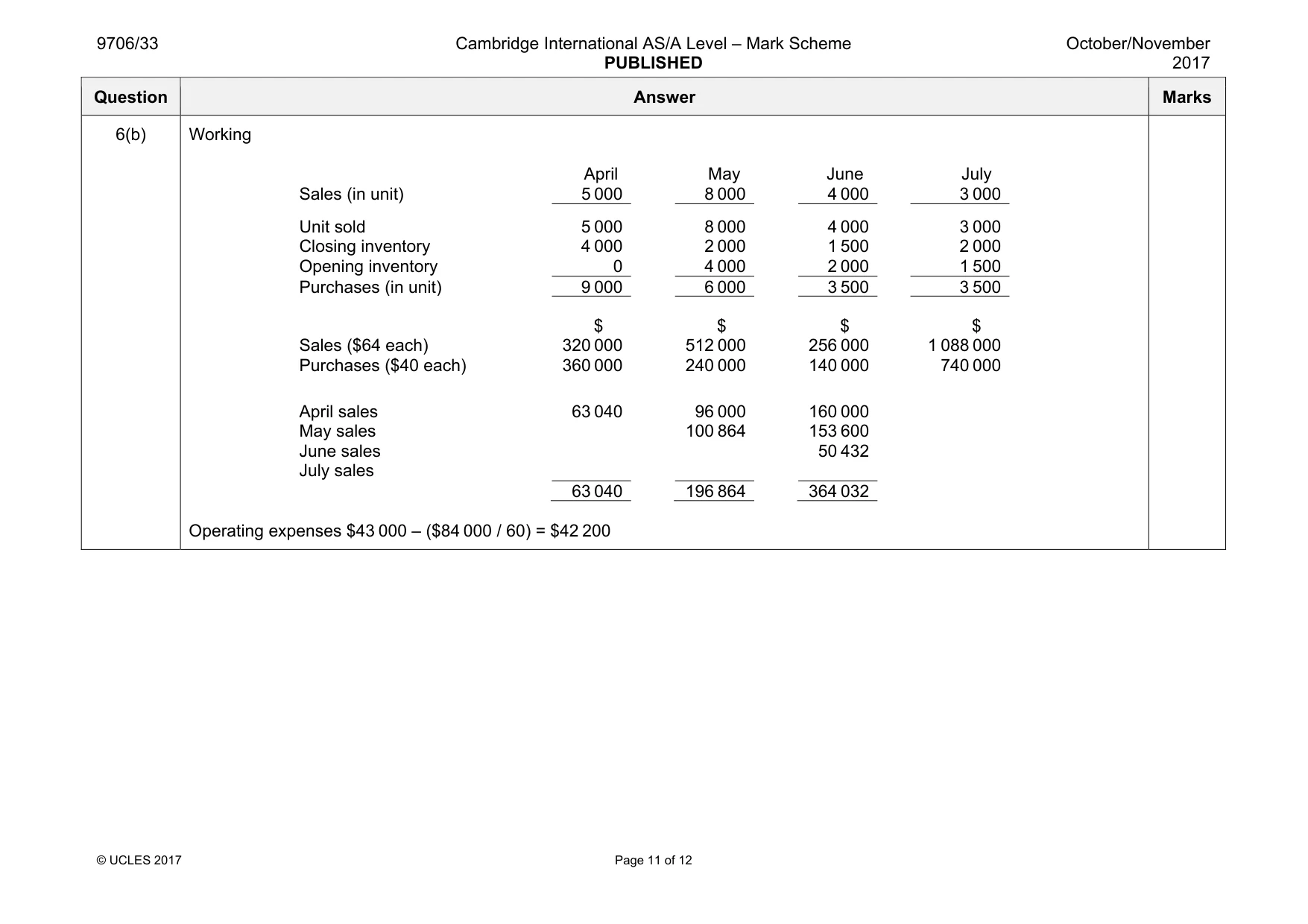
9706/33 Cambridge International AS/A Level – Mark Scheme PUBLISHED October/November 2017 © UCLES 2017 Page 11 of 12 Question Answer Marks 6(b) Working April May June July Sales (in unit) 5 000 8 000 4 000 3 000 Unit sold 5 000 8 000 4 000 3 000 Closing inventory 4 000 2 000 1 500 2 000 Opening inventory 0 4 000 2 000 1 500 Purchases (in unit) 9 000 6 000 3 500 3 500 $ $ $ $ Sales ($64 each) 320 000 512 000 256 000 1 088 000 Purchases ($40 each) 360 000 240 000 140 000 740 000 April sales 63 040 96 000 160 000 May sales 100 864 153 600 June sales 50 432 July sales 63 040 196 864 364 032 Operating expenses $43 000 – ($84 000 / 60) = $42 200
Mark scheme, page 12
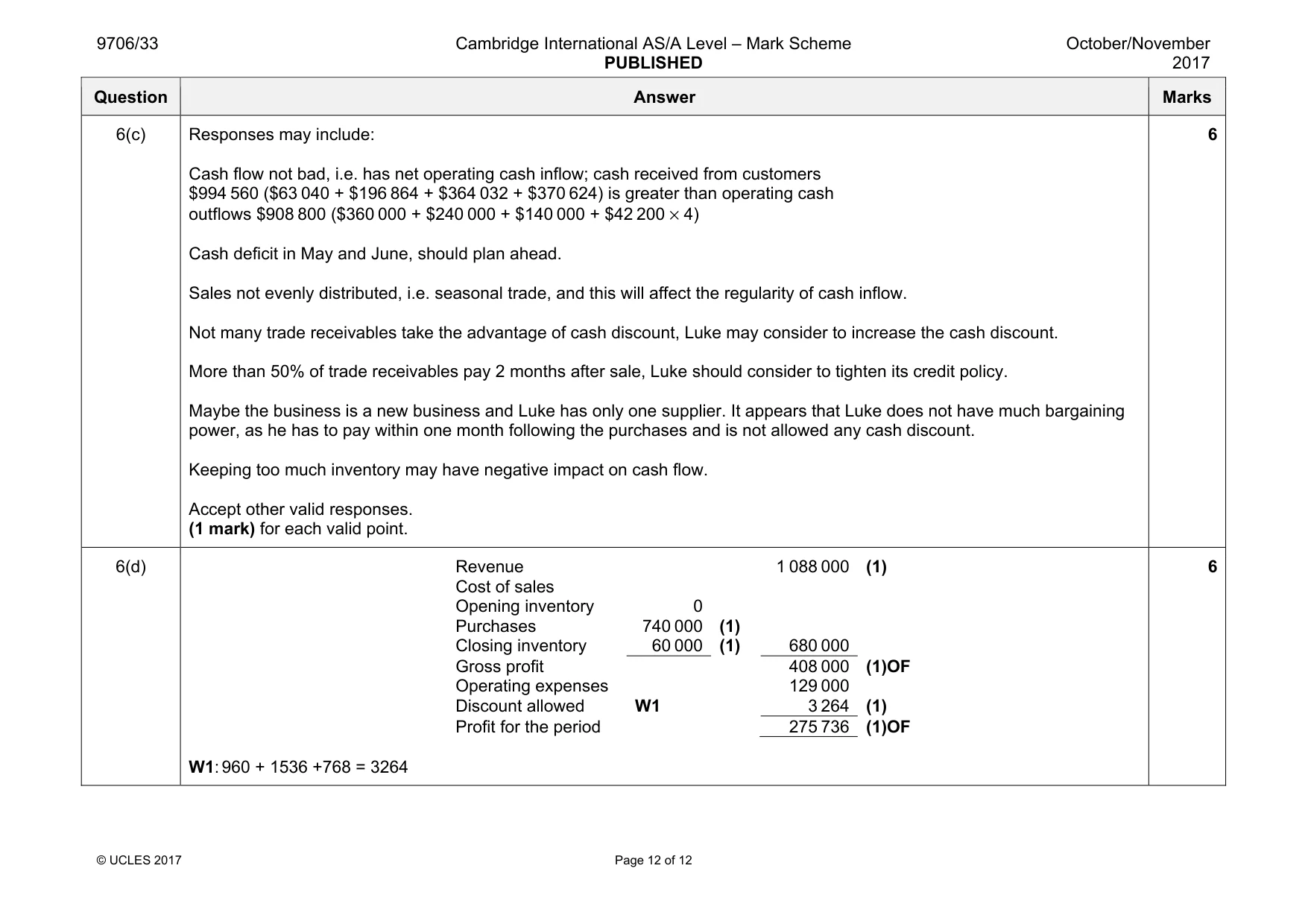
9706/33 Cambridge International AS/A Level – Mark Scheme PUBLISHED October/November 2017 © UCLES 2017 Page 12 of 12 Question Answer Marks 6(c) Responses may include: Cash flow not bad, i.e. has net operating cash inflow; cash received from customers $994 560 ($63 040 + $196 864 + $364 032 + $370 624) is greater than operating cash outflows $908 800 ($360 000 + $240 000 + $140 000 + $42 200 × 4) Cash deficit in May and June, should plan ahead. Sales not evenly distributed, i.e. seasonal trade, and this will affect the regularity of cash inflow. Not many trade receivables take the advantage of cash discount, Luke may consider to increase the cash discount. More than 50% of trade receivables pay 2 months after sale, Luke should consider to tighten its credit policy. Maybe the business is a new business and Luke has only one supplier. It appears that Luke does not have much bargaining power, as he has to pay within one month following the purchases and is not allowed any cash discount. Keeping too much inventory may have negative impact on cash flow. Accept other valid responses. (1 mark) for each valid point. 6 6(d) Revenue 1 088 000 (1) Cost of sales Opening inventory 0 Purchases 740 000 (1) Closing inventory 60 000 (1) 680 000 Gross profit 408 000 (1)OF Operating expenses 129 000 Discount allowed W1 3 264 (1) Profit for the period 275 736 (1)OF W1: 960 + 1536 +768 = 3264 6
What you needed in this session
Cambridge’s own grade thresholds for 2017 Oct/Nov, Paper 3 · Variant 3. A higher threshold means an easier paper — the bar moves with how the cohort did.