Cambridge A Level Accounting 9706 — 2017 Oct/Nov Paper 3 · Variant 2
9706/32/O/N/17 · 150 marks · ≈169 min
The question paper and its mark scheme, free to read here and free to download. This is Cambridge’s own paper, exactly as it was sat.
Question paper12 pages


Mark scheme11 pages
Answers below. Sit the paper first if you are practising.
Paper as text
Question paper, page 1
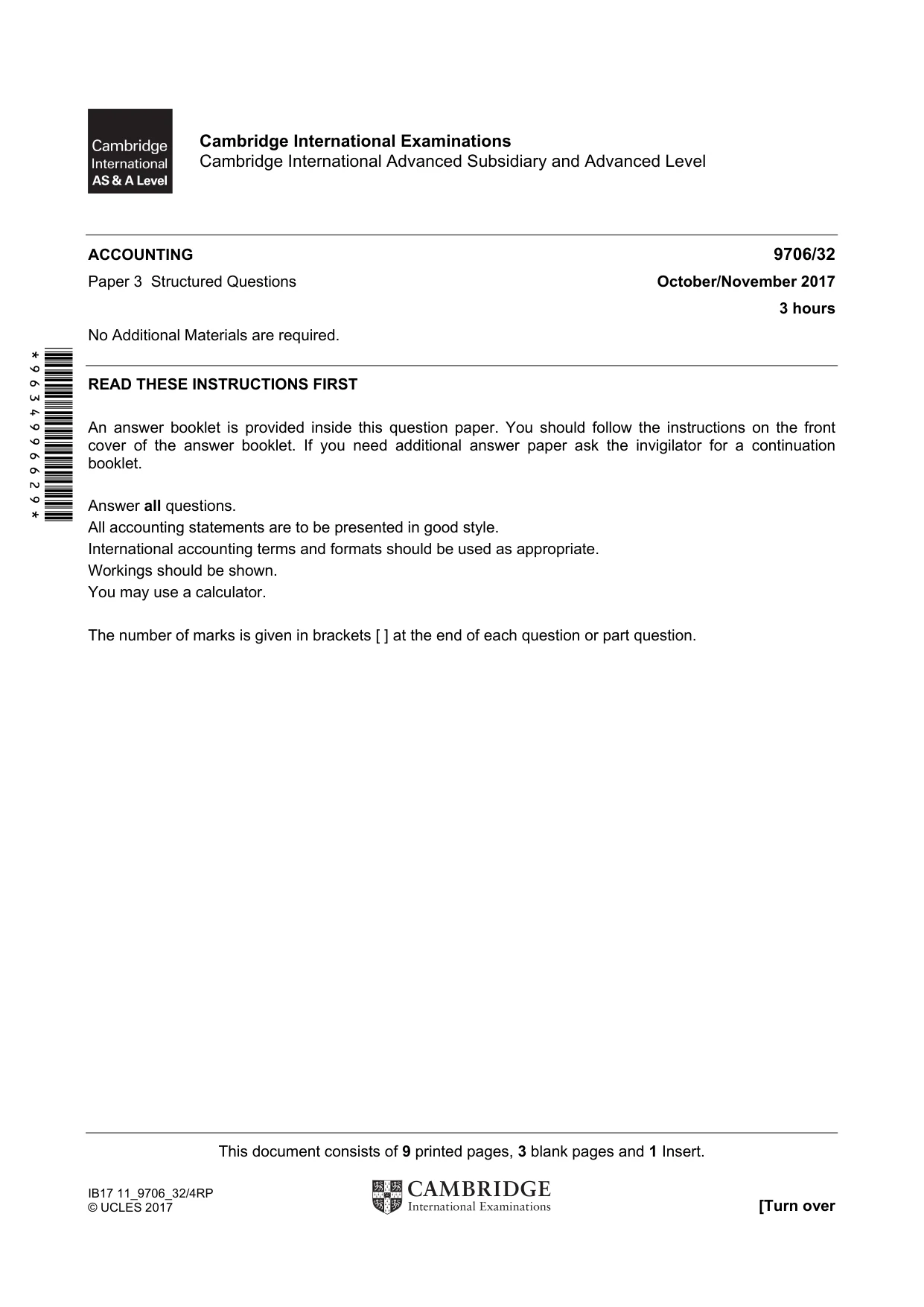
This document consists of 9 printed pages, 3 blank pages and 1 Insert. IB17 11_9706_32/4RP © UCLES 2017 [Turn over Cambridge International Examinations Cambridge International Advanced Subsidiary and Advanced Level ACCOUNTING 9706/32 Paper 3 Structured Questions October/November 2017 3 hours No Additional Materials are required. READ THESE INSTRUCTIONS FIRST An answer booklet is provided inside this question paper. You should follow the instructions on the front cover of the answer booklet. If you need additional answer paper ask the invigilator for a continuation booklet. Answer all questions. All accounting statements are to be presented in good style. International accounting terms and formats should be used as appropriate. Workings should be shown. You may use a calculator. The number of marks is given in brackets [ ] at the end of each question or part question.
Question paper, page 2
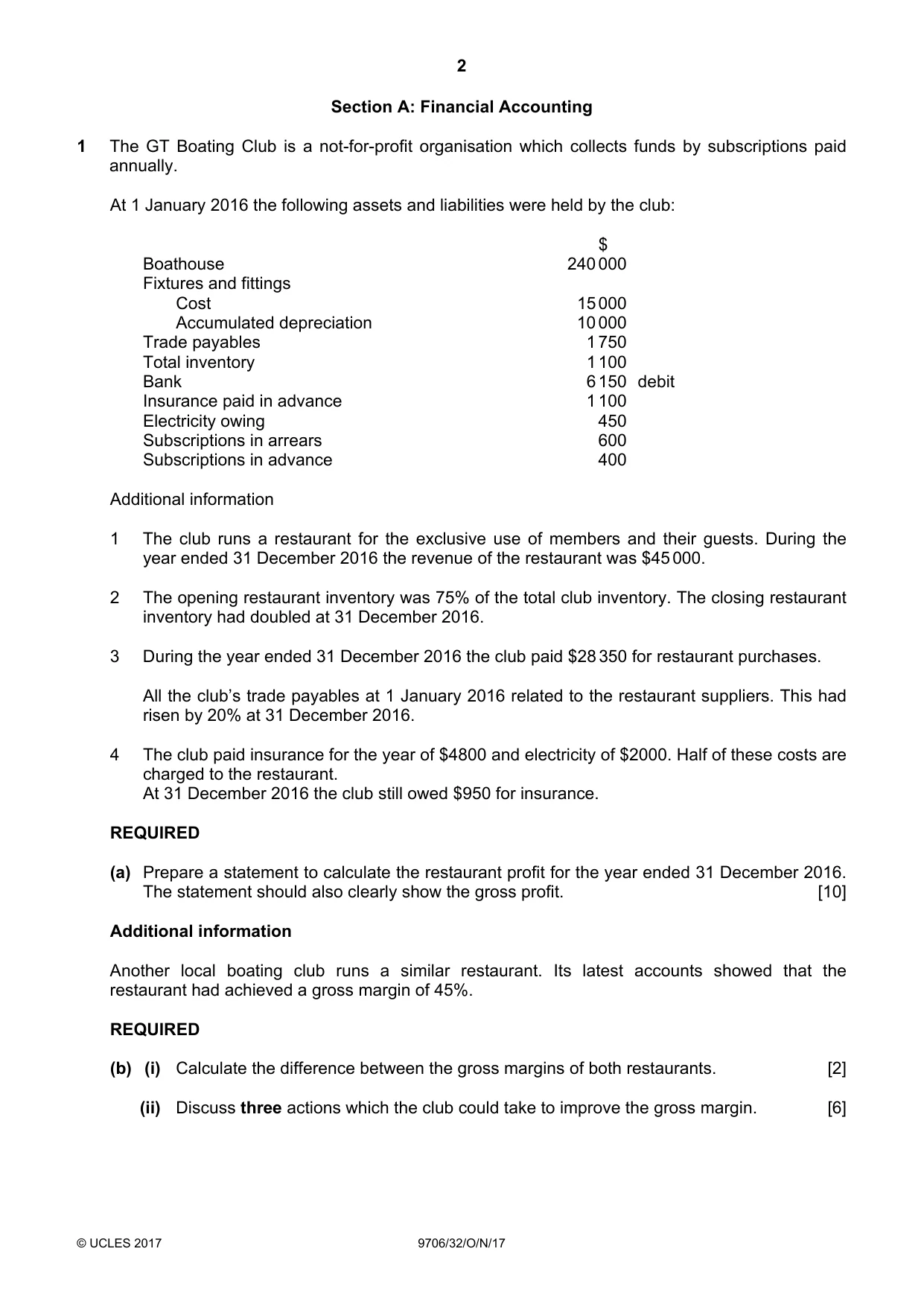
2 © UCLES 2017 9706/32/O/N/17 Section A: Financial Accounting 1 The GT Boating Club is a not-for-profit organisation which collects funds by subscriptions paid annually. At 1 January 2016 the following assets and liabilities were held by the club: $ Boathouse 240 000 Fixtures and fittings Cost 15 000 Accumulated depreciation 10 000 Trade payables 1 750 Total inventory 1 100 Bank 6 150 debit Insurance paid in advance 1 100 Electricity owing 450 Subscriptions in arrears 600 Subscriptions in advance 400 Additional information 1 The club runs a restaurant for the exclusive use of members and their guests. During the year ended 31 December 2016 the revenue of the restaurant was $45 000. 2 The opening restaurant inventory was 75% of the total club inventory. The closing restaurant inventory had doubled at 31 December 2016. 3 During the year ended 31 December 2016 the club paid $28 350 for restaurant purchases. All the club’s trade payables at 1 January 2016 related to the restaurant suppliers. This had risen by 20% at 31 December 2016. 4 The club paid insurance for the year of $4800 and electricity of $2000. Half of these costs are charged to the restaurant. At 31 December 2016 the club still owed $950 for insurance. REQUIRED (a) Prepare a statement to calculate the restaurant profit for the year ended 31 December 2016. The statement should also clearly show the gross profit. [10] Additional information Another local boating club runs a similar restaurant. Its latest accounts showed that the restaurant had achieved a gross margin of 45%. REQUIRED (b) (i) Calculate the difference between the gross margins of both restaurants. [2] (ii) Discuss three actions which the club could take to improve the gross margin. [6]
Question paper, page 3
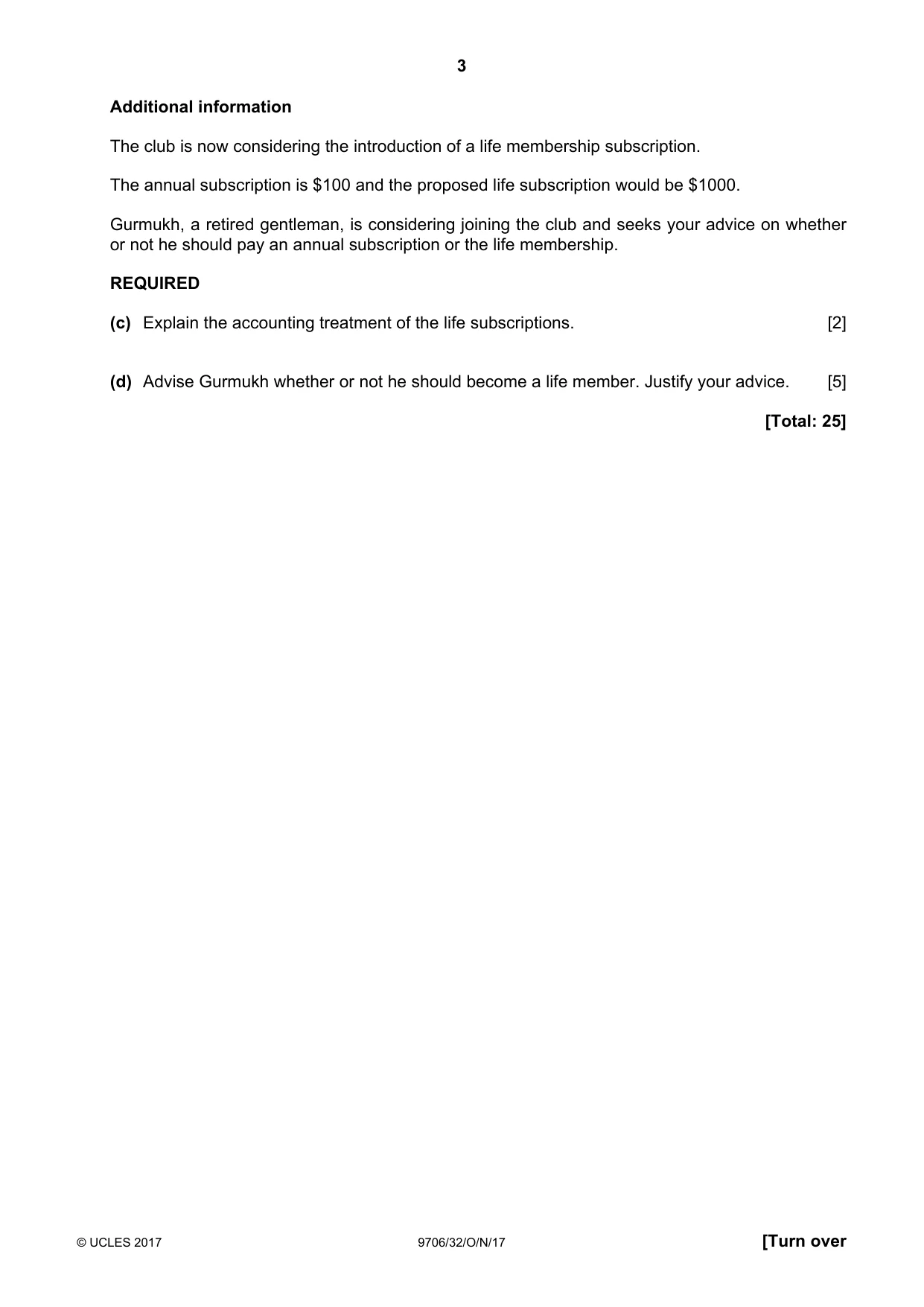
3 © UCLES 2017 9706/32/O/N/17 [Turn over Additional information The club is now considering the introduction of a life membership subscription. The annual subscription is $100 and the proposed life subscription would be $1000. Gurmukh, a retired gentleman, is considering joining the club and seeks your advice on whether or not he should pay an annual subscription or the life membership. REQUIRED (c) Explain the accounting treatment of the life subscriptions. [2] (d) Advise Gurmukh whether or not he should become a life member. Justify your advice. [5] [Total: 25]
Question paper, page 4
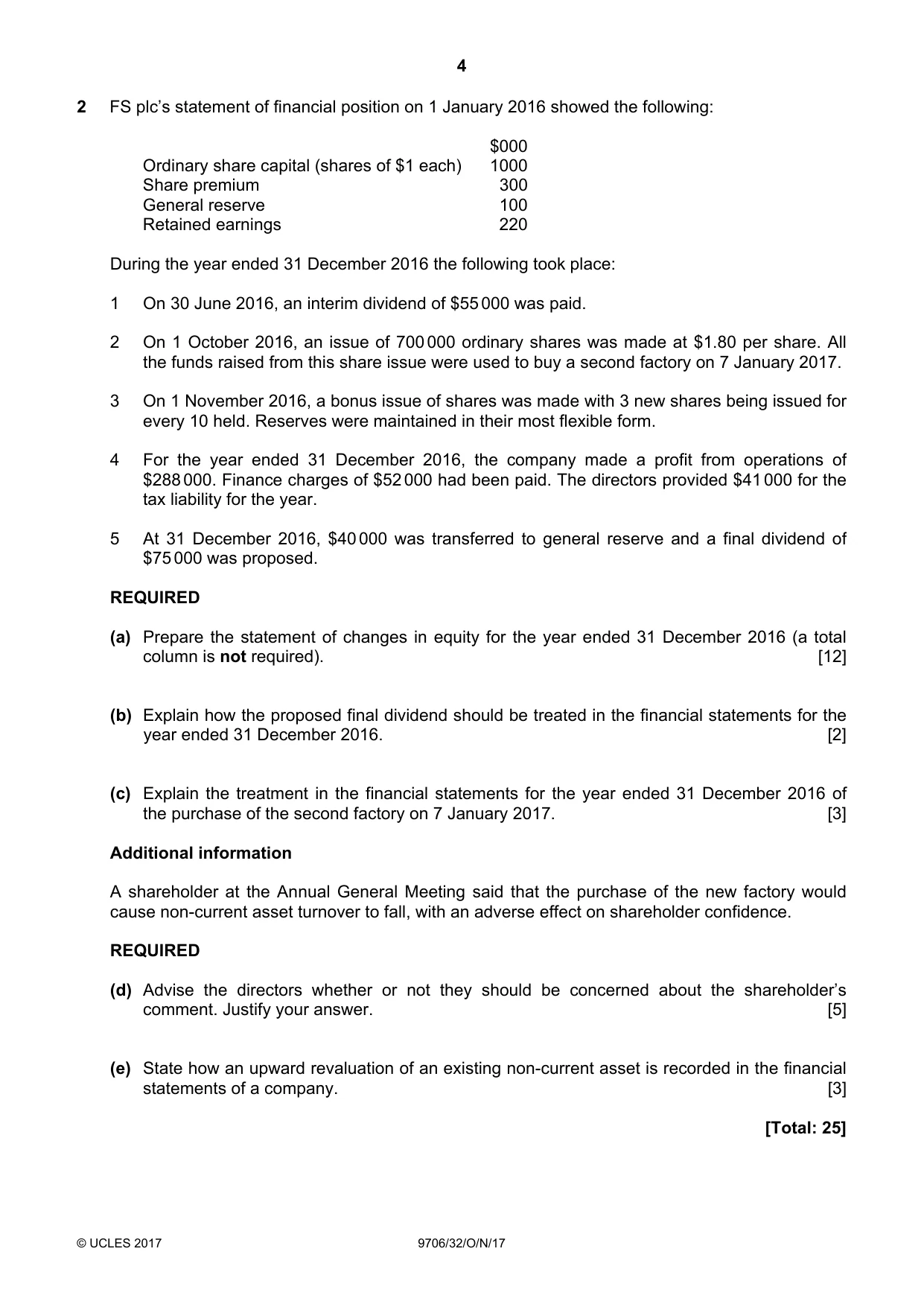
4 © UCLES 2017 9706/32/O/N/17 2 FS plc’s statement of financial position on 1 January 2016 showed the following: $000 Ordinary share capital (shares of $1 each) 1000 Share premium 300 General reserve 100 Retained earnings 220 During the year ended 31 December 2016 the following took place: 1 On 30 June 2016, an interim dividend of $55 000 was paid. 2 On 1 October 2016, an issue of 700 000 ordinary shares was made at $1.80 per share. All the funds raised from this share issue were used to buy a second factory on 7 January 2017. 3 On 1 November 2016, a bonus issue of shares was made with 3 new shares being issued for every 10 held. Reserves were maintained in their most flexible form. 4 For the year ended 31 December 2016, the company made a profit from operations of $288 000. Finance charges of $52 000 had been paid. The directors provided $41 000 for the tax liability for the year. 5 At 31 December 2016, $40 000 was transferred to general reserve and a final dividend of $75 000 was proposed. REQUIRED (a) Prepare the statement of changes in equity for the year ended 31 December 2016 (a total column is not required). [12] (b) Explain how the proposed final dividend should be treated in the financial statements for the year ended 31 December 2016. [2] (c) Explain the treatment in the financial statements for the year ended 31 December 2016 of the purchase of the second factory on 7 January 2017. [3] Additional information A shareholder at the Annual General Meeting said that the purchase of the new factory would cause non-current asset turnover to fall, with an adverse effect on shareholder confidence. REQUIRED (d) Advise the directors whether or not they should be concerned about the shareholder’s comment. Justify your answer. [5] (e) State how an upward revaluation of an existing non-current asset is recorded in the financial statements of a company. [3] [Total: 25]
Question paper, page 5
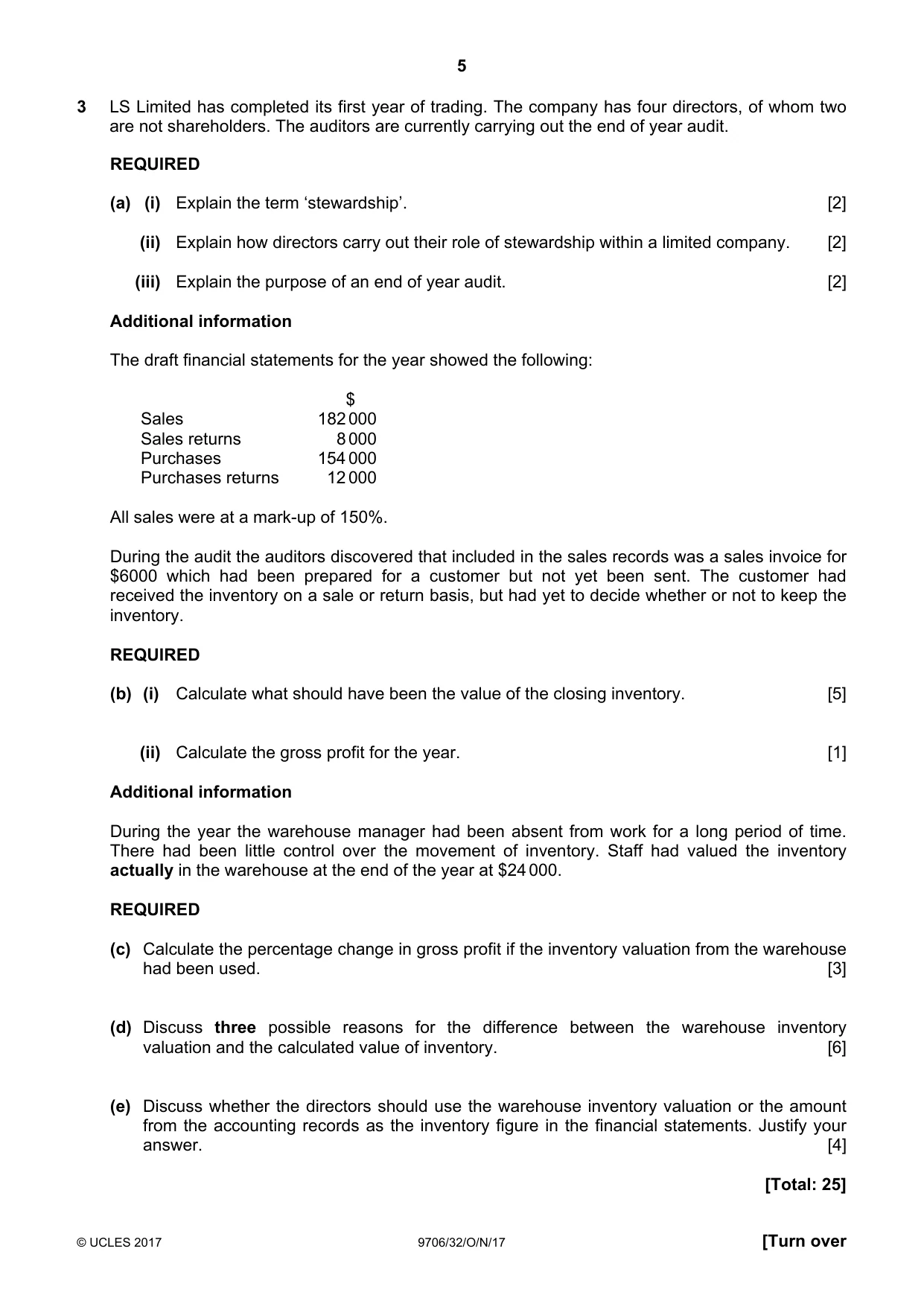
5 © UCLES 2017 9706/32/O/N/17 [Turn over 3 LS Limited has completed its first year of trading. The company has four directors, of whom two are not shareholders. The auditors are currently carrying out the end of year audit. REQUIRED (a) (i) Explain the term ‘stewardship’. [2] (ii) Explain how directors carry out their role of stewardship within a limited company. [2] (iii) Explain the purpose of an end of year audit. [2] Additional information The draft financial statements for the year showed the following: $ Sales 182 000 Sales returns 8 000 Purchases 154 000 Purchases returns 12 000 All sales were at a mark-up of 150%. During the audit the auditors discovered that included in the sales records was a sales invoice for $6000 which had been prepared for a customer but not yet been sent. The customer had received the inventory on a sale or return basis, but had yet to decide whether or not to keep the inventory. REQUIRED (b) (i) Calculate what should have been the value of the closing inventory. [5] (ii) Calculate the gross profit for the year. [1] Additional information During the year the warehouse manager had been absent from work for a long period of time. There had been little control over the movement of inventory. Staff had valued the inventory actually in the warehouse at the end of the year at $24 000. REQUIRED (c) Calculate the percentage change in gross profit if the inventory valuation from the warehouse had been used. [3] (d) Discuss three possible reasons for the difference between the warehouse inventory valuation and the calculated value of inventory. [6] (e) Discuss whether the directors should use the warehouse inventory valuation or the amount from the accounting records as the inventory figure in the financial statements. Justify your answer. [4] [Total: 25]
Question paper, page 6
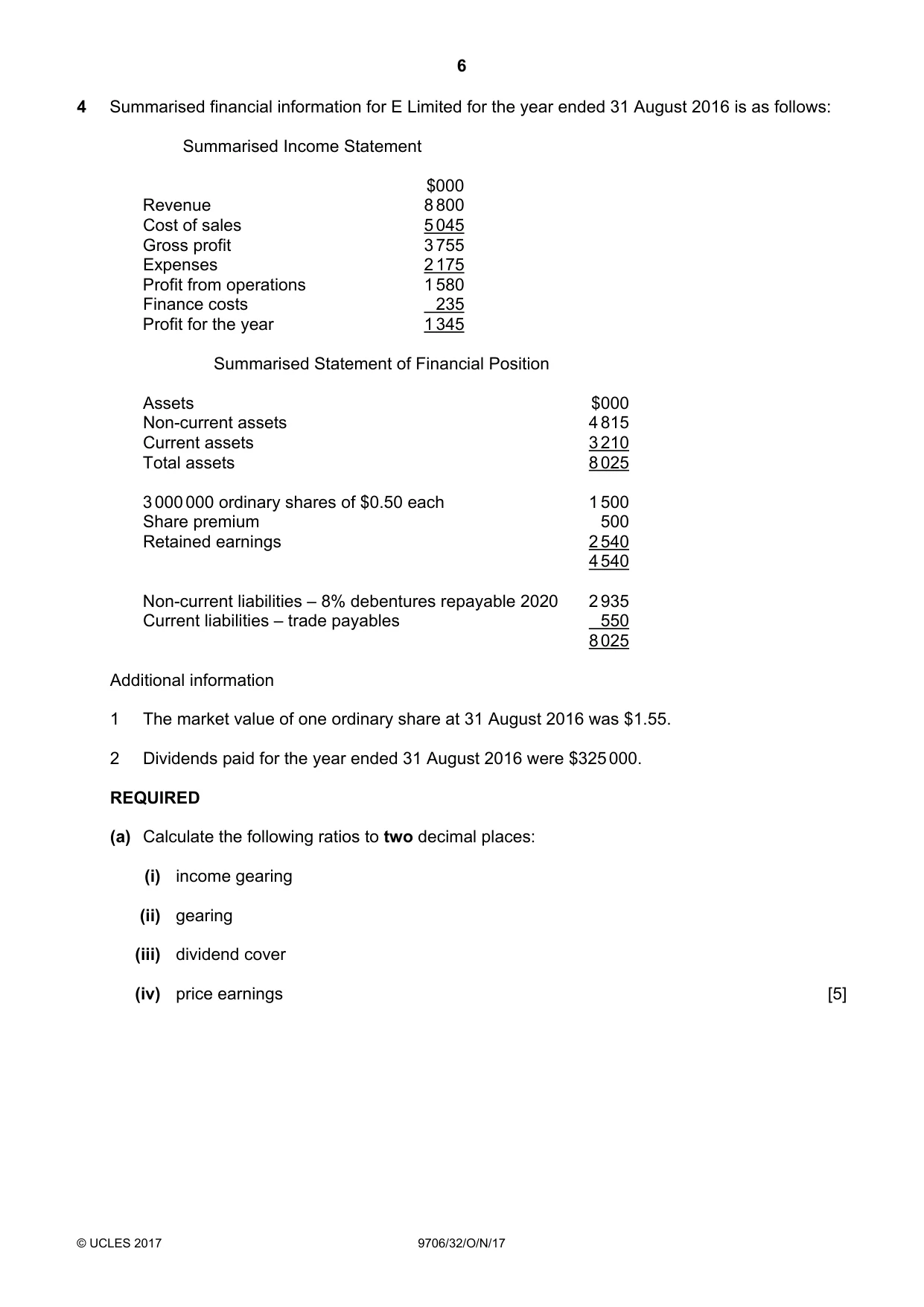
6 © UCLES 2017 9706/32/O/N/17 4 Summarised financial information for E Limited for the year ended 31 August 2016 is as follows: Summarised Income Statement $000 Revenue 8 800 Cost of sales 5 045 Gross profit 3 755 Expenses 2 175 Profit from operations 1 580 Finance costs 235 Profit for the year 1 345 Summarised Statement of Financial Position Assets $000 Non-current assets 4 815 Current assets 3 210 Total assets 8 025 3 000 000 ordinary shares of $0.50 each 1 500 Share premium 500 Retained earnings 2 540 4 540 Non-current liabilities – 8% debentures repayable 2020 2 935 Current liabilities – trade payables 550 8 025 Additional information 1 The market value of one ordinary share at 31 August 2016 was $1.55. 2 Dividends paid for the year ended 31 August 2016 were $325 000. REQUIRED (a) Calculate the following ratios to two decimal places: (i) income gearing (ii) gearing (iii) dividend cover (iv) price earnings [5]
Question paper, page 7
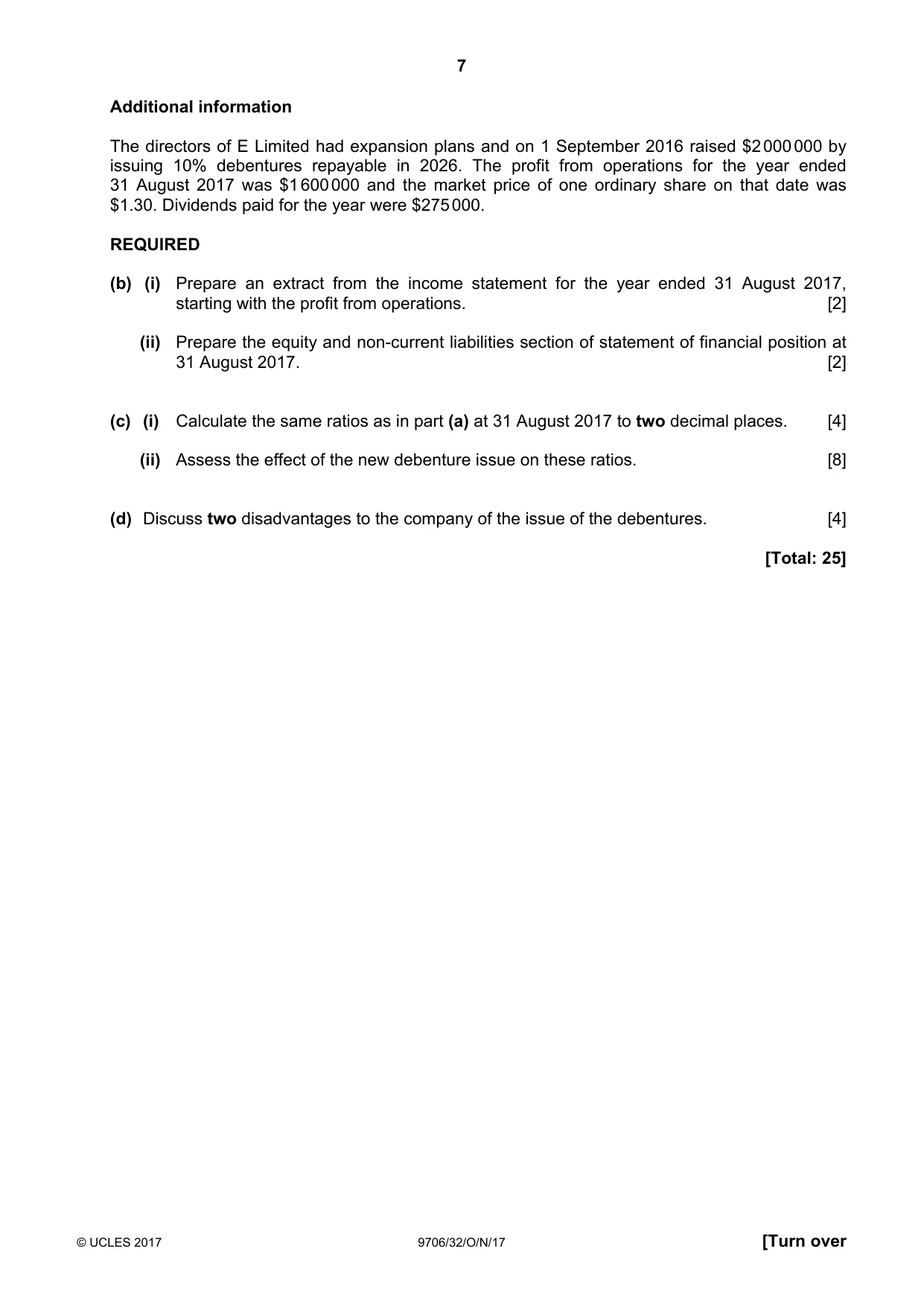
7 © UCLES 2017 9706/32/O/N/17 [Turn over Additional information The directors of E Limited had expansion plans and on 1 September 2016 raised $2 000 000 by issuing 10% debentures repayable in 2026. The profit from operations for the year ended 31 August 2017 was $1 600 000 and the market price of one ordinary share on that date was $1.30. Dividends paid for the year were $275 000. REQUIRED (b) (i) Prepare an extract from the income statement for the year ended 31 August 2017, starting with the profit from operations. [2] (ii) Prepare the equity and non-current liabilities section of statement of financial position at 31 August 2017. [2] (c) (i) Calculate the same ratios as in part (a) at 31 August 2017 to two decimal places. [4] (ii) Assess the effect of the new debenture issue on these ratios. [8] (d) Discuss two disadvantages to the company of the issue of the debentures. [4] [Total: 25]
Question paper, page 8
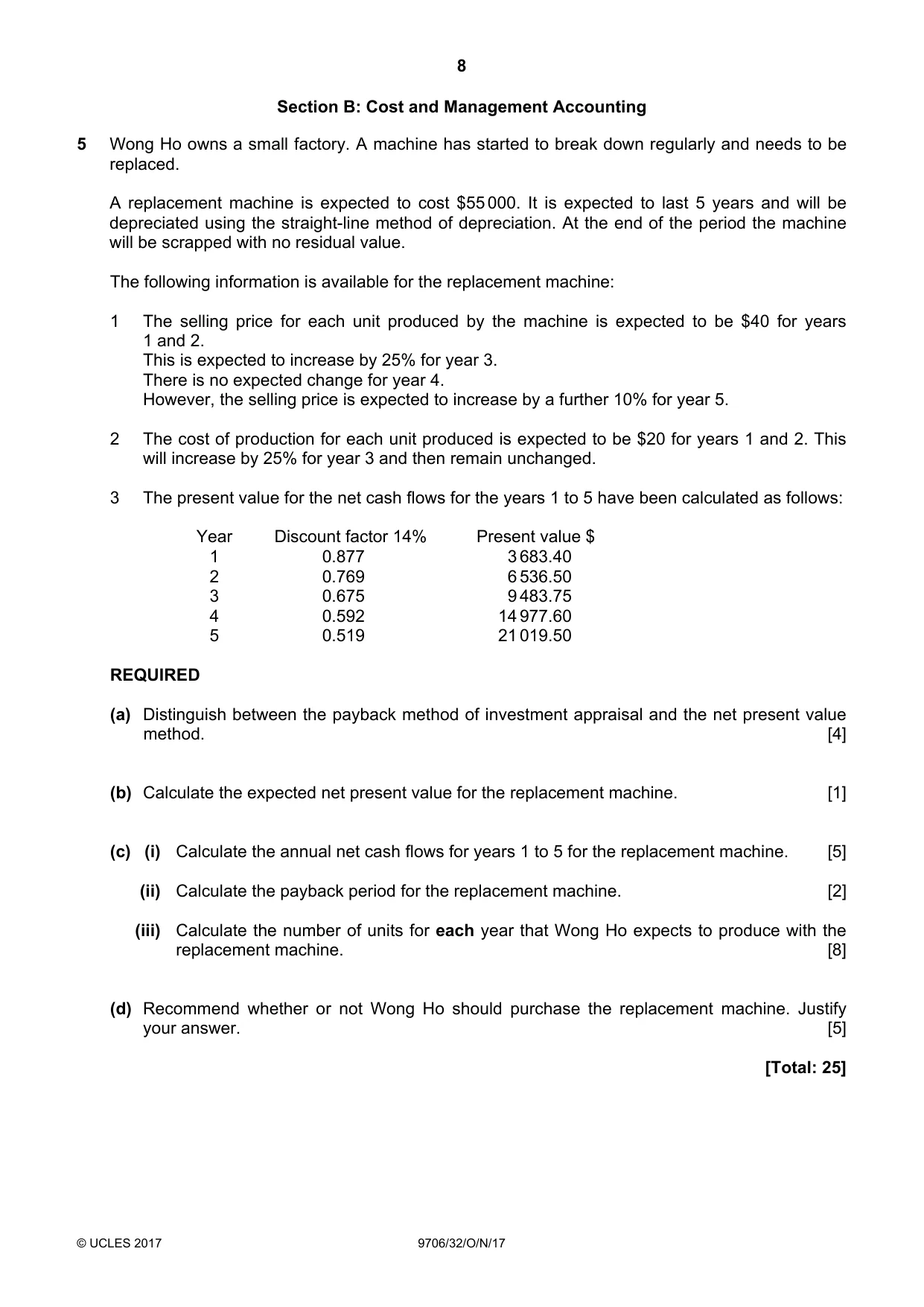
8 © UCLES 2017 9706/32/O/N/17 Section B: Cost and Management Accounting 5 Wong Ho owns a small factory. A machine has started to break down regularly and needs to be replaced. A replacement machine is expected to cost $55 000. It is expected to last 5 years and will be depreciated using the straight-line method of depreciation. At the end of the period the machine will be scrapped with no residual value. The following information is available for the replacement machine: 1 The selling price for each unit produced by the machine is expected to be $40 for years 1 and 2. This is expected to increase by 25% for year 3. There is no expected change for year 4. However, the selling price is expected to increase by a further 10% for year 5. 2 The cost of production for each unit produced is expected to be $20 for years 1 and 2. This will increase by 25% for year 3 and then remain unchanged. 3 The present value for the net cash flows for the years 1 to 5 have been calculated as follows: Year Discount factor 14% Present value $ 1 0.877 3 683.40 2 0.769 6 536.50 3 0.675 9 483.75 4 0.592 14 977.60 5 0.519 21 019.50 REQUIRED (a) Distinguish between the payback method of investment appraisal and the net present value method. [4] (b) Calculate the expected net present value for the replacement machine. [1] (c) (i) Calculate the annual net cash flows for years 1 to 5 for the replacement machine. [5] (ii) Calculate the payback period for the replacement machine. [2] (iii) Calculate the number of units for each year that Wong Ho expects to produce with the replacement machine. [8] (d) Recommend whether or not Wong Ho should purchase the replacement machine. Justify your answer. [5] [Total: 25]
Question paper, page 9
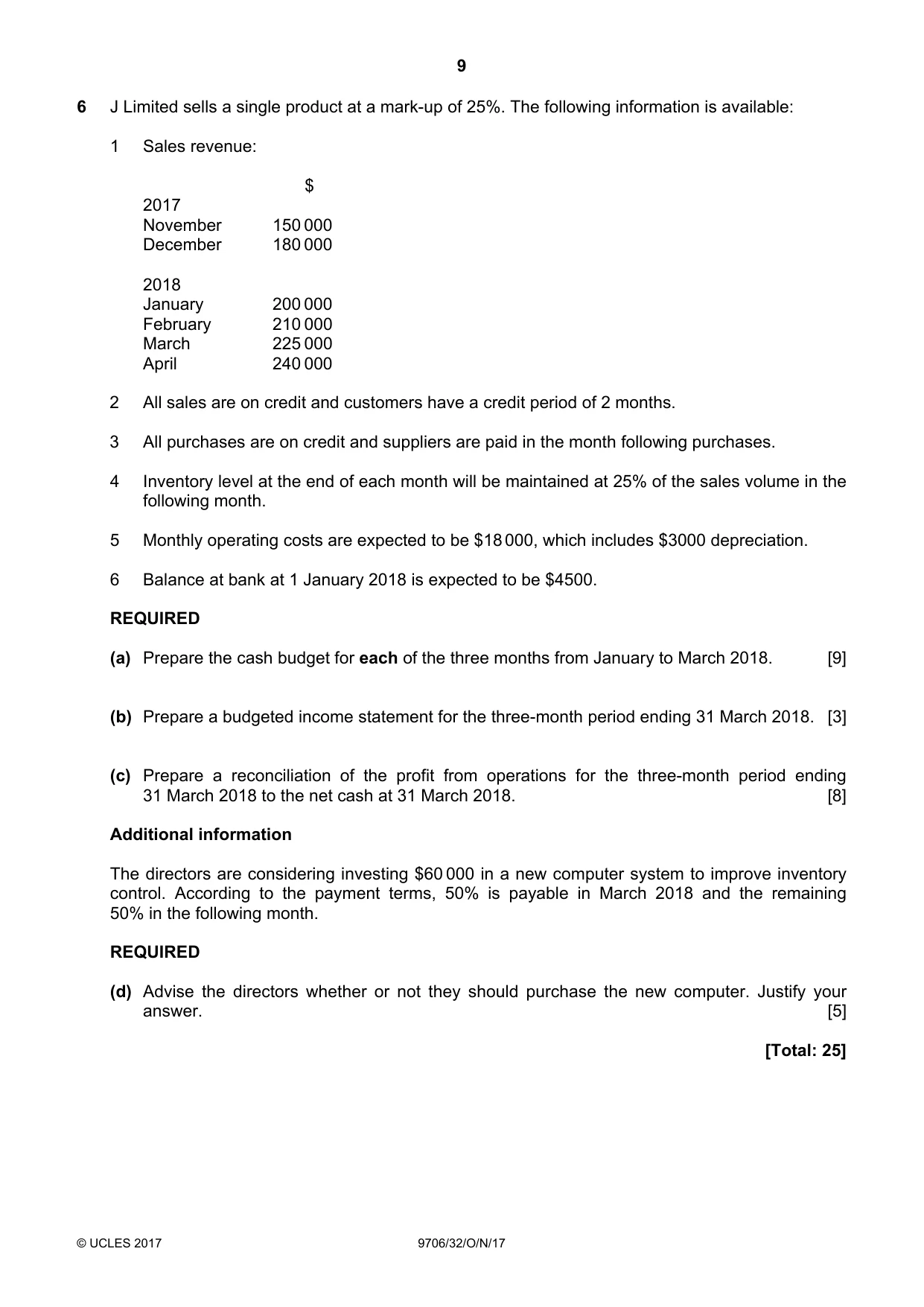
9 © UCLES 2017 9706/32/O/N/17 6 J Limited sells a single product at a mark-up of 25%. The following information is available: 1 Sales revenue: $ 2017 November 150 000 December 180 000 2018 January 200 000 February 210 000 March 225 000 April 240 000 2 All sales are on credit and customers have a credit period of 2 months. 3 All purchases are on credit and suppliers are paid in the month following purchases. 4 Inventory level at the end of each month will be maintained at 25% of the sales volume in the following month. 5 Monthly operating costs are expected to be $18 000, which includes $3000 depreciation. 6 Balance at bank at 1 January 2018 is expected to be $4500. REQUIRED (a) Prepare the cash budget for each of the three months from January to March 2018. [9] (b) Prepare a budgeted income statement for the three-month period ending 31 March 2018. [3] (c) Prepare a reconciliation of the profit from operations for the three-month period ending 31 March 2018 to the net cash at 31 March 2018. [8] Additional information The directors are considering investing $60 000 in a new computer system to improve inventory control. According to the payment terms, 50% is payable in March 2018 and the remaining 50% in the following month. REQUIRED (d) Advise the directors whether or not they should purchase the new computer. Justify your answer. [5] [Total: 25]
Question paper, page 10
10 © UCLES 2017 9706/32/O/N/17 BLANK PAGE
Question paper, page 11
11 © UCLES 2017 9706/32/O/N/17 BLANK PAGE
Question paper, page 12
12 Permission to reproduce items where third-party owned material protected by copyright is included has been sought and cleared where possible. Every reasonable effort has been made by the publisher (UCLES) to trace copyright holders, but if any items requiring clearance have unwittingly been included, the publisher will be pleased to make amends at the earliest possible opportunity. To avoid the issue of disclosure of answer-related information to candidates, all copyright acknowledgements are reproduced online in the Cambridge International Examinations Copyright Acknowledgements Booklet. This is produced for each series of examinations and is freely available to download at www.cie.org.uk after the live examination series. Cambridge International Examinations is part of the Cambridge Assessment Group. Cambridge Assessment is the brand name of University of Cambridge Local Examinations Syndicate (UCLES), which is itself a department of the University of Cambridge. © UCLES 2017 9706/32/O/N/17 BLANK PAGE
Mark scheme, page 1
® IGCSE is a registered trademark. This document consists of 11 printed pages. © UCLES 2017 [Turn over Cambridge Assessment International Education Cambridge International Advanced Subsidiary and Advanced Level ACCOUNTING 9706/32 Paper 3 Structured Questions October/November 2017 MARK SCHEME Maximum Mark: 150 Published This mark scheme is published as an aid to teachers and candidates, to indicate the requirements of the examination. It shows the basis on which Examiners were instructed to award marks. It does not indicate the details of the discussions that took place at an Examiners’ meeting before marking began, which would have considered the acceptability of alternative answers. Mark schemes should be read in conjunction with the question paper and the Principal Examiner Report for Teachers. Cambridge International will not enter into discussions about these mark schemes. Cambridge International is publishing the mark schemes for the October/November 2017 series for most Cambridge IGCSE®, Cambridge International A and AS Level components and some Cambridge O Level components.
Mark scheme, page 2
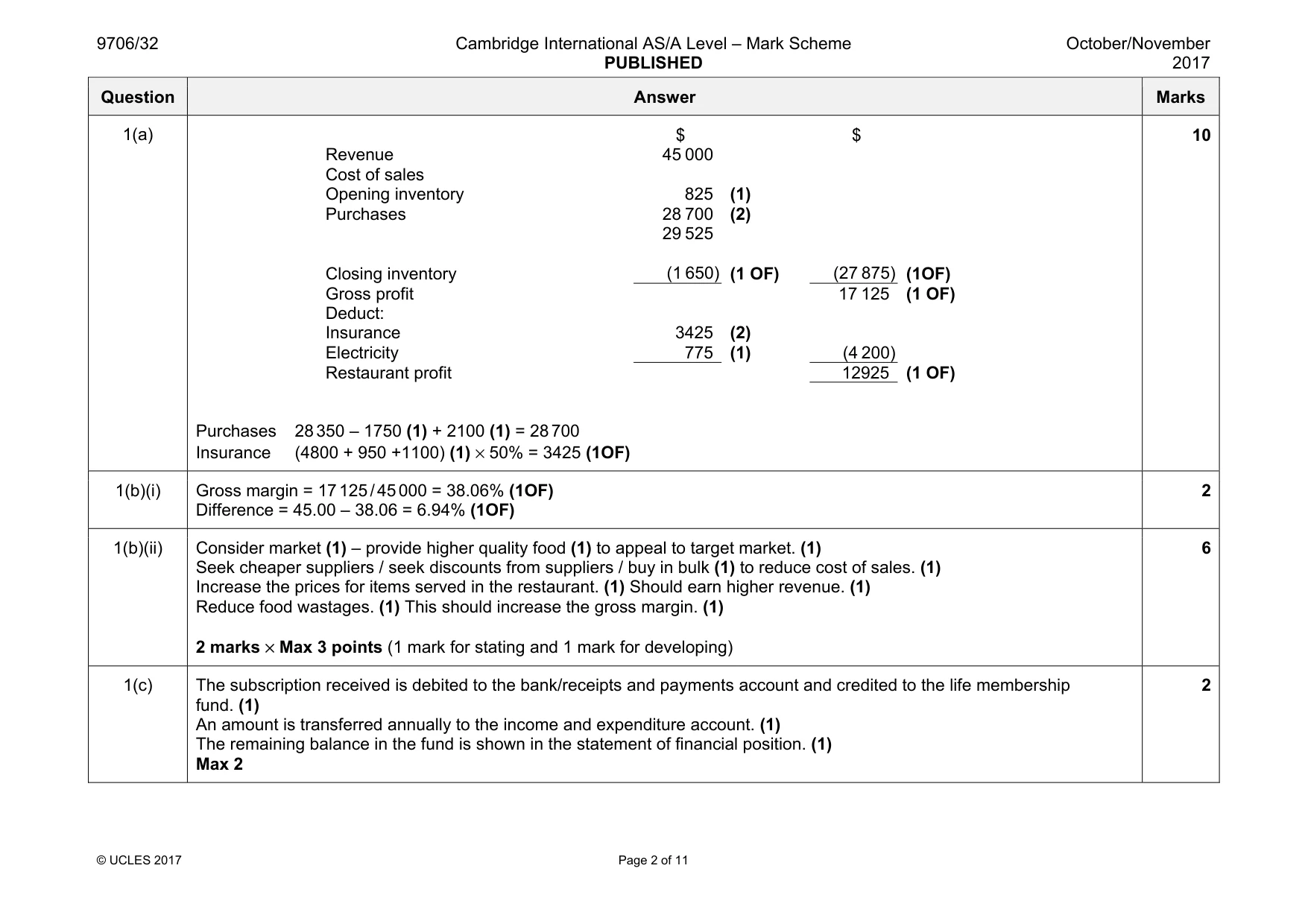
9706/32 Cambridge International AS/A Level – Mark Scheme PUBLISHED October/November 2017 © UCLES 2017 Page 2 of 11 Question Answer Marks 1(a) $ $ Revenue 45 000 Cost of sales Opening inventory 825 (1) Purchases 28 700 (2) 29 525 Closing inventory (1 650) (1 OF) (27 875) (1OF) Gross profit 17 125 (1 OF) Deduct: Insurance 3425 (2) Electricity 775 (1) (4 200) Restaurant profit 12925 (1 OF) Purchases 28 350 – 1750 (1) + 2100 (1) = 28 700 Insurance (4800 + 950 +1100) (1) × 50% = 3425 (1OF) 10 1(b)(i) Gross margin = 17 125 / 45 000 = 38.06% (1OF) Difference = 45.00 – 38.06 = 6.94% (1OF) 2 1(b)(ii) Consider market (1) – provide higher quality food (1) to appeal to target market. (1) Seek cheaper suppliers / seek discounts from suppliers / buy in bulk (1) to reduce cost of sales. (1) Increase the prices for items served in the restaurant. (1) Should earn higher revenue. (1) Reduce food wastages. (1) This should increase the gross margin. (1) 2 marks × Max 3 points (1 mark for stating and 1 mark for developing) 6 1(c) The subscription received is debited to the bank/receipts and payments account and credited to the life membership fund. (1) An amount is transferred annually to the income and expenditure account. (1) The remaining balance in the fund is shown in the statement of financial position. (1) Max 2 2
Mark scheme, page 3
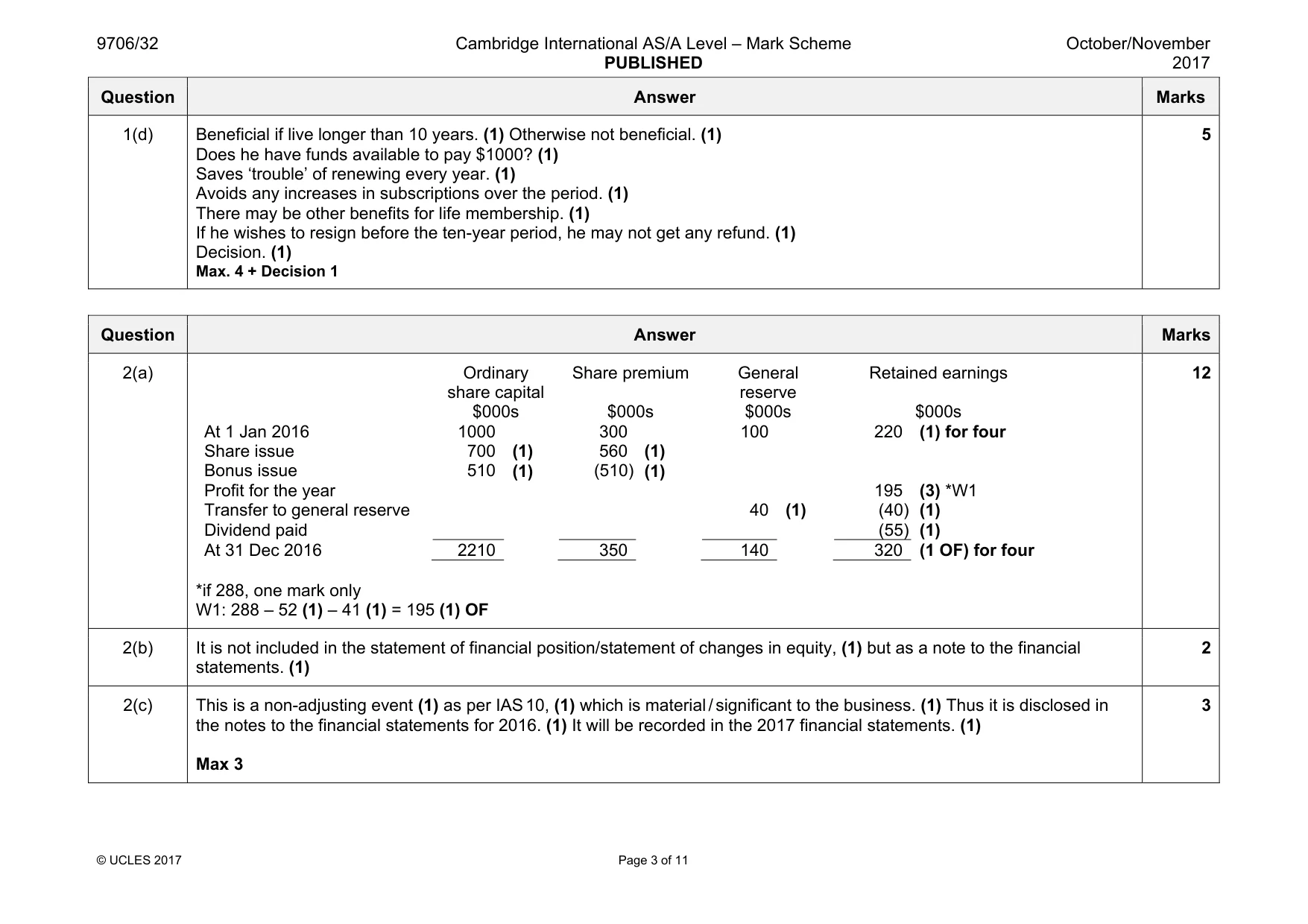
9706/32 Cambridge International AS/A Level – Mark Scheme PUBLISHED October/November 2017 © UCLES 2017 Page 3 of 11 Question Answer Marks 1(d) Beneficial if live longer than 10 years. (1) Otherwise not beneficial. (1) Does he have funds available to pay $1000? (1) Saves ‘trouble’ of renewing every year. (1) Avoids any increases in subscriptions over the period. (1) There may be other benefits for life membership. (1) If he wishes to resign before the ten-year period, he may not get any refund. (1) Decision. (1) Max. 4 + Decision 1 5 Question Answer Marks 2(a) Ordinary share capital Share premium General reserve Retained earnings $000s $000s $000s $000s At 1 Jan 2016 1000 300 100 220 (1) for four Share issue 700 (1) 560 (1) Bonus issue 510 (1) (510) (1) Profit for the year 195 (3) *W1 Transfer to general reserve 40 (1) (40) (1) Dividend paid (55) (1) At 31 Dec 2016 2210 350 140 320 (1 OF) for four *if 288, one mark only W1: 288 – 52 (1) – 41 (1) = 195 (1) OF 12 2(b) It is not included in the statement of financial position/statement of changes in equity, (1) but as a note to the financial statements. (1) 2 2(c) This is a non-adjusting event (1) as per IAS 10, (1) which is material / significant to the business. (1) Thus it is disclosed in the notes to the financial statements for 2016. (1) It will be recorded in the 2017 financial statements. (1) Max 3 3
Mark scheme, page 4
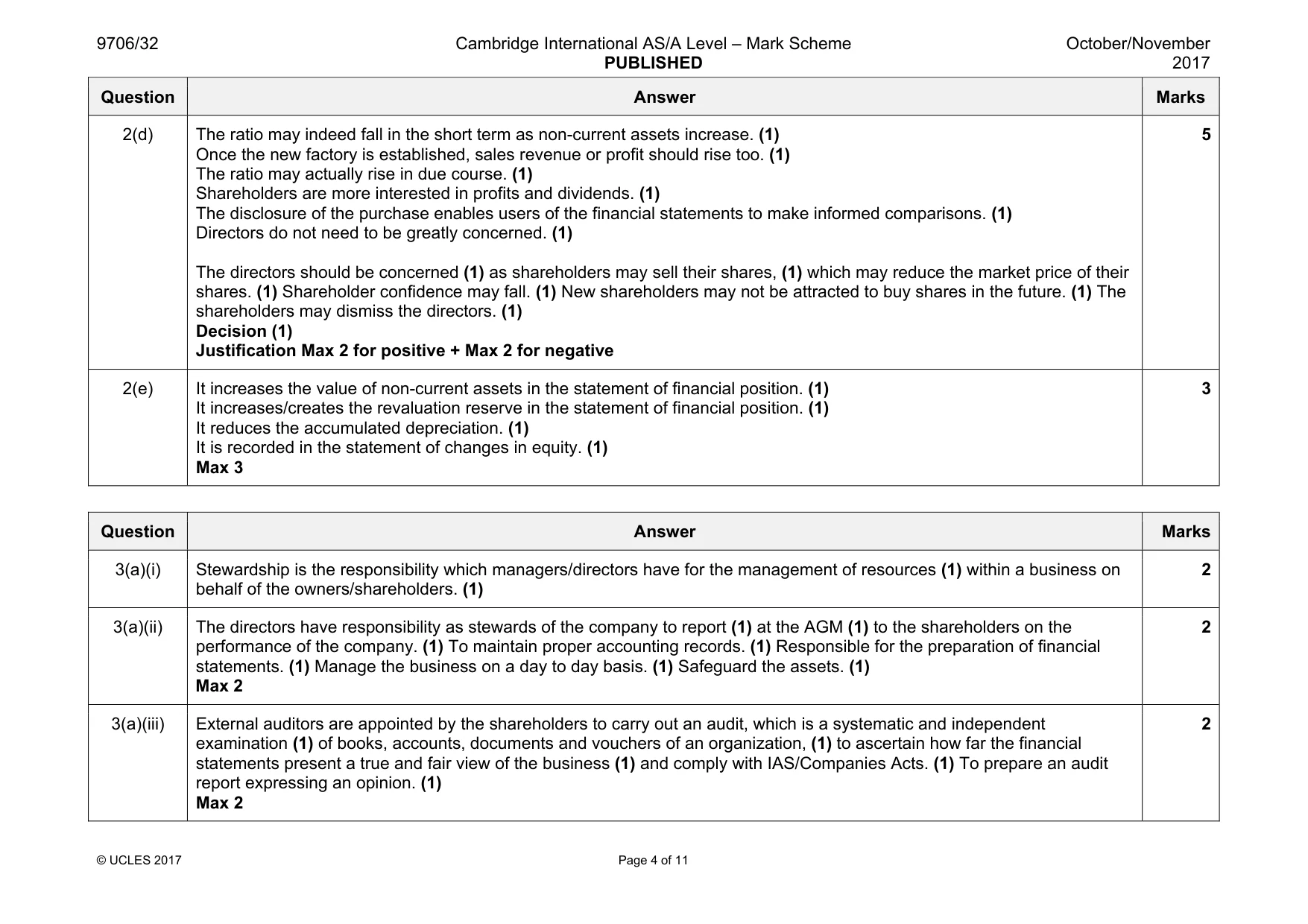
9706/32 Cambridge International AS/A Level – Mark Scheme PUBLISHED October/November 2017 © UCLES 2017 Page 4 of 11 Question Answer Marks 2(d) The ratio may indeed fall in the short term as non-current assets increase. (1) Once the new factory is established, sales revenue or profit should rise too. (1) The ratio may actually rise in due course. (1) Shareholders are more interested in profits and dividends. (1) The disclosure of the purchase enables users of the financial statements to make informed comparisons. (1) Directors do not need to be greatly concerned. (1) The directors should be concerned (1) as shareholders may sell their shares, (1) which may reduce the market price of their shares. (1) Shareholder confidence may fall. (1) New shareholders may not be attracted to buy shares in the future. (1) The shareholders may dismiss the directors. (1) Decision (1) Justification Max 2 for positive + Max 2 for negative 5 2(e) It increases the value of non-current assets in the statement of financial position. (1) It increases/creates the revaluation reserve in the statement of financial position. (1) It reduces the accumulated depreciation. (1) It is recorded in the statement of changes in equity. (1) Max 3 3 Question Answer Marks 3(a)(i) Stewardship is the responsibility which managers/directors have for the management of resources (1) within a business on behalf of the owners/shareholders. (1) 2 3(a)(ii) The directors have responsibility as stewards of the company to report (1) at the AGM (1) to the shareholders on the performance of the company. (1) To maintain proper accounting records. (1) Responsible for the preparation of financial statements. (1) Manage the business on a day to day basis. (1) Safeguard the assets. (1) Max 2 2 3(a)(iii) External auditors are appointed by the shareholders to carry out an audit, which is a systematic and independent examination (1) of books, accounts, documents and vouchers of an organization, (1) to ascertain how far the financial statements present a true and fair view of the business (1) and comply with IAS/Companies Acts. (1) To prepare an audit report expressing an opinion. (1) Max 2 2
Mark scheme, page 5
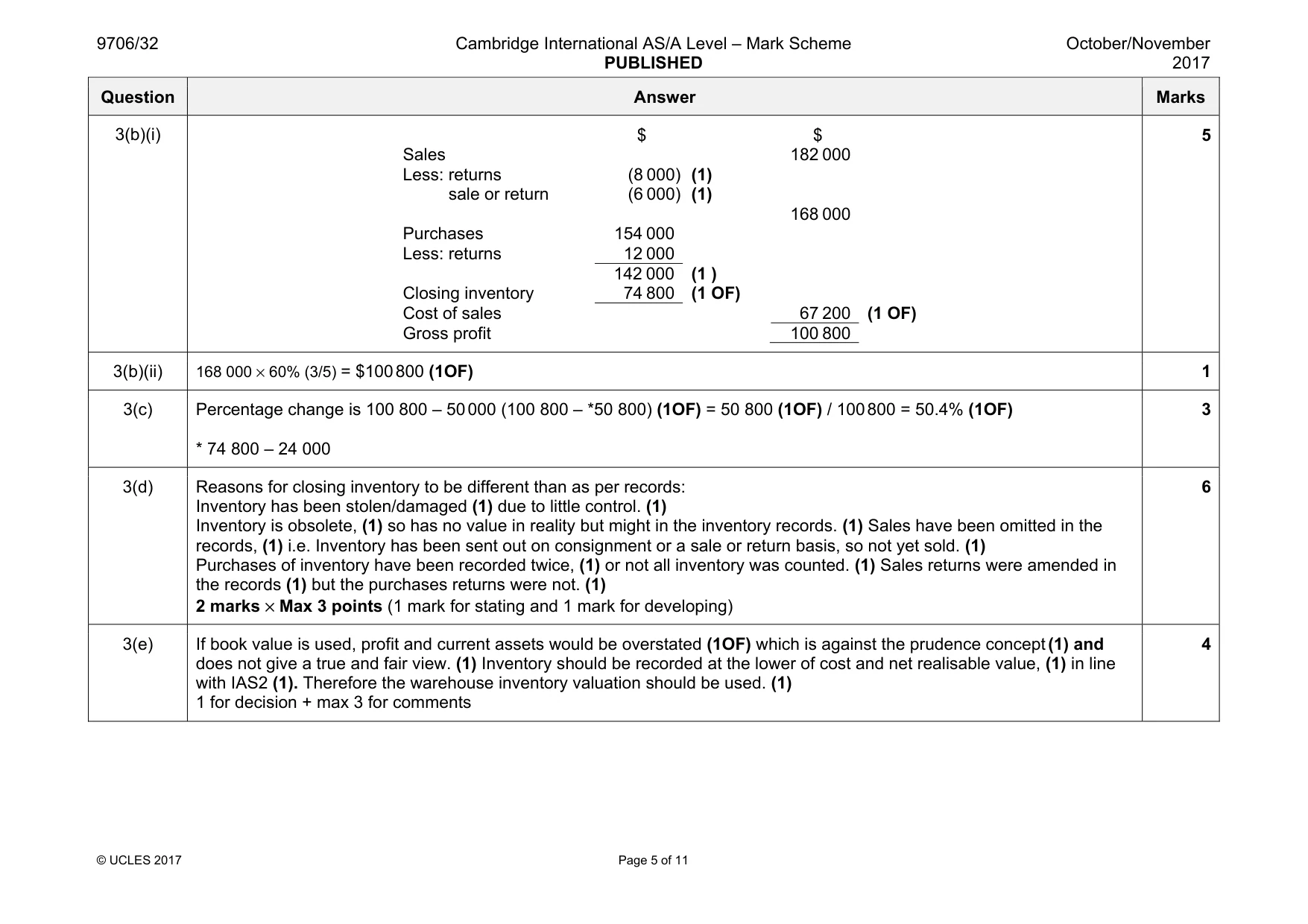
9706/32 Cambridge International AS/A Level – Mark Scheme PUBLISHED October/November 2017 © UCLES 2017 Page 5 of 11 Question Answer Marks 3(b)(i) $ $ Sales 182 000 Less: returns (8 000) (1) Less: sale or return (6 000) (1) 168 000 Purchases 154 000 Less: returns 12 000 142 000 (1 ) Closing inventory 74 800 (1 OF) Cost of sales 67 200 (1 OF) Gross profit 100 800 5 3(b)(ii) 168 000 × 60% (3/5) = $100 800 (1OF) 1 3(c) Percentage change is 100 800 – 50 000 (100 800 – *50 800) (1OF) = 50 800 (1OF) / 100 800 = 50.4% (1OF) * 74 800 – 24 000 3 3(d) Reasons for closing inventory to be different than as per records: Inventory has been stolen/damaged (1) due to little control. (1) Inventory is obsolete, (1) so has no value in reality but might in the inventory records. (1) Sales have been omitted in the records, (1) i.e. Inventory has been sent out on consignment or a sale or return basis, so not yet sold. (1) Purchases of inventory have been recorded twice, (1) or not all inventory was counted. (1) Sales returns were amended in the records (1) but the purchases returns were not. (1) 2 marks × Max 3 points (1 mark for stating and 1 mark for developing) 6 3(e) If book value is used, profit and current assets would be overstated (1OF) which is against the prudence concept (1) and does not give a true and fair view. (1) Inventory should be recorded at the lower of cost and net realisable value, (1) in line with IAS2 (1). Therefore the warehouse inventory valuation should be used. (1) 1 for decision + max 3 for comments 4
Mark scheme, page 6
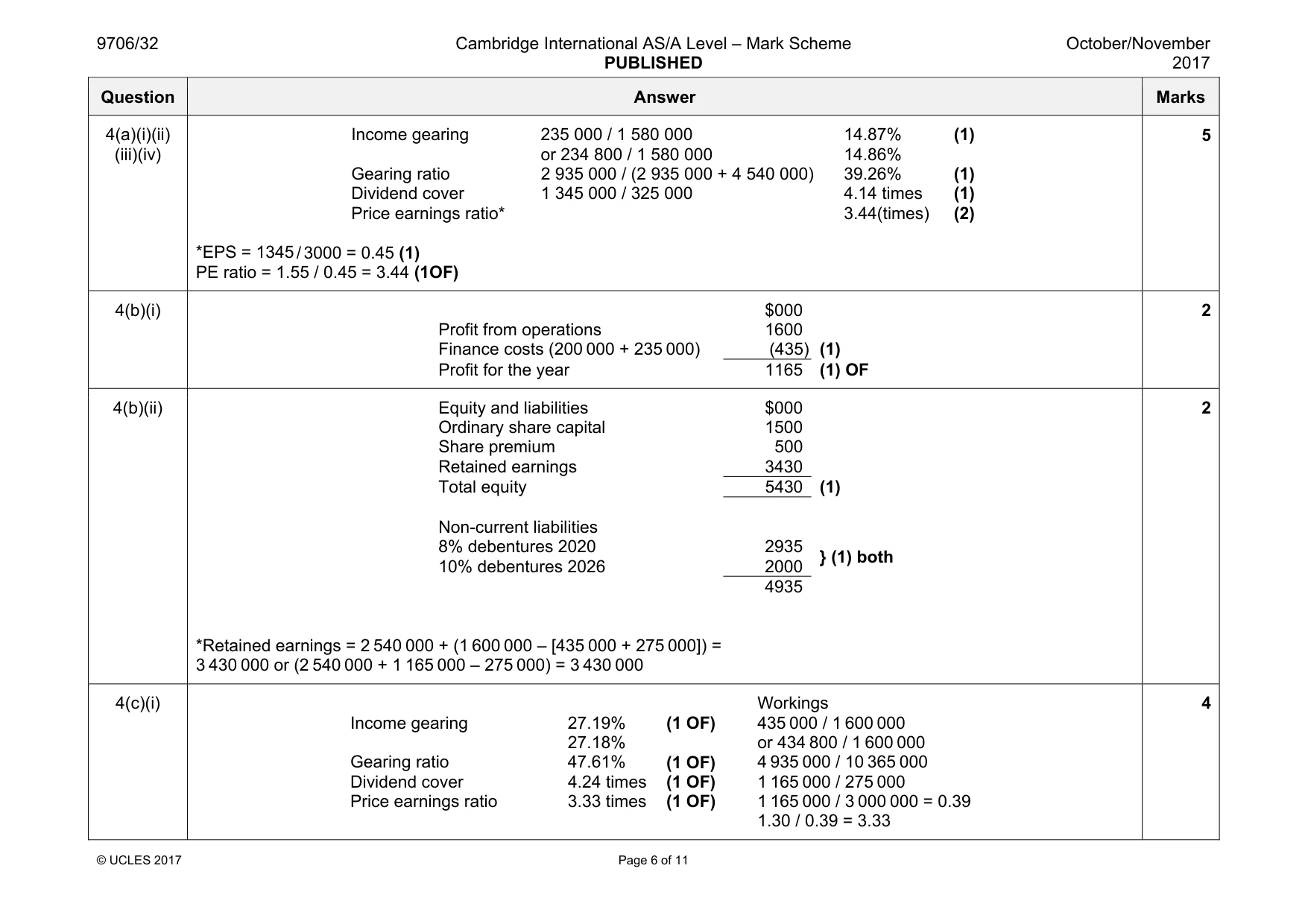
9706/32 Cambridge International AS/A Level – Mark Scheme PUBLISHED October/November 2017 © UCLES 2017 Page 6 of 11 Question Answer Marks 4(a)(i)(ii) (iii)(iv) Income gearing 235 000 / 1 580 000 or 234 800 / 1 580 000 14.87% 14.86% (1) Gearing ratio 2 935 000 / (2 935 000 + 4 540 000) 39.26% (1) Dividend cover 1 345 000 / 325 000 4.14 times (1) Price earnings ratio* 3.44(times) (2) *EPS = 1345 / 3000 = 0.45 (1) PE ratio = 1.55 / 0.45 = 3.44 (1OF) 5 4(b)(i) $000 Profit from operations 1600 Finance costs (200 000 + 235 000) (435) (1) Profit for the year 1165 (1) OF 2 4(b)(ii) Equity and liabilities $000 Ordinary share capital 1500 Share premium 500 Retained earnings 3430 Total equity 5430 (1) Non-current liabilities 8% debentures 2020 2935 } (1) both 10% debentures 2026 2000 4935 *Retained earnings = 2 540 000 + (1 600 000 – [435 000 + 275 000]) = 3 430 000 or (2 540 000 + 1 165 000 – 275 000) = 3 430 000 2 4(c)(i) Workings Income gearing 27.19% 27.18% (1 OF) 435 000 / 1 600 000 or 434 800 / 1 600 000 Gearing ratio 47.61% (1 OF) 4 935 000 / 10 365 000 Dividend cover 4.24 times (1 OF) 1 165 000 / 275 000 Price earnings ratio 3.33 times (1 OF) 1 165 000 / 3 000 000 = 0.39 1.30 / 0.39 = 3.33 4
Mark scheme, page 7
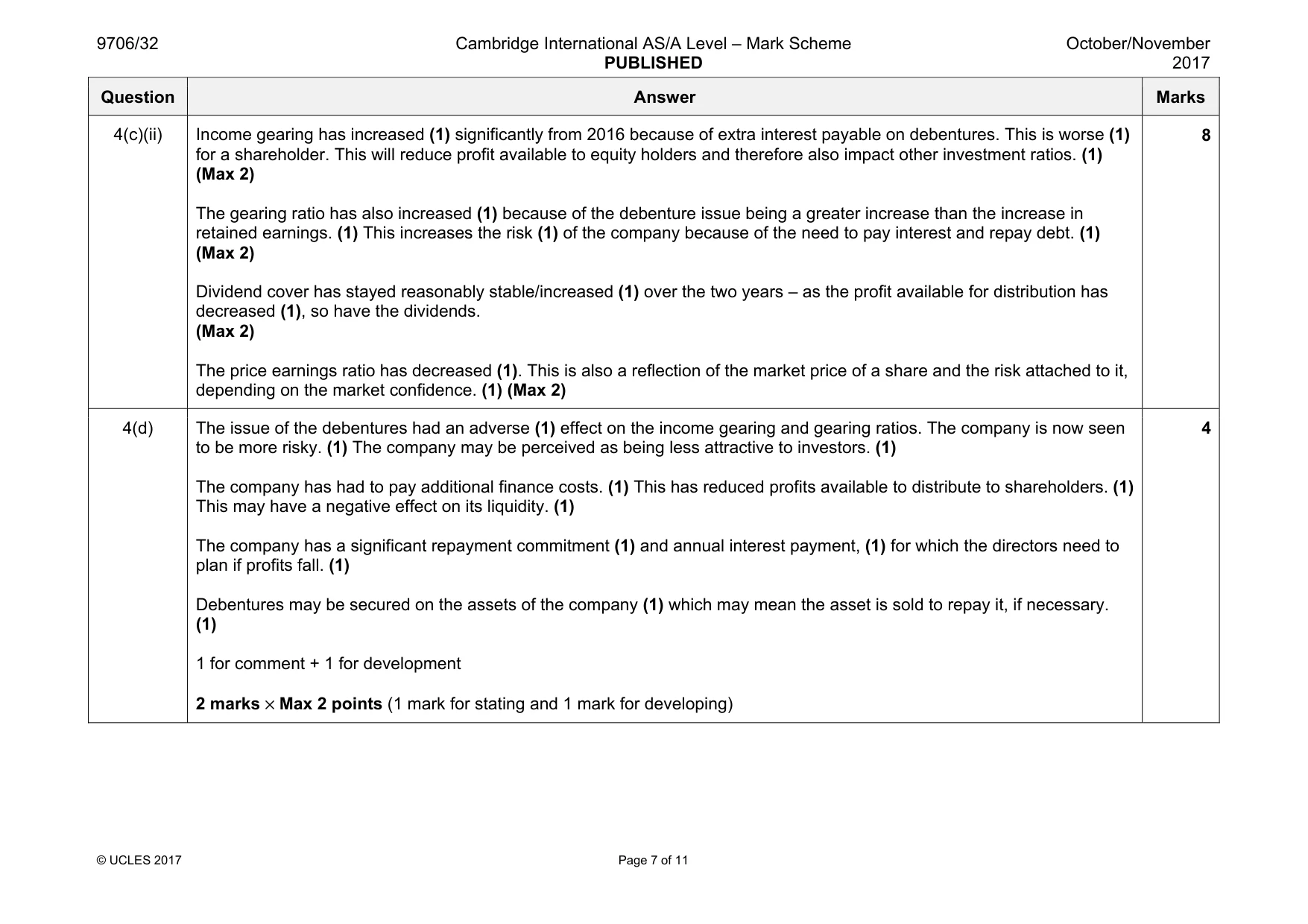
9706/32 Cambridge International AS/A Level – Mark Scheme PUBLISHED October/November 2017 © UCLES 2017 Page 7 of 11 Question Answer Marks 4(c)(ii) Income gearing has increased (1) significantly from 2016 because of extra interest payable on debentures. This is worse (1) for a shareholder. This will reduce profit available to equity holders and therefore also impact other investment ratios. (1) (Max 2) The gearing ratio has also increased (1) because of the debenture issue being a greater increase than the increase in retained earnings. (1) This increases the risk (1) of the company because of the need to pay interest and repay debt. (1) (Max 2) Dividend cover has stayed reasonably stable/increased (1) over the two years – as the profit available for distribution has decreased (1), so have the dividends. (Max 2) The price earnings ratio has decreased (1). This is also a reflection of the market price of a share and the risk attached to it, depending on the market confidence. (1) (Max 2) 8 4(d) The issue of the debentures had an adverse (1) effect on the income gearing and gearing ratios. The company is now seen to be more risky. (1) The company may be perceived as being less attractive to investors. (1) The company has had to pay additional finance costs. (1) This has reduced profits available to distribute to shareholders. (1) This may have a negative effect on its liquidity. (1) The company has a significant repayment commitment (1) and annual interest payment, (1) for which the directors need to plan if profits fall. (1) Debentures may be secured on the assets of the company (1) which may mean the asset is sold to repay it, if necessary. (1) 1 for comment + 1 for development 2 marks × Max 2 points (1 mark for stating and 1 mark for developing) 4
Mark scheme, page 8
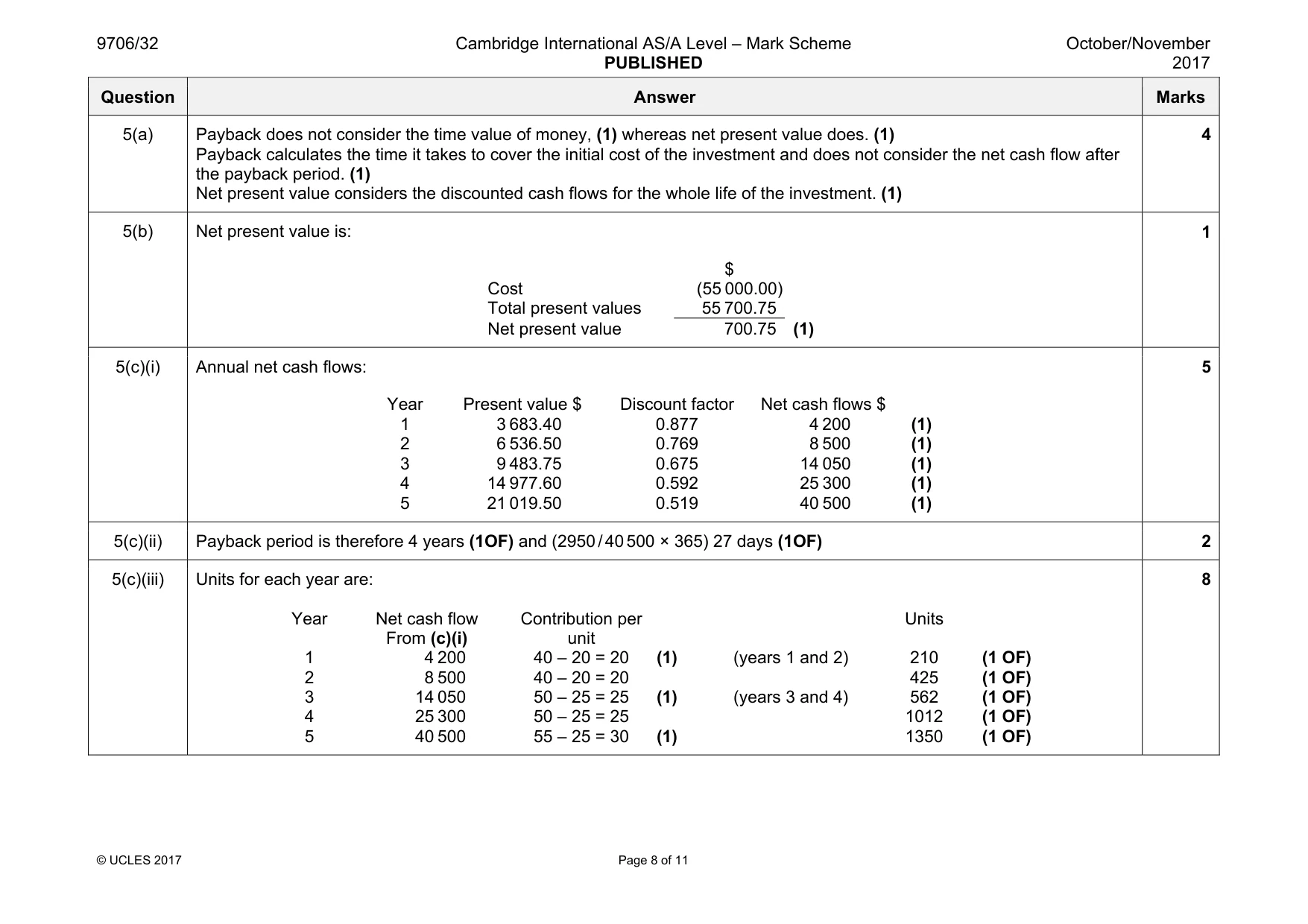
9706/32 Cambridge International AS/A Level – Mark Scheme PUBLISHED October/November 2017 © UCLES 2017 Page 8 of 11 Question Answer Marks 5(a) Payback does not consider the time value of money, (1) whereas net present value does. (1) Payback calculates the time it takes to cover the initial cost of the investment and does not consider the net cash flow after the payback period. (1) Net present value considers the discounted cash flows for the whole life of the investment. (1) 4 5(b) Net present value is: $ Cost (55 000.00) Total present values 55 700.75 Net present value 700.75 (1) 1 5(c)(i) Annual net cash flows: Year Present value $ Discount factor Net cash flows $ 1 3 683.40 0.877 4 200 (1) 2 6 536.50 0.769 8 500 (1) 3 9 483.75 0.675 14 050 (1) 4 14 977.60 0.592 25 300 (1) 5 21 019.50 0.519 40 500 (1) 5 5(c)(ii) Payback period is therefore 4 years (1OF) and (2950 / 40 500 × 365) 27 days (1OF) 2 5(c)(iii) Units for each year are: Year Net cash flow From (c)(i) Contribution per unit Units 1 4 200 40 – 20 = 20 (1) (years 1 and 2) 210 (1 OF) 2 8 500 40 – 20 = 20 425 (1 OF) 3 14 050 50 – 25 = 25 (1) (years 3 and 4) 562 (1 OF) 4 25 300 50 – 25 = 25 1012 (1 OF) 5 40 500 55 – 25 = 30 (1) 1350 (1 OF) 8
Mark scheme, page 9
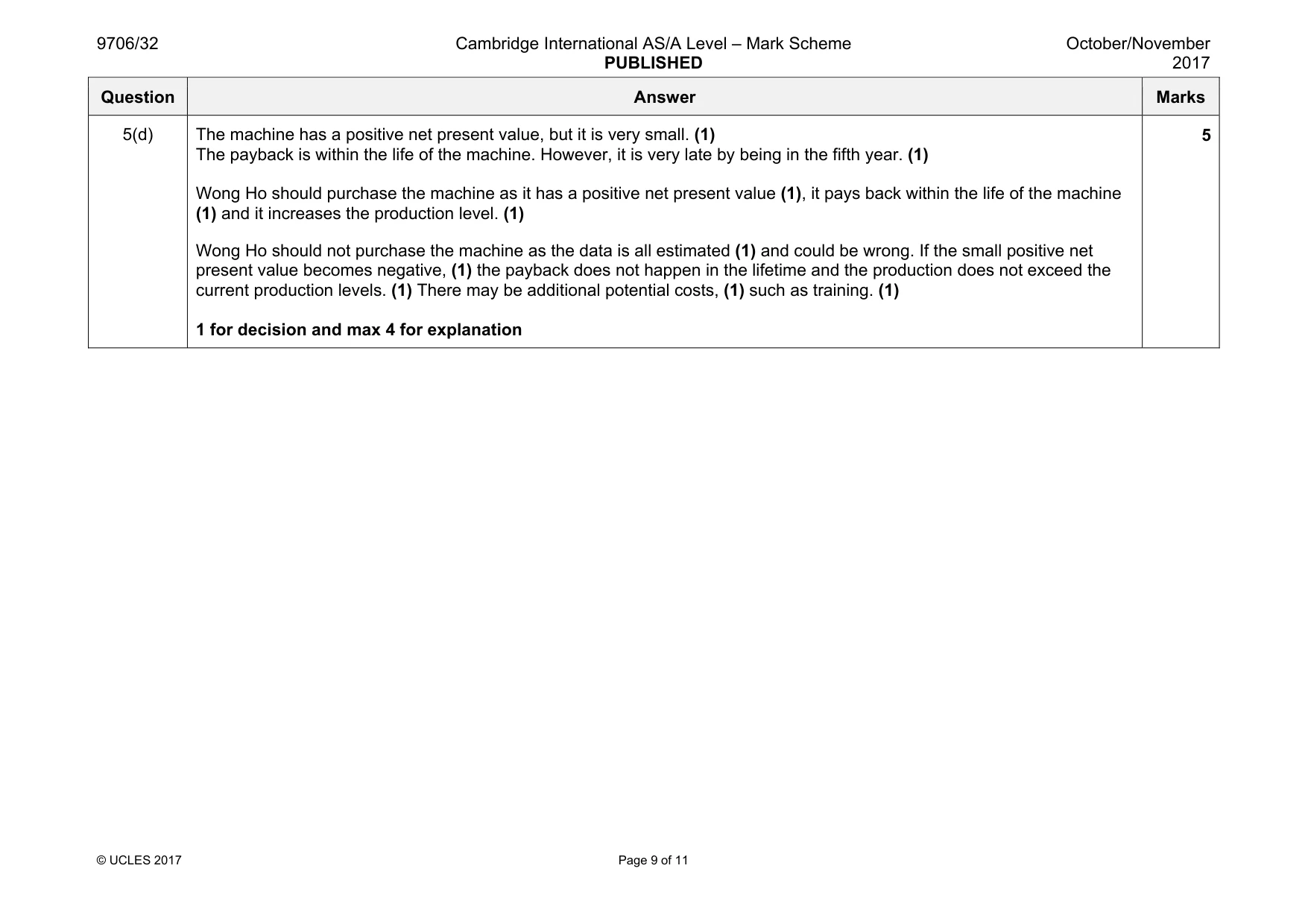
9706/32 Cambridge International AS/A Level – Mark Scheme PUBLISHED October/November 2017 © UCLES 2017 Page 9 of 11 Question Answer Marks 5(d) The machine has a positive net present value, but it is very small. (1) The payback is within the life of the machine. However, it is very late by being in the fifth year. (1) Wong Ho should purchase the machine as it has a positive net present value (1), it pays back within the life of the machine (1) and it increases the production level. (1) Wong Ho should not purchase the machine as the data is all estimated (1) and could be wrong. If the small positive net present value becomes negative, (1) the payback does not happen in the lifetime and the production does not exceed the current production levels. (1) There may be additional potential costs, (1) such as training. (1) 1 for decision and max 4 for explanation 5
Mark scheme, page 10
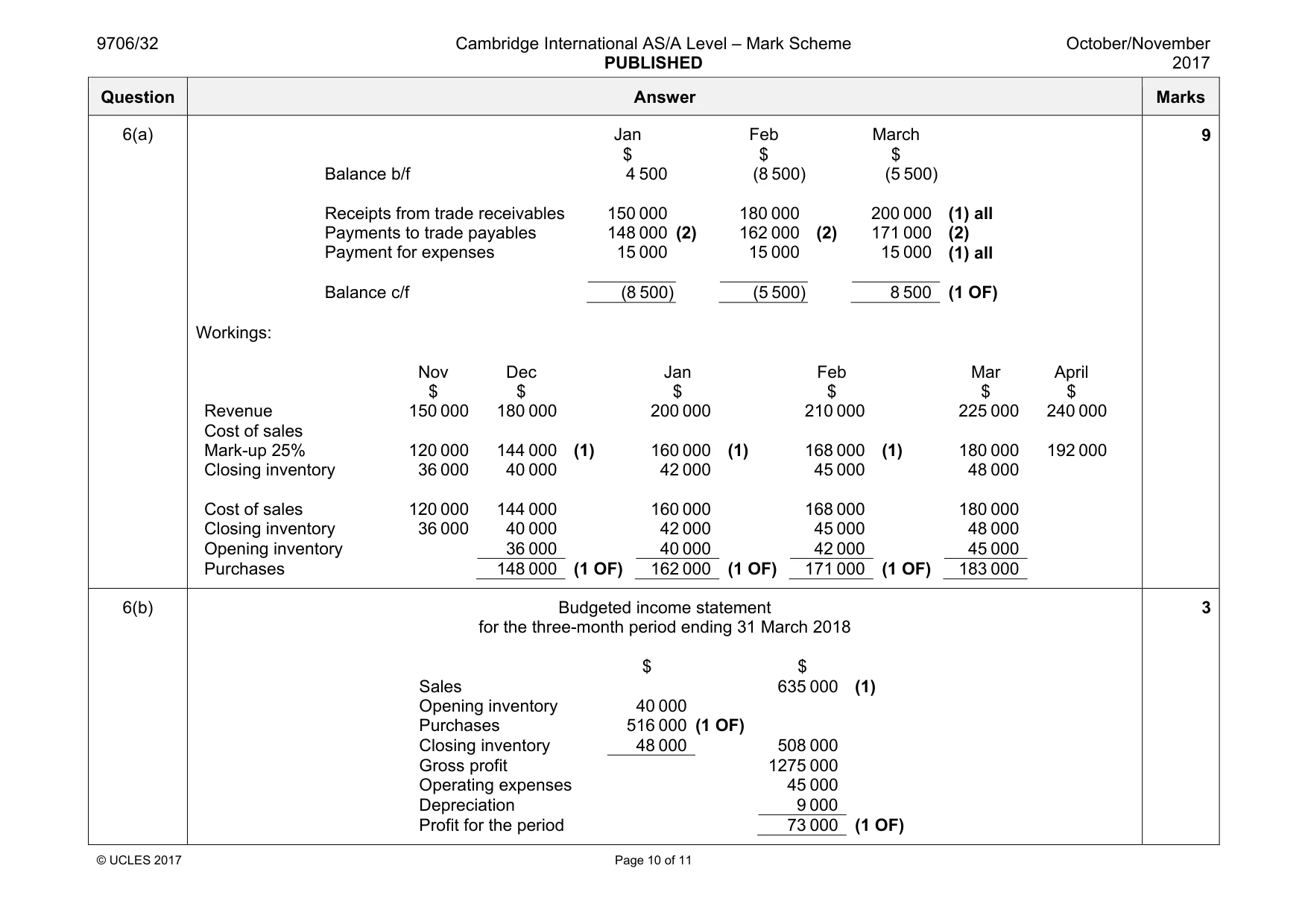
9706/32 Cambridge International AS/A Level – Mark Scheme PUBLISHED October/November 2017 © UCLES 2017 Page 10 of 11 Question Answer Marks 6(a) Jan $ Feb $ March $ Balance b/f 4 500 (8 500) (5 500) Receipts from trade receivables 150 000 180 000 200 000 (1) all Payments to trade payables 148 000 (2) 162 000 (2) 171 000 (2) Payment for expenses 15 000 15 000 15 000 (1) all Balance c/f (8 500) (5 500) 8 500 (1 OF) Workings: Nov $ Dec $ Jan $ Feb $ Mar $ April $ Revenue 150 000 180 000 200 000 210 000 225 000 240 000 Cost of sales Mark-up 25% 120 000 144 000 (1) 160 000 (1) 168 000 (1) 180 000 192 000 Closing inventory 36 000 40 000 42 000 45 000 48 000 Cost of sales 120 000 144 000 160 000 168 000 180 000 Closing inventory 36 000 40 000 42 000 45 000 48 000 Opening inventory 36 000 40 000 42 000 45 000 Purchases 148 000 (1 OF) 162 000 (1 OF) 171 000 (1 OF) 183 000 9 6(b) Budgeted income statement for the three-month period ending 31 March 2018 $ $ Sales 635 000 (1) Opening inventory 40 000 Purchases 516 000 (1 OF) Closing inventory 48 000 508 000 Gross profit 1275 000 Operating expenses 45 000 Depreciation 9 000 Profit for the period 73 000 (1 OF) 3
Mark scheme, page 11
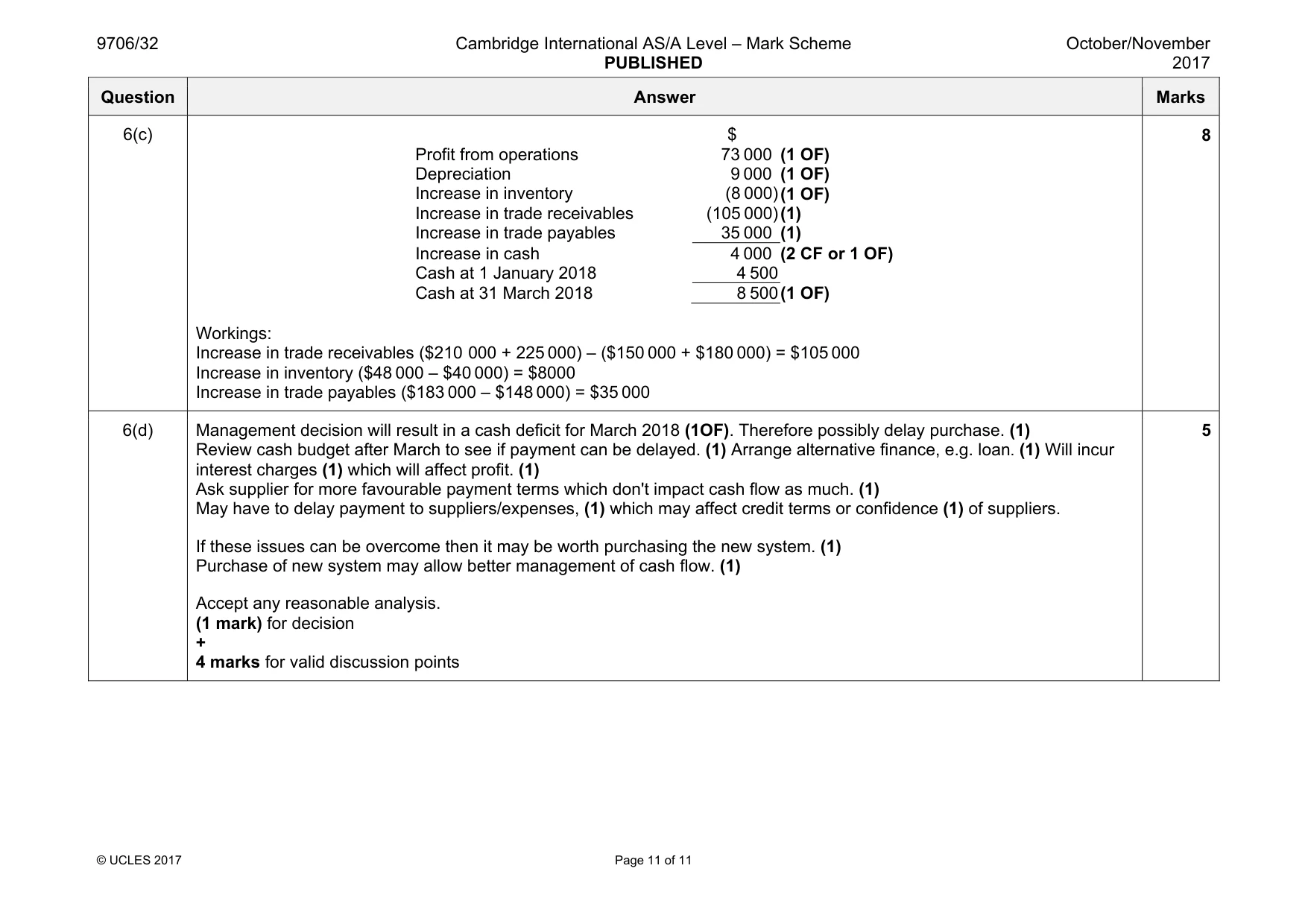
9706/32 Cambridge International AS/A Level – Mark Scheme PUBLISHED October/November 2017 © UCLES 2017 Page 11 of 11 Question Answer Marks 6(c) $ Profit from operations 73 000 (1 OF) Depreciation 9 000 (1 OF) Increase in inventory (8 000)(1 OF) Increase in trade receivables (105 000)(1) Increase in trade payables 35 000 (1) Increase in cash 4 000 (2 CF or 1 OF) Cash at 1 January 2018 4 500 Cash at 31 March 2018 8 500(1 OF) Workings: Increase in trade receivables ($210 000 + 225 000) – ($150 000 + $180 000) = $105 000 Increase in inventory ($48 000 – $40 000) = $8000 Increase in trade payables ($183 000 – $148 000) = $35 000 8 6(d) Management decision will result in a cash deficit for March 2018 (1OF). Therefore possibly delay purchase. (1) Review cash budget after March to see if payment can be delayed. (1) Arrange alternative finance, e.g. loan. (1) Will incur interest charges (1) which will affect profit. (1) Ask supplier for more favourable payment terms which don't impact cash flow as much. (1) May have to delay payment to suppliers/expenses, (1) which may affect credit terms or confidence (1) of suppliers. If these issues can be overcome then it may be worth purchasing the new system. (1) Purchase of new system may allow better management of cash flow. (1) Accept any reasonable analysis. (1 mark) for decision + 4 marks for valid discussion points 5
What you needed in this session
Cambridge’s own grade thresholds for 2017 Oct/Nov, Paper 3 · Variant 2. A higher threshold means an easier paper — the bar moves with how the cohort did.