Cambridge IGCSE Twenty-First Century Science 0608 — 2010 Oct/Nov Paper 2 · Variant 1
0608/21/O/N/10 · 40 marks · ≈45 min
The question paper and its mark scheme, free to read here and free to download. This is Cambridge’s own paper, exactly as it was sat.
Question paper16 pages

Mark scheme2 pages
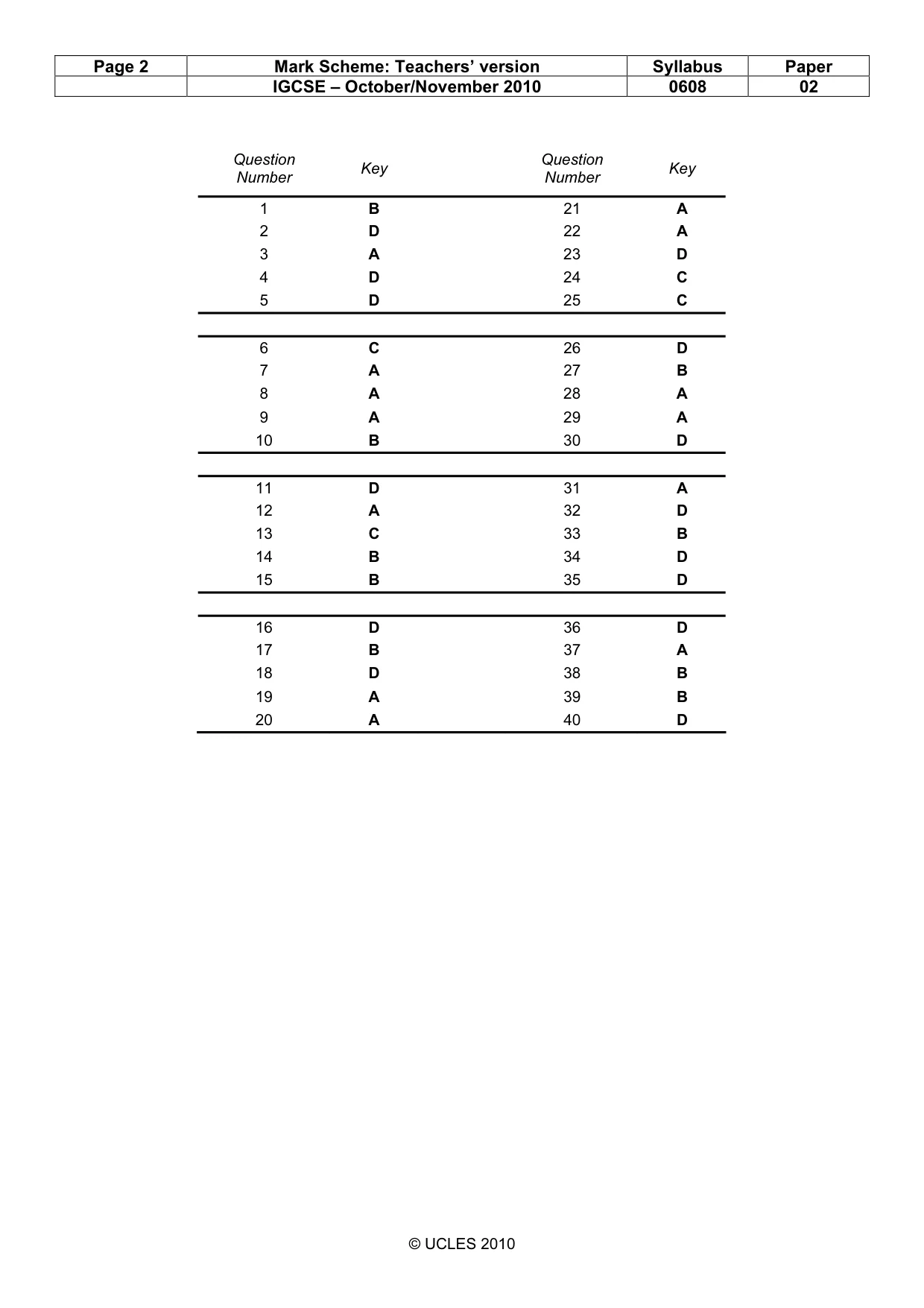
Answers below. Sit the paper first if you are practising.
Paper as text
Question paper, page 1
This document consists of 14 printed pages and 2 blank pages. IB10 11_0608_02/2RP © UCLES 2010 [Turn over *8778376098* UNIVERSITY OF CAMBRIDGE INTERNATIONAL EXAMINATIONS International General Certificate of Secondary Education TWENTY FIRST CENTURY SCIENCE (EXTENDED) 0608/02 Paper 2 Multiple Choice October/November 2010 1 hour Additional Materials: Multiple Choice Answer Sheet Soft clean eraser Soft pencil (type B or HB is recommended) READ THESE INSTRUCTIONS FIRST Write in soft pencil. Do not use staples, paper clips, highlighters, glue or correction fluid. Write your name, Centre number and candidate number on the Answer Sheet in the spaces provided unless this has been done for you. There are forty questions on this paper. Answer all questions. For each question there are four possible answers A, B, C and D. Choose the one you consider correct and record your choice in soft pencil on the separate Answer Sheet. Read the instructions on the Answer Sheet very carefully. Each correct answer will score one mark. A mark will not be deducted for a wrong answer. Any rough working should be done in this booklet. You may use a calculator. www.XtremePapers.com
Question paper, page 2
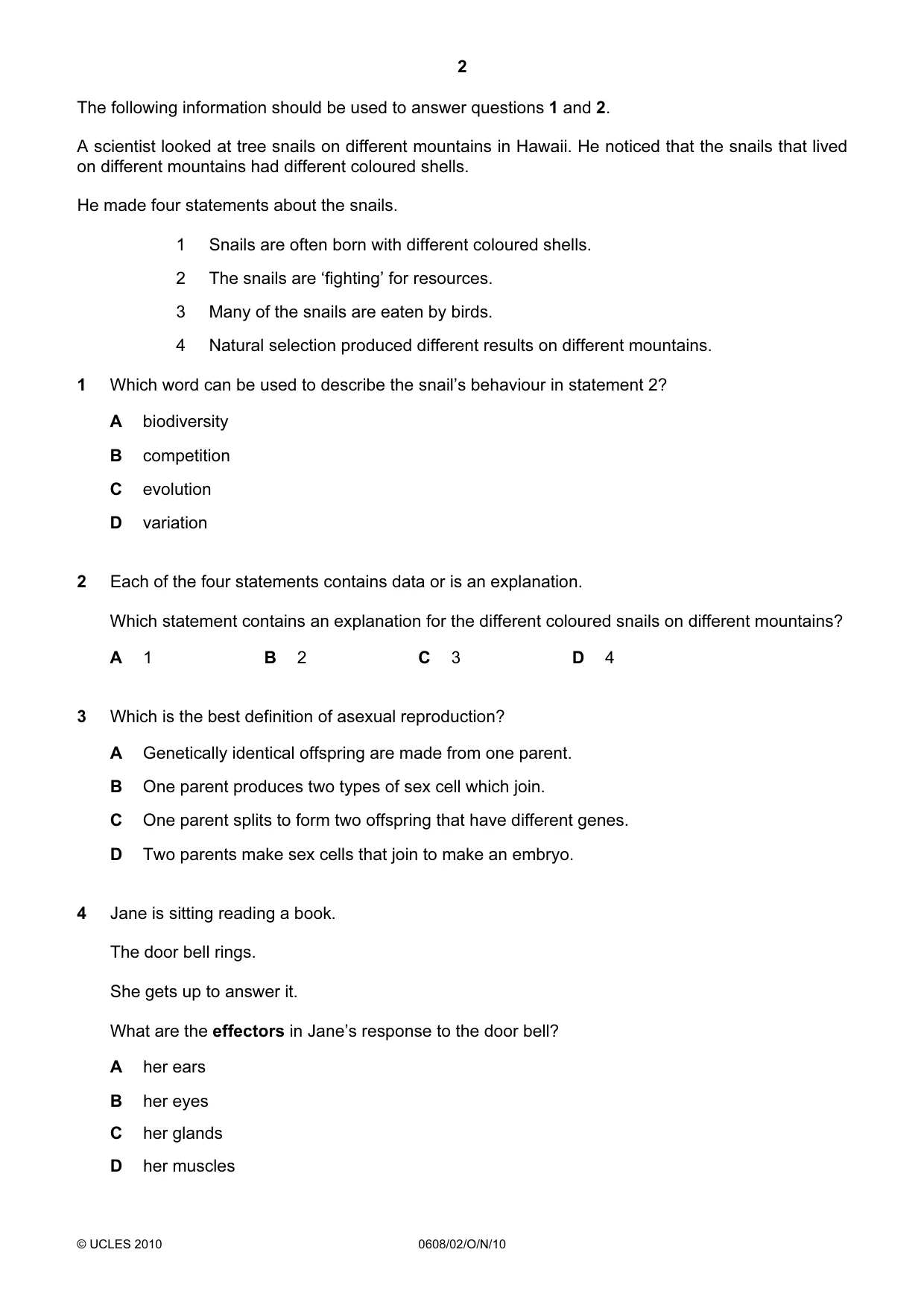
2 © UCLES 2010 0608/02/O/N/10 The following information should be used to answer questions 1 and 2. A scientist looked at tree snails on different mountains in Hawaii. He noticed that the snails that lived on different mountains had different coloured shells. He made four statements about the snails. 1 Snails are often born with different coloured shells. 2 The snails are ‘fighting’ for resources. 3 Many of the snails are eaten by birds. 4 Natural selection produced different results on different mountains. 1 Which word can be used to describe the snail’s behaviour in statement 2? A biodiversity B competition C evolution D variation 2 Each of the four statements contains data or is an explanation. Which statement contains an explanation for the different coloured snails on different mountains? A 1 B 2 C 3 D 4 3 Which is the best definition of asexual reproduction? A Genetically identical offspring are made from one parent. B One parent produces two types of sex cell which join. C One parent splits to form two offspring that have different genes. D Two parents make sex cells that join to make an embryo. 4 Jane is sitting reading a book. The door bell rings. She gets up to answer it. What are the effectors in Jane’s response to the door bell? A her ears B her eyes C her glands D her muscles
Question paper, page 3
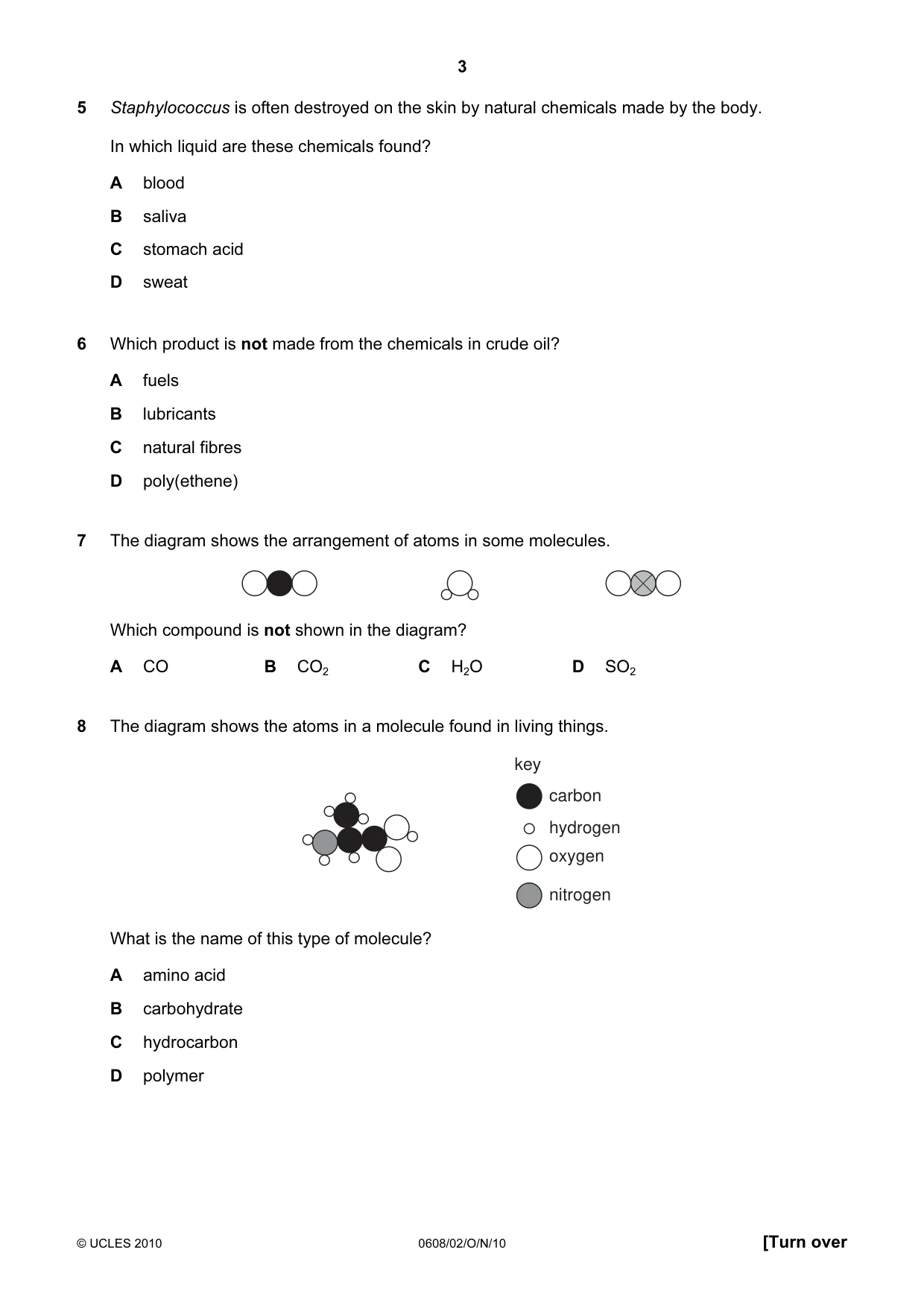
3 © UCLES 2010 0608/02/O/N/10 [Turn over 5 Staphylococcus is often destroyed on the skin by natural chemicals made by the body. In which liquid are these chemicals found? A blood B saliva C stomach acid D sweat 6 Which product is not made from the chemicals in crude oil? A fuels B lubricants C natural fibres D poly(ethene) 7 The diagram shows the arrangement of atoms in some molecules. Which compound is not shown in the diagram? A CO B CO2 C H2O D SO2 8 The diagram shows the atoms in a molecule found in living things. key carbon hydrogen oxygen nitrogen What is the name of this type of molecule? A amino acid B carbohydrate C hydrocarbon D polymer
Question paper, page 4
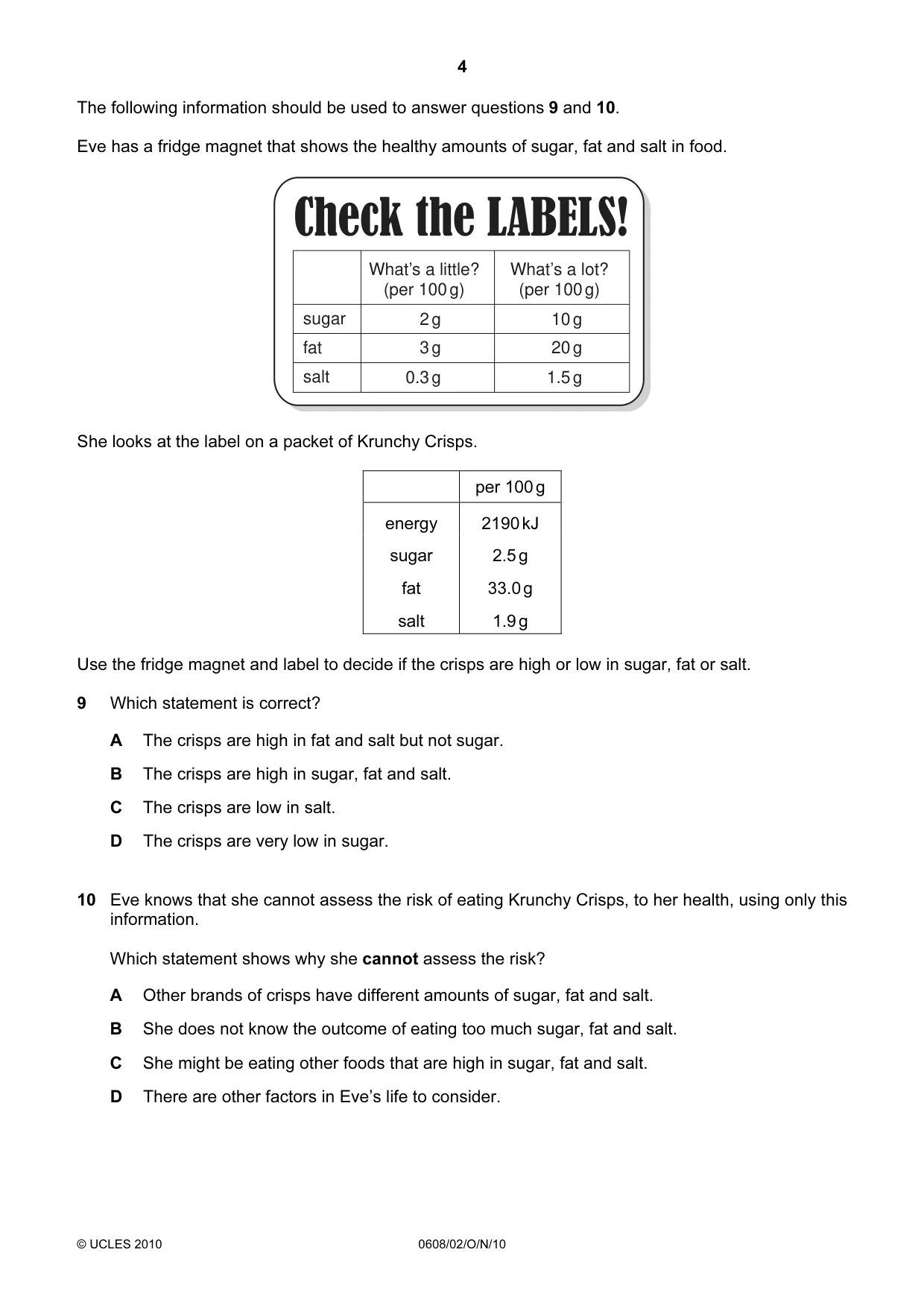
4 © UCLES 2010 0608/02/O/N/10 The following information should be used to answer questions 9 and 10. Eve has a fridge magnet that shows the healthy amounts of sugar, fat and salt in food. What’s a little? (per 100 g) 2 g 3 g 0.3 g 10 g 20 g 1.5 g What’s a lot? (per 100 g) sugar fat salt She looks at the label on a packet of Krunchy Crisps. per 100 g energy 2190 kJ sugar 2.5 g fat 33.0 g salt 1.9 g Use the fridge magnet and label to decide if the crisps are high or low in sugar, fat or salt. 9 Which statement is correct? A The crisps are high in fat and salt but not sugar. B The crisps are high in sugar, fat and salt. C The crisps are low in salt. D The crisps are very low in sugar. 10 Eve knows that she cannot assess the risk of eating Krunchy Crisps, to her health, using only this information. Which statement shows why she cannot assess the risk? A Other brands of crisps have different amounts of sugar, fat and salt. B She does not know the outcome of eating too much sugar, fat and salt. C She might be eating other foods that are high in sugar, fat and salt. D There are other factors in Eve’s life to consider.
Question paper, page 5
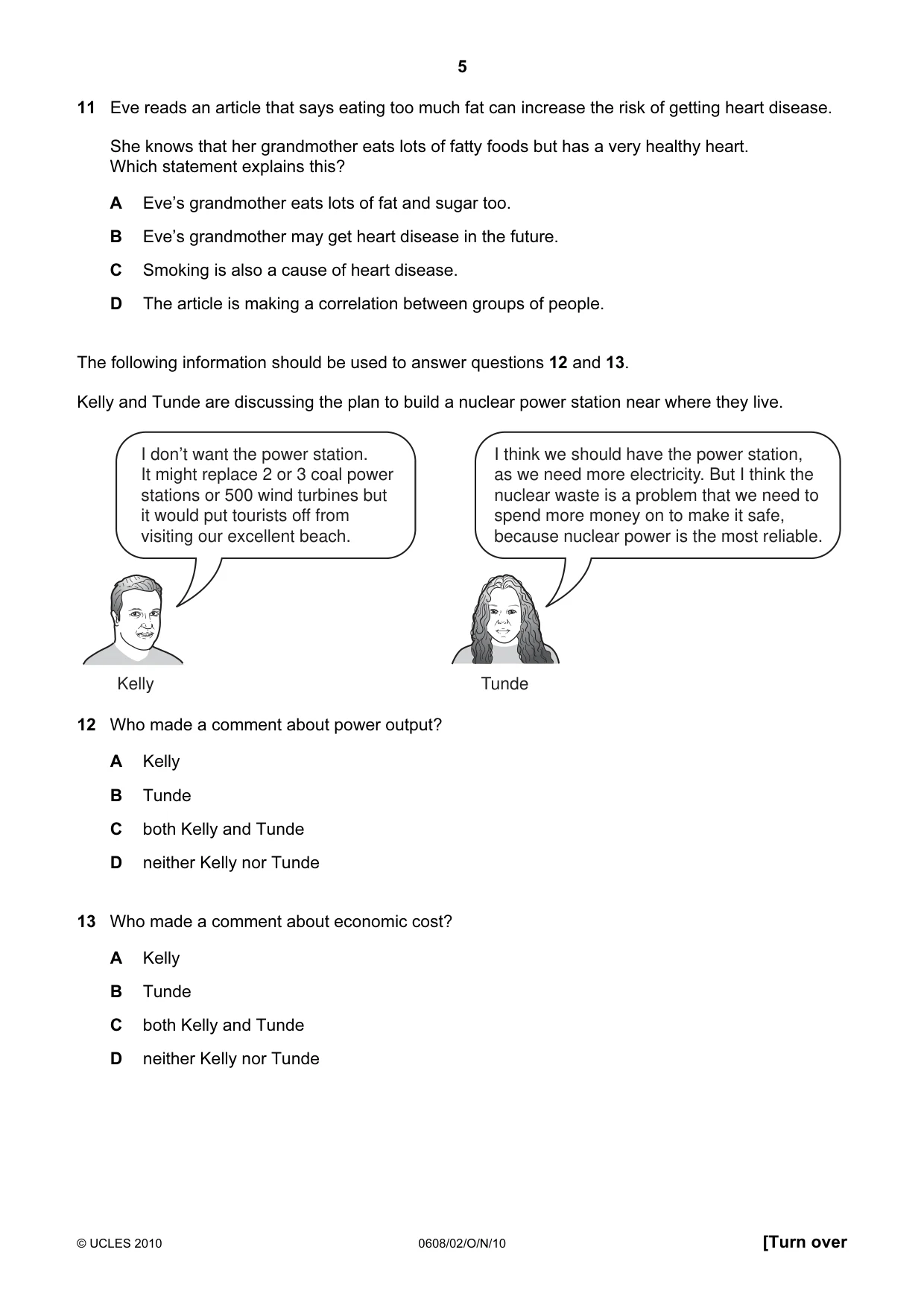
5 © UCLES 2010 0608/02/O/N/10 [Turn over 11 Eve reads an article that says eating too much fat can increase the risk of getting heart disease. She knows that her grandmother eats lots of fatty foods but has a very healthy heart. Which statement explains this? A Eve’s grandmother eats lots of fat and sugar too. B Eve’s grandmother may get heart disease in the future. C Smoking is also a cause of heart disease. D The article is making a correlation between groups of people. The following information should be used to answer questions 12 and 13. Kelly and Tunde are discussing the plan to build a nuclear power station near where they live. Kelly Tunde I don’t want the power station. It might replace 2 or 3 coal power stations or 500 wind turbines but it would put tourists off from visiting our excellent beach. I think we should have the power station, as we need more electricity. But I think the nuclear waste is a problem that we need to spend more money on to make it safe, because nuclear power is the most reliable. 12 Who made a comment about power output? A Kelly B Tunde C both Kelly and Tunde D neither Kelly nor Tunde 13 Who made a comment about economic cost? A Kelly B Tunde C both Kelly and Tunde D neither Kelly nor Tunde
Question paper, page 6
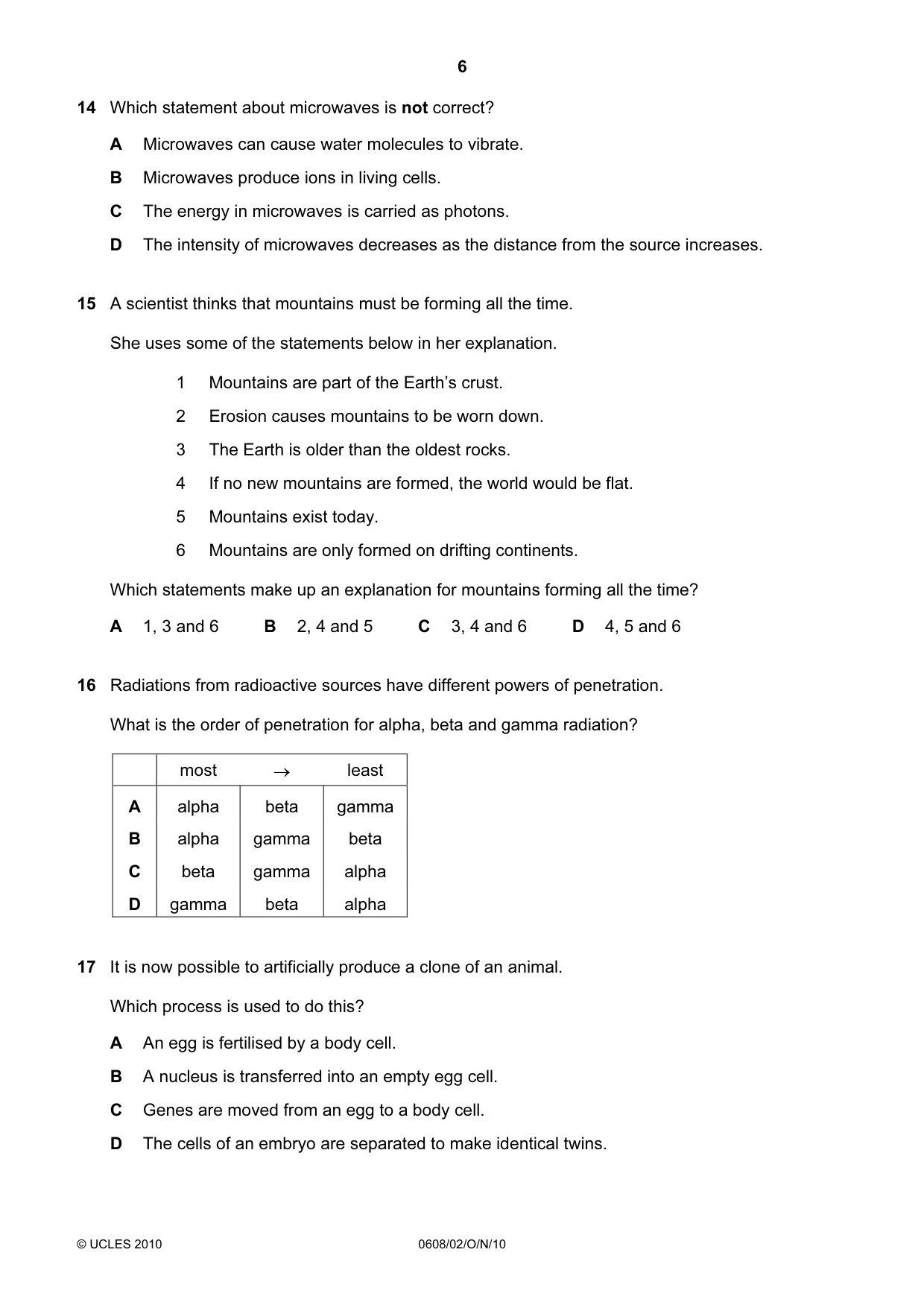
6 © UCLES 2010 0608/02/O/N/10 14 Which statement about microwaves is not correct? A Microwaves can cause water molecules to vibrate. B Microwaves produce ions in living cells. C The energy in microwaves is carried as photons. D The intensity of microwaves decreases as the distance from the source increases. 15 A scientist thinks that mountains must be forming all the time. She uses some of the statements below in her explanation. 1 Mountains are part of the Earth’s crust. 2 Erosion causes mountains to be worn down. 3 The Earth is older than the oldest rocks. 4 If no new mountains are formed, the world would be flat. 5 Mountains exist today. 6 Mountains are only formed on drifting continents. Which statements make up an explanation for mountains forming all the time? A 1, 3 and 6 B 2, 4 and 5 C 3, 4 and 6 D 4, 5 and 6 16 Radiations from radioactive sources have different powers of penetration. What is the order of penetration for alpha, beta and gamma radiation? most → least A alpha beta gamma B alpha gamma beta C beta gamma alpha D gamma beta alpha 17 It is now possible to artificially produce a clone of an animal. Which process is used to do this? A An egg is fertilised by a body cell. B A nucleus is transferred into an empty egg cell. C Genes are moved from an egg to a body cell. D The cells of an embryo are separated to make identical twins.
Question paper, page 7
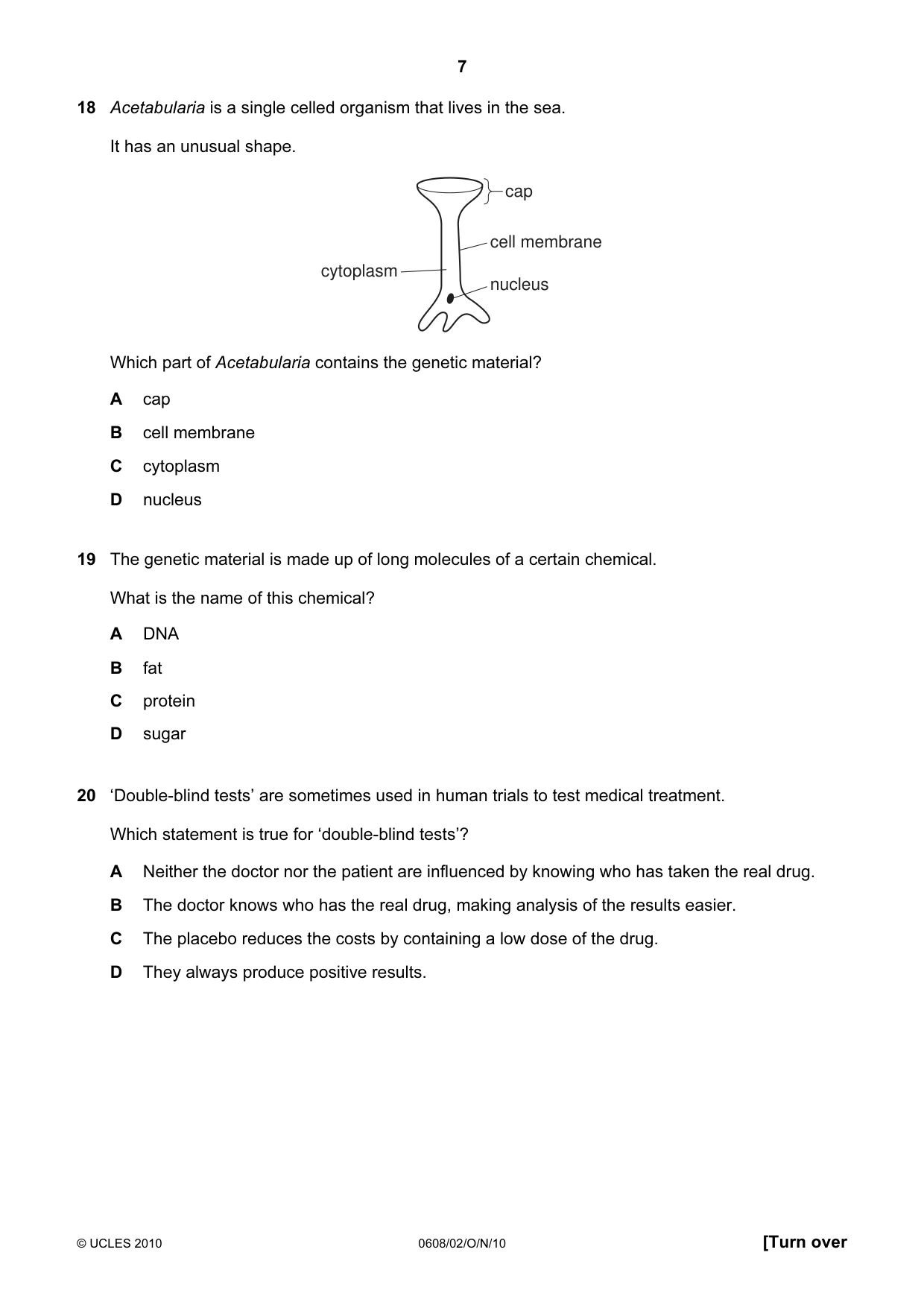
7 © UCLES 2010 0608/02/O/N/10 [Turn over 18 Acetabularia is a single celled organism that lives in the sea. It has an unusual shape. cap cell membrane nucleus cytoplasm Which part of Acetabularia contains the genetic material? A cap B cell membrane C cytoplasm D nucleus 19 The genetic material is made up of long molecules of a certain chemical. What is the name of this chemical? A DNA B fat C protein D sugar 20 ‘Double-blind tests’ are sometimes used in human trials to test medical treatment. Which statement is true for ‘double-blind tests’? A Neither the doctor nor the patient are influenced by knowing who has taken the real drug. B The doctor knows who has the real drug, making analysis of the results easier. C The placebo reduces the costs by containing a low dose of the drug. D They always produce positive results.
Question paper, page 8
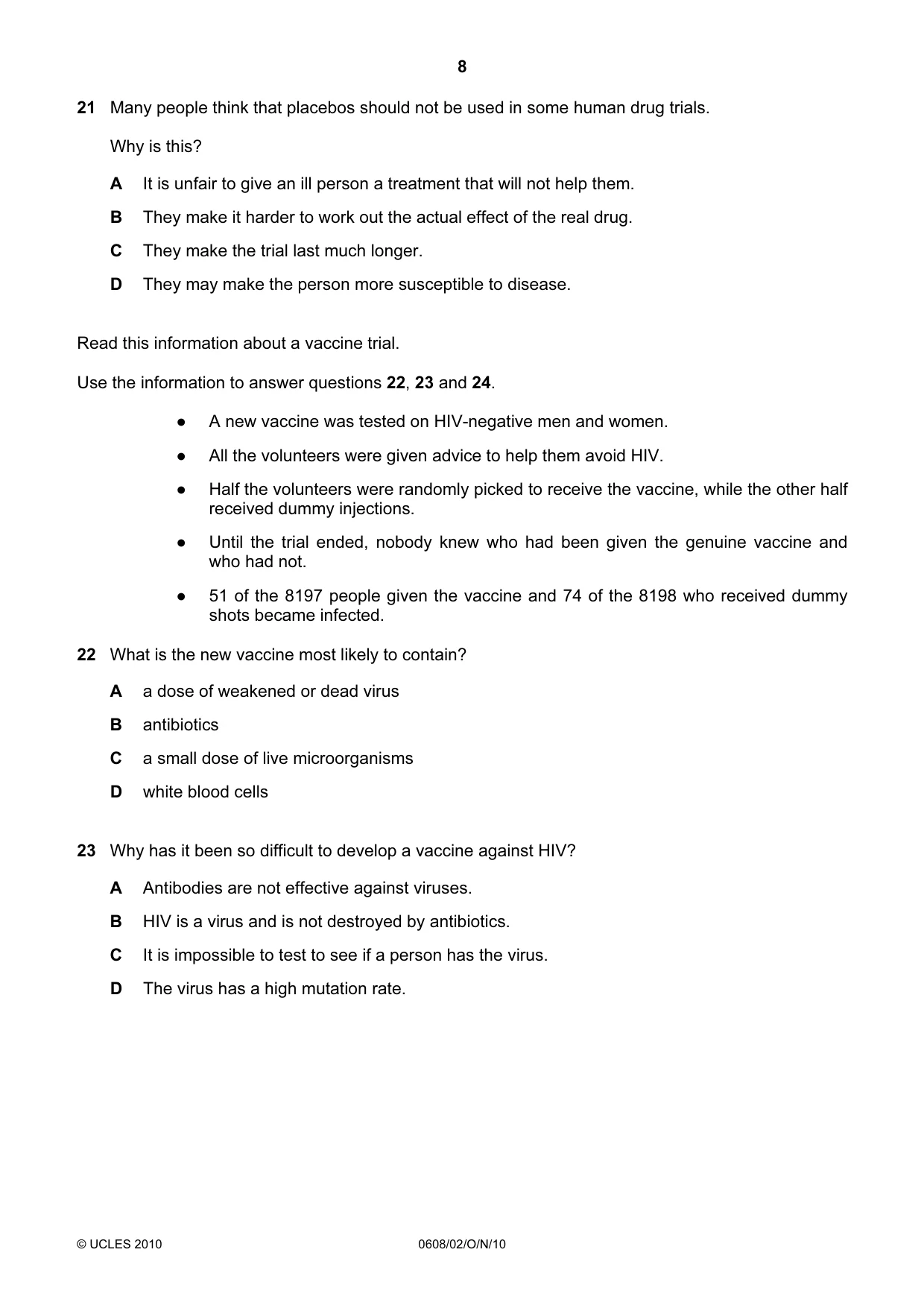
8 © UCLES 2010 0608/02/O/N/10 21 Many people think that placebos should not be used in some human drug trials. Why is this? A It is unfair to give an ill person a treatment that will not help them. B They make it harder to work out the actual effect of the real drug. C They make the trial last much longer. D They may make the person more susceptible to disease. Read this information about a vaccine trial. Use the information to answer questions 22, 23 and 24. ● A new vaccine was tested on HIV-negative men and women. ● All the volunteers were given advice to help them avoid HIV. ● Half the volunteers were randomly picked to receive the vaccine, while the other half received dummy injections. ● Until the trial ended, nobody knew who had been given the genuine vaccine and who had not. ● 51 of the 8197 people given the vaccine and 74 of the 8198 who received dummy shots became infected. 22 What is the new vaccine most likely to contain? A a dose of weakened or dead virus B antibiotics C a small dose of live microorganisms D white blood cells 23 Why has it been so difficult to develop a vaccine against HIV? A Antibodies are not effective against viruses. B HIV is a virus and is not destroyed by antibiotics. C It is impossible to test to see if a person has the virus. D The virus has a high mutation rate.
Question paper, page 9
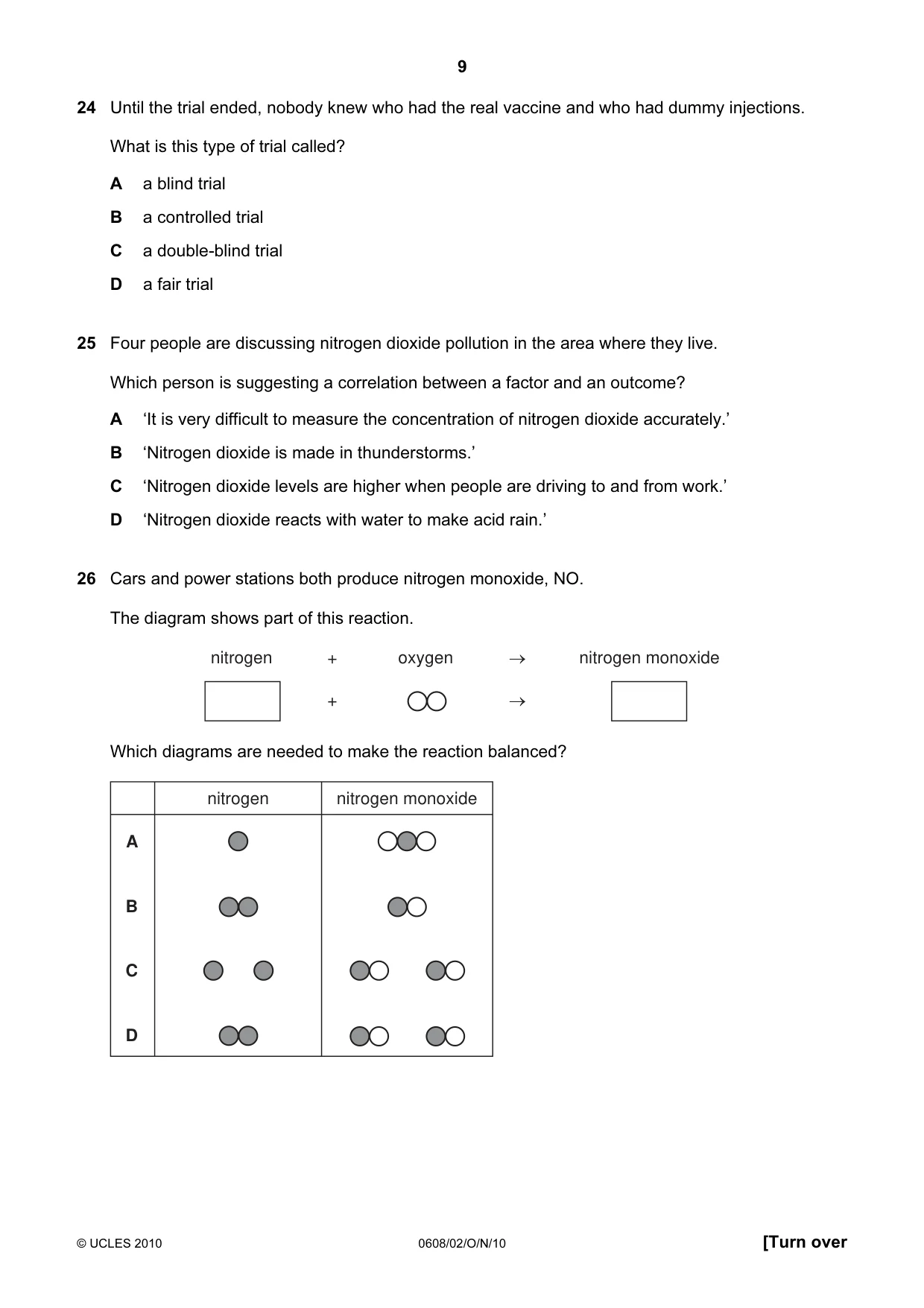
9 © UCLES 2010 0608/02/O/N/10 [Turn over 24 Until the trial ended, nobody knew who had the real vaccine and who had dummy injections. What is this type of trial called? A a blind trial B a controlled trial C a double-blind trial D a fair trial 25 Four people are discussing nitrogen dioxide pollution in the area where they live. Which person is suggesting a correlation between a factor and an outcome? A ‘It is very difficult to measure the concentration of nitrogen dioxide accurately.’ B ‘Nitrogen dioxide is made in thunderstorms.’ C ‘Nitrogen dioxide levels are higher when people are driving to and from work.’ D ‘Nitrogen dioxide reacts with water to make acid rain.’ 26 Cars and power stations both produce nitrogen monoxide, NO. The diagram shows part of this reaction. nitrogen + oxygen nitrogen monoxide → + → Which diagrams are needed to make the reaction balanced? A B C D nitrogen nitrogen monoxide
Question paper, page 10
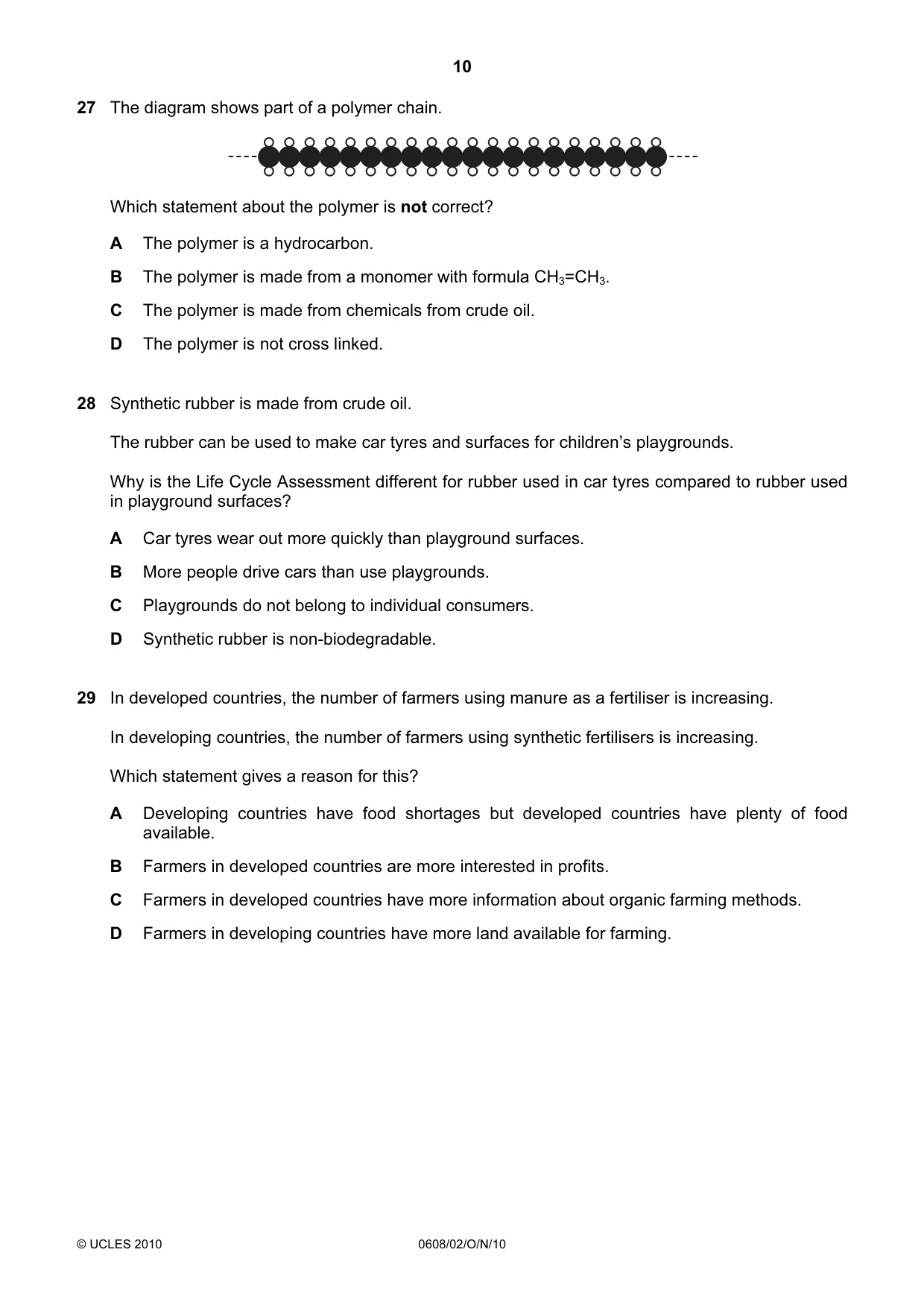
10 © UCLES 2010 0608/02/O/N/10 27 The diagram shows part of a polymer chain. Which statement about the polymer is not correct? A The polymer is a hydrocarbon. B The polymer is made from a monomer with formula CH3=CH3. C The polymer is made from chemicals from crude oil. D The polymer is not cross linked. 28 Synthetic rubber is made from crude oil. The rubber can be used to make car tyres and surfaces for children’s playgrounds. Why is the Life Cycle Assessment different for rubber used in car tyres compared to rubber used in playground surfaces? A Car tyres wear out more quickly than playground surfaces. B More people drive cars than use playgrounds. C Playgrounds do not belong to individual consumers. D Synthetic rubber is non-biodegradable. 29 In developed countries, the number of farmers using manure as a fertiliser is increasing. In developing countries, the number of farmers using synthetic fertilisers is increasing. Which statement gives a reason for this? A Developing countries have food shortages but developed countries have plenty of food available. B Farmers in developed countries are more interested in profits. C Farmers in developed countries have more information about organic farming methods. D Farmers in developing countries have more land available for farming.
Question paper, page 11
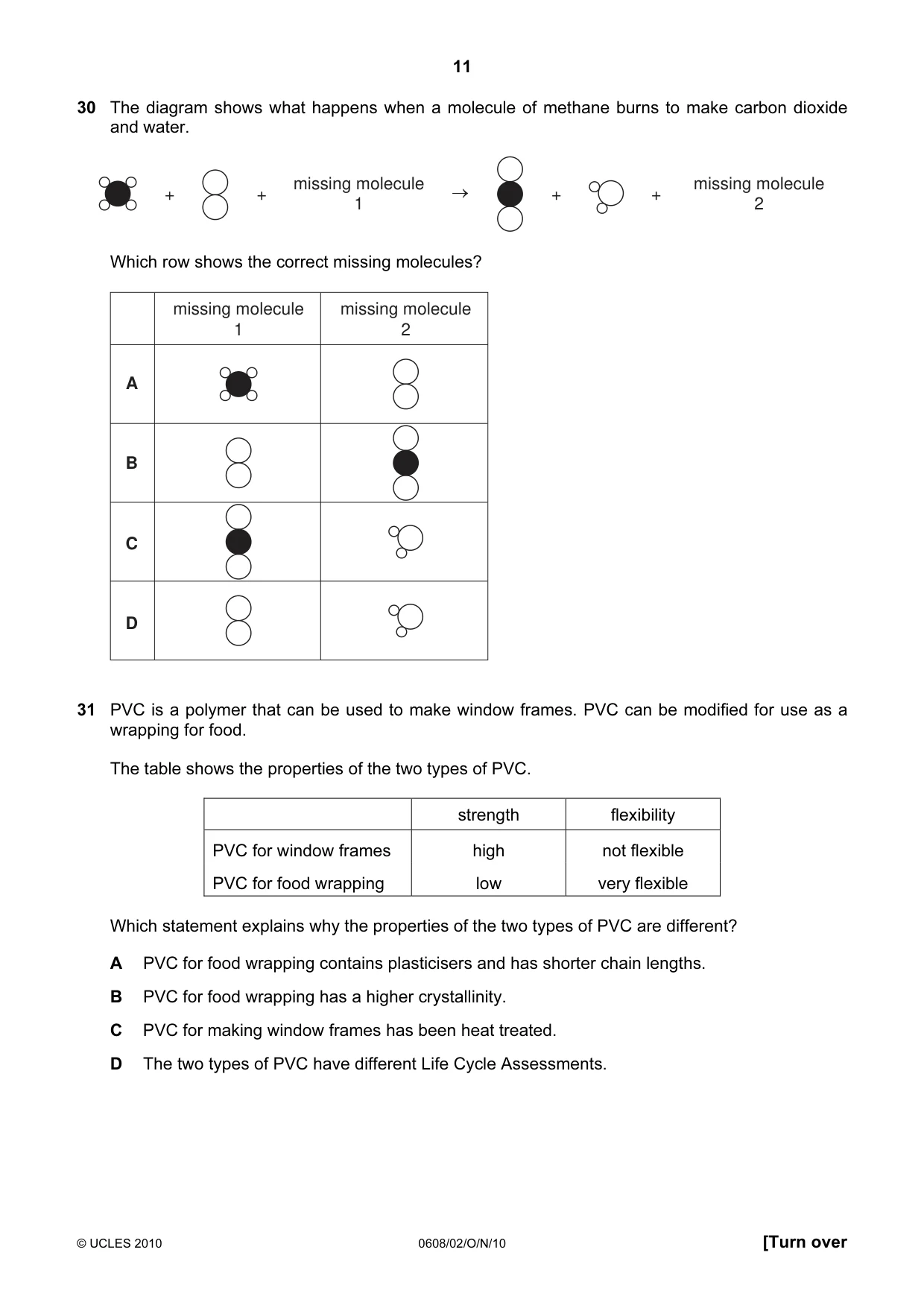
11 © UCLES 2010 0608/02/O/N/10 [Turn over 30 The diagram shows what happens when a molecule of methane burns to make carbon dioxide and water. + + + → missing molecule 1 + missing molecule 2 Which row shows the correct missing molecules? A B C D missing molecule 1 missing molecule 2 31 PVC is a polymer that can be used to make window frames. PVC can be modified for use as a wrapping for food. The table shows the properties of the two types of PVC. strength flexibility PVC for window frames high not flexible PVC for food wrapping low very flexible Which statement explains why the properties of the two types of PVC are different? A PVC for food wrapping contains plasticisers and has shorter chain lengths. B PVC for food wrapping has a higher crystallinity. C PVC for making window frames has been heat treated. D The two types of PVC have different Life Cycle Assessments.
Question paper, page 12
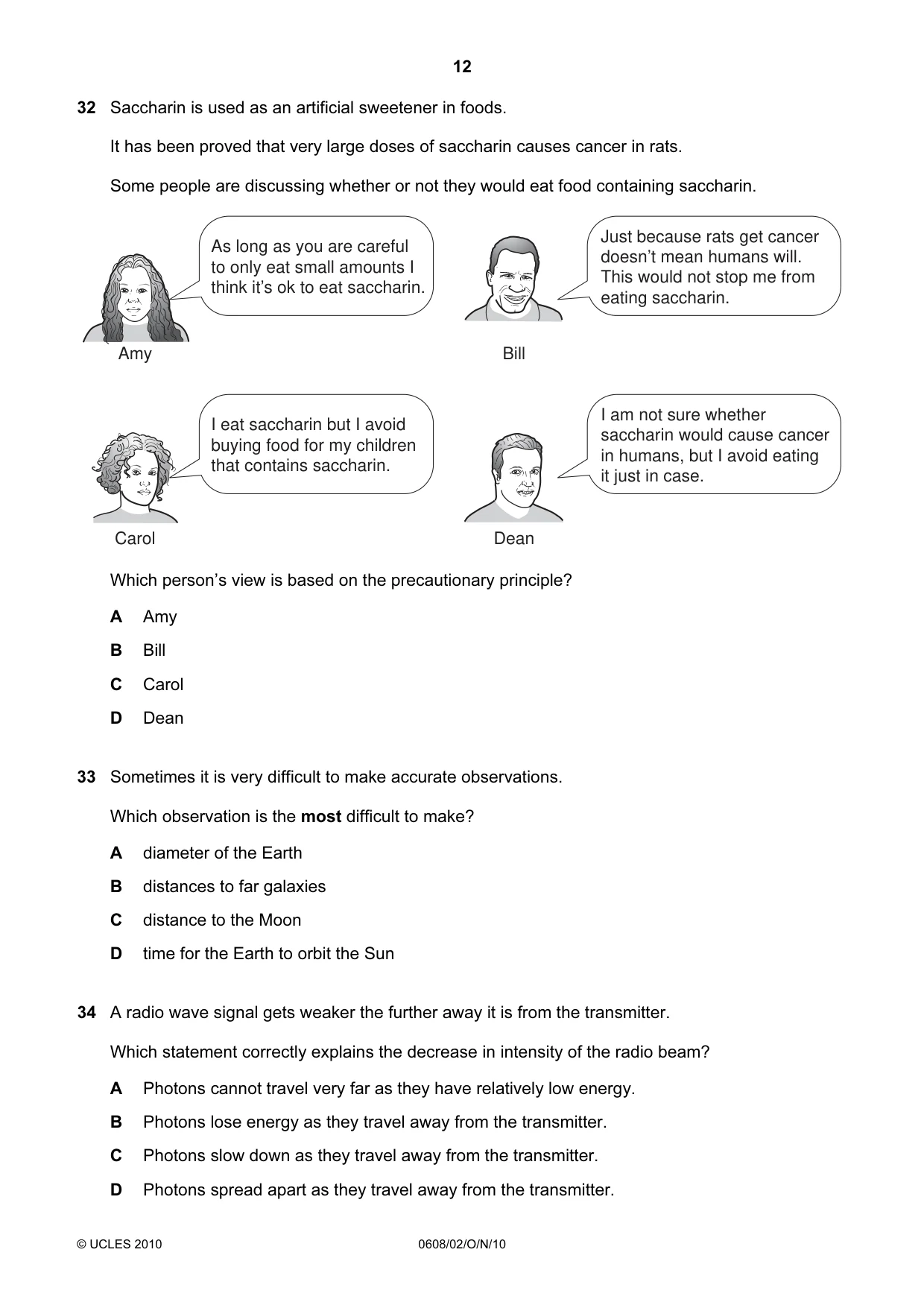
12 © UCLES 2010 0608/02/O/N/10 32 Saccharin is used as an artificial sweetener in foods. It has been proved that very large doses of saccharin causes cancer in rats. Some people are discussing whether or not they would eat food containing saccharin. Amy Carol Bill Dean As long as you are careful to only eat small amounts I think it’s ok to eat saccharin. I eat saccharin but I avoid buying food for my children that contains saccharin. Just because rats get cancer doesn’t mean humans will. This would not stop me from eating saccharin. I am not sure whether saccharin would cause cancer in humans, but I avoid eating it just in case. Which person’s view is based on the precautionary principle? A Amy B Bill C Carol D Dean 33 Sometimes it is very difficult to make accurate observations. Which observation is the most difficult to make? A diameter of the Earth B distances to far galaxies C distance to the Moon D time for the Earth to orbit the Sun 34 A radio wave signal gets weaker the further away it is from the transmitter. Which statement correctly explains the decrease in intensity of the radio beam? A Photons cannot travel very far as they have relatively low energy. B Photons lose energy as they travel away from the transmitter. C Photons slow down as they travel away from the transmitter. D Photons spread apart as they travel away from the transmitter.
Question paper, page 13
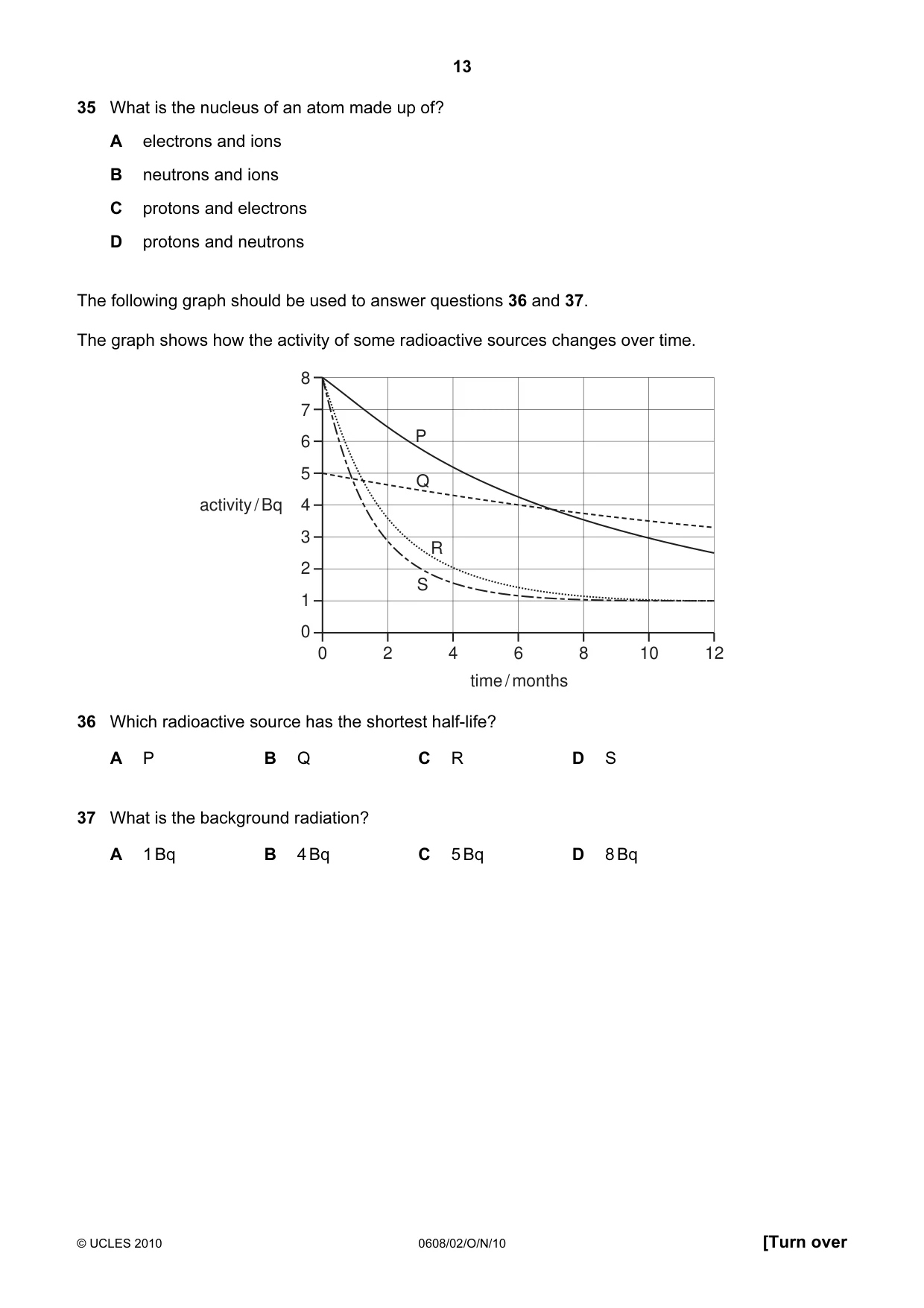
13 © UCLES 2010 0608/02/O/N/10 [Turn over 35 What is the nucleus of an atom made up of? A electrons and ions B neutrons and ions C protons and electrons D protons and neutrons The following graph should be used to answer questions 36 and 37. The graph shows how the activity of some radioactive sources changes over time. 8 7 6 5 4 3 2 1 0 0 2 4 6 8 10 12 activity / Bq time / months P Q R S 36 Which radioactive source has the shortest half-life? A P B Q C R D S 37 What is the background radiation? A 1 Bq B 4 Bq C 5 Bq D 8 Bq
Question paper, page 14
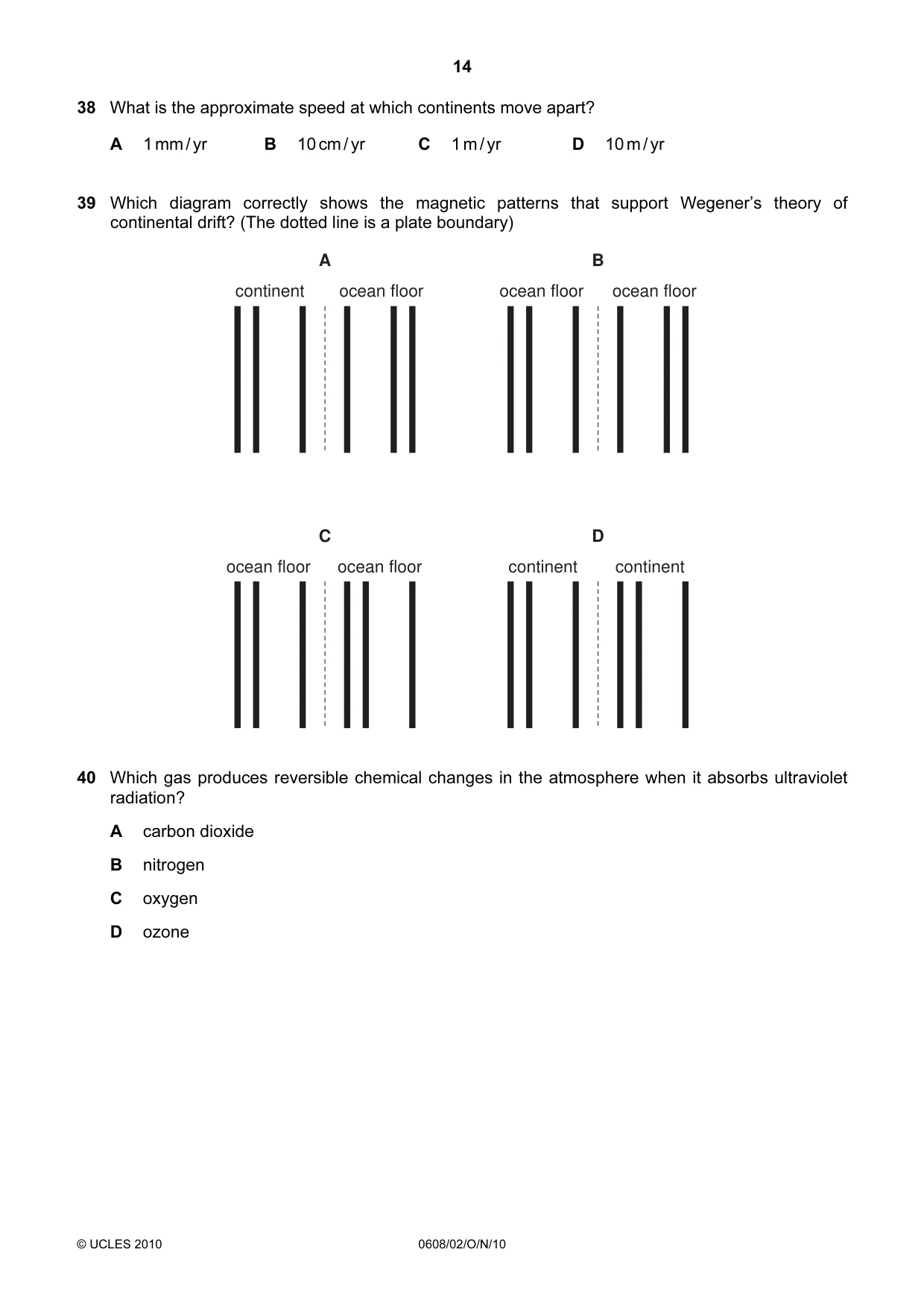
14 © UCLES 2010 0608/02/O/N/10 38 What is the approximate speed at which continents move apart? A 1 mm / yr B 10 cm / yr C 1 m / yr D 10 m / yr 39 Which diagram correctly shows the magnetic patterns that support Wegener’s theory of continental drift? (The dotted line is a plate boundary) A continent ocean floor B ocean floor ocean floor C ocean floor ocean floor D continent continent 40 Which gas produces reversible chemical changes in the atmosphere when it absorbs ultraviolet radiation? A carbon dioxide B nitrogen C oxygen D ozone
Question paper, page 15
15 © UCLES 2010 0608/02/O/N/10 BLANK PAGE
Question paper, page 16
16 Permission to reproduce items where third-party owned material protected by copyright is included has been sought and cleared where possible. Every reasonable effort has been made by the publisher (UCLES) to trace copyright holders, but if any items requiring clearance have unwittingly been included, the publisher will be pleased to make amends at the earliest possible opportunity. University of Cambridge International Examinations is part of the Cambridge Assessment Group. Cambridge Assessment is the brand name of University of Cambridge Local Examinations Syndicate (UCLES), which is itself a department of the University of Cambridge. © UCLES 2010 0608/02/O/N/10 BLANK PAGE
Mark scheme, page 1
UNIVERSITY OF CAMBRIDGE INTERNATIONAL EXAMINATIONS International General Certificate of Secondary Education MARK SCHEME for the October/November 2010 question paper for the guidance of teachers 0608 TWENTY FIRST CENTURY SCIENCE 0608/02 Paper 2 (Multiple Choice – Extended), maximum raw mark 40 Mark schemes must be read in conjunction with the question papers and the report on the examination. • CIE will not enter into discussions or correspondence in connection with these mark schemes. CIE is publishing the mark schemes for the October/November 2010 question papers for most IGCSE, GCE Advanced Level and Advanced Subsidiary Level syllabuses and some Ordinary Level syllabuses. www.XtremePapers.com
Mark scheme, page 2
Page 2 Mark Scheme: Teachers’ version Syllabus Paper IGCSE – October/November 2010 0608 02 © UCLES 2010 Question Number Key Question Number Key 1 B 21 A 2 D 22 A 3 A 23 D 4 D 24 C 5 D 25 C 6 C 26 D 7 A 27 B 8 A 28 A 9 A 29 A 10 B 30 D 11 D 31 A 12 A 32 D 13 C 33 B 14 B 34 D 15 B 35 D 16 D 36 D 17 B 37 A 18 D 38 B 19 A 39 B 20 A 40 D
What you needed in this session
Cambridge’s own grade thresholds for 2010 Oct/Nov, Paper 2 · Variant 1. A higher threshold means an easier paper — the bar moves with how the cohort did.