Cambridge IGCSE Twenty-First Century Science 0608 — 2011 May/June Paper 2 · Variant 1
0608/21/M/J/11 · 40 marks · ≈45 min
The question paper and its mark scheme, free to read here and free to download. This is Cambridge’s own paper, exactly as it was sat.
Question paper16 pages
Mark scheme2 pages
Answers below. Sit the paper first if you are practising.
Paper as text
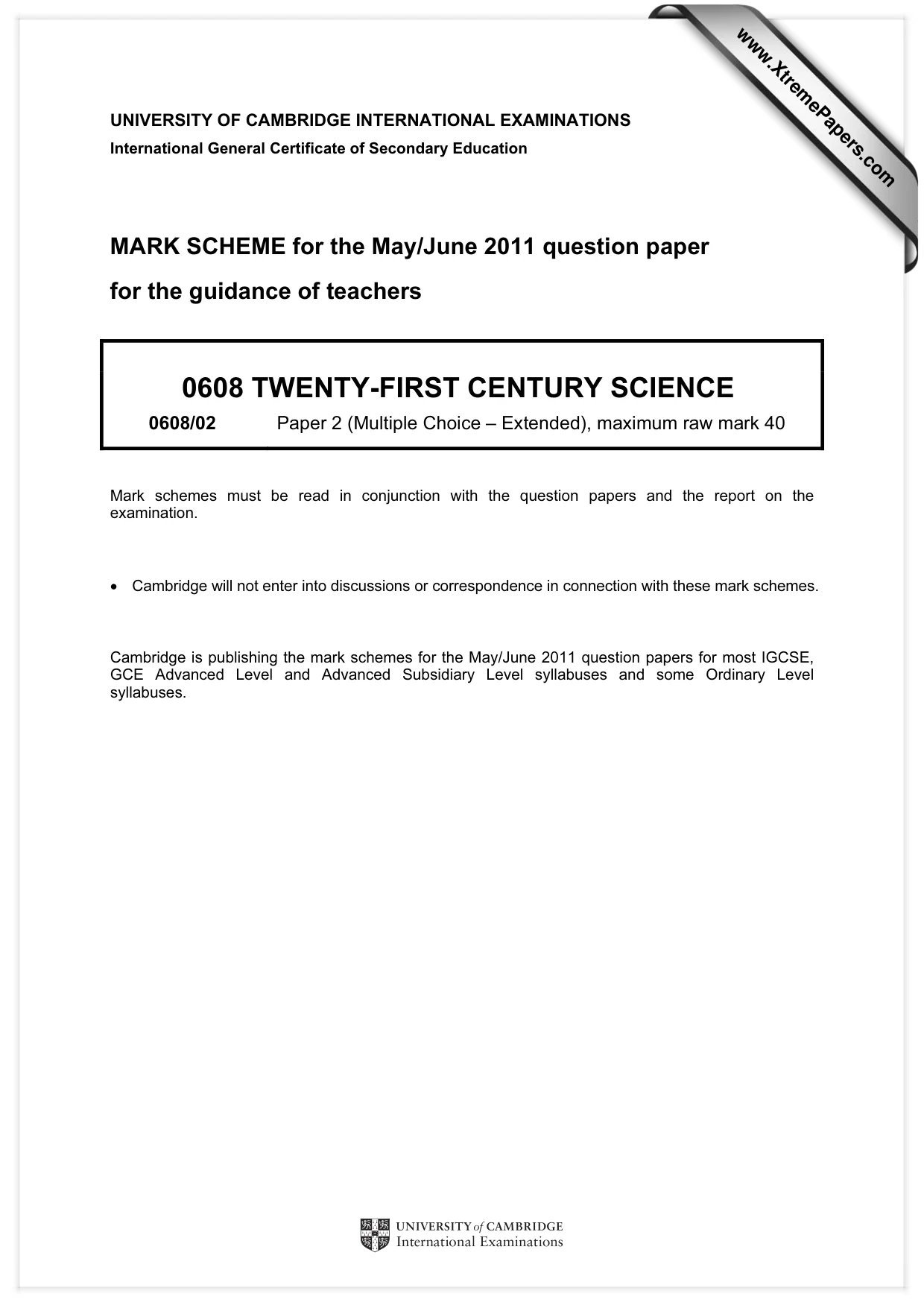
Question paper, page 1
This document consists of 16 printed pages. IB11 06_0608_02/RP © UCLES 2011 [Turn over *5094761180* UNIVERSITY OF CAMBRIDGE INTERNATIONAL EXAMINATIONS International General Certificate of Secondary Education TWENTY FIRST CENTURY SCIENCE (EXTENDED) 0608/02 Paper 2 Multiple Choice May/June 2011 1 hour Additional Materials: Multiple Choice Answer Sheet Soft clean eraser Soft pencil (type B or HB is recommended) READ THESE INSTRUCTIONS FIRST Write in soft pencil. Do not use staples, paper clips, highlighters, glue or correction fluid. Write your name, Centre number and candidate number on the Answer Sheet in the spaces provided unless this has been done for you. There are forty questions on this paper. Answer all questions. For each question there are four possible answers A, B, C and D. Choose the one you consider correct and record your choice in soft pencil on the separate Answer Sheet. Read the instructions on the Answer Sheet very carefully. Each correct answer will score one mark. A mark will not be deducted for a wrong answer. Any rough working should be done in this booklet. You may use a calculator. www.XtremePapers.com
Question paper, page 2
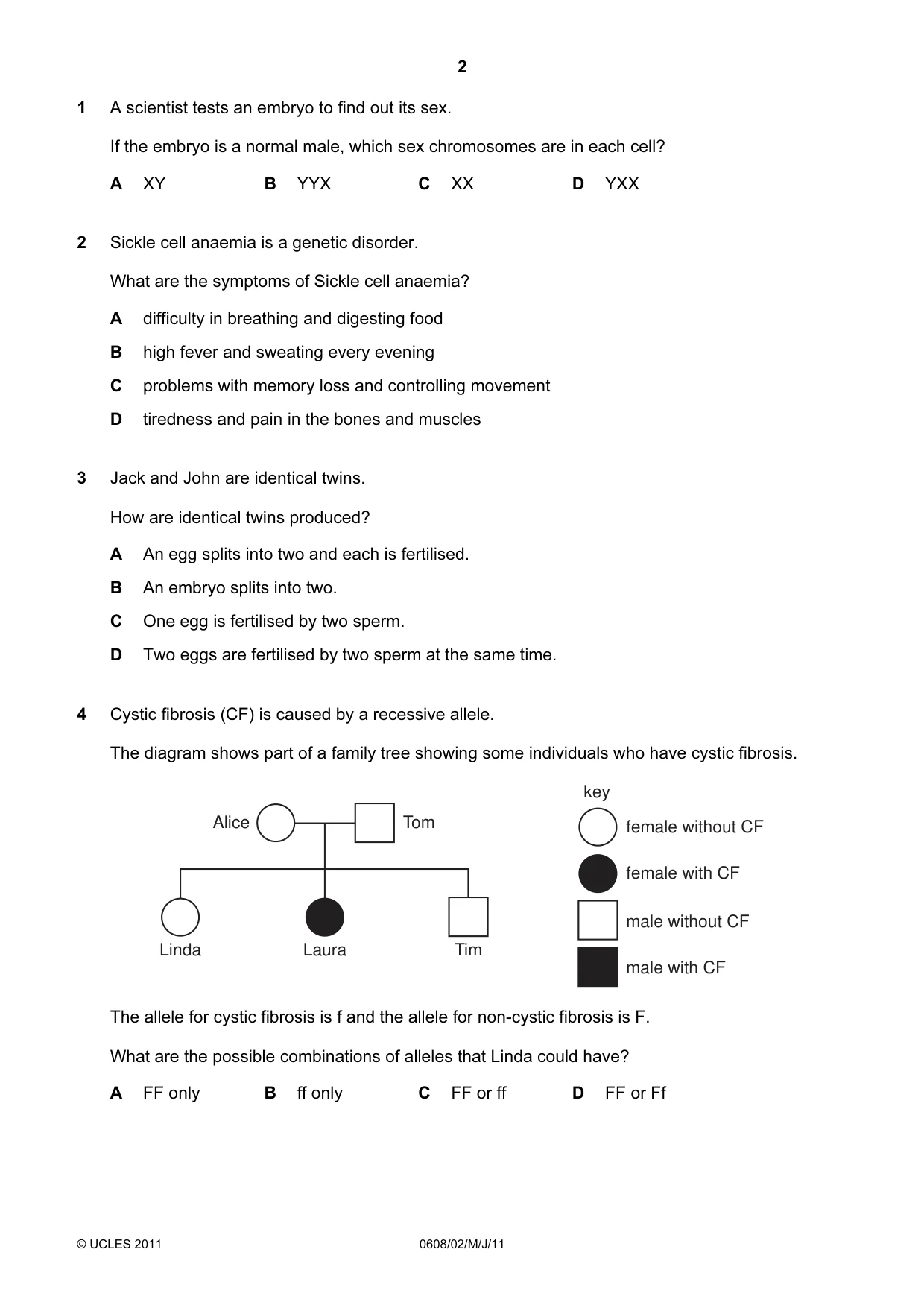
2 © UCLES 2011 0608/02/M/J/11 1 A scientist tests an embryo to find out its sex. If the embryo is a normal male, which sex chromosomes are in each cell? A XY B YYX C XX D YXX 2 Sickle cell anaemia is a genetic disorder. What are the symptoms of Sickle cell anaemia? A difficulty in breathing and digesting food B high fever and sweating every evening C problems with memory loss and controlling movement D tiredness and pain in the bones and muscles 3 Jack and John are identical twins. How are identical twins produced? A An egg splits into two and each is fertilised. B An embryo splits into two. C One egg is fertilised by two sperm. D Two eggs are fertilised by two sperm at the same time. 4 Cystic fibrosis (CF) is caused by a recessive allele. The diagram shows part of a family tree showing some individuals who have cystic fibrosis. Alice key female without CF female with CF male without CF male with CF Linda Laura Tim Tom The allele for cystic fibrosis is f and the allele for non-cystic fibrosis is F. What are the possible combinations of alleles that Linda could have? A FF only B ff only C FF or ff D FF or Ff
Question paper, page 3
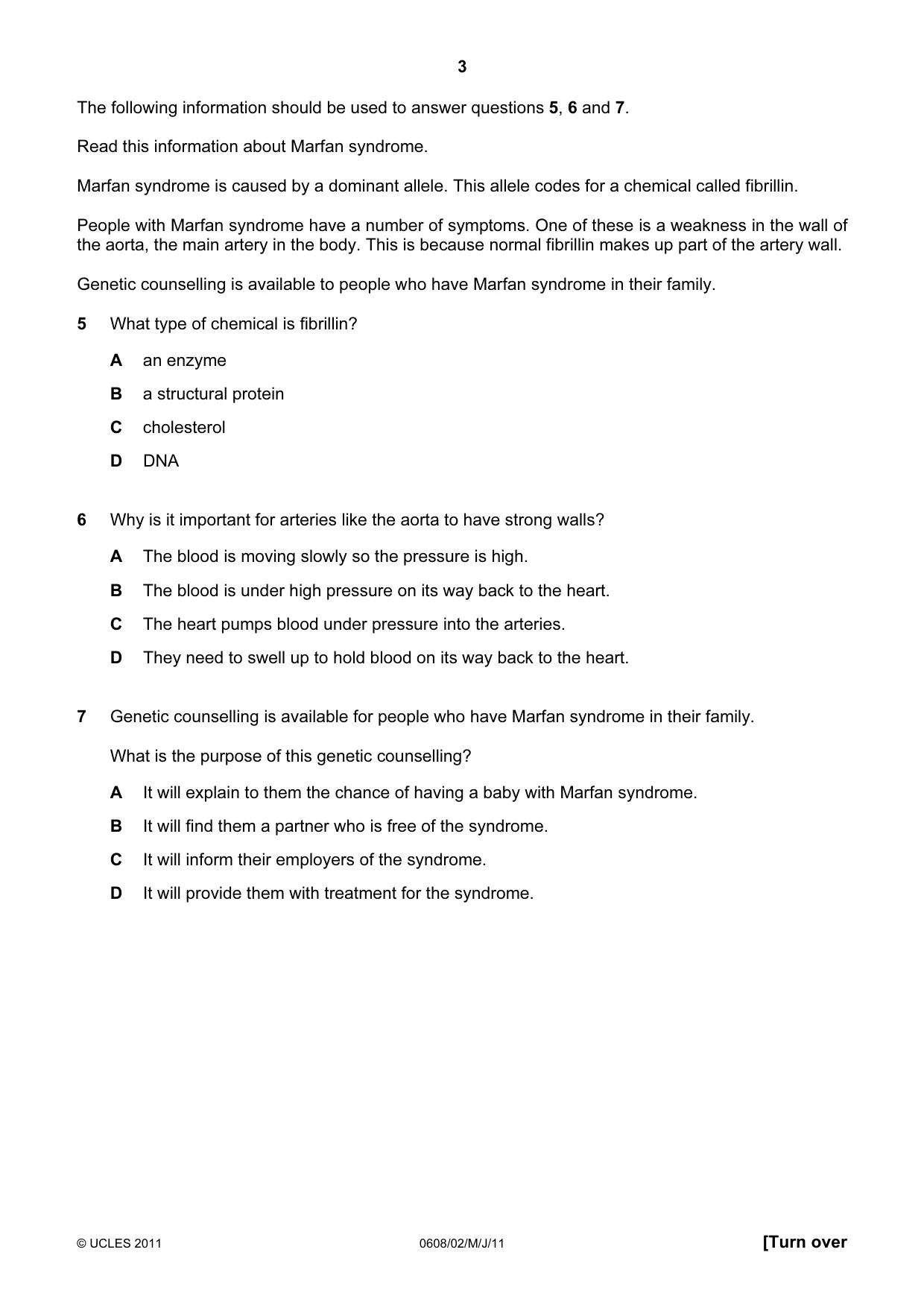
3 © UCLES 2011 0608/02/M/J/11 [Turn over The following information should be used to answer questions 5, 6 and 7. Read this information about Marfan syndrome. Marfan syndrome is caused by a dominant allele. This allele codes for a chemical called fibrillin. People with Marfan syndrome have a number of symptoms. One of these is a weakness in the wall of the aorta, the main artery in the body. This is because normal fibrillin makes up part of the artery wall. Genetic counselling is available to people who have Marfan syndrome in their family. 5 What type of chemical is fibrillin? A an enzyme B a structural protein C cholesterol D DNA 6 Why is it important for arteries like the aorta to have strong walls? A The blood is moving slowly so the pressure is high. B The blood is under high pressure on its way back to the heart. C The heart pumps blood under pressure into the arteries. D They need to swell up to hold blood on its way back to the heart. 7 Genetic counselling is available for people who have Marfan syndrome in their family. What is the purpose of this genetic counselling? A It will explain to them the chance of having a baby with Marfan syndrome. B It will find them a partner who is free of the syndrome. C It will inform their employers of the syndrome. D It will provide them with treatment for the syndrome.
Question paper, page 4
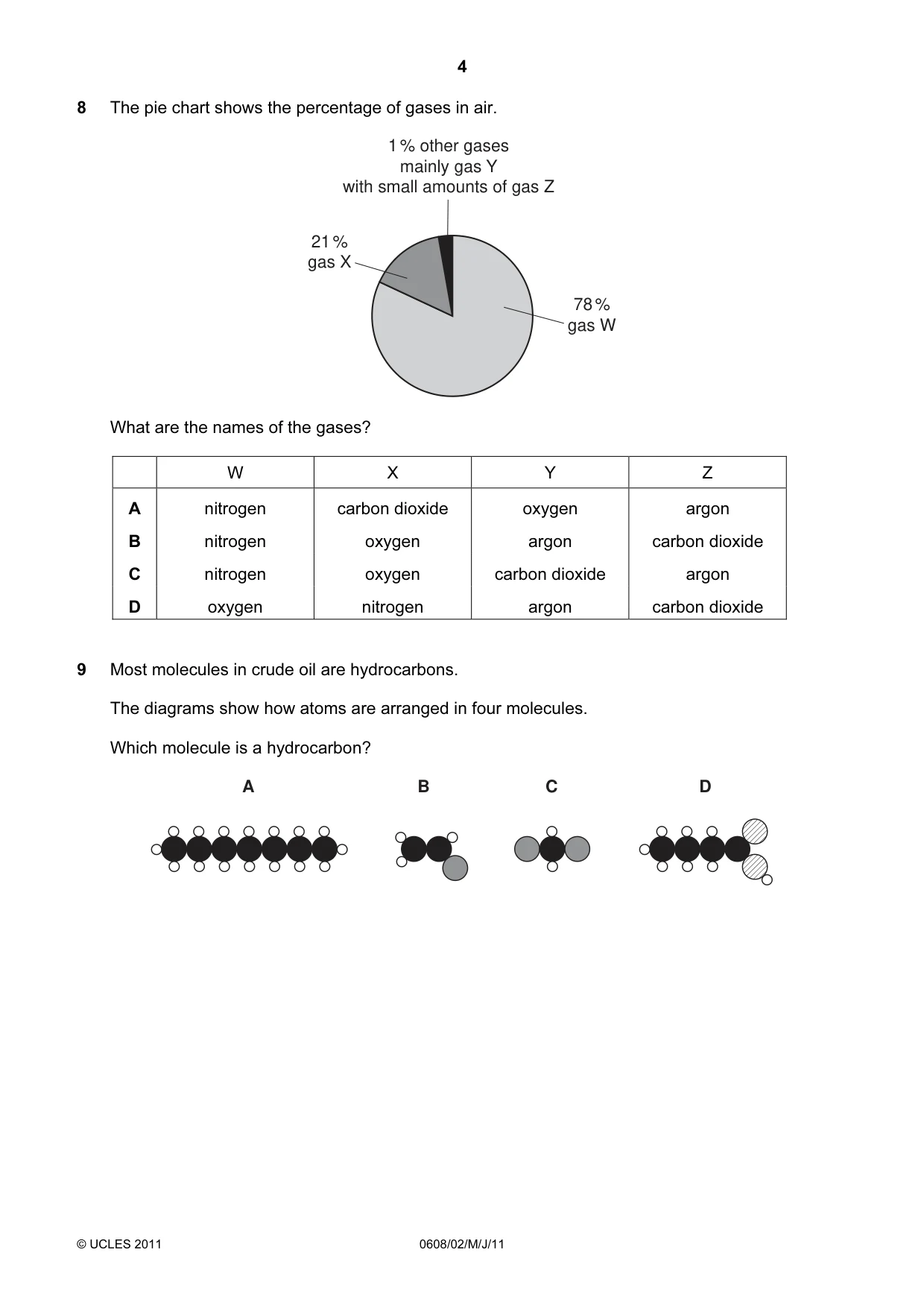
4 © UCLES 2011 0608/02/M/J/11 8 The pie chart shows the percentage of gases in air. 78 % gas W 21 % gas X 1 % other gases mainly gas Y with small amounts of gas Z What are the names of the gases? W X Y Z A nitrogen carbon dioxide oxygen argon B nitrogen oxygen argon carbon dioxide C nitrogen oxygen carbon dioxide argon D oxygen nitrogen argon carbon dioxide 9 Most molecules in crude oil are hydrocarbons. The diagrams show how atoms are arranged in four molecules. Which molecule is a hydrocarbon? A B C D
Question paper, page 5
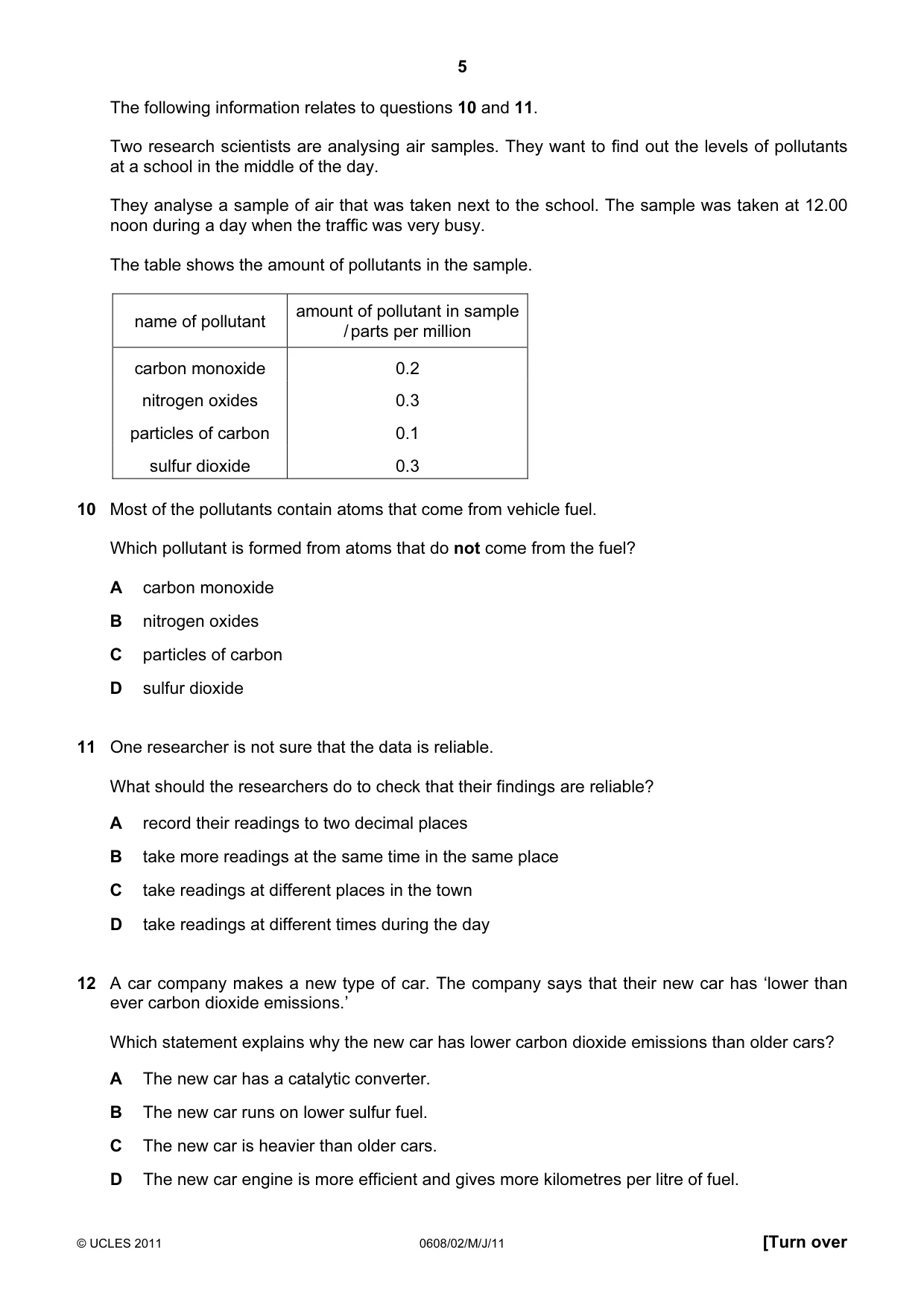
5 © UCLES 2011 0608/02/M/J/11 [Turn over The following information relates to questions 10 and 11. Two research scientists are analysing air samples. They want to find out the levels of pollutants at a school in the middle of the day. They analyse a sample of air that was taken next to the school. The sample was taken at 12.00 noon during a day when the traffic was very busy. The table shows the amount of pollutants in the sample. name of pollutant amount of pollutant in sample / parts per million carbon monoxide 0.2 nitrogen oxides 0.3 particles of carbon 0.1 sulfur dioxide 0.3 10 Most of the pollutants contain atoms that come from vehicle fuel. Which pollutant is formed from atoms that do not come from the fuel? A carbon monoxide B nitrogen oxides C particles of carbon D sulfur dioxide 11 One researcher is not sure that the data is reliable. What should the researchers do to check that their findings are reliable? A record their readings to two decimal places B take more readings at the same time in the same place C take readings at different places in the town D take readings at different times during the day 12 A car company makes a new type of car. The company says that their new car has ‘lower than ever carbon dioxide emissions.’ Which statement explains why the new car has lower carbon dioxide emissions than older cars? A The new car has a catalytic converter. B The new car runs on lower sulfur fuel. C The new car is heavier than older cars. D The new car engine is more efficient and gives more kilometres per litre of fuel.
Question paper, page 6
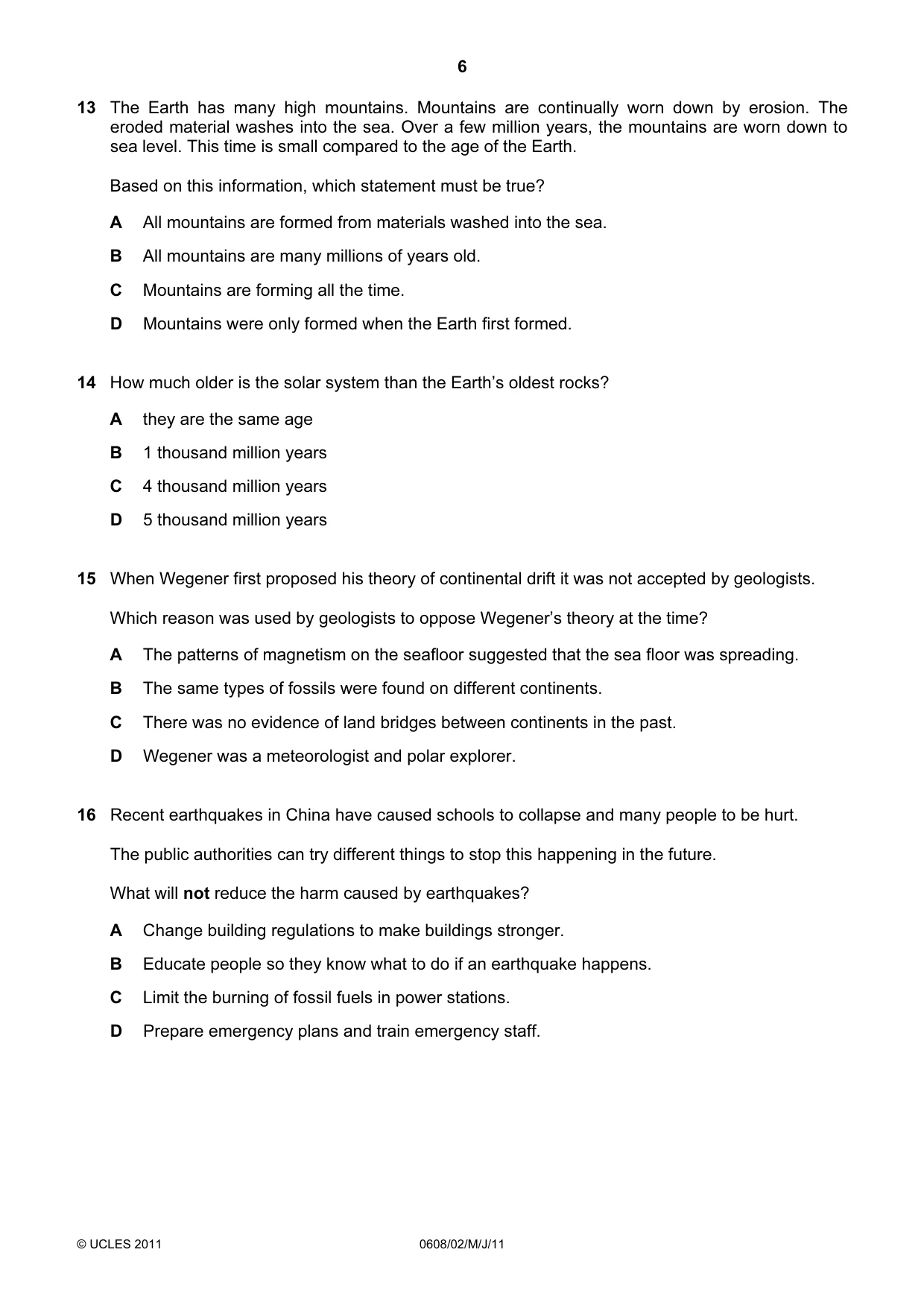
6 © UCLES 2011 0608/02/M/J/11 13 The Earth has many high mountains. Mountains are continually worn down by erosion. The eroded material washes into the sea. Over a few million years, the mountains are worn down to sea level. This time is small compared to the age of the Earth. Based on this information, which statement must be true? A All mountains are formed from materials washed into the sea. B All mountains are many millions of years old. C Mountains are forming all the time. D Mountains were only formed when the Earth first formed. 14 How much older is the solar system than the Earth’s oldest rocks? A they are the same age B 1 thousand million years C 4 thousand million years D 5 thousand million years 15 When Wegener first proposed his theory of continental drift it was not accepted by geologists. Which reason was used by geologists to oppose Wegener’s theory at the time? A The patterns of magnetism on the seafloor suggested that the sea floor was spreading. B The same types of fossils were found on different continents. C There was no evidence of land bridges between continents in the past. D Wegener was a meteorologist and polar explorer. 16 Recent earthquakes in China have caused schools to collapse and many people to be hurt. The public authorities can try different things to stop this happening in the future. What will not reduce the harm caused by earthquakes? A Change building regulations to make buildings stronger. B Educate people so they know what to do if an earthquake happens. C Limit the burning of fossil fuels in power stations. D Prepare emergency plans and train emergency staff.
Question paper, page 7
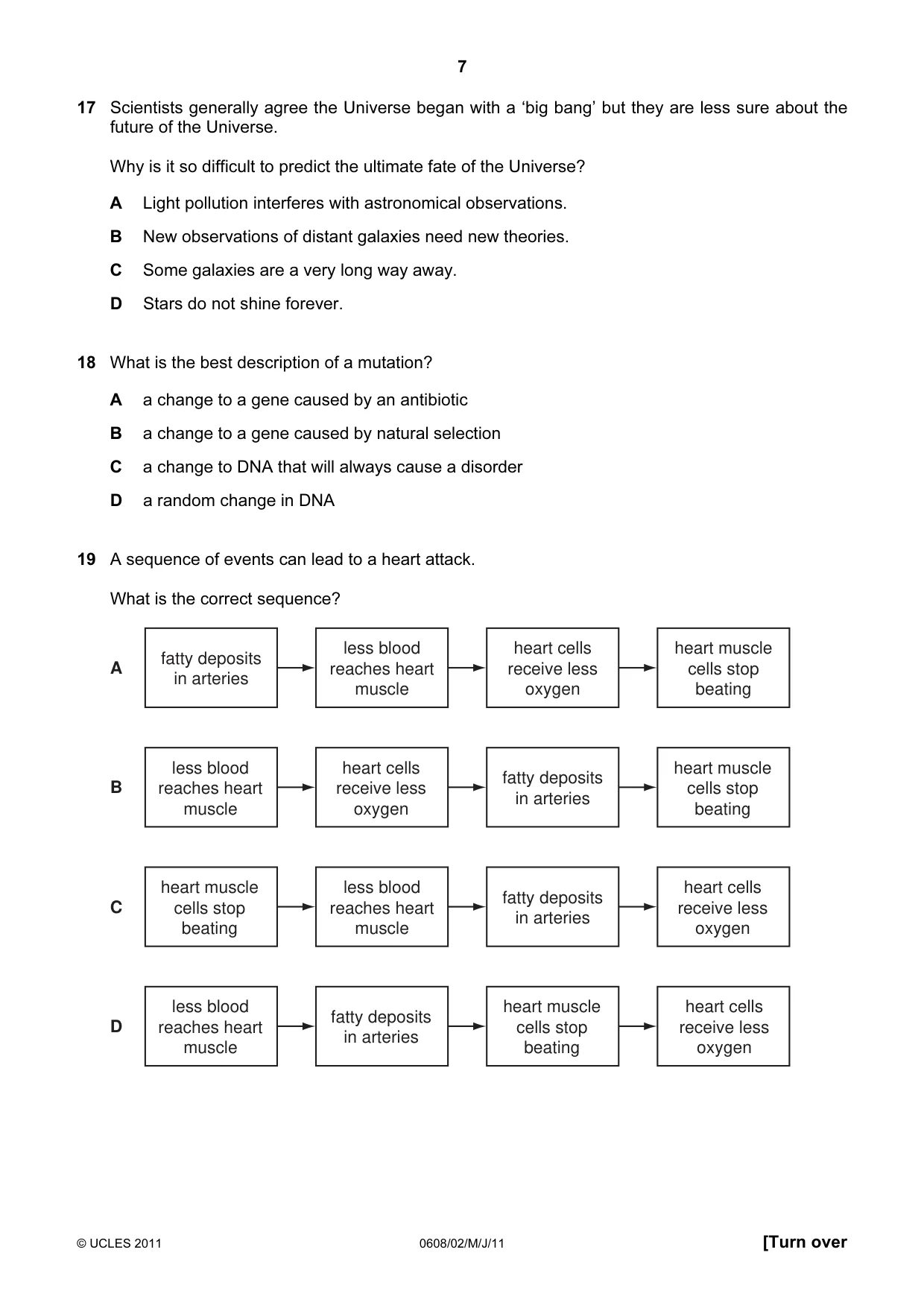
7 © UCLES 2011 0608/02/M/J/11 [Turn over 17 Scientists generally agree the Universe began with a ‘big bang’ but they are less sure about the future of the Universe. Why is it so difficult to predict the ultimate fate of the Universe? A Light pollution interferes with astronomical observations. B New observations of distant galaxies need new theories. C Some galaxies are a very long way away. D Stars do not shine forever. 18 What is the best description of a mutation? A a change to a gene caused by an antibiotic B a change to a gene caused by natural selection C a change to DNA that will always cause a disorder D a random change in DNA 19 A sequence of events can lead to a heart attack. What is the correct sequence? fatty deposits in arteries less blood reaches heart muscle heart cells receive less oxygen heart muscle cells stop beating A fatty deposits in arteries less blood reaches heart muscle heart cells receive less oxygen heart muscle cells stop beating B fatty deposits in arteries less blood reaches heart muscle heart cells receive less oxygen heart muscle cells stop beating C fatty deposits in arteries less blood reaches heart muscle heart cells receive less oxygen heart muscle cells stop beating D
Question paper, page 8
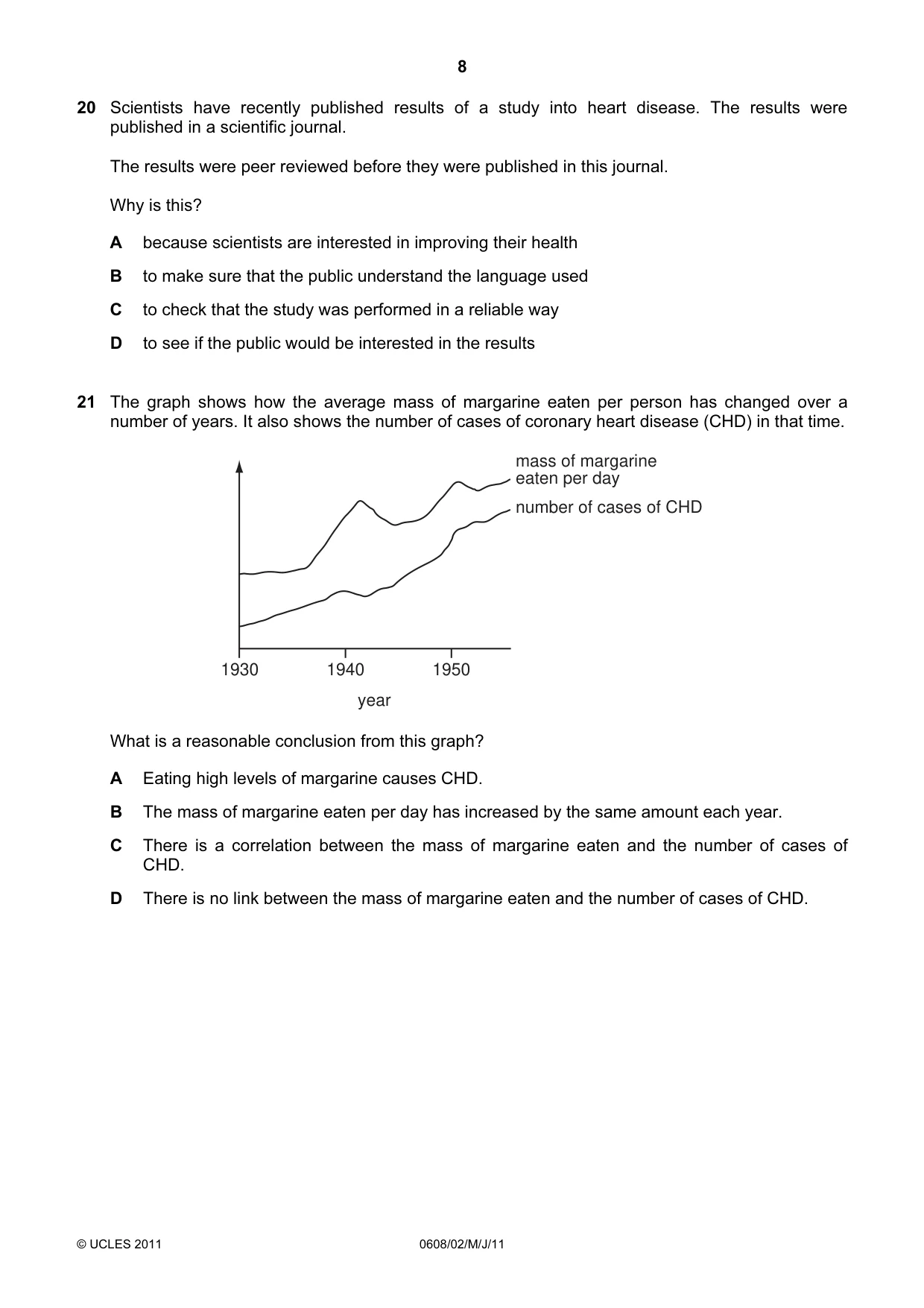
8 © UCLES 2011 0608/02/M/J/11 20 Scientists have recently published results of a study into heart disease. The results were published in a scientific journal. The results were peer reviewed before they were published in this journal. Why is this? A because scientists are interested in improving their health B to make sure that the public understand the language used C to check that the study was performed in a reliable way D to see if the public would be interested in the results 21 The graph shows how the average mass of margarine eaten per person has changed over a number of years. It also shows the number of cases of coronary heart disease (CHD) in that time. 1930 1940 1950 year mass of margarine eaten per day number of cases of CHD What is a reasonable conclusion from this graph? A Eating high levels of margarine causes CHD. B The mass of margarine eaten per day has increased by the same amount each year. C There is a correlation between the mass of margarine eaten and the number of cases of CHD. D There is no link between the mass of margarine eaten and the number of cases of CHD.
Question paper, page 9
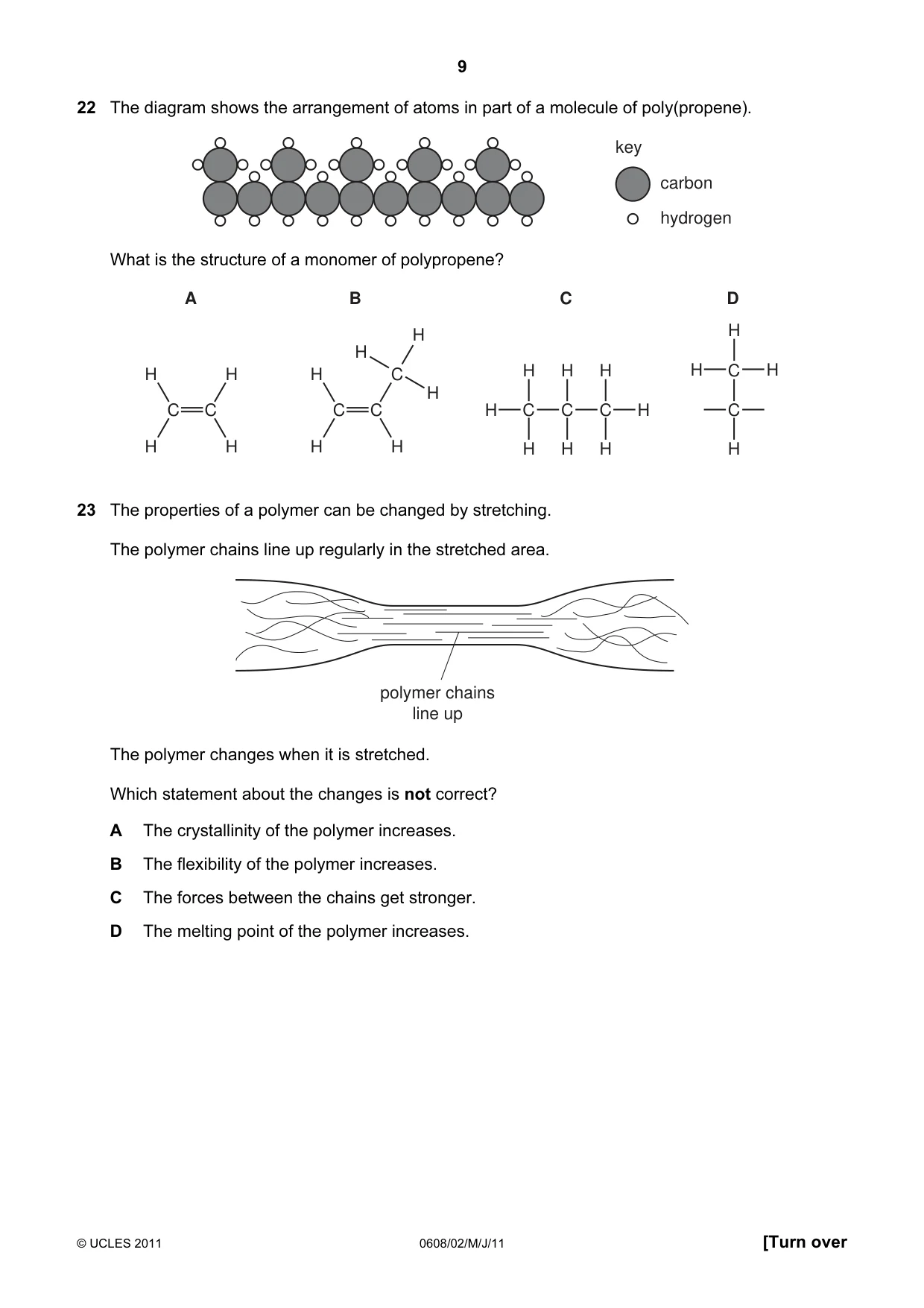
9 © UCLES 2011 0608/02/M/J/11 [Turn over 22 The diagram shows the arrangement of atoms in part of a molecule of poly(propene). carbon key hydrogen What is the structure of a monomer of polypropene? C C H H H H A C C H C H H C H H H H H H B C C H H H H H C H H D C H C H 23 The properties of a polymer can be changed by stretching. The polymer chains line up regularly in the stretched area. polymer chains line up The polymer changes when it is stretched. Which statement about the changes is not correct? A The crystallinity of the polymer increases. B The flexibility of the polymer increases. C The forces between the chains get stronger. D The melting point of the polymer increases.
Question paper, page 10
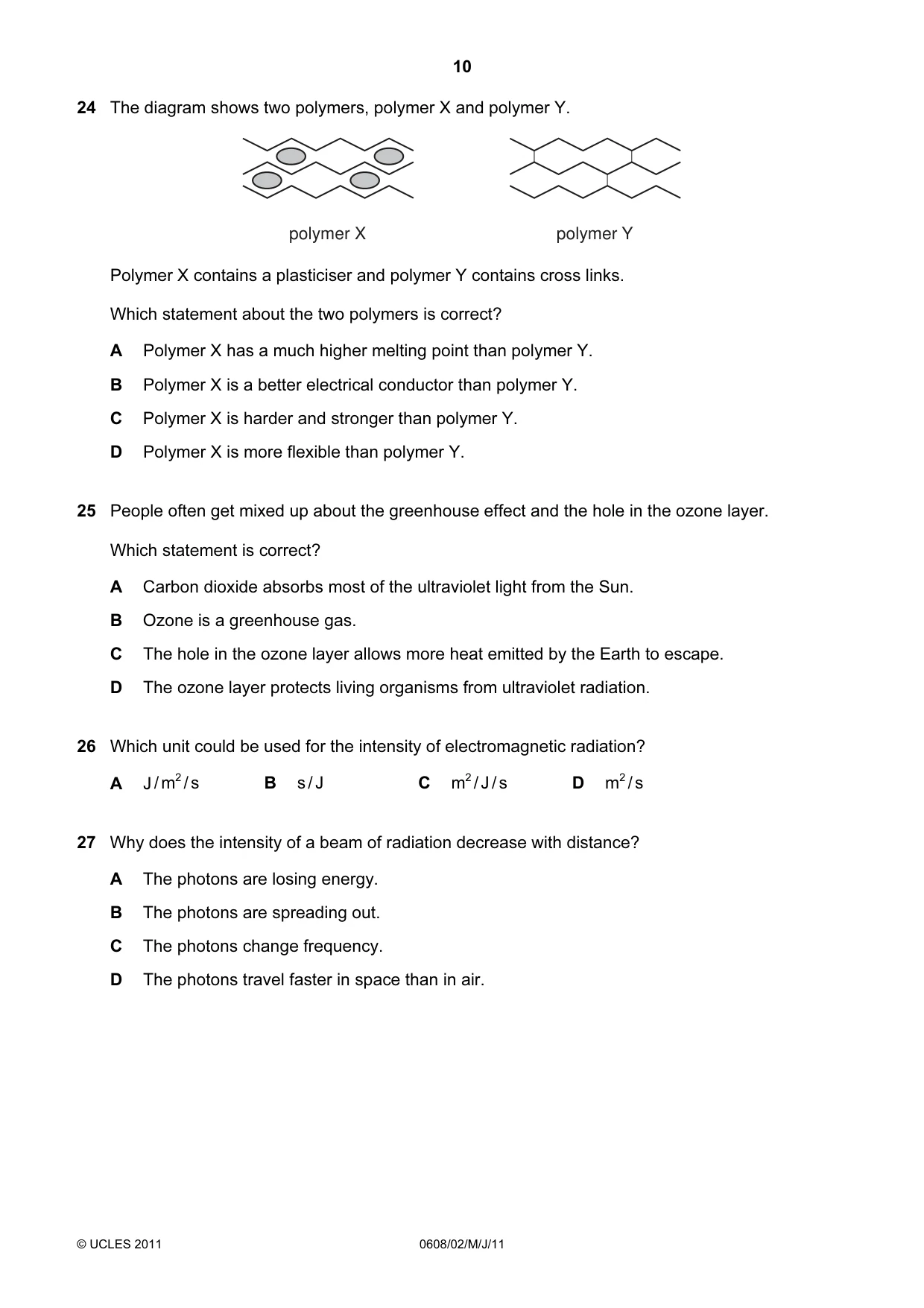
10 © UCLES 2011 0608/02/M/J/11 24 The diagram shows two polymers, polymer X and polymer Y. polymer X polymer Y Polymer X contains a plasticiser and polymer Y contains cross links. Which statement about the two polymers is correct? A Polymer X has a much higher melting point than polymer Y. B Polymer X is a better electrical conductor than polymer Y. C Polymer X is harder and stronger than polymer Y. D Polymer X is more flexible than polymer Y. 25 People often get mixed up about the greenhouse effect and the hole in the ozone layer. Which statement is correct? A Carbon dioxide absorbs most of the ultraviolet light from the Sun. B Ozone is a greenhouse gas. C The hole in the ozone layer allows more heat emitted by the Earth to escape. D The ozone layer protects living organisms from ultraviolet radiation. 26 Which unit could be used for the intensity of electromagnetic radiation? A J / m2 / s B s / J C m2 / J / s D m2 / s 27 Why does the intensity of a beam of radiation decrease with distance? A The photons are losing energy. B The photons are spreading out. C The photons change frequency. D The photons travel faster in space than in air.
Question paper, page 11
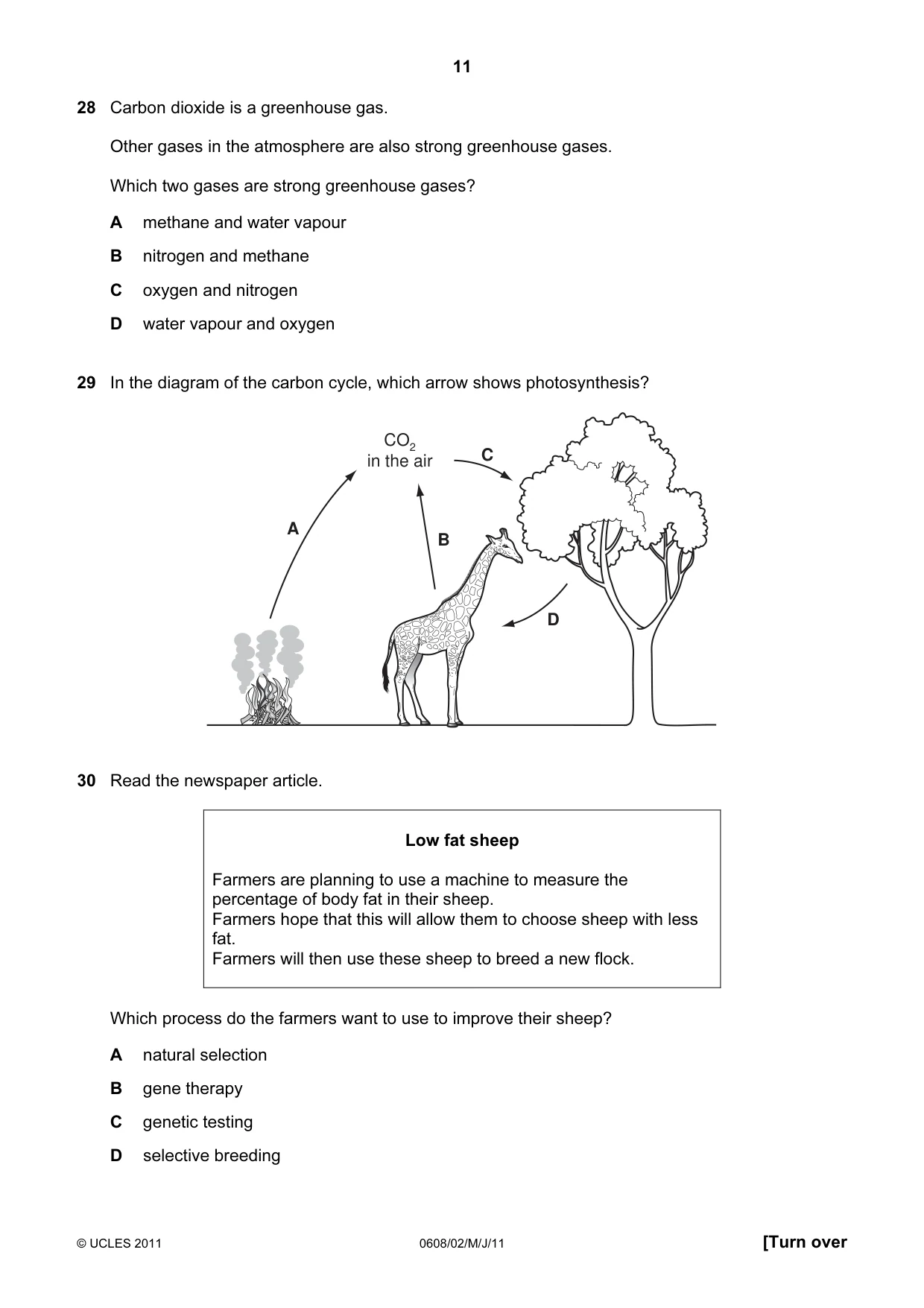
11 © UCLES 2011 0608/02/M/J/11 [Turn over 28 Carbon dioxide is a greenhouse gas. Other gases in the atmosphere are also strong greenhouse gases. Which two gases are strong greenhouse gases? A methane and water vapour B nitrogen and methane C oxygen and nitrogen D water vapour and oxygen 29 In the diagram of the carbon cycle, which arrow shows photosynthesis? CO2 in the air A B C D 30 Read the newspaper article. Low fat sheep Farmers are planning to use a machine to measure the percentage of body fat in their sheep. Farmers hope that this will allow them to choose sheep with less fat. Farmers will then use these sheep to breed a new flock. Which process do the farmers want to use to improve their sheep? A natural selection B gene therapy C genetic testing D selective breeding
Question paper, page 12
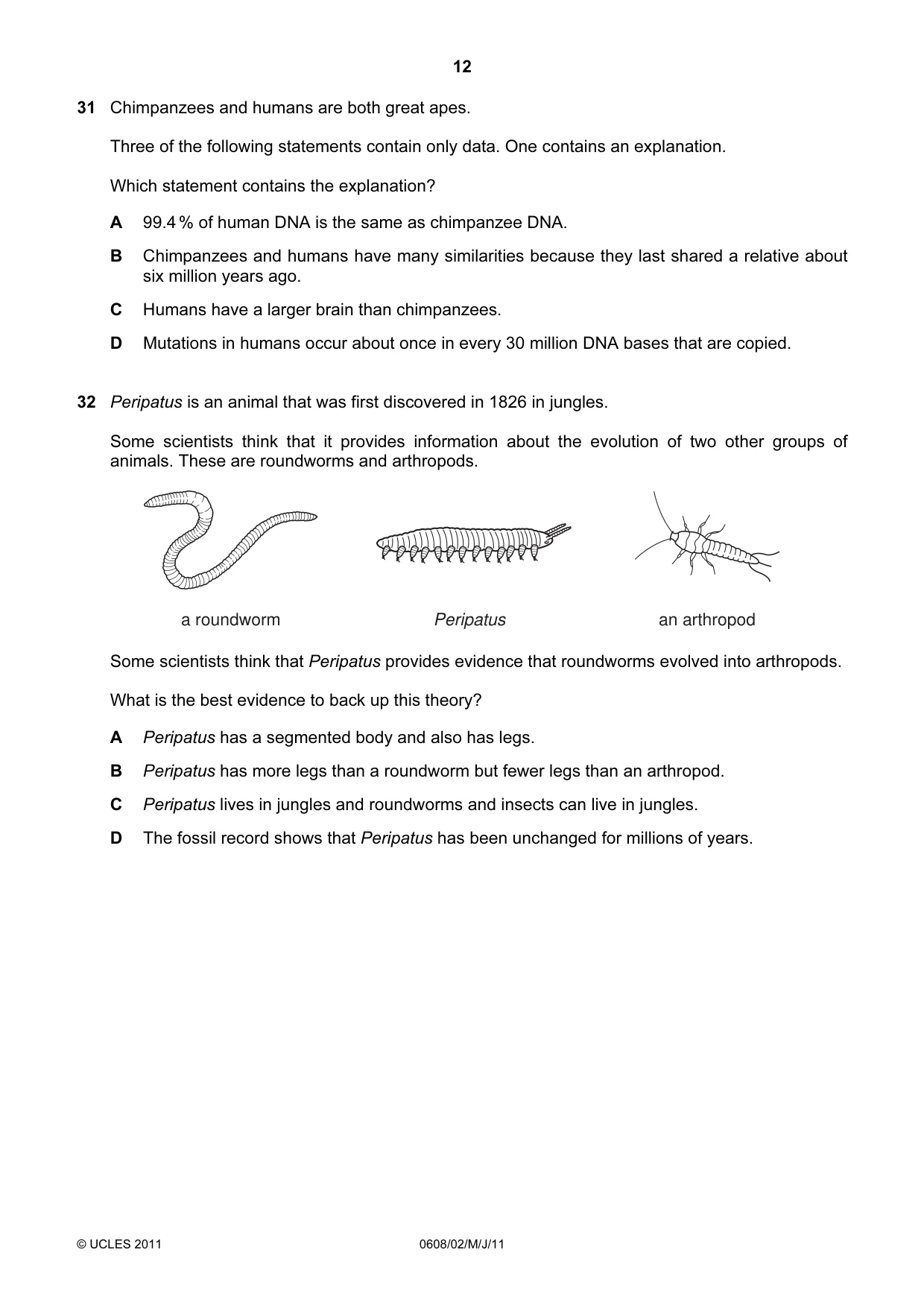
12 © UCLES 2011 0608/02/M/J/11 31 Chimpanzees and humans are both great apes. Three of the following statements contain only data. One contains an explanation. Which statement contains the explanation? A 99.4 % of human DNA is the same as chimpanzee DNA. B Chimpanzees and humans have many similarities because they last shared a relative about six million years ago. C Humans have a larger brain than chimpanzees. D Mutations in humans occur about once in every 30 million DNA bases that are copied. 32 Peripatus is an animal that was first discovered in 1826 in jungles. Some scientists think that it provides information about the evolution of two other groups of animals. These are roundworms and arthropods. a roundworm Peripatus an arthropod Some scientists think that Peripatus provides evidence that roundworms evolved into arthropods. What is the best evidence to back up this theory? A Peripatus has a segmented body and also has legs. B Peripatus has more legs than a roundworm but fewer legs than an arthropod. C Peripatus lives in jungles and roundworms and insects can live in jungles. D The fossil record shows that Peripatus has been unchanged for millions of years.
Question paper, page 13
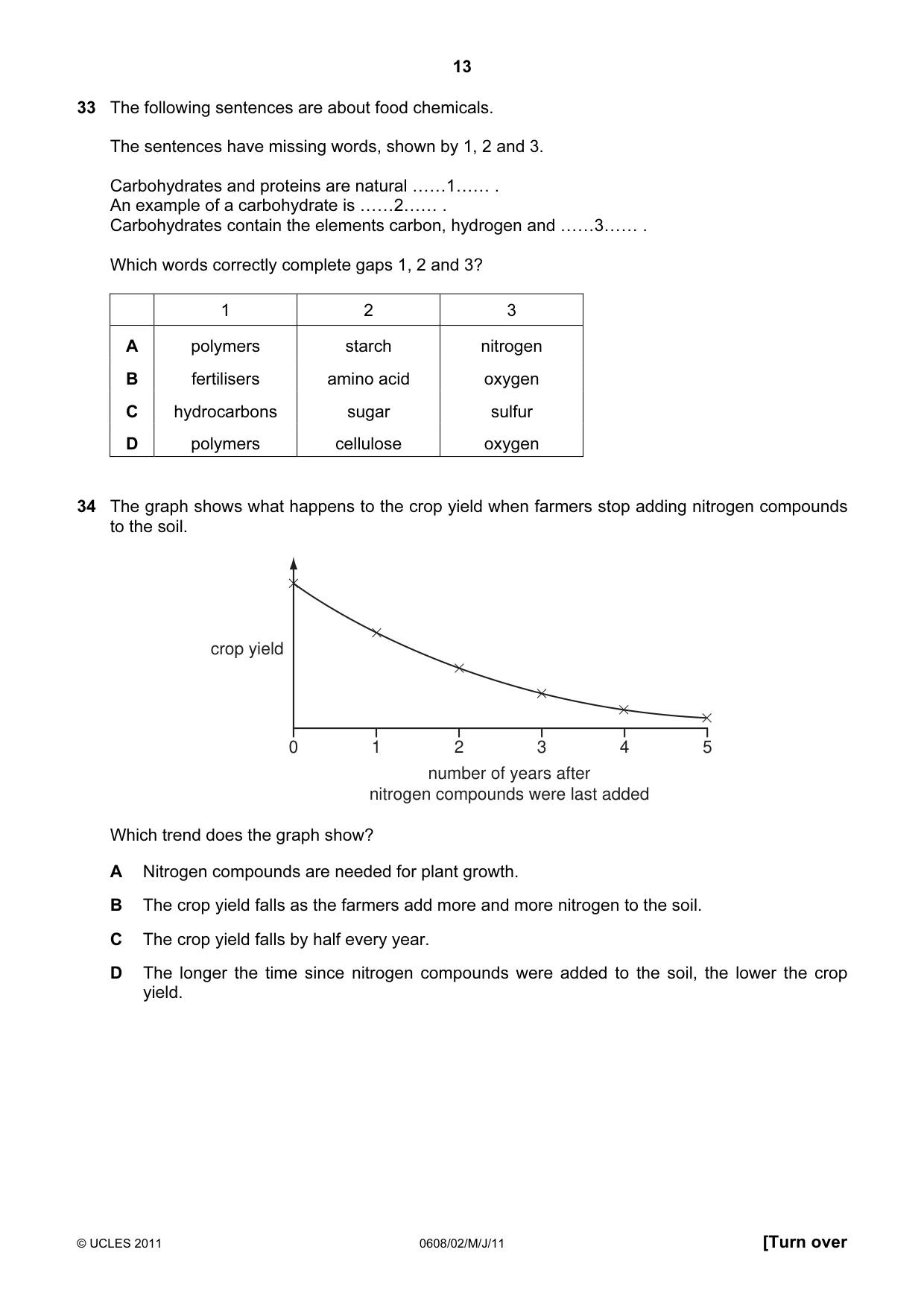
13 © UCLES 2011 0608/02/M/J/11 [Turn over 33 The following sentences are about food chemicals. The sentences have missing words, shown by 1, 2 and 3. Carbohydrates and proteins are natural ……1…… . An example of a carbohydrate is ……2…… . Carbohydrates contain the elements carbon, hydrogen and ……3…… . Which words correctly complete gaps 1, 2 and 3? 1 2 3 A polymers starch nitrogen B fertilisers amino acid oxygen C hydrocarbons sugar sulfur D polymers cellulose oxygen 34 The graph shows what happens to the crop yield when farmers stop adding nitrogen compounds to the soil. 0 1 2 3 4 5 number of years after nitrogen compounds were last added crop yield Which trend does the graph show? A Nitrogen compounds are needed for plant growth. B The crop yield falls as the farmers add more and more nitrogen to the soil. C The crop yield falls by half every year. D The longer the time since nitrogen compounds were added to the soil, the lower the crop yield.
Question paper, page 14
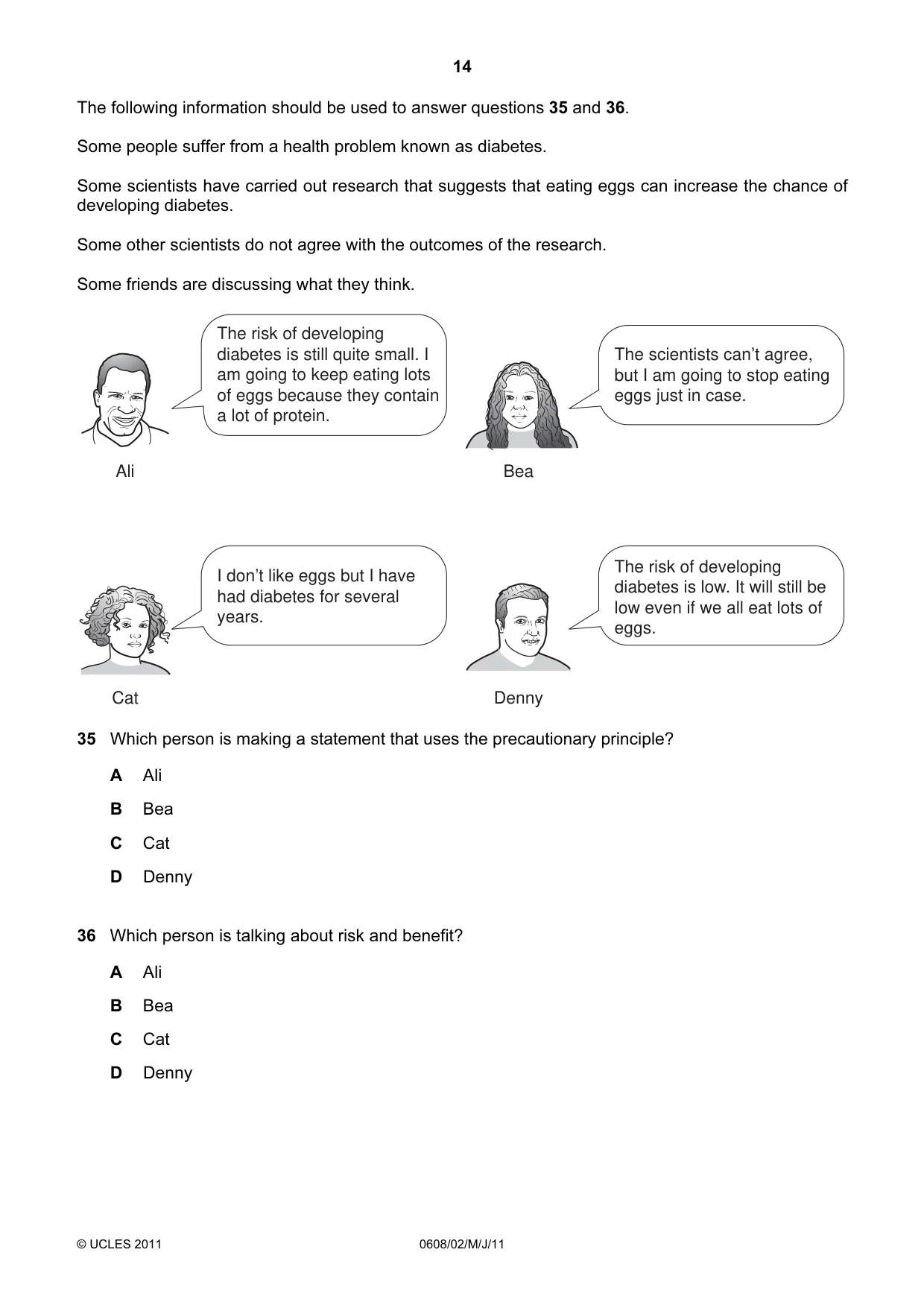
14 © UCLES 2011 0608/02/M/J/11 The following information should be used to answer questions 35 and 36. Some people suffer from a health problem known as diabetes. Some scientists have carried out research that suggests that eating eggs can increase the chance of developing diabetes. Some other scientists do not agree with the outcomes of the research. Some friends are discussing what they think. The risk of developing diabetes is still quite small. I am going to keep eating lots of eggs because they contain a lot of protein. The scientists can’t agree, but I am going to stop eating eggs just in case. I don’t like eggs but I have had diabetes for several years. The risk of developing diabetes is low. It will still be low even if we all eat lots of eggs. Ali Cat Bea Denny 35 Which person is making a statement that uses the precautionary principle? A Ali B Bea C Cat D Denny 36 Which person is talking about risk and benefit? A Ali B Bea C Cat D Denny
Question paper, page 15
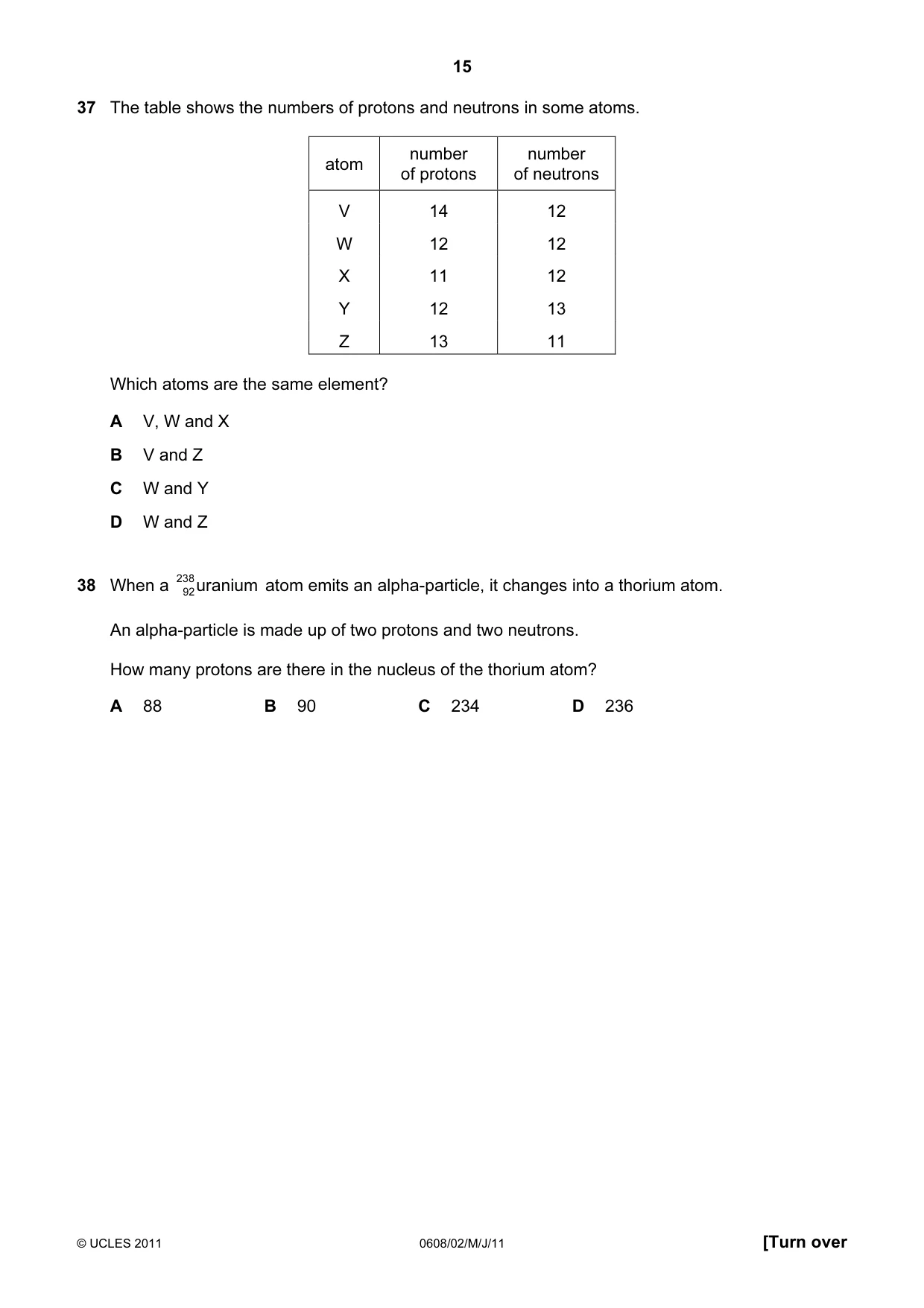
15 © UCLES 2011 0608/02/M/J/11 [Turn over 37 The table shows the numbers of protons and neutrons in some atoms. atom number of protons number of neutrons V 14 12 W 12 12 X 11 12 Y 12 13 Z 13 11 Which atoms are the same element? A V, W and X B V and Z C W and Y D W and Z 38 When a uranium 238 92 atom emits an alpha-particle, it changes into a thorium atom. An alpha-particle is made up of two protons and two neutrons. How many protons are there in the nucleus of the thorium atom? A 88 B 90 C 234 D 236
Question paper, page 16
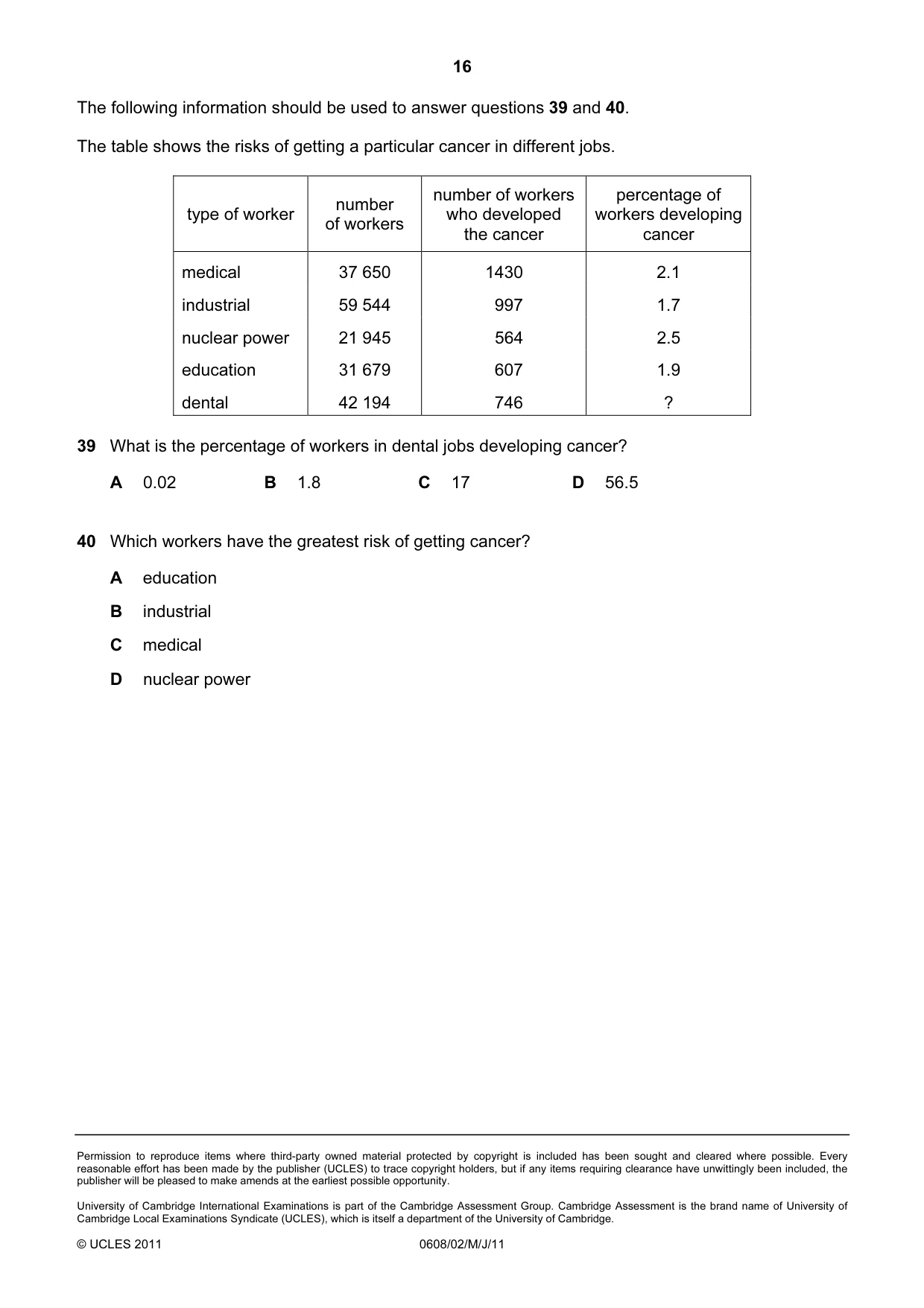
16 Permission to reproduce items where third-party owned material protected by copyright is included has been sought and cleared where possible. Every reasonable effort has been made by the publisher (UCLES) to trace copyright holders, but if any items requiring clearance have unwittingly been included, the publisher will be pleased to make amends at the earliest possible opportunity. University of Cambridge International Examinations is part of the Cambridge Assessment Group. Cambridge Assessment is the brand name of University of Cambridge Local Examinations Syndicate (UCLES), which is itself a department of the University of Cambridge. © UCLES 2011 0608/02/M/J/11 The following information should be used to answer questions 39 and 40. The table shows the risks of getting a particular cancer in different jobs. type of worker number of workers number of workers who developed the cancer percentage of workers developing cancer medical 37 650 1430 2.1 industrial 59 544 997 1.7 nuclear power 21 945 564 2.5 education 31 679 607 1.9 dental 42 194 746 ? 39 What is the percentage of workers in dental jobs developing cancer? A 0.02 B 1.8 C 17 D 56.5 40 Which workers have the greatest risk of getting cancer? A education B industrial C medical D nuclear power
Mark scheme, page 1
UNIVERSITY OF CAMBRIDGE INTERNATIONAL EXAMINATIONS International General Certificate of Secondary Education MARK SCHEME for the May/June 2011 question paper for the guidance of teachers 0608 TWENTY-FIRST CENTURY SCIENCE 0608/02 Paper 2 (Multiple Choice – Extended), maximum raw mark 40 Mark schemes must be read in conjunction with the question papers and the report on the examination. • Cambridge will not enter into discussions or correspondence in connection with these mark schemes. Cambridge is publishing the mark schemes for the May/June 2011 question papers for most IGCSE, GCE Advanced Level and Advanced Subsidiary Level syllabuses and some Ordinary Level syllabuses. www.XtremePapers.com
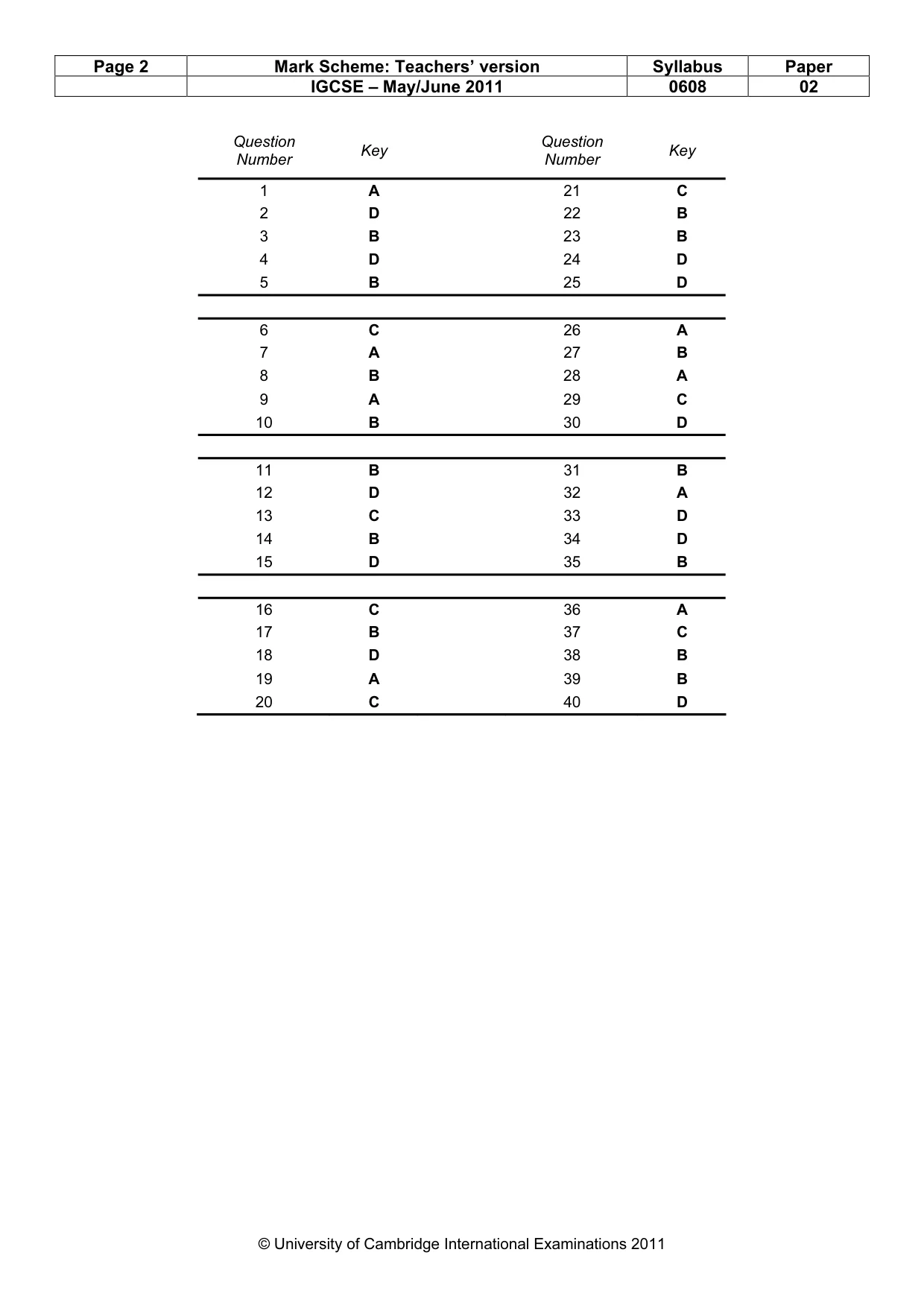
Mark scheme, page 2
Page 2 Mark Scheme: Teachers’ version Syllabus Paper IGCSE – May/June 2011 0608 02 © University of Cambridge International Examinations 2011 Question Number Key Question Number Key 1 A 21 C 2 D 22 B 3 B 23 B 4 D 24 D 5 B 25 D 6 C 26 A 7 A 27 B 8 B 28 A 9 A 29 C 10 B 30 D 11 B 31 B 12 D 32 A 13 C 33 D 14 B 34 D 15 D 35 B 16 C 36 A 17 B 37 C 18 D 38 B 19 A 39 B 20 C 40 D
What you needed in this session
Cambridge’s own grade thresholds for 2011 May/June, Paper 2 · Variant 1. A higher threshold means an easier paper — the bar moves with how the cohort did.