Cambridge IGCSE Travel and Tourism 0471 — 2017 Oct/Nov Paper 1 · Variant 1
0471/11/O/N/17 · 100 marks · ≈113 min
The question paper and its mark scheme, free to read here and free to download. This is Cambridge’s own paper, exactly as it was sat.
Question paper12 pages

Mark scheme12 pages
Answers below. Sit the paper first if you are practising.
Paper as text
Question paper, page 1
This document consists of 11 printed pages, 1 blank page and 1 Insert. DC (ST) 143333 © UCLES 2017 [Turn over * 6 7 4 6 7 1 7 2 0 9 * TRAVEL AND TOURISM 0471/11 Core Module October/November 2017 2 hours Candidates answer on the Question Paper. No Additional Materials are required. READ THESE INSTRUCTIONS FIRST Write your Centre number, candidate number and name on all the work you hand in. Write in dark blue or black pen. You may use an HB pencil for any diagrams or graphs. Do not use staples, paper clips, glue or correction fluid. DO NOT WRITE IN ANY BARCODES. Answer all questions. All Figures referred to in the questions are contained in the Insert. The number of marks is given in brackets [ ] at the end of each question or part question. Cambridge International Examinations Cambridge International General Certificate of Secondary Education
Question paper, page 2
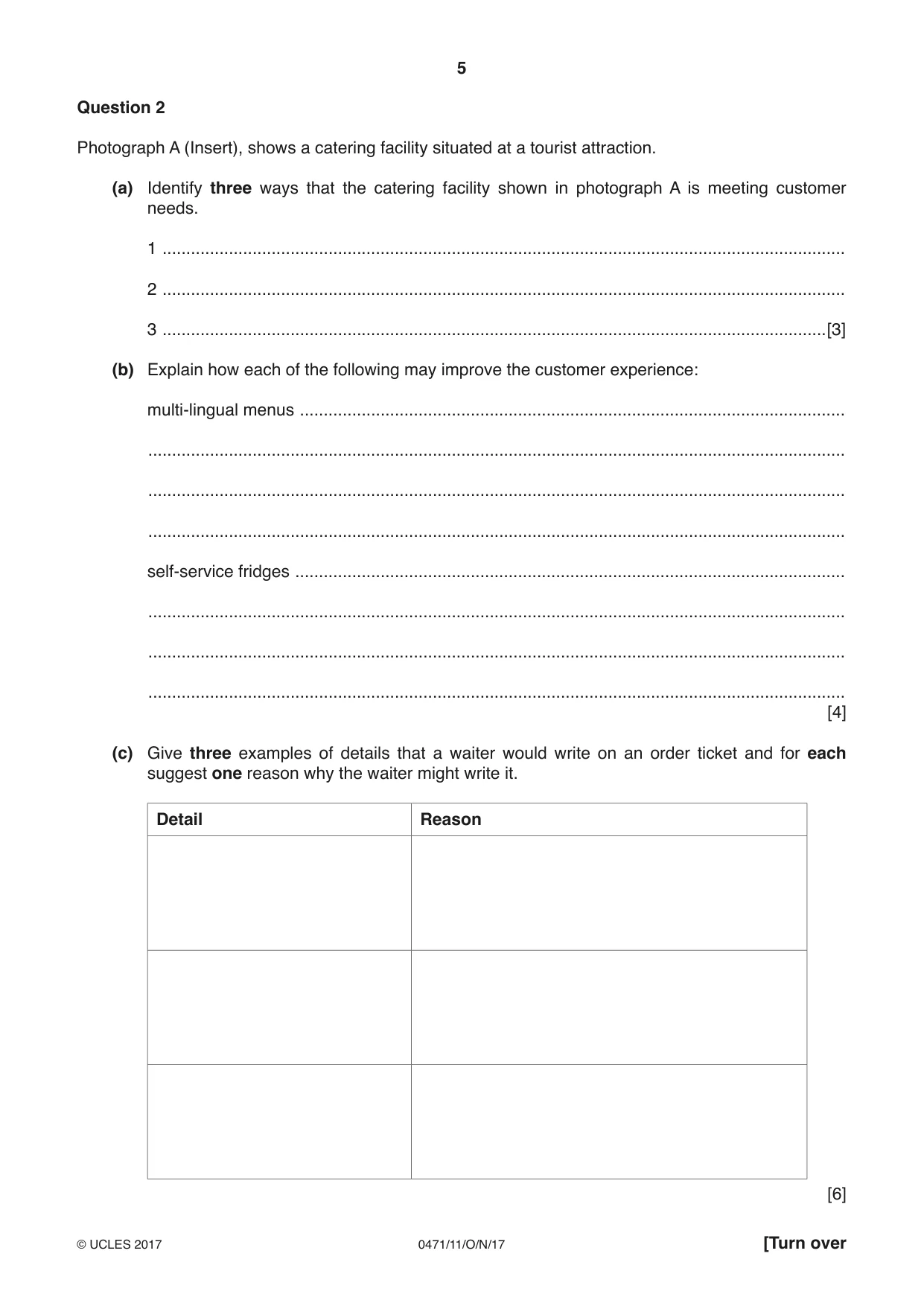
2 0471/11/O/N/17 © UCLES 2017 Question 1 Refer to Fig. 1 (Insert), information about Star Ferry, a ferry company in Hong Kong. (a) Identify the following: the number of passengers carried by Star Ferry per year … the number of routes operated by Star Ferry … [2] (b) Hong Kong is located on China’s south coast and is situated just south of the Tropic of Cancer. State the climate of Hong Kong. …[1] (c) Explain two ways that transport organisations, such as Star Ferry, can minimise their environmental impact. 1 … … … … 2 … … … …[4]
Question paper, page 3
3 0471/11/O/N/17 © UCLES 2017 [Turn over (d) State three services that may be provided aboard international ferries and for each give one benefit to the passenger. Service Benefit [6] (e) Explain three ways that local people may be affected when transport services become popular with tourists. 1 … … … … 2 … … … … 3 … … … …[6]
Question paper, page 4
4 0471/11/O/N/17 © UCLES 2017 (f) Discuss the benefit of looking at tourist reviews sites when planning journeys. … … … … … … … … … … … …[6] [Total: 25]
Question paper, page 5
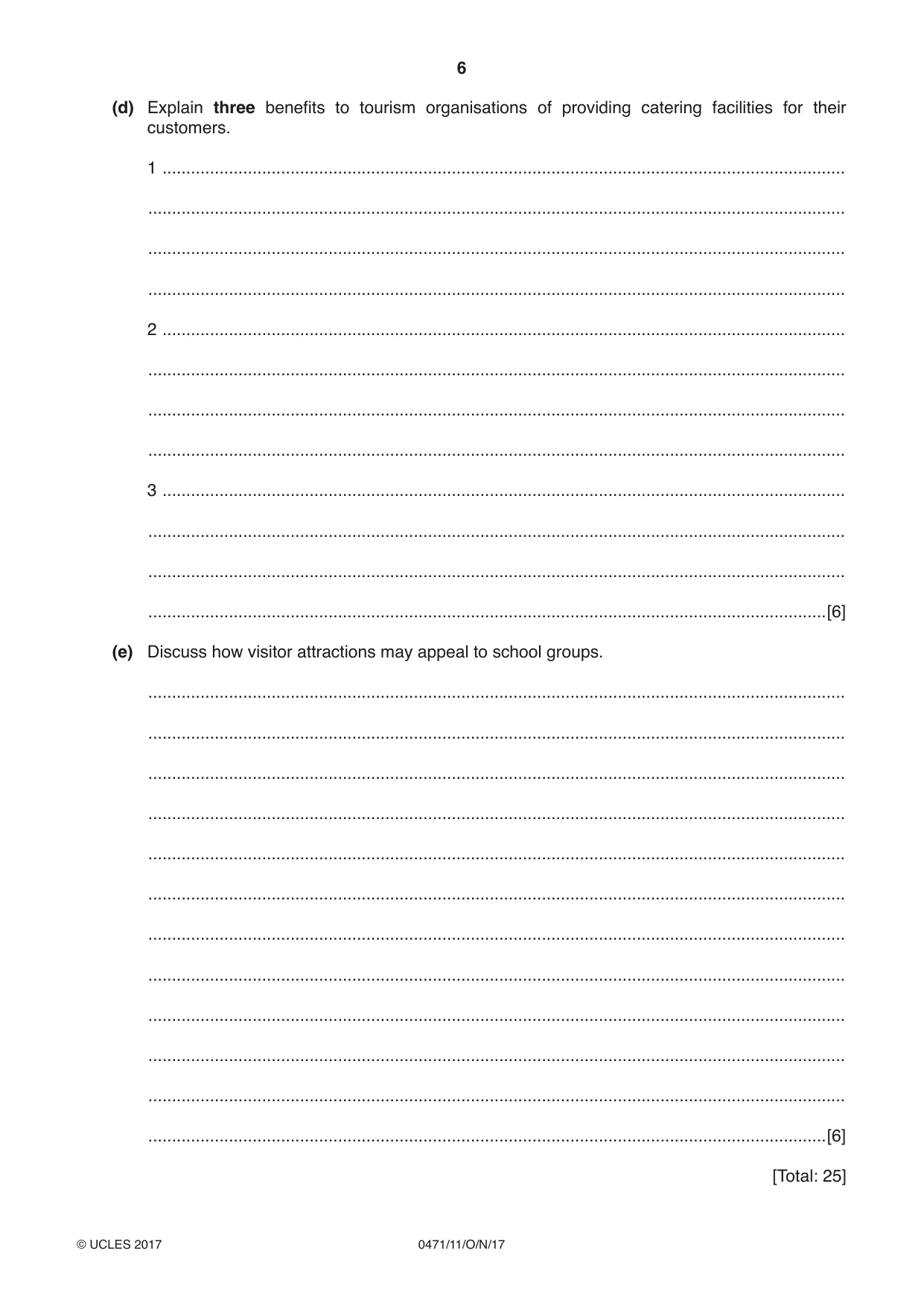
5 0471/11/O/N/17 © UCLES 2017 [Turn over Question 2 Photograph A (Insert), shows a catering facility situated at a tourist attraction. (a) Identify three ways that the catering facility shown in photograph A is meeting customer needs. 1 … 2 … 3 …[3] (b) Explain how each of the following may improve the customer experience: multi-lingual menus … … … … self-service fridges … … … … [4] (c) Give three examples of details that a waiter would write on an order ticket and for each suggest one reason why the waiter might write it. Detail Reason [6]
Question paper, page 6
6 0471/11/O/N/17 © UCLES 2017 (d) Explain three benefits to tourism organisations of providing catering facilities for their customers. 1 … … … … 2 … … … … 3 … … … …[6] (e) Discuss how visitor attractions may appeal to school groups. … … … … … … … … … … … …[6] [Total: 25]
Question paper, page 7
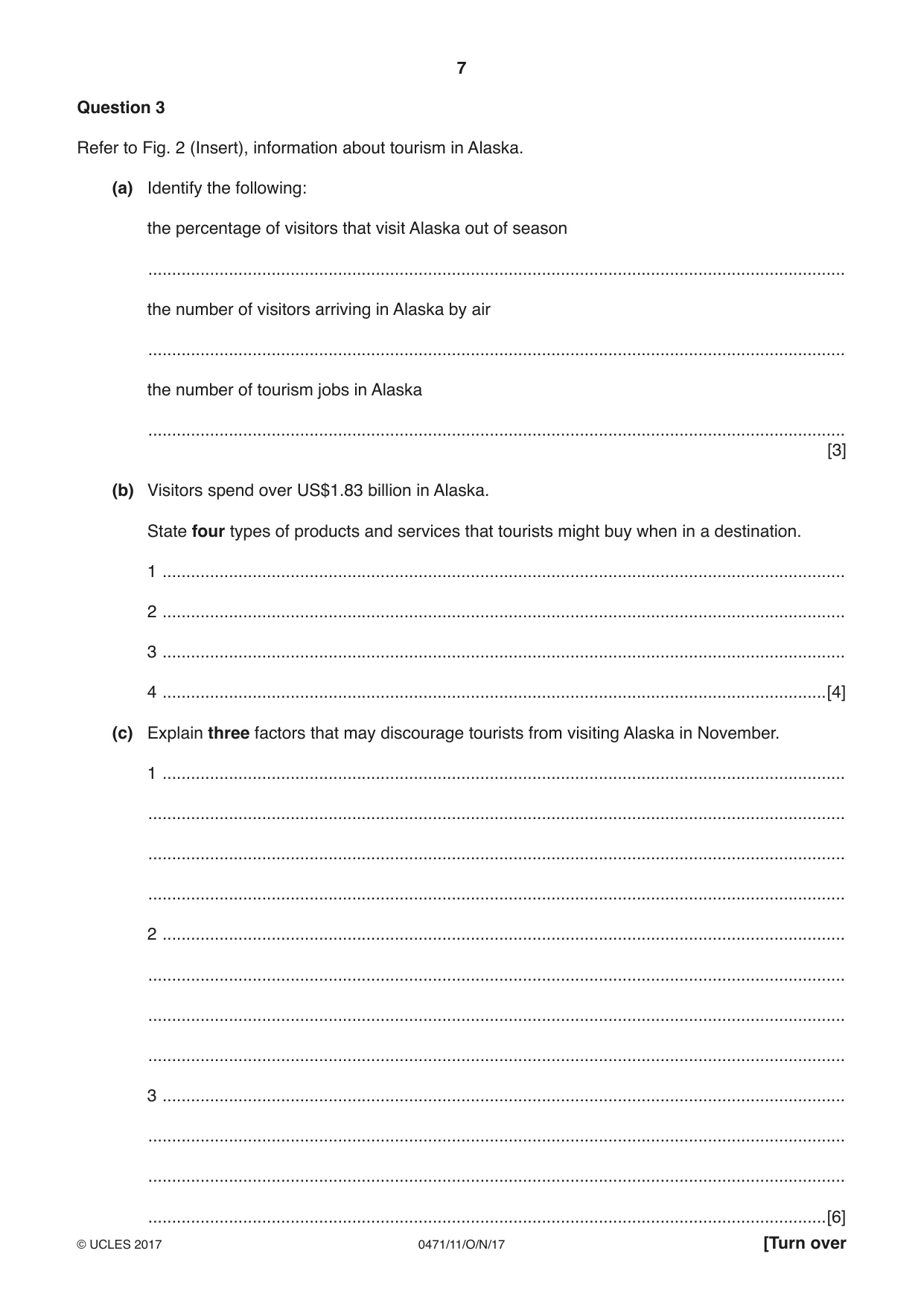
7 0471/11/O/N/17 © UCLES 2017 [Turn over Question 3 Refer to Fig. 2 (Insert), information about tourism in Alaska. (a) Identify the following: the percentage of visitors that visit Alaska out of season … the number of visitors arriving in Alaska by air … the number of tourism jobs in Alaska … [3] (b) Visitors spend over US$1.83 billion in Alaska. State four types of products and services that tourists might buy when in a destination. 1 … 2 … 3 … 4 …[4] (c) Explain three factors that may discourage tourists from visiting Alaska in November. 1 … … … … 2 … … … … 3 … … … …[6]
Question paper, page 8
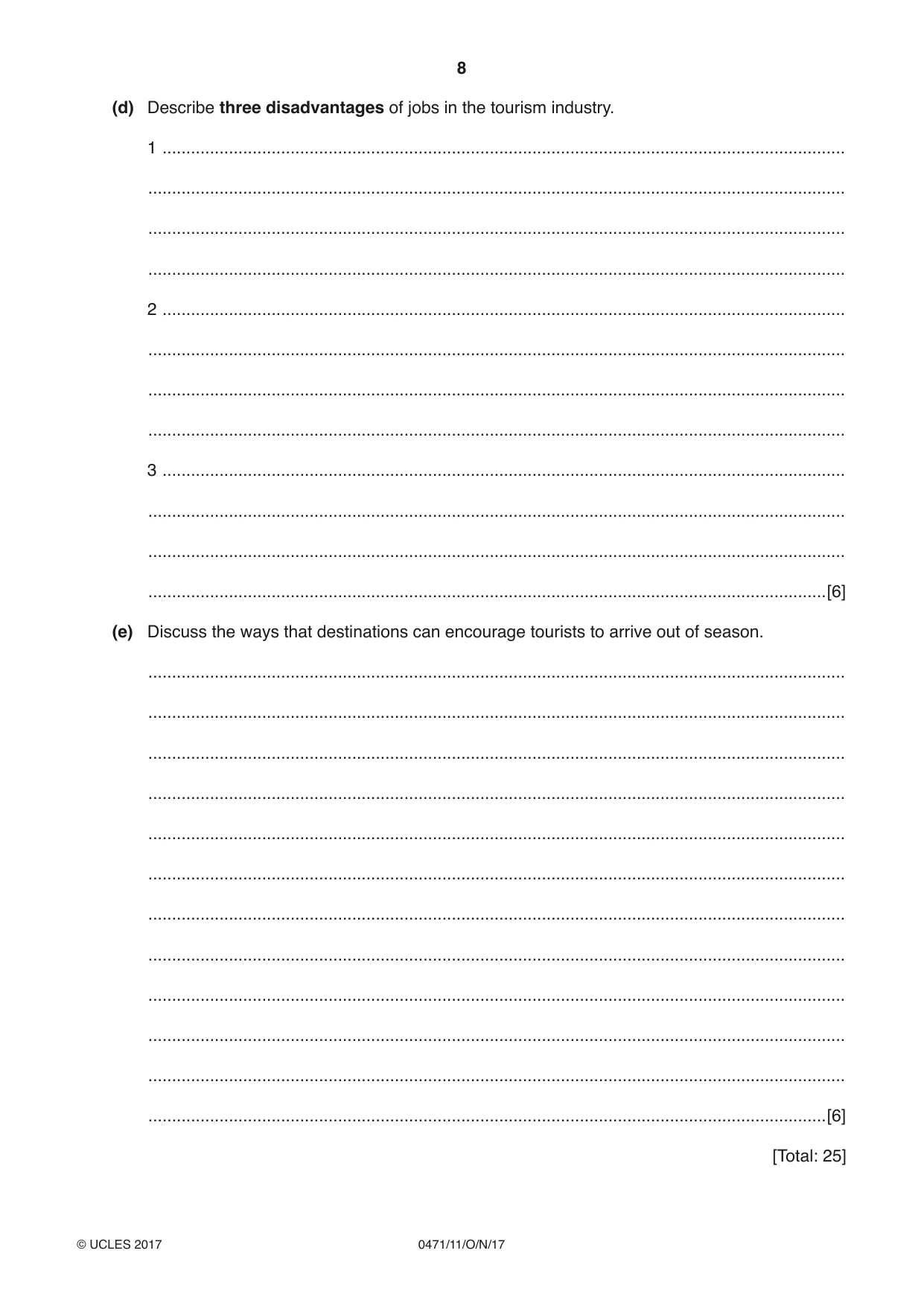
8 0471/11/O/N/17 © UCLES 2017 (d) Describe three disadvantages of jobs in the tourism industry. 1 … … … … 2 … … … … 3 … … … …[6] (e) Discuss the ways that destinations can encourage tourists to arrive out of season. … … … … … … … … … … … …[6] [Total: 25]
Question paper, page 9
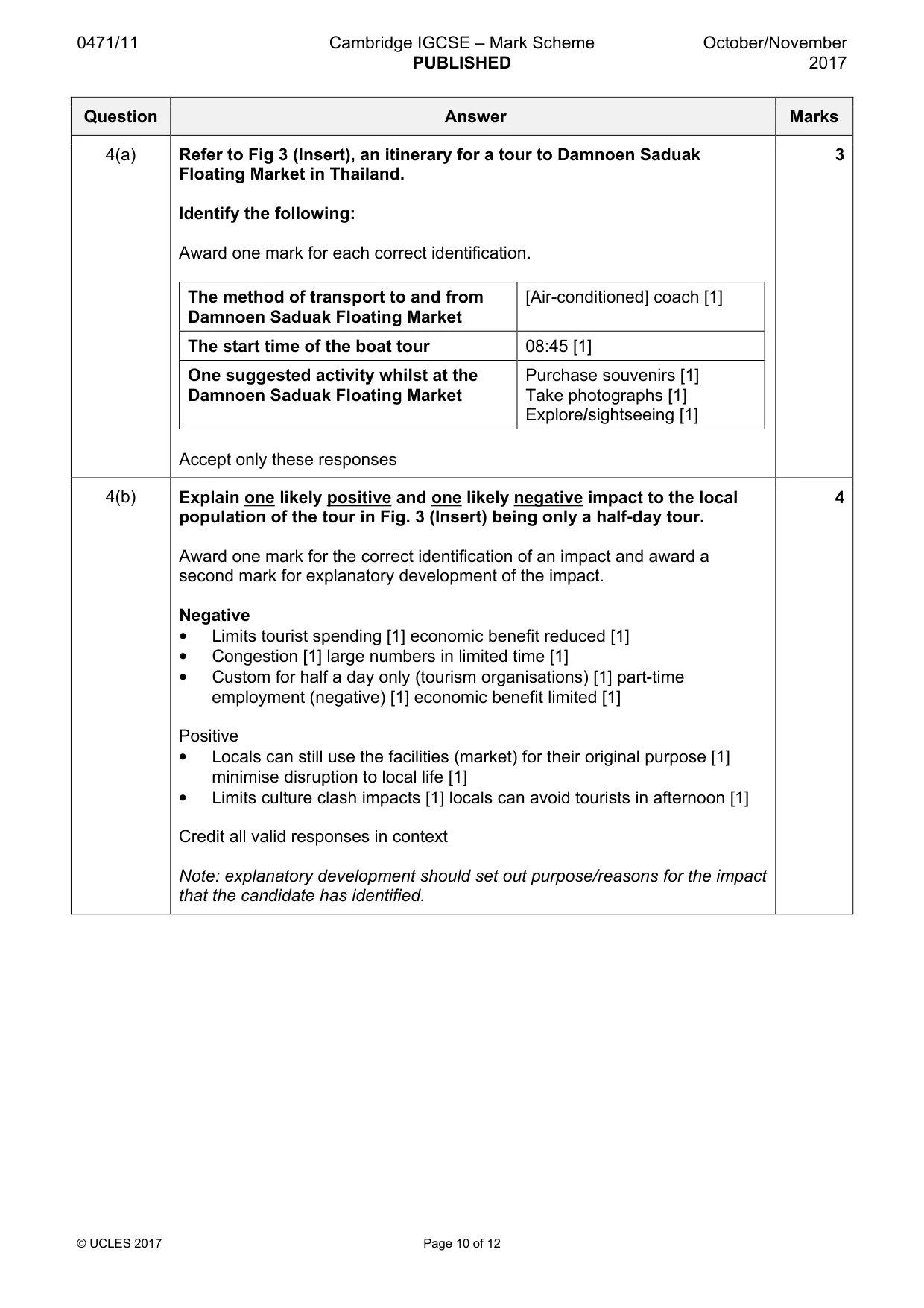
9 0471/11/O/N/17 © UCLES 2017 [Turn over Question 4 Refer to Fig. 3 (Insert), an itinerary for a tour to Damnoen Saduak Floating Market in Thailand. (a) Identify the following: the method of transport to and from Damnoen Saduak Floating Market … the start time of the boat tour … one suggested activity whilst at the Damnoen Saduak Floating Market … [3] (b) Explain one likely positive and one likely negative impact to the local population of the tour in Fig. 3 (Insert) being only a half-day tour. negative impact … … … … positive impact … … … … [4]
Question paper, page 10
10 0471/11/O/N/17 © UCLES 2017 (c) Explain three benefits to tour operators of using local tour guides. 1 … … … … 2 … … … … 3 … … … …[6] (d) Describe three features of a destination that may appeal to budget travellers. 1 … … … … 2 … … … … 3 … … … …[6]
Question paper, page 11
11 0471/11/O/N/17 © UCLES 2017 (e) Discuss the appeal of all-inclusive holidays to families. … … … … … … … … … … … …[6] [Total: 25]
Question paper, page 12
12 0471/11/O/N/17 © UCLES 2017 Permission to reproduce items where third-party owned material protected by copyright is included has been sought and cleared where possible. Every reasonable effort has been made by the publisher (UCLES) to trace copyright holders, but if any items requiring clearance have unwittingly been included, the publisher will be pleased to make amends at the earliest possible opportunity. To avoid the issue of disclosure of answer-related information to candidates, all copyright acknowledgements are reproduced online in the Cambridge International Examinations Copyright Acknowledgements Booklet. This is produced for each series of examinations and is freely available to download at www.cie.org.uk after the live examination series. Cambridge International Examinations is part of the Cambridge Assessment Group. Cambridge Assessment is the brand name of University of Cambridge Local Examinations Syndicate (UCLES), which is itself a department of the University of Cambridge. BLANK PAGE
Mark scheme, page 1
® IGCSE is a registered trademark. This document consists of 12 printed pages. © UCLES 2017 [Turn over Cambridge Assessment International Education Cambridge International General Certificate of Secondary Education TRAVEL AND TOURISM 0471/11 Paper 1 Core Module October/November 2017 MARK SCHEME Maximum Mark: 100 Published This mark scheme is published as an aid to teachers and candidates, to indicate the requirements of the examination. It shows the basis on which Examiners were instructed to award marks. It does not indicate the details of the discussions that took place at an Examiners’ meeting before marking began, which would have considered the acceptability of alternative answers. Mark schemes should be read in conjunction with the question paper and the Principal Examiner Report for Teachers. Cambridge International will not enter into discussions about these mark schemes. Cambridge International is publishing the mark schemes for the October/November 2017 series for most Cambridge IGCSE®, Cambridge International A and AS Level components and some Cambridge O Level components.
Mark scheme, page 2
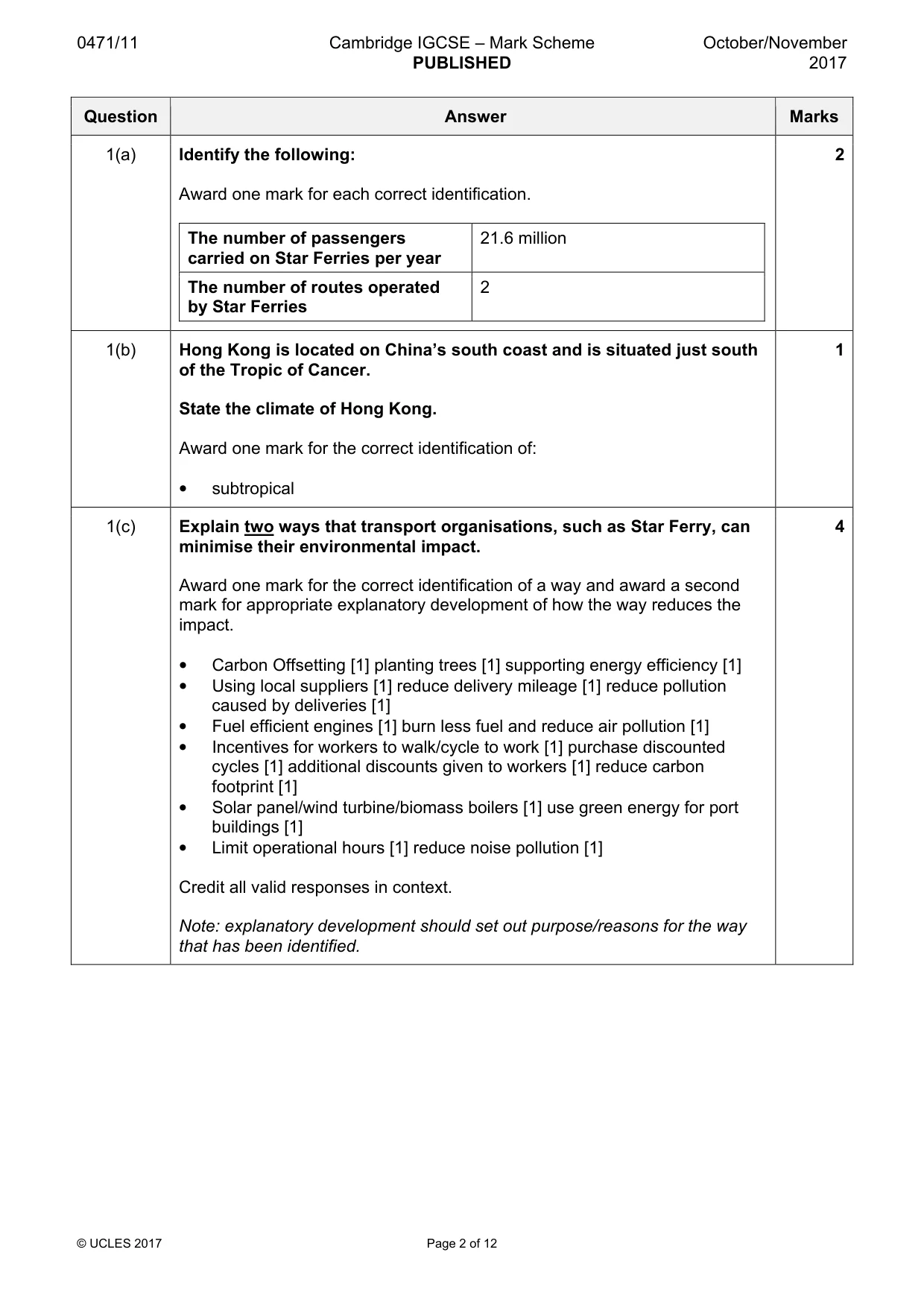
0471/11 Cambridge IGCSE – Mark Scheme PUBLISHED October/November 2017 © UCLES 2017 Page 2 of 12 Question Answer Marks 1(a) Identify the following: Award one mark for each correct identification. The number of passengers carried on Star Ferries per year 21.6 million The number of routes operated by Star Ferries 2 2 1(b) Hong Kong is located on China’s south coast and is situated just south of the Tropic of Cancer. State the climate of Hong Kong. Award one mark for the correct identification of: • subtropical 1 1(c) Explain two ways that transport organisations, such as Star Ferry, can minimise their environmental impact. Award one mark for the correct identification of a way and award a second mark for appropriate explanatory development of how the way reduces the impact. • Carbon Offsetting [1] planting trees [1] supporting energy efficiency [1] • Using local suppliers [1] reduce delivery mileage [1] reduce pollution caused by deliveries [1] • Fuel efficient engines [1] burn less fuel and reduce air pollution [1] • Incentives for workers to walk/cycle to work [1] purchase discounted cycles [1] additional discounts given to workers [1] reduce carbon footprint [1] • Solar panel/wind turbine/biomass boilers [1] use green energy for port buildings [1] • Limit operational hours [1] reduce noise pollution [1] Credit all valid responses in context. Note: explanatory development should set out purpose/reasons for the way that has been identified. 4
Mark scheme, page 3
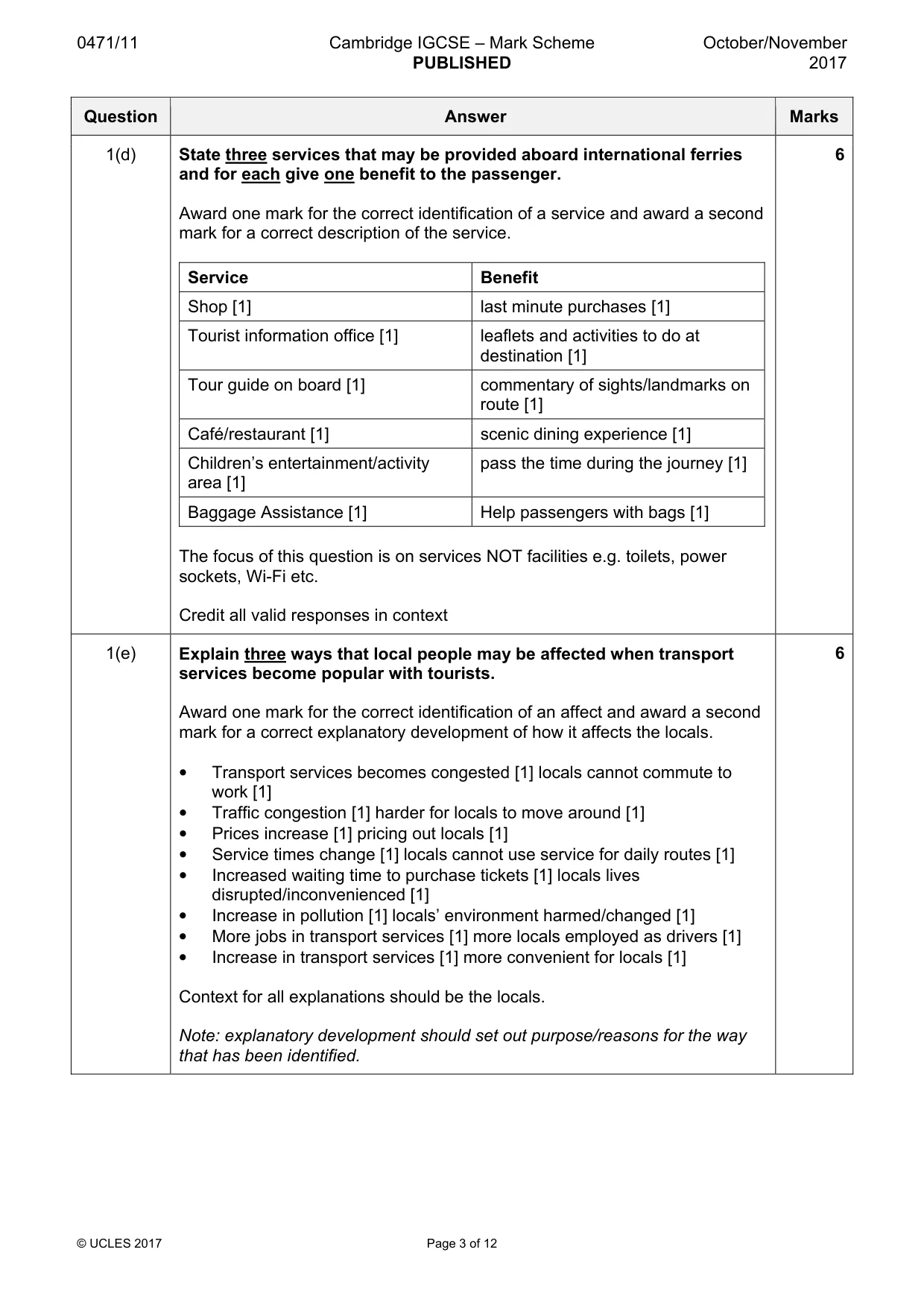
0471/11 Cambridge IGCSE – Mark Scheme PUBLISHED October/November 2017 © UCLES 2017 Page 3 of 12 Question Answer Marks 1(d) State three services that may be provided aboard international ferries and for each give one benefit to the passenger. Award one mark for the correct identification of a service and award a second mark for a correct description of the service. Service Benefit Shop [1] last minute purchases [1] Tourist information office [1] leaflets and activities to do at destination [1] Tour guide on board [1] commentary of sights/landmarks on route [1] Café/restaurant [1] scenic dining experience [1] Children’s entertainment/activity area [1] pass the time during the journey [1] Baggage Assistance [1] Help passengers with bags [1] The focus of this question is on services NOT facilities e.g. toilets, power sockets, Wi-Fi etc. Credit all valid responses in context 6 1(e) Explain three ways that local people may be affected when transport services become popular with tourists. Award one mark for the correct identification of an affect and award a second mark for a correct explanatory development of how it affects the locals. • Transport services becomes congested [1] locals cannot commute to work [1] • Traffic congestion [1] harder for locals to move around [1] • Prices increase [1] pricing out locals [1] • Service times change [1] locals cannot use service for daily routes [1] • Increased waiting time to purchase tickets [1] locals lives disrupted/inconvenienced [1] • Increase in pollution [1] locals’ environment harmed/changed [1] • More jobs in transport services [1] more locals employed as drivers [1] • Increase in transport services [1] more convenient for locals [1] Context for all explanations should be the locals. Note: explanatory development should set out purpose/reasons for the way that has been identified. 6
Mark scheme, page 4
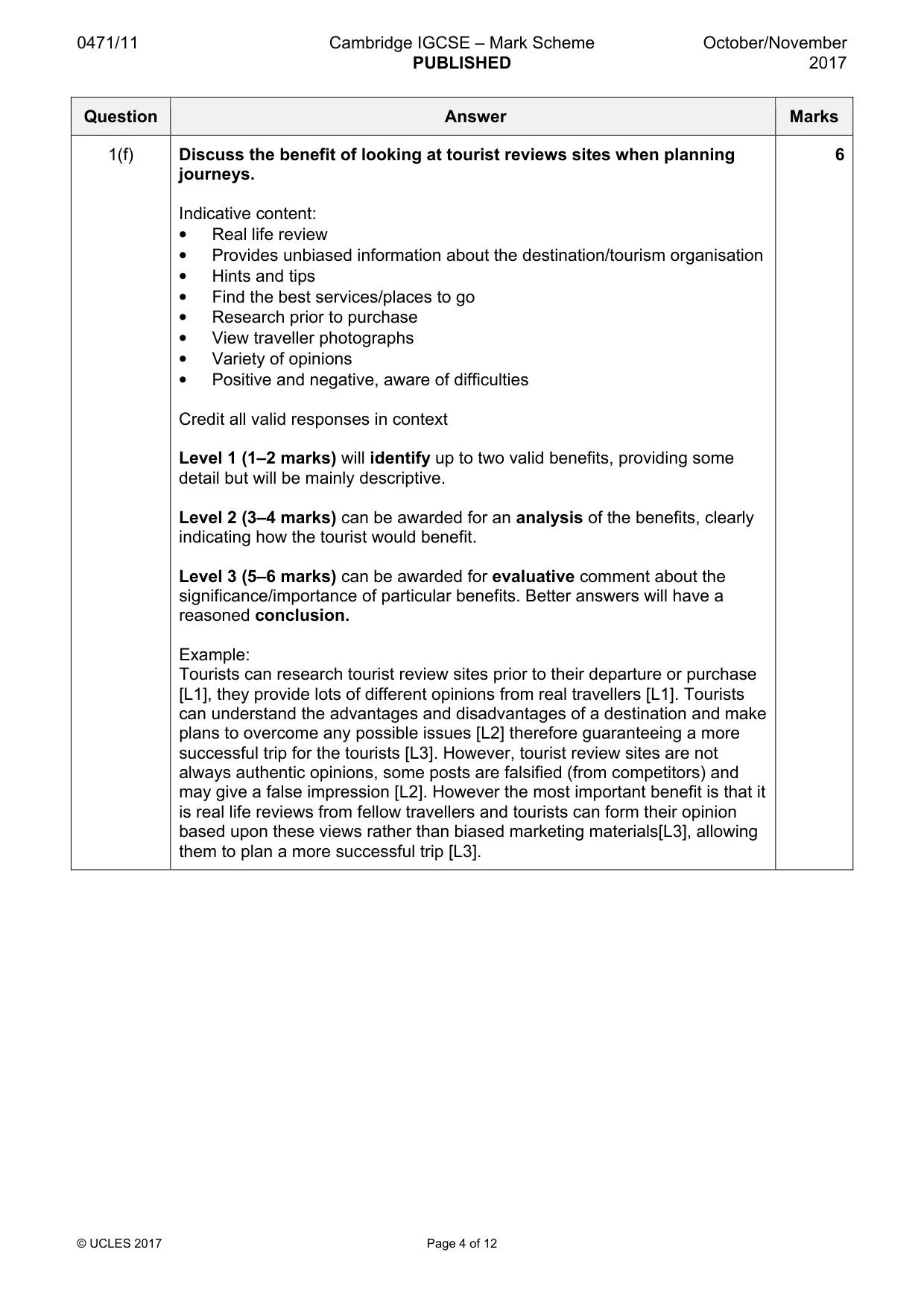
0471/11 Cambridge IGCSE – Mark Scheme PUBLISHED October/November 2017 © UCLES 2017 Page 4 of 12 Question Answer Marks 1(f) Discuss the benefit of looking at tourist reviews sites when planning journeys. Indicative content: • Real life review • Provides unbiased information about the destination/tourism organisation • Hints and tips • Find the best services/places to go • Research prior to purchase • View traveller photographs • Variety of opinions • Positive and negative, aware of difficulties Credit all valid responses in context Level 1 (1–2 marks) will identify up to two valid benefits, providing some detail but will be mainly descriptive. Level 2 (3–4 marks) can be awarded for an analysis of the benefits, clearly indicating how the tourist would benefit. Level 3 (5–6 marks) can be awarded for evaluative comment about the significance/importance of particular benefits. Better answers will have a reasoned conclusion. Example: Tourists can research tourist review sites prior to their departure or purchase [L1], they provide lots of different opinions from real travellers [L1]. Tourists can understand the advantages and disadvantages of a destination and make plans to overcome any possible issues [L2] therefore guaranteeing a more successful trip for the tourists [L3]. However, tourist review sites are not always authentic opinions, some posts are falsified (from competitors) and may give a false impression [L2]. However the most important benefit is that it is real life reviews from fellow travellers and tourists can form their opinion based upon these views rather than biased marketing materials[L3], allowing them to plan a more successful trip [L3]. 6
Mark scheme, page 5
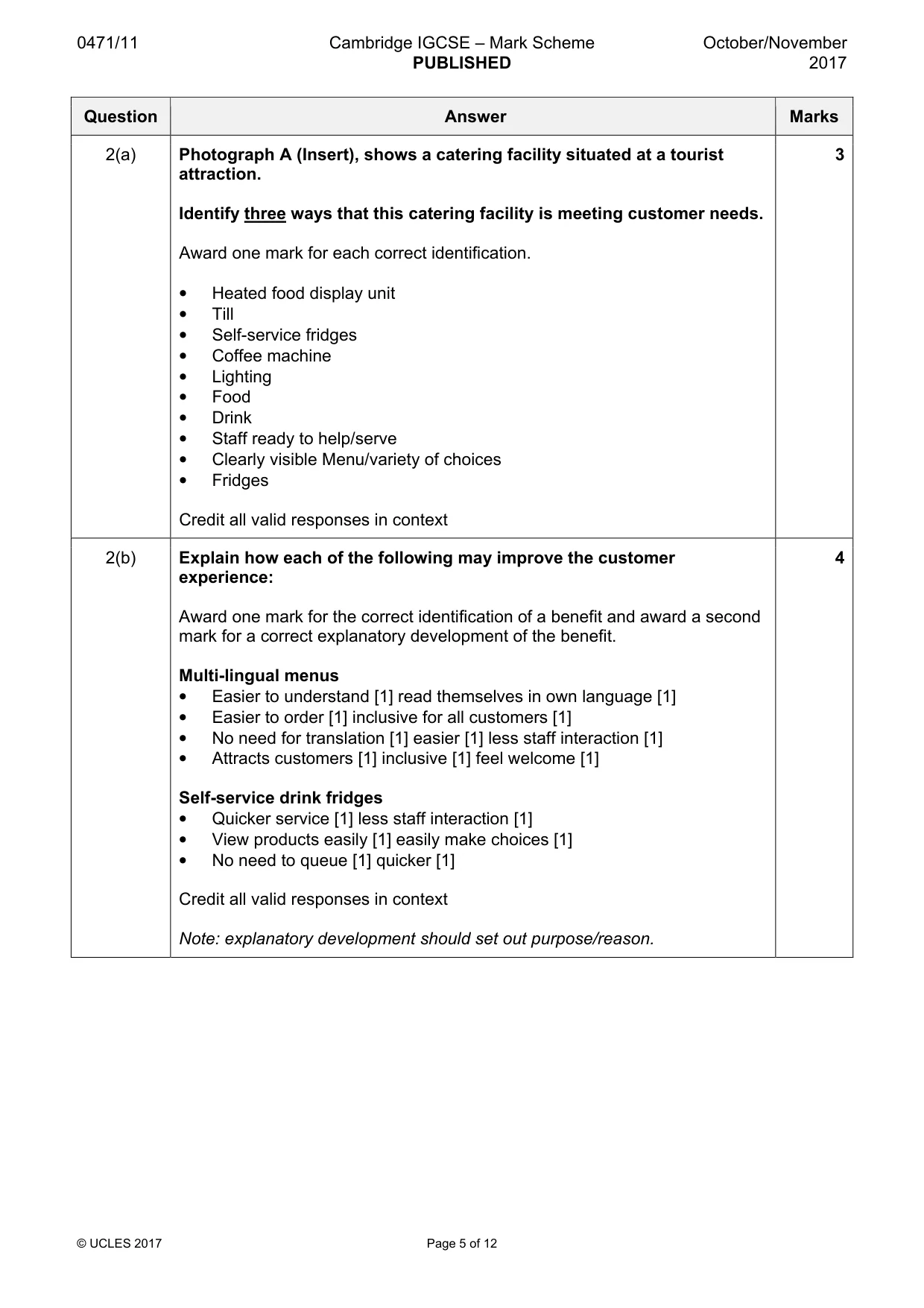
0471/11 Cambridge IGCSE – Mark Scheme PUBLISHED October/November 2017 © UCLES 2017 Page 5 of 12 Question Answer Marks 2(a) Photograph A (Insert), shows a catering facility situated at a tourist attraction. Identify three ways that this catering facility is meeting customer needs. Award one mark for each correct identification. • Heated food display unit • Till • Self-service fridges • Coffee machine • Lighting • Food • Drink • Staff ready to help/serve • Clearly visible Menu/variety of choices • Fridges Credit all valid responses in context 3 2(b) Explain how each of the following may improve the customer experience: Award one mark for the correct identification of a benefit and award a second mark for a correct explanatory development of the benefit. Multi-lingual menus • Easier to understand [1] read themselves in own language [1] • Easier to order [1] inclusive for all customers [1] • No need for translation [1] easier [1] less staff interaction [1] • Attracts customers [1] inclusive [1] feel welcome [1] Self-service drink fridges • Quicker service [1] less staff interaction [1] • View products easily [1] easily make choices [1] • No need to queue [1] quicker [1] Credit all valid responses in context Note: explanatory development should set out purpose/reason. 4
Mark scheme, page 6
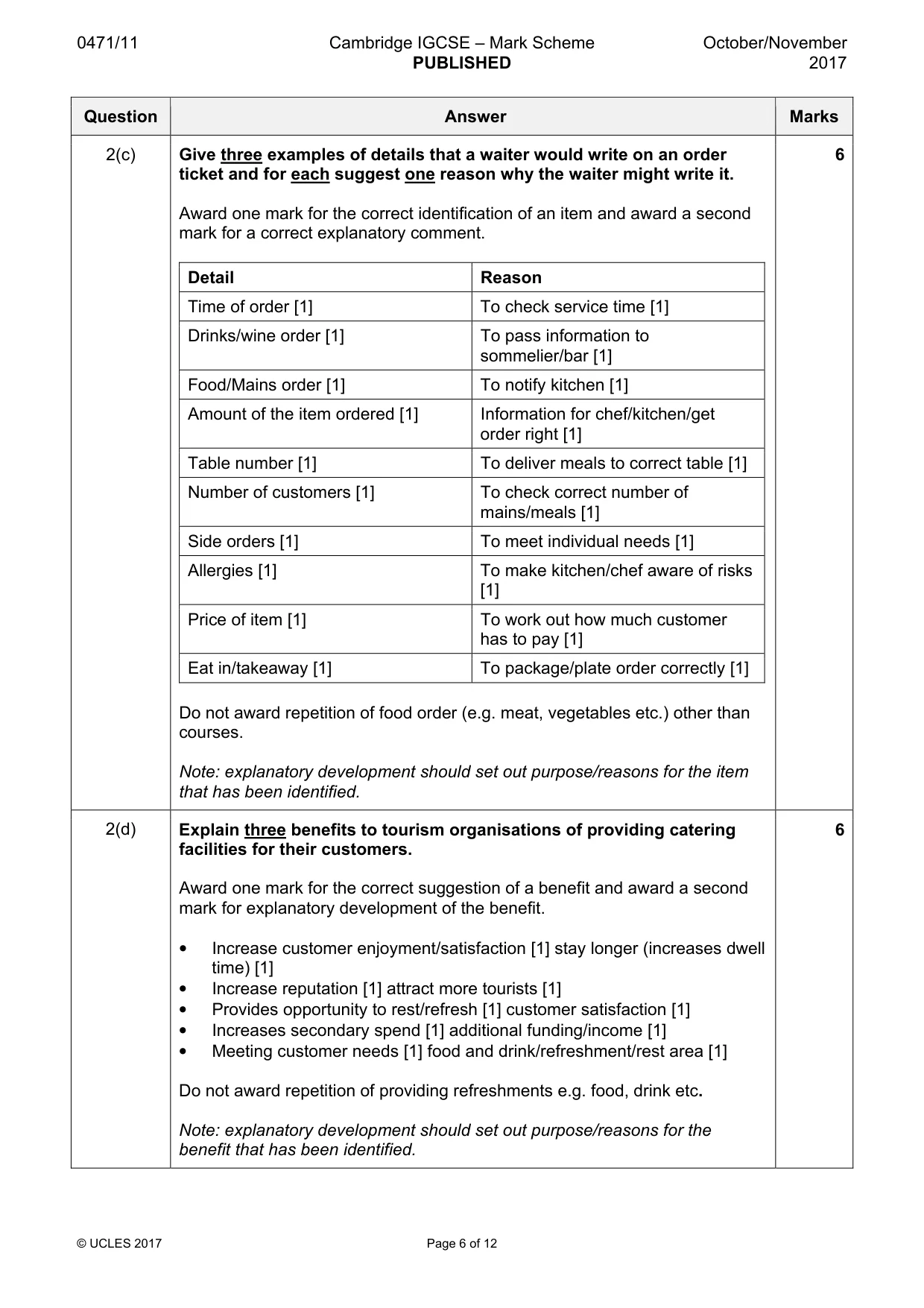
0471/11 Cambridge IGCSE – Mark Scheme PUBLISHED October/November 2017 © UCLES 2017 Page 6 of 12 Question Answer Marks 2(c) Give three examples of details that a waiter would write on an order ticket and for each suggest one reason why the waiter might write it. Award one mark for the correct identification of an item and award a second mark for a correct explanatory comment. Detail Reason Time of order [1] To check service time [1] Drinks/wine order [1] To pass information to sommelier/bar [1] Food/Mains order [1] To notify kitchen [1] Amount of the item ordered [1] Information for chef/kitchen/get order right [1] Table number [1] To deliver meals to correct table [1] Number of customers [1] To check correct number of mains/meals [1] Side orders [1] To meet individual needs [1] Allergies [1] To make kitchen/chef aware of risks [1] Price of item [1] To work out how much customer has to pay [1] Eat in/takeaway [1] To package/plate order correctly [1] Do not award repetition of food order (e.g. meat, vegetables etc.) other than courses. Note: explanatory development should set out purpose/reasons for the item that has been identified. 6 2(d) Explain three benefits to tourism organisations of providing catering facilities for their customers. Award one mark for the correct suggestion of a benefit and award a second mark for explanatory development of the benefit. • Increase customer enjoyment/satisfaction [1] stay longer (increases dwell time) [1] • Increase reputation [1] attract more tourists [1] • Provides opportunity to rest/refresh [1] customer satisfaction [1] • Increases secondary spend [1] additional funding/income [1] • Meeting customer needs [1] food and drink/refreshment/rest area [1] Do not award repetition of providing refreshments e.g. food, drink etc. Note: explanatory development should set out purpose/reasons for the benefit that has been identified. 6
Mark scheme, page 7
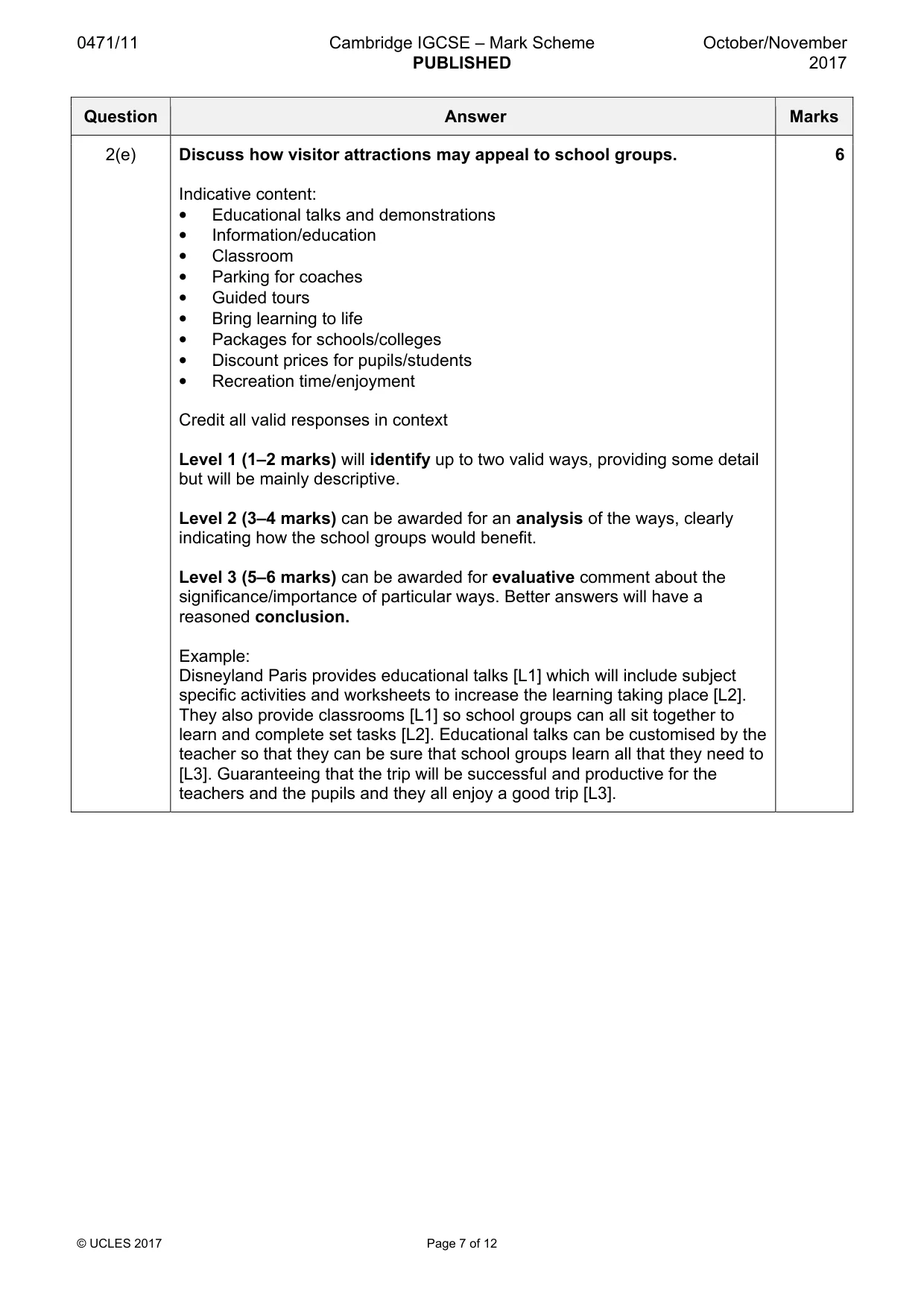
0471/11 Cambridge IGCSE – Mark Scheme PUBLISHED October/November 2017 © UCLES 2017 Page 7 of 12 Question Answer Marks 2(e) Discuss how visitor attractions may appeal to school groups. Indicative content: • Educational talks and demonstrations • Information/education • Classroom • Parking for coaches • Guided tours • Bring learning to life • Packages for schools/colleges • Discount prices for pupils/students • Recreation time/enjoyment Credit all valid responses in context Level 1 (1–2 marks) will identify up to two valid ways, providing some detail but will be mainly descriptive. Level 2 (3–4 marks) can be awarded for an analysis of the ways, clearly indicating how the school groups would benefit. Level 3 (5–6 marks) can be awarded for evaluative comment about the significance/importance of particular ways. Better answers will have a reasoned conclusion. Example: Disneyland Paris provides educational talks [L1] which will include subject specific activities and worksheets to increase the learning taking place [L2]. They also provide classrooms [L1] so school groups can all sit together to learn and complete set tasks [L2]. Educational talks can be customised by the teacher so that they can be sure that school groups learn all that they need to [L3]. Guaranteeing that the trip will be successful and productive for the teachers and the pupils and they all enjoy a good trip [L3]. 6
Mark scheme, page 8
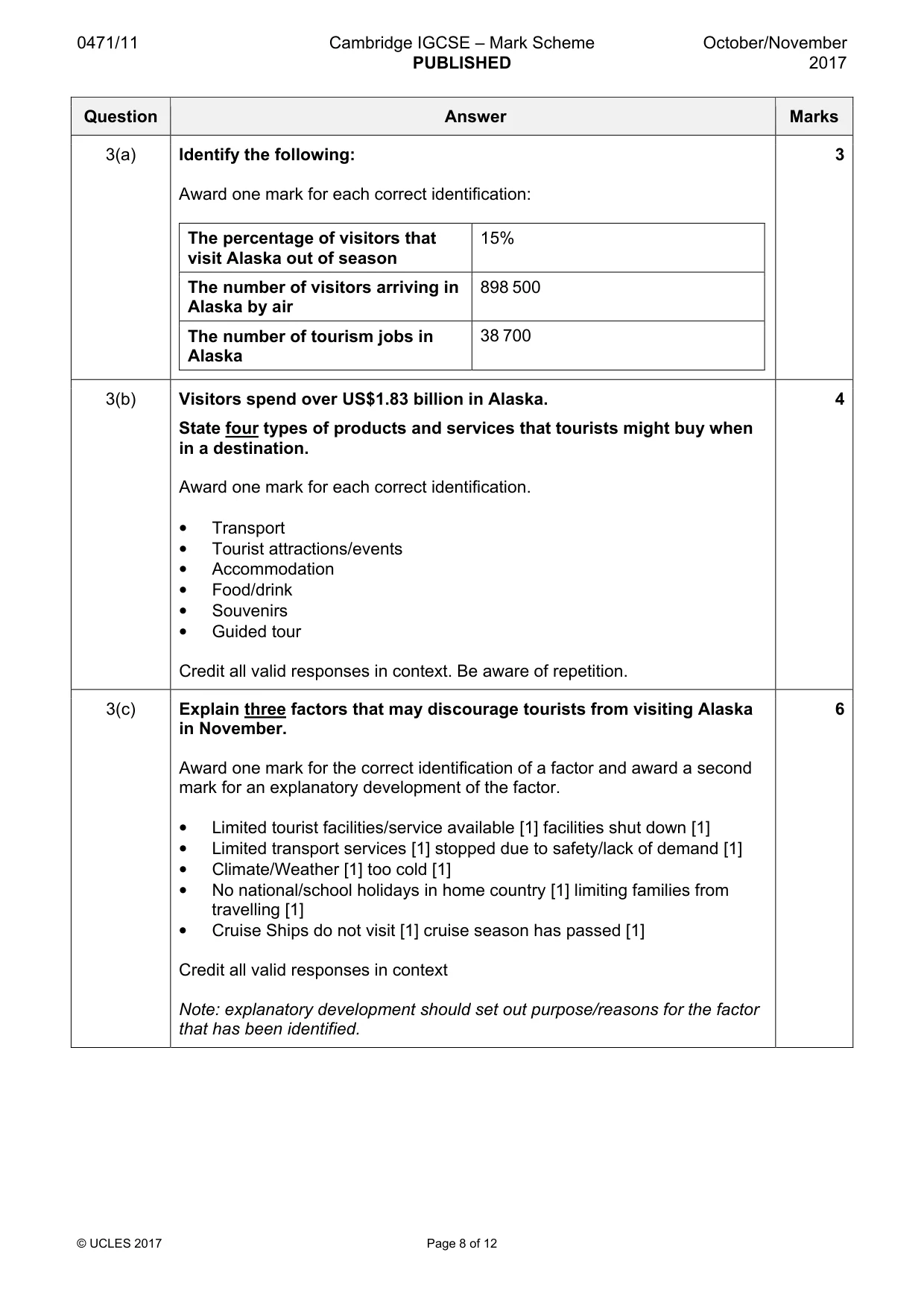
0471/11 Cambridge IGCSE – Mark Scheme PUBLISHED October/November 2017 © UCLES 2017 Page 8 of 12 Question Answer Marks 3(a) Identify the following: Award one mark for each correct identification: The percentage of visitors that visit Alaska out of season 15% The number of visitors arriving in Alaska by air 898 500 The number of tourism jobs in Alaska 38 700 3 3(b) Visitors spend over US$1.83 billion in Alaska. State four types of products and services that tourists might buy when in a destination. Award one mark for each correct identification. • Transport • Tourist attractions/events • Accommodation • Food/drink • Souvenirs • Guided tour Credit all valid responses in context. Be aware of repetition. 4 3(c) Explain three factors that may discourage tourists from visiting Alaska in November. Award one mark for the correct identification of a factor and award a second mark for an explanatory development of the factor. • Limited tourist facilities/service available [1] facilities shut down [1] • Limited transport services [1] stopped due to safety/lack of demand [1] • Climate/Weather [1] too cold [1] • No national/school holidays in home country [1] limiting families from travelling [1] • Cruise Ships do not visit [1] cruise season has passed [1] Credit all valid responses in context Note: explanatory development should set out purpose/reasons for the factor that has been identified. 6
Mark scheme, page 9
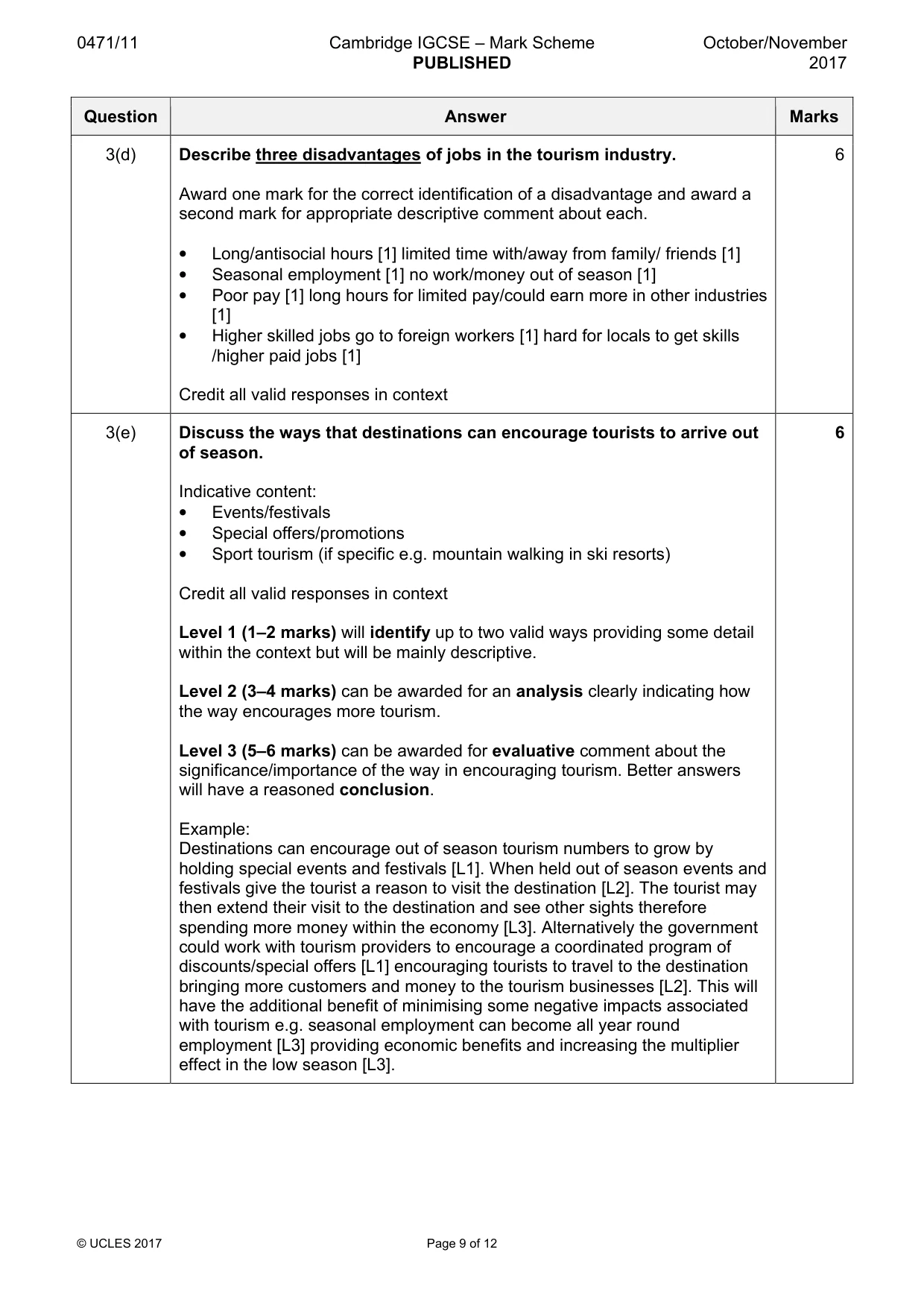
0471/11 Cambridge IGCSE – Mark Scheme PUBLISHED October/November 2017 © UCLES 2017 Page 9 of 12 Question Answer Marks 3(d) Describe three disadvantages of jobs in the tourism industry. Award one mark for the correct identification of a disadvantage and award a second mark for appropriate descriptive comment about each. • Long/antisocial hours [1] limited time with/away from family/ friends [1] • Seasonal employment [1] no work/money out of season [1] • Poor pay [1] long hours for limited pay/could earn more in other industries [1] • Higher skilled jobs go to foreign workers [1] hard for locals to get skills /higher paid jobs [1] Credit all valid responses in context 6 3(e) Discuss the ways that destinations can encourage tourists to arrive out of season. Indicative content: • Events/festivals • Special offers/promotions • Sport tourism (if specific e.g. mountain walking in ski resorts) Credit all valid responses in context Level 1 (1–2 marks) will identify up to two valid ways providing some detail within the context but will be mainly descriptive. Level 2 (3–4 marks) can be awarded for an analysis clearly indicating how the way encourages more tourism. Level 3 (5–6 marks) can be awarded for evaluative comment about the significance/importance of the way in encouraging tourism. Better answers will have a reasoned conclusion. Example: Destinations can encourage out of season tourism numbers to grow by holding special events and festivals [L1]. When held out of season events and festivals give the tourist a reason to visit the destination [L2]. The tourist may then extend their visit to the destination and see other sights therefore spending more money within the economy [L3]. Alternatively the government could work with tourism providers to encourage a coordinated program of discounts/special offers [L1] encouraging tourists to travel to the destination bringing more customers and money to the tourism businesses [L2]. This will have the additional benefit of minimising some negative impacts associated with tourism e.g. seasonal employment can become all year round employment [L3] providing economic benefits and increasing the multiplier effect in the low season [L3]. 6
Mark scheme, page 10
0471/11 Cambridge IGCSE – Mark Scheme PUBLISHED October/November 2017 © UCLES 2017 Page 10 of 12 Question Answer Marks 4(a) Refer to Fig 3 (Insert), an itinerary for a tour to Damnoen Saduak Floating Market in Thailand. Identify the following: Award one mark for each correct identification. The method of transport to and from Damnoen Saduak Floating Market [Air-conditioned] coach [1] The start time of the boat tour 08:45 [1] One suggested activity whilst at the Damnoen Saduak Floating Market Purchase souvenirs [1] Take photographs [1] Explore/sightseeing [1] Accept only these responses 3 4(b) Explain one likely positive and one likely negative impact to the local population of the tour in Fig. 3 (Insert) being only a half-day tour. Award one mark for the correct identification of an impact and award a second mark for explanatory development of the impact. Negative • Limits tourist spending [1] economic benefit reduced [1] • Congestion [1] large numbers in limited time [1] • Custom for half a day only (tourism organisations) [1] part-time employment (negative) [1] economic benefit limited [1] Positive • Locals can still use the facilities (market) for their original purpose [1] minimise disruption to local life [1] • Limits culture clash impacts [1] locals can avoid tourists in afternoon [1] Credit all valid responses in context Note: explanatory development should set out purpose/reasons for the impact that the candidate has identified. 4
Mark scheme, page 11
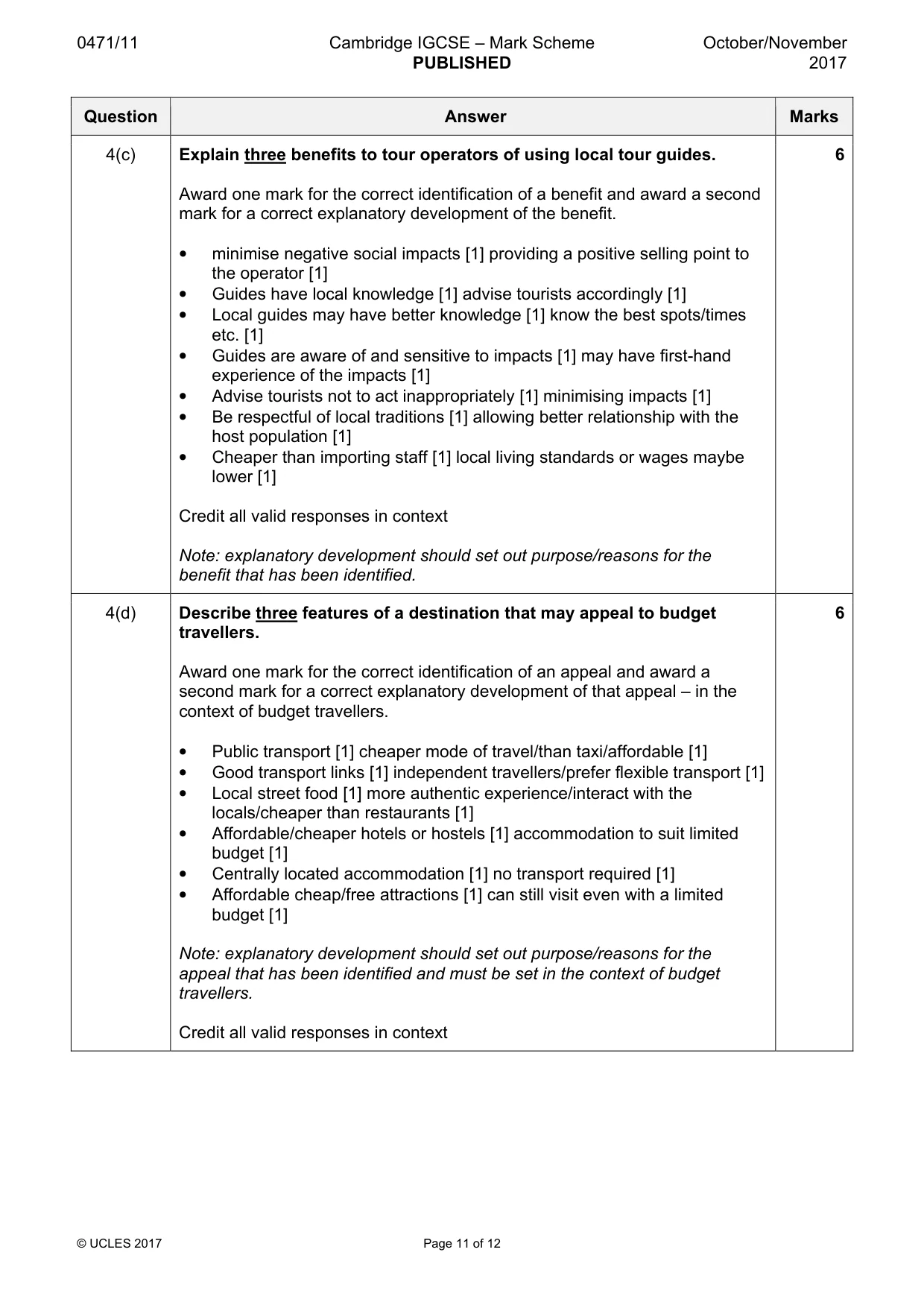
0471/11 Cambridge IGCSE – Mark Scheme PUBLISHED October/November 2017 © UCLES 2017 Page 11 of 12 Question Answer Marks 4(c) Explain three benefits to tour operators of using local tour guides. Award one mark for the correct identification of a benefit and award a second mark for a correct explanatory development of the benefit. • minimise negative social impacts [1] providing a positive selling point to the operator [1] • Guides have local knowledge [1] advise tourists accordingly [1] • Local guides may have better knowledge [1] know the best spots/times etc. [1] • Guides are aware of and sensitive to impacts [1] may have first-hand experience of the impacts [1] • Advise tourists not to act inappropriately [1] minimising impacts [1] • Be respectful of local traditions [1] allowing better relationship with the host population [1] • Cheaper than importing staff [1] local living standards or wages maybe lower [1] Credit all valid responses in context Note: explanatory development should set out purpose/reasons for the benefit that has been identified. 6 4(d) Describe three features of a destination that may appeal to budget travellers. Award one mark for the correct identification of an appeal and award a second mark for a correct explanatory development of that appeal – in the context of budget travellers. • Public transport [1] cheaper mode of travel/than taxi/affordable [1] • Good transport links [1] independent travellers/prefer flexible transport [1] • Local street food [1] more authentic experience/interact with the locals/cheaper than restaurants [1] • Affordable/cheaper hotels or hostels [1] accommodation to suit limited budget [1] • Centrally located accommodation [1] no transport required [1] • Affordable cheap/free attractions [1] can still visit even with a limited budget [1] Note: explanatory development should set out purpose/reasons for the appeal that has been identified and must be set in the context of budget travellers. Credit all valid responses in context 6
Mark scheme, page 12
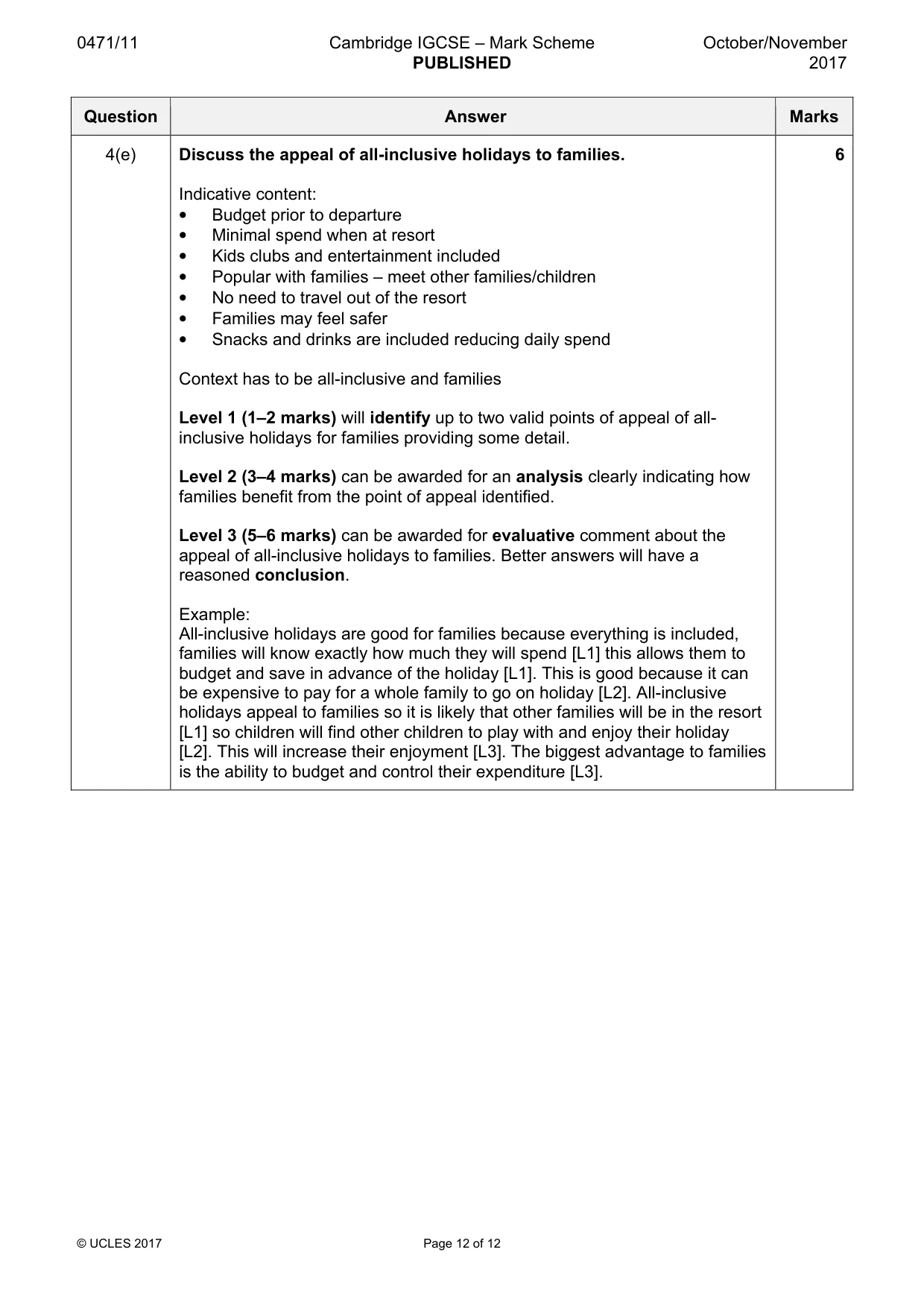
0471/11 Cambridge IGCSE – Mark Scheme PUBLISHED October/November 2017 © UCLES 2017 Page 12 of 12 Question Answer Marks 4(e) Discuss the appeal of all-inclusive holidays to families. Indicative content: • Budget prior to departure • Minimal spend when at resort • Kids clubs and entertainment included • Popular with families – meet other families/children • No need to travel out of the resort • Families may feel safer • Snacks and drinks are included reducing daily spend Context has to be all-inclusive and families Level 1 (1–2 marks) will identify up to two valid points of appeal of all- inclusive holidays for families providing some detail. Level 2 (3–4 marks) can be awarded for an analysis clearly indicating how families benefit from the point of appeal identified. Level 3 (5–6 marks) can be awarded for evaluative comment about the appeal of all-inclusive holidays to families. Better answers will have a reasoned conclusion. Example: All-inclusive holidays are good for families because everything is included, families will know exactly how much they will spend [L1] this allows them to budget and save in advance of the holiday [L1]. This is good because it can be expensive to pay for a whole family to go on holiday [L2]. All-inclusive holidays appeal to families so it is likely that other families will be in the resort [L1] so children will find other children to play with and enjoy their holiday [L2]. This will increase their enjoyment [L3]. The biggest advantage to families is the ability to budget and control their expenditure [L3]. 6
What you needed in this session
Cambridge’s own grade thresholds for 2017 Oct/Nov, Paper 1 · Variant 1. A higher threshold means an easier paper — the bar moves with how the cohort did.