Cambridge IGCSE Travel and Tourism 0471 — 2017 May/June Paper 1 · Variant 1
0471/11/M/J/17 · 100 marks · ≈113 min
The question paper and its mark scheme, free to read here and free to download. This is Cambridge’s own paper, exactly as it was sat.
Question paper12 pages
Mark scheme10 pages
Answers below. Sit the paper first if you are practising.
Paper as text
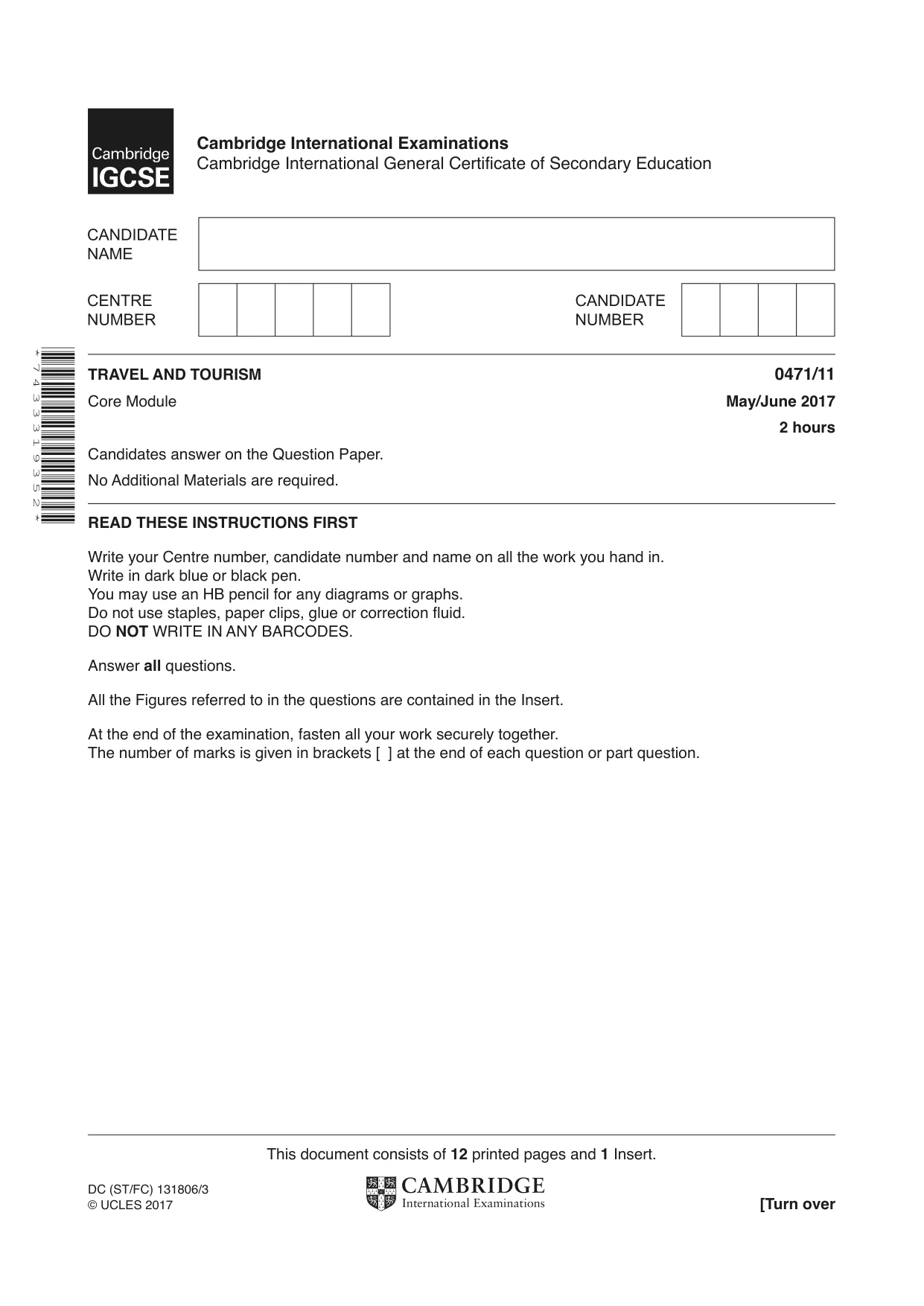
Question paper, page 1
This document consists of 12 printed pages and 1 Insert. DC (ST/FC) 131806/3 © UCLES 2017 [Turn over Cambridge International Examinations Cambridge International General Certificate of Secondary Education * 7 4 3 3 3 1 9 3 5 2 * TRAVEL AND TOURISM 0471/11 Core Module May/June 2017 2 hours Candidates answer on the Question Paper. No Additional Materials are required. READ THESE INSTRUCTIONS FIRST Write your Centre number, candidate number and name on all the work you hand in. Write in dark blue or black pen. You may use an HB pencil for any diagrams or graphs. Do not use staples, paper clips, glue or correction fluid. DO NOT WRITE IN ANY BARCODES. Answer all questions. All the Figures referred to in the questions are contained in the Insert. At the end of the examination, fasten all your work securely together. The number of marks is given in brackets [ ] at the end of each question or part question.
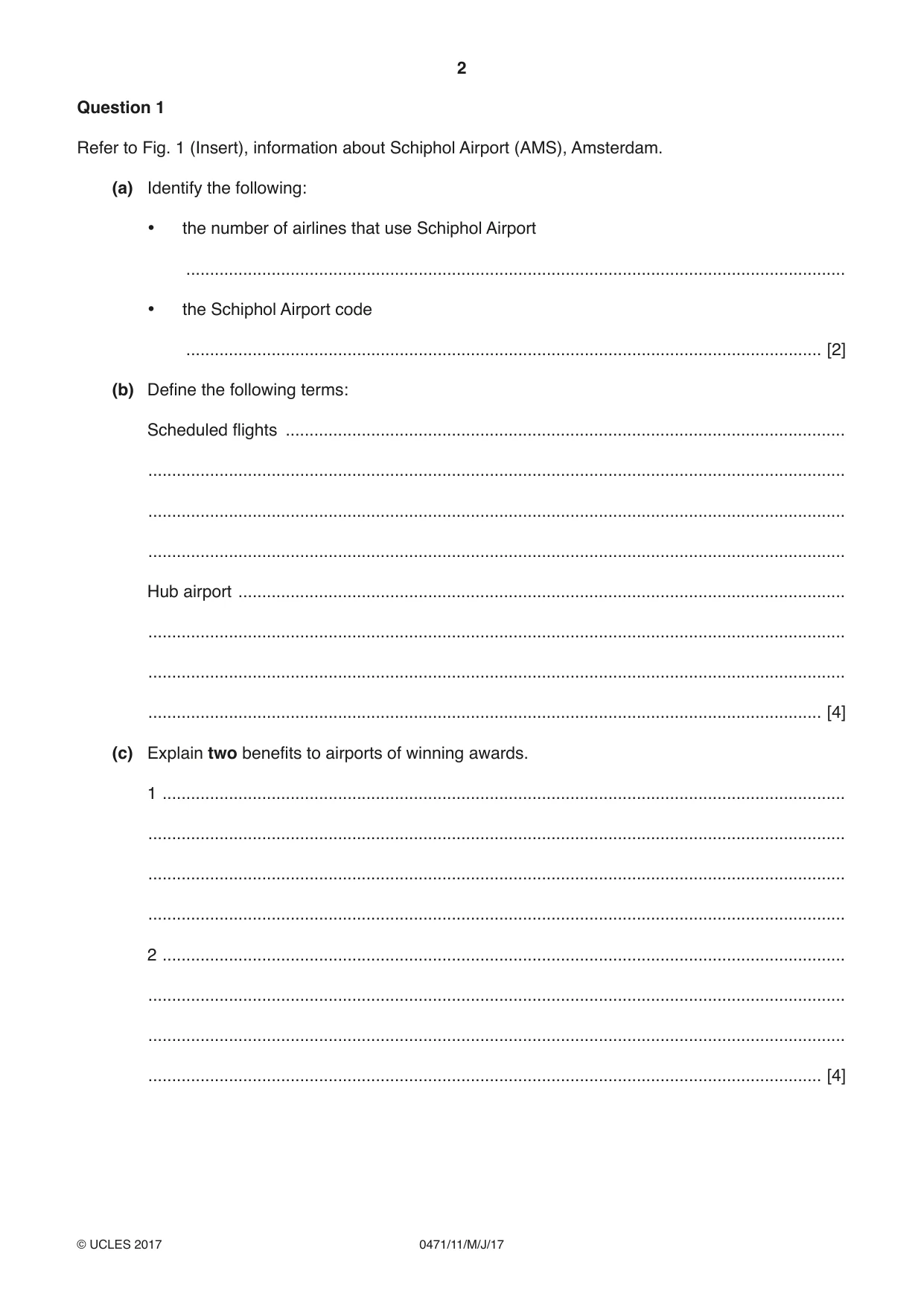
Question paper, page 2
2 0471/11/M/J/17 © UCLES 2017 Question 1 Refer to Fig. 1 (Insert), information about Schiphol Airport (AMS), Amsterdam. (a) Identify the following: • the number of airlines that use Schiphol Airport … • the Schiphol Airport code … [2] (b) Define the following terms: Scheduled flights … … … … Hub airport … … … … [4] (c) Explain two benefits to airports of winning awards. 1 … … … … 2 … … … … [4]
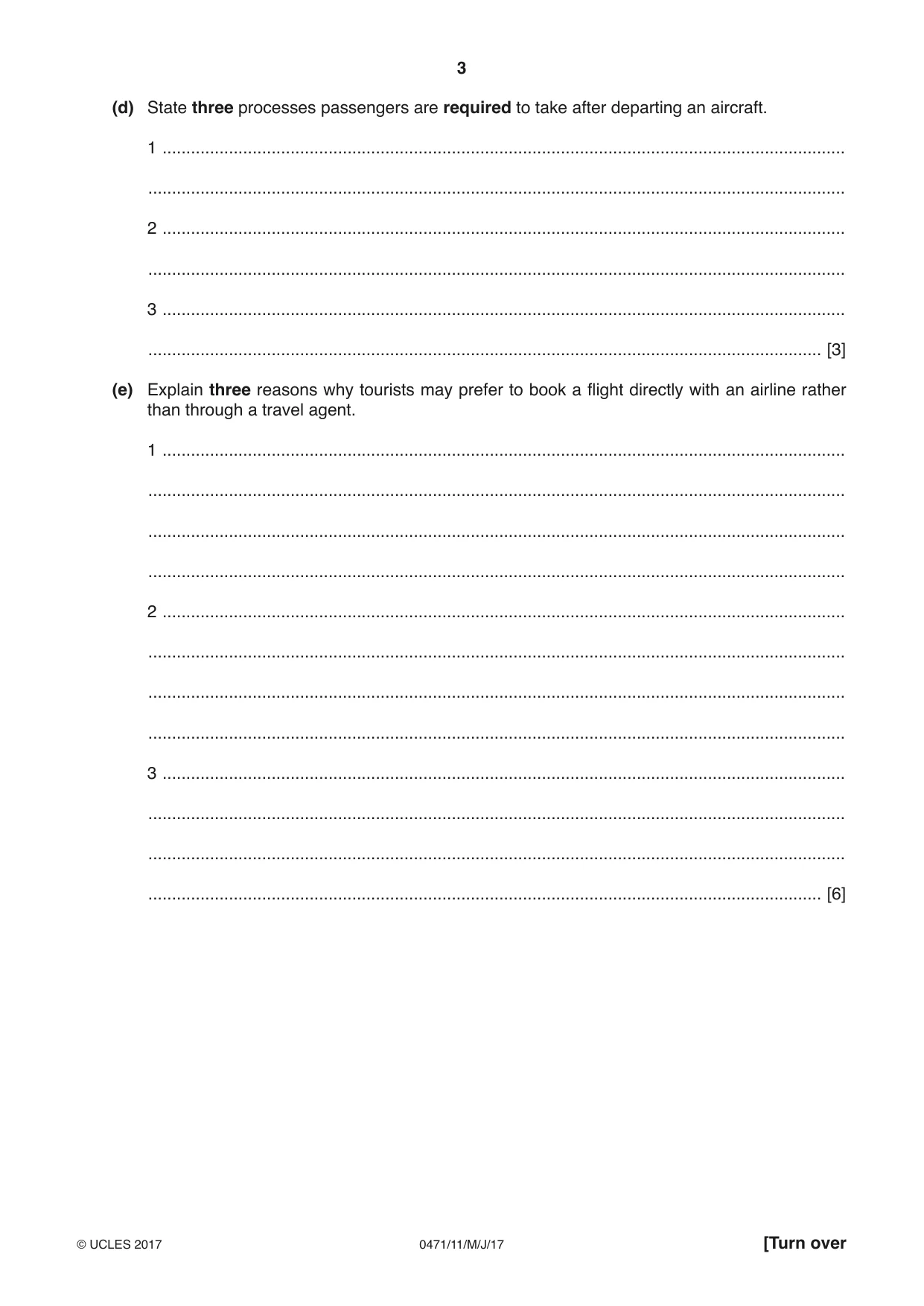
Question paper, page 3
3 0471/11/M/J/17 © UCLES 2017 [Turn over (d) State three processes passengers are required to take after departing an aircraft. 1 … … 2 … … 3 … … [3] (e) Explain three reasons why tourists may prefer to book a flight directly with an airline rather than through a travel agent. 1 … … … … 2 … … … … 3 … … … … [6]
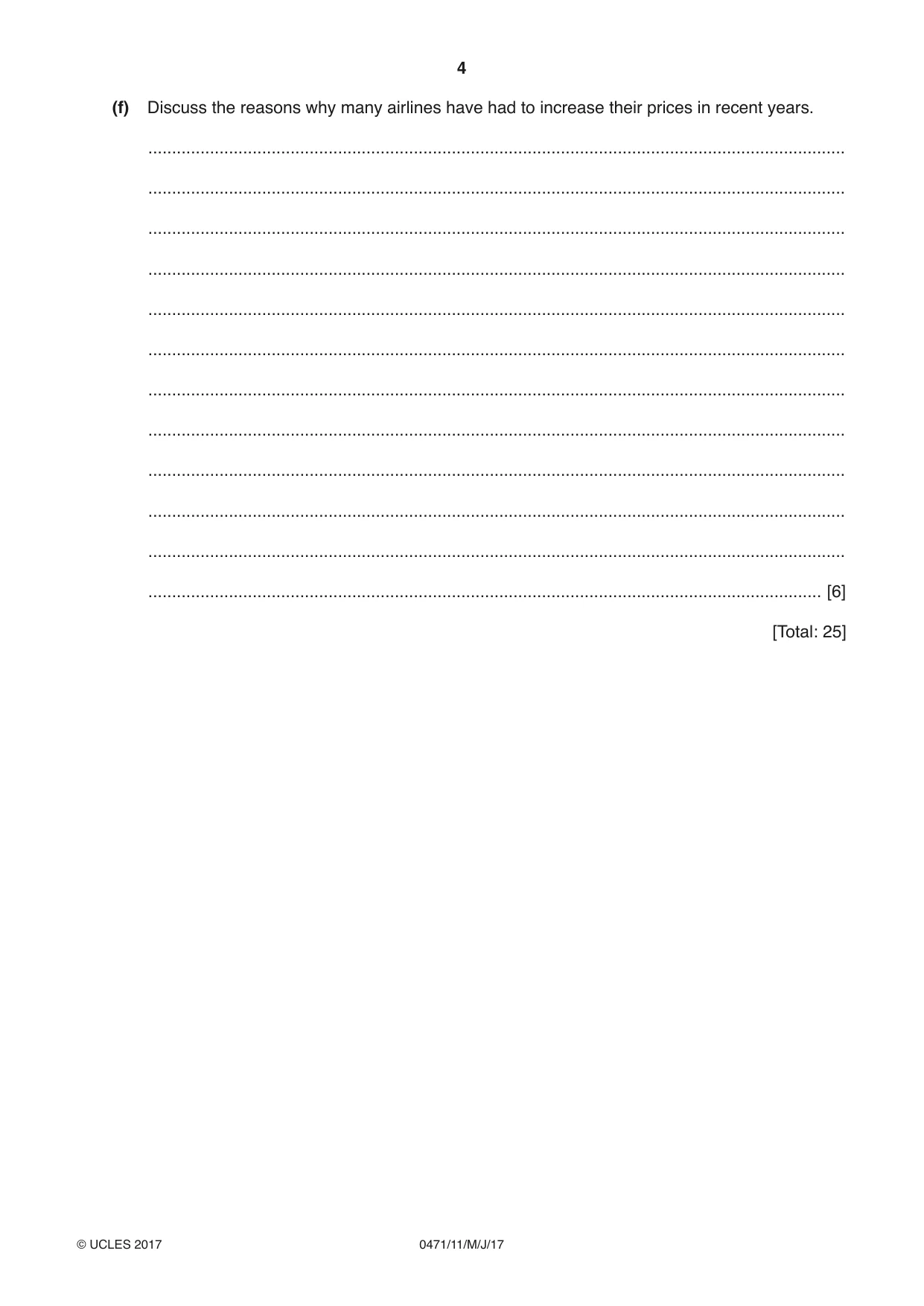
Question paper, page 4
4 0471/11/M/J/17 © UCLES 2017 (f) Discuss the reasons why many airlines have had to increase their prices in recent years. … … … … … … … … … … … … [6] [Total: 25]
Question paper, page 5
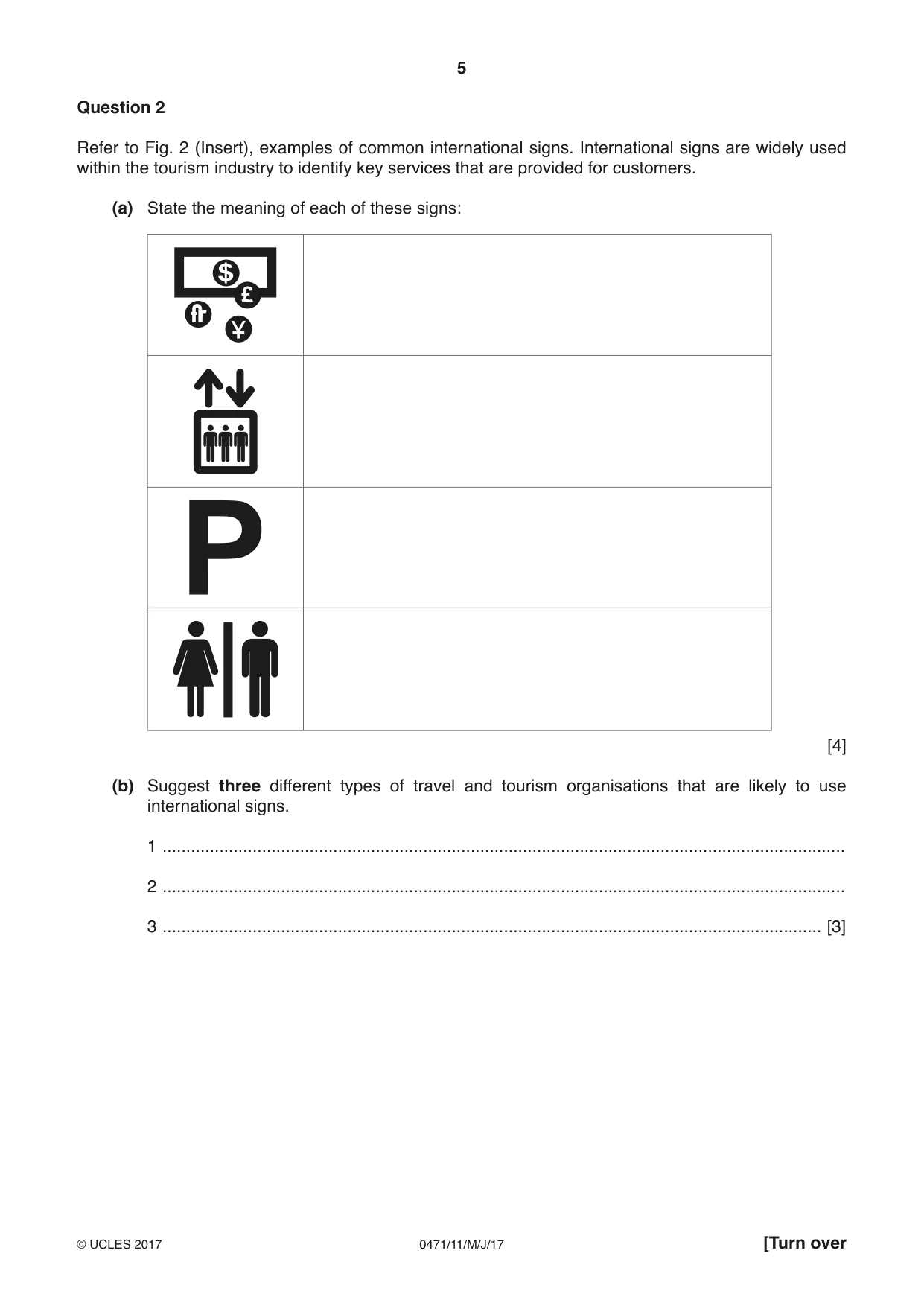
5 0471/11/M/J/17 © UCLES 2017 [Turn over Question 2 Refer to Fig. 2 (Insert), examples of common international signs. International signs are widely used within the tourism industry to identify key services that are provided for customers. (a) State the meaning of each of these signs: [4] (b) Suggest three different types of travel and tourism organisations that are likely to use international signs. 1 … 2 … 3 … [3]
Question paper, page 6
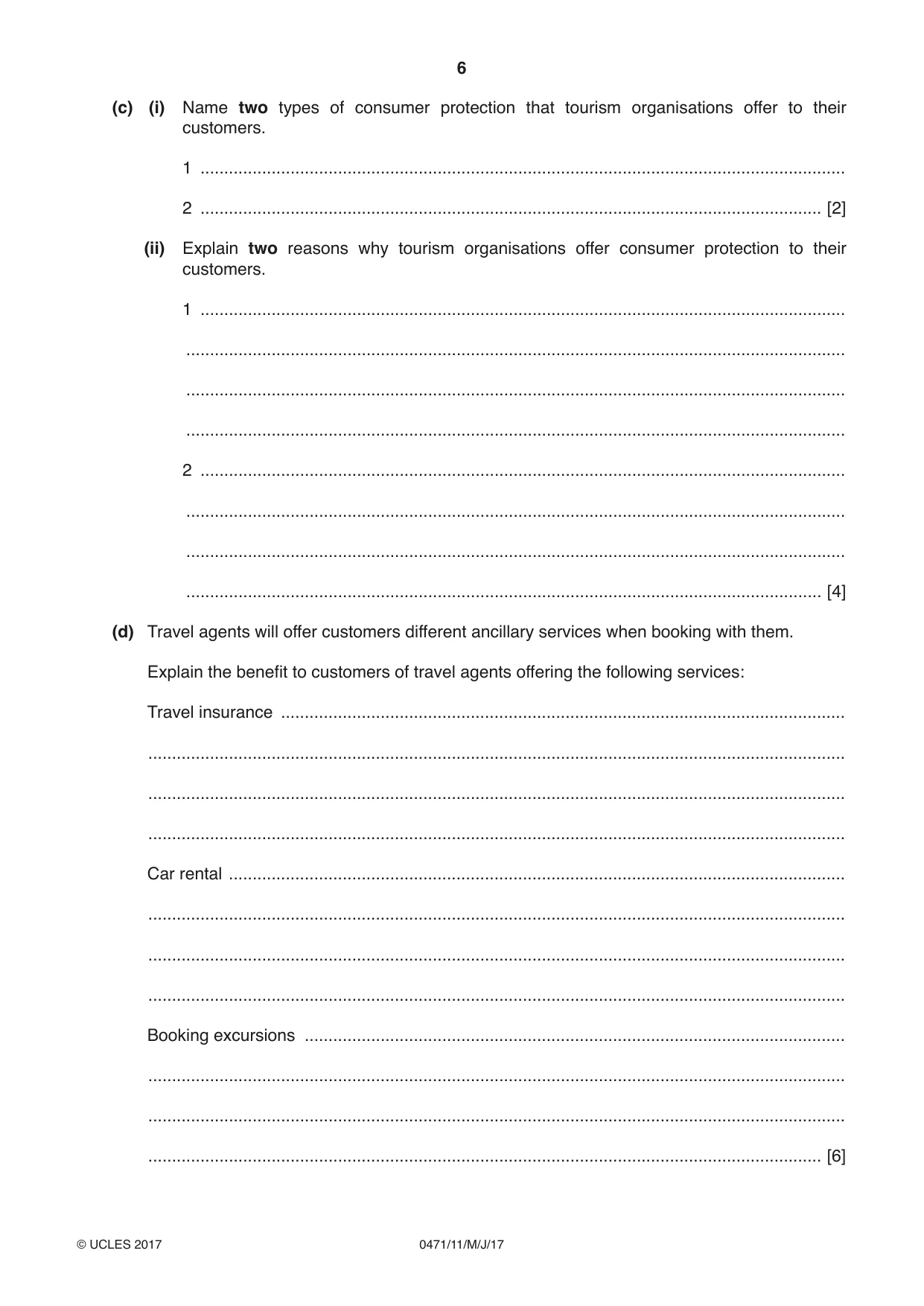
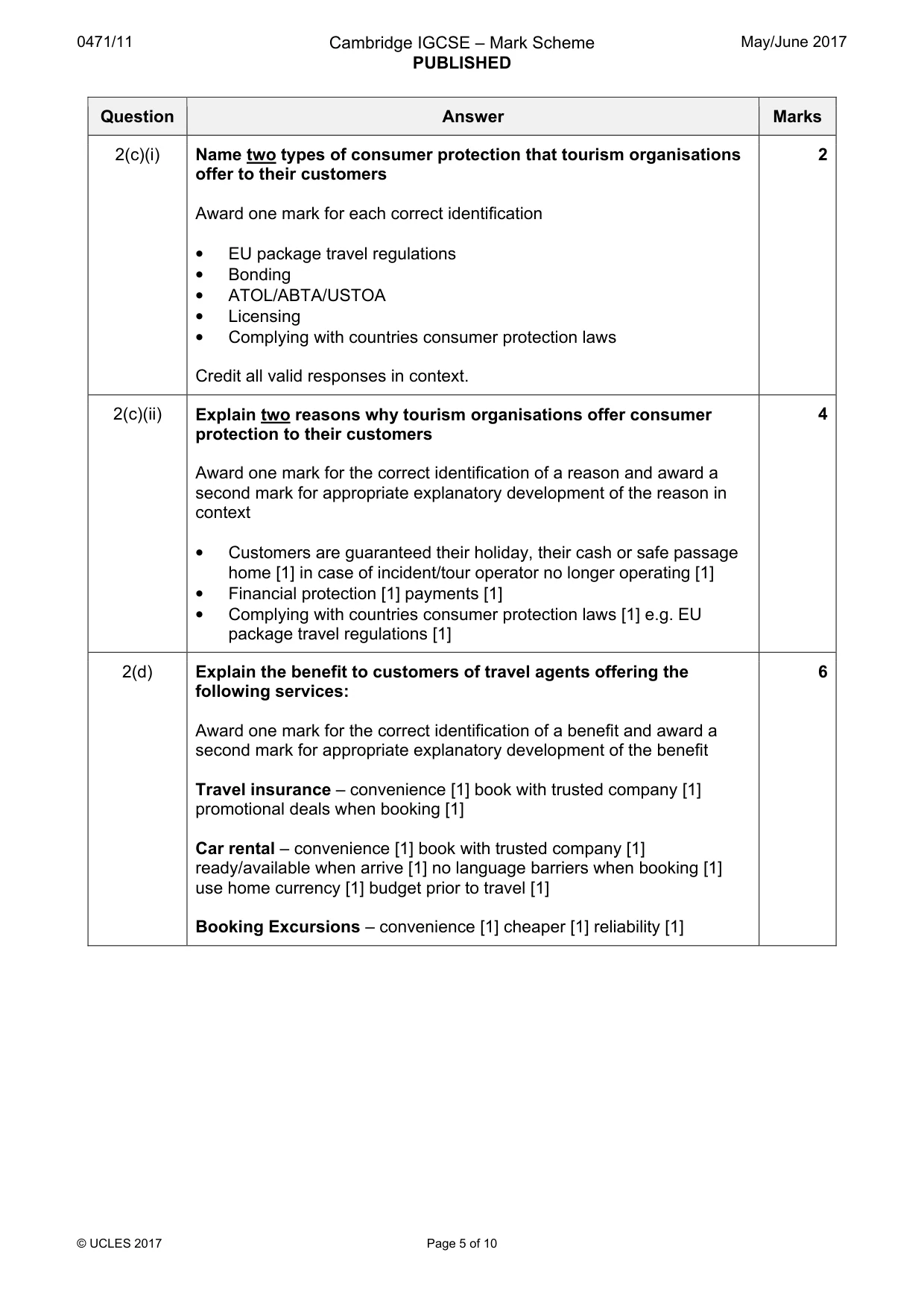
6 0471/11/M/J/17 © UCLES 2017 (c) (i) Name two types of consumer protection that tourism organisations offer to their customers. 1 … 2 … [2] (ii) Explain two reasons why tourism organisations offer consumer protection to their customers. 1 … … … … 2 … … … … [4] (d) Travel agents will offer customers different ancillary services when booking with them. Explain the benefit to customers of travel agents offering the following services: Travel insurance … … … … Car rental … … … … Booking excursions … … … … [6]
Question paper, page 7
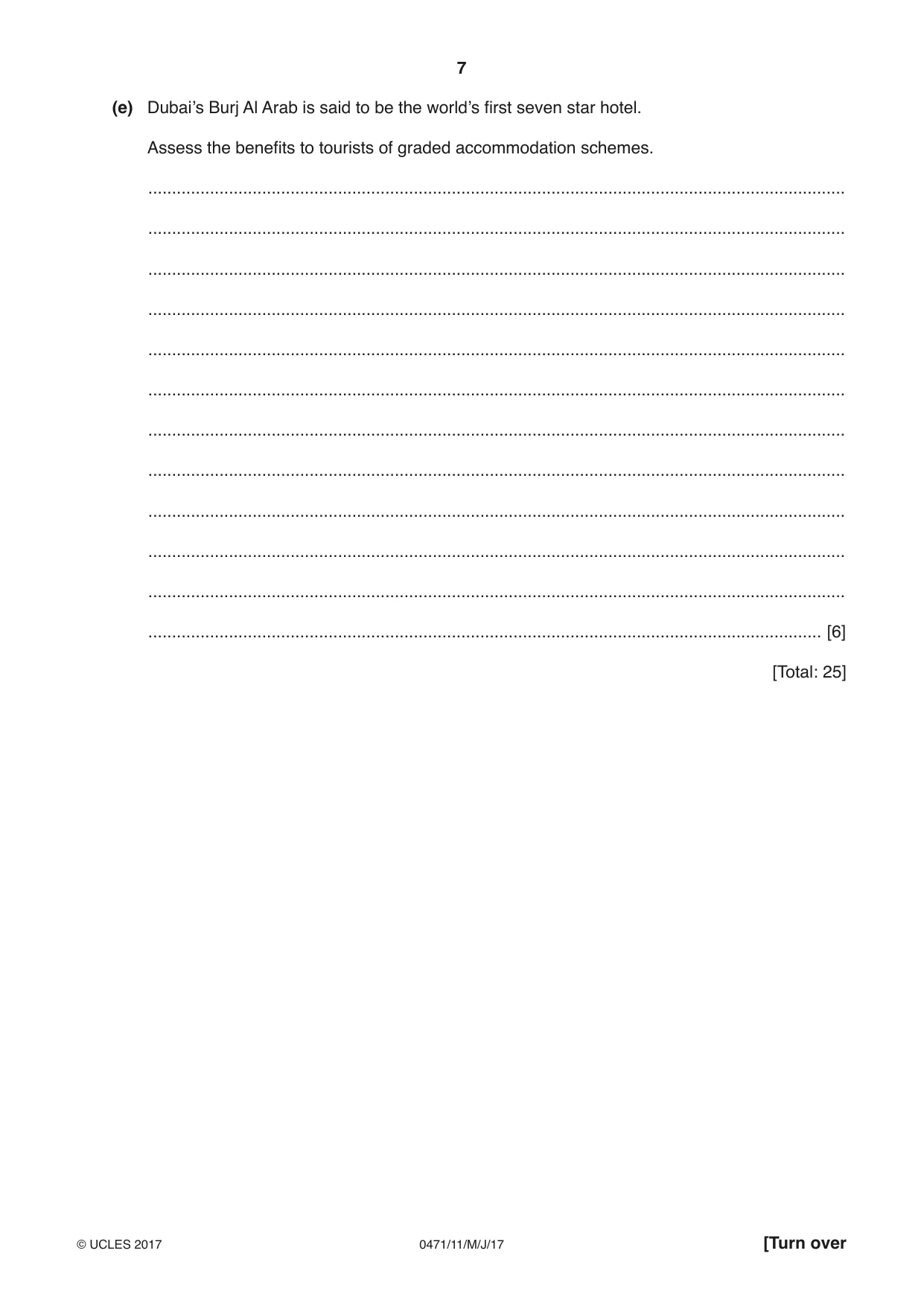
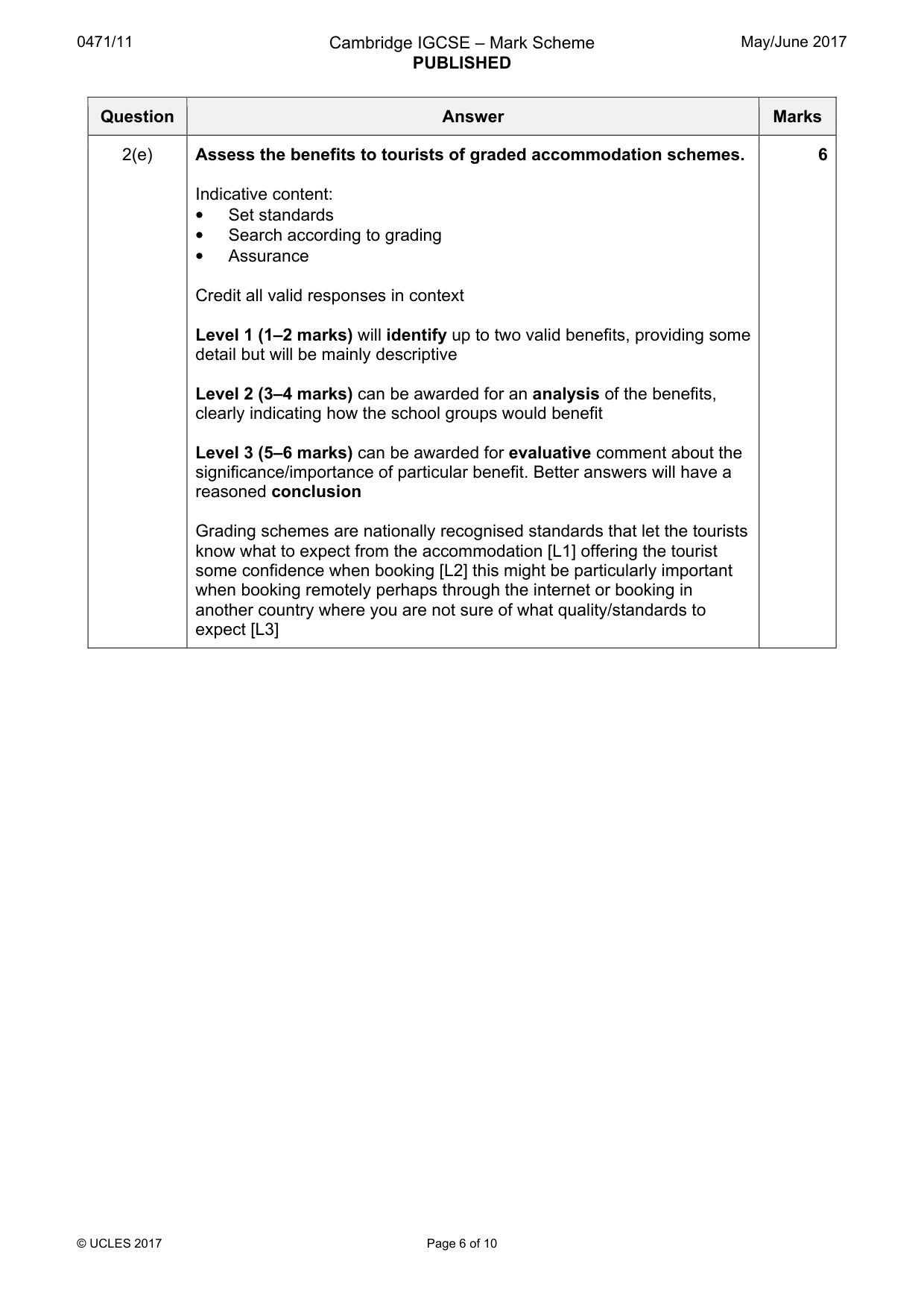
7 0471/11/M/J/17 © UCLES 2017 [Turn over (e) Dubai’s Burj Al Arab is said to be the world’s first seven star hotel. Assess the benefits to tourists of graded accommodation schemes. … … … … … … … … … … … … [6] [Total: 25]
Question paper, page 8
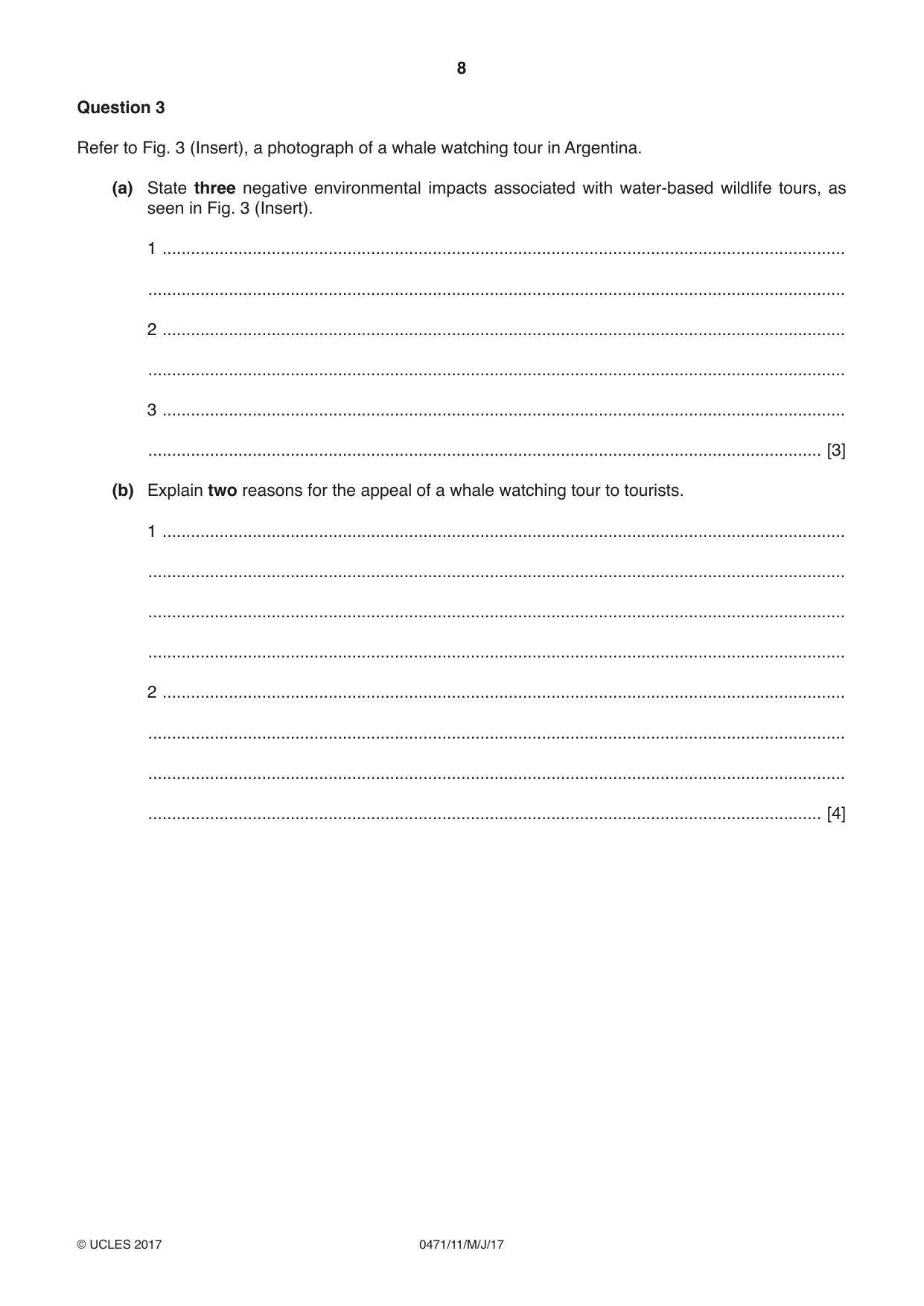
8 0471/11/M/J/17 © UCLES 2017 Question 3 Refer to Fig. 3 (Insert), a photograph of a whale watching tour in Argentina. (a) State three negative environmental impacts associated with water-based wildlife tours, as seen in Fig. 3 (Insert). 1 … … 2 … … 3 … … [3] (b) Explain two reasons for the appeal of a whale watching tour to tourists. 1 … … … … 2 … … … … [4]
Question paper, page 9
9 0471/11/M/J/17 © UCLES 2017 [Turn over (c) Explain three ways that tourism can be used to conserve local wildlife. 1 … … … … 2 … … … … 3 … … … … [6] (d) State three ways a tourist could book a wildlife tour. Outline one benefit of each booking method for the tourists. Booking Method Benefit to tourist 1 2 3 [6]
Question paper, page 10
10 0471/11/M/J/17 © UCLES 2017 (e) Discuss how destinations can manage their carrying capacity. … … … … … … … … … … … … [6] [Total: 25]
Question paper, page 11
11 0471/11/M/J/17 © UCLES 2017 [Turn over Question 4 Refer to Fig. 4 (Insert), information about tourism in Wales, a country in the UK. (a) Identify the following: • the percentage increase in nights spent in Wales by domestic visitors … • the percentage occupancy in self-catering units … [2] (b) State three types of self-catering accommodation. 1 … 2 … 3 … [3] (c) Explain the importance of occupancy rates to National Tourist Boards. … … … … … … … … [4] (d) Explain two ways that destinations may benefit from the multiplier effect. 1 … … … … 2 … … … … [4]
Question paper, page 12
12 0471/11/M/J/17 © UCLES 2017 Permission to reproduce items where third-party owned material protected by copyright is included has been sought and cleared where possible. Every reasonable effort has been made by the publisher (UCLES) to trace copyright holders, but if any items requiring clearance have unwittingly been included, the publisher will be pleased to make amends at the earliest possible opportunity. To avoid the issue of disclosure of answer-related information to candidates, all copyright acknowledgements are reproduced online in the Cambridge International Examinations Copyright Acknowledgements Booklet. This is produced for each series of examinations and is freely available to download at www.cie.org.uk after the live examination series. Cambridge International Examinations is part of the Cambridge Assessment Group. Cambridge Assessment is the brand name of University of Cambridge Local Examinations Syndicate (UCLES), which is itself a department of the University of Cambridge. (e) State three items of information found in a travel guide book. For each suggest one benefit to the tourist. Information Benefit to tourist 1 2 3 [6] (f) Discuss the ways that visitor attractions may help to preserve the local culture. … … … … … … … … … … … …[6] [Total: 25]
Mark scheme, page 1
® IGCSE is a registered trademark. This document consists of 10 printed pages. © UCLES 2017 [Turn over Cambridge International Examinations Cambridge International General Certificate of Secondary Education TRAVEL AND TOURISM 0471/11 Paper 1 Core Module May/June 2017 MARK SCHEME Maximum Mark: 100 Published This mark scheme is published as an aid to teachers and candidates, to indicate the requirements of the examination. It shows the basis on which Examiners were instructed to award marks. It does not indicate the details of the discussions that took place at an Examiners’ meeting before marking began, which would have considered the acceptability of alternative answers. Mark schemes should be read in conjunction with the question paper and the Principal Examiner Report for Teachers. Cambridge will not enter into discussions about these mark schemes. Cambridge is publishing the mark schemes for the May/June 2017 series for most Cambridge IGCSE®, Cambridge International A and AS Level and Cambridge Pre-U components, and some Cambridge O Level components.
Mark scheme, page 2
0471/11 Cambridge IGCSE – Mark Scheme PUBLISHED May/June 2017 © UCLES 2017 Page 2 of 10 Question Answer Marks 1(a) Identify the following: Award one mark for each correct identification The number of airlines that use Schiphol Airport = 103 The Schiphol airport code = AMS 2 1(b) Define the following terms: Award one mark for the correct identification of a characteristic of the term and award a second mark for an appropriate development of the characteristic or identification of an additional characteristic of the term. Scheduled flights Flights that operate to a timetable [1] fly regardless [1] timetable is adjusted according to season [1] not part of a package [1] Hub airport Airport used as a transfer point [1] change flights [1] 4 1(c) Explain two benefits to airports of winning awards. Award one mark for the correct identification of a benefit and award a second mark for appropriate explanatory development of the benefit in context • Increased customer satisfaction [1] more passengers [1] • Attracts more airlines [1] more success [1] • Attracts more ancillary service to rent out airport space [1] increasing facilities to passengers and customer satisfaction [1] Responses need to be set in the context of airports to achieve the full 2 marks per benefit Credit all valid responses in context 4 1(d) State three processes passengers are required to take after departing an aircraft. Award one mark for each correct identification • Reclaim baggage • Clear customs • Fill out landing cards • Immigration • Pay visa 3
Mark scheme, page 3
0471/11 Cambridge IGCSE – Mark Scheme PUBLISHED May/June 2017 © UCLES 2017 Page 3 of 10 Question Answer Marks 1(e) Explain three reasons why tourists may prefer to book a flight directly with an airline rather than through a travel agent. Award one mark for the correct identification of a preference and award a second mark for appropriate explanatory development of the preference • Cheaper ticket price [1] avoid travel agent fees [1] • Special requirement organised at point of booking [1] direct communication [1] • Use discounts [1] discounts may apply only to airlines [1] loyalty cards [1] air miles [1] Credit all valid responses in context 6 1(f) Discuss the reasons why many airlines have had to increase their prices in recent years Indicative content: • Increased environmental taxes • Increase in fuel costs • Additional service (security) costs are passed on to customers • Increased landing fees • Inflation Credit all valid responses in context Level 1 (1–2 marks) will identify up to two valid reasons, providing some detail but will be mainly descriptive Level 2 (3–4 marks) can be awarded for an analysis of the reasons, clearly indicating how these have caused an increase in price Level 3 (5–6 marks) can be awarded for evaluative comment about the significance/importance of particular reasons. Better answers will have a reasoned conclusion The increasing costs of aviation fuel have led to airlines increasing their prices [L1]. The cost of the fuel has been passed on to the passenger through an increase in ticket prices, airlines have to ensure that all costs are covered to continue operating [L2]. In addition many governments added environmental taxes to air travel [L1] this tax has to be collected by the airline and passed onto the government, this is collected within the ticket price hence the increase in ticket price [L2]. The greatest increase in price has come from additional taxes such as the environmental tax [L3] 6
Mark scheme, page 4
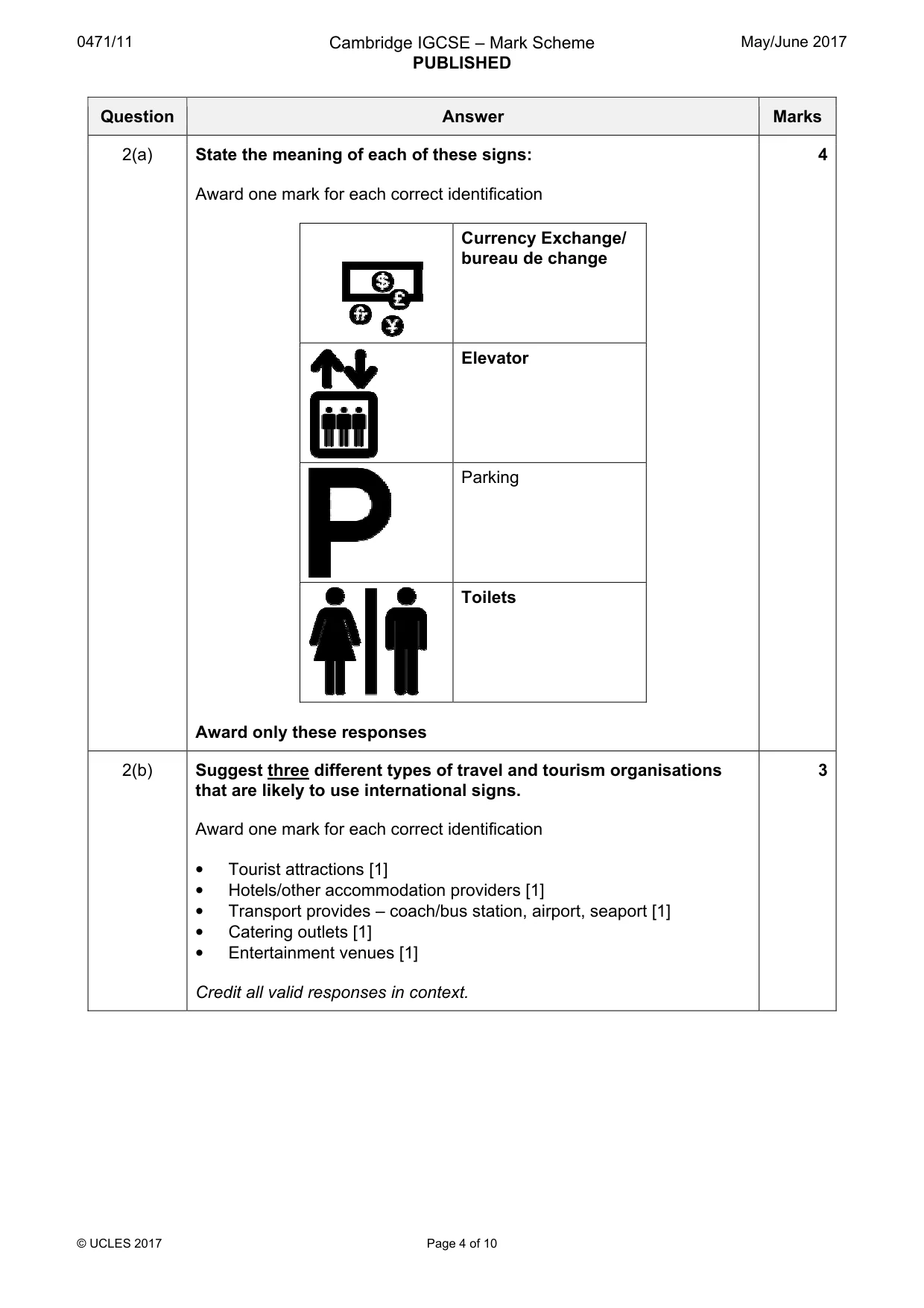
0471/11 Cambridge IGCSE – Mark Scheme PUBLISHED May/June 2017 © UCLES 2017 Page 4 of 10 Question Answer Marks 2(a) State the meaning of each of these signs: Award one mark for each correct identification Currency Exchange/ bureau de change Elevator Parking Toilets Award only these responses 4 2(b) Suggest three different types of travel and tourism organisations that are likely to use international signs. Award one mark for each correct identification • Tourist attractions [1] • Hotels/other accommodation providers [1] • Transport provides – coach/bus station, airport, seaport [1] • Catering outlets [1] • Entertainment venues [1] Credit all valid responses in context. 3
Mark scheme, page 5
0471/11 Cambridge IGCSE – Mark Scheme PUBLISHED May/June 2017 © UCLES 2017 Page 5 of 10 Question Answer Marks 2(c)(i) Name two types of consumer protection that tourism organisations offer to their customers Award one mark for each correct identification • EU package travel regulations • Bonding • ATOL/ABTA/USTOA • Licensing • Complying with countries consumer protection laws Credit all valid responses in context. 2 2(c)(ii) Explain two reasons why tourism organisations offer consumer protection to their customers Award one mark for the correct identification of a reason and award a second mark for appropriate explanatory development of the reason in context • Customers are guaranteed their holiday, their cash or safe passage home [1] in case of incident/tour operator no longer operating [1] • Financial protection [1] payments [1] • Complying with countries consumer protection laws [1] e.g. EU package travel regulations [1] 4 2(d) Explain the benefit to customers of travel agents offering the following services: Award one mark for the correct identification of a benefit and award a second mark for appropriate explanatory development of the benefit Travel insurance – convenience [1] book with trusted company [1] promotional deals when booking [1] Car rental – convenience [1] book with trusted company [1] ready/available when arrive [1] no language barriers when booking [1] use home currency [1] budget prior to travel [1] Booking Excursions – convenience [1] cheaper [1] reliability [1] 6
Mark scheme, page 6
0471/11 Cambridge IGCSE – Mark Scheme PUBLISHED May/June 2017 © UCLES 2017 Page 6 of 10 Question Answer Marks 2(e) Assess the benefits to tourists of graded accommodation schemes. Indicative content: • Set standards • Search according to grading • Assurance Credit all valid responses in context Level 1 (1–2 marks) will identify up to two valid benefits, providing some detail but will be mainly descriptive Level 2 (3–4 marks) can be awarded for an analysis of the benefits, clearly indicating how the school groups would benefit Level 3 (5–6 marks) can be awarded for evaluative comment about the significance/importance of particular benefit. Better answers will have a reasoned conclusion Grading schemes are nationally recognised standards that let the tourists know what to expect from the accommodation [L1] offering the tourist some confidence when booking [L2] this might be particularly important when booking remotely perhaps through the internet or booking in another country where you are not sure of what quality/standards to expect [L3] 6
Mark scheme, page 7
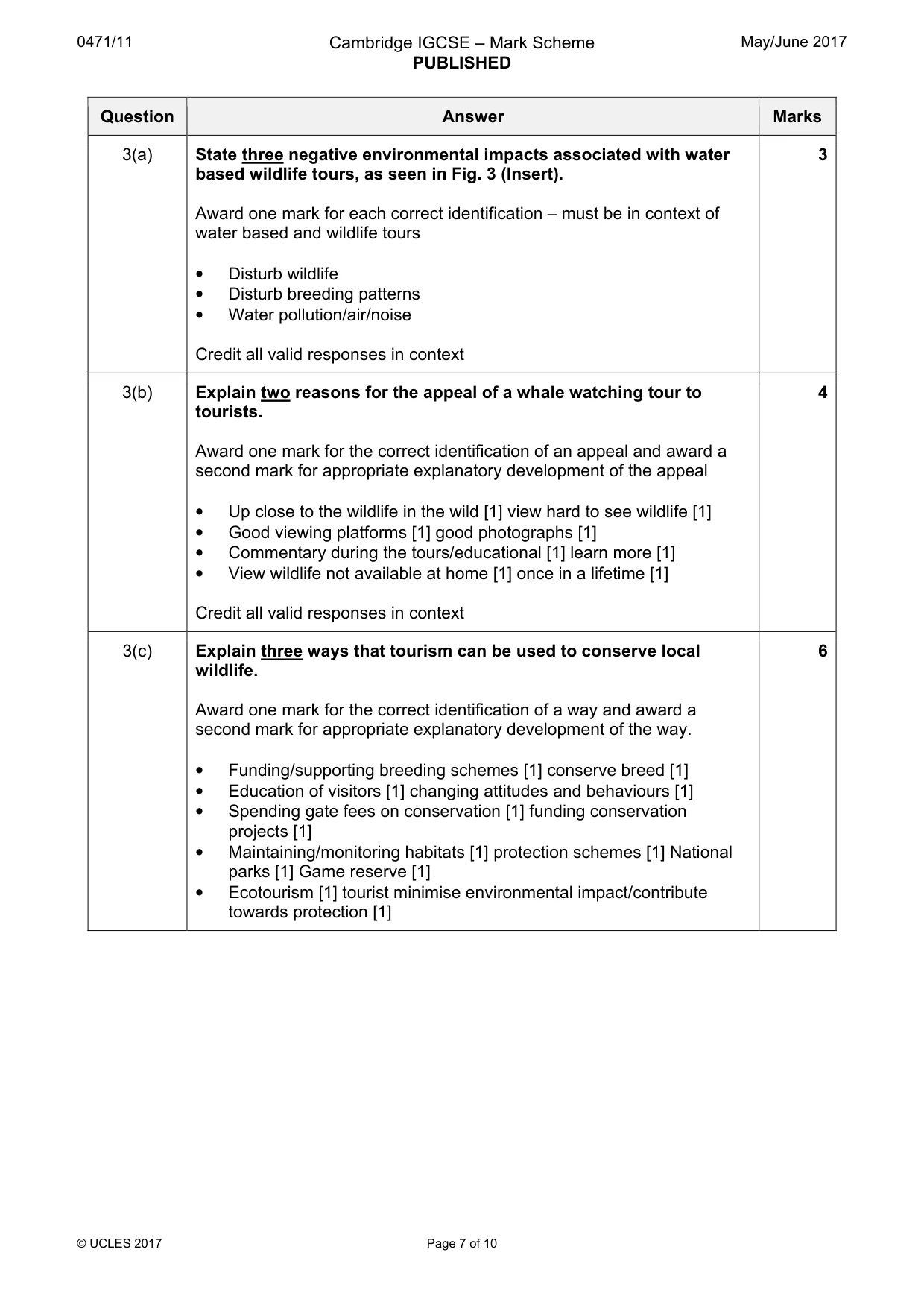
0471/11 Cambridge IGCSE – Mark Scheme PUBLISHED May/June 2017 © UCLES 2017 Page 7 of 10 Question Answer Marks 3(a) State three negative environmental impacts associated with water based wildlife tours, as seen in Fig. 3 (Insert). Award one mark for each correct identification – must be in context of water based and wildlife tours • Disturb wildlife • Disturb breeding patterns • Water pollution/air/noise Credit all valid responses in context 3 3(b) Explain two reasons for the appeal of a whale watching tour to tourists. Award one mark for the correct identification of an appeal and award a second mark for appropriate explanatory development of the appeal • Up close to the wildlife in the wild [1] view hard to see wildlife [1] • Good viewing platforms [1] good photographs [1] • Commentary during the tours/educational [1] learn more [1] • View wildlife not available at home [1] once in a lifetime [1] Credit all valid responses in context 4 3(c) Explain three ways that tourism can be used to conserve local wildlife. Award one mark for the correct identification of a way and award a second mark for appropriate explanatory development of the way. • Funding/supporting breeding schemes [1] conserve breed [1] • Education of visitors [1] changing attitudes and behaviours [1] • Spending gate fees on conservation [1] funding conservation projects [1] • Maintaining/monitoring habitats [1] protection schemes [1] National parks [1] Game reserve [1] • Ecotourism [1] tourist minimise environmental impact/contribute towards protection [1] 6
Mark scheme, page 8
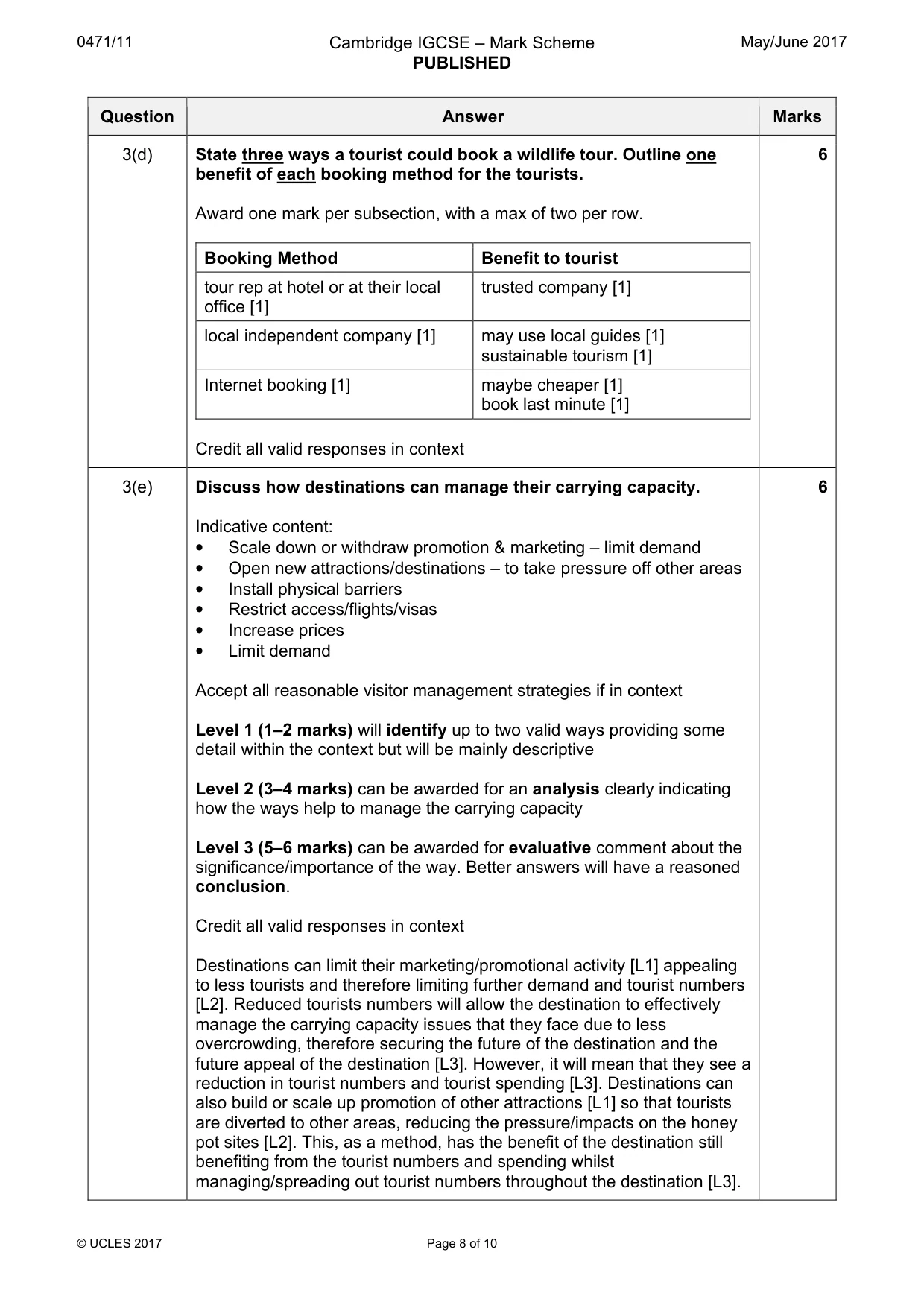
0471/11 Cambridge IGCSE – Mark Scheme PUBLISHED May/June 2017 © UCLES 2017 Page 8 of 10 Question Answer Marks 3(d) State three ways a tourist could book a wildlife tour. Outline one benefit of each booking method for the tourists. Award one mark per subsection, with a max of two per row. Booking Method Benefit to tourist tour rep at hotel or at their local office [1] trusted company [1] local independent company [1] may use local guides [1] sustainable tourism [1] Internet booking [1] maybe cheaper [1] book last minute [1] Credit all valid responses in context 6 3(e) Discuss how destinations can manage their carrying capacity. Indicative content: • Scale down or withdraw promotion & marketing – limit demand • Open new attractions/destinations – to take pressure off other areas • Install physical barriers • Restrict access/flights/visas • Increase prices • Limit demand Accept all reasonable visitor management strategies if in context Level 1 (1–2 marks) will identify up to two valid ways providing some detail within the context but will be mainly descriptive Level 2 (3–4 marks) can be awarded for an analysis clearly indicating how the ways help to manage the carrying capacity Level 3 (5–6 marks) can be awarded for evaluative comment about the significance/importance of the way. Better answers will have a reasoned conclusion. Credit all valid responses in context Destinations can limit their marketing/promotional activity [L1] appealing to less tourists and therefore limiting further demand and tourist numbers [L2]. Reduced tourists numbers will allow the destination to effectively manage the carrying capacity issues that they face due to less overcrowding, therefore securing the future of the destination and the future appeal of the destination [L3]. However, it will mean that they see a reduction in tourist numbers and tourist spending [L3]. Destinations can also build or scale up promotion of other attractions [L1] so that tourists are diverted to other areas, reducing the pressure/impacts on the honey pot sites [L2]. This, as a method, has the benefit of the destination still benefiting from the tourist numbers and spending whilst managing/spreading out tourist numbers throughout the destination [L3]. 6
Mark scheme, page 9
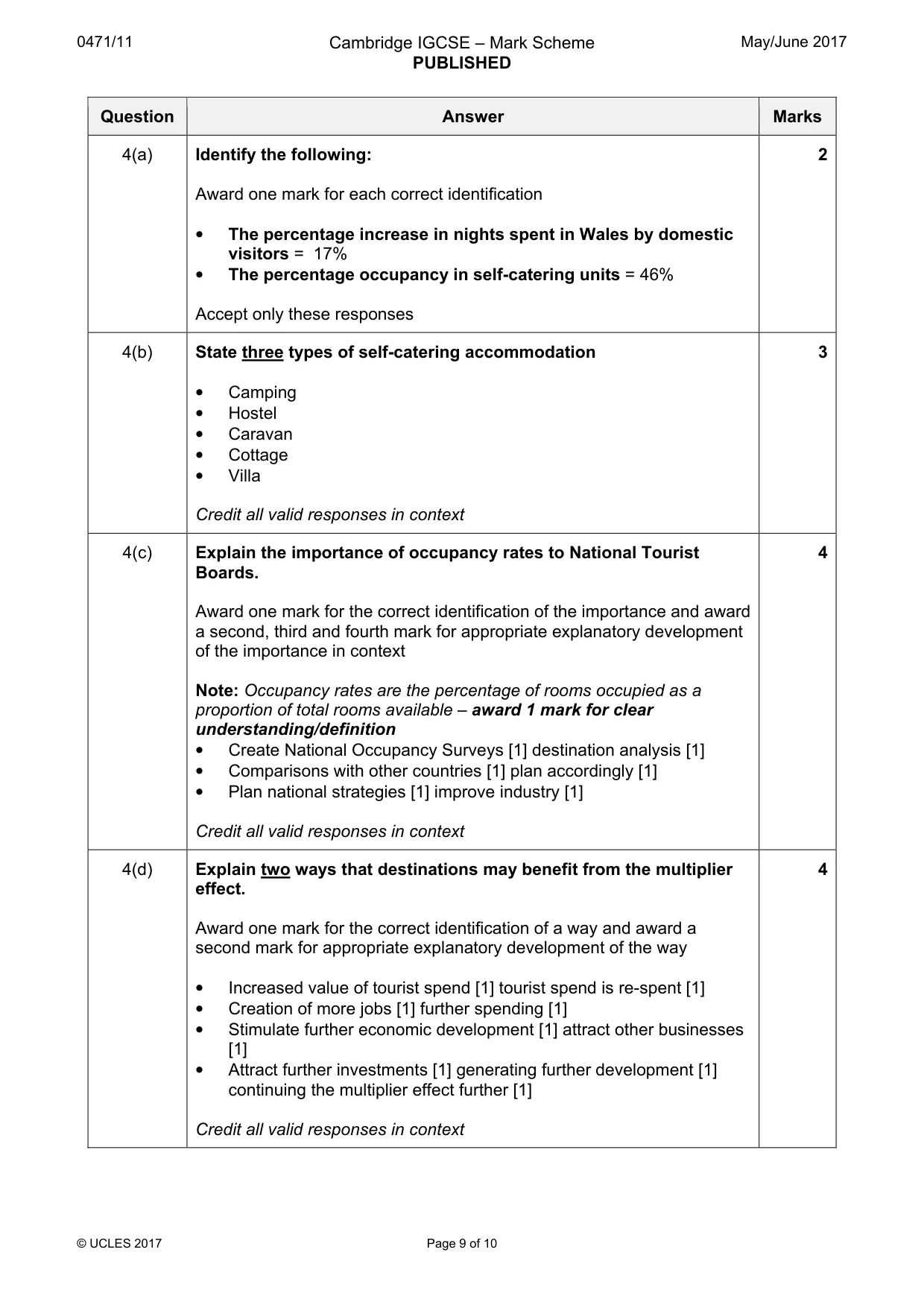
0471/11 Cambridge IGCSE – Mark Scheme PUBLISHED May/June 2017 © UCLES 2017 Page 9 of 10 Question Answer Marks 4(a) Identify the following: Award one mark for each correct identification • The percentage increase in nights spent in Wales by domestic visitors = 17% • The percentage occupancy in self-catering units = 46% Accept only these responses 2 4(b) State three types of self-catering accommodation • Camping • Hostel • Caravan • Cottage • Villa Credit all valid responses in context 3 4(c) Explain the importance of occupancy rates to National Tourist Boards. Award one mark for the correct identification of the importance and award a second, third and fourth mark for appropriate explanatory development of the importance in context Note: Occupancy rates are the percentage of rooms occupied as a proportion of total rooms available – award 1 mark for clear understanding/definition • Create National Occupancy Surveys [1] destination analysis [1] • Comparisons with other countries [1] plan accordingly [1] • Plan national strategies [1] improve industry [1] Credit all valid responses in context 4 4(d) Explain two ways that destinations may benefit from the multiplier effect. Award one mark for the correct identification of a way and award a second mark for appropriate explanatory development of the way • Increased value of tourist spend [1] tourist spend is re-spent [1] • Creation of more jobs [1] further spending [1] • Stimulate further economic development [1] attract other businesses [1] • Attract further investments [1] generating further development [1] continuing the multiplier effect further [1] Credit all valid responses in context 4
Mark scheme, page 10
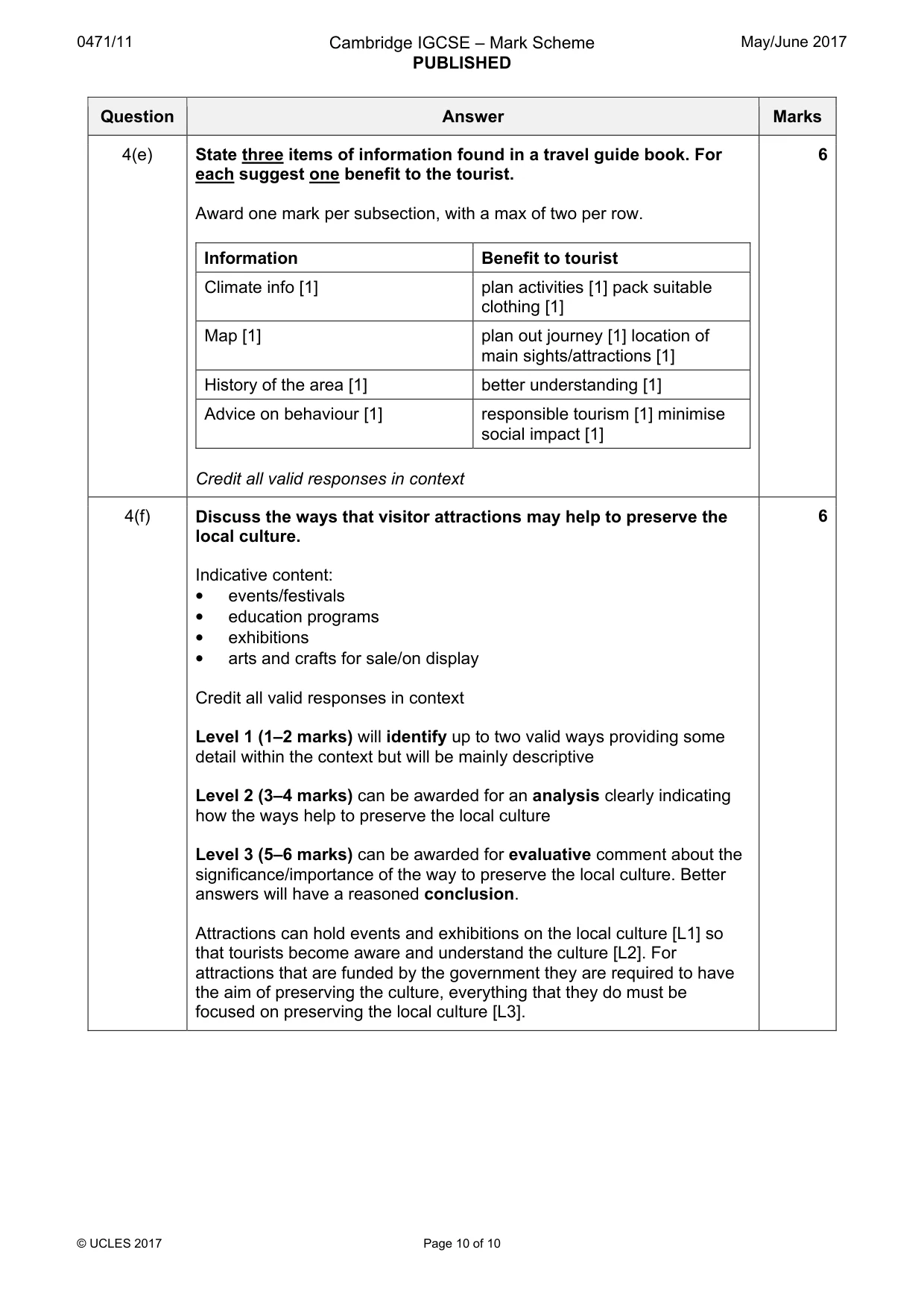
0471/11 Cambridge IGCSE – Mark Scheme PUBLISHED May/June 2017 © UCLES 2017 Page 10 of 10 Question Answer Marks 4(e) State three items of information found in a travel guide book. For each suggest one benefit to the tourist. Award one mark per subsection, with a max of two per row. Information Benefit to tourist Climate info [1] plan activities [1] pack suitable clothing [1] Map [1] plan out journey [1] location of main sights/attractions [1] History of the area [1] better understanding [1] Advice on behaviour [1] responsible tourism [1] minimise social impact [1] Credit all valid responses in context 6 4(f) Discuss the ways that visitor attractions may help to preserve the local culture. Indicative content: • events/festivals • education programs • exhibitions • arts and crafts for sale/on display Credit all valid responses in context Level 1 (1–2 marks) will identify up to two valid ways providing some detail within the context but will be mainly descriptive Level 2 (3–4 marks) can be awarded for an analysis clearly indicating how the ways help to preserve the local culture Level 3 (5–6 marks) can be awarded for evaluative comment about the significance/importance of the way to preserve the local culture. Better answers will have a reasoned conclusion. Attractions can hold events and exhibitions on the local culture [L1] so that tourists become aware and understand the culture [L2]. For attractions that are funded by the government they are required to have the aim of preserving the culture, everything that they do must be focused on preserving the local culture [L3]. 6
What you needed in this session
Cambridge’s own grade thresholds for 2017 May/June, Paper 1 · Variant 1. A higher threshold means an easier paper — the bar moves with how the cohort did.