Cambridge IGCSE Travel and Tourism 0471 — 2015 Oct/Nov Paper 2 · Variant 1
0471/21/O/N/15 · 100 marks · ≈113 min
The question paper and its mark scheme, free to read here and free to download. This is Cambridge’s own paper, exactly as it was sat.
Question paper16 pages



Mark scheme9 pages
Answers below. Sit the paper first if you are practising.
Paper as text
Question paper, page 1
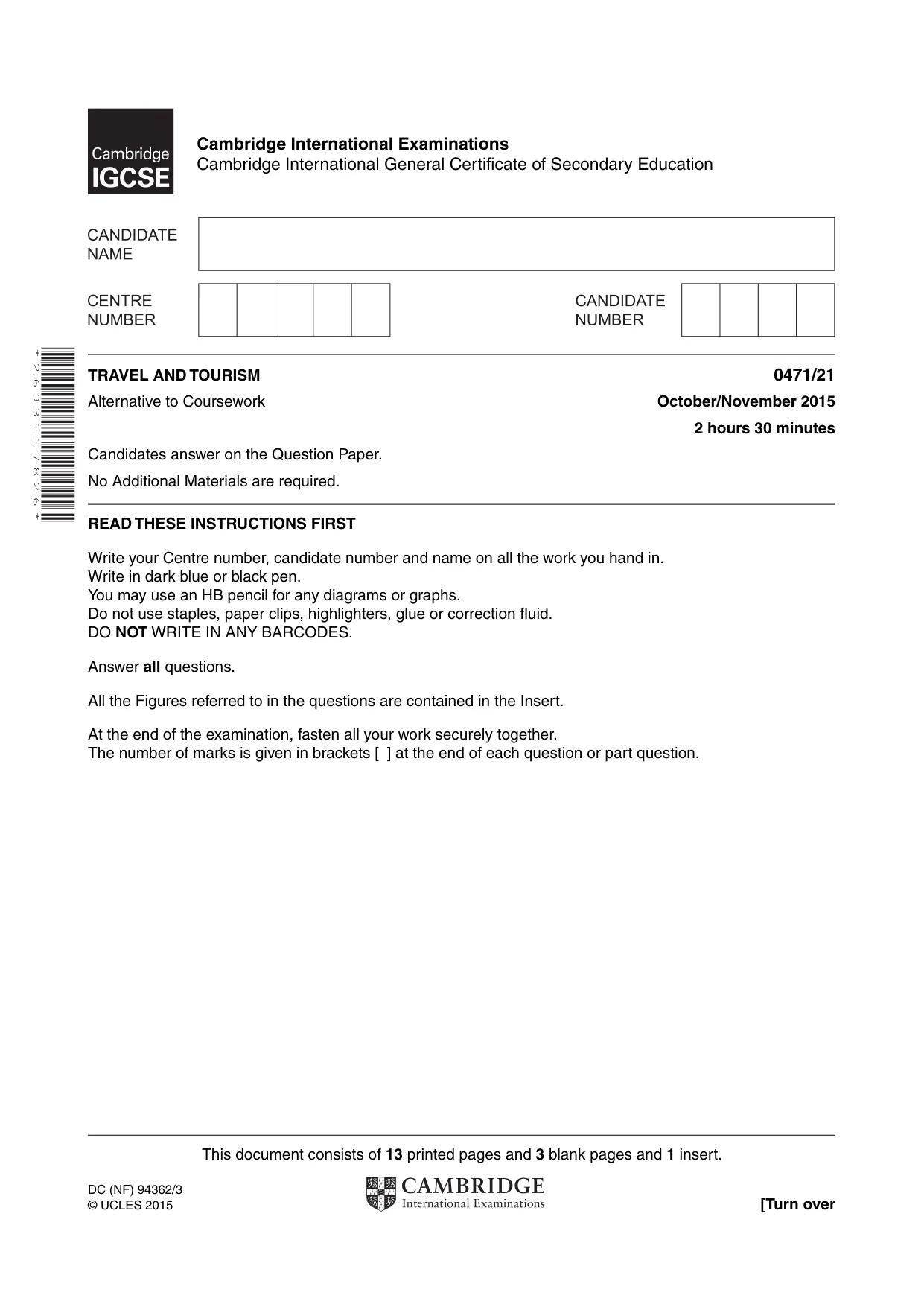
This document consists of 13 printed pages and 3 blank pages and 1 insert. DC (NF) 94362/3 © UCLES 2015 [Turn over Cambridge International Examinations Cambridge International General Certificate of Secondary Education * 2 6 9 3 1 1 7 8 2 6 * TRAVEL AND TOURISM 0471/21 Alternative to Coursework October/November 2015 2 hours 30 minutes Candidates answer on the Question Paper. No Additional Materials are required. READ THESE INSTRUCTIONS FIRST Write your Centre number, candidate number and name on all the work you hand in. Write in dark blue or black pen. You may use an HB pencil for any diagrams or graphs. Do not use staples, paper clips, highlighters, glue or correction fluid. DO NOT WRITE IN ANY BARCODES. Answer all questions. All the Figures referred to in the questions are contained in the Insert. At the end of the examination, fasten all your work securely together. The number of marks is given in brackets [ ] at the end of each question or part question.
Question paper, page 2
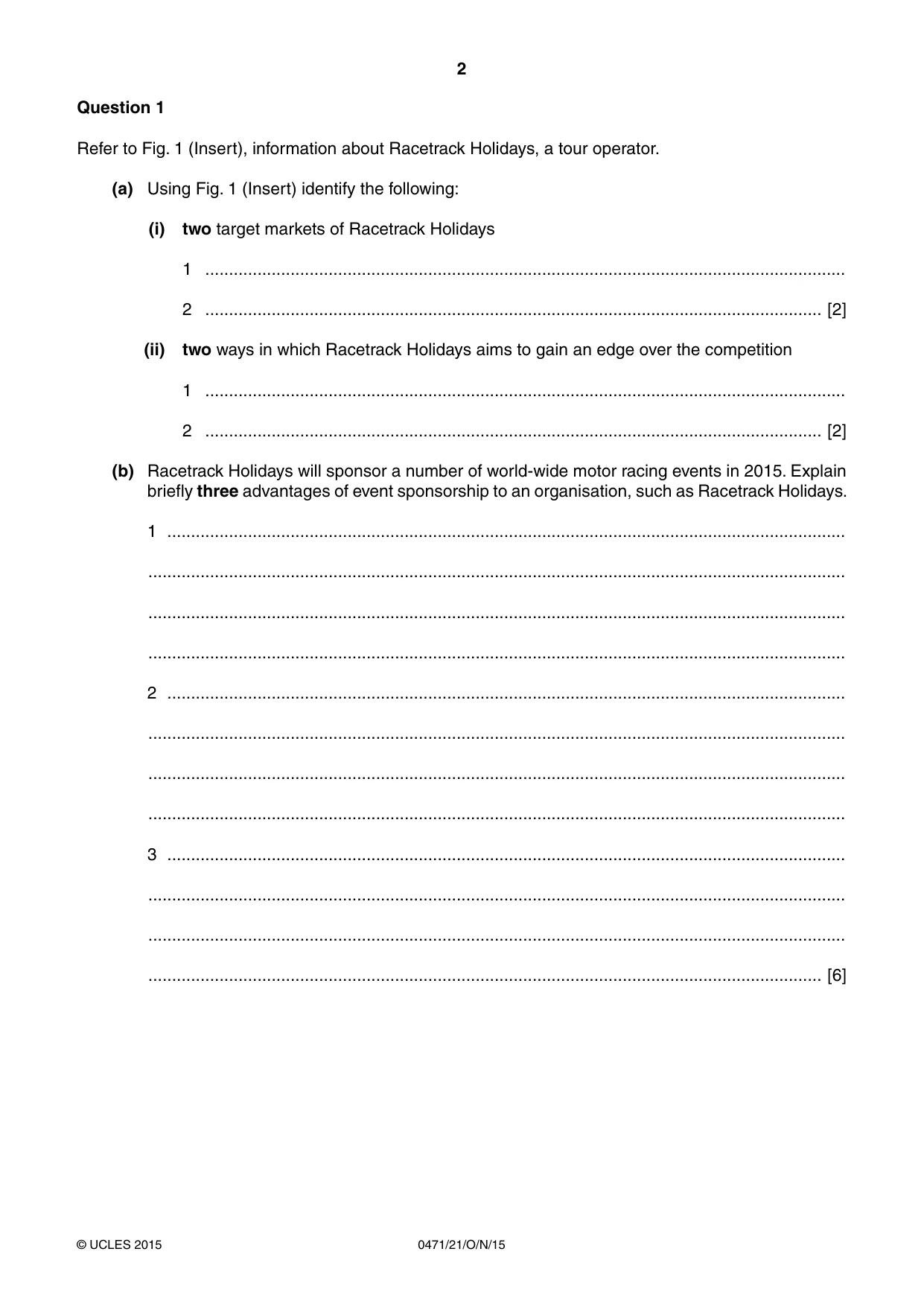
2 0471/21/O/N/15 © UCLES 2015 Question 1 Refer to Fig. 1 (Insert), information about Racetrack Holidays, a tour operator. (a) Using Fig. 1 (Insert) identify the following: (i) two target markets of Racetrack Holidays 1 … 2 … [2] (ii) two ways in which Racetrack Holidays aims to gain an edge over the competition 1 … 2 … [2] (b) Racetrack Holidays will sponsor a number of world-wide motor racing events in 2015. Explain briefly three advantages of event sponsorship to an organisation, such as Racetrack Holidays. 1 … … … … 2 … … … … 3 … … … … [6]
Question paper, page 3
3 0471/21/O/N/15 © UCLES 2015 [Turn over (c) Explain fully the suitability of the following pricing policies to attract customers to a company, such as Racetrack Holidays: • going rate … … … … … … • variable pricing … … … … … … [6]
Question paper, page 4
4 0471/21/O/N/15 © UCLES 2015 (d) Evaluate the importance of cost to a new company, such as Racetrack Holidays, when planning an effective promotional campaign. … … … … … … … … … … … … … … … … … … [9] [Total: 25]
Question paper, page 5
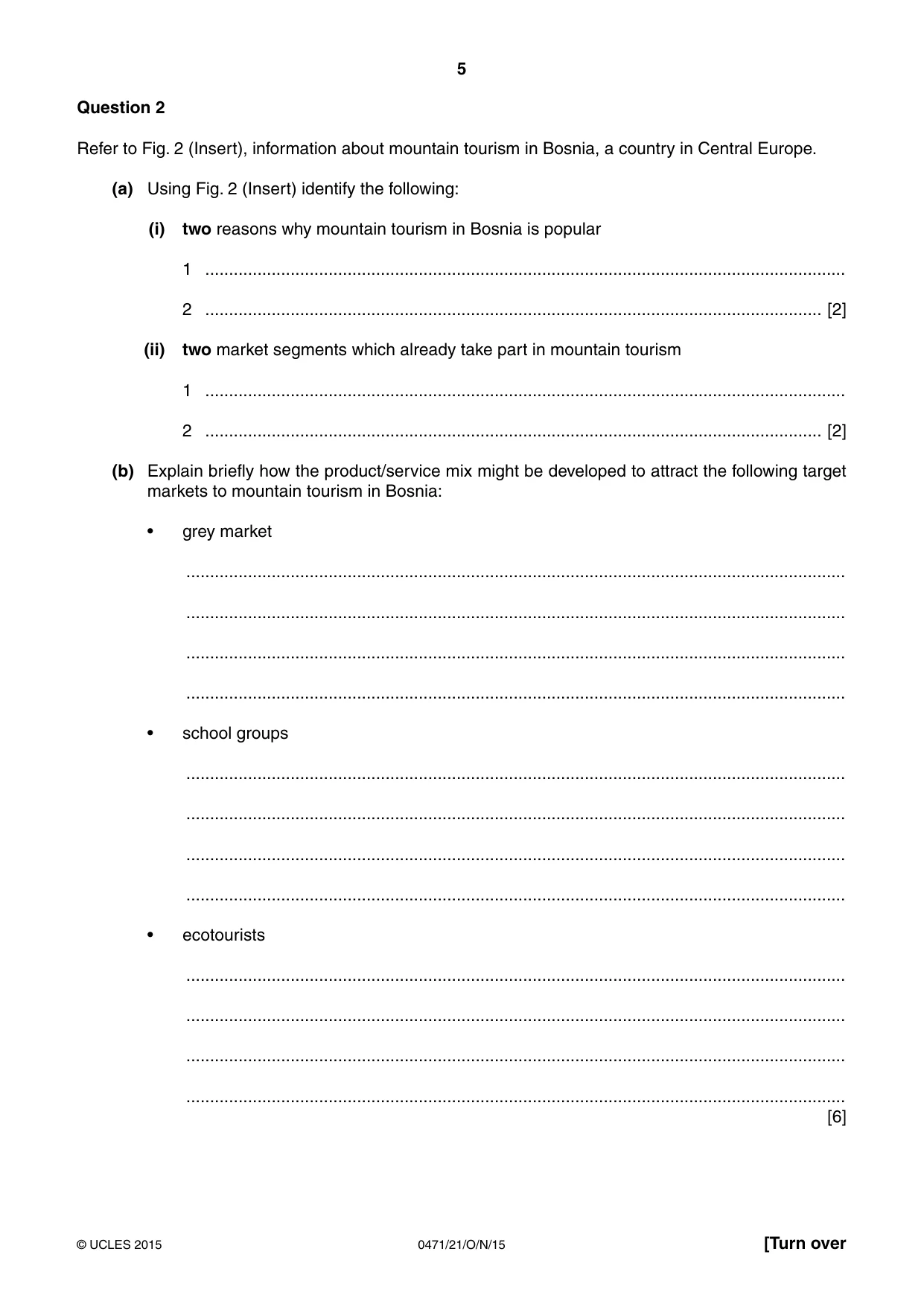
5 0471/21/O/N/15 © UCLES 2015 [Turn over Question 2 Refer to Fig. 2 (Insert), information about mountain tourism in Bosnia, a country in Central Europe. (a) Using Fig. 2 (Insert) identify the following: (i) two reasons why mountain tourism in Bosnia is popular 1 … 2 … [2] (ii) two market segments which already take part in mountain tourism 1 … 2 … [2] (b) Explain briefly how the product/service mix might be developed to attract the following target markets to mountain tourism in Bosnia: • grey market … … … … • school groups … … … … • ecotourists … … … … [6]
Question paper, page 6
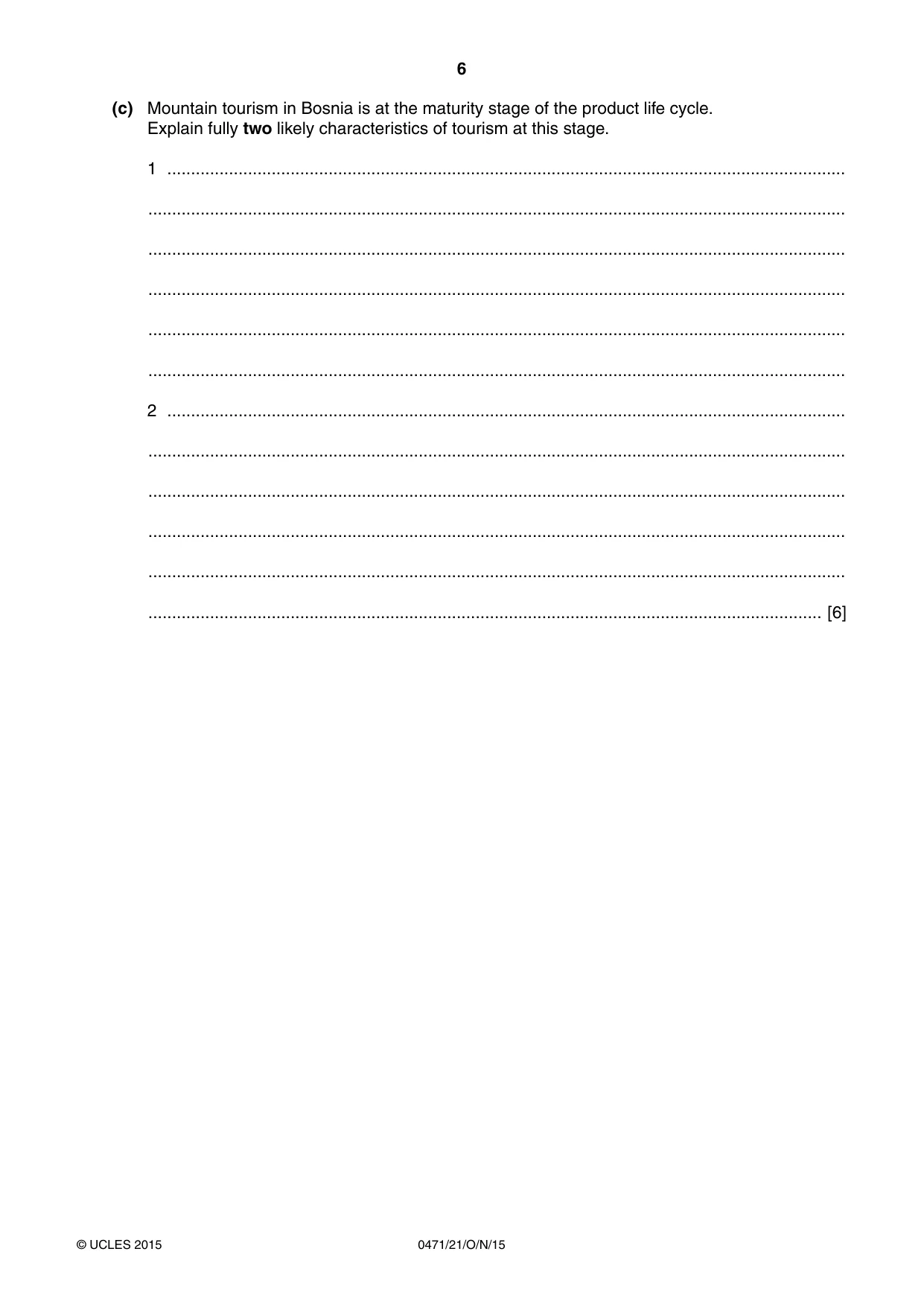
6 0471/21/O/N/15 © UCLES 2015 (c) Mountain tourism in Bosnia is at the maturity stage of the product life cycle. Explain fully two likely characteristics of tourism at this stage. 1 … … … … … … 2 … … … … … … [6]
Question paper, page 7
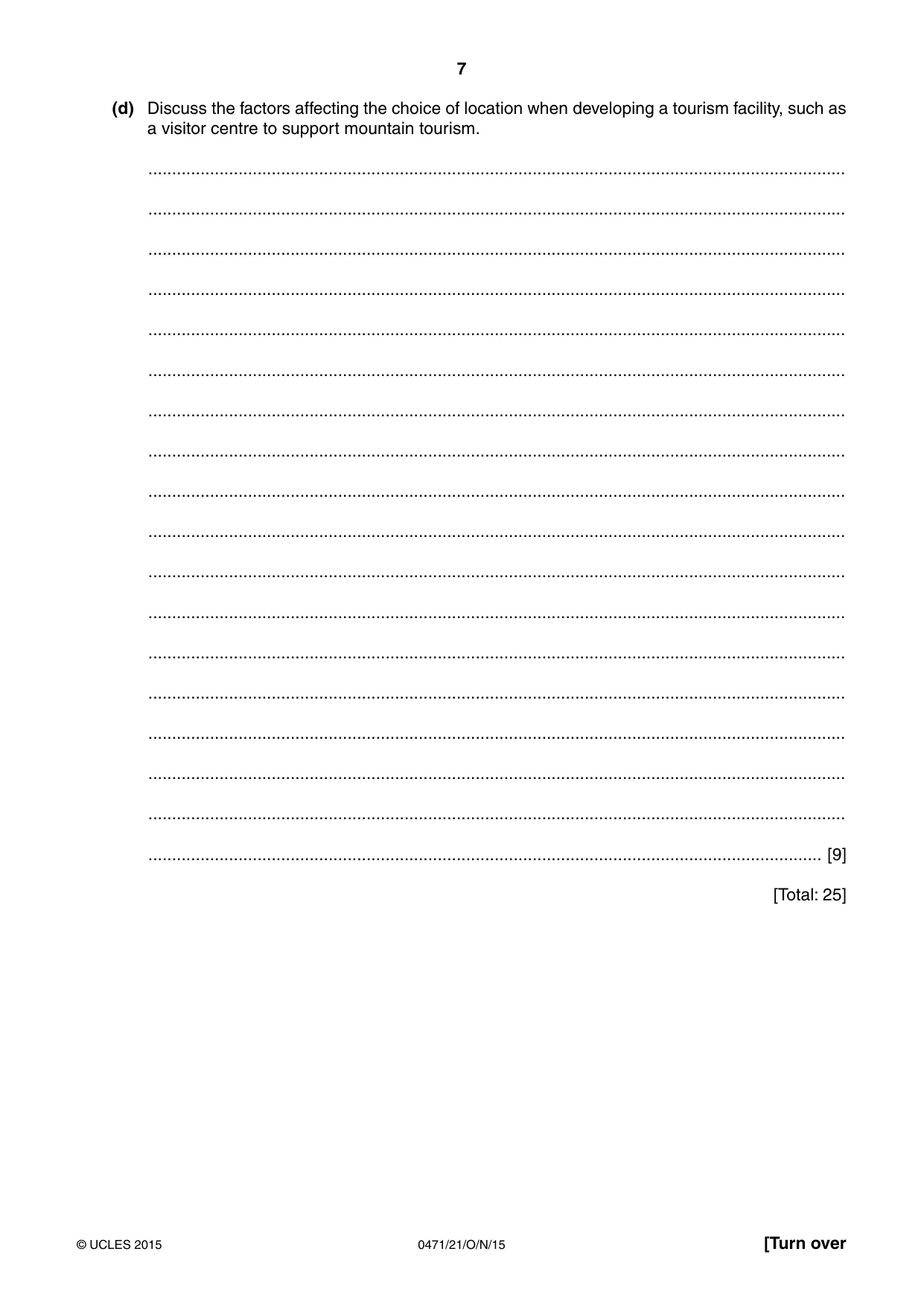
7 0471/21/O/N/15 © UCLES 2015 [Turn over (d) Discuss the factors affecting the choice of location when developing a tourism facility, such as a visitor centre to support mountain tourism. … … … … … … … … … … … … … … … … … … [9] [Total: 25]
Question paper, page 8
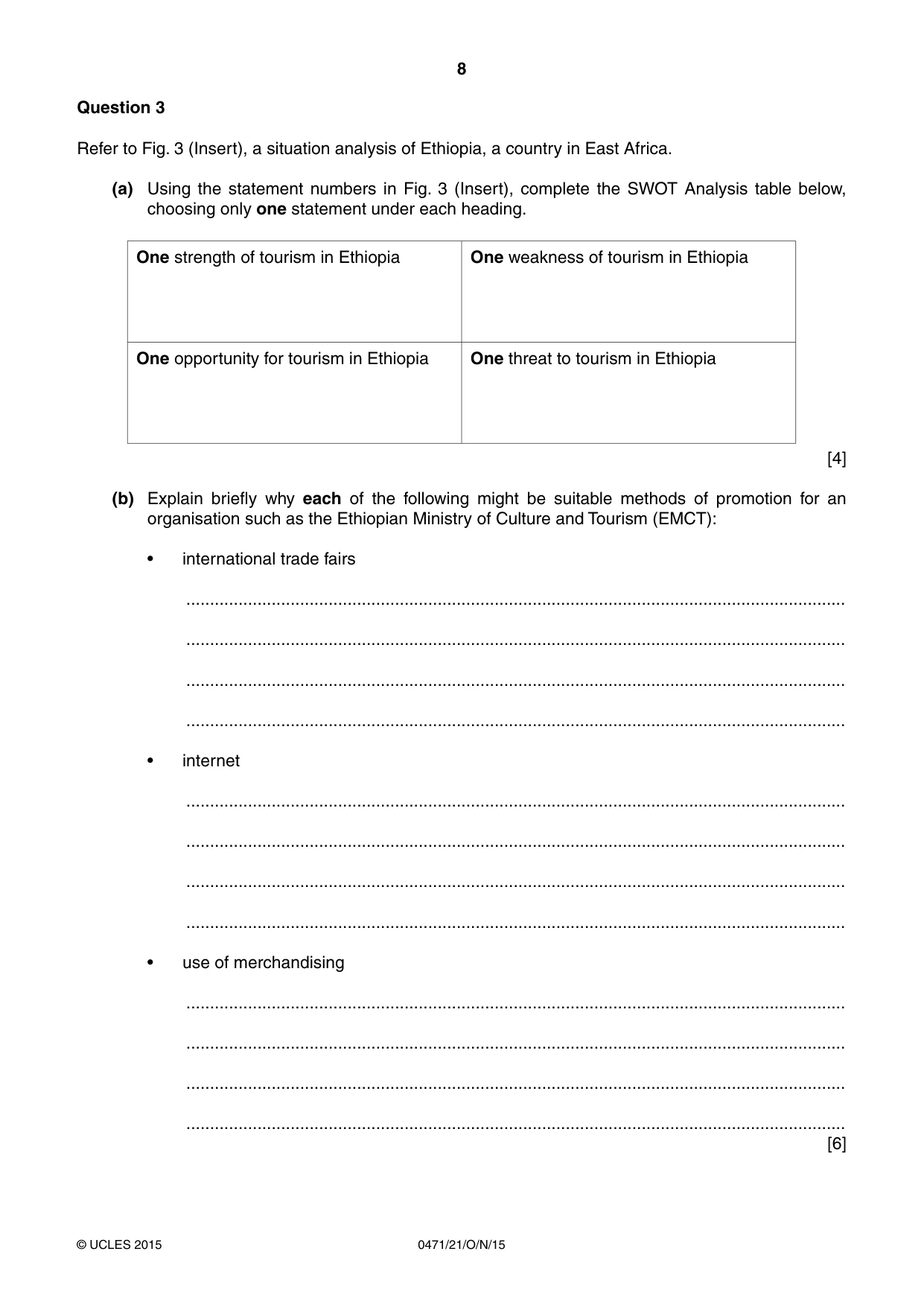
8 0471/21/O/N/15 © UCLES 2015 Question 3 Refer to Fig. 3 (Insert), a situation analysis of Ethiopia, a country in East Africa. (a) Using the statement numbers in Fig. 3 (Insert), complete the SWOT Analysis table below, choosing only one statement under each heading. One strength of tourism in Ethiopia One weakness of tourism in Ethiopia One opportunity for tourism in Ethiopia One threat to tourism in Ethiopia [4] (b) Explain briefly why each of the following might be suitable methods of promotion for an organisation such as the Ethiopian Ministry of Culture and Tourism (EMCT): • international trade fairs … … … … • internet … … … … • use of merchandising … … … … [6]
Question paper, page 9
9 0471/21/O/N/15 © UCLES 2015 [Turn over (c) The EMCT has created a brand, ‘Land of Great Civilisation’. Explain fully two ways in which branding may be used to increase the number of visitors to a destination, such as Ethiopia. 1 … … … … … … 2 … … … … … … [6]
Question paper, page 10
10 0471/21/O/N/15 © UCLES 2015 (d) Evaluate the importance of using marketing tools, such as a SWOT analysis, for a tourism authority such as the EMCT. … … … … … … … … … … … … … … … … … … [9] [Total: 25]
Question paper, page 11
11 0471/21/O/N/15 © UCLES 2015 [Turn over Question 4 Refer to Fig. 4 (Insert), information about tourism in Madagascar, an island in the Indian Ocean. (a) Using Fig. 4 (Insert) identify the following: (i) two reasons why visitor numbers to Madagascar are lower than to other islands in the Indian Ocean 1 … 2 … [2] (ii) two reasons for the appeal of Madagascar 1 … 2 … [2] (b) Explain briefly the impact that marketing and promotion of tourism in Madagascar is likely to have on the following: • volume of sales … … … … • its position within a competitive market … … … … • customer satisfaction … … … … [6]
Question paper, page 12
12 0471/21/O/N/15 © UCLES 2015 (c) Explain fully how the Madagascar National Tourism Board (MNTB) might use the following aspects of the marketing mix to attract more tourists from countries, other than France. • promotion … … … … … … • place … … … … … … [6]
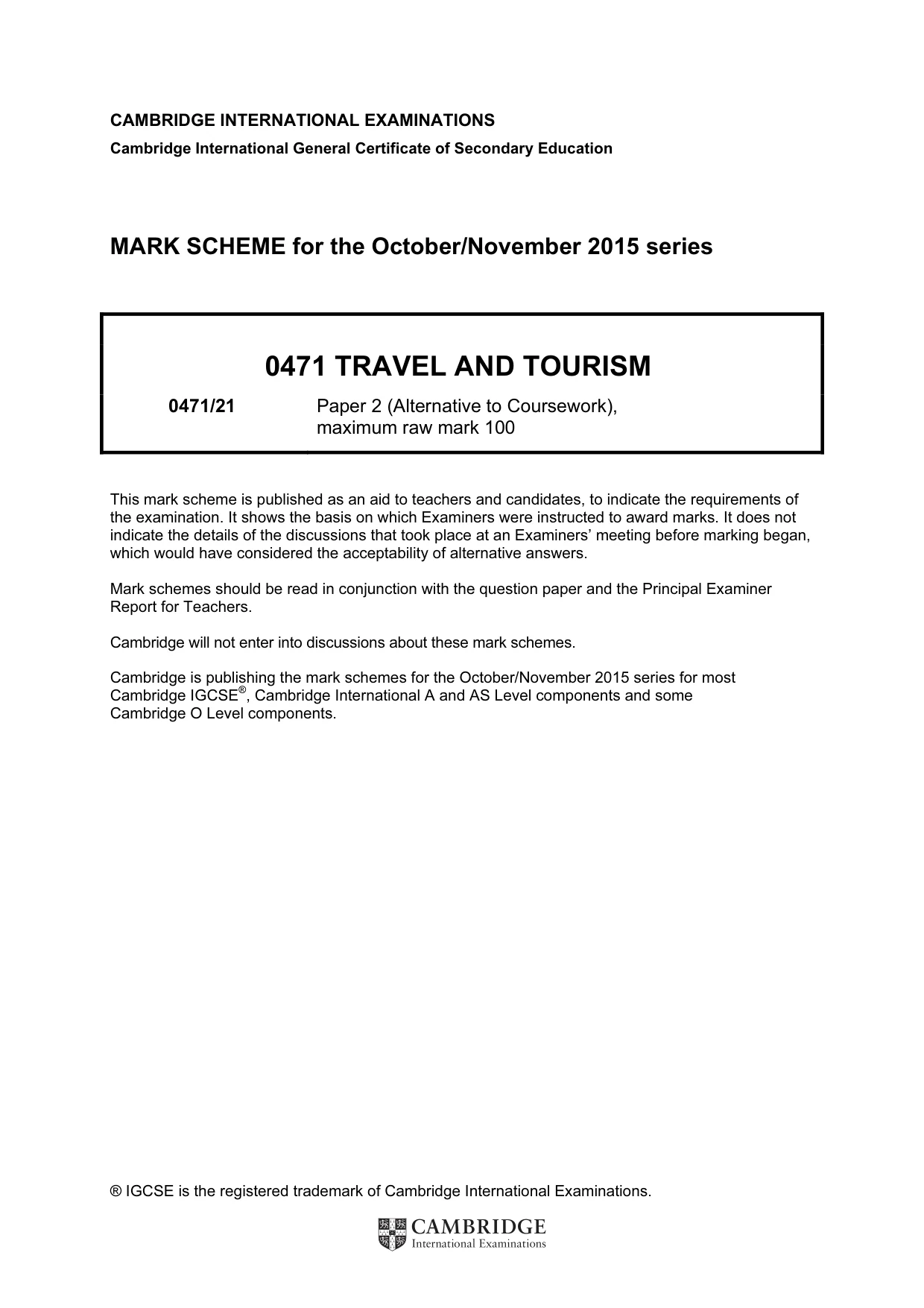
Question paper, page 13
13 0471/21/O/N/15 © UCLES 2015 (d) Evaluate the importance of customers’ expectations as a factor when determining pricing policies for tourism providers in Madagascar. … … … … … … … … … … … … … … … … … … [9] [Total: 25]
Question paper, page 14
14 0471/21/O/N/15 © UCLES 2015 BLANK PAGE
Question paper, page 15
15 0471/21/O/N/15 © UCLES 2015 BLANK PAGE
Question paper, page 16
16 0471/21/O/N/15 © UCLES 2015 Permission to reproduce items where third-party owned material protected by copyright is included has been sought and cleared where possible. Every reasonable effort has been made by the publisher (UCLES) to trace copyright holders, but if any items requiring clearance have unwittingly been included, the publisher will be pleased to make amends at the earliest possible opportunity. To avoid the issue of disclosure of answer-related information to candidates, all copyright acknowledgements are reproduced online in the Cambridge International Examinations Copyright Acknowledgements Booklet. This is produced for each series of examinations and is freely available to download at www.cie.org.uk after the live examination series. Cambridge International Examinations is part of the Cambridge Assessment Group. Cambridge Assessment is the brand name of University of Cambridge Local Examinations Syndicate (UCLES), which is itself a department of the University of Cambridge. BLANK PAGE
Mark scheme, page 1
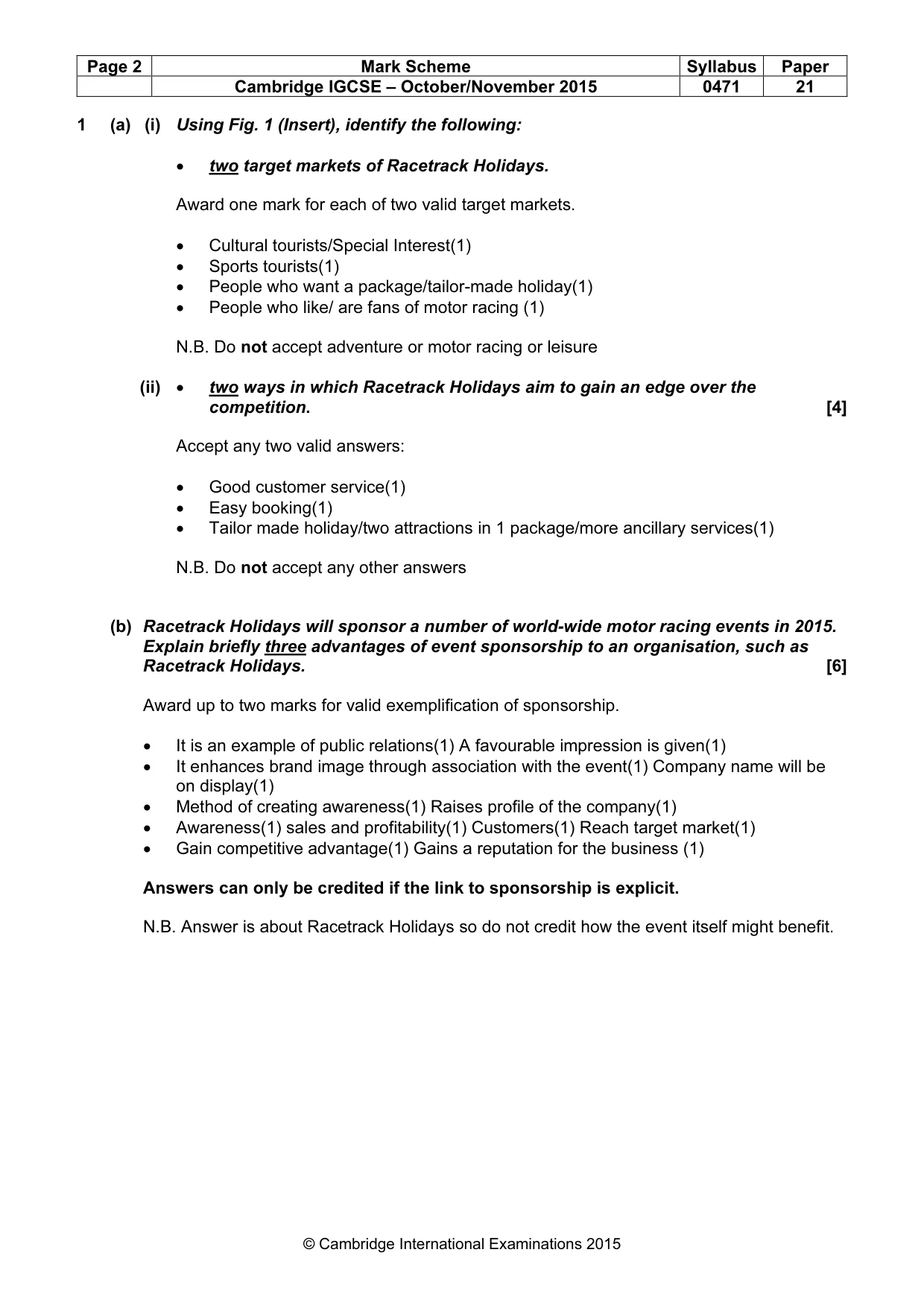
® IGCSE is the registered trademark of Cambridge International Examinations. CAMBRIDGE INTERNATIONAL EXAMINATIONS Cambridge International General Certificate of Secondary Education MARK SCHEME for the October/November 2015 series 0471 TRAVEL AND TOURISM 0471/21 Paper 2 (Alternative to Coursework), maximum raw mark 100 This mark scheme is published as an aid to teachers and candidates, to indicate the requirements of the examination. It shows the basis on which Examiners were instructed to award marks. It does not indicate the details of the discussions that took place at an Examiners’ meeting before marking began, which would have considered the acceptability of alternative answers. Mark schemes should be read in conjunction with the question paper and the Principal Examiner Report for Teachers. Cambridge will not enter into discussions about these mark schemes. Cambridge is publishing the mark schemes for the October/November 2015 series for most Cambridge IGCSE®, Cambridge International A and AS Level components and some Cambridge O Level components.
Mark scheme, page 2
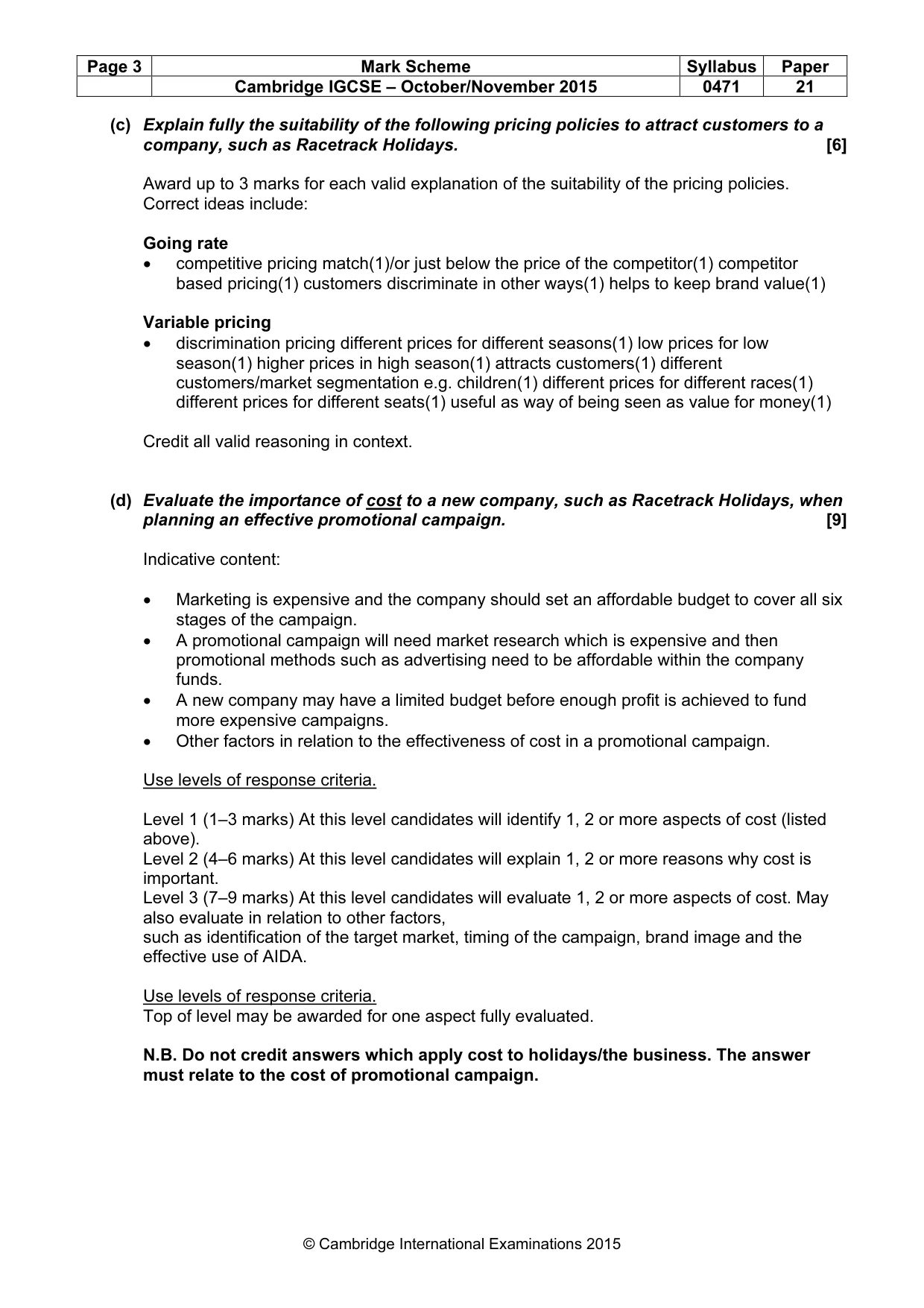
Page 2 Mark Scheme Syllabus Paper Cambridge IGCSE – October/November 2015 0471 21 © Cambridge International Examinations 2015 1 (a) (i) Using Fig. 1 (Insert), identify the following: • two target markets of Racetrack Holidays. Award one mark for each of two valid target markets. • Cultural tourists/Special Interest(1) • Sports tourists(1) • People who want a package/tailor-made holiday(1) • People who like/ are fans of motor racing (1) N.B. Do not accept adventure or motor racing or leisure (ii) • two ways in which Racetrack Holidays aim to gain an edge over the competition. [4] Accept any two valid answers: • Good customer service(1) • Easy booking(1) • Tailor made holiday/two attractions in 1 package/more ancillary services(1) N.B. Do not accept any other answers (b) Racetrack Holidays will sponsor a number of world-wide motor racing events in 2015. Explain briefly three advantages of event sponsorship to an organisation, such as Racetrack Holidays. [6] Award up to two marks for valid exemplification of sponsorship. • It is an example of public relations(1) A favourable impression is given(1) • It enhances brand image through association with the event(1) Company name will be on display(1) • Method of creating awareness(1) Raises profile of the company(1) • Awareness(1) sales and profitability(1) Customers(1) Reach target market(1) • Gain competitive advantage(1) Gains a reputation for the business (1) Answers can only be credited if the link to sponsorship is explicit. N.B. Answer is about Racetrack Holidays so do not credit how the event itself might benefit.
Mark scheme, page 3
Page 3 Mark Scheme Syllabus Paper Cambridge IGCSE – October/November 2015 0471 21 © Cambridge International Examinations 2015 (c) Explain fully the suitability of the following pricing policies to attract customers to a company, such as Racetrack Holidays. [6] Award up to 3 marks for each valid explanation of the suitability of the pricing policies. Correct ideas include: Going rate • competitive pricing match(1)/or just below the price of the competitor(1) competitor based pricing(1) customers discriminate in other ways(1) helps to keep brand value(1) Variable pricing • discrimination pricing different prices for different seasons(1) low prices for low season(1) higher prices in high season(1) attracts customers(1) different customers/market segmentation e.g. children(1) different prices for different races(1) different prices for different seats(1) useful as way of being seen as value for money(1) Credit all valid reasoning in context. (d) Evaluate the importance of cost to a new company, such as Racetrack Holidays, when planning an effective promotional campaign. [9] Indicative content: • Marketing is expensive and the company should set an affordable budget to cover all six stages of the campaign. • A promotional campaign will need market research which is expensive and then promotional methods such as advertising need to be affordable within the company funds. • A new company may have a limited budget before enough profit is achieved to fund more expensive campaigns. • Other factors in relation to the effectiveness of cost in a promotional campaign. Use levels of response criteria. Level 1 (1–3 marks) At this level candidates will identify 1, 2 or more aspects of cost (listed above). Level 2 (4–6 marks) At this level candidates will explain 1, 2 or more reasons why cost is important. Level 3 (7–9 marks) At this level candidates will evaluate 1, 2 or more aspects of cost. May also evaluate in relation to other factors, such as identification of the target market, timing of the campaign, brand image and the effective use of AIDA. Use levels of response criteria. Top of level may be awarded for one aspect fully evaluated. N.B. Do not credit answers which apply cost to holidays/the business. The answer must relate to the cost of promotional campaign.
Mark scheme, page 4
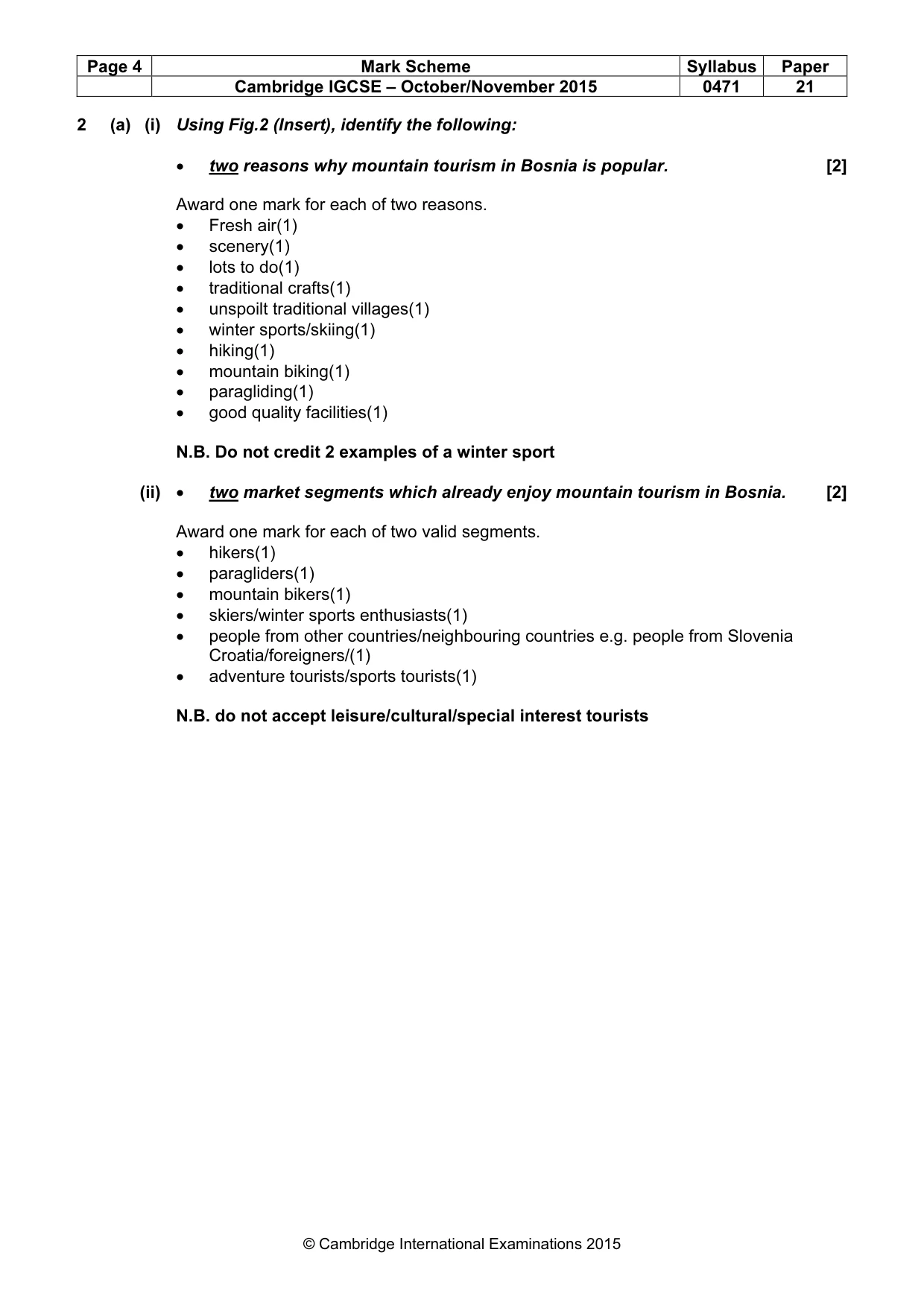
Page 4 Mark Scheme Syllabus Paper Cambridge IGCSE – October/November 2015 0471 21 © Cambridge International Examinations 2015 2 (a) (i) Using Fig.2 (Insert), identify the following: • two reasons why mountain tourism in Bosnia is popular. [2] Award one mark for each of two reasons. • Fresh air(1) • scenery(1) • lots to do(1) • traditional crafts(1) • unspoilt traditional villages(1) • winter sports/skiing(1) • hiking(1) • mountain biking(1) • paragliding(1) • good quality facilities(1) N.B. Do not credit 2 examples of a winter sport (ii) • two market segments which already enjoy mountain tourism in Bosnia. [2] Award one mark for each of two valid segments. • hikers(1) • paragliders(1) • mountain bikers(1) • skiers/winter sports enthusiasts(1) • people from other countries/neighbouring countries e.g. people from Slovenia Croatia/foreigners/(1) • adventure tourists/sports tourists(1) N.B. do not accept leisure/cultural/special interest tourists
Mark scheme, page 5
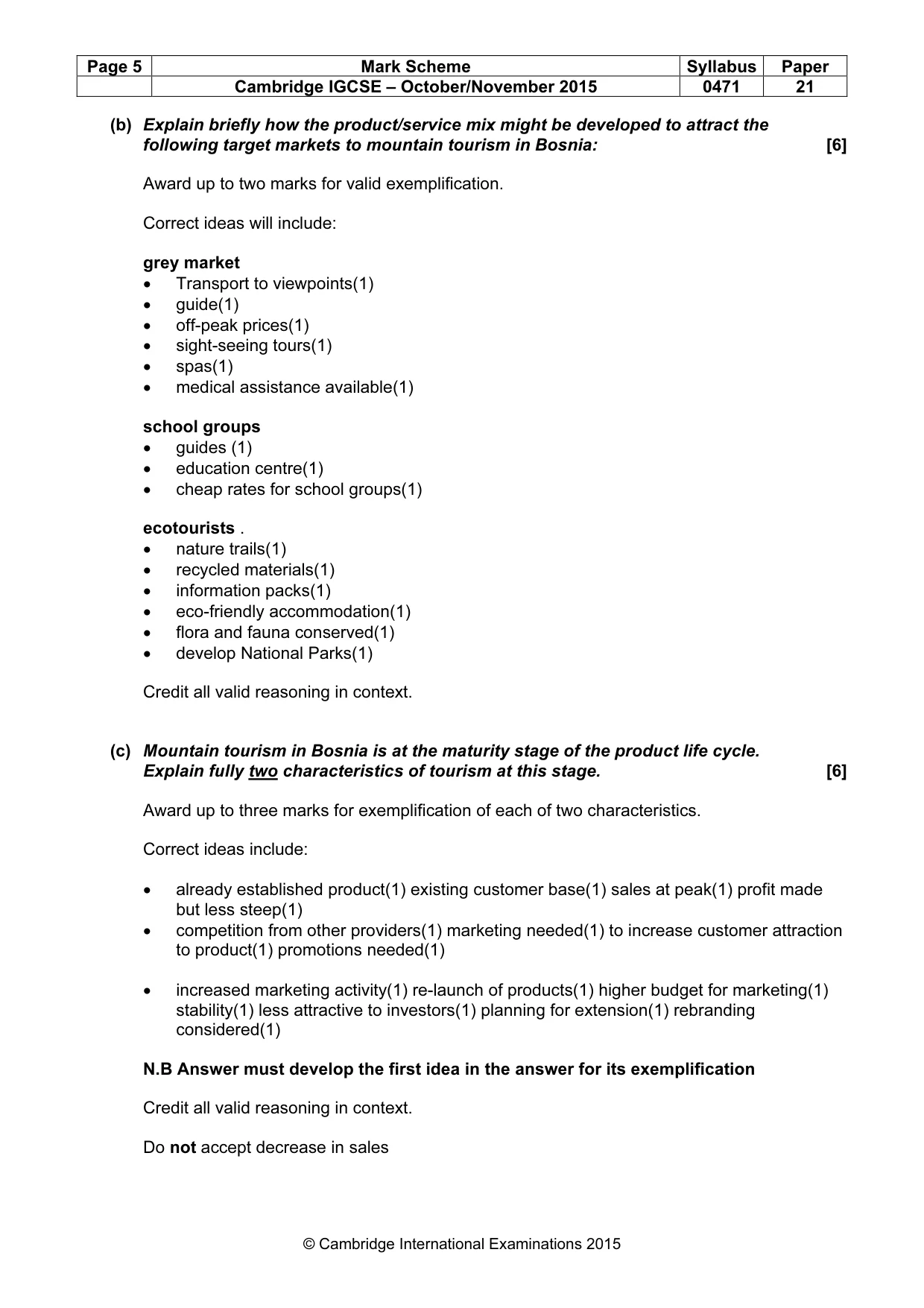
Page 5 Mark Scheme Syllabus Paper Cambridge IGCSE – October/November 2015 0471 21 © Cambridge International Examinations 2015 (b) Explain briefly how the product/service mix might be developed to attract the following target markets to mountain tourism in Bosnia: [6] Award up to two marks for valid exemplification. Correct ideas will include: grey market • Transport to viewpoints(1) • guide(1) • off-peak prices(1) • sight-seeing tours(1) • spas(1) • medical assistance available(1) school groups • guides (1) • education centre(1) • cheap rates for school groups(1) ecotourists . • nature trails(1) • recycled materials(1) • information packs(1) • eco-friendly accommodation(1) • flora and fauna conserved(1) • develop National Parks(1) Credit all valid reasoning in context. (c) Mountain tourism in Bosnia is at the maturity stage of the product life cycle. Explain fully two characteristics of tourism at this stage. [6] Award up to three marks for exemplification of each of two characteristics. Correct ideas include: • already established product(1) existing customer base(1) sales at peak(1) profit made but less steep(1) • competition from other providers(1) marketing needed(1) to increase customer attraction to product(1) promotions needed(1) • increased marketing activity(1) re-launch of products(1) higher budget for marketing(1) stability(1) less attractive to investors(1) planning for extension(1) rebranding considered(1) N.B Answer must develop the first idea in the answer for its exemplification Credit all valid reasoning in context. Do not accept decrease in sales
Mark scheme, page 6
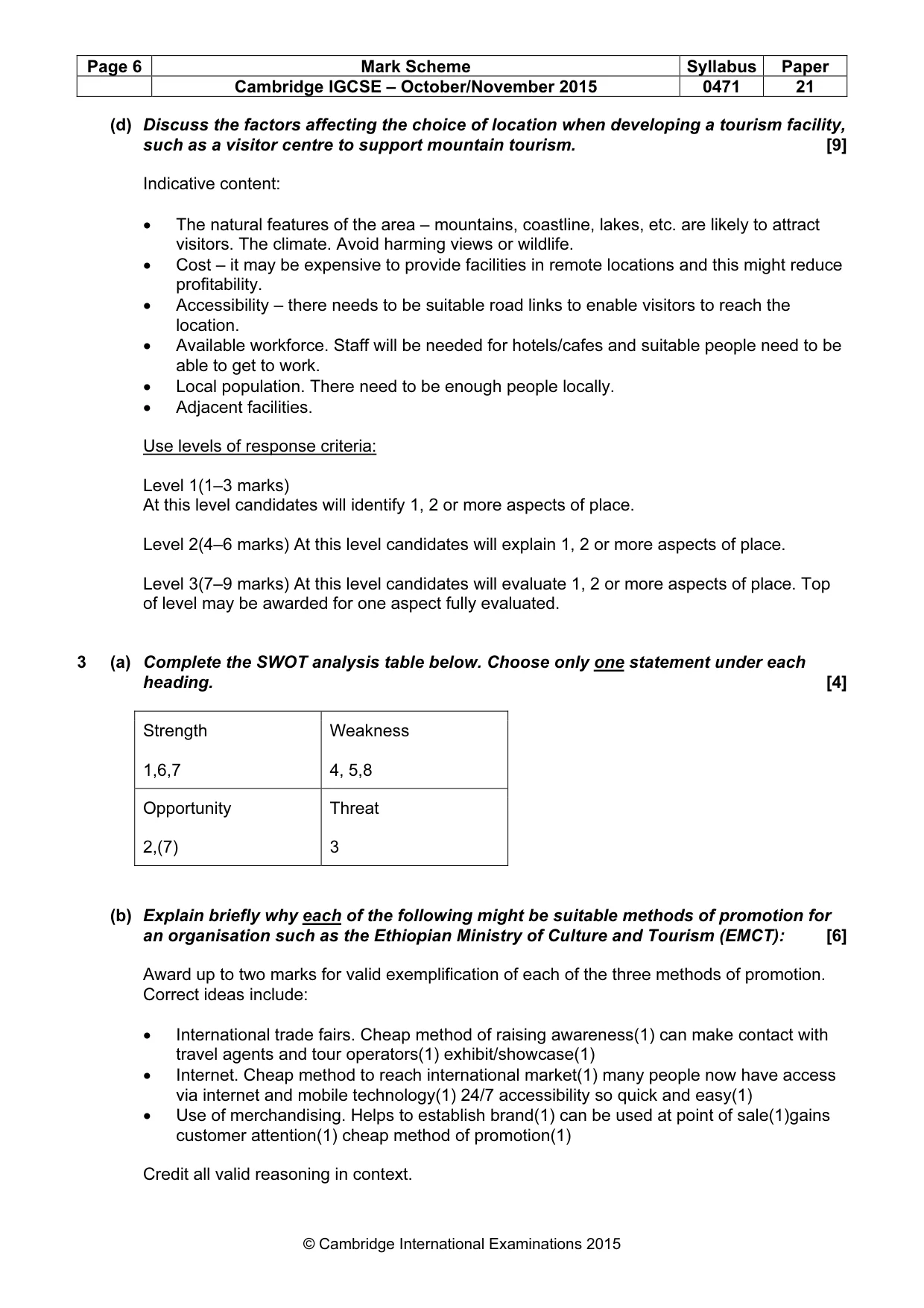
Page 6 Mark Scheme Syllabus Paper Cambridge IGCSE – October/November 2015 0471 21 © Cambridge International Examinations 2015 (d) Discuss the factors affecting the choice of location when developing a tourism facility, such as a visitor centre to support mountain tourism. [9] Indicative content: • The natural features of the area – mountains, coastline, lakes, etc. are likely to attract visitors. The climate. Avoid harming views or wildlife. • Cost – it may be expensive to provide facilities in remote locations and this might reduce profitability. • Accessibility – there needs to be suitable road links to enable visitors to reach the location. • Available workforce. Staff will be needed for hotels/cafes and suitable people need to be able to get to work. • Local population. There need to be enough people locally. • Adjacent facilities. Use levels of response criteria: Level 1(1–3 marks) At this level candidates will identify 1, 2 or more aspects of place. Level 2(4–6 marks) At this level candidates will explain 1, 2 or more aspects of place. Level 3(7–9 marks) At this level candidates will evaluate 1, 2 or more aspects of place. Top of level may be awarded for one aspect fully evaluated. 3 (a) Complete the SWOT analysis table below. Choose only one statement under each heading. [4] Strength 1,6,7 Weakness 4, 5,8 Opportunity 2,(7) Threat 3 (b) Explain briefly why each of the following might be suitable methods of promotion for an organisation such as the Ethiopian Ministry of Culture and Tourism (EMCT): [6] Award up to two marks for valid exemplification of each of the three methods of promotion. Correct ideas include: • International trade fairs. Cheap method of raising awareness(1) can make contact with travel agents and tour operators(1) exhibit/showcase(1) • Internet. Cheap method to reach international market(1) many people now have access via internet and mobile technology(1) 24/7 accessibility so quick and easy(1) • Use of merchandising. Helps to establish brand(1) can be used at point of sale(1)gains customer attention(1) cheap method of promotion(1) Credit all valid reasoning in context.
Mark scheme, page 7
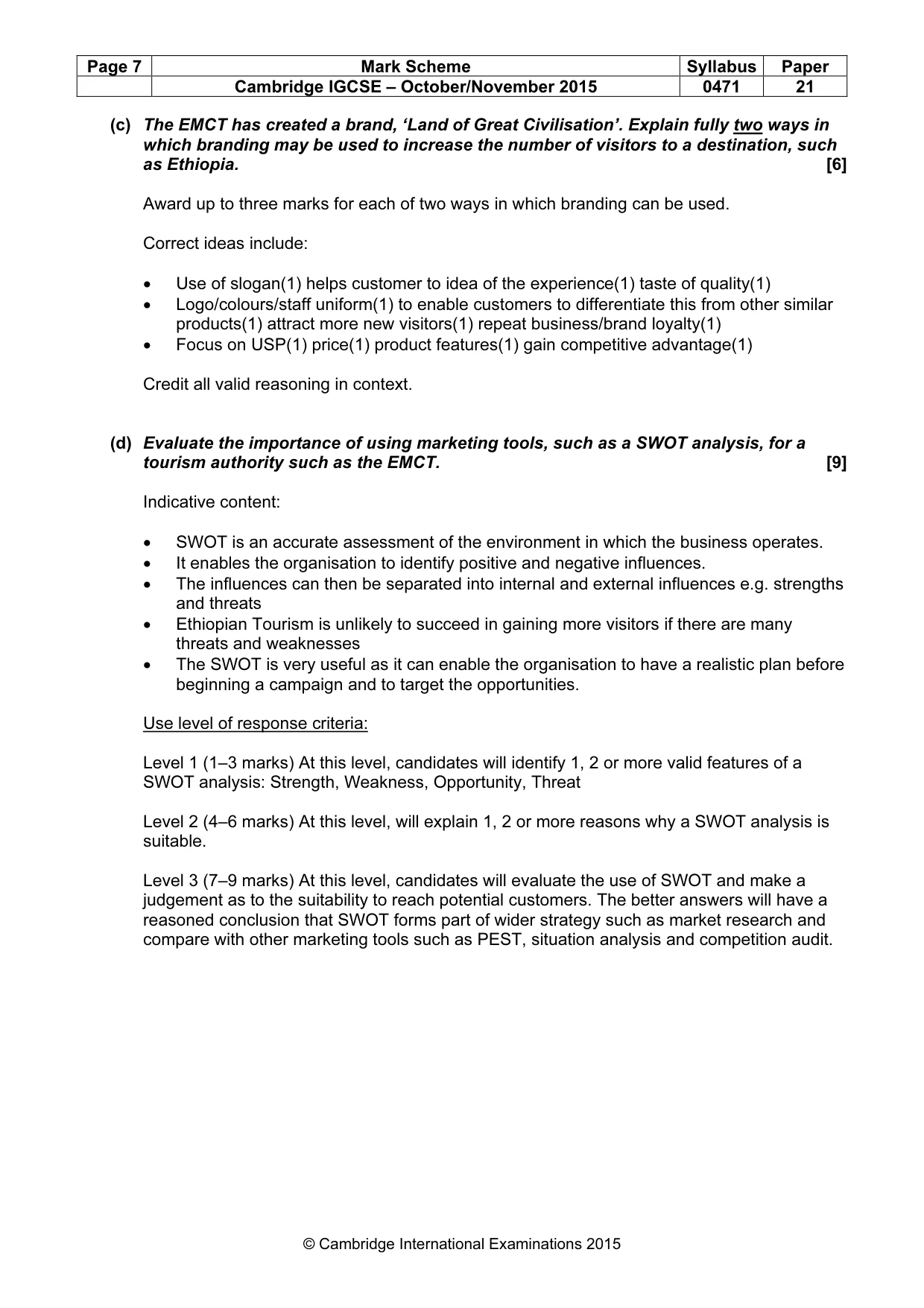
Page 7 Mark Scheme Syllabus Paper Cambridge IGCSE – October/November 2015 0471 21 © Cambridge International Examinations 2015 (c) The EMCT has created a brand, ‘Land of Great Civilisation’. Explain fully two ways in which branding may be used to increase the number of visitors to a destination, such as Ethiopia. [6] Award up to three marks for each of two ways in which branding can be used. Correct ideas include: • Use of slogan(1) helps customer to idea of the experience(1) taste of quality(1) • Logo/colours/staff uniform(1) to enable customers to differentiate this from other similar products(1) attract more new visitors(1) repeat business/brand loyalty(1) • Focus on USP(1) price(1) product features(1) gain competitive advantage(1) Credit all valid reasoning in context. (d) Evaluate the importance of using marketing tools, such as a SWOT analysis, for a tourism authority such as the EMCT. [9] Indicative content: • SWOT is an accurate assessment of the environment in which the business operates. • It enables the organisation to identify positive and negative influences. • The influences can then be separated into internal and external influences e.g. strengths and threats • Ethiopian Tourism is unlikely to succeed in gaining more visitors if there are many threats and weaknesses • The SWOT is very useful as it can enable the organisation to have a realistic plan before beginning a campaign and to target the opportunities. Use level of response criteria: Level 1 (1–3 marks) At this level, candidates will identify 1, 2 or more valid features of a SWOT analysis: Strength, Weakness, Opportunity, Threat Level 2 (4–6 marks) At this level, will explain 1, 2 or more reasons why a SWOT analysis is suitable. Level 3 (7–9 marks) At this level, candidates will evaluate the use of SWOT and make a judgement as to the suitability to reach potential customers. The better answers will have a reasoned conclusion that SWOT forms part of wider strategy such as market research and compare with other marketing tools such as PEST, situation analysis and competition audit.
Mark scheme, page 8
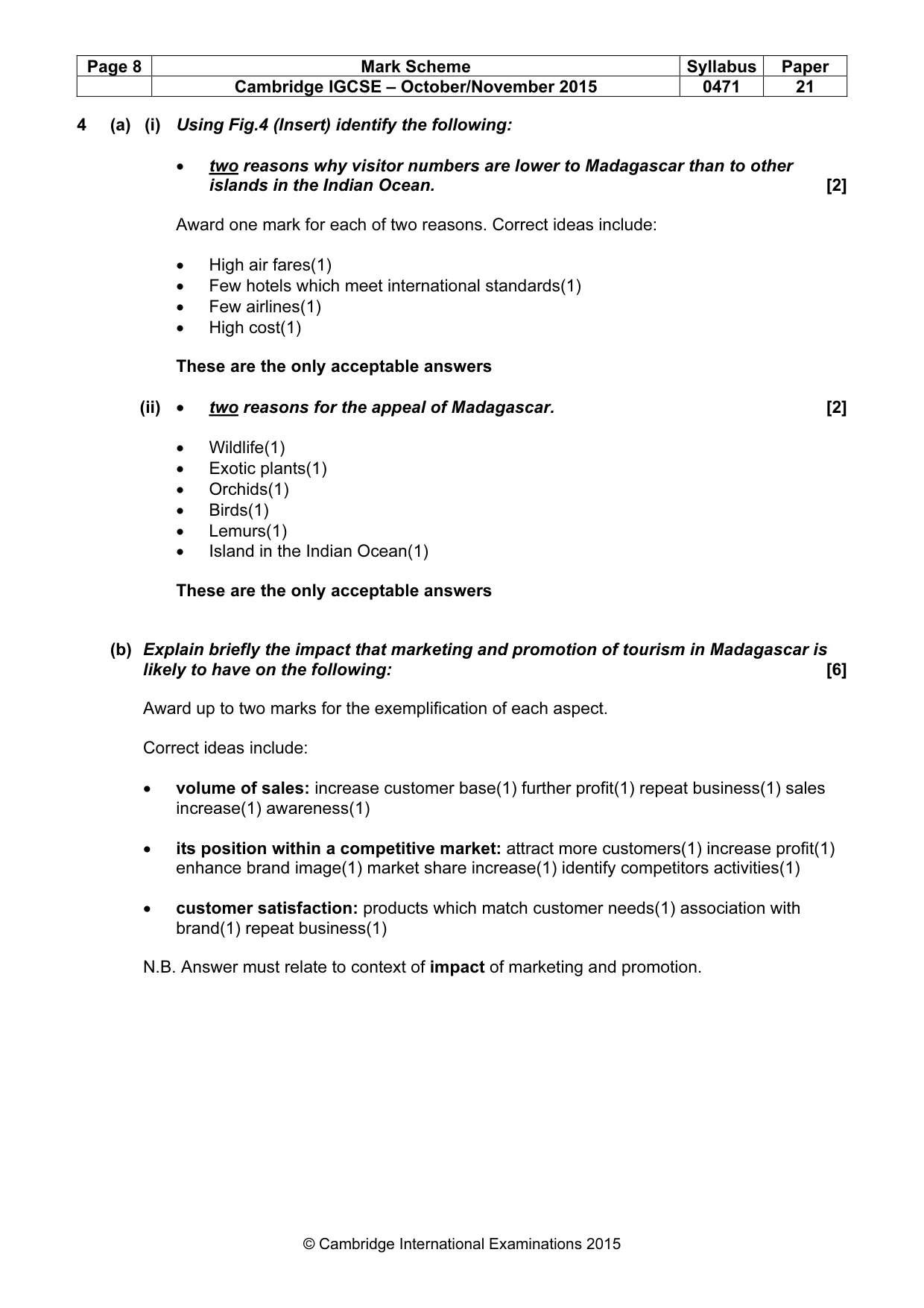
Page 8 Mark Scheme Syllabus Paper Cambridge IGCSE – October/November 2015 0471 21 © Cambridge International Examinations 2015 4 (a) (i) Using Fig.4 (Insert) identify the following: • two reasons why visitor numbers are lower to Madagascar than to other islands in the Indian Ocean. [2] Award one mark for each of two reasons. Correct ideas include: • High air fares(1) • Few hotels which meet international standards(1) • Few airlines(1) • High cost(1) These are the only acceptable answers (ii) • two reasons for the appeal of Madagascar. [2] • Wildlife(1) • Exotic plants(1) • Orchids(1) • Birds(1) • Lemurs(1) • Island in the Indian Ocean(1) These are the only acceptable answers (b) Explain briefly the impact that marketing and promotion of tourism in Madagascar is likely to have on the following: [6] Award up to two marks for the exemplification of each aspect. Correct ideas include: • volume of sales: increase customer base(1) further profit(1) repeat business(1) sales increase(1) awareness(1) • its position within a competitive market: attract more customers(1) increase profit(1) enhance brand image(1) market share increase(1) identify competitors activities(1) • customer satisfaction: products which match customer needs(1) association with brand(1) repeat business(1) N.B. Answer must relate to context of impact of marketing and promotion.
Mark scheme, page 9
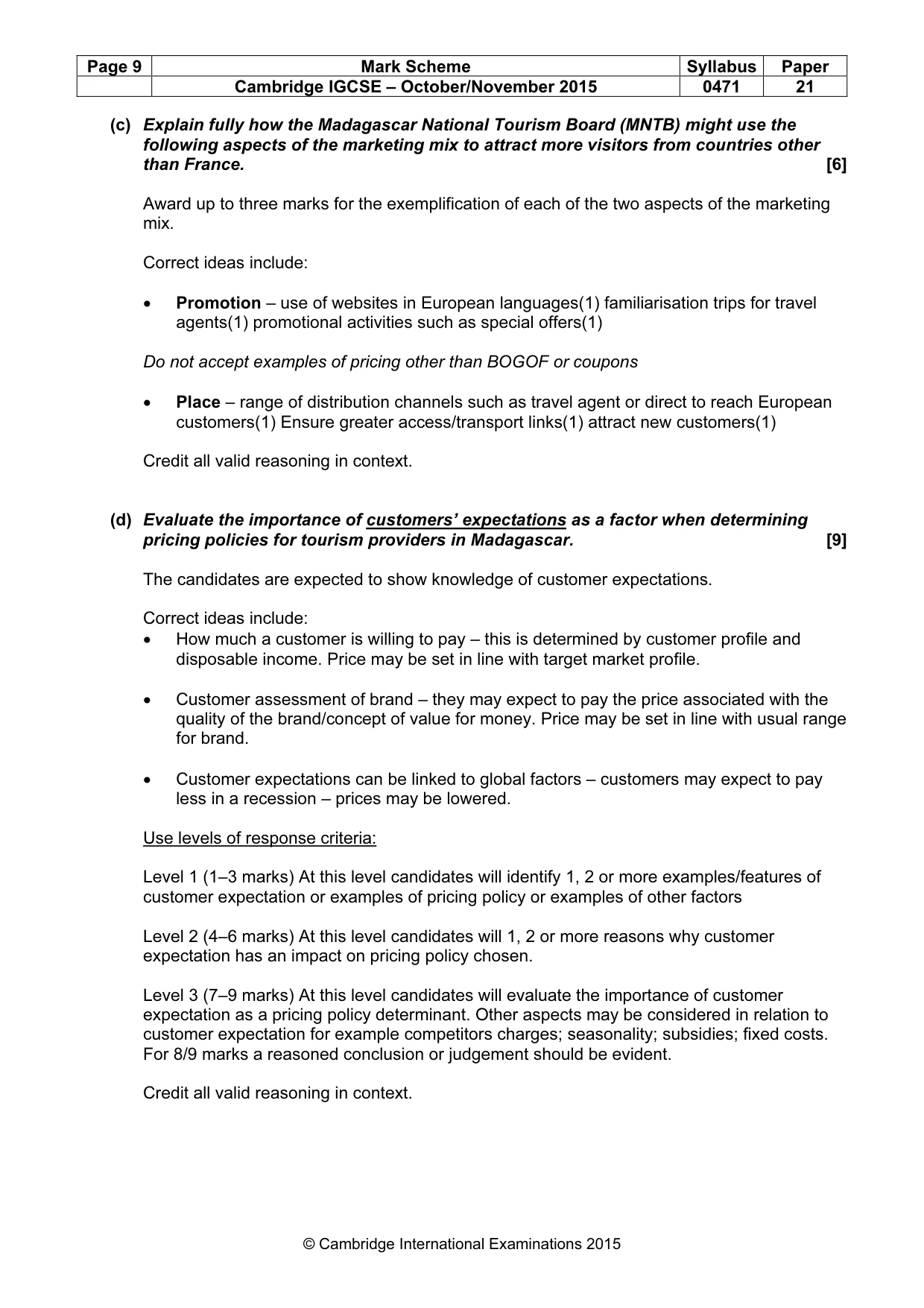
Page 9 Mark Scheme Syllabus Paper Cambridge IGCSE – October/November 2015 0471 21 © Cambridge International Examinations 2015 (c) Explain fully how the Madagascar National Tourism Board (MNTB) might use the following aspects of the marketing mix to attract more visitors from countries other than France. [6] Award up to three marks for the exemplification of each of the two aspects of the marketing mix. Correct ideas include: • Promotion – use of websites in European languages(1) familiarisation trips for travel agents(1) promotional activities such as special offers(1) Do not accept examples of pricing other than BOGOF or coupons • Place – range of distribution channels such as travel agent or direct to reach European customers(1) Ensure greater access/transport links(1) attract new customers(1) Credit all valid reasoning in context. (d) Evaluate the importance of customers’ expectations as a factor when determining pricing policies for tourism providers in Madagascar. [9] The candidates are expected to show knowledge of customer expectations. Correct ideas include: • How much a customer is willing to pay – this is determined by customer profile and disposable income. Price may be set in line with target market profile. • Customer assessment of brand – they may expect to pay the price associated with the quality of the brand/concept of value for money. Price may be set in line with usual range for brand. • Customer expectations can be linked to global factors – customers may expect to pay less in a recession – prices may be lowered. Use levels of response criteria: Level 1 (1–3 marks) At this level candidates will identify 1, 2 or more examples/features of customer expectation or examples of pricing policy or examples of other factors Level 2 (4–6 marks) At this level candidates will 1, 2 or more reasons why customer expectation has an impact on pricing policy chosen. Level 3 (7–9 marks) At this level candidates will evaluate the importance of customer expectation as a pricing policy determinant. Other aspects may be considered in relation to customer expectation for example competitors charges; seasonality; subsidies; fixed costs. For 8/9 marks a reasoned conclusion or judgement should be evident. Credit all valid reasoning in context.
What you needed in this session
Cambridge’s own grade thresholds for 2015 Oct/Nov, Paper 2 · Variant 1. A higher threshold means an easier paper — the bar moves with how the cohort did.