Cambridge IGCSE Travel and Tourism 0471 — 2015 May/June Paper 2 · Variant 1
0471/21/M/J/15 · 100 marks · ≈113 min
The question paper and its mark scheme, free to read here and free to download. This is Cambridge’s own paper, exactly as it was sat.
Question paper16 pages



Mark scheme8 pages
Answers below. Sit the paper first if you are practising.
Paper as text
Question paper, page 1
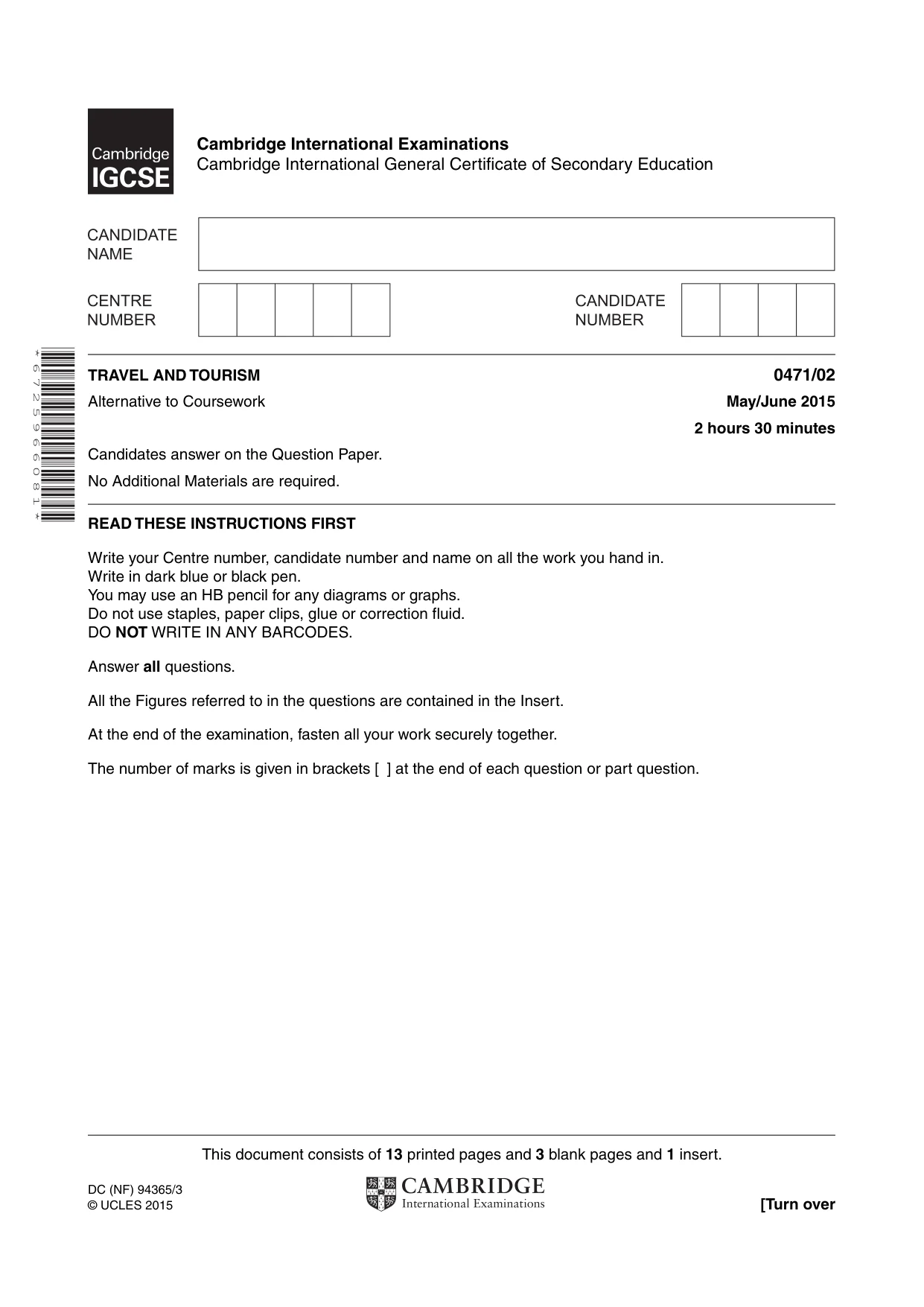
This document consists of 13 printed pages and 3 blank pages and 1 insert. DC (NF) 94365/3 © UCLES 2015 [Turn over Cambridge International Examinations Cambridge International General Certificate of Secondary Education * 6 7 2 5 9 6 6 0 8 1 * TRAVEL AND TOURISM 0471/02 Alternative to Coursework May/June 2015 2 hours 30 minutes Candidates answer on the Question Paper. No Additional Materials are required. READ THESE INSTRUCTIONS FIRST Write your Centre number, candidate number and name on all the work you hand in. Write in dark blue or black pen. You may use an HB pencil for any diagrams or graphs. Do not use staples, paper clips, glue or correction fluid. DO NOT WRITE IN ANY BARCODES. Answer all questions. All the Figures referred to in the questions are contained in the Insert. At the end of the examination, fasten all your work securely together. The number of marks is given in brackets [ ] at the end of each question or part question.
Question paper, page 2
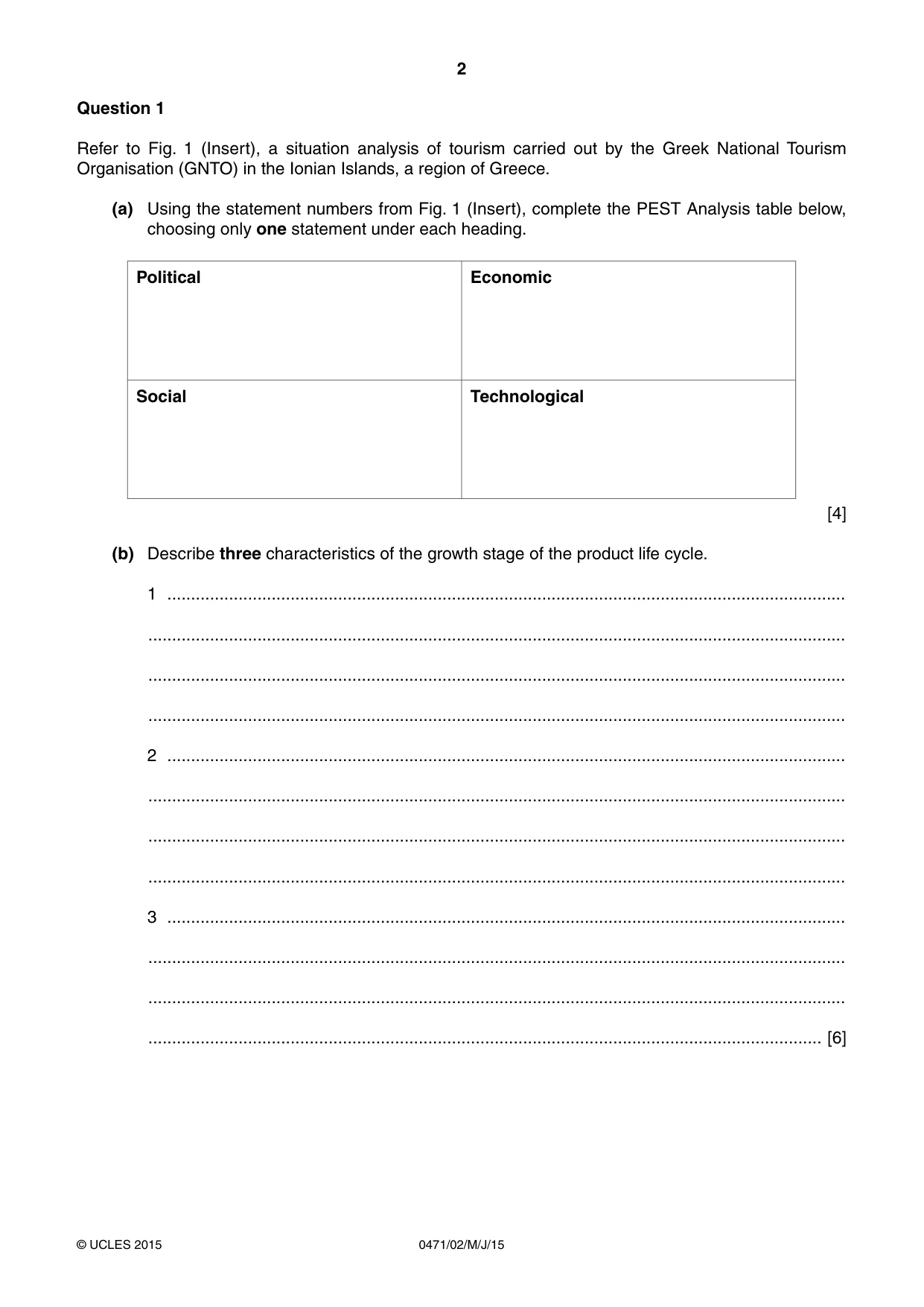
2 0471/02/M/J/15 © UCLES 2015 Question 1 Refer to Fig. 1 (Insert), a situation analysis of tourism carried out by the Greek National Tourism Organisation (GNTO) in the Ionian Islands, a region of Greece. (a) Using the statement numbers from Fig. 1 (Insert), complete the PEST Analysis table below, choosing only one statement under each heading. Political Economic Social Technological [4] (b) Describe three characteristics of the growth stage of the product life cycle. 1 … … … … 2 … … … … 3 … … … … [6]
Question paper, page 3
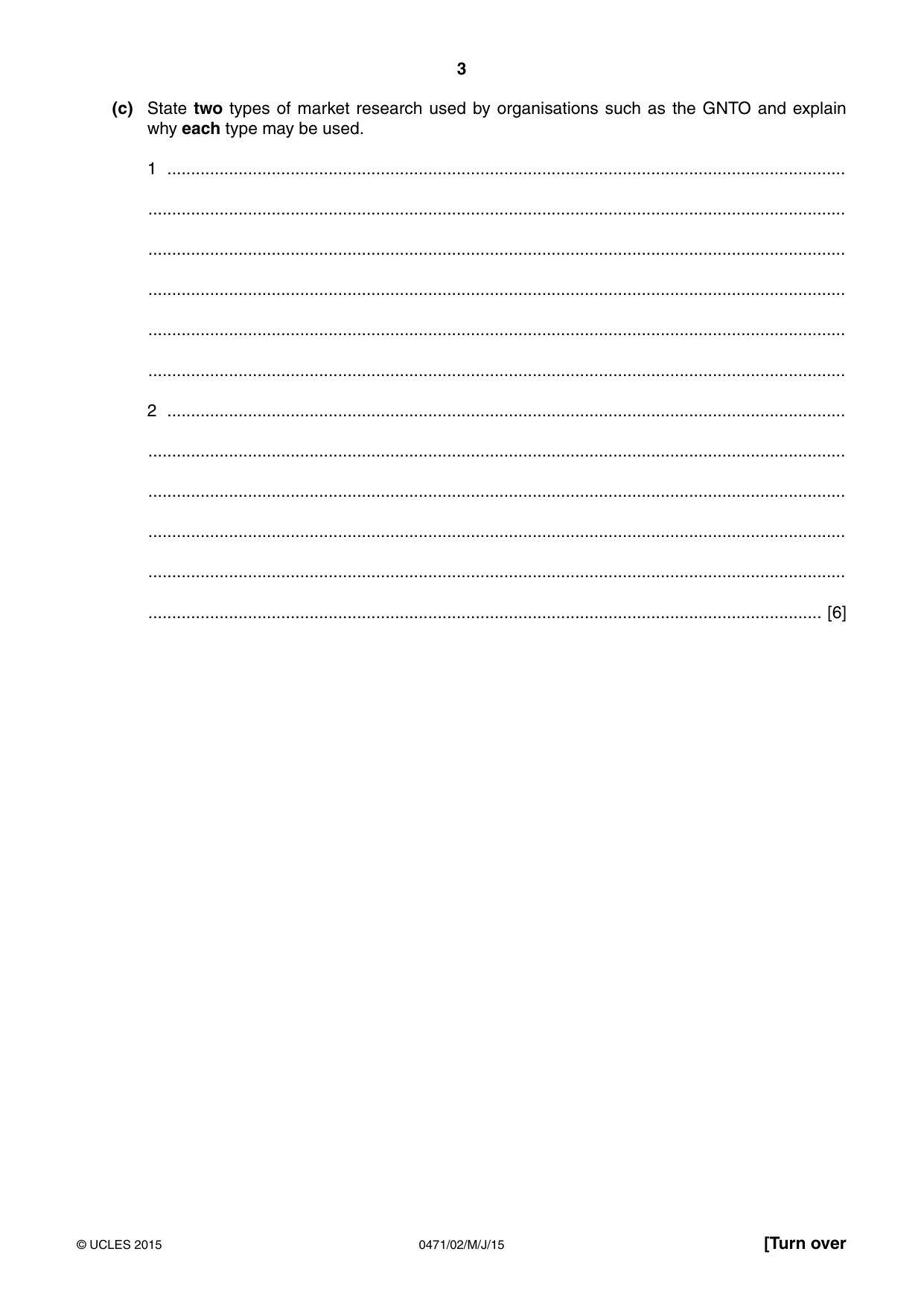
3 0471/02/M/J/15 © UCLES 2015 [Turn over (c) State two types of market research used by organisations such as the GNTO and explain why each type may be used. 1 … … … … … … 2 … … … … … … [6]
Question paper, page 4
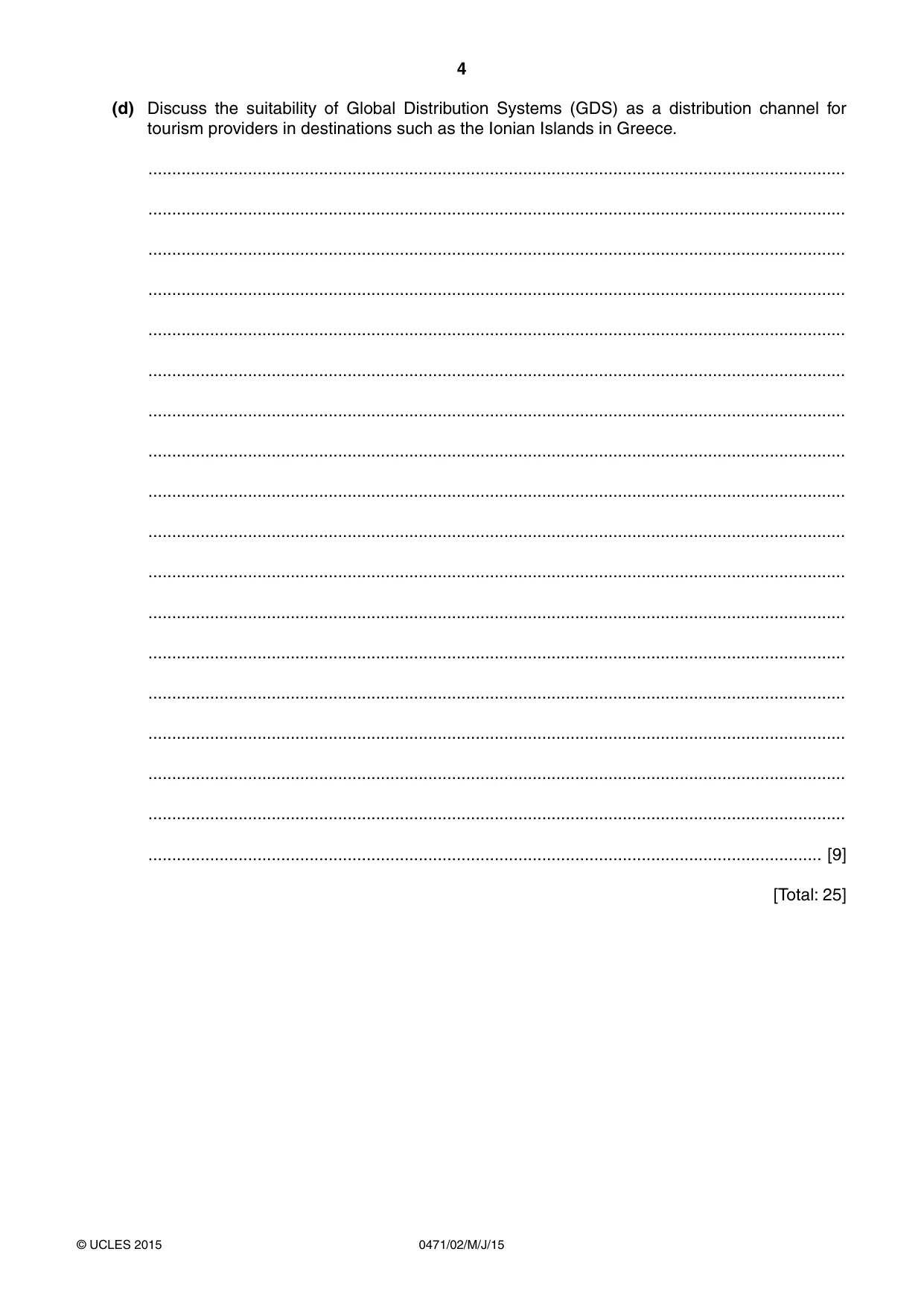
4 0471/02/M/J/15 © UCLES 2015 (d) Discuss the suitability of Global Distribution Systems (GDS) as a distribution channel for tourism providers in destinations such as the Ionian Islands in Greece. … … … … … … … … … … … … … … … … … … [9] [Total: 25]
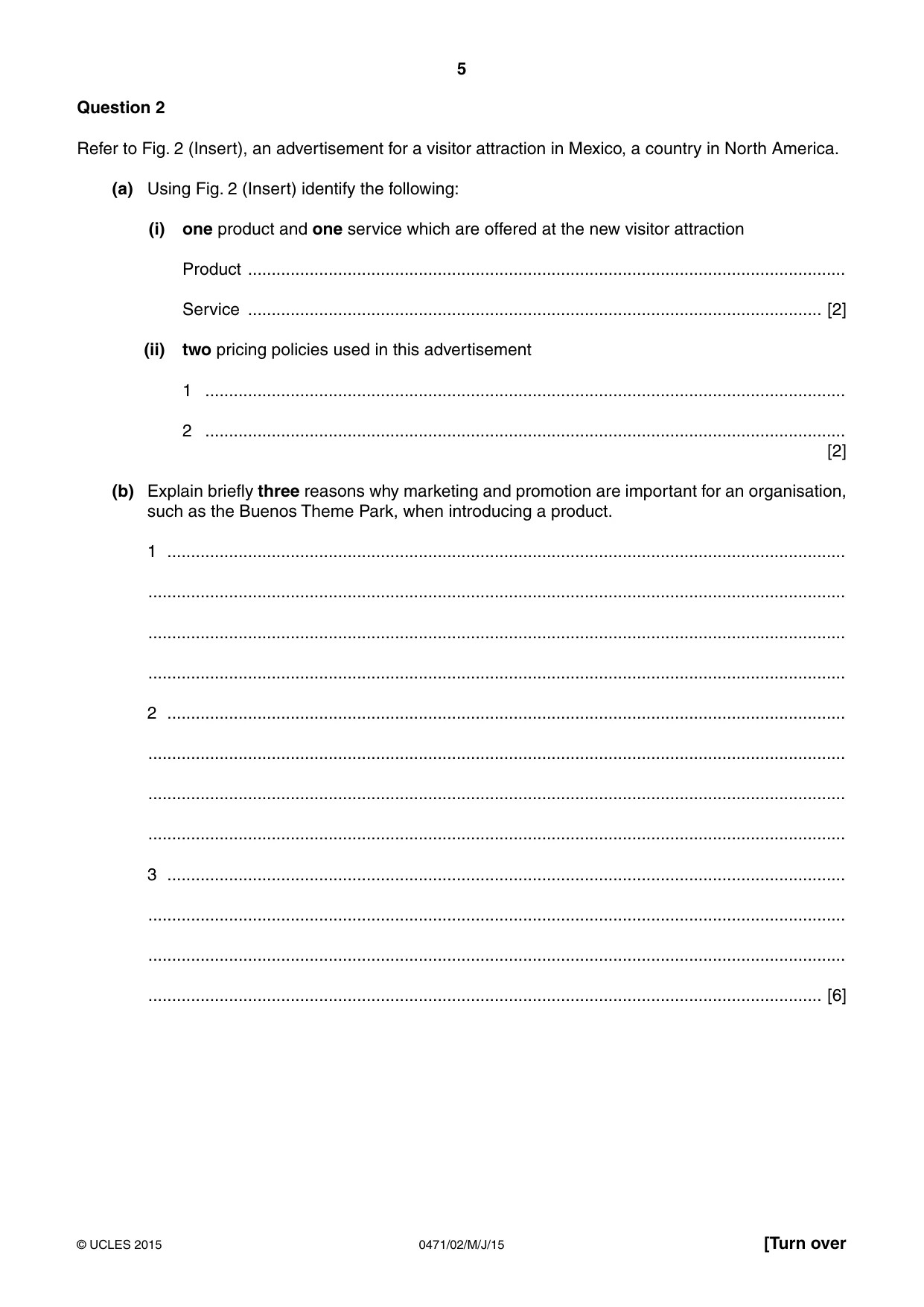
Question paper, page 5
5 0471/02/M/J/15 © UCLES 2015 [Turn over Question 2 Refer to Fig. 2 (Insert), an advertisement for a visitor attraction in Mexico, a country in North America. (a) Using Fig. 2 (Insert) identify the following: (i) one product and one service which are offered at the new visitor attraction Product … Service … [2] (ii) two pricing policies used in this advertisement 1 … 2 … [2] (b) Explain briefly three reasons why marketing and promotion are important for an organisation, such as the Buenos Theme Park, when introducing a product. 1 … … … … 2 … … … … 3 … … … … [6]
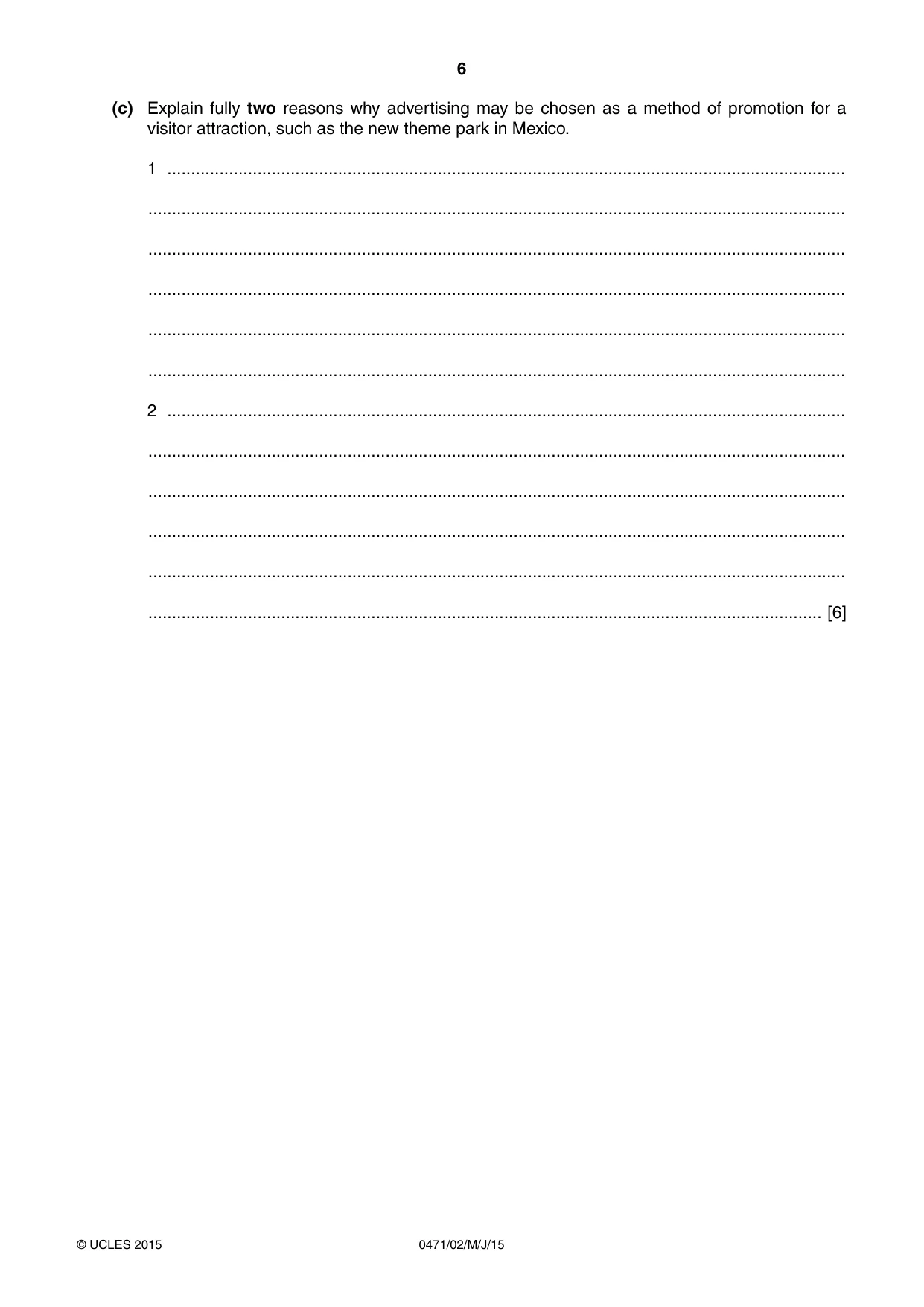
Question paper, page 6
6 0471/02/M/J/15 © UCLES 2015 (c) Explain fully two reasons why advertising may be chosen as a method of promotion for a visitor attraction, such as the new theme park in Mexico. 1 … … … … … … 2 … … … … … … [6]
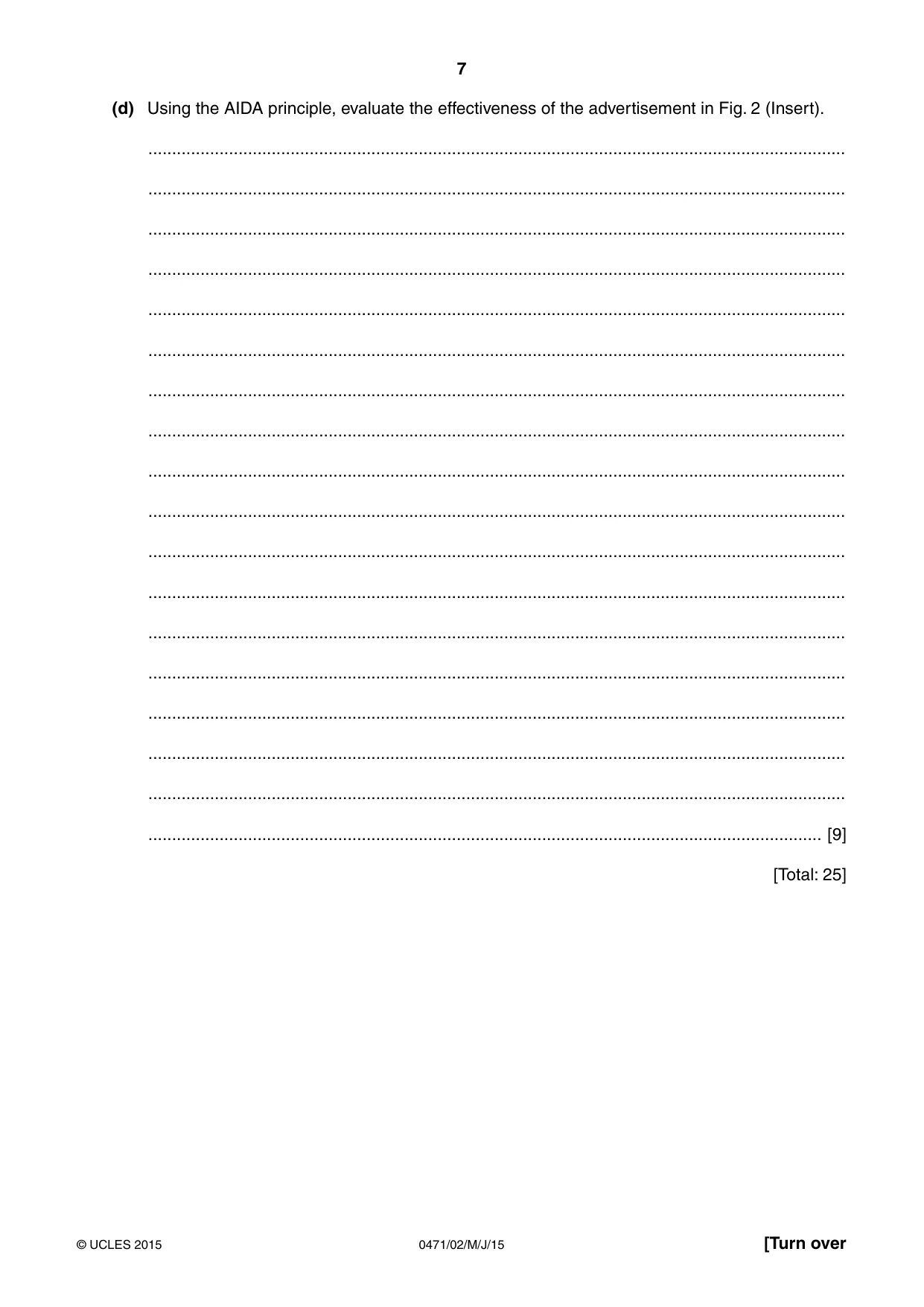
Question paper, page 7
7 0471/02/M/J/15 © UCLES 2015 [Turn over (d) Using the AIDA principle, evaluate the effectiveness of the advertisement in Fig. 2 (Insert). … … … … … … … … … … … … … … … … … … [9] [Total: 25]
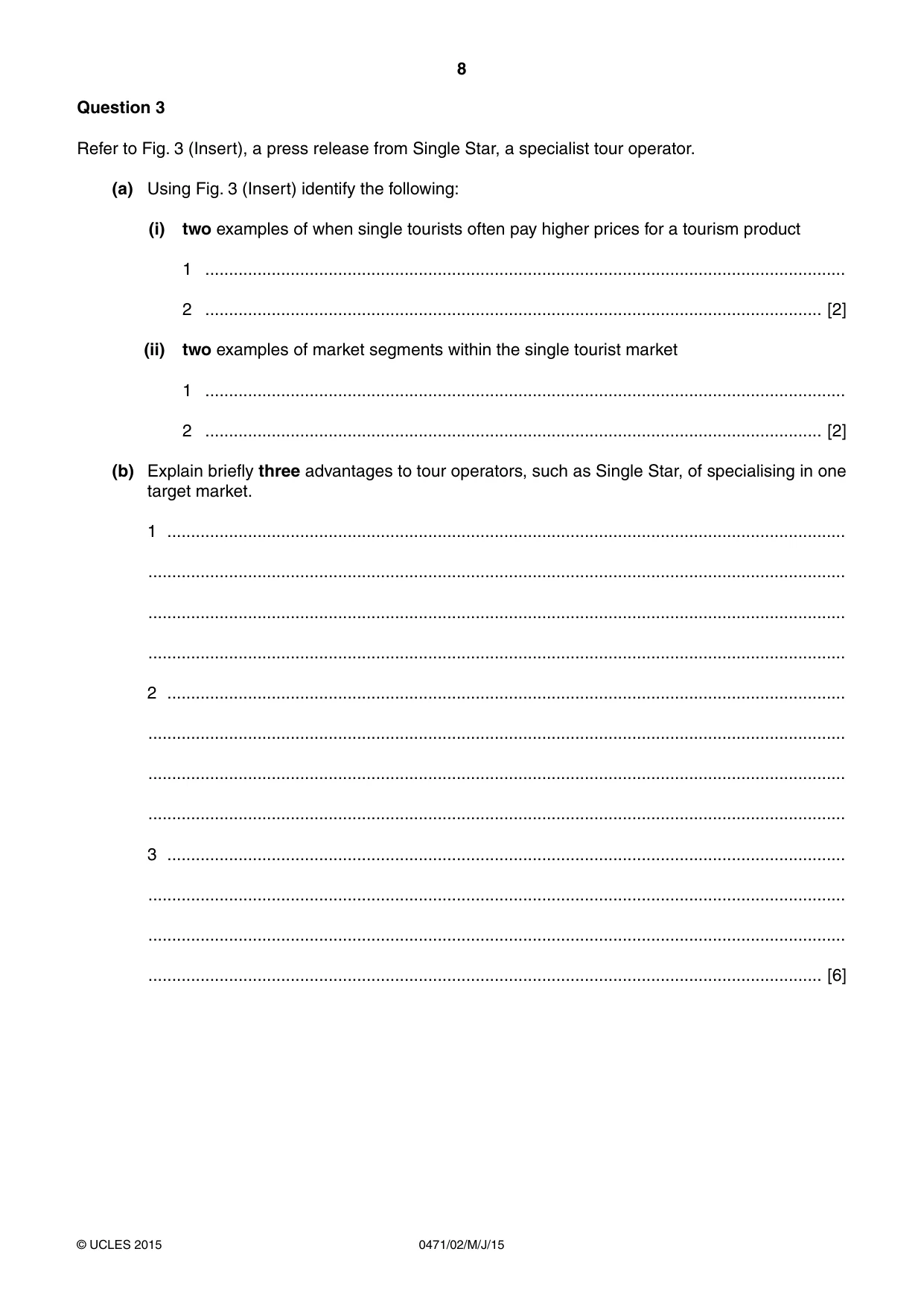
Question paper, page 8
8 0471/02/M/J/15 © UCLES 2015 Question 3 Refer to Fig. 3 (Insert), a press release from Single Star, a specialist tour operator. (a) Using Fig. 3 (Insert) identify the following: (i) two examples of when single tourists often pay higher prices for a tourism product 1 … 2 … [2] (ii) two examples of market segments within the single tourist market 1 … 2 … [2] (b) Explain briefly three advantages to tour operators, such as Single Star, of specialising in one target market. 1 … … … … 2 … … … … 3 … … … … [6]
Question paper, page 9
9 0471/02/M/J/15 © UCLES 2015 [Turn over (c) Explain fully two factors that may influence the pricing policies of an organisation, such as Single Star. 1 … … … … … … 2 … … … … … … [6]
Question paper, page 10
10 0471/02/M/J/15 © UCLES 2015 (d) Discuss how a specialist tour operator, such as Single Star, might adapt its marketing mix to enter the market. … … … … … … … … … … … … … … … … … … [9] [Total: 25]
Question paper, page 11
11 0471/02/M/J/15 © UCLES 2015 [Turn over Question 4 Refer to Fig. 4 (Insert), a 2014 marketing campaign for VisitScotland, Scotland’s national tourist board. (a) Using Fig. 4 (Insert) identify the following: (i) two international sports tourism events held in Scotland in 2014 1 … 2 … [2] (ii) two methods of transport that international visitors may use to travel to Scotland 1 … 2 … [2] (b) Identify three different types of itinerary available as part of the Homecoming Scotland marketing campaign and briefly explain the likely appeal of each itinerary to different visitor types. 1 … … … … 2 … … … … 3 … … … … [6]
Question paper, page 12
12 0471/02/M/J/15 © UCLES 2015 (c) Explain fully two reasons why a national tourist board might use a brand, such as ‘Year of Homecoming’, as part of its marketing campaign. 1 … … … … … … 2 … … … … … … [6]
Question paper, page 13
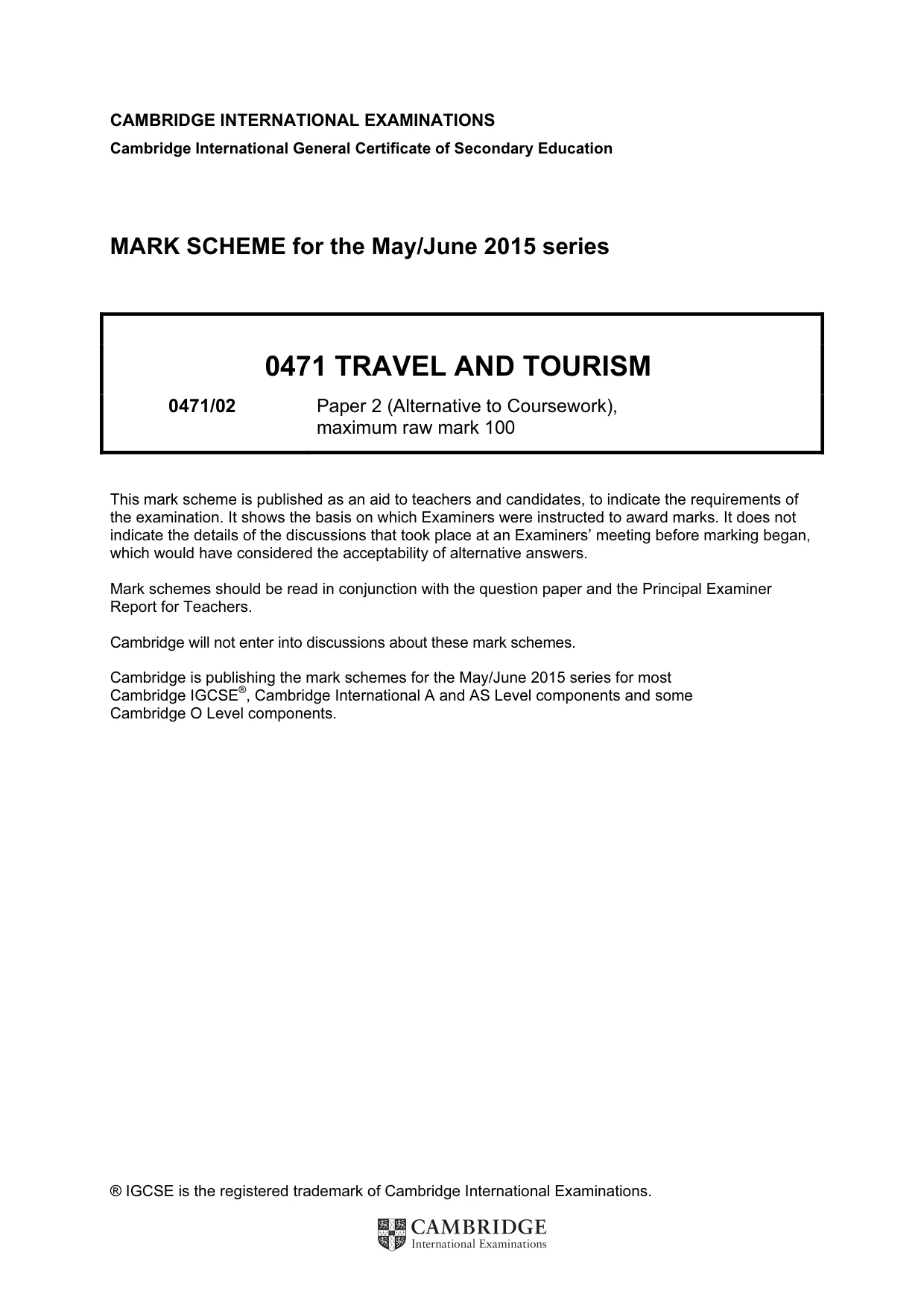
13 0471/02/M/J/15 © UCLES 2015 (d) Discuss the ways in which the product/service mix of a 5* hotel may meet the needs of a city break tourist. … … … … … … … … … … … … … … … … … … [9] [Total: 25]
Question paper, page 14
14 0471/02/M/J/15 © UCLES 2015 BLANK PAGE
Question paper, page 15
15 0471/02/M/J/15 © UCLES 2015 BLANK PAGE
Question paper, page 16
16 0471/02/M/J/15 © UCLES 2015 Permission to reproduce items where third-party owned material protected by copyright is included has been sought and cleared where possible. Every reasonable effort has been made by the publisher (UCLES) to trace copyright holders, but if any items requiring clearance have unwittingly been included, the publisher will be pleased to make amends at the earliest possible opportunity. To avoid the issue of disclosure of answer-related information to candidates, all copyright acknowledgements are reproduced online in the Cambridge International Examinations Copyright Acknowledgements Booklet. This is produced for each series of examinations and is freely available to download at www.cie.org.uk after the live examination series. Cambridge International Examinations is part of the Cambridge Assessment Group. Cambridge Assessment is the brand name of University of Cambridge Local Examinations Syndicate (UCLES), which is itself a department of the University of Cambridge. BLANK PAGE
Mark scheme, page 1
® IGCSE is the registered trademark of Cambridge International Examinations. CAMBRIDGE INTERNATIONAL EXAMINATIONS Cambridge International General Certificate of Secondary Education MARK SCHEME for the May/June 2015 series 0471 TRAVEL AND TOURISM 0471/02 Paper 2 (Alternative to Coursework), maximum raw mark 100 This mark scheme is published as an aid to teachers and candidates, to indicate the requirements of the examination. It shows the basis on which Examiners were instructed to award marks. It does not indicate the details of the discussions that took place at an Examiners’ meeting before marking began, which would have considered the acceptability of alternative answers. Mark schemes should be read in conjunction with the question paper and the Principal Examiner Report for Teachers. Cambridge will not enter into discussions about these mark schemes. Cambridge is publishing the mark schemes for the May/June 2015 series for most Cambridge IGCSE®, Cambridge International A and AS Level components and some Cambridge O Level components.
Mark scheme, page 2
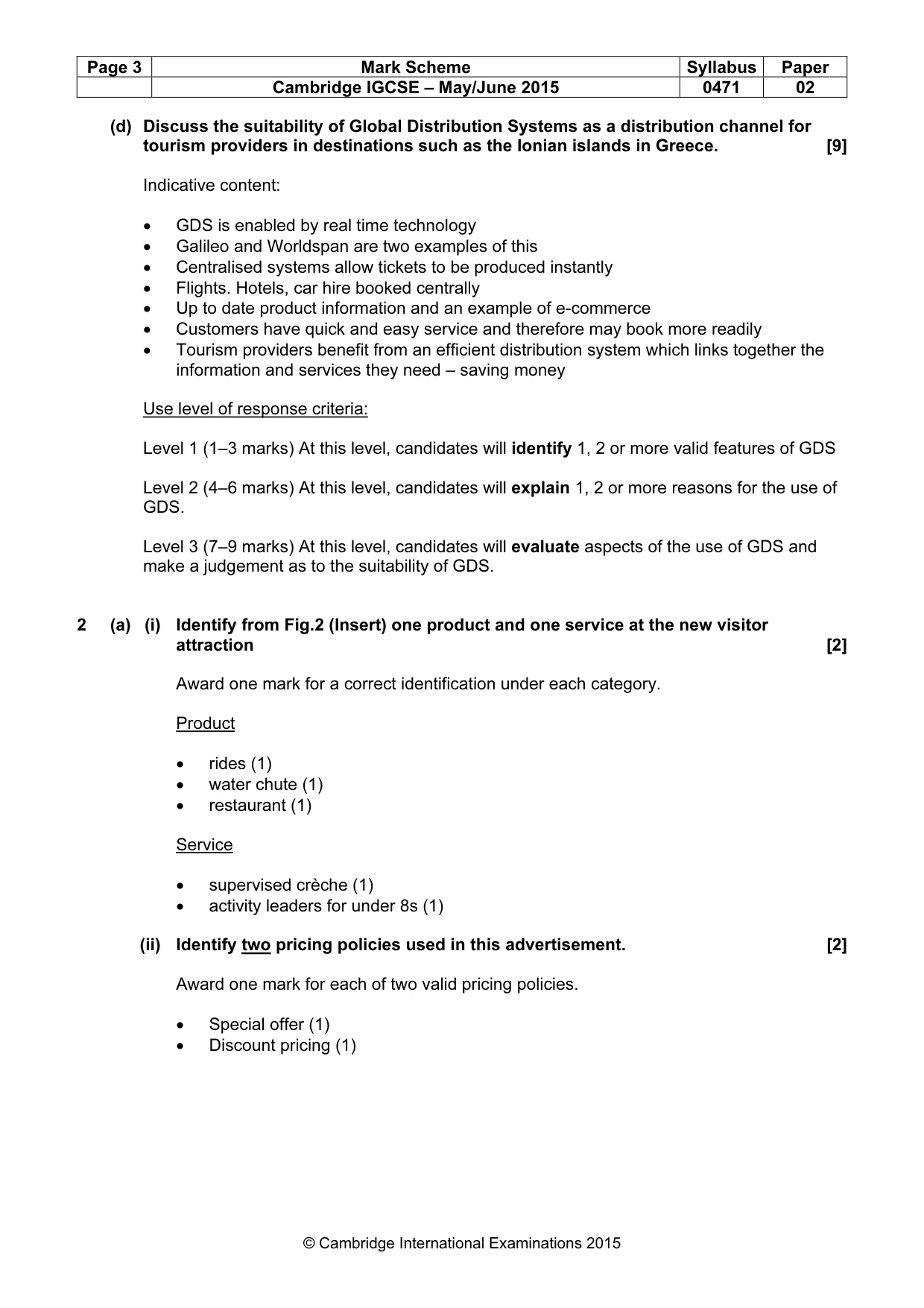
Page 2 Mark Scheme Syllabus Paper Cambridge IGCSE – May/June 2015 0471 02 © Cambridge International Examinations 2015 1 (a) Complete the PEST analysis table below. Choose only one statement under each heading. [4] Political Economic 1 4, 6 Social Technological 5, 2 3 (b) Describe three characteristics of the growth stage of the product life cycle. [6] Award one mark for each of three characteristics and an additional mark for further exemplification of each. Correct ideas include: • Demand rises steadily (1) increased sales (1) increased profits (1) • Increased market share (1) competitors looking for ways to substitute (1) critical stage (1) • Customers become aware of the product (1) brand image is established by advertising and product differentiation (1) costs reduce (1) Credit all valid reasoning in context. (c) State two types of market research used by organisations such as the GNTO and explain why each type may be used. [6] Award up to three marks for each of two ways in which market research can be used. Credit up to two marks for the detail of market research and the third mark for explanation of use. Correct ideas include: • Primary research/Field Research/Questionnaires/surveys (1) useful to find out customer views (1) which are used to plan the product or promotion method (1) show extent of customer satisfaction (1) helps to inform the development of the product to fit customer need (1) • Secondary market research/desk research/quantitative (1) gives trends which can show patterns in the market (1) which helps to make decisions on price/place for example (1) identify the competitors (1) Credit all valid reasoning in context.
Mark scheme, page 3
Page 3 Mark Scheme Syllabus Paper Cambridge IGCSE – May/June 2015 0471 02 © Cambridge International Examinations 2015 (d) Discuss the suitability of Global Distribution Systems as a distribution channel for tourism providers in destinations such as the Ionian islands in Greece. [9] Indicative content: • GDS is enabled by real time technology • Galileo and Worldspan are two examples of this • Centralised systems allow tickets to be produced instantly • Flights. Hotels, car hire booked centrally • Up to date product information and an example of e-commerce • Customers have quick and easy service and therefore may book more readily • Tourism providers benefit from an efficient distribution system which links together the information and services they need – saving money Use level of response criteria: Level 1 (1–3 marks) At this level, candidates will identify 1, 2 or more valid features of GDS Level 2 (4–6 marks) At this level, candidates will explain 1, 2 or more reasons for the use of GDS. Level 3 (7–9 marks) At this level, candidates will evaluate aspects of the use of GDS and make a judgement as to the suitability of GDS. 2 (a) (i) Identify from Fig.2 (Insert) one product and one service at the new visitor attraction [2] Award one mark for a correct identification under each category. Product • rides (1) • water chute (1) • restaurant (1) Service • supervised crèche (1) • activity leaders for under 8s (1) (ii) Identify two pricing policies used in this advertisement. [2] Award one mark for each of two valid pricing policies. • Special offer (1) • Discount pricing (1)
Mark scheme, page 4
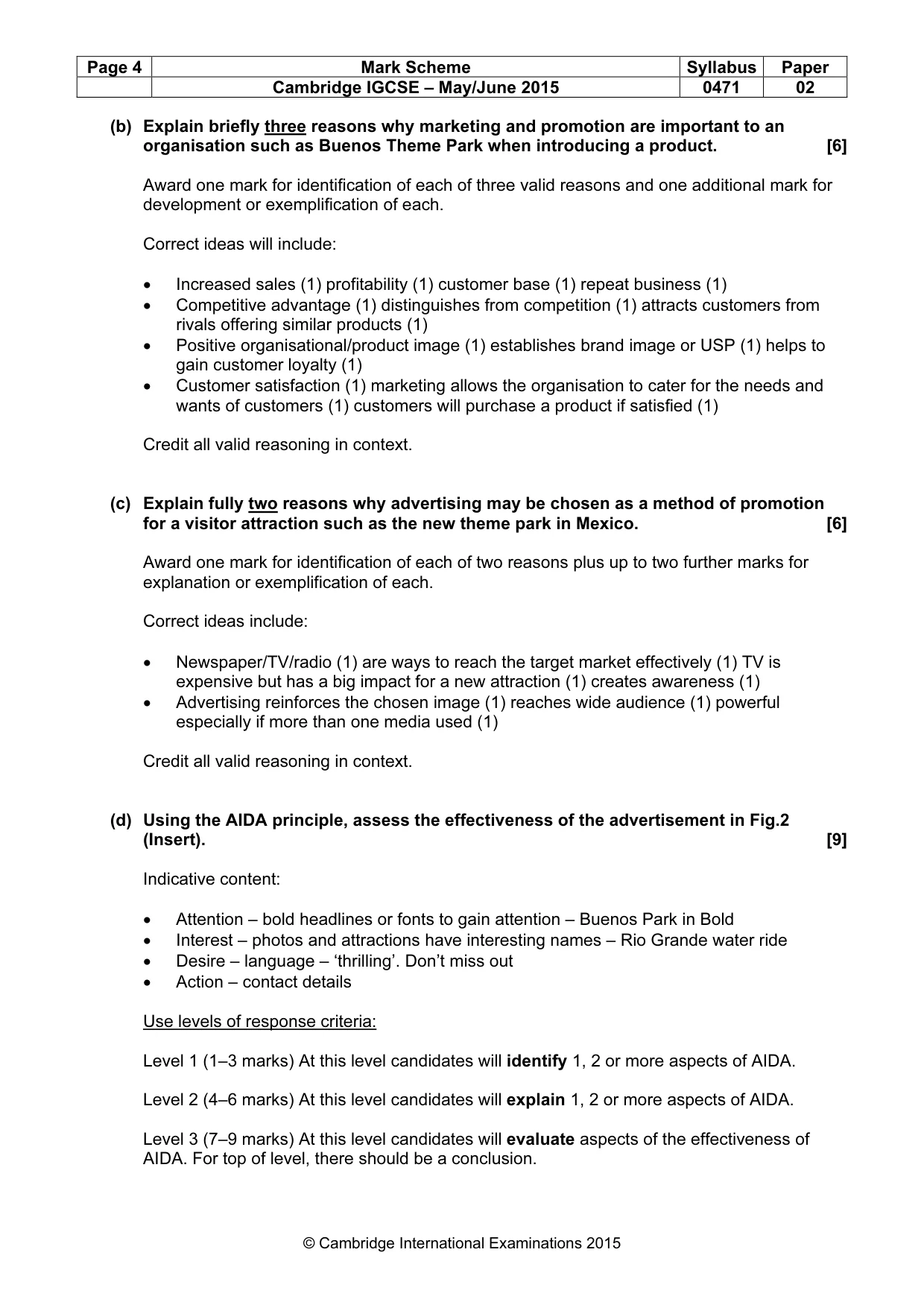
Page 4 Mark Scheme Syllabus Paper Cambridge IGCSE – May/June 2015 0471 02 © Cambridge International Examinations 2015 (b) Explain briefly three reasons why marketing and promotion are important to an organisation such as Buenos Theme Park when introducing a product. [6] Award one mark for identification of each of three valid reasons and one additional mark for development or exemplification of each. Correct ideas will include: • Increased sales (1) profitability (1) customer base (1) repeat business (1) • Competitive advantage (1) distinguishes from competition (1) attracts customers from rivals offering similar products (1) • Positive organisational/product image (1) establishes brand image or USP (1) helps to gain customer loyalty (1) • Customer satisfaction (1) marketing allows the organisation to cater for the needs and wants of customers (1) customers will purchase a product if satisfied (1) Credit all valid reasoning in context. (c) Explain fully two reasons why advertising may be chosen as a method of promotion for a visitor attraction such as the new theme park in Mexico. [6] Award one mark for identification of each of two reasons plus up to two further marks for explanation or exemplification of each. Correct ideas include: • Newspaper/TV/radio (1) are ways to reach the target market effectively (1) TV is expensive but has a big impact for a new attraction (1) creates awareness (1) • Advertising reinforces the chosen image (1) reaches wide audience (1) powerful especially if more than one media used (1) Credit all valid reasoning in context. (d) Using the AIDA principle, assess the effectiveness of the advertisement in Fig.2 (Insert). [9] Indicative content: • Attention – bold headlines or fonts to gain attention – Buenos Park in Bold • Interest – photos and attractions have interesting names – Rio Grande water ride • Desire – language – ‘thrilling’. Don’t miss out • Action – contact details Use levels of response criteria: Level 1 (1–3 marks) At this level candidates will identify 1, 2 or more aspects of AIDA. Level 2 (4–6 marks) At this level candidates will explain 1, 2 or more aspects of AIDA. Level 3 (7–9 marks) At this level candidates will evaluate aspects of the effectiveness of AIDA. For top of level, there should be a conclusion.
Mark scheme, page 5
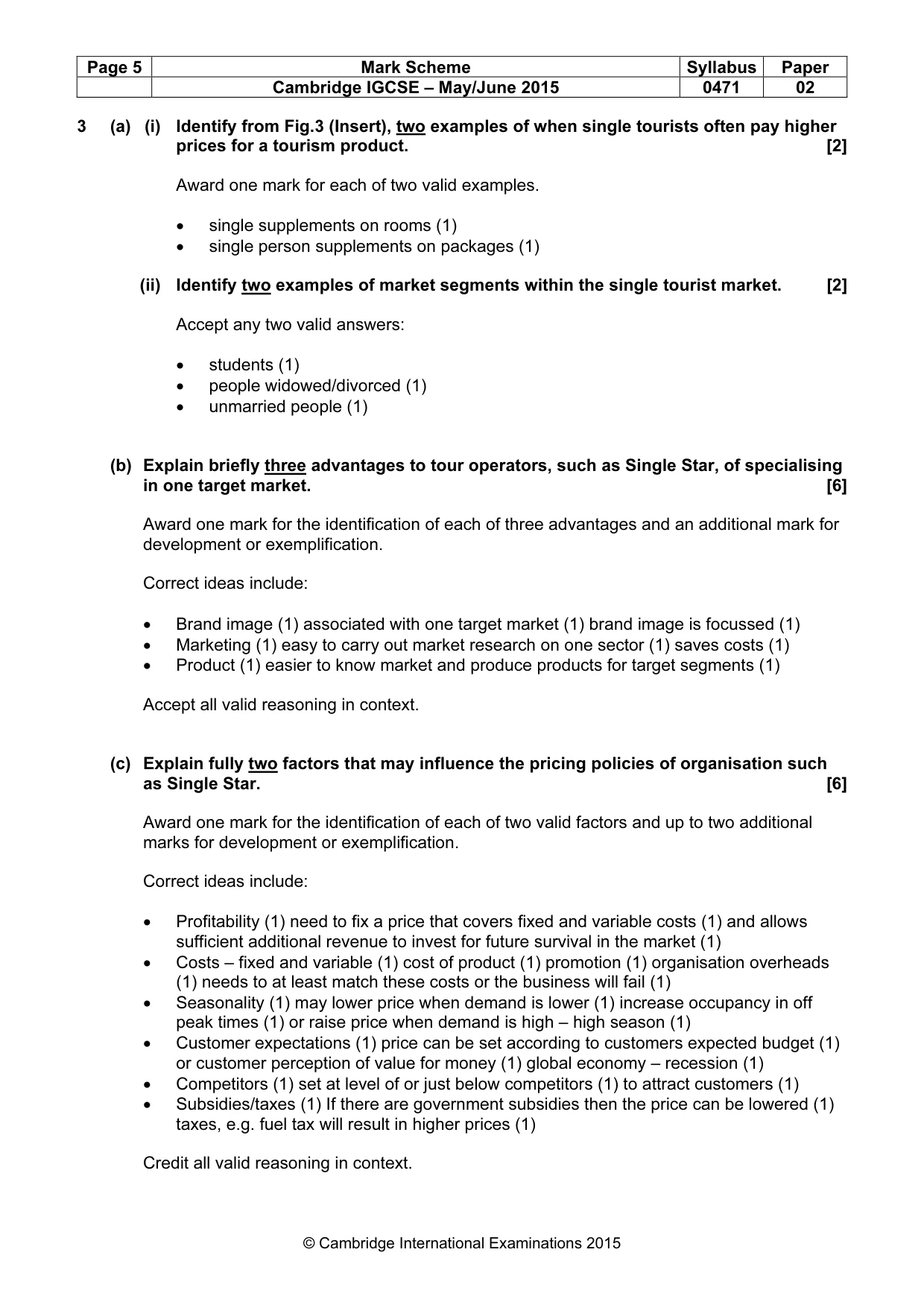
Page 5 Mark Scheme Syllabus Paper Cambridge IGCSE – May/June 2015 0471 02 © Cambridge International Examinations 2015 3 (a) (i) Identify from Fig.3 (Insert), two examples of when single tourists often pay higher prices for a tourism product. [2] Award one mark for each of two valid examples. • single supplements on rooms (1) • single person supplements on packages (1) (ii) Identify two examples of market segments within the single tourist market. [2] Accept any two valid answers: • students (1) • people widowed/divorced (1) • unmarried people (1) (b) Explain briefly three advantages to tour operators, such as Single Star, of specialising in one target market. [6] Award one mark for the identification of each of three advantages and an additional mark for development or exemplification. Correct ideas include: • Brand image (1) associated with one target market (1) brand image is focussed (1) • Marketing (1) easy to carry out market research on one sector (1) saves costs (1) • Product (1) easier to know market and produce products for target segments (1) Accept all valid reasoning in context. (c) Explain fully two factors that may influence the pricing policies of organisation such as Single Star. [6] Award one mark for the identification of each of two valid factors and up to two additional marks for development or exemplification. Correct ideas include: • Profitability (1) need to fix a price that covers fixed and variable costs (1) and allows sufficient additional revenue to invest for future survival in the market (1) • Costs – fixed and variable (1) cost of product (1) promotion (1) organisation overheads (1) needs to at least match these costs or the business will fail (1) • Seasonality (1) may lower price when demand is lower (1) increase occupancy in off peak times (1) or raise price when demand is high – high season (1) • Customer expectations (1) price can be set according to customers expected budget (1) or customer perception of value for money (1) global economy – recession (1) • Competitors (1) set at level of or just below competitors (1) to attract customers (1) • Subsidies/taxes (1) If there are government subsidies then the price can be lowered (1) taxes, e.g. fuel tax will result in higher prices (1) Credit all valid reasoning in context.
Mark scheme, page 6
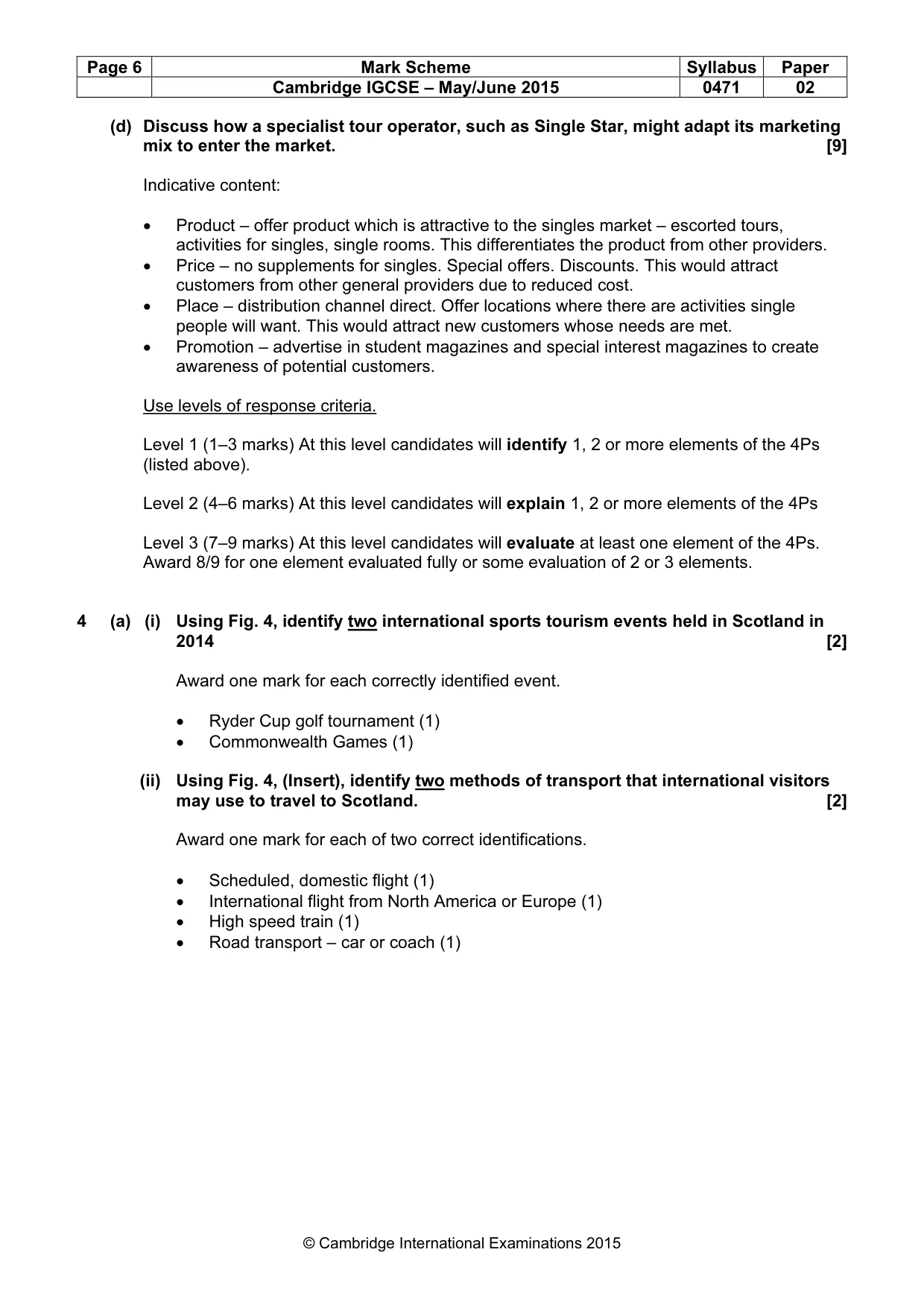
Page 6 Mark Scheme Syllabus Paper Cambridge IGCSE – May/June 2015 0471 02 © Cambridge International Examinations 2015 (d) Discuss how a specialist tour operator, such as Single Star, might adapt its marketing mix to enter the market. [9] Indicative content: • Product – offer product which is attractive to the singles market – escorted tours, activities for singles, single rooms. This differentiates the product from other providers. • Price – no supplements for singles. Special offers. Discounts. This would attract customers from other general providers due to reduced cost. • Place – distribution channel direct. Offer locations where there are activities single people will want. This would attract new customers whose needs are met. • Promotion – advertise in student magazines and special interest magazines to create awareness of potential customers. Use levels of response criteria. Level 1 (1–3 marks) At this level candidates will identify 1, 2 or more elements of the 4Ps (listed above). Level 2 (4–6 marks) At this level candidates will explain 1, 2 or more elements of the 4Ps Level 3 (7–9 marks) At this level candidates will evaluate at least one element of the 4Ps. Award 8/9 for one element evaluated fully or some evaluation of 2 or 3 elements. 4 (a) (i) Using Fig. 4, identify two international sports tourism events held in Scotland in 2014 [2] Award one mark for each correctly identified event. • Ryder Cup golf tournament (1) • Commonwealth Games (1) (ii) Using Fig. 4, (Insert), identify two methods of transport that international visitors may use to travel to Scotland. [2] Award one mark for each of two correct identifications. • Scheduled, domestic flight (1) • International flight from North America or Europe (1) • High speed train (1) • Road transport – car or coach (1)
Mark scheme, page 7
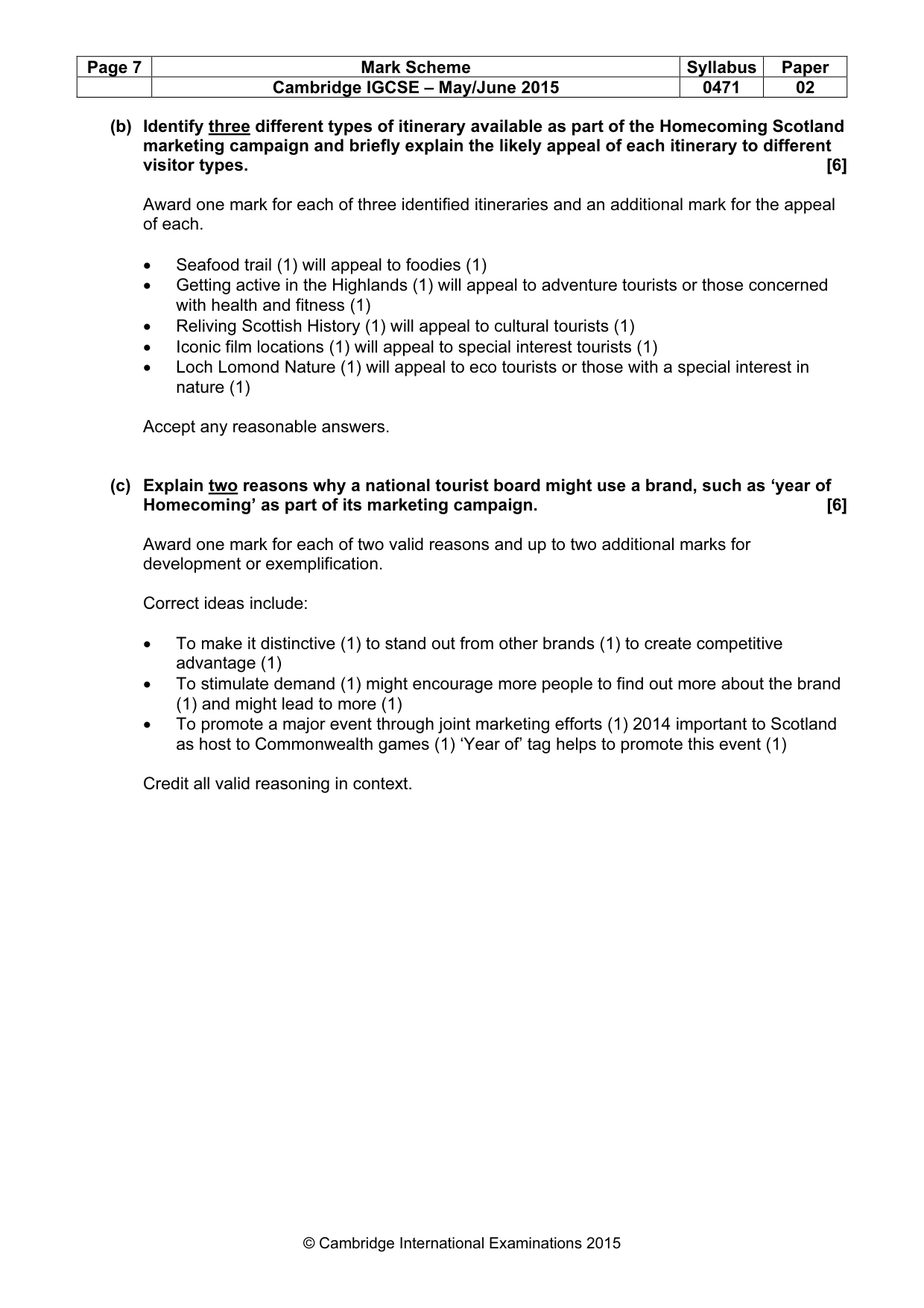
Page 7 Mark Scheme Syllabus Paper Cambridge IGCSE – May/June 2015 0471 02 © Cambridge International Examinations 2015 (b) Identify three different types of itinerary available as part of the Homecoming Scotland marketing campaign and briefly explain the likely appeal of each itinerary to different visitor types. [6] Award one mark for each of three identified itineraries and an additional mark for the appeal of each. • Seafood trail (1) will appeal to foodies (1) • Getting active in the Highlands (1) will appeal to adventure tourists or those concerned with health and fitness (1) • Reliving Scottish History (1) will appeal to cultural tourists (1) • Iconic film locations (1) will appeal to special interest tourists (1) • Loch Lomond Nature (1) will appeal to eco tourists or those with a special interest in nature (1) Accept any reasonable answers. (c) Explain two reasons why a national tourist board might use a brand, such as ‘year of Homecoming’ as part of its marketing campaign. [6] Award one mark for each of two valid reasons and up to two additional marks for development or exemplification. Correct ideas include: • To make it distinctive (1) to stand out from other brands (1) to create competitive advantage (1) • To stimulate demand (1) might encourage more people to find out more about the brand (1) and might lead to more (1) • To promote a major event through joint marketing efforts (1) 2014 important to Scotland as host to Commonwealth games (1) ‘Year of’ tag helps to promote this event (1) Credit all valid reasoning in context.
Mark scheme, page 8
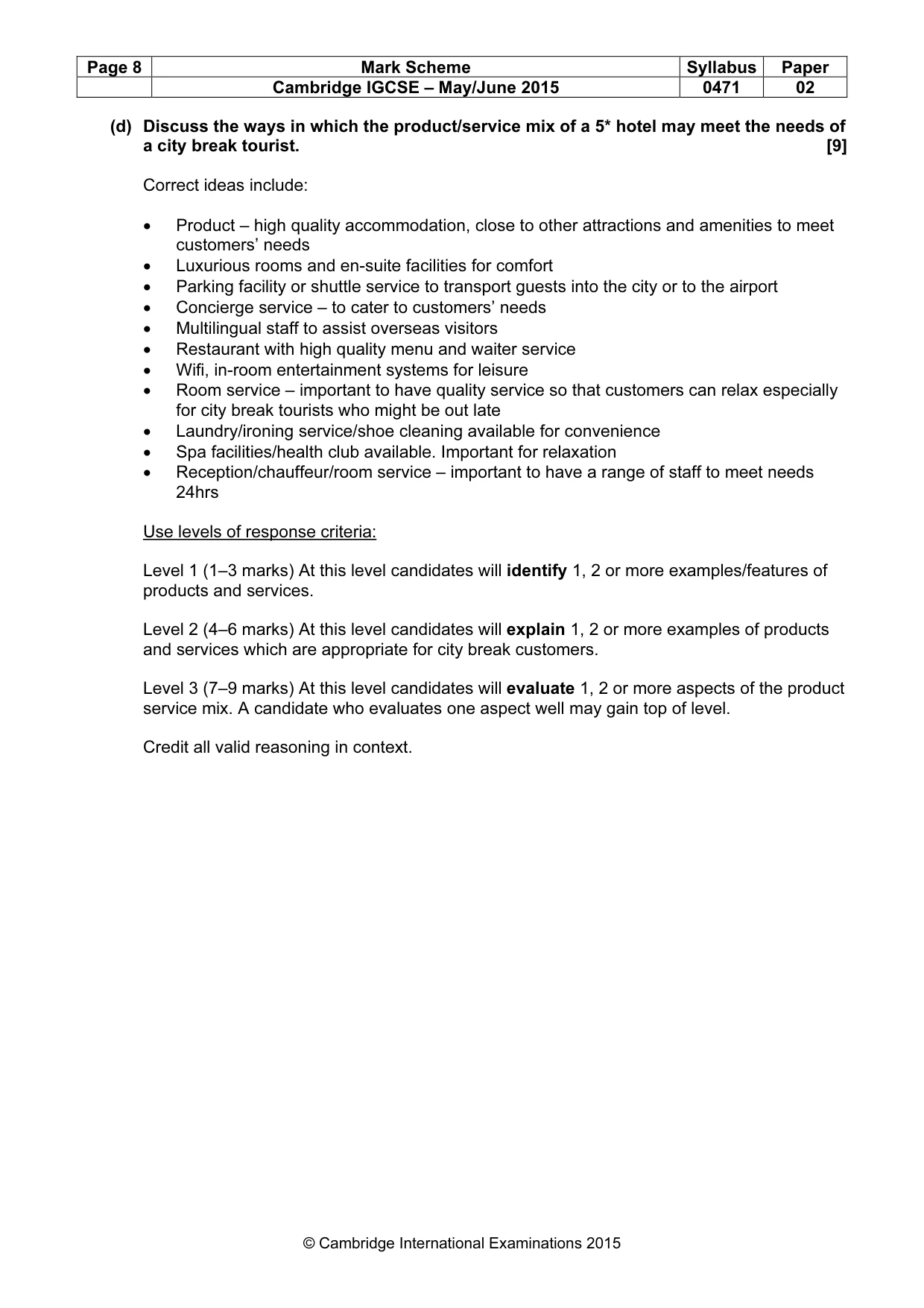
Page 8 Mark Scheme Syllabus Paper Cambridge IGCSE – May/June 2015 0471 02 © Cambridge International Examinations 2015 (d) Discuss the ways in which the product/service mix of a 5* hotel may meet the needs of a city break tourist. [9] Correct ideas include: • Product – high quality accommodation, close to other attractions and amenities to meet customers’ needs • Luxurious rooms and en-suite facilities for comfort • Parking facility or shuttle service to transport guests into the city or to the airport • Concierge service – to cater to customers’ needs • Multilingual staff to assist overseas visitors • Restaurant with high quality menu and waiter service • Wifi, in-room entertainment systems for leisure • Room service – important to have quality service so that customers can relax especially for city break tourists who might be out late • Laundry/ironing service/shoe cleaning available for convenience • Spa facilities/health club available. Important for relaxation • Reception/chauffeur/room service – important to have a range of staff to meet needs 24hrs Use levels of response criteria: Level 1 (1–3 marks) At this level candidates will identify 1, 2 or more examples/features of products and services. Level 2 (4–6 marks) At this level candidates will explain 1, 2 or more examples of products and services which are appropriate for city break customers. Level 3 (7–9 marks) At this level candidates will evaluate 1, 2 or more aspects of the product service mix. A candidate who evaluates one aspect well may gain top of level. Credit all valid reasoning in context.
What you needed in this session
Cambridge’s own grade thresholds for 2015 May/June, Paper 2 · Variant 1. A higher threshold means an easier paper — the bar moves with how the cohort did.