Cambridge IGCSE Travel and Tourism 0471 — 2015 May/June Paper 1 · Variant 1
0471/11/M/J/15 · 100 marks · ≈113 min
The question paper and its mark scheme, free to read here and free to download. This is Cambridge’s own paper, exactly as it was sat.
Question paper16 pages

Mark scheme10 pages
Answers below. Sit the paper first if you are practising.
Paper as text
Question paper, page 1
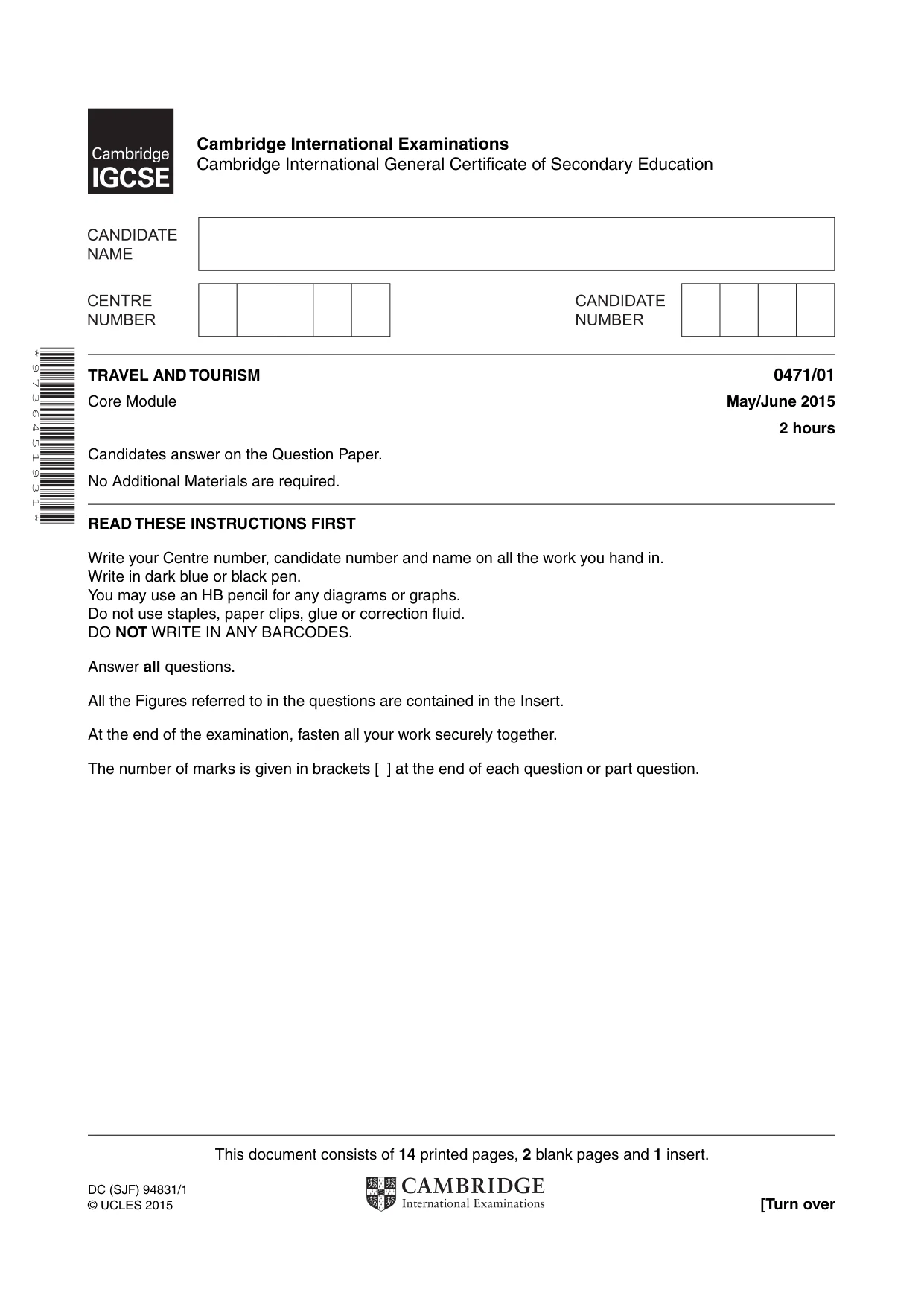
This document consists of 14 printed pages, 2 blank pages and 1 insert. DC (SJF) 94831/1 © UCLES 2015 [Turn over Cambridge International Examinations Cambridge International General Certificate of Secondary Education * 9 7 3 6 4 5 1 9 3 1 * TRAVEL AND TOURISM 0471/01 Core Module May/June 2015 2 hours Candidates answer on the Question Paper. No Additional Materials are required. READ THESE INSTRUCTIONS FIRST Write your Centre number, candidate number and name on all the work you hand in. Write in dark blue or black pen. You may use an HB pencil for any diagrams or graphs. Do not use staples, paper clips, glue or correction fluid. DO NOT WRITE IN ANY BARCODES. Answer all questions. All the Figures referred to in the questions are contained in the Insert. At the end of the examination, fasten all your work securely together. The number of marks is given in brackets [ ] at the end of each question or part question.
Question paper, page 2
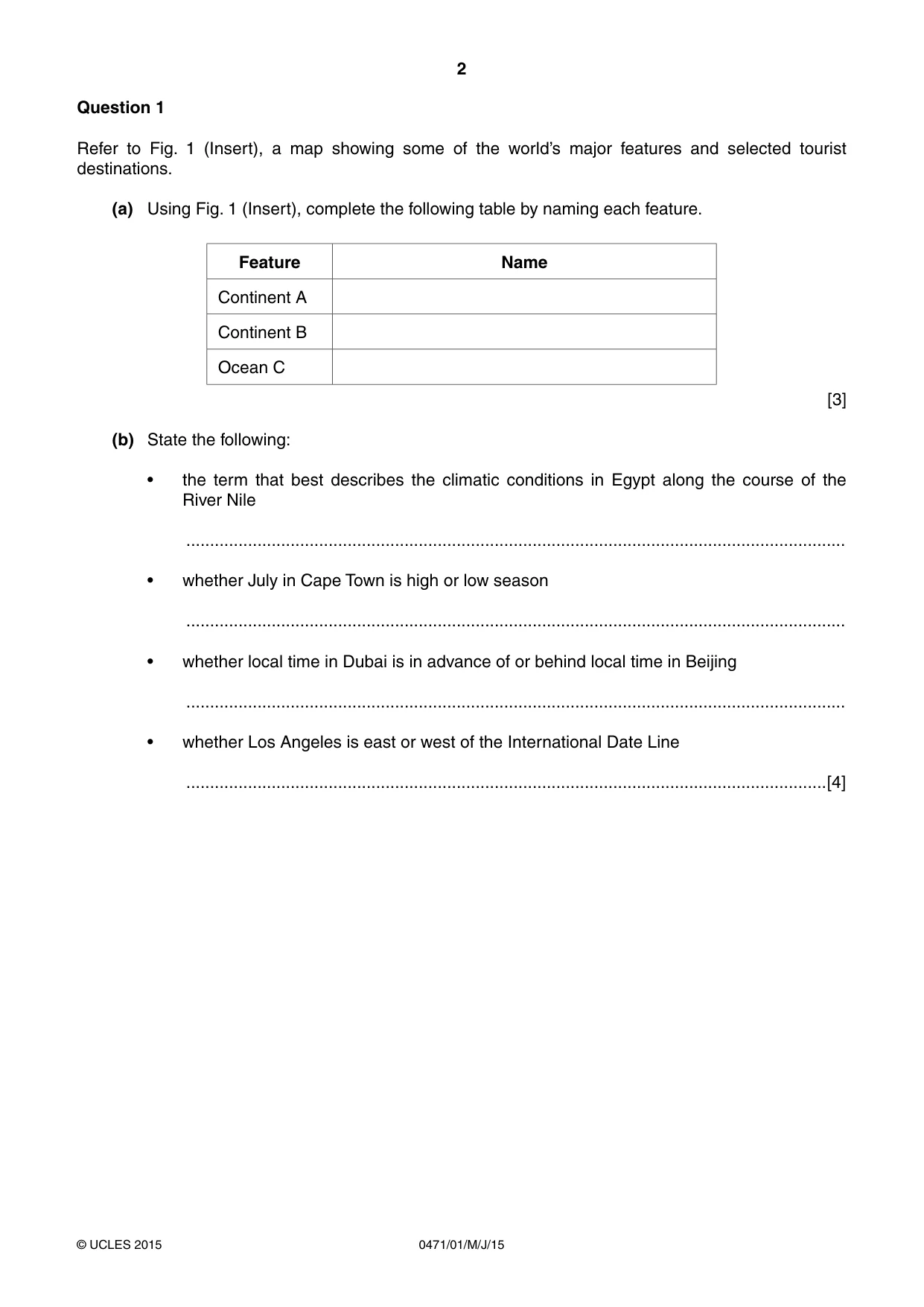
2 0471/01/M/J/15 © UCLES 2015 Question 1 Refer to Fig. 1 (Insert), a map showing some of the world’s major features and selected tourist destinations. (a) Using Fig. 1 (Insert), complete the following table by naming each feature. Feature Name Continent A Continent B Ocean C [3] (b) State the following: • the term that best describes the climatic conditions in Egypt along the course of the River Nile … • whether July in Cape Town is high or low season … • whether local time in Dubai is in advance of or behind local time in Beijing … • whether Los Angeles is east or west of the International Date Line …[4]
Question paper, page 3
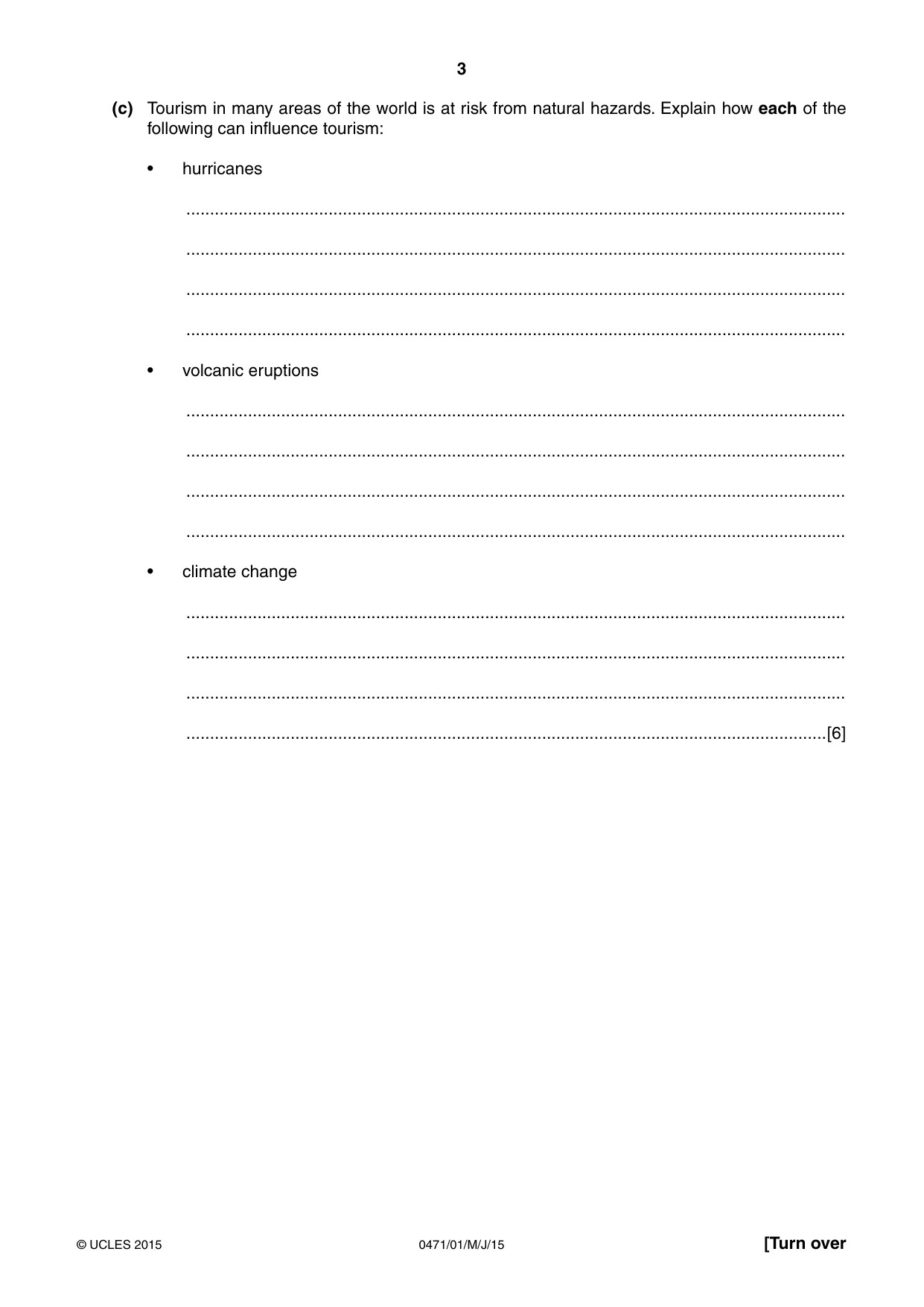
3 0471/01/M/J/15 © UCLES 2015 [Turn over (c) Tourism in many areas of the world is at risk from natural hazards. Explain how each of the following can influence tourism: • hurricanes … … … … • volcanic eruptions … … … … • climate change … … … …[6]
Question paper, page 4
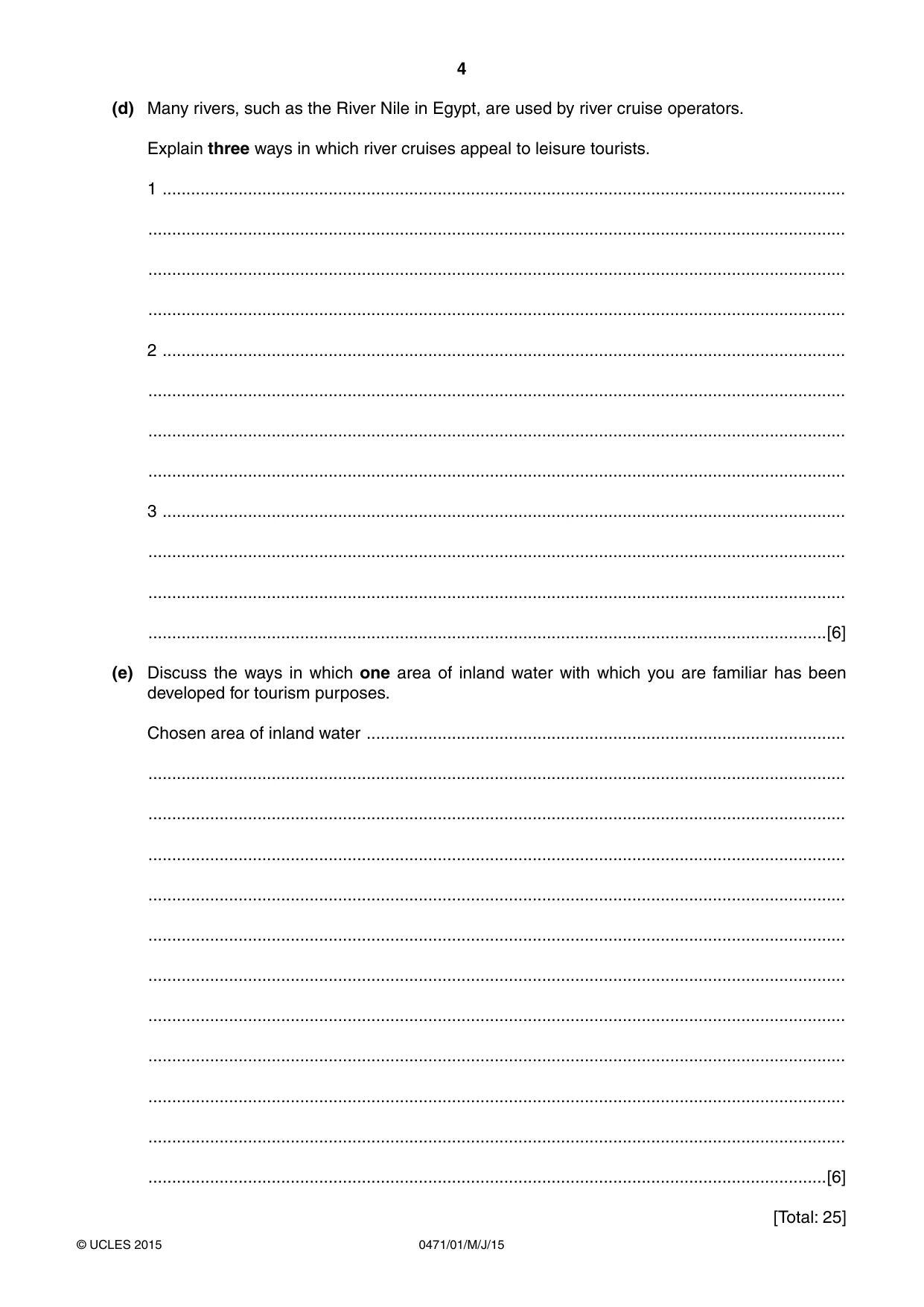
4 0471/01/M/J/15 © UCLES 2015 (d) Many rivers, such as the River Nile in Egypt, are used by river cruise operators. Explain three ways in which river cruises appeal to leisure tourists. 1 … … … … 2 … … … … 3 … … … …[6] (e) Discuss the ways in which one area of inland water with which you are familiar has been developed for tourism purposes. Chosen area of inland water … … … … … … … … … … … …[6] [Total: 25]
Question paper, page 5
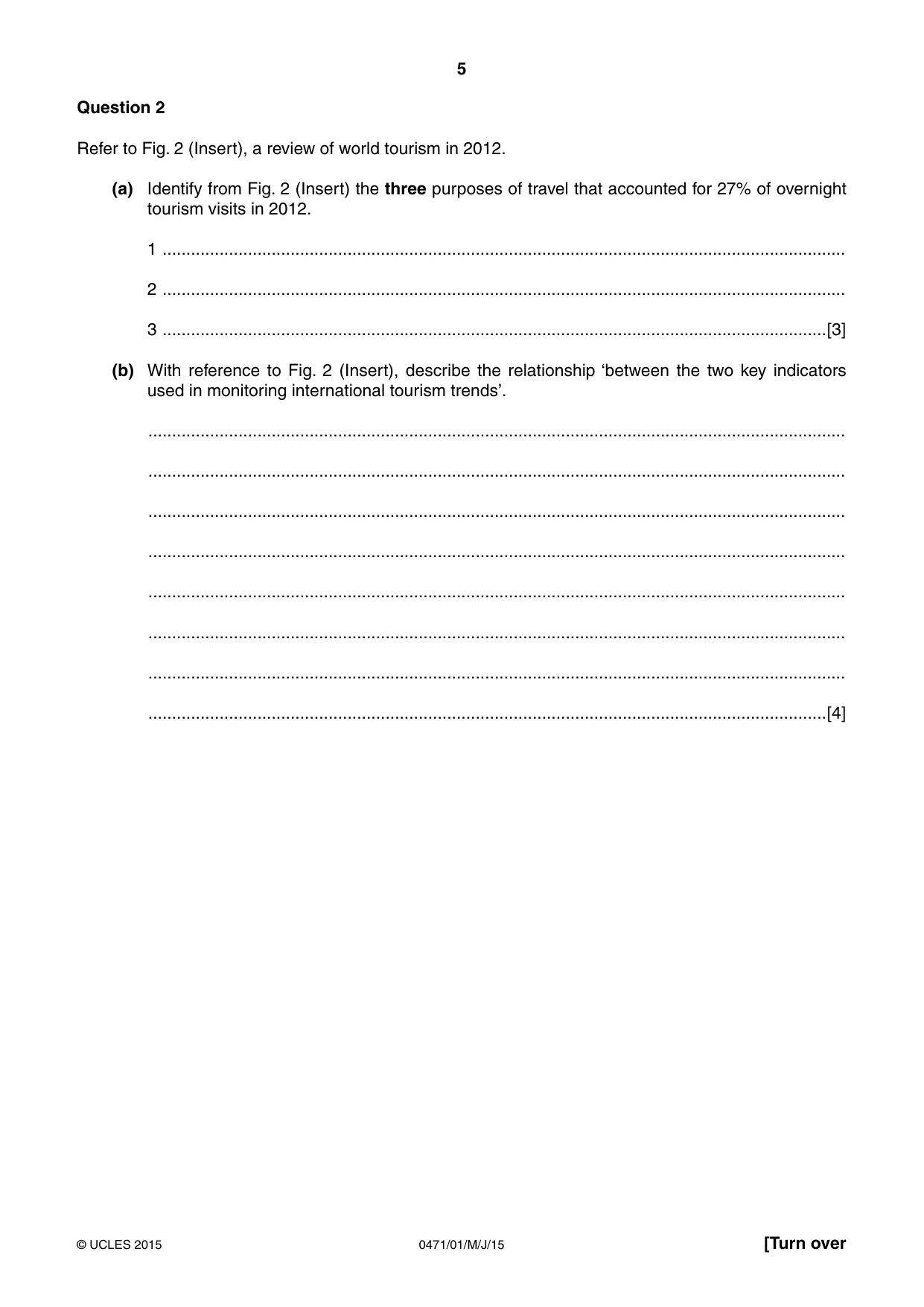
5 0471/01/M/J/15 © UCLES 2015 [Turn over Question 2 Refer to Fig. 2 (Insert), a review of world tourism in 2012. (a) Identify from Fig. 2 (Insert) the three purposes of travel that accounted for 27% of overnight tourism visits in 2012. 1 … 2 … 3 …[3] (b) With reference to Fig. 2 (Insert), describe the relationship ‘between the two key indicators used in monitoring international tourism trends’. … … … … … … … …[4]
Question paper, page 6
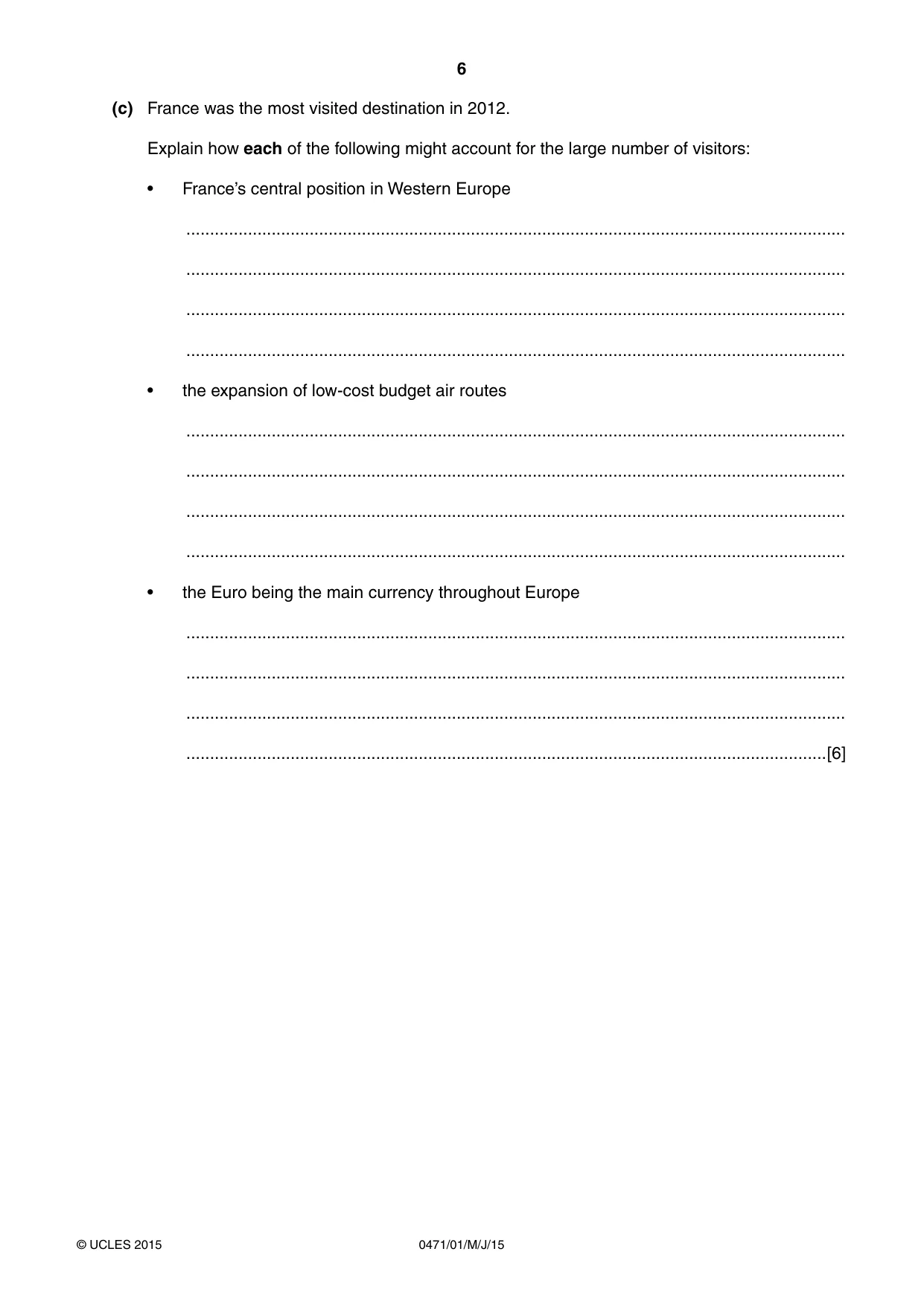
6 0471/01/M/J/15 © UCLES 2015 (c) France was the most visited destination in 2012. Explain how each of the following might account for the large number of visitors: • France’s central position in Western Europe … … … … • the expansion of low-cost budget air routes … … … … • the Euro being the main currency throughout Europe … … … …[6]
Question paper, page 7
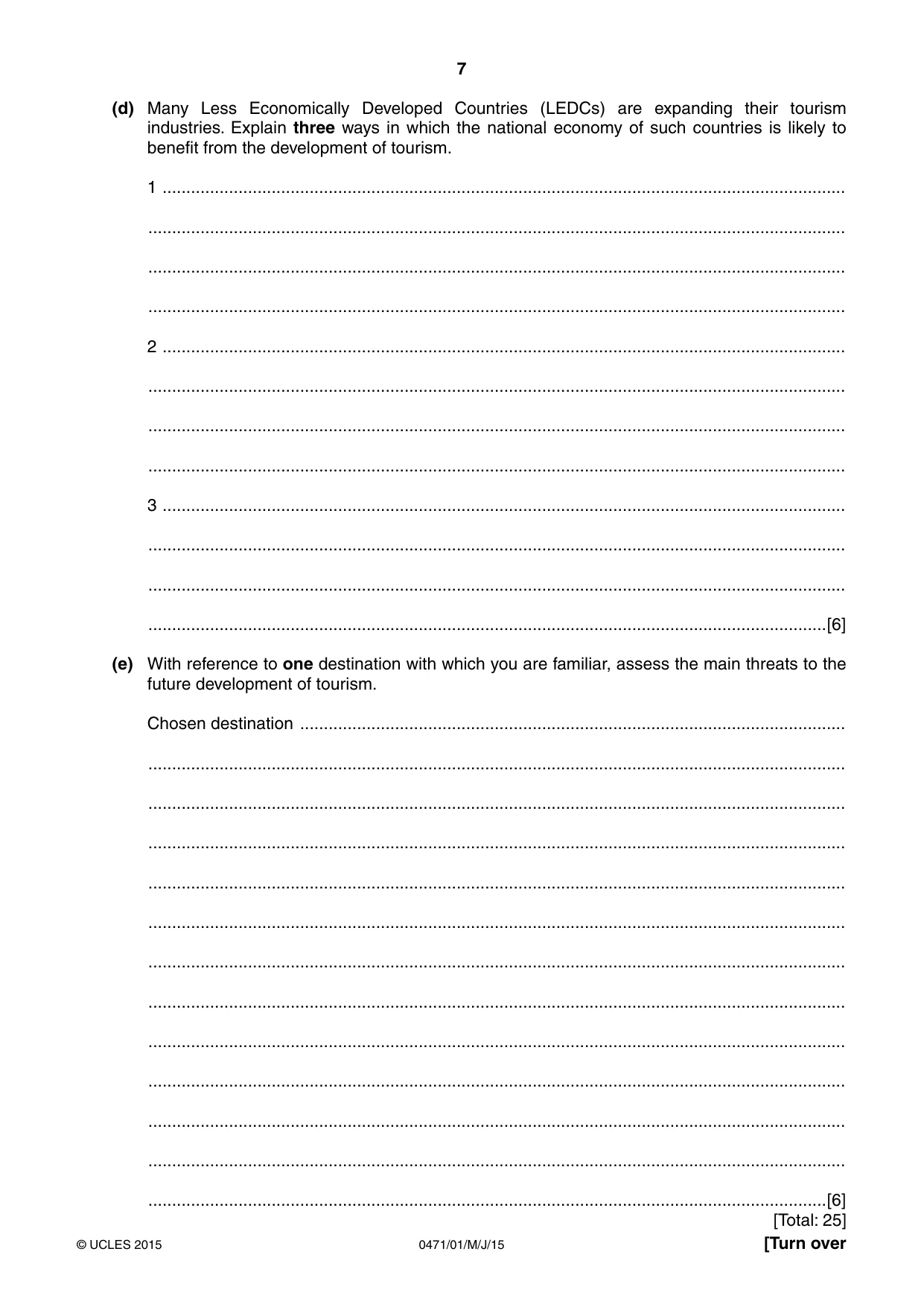
7 0471/01/M/J/15 © UCLES 2015 [Turn over (d) Many Less Economically Developed Countries (LEDCs) are expanding their tourism industries. Explain three ways in which the national economy of such countries is likely to benefit from the development of tourism. 1 … … … … 2 … … … … 3 … … … …[6] (e) With reference to one destination with which you are familiar, assess the main threats to the future development of tourism. Chosen destination … … … … … … … … … … … … …[6] [Total: 25]
Question paper, page 8
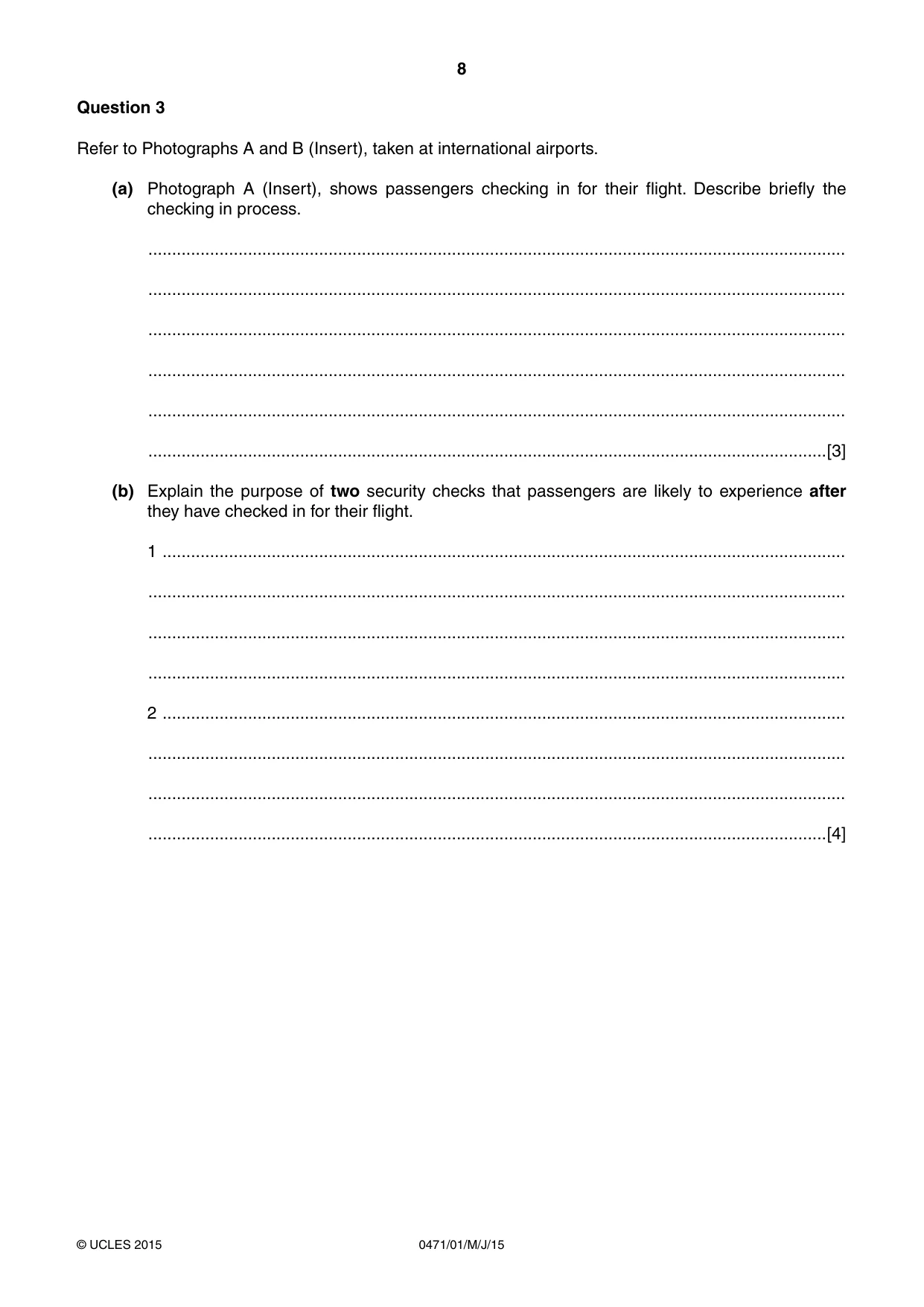
8 0471/01/M/J/15 © UCLES 2015 Question 3 Refer to Photographs A and B (Insert), taken at international airports. (a) Photograph A (Insert), shows passengers checking in for their flight. Describe briefly the checking in process. … … … … … …[3] (b) Explain the purpose of two security checks that passengers are likely to experience after they have checked in for their flight. 1 … … … … 2 … … … …[4]
Question paper, page 9
9 0471/01/M/J/15 © UCLES 2015 [Turn over (c) Some passengers will use the currency exchange facility shown in Photograph B (Insert). Explain the purpose served by each of the following: • the display screen … … … … • the reduced height service counter … … … …[4]
Question paper, page 10
10 0471/01/M/J/15 © UCLES 2015 (d) Other than currency exchange, state four services provided by major airports and explain how each meets the needs of outbound international travellers. 1 … … … … 2 … … … … 3 … … … … 4 … … … …[8]
Question paper, page 11
11 0471/01/M/J/15 © UCLES 2015 [Turn over (e) Discuss the reasons why many travel and tourism employees, such as the ones shown in Photographs A and B (Insert), wear a uniform. … … … … … … … … … … … …[6] [Total: 25]
Question paper, page 12
12 0471/01/M/J/15 © UCLES 2015 Question 4 Refer to Fig. 3 (Insert), information for staff working for Carnival UK, a cruise company based in the UK. (a) Identify from Fig. 3 (Insert) the following: • the two cruise lines operated by Carnival UK 1 … 2 … • the organisation Carnival UK worked with when developing its recruitment process …[3] (b) Explain two benefits to Carnival UK’s customers of the company making all employment offers ‘subject to the disclosure of criminal records and vetting checks’. 1 … … … … 2 … … … …[4]
Question paper, page 13
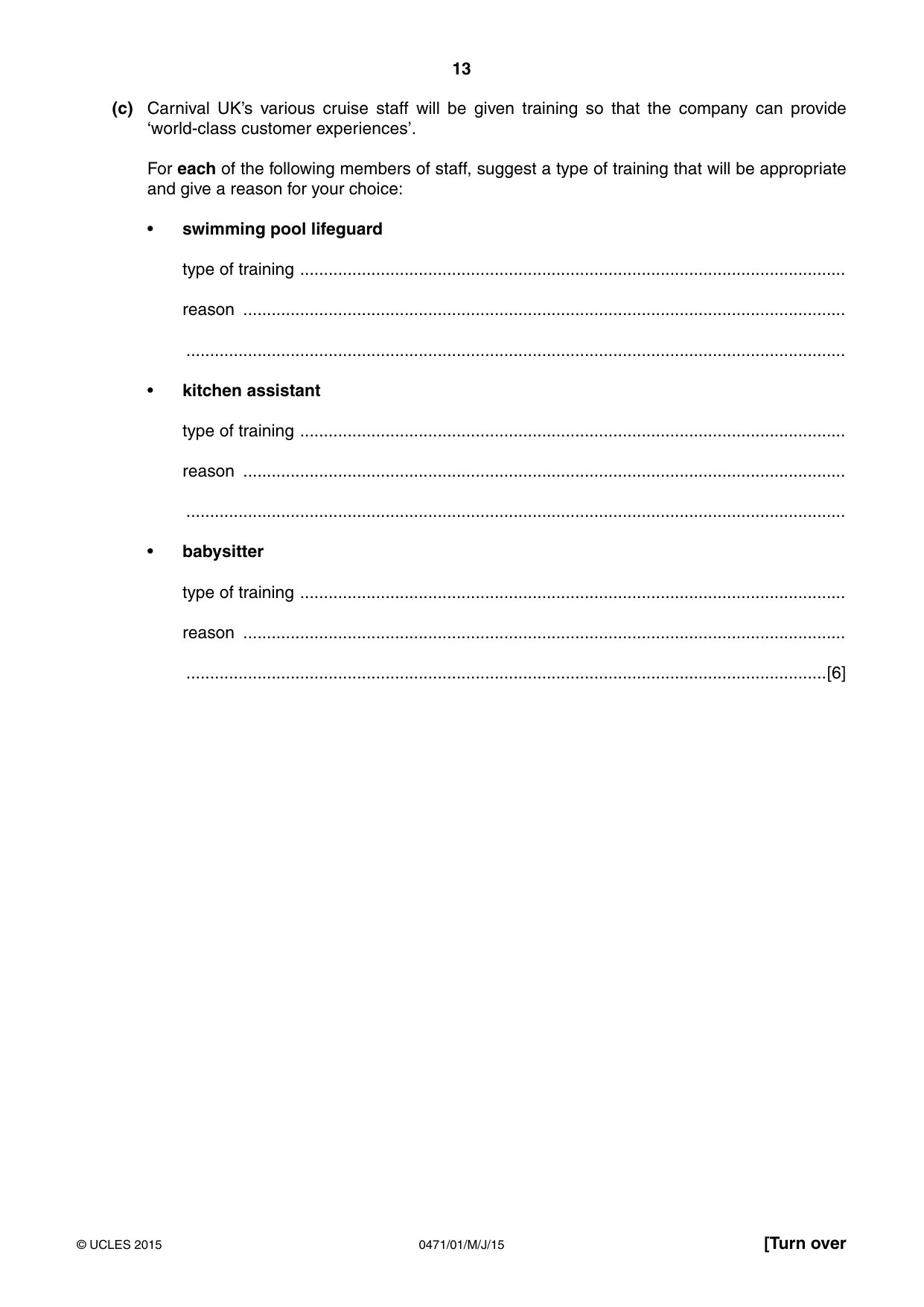
13 0471/01/M/J/15 © UCLES 2015 [Turn over (c) Carnival UK’s various cruise staff will be given training so that the company can provide ‘world-class customer experiences’. For each of the following members of staff, suggest a type of training that will be appropriate and give a reason for your choice: • swimming pool lifeguard type of training … reason … … • kitchen assistant type of training … reason … … • babysitter type of training … reason … …[6]
Question paper, page 14
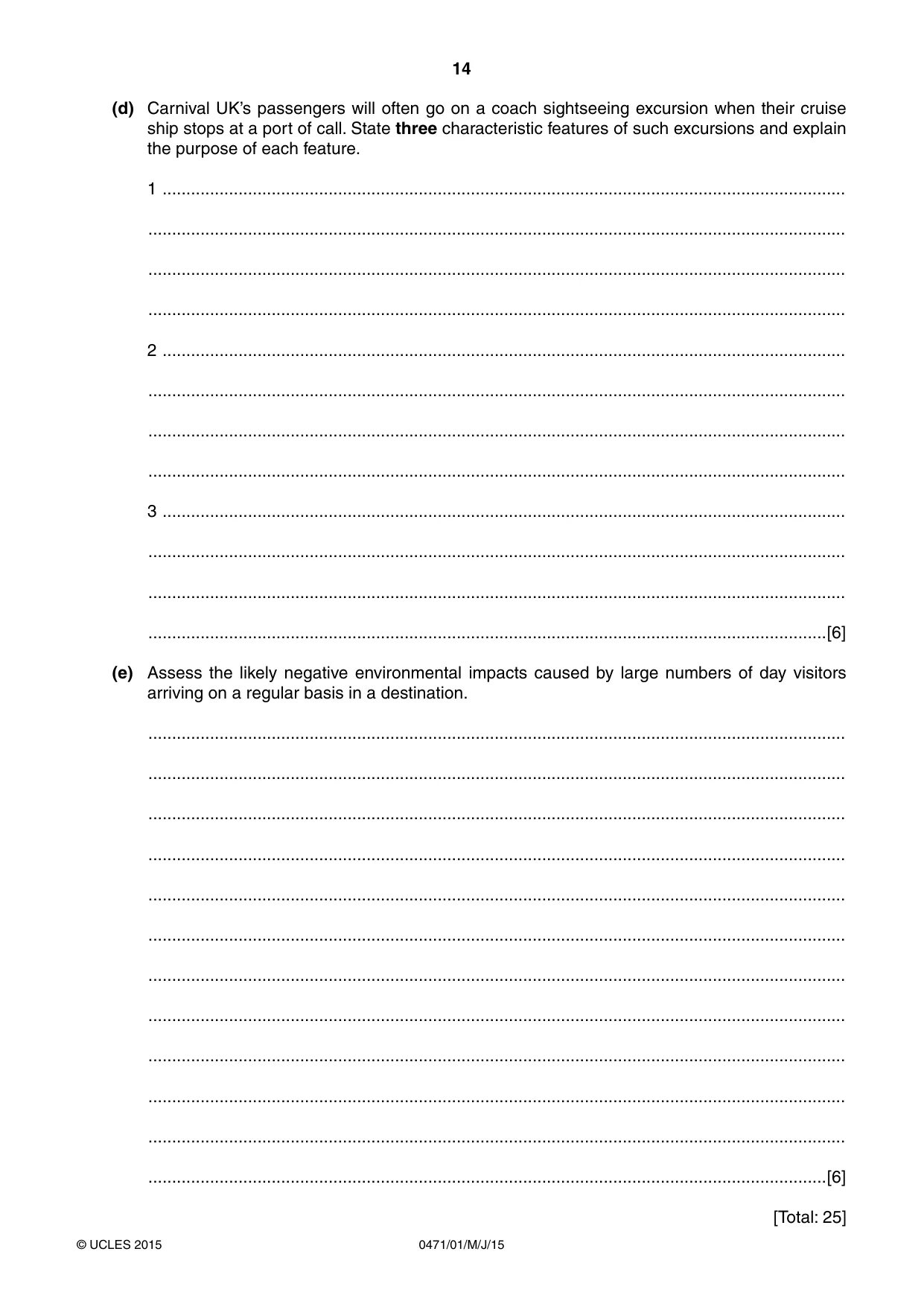
14 0471/01/M/J/15 © UCLES 2015 (d) Carnival UK’s passengers will often go on a coach sightseeing excursion when their cruise ship stops at a port of call. State three characteristic features of such excursions and explain the purpose of each feature. 1 … … … … 2 … … … … 3 … … … …[6] (e) Assess the likely negative environmental impacts caused by large numbers of day visitors arriving on a regular basis in a destination. … … … … … … … … … … … …[6] [Total: 25]
Question paper, page 15
15 0471/01/M/J/15 © UCLES 2015 BLANK PAGE
Question paper, page 16
16 0471/01/M/J/15 © UCLES 2015 Permission to reproduce items where third-party owned material protected by copyright is included has been sought and cleared where possible. Every reasonable effort has been made by the publisher (UCLES) to trace copyright holders, but if any items requiring clearance have unwittingly been included, the publisher will be pleased to make amends at the earliest possible opportunity. To avoid the issue of disclosure of answer-related information to candidates, all copyright acknowledgements are reproduced online in the Cambridge International Examinations Copyright Acknowledgements Booklet. This is produced for each series of examinations and is freely available to download at www.cie.org.uk after the live examination series. Cambridge International Examinations is part of the Cambridge Assessment Group. Cambridge Assessment is the brand name of University of Cambridge Local Examinations Syndicate (UCLES), which is itself a department of the University of Cambridge. BLANK PAGE
Mark scheme, page 1
® IGCSE is the registered trademark of Cambridge International Examinations. CAMBRIDGE INTERNATIONAL EXAMINATIONS Cambridge International General Certificate of Secondary Education MARK SCHEME for the May/June 2015 series 0471 TRAVEL AND TOURISM 0471/01 Paper 1 (Written Paper), maximum raw mark 100 This mark scheme is published as an aid to teachers and candidates, to indicate the requirements of the examination. It shows the basis on which Examiners were instructed to award marks. It does not indicate the details of the discussions that took place at an Examiners’ meeting before marking began, which would have considered the acceptability of alternative answers. Mark schemes should be read in conjunction with the question paper and the Principal Examiner Report for Teachers. Cambridge will not enter into discussions about these mark schemes. Cambridge is publishing the mark schemes for the May/June 2015 series for most Cambridge IGCSE®, Cambridge International A and AS Level components and some Cambridge O Level components.
Mark scheme, page 2
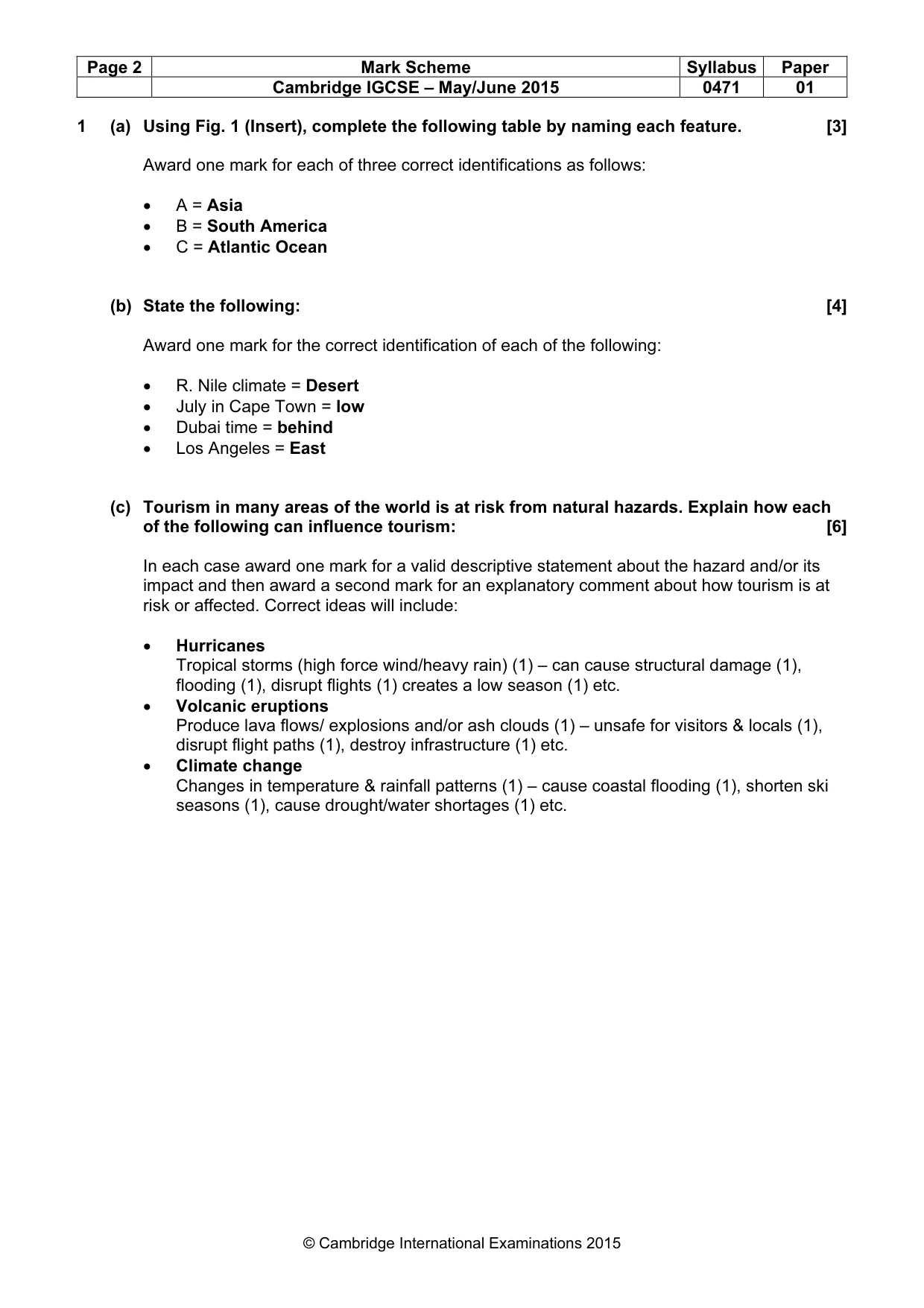
Page 2 Mark Scheme Syllabus Paper Cambridge IGCSE – May/June 2015 0471 01 © Cambridge International Examinations 2015 1 (a) Using Fig. 1 (Insert), complete the following table by naming each feature. [3] Award one mark for each of three correct identifications as follows: • A = Asia • B = South America • C = Atlantic Ocean (b) State the following: [4] Award one mark for the correct identification of each of the following: • R. Nile climate = Desert • July in Cape Town = low • Dubai time = behind • Los Angeles = East (c) Tourism in many areas of the world is at risk from natural hazards. Explain how each of the following can influence tourism: [6] In each case award one mark for a valid descriptive statement about the hazard and/or its impact and then award a second mark for an explanatory comment about how tourism is at risk or affected. Correct ideas will include: • Hurricanes Tropical storms (high force wind/heavy rain) (1) – can cause structural damage (1), flooding (1), disrupt flights (1) creates a low season (1) etc. • Volcanic eruptions Produce lava flows/ explosions and/or ash clouds (1) – unsafe for visitors & locals (1), disrupt flight paths (1), destroy infrastructure (1) etc. • Climate change Changes in temperature & rainfall patterns (1) – cause coastal flooding (1), shorten ski seasons (1), cause drought/water shortages (1) etc.
Mark scheme, page 3
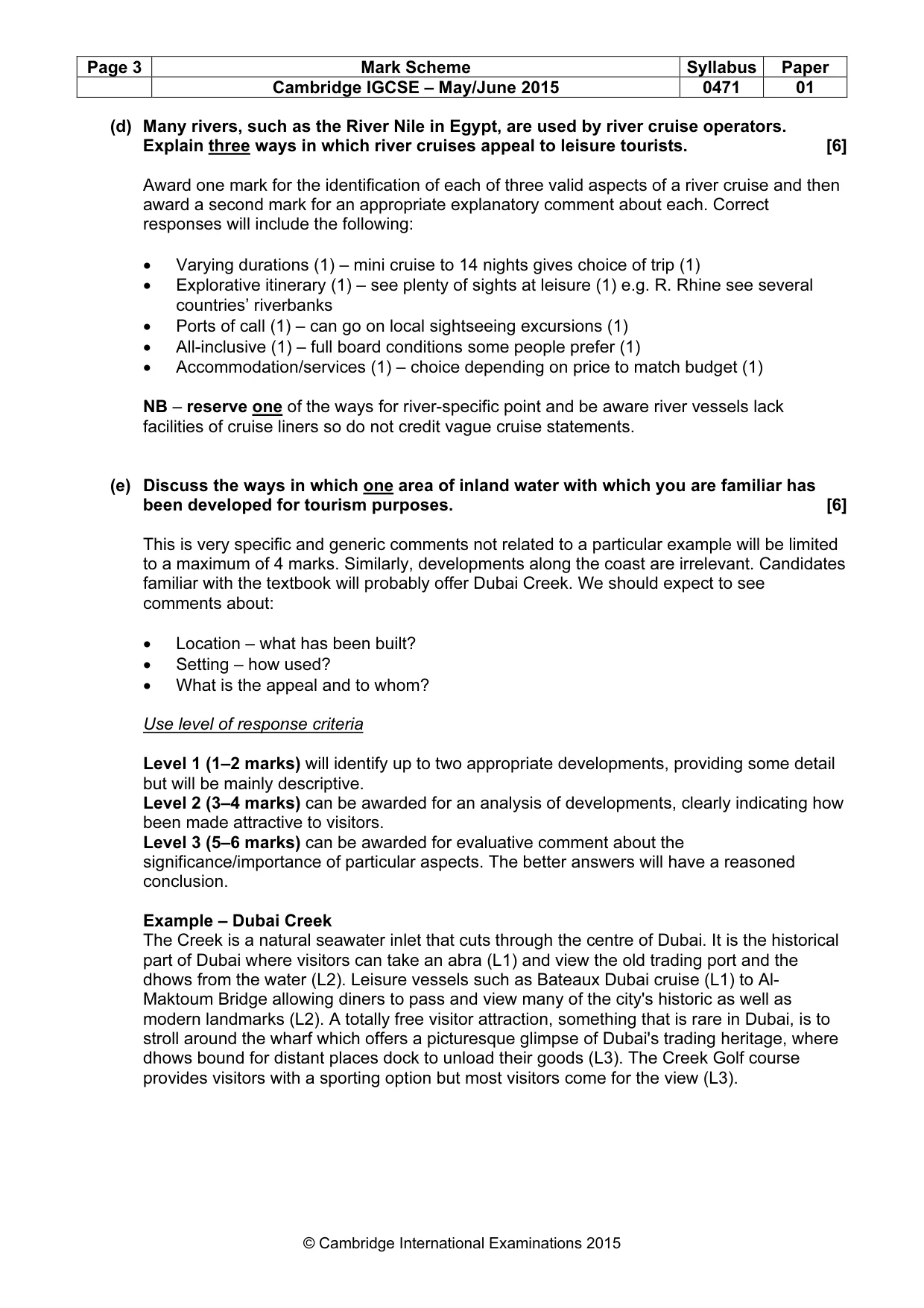
Page 3 Mark Scheme Syllabus Paper Cambridge IGCSE – May/June 2015 0471 01 © Cambridge International Examinations 2015 (d) Many rivers, such as the River Nile in Egypt, are used by river cruise operators. Explain three ways in which river cruises appeal to leisure tourists. [6] Award one mark for the identification of each of three valid aspects of a river cruise and then award a second mark for an appropriate explanatory comment about each. Correct responses will include the following: • Varying durations (1) – mini cruise to 14 nights gives choice of trip (1) • Explorative itinerary (1) – see plenty of sights at leisure (1) e.g. R. Rhine see several countries’ riverbanks • Ports of call (1) – can go on local sightseeing excursions (1) • All-inclusive (1) – full board conditions some people prefer (1) • Accommodation/services (1) – choice depending on price to match budget (1) NB – reserve one of the ways for river-specific point and be aware river vessels lack facilities of cruise liners so do not credit vague cruise statements. (e) Discuss the ways in which one area of inland water with which you are familiar has been developed for tourism purposes. [6] This is very specific and generic comments not related to a particular example will be limited to a maximum of 4 marks. Similarly, developments along the coast are irrelevant. Candidates familiar with the textbook will probably offer Dubai Creek. We should expect to see comments about: • Location – what has been built? • Setting – how used? • What is the appeal and to whom? Use level of response criteria Level 1 (1–2 marks) will identify up to two appropriate developments, providing some detail but will be mainly descriptive. Level 2 (3–4 marks) can be awarded for an analysis of developments, clearly indicating how been made attractive to visitors. Level 3 (5–6 marks) can be awarded for evaluative comment about the significance/importance of particular aspects. The better answers will have a reasoned conclusion. Example – Dubai Creek The Creek is a natural seawater inlet that cuts through the centre of Dubai. It is the historical part of Dubai where visitors can take an abra (L1) and view the old trading port and the dhows from the water (L2). Leisure vessels such as Bateaux Dubai cruise (L1) to Al- Maktoum Bridge allowing diners to pass and view many of the city's historic as well as modern landmarks (L2). A totally free visitor attraction, something that is rare in Dubai, is to stroll around the wharf which offers a picturesque glimpse of Dubai's trading heritage, where dhows bound for distant places dock to unload their goods (L3). The Creek Golf course provides visitors with a sporting option but most visitors come for the view (L3).
Mark scheme, page 4
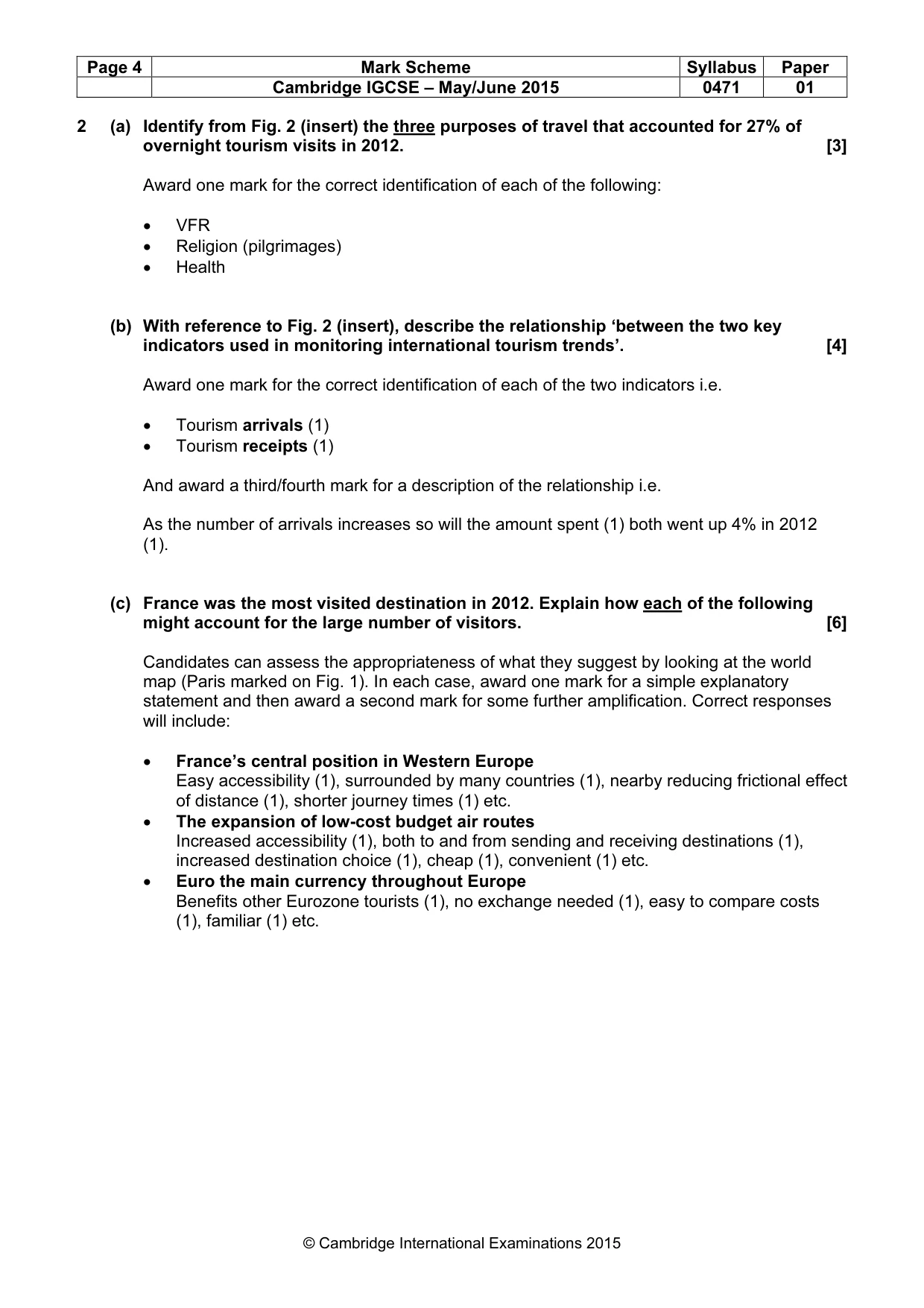
Page 4 Mark Scheme Syllabus Paper Cambridge IGCSE – May/June 2015 0471 01 © Cambridge International Examinations 2015 2 (a) Identify from Fig. 2 (insert) the three purposes of travel that accounted for 27% of overnight tourism visits in 2012. [3] Award one mark for the correct identification of each of the following: • VFR • Religion (pilgrimages) • Health (b) With reference to Fig. 2 (insert), describe the relationship ‘between the two key indicators used in monitoring international tourism trends’. [4] Award one mark for the correct identification of each of the two indicators i.e. • Tourism arrivals (1) • Tourism receipts (1) And award a third/fourth mark for a description of the relationship i.e. As the number of arrivals increases so will the amount spent (1) both went up 4% in 2012 (1). (c) France was the most visited destination in 2012. Explain how each of the following might account for the large number of visitors. [6] Candidates can assess the appropriateness of what they suggest by looking at the world map (Paris marked on Fig. 1). In each case, award one mark for a simple explanatory statement and then award a second mark for some further amplification. Correct responses will include: • France’s central position in Western Europe Easy accessibility (1), surrounded by many countries (1), nearby reducing frictional effect of distance (1), shorter journey times (1) etc. • The expansion of low-cost budget air routes Increased accessibility (1), both to and from sending and receiving destinations (1), increased destination choice (1), cheap (1), convenient (1) etc. • Euro the main currency throughout Europe Benefits other Eurozone tourists (1), no exchange needed (1), easy to compare costs (1), familiar (1) etc.
Mark scheme, page 5
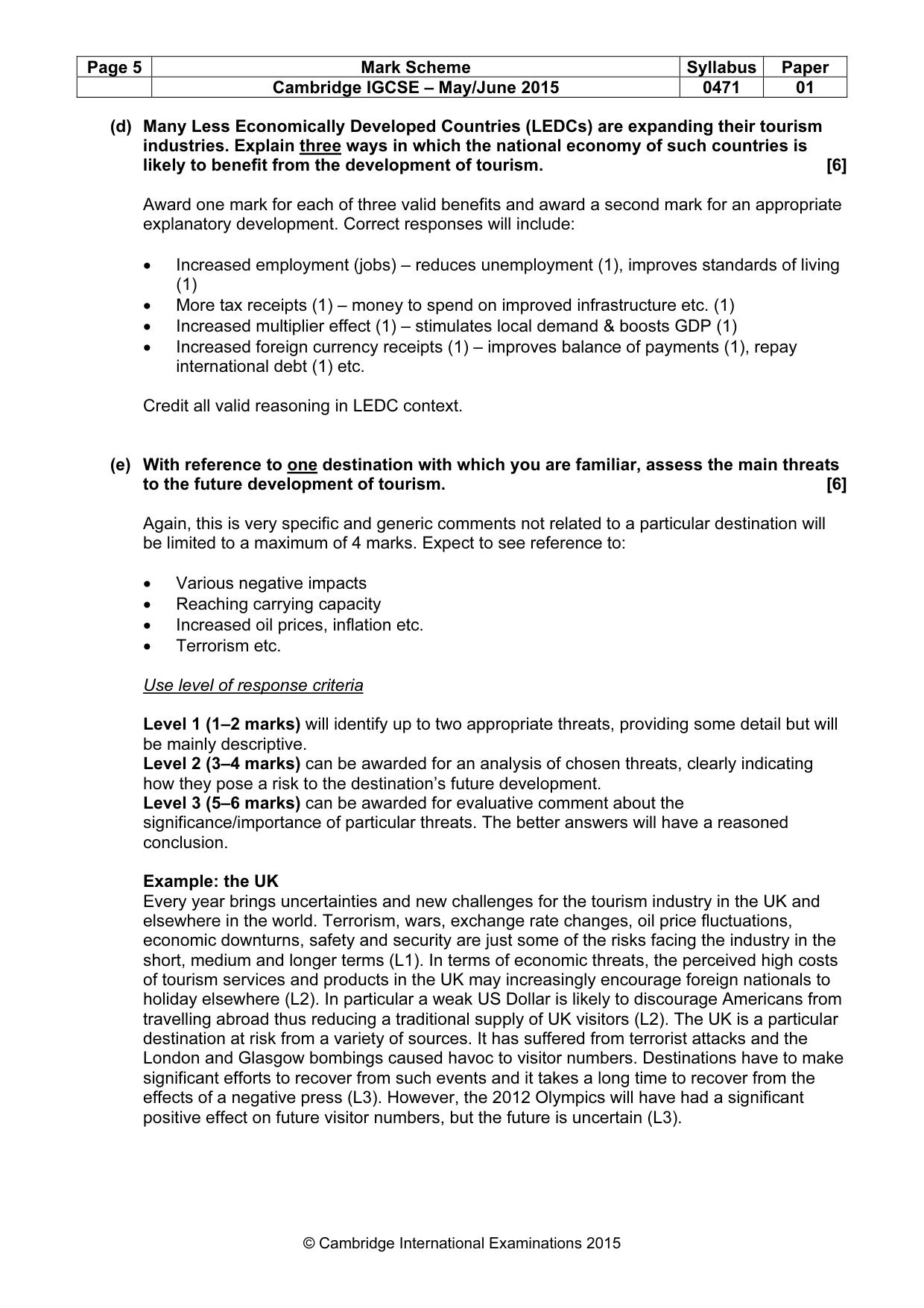
Page 5 Mark Scheme Syllabus Paper Cambridge IGCSE – May/June 2015 0471 01 © Cambridge International Examinations 2015 (d) Many Less Economically Developed Countries (LEDCs) are expanding their tourism industries. Explain three ways in which the national economy of such countries is likely to benefit from the development of tourism. [6] Award one mark for each of three valid benefits and award a second mark for an appropriate explanatory development. Correct responses will include: • Increased employment (jobs) – reduces unemployment (1), improves standards of living (1) • More tax receipts (1) – money to spend on improved infrastructure etc. (1) • Increased multiplier effect (1) – stimulates local demand & boosts GDP (1) • Increased foreign currency receipts (1) – improves balance of payments (1), repay international debt (1) etc. Credit all valid reasoning in LEDC context. (e) With reference to one destination with which you are familiar, assess the main threats to the future development of tourism. [6] Again, this is very specific and generic comments not related to a particular destination will be limited to a maximum of 4 marks. Expect to see reference to: • Various negative impacts • Reaching carrying capacity • Increased oil prices, inflation etc. • Terrorism etc. Use level of response criteria Level 1 (1–2 marks) will identify up to two appropriate threats, providing some detail but will be mainly descriptive. Level 2 (3–4 marks) can be awarded for an analysis of chosen threats, clearly indicating how they pose a risk to the destination’s future development. Level 3 (5–6 marks) can be awarded for evaluative comment about the significance/importance of particular threats. The better answers will have a reasoned conclusion. Example: the UK Every year brings uncertainties and new challenges for the tourism industry in the UK and elsewhere in the world. Terrorism, wars, exchange rate changes, oil price fluctuations, economic downturns, safety and security are just some of the risks facing the industry in the short, medium and longer terms (L1). In terms of economic threats, the perceived high costs of tourism services and products in the UK may increasingly encourage foreign nationals to holiday elsewhere (L2). In particular a weak US Dollar is likely to discourage Americans from travelling abroad thus reducing a traditional supply of UK visitors (L2). The UK is a particular destination at risk from a variety of sources. It has suffered from terrorist attacks and the London and Glasgow bombings caused havoc to visitor numbers. Destinations have to make significant efforts to recover from such events and it takes a long time to recover from the effects of a negative press (L3). However, the 2012 Olympics will have had a significant positive effect on future visitor numbers, but the future is uncertain (L3).
Mark scheme, page 6
Page 6 Mark Scheme Syllabus Paper Cambridge IGCSE – May/June 2015 0471 01 © Cambridge International Examinations 2015 3 (a) Photograph A (Insert) shows passengers checking in for their flight. Describe briefly the checking in process. [3] Award one mark for each of three valid descriptive statements, such as: • Report to airline desk (1) • Show documentation (ticket, passport) (1) • Luggage weighed & tag issued (1) • Seats & boarding pass issued (1) • Check passport/visa (1) (b) Explain the purpose of two security checks that passengers are likely to experience after they have checked in for their flight. [4] Award one mark for the identification of each of two valid checks and award a second mark for an appropriate explanation in context, such as: • Passport control (1) – border agency check for illegal/wanted individuals (1) • Hand baggage X-ray (1) – check for contraband (1) • Body scanner/frisk (1) – person check for concealed weapons (1) • Check passport (1) check it matches boarding pass (c) Some passengers will use the currency exchange facility shown in Photograph B (Insert). Explain the purpose served by each of the following: [4] In each case award one mark for a simple explanatory statement and then award a second mark for some further amplification. Thus, correct responses will include: • The display screen To show customers the exchange rate (1) – so that they can calculate purchase (1), to make comparison and judge value (1), to avoid complaints (1) • The reduced height service counter Accessible to wheelchair users (1) – so that they can easily reach (1), to comply with legislation (1)
Mark scheme, page 7
Page 7 Mark Scheme Syllabus Paper Cambridge IGCSE – May/June 2015 0471 01 © Cambridge International Examinations 2015 (d) Other than currency exchange, state four services provided by major airports and explain how each meets the needs of outbound international travellers. [8] Award one mark for the correct identification of each of four valid services and then award a second mark for an explanation about meeting passenger needs. However, remember the question clearly states an outbound context. We can accept all valid services both landside and airside including: • Car parking (1) – no transport needed (1) • Porters (1) – take bags to check-in (1) • Buggy (1) – mobility problems (1) • F&B outlets (1) – refreshments (1) • Duty free (1) – tax free purchases (1) • Wi-fi (1) – check email and social media (1) • Prayer room (1) – meet cultural norm (1) • Shops (1) – buy items they have forgotten (1) • Lounges (1) – business & leisure need (1) • Kids zone (1) – occupy children in safe environment (1) Credit all valid services, not signs. (e) Discuss the reasons why many travel and tourism employees, such as the ones shown in Photographs A and B (Insert), wear a uniform: [6] We should expect to see reference to ideas such as: • Professional dress code • Corporate image • Easy to recognise • Customer expectation • Employee status issue Use level of response criteria Level 1 (1–2 marks) will identify up to two valid reasons, providing some detail but will be mainly descriptive Level 2 (3–4 marks) can be awarded for an analysis of selected reasons, clearly indicating how they help to improve operational efficiency Level 3 (5–6 marks) can be awarded for evaluative comment about the significance/importance of particular aspects. The better answers will have a reasoned conclusion. Example When employees all wear a uniform it creates a unified image for the company (L1). The staff are easily identifiable, a key factor for a service situation where customers want to know who works there when they need assistance (L2). The uniforms create a professional appearance and a set standard for customers and clients to expect to see (L1). The uniforms also help create a sense of unity among the staff and foster a sense of both care and equality thus helping motivation and productivity (L2). Uniforms give the company more exposure, especially when the logo is on the shirt. Over time, the uniforms become part of the company’s branding. Local residents begin easily identifying the uniform and associating it with the company (L3).
Mark scheme, page 8
Page 8 Mark Scheme Syllabus Paper Cambridge IGCSE – May/June 2015 0471 01 © Cambridge International Examinations 2015 4 (a) Identify from Fig.3 (Insert) the following: [3] Award one mark for each correct identification as follows: • 2 cruise lines = P&O (1) and Cunard (1) • Organisation = NSPCC (1) (b) Explain two benefits to Carnival UK’s customers of the company making all employment offers ‘subject to the disclosure of criminal records and vetting checks’. [4] This question requires candidates to think about important customer service issues. Award one mark for the identification of each of two valid benefits and award a second mark for an appropriate explanatory development about each. Correct responses will include: • Safety & security (1) – customers (particularly children) not at risk from employees (1) • Quality assurance (1) – employees selected to be fit-for-purpose (1) Answers splitting safety and security can be credited for BOTH identifications but explanatory comments should have a different focus. (c) Carnival UK’s various cruise staff will be given training so that the company can provide ‘world class customer experiences’. For each of the following members of staff, suggest a type of training that will be appropriate and give a reason for your choice. [6] In each case award one mark for a valid job-appropriate type of training and award a second mark for an appropriate reason, such as: • Swimming pool lifeguard First aid (1) – attend to injuries (1) • Kitchen assistant Food hygiene (1) – prevent contamination (1) Cooking (1) – assist the chef making quality food (1) • Babysitter Childcare (1) – administer feeds correctly (1) ensure safety (1) Credit all valid reasoning.
Mark scheme, page 9
Page 9 Mark Scheme Syllabus Paper Cambridge IGCSE – May/June 2015 0471 01 © Cambridge International Examinations 2015 (d) Carnival UK’s passengers will often go on a coach sightseeing excursion when their cruise ship stops at a port of call. State three characteristic features of such excursions and explain the purpose of each feature. [6] Award one mark for the identification of each of three valid features and award a second mark for an appropriate explanatory comment about each. Correct ideas will include: • Collect from ship & return (1) – for convenience of passengers (1) • Tour guide (1) – to provide information (1) • Multi-lingual (1) – to answer questions from foreign customers (1) • Go to main tourist sites (1) – see a lot in little time (1) • Visit selected locations (1) – explore (1) • Meal/shopping stops (1) – break up trip as appropriate (1), buy souvenirs (1) • Local driver (1) know local roads and routes (1) Credit all valid reasoning. Coach features e.g. air conditioning, windows, tables, toilets etc. are not valid.
Mark scheme, page 10
Page 10 Mark Scheme Syllabus Paper Cambridge IGCSE – May/June 2015 0471 01 © Cambridge International Examinations 2015 (e) Assess the likely negative environmental impacts caused by large numbers of day visitors arriving on a regular basis in a destination. [6] The fact is that most day visitors arrive by car & coach thus the major impact to consider is congestion/overcrowding. Expect to see reference to: • The creation of ‘honeypots’ and the carrying capacity being exceeded • Traffic congestion • Noise • Litter & waste • Footpath erosion • Damage to farmland – open gates etc. Do not credit visual pollution (the visitors do not create it) nor habitat disruption (wildlife will have already gone). Use level of response criteria Level 1 (1–2 marks) will identify up to two valid impacts, providing some detail but will be mainly descriptive. Level 2 (3–4 marks) can be awarded for an analysis of selected negative environmental impacts, clearly indicating how these have caused by frequent day visitor arrivals. Level 3 (5–6 marks) can be awarded for evaluative comment about the significance/importance of particular impacts. The better answers will have a reasoned conclusion. Example Popular day trip destinations are usually invaded by large numbers of visitors and there is a growing awareness of negative tourism impacts caused by overcrowding and congestion (L1). At Machu Picchu up to 2000 people visit daily, with visitor numbers growing at 6% per year. These tourists largely contribute to pollution in the area (L1) by leaving rubbish along the banks of the Urubamba River and the untreated sewage within it (L2). Problems are focused also on the campsites for backpacking groups, unregulated latrines and issues of waste disposal (L2). The site has become a ‘honeypot’: frequently over 1000 people came, all trying to see the sunrise in Machu Picchu at the same time. The destination’s carrying capacity has reached its limit (L3). The biggest issue remains the threat to the viability of the Inca Trail.
What you needed in this session
Cambridge’s own grade thresholds for 2015 May/June, Paper 1 · Variant 1. A higher threshold means an easier paper — the bar moves with how the cohort did.