Cambridge IGCSE Travel and Tourism 0471 — 2013 May/June Paper 2 · Variant 1
0471/21/M/J/13 · 100 marks · ≈113 min
The question paper and its mark scheme, free to read here and free to download. This is Cambridge’s own paper, exactly as it was sat.
Question paper16 pages


Mark scheme9 pages
Answers below. Sit the paper first if you are practising.
Paper as text
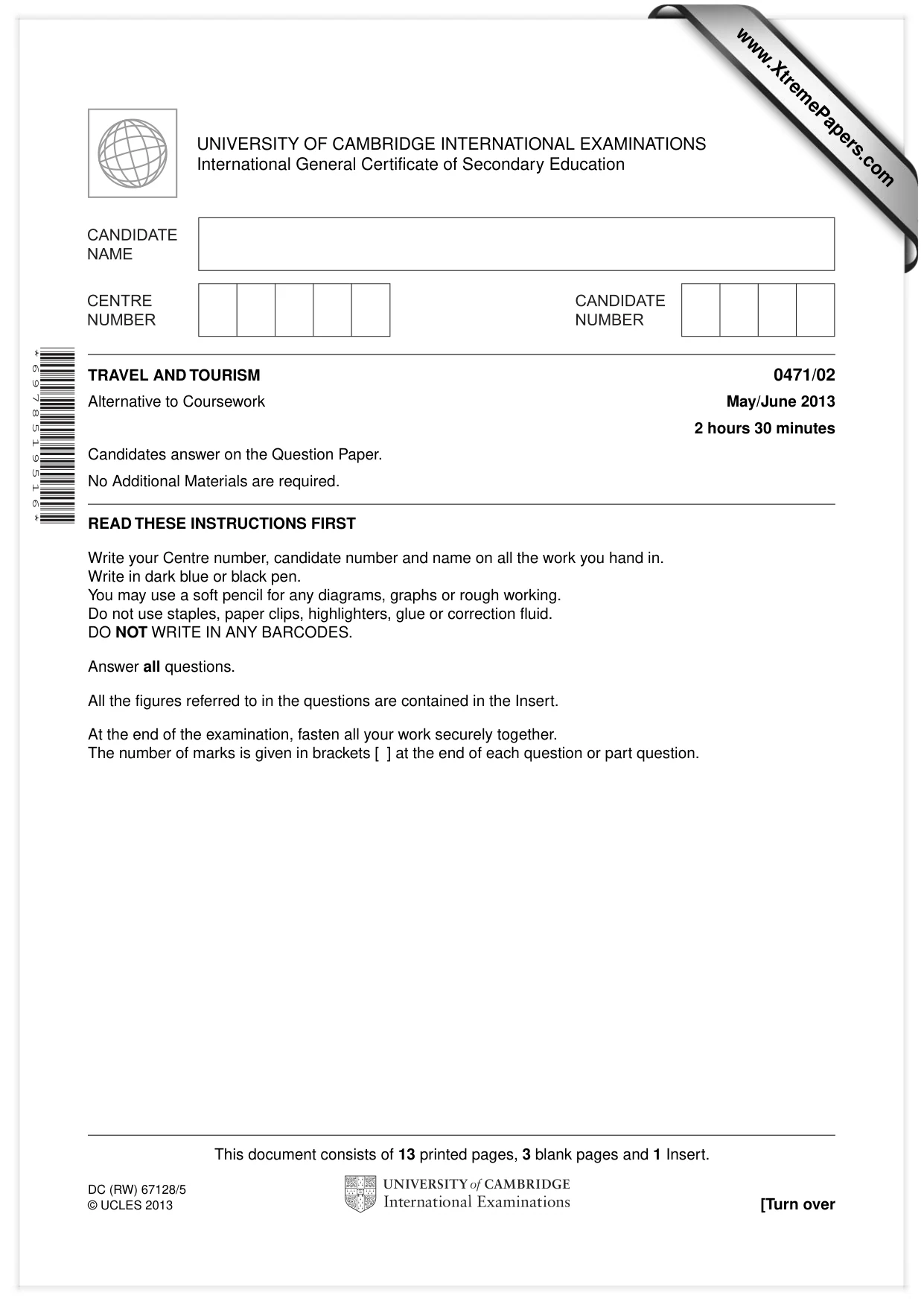
Question paper, page 1
This document consists of 13 printed pages, 3 blank pages and 1 Insert. DC (RW) 67128/5 © UCLES 2013 [Turn over UNIVERSITY OF CAMBRIDGE INTERNATIONAL EXAMINATIONS International General Certificate of Secondary Education * 6 9 7 8 5 1 9 5 1 6 * TRAVEL AND TOURISM 0471/02 Alternative to Coursework May/June 2013 2 hours 30 minutes Candidates answer on the Question Paper. No Additional Materials are required. READ THESE INSTRUCTIONS FIRST Write your Centre number, candidate number and name on all the work you hand in. Write in dark blue or black pen. You may use a soft pencil for any diagrams, graphs or rough working. Do not use staples, paper clips, highlighters, glue or correction fluid. DO NOT WRITE IN ANY BARCODES. Answer all questions. All the figures referred to in the questions are contained in the Insert. At the end of the examination, fasten all your work securely together. The number of marks is given in brackets [ ] at the end of each question or part question. www.XtremePapers.com
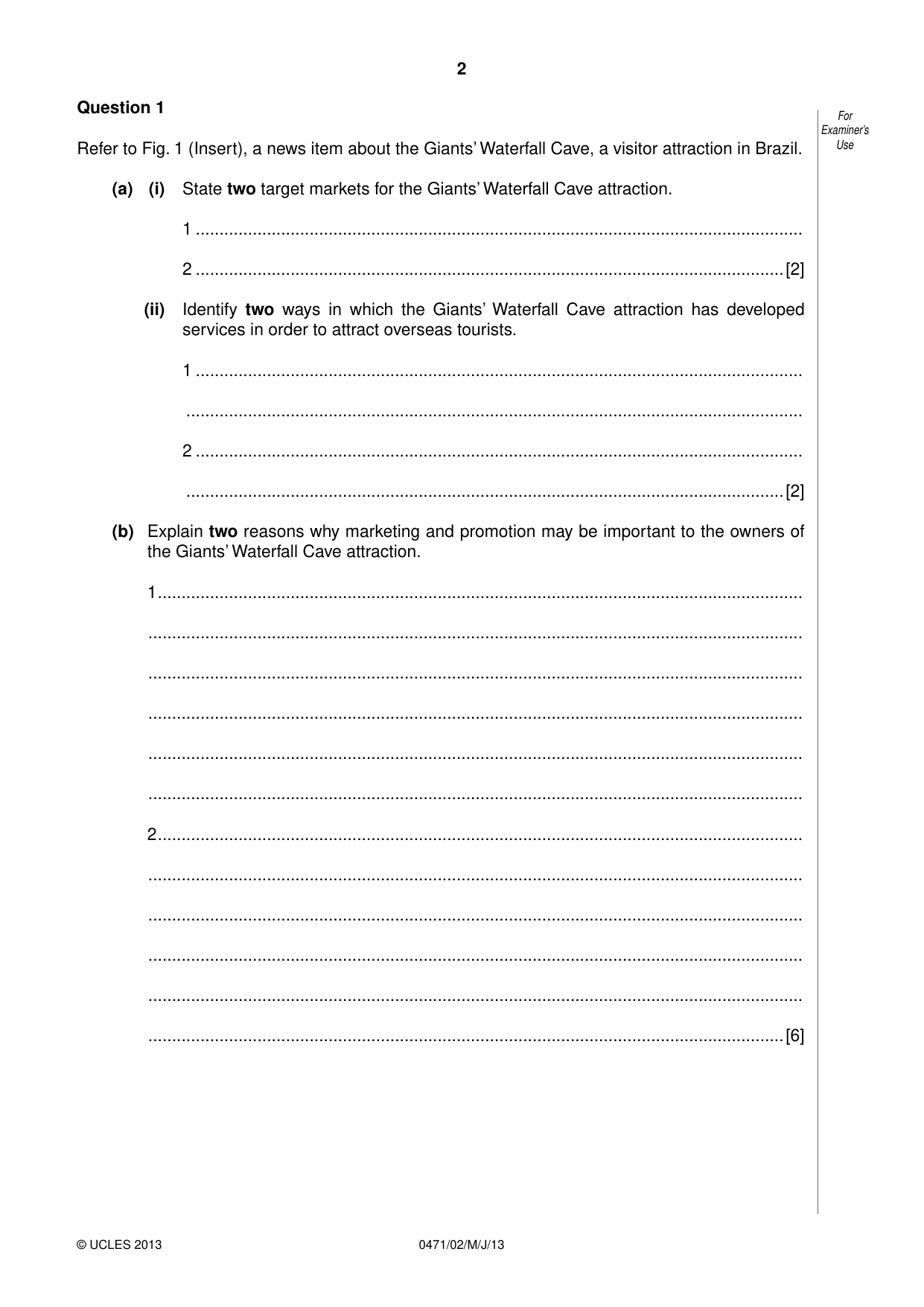
Question paper, page 2
2 0471/02/M/J/13 © UCLES 2013 For Examiner’s Use Question 1 Refer to Fig. 1 (Insert), a news item about the Giants’ Waterfall Cave, a visitor attraction in Brazil. (a) (i) State two target markets for the Giants’ Waterfall Cave attraction. 1 … 2 …[2] (ii) Identify two ways in which the Giants’ Waterfall Cave attraction has developed services in order to attract overseas tourists. 1 … … 2 … …[2] (b) Explain two reasons why marketing and promotion may be important to the owners of the Giants’ Waterfall Cave attraction. 1 … … … … … … 2 … … … … … …[6]
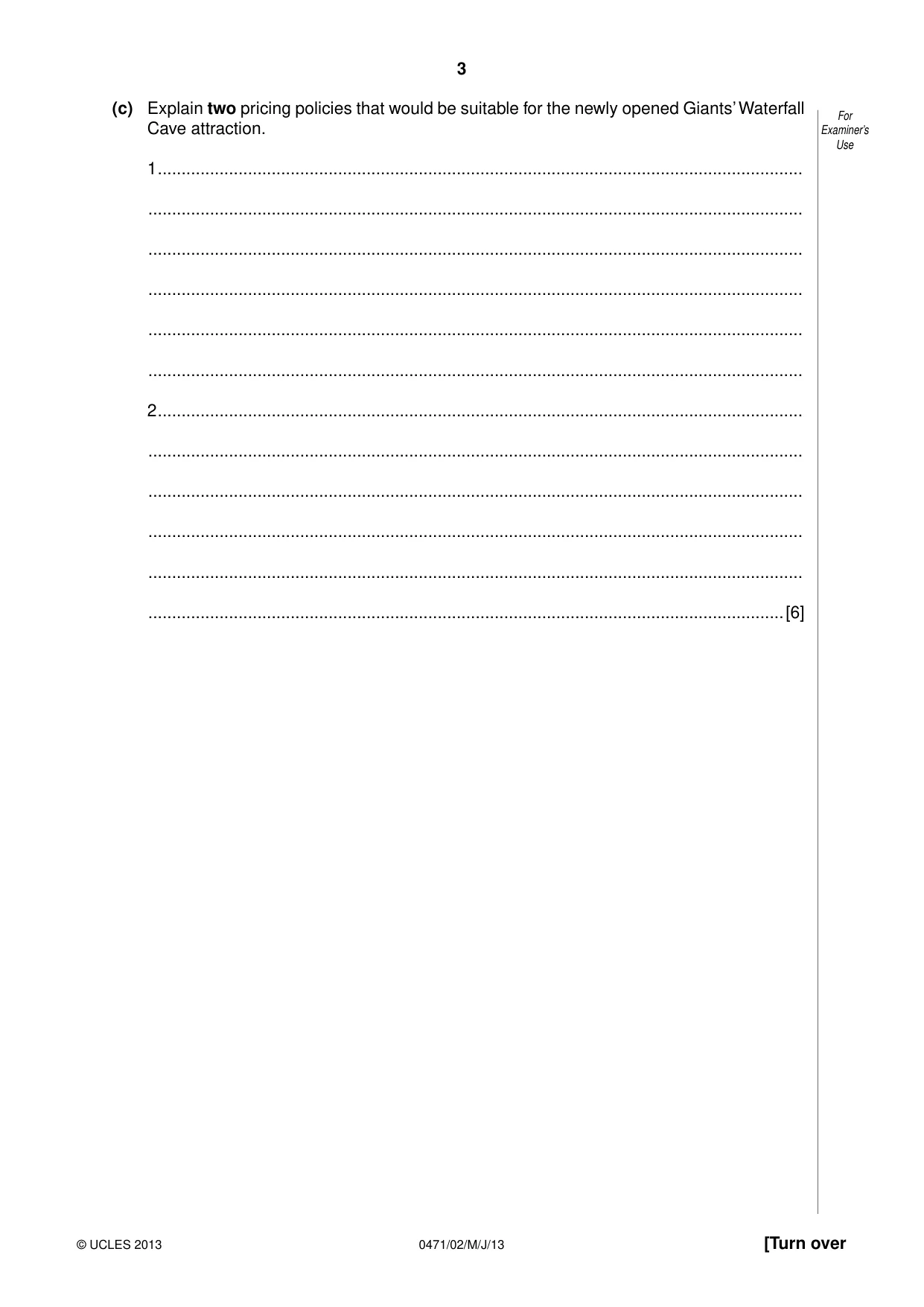
Question paper, page 3
3 0471/02/M/J/13 © UCLES 2013 [Turn over For Examiner’s Use (c) Explain two pricing policies that would be suitable for the newly opened Giants’ Waterfall Cave attraction. 1 … … … … … … 2 … … … … … …[6]
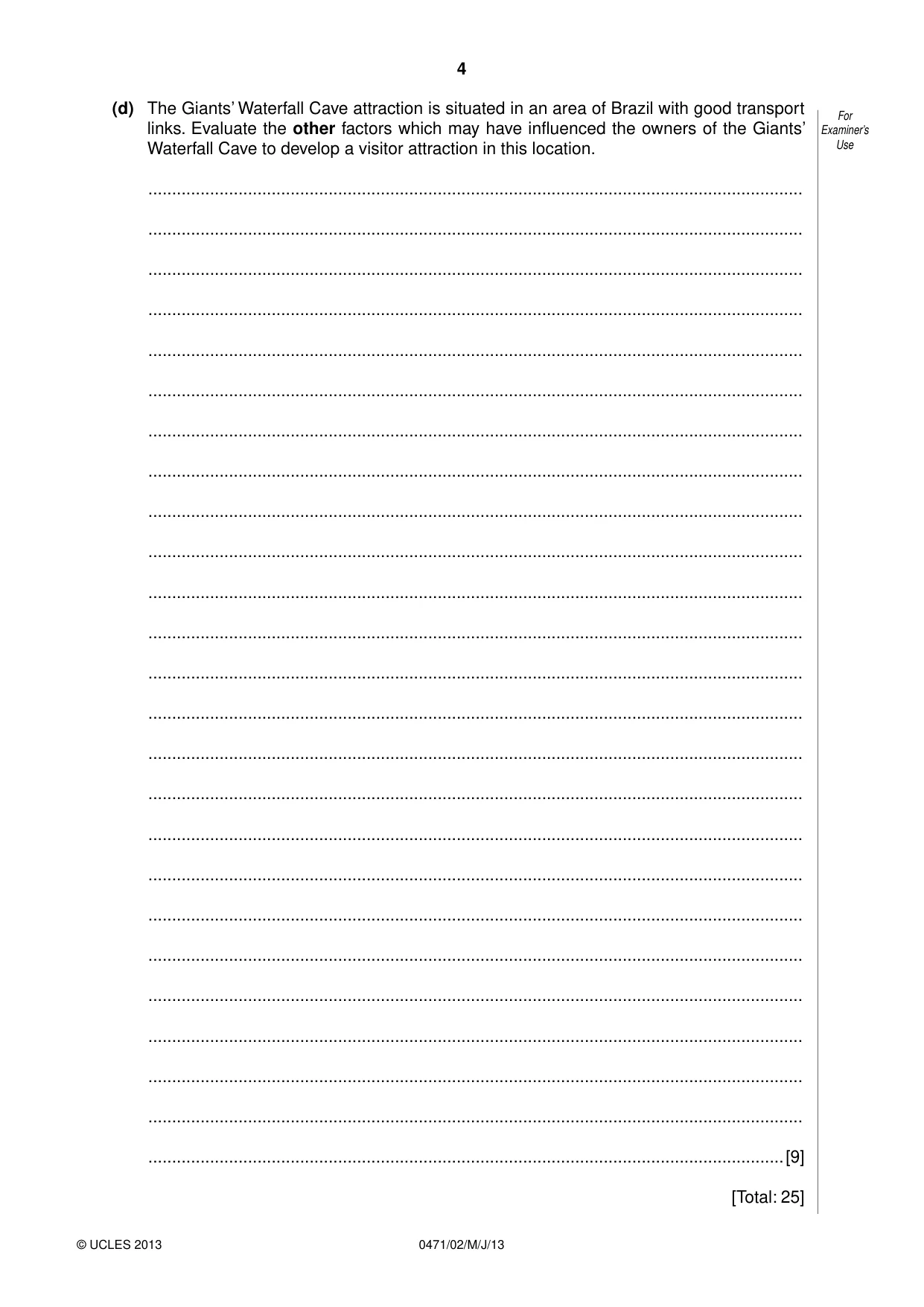
Question paper, page 4
4 0471/02/M/J/13 © UCLES 2013 For Examiner’s Use (d) The Giants’ Waterfall Cave attraction is situated in an area of Brazil with good transport links. Evaluate the other factors which may have influenced the owners of the Giants’ Waterfall Cave to develop a visitor attraction in this location. … … … … … … … … … … … … … … … … … … … … … … … … …[9] [Total: 25]
Question paper, page 5
5 0471/02/M/J/13 © UCLES 2013 [Turn over For Examiner’s Use Question 2 Refer to Fig. 2 (Insert), a news item about the European low-cost airline market. (a) (i) State two reasons to support the view that European low-cost airlines are at the maturity stage of the product life cycle. 1 … … 2 … …[2] (ii) New airline routes are examples of products at the introduction stage of the product life cycle. Give two market characteristics of the introduction stage. 1 … … 2 … …[2] (b) Identify and explain two methods of promotion that low-cost airlines could use to promote their new routes. 1 … … … … … … 2 … … … … … …[6]
Question paper, page 6
6 0471/02/M/J/13 © UCLES 2013 For Examiner’s Use (c) Low-cost airlines use direct selling as a distribution channel. Explain two advantages to the airline of using this distribution channel. 1 … … … … … … 2 … … … … … …[6]
Question paper, page 7
7 0471/02/M/J/13 © UCLES 2013 [Turn over For Examiner’s Use (d) Discuss how low-cost airlines might use the marketing mix to remain competitive. … … … … … … … … … … … … … … … … … … … … … … … … … …[9] [Total: 25]
Question paper, page 8
8 0471/02/M/J/13 © UCLES 2013 For Examiner’s Use Question 3 Refer to Fig. 3 (Insert), an advertisement for a holiday to Sri Lanka, offered by Vacation Water Sports, a global tour operator. (a) State and explain two benefits to the customer of booking this holiday by telephone. 1 … … … … 2 … … … …[4] (b) Other than the AIDA principle, state and explain two factors that Vacation Water Sports will consider when producing promotional material such as the advertisement in Fig. 3. 1 … … … … … … 2 … … … … … …[6]
Question paper, page 9
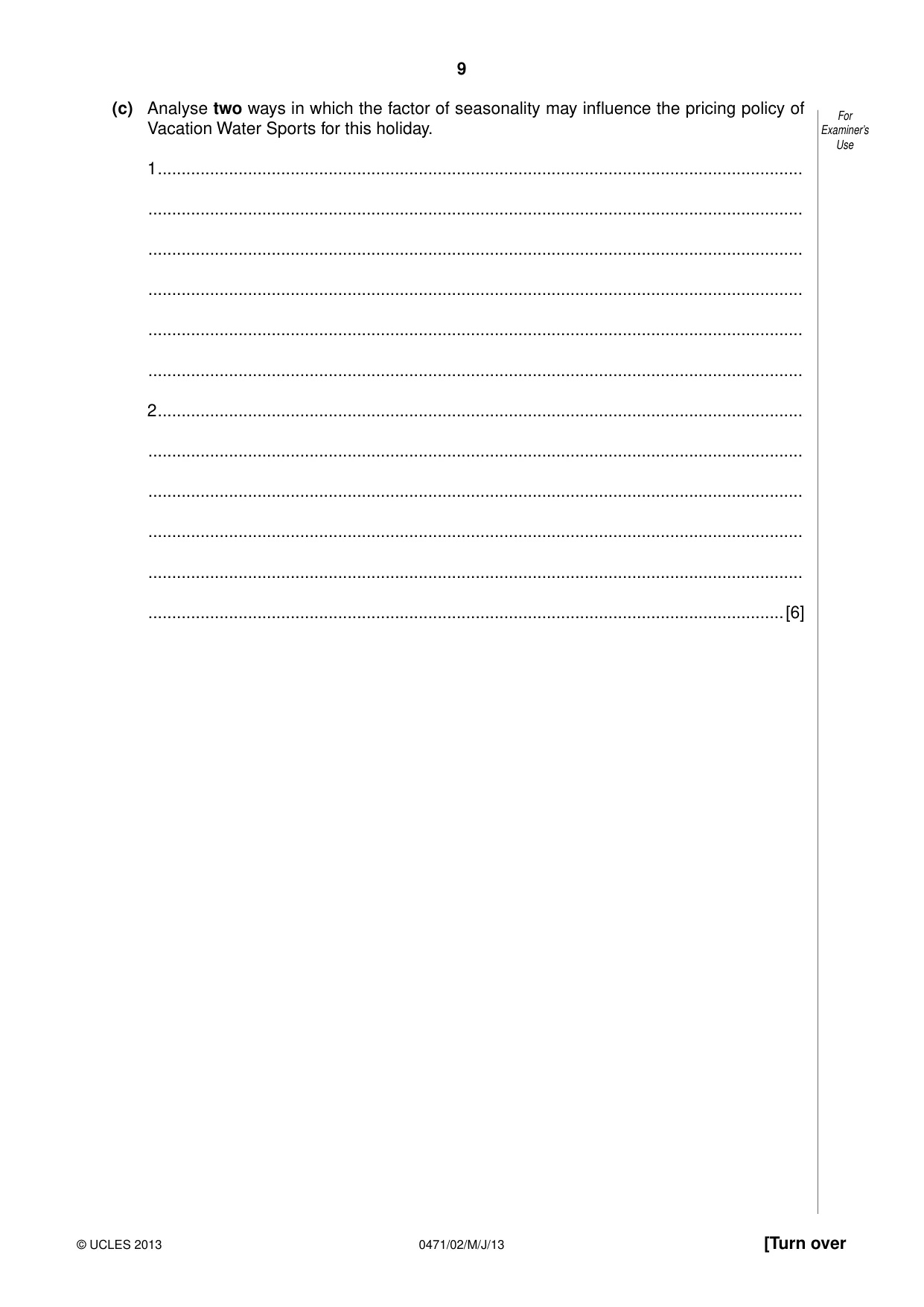
9 0471/02/M/J/13 © UCLES 2013 [Turn over For Examiner’s Use (c) Analyse two ways in which the factor of seasonality may influence the pricing policy of Vacation Water Sports for this holiday. 1 … … … … … … 2 … … … … … …[6]
Question paper, page 10
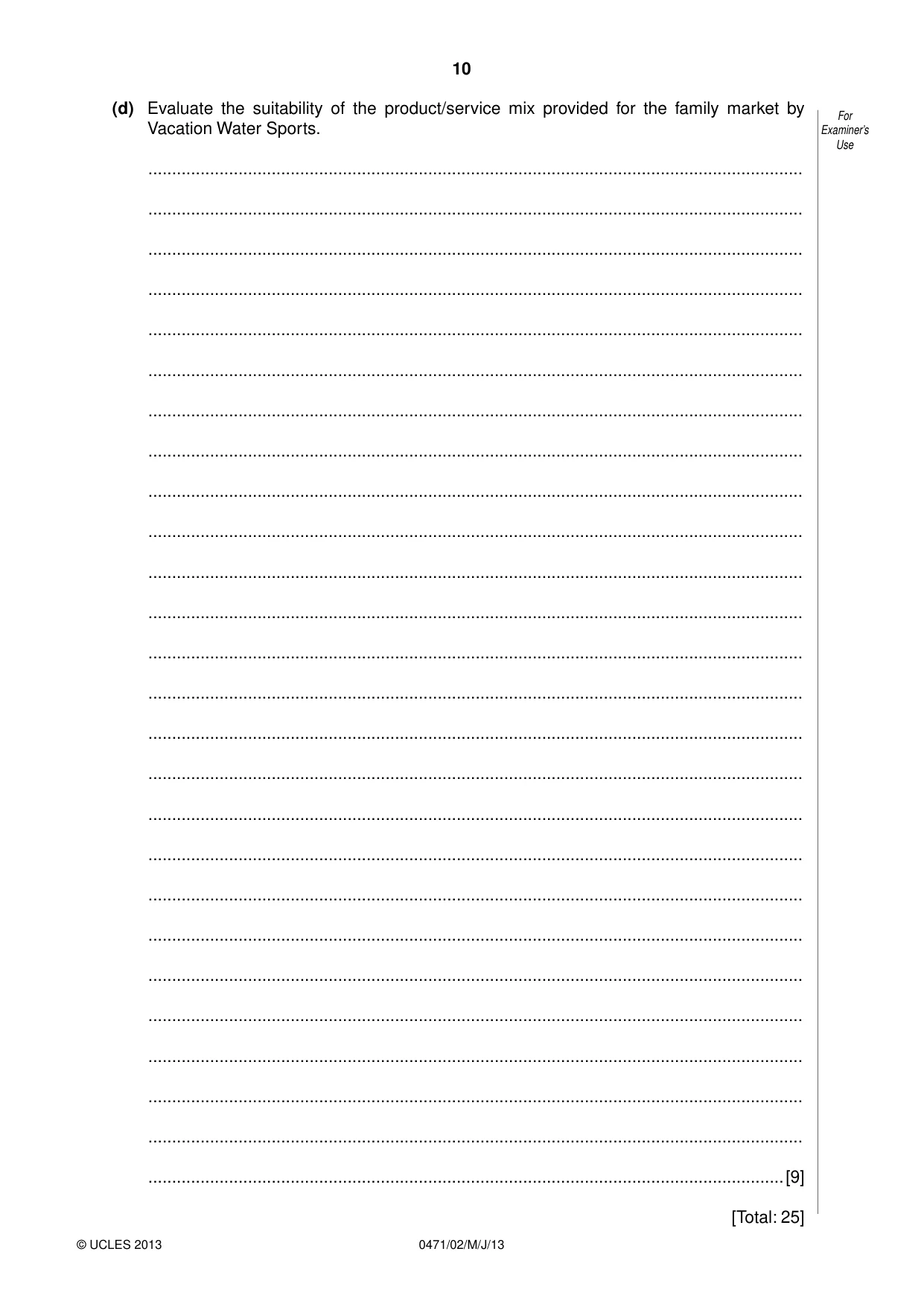
10 0471/02/M/J/13 © UCLES 2013 For Examiner’s Use (d) Evaluate the suitability of the product/service mix provided for the family market by Vacation Water Sports. … … … … … … … … … … … … … … … … … … … … … … … … … …[9] [Total: 25]
Question paper, page 11
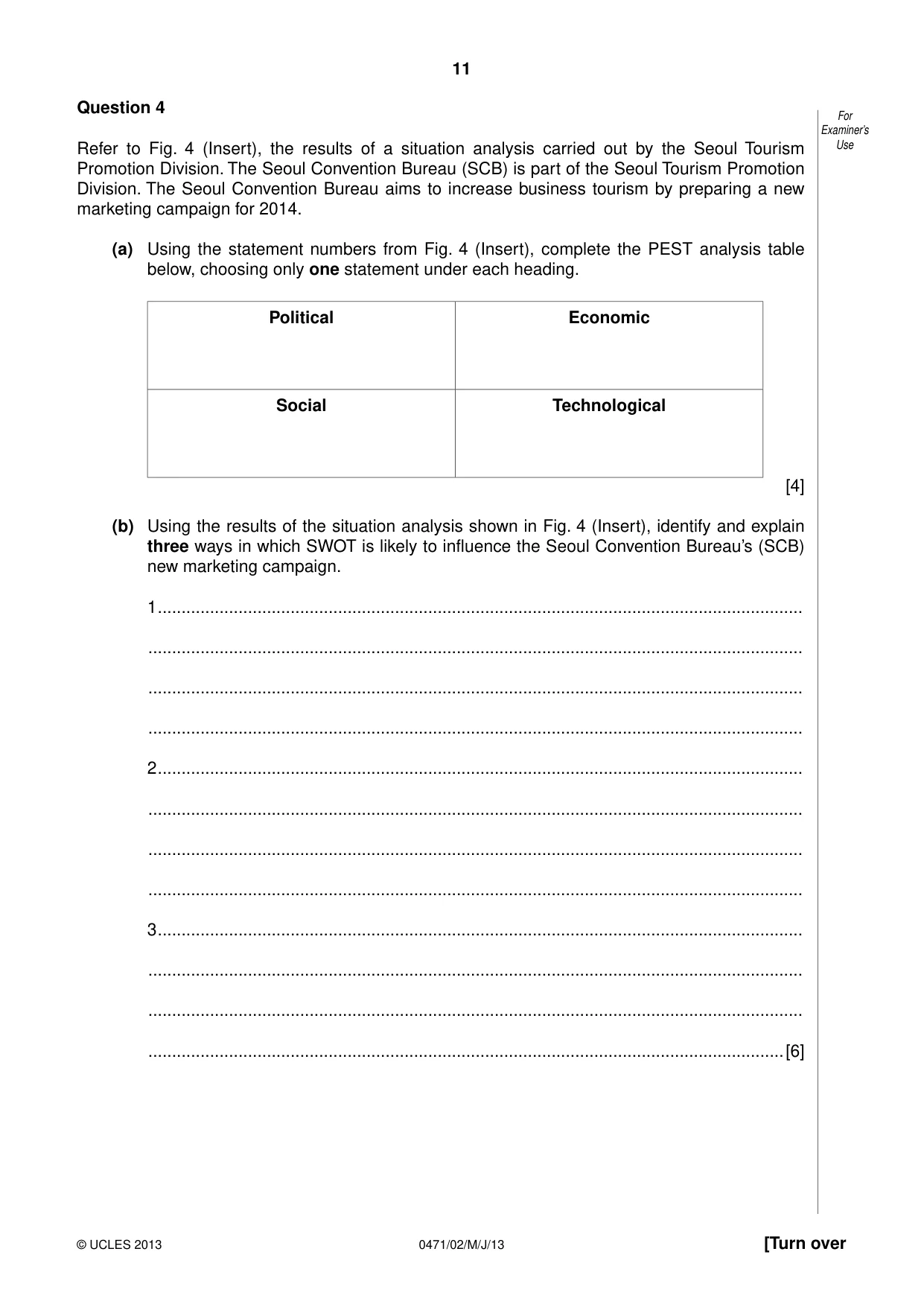
11 0471/02/M/J/13 © UCLES 2013 [Turn over For Examiner’s Use Question 4 Refer to Fig. 4 (Insert), the results of a situation analysis carried out by the Seoul Tourism Promotion Division. The Seoul Convention Bureau (SCB) is part of the Seoul Tourism Promotion Division. The Seoul Convention Bureau aims to increase business tourism by preparing a new marketing campaign for 2014. (a) Using the statement numbers from Fig. 4 (Insert), complete the PEST analysis table below, choosing only one statement under each heading. Political Economic Social Technological [4] (b) Using the results of the situation analysis shown in Fig. 4 (Insert), identify and explain three ways in which SWOT is likely to influence the Seoul Convention Bureau’s (SCB) new marketing campaign. 1 … … … … 2 … … … … 3 … … … …[6]
Question paper, page 12
12 0471/02/M/J/13 © UCLES 2013 For Examiner’s Use (c) Explain two ways in which the Seoul Convention Bureau (SCB) might create a brand image within its new marketing campaign. 1 … … … … … … 2 … … … … … …[6]
Question paper, page 13
13 0471/02/M/J/13 © UCLES 2013 For Examiner’s Use (d) Discuss how the Seoul Convention Bureau (SCB) might use public relations to help promote business tourism visits to Seoul. … … … … … … … … … … … … … … … … … … … … … … … … … …[9] [Total: 25]
Question paper, page 14
14 0471/02/M/J/13 © UCLES 2013 BLANK PAGE
Question paper, page 15
15 0471/02/M/J/13 © UCLES 2013 BLANK PAGE
Question paper, page 16
16 0471/02/M/J/13 © UCLES 2013 Permission to reproduce items where third-party owned material protected by copyright is included has been sought and cleared where possible. Every reasonable effort has been made by the publisher (UCLES) to trace copyright holders, but if any items requiring clearance have unwittingly been included, the publisher will be pleased to make amends at the earliest possible opportunity. University of Cambridge International Examinations is part of the Cambridge Assessment Group. Cambridge Assessment is the brand name of University of Cambridge Local Examinations Syndicate (UCLES), which is itself a department of the University of Cambridge. BLANK PAGE
Mark scheme, page 1
CAMBRIDGE INTERNATIONAL EXAMINATIONS International General Certificate of Secondary Education MARK SCHEME for the May/June 2013 series 0471 TRAVEL AND TOURISM 0471/02 Paper 2 (Alternative to Coursework), maximum raw mark 100 This mark scheme is published as an aid to teachers and candidates, to indicate the requirements of the examination. It shows the basis on which Examiners were instructed to award marks. It does not indicate the details of the discussions that took place at an Examiners’ meeting before marking began, which would have considered the acceptability of alternative answers. Mark schemes should be read in conjunction with the question paper and the Principal Examiner Report for Teachers. Cambridge will not enter into discussions about these mark schemes. Cambridge is publishing the mark schemes for the May/June 2013 series for most IGCSE, GCE Advanced Level and Advanced Subsidiary Level components and some Ordinary Level components. www.XtremePapers.com
Mark scheme, page 2
Page 2 Mark Scheme Syllabus Paper IGCSE – May/June 2013 0471 02 © Cambridge International Examinations 2013 1 (a) (i) State two target markets for the Giants’ Waterfall Cave attraction. [2] Award one mark for each valid target market identified. Correct answers are: • Cultural tourists • Families / Families with Children • Special interest (interested in history, walking, natural features/waterfalls/caves – but need a statement that implies people here) • Overseas tourists / foreign visitors DO NOT ACCEPT: children, adults, leisure, adventure, youth, elderly, the blind, painters, newlyweds, young couples, demographic, lifestyle, geographic etc.. (ii) Identify two ways in which the Giants’ Waterfall Cave has developed services in order to attract overseas tourists. [2] Award one mark for each valid service identified– (must be appropriate to overseas visitors). Correct answers are: • Shuttle bus from airport • Audio tours • Multi-lingual guides DO NOT ACCEPT: car park, playground etc. answer MUST relate to OVERSEAS visitors, not visitors in general. (b) Explain reasons why marketing and promotion may be important to the owners of the Giants’ Waterfall Cave attraction. [6] Award one mark for each of two valid reasons and up to an additional two marks for exemplification. Correct answers include: • To create loyalty (1) enhance brand image (1) enhance reputation (1) use of logos, slogans (1) repeat business (1) • To generate increased sales (1) customer satisfaction (1) new customers (1) higher market share (1) • To gain competitive advantage (1) establish customer base (1) which is better than competition in the area (1) • Raise awareness (1) to let customers know that the product/service is available (1) to generate an interest in visiting (1) DO NOT ACCEPT: generic answers about the importance of owners carrying out market research.
Mark scheme, page 3
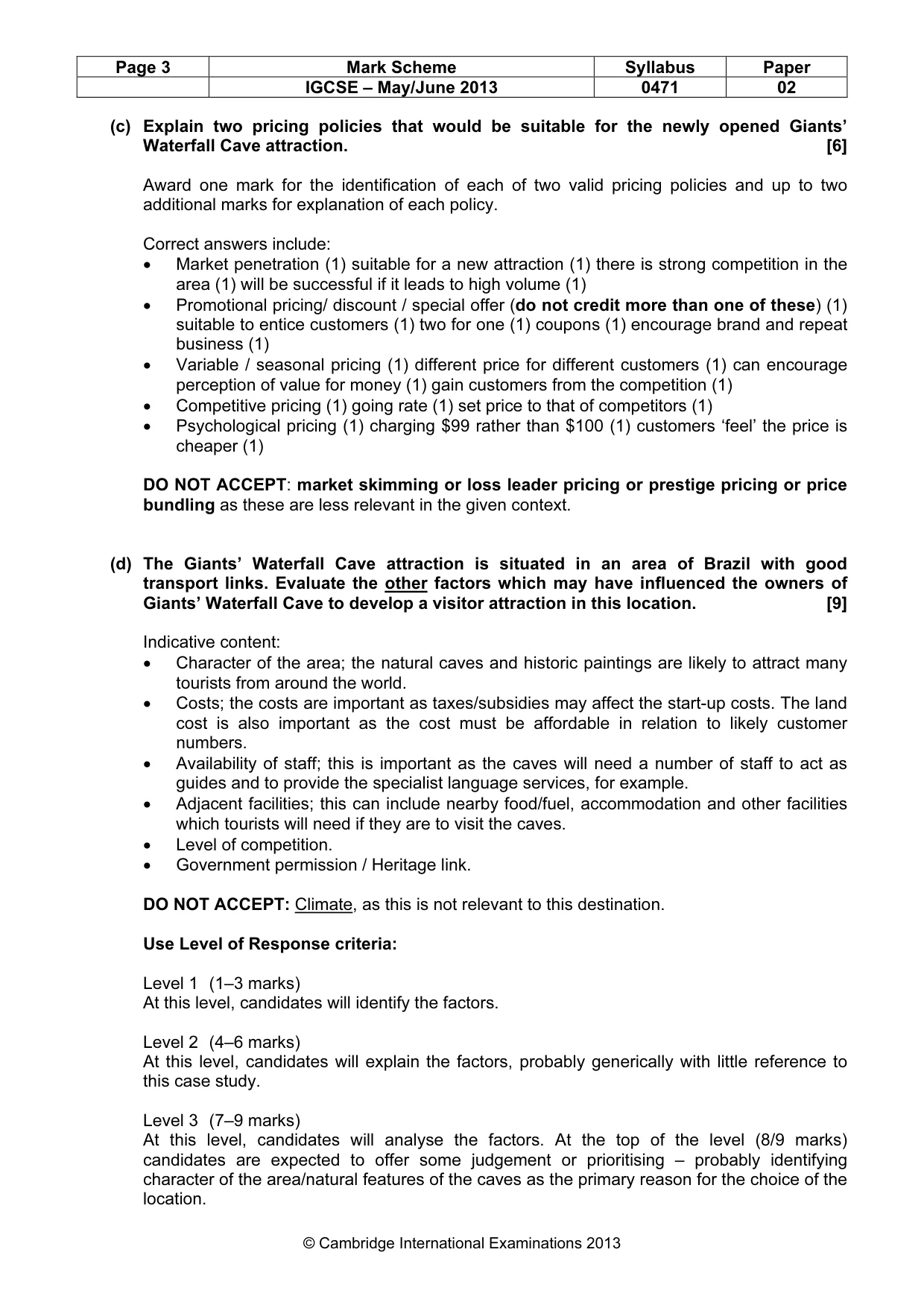
Page 3 Mark Scheme Syllabus Paper IGCSE – May/June 2013 0471 02 © Cambridge International Examinations 2013 (c) Explain two pricing policies that would be suitable for the newly opened Giants’ Waterfall Cave attraction. [6] Award one mark for the identification of each of two valid pricing policies and up to two additional marks for explanation of each policy. Correct answers include: • Market penetration (1) suitable for a new attraction (1) there is strong competition in the area (1) will be successful if it leads to high volume (1) • Promotional pricing/ discount / special offer (do not credit more than one of these) (1) suitable to entice customers (1) two for one (1) coupons (1) encourage brand and repeat business (1) • Variable / seasonal pricing (1) different price for different customers (1) can encourage perception of value for money (1) gain customers from the competition (1) • Competitive pricing (1) going rate (1) set price to that of competitors (1) • Psychological pricing (1) charging $99 rather than $100 (1) customers ‘feel’ the price is cheaper (1) DO NOT ACCEPT: market skimming or loss leader pricing or prestige pricing or price bundling as these are less relevant in the given context. (d) The Giants’ Waterfall Cave attraction is situated in an area of Brazil with good transport links. Evaluate the other factors which may have influenced the owners of Giants’ Waterfall Cave to develop a visitor attraction in this location. [9] Indicative content: • Character of the area; the natural caves and historic paintings are likely to attract many tourists from around the world. • Costs; the costs are important as taxes/subsidies may affect the start-up costs. The land cost is also important as the cost must be affordable in relation to likely customer numbers. • Availability of staff; this is important as the caves will need a number of staff to act as guides and to provide the specialist language services, for example. • Adjacent facilities; this can include nearby food/fuel, accommodation and other facilities which tourists will need if they are to visit the caves. • Level of competition. • Government permission / Heritage link. DO NOT ACCEPT: Climate, as this is not relevant to this destination. Use Level of Response criteria: Level 1 (1–3 marks) At this level, candidates will identify the factors. Level 2 (4–6 marks) At this level, candidates will explain the factors, probably generically with little reference to this case study. Level 3 (7–9 marks) At this level, candidates will analyse the factors. At the top of the level (8/9 marks) candidates are expected to offer some judgement or prioritising – probably identifying character of the area/natural features of the caves as the primary reason for the choice of the location.
Mark scheme, page 4
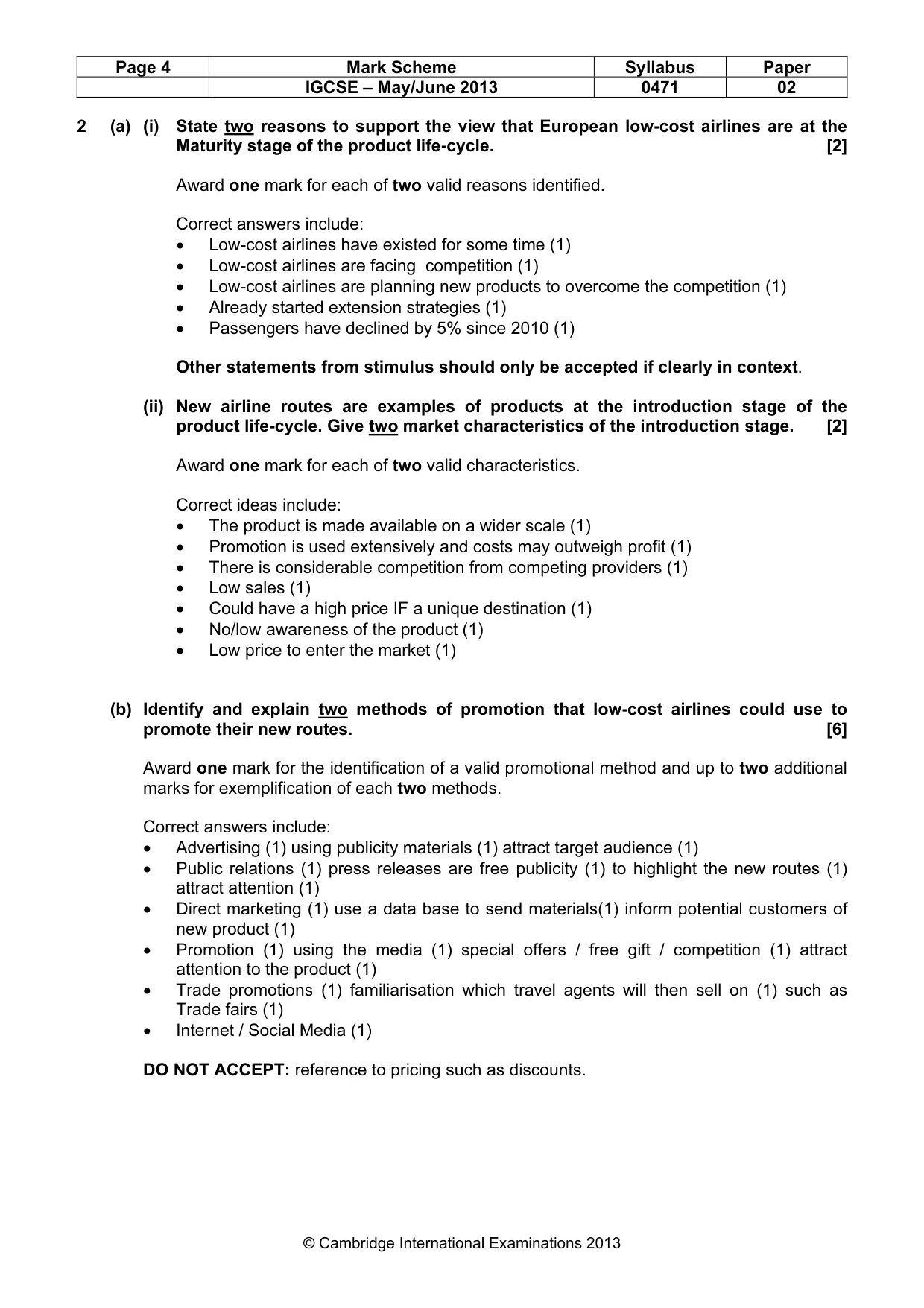
Page 4 Mark Scheme Syllabus Paper IGCSE – May/June 2013 0471 02 © Cambridge International Examinations 2013 2 (a) (i) State two reasons to support the view that European low-cost airlines are at the Maturity stage of the product life-cycle. [2] Award one mark for each of two valid reasons identified. Correct answers include: • Low-cost airlines have existed for some time (1) • Low-cost airlines are facing competition (1) • Low-cost airlines are planning new products to overcome the competition (1) • Already started extension strategies (1) • Passengers have declined by 5% since 2010 (1) Other statements from stimulus should only be accepted if clearly in context. (ii) New airline routes are examples of products at the introduction stage of the product life-cycle. Give two market characteristics of the introduction stage. [2] Award one mark for each of two valid characteristics. Correct ideas include: • The product is made available on a wider scale (1) • Promotion is used extensively and costs may outweigh profit (1) • There is considerable competition from competing providers (1) • Low sales (1) • Could have a high price IF a unique destination (1) • No/low awareness of the product (1) • Low price to enter the market (1) (b) Identify and explain two methods of promotion that low-cost airlines could use to promote their new routes. [6] Award one mark for the identification of a valid promotional method and up to two additional marks for exemplification of each two methods. Correct answers include: • Advertising (1) using publicity materials (1) attract target audience (1) • Public relations (1) press releases are free publicity (1) to highlight the new routes (1) attract attention (1) • Direct marketing (1) use a data base to send materials(1) inform potential customers of new product (1) • Promotion (1) using the media (1) special offers / free gift / competition (1) attract attention to the product (1) • Trade promotions (1) familiarisation which travel agents will then sell on (1) such as Trade fairs (1) • Internet / Social Media (1) DO NOT ACCEPT: reference to pricing such as discounts.
Mark scheme, page 5
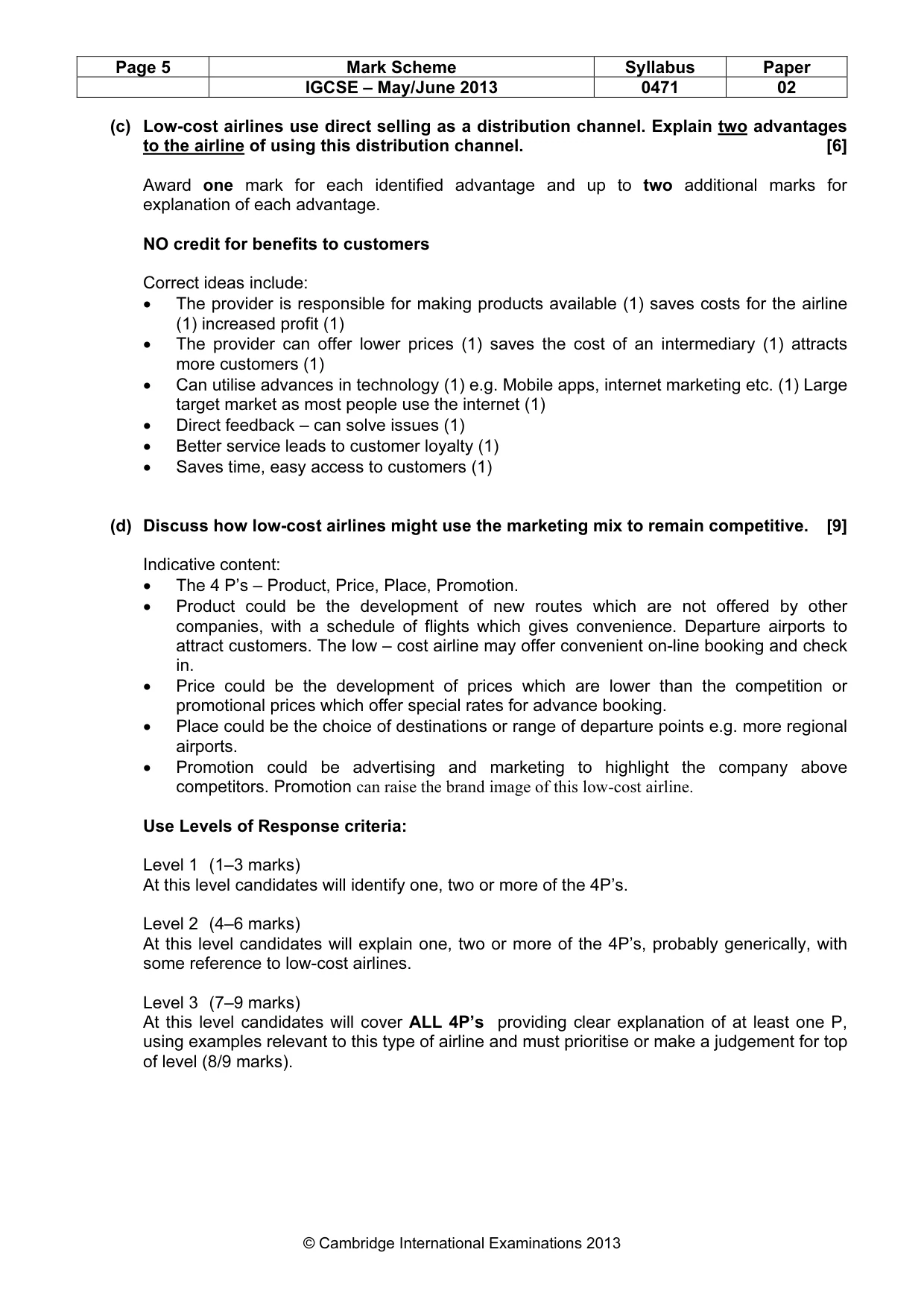
Page 5 Mark Scheme Syllabus Paper IGCSE – May/June 2013 0471 02 © Cambridge International Examinations 2013 (c) Low-cost airlines use direct selling as a distribution channel. Explain two advantages to the airline of using this distribution channel. [6] Award one mark for each identified advantage and up to two additional marks for explanation of each advantage. NO credit for benefits to customers Correct ideas include: • The provider is responsible for making products available (1) saves costs for the airline (1) increased profit (1) • The provider can offer lower prices (1) saves the cost of an intermediary (1) attracts more customers (1) • Can utilise advances in technology (1) e.g. Mobile apps, internet marketing etc. (1) Large target market as most people use the internet (1) • Direct feedback – can solve issues (1) • Better service leads to customer loyalty (1) • Saves time, easy access to customers (1) (d) Discuss how low-cost airlines might use the marketing mix to remain competitive. [9] Indicative content: • The 4 P’s – Product, Price, Place, Promotion. • Product could be the development of new routes which are not offered by other companies, with a schedule of flights which gives convenience. Departure airports to attract customers. The low – cost airline may offer convenient on-line booking and check in. • Price could be the development of prices which are lower than the competition or promotional prices which offer special rates for advance booking. • Place could be the choice of destinations or range of departure points e.g. more regional airports. • Promotion could be advertising and marketing to highlight the company above competitors. Promotion can raise the brand image of this low-cost airline. Use Levels of Response criteria: Level 1 (1–3 marks) At this level candidates will identify one, two or more of the 4P’s. Level 2 (4–6 marks) At this level candidates will explain one, two or more of the 4P’s, probably generically, with some reference to low-cost airlines. Level 3 (7–9 marks) At this level candidates will cover ALL 4P’s providing clear explanation of at least one P, using examples relevant to this type of airline and must prioritise or make a judgement for top of level (8/9 marks).
Mark scheme, page 6
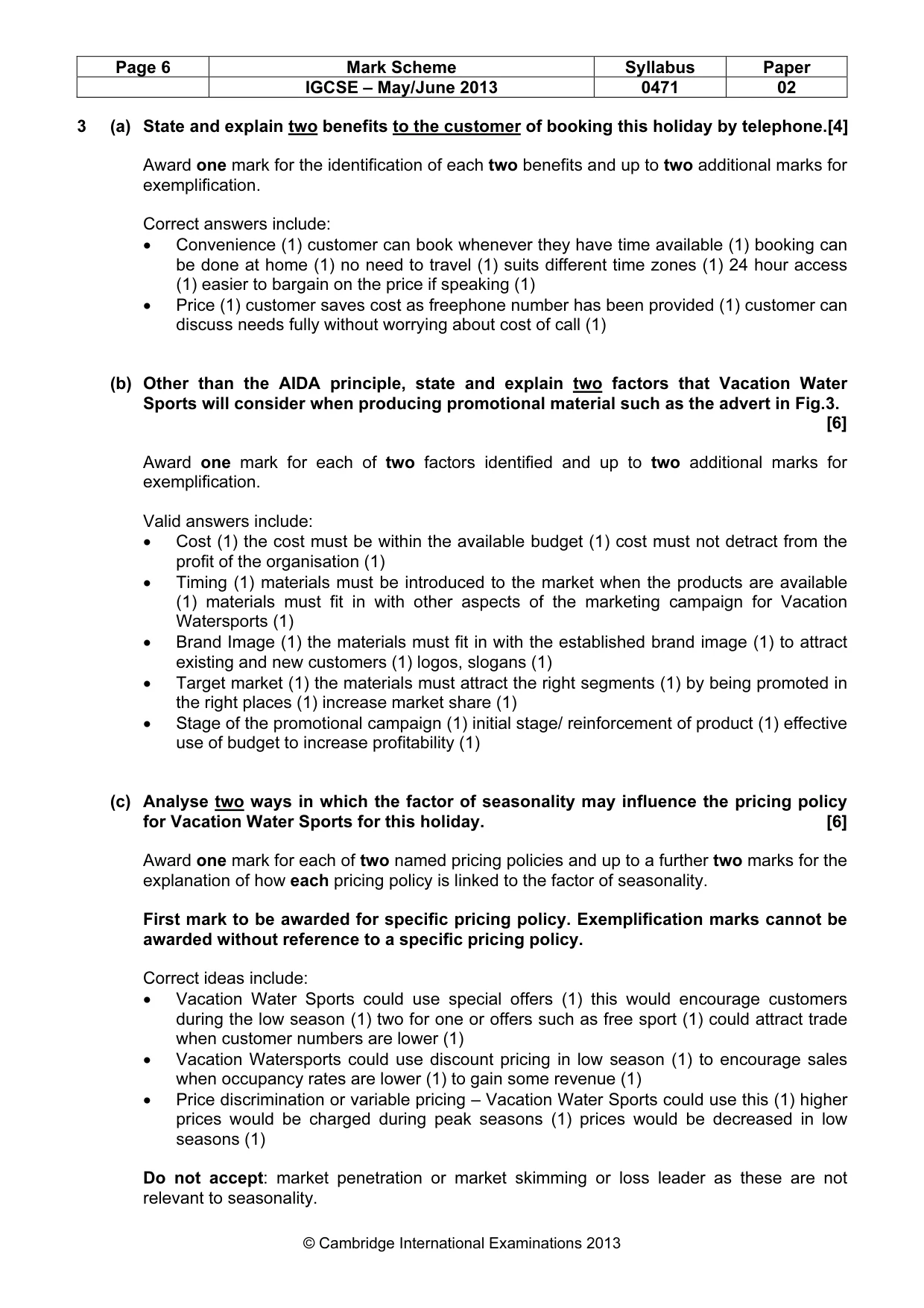
Page 6 Mark Scheme Syllabus Paper IGCSE – May/June 2013 0471 02 © Cambridge International Examinations 2013 3 (a) State and explain two benefits to the customer of booking this holiday by telephone.[4] Award one mark for the identification of each two benefits and up to two additional marks for exemplification. Correct answers include: • Convenience (1) customer can book whenever they have time available (1) booking can be done at home (1) no need to travel (1) suits different time zones (1) 24 hour access (1) easier to bargain on the price if speaking (1) • Price (1) customer saves cost as freephone number has been provided (1) customer can discuss needs fully without worrying about cost of call (1) (b) Other than the AIDA principle, state and explain two factors that Vacation Water Sports will consider when producing promotional material such as the advert in Fig.3. [6] Award one mark for each of two factors identified and up to two additional marks for exemplification. Valid answers include: • Cost (1) the cost must be within the available budget (1) cost must not detract from the profit of the organisation (1) • Timing (1) materials must be introduced to the market when the products are available (1) materials must fit in with other aspects of the marketing campaign for Vacation Watersports (1) • Brand Image (1) the materials must fit in with the established brand image (1) to attract existing and new customers (1) logos, slogans (1) • Target market (1) the materials must attract the right segments (1) by being promoted in the right places (1) increase market share (1) • Stage of the promotional campaign (1) initial stage/ reinforcement of product (1) effective use of budget to increase profitability (1) (c) Analyse two ways in which the factor of seasonality may influence the pricing policy for Vacation Water Sports for this holiday. [6] Award one mark for each of two named pricing policies and up to a further two marks for the explanation of how each pricing policy is linked to the factor of seasonality. First mark to be awarded for specific pricing policy. Exemplification marks cannot be awarded without reference to a specific pricing policy. Correct ideas include: • Vacation Water Sports could use special offers (1) this would encourage customers during the low season (1) two for one or offers such as free sport (1) could attract trade when customer numbers are lower (1) • Vacation Watersports could use discount pricing in low season (1) to encourage sales when occupancy rates are lower (1) to gain some revenue (1) • Price discrimination or variable pricing – Vacation Water Sports could use this (1) higher prices would be charged during peak seasons (1) prices would be decreased in low seasons (1) Do not accept: market penetration or market skimming or loss leader as these are not relevant to seasonality.
Mark scheme, page 7
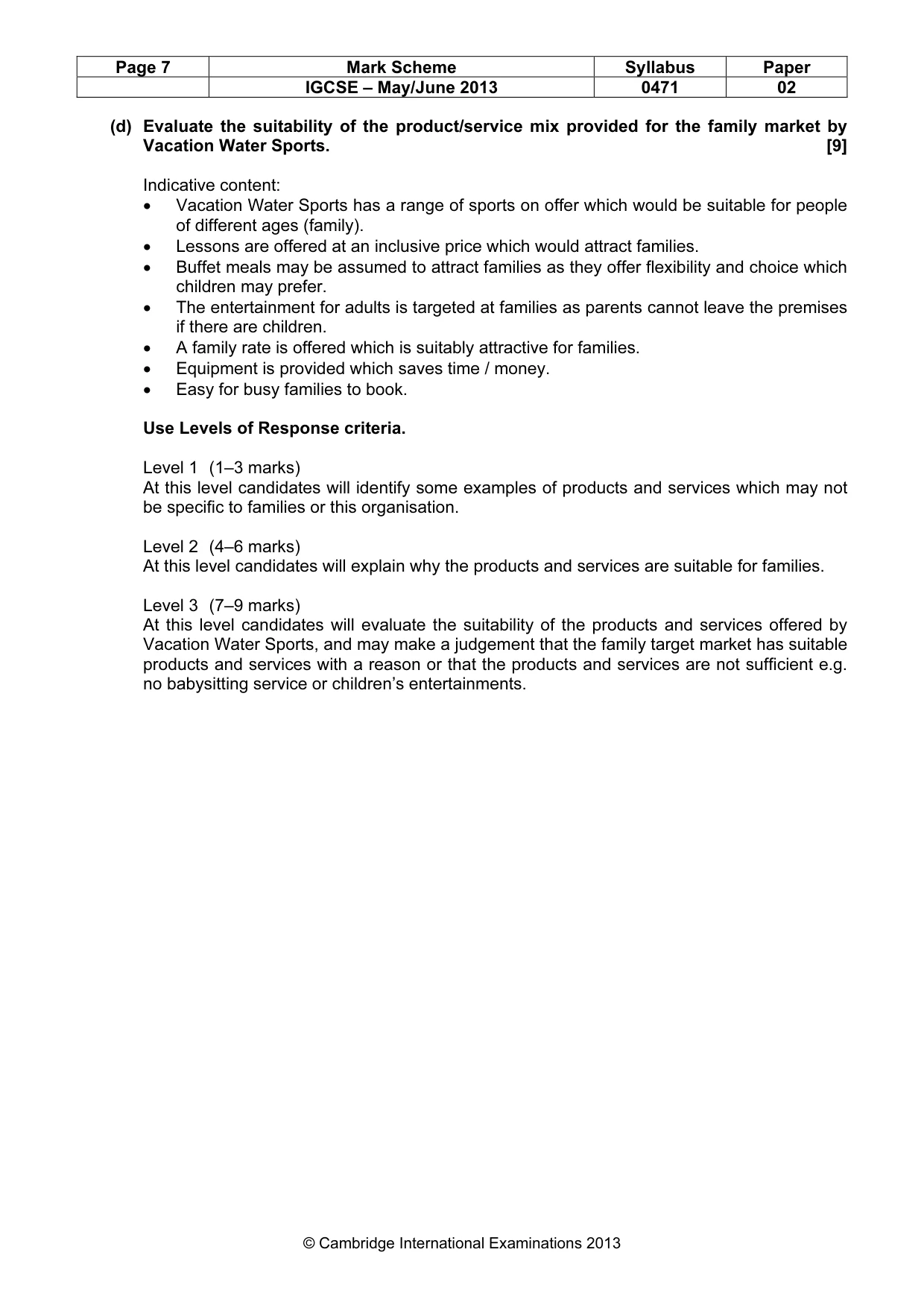
Page 7 Mark Scheme Syllabus Paper IGCSE – May/June 2013 0471 02 © Cambridge International Examinations 2013 (d) Evaluate the suitability of the product/service mix provided for the family market by Vacation Water Sports. [9] Indicative content: • Vacation Water Sports has a range of sports on offer which would be suitable for people of different ages (family). • Lessons are offered at an inclusive price which would attract families. • Buffet meals may be assumed to attract families as they offer flexibility and choice which children may prefer. • The entertainment for adults is targeted at families as parents cannot leave the premises if there are children. • A family rate is offered which is suitably attractive for families. • Equipment is provided which saves time / money. • Easy for busy families to book. Use Levels of Response criteria. Level 1 (1–3 marks) At this level candidates will identify some examples of products and services which may not be specific to families or this organisation. Level 2 (4–6 marks) At this level candidates will explain why the products and services are suitable for families. Level 3 (7–9 marks) At this level candidates will evaluate the suitability of the products and services offered by Vacation Water Sports, and may make a judgement that the family target market has suitable products and services with a reason or that the products and services are not sufficient e.g. no babysitting service or children’s entertainments.
Mark scheme, page 8
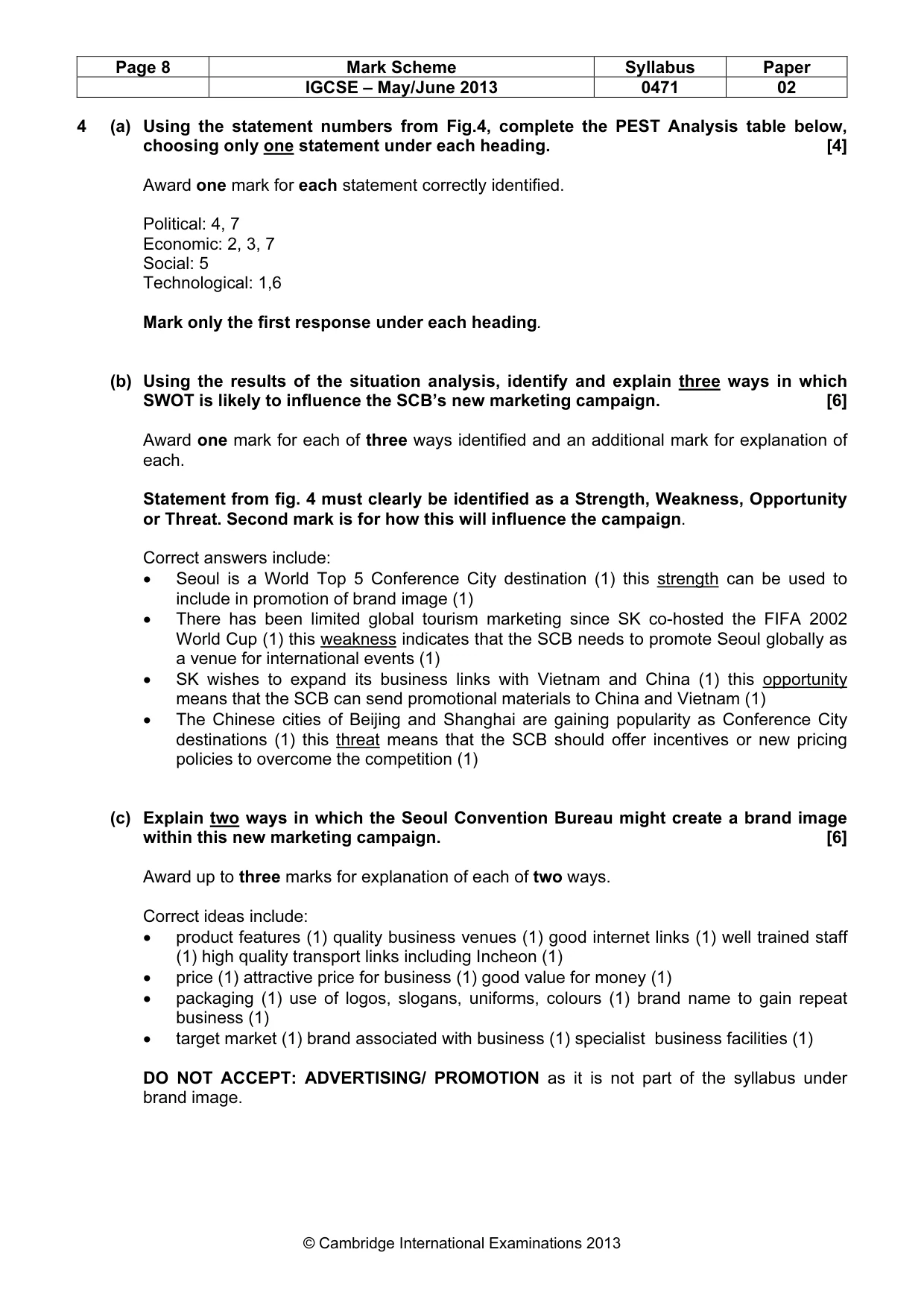
Page 8 Mark Scheme Syllabus Paper IGCSE – May/June 2013 0471 02 © Cambridge International Examinations 2013 4 (a) Using the statement numbers from Fig.4, complete the PEST Analysis table below, choosing only one statement under each heading. [4] Award one mark for each statement correctly identified. Political: 4, 7 Economic: 2, 3, 7 Social: 5 Technological: 1,6 Mark only the first response under each heading. (b) Using the results of the situation analysis, identify and explain three ways in which SWOT is likely to influence the SCB’s new marketing campaign. [6] Award one mark for each of three ways identified and an additional mark for explanation of each. Statement from fig. 4 must clearly be identified as a Strength, Weakness, Opportunity or Threat. Second mark is for how this will influence the campaign. Correct answers include: • Seoul is a World Top 5 Conference City destination (1) this strength can be used to include in promotion of brand image (1) • There has been limited global tourism marketing since SK co-hosted the FIFA 2002 World Cup (1) this weakness indicates that the SCB needs to promote Seoul globally as a venue for international events (1) • SK wishes to expand its business links with Vietnam and China (1) this opportunity means that the SCB can send promotional materials to China and Vietnam (1) • The Chinese cities of Beijing and Shanghai are gaining popularity as Conference City destinations (1) this threat means that the SCB should offer incentives or new pricing policies to overcome the competition (1) (c) Explain two ways in which the Seoul Convention Bureau might create a brand image within this new marketing campaign. [6] Award up to three marks for explanation of each of two ways. Correct ideas include: • product features (1) quality business venues (1) good internet links (1) well trained staff (1) high quality transport links including Incheon (1) • price (1) attractive price for business (1) good value for money (1) • packaging (1) use of logos, slogans, uniforms, colours (1) brand name to gain repeat business (1) • target market (1) brand associated with business (1) specialist business facilities (1) DO NOT ACCEPT: ADVERTISING/ PROMOTION as it is not part of the syllabus under brand image.
Mark scheme, page 9
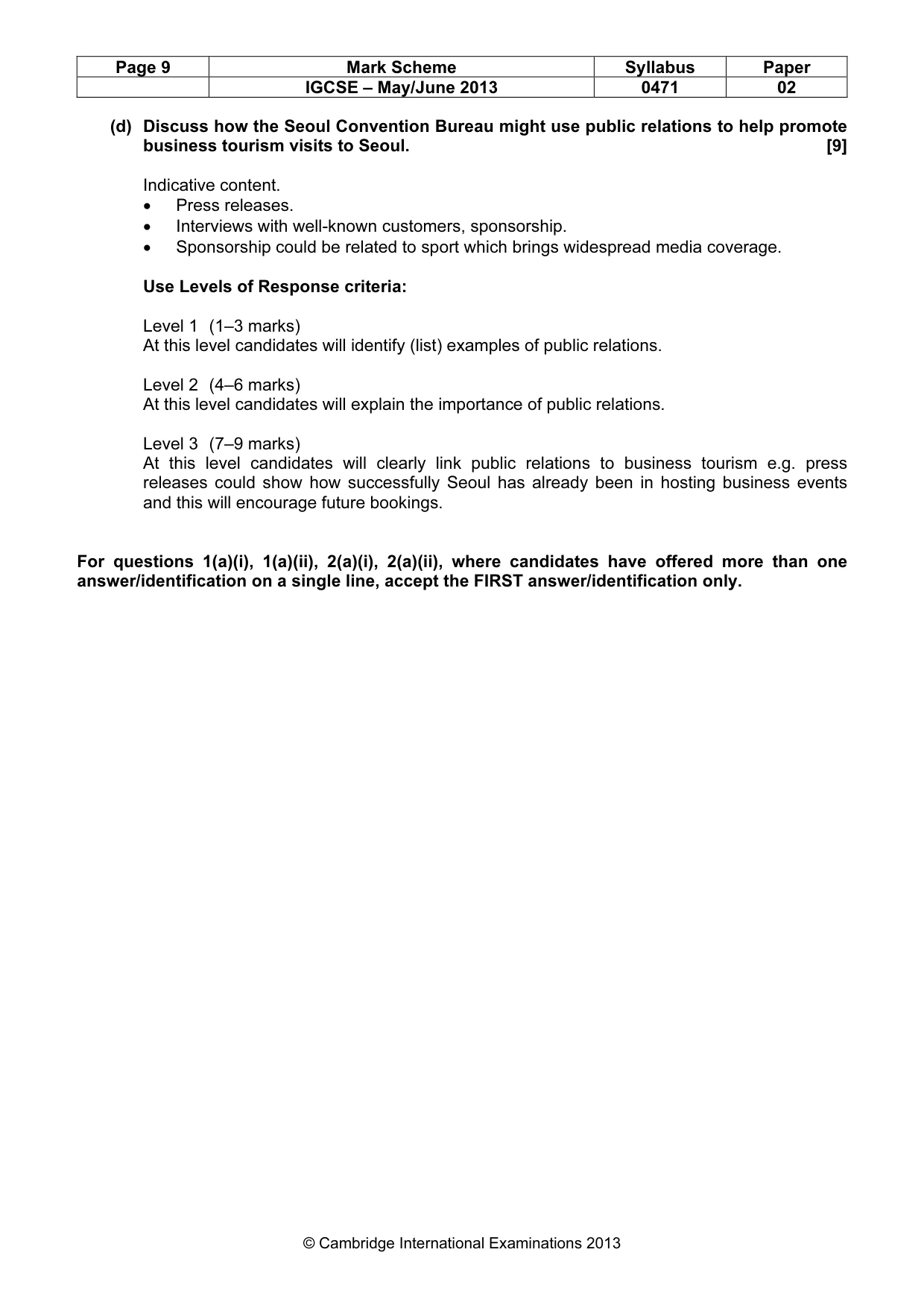
Page 9 Mark Scheme Syllabus Paper IGCSE – May/June 2013 0471 02 © Cambridge International Examinations 2013 (d) Discuss how the Seoul Convention Bureau might use public relations to help promote business tourism visits to Seoul. [9] Indicative content. • Press releases. • Interviews with well-known customers, sponsorship. • Sponsorship could be related to sport which brings widespread media coverage. Use Levels of Response criteria: Level 1 (1–3 marks) At this level candidates will identify (list) examples of public relations. Level 2 (4–6 marks) At this level candidates will explain the importance of public relations. Level 3 (7–9 marks) At this level candidates will clearly link public relations to business tourism e.g. press releases could show how successfully Seoul has already been in hosting business events and this will encourage future bookings. For questions 1(a)(i), 1(a)(ii), 2(a)(i), 2(a)(ii), where candidates have offered more than one answer/identification on a single line, accept the FIRST answer/identification only.
What you needed in this session
Cambridge’s own grade thresholds for 2013 May/June, Paper 2 · Variant 1. A higher threshold means an easier paper — the bar moves with how the cohort did.