Cambridge IGCSE Travel and Tourism 0471 — 2013 May/June Paper 1 · Variant 1
0471/11/M/J/13 · 100 marks · ≈113 min
The question paper and its mark scheme, free to read here and free to download. This is Cambridge’s own paper, exactly as it was sat.
Question paper12 pages
Mark scheme9 pages
Answers below. Sit the paper first if you are practising.
Paper as text
Question paper, page 1
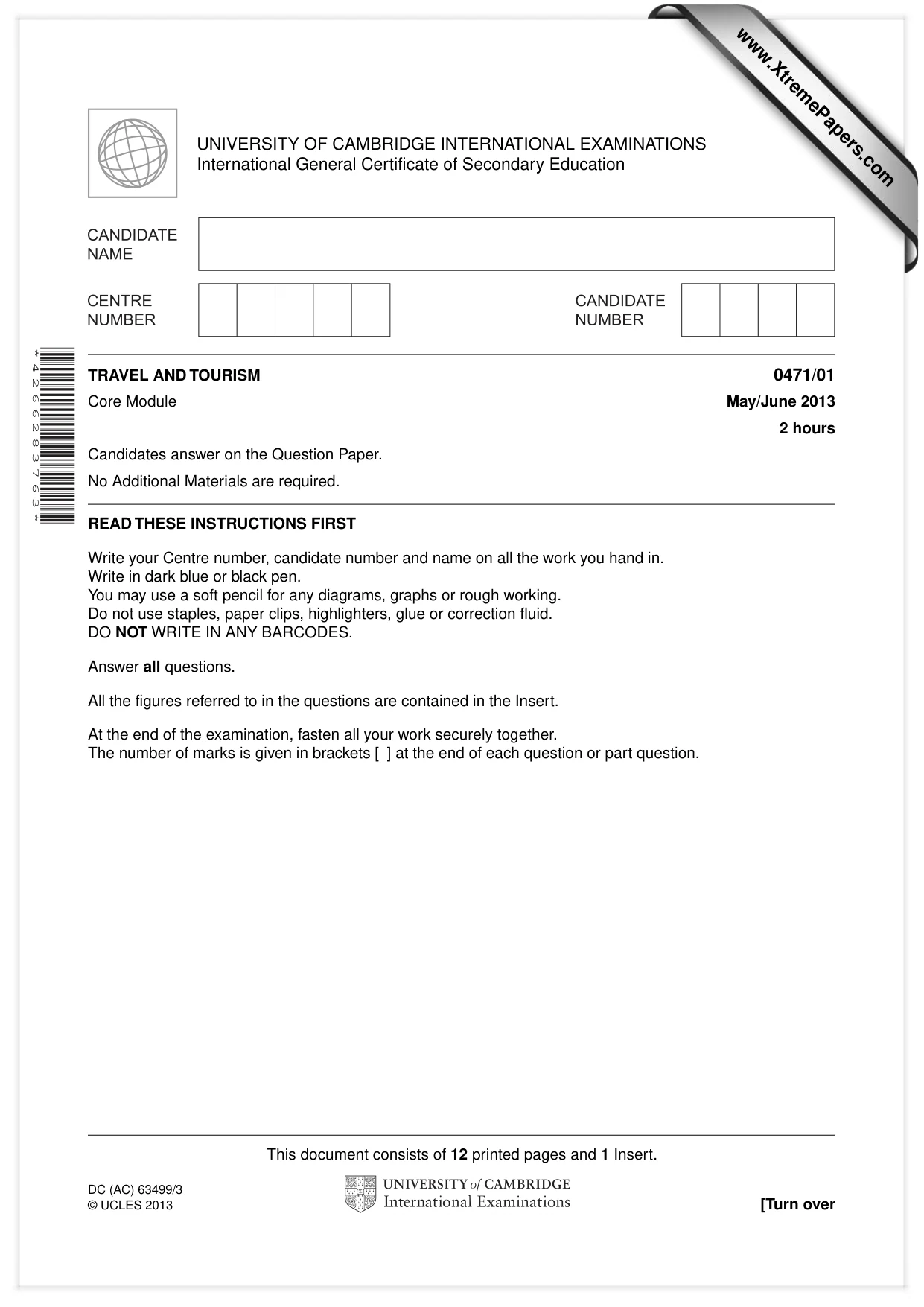
This document consists of 12 printed pages and 1 Insert. DC (AC) 63499/3 © UCLES 2013 [Turn over UNIVERSITY OF CAMBRIDGE INTERNATIONAL EXAMINATIONS International General Certificate of Secondary Education * 4 2 6 6 2 8 3 7 6 3 * TRAVEL AND TOURISM 0471/01 Core Module May/June 2013 2 hours Candidates answer on the Question Paper. No Additional Materials are required. READ THESE INSTRUCTIONS FIRST Write your Centre number, candidate number and name on all the work you hand in. Write in dark blue or black pen. You may use a soft pencil for any diagrams, graphs or rough working. Do not use staples, paper clips, highlighters, glue or correction fluid. DO NOT WRITE IN ANY BARCODES. Answer all questions. All the figures referred to in the questions are contained in the Insert. At the end of the examination, fasten all your work securely together. The number of marks is given in brackets [ ] at the end of each question or part question. www.XtremePapers.com
Question paper, page 2
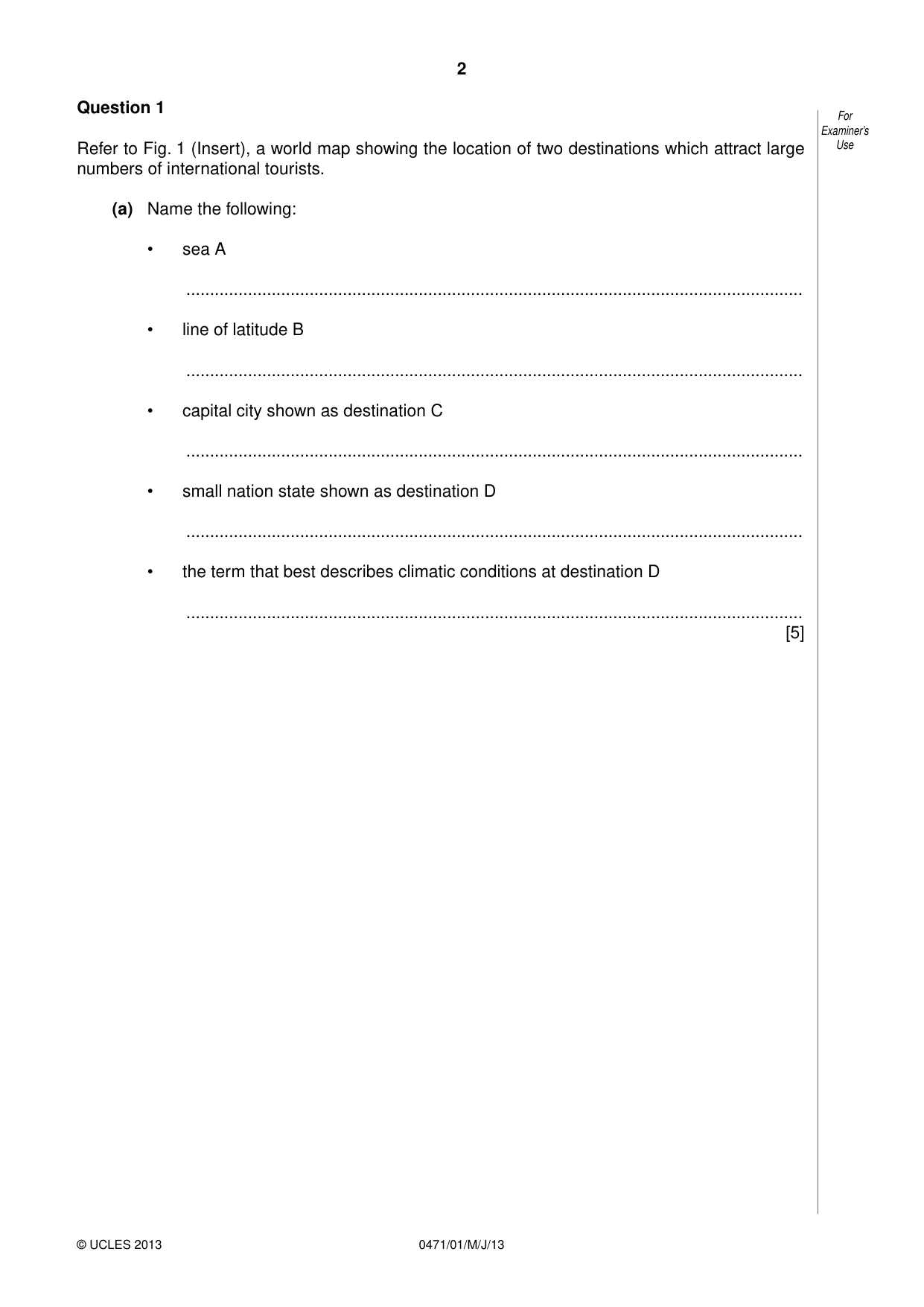
2 0471/01/M/J/13 © UCLES 2013 For Examiner’s Use Question 1 Refer to Fig. 1 (Insert), a world map showing the location of two destinations which attract large numbers of international tourists. (a) Name the following: • sea A … • line of latitude B … • capital city shown as destination C … • small nation state shown as destination D … • the term that best describes climatic conditions at destination D … [5]
Question paper, page 3
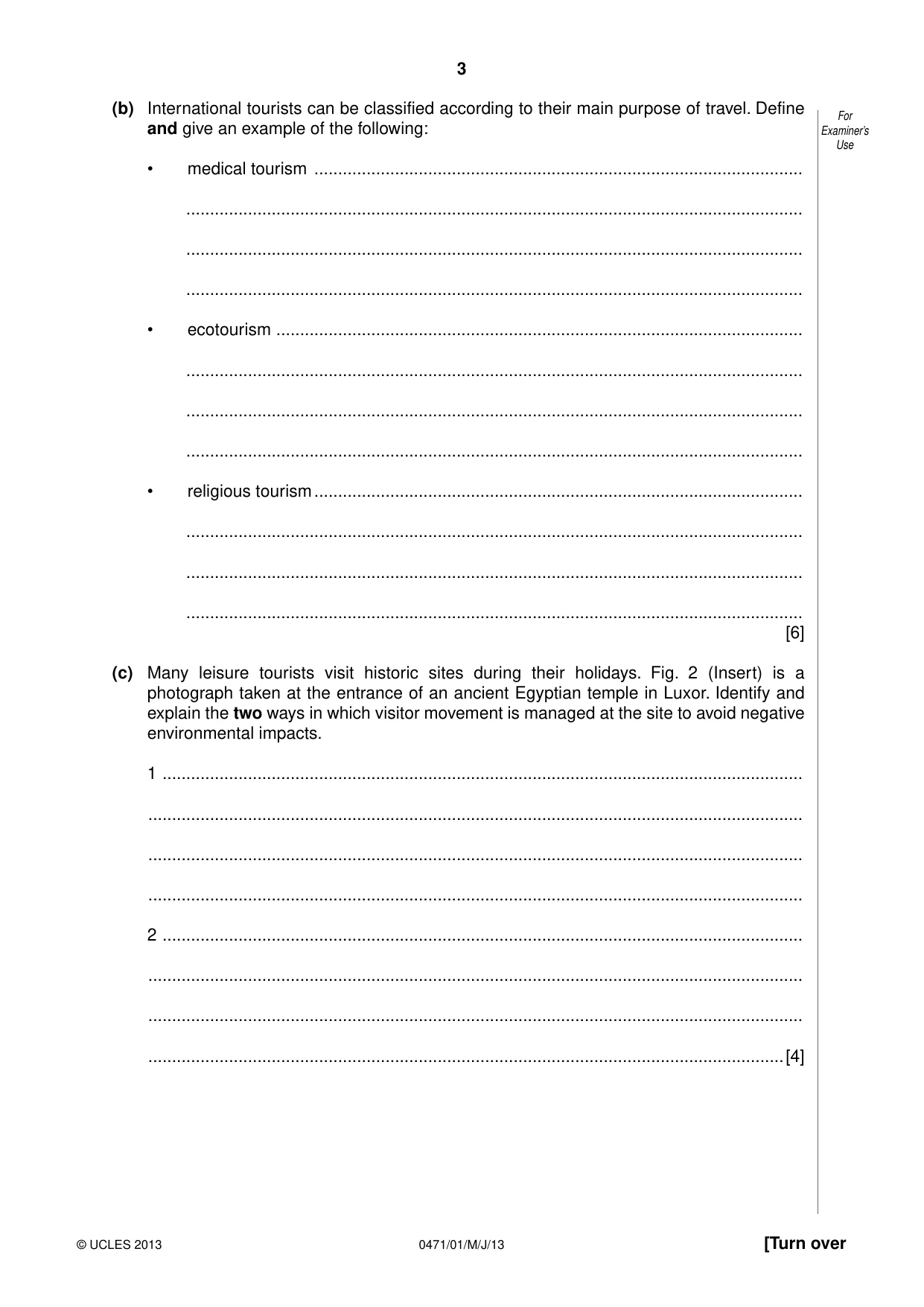
3 0471/01/M/J/13 © UCLES 2013 [Turn over For Examiner’s Use (b) International tourists can be classified according to their main purpose of travel. Define and give an example of the following: • medical tourism … … … … • ecotourism … … … … • religious tourism … … … … [6] (c) Many leisure tourists visit historic sites during their holidays. Fig. 2 (Insert) is a photograph taken at the entrance of an ancient Egyptian temple in Luxor. Identify and explain the two ways in which visitor movement is managed at the site to avoid negative environmental impacts. 1 … … … … 2 … … … …[4]
Question paper, page 4
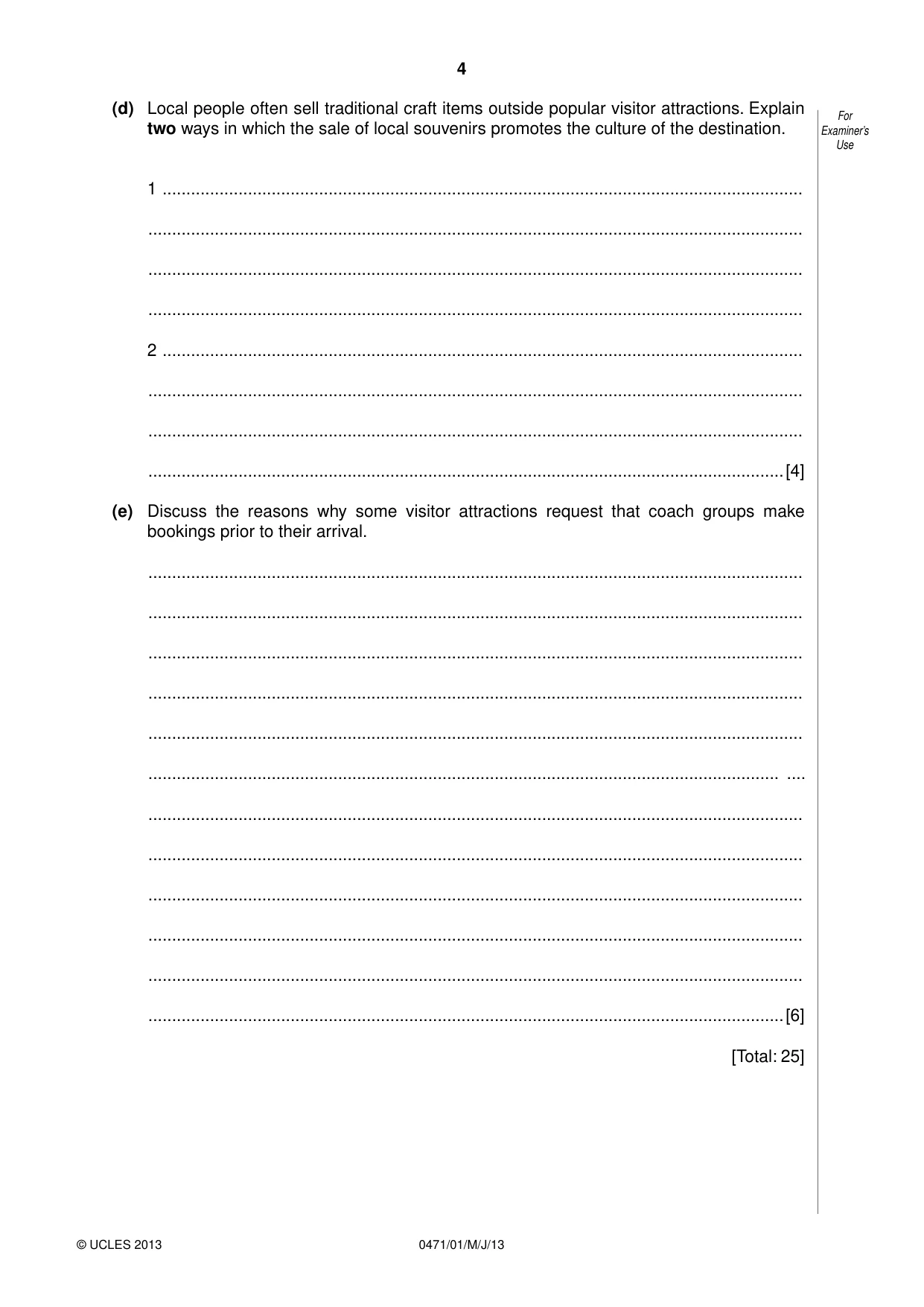
4 0471/01/M/J/13 © UCLES 2013 For Examiner’s Use (d) Local people often sell traditional craft items outside popular visitor attractions. Explain two ways in which the sale of local souvenirs promotes the culture of the destination. 1 … … … … 2 … … … …[4] (e) Discuss the reasons why some visitor attractions request that coach groups make bookings prior to their arrival. … … … … … … … … … … … … …[6] [Total: 25]
Question paper, page 5
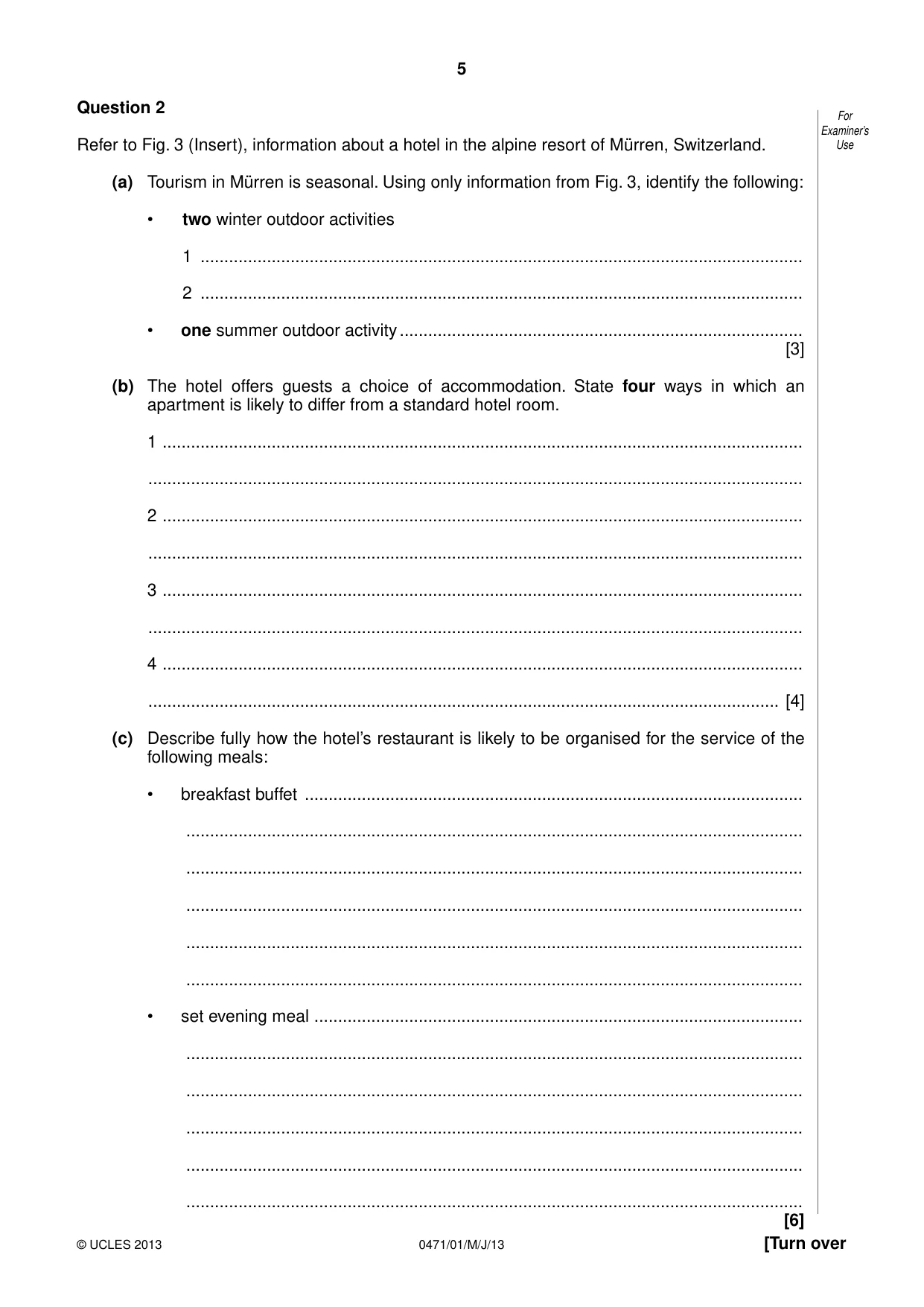
5 0471/01/M/J/13 © UCLES 2013 [Turn over For Examiner’s Use Question 2 Refer to Fig. 3 (Insert), information about a hotel in the alpine resort of Mürren, Switzerland. (a) Tourism in Mürren is seasonal. Using only information from Fig. 3, identify the following: • two winter outdoor activities 1 … 2 … • one summer outdoor activity … [3] (b) The hotel offers guests a choice of accommodation. State four ways in which an apartment is likely to differ from a standard hotel room. 1 … … 2 … … 3 … … 4 … … [4] (c) Describe fully how the hotel’s restaurant is likely to be organised for the service of the following meals: • breakfast buffet … … … … … … • set evening meal … … … … … … [6]
Question paper, page 6
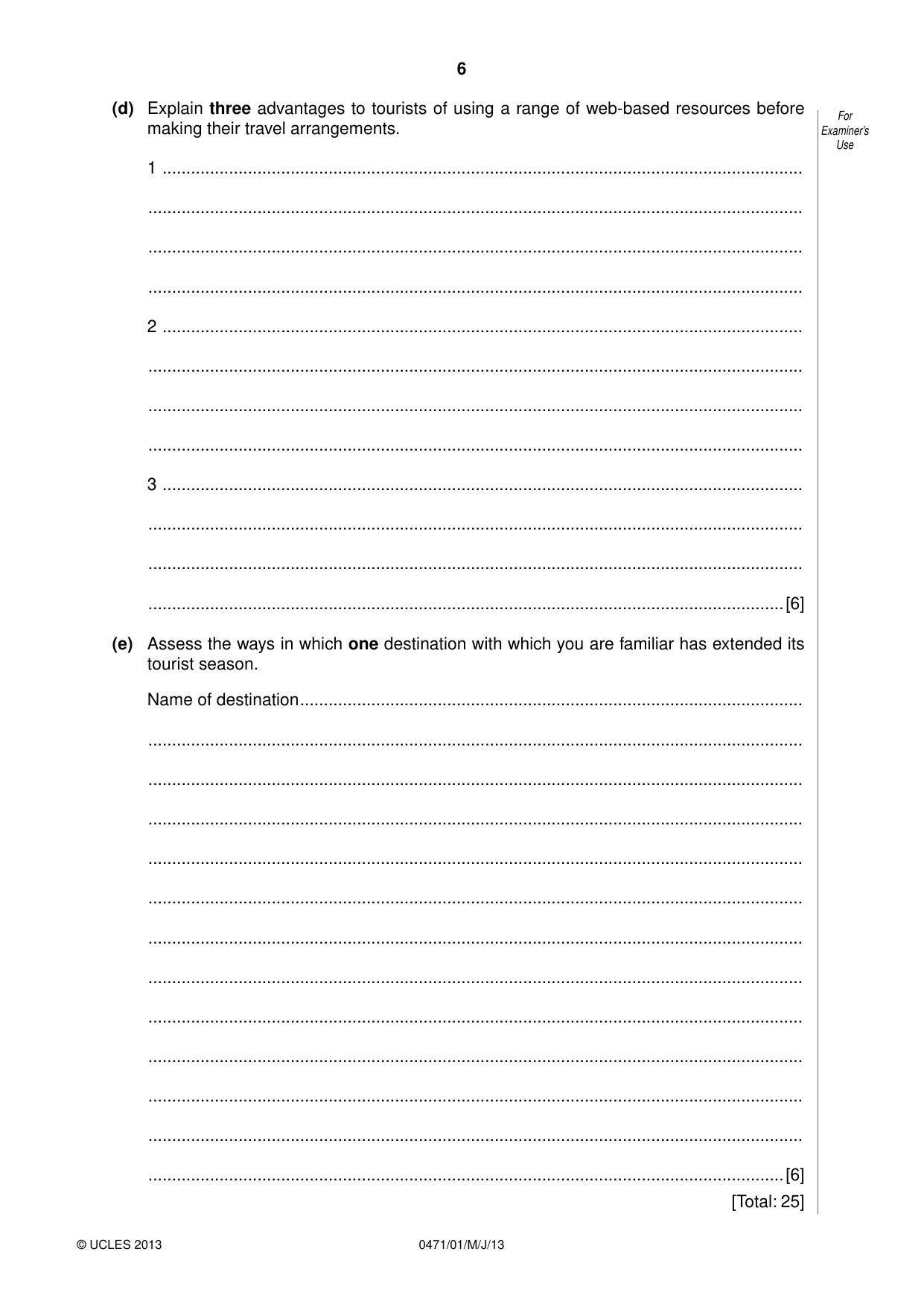
6 0471/01/M/J/13 © UCLES 2013 For Examiner’s Use (d) Explain three advantages to tourists of using a range of web-based resources before making their travel arrangements. 1 … … … … 2 … … … … 3 … … … …[6] (e) Assess the ways in which one destination with which you are familiar has extended its tourist season. Name of destination … … … … … … … … … … … … …[6] [Total: 25]
Question paper, page 7
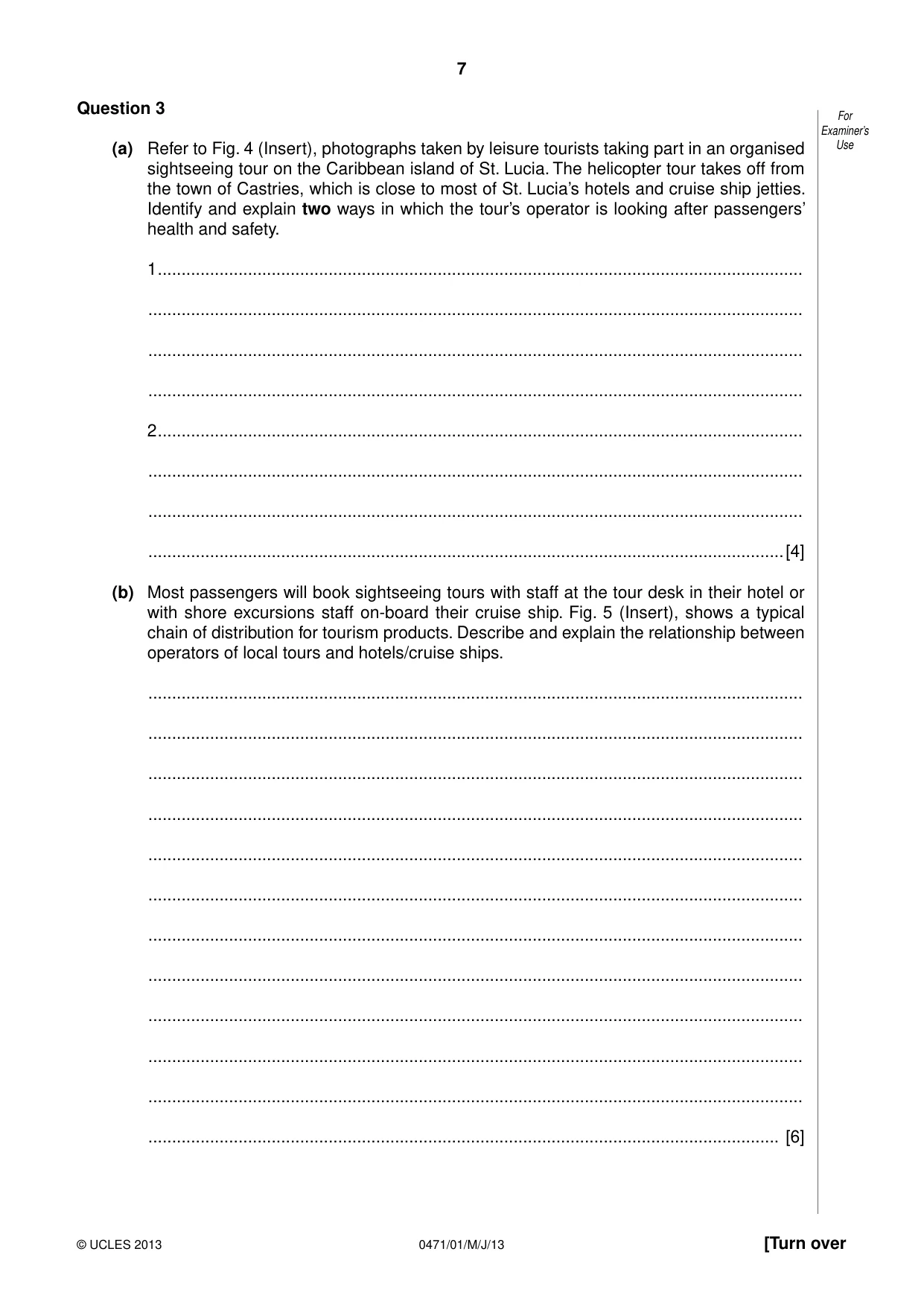
7 0471/01/M/J/13 © UCLES 2013 [Turn over For Examiner’s Use Question 3 (a) Refer to Fig. 4 (Insert), photographs taken by leisure tourists taking part in an organised sightseeing tour on the Caribbean island of St. Lucia. The helicopter tour takes off from the town of Castries, which is close to most of St. Lucia’s hotels and cruise ship jetties. Identify and explain two ways in which the tour’s operator is looking after passengers’ health and safety. 1 … … … … 2 … … … …[4] (b) Most passengers will book sightseeing tours with staff at the tour desk in their hotel or with shore excursions staff on-board their cruise ship. Fig. 5 (Insert), shows a typical chain of distribution for tourism products. Describe and explain the relationship between operators of local tours and hotels/cruise ships. … … … … … … … … … … … … [6]
Question paper, page 8
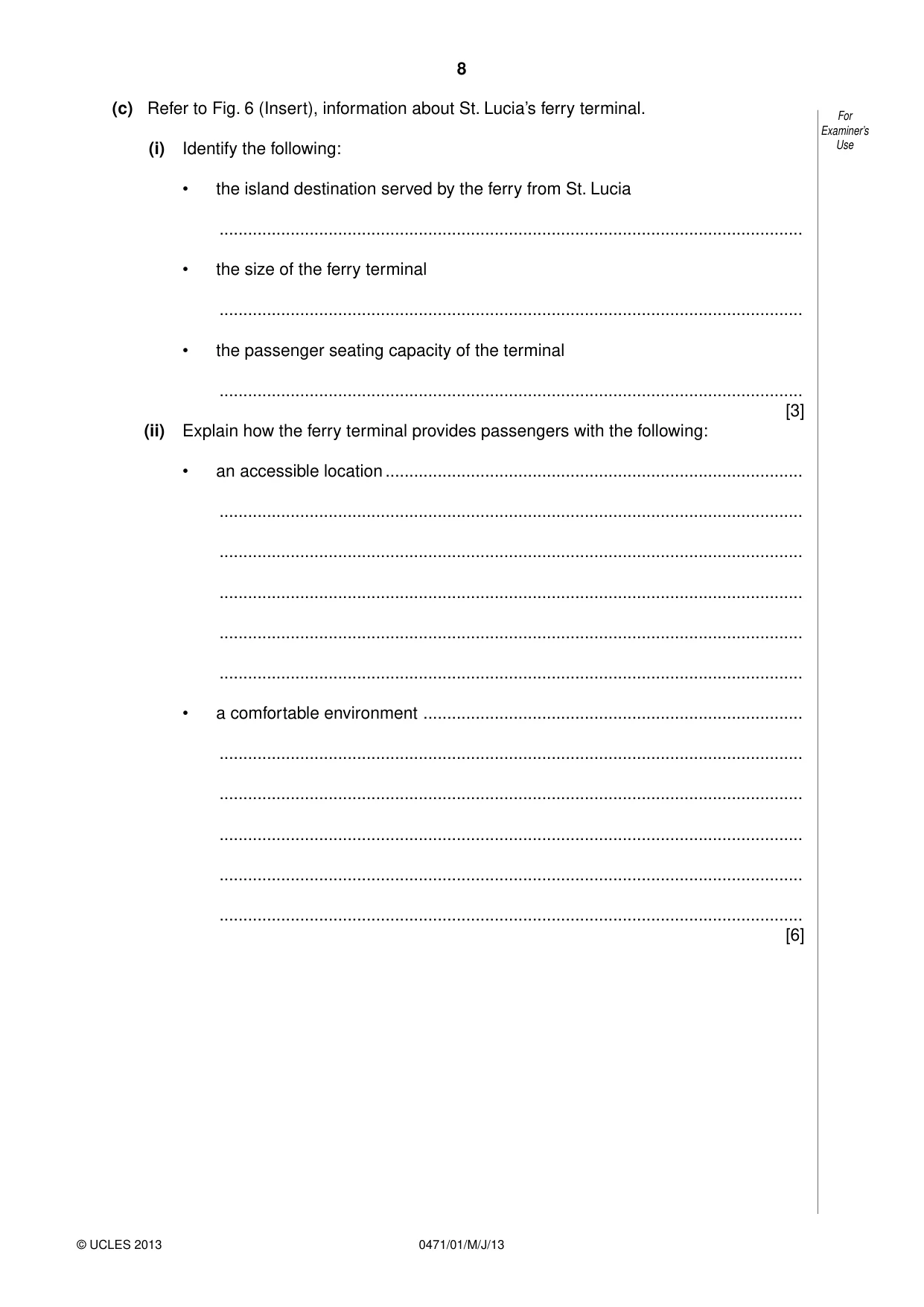
8 0471/01/M/J/13 © UCLES 2013 For Examiner’s Use (c) Refer to Fig. 6 (Insert), information about St. Lucia’s ferry terminal. (i) Identify the following: • the island destination served by the ferry from St. Lucia … • the size of the ferry terminal … • the passenger seating capacity of the terminal … [3] (ii) Explain how the ferry terminal provides passengers with the following: • an accessible location … … … … … … • a comfortable environment … … … … … … [6]
Question paper, page 9
9 0471/01/M/J/13 © UCLES 2013 [Turn over For Examiner’s Use (d) With reference to one destination with which you are familiar, discuss the negative sociocultural impacts of tourism. Name of destination … … … … … … … … … … … … … [6] [Total: 25]
Question paper, page 10
10 0471/01/M/J/13 © UCLES 2013 For Examiner’s Use Question 4 Refer to Fig. 7 (Insert), information about a new Jumeirah Group hotel in Pudong, China. (a) Identify and explain three ways in which the Jumeirah Himalayas Hotel Shanghai will appeal to business tourists. 1 … … … … 2 … … … … 3 … … … …[6]
Question paper, page 11
11 0471/01/M/J/13 © UCLES 2013 [Turn over For Examiner’s Use (b) The Jumeirah Group currently employs over 10 000 members of staff from over 90 different countries. Suggest and explain three types of training that will be provided for staff in front-line customer service roles. 1 … … … … 2 … … … … 3 … … … …[6] (c) One of the features of the Jumeirah Group is its outstanding customer service. Describe how a member of the waiting staff in a Jumeirah restaurant will be expected to respond to a guest asking for an item not listed on the menu. … … … … … …[3]
Question paper, page 12
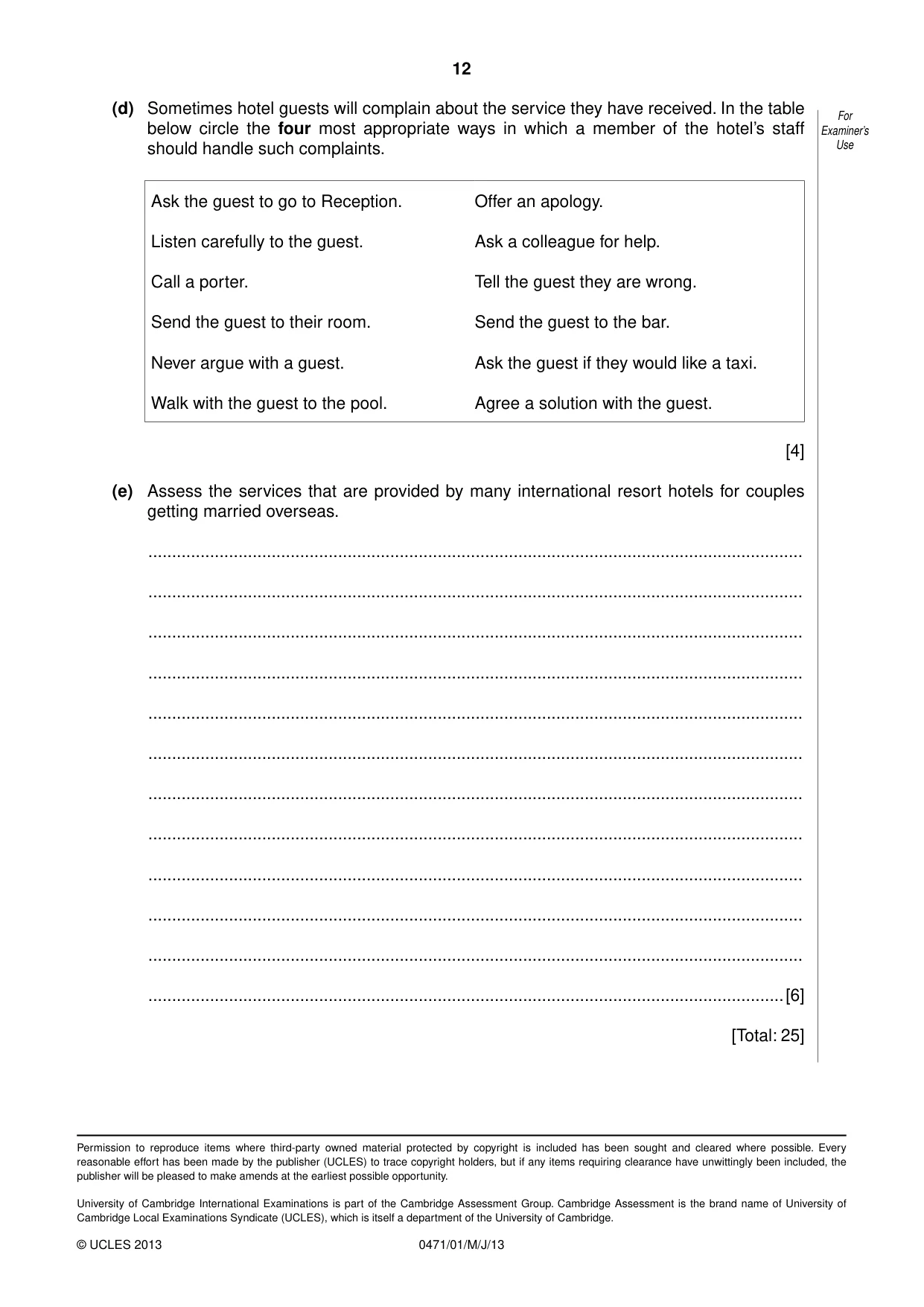
12 0471/01/M/J/13 © UCLES 2013 For Examiner’s Use Permission to reproduce items where third-party owned material protected by copyright is included has been sought and cleared where possible. Every reasonable effort has been made by the publisher (UCLES) to trace copyright holders, but if any items requiring clearance have unwittingly been included, the publisher will be pleased to make amends at the earliest possible opportunity. University of Cambridge International Examinations is part of the Cambridge Assessment Group. Cambridge Assessment is the brand name of University of Cambridge Local Examinations Syndicate (UCLES), which is itself a department of the University of Cambridge. (d) Sometimes hotel guests will complain about the service they have received. In the table below circle the four most appropriate ways in which a member of the hotel’s staff should handle such complaints. Ask the guest to go to Reception. Listen carefully to the guest. Call a porter. Send the guest to their room. Never argue with a guest. Walk with the guest to the pool. Offer an apology. Ask a colleague for help. Tell the guest they are wrong. Send the guest to the bar. Ask the guest if they would like a taxi. Agree a solution with the guest. [4] (e) Assess the services that are provided by many international resort hotels for couples getting married overseas. … … … … … … … … … … … …[6] [Total: 25]
Mark scheme, page 1
CAMBRIDGE INTERNATIONAL EXAMINATIONS International General Certificate of Secondary Education MARK SCHEME for the May/June 2013 series 0471 TRAVEL AND TOURISM 0471/01 Paper 1 (Written Paper), maximum raw mark 100 This mark scheme is published as an aid to teachers and candidates, to indicate the requirements of the examination. It shows the basis on which Examiners were instructed to award marks. It does not indicate the details of the discussions that took place at an Examiners’ meeting before marking began, which would have considered the acceptability of alternative answers. Mark schemes should be read in conjunction with the question paper and the Principal Examiner Report for Teachers. Cambridge will not enter into discussions about these mark schemes. Cambridge is publishing the mark schemes for the May/June 2013 series for most IGCSE, GCE Advanced Level and Advanced Subsidiary Level components and some Ordinary Level components. www.XtremePapers.com
Mark scheme, page 2
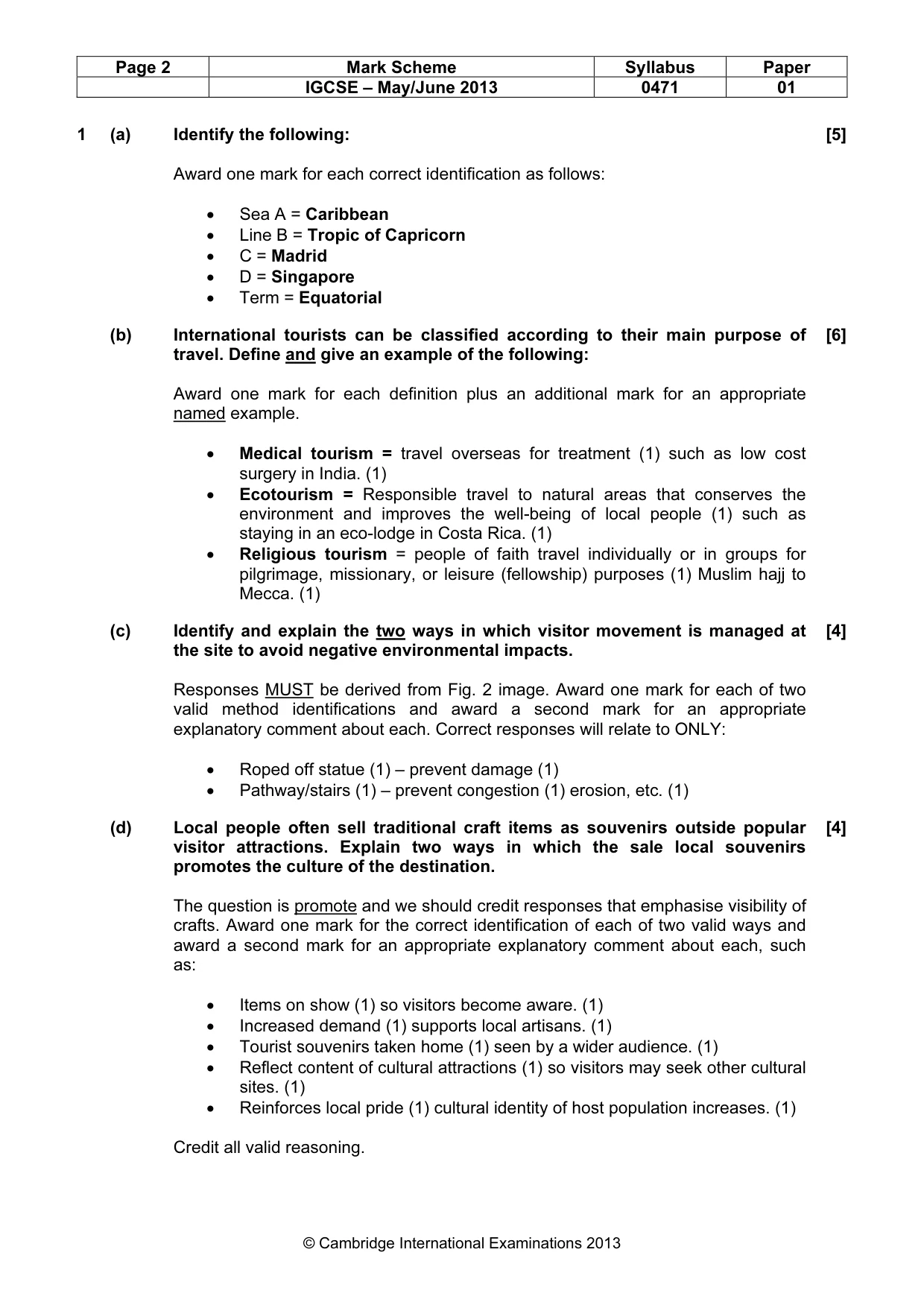
Page 2 Mark Scheme Syllabus Paper IGCSE – May/June 2013 0471 01 © Cambridge International Examinations 2013 1 (a) Identify the following: Award one mark for each correct identification as follows: • Sea A = Caribbean • Line B = Tropic of Capricorn • C = Madrid • D = Singapore • Term = Equatorial [5] (b) International tourists can be classified according to their main purpose of travel. Define and give an example of the following: Award one mark for each definition plus an additional mark for an appropriate named example. • Medical tourism = travel overseas for treatment (1) such as low cost surgery in India. (1) • Ecotourism = Responsible travel to natural areas that conserves the environment and improves the well-being of local people (1) such as staying in an eco-lodge in Costa Rica. (1) • Religious tourism = people of faith travel individually or in groups for pilgrimage, missionary, or leisure (fellowship) purposes (1) Muslim hajj to Mecca. (1) [6] (c) Identify and explain the two ways in which visitor movement is managed at the site to avoid negative environmental impacts. Responses MUST be derived from Fig. 2 image. Award one mark for each of two valid method identifications and award a second mark for an appropriate explanatory comment about each. Correct responses will relate to ONLY: • Roped off statue (1) – prevent damage (1) • Pathway/stairs (1) – prevent congestion (1) erosion, etc. (1) [4] (d) Local people often sell traditional craft items as souvenirs outside popular visitor attractions. Explain two ways in which the sale local souvenirs promotes the culture of the destination. The question is promote and we should credit responses that emphasise visibility of crafts. Award one mark for the correct identification of each of two valid ways and award a second mark for an appropriate explanatory comment about each, such as: • Items on show (1) so visitors become aware. (1) • Increased demand (1) supports local artisans. (1) • Tourist souvenirs taken home (1) seen by a wider audience. (1) • Reflect content of cultural attractions (1) so visitors may seek other cultural sites. (1) • Reinforces local pride (1) cultural identity of host population increases. (1) Credit all valid reasoning. [4]
Mark scheme, page 3
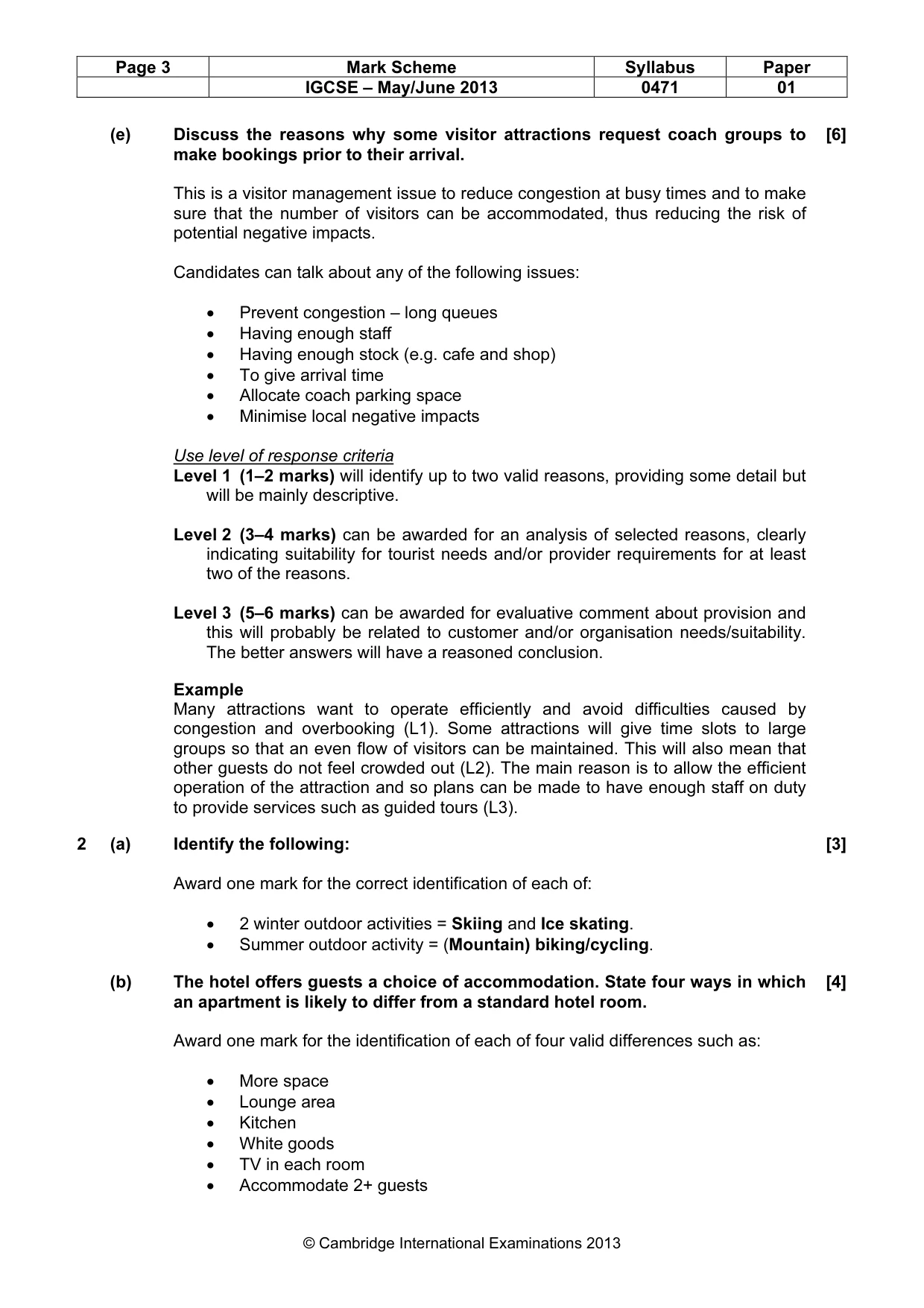
Page 3 Mark Scheme Syllabus Paper IGCSE – May/June 2013 0471 01 © Cambridge International Examinations 2013 (e) Discuss the reasons why some visitor attractions request coach groups to make bookings prior to their arrival. This is a visitor management issue to reduce congestion at busy times and to make sure that the number of visitors can be accommodated, thus reducing the risk of potential negative impacts. Candidates can talk about any of the following issues: • Prevent congestion – long queues • Having enough staff • Having enough stock (e.g. cafe and shop) • To give arrival time • Allocate coach parking space • Minimise local negative impacts Use level of response criteria Level 1 (1–2 marks) will identify up to two valid reasons, providing some detail but will be mainly descriptive. Level 2 (3–4 marks) can be awarded for an analysis of selected reasons, clearly indicating suitability for tourist needs and/or provider requirements for at least two of the reasons. Level 3 (5–6 marks) can be awarded for evaluative comment about provision and this will probably be related to customer and/or organisation needs/suitability. The better answers will have a reasoned conclusion. [6] Example Many attractions want to operate efficiently and avoid difficulties caused by congestion and overbooking (L1). Some attractions will give time slots to large groups so that an even flow of visitors can be maintained. This will also mean that other guests do not feel crowded out (L2). The main reason is to allow the efficient operation of the attraction and so plans can be made to have enough staff on duty to provide services such as guided tours (L3). 2 (a) Identify the following: Award one mark for the correct identification of each of: • 2 winter outdoor activities = Skiing and Ice skating. • Summer outdoor activity = (Mountain) biking/cycling. [3] (b) The hotel offers guests a choice of accommodation. State four ways in which an apartment is likely to differ from a standard hotel room. Award one mark for the identification of each of four valid differences such as: • More space • Lounge area • Kitchen • White goods • TV in each room • Accommodate 2+ guests [4]
Mark scheme, page 4
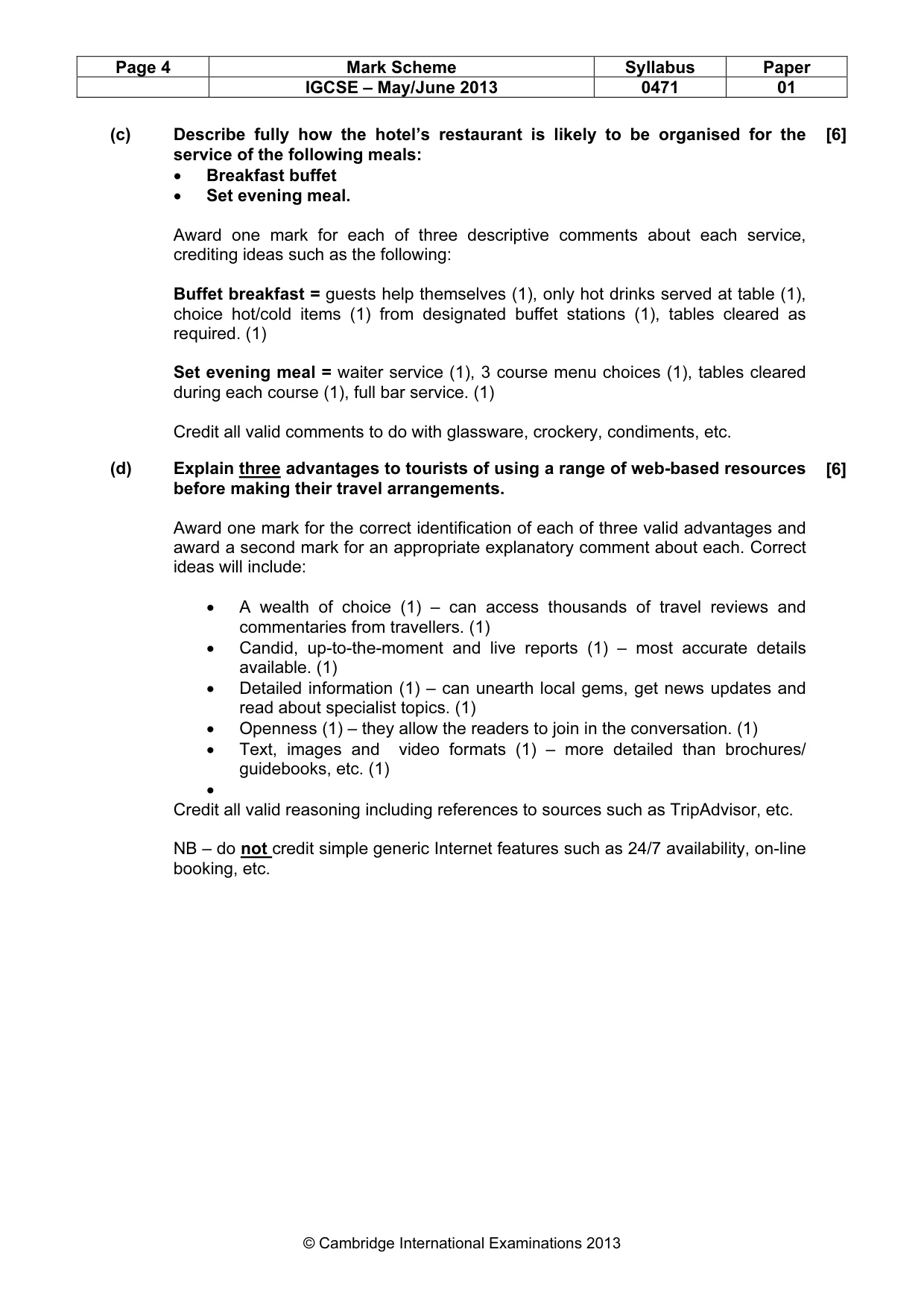
Page 4 Mark Scheme Syllabus Paper IGCSE – May/June 2013 0471 01 © Cambridge International Examinations 2013 (c) Describe fully how the hotel’s restaurant is likely to be organised for the service of the following meals: • Breakfast buffet • Set evening meal. Award one mark for each of three descriptive comments about each service, crediting ideas such as the following: Buffet breakfast = guests help themselves (1), only hot drinks served at table (1), choice hot/cold items (1) from designated buffet stations (1), tables cleared as required. (1) Set evening meal = waiter service (1), 3 course menu choices (1), tables cleared during each course (1), full bar service. (1) Credit all valid comments to do with glassware, crockery, condiments, etc. [6] (d) Explain three advantages to tourists of using a range of web-based resources before making their travel arrangements. Award one mark for the correct identification of each of three valid advantages and award a second mark for an appropriate explanatory comment about each. Correct ideas will include: • A wealth of choice (1) – can access thousands of travel reviews and commentaries from travellers. (1) • Candid, up-to-the-moment and live reports (1) – most accurate details available. (1) • Detailed information (1) – can unearth local gems, get news updates and read about specialist topics. (1) • Openness (1) – they allow the readers to join in the conversation. (1) • Text, images and video formats (1) – more detailed than brochures/ guidebooks, etc. (1) • Credit all valid reasoning including references to sources such as TripAdvisor, etc. NB – do not credit simple generic Internet features such as 24/7 availability, on-line booking, etc. [6]
Mark scheme, page 5
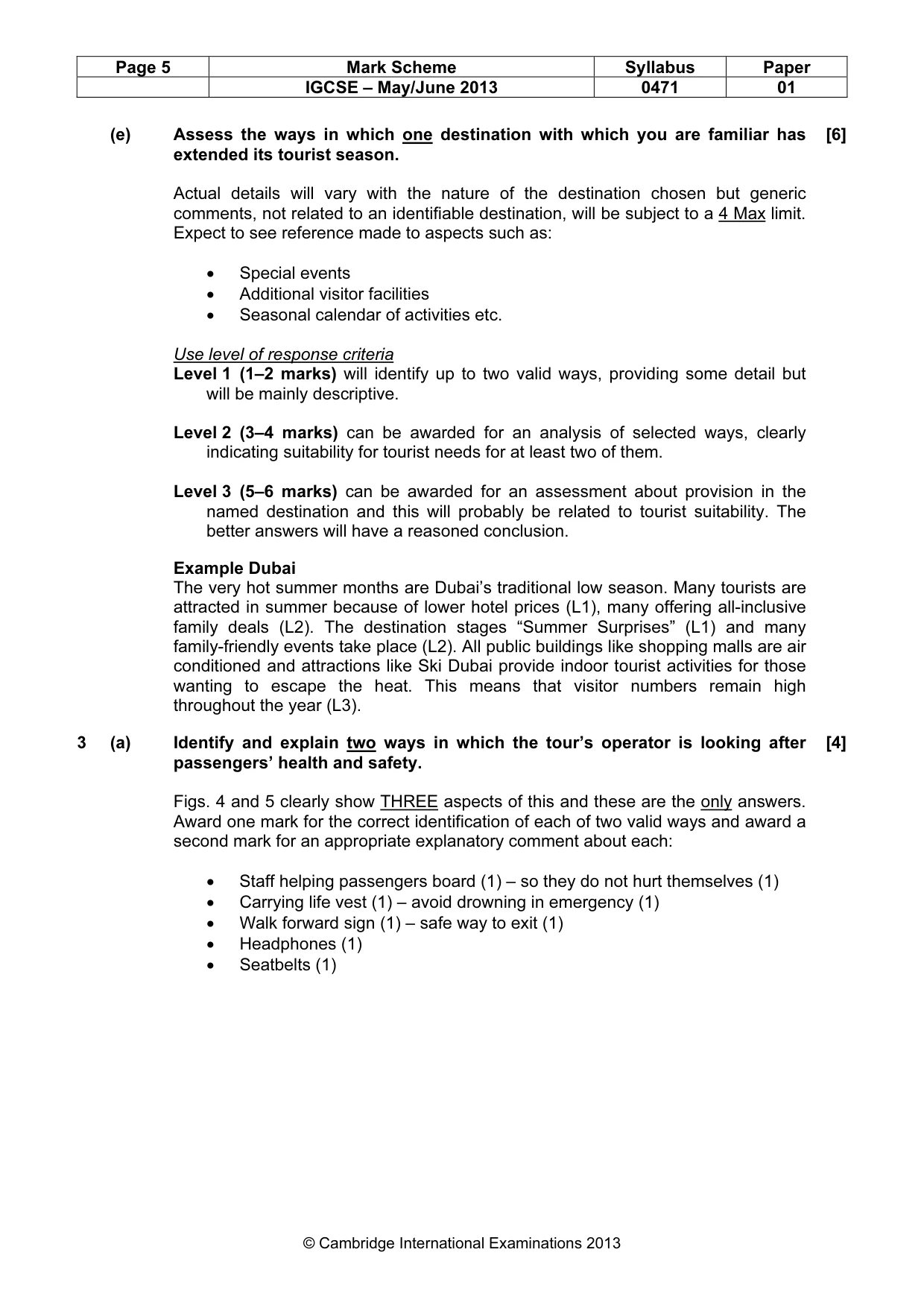
Page 5 Mark Scheme Syllabus Paper IGCSE – May/June 2013 0471 01 © Cambridge International Examinations 2013 (e) Assess the ways in which one destination with which you are familiar has extended its tourist season. Actual details will vary with the nature of the destination chosen but generic comments, not related to an identifiable destination, will be subject to a 4 Max limit. Expect to see reference made to aspects such as: • Special events • Additional visitor facilities • Seasonal calendar of activities etc. Use level of response criteria Level 1 (1–2 marks) will identify up to two valid ways, providing some detail but will be mainly descriptive. Level 2 (3–4 marks) can be awarded for an analysis of selected ways, clearly indicating suitability for tourist needs for at least two of them. Level 3 (5–6 marks) can be awarded for an assessment about provision in the named destination and this will probably be related to tourist suitability. The better answers will have a reasoned conclusion. [6] Example Dubai The very hot summer months are Dubai’s traditional low season. Many tourists are attracted in summer because of lower hotel prices (L1), many offering all-inclusive family deals (L2). The destination stages “Summer Surprises” (L1) and many family-friendly events take place (L2). All public buildings like shopping malls are air conditioned and attractions like Ski Dubai provide indoor tourist activities for those wanting to escape the heat. This means that visitor numbers remain high throughout the year (L3). 3 (a) Identify and explain two ways in which the tour’s operator is looking after passengers’ health and safety. Figs. 4 and 5 clearly show THREE aspects of this and these are the only answers. Award one mark for the correct identification of each of two valid ways and award a second mark for an appropriate explanatory comment about each: • Staff helping passengers board (1) – so they do not hurt themselves (1) • Carrying life vest (1) – avoid drowning in emergency (1) • Walk forward sign (1) – safe way to exit (1) • Headphones (1) • Seatbelts (1) [4]
Mark scheme, page 6
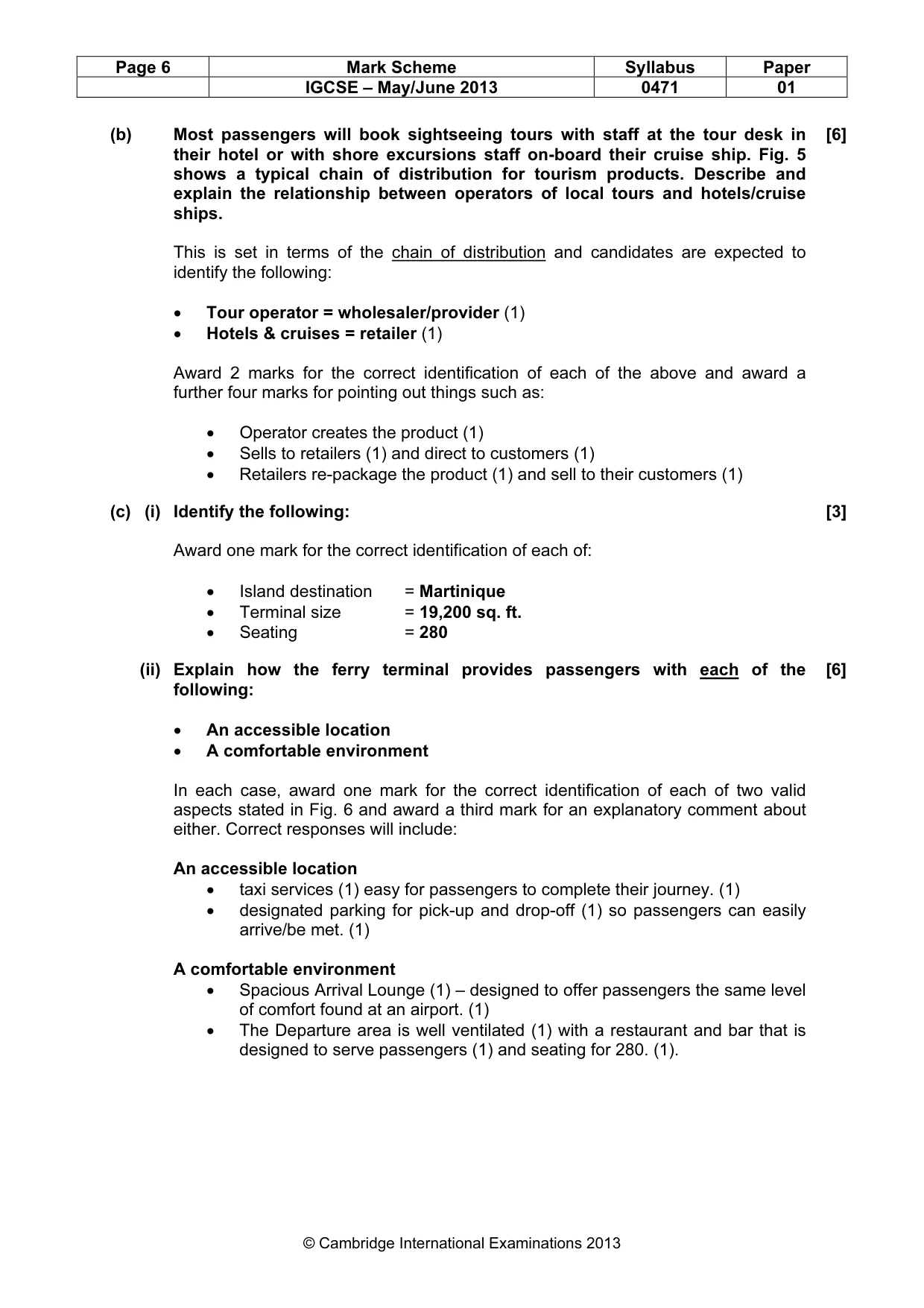
Page 6 Mark Scheme Syllabus Paper IGCSE – May/June 2013 0471 01 © Cambridge International Examinations 2013 (b) Most passengers will book sightseeing tours with staff at the tour desk in their hotel or with shore excursions staff on-board their cruise ship. Fig. 5 shows a typical chain of distribution for tourism products. Describe and explain the relationship between operators of local tours and hotels/cruise ships. This is set in terms of the chain of distribution and candidates are expected to identify the following: • Tour operator = wholesaler/provider (1) • Hotels & cruises = retailer (1) Award 2 marks for the correct identification of each of the above and award a further four marks for pointing out things such as: • Operator creates the product (1) • Sells to retailers (1) and direct to customers (1) • Retailers re-package the product (1) and sell to their customers (1) [6] (c) (i) Identify the following: Award one mark for the correct identification of each of: • Island destination = Martinique • Terminal size = 19,200 sq. ft. • Seating = 280 [3] (ii) Explain how the ferry terminal provides passengers with each of the following: • An accessible location • A comfortable environment In each case, award one mark for the correct identification of each of two valid aspects stated in Fig. 6 and award a third mark for an explanatory comment about either. Correct responses will include: An accessible location • taxi services (1) easy for passengers to complete their journey. (1) • designated parking for pick-up and drop-off (1) so passengers can easily arrive/be met. (1) A comfortable environment • Spacious Arrival Lounge (1) – designed to offer passengers the same level of comfort found at an airport. (1) • The Departure area is well ventilated (1) with a restaurant and bar that is designed to serve passengers (1) and seating for 280. (1). [6]
Mark scheme, page 7
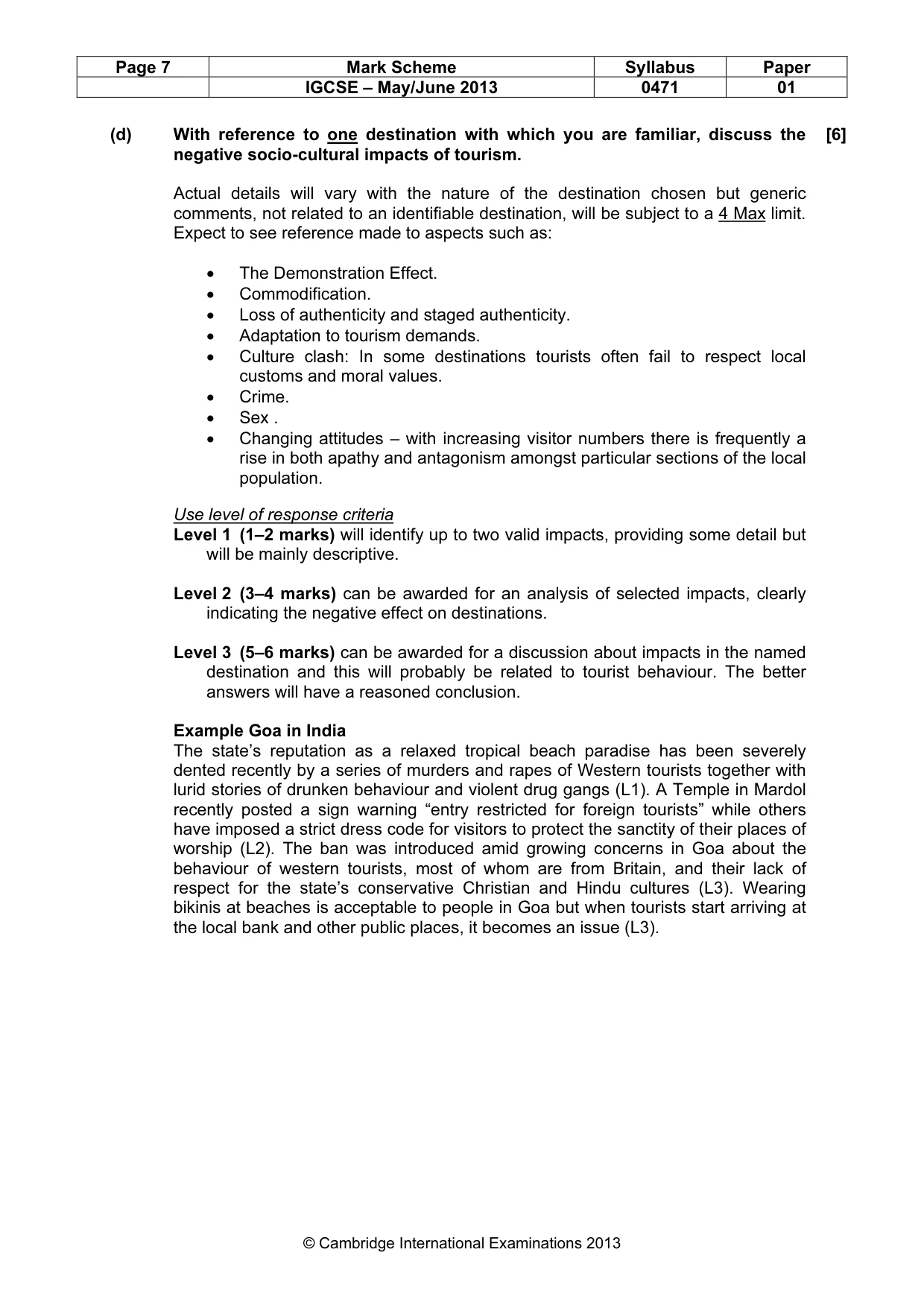
Page 7 Mark Scheme Syllabus Paper IGCSE – May/June 2013 0471 01 © Cambridge International Examinations 2013 (d) With reference to one destination with which you are familiar, discuss the negative socio-cultural impacts of tourism. Actual details will vary with the nature of the destination chosen but generic comments, not related to an identifiable destination, will be subject to a 4 Max limit. Expect to see reference made to aspects such as: • The Demonstration Effect. • Commodification. • Loss of authenticity and staged authenticity. • Adaptation to tourism demands. • Culture clash: In some destinations tourists often fail to respect local customs and moral values. • Crime. • Sex . • Changing attitudes – with increasing visitor numbers there is frequently a rise in both apathy and antagonism amongst particular sections of the local population. [6] Use level of response criteria Level 1 (1–2 marks) will identify up to two valid impacts, providing some detail but will be mainly descriptive. Level 2 (3–4 marks) can be awarded for an analysis of selected impacts, clearly indicating the negative effect on destinations. Level 3 (5–6 marks) can be awarded for a discussion about impacts in the named destination and this will probably be related to tourist behaviour. The better answers will have a reasoned conclusion. Example Goa in India The state’s reputation as a relaxed tropical beach paradise has been severely dented recently by a series of murders and rapes of Western tourists together with lurid stories of drunken behaviour and violent drug gangs (L1). A Temple in Mardol recently posted a sign warning “entry restricted for foreign tourists” while others have imposed a strict dress code for visitors to protect the sanctity of their places of worship (L2). The ban was introduced amid growing concerns in Goa about the behaviour of western tourists, most of whom are from Britain, and their lack of respect for the state’s conservative Christian and Hindu cultures (L3). Wearing bikinis at beaches is acceptable to people in Goa but when tourists start arriving at the local bank and other public places, it becomes an issue (L3).
Mark scheme, page 8
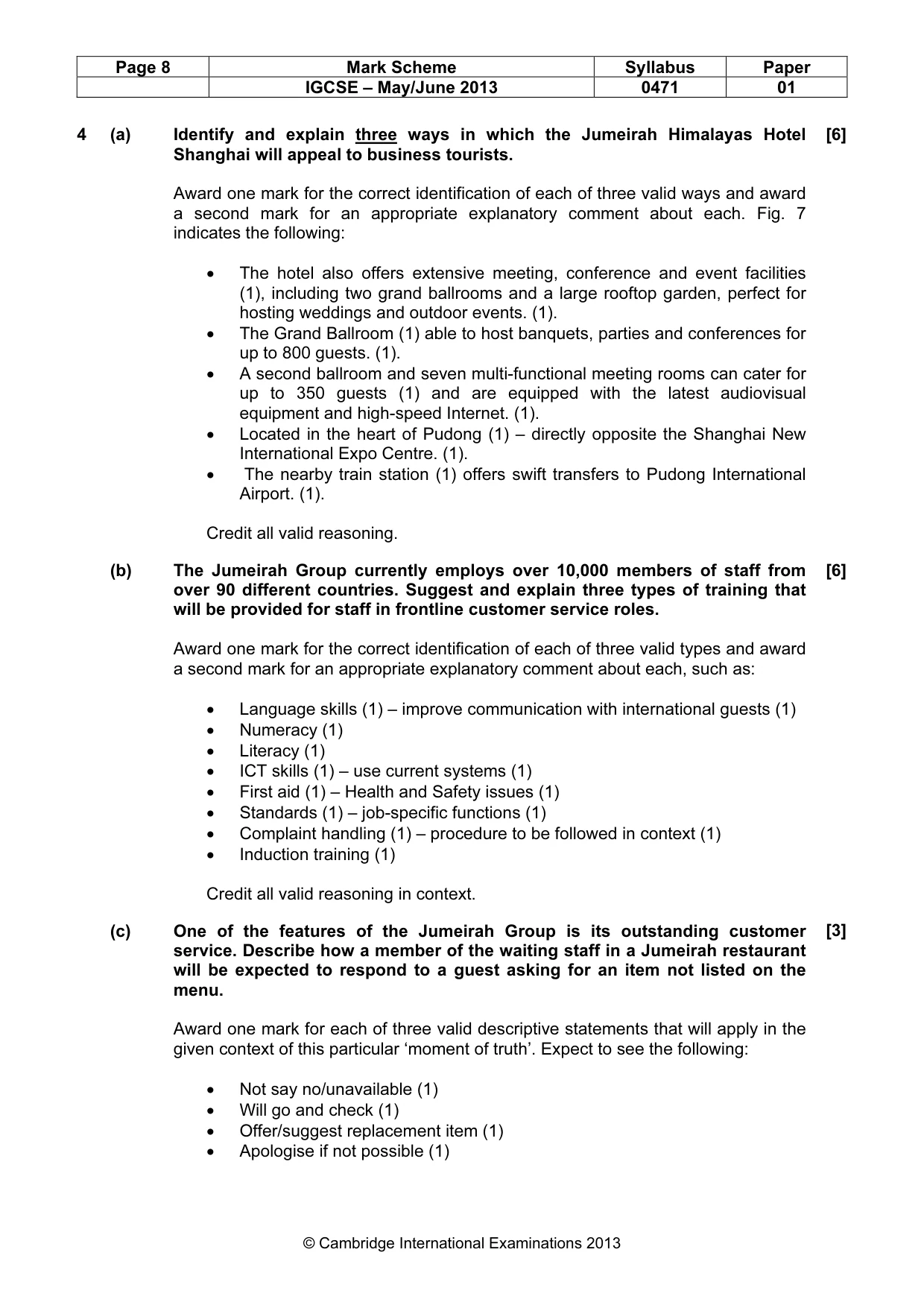
Page 8 Mark Scheme Syllabus Paper IGCSE – May/June 2013 0471 01 © Cambridge International Examinations 2013 4 (a) Identify and explain three ways in which the Jumeirah Himalayas Hotel Shanghai will appeal to business tourists. Award one mark for the correct identification of each of three valid ways and award a second mark for an appropriate explanatory comment about each. Fig. 7 indicates the following: • The hotel also offers extensive meeting, conference and event facilities (1), including two grand ballrooms and a large rooftop garden, perfect for hosting weddings and outdoor events. (1). • The Grand Ballroom (1) able to host banquets, parties and conferences for up to 800 guests. (1). • A second ballroom and seven multi-functional meeting rooms can cater for up to 350 guests (1) and are equipped with the latest audiovisual equipment and high-speed Internet. (1). • Located in the heart of Pudong (1) – directly opposite the Shanghai New International Expo Centre. (1). • The nearby train station (1) offers swift transfers to Pudong International Airport. (1). Credit all valid reasoning. [6] (b) The Jumeirah Group currently employs over 10,000 members of staff from over 90 different countries. Suggest and explain three types of training that will be provided for staff in frontline customer service roles. Award one mark for the correct identification of each of three valid types and award a second mark for an appropriate explanatory comment about each, such as: • Language skills (1) – improve communication with international guests (1) • Numeracy (1) • Literacy (1) • ICT skills (1) – use current systems (1) • First aid (1) – Health and Safety issues (1) • Standards (1) – job-specific functions (1) • Complaint handling (1) – procedure to be followed in context (1) • Induction training (1) Credit all valid reasoning in context. [6] (c) One of the features of the Jumeirah Group is its outstanding customer service. Describe how a member of the waiting staff in a Jumeirah restaurant will be expected to respond to a guest asking for an item not listed on the menu. Award one mark for each of three valid descriptive statements that will apply in the given context of this particular ‘moment of truth’. Expect to see the following: • Not say no/unavailable (1) • Will go and check (1) • Offer/suggest replacement item (1) • Apologise if not possible (1) [3]
Mark scheme, page 9
Page 9 Mark Scheme Syllabus Paper IGCSE – May/June 2013 0471 01 © Cambridge International Examinations 2013 (d) Sometimes hotel guests will complain about the service they have received. In the table below circle the four most appropriate ways in which a member of the hotel’s staff should handle such complaints. Award one mark for the correct identification of each of: • Never argue • Listen carefully to the guest • Apologise in general terms • Agree a solution with the guest [4] (e) Assess the services that are provided by many international resort hotels for couples getting married overseas. This should be familiar to most candidates and we should expect to see reference made to aspects such as: • Choice of rooms and packages appropriate to number of guests and budget. • Services of a Wedding Planner – manages event for the clients. • Can arrange extras – decorations, disc, etc. • Provide honeymoon suite – offer discounted rate for other guests. • Locations for photos – stunning views, etc. Use level of response criteria Level 1 (1–2 marks) will identify up to two valid services, providing some detail but will be mainly descriptive. Level 2 (3–4 marks) can be awarded for an analysis of selected services, clearly indicating their appropriateness for the foreign couple. Level 3 (5–6 marks) can be awarded for an assessment of selected services in meeting the couple’s needs. The better answers will have a reasoned conclusion. Example Exotic foreign weddings are no longer exclusively for celebrities. Weddings in the Caribbean at resorts like Sandals are popular for a variety of reasons including the services of a wedding organiser (L1) and this makes planning easier for the couple (L2). Free luggage and china are offered (L1) and this is a high quality incentive to couples (L2). A Personal butler (L1) is available to provide a range of personal services to the couple (L2). Many hotel groups such as Sandals offer room upgrades to honeymoon couples and this helps to provide value for money (L2). The most important factor for many is cost and holding the event overseas can easily compare with a more lavish home-based ceremony, only with the weather guaranteed (L3). [6]
What you needed in this session
Cambridge’s own grade thresholds for 2013 May/June, Paper 1 · Variant 1. A higher threshold means an easier paper — the bar moves with how the cohort did.