Cambridge IGCSE Travel and Tourism 0471 — 2012 Oct/Nov Paper 2 · Variant 1
0471/21/O/N/12 · 100 marks · ≈113 min
The question paper and its mark scheme, free to read here and free to download. This is Cambridge’s own paper, exactly as it was sat.
Question paper16 pages
Mark scheme9 pages
Answers below. Sit the paper first if you are practising.
Paper as text
Question paper, page 1
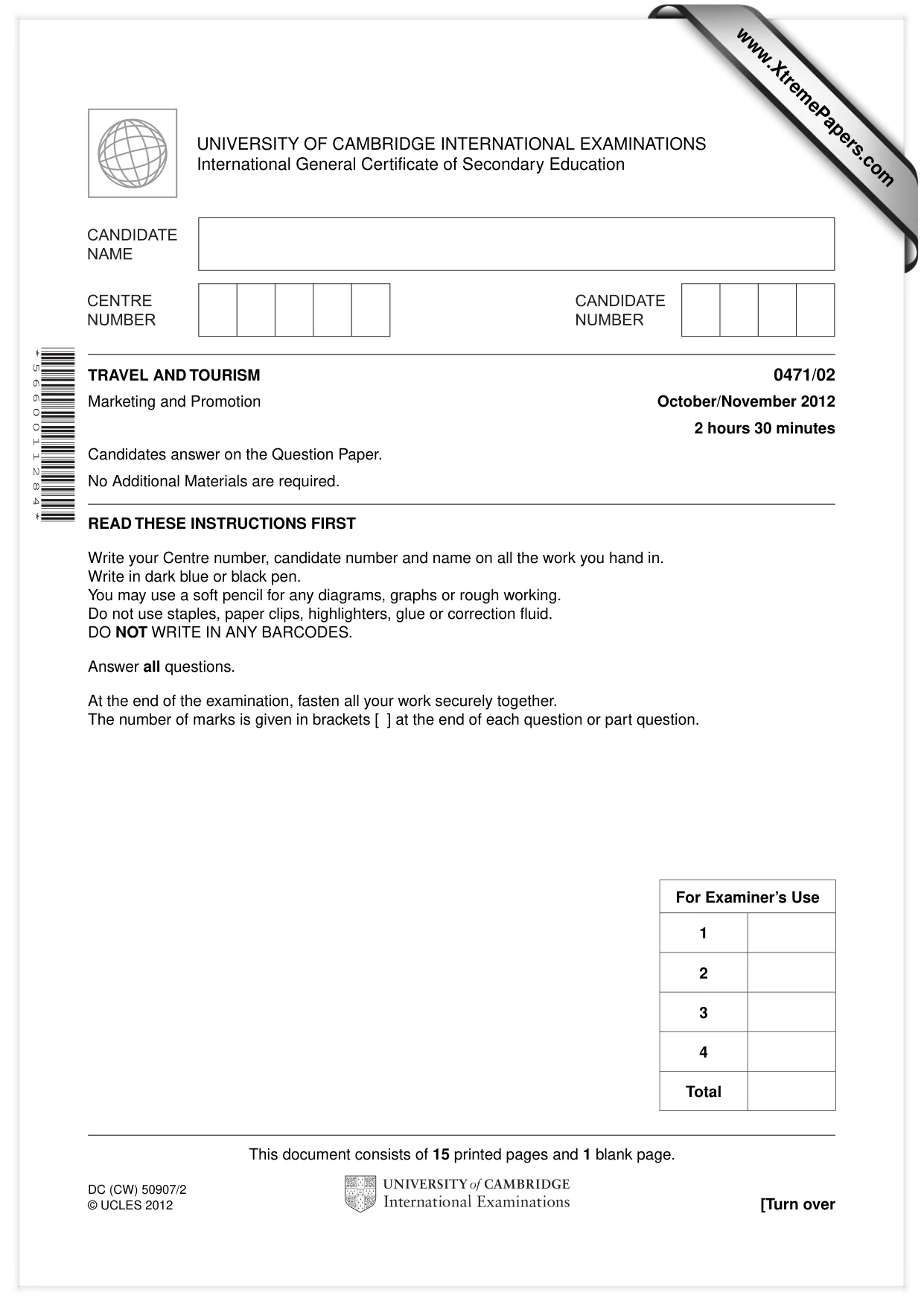
This document consists of 15 printed pages and 1 blank page. DC (CW) 50907/2 © UCLES 2012 [Turn over UNIVERSITY OF CAMBRIDGE INTERNATIONAL EXAMINATIONS International General Certificate of Secondary Education * 5 6 6 0 0 1 1 2 8 4 * TRAVEL AND TOURISM 0471/02 Marketing and Promotion October/November 2012 2 hours 30 minutes Candidates answer on the Question Paper. No Additional Materials are required. READ THESE INSTRUCTIONS FIRST Write your Centre number, candidate number and name on all the work you hand in. Write in dark blue or black pen. You may use a soft pencil for any diagrams, graphs or rough working. Do not use staples, paper clips, highlighters, glue or correction fluid. DO NOT WRITE IN ANY BARCODES. Answer all questions. At the end of the examination, fasten all your work securely together. The number of marks is given in brackets [ ] at the end of each question or part question. For Examiner’s Use 1 2 3 4 Total www.XtremePapers.com
Question paper, page 2
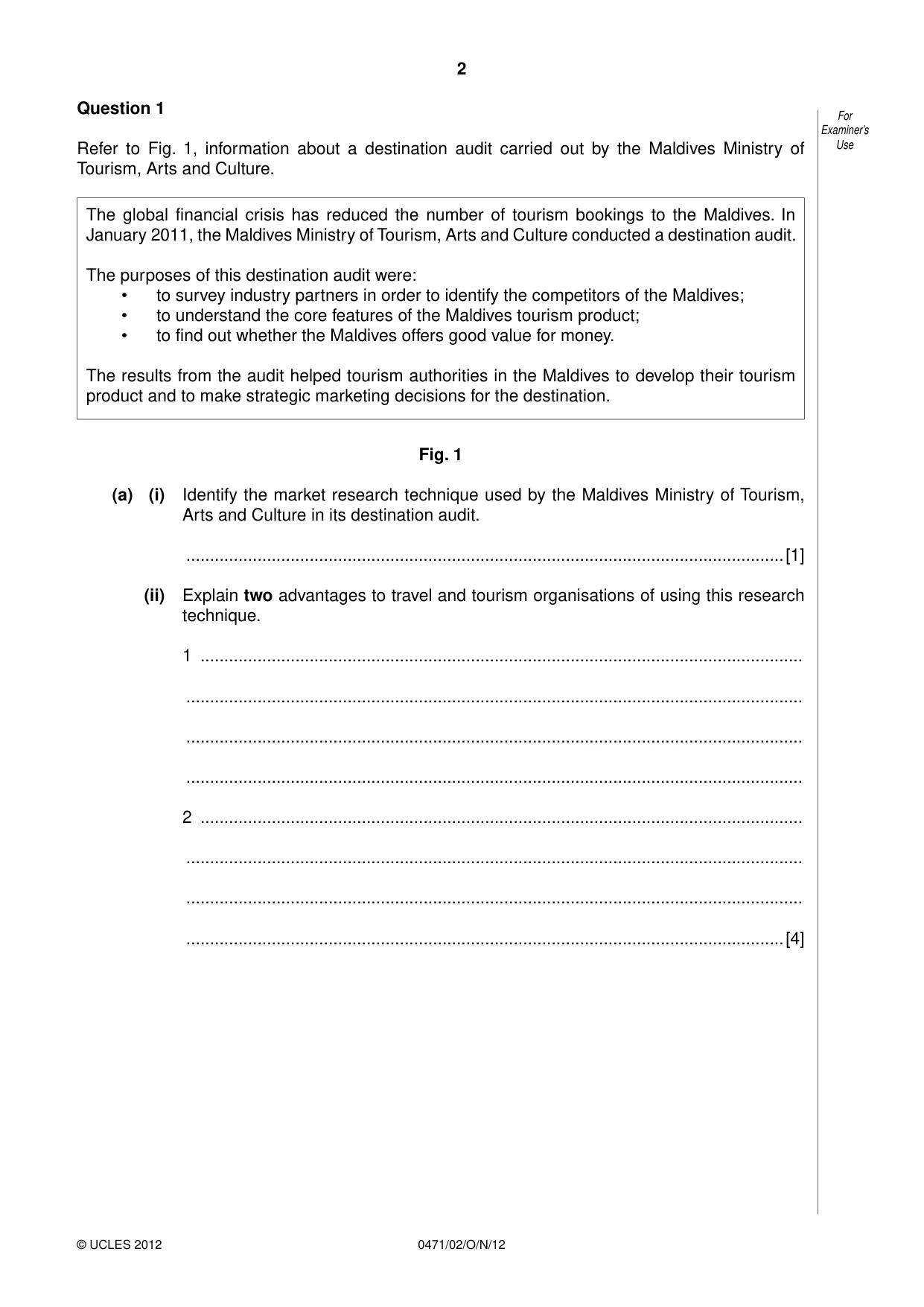
2 0471/02/O/N/12 © UCLES 2012 For Examiner’s Use Question 1 Refer to Fig. 1, information about a destination audit carried out by the Maldives Ministry of Tourism, Arts and Culture. The global financial crisis has reduced the number of tourism bookings to the Maldives. In January 2011, the Maldives Ministry of Tourism, Arts and Culture conducted a destination audit. The purposes of this destination audit were: • to survey industry partners in order to identify the competitors of the Maldives; • to understand the core features of the Maldives tourism product; • to find out whether the Maldives offers good value for money. The results from the audit helped tourism authorities in the Maldives to develop their tourism product and to make strategic marketing decisions for the destination. Fig. 1 (a) (i) Identify the market research technique used by the Maldives Ministry of Tourism, Arts and Culture in its destination audit. …[1] (ii) Explain two advantages to travel and tourism organisations of using this research technique. 1 … … … … 2 … … … …[4]
Question paper, page 3
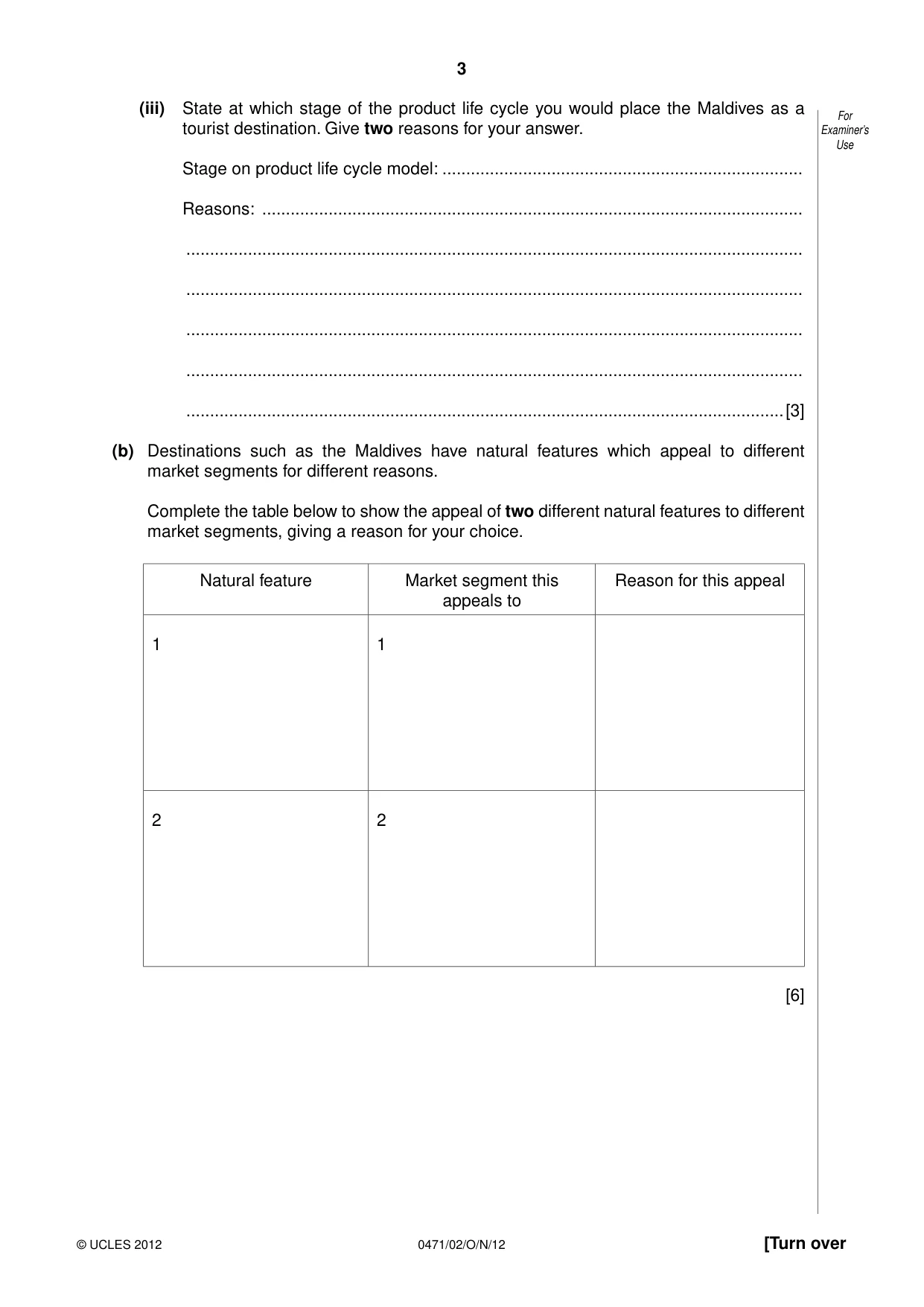
3 [Turn over © UCLES 2012 0471/02/O/N/12 For Examiner’s Use (iii) State at which stage of the product life cycle you would place the Maldives as a tourist destination. Give two reasons for your answer. Stage on product life cycle model: … Reasons: … … … … … …[3] (b) Destinations such as the Maldives have natural features which appeal to different market segments for different reasons. Complete the table below to show the appeal of two different natural features to different market segments, giving a reason for your choice. Natural feature Market segment this appeals to Reason for this appeal 1 1 2 2 [6]
Question paper, page 4
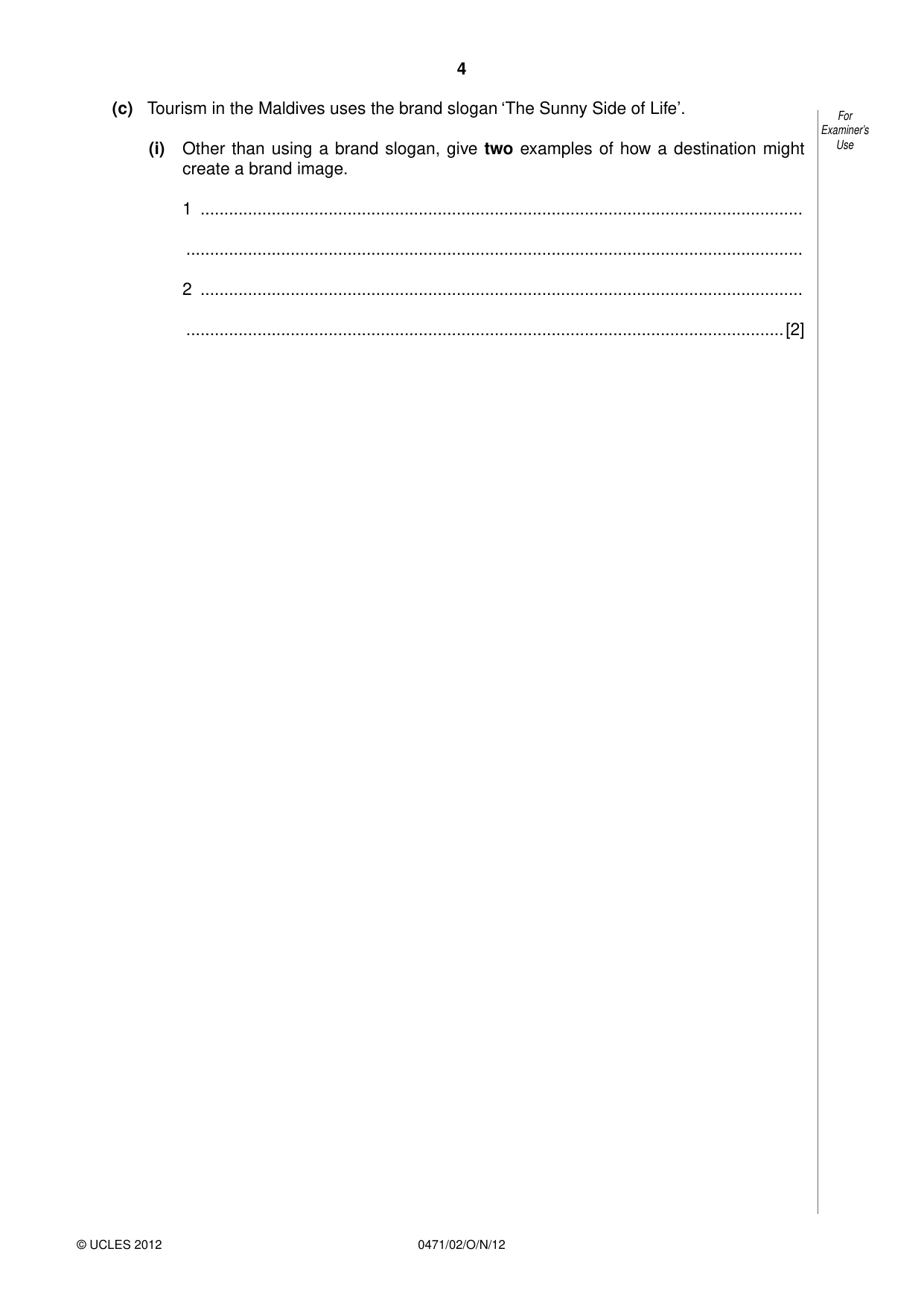
4 0471/02/O/N/12 © UCLES 2012 For Examiner’s Use (c) Tourism in the Maldives uses the brand slogan ‘The Sunny Side of Life’. (i) Other than using a brand slogan, give two examples of how a destination might create a brand image. 1 … … 2 … …[2]
Question paper, page 5
5 [Turn over © UCLES 2012 0471/02/O/N/12 For Examiner’s Use (ii) Analyse the importance of brand image for a destination such as the Maldives. … … … … … … … … … … … … … … … … … … … … … … … … … …[9] [Total: 25 marks]
Question paper, page 6
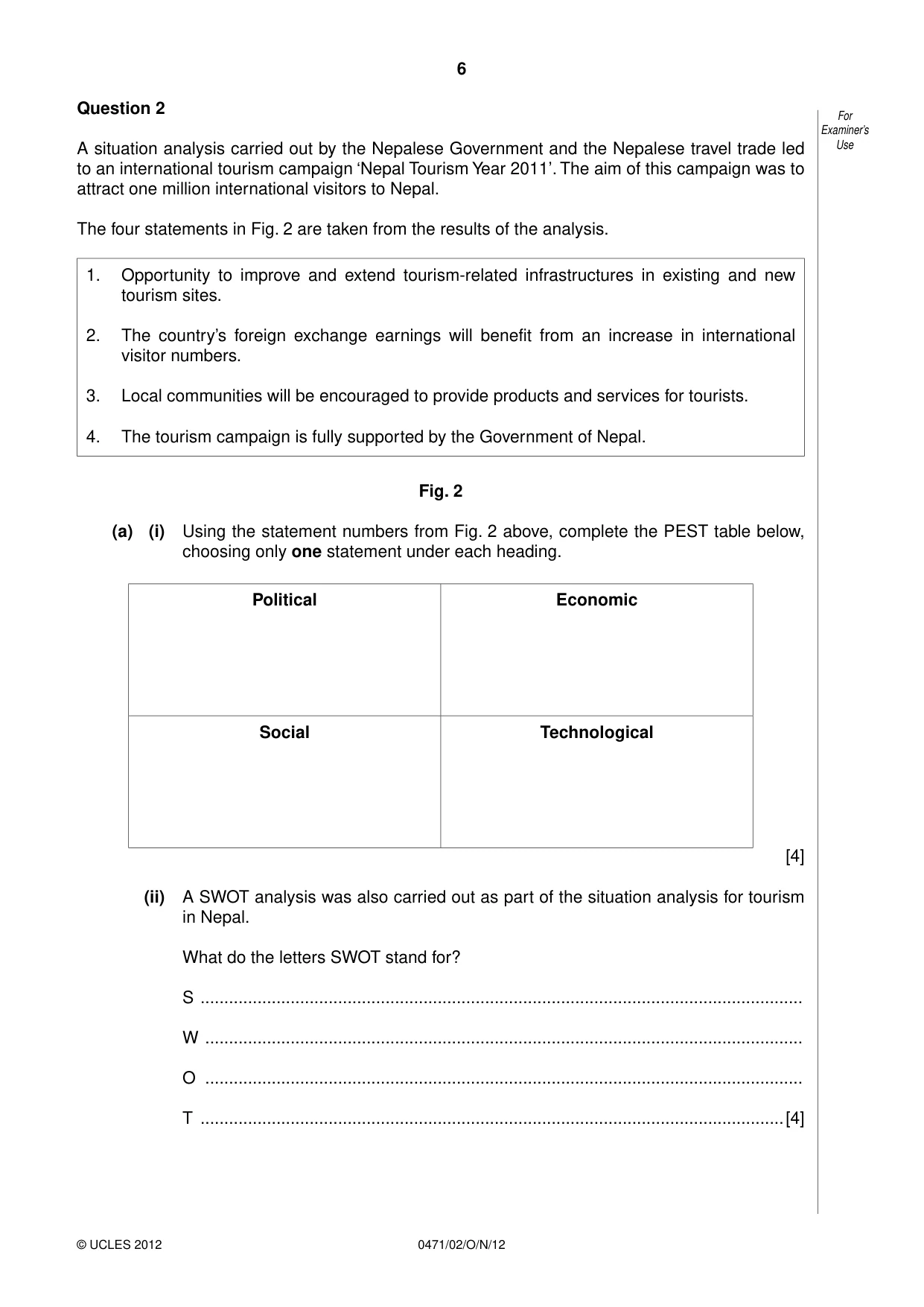
6 0471/02/O/N/12 © UCLES 2012 For Examiner’s Use Question 2 A situation analysis carried out by the Nepalese Government and the Nepalese travel trade led to an international tourism campaign ‘Nepal Tourism Year 2011’. The aim of this campaign was to attract one million international visitors to Nepal. The four statements in Fig. 2 are taken from the results of the analysis. 1. Opportunity to improve and extend tourism-related infrastructures in existing and new tourism sites. 2. The country’s foreign exchange earnings will benefit from an increase in international visitor numbers. 3. Local communities will be encouraged to provide products and services for tourists. 4. The tourism campaign is fully supported by the Government of Nepal. Fig. 2 (a) (i) Using the statement numbers from Fig. 2 above, complete the PEST table below, choosing only one statement under each heading. Political Economic Social Technological [4] (ii) A SWOT analysis was also carried out as part of the situation analysis for tourism in Nepal. What do the letters SWOT stand for? S … W … O … T …[4]
Question paper, page 7
7 [Turn over © UCLES 2012 0471/02/O/N/12 For Examiner’s Use (b) The Nepal Tourism Board has planned an international promotional campaign. (i) Explain four methods of promotion that could be used as part of this campaign. 1 … … … … 2 … … … … 3 … … … … 4 … … … …[8]
Question paper, page 8
8 0471/02/O/N/12 © UCLES 2012 For Examiner’s Use (ii) Discuss why travel and tourism organisations, such as the Nepal Tourism Board, carry out marketing and promotion. … … … … … … … … … … … … … … … … … … … … … … … … … …[9] [Total: 25 marks]
Question paper, page 9
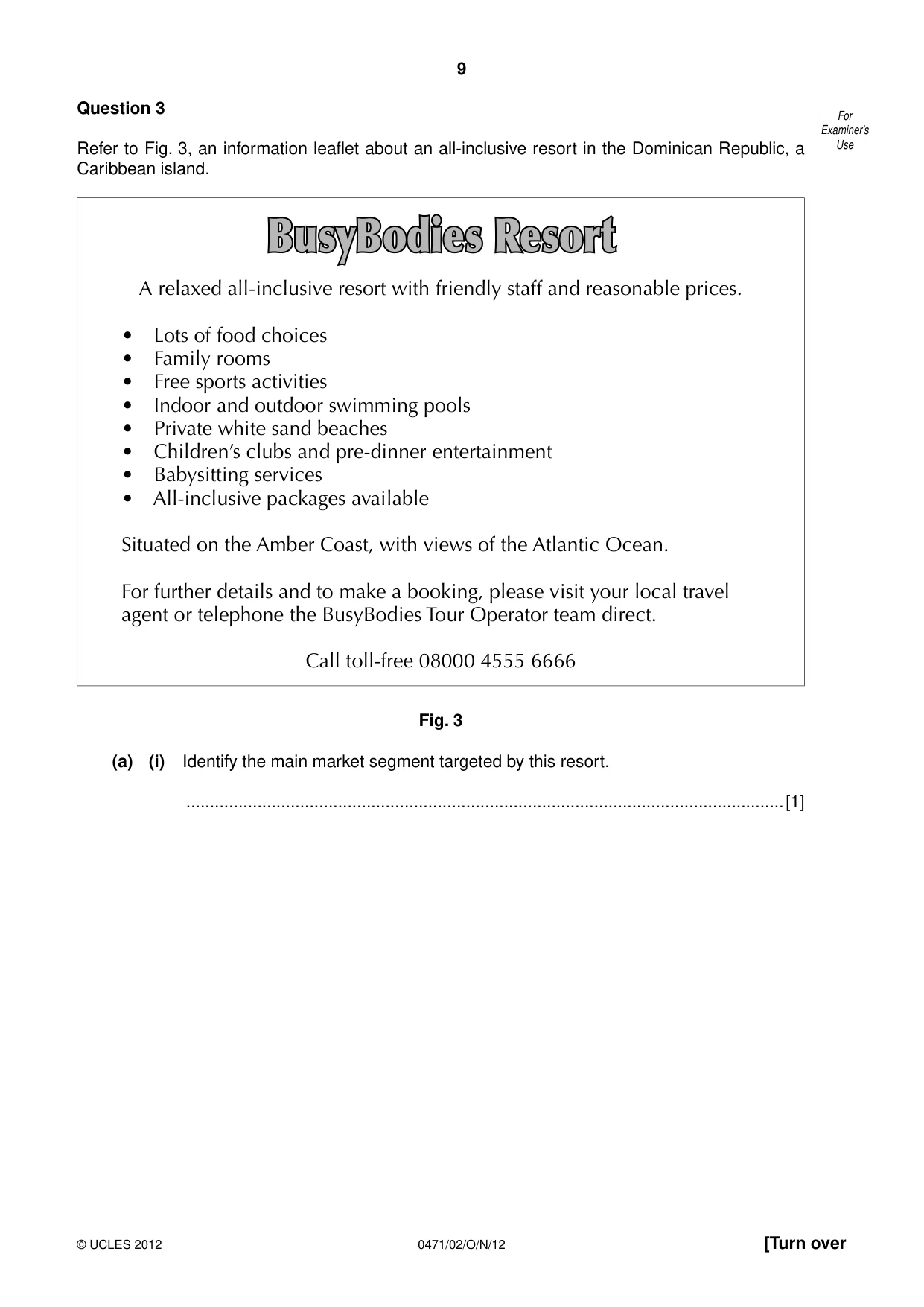
9 [Turn over © UCLES 2012 0471/02/O/N/12 For Examiner’s Use Question 3 Refer to Fig. 3, an information leaflet about an all-inclusive resort in the Dominican Republic, a Caribbean island. BusyBodies Resort BusyBodies Resort A relaxed all-inclusive resort with friendly staff and reasonable prices. • Lots of food choices • Family rooms • Free sports activities • Indoor and outdoor swimming pools • Private white sand beaches • Children’s clubs and pre-dinner entertainment • Babysitting services • All-inclusive packages available Situated on the Amber Coast, with views of the Atlantic Ocean. For further details and to make a booking, please visit your local travel agent or telephone the BusyBodies Tour Operator team direct. Call toll-free 08000 4555 6666 Fig. 3 (a) (i) Identify the main market segment targeted by this resort. …[1]
Question paper, page 10
10 0471/02/O/N/12 © UCLES 2012 For Examiner’s Use (ii) Identify and explain three ways in which the products or services at this resort may meet the needs of this target market. 1 … … … … 2 … … … … 3 … … … …[6] (b) An all-inclusive holiday package is made up of both tourism products and services. Explain, using examples, two differences between a tourism product and a tourism service. 1 … … … … 2 … … … …[4]
Question paper, page 11
11 [Turn over © UCLES 2012 0471/02/O/N/12 For Examiner’s Use (c) State five locational factors that may influence the decision to open a new holiday resort. 1 … … 2 … … 3 … … 4 … … 5 … …[5]
Question paper, page 12
12 0471/02/O/N/12 © UCLES 2012 For Examiner’s Use (d) Discuss the advantages and disadvantages to the resort owners of using a range of distribution channels in order to sell an all-inclusive package holiday. … … … … … … … … … … … … … … … … … … … … … … … … … …[9] [Total: 25 marks]
Question paper, page 13
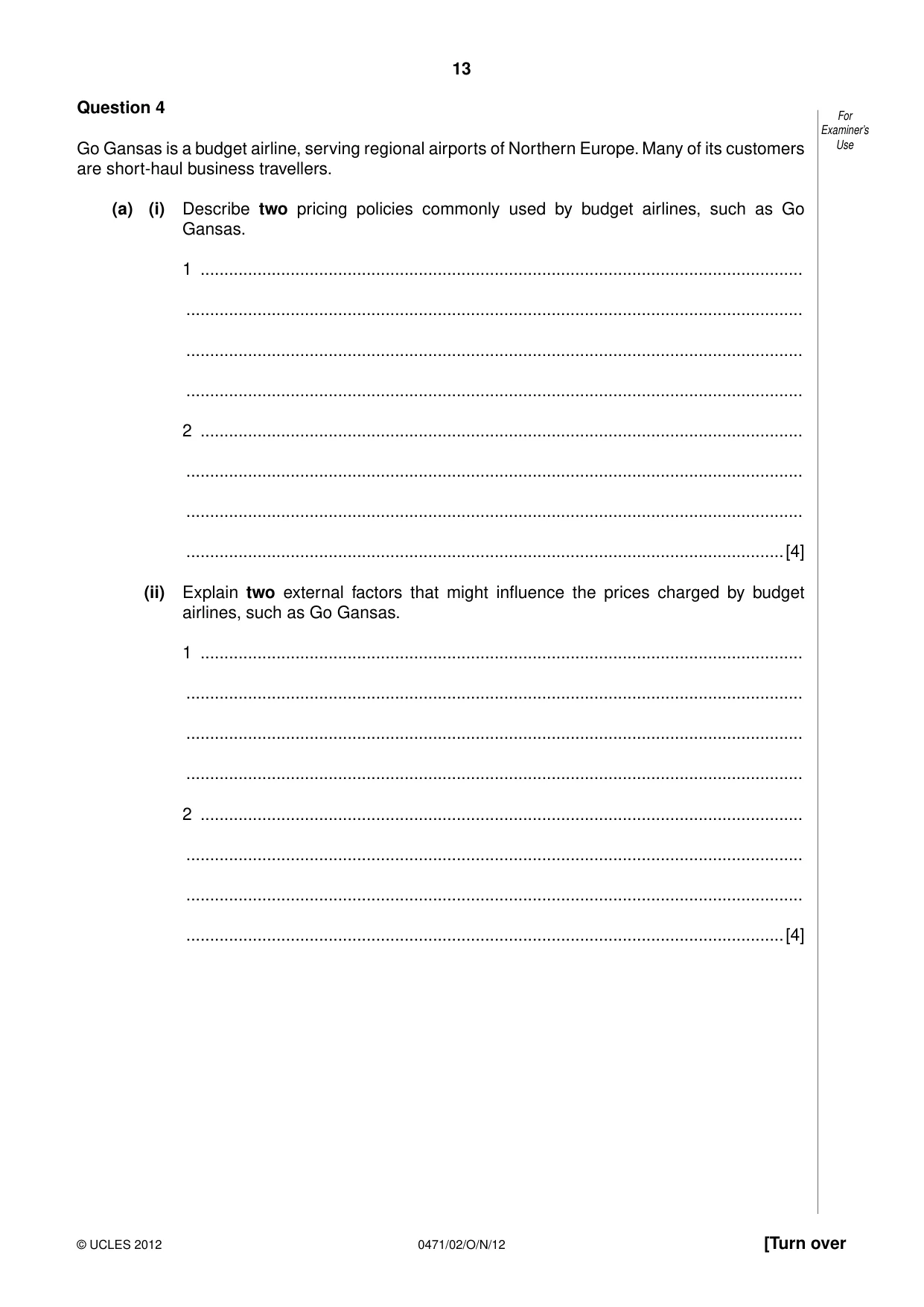
13 [Turn over © UCLES 2012 0471/02/O/N/12 For Examiner’s Use Question 4 Go Gansas is a budget airline, serving regional airports of Northern Europe. Many of its customers are short-haul business travellers. (a) (i) Describe two pricing policies commonly used by budget airlines, such as Go Gansas. 1 … … … … 2 … … … …[4] (ii) Explain two external factors that might influence the prices charged by budget airlines, such as Go Gansas. 1 … … … … 2 … … … …[4]
Question paper, page 14
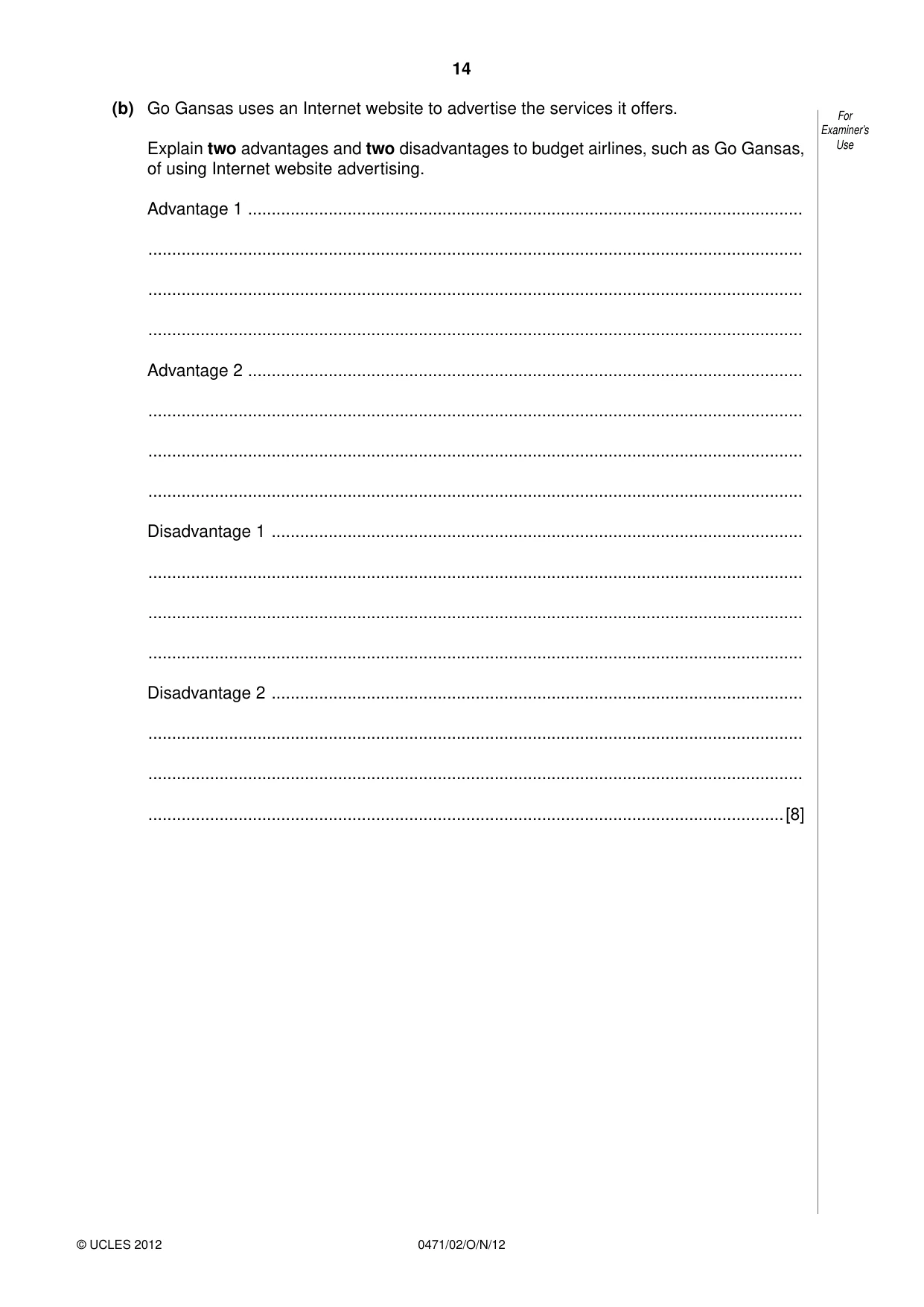
14 0471/02/O/N/12 © UCLES 2012 For Examiner’s Use (b) Go Gansas uses an Internet website to advertise the services it offers. Explain two advantages and two disadvantages to budget airlines, such as Go Gansas, of using Internet website advertising. Advantage 1 … … … … Advantage 2 … … … … Disadvantage 1 … … … … Disadvantage 2 … … … …[8]
Question paper, page 15
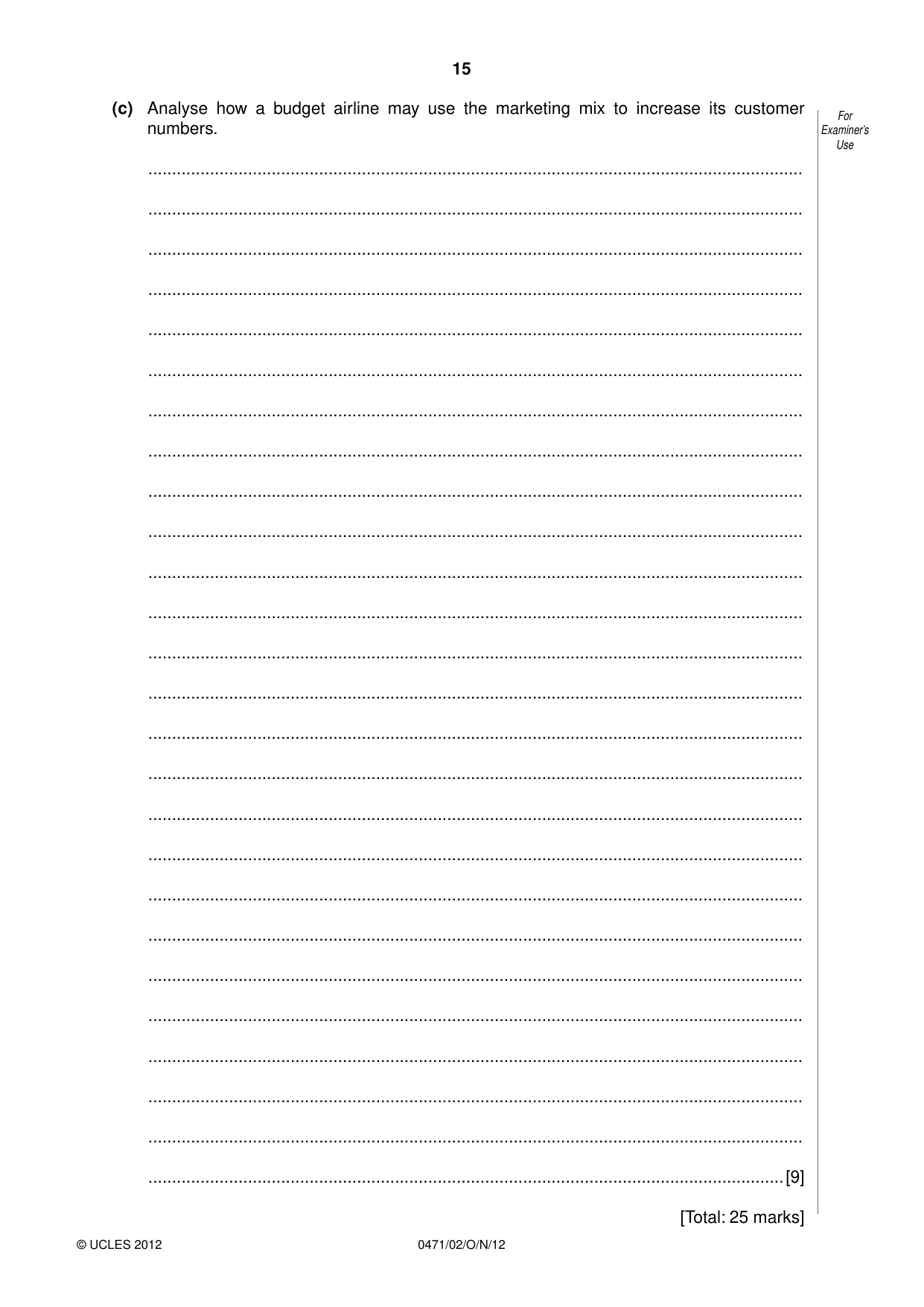
15 © UCLES 2012 0471/02/O/N/12 For Examiner’s Use (c) Analyse how a budget airline may use the marketing mix to increase its customer numbers. … … … … … … … … … … … … … … … … … … … … … … … … … …[9] [Total: 25 marks]
Question paper, page 16
16 0471/02/O/N/12 © UCLES 2012 BLANK PAGE Copyright Acknowledgements: Question 1 © Tourism Destination Audit ; Maldives Ministry of Tourism, Arts & Culture; January 2011. Permission to reproduce items where third-party owned material protected by copyright is included has been sought and cleared where possible. Every reasonable effort has been made by the publisher (UCLES) to trace copyright holders, but if any items requiring clearance have unwittingly been included, the publisher will be pleased to make amends at the earliest possible opportunity. University of Cambridge International Examinations is part of the Cambridge Assessment Group. Cambridge Assessment is the brand name of University of Cambridge Local Examinations Syndicate (UCLES), which is itself a department of the University of Cambridge.
Mark scheme, page 1
CAMBRIDGE INTERNATIONAL EXAMINATIONS International General Certificate of Secondary Education MARK SCHEME for the October/November 2012 series 0471 TRAVEL AND TOURISM 0471/02 Paper 2 (Alternative to Coursework), maximum raw mark 100 This mark scheme is published as an aid to teachers and candidates, to indicate the requirements of the examination. It shows the basis on which Examiners were instructed to award marks. It does not indicate the details of the discussions that took place at an Examiners’ meeting before marking began, which would have considered the acceptability of alternative answers. Mark schemes should be read in conjunction with the question paper and the Principal Examiner Report for Teachers. Cambridge will not enter into discussions about these mark schemes. Cambridge is publishing the mark schemes for the October/November 2012 series for most IGCSE, GCE Advanced Level and Advanced Subsidiary Level components and some Ordinary Level components. www.XtremePapers.com
Mark scheme, page 2
Page 2 Mark Scheme: Teachers’ version Syllabus Paper IGCSE – October/November 2012 0471 02 © Cambridge International Examinations 2012 1 (a) (i) Identify the market research technique used by the Maldives Ministry of Tourism, Arts and Culture in its destination audit. [1] Award one mark for a correct identification. Survey (1) Audit (1) Do not accept ‘Primary research’ or any other answers e.g. ‘questionnaires’, interviews etc. (ii) Explain two advantages to travel and tourism organisations of using this research technique. [2 × 2 = 4] Award one mark for each of two correct identifications of the advantages. Award a second mark for an explanation of each identification, up to two explanations. e.g. Primary research method (face to face/direct) (1) you can target the questions (1) Up to date (1) Information will be valid (1) Specific (detailed) information (1) information will be relevant to your research (1) Cheaper (1) than secondary research (1) Accept any valid explanation. (iii) State at which stage of the product life cycle you would place the Maldives as a tourist destination. Give two reasons for your answer. [3 × 1 = 3] Award one mark for correct identification of the stage and up to two marks for the reasons given. Credit can be given for the reasons, even if the stage is incorrect. Maturity (1) Many tourists have now visited (1) and are choosing different types of destinations (1) Competition from other destinations is high (1) visitor numbers are decreasing (1) Accept any valid reasons. (b) Complete the table below to show the appeal of two different natural features to different market segments, giving a reason for your choice. [1 + 1 + 1 × 2 = 6] Award one mark for each of two correct identifications in each section of the table. NB If no ‘natural’ features are identified, it is not possible to gain marks for the segment or the reason for the appeal. e.g. Climate (1) people from colder parts of the world (1) to experience hot destinations (1) Tropical island (1) honeymooners (1) Romantic/wedding ceremony on the beach (1) White sandy beaches (1) Leisure tourists (1) For relaxation and fun (1) Underwater beauty (1) Divers (1) To see marine life (1) Mountains (1) Adventure tourists (1) Hiking/climbing (1).
Mark scheme, page 3
Page 3 Mark Scheme: Teachers’ version Syllabus Paper IGCSE – October/November 2012 0471 02 © Cambridge International Examinations 2012 (c) (i) Other than using a brand slogan, give two examples of how a destination might create a brand image. [2 × 1 = 2] Award one mark for each correct identification up to two identifications e.g. Destination/product features/USP/quality of the product (1) Logo/name (1) Colours associated with the brand (1) Uniform (1) Mascot (1) Price (1) Accept any reasonable suggestions. (ii) Analyse the importance of brand image for a destination such as the Maldives. [9] Levels of Response: Level 1 (1–3 marks) Candidates at this level will identify up to three reasons why brand image is important. Level 2 (4–6 marks) At this level, candidates will explain up to three reasons why brand image is important. Level 3 (7–9 marks) Responses at this level will analyse at least one reason for the importance of brand image. e.g. • Competitive advantage – island resorts are in strong competition with one another/to overcome the competition from newly emerging destinations • To appeal to a wider customer base/selling more • To benefit from repeat visits • To create a unique product image • To create awareness.
Mark scheme, page 4
Page 4 Mark Scheme: Teachers’ version Syllabus Paper IGCSE – October/November 2012 0471 02 © Cambridge International Examinations 2012 2 (a) (i) Using the statement numbers from Fig. 2 above, complete the PEST table below, choosing only one statement under each heading. [4 × 1 = 4] Award one mark for each valid identification. Political 4 Economic 2 Social 3 Technological 1 (ii) What do the letters SWOT stand for? [4 × 1 = 4] Award one mark for each correct identification. Strength/s (1) Weakness/es (1) Opportunity/ies (1) Threat/s (1) (b) (i) Explain four methods of promotion that could be used as part of this campaign. [4 × 2 = 8] Award one mark for the identification of each of four promotional methods and a second mark for exemplification/explanation of each method. • Advertising (1) international websites (1) international TV campaign (1) • Publicity (1) leaflets and brochures distributed via embassies overseas (1) • PR (1) incentives/familiarisation trips to travel trade (1) • Press conference (1) for media exposure (1) • Internet (1) own tourist board website (1) • Road show/Trade show/Travel fair/Exhibitions (1) to showcase to industry partners (1) • Sales promotion (1) Free gifts/free sports activities/coupons/BOGOFs (1) • Sponsorship of events (1) to raise awareness of the organisation (1). Accept any valid promotional methods. NB Promotional/discount pricing are NOT promotional methods so DO NOT ALLOW.
Mark scheme, page 5
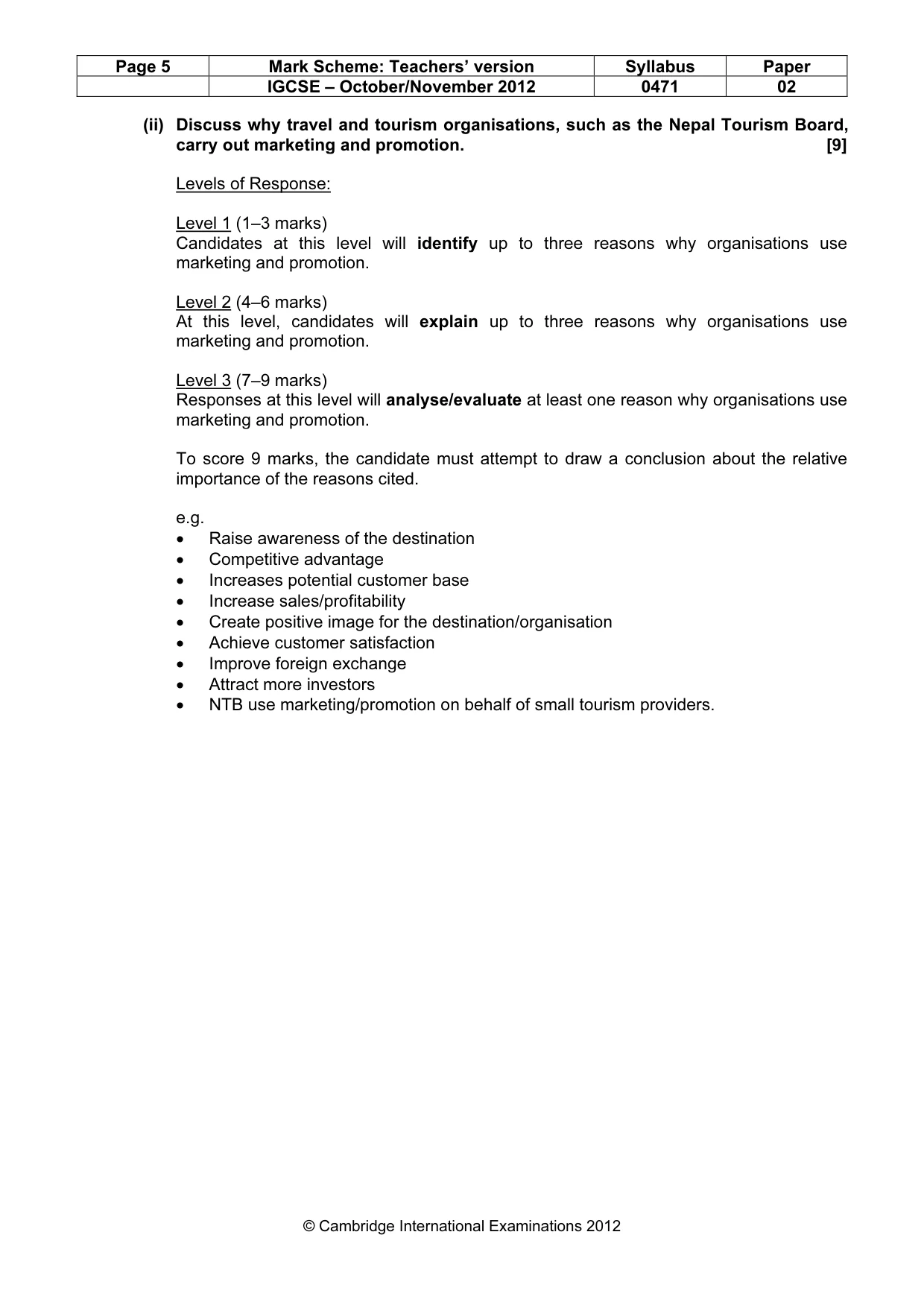
Page 5 Mark Scheme: Teachers’ version Syllabus Paper IGCSE – October/November 2012 0471 02 © Cambridge International Examinations 2012 (ii) Discuss why travel and tourism organisations, such as the Nepal Tourism Board, carry out marketing and promotion. [9] Levels of Response: Level 1 (1–3 marks) Candidates at this level will identify up to three reasons why organisations use marketing and promotion. Level 2 (4–6 marks) At this level, candidates will explain up to three reasons why organisations use marketing and promotion. Level 3 (7–9 marks) Responses at this level will analyse/evaluate at least one reason why organisations use marketing and promotion. To score 9 marks, the candidate must attempt to draw a conclusion about the relative importance of the reasons cited. e.g. • Raise awareness of the destination • Competitive advantage • Increases potential customer base • Increase sales/profitability • Create positive image for the destination/organisation • Achieve customer satisfaction • Improve foreign exchange • Attract more investors • NTB use marketing/promotion on behalf of small tourism providers.
Mark scheme, page 6
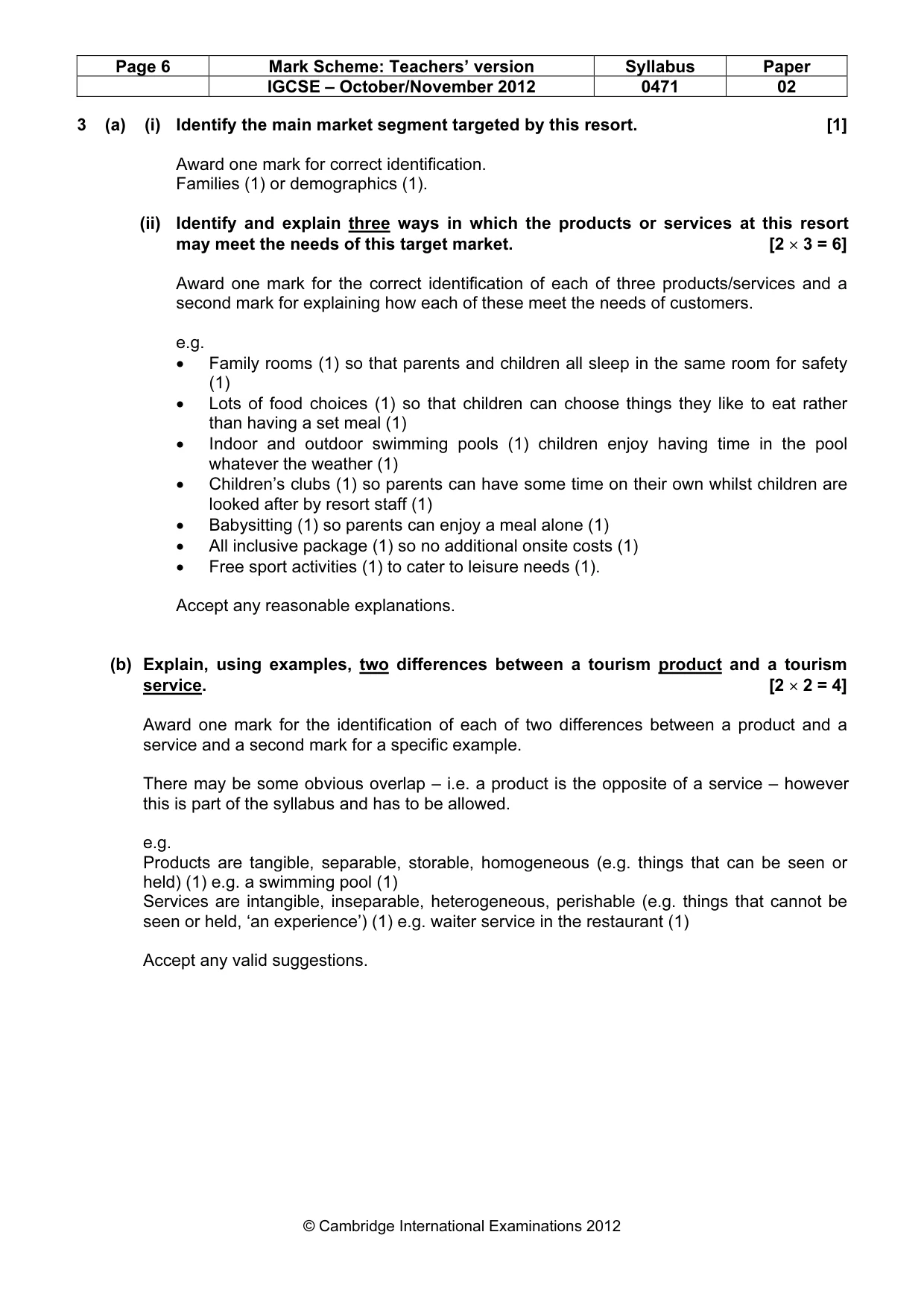
Page 6 Mark Scheme: Teachers’ version Syllabus Paper IGCSE – October/November 2012 0471 02 © Cambridge International Examinations 2012 3 (a) (i) Identify the main market segment targeted by this resort. [1] Award one mark for correct identification. Families (1) or demographics (1). (ii) Identify and explain three ways in which the products or services at this resort may meet the needs of this target market. [2 × 3 = 6] Award one mark for the correct identification of each of three products/services and a second mark for explaining how each of these meet the needs of customers. e.g. • Family rooms (1) so that parents and children all sleep in the same room for safety (1) • Lots of food choices (1) so that children can choose things they like to eat rather than having a set meal (1) • Indoor and outdoor swimming pools (1) children enjoy having time in the pool whatever the weather (1) • Children’s clubs (1) so parents can have some time on their own whilst children are looked after by resort staff (1) • Babysitting (1) so parents can enjoy a meal alone (1) • All inclusive package (1) so no additional onsite costs (1) • Free sport activities (1) to cater to leisure needs (1). Accept any reasonable explanations. (b) Explain, using examples, two differences between a tourism product and a tourism service. [2 × 2 = 4] Award one mark for the identification of each of two differences between a product and a service and a second mark for a specific example. There may be some obvious overlap – i.e. a product is the opposite of a service – however this is part of the syllabus and has to be allowed. e.g. Products are tangible, separable, storable, homogeneous (e.g. things that can be seen or held) (1) e.g. a swimming pool (1) Services are intangible, inseparable, heterogeneous, perishable (e.g. things that cannot be seen or held, ‘an experience’) (1) e.g. waiter service in the restaurant (1) Accept any valid suggestions.
Mark scheme, page 7
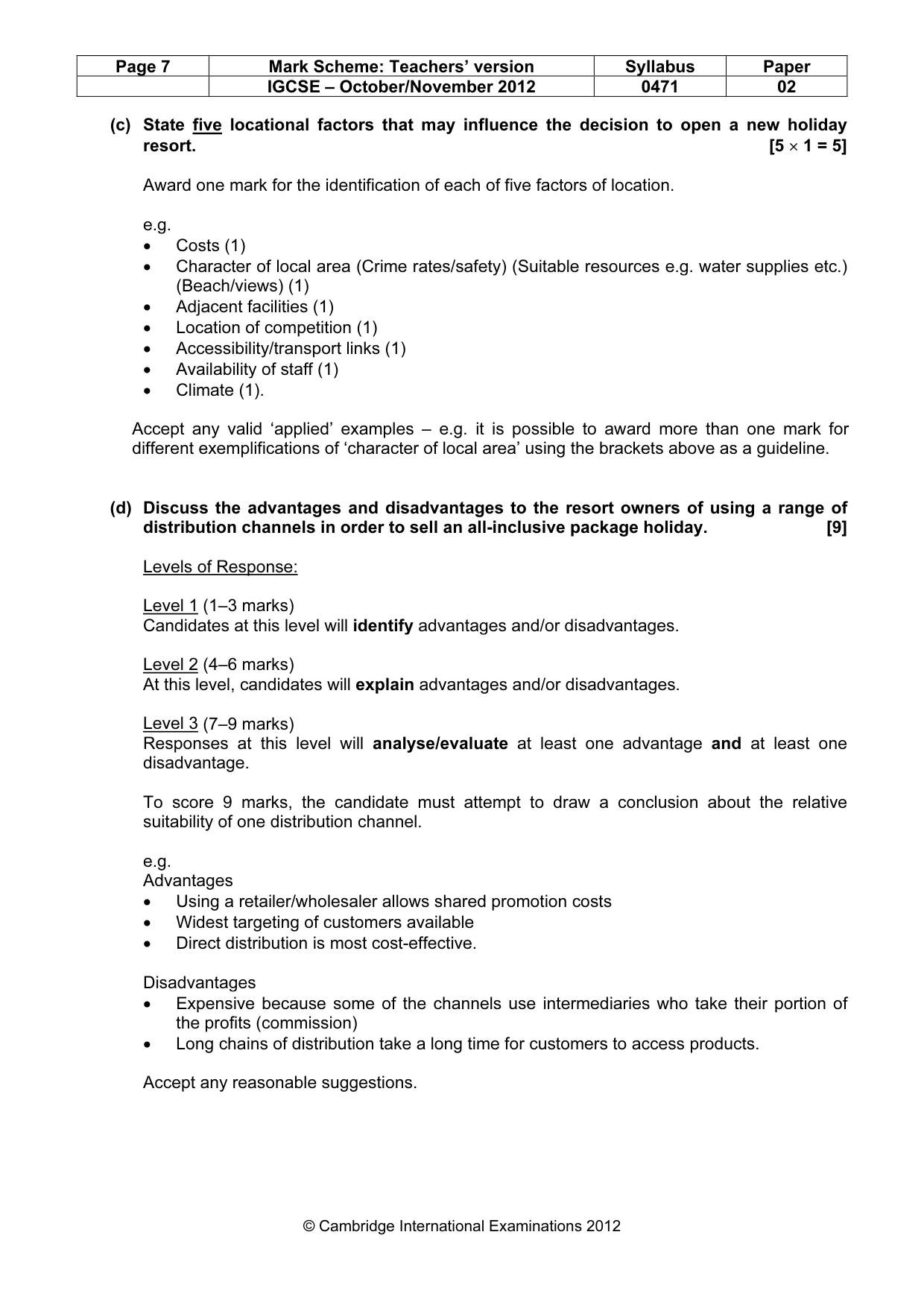
Page 7 Mark Scheme: Teachers’ version Syllabus Paper IGCSE – October/November 2012 0471 02 © Cambridge International Examinations 2012 (c) State five locational factors that may influence the decision to open a new holiday resort. [5 × 1 = 5] Award one mark for the identification of each of five factors of location. e.g. • Costs (1) • Character of local area (Crime rates/safety) (Suitable resources e.g. water supplies etc.) (Beach/views) (1) • Adjacent facilities (1) • Location of competition (1) • Accessibility/transport links (1) • Availability of staff (1) • Climate (1). Accept any valid ‘applied’ examples – e.g. it is possible to award more than one mark for different exemplifications of ‘character of local area’ using the brackets above as a guideline. (d) Discuss the advantages and disadvantages to the resort owners of using a range of distribution channels in order to sell an all-inclusive package holiday. [9] Levels of Response: Level 1 (1–3 marks) Candidates at this level will identify advantages and/or disadvantages. Level 2 (4–6 marks) At this level, candidates will explain advantages and/or disadvantages. Level 3 (7–9 marks) Responses at this level will analyse/evaluate at least one advantage and at least one disadvantage. To score 9 marks, the candidate must attempt to draw a conclusion about the relative suitability of one distribution channel. e.g. Advantages • Using a retailer/wholesaler allows shared promotion costs • Widest targeting of customers available • Direct distribution is most cost-effective. Disadvantages • Expensive because some of the channels use intermediaries who take their portion of the profits (commission) • Long chains of distribution take a long time for customers to access products. Accept any reasonable suggestions.
Mark scheme, page 8
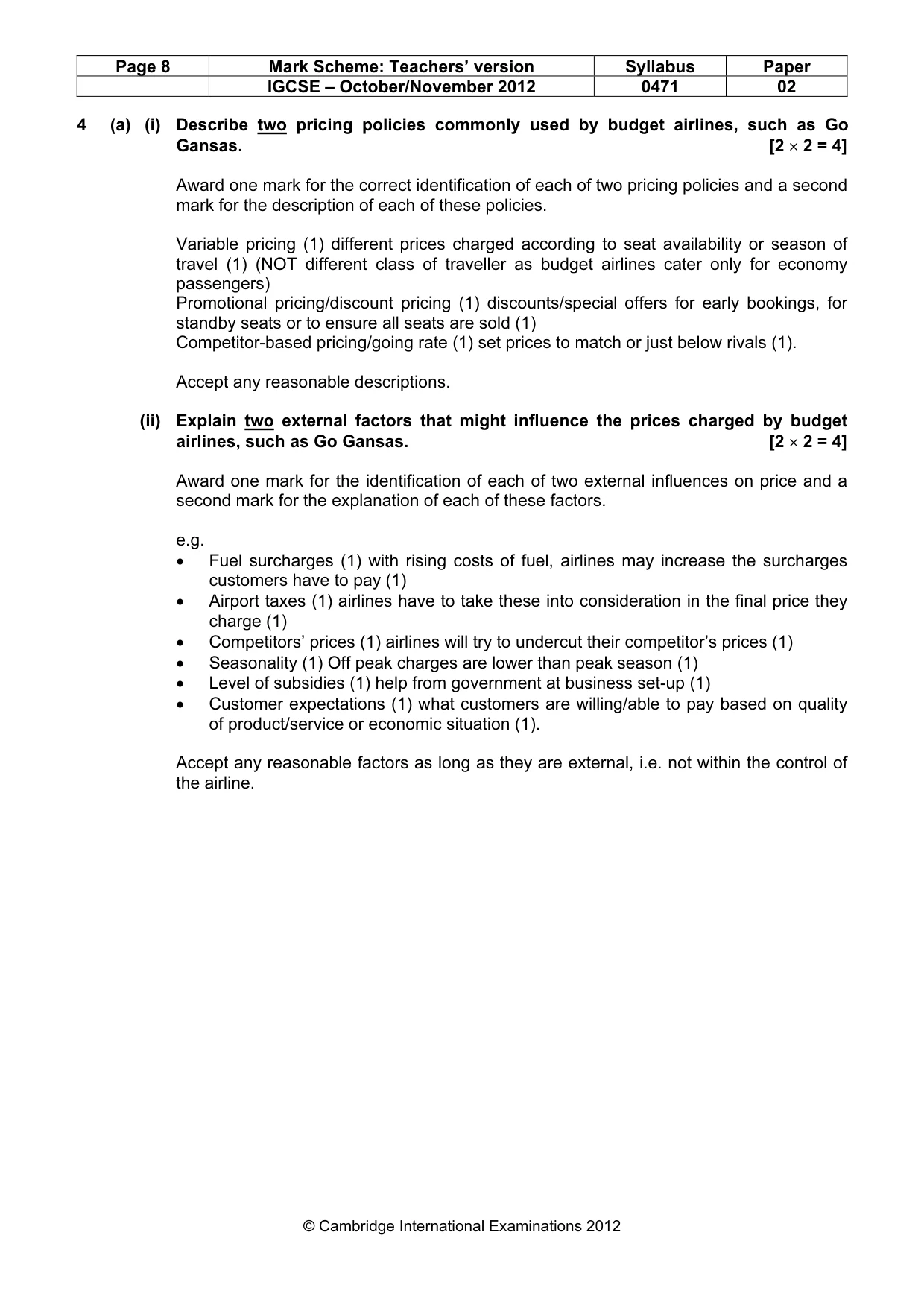
Page 8 Mark Scheme: Teachers’ version Syllabus Paper IGCSE – October/November 2012 0471 02 © Cambridge International Examinations 2012 4 (a) (i) Describe two pricing policies commonly used by budget airlines, such as Go Gansas. [2 × 2 = 4] Award one mark for the correct identification of each of two pricing policies and a second mark for the description of each of these policies. Variable pricing (1) different prices charged according to seat availability or season of travel (1) (NOT different class of traveller as budget airlines cater only for economy passengers) Promotional pricing/discount pricing (1) discounts/special offers for early bookings, for standby seats or to ensure all seats are sold (1) Competitor-based pricing/going rate (1) set prices to match or just below rivals (1). Accept any reasonable descriptions. (ii) Explain two external factors that might influence the prices charged by budget airlines, such as Go Gansas. [2 × 2 = 4] Award one mark for the identification of each of two external influences on price and a second mark for the explanation of each of these factors. e.g. • Fuel surcharges (1) with rising costs of fuel, airlines may increase the surcharges customers have to pay (1) • Airport taxes (1) airlines have to take these into consideration in the final price they charge (1) • Competitors’ prices (1) airlines will try to undercut their competitor’s prices (1) • Seasonality (1) Off peak charges are lower than peak season (1) • Level of subsidies (1) help from government at business set-up (1) • Customer expectations (1) what customers are willing/able to pay based on quality of product/service or economic situation (1). Accept any reasonable factors as long as they are external, i.e. not within the control of the airline.
Mark scheme, page 9
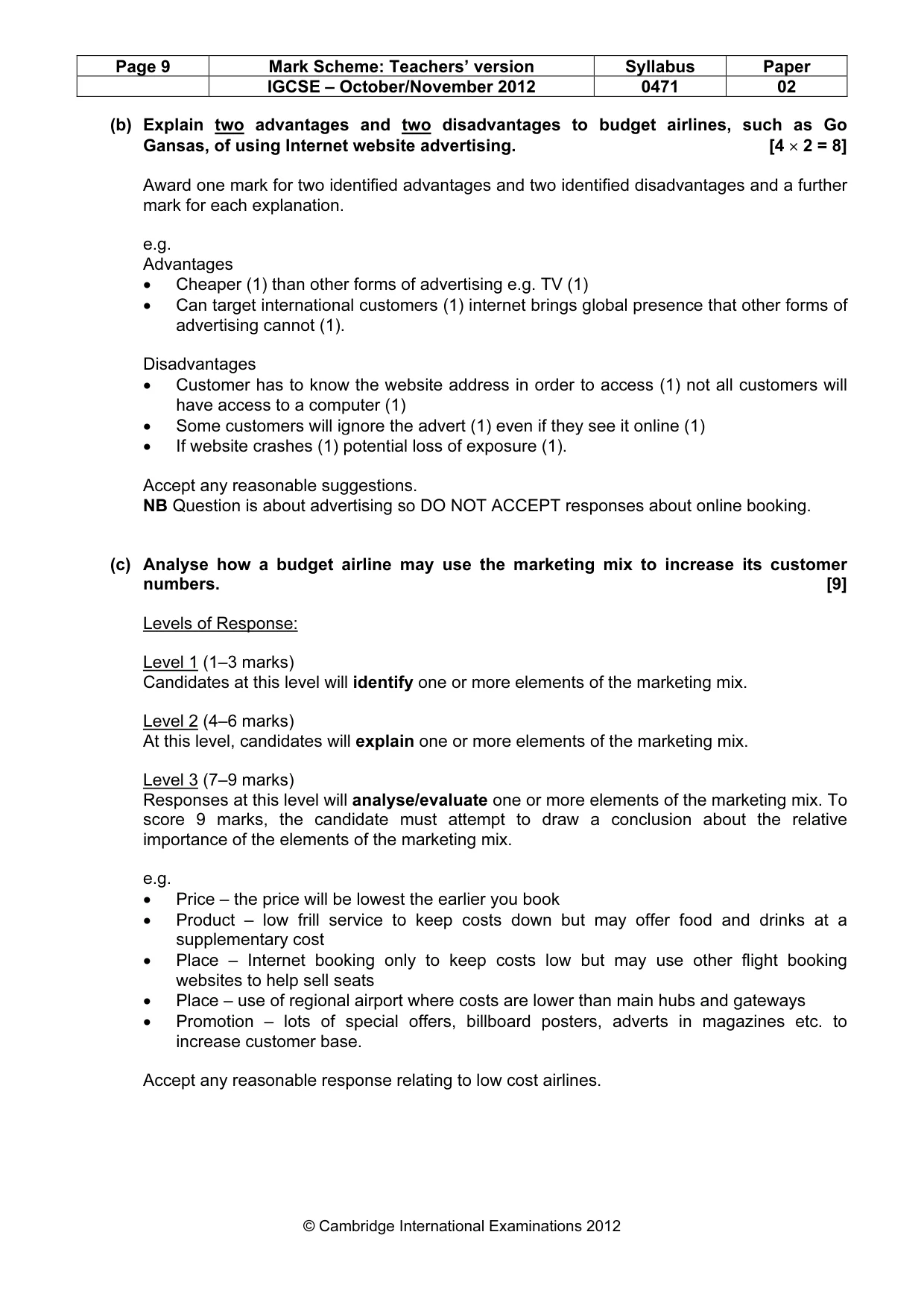
Page 9 Mark Scheme: Teachers’ version Syllabus Paper IGCSE – October/November 2012 0471 02 © Cambridge International Examinations 2012 (b) Explain two advantages and two disadvantages to budget airlines, such as Go Gansas, of using Internet website advertising. [4 × 2 = 8] Award one mark for two identified advantages and two identified disadvantages and a further mark for each explanation. e.g. Advantages • Cheaper (1) than other forms of advertising e.g. TV (1) • Can target international customers (1) internet brings global presence that other forms of advertising cannot (1). Disadvantages • Customer has to know the website address in order to access (1) not all customers will have access to a computer (1) • Some customers will ignore the advert (1) even if they see it online (1) • If website crashes (1) potential loss of exposure (1). Accept any reasonable suggestions. NB Question is about advertising so DO NOT ACCEPT responses about online booking. (c) Analyse how a budget airline may use the marketing mix to increase its customer numbers. [9] Levels of Response: Level 1 (1–3 marks) Candidates at this level will identify one or more elements of the marketing mix. Level 2 (4–6 marks) At this level, candidates will explain one or more elements of the marketing mix. Level 3 (7–9 marks) Responses at this level will analyse/evaluate one or more elements of the marketing mix. To score 9 marks, the candidate must attempt to draw a conclusion about the relative importance of the elements of the marketing mix. e.g. • Price – the price will be lowest the earlier you book • Product – low frill service to keep costs down but may offer food and drinks at a supplementary cost • Place – Internet booking only to keep costs low but may use other flight booking websites to help sell seats • Place – use of regional airport where costs are lower than main hubs and gateways • Promotion – lots of special offers, billboard posters, adverts in magazines etc. to increase customer base. Accept any reasonable response relating to low cost airlines.
What you needed in this session
Cambridge’s own grade thresholds for 2012 Oct/Nov, Paper 2 · Variant 1. A higher threshold means an easier paper — the bar moves with how the cohort did.