Cambridge IGCSE Travel and Tourism 0471 — 2012 May/June Paper 1 · Variant 1
0471/11/M/J/12 · 100 marks · ≈113 min
The question paper and its mark scheme, free to read here and free to download. This is Cambridge’s own paper, exactly as it was sat.
Question paper16 pages


Mark scheme10 pages
Answers below. Sit the paper first if you are practising.
Paper as text
Question paper, page 1
This document consists of 14 printed pages and 2 blank pages. DC (NF/JG) 50909/4 © UCLES 2012 [Turn over UNIVERSITY OF CAMBRIDGE INTERNATIONAL EXAMINATIONS International General Certificate of Secondary Education * 0 4 1 6 4 2 1 0 6 5 * TRAVEL AND TOURISM 0471/01 Core Module May/June 2012 2 hours Candidates answer on the Question Paper. No Additional Materials are required. READ THESE INSTRUCTIONS FIRST Write your Centre number, candidate number and name on all the work you hand in. Write in dark blue or black pen. You may use a soft pencil for any diagrams, graphs or rough working. Do not use staples, paper clips, highlighters, glue or correction fluid. DO NOT WRITE IN ANY BARCODES. Answer all questions. At the end of the examination, fasten all your work securely together. The number of marks is given in brackets [ ] at the end of each question or part question. For Examiner’s Use 1 2 3 4 Total www.XtremePapers.com
Question paper, page 2
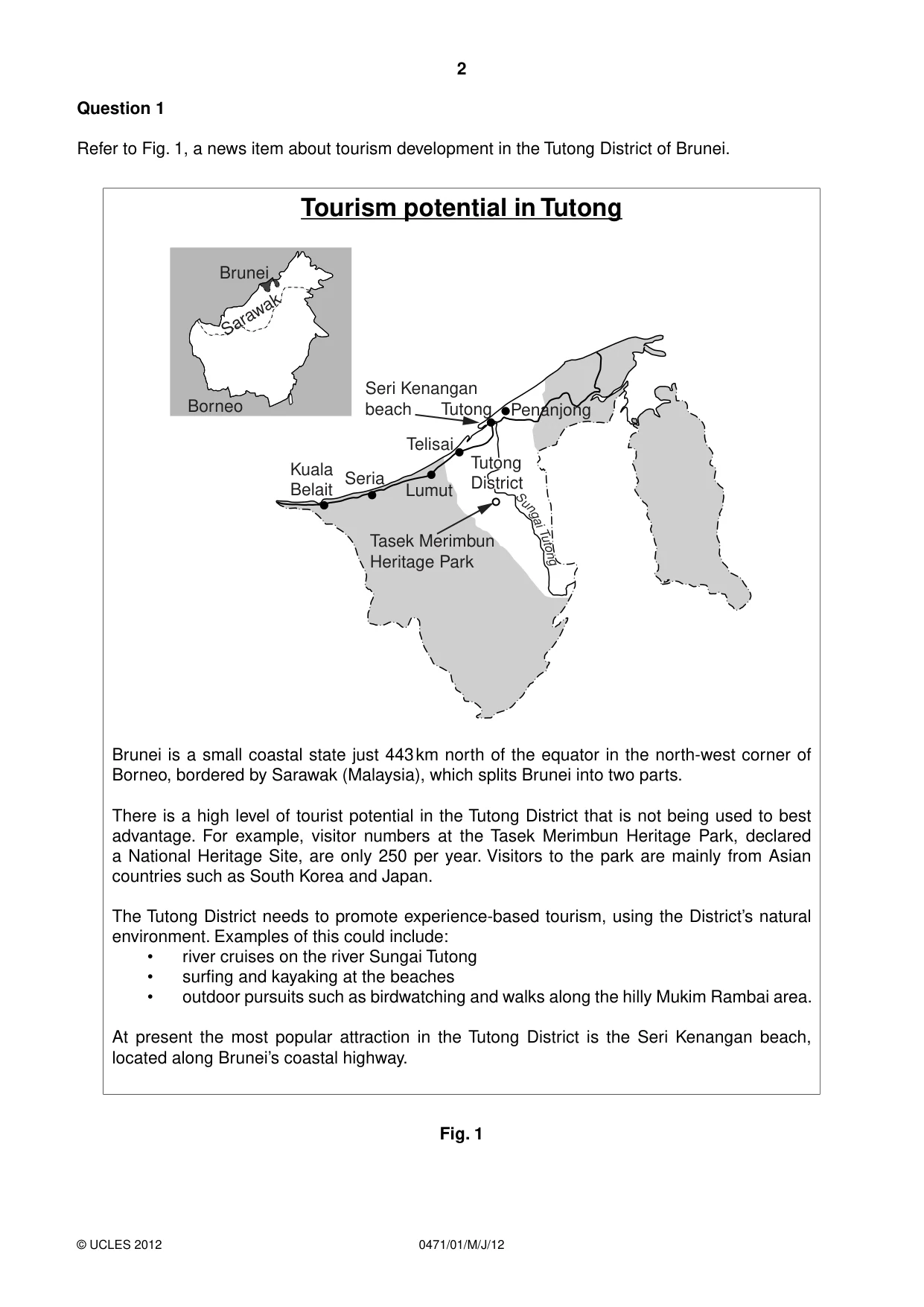
2 0471/01/M/J/12 © UCLES 2012 Question 1 Refer to Fig. 1, a news item about tourism development in the Tutong District of Brunei. Tourism potential in Tutong Kuala Belait Seria Telisai Lumut Tutong Penanjong Seri Kenangan beach Tasek Merimbun Heritage Park S u n g a i T ut on g Borneo Brunei Sarawak Tutong District Brunei is a small coastal state just 443 km north of the equator in the north-west corner of Borneo, bordered by Sarawak (Malaysia), which splits Brunei into two parts. There is a high level of tourist potential in the Tutong District that is not being used to best advantage. For example, visitor numbers at the Tasek Merimbun Heritage Park, declared a National Heritage Site, are only 250 per year. Visitors to the park are mainly from Asian countries such as South Korea and Japan. The Tutong District needs to promote experience-based tourism, using the District’s natural environment. Examples of this could include: • river cruises on the river Sungai Tutong • surfing and kayaking at the beaches • outdoor pursuits such as birdwatching and walks along the hilly Mukim Rambai area. At present the most popular attraction in the Tutong District is the Seri Kenangan beach, located along Brunei’s coastal highway. Fig. 1
Question paper, page 3
3 0471/01/M/J/12 © UCLES 2012 [Turn over For Examiner’s Use (a) Identify three outdoor activities that might be developed in the Tutong District of Brunei. 1 … 2 … 3 … [3] (b) State the following: • the term that best describes climatic conditions in Brunei … • the name of the island on which Brunei is located … • the most popular attraction in Brunei’s Tutong District … • whether local time in Brunei will be in advance of or behind local time in New York … [4] (c) Areas of outstanding natural beauty usually contain sites that act as ‘honeypots’, attracting large numbers of visitors. Explain three ways in which such ‘honeypot’ sites can be managed to prevent visitor congestion. 1 … … … … 2 … … … … 3 … … … … [6]
Question paper, page 4
4 0471/01/M/J/12 © UCLES 2012 For Examiner’s Use (d) Business tourism is very important to some destinations. Describe what is meant by each of the following: • meetings … … … … • conferences … … … … • exhibitions … … … … [6] (e) Discuss the reasons why most international travel and tourism providers now have their own Internet websites. … … … … … … … … … … … … [6] [Total: 25]
Question paper, page 5
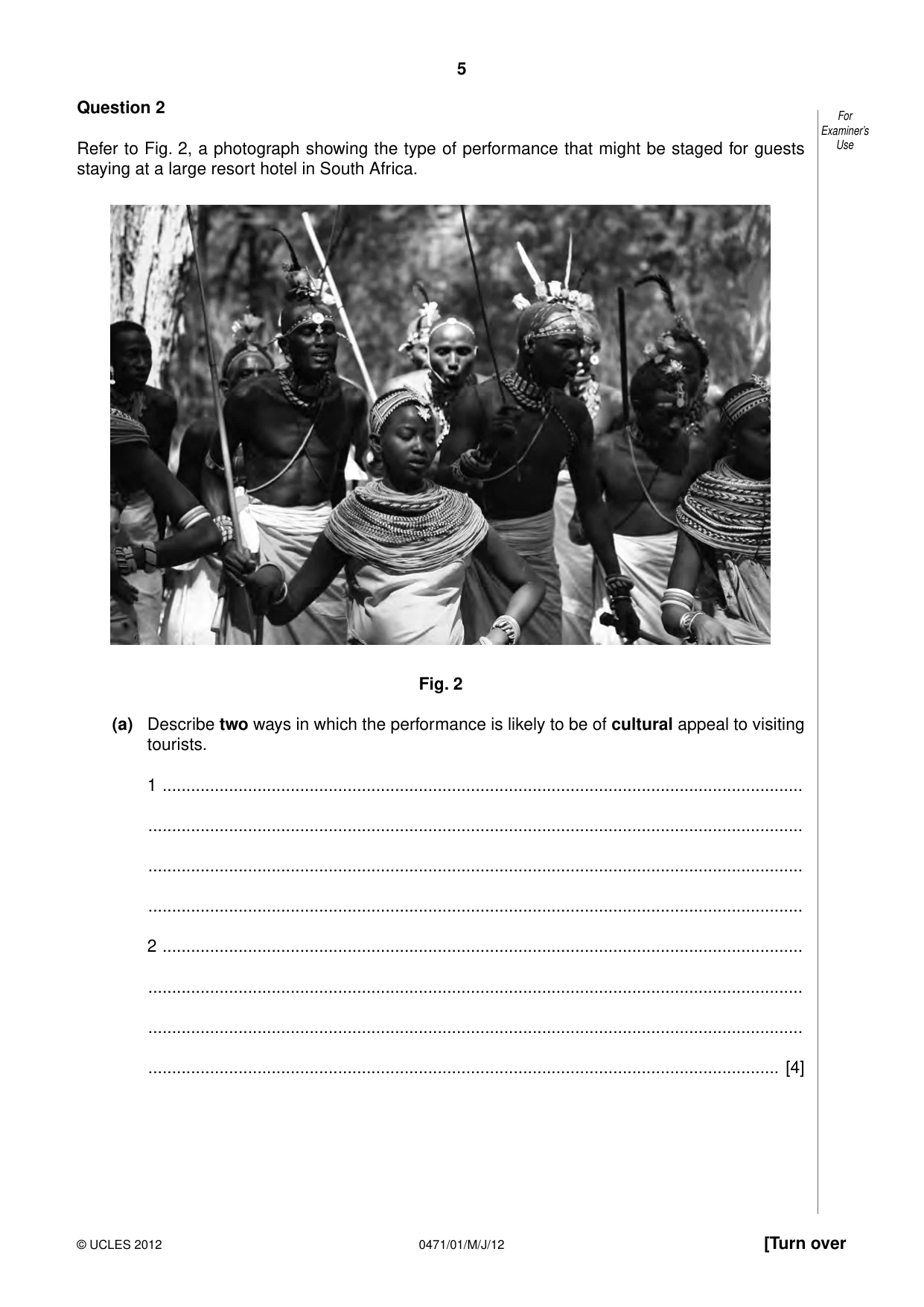
5 0471/01/M/J/12 © UCLES 2012 [Turn over For Examiner’s Use Question 2 Refer to Fig. 2, a photograph showing the type of performance that might be staged for guests staying at a large resort hotel in South Africa. Fig. 2 (a) Describe two ways in which the performance is likely to be of cultural appeal to visiting tourists. 1 … … … … 2 … … … … [4]
Question paper, page 6
6 0471/01/M/J/12 © UCLES 2012 For Examiner’s Use (b) Guests staying at larger hotels usually have a choice of places to eat and drink. State three characteristics of a ‘fine dining’ restaurant. 1 … 2 … 3 … [3] (c) Members of staff working together is known as team-work. Team-work is important for the effective delivery of customer service in hotel restaurants. Describe how each of the following job roles involves team-work: • waiting staff … … … … • kitchen staff … … … … • bar staff … … … … [6]
Question paper, page 7
7 0471/01/M/J/12 © UCLES 2012 [Turn over For Examiner’s Use (d) Many hotel guests will take part in an organised sightseeing trip or excursion during their stay. Identify three ways in which such activities can be booked and briefly explain why an international leisure traveller would find each booking method helpful. 1 … … … … 2 … … … … 3 … … … … [6] (e) Many destinations hold special events that attract leisure tourists, such as a carnival or sports event. With reference to one special event with which you are familiar, discuss its appeal to visiting leisure tourists. Name of chosen special event … … … … … … … … … … … … … [6] [Total: 25]
Question paper, page 8
8 0471/01/M/J/12 © UCLES 2012 For Examiner’s Use Question 3 Refer to Fig. 3, a news item about the growth of tourism in Cambodia in 2010. Tourist arrivals in Cambodia increased by about 12% in the first six months of 2010, according to its national tourist board statistics. Tourists from Asia accounted for a large number of visitors. The largest numbers of visitors came from Vietnam, South Korea and Japan. The President of the Cambodia Association of Travel Agents said that visa agreements and an increase in flights would be important factors in attracting even more tourists to Cambodia. He said that airlines such as Bangkok Airways and Air Asia would increase their flights during the peak season, including more direct flights. The national airline recently announced plans to buy two new planes in order to open routes to Japan, China and South Korea. Cambodia’s visitor numbers may continue to grow because better infrastructure is being introduced. Fig. 3 (a) Identify Cambodia’s three largest tourism markets. 1 … 2 … 3 … [3] (b) Explain two likely reasons why Cambodia’s national airline plans to open new routes to China. 1 … … … … 2 … … … … [4]
Question paper, page 9
9 0471/01/M/J/12 © UCLES 2012 [Turn over For Examiner’s Use (c) Explain three positive economic impacts that are likely to result from the creation of an improved tourism infrastructure. 1 … … … … 2 … … … … 3 … … … … [6]
Question paper, page 10
10 0471/01/M/J/12 © UCLES 2012 For Examiner’s Use (d) Air Asia is an example of a low-cost airline. Explain how the characteristics of low-cost airlines, such as Air Asia, can: • serve poorly connected destinations … … … … … … … • reduce fares … … … … … … … [6]
Question paper, page 11
11 0471/01/M/J/12 © UCLES 2012 [Turn over For Examiner’s Use (e) Discuss the reasons why national tourist boards collect visitor statistics. … … … … … … … … … … … … [6] [Total: 25]
Question paper, page 12
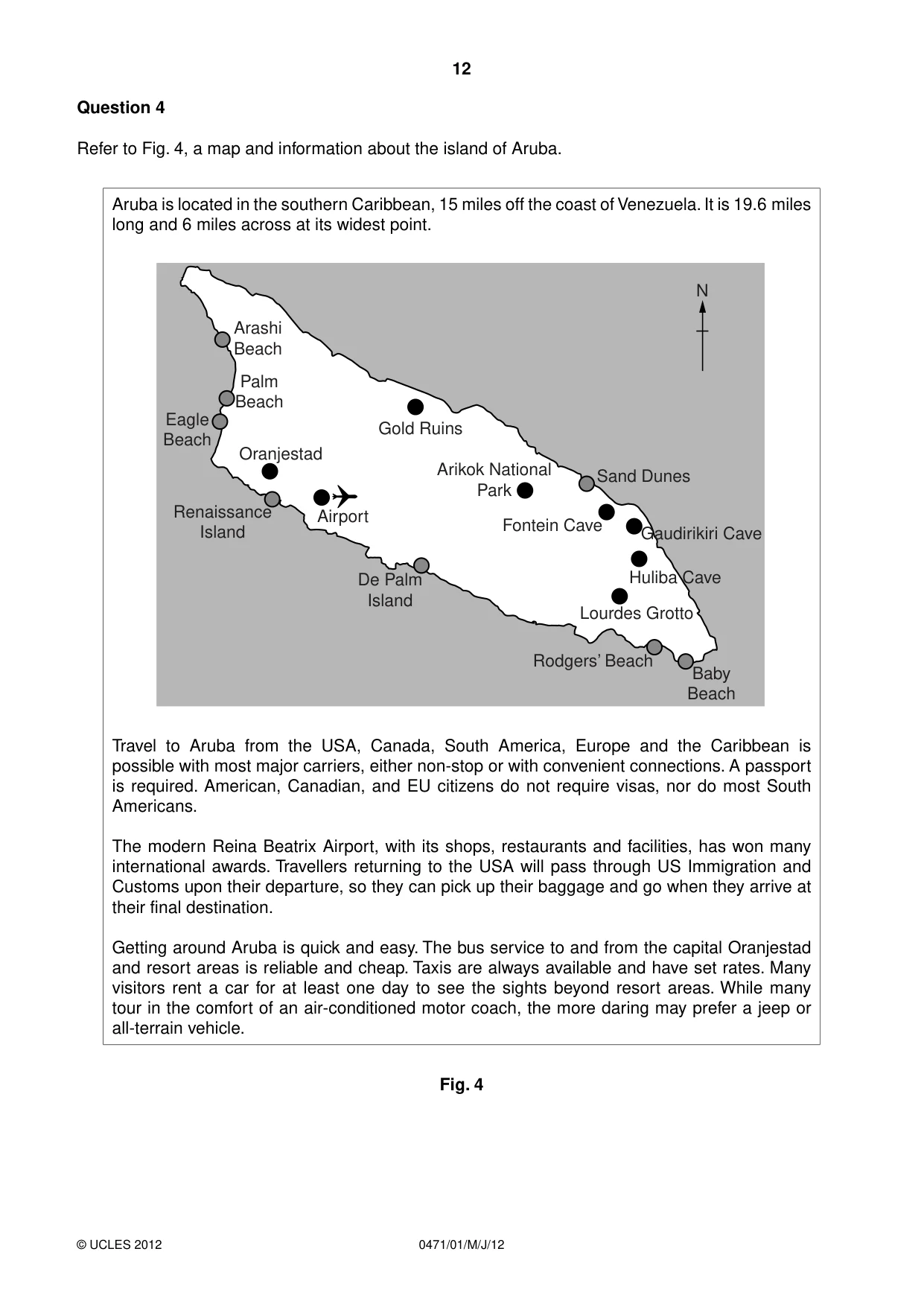
12 0471/01/M/J/12 © UCLES 2012 Question 4 Refer to Fig. 4, a map and information about the island of Aruba. Aruba is located in the southern Caribbean, 15 miles off the coast of Venezuela. It is 19.6 miles long and 6 miles across at its widest point. Eagle Beach Baby Beach Rodgers’ Beach Renaissance Island De Palm Island Palm Beach Arashi Beach Oranjestad Gold Ruins Fontein Cave Arikok National Park Gaudirikiri Cave Huliba Cave Lourdes Grotto Sand Dunes Airport N Travel to Aruba from the USA, Canada, South America, Europe and the Caribbean is possible with most major carriers, either non-stop or with convenient connections. A passport is required. American, Canadian, and EU citizens do not require visas, nor do most South Americans. The modern Reina Beatrix Airport, with its shops, restaurants and facilities, has won many international awards. Travellers returning to the USA will pass through US Immigration and Customs upon their departure, so they can pick up their baggage and go when they arrive at their final destination. Getting around Aruba is quick and easy. The bus service to and from the capital Oranjestad and resort areas is reliable and cheap. Taxis are always available and have set rates. Many visitors rent a car for at least one day to see the sights beyond resort areas. While many tour in the comfort of an air-conditioned motor coach, the more daring may prefer a jeep or all-terrain vehicle. Fig. 4
Question paper, page 13
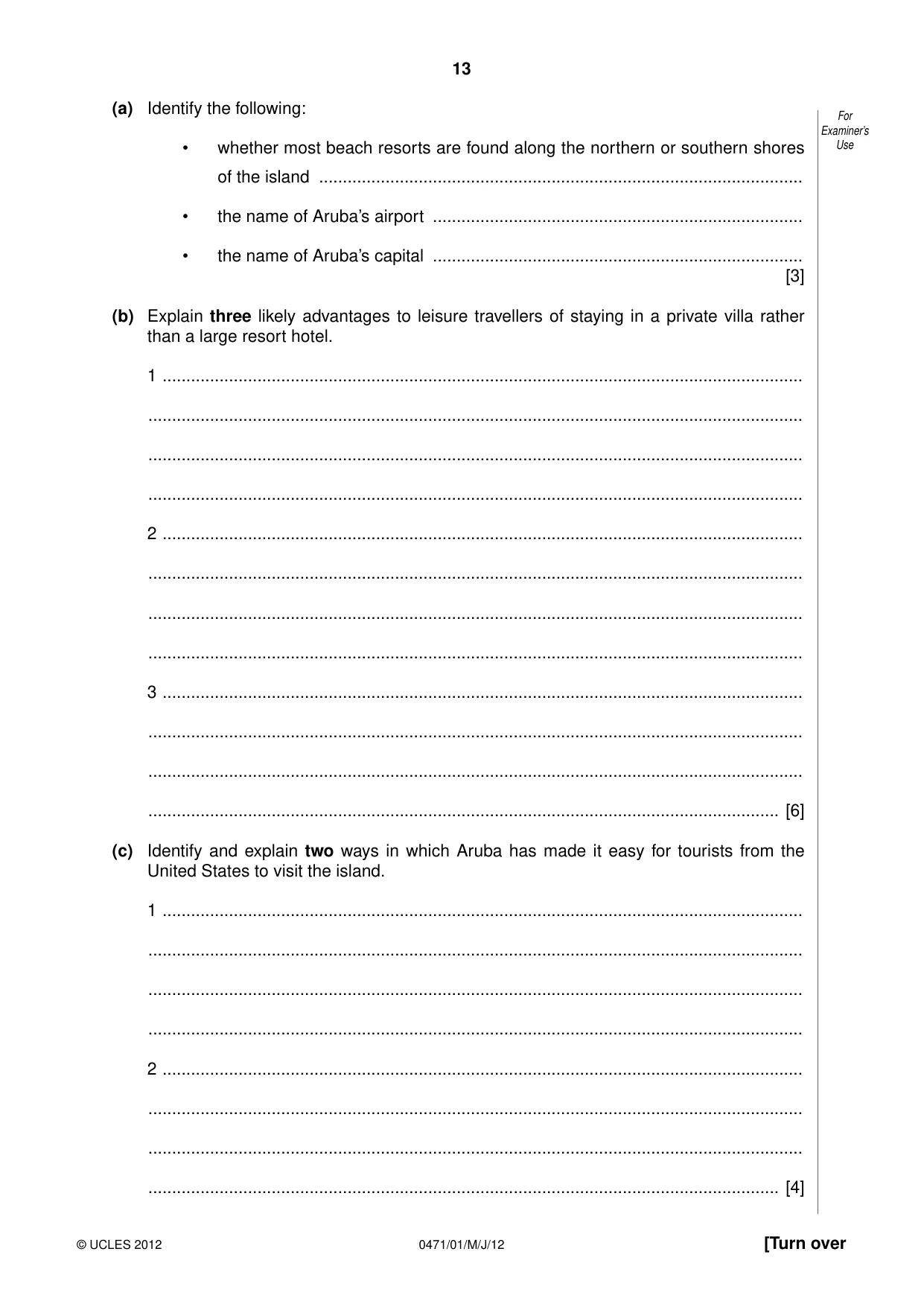
13 0471/01/M/J/12 © UCLES 2012 [Turn over For Examiner’s Use (a) Identify the following: • whether most beach resorts are found along the northern or southern shores of the island … • the name of Aruba’s airport … • the name of Aruba’s capital … [3] (b) Explain three likely advantages to leisure travellers of staying in a private villa rather than a large resort hotel. 1 … … … … 2 … … … … 3 … … … … [6] (c) Identify and explain two ways in which Aruba has made it easy for tourists from the United States to visit the island. 1 … … … … 2 … … … … [4]
Question paper, page 14
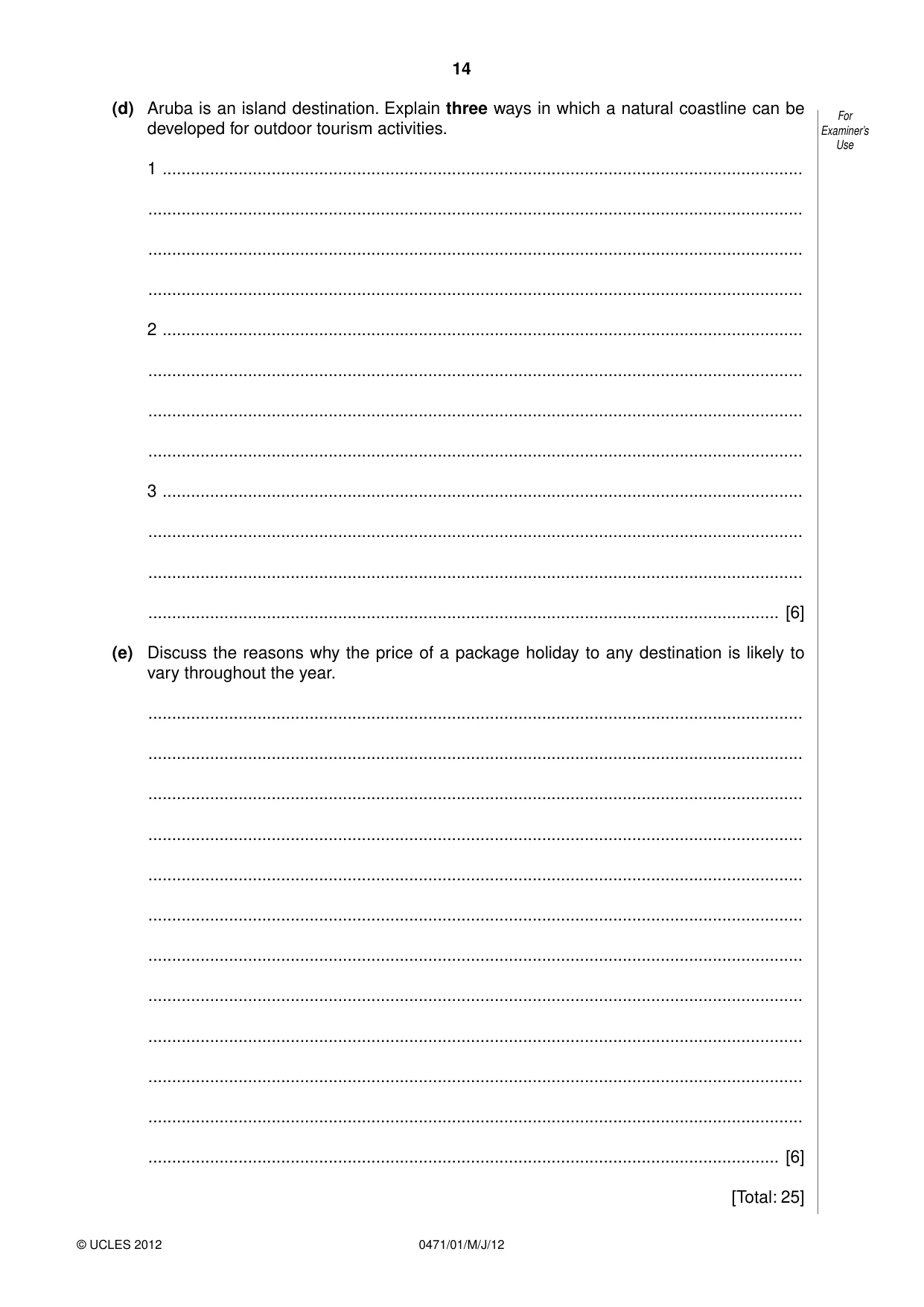
14 0471/01/M/J/12 © UCLES 2012 For Examiner’s Use (d) Aruba is an island destination. Explain three ways in which a natural coastline can be developed for outdoor tourism activities. 1 … … … … 2 … … … … 3 … … … … [6] (e) Discuss the reasons why the price of a package holiday to any destination is likely to vary throughout the year. … … … … … … … … … … … … [6] [Total: 25]
Question paper, page 15
15 0471/01/M/J/12 © UCLES 2012 BLANK PAGE
Question paper, page 16
16 0471/01/M/J/12 © UCLES 2012 BLANK PAGE Copyright Acknowledgements: Question 2 Photograph © iStock ref. 15705221; SoopySue; Samburu girls dancing with a group of morani (warriors) Kenya; www.istockphoto.com Question 3 Figure 3 © ADAPTED; http://www.phnompenhpost.com/index.php/2010072640779/Business/tourist-arrivals-surge-past-ministry- forecast.html Question 4 © ADAPTED; www.aruba.com/TraveltoAruba/maps.aspx. Permission to reproduce items where third-party owned material protected by copyright is included has been sought and cleared where possible. Every reasonable effort has been made by the publisher (UCLES) to trace copyright holders, but if any items requiring clearance have unwittingly been included, the publisher will be pleased to make amends at the earliest possible opportunity. University of Cambridge International Examinations is part of the Cambridge Assessment Group. Cambridge Assessment is the brand name of University of Cambridge Local Examinations Syndicate (UCLES), which is itself a department of the University of Cambridge.
Mark scheme, page 1
UNIVERSITY OF CAMBRIDGE INTERNATIONAL EXAMINATIONS International General Certificate of Secondary Education MARK SCHEME for the May/June 2012 question paper for the guidance of teachers 0471 TRAVEL AND TOURISM 0471/01 Paper 1 (Written Paper), maximum raw mark 100 This mark scheme is published as an aid to teachers and candidates, to indicate the requirements of the examination. It shows the basis on which Examiners were instructed to award marks. It does not indicate the details of the discussions that took place at an Examiners’ meeting before marking began, which would have considered the acceptability of alternative answers. Mark schemes must be read in conjunction with the question papers and the report on the examination. • Cambridge will not enter into discussions or correspondence in connection with these mark schemes. Cambridge is publishing the mark schemes for the May/June 2012 question papers for most IGCSE, GCE Advanced Level and Advanced Subsidiary Level syllabuses and some Ordinary Level syllabuses. www.XtremePapers.com
Mark scheme, page 2
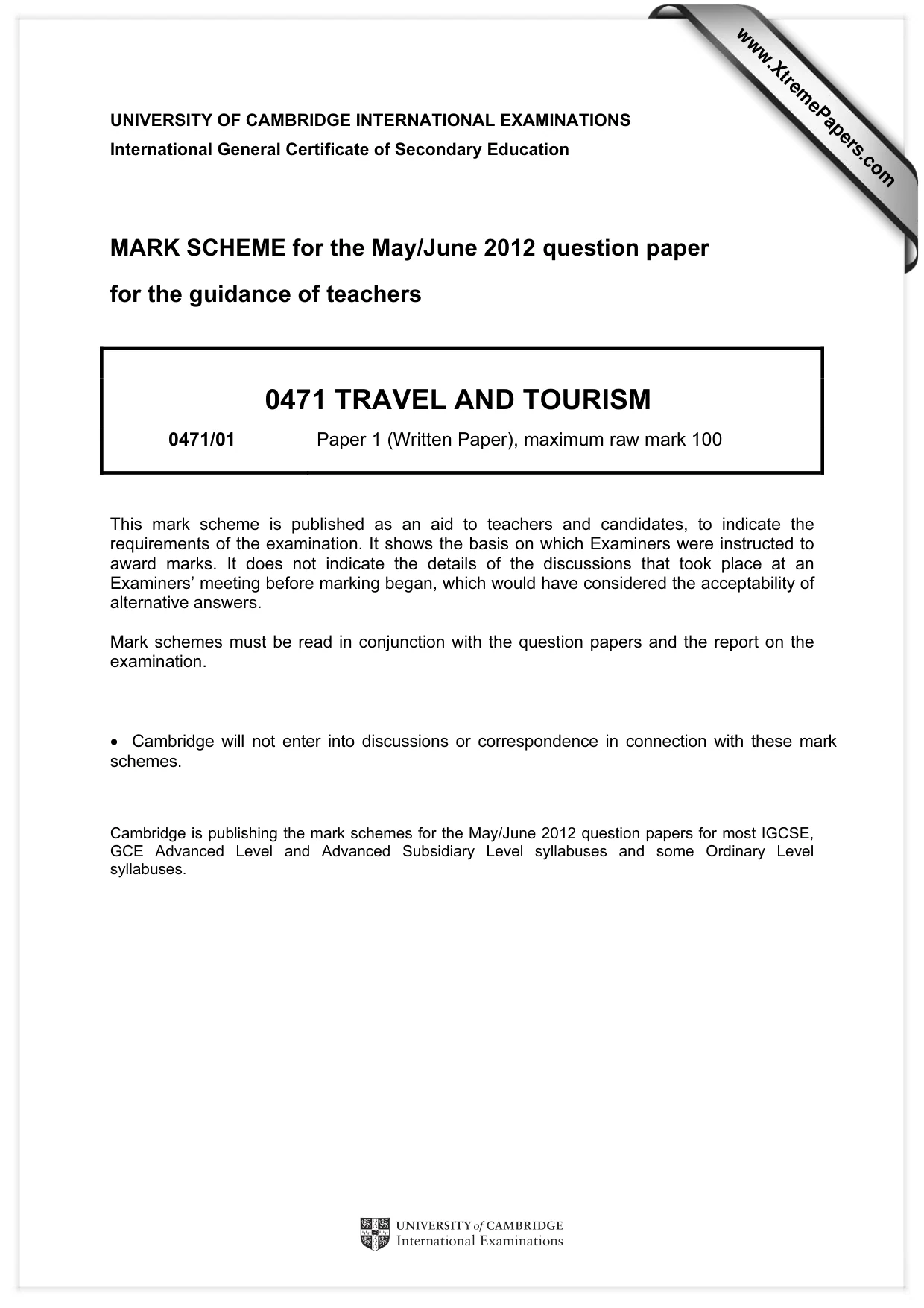
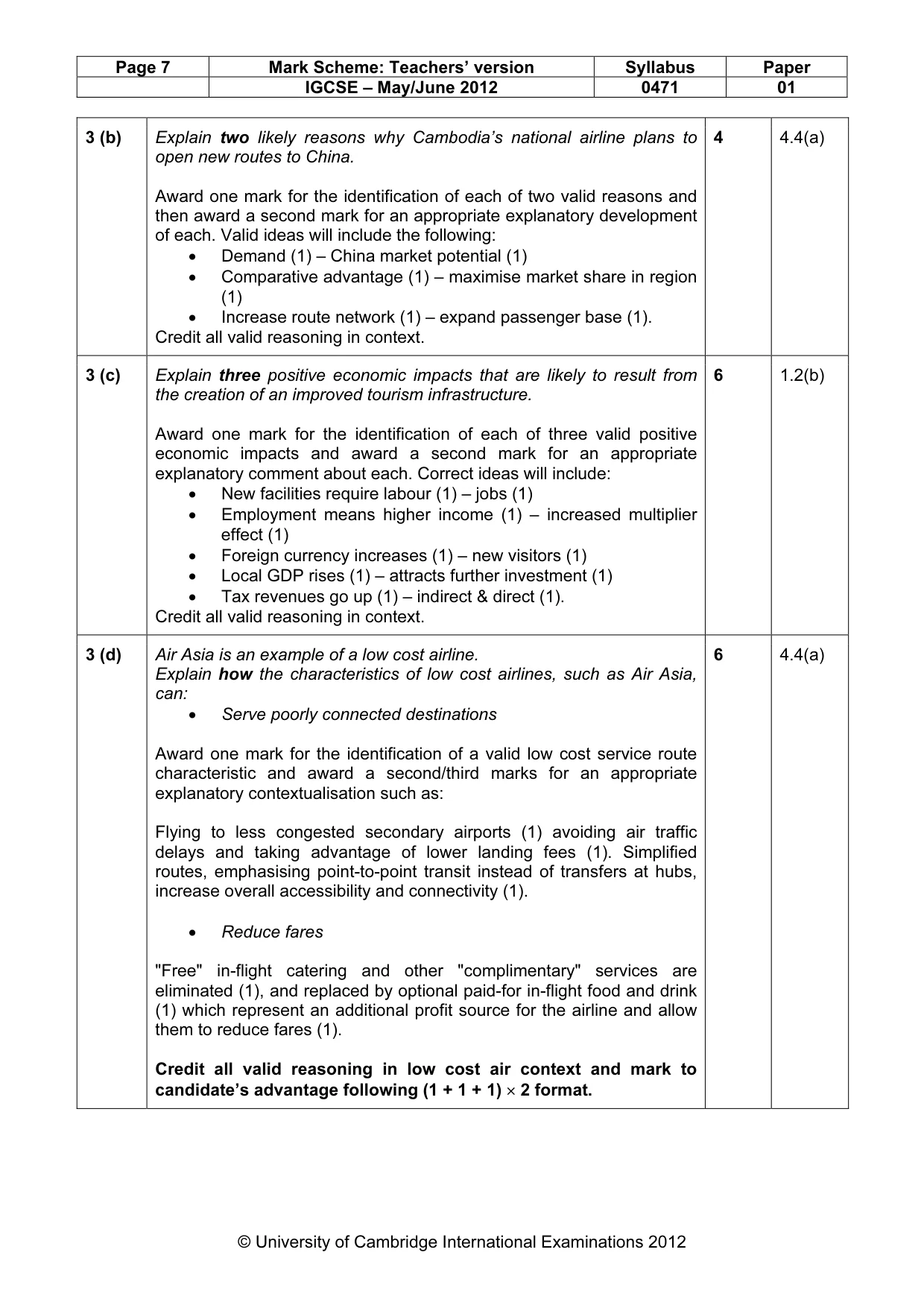
Page 2 Mark Scheme: Teachers’ version Syllabus Paper IGCSE – May/June 2012 0471 01 © University of Cambridge International Examinations 2012 Q. No. Expected Answer Mark Focus 1 (a) Identify three outdoor activities that might be developed in the Tutong District of Brunei. Award one mark for the correct identification of each of three outdoor activities from: • river cruises (on the river Sungai Tutong) • surfing • kayaking • birdwatching and • walks (along the hilly Mukim Rambai area). 3 2.4(a) 1 (b) State the following: Award one mark for each as follows: • Climate = Equatorial • Island = Borneo • Attraction = Seri Kenangan beach • Time = Advance 4 2.2(a) 2.2(b) 2.4(a) 1 (c) Areas of outstanding natural beauty usually contain sites that act as ‘honeypots’ attracting large numbers of visitors. Explain three ways in which such ‘honeypot’ sites can be managed to prevent visitor congestion. Award one mark for the correct identification of each of three valid control methods in a rural AONB context and award a second mark for an appropriate explanation as to how congestion might be relieved or avoided in each case. Correct ideas will include: • Signage (1) – to avoid entrance queues etc. (1) and can indicate clear paths/routes (1) • Limit larger groups (1) – coach parties only at certain times or must have guide etc. (1) • Designated car/coach parking areas (1) – even out flow of visitors (1) • More staff at busy times (1) – gives increased capacity when needed (1) and can provide additional services e.g. shop, visitor centre etc. (1) • Set limits (1) – have overspill facilities (1) and close when full (1). Credit all valid reasoning. 6 1.2(c)
Mark scheme, page 3
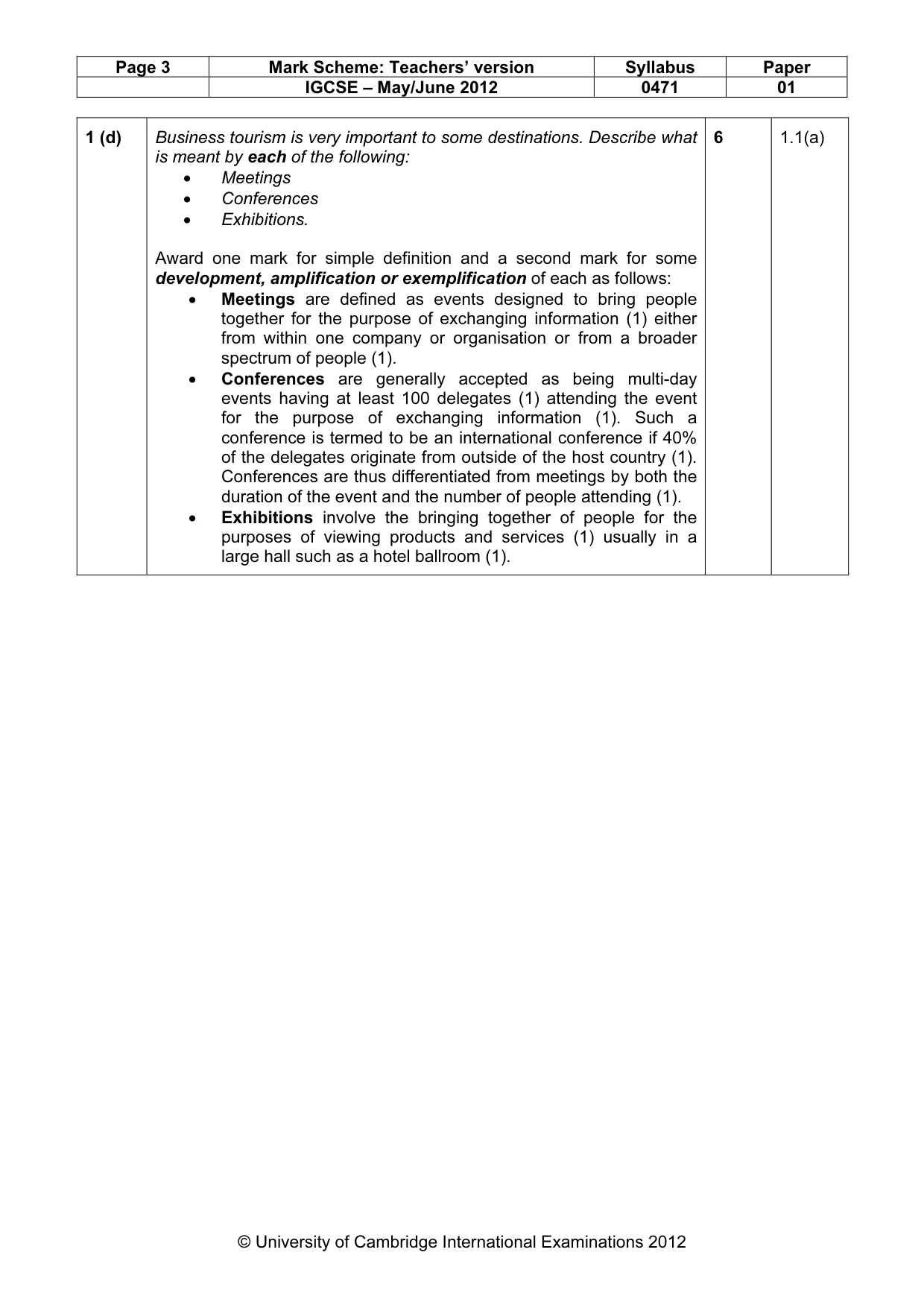
Page 3 Mark Scheme: Teachers’ version Syllabus Paper IGCSE – May/June 2012 0471 01 © University of Cambridge International Examinations 2012 1 (d) Business tourism is very important to some destinations. Describe what is meant by each of the following: • Meetings • Conferences • Exhibitions. Award one mark for simple definition and a second mark for some development, amplification or exemplification of each as follows: • Meetings are defined as events designed to bring people together for the purpose of exchanging information (1) either from within one company or organisation or from a broader spectrum of people (1). • Conferences are generally accepted as being multi-day events having at least 100 delegates (1) attending the event for the purpose of exchanging information (1). Such a conference is termed to be an international conference if 40% of the delegates originate from outside of the host country (1). Conferences are thus differentiated from meetings by both the duration of the event and the number of people attending (1). • Exhibitions involve the bringing together of people for the purposes of viewing products and services (1) usually in a large hall such as a hotel ballroom (1). 6 1.1(a)
Mark scheme, page 4
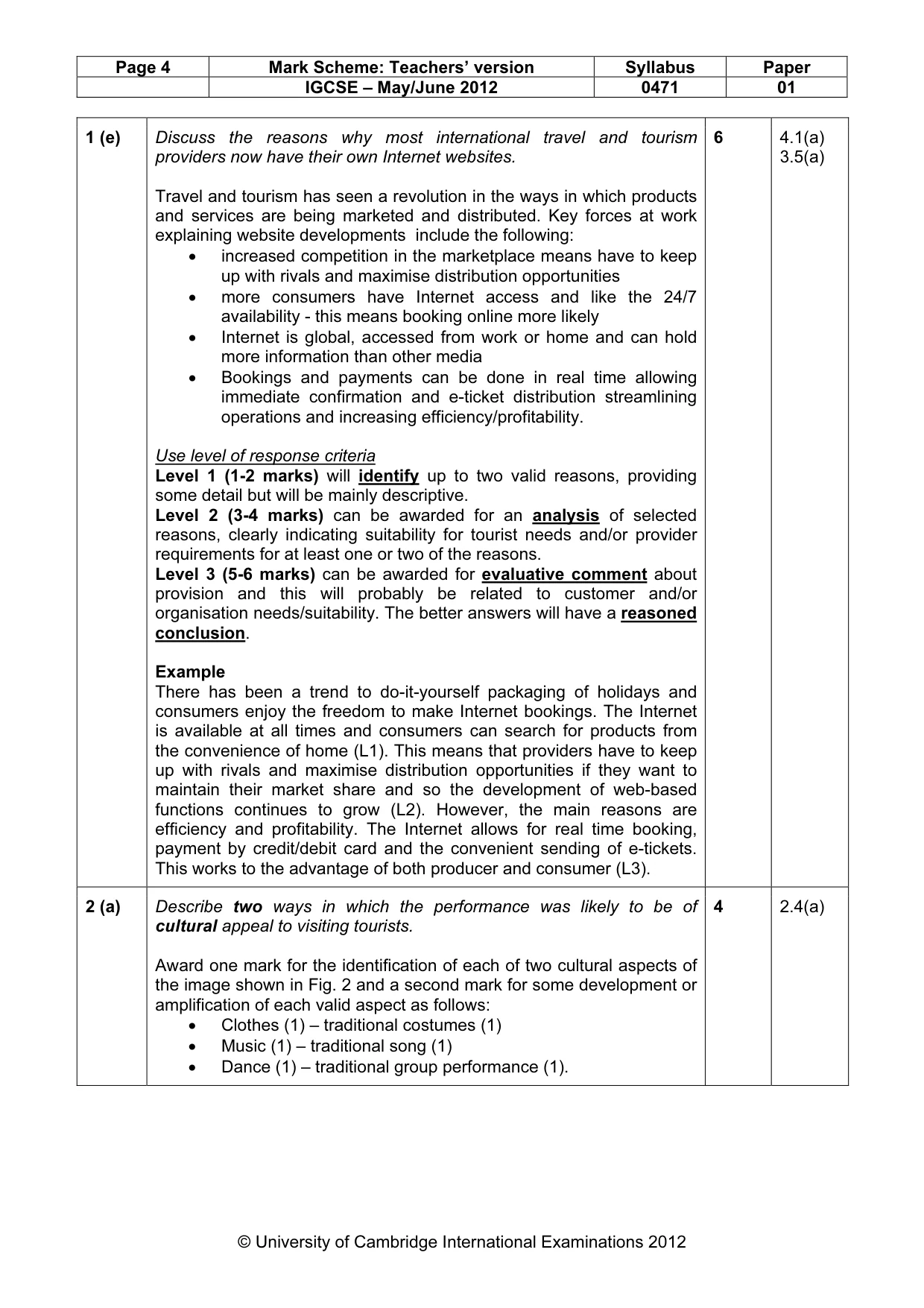
Page 4 Mark Scheme: Teachers’ version Syllabus Paper IGCSE – May/June 2012 0471 01 © University of Cambridge International Examinations 2012 1 (e) Discuss the reasons why most international travel and tourism providers now have their own Internet websites. Travel and tourism has seen a revolution in the ways in which products and services are being marketed and distributed. Key forces at work explaining website developments include the following: • increased competition in the marketplace means have to keep up with rivals and maximise distribution opportunities • more consumers have Internet access and like the 24/7 availability - this means booking online more likely • Internet is global, accessed from work or home and can hold more information than other media • Bookings and payments can be done in real time allowing immediate confirmation and e-ticket distribution streamlining operations and increasing efficiency/profitability. Use level of response criteria Level 1 (1-2 marks) will identify up to two valid reasons, providing some detail but will be mainly descriptive. Level 2 (3-4 marks) can be awarded for an analysis of selected reasons, clearly indicating suitability for tourist needs and/or provider requirements for at least one or two of the reasons. Level 3 (5-6 marks) can be awarded for evaluative comment about provision and this will probably be related to customer and/or organisation needs/suitability. The better answers will have a reasoned conclusion. Example There has been a trend to do-it-yourself packaging of holidays and consumers enjoy the freedom to make Internet bookings. The Internet is available at all times and consumers can search for products from the convenience of home (L1). This means that providers have to keep up with rivals and maximise distribution opportunities if they want to maintain their market share and so the development of web-based functions continues to grow (L2). However, the main reasons are efficiency and profitability. The Internet allows for real time booking, payment by credit/debit card and the convenient sending of e-tickets. This works to the advantage of both producer and consumer (L3). 6 4.1(a) 3.5(a) 2 (a) Describe two ways in which the performance was likely to be of cultural appeal to visiting tourists. Award one mark for the identification of each of two cultural aspects of the image shown in Fig. 2 and a second mark for some development or amplification of each valid aspect as follows: • Clothes (1) – traditional costumes (1) • Music (1) – traditional song (1) • Dance (1) – traditional group performance (1). 4 2.4(a)
Mark scheme, page 5
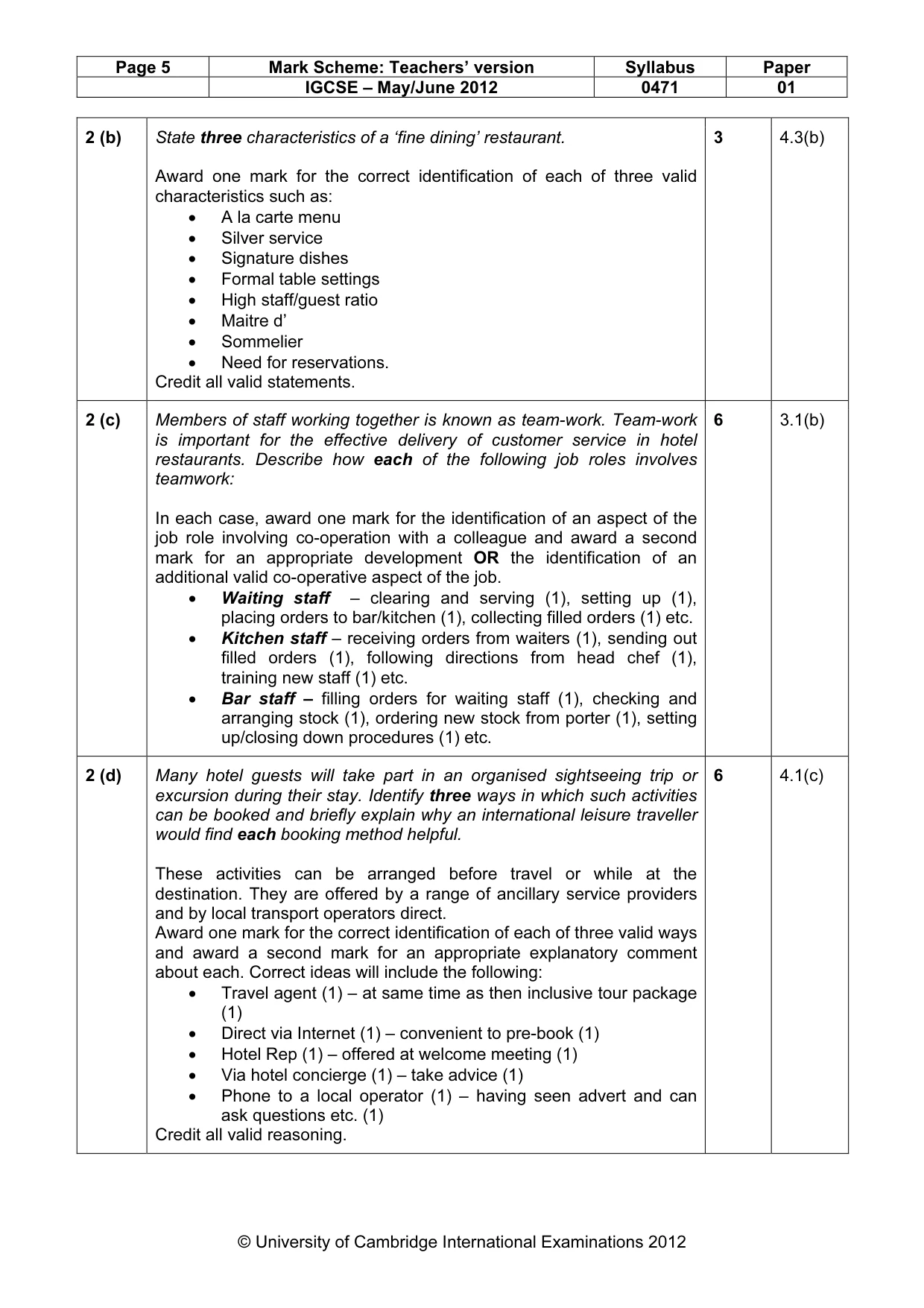
Page 5 Mark Scheme: Teachers’ version Syllabus Paper IGCSE – May/June 2012 0471 01 © University of Cambridge International Examinations 2012 2 (b) State three characteristics of a ‘fine dining’ restaurant. Award one mark for the correct identification of each of three valid characteristics such as: • A la carte menu • Silver service • Signature dishes • Formal table settings • High staff/guest ratio • Maitre d’ • Sommelier • Need for reservations. Credit all valid statements. 3 4.3(b) 2 (c) Members of staff working together is known as team-work. Team-work is important for the effective delivery of customer service in hotel restaurants. Describe how each of the following job roles involves teamwork: In each case, award one mark for the identification of an aspect of the job role involving co-operation with a colleague and award a second mark for an appropriate development OR the identification of an additional valid co-operative aspect of the job. • Waiting staff – clearing and serving (1), setting up (1), placing orders to bar/kitchen (1), collecting filled orders (1) etc. • Kitchen staff – receiving orders from waiters (1), sending out filled orders (1), following directions from head chef (1), training new staff (1) etc. • Bar staff – filling orders for waiting staff (1), checking and arranging stock (1), ordering new stock from porter (1), setting up/closing down procedures (1) etc. 6 3.1(b) 2 (d) Many hotel guests will take part in an organised sightseeing trip or excursion during their stay. Identify three ways in which such activities can be booked and briefly explain why an international leisure traveller would find each booking method helpful. These activities can be arranged before travel or while at the destination. They are offered by a range of ancillary service providers and by local transport operators direct. Award one mark for the correct identification of each of three valid ways and award a second mark for an appropriate explanatory comment about each. Correct ideas will include the following: • Travel agent (1) – at same time as then inclusive tour package (1) • Direct via Internet (1) – convenient to pre-book (1) • Hotel Rep (1) – offered at welcome meeting (1) • Via hotel concierge (1) – take advice (1) • Phone to a local operator (1) – having seen advert and can ask questions etc. (1) Credit all valid reasoning. 6 4.1(c)
Mark scheme, page 6
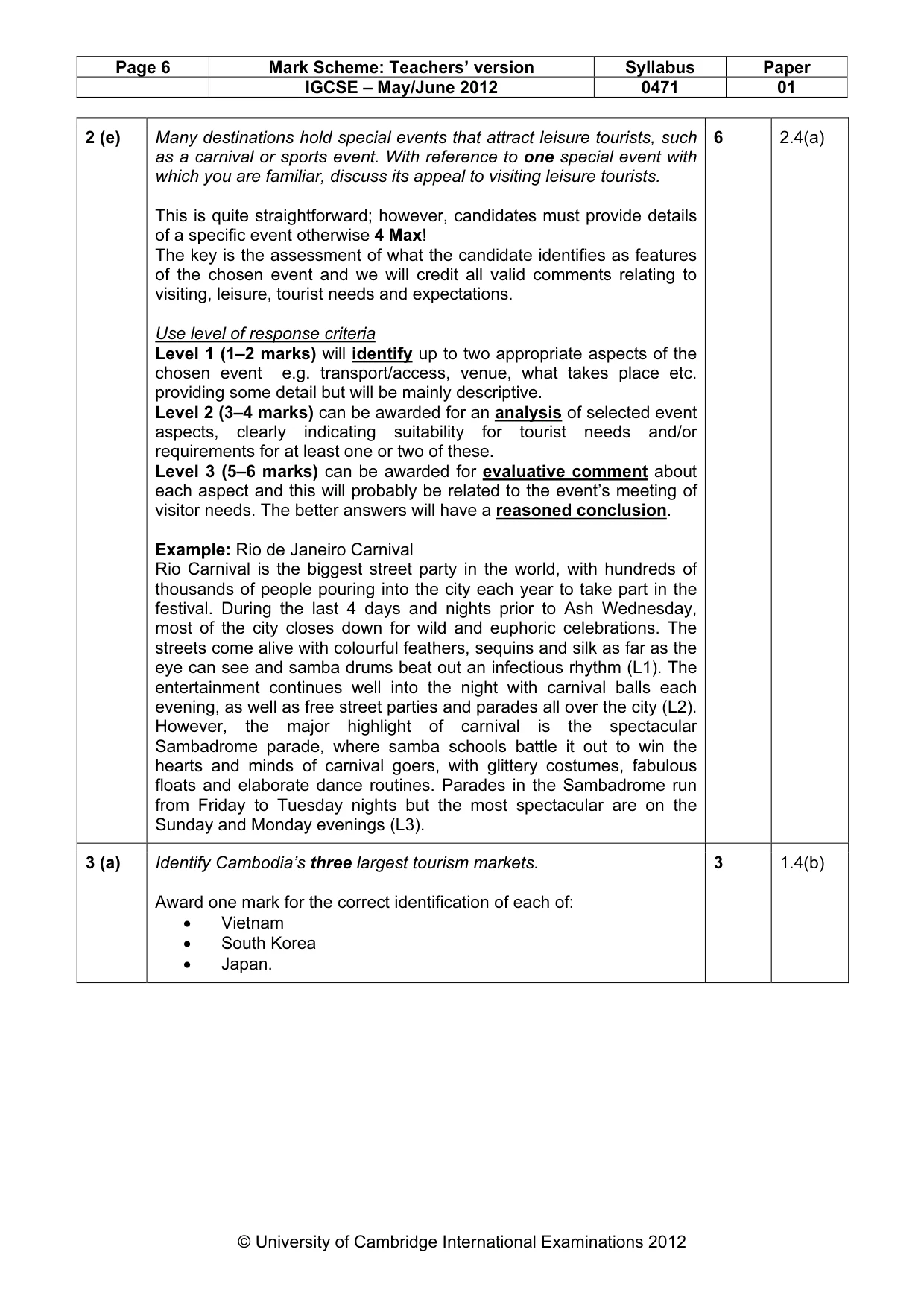
Page 6 Mark Scheme: Teachers’ version Syllabus Paper IGCSE – May/June 2012 0471 01 © University of Cambridge International Examinations 2012 2 (e) Many destinations hold special events that attract leisure tourists, such as a carnival or sports event. With reference to one special event with which you are familiar, discuss its appeal to visiting leisure tourists. This is quite straightforward; however, candidates must provide details of a specific event otherwise 4 Max! The key is the assessment of what the candidate identifies as features of the chosen event and we will credit all valid comments relating to visiting, leisure, tourist needs and expectations. Use level of response criteria Level 1 (1–2 marks) will identify up to two appropriate aspects of the chosen event e.g. transport/access, venue, what takes place etc. providing some detail but will be mainly descriptive. Level 2 (3–4 marks) can be awarded for an analysis of selected event aspects, clearly indicating suitability for tourist needs and/or requirements for at least one or two of these. Level 3 (5–6 marks) can be awarded for evaluative comment about each aspect and this will probably be related to the event’s meeting of visitor needs. The better answers will have a reasoned conclusion. Example: Rio de Janeiro Carnival Rio Carnival is the biggest street party in the world, with hundreds of thousands of people pouring into the city each year to take part in the festival. During the last 4 days and nights prior to Ash Wednesday, most of the city closes down for wild and euphoric celebrations. The streets come alive with colourful feathers, sequins and silk as far as the eye can see and samba drums beat out an infectious rhythm (L1). The entertainment continues well into the night with carnival balls each evening, as well as free street parties and parades all over the city (L2). However, the major highlight of carnival is the spectacular Sambadrome parade, where samba schools battle it out to win the hearts and minds of carnival goers, with glittery costumes, fabulous floats and elaborate dance routines. Parades in the Sambadrome run from Friday to Tuesday nights but the most spectacular are on the Sunday and Monday evenings (L3). 6 2.4(a) 3 (a) Identify Cambodia’s three largest tourism markets. Award one mark for the correct identification of each of: • Vietnam • South Korea • Japan. 3 1.4(b)
Mark scheme, page 7
Page 7 Mark Scheme: Teachers’ version Syllabus Paper IGCSE – May/June 2012 0471 01 © University of Cambridge International Examinations 2012 3 (b) Explain two likely reasons why Cambodia’s national airline plans to open new routes to China. Award one mark for the identification of each of two valid reasons and then award a second mark for an appropriate explanatory development of each. Valid ideas will include the following: • Demand (1) – China market potential (1) • Comparative advantage (1) – maximise market share in region (1) • Increase route network (1) – expand passenger base (1). Credit all valid reasoning in context. 4 4.4(a) 3 (c) Explain three positive economic impacts that are likely to result from the creation of an improved tourism infrastructure. Award one mark for the identification of each of three valid positive economic impacts and award a second mark for an appropriate explanatory comment about each. Correct ideas will include: • New facilities require labour (1) – jobs (1) • Employment means higher income (1) – increased multiplier effect (1) • Foreign currency increases (1) – new visitors (1) • Local GDP rises (1) – attracts further investment (1) • Tax revenues go up (1) – indirect & direct (1). Credit all valid reasoning in context. 6 1.2(b) 3 (d) Air Asia is an example of a low cost airline. Explain how the characteristics of low cost airlines, such as Air Asia, can: • Serve poorly connected destinations Award one mark for the identification of a valid low cost service route characteristic and award a second/third marks for an appropriate explanatory contextualisation such as: Flying to less congested secondary airports (1) avoiding air traffic delays and taking advantage of lower landing fees (1). Simplified routes, emphasising point-to-point transit instead of transfers at hubs, increase overall accessibility and connectivity (1). • Reduce fares "Free" in-flight catering and other "complimentary" services are eliminated (1), and replaced by optional paid-for in-flight food and drink (1) which represent an additional profit source for the airline and allow them to reduce fares (1). Credit all valid reasoning in low cost air context and mark to candidate’s advantage following (1 + 1 + 1) × 2 format. 6 4.4(a)
Mark scheme, page 8
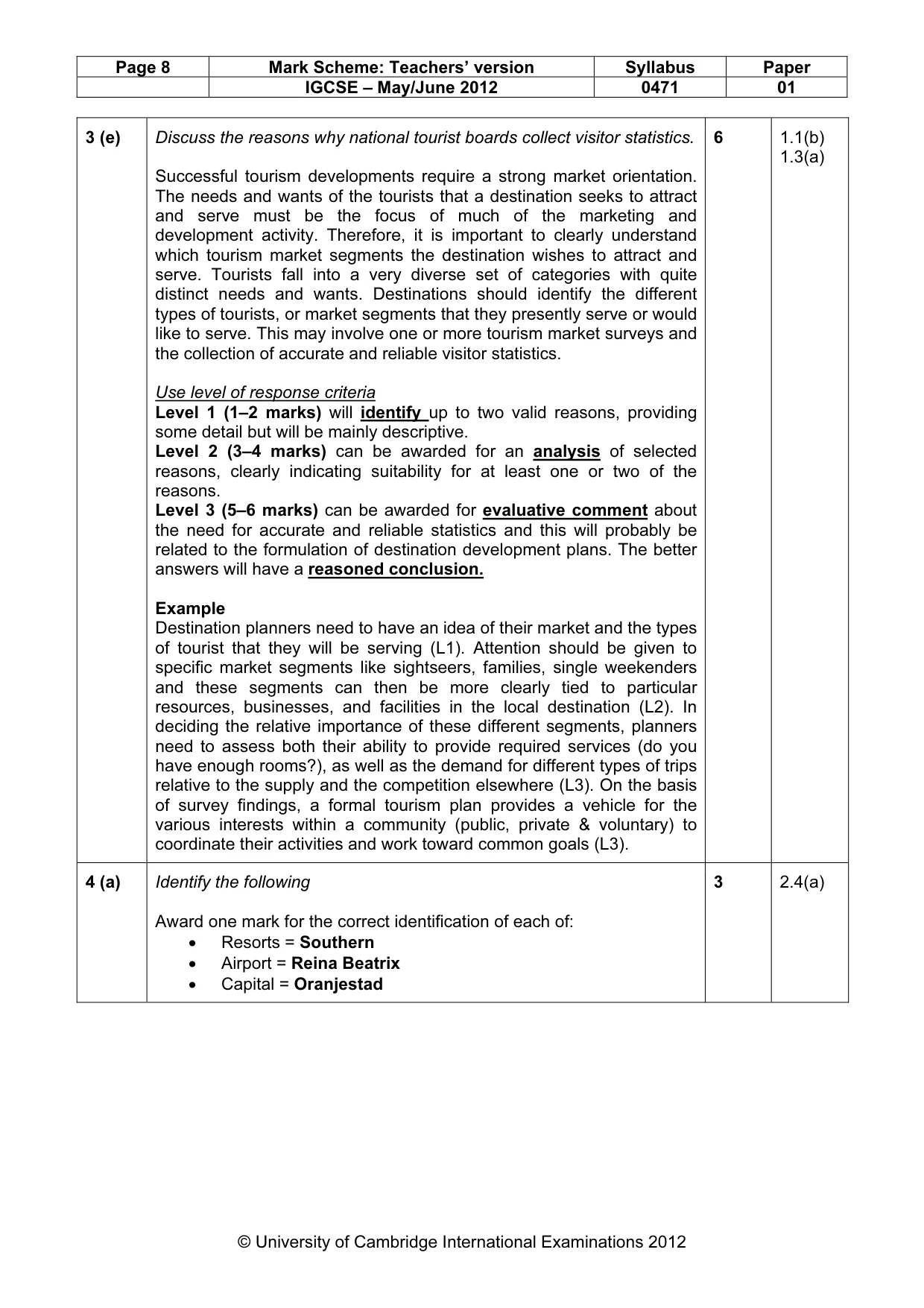
Page 8 Mark Scheme: Teachers’ version Syllabus Paper IGCSE – May/June 2012 0471 01 © University of Cambridge International Examinations 2012 3 (e) Discuss the reasons why national tourist boards collect visitor statistics. Successful tourism developments require a strong market orientation. The needs and wants of the tourists that a destination seeks to attract and serve must be the focus of much of the marketing and development activity. Therefore, it is important to clearly understand which tourism market segments the destination wishes to attract and serve. Tourists fall into a very diverse set of categories with quite distinct needs and wants. Destinations should identify the different types of tourists, or market segments that they presently serve or would like to serve. This may involve one or more tourism market surveys and the collection of accurate and reliable visitor statistics. Use level of response criteria Level 1 (1–2 marks) will identify up to two valid reasons, providing some detail but will be mainly descriptive. Level 2 (3–4 marks) can be awarded for an analysis of selected reasons, clearly indicating suitability for at least one or two of the reasons. Level 3 (5–6 marks) can be awarded for evaluative comment about the need for accurate and reliable statistics and this will probably be related to the formulation of destination development plans. The better answers will have a reasoned conclusion. Example Destination planners need to have an idea of their market and the types of tourist that they will be serving (L1). Attention should be given to specific market segments like sightseers, families, single weekenders and these segments can then be more clearly tied to particular resources, businesses, and facilities in the local destination (L2). In deciding the relative importance of these different segments, planners need to assess both their ability to provide required services (do you have enough rooms?), as well as the demand for different types of trips relative to the supply and the competition elsewhere (L3). On the basis of survey findings, a formal tourism plan provides a vehicle for the various interests within a community (public, private & voluntary) to coordinate their activities and work toward common goals (L3). 6 1.1(b) 1.3(a) 4 (a) Identify the following Award one mark for the correct identification of each of: • Resorts = Southern • Airport = Reina Beatrix • Capital = Oranjestad 3 2.4(a)
Mark scheme, page 9
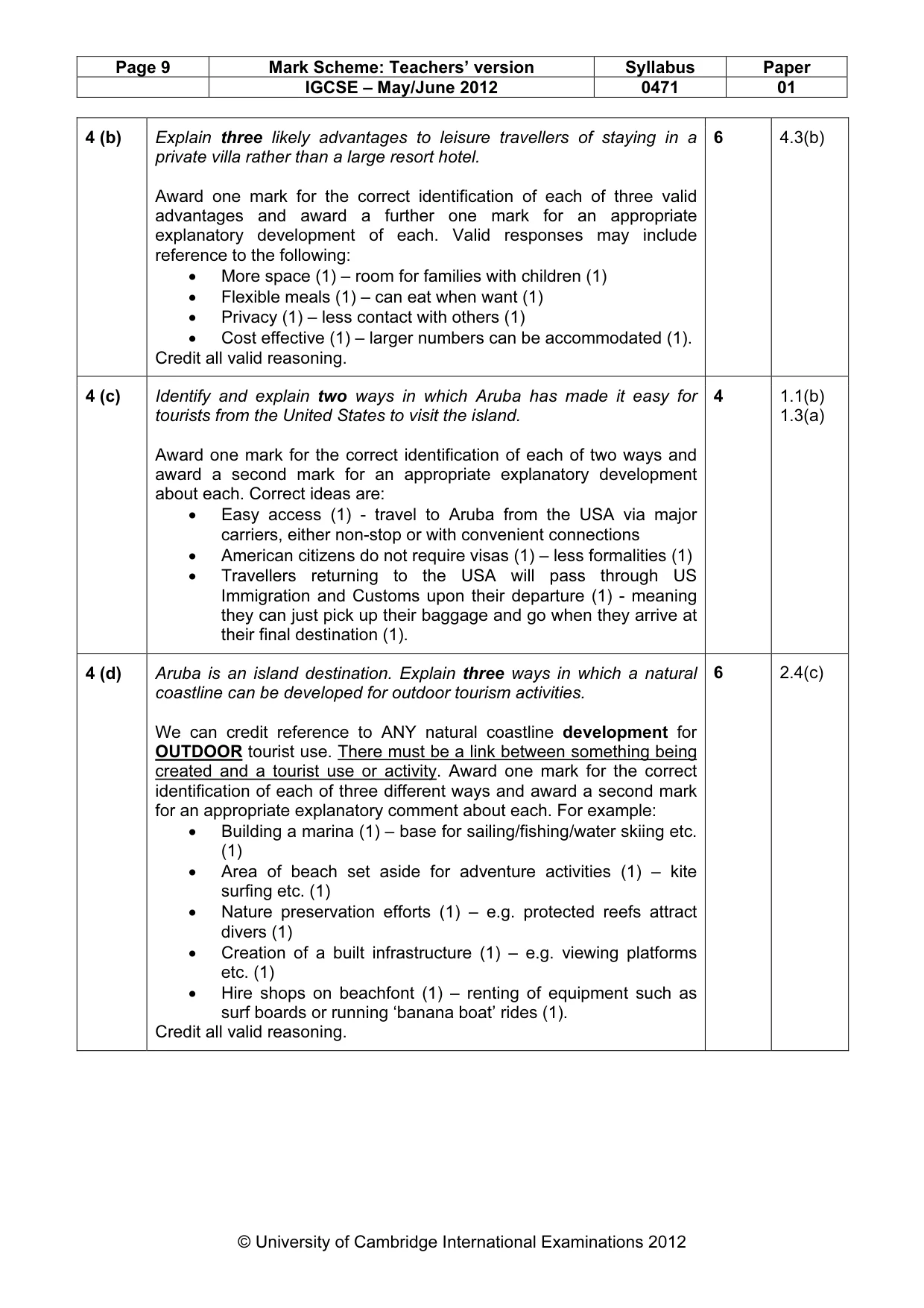
Page 9 Mark Scheme: Teachers’ version Syllabus Paper IGCSE – May/June 2012 0471 01 © University of Cambridge International Examinations 2012 4 (b) Explain three likely advantages to leisure travellers of staying in a private villa rather than a large resort hotel. Award one mark for the correct identification of each of three valid advantages and award a further one mark for an appropriate explanatory development of each. Valid responses may include reference to the following: • More space (1) – room for families with children (1) • Flexible meals (1) – can eat when want (1) • Privacy (1) – less contact with others (1) • Cost effective (1) – larger numbers can be accommodated (1). Credit all valid reasoning. 6 4.3(b) 4 (c) Identify and explain two ways in which Aruba has made it easy for tourists from the United States to visit the island. Award one mark for the correct identification of each of two ways and award a second mark for an appropriate explanatory development about each. Correct ideas are: • Easy access (1) - travel to Aruba from the USA via major carriers, either non-stop or with convenient connections • American citizens do not require visas (1) – less formalities (1) • Travellers returning to the USA will pass through US Immigration and Customs upon their departure (1) - meaning they can just pick up their baggage and go when they arrive at their final destination (1). 4 1.1(b) 1.3(a) 4 (d) Aruba is an island destination. Explain three ways in which a natural coastline can be developed for outdoor tourism activities. We can credit reference to ANY natural coastline development for OUTDOOR tourist use. There must be a link between something being created and a tourist use or activity. Award one mark for the correct identification of each of three different ways and award a second mark for an appropriate explanatory comment about each. For example: • Building a marina (1) – base for sailing/fishing/water skiing etc. (1) • Area of beach set aside for adventure activities (1) – kite surfing etc. (1) • Nature preservation efforts (1) – e.g. protected reefs attract divers (1) • Creation of a built infrastructure (1) – e.g. viewing platforms etc. (1) • Hire shops on beachfont (1) – renting of equipment such as surf boards or running ‘banana boat’ rides (1). Credit all valid reasoning. 6 2.4(c)
Mark scheme, page 10
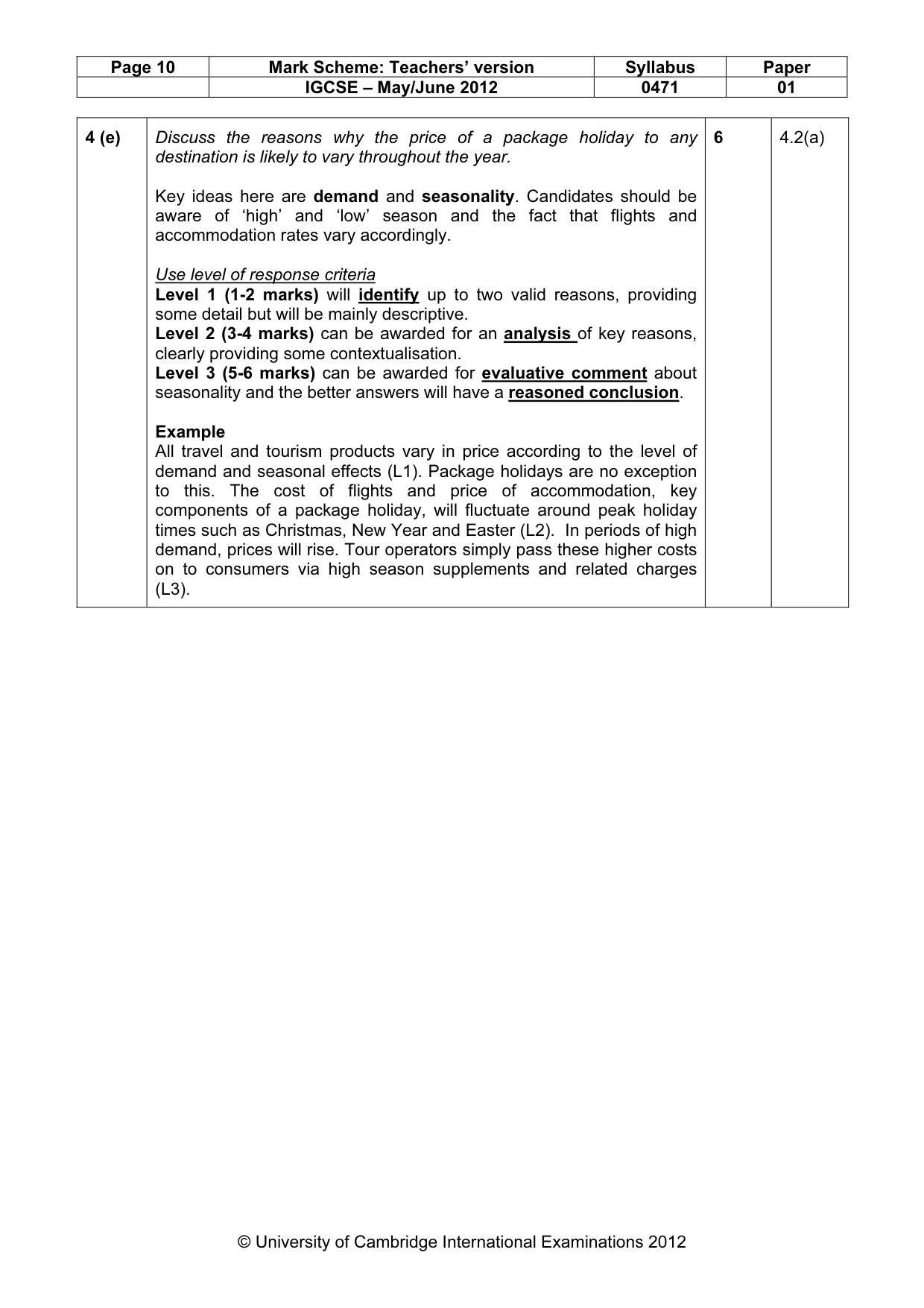
Page 10 Mark Scheme: Teachers’ version Syllabus Paper IGCSE – May/June 2012 0471 01 © University of Cambridge International Examinations 2012 4 (e) Discuss the reasons why the price of a package holiday to any destination is likely to vary throughout the year. Key ideas here are demand and seasonality. Candidates should be aware of ‘high’ and ‘low’ season and the fact that flights and accommodation rates vary accordingly. Use level of response criteria Level 1 (1-2 marks) will identify up to two valid reasons, providing some detail but will be mainly descriptive. Level 2 (3-4 marks) can be awarded for an analysis of key reasons, clearly providing some contextualisation. Level 3 (5-6 marks) can be awarded for evaluative comment about seasonality and the better answers will have a reasoned conclusion. Example All travel and tourism products vary in price according to the level of demand and seasonal effects (L1). Package holidays are no exception to this. The cost of flights and price of accommodation, key components of a package holiday, will fluctuate around peak holiday times such as Christmas, New Year and Easter (L2). In periods of high demand, prices will rise. Tour operators simply pass these higher costs on to consumers via high season supplements and related charges (L3). 6 4.2(a)
What you needed in this session
Cambridge’s own grade thresholds for 2012 May/June, Paper 1 · Variant 1. A higher threshold means an easier paper — the bar moves with how the cohort did.