Cambridge IGCSE Travel and Tourism 0471 — 2011 Oct/Nov Paper 2 · Variant 1
0471/21/O/N/11 · 100 marks · ≈113 min
The question paper and its mark scheme, free to read here and free to download. This is Cambridge’s own paper, exactly as it was sat.
Question paper16 pages


Mark scheme10 pages
Answers below. Sit the paper first if you are practising.
Paper as text
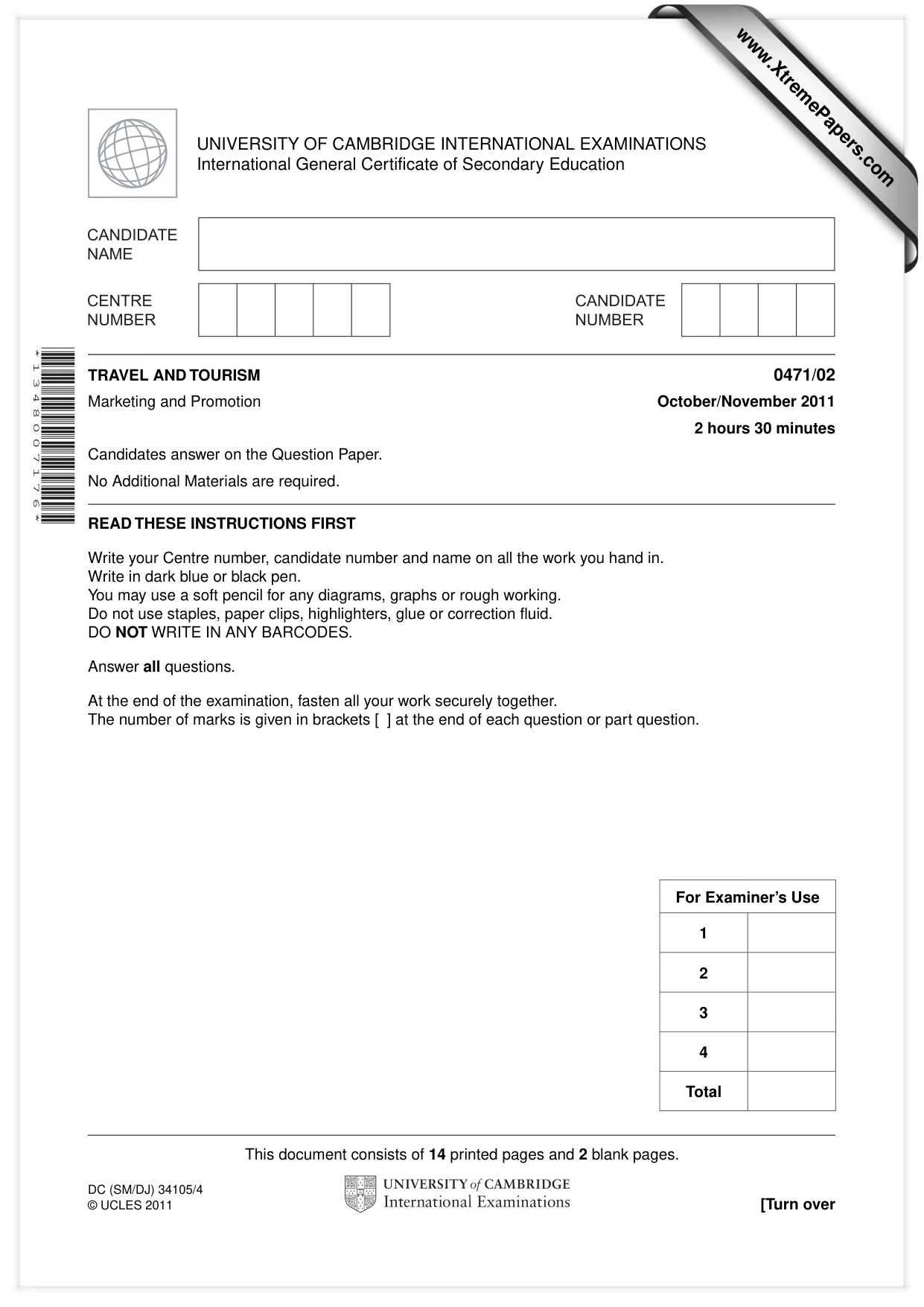
Question paper, page 1
This document consists of 14 printed pages and 2 blank pages. DC (SM/DJ) 34105/4 © UCLES 2011 [Turn over UNIVERSITY OF CAMBRIDGE INTERNATIONAL EXAMINATIONS International General Certificate of Secondary Education * 1 3 4 8 0 0 7 1 7 6 * TRAVEL AND TOURISM 0471/02 Marketing and Promotion October/November 2011 2 hours 30 minutes Candidates answer on the Question Paper. No Additional Materials are required. READ THESE INSTRUCTIONS FIRST Write your Centre number, candidate number and name on all the work you hand in. Write in dark blue or black pen. You may use a soft pencil for any diagrams, graphs or rough working. Do not use staples, paper clips, highlighters, glue or correction fluid. DO NOT WRITE IN ANY BARCODES. Answer all questions. At the end of the examination, fasten all your work securely together. The number of marks is given in brackets [ ] at the end of each question or part question. For Examiner’s Use 1 2 3 4 Total www.XtremePapers.com
Question paper, page 2
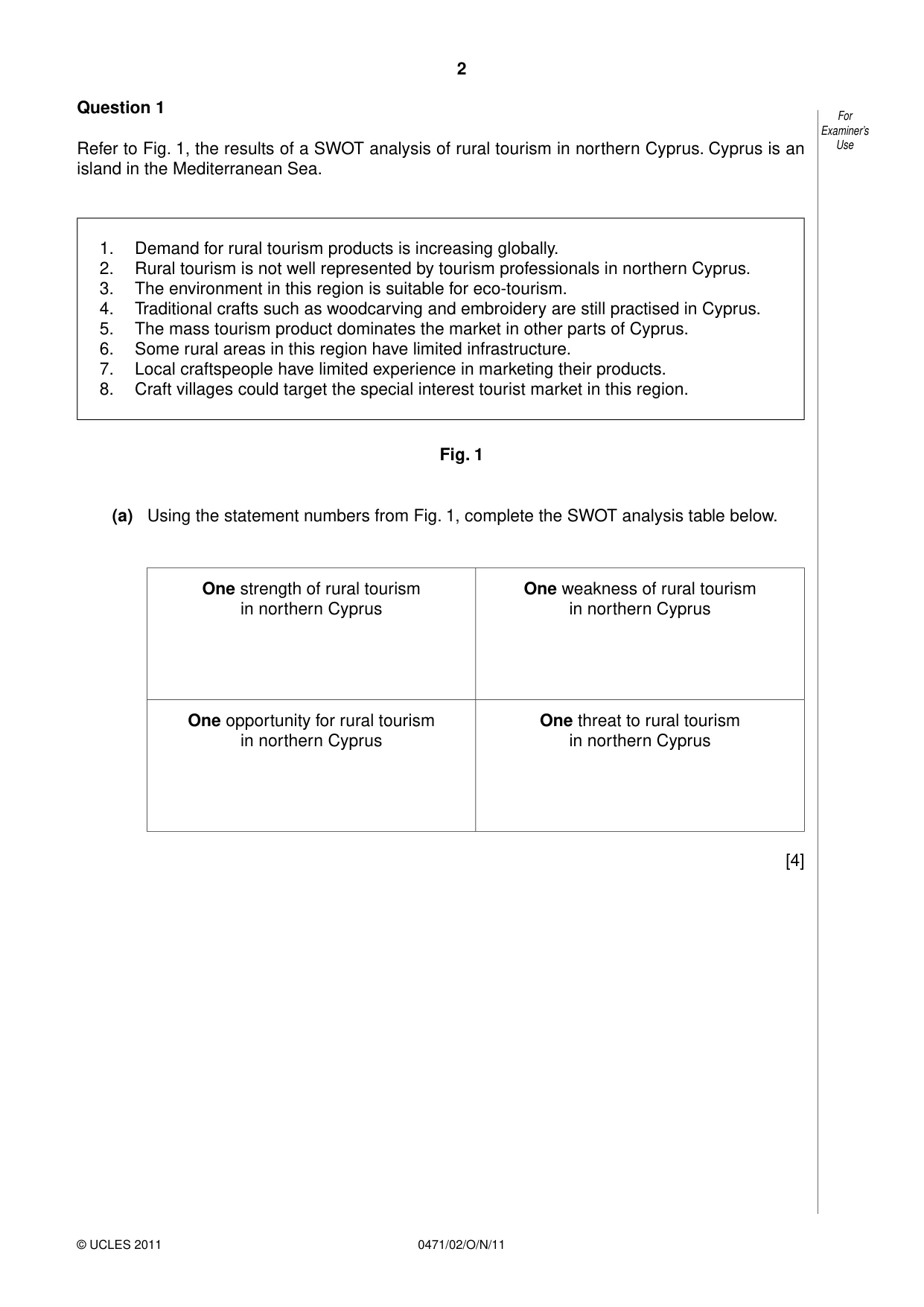
2 0471/02/O/N/11 © UCLES 2011 For Examiner’s Use Question 1 Refer to Fig. 1, the results of a SWOT analysis of rural tourism in northern Cyprus. Cyprus is an island in the Mediterranean Sea. 1. Demand for rural tourism products is increasing globally. 2. Rural tourism is not well represented by tourism professionals in northern Cyprus. 3. The environment in this region is suitable for eco-tourism. 4. Traditional crafts such as woodcarving and embroidery are still practised in Cyprus. 5. The mass tourism product dominates the market in other parts of Cyprus. 6. Some rural areas in this region have limited infrastructure. 7. Local craftspeople have limited experience in marketing their products. 8. Craft villages could target the special interest tourist market in this region. Fig. 1 (a) Using the statement numbers from Fig. 1, complete the SWOT analysis table below. One strength of rural tourism in northern Cyprus One weakness of rural tourism in northern Cyprus One opportunity for rural tourism in northern Cyprus One threat to rural tourism in northern Cyprus [4]
Question paper, page 3
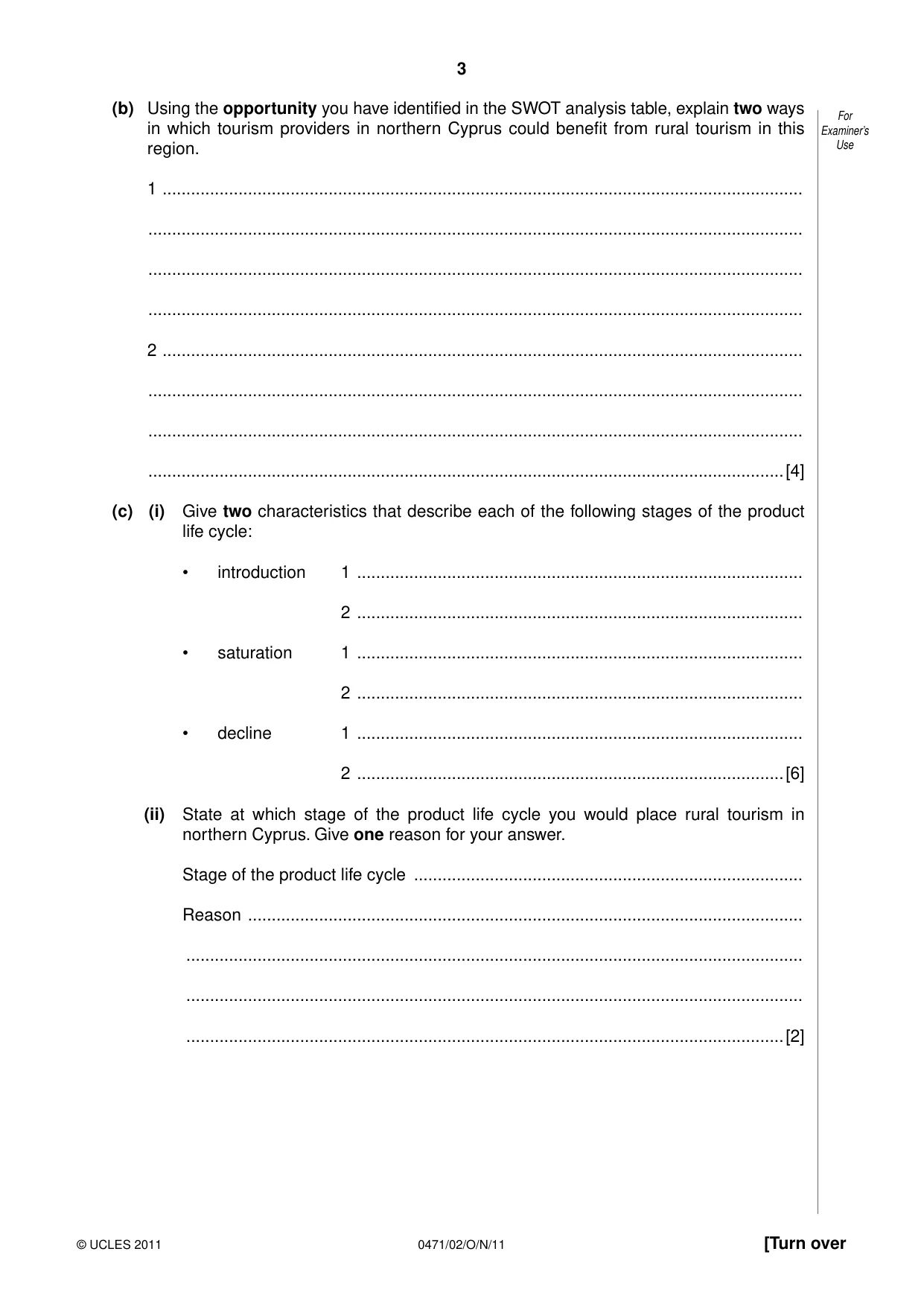
3 [Turn over © UCLES 2011 0471/02/O/N/11 For Examiner’s Use (b) Using the opportunity you have identified in the SWOT analysis table, explain two ways in which tourism providers in northern Cyprus could benefit from rural tourism in this region. 1 … … … … 2 … … … …[4] (c) (i) Give two characteristics that describe each of the following stages of the product life cycle: • introduction 1 … 2 … • saturation 1 … 2 … • decline 1 … 2 …[6] (ii) State at which stage of the product life cycle you would place rural tourism in northern Cyprus. Give one reason for your answer. Stage of the product life cycle … Reason … … … …[2]
Question paper, page 4
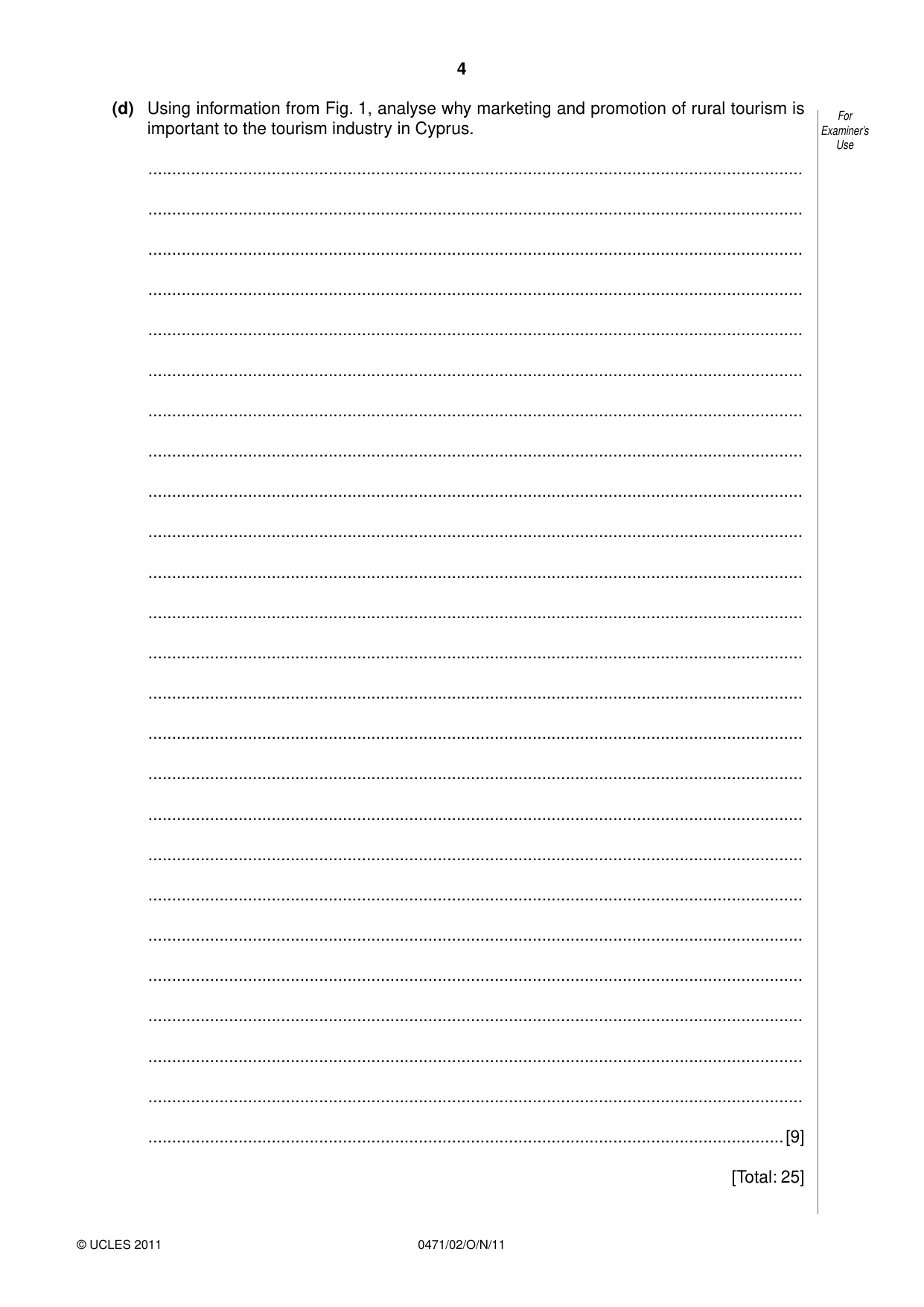
4 0471/02/O/N/11 © UCLES 2011 For Examiner’s Use (d) Using information from Fig. 1, analyse why marketing and promotion of rural tourism is important to the tourism industry in Cyprus. … … … … … … … … … … … … … … … … … … … … … … … … …[9] [Total: 25]
Question paper, page 5
5 0471/02/O/N/11 © UCLES 2011 [Turn over BLANK PAGE TURN OVER FOR QUESTION 2
Question paper, page 6
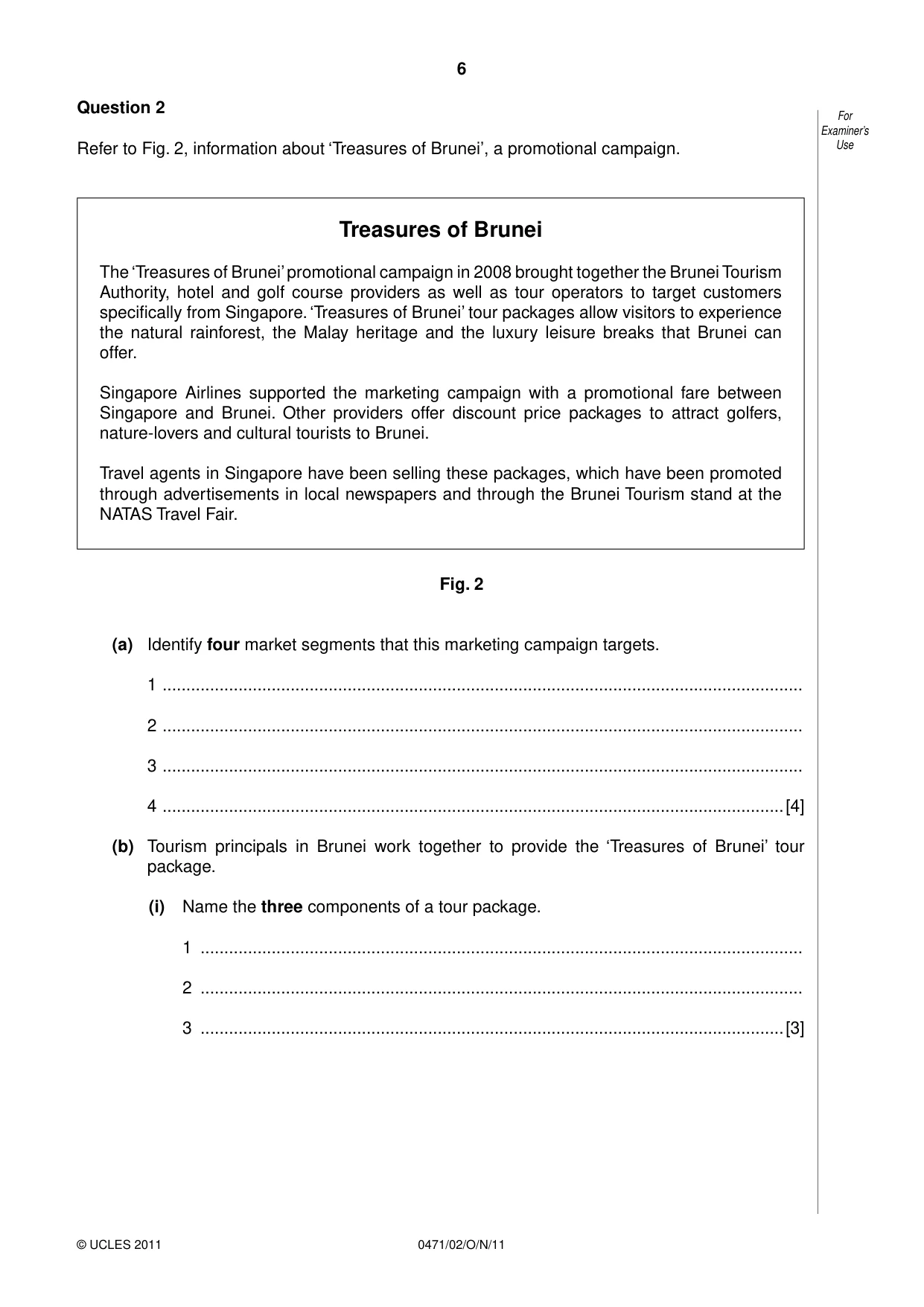
6 0471/02/O/N/11 © UCLES 2011 For Examiner’s Use Question 2 Refer to Fig. 2, information about ‘Treasures of Brunei’, a promotional campaign. Treasures of Brunei The ‘Treasures of Brunei’ promotional campaign in 2008 brought together the Brunei Tourism Authority, hotel and golf course providers as well as tour operators to target customers specifically from Singapore. ‘Treasures of Brunei’ tour packages allow visitors to experience the natural rainforest, the Malay heritage and the luxury leisure breaks that Brunei can offer. Singapore Airlines supported the marketing campaign with a promotional fare between Singapore and Brunei. Other providers offer discount price packages to attract golfers, nature-lovers and cultural tourists to Brunei. Travel agents in Singapore have been selling these packages, which have been promoted through advertisements in local newspapers and through the Brunei Tourism stand at the NATAS Travel Fair. Fig. 2 (a) Identify four market segments that this marketing campaign targets. 1 … 2 … 3 … 4 …[4] (b) Tourism principals in Brunei work together to provide the ‘Treasures of Brunei’ tour package. (i) Name the three components of a tour package. 1 … 2 … 3 …[3]
Question paper, page 7
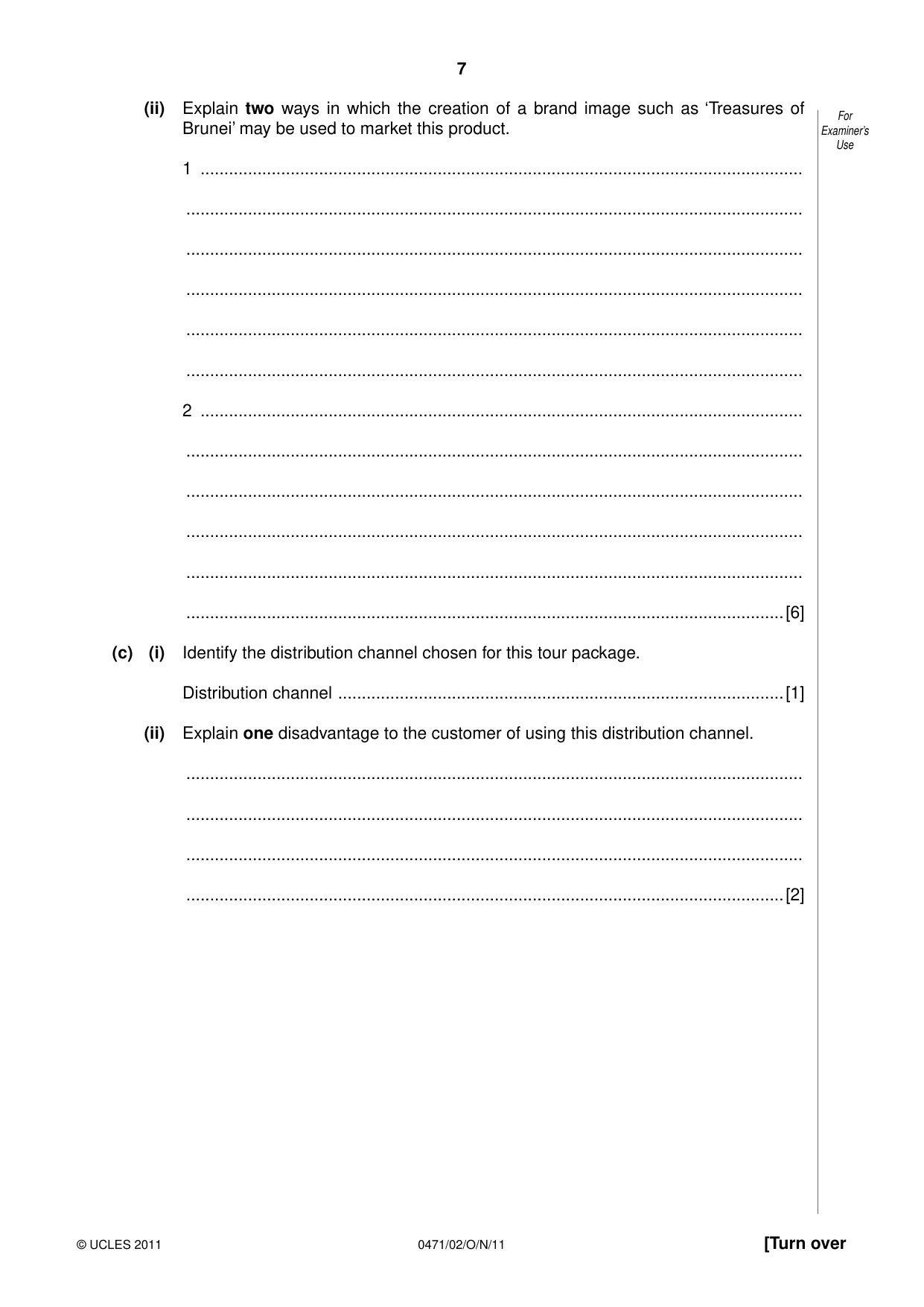
7 [Turn over © UCLES 2011 0471/02/O/N/11 For Examiner’s Use (ii) Explain two ways in which the creation of a brand image such as ‘Treasures of Brunei’ may be used to market this product. 1 … … … … … … 2 … … … … … …[6] (c) (i) Identify the distribution channel chosen for this tour package. Distribution channel …[1] (ii) Explain one disadvantage to the customer of using this distribution channel. … … … …[2]
Question paper, page 8
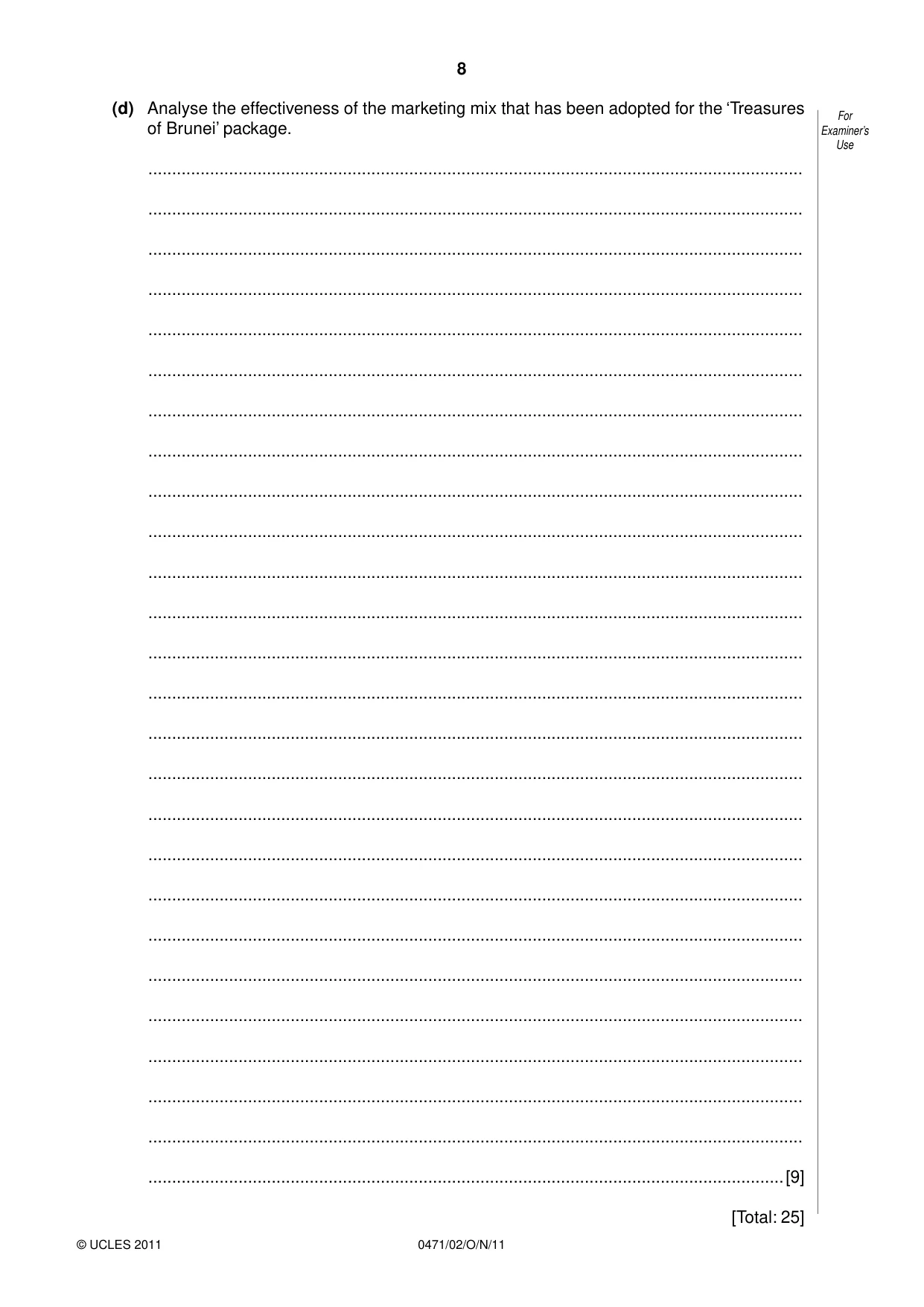
8 0471/02/O/N/11 © UCLES 2011 For Examiner’s Use (d) Analyse the effectiveness of the marketing mix that has been adopted for the ‘Treasures of Brunei’ package. … … … … … … … … … … … … … … … … … … … … … … … … … …[9] [Total: 25]
Question paper, page 9
9 0471/02/O/N/11 © UCLES 2011 [Turn over BLANK PAGE TURN OVER FOR QUESTION 3
Question paper, page 10
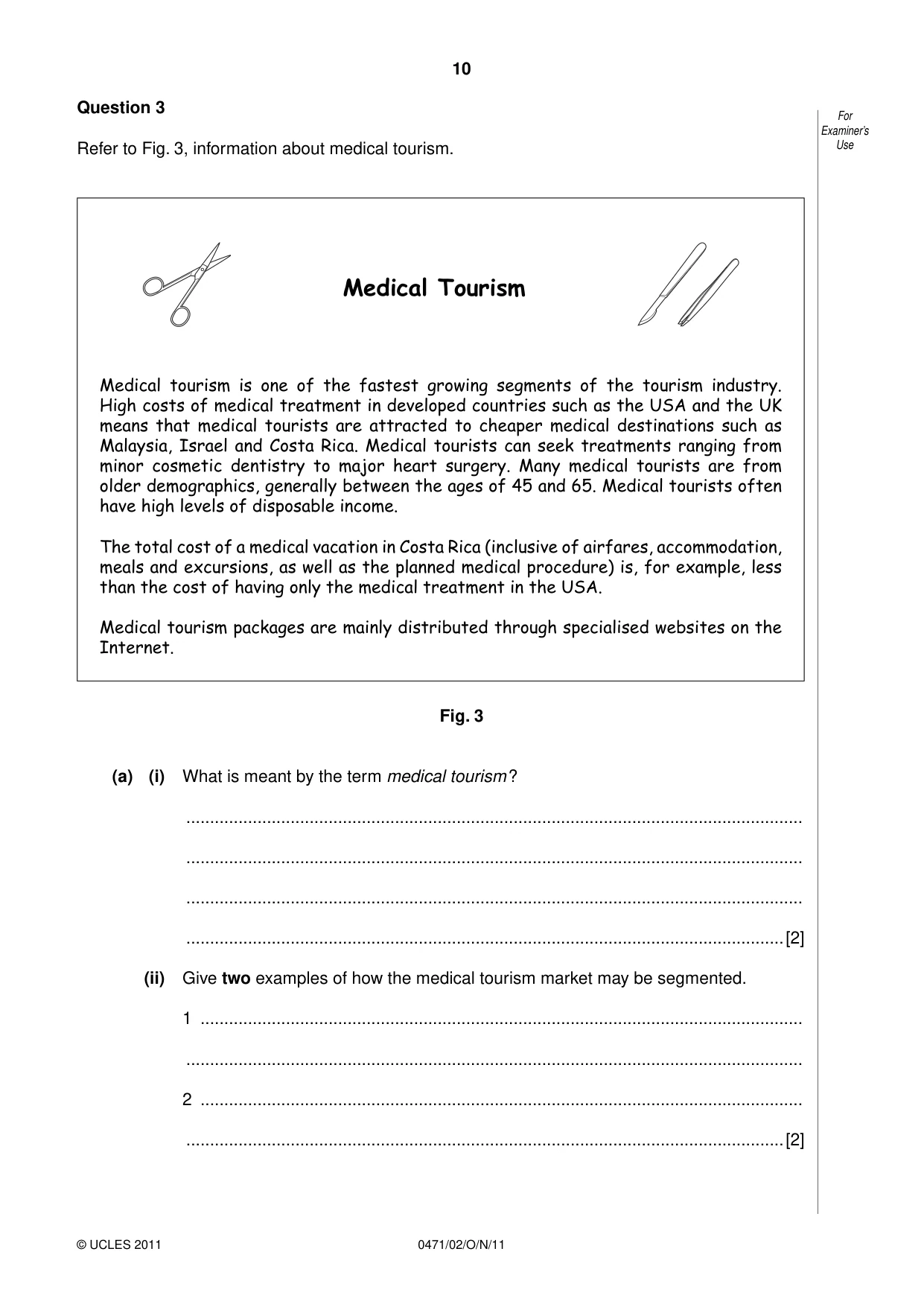
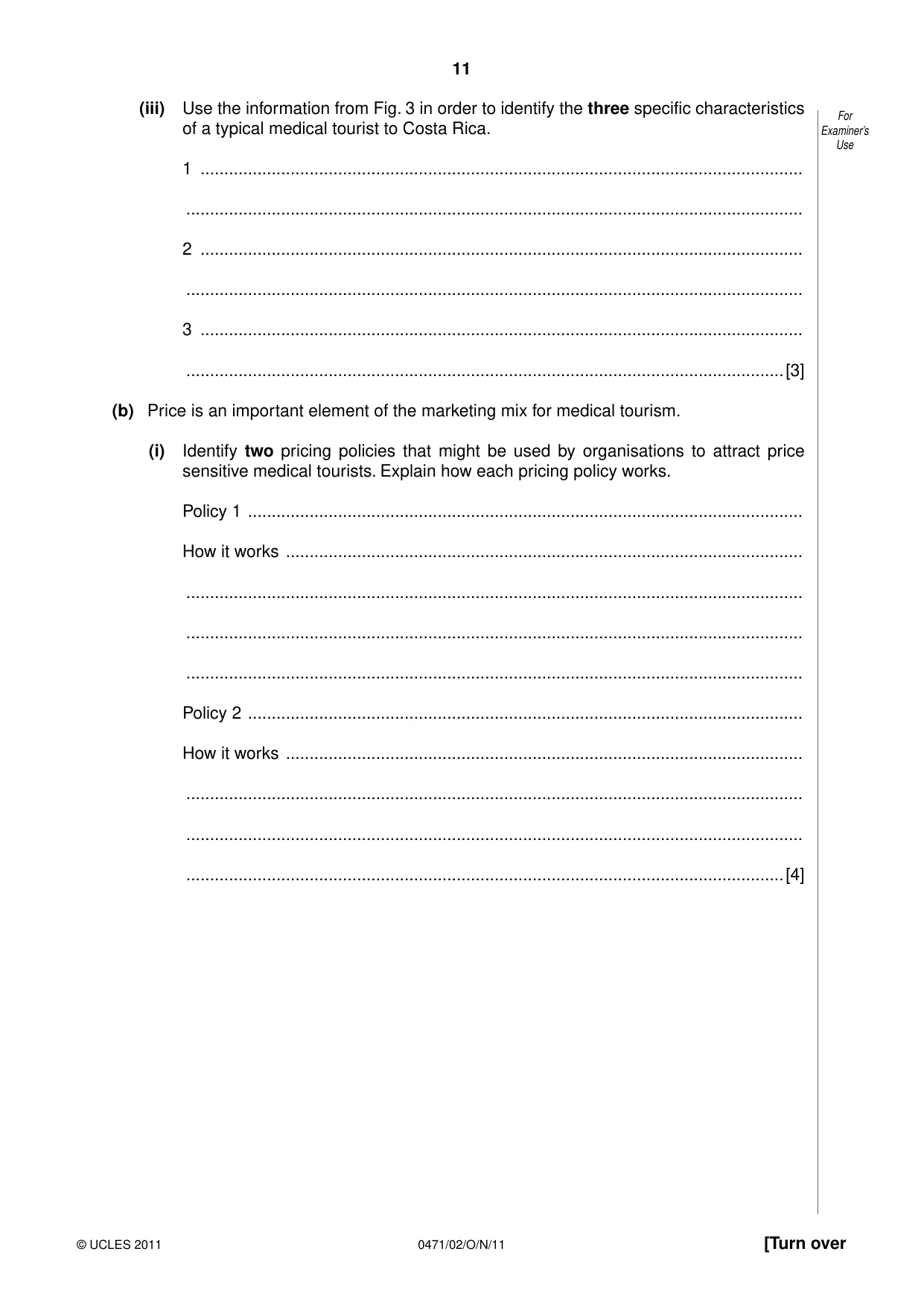
10 0471/02/O/N/11 © UCLES 2011 For Examiner’s Use Question 3 Refer to Fig. 3, information about medical tourism. Medical Tourism Medical tourism is one of the fastest growing segments of the tourism industry. High costs of medical treatment in developed countries such as the USA and the UK means that medical tourists are attracted to cheaper medical destinations such as Malaysia, Israel and Costa Rica. Medical tourists can seek treatments ranging from minor cosmetic dentistry to major heart surgery. Many medical tourists are from older demographics, generally between the ages of 45 and 65. Medical tourists often have high levels of disposable income. The total cost of a medical vacation in Costa Rica (inclusive of airfares, accommodation, meals and excursions, as well as the planned medical procedure) is, for example, less than the cost of having only the medical treatment in the USA. Medical tourism packages are mainly distributed through specialised websites on the Internet. Fig. 3 (a) (i) What is meant by the term medical tourism ? … … … …[2] (ii) Give two examples of how the medical tourism market may be segmented. 1 … … 2 … …[2]
Question paper, page 11
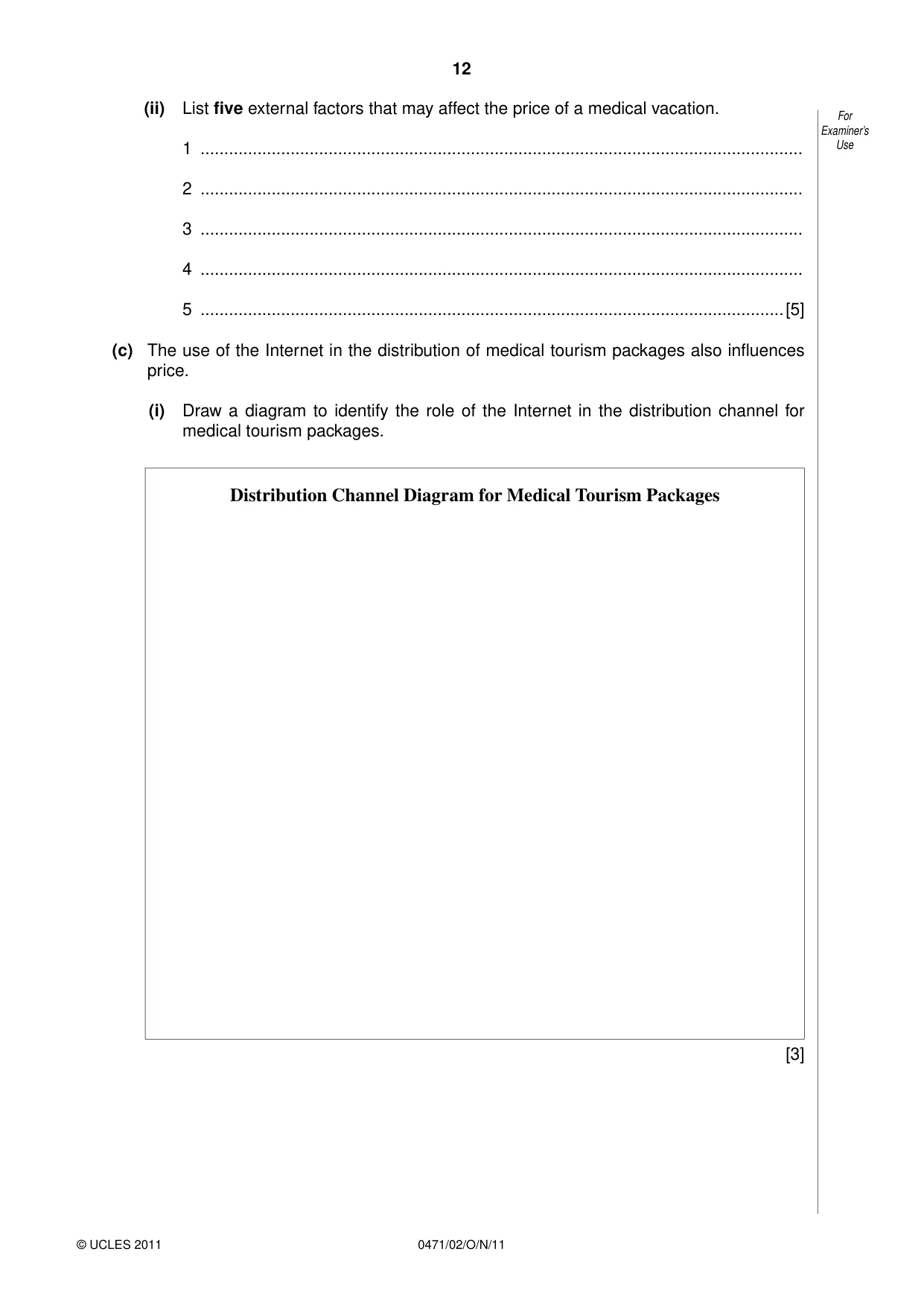
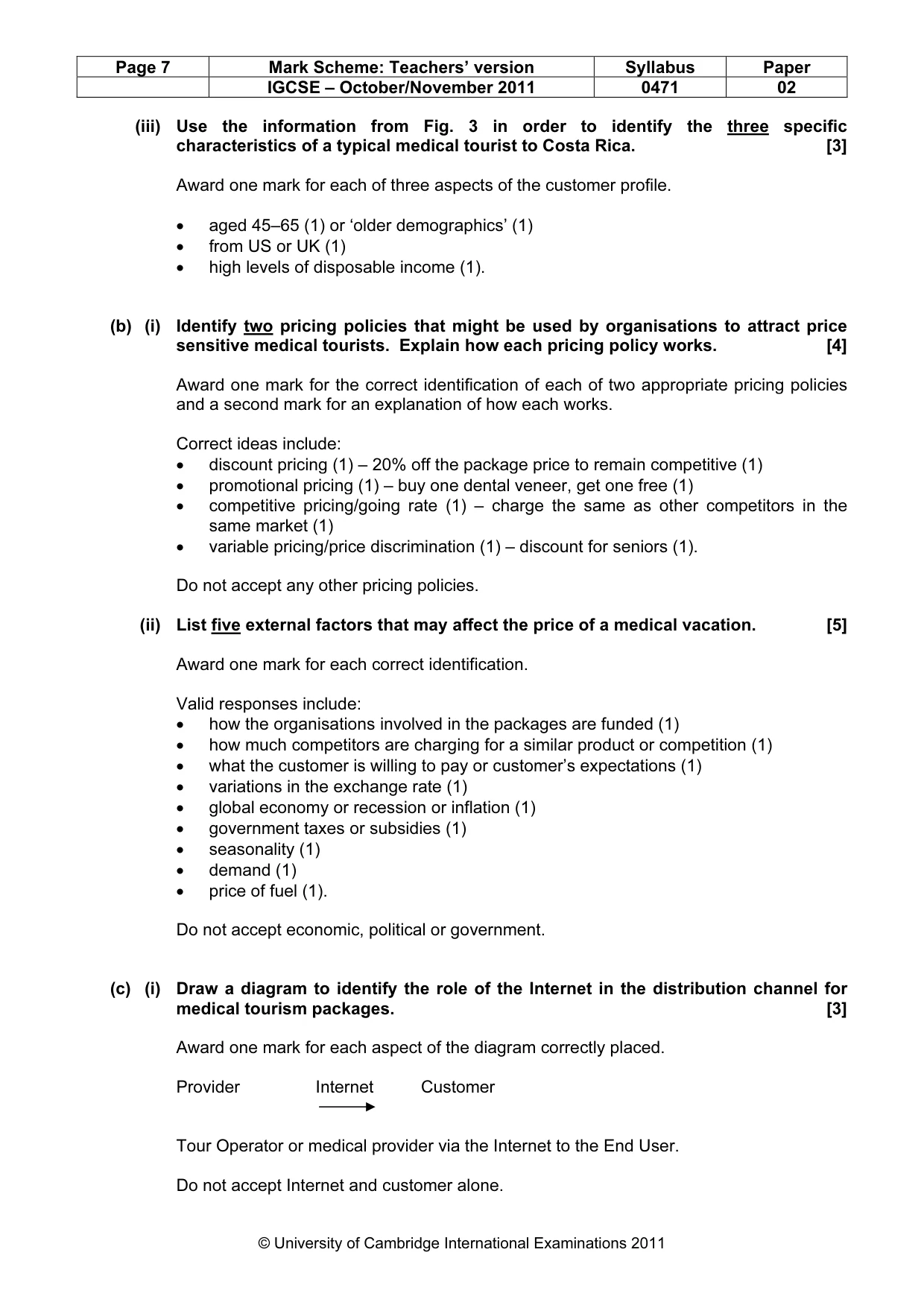
11 [Turn over © UCLES 2011 0471/02/O/N/11 For Examiner’s Use (iii) Use the information from Fig. 3 in order to identify the three specific characteristics of a typical medical tourist to Costa Rica. 1 … … 2 … … 3 … …[3] (b) Price is an important element of the marketing mix for medical tourism. (i) Identify two pricing policies that might be used by organisations to attract price sensitive medical tourists. Explain how each pricing policy works. Policy 1 … How it works … … … … Policy 2 … How it works … … … …[4]
Question paper, page 12
12 0471/02/O/N/11 © UCLES 2011 For Examiner’s Use (ii) List five external factors that may affect the price of a medical vacation. 1 … 2 … 3 … 4 … 5 …[5] (c) The use of the Internet in the distribution of medical tourism packages also influences price. (i) Draw a diagram to identify the role of the Internet in the distribution channel for medical tourism packages. Distribution Channel Diagram for Medical Tourism Packages [3]
Question paper, page 13
13 [Turn over © UCLES 2011 0471/02/O/N/11 For Examiner’s Use (ii) Evaluate the reasons why the Internet is used widely to promote sales of medical tourism packages. … … … … … … … … … … … …[6] [Total: 25]
Question paper, page 14
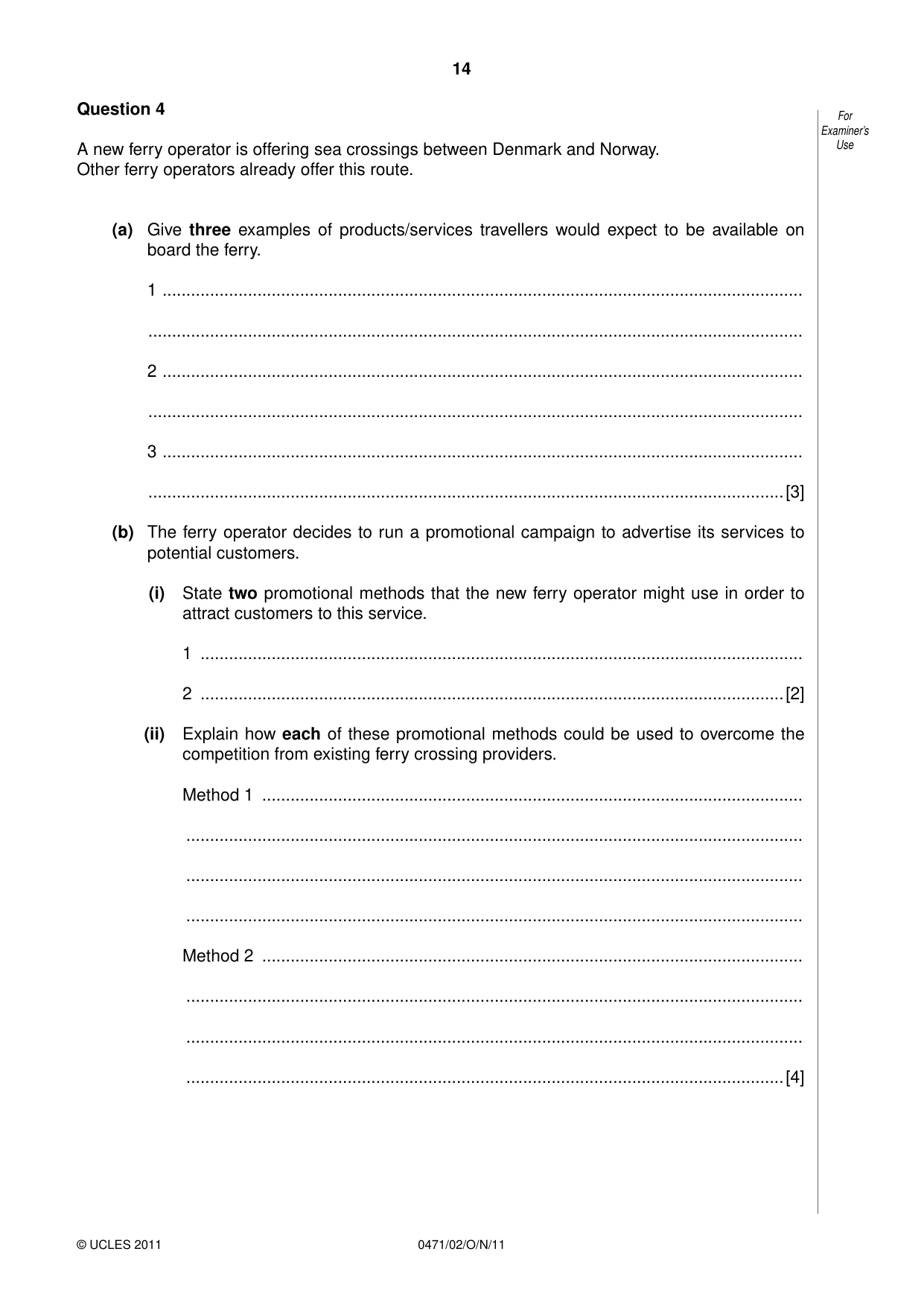
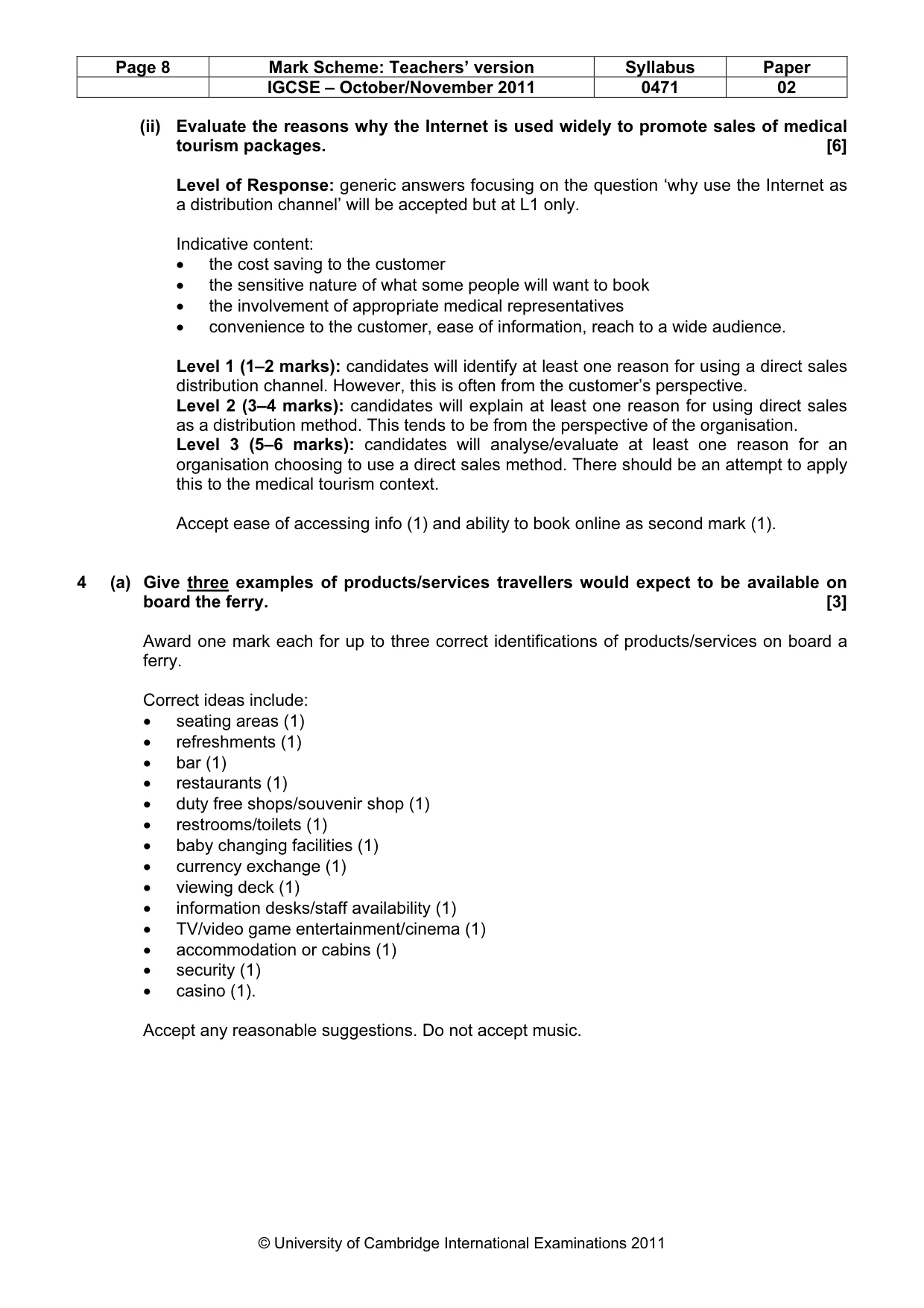
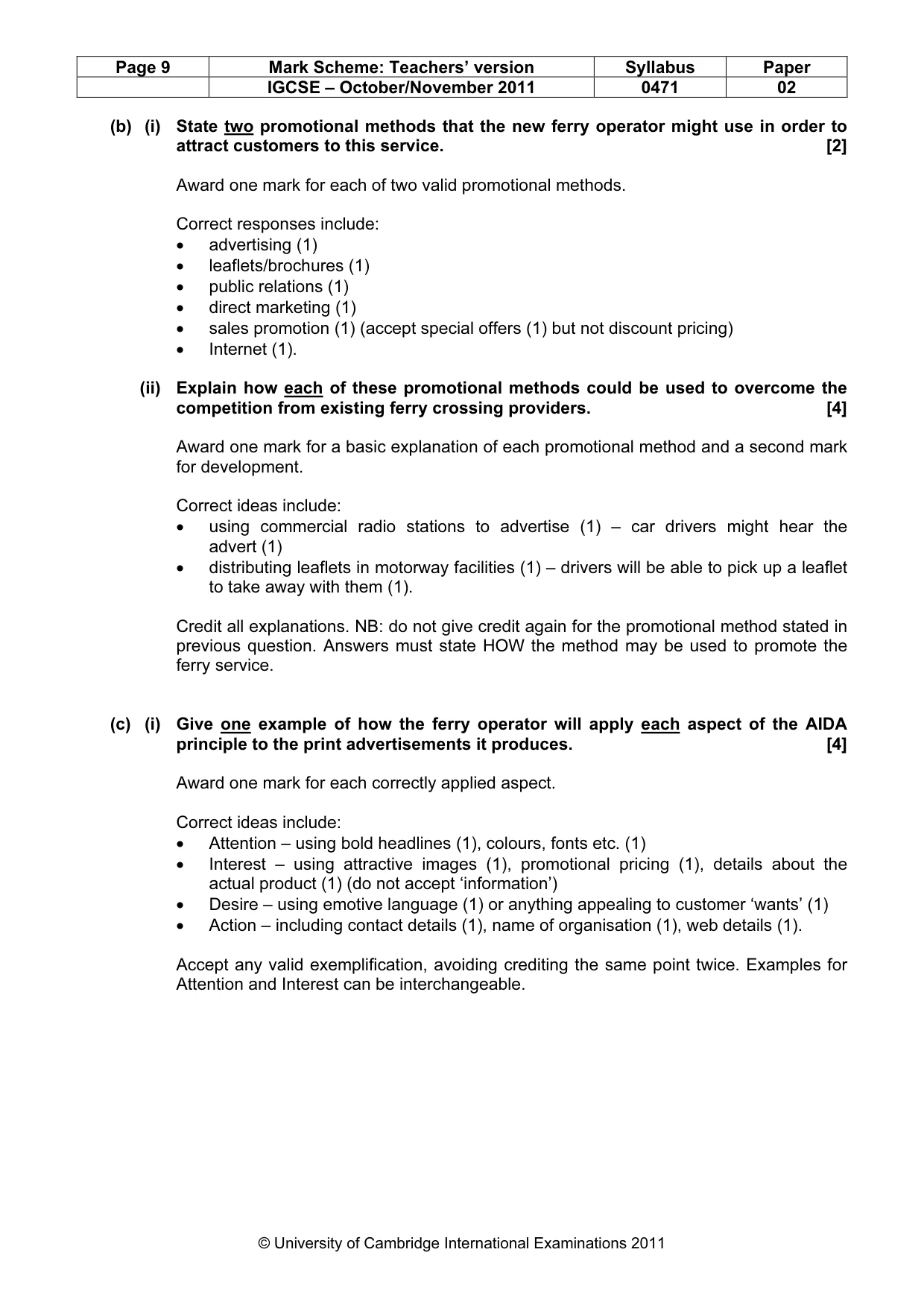
14 0471/02/O/N/11 © UCLES 2011 For Examiner’s Use Question 4 A new ferry operator is offering sea crossings between Denmark and Norway. Other ferry operators already offer this route. (a) Give three examples of products/services travellers would expect to be available on board the ferry. 1 … … 2 … … 3 … …[3] (b) The ferry operator decides to run a promotional campaign to advertise its services to potential customers. (i) State two promotional methods that the new ferry operator might use in order to attract customers to this service. 1 … 2 …[2] (ii) Explain how each of these promotional methods could be used to overcome the competition from existing ferry crossing providers. Method 1 … … … … Method 2 … … … …[4]
Question paper, page 15
15 [Turn over © UCLES 2011 0471/02/O/N/11 For Examiner’s Use (c) The ferry operator uses the AIDA principle to assess the effectiveness of its marketing materials. (i) Give one example of how the ferry operator will apply each aspect of the AIDA principle to the print advertisements it produces. Attention … … Interest … … Desire … … Action … …[4] (ii) Other than the AIDA principle, identify three factors that the ferry operator must take into consideration when planning its promotional campaign. 1 … … 2 … … 3 … …[3]
Question paper, page 16
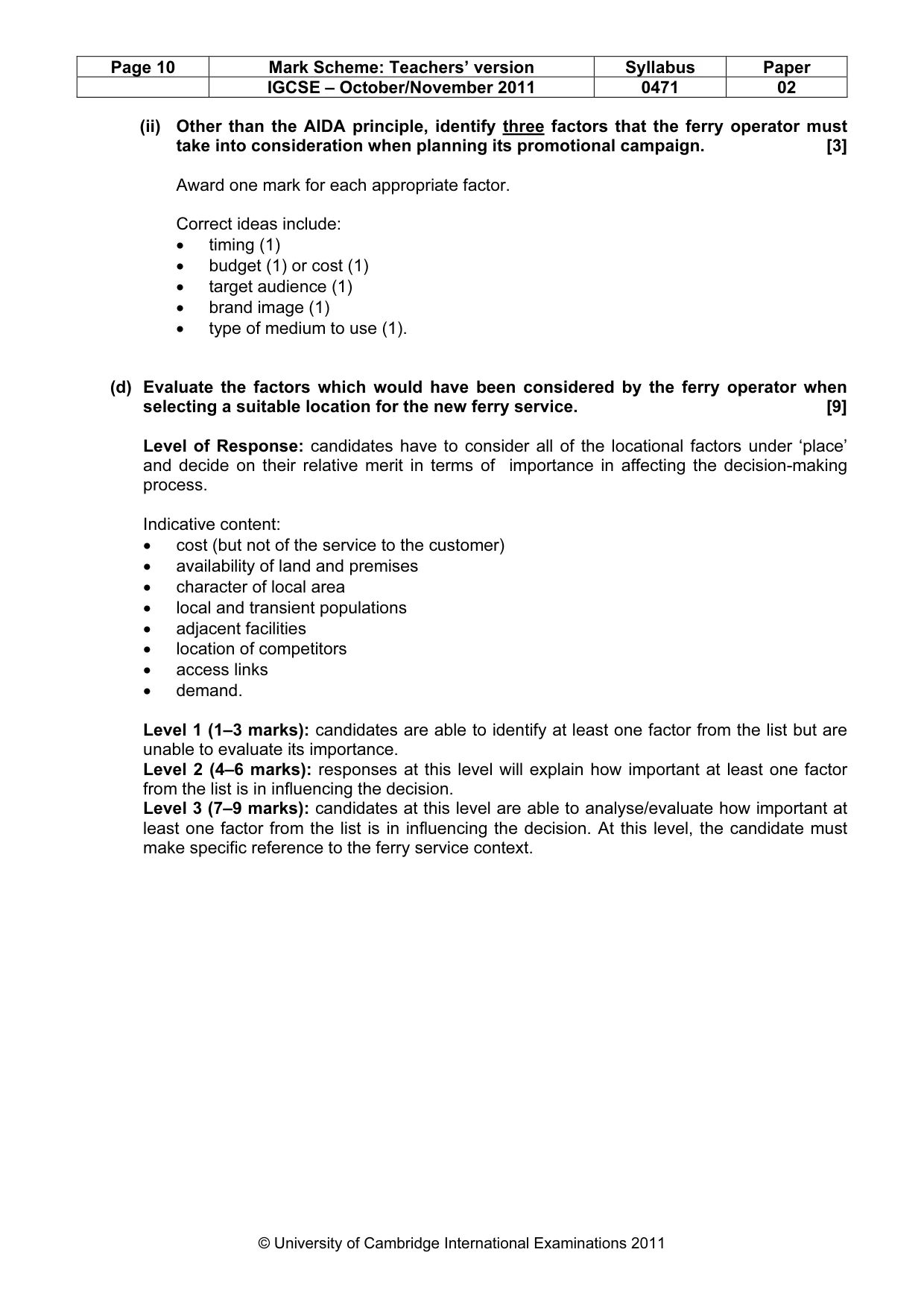
16 0471/02/O/N/11 © UCLES 2011 For Examiner’s Use (d) Evaluate the factors which would have been considered by the ferry operator when selecting a suitable location for the new ferry service. … … … … … … … … … … … … … … … … … … … … … … …[9] [Total: 25] Permission to reproduce items where third-party owned material protected by copyright is included has been sought and cleared where possible. Every reasonable effort has been made by the publisher (UCLES) to trace copyright holders, but if any items requiring clearance have unwittingly been included, the publisher will be pleased to make amends at the earliest possible opportunity. University of Cambridge International Examinations is part of the Cambridge Assessment Group. Cambridge Assessment is the brand name of University of Cambridge Local Examinations Syndicate (UCLES), which is itself a department of the University of Cambridge.
Mark scheme, page 1
UNIVERSITY OF CAMBRIDGE INTERNATIONAL EXAMINATIONS International General Certificate of Secondary Education MARK SCHEME for the October/November 2011 question paper for the guidance of teachers 0471 TRAVEL AND TOURISM 0471/02 Paper 2 (Alternative to Coursework), maximum raw mark 100 This mark scheme is published as an aid to teachers and candidates, to indicate the requirements of the examination. It shows the basis on which Examiners were instructed to award marks. It does not indicate the details of the discussions that took place at an Examiners’ meeting before marking began, which would have considered the acceptability of alternative answers. Mark schemes must be read in conjunction with the question papers and the report on the examination. • Cambridge will not enter into discussions or correspondence in connection with these mark schemes. Cambridge is publishing the mark schemes for the October/November 2011 question papers for most IGCSE, GCE Advanced Level and Advanced Subsidiary Level syllabuses and some Ordinary Level syllabuses. www.XtremePapers.com
Mark scheme, page 2
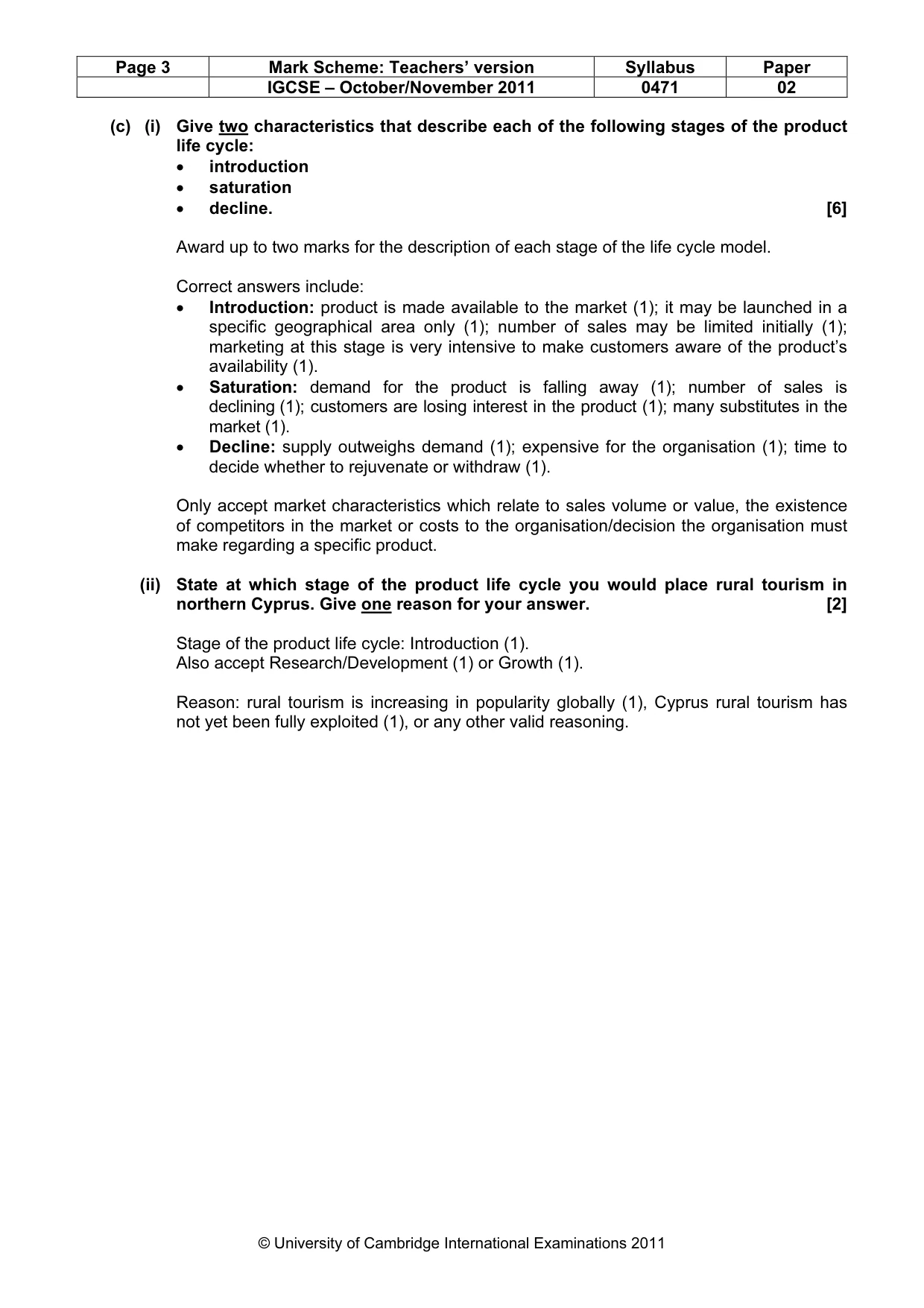
Page 2 Mark Scheme: Teachers’ version Syllabus Paper IGCSE – October/November 2011 0471 02 © University of Cambridge International Examinations 2011 1 (a) Using the statement numbers from Fig. 1, complete the SWOT analysis table below. [4] Strength 4 or 3 Weakness 2 or 6 or 7 Opportunity 1 or 3 or 7 or 8 Threat 2 or 5 Strength: 4 – Traditional crafts such as woodcarving and embroidery are still practised in Cyprus or 3 – The environment in this region is suitable for eco-tourism. Weakness: 2 – Rural tourism is not well represented by tourism professionals in northern Cyprus or 6 – Some rural areas in this region have limited infrastructure or 7 – Local craftspeople have limited experience in marketing their products. Opportunity: 1 – Demand for rural tourism products is increasing globally or 3 – The environment in this region is suitable for eco-tourism or 7 – Local craftspeople have limited experience in marketing their products or 8 – Craft villages could target the special interest tourist market in this region. Threat: 2 – Rural tourism is not well represented by tourism professionals in northern Cyprus or 5 – The mass tourism product dominates the market in other parts of Cyprus. Accept ONLY the first answer in each box. (b) Using the opportunity you have identified in the SWOT analysis table, explain two ways in which tourism providers in northern Cyprus could benefit from rural tourism in this region. [4] Award one mark for the identification of each of two ways in which tourism providers in northern Cyprus could benefit from rural tourism. Award a second mark for amplification of each idea. Correct answers could include: • increased demand worldwide for rural tourism – tourism providers in northern Cyprus could advertise day trips to the area (1) from the mass tourism resorts elsewhere on the island, capturing this market (1); • the environment is suitable for eco-tourism – tourism providers could work together to create an eco-tourism product (1) to attract a different type of tourist to Cyprus (1); • local craftspeople have limited experience in marketing their products – tourism providers could join forces to host craft fairs (1) where the locals exhibit their work but the tourism providers undertake the marketing of the event (1); • craft villages could target the special interest tourist market – tourism providers could develop special interest packages (1) to offer craft workshops for tourists (1). Accept any valid ideas. Can accept generic answers, e.g. profit, employment etc.
Mark scheme, page 3
Page 3 Mark Scheme: Teachers’ version Syllabus Paper IGCSE – October/November 2011 0471 02 © University of Cambridge International Examinations 2011 (c) (i) Give two characteristics that describe each of the following stages of the product life cycle: • introduction • saturation • decline. [6] Award up to two marks for the description of each stage of the life cycle model. Correct answers include: • Introduction: product is made available to the market (1); it may be launched in a specific geographical area only (1); number of sales may be limited initially (1); marketing at this stage is very intensive to make customers aware of the product’s availability (1). • Saturation: demand for the product is falling away (1); number of sales is declining (1); customers are losing interest in the product (1); many substitutes in the market (1). • Decline: supply outweighs demand (1); expensive for the organisation (1); time to decide whether to rejuvenate or withdraw (1). Only accept market characteristics which relate to sales volume or value, the existence of competitors in the market or costs to the organisation/decision the organisation must make regarding a specific product. (ii) State at which stage of the product life cycle you would place rural tourism in northern Cyprus. Give one reason for your answer. [2] Stage of the product life cycle: Introduction (1). Also accept Research/Development (1) or Growth (1). Reason: rural tourism is increasing in popularity globally (1), Cyprus rural tourism has not yet been fully exploited (1), or any other valid reasoning.
Mark scheme, page 4
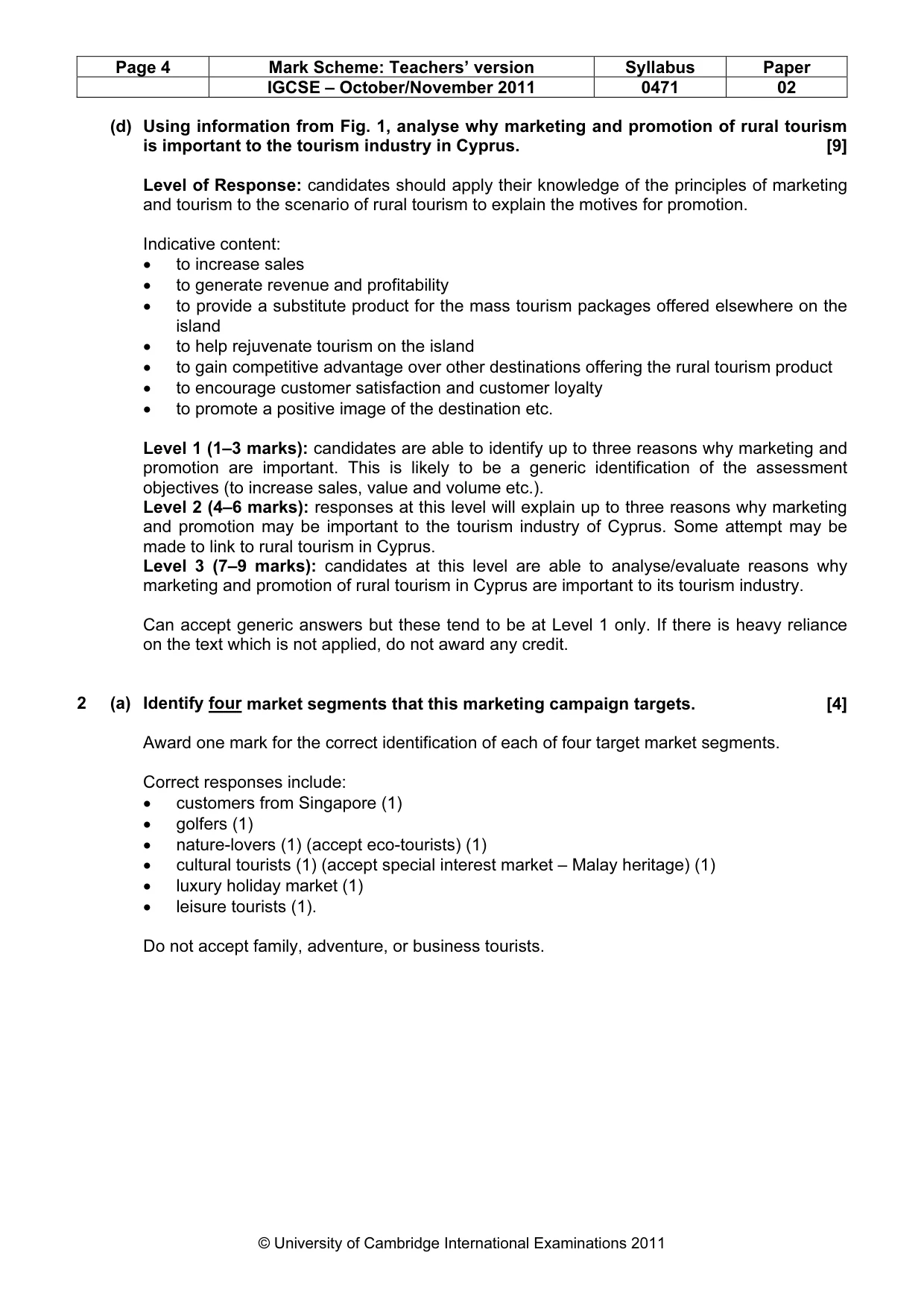
Page 4 Mark Scheme: Teachers’ version Syllabus Paper IGCSE – October/November 2011 0471 02 © University of Cambridge International Examinations 2011 (d) Using information from Fig. 1, analyse why marketing and promotion of rural tourism is important to the tourism industry in Cyprus. [9] Level of Response: candidates should apply their knowledge of the principles of marketing and tourism to the scenario of rural tourism to explain the motives for promotion. Indicative content: • to increase sales • to generate revenue and profitability • to provide a substitute product for the mass tourism packages offered elsewhere on the island • to help rejuvenate tourism on the island • to gain competitive advantage over other destinations offering the rural tourism product • to encourage customer satisfaction and customer loyalty • to promote a positive image of the destination etc. Level 1 (1–3 marks): candidates are able to identify up to three reasons why marketing and promotion are important. This is likely to be a generic identification of the assessment objectives (to increase sales, value and volume etc.). Level 2 (4–6 marks): responses at this level will explain up to three reasons why marketing and promotion may be important to the tourism industry of Cyprus. Some attempt may be made to link to rural tourism in Cyprus. Level 3 (7–9 marks): candidates at this level are able to analyse/evaluate reasons why marketing and promotion of rural tourism in Cyprus are important to its tourism industry. Can accept generic answers but these tend to be at Level 1 only. If there is heavy reliance on the text which is not applied, do not award any credit. 2 (a) Identify four market segments that this marketing campaign targets. [4] Award one mark for the correct identification of each of four target market segments. Correct responses include: • customers from Singapore (1) • golfers (1) • nature-lovers (1) (accept eco-tourists) (1) • cultural tourists (1) (accept special interest market – Malay heritage) (1) • luxury holiday market (1) • leisure tourists (1). Do not accept family, adventure, or business tourists.
Mark scheme, page 5
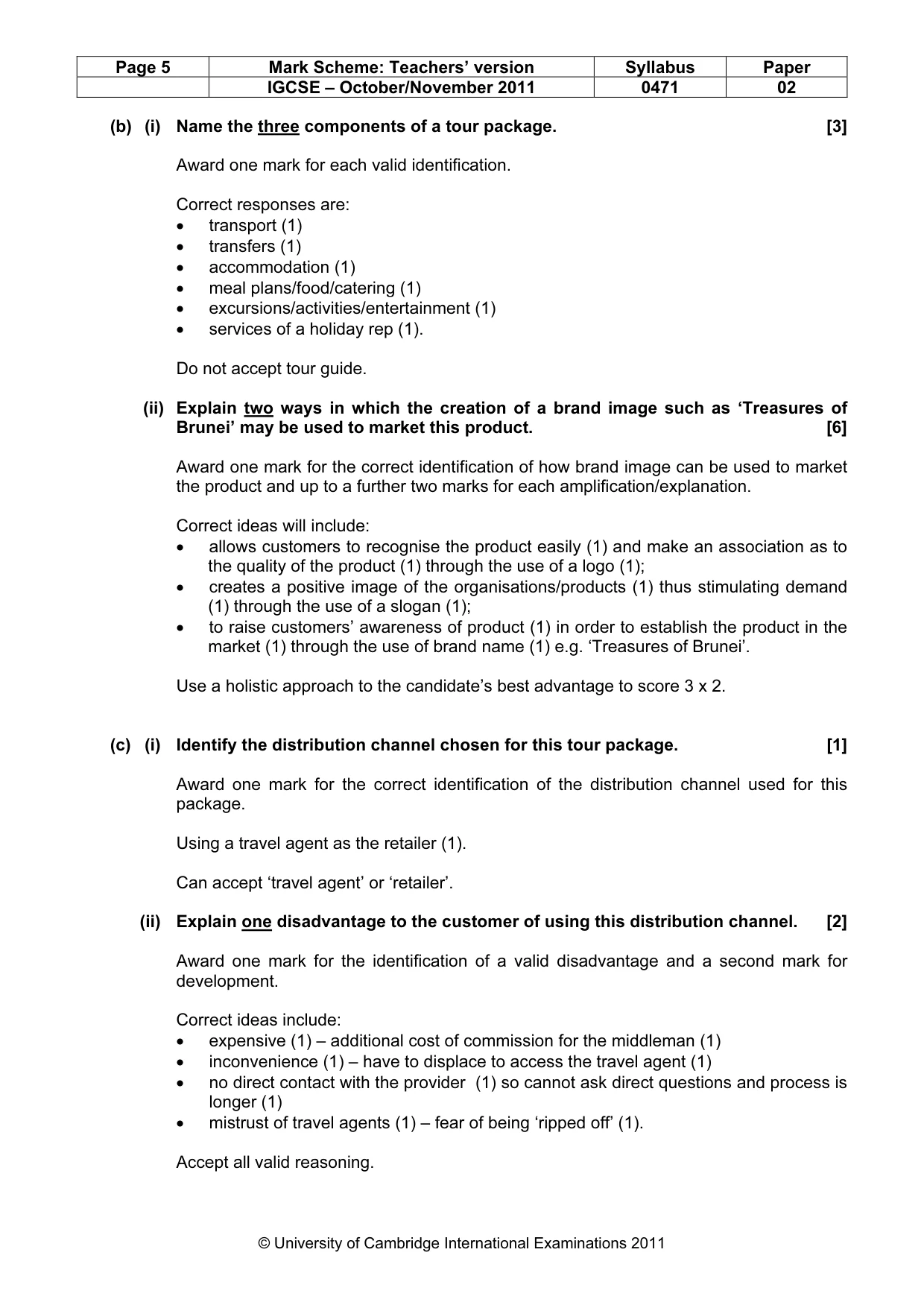
Page 5 Mark Scheme: Teachers’ version Syllabus Paper IGCSE – October/November 2011 0471 02 © University of Cambridge International Examinations 2011 (b) (i) Name the three components of a tour package. [3] Award one mark for each valid identification. Correct responses are: • transport (1) • transfers (1) • accommodation (1) • meal plans/food/catering (1) • excursions/activities/entertainment (1) • services of a holiday rep (1). Do not accept tour guide. (ii) Explain two ways in which the creation of a brand image such as ‘Treasures of Brunei’ may be used to market this product. [6] Award one mark for the correct identification of how brand image can be used to market the product and up to a further two marks for each amplification/explanation. Correct ideas will include: • allows customers to recognise the product easily (1) and make an association as to the quality of the product (1) through the use of a logo (1); • creates a positive image of the organisations/products (1) thus stimulating demand (1) through the use of a slogan (1); • to raise customers’ awareness of product (1) in order to establish the product in the market (1) through the use of brand name (1) e.g. ‘Treasures of Brunei’. Use a holistic approach to the candidate’s best advantage to score 3 x 2. (c) (i) Identify the distribution channel chosen for this tour package. [1] Award one mark for the correct identification of the distribution channel used for this package. Using a travel agent as the retailer (1). Can accept ‘travel agent’ or ‘retailer’. (ii) Explain one disadvantage to the customer of using this distribution channel. [2] Award one mark for the identification of a valid disadvantage and a second mark for development. Correct ideas include: • expensive (1) – additional cost of commission for the middleman (1) • inconvenience (1) – have to displace to access the travel agent (1) • no direct contact with the provider (1) so cannot ask direct questions and process is longer (1) • mistrust of travel agents (1) – fear of being ‘ripped off’ (1). Accept all valid reasoning.
Mark scheme, page 6
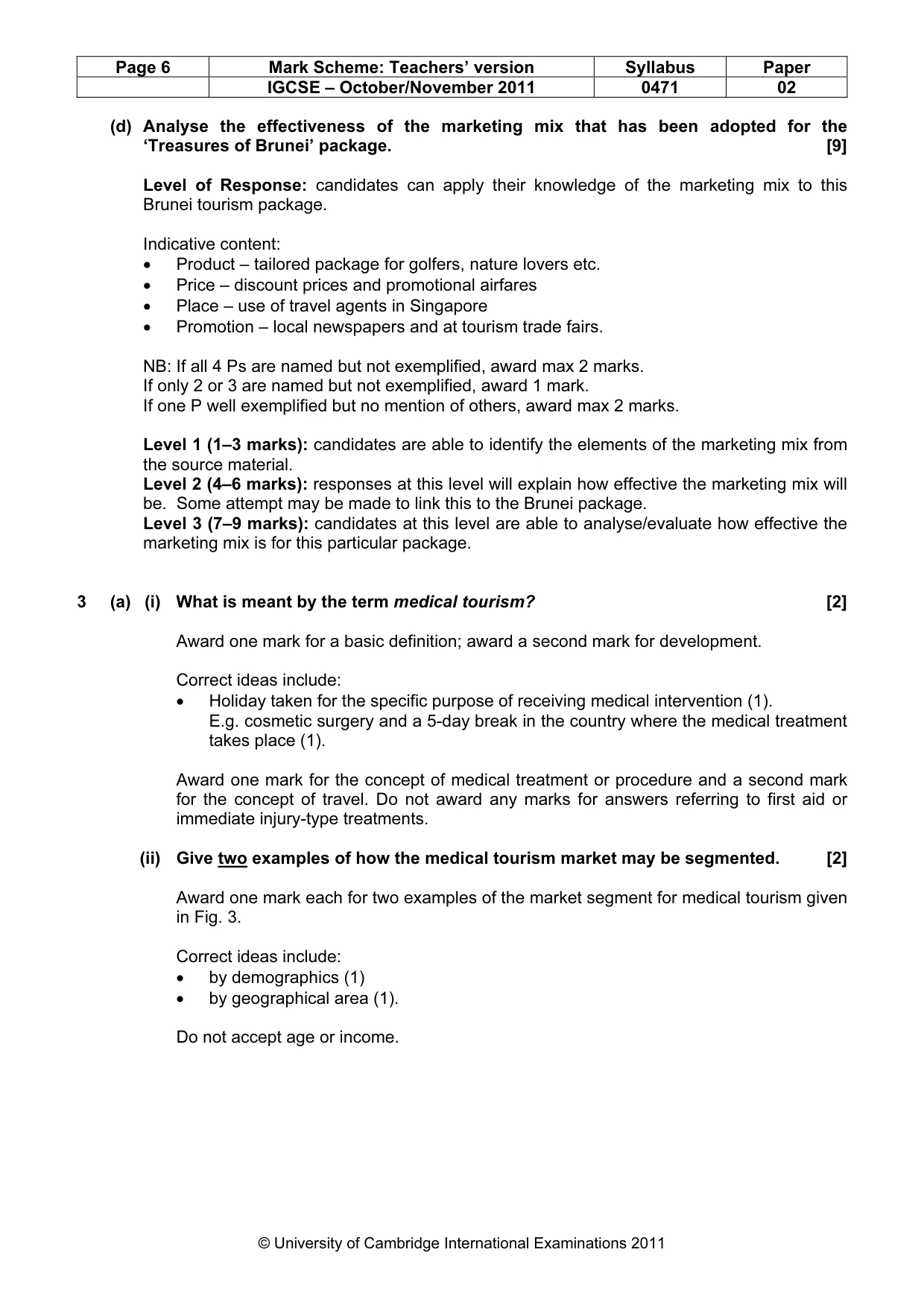
Page 6 Mark Scheme: Teachers’ version Syllabus Paper IGCSE – October/November 2011 0471 02 © University of Cambridge International Examinations 2011 (d) Analyse the effectiveness of the marketing mix that has been adopted for the ‘Treasures of Brunei’ package. [9] Level of Response: candidates can apply their knowledge of the marketing mix to this Brunei tourism package. Indicative content: • Product – tailored package for golfers, nature lovers etc. • Price – discount prices and promotional airfares • Place – use of travel agents in Singapore • Promotion – local newspapers and at tourism trade fairs. NB: If all 4 Ps are named but not exemplified, award max 2 marks. If only 2 or 3 are named but not exemplified, award 1 mark. If one P well exemplified but no mention of others, award max 2 marks. Level 1 (1–3 marks): candidates are able to identify the elements of the marketing mix from the source material. Level 2 (4–6 marks): responses at this level will explain how effective the marketing mix will be. Some attempt may be made to link this to the Brunei package. Level 3 (7–9 marks): candidates at this level are able to analyse/evaluate how effective the marketing mix is for this particular package. 3 (a) (i) What is meant by the term medical tourism? [2] Award one mark for a basic definition; award a second mark for development. Correct ideas include: • Holiday taken for the specific purpose of receiving medical intervention (1). E.g. cosmetic surgery and a 5-day break in the country where the medical treatment takes place (1). Award one mark for the concept of medical treatment or procedure and a second mark for the concept of travel. Do not award any marks for answers referring to first aid or immediate injury-type treatments. (ii) Give two examples of how the medical tourism market may be segmented. [2] Award one mark each for two examples of the market segment for medical tourism given in Fig. 3. Correct ideas include: • by demographics (1) • by geographical area (1). Do not accept age or income.
Mark scheme, page 7
Page 7 Mark Scheme: Teachers’ version Syllabus Paper IGCSE – October/November 2011 0471 02 © University of Cambridge International Examinations 2011 (iii) Use the information from Fig. 3 in order to identify the three specific characteristics of a typical medical tourist to Costa Rica. [3] Award one mark for each of three aspects of the customer profile. • aged 45–65 (1) or ‘older demographics’ (1) • from US or UK (1) • high levels of disposable income (1). (b) (i) Identify two pricing policies that might be used by organisations to attract price sensitive medical tourists. Explain how each pricing policy works. [4] Award one mark for the correct identification of each of two appropriate pricing policies and a second mark for an explanation of how each works. Correct ideas include: • discount pricing (1) – 20% off the package price to remain competitive (1) • promotional pricing (1) – buy one dental veneer, get one free (1) • competitive pricing/going rate (1) – charge the same as other competitors in the same market (1) • variable pricing/price discrimination (1) – discount for seniors (1). Do not accept any other pricing policies. (ii) List five external factors that may affect the price of a medical vacation. [5] Award one mark for each correct identification. Valid responses include: • how the organisations involved in the packages are funded (1) • how much competitors are charging for a similar product or competition (1) • what the customer is willing to pay or customer’s expectations (1) • variations in the exchange rate (1) • global economy or recession or inflation (1) • government taxes or subsidies (1) • seasonality (1) • demand (1) • price of fuel (1). Do not accept economic, political or government. (c) (i) Draw a diagram to identify the role of the Internet in the distribution channel for medical tourism packages. [3] Award one mark for each aspect of the diagram correctly placed. Provider Internet Customer Tour Operator or medical provider via the Internet to the End User. Do not accept Internet and customer alone.
Mark scheme, page 8
Page 8 Mark Scheme: Teachers’ version Syllabus Paper IGCSE – October/November 2011 0471 02 © University of Cambridge International Examinations 2011 (ii) Evaluate the reasons why the Internet is used widely to promote sales of medical tourism packages. [6] Level of Response: generic answers focusing on the question ‘why use the Internet as a distribution channel’ will be accepted but at L1 only. Indicative content: • the cost saving to the customer • the sensitive nature of what some people will want to book • the involvement of appropriate medical representatives • convenience to the customer, ease of information, reach to a wide audience. Level 1 (1–2 marks): candidates will identify at least one reason for using a direct sales distribution channel. However, this is often from the customer’s perspective. Level 2 (3–4 marks): candidates will explain at least one reason for using direct sales as a distribution method. This tends to be from the perspective of the organisation. Level 3 (5–6 marks): candidates will analyse/evaluate at least one reason for an organisation choosing to use a direct sales method. There should be an attempt to apply this to the medical tourism context. Accept ease of accessing info (1) and ability to book online as second mark (1). 4 (a) Give three examples of products/services travellers would expect to be available on board the ferry. [3] Award one mark each for up to three correct identifications of products/services on board a ferry. Correct ideas include: • seating areas (1) • refreshments (1) • bar (1) • restaurants (1) • duty free shops/souvenir shop (1) • restrooms/toilets (1) • baby changing facilities (1) • currency exchange (1) • viewing deck (1) • information desks/staff availability (1) • TV/video game entertainment/cinema (1) • accommodation or cabins (1) • security (1) • casino (1). Accept any reasonable suggestions. Do not accept music.
Mark scheme, page 9
Page 9 Mark Scheme: Teachers’ version Syllabus Paper IGCSE – October/November 2011 0471 02 © University of Cambridge International Examinations 2011 (b) (i) State two promotional methods that the new ferry operator might use in order to attract customers to this service. [2] Award one mark for each of two valid promotional methods. Correct responses include: • advertising (1) • leaflets/brochures (1) • public relations (1) • direct marketing (1) • sales promotion (1) (accept special offers (1) but not discount pricing) • Internet (1). (ii) Explain how each of these promotional methods could be used to overcome the competition from existing ferry crossing providers. [4] Award one mark for a basic explanation of each promotional method and a second mark for development. Correct ideas include: • using commercial radio stations to advertise (1) – car drivers might hear the advert (1) • distributing leaflets in motorway facilities (1) – drivers will be able to pick up a leaflet to take away with them (1). Credit all explanations. NB: do not give credit again for the promotional method stated in previous question. Answers must state HOW the method may be used to promote the ferry service. (c) (i) Give one example of how the ferry operator will apply each aspect of the AIDA principle to the print advertisements it produces. [4] Award one mark for each correctly applied aspect. Correct ideas include: • Attention – using bold headlines (1), colours, fonts etc. (1) • Interest – using attractive images (1), promotional pricing (1), details about the actual product (1) (do not accept ‘information’) • Desire – using emotive language (1) or anything appealing to customer ‘wants’ (1) • Action – including contact details (1), name of organisation (1), web details (1). Accept any valid exemplification, avoiding crediting the same point twice. Examples for Attention and Interest can be interchangeable.
Mark scheme, page 10
Page 10 Mark Scheme: Teachers’ version Syllabus Paper IGCSE – October/November 2011 0471 02 © University of Cambridge International Examinations 2011 (ii) Other than the AIDA principle, identify three factors that the ferry operator must take into consideration when planning its promotional campaign. [3] Award one mark for each appropriate factor. Correct ideas include: • timing (1) • budget (1) or cost (1) • target audience (1) • brand image (1) • type of medium to use (1). (d) Evaluate the factors which would have been considered by the ferry operator when selecting a suitable location for the new ferry service. [9] Level of Response: candidates have to consider all of the locational factors under ‘place’ and decide on their relative merit in terms of importance in affecting the decision-making process. Indicative content: • cost (but not of the service to the customer) • availability of land and premises • character of local area • local and transient populations • adjacent facilities • location of competitors • access links • demand. Level 1 (1–3 marks): candidates are able to identify at least one factor from the list but are unable to evaluate its importance. Level 2 (4–6 marks): responses at this level will explain how important at least one factor from the list is in influencing the decision. Level 3 (7–9 marks): candidates at this level are able to analyse/evaluate how important at least one factor from the list is in influencing the decision. At this level, the candidate must make specific reference to the ferry service context.
What you needed in this session
Cambridge’s own grade thresholds for 2011 Oct/Nov, Paper 2 · Variant 1. A higher threshold means an easier paper — the bar moves with how the cohort did.