Cambridge IGCSE Travel and Tourism 0471 — 2011 Oct/Nov Paper 1 · Variant 1
0471/11/O/N/11 · 100 marks · ≈113 min
The question paper and its mark scheme, free to read here and free to download. This is Cambridge’s own paper, exactly as it was sat.
Question paper16 pages
Mark scheme12 pages
Answers below. Sit the paper first if you are practising.
Paper as text
Question paper, page 1
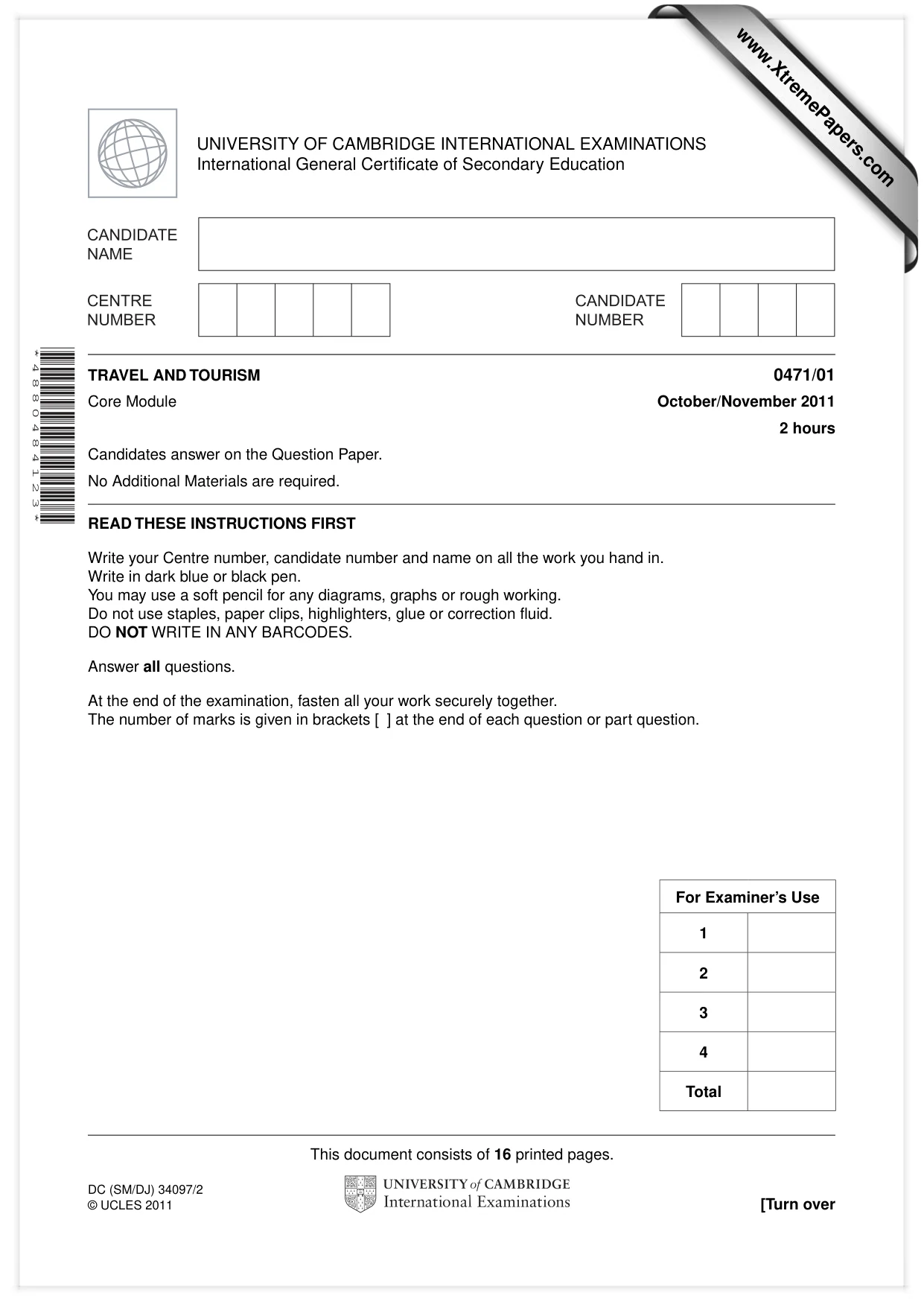
This document consists of 16 printed pages. DC (SM/DJ) 34097/2 © UCLES 2011 [Turn over UNIVERSITY OF CAMBRIDGE INTERNATIONAL EXAMINATIONS International General Certificate of Secondary Education * 4 8 8 0 4 8 4 1 2 3 * TRAVEL AND TOURISM 0471/01 Core Module October/November 2011 2 hours Candidates answer on the Question Paper. No Additional Materials are required. READ THESE INSTRUCTIONS FIRST Write your Centre number, candidate number and name on all the work you hand in. Write in dark blue or black pen. You may use a soft pencil for any diagrams, graphs or rough working. Do not use staples, paper clips, highlighters, glue or correction fluid. DO NOT WRITE IN ANY BARCODES. Answer all questions. At the end of the examination, fasten all your work securely together. The number of marks is given in brackets [ ] at the end of each question or part question. For Examiner’s Use 1 2 3 4 Total www.XtremePapers.com
Question paper, page 2
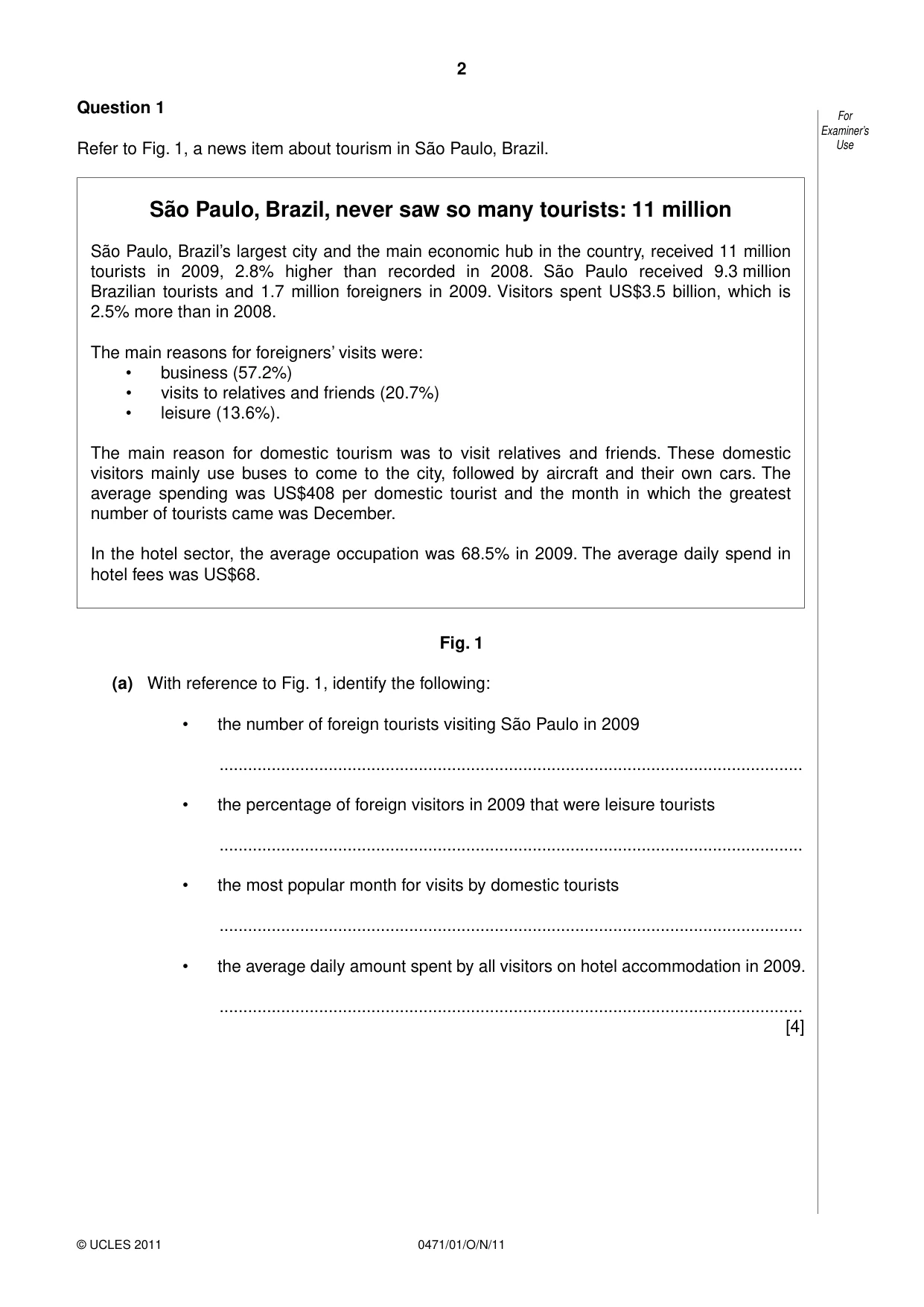
2 0471/01/O/N/11 © UCLES 2011 For Examiner’s Use Question 1 Refer to Fig. 1, a news item about tourism in São Paulo, Brazil. São Paulo, Brazil, never saw so many tourists: 11 million São Paulo, Brazil’s largest city and the main economic hub in the country, received 11 million tourists in 2009, 2.8% higher than recorded in 2008. São Paulo received 9.3 million Brazilian tourists and 1.7 million foreigners in 2009. Visitors spent US$3.5 billion, which is 2.5% more than in 2008. The main reasons for foreigners’ visits were: • business (57.2%) • visits to relatives and friends (20.7%) • leisure (13.6%). The main reason for domestic tourism was to visit relatives and friends. These domestic visitors mainly use buses to come to the city, followed by aircraft and their own cars. The average spending was US$408 per domestic tourist and the month in which the greatest number of tourists came was December. In the hotel sector, the average occupation was 68.5% in 2009. The average daily spend in hotel fees was US$68. Fig. 1 (a) With reference to Fig. 1, identify the following: • the number of foreign tourists visiting São Paulo in 2009 … • the percentage of foreign visitors in 2009 that were leisure tourists … • the most popular month for visits by domestic tourists … • the average daily amount spent by all visitors on hotel accommodation in 2009. … [4]
Question paper, page 3
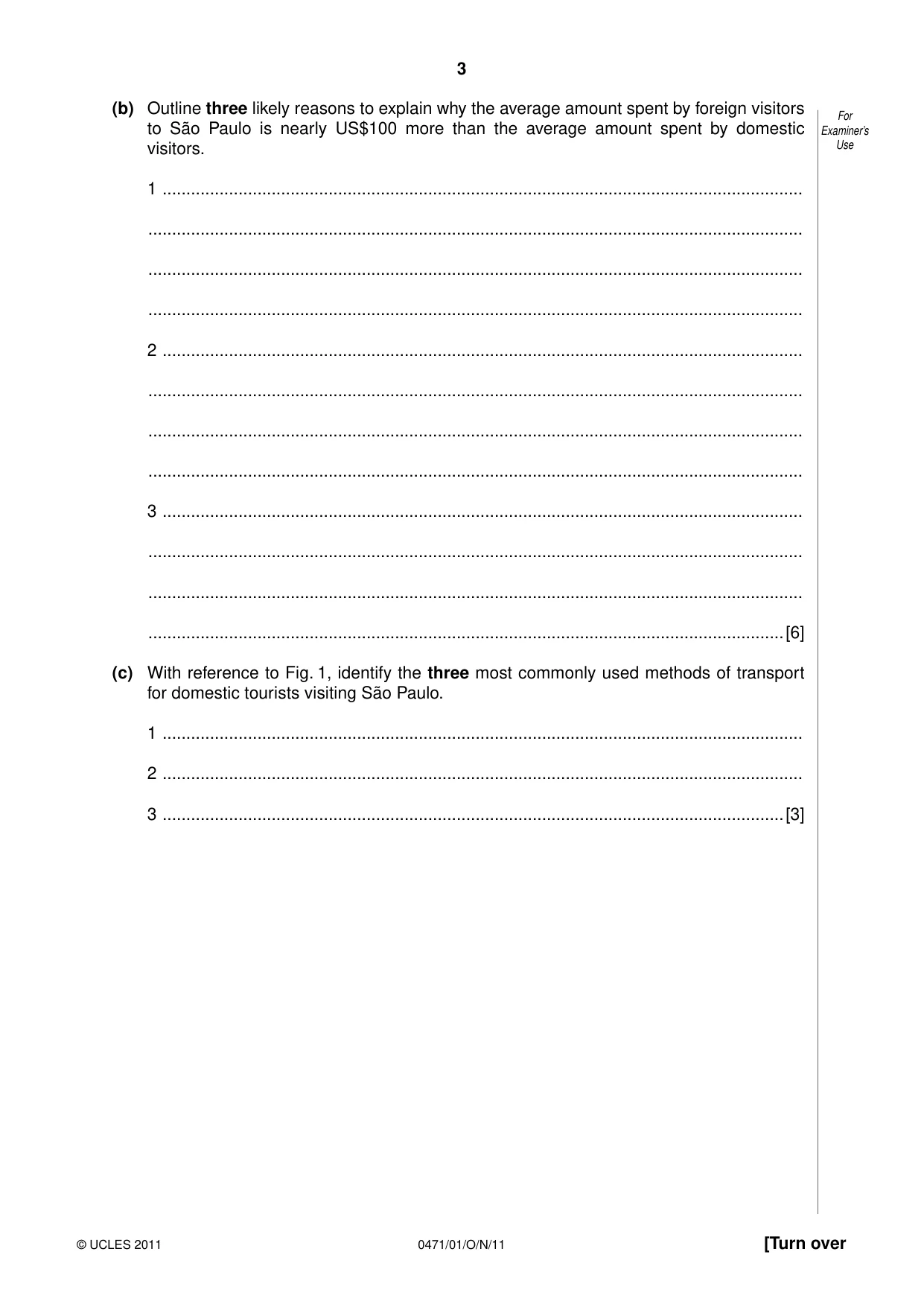
3 [Turn over © UCLES 2011 0471/01/O/N/11 For Examiner’s Use (b) Outline three likely reasons to explain why the average amount spent by foreign visitors to São Paulo is nearly US$100 more than the average amount spent by domestic visitors. 1 … … … … 2 … … … … 3 … … … …[6] (c) With reference to Fig. 1, identify the three most commonly used methods of transport for domestic tourists visiting São Paulo. 1 … 2 … 3 …[3]
Question paper, page 4
4 0471/01/O/N/11 © UCLES 2011 For Examiner’s Use (d) Explain three in-flight services that are provided by long-haul international carriers for the benefit of business class passengers. 1 … … … … 2 … … … … 3 … … … …[6]
Question paper, page 5
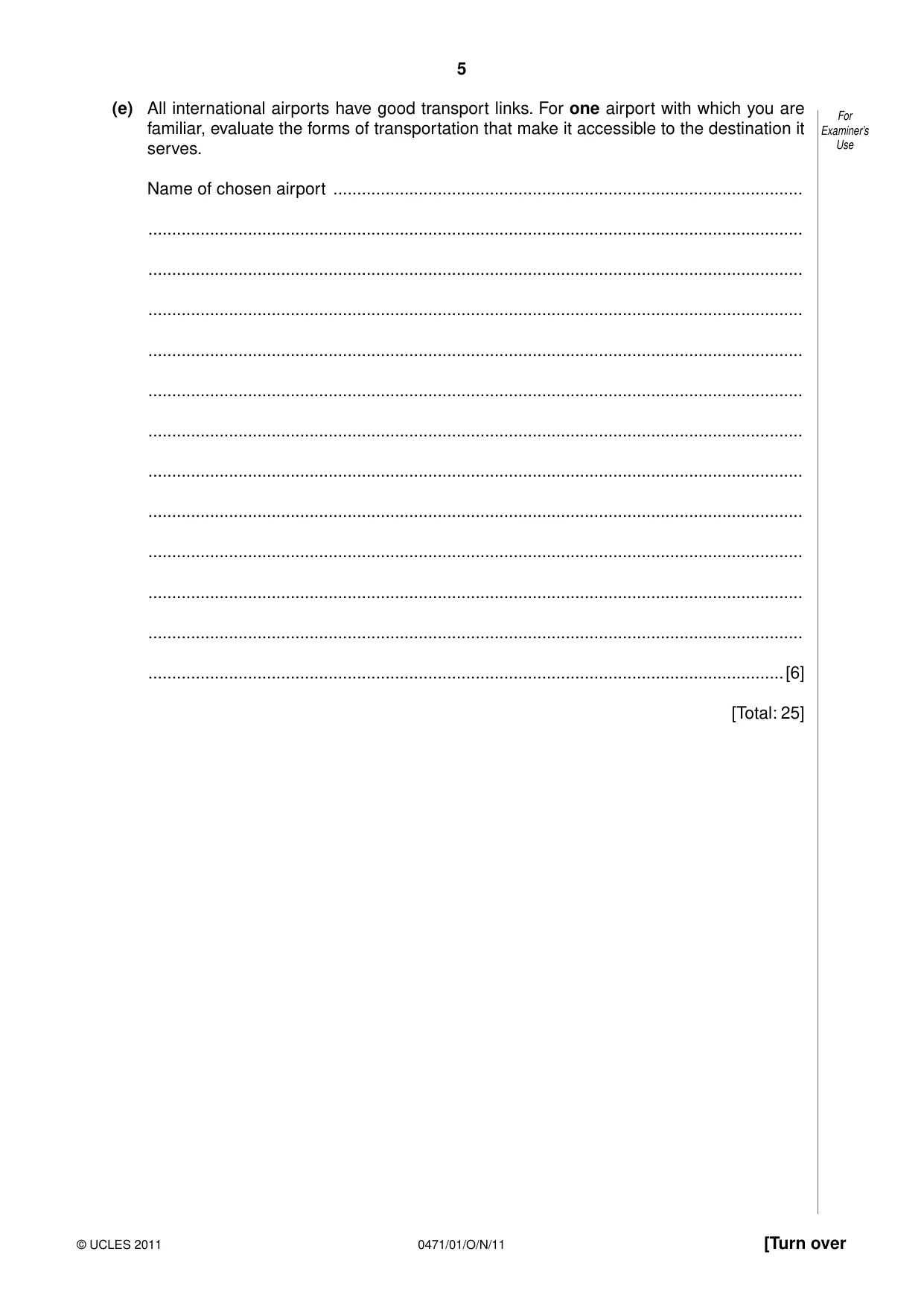
5 [Turn over © UCLES 2011 0471/01/O/N/11 For Examiner’s Use (e) All international airports have good transport links. For one airport with which you are familiar, evaluate the forms of transportation that make it accessible to the destination it serves. Name of chosen airport … … … … … … … … … … … … …[6] [Total: 25]
Question paper, page 6
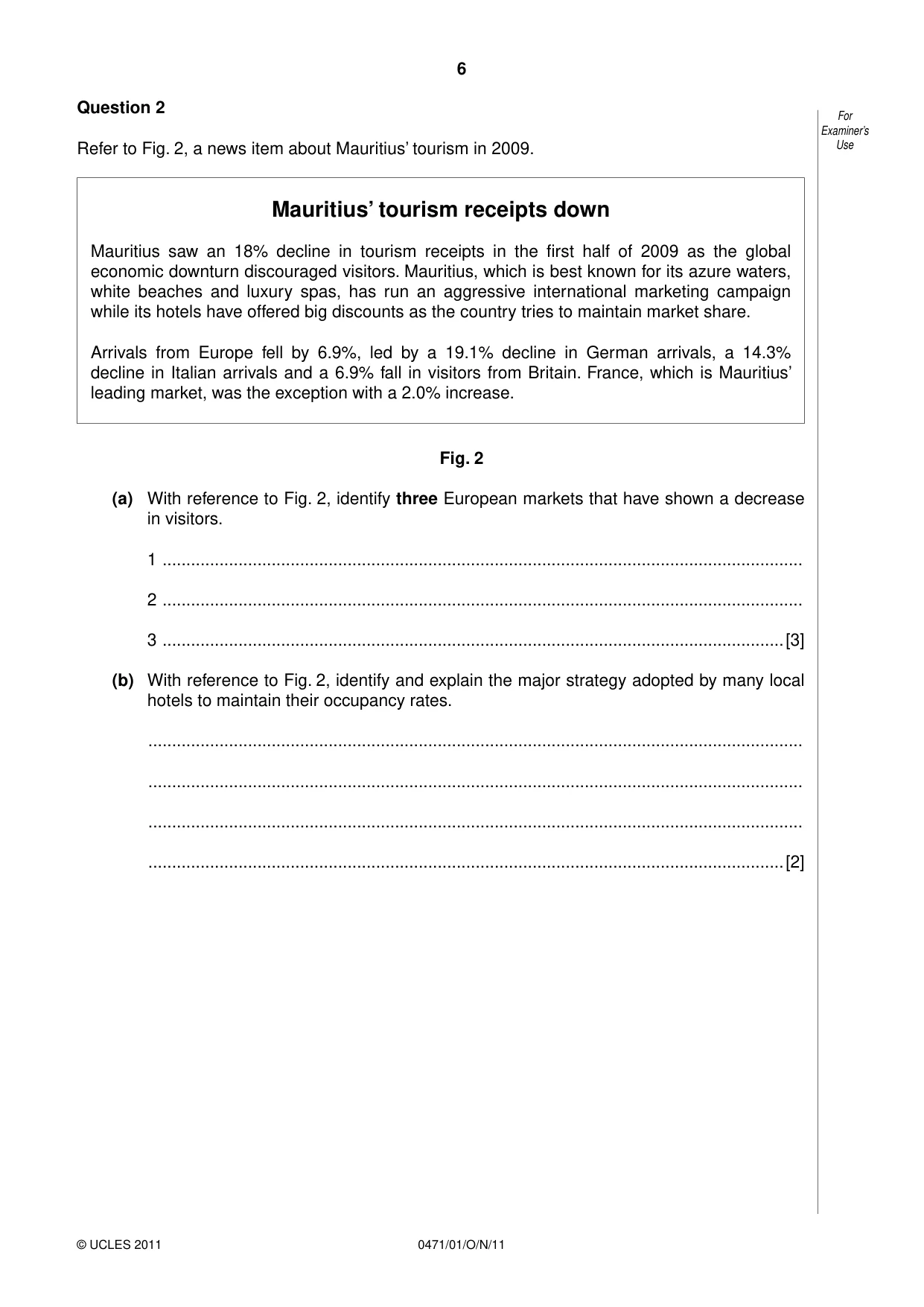
6 0471/01/O/N/11 © UCLES 2011 For Examiner’s Use Question 2 Refer to Fig. 2, a news item about Mauritius’ tourism in 2009. Mauritius’ tourism receipts down Mauritius saw an 18% decline in tourism receipts in the first half of 2009 as the global economic downturn discouraged visitors. Mauritius, which is best known for its azure waters, white beaches and luxury spas, has run an aggressive international marketing campaign while its hotels have offered big discounts as the country tries to maintain market share. Arrivals from Europe fell by 6.9%, led by a 19.1% decline in German arrivals, a 14.3% decline in Italian arrivals and a 6.9% fall in visitors from Britain. France, which is Mauritius’ leading market, was the exception with a 2.0% increase. Fig. 2 (a) With reference to Fig. 2, identify three European markets that have shown a decrease in visitors. 1 … 2 … 3 …[3] (b) With reference to Fig. 2, identify and explain the major strategy adopted by many local hotels to maintain their occupancy rates. … … … …[2]
Question paper, page 7
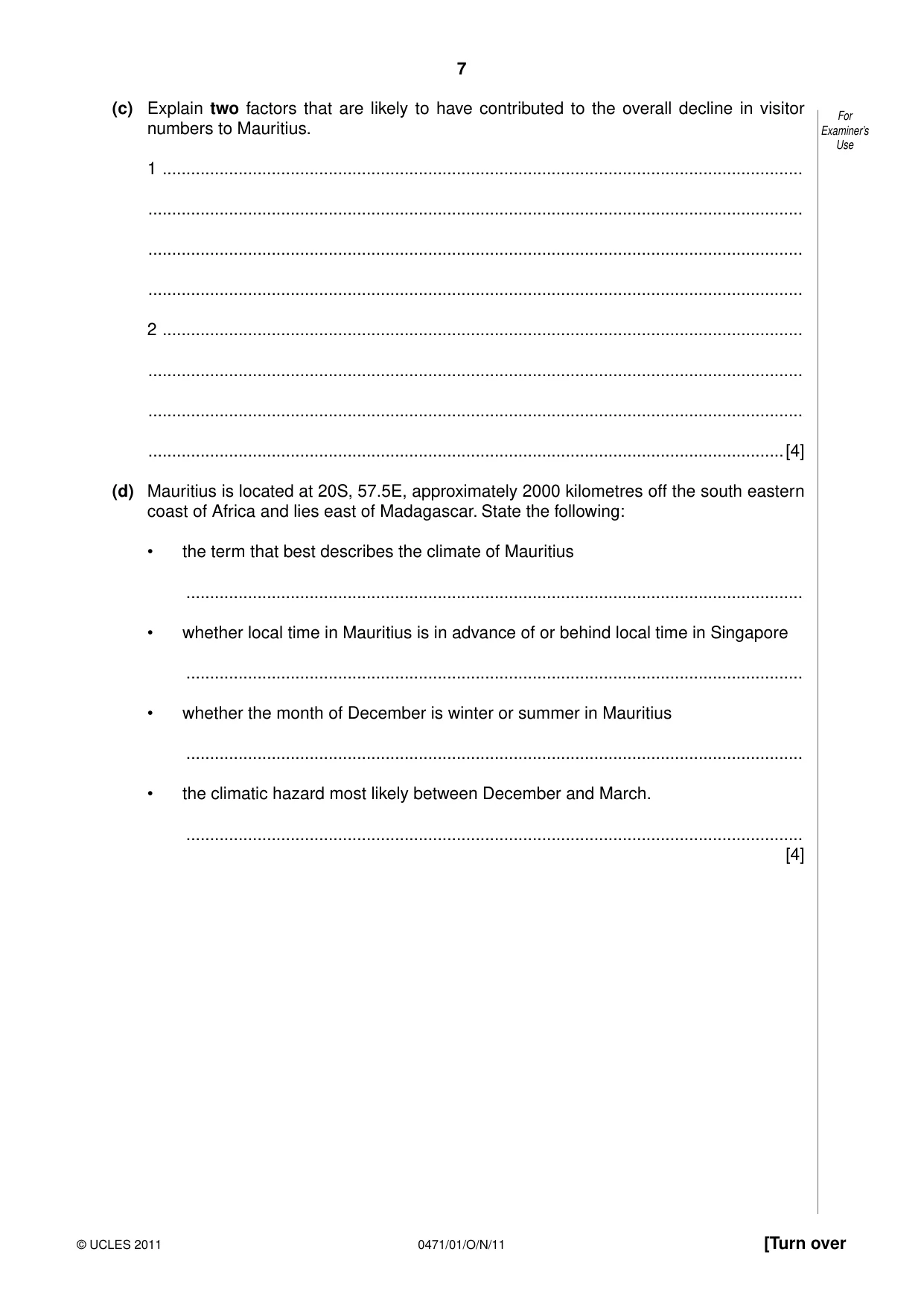
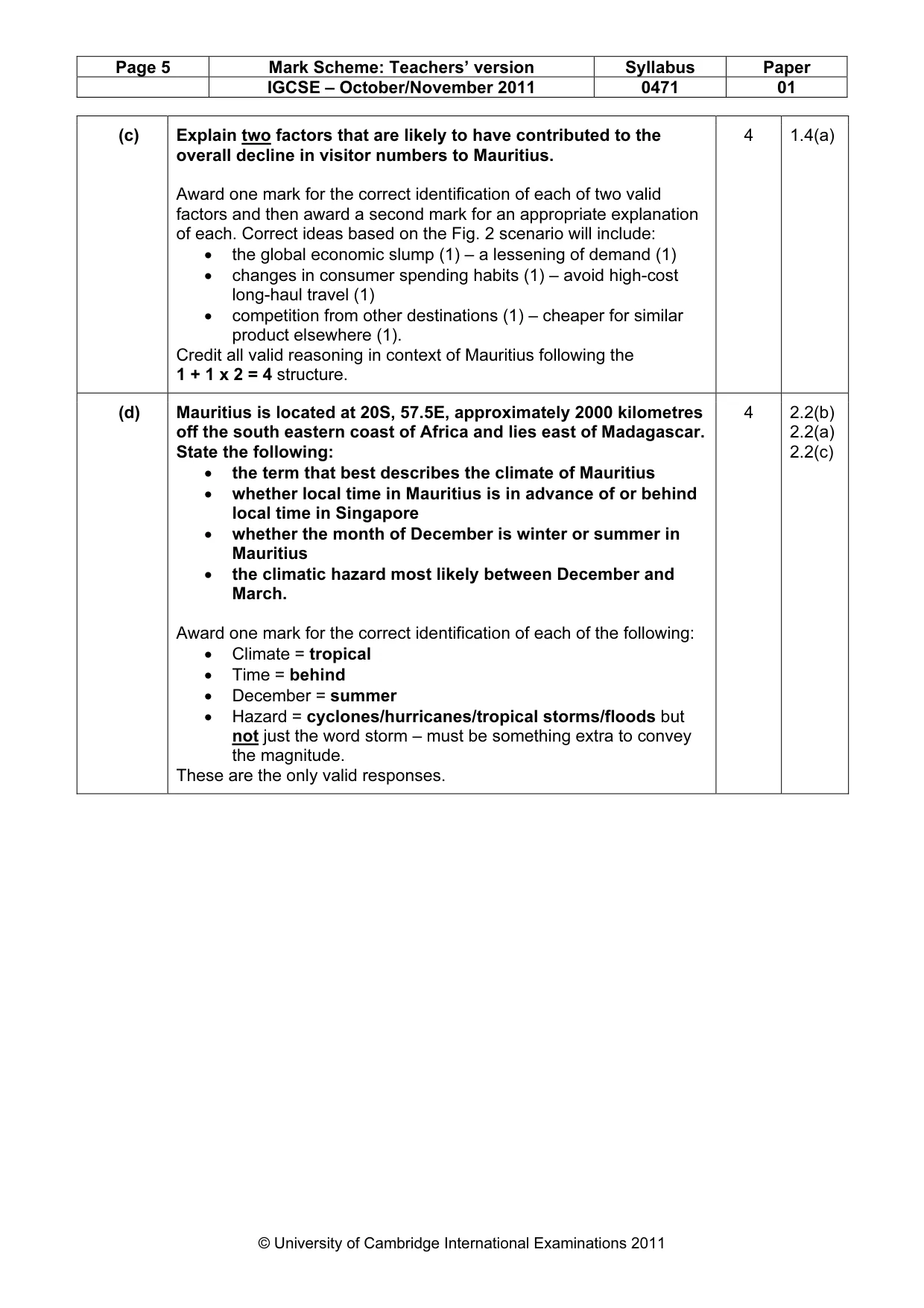
7 [Turn over © UCLES 2011 0471/01/O/N/11 For Examiner’s Use (c) Explain two factors that are likely to have contributed to the overall decline in visitor numbers to Mauritius. 1 … … … … 2 … … … …[4] (d) Mauritius is located at 20S, 57.5E, approximately 2000 kilometres off the south eastern coast of Africa and lies east of Madagascar. State the following: • the term that best describes the climate of Mauritius … • whether local time in Mauritius is in advance of or behind local time in Singapore … • whether the month of December is winter or summer in Mauritius … • the climatic hazard most likely between December and March. … [4]
Question paper, page 8
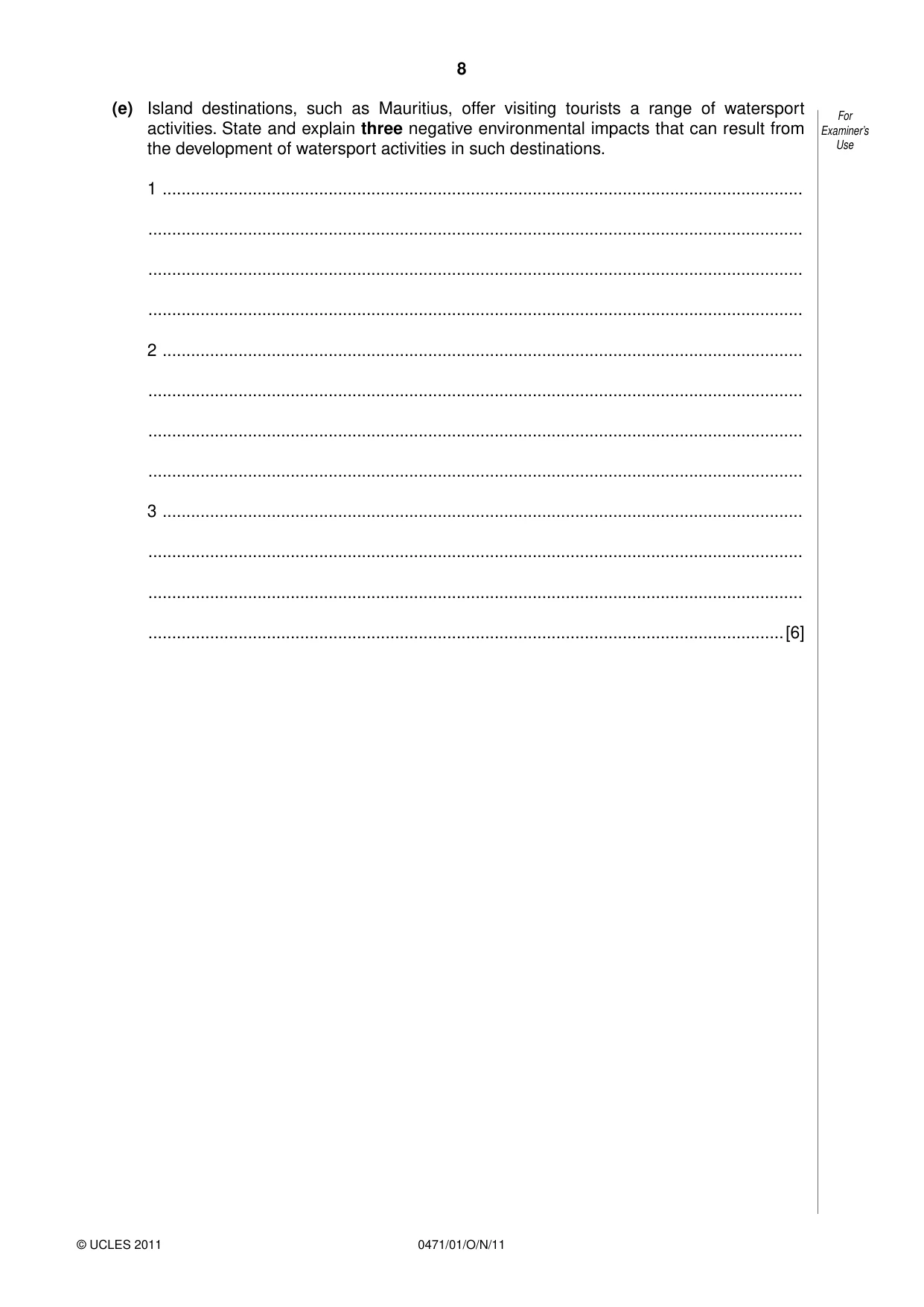
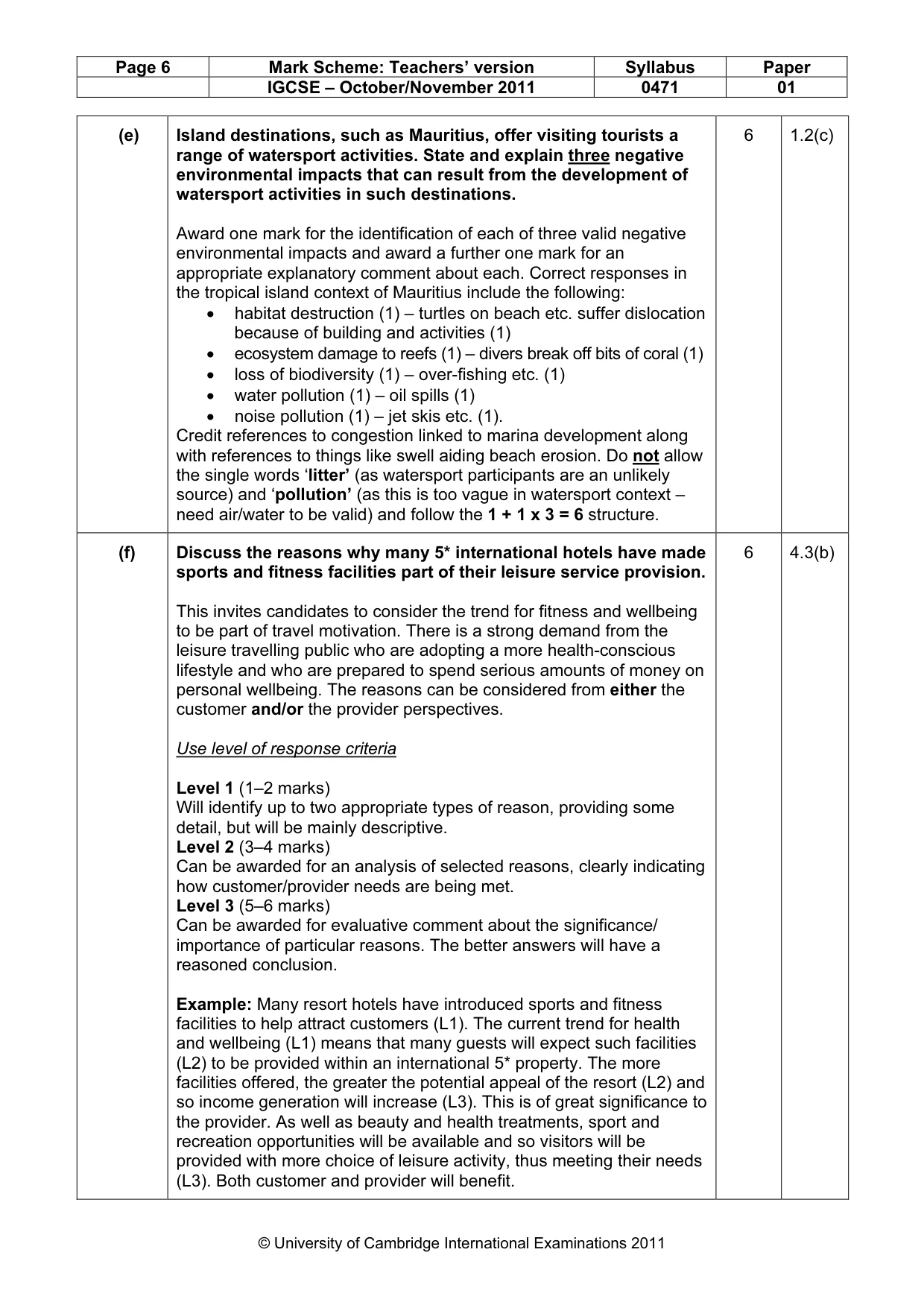
8 0471/01/O/N/11 © UCLES 2011 For Examiner’s Use (e) Island destinations, such as Mauritius, offer visiting tourists a range of watersport activities. State and explain three negative environmental impacts that can result from the development of watersport activities in such destinations. 1 … … … … 2 … … … … 3 … … … …[6]
Question paper, page 9
9 [Turn over © UCLES 2011 0471/01/O/N/11 For Examiner’s Use (f) Discuss the reasons why many 5* international hotels have made sports and fitness facilities part of their leisure service provision. … … … … … … … … … … … …[6] [Total: 25]
Question paper, page 10
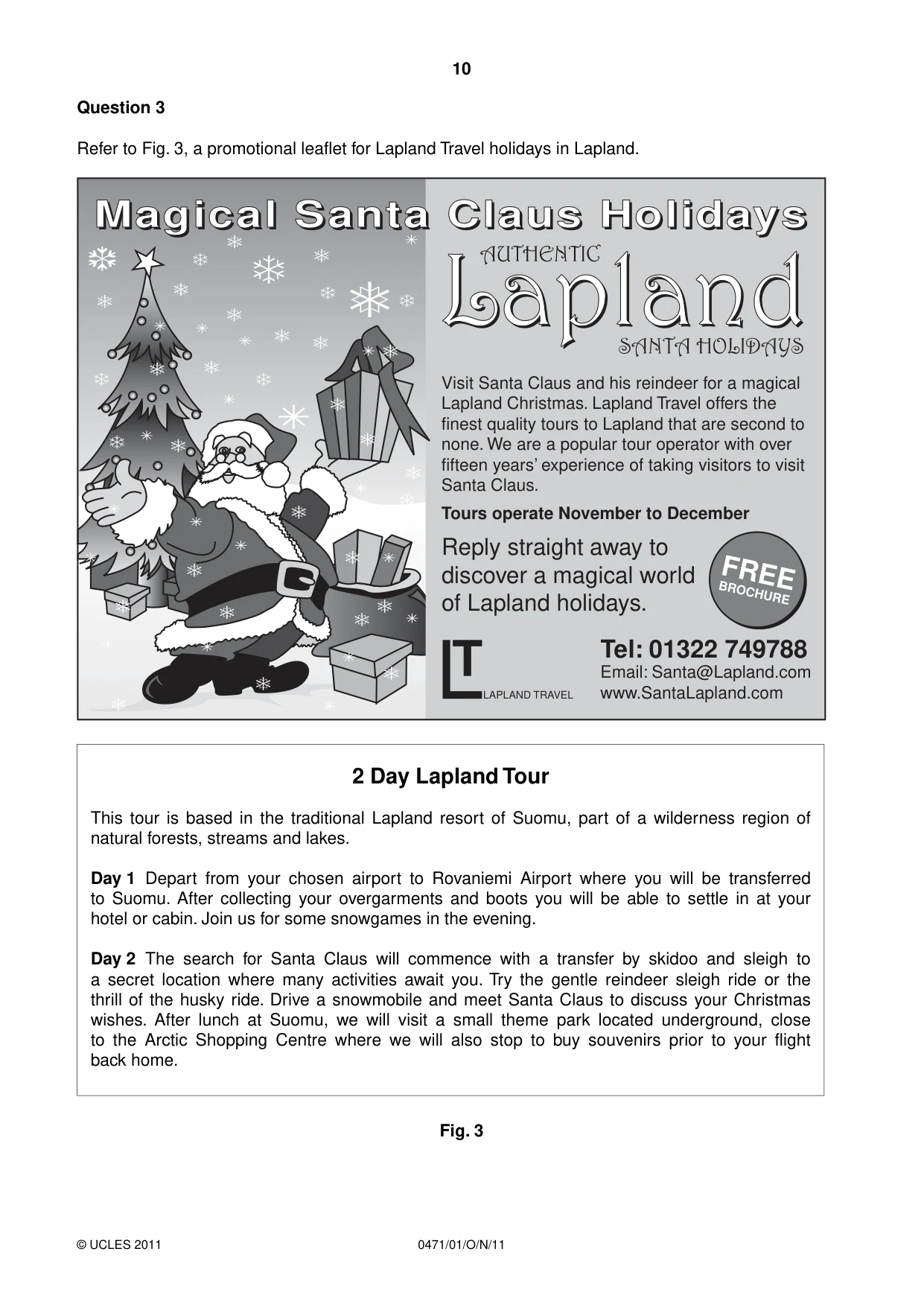
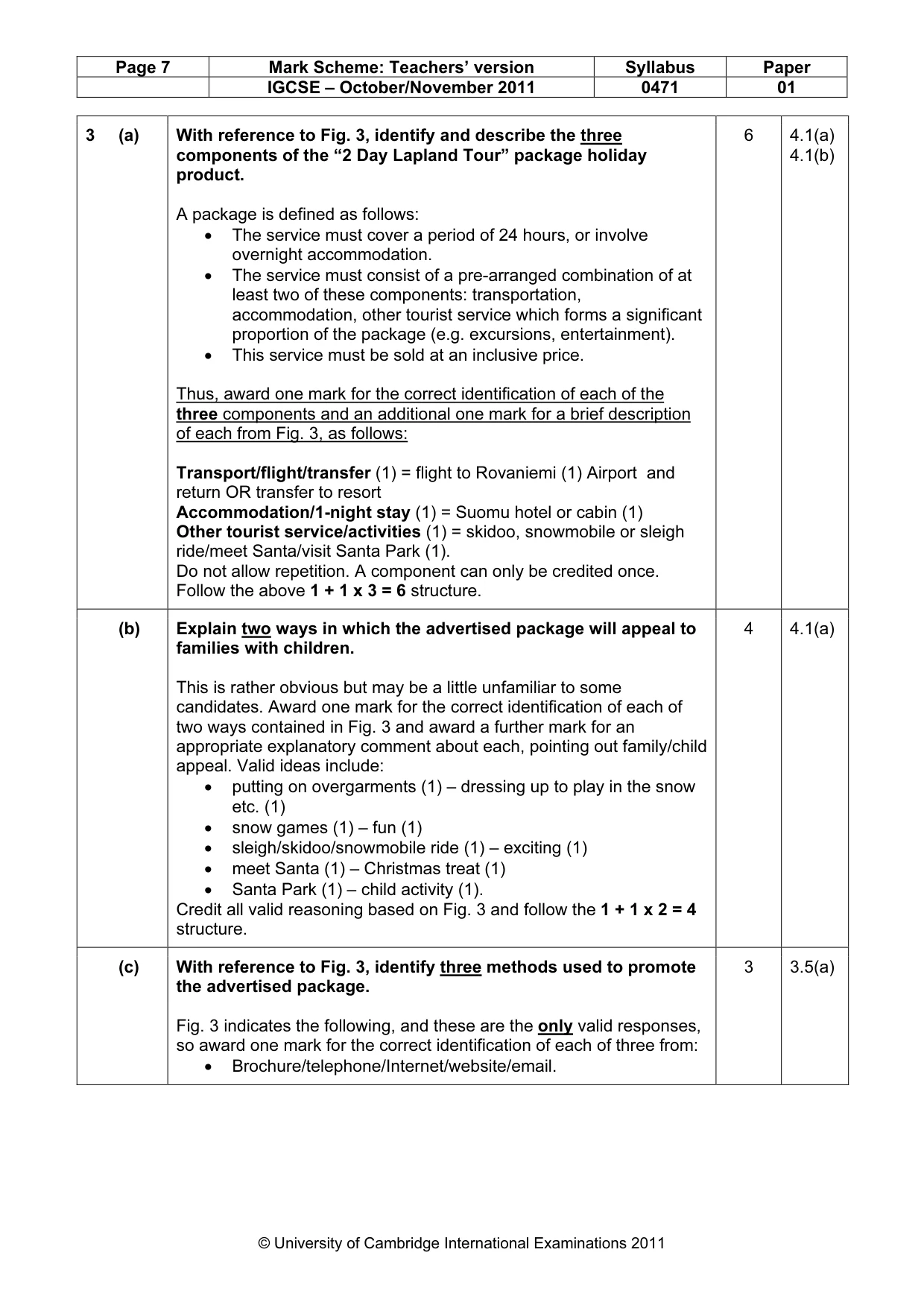
10 0471/01/O/N/11 © UCLES 2011 Question 3 Refer to Fig. 3, a promotional leaflet for Lapland Travel holidays in Lapland. Magical Santa Claus Holidays Magical Santa Claus Holidays Magical Santa Claus Holidays Visit Santa Claus and his reindeer for a magical Lapland Christmas. Lapland Travel offers the finest quality tours to Lapland that are second to none. We are a popular tour operator with over fifteen years’ experience of taking visitors to visit Santa Claus. Tours operate November to December Tel: 01322 749788 Email: Santa@Lapland.com www.SantaLapland.com Reply straight away to discover a magical world of Lapland holidays. FREE BROCHURE LAPLAND TRAVEL 2 Day Lapland Tour This tour is based in the traditional Lapland resort of Suomu, part of a wilderness region of natural forests, streams and lakes. Day 1 Depart from your chosen airport to Rovaniemi Airport where you will be transferred to Suomu. After collecting your overgarments and boots you will be able to settle in at your hotel or cabin. Join us for some snowgames in the evening. Day 2 The search for Santa Claus will commence with a transfer by skidoo and sleigh to a secret location where many activities await you. Try the gentle reindeer sleigh ride or the thrill of the husky ride. Drive a snowmobile and meet Santa Claus to discuss your Christmas wishes. After lunch at Suomu, we will visit a small theme park located underground, close to the Arctic Shopping Centre where we will also stop to buy souvenirs prior to your flight back home. Fig. 3
Question paper, page 11
11 [Turn over © UCLES 2011 0471/01/O/N/11 For Examiner’s Use (a) With reference to Fig. 3, identify and describe the three components of the “2 Day Lapland Tour” package holiday product. 1 … … … … 2 … … … … 3 … … … …[6] (b) Explain two ways in which the advertised package will appeal to families with children. 1 … … … … 2 … … … …[4] (c) With reference to Fig. 3, identify three methods used to promote the advertised package. 1 … 2 … 3 …[3]
Question paper, page 12
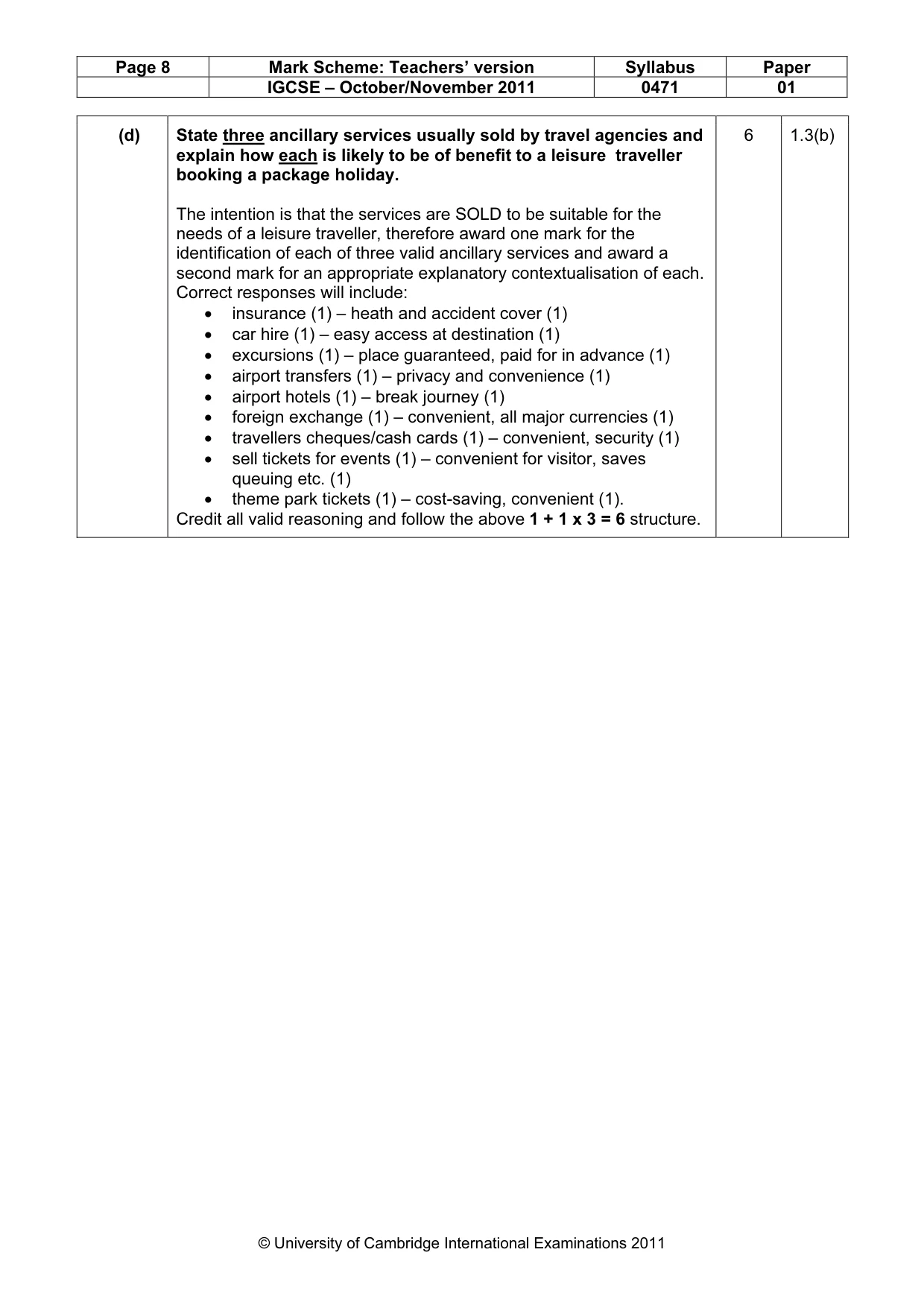
12 0471/01/O/N/11 © UCLES 2011 For Examiner’s Use (d) State three ancillary services usually sold by travel agencies and explain how each is likely to be of benefit to a leisure traveller booking a package holiday. Service … Benefit … … … Service … Benefit … … … Service … Benefit … … …[6] (e) With reference to one example with which you are familiar, discuss how a river, lake or inland waterway has been developed for tourism purposes. Name of chosen river/lake/waterway … … … … … … … … … … … … …[6] [Total: 25]
Question paper, page 13
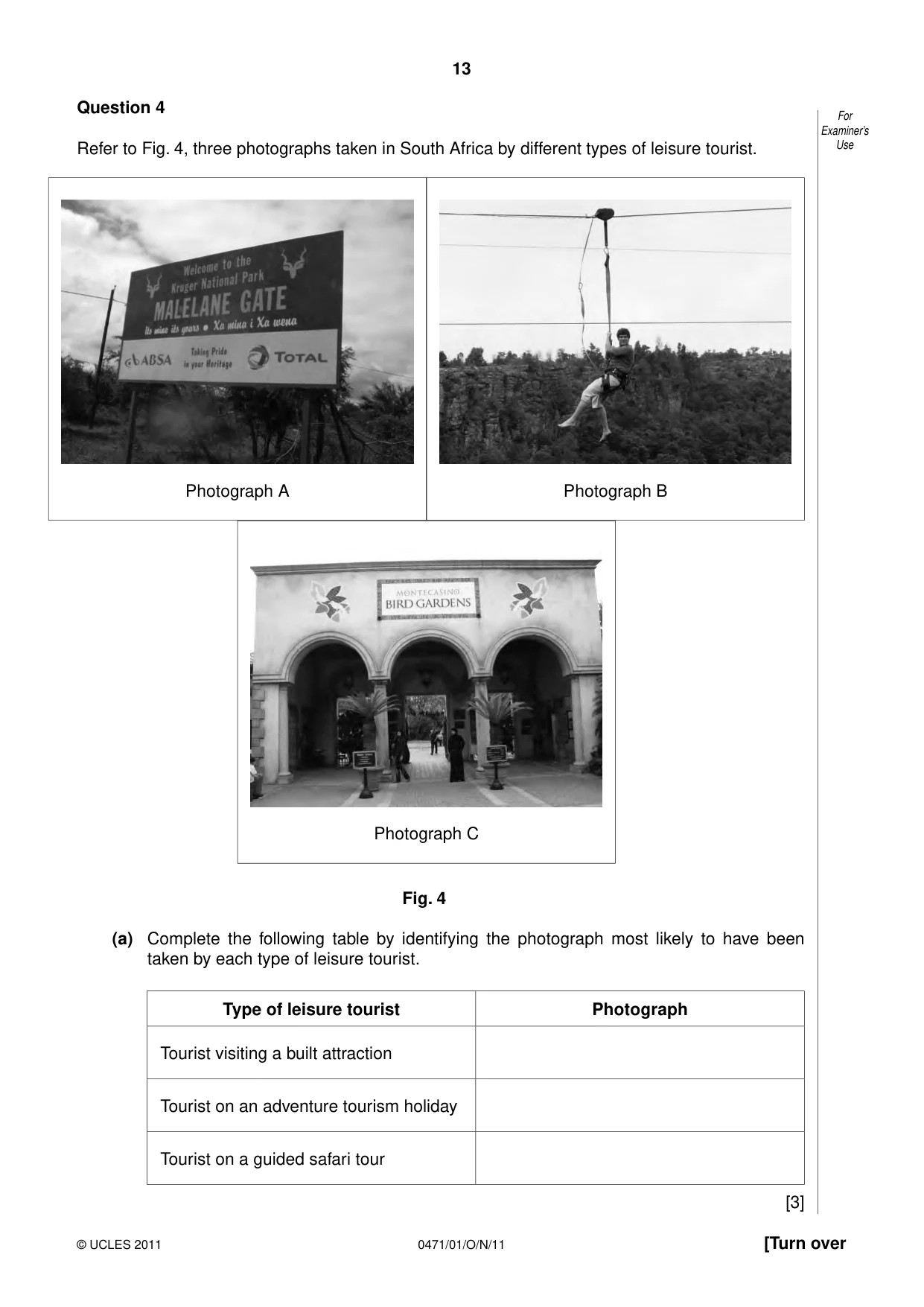
13 [Turn over © UCLES 2011 0471/01/O/N/11 For Examiner’s Use Question 4 Refer to Fig. 4, three photographs taken in South Africa by different types of leisure tourist. Photograph A Photograph B Photograph C Fig. 4 (a) Complete the following table by identifying the photograph most likely to have been taken by each type of leisure tourist. Type of leisure tourist Photograph Tourist visiting a built attraction Tourist on an adventure tourism holiday Tourist on a guided safari tour [3]
Question paper, page 14
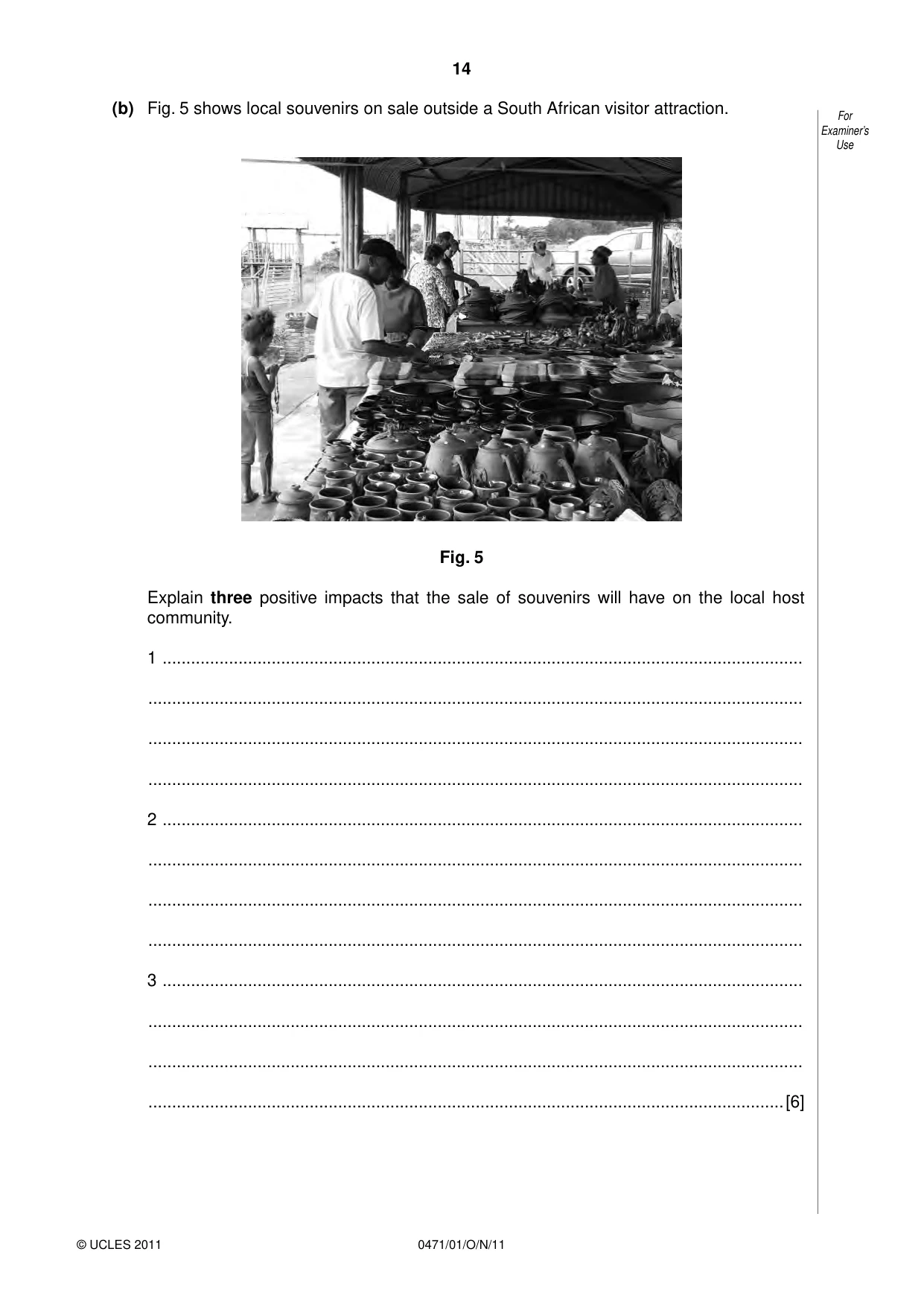
14 0471/01/O/N/11 © UCLES 2011 For Examiner’s Use (b) Fig. 5 shows local souvenirs on sale outside a South African visitor attraction. Fig. 5 Explain three positive impacts that the sale of souvenirs will have on the local host community. 1 … … … … 2 … … … … 3 … … … …[6]
Question paper, page 15
15 [Turn over © UCLES 2011 0471/01/O/N/11 For Examiner’s Use (c) Not all encounters between tourists and the host population are positive. Explain three ways in which the ‘demonstration effect’ can result in a negative social/cultural impact on a local host population. 1 … … … … 2 … … … … 3 … … … …[6] (d) Explain two ways in which built attractions can manage visitor arrivals to prevent congestion. 1 … … … … 2 … … … …[4]
Question paper, page 16
16 0471/01/O/N/11 © UCLES 2011 For Examiner’s Use (e) Many international visitor attractions employ staff to act as guides. Discuss the main skills that such employees will be expected to possess. … … … … … … … … … … … …[6] [Total: 25] Copyright Acknowledgements: Question 1 © Eturbonews Sao Paulo; www.eturbonews.com. Question 2 © Eturbonews Mauritius; www.eturbonews.com. Question 4 Photographs © John D Smith © UCLES. Permission to reproduce items where third-party owned material protected by copyright is included has been sought and cleared where possible. Every reasonable effort has been made by the publisher (UCLES) to trace copyright holders, but if any items requiring clearance have unwittingly been included, the publisher will be pleased to make amends at the earliest possible opportunity. University of Cambridge International Examinations is part of the Cambridge Assessment Group. Cambridge Assessment is the brand name of University of Cambridge Local Examinations Syndicate (UCLES), which is itself a department of the University of Cambridge.
Mark scheme, page 1
UNIVERSITY OF CAMBRIDGE INTERNATIONAL EXAMINATIONS International General Certificate of Secondary Education MARK SCHEME for the October/November 2011 question paper for the guidance of teachers 0471 TRAVEL AND TOURISM 0471/01 Paper 1 (Written Paper), maximum raw mark 100 This mark scheme is published as an aid to teachers and candidates, to indicate the requirements of the examination. It shows the basis on which Examiners were instructed to award marks. It does not indicate the details of the discussions that took place at an Examiners’ meeting before marking began, which would have considered the acceptability of alternative answers. Mark schemes must be read in conjunction with the question papers and the report on the examination. • Cambridge will not enter into discussions or correspondence in connection with these mark schemes. Cambridge is publishing the mark schemes for the October/November 2011 question papers for most IGCSE, GCE Advanced Level and Advanced Subsidiary Level syllabuses and some Ordinary Level syllabuses. www.XtremePapers.com
Mark scheme, page 2
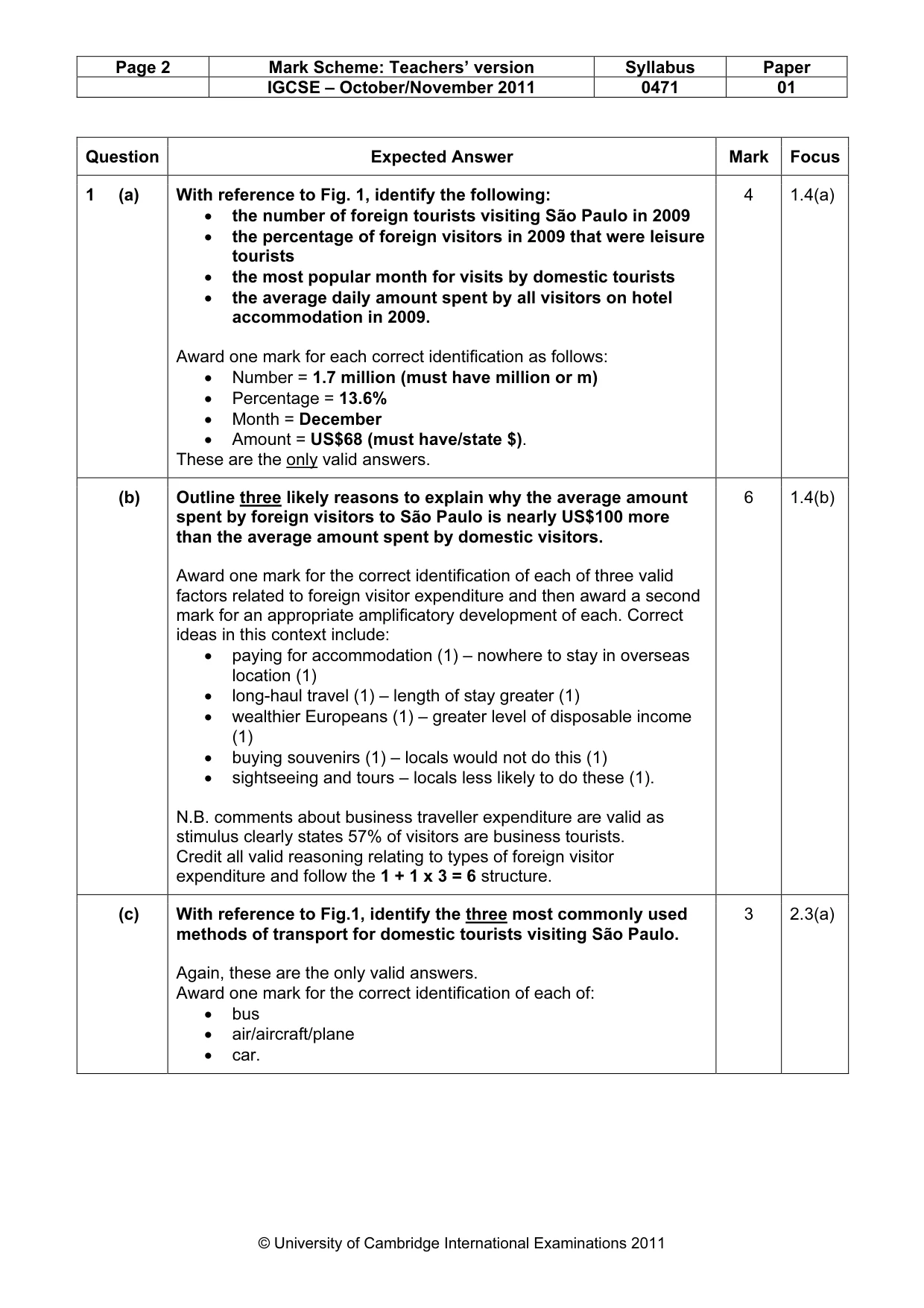
Page 2 Mark Scheme: Teachers’ version Syllabus Paper IGCSE – October/November 2011 0471 01 © University of Cambridge International Examinations 2011 Question Expected Answer Mark Focus 1 (a) With reference to Fig. 1, identify the following: • the number of foreign tourists visiting São Paulo in 2009 • the percentage of foreign visitors in 2009 that were leisure tourists • the most popular month for visits by domestic tourists • the average daily amount spent by all visitors on hotel accommodation in 2009. Award one mark for each correct identification as follows: • Number = 1.7 million (must have million or m) • Percentage = 13.6% • Month = December • Amount = US$68 (must have/state $). These are the only valid answers. 4 1.4(a) (b) Outline three likely reasons to explain why the average amount spent by foreign visitors to São Paulo is nearly US$100 more than the average amount spent by domestic visitors. Award one mark for the correct identification of each of three valid factors related to foreign visitor expenditure and then award a second mark for an appropriate amplificatory development of each. Correct ideas in this context include: • paying for accommodation (1) – nowhere to stay in overseas location (1) • long-haul travel (1) – length of stay greater (1) • wealthier Europeans (1) – greater level of disposable income (1) • buying souvenirs (1) – locals would not do this (1) • sightseeing and tours – locals less likely to do these (1). N.B. comments about business traveller expenditure are valid as stimulus clearly states 57% of visitors are business tourists. Credit all valid reasoning relating to types of foreign visitor expenditure and follow the 1 + 1 x 3 = 6 structure. 6 1.4(b) (c) With reference to Fig.1, identify the three most commonly used methods of transport for domestic tourists visiting São Paulo. Again, these are the only valid answers. Award one mark for the correct identification of each of: • bus • air/aircraft/plane • car. 3 2.3(a)
Mark scheme, page 3
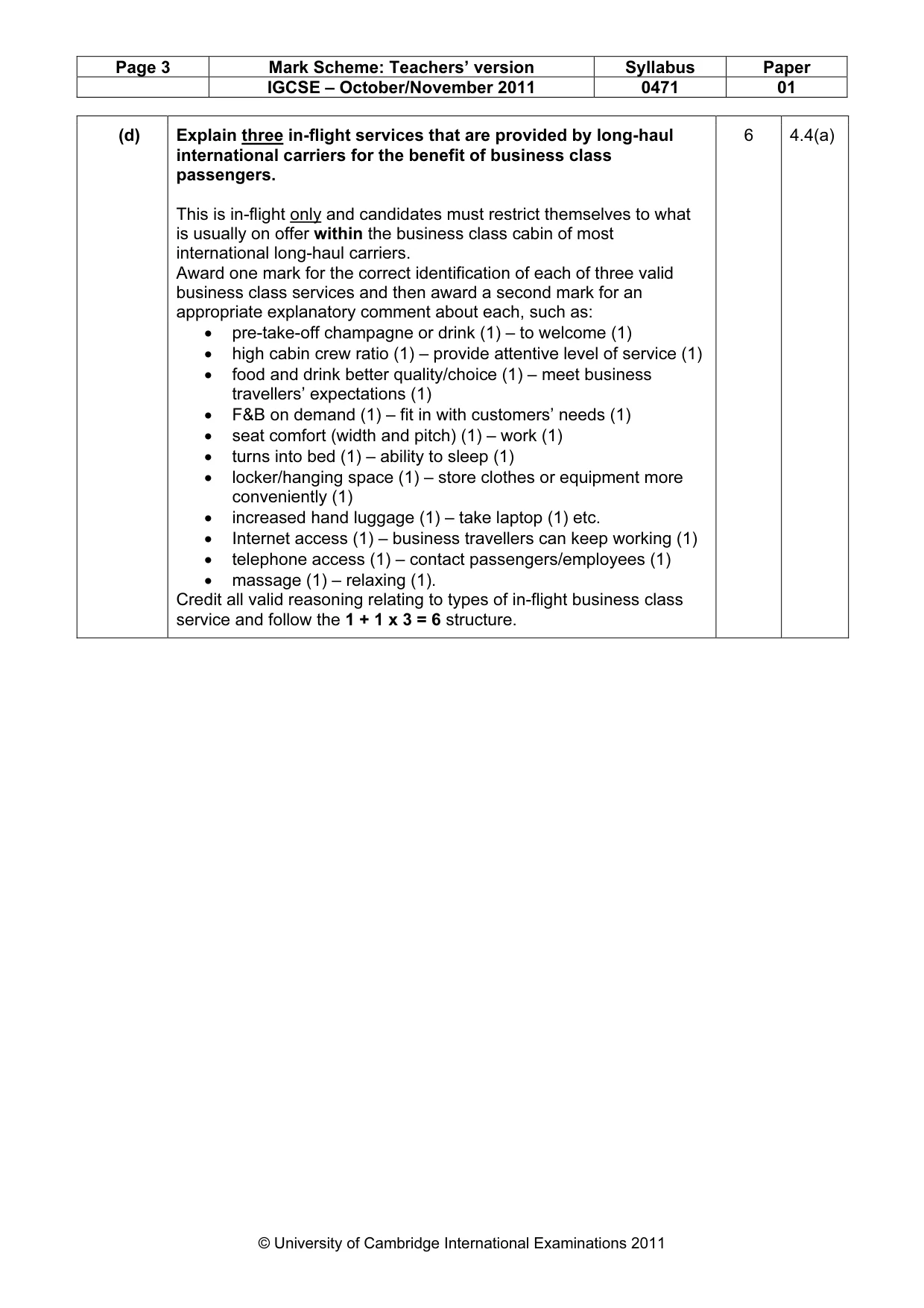
Page 3 Mark Scheme: Teachers’ version Syllabus Paper IGCSE – October/November 2011 0471 01 © University of Cambridge International Examinations 2011 (d) Explain three in-flight services that are provided by long-haul international carriers for the benefit of business class passengers. This is in-flight only and candidates must restrict themselves to what is usually on offer within the business class cabin of most international long-haul carriers. Award one mark for the correct identification of each of three valid business class services and then award a second mark for an appropriate explanatory comment about each, such as: • pre-take-off champagne or drink (1) – to welcome (1) • high cabin crew ratio (1) – provide attentive level of service (1) • food and drink better quality/choice (1) – meet business travellers’ expectations (1) • F&B on demand (1) – fit in with customers’ needs (1) • seat comfort (width and pitch) (1) – work (1) • turns into bed (1) – ability to sleep (1) • locker/hanging space (1) – store clothes or equipment more conveniently (1) • increased hand luggage (1) – take laptop (1) etc. • Internet access (1) – business travellers can keep working (1) • telephone access (1) – contact passengers/employees (1) • massage (1) – relaxing (1). Credit all valid reasoning relating to types of in-flight business class service and follow the 1 + 1 x 3 = 6 structure. 6 4.4(a)
Mark scheme, page 4
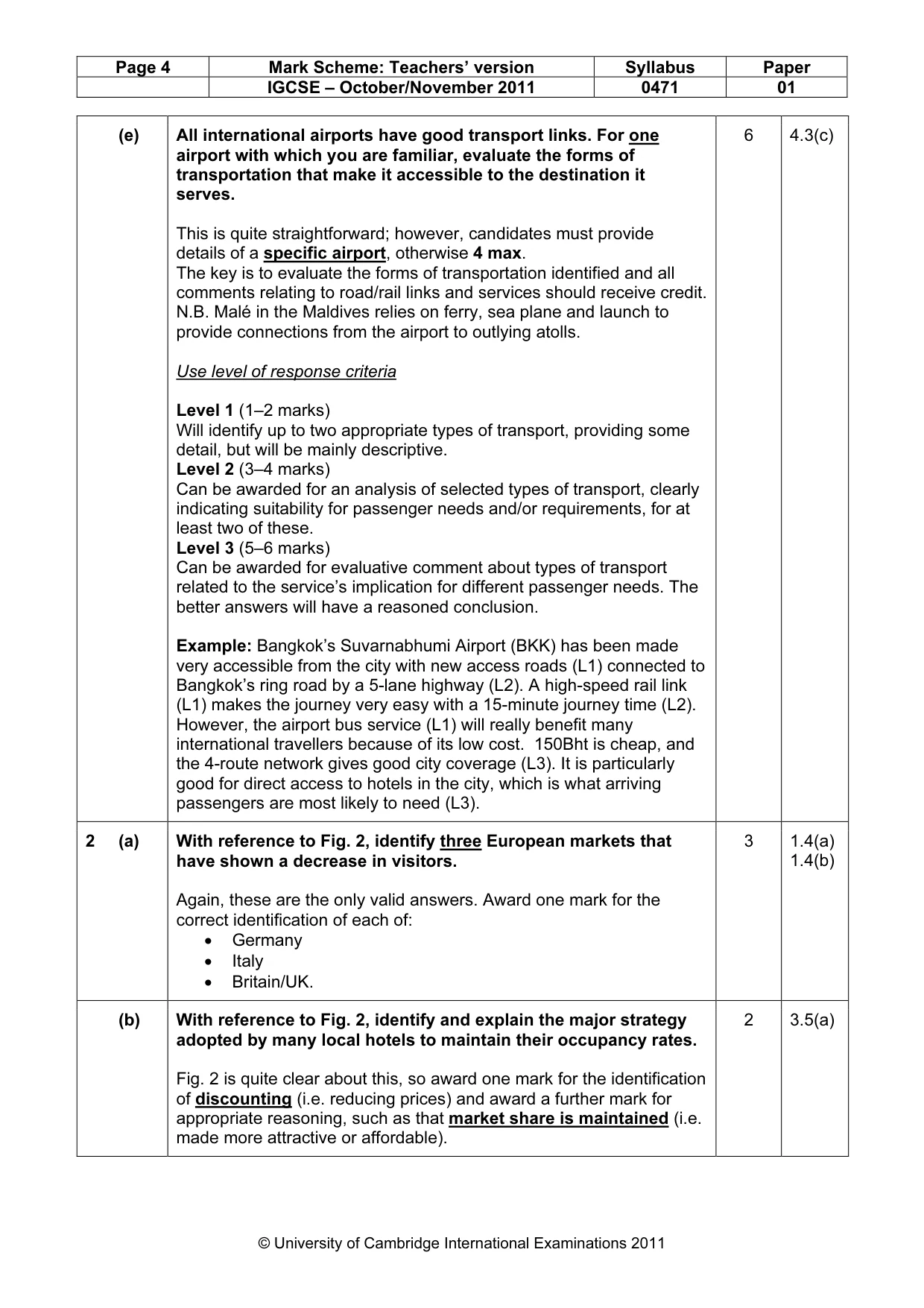
Page 4 Mark Scheme: Teachers’ version Syllabus Paper IGCSE – October/November 2011 0471 01 © University of Cambridge International Examinations 2011 (e) All international airports have good transport links. For one airport with which you are familiar, evaluate the forms of transportation that make it accessible to the destination it serves. This is quite straightforward; however, candidates must provide details of a specific airport, otherwise 4 max. The key is to evaluate the forms of transportation identified and all comments relating to road/rail links and services should receive credit. N.B. Malé in the Maldives relies on ferry, sea plane and launch to provide connections from the airport to outlying atolls. Use level of response criteria Level 1 (1–2 marks) Will identify up to two appropriate types of transport, providing some detail, but will be mainly descriptive. Level 2 (3–4 marks) Can be awarded for an analysis of selected types of transport, clearly indicating suitability for passenger needs and/or requirements, for at least two of these. Level 3 (5–6 marks) Can be awarded for evaluative comment about types of transport related to the service’s implication for different passenger needs. The better answers will have a reasoned conclusion. Example: Bangkok’s Suvarnabhumi Airport (BKK) has been made very accessible from the city with new access roads (L1) connected to Bangkok’s ring road by a 5-lane highway (L2). A high-speed rail link (L1) makes the journey very easy with a 15-minute journey time (L2). However, the airport bus service (L1) will really benefit many international travellers because of its low cost. 150Bht is cheap, and the 4-route network gives good city coverage (L3). It is particularly good for direct access to hotels in the city, which is what arriving passengers are most likely to need (L3). 6 4.3(c) 2 (a) With reference to Fig. 2, identify three European markets that have shown a decrease in visitors. Again, these are the only valid answers. Award one mark for the correct identification of each of: • Germany • Italy • Britain/UK. 3 1.4(a) 1.4(b) (b) With reference to Fig. 2, identify and explain the major strategy adopted by many local hotels to maintain their occupancy rates. Fig. 2 is quite clear about this, so award one mark for the identification of discounting (i.e. reducing prices) and award a further mark for appropriate reasoning, such as that market share is maintained (i.e. made more attractive or affordable). 2 3.5(a)
Mark scheme, page 5
Page 5 Mark Scheme: Teachers’ version Syllabus Paper IGCSE – October/November 2011 0471 01 © University of Cambridge International Examinations 2011 (c) Explain two factors that are likely to have contributed to the overall decline in visitor numbers to Mauritius. Award one mark for the correct identification of each of two valid factors and then award a second mark for an appropriate explanation of each. Correct ideas based on the Fig. 2 scenario will include: • the global economic slump (1) – a lessening of demand (1) • changes in consumer spending habits (1) – avoid high-cost long-haul travel (1) • competition from other destinations (1) – cheaper for similar product elsewhere (1). Credit all valid reasoning in context of Mauritius following the 1 + 1 x 2 = 4 structure. 4 1.4(a) (d) Mauritius is located at 20S, 57.5E, approximately 2000 kilometres off the south eastern coast of Africa and lies east of Madagascar. State the following: • the term that best describes the climate of Mauritius • whether local time in Mauritius is in advance of or behind local time in Singapore • whether the month of December is winter or summer in Mauritius • the climatic hazard most likely between December and March. Award one mark for the correct identification of each of the following: • Climate = tropical • Time = behind • December = summer • Hazard = cyclones/hurricanes/tropical storms/floods but not just the word storm – must be something extra to convey the magnitude. These are the only valid responses. 4 2.2(b) 2.2(a) 2.2(c)
Mark scheme, page 6
Page 6 Mark Scheme: Teachers’ version Syllabus Paper IGCSE – October/November 2011 0471 01 © University of Cambridge International Examinations 2011 (e) Island destinations, such as Mauritius, offer visiting tourists a range of watersport activities. State and explain three negative environmental impacts that can result from the development of watersport activities in such destinations. Award one mark for the identification of each of three valid negative environmental impacts and award a further one mark for an appropriate explanatory comment about each. Correct responses in the tropical island context of Mauritius include the following: • habitat destruction (1) – turtles on beach etc. suffer dislocation because of building and activities (1) • ecosystem damage to reefs (1) – divers break off bits of coral (1) • loss of biodiversity (1) – over-fishing etc. (1) • water pollution (1) – oil spills (1) • noise pollution (1) – jet skis etc. (1). Credit references to congestion linked to marina development along with references to things like swell aiding beach erosion. Do not allow the single words ‘litter’ (as watersport participants are an unlikely source) and ‘pollution’ (as this is too vague in watersport context – need air/water to be valid) and follow the 1 + 1 x 3 = 6 structure. 6 1.2(c) (f) Discuss the reasons why many 5* international hotels have made sports and fitness facilities part of their leisure service provision. This invites candidates to consider the trend for fitness and wellbeing to be part of travel motivation. There is a strong demand from the leisure travelling public who are adopting a more health-conscious lifestyle and who are prepared to spend serious amounts of money on personal wellbeing. The reasons can be considered from either the customer and/or the provider perspectives. Use level of response criteria Level 1 (1–2 marks) Will identify up to two appropriate types of reason, providing some detail, but will be mainly descriptive. Level 2 (3–4 marks) Can be awarded for an analysis of selected reasons, clearly indicating how customer/provider needs are being met. Level 3 (5–6 marks) Can be awarded for evaluative comment about the significance/ importance of particular reasons. The better answers will have a reasoned conclusion. Example: Many resort hotels have introduced sports and fitness facilities to help attract customers (L1). The current trend for health and wellbeing (L1) means that many guests will expect such facilities (L2) to be provided within an international 5* property. The more facilities offered, the greater the potential appeal of the resort (L2) and so income generation will increase (L3). This is of great significance to the provider. As well as beauty and health treatments, sport and recreation opportunities will be available and so visitors will be provided with more choice of leisure activity, thus meeting their needs (L3). Both customer and provider will benefit. 6 4.3(b)
Mark scheme, page 7
Page 7 Mark Scheme: Teachers’ version Syllabus Paper IGCSE – October/November 2011 0471 01 © University of Cambridge International Examinations 2011 3 (a) With reference to Fig. 3, identify and describe the three components of the “2 Day Lapland Tour” package holiday product. A package is defined as follows: • The service must cover a period of 24 hours, or involve overnight accommodation. • The service must consist of a pre-arranged combination of at least two of these components: transportation, accommodation, other tourist service which forms a significant proportion of the package (e.g. excursions, entertainment). • This service must be sold at an inclusive price. Thus, award one mark for the correct identification of each of the three components and an additional one mark for a brief description of each from Fig. 3, as follows: Transport/flight/transfer (1) = flight to Rovaniemi (1) Airport and return OR transfer to resort Accommodation/1-night stay (1) = Suomu hotel or cabin (1) Other tourist service/activities (1) = skidoo, snowmobile or sleigh ride/meet Santa/visit Santa Park (1). Do not allow repetition. A component can only be credited once. Follow the above 1 + 1 x 3 = 6 structure. 6 4.1(a) 4.1(b) (b) Explain two ways in which the advertised package will appeal to families with children. This is rather obvious but may be a little unfamiliar to some candidates. Award one mark for the correct identification of each of two ways contained in Fig. 3 and award a further mark for an appropriate explanatory comment about each, pointing out family/child appeal. Valid ideas include: • putting on overgarments (1) – dressing up to play in the snow etc. (1) • snow games (1) – fun (1) • sleigh/skidoo/snowmobile ride (1) – exciting (1) • meet Santa (1) – Christmas treat (1) • Santa Park (1) – child activity (1). Credit all valid reasoning based on Fig. 3 and follow the 1 + 1 x 2 = 4 structure. 4 4.1(a) (c) With reference to Fig. 3, identify three methods used to promote the advertised package. Fig. 3 indicates the following, and these are the only valid responses, so award one mark for the correct identification of each of three from: • Brochure/telephone/Internet/website/email. 3 3.5(a)
Mark scheme, page 8
Page 8 Mark Scheme: Teachers’ version Syllabus Paper IGCSE – October/November 2011 0471 01 © University of Cambridge International Examinations 2011 (d) State three ancillary services usually sold by travel agencies and explain how each is likely to be of benefit to a leisure traveller booking a package holiday. The intention is that the services are SOLD to be suitable for the needs of a leisure traveller, therefore award one mark for the identification of each of three valid ancillary services and award a second mark for an appropriate explanatory contextualisation of each. Correct responses will include: • insurance (1) – heath and accident cover (1) • car hire (1) – easy access at destination (1) • excursions (1) – place guaranteed, paid for in advance (1) • airport transfers (1) – privacy and convenience (1) • airport hotels (1) – break journey (1) • foreign exchange (1) – convenient, all major currencies (1) • travellers cheques/cash cards (1) – convenient, security (1) • sell tickets for events (1) – convenient for visitor, saves queuing etc. (1) • theme park tickets (1) – cost-saving, convenient (1). Credit all valid reasoning and follow the above 1 + 1 x 3 = 6 structure. 6 1.3(b)
Mark scheme, page 9
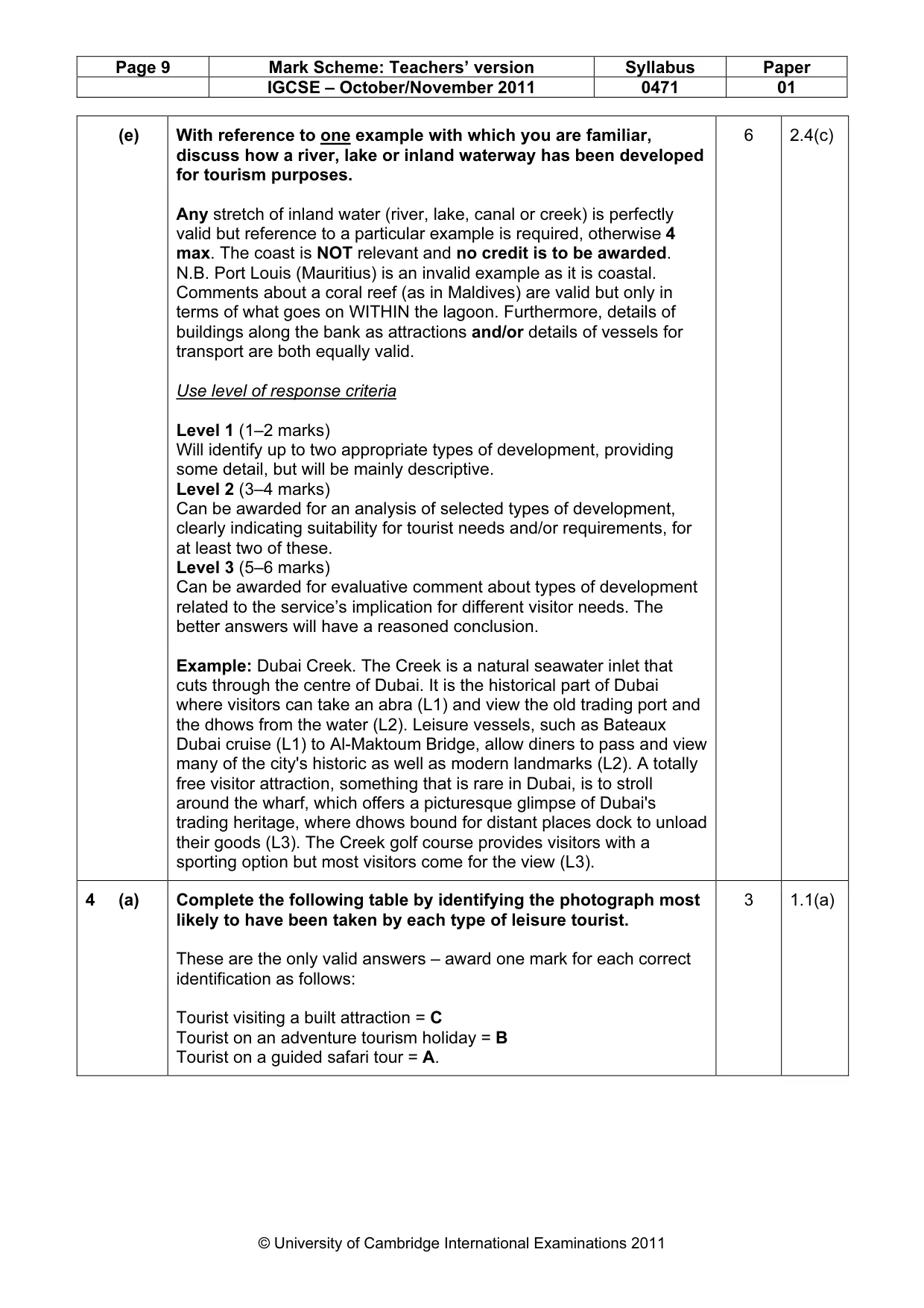
Page 9 Mark Scheme: Teachers’ version Syllabus Paper IGCSE – October/November 2011 0471 01 © University of Cambridge International Examinations 2011 (e) With reference to one example with which you are familiar, discuss how a river, lake or inland waterway has been developed for tourism purposes. Any stretch of inland water (river, lake, canal or creek) is perfectly valid but reference to a particular example is required, otherwise 4 max. The coast is NOT relevant and no credit is to be awarded. N.B. Port Louis (Mauritius) is an invalid example as it is coastal. Comments about a coral reef (as in Maldives) are valid but only in terms of what goes on WITHIN the lagoon. Furthermore, details of buildings along the bank as attractions and/or details of vessels for transport are both equally valid. Use level of response criteria Level 1 (1–2 marks) Will identify up to two appropriate types of development, providing some detail, but will be mainly descriptive. Level 2 (3–4 marks) Can be awarded for an analysis of selected types of development, clearly indicating suitability for tourist needs and/or requirements, for at least two of these. Level 3 (5–6 marks) Can be awarded for evaluative comment about types of development related to the service’s implication for different visitor needs. The better answers will have a reasoned conclusion. Example: Dubai Creek. The Creek is a natural seawater inlet that cuts through the centre of Dubai. It is the historical part of Dubai where visitors can take an abra (L1) and view the old trading port and the dhows from the water (L2). Leisure vessels, such as Bateaux Dubai cruise (L1) to Al-Maktoum Bridge, allow diners to pass and view many of the city's historic as well as modern landmarks (L2). A totally free visitor attraction, something that is rare in Dubai, is to stroll around the wharf, which offers a picturesque glimpse of Dubai's trading heritage, where dhows bound for distant places dock to unload their goods (L3). The Creek golf course provides visitors with a sporting option but most visitors come for the view (L3). 6 2.4(c) 4 (a) Complete the following table by identifying the photograph most likely to have been taken by each type of leisure tourist. These are the only valid answers – award one mark for each correct identification as follows: Tourist visiting a built attraction = C Tourist on an adventure tourism holiday = B Tourist on a guided safari tour = A. 3 1.1(a)
Mark scheme, page 10
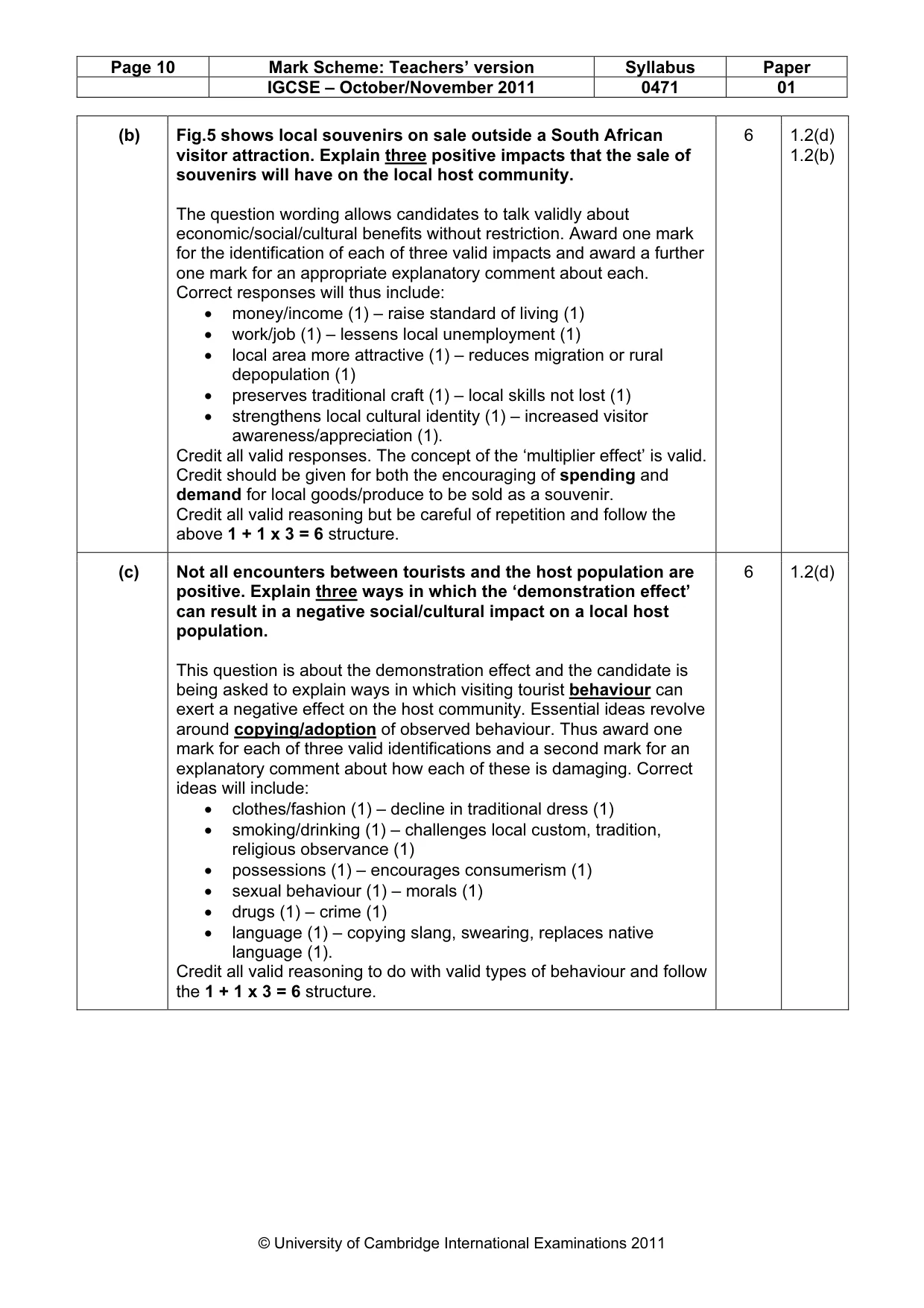
Page 10 Mark Scheme: Teachers’ version Syllabus Paper IGCSE – October/November 2011 0471 01 © University of Cambridge International Examinations 2011 (b) Fig.5 shows local souvenirs on sale outside a South African visitor attraction. Explain three positive impacts that the sale of souvenirs will have on the local host community. The question wording allows candidates to talk validly about economic/social/cultural benefits without restriction. Award one mark for the identification of each of three valid impacts and award a further one mark for an appropriate explanatory comment about each. Correct responses will thus include: • money/income (1) – raise standard of living (1) • work/job (1) – lessens local unemployment (1) • local area more attractive (1) – reduces migration or rural depopulation (1) • preserves traditional craft (1) – local skills not lost (1) • strengthens local cultural identity (1) – increased visitor awareness/appreciation (1). Credit all valid responses. The concept of the ‘multiplier effect’ is valid. Credit should be given for both the encouraging of spending and demand for local goods/produce to be sold as a souvenir. Credit all valid reasoning but be careful of repetition and follow the above 1 + 1 x 3 = 6 structure. 6 1.2(d) 1.2(b) (c) Not all encounters between tourists and the host population are positive. Explain three ways in which the ‘demonstration effect’ can result in a negative social/cultural impact on a local host population. This question is about the demonstration effect and the candidate is being asked to explain ways in which visiting tourist behaviour can exert a negative effect on the host community. Essential ideas revolve around copying/adoption of observed behaviour. Thus award one mark for each of three valid identifications and a second mark for an explanatory comment about how each of these is damaging. Correct ideas will include: • clothes/fashion (1) – decline in traditional dress (1) • smoking/drinking (1) – challenges local custom, tradition, religious observance (1) • possessions (1) – encourages consumerism (1) • sexual behaviour (1) – morals (1) • drugs (1) – crime (1) • language (1) – copying slang, swearing, replaces native language (1). Credit all valid reasoning to do with valid types of behaviour and follow the 1 + 1 x 3 = 6 structure. 6 1.2(d)
Mark scheme, page 11
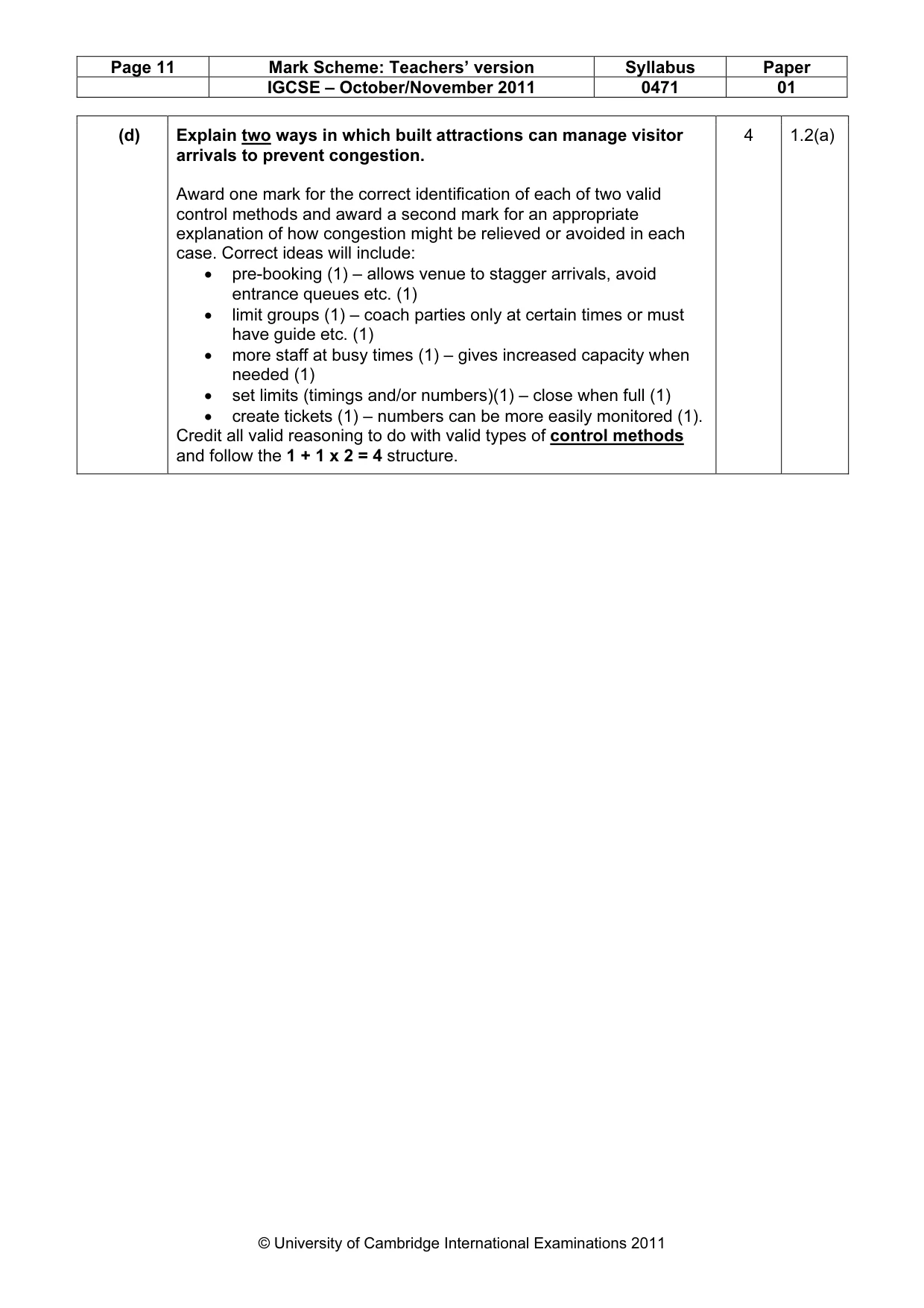
Page 11 Mark Scheme: Teachers’ version Syllabus Paper IGCSE – October/November 2011 0471 01 © University of Cambridge International Examinations 2011 (d) Explain two ways in which built attractions can manage visitor arrivals to prevent congestion. Award one mark for the correct identification of each of two valid control methods and award a second mark for an appropriate explanation of how congestion might be relieved or avoided in each case. Correct ideas will include: • pre-booking (1) – allows venue to stagger arrivals, avoid entrance queues etc. (1) • limit groups (1) – coach parties only at certain times or must have guide etc. (1) • more staff at busy times (1) – gives increased capacity when needed (1) • set limits (timings and/or numbers)(1) – close when full (1) • create tickets (1) – numbers can be more easily monitored (1). Credit all valid reasoning to do with valid types of control methods and follow the 1 + 1 x 2 = 4 structure. 4 1.2(a)
Mark scheme, page 12
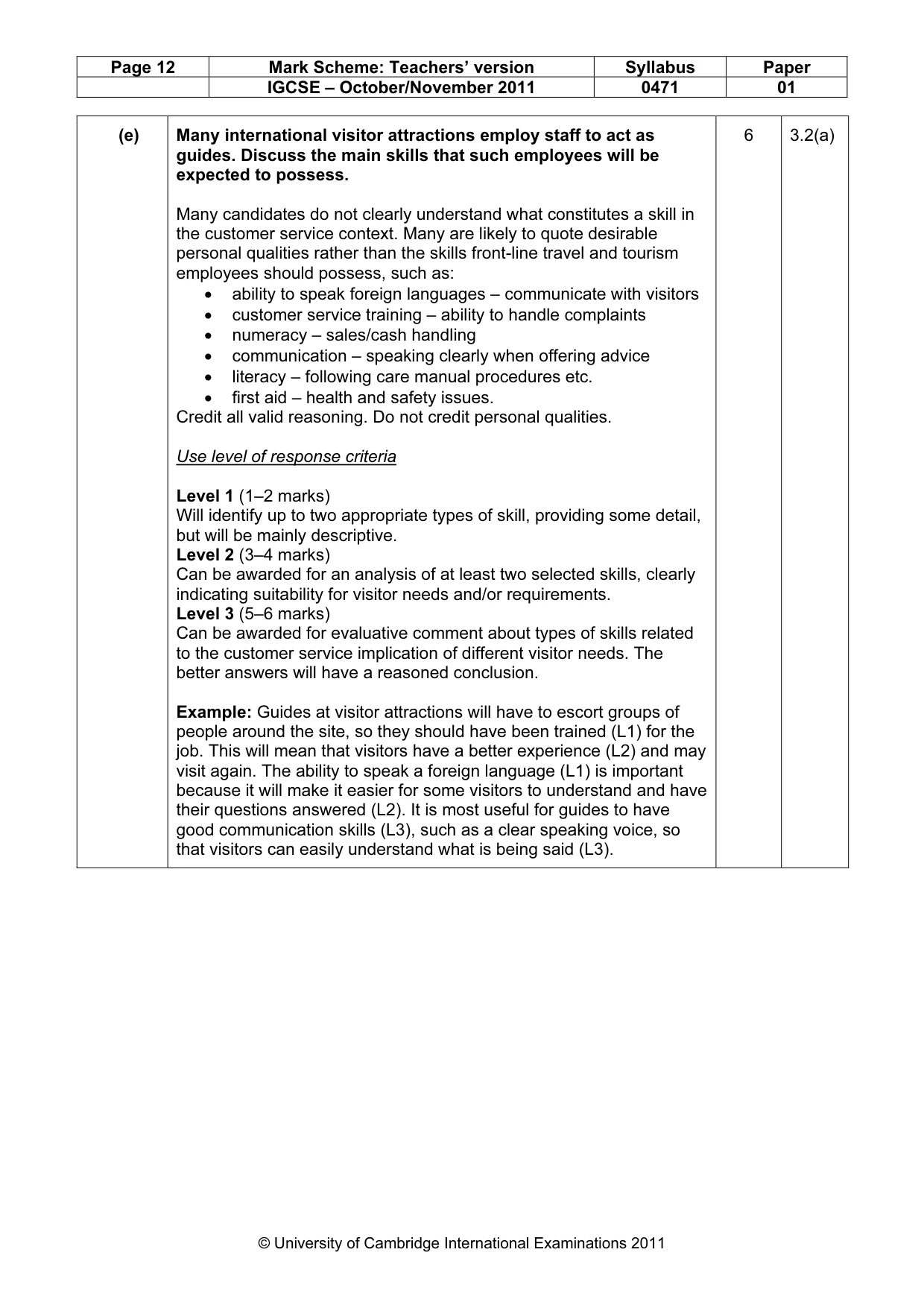
Page 12 Mark Scheme: Teachers’ version Syllabus Paper IGCSE – October/November 2011 0471 01 © University of Cambridge International Examinations 2011 (e) Many international visitor attractions employ staff to act as guides. Discuss the main skills that such employees will be expected to possess. Many candidates do not clearly understand what constitutes a skill in the customer service context. Many are likely to quote desirable personal qualities rather than the skills front-line travel and tourism employees should possess, such as: • ability to speak foreign languages – communicate with visitors • customer service training – ability to handle complaints • numeracy – sales/cash handling • communication – speaking clearly when offering advice • literacy – following care manual procedures etc. • first aid – health and safety issues. Credit all valid reasoning. Do not credit personal qualities. Use level of response criteria Level 1 (1–2 marks) Will identify up to two appropriate types of skill, providing some detail, but will be mainly descriptive. Level 2 (3–4 marks) Can be awarded for an analysis of at least two selected skills, clearly indicating suitability for visitor needs and/or requirements. Level 3 (5–6 marks) Can be awarded for evaluative comment about types of skills related to the customer service implication of different visitor needs. The better answers will have a reasoned conclusion. Example: Guides at visitor attractions will have to escort groups of people around the site, so they should have been trained (L1) for the job. This will mean that visitors have a better experience (L2) and may visit again. The ability to speak a foreign language (L1) is important because it will make it easier for some visitors to understand and have their questions answered (L2). It is most useful for guides to have good communication skills (L3), such as a clear speaking voice, so that visitors can easily understand what is being said (L3). 6 3.2(a)
What you needed in this session
Cambridge’s own grade thresholds for 2011 Oct/Nov, Paper 1 · Variant 1. A higher threshold means an easier paper — the bar moves with how the cohort did.