Cambridge IGCSE Travel and Tourism 0471 — 2011 May/June Paper 1 · Variant 1
0471/11/M/J/11 · 100 marks · ≈113 min
The question paper and its mark scheme, free to read here and free to download. This is Cambridge’s own paper, exactly as it was sat.
Question paper16 pages
Mark scheme11 pages
Answers below. Sit the paper first if you are practising.
Paper as text
Question paper, page 1
This document consists of 16 printed pages. DC (SM/CGW) 31924/4 © UCLES 2011 [Turn over UNIVERSITY OF CAMBRIDGE INTERNATIONAL EXAMINATIONS International General Certificate of Secondary Education * 3 7 3 5 7 4 2 9 8 6 * TRAVEL AND TOURISM 0471/01 Core Module May/June 2011 2 hours Candidates answer on the Question Paper. No Additional Materials are required. READ THESE INSTRUCTIONS FIRST Write your Centre number, candidate number and name on all the work you hand in. Write in dark blue or black pen. You may use a soft pencil for any diagrams, graphs or rough working. Do not use staples, paper clips, highlighters, glue or correction fluid. DO NOT WRITE IN ANY BARCODES. Answer all questions. At the end of the examination, fasten all your work securely together. The number of marks is given in brackets [ ] at the end of each question or part question. For Examiner’s Use 1 2 3 4 Total www.XtremePapers.com
Question paper, page 2
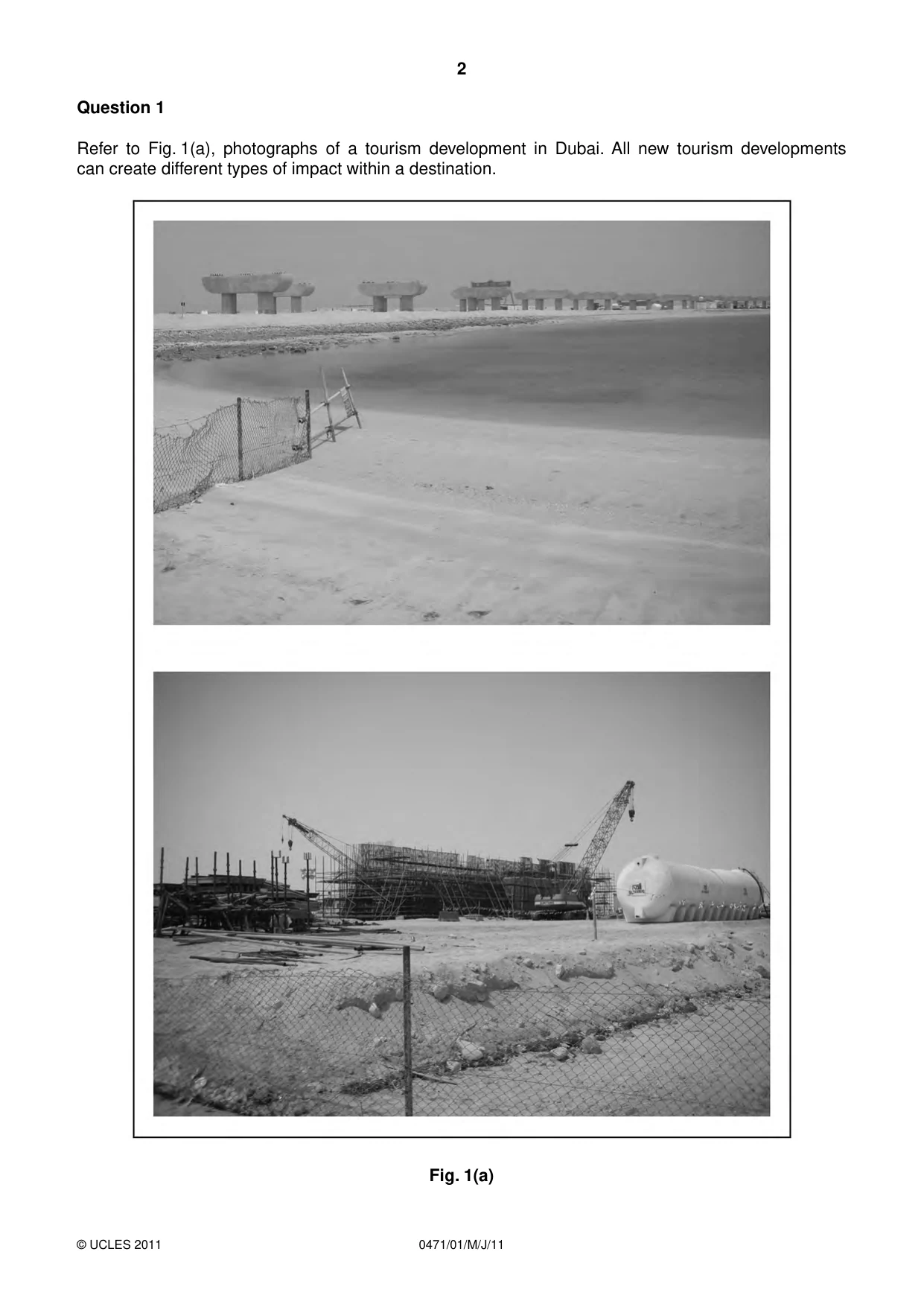
2 0471/01/M/J/11 © UCLES 2011 Question 1 Refer to Fig. 1(a), photographs of a tourism development in Dubai. All new tourism developments can create different types of impact within a destination. Fig. 1(a)
Question paper, page 3
3 [Turn over © UCLES 2011 0471/01/M/J/11 For Examiner’s Use (a) State and explain three negative environmental impacts likely to be caused by the development work shown in Fig. 1(a). 1 … … … … 2 … … … … 3 … … … …[6] (b) When the development work is complete, the destination expects to receive additional visitors. Explain three positive economic impacts that are likely to result from this increase in visitor numbers. 1 … … … … 2 … … … … 3 … … … …[6]
Question paper, page 4
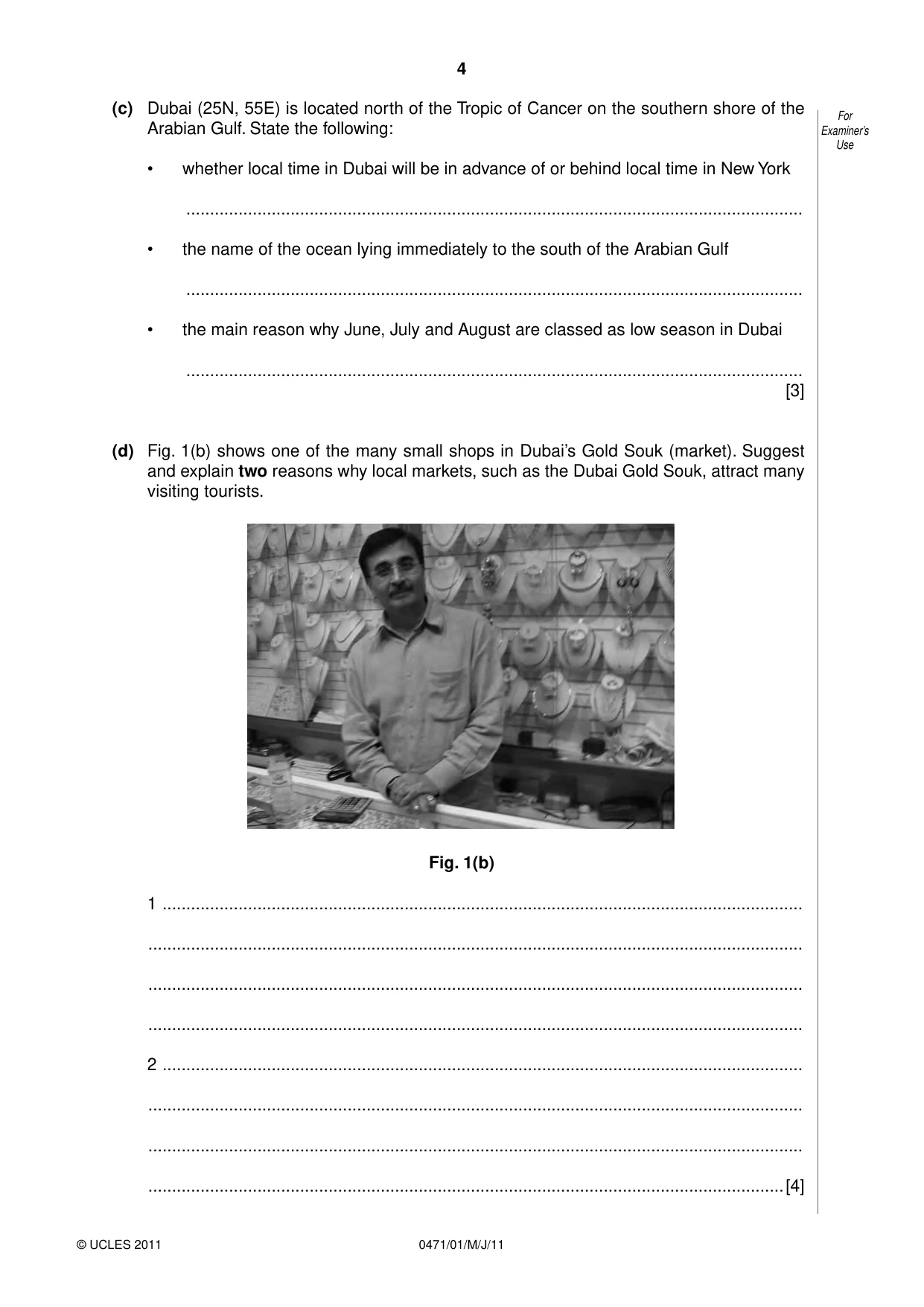
4 0471/01/M/J/11 © UCLES 2011 For Examiner’s Use (c) Dubai (25N, 55E) is located north of the Tropic of Cancer on the southern shore of the Arabian Gulf. State the following: • whether local time in Dubai will be in advance of or behind local time in New York … • the name of the ocean lying immediately to the south of the Arabian Gulf … • the main reason why June, July and August are classed as low season in Dubai … [3] (d) Fig. 1(b) shows one of the many small shops in Dubai’s Gold Souk (market). Suggest and explain two reasons why local markets, such as the Dubai Gold Souk, attract many visiting tourists. Fig. 1(b) 1 … … … … 2 … … … …[4]
Question paper, page 5
5 [Turn over © UCLES 2011 0471/01/M/J/11 For Examiner’s Use (e) Many leisure tourists will choose to take an organised sightseeing tour in their destination. With reference to one organised tour with which you are familiar, assess its appeal to visiting leisure tourists. Name of destination or tour: … … … … … … … … … … … … …[6] [Total: 25]
Question paper, page 6
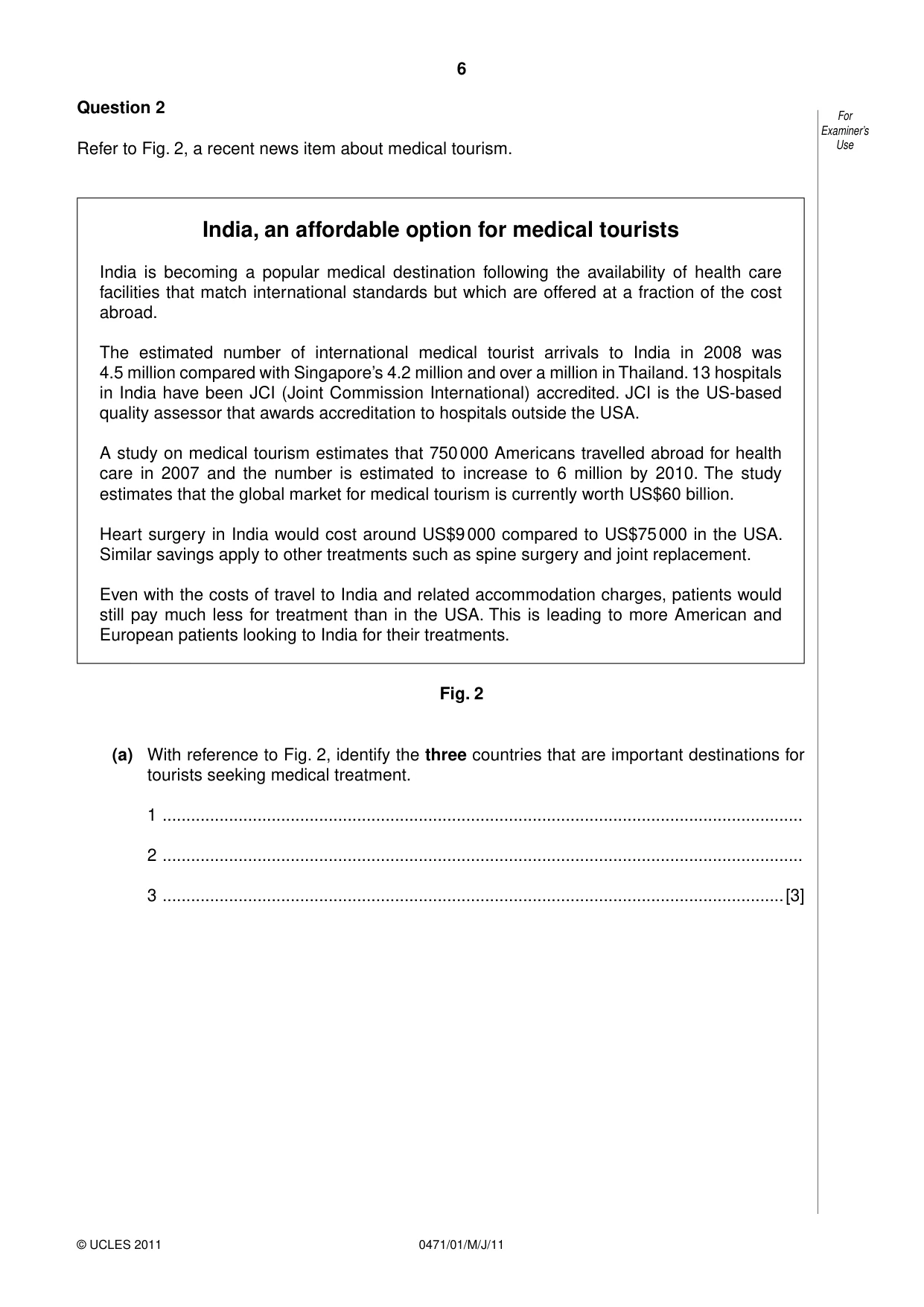
6 0471/01/M/J/11 © UCLES 2011 For Examiner’s Use Question 2 Refer to Fig. 2, a recent news item about medical tourism. India, an affordable option for medical tourists India is becoming a popular medical destination following the availability of health care facilities that match international standards but which are offered at a fraction of the cost abroad. The estimated number of international medical tourist arrivals to India in 2008 was 4.5 million compared with Singapore’s 4.2 million and over a million in Thailand. 13 hospitals in India have been JCI (Joint Commission International) accredited. JCI is the US-based quality assessor that awards accreditation to hospitals outside the USA. A study on medical tourism estimates that 750 000 Americans travelled abroad for health care in 2007 and the number is estimated to increase to 6 million by 2010. The study estimates that the global market for medical tourism is currently worth US$60 billion. Heart surgery in India would cost around US$9 000 compared to US$75 000 in the USA. Similar savings apply to other treatments such as spine surgery and joint replacement. Even with the costs of travel to India and related accommodation charges, patients would still pay much less for treatment than in the USA. This is leading to more American and European patients looking to India for their treatments. Fig. 2 (a) With reference to Fig. 2, identify the three countries that are important destinations for tourists seeking medical treatment. 1 … 2 … 3 …[3]
Question paper, page 7
7 [Turn over © UCLES 2011 0471/01/M/J/11 For Examiner’s Use (b) With reference to Fig. 2, identify and explain two reasons why many Americans seek medical treatment outside of the USA. 1 … … … … 2 … … … …[4] (c) Explain three marketing and promotion methods that are used by a country’s national tourist board to increase the number of international leisure tourists. 1 … … … … 2 … … … … 3 … … … …[6]
Question paper, page 8
8 0471/01/M/J/11 © UCLES 2011 For Examiner’s Use (d) Some destinations in Less Economically Developed Countries (LEDCs) have experienced a rapid increase in international visitor arrivals. Explain how each of the following is likely to occur because of this rapid growth: • water shortages in some local communities … … … … • a change in the country’s traditional employment structure … … … … • the devaluing of local cultural traditions … … … … [6]
Question paper, page 9
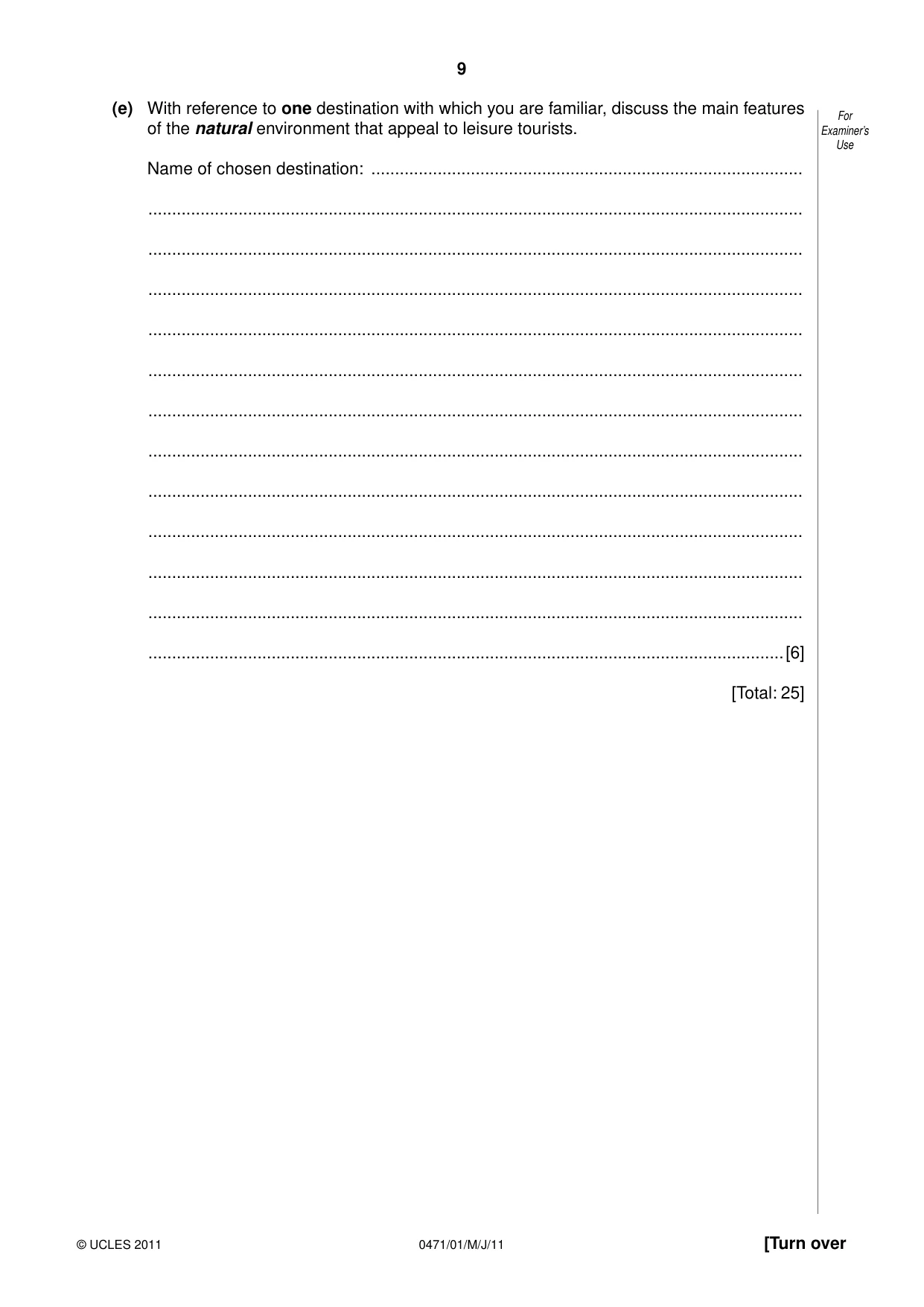
9 [Turn over © UCLES 2011 0471/01/M/J/11 For Examiner’s Use (e) With reference to one destination with which you are familiar, discuss the main features of the natural environment that appeal to leisure tourists. Name of chosen destination: … … … … … … … … … … … … …[6] [Total: 25]
Question paper, page 10
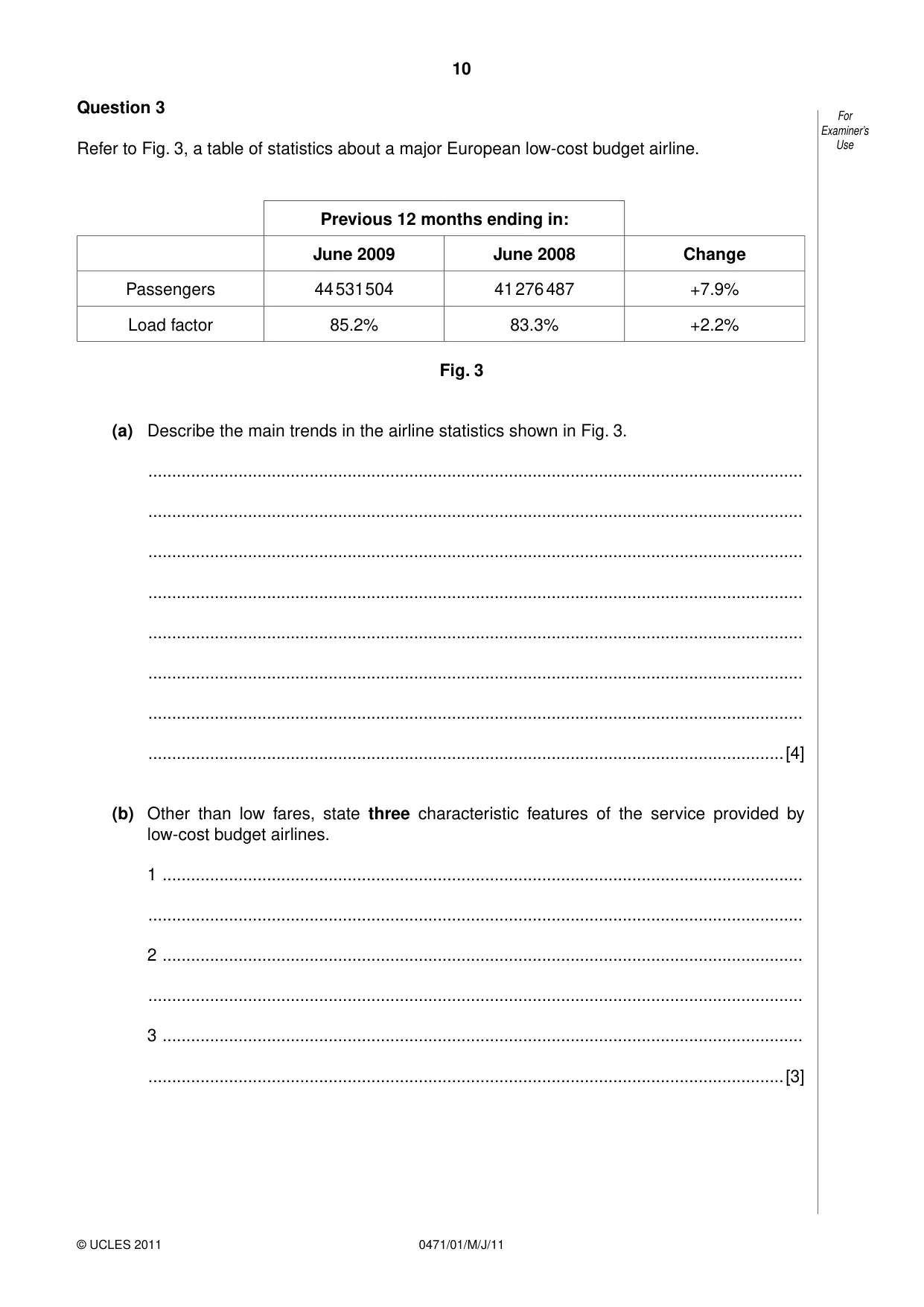
10 0471/01/M/J/11 © UCLES 2011 For Examiner’s Use Question 3 Refer to Fig. 3, a table of statistics about a major European low-cost budget airline. Previous 12 months ending in: June 2009 June 2008 Change Passengers 44 531 504 41 276 487 +7.9% Load factor 85.2% 83.3% +2.2% Fig. 3 (a) Describe the main trends in the airline statistics shown in Fig. 3. … … … … … … … …[4] (b) Other than low fares, state three characteristic features of the service provided by low-cost budget airlines. 1 … … 2 … … 3 … …[3]
Question paper, page 11
11 [Turn over © UCLES 2011 0471/01/M/J/11 For Examiner’s Use (c) For long journeys, many international travellers choose to fly with a full fare scheduled airline. Explain three ways in which passengers travelling in business class will enjoy advantages over those travelling in economy class. 1 … … … … 2 … … … … 3 … … … …[6]
Question paper, page 12
12 0471/01/M/J/11 © UCLES 2011 For Examiner’s Use (d) Explain three in-flight services that full fare scheduled airlines usually provide for the benefit of younger passengers on long-haul flights. 1 … … … … 2 … … … … 3 … … … …[6] (e) Discuss the reasons why it is important for airline cabin crew to work as a team. … … … … … … … … … … … …[6] [Total: 25]
Question paper, page 13
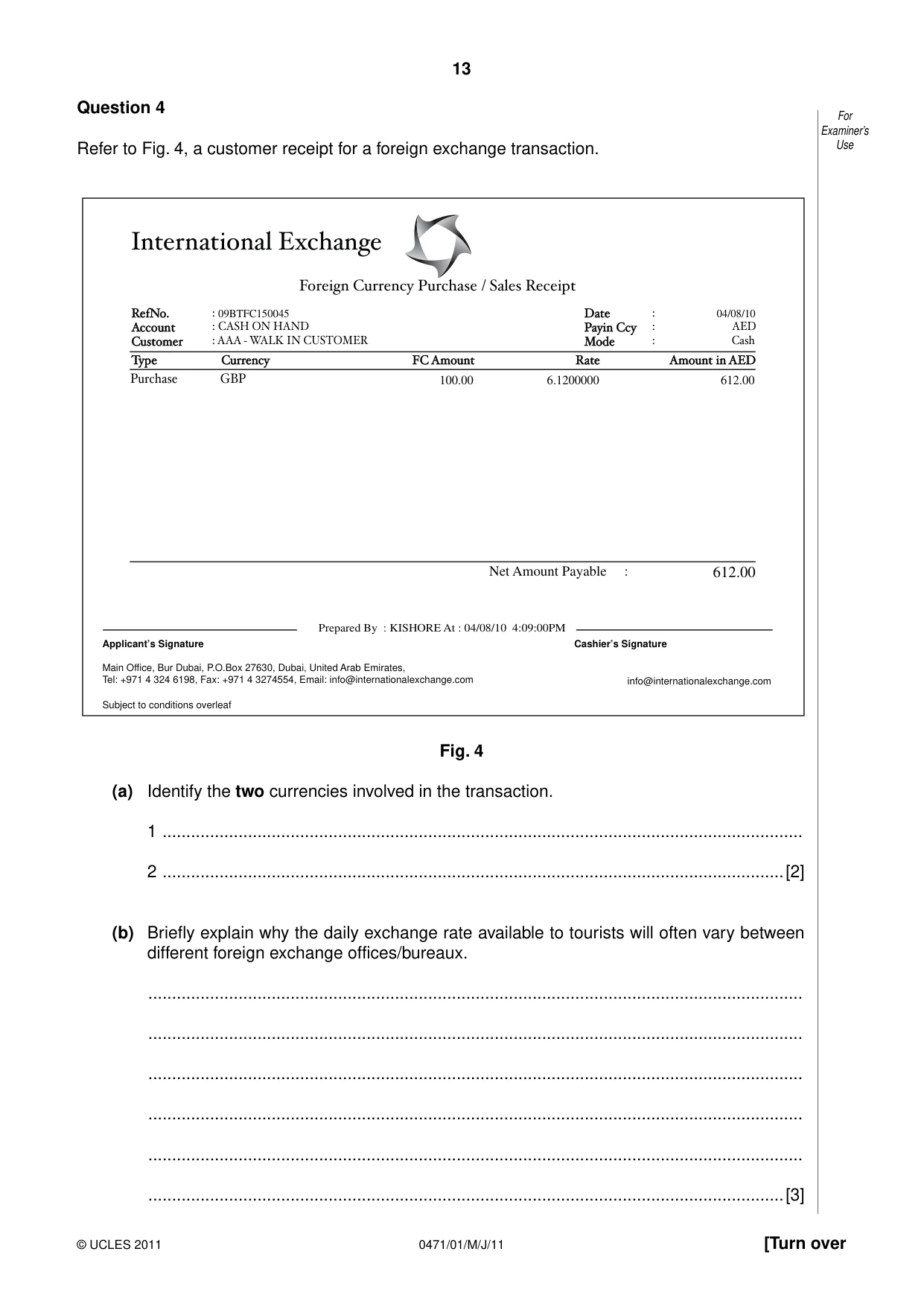
13 [Turn over © UCLES 2011 0471/01/M/J/11 For Examiner’s Use Question 4 Refer to Fig. 4, a customer receipt for a foreign exchange transaction. International Exchange Foreign Currency Purchase / Sales Receipt RefNo. RefNo. Account Account Customer Customer Type Type Currency Currency FC Amount FC Amount Rate Rate Amount in AED Amount in AED : 09BTFC150045 : CASH ON HAND Purchase GBP 100.00 6.1200000 Net Amount Payable : Prepared By : KISHORE At : 04/08/10 4:09:00PM Applicant’s Signature Main Office, Bur Dubai, P.O.Box 27630, Dubai, United Arab Emirates, Tel: +971 4 324 6198, Fax: +971 4 3274554, Email: info@internationalexchange.com info@internationalexchange.com Subject to conditions overleaf Cashier’s Signature 612.00 612.00 : AAA - WALK IN CUSTOMER Date Date Payin Ccy Payin Ccy Mode Mode : 04/08/10 : AED : Cash Fig. 4 (a) Identify the two currencies involved in the transaction. 1 … 2 …[2] (b) Briefly explain why the daily exchange rate available to tourists will often vary between different foreign exchange offices/bureaux. … … … … … …[3]
Question paper, page 14
14 0471/01/M/J/11 © UCLES 2011 For Examiner’s Use (c) International Exchange has several branches. Explain two advantages to International Exchange of having a branch located within a large modern shopping mall. 1 … … … … 2 … … … …[4] (d) Explain why it will be important for foreign exchange staff to have the following personal skills: • clear speech … … … … • numeracy … … … … [4]
Question paper, page 15
15 [Turn over © UCLES 2011 0471/01/M/J/11 For Examiner’s Use (e) Business tourists have different needs from leisure tourists and those visiting relatives and friends. Explain three ways in which hotels can meet the needs of female business tourists travelling alone. 1 … … … … 2 … … … … 3 … … … …[6]
Question paper, page 16
16 0471/01/M/J/11 © UCLES 2011 For Examiner’s Use (f) Not all tourists will want to stay in 4/5* hotels. For one destination with which you are familiar, discuss the range of ‘budget’ or low cost accommodation that is available. Name of chosen destination: … … … … … … … … … … … … …[6] [Total: 25] Copyright Acknowledgements: Question 1 Figs 1(a) and 1(b) John D Smith © UCLES. Question 2 © India’s Medical Tourism; www.eturbonews.com. Permission to reproduce items where third-party owned material protected by copyright is included has been sought and cleared where possible. Every reasonable effort has been made by the publisher (UCLES) to trace copyright holders, but if any items requiring clearance have unwittingly been included, the publisher will be pleased to make amends at the earliest possible opportunity. University of Cambridge International Examinations is part of the Cambridge Assessment Group. Cambridge Assessment is the brand name of University of Cambridge Local Examinations Syndicate (UCLES), which is itself a department of the University of Cambridge.
Mark scheme, page 1
UNIVERSITY OF CAMBRIDGE INTERNATIONAL EXAMINATIONS International General Certificate of Secondary Education MARK SCHEME for the May/June 2011 question paper for the guidance of teachers 0471 TRAVEL AND TOURISM 0471/01 Paper 1 (Written Paper), maximum raw mark 100 This mark scheme is published as an aid to teachers and candidates, to indicate the requirements of the examination. It shows the basis on which Examiners were instructed to award marks. It does not indicate the details of the discussions that took place at an Examiners’ meeting before marking began, which would have considered the acceptability of alternative answers. Mark schemes must be read in conjunction with the question papers and the report on the examination. • Cambridge will not enter into discussions or correspondence in connection with these mark schemes. Cambridge is publishing the mark schemes for the May/June 2011 question papers for most IGCSE, GCE Advanced Level and Advanced Subsidiary Level syllabuses and some Ordinary Level syllabuses. www.XtremePapers.com
Mark scheme, page 2
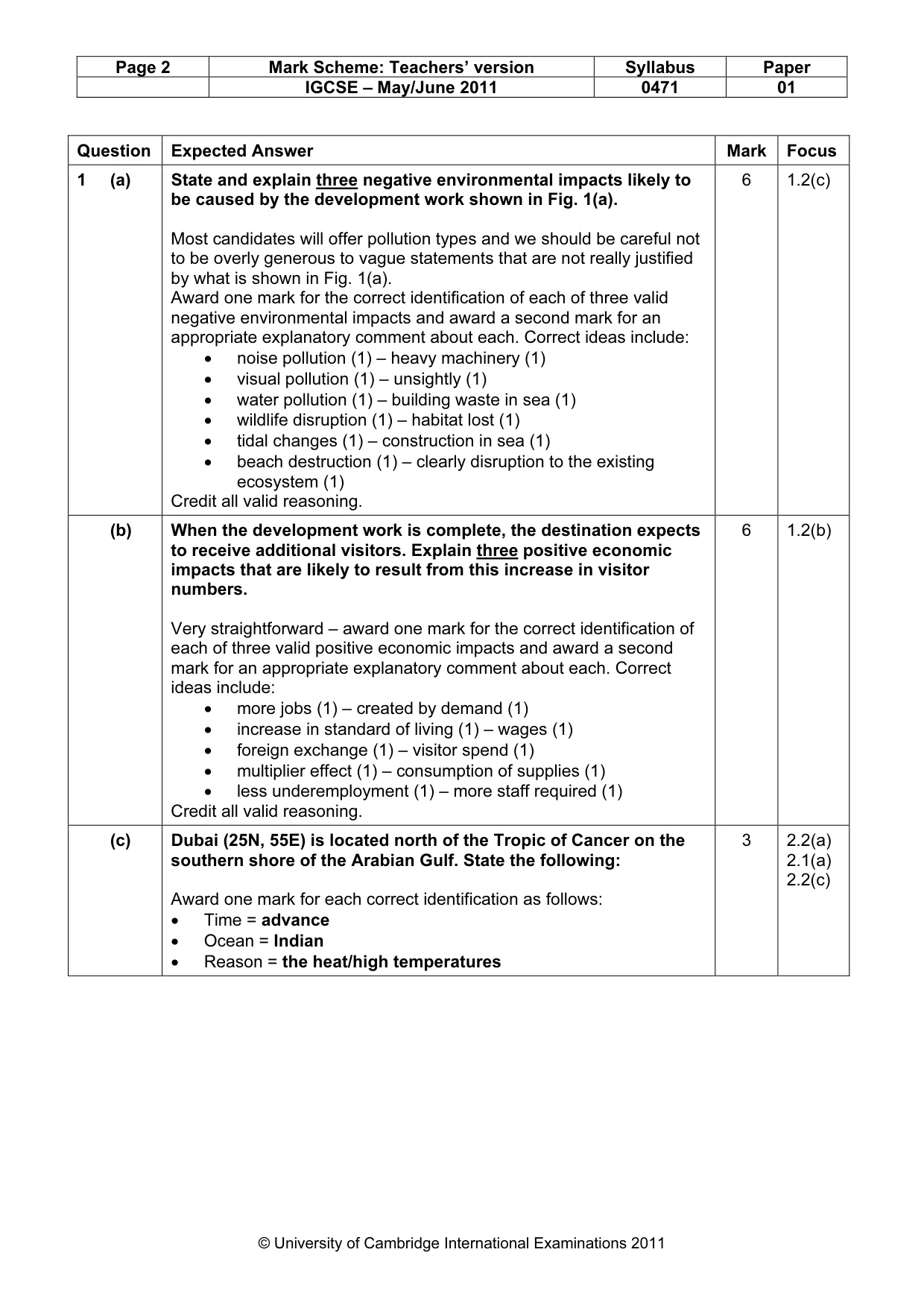
Page 2 Mark Scheme: Teachers’ version Syllabus Paper IGCSE – May/June 2011 0471 01 © University of Cambridge International Examinations 2011 Question Expected Answer Mark Focus 1 (a) State and explain three negative environmental impacts likely to be caused by the development work shown in Fig. 1(a). Most candidates will offer pollution types and we should be careful not to be overly generous to vague statements that are not really justified by what is shown in Fig. 1(a). Award one mark for the correct identification of each of three valid negative environmental impacts and award a second mark for an appropriate explanatory comment about each. Correct ideas include: • noise pollution (1) – heavy machinery (1) • visual pollution (1) – unsightly (1) • water pollution (1) – building waste in sea (1) • wildlife disruption (1) – habitat lost (1) • tidal changes (1) – construction in sea (1) • beach destruction (1) – clearly disruption to the existing ecosystem (1) Credit all valid reasoning. 6 1.2(c) (b) When the development work is complete, the destination expects to receive additional visitors. Explain three positive economic impacts that are likely to result from this increase in visitor numbers. Very straightforward – award one mark for the correct identification of each of three valid positive economic impacts and award a second mark for an appropriate explanatory comment about each. Correct ideas include: • more jobs (1) – created by demand (1) • increase in standard of living (1) – wages (1) • foreign exchange (1) – visitor spend (1) • multiplier effect (1) – consumption of supplies (1) • less underemployment (1) – more staff required (1) Credit all valid reasoning. 6 1.2(b) (c) Dubai (25N, 55E) is located north of the Tropic of Cancer on the southern shore of the Arabian Gulf. State the following: Award one mark for each correct identification as follows: • Time = advance • Ocean = Indian • Reason = the heat/high temperatures 3 2.2(a) 2.1(a) 2.2(c)
Mark scheme, page 3
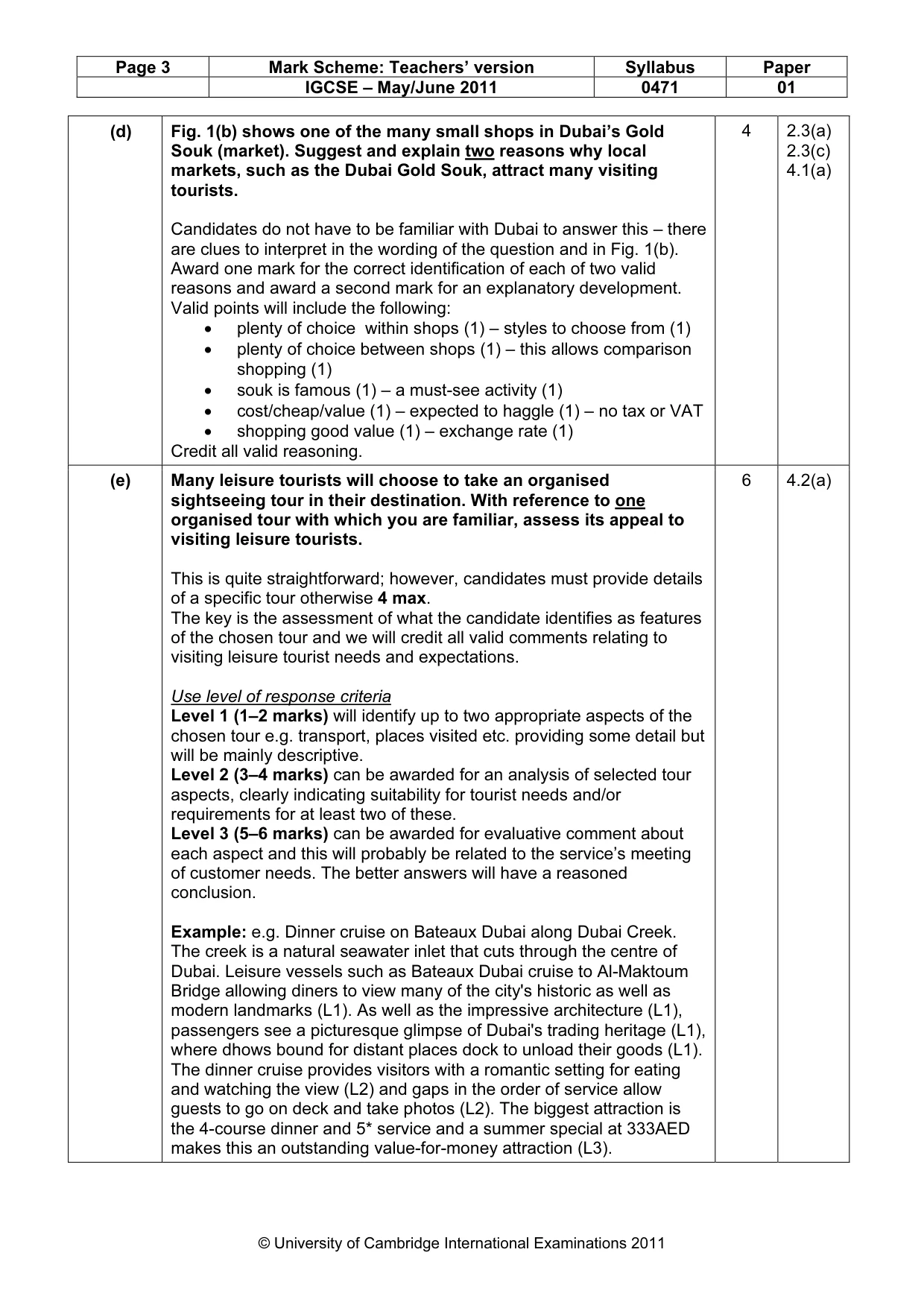
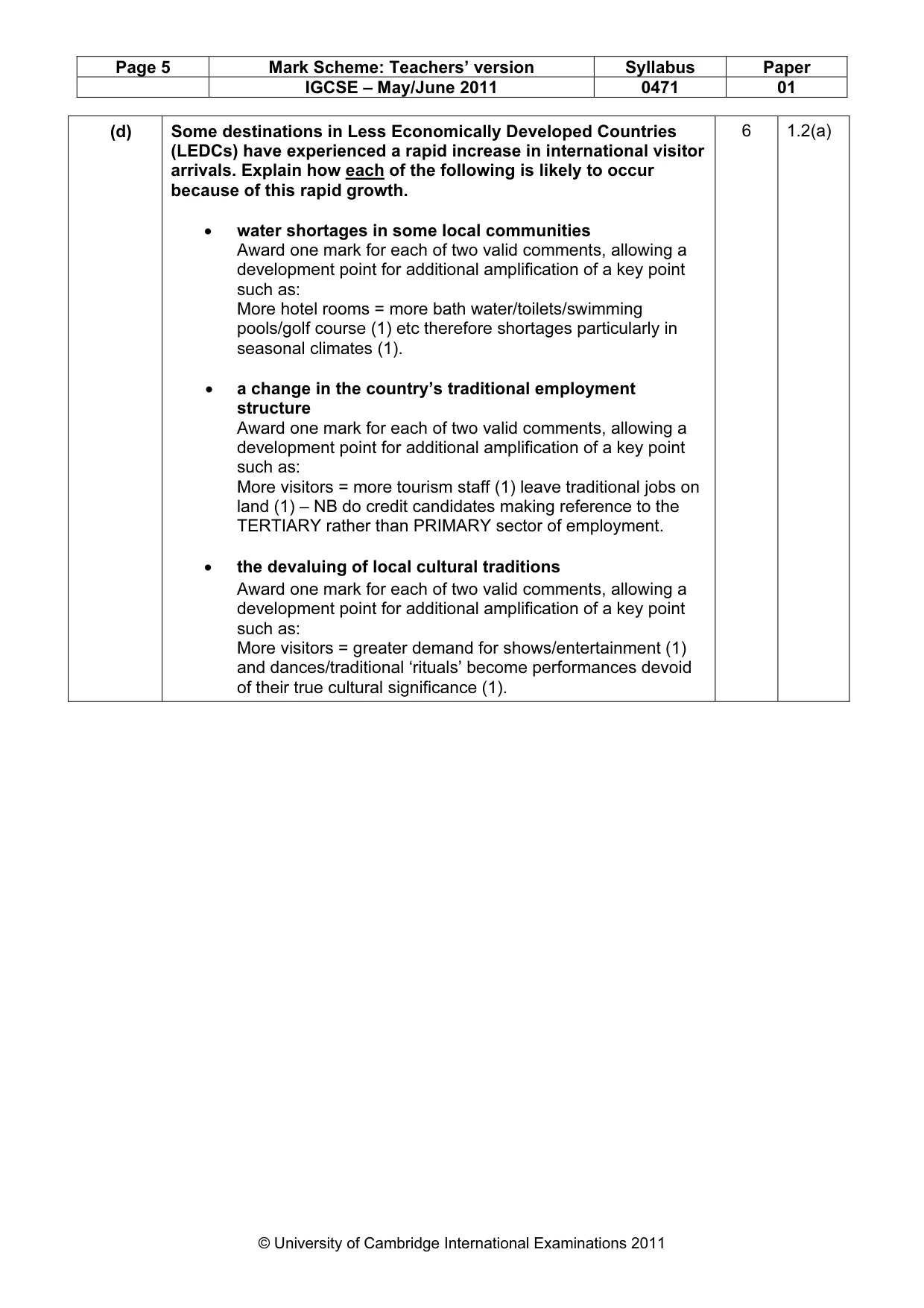
Page 3 Mark Scheme: Teachers’ version Syllabus Paper IGCSE – May/June 2011 0471 01 © University of Cambridge International Examinations 2011 (d) Fig. 1(b) shows one of the many small shops in Dubai’s Gold Souk (market). Suggest and explain two reasons why local markets, such as the Dubai Gold Souk, attract many visiting tourists. Candidates do not have to be familiar with Dubai to answer this – there are clues to interpret in the wording of the question and in Fig. 1(b). Award one mark for the correct identification of each of two valid reasons and award a second mark for an explanatory development. Valid points will include the following: • plenty of choice within shops (1) – styles to choose from (1) • plenty of choice between shops (1) – this allows comparison shopping (1) • souk is famous (1) – a must-see activity (1) • cost/cheap/value (1) – expected to haggle (1) – no tax or VAT • shopping good value (1) – exchange rate (1) Credit all valid reasoning. 4 2.3(a) 2.3(c) 4.1(a) (e) Many leisure tourists will choose to take an organised sightseeing tour in their destination. With reference to one organised tour with which you are familiar, assess its appeal to visiting leisure tourists. This is quite straightforward; however, candidates must provide details of a specific tour otherwise 4 max. The key is the assessment of what the candidate identifies as features of the chosen tour and we will credit all valid comments relating to visiting leisure tourist needs and expectations. Use level of response criteria Level 1 (1–2 marks) will identify up to two appropriate aspects of the chosen tour e.g. transport, places visited etc. providing some detail but will be mainly descriptive. Level 2 (3–4 marks) can be awarded for an analysis of selected tour aspects, clearly indicating suitability for tourist needs and/or requirements for at least two of these. Level 3 (5–6 marks) can be awarded for evaluative comment about each aspect and this will probably be related to the service’s meeting of customer needs. The better answers will have a reasoned conclusion. Example: e.g. Dinner cruise on Bateaux Dubai along Dubai Creek. The creek is a natural seawater inlet that cuts through the centre of Dubai. Leisure vessels such as Bateaux Dubai cruise to Al-Maktoum Bridge allowing diners to view many of the city's historic as well as modern landmarks (L1). As well as the impressive architecture (L1), passengers see a picturesque glimpse of Dubai's trading heritage (L1), where dhows bound for distant places dock to unload their goods (L1). The dinner cruise provides visitors with a romantic setting for eating and watching the view (L2) and gaps in the order of service allow guests to go on deck and take photos (L2). The biggest attraction is the 4-course dinner and 5* service and a summer special at 333AED makes this an outstanding value-for-money attraction (L3). 6 4.2(a)
Mark scheme, page 4
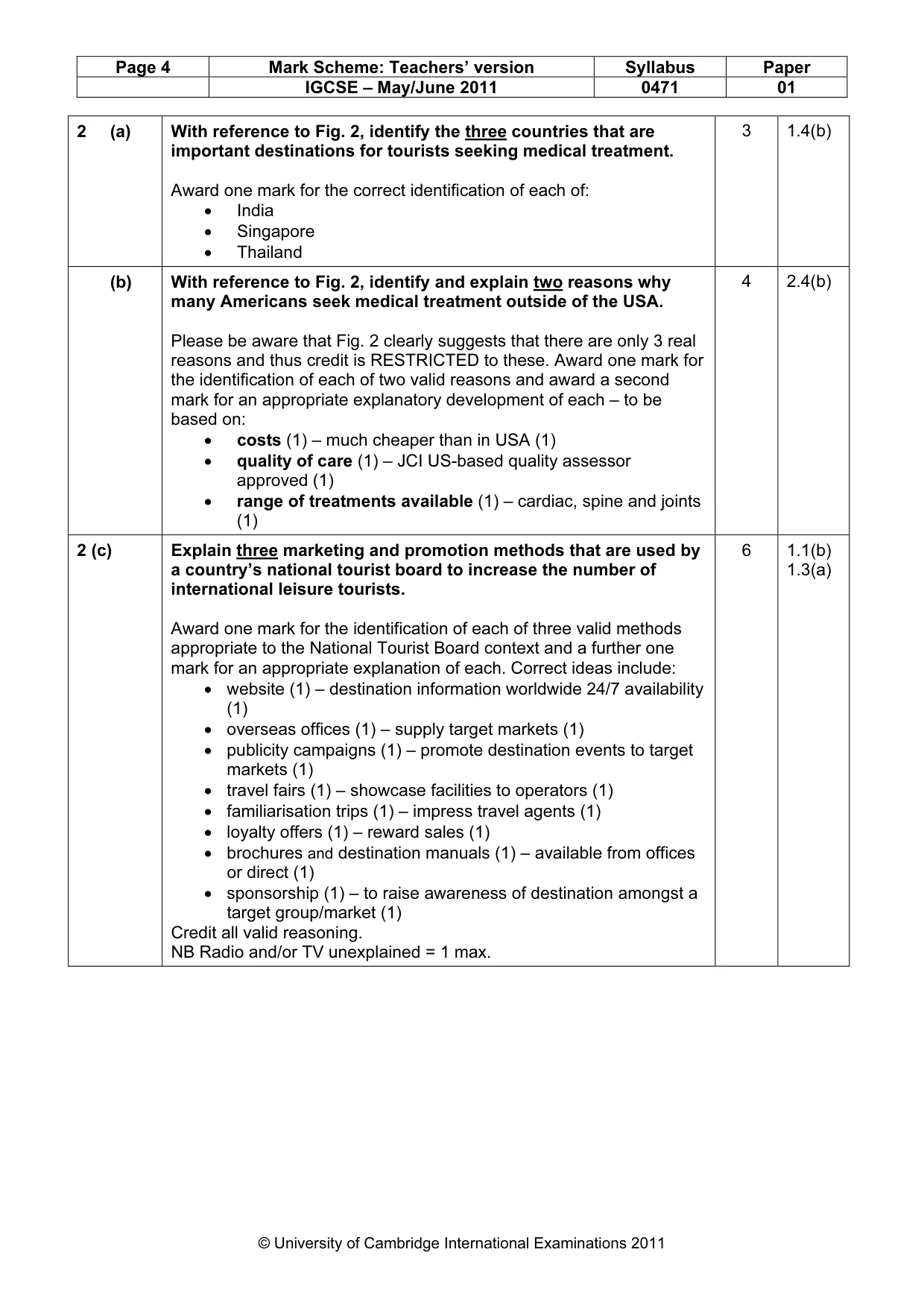
Page 4 Mark Scheme: Teachers’ version Syllabus Paper IGCSE – May/June 2011 0471 01 © University of Cambridge International Examinations 2011 2 (a) With reference to Fig. 2, identify the three countries that are important destinations for tourists seeking medical treatment. Award one mark for the correct identification of each of: • India • Singapore • Thailand 3 1.4(b) (b) With reference to Fig. 2, identify and explain two reasons why many Americans seek medical treatment outside of the USA. Please be aware that Fig. 2 clearly suggests that there are only 3 real reasons and thus credit is RESTRICTED to these. Award one mark for the identification of each of two valid reasons and award a second mark for an appropriate explanatory development of each – to be based on: • costs (1) – much cheaper than in USA (1) • quality of care (1) – JCI US-based quality assessor approved (1) • range of treatments available (1) – cardiac, spine and joints (1) 4 2.4(b) 2 (c) Explain three marketing and promotion methods that are used by a country’s national tourist board to increase the number of international leisure tourists. Award one mark for the identification of each of three valid methods appropriate to the National Tourist Board context and a further one mark for an appropriate explanation of each. Correct ideas include: • website (1) – destination information worldwide 24/7 availability (1) • overseas offices (1) – supply target markets (1) • publicity campaigns (1) – promote destination events to target markets (1) • travel fairs (1) – showcase facilities to operators (1) • familiarisation trips (1) – impress travel agents (1) • loyalty offers (1) – reward sales (1) • brochures and destination manuals (1) – available from offices or direct (1) • sponsorship (1) – to raise awareness of destination amongst a target group/market (1) Credit all valid reasoning. NB Radio and/or TV unexplained = 1 max. 6 1.1(b) 1.3(a)
Mark scheme, page 5
Page 5 Mark Scheme: Teachers’ version Syllabus Paper IGCSE – May/June 2011 0471 01 © University of Cambridge International Examinations 2011 (d) Some destinations in Less Economically Developed Countries (LEDCs) have experienced a rapid increase in international visitor arrivals. Explain how each of the following is likely to occur because of this rapid growth. • water shortages in some local communities Award one mark for each of two valid comments, allowing a development point for additional amplification of a key point such as: More hotel rooms = more bath water/toilets/swimming pools/golf course (1) etc therefore shortages particularly in seasonal climates (1). • a change in the country’s traditional employment structure Award one mark for each of two valid comments, allowing a development point for additional amplification of a key point such as: More visitors = more tourism staff (1) leave traditional jobs on land (1) – NB do credit candidates making reference to the TERTIARY rather than PRIMARY sector of employment. • the devaluing of local cultural traditions Award one mark for each of two valid comments, allowing a development point for additional amplification of a key point such as: More visitors = greater demand for shows/entertainment (1) and dances/traditional ‘rituals’ become performances devoid of their true cultural significance (1). 6 1.2(a)
Mark scheme, page 6
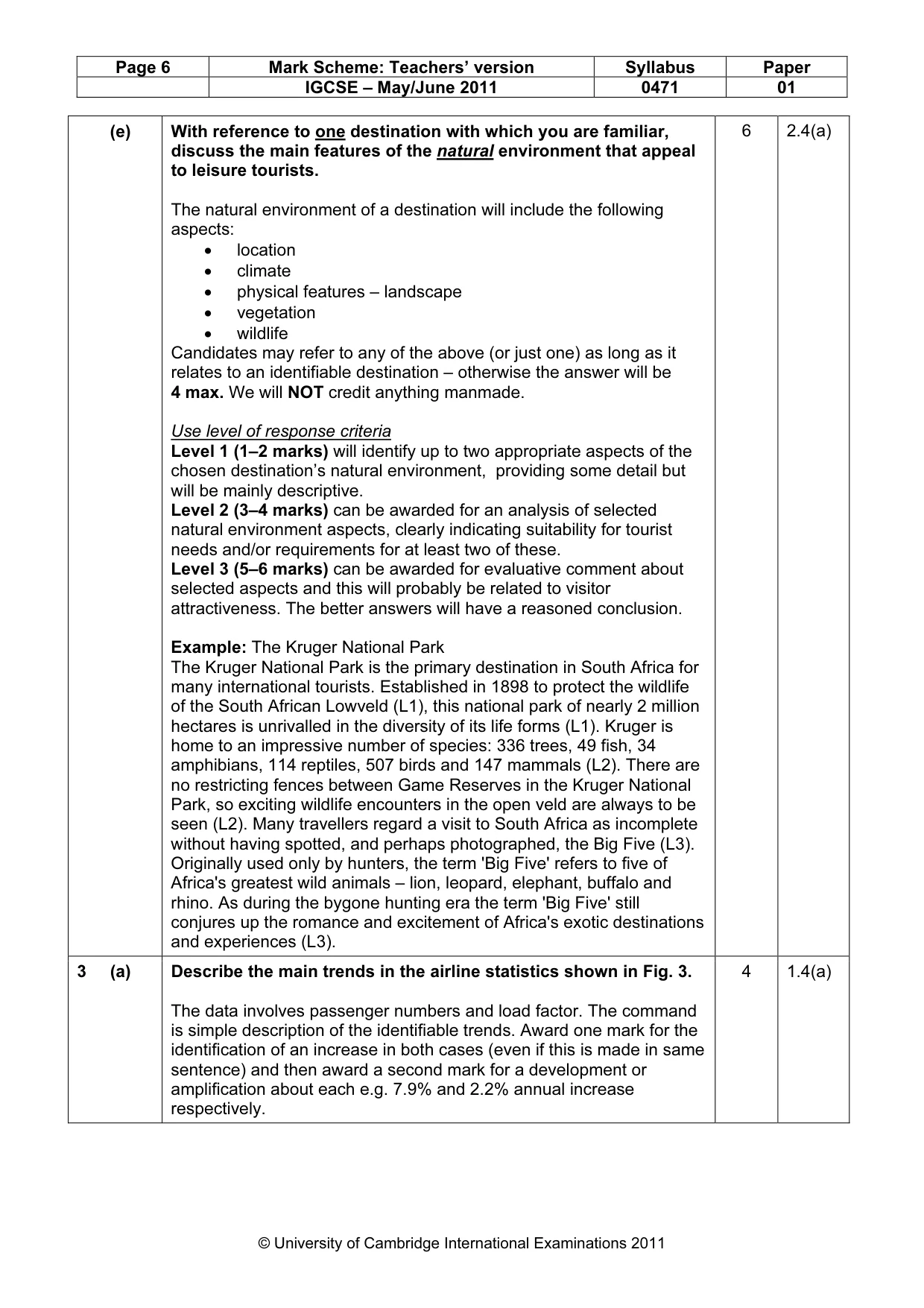
Page 6 Mark Scheme: Teachers’ version Syllabus Paper IGCSE – May/June 2011 0471 01 © University of Cambridge International Examinations 2011 (e) With reference to one destination with which you are familiar, discuss the main features of the natural environment that appeal to leisure tourists. The natural environment of a destination will include the following aspects: • location • climate • physical features – landscape • vegetation • wildlife Candidates may refer to any of the above (or just one) as long as it relates to an identifiable destination – otherwise the answer will be 4 max. We will NOT credit anything manmade. Use level of response criteria Level 1 (1–2 marks) will identify up to two appropriate aspects of the chosen destination’s natural environment, providing some detail but will be mainly descriptive. Level 2 (3–4 marks) can be awarded for an analysis of selected natural environment aspects, clearly indicating suitability for tourist needs and/or requirements for at least two of these. Level 3 (5–6 marks) can be awarded for evaluative comment about selected aspects and this will probably be related to visitor attractiveness. The better answers will have a reasoned conclusion. Example: The Kruger National Park The Kruger National Park is the primary destination in South Africa for many international tourists. Established in 1898 to protect the wildlife of the South African Lowveld (L1), this national park of nearly 2 million hectares is unrivalled in the diversity of its life forms (L1). Kruger is home to an impressive number of species: 336 trees, 49 fish, 34 amphibians, 114 reptiles, 507 birds and 147 mammals (L2). There are no restricting fences between Game Reserves in the Kruger National Park, so exciting wildlife encounters in the open veld are always to be seen (L2). Many travellers regard a visit to South Africa as incomplete without having spotted, and perhaps photographed, the Big Five (L3). Originally used only by hunters, the term 'Big Five' refers to five of Africa's greatest wild animals – lion, leopard, elephant, buffalo and rhino. As during the bygone hunting era the term 'Big Five' still conjures up the romance and excitement of Africa's exotic destinations and experiences (L3). 6 2.4(a) 3 (a) Describe the main trends in the airline statistics shown in Fig. 3. The data involves passenger numbers and load factor. The command is simple description of the identifiable trends. Award one mark for the identification of an increase in both cases (even if this is made in same sentence) and then award a second mark for a development or amplification about each e.g. 7.9% and 2.2% annual increase respectively. 4 1.4(a)
Mark scheme, page 7
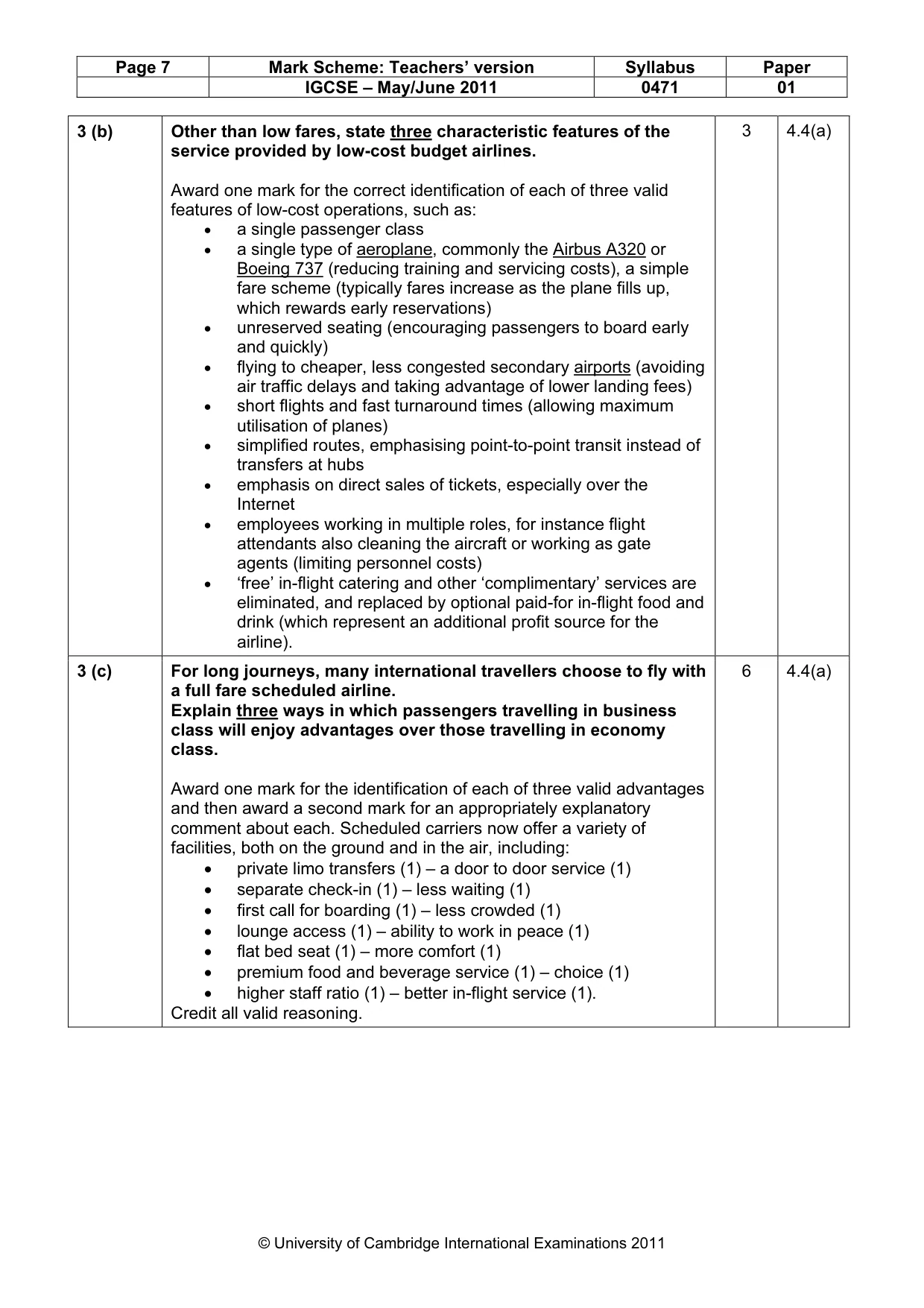
Page 7 Mark Scheme: Teachers’ version Syllabus Paper IGCSE – May/June 2011 0471 01 © University of Cambridge International Examinations 2011 3 (b) Other than low fares, state three characteristic features of the service provided by low-cost budget airlines. Award one mark for the correct identification of each of three valid features of low-cost operations, such as: • a single passenger class • a single type of aeroplane, commonly the Airbus A320 or Boeing 737 (reducing training and servicing costs), a simple fare scheme (typically fares increase as the plane fills up, which rewards early reservations) • unreserved seating (encouraging passengers to board early and quickly) • flying to cheaper, less congested secondary airports (avoiding air traffic delays and taking advantage of lower landing fees) • short flights and fast turnaround times (allowing maximum utilisation of planes) • simplified routes, emphasising point-to-point transit instead of transfers at hubs • emphasis on direct sales of tickets, especially over the Internet • employees working in multiple roles, for instance flight attendants also cleaning the aircraft or working as gate agents (limiting personnel costs) • ‘free’ in-flight catering and other ‘complimentary’ services are eliminated, and replaced by optional paid-for in-flight food and drink (which represent an additional profit source for the airline). 3 4.4(a) 3 (c) For long journeys, many international travellers choose to fly with a full fare scheduled airline. Explain three ways in which passengers travelling in business class will enjoy advantages over those travelling in economy class. Award one mark for the identification of each of three valid advantages and then award a second mark for an appropriately explanatory comment about each. Scheduled carriers now offer a variety of facilities, both on the ground and in the air, including: • private limo transfers (1) – a door to door service (1) • separate check-in (1) – less waiting (1) • first call for boarding (1) – less crowded (1) • lounge access (1) – ability to work in peace (1) • flat bed seat (1) – more comfort (1) • premium food and beverage service (1) – choice (1) • higher staff ratio (1) – better in-flight service (1). Credit all valid reasoning. 6 4.4(a)
Mark scheme, page 8
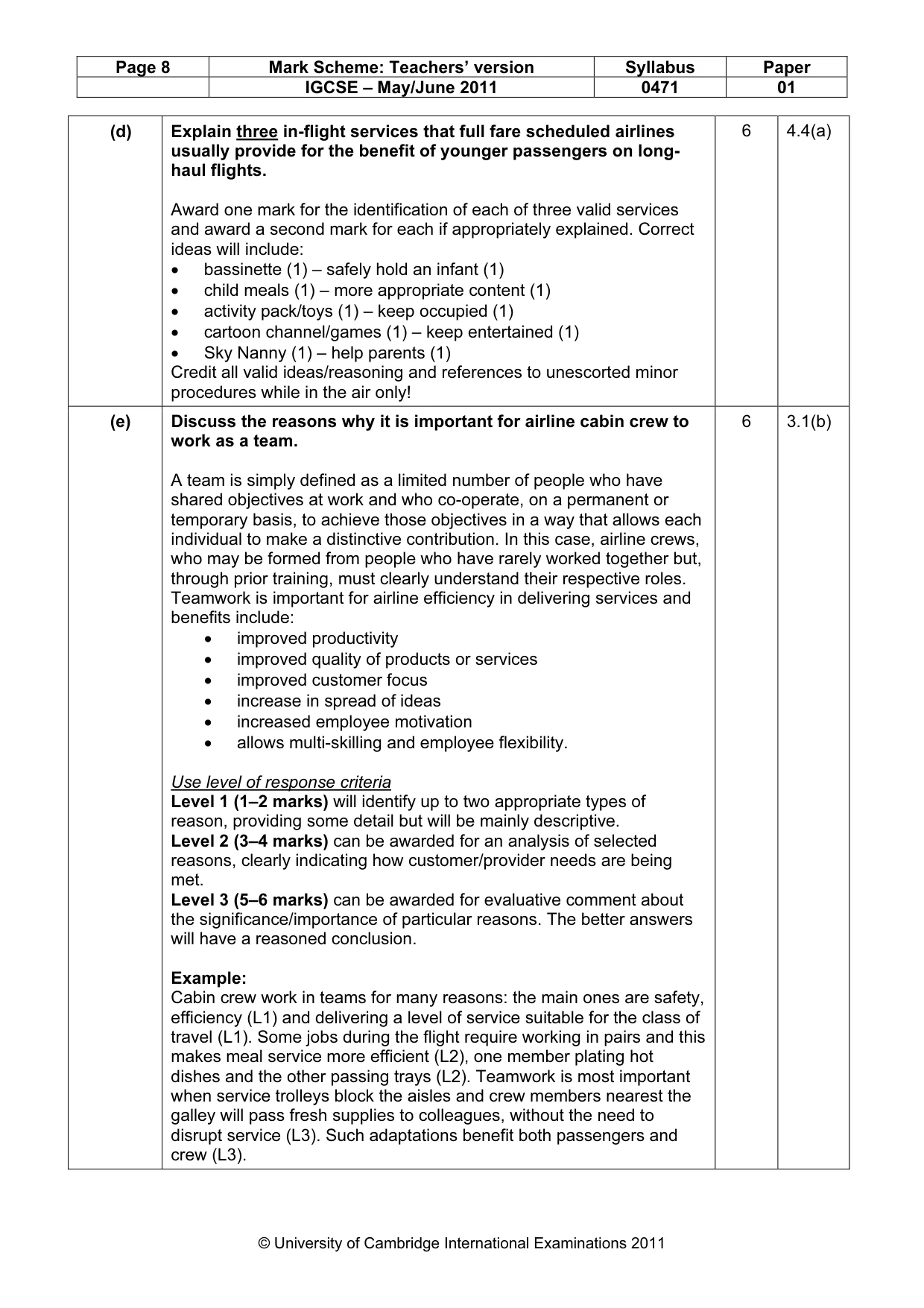
Page 8 Mark Scheme: Teachers’ version Syllabus Paper IGCSE – May/June 2011 0471 01 © University of Cambridge International Examinations 2011 (d) Explain three in-flight services that full fare scheduled airlines usually provide for the benefit of younger passengers on long- haul flights. Award one mark for the identification of each of three valid services and award a second mark for each if appropriately explained. Correct ideas will include: • bassinette (1) – safely hold an infant (1) • child meals (1) – more appropriate content (1) • activity pack/toys (1) – keep occupied (1) • cartoon channel/games (1) – keep entertained (1) • Sky Nanny (1) – help parents (1) Credit all valid ideas/reasoning and references to unescorted minor procedures while in the air only! 6 4.4(a) (e) Discuss the reasons why it is important for airline cabin crew to work as a team. A team is simply defined as a limited number of people who have shared objectives at work and who co-operate, on a permanent or temporary basis, to achieve those objectives in a way that allows each individual to make a distinctive contribution. In this case, airline crews, who may be formed from people who have rarely worked together but, through prior training, must clearly understand their respective roles. Teamwork is important for airline efficiency in delivering services and benefits include: • improved productivity • improved quality of products or services • improved customer focus • increase in spread of ideas • increased employee motivation • allows multi-skilling and employee flexibility. Use level of response criteria Level 1 (1–2 marks) will identify up to two appropriate types of reason, providing some detail but will be mainly descriptive. Level 2 (3–4 marks) can be awarded for an analysis of selected reasons, clearly indicating how customer/provider needs are being met. Level 3 (5–6 marks) can be awarded for evaluative comment about the significance/importance of particular reasons. The better answers will have a reasoned conclusion. Example: Cabin crew work in teams for many reasons: the main ones are safety, efficiency (L1) and delivering a level of service suitable for the class of travel (L1). Some jobs during the flight require working in pairs and this makes meal service more efficient (L2), one member plating hot dishes and the other passing trays (L2). Teamwork is most important when service trolleys block the aisles and crew members nearest the galley will pass fresh supplies to colleagues, without the need to disrupt service (L3). Such adaptations benefit both passengers and crew (L3). 6 3.1(b)
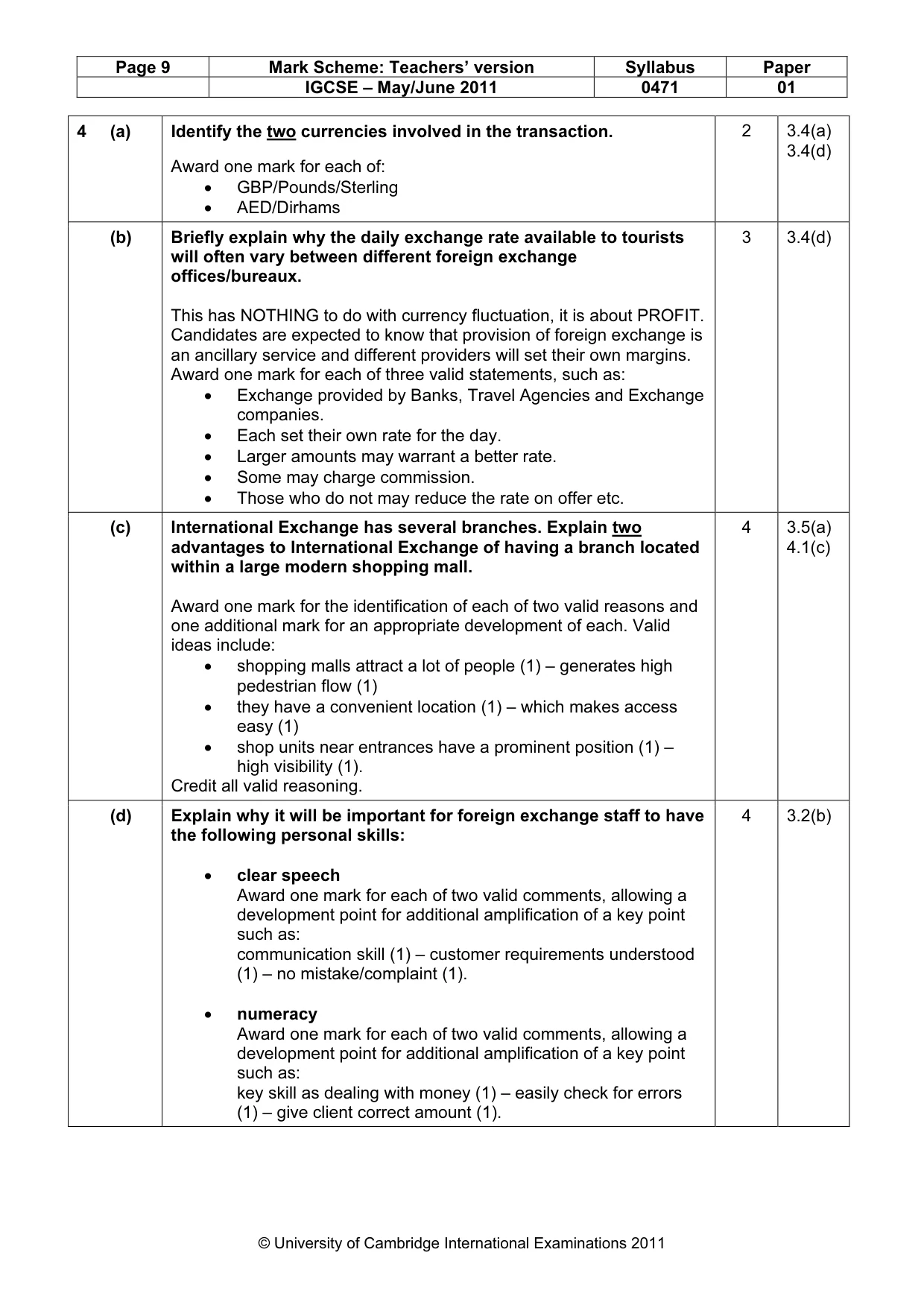
Mark scheme, page 9
Page 9 Mark Scheme: Teachers’ version Syllabus Paper IGCSE – May/June 2011 0471 01 © University of Cambridge International Examinations 2011 4 (a) Identify the two currencies involved in the transaction. Award one mark for each of: • GBP/Pounds/Sterling • AED/Dirhams 2 3.4(a) 3.4(d) (b) Briefly explain why the daily exchange rate available to tourists will often vary between different foreign exchange offices/bureaux. This has NOTHING to do with currency fluctuation, it is about PROFIT. Candidates are expected to know that provision of foreign exchange is an ancillary service and different providers will set their own margins. Award one mark for each of three valid statements, such as: • Exchange provided by Banks, Travel Agencies and Exchange companies. • Each set their own rate for the day. • Larger amounts may warrant a better rate. • Some may charge commission. • Those who do not may reduce the rate on offer etc. 3 3.4(d) (c) International Exchange has several branches. Explain two advantages to International Exchange of having a branch located within a large modern shopping mall. Award one mark for the identification of each of two valid reasons and one additional mark for an appropriate development of each. Valid ideas include: • shopping malls attract a lot of people (1) – generates high pedestrian flow (1) • they have a convenient location (1) – which makes access easy (1) • shop units near entrances have a prominent position (1) – high visibility (1). Credit all valid reasoning. 4 3.5(a) 4.1(c) (d) Explain why it will be important for foreign exchange staff to have the following personal skills: • clear speech Award one mark for each of two valid comments, allowing a development point for additional amplification of a key point such as: communication skill (1) – customer requirements understood (1) – no mistake/complaint (1). • numeracy Award one mark for each of two valid comments, allowing a development point for additional amplification of a key point such as: key skill as dealing with money (1) – easily check for errors (1) – give client correct amount (1). 4 3.2(b)
Mark scheme, page 10
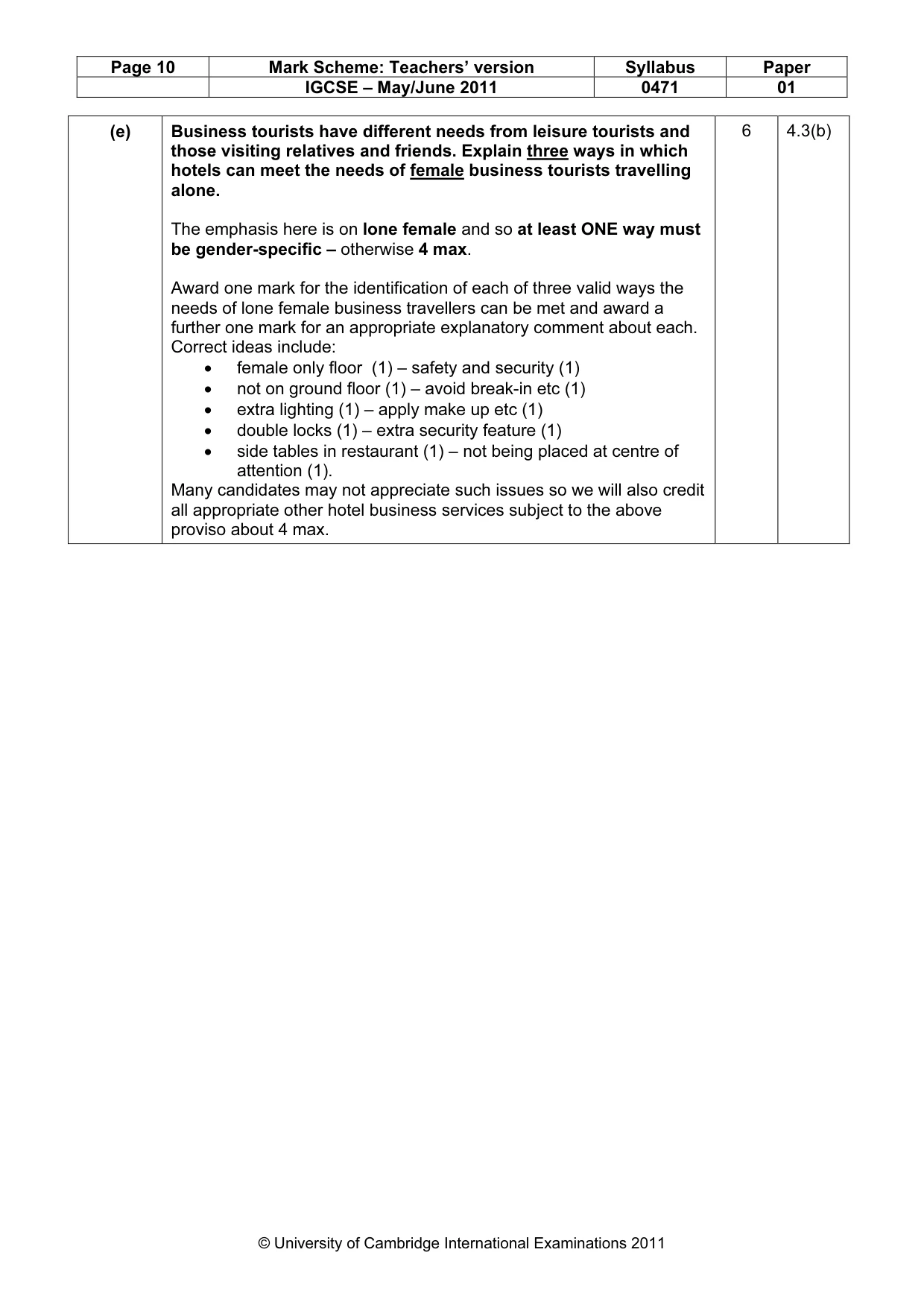
Page 10 Mark Scheme: Teachers’ version Syllabus Paper IGCSE – May/June 2011 0471 01 © University of Cambridge International Examinations 2011 (e) Business tourists have different needs from leisure tourists and those visiting relatives and friends. Explain three ways in which hotels can meet the needs of female business tourists travelling alone. The emphasis here is on lone female and so at least ONE way must be gender-specific – otherwise 4 max. Award one mark for the identification of each of three valid ways the needs of lone female business travellers can be met and award a further one mark for an appropriate explanatory comment about each. Correct ideas include: • female only floor (1) – safety and security (1) • not on ground floor (1) – avoid break-in etc (1) • extra lighting (1) – apply make up etc (1) • double locks (1) – extra security feature (1) • side tables in restaurant (1) – not being placed at centre of attention (1). Many candidates may not appreciate such issues so we will also credit all appropriate other hotel business services subject to the above proviso about 4 max. 6 4.3(b)
Mark scheme, page 11
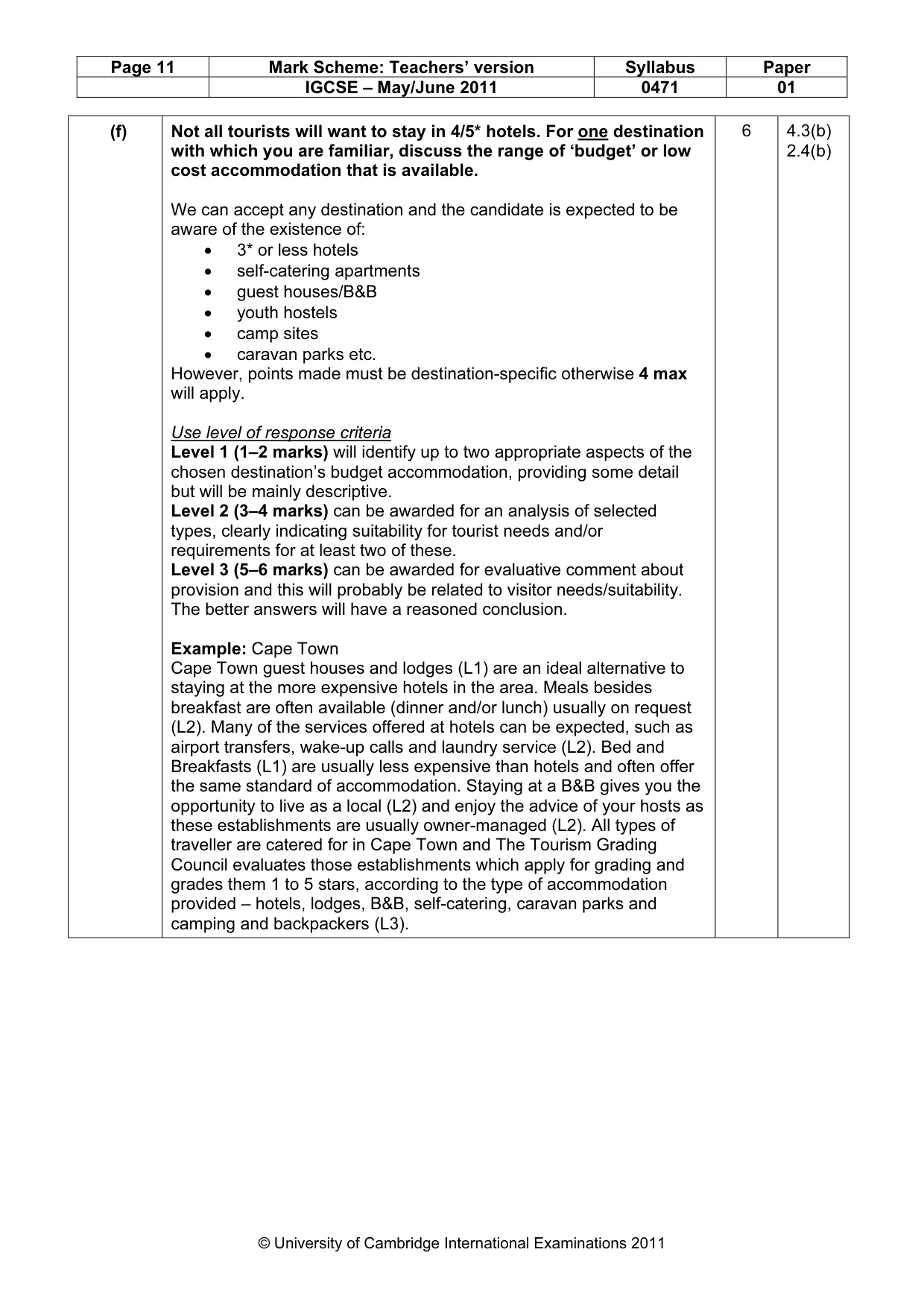
Page 11 Mark Scheme: Teachers’ version Syllabus Paper IGCSE – May/June 2011 0471 01 © University of Cambridge International Examinations 2011 (f) Not all tourists will want to stay in 4/5* hotels. For one destination with which you are familiar, discuss the range of ‘budget’ or low cost accommodation that is available. We can accept any destination and the candidate is expected to be aware of the existence of: • 3* or less hotels • self-catering apartments • guest houses/B&B • youth hostels • camp sites • caravan parks etc. However, points made must be destination-specific otherwise 4 max will apply. Use level of response criteria Level 1 (1–2 marks) will identify up to two appropriate aspects of the chosen destination’s budget accommodation, providing some detail but will be mainly descriptive. Level 2 (3–4 marks) can be awarded for an analysis of selected types, clearly indicating suitability for tourist needs and/or requirements for at least two of these. Level 3 (5–6 marks) can be awarded for evaluative comment about provision and this will probably be related to visitor needs/suitability. The better answers will have a reasoned conclusion. Example: Cape Town Cape Town guest houses and lodges (L1) are an ideal alternative to staying at the more expensive hotels in the area. Meals besides breakfast are often available (dinner and/or lunch) usually on request (L2). Many of the services offered at hotels can be expected, such as airport transfers, wake-up calls and laundry service (L2). Bed and Breakfasts (L1) are usually less expensive than hotels and often offer the same standard of accommodation. Staying at a B&B gives you the opportunity to live as a local (L2) and enjoy the advice of your hosts as these establishments are usually owner-managed (L2). All types of traveller are catered for in Cape Town and The Tourism Grading Council evaluates those establishments which apply for grading and grades them 1 to 5 stars, according to the type of accommodation provided – hotels, lodges, B&B, self-catering, caravan parks and camping and backpackers (L3). 6 4.3(b) 2.4(b)
What you needed in this session
Cambridge’s own grade thresholds for 2011 May/June, Paper 1 · Variant 1. A higher threshold means an easier paper — the bar moves with how the cohort did.