Cambridge IGCSE Travel and Tourism 0471 — 2010 Oct/Nov Paper 1 · Variant 1
0471/11/O/N/10 · 100 marks · ≈113 min
The question paper and its mark scheme, free to read here and free to download. This is Cambridge’s own paper, exactly as it was sat.
Question paper20 pages


Mark scheme9 pages
Answers below. Sit the paper first if you are practising.
Paper as text
Question paper, page 1
This document consists of 17 printed pages and 3 blank pages. IB10 11_0471_01/9RP © UCLES 2010 [Turn over *3739252945* For Examiner's Use 1 2 3 4 Total UNIVERSITY OF CAMBRIDGE INTERNATIONAL EXAMINATIONS International General Certificate of Secondary Education TRAVEL AND TOURISM 0471/01 Core Module October/November 2010 2 hours Candidates answer on the Question Paper. No Additional Materials are required. READ THESE INSTRUCTIONS FIRST Write your Centre number, candidate number and name on all the work you hand in. Write in dark blue or black pen. You may use a soft pencil for any diagrams, graphs or rough working. Do not use staples, paper clips, highlighters, glue or correction fluid. DO NOT WRITE IN ANY BARCODES. Answer all questions. At the end of the examination, fasten all your work securely together. The number of marks is given in brackets [ ] at the end of each question or part question. www.XtremePapers.com
Question paper, page 2
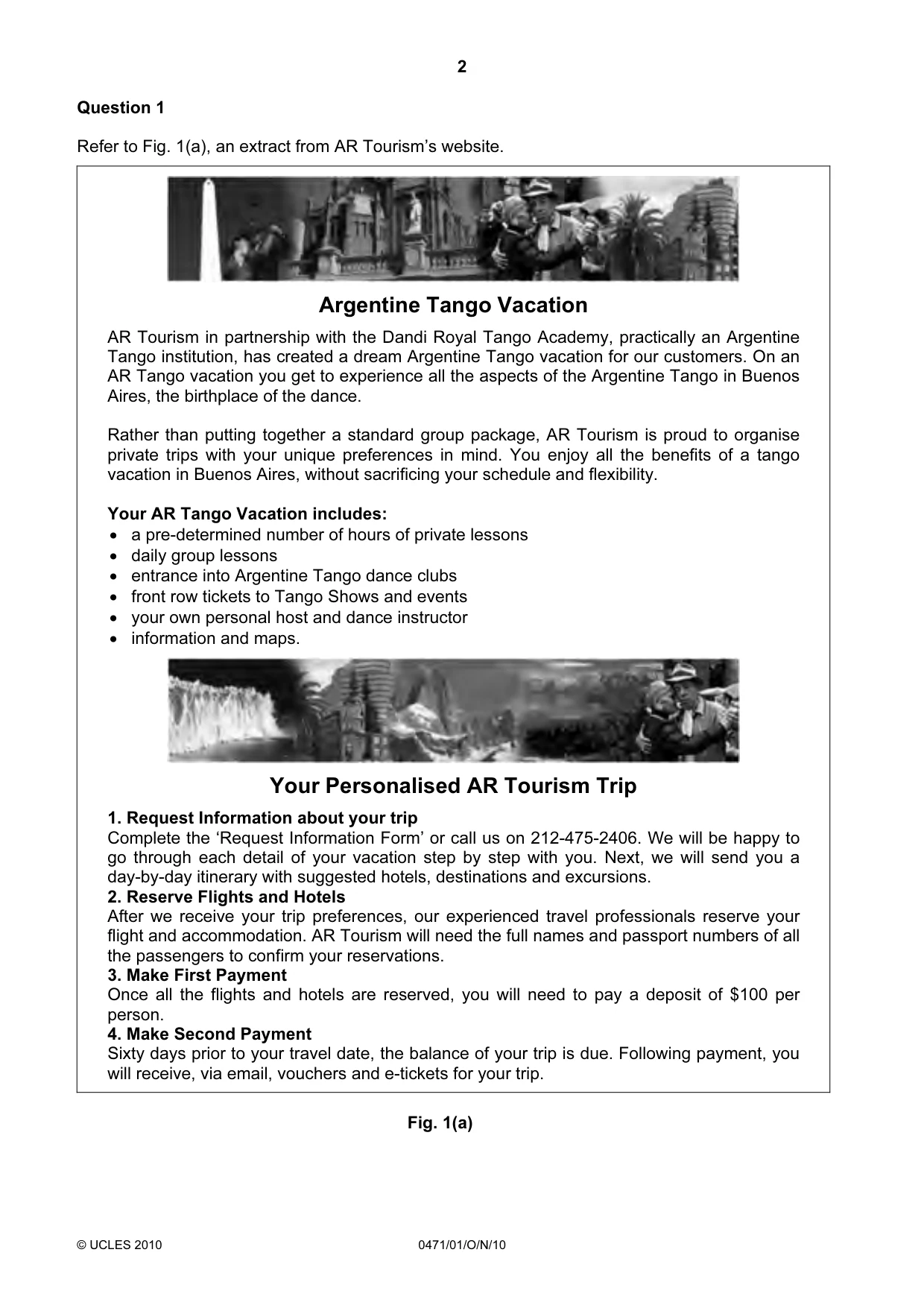
2 © UCLES 2010 0471/01/O/N/10 Question 1 Refer to Fig. 1(a), an extract from AR Tourism’s website. Argentine Tango Vacation AR Tourism in partnership with the Dandi Royal Tango Academy, practically an Argentine Tango institution, has created a dream Argentine Tango vacation for our customers. On an AR Tango vacation you get to experience all the aspects of the Argentine Tango in Buenos Aires, the birthplace of the dance. Rather than putting together a standard group package, AR Tourism is proud to organise private trips with your unique preferences in mind. You enjoy all the benefits of a tango vacation in Buenos Aires, without sacrificing your schedule and flexibility. Your AR Tango Vacation includes: • a pre-determined number of hours of private lessons • daily group lessons • entrance into Argentine Tango dance clubs • front row tickets to Tango Shows and events • your own personal host and dance instructor • information and maps. Your Personalised AR Tourism Trip 1. Request Information about your trip Complete the ‘Request Information Form’ or call us on 212-475-2406. We will be happy to go through each detail of your vacation step by step with you. Next, we will send you a day-by-day itinerary with suggested hotels, destinations and excursions. 2. Reserve Flights and Hotels After we receive your trip preferences, our experienced travel professionals reserve your flight and accommodation. AR Tourism will need the full names and passport numbers of all the passengers to confirm your reservations. 3. Make First Payment Once all the flights and hotels are reserved, you will need to pay a deposit of $100 per person. 4. Make Second Payment Sixty days prior to your travel date, the balance of your trip is due. Following payment, you will receive, via email, vouchers and e-tickets for your trip. Fig. 1(a)
Question paper, page 3
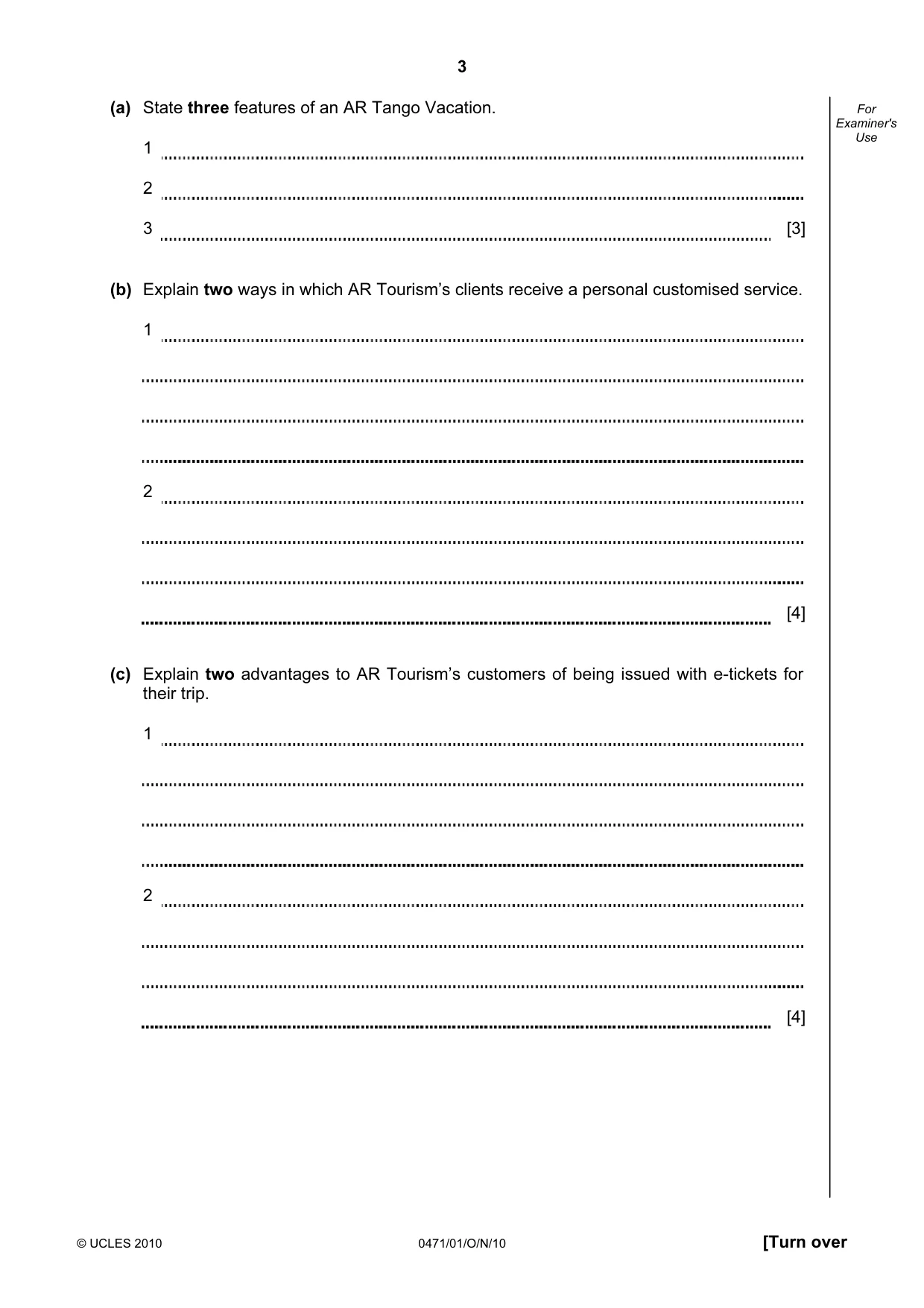
3 © UCLES 2010 0471/01/O/N/10 [Turn over For Examiner's Use (a) State three features of an AR Tango Vacation. 1 2 3 [3] (b) Explain two ways in which AR Tourism’s clients receive a personal customised service. 1 2 [4] (c) Explain two advantages to AR Tourism’s customers of being issued with e-tickets for their trip. 1 2 [4]
Question paper, page 4
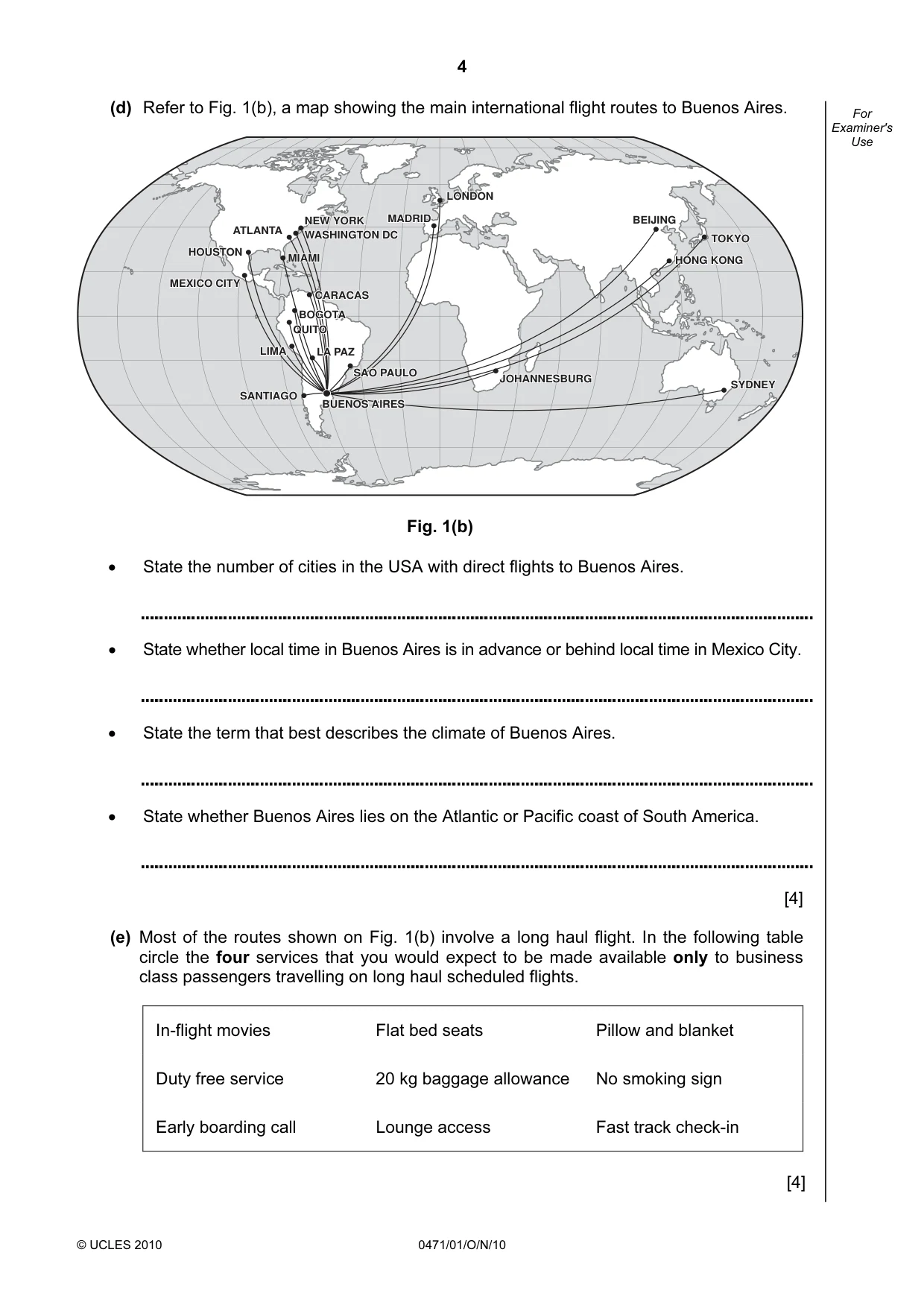
4 © UCLES 2010 0471/01/O/N/10 For Examiner's Use (d) Refer to Fig. 1(b), a map showing the main international flight routes to Buenos Aires. NEW YORK NEW YORK WASHINGTON DC WASHINGTON DC ATLANTA ATLANTA MIAMI MIAMI HOUSTON HOUSTON MEXICO CITY MEXICO CITY CARACAS CARACAS BOGOTA BOGOTA QUITO QUITO LIMA LIMA SANTIAGO SANTIAGO SAO PAULO SAO PAULO JOHANNESBURG JOHANNESBURG LONDON LONDON MADRID MADRID HONG KONG HONG KONG TOKYO TOKYO SYDNEY SYDNEY BEIJING BEIJING LA PAZ LA PAZ BUENOS AIRES BUENOS AIRES NEW YORK WASHINGTON DC ATLANTA MIAMI HOUSTON MEXICO CITY CARACAS BOGOTA QUITO LIMA SANTIAGO SAO PAULO JOHANNESBURG LONDON MADRID HONG KONG TOKYO SYDNEY BEIJING LA PAZ BUENOS AIRES Fig. 1(b) • State the number of cities in the USA with direct flights to Buenos Aires. • State whether local time in Buenos Aires is in advance or behind local time in Mexico City. • State the term that best describes the climate of Buenos Aires. • State whether Buenos Aires lies on the Atlantic or Pacific coast of South America. [4] (e) Most of the routes shown on Fig. 1(b) involve a long haul flight. In the following table circle the four services that you would expect to be made available only to business class passengers travelling on long haul scheduled flights. In-flight movies Flat bed seats Pillow and blanket Duty free service 20 kg baggage allowance No smoking sign Early boarding call Lounge access Fast track check-in [4]
Question paper, page 5
5 © UCLES 2010 0471/01/O/N/10 [Turn over For Examiner's Use (f) With reference to one example with which you are familiar, discuss how a mountain area has been developed to attract tourists. Name of chosen mountain area [6] [Total: 25]
Question paper, page 6
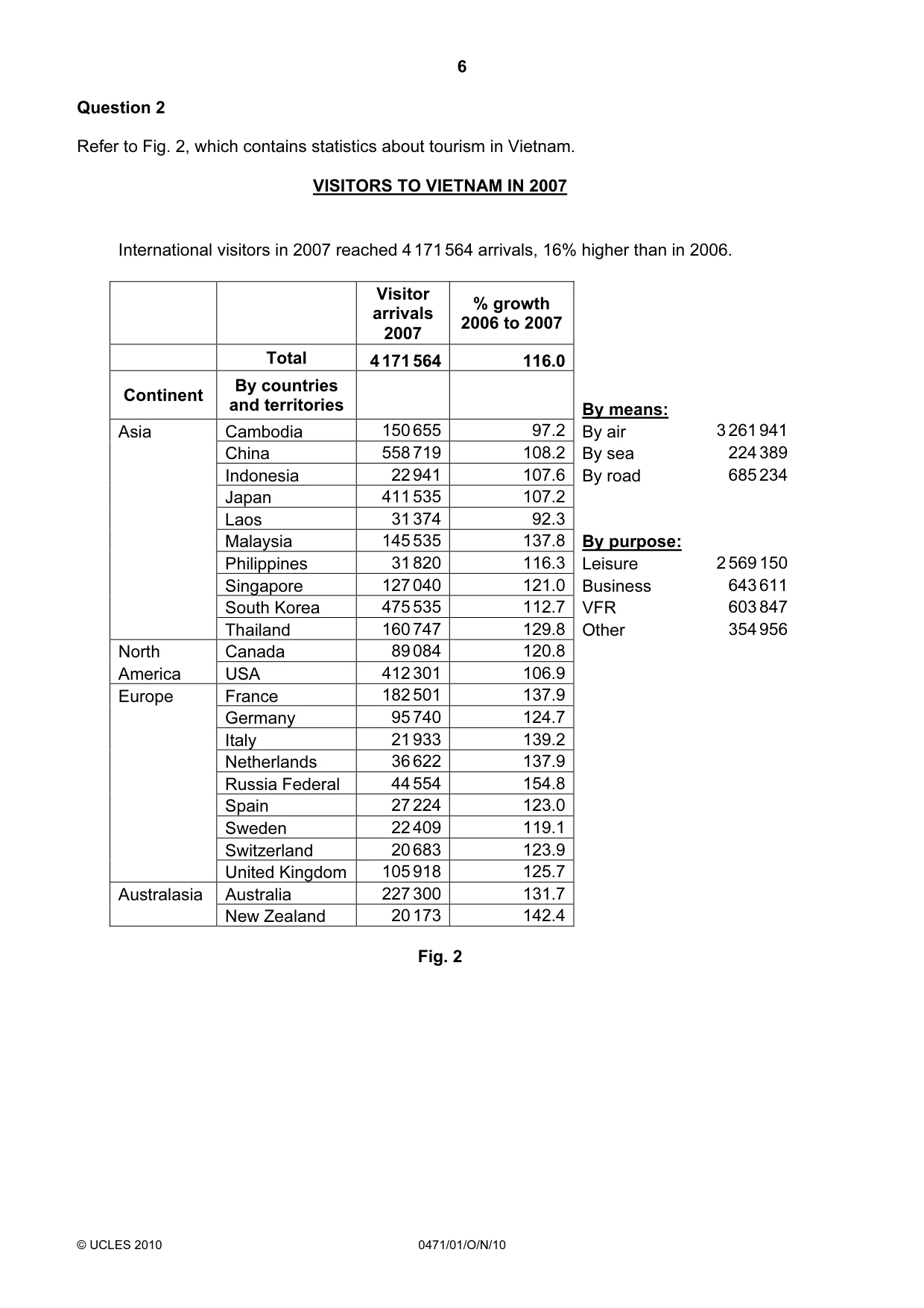
6 © UCLES 2010 0471/01/O/N/10 Question 2 Refer to Fig. 2, which contains statistics about tourism in Vietnam. VISITORS TO VIETNAM IN 2007 International visitors in 2007 reached 4 171 564 arrivals, 16% higher than in 2006. Visitor arrivals 2007 % growth 2006 to 2007 Total 4 171 564 116.0 Continent By countries and territories By means: Asia Cambodia 150 655 97.2 By air 3 261 941 China 558 719 108.2 By sea 224 389 Indonesia 22 941 107.6 By road 685 234 Japan 411 535 107.2 Laos 31 374 92.3 Malaysia 145 535 137.8 By purpose: Philippines 31 820 116.3 Leisure 2 569 150 Singapore 127 040 121.0 Business 643 611 South Korea 475 535 112.7 VFR 603 847 Thailand 160 747 129.8 Other 354 956 North Canada 89 084 120.8 America USA 412 301 106.9 Europe France 182 501 137.9 Germany 95 740 124.7 Italy 21 933 139.2 Netherlands 36 622 137.9 Russia Federal 44 554 154.8 Spain 27 224 123.0 Sweden 22 409 119.1 Switzerland 20 683 123.9 United Kingdom 105 918 125.7 Australasia Australia 227 300 131.7 New Zealand 20 173 142.4 Fig. 2
Question paper, page 7
7 © UCLES 2010 0471/01/O/N/10 [Turn over For Examiner's Use (a) Identify the following: • the total number of leisure visitors to Vietnam in 2007; • Vietnam’s third largest source market for visitors in 2007; • Vietnam’s source market showing the greatest percentage increase in 2007; • Vietnam’s largest Asian source market for visitors in 2007. [4] (b) Visitors come to Vietnam for a variety of purposes. Suggest three types of visit that could be included in the “other” category of Fig. 2 and give an example of each. 1 2 3 [6]
Question paper, page 8
8 © UCLES 2010 0471/01/O/N/10 For Examiner's Use (c) State three reasons why national governments collect tourism statistics. 1 2 3 [3] (d) Vietnam is a Less Economically Developed Country (LEDC). Explain three positive economic impacts that are likely to result from the development of tourism in the country. 1 2 3 [6]
Question paper, page 9
9 © UCLES 2010 0471/01/O/N/10 [Turn over For Examiner's Use (e) Assess the visitor appeal of one purpose-built visitor attraction with which you are familiar. Name of chosen attraction [6] [Total: 25]
Question paper, page 10
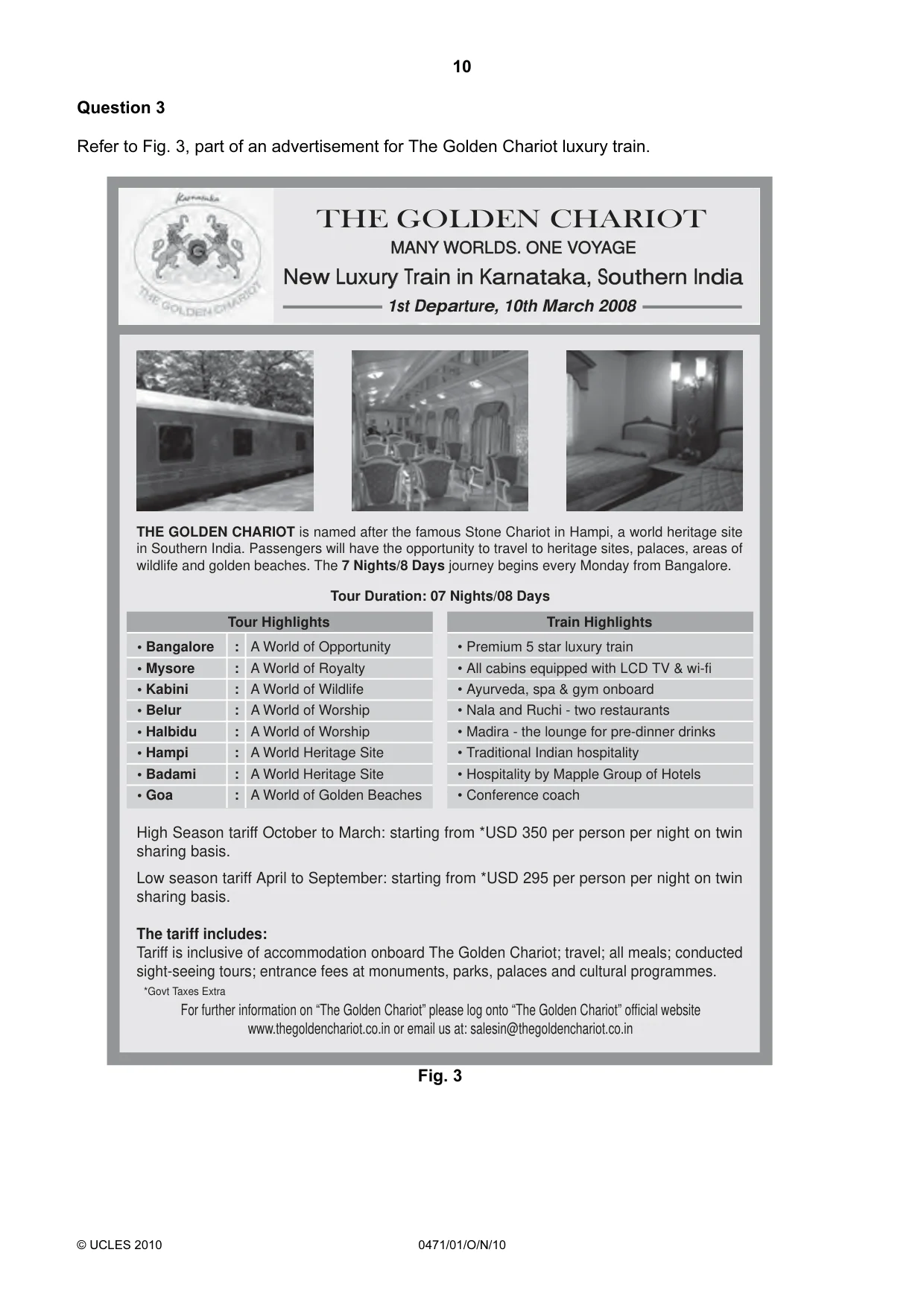
10 © UCLES 2010 0471/01/O/N/10 Question 3 Refer to Fig. 3, part of an advertisement for The Golden Chariot luxury train. MANY WORLDS. ONE VOYAGE MANY WORLDS. ONE VOYAGE 1st Departure, 10th March 2008 New Luxury Train in Karnataka, Southern India New Luxury Train in Karnataka, Southern India THE GOLDEN CHARIOT is named after the famous Stone Chariot in Hampi, a world heritage site in Southern India. Passengers will have the opportunity to travel to heritage sites, palaces, areas of wildlife and golden beaches. The 7 Nights/8 Days journey begins every Monday from Bangalore. High Season tariff October to March: starting from *USD 350 per person per night on twin sharing basis. Low season tariff April to September: starting from *USD 295 per person per night on twin sharing basis. The tariff includes: Tariff is inclusive of accommodation onboard The Golden Chariot; travel; all meals; conducted sight-seeing tours; entrance fees at monuments, parks, palaces and cultural programmes. *Govt Taxes Extra Tour Duration: 07 Nights/08 Days Tour Highlights • Bangalore : A World of Opportunity • Mysore : A World of Royalty • Kabini : A World of Wildlife • Belur : A World of Worship • Halbidu : A World of Worship • Hampi : A World Heritage Site • Badami : A World Heritage Site • Goa : A World of Golden Beaches Train Highlights • Premium 5 star luxury train • All cabins equipped with LCD TV & wi-fi • Ayurveda, spa & gym onboard • Nala and Ruchi - two restaurants • Madira - the lounge for pre-dinner drinks • Traditional Indian hospitality • Hospitality by Mapple Group of Hotels • Conference coach For further information on “The Golden Chariot” please log onto “The Golden Chariot” official website www.thegoldenchariot.co.in or email us at: salesin@thegoldenchariot.co.in THE GOLDEN CHARIOT Fig. 3
Question paper, page 11
11 © UCLES 2010 0471/01/O/N/10 [Turn over For Examiner's Use (a) Identify the following: • the beach destination included in the itinerary; • the destination famous for its stone chariot; • the destination famous for its wildlife. [3] (b) Describe two ways in which The Golden Chariot’s facilities are likely to appeal to luxury travellers. 1 2 [4] (c) In the table below, circle the three factors most likely to explain why the period from April to September has been classed as ‘Low Season’. Main dry season Monsoon season Period of clear blue skies High humidity Low sunshine hours Low humidity High sunshine hours Settled conditions Risk of night frosts [3]
Question paper, page 12
12 © UCLES 2010 0471/01/O/N/10 For Examiner's Use (d) State three likely hospitality job roles onboard the train. 1 2 3 [3] (e) Sight-seeing tours, such as those included in the Golden Chariot package, are organised for the convenience of passengers. Identify and explain the three ways in which The Golden Chariot has achieved this. 1 2 3 [6]
Question paper, page 13
13 © UCLES 2010 0471/01/O/N/10 [Turn over For Examiner's Use (f) Assess the ways in which one historic/cultural site with which you are familiar is managed in order to minimise visitor congestion. Name of chosen site [6] [Total: 25]
Question paper, page 14
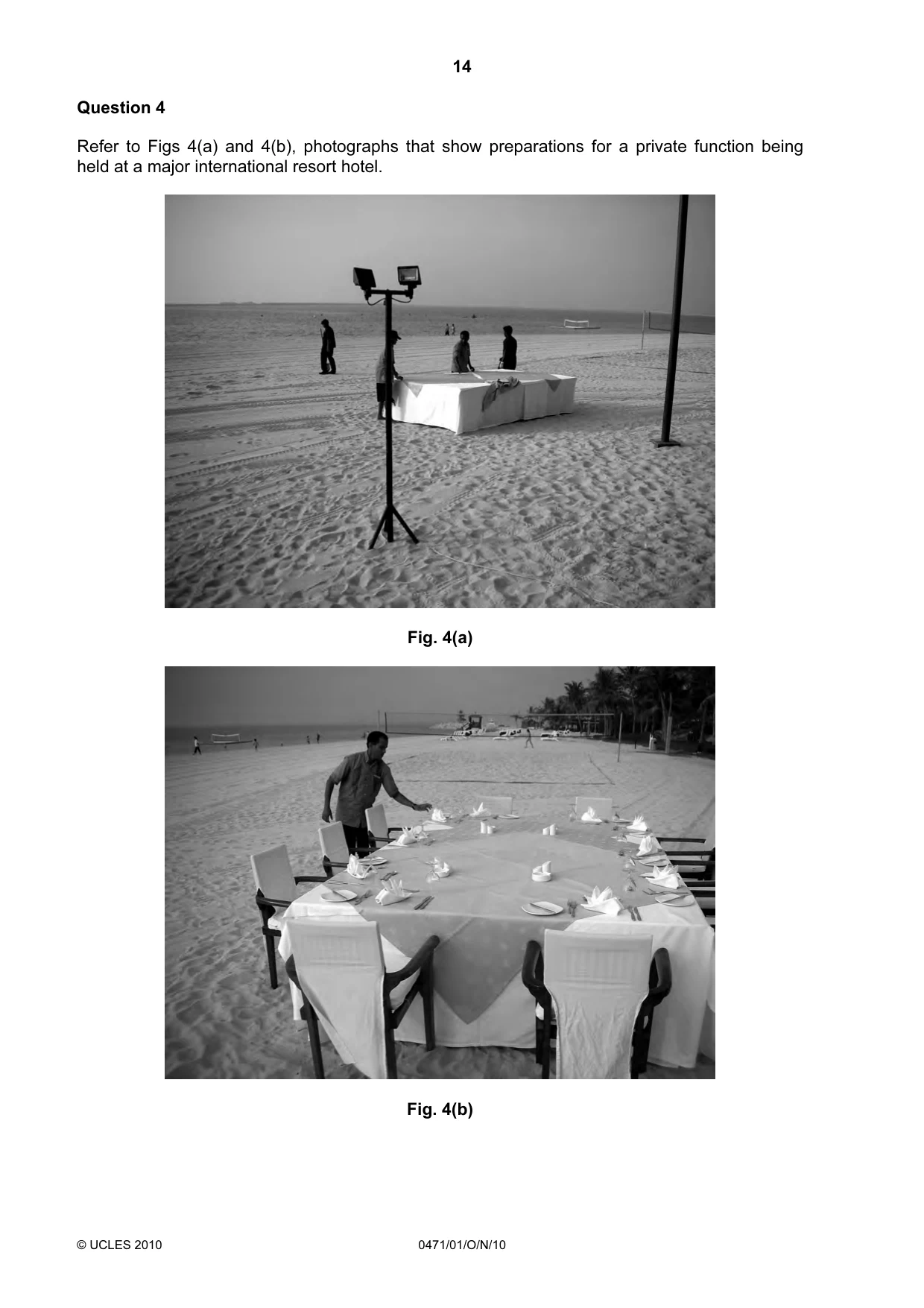
14 © UCLES 2010 0471/01/O/N/10 Question 4 Refer to Figs 4(a) and 4(b), photographs that show preparations for a private function being held at a major international resort hotel. Fig. 4(a) Fig. 4(b)
Question paper, page 15
15 © UCLES 2010 0471/01/O/N/10 [Turn over For Examiner's Use (a) With reference to Figs 4(a) and 4(b), identify and explain three ways in which teamwork is important for staff involved in the event preparations. 1 2 3 [6] (b) Many international hotels attract business customers attending meetings, incentives, conferences and exhibitions (MICE). Explain three facilities/services usually provided for the convenience of such guests. 1 2 3 [6]
Question paper, page 16
16 © UCLES 2010 0471/01/O/N/10 For Examiner's Use (c) Large resort hotels can create a range of negative impacts. In the following table, circle the three negative social impacts that may frequently result from resort hotel development. Increased employment Seasonal underemployment Preservation of traditional culture Better infrastructure Increased crime Exposure to alternative lifestyle(s) Loss of wildlife habitats Increased incomes Increased foreign exchange [3] (d) Not all tourists choose to stay in a hotel at their chosen destination. Explain two reasons why staying at a serviced apartment will appeal to some visitors. 1 2 [4]
Question paper, page 17
17 © UCLES 2010 0471/01/O/N/10 For Examiner's Use (e) Discuss the reasons why many international tourists will use a local travel agency to make their holiday travel arrangements. [6] [Total: 25]
Question paper, page 18
18 © UCLES 2010 0471/01/O/N/10 BLANK PAGE
Question paper, page 19
19 © UCLES 2010 0471/01/O/N/10 BLANK PAGE
Question paper, page 20
20 Copyright Acknowledgements: Question 1 Question 2 Question 3 Question 4a Question 4b © Advert for AR Tango Tours; www.artourism.com. © Vietnam Tourism Data; www.vietnam-tourism.gov.vn. © Golden Chariot Advert; www.goldenchariot.co.in. J D Smith © UCLES. J D Smith © UCLES. Permission to reproduce items where third-party owned material protected by copyright is included has been sought and cleared where possible. Every reasonable effort has been made by the publisher (UCLES) to trace copyright holders, but if any items requiring clearance have unwittingly been included, the publisher will be pleased to make amends at the earliest possible opportunity. University of Cambridge International Examinations is part of the Cambridge Assessment Group. Cambridge Assessment is the brand name of University of Cambridge Local Examinations Syndicate (UCLES), which is itself a department of the University of Cambridge. © UCLES 2010 0471/01/O/N/10 BLANK PAGE
Mark scheme, page 1
UNIVERSITY OF CAMBRIDGE INTERNATIONAL EXAMINATIONS International General Certificate of Secondary Education MARK SCHEME for the October/November 2010 question paper for the guidance of teachers 0471 TRAVEL AND TOURISM 0471/01 Paper 1 (Written Paper), maximum raw mark 100 This mark scheme is published as an aid to teachers and candidates, to indicate the requirements of the examination. It shows the basis on which Examiners were instructed to award marks. It does not indicate the details of the discussions that took place at an Examiners’ meeting before marking began, which would have considered the acceptability of alternative answers. Mark schemes must be read in conjunction with the question papers and the report on the examination. • CIE will not enter into discussions or correspondence in connection with these mark schemes. CIE is publishing the mark schemes for the October/November 2010 question papers for most IGCSE, GCE Advanced Level and Advanced Subsidiary Level syllabuses and some Ordinary Level syllabuses. www.XtremePapers.com
Mark scheme, page 2
Page 2 Mark Scheme: Teachers’ version Syllabus Paper IGCSE – October/November 2010 0471 01 © UCLES 2010 1 (a) State three features of an AR Tango Vacation. [3] Award one mark for each of three of the following: • A pre-determined number of hours of private lessons • Daily group lessons • Entrance into Argentine Tango dance clubs • Front row tickets to Tango Shows and events • Your own personal host and dance instructor (b) Explain two ways in which AR Tourism’s clients receive a personal customised service. [4] Fig. 1(a) provides the appropriate clues for this. Award one mark for the identification of each of two valid procedures and a second mark for an appropriate explanatory comment about each. Correct ideas based on Fig. 1(a) include: • Completing a ‘Request Information Form’ or calling on 212-475-2406 (1) – can go through each detail of proposed vacation step by step with agent (1) • Sent itinerary that is a breakdown of proposed trip day-by-day (1) – suggested hotels, destinations and excursions are included in itinerary for confirmation/approval (1) • Only after they receive trip preferences will staff reserve flights and accommodation (1) – meet individual requirements (1) Credit all valid reasoning based on Fig. 1(a) context. (c) Explain two advantages to AR Tourism’s customers of being issued with e-tickets for their trip. [4] An electronic ticket (ET or e-ticket) holds the information previously held on a paper ticket in an electronic format. The only paper you now need is an itinerary receipt that confirms the detail of the ticket you purchased e.g. flight numbers, departure times, destinations, ticket number and airport information. You should always keep your itinerary receipt with you when travelling just in case you need to show it to airport staff. Award one mark for the identification of each of two valid advantages and a further one mark for an appropriate explanation of each from the customer perspective. For example: • More efficient and more convenient for passengers (1) – You can’t lose an electronic ticket (1). The information will always be stored securely in an airline’s computer system (1). • It’s easier to make changes to your itinerary (1). With an electronic ticket, you no longer have to go to an airline or travel agency office to pick up a new ticket (1). The changes can be made immediately in the computer system (1). (d) Award one mark for each, as follows: [4] (i) 5 (ii) Advance (iii) Temperate (iv) Atlantic (4 × 1)
Mark scheme, page 3
Page 3 Mark Scheme: Teachers’ version Syllabus Paper IGCSE – October/November 2010 0471 01 © UCLES 2010 (e) Most of the routes shown on Fig. 1(b) involve a long haul flight. In the following table circle the four services that you would expect to be made available only to business class passengers travelling on long haul scheduled flights. [4] Award one mark for the correct identification of each of the following: • Flat bed seats • Early boarding call • Lounge access • Fast track check-in (f) With reference to one example with which you are familiar, discuss how a mountain area has been developed to attract tourists. [6] This does not have to be in the winter sports context (e.g. Machu Picchu and Inca Trail) but many will go down that route. The question is firmly set in Unit 2.4 and candidates not writing about an identifiable mountain location will have Level 2 maximum 4 marks. Use level of response criteria Level 1 (1–2 marks) will identify up to two valid developments, providing some detail but will be mainly descriptive about chosen features. Level 2 (3–4 marks) can be awarded for an analysis of selected developments and we should expect an appropriate treatment of at least two of these. Level 3 (5–6 marks) can be awarded for evaluative comment about types of service/facilities developed and the better answers will have a reasoned conclusion. Example: Villars-sur-Ollon is a traditional Swiss ski resort, set in the heart of the Vaudoise Alps some 60 km from Lausanne and Lake Leman in the Canton de Vaud. Winter skiers have over 100 km of pistes (L1) to try out within the wider Villars region with 45 ski lifts (L1) and 43 identified ski runs (L1). The ski runs cover valley slopes ranging between 1250 m and 2200 m and this variation in altitude will mean that some skiing is possible early and late in the season (L2), thus extending the resort’s operational dates (L2). The resort has access to 44 km of cross country ski trails in addition to the downhill runs already mentioned. This choice of skiing widens the resort’s potential appeal (L3). In summer it is the natural scenic appeal of the area which attracts visitors, particularly those who enjoy exploring mountain and lake countryside (L3).
Mark scheme, page 4
Page 4 Mark Scheme: Teachers’ version Syllabus Paper IGCSE – October/November 2010 0471 01 © UCLES 2010 2 (a) Identify the following: [4] Award one mark for each of the following: (i) 2,569,150 (ii) USA (iii) Russia (iv) China (b) Visitors come to Vietnam for a variety of purposes. Suggest three types of visit that could be included in the “other” category of Fig. 2 and give an example of each. [6] Award one mark for each of three appropriate purposes and award a second mark for a valid illustration of each. Correct ideas include: • Sport (1) – visiting team tour (1) • Medical (1) – to seek treatment (1) • Religion (1) – pilgrimage (1) • Political (1) – refugee (1) • Education (1) – exchange/study visit (1) • Cultural exchange (1) – e.g. Music performance (1) (c) State three reasons why national governments collect tourism statistics. [3] Award one mark for the identification of each of three valid reasons, which may be simply stated, such as: • To aid planning • To pinpoint areas of demand on infrastructure • To identify key market segments • To monitor the success of past plans/initiatives • To support/inform policy decisions etc. Credit all valid points (d) Vietnam is a Less Economically Developed Country (LEDC). Explain three positive economic impacts that are likely to result from the development of tourism in the country. [6] Award one mark for the identification of each of three valid economic impacts and a further one mark for an appropriate explanatory comment about each, such as: • Balance of payments improve (1) – higher levels of GDP (1) • Increased employment (1) – new businesses (1) • Reduction in unemployment and underemployment levels (1) – especially if no low season (1) • Multiplier effect (1) – stimulates demand (1) • Incomes rise (1) – increased living standards (1) • Infrastructure improves (1) – new facilities (1) Credit all valid reasoning.
Mark scheme, page 5
Page 5 Mark Scheme: Teachers’ version Syllabus Paper IGCSE – October/November 2010 0471 01 © UCLES 2010 (e) Assess the visitor appeal of one purpose-built visitor attraction with which you are familiar. [6] Candidates are expected to have studied at least one destination and any type of purpose- built attraction is acceptable. The focus is on an assessment of visitor appeal for a known attraction. If not purpose-built visitor attraction, then 4 marks maximum. Use level of response criteria Level 1 (1–2 marks) will identify up to two appropriate types of product/service appeal, providing some detail but will be mainly descriptive about features of the chosen attraction Level 2 (3–4 marks) can be awarded for an analysis of selected features/products/services and we should expect an appropriate treatment, indicating suitability for visitor requirements, of at least two of these. Level 3 (5–6 marks) can be awarded for evaluative comment about types of provision related to different visitor needs. The better answers will have a reasoned conclusion. Example: The Louvre in Paris get visitors from people (individuals and groups) on educational trips, holiday excursions, attending an event and other specialised activities. Made up of eight departments, the Louvre now displays 35,000 works in 60,000 square meters of exhibition space (L1). The Louvre has a wide range of aids and amenities to ensure any given visit is fruitful, from floor plans, audio guides, and program listings to cafés, media centres, and a bookstore (L1). The Louvre's libraries and multimedia centres enable visitors to learn about the collections in greater depth (L2). In addition to these, the museum's various curatorial departments have research centres and libraries that contain a wealth of material for the use of researchers, students, and other interested parties (L2). The Musée du Louvre and the Musée Delacroix can even provide a prestigious setting for private receptions, gala evenings, prize-giving ceremonies, product launches, concerts, film premieres with dinners, cocktails, and breakfasts (L3). Open to all since 1793, the Louvre has embodied the concept of a truly "universal" institution. Universal in the scope of its collections, it is also universal in its appeal to some 6 million business and leisure visitors every year (L3).
Mark scheme, page 6
Page 6 Mark Scheme: Teachers’ version Syllabus Paper IGCSE – October/November 2010 0471 01 © UCLES 2010 3 (a) Identify the following: [3] Award one mark for each of the following: (i) Goa (ii) Hampi (iii) Kabini (b) Describe two ways in which The Golden Chariot’s facilities are likely to appeal to luxury travellers. [4] Award one mark for the identification of each of two appropriate aspects and award a further mark for a valid development of each. Correct responses based on Fig. 2 will include things such as: • Branded as 5* luxury (1) – images convey sense of luxury (1) • Cabins have LCD TV and wi-fi (1) – tastefully furnished (1) • Spa and Gym (1) – leisure facilities like hotels (1) • Two restaurants (1) – lounge bar (1) (c) In the table below, circle the three factors most likely to explain why the period from April to September has been classed as ‘Low Season’. [3] Award one mark for the correct identification of each of the following: • Monsoon season • High humidity • Low sunshine hours (d) State three likely hospitality job roles onboard the train. [3] Award one mark for the correct identification of each of three valid hospitality roles such as: • Chef • Kitchen porter • Waiter • Bartender • Room attendant (e) Sight-seeing tours, such as those included in The Golden Chariot package, are organised for the convenience of passengers. Identify and explain the three ways in which The Golden Chariot achieves this. [6] Fig. 3 states that these are included in the itinerary. Award one mark for the identification of each of three appropriate aspects and award a further mark for a valid explanation of each such as: • Tours are conducted (1) – use of guides (1) • Meals included (1) – away from train (1) all-inclusive (1) • All entrance fees/charges included (1) – no extra charge (1) Credit valid reasoning in Fig. 3 context.
Mark scheme, page 7
Page 7 Mark Scheme: Teachers’ version Syllabus Paper IGCSE – October/November 2010 0471 01 © UCLES 2010 (f) Assess the ways in which one historic/cultural site with which you are familiar is managed in order to minimise visitor congestion. [6] This requires candidates to talk about an historic/cultural site which may or may not be a building. The focus is on how the visitors are managed and we should reward mention of any of the following: • Signposting • Car parking and vehicle access • Entrance times • Advance pre-booking • Guides • Restricted areas/access A generic answer not related to a specific identifiable site can only score a maximum 4. Use level of response criteria Level 1 (1–2 marks) will identify up to two appropriate types of strategy, providing some detail but will be mainly descriptive about features of the chosen attraction Level 2 (3–4 marks) can be awarded for an analysis of selected strategies and we should expect an appropriate treatment, indicating visitor management of at least two of these. Level 3 (5–6 marks) can be awarded for evaluative comment about types of provision and the better answers will have a reasoned conclusion. Example: Visitors to the Pyramids find themselves being managed in a variety of ways. An access stone walkway (L1) has been introduced to prevent erosion and to reduce visitors wandering around the site (L2). Sensitive or dangerous areas are fenced off (1) to limit risk of injury and further damage (L2). A new access road (L1) for traffic is probably of greatest significance (L3) because coach parties can be better managed and guides pre-booked helping to reduce congestion (L3).
Mark scheme, page 8
Page 8 Mark Scheme: Teachers’ version Syllabus Paper IGCSE – October/November 2010 0471 01 © UCLES 2010 4 (a) With reference to Figs 4(a) and 4(b), identify and explain three ways in which teamwork is important for staff involved in the event preparations. [6] Fig. 4 (a) clearly shows evidence of team work between internal customers – staff of different departments – working together to prepare for the event. Award one mark for the identification of each of three stages in the preparations and award a second mark for a valid explanatory comment about each. Correct ideas based on both Figs 4(a) and (b) include i.e. • Site preparation (1) – beach swept (1) and lights set up by maintenance (1) • Table set up (1) – 2 hospitality staff carry and arrange tables on cleared site (1) • Size of table (12 guests) needs 2 staff (1) – lay cloths (1) • Staff bring cutlery etc. (1) – waiting and kitchen staff need to have a system in place (1) Credit all valid reasoning in context. (b) Many international hotels attract business customers attending meetings, exhibitions and conferences (MICE). Explain three facilities/services usually provided for the convenience of such guests. [6] Candidates may write about appropriate hotel services and/or facilities suitable to the needs of business customers without restriction. Award one mark for the identification or each of three valid services/facilities and award a second mark for an appropriate explanatory comment. Correct ideas include: • Airport transfers (1) – meet and greet (1) • Business lounge access (1) – work support facilities (1) • Meeting rooms (1) – internet and office support (1) • Express check-out (1) – travel deadlines (1) • Dedicated member of staff to supply the event organiser with a specialist customer service package (1) – help with the choice of room appropriate to the scale of the event • Social and partners programmes (1) – visitors/delegates enjoy their stay and will want to return (1) Credit all valid reasoning. (c) Large resort hotels can create a range of negative impacts. In the following table, circle the three negative social impacts that may frequently result from resort hotel development. [3] Award one mark for the correct identification of each of the following: • Seasonal underemployment • Increased crime • Exposure to alternative lifestyle(s) (d) Not all tourists choose to stay in a hotel at their chosen destination. Explain two reasons why staying at a serviced apartment will appeal to some visitors. [4] Award one mark for the correct identification of each of two valid types of appeal and award a further one mark for an appropriate explanation of each. Correct ideas include: • More space (1) – family occupancy (1) • Cheaper than hotel (1) – can make savings (1) • Relaxed atmosphere (1) – better for parents with small children (1) • Self-cater or eat out (1) – meal flexibility (1) • Some apartments linked with hotels (1) – allows guests to use hotel facilities (1) • Apartments often nearer business locations (1) – allows easier access for business travellers (1) Credit all valid reasoning.
Mark scheme, page 9
Page 9 Mark Scheme: Teachers’ version Syllabus Paper IGCSE – October/November 2010 0471 01 © UCLES 2010 (e) Discuss the reasons why many international tourists will use a local travel agency to make their holiday travel arrangements. [6] There are a variety of reasons for this and candidates will probably give emphasis to the convenience, face to face contact, range of additional services etc. that they see fit. Use level of response criteria Level 1 (1–2 marks) will identify up to two valid reasons, providing some detail but will be mainly descriptive about chosen features. Level 2 (3–4 marks) can be awarded for an analysis of selected reasons and we should expect an appropriate treatment of at least two of these. Level 3 (5–6 marks) can be awarded for evaluative comment about types of service provision and the better answers will have a reasoned conclusion. Example: Customers like the convenience (L1) of agencies located in shopping areas near their home or place of work. Customers without Internet access rely on travel agencies (L1) and most people value the personal touch of face to face contact (L2). The agencies have many special offer deals (L1) and these represent value for money (L2). However, modern agencies have evolved into ‘one stop travel shops’ and customers can purchase a range of ancillary services and obtain all their travel needs (insurance, currency, car hire etc.) at the same time (L3). This makes them the most convenient option for many people (L3).
What you needed in this session
Cambridge’s own grade thresholds for 2010 Oct/Nov, Paper 1 · Variant 1. A higher threshold means an easier paper — the bar moves with how the cohort did.