Cambridge IGCSE Travel and Tourism 0471 — 2010 May/June Paper 2 · Variant 1
0471/21/M/J/10 · 100 marks · ≈113 min
The question paper and its mark scheme, free to read here and free to download. This is Cambridge’s own paper, exactly as it was sat.
Question paper16 pages
Mark scheme9 pages
Answers below. Sit the paper first if you are practising.
Paper as text
Question paper, page 1
This document consists of 16 printed pages. IB10 06_0471_02/4RP © UCLES 2010 [Turn over *3500262042* For Examiner's Use 1 2 3 4 Total UNIVERSITY OF CAMBRIDGE INTERNATIONAL EXAMINATIONS International General Certificate of Secondary Education TRAVEL AND TOURISM 0471/02 Marketing and Promotion May/June 2010 2 hours 30 minutes Candidates answer on the Question Paper. No Additional Materials are required. READ THESE INSTRUCTIONS FIRST Write your Centre number, candidate number and name on all the work you hand in. Write in dark blue or black pen. You may use a soft pencil for any diagrams, graphs or rough working. Do not use staples, paper clips, highlighters, glue or correction fluid. DO NOT WRITE IN ANY BARCODES. Answer all questions. At the end of the examination, fasten all your work securely together. The number of marks is given in brackets [ ] at the end of each question or part question. www.XtremePapers.com
Question paper, page 2
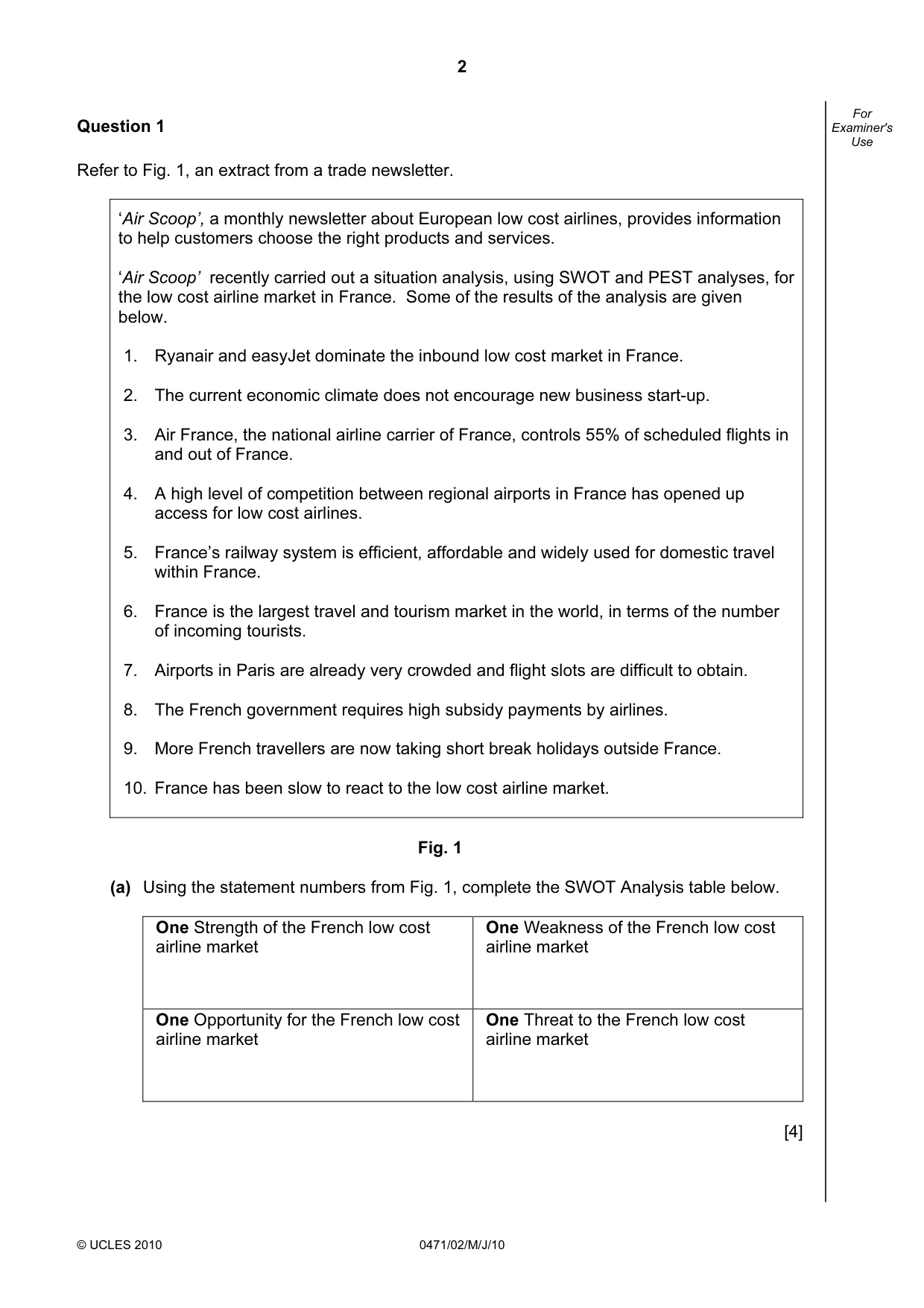
2 © UCLES 2010 0471/02/M/J/10 For Examiner's Use Question 1 Refer to Fig. 1, an extract from a trade newsletter. ‘Air Scoop’, a monthly newsletter about European low cost airlines, provides information to help customers choose the right products and services. ‘Air Scoop’ recently carried out a situation analysis, using SWOT and PEST analyses, for the low cost airline market in France. Some of the results of the analysis are given below. 1. Ryanair and easyJet dominate the inbound low cost market in France. 2. The current economic climate does not encourage new business start-up. 3. Air France, the national airline carrier of France, controls 55% of scheduled flights in and out of France. 4. A high level of competition between regional airports in France has opened up access for low cost airlines. 5. France’s railway system is efficient, affordable and widely used for domestic travel within France. 6. France is the largest travel and tourism market in the world, in terms of the number of incoming tourists. 7. Airports in Paris are already very crowded and flight slots are difficult to obtain. 8. The French government requires high subsidy payments by airlines. 9. More French travellers are now taking short break holidays outside France. 10. France has been slow to react to the low cost airline market. Fig. 1 (a) Using the statement numbers from Fig. 1, complete the SWOT Analysis table below. One Strength of the French low cost airline market One Weakness of the French low cost airline market One Opportunity for the French low cost airline market One Threat to the French low cost airline market [4]
Question paper, page 3
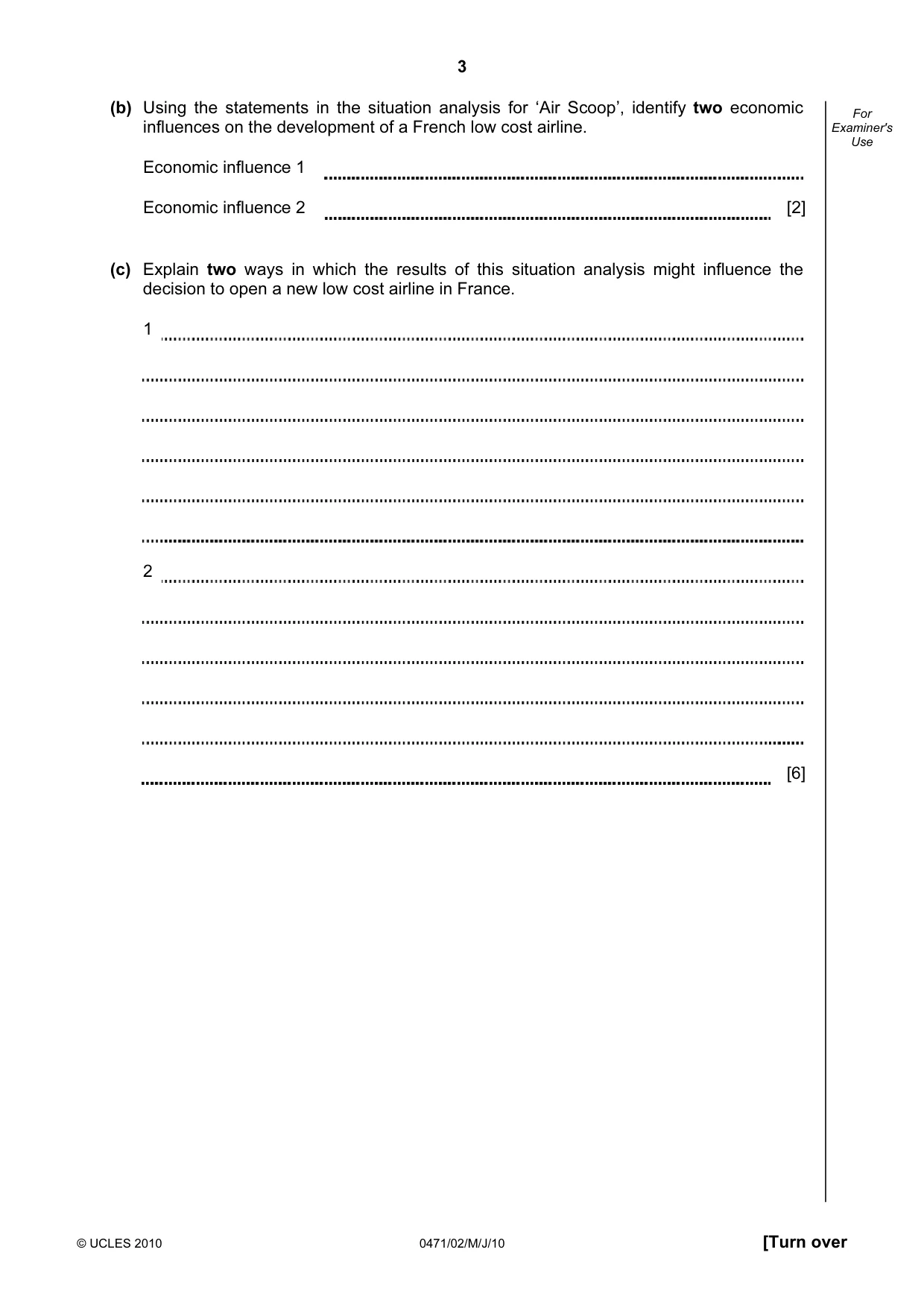
3 © UCLES 2010 0471/02/M/J/10 [Turn over For Examiner's Use (b) Using the statements in the situation analysis for ‘Air Scoop’, identify two economic influences on the development of a French low cost airline. Economic influence 1 Economic influence 2 [2] (c) Explain two ways in which the results of this situation analysis might influence the decision to open a new low cost airline in France. 1 2 [6]
Question paper, page 4
4 © UCLES 2010 0471/02/M/J/10 For Examiner's Use (d) (i) Describe two features of the low cost airline product. Feature 1: Feature 2: [4]
Question paper, page 5
5 © UCLES 2010 0471/02/M/J/10 [Turn over For Examiner's Use (ii) Analyse the advantages and disadvantages for travellers of using the services of a low cost airline when going on holiday. [9] [Total: 25]
Question paper, page 6
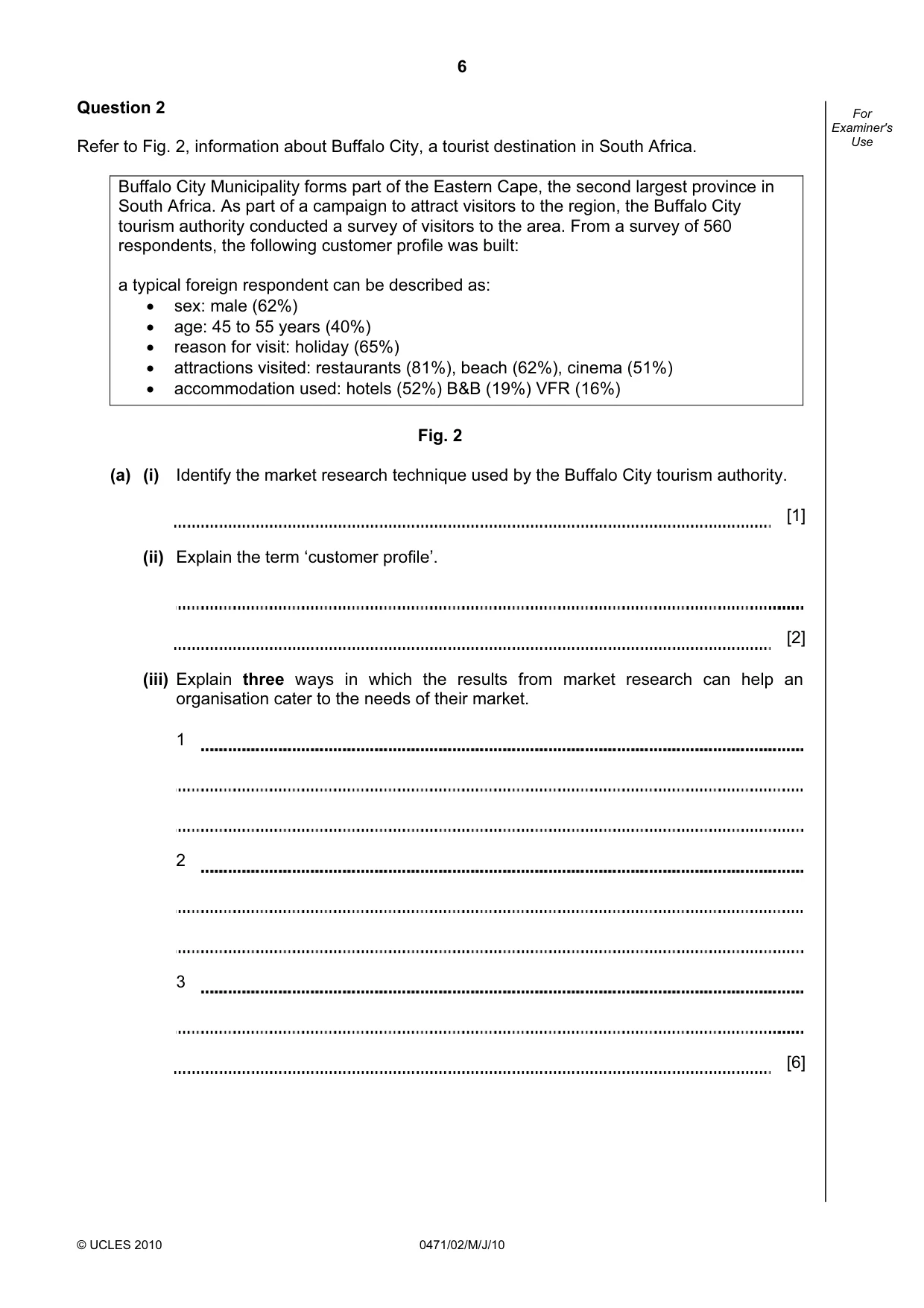
6 © UCLES 2010 0471/02/M/J/10 For Examiner's Use Question 2 Refer to Fig. 2, information about Buffalo City, a tourist destination in South Africa. Buffalo City Municipality forms part of the Eastern Cape, the second largest province in South Africa. As part of a campaign to attract visitors to the region, the Buffalo City tourism authority conducted a survey of visitors to the area. From a survey of 560 respondents, the following customer profile was built: a typical foreign respondent can be described as: • sex: male (62%) • age: 45 to 55 years (40%) • reason for visit: holiday (65%) • attractions visited: restaurants (81%), beach (62%), cinema (51%) • accommodation used: hotels (52%) B&B (19%) VFR (16%) Fig. 2 (a) (i) Identify the market research technique used by the Buffalo City tourism authority. [1] (ii) Explain the term ‘customer profile’. [2] (iii) Explain three ways in which the results from market research can help an organisation cater to the needs of their market. 1 2 3 [6]
Question paper, page 7
7 © UCLES 2010 0471/02/M/J/10 [Turn over For Examiner's Use (b) The Buffalo City Tourism Plan outlines a 10-year strategy to promote the development and marketing of tourism opportunities in the region. It includes plans to market the region as a ‘perfect base camp’ for the 2010 FIFA World Cup, taking place in South Africa. Analyse why marketing and promotion of the 2010 FIFA World Cup is important to the tourism industry of South Africa. [6] (c) The following press release appeared in September 2008: ‘Mascot for 2010 World Cup in South Africa makes appearance for media: a cuddly leopard named Zakumi will be the mascot of the 2010 World Cup.’ (i) Define the term ‘press release’. [1]
Question paper, page 8
8 © UCLES 2010 0471/02/M/J/10 For Examiner's Use (ii) Explain the importance for tourism of using a mascot in marketing an event such as the 2010 FIFA World Cup in South Africa. [3] (d) Compare and contrast two promotional methods that tourism authorities in South Africa could use to promote the 2010 FIFA World Cup event effectively. [6] [Total: 25]
Question paper, page 9
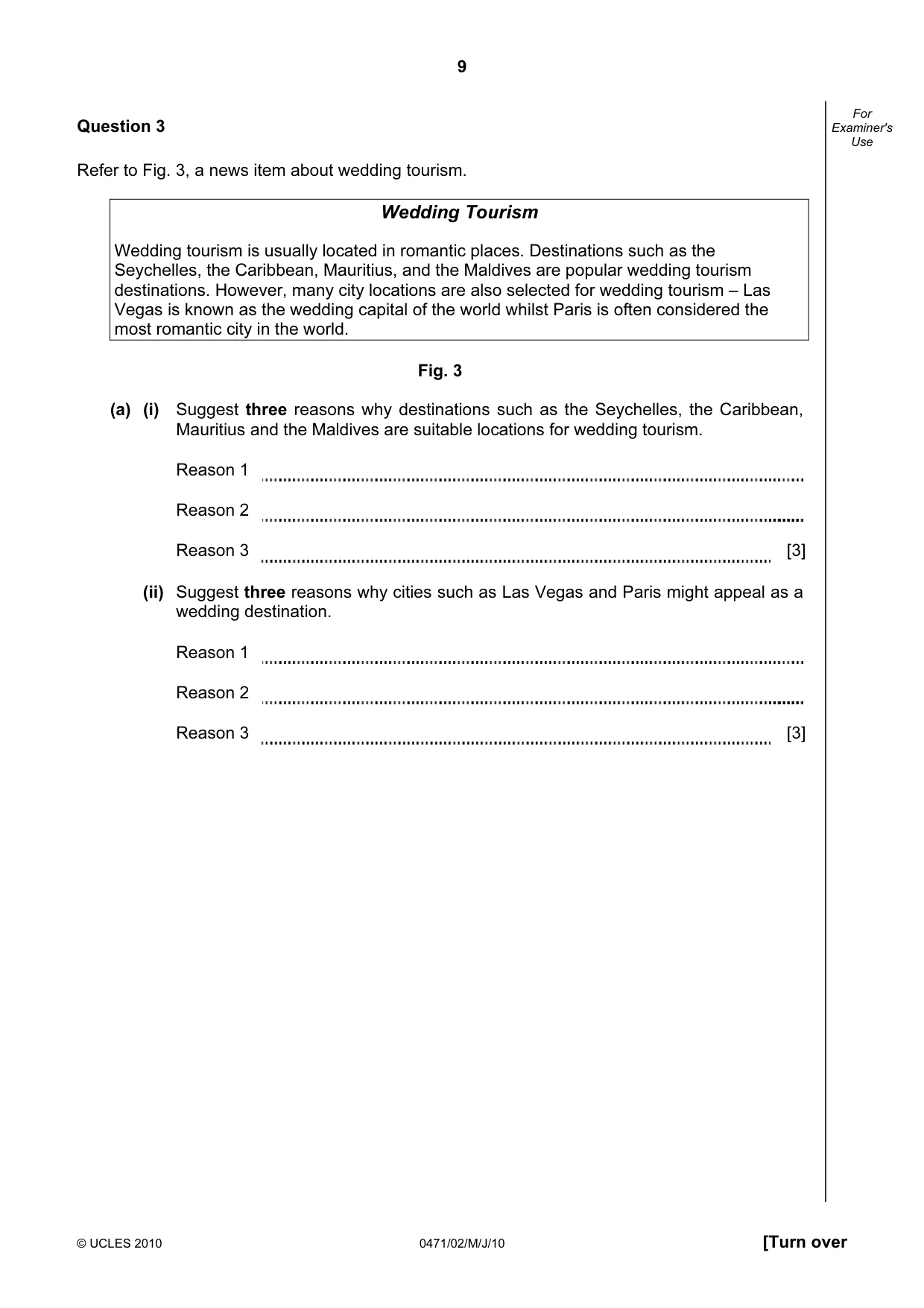
9 © UCLES 2010 0471/02/M/J/10 [Turn over For Examiner's Use Question 3 Refer to Fig. 3, a news item about wedding tourism. Wedding Tourism Wedding tourism is usually located in romantic places. Destinations such as the Seychelles, the Caribbean, Mauritius, and the Maldives are popular wedding tourism destinations. However, many city locations are also selected for wedding tourism – Las Vegas is known as the wedding capital of the world whilst Paris is often considered the most romantic city in the world. Fig. 3 (a) (i) Suggest three reasons why destinations such as the Seychelles, the Caribbean, Mauritius and the Maldives are suitable locations for wedding tourism. Reason 1 Reason 2 Reason 3 [3] (ii) Suggest three reasons why cities such as Las Vegas and Paris might appeal as a wedding destination. Reason 1 Reason 2 Reason 3 [3]
Question paper, page 10
10 © UCLES 2010 0471/02/M/J/10 For Examiner's Use (b) Choose two pricing policies that might be used for wedding tourism products and services. Explain how each policy works. Policy 1 How it works Policy 2 How it works [4]
Question paper, page 11
11 © UCLES 2010 0471/02/M/J/10 [Turn over For Examiner's Use (c) ‘bridesandbeaches’ is a specialist travel agent, offering wedding tourism bookings worldwide. Discuss the reasons why customers use this type of distribution channel. [9]
Question paper, page 12
12 © UCLES 2010 0471/02/M/J/10 For Examiner's Use (d) Explain, with examples, how the following factors determine pricing policies used by tourism providers: profitability competitors subsidies [6] [Total: 25]
Question paper, page 13
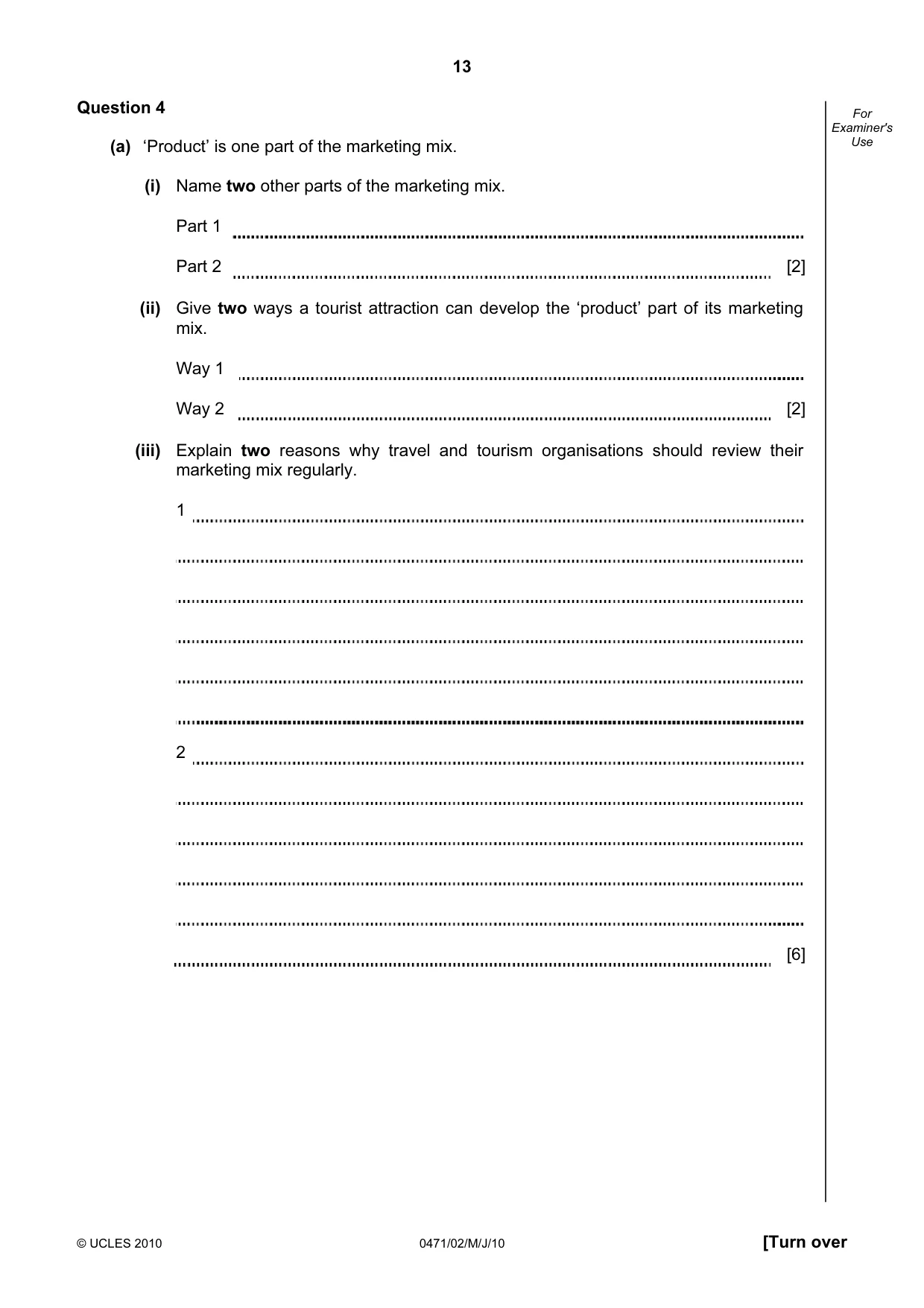
13 © UCLES 2010 0471/02/M/J/10 [Turn over For Examiner's Use Question 4 (a) ‘Product’ is one part of the marketing mix. (i) Name two other parts of the marketing mix. Part 1 Part 2 [2] (ii) Give two ways a tourist attraction can develop the ‘product’ part of its marketing mix. Way 1 Way 2 [2] (iii) Explain two reasons why travel and tourism organisations should review their marketing mix regularly. 1 2 [6]
Question paper, page 14
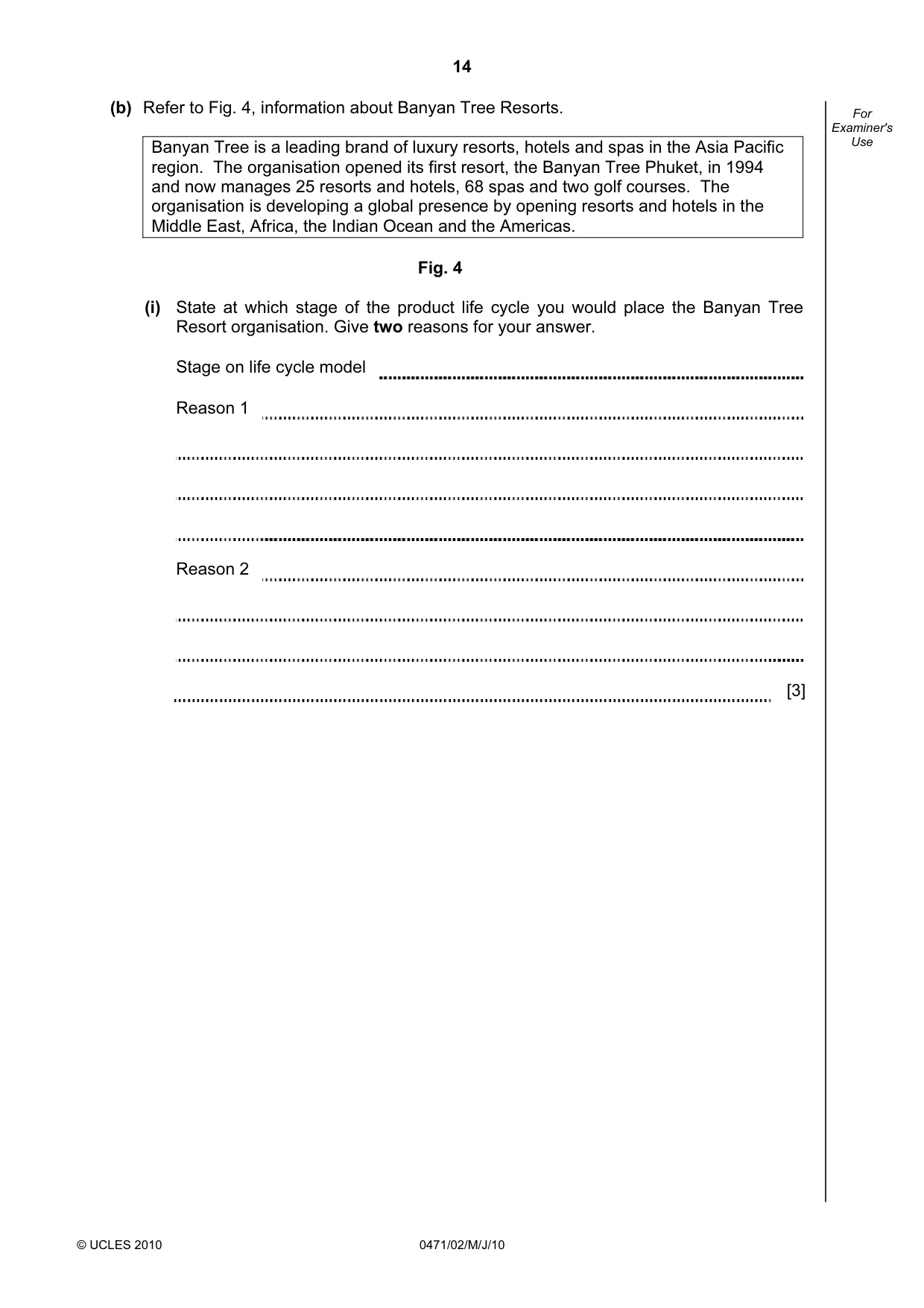
14 © UCLES 2010 0471/02/M/J/10 For Examiner's Use (b) Refer to Fig. 4, information about Banyan Tree Resorts. Banyan Tree is a leading brand of luxury resorts, hotels and spas in the Asia Pacific region. The organisation opened its first resort, the Banyan Tree Phuket, in 1994 and now manages 25 resorts and hotels, 68 spas and two golf courses. The organisation is developing a global presence by opening resorts and hotels in the Middle East, Africa, the Indian Ocean and the Americas. Fig. 4 (i) State at which stage of the product life cycle you would place the Banyan Tree Resort organisation. Give two reasons for your answer. Stage on life cycle model Reason 1 Reason 2 [3]
Question paper, page 15
15 © UCLES 2010 0471/02/M/J/10 [Turn over For Examiner's Use (ii) Describe three methods used by organisations such as Banyan Tree to create a brand image. Method 1 Description Method 2 Description Method 3 Description [6]
Question paper, page 16
16 Permission to reproduce items where third-party owned material protected by copyright is included has been sought and cleared where possible. Every reasonable effort has been made by the publisher (UCLES) to trace copyright holders, but if any items requiring clearance have unwittingly been included, the publisher will be pleased to make amends at the earliest possible opportunity. University of Cambridge International Examinations is part of the Cambridge Assessment Group. Cambridge Assessment is the brand name of University of Cambridge Local Examinations Syndicate (UCLES), which is itself a department of the University of Cambridge. © UCLES 2010 0471/02/M/J/10 For Examiner's Use (iii) Banyan Tree operates in a competitive market, with many other brands offering similar resorts in the Indian Ocean. Explain two reasons why some of its competitors may have to re-brand, once Banyan Tree enters this market. Reason 1 Reason 2 [6] [Total: 25]
Mark scheme, page 1
UNIVERSITY OF CAMBRIDGE INTERNATIONAL EXAMINATIONS International General Certificate of Secondary Education MARK SCHEME for the May/June 2010 question paper for the guidance of teachers 0471 TRAVEL AND TOURISM 0471/02 Paper 2 (Alternative to Coursework), maximum raw mark 100 This mark scheme is published as an aid to teachers and candidates, to indicate the requirements of the examination. It shows the basis on which Examiners were instructed to award marks. It does not indicate the details of the discussions that took place at an Examiners’ meeting before marking began, which would have considered the acceptability of alternative answers. Mark schemes must be read in conjunction with the question papers and the report on the examination. • CIE will not enter into discussions or correspondence in connection with these mark schemes. CIE is publishing the mark schemes for the May/June 2010 question papers for most IGCSE, GCE Advanced Level and Advanced Subsidiary Level syllabuses and some Ordinary Level syllabuses. www.XtremePapers.com
Mark scheme, page 2
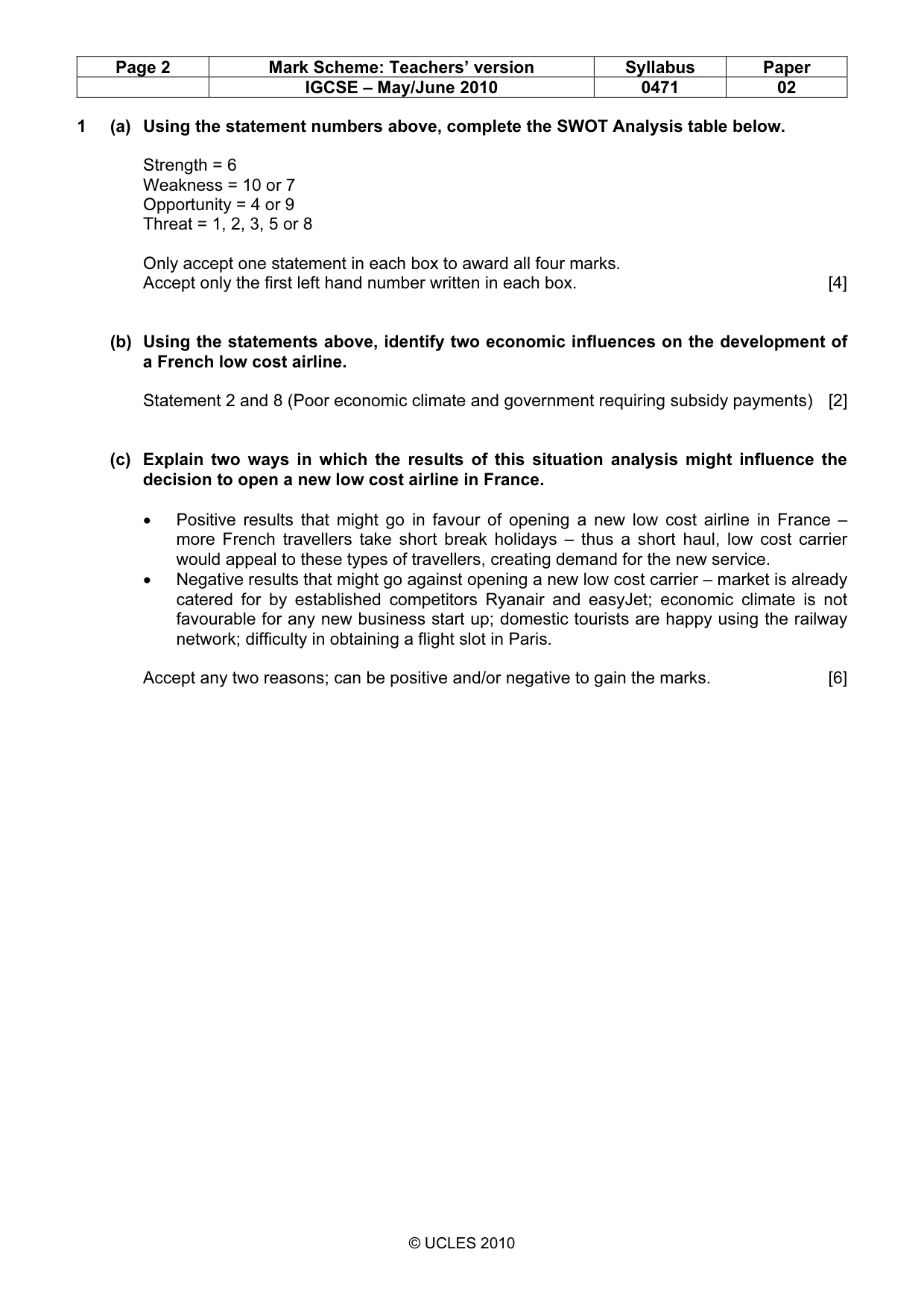
Page 2 Mark Scheme: Teachers’ version Syllabus Paper IGCSE – May/June 2010 0471 02 © UCLES 2010 1 (a) Using the statement numbers above, complete the SWOT Analysis table below. Strength = 6 Weakness = 10 or 7 Opportunity = 4 or 9 Threat = 1, 2, 3, 5 or 8 Only accept one statement in each box to award all four marks. Accept only the first left hand number written in each box. [4] (b) Using the statements above, identify two economic influences on the development of a French low cost airline. Statement 2 and 8 (Poor economic climate and government requiring subsidy payments) [2] (c) Explain two ways in which the results of this situation analysis might influence the decision to open a new low cost airline in France. • Positive results that might go in favour of opening a new low cost airline in France – more French travellers take short break holidays – thus a short haul, low cost carrier would appeal to these types of travellers, creating demand for the new service. • Negative results that might go against opening a new low cost carrier – market is already catered for by established competitors Ryanair and easyJet; economic climate is not favourable for any new business start up; domestic tourists are happy using the railway network; difficulty in obtaining a flight slot in Paris. Accept any two reasons; can be positive and/or negative to gain the marks. [6]
Mark scheme, page 3
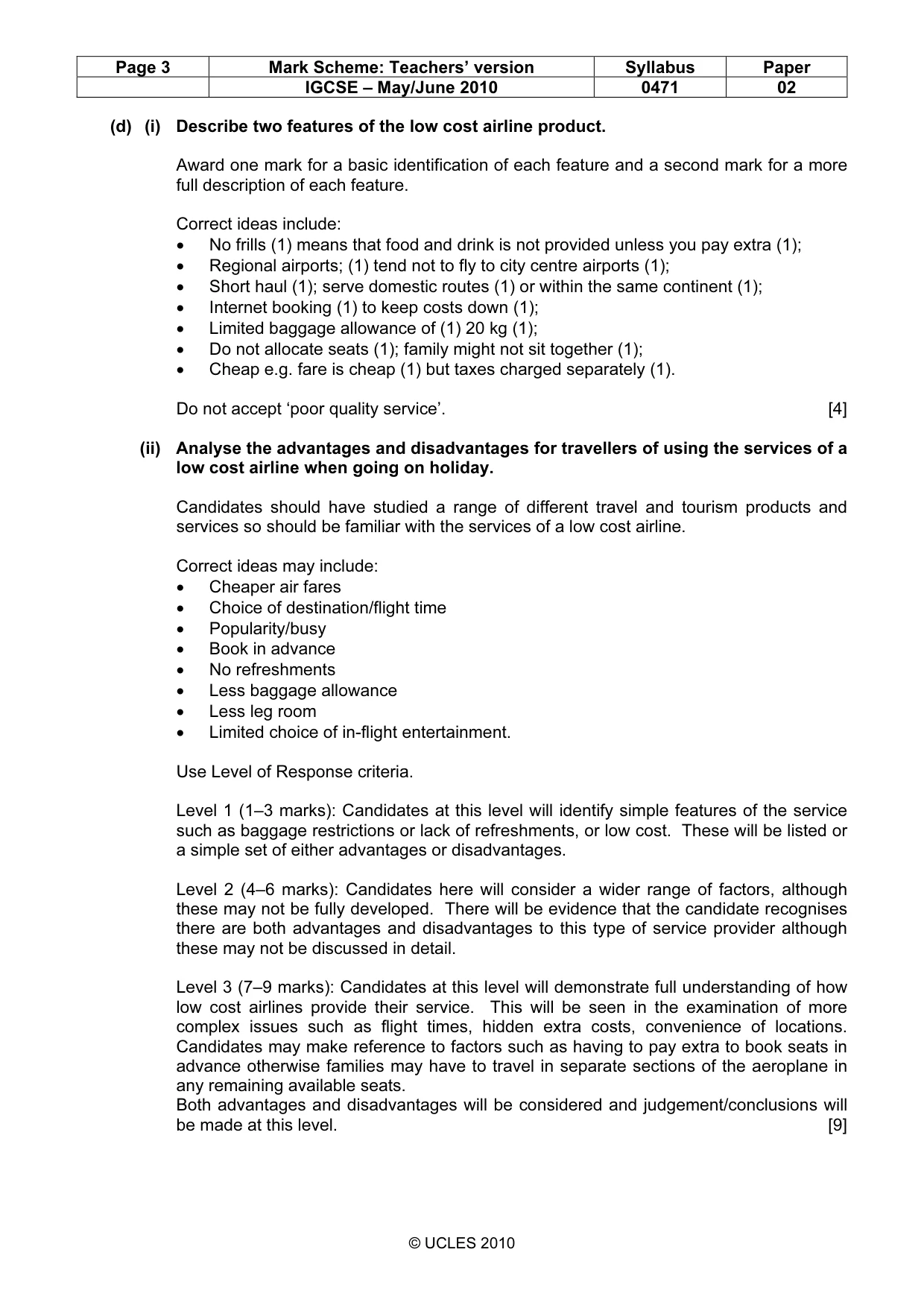
Page 3 Mark Scheme: Teachers’ version Syllabus Paper IGCSE – May/June 2010 0471 02 © UCLES 2010 (d) (i) Describe two features of the low cost airline product. Award one mark for a basic identification of each feature and a second mark for a more full description of each feature. Correct ideas include: • No frills (1) means that food and drink is not provided unless you pay extra (1); • Regional airports; (1) tend not to fly to city centre airports (1); • Short haul (1); serve domestic routes (1) or within the same continent (1); • Internet booking (1) to keep costs down (1); • Limited baggage allowance of (1) 20 kg (1); • Do not allocate seats (1); family might not sit together (1); • Cheap e.g. fare is cheap (1) but taxes charged separately (1). Do not accept ‘poor quality service’. [4] (ii) Analyse the advantages and disadvantages for travellers of using the services of a low cost airline when going on holiday. Candidates should have studied a range of different travel and tourism products and services so should be familiar with the services of a low cost airline. Correct ideas may include: • Cheaper air fares • Choice of destination/flight time • Popularity/busy • Book in advance • No refreshments • Less baggage allowance • Less leg room • Limited choice of in-flight entertainment. Use Level of Response criteria. Level 1 (1–3 marks): Candidates at this level will identify simple features of the service such as baggage restrictions or lack of refreshments, or low cost. These will be listed or a simple set of either advantages or disadvantages. Level 2 (4–6 marks): Candidates here will consider a wider range of factors, although these may not be fully developed. There will be evidence that the candidate recognises there are both advantages and disadvantages to this type of service provider although these may not be discussed in detail. Level 3 (7–9 marks): Candidates at this level will demonstrate full understanding of how low cost airlines provide their service. This will be seen in the examination of more complex issues such as flight times, hidden extra costs, convenience of locations. Candidates may make reference to factors such as having to pay extra to book seats in advance otherwise families may have to travel in separate sections of the aeroplane in any remaining available seats. Both advantages and disadvantages will be considered and judgement/conclusions will be made at this level. [9]
Mark scheme, page 4
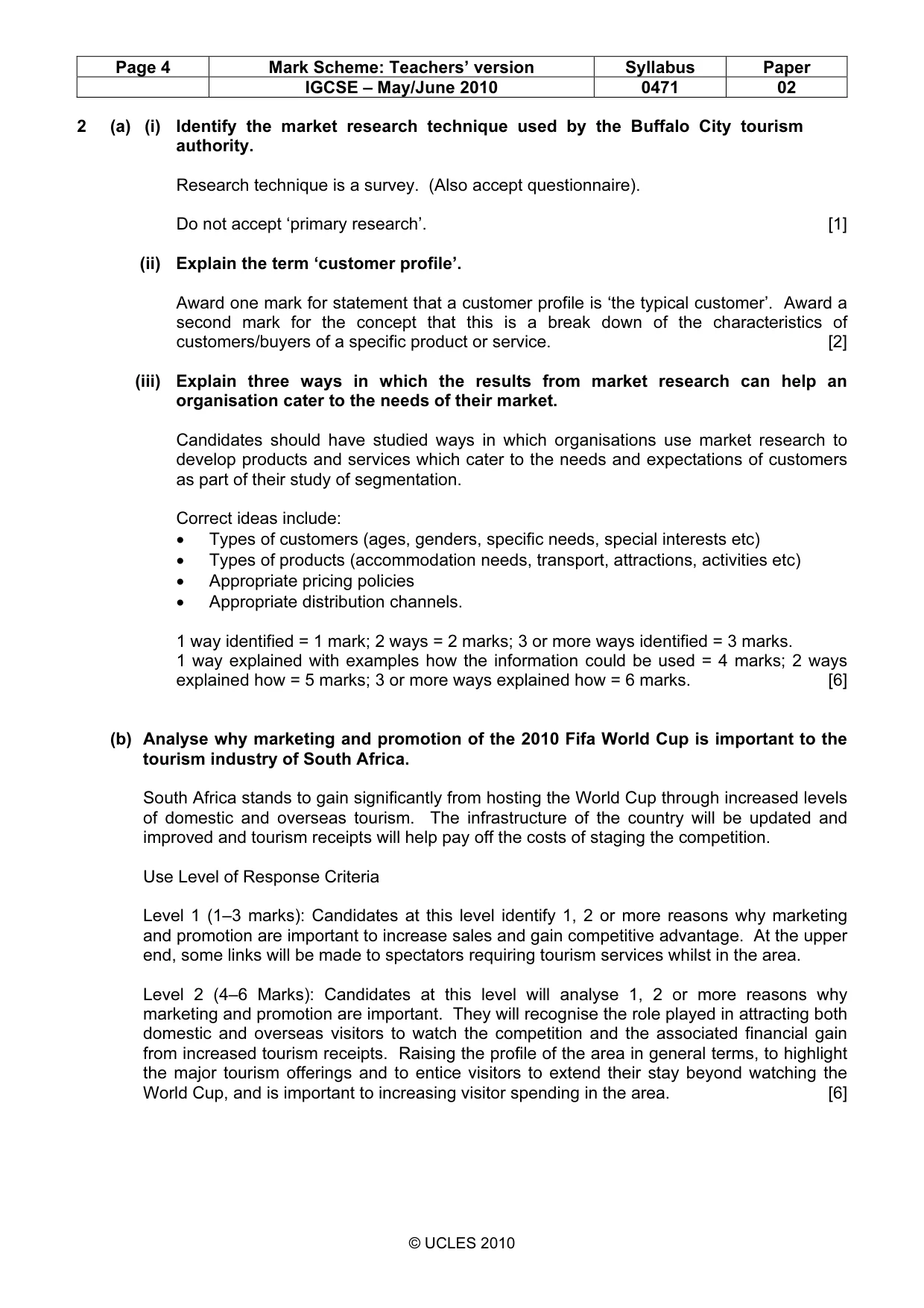
Page 4 Mark Scheme: Teachers’ version Syllabus Paper IGCSE – May/June 2010 0471 02 © UCLES 2010 2 (a) (i) Identify the market research technique used by the Buffalo City tourism authority. Research technique is a survey. (Also accept questionnaire). Do not accept ‘primary research’. [1] (ii) Explain the term ‘customer profile’. Award one mark for statement that a customer profile is ‘the typical customer’. Award a second mark for the concept that this is a break down of the characteristics of customers/buyers of a specific product or service. [2] (iii) Explain three ways in which the results from market research can help an organisation cater to the needs of their market. Candidates should have studied ways in which organisations use market research to develop products and services which cater to the needs and expectations of customers as part of their study of segmentation. Correct ideas include: • Types of customers (ages, genders, specific needs, special interests etc) • Types of products (accommodation needs, transport, attractions, activities etc) • Appropriate pricing policies • Appropriate distribution channels. 1 way identified = 1 mark; 2 ways = 2 marks; 3 or more ways identified = 3 marks. 1 way explained with examples how the information could be used = 4 marks; 2 ways explained how = 5 marks; 3 or more ways explained how = 6 marks. [6] (b) Analyse why marketing and promotion of the 2010 Fifa World Cup is important to the tourism industry of South Africa. South Africa stands to gain significantly from hosting the World Cup through increased levels of domestic and overseas tourism. The infrastructure of the country will be updated and improved and tourism receipts will help pay off the costs of staging the competition. Use Level of Response Criteria Level 1 (1–3 marks): Candidates at this level identify 1, 2 or more reasons why marketing and promotion are important to increase sales and gain competitive advantage. At the upper end, some links will be made to spectators requiring tourism services whilst in the area. Level 2 (4–6 Marks): Candidates at this level will analyse 1, 2 or more reasons why marketing and promotion are important. They will recognise the role played in attracting both domestic and overseas visitors to watch the competition and the associated financial gain from increased tourism receipts. Raising the profile of the area in general terms, to highlight the major tourism offerings and to entice visitors to extend their stay beyond watching the World Cup, and is important to increasing visitor spending in the area. [6]
Mark scheme, page 5
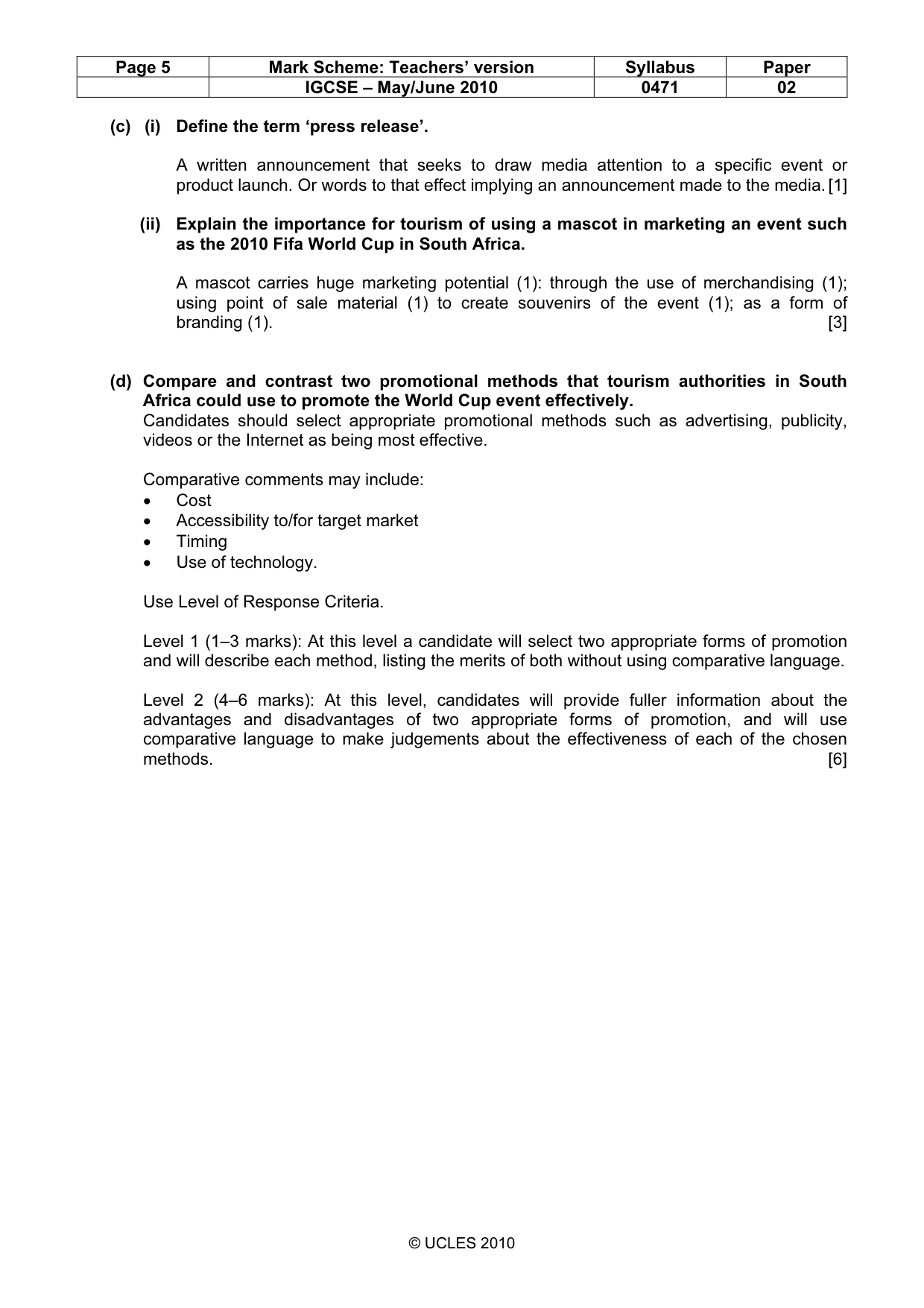
Page 5 Mark Scheme: Teachers’ version Syllabus Paper IGCSE – May/June 2010 0471 02 © UCLES 2010 (c) (i) Define the term ‘press release’. A written announcement that seeks to draw media attention to a specific event or product launch. Or words to that effect implying an announcement made to the media. [1] (ii) Explain the importance for tourism of using a mascot in marketing an event such as the 2010 Fifa World Cup in South Africa. A mascot carries huge marketing potential (1): through the use of merchandising (1); using point of sale material (1) to create souvenirs of the event (1); as a form of branding (1). [3] (d) Compare and contrast two promotional methods that tourism authorities in South Africa could use to promote the World Cup event effectively. Candidates should select appropriate promotional methods such as advertising, publicity, videos or the Internet as being most effective. Comparative comments may include: • Cost • Accessibility to/for target market • Timing • Use of technology. Use Level of Response Criteria. Level 1 (1–3 marks): At this level a candidate will select two appropriate forms of promotion and will describe each method, listing the merits of both without using comparative language. Level 2 (4–6 marks): At this level, candidates will provide fuller information about the advantages and disadvantages of two appropriate forms of promotion, and will use comparative language to make judgements about the effectiveness of each of the chosen methods. [6]
Mark scheme, page 6
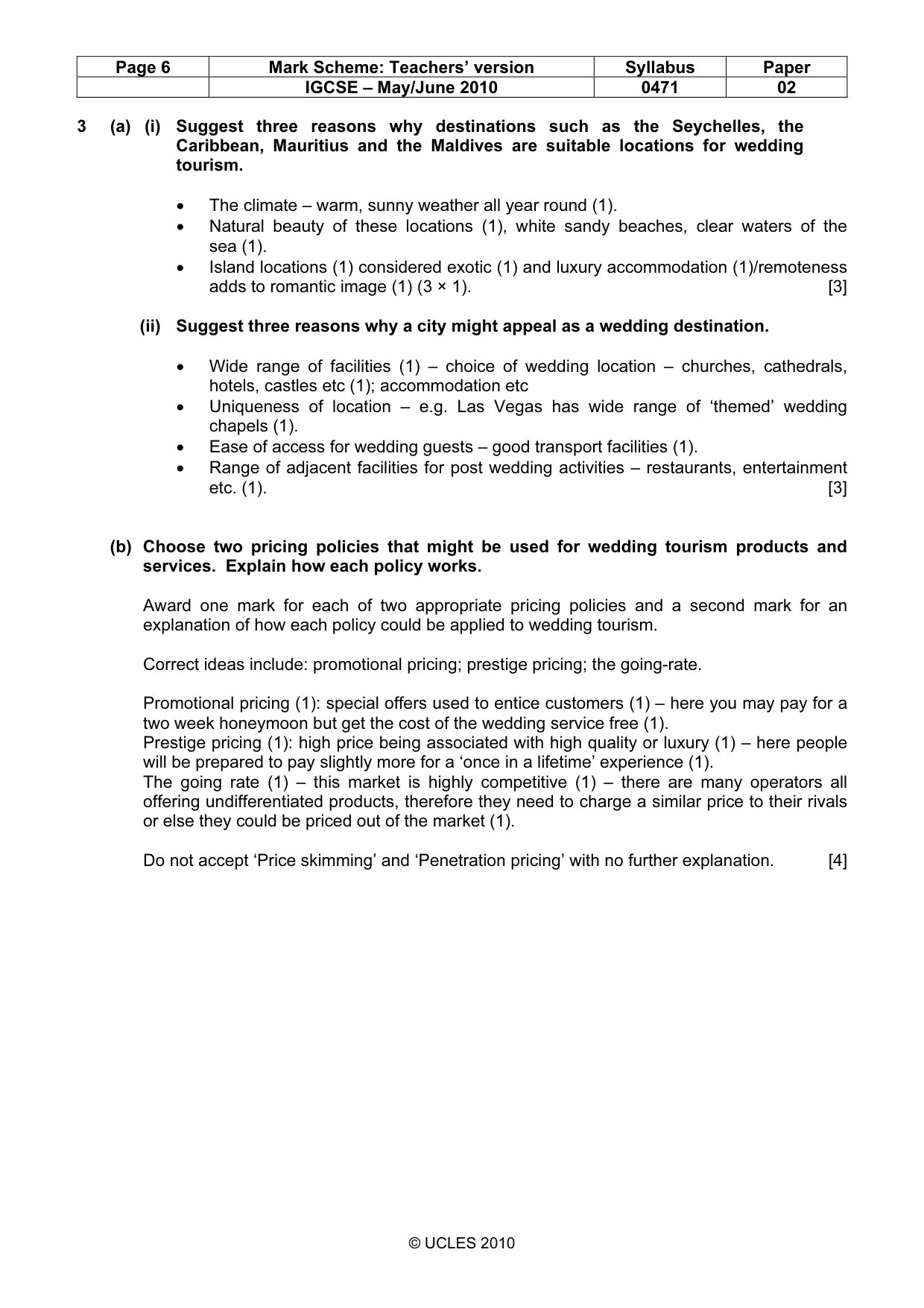
Page 6 Mark Scheme: Teachers’ version Syllabus Paper IGCSE – May/June 2010 0471 02 © UCLES 2010 3 (a) (i) Suggest three reasons why destinations such as the Seychelles, the Caribbean, Mauritius and the Maldives are suitable locations for wedding tourism. • The climate – warm, sunny weather all year round (1). • Natural beauty of these locations (1), white sandy beaches, clear waters of the sea (1). • Island locations (1) considered exotic (1) and luxury accommodation (1)/remoteness adds to romantic image (1) (3 × 1). [3] (ii) Suggest three reasons why a city might appeal as a wedding destination. • Wide range of facilities (1) – choice of wedding location – churches, cathedrals, hotels, castles etc (1); accommodation etc • Uniqueness of location – e.g. Las Vegas has wide range of ‘themed’ wedding chapels (1). • Ease of access for wedding guests – good transport facilities (1). • Range of adjacent facilities for post wedding activities – restaurants, entertainment etc. (1). [3] (b) Choose two pricing policies that might be used for wedding tourism products and services. Explain how each policy works. Award one mark for each of two appropriate pricing policies and a second mark for an explanation of how each policy could be applied to wedding tourism. Correct ideas include: promotional pricing; prestige pricing; the going-rate. Promotional pricing (1): special offers used to entice customers (1) – here you may pay for a two week honeymoon but get the cost of the wedding service free (1). Prestige pricing (1): high price being associated with high quality or luxury (1) – here people will be prepared to pay slightly more for a ‘once in a lifetime’ experience (1). The going rate (1) – this market is highly competitive (1) – there are many operators all offering undifferentiated products, therefore they need to charge a similar price to their rivals or else they could be priced out of the market (1). Do not accept ‘Price skimming’ and ‘Penetration pricing’ with no further explanation. [4]
Mark scheme, page 7
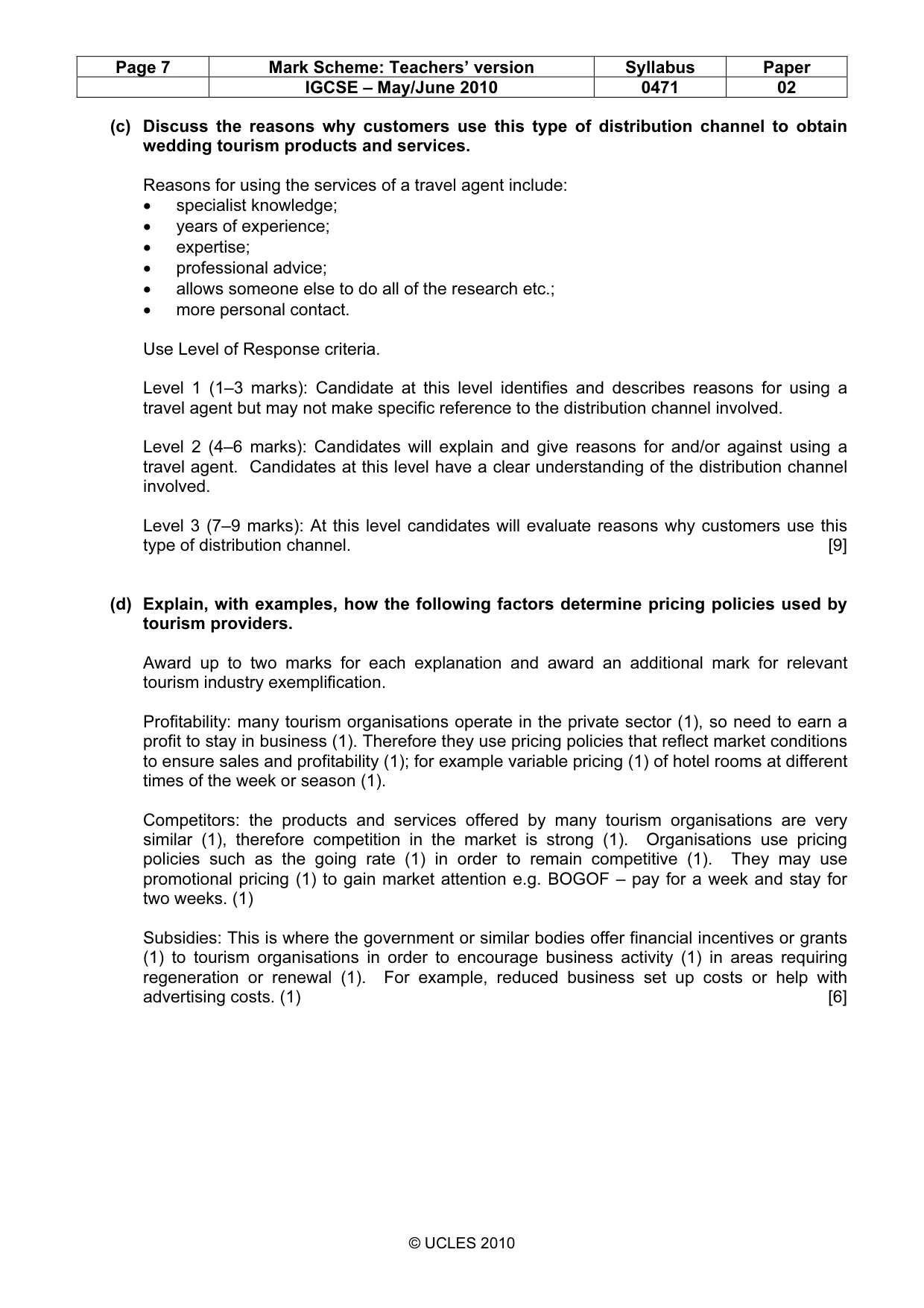
Page 7 Mark Scheme: Teachers’ version Syllabus Paper IGCSE – May/June 2010 0471 02 © UCLES 2010 (c) Discuss the reasons why customers use this type of distribution channel to obtain wedding tourism products and services. Reasons for using the services of a travel agent include: • specialist knowledge; • years of experience; • expertise; • professional advice; • allows someone else to do all of the research etc.; • more personal contact. Use Level of Response criteria. Level 1 (1–3 marks): Candidate at this level identifies and describes reasons for using a travel agent but may not make specific reference to the distribution channel involved. Level 2 (4–6 marks): Candidates will explain and give reasons for and/or against using a travel agent. Candidates at this level have a clear understanding of the distribution channel involved. Level 3 (7–9 marks): At this level candidates will evaluate reasons why customers use this type of distribution channel. [9] (d) Explain, with examples, how the following factors determine pricing policies used by tourism providers. Award up to two marks for each explanation and award an additional mark for relevant tourism industry exemplification. Profitability: many tourism organisations operate in the private sector (1), so need to earn a profit to stay in business (1). Therefore they use pricing policies that reflect market conditions to ensure sales and profitability (1); for example variable pricing (1) of hotel rooms at different times of the week or season (1). Competitors: the products and services offered by many tourism organisations are very similar (1), therefore competition in the market is strong (1). Organisations use pricing policies such as the going rate (1) in order to remain competitive (1). They may use promotional pricing (1) to gain market attention e.g. BOGOF – pay for a week and stay for two weeks. (1) Subsidies: This is where the government or similar bodies offer financial incentives or grants (1) to tourism organisations in order to encourage business activity (1) in areas requiring regeneration or renewal (1). For example, reduced business set up costs or help with advertising costs. (1) [6]
Mark scheme, page 8
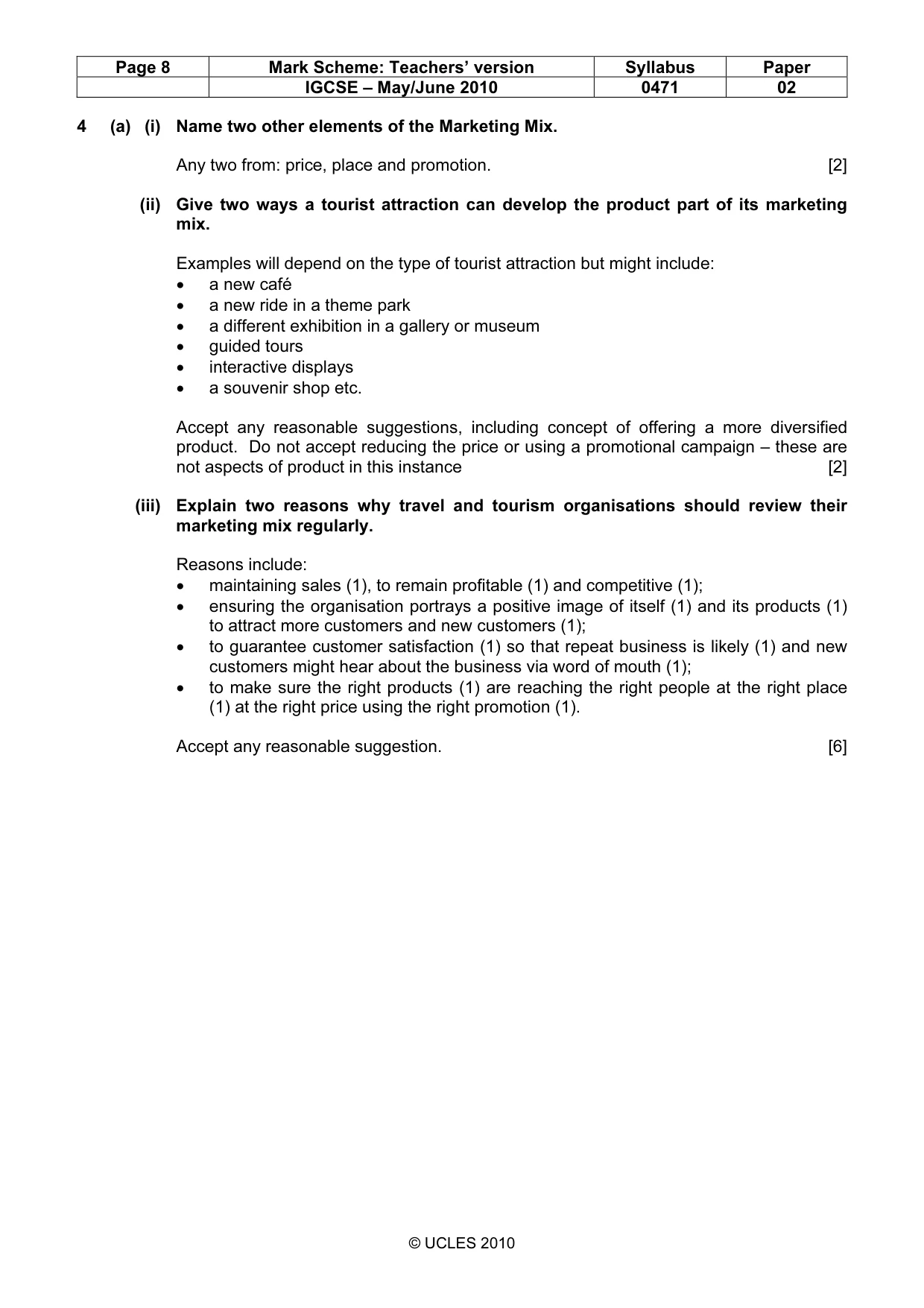
Page 8 Mark Scheme: Teachers’ version Syllabus Paper IGCSE – May/June 2010 0471 02 © UCLES 2010 4 (a) (i) Name two other elements of the Marketing Mix. Any two from: price, place and promotion. [2] (ii) Give two ways a tourist attraction can develop the product part of its marketing mix. Examples will depend on the type of tourist attraction but might include: • a new café • a new ride in a theme park • a different exhibition in a gallery or museum • guided tours • interactive displays • a souvenir shop etc. Accept any reasonable suggestions, including concept of offering a more diversified product. Do not accept reducing the price or using a promotional campaign – these are not aspects of product in this instance [2] (iii) Explain two reasons why travel and tourism organisations should review their marketing mix regularly. Reasons include: • maintaining sales (1), to remain profitable (1) and competitive (1); • ensuring the organisation portrays a positive image of itself (1) and its products (1) to attract more customers and new customers (1); • to guarantee customer satisfaction (1) so that repeat business is likely (1) and new customers might hear about the business via word of mouth (1); • to make sure the right products (1) are reaching the right people at the right place (1) at the right price using the right promotion (1). Accept any reasonable suggestion. [6]
Mark scheme, page 9
Page 9 Mark Scheme: Teachers’ version Syllabus Paper IGCSE – May/June 2010 0471 02 © UCLES 2010 (b) (i) State at which stage of the product life cycle you would place the Banyan Tree Resort organisation. Give two reasons for your answer. Banyan Tree is still in the growth stage (accept maturity). (1) Reasons could include: been in the market since 1994 (1); leading brand in Asia Pacific (1); established a global presence opening resorts in other non-Asia Pacific locations (1); now has 25 resorts and 68 spas (1); still expanding its operations (1). [3] (ii) Describe three methods used by organisations such as Banyan Tree to create a brand image. Methods will include: • use of logos, corporate colours, slogans, symbols and uniforms (1); organisations such as Banyan Tree use easily recognisable logos so that customers can easily distinguish their resorts amongst competitors. • Product features (1); luxury and romantic association (1); spa (1). • Packaging (1); use of corporate colours on all communications (1); toiletry products in the bathroom use corporate packaging (1) • Price (1): Pricing policy associated with luxury products (1); prestige price (1); high quality (1). • Promotion (1): use of colour brochures and multi media (1) to present idyllic images associated with the brand (1). • Target market segment (1); association with honeymoon and wedding packages (1). [6] (iii) Explain two reasons why its competitors may have to re-brand, once Banyan Tree enters this market. Reasons will include: • To refresh their image (1); to make sure people know that they are ‘moving with the times’ (1). • To remain competitive (1); to overcome the threat (1) posed by newcomers to the market (1). • To remind people of the products (1) and services (1) they offer, so that people recognise what they have to offer (1). • To change position in the market (1) – to regain market share, (1) if they have lost sales to newcomers. • To re-connect with customers, (1) who think they have become outdated (1). [6]
What you needed in this session
Cambridge’s own grade thresholds for 2010 May/June, Paper 2 · Variant 1. A higher threshold means an easier paper — the bar moves with how the cohort did.