Cambridge IGCSE Travel and Tourism 0471 — 2010 May/June Paper 1 · Variant 1
0471/11/M/J/10 · 100 marks · ≈113 min
The question paper and its mark scheme, free to read here and free to download. This is Cambridge’s own paper, exactly as it was sat.
Question paper16 pages

Mark scheme9 pages
Answers below. Sit the paper first if you are practising.
Paper as text
Question paper, page 1
This document consists of 14 printed pages and 2 blank pages. IB10 06_0471_01/5RP © UCLES 2010 [Turn over *8559577196* For Examiner's Use 1 2 3 4 Total UNIVERSITY OF CAMBRIDGE INTERNATIONAL EXAMINATIONS International General Certificate of Secondary Education TRAVEL AND TOURISM 0471/01 Core Module May/June 2010 2 hours Candidates answer on the Question Paper. No Additional Materials are required. READ THESE INSTRUCTIONS FIRST Write your Centre number, candidate number and name on all the work you hand in. Write in dark blue or black pen. You may use a soft pencil for any diagrams, graphs or rough working. Do not use staples, paper clips, highlighters, glue or correction fluid. DO NOT WRITE IN ANY BARCODES. Answer all questions. At the end of the examination, fasten all your work securely together. The number of marks is given in brackets [ ] at the end of each question or part question. www.XtremePapers.com
Question paper, page 2
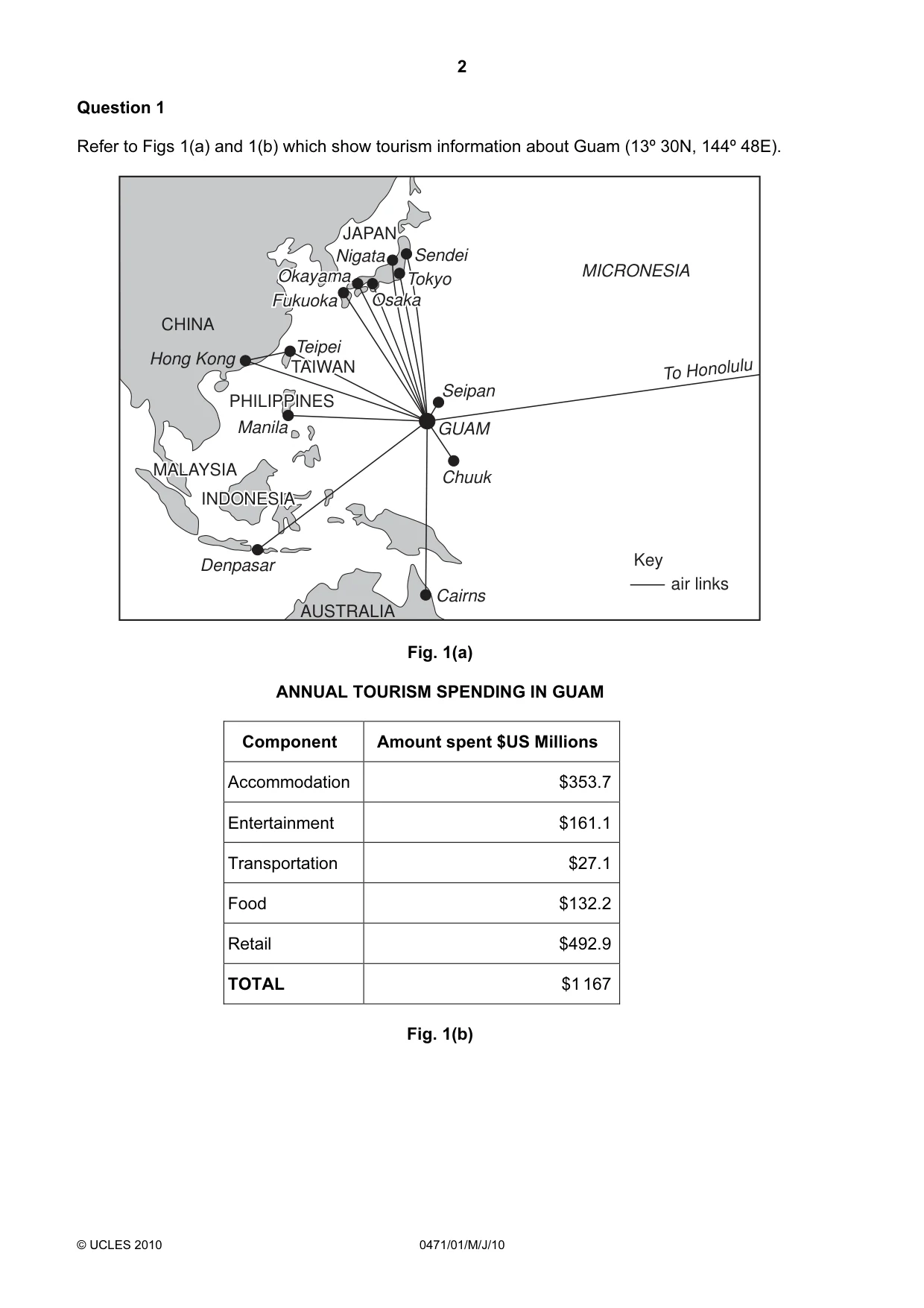
2 © UCLES 2010 0471/01/M/J/10 Question 1 Refer to Figs 1(a) and 1(b) which show tourism information about Guam (13º 30N, 144º 48E). To Honolulu Chuuk Cairns MICRONESIA Manila Hong Kong Nigata Teipei Seipan Denpasar Okayama Okayama Tokyo Tokyo Sendei Tokyo Fukuoka Fukuoka GUAM AUSTRALIA CHINA INDONESIA INDONESIA INDONESIA MALAYSIA MALAYSIA MALAYSIA PHILIPPINES PHILIPPINES TAIWAN TAIWAN TAIWAN Fukuoka Okayama JAPAN PHILIPPINES Osaka Osaka Osaka air links Key Fig. 1(a) ANNUAL TOURISM SPENDING IN GUAM Component Amount spent $US Millions Accommodation $353.7 Entertainment $161.1 Transportation $27.1 Food $132.2 Retail $492.9 TOTAL $1 167 Fig. 1(b)
Question paper, page 3
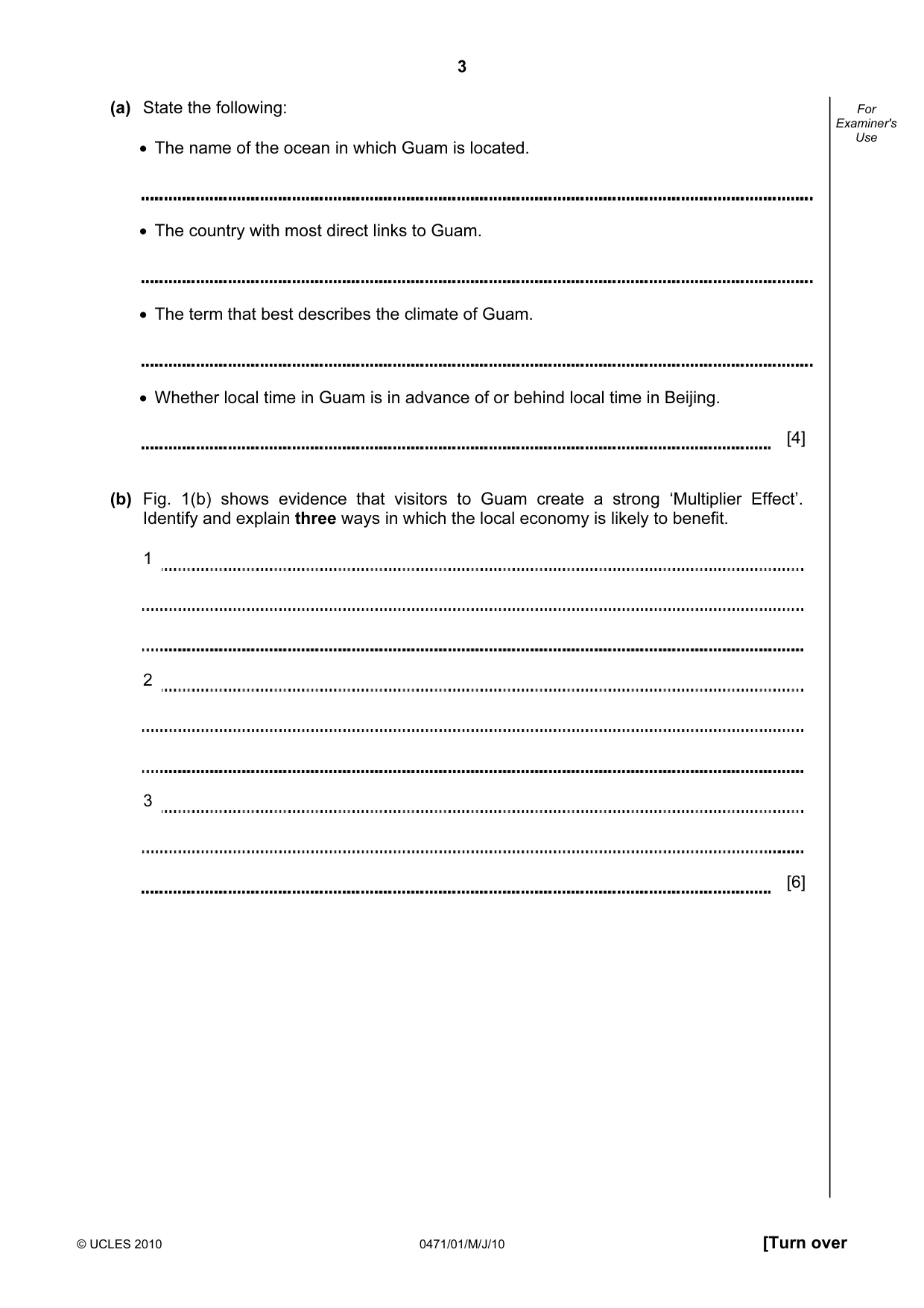
3 © UCLES 2010 0471/01/M/J/10 [Turn over For Examiner's Use (a) State the following: • The name of the ocean in which Guam is located. • The country with most direct links to Guam. • The term that best describes the climate of Guam. • Whether local time in Guam is in advance of or behind local time in Beijing. [4] (b) Fig. 1(b) shows evidence that visitors to Guam create a strong ‘Multiplier Effect’. Identify and explain three ways in which the local economy is likely to benefit. 1 2 3 [6]
Question paper, page 4
4 © UCLES 2010 0471/01/M/J/10 For Examiner's Use (c) Explain three ways in which the Guam Visitors Bureau could help to increase the number of international visitors to the destination. 1 2 3 [6] (d) Most package holidays include airport transfers. Identify three stages in the transfer process. 1 2 3 [3]
Question paper, page 5
5 © UCLES 2010 0471/01/M/J/10 [Turn over For Examiner's Use (e) Many small island destinations are visited by cruise ships. With reference to one example with which you are familiar, discuss the island’s appeal to cruise ship visitors. Chosen island destination [6] [Total: 25]
Question paper, page 6
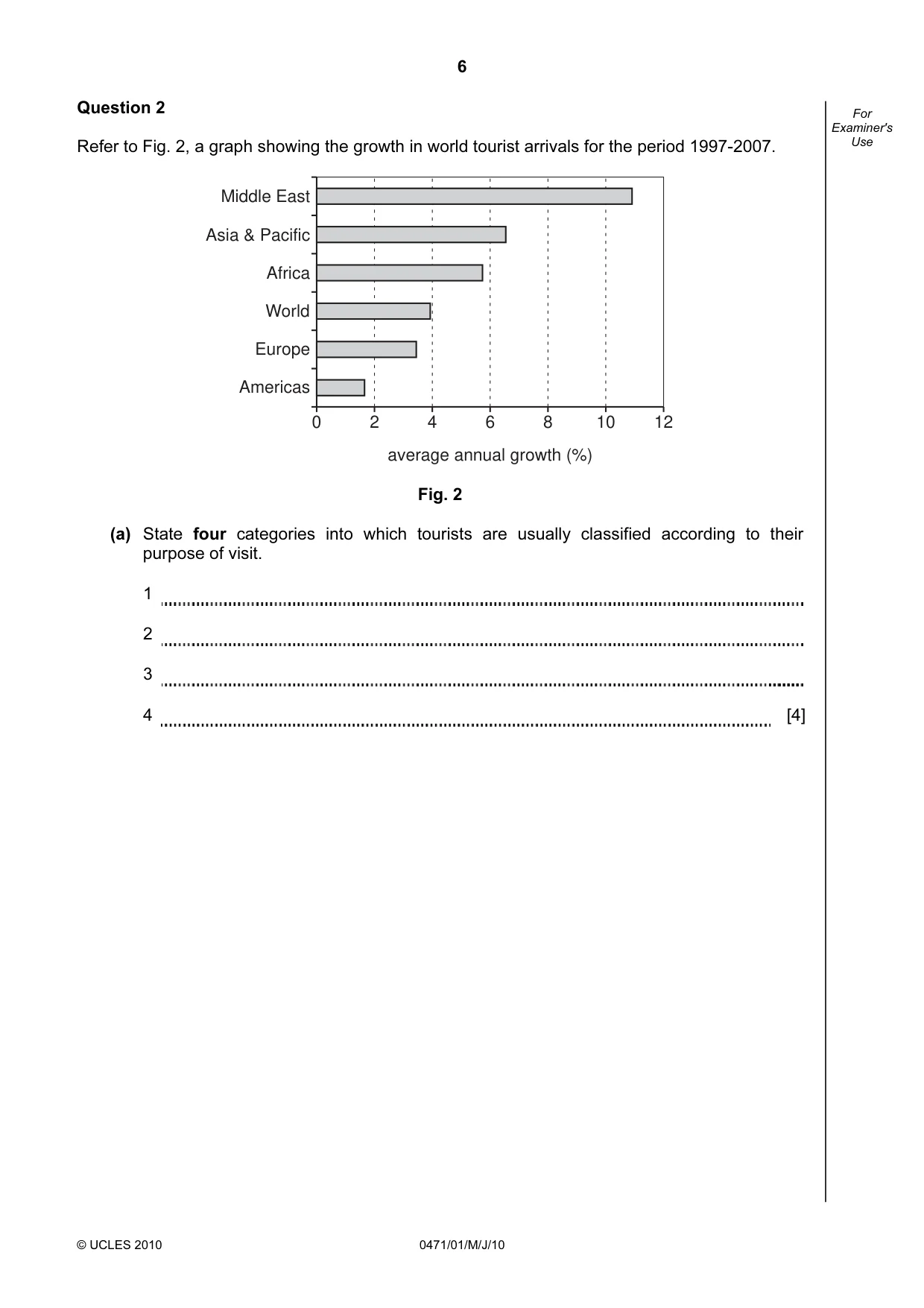
6 © UCLES 2010 0471/01/M/J/10 For Examiner's Use Question 2 Refer to Fig. 2, a graph showing the growth in world tourist arrivals for the period 1997-2007. 0 2 4 6 average annual growth (%) 8 10 12 Middle East Asia & Pacific Africa World Europe Americas Fig. 2 (a) State four categories into which tourists are usually classified according to their purpose of visit. 1 2 3 4 [4]
Question paper, page 7
7 © UCLES 2010 0471/01/M/J/10 [Turn over For Examiner's Use (b) With reference to Fig. 2, identify and comment on three contrasting variations in tourist arrivals for the period 1997-2007. 1 2 3 [6] (c) Once at their chosen destination, international visitors are likely to visit a local Tourist Information Centre (TIC). State three services provided by a TIC and for each explain why an international visitor might use each service. Service 1 Explanation Service 2 Explanation Service 3 Explanation [6]
Question paper, page 8
8 © UCLES 2010 0471/01/M/J/10 For Examiner's Use (d) Holiday brochures are a source of information for international visitors. In the following table, circle the three types of information usually found in holiday brochures: List of cinemas Details of supermarkets Local climate statistics Hotel descriptions Cooking recipes Local sport fixtures Train timetables Destination map TV programme guide [3] (e) Evaluate the main security measures that are currently in place at major international airports. [Total: 25] [6]
Question paper, page 9
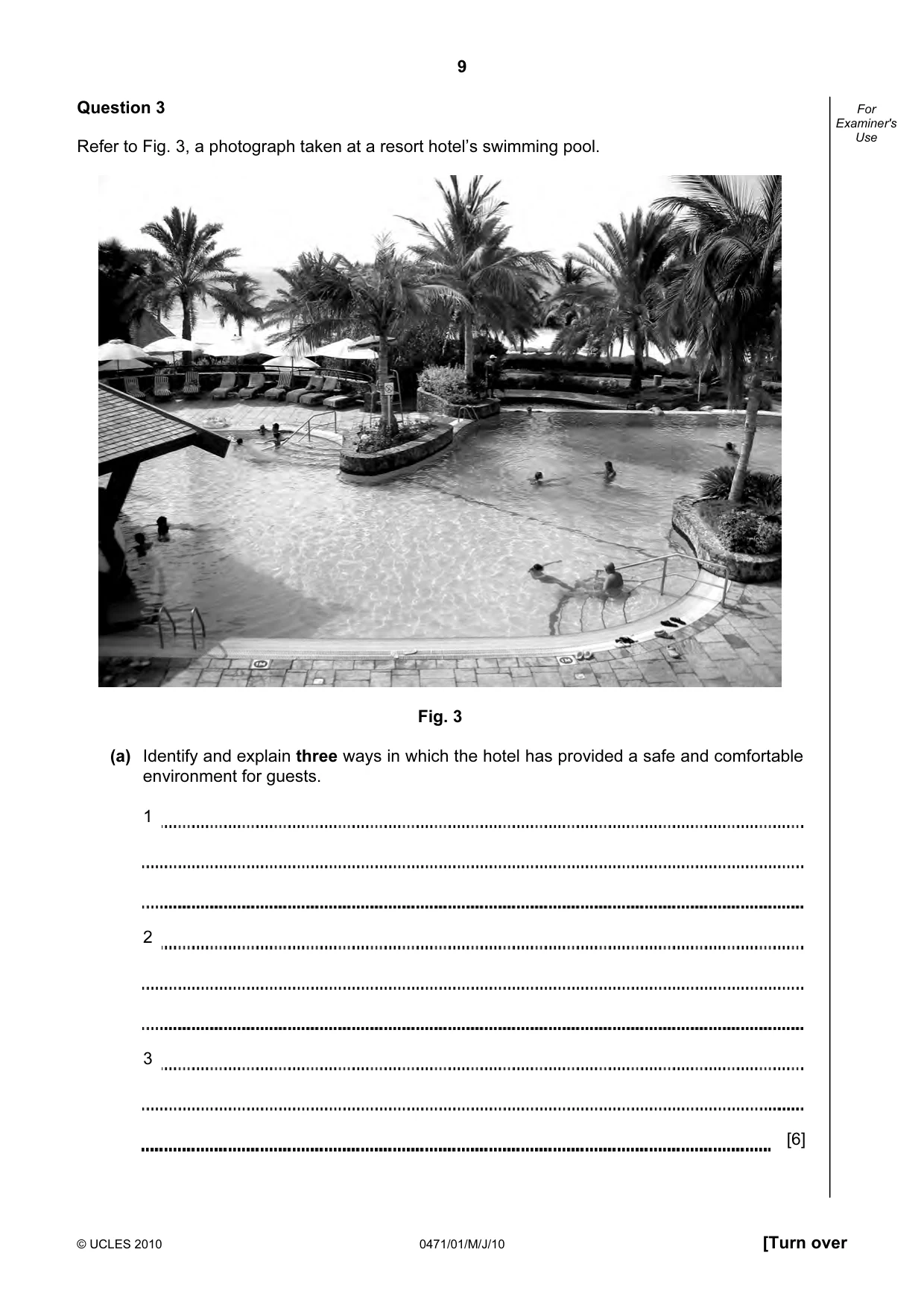
9 © UCLES 2010 0471/01/M/J/10 [Turn over For Examiner's Use Question 3 Refer to Fig. 3, a photograph taken at a resort hotel’s swimming pool. Fig. 3 (a) Identify and explain three ways in which the hotel has provided a safe and comfortable environment for guests. 1 2 3 [6]
Question paper, page 10
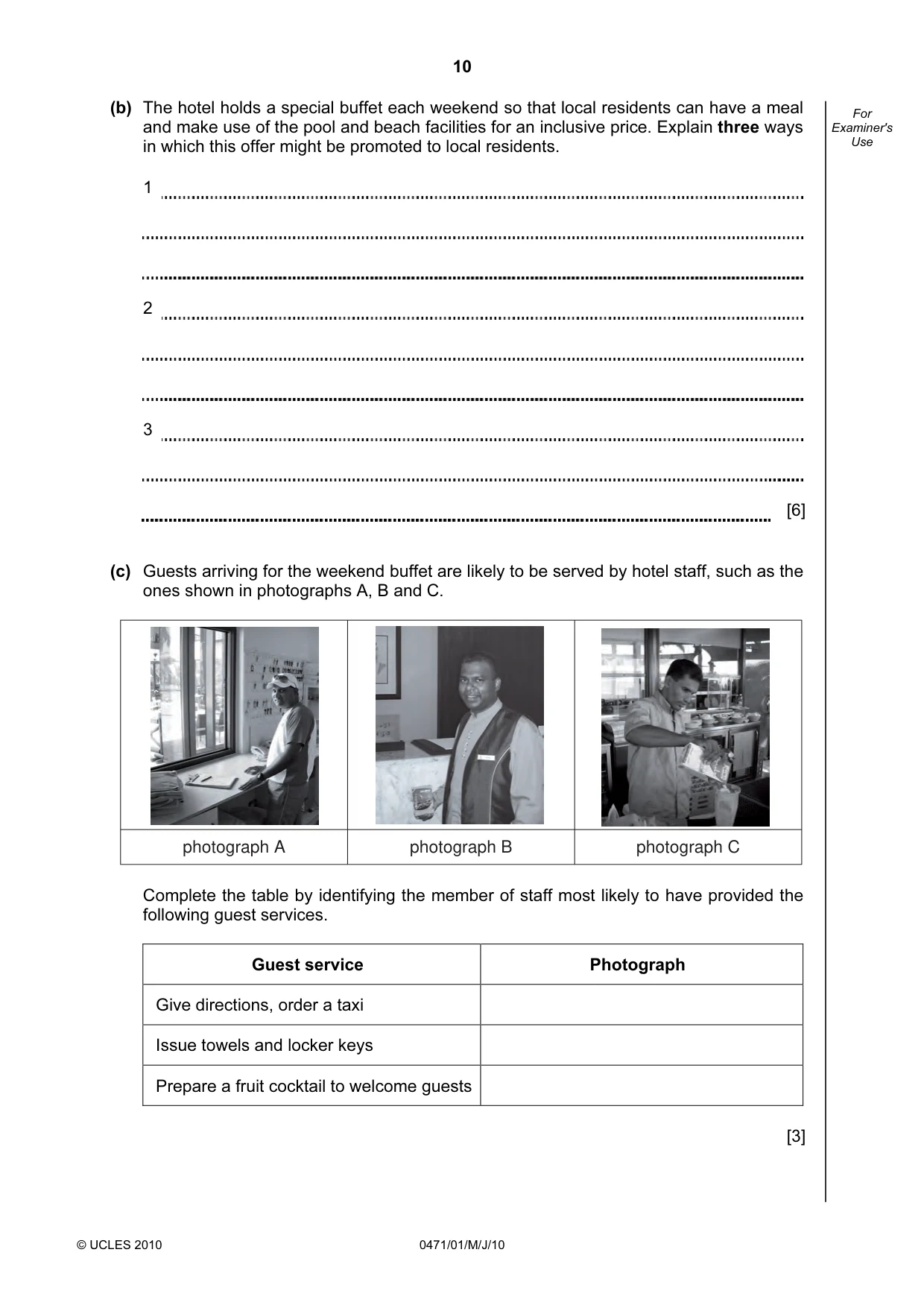
10 © UCLES 2010 0471/01/M/J/10 For Examiner's Use (b) The hotel holds a special buffet each weekend so that local residents can have a meal and make use of the pool and beach facilities for an inclusive price. Explain three ways in which this offer might be promoted to local residents. 1 2 3 [6] (c) Guests arriving for the weekend buffet are likely to be served by hotel staff, such as the ones shown in photographs A, B and C. photograph A photograph B photograph C Complete the table by identifying the member of staff most likely to have provided the following guest services. Guest service Photograph Give directions, order a taxi Issue towels and locker keys Prepare a fruit cocktail to welcome guests [3]
Question paper, page 11
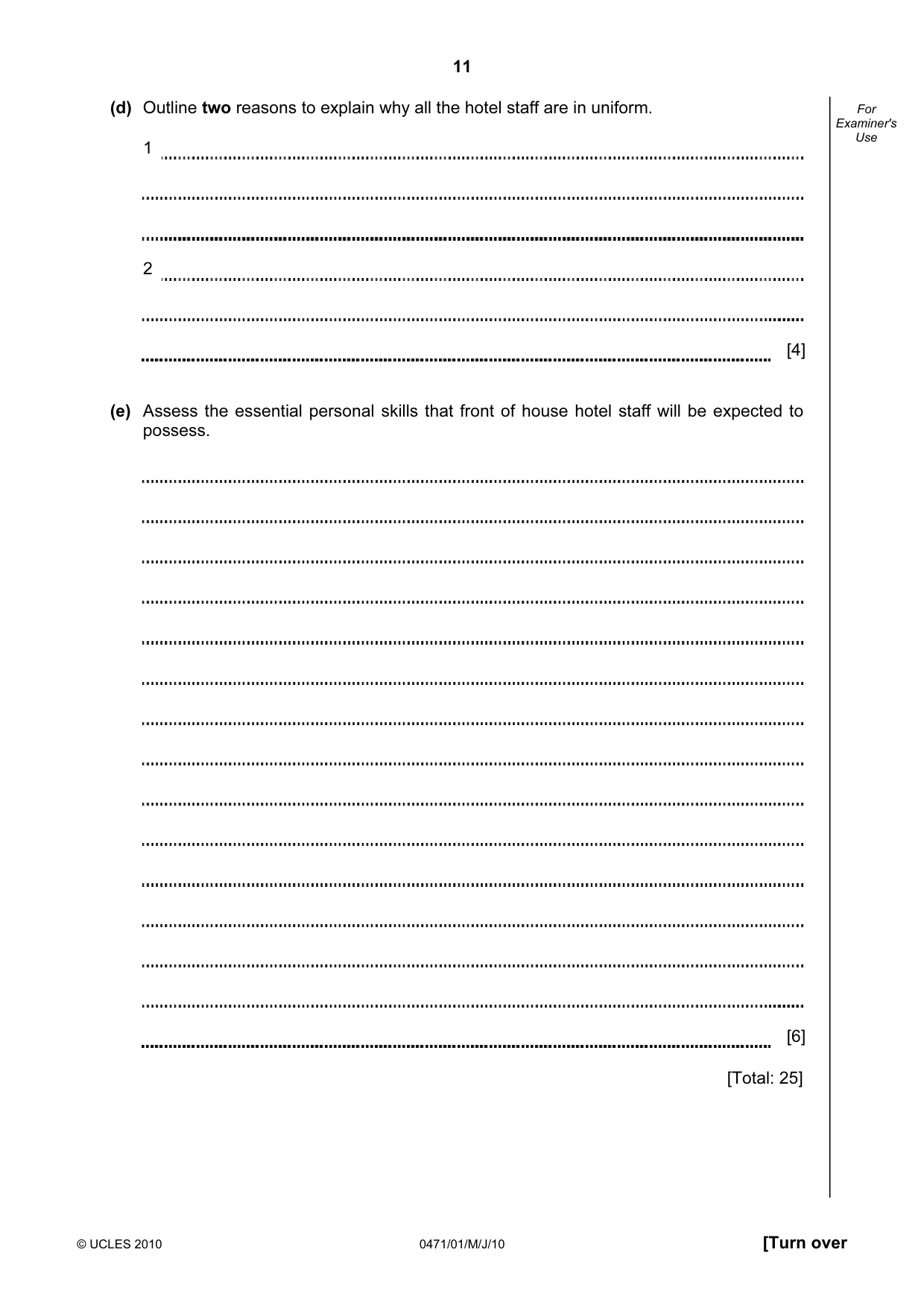
11 © UCLES 2010 0471/01/M/J/10 [Turn over For Examiner's Use (d) Outline two reasons to explain why all the hotel staff are in uniform. 1 2 [4] (e) Assess the essential personal skills that front of house hotel staff will be expected to possess. [Total: 25] [6]
Question paper, page 12
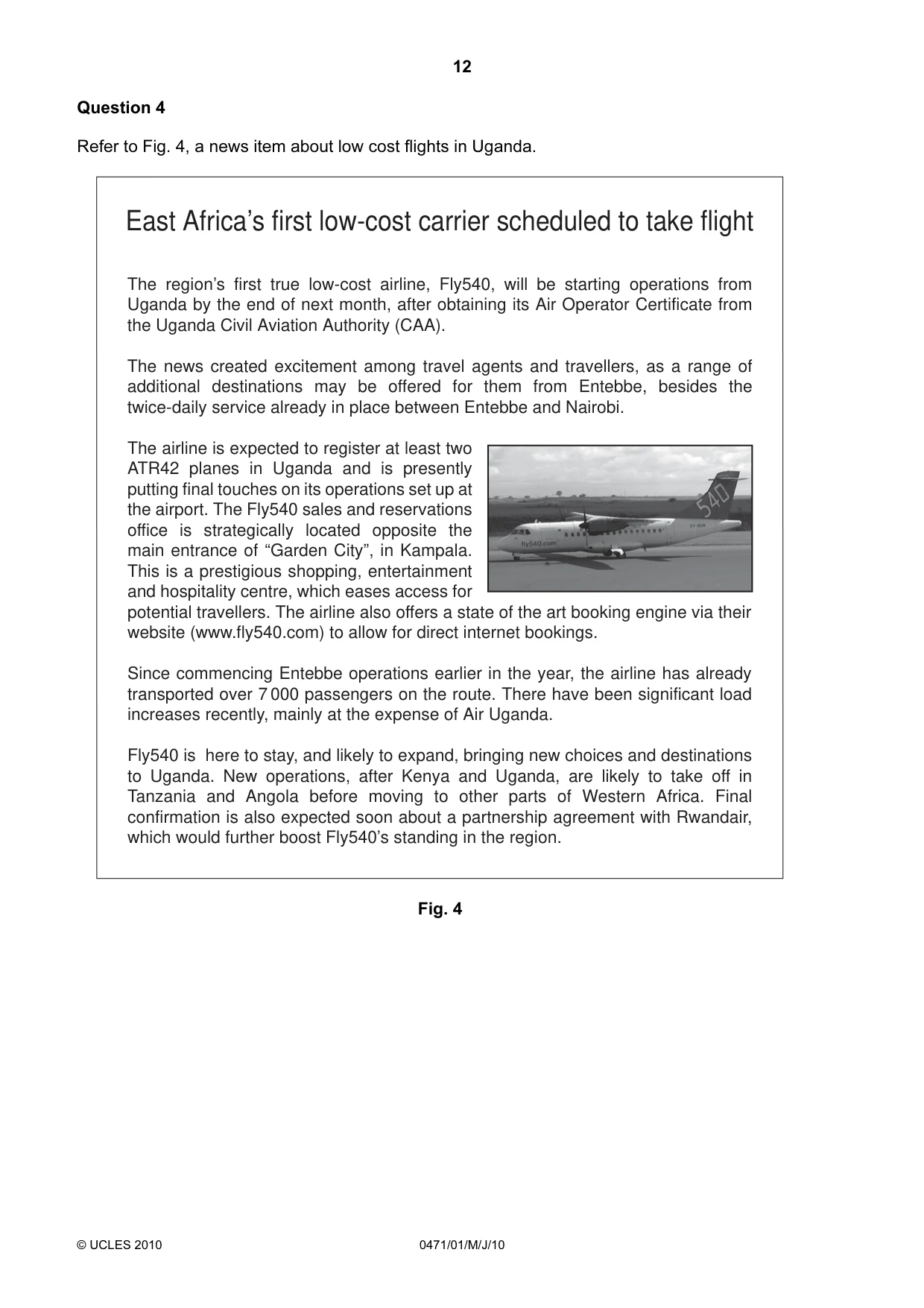
12 © UCLES 2010 0471/01/M/J/10 Question 4 Refer to Fig. 4, a news item about low cost flights in Uganda. The region’s first true low-cost airline, Fly540, will be starting operations from Uganda by the end of next month, after obtaining its Air Operator Certificate from the Uganda Civil Aviation Authority (CAA). The news created excitement among travel agents and travellers, as a range of additional destinations may be offered for them from Entebbe, besides the twice-daily service already in place between Entebbe and Nairobi. The airline is expected to register at least two ATR42 planes in Uganda and is presently putting final touches on its operations set up at the airport. The Fly540 sales and reservations office is strategically located opposite the main entrance of “Garden City”, in Kampala. This is a prestigious shopping, entertainment and hospitality centre, which eases access for potential travellers. The airline also offers a state of the art booking engine via their website (www.fly540.com) to allow for direct internet bookings. Since commencing Entebbe operations earlier in the year, the airline has already transported over 7 000 passengers on the route. There have been significant load increases recently, mainly at the expense of Air Uganda. Fly540 is here to stay, and likely to expand, bringing new choices and destinations to Uganda. New operations, after Kenya and Uganda, are likely to take off in Tanzania and Angola before moving to other parts of Western Africa. Final confirmation is also expected soon about a partnership agreement with Rwandair, which would further boost Fly540’s standing in the region. East Africa’s first low-cost carrier scheduled to take flight Fig. 4
Question paper, page 13
13 © UCLES 2010 0471/01/M/J/10 [Turn over For Examiner's Use (a) Identify the following: • The existing Fly540 route in East Africa. • The type of aircraft used on this service. • Two destinations likely to be added to the Fly540 route network in the future. 1 2 • Two airlines in competition with Fly540. 1 2 [6] (b) Outline two reasons to explain why Fly540 chose to open a sales and reservations office opposite the main entrance of “Garden City”. 1 2 [4] (c) Explain two advantages to Fly540’s customers of using the Internet to make bookings. 1 2 [4]
Question paper, page 14
14 © UCLES 2010 0471/01/M/J/10 For Examiner's Use (d) Many tourists visit East Africa to see the wildlife. State one negative environmental impact caused by such tourists and explain two ways in which this impact might be controlled. Chosen impact: 1 2 [5] (e) With reference to examples with which you are familiar, discuss why the ‘Demonstration Effect’ can cause serious social problems. [6] [Total: 25]
Question paper, page 15
15 © UCLES 2010 0471/01/M/J/10 BLANK PAGE
Question paper, page 16
16 Question 2 Figure 2 Question 3 Photograph A Question 3 Photograph B Question 3 Photograph C Question 3 Figure 3 Question 4 Figure 4 © Graph of Tourist Arrivals; www.earthtrends.wri.org. J D Smith © UCLES. J D Smith © UCLES. J D Smith © UCLES. Photograph J.D Smith © UCLES. © www.eturbonews.com/4441/east-africas-first-low-cost-carrier-scheduled-take -flight Permission to reproduce items where third-party owned material protected by copyright is included has been sought and cleared where possible. Every reasonable effort has been made by the publisher (UCLES) to trace copyright holders, but if any items requiring clearance have unwittingly been included, the publisher will be pleased to make amends at the earliest possible opportunity. University of Cambridge International Examinations is part of the Cambridge Assessment Group. Cambridge Assessment is the brand name of University of Cambridge Local Examinations Syndicate (UCLES), which is itself a department of the University of Cambridge. © UCLES 2010 0471/01/M/J/10 BLANK PAGE
Mark scheme, page 1
UNIVERSITY OF CAMBRIDGE INTERNATIONAL EXAMINATIONS International General Certificate of Secondary Education MARK SCHEME for the May/June 2010 question paper for the guidance of teachers 0471 TRAVEL AND TOURISM 0471/01 Paper 1 (Written Paper), maximum raw mark 100 This mark scheme is published as an aid to teachers and candidates, to indicate the requirements of the examination. It shows the basis on which Examiners were instructed to award marks. It does not indicate the details of the discussions that took place at an Examiners’ meeting before marking began, which would have considered the acceptability of alternative answers. Mark schemes must be read in conjunction with the question papers and the report on the examination. • CIE will not enter into discussions or correspondence in connection with these mark schemes. CIE is publishing the mark schemes for the May/June 2010 question papers for most IGCSE, GCE Advanced Level and Advanced Subsidiary Level syllabuses and some Ordinary Level syllabuses. www.XtremePapers.com
Mark scheme, page 2
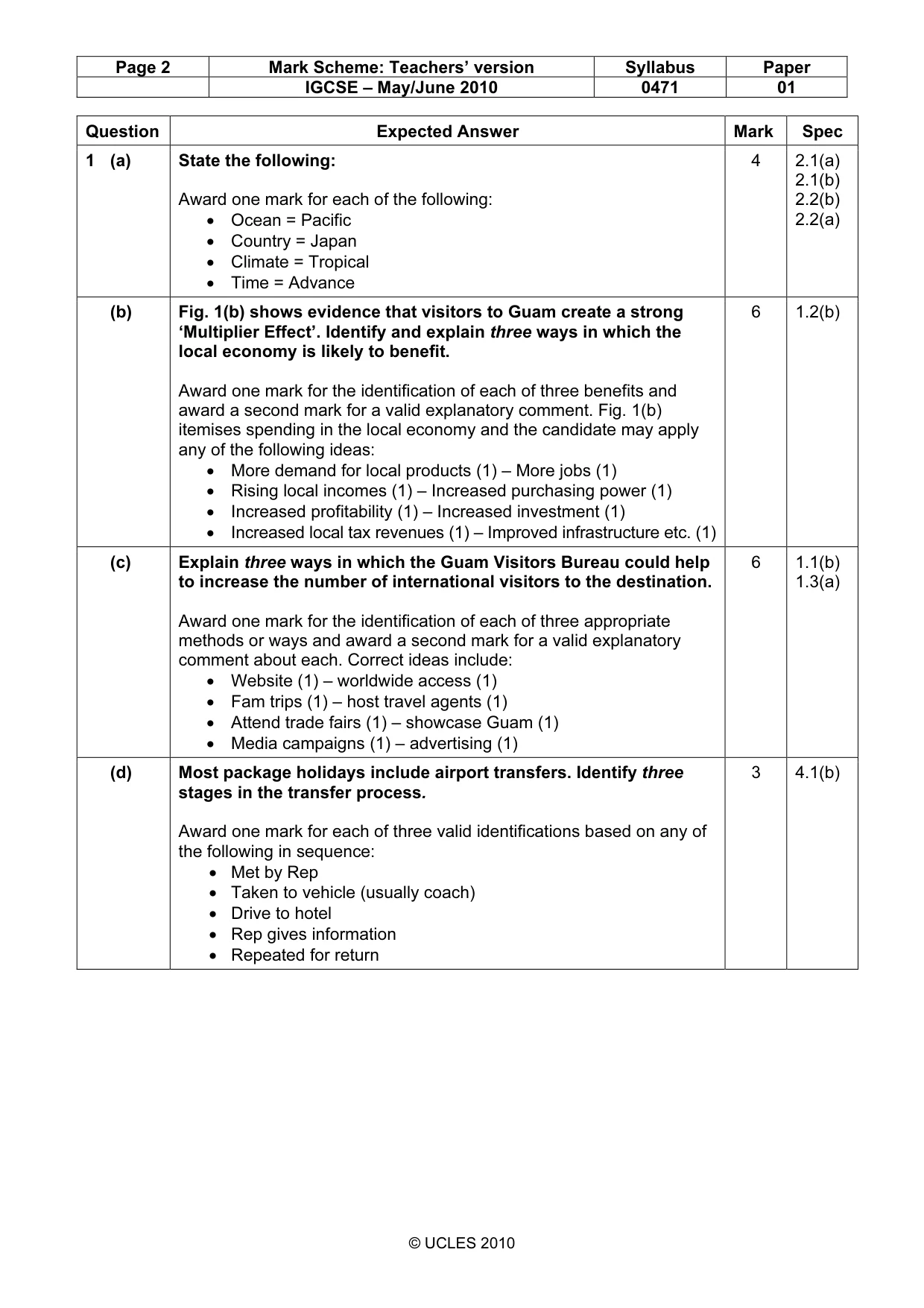
Page 2 Mark Scheme: Teachers’ version Syllabus Paper IGCSE – May/June 2010 0471 01 © UCLES 2010 Question Expected Answer Mark Spec 1 (a) State the following: Award one mark for each of the following: • Ocean = Pacific • Country = Japan • Climate = Tropical • Time = Advance 4 2.1(a) 2.1(b) 2.2(b) 2.2(a) (b) Fig. 1(b) shows evidence that visitors to Guam create a strong ‘Multiplier Effect’. Identify and explain three ways in which the local economy is likely to benefit. Award one mark for the identification of each of three benefits and award a second mark for a valid explanatory comment. Fig. 1(b) itemises spending in the local economy and the candidate may apply any of the following ideas: • More demand for local products (1) – More jobs (1) • Rising local incomes (1) – Increased purchasing power (1) • Increased profitability (1) – Increased investment (1) • Increased local tax revenues (1) – Improved infrastructure etc. (1) 6 1.2(b) (c) Explain three ways in which the Guam Visitors Bureau could help to increase the number of international visitors to the destination. Award one mark for the identification of each of three appropriate methods or ways and award a second mark for a valid explanatory comment about each. Correct ideas include: • Website (1) – worldwide access (1) • Fam trips (1) – host travel agents (1) • Attend trade fairs (1) – showcase Guam (1) • Media campaigns (1) – advertising (1) 6 1.1(b) 1.3(a) (d) Most package holidays include airport transfers. Identify three stages in the transfer process. Award one mark for each of three valid identifications based on any of the following in sequence: • Met by Rep • Taken to vehicle (usually coach) • Drive to hotel • Rep gives information • Repeated for return 3 4.1(b)
Mark scheme, page 3
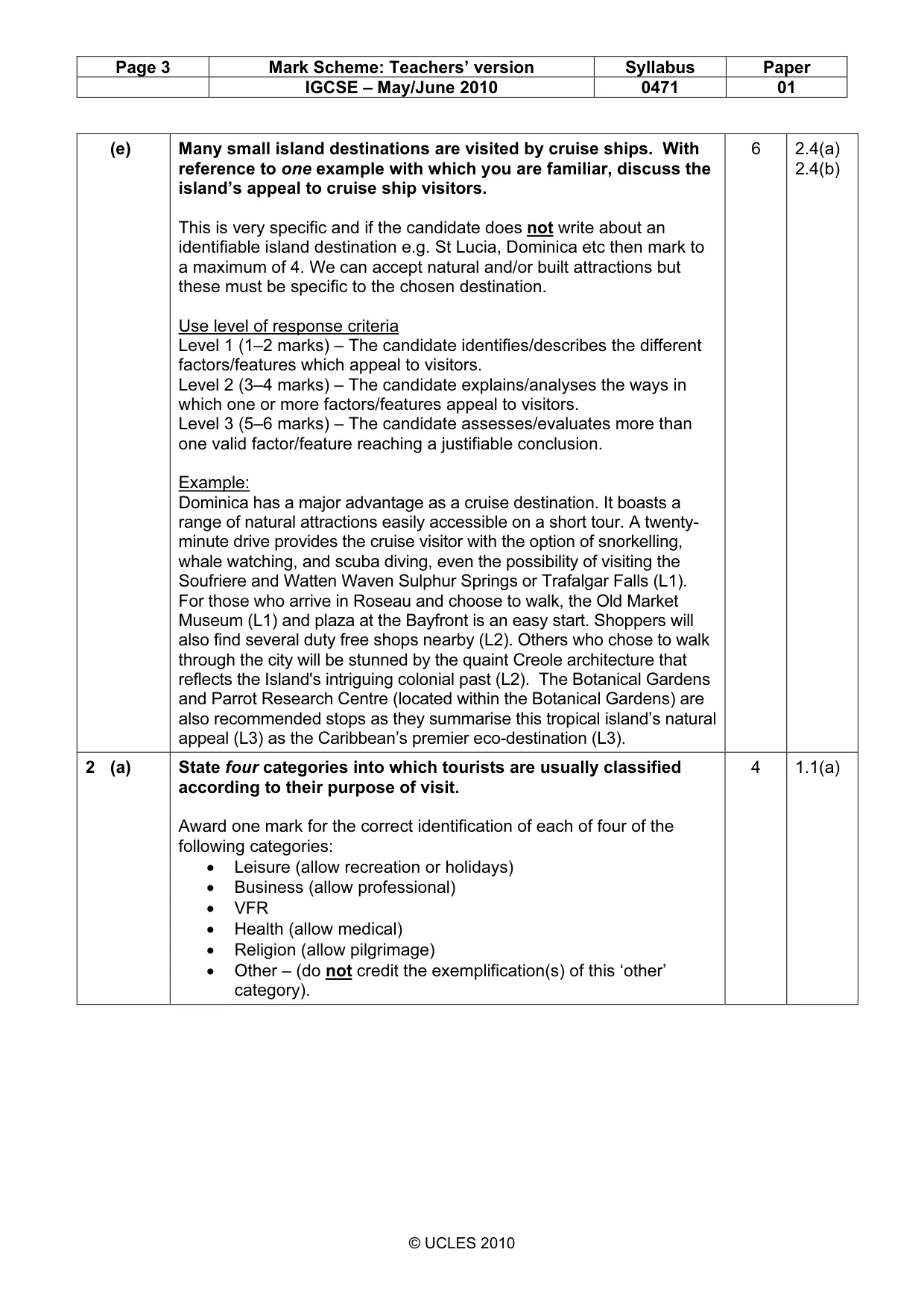
Page 3 Mark Scheme: Teachers’ version Syllabus Paper IGCSE – May/June 2010 0471 01 © UCLES 2010 (e) Many small island destinations are visited by cruise ships. With reference to one example with which you are familiar, discuss the island’s appeal to cruise ship visitors. This is very specific and if the candidate does not write about an identifiable island destination e.g. St Lucia, Dominica etc then mark to a maximum of 4. We can accept natural and/or built attractions but these must be specific to the chosen destination. Use level of response criteria Level 1 (1–2 marks) – The candidate identifies/describes the different factors/features which appeal to visitors. Level 2 (3–4 marks) – The candidate explains/analyses the ways in which one or more factors/features appeal to visitors. Level 3 (5–6 marks) – The candidate assesses/evaluates more than one valid factor/feature reaching a justifiable conclusion. Example: Dominica has a major advantage as a cruise destination. It boasts a range of natural attractions easily accessible on a short tour. A twenty- minute drive provides the cruise visitor with the option of snorkelling, whale watching, and scuba diving, even the possibility of visiting the Soufriere and Watten Waven Sulphur Springs or Trafalgar Falls (L1). For those who arrive in Roseau and choose to walk, the Old Market Museum (L1) and plaza at the Bayfront is an easy start. Shoppers will also find several duty free shops nearby (L2). Others who chose to walk through the city will be stunned by the quaint Creole architecture that reflects the Island's intriguing colonial past (L2). The Botanical Gardens and Parrot Research Centre (located within the Botanical Gardens) are also recommended stops as they summarise this tropical island’s natural appeal (L3) as the Caribbean’s premier eco-destination (L3). 6 2.4(a) 2.4(b) 2 (a) State four categories into which tourists are usually classified according to their purpose of visit. Award one mark for the correct identification of each of four of the following categories: • Leisure (allow recreation or holidays) • Business (allow professional) • VFR • Health (allow medical) • Religion (allow pilgrimage) • Other – (do not credit the exemplification(s) of this ‘other’ category). 4 1.1(a)
Mark scheme, page 4
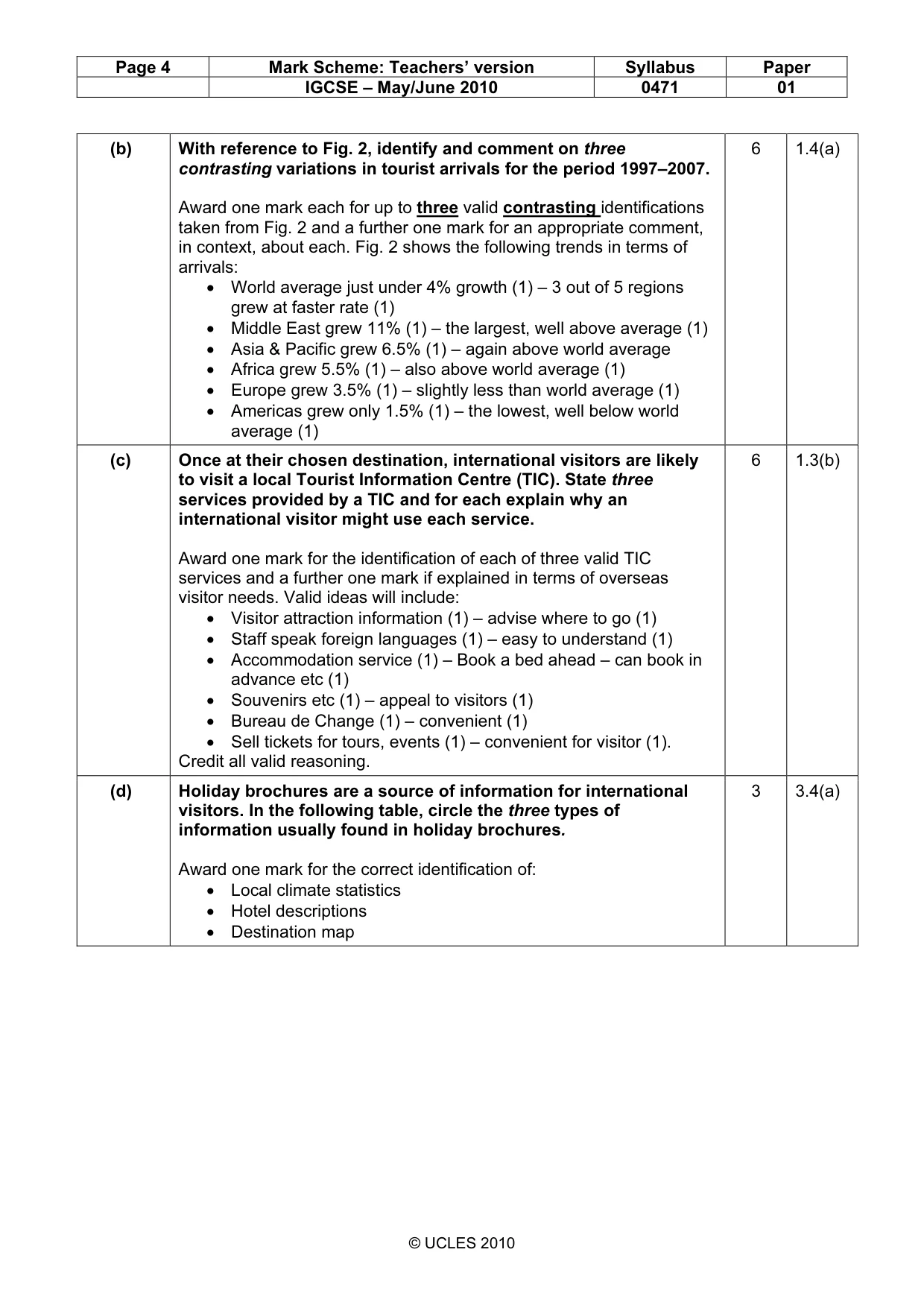
Page 4 Mark Scheme: Teachers’ version Syllabus Paper IGCSE – May/June 2010 0471 01 © UCLES 2010 (b) With reference to Fig. 2, identify and comment on three contrasting variations in tourist arrivals for the period 1997–2007. Award one mark each for up to three valid contrasting identifications taken from Fig. 2 and a further one mark for an appropriate comment, in context, about each. Fig. 2 shows the following trends in terms of arrivals: • World average just under 4% growth (1) – 3 out of 5 regions grew at faster rate (1) • Middle East grew 11% (1) – the largest, well above average (1) • Asia & Pacific grew 6.5% (1) – again above world average • Africa grew 5.5% (1) – also above world average (1) • Europe grew 3.5% (1) – slightly less than world average (1) • Americas grew only 1.5% (1) – the lowest, well below world average (1) 6 1.4(a) (c) Once at their chosen destination, international visitors are likely to visit a local Tourist Information Centre (TIC). State three services provided by a TIC and for each explain why an international visitor might use each service. Award one mark for the identification of each of three valid TIC services and a further one mark if explained in terms of overseas visitor needs. Valid ideas will include: • Visitor attraction information (1) – advise where to go (1) • Staff speak foreign languages (1) – easy to understand (1) • Accommodation service (1) – Book a bed ahead – can book in advance etc (1) • Souvenirs etc (1) – appeal to visitors (1) • Bureau de Change (1) – convenient (1) • Sell tickets for tours, events (1) – convenient for visitor (1). Credit all valid reasoning. 6 1.3(b) (d) Holiday brochures are a source of information for international visitors. In the following table, circle the three types of information usually found in holiday brochures. Award one mark for the correct identification of: • Local climate statistics • Hotel descriptions • Destination map 3 3.4(a)
Mark scheme, page 5
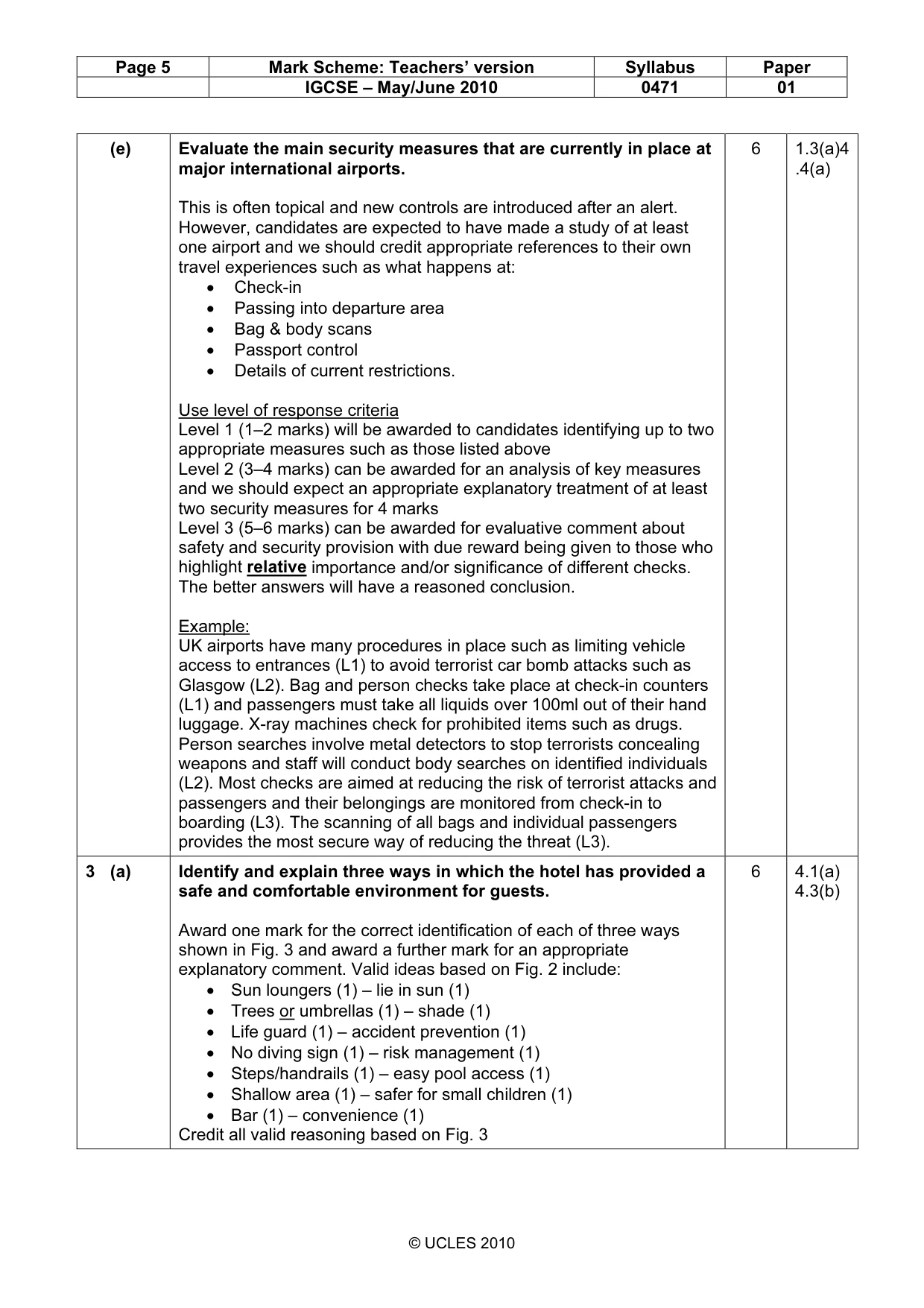
Page 5 Mark Scheme: Teachers’ version Syllabus Paper IGCSE – May/June 2010 0471 01 © UCLES 2010 (e) Evaluate the main security measures that are currently in place at major international airports. This is often topical and new controls are introduced after an alert. However, candidates are expected to have made a study of at least one airport and we should credit appropriate references to their own travel experiences such as what happens at: • Check-in • Passing into departure area • Bag & body scans • Passport control • Details of current restrictions. Use level of response criteria Level 1 (1–2 marks) will be awarded to candidates identifying up to two appropriate measures such as those listed above Level 2 (3–4 marks) can be awarded for an analysis of key measures and we should expect an appropriate explanatory treatment of at least two security measures for 4 marks Level 3 (5–6 marks) can be awarded for evaluative comment about safety and security provision with due reward being given to those who highlight relative importance and/or significance of different checks. The better answers will have a reasoned conclusion. Example: UK airports have many procedures in place such as limiting vehicle access to entrances (L1) to avoid terrorist car bomb attacks such as Glasgow (L2). Bag and person checks take place at check-in counters (L1) and passengers must take all liquids over 100ml out of their hand luggage. X-ray machines check for prohibited items such as drugs. Person searches involve metal detectors to stop terrorists concealing weapons and staff will conduct body searches on identified individuals (L2). Most checks are aimed at reducing the risk of terrorist attacks and passengers and their belongings are monitored from check-in to boarding (L3). The scanning of all bags and individual passengers provides the most secure way of reducing the threat (L3). 6 1.3(a)4 .4(a) 3 (a) Identify and explain three ways in which the hotel has provided a safe and comfortable environment for guests. Award one mark for the correct identification of each of three ways shown in Fig. 3 and award a further mark for an appropriate explanatory comment. Valid ideas based on Fig. 2 include: • Sun loungers (1) – lie in sun (1) • Trees or umbrellas (1) – shade (1) • Life guard (1) – accident prevention (1) • No diving sign (1) – risk management (1) • Steps/handrails (1) – easy pool access (1) • Shallow area (1) – safer for small children (1) • Bar (1) – convenience (1) Credit all valid reasoning based on Fig. 3 6 4.1(a) 4.3(b)
Mark scheme, page 6
Page 6 Mark Scheme: Teachers’ version Syllabus Paper IGCSE – May/June 2010 0471 01 © UCLES 2010 (b) The hotel holds a special buffet each weekend so that local residents can have a meal and make use of the pool and beach facilities for an inclusive price. Explain three ways in which this offer might be promoted to local residents. This is clearly based on the idea of promotion but within the context of a 5* beach resort. Award one mark for each of three valid suggestions and award an additional mark for an appropriate explanatory comment such as: • Hotel notice board (1) – seen when visiting (1) • Newsletter (1) – sent via database records (1) • Newspaper advert (1) – most people buy (1) • Radio Adverts (1) – people listen (1) • Menu insert (1) – inform existing customers (1) • Poster/banner outside (1) – passers by (1) Credit other valid suggestions made in context. 6 3.5(a) (c) Guests arriving for the weekend buffet are likely to be served by hotel staff, such as the ones shown in photographs A, B and C. Complete the table by identifying the member of staff most likely to have provided the following guest services. Award one mark for the correct identification of each: • Directions & taxi = B • Towels & locker key = A • Prepare fruit cocktails = C 3 3.1(a) (d) Outline two reasons to explain why all the hotel staff are in uniform. Award one mark for the identification of each of two valid reasons and one additional mark for an appropriate development of each. Valid ideas include: • Recognition/easy identification (1) – guests know who to approach (1) • Corporate image (1) – all staff maintain a businesslike appearance (1) • Staff motivation (1) – company provides appropriate work clothes for all employees (1) • Cleanliness (1) – staff not in own clothes (1) 4 3.2(b)
Mark scheme, page 7
Page 7 Mark Scheme: Teachers’ version Syllabus Paper IGCSE – May/June 2010 0471 01 © UCLES 2010 (e) Assess the essential personal skills that front of house hotel staff will be expected to possess. This is a familiar concept, this time set in a hotel context. We should expect candidates to address the obvious points of: • Foreign languages – visitors • Numeracy – sales/cash handling • Communication – clear help & advice • Ability to handle complaints - politely • Literacy – following care manual etc • ICT – admin systems etc. Use level of response criteria Level 1 (1 or 2 marks) can be awarded for the simple identification/ description of appropriate skills Level 2 (3 or 4 marks) can be awarded for the analysis of one or more of the appropriate customer service skills Level 3 (5 or 6 marks) to be awarded for some evaluative comment about appropriate skills in this front of house context. Example: Staff on reception should be smartly dressed (L1), alert, and attentive. They greet guests on arrival at the hotel and good first impressions are created by the welcome appearance (L2). Administrative skills (L1) are also important as reception systems are computerised (L2) so ICT skills are of the greatest significance so that reservations are dealt with accurately and efficiently (L3). Selling is a key skill (L1) because a timely suggestion can persuade the guest to have a better room, to stay longer, to eat in the restaurant, to take advantage of a special promotion (L2), and this will contribute to hotel profits (L3). 6 3.1(c) 3.2(a) 3.2(b) 3.2(c) 4 (a) Identify the following: • The existing Fly540 route in East Africa Award one mark for: Entebbe/Nairobi • The type of aircraft used on this service Award one mark for: ATR42 • Two destinations likely to be added to the Fly540 route network in the future Award one mark for the correct identification of two from: Tanzania Angola West Africa • Two airlines in competition with Fly540 Award one mark for the correct identification of each of: Air Uganda & Rwandair 6 3.4(a) 4.4(a) 4.4(a) 3.4(a) 3.4(a) 4.4(a)
Mark scheme, page 8
Page 8 Mark Scheme: Teachers’ version Syllabus Paper IGCSE – May/June 2010 0471 01 © UCLES 2010 (b) Outline two reasons to explain why Fly540 chose to open a sales and reservations office opposite the main entrance of “Garden City”. Award one mark for the identification of each of two valid reasons and one additional mark for an appropriate development of each. Valid ideas include: • Kampala’s most prestigious shopping, entertainment and hospitality centre (1) – generates high pedestrian flow (1) • City centre location (1) – which makes access easy (1) • Prominent position (1) – high visibility (1) • Convenience (1) – attractive to both city workers & shoppers (1) 4 2.4(b) (c) Explain two advantages to Fly540’s customers of using the Internet to make bookings. Award one mark for the correct identification of each of two valid advantages and award a second mark for an appropriate explanatory comment about each, such as: • 24/7 availability (1) – convenient (1) • Cheaper (1) – discounts on-line (1) • Faster/quicker (1) – convenience (1) • Home or work (1) – no journey required (1) • E-tickets (1) – cannot get lost (1) 4 3.2(c) (d) Many tourists visit East Africa to see the wildlife. State one negative environmental impact caused by such tourists and explain two ways in which this impact might be controlled. Award one mark for the identification of an appropriate negative environmental impact such as wildlife habitat disruption (at the larger scale) down to individual footpath erosion (at the local scale). Then, award one mark for the identification of each of two management strategies and a further one mark for a valid explanatory comment about each. For example: Wildlife disruption (1) • Lodges built at key locations (1) – allows safe viewing (1) • Number of guests limited (1) – minimizes disruption (1) 5 1.2(c)
Mark scheme, page 9
Page 9 Mark Scheme: Teachers’ version Syllabus Paper IGCSE – May/June 2010 0471 01 © UCLES 2010 (e) Discuss why the ‘Demonstration Effect’ can cause serious social problems. This should not present candidates with too much difficulty. Not all tourist/host encounters are positive and the rapid expansion of tourism in some LEDC destinations can generate a variety of conflicts. We can credit all types of negative social impact related to the Demonstration Effect, such as: • conflicts with the host community; • crime e.g. theft and mugging; • social problems, such as begging and prostitution etc. Use level of response criteria Level 1 (1–2 marks) The candidate identifies/describes the different social problems associated with the Demonstration Effect. Level 2 (3–4 marks) The candidate explains/analyses one or more social problems. Level 3 (4–6 marks) The candidate assesses/evaluates more than one valid type of social problem, reaching justifiable conclusion(s). Example: During their stay in a destination, tourists interact with local residents and the outcome of their relationship can be changes in the host individuals' and host community's quality of life, value systems, labour division, family relationships, attitudes, behavioural patterns, ceremonies and creative expressions (L1). The larger the cultural and economic difference between tourists and local residents, the more obvious and more significant these changes are (L2). The Demonstration Effect can lead to the erosion of traditional culture and values as the local population adopts visitor behaviour and this causes tension within sections of local society (L2). A good example would be the Middle East where western lifestyle is frequently at odds with Muslim tradition. The key issues here are drinking and sexual conduct (L3) leading to a change in social norms and concerns about loss of traditional Arab identity (L3). 6 1.2(d)
What you needed in this session
Cambridge’s own grade thresholds for 2010 May/June, Paper 1 · Variant 1. A higher threshold means an easier paper — the bar moves with how the cohort did.