Cambridge IGCSE Travel and Tourism 0471 — 2009 May/June Paper 2 · Variant 1
0471/21/M/J/09 · 100 marks · ≈113 min
The question paper and its mark scheme, free to read here and free to download. This is Cambridge’s own paper, exactly as it was sat.
Question paper12 pages
Mark scheme10 pages
Answers below. Sit the paper first if you are practising.
Paper as text
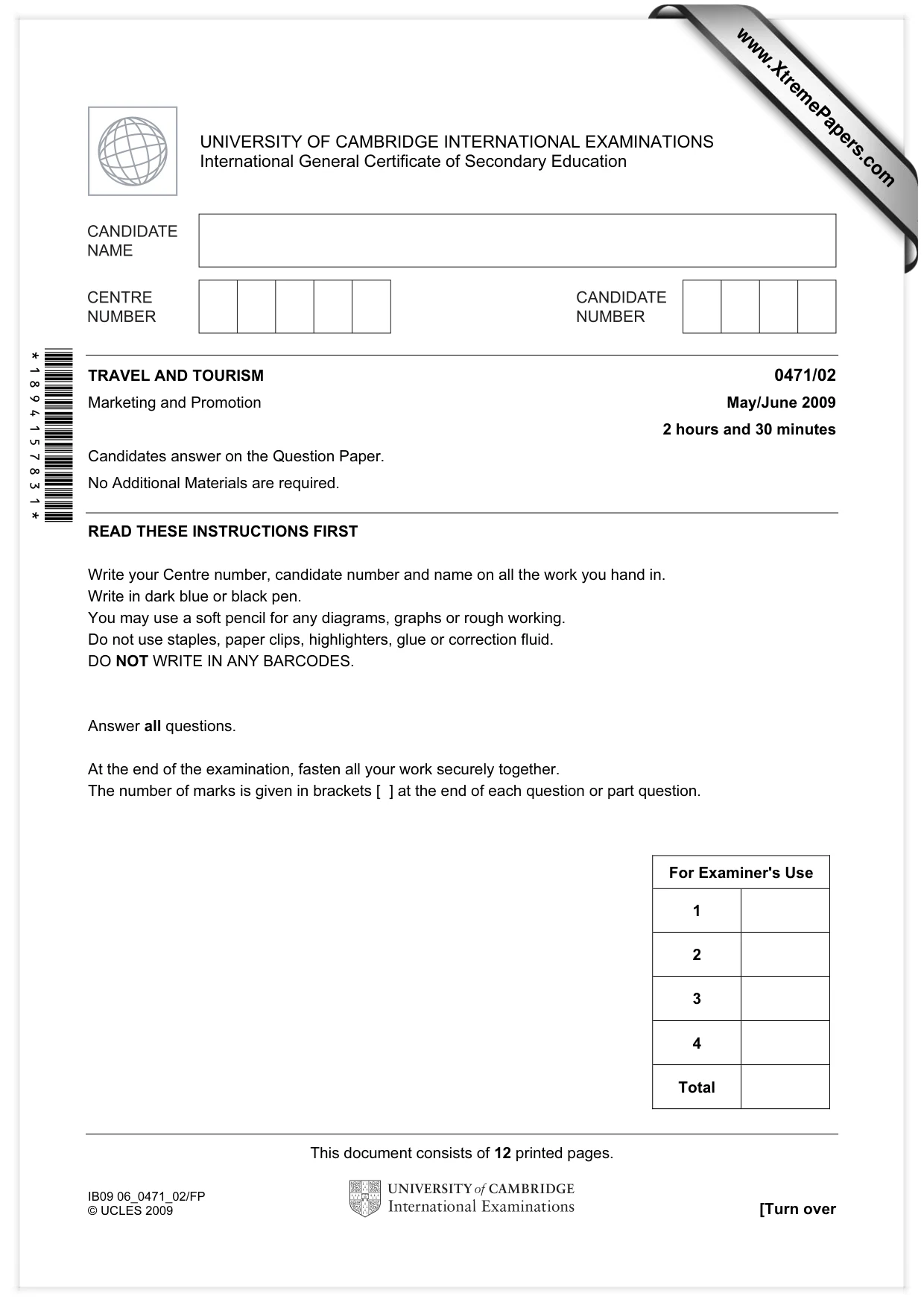
Question paper, page 1
This document consists of 12 printed pages. IB09 06_0471_02/FP © UCLES 2009 [Turn over ** *1894157831* For Examiner's Use 1 2 3 4 Total UNIVERSITY OF CAMBRIDGE INTERNATIONAL EXAMINATIONS International General Certificate of Secondary Education TRAVEL AND TOURISM 0471/02 Marketing and Promotion May/June 2009 2 hours and 30 minutes Candidates answer on the Question Paper. No Additional Materials are required. READ THESE INSTRUCTIONS FIRST Write your Centre number, candidate number and name on all the work you hand in. Write in dark blue or black pen. You may use a soft pencil for any diagrams, graphs or rough working. Do not use staples, paper clips, highlighters, glue or correction fluid. DO NOT WRITE IN ANY BARCODES. Answer all questions. At the end of the examination, fasten all your work securely together. The number of marks is given in brackets [ ] at the end of each question or part question. www.XtremePapers.com
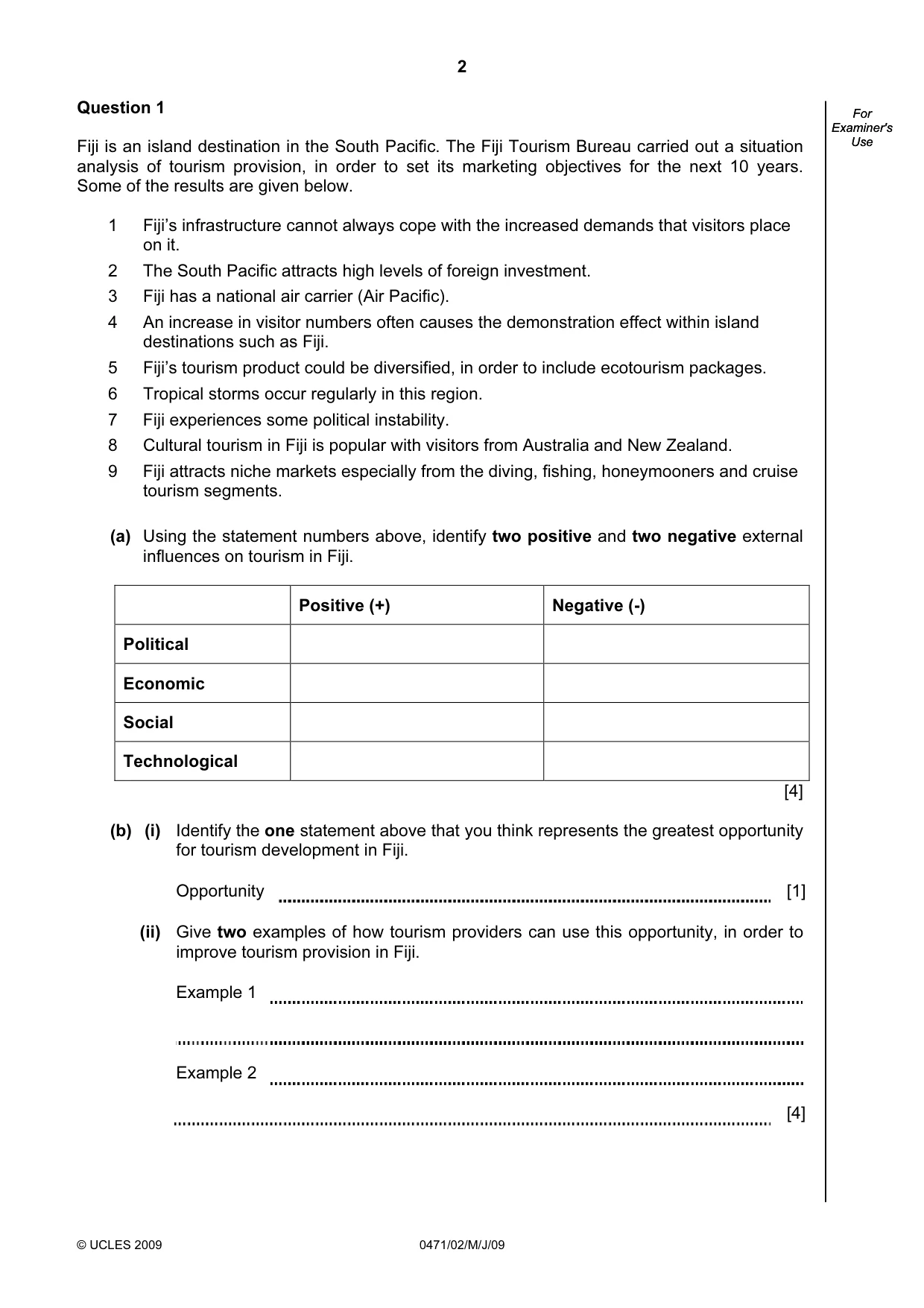
Question paper, page 2
2 © UCLES 2009 0471/02/M/J/09 For Examiner's Use For Examiner's Use Question 1 Fiji is an island destination in the South Pacific. The Fiji Tourism Bureau carried out a situation analysis of tourism provision, in order to set its marketing objectives for the next 10 years. Some of the results are given below. 1 Fiji’s infrastructure cannot always cope with the increased demands that visitors place on it. 2 The South Pacific attracts high levels of foreign investment. 3 Fiji has a national air carrier (Air Pacific). 4 An increase in visitor numbers often causes the demonstration effect within island destinations such as Fiji. 5 Fiji’s tourism product could be diversified, in order to include ecotourism packages. 6 Tropical storms occur regularly in this region. 7 Fiji experiences some political instability. 8 Cultural tourism in Fiji is popular with visitors from Australia and New Zealand. 9 Fiji attracts niche markets especially from the diving, fishing, honeymooners and cruise tourism segments. (a) Using the statement numbers above, identify two positive and two negative external influences on tourism in Fiji. Positive (+) Negative (-) Political Economic Social Technological [4] (b) (i) Identify the one statement above that you think represents the greatest opportunity for tourism development in Fiji. Opportunity [1] (ii) Give two examples of how tourism providers can use this opportunity, in order to improve tourism provision in Fiji. Example 1 Example 2 [4]
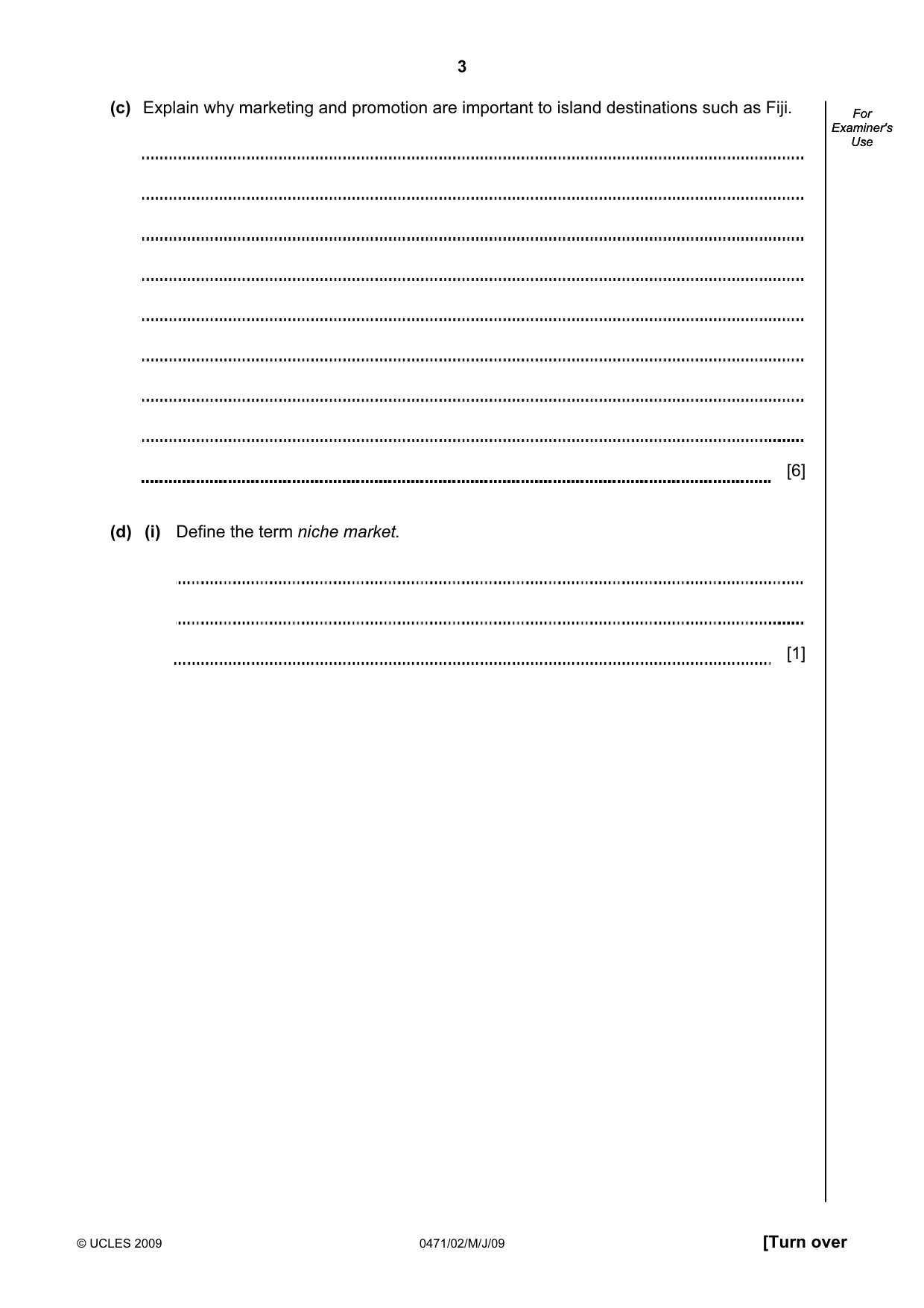
Question paper, page 3
3 © UCLES 2009 0471/02/M/J/09 [Turn over For Examiner's Use For Examiner's Use (c) Explain why marketing and promotion are important to island destinations such as Fiji. [6] (d) (i) Define the term niche market. [1]
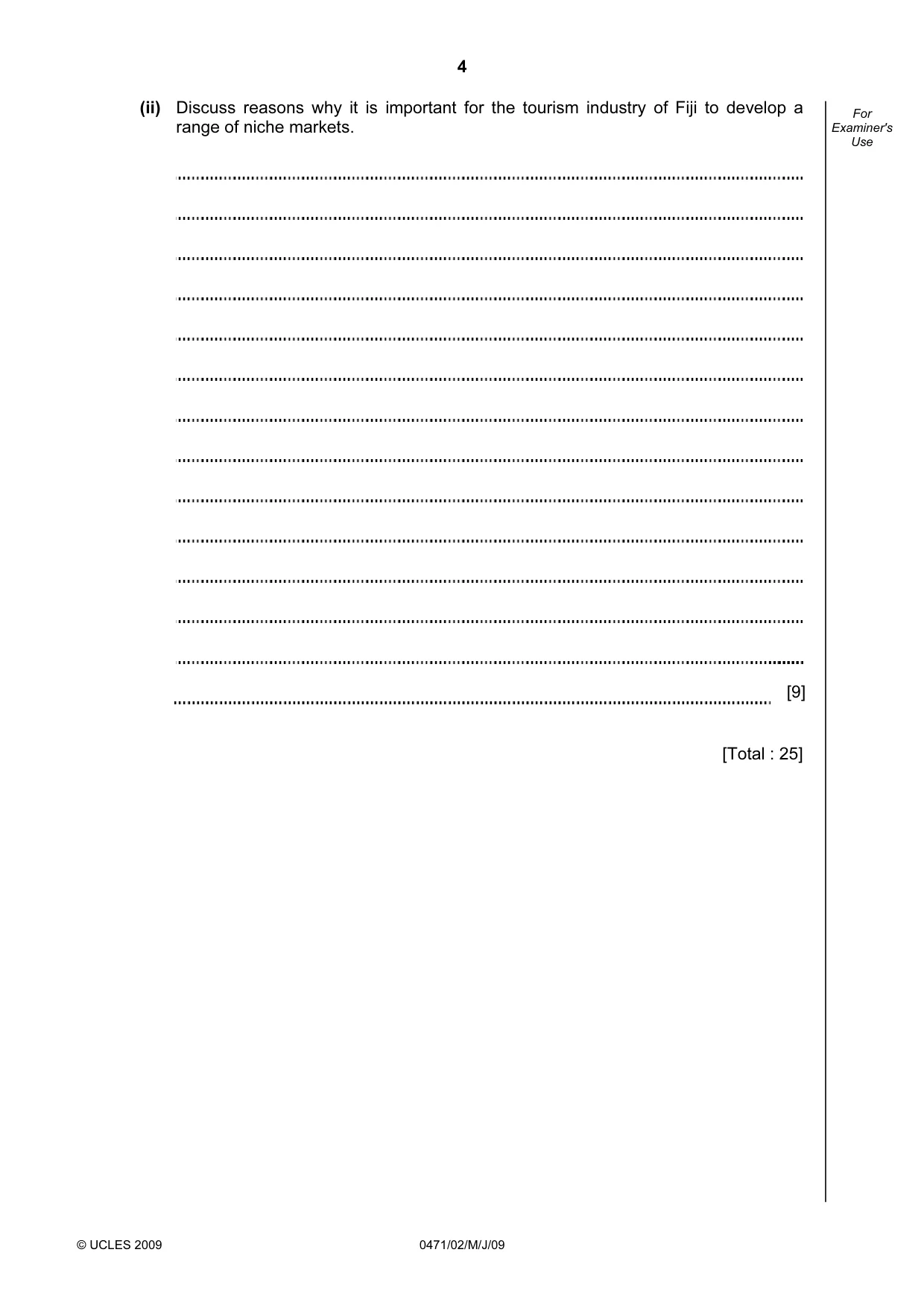
Question paper, page 4
4 © UCLES 2009 0471/02/M/J/09 For Examiner's Use (ii) Discuss reasons why it is important for the tourism industry of Fiji to develop a range of niche markets. [9] [Total : 25]
Question paper, page 5
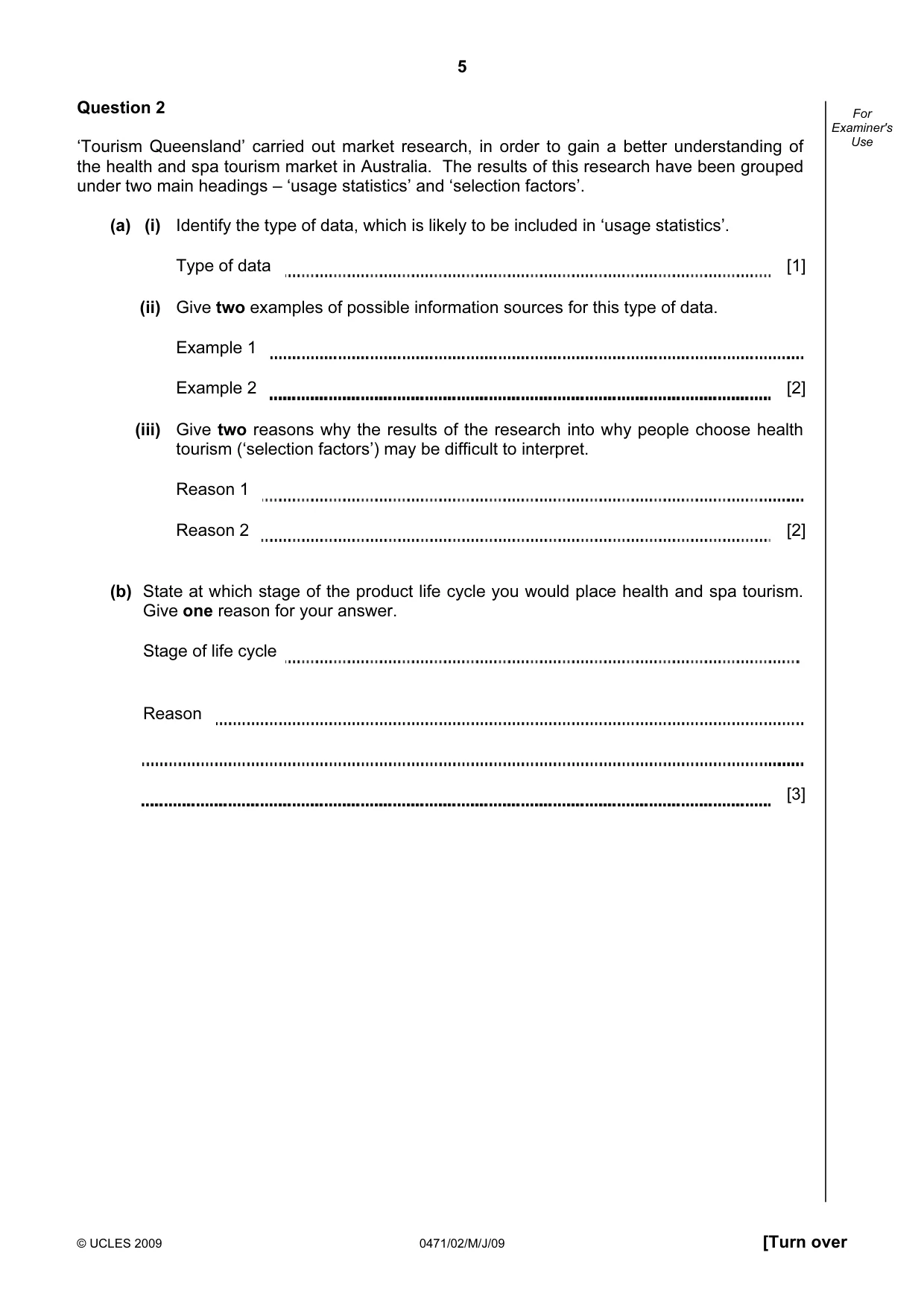
5 © UCLES 2009 0471/02/M/J/09 [Turn over For Examiner's Use Question 2 ‘Tourism Queensland’ carried out market research, in order to gain a better understanding of the health and spa tourism market in Australia. The results of this research have been grouped under two main headings – ‘usage statistics’ and ‘selection factors’. (a) (i) Identify the type of data, which is likely to be included in ‘usage statistics’. Type of data [1] (ii) Give two examples of possible information sources for this type of data. Example 1 Example 2 [2] (iii) Give two reasons why the results of the research into why people choose health tourism (‘selection factors’) may be difficult to interpret. Reason 1 Reason 2 [2] (b) State at which stage of the product life cycle you would place health and spa tourism. Give one reason for your answer. Stage of life cycle Reason [3]
Question paper, page 6
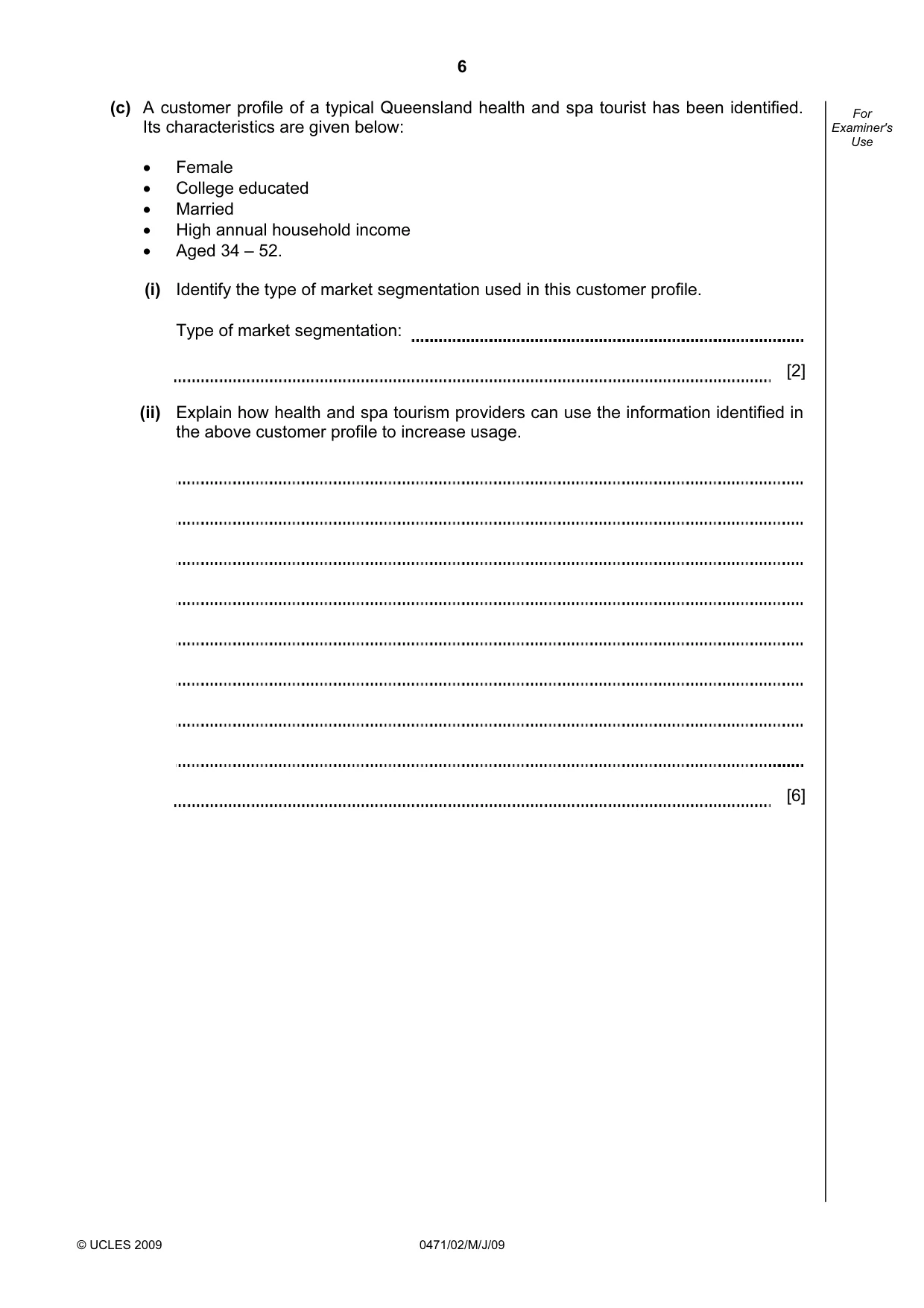
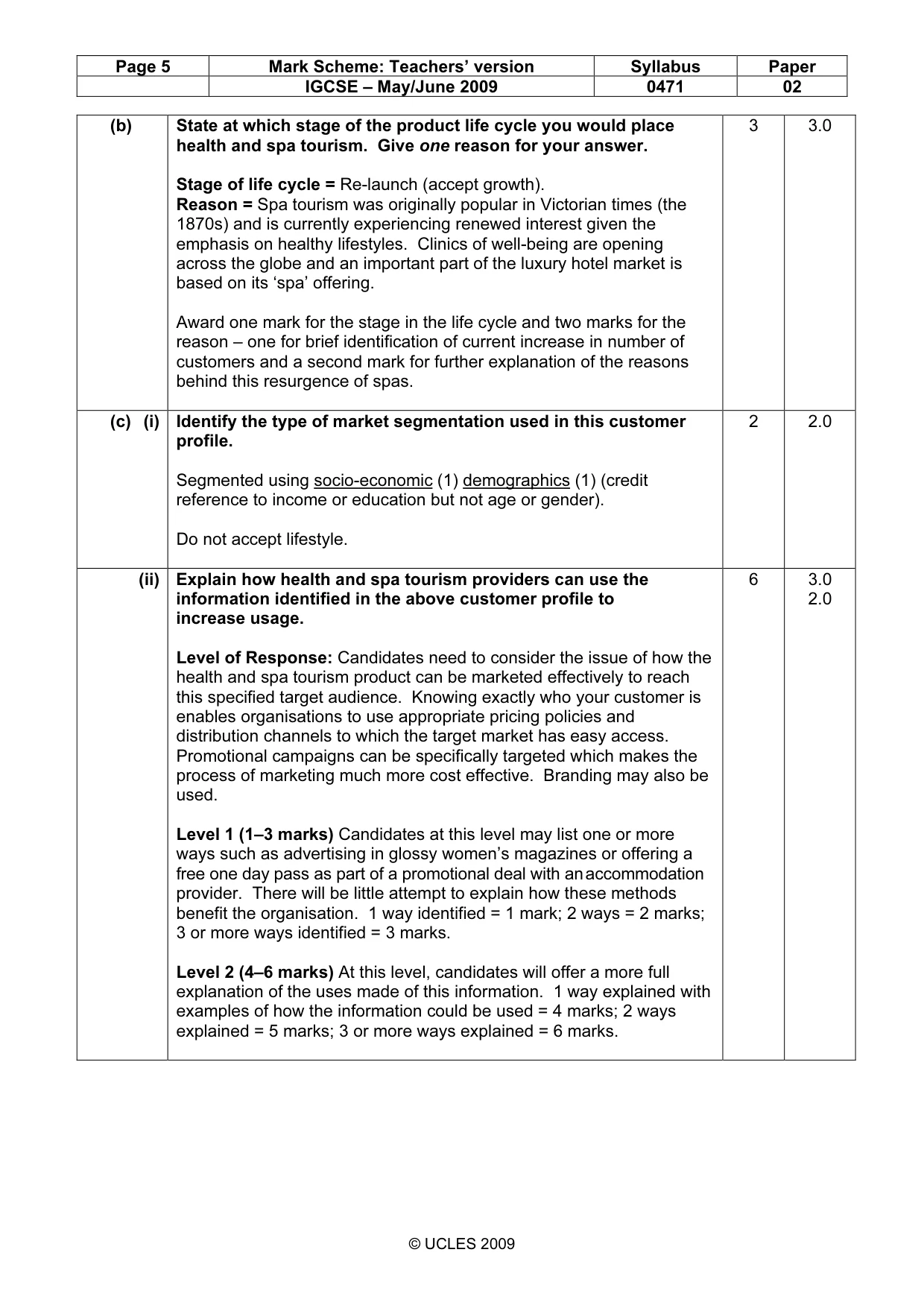
6 © UCLES 2009 0471/02/M/J/09 For Examiner's Use (c) A customer profile of a typical Queensland health and spa tourist has been identified. Its characteristics are given below: • Female • College educated • Married • High annual household income • Aged 34 – 52. (i) Identify the type of market segmentation used in this customer profile. Type of market segmentation: [2] (ii) Explain how health and spa tourism providers can use the information identified in the above customer profile to increase usage. [6]
Question paper, page 7
7 © UCLES 2009 0471/02/M/J/09 [Turn over For Examiner's Use (d) Discuss pricing policies that spa tourism providers may use for their products. [9] [Total : 25]
Question paper, page 8
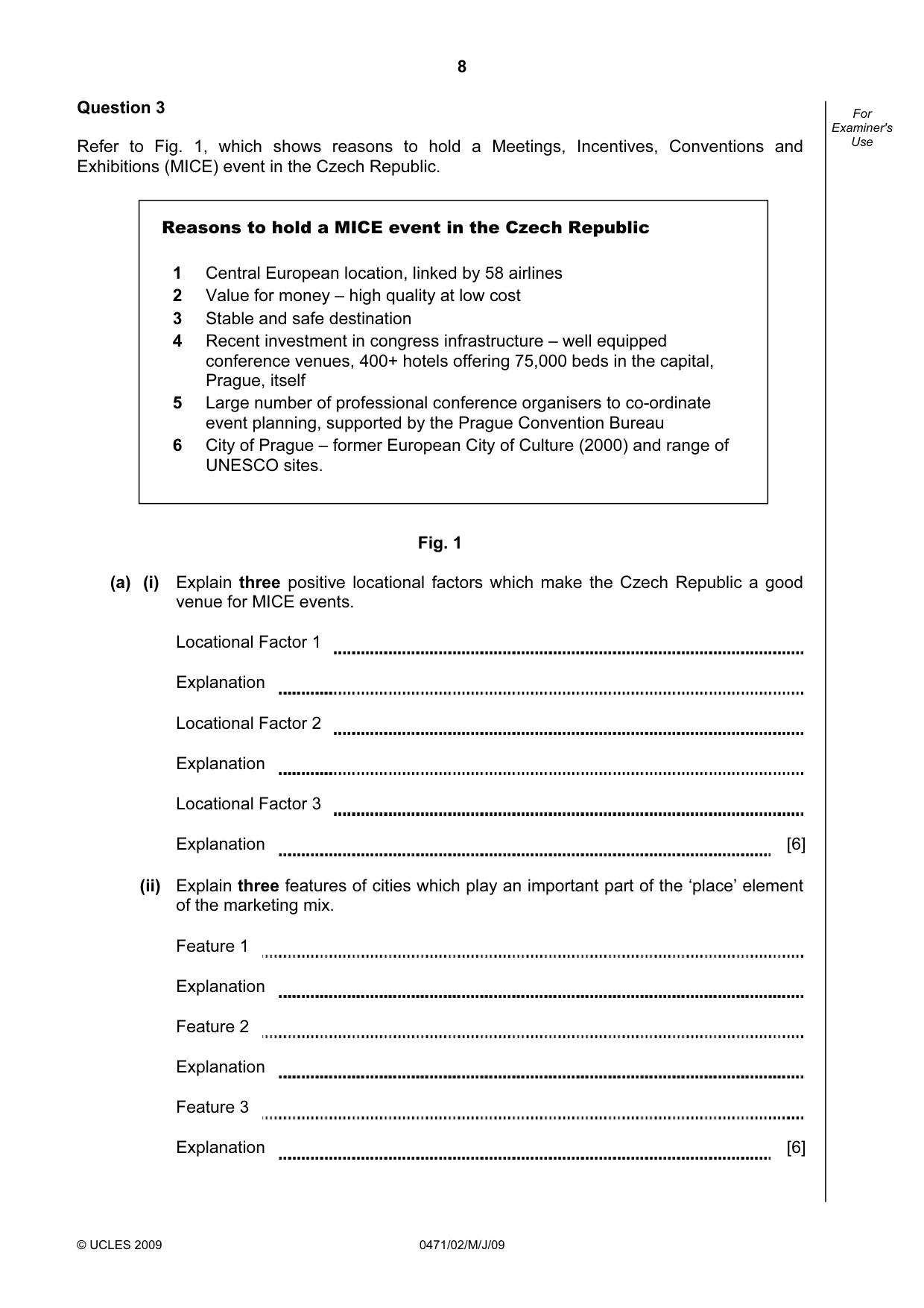
8 © UCLES 2009 0471/02/M/J/09 For Examiner's Use Question 3 Refer to Fig. 1, which shows reasons to hold a Meetings, Incentives, Conventions and Exhibitions (MICE) event in the Czech Republic. Fig. 1 (a) (i) Explain three positive locational factors which make the Czech Republic a good venue for MICE events. Locational Factor 1 Explanation Locational Factor 2 Explanation Locational Factor 3 Explanation [6] (ii) Explain three features of cities which play an important part of the ‘place’ element of the marketing mix. Feature 1 Explanation Feature 2 Explanation Feature 3 Explanation [6] Reasons to hold a MICE event in the Czech Republic 1 Central European location, linked by 58 airlines 2 Value for money – high quality at low cost 3 Stable and safe destination 4 Recent investment in congress infrastructure – well equipped conference venues, 400+ hotels offering 75,000 beds in the capital, Prague, itself 5 Large number of professional conference organisers to co-ordinate event planning, supported by the Prague Convention Bureau 6 City of Prague – former European City of Culture (2000) and range of UNESCO sites.
Question paper, page 9
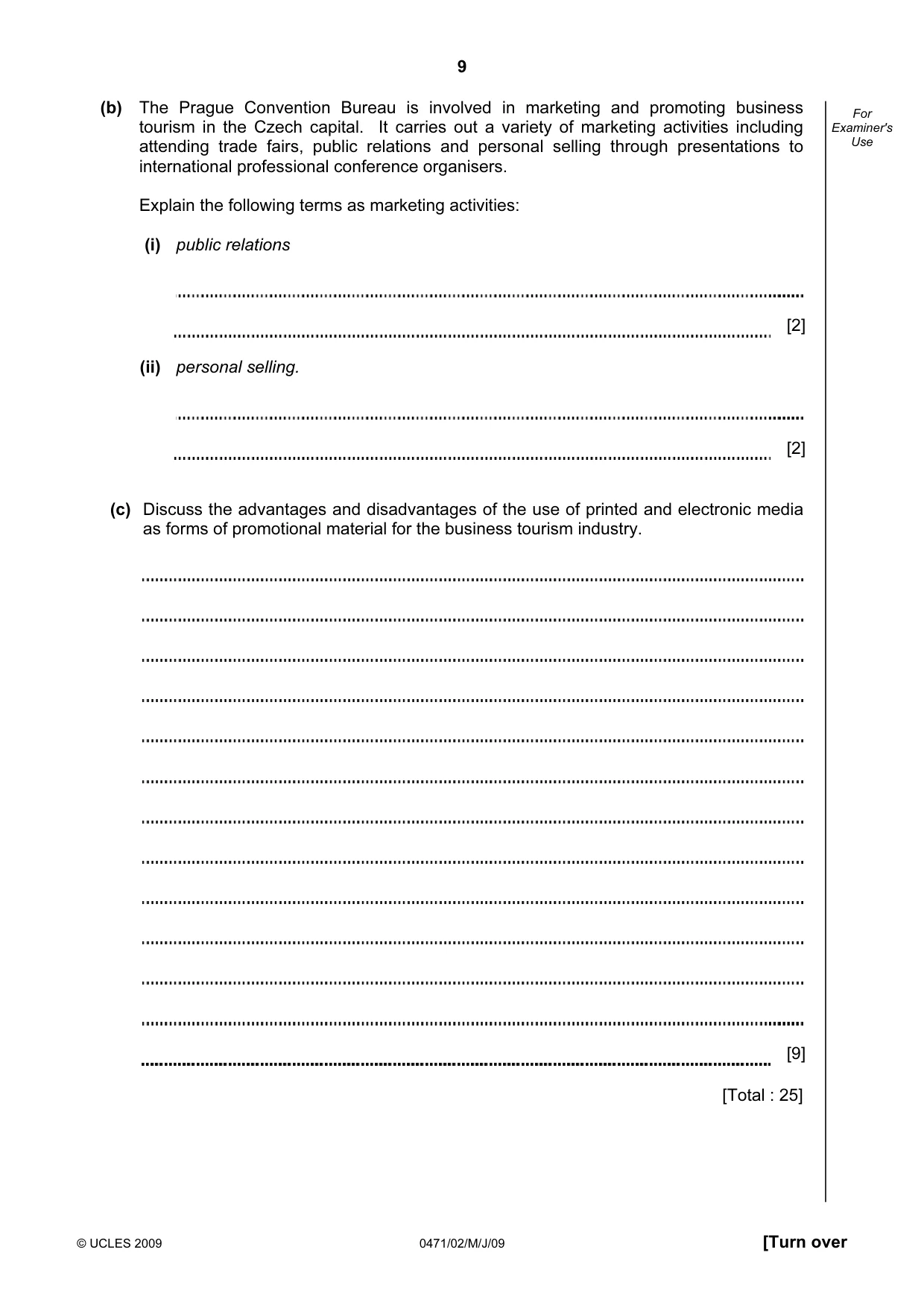
9 © UCLES 2009 0471/02/M/J/09 [Turn over For Examiner's Use (b) The Prague Convention Bureau is involved in marketing and promoting business tourism in the Czech capital. It carries out a variety of marketing activities including attending trade fairs, public relations and personal selling through presentations to international professional conference organisers. Explain the following terms as marketing activities: (i) public relations [2] (ii) personal selling. [2] (c) Discuss the advantages and disadvantages of the use of printed and electronic media as forms of promotional material for the business tourism industry. [9] [Total : 25]
Question paper, page 10
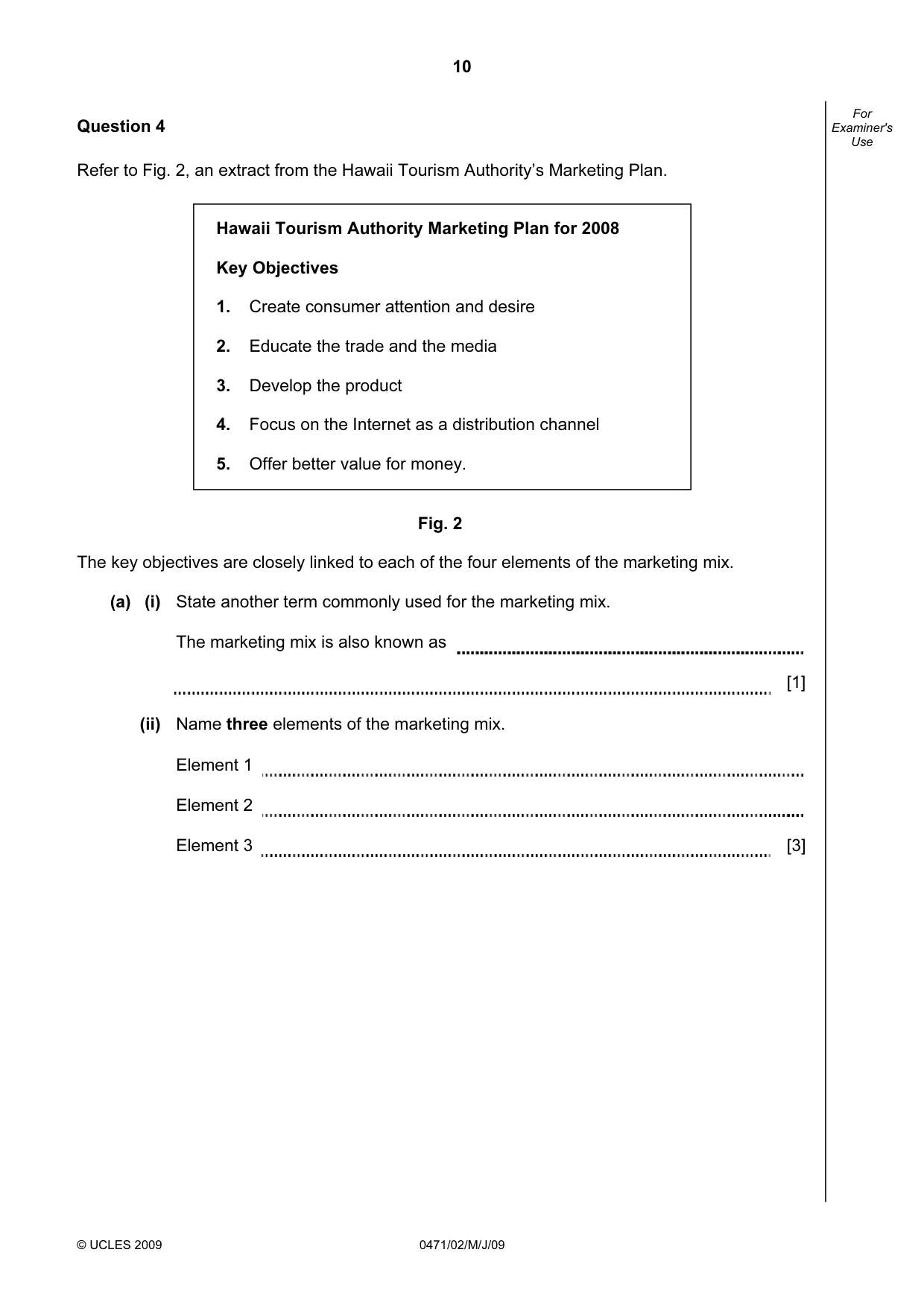
10 © UCLES 2009 0471/02/M/J/09 For Examiner's Use Question 4 Refer to Fig. 2, an extract from the Hawaii Tourism Authority’s Marketing Plan. Fig. 2 The key objectives are closely linked to each of the four elements of the marketing mix. (a) (i) State another term commonly used for the marketing mix. The marketing mix is also known as [1] (ii) Name three elements of the marketing mix. Element 1 Element 2 Element 3 [3] Hawaii Tourism Authority Marketing Plan for 2008 Key Objectives 1. Create consumer attention and desire 2. Educate the trade and the media 3. Develop the product 4. Focus on the Internet as a distribution channel 5. Offer better value for money.
Question paper, page 11
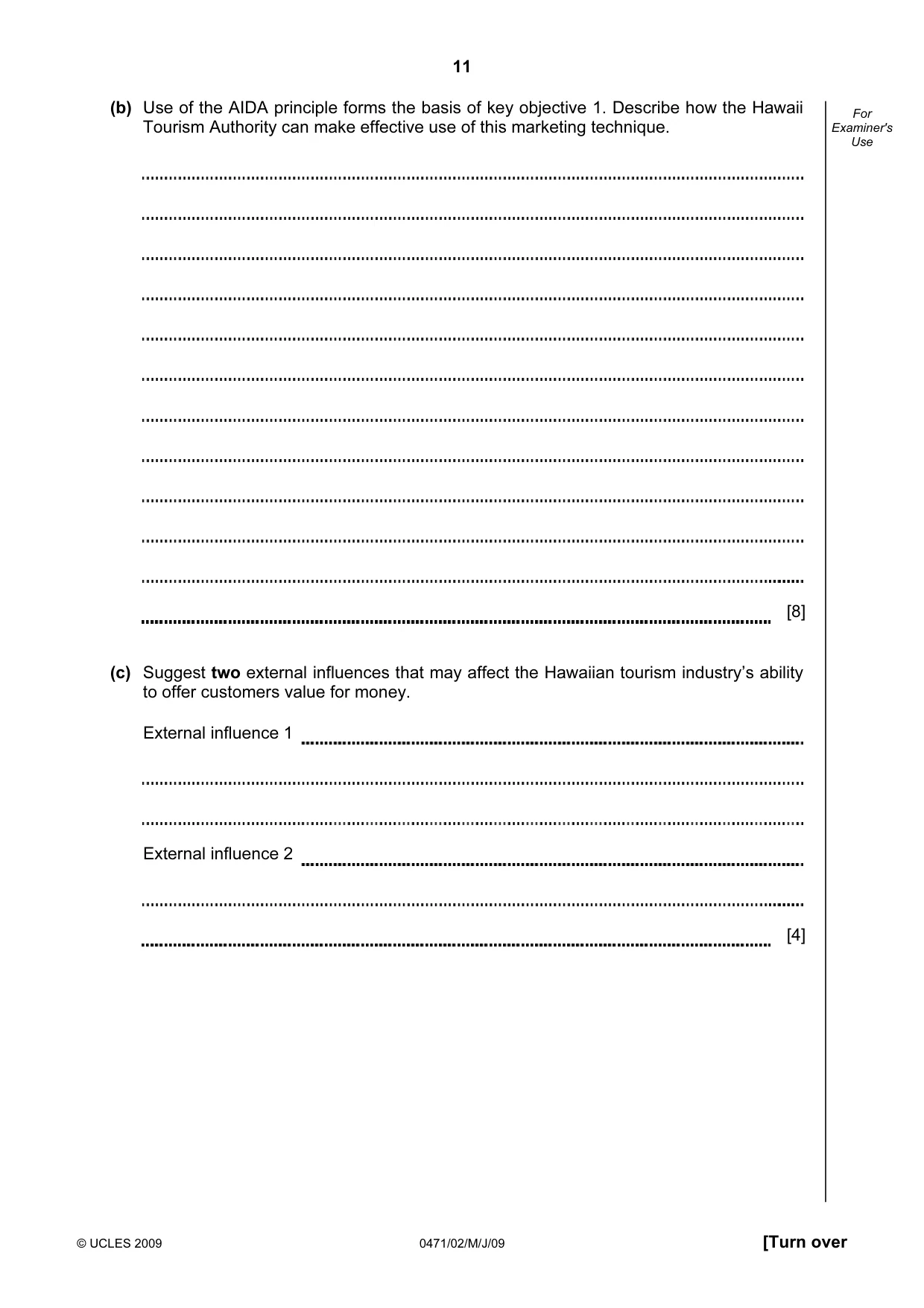
11 © UCLES 2009 0471/02/M/J/09 [Turn over For Examiner's Use (b) Use of the AIDA principle forms the basis of key objective 1. Describe how the Hawaii Tourism Authority can make effective use of this marketing technique. [8] (c) Suggest two external influences that may affect the Hawaiian tourism industry’s ability to offer customers value for money. External influence 1 External influence 2 [4]
Question paper, page 12
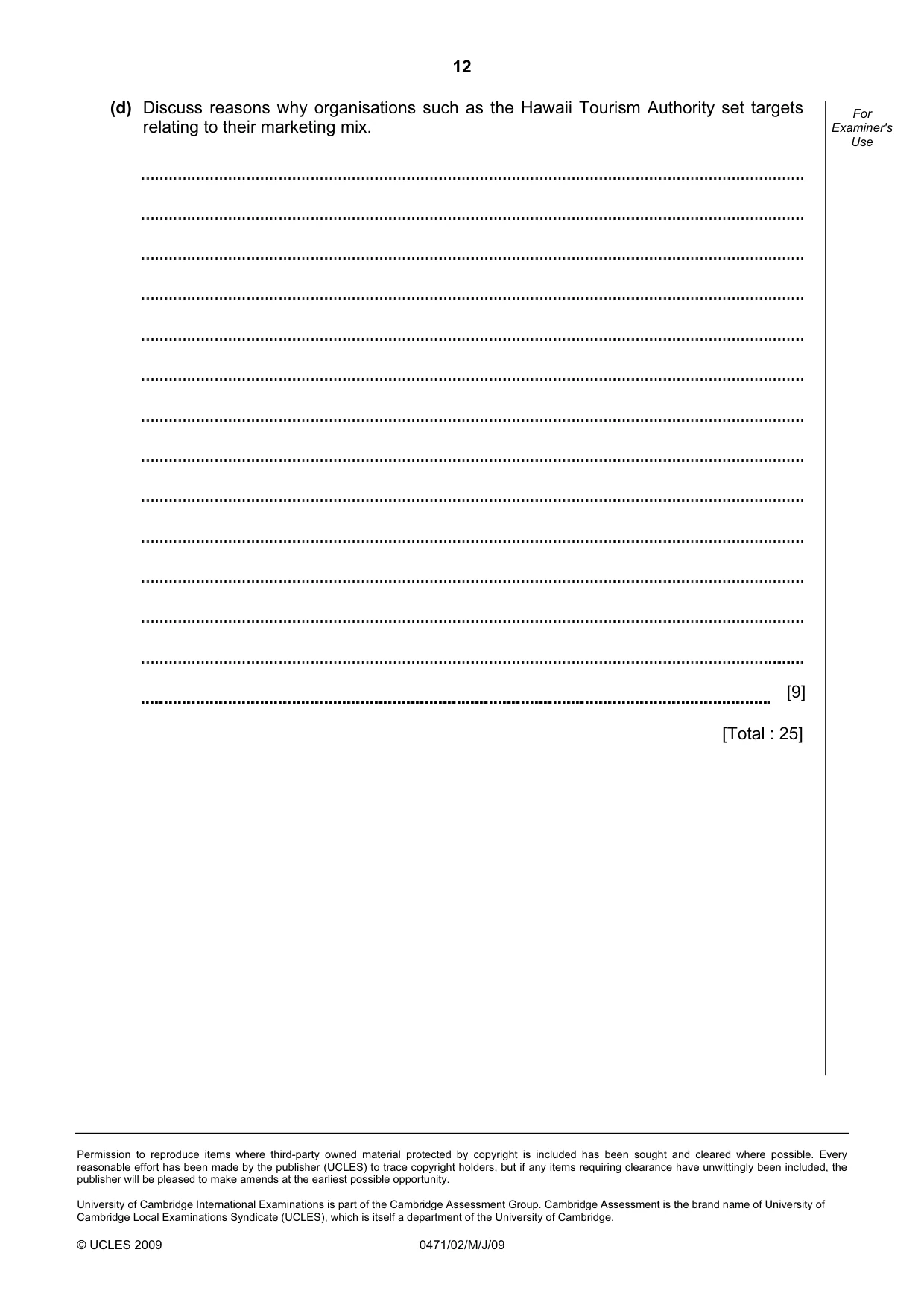
12 Permission to reproduce items where third-party owned material protected by copyright is included has been sought and cleared where possible. Every reasonable effort has been made by the publisher (UCLES) to trace copyright holders, but if any items requiring clearance have unwittingly been included, the publisher will be pleased to make amends at the earliest possible opportunity. University of Cambridge International Examinations is part of the Cambridge Assessment Group. Cambridge Assessment is the brand name of University of Cambridge Local Examinations Syndicate (UCLES), which is itself a department of the University of Cambridge. © UCLES 2009 0471/02/M/J/09 For Examiner's Use (d) Discuss reasons why organisations such as the Hawaii Tourism Authority set targets relating to their marketing mix. [9] [Total : 25]
Mark scheme, page 1
UNIVERSITY OF CAMBRIDGE INTERNATIONAL EXAMINATIONS International General Certificate of Secondary Education MARK SCHEME for the May/June 2009 question paper for the guidance of teachers 0471 TRAVEL AND TOURISM 0471/02 Paper 2 (Alternative to Coursework), maximum raw mark 100 This mark scheme is published as an aid to teachers and candidates, to indicate the requirements of the examination. It shows the basis on which Examiners were instructed to award marks. It does not indicate the details of the discussions that took place at an Examiners’ meeting before marking began, which would have considered the acceptability of alternative answers. Mark schemes must be read in conjunction with the question papers and the report on the examination. • CIE will not enter into discussions or correspondence in connection with these mark schemes. CIE is publishing the mark schemes for the May/June 2009 question papers for most IGCSE, GCE Advanced Level and Advanced Subsidiary Level syllabuses and some Ordinary Level syllabuses. www.XtremePapers.com
Mark scheme, page 2
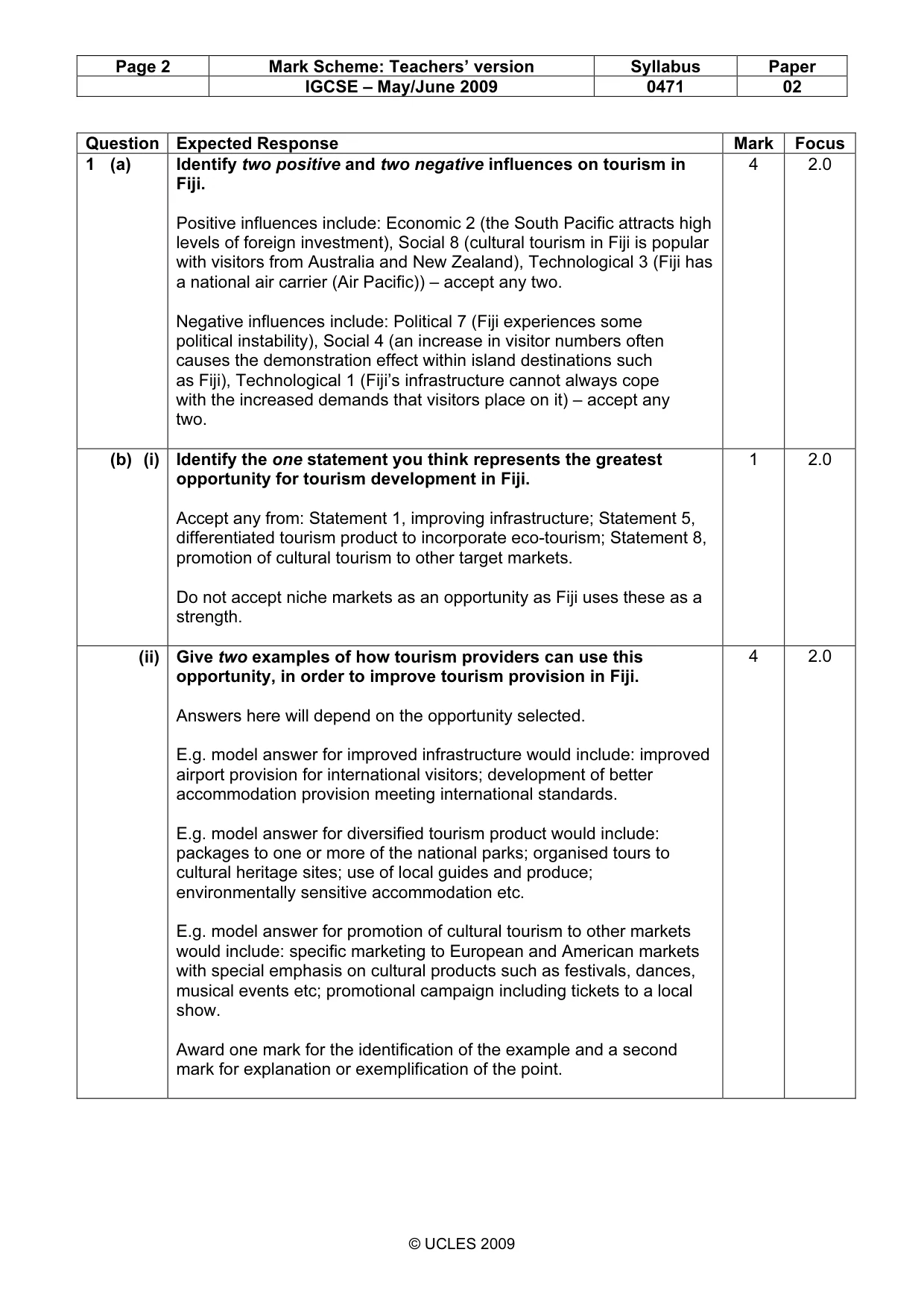
Page 2 Mark Scheme: Teachers’ version Syllabus Paper IGCSE – May/June 2009 0471 02 © UCLES 2009 Question Expected Response Mark Focus 1 (a) Identify two positive and two negative influences on tourism in Fiji. Positive influences include: Economic 2 (the South Pacific attracts high levels of foreign investment), Social 8 (cultural tourism in Fiji is popular with visitors from Australia and New Zealand), Technological 3 (Fiji has a national air carrier (Air Pacific)) – accept any two. Negative influences include: Political 7 (Fiji experiences some political instability), Social 4 (an increase in visitor numbers often causes the demonstration effect within island destinations such as Fiji), Technological 1 (Fiji’s infrastructure cannot always cope with the increased demands that visitors place on it) – accept any two. 4 2.0 (b) (i) Identify the one statement you think represents the greatest opportunity for tourism development in Fiji. Accept any from: Statement 1, improving infrastructure; Statement 5, differentiated tourism product to incorporate eco-tourism; Statement 8, promotion of cultural tourism to other target markets. Do not accept niche markets as an opportunity as Fiji uses these as a strength. 1 2.0 (ii) Give two examples of how tourism providers can use this opportunity, in order to improve tourism provision in Fiji. Answers here will depend on the opportunity selected. E.g. model answer for improved infrastructure would include: improved airport provision for international visitors; development of better accommodation provision meeting international standards. E.g. model answer for diversified tourism product would include: packages to one or more of the national parks; organised tours to cultural heritage sites; use of local guides and produce; environmentally sensitive accommodation etc. E.g. model answer for promotion of cultural tourism to other markets would include: specific marketing to European and American markets with special emphasis on cultural products such as festivals, dances, musical events etc; promotional campaign including tickets to a local show. Award one mark for the identification of the example and a second mark for explanation or exemplification of the point. 4 2.0
Mark scheme, page 3
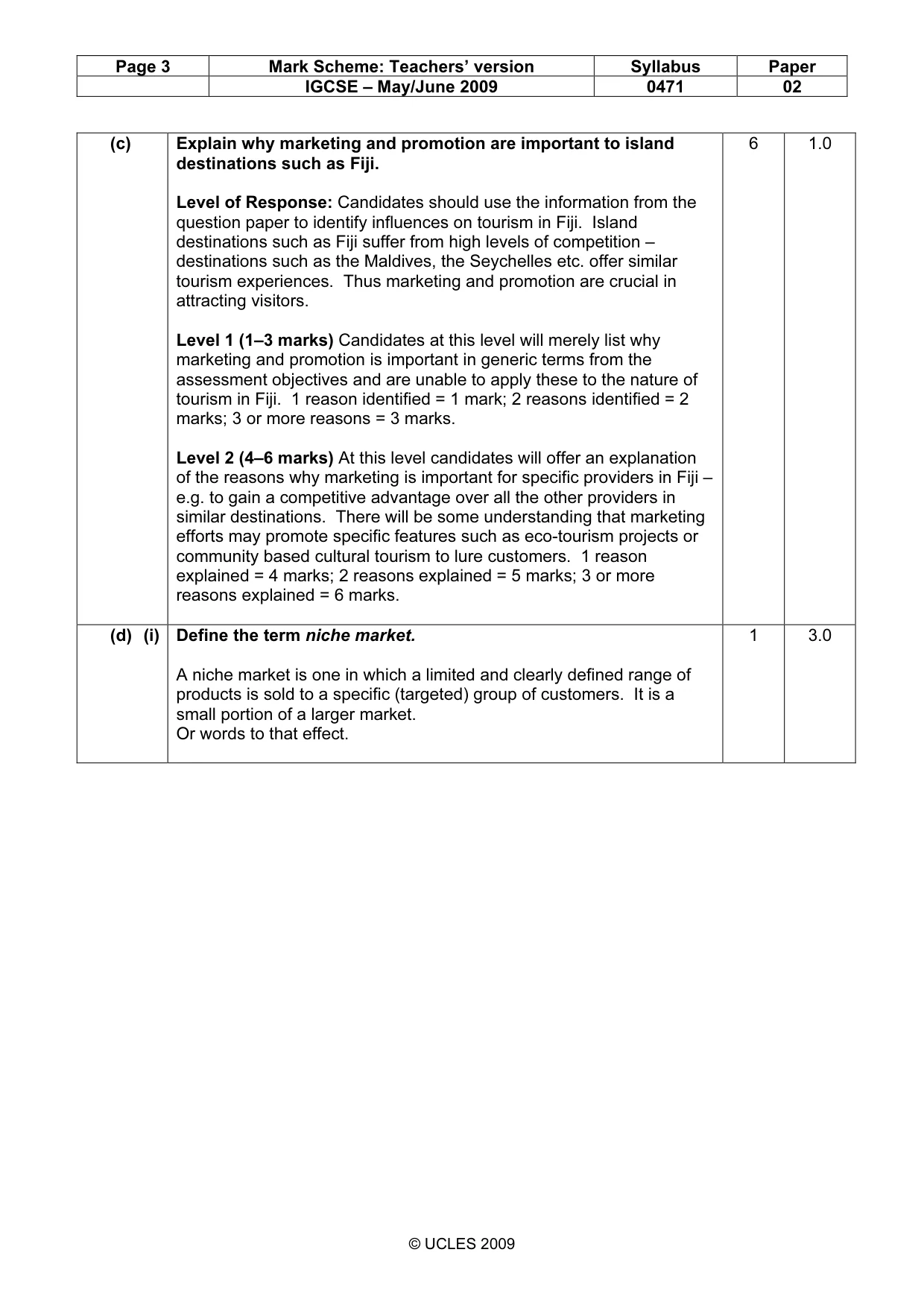
Page 3 Mark Scheme: Teachers’ version Syllabus Paper IGCSE – May/June 2009 0471 02 © UCLES 2009 (c) Explain why marketing and promotion are important to island destinations such as Fiji. Level of Response: Candidates should use the information from the question paper to identify influences on tourism in Fiji. Island destinations such as Fiji suffer from high levels of competition – destinations such as the Maldives, the Seychelles etc. offer similar tourism experiences. Thus marketing and promotion are crucial in attracting visitors. Level 1 (1–3 marks) Candidates at this level will merely list why marketing and promotion is important in generic terms from the assessment objectives and are unable to apply these to the nature of tourism in Fiji. 1 reason identified = 1 mark; 2 reasons identified = 2 marks; 3 or more reasons = 3 marks. Level 2 (4–6 marks) At this level candidates will offer an explanation of the reasons why marketing is important for specific providers in Fiji – e.g. to gain a competitive advantage over all the other providers in similar destinations. There will be some understanding that marketing efforts may promote specific features such as eco-tourism projects or community based cultural tourism to lure customers. 1 reason explained = 4 marks; 2 reasons explained = 5 marks; 3 or more reasons explained = 6 marks. 6 1.0 (d) (i) Define the term niche market. A niche market is one in which a limited and clearly defined range of products is sold to a specific (targeted) group of customers. It is a small portion of a larger market. Or words to that effect. 1 3.0
Mark scheme, page 4
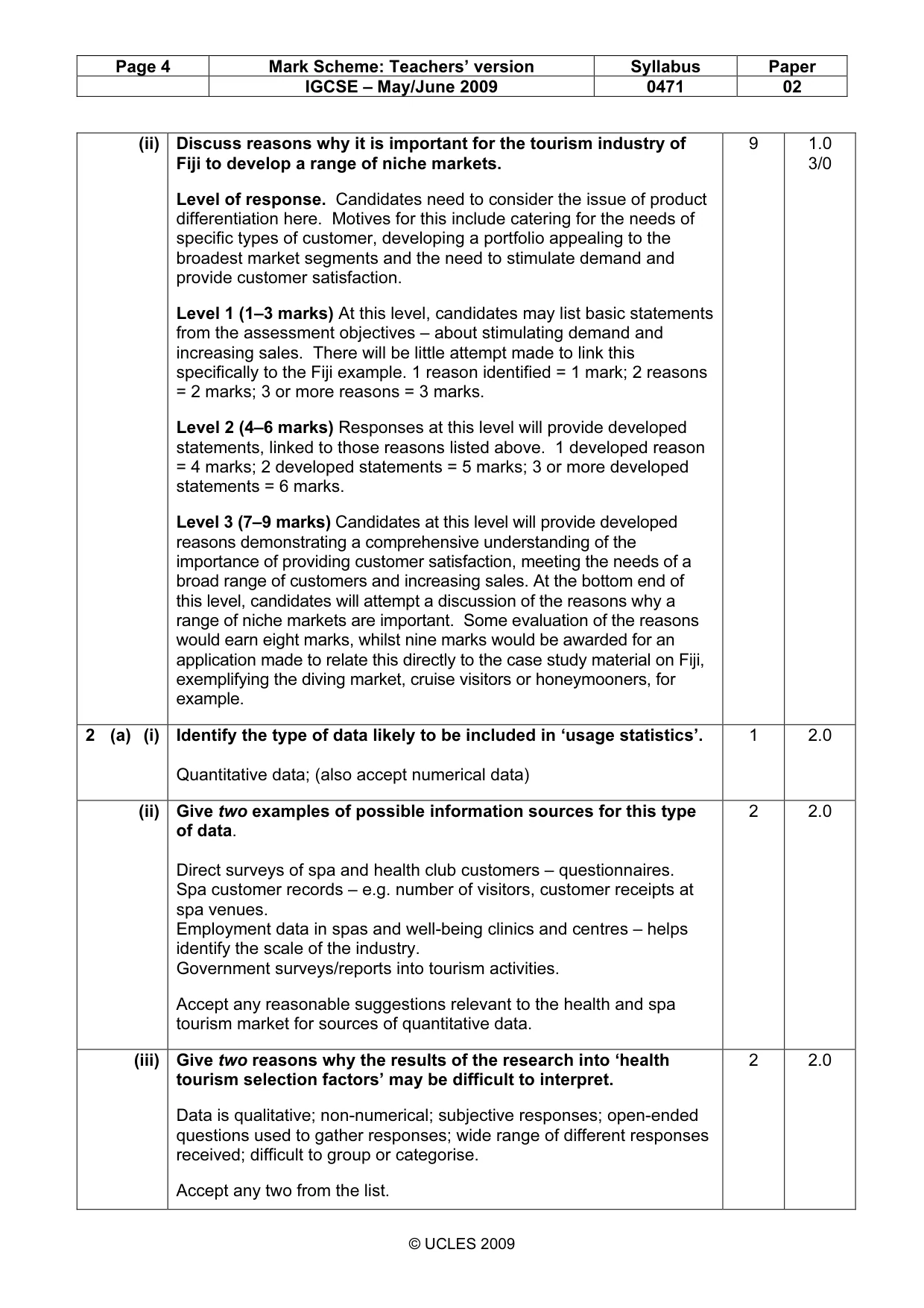
Page 4 Mark Scheme: Teachers’ version Syllabus Paper IGCSE – May/June 2009 0471 02 © UCLES 2009 (ii) Discuss reasons why it is important for the tourism industry of Fiji to develop a range of niche markets. Level of response. Candidates need to consider the issue of product differentiation here. Motives for this include catering for the needs of specific types of customer, developing a portfolio appealing to the broadest market segments and the need to stimulate demand and provide customer satisfaction. Level 1 (1–3 marks) At this level, candidates may list basic statements from the assessment objectives – about stimulating demand and increasing sales. There will be little attempt made to link this specifically to the Fiji example. 1 reason identified = 1 mark; 2 reasons = 2 marks; 3 or more reasons = 3 marks. Level 2 (4–6 marks) Responses at this level will provide developed statements, linked to those reasons listed above. 1 developed reason = 4 marks; 2 developed statements = 5 marks; 3 or more developed statements = 6 marks. Level 3 (7–9 marks) Candidates at this level will provide developed reasons demonstrating a comprehensive understanding of the importance of providing customer satisfaction, meeting the needs of a broad range of customers and increasing sales. At the bottom end of this level, candidates will attempt a discussion of the reasons why a range of niche markets are important. Some evaluation of the reasons would earn eight marks, whilst nine marks would be awarded for an application made to relate this directly to the case study material on Fiji, exemplifying the diving market, cruise visitors or honeymooners, for example. 9 1.0 3/0 2 (a) (i) Identify the type of data likely to be included in ‘usage statistics’. Quantitative data; (also accept numerical data) 1 2.0 (ii) Give two examples of possible information sources for this type of data. Direct surveys of spa and health club customers – questionnaires. Spa customer records – e.g. number of visitors, customer receipts at spa venues. Employment data in spas and well-being clinics and centres – helps identify the scale of the industry. Government surveys/reports into tourism activities. Accept any reasonable suggestions relevant to the health and spa tourism market for sources of quantitative data. 2 2.0 (iii) Give two reasons why the results of the research into ‘health tourism selection factors’ may be difficult to interpret. Data is qualitative; non-numerical; subjective responses; open-ended questions used to gather responses; wide range of different responses received; difficult to group or categorise. Accept any two from the list. 2 2.0
Mark scheme, page 5
Page 5 Mark Scheme: Teachers’ version Syllabus Paper IGCSE – May/June 2009 0471 02 © UCLES 2009 (b) State at which stage of the product life cycle you would place health and spa tourism. Give one reason for your answer. Stage of life cycle = Re-launch (accept growth). Reason = Spa tourism was originally popular in Victorian times (the 1870s) and is currently experiencing renewed interest given the emphasis on healthy lifestyles. Clinics of well-being are opening across the globe and an important part of the luxury hotel market is based on its ‘spa’ offering. Award one mark for the stage in the life cycle and two marks for the reason – one for brief identification of current increase in number of customers and a second mark for further explanation of the reasons behind this resurgence of spas. 3 3.0 (c) (i) Identify the type of market segmentation used in this customer profile. Segmented using socio-economic (1) demographics (1) (credit reference to income or education but not age or gender). Do not accept lifestyle. 2 2.0 (ii) Explain how health and spa tourism providers can use the information identified in the above customer profile to increase usage. Level of Response: Candidates need to consider the issue of how the health and spa tourism product can be marketed effectively to reach this specified target audience. Knowing exactly who your customer is enables organisations to use appropriate pricing policies and distribution channels to which the target market has easy access. Promotional campaigns can be specifically targeted which makes the process of marketing much more cost effective. Branding may also be used. Level 1 (1–3 marks) Candidates at this level may list one or more ways such as advertising in glossy women’s magazines or offering a free one day pass as part of a promotional deal with an accommodation provider. There will be little attempt to explain how these methods benefit the organisation. 1 way identified = 1 mark; 2 ways = 2 marks; 3 or more ways identified = 3 marks. Level 2 (4–6 marks) At this level, candidates will offer a more full explanation of the uses made of this information. 1 way explained with examples of how the information could be used = 4 marks; 2 ways explained = 5 marks; 3 or more ways explained = 6 marks. 6 3.0 2.0
Mark scheme, page 6
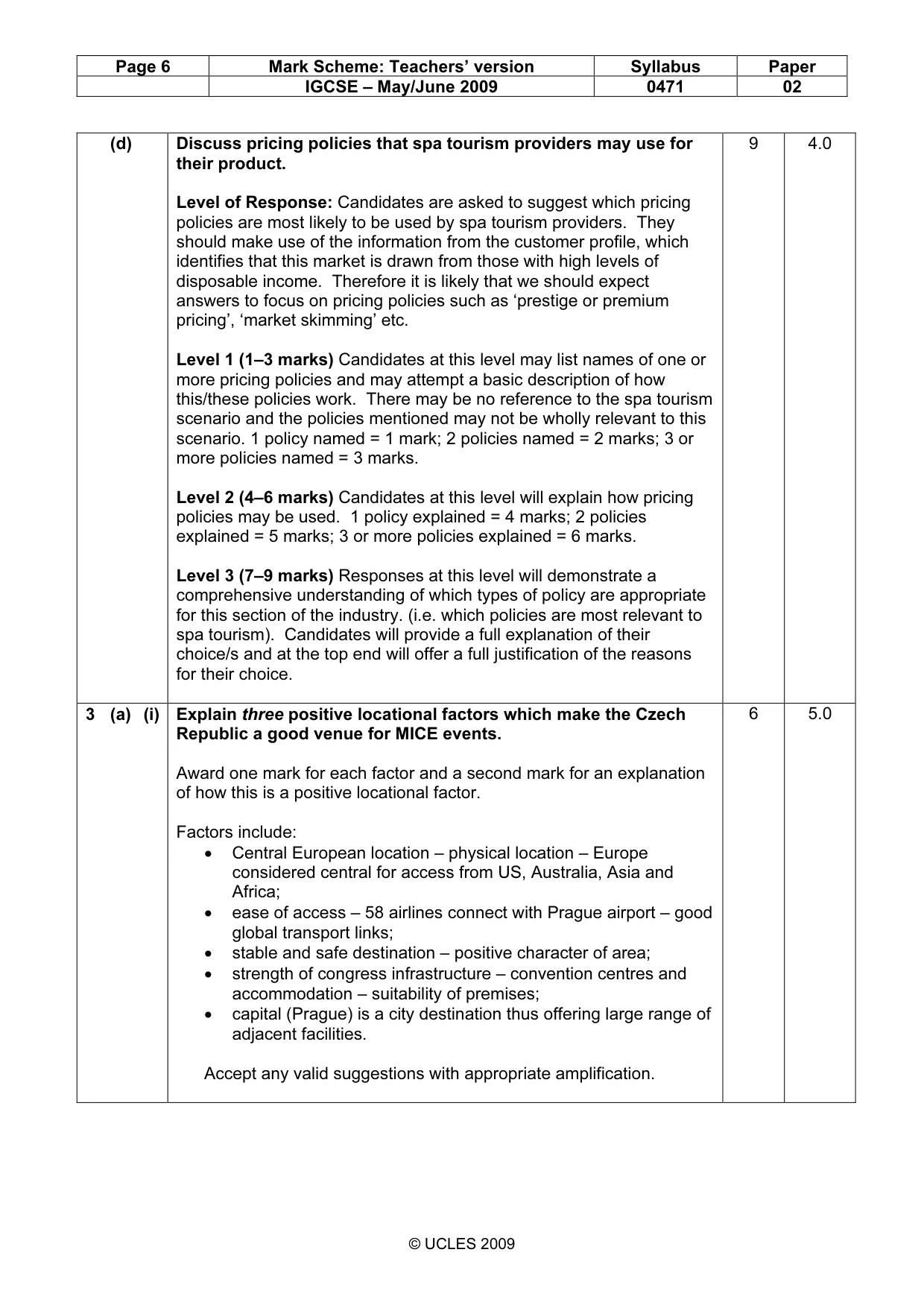
Page 6 Mark Scheme: Teachers’ version Syllabus Paper IGCSE – May/June 2009 0471 02 © UCLES 2009 (d) Discuss pricing policies that spa tourism providers may use for their product. Level of Response: Candidates are asked to suggest which pricing policies are most likely to be used by spa tourism providers. They should make use of the information from the customer profile, which identifies that this market is drawn from those with high levels of disposable income. Therefore it is likely that we should expect answers to focus on pricing policies such as ‘prestige or premium pricing’, ‘market skimming’ etc. Level 1 (1–3 marks) Candidates at this level may list names of one or more pricing policies and may attempt a basic description of how this/these policies work. There may be no reference to the spa tourism scenario and the policies mentioned may not be wholly relevant to this scenario. 1 policy named = 1 mark; 2 policies named = 2 marks; 3 or more policies named = 3 marks. Level 2 (4–6 marks) Candidates at this level will explain how pricing policies may be used. 1 policy explained = 4 marks; 2 policies explained = 5 marks; 3 or more policies explained = 6 marks. Level 3 (7–9 marks) Responses at this level will demonstrate a comprehensive understanding of which types of policy are appropriate for this section of the industry. (i.e. which policies are most relevant to spa tourism). Candidates will provide a full explanation of their choice/s and at the top end will offer a full justification of the reasons for their choice. 9 4.0 3 (a) (i) Explain three positive locational factors which make the Czech Republic a good venue for MICE events. Award one mark for each factor and a second mark for an explanation of how this is a positive locational factor. Factors include: • Central European location – physical location – Europe considered central for access from US, Australia, Asia and Africa; • ease of access – 58 airlines connect with Prague airport – good global transport links; • stable and safe destination – positive character of area; • strength of congress infrastructure – convention centres and accommodation – suitability of premises; • capital (Prague) is a city destination thus offering large range of adjacent facilities. Accept any valid suggestions with appropriate amplification. 6 5.0
Mark scheme, page 7
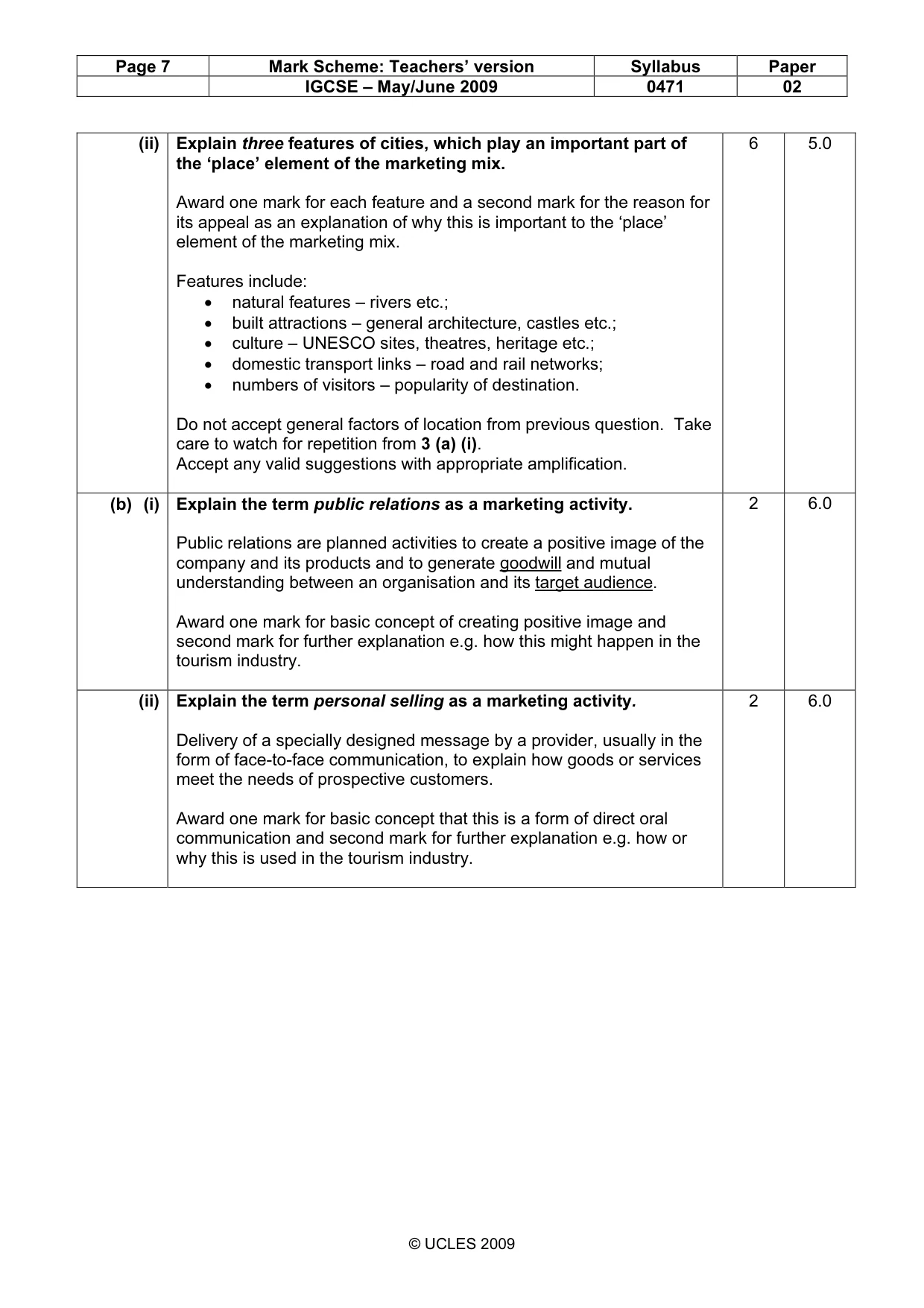
Page 7 Mark Scheme: Teachers’ version Syllabus Paper IGCSE – May/June 2009 0471 02 © UCLES 2009 (ii) Explain three features of cities, which play an important part of the ‘place’ element of the marketing mix. Award one mark for each feature and a second mark for the reason for its appeal as an explanation of why this is important to the ‘place’ element of the marketing mix. Features include: • natural features – rivers etc.; • built attractions – general architecture, castles etc.; • culture – UNESCO sites, theatres, heritage etc.; • domestic transport links – road and rail networks; • numbers of visitors – popularity of destination. Do not accept general factors of location from previous question. Take care to watch for repetition from 3 (a) (i). Accept any valid suggestions with appropriate amplification. 6 5.0 (b) (i) Explain the term public relations as a marketing activity. Public relations are planned activities to create a positive image of the company and its products and to generate goodwill and mutual understanding between an organisation and its target audience. Award one mark for basic concept of creating positive image and second mark for further explanation e.g. how this might happen in the tourism industry. 2 6.0 (ii) Explain the term personal selling as a marketing activity. Delivery of a specially designed message by a provider, usually in the form of face-to-face communication, to explain how goods or services meet the needs of prospective customers. Award one mark for basic concept that this is a form of direct oral communication and second mark for further explanation e.g. how or why this is used in the tourism industry. 2 6.0
Mark scheme, page 8
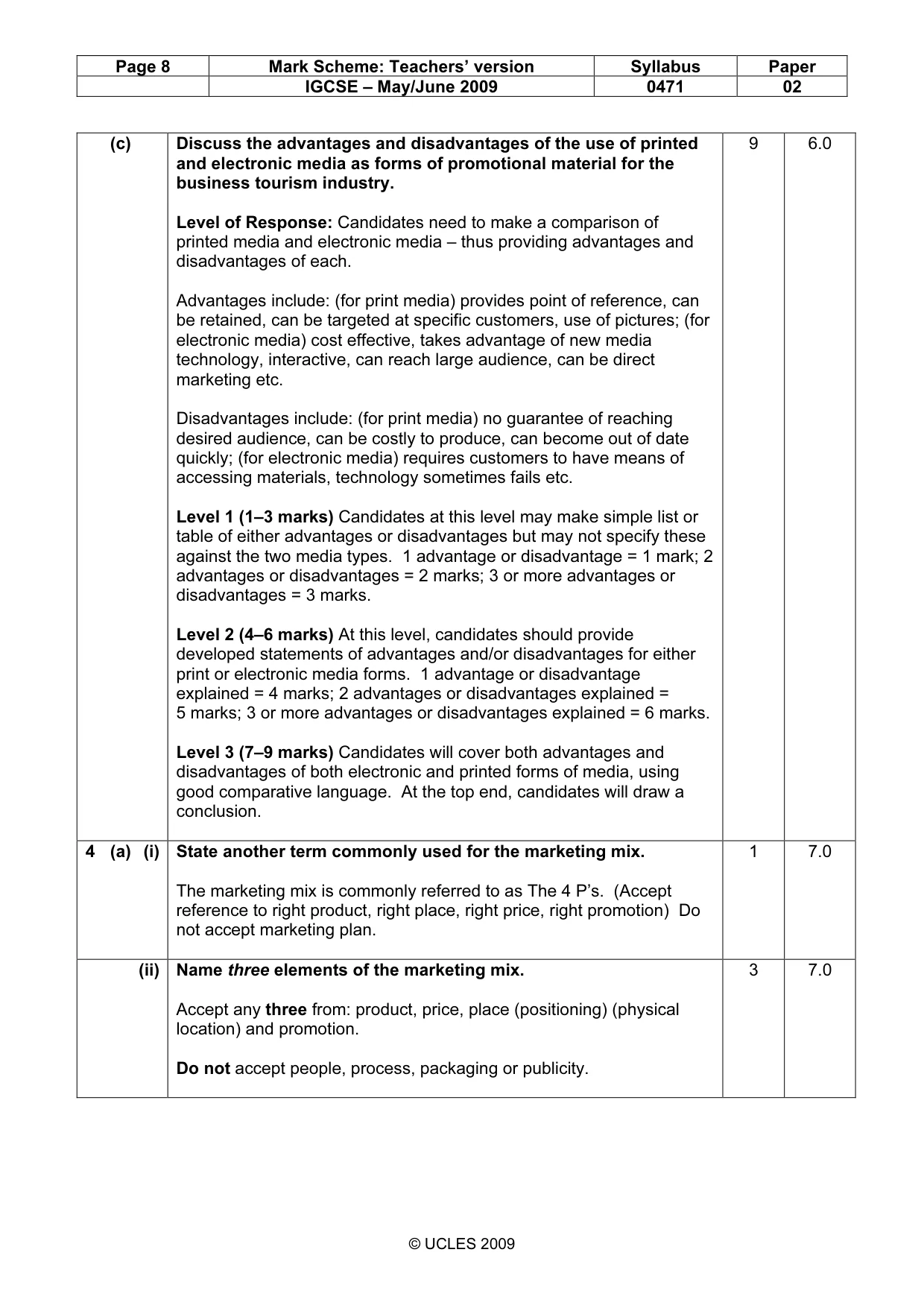
Page 8 Mark Scheme: Teachers’ version Syllabus Paper IGCSE – May/June 2009 0471 02 © UCLES 2009 (c) Discuss the advantages and disadvantages of the use of printed and electronic media as forms of promotional material for the business tourism industry. Level of Response: Candidates need to make a comparison of printed media and electronic media – thus providing advantages and disadvantages of each. Advantages include: (for print media) provides point of reference, can be retained, can be targeted at specific customers, use of pictures; (for electronic media) cost effective, takes advantage of new media technology, interactive, can reach large audience, can be direct marketing etc. Disadvantages include: (for print media) no guarantee of reaching desired audience, can be costly to produce, can become out of date quickly; (for electronic media) requires customers to have means of accessing materials, technology sometimes fails etc. Level 1 (1–3 marks) Candidates at this level may make simple list or table of either advantages or disadvantages but may not specify these against the two media types. 1 advantage or disadvantage = 1 mark; 2 advantages or disadvantages = 2 marks; 3 or more advantages or disadvantages = 3 marks. Level 2 (4–6 marks) At this level, candidates should provide developed statements of advantages and/or disadvantages for either print or electronic media forms. 1 advantage or disadvantage explained = 4 marks; 2 advantages or disadvantages explained = 5 marks; 3 or more advantages or disadvantages explained = 6 marks. Level 3 (7–9 marks) Candidates will cover both advantages and disadvantages of both electronic and printed forms of media, using good comparative language. At the top end, candidates will draw a conclusion. 9 6.0 4 (a) (i) State another term commonly used for the marketing mix. The marketing mix is commonly referred to as The 4 P’s. (Accept reference to right product, right place, right price, right promotion) Do not accept marketing plan. 1 7.0 (ii) Name three elements of the marketing mix. Accept any three from: product, price, place (positioning) (physical location) and promotion. Do not accept people, process, packaging or publicity. 3 7.0
Mark scheme, page 9
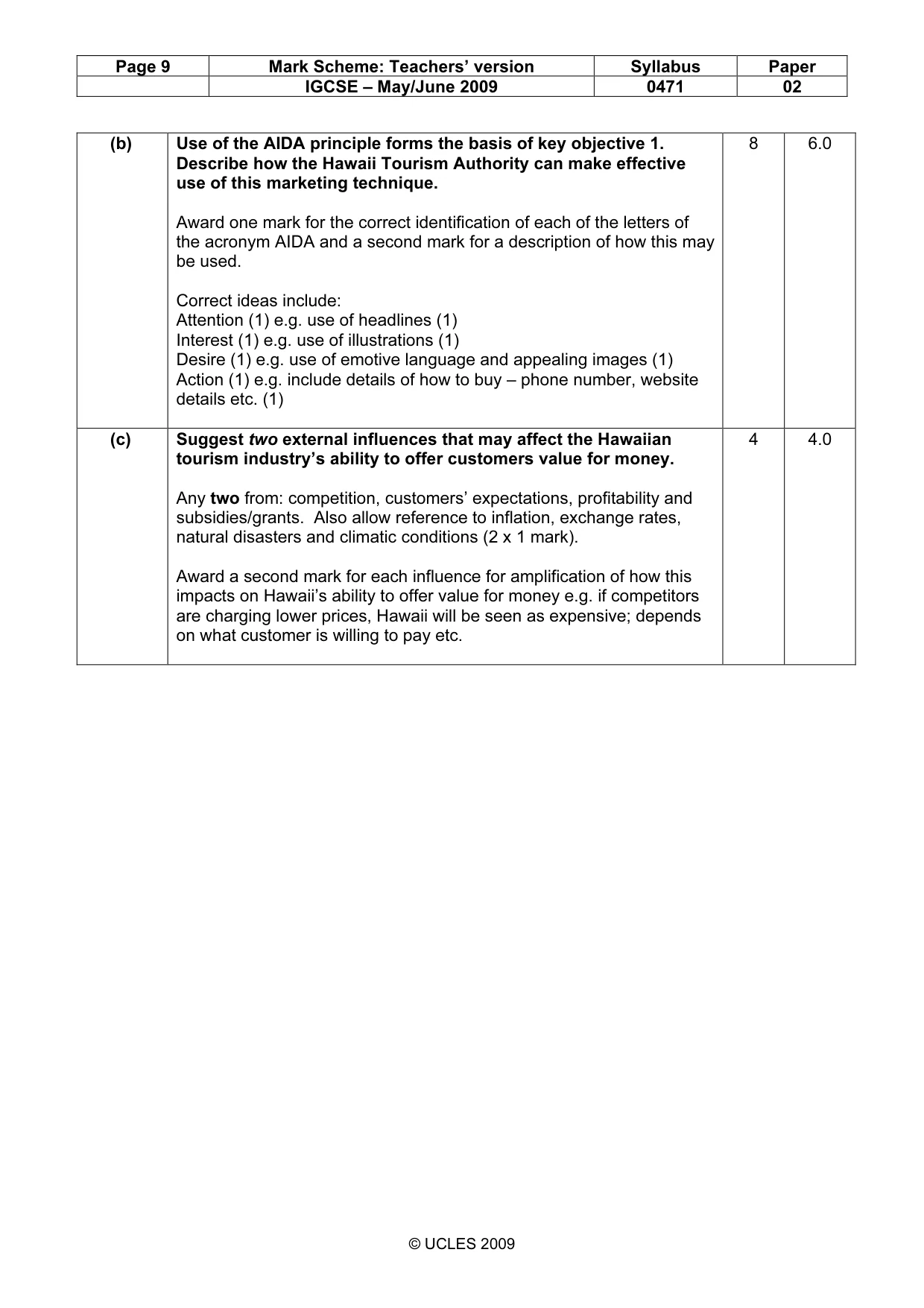
Page 9 Mark Scheme: Teachers’ version Syllabus Paper IGCSE – May/June 2009 0471 02 © UCLES 2009 (b) Use of the AIDA principle forms the basis of key objective 1. Describe how the Hawaii Tourism Authority can make effective use of this marketing technique. Award one mark for the correct identification of each of the letters of the acronym AIDA and a second mark for a description of how this may be used. Correct ideas include: Attention (1) e.g. use of headlines (1) Interest (1) e.g. use of illustrations (1) Desire (1) e.g. use of emotive language and appealing images (1) Action (1) e.g. include details of how to buy – phone number, website details etc. (1) 8 6.0 (c) Suggest two external influences that may affect the Hawaiian tourism industry’s ability to offer customers value for money. Any two from: competition, customers’ expectations, profitability and subsidies/grants. Also allow reference to inflation, exchange rates, natural disasters and climatic conditions (2 x 1 mark). Award a second mark for each influence for amplification of how this impacts on Hawaii’s ability to offer value for money e.g. if competitors are charging lower prices, Hawaii will be seen as expensive; depends on what customer is willing to pay etc. 4 4.0
Mark scheme, page 10
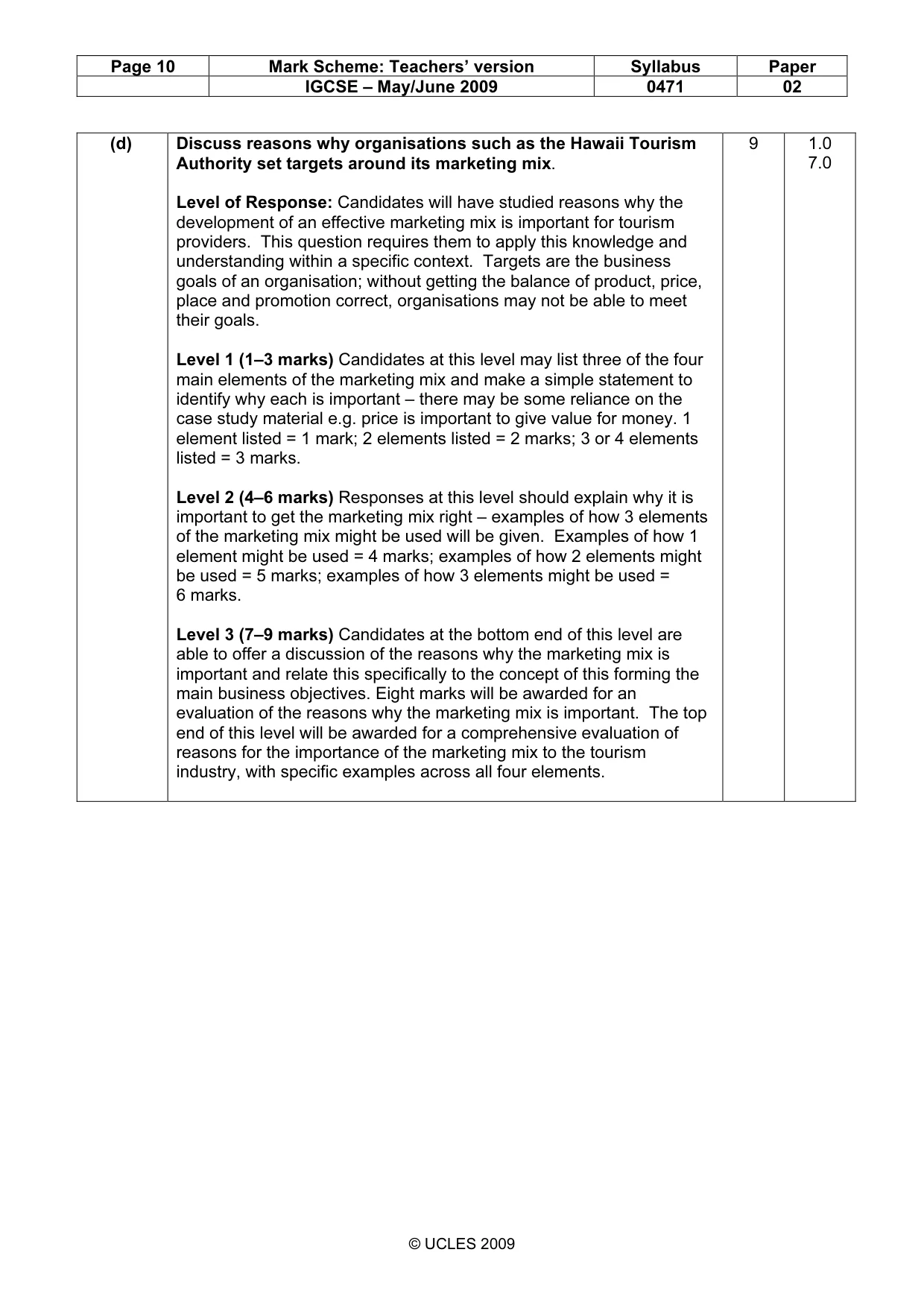
Page 10 Mark Scheme: Teachers’ version Syllabus Paper IGCSE – May/June 2009 0471 02 © UCLES 2009 (d) Discuss reasons why organisations such as the Hawaii Tourism Authority set targets around its marketing mix. Level of Response: Candidates will have studied reasons why the development of an effective marketing mix is important for tourism providers. This question requires them to apply this knowledge and understanding within a specific context. Targets are the business goals of an organisation; without getting the balance of product, price, place and promotion correct, organisations may not be able to meet their goals. Level 1 (1–3 marks) Candidates at this level may list three of the four main elements of the marketing mix and make a simple statement to identify why each is important – there may be some reliance on the case study material e.g. price is important to give value for money. 1 element listed = 1 mark; 2 elements listed = 2 marks; 3 or 4 elements listed = 3 marks. Level 2 (4–6 marks) Responses at this level should explain why it is important to get the marketing mix right – examples of how 3 elements of the marketing mix might be used will be given. Examples of how 1 element might be used = 4 marks; examples of how 2 elements might be used = 5 marks; examples of how 3 elements might be used = 6 marks. Level 3 (7–9 marks) Candidates at the bottom end of this level are able to offer a discussion of the reasons why the marketing mix is important and relate this specifically to the concept of this forming the main business objectives. Eight marks will be awarded for an evaluation of the reasons why the marketing mix is important. The top end of this level will be awarded for a comprehensive evaluation of reasons for the importance of the marketing mix to the tourism industry, with specific examples across all four elements. 9 1.0 7.0
What you needed in this session
Cambridge’s own grade thresholds for 2009 May/June, Paper 2 · Variant 1. A higher threshold means an easier paper — the bar moves with how the cohort did.