Cambridge IGCSE Travel and Tourism 0471 — 2008 Oct/Nov Paper 2 · Variant 1
0471/21/O/N/08 · 100 marks · ≈113 min
The question paper and its mark scheme, free to read here and free to download. This is Cambridge’s own paper, exactly as it was sat.
Question paper16 pages



Mark scheme10 pages
Answers below. Sit the paper first if you are practising.
Paper as text
Question paper, page 1
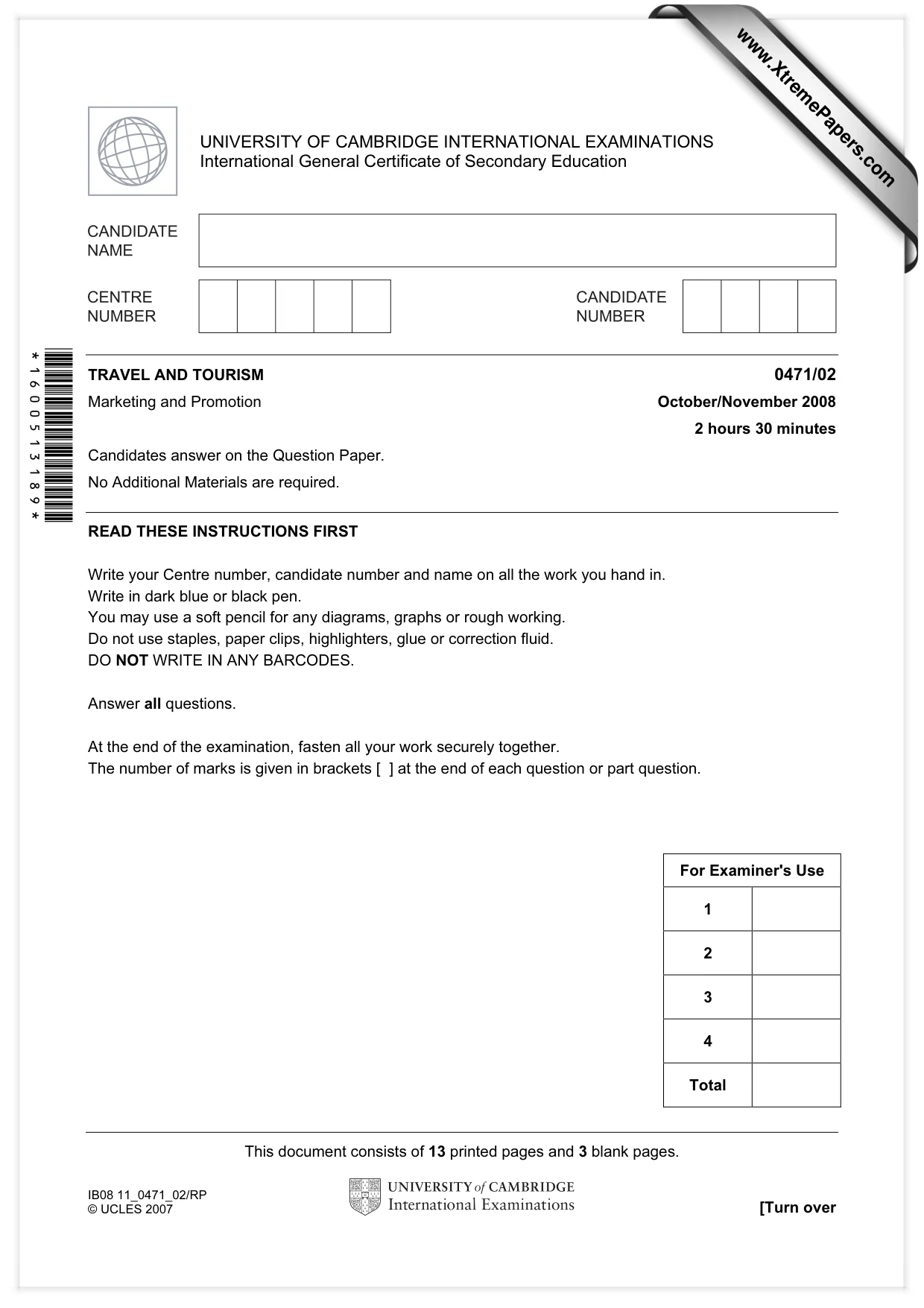
This document consists of 13 printed pages and 3 blank pages. IB08 11_0471_02/RP © UCLES 2007 [Turn over *1600513189* For Examiner's Use 1 2 3 4 Total UNIVERSITY OF CAMBRIDGE INTERNATIONAL EXAMINATIONS International General Certificate of Secondary Education TRAVEL AND TOURISM 0471/02 Marketing and Promotion October/November 2008 2 hours 30 minutes Candidates answer on the Question Paper. No Additional Materials are required. READ THESE INSTRUCTIONS FIRST Write your Centre number, candidate number and name on all the work you hand in. Write in dark blue or black pen. You may use a soft pencil for any diagrams, graphs or rough working. Do not use staples, paper clips, highlighters, glue or correction fluid. DO NOT WRITE IN ANY BARCODES. Answer all questions. At the end of the examination, fasten all your work securely together. The number of marks is given in brackets [ ] at the end of each question or part question. www.XtremePapers.com
Question paper, page 2
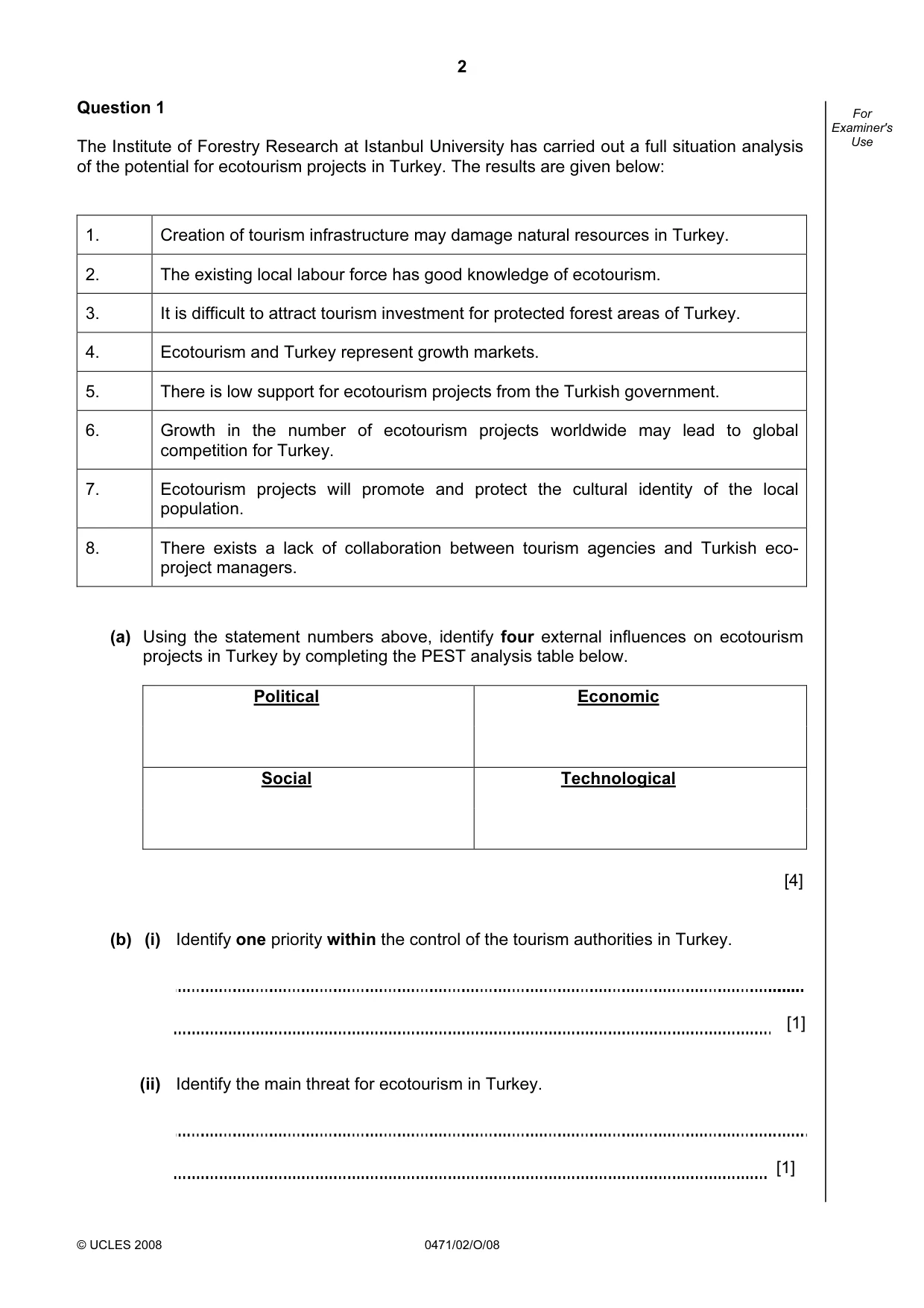
2 © UCLES 2008 0471/02/O/08 For Examiner's Use Question 1 The Institute of Forestry Research at Istanbul University has carried out a full situation analysis of the potential for ecotourism projects in Turkey. The results are given below: 1. Creation of tourism infrastructure may damage natural resources in Turkey. 2. The existing local labour force has good knowledge of ecotourism. 3. It is difficult to attract tourism investment for protected forest areas of Turkey. 4. Ecotourism and Turkey represent growth markets. 5. There is low support for ecotourism projects from the Turkish government. 6. Growth in the number of ecotourism projects worldwide may lead to global competition for Turkey. 7. Ecotourism projects will promote and protect the cultural identity of the local population. 8. There exists a lack of collaboration between tourism agencies and Turkish eco- project managers. (a) Using the statement numbers above, identify four external influences on ecotourism projects in Turkey by completing the PEST analysis table below. Political Economic Social Technological [4] (b) (i) Identify one priority within the control of the tourism authorities in Turkey. [1] (ii) Identify the main threat for ecotourism in Turkey. [1]
Question paper, page 3
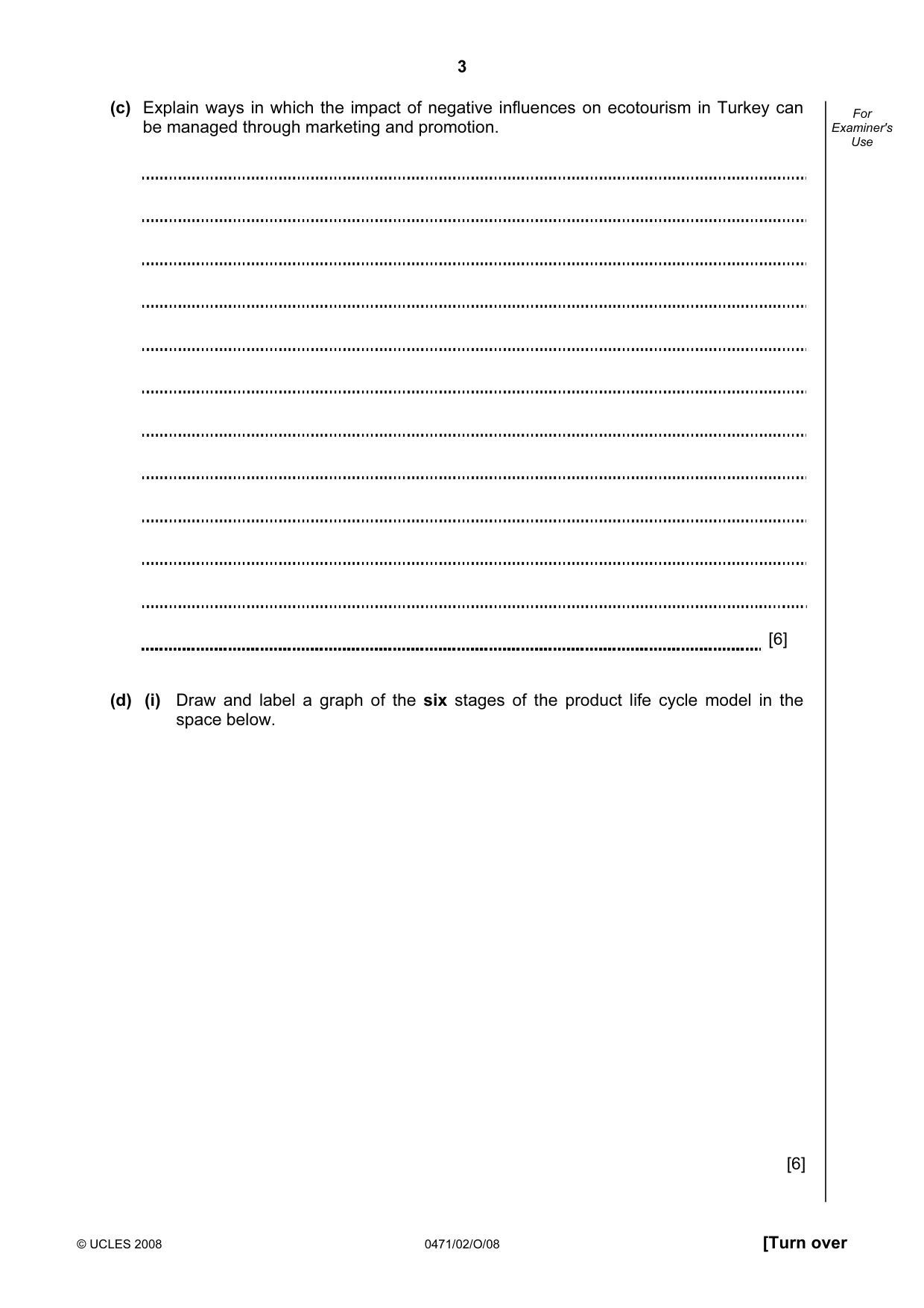
3 © UCLES 2008 0471/02/O/08 [Turn over For Examiner's Use (c) Explain ways in which the impact of negative influences on ecotourism in Turkey can be managed through marketing and promotion. [6] (d) (i) Draw and label a graph of the six stages of the product life cycle model in the space below. [6]
Question paper, page 4
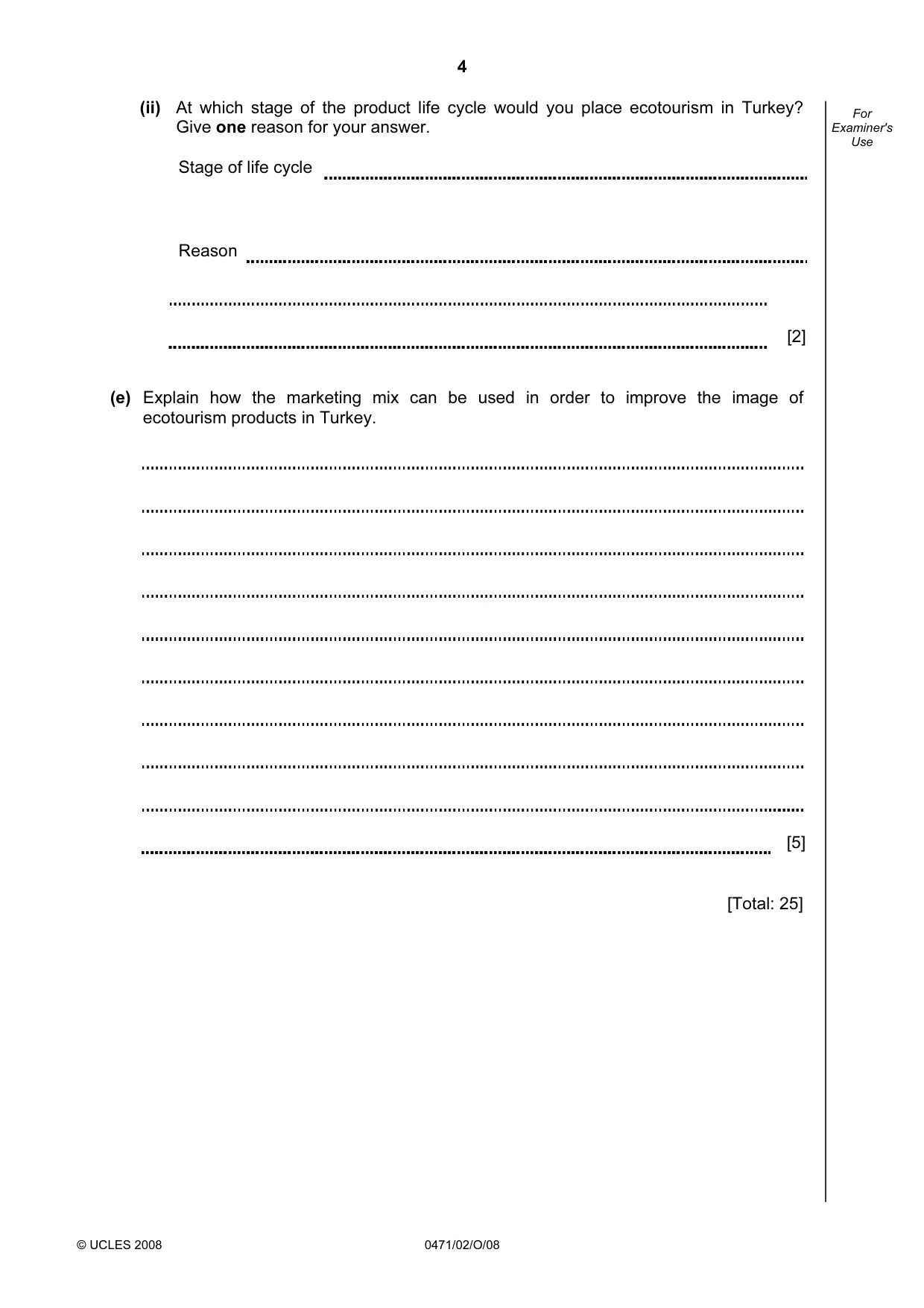
4 © UCLES 2008 0471/02/O/08 For Examiner's Use (ii) At which stage of the product life cycle would you place ecotourism in Turkey? Give one reason for your answer. Stage of life cycle Reason [2] (e) Explain how the marketing mix can be used in order to improve the image of ecotourism products in Turkey. [5] [Total: 25]
Question paper, page 6
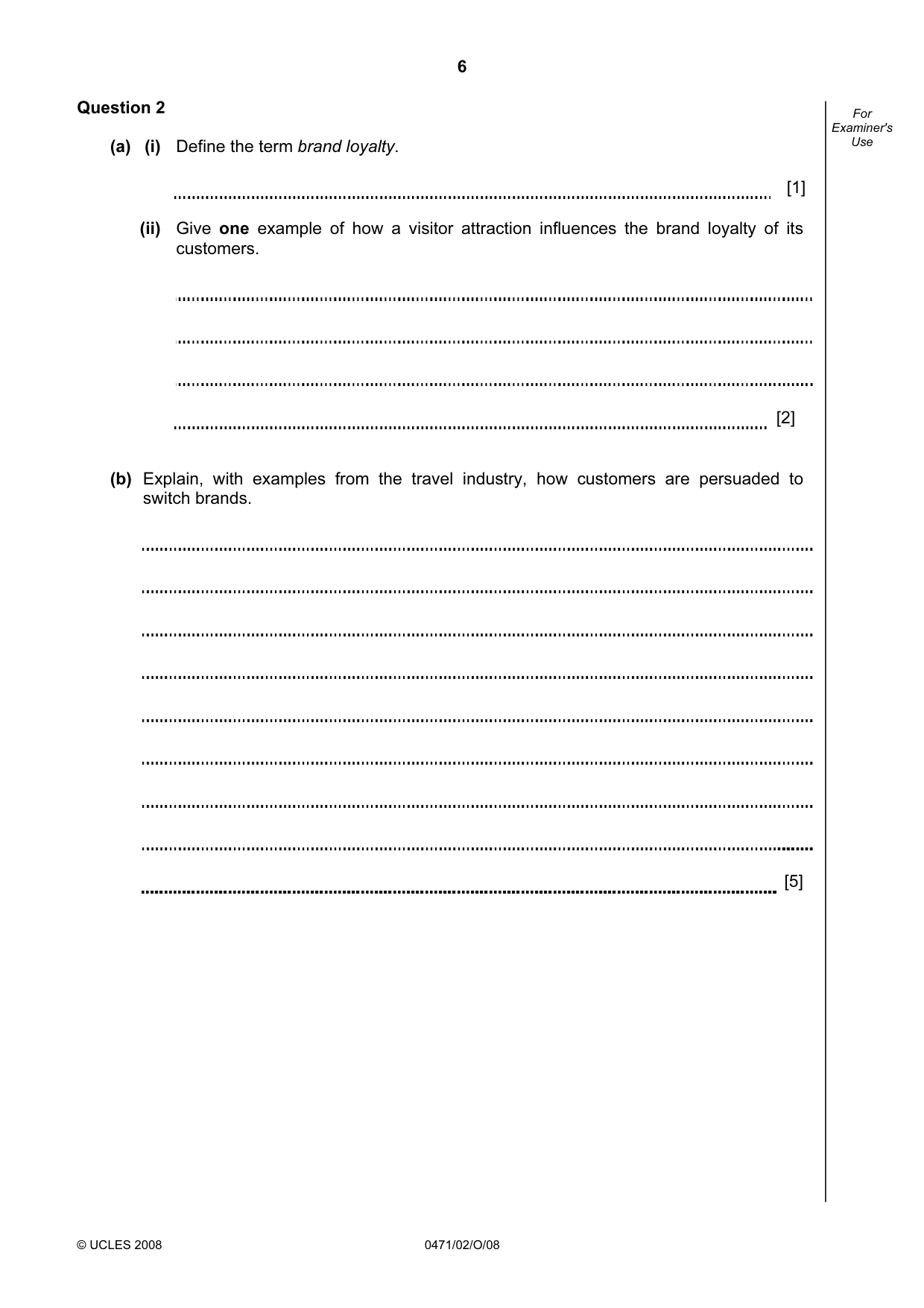
6 © UCLES 2008 0471/02/O/08 For Examiner's Use Question 2 (a) (i) Define the term brand loyalty. [1] (ii) Give one example of how a visitor attraction influences the brand loyalty of its customers. [2] (b) Explain, with examples from the travel industry, how customers are persuaded to switch brands. [5]
Question paper, page 7
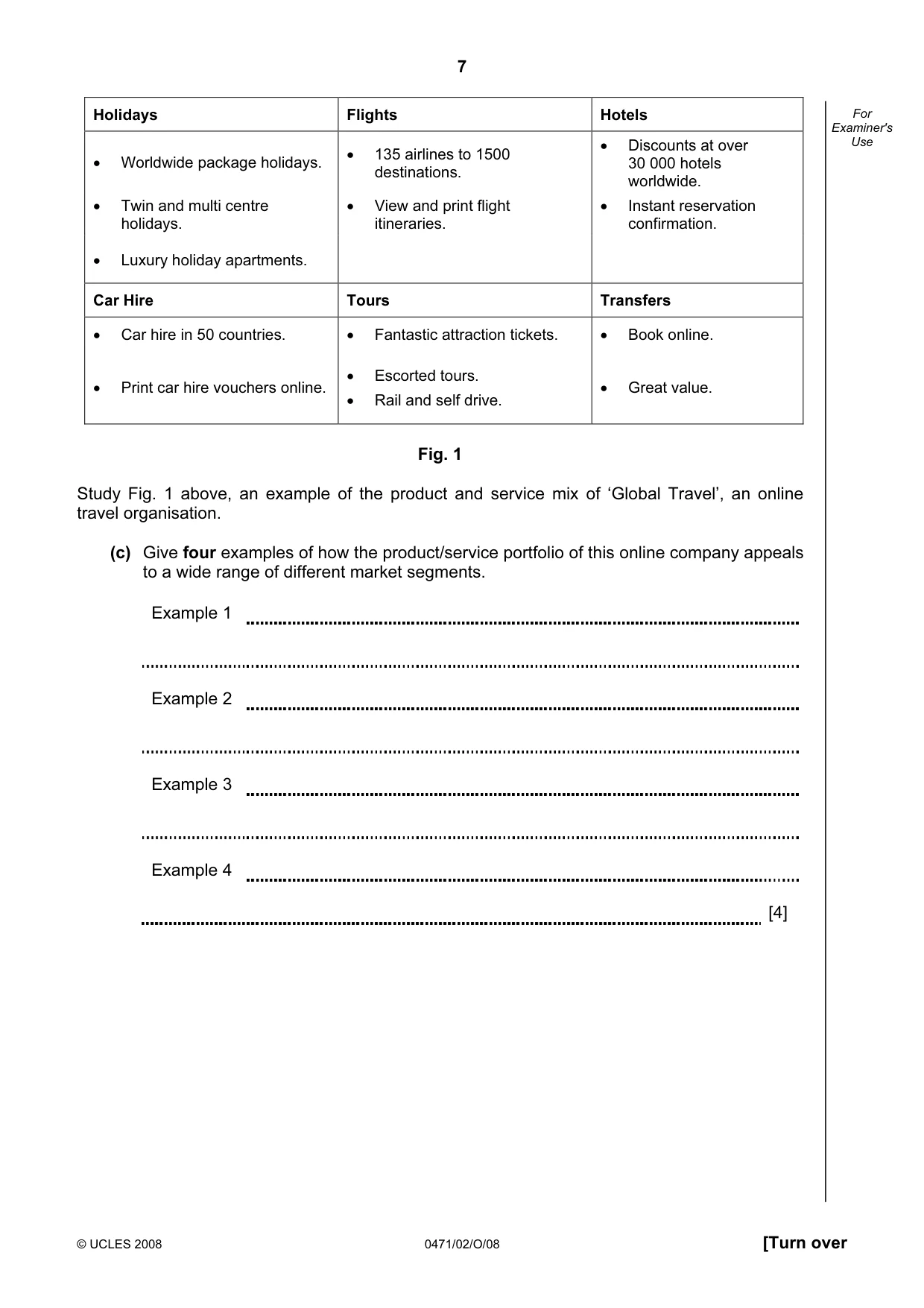
7 © UCLES 2008 0471/02/O/08 [Turn over For Examiner's Use Holidays Flights Hotels • Worldwide package holidays. • 135 airlines to 1500 destinations. • Discounts at over 30 000 hotels worldwide. • Twin and multi centre holidays. • View and print flight itineraries. • Instant reservation confirmation. • Luxury holiday apartments. Car Hire Tours Transfers • Car hire in 50 countries. • Fantastic attraction tickets. • Book online. • Print car hire vouchers online. • Escorted tours. • Rail and self drive. • Great value. Fig. 1 Study Fig. 1 above, an example of the product and service mix of ‘Global Travel’, an online travel organisation. (c) Give four examples of how the product/service portfolio of this online company appeals to a wide range of different market segments. Example 1 Example 2 Example 3 Example 4 [4]
Question paper, page 8
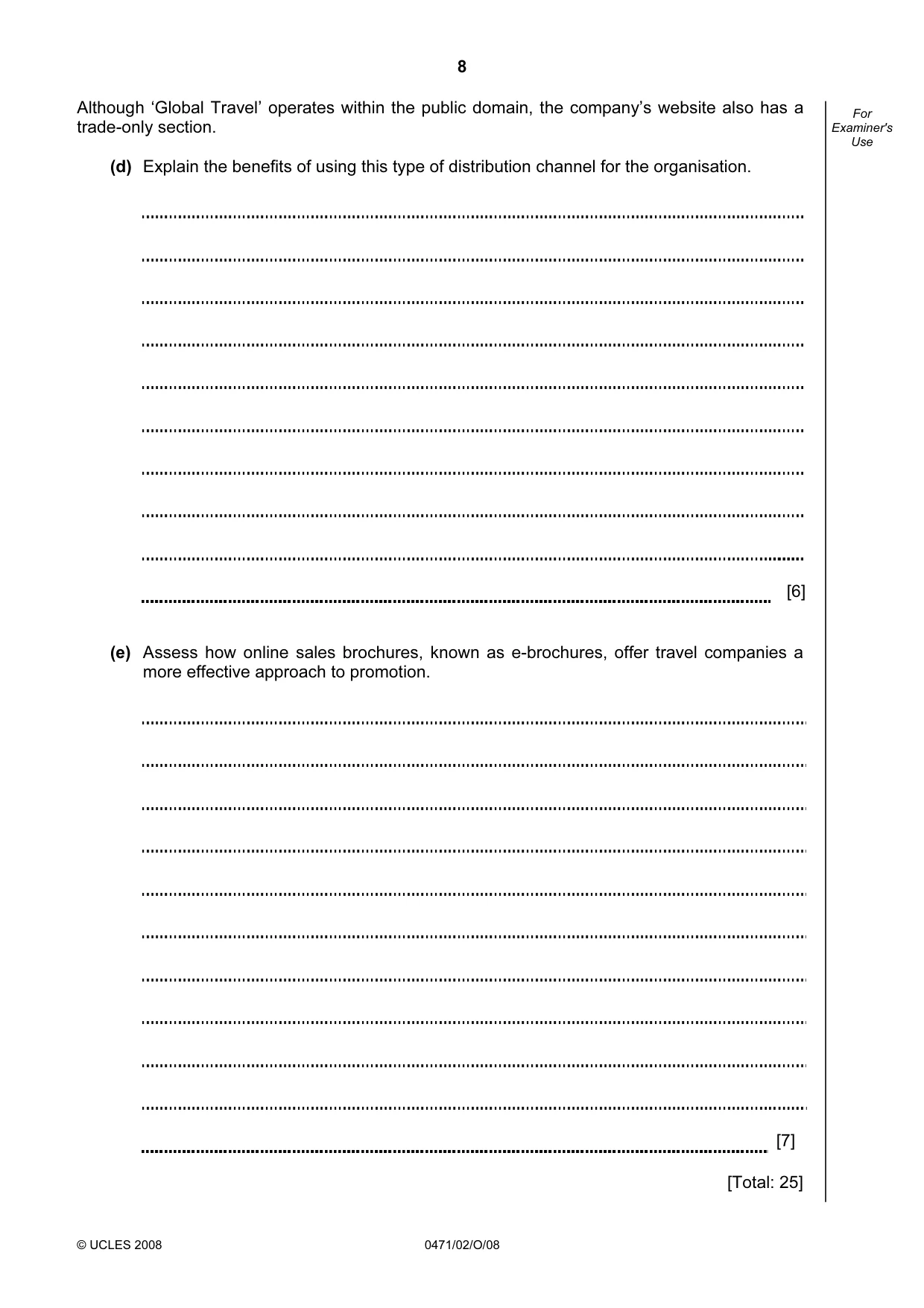
8 © UCLES 2008 0471/02/O/08 For Examiner's Use Although ‘Global Travel’ operates within the public domain, the company’s website also has a trade-only section. (d) Explain the benefits of using this type of distribution channel for the organisation. [6] (e) Assess how online sales brochures, known as e-brochures, offer travel companies a more effective approach to promotion. [7] [Total: 25]
Question paper, page 10
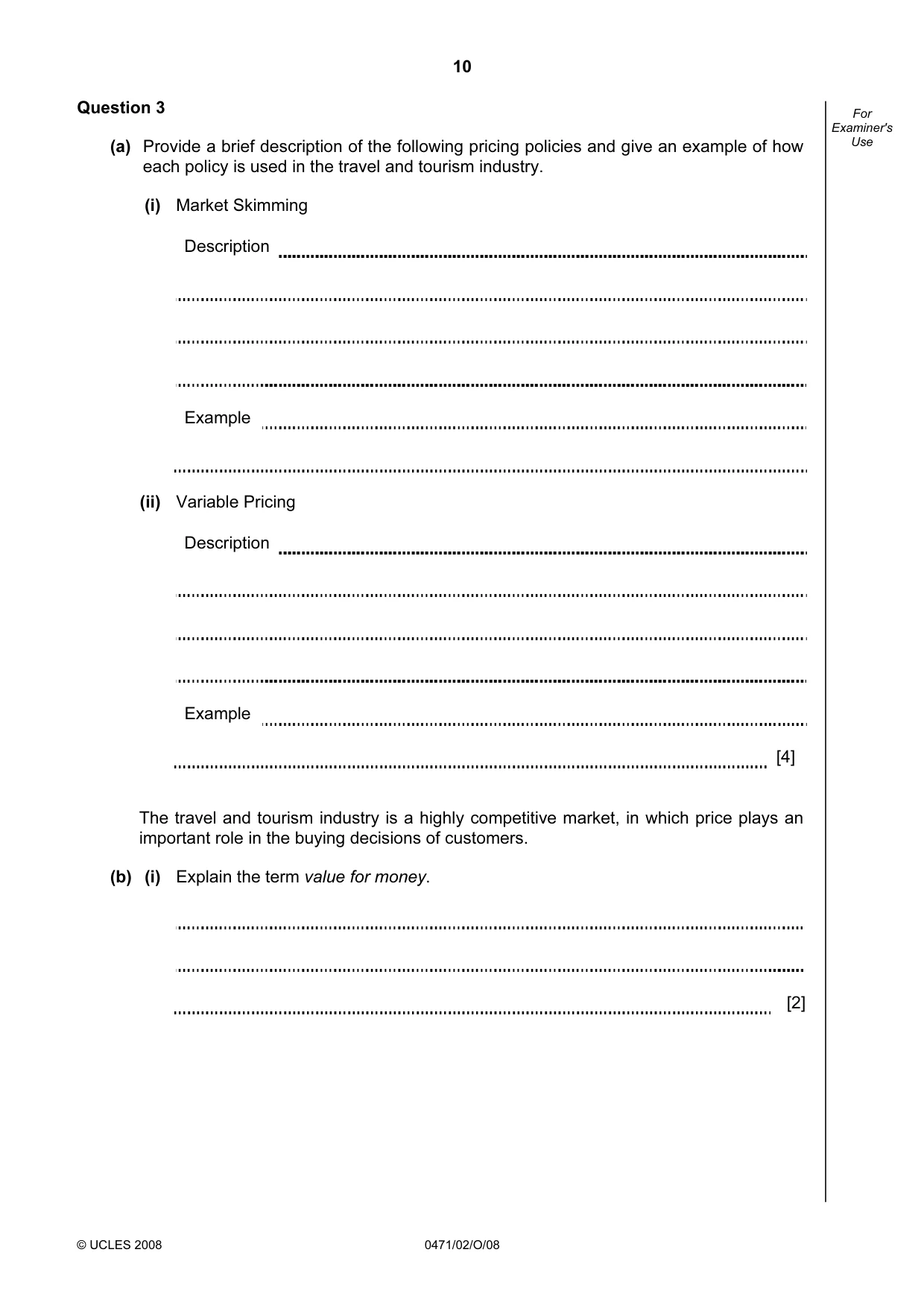
10 © UCLES 2008 0471/02/O/08 For Examiner's Use Question 3 (a) Provide a brief description of the following pricing policies and give an example of how each policy is used in the travel and tourism industry. (i) Market Skimming Description Example (ii) Variable Pricing Description Example [4] The travel and tourism industry is a highly competitive market, in which price plays an important role in the buying decisions of customers. (b) (i) Explain the term value for money. [2]
Question paper, page 11
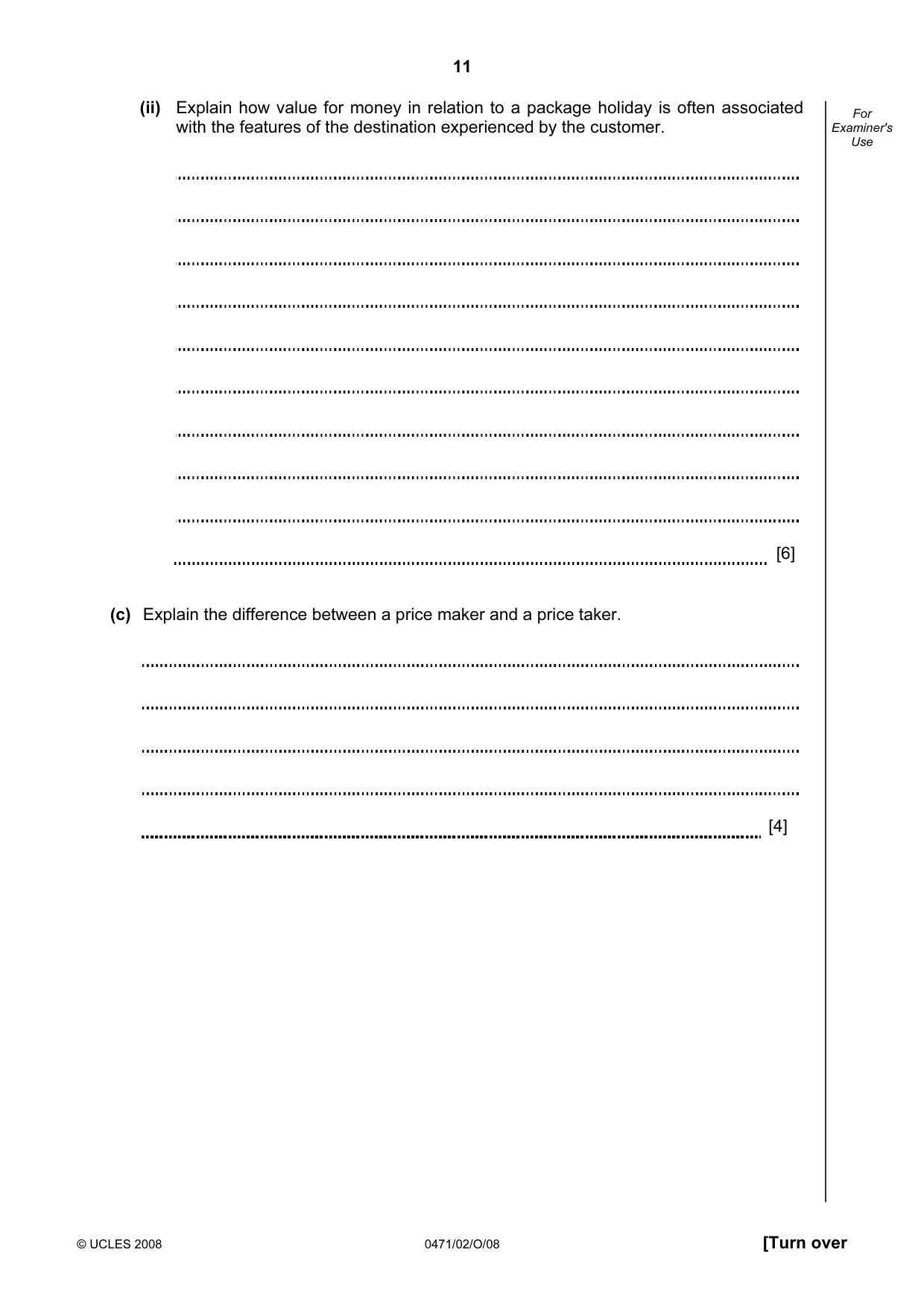
11 © UCLES 2008 0471/02/O/08 [Turn over For Examiner's Use (ii) Explain how value for money in relation to a package holiday is often associated with the features of the destination experienced by the customer. [6] (c) Explain the difference between a price maker and a price taker. [4]
Question paper, page 12
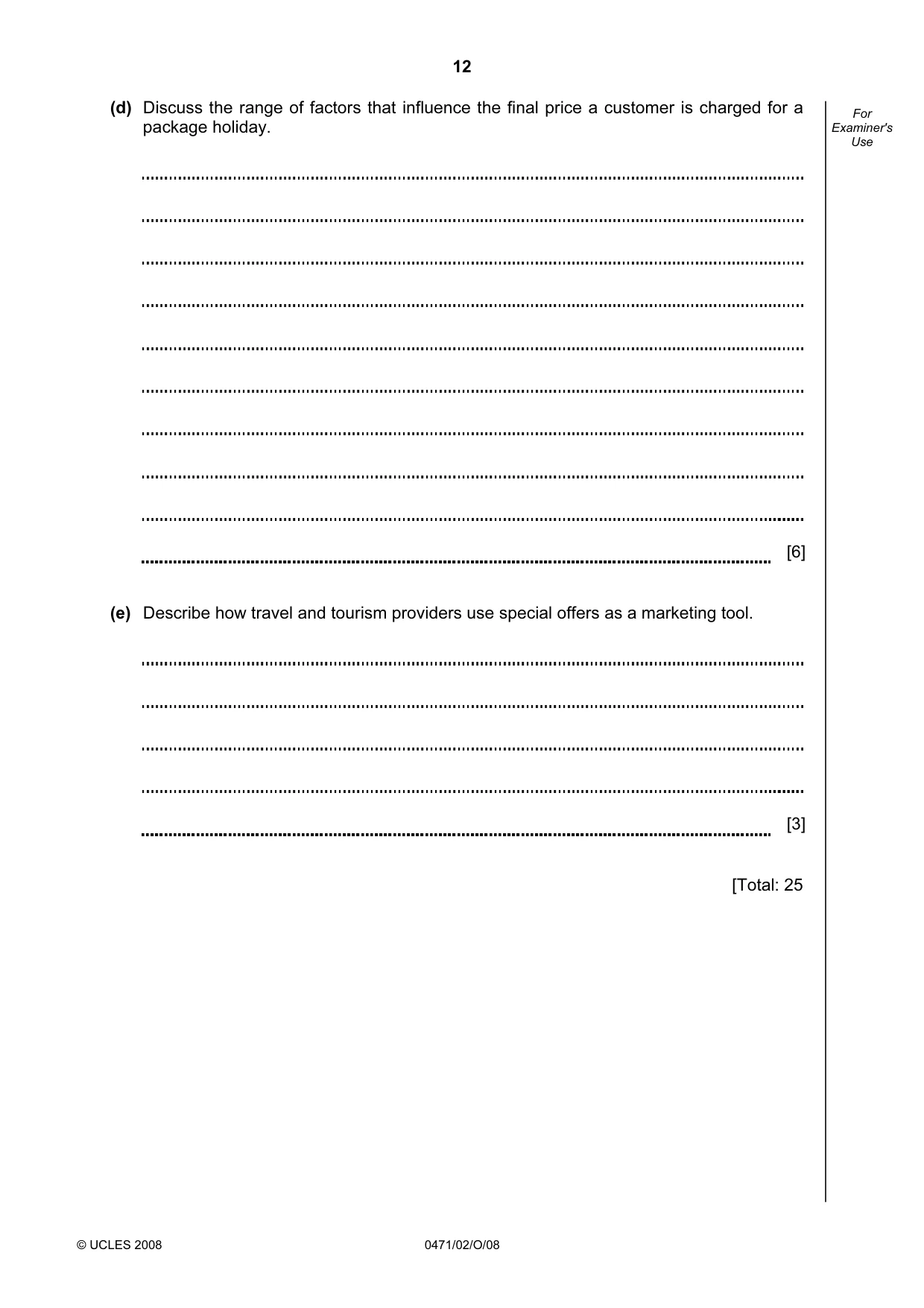
12 © UCLES 2008 0471/02/O/08 For Examiner's Use (d) Discuss the range of factors that influence the final price a customer is charged for a package holiday. [6] (e) Describe how travel and tourism providers use special offers as a marketing tool. [3] [Total: 25
Question paper, page 14
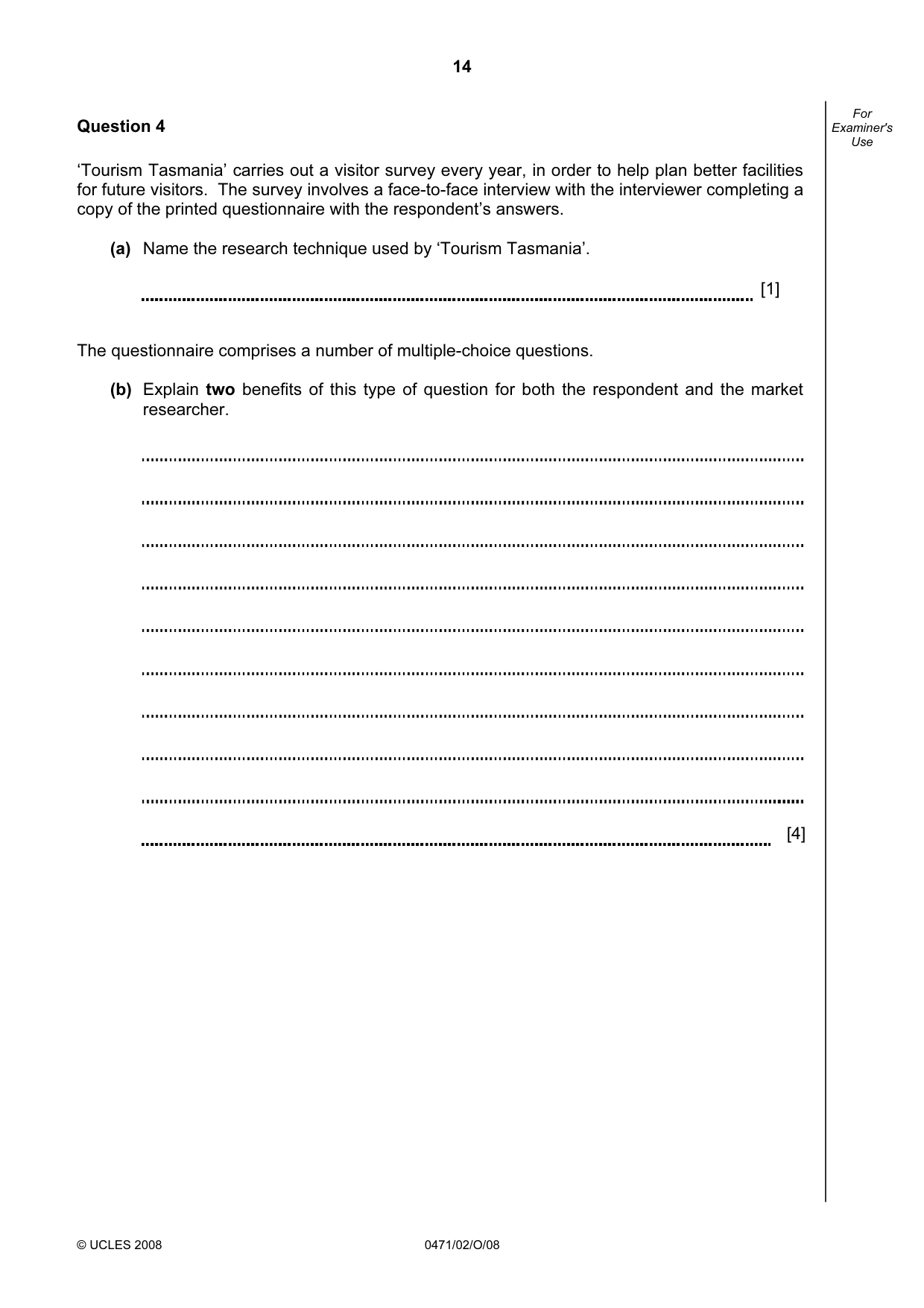
14 © UCLES 2008 0471/02/O/08 For Examiner's Use Question 4 ‘Tourism Tasmania’ carries out a visitor survey every year, in order to help plan better facilities for future visitors. The survey involves a face-to-face interview with the interviewer completing a copy of the printed questionnaire with the respondent’s answers. (a) Name the research technique used by ‘Tourism Tasmania’. [1] The questionnaire comprises a number of multiple-choice questions. (b) Explain two benefits of this type of question for both the respondent and the market researcher. [4]
Question paper, page 15
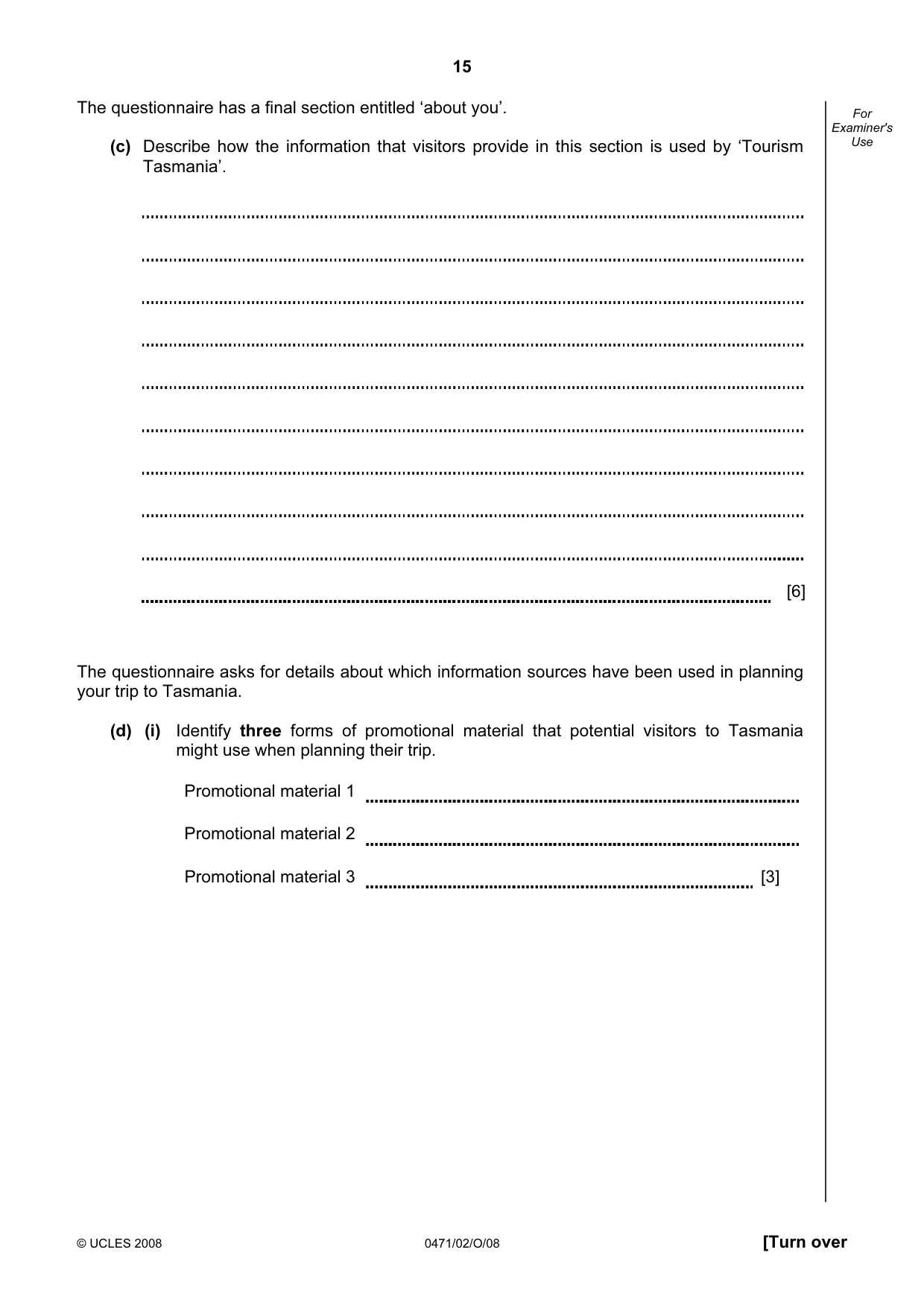
15 © UCLES 2008 0471/02/O/08 [Turn over For Examiner's Use The questionnaire has a final section entitled ‘about you’. (c) Describe how the information that visitors provide in this section is used by ‘Tourism Tasmania’. [6] The questionnaire asks for details about which information sources have been used in planning your trip to Tasmania. (d) (i) Identify three forms of promotional material that potential visitors to Tasmania might use when planning their trip. Promotional material 1 Promotional material 2 Promotional material 3 [3]
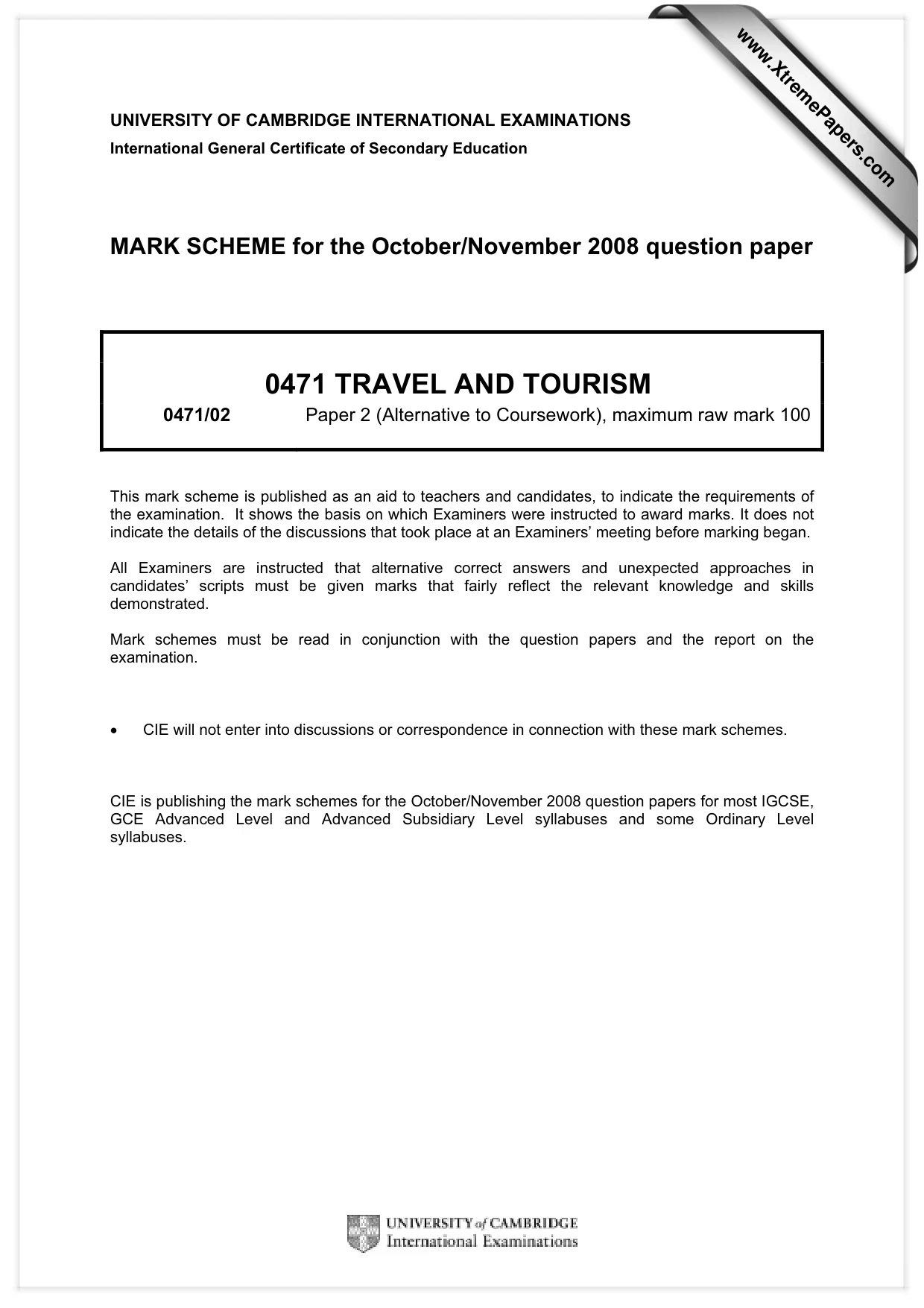
Question paper, page 16
16 Permission to reproduce items where third-party owned material protected by copyright is included has been sought and cleared where possible. Every reasonable effort has been made by the publisher (UCLES) to trace copyright holders, but if any items requiring clearance have unwittingly been included, the publisher will be pleased to make amends at the earliest possible opportunity. University of Cambridge International Examinations is part of the Cambridge Assessment Group. Cambridge Assessment is the brand name of University of Cambridge Local Examinations Syndicate (UCLES), which is itself a department of the University of Cambridge. © UCLES 2008 0471/02/O/08 For Examiner's Use (ii) Compare and contrast the effectiveness of two of these promotional materials in marketing tourism in Tasmania. [6] (e) Explain the marketing function of organisations such as ‘Tourism Tasmania’. [5] [Total: 25]
Mark scheme, page 1
UNIVERSITY OF CAMBRIDGE INTERNATIONAL EXAMINATIONS International General Certificate of Secondary Education MARK SCHEME for the October/November 2008 question paper 0471 TRAVEL AND TOURISM 0471/02 Paper 2 (Alternative to Coursework), maximum raw mark 100 This mark scheme is published as an aid to teachers and candidates, to indicate the requirements of the examination. It shows the basis on which Examiners were instructed to award marks. It does not indicate the details of the discussions that took place at an Examiners’ meeting before marking began. All Examiners are instructed that alternative correct answers and unexpected approaches in candidates’ scripts must be given marks that fairly reflect the relevant knowledge and skills demonstrated. Mark schemes must be read in conjunction with the question papers and the report on the examination. • CIE will not enter into discussions or correspondence in connection with these mark schemes. CIE is publishing the mark schemes for the October/November 2008 question papers for most IGCSE, GCE Advanced Level and Advanced Subsidiary Level syllabuses and some Ordinary Level syllabuses. www.XtremePapers.com
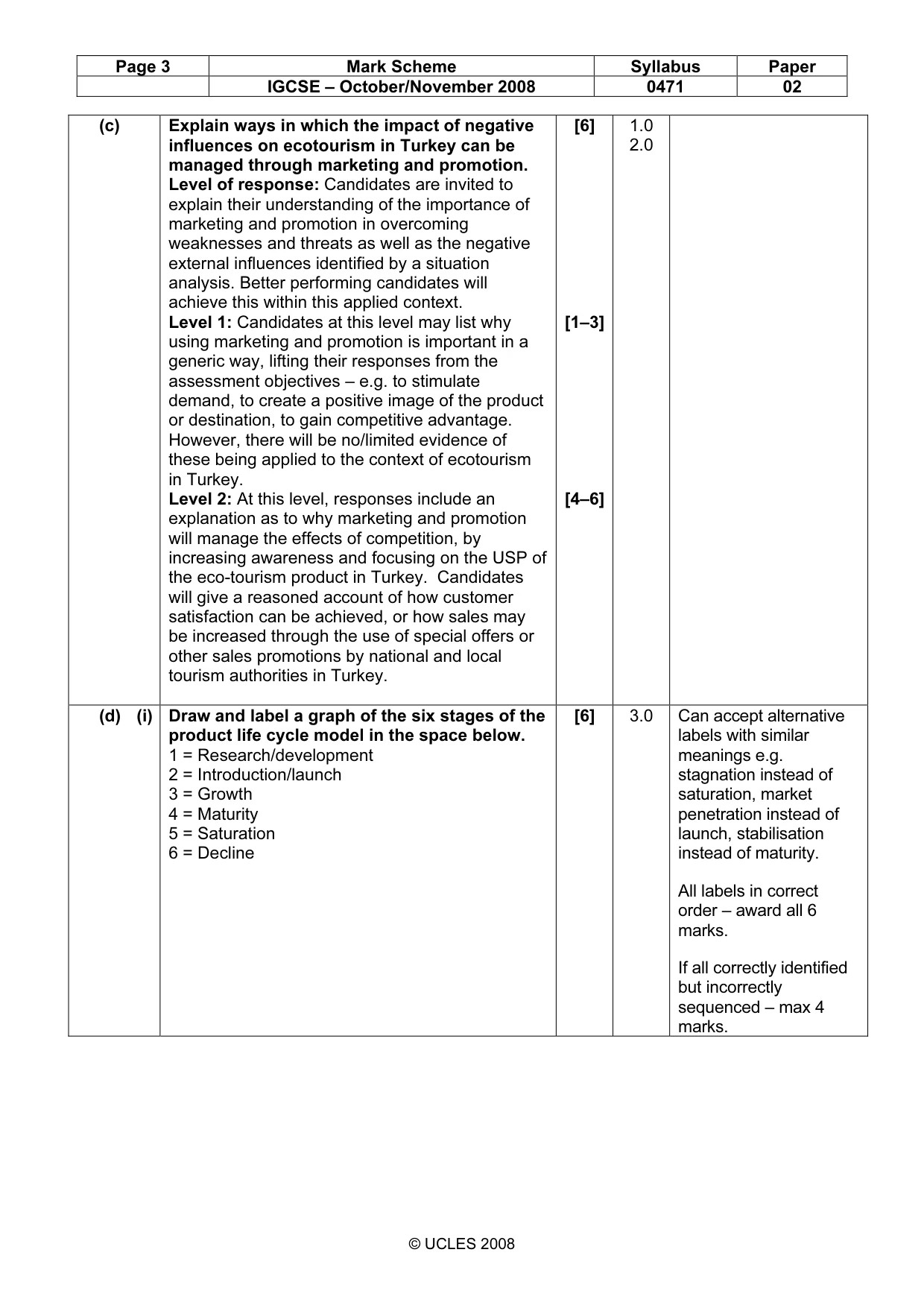
Mark scheme, page 2
Page 2 Mark Scheme Syllabus Paper IGCSE – October/November 2008 0471 02 © UCLES 2008 Question No Expected Response Mark Ass. Obj. Additional Guidance 1 (a) Using the statement numbers above, identify four external influences on ecotourism projects in Turkey by completing the PEST analysis table below. Political: 5 (Low support for eco tourism projects) or 8 (lack of collaboration) Economic: 3 (difficult to attract investment) or 6 (growth in number of eco tourism projects – competition) Social: 2 (labour force has good knowledge of eco tourism) or 7 (promote and protect cultural identity) Technological: 1 (infrastructure damage natural resources) [4] 2.0 Accept any four valid responses (b) (i) Identify one priority within the control of the tourism authorities in Turkey. 8 – lack of collaboration between tourism agencies and eco-project managers. [1] 2.0 (ii) Identify the main threat for ecotourism in Turkey. 6 – growth in number of ecotourism projects worldwide may lead to global competition for Turkey. [1] 2.0 Can also accept 3 – it is difficult to attract tourism investment for protected forest areas of Turkey. Do not accept 5 Low support from Turkish Govt – not a main threat
Mark scheme, page 3
Page 3 Mark Scheme Syllabus Paper IGCSE – October/November 2008 0471 02 © UCLES 2008 (c) Explain ways in which the impact of negative influences on ecotourism in Turkey can be managed through marketing and promotion. Level of response: Candidates are invited to explain their understanding of the importance of marketing and promotion in overcoming weaknesses and threats as well as the negative external influences identified by a situation analysis. Better performing candidates will achieve this within this applied context. Level 1: Candidates at this level may list why using marketing and promotion is important in a generic way, lifting their responses from the assessment objectives – e.g. to stimulate demand, to create a positive image of the product or destination, to gain competitive advantage. However, there will be no/limited evidence of these being applied to the context of ecotourism in Turkey. Level 2: At this level, responses include an explanation as to why marketing and promotion will manage the effects of competition, by increasing awareness and focusing on the USP of the eco-tourism product in Turkey. Candidates will give a reasoned account of how customer satisfaction can be achieved, or how sales may be increased through the use of special offers or other sales promotions by national and local tourism authorities in Turkey. [6] [1–3] [4–6] 1.0 2.0 (d) (i) Draw and label a graph of the six stages of the product life cycle model in the space below. 1 = Research/development 2 = Introduction/launch 3 = Growth 4 = Maturity 5 = Saturation 6 = Decline [6] 3.0 Can accept alternative labels with similar meanings e.g. stagnation instead of saturation, market penetration instead of launch, stabilisation instead of maturity. All labels in correct order – award all 6 marks. If all correctly identified but incorrectly sequenced – max 4 marks.
Mark scheme, page 4
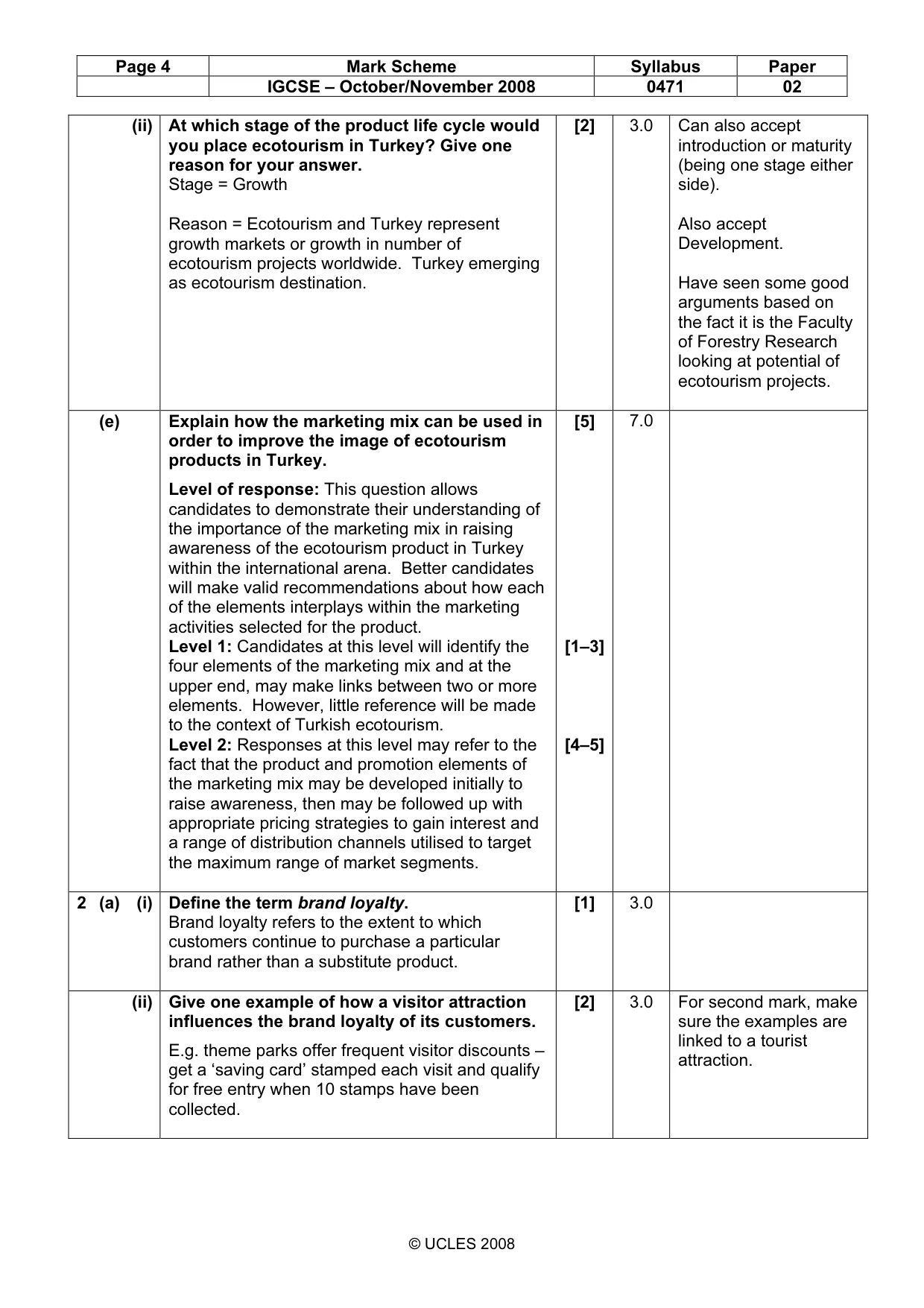
Page 4 Mark Scheme Syllabus Paper IGCSE – October/November 2008 0471 02 © UCLES 2008 (ii) At which stage of the product life cycle would you place ecotourism in Turkey? Give one reason for your answer. Stage = Growth Reason = Ecotourism and Turkey represent growth markets or growth in number of ecotourism projects worldwide. Turkey emerging as ecotourism destination. [2] 3.0 Can also accept introduction or maturity (being one stage either side). Also accept Development. Have seen some good arguments based on the fact it is the Faculty of Forestry Research looking at potential of ecotourism projects. (e) Explain how the marketing mix can be used in order to improve the image of ecotourism products in Turkey. Level of response: This question allows candidates to demonstrate their understanding of the importance of the marketing mix in raising awareness of the ecotourism product in Turkey within the international arena. Better candidates will make valid recommendations about how each of the elements interplays within the marketing activities selected for the product. Level 1: Candidates at this level will identify the four elements of the marketing mix and at the upper end, may make links between two or more elements. However, little reference will be made to the context of Turkish ecotourism. Level 2: Responses at this level may refer to the fact that the product and promotion elements of the marketing mix may be developed initially to raise awareness, then may be followed up with appropriate pricing strategies to gain interest and a range of distribution channels utilised to target the maximum range of market segments. [5] [1–3] [4–5] 7.0 2 (a) (i) Define the term brand loyalty. Brand loyalty refers to the extent to which customers continue to purchase a particular brand rather than a substitute product. [1] 3.0 (ii) Give one example of how a visitor attraction influences the brand loyalty of its customers. E.g. theme parks offer frequent visitor discounts – get a ‘saving card’ stamped each visit and qualify for free entry when 10 stamps have been collected. [2] 3.0 For second mark, make sure the examples are linked to a tourist attraction.
Mark scheme, page 5
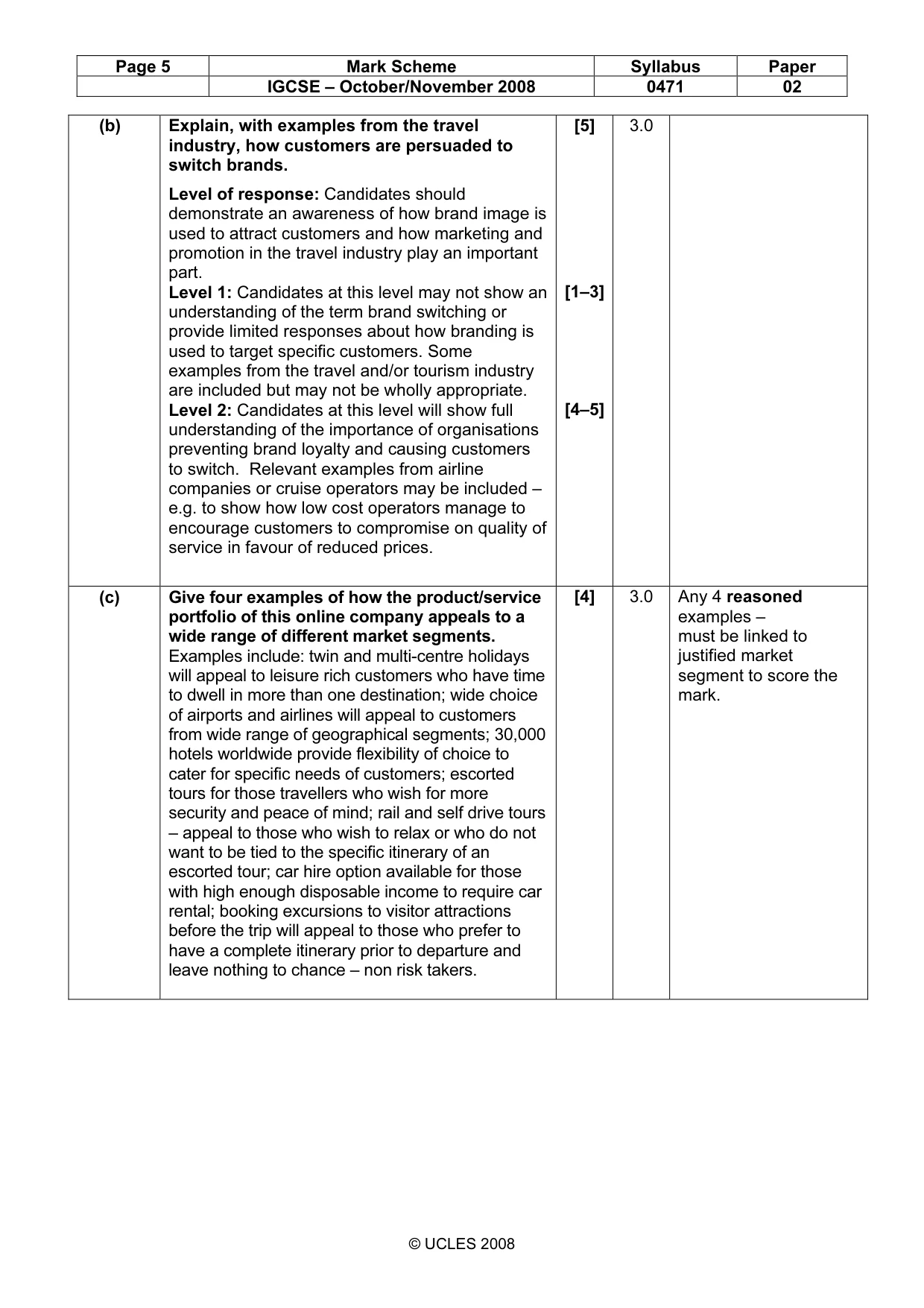
Page 5 Mark Scheme Syllabus Paper IGCSE – October/November 2008 0471 02 © UCLES 2008 (b) Explain, with examples from the travel industry, how customers are persuaded to switch brands. Level of response: Candidates should demonstrate an awareness of how brand image is used to attract customers and how marketing and promotion in the travel industry play an important part. Level 1: Candidates at this level may not show an understanding of the term brand switching or provide limited responses about how branding is used to target specific customers. Some examples from the travel and/or tourism industry are included but may not be wholly appropriate. Level 2: Candidates at this level will show full understanding of the importance of organisations preventing brand loyalty and causing customers to switch. Relevant examples from airline companies or cruise operators may be included – e.g. to show how low cost operators manage to encourage customers to compromise on quality of service in favour of reduced prices. [5] [1–3] [4–5] 3.0 (c) Give four examples of how the product/service portfolio of this online company appeals to a wide range of different market segments. Examples include: twin and multi-centre holidays will appeal to leisure rich customers who have time to dwell in more than one destination; wide choice of airports and airlines will appeal to customers from wide range of geographical segments; 30,000 hotels worldwide provide flexibility of choice to cater for specific needs of customers; escorted tours for those travellers who wish for more security and peace of mind; rail and self drive tours – appeal to those who wish to relax or who do not want to be tied to the specific itinerary of an escorted tour; car hire option available for those with high enough disposable income to require car rental; booking excursions to visitor attractions before the trip will appeal to those who prefer to have a complete itinerary prior to departure and leave nothing to chance – non risk takers. [4] 3.0 Any 4 reasoned examples – must be linked to justified market segment to score the mark.
Mark scheme, page 6
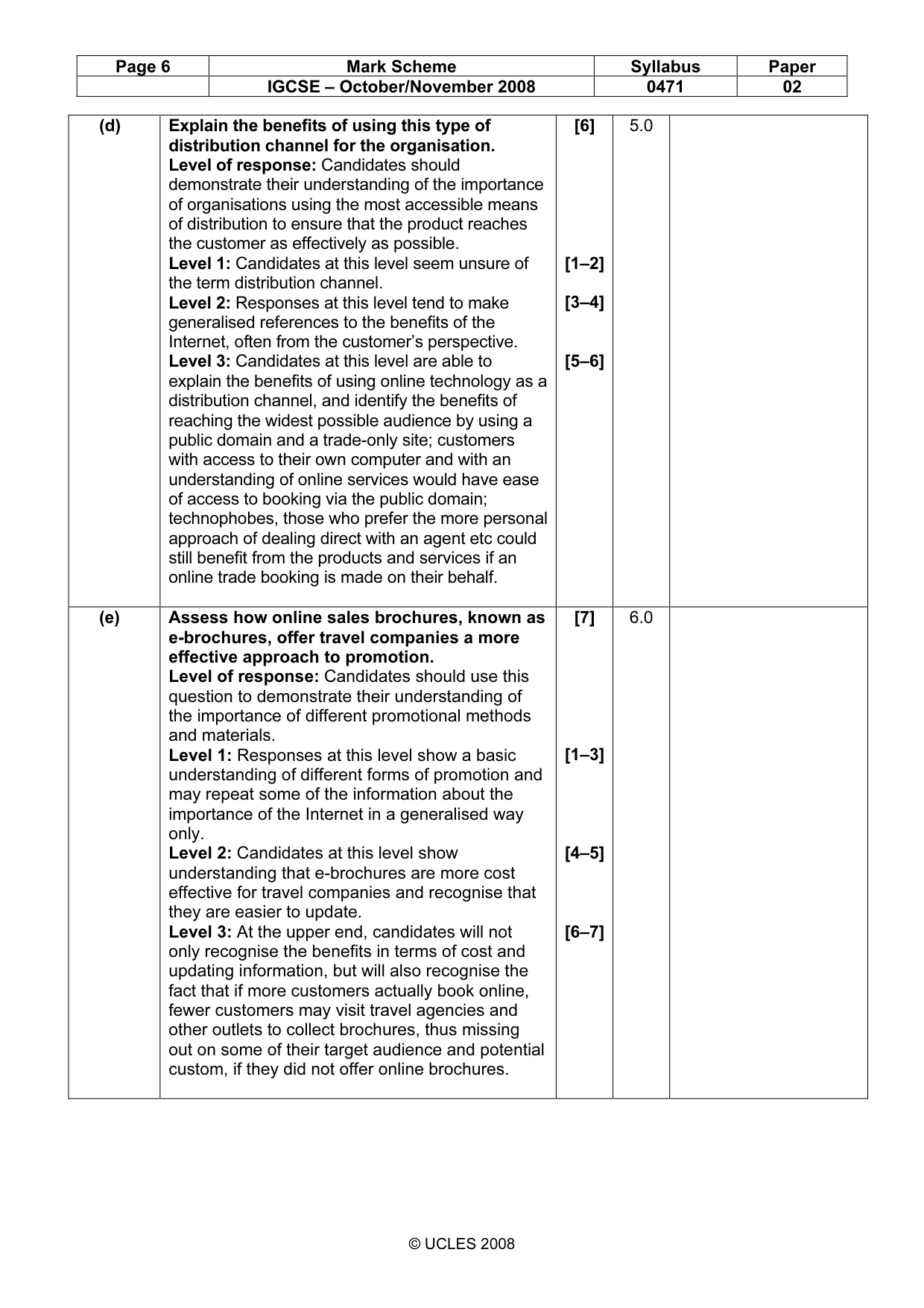
Page 6 Mark Scheme Syllabus Paper IGCSE – October/November 2008 0471 02 © UCLES 2008 (d) Explain the benefits of using this type of distribution channel for the organisation. Level of response: Candidates should demonstrate their understanding of the importance of organisations using the most accessible means of distribution to ensure that the product reaches the customer as effectively as possible. Level 1: Candidates at this level seem unsure of the term distribution channel. Level 2: Responses at this level tend to make generalised references to the benefits of the Internet, often from the customer’s perspective. Level 3: Candidates at this level are able to explain the benefits of using online technology as a distribution channel, and identify the benefits of reaching the widest possible audience by using a public domain and a trade-only site; customers with access to their own computer and with an understanding of online services would have ease of access to booking via the public domain; technophobes, those who prefer the more personal approach of dealing direct with an agent etc could still benefit from the products and services if an online trade booking is made on their behalf. [6] [1–2] [3–4] [5–6] 5.0 (e) Assess how online sales brochures, known as e-brochures, offer travel companies a more effective approach to promotion. Level of response: Candidates should use this question to demonstrate their understanding of the importance of different promotional methods and materials. Level 1: Responses at this level show a basic understanding of different forms of promotion and may repeat some of the information about the importance of the Internet in a generalised way only. Level 2: Candidates at this level show understanding that e-brochures are more cost effective for travel companies and recognise that they are easier to update. Level 3: At the upper end, candidates will not only recognise the benefits in terms of cost and updating information, but will also recognise the fact that if more customers actually book online, fewer customers may visit travel agencies and other outlets to collect brochures, thus missing out on some of their target audience and potential custom, if they did not offer online brochures. [7] [1–3] [4–5] [6–7] 6.0
Mark scheme, page 7
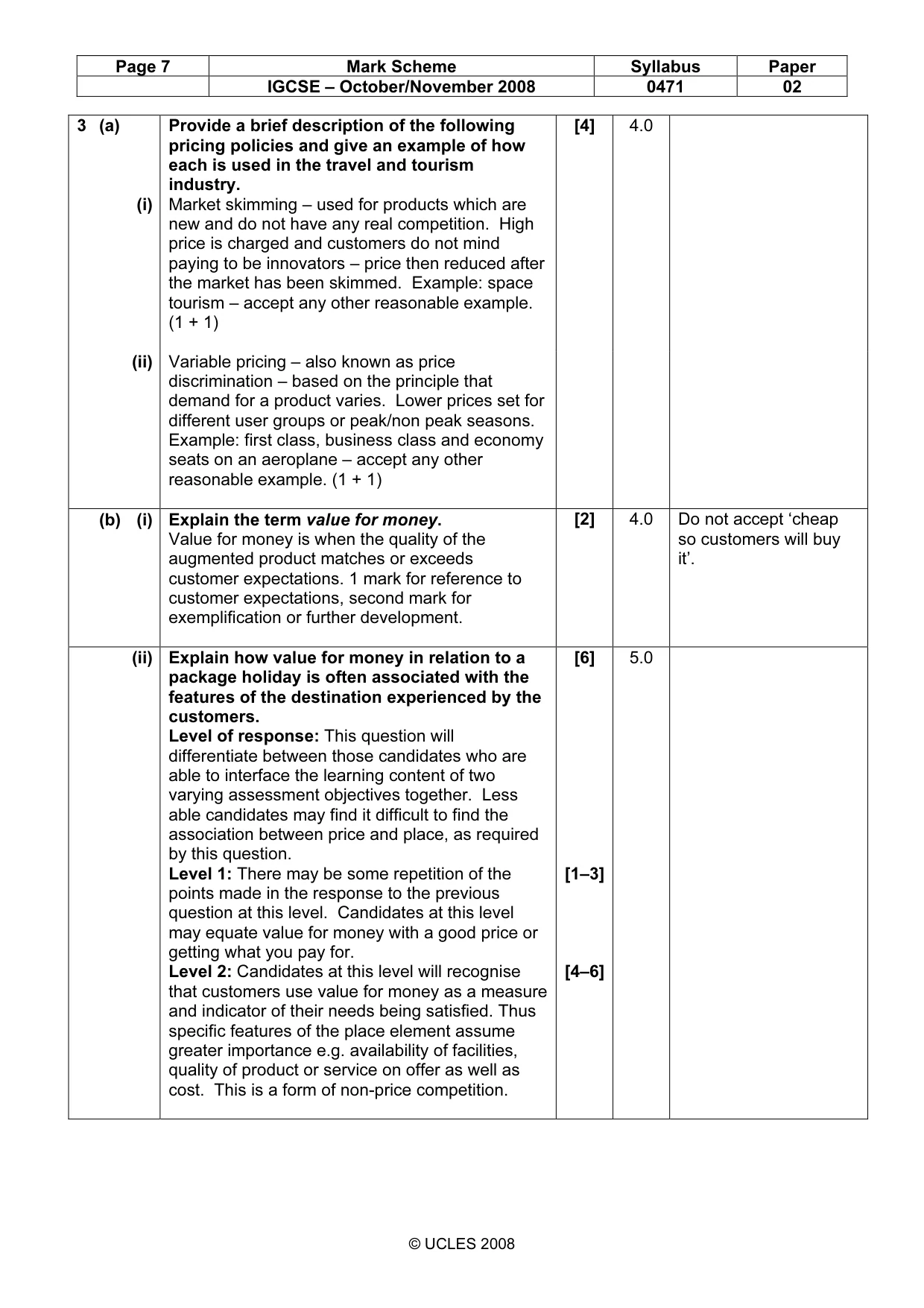
Page 7 Mark Scheme Syllabus Paper IGCSE – October/November 2008 0471 02 © UCLES 2008 3 (a) (i) Provide a brief description of the following pricing policies and give an example of how each is used in the travel and tourism industry. Market skimming – used for products which are new and do not have any real competition. High price is charged and customers do not mind paying to be innovators – price then reduced after the market has been skimmed. Example: space tourism – accept any other reasonable example. (1 + 1) [4] 4.0 (ii) Variable pricing – also known as price discrimination – based on the principle that demand for a product varies. Lower prices set for different user groups or peak/non peak seasons. Example: first class, business class and economy seats on an aeroplane – accept any other reasonable example. (1 + 1) (b) (i) Explain the term value for money. Value for money is when the quality of the augmented product matches or exceeds customer expectations. 1 mark for reference to customer expectations, second mark for exemplification or further development. [2] 4.0 Do not accept ‘cheap so customers will buy it’. (ii) Explain how value for money in relation to a package holiday is often associated with the features of the destination experienced by the customers. Level of response: This question will differentiate between those candidates who are able to interface the learning content of two varying assessment objectives together. Less able candidates may find it difficult to find the association between price and place, as required by this question. Level 1: There may be some repetition of the points made in the response to the previous question at this level. Candidates at this level may equate value for money with a good price or getting what you pay for. Level 2: Candidates at this level will recognise that customers use value for money as a measure and indicator of their needs being satisfied. Thus specific features of the place element assume greater importance e.g. availability of facilities, quality of product or service on offer as well as cost. This is a form of non-price competition. [6] [1–3] [4–6] 5.0
Mark scheme, page 8
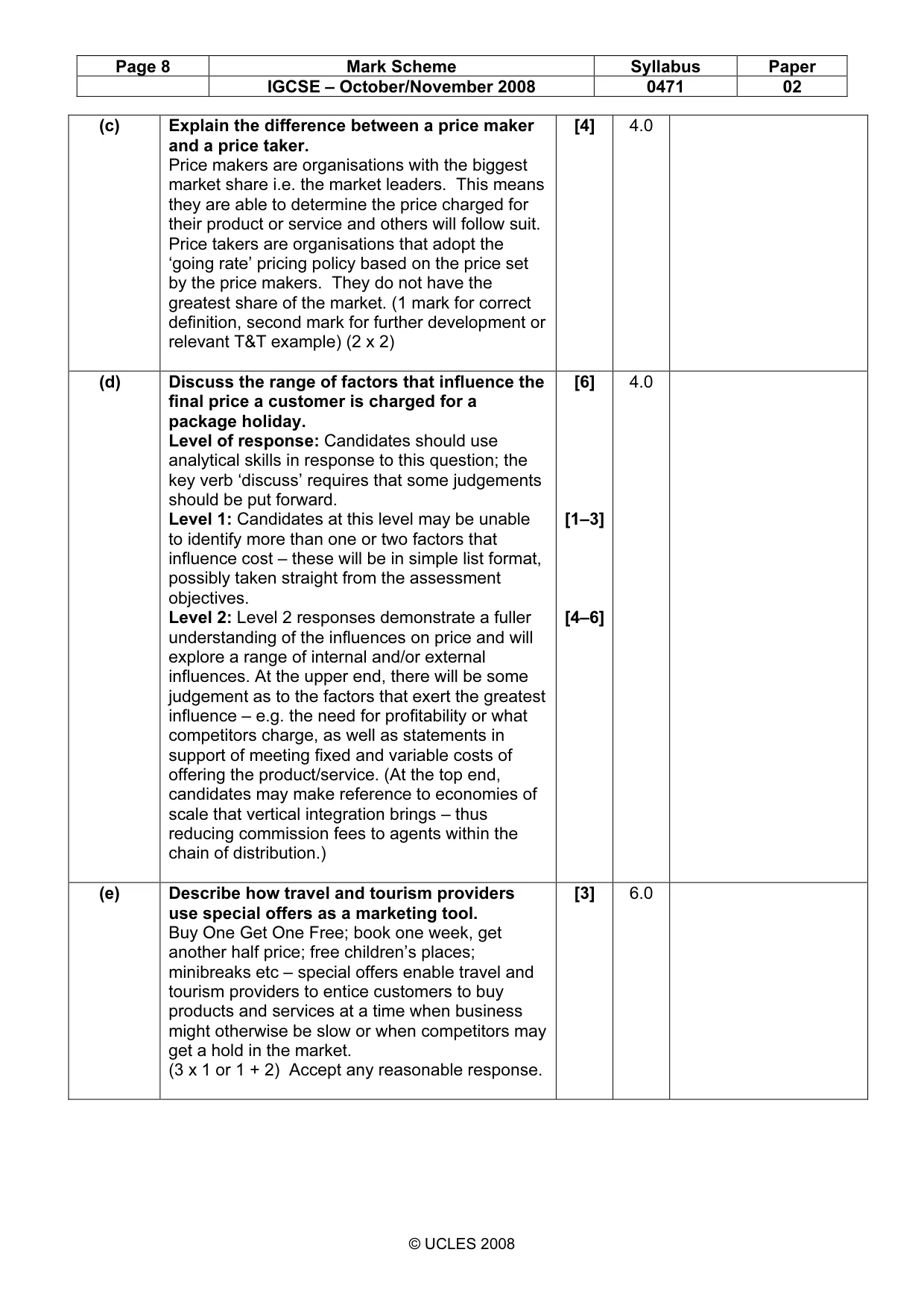
Page 8 Mark Scheme Syllabus Paper IGCSE – October/November 2008 0471 02 © UCLES 2008 (c) Explain the difference between a price maker and a price taker. Price makers are organisations with the biggest market share i.e. the market leaders. This means they are able to determine the price charged for their product or service and others will follow suit. Price takers are organisations that adopt the ‘going rate’ pricing policy based on the price set by the price makers. They do not have the greatest share of the market. (1 mark for correct definition, second mark for further development or relevant T&T example) (2 x 2) [4] 4.0 (d) Discuss the range of factors that influence the final price a customer is charged for a package holiday. Level of response: Candidates should use analytical skills in response to this question; the key verb ‘discuss’ requires that some judgements should be put forward. Level 1: Candidates at this level may be unable to identify more than one or two factors that influence cost – these will be in simple list format, possibly taken straight from the assessment objectives. Level 2: Level 2 responses demonstrate a fuller understanding of the influences on price and will explore a range of internal and/or external influences. At the upper end, there will be some judgement as to the factors that exert the greatest influence – e.g. the need for profitability or what competitors charge, as well as statements in support of meeting fixed and variable costs of offering the product/service. (At the top end, candidates may make reference to economies of scale that vertical integration brings – thus reducing commission fees to agents within the chain of distribution.) [6] [1–3] [4–6] 4.0 (e) Describe how travel and tourism providers use special offers as a marketing tool. Buy One Get One Free; book one week, get another half price; free children’s places; minibreaks etc – special offers enable travel and tourism providers to entice customers to buy products and services at a time when business might otherwise be slow or when competitors may get a hold in the market. (3 x 1 or 1 + 2) Accept any reasonable response. [3] 6.0
Mark scheme, page 9
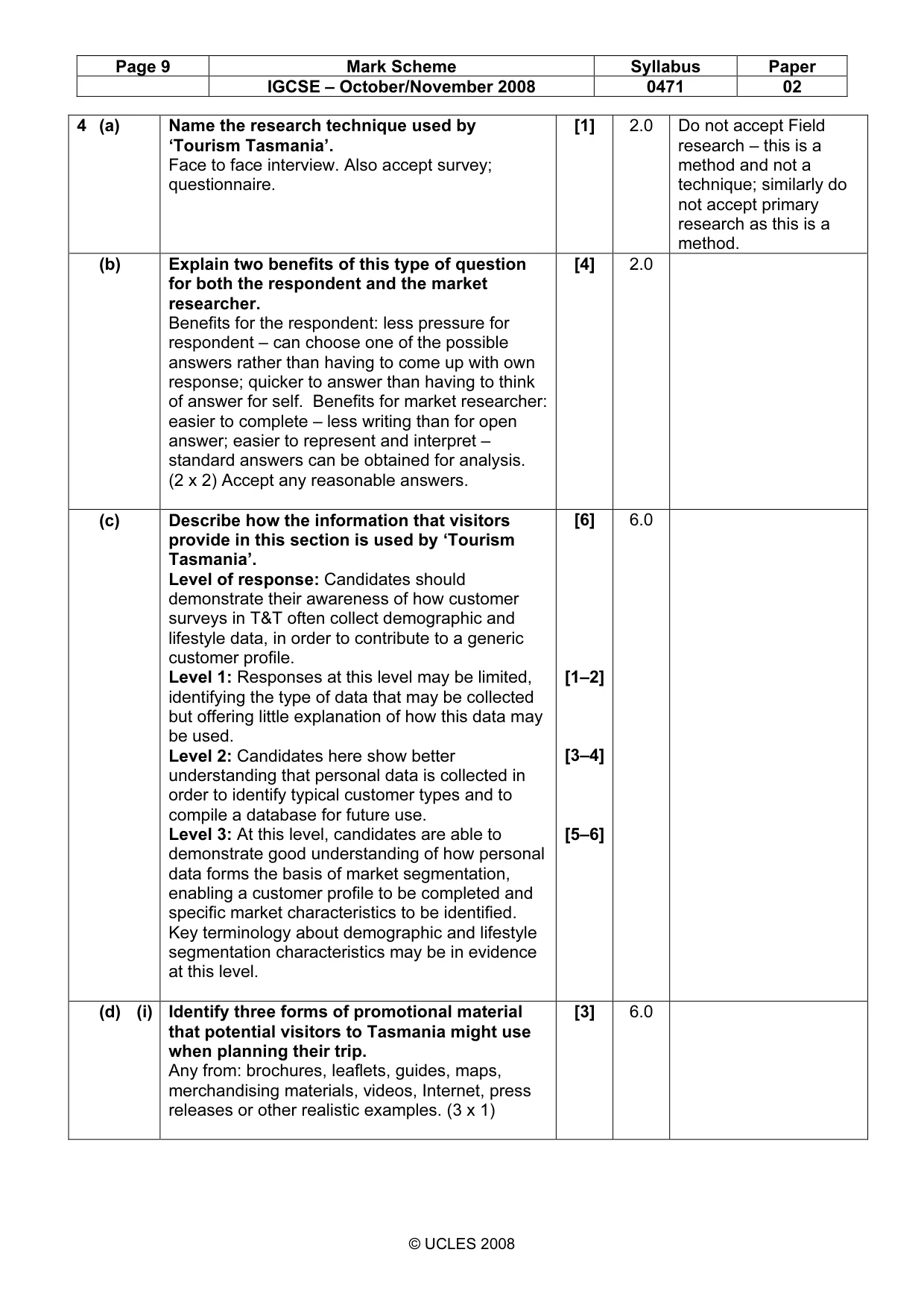
Page 9 Mark Scheme Syllabus Paper IGCSE – October/November 2008 0471 02 © UCLES 2008 4 (a) Name the research technique used by ‘Tourism Tasmania’. Face to face interview. Also accept survey; questionnaire. [1] 2.0 Do not accept Field research – this is a method and not a technique; similarly do not accept primary research as this is a method. (b) Explain two benefits of this type of question for both the respondent and the market researcher. Benefits for the respondent: less pressure for respondent – can choose one of the possible answers rather than having to come up with own response; quicker to answer than having to think of answer for self. Benefits for market researcher: easier to complete – less writing than for open answer; easier to represent and interpret – standard answers can be obtained for analysis. (2 x 2) Accept any reasonable answers. [4] 2.0 (c) Describe how the information that visitors provide in this section is used by ‘Tourism Tasmania’. Level of response: Candidates should demonstrate their awareness of how customer surveys in T&T often collect demographic and lifestyle data, in order to contribute to a generic customer profile. Level 1: Responses at this level may be limited, identifying the type of data that may be collected but offering little explanation of how this data may be used. Level 2: Candidates here show better understanding that personal data is collected in order to identify typical customer types and to compile a database for future use. Level 3: At this level, candidates are able to demonstrate good understanding of how personal data forms the basis of market segmentation, enabling a customer profile to be completed and specific market characteristics to be identified. Key terminology about demographic and lifestyle segmentation characteristics may be in evidence at this level. [6] [1–2] [3–4] [5–6] 6.0 (d) (i) Identify three forms of promotional material that potential visitors to Tasmania might use when planning their trip. Any from: brochures, leaflets, guides, maps, merchandising materials, videos, Internet, press releases or other realistic examples. (3 x 1) [3] 6.0
Mark scheme, page 10
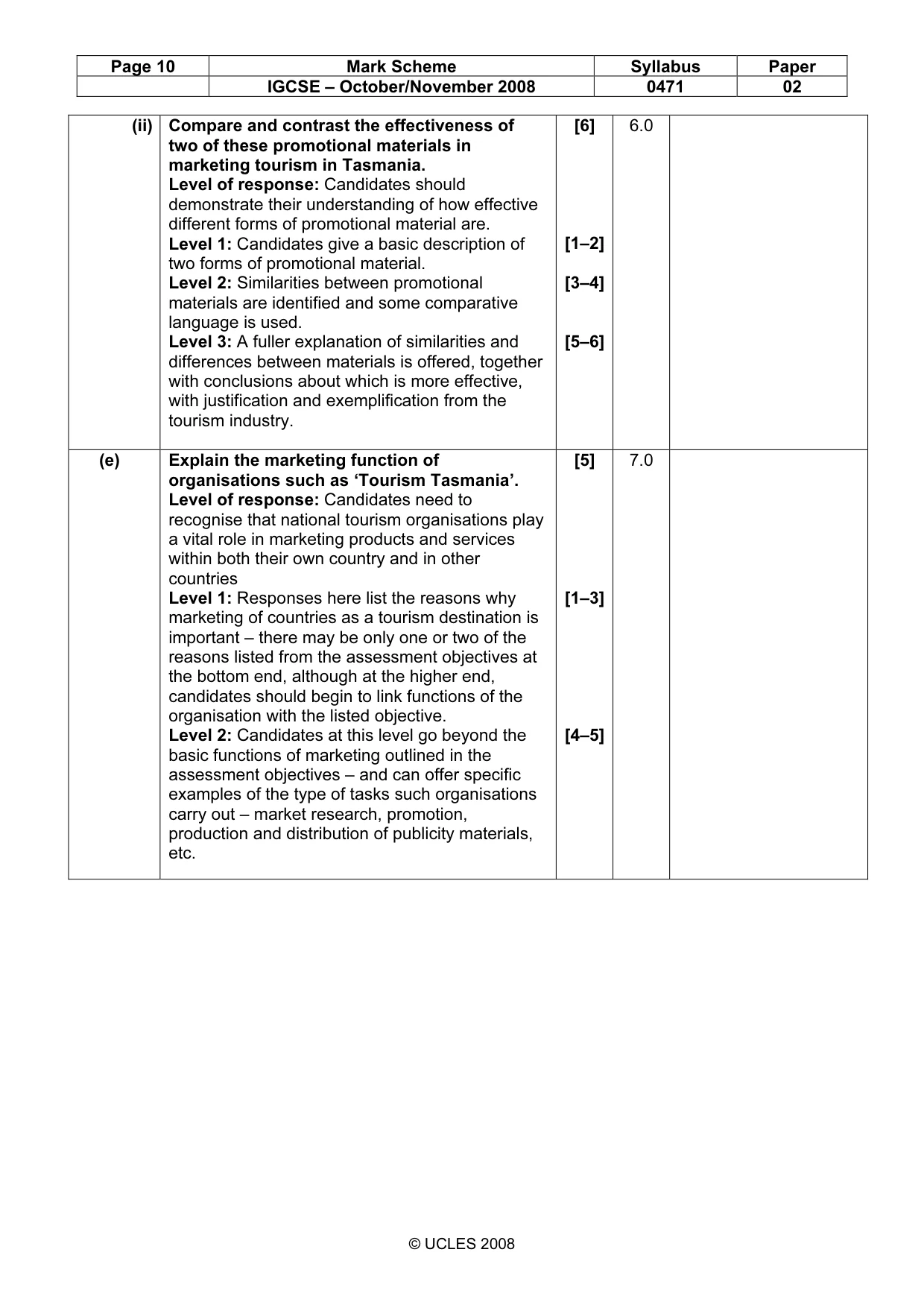
Page 10 Mark Scheme Syllabus Paper IGCSE – October/November 2008 0471 02 © UCLES 2008 (ii) Compare and contrast the effectiveness of two of these promotional materials in marketing tourism in Tasmania. Level of response: Candidates should demonstrate their understanding of how effective different forms of promotional material are. Level 1: Candidates give a basic description of two forms of promotional material. Level 2: Similarities between promotional materials are identified and some comparative language is used. Level 3: A fuller explanation of similarities and differences between materials is offered, together with conclusions about which is more effective, with justification and exemplification from the tourism industry. [6] [1–2] [3–4] [5–6] 6.0 (e) Explain the marketing function of organisations such as ‘Tourism Tasmania’. Level of response: Candidates need to recognise that national tourism organisations play a vital role in marketing products and services within both their own country and in other countries Level 1: Responses here list the reasons why marketing of countries as a tourism destination is important – there may be only one or two of the reasons listed from the assessment objectives at the bottom end, although at the higher end, candidates should begin to link functions of the organisation with the listed objective. Level 2: Candidates at this level go beyond the basic functions of marketing outlined in the assessment objectives – and can offer specific examples of the type of tasks such organisations carry out – market research, promotion, production and distribution of publicity materials, etc. [5] [1–3] [4–5] 7.0
What you needed in this session
Cambridge’s own grade thresholds for 2008 Oct/Nov, Paper 2 · Variant 1. A higher threshold means an easier paper — the bar moves with how the cohort did.