Cambridge IGCSE Travel and Tourism 0471 — 2008 May/June Paper 1 · Variant 1
0471/11/M/J/08 · 100 marks · ≈113 min
The question paper and its mark scheme, free to read here and free to download. This is Cambridge’s own paper, exactly as it was sat.
Question paper20 pages




Mark scheme6 pages
Answers below. Sit the paper first if you are practising.
Paper as text
Question paper, page 1
This document consists of 16 printed pages and 4 blank pages. IB08 06_0471_01/FP © UCLES 2008 [Turn over UNIVERSITY OF CAMBRIDGE INTERNATIONAL EXAMINATIONS International General Certificate of Secondary Education TRAVEL AND TOURISM 0471/01 Core Module May/June 2008 2 hours Candidates answer on the Question Paper. No Additional Materials are required. READ THESE INSTRUCTIONS FIRST Write your Centre number, candidate number and name on all the work you hand in. Write in dark blue or black pen. You may use a soft pencil for any diagrams, graphs or rough working. Do not use staples, paper clips, highlighters, glue or correction fluid. DO NOT WRITE IN ANY BARCODES. Answer all questions. At the end of the examination, fasten all your work securely together. The number of marks is given in brackets [ ] at the end of each question or part question. *4135422417* For Examiner's Use 1 2 3 4 Total www.XtremePapers.com
Question paper, page 2
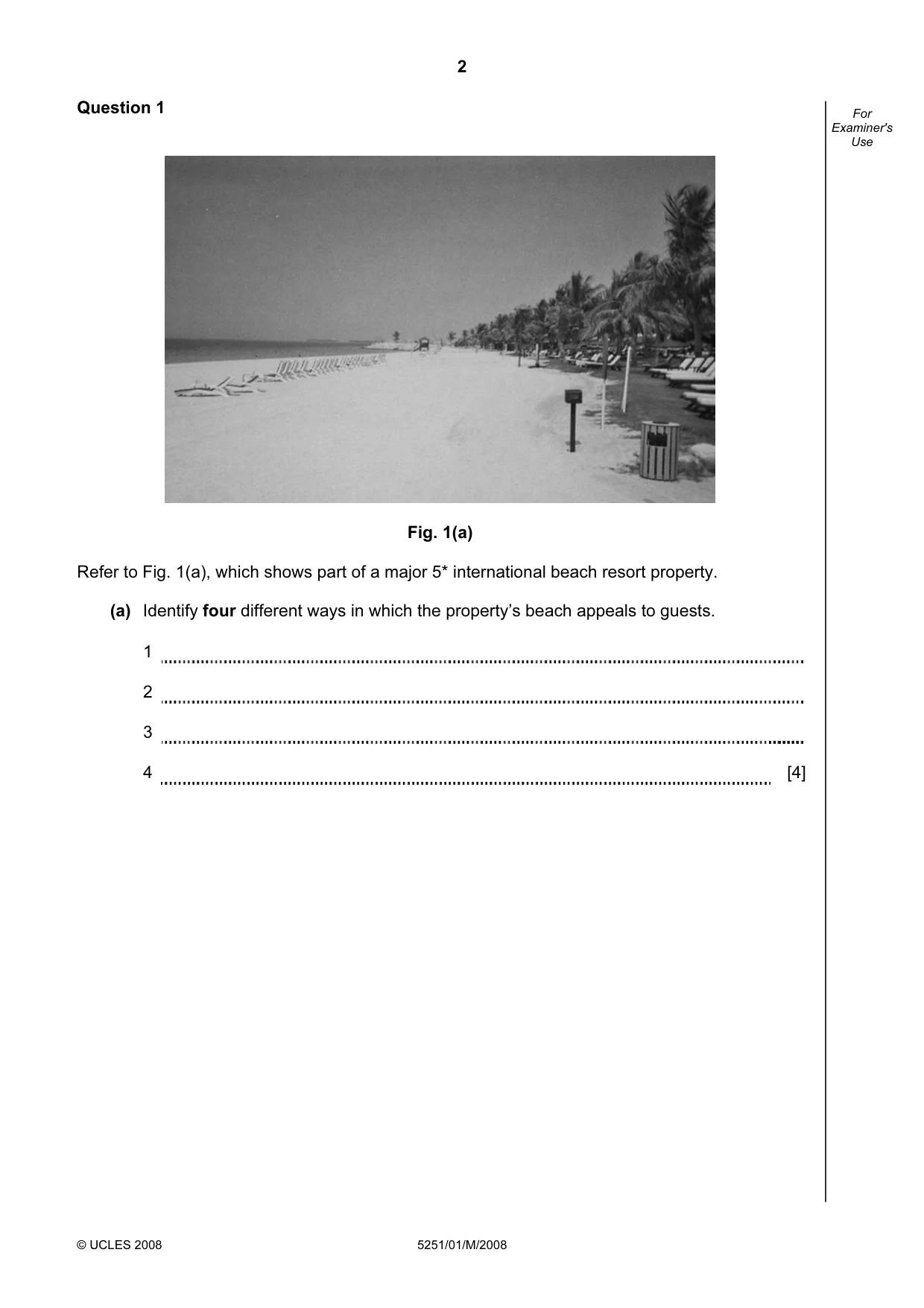
2 © UCLES 2008 5251/01/M/2008 For Examiner's Use Question 1 Fig. 1(a) Refer to Fig. 1(a), which shows part of a major 5* international beach resort property. (a) Identify four different ways in which the property’s beach appeals to guests. 1 2 3 4 [4]
Question paper, page 4
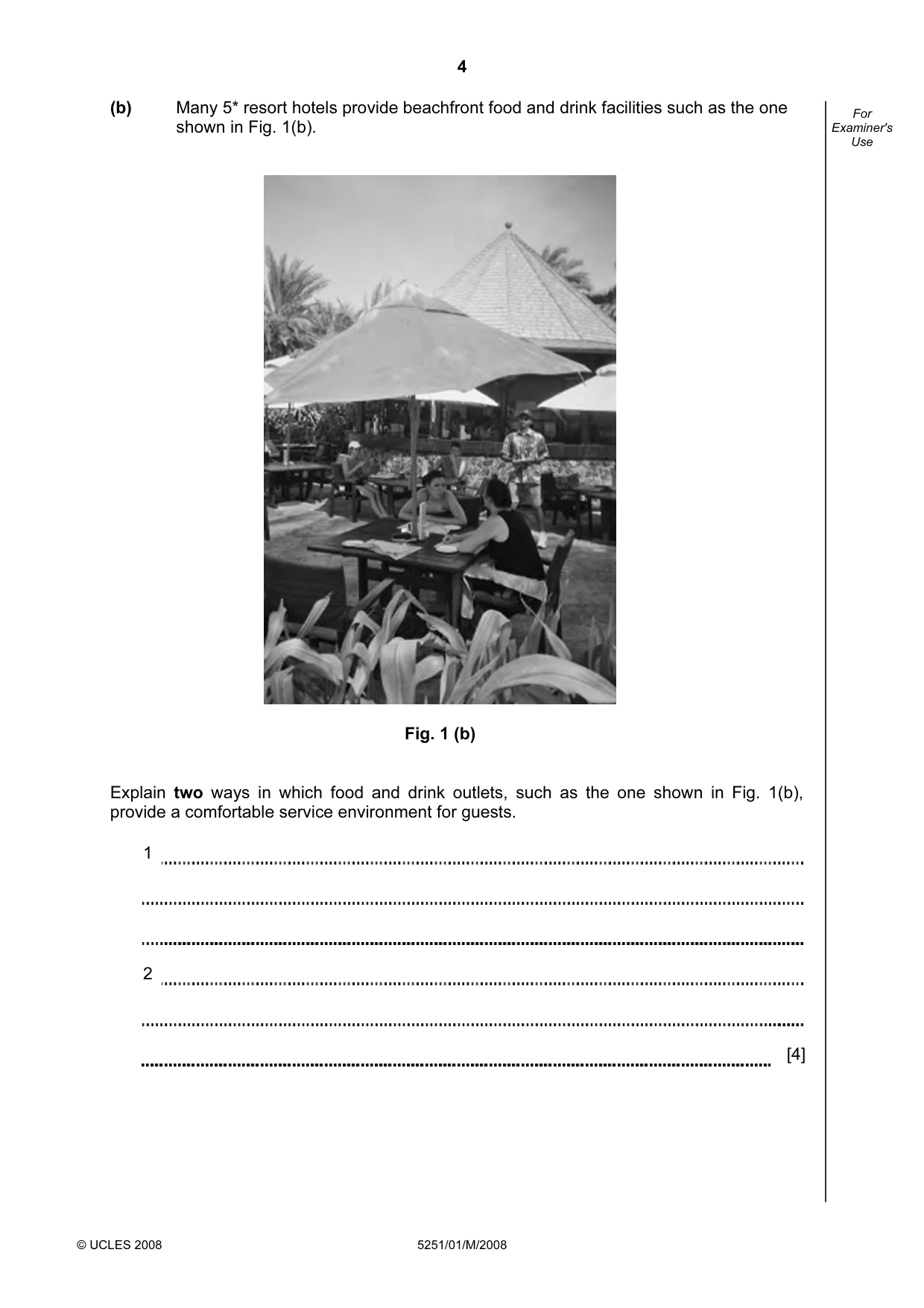
4 © UCLES 2008 5251/01/M/2008 For Examiner's Use (b) Many 5* resort hotels provide beachfront food and drink facilities such as the one shown in Fig. 1(b). Fig. 1 (b) Explain two ways in which food and drink outlets, such as the one shown in Fig. 1(b), provide a comfortable service environment for guests. 1 2 [4]
Question paper, page 5
5 © UCLES 2008 5251/01/M/2008 [Turn over For Examiner's Use (c) Explain four personal skills and qualities that members of staff in 5* resort properties would be expected to possess. 1 2 3 4 [8] (d) Suggest three ways in which food and drink outlets at 5* resort properties might promote special offers to guests. 1 2 3 [3]
Question paper, page 6
6 © UCLES 2008 5251/01/M/2008 For Examiner's Use (e) Discuss the range of negative environmental impacts that may result from the development of large coastal resort properties. [6] [Total: 25]
Question paper, page 8
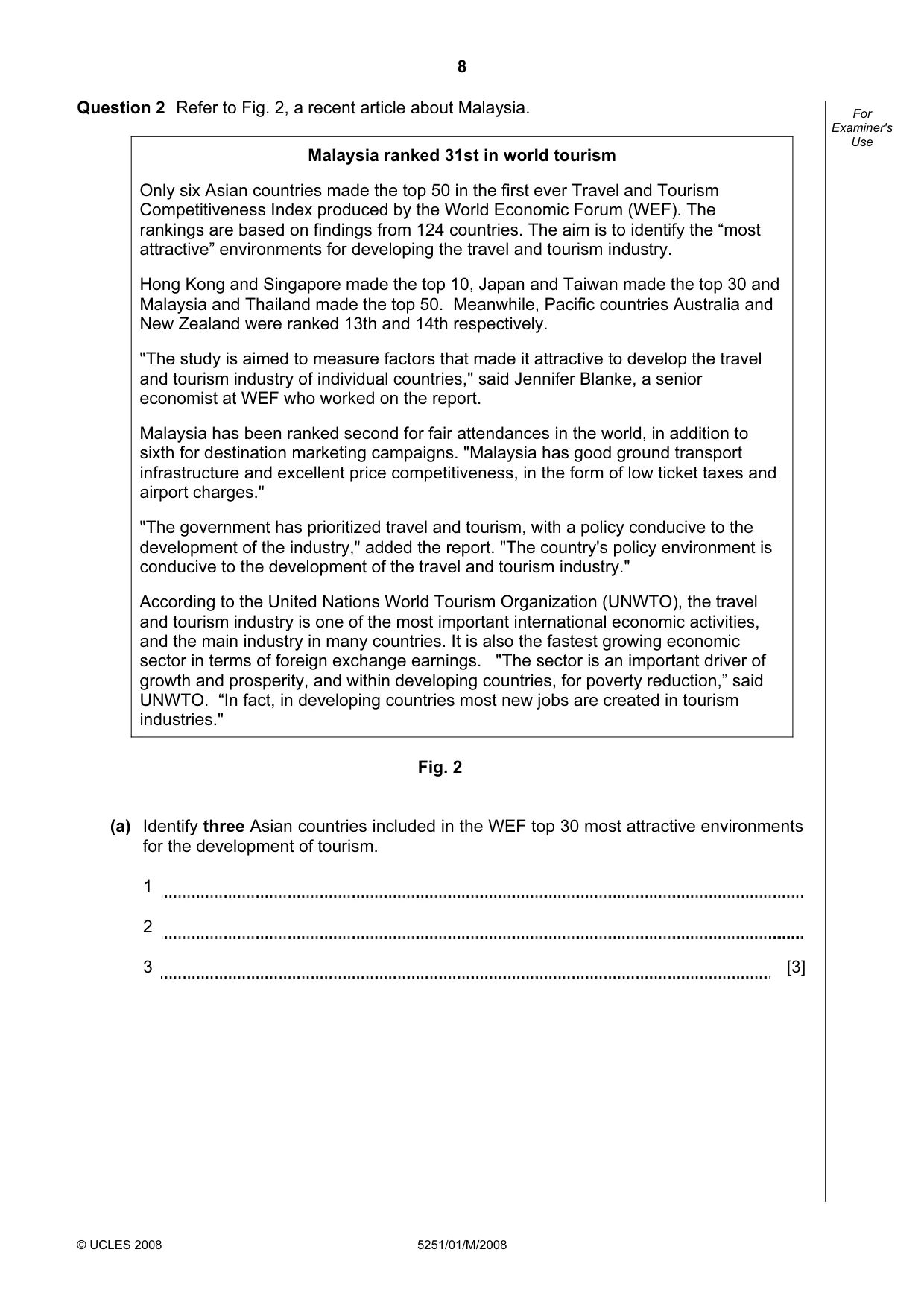
8 © UCLES 2008 5251/01/M/2008 For Examiner's Use Question 2 Refer to Fig. 2, a recent article about Malaysia. Malaysia ranked 31st in world tourism Only six Asian countries made the top 50 in the first ever Travel and Tourism Competitiveness Index produced by the World Economic Forum (WEF). The rankings are based on findings from 124 countries. The aim is to identify the “most attractive” environments for developing the travel and tourism industry. Hong Kong and Singapore made the top 10, Japan and Taiwan made the top 30 and Malaysia and Thailand made the top 50. Meanwhile, Pacific countries Australia and New Zealand were ranked 13th and 14th respectively. "The study is aimed to measure factors that made it attractive to develop the travel and tourism industry of individual countries," said Jennifer Blanke, a senior economist at WEF who worked on the report. Malaysia has been ranked second for fair attendances in the world, in addition to sixth for destination marketing campaigns. "Malaysia has good ground transport infrastructure and excellent price competitiveness, in the form of low ticket taxes and airport charges." "The government has prioritized travel and tourism, with a policy conducive to the development of the industry," added the report. "The country's policy environment is conducive to the development of the travel and tourism industry." According to the United Nations World Tourism Organization (UNWTO), the travel and tourism industry is one of the most important international economic activities, and the main industry in many countries. It is also the fastest growing economic sector in terms of foreign exchange earnings. "The sector is an important driver of growth and prosperity, and within developing countries, for poverty reduction,” said UNWTO. “In fact, in developing countries most new jobs are created in tourism industries." Fig. 2 (a) Identify three Asian countries included in the WEF top 30 most attractive environments for the development of tourism. 1 2 3 [3]
Question paper, page 9
9 © UCLES 2008 5251/01/M/2008 [Turn over For Examiner's Use (b) Identify and explain two ways in which the United Nations World Tourism Organization says countries like Malaysia benefit from tourism. 1 2 [4] (c) Located between 2º and 7º north of the Equator, Peninsular Malaysia is separated from the states of Sabah and Sarawak by the South China Sea. To the north of Peninsular Malaysia is Thailand while its southern neighbour is Singapore. Kuala Lumpur, Malaysia’s capital city, is located on the western side of the peninsula. (i) What term best describes the climate of Malaysia? [1] (ii) Will local time in Kuala Lumpur be in advance of or behind local time in the Middle East? [1] (iii) How many degrees of latitude does Peninsular Malaysia cover? [1] (iv) State whether Kuala Lumpur is located south or north of Singapore. [1]
Question paper, page 10
10 © UCLES 2008 5251/01/M/2008 For Examiner's Use (d) Explain four marketing and promotion methods that the Malaysia Tourism Promotion Board may use in order to increase the number of overseas visitors to the country. 1 2 3 4 [8]
Question paper, page 11
11 © UCLES 2008 5251/01/M/2008 [Turn over For Examiner's Use (e) Discuss the ways in which major city destinations such as Kuala Lumpur meet the needs of business tourists. You should refer to examples with which you are familiar. [6] [Total: 25]
Question paper, page 12
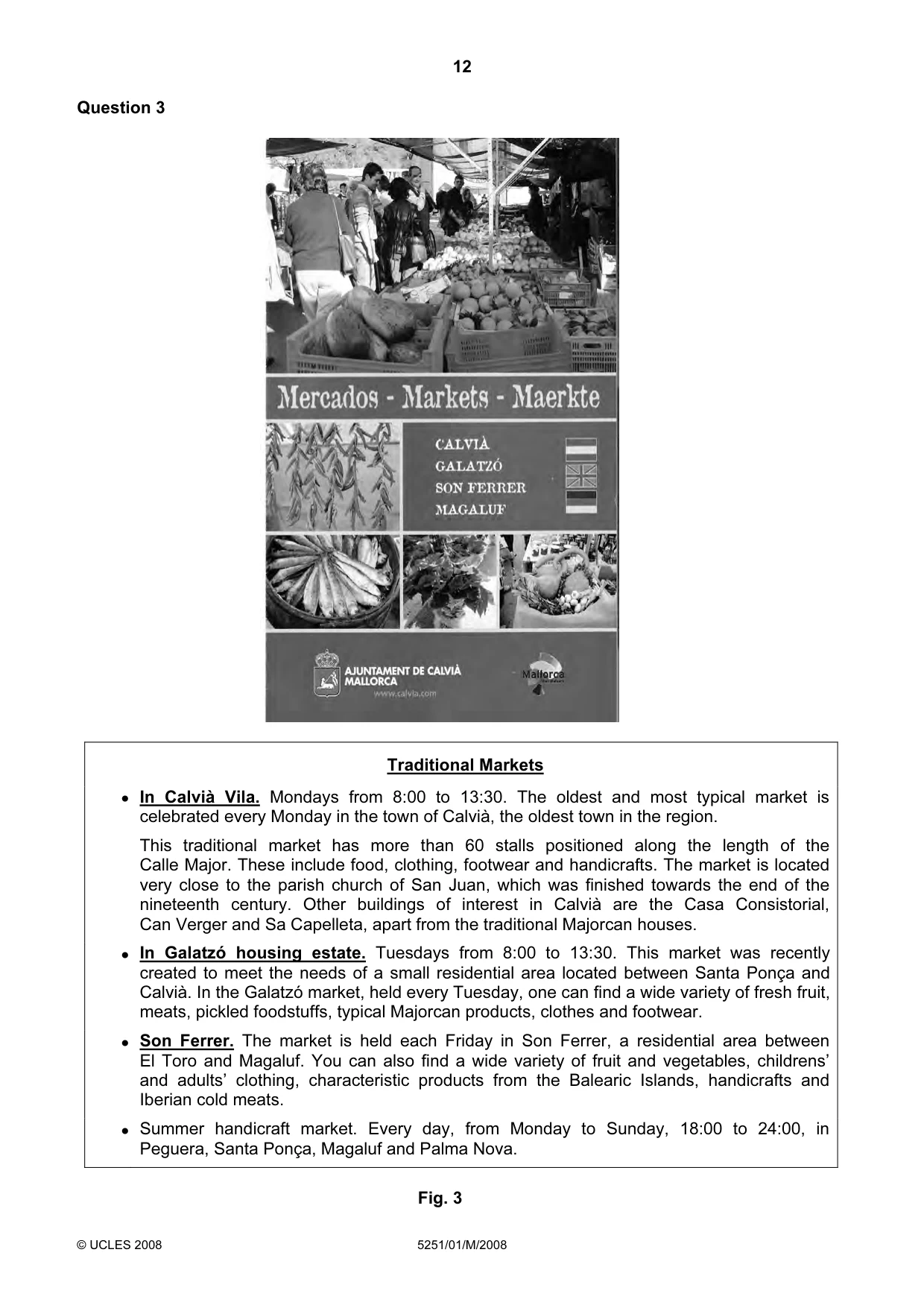
12 © UCLES 2008 5251/01/M/2008 Question 3 Traditional Markets • In Calvià Vila. Mondays from 8:00 to 13:30. The oldest and most typical market is celebrated every Monday in the town of Calvià, the oldest town in the region. This traditional market has more than 60 stalls positioned along the length of the Calle Major. These include food, clothing, footwear and handicrafts. The market is located very close to the parish church of San Juan, which was finished towards the end of the nineteenth century. Other buildings of interest in Calvià are the Casa Consistorial, Can Verger and Sa Capelleta, apart from the traditional Majorcan houses. • In Galatzó housing estate. Tuesdays from 8:00 to 13:30. This market was recently created to meet the needs of a small residential area located between Santa Ponça and Calvià. In the Galatzó market, held every Tuesday, one can find a wide variety of fresh fruit, meats, pickled foodstuffs, typical Majorcan products, clothes and footwear. • Son Ferrer. The market is held each Friday in Son Ferrer, a residential area between El Toro and Magaluf. You can also find a wide variety of fruit and vegetables, childrens’ and adults’ clothing, characteristic products from the Balearic Islands, handicrafts and Iberian cold meats. • Summer handicraft market. Every day, from Monday to Sunday, 18:00 to 24:00, in Peguera, Santa Ponça, Magaluf and Palma Nova. Fig. 3
Question paper, page 13
13 © UCLES 2008 5251/01/M/2008 [Turn over For Examiner's Use Refer to Fig. 3, tourist information about traditional markets near Magaluf, on the Spanish island of Mallorca. (a) Identify the four locations that have a special handicraft market just during the main tourist season. 1 2 3 4 [4] (b) Explain three ways in which the market held in the town of Calvià each Monday is likely to appeal to tourists. 1 2 3 [6] (c) Many destinations are famous for their local food and drink. Complete the following table and identify a typical food or drink for each country. Types of food and drink Country USA Italy India China UK [5]
Question paper, page 14
14 © UCLES 2008 5251/01/M/2008 For Examiner's Use (d) In many destinations, visitors can go on ‘food-themed’ tours. Explain two ways in which such tours will be organised. 1 2 [4] (e) Discuss the visitor appeal of one cultural attraction with which you are familiar. [6] [Total: 25]
Question paper, page 16
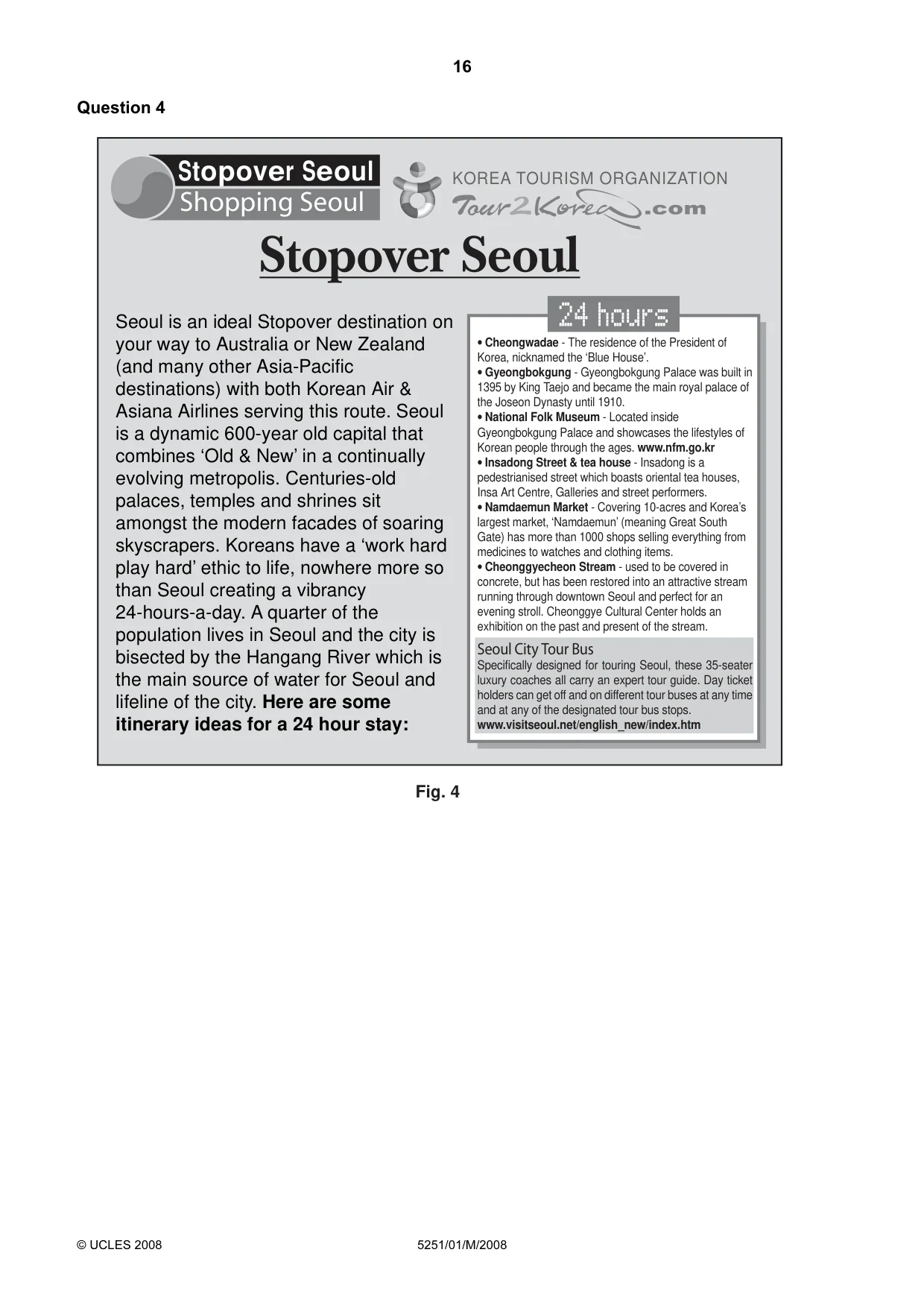
16 © UCLES 2008 5251/01/M/2008 Question 4 Fig. 4 Stopover Seoul Shopping Seoul KOREA TOURISM ORGANIZATION Seoul is an ideal Stopover destination on your way to Australia or New Zealand (and many other Asia-Pacific destinations) with both Korean Air & Asiana Airlines serving this route. Seoul is a dynamic 600-year old capital that combines ‘Old & New’ in a continually evolving metropolis. Centuries-old palaces, temples and shrines sit amongst the modern facades of soaring skyscrapers. Koreans have a ‘work hard play hard’ ethic to life, nowhere more so than Seoul creating a vibrancy 24-hours-a-day. A quarter of the population lives in Seoul and the city is bisected by the Hangang River which is the main source of water for Seoul and lifeline of the city. Here are some itinerary ideas for a 24 hour stay: • Cheongwadae - The residence of the President of Korea, nicknamed the ‘Blue House’. • Gyeongbokgung - Gyeongbokgung Palace was built in 1395 by King Taejo and became the main royal palace of the Joseon Dynasty until 1910. • National Folk Museum - Located inside Gyeongbokgung Palace and showcases the lifestyles of Korean people through the ages. www.nfm.go.kr • Insadong Street & tea house - Insadong is a pedestrianised street which boasts oriental tea houses, Insa Art Centre, Galleries and street performers. • Namdaemun Market - Covering 10-acres and Korea’s largest market, ‘Namdaemun’ (meaning Great South Gate) has more than 1000 shops selling everything from medicines to watches and clothing items. • Cheonggyecheon Stream - used to be covered in concrete, but has been restored into an attractive stream running through downtown Seoul and perfect for an evening stroll. Cheonggye Cultural Center holds an exhibition on the past and present of the stream. Seoul City Tour Bus Specifically designed for touring Seoul, these 35-seater luxury coaches all carry an expert tour guide. Day ticket holders can get off and on different tour buses at any time and at any of the designated tour bus stops. www.visitseoul.net/english_new/index.htm
Question paper, page 17
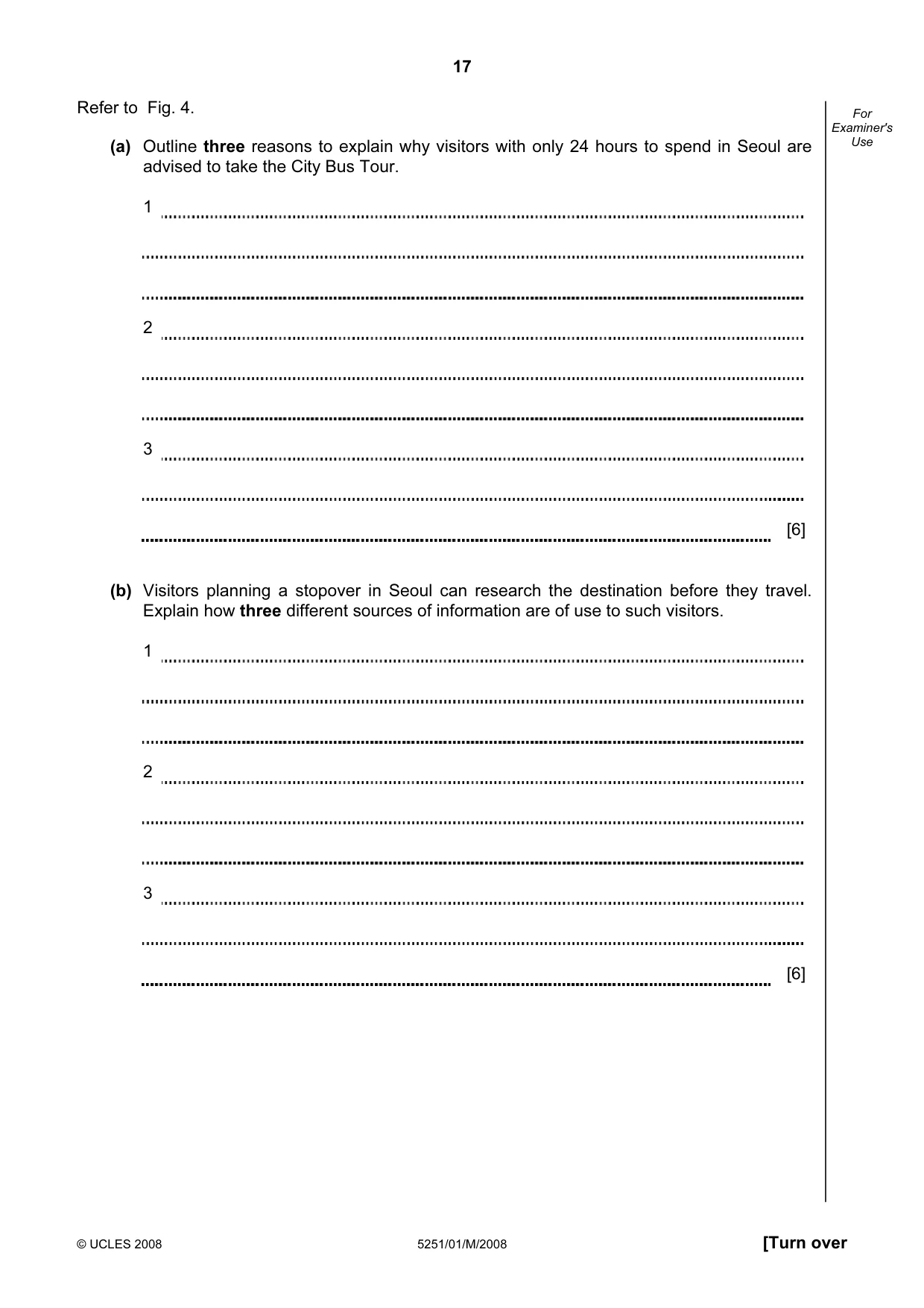
17 © UCLES 2008 5251/01/M/2008 [Turn over For Examiner's Use Refer to Fig. 4. (a) Outline three reasons to explain why visitors with only 24 hours to spend in Seoul are advised to take the City Bus Tour. 1 2 3 [6] (b) Visitors planning a stopover in Seoul can research the destination before they travel. Explain how three different sources of information are of use to such visitors. 1 2 3 [6]
Question paper, page 18
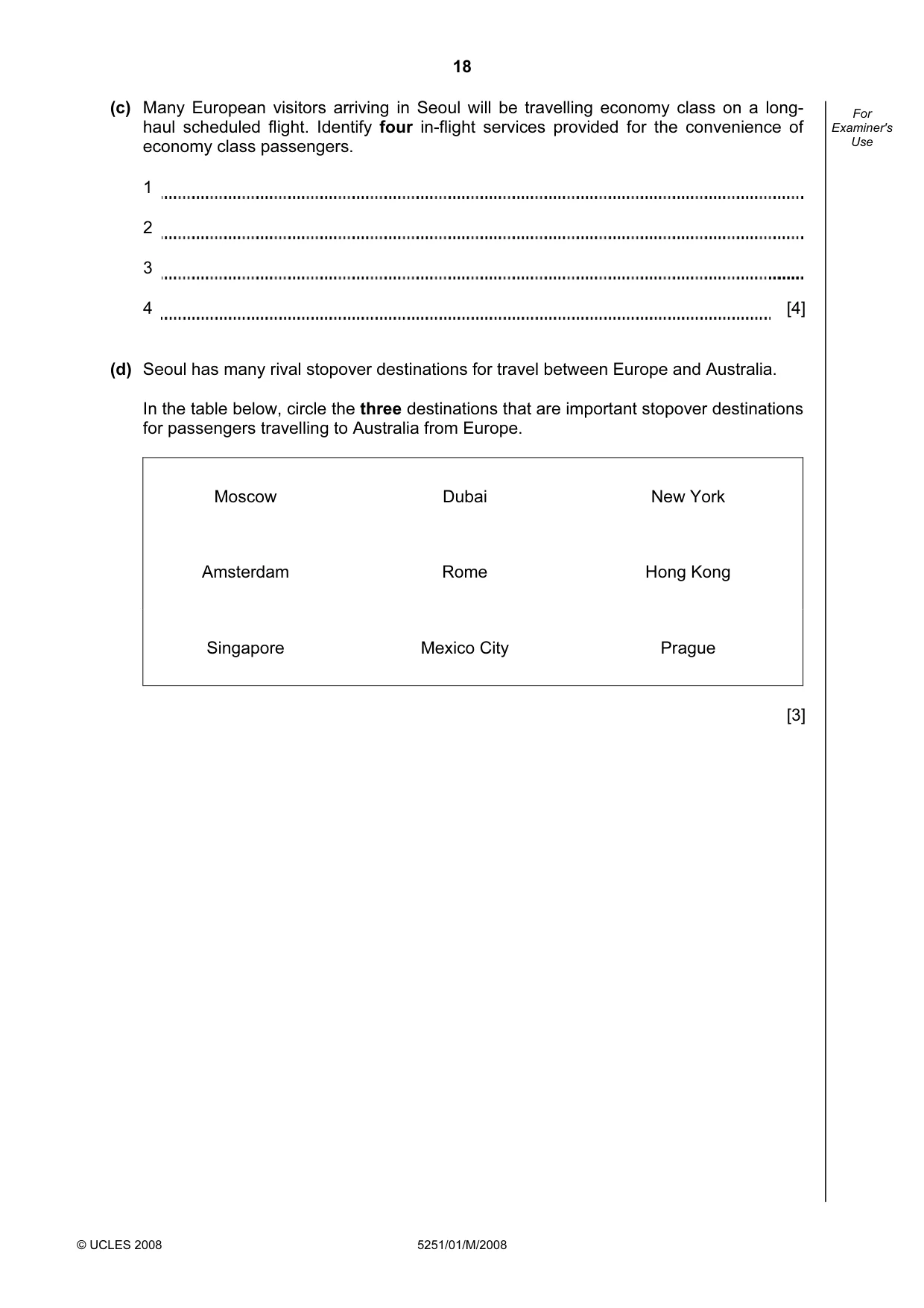
18 © UCLES 2008 5251/01/M/2008 For Examiner's Use (c) Many European visitors arriving in Seoul will be travelling economy class on a long- haul scheduled flight. Identify four in-flight services provided for the convenience of economy class passengers. 1 2 3 4 [4] (d) Seoul has many rival stopover destinations for travel between Europe and Australia. In the table below, circle the three destinations that are important stopover destinations for passengers travelling to Australia from Europe. Moscow Dubai New York Amsterdam Rome Hong Kong Singapore Mexico City Prague [3]
Question paper, page 19
19 UCLES 2008 5251/01/M/2008 For Examiner's Use (e) Not all passengers passing through Seoul will have a stopover. These passengers are described as being ‘in-transit’. Discuss the range of services that major international airports provide for passengers who are ‘in-transit’. [6] [Total: 25]
Question paper, page 20
20 Copyright Acknowledgements: Question 1 Fig. 1 (a) J.D. Smith © UCLES. Question 1 Fig. 1 (b) J.D. Smith © UCLES. Question 2 Fig. 2 © www.travelwirenews.com Question 3 Fig. 3 © www.calvia.com Question 4 Fig. 4 © www.tour2korea.com Permission to reproduce items where third-party owned material protected by copyright is included has been sought and cleared where possible. Every reasonable effort has been made by the publisher (UCLES) to trace copyright holders, but if any items requiring clearance have unwittingly been included, the publisher will be pleased to make amends at the earliest possible opportunity. University of Cambridge International Examinations is part of the Cambridge Assessment Group. Cambridge Assessment is the brand name of University of Cambridge Local Examinations Syndicate (UCLES), which is itself a department of the University of Cambridge. © UCLES 2008 5251/01/M/2008 BLANK PAGE
Mark scheme, page 1
UNIVERSITY OF CAMBRIDGE INTERNATIONAL EXAMINATIONS International General Certificate of Secondary Education MARK SCHEME for the May/June 2008 question paper 0471 TRAVEL AND TOURISM 0471/01 Paper 1 (Written Paper), maximum raw mark 100 This mark scheme is published as an aid to teachers and candidates, to indicate the requirements of the examination. It shows the basis on which Examiners were instructed to award marks. It does not indicate the details of the discussions that took place at an Examiners’ meeting before marking began. All Examiners are instructed that alternative correct answers and unexpected approaches in candidates’ scripts must be given marks that fairly reflect the relevant knowledge and skills demonstrated. Mark schemes must be read in conjunction with the question papers and the report on the examination. • CIE will not enter into discussions or correspondence in connection with these mark schemes. CIE is publishing the mark schemes for the May/June 2008 question papers for most IGCSE, GCE Advanced Level and Advanced Subsidiary Level syllabuses and some Ordinary Level syllabuses. www.XtremePapers.com
Mark scheme, page 2
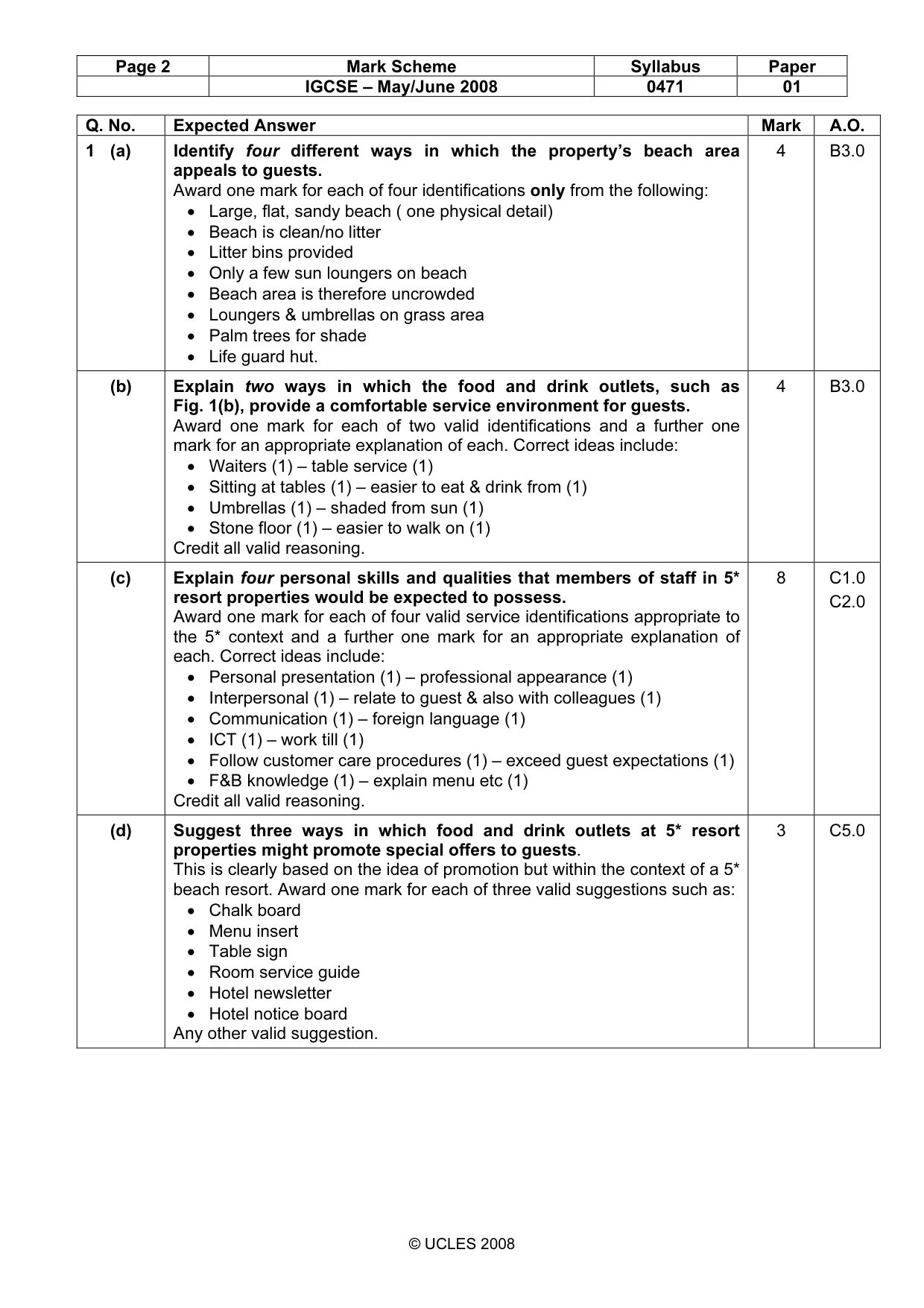
Page 2 Mark Scheme Syllabus Paper IGCSE – May/June 2008 0471 01 © UCLES 2008 Q. No. Expected Answer Mark A.O. 1 (a) Identify four different ways in which the property’s beach area appeals to guests. Award one mark for each of four identifications only from the following: • Large, flat, sandy beach ( one physical detail) • Beach is clean/no litter • Litter bins provided • Only a few sun loungers on beach • Beach area is therefore uncrowded • Loungers & umbrellas on grass area • Palm trees for shade • Life guard hut. 4 B3.0 (b) Explain two ways in which the food and drink outlets, such as Fig. 1(b), provide a comfortable service environment for guests. Award one mark for each of two valid identifications and a further one mark for an appropriate explanation of each. Correct ideas include: • Waiters (1) – table service (1) • Sitting at tables (1) – easier to eat & drink from (1) • Umbrellas (1) – shaded from sun (1) • Stone floor (1) – easier to walk on (1) Credit all valid reasoning. 4 B3.0 (c) Explain four personal skills and qualities that members of staff in 5* resort properties would be expected to possess. Award one mark for each of four valid service identifications appropriate to the 5* context and a further one mark for an appropriate explanation of each. Correct ideas include: • Personal presentation (1) – professional appearance (1) • Interpersonal (1) – relate to guest & also with colleagues (1) • Communication (1) – foreign language (1) • ICT (1) – work till (1) • Follow customer care procedures (1) – exceed guest expectations (1) • F&B knowledge (1) – explain menu etc (1) Credit all valid reasoning. 8 C1.0 C2.0 (d) Suggest three ways in which food and drink outlets at 5* resort properties might promote special offers to guests. This is clearly based on the idea of promotion but within the context of a 5* beach resort. Award one mark for each of three valid suggestions such as: • Chalk board • Menu insert • Table sign • Room service guide • Hotel newsletter • Hotel notice board Any other valid suggestion. 3 C5.0
Mark scheme, page 3
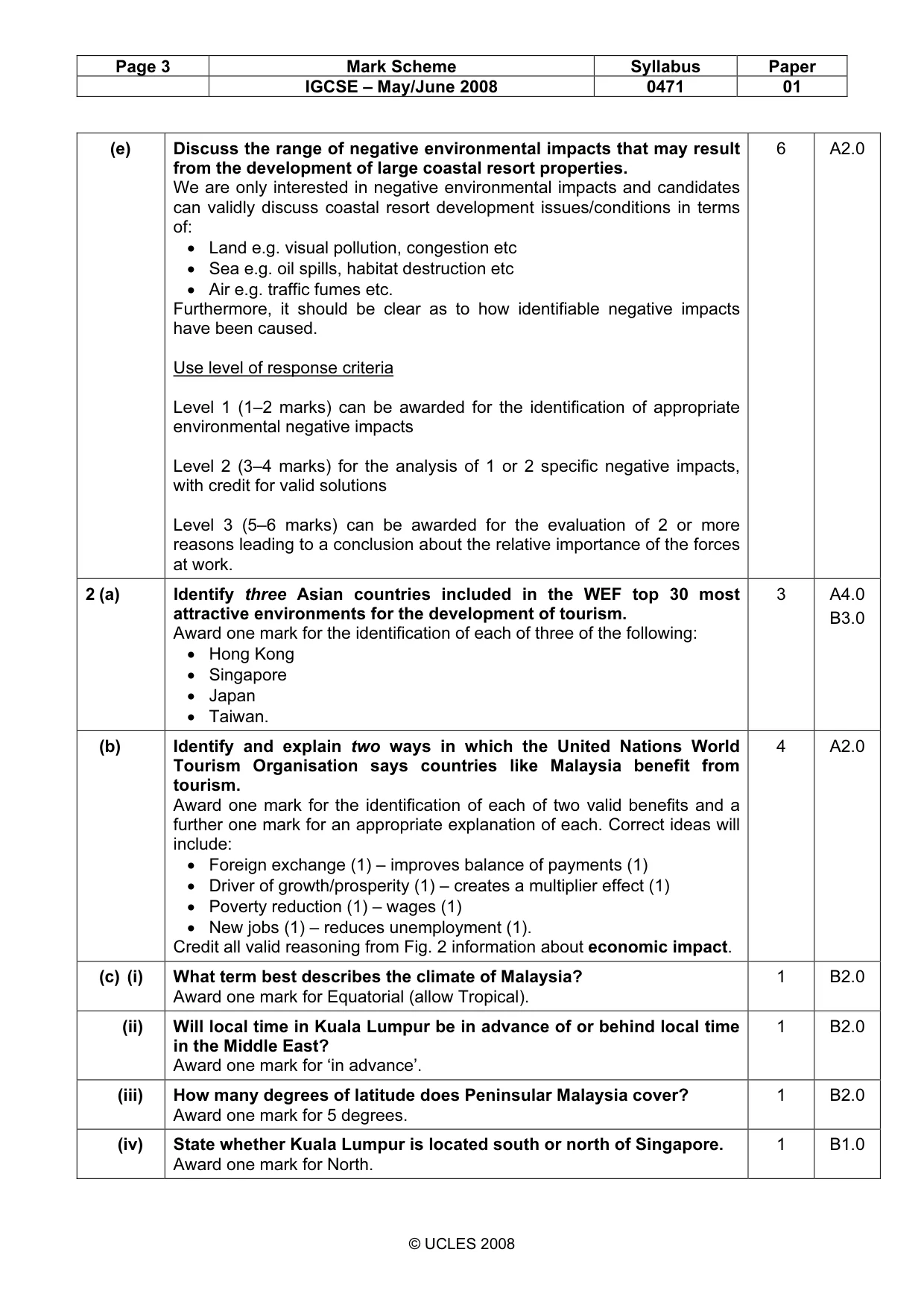
Page 3 Mark Scheme Syllabus Paper IGCSE – May/June 2008 0471 01 © UCLES 2008 (e) Discuss the range of negative environmental impacts that may result from the development of large coastal resort properties. We are only interested in negative environmental impacts and candidates can validly discuss coastal resort development issues/conditions in terms of: • Land e.g. visual pollution, congestion etc • Sea e.g. oil spills, habitat destruction etc • Air e.g. traffic fumes etc. Furthermore, it should be clear as to how identifiable negative impacts have been caused. Use level of response criteria Level 1 (1–2 marks) can be awarded for the identification of appropriate environmental negative impacts Level 2 (3–4 marks) for the analysis of 1 or 2 specific negative impacts, with credit for valid solutions Level 3 (5–6 marks) can be awarded for the evaluation of 2 or more reasons leading to a conclusion about the relative importance of the forces at work. 6 A2.0 2 (a) Identify three Asian countries included in the WEF top 30 most attractive environments for the development of tourism. Award one mark for the identification of each of three of the following: • Hong Kong • Singapore • Japan • Taiwan. 3 A4.0 B3.0 (b) Identify and explain two ways in which the United Nations World Tourism Organisation says countries like Malaysia benefit from tourism. Award one mark for the identification of each of two valid benefits and a further one mark for an appropriate explanation of each. Correct ideas will include: • Foreign exchange (1) – improves balance of payments (1) • Driver of growth/prosperity (1) – creates a multiplier effect (1) • Poverty reduction (1) – wages (1) • New jobs (1) – reduces unemployment (1). Credit all valid reasoning from Fig. 2 information about economic impact. 4 A2.0 (c) (i) What term best describes the climate of Malaysia? Award one mark for Equatorial (allow Tropical). 1 B2.0 (ii) Will local time in Kuala Lumpur be in advance of or behind local time in the Middle East? Award one mark for ‘in advance’. 1 B2.0 (iii) How many degrees of latitude does Peninsular Malaysia cover? Award one mark for 5 degrees. 1 B2.0 (iv) State whether Kuala Lumpur is located south or north of Singapore. Award one mark for North. 1 B1.0
Mark scheme, page 4
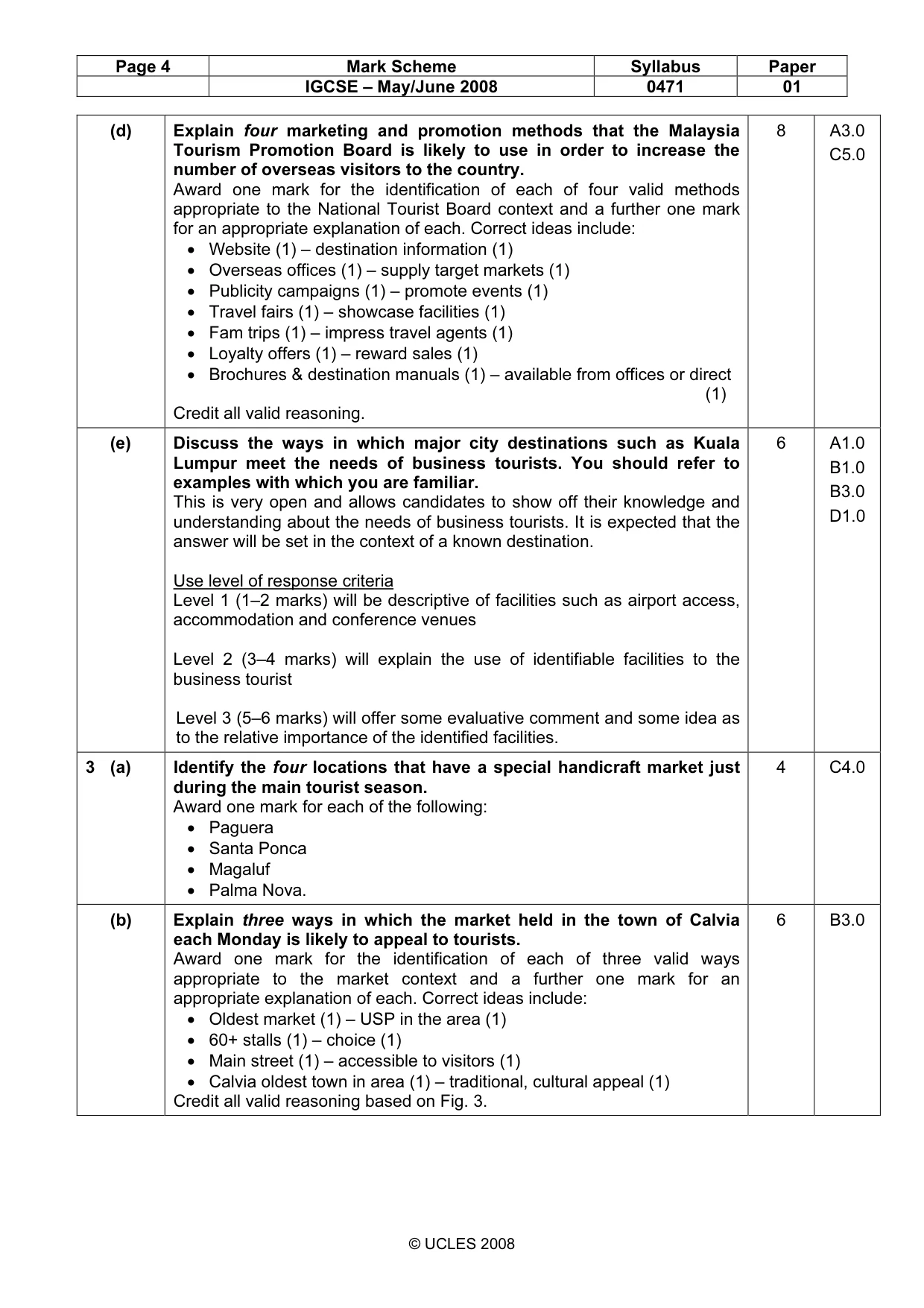
Page 4 Mark Scheme Syllabus Paper IGCSE – May/June 2008 0471 01 © UCLES 2008 (d) Explain four marketing and promotion methods that the Malaysia Tourism Promotion Board is likely to use in order to increase the number of overseas visitors to the country. Award one mark for the identification of each of four valid methods appropriate to the National Tourist Board context and a further one mark for an appropriate explanation of each. Correct ideas include: • Website (1) – destination information (1) • Overseas offices (1) – supply target markets (1) • Publicity campaigns (1) – promote events (1) • Travel fairs (1) – showcase facilities (1) • Fam trips (1) – impress travel agents (1) • Loyalty offers (1) – reward sales (1) • Brochures & destination manuals (1) – available from offices or direct (1) Credit all valid reasoning. 8 A3.0 C5.0 (e) Discuss the ways in which major city destinations such as Kuala Lumpur meet the needs of business tourists. You should refer to examples with which you are familiar. This is very open and allows candidates to show off their knowledge and understanding about the needs of business tourists. It is expected that the answer will be set in the context of a known destination. Use level of response criteria Level 1 (1–2 marks) will be descriptive of facilities such as airport access, accommodation and conference venues Level 2 (3–4 marks) will explain the use of identifiable facilities to the business tourist Level 3 (5–6 marks) will offer some evaluative comment and some idea as to the relative importance of the identified facilities. 6 A1.0 B1.0 B3.0 D1.0 3 (a) Identify the four locations that have a special handicraft market just during the main tourist season. Award one mark for each of the following: • Paguera • Santa Ponca • Magaluf • Palma Nova. 4 C4.0 (b) Explain three ways in which the market held in the town of Calvia each Monday is likely to appeal to tourists. Award one mark for the identification of each of three valid ways appropriate to the market context and a further one mark for an appropriate explanation of each. Correct ideas include: • Oldest market (1) – USP in the area (1) • 60+ stalls (1) – choice (1) • Main street (1) – accessible to visitors (1) • Calvia oldest town in area (1) – traditional, cultural appeal (1) Credit all valid reasoning based on Fig. 3. 6 B3.0
Mark scheme, page 5
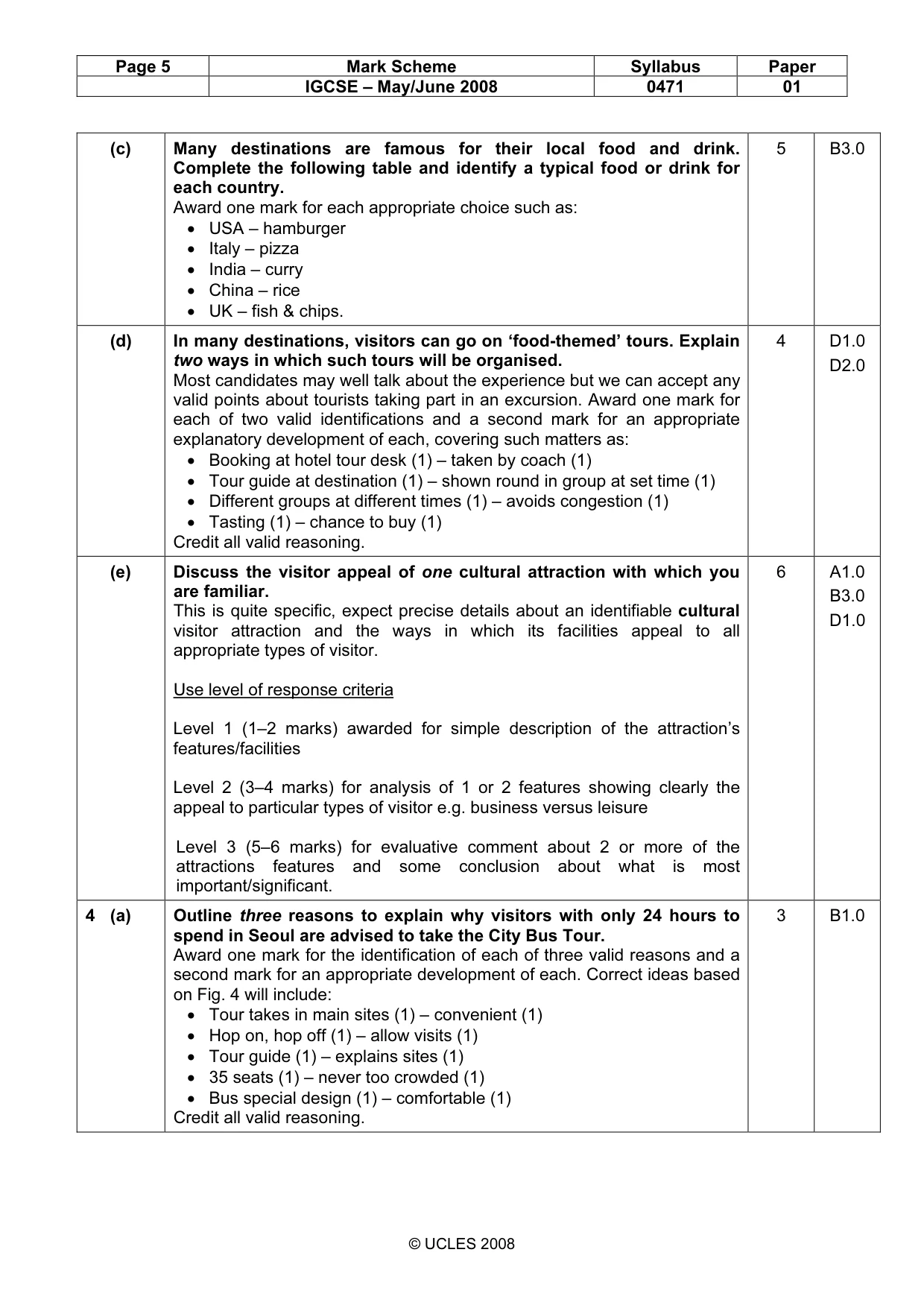
Page 5 Mark Scheme Syllabus Paper IGCSE – May/June 2008 0471 01 © UCLES 2008 (c) Many destinations are famous for their local food and drink. Complete the following table and identify a typical food or drink for each country. Award one mark for each appropriate choice such as: • USA – hamburger • Italy – pizza • India – curry • China – rice • UK – fish & chips. 5 B3.0 (d) In many destinations, visitors can go on ‘food-themed’ tours. Explain two ways in which such tours will be organised. Most candidates may well talk about the experience but we can accept any valid points about tourists taking part in an excursion. Award one mark for each of two valid identifications and a second mark for an appropriate explanatory development of each, covering such matters as: • Booking at hotel tour desk (1) – taken by coach (1) • Tour guide at destination (1) – shown round in group at set time (1) • Different groups at different times (1) – avoids congestion (1) • Tasting (1) – chance to buy (1) Credit all valid reasoning. 4 D1.0 D2.0 (e) Discuss the visitor appeal of one cultural attraction with which you are familiar. This is quite specific, expect precise details about an identifiable cultural visitor attraction and the ways in which its facilities appeal to all appropriate types of visitor. Use level of response criteria Level 1 (1–2 marks) awarded for simple description of the attraction’s features/facilities Level 2 (3–4 marks) for analysis of 1 or 2 features showing clearly the appeal to particular types of visitor e.g. business versus leisure Level 3 (5–6 marks) for evaluative comment about 2 or more of the attractions features and some conclusion about what is most important/significant. 6 A1.0 B3.0 D1.0 4 (a) Outline three reasons to explain why visitors with only 24 hours to spend in Seoul are advised to take the City Bus Tour. Award one mark for the identification of each of three valid reasons and a second mark for an appropriate development of each. Correct ideas based on Fig. 4 will include: • Tour takes in main sites (1) – convenient (1) • Hop on, hop off (1) – allow visits (1) • Tour guide (1) – explains sites (1) • 35 seats (1) – never too crowded (1) • Bus special design (1) – comfortable (1) Credit all valid reasoning. 3 B1.0
Mark scheme, page 6
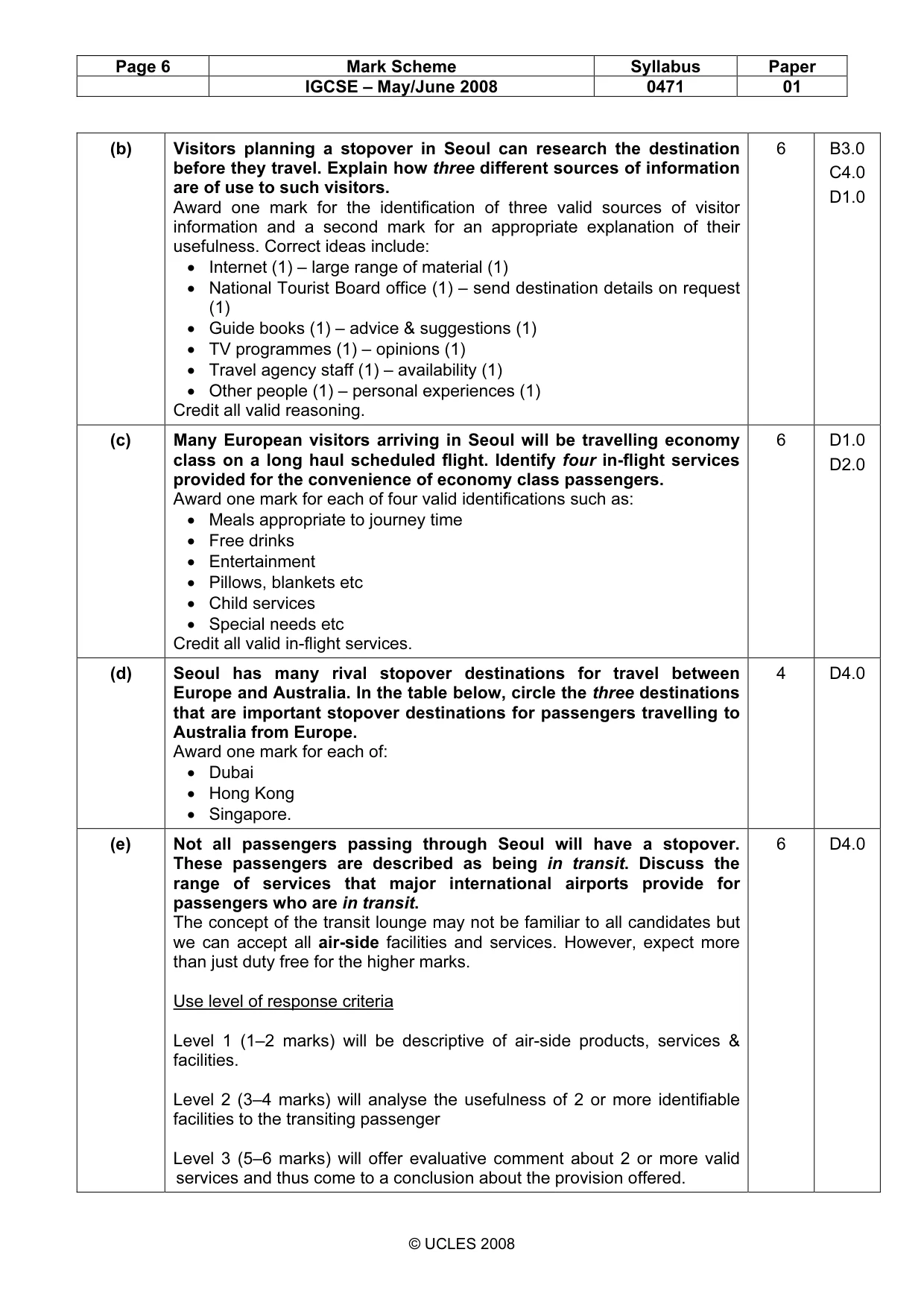
Page 6 Mark Scheme Syllabus Paper IGCSE – May/June 2008 0471 01 © UCLES 2008 (b) Visitors planning a stopover in Seoul can research the destination before they travel. Explain how three different sources of information are of use to such visitors. Award one mark for the identification of three valid sources of visitor information and a second mark for an appropriate explanation of their usefulness. Correct ideas include: • Internet (1) – large range of material (1) • National Tourist Board office (1) – send destination details on request (1) • Guide books (1) – advice & suggestions (1) • TV programmes (1) – opinions (1) • Travel agency staff (1) – availability (1) • Other people (1) – personal experiences (1) Credit all valid reasoning. 6 B3.0 C4.0 D1.0 (c) Many European visitors arriving in Seoul will be travelling economy class on a long haul scheduled flight. Identify four in-flight services provided for the convenience of economy class passengers. Award one mark for each of four valid identifications such as: • Meals appropriate to journey time • Free drinks • Entertainment • Pillows, blankets etc • Child services • Special needs etc Credit all valid in-flight services. 6 D1.0 D2.0 (d) Seoul has many rival stopover destinations for travel between Europe and Australia. In the table below, circle the three destinations that are important stopover destinations for passengers travelling to Australia from Europe. Award one mark for each of: • Dubai • Hong Kong • Singapore. 4 D4.0 (e) Not all passengers passing through Seoul will have a stopover. These passengers are described as being in transit. Discuss the range of services that major international airports provide for passengers who are in transit. The concept of the transit lounge may not be familiar to all candidates but we can accept all air-side facilities and services. However, expect more than just duty free for the higher marks. Use level of response criteria Level 1 (1–2 marks) will be descriptive of air-side products, services & facilities. Level 2 (3–4 marks) will analyse the usefulness of 2 or more identifiable facilities to the transiting passenger Level 3 (5–6 marks) will offer evaluative comment about 2 or more valid services and thus come to a conclusion about the provision offered. 6 D4.0
What you needed in this session
Cambridge’s own grade thresholds for 2008 May/June, Paper 1 · Variant 1. A higher threshold means an easier paper — the bar moves with how the cohort did.