Cambridge IGCSE Travel and Tourism 0471 — 2007 Oct/Nov Paper 2 · Variant 1
0471/21/O/N/07 · 100 marks · ≈113 min
The question paper and its mark scheme, free to read here and free to download. This is Cambridge’s own paper, exactly as it was sat.
Question paper12 pages
Mark scheme9 pages
Answers below. Sit the paper first if you are practising.
Paper as text
Question paper, page 1
This document consists of 12 printed pages and 0 blank pages. IB07 11_0471_02/2RP © UCLES 2007 [Turn over *3181419119* For Examiner's Use 1 2 3 4 Total UNIVERSITY OF CAMBRIDGE INTERNATIONAL EXAMINATIONS International General Certificate of Secondary Education TRAVEL AND TOURISM 0471/02 Marketing and Promotion October/November 2007 2 hours 30 minutes Candidates answer on the Question Paper. No Additional Materials are required. READ THESE INSTRUCTIONS FIRST Write your Centre number, candidate number and name on all the work you hand in. Write in dark blue or black pen. You may use a soft pencil for any diagrams, graphs or rough working. Do not use staples, paper clips, highlighters, glue or correction fluid. DO NOT WRITE IN ANY BARCODES. Answer all questions. At the end of the examination, fasten all your work securely together. The number of marks is given in brackets [ ] at the end of each question or part question. www.XtremePapers.com
Question paper, page 2
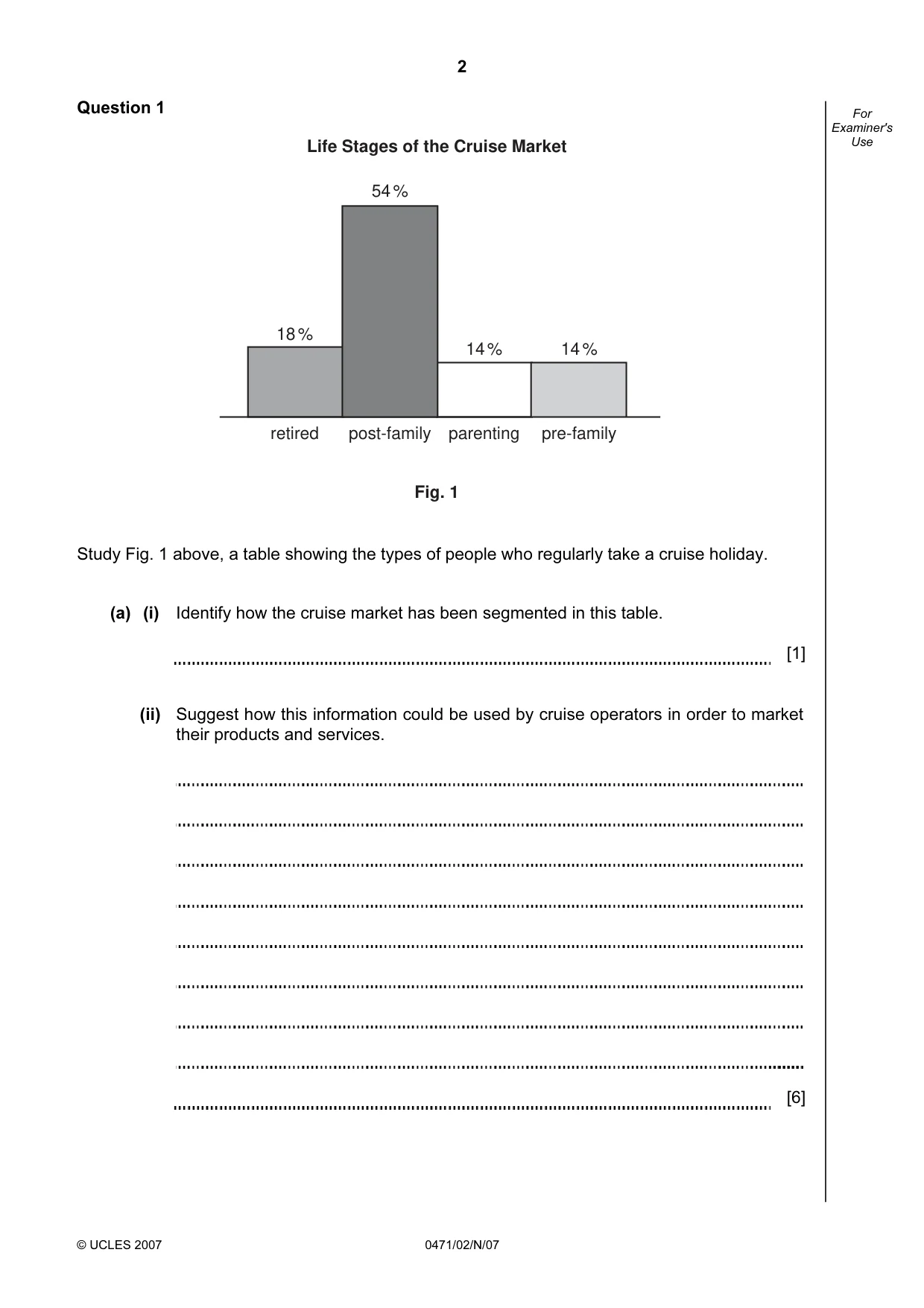
2 © UCLES 2007 0471/02/N/07 For Examiner's Use Question 1 retired post-family parenting pre-family 18 % 54 % 14 % 14 % Life Stages of the Cruise Market Fig. 1 Study Fig. 1 above, a table showing the types of people who regularly take a cruise holiday. (a) (i) Identify how the cruise market has been segmented in this table. [1] (ii) Suggest how this information could be used by cruise operators in order to market their products and services. [6]
Question paper, page 3
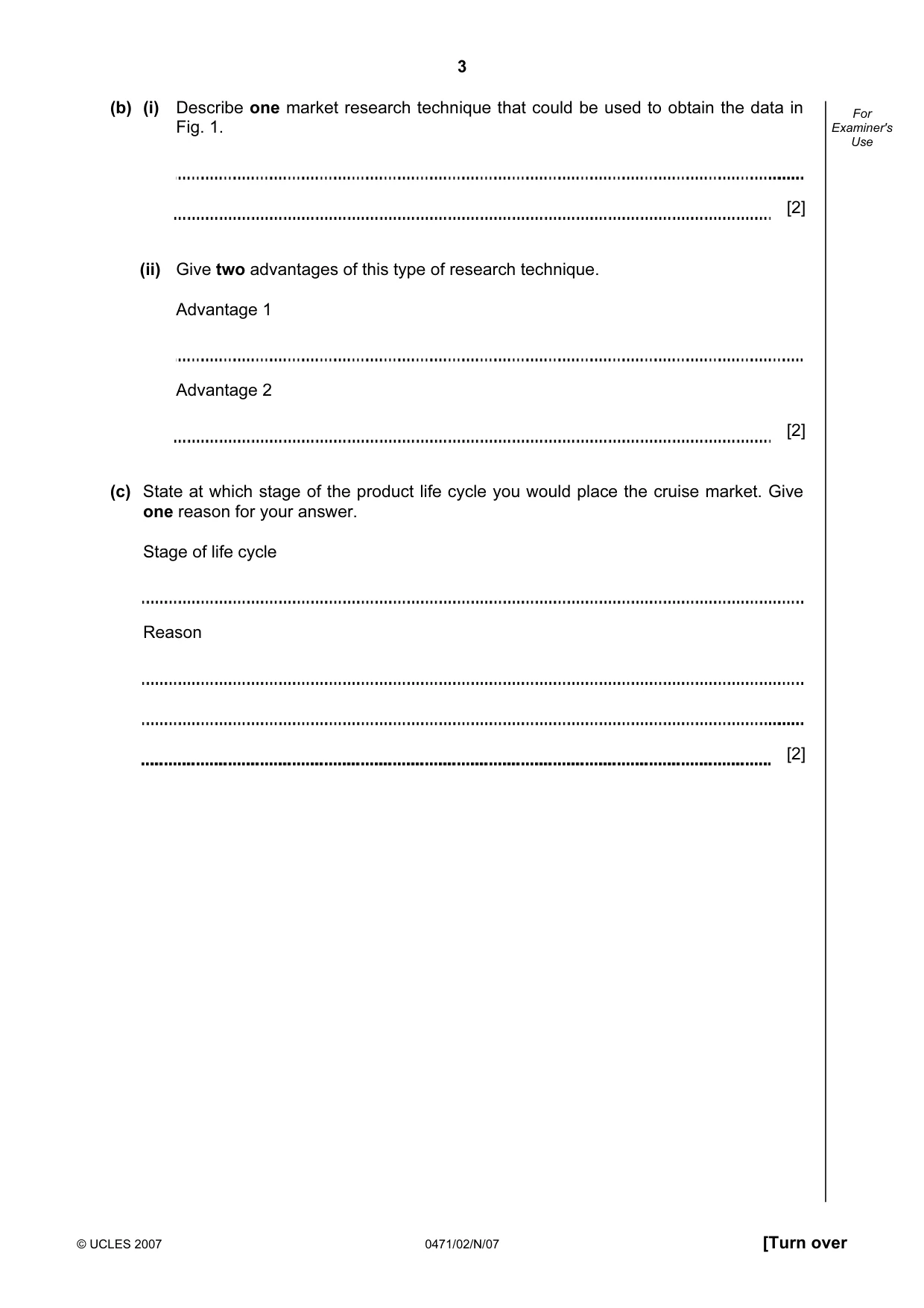
3 © UCLES 2007 0471/02/N/07 [Turn over For Examiner's Use (b) (i) Describe one market research technique that could be used to obtain the data in Fig. 1. [2] (ii) Give two advantages of this type of research technique. Advantage 1 Advantage 2 [2] (c) State at which stage of the product life cycle you would place the cruise market. Give one reason for your answer. Stage of life cycle Reason [2]
Question paper, page 4
4 © UCLES 2007 0471/02/N/07 For Examiner's Use (d) Discuss the product/service mix associated with a cruise holiday. [6] (e) Explain why marketing and promotion are important to cruise operators. [6] [Total : 25]
Question paper, page 5
5 © UCLES 2007 0471/02/N/07 [Turn over For Examiner's Use Question 2 (a) (i) Define the term public relations. [1] (ii) Describe two examples of how public relations are used in the travel and tourism industry. Example 1 Example 2 [4] (b) Explain the benefits of printed publicity materials as a communication method from the point of view of both the tourism provider and the customer. [8]
Question paper, page 6
6 © UCLES 2007 0471/02/N/07 For Examiner's Use (c) Explain how the AIDA principle can be used to benefit tourism providers in marketing their products. [8] (d) Describe the way in which the brand image of an airline company may be used to promote the company’s travel products. [4] [Total : 25]
Question paper, page 7
7 © UCLES 2007 0471/02/N/07 [Turn over For Examiner's Use Question 3 The Hong Kong Tourism Authority carried out a situation analysis, in order to see how it could improve tourism provision in Hong Kong. The analysis was broken down into two parts – PEST and SWOT analyses. (a) Identify the four sections of a PEST analysis. Section 1 Section 2 Section 3 Section 4 [4]
Question paper, page 8
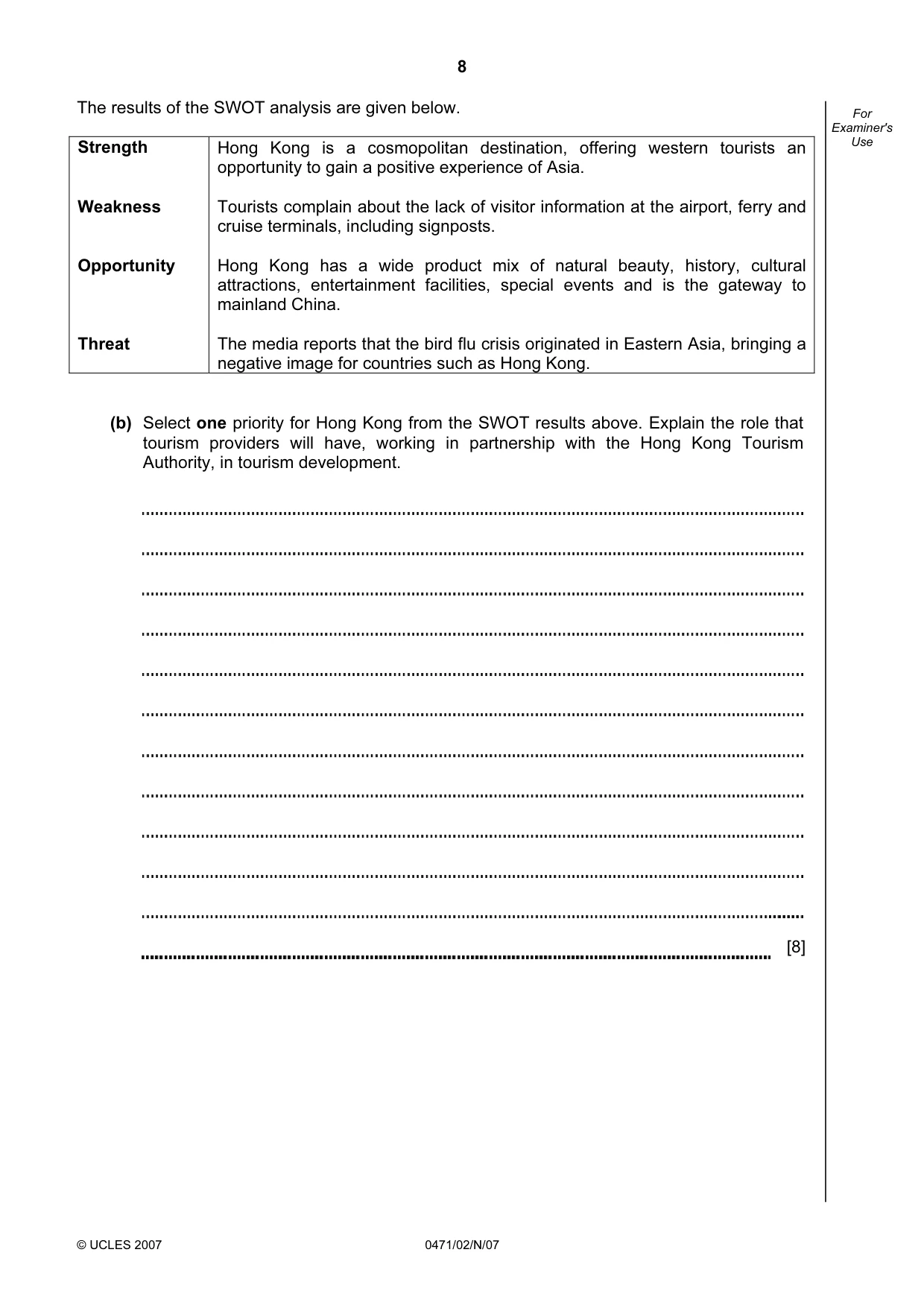
8 © UCLES 2007 0471/02/N/07 For Examiner's Use The results of the SWOT analysis are given below. Strength Weakness Opportunity Threat Hong Kong is a cosmopolitan destination, offering western tourists an opportunity to gain a positive experience of Asia. Tourists complain about the lack of visitor information at the airport, ferry and cruise terminals, including signposts. Hong Kong has a wide product mix of natural beauty, history, cultural attractions, entertainment facilities, special events and is the gateway to mainland China. The media reports that the bird flu crisis originated in Eastern Asia, bringing a negative image for countries such as Hong Kong. (b) Select one priority for Hong Kong from the SWOT results above. Explain the role that tourism providers will have, working in partnership with the Hong Kong Tourism Authority, in tourism development. [8]
Question paper, page 9
9 © UCLES 2007 0471/02/N/07 [Turn over For Examiner's Use The Hong Kong Tourism Authority suggests the development of a wide range of tourism products for the country. These include the following: • Waterfront attractions – based on the successful night markets and quayside restaurants in Singapore. • Food attractions – highlighting the richness of oriental flavours/aromas in on-the-street cookery demonstrations. • Natural medicine packages – allowing visitors to experience a range of alternative health treatments. • Mainland China guided tours – appealing to visitors who enjoy multi-stay holidays. (c) Imagine that you work for the Hong Kong Tourism Authority. Explain how you would develop the marketing mix for one of these new tourism products. [8]
Question paper, page 10
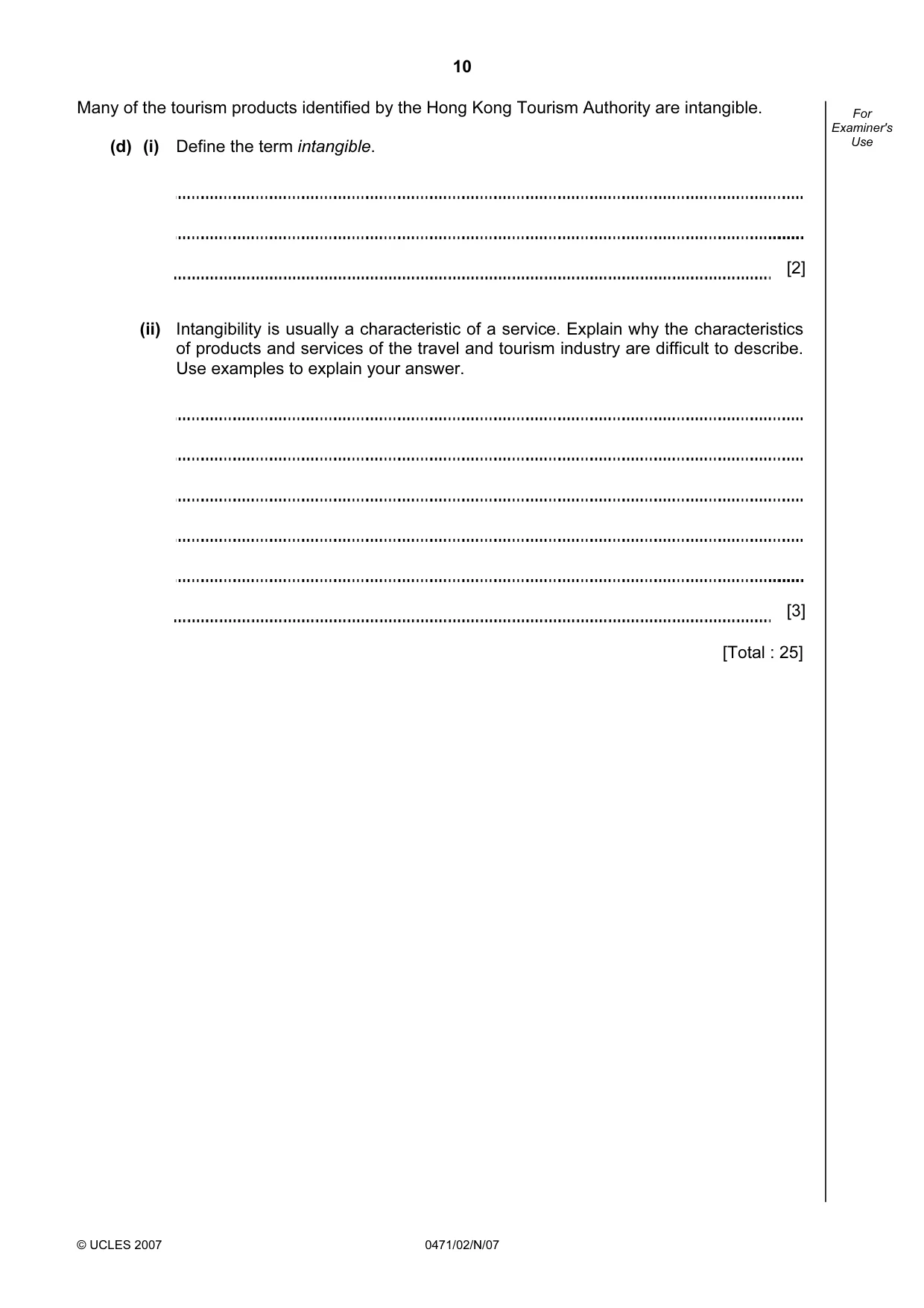
10 © UCLES 2007 0471/02/N/07 For Examiner's Use Many of the tourism products identified by the Hong Kong Tourism Authority are intangible. (d) (i) Define the term intangible. [2] (ii) Intangibility is usually a characteristic of a service. Explain why the characteristics of products and services of the travel and tourism industry are difficult to describe. Use examples to explain your answer. [3] [Total : 25]
Question paper, page 11
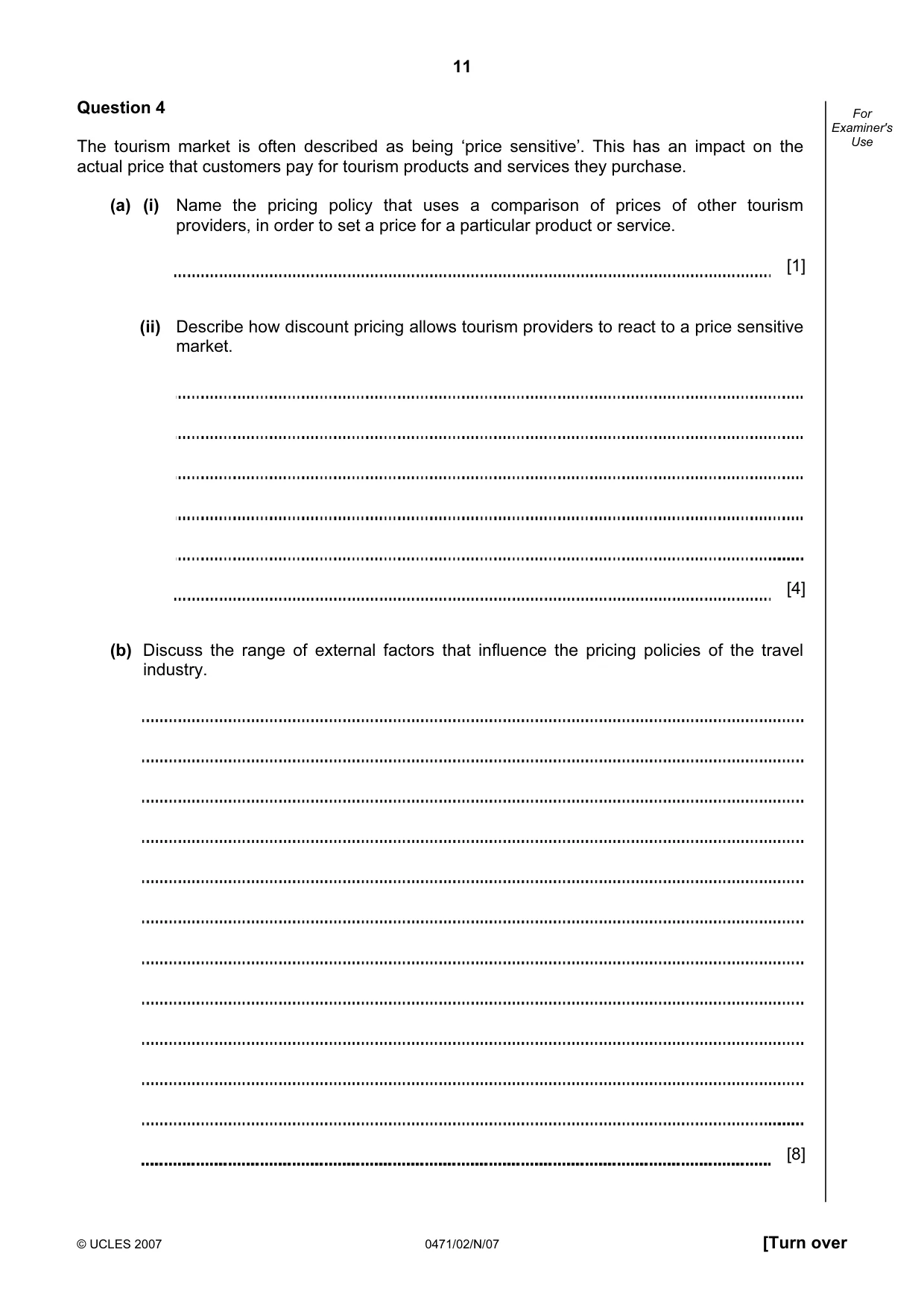
11 © UCLES 2007 0471/02/N/07 [Turn over For Examiner's Use Question 4 The tourism market is often described as being ‘price sensitive’. This has an impact on the actual price that customers pay for tourism products and services they purchase. (a) (i) Name the pricing policy that uses a comparison of prices of other tourism providers, in order to set a price for a particular product or service. [1] (ii) Describe how discount pricing allows tourism providers to react to a price sensitive market. [4] (b) Discuss the range of external factors that influence the pricing policies of the travel industry. [8]
Question paper, page 12
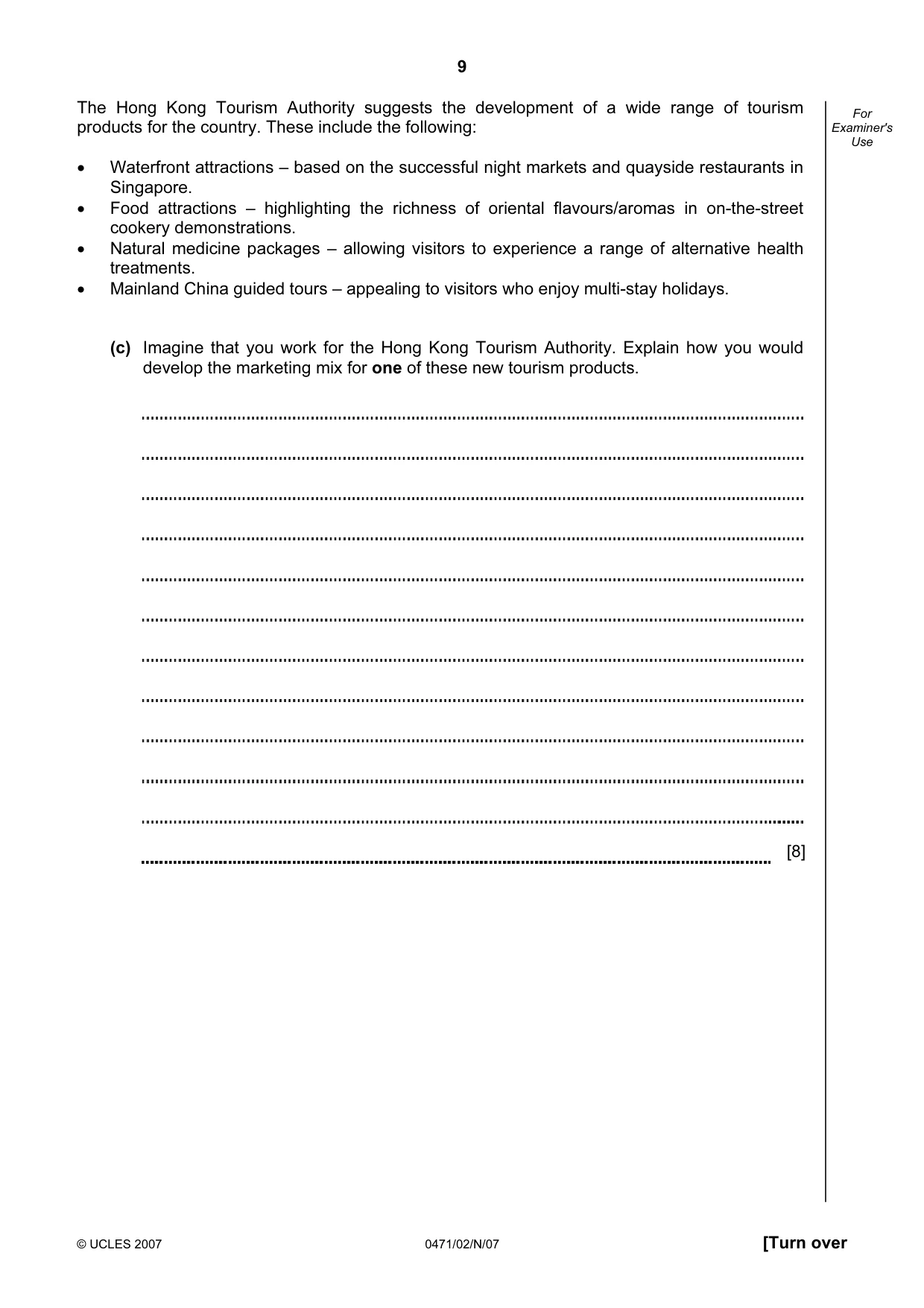
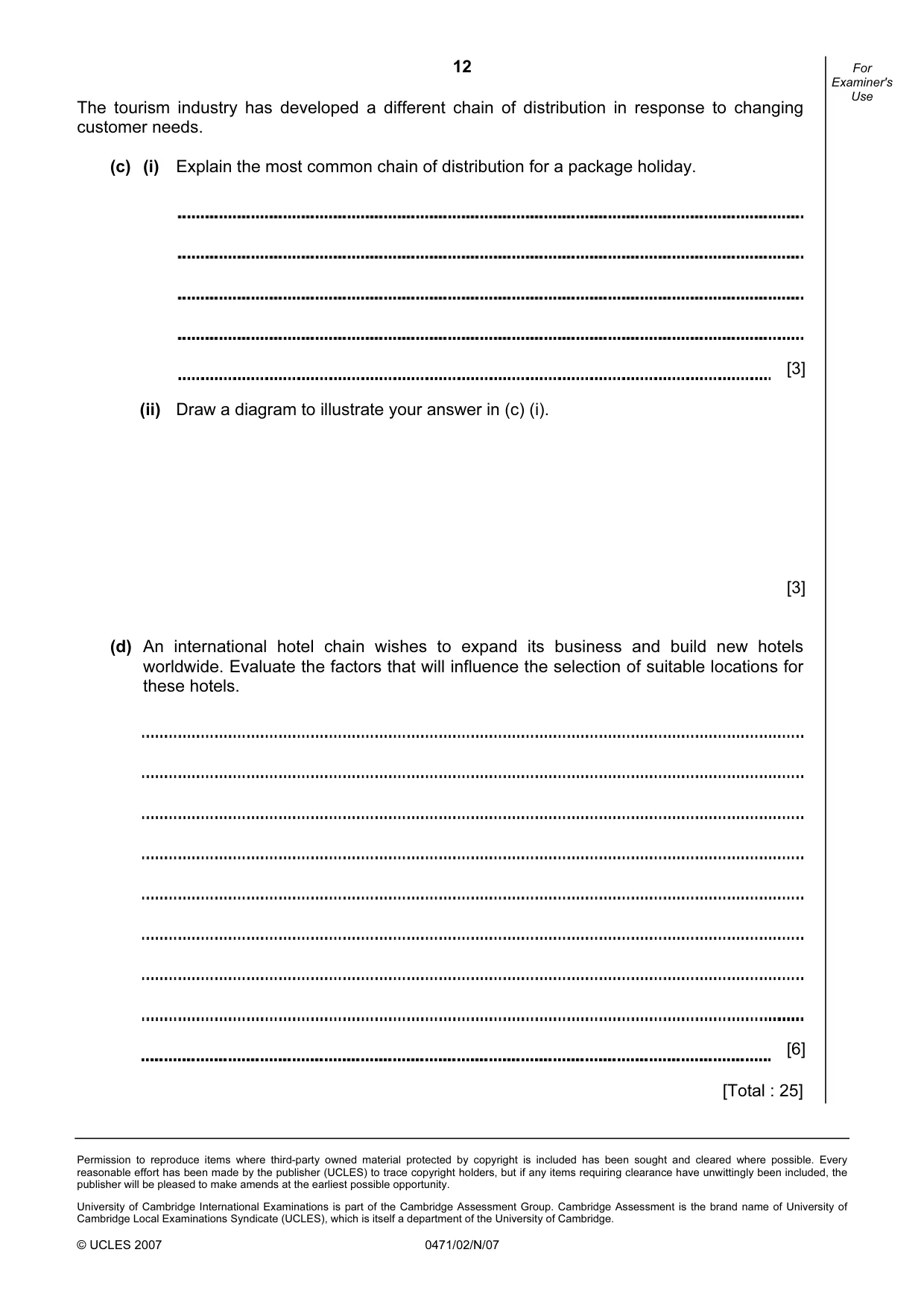
12 Permission to reproduce items where third-party owned material protected by copyright is included has been sought and cleared where possible. Every reasonable effort has been made by the publisher (UCLES) to trace copyright holders, but if any items requiring clearance have unwittingly been included, the publisher will be pleased to make amends at the earliest possible opportunity. University of Cambridge International Examinations is part of the Cambridge Assessment Group. Cambridge Assessment is the brand name of University of Cambridge Local Examinations Syndicate (UCLES), which is itself a department of the University of Cambridge. © UCLES 2007 0471/02/N/07 For Examiner's Use The tourism industry has developed a different chain of distribution in response to changing customer needs. (c) (i) Explain the most common chain of distribution for a package holiday. [3] (ii) Draw a diagram to illustrate your answer in (c) (i). [3] (d) An international hotel chain wishes to expand its business and build new hotels worldwide. Evaluate the factors that will influence the selection of suitable locations for these hotels. [6] [Total : 25]
Mark scheme, page 1
UNIVERSITY OF CAMBRIDGE INTERNATIONAL EXAMINATIONS International General Certificate of Secondary Education MARK SCHEME for the October/November 2007 question paper 0471 TRAVEL AND TOURISM 0471/02 Paper 2 (Alternative to Coursework), maximum raw mark 100 This mark scheme is published as an aid to teachers and candidates, to indicate the requirements of the examination. It shows the basis on which Examiners were instructed to award marks. It does not indicate the details of the discussions that took place at an Examiners’ meeting before marking began. All Examiners are instructed that alternative correct answers and unexpected approaches in candidates’ scripts must be given marks that fairly reflect the relevant knowledge and skills demonstrated. Mark schemes must be read in conjunction with the question papers and the report on the examination. • CIE will not enter into discussions or correspondence in connection with these mark schemes. CIE is publishing the mark schemes for the October/November 2007 question papers for most IGCSE, GCE Advanced Level and Advanced Subsidiary Level syllabuses and some Ordinary Level syllabuses. www.XtremePapers.com
Mark scheme, page 2
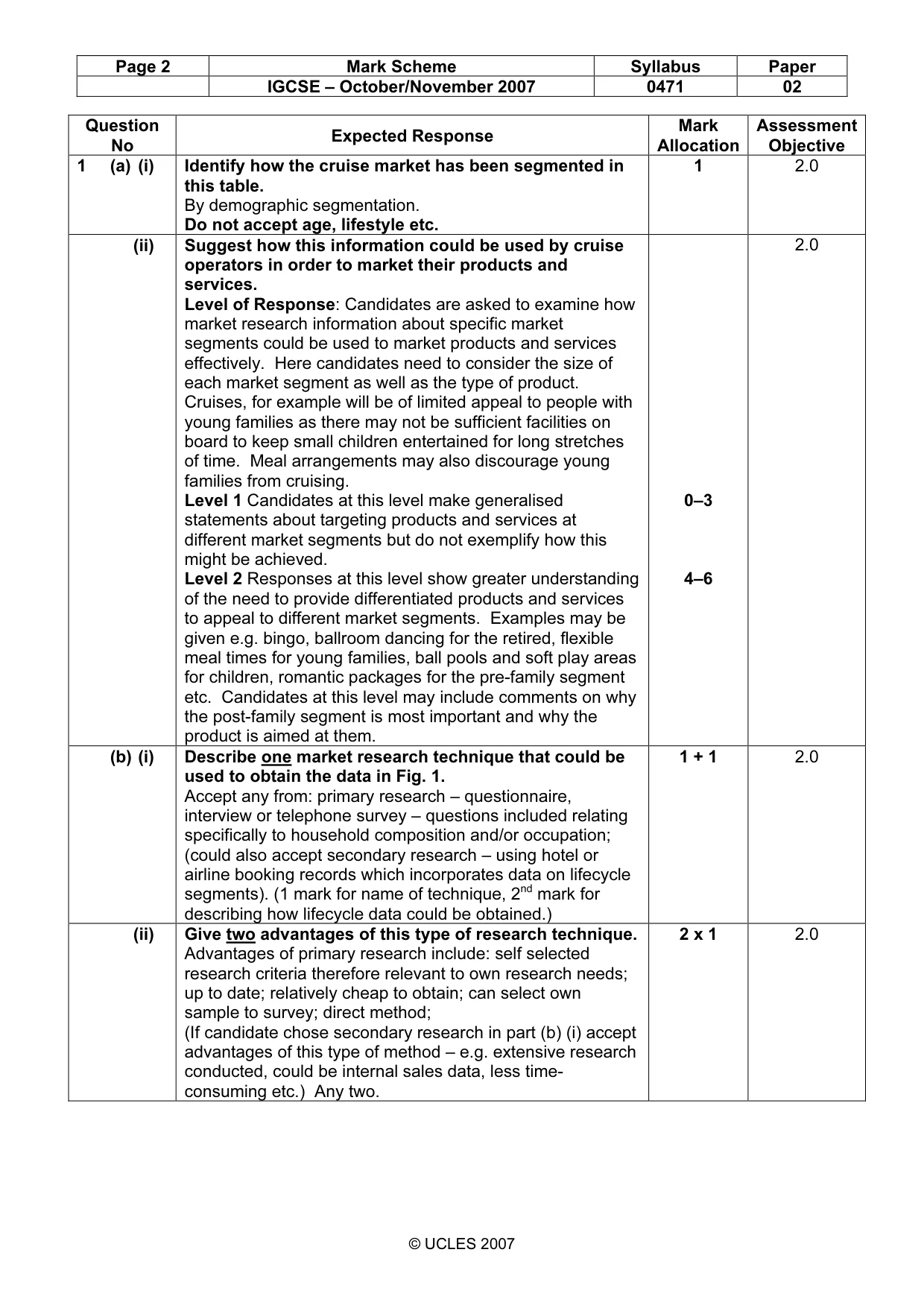
Page 2 Mark Scheme Syllabus Paper IGCSE – October/November 2007 0471 02 © UCLES 2007 Question No Expected Response Mark Allocation Assessment Objective 1 (a) (i) Identify how the cruise market has been segmented in this table. By demographic segmentation. Do not accept age, lifestyle etc. 1 2.0 (ii) Suggest how this information could be used by cruise operators in order to market their products and services. Level of Response: Candidates are asked to examine how market research information about specific market segments could be used to market products and services effectively. Here candidates need to consider the size of each market segment as well as the type of product. Cruises, for example will be of limited appeal to people with young families as there may not be sufficient facilities on board to keep small children entertained for long stretches of time. Meal arrangements may also discourage young families from cruising. Level 1 Candidates at this level make generalised statements about targeting products and services at different market segments but do not exemplify how this might be achieved. Level 2 Responses at this level show greater understanding of the need to provide differentiated products and services to appeal to different market segments. Examples may be given e.g. bingo, ballroom dancing for the retired, flexible meal times for young families, ball pools and soft play areas for children, romantic packages for the pre-family segment etc. Candidates at this level may include comments on why the post-family segment is most important and why the product is aimed at them. 0–3 4–6 2.0 (b) (i) Describe one market research technique that could be used to obtain the data in Fig. 1. Accept any from: primary research – questionnaire, interview or telephone survey – questions included relating specifically to household composition and/or occupation; (could also accept secondary research – using hotel or airline booking records which incorporates data on lifecycle segments). (1 mark for name of technique, 2nd mark for describing how lifecycle data could be obtained.) 1 + 1 2.0 (ii) Give two advantages of this type of research technique. Advantages of primary research include: self selected research criteria therefore relevant to own research needs; up to date; relatively cheap to obtain; can select own sample to survey; direct method; (If candidate chose secondary research in part (b) (i) accept advantages of this type of method – e.g. extensive research conducted, could be internal sales data, less time- consuming etc.) Any two. 2 x 1 2.0
Mark scheme, page 3
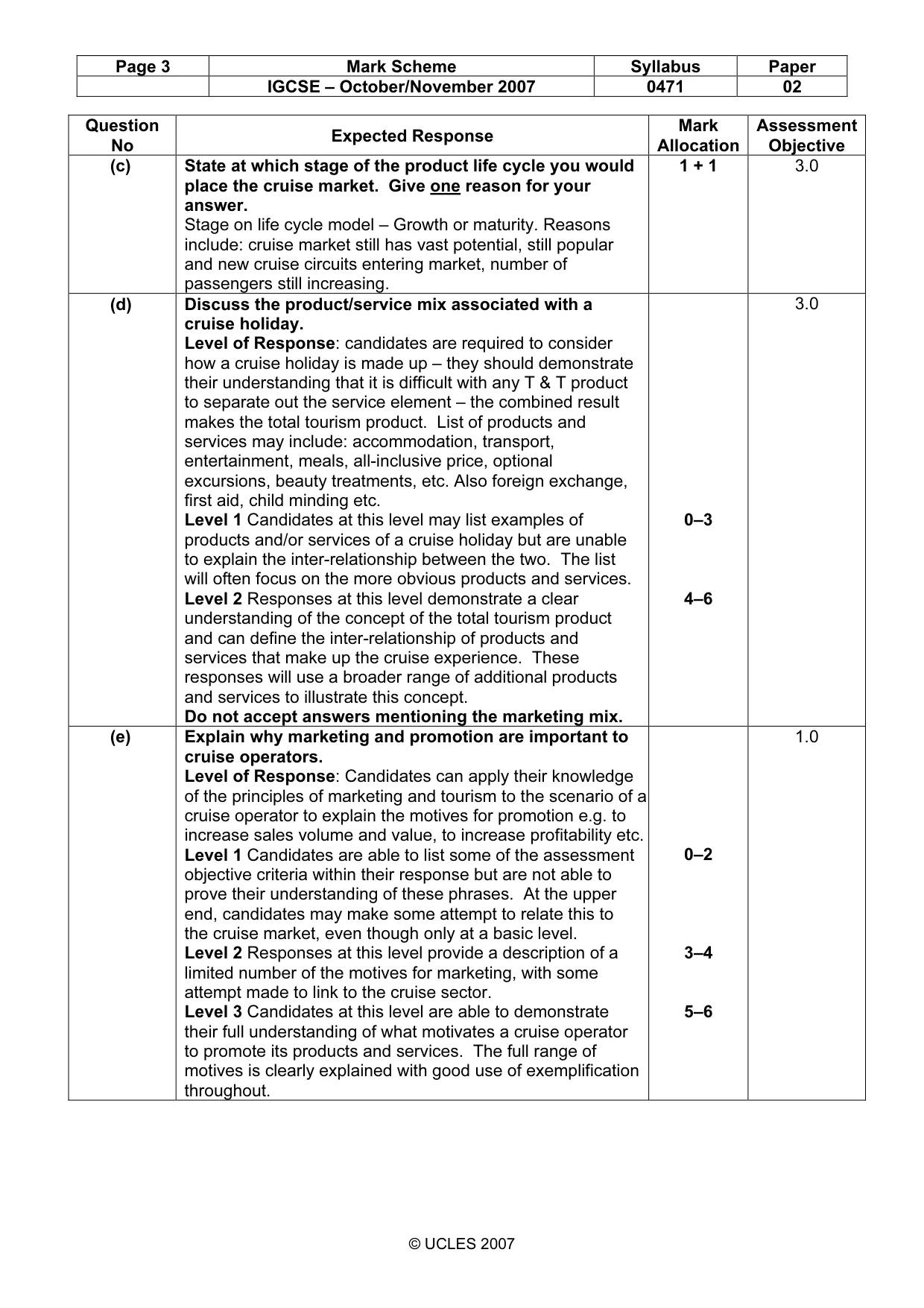
Page 3 Mark Scheme Syllabus Paper IGCSE – October/November 2007 0471 02 © UCLES 2007 Question No Expected Response Mark Allocation Assessment Objective (c) State at which stage of the product life cycle you would place the cruise market. Give one reason for your answer. Stage on life cycle model – Growth or maturity. Reasons include: cruise market still has vast potential, still popular and new cruise circuits entering market, number of passengers still increasing. 1 + 1 3.0 (d) Discuss the product/service mix associated with a cruise holiday. Level of Response: candidates are required to consider how a cruise holiday is made up – they should demonstrate their understanding that it is difficult with any T & T product to separate out the service element – the combined result makes the total tourism product. List of products and services may include: accommodation, transport, entertainment, meals, all-inclusive price, optional excursions, beauty treatments, etc. Also foreign exchange, first aid, child minding etc. Level 1 Candidates at this level may list examples of products and/or services of a cruise holiday but are unable to explain the inter-relationship between the two. The list will often focus on the more obvious products and services. Level 2 Responses at this level demonstrate a clear understanding of the concept of the total tourism product and can define the inter-relationship of products and services that make up the cruise experience. These responses will use a broader range of additional products and services to illustrate this concept. Do not accept answers mentioning the marketing mix. 0–3 4–6 3.0 (e) Explain why marketing and promotion are important to cruise operators. Level of Response: Candidates can apply their knowledge of the principles of marketing and tourism to the scenario of a cruise operator to explain the motives for promotion e.g. to increase sales volume and value, to increase profitability etc. Level 1 Candidates are able to list some of the assessment objective criteria within their response but are not able to prove their understanding of these phrases. At the upper end, candidates may make some attempt to relate this to the cruise market, even though only at a basic level. Level 2 Responses at this level provide a description of a limited number of the motives for marketing, with some attempt made to link to the cruise sector. Level 3 Candidates at this level are able to demonstrate their full understanding of what motivates a cruise operator to promote its products and services. The full range of motives is clearly explained with good use of exemplification throughout. 0–2 3–4 5–6 1.0
Mark scheme, page 4
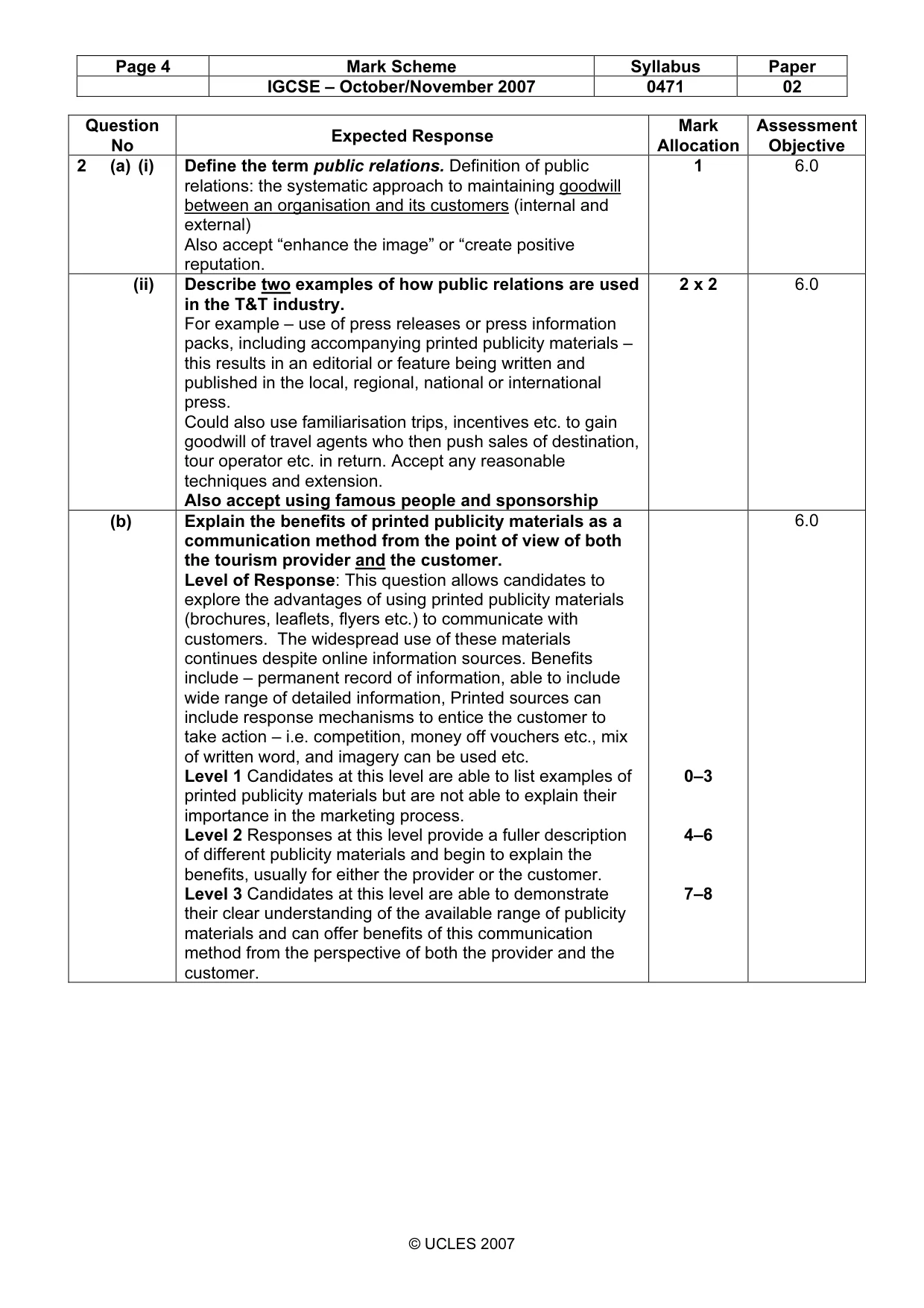
Page 4 Mark Scheme Syllabus Paper IGCSE – October/November 2007 0471 02 © UCLES 2007 Question No Expected Response Mark Allocation Assessment Objective 2 (a) (i) Define the term public relations. Definition of public relations: the systematic approach to maintaining goodwill between an organisation and its customers (internal and external) Also accept “enhance the image” or “create positive reputation. 1 6.0 (ii) Describe two examples of how public relations are used in the T&T industry. For example – use of press releases or press information packs, including accompanying printed publicity materials – this results in an editorial or feature being written and published in the local, regional, national or international press. Could also use familiarisation trips, incentives etc. to gain goodwill of travel agents who then push sales of destination, tour operator etc. in return. Accept any reasonable techniques and extension. Also accept using famous people and sponsorship 2 x 2 6.0 (b) Explain the benefits of printed publicity materials as a communication method from the point of view of both the tourism provider and the customer. Level of Response: This question allows candidates to explore the advantages of using printed publicity materials (brochures, leaflets, flyers etc.) to communicate with customers. The widespread use of these materials continues despite online information sources. Benefits include – permanent record of information, able to include wide range of detailed information, Printed sources can include response mechanisms to entice the customer to take action – i.e. competition, money off vouchers etc., mix of written word, and imagery can be used etc. Level 1 Candidates at this level are able to list examples of printed publicity materials but are not able to explain their importance in the marketing process. Level 2 Responses at this level provide a fuller description of different publicity materials and begin to explain the benefits, usually for either the provider or the customer. Level 3 Candidates at this level are able to demonstrate their clear understanding of the available range of publicity materials and can offer benefits of this communication method from the perspective of both the provider and the customer. 0–3 4–6 7–8 6.0
Mark scheme, page 5
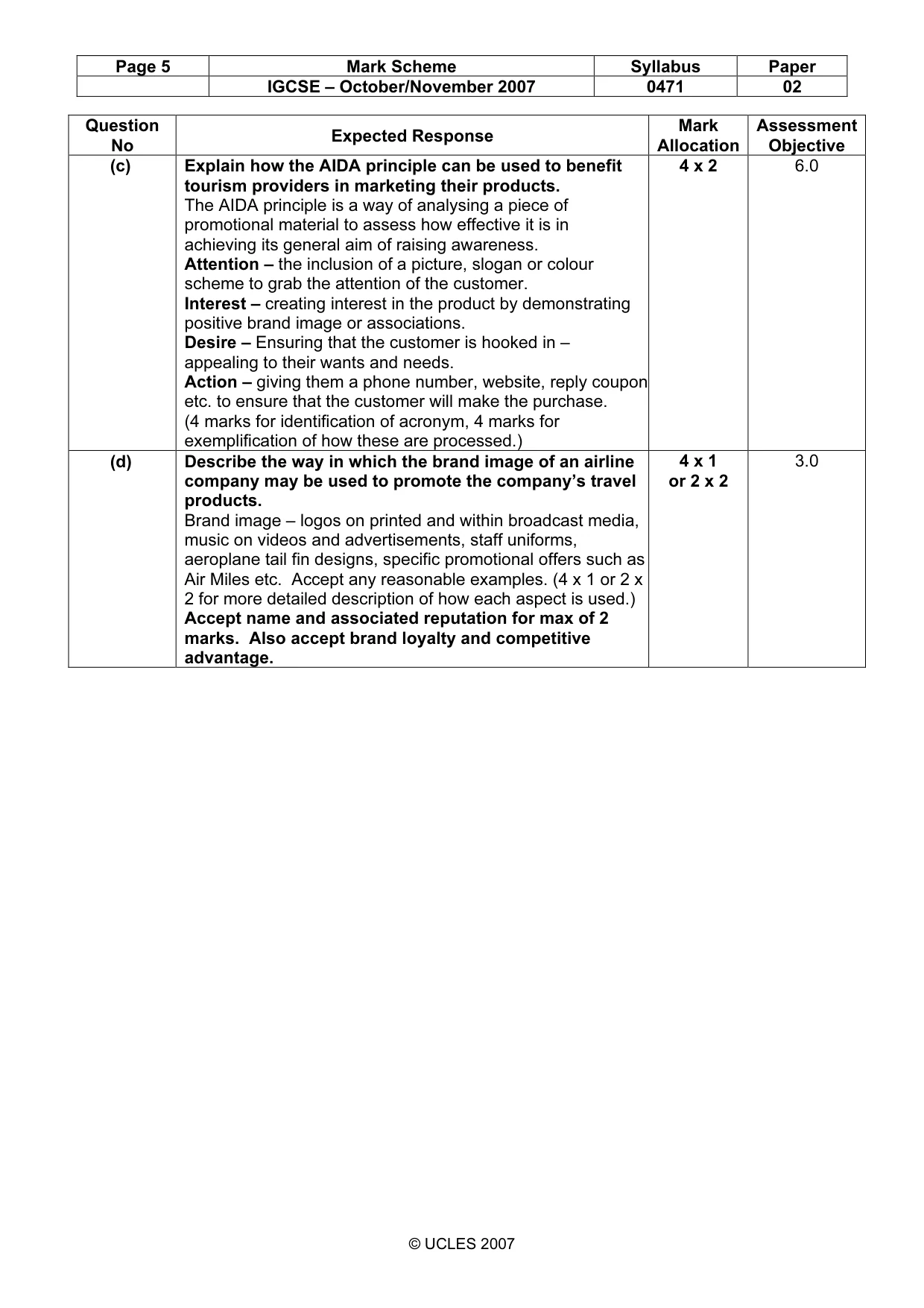
Page 5 Mark Scheme Syllabus Paper IGCSE – October/November 2007 0471 02 © UCLES 2007 Question No Expected Response Mark Allocation Assessment Objective (c) Explain how the AIDA principle can be used to benefit tourism providers in marketing their products. The AIDA principle is a way of analysing a piece of promotional material to assess how effective it is in achieving its general aim of raising awareness. Attention – the inclusion of a picture, slogan or colour scheme to grab the attention of the customer. Interest – creating interest in the product by demonstrating positive brand image or associations. Desire – Ensuring that the customer is hooked in – appealing to their wants and needs. Action – giving them a phone number, website, reply coupon etc. to ensure that the customer will make the purchase. (4 marks for identification of acronym, 4 marks for exemplification of how these are processed.) 4 x 2 6.0 (d) Describe the way in which the brand image of an airline company may be used to promote the company’s travel products. Brand image – logos on printed and within broadcast media, music on videos and advertisements, staff uniforms, aeroplane tail fin designs, specific promotional offers such as Air Miles etc. Accept any reasonable examples. (4 x 1 or 2 x 2 for more detailed description of how each aspect is used.) Accept name and associated reputation for max of 2 marks. Also accept brand loyalty and competitive advantage. 4 x 1 or 2 x 2 3.0
Mark scheme, page 6
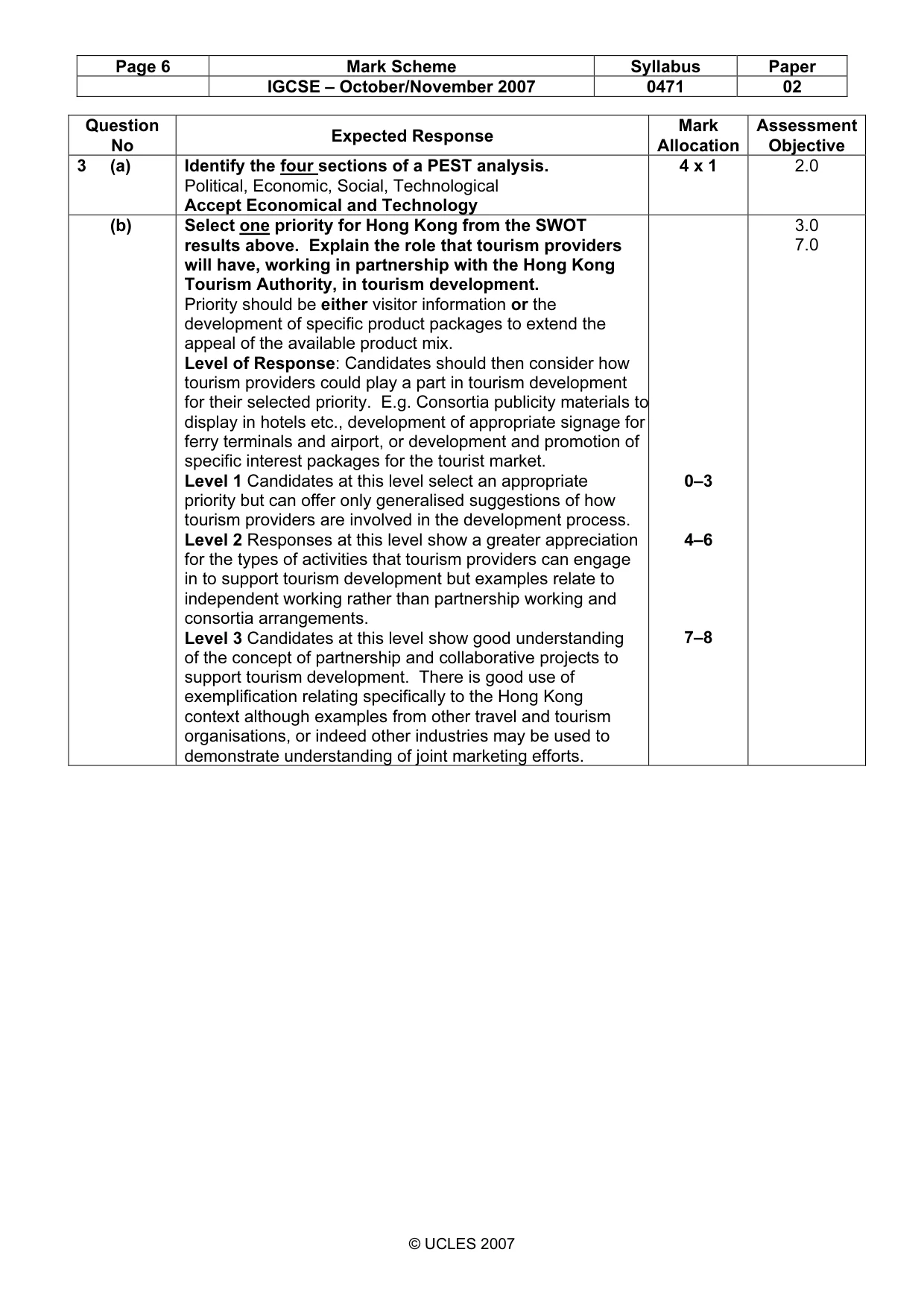
Page 6 Mark Scheme Syllabus Paper IGCSE – October/November 2007 0471 02 © UCLES 2007 Question No Expected Response Mark Allocation Assessment Objective 3 (a) Identify the four sections of a PEST analysis. Political, Economic, Social, Technological Accept Economical and Technology 4 x 1 2.0 (b) Select one priority for Hong Kong from the SWOT results above. Explain the role that tourism providers will have, working in partnership with the Hong Kong Tourism Authority, in tourism development. Priority should be either visitor information or the development of specific product packages to extend the appeal of the available product mix. Level of Response: Candidates should then consider how tourism providers could play a part in tourism development for their selected priority. E.g. Consortia publicity materials to display in hotels etc., development of appropriate signage for ferry terminals and airport, or development and promotion of specific interest packages for the tourist market. Level 1 Candidates at this level select an appropriate priority but can offer only generalised suggestions of how tourism providers are involved in the development process. Level 2 Responses at this level show a greater appreciation for the types of activities that tourism providers can engage in to support tourism development but examples relate to independent working rather than partnership working and consortia arrangements. Level 3 Candidates at this level show good understanding of the concept of partnership and collaborative projects to support tourism development. There is good use of exemplification relating specifically to the Hong Kong context although examples from other travel and tourism organisations, or indeed other industries may be used to demonstrate understanding of joint marketing efforts. 0–3 4–6 7–8 3.0 7.0
Mark scheme, page 7
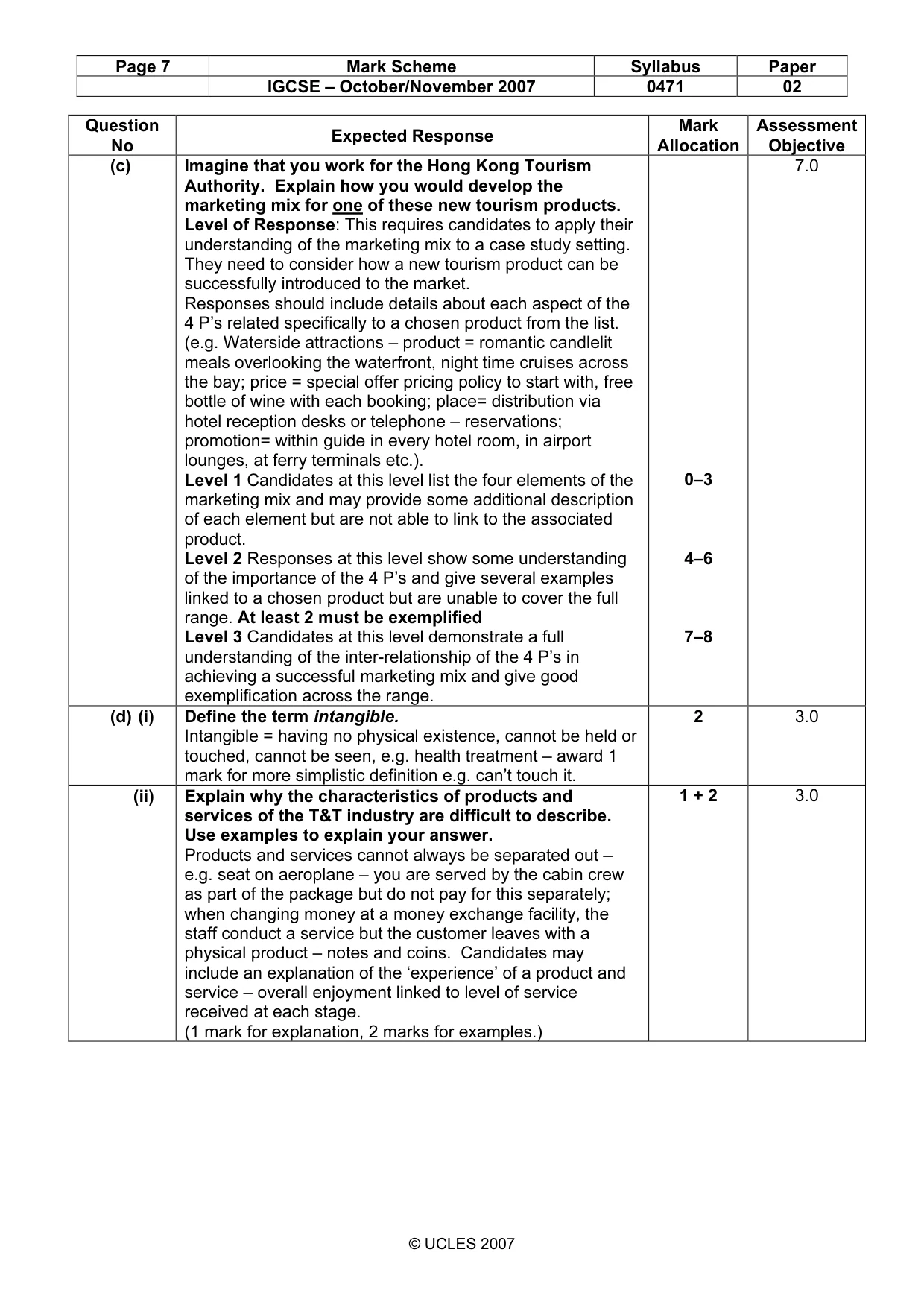
Page 7 Mark Scheme Syllabus Paper IGCSE – October/November 2007 0471 02 © UCLES 2007 Question No Expected Response Mark Allocation Assessment Objective (c) Imagine that you work for the Hong Kong Tourism Authority. Explain how you would develop the marketing mix for one of these new tourism products. Level of Response: This requires candidates to apply their understanding of the marketing mix to a case study setting. They need to consider how a new tourism product can be successfully introduced to the market. Responses should include details about each aspect of the 4 P’s related specifically to a chosen product from the list. (e.g. Waterside attractions – product = romantic candlelit meals overlooking the waterfront, night time cruises across the bay; price = special offer pricing policy to start with, free bottle of wine with each booking; place= distribution via hotel reception desks or telephone – reservations; promotion= within guide in every hotel room, in airport lounges, at ferry terminals etc.). Level 1 Candidates at this level list the four elements of the marketing mix and may provide some additional description of each element but are not able to link to the associated product. Level 2 Responses at this level show some understanding of the importance of the 4 P’s and give several examples linked to a chosen product but are unable to cover the full range. At least 2 must be exemplified Level 3 Candidates at this level demonstrate a full understanding of the inter-relationship of the 4 P’s in achieving a successful marketing mix and give good exemplification across the range. 0–3 4–6 7–8 7.0 (d) (i) Define the term intangible. Intangible = having no physical existence, cannot be held or touched, cannot be seen, e.g. health treatment – award 1 mark for more simplistic definition e.g. can’t touch it. 2 3.0 (ii) Explain why the characteristics of products and services of the T&T industry are difficult to describe. Use examples to explain your answer. Products and services cannot always be separated out – e.g. seat on aeroplane – you are served by the cabin crew as part of the package but do not pay for this separately; when changing money at a money exchange facility, the staff conduct a service but the customer leaves with a physical product – notes and coins. Candidates may include an explanation of the ‘experience’ of a product and service – overall enjoyment linked to level of service received at each stage. (1 mark for explanation, 2 marks for examples.) 1 + 2 3.0
Mark scheme, page 8
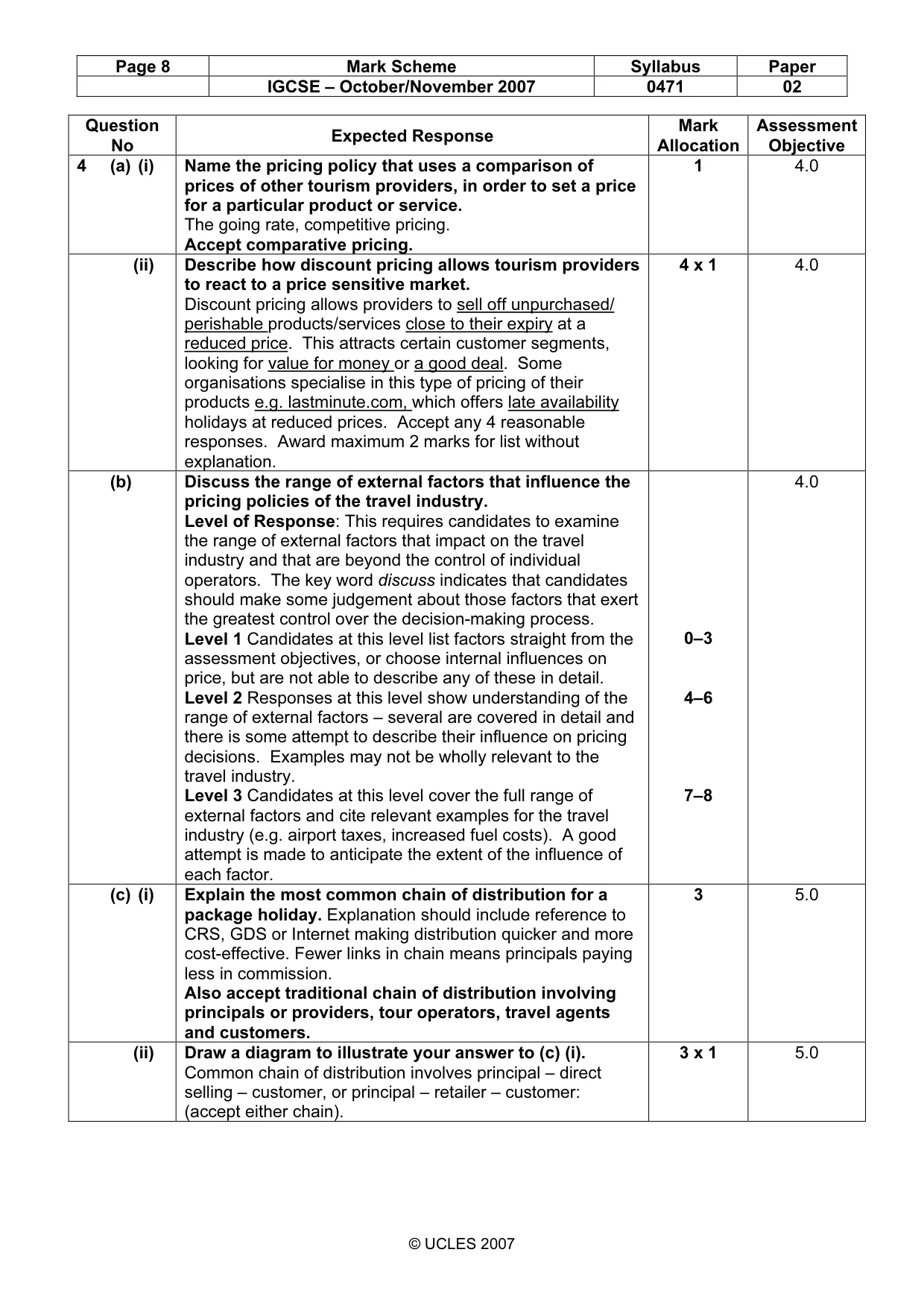
Page 8 Mark Scheme Syllabus Paper IGCSE – October/November 2007 0471 02 © UCLES 2007 Question No Expected Response Mark Allocation Assessment Objective 4 (a) (i) Name the pricing policy that uses a comparison of prices of other tourism providers, in order to set a price for a particular product or service. The going rate, competitive pricing. Accept comparative pricing. 1 4.0 (ii) Describe how discount pricing allows tourism providers to react to a price sensitive market. Discount pricing allows providers to sell off unpurchased/ perishable products/services close to their expiry at a reduced price. This attracts certain customer segments, looking for value for money or a good deal. Some organisations specialise in this type of pricing of their products e.g. lastminute.com, which offers late availability holidays at reduced prices. Accept any 4 reasonable responses. Award maximum 2 marks for list without explanation. 4 x 1 4.0 (b) Discuss the range of external factors that influence the pricing policies of the travel industry. Level of Response: This requires candidates to examine the range of external factors that impact on the travel industry and that are beyond the control of individual operators. The key word discuss indicates that candidates should make some judgement about those factors that exert the greatest control over the decision-making process. Level 1 Candidates at this level list factors straight from the assessment objectives, or choose internal influences on price, but are not able to describe any of these in detail. Level 2 Responses at this level show understanding of the range of external factors – several are covered in detail and there is some attempt to describe their influence on pricing decisions. Examples may not be wholly relevant to the travel industry. Level 3 Candidates at this level cover the full range of external factors and cite relevant examples for the travel industry (e.g. airport taxes, increased fuel costs). A good attempt is made to anticipate the extent of the influence of each factor. 0–3 4–6 7–8 4.0 (c) (i) Explain the most common chain of distribution for a package holiday. Explanation should include reference to CRS, GDS or Internet making distribution quicker and more cost-effective. Fewer links in chain means principals paying less in commission. Also accept traditional chain of distribution involving principals or providers, tour operators, travel agents and customers. 3 5.0 (ii) Draw a diagram to illustrate your answer to (c) (i). Common chain of distribution involves principal – direct selling – customer, or principal – retailer – customer: (accept either chain). 3 x 1 5.0
Mark scheme, page 9
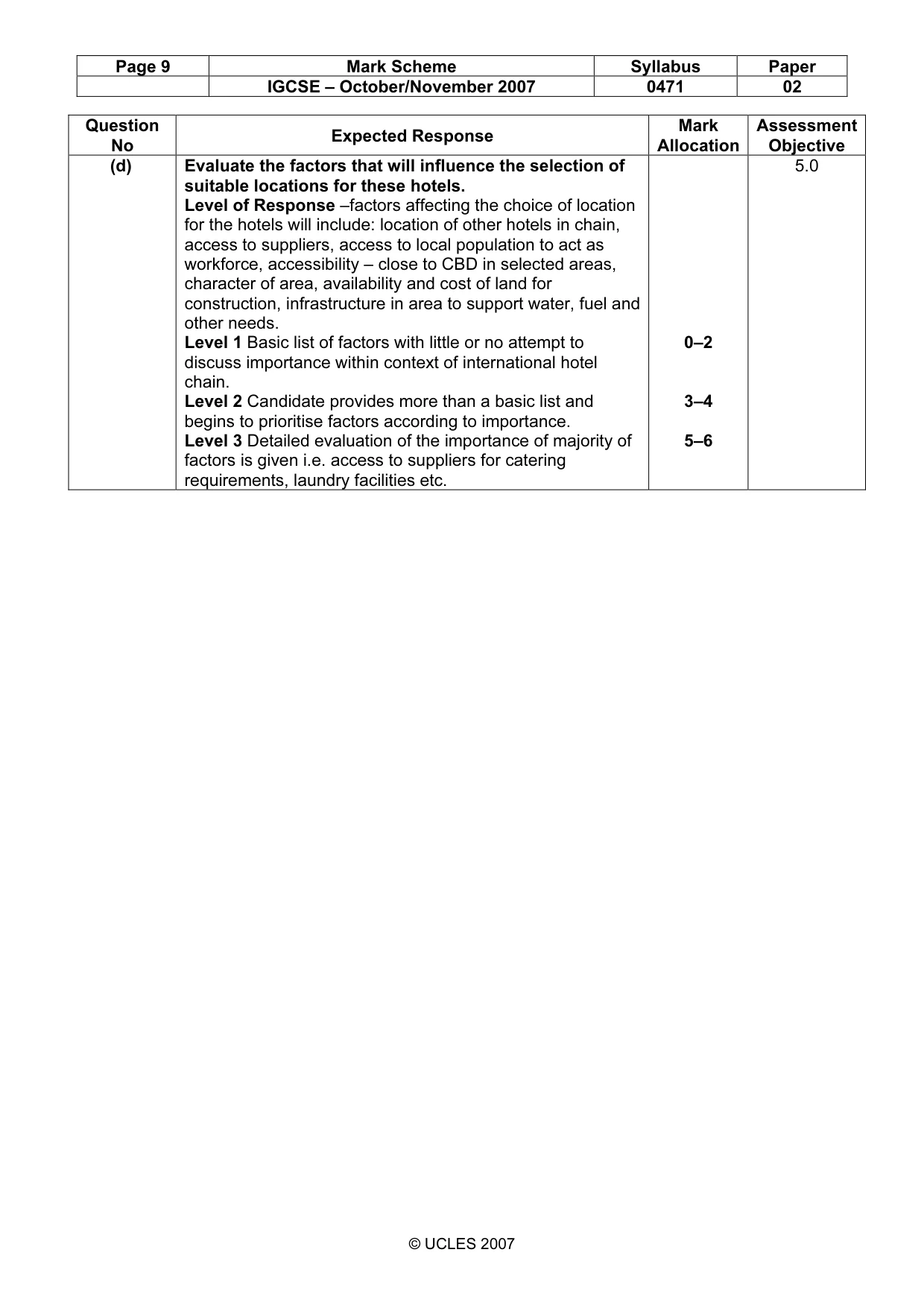
Page 9 Mark Scheme Syllabus Paper IGCSE – October/November 2007 0471 02 © UCLES 2007 Question No Expected Response Mark Allocation Assessment Objective (d) Evaluate the factors that will influence the selection of suitable locations for these hotels. Level of Response –factors affecting the choice of location for the hotels will include: location of other hotels in chain, access to suppliers, access to local population to act as workforce, accessibility – close to CBD in selected areas, character of area, availability and cost of land for construction, infrastructure in area to support water, fuel and other needs. Level 1 Basic list of factors with little or no attempt to discuss importance within context of international hotel chain. Level 2 Candidate provides more than a basic list and begins to prioritise factors according to importance. Level 3 Detailed evaluation of the importance of majority of factors is given i.e. access to suppliers for catering requirements, laundry facilities etc. 0–2 3–4 5–6 5.0
What you needed in this session
Cambridge’s own grade thresholds for 2007 Oct/Nov, Paper 2 · Variant 1. A higher threshold means an easier paper — the bar moves with how the cohort did.