Cambridge IGCSE Travel and Tourism 0471 — 2007 May/June Paper 2 · Variant 1
0471/21/M/J/07 · 100 marks · ≈113 min
The question paper and its mark scheme, free to read here and free to download. This is Cambridge’s own paper, exactly as it was sat.
Question paper16 pages



Mark scheme7 pages
Answers below. Sit the paper first if you are practising.
Paper as text
Question paper, page 1
This document consists of 13 printed pages and 3 blank pages. IB07 06_0471_02/FP © UCLES 2007 [Turn over *5874205834* For Examiner's Use 1 2 3 4 Total UNIVERSITY OF CAMBRIDGE INTERNATIONAL EXAMINATIONS International General Certificate of Secondary Education TRAVEL AND TOURISM 0471/02 Marketing and Promotion May/June 2007 2 hours 30 minutes Candidates answer on the Question Paper. No Additional Materials are required. READ THESE INSTRUCTIONS FIRST Write your Centre number, candidate number and name on all the work you hand in. Write in dark blue or black pen. You may use a soft pencil for any diagrams, graphs or rough working. Do not use staples, paper clips, highlighters, glue or correction fluid. DO NOT WRITE IN ANY BARCODES. Answer all questions. At the end of the examination, fasten all your work securely together. The number of marks is given in brackets [ ] at the end of each question or part question. www.XtremePapers.com
Question paper, page 2
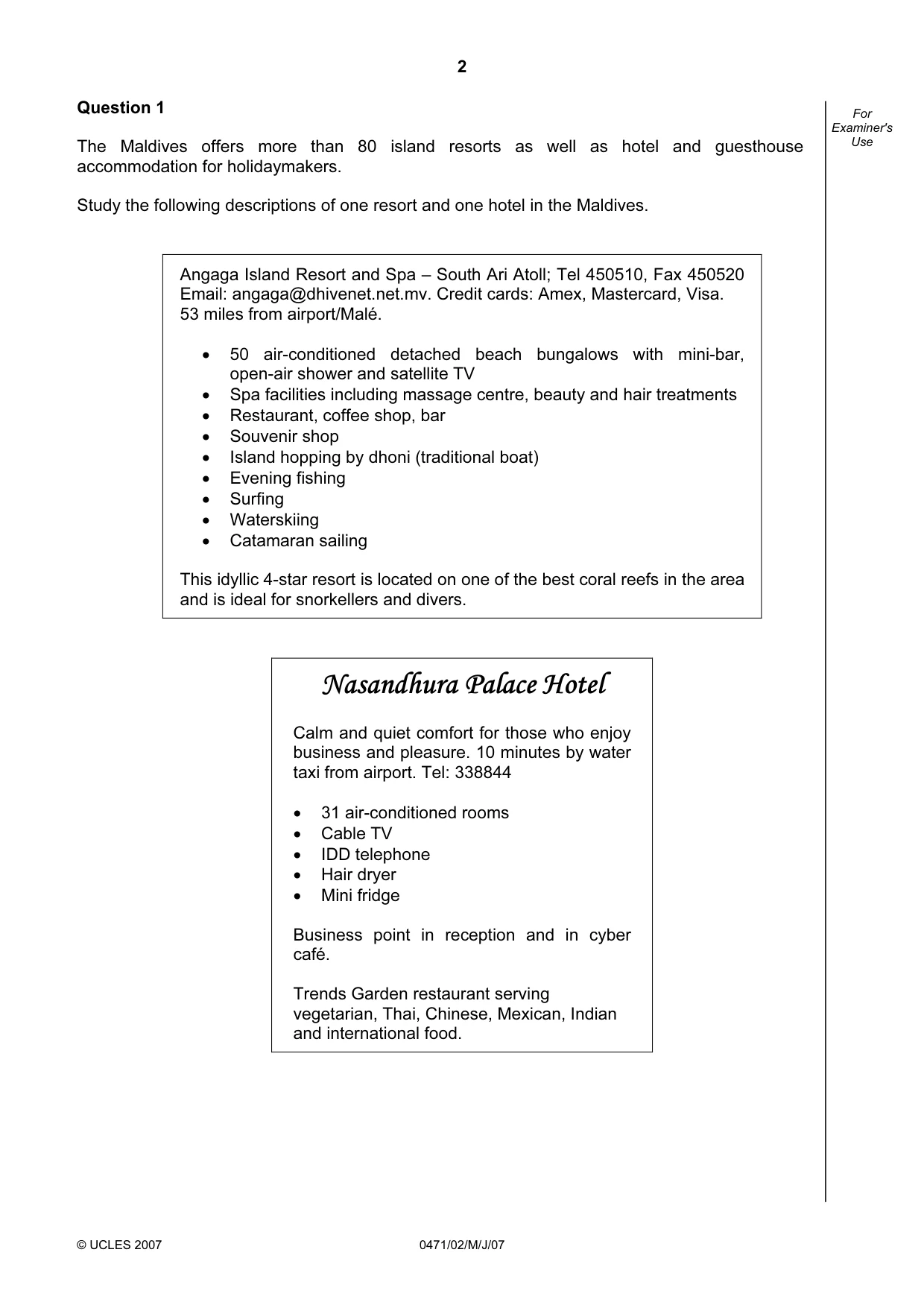
2 © UCLES 2007 0471/02/M/J/07 For Examiner's Use Question 1 The Maldives offers more than 80 island resorts as well as hotel and guesthouse accommodation for holidaymakers. Study the following descriptions of one resort and one hotel in the Maldives. Angaga Island Resort and Spa – South Ari Atoll; Tel 450510, Fax 450520 Email: angaga@dhivenet.net.mv. Credit cards: Amex, Mastercard, Visa. 53 miles from airport/Malé. • 50 air-conditioned detached beach bungalows with mini-bar, open-air shower and satellite TV • Spa facilities including massage centre, beauty and hair treatments • Restaurant, coffee shop, bar • Souvenir shop • Island hopping by dhoni (traditional boat) • Evening fishing • Surfing • Waterskiing • Catamaran sailing This idyllic 4-star resort is located on one of the best coral reefs in the area and is ideal for snorkellers and divers. Nasandhura Palace Hotel Calm and quiet comfort for those who enjoy business and pleasure. 10 minutes by water taxi from airport. Tel: 338844 • 31 air-conditioned rooms • Cable TV • IDD telephone • Hair dryer • Mini fridge Business point in reception and in cyber café. Trends Garden restaurant serving vegetarian, Thai, Chinese, Mexican, Indian and international food.
Question paper, page 3
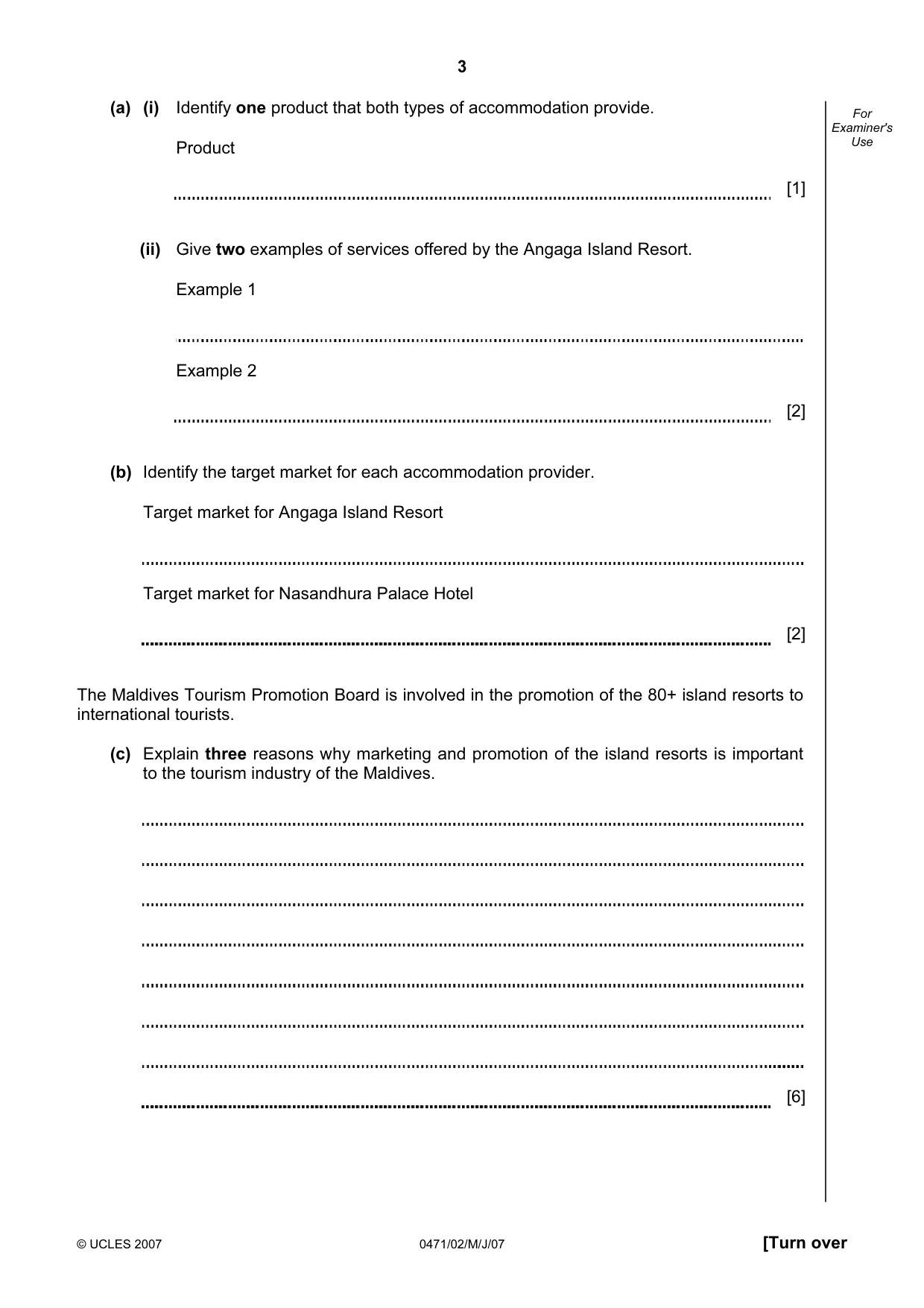
3 © UCLES 2007 0471/02/M/J/07 [Turn over For Examiner's Use (a) (i) Identify one product that both types of accommodation provide. Product [1] (ii) Give two examples of services offered by the Angaga Island Resort. Example 1 Example 2 [2] (b) Identify the target market for each accommodation provider. Target market for Angaga Island Resort Target market for Nasandhura Palace Hotel [2] The Maldives Tourism Promotion Board is involved in the promotion of the 80+ island resorts to international tourists. (c) Explain three reasons why marketing and promotion of the island resorts is important to the tourism industry of the Maldives. [6]
Question paper, page 4
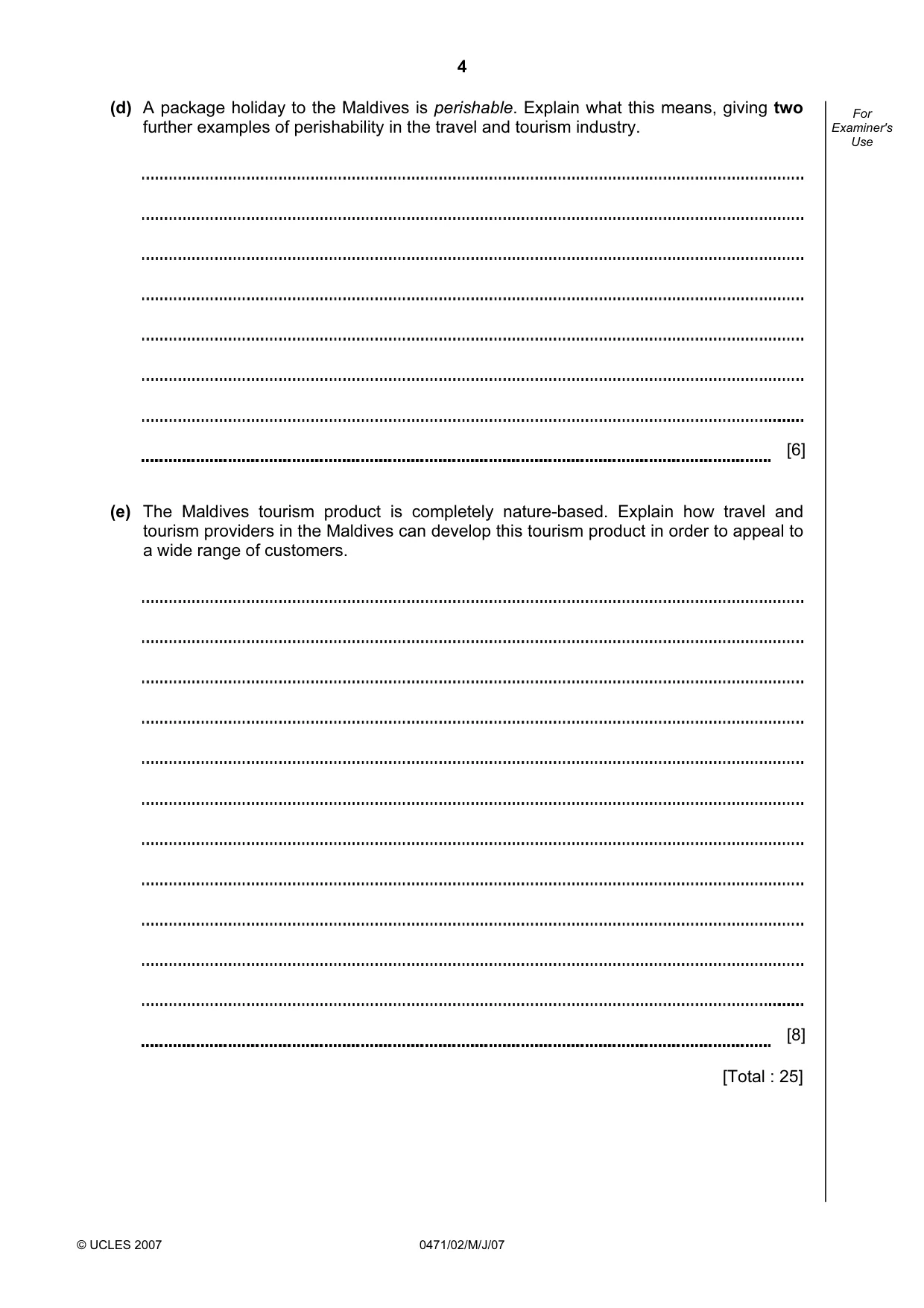
4 © UCLES 2007 0471/02/M/J/07 For Examiner's Use (d) A package holiday to the Maldives is perishable. Explain what this means, giving two further examples of perishability in the travel and tourism industry. [6] (e) The Maldives tourism product is completely nature-based. Explain how travel and tourism providers in the Maldives can develop this tourism product in order to appeal to a wide range of customers. [8] [Total : 25]
Question paper, page 6
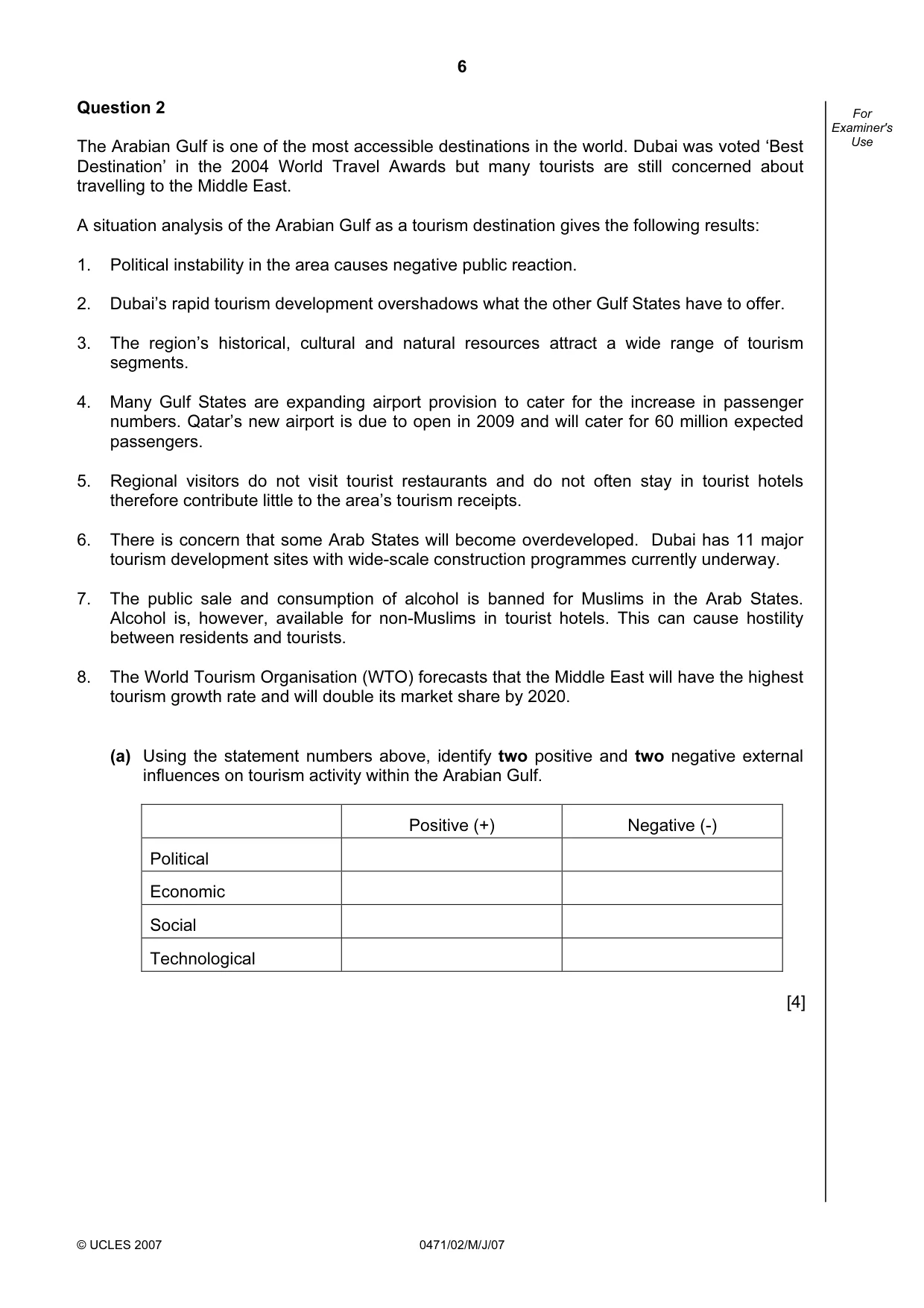
6 © UCLES 2007 0471/02/M/J/07 For Examiner's Use Question 2 The Arabian Gulf is one of the most accessible destinations in the world. Dubai was voted ‘Best Destination’ in the 2004 World Travel Awards but many tourists are still concerned about travelling to the Middle East. A situation analysis of the Arabian Gulf as a tourism destination gives the following results: 1. Political instability in the area causes negative public reaction. 2. Dubai’s rapid tourism development overshadows what the other Gulf States have to offer. 3. The region’s historical, cultural and natural resources attract a wide range of tourism segments. 4. Many Gulf States are expanding airport provision to cater for the increase in passenger numbers. Qatar’s new airport is due to open in 2009 and will cater for 60 million expected passengers. 5. Regional visitors do not visit tourist restaurants and do not often stay in tourist hotels therefore contribute little to the area’s tourism receipts. 6. There is concern that some Arab States will become overdeveloped. Dubai has 11 major tourism development sites with wide-scale construction programmes currently underway. 7. The public sale and consumption of alcohol is banned for Muslims in the Arab States. Alcohol is, however, available for non-Muslims in tourist hotels. This can cause hostility between residents and tourists. 8. The World Tourism Organisation (WTO) forecasts that the Middle East will have the highest tourism growth rate and will double its market share by 2020. (a) Using the statement numbers above, identify two positive and two negative external influences on tourism activity within the Arabian Gulf. Positive (+) Negative (-) Political Economic Social Technological [4]
Question paper, page 7
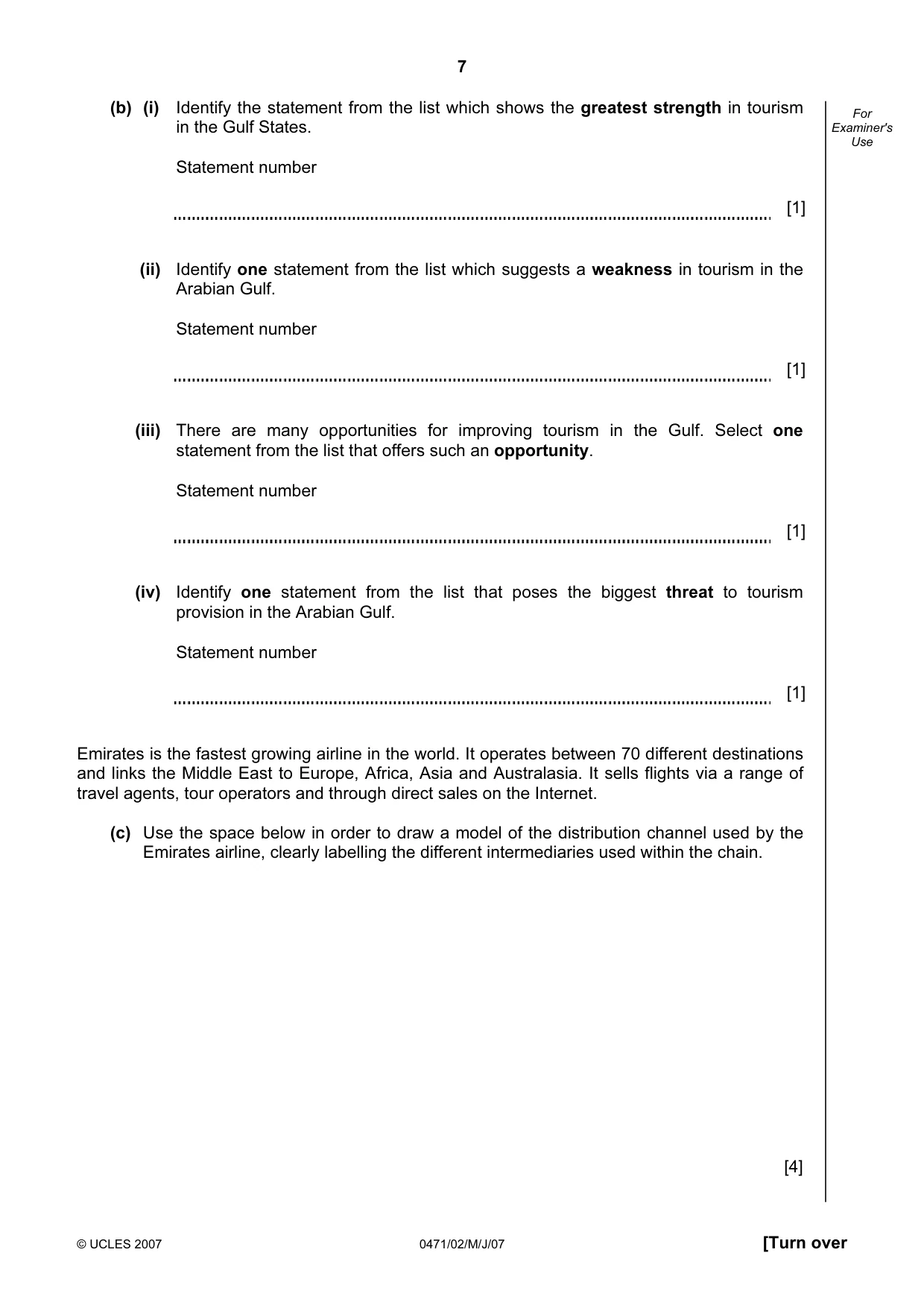
7 © UCLES 2007 0471/02/M/J/07 [Turn over For Examiner's Use (b) (i) Identify the statement from the list which shows the greatest strength in tourism in the Gulf States. Statement number [1] (ii) Identify one statement from the list which suggests a weakness in tourism in the Arabian Gulf. Statement number [1] (iii) There are many opportunities for improving tourism in the Gulf. Select one statement from the list that offers such an opportunity. Statement number [1] (iv) Identify one statement from the list that poses the biggest threat to tourism provision in the Arabian Gulf. Statement number [1] Emirates is the fastest growing airline in the world. It operates between 70 different destinations and links the Middle East to Europe, Africa, Asia and Australasia. It sells flights via a range of travel agents, tour operators and through direct sales on the Internet. (c) Use the space below in order to draw a model of the distribution channel used by the Emirates airline, clearly labelling the different intermediaries used within the chain. [4]
Question paper, page 8
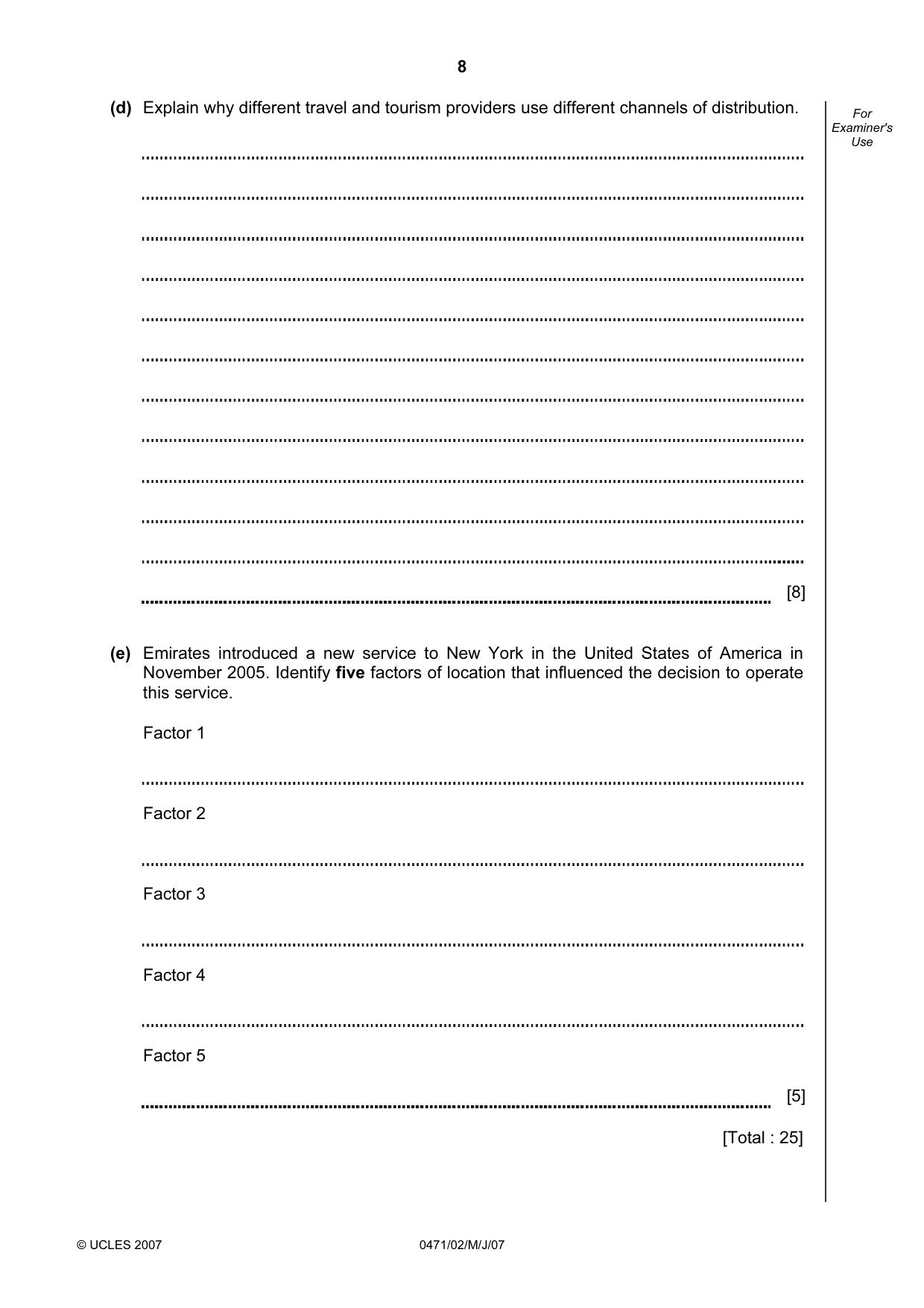
8 © UCLES 2007 0471/02/M/J/07 For Examiner's Use (d) Explain why different travel and tourism providers use different channels of distribution. [8] (e) Emirates introduced a new service to New York in the United States of America in November 2005. Identify five factors of location that influenced the decision to operate this service. Factor 1 Factor 2 Factor 3 Factor 4 Factor 5 [5] [Total : 25]
Question paper, page 10
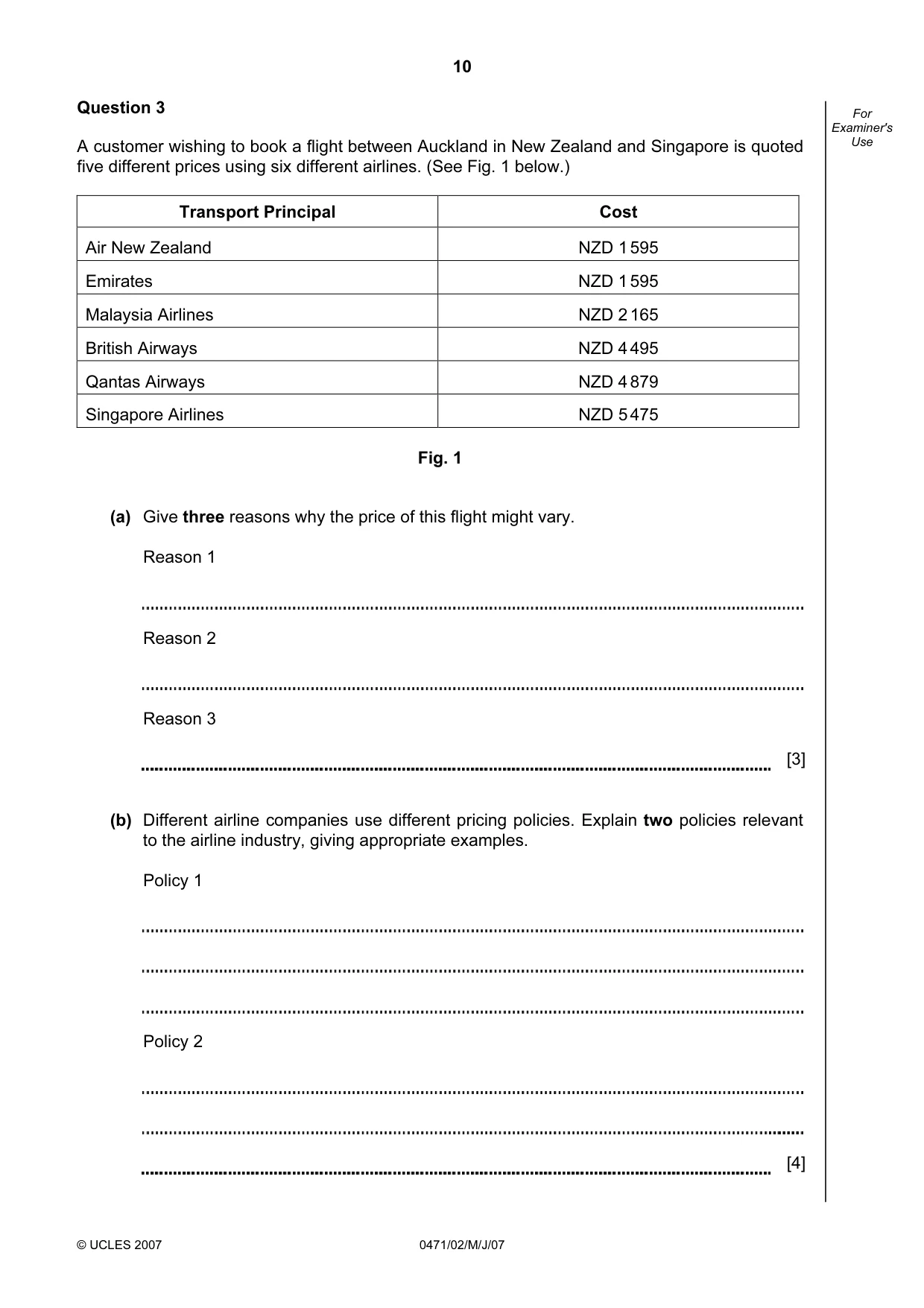
10 © UCLES 2007 0471/02/M/J/07 For Examiner's Use Question 3 A customer wishing to book a flight between Auckland in New Zealand and Singapore is quoted five different prices using six different airlines. (See Fig. 1 below.) Transport Principal Cost Air New Zealand NZD 1 595 Emirates NZD 1 595 Malaysia Airlines NZD 2 165 British Airways NZD 4 495 Qantas Airways NZD 4 879 Singapore Airlines NZD 5 475 Fig. 1 (a) Give three reasons why the price of this flight might vary. Reason 1 Reason 2 Reason 3 [3] (b) Different airline companies use different pricing policies. Explain two policies relevant to the airline industry, giving appropriate examples. Policy 1 Policy 2 [4]
Question paper, page 11
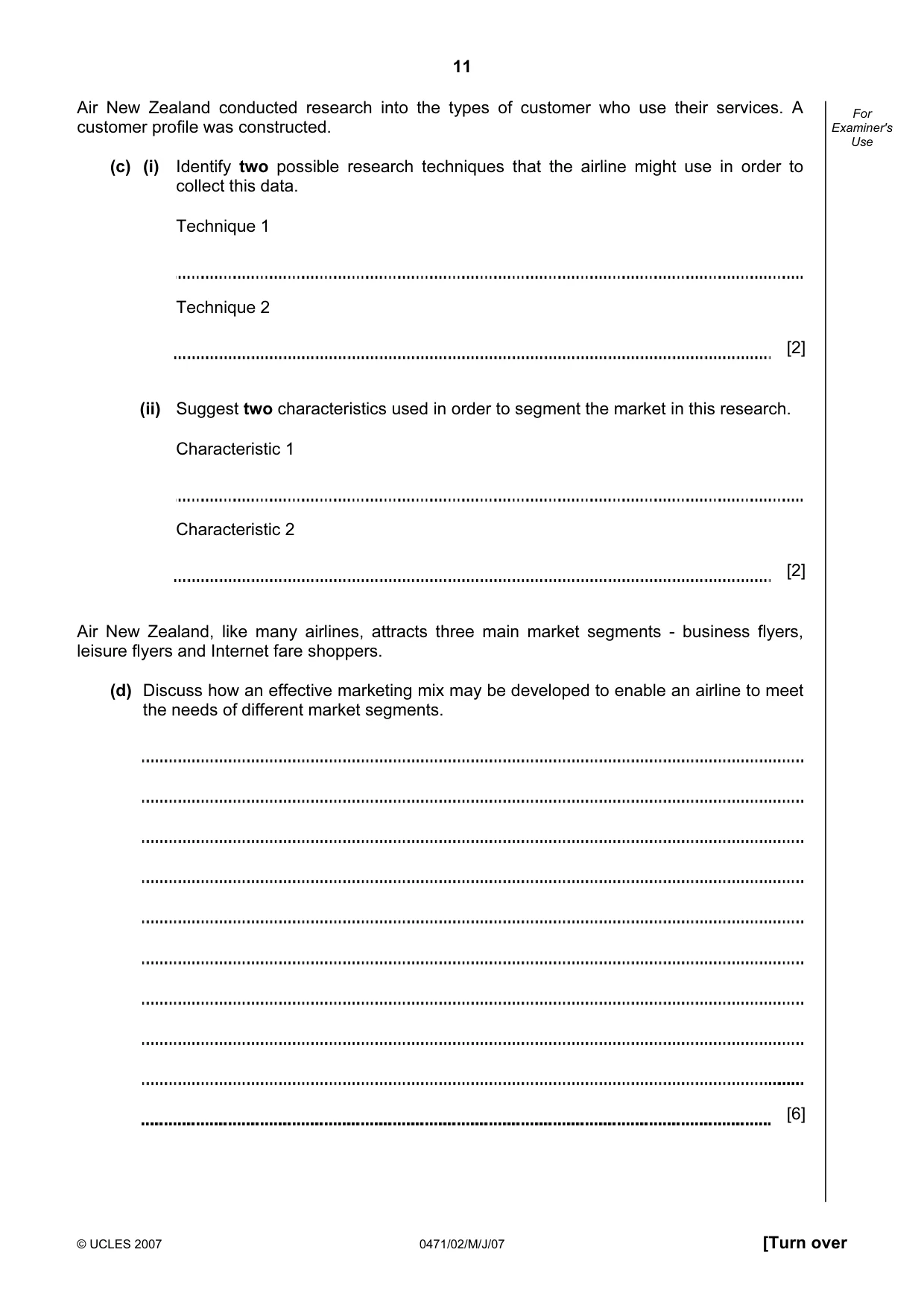
11 © UCLES 2007 0471/02/M/J/07 [Turn over For Examiner's Use Air New Zealand conducted research into the types of customer who use their services. A customer profile was constructed. (c) (i) Identify two possible research techniques that the airline might use in order to collect this data. Technique 1 Technique 2 [2] (ii) Suggest two characteristics used in order to segment the market in this research. Characteristic 1 Characteristic 2 [2] Air New Zealand, like many airlines, attracts three main market segments - business flyers, leisure flyers and Internet fare shoppers. (d) Discuss how an effective marketing mix may be developed to enable an airline to meet the needs of different market segments. [6]
Question paper, page 12
12 © UCLES 2007 0471/02/M/J/07 For Examiner's Use (e) Like many airline companies, Air New Zealand has created a successful brand image. Use relevant examples for this airline company in order to explain the term brand image. [8] [Total : 25]
Question paper, page 13
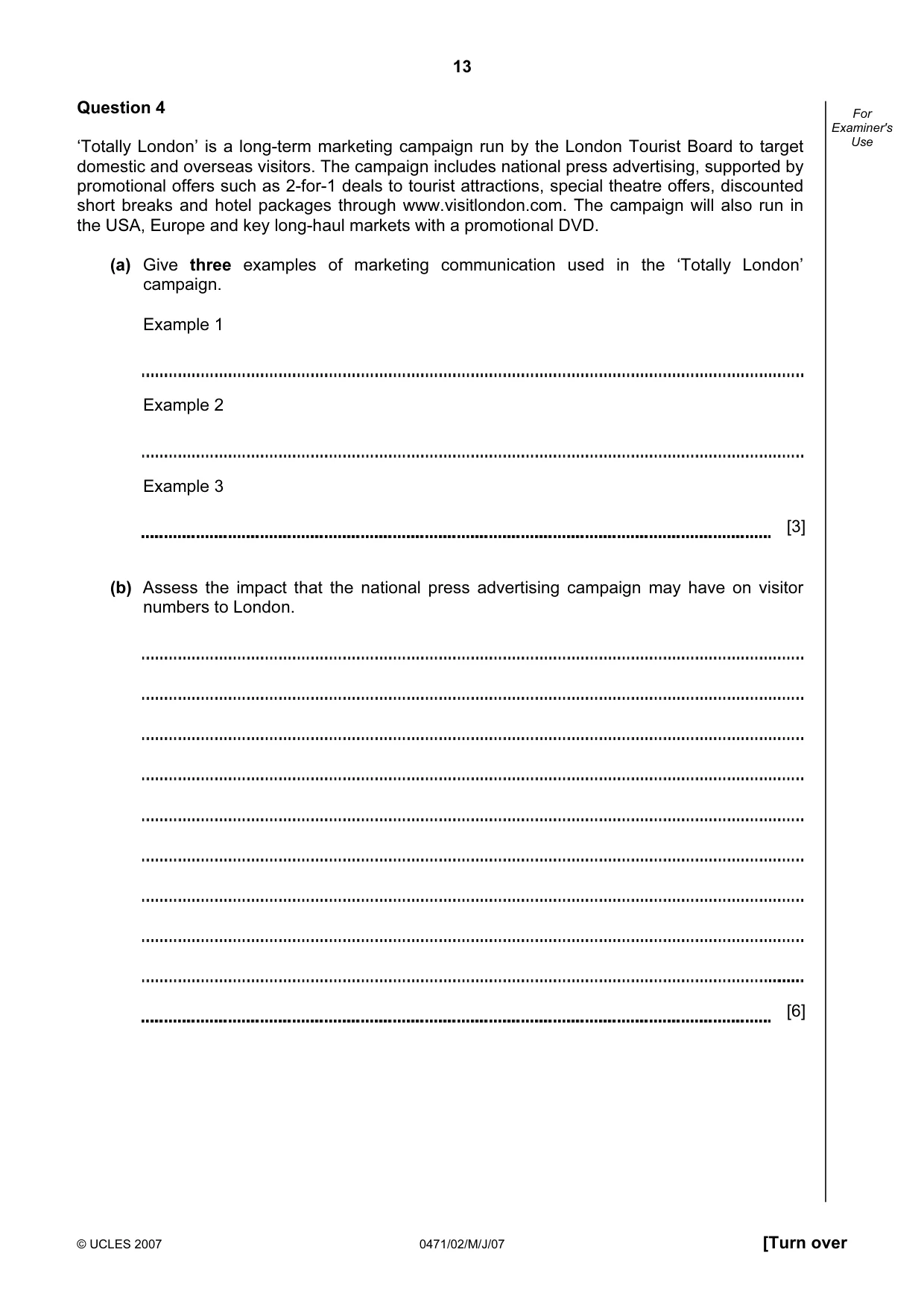
13 © UCLES 2007 0471/02/M/J/07 [Turn over For Examiner's Use Question 4 ‘Totally London’ is a long-term marketing campaign run by the London Tourist Board to target domestic and overseas visitors. The campaign includes national press advertising, supported by promotional offers such as 2-for-1 deals to tourist attractions, special theatre offers, discounted short breaks and hotel packages through www.visitlondon.com. The campaign will also run in the USA, Europe and key long-haul markets with a promotional DVD. (a) Give three examples of marketing communication used in the ‘Totally London’ campaign. Example 1 Example 2 Example 3 [3] (b) Assess the impact that the national press advertising campaign may have on visitor numbers to London. [6]
Question paper, page 14
14 © UCLES 2007 0471/02/M/J/07 For Examiner's Use Sending video clips of tourist destinations to customers’ mobile phones and using MP3 players to download travel guides are examples of how advanced technology may be used to market travel and tourism products in the future. (c) Describe the appeal of this type of marketing of travel and tourism products. [3] (d) Analyse the factors affecting the production of the promotional materials to support the ‘Totally London’ campaign. [8]
Question paper, page 15
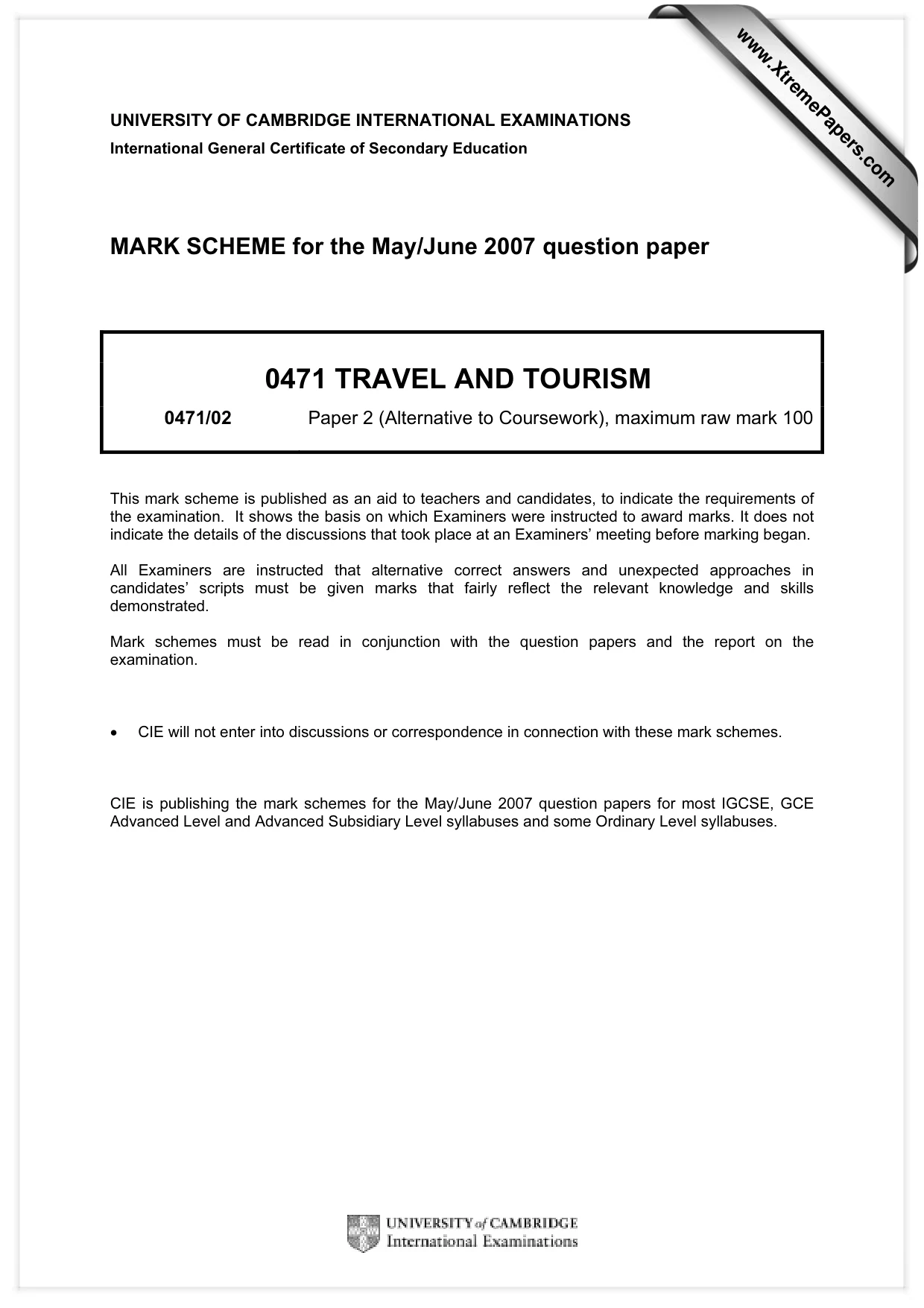
15 © UCLES 2007 0471/02/M/J/07 For Examiner's Use (e) Suggest how the marketing mix for London as a tourist destination might be developed as a result of the ‘Totally London’ campaign. [5] [Total : 25]
Question paper, page 16
16 Permission to reproduce items where third-party owned material protected by copyright is included has been sought and cleared where possible. Every reasonable effort has been made by the publisher (UCLES) to trace copyright holders, but if any items requiring clearance have unwittingly been included, the publisher will be pleased to make amends at the earliest possible opportunity. University of Cambridge International Examinations is part of the Cambridge Assessment Group. Cambridge Assessment is the brand name of University of Cambridge Local Examinations Syndicate (UCLES), which is itself a department of the University of Cambridge. 0471/02/M/J/07 BLANK PAGE
Mark scheme, page 1
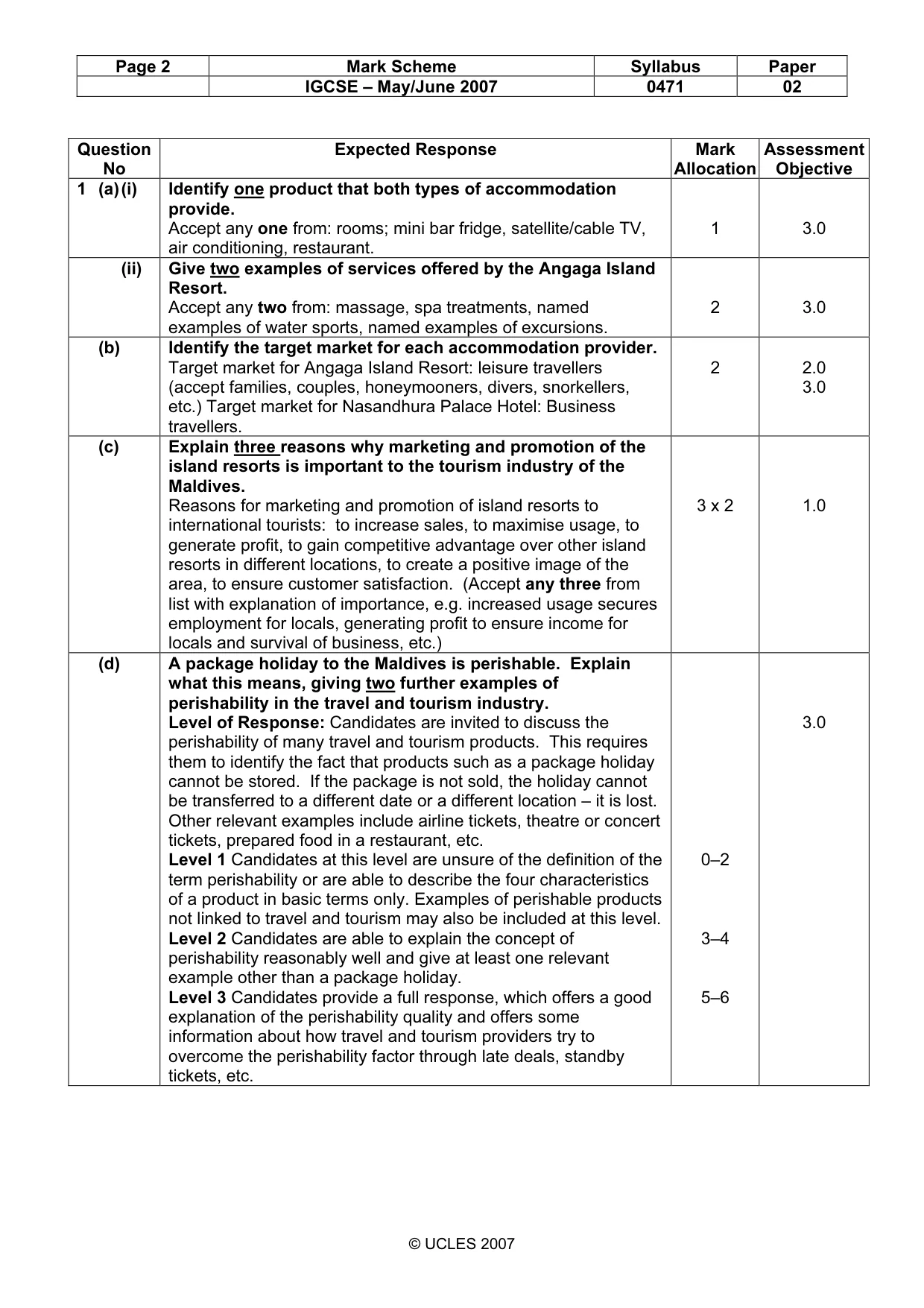
UNIVERSITY OF CAMBRIDGE INTERNATIONAL EXAMINATIONS International General Certificate of Secondary Education MARK SCHEME for the May/June 2007 question paper 0471 TRAVEL AND TOURISM 0471/02 Paper 2 (Alternative to Coursework), maximum raw mark 100 This mark scheme is published as an aid to teachers and candidates, to indicate the requirements of the examination. It shows the basis on which Examiners were instructed to award marks. It does not indicate the details of the discussions that took place at an Examiners’ meeting before marking began. All Examiners are instructed that alternative correct answers and unexpected approaches in candidates’ scripts must be given marks that fairly reflect the relevant knowledge and skills demonstrated. Mark schemes must be read in conjunction with the question papers and the report on the examination. • CIE will not enter into discussions or correspondence in connection with these mark schemes. CIE is publishing the mark schemes for the May/June 2007 question papers for most IGCSE, GCE Advanced Level and Advanced Subsidiary Level syllabuses and some Ordinary Level syllabuses. www.XtremePapers.com
Mark scheme, page 2
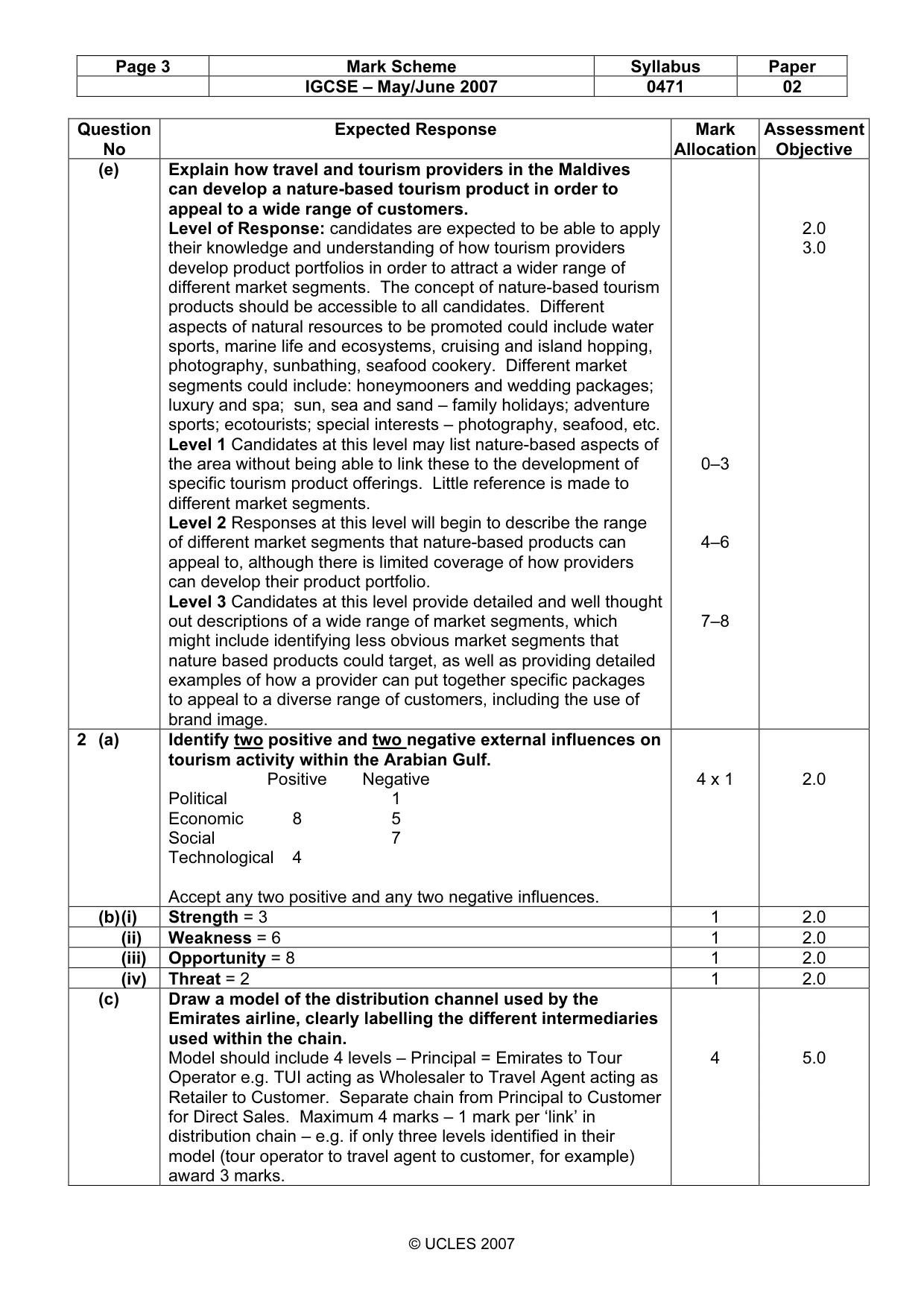
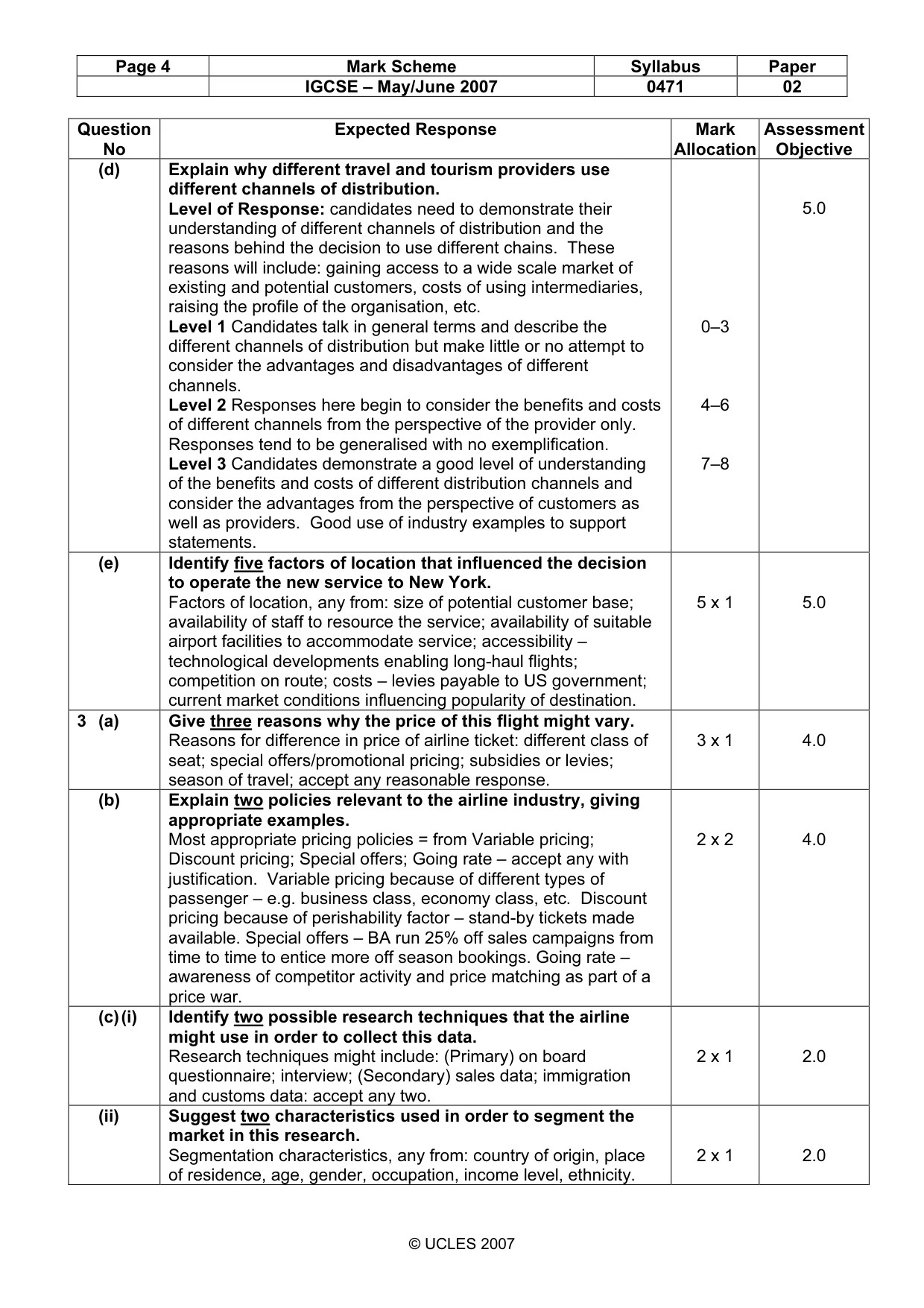
Page 2 Mark Scheme Syllabus Paper IGCSE – May/June 2007 0471 02 © UCLES 2007 Question No Expected Response Mark Allocation Assessment Objective 1 (a) (i) Identify one product that both types of accommodation provide. Accept any one from: rooms; mini bar fridge, satellite/cable TV, air conditioning, restaurant. 1 3.0 (ii) Give two examples of services offered by the Angaga Island Resort. Accept any two from: massage, spa treatments, named examples of water sports, named examples of excursions. 2 3.0 (b) Identify the target market for each accommodation provider. Target market for Angaga Island Resort: leisure travellers (accept families, couples, honeymooners, divers, snorkellers, etc.) Target market for Nasandhura Palace Hotel: Business travellers. 2 2.0 3.0 (c) Explain three reasons why marketing and promotion of the island resorts is important to the tourism industry of the Maldives. Reasons for marketing and promotion of island resorts to international tourists: to increase sales, to maximise usage, to generate profit, to gain competitive advantage over other island resorts in different locations, to create a positive image of the area, to ensure customer satisfaction. (Accept any three from list with explanation of importance, e.g. increased usage secures employment for locals, generating profit to ensure income for locals and survival of business, etc.) 3 x 2 1.0 (d) A package holiday to the Maldives is perishable. Explain what this means, giving two further examples of perishability in the travel and tourism industry. Level of Response: Candidates are invited to discuss the perishability of many travel and tourism products. This requires them to identify the fact that products such as a package holiday cannot be stored. If the package is not sold, the holiday cannot be transferred to a different date or a different location – it is lost. Other relevant examples include airline tickets, theatre or concert tickets, prepared food in a restaurant, etc. Level 1 Candidates at this level are unsure of the definition of the term perishability or are able to describe the four characteristics of a product in basic terms only. Examples of perishable products not linked to travel and tourism may also be included at this level. Level 2 Candidates are able to explain the concept of perishability reasonably well and give at least one relevant example other than a package holiday. Level 3 Candidates provide a full response, which offers a good explanation of the perishability quality and offers some information about how travel and tourism providers try to overcome the perishability factor through late deals, standby tickets, etc. 0–2 3–4 5–6 3.0
Mark scheme, page 3
Page 3 Mark Scheme Syllabus Paper IGCSE – May/June 2007 0471 02 © UCLES 2007 Question No Expected Response Mark Allocation Assessment Objective (e) Explain how travel and tourism providers in the Maldives can develop a nature-based tourism product in order to appeal to a wide range of customers. Level of Response: candidates are expected to be able to apply their knowledge and understanding of how tourism providers develop product portfolios in order to attract a wider range of different market segments. The concept of nature-based tourism products should be accessible to all candidates. Different aspects of natural resources to be promoted could include water sports, marine life and ecosystems, cruising and island hopping, photography, sunbathing, seafood cookery. Different market segments could include: honeymooners and wedding packages; luxury and spa; sun, sea and sand – family holidays; adventure sports; ecotourists; special interests – photography, seafood, etc. Level 1 Candidates at this level may list nature-based aspects of the area without being able to link these to the development of specific tourism product offerings. Little reference is made to different market segments. Level 2 Responses at this level will begin to describe the range of different market segments that nature-based products can appeal to, although there is limited coverage of how providers can develop their product portfolio. Level 3 Candidates at this level provide detailed and well thought out descriptions of a wide range of market segments, which might include identifying less obvious market segments that nature based products could target, as well as providing detailed examples of how a provider can put together specific packages to appeal to a diverse range of customers, including the use of brand image. 0–3 4–6 7–8 2.0 3.0 2 (a) Identify two positive and two negative external influences on tourism activity within the Arabian Gulf. Positive Negative Political 1 Economic 8 5 Social 7 Technological 4 Accept any two positive and any two negative influences. 4 x 1 2.0 (b) (i) Strength = 3 1 2.0 (ii) Weakness = 6 1 2.0 (iii) Opportunity = 8 1 2.0 (iv) Threat = 2 1 2.0 (c) Draw a model of the distribution channel used by the Emirates airline, clearly labelling the different intermediaries used within the chain. Model should include 4 levels – Principal = Emirates to Tour Operator e.g. TUI acting as Wholesaler to Travel Agent acting as Retailer to Customer. Separate chain from Principal to Customer for Direct Sales. Maximum 4 marks – 1 mark per ‘link’ in distribution chain – e.g. if only three levels identified in their model (tour operator to travel agent to customer, for example) award 3 marks. 4 5.0
Mark scheme, page 4
Page 4 Mark Scheme Syllabus Paper IGCSE – May/June 2007 0471 02 © UCLES 2007 Question No Expected Response Mark Allocation Assessment Objective (d) Explain why different travel and tourism providers use different channels of distribution. Level of Response: candidates need to demonstrate their understanding of different channels of distribution and the reasons behind the decision to use different chains. These reasons will include: gaining access to a wide scale market of existing and potential customers, costs of using intermediaries, raising the profile of the organisation, etc. Level 1 Candidates talk in general terms and describe the different channels of distribution but make little or no attempt to consider the advantages and disadvantages of different channels. Level 2 Responses here begin to consider the benefits and costs of different channels from the perspective of the provider only. Responses tend to be generalised with no exemplification. Level 3 Candidates demonstrate a good level of understanding of the benefits and costs of different distribution channels and consider the advantages from the perspective of customers as well as providers. Good use of industry examples to support statements. 0–3 4–6 7–8 5.0 (e) Identify five factors of location that influenced the decision to operate the new service to New York. Factors of location, any from: size of potential customer base; availability of staff to resource the service; availability of suitable airport facilities to accommodate service; accessibility – technological developments enabling long-haul flights; competition on route; costs – levies payable to US government; current market conditions influencing popularity of destination. 5 x 1 5.0 3 (a) Give three reasons why the price of this flight might vary. Reasons for difference in price of airline ticket: different class of seat; special offers/promotional pricing; subsidies or levies; season of travel; accept any reasonable response. 3 x 1 4.0 (b) Explain two policies relevant to the airline industry, giving appropriate examples. Most appropriate pricing policies = from Variable pricing; Discount pricing; Special offers; Going rate – accept any with justification. Variable pricing because of different types of passenger – e.g. business class, economy class, etc. Discount pricing because of perishability factor – stand-by tickets made available. Special offers – BA run 25% off sales campaigns from time to time to entice more off season bookings. Going rate – awareness of competitor activity and price matching as part of a price war. 2 x 2 4.0 (c) (i) Identify two possible research techniques that the airline might use in order to collect this data. Research techniques might include: (Primary) on board questionnaire; interview; (Secondary) sales data; immigration and customs data: accept any two. 2 x 1 2.0 (ii) Suggest two characteristics used in order to segment the market in this research. Segmentation characteristics, any from: country of origin, place of residence, age, gender, occupation, income level, ethnicity. 2 x 1 2.0
Mark scheme, page 5
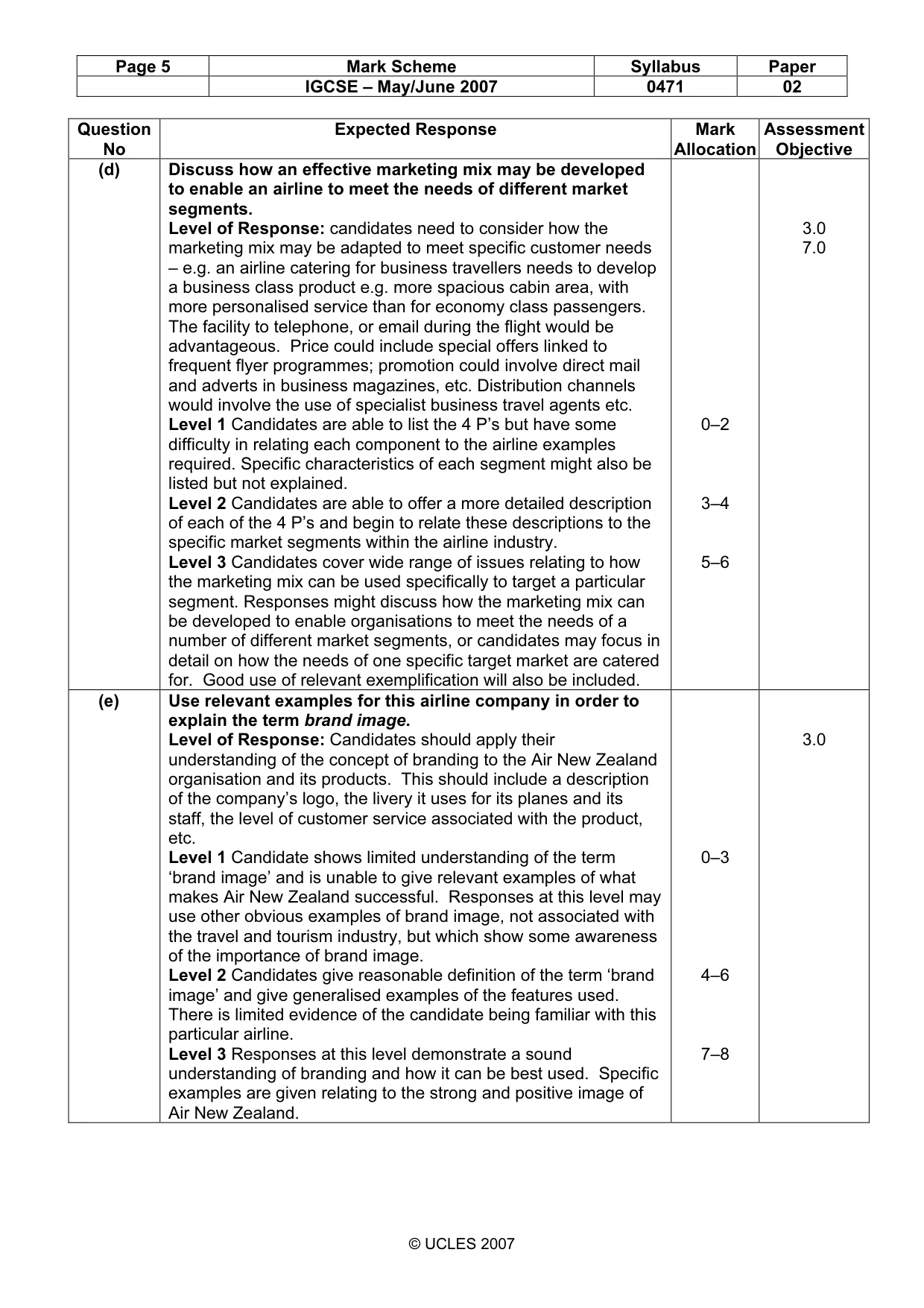
Page 5 Mark Scheme Syllabus Paper IGCSE – May/June 2007 0471 02 © UCLES 2007 Question No Expected Response Mark Allocation Assessment Objective (d) Discuss how an effective marketing mix may be developed to enable an airline to meet the needs of different market segments. Level of Response: candidates need to consider how the marketing mix may be adapted to meet specific customer needs – e.g. an airline catering for business travellers needs to develop a business class product e.g. more spacious cabin area, with more personalised service than for economy class passengers. The facility to telephone, or email during the flight would be advantageous. Price could include special offers linked to frequent flyer programmes; promotion could involve direct mail and adverts in business magazines, etc. Distribution channels would involve the use of specialist business travel agents etc. Level 1 Candidates are able to list the 4 P’s but have some difficulty in relating each component to the airline examples required. Specific characteristics of each segment might also be listed but not explained. Level 2 Candidates are able to offer a more detailed description of each of the 4 P’s and begin to relate these descriptions to the specific market segments within the airline industry. Level 3 Candidates cover wide range of issues relating to how the marketing mix can be used specifically to target a particular segment. Responses might discuss how the marketing mix can be developed to enable organisations to meet the needs of a number of different market segments, or candidates may focus in detail on how the needs of one specific target market are catered for. Good use of relevant exemplification will also be included. 0–2 3–4 5–6 3.0 7.0 (e) Use relevant examples for this airline company in order to explain the term brand image. Level of Response: Candidates should apply their understanding of the concept of branding to the Air New Zealand organisation and its products. This should include a description of the company’s logo, the livery it uses for its planes and its staff, the level of customer service associated with the product, etc. Level 1 Candidate shows limited understanding of the term ‘brand image’ and is unable to give relevant examples of what makes Air New Zealand successful. Responses at this level may use other obvious examples of brand image, not associated with the travel and tourism industry, but which show some awareness of the importance of brand image. Level 2 Candidates give reasonable definition of the term ‘brand image’ and give generalised examples of the features used. There is limited evidence of the candidate being familiar with this particular airline. Level 3 Responses at this level demonstrate a sound understanding of branding and how it can be best used. Specific examples are given relating to the strong and positive image of Air New Zealand. 0–3 4–6 7–8 3.0
Mark scheme, page 6
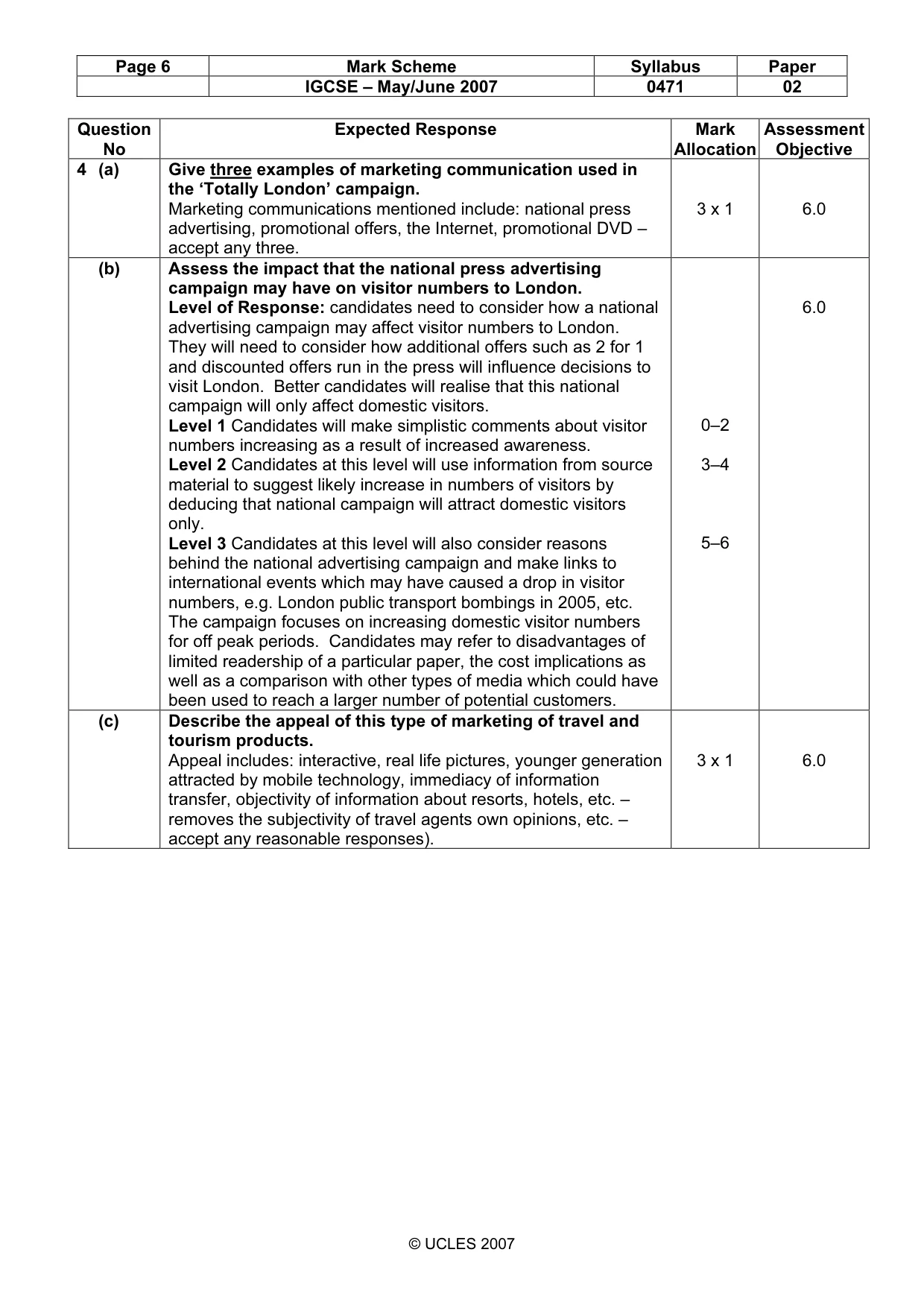
Page 6 Mark Scheme Syllabus Paper IGCSE – May/June 2007 0471 02 © UCLES 2007 Question No Expected Response Mark Allocation Assessment Objective 4 (a) Give three examples of marketing communication used in the ‘Totally London’ campaign. Marketing communications mentioned include: national press advertising, promotional offers, the Internet, promotional DVD – accept any three. 3 x 1 6.0 (b) Assess the impact that the national press advertising campaign may have on visitor numbers to London. Level of Response: candidates need to consider how a national advertising campaign may affect visitor numbers to London. They will need to consider how additional offers such as 2 for 1 and discounted offers run in the press will influence decisions to visit London. Better candidates will realise that this national campaign will only affect domestic visitors. Level 1 Candidates will make simplistic comments about visitor numbers increasing as a result of increased awareness. Level 2 Candidates at this level will use information from source material to suggest likely increase in numbers of visitors by deducing that national campaign will attract domestic visitors only. Level 3 Candidates at this level will also consider reasons behind the national advertising campaign and make links to international events which may have caused a drop in visitor numbers, e.g. London public transport bombings in 2005, etc. The campaign focuses on increasing domestic visitor numbers for off peak periods. Candidates may refer to disadvantages of limited readership of a particular paper, the cost implications as well as a comparison with other types of media which could have been used to reach a larger number of potential customers. 0–2 3–4 5–6 6.0 (c) Describe the appeal of this type of marketing of travel and tourism products. Appeal includes: interactive, real life pictures, younger generation attracted by mobile technology, immediacy of information transfer, objectivity of information about resorts, hotels, etc. – removes the subjectivity of travel agents own opinions, etc. – accept any reasonable responses). 3 x 1 6.0
Mark scheme, page 7
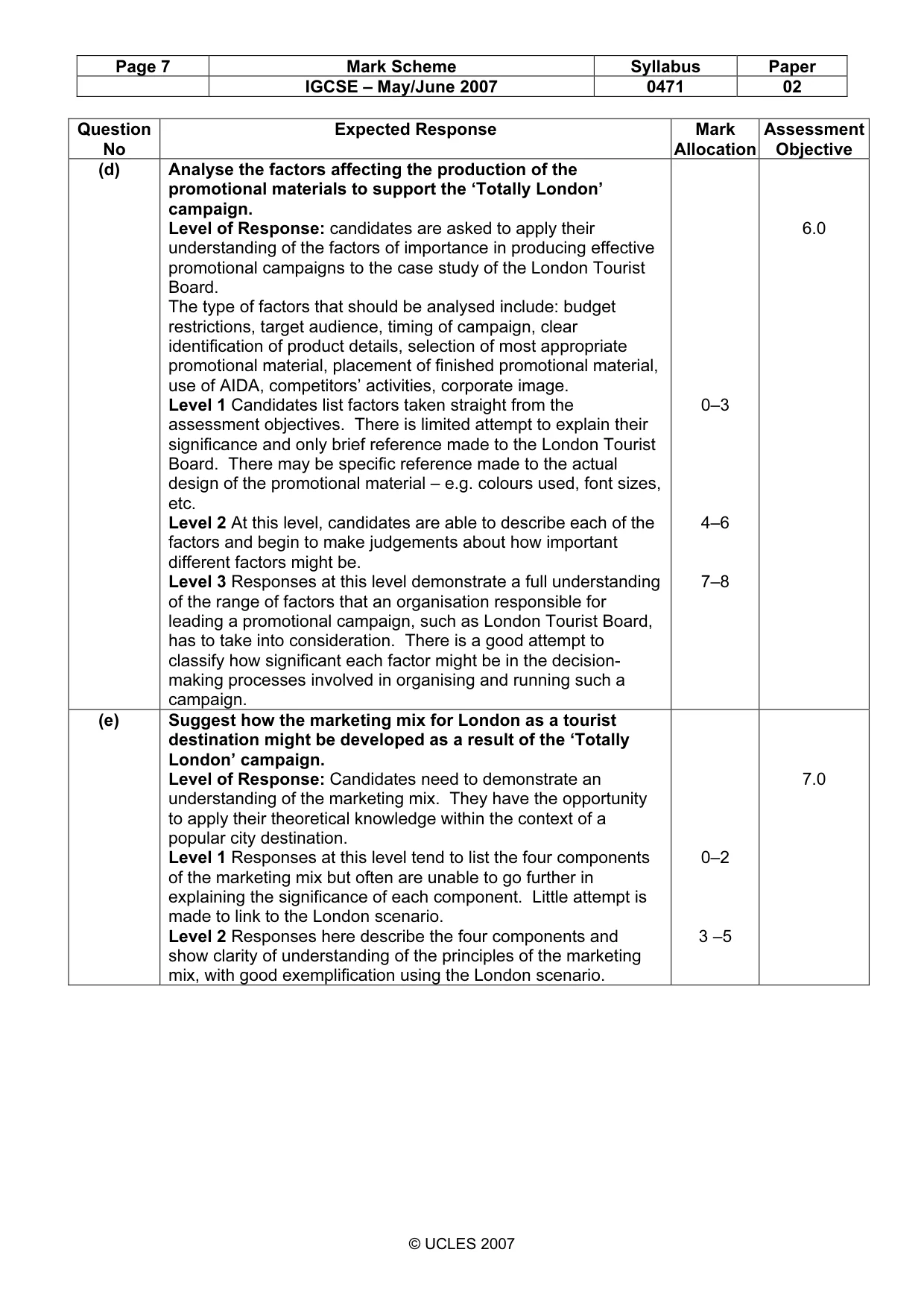
Page 7 Mark Scheme Syllabus Paper IGCSE – May/June 2007 0471 02 © UCLES 2007 Question No Expected Response Mark Allocation Assessment Objective (d) Analyse the factors affecting the production of the promotional materials to support the ‘Totally London’ campaign. Level of Response: candidates are asked to apply their understanding of the factors of importance in producing effective promotional campaigns to the case study of the London Tourist Board. The type of factors that should be analysed include: budget restrictions, target audience, timing of campaign, clear identification of product details, selection of most appropriate promotional material, placement of finished promotional material, use of AIDA, competitors’ activities, corporate image. Level 1 Candidates list factors taken straight from the assessment objectives. There is limited attempt to explain their significance and only brief reference made to the London Tourist Board. There may be specific reference made to the actual design of the promotional material – e.g. colours used, font sizes, etc. Level 2 At this level, candidates are able to describe each of the factors and begin to make judgements about how important different factors might be. Level 3 Responses at this level demonstrate a full understanding of the range of factors that an organisation responsible for leading a promotional campaign, such as London Tourist Board, has to take into consideration. There is a good attempt to classify how significant each factor might be in the decision- making processes involved in organising and running such a campaign. 0–3 4–6 7–8 6.0 (e) Suggest how the marketing mix for London as a tourist destination might be developed as a result of the ‘Totally London’ campaign. Level of Response: Candidates need to demonstrate an understanding of the marketing mix. They have the opportunity to apply their theoretical knowledge within the context of a popular city destination. Level 1 Responses at this level tend to list the four components of the marketing mix but often are unable to go further in explaining the significance of each component. Little attempt is made to link to the London scenario. Level 2 Responses here describe the four components and show clarity of understanding of the principles of the marketing mix, with good exemplification using the London scenario. 0–2 3 –5 7.0
What you needed in this session
Cambridge’s own grade thresholds for 2007 May/June, Paper 2 · Variant 1. A higher threshold means an easier paper — the bar moves with how the cohort did.