Cambridge IGCSE Thai - First Language 0518 — 2017 May/June Paper 3 · Variant 1
0518/31/M/J/17 · 40 marks · ≈45 min
The question paper and its mark scheme, free to read here and free to download. This is Cambridge’s own paper, exactly as it was sat.
Question paper4 pages
Mark scheme10 pages
Answers below. Sit the paper first if you are practising.
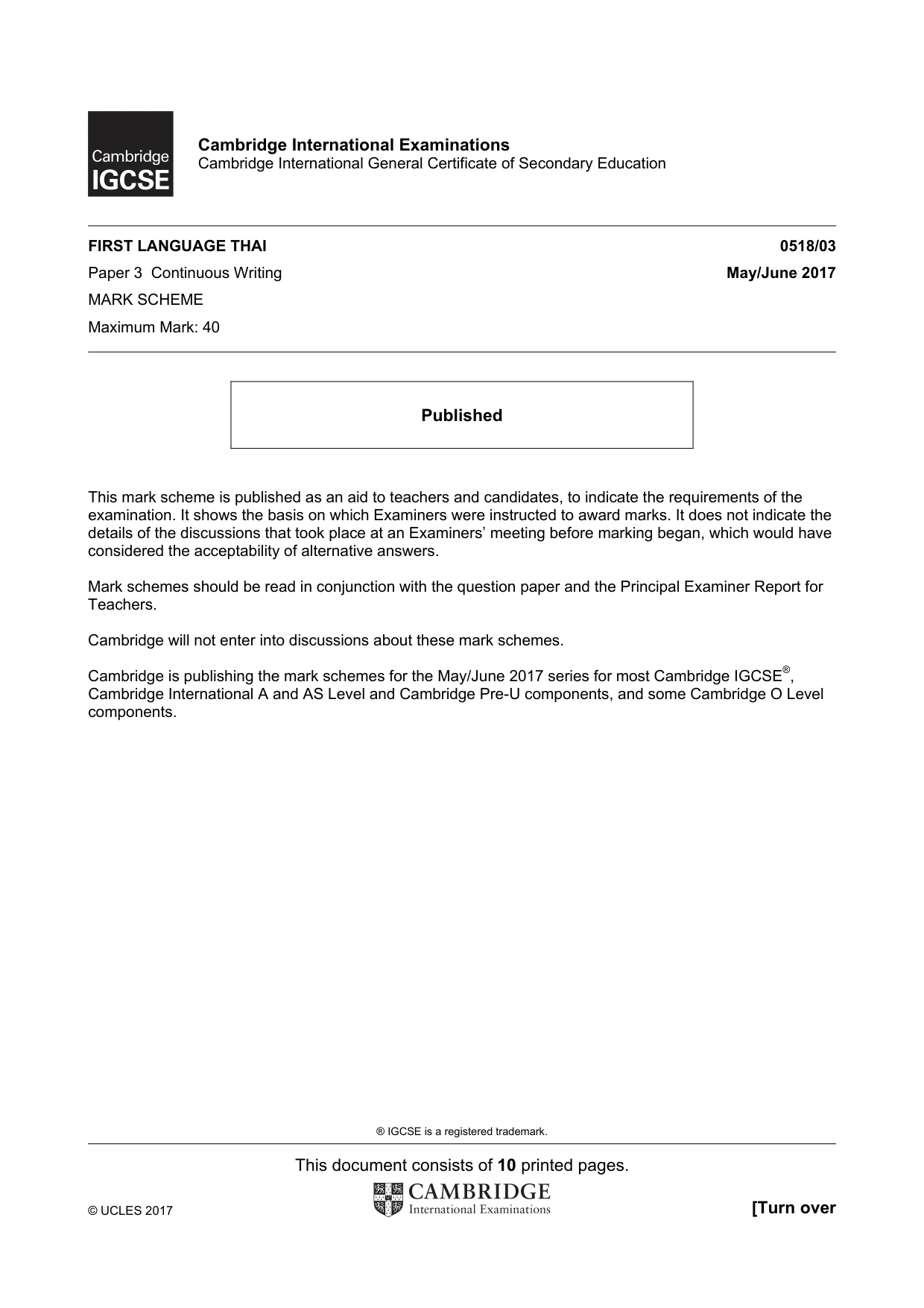
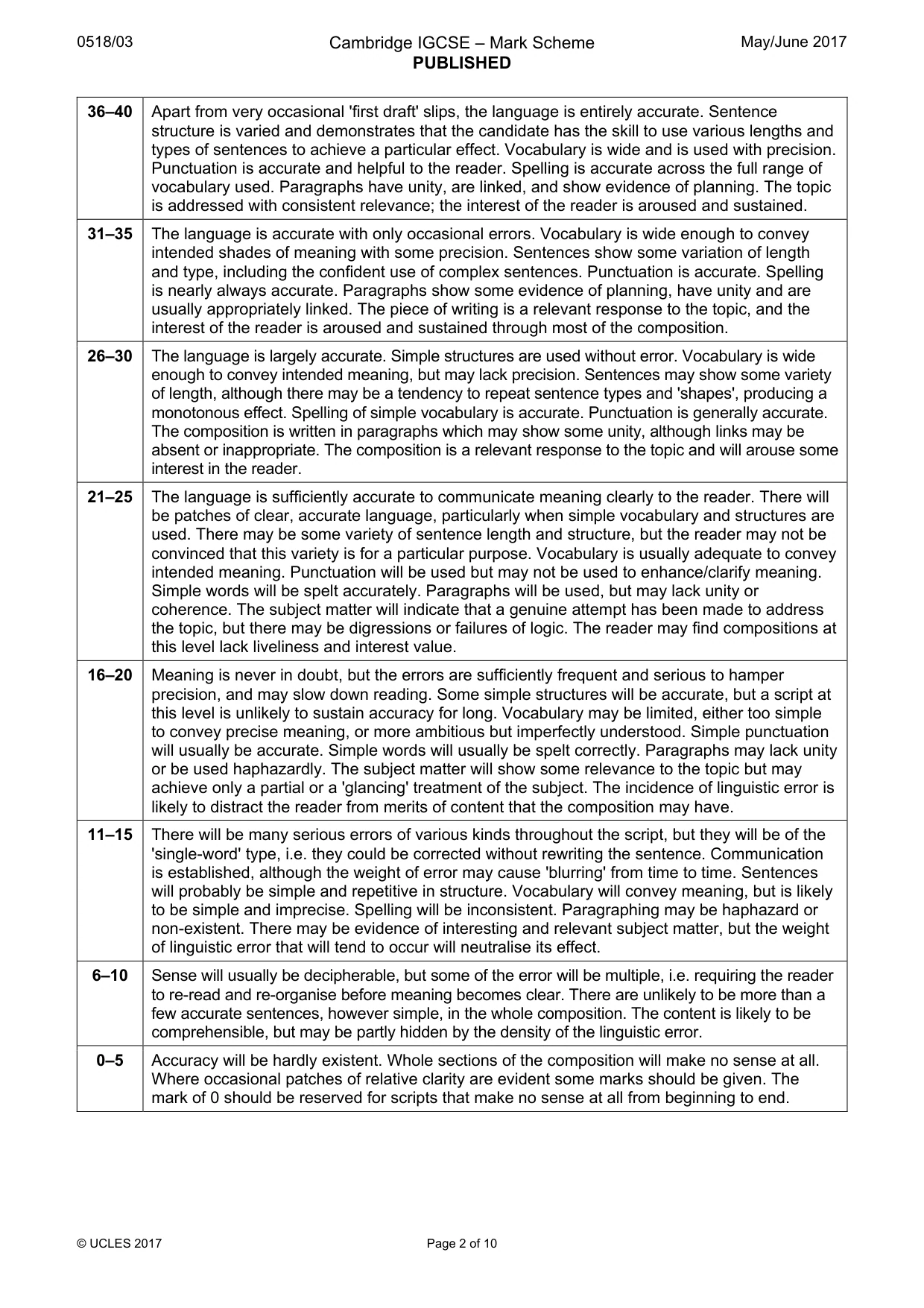
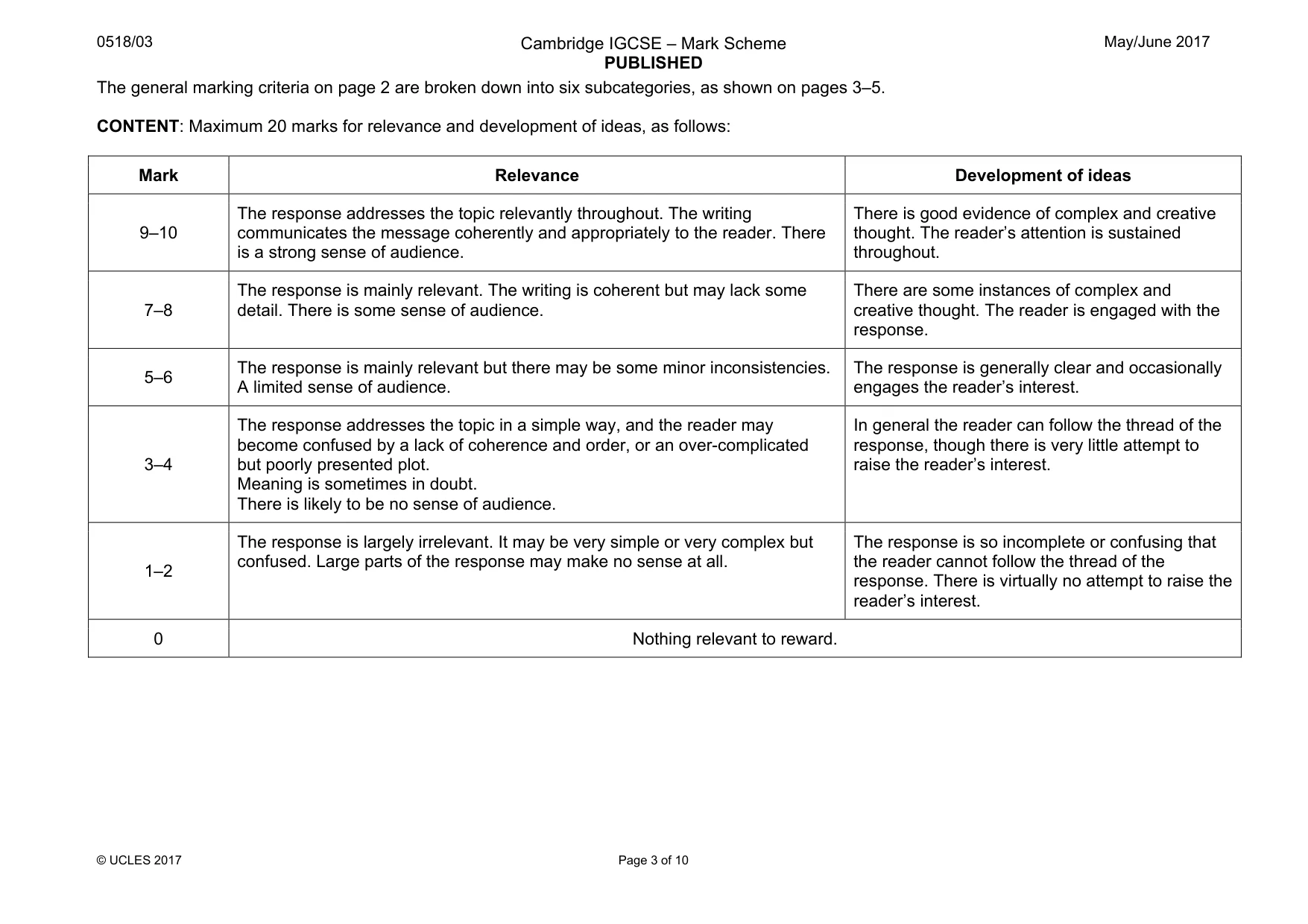
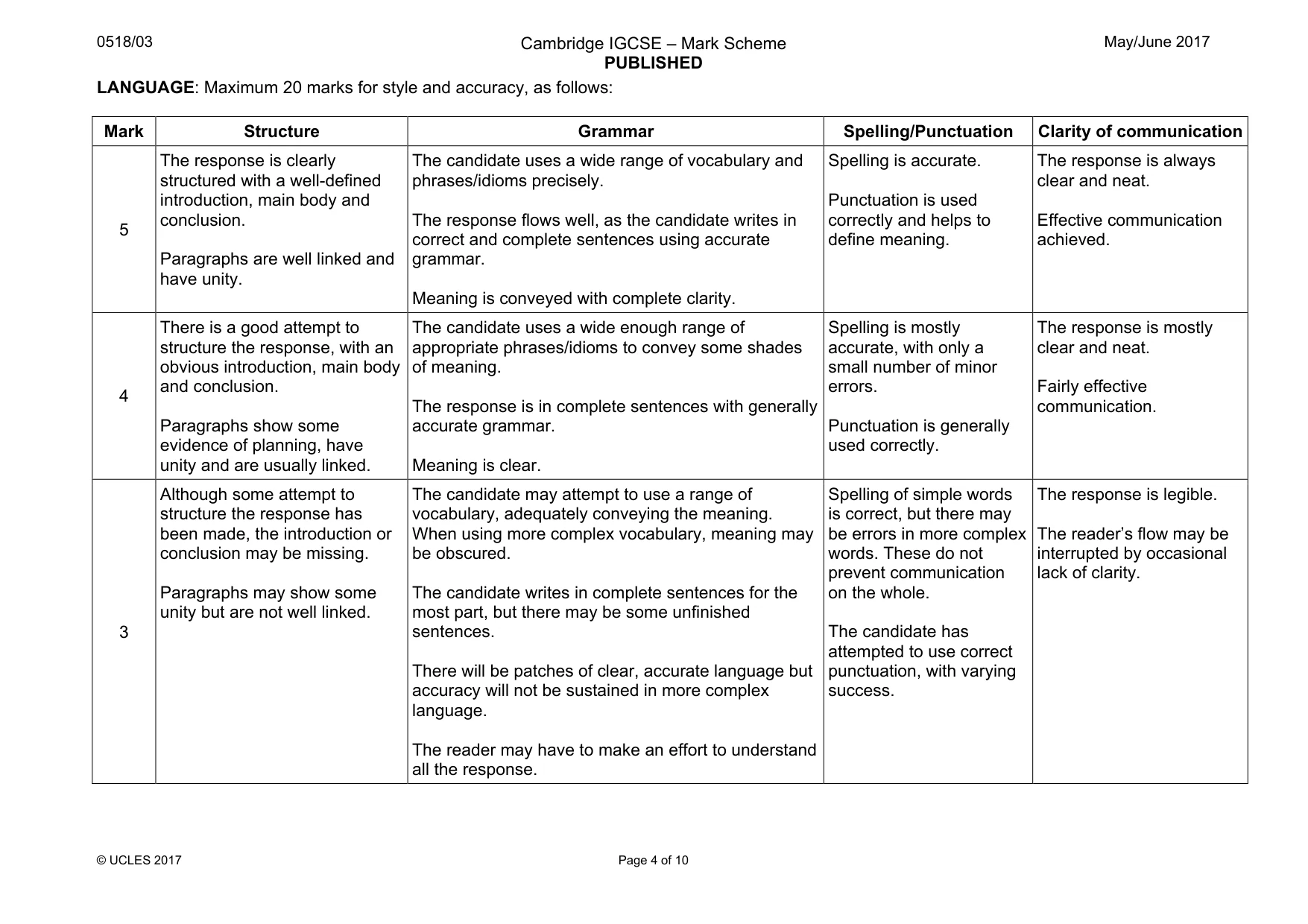
Paper as text
Question paper, page 1
This document consists of 3 printed pages and 1 blank page. DC (NF/FC) 131299/1 © UCLES 2017 [Turn over Cambridge International Examinations Cambridge International General Certificate of Secondary Education * 5 3 4 0 7 2 0 7 1 3 * FIRST LANGUAGE THAI 0518/03 Paper 3 Continuous Writing May/June 2017 1 hour 15 minutes Additional Materials: Answer Booklet/Paper READ THESE INSTRUCTIONS FIRST If you have been given an Answer Booklet, follow the instructions on the front cover of the Booklet. Write your Centre number, candidate number and name on all the work you hand in. Write in dark blue or black pen. Do not use staples, paper clips, glue or correction fluid. DO NOT WRITE IN ANY BARCODES. Write a composition based on one of the topics overleaf. You should write between 350 and 500 words. Dictionaries are not permitted. At the end of the examination, fasten all your work securely together. All questions in this paper carry equal marks. คําสัง สําหรับผู้เข้าสอบ เขียนชือและเลขประจําตัวสําหรับผู้เข้าสอบ พร้อมทังหมายเลขประจําหน่วยสอบ ลงในช่องว่างทีให้ไว้ในสมุดเขียนคําตอบหรือกระดาษคําตอบทุกแผ่น เขียนด้วยหมึกสีนําเงิน หรือหมึกดํา ห้ามใช้ทีเย็บกระดาษ ทีหนีบกระดาษ กาว หรือ นํายาลบคําผิด ห้ามเขียนบนบาร์โค้ด เลือกเขียนเพียง หนึง เรือง จากหัวเรืองต่าง ๆ ทีให้ในหน้าถัดไป เรียงความทีเขียนควรมีความยาวประมาณ 350 ถึง 500 คํา ห้ามใช้พจนานุกรม หากนักเรียนใช้กระดาษตอบมากกว่าหนึงแผ่น ต้องผูกกระดาษทุกแผ่นเข้าด้วยกัน คําถามทุกข้อในข้อสอบชุดนีมีคะแนนเท่ากันหมด 350 500
Question paper, page 2
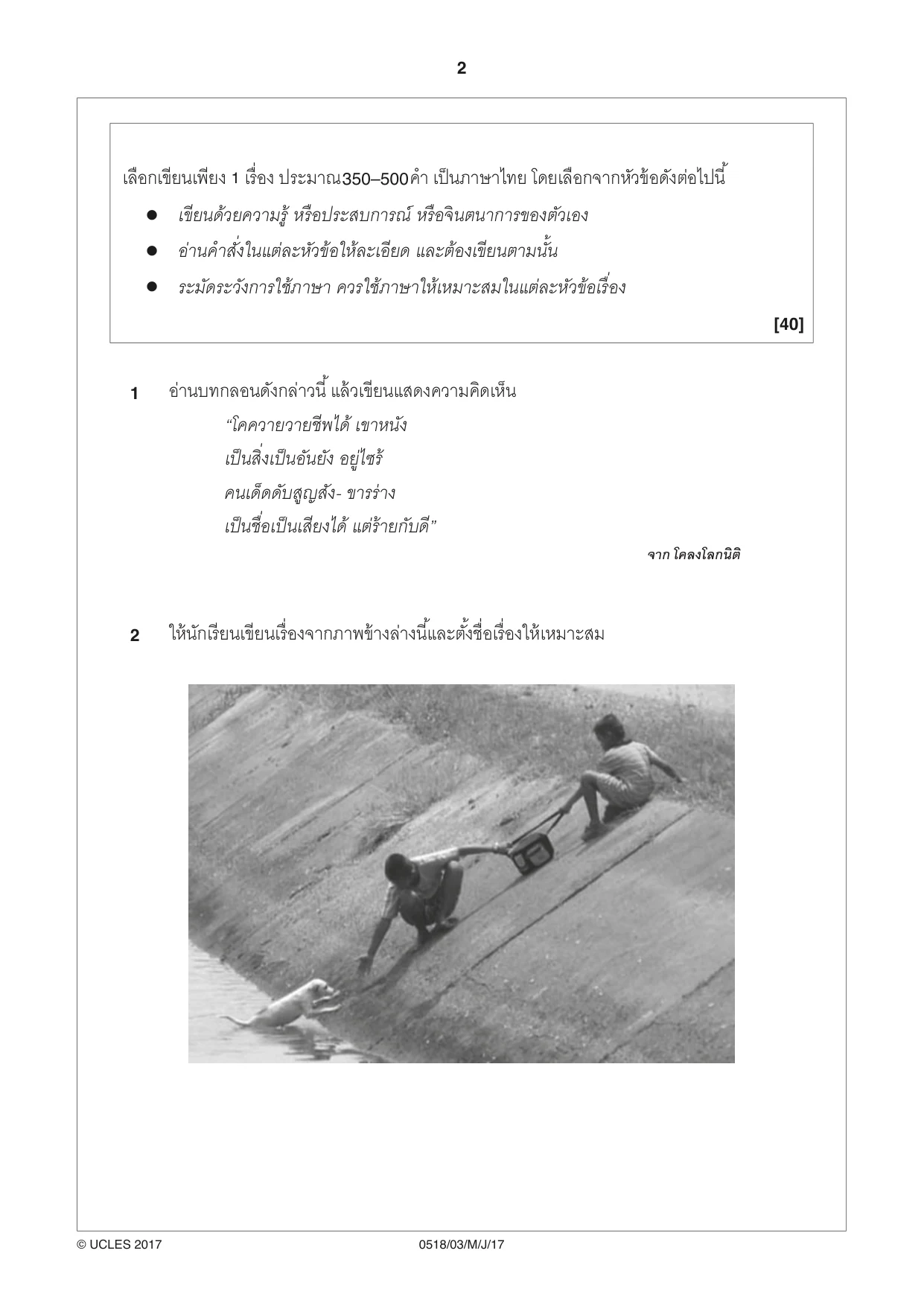
2 0518/03/M/J/17 © UCLES 2017 เลือกเขียนเพียง 1 เรือง ประมาณ 350-500 คํา เป็นภาษาไทย โดยเลือกจากหัวข้อดังต่อไปนี • เขียนด้วยความรู้ หรือประสบการณ์ หรือจินตนาการของตัวเอง • อ่านคําสังในแต่ละหัวข้อให้ละเอียด และต้องเขียนตามนัน • ระมัดระวังการใช้ภาษา ควรใช้ภาษาให้เหมาะสมในแต่ละหัวข้อเรือง 1 350–500 [40] อ่านบทกลอนดังกล่าวนี แล้วเขียนแสดงความคิดเห็น “โคควายวายชีพได้ เขาหนัง เป็นสิงเป็นอันยัง อยู่ไซร้ คนเด็ดดับสูญสัง- ขารร่าง เป็นชือเป็นเสียงได้ แต่ร้ายกับดี” จาก โคลงโลกนิติ ให้นักเรียนเขียนเรืองจากภาพข้างล่างนีและตังชือเรืองให้เหมาะสม 1 2
Question paper, page 3
3 0518/03/M/J/17 © UCLES 2017 เขียนเล่าเรือง โดยใส่ข้อความต่อไปนีตรงไหนก็ได้ในเรือง แล้วแต่นักเรียนเห็นสมควร “ฉันหยิบเงินเพือจะจ่ายค่าข้าวเหนียวส้มตํากับไก่ย่าง แต่แล้วก็ต้องชะงัก เมือได้ยินลูกค้าสองคน ในร้านพูดว่า...” “โทรศัพท์มือถือคือเครืองมือควบคุมชีวิตคน” นักเรียนเห็นด้วยหรือไม่ เพราะเหตุใด “ถนนคนเดิน” ให้นักเรียนเขียนบรรยายบรรยากาศถนนคนเดิน จากประสบการณ์ของนักเรียน เพือลงในวารสารของโรงเรียน เขียนเรียงความเรือง “มหัศจรรย์..เมืองไทย” “ไก่งามเพราะขน คนงามเพราะแต่ง” นักเรียนเห็นด้วยหรือไม่ เพราะเหตุใด เขียนเล่าเรือง โดยใช้ชือเรืองว่า “ความลับไม่มีในโลก” เขียนเล่าเรือง โดยเริมต้นด้วยข้อความต่อไปนี “บัดนี ข้าพเจ้าได้ย้ายมาอยู่โรงเรียนแห่งใหม่แล้ว ความแปลกตาของโรงเรียนใหม่ในต่างจังหวัด ยังความตืนเต้นแก่ข้าพเจ้าได้ไม่น้อยเลย นับแต่วันแรกทีมีโอกาสเหยียบย่างผ่านประตูโรงเรียน เข้าไป...” จากเรือง “โรงเรียนแห่งใหม่” โดย จํานง พันธ์ชืน 3 4 5 6 7 8 9
Question paper, page 4
4 0518/03/M/J/17 © UCLES 2017 BLANK PAGE Permission to reproduce items where third-party owned material protected by copyright is included has been sought and cleared where possible. Every reasonable effort has been made by the publisher (UCLES) to trace copyright holders, but if any items requiring clearance have unwittingly been included, the publisher will be pleased to make amends at the earliest possible opportunity. To avoid the issue of disclosure of answer-related information to candidates, all copyright acknowledgements are reproduced online in the Cambridge International Examinations Copyright Acknowledgements Booklet. This is produced for each series of examinations and is freely available to download at www.cie.org.uk after the live examination series. Cambridge International Examinations is part of the Cambridge Assessment Group. Cambridge Assessment is the brand name of University of Cambridge Local Examinations Syndicate (UCLES), which is itself a department of the University of Cambridge.
Mark scheme, page 1
® IGCSE is a registered trademark. This document consists of 10 printed pages. © UCLES 2017 [Turn over Cambridge International Examinations Cambridge International General Certificate of Secondary Education FIRST LANGUAGE THAI 0518/03 Paper 3 Continuous Writing May/June 2017 MARK SCHEME Maximum Mark: 40 Published This mark scheme is published as an aid to teachers and candidates, to indicate the requirements of the examination. It shows the basis on which Examiners were instructed to award marks. It does not indicate the details of the discussions that took place at an Examiners’ meeting before marking began, which would have considered the acceptability of alternative answers. Mark schemes should be read in conjunction with the question paper and the Principal Examiner Report for Teachers. Cambridge will not enter into discussions about these mark schemes. Cambridge is publishing the mark schemes for the May/June 2017 series for most Cambridge IGCSE®, Cambridge International A and AS Level and Cambridge Pre-U components, and some Cambridge O Level components.
Mark scheme, page 2
0518/03 Cambridge IGCSE – Mark Scheme PUBLISHED May/June 2017 © UCLES 2017 Page 2 of 10 36–40 Apart from very occasional 'first draft' slips, the language is entirely accurate. Sentence structure is varied and demonstrates that the candidate has the skill to use various lengths and types of sentences to achieve a particular effect. Vocabulary is wide and is used with precision. Punctuation is accurate and helpful to the reader. Spelling is accurate across the full range of vocabulary used. Paragraphs have unity, are linked, and show evidence of planning. The topic is addressed with consistent relevance; the interest of the reader is aroused and sustained. 31–35 The language is accurate with only occasional errors. Vocabulary is wide enough to convey intended shades of meaning with some precision. Sentences show some variation of length and type, including the confident use of complex sentences. Punctuation is accurate. Spelling is nearly always accurate. Paragraphs show some evidence of planning, have unity and are usually appropriately linked. The piece of writing is a relevant response to the topic, and the interest of the reader is aroused and sustained through most of the composition. 26–30 The language is largely accurate. Simple structures are used without error. Vocabulary is wide enough to convey intended meaning, but may lack precision. Sentences may show some variety of length, although there may be a tendency to repeat sentence types and 'shapes', producing a monotonous effect. Spelling of simple vocabulary is accurate. Punctuation is generally accurate. The composition is written in paragraphs which may show some unity, although links may be absent or inappropriate. The composition is a relevant response to the topic and will arouse some interest in the reader. 21–25 The language is sufficiently accurate to communicate meaning clearly to the reader. There will be patches of clear, accurate language, particularly when simple vocabulary and structures are used. There may be some variety of sentence length and structure, but the reader may not be convinced that this variety is for a particular purpose. Vocabulary is usually adequate to convey intended meaning. Punctuation will be used but may not be used to enhance/clarify meaning. Simple words will be spelt accurately. Paragraphs will be used, but may lack unity or coherence. The subject matter will indicate that a genuine attempt has been made to address the topic, but there may be digressions or failures of logic. The reader may find compositions at this level lack liveliness and interest value. 16–20 Meaning is never in doubt, but the errors are sufficiently frequent and serious to hamper precision, and may slow down reading. Some simple structures will be accurate, but a script at this level is unlikely to sustain accuracy for long. Vocabulary may be limited, either too simple to convey precise meaning, or more ambitious but imperfectly understood. Simple punctuation will usually be accurate. Simple words will usually be spelt correctly. Paragraphs may lack unity or be used haphazardly. The subject matter will show some relevance to the topic but may achieve only a partial or a 'glancing' treatment of the subject. The incidence of linguistic error is likely to distract the reader from merits of content that the composition may have. 11–15 There will be many serious errors of various kinds throughout the script, but they will be of the 'single-word' type, i.e. they could be corrected without rewriting the sentence. Communication is established, although the weight of error may cause 'blurring' from time to time. Sentences will probably be simple and repetitive in structure. Vocabulary will convey meaning, but is likely to be simple and imprecise. Spelling will be inconsistent. Paragraphing may be haphazard or non-existent. There may be evidence of interesting and relevant subject matter, but the weight of linguistic error that will tend to occur will neutralise its effect. 6–10 Sense will usually be decipherable, but some of the error will be multiple, i.e. requiring the reader to re-read and re-organise before meaning becomes clear. There are unlikely to be more than a few accurate sentences, however simple, in the whole composition. The content is likely to be comprehensible, but may be partly hidden by the density of the linguistic error. 0–5 Accuracy will be hardly existent. Whole sections of the composition will make no sense at all. Where occasional patches of relative clarity are evident some marks should be given. The mark of 0 should be reserved for scripts that make no sense at all from beginning to end.
Mark scheme, page 3
0518/03 Cambridge IGCSE – Mark Scheme PUBLISHED May/June 2017 © UCLES 2017 Page 3 of 10 The general marking criteria on page 2 are broken down into six subcategories, as shown on pages 3–5. CONTENT: Maximum 20 marks for relevance and development of ideas, as follows: Mark Relevance Development of ideas 9–10 The response addresses the topic relevantly throughout. The writing communicates the message coherently and appropriately to the reader. There is a strong sense of audience. There is good evidence of complex and creative thought. The reader’s attention is sustained throughout. 7–8 The response is mainly relevant. The writing is coherent but may lack some detail. There is some sense of audience. There are some instances of complex and creative thought. The reader is engaged with the response. 5–6 The response is mainly relevant but there may be some minor inconsistencies. A limited sense of audience. The response is generally clear and occasionally engages the reader’s interest. 3–4 The response addresses the topic in a simple way, and the reader may become confused by a lack of coherence and order, or an over-complicated but poorly presented plot. Meaning is sometimes in doubt. There is likely to be no sense of audience. In general the reader can follow the thread of the response, though there is very little attempt to raise the reader’s interest. 1–2 The response is largely irrelevant. It may be very simple or very complex but confused. Large parts of the response may make no sense at all. The response is so incomplete or confusing that the reader cannot follow the thread of the response. There is virtually no attempt to raise the reader’s interest. 0 Nothing relevant to reward.
Mark scheme, page 4
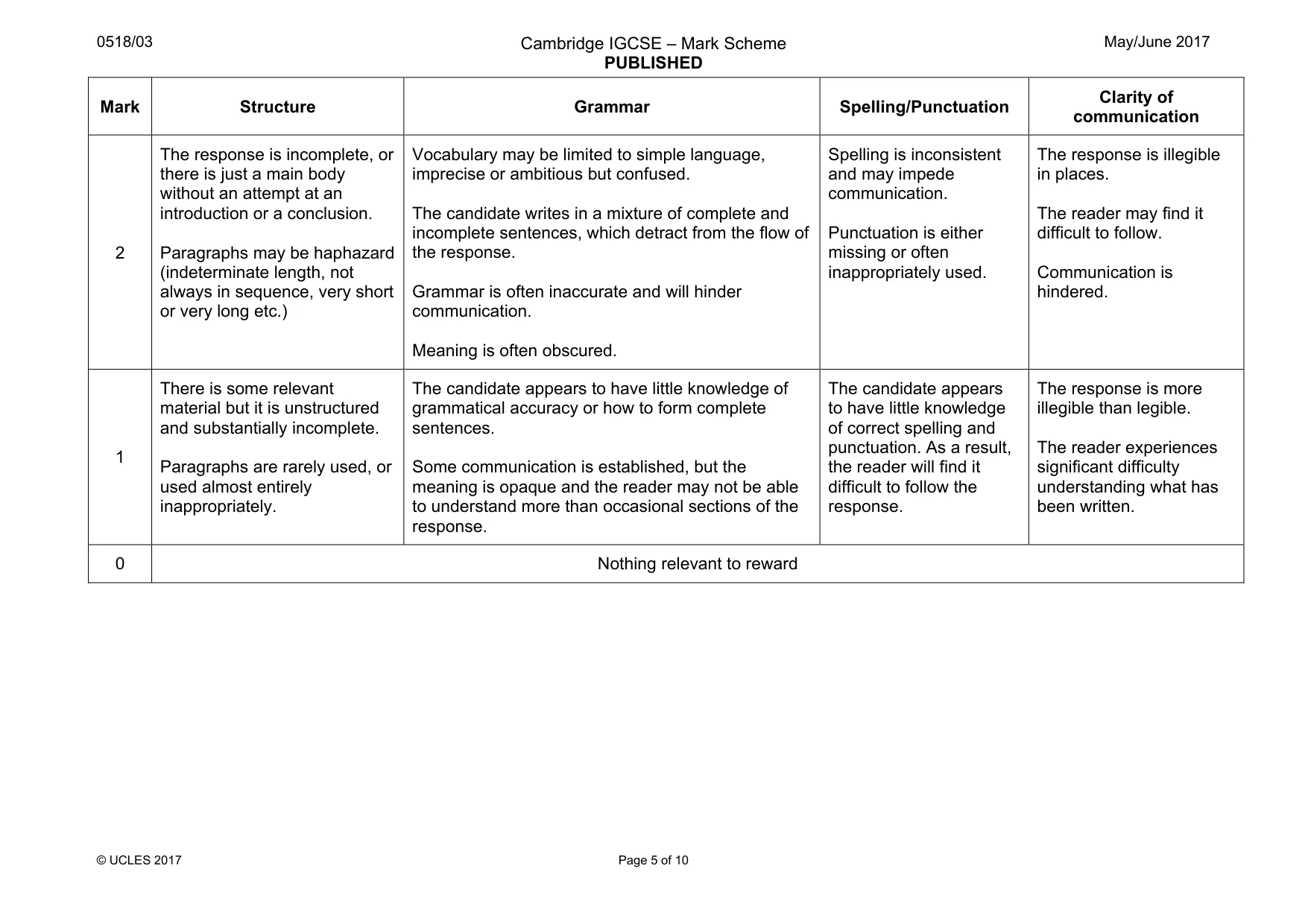
0518/03 Cambridge IGCSE – Mark Scheme PUBLISHED May/June 2017 © UCLES 2017 Page 4 of 10 LANGUAGE: Maximum 20 marks for style and accuracy, as follows: Mark Structure Grammar Spelling/Punctuation Clarity of communication 5 The response is clearly structured with a well-defined introduction, main body and conclusion. Paragraphs are well linked and have unity. The candidate uses a wide range of vocabulary and phrases/idioms precisely. The response flows well, as the candidate writes in correct and complete sentences using accurate grammar. Meaning is conveyed with complete clarity. Spelling is accurate. Punctuation is used correctly and helps to define meaning. The response is always clear and neat. Effective communication achieved. 4 There is a good attempt to structure the response, with an obvious introduction, main body and conclusion. Paragraphs show some evidence of planning, have unity and are usually linked. The candidate uses a wide enough range of appropriate phrases/idioms to convey some shades of meaning. The response is in complete sentences with generally accurate grammar. Meaning is clear. Spelling is mostly accurate, with only a small number of minor errors. Punctuation is generally used correctly. The response is mostly clear and neat. Fairly effective communication. 3 Although some attempt to structure the response has been made, the introduction or conclusion may be missing. Paragraphs may show some unity but are not well linked. The candidate may attempt to use a range of vocabulary, adequately conveying the meaning. When using more complex vocabulary, meaning may be obscured. The candidate writes in complete sentences for the most part, but there may be some unfinished sentences. There will be patches of clear, accurate language but accuracy will not be sustained in more complex language. The reader may have to make an effort to understand all the response. Spelling of simple words is correct, but there may be errors in more complex words. These do not prevent communication on the whole. The candidate has attempted to use correct punctuation, with varying success. The response is legible. The reader’s flow may be interrupted by occasional lack of clarity.
Mark scheme, page 5
0518/03 Cambridge IGCSE – Mark Scheme PUBLISHED May/June 2017 © UCLES 2017 Page 5 of 10 Mark Structure Grammar Spelling/Punctuation Clarity of communication 2 The response is incomplete, or there is just a main body without an attempt at an introduction or a conclusion. Paragraphs may be haphazard (indeterminate length, not always in sequence, very short or very long etc.) Vocabulary may be limited to simple language, imprecise or ambitious but confused. The candidate writes in a mixture of complete and incomplete sentences, which detract from the flow of the response. Grammar is often inaccurate and will hinder communication. Meaning is often obscured. Spelling is inconsistent and may impede communication. Punctuation is either missing or often inappropriately used. The response is illegible in places. The reader may find it difficult to follow. Communication is hindered. 1 There is some relevant material but it is unstructured and substantially incomplete. Paragraphs are rarely used, or used almost entirely inappropriately. The candidate appears to have little knowledge of grammatical accuracy or how to form complete sentences. Some communication is established, but the meaning is opaque and the reader may not be able to understand more than occasional sections of the response. The candidate appears to have little knowledge of correct spelling and punctuation. As a result, the reader will find it difficult to follow the response. The response is more illegible than legible. The reader experiences significant difficulty understanding what has been written. 0 Nothing relevant to reward
Mark scheme, page 6
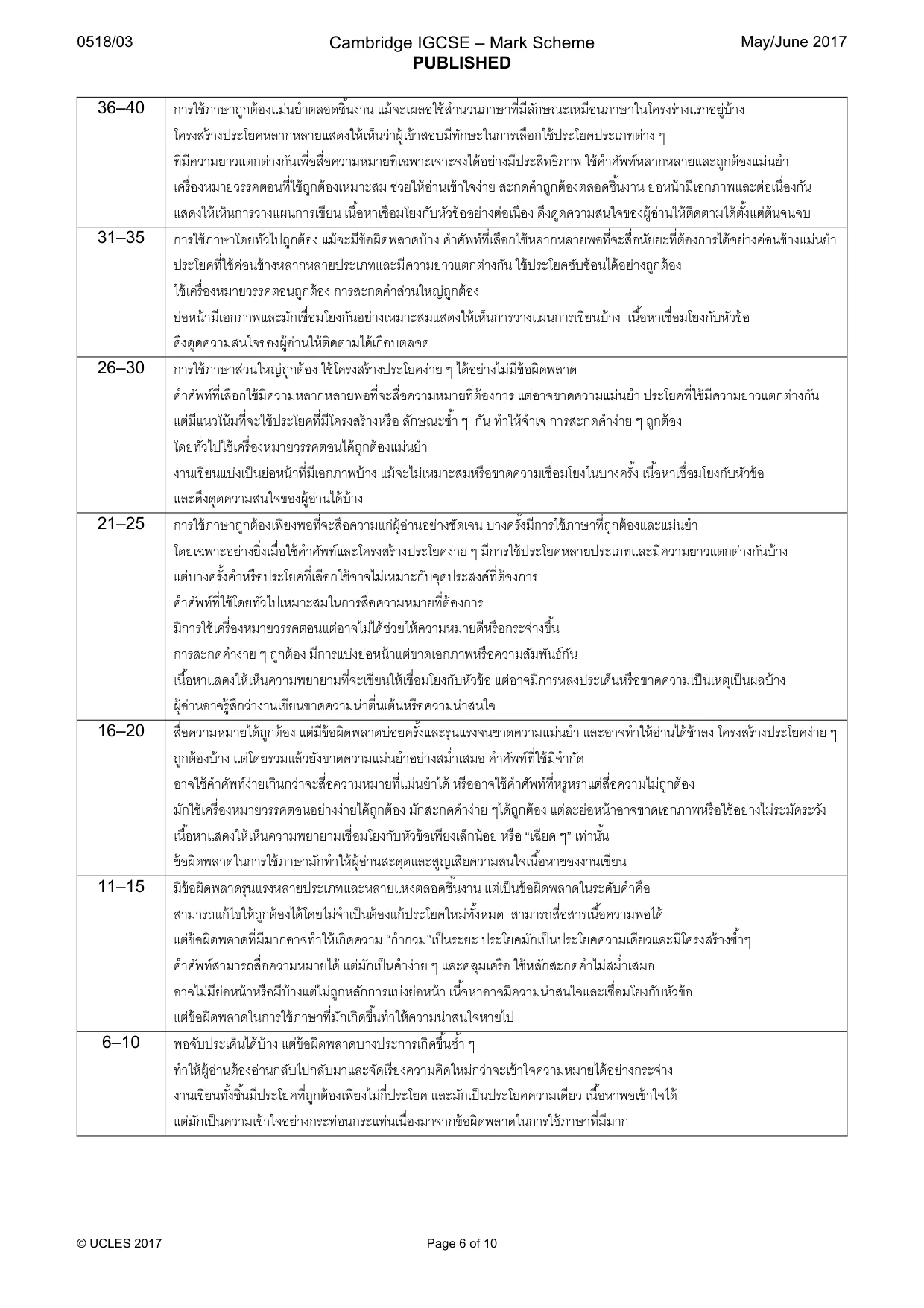
0518/03 Cambridge IGCSE – Mark Scheme PUBLISHED May/June 2017 © UCLES 2017 Page 6 of 10 36–40 การใช้ภาษาถูกต้องแม่นยําตลอดชิÊนงาน แม้จะเผลอใช้สํานวนภาษาทีÉมีลักษณะเหมือนภาษาในโครงร่างแรกอยู่บ้าง โครงสร้างประโยคหลากหลายแสดงให้เห็นว่าผู้เข้าสอบมีทักษะในการเลือกใช้ประโยคประเภทต่าง ๆ ทีÉมีความยาวแตกต่างกันเพืÉอสืÉอความหมายทีÉเฉพาะเจาะจงได้อย่างมีประสิทธิภาพ ใช้คําศัพท์หลากหลายและถูกต้องแม่นยํา เครืÉองหมายวรรคตอนทีÉใช้ถูกต้องเหมาะสม ช่วยให้อ่านเข้าใจง่าย สะกดคําถูกต้องตลอดชิÊนงาน ย่อหน้ามีเอกภาพและต่อเนืÉองกัน แสดงให้เห็นการวางแผนการเขียน เนืÊอหาเชืÉอมโยงกับหัวข้ออย่างต่อเนืÉอง ดึงดูดความสนใจของผู้อ่านให้ติดตามได้ตัÊงแต่ต้นจนจบ 31–35 การใช้ภาษาโดยทัÉวไปถูกต้อง แม้จะมีข้อผิดพลาดบ้าง คําศัพท์ทีÉเลือกใช้หลากหลายพอทีÉจะสืÉอนัยยะทีÉต้องการได้อย่างค่อนข้างแม่นยํา ประโยคทีÉใช้ค่อนข้างหลากหลายประเภทและมีความยาวแตกต่างกัน ใช้ประโยคซับซ้อนได้อย่างถูกต้อง ใช้เครืÉองหมายวรรคตอนถูกต้อง การสะกดคําส่วนใหญ่ถูกต้อง ย่อหน้ามีเอกภาพและมักเชืÉอมโยงกันอย่างเหมาะสมแสดงให้เห็นการวางแผนการเขียนบ้าง เนืÊอหาเชืÉอมโยงกับหัวข้อ ดึงดูดความสนใจของผู้อ่านให้ติดตามได้เกือบตลอด 26–30 การใช้ภาษาส่วนใหญ่ถูกต้อง ใช้โครงสร้างประโยคง่าย ๆ ได้อย่างไม่มีข้อผิดพลาด คําศัพท์ทีÉเลือกใช้มีความหลากหลายพอทีÉจะสืÉอความหมายทีÉต้องการ แต่อาจขาดความแม่นยํา ประโยคทีÉใช้มีความยาวแตกต่างกัน แต่มีแนวโน้มทีÉจะใช้ประโยคทีÉมีโครงสร้างหรือ ลักษณะซํÊา ๆ กัน ทําให้จําเจ การสะกดคําง่าย ๆ ถูกต้อง โดยทัÉวไปใช้เครืÉองหมายวรรคตอนได้ถูกต้องแม่นยํา งานเขียนแบ่งเป็นย่อหน้าทีÉมีเอกภาพบ้าง แม้จะไม่เหมาะสมหรือขาดความเชืÉอมโยงในบางครัÊง เนืÊอหาเชืÉอมโยงกับหัวข้อ และดึงดูดความสนใจของผู้อ่านได้บ้าง 21–25 การใช้ภาษาถูกต้องเพียงพอทีÉจะสืÉอความแก่ผู้อ่านอย่างชัดเจน บางครัÊงมีการใช้ภาษาทีÉถูกต้องและแม่นยํา โดยเฉพาะอย่างยิÉงเมืÉอใช้คําศัพท์และโครงสร้างประโยคง่าย ๆ มีการใช้ประโยคหลายประเภทและมีความยาวแตกต่างกันบ้าง แต่บางครัÊงคําหรือประโยคทีÉเลือกใช้อาจไม่เหมาะกับจุดประสงค์ทีÉต้องการ คําศัพท์ทีÉใช้โดยทัÉวไปเหมาะสมในการสืÉอความหมายทีÉต้องการ มีการใช้เครืÉองหมายวรรคตอนแต่อาจไม่ได้ช่วยให้ความหมายดีหรือกระจ่างขึÊน การสะกดคําง่าย ๆ ถูกต้อง มีการแบ่งย่อหน้าแต่ขาดเอกภาพหรือความสัมพันธ์กัน เนืÊอหาแสดงให้เห็นความพยายามทีÉจะเขียนให้เชืÉอมโยงกับหัวข้อ แต่อาจมีการหลงประเด็นหรือขาดความเป็นเหตุเป็นผลบ้าง ผู้อ่านอาจรู้สึกว่างานเขียนขาดความน่าตืÉนเต้นหรือความน่าสนใจ 16–20 สืÉอความหมายได้ถูกต้อง แต่มีข้อผิดพลาดบ่อยครัÊงและรุนแรงจนขาดความแม่นยํา และอาจทําให้อ่านได้ช้าลง โครงสร้างประโยคง่าย ๆ ถูกต้องบ้าง แต่โดยรวมแล้วยังขาดความแม่นยําอย่างสมํÉาเสมอ คําศัพท์ทีÉใช้มีจํากัด อาจใช้คําศัพท์ง่ายเกินกว่าจะสืÉอความหมายทีÉแม่นยําได้ หรืออาจใช้คําศัพท์ทีÉหรูหราแต่สืÉอความไม่ถูกต้อง มักใช้เครืÉองหมายวรรคตอนอย่างง่ายได้ถูกต้อง มักสะกดคําง่าย ๆได้ถูกต้อง แต่ละย่อหน้าอาจขาดเอกภาพหรือใช้อย่างไม่ระมัดระวัง เนืÊอหาแสดงให้เห็นความพยายามเชืÉอมโยงกับหัวข้อเพียงเล็กน้อย หรือ “เฉียด ๆ” เท่านัÊน ข้อผิดพลาดในการใช้ภาษามักทําให้ผู้อ่านสะดุดและสูญเสียความสนใจเนืÊอหาของงานเขียน 11–15 มีข้อผิดพลาดรุนแรงหลายประเภทและหลายแห่งตลอดชิÊนงานแต่เป็นข้อผิดพลาดในระดับคําคือ สามารถแก้ไขให้ถูกต้องได้โดยไม่จําเป็นต้องแก้ประโยคใหม่ทัÊงหมด สามารถสืÉอสารเนืÊอความพอได้ แต่ข้อผิดพลาดทีÉมีมากอาจทําให้เกิดความ “กํากวม”เป็นระยะ ประโยคมักเป็นประโยคความเดียวและมีโครงสร้างซํÊาๆ คําศัพท์สามารถสืÉอความหมายได้ แต่มักเป็นคําง่าย ๆ และคลุมเครือ ใช้หลักสะกดคําไม่สมํÉาเสมอ อาจไม่มีย่อหน้าหรือมีบ้างแต่ไม่ถูกหลักการแบ่งย่อหน้า เนืÊอหาอาจมีความน่าสนใจและเชืÉอมโยงกับหัวข้อ แต่ข้อผิดพลาดในการใช้ภาษาทีÉมักเกิดขึÊนทําให้ความน่าสนใจหายไป 6–10 พอจับประเด็นได้บ้าง แต่ข้อผิดพลาดบางประการเกิดขึÊนซํÊาๆ ทําให้ผู้อ่านต้องอ่านกลับไปกลับมาและจัดเรียงความคิดใหม่กว่าจะเข้าใจความหมายได้อย่างกระจ่าง งานเขียนทัÊงชิÊนมีประโยคทีÉถูกต้องเพียงไม่กีÉประโยค และมักเป็นประโยคความเดียว เนืÊอหาพอเข้าใจได้ แต่มักเป็นความเข้าใจอย่างกระท่อนกระแท่นเนืÉองมาจากข้อผิดพลาดในการใช้ภาษาทีÉมีมาก
Mark scheme, page 7
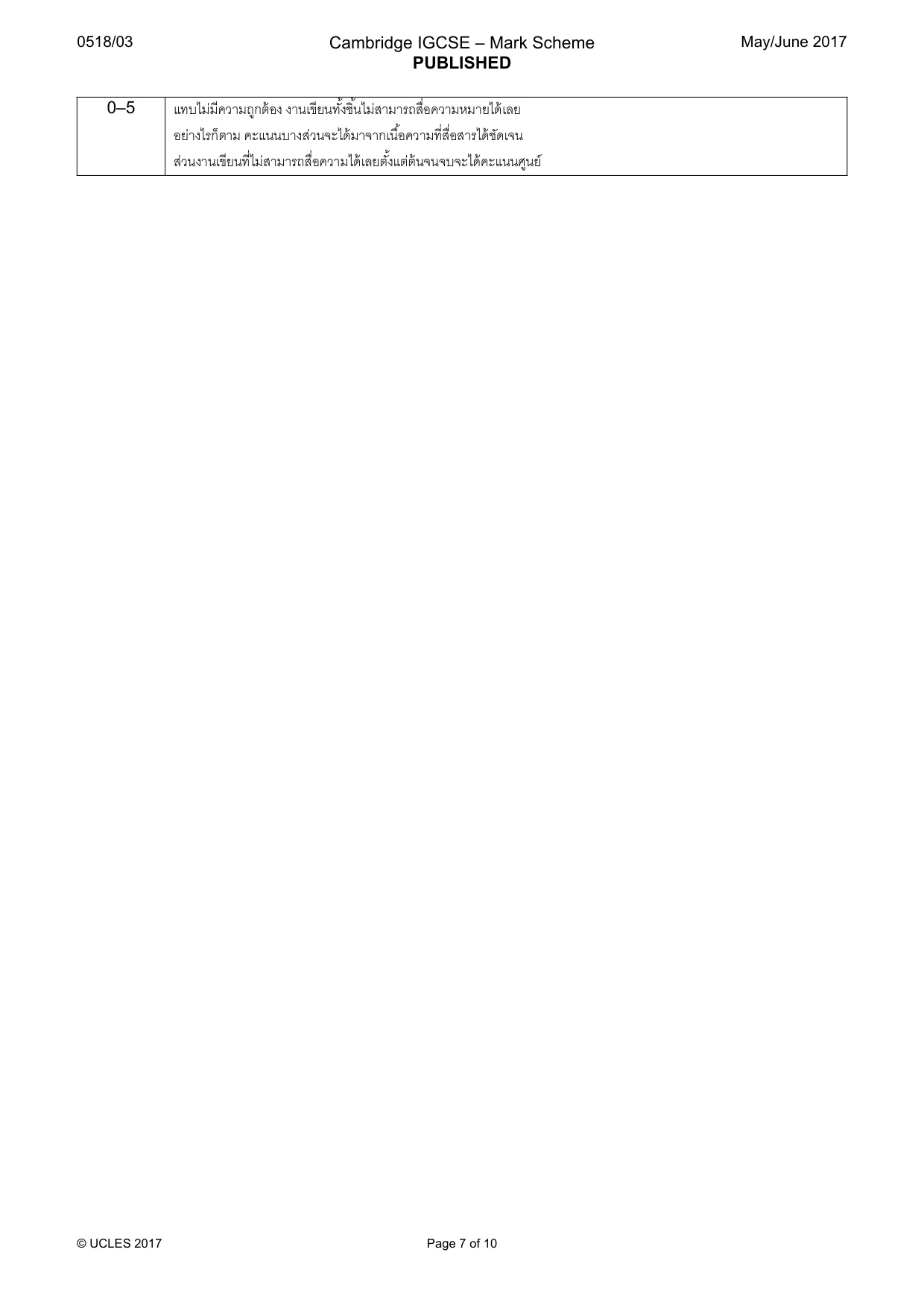
0518/03 Cambridge IGCSE – Mark Scheme PUBLISHED May/June 2017 © UCLES 2017 Page 7 of 10 0–5 แทบไม่มีความถูกต้อง งานเขียนทัÊงชิÊนไม่สามารถสืÉอความหมายได้เลย อย่างไรก็ตาม คะแนนบางส่วนจะได้มาจากเนืÊอความทีÉสืÉอสารได้ชัดเจน ส่วนงานเขียนทีÉไม่สามารถสืÉอความได้เลยตัÊงแต่ต้นจนจบจะได้คะแนนศูนย์
Mark scheme, page 8
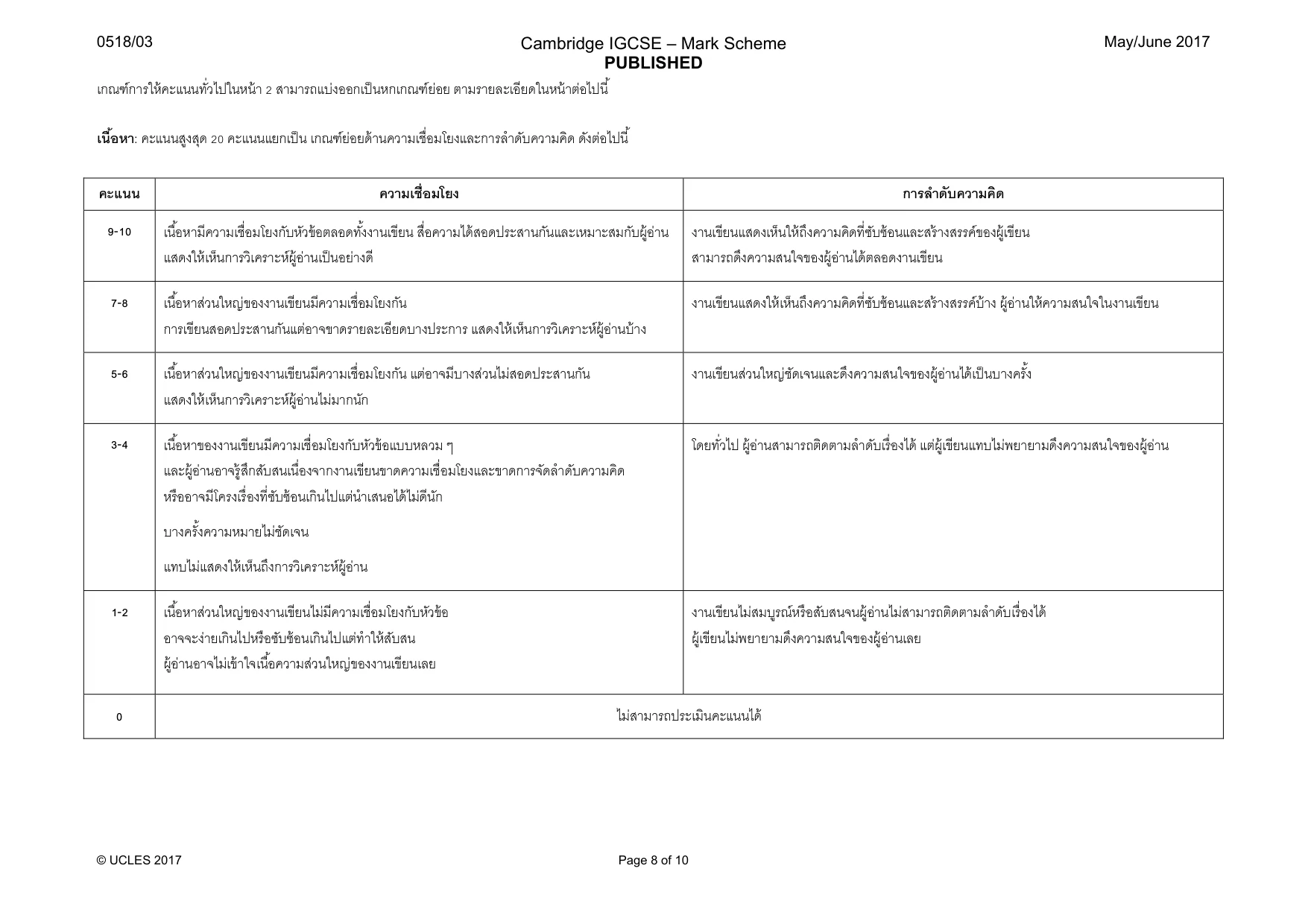
0518/03 Cambridge IGCSE – Mark Scheme PUBLISHED May/June 2017 © UCLES 2017 Page 8 of 10 เกณฑ์การให้คะแนนทัÉวไปในหน้า 2 สามารถแบ่งออกเป็นหกเกณฑ์ย่อย ตามรายละเอียดในหน้าต่อไปนีÊ เนืÊอหา: คะแนนสูงสุด 20 คะแนนแยกเป็น เกณฑ์ย่อยด้านความเชืÉอมโยงและการลําดับความคิด ดังต่อไปนีÊ คะแนน ความเชืÉอมโยง การลําดับความคิด 9-10 เนืÊอหามีความเชืÉอมโยงกับหัวข้อตลอดทัÊงงานเขียน สืÉอความได้สอดประสานกันและเหมาะสมกับผู้อ่าน แสดงให้เห็นการวิเคราะห์ผู้อ่านเป็นอย่างดี งานเขียนแสดงเห็นให้ถึงความคิดทีÉซับซ้อนและสร้างสรรค์ของผู้เขียน สามารถดึงความสนใจของผู้อ่านได้ตลอดงานเขียน 7-8 เนืÊอหาส่วนใหญ่ของงานเขียนมีความเชืÉอมโยงกัน การเขียนสอดประสานกันแต่อาจขาดรายละเอียดบางประการ แสดงให้เห็นการวิเคราะห์ผู้อ่านบ้าง งานเขียนแสดงให้เห็นถึงความคิดทีÉซับซ้อนและสร้างสรรค์บ้าง ผู้อ่านให้ความสนใจในงานเขียน 5-6 เนืÊอหาส่วนใหญ่ของงานเขียนมีความเชืÉอมโยงกัน แต่อาจมีบางส่วนไม่สอดประสานกัน แสดงให้เห็นการวิเคราะห์ผู้อ่านไม่มากนัก งานเขียนส่วนใหญ่ชัดเจนและดึงความสนใจของผู้อ่านได้เป็นบางครัÊง 3-4 เนืÊอหาของงานเขียนมีความเชืÉอมโยงกับหัวข้อแบบหลวม ๆ และผู้อ่านอาจรู้สึกสับสนเนืÉองจากงานเขียนขาดความเชืÉอมโยงและขาดการจัดลําดับความคิด หรืออาจมีโครงเรืÉองทีÉซับซ้อนเกินไปแต่นําเสนอได้ไม่ดีนัก บางครัÊงความหมายไม่ชัดเจน แทบไม่แสดงให้เห็นถึงการวิเคราะห์ผู้อ่าน โดยทัÉวไป ผู้อ่านสามารถติดตามลําดับเรืÉองได้ แต่ผู้เขียนแทบไม่พยายามดึงความสนใจของผู้อ่าน 1-2 เนืÊอหาส่วนใหญ่ของงานเขียนไม่มีความเชืÉอมโยงกับหัวข้อ อาจจะง่ายเกินไปหรือซับซ้อนเกินไปแต่ทําให้สับสน ผู้อ่านอาจไม่เข้าใจเนืÊอความส่วนใหญ่ของงานเขียนเลย งานเขียนไม่สมบูรณ์หรือสับสนจนผู้อ่านไม่สามารถติดตามลําดับเรืÉองได้ ผู้เขียนไม่พยายามดึงความสนใจของผู้อ่านเลย 0 ไม่สามารถประเมินคะแนนได้
Mark scheme, page 9
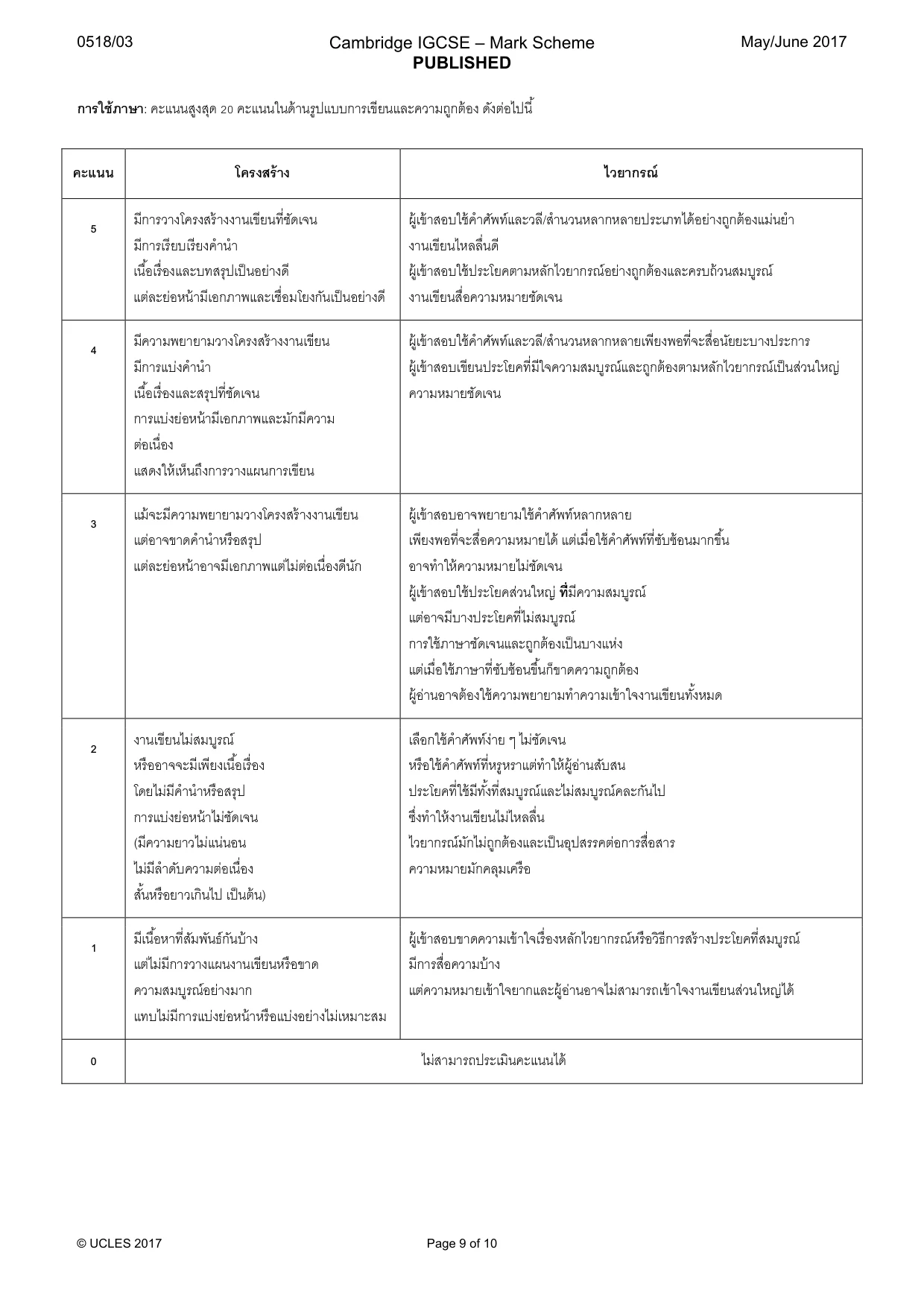
0518/03 Cambridge IGCSE – Mark Scheme PUBLISHED May/June 2017 © UCLES 2017 Page 9 of 10 การใช้ภาษา: คะแนนสูงสุด 20 คะแนนในด้านรูปแบบการเขียนและความถูกต้อง ดังต่อไปนีÊ คะแนน โครงสร้าง ไวยากรณ์ 5 มีการวางโครงสร้างงานเขียนทีÉชัดเจน มีการเรียบเรียงคํานํา เนืÊอเรืÉองและบทสรุปเป็นอย่างดี แต่ละย่อหน้ามีเอกภาพและเชืÉอมโยงกันเป็นอย่างดี ผู้เข้าสอบใช้คําศัพท์และวลี/สํานวนหลากหลายประเภทได้อย่างถูกต้องแม่นยํา งานเขียนไหลลืÉนดี ผู้เข้าสอบใช้ประโยคตามหลักไวยากรณ์อย่างถูกต้องและครบถ้วนสมบูรณ์ งานเขียนสืÉอความหมายชัดเจน 4 มีความพยายามวางโครงสร้างงานเขียน มีการแบ่งคํานํา เนืÊอเรืÉองและสรุปทีÉชัดเจน การแบ่งย่อหน้ามีเอกภาพและมักมีความ ต่อเนืÉอง แสดงให้เห็นถึงการวางแผนการเขียน ผู้เข้าสอบใช้คําศัพท์และวลี/สํานวนหลากหลายเพียงพอทีÉจะสืÉอนัยยะบางประการ ผู้เข้าสอบเขียนประโยคทีÉมีใจความสมบูรณ์และถูกต้องตามหลักไวยากรณ์เป็นส่วนใหญ่ ความหมายชัดเจน 3 แม้จะมีความพยายามวางโครงสร้างงานเขียน แต่อาจขาดคํานําหรือสรุป แต่ละย่อหน้าอาจมีเอกภาพแต่ไม่ต่อเนืÉองดีนัก ผู้เข้าสอบอาจพยายามใช้คําศัพท์หลากหลาย เพียงพอทีÉจะสืÉอความหมายได้ แต่เมืÉอใช้คําศัพท์ทีÉซับซ้อนมากขึÊน อาจทําให้ความหมายไม่ชัดเจน ผู้เข้าสอบใช้ประโยคส่วนใหญ่ ทีÉมีความสมบูรณ์ แต่อาจมีบางประโยคทีÉไม่สมบูรณ์ การใช้ภาษาชัดเจนและถูกต้องเป็นบางแห่ง แต่เมืÉอใช้ภาษาทีÉซับซ้อนขึÊนก็ขาดความถูกต้อง ผู้อ่านอาจต้องใช้ความพยายามทําความเข้าใจงานเขียนทัÊงหมด 2 งานเขียนไม่สมบูรณ์ หรืออาจจะมีเพียงเนืÊอเรืÉอง โดยไม่มีคํานําหรือสรุป การแบ่งย่อหน้าไม่ชัดเจน (มีความยาวไม่แน่นอน ไม่มีลําดับความต่อเนืÉอง สัÊนหรือยาวเกินไป เป็นต้น) เลือกใช้คําศัพท์ง่าย ๆ ไม่ชัดเจน หรือใช้คําศัพท์ทีÉหรูหราแต่ทําให้ผู้อ่านสับสน ประโยคทีÉใช้มีทัÊงทีÉสมบูรณ์และไม่สมบูรณ์คละกันไป ซึÉงทําให้งานเขียนไม่ไหลลืÉน ไวยากรณ์มักไม่ถูกต้องและเป็นอุปสรรคต่อการสืÉอสาร ความหมายมักคลุมเครือ 1 มีเนืÊอหาทีÉสัมพันธ์กันบ้าง แต่ไม่มีการวางแผนงานเขียนหรือขาด ความสมบูรณ์อย่างมาก แทบไม่มีการแบ่งย่อหน้าหรือแบ่งอย่างไม่เหมาะสม ผู้เข้าสอบขาดความเข้าใจเรืÉองหลักไวยากรณ์หรือวิธีการสร้างประโยคทีÉสมบูรณ์ มีการสืÉอความบ้าง แต่ความหมายเข้าใจยากและผู้อ่านอาจไม่สามารถเข้าใจงานเขียนส่วนใหญ่ได้ 0 ไม่สามารถประเมินคะแนนได้
Mark scheme, page 10
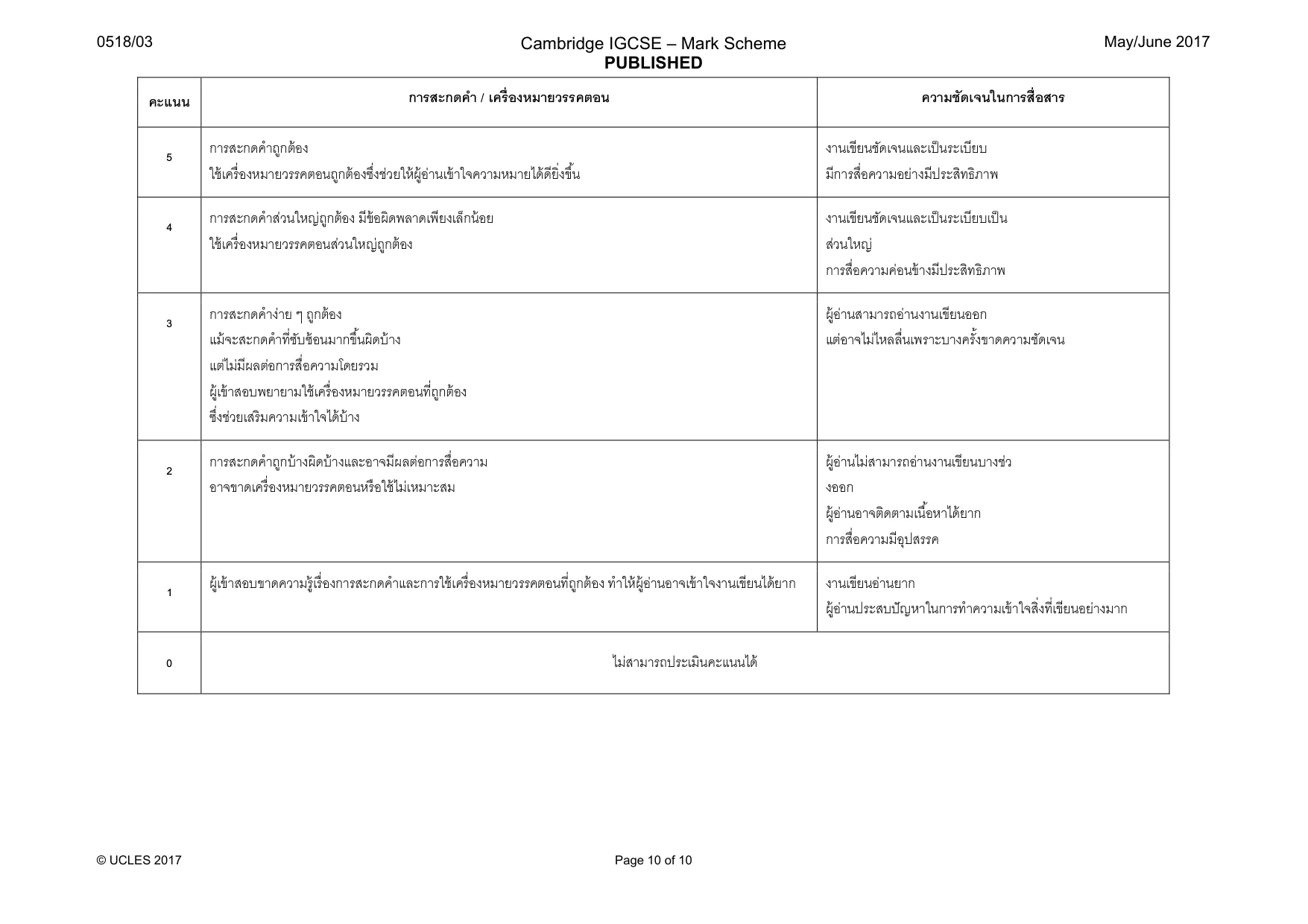
0518/03 Cambridge IGCSE – Mark Scheme PUBLISHED May/June 2017 © UCLES 2017 Page 10 of 10 คะแนน การสะกดคํา / เครืÉองหมายวรรคตอน ความชัดเจนในการสืÉอสาร 5 การสะกดคําถูกต้อง ใช้เครืÉองหมายวรรคตอนถูกต้องซึÉงช่วยให้ผู้อ่านเข้าใจความหมายได้ดียิÉงขึÊน งานเขียนชัดเจนและเป็นระเบียบ มีการสืÉอความอย่างมีประสิทธิภาพ 4 การสะกดคําส่วนใหญ่ถูกต้อง มีข้อผิดพลาดเพียงเล็กน้อย ใช้เครืÉองหมายวรรคตอนส่วนใหญ่ถูกต้อง งานเขียนชัดเจนและเป็นระเบียบเป็น ส่วนใหญ่ การสืÉอความค่อนข้างมีประสิทธิภาพ 3 การสะกดคําง่าย ๆ ถูกต้อง แม้จะสะกดคําทีÉซับซ้อนมากขึÊนผิดบ้าง แต่ไม่มีผลต่อการสืÉอความโดยรวม ผู้เข้าสอบพยายามใช้เครืÉองหมายวรรคตอนทีÉถูกต้อง ซึÉงช่วยเสริมความเข้าใจได้บ้าง ผู้อ่านสามารถอ่านงานเขียนออก แต่อาจไม่ไหลลืÉนเพราะบางครัÊงขาดความชัดเจน 2 การสะกดคําถูกบ้างผิดบ้างและอาจมีผลต่อการสืÉอความ อาจขาดเครืÉองหมายวรรคตอนหรือใช้ไม่เหมาะสม ผู้อ่านไม่สามารถอ่านงานเขียนบางช่ว งออก ผู้อ่านอาจติดตามเนืÊอหาได้ยาก การสืÉอความมีอุปสรรค 1 ผู้เข้าสอบขาดความรู้เรืÉองการสะกดคําและการใช้เครืÉองหมายวรรคตอนทีÉถูกต้อง ทําให้ผู้อ่านอาจเข้าใจงานเขียนได้ยาก งานเขียนอ่านยาก ผู้อ่านประสบปัญหาในการทําความเข้าใจสิÉงทีÉเขียนอย่างมาก 0 ไม่สามารถประเมินคะแนนได้
What you needed in this session
Cambridge’s own grade thresholds for 2017 May/June, Paper 3 · Variant 1. A higher threshold means an easier paper — the bar moves with how the cohort did.