Cambridge IGCSE Thai - First Language 0518 — 2011 May/June Paper 3 · Variant 1
0518/31/M/J/11 · 40 marks · ≈45 min
The question paper and its mark scheme, free to read here and free to download. This is Cambridge’s own paper, exactly as it was sat.
Question paper4 pages
Mark scheme2 pages
Answers below. Sit the paper first if you are practising.
Paper as text
Question paper, page 1
This document consists of 3 printed pages and 1 blank page. DC (LEO/SW) 41256/1 © UCLES 2011 [Turn over UNIVERSITY OF CAMBRIDGE INTERNATIONAL EXAMINATIONS International General Certificate of Secondary Education READ THESE INSTRUCTIONS FIRST If you have been given an Answer Booklet, follow the instructions on the front cover of the Booklet. Write your Centre number, candidate number and name on all the work you hand in. Write in dark blue or black pen. Do not use staples, paper clips, highlighters, glue or correction fluid. Write a composition based on one of the topics overleaf. You should write between 350 and 500 words. Dictionaries are not permitted. At the end of the examination, fasten all your work securely together. All questions in this paper carry equal marks. * 8 5 6 8 4 2 2 7 9 4 * FIRST LANGUAGE THAI 0518/03 Paper 3 Continuous Writing May/June 2011 1 hour 15 minutes Additional Materials: Answer Booklet/Paper www.XtremePapers.com
Question paper, page 2
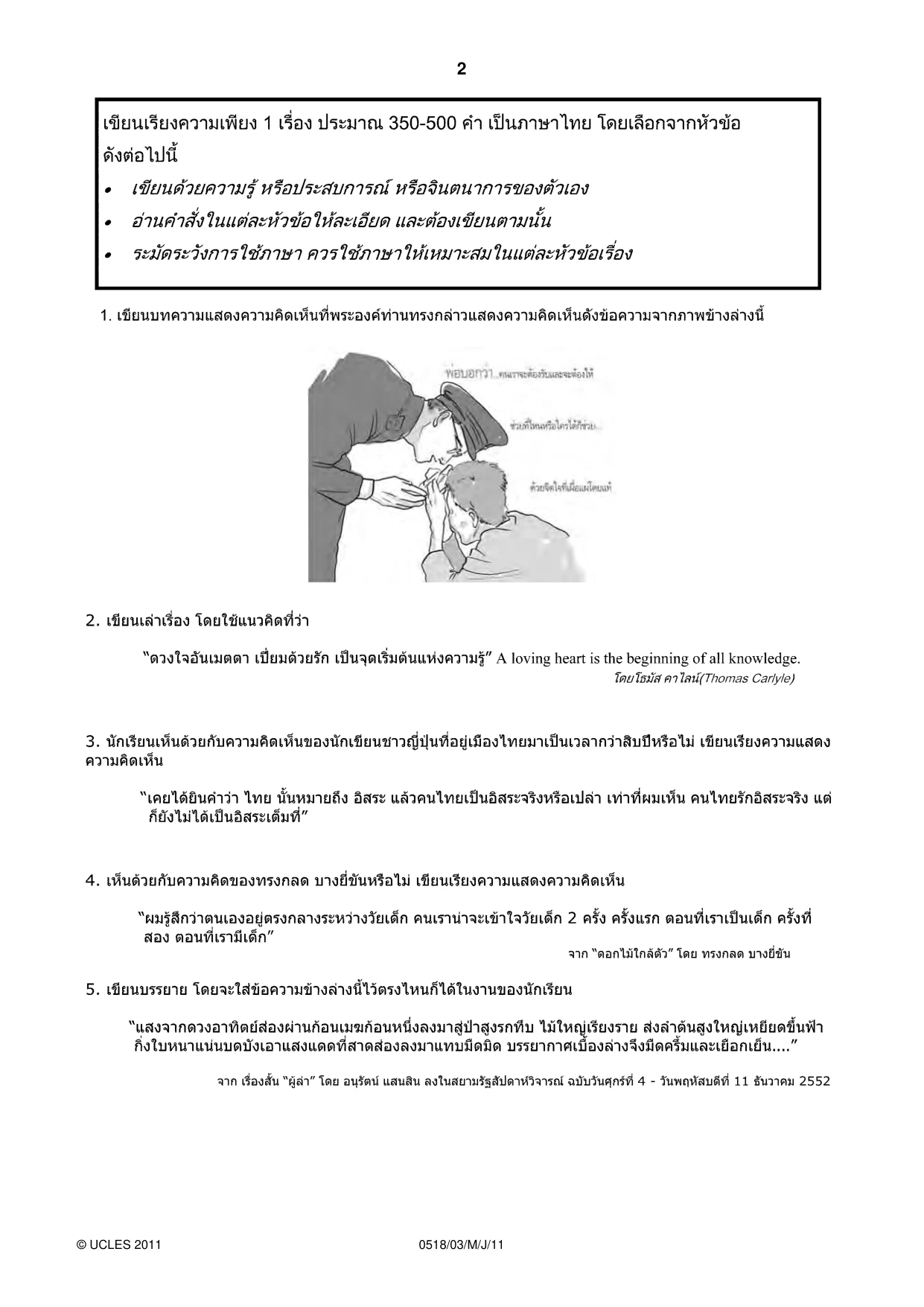
uusevariuivias 1 ae Useure 350-500 ¢1 Hund Ing Tauaansinviada susia lit 6 (Gaus qwarUg uiaseaunrsU UFAGUAUINITVAVGUDI ¢ a 1uA a luumaenI%a liandua UavdaudeunUy - selasedunis lin) 975 ind Winuqwau luusiaendalsau 1, MauunanauaasarmAaiuiuszasdvnunsonaruamsarAaiudodaanuaiamwinvart 2. Wlawandas Tantiunaatn Pa “protaduimam tiaudae%n uluqaSuduuvoarg” A loving heart is the beginning of all knowledge. Tau Tatia ar lai(Thomas Carlyle) 3. dagauiudraAvanudamuaastadiauandiluviadvias veaanilunarnnauilvsaa dauguvanuuane anuaaiu “aaladuert Ino tunwnwde dasy udaaulveiudaszatovsaular wiry au'lnaindasvaty usi Ade'hilafudaszidiud” 4. WusnaAuanAauasnsonan uvdduvtal Maugasanuuaasardaiu “naj rautasagasonarssewaiaudin ausnirasiintatain 2 a9 avousn aauvisutudin afer as nauttsriin” ain “aan'liitndda” Tag vsenaa urwidu 5. auusseng Tanavtadaanuinvaioi Vaso luuAlatuoruuasingeu “uaornmoainddasriuAauuaiaunfisaswgigesnviy ‘UituagGasne dash fugetnaiindandush Avtumnuiuuartoauacuaniaradasannunusiaia usseNMALLavawavfiaasuuasiantéu.. ann davdu “gan” Taw ausar uauadu avtuaenudgadoarviarsal adluduansy 4 - Yuwavaudil 11 suray 2552 @UCLES 2011 0518/03/M/J/11
Question paper, page 3
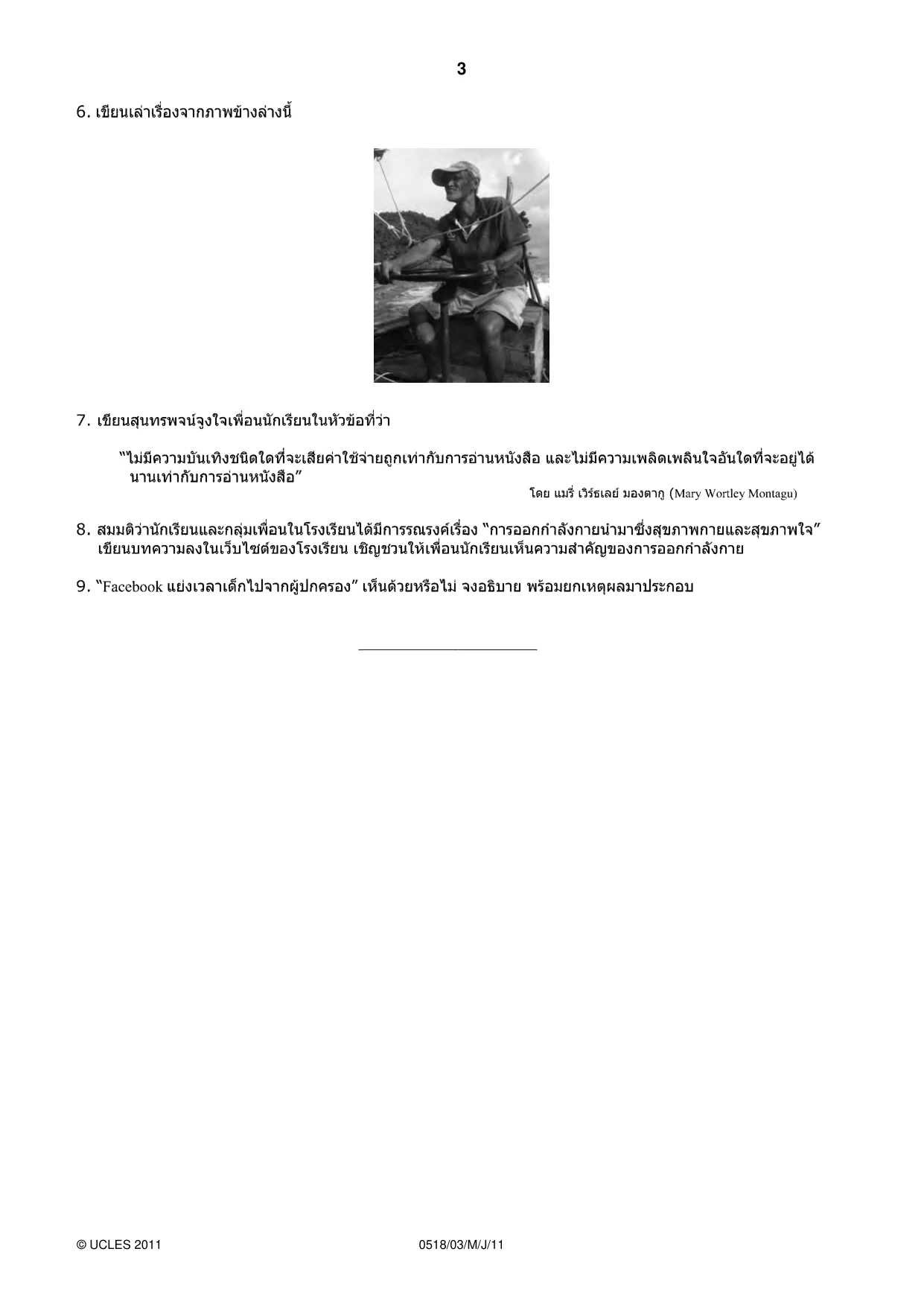
6. Mauargasaamwinvatl 7. isuqunswaiqetamautngautuvaiain “Liflariumorfialavasaucntasiagniiadumsaruuieda uarluifiarundomautadutaviavag'ta wuiAunrsarunieda” ; Tau wit sstad wavag (Mary Wortley Montagu) 8. and Wintouuarnaufautulsdawlasimssasodidas “asaanademenhundvaunwmauaaunrwta” iguunaniuastusuladuastsogeu aqanulimautnsauiuanuaauuasnsaannaeme 9. “Facebook usionatdntuarinadunasas” Wiusaansala avasiung wiauaniqnamnussnau @UCLES 2011 0518/03/M/J/11
Question paper, page 4
4 0518/03/M/J/11 © UCLES 2011 Permission to reproduce items where third-party owned material protected by copyright is included has been sought and cleared where possible. Every reasonable effort has been made by the publisher (UCLES) to trace copyright holders, but if any items requiring clearance have unwittingly been included, the publisher will be pleased to make amends at the earliest possible opportunity. University of Cambridge International Examinations is part of the Cambridge Assessment Group. Cambridge Assessment is the brand name of University of Cambridge Local Examinations Syndicate (UCLES), which is itself a department of the University of Cambridge. BLANK PAGE
Mark scheme, page 1
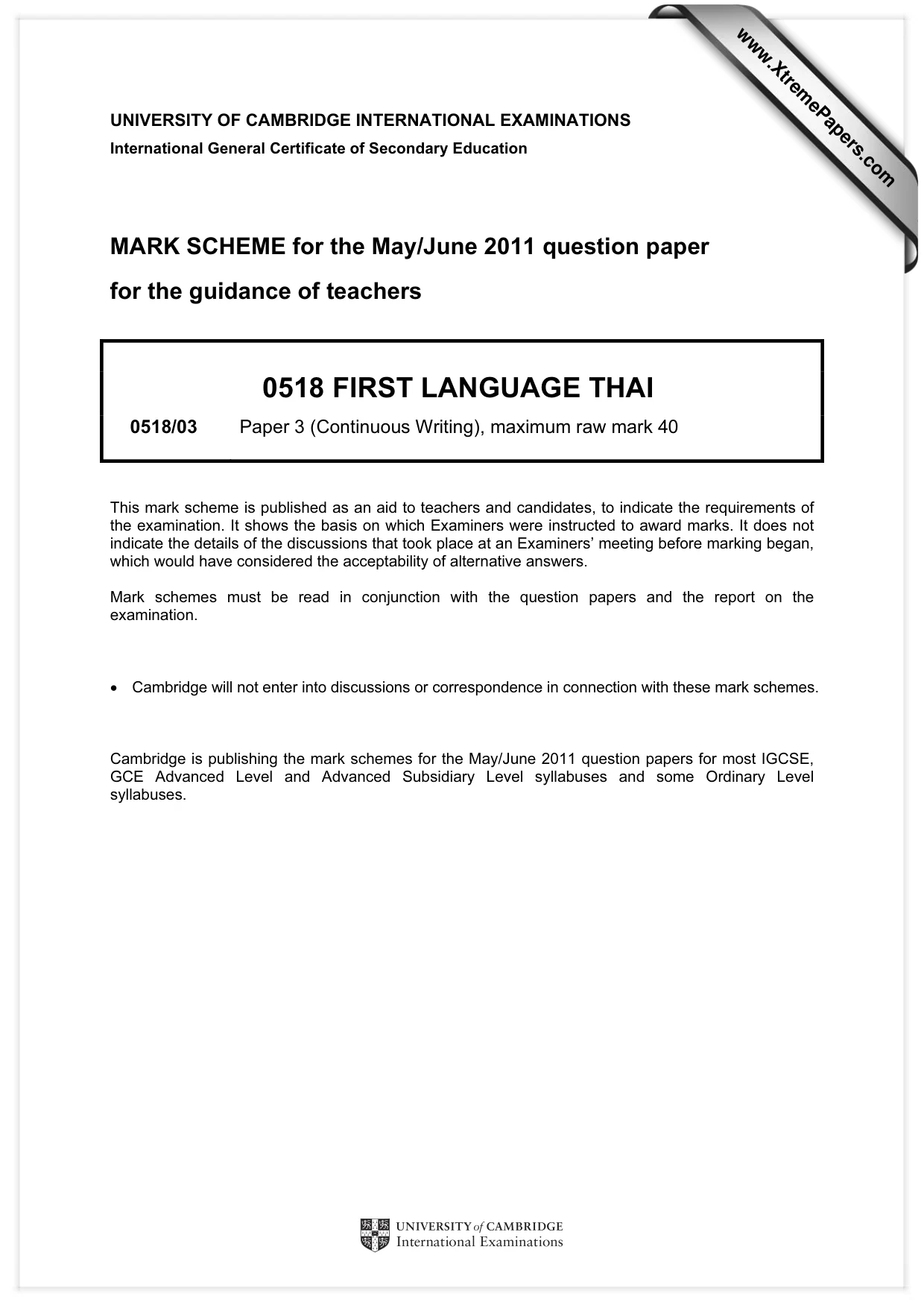
UNIVERSITY OF CAMBRIDGE INTERNATIONAL EXAMINATIONS International General Certificate of Secondary Education MARK SCHEME for the May/June 2011 question paper for the guidance of teachers 0518 FIRST LANGUAGE THAI 0518/03 Paper 3 (Continuous Writing), maximum raw mark 40 This mark scheme is published as an aid to teachers and candidates, to indicate the requirements of the examination. It shows the basis on which Examiners were instructed to award marks. It does not indicate the details of the discussions that took place at an Examiners’ meeting before marking began, which would have considered the acceptability of alternative answers. Mark schemes must be read in conjunction with the question papers and the report on the examination. • Cambridge will not enter into discussions or correspondence in connection with these mark schemes. Cambridge is publishing the mark schemes for the May/June 2011 question papers for most IGCSE, GCE Advanced Level and Advanced Subsidiary Level syllabuses and some Ordinary Level syllabuses. www.XtremePapers.com
Mark scheme, page 2
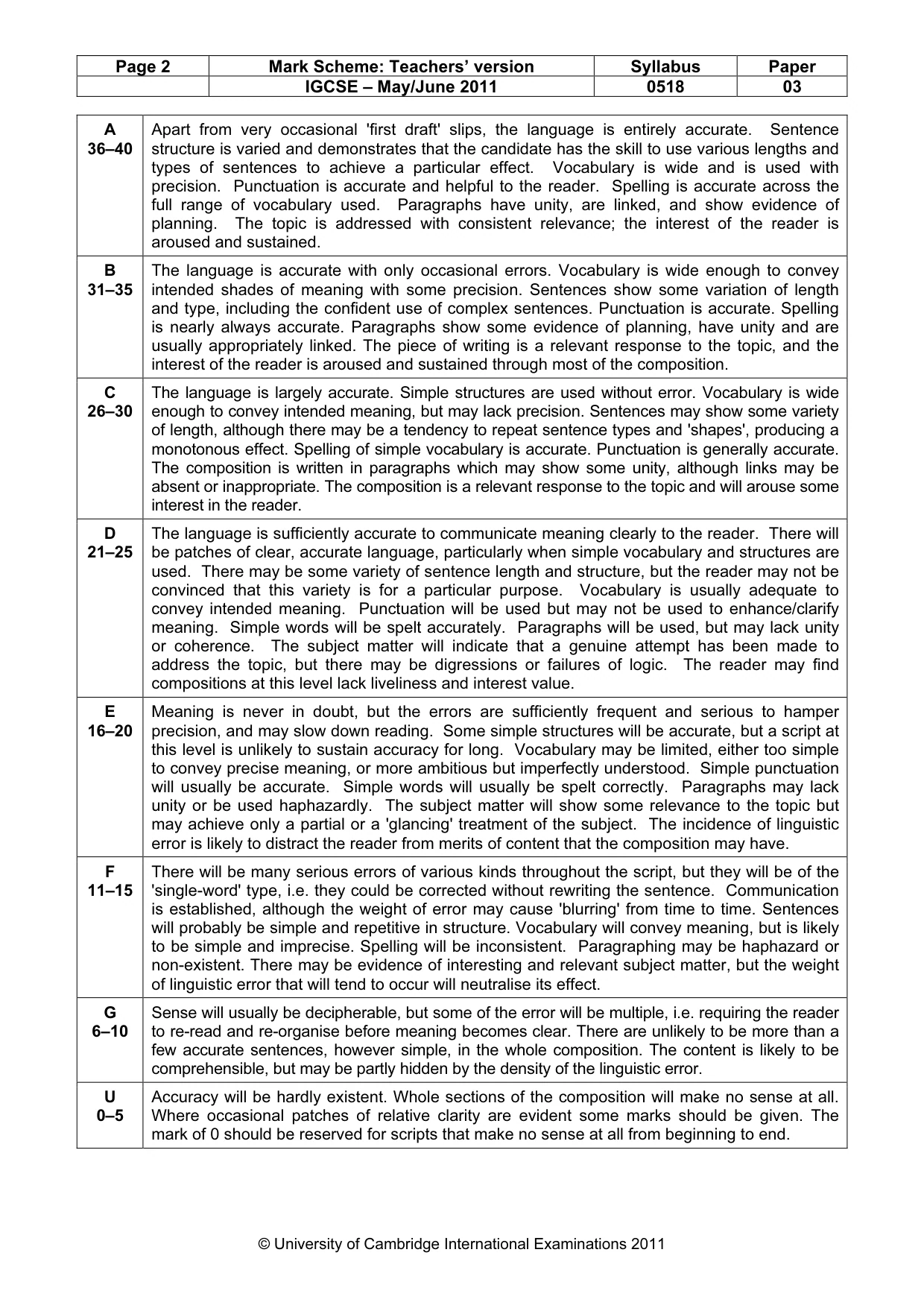
Page 2 Mark Scheme: Teachers’ version Syllabus Paper IGCSE – May/June 2011 0518 03 © University of Cambridge International Examinations 2011 A 36–40 Apart from very occasional 'first draft' slips, the language is entirely accurate. Sentence structure is varied and demonstrates that the candidate has the skill to use various lengths and types of sentences to achieve a particular effect. Vocabulary is wide and is used with precision. Punctuation is accurate and helpful to the reader. Spelling is accurate across the full range of vocabulary used. Paragraphs have unity, are linked, and show evidence of planning. The topic is addressed with consistent relevance; the interest of the reader is aroused and sustained. B 31–35 The language is accurate with only occasional errors. Vocabulary is wide enough to convey intended shades of meaning with some precision. Sentences show some variation of length and type, including the confident use of complex sentences. Punctuation is accurate. Spelling is nearly always accurate. Paragraphs show some evidence of planning, have unity and are usually appropriately linked. The piece of writing is a relevant response to the topic, and the interest of the reader is aroused and sustained through most of the composition. C 26–30 The language is largely accurate. Simple structures are used without error. Vocabulary is wide enough to convey intended meaning, but may lack precision. Sentences may show some variety of length, although there may be a tendency to repeat sentence types and 'shapes', producing a monotonous effect. Spelling of simple vocabulary is accurate. Punctuation is generally accurate. The composition is written in paragraphs which may show some unity, although links may be absent or inappropriate. The composition is a relevant response to the topic and will arouse some interest in the reader. D 21–25 The language is sufficiently accurate to communicate meaning clearly to the reader. There will be patches of clear, accurate language, particularly when simple vocabulary and structures are used. There may be some variety of sentence length and structure, but the reader may not be convinced that this variety is for a particular purpose. Vocabulary is usually adequate to convey intended meaning. Punctuation will be used but may not be used to enhance/clarify meaning. Simple words will be spelt accurately. Paragraphs will be used, but may lack unity or coherence. The subject matter will indicate that a genuine attempt has been made to address the topic, but there may be digressions or failures of logic. The reader may find compositions at this level lack liveliness and interest value. E 16–20 Meaning is never in doubt, but the errors are sufficiently frequent and serious to hamper precision, and may slow down reading. Some simple structures will be accurate, but a script at this level is unlikely to sustain accuracy for long. Vocabulary may be limited, either too simple to convey precise meaning, or more ambitious but imperfectly understood. Simple punctuation will usually be accurate. Simple words will usually be spelt correctly. Paragraphs may lack unity or be used haphazardly. The subject matter will show some relevance to the topic but may achieve only a partial or a 'glancing' treatment of the subject. The incidence of linguistic error is likely to distract the reader from merits of content that the composition may have. F 11–15 There will be many serious errors of various kinds throughout the script, but they will be of the 'single-word' type, i.e. they could be corrected without rewriting the sentence. Communication is established, although the weight of error may cause 'blurring' from time to time. Sentences will probably be simple and repetitive in structure. Vocabulary will convey meaning, but is likely to be simple and imprecise. Spelling will be inconsistent. Paragraphing may be haphazard or non-existent. There may be evidence of interesting and relevant subject matter, but the weight of linguistic error that will tend to occur will neutralise its effect. G 6–10 Sense will usually be decipherable, but some of the error will be multiple, i.e. requiring the reader to re-read and re-organise before meaning becomes clear. There are unlikely to be more than a few accurate sentences, however simple, in the whole composition. The content is likely to be comprehensible, but may be partly hidden by the density of the linguistic error. U 0–5 Accuracy will be hardly existent. Whole sections of the composition will make no sense at all. Where occasional patches of relative clarity are evident some marks should be given. The mark of 0 should be reserved for scripts that make no sense at all from beginning to end.
What you needed in this session
Cambridge’s own grade thresholds for 2011 May/June, Paper 3 · Variant 1. A higher threshold means an easier paper — the bar moves with how the cohort did.