Cambridge IGCSE Spanish - Foreign Language 0530 — 2020 May/June Paper 1 · Variant 3
0530/13/M/J/20
The question paper and its mark scheme, free to read here and free to download. This is Cambridge’s own paper, exactly as it was sat.
Question paper12 pages

Mark scheme13 pages
Answers below. Sit the paper first if you are practising.
Paper as text
Question paper, page 1
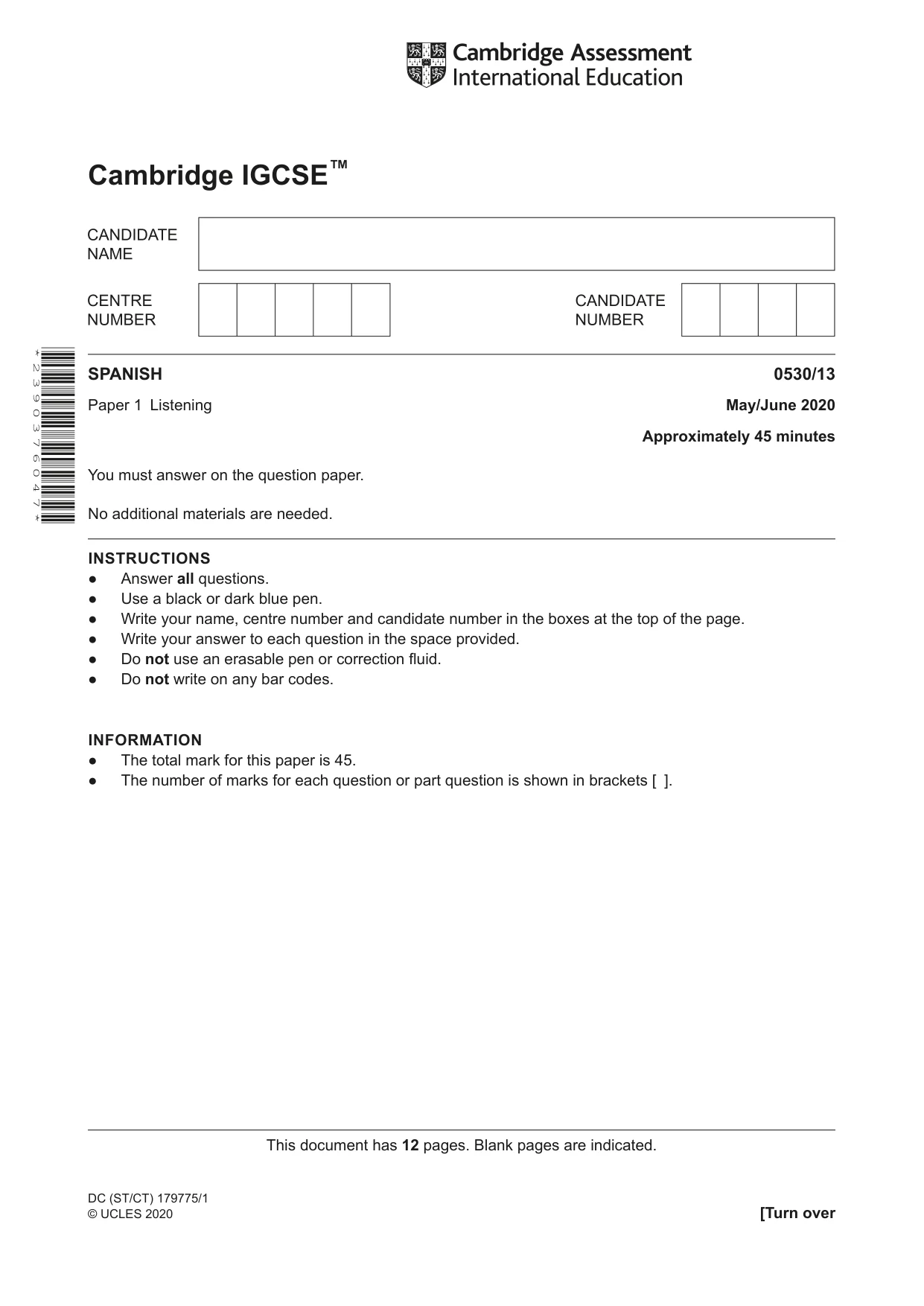
This document has 12 pages. Blank pages are indicated. DC (ST/CT) 179775/1 © UCLES 2020 [Turn over * 2 3 9 0 3 7 6 0 4 7 * SPANISH 0530/13 Paper 1 Listening May/June 2020 Approximately 45 minutes You must answer on the question paper. No additional materials are needed. INSTRUCTIONS ● Answer all questions. ● Use a black or dark blue pen. ● Write your name, centre number and candidate number in the boxes at the top of the page. ● Write your answer to each question in the space provided. ● Do not use an erasable pen or correction fluid. ● Do not write on any bar codes. INFORMATION ● The total mark for this paper is 45. ● The number of marks for each question or part question is shown in brackets [ ]. Cambridge IGCSE™
Question paper, page 2
2 0530/13/M/J/20 © UCLES 2020 BLANK PAGE
Question paper, page 3
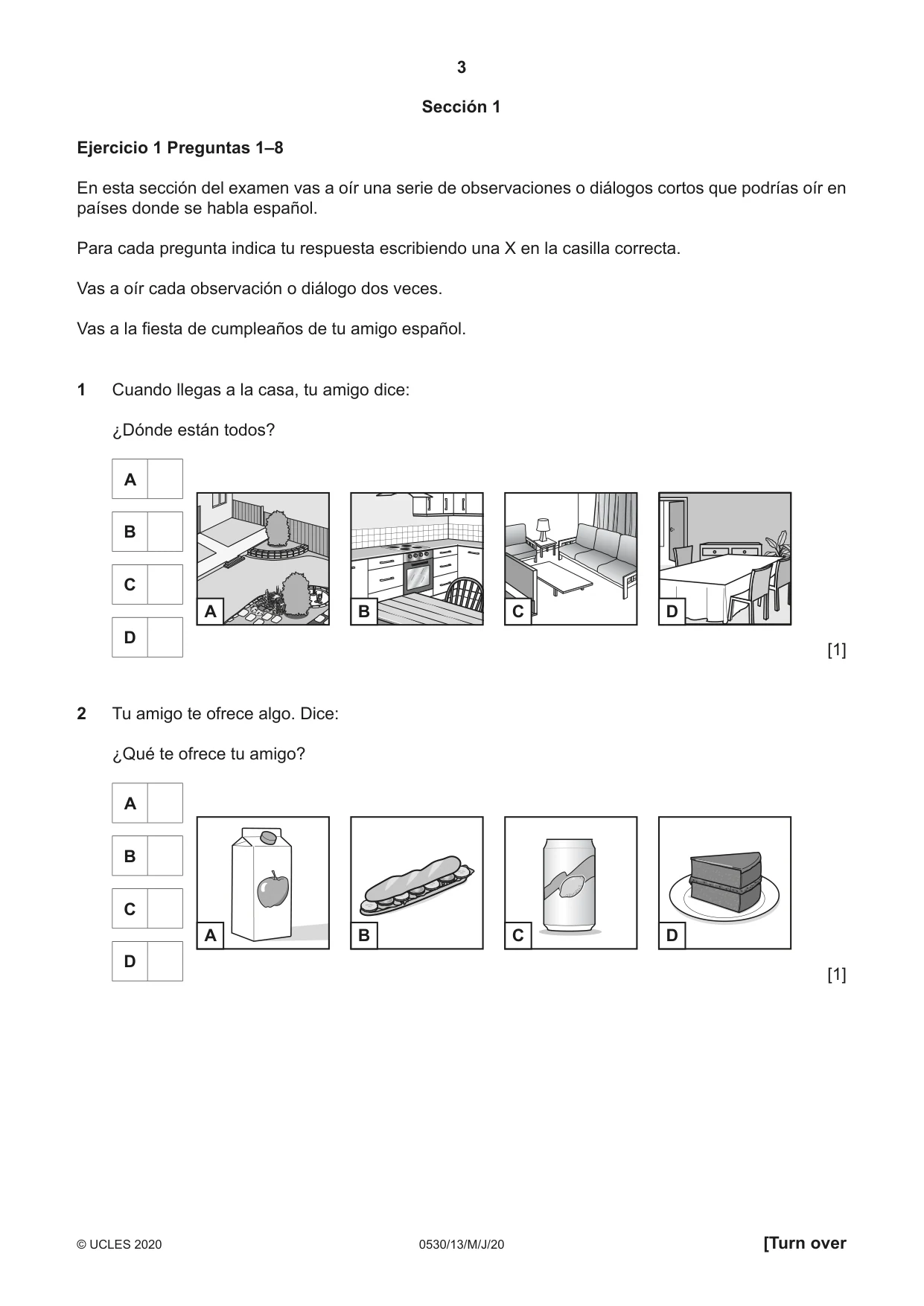
3 0530/13/M/J/20 © UCLES 2020 [Turn over Sección 1 Ejercicio 1 Preguntas 1–8 En esta sección del examen vas a oír una serie de observaciones o diálogos cortos que podrías oír en países donde se habla español. Para cada pregunta indica tu respuesta escribiendo una X en la casilla correcta. Vas a oír cada observación o diálogo dos veces. Vas a la fiesta de cumpleaños de tu amigo español. 1 Cuando llegas a la casa, tu amigo dice: ¿Dónde están todos? A B C D A B C D [1] 2 Tu amigo te ofrece algo. Dice: ¿Qué te ofrece tu amigo? A B C D A B C D [1]
Question paper, page 4
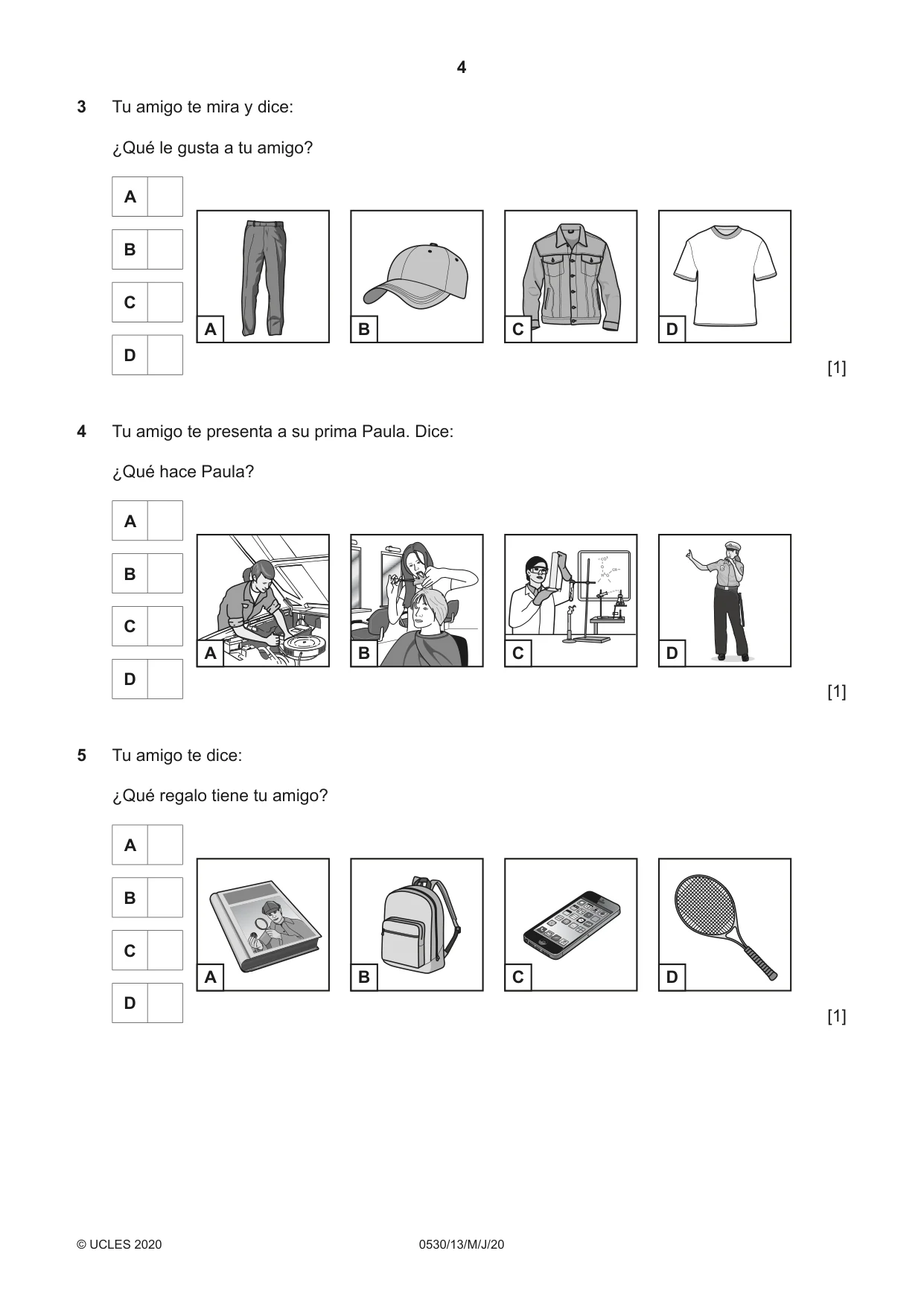
4 0530/13/M/J/20 © UCLES 2020 3 Tu amigo te mira y dice: ¿Qué le gusta a tu amigo? A B C D A B C D [1] 4 Tu amigo te presenta a su prima Paula. Dice: ¿Qué hace Paula? A B C D A B C D [1] 5 Tu amigo te dice: ¿Qué regalo tiene tu amigo? A B C D A B C D [1]
Question paper, page 5
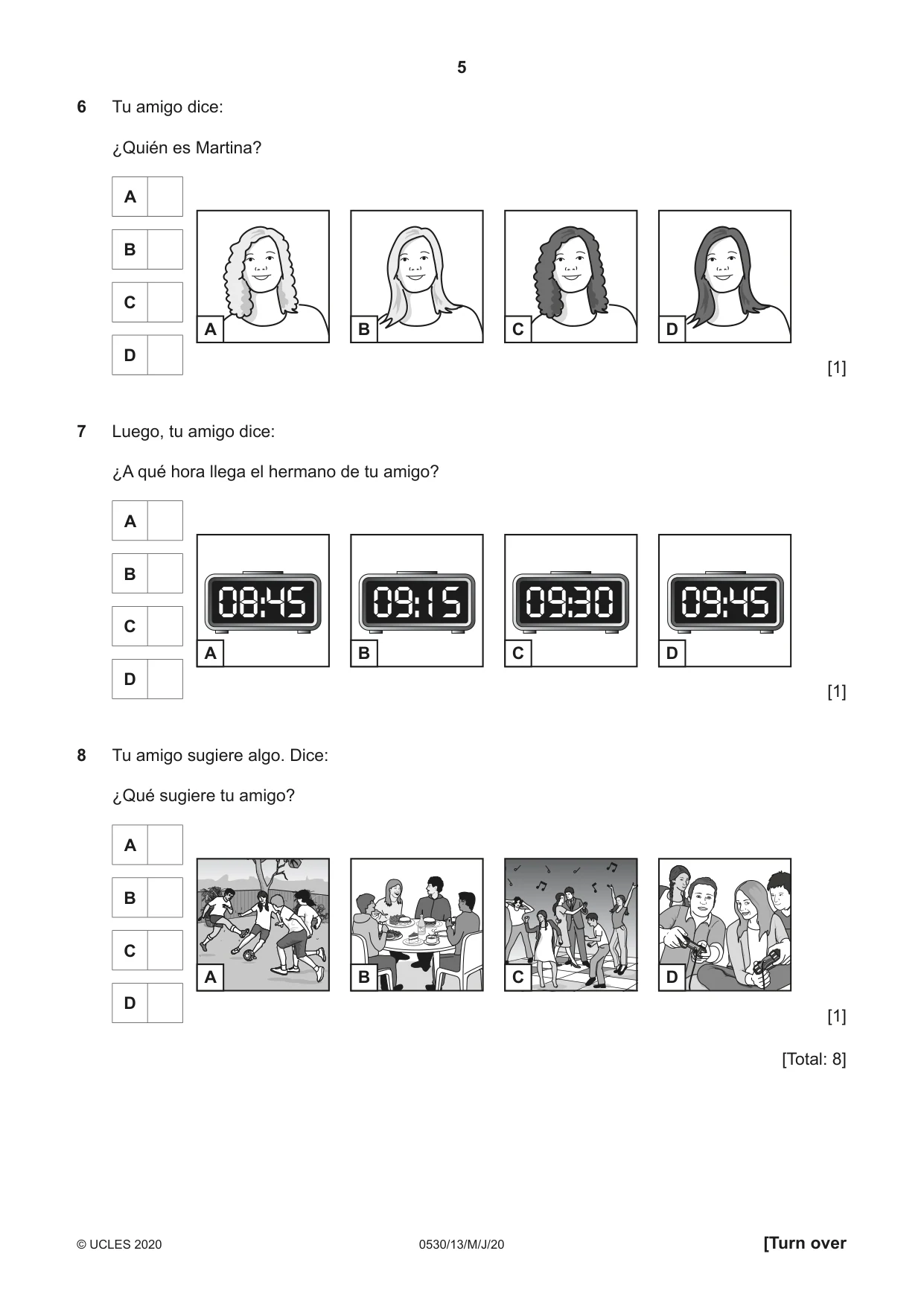
5 0530/13/M/J/20 © UCLES 2020 [Turn over 6 Tu amigo dice: ¿Quién es Martina? A B C D A B C D [1] 7 Luego, tu amigo dice: ¿A qué hora llega el hermano de tu amigo? A B C D 09:15 09:30 09:45 08:45 A B C D [1] 8 Tu amigo sugiere algo. Dice: ¿Qué sugiere tu amigo? A B C D A B C D [1] [Total: 8]
Question paper, page 6
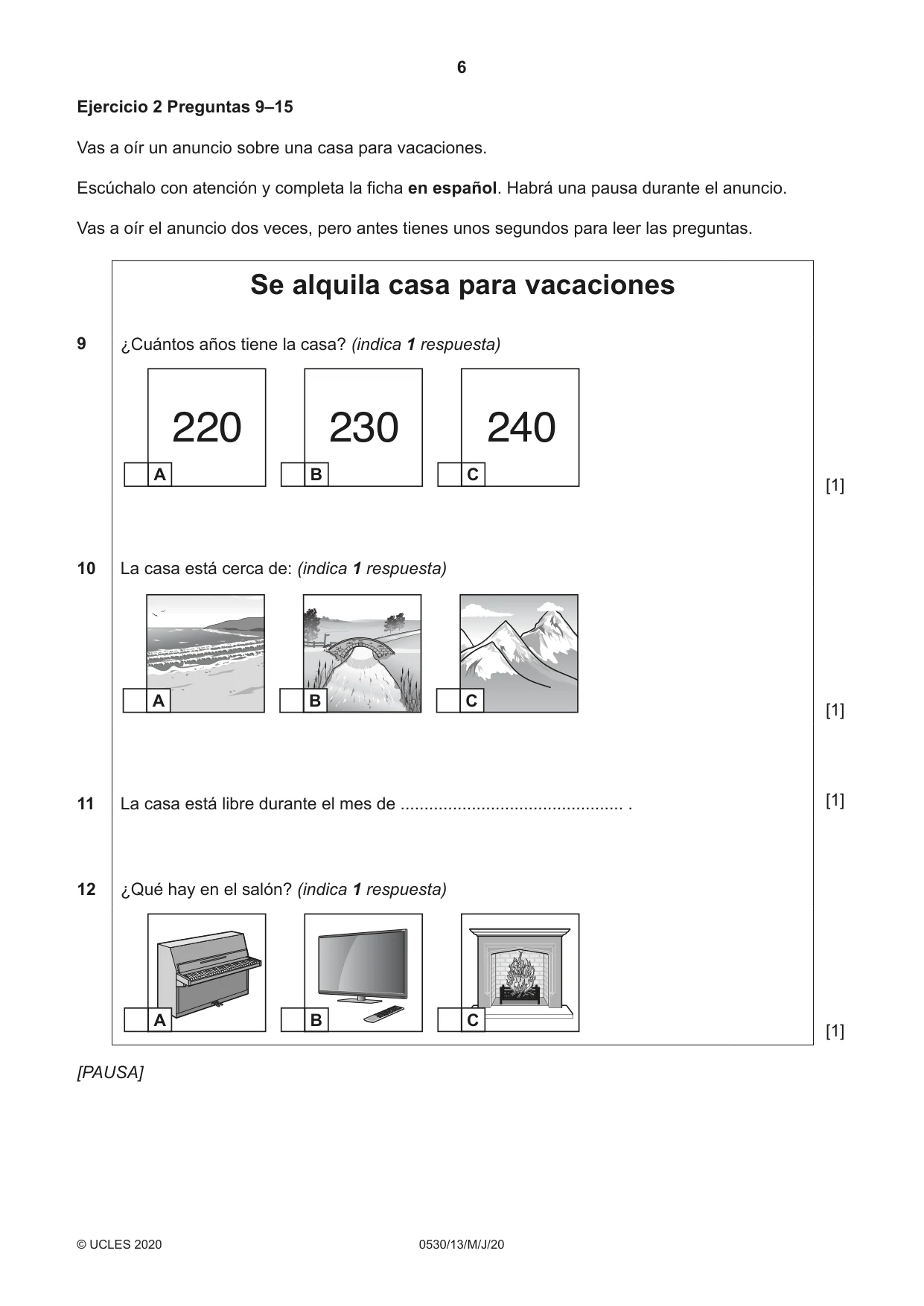
6 0530/13/M/J/20 © UCLES 2020 Ejercicio 2 Preguntas 9–15 Vas a oír un anuncio sobre una casa para vacaciones. Escúchalo con atención y completa la ficha en español. Habrá una pausa durante el anuncio. Vas a oír el anuncio dos veces, pero antes tienes unos segundos para leer las preguntas. Se alquila casa para vacaciones 9 ¿Cuántos años tiene la casa? (indica 1 respuesta) 220 230 240 A B C [1] 10 La casa está cerca de: (indica 1 respuesta) A B C [1] 11 La casa está libre durante el mes de … . [1] 12 ¿Qué hay en el salón? (indica 1 respuesta) A B C [1] [PAUSA]
Question paper, page 7
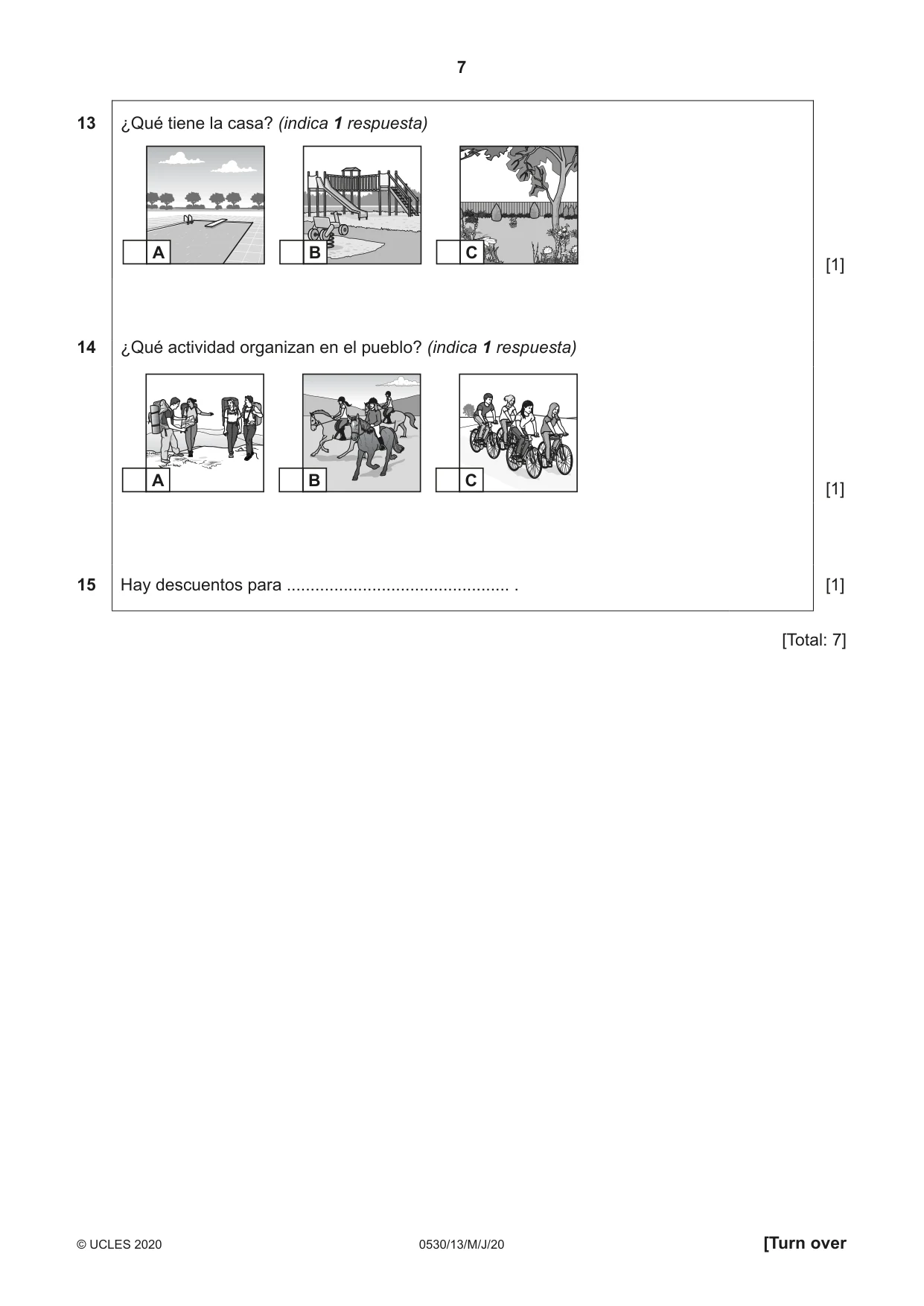
7 0530/13/M/J/20 © UCLES 2020 [Turn over 13 ¿Qué tiene la casa? (indica 1 respuesta) A B C [1] 14 ¿Qué actividad organizan en el pueblo? (indica 1 respuesta) A B C [1] 15 Hay descuentos para … . [1] [Total: 7]
Question paper, page 8
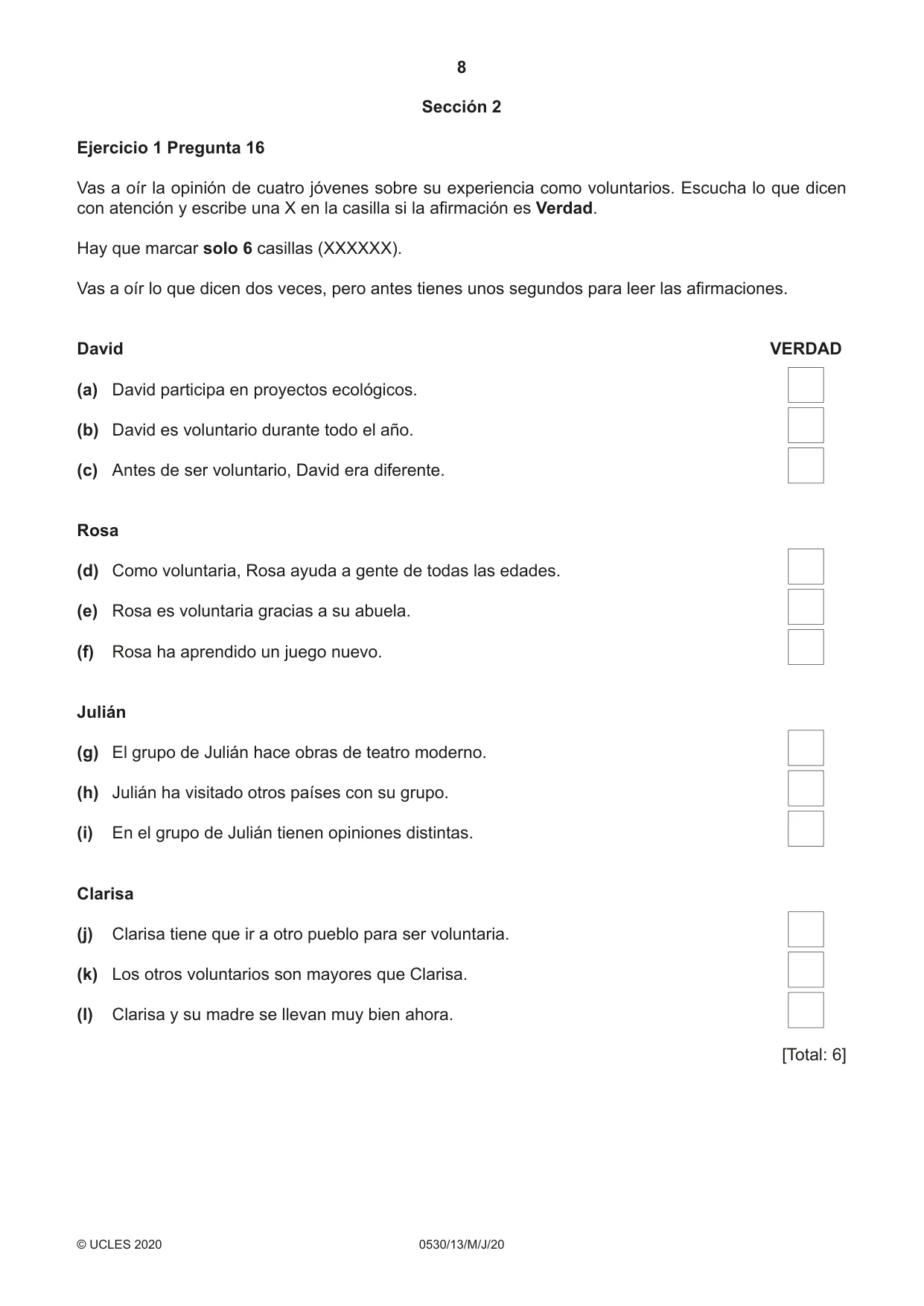
8 0530/13/M/J/20 © UCLES 2020 Sección 2 Ejercicio 1 Pregunta 16 Vas a oír la opinión de cuatro jóvenes sobre su experiencia como voluntarios. Escucha lo que dicen con atención y escribe una X en la casilla si la afirmación es Verdad. Hay que marcar solo 6 casillas (XXXXXX). Vas a oír lo que dicen dos veces, pero antes tienes unos segundos para leer las afirmaciones. David VERDAD (a) David participa en proyectos ecológicos. (b) David es voluntario durante todo el año. (c) Antes de ser voluntario, David era diferente. Rosa (d) Como voluntaria, Rosa ayuda a gente de todas las edades. (e) Rosa es voluntaria gracias a su abuela. (f) Rosa ha aprendido un juego nuevo. Julián (g) El grupo de Julián hace obras de teatro moderno. (h) Julián ha visitado otros países con su grupo. (i) En el grupo de Julián tienen opiniones distintas. Clarisa (j) Clarisa tiene que ir a otro pueblo para ser voluntaria. (k) Los otros voluntarios son mayores que Clarisa. (l) Clarisa y su madre se llevan muy bien ahora. [Total: 6]
Question paper, page 9
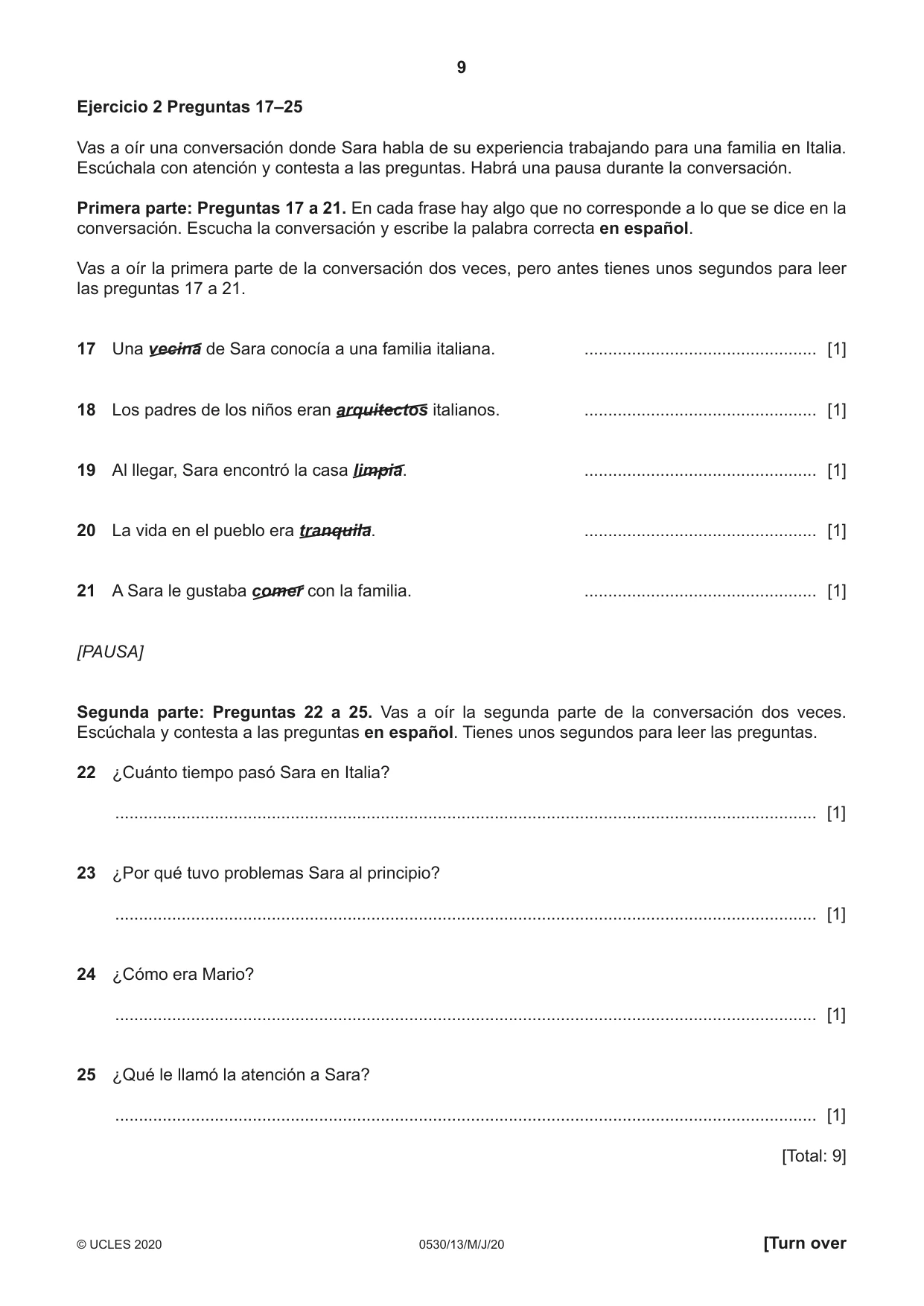
9 0530/13/M/J/20 © UCLES 2020 [Turn over Ejercicio 2 Preguntas 17–25 Vas a oír una conversación donde Sara habla de su experiencia trabajando para una familia en Italia. Escúchala con atención y contesta a las preguntas. Habrá una pausa durante la conversación. Primera parte: Preguntas 17 a 21. En cada frase hay algo que no corresponde a lo que se dice en la conversación. Escucha la conversación y escribe la palabra correcta en español. Vas a oír la primera parte de la conversación dos veces, pero antes tienes unos segundos para leer las preguntas 17 a 21. 17 Una vecina de Sara conocía a una familia italiana. … [1] 18 Los padres de los niños eran arquitectos italianos. … [1] 19 Al llegar, Sara encontró la casa limpia. … [1] 20 La vida en el pueblo era tranquila. … [1] 21 A Sara le gustaba comer con la familia. … [1] [PAUSA] Segunda parte: Preguntas 22 a 25. Vas a oír la segunda parte de la conversación dos veces. Escúchala y contesta a las preguntas en español. Tienes unos segundos para leer las preguntas. 22 ¿Cuánto tiempo pasó Sara en Italia? … [1] 23 ¿Por qué tuvo problemas Sara al principio? … [1] 24 ¿Cómo era Mario? … [1] 25 ¿Qué le llamó la atención a Sara? … [1] [Total: 9]
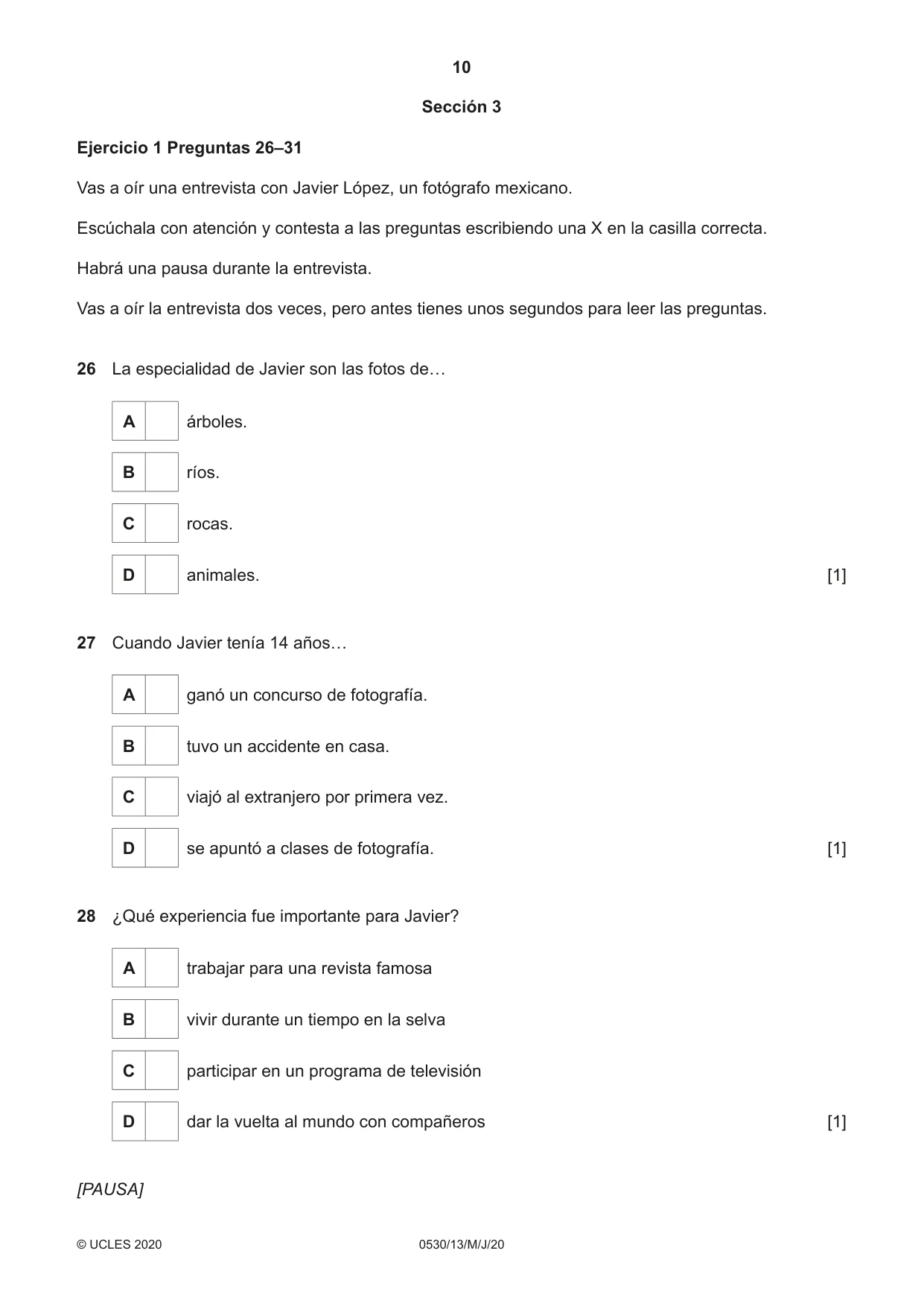
Question paper, page 10
10 0530/13/M/J/20 © UCLES 2020 Sección 3 Ejercicio 1 Preguntas 26–31 Vas a oír una entrevista con Javier López, un fotógrafo mexicano. Escúchala con atención y contesta a las preguntas escribiendo una X en la casilla correcta. Habrá una pausa durante la entrevista. Vas a oír la entrevista dos veces, pero antes tienes unos segundos para leer las preguntas. 26 La especialidad de Javier son las fotos de… A árboles. B ríos. C rocas. D animales. [1] 27 Cuando Javier tenía 14 años… A ganó un concurso de fotografía. B tuvo un accidente en casa. C viajó al extranjero por primera vez. D se apuntó a clases de fotografía. [1] 28 ¿Qué experiencia fue importante para Javier? A trabajar para una revista famosa B vivir durante un tiempo en la selva C participar en un programa de televisión D dar la vuelta al mundo con compañeros [1] [PAUSA]
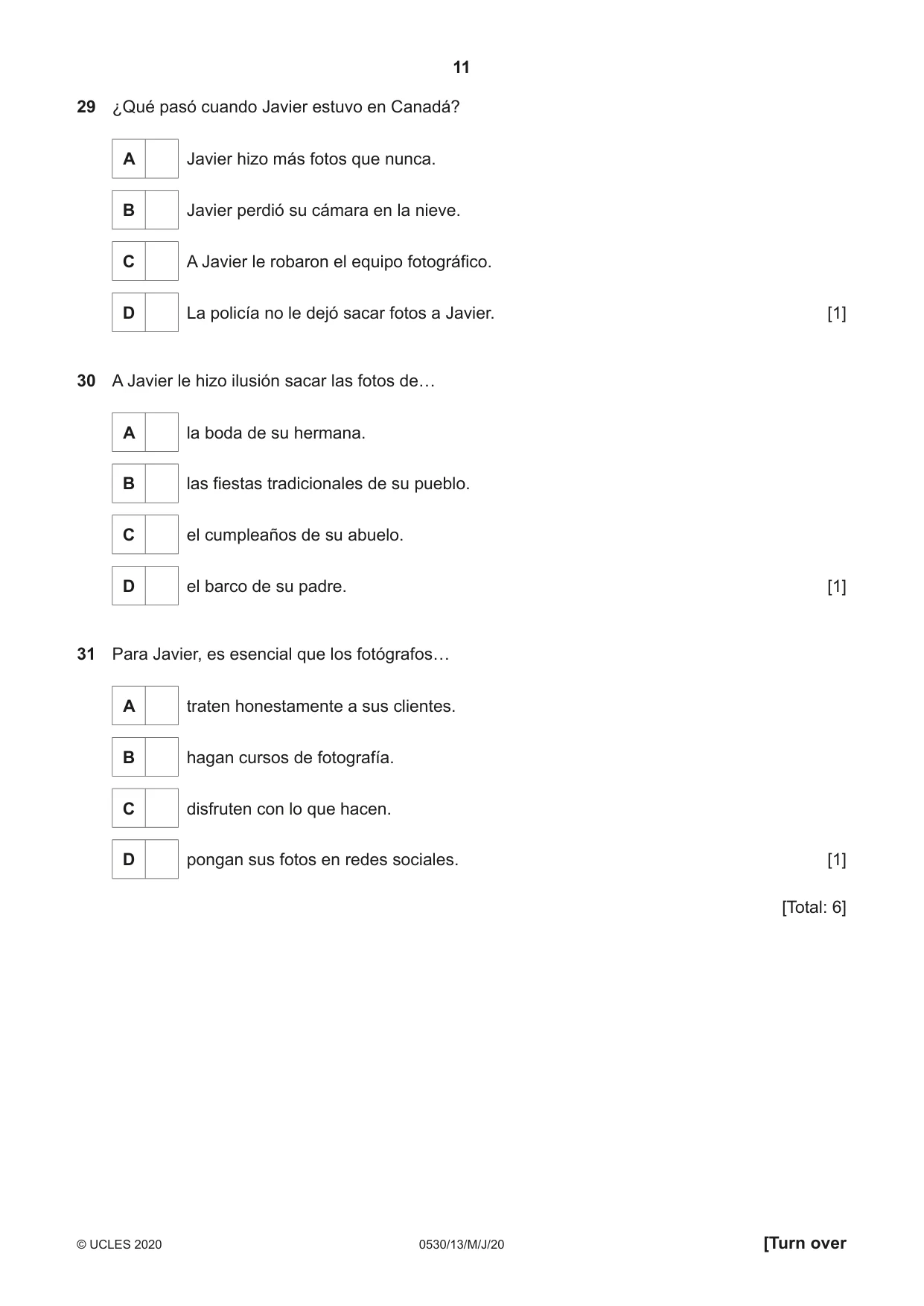
Question paper, page 11
11 0530/13/M/J/20 © UCLES 2020 [Turn over 29 ¿Qué pasó cuando Javier estuvo en Canadá? A Javier hizo más fotos que nunca. B Javier perdió su cámara en la nieve. C A Javier le robaron el equipo fotográfico. D La policía no le dejó sacar fotos a Javier. [1] 30 A Javier le hizo ilusión sacar las fotos de… A la boda de su hermana. B las fiestas tradicionales de su pueblo. C el cumpleaños de su abuelo. D el barco de su padre. [1] 31 Para Javier, es esencial que los fotógrafos… A traten honestamente a sus clientes. B hagan cursos de fotografía. C disfruten con lo que hacen. D pongan sus fotos en redes sociales. [1] [Total: 6]
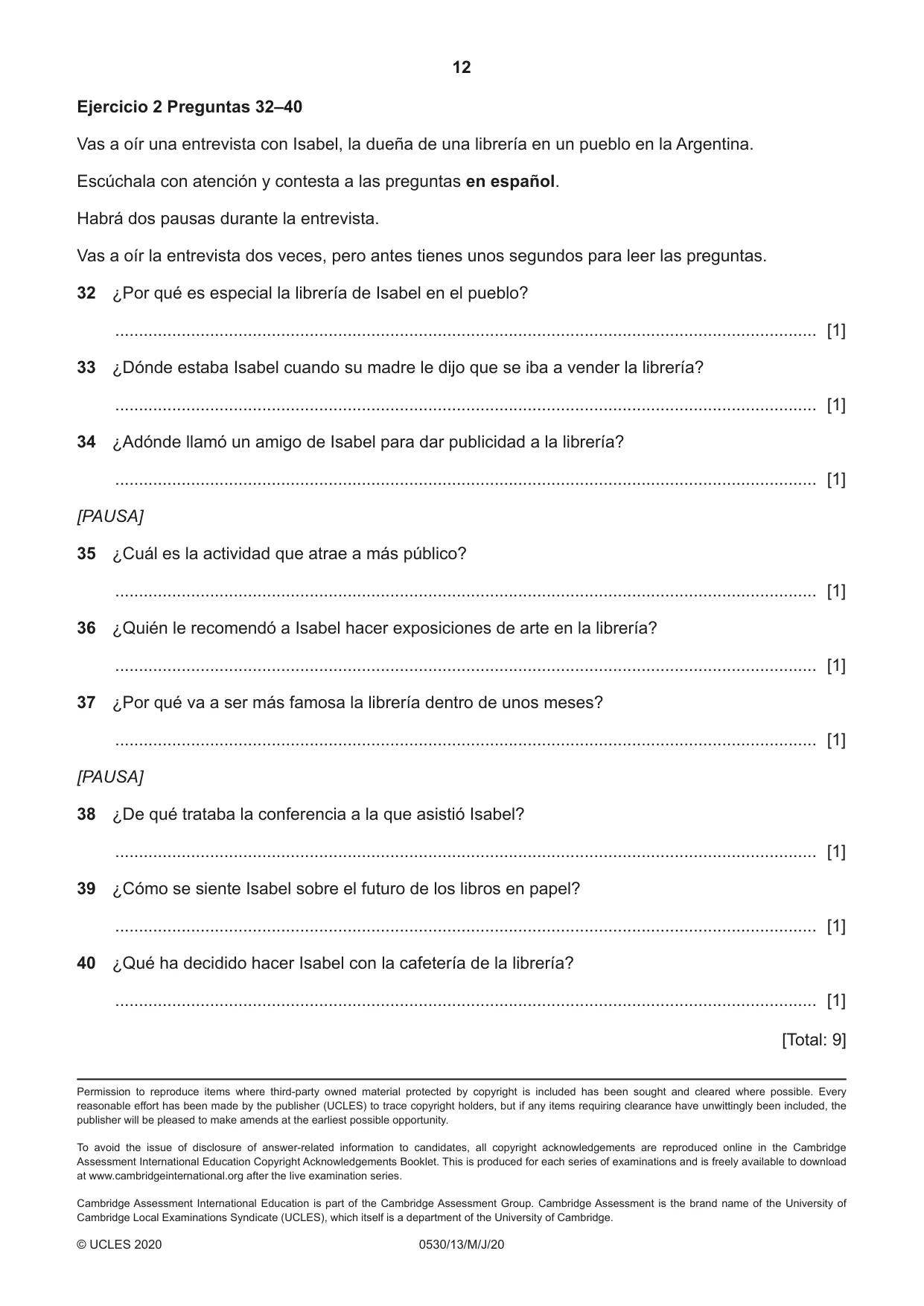
Question paper, page 12
12 0530/13/M/J/20 © UCLES 2020 Permission to reproduce items where third-party owned material protected by copyright is included has been sought and cleared where possible. Every reasonable effort has been made by the publisher (UCLES) to trace copyright holders, but if any items requiring clearance have unwittingly been included, the publisher will be pleased to make amends at the earliest possible opportunity. To avoid the issue of disclosure of answer-related information to candidates, all copyright acknowledgements are reproduced online in the Cambridge Assessment International Education Copyright Acknowledgements Booklet. This is produced for each series of examinations and is freely available to download at www.cambridgeinternational.org after the live examination series. Cambridge Assessment International Education is part of the Cambridge Assessment Group. Cambridge Assessment is the brand name of the University of Cambridge Local Examinations Syndicate (UCLES), which itself is a department of the University of Cambridge. Ejercicio 2 Preguntas 32–40 Vas a oír una entrevista con Isabel, la dueña de una librería en un pueblo en la Argentina. Escúchala con atención y contesta a las preguntas en español. Habrá dos pausas durante la entrevista. Vas a oír la entrevista dos veces, pero antes tienes unos segundos para leer las preguntas. 32 ¿Por qué es especial la librería de Isabel en el pueblo? … [1] 33 ¿Dónde estaba Isabel cuando su madre le dijo que se iba a vender la librería? … [1] 34 ¿Adónde llamó un amigo de Isabel para dar publicidad a la librería? … [1] [PAUSA] 35 ¿Cuál es la actividad que atrae a más público? … [1] 36 ¿Quién le recomendó a Isabel hacer exposiciones de arte en la librería? … [1] 37 ¿Por qué va a ser más famosa la librería dentro de unos meses? … [1] [PAUSA] 38 ¿De qué trataba la conferencia a la que asistió Isabel? … [1] 39 ¿Cómo se siente Isabel sobre el futuro de los libros en papel? … [1] 40 ¿Qué ha decidido hacer Isabel con la cafetería de la librería? … [1] [Total: 9]
Mark scheme, page 1
This document consists of 13 printed pages. © UCLES 2020 [Turn over Cambridge IGCSE™ SPANISH 0530/13 Paper 1 Listening May/June 2020 MARK SCHEME Maximum Mark: 45 Published Students did not sit exam papers in the June 2020 series due to the Covid-19 global pandemic. This mark scheme is published to support teachers and students and should be read together with the question paper. It shows the requirements of the exam. The answer column of the mark scheme shows the proposed basis on which Examiners would award marks for this exam. Where appropriate, this column also provides the most likely acceptable alternative responses expected from students. Examiners usually review the mark scheme after they have seen student responses and update the mark scheme if appropriate. In the June series, Examiners were unable to consider the acceptability of alternative responses, as there were no student responses to consider. Mark schemes should usually be read together with the Principal Examiner Report for Teachers. However, because students did not sit exam papers, there is no Principal Examiner Report for Teachers for the June 2020 series. Cambridge International will not enter into discussions about these mark schemes. Cambridge International is publishing the mark schemes for the June 2020 series for most Cambridge IGCSE™ and Cambridge International A & AS Level components, and some Cambridge O Level components.
Mark scheme, page 2
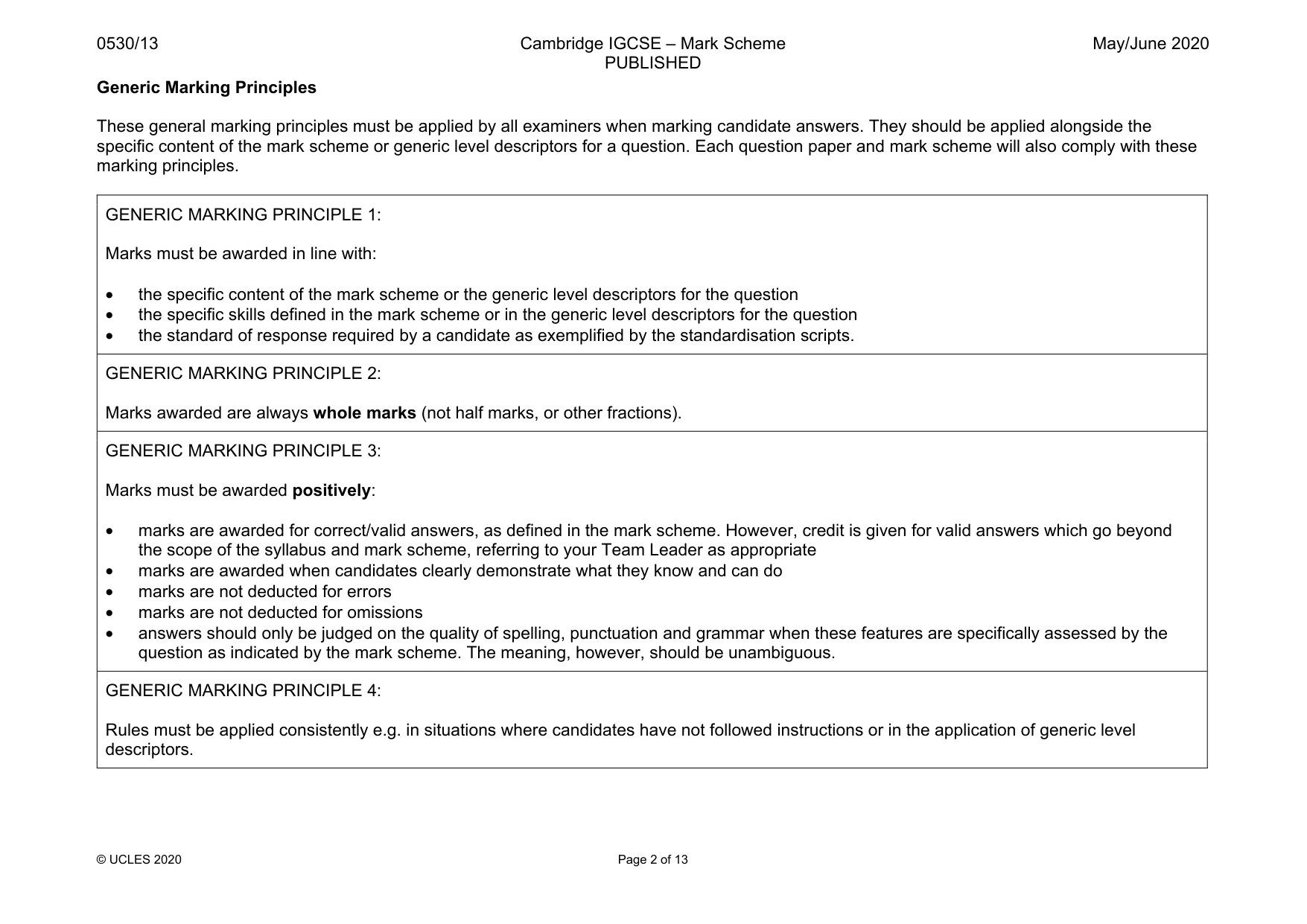
0530/13 Cambridge IGCSE – Mark Scheme PUBLISHED May/June 2020 © UCLES 2020 Page 2 of 13 Generic Marking Principles These general marking principles must be applied by all examiners when marking candidate answers. They should be applied alongside the specific content of the mark scheme or generic level descriptors for a question. Each question paper and mark scheme will also comply with these marking principles. GENERIC MARKING PRINCIPLE 1: Marks must be awarded in line with: • the specific content of the mark scheme or the generic level descriptors for the question • the specific skills defined in the mark scheme or in the generic level descriptors for the question • the standard of response required by a candidate as exemplified by the standardisation scripts. GENERIC MARKING PRINCIPLE 2: Marks awarded are always whole marks (not half marks, or other fractions). GENERIC MARKING PRINCIPLE 3: Marks must be awarded positively: • marks are awarded for correct/valid answers, as defined in the mark scheme. However, credit is given for valid answers which go beyond the scope of the syllabus and mark scheme, referring to your Team Leader as appropriate • marks are awarded when candidates clearly demonstrate what they know and can do • marks are not deducted for errors • marks are not deducted for omissions • answers should only be judged on the quality of spelling, punctuation and grammar when these features are specifically assessed by the question as indicated by the mark scheme. The meaning, however, should be unambiguous. GENERIC MARKING PRINCIPLE 4: Rules must be applied consistently e.g. in situations where candidates have not followed instructions or in the application of generic level descriptors.
Mark scheme, page 3
0530/13 Cambridge IGCSE – Mark Scheme PUBLISHED May/June 2020 © UCLES 2020 Page 3 of 13 GENERIC MARKING PRINCIPLE 5: Marks should be awarded using the full range of marks defined in the mark scheme for the question (however; the use of the full mark range may be limited according to the quality of the candidate responses seen). GENERIC MARKING PRINCIPLE 6: Marks awarded are based solely on the requirements as defined in the mark scheme. Marks should not be awarded with grade thresholds or grade descriptors in mind.
Mark scheme, page 4
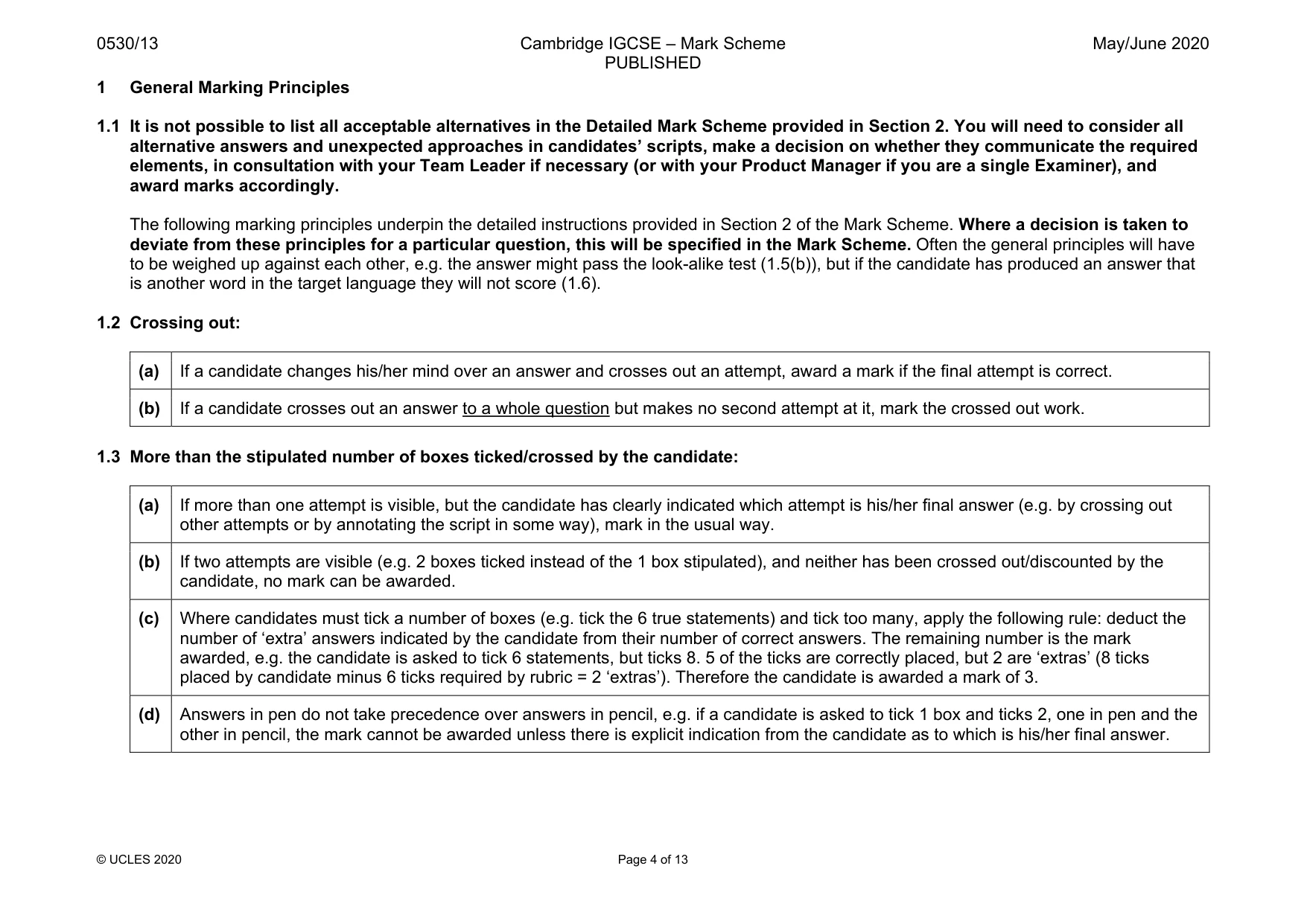
0530/13 Cambridge IGCSE – Mark Scheme PUBLISHED May/June 2020 © UCLES 2020 Page 4 of 13 1 General Marking Principles 1.1 It is not possible to list all acceptable alternatives in the Detailed Mark Scheme provided in Section 2. You will need to consider all alternative answers and unexpected approaches in candidates’ scripts, make a decision on whether they communicate the required elements, in consultation with your Team Leader if necessary (or with your Product Manager if you are a single Examiner), and award marks accordingly. The following marking principles underpin the detailed instructions provided in Section 2 of the Mark Scheme. Where a decision is taken to deviate from these principles for a particular question, this will be specified in the Mark Scheme. Often the general principles will have to be weighed up against each other, e.g. the answer might pass the look-alike test (1.5(b)), but if the candidate has produced an answer that is another word in the target language they will not score (1.6). 1.2 Crossing out: (a) If a candidate changes his/her mind over an answer and crosses out an attempt, award a mark if the final attempt is correct. (b) If a candidate crosses out an answer to a whole question but makes no second attempt at it, mark the crossed out work. 1.3 More than the stipulated number of boxes ticked/crossed by the candidate: (a) If more than one attempt is visible, but the candidate has clearly indicated which attempt is his/her final answer (e.g. by crossing out other attempts or by annotating the script in some way), mark in the usual way. (b) If two attempts are visible (e.g. 2 boxes ticked instead of the 1 box stipulated), and neither has been crossed out/discounted by the candidate, no mark can be awarded. (c) Where candidates must tick a number of boxes (e.g. tick the 6 true statements) and tick too many, apply the following rule: deduct the number of ‘extra’ answers indicated by the candidate from their number of correct answers. The remaining number is the mark awarded, e.g. the candidate is asked to tick 6 statements, but ticks 8. 5 of the ticks are correctly placed, but 2 are ‘extras’ (8 ticks placed by candidate minus 6 ticks required by rubric = 2 ‘extras’). Therefore the candidate is awarded a mark of 3. (d) Answers in pen do not take precedence over answers in pencil, e.g. if a candidate is asked to tick 1 box and ticks 2, one in pen and the other in pencil, the mark cannot be awarded unless there is explicit indication from the candidate as to which is his/her final answer.
Mark scheme, page 5
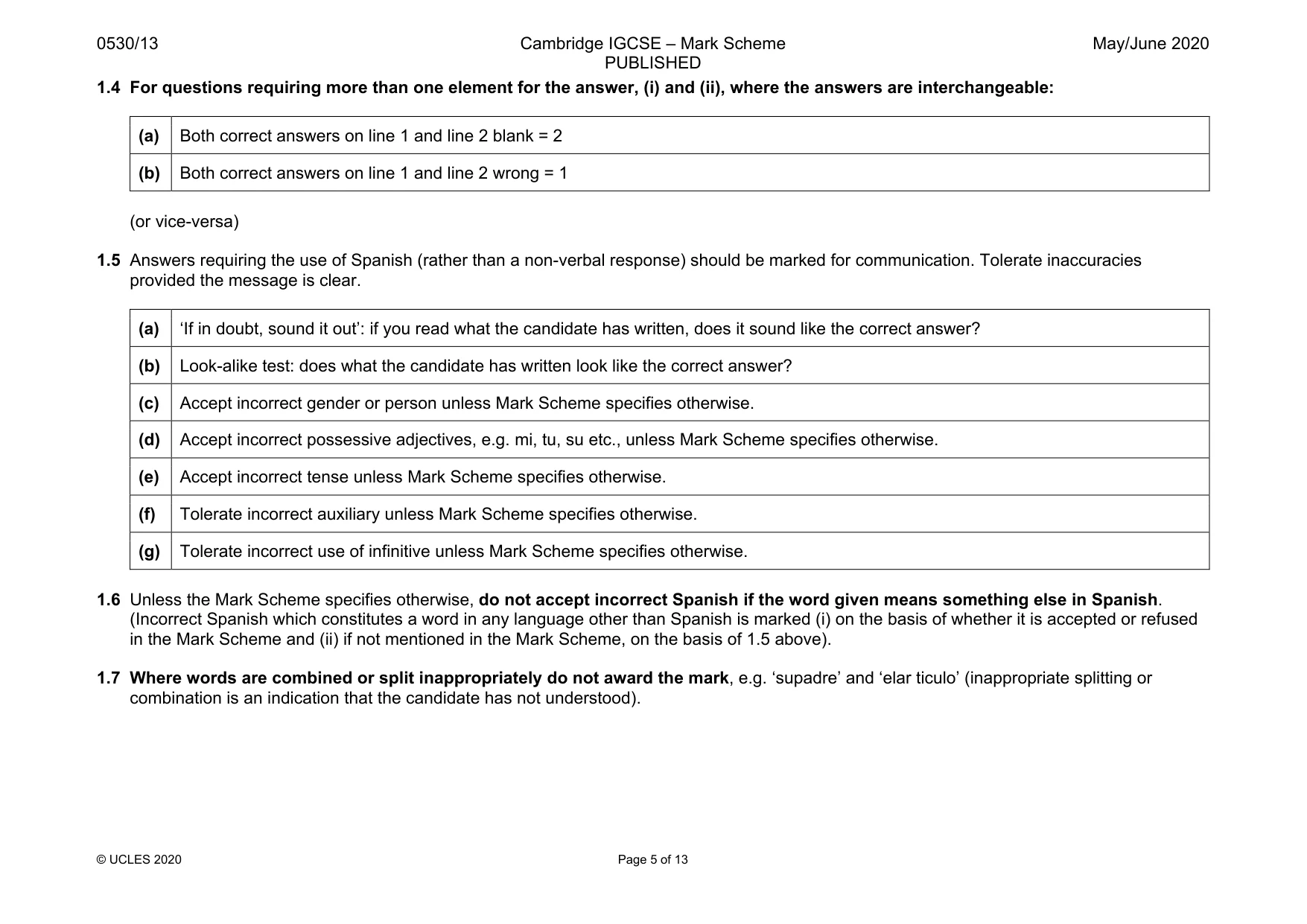
0530/13 Cambridge IGCSE – Mark Scheme PUBLISHED May/June 2020 © UCLES 2020 Page 5 of 13 1.4 For questions requiring more than one element for the answer, (i) and (ii), where the answers are interchangeable: (a) Both correct answers on line 1 and line 2 blank = 2 (b) Both correct answers on line 1 and line 2 wrong = 1 (or vice-versa) 1.5 Answers requiring the use of Spanish (rather than a non-verbal response) should be marked for communication. Tolerate inaccuracies provided the message is clear. (a) ‘If in doubt, sound it out’: if you read what the candidate has written, does it sound like the correct answer? (b) Look-alike test: does what the candidate has written look like the correct answer? (c) Accept incorrect gender or person unless Mark Scheme specifies otherwise. (d) Accept incorrect possessive adjectives, e.g. mi, tu, su etc., unless Mark Scheme specifies otherwise. (e) Accept incorrect tense unless Mark Scheme specifies otherwise. (f) Tolerate incorrect auxiliary unless Mark Scheme specifies otherwise. (g) Tolerate incorrect use of infinitive unless Mark Scheme specifies otherwise. 1.6 Unless the Mark Scheme specifies otherwise, do not accept incorrect Spanish if the word given means something else in Spanish. (Incorrect Spanish which constitutes a word in any language other than Spanish is marked (i) on the basis of whether it is accepted or refused in the Mark Scheme and (ii) if not mentioned in the Mark Scheme, on the basis of 1.5 above). 1.7 Where words are combined or split inappropriately do not award the mark, e.g. ‘supadre’ and ‘elar ticulo’ (inappropriate splitting or combination is an indication that the candidate has not understood).
Mark scheme, page 6
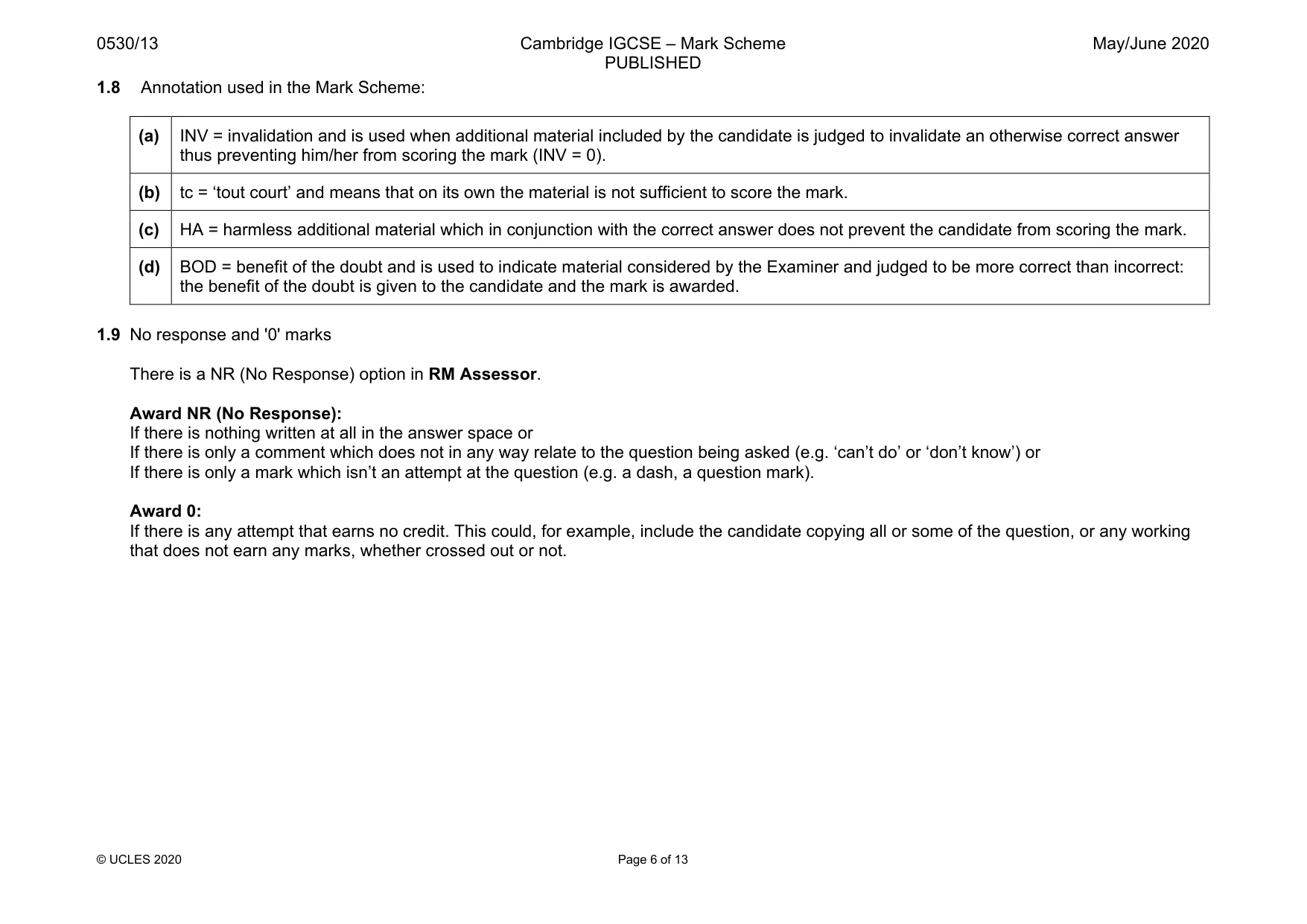
0530/13 Cambridge IGCSE – Mark Scheme PUBLISHED May/June 2020 © UCLES 2020 Page 6 of 13 1.8 Annotation used in the Mark Scheme: (a) INV = invalidation and is used when additional material included by the candidate is judged to invalidate an otherwise correct answer thus preventing him/her from scoring the mark (INV = 0). (b) tc = ‘tout court’ and means that on its own the material is not sufficient to score the mark. (c) HA = harmless additional material which in conjunction with the correct answer does not prevent the candidate from scoring the mark. (d) BOD = benefit of the doubt and is used to indicate material considered by the Examiner and judged to be more correct than incorrect: the benefit of the doubt is given to the candidate and the mark is awarded. 1.9 No response and '0' marks There is a NR (No Response) option in RM Assessor. Award NR (No Response): If there is nothing written at all in the answer space or If there is only a comment which does not in any way relate to the question being asked (e.g. ‘can’t do’ or ‘don’t know’) or If there is only a mark which isn’t an attempt at the question (e.g. a dash, a question mark). Award 0: If there is any attempt that earns no credit. This could, for example, include the candidate copying all or some of the question, or any working that does not earn any marks, whether crossed out or not.
Mark scheme, page 7
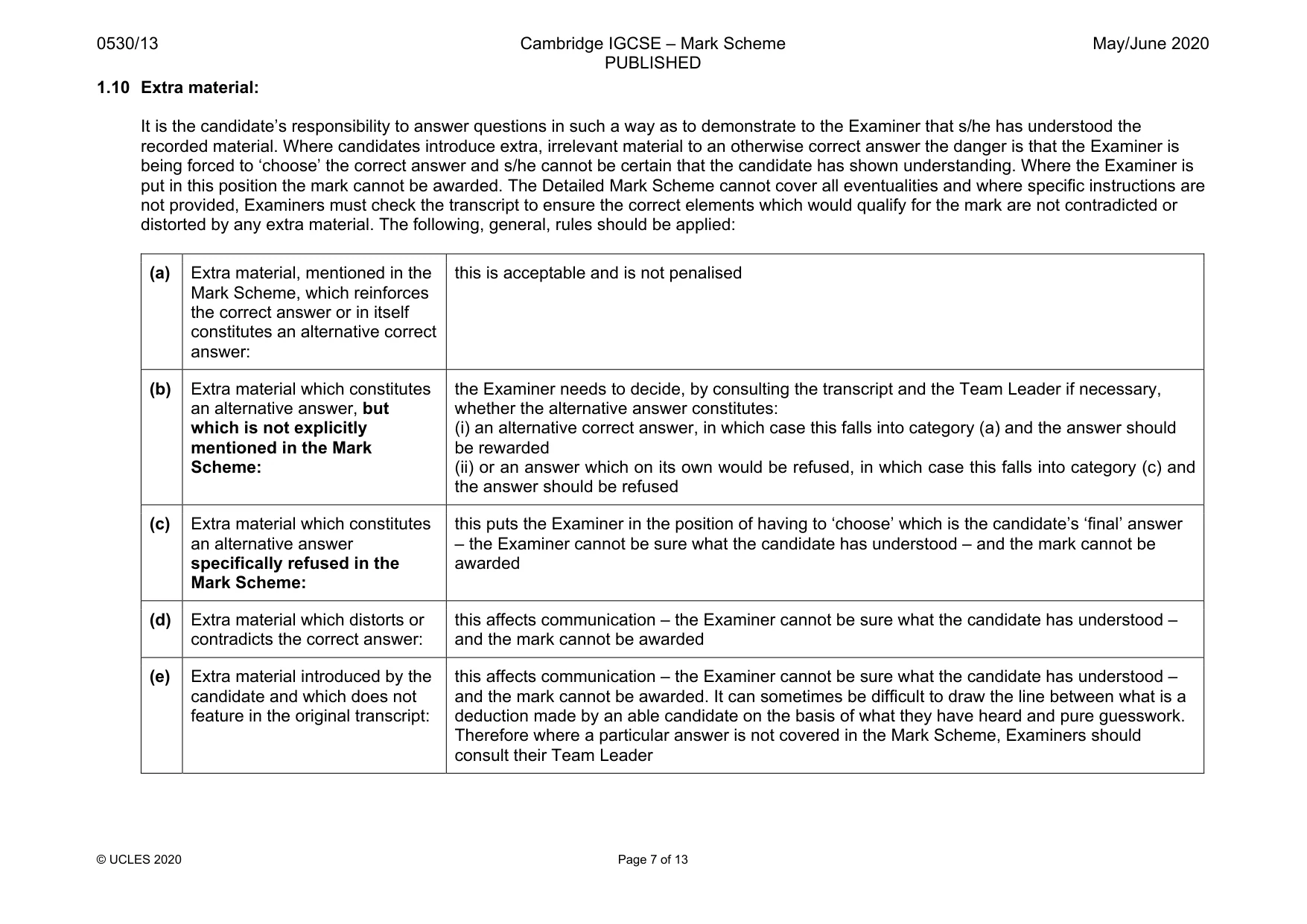
0530/13 Cambridge IGCSE – Mark Scheme PUBLISHED May/June 2020 © UCLES 2020 Page 7 of 13 1.10 Extra material: It is the candidate’s responsibility to answer questions in such a way as to demonstrate to the Examiner that s/he has understood the recorded material. Where candidates introduce extra, irrelevant material to an otherwise correct answer the danger is that the Examiner is being forced to ‘choose’ the correct answer and s/he cannot be certain that the candidate has shown understanding. Where the Examiner is put in this position the mark cannot be awarded. The Detailed Mark Scheme cannot cover all eventualities and where specific instructions are not provided, Examiners must check the transcript to ensure the correct elements which would qualify for the mark are not contradicted or distorted by any extra material. The following, general, rules should be applied: (a) Extra material, mentioned in the Mark Scheme, which reinforces the correct answer or in itself constitutes an alternative correct answer: this is acceptable and is not penalised (b) Extra material which constitutes an alternative answer, but which is not explicitly mentioned in the Mark Scheme: the Examiner needs to decide, by consulting the transcript and the Team Leader if necessary, whether the alternative answer constitutes: (i) an alternative correct answer, in which case this falls into category (a) and the answer should be rewarded (ii) or an answer which on its own would be refused, in which case this falls into category (c) and the answer should be refused (c) Extra material which constitutes an alternative answer specifically refused in the Mark Scheme: this puts the Examiner in the position of having to ‘choose’ which is the candidate’s ‘final’ answer – the Examiner cannot be sure what the candidate has understood – and the mark cannot be awarded (d) Extra material which distorts or contradicts the correct answer: this affects communication – the Examiner cannot be sure what the candidate has understood – and the mark cannot be awarded (e) Extra material introduced by the candidate and which does not feature in the original transcript: this affects communication – the Examiner cannot be sure what the candidate has understood – and the mark cannot be awarded. It can sometimes be difficult to draw the line between what is a deduction made by an able candidate on the basis of what they have heard and pure guesswork. Therefore where a particular answer is not covered in the Mark Scheme, Examiners should consult their Team Leader
Mark scheme, page 8
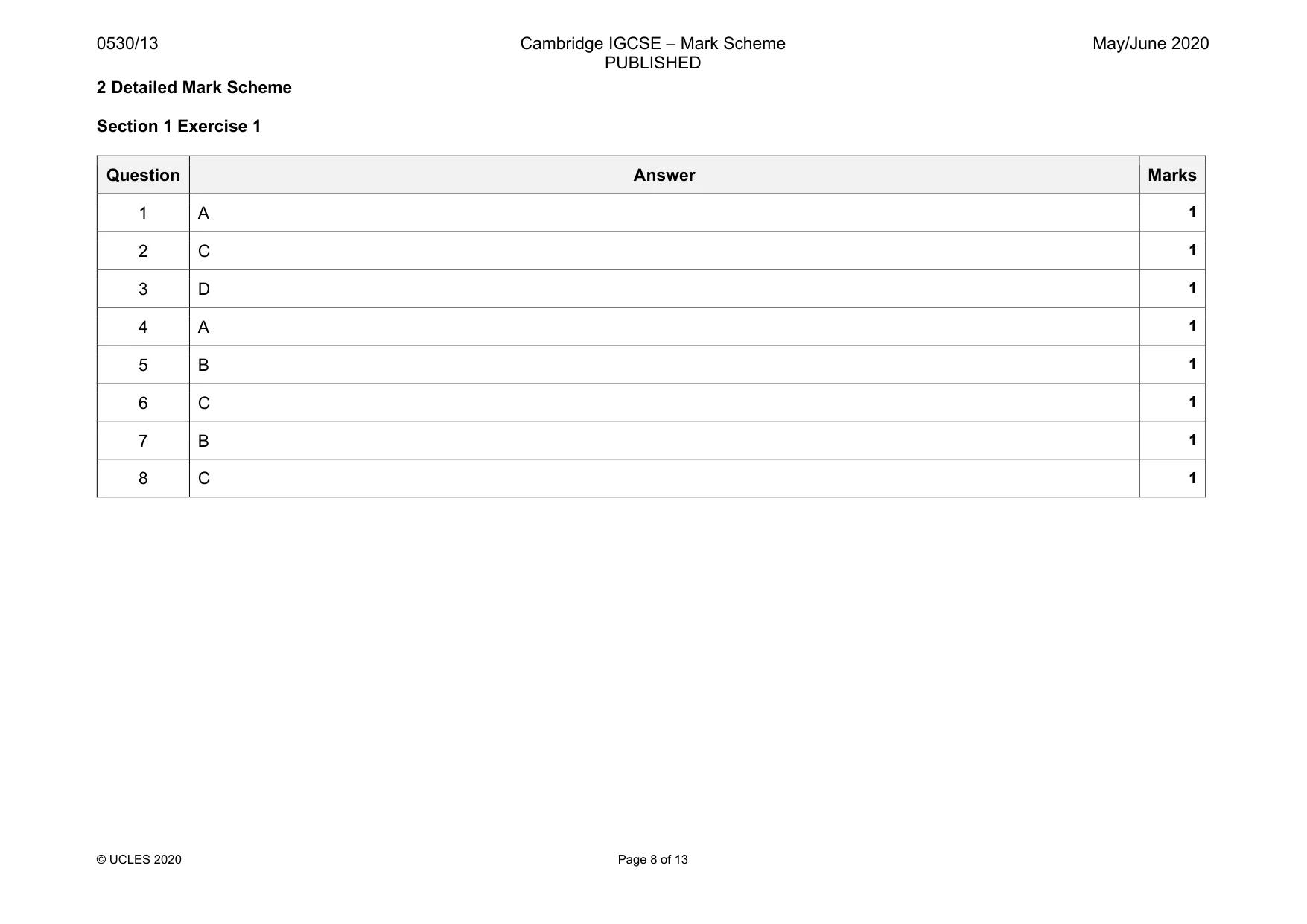
0530/13 Cambridge IGCSE – Mark Scheme PUBLISHED May/June 2020 © UCLES 2020 Page 8 of 13 2 Detailed Mark Scheme Section 1 Exercise 1 Question Answer Marks 1 A 1 2 C 1 3 D 1 4 A 1 5 B 1 6 C 1 7 B 1 8 C 1
Mark scheme, page 9
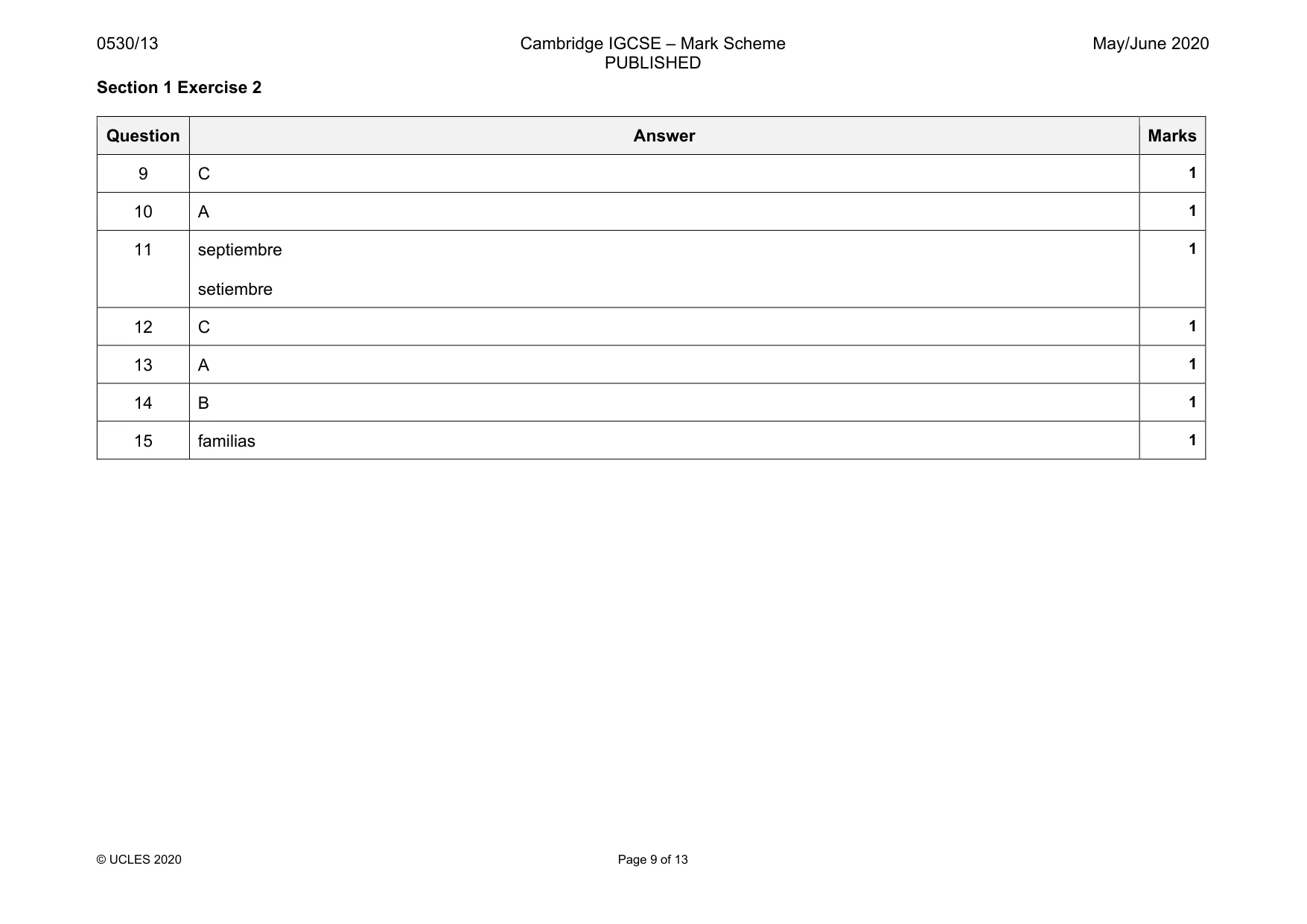
0530/13 Cambridge IGCSE – Mark Scheme PUBLISHED May/June 2020 © UCLES 2020 Page 9 of 13 Section 1 Exercise 2 Question Answer Marks 9 C 1 10 A 1 11 septiembre setiembre 1 12 C 1 13 A 1 14 B 1 15 familias 1
Mark scheme, page 10
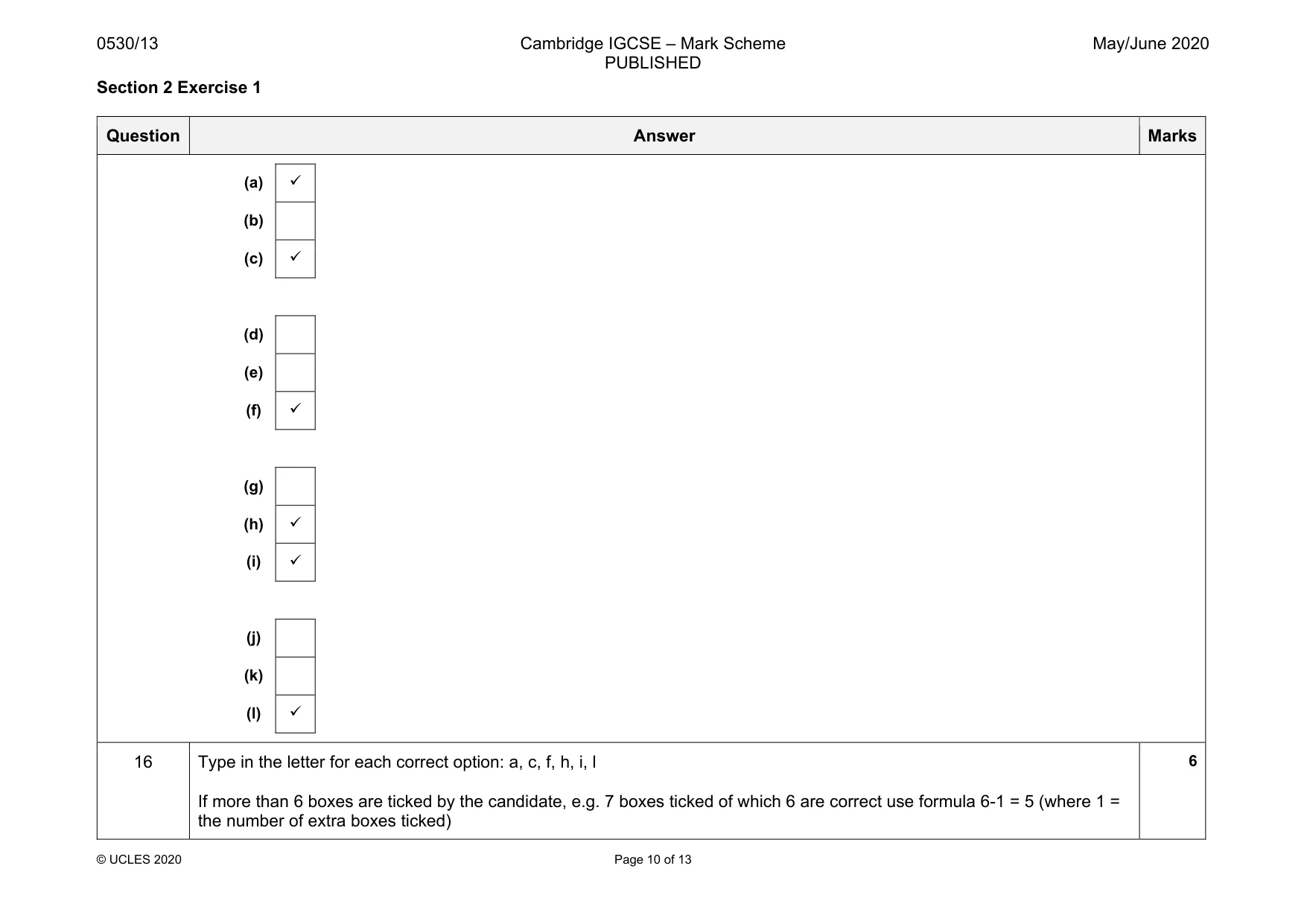
0530/13 Cambridge IGCSE – Mark Scheme PUBLISHED May/June 2020 © UCLES 2020 Page 10 of 13 Section 2 Exercise 1 Question Answer Marks (a) (b) (c) (d) (e) (f) (g) (h) (i) (j) (k) (l) 16 Type in the letter for each correct option: a, c, f, h, i, l If more than 6 boxes are ticked by the candidate, e.g. 7 boxes ticked of which 6 are correct use formula 6-1 = 5 (where 1 = the number of extra boxes ticked) 6
Mark scheme, page 11
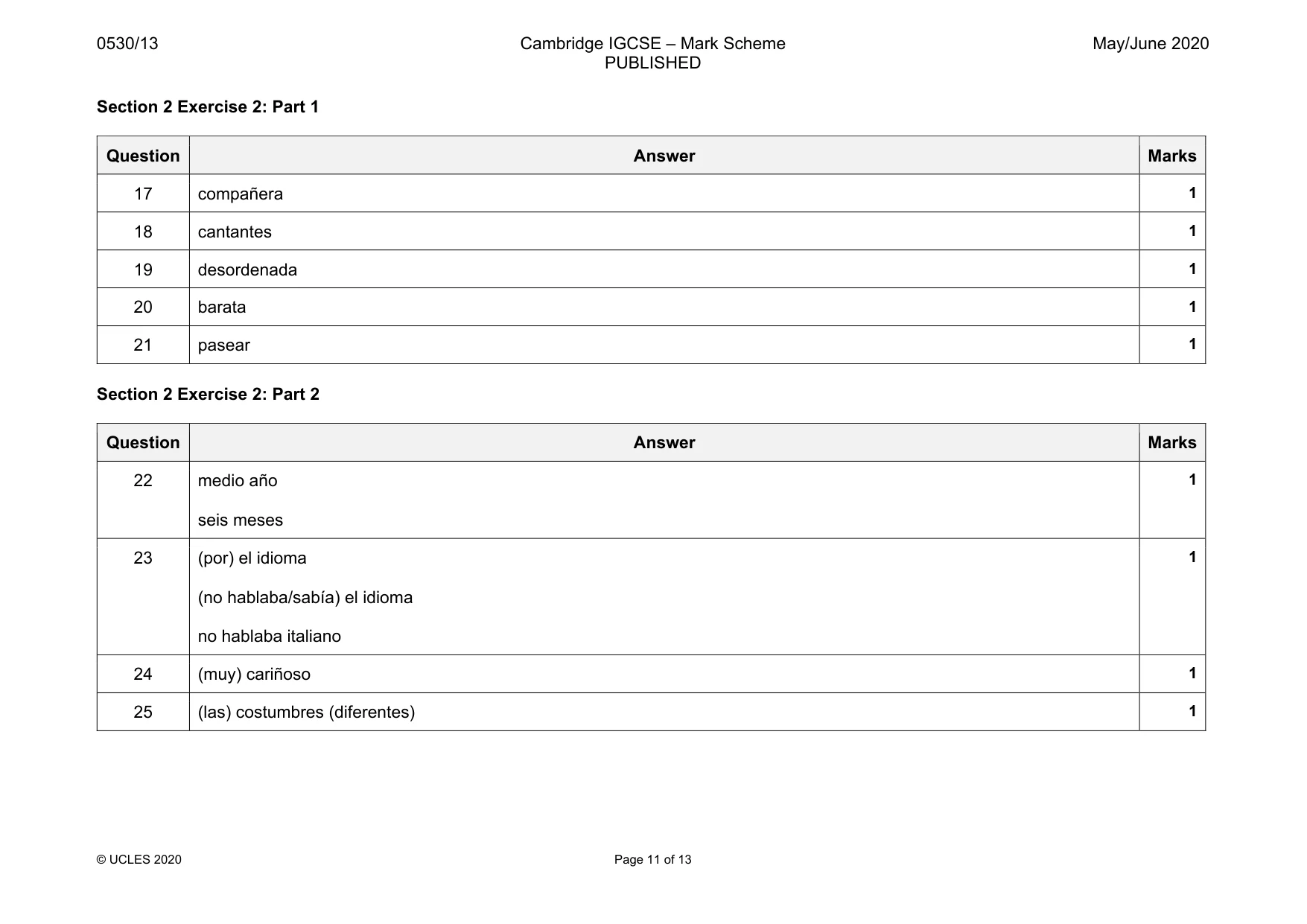
0530/13 Cambridge IGCSE – Mark Scheme PUBLISHED May/June 2020 © UCLES 2020 Page 11 of 13 Section 2 Exercise 2: Part 1 Question Answer Marks 17 compañera 1 18 cantantes 1 19 desordenada 1 20 barata 1 21 pasear 1 Section 2 Exercise 2: Part 2 Question Answer Marks 22 medio año seis meses 1 23 (por) el idioma (no hablaba/sabía) el idioma no hablaba italiano 1 24 (muy) cariñoso 1 25 (las) costumbres (diferentes) 1
Mark scheme, page 12
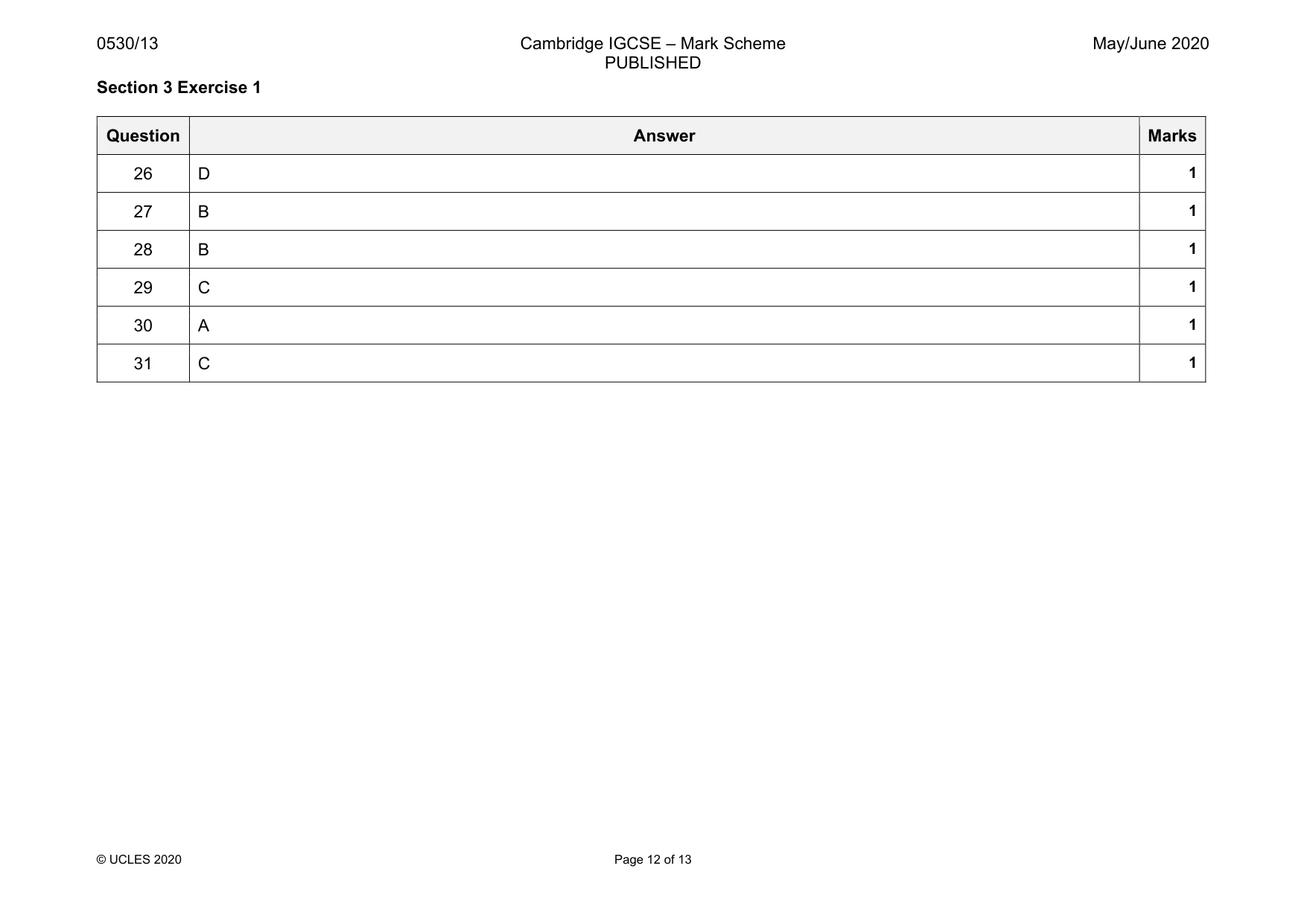
0530/13 Cambridge IGCSE – Mark Scheme PUBLISHED May/June 2020 © UCLES 2020 Page 12 of 13 Section 3 Exercise 1 Question Answer Marks 26 D 1 27 B 1 28 B 1 29 C 1 30 A 1 31 C 1
Mark scheme, page 13
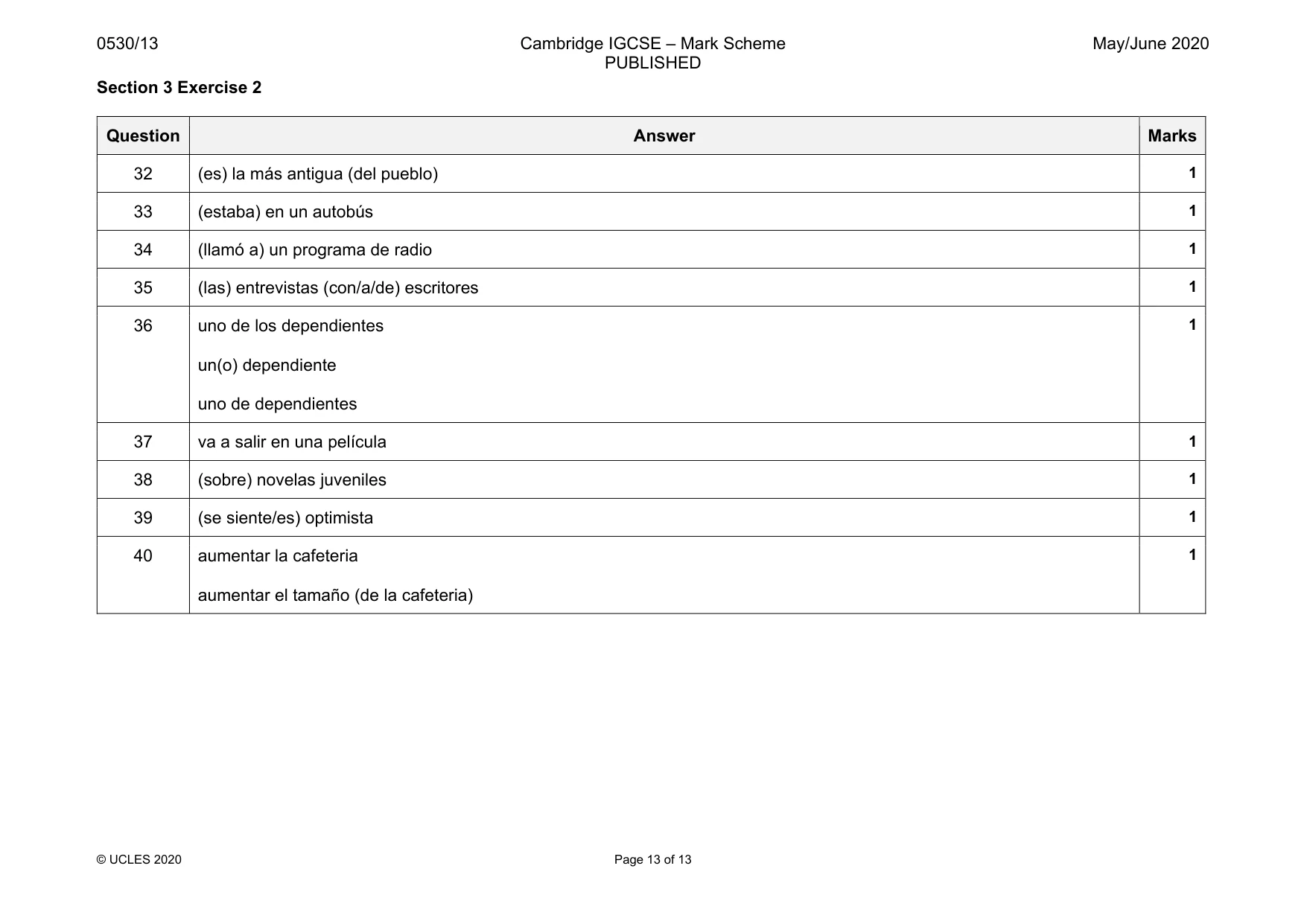
0530/13 Cambridge IGCSE – Mark Scheme PUBLISHED May/June 2020 © UCLES 2020 Page 13 of 13 Section 3 Exercise 2 Question Answer Marks 32 (es) la más antigua (del pueblo) 1 33 (estaba) en un autobús 1 34 (llamó a) un programa de radio 1 35 (las) entrevistas (con/a/de) escritores 1 36 uno de los dependientes un(o) dependiente uno de dependientes 1 37 va a salir en una película 1 38 (sobre) novelas juveniles 1 39 (se siente/es) optimista 1 40 aumentar la cafeteria aumentar el tamaño (de la cafeteria) 1