Cambridge IGCSE Spanish - Foreign Language 0530 — 2017 May/June Paper 4 · Variant 1
0530/41/M/J/17 · 50 marks · ≈56 min
The question paper and its mark scheme, free to read here and free to download. This is Cambridge’s own paper, exactly as it was sat.
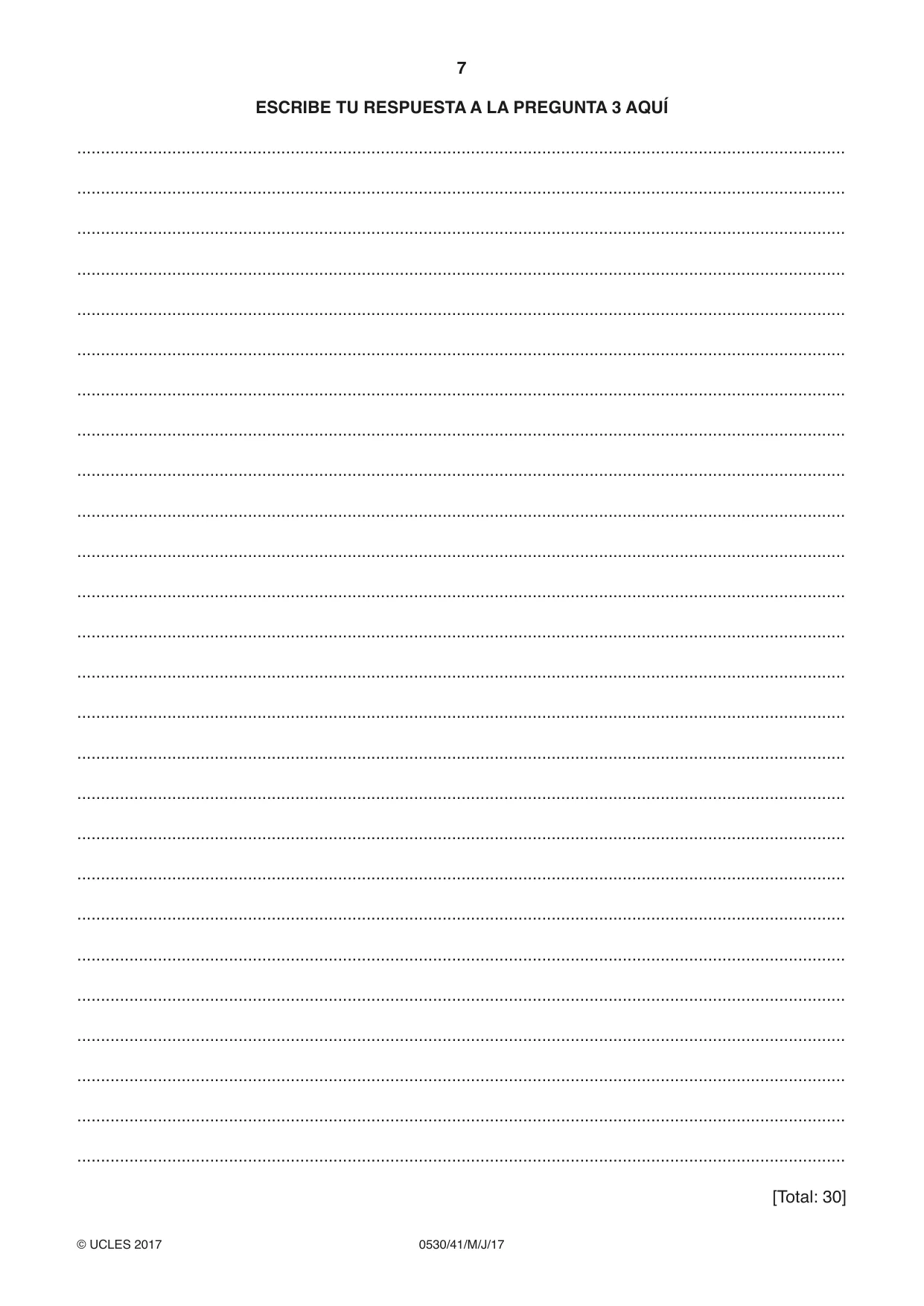
Question paper8 pages


Mark scheme30 pages
Answers below. Sit the paper first if you are practising.
Paper as text
Question paper, page 1
This document consists of 6 printed pages and 2 blank pages. DC (LK/SG) 125557/2 © UCLES 2017 [Turn over Cambridge International Examinations Cambridge International General Certificate of Secondary Education * 0 4 6 3 5 6 2 0 4 6 * SPANISH 0530/41 Paper 4 Writing May/June 2017 1 hour Candidates answer on the Question Paper. No Additional Materials are required. READ THESE INSTRUCTIONS FIRST Write your Centre number, candidate number and name in the spaces at the top of this page. Write in dark blue or black pen. Do not use staples, paper clips, glue or correction fluid. DO NOT WRITE IN ANY BARCODES. Answer three questions: Question 1, Question 2 and Question 3(a) or Question 3(b) or Question 3(c). The number of marks is given in brackets [ ] at the end of each question or part question. The syllabus is approved for use in England, Wales and Northern Ireland as a Cambridge International Level 1/Level 2 Certificate.
Question paper, page 2
2 0530/41/M/J/17 © UCLES 2017 BLANK PAGE
Question paper, page 3
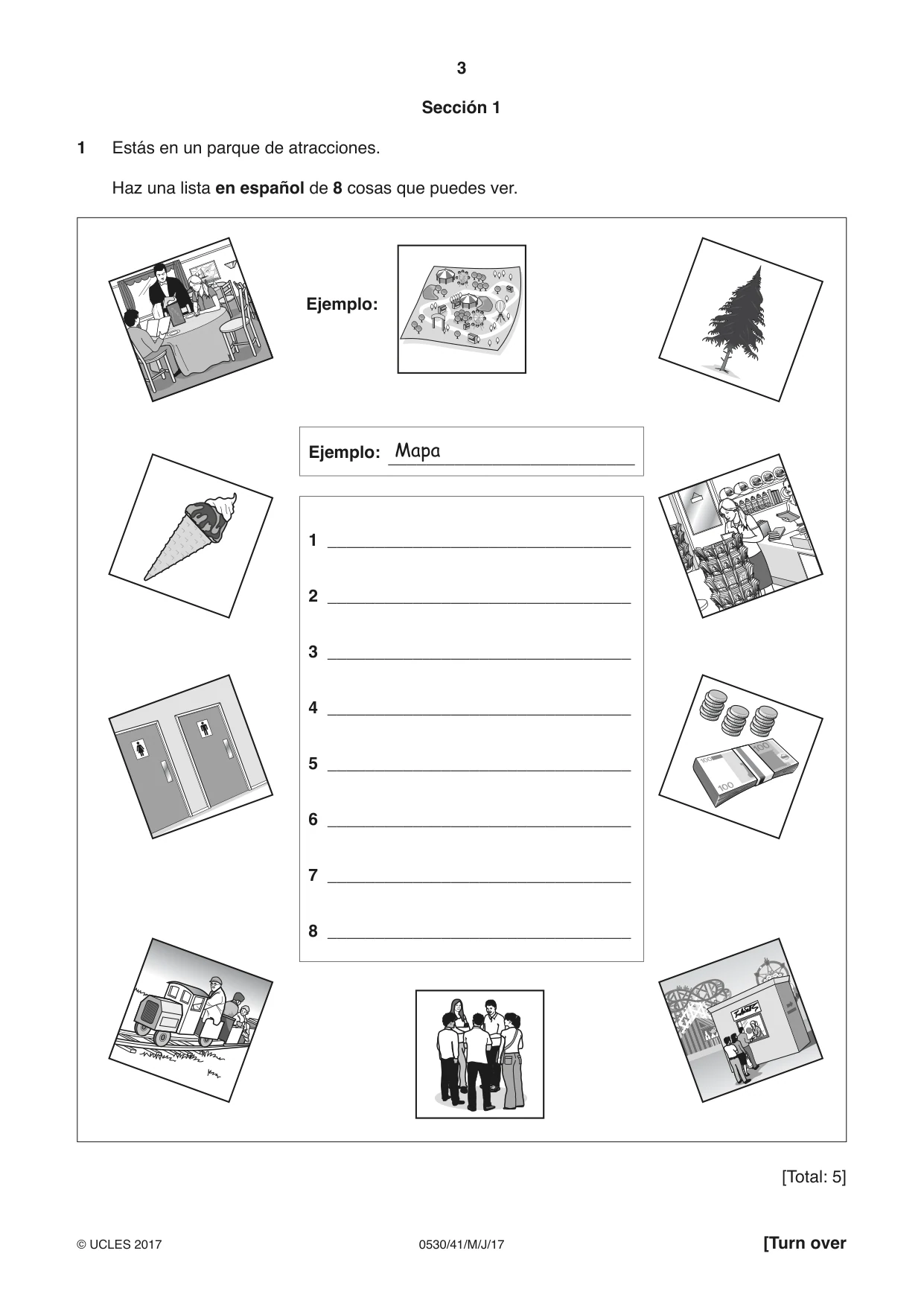
3 0530/41/M/J/17 © UCLES 2017 [Turn over Sección 1 1 Estás en un parque de atracciones. Haz una lista en español de 8 cosas que puedes ver. Ejemplo: Ejemplo: Mapa __________________________ 1 ________________________________ 2 ________________________________ 3 ________________________________ 4 ________________________________ 5 ________________________________ 6 ________________________________ 7 ________________________________ 8 ________________________________ [Total: 5]
Question paper, page 4
4 0530/41/M/J/17 © UCLES 2017 2 Las vacaciones • ¿Adónde vas de vacaciones normalmente? • Describe el lugar donde pasas las vacaciones. • Explica por qué te gusta pasar las vacaciones allí. • ¿Con quién te gustaría ir de vacaciones el año próximo? ¿Por qué? Debes escribir entre 80 y 90 palabras en español. … … … … … … … … … … … … … … [Total: 15]
Question paper, page 5
5 0530/41/M/J/17 © UCLES 2017 [Turn over Dar la vuelta para la Sección 2.
Question paper, page 6
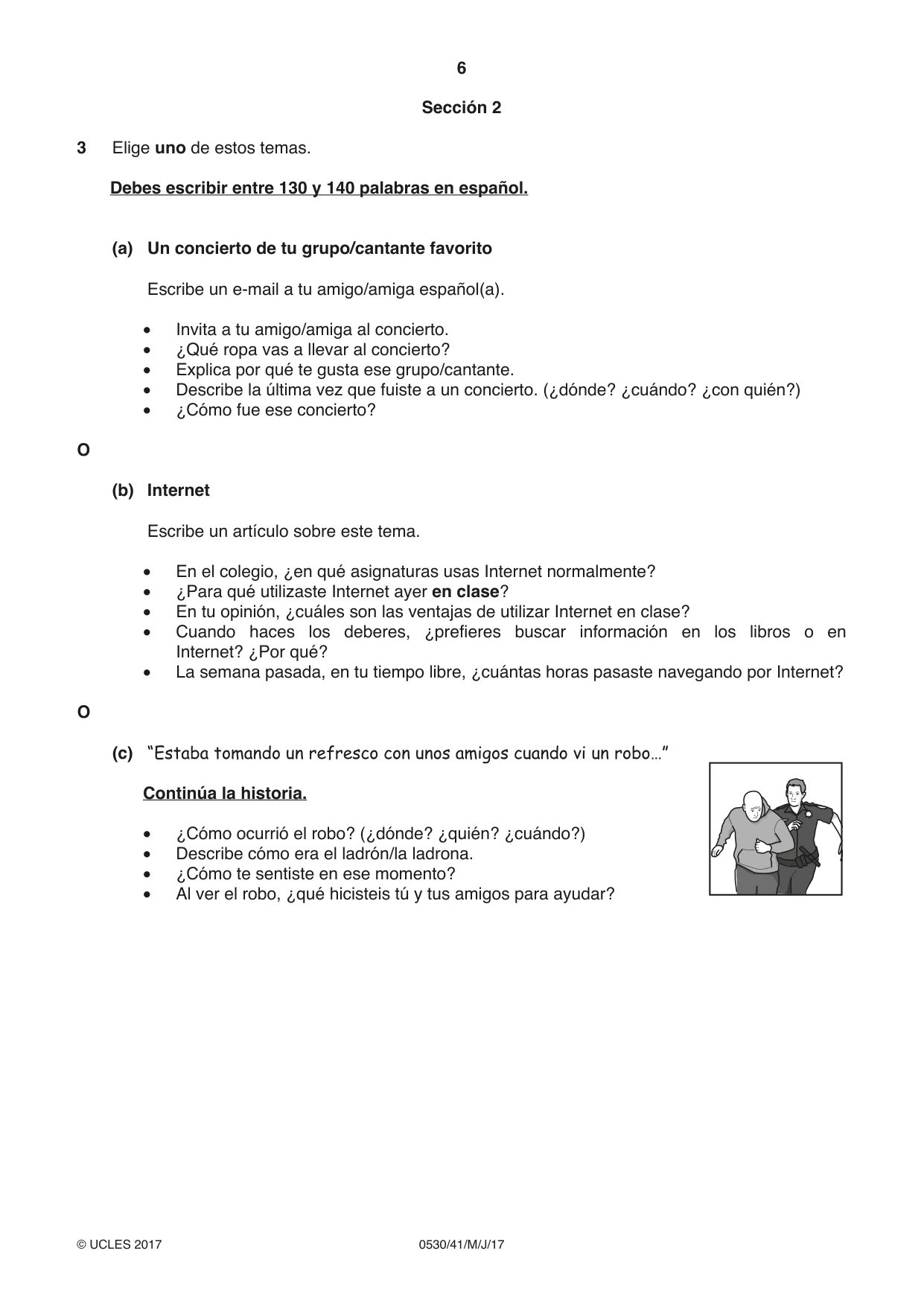
6 0530/41/M/J/17 © UCLES 2017 Sección 2 3 Elige uno de estos temas. Debes escribir entre 130 y 140 palabras en español. (a) Un concierto de tu grupo/cantante favorito Escribe un e-mail a tu amigo/amiga español(a). • Invita a tu amigo/amiga al concierto. • ¿Qué ropa vas a llevar al concierto? • Explica por qué te gusta ese grupo/cantante. • Describe la última vez que fuiste a un concierto. (¿dónde? ¿cuándo? ¿con quién?) • ¿Cómo fue ese concierto? O (b) Internet Escribe un artículo sobre este tema. • En el colegio, ¿en qué asignaturas usas Internet normalmente? • ¿Para qué utilizaste Internet ayer en clase? • En tu opinión, ¿cuáles son las ventajas de utilizar Internet en clase? • Cuando haces los deberes, ¿prefieres buscar información en los libros o en Internet? ¿Por qué? • La semana pasada, en tu tiempo libre, ¿cuántas horas pasaste navegando por Internet? O (c) “Estaba tomando un refresco con unos amigos cuando vi un robo…” Continúa la historia. • ¿Cómo ocurrió el robo? (¿dónde? ¿quién? ¿cuándo?) • Describe cómo era el ladrón/la ladrona. • ¿Cómo te sentiste en ese momento? • Al ver el robo, ¿qué hicisteis tú y tus amigos para ayudar?
Question paper, page 7
7 0530/41/M/J/17 © UCLES 2017 ESCRIBE TU RESPUESTA A LA PREGUNTA 3 AQUÍ … … … … … … … … … … … … … … … … … … … … … … … … … … [Total: 30]
Question paper, page 8
8 0530/41/M/J/17 © UCLES 2017 Permission to reproduce items where third-party owned material protected by copyright is included has been sought and cleared where possible. Every reasonable effort has been made by the publisher (UCLES) to trace copyright holders, but if any items requiring clearance have unwittingly been included, the publisher will be pleased to make amends at the earliest possible opportunity. To avoid the issue of disclosure of answer-related information to candidates, all copyright acknowledgements are reproduced online in the Cambridge International Examinations Copyright Acknowledgements Booklet. This is produced for each series of examinations and is freely available to download at www.cie.org.uk after the live examination series. Cambridge International Examinations is part of the Cambridge Assessment Group. Cambridge Assessment is the brand name of University of Cambridge Local Examinations Syndicate (UCLES), which is itself a department of the University of Cambridge. BLANK PAGE
Mark scheme, page 1
® IGCSE is a registered trademark. This syllabus is approved for use in England, Wales and Northern Ireland as a Cambridge International Level 1/Level 2 Certificate. This document consists of 30 printed pages. © UCLES 2017 [Turn over Cambridge International Examinations Cambridge International General Certificate of Secondary Education SPANISH 0530/41 Paper 4 Writing May/June 2017 MARK SCHEME Maximum Mark: 50 Published This mark scheme is published as an aid to teachers and candidates, to indicate the requirements of the examination. It shows the basis on which Examiners were instructed to award marks. It does not indicate the details of the discussions that took place at an Examiners’ meeting before marking began, which would have considered the acceptability of alternative answers. Mark schemes should be read in conjunction with the question paper and the Principal Examiner Report for Teachers. Cambridge will not enter into discussions about these mark schemes. Cambridge is publishing the mark schemes for the May/June 2017 series for most Cambridge IGCSE®, Cambridge International A and AS Level and Cambridge Pre-U components, and some Cambridge O Level components.
Mark scheme, page 2
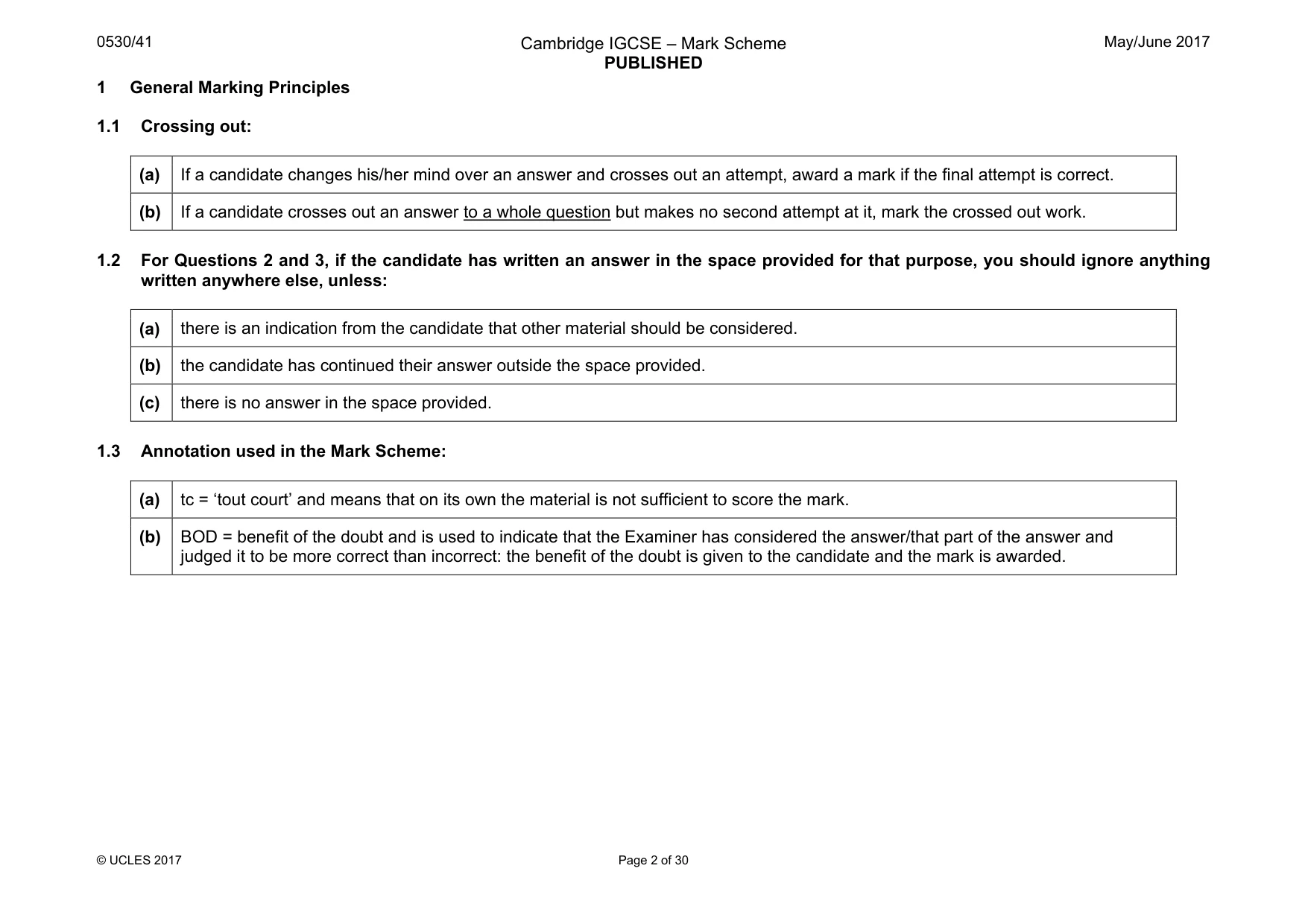
0530/41 Cambridge IGCSE – Mark Scheme PUBLISHED May/June 2017 © UCLES 2017 Page 2 of 30 1 General Marking Principles 1.1 Crossing out: (a) If a candidate changes his/her mind over an answer and crosses out an attempt, award a mark if the final attempt is correct. (b) If a candidate crosses out an answer to a whole question but makes no second attempt at it, mark the crossed out work. 1.2 For Questions 2 and 3, if the candidate has written an answer in the space provided for that purpose, you should ignore anything written anywhere else, unless: (a) there is an indication from the candidate that other material should be considered. (b) the candidate has continued their answer outside the space provided. (c) there is no answer in the space provided. 1.3 Annotation used in the Mark Scheme: (a) tc = ‘tout court’ and means that on its own the material is not sufficient to score the mark. (b) BOD = benefit of the doubt and is used to indicate that the Examiner has considered the answer/that part of the answer and judged it to be more correct than incorrect: the benefit of the doubt is given to the candidate and the mark is awarded.
Mark scheme, page 3
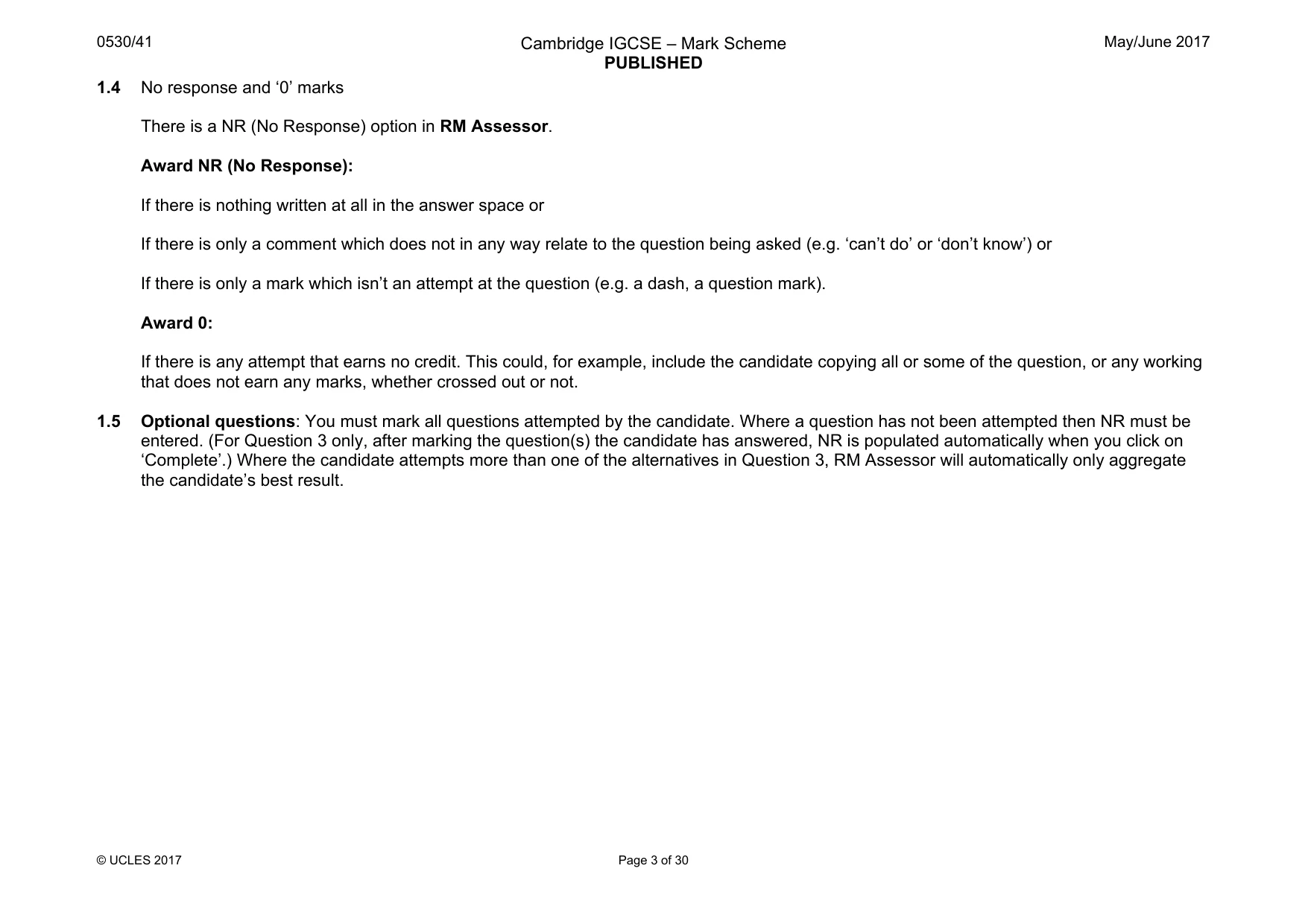
0530/41 Cambridge IGCSE – Mark Scheme PUBLISHED May/June 2017 © UCLES 2017 Page 3 of 30 1.4 No response and ‘0’ marks There is a NR (No Response) option in RM Assessor. Award NR (No Response): If there is nothing written at all in the answer space or If there is only a comment which does not in any way relate to the question being asked (e.g. ‘can’t do’ or ‘don’t know’) or If there is only a mark which isn’t an attempt at the question (e.g. a dash, a question mark). Award 0: If there is any attempt that earns no credit. This could, for example, include the candidate copying all or some of the question, or any working that does not earn any marks, whether crossed out or not. 1.5 Optional questions: You must mark all questions attempted by the candidate. Where a question has not been attempted then NR must be entered. (For Question 3 only, after marking the question(s) the candidate has answered, NR is populated automatically when you click on ‘Complete’.) Where the candidate attempts more than one of the alternatives in Question 3, RM Assessor will automatically only aggregate the candidate’s best result.
Mark scheme, page 4
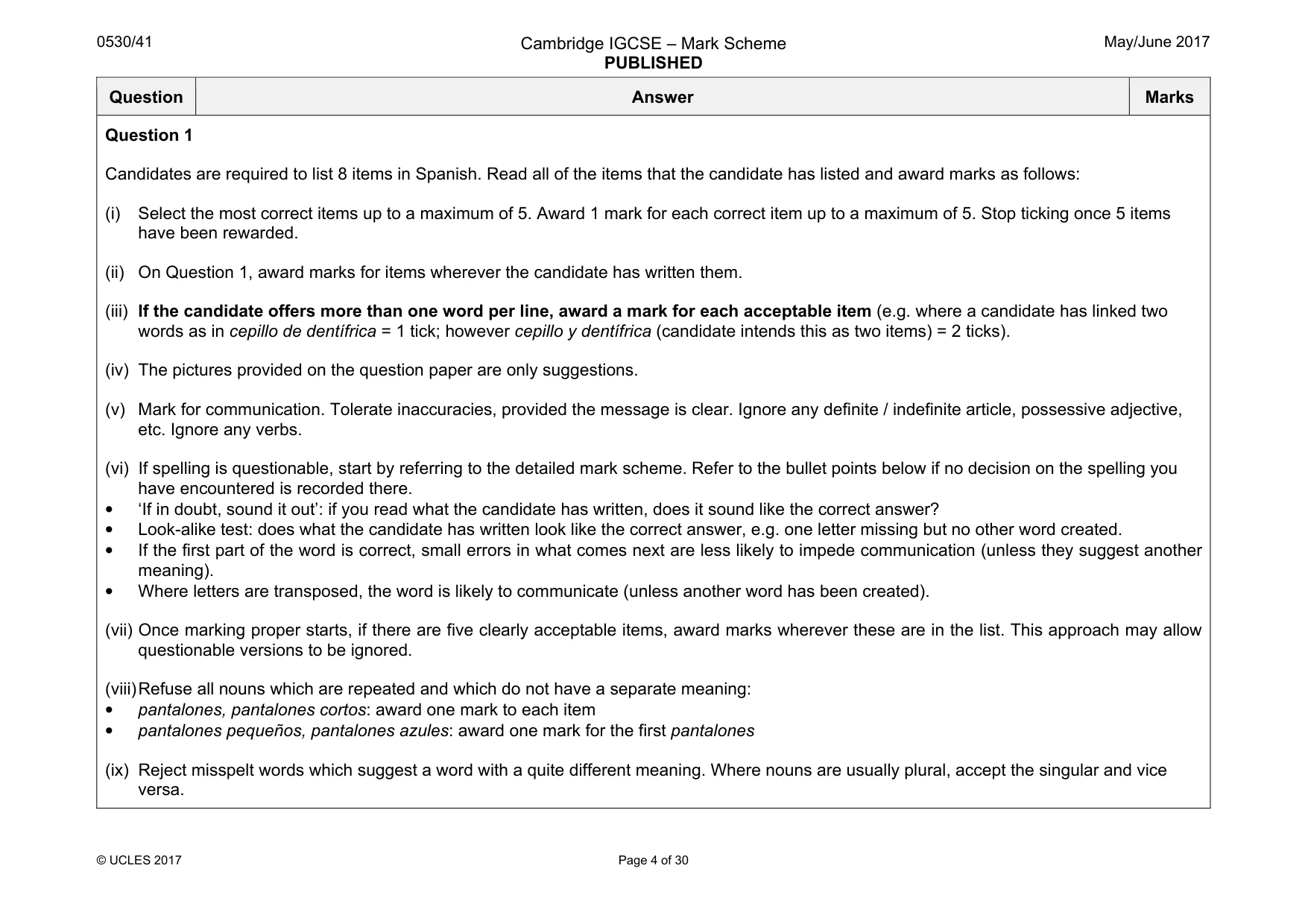
0530/41 Cambridge IGCSE – Mark Scheme PUBLISHED May/June 2017 © UCLES 2017 Page 4 of 30 Question Answer Marks Question 1 Candidates are required to list 8 items in Spanish. Read all of the items that the candidate has listed and award marks as follows: (i) Select the most correct items up to a maximum of 5. Award 1 mark for each correct item up to a maximum of 5. Stop ticking once 5 items have been rewarded. (ii) On Question 1, award marks for items wherever the candidate has written them. (iii) If the candidate offers more than one word per line, award a mark for each acceptable item (e.g. where a candidate has linked two words as in cepillo de dentífrica = 1 tick; however cepillo y dentífrica (candidate intends this as two items) = 2 ticks). (iv) The pictures provided on the question paper are only suggestions. (v) Mark for communication. Tolerate inaccuracies, provided the message is clear. Ignore any definite / indefinite article, possessive adjective, etc. Ignore any verbs. (vi) If spelling is questionable, start by referring to the detailed mark scheme. Refer to the bullet points below if no decision on the spelling you have encountered is recorded there. • ‘If in doubt, sound it out’: if you read what the candidate has written, does it sound like the correct answer? • Look-alike test: does what the candidate has written look like the correct answer, e.g. one letter missing but no other word created. • If the first part of the word is correct, small errors in what comes next are less likely to impede communication (unless they suggest another meaning). • Where letters are transposed, the word is likely to communicate (unless another word has been created). (vii) Once marking proper starts, if there are five clearly acceptable items, award marks wherever these are in the list. This approach may allow questionable versions to be ignored. (viii) Refuse all nouns which are repeated and which do not have a separate meaning: • pantalones, pantalones cortos: award one mark to each item • pantalones pequeños, pantalones azules: award one mark for the first pantalones (ix) Reject misspelt words which suggest a word with a quite different meaning. Where nouns are usually plural, accept the singular and vice versa.
Mark scheme, page 5
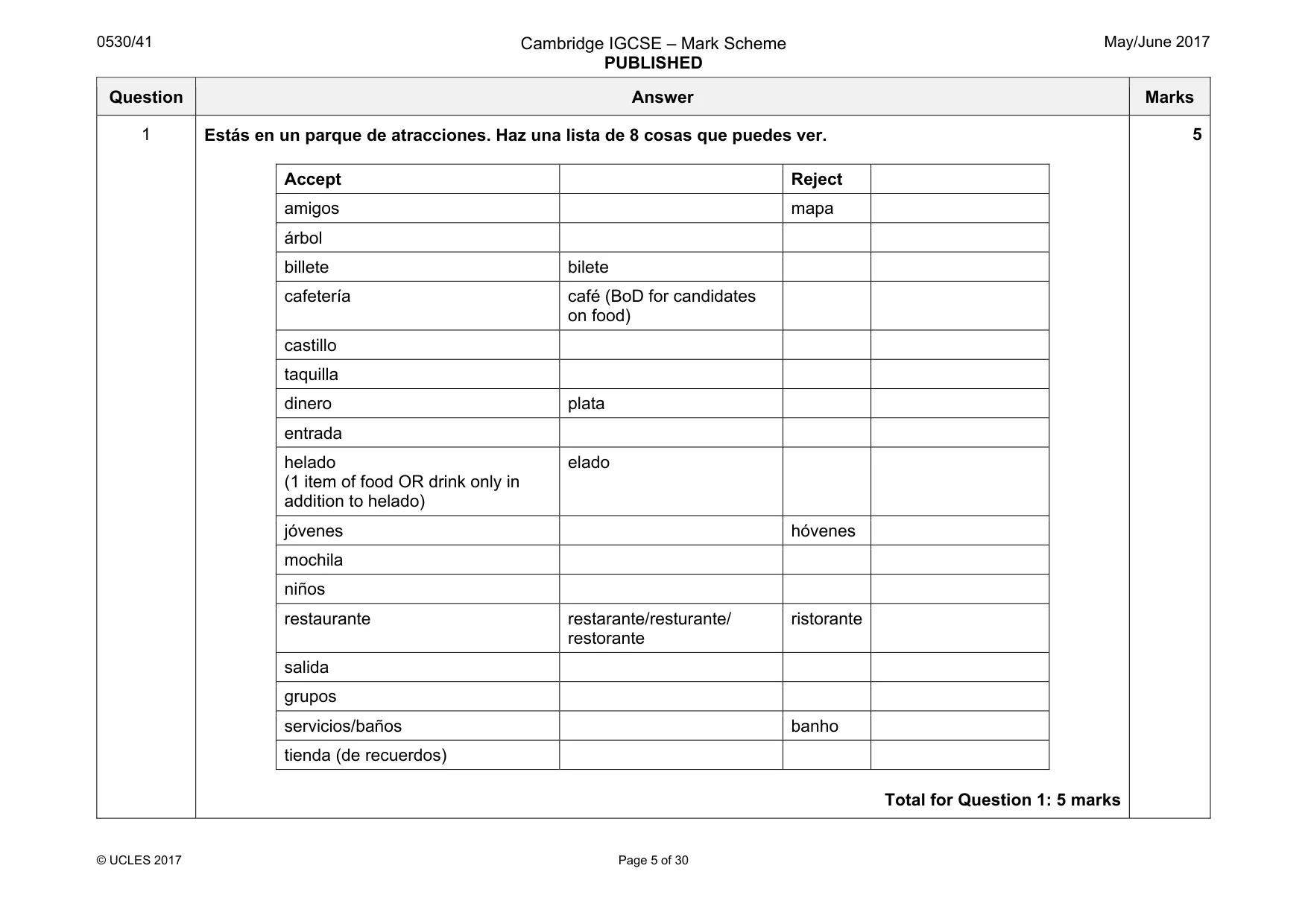
0530/41 Cambridge IGCSE – Mark Scheme PUBLISHED May/June 2017 © UCLES 2017 Page 5 of 30 Question Answer Marks 1 Estás en un parque de atracciones. Haz una lista de 8 cosas que puedes ver. Accept Reject amigos mapa árbol billete bilete cafetería café (BoD for candidates on food) castillo taquilla dinero plata entrada helado (1 item of food OR drink only in addition to helado) elado jóvenes hóvenes mochila niños restaurante restarante/resturante/ restorante ristorante salida grupos servicios/baños banho tienda (de recuerdos) Total for Question 1: 5 marks 5
Mark scheme, page 6
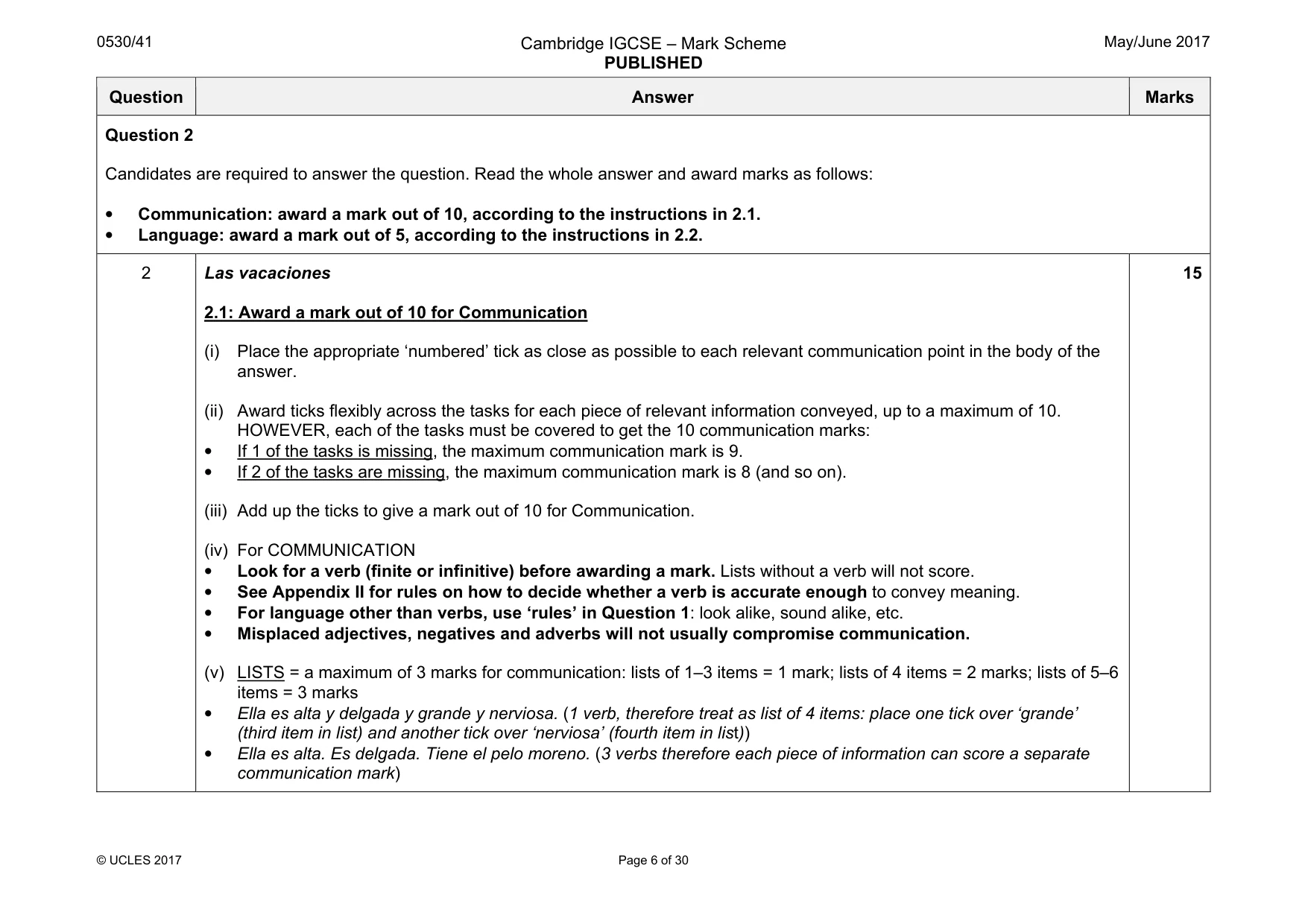
0530/41 Cambridge IGCSE – Mark Scheme PUBLISHED May/June 2017 © UCLES 2017 Page 6 of 30 Question Answer Marks Question 2 Candidates are required to answer the question. Read the whole answer and award marks as follows: • Communication: award a mark out of 10, according to the instructions in 2.1. • Language: award a mark out of 5, according to the instructions in 2.2. 2 Las vacaciones 2.1: Award a mark out of 10 for Communication (i) Place the appropriate ‘numbered’ tick as close as possible to each relevant communication point in the body of the answer. (ii) Award ticks flexibly across the tasks for each piece of relevant information conveyed, up to a maximum of 10. HOWEVER, each of the tasks must be covered to get the 10 communication marks: • If 1 of the tasks is missing, the maximum communication mark is 9. • If 2 of the tasks are missing, the maximum communication mark is 8 (and so on). (iii) Add up the ticks to give a mark out of 10 for Communication. (iv) For COMMUNICATION • Look for a verb (finite or infinitive) before awarding a mark. Lists without a verb will not score. • See Appendix II for rules on how to decide whether a verb is accurate enough to convey meaning. • For language other than verbs, use ‘rules’ in Question 1: look alike, sound alike, etc. • Misplaced adjectives, negatives and adverbs will not usually compromise communication. (v) LISTS = a maximum of 3 marks for communication: lists of 1–3 items = 1 mark; lists of 4 items = 2 marks; lists of 5–6 items = 3 marks • Ella es alta y delgada y grande y nerviosa. (1 verb, therefore treat as list of 4 items: place one tick over ‘grande’ (third item in list) and another tick over ‘nerviosa’ (fourth item in list)) • Ella es alta. Es delgada. Tiene el pelo moreno. (3 verbs therefore each piece of information can score a separate communication mark) 15
Mark scheme, page 7
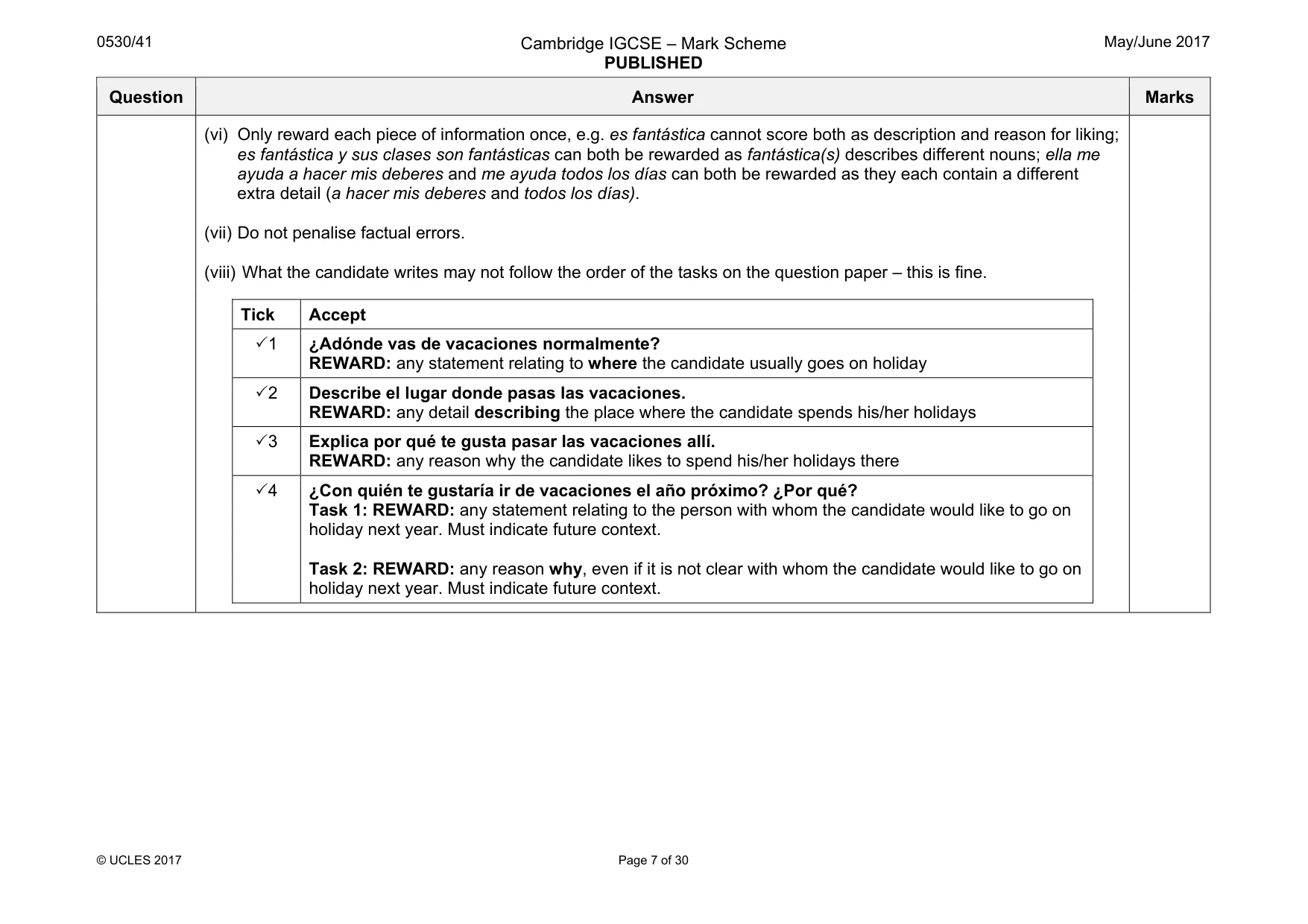
0530/41 Cambridge IGCSE – Mark Scheme PUBLISHED May/June 2017 © UCLES 2017 Page 7 of 30 Question Answer Marks (vi) Only reward each piece of information once, e.g. es fantástica cannot score both as description and reason for liking; es fantástica y sus clases son fantásticas can both be rewarded as fantástica(s) describes different nouns; ella me ayuda a hacer mis deberes and me ayuda todos los días can both be rewarded as they each contain a different extra detail (a hacer mis deberes and todos los días). (vii) Do not penalise factual errors. (viii) What the candidate writes may not follow the order of the tasks on the question paper – this is fine. Tick Accept 31 ¿Adónde vas de vacaciones normalmente? REWARD: any statement relating to where the candidate usually goes on holiday 32 Describe el lugar donde pasas las vacaciones. REWARD: any detail describing the place where the candidate spends his/her holidays 33 Explica por qué te gusta pasar las vacaciones allí. REWARD: any reason why the candidate likes to spend his/her holidays there 34 ¿Con quién te gustaría ir de vacaciones el año próximo? ¿Por qué? Task 1: REWARD: any statement relating to the person with whom the candidate would like to go on holiday next year. Must indicate future context. Task 2: REWARD: any reason why, even if it is not clear with whom the candidate would like to go on holiday next year. Must indicate future context.
Mark scheme, page 8
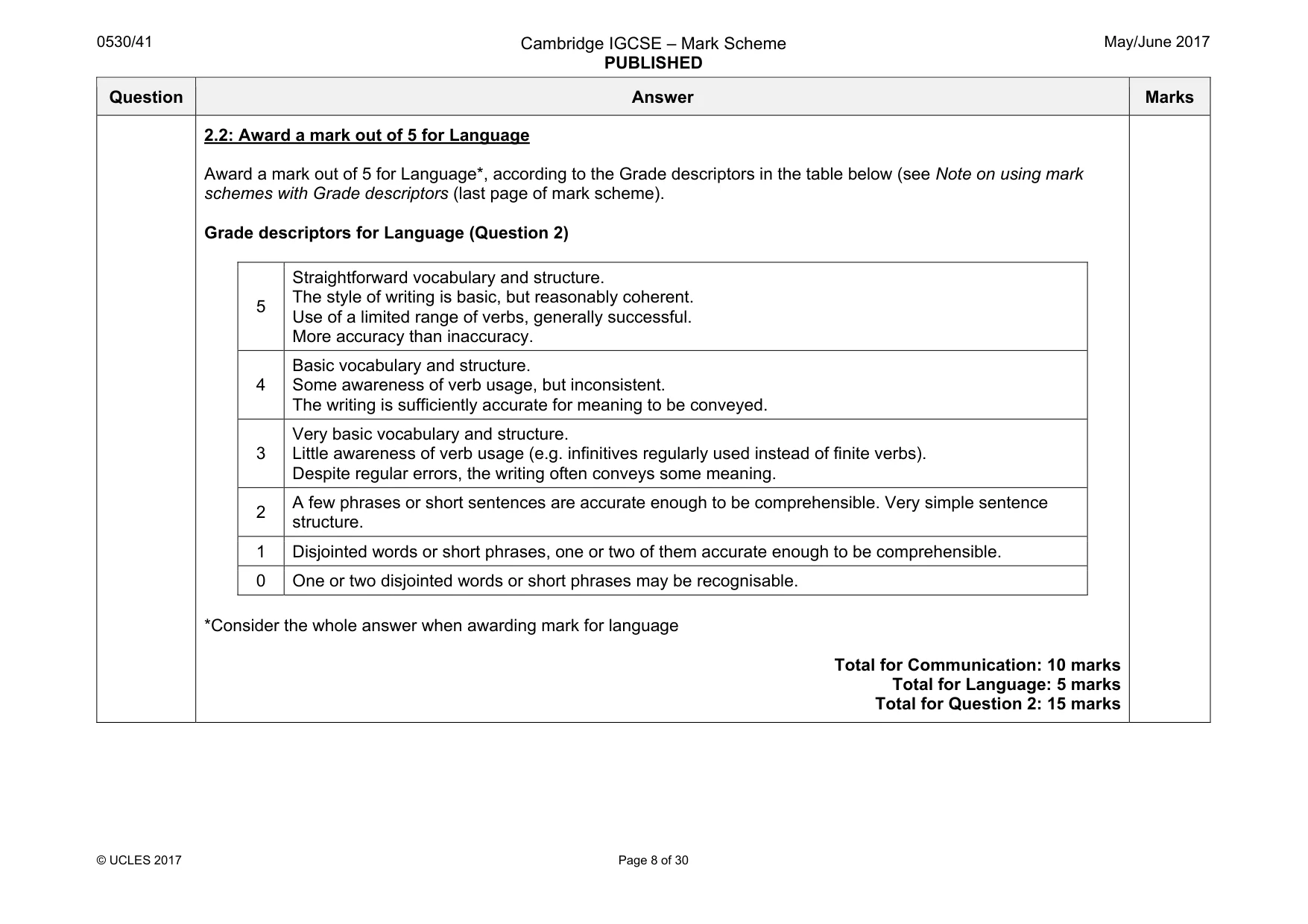
0530/41 Cambridge IGCSE – Mark Scheme PUBLISHED May/June 2017 © UCLES 2017 Page 8 of 30 Question Answer Marks 2.2: Award a mark out of 5 for Language Award a mark out of 5 for Language*, according to the Grade descriptors in the table below (see Note on using mark schemes with Grade descriptors (last page of mark scheme). Grade descriptors for Language (Question 2) 5 Straightforward vocabulary and structure. The style of writing is basic, but reasonably coherent. Use of a limited range of verbs, generally successful. More accuracy than inaccuracy. 4 Basic vocabulary and structure. Some awareness of verb usage, but inconsistent. The writing is sufficiently accurate for meaning to be conveyed. 3 Very basic vocabulary and structure. Little awareness of verb usage (e.g. infinitives regularly used instead of finite verbs). Despite regular errors, the writing often conveys some meaning. 2 A few phrases or short sentences are accurate enough to be comprehensible. Very simple sentence structure. 1 Disjointed words or short phrases, one or two of them accurate enough to be comprehensible. 0 One or two disjointed words or short phrases may be recognisable. *Consider the whole answer when awarding mark for language Total for Communication: 10 marks Total for Language: 5 marks Total for Question 2: 15 marks
Mark scheme, page 9
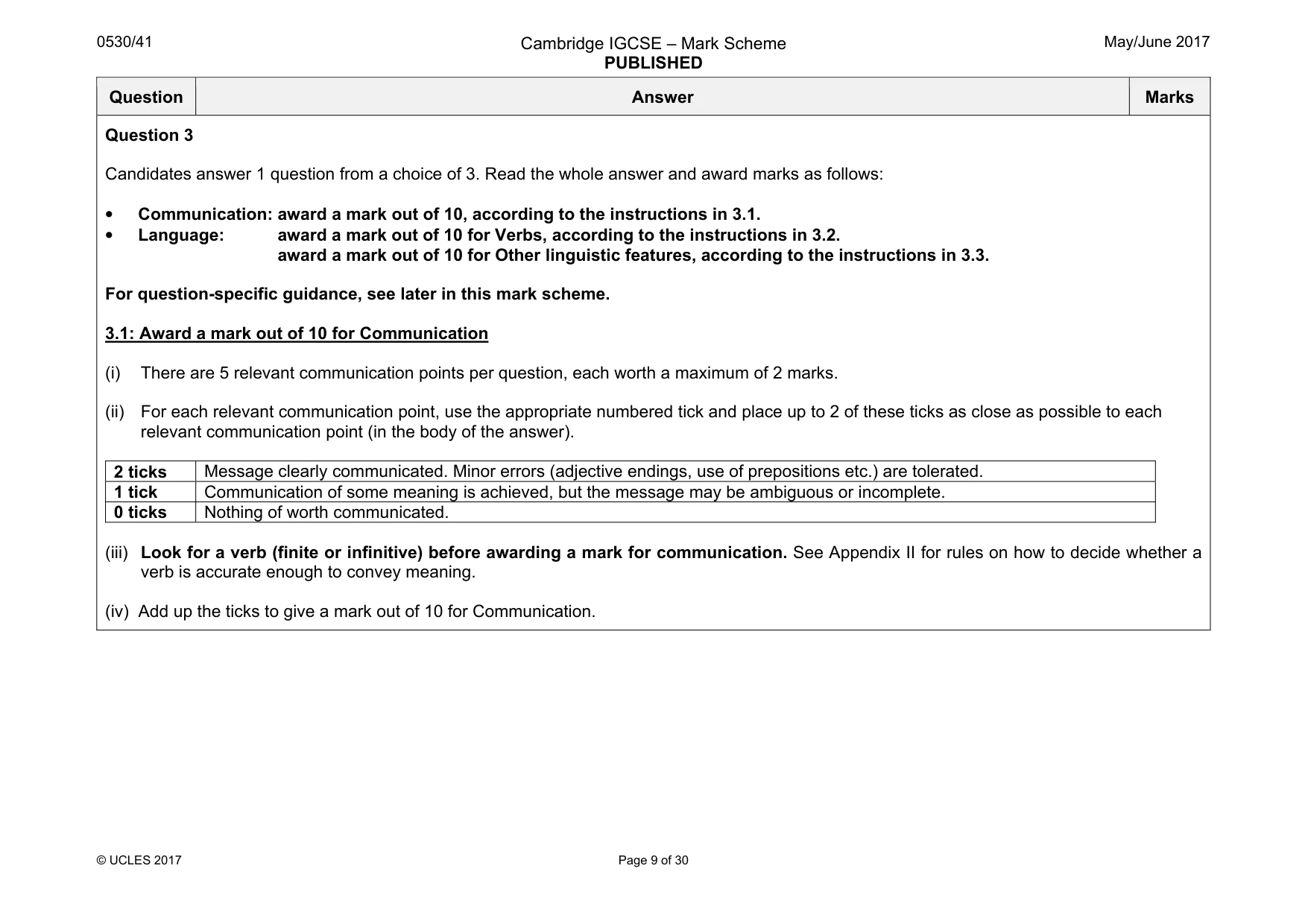
0530/41 Cambridge IGCSE – Mark Scheme PUBLISHED May/June 2017 © UCLES 2017 Page 9 of 30 Question Answer Marks Question 3 Candidates answer 1 question from a choice of 3. Read the whole answer and award marks as follows: • Communication: award a mark out of 10, according to the instructions in 3.1. • Language: award a mark out of 10 for Verbs, according to the instructions in 3.2. award a mark out of 10 for Other linguistic features, according to the instructions in 3.3. For question-specific guidance, see later in this mark scheme. 3.1: Award a mark out of 10 for Communication (i) There are 5 relevant communication points per question, each worth a maximum of 2 marks. (ii) For each relevant communication point, use the appropriate numbered tick and place up to 2 of these ticks as close as possible to each relevant communication point (in the body of the answer). 2 ticks Message clearly communicated. Minor errors (adjective endings, use of prepositions etc.) are tolerated. 1 tick Communication of some meaning is achieved, but the message may be ambiguous or incomplete. 0 ticks Nothing of worth communicated. (iii) Look for a verb (finite or infinitive) before awarding a mark for communication. See Appendix II for rules on how to decide whether a verb is accurate enough to convey meaning. (iv) Add up the ticks to give a mark out of 10 for Communication.
Mark scheme, page 10
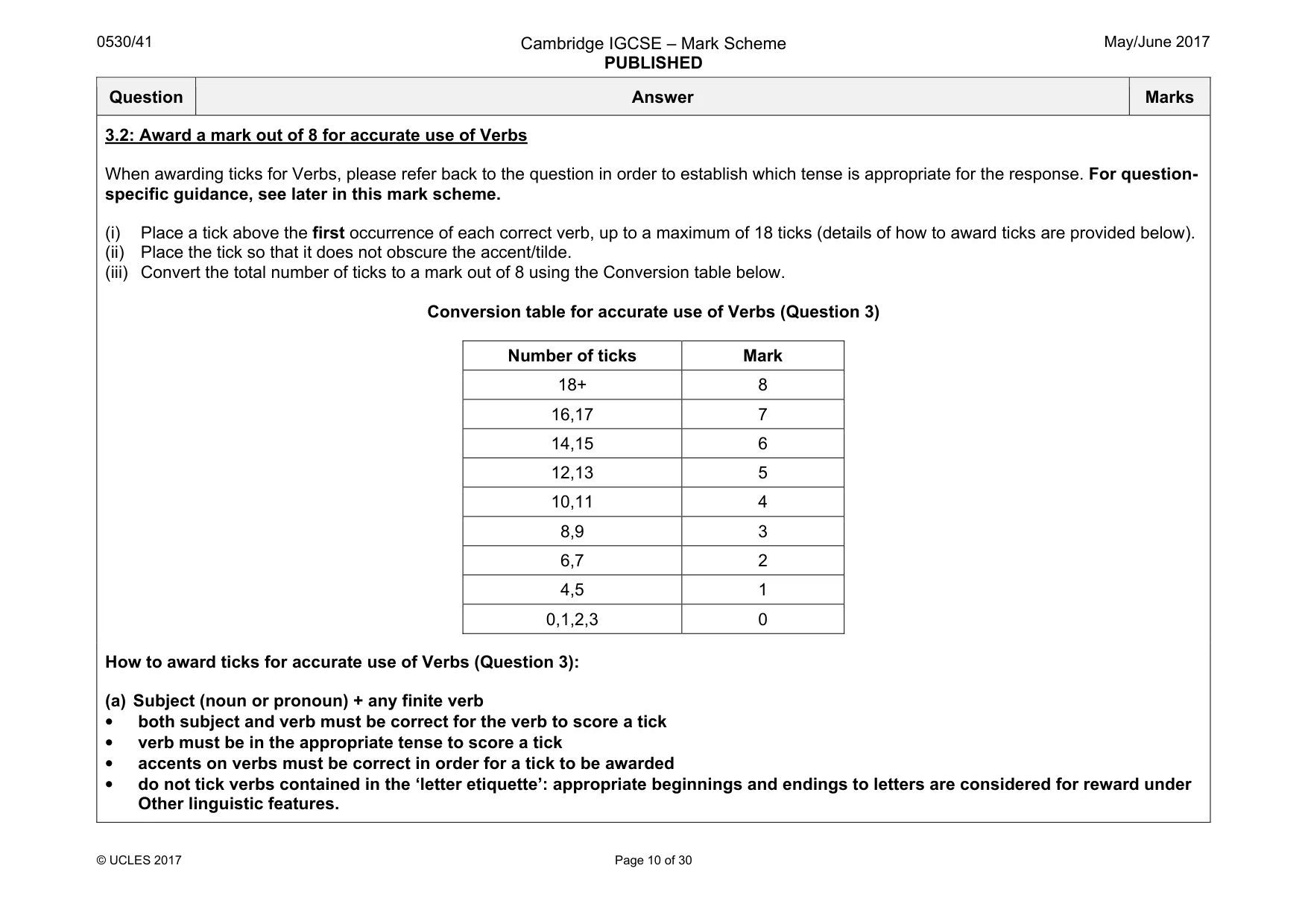
0530/41 Cambridge IGCSE – Mark Scheme PUBLISHED May/June 2017 © UCLES 2017 Page 10 of 30 Question Answer Marks 3.2: Award a mark out of 8 for accurate use of Verbs When awarding ticks for Verbs, please refer back to the question in order to establish which tense is appropriate for the response. For question- specific guidance, see later in this mark scheme. (i) Place a tick above the first occurrence of each correct verb, up to a maximum of 18 ticks (details of how to award ticks are provided below). (ii) Place the tick so that it does not obscure the accent/tilde. (iii) Convert the total number of ticks to a mark out of 8 using the Conversion table below. Conversion table for accurate use of Verbs (Question 3) Number of ticks Mark 18+ 8 16,17 7 14,15 6 12,13 5 10,11 4 8,9 3 6,7 2 4,5 1 0,1,2,3 0 How to award ticks for accurate use of Verbs (Question 3): (a) Subject (noun or pronoun) + any finite verb • both subject and verb must be correct for the verb to score a tick • verb must be in the appropriate tense to score a tick • accents on verbs must be correct in order for a tick to be awarded • do not tick verbs contained in the ‘letter etiquette’: appropriate beginnings and endings to letters are considered for reward under Other linguistic features.
Mark scheme, page 11
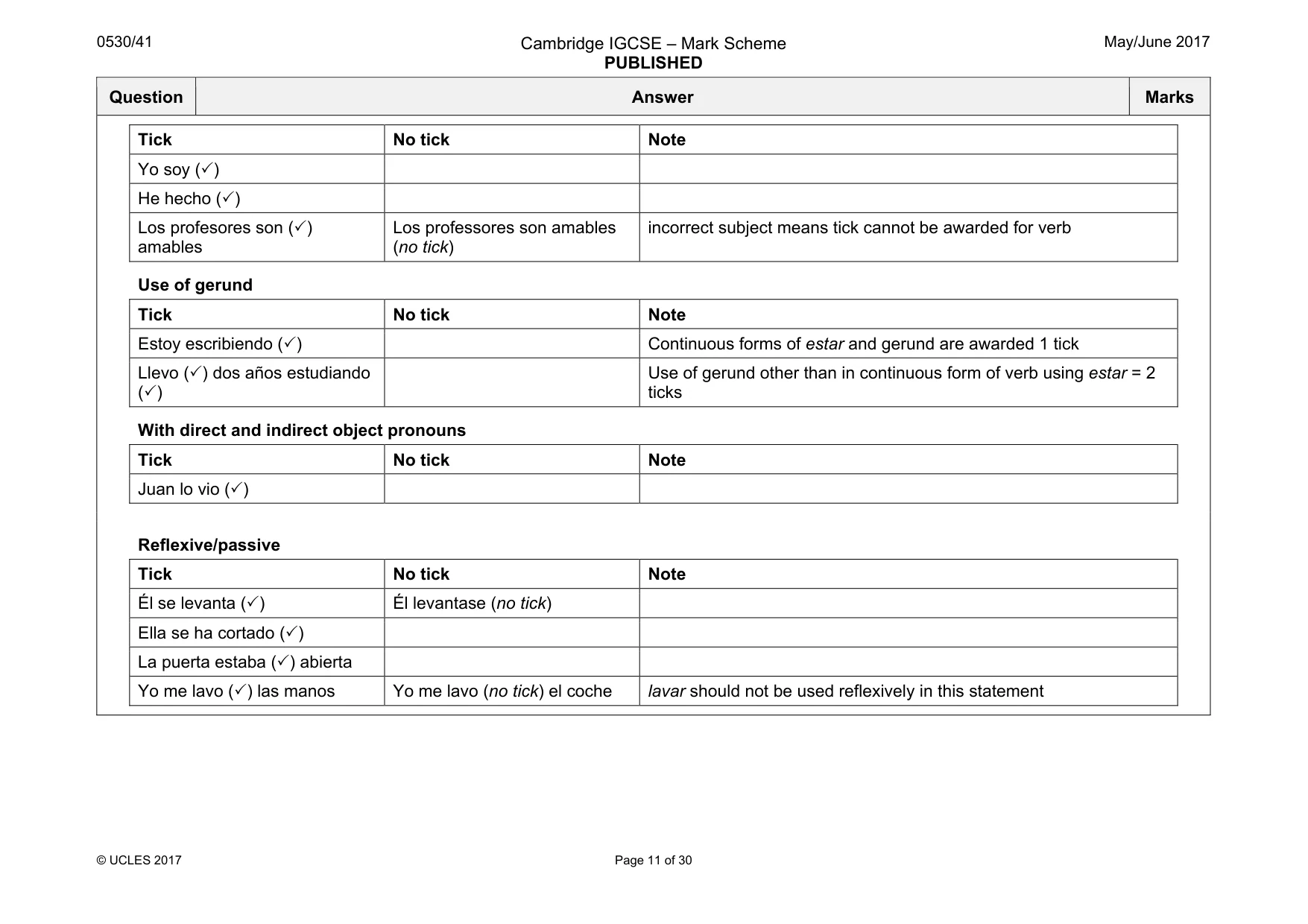
0530/41 Cambridge IGCSE – Mark Scheme PUBLISHED May/June 2017 © UCLES 2017 Page 11 of 30 Question Answer Marks Tick No tick Note Yo soy (3) He hecho (3) Los profesores son (3) amables Los professores son amables (no tick) incorrect subject means tick cannot be awarded for verb Use of gerund Tick No tick Note Estoy escribiendo (3) Continuous forms of estar and gerund are awarded 1 tick Llevo (3) dos años estudiando (3) Use of gerund other than in continuous form of verb using estar = 2 ticks With direct and indirect object pronouns Tick No tick Note Juan lo vio (3) Reflexive/passive Tick No tick Note Él se levanta (3) Él levantase (no tick) Ella se ha cortado (3) La puerta estaba (3) abierta Yo me lavo (3) las manos Yo me lavo (no tick) el coche lavar should not be used reflexively in this statement
Mark scheme, page 12
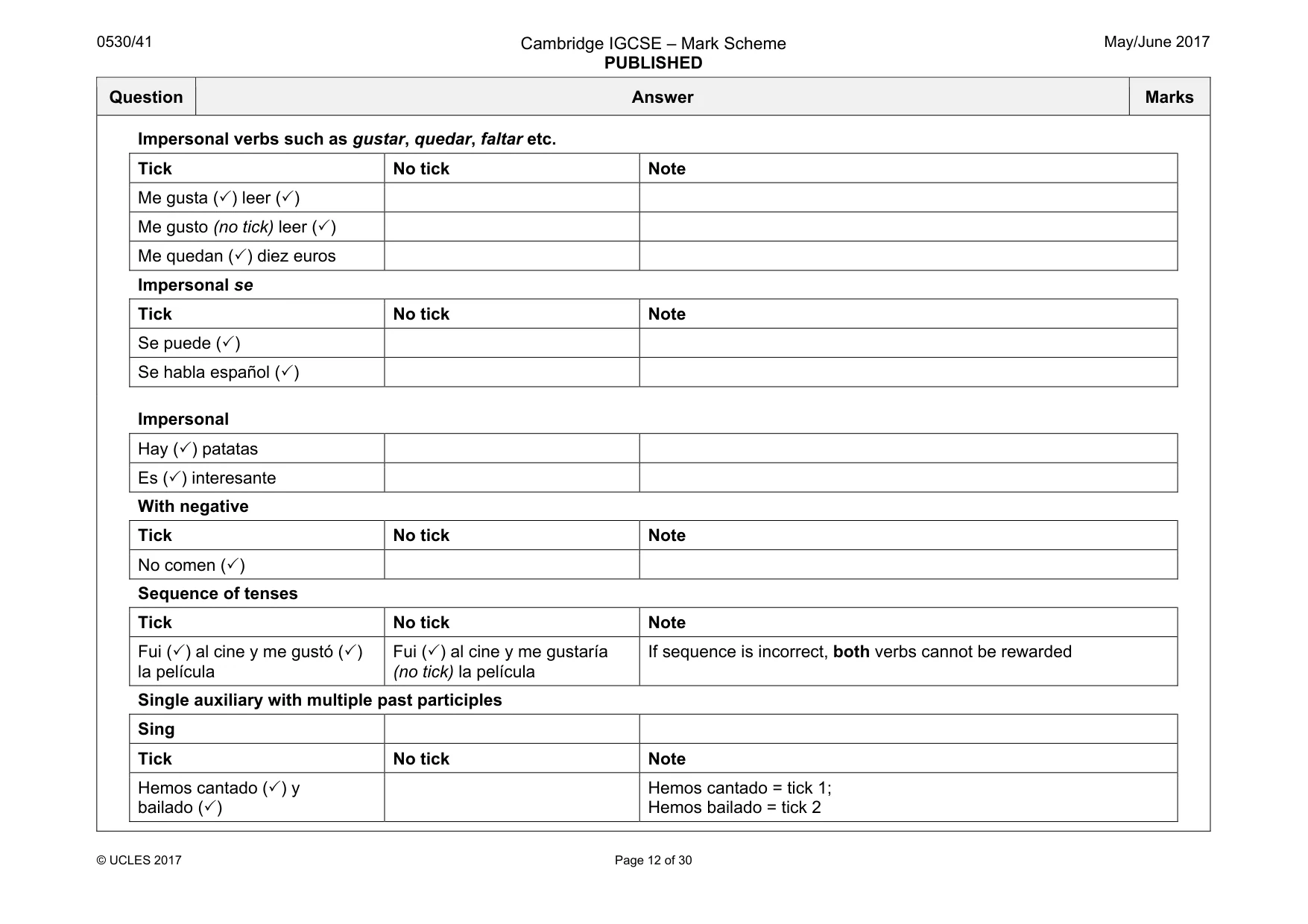
0530/41 Cambridge IGCSE – Mark Scheme PUBLISHED May/June 2017 © UCLES 2017 Page 12 of 30 Question Answer Marks Impersonal verbs such as gustar, quedar, faltar etc. Tick No tick Note Me gusta (3) leer (3) Me gusto (no tick) leer (3) Me quedan (3) diez euros Impersonal se Tick No tick Note Se puede (3) Se habla español (3) Impersonal Hay (3) patatas Es (3) interesante With negative Tick No tick Note No comen (3) Sequence of tenses Tick No tick Note Fui (3) al cine y me gustó (3) la película Fui (3) al cine y me gustaría (no tick) la película If sequence is incorrect, both verbs cannot be rewarded Single auxiliary with multiple past participles Sing Tick No tick Note Hemos cantado (3) y bailado (3) Hemos cantado = tick 1; Hemos bailado = tick 2
Mark scheme, page 13
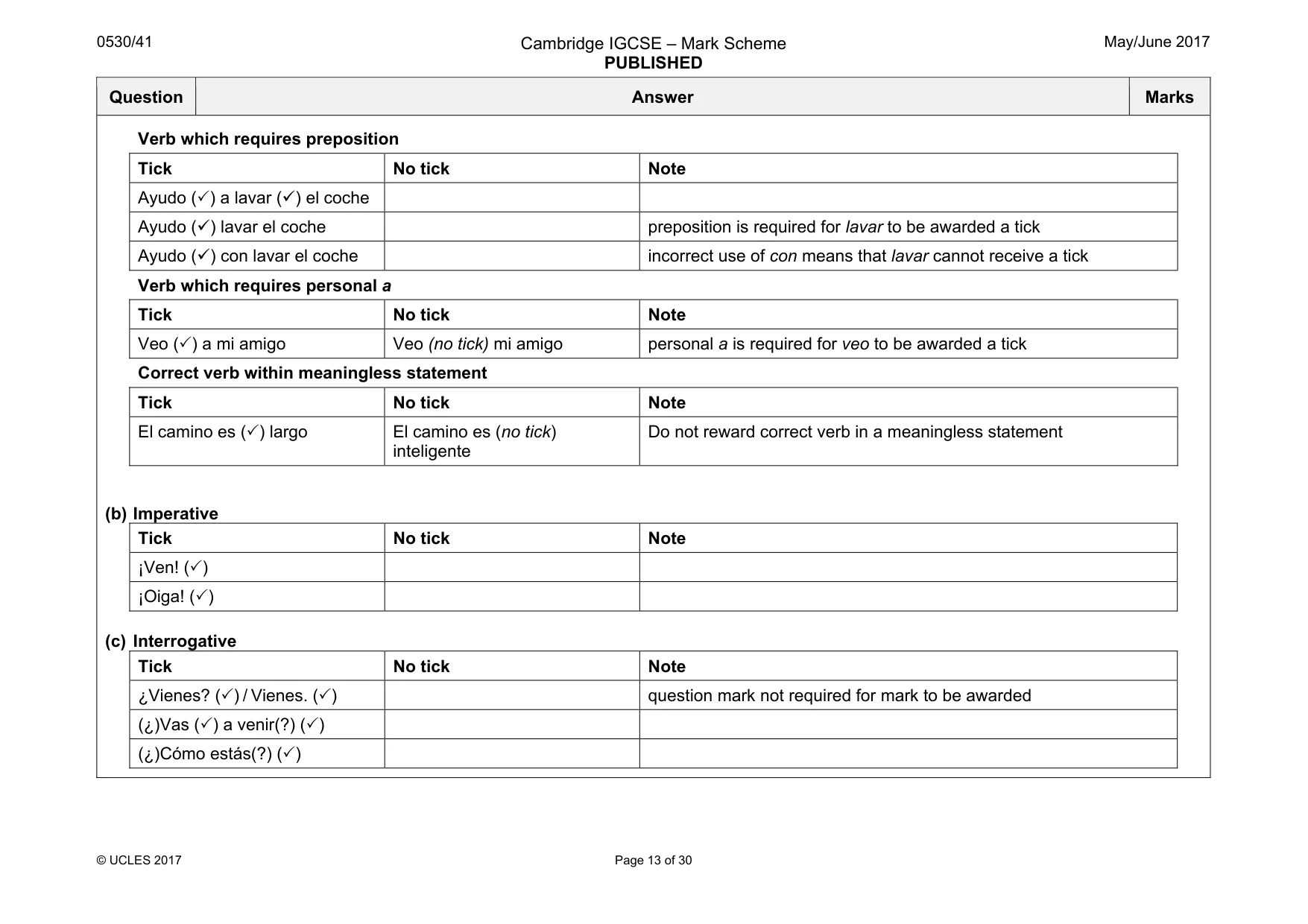
0530/41 Cambridge IGCSE – Mark Scheme PUBLISHED May/June 2017 © UCLES 2017 Page 13 of 30 Question Answer Marks Verb which requires preposition Tick No tick Note Ayudo (3) a lavar (9) el coche Ayudo (9) lavar el coche preposition is required for lavar to be awarded a tick Ayudo (9) con lavar el coche incorrect use of con means that lavar cannot receive a tick Verb which requires personal a Tick No tick Note Veo (3) a mi amigo Veo (no tick) mi amigo personal a is required for veo to be awarded a tick Correct verb within meaningless statement Tick No tick Note El camino es (3) largo El camino es (no tick) inteligente Do not reward correct verb in a meaningless statement (b) Imperative Tick No tick Note ¡Ven! (3) ¡Oiga! (3) (c) Interrogative Tick No tick Note ¿Vienes? (3) / Vienes. (3) question mark not required for mark to be awarded (¿)Vas (3) a venir(?) (3) (¿)Cómo estás(?) (3)
Mark scheme, page 14
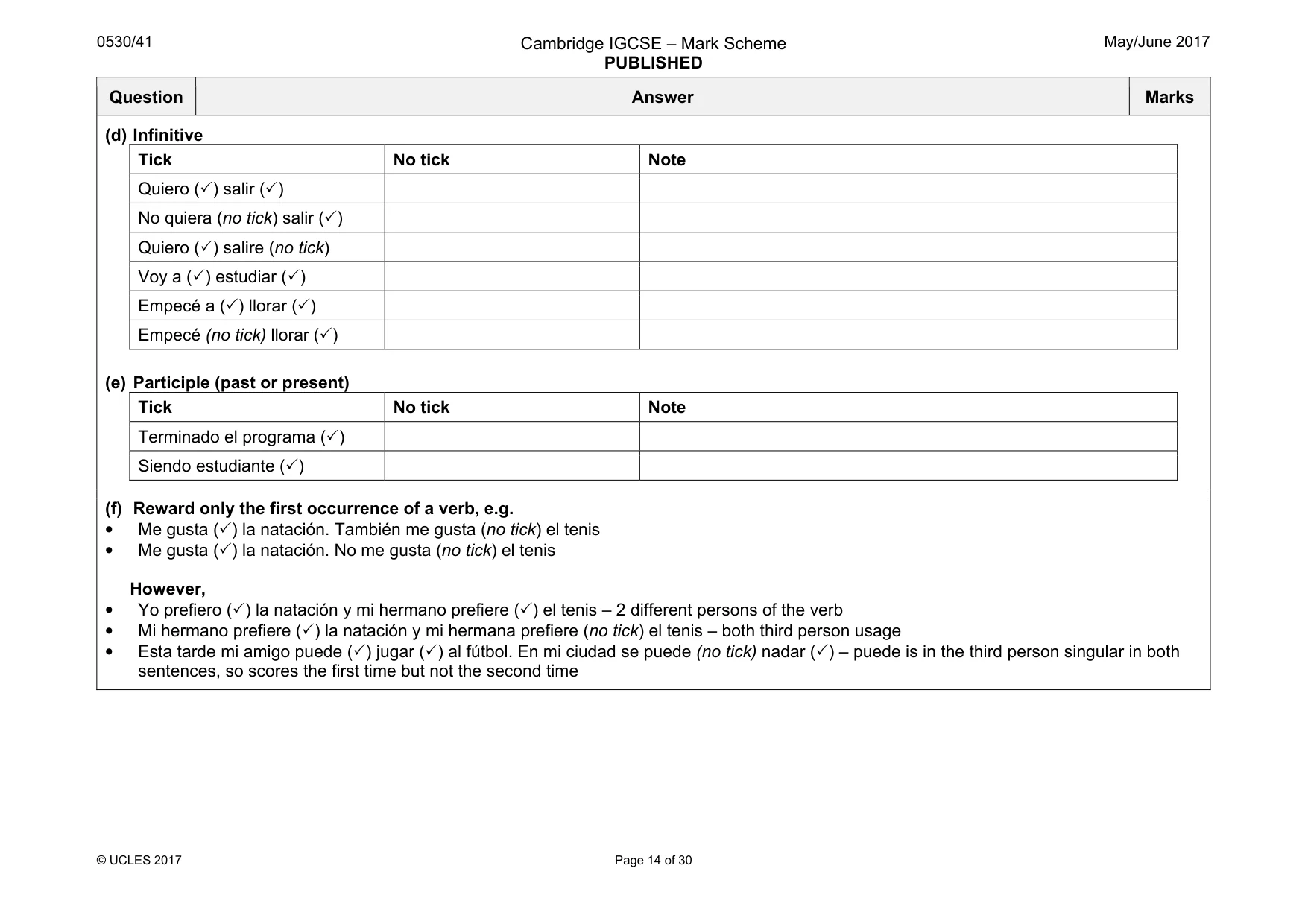
0530/41 Cambridge IGCSE – Mark Scheme PUBLISHED May/June 2017 © UCLES 2017 Page 14 of 30 Question Answer Marks (d) Infinitive Tick No tick Note Quiero (3) salir (3) No quiera (no tick) salir (3) Quiero (3) salire (no tick) Voy a (3) estudiar (3) Empecé a (3) llorar (3) Empecé (no tick) llorar (3) (e) Participle (past or present) Tick No tick Note Terminado el programa (3) Siendo estudiante (3) (f) Reward only the first occurrence of a verb, e.g. • Me gusta (3) la natación. También me gusta (no tick) el tenis • Me gusta (3) la natación. No me gusta (no tick) el tenis However, • Yo prefiero (3) la natación y mi hermano prefiere (3) el tenis – 2 different persons of the verb • Mi hermano prefiere (3) la natación y mi hermana prefiere (no tick) el tenis – both third person usage • Esta tarde mi amigo puede (3) jugar (3) al fútbol. En mi ciudad se puede (no tick) nadar (3) – puede is in the third person singular in both sentences, so scores the first time but not the second time
Mark scheme, page 15
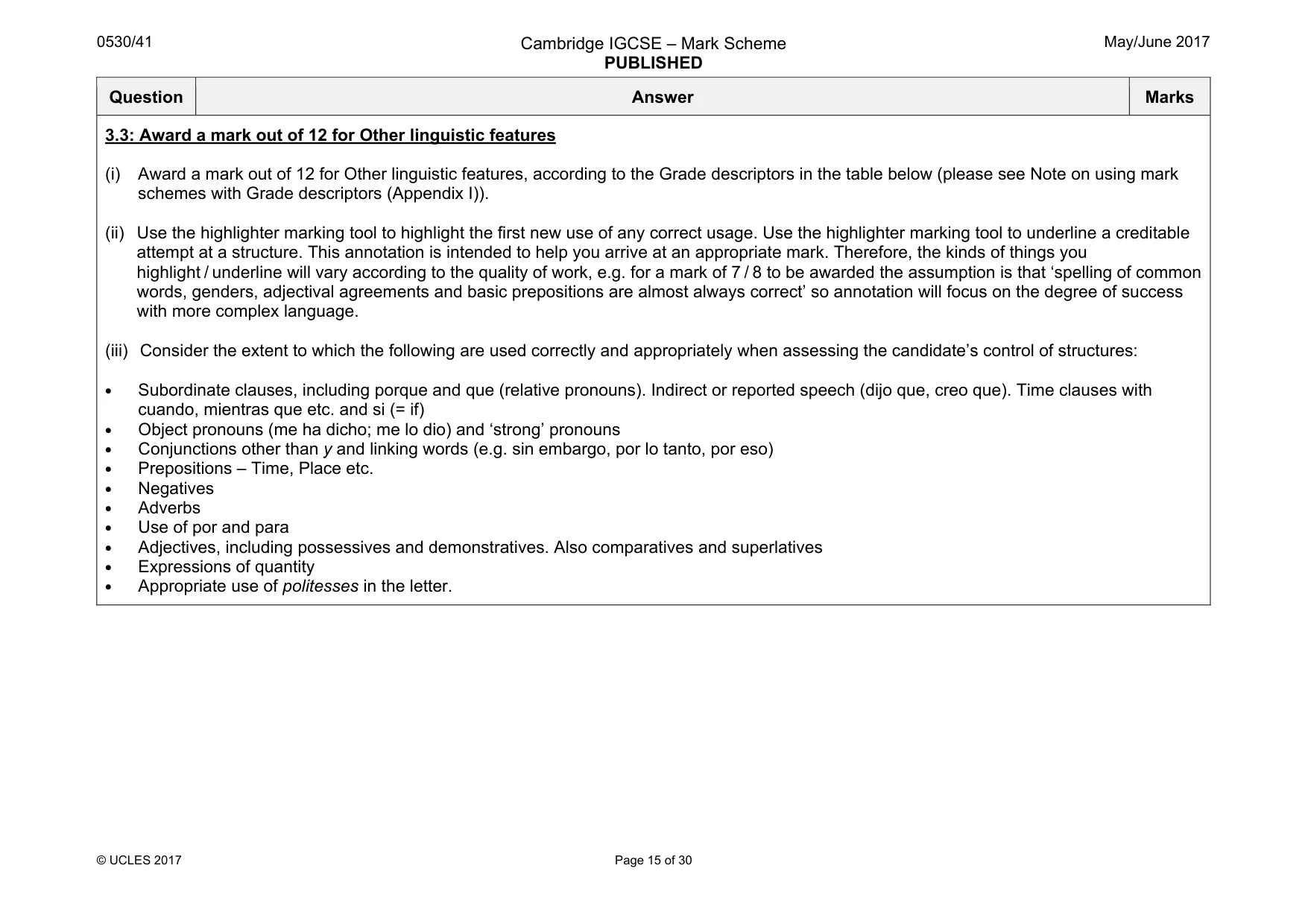
0530/41 Cambridge IGCSE – Mark Scheme PUBLISHED May/June 2017 © UCLES 2017 Page 15 of 30 Question Answer Marks 3.3: Award a mark out of 12 for Other linguistic features (i) Award a mark out of 12 for Other linguistic features, according to the Grade descriptors in the table below (please see Note on using mark schemes with Grade descriptors (Appendix I)). (ii) Use the highlighter marking tool to highlight the first new use of any correct usage. Use the highlighter marking tool to underline a creditable attempt at a structure. This annotation is intended to help you arrive at an appropriate mark. Therefore, the kinds of things you highlight / underline will vary according to the quality of work, e.g. for a mark of 7 / 8 to be awarded the assumption is that ‘spelling of common words, genders, adjectival agreements and basic prepositions are almost always correct’ so annotation will focus on the degree of success with more complex language. (iii) Consider the extent to which the following are used correctly and appropriately when assessing the candidate’s control of structures: • Subordinate clauses, including porque and que (relative pronouns). Indirect or reported speech (dijo que, creo que). Time clauses with cuando, mientras que etc. and si (= if) • Object pronouns (me ha dicho; me lo dio) and ‘strong’ pronouns • Conjunctions other than y and linking words (e.g. sin embargo, por lo tanto, por eso) • Prepositions – Time, Place etc. • Negatives • Adverbs • Use of por and para • Adjectives, including possessives and demonstratives. Also comparatives and superlatives • Expressions of quantity • Appropriate use of politesses in the letter.
Mark scheme, page 16
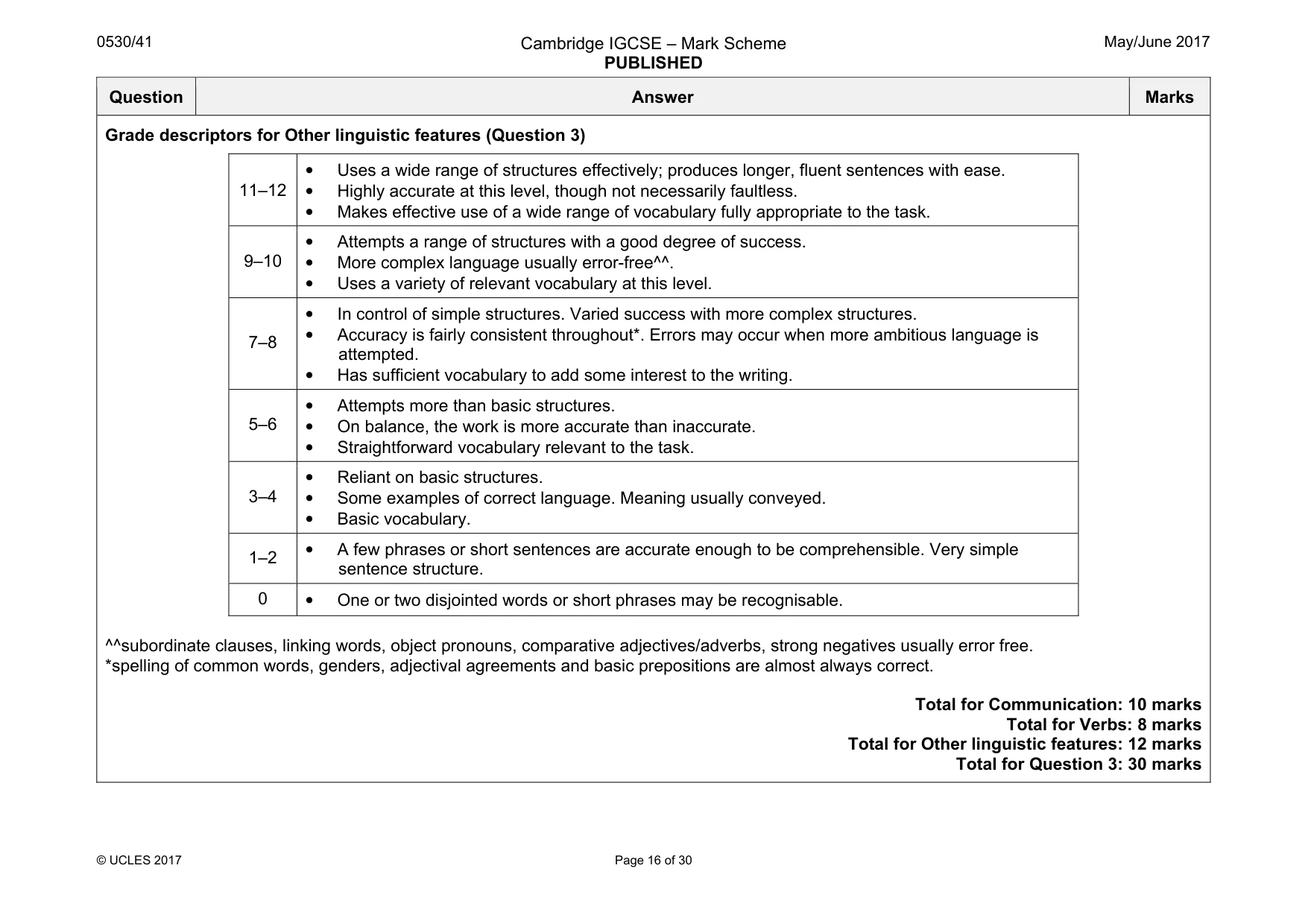
0530/41 Cambridge IGCSE – Mark Scheme PUBLISHED May/June 2017 © UCLES 2017 Page 16 of 30 Question Answer Marks Grade descriptors for Other linguistic features (Question 3) 11–12 • Uses a wide range of structures effectively; produces longer, fluent sentences with ease. • Highly accurate at this level, though not necessarily faultless. • Makes effective use of a wide range of vocabulary fully appropriate to the task. 9–10 • Attempts a range of structures with a good degree of success. • More complex language usually error-free^^. • Uses a variety of relevant vocabulary at this level. 7–8 • In control of simple structures. Varied success with more complex structures. • Accuracy is fairly consistent throughout*. Errors may occur when more ambitious language is attempted. • Has sufficient vocabulary to add some interest to the writing. 5–6 • Attempts more than basic structures. • On balance, the work is more accurate than inaccurate. • Straightforward vocabulary relevant to the task. 3–4 • Reliant on basic structures. • Some examples of correct language. Meaning usually conveyed. • Basic vocabulary. 1–2 • A few phrases or short sentences are accurate enough to be comprehensible. Very simple sentence structure. 0 • One or two disjointed words or short phrases may be recognisable. ^^subordinate clauses, linking words, object pronouns, comparative adjectives/adverbs, strong negatives usually error free. *spelling of common words, genders, adjectival agreements and basic prepositions are almost always correct. Total for Communication: 10 marks Total for Verbs: 8 marks Total for Other linguistic features: 12 marks Total for Question 3: 30 marks
Mark scheme, page 17
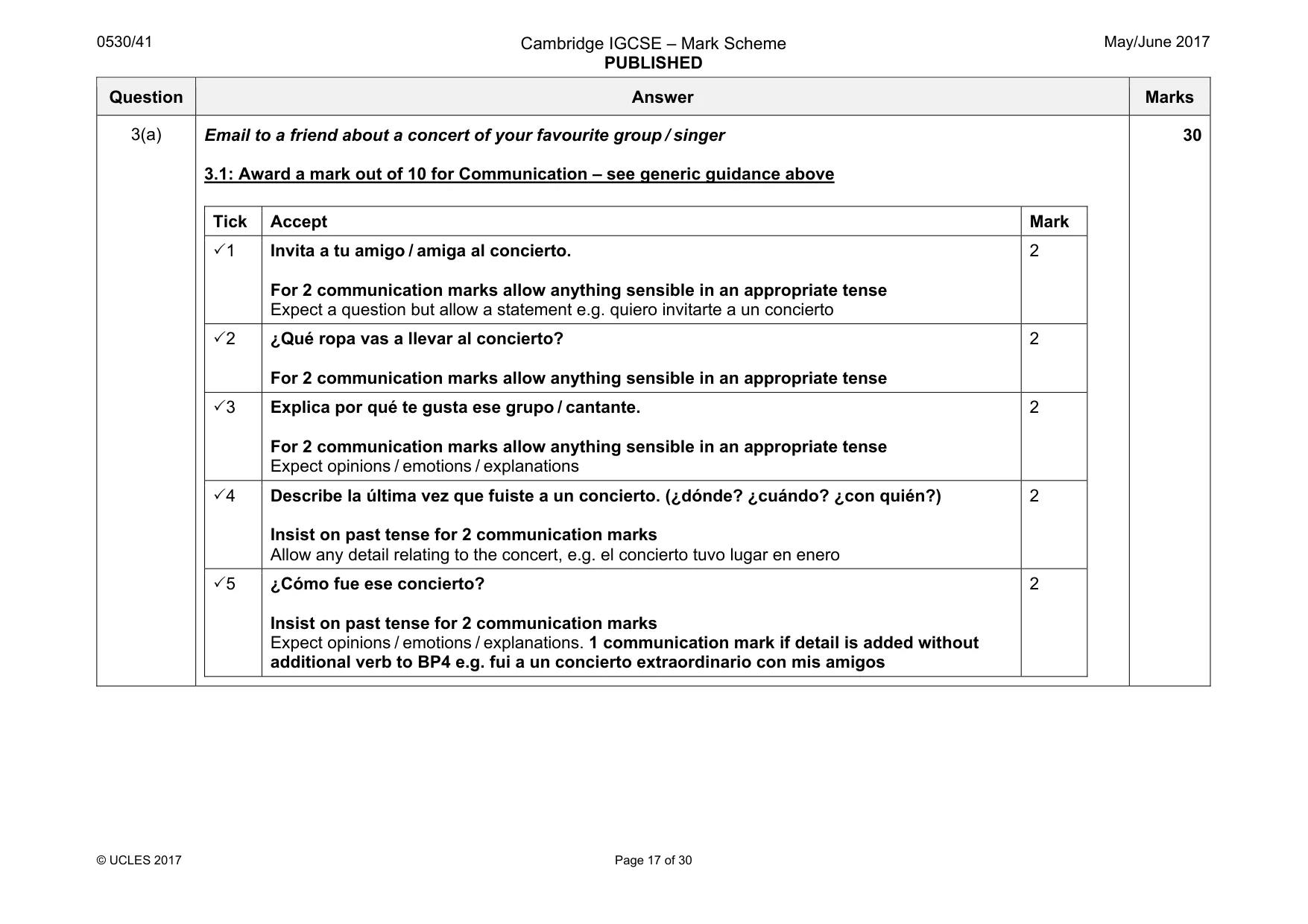
0530/41 Cambridge IGCSE – Mark Scheme PUBLISHED May/June 2017 © UCLES 2017 Page 17 of 30 Question Answer Marks 3(a) Email to a friend about a concert of your favourite group / singer 3.1: Award a mark out of 10 for Communication – see generic guidance above Tick Accept Mark 31 Invita a tu amigo / amiga al concierto. For 2 communication marks allow anything sensible in an appropriate tense Expect a question but allow a statement e.g. quiero invitarte a un concierto 2 32 ¿Qué ropa vas a llevar al concierto? For 2 communication marks allow anything sensible in an appropriate tense 2 33 Explica por qué te gusta ese grupo / cantante. For 2 communication marks allow anything sensible in an appropriate tense Expect opinions / emotions / explanations 2 34 Describe la última vez que fuiste a un concierto. (¿dónde? ¿cuándo? ¿con quién?) Insist on past tense for 2 communication marks Allow any detail relating to the concert, e.g. el concierto tuvo lugar en enero 2 35 ¿Cómo fue ese concierto? Insist on past tense for 2 communication marks Expect opinions / emotions / explanations. 1 communication mark if detail is added without additional verb to BP4 e.g. fui a un concierto extraordinario con mis amigos 2 30
Mark scheme, page 18
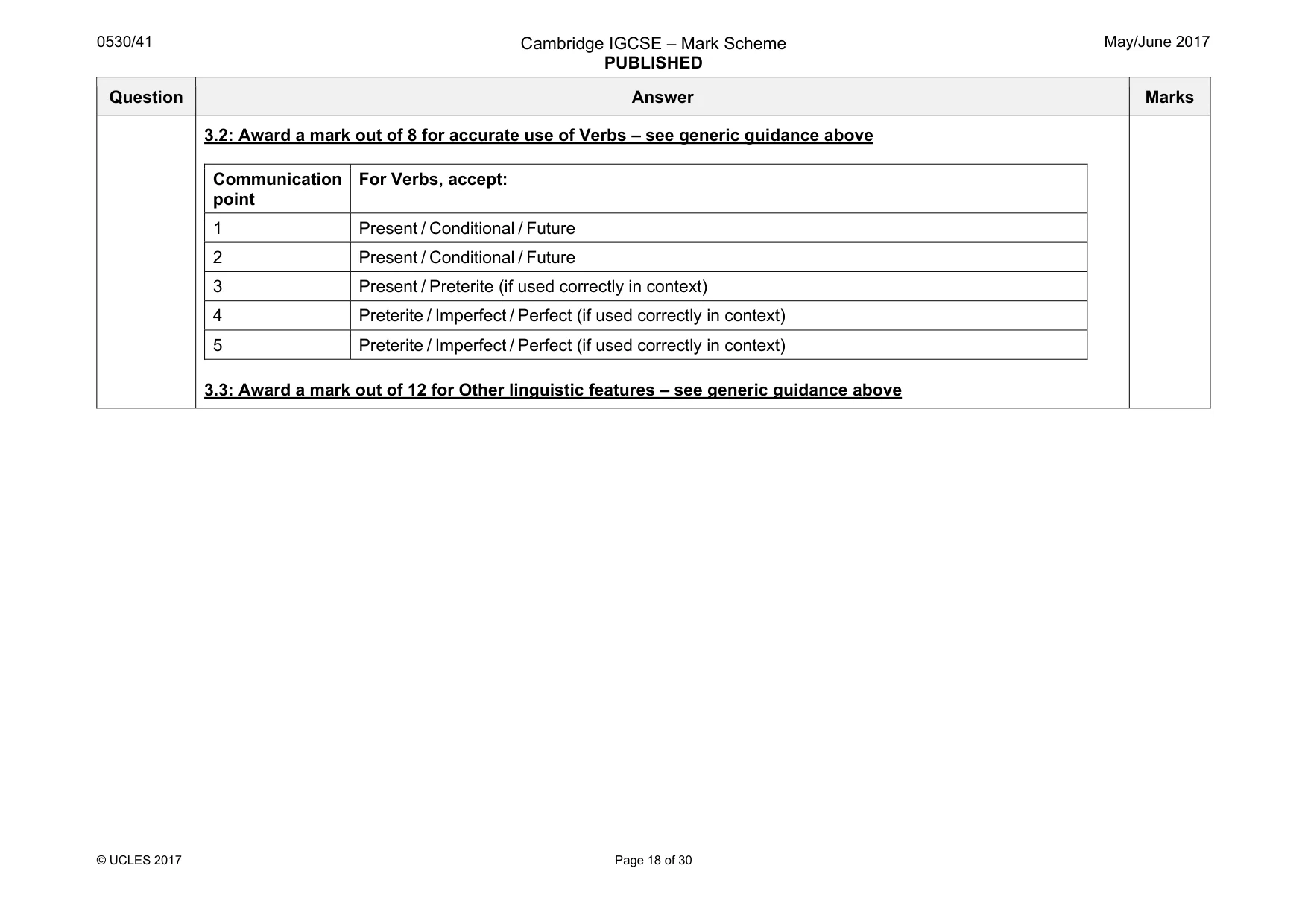
0530/41 Cambridge IGCSE – Mark Scheme PUBLISHED May/June 2017 © UCLES 2017 Page 18 of 30 Question Answer Marks 3.2: Award a mark out of 8 for accurate use of Verbs – see generic guidance above Communication point For Verbs, accept: 1 Present / Conditional / Future 2 Present / Conditional / Future 3 Present / Preterite (if used correctly in context) 4 Preterite / Imperfect / Perfect (if used correctly in context) 5 Preterite / Imperfect / Perfect (if used correctly in context) 3.3: Award a mark out of 12 for Other linguistic features – see generic guidance above
Mark scheme, page 19
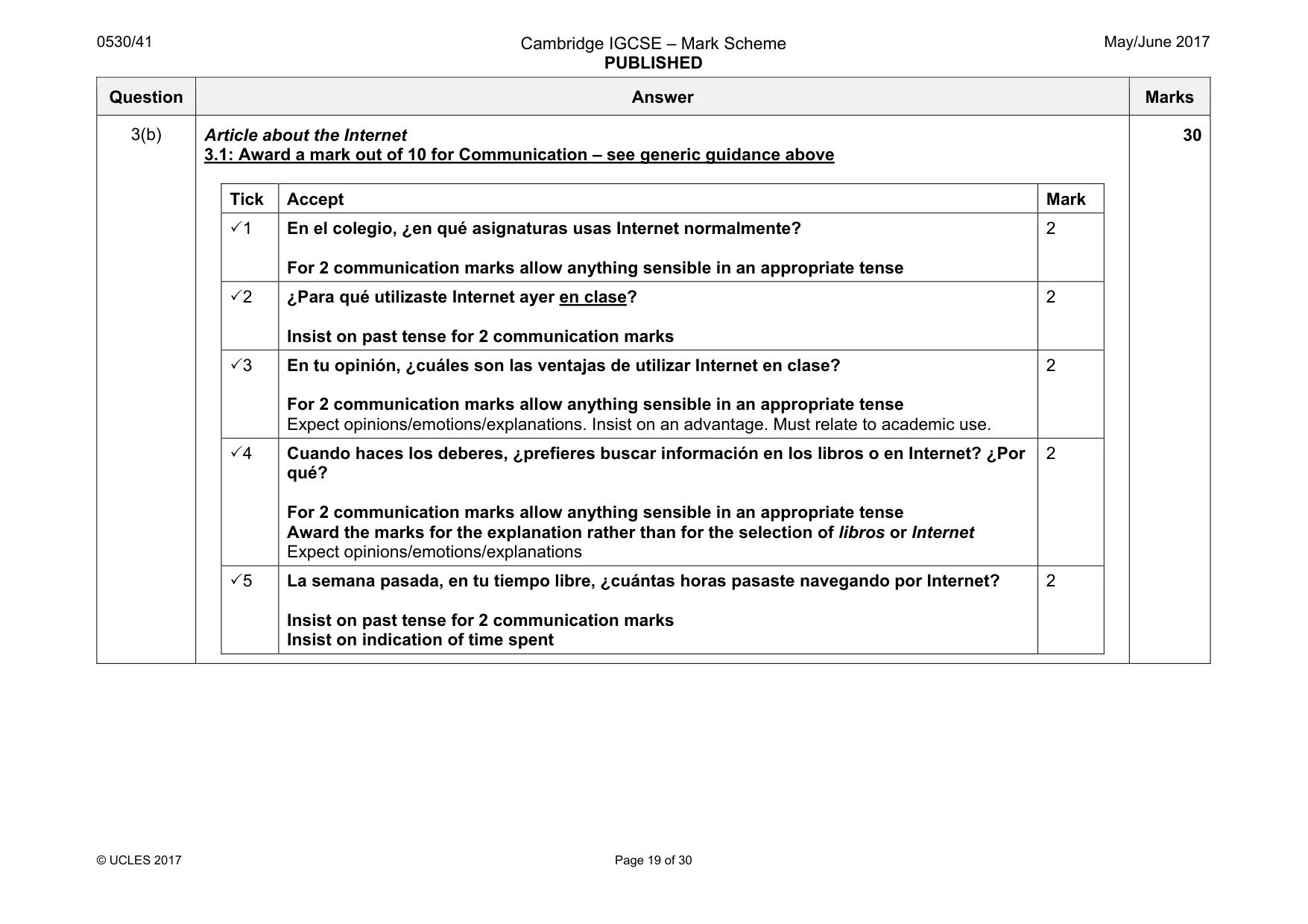
0530/41 Cambridge IGCSE – Mark Scheme PUBLISHED May/June 2017 © UCLES 2017 Page 19 of 30 Question Answer Marks 3(b) Article about the Internet 3.1: Award a mark out of 10 for Communication – see generic guidance above Tick Accept Mark 31 En el colegio, ¿en qué asignaturas usas Internet normalmente? For 2 communication marks allow anything sensible in an appropriate tense 2 32 ¿Para qué utilizaste Internet ayer en clase? Insist on past tense for 2 communication marks 2 33 En tu opinión, ¿cuáles son las ventajas de utilizar Internet en clase? For 2 communication marks allow anything sensible in an appropriate tense Expect opinions/emotions/explanations. Insist on an advantage. Must relate to academic use. 2 34 Cuando haces los deberes, ¿prefieres buscar información en los libros o en Internet? ¿Por qué? For 2 communication marks allow anything sensible in an appropriate tense Award the marks for the explanation rather than for the selection of libros or Internet Expect opinions/emotions/explanations 2 35 La semana pasada, en tu tiempo libre, ¿cuántas horas pasaste navegando por Internet? Insist on past tense for 2 communication marks Insist on indication of time spent 2 30
Mark scheme, page 20
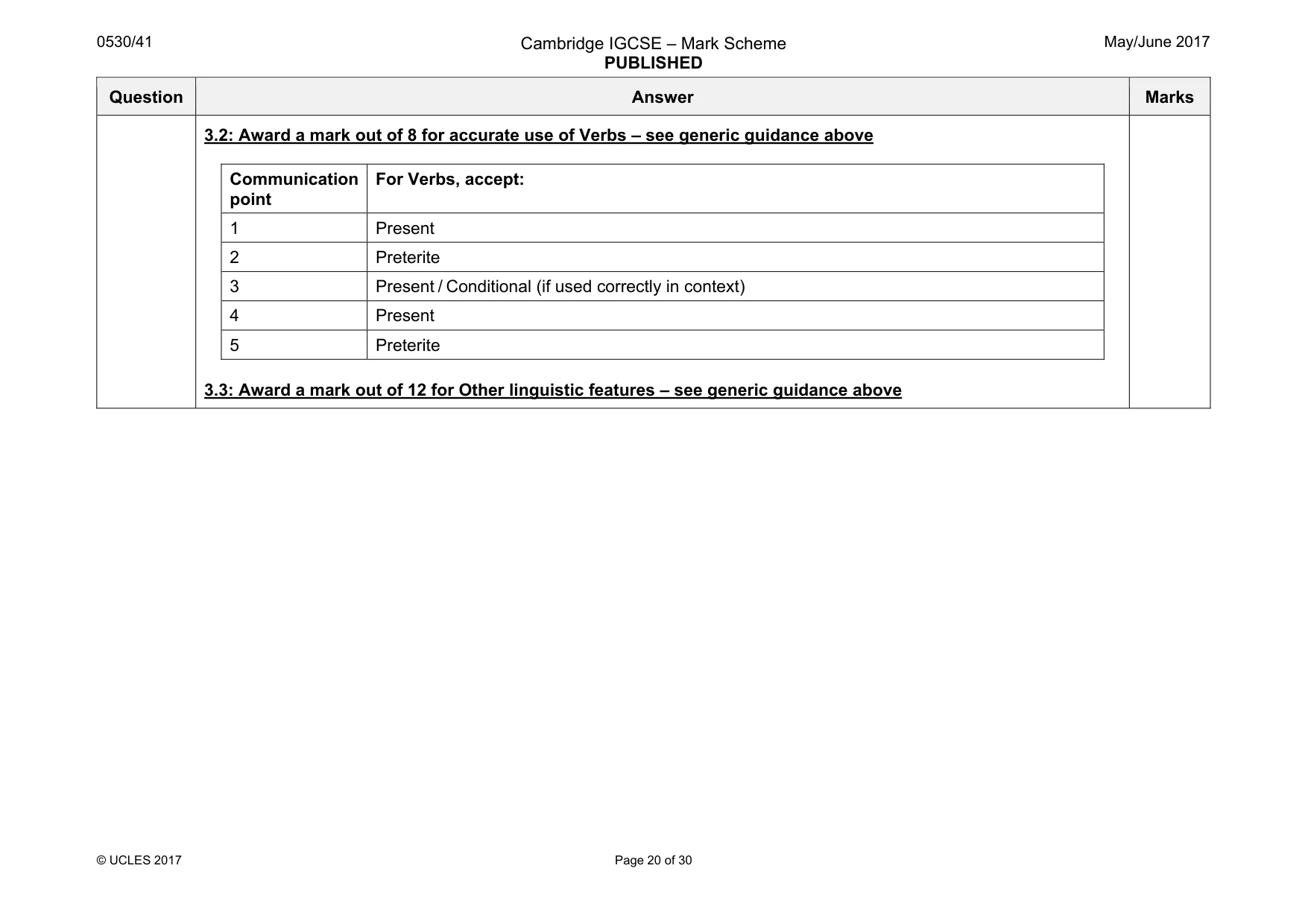
0530/41 Cambridge IGCSE – Mark Scheme PUBLISHED May/June 2017 © UCLES 2017 Page 20 of 30 Question Answer Marks 3.2: Award a mark out of 8 for accurate use of Verbs – see generic guidance above Communication point For Verbs, accept: 1 Present 2 Preterite 3 Present / Conditional (if used correctly in context) 4 Present 5 Preterite 3.3: Award a mark out of 12 for Other linguistic features – see generic guidance above
Mark scheme, page 21
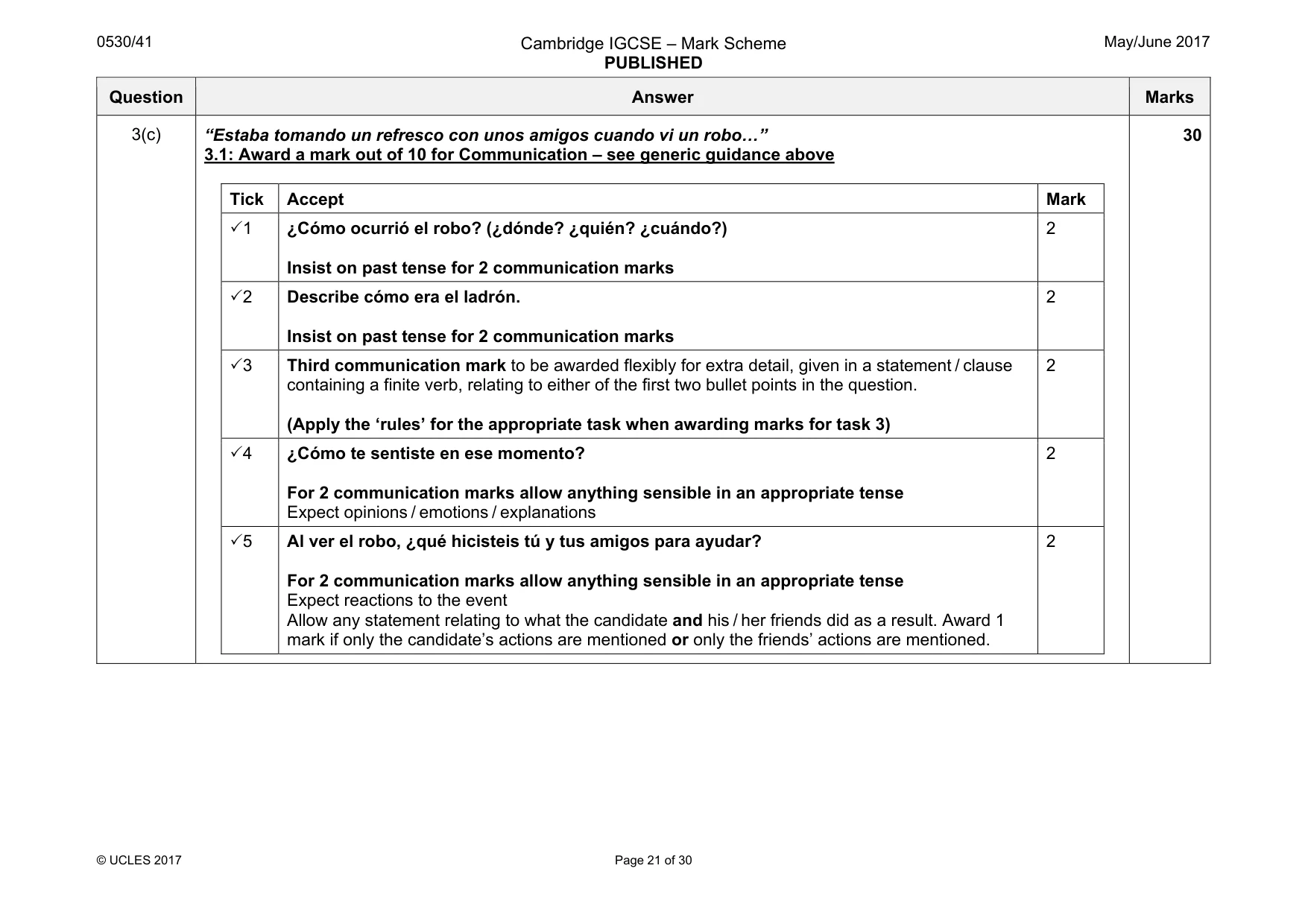
0530/41 Cambridge IGCSE – Mark Scheme PUBLISHED May/June 2017 © UCLES 2017 Page 21 of 30 Question Answer Marks 3(c) “Estaba tomando un refresco con unos amigos cuando vi un robo«” 3.1: Award a mark out of 10 for Communication – see generic guidance above Tick Accept Mark 31 ¿Cómo ocurrió el robo? (¿dónde? ¿quién? ¿cuándo?) Insist on past tense for 2 communication marks 2 32 Describe cómo era el ladrón. Insist on past tense for 2 communication marks 2 33 Third communication mark to be awarded flexibly for extra detail, given in a statement / clause containing a finite verb, relating to either of the first two bullet points in the question. (Apply the ‘rules’ for the appropriate task when awarding marks for task 3) 2 34 ¿Cómo te sentiste en ese momento? For 2 communication marks allow anything sensible in an appropriate tense Expect opinions / emotions / explanations 2 35 Al ver el robo, ¿qué hicisteis tú y tus amigos para ayudar? For 2 communication marks allow anything sensible in an appropriate tense Expect reactions to the event Allow any statement relating to what the candidate and his / her friends did as a result. Award 1 mark if only the candidate’s actions are mentioned or only the friends’ actions are mentioned. 2 30
Mark scheme, page 22
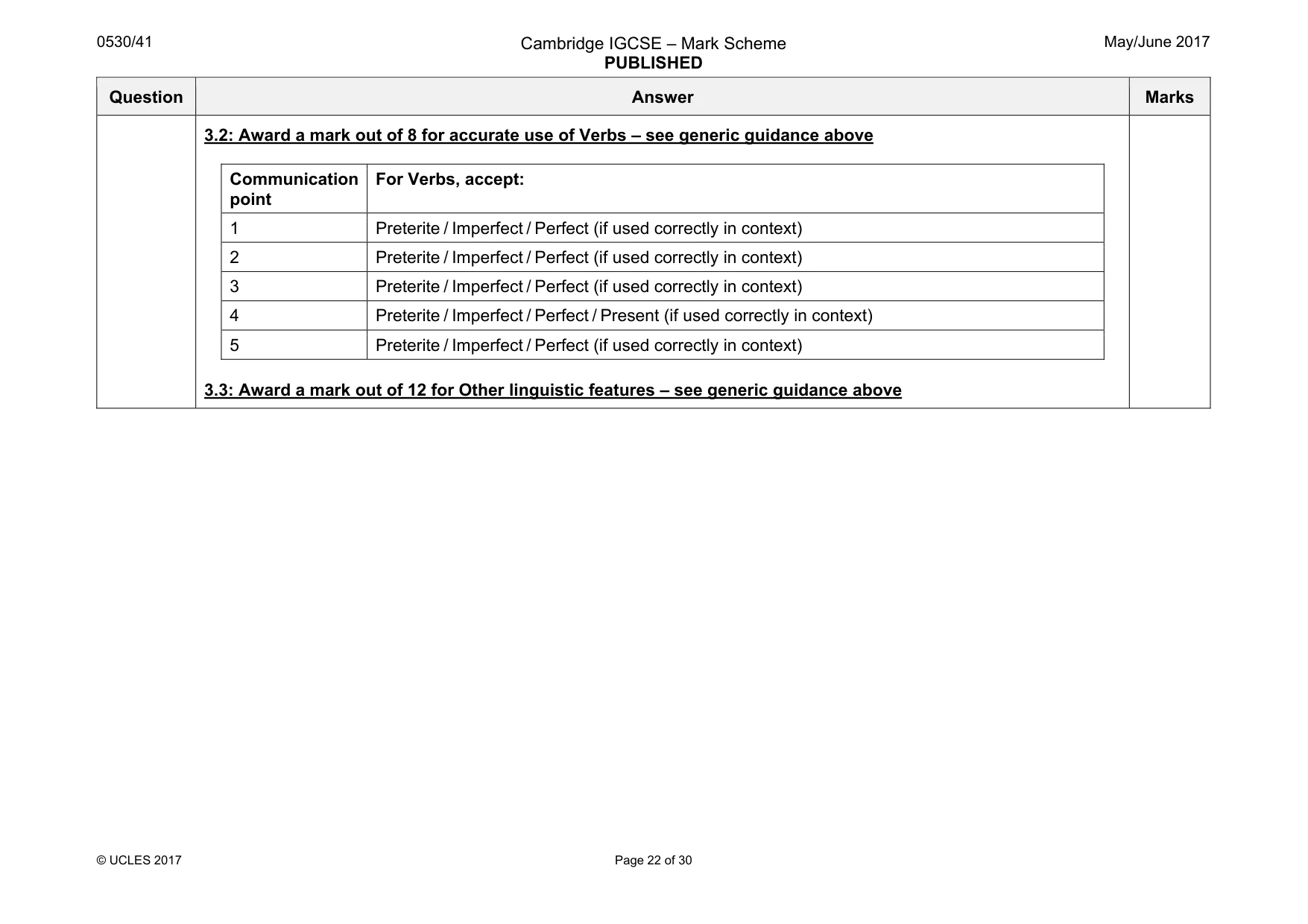
0530/41 Cambridge IGCSE – Mark Scheme PUBLISHED May/June 2017 © UCLES 2017 Page 22 of 30 Question Answer Marks 3.2: Award a mark out of 8 for accurate use of Verbs – see generic guidance above Communication point For Verbs, accept: 1 Preterite / Imperfect / Perfect (if used correctly in context) 2 Preterite / Imperfect / Perfect (if used correctly in context) 3 Preterite / Imperfect / Perfect (if used correctly in context) 4 Preterite / Imperfect / Perfect / Present (if used correctly in context) 5 Preterite / Imperfect / Perfect (if used correctly in context) 3.3: Award a mark out of 12 for Other linguistic features – see generic guidance above
Mark scheme, page 23
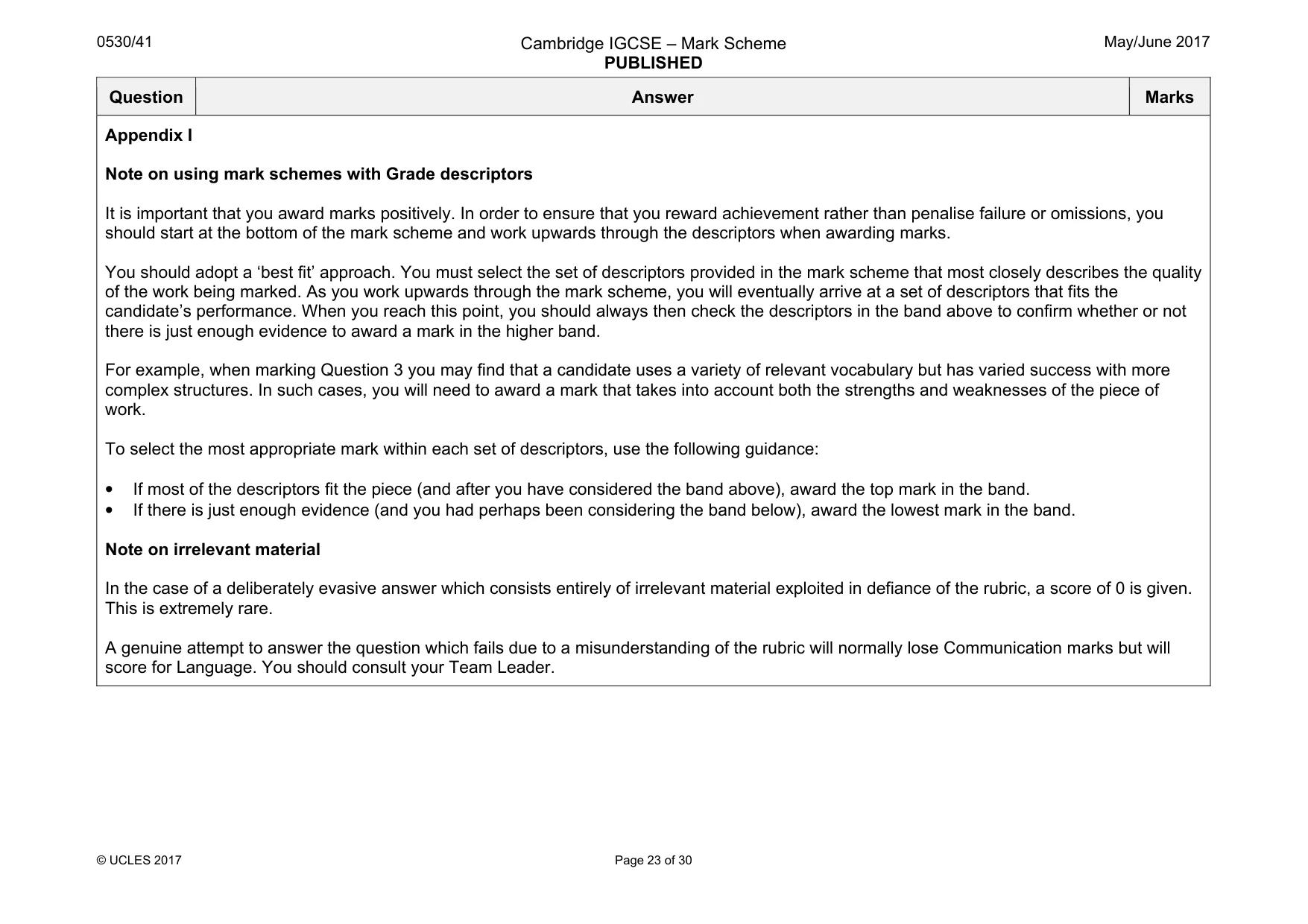
0530/41 Cambridge IGCSE – Mark Scheme PUBLISHED May/June 2017 © UCLES 2017 Page 23 of 30 Question Answer Marks Appendix I Note on using mark schemes with Grade descriptors It is important that you award marks positively. In order to ensure that you reward achievement rather than penalise failure or omissions, you should start at the bottom of the mark scheme and work upwards through the descriptors when awarding marks. You should adopt a ‘best fit’ approach. You must select the set of descriptors provided in the mark scheme that most closely describes the quality of the work being marked. As you work upwards through the mark scheme, you will eventually arrive at a set of descriptors that fits the candidate’s performance. When you reach this point, you should always then check the descriptors in the band above to confirm whether or not there is just enough evidence to award a mark in the higher band. For example, when marking Question 3 you may find that a candidate uses a variety of relevant vocabulary but has varied success with more complex structures. In such cases, you will need to award a mark that takes into account both the strengths and weaknesses of the piece of work. To select the most appropriate mark within each set of descriptors, use the following guidance: • If most of the descriptors fit the piece (and after you have considered the band above), award the top mark in the band. • If there is just enough evidence (and you had perhaps been considering the band below), award the lowest mark in the band. Note on irrelevant material In the case of a deliberately evasive answer which consists entirely of irrelevant material exploited in defiance of the rubric, a score of 0 is given. This is extremely rare. A genuine attempt to answer the question which fails due to a misunderstanding of the rubric will normally lose Communication marks but will score for Language. You should consult your Team Leader.
Mark scheme, page 24
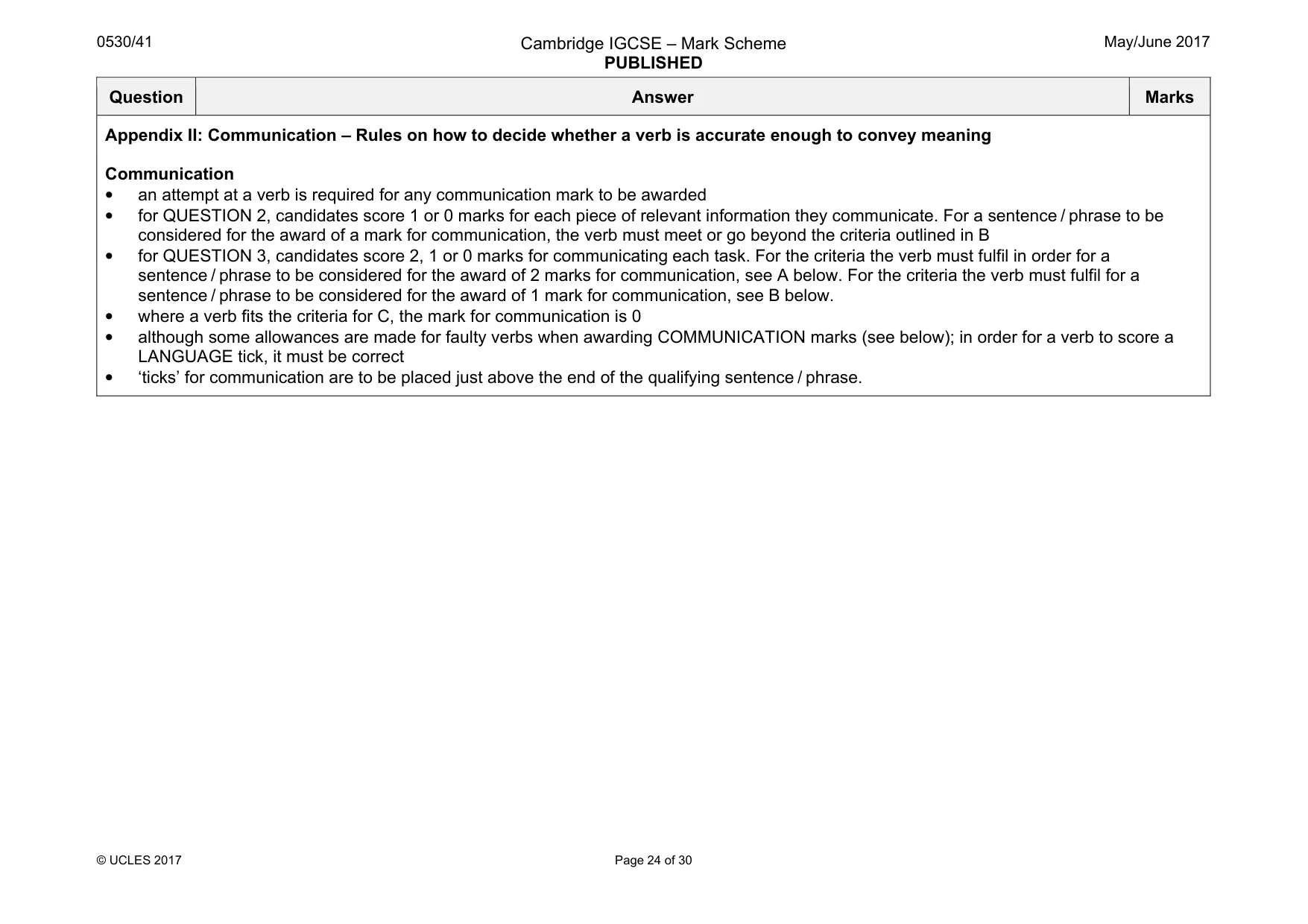
0530/41 Cambridge IGCSE – Mark Scheme PUBLISHED May/June 2017 © UCLES 2017 Page 24 of 30 Question Answer Marks Appendix II: Communication – Rules on how to decide whether a verb is accurate enough to convey meaning Communication • an attempt at a verb is required for any communication mark to be awarded • for QUESTION 2, candidates score 1 or 0 marks for each piece of relevant information they communicate. For a sentence / phrase to be considered for the award of a mark for communication, the verb must meet or go beyond the criteria outlined in B • for QUESTION 3, candidates score 2, 1 or 0 marks for communicating each task. For the criteria the verb must fulfil in order for a sentence / phrase to be considered for the award of 2 marks for communication, see A below. For the criteria the verb must fulfil for a sentence / phrase to be considered for the award of 1 mark for communication, see B below. • where a verb fits the criteria for C, the mark for communication is 0 • although some allowances are made for faulty verbs when awarding COMMUNICATION marks (see below); in order for a verb to score a LANGUAGE tick, it must be correct • ‘ticks’ for communication are to be placed just above the end of the qualifying sentence / phrase.
Mark scheme, page 25
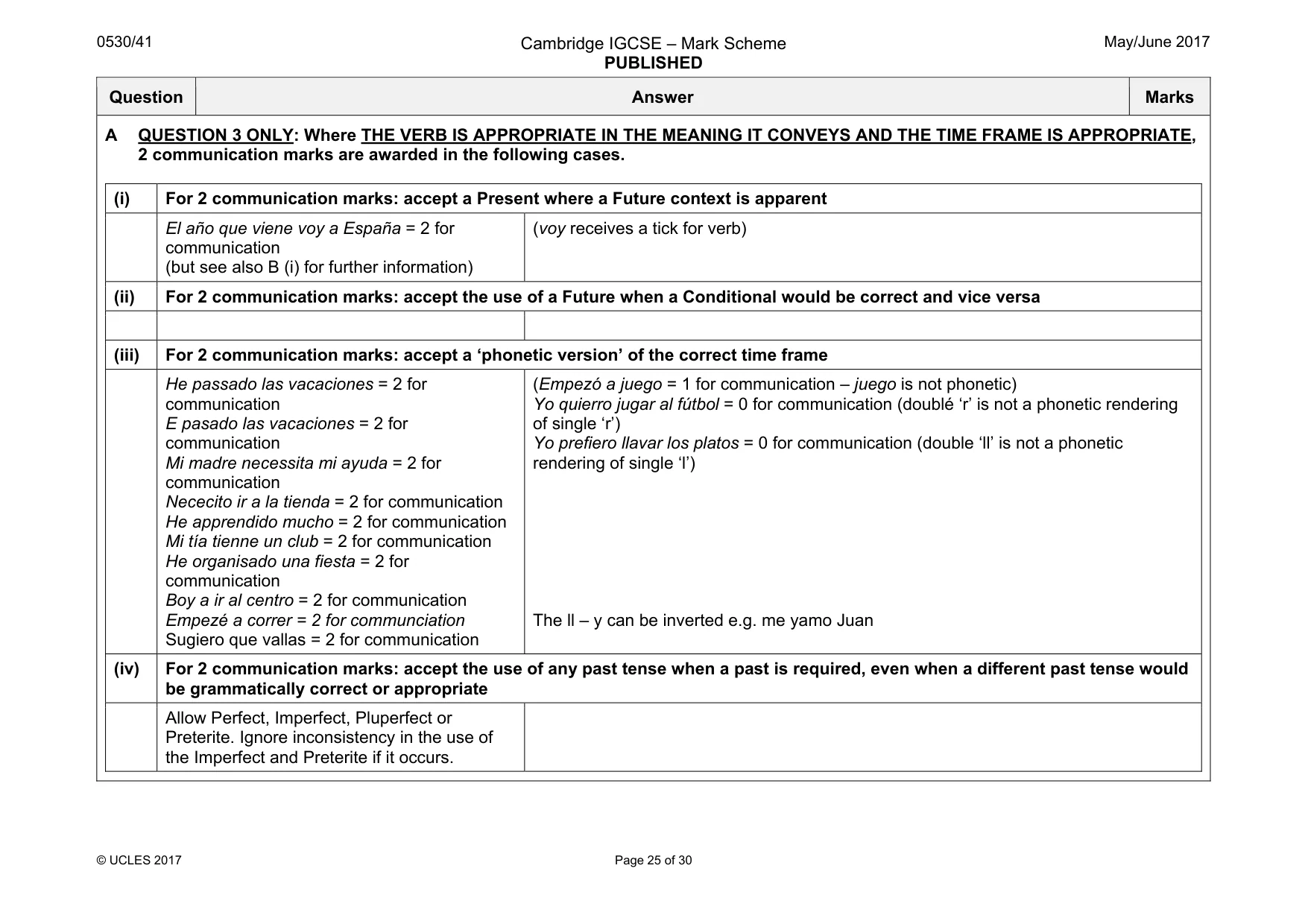
0530/41 Cambridge IGCSE – Mark Scheme PUBLISHED May/June 2017 © UCLES 2017 Page 25 of 30 Question Answer Marks A QUESTION 3 ONLY: Where THE VERB IS APPROPRIATE IN THE MEANING IT CONVEYS AND THE TIME FRAME IS APPROPRIATE, 2 communication marks are awarded in the following cases. (i) For 2 communication marks: accept a Present where a Future context is apparent El año que viene voy a España = 2 for communication (but see also B (i) for further information) (voy receives a tick for verb) (ii) For 2 communication marks: accept the use of a Future when a Conditional would be correct and vice versa (iii) For 2 communication marks: accept a ‘phonetic version’ of the correct time frame He passado las vacaciones = 2 for communication E pasado las vacaciones = 2 for communication Mi madre necessita mi ayuda = 2 for communication Nececito ir a la tienda = 2 for communication He apprendido mucho = 2 for communication Mi tía tienne un club = 2 for communication He organisado una fiesta = 2 for communication Boy a ir al centro = 2 for communication Empezé a correr = 2 for communciation Sugiero que vallas = 2 for communication (Empezó a juego = 1 for communication – juego is not phonetic) Yo quierro jugar al fútbol = 0 for communication (doublé ‘r’ is not a phonetic rendering of single ‘r’) Yo prefiero llavar los platos = 0 for communication (double ‘ll’ is not a phonetic rendering of single ‘l’) The ll – y can be inverted e.g. me yamo Juan (iv) For 2 communication marks: accept the use of any past tense when a past is required, even when a different past tense would be grammatically correct or appropriate Allow Perfect, Imperfect, Pluperfect or Preterite. Ignore inconsistency in the use of the Imperfect and Preterite if it occurs.
Mark scheme, page 26
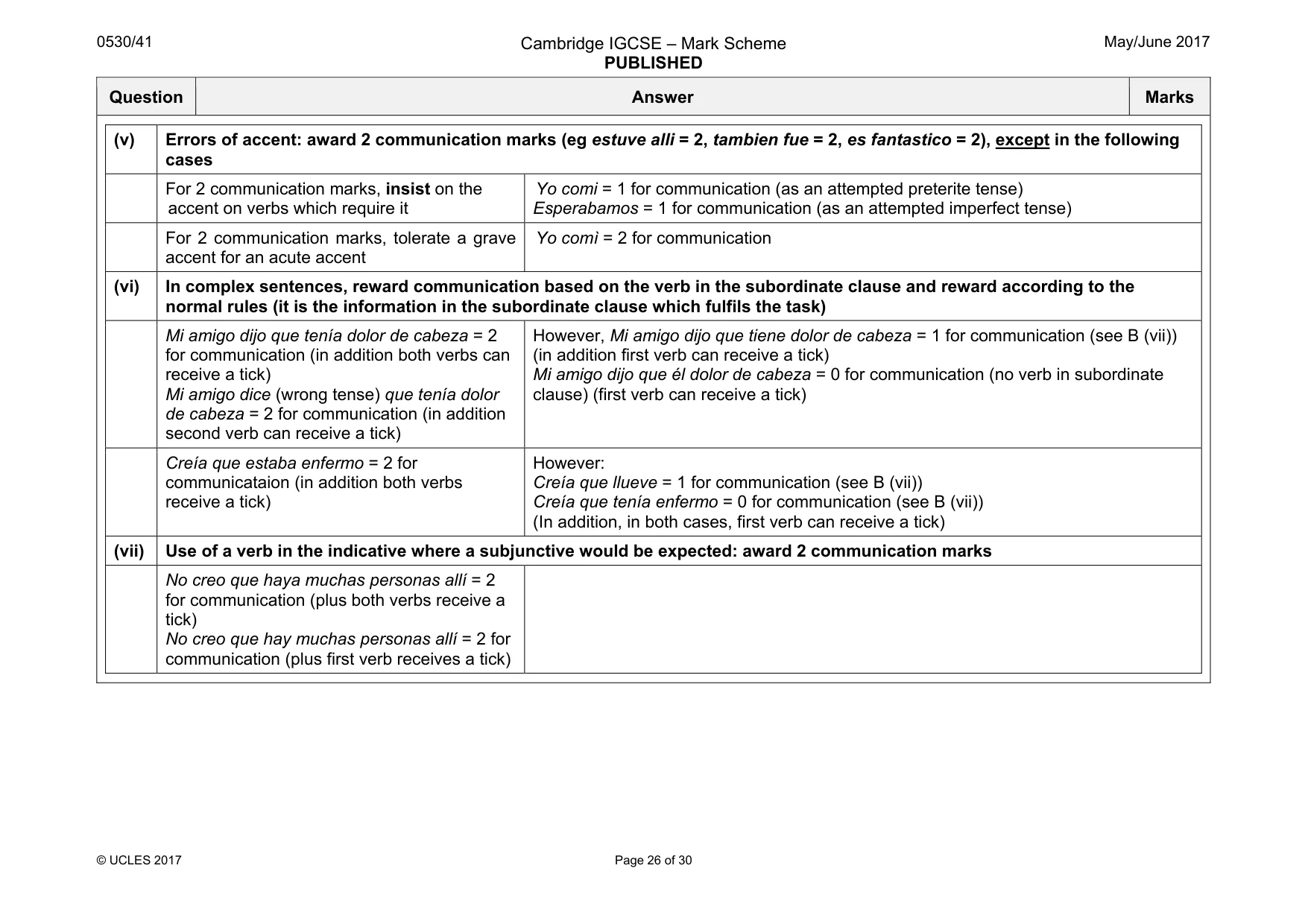
0530/41 Cambridge IGCSE – Mark Scheme PUBLISHED May/June 2017 © UCLES 2017 Page 26 of 30 Question Answer Marks (v) Errors of accent: award 2 communication marks (eg estuve alli = 2, tambien fue = 2, es fantastico = 2), except in the following cases For 2 communication marks, insist on the accent on verbs which require it Yo comi = 1 for communication (as an attempted preterite tense) Esperabamos = 1 for communication (as an attempted imperfect tense) For 2 communication marks, tolerate a grave accent for an acute accent Yo comì = 2 for communication (vi) In complex sentences, reward communication based on the verb in the subordinate clause and reward according to the normal rules (it is the information in the subordinate clause which fulfils the task) Mi amigo dijo que tenía dolor de cabeza = 2 for communication (in addition both verbs can receive a tick) Mi amigo dice (wrong tense) que tenía dolor de cabeza = 2 for communication (in addition second verb can receive a tick) However, Mi amigo dijo que tiene dolor de cabeza = 1 for communication (see B (vii)) (in addition first verb can receive a tick) Mi amigo dijo que él dolor de cabeza = 0 for communication (no verb in subordinate clause) (first verb can receive a tick) Creía que estaba enfermo = 2 for communicataion (in addition both verbs receive a tick) However: Creía que llueve = 1 for communication (see B (vii)) Creía que tenía enfermo = 0 for communication (see B (vii)) (In addition, in both cases, first verb can receive a tick) (vii) Use of a verb in the indicative where a subjunctive would be expected: award 2 communication marks No creo que haya muchas personas allí = 2 for communication (plus both verbs receive a tick) No creo que hay muchas personas allí = 2 for communication (plus first verb receives a tick)
Mark scheme, page 27
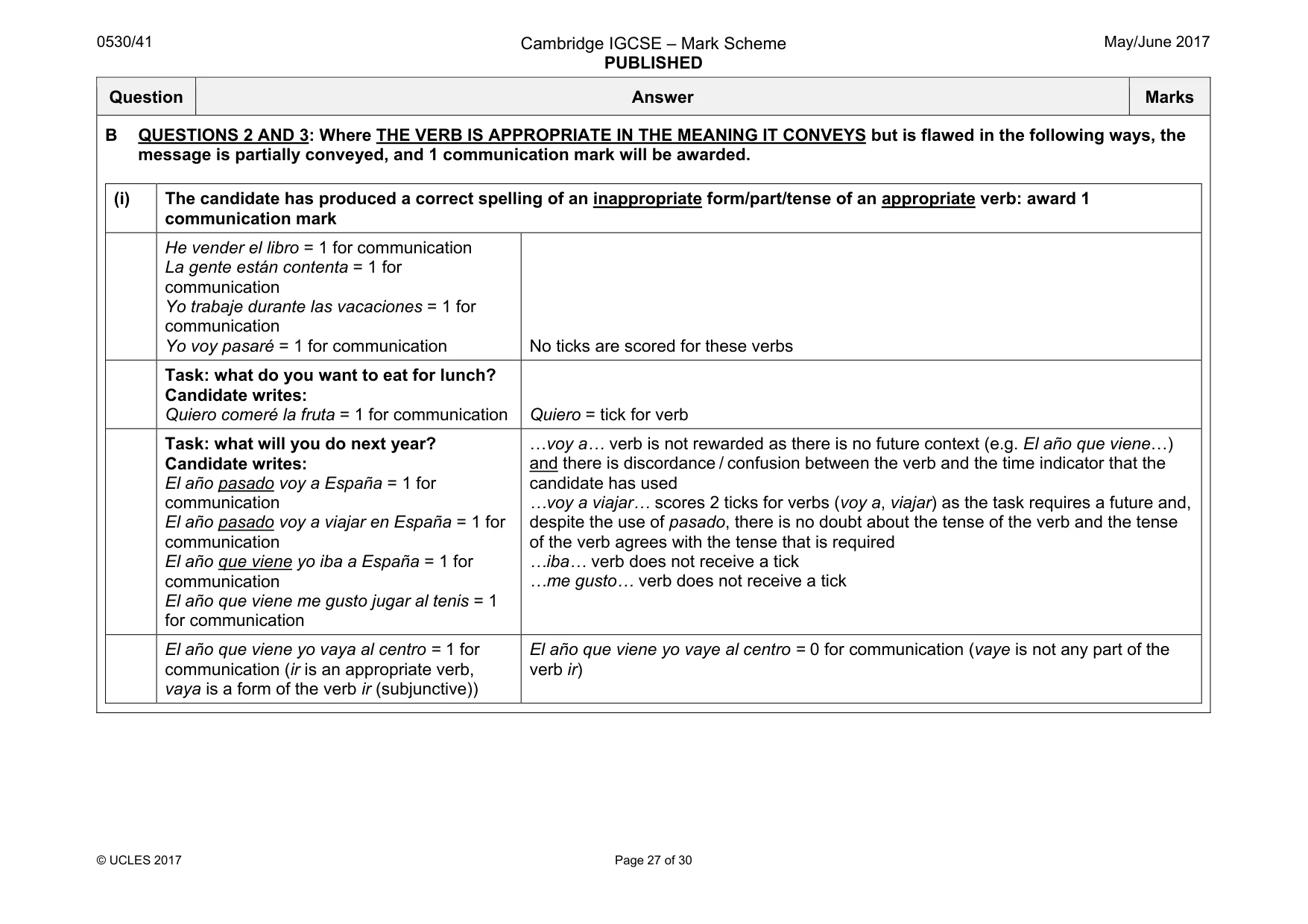
0530/41 Cambridge IGCSE – Mark Scheme PUBLISHED May/June 2017 © UCLES 2017 Page 27 of 30 Question Answer Marks B QUESTIONS 2 AND 3: Where THE VERB IS APPROPRIATE IN THE MEANING IT CONVEYS but is flawed in the following ways, the message is partially conveyed, and 1 communication mark will be awarded. (i) The candidate has produced a correct spelling of an inappropriate form/part/tense of an appropriate verb: award 1 communication mark He vender el libro = 1 for communication La gente están contenta = 1 for communication Yo trabaje durante las vacaciones = 1 for communication Yo voy pasaré = 1 for communication No ticks are scored for these verbs Task: what do you want to eat for lunch? Candidate writes: Quiero comeré la fruta = 1 for communication Quiero = tick for verb Task: what will you do next year? Candidate writes: El año pasado voy a España = 1 for communication El año pasado voy a viajar en España = 1 for communication El año que viene yo iba a España = 1 for communication El año que viene me gusto jugar al tenis = 1 for communication «voy a« verb is not rewarded as there is no future context (e.g. El año que viene«) and there is discordance / confusion between the verb and the time indicator that the candidate has used «voy a viajar« scores 2 ticks for verbs (voy a, viajar) as the task requires a future and, despite the use of pasado, there is no doubt about the tense of the verb and the tense of the verb agrees with the tense that is required «iba« verb does not receive a tick «me gusto« verb does not receive a tick El año que viene yo vaya al centro = 1 for communication (ir is an appropriate verb, vaya is a form of the verb ir (subjunctive)) El año que viene yo vaye al centro = 0 for communication (vaye is not any part of the verb ir)
Mark scheme, page 28
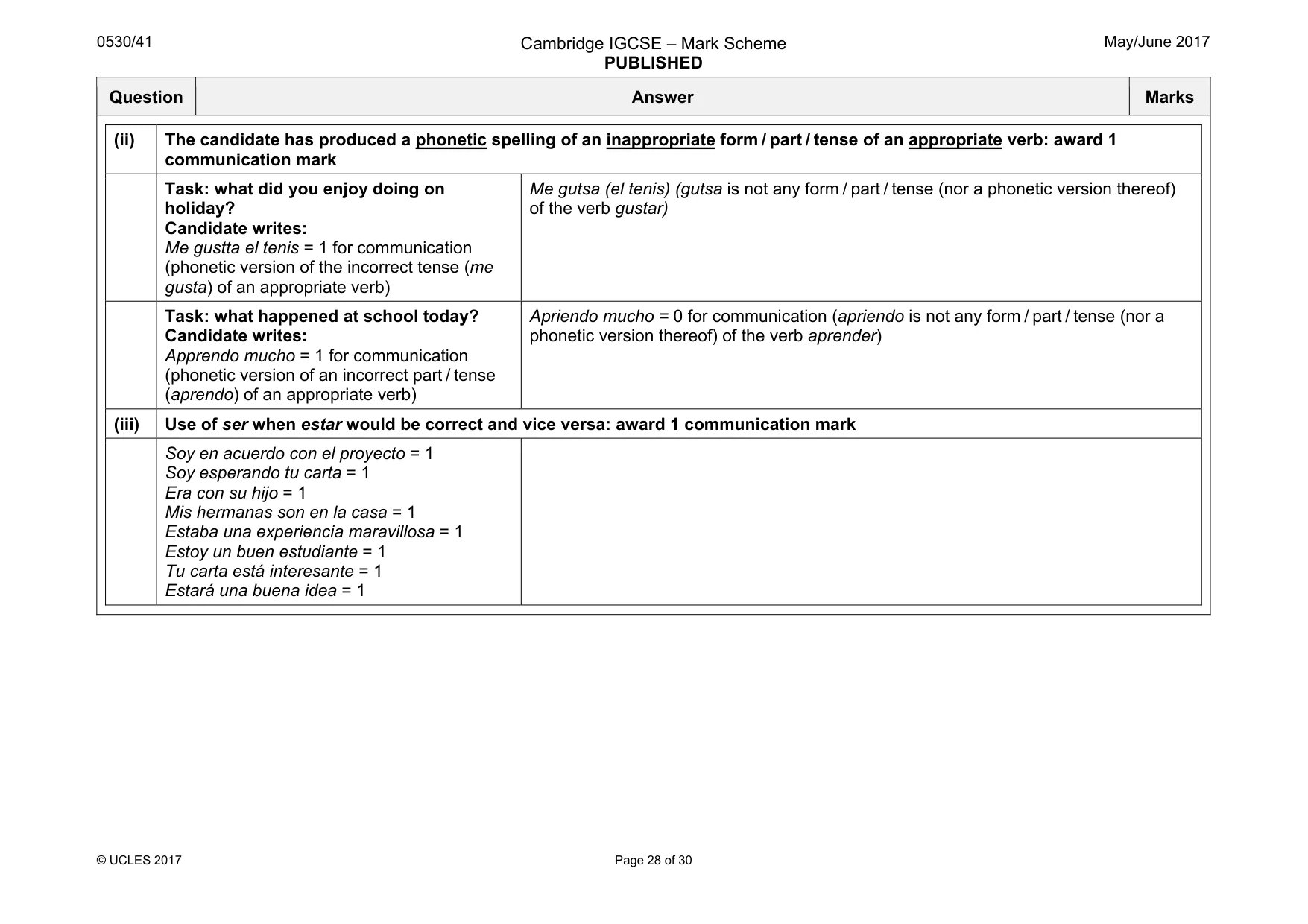
0530/41 Cambridge IGCSE – Mark Scheme PUBLISHED May/June 2017 © UCLES 2017 Page 28 of 30 Question Answer Marks (ii) The candidate has produced a phonetic spelling of an inappropriate form / part / tense of an appropriate verb: award 1 communication mark Task: what did you enjoy doing on holiday? Candidate writes: Me gustta el tenis = 1 for communication (phonetic version of the incorrect tense (me gusta) of an appropriate verb) Me gutsa (el tenis) (gutsa is not any form / part / tense (nor a phonetic version thereof) of the verb gustar) Task: what happened at school today? Candidate writes: Apprendo mucho = 1 for communication (phonetic version of an incorrect part / tense (aprendo) of an appropriate verb) Apriendo mucho = 0 for communication (apriendo is not any form / part / tense (nor a phonetic version thereof) of the verb aprender) (iii) Use of ser when estar would be correct and vice versa: award 1 communication mark Soy en acuerdo con el proyecto = 1 Soy esperando tu carta = 1 Era con su hijo = 1 Mis hermanas son en la casa = 1 Estaba una experiencia maravillosa = 1 Estoy un buen estudiante = 1 Tu carta está interesante = 1 Estará una buena idea = 1
Mark scheme, page 29
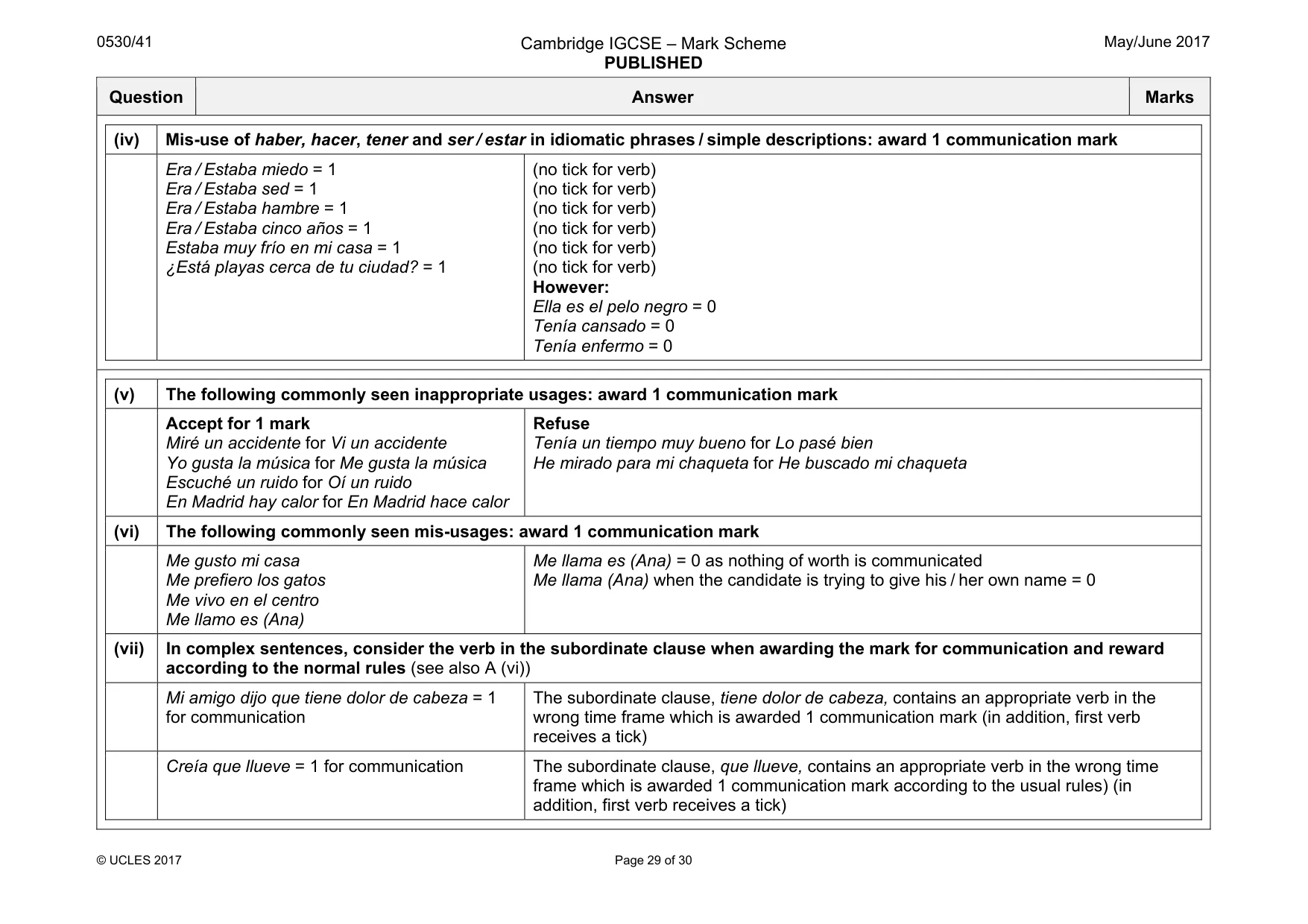
0530/41 Cambridge IGCSE – Mark Scheme PUBLISHED May/June 2017 © UCLES 2017 Page 29 of 30 Question Answer Marks (iv) Mis-use of haber, hacer, tener and ser / estar in idiomatic phrases / simple descriptions: award 1 communication mark Era / Estaba miedo = 1 Era / Estaba sed = 1 Era / Estaba hambre = 1 Era / Estaba cinco años = 1 Estaba muy frío en mi casa = 1 ¿Está playas cerca de tu ciudad? = 1 (no tick for verb) (no tick for verb) (no tick for verb) (no tick for verb) (no tick for verb) (no tick for verb) However: Ella es el pelo negro = 0 Tenía cansado = 0 Tenía enfermo = 0 (v) The following commonly seen inappropriate usages: award 1 communication mark Accept for 1 mark Miré un accidente for Vi un accidente Yo gusta la música for Me gusta la música Escuché un ruido for Oí un ruido En Madrid hay calor for En Madrid hace calor Refuse Tenía un tiempo muy bueno for Lo pasé bien He mirado para mi chaqueta for He buscado mi chaqueta (vi) The following commonly seen mis-usages: award 1 communication mark Me gusto mi casa Me prefiero los gatos Me vivo en el centro Me llamo es (Ana) Me llama es (Ana) = 0 as nothing of worth is communicated Me llama (Ana) when the candidate is trying to give his / her own name = 0 (vii) In complex sentences, consider the verb in the subordinate clause when awarding the mark for communication and reward according to the normal rules (see also A (vi)) Mi amigo dijo que tiene dolor de cabeza = 1 for communication The subordinate clause, tiene dolor de cabeza, contains an appropriate verb in the wrong time frame which is awarded 1 communication mark (in addition, first verb receives a tick) Creía que llueve = 1 for communication The subordinate clause, que llueve, contains an appropriate verb in the wrong time frame which is awarded 1 communication mark according to the usual rules) (in addition, first verb receives a tick)
Mark scheme, page 30
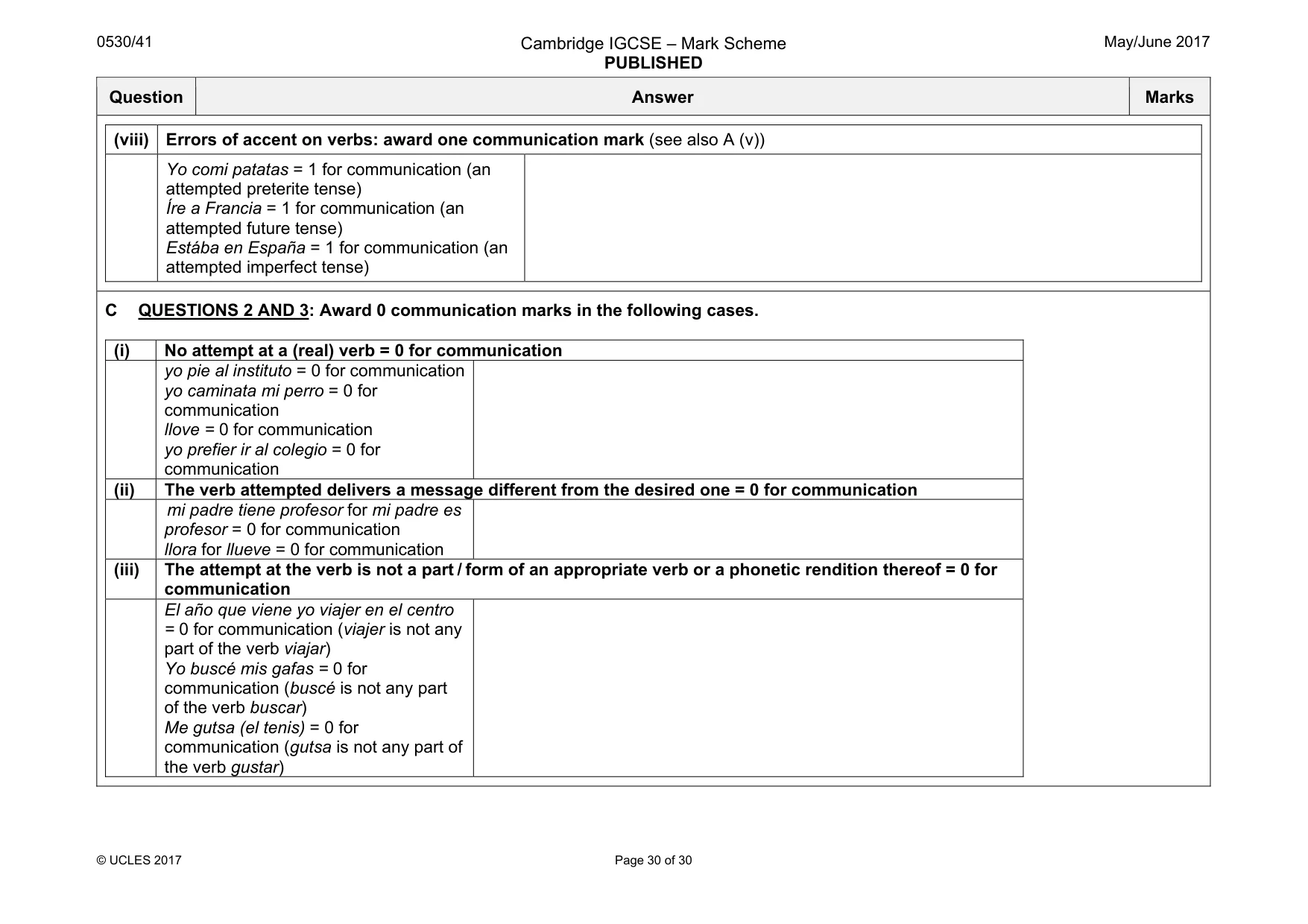
0530/41 Cambridge IGCSE – Mark Scheme PUBLISHED May/June 2017 © UCLES 2017 Page 30 of 30 Question Answer Marks (viii) Errors of accent on verbs: award one communication mark (see also A (v)) Yo comi patatas = 1 for communication (an attempted preterite tense) Íre a Francia = 1 for communication (an attempted future tense) Estába en España = 1 for communication (an attempted imperfect tense) C QUESTIONS 2 AND 3: Award 0 communication marks in the following cases. (i) No attempt at a (real) verb = 0 for communication yo pie al instituto = 0 for communication yo caminata mi perro = 0 for communication llove = 0 for communication yo prefier ir al colegio = 0 for communication (ii) The verb attempted delivers a message different from the desired one = 0 for communication mi padre tiene profesor for mi padre es profesor = 0 for communication llora for llueve = 0 for communication (iii) The attempt at the verb is not a part / form of an appropriate verb or a phonetic rendition thereof = 0 for communication El año que viene yo viajer en el centro = 0 for communication (viajer is not any part of the verb viajar) Yo buscé mis gafas = 0 for communication (buscé is not any part of the verb buscar) Me gutsa (el tenis) = 0 for communication (gutsa is not any part of the verb gustar)
What you needed in this session
Cambridge’s own grade thresholds for 2017 May/June, Paper 4 · Variant 1. A higher threshold means an easier paper — the bar moves with how the cohort did.