Cambridge IGCSE Spanish - Foreign Language 0530 — 2023 May/June Paper 4 · Variant 1
0530/41/M/J/23 · 45 marks · ≈51 min
The question paper and its mark scheme, free to read here and free to download. This is Cambridge’s own paper, exactly as it was sat.
Question paper8 pages



Mark scheme13 pages
Answers below. Sit the paper first if you are practising.
Paper as text
Question paper, page 1
This document has 8 pages. Any blank pages are indicated. [Turn over Cambridge IGCSE™ * 2 6 6 9 6 6 6 8 3 9 * DC (EF/CT) 310676/4 © UCLES 2023 SPANISH 0530/41 Paper 4 Writing May/June 2023 1 hour You must answer on the question paper. No additional materials are needed. INSTRUCTIONS ● Answer three questions in total: Answer Question 1. Answer Question 2. Answer either Question 3(a) or Question 3(b). ● Use a black or dark blue pen. ● Write your name, centre number and candidate number in the boxes at the top of the page. ● Write your answer to each question in the space provided. ● Do not use an erasable pen or correction fluid. ● Do not write on any bar codes. ● Dictionaries are not allowed. INFORMATION ● The total mark for this paper is 45. ● The number of marks for each question or part question is shown in brackets [ ].
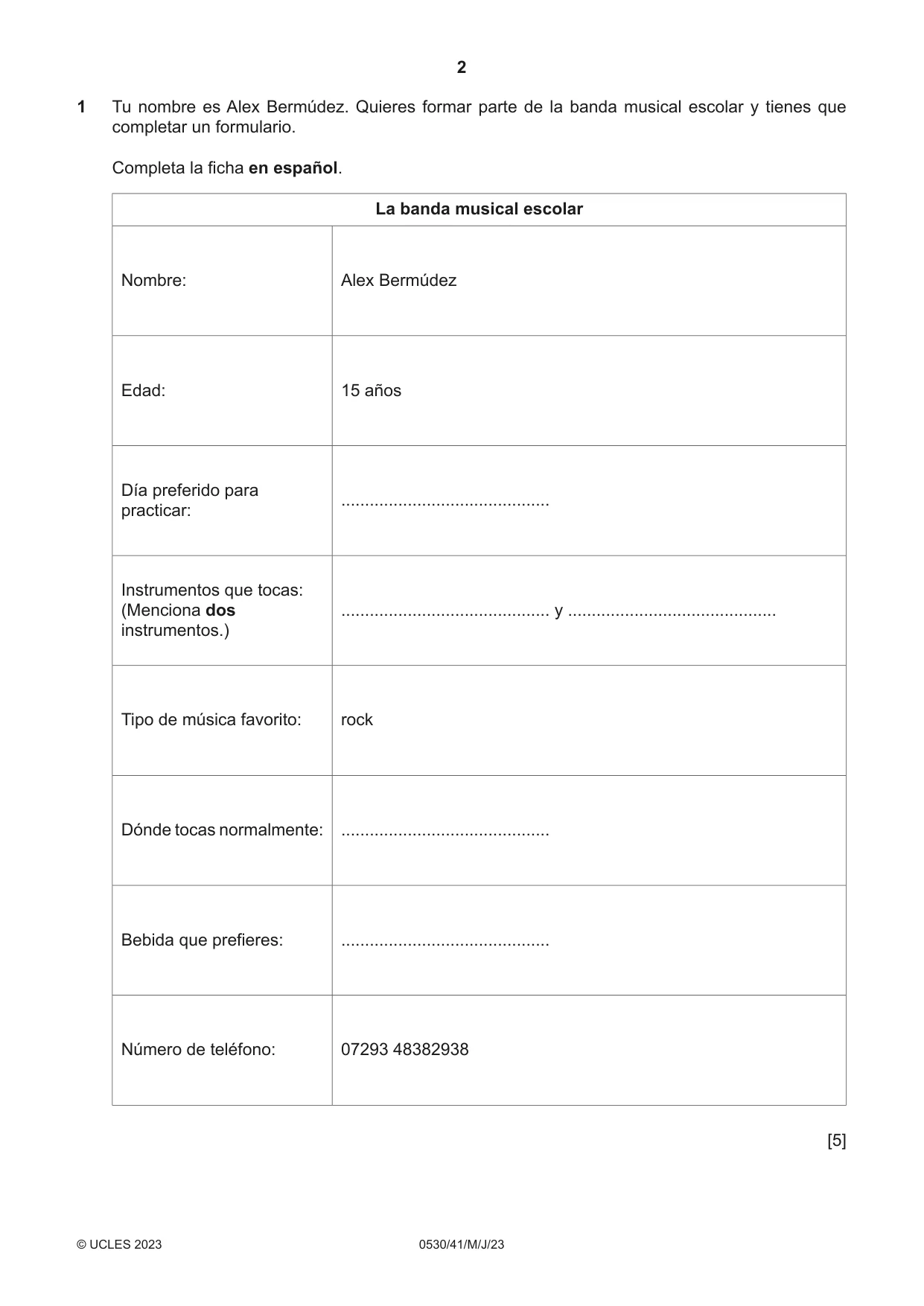
Question paper, page 2
2 0530/41/M/J/23 © UCLES 2023 1 Tu nombre es Alex Bermúdez. Quieres formar parte de la banda musical escolar y tienes que completar un formulario. Completa la ficha en español. La banda musical escolar Nombre: Alex Bermúdez Edad: 15 años Día preferido para practicar: … Instrumentos que tocas: (Menciona dos instrumentos.) … y … Tipo de música favorito: rock Dónde tocas normalmente: … Bebida que prefieres: … Número de teléfono: 07293 48382938 [5]
Question paper, page 3
3 0530/41/M/J/23 © UCLES 2023 [Turn over 2 Mi profesor(a) favorito/a • Describe a tu profesor(a) favorito/a físicamente. (¿ojos? ¿pelo?) • ¿Por qué es tu profesor(a) favorito/a? • ¿Cuándo tienes clases con tu profesor(a) favorito/a? • Describe tus actividades favoritas en las clases de tu profesor(a) favorito/a. • Explica por qué (no) te gustaría ser profesor(a) en el futuro. Escribe 80–90 palabras en español. … … … … … … … … … … … … … … … [12]
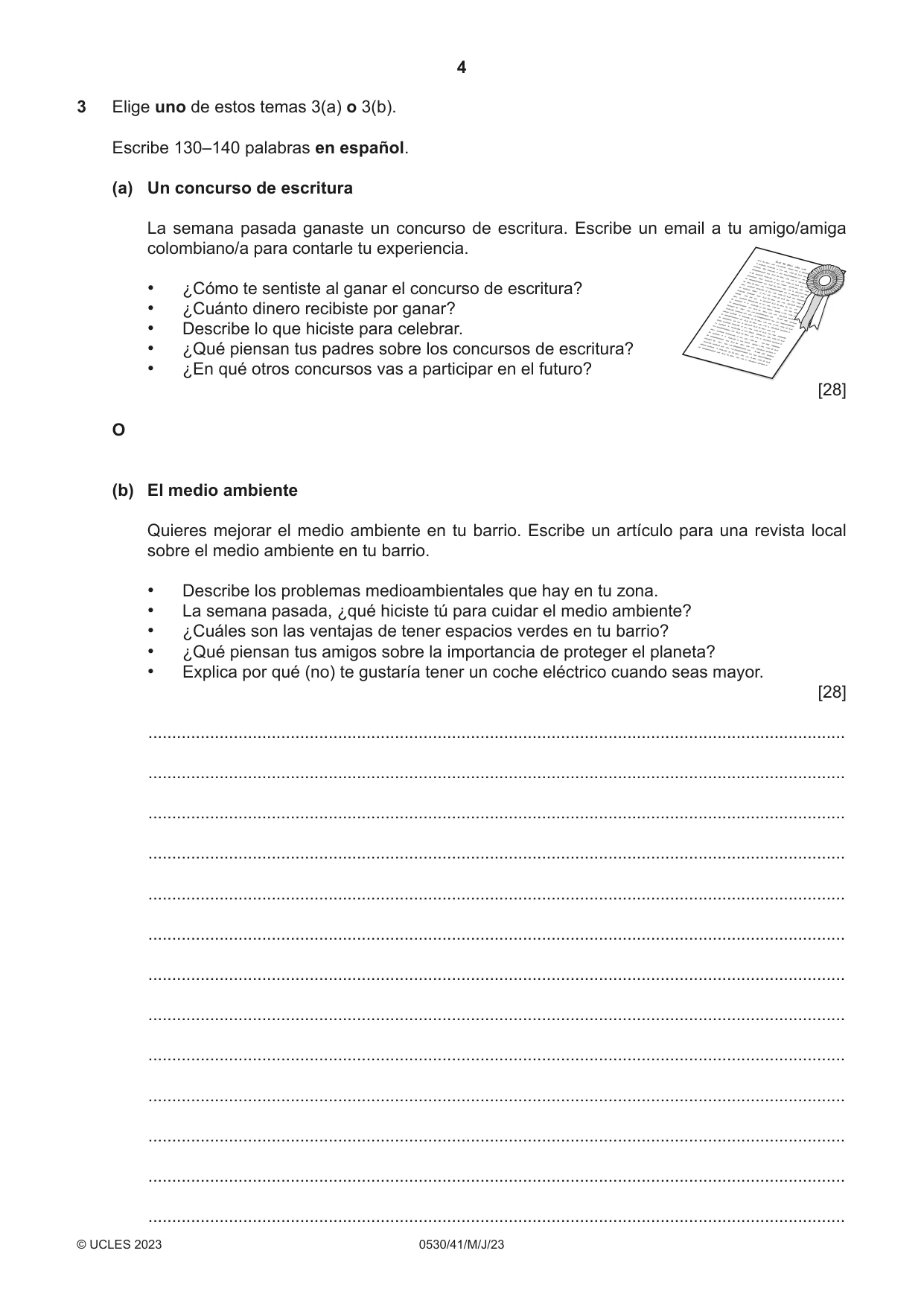
Question paper, page 4
4 0530/41/M/J/23 © UCLES 2023 3 Elige uno de estos temas 3(a) o 3(b). Escribe 130–140 palabras en español. (a) Un concurso de escritura La semana pasada ganaste un concurso de escritura. Escribe un email a tu amigo/amiga colombiano/a para contarle tu experiencia. • ¿Cómo te sentiste al ganar el concurso de escritura? • ¿Cuánto dinero recibiste por ganar? • Describe lo que hiciste para celebrar. • ¿Qué piensan tus padres sobre los concursos de escritura? • ¿En qué otros concursos vas a participar en el futuro? [28] O (b) El medio ambiente Quieres mejorar el medio ambiente en tu barrio. Escribe un artículo para una revista local sobre el medio ambiente en tu barrio. • Describe los problemas medioambientales que hay en tu zona. • La semana pasada, ¿qué hiciste tú para cuidar el medio ambiente? • ¿Cuáles son las ventajas de tener espacios verdes en tu barrio? • ¿Qué piensan tus amigos sobre la importancia de proteger el planeta? • Explica por qué (no) te gustaría tener un coche eléctrico cuando seas mayor. [28] … … … … … … … … … … … … …
Question paper, page 5
5 0530/41/M/J/23 © UCLES 2023 … … … … … … … … … … … … … … … … … … … … … … … … … … … …
Question paper, page 6
6 0530/41/M/J/23 © UCLES 2023 BLANK PAGE
Question paper, page 7
7 0530/41/M/J/23 © UCLES 2023 BLANK PAGE
Question paper, page 8
8 0530/41/M/J/23 © UCLES 2023 Permission to reproduce items where third-party owned material protected by copyright is included has been sought and cleared where possible. Every reasonable effort has been made by the publisher (UCLES) to trace copyright holders, but if any items requiring clearance have unwittingly been included, the publisher will be pleased to make amends at the earliest possible opportunity. To avoid the issue of disclosure of answer-related information to candidates, all copyright acknowledgements are reproduced online in the Cambridge Assessment International Education Copyright Acknowledgements Booklet. This is produced for each series of examinations and is freely available to download at www.cambridgeinternational.org after the live examination series. Cambridge Assessment International Education is part of Cambridge Assessment. Cambridge Assessment is the brand name of the University of Cambridge Local Examinations Syndicate (UCLES), which is a department of the University of Cambridge. BLANK PAGE
Mark scheme, page 1
This document consists of 13 printed pages. © UCLES 2023 [Turn over Cambridge IGCSE™ SPANISH 0530/41 Paper 4 Writing May/June 2023 MARK SCHEME Maximum Mark: 45 Published This mark scheme is published as an aid to teachers and candidates, to indicate the requirements of the examination. It shows the basis on which Examiners were instructed to award marks. It does not indicate the details of the discussions that took place at an Examiners’ meeting before marking began, which would have considered the acceptability of alternative answers. Mark schemes should be read in conjunction with the question paper and the Principal Examiner Report for Teachers. Cambridge International will not enter into discussions about these mark schemes. Cambridge International is publishing the mark schemes for the May/June 2023 series for most Cambridge IGCSE, Cambridge International A and AS Level and Cambridge Pre-U components, and some Cambridge O Level components.
Mark scheme, page 2
0530/41 Cambridge IGCSE – Mark Scheme PUBLISHED May/June 2023 © UCLES 2023 Page 2 of 13 Generic Marking Principles These general marking principles must be applied by all examiners when marking candidate answers. They should be applied alongside the specific content of the mark scheme or generic level descriptors for a question. Each question paper and mark scheme will also comply with these marking principles. GENERIC MARKING PRINCIPLE 1: Marks must be awarded in line with: the specific content of the mark scheme or the generic level descriptors for the question the specific skills defined in the mark scheme or in the generic level descriptors for the question the standard of response required by a candidate as exemplified by the standardisation scripts. GENERIC MARKING PRINCIPLE 2: Marks awarded are always whole marks (not half marks, or other fractions). GENERIC MARKING PRINCIPLE 3: Marks must be awarded positively: marks are awarded for correct/valid answers, as defined in the mark scheme. However, credit is given for valid answers which go beyond the scope of the syllabus and mark scheme, referring to your Team Leader as appropriate marks are awarded when candidates clearly demonstrate what they know and can do marks are not deducted for errors marks are not deducted for omissions answers should only be judged on the quality of spelling, punctuation and grammar when these features are specifically assessed by the question as indicated by the mark scheme. The meaning, however, should be unambiguous. GENERIC MARKING PRINCIPLE 4: Rules must be applied consistently, e.g. in situations where candidates have not followed instructions or in the application of generic level descriptors.
Mark scheme, page 3
0530/41 Cambridge IGCSE – Mark Scheme PUBLISHED May/June 2023 © UCLES 2023 Page 3 of 13 GENERIC MARKING PRINCIPLE 5: Marks should be awarded using the full range of marks defined in the mark scheme for the question (however; the use of the full mark range may be limited according to the quality of the candidate responses seen). GENERIC MARKING PRINCIPLE 6: Marks awarded are based solely on the requirements as defined in the mark scheme. Marks should not be awarded with grade thresholds or grade descriptors in mind.
Mark scheme, page 4
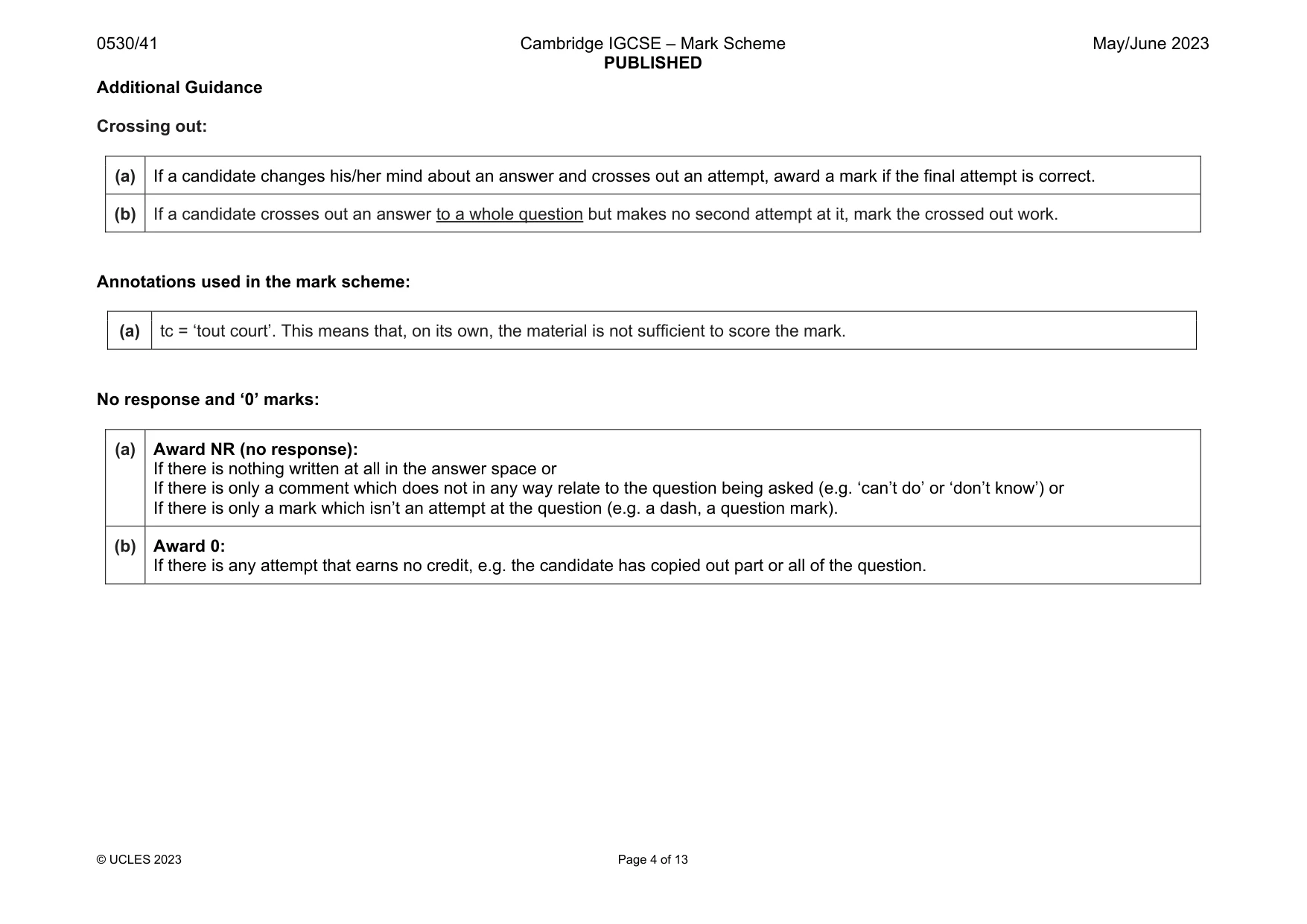
0530/41 Cambridge IGCSE – Mark Scheme PUBLISHED May/June 2023 © UCLES 2023 Page 4 of 13 Additional Guidance Crossing out: (a) If a candidate changes his/her mind about an answer and crosses out an attempt, award a mark if the final attempt is correct. (b) If a candidate crosses out an answer to a whole question but makes no second attempt at it, mark the crossed out work. Annotations used in the mark scheme: (a) tc = ‘tout court’. This means that, on its own, the material is not sufficient to score the mark. No response and ‘0’ marks: (a) Award NR (no response): If there is nothing written at all in the answer space or If there is only a comment which does not in any way relate to the question being asked (e.g. ‘can’t do’ or ‘don’t know’) or If there is only a mark which isn’t an attempt at the question (e.g. a dash, a question mark). (b) Award 0: If there is any attempt that earns no credit, e.g. the candidate has copied out part or all of the question.
Mark scheme, page 5
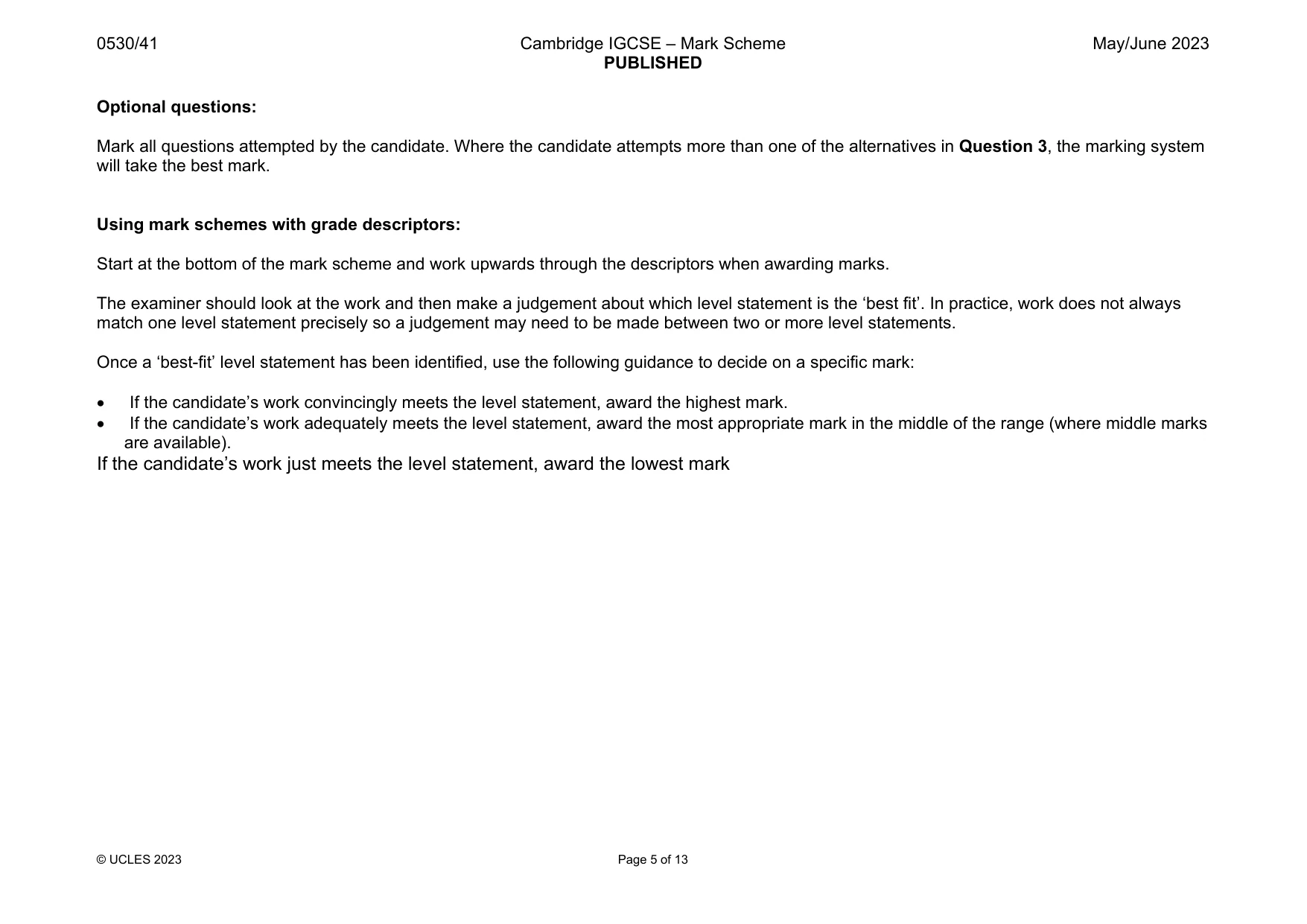
0530/41 Cambridge IGCSE – Mark Scheme PUBLISHED May/June 2023 © UCLES 2023 Page 5 of 13 Optional questions: Mark all questions attempted by the candidate. Where the candidate attempts more than one of the alternatives in Question 3, the marking system will take the best mark. Using mark schemes with grade descriptors: Start at the bottom of the mark scheme and work upwards through the descriptors when awarding marks. The examiner should look at the work and then make a judgement about which level statement is the ‘best fit’. In practice, work does not always match one level statement precisely so a judgement may need to be made between two or more level statements. Once a ‘best-fit’ level statement has been identified, use the following guidance to decide on a specific mark: If the candidate’s work convincingly meets the level statement, award the highest mark. If the candidate’s work adequately meets the level statement, award the most appropriate mark in the middle of the range (where middle marks are available). If the candidate’s work just meets the level statement, award the lowest mark
Mark scheme, page 6
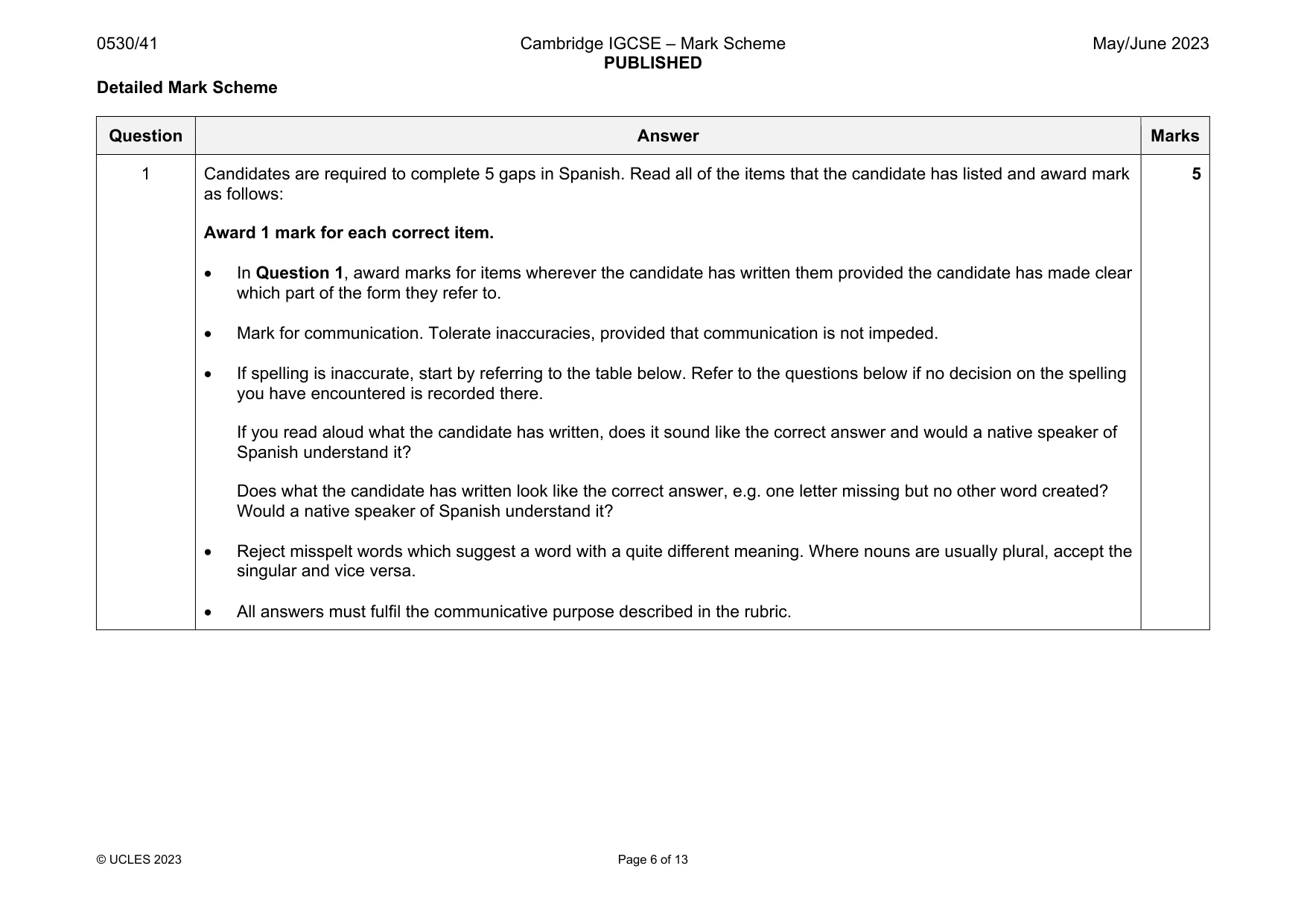
0530/41 Cambridge IGCSE – Mark Scheme PUBLISHED May/June 2023 © UCLES 2023 Page 6 of 13 Detailed Mark Scheme Question Answer Marks 1 Candidates are required to complete 5 gaps in Spanish. Read all of the items that the candidate has listed and award mark as follows: Award 1 mark for each correct item. In Question 1, award marks for items wherever the candidate has written them provided the candidate has made clear which part of the form they refer to. Mark for communication. Tolerate inaccuracies, provided that communication is not impeded. If spelling is inaccurate, start by referring to the table below. Refer to the questions below if no decision on the spelling you have encountered is recorded there. If you read aloud what the candidate has written, does it sound like the correct answer and would a native speaker of Spanish understand it? Does what the candidate has written look like the correct answer, e.g. one letter missing but no other word created? Would a native speaker of Spanish understand it? Reject misspelt words which suggest a word with a quite different meaning. Where nouns are usually plural, accept the singular and vice versa. All answers must fulfil the communicative purpose described in the rubric. 5
Mark scheme, page 7
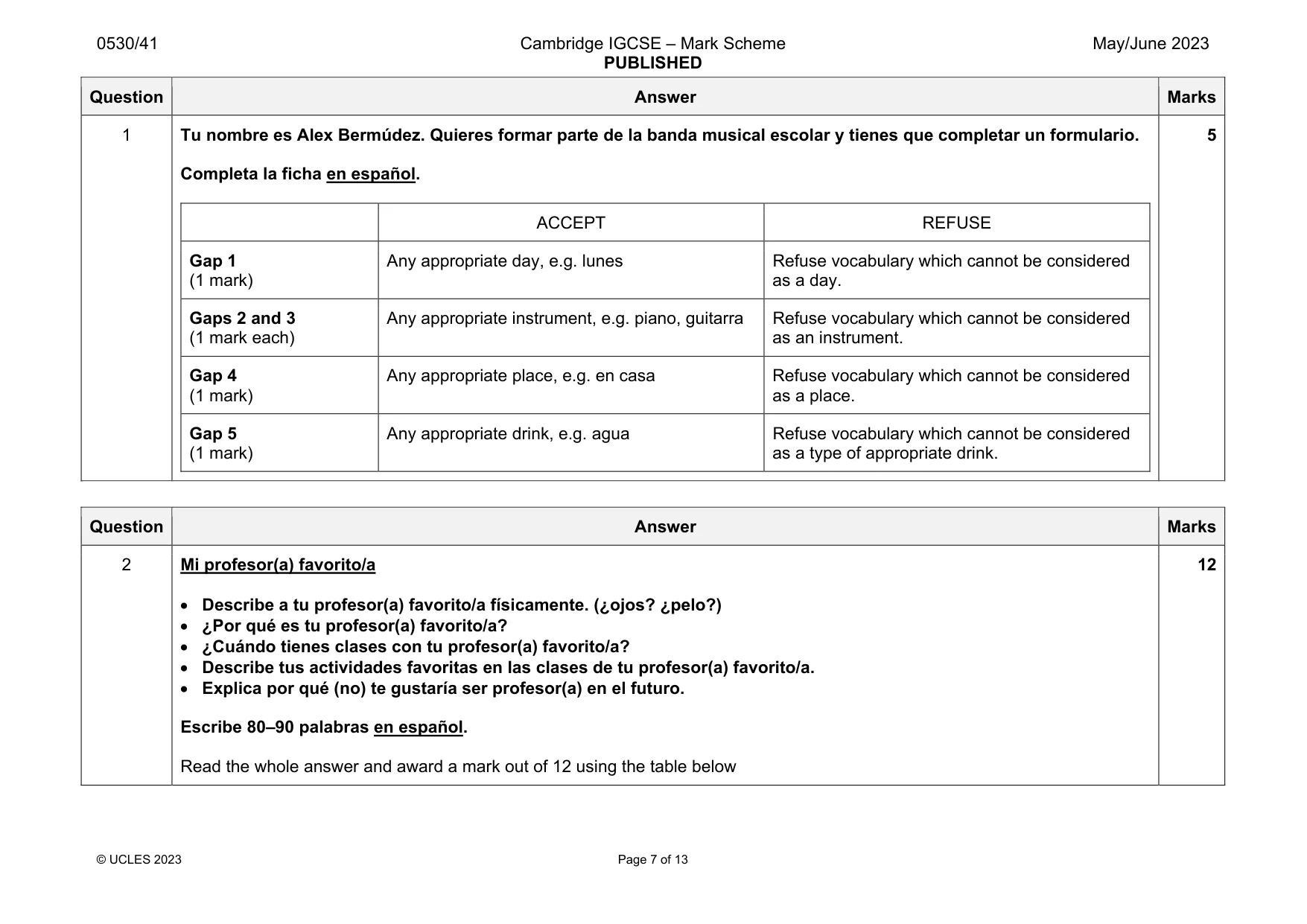
0530/41 Cambridge IGCSE – Mark Scheme PUBLISHED May/June 2023 © UCLES 2023 Page 7 of 13 Question Answer Marks 1 Tu nombre es Alex Bermúdez. Quieres formar parte de la banda musical escolar y tienes que completar un formulario. Completa la ficha en español. ACCEPT REFUSE Gap 1 (1 mark) Any appropriate day, e.g. lunes Refuse vocabulary which cannot be considered as a day. Gaps 2 and 3 (1 mark each) Any appropriate instrument, e.g. piano, guitarra Refuse vocabulary which cannot be considered as an instrument. Gap 4 (1 mark) Any appropriate place, e.g. en casa Refuse vocabulary which cannot be considered as a place. Gap 5 (1 mark) Any appropriate drink, e.g. agua Refuse vocabulary which cannot be considered as a type of appropriate drink. 5 Question Answer Marks 2 Mi profesor(a) favorito/a Describe a tu profesor(a) favorito/a físicamente. (¿ojos? ¿pelo?) ¿Por qué es tu profesor(a) favorito/a? ¿Cuándo tienes clases con tu profesor(a) favorito/a? Describe tus actividades favoritas en las clases de tu profesor(a) favorito/a. Explica por qué (no) te gustaría ser profesor(a) en el futuro. Escribe 80–90 palabras en español. Read the whole answer and award a mark out of 12 using the table below 12
Mark scheme, page 8
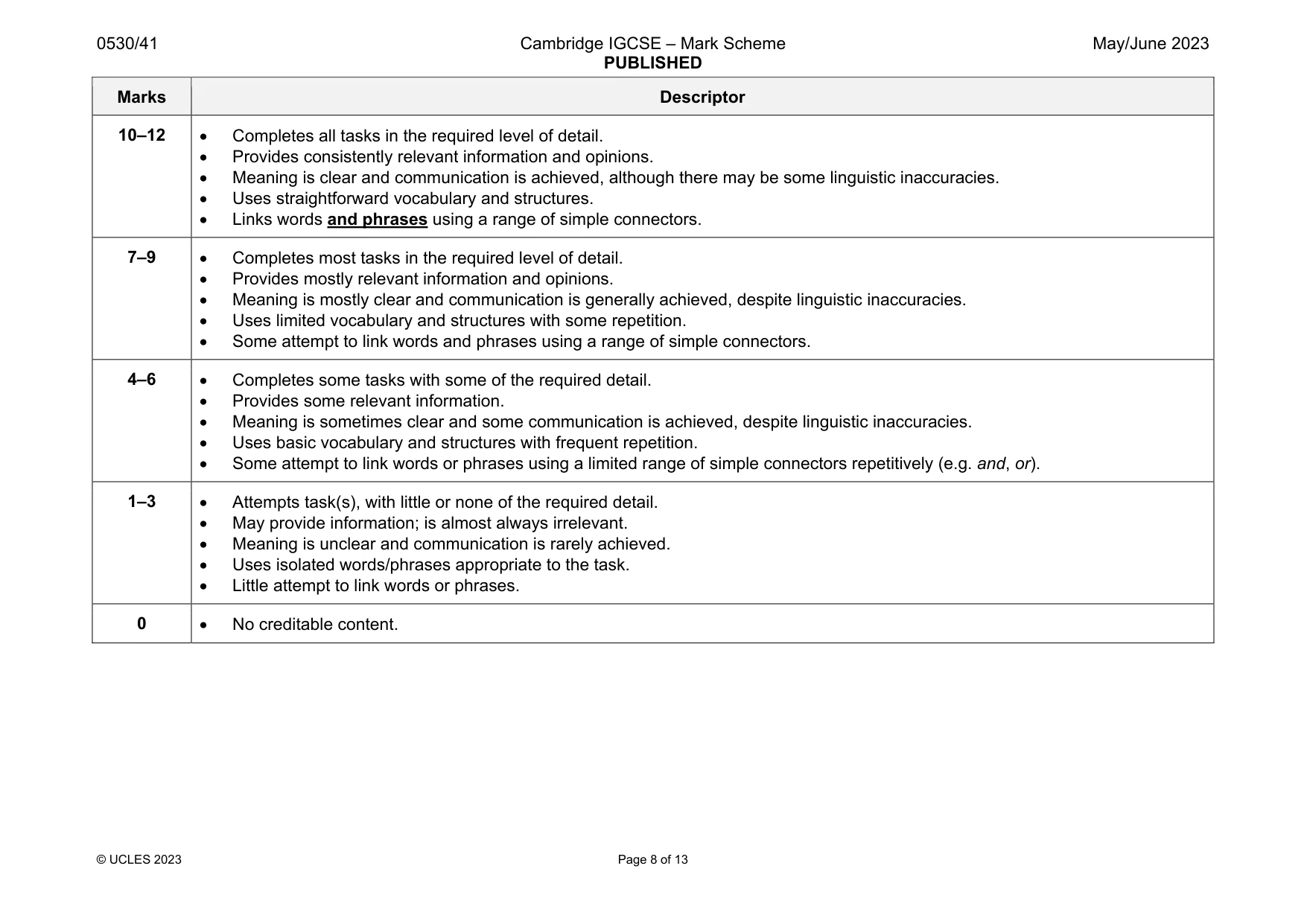
0530/41 Cambridge IGCSE – Mark Scheme PUBLISHED May/June 2023 © UCLES 2023 Page 8 of 13 Marks Descriptor 10–12 Completes all tasks in the required level of detail. Provides consistently relevant information and opinions. Meaning is clear and communication is achieved, although there may be some linguistic inaccuracies. Uses straightforward vocabulary and structures. Links words and phrases using a range of simple connectors. 7–9 Completes most tasks in the required level of detail. Provides mostly relevant information and opinions. Meaning is mostly clear and communication is generally achieved, despite linguistic inaccuracies. Uses limited vocabulary and structures with some repetition. Some attempt to link words and phrases using a range of simple connectors. 4–6 Completes some tasks with some of the required detail. Provides some relevant information. Meaning is sometimes clear and some communication is achieved, despite linguistic inaccuracies. Uses basic vocabulary and structures with frequent repetition. Some attempt to link words or phrases using a limited range of simple connectors repetitively (e.g. and, or). 1–3 Attempts task(s), with little or none of the required detail. May provide information; is almost always irrelevant. Meaning is unclear and communication is rarely achieved. Uses isolated words/phrases appropriate to the task. Little attempt to link words or phrases. 0 No creditable content.
Mark scheme, page 9
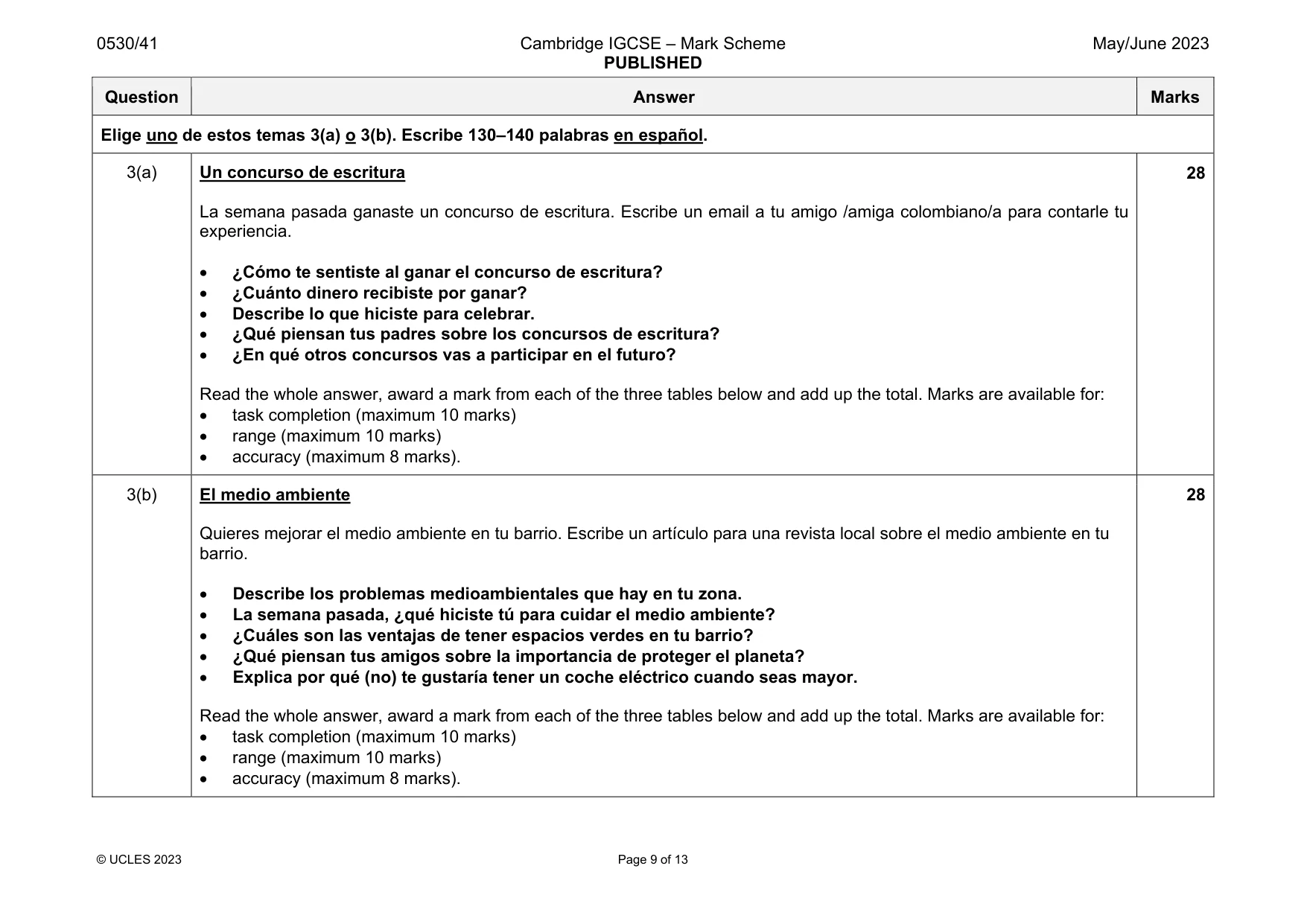
0530/41 Cambridge IGCSE – Mark Scheme PUBLISHED May/June 2023 © UCLES 2023 Page 9 of 13 Question Answer Marks Elige uno de estos temas 3(a) o 3(b). Escribe 130–140 palabras en español. 3(a) Un concurso de escritura La semana pasada ganaste un concurso de escritura. Escribe un email a tu amigo /amiga colombiano/a para contarle tu experiencia. ¿Cómo te sentiste al ganar el concurso de escritura? ¿Cuánto dinero recibiste por ganar? Describe lo que hiciste para celebrar. ¿Qué piensan tus padres sobre los concursos de escritura? ¿En qué otros concursos vas a participar en el futuro? Read the whole answer, award a mark from each of the three tables below and add up the total. Marks are available for: task completion (maximum 10 marks) range (maximum 10 marks) accuracy (maximum 8 marks). 28 3(b) El medio ambiente Quieres mejorar el medio ambiente en tu barrio. Escribe un artículo para una revista local sobre el medio ambiente en tu barrio. Describe los problemas medioambientales que hay en tu zona. La semana pasada, ¿qué hiciste tú para cuidar el medio ambiente? ¿Cuáles son las ventajas de tener espacios verdes en tu barrio? ¿Qué piensan tus amigos sobre la importancia de proteger el planeta? Explica por qué (no) te gustaría tener un coche eléctrico cuando seas mayor. Read the whole answer, award a mark from each of the three tables below and add up the total. Marks are available for: task completion (maximum 10 marks) range (maximum 10 marks) accuracy (maximum 8 marks). 28
Mark scheme, page 10
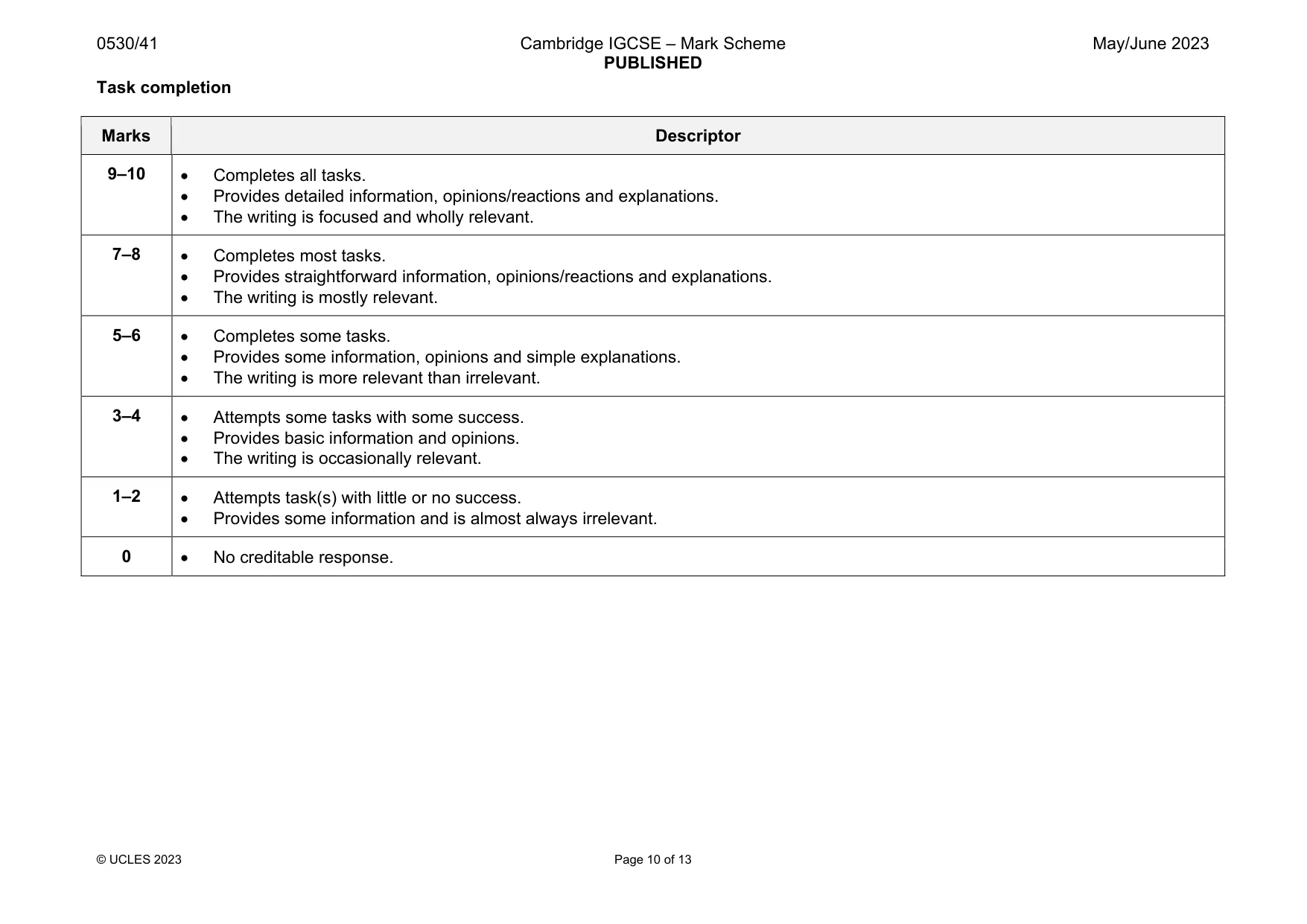
0530/41 Cambridge IGCSE – Mark Scheme PUBLISHED May/June 2023 © UCLES 2023 Page 10 of 13 Task completion Marks Descriptor 9–10 Completes all tasks. Provides detailed information, opinions/reactions and explanations. The writing is focused and wholly relevant. 7–8 Completes most tasks. Provides straightforward information, opinions/reactions and explanations. The writing is mostly relevant. 5–6 Completes some tasks. Provides some information, opinions and simple explanations. The writing is more relevant than irrelevant. 3–4 Attempts some tasks with some success. Provides basic information and opinions. The writing is occasionally relevant. 1–2 Attempts task(s) with little or no success. Provides some information and is almost always irrelevant. 0 No creditable response.
Mark scheme, page 11
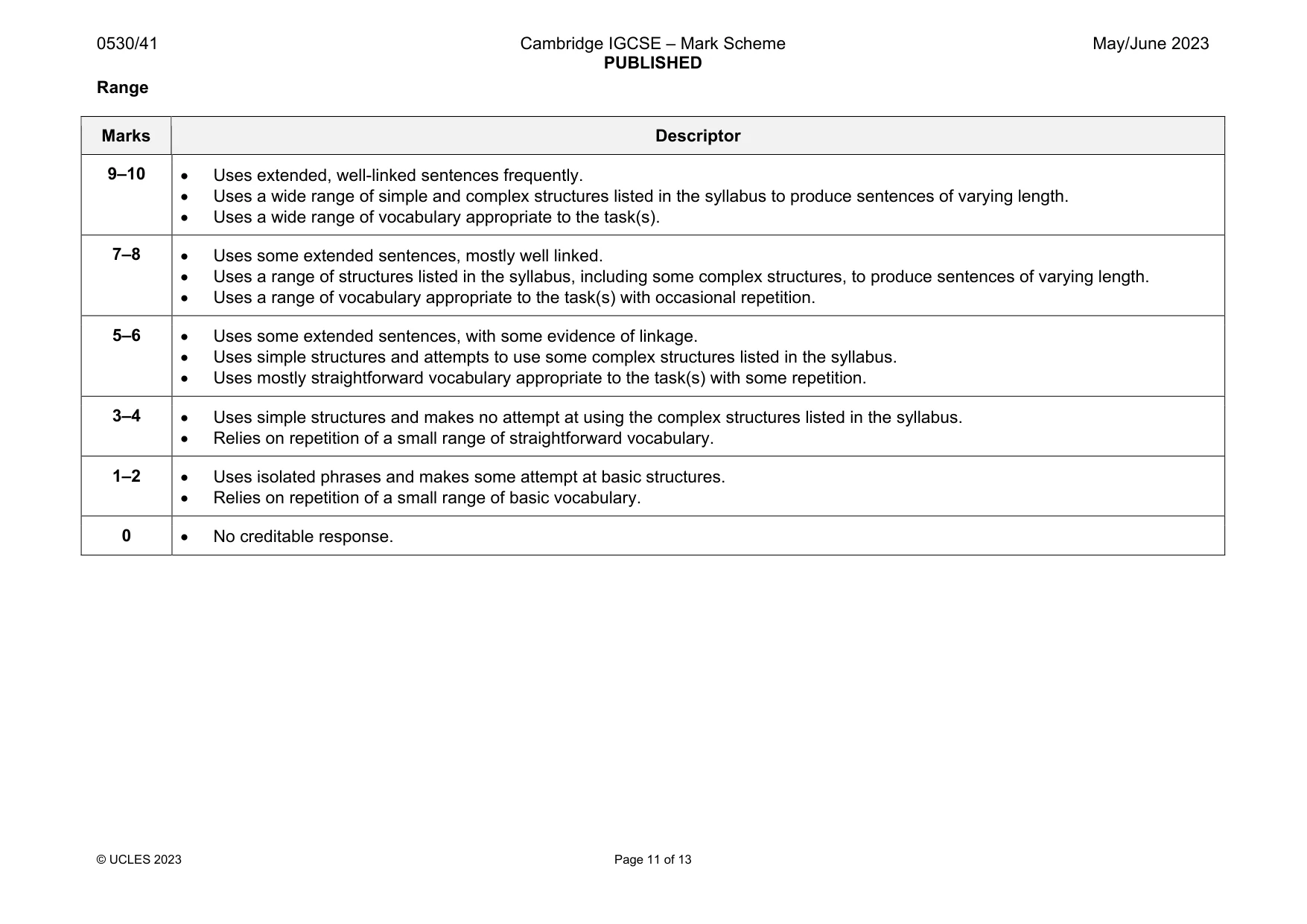
0530/41 Cambridge IGCSE – Mark Scheme PUBLISHED May/June 2023 © UCLES 2023 Page 11 of 13 Range Marks Descriptor 9–10 Uses extended, well-linked sentences frequently. Uses a wide range of simple and complex structures listed in the syllabus to produce sentences of varying length. Uses a wide range of vocabulary appropriate to the task(s). 7–8 Uses some extended sentences, mostly well linked. Uses a range of structures listed in the syllabus, including some complex structures, to produce sentences of varying length. Uses a range of vocabulary appropriate to the task(s) with occasional repetition. 5–6 Uses some extended sentences, with some evidence of linkage. Uses simple structures and attempts to use some complex structures listed in the syllabus. Uses mostly straightforward vocabulary appropriate to the task(s) with some repetition. 3–4 Uses simple structures and makes no attempt at using the complex structures listed in the syllabus. Relies on repetition of a small range of straightforward vocabulary. 1–2 Uses isolated phrases and makes some attempt at basic structures. Relies on repetition of a small range of basic vocabulary. 0 No creditable response.
Mark scheme, page 12
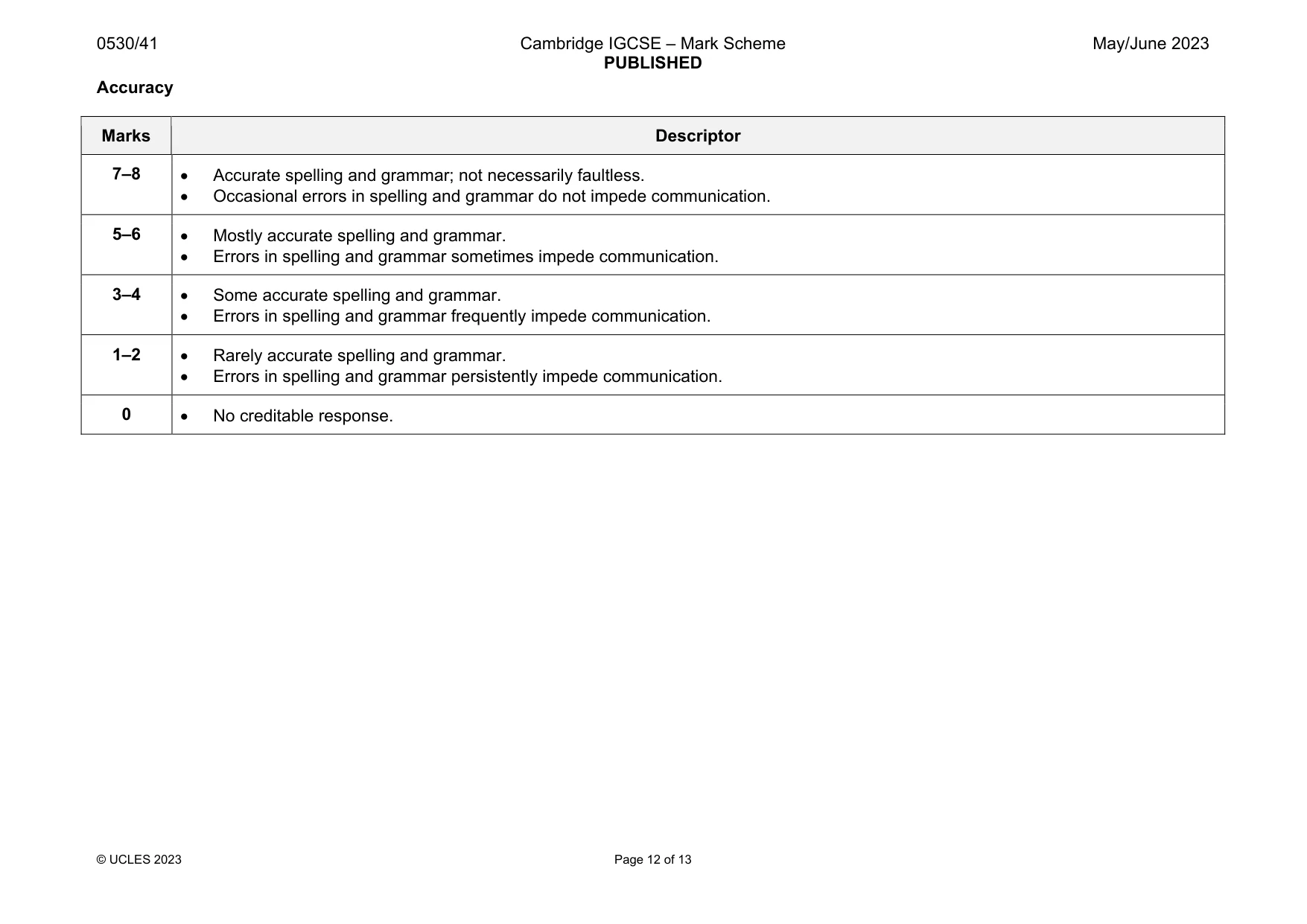
0530/41 Cambridge IGCSE – Mark Scheme PUBLISHED May/June 2023 © UCLES 2023 Page 12 of 13 Accuracy Marks Descriptor 7–8 Accurate spelling and grammar; not necessarily faultless. Occasional errors in spelling and grammar do not impede communication. 5–6 Mostly accurate spelling and grammar. Errors in spelling and grammar sometimes impede communication. 3–4 Some accurate spelling and grammar. Errors in spelling and grammar frequently impede communication. 1–2 Rarely accurate spelling and grammar. Errors in spelling and grammar persistently impede communication. 0 No creditable response.
Mark scheme, page 13
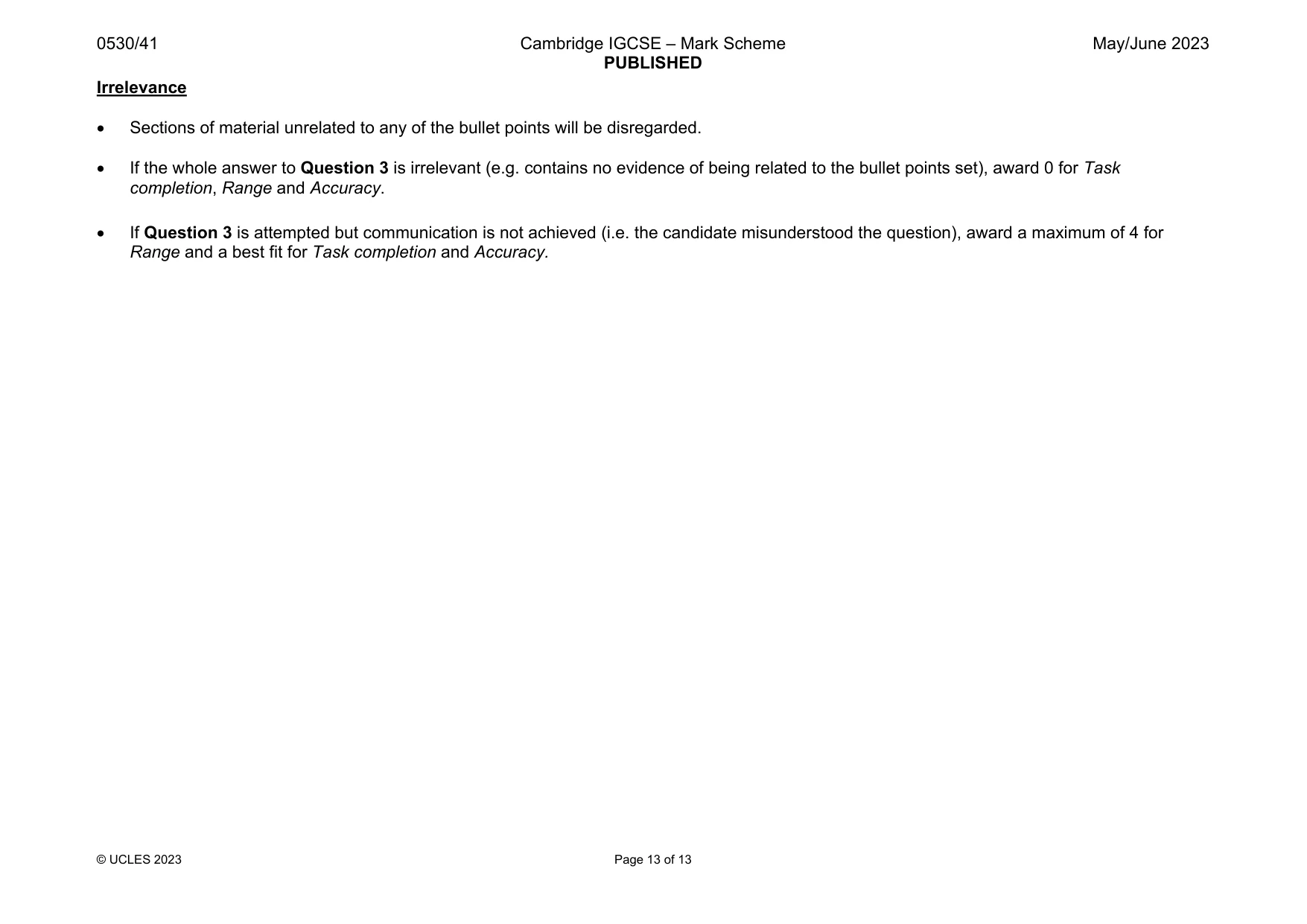
0530/41 Cambridge IGCSE – Mark Scheme PUBLISHED May/June 2023 © UCLES 2023 Page 13 of 13 Irrelevance Sections of material unrelated to any of the bullet points will be disregarded. If the whole answer to Question 3 is irrelevant (e.g. contains no evidence of being related to the bullet points set), award 0 for Task completion, Range and Accuracy. If Question 3 is attempted but communication is not achieved (i.e. the candidate misunderstood the question), award a maximum of 4 for Range and a best fit for Task completion and Accuracy.
What you needed in this session
Cambridge’s own grade thresholds for 2023 May/June, Paper 4 · Variant 1. A higher threshold means an easier paper — the bar moves with how the cohort did.