Cambridge IGCSE Spanish - Foreign Language 0530 — 2006 May/June Paper 4 · Variant 1
0530/41/M/J/06 · 50 marks · ≈56 min
The question paper and its mark scheme, free to read here and free to download. This is Cambridge’s own paper, exactly as it was sat.
Question paper4 pages
Mark scheme15 pages
Answers below. Sit the paper first if you are practising.
Paper as text
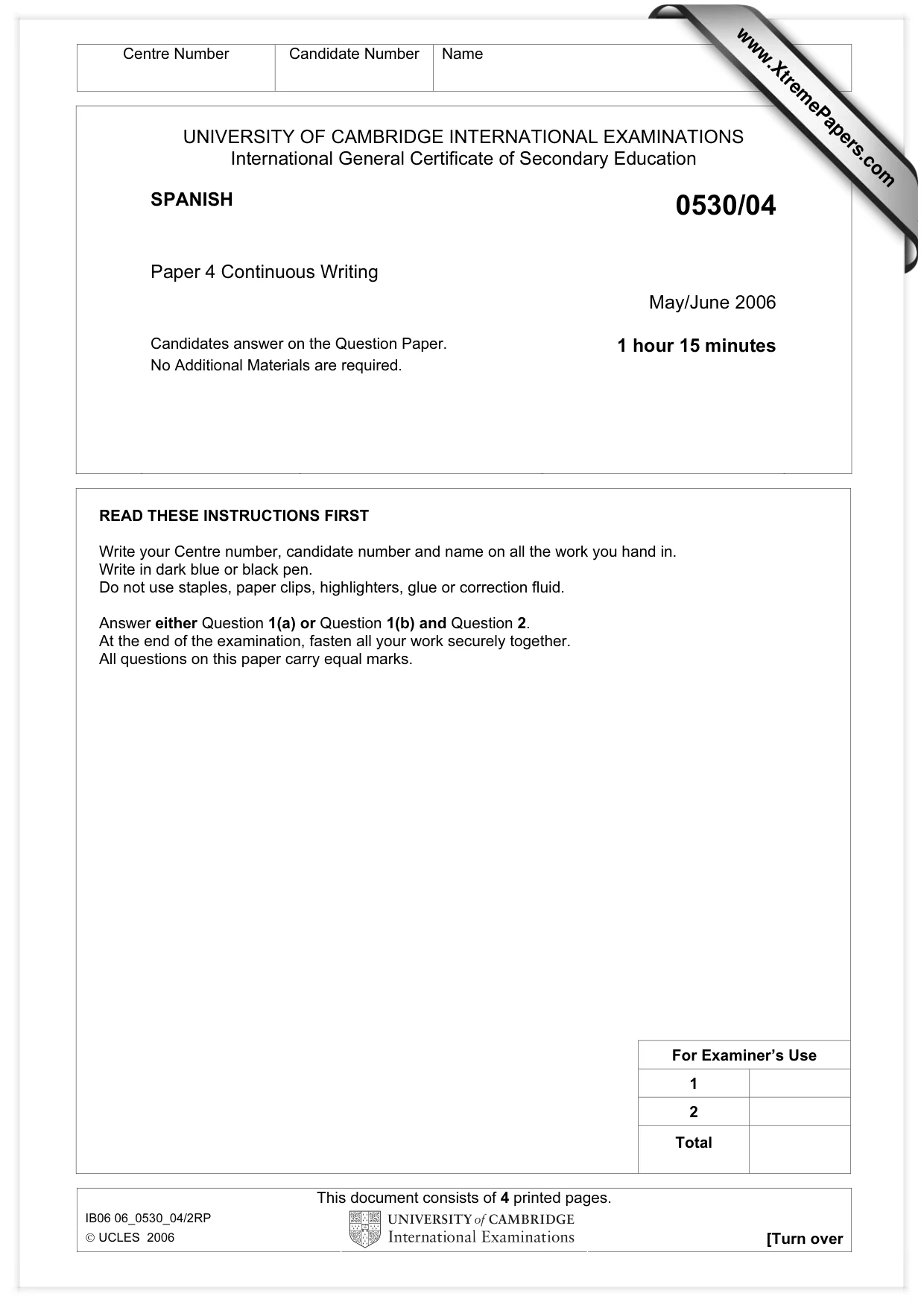
Question paper, page 1
Centre Number Candidate Number Name UNIVERSITY OF CAMBRIDGE INTERNATIONAL EXAMINATIONS International General Certificate of Secondary Education SPANISH 0530/04 Paper 4 Continuous Writing May/June 2006 Candidates answer on the Question Paper. 1 hour 15 minutes No Additional Materials are required. READ THESE INSTRUCTIONS FIRST Write your Centre number, candidate number and name on all the work you hand in. Write in dark blue or black pen. Do not use staples, paper clips, highlighters, glue or correction fluid. Answer either Question 1(a) or Question 1(b) and Question 2. At the end of the examination, fasten all your work securely together. All questions on this paper carry equal marks. For Examiner’s Use 1 2 Total This document consists of 4 printed pages. IB06 06_0530_04/2RP UCLES 2006 [Turn over www.XtremePapers.com
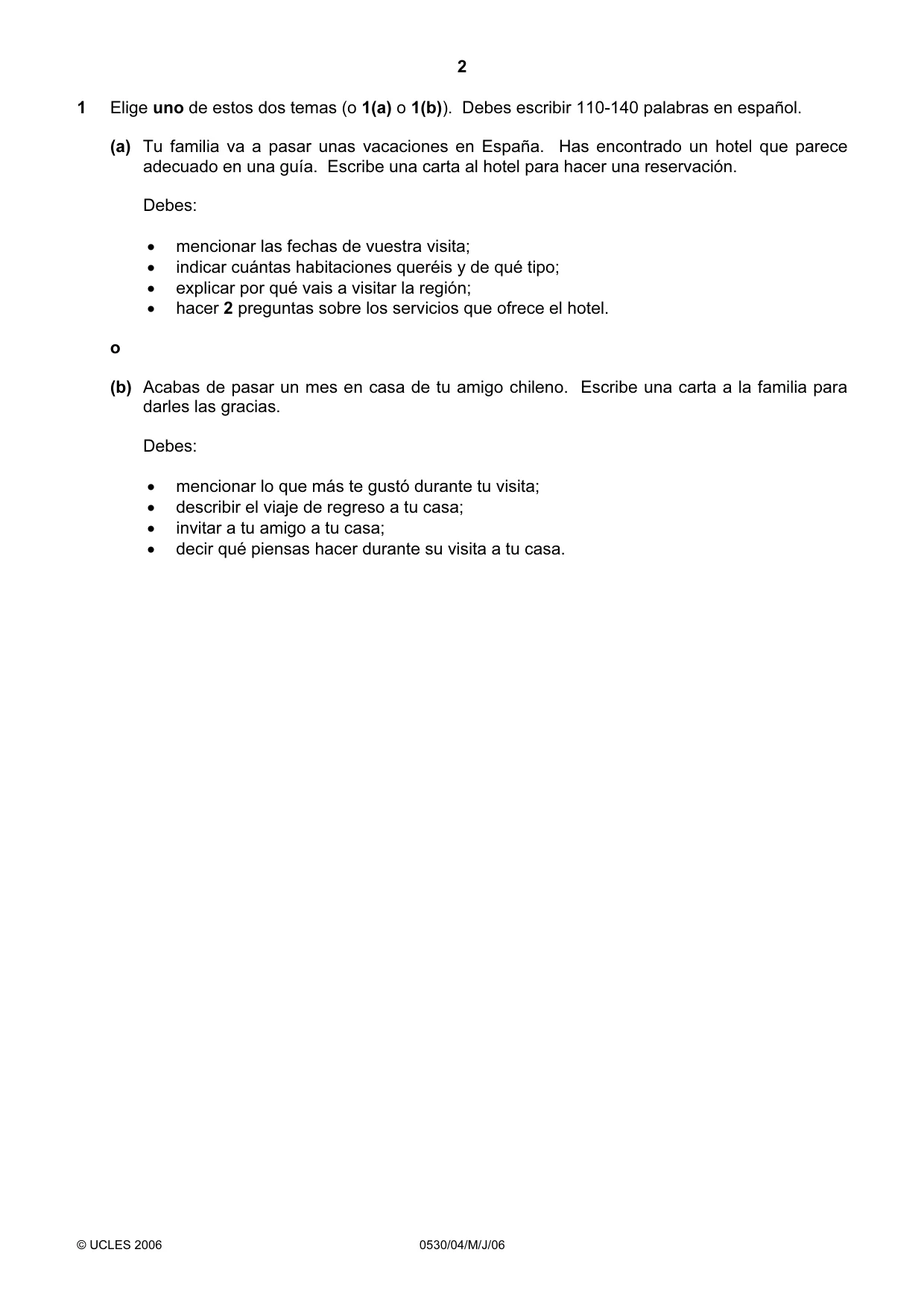
Question paper, page 2
2 © UCLES 2006 0530/04/M/J/06 1 Elige uno de estos dos temas (o 1(a) o 1(b)). Debes escribir 110-140 palabras en español. (a) Tu familia va a pasar unas vacaciones en España. Has encontrado un hotel que parece adecuado en una guía. Escribe una carta al hotel para hacer una reservación. Debes: • mencionar las fechas de vuestra visita; • indicar cuántas habitaciones queréis y de qué tipo; • explicar por qué vais a visitar la región; • hacer 2 preguntas sobre los servicios que ofrece el hotel. o (b) Acabas de pasar un mes en casa de tu amigo chileno. Escribe una carta a la familia para darles las gracias. Debes: • mencionar lo que más te gustó durante tu visita; • describir el viaje de regreso a tu casa; • invitar a tu amigo a tu casa; • decir qué piensas hacer durante su visita a tu casa.
Question paper, page 3
3 © UCLES 2006 0530/04/M/J/06 [Dar la vuelta For Examiner's Use ESCRIBE TU RESPUESTA A LA PREGUNTA 1 AQUI. 2006
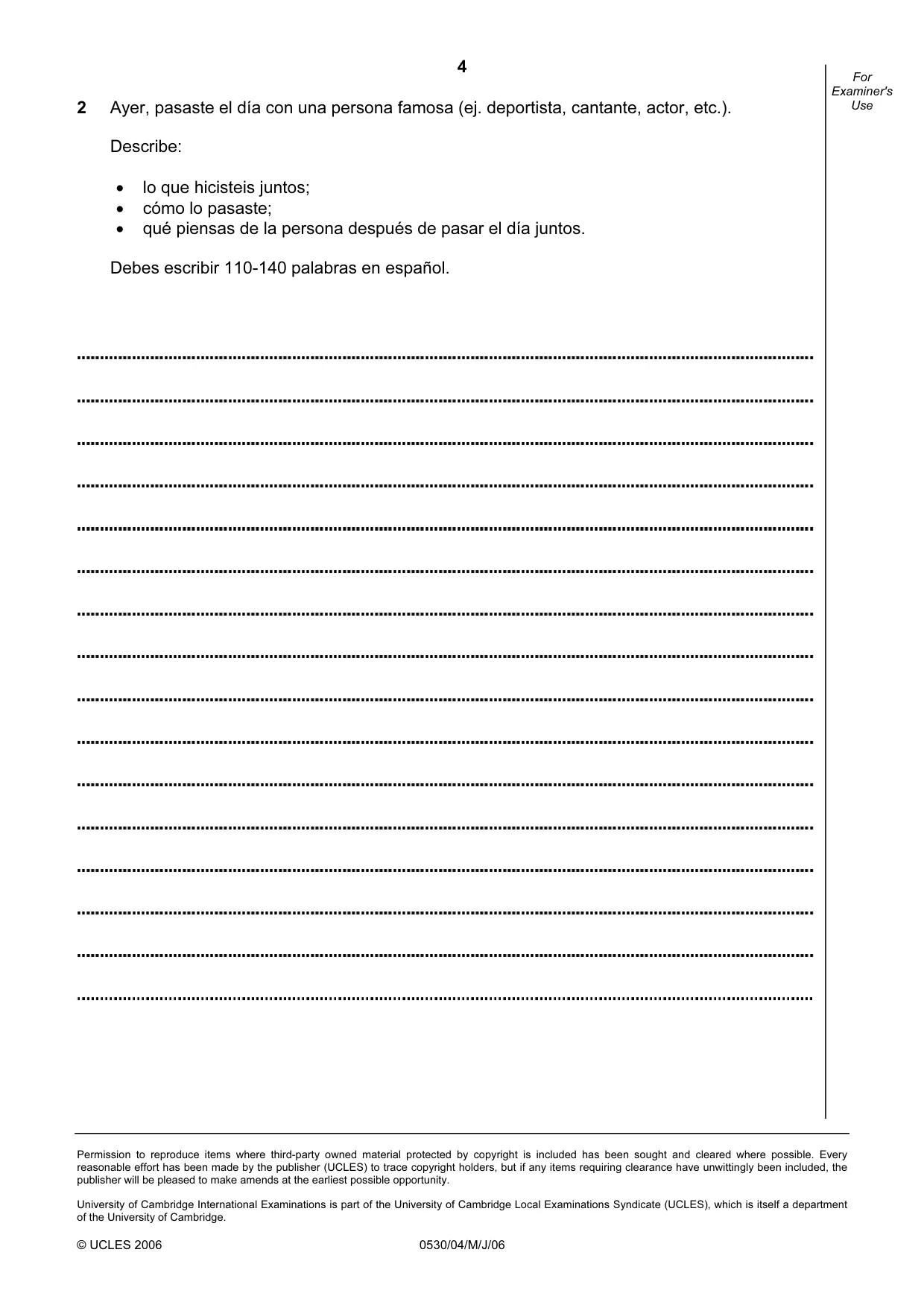
Question paper, page 4
4 Permission to reproduce items where third-party owned material protected by copyright is included has been sought and cleared where possible. Every reasonable effort has been made by the publisher (UCLES) to trace copyright holders, but if any items requiring clearance have unwittingly been included, the publisher will be pleased to make amends at the earliest possible opportunity. University of Cambridge International Examinations is part of the University of Cambridge Local Examinations Syndicate (UCLES), which is itself a department of the University of Cambridge. © UCLES 2006 0530/04/M/J/06 For Examiner's Use 2 Ayer, pasaste el día con una persona famosa (ej. deportista, cantante, actor, etc.). Describe: • lo que hicisteis juntos; • cómo lo pasaste; • qué piensas de la persona después de pasar el día juntos. Debes escribir 110-140 palabras en español.
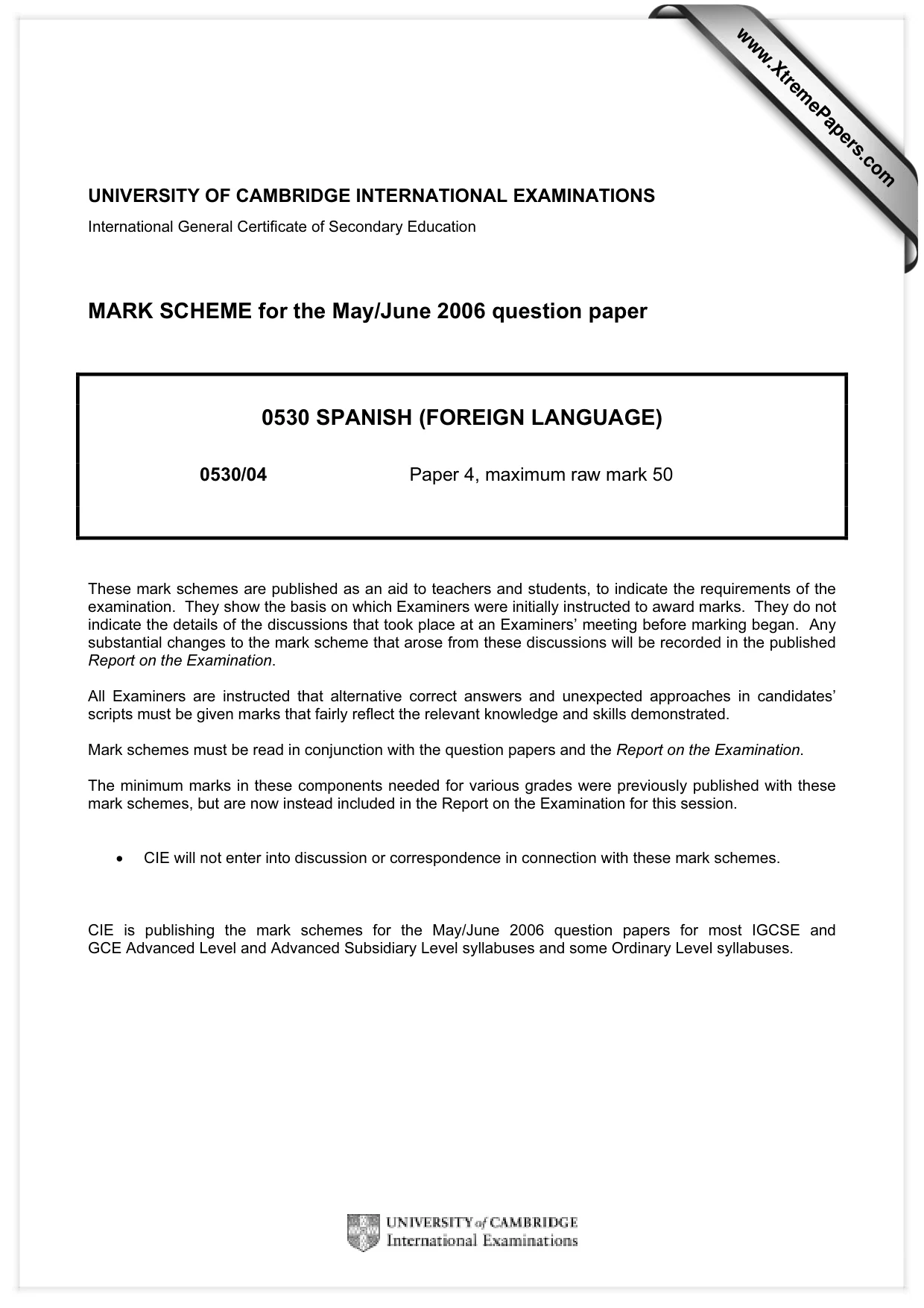
Mark scheme, page 1
UNIVERSITY OF CAMBRIDGE INTERNATIONAL EXAMINATIONS International General Certificate of Secondary Education MARK SCHEME for the May/June 2006 question paper 0530 SPANISH (FOREIGN LANGUAGE) 0530/04 Paper 4, maximum raw mark 50 These mark schemes are published as an aid to teachers and students, to indicate the requirements of the examination. They show the basis on which Examiners were initially instructed to award marks. They do not indicate the details of the discussions that took place at an Examiners’ meeting before marking began. Any substantial changes to the mark scheme that arose from these discussions will be recorded in the published Report on the Examination. All Examiners are instructed that alternative correct answers and unexpected approaches in candidates’ scripts must be given marks that fairly reflect the relevant knowledge and skills demonstrated. Mark schemes must be read in conjunction with the question papers and the Report on the Examination. The minimum marks in these components needed for various grades were previously published with these mark schemes, but are now instead included in the Report on the Examination for this session. • CIE will not enter into discussion or correspondence in connection with these mark schemes. CIE is publishing the mark schemes for the May/June 2006 question papers for most IGCSE and GCE Advanced Level and Advanced Subsidiary Level syllabuses and some Ordinary Level syllabuses. www.XtremePapers.com
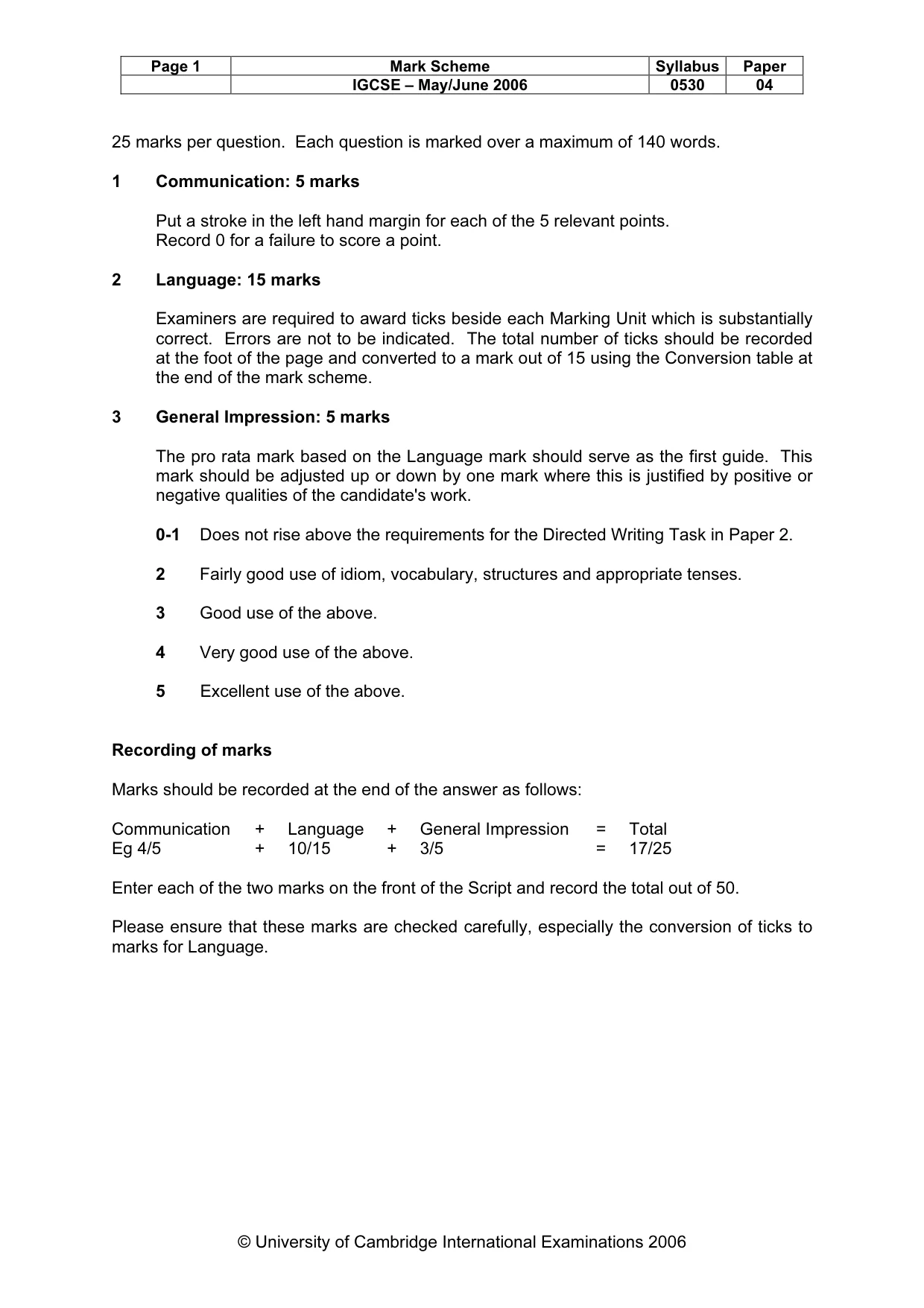
Mark scheme, page 2
Page 1 Mark Scheme Syllabus Paper IGCSE – May/June 2006 0530 04 © University of Cambridge International Examinations 2006 25 marks per question. Each question is marked over a maximum of 140 words. 1 Communication: 5 marks Put a stroke in the left hand margin for each of the 5 relevant points. Record 0 for a failure to score a point. 2 Language: 15 marks Examiners are required to award ticks beside each Marking Unit which is substantially correct. Errors are not to be indicated. The total number of ticks should be recorded at the foot of the page and converted to a mark out of 15 using the Conversion table at the end of the mark scheme. 3 General Impression: 5 marks The pro rata mark based on the Language mark should serve as the first guide. This mark should be adjusted up or down by one mark where this is justified by positive or negative qualities of the candidate's work. 0-1 Does not rise above the requirements for the Directed Writing Task in Paper 2. 2 Fairly good use of idiom, vocabulary, structures and appropriate tenses. 3 Good use of the above. 4 Very good use of the above. 5 Excellent use of the above. Recording of marks Marks should be recorded at the end of the answer as follows: Communication + Language + General Impression = Total Eg 4/5 + 10/15 + 3/5 = 17/25 Enter each of the two marks on the front of the Script and record the total out of 50. Please ensure that these marks are checked carefully, especially the conversion of ticks to marks for Language.
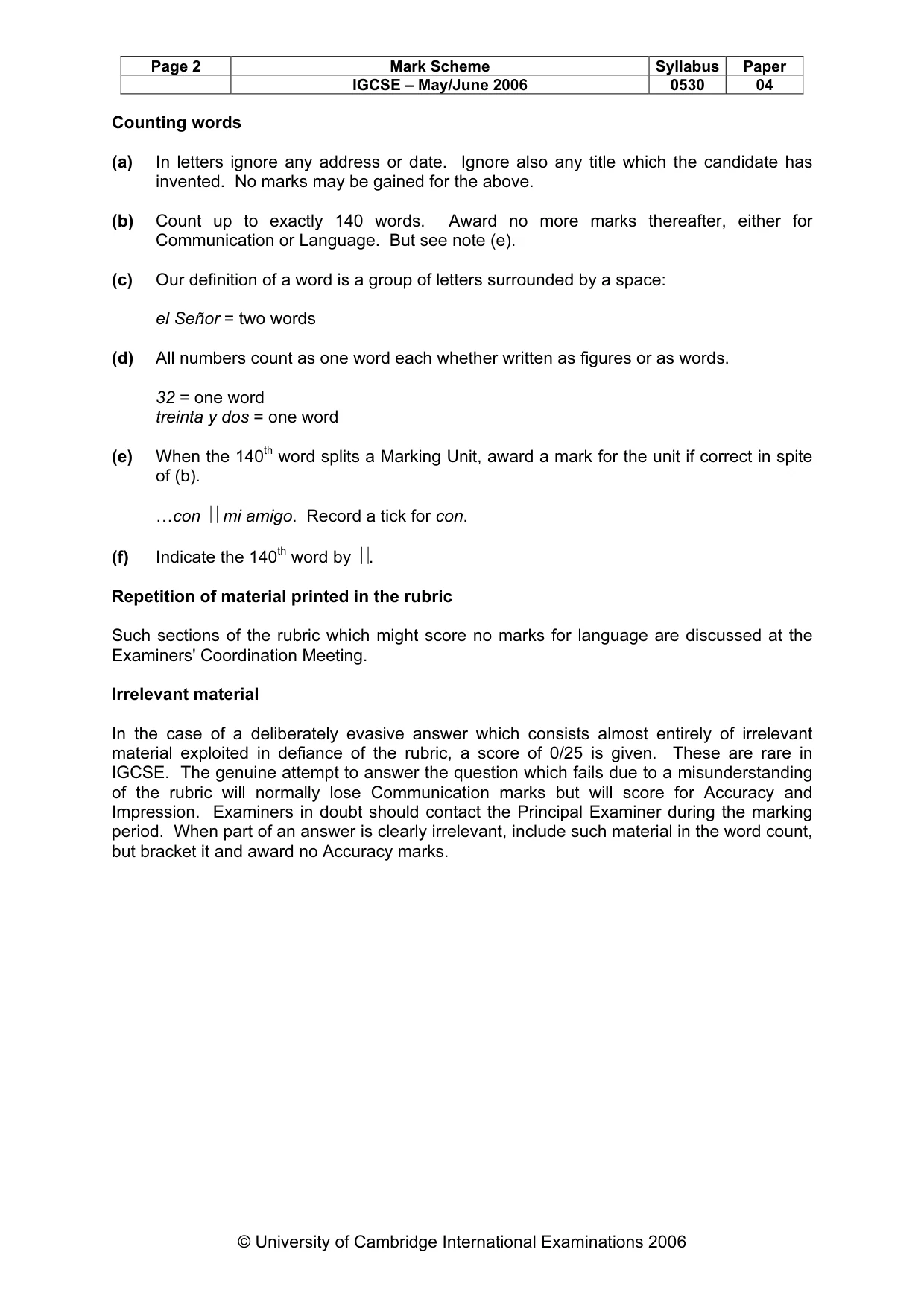
Mark scheme, page 3
Page 2 Mark Scheme Syllabus Paper IGCSE – May/June 2006 0530 04 © University of Cambridge International Examinations 2006 Counting words (a) In letters ignore any address or date. Ignore also any title which the candidate has invented. No marks may be gained for the above. (b) Count up to exactly 140 words. Award no more marks thereafter, either for Communication or Language. But see note (e). (c) Our definition of a word is a group of letters surrounded by a space: el Señor = two words (d) All numbers count as one word each whether written as figures or as words. 32 = one word treinta y dos = one word (e) When the 140th word splits a Marking Unit, award a mark for the unit if correct in spite of (b). …con mi amigo. Record a tick for con. (f) Indicate the 140th word by . Repetition of material printed in the rubric Such sections of the rubric which might score no marks for language are discussed at the Examiners' Coordination Meeting. Irrelevant material In the case of a deliberately evasive answer which consists almost entirely of irrelevant material exploited in defiance of the rubric, a score of 0/25 is given. These are rare in IGCSE. The genuine attempt to answer the question which fails due to a misunderstanding of the rubric will normally lose Communication marks but will score for Accuracy and Impression. Examiners in doubt should contact the Principal Examiner during the marking period. When part of an answer is clearly irrelevant, include such material in the word count, but bracket it and award no Accuracy marks.
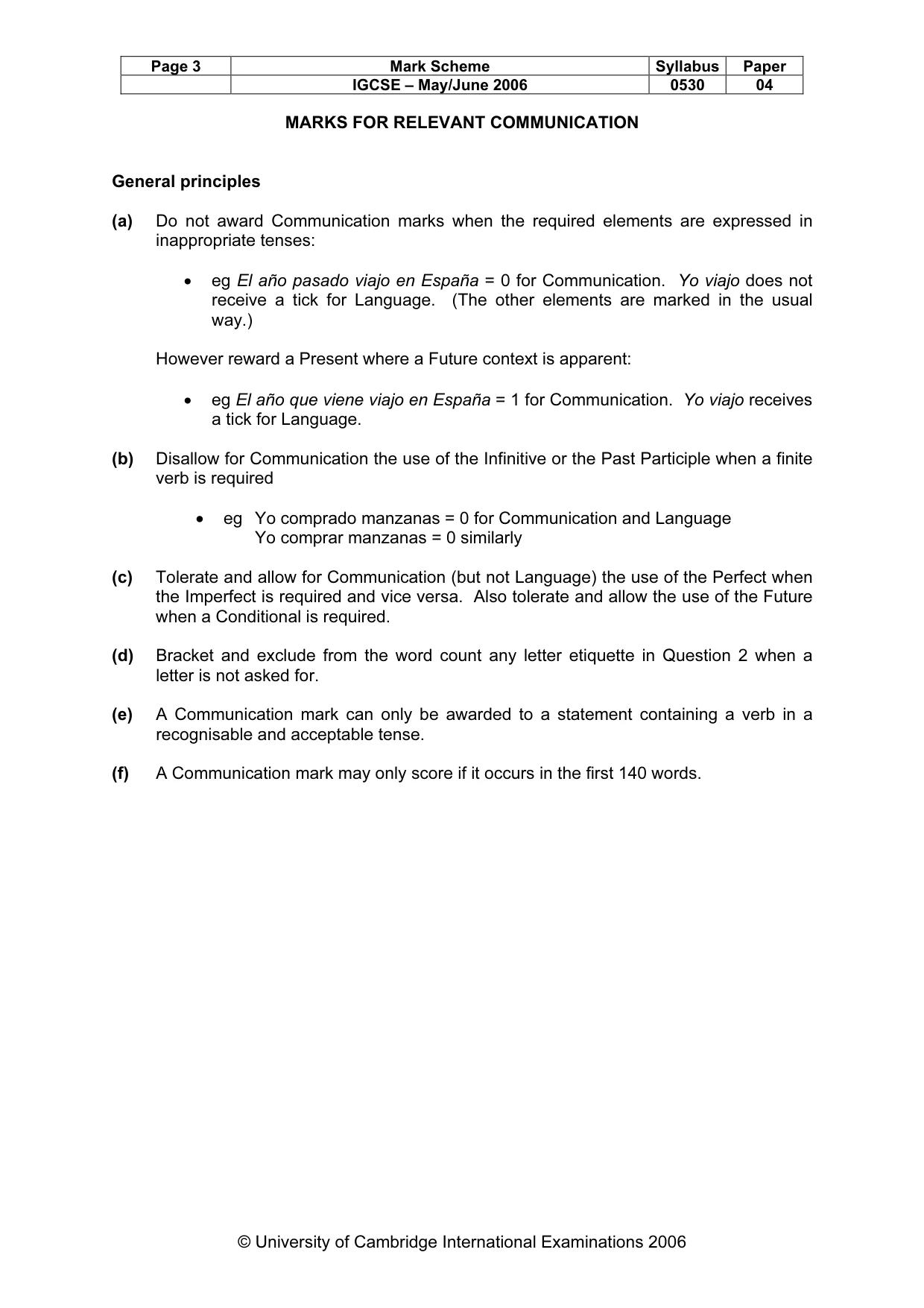
Mark scheme, page 4
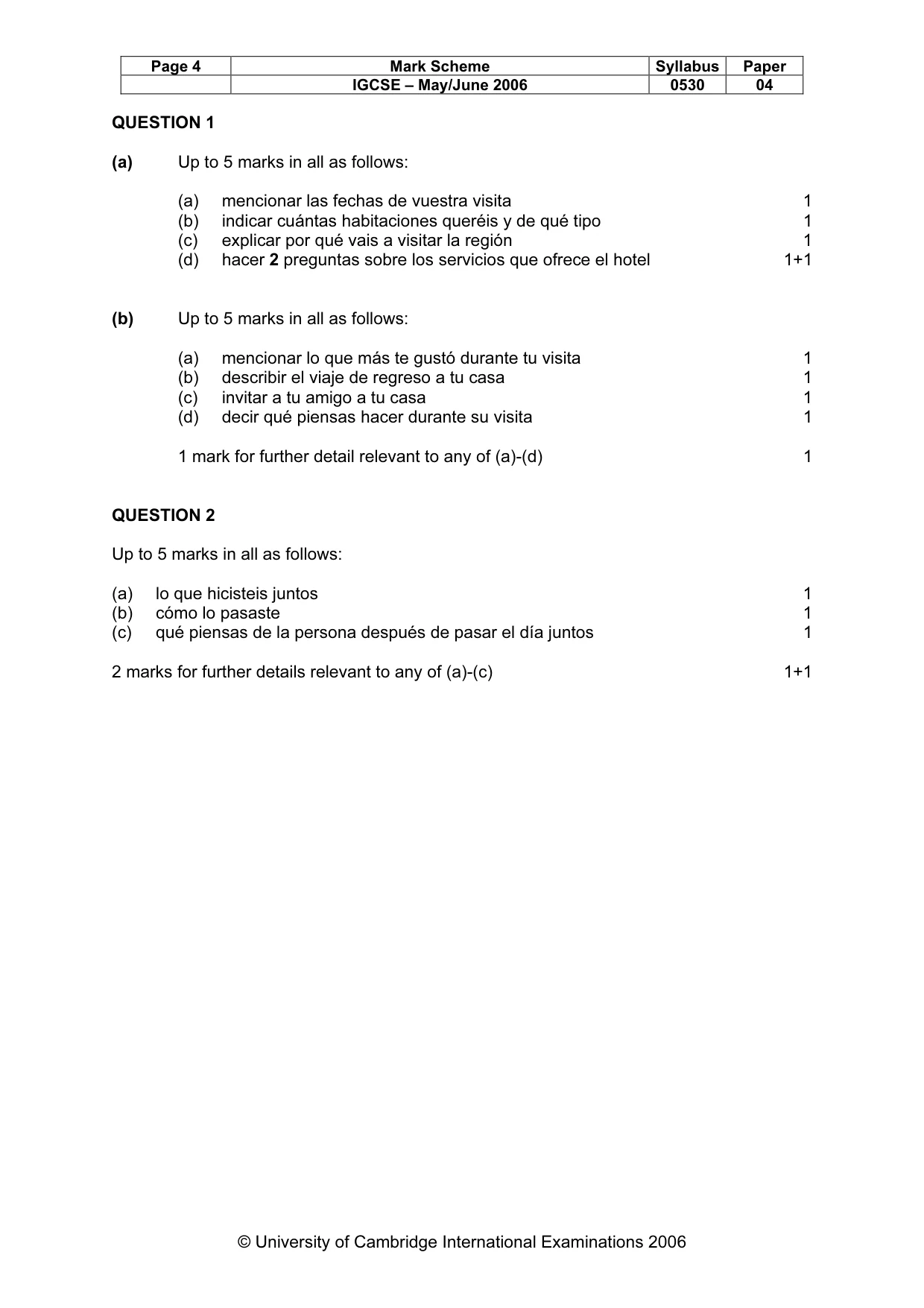
Page 3 Mark Scheme Syllabus Paper IGCSE – May/June 2006 0530 04 © University of Cambridge International Examinations 2006 MARKS FOR RELEVANT COMMUNICATION General principles (a) Do not award Communication marks when the required elements are expressed in inappropriate tenses: • eg El año pasado viajo en España = 0 for Communication. Yo viajo does not receive a tick for Language. (The other elements are marked in the usual way.) However reward a Present where a Future context is apparent: • eg El año que viene viajo en España = 1 for Communication. Yo viajo receives a tick for Language. (b) Disallow for Communication the use of the Infinitive or the Past Participle when a finite verb is required • eg Yo comprado manzanas = 0 for Communication and Language Yo comprar manzanas = 0 similarly (c) Tolerate and allow for Communication (but not Language) the use of the Perfect when the Imperfect is required and vice versa. Also tolerate and allow the use of the Future when a Conditional is required. (d) Bracket and exclude from the word count any letter etiquette in Question 2 when a letter is not asked for. (e) A Communication mark can only be awarded to a statement containing a verb in a recognisable and acceptable tense. (f) A Communication mark may only score if it occurs in the first 140 words.
Mark scheme, page 5
Page 4 Mark Scheme Syllabus Paper IGCSE – May/June 2006 0530 04 © University of Cambridge International Examinations 2006 QUESTION 1 (a) Up to 5 marks in all as follows: (a) mencionar las fechas de vuestra visita 1 (b) indicar cuántas habitaciones queréis y de qué tipo 1 (c) explicar por qué vais a visitar la región 1 (d) hacer 2 preguntas sobre los servicios que ofrece el hotel 1+1 (b) Up to 5 marks in all as follows: (a) mencionar lo que más te gustó durante tu visita 1 (b) describir el viaje de regreso a tu casa 1 (c) invitar a tu amigo a tu casa 1 (d) decir qué piensas hacer durante su visita 1 1 mark for further detail relevant to any of (a)-(d) 1 QUESTION 2 Up to 5 marks in all as follows: (a) lo que hicisteis juntos 1 (b) cómo lo pasaste 1 (c) qué piensas de la persona después de pasar el día juntos 1 2 marks for further details relevant to any of (a)-(c) 1+1
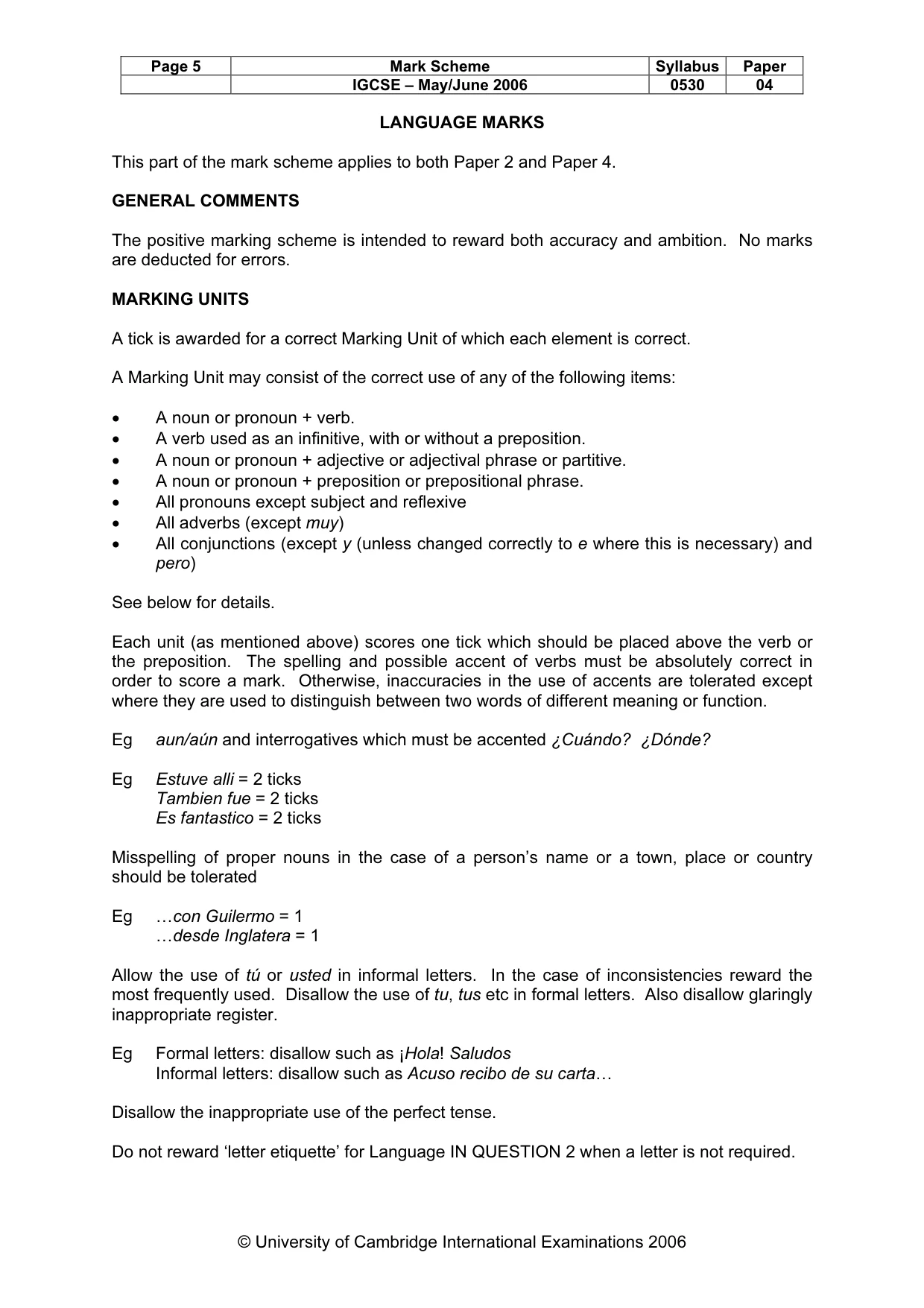
Mark scheme, page 6
Page 5 Mark Scheme Syllabus Paper IGCSE – May/June 2006 0530 04 © University of Cambridge International Examinations 2006 LANGUAGE MARKS This part of the mark scheme applies to both Paper 2 and Paper 4. GENERAL COMMENTS The positive marking scheme is intended to reward both accuracy and ambition. No marks are deducted for errors. MARKING UNITS A tick is awarded for a correct Marking Unit of which each element is correct. A Marking Unit may consist of the correct use of any of the following items: • A noun or pronoun + verb. • A verb used as an infinitive, with or without a preposition. • A noun or pronoun + adjective or adjectival phrase or partitive. • A noun or pronoun + preposition or prepositional phrase. • All pronouns except subject and reflexive • All adverbs (except muy) • All conjunctions (except y (unless changed correctly to e where this is necessary) and pero) See below for details. Each unit (as mentioned above) scores one tick which should be placed above the verb or the preposition. The spelling and possible accent of verbs must be absolutely correct in order to score a mark. Otherwise, inaccuracies in the use of accents are tolerated except where they are used to distinguish between two words of different meaning or function. Eg aun/aún and interrogatives which must be accented ¿Cuándo? ¿Dónde? Eg Estuve alli = 2 ticks Tambien fue = 2 ticks Es fantastico = 2 ticks Misspelling of proper nouns in the case of a person’s name or a town, place or country should be tolerated Eg …con Guilermo = 1 …desde Inglatera = 1 Allow the use of tú or usted in informal letters. In the case of inconsistencies reward the most frequently used. Disallow the use of tu, tus etc in formal letters. Also disallow glaringly inappropriate register. Eg Formal letters: disallow such as ¡Hola! Saludos Informal letters: disallow such as Acuso recibo de su carta… Disallow the inappropriate use of the perfect tense. Do not reward ‘letter etiquette’ for Language IN QUESTION 2 when a letter is not required.
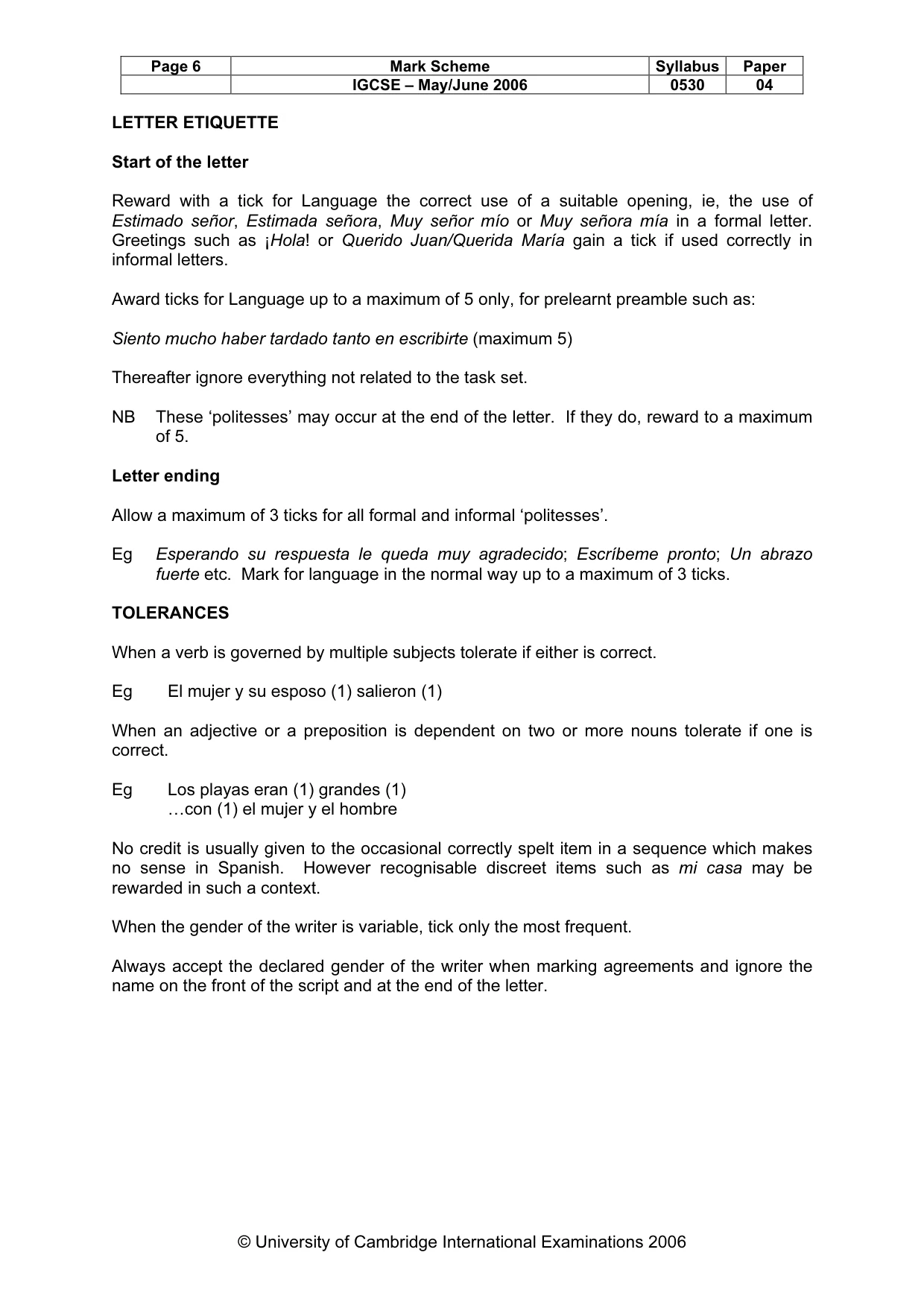
Mark scheme, page 7
Page 6 Mark Scheme Syllabus Paper IGCSE – May/June 2006 0530 04 © University of Cambridge International Examinations 2006 LETTER ETIQUETTE Start of the letter Reward with a tick for Language the correct use of a suitable opening, ie, the use of Estimado señor, Estimada señora, Muy señor mío or Muy señora mía in a formal letter. Greetings such as ¡Hola! or Querido Juan/Querida María gain a tick if used correctly in informal letters. Award ticks for Language up to a maximum of 5 only, for prelearnt preamble such as: Siento mucho haber tardado tanto en escribirte (maximum 5) Thereafter ignore everything not related to the task set. NB These ‘politesses’ may occur at the end of the letter. If they do, reward to a maximum of 5. Letter ending Allow a maximum of 3 ticks for all formal and informal ‘politesses’. Eg Esperando su respuesta le queda muy agradecido; Escríbeme pronto; Un abrazo fuerte etc. Mark for language in the normal way up to a maximum of 3 ticks. TOLERANCES When a verb is governed by multiple subjects tolerate if either is correct. Eg El mujer y su esposo (1) salieron (1) When an adjective or a preposition is dependent on two or more nouns tolerate if one is correct. Eg Los playas eran (1) grandes (1) …con (1) el mujer y el hombre No credit is usually given to the occasional correctly spelt item in a sequence which makes no sense in Spanish. However recognisable discreet items such as mi casa may be rewarded in such a context. When the gender of the writer is variable, tick only the most frequent. Always accept the declared gender of the writer when marking agreements and ignore the name on the front of the script and at the end of the letter.
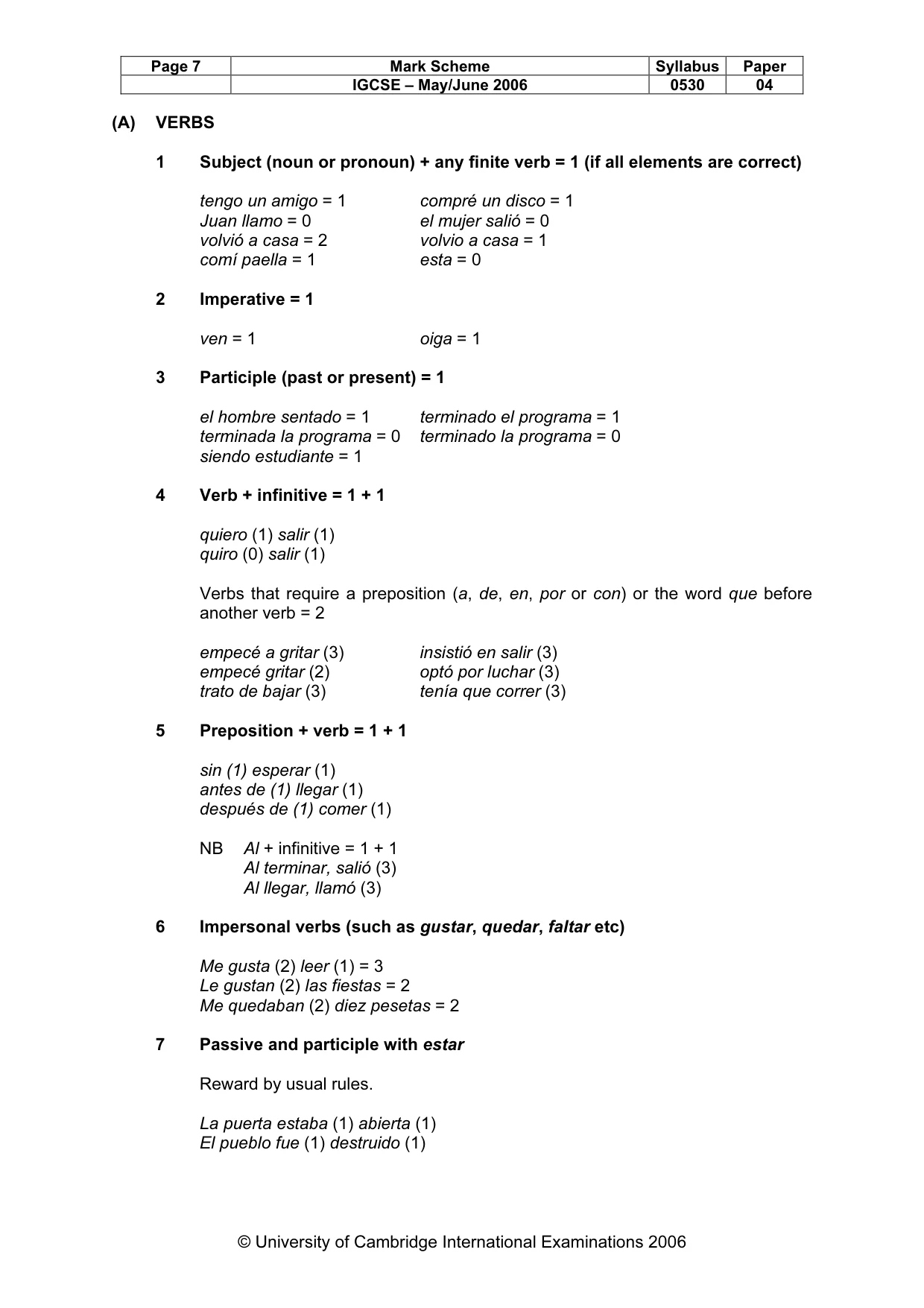
Mark scheme, page 8
Page 7 Mark Scheme Syllabus Paper IGCSE – May/June 2006 0530 04 © University of Cambridge International Examinations 2006 (A) VERBS 1 Subject (noun or pronoun) + any finite verb = 1 (if all elements are correct) tengo un amigo = 1 compré un disco = 1 Juan llamo = 0 el mujer salió = 0 volvió a casa = 2 volvio a casa = 1 comí paella = 1 esta = 0 2 Imperative = 1 ven = 1 oiga = 1 3 Participle (past or present) = 1 el hombre sentado = 1 terminado el programa = 1 terminada la programa = 0 terminado la programa = 0 siendo estudiante = 1 4 Verb + infinitive = 1 + 1 quiero (1) salir (1) quiro (0) salir (1) Verbs that require a preposition (a, de, en, por or con) or the word que before another verb = 2 empecé a gritar (3) insistió en salir (3) empecé gritar (2) optó por luchar (3) trato de bajar (3) tenía que correr (3) 5 Preposition + verb = 1 + 1 sin (1) esperar (1) antes de (1) llegar (1) después de (1) comer (1) NB Al + infinitive = 1 + 1 Al terminar, salió (3) Al llegar, llamó (3) 6 Impersonal verbs (such as gustar, quedar, faltar etc) Me gusta (2) leer (1) = 3 Le gustan (2) las fiestas = 2 Me quedaban (2) diez pesetas = 2 7 Passive and participle with estar Reward by usual rules. La puerta estaba (1) abierta (1) El pueblo fue (1) destruido (1)
Mark scheme, page 9
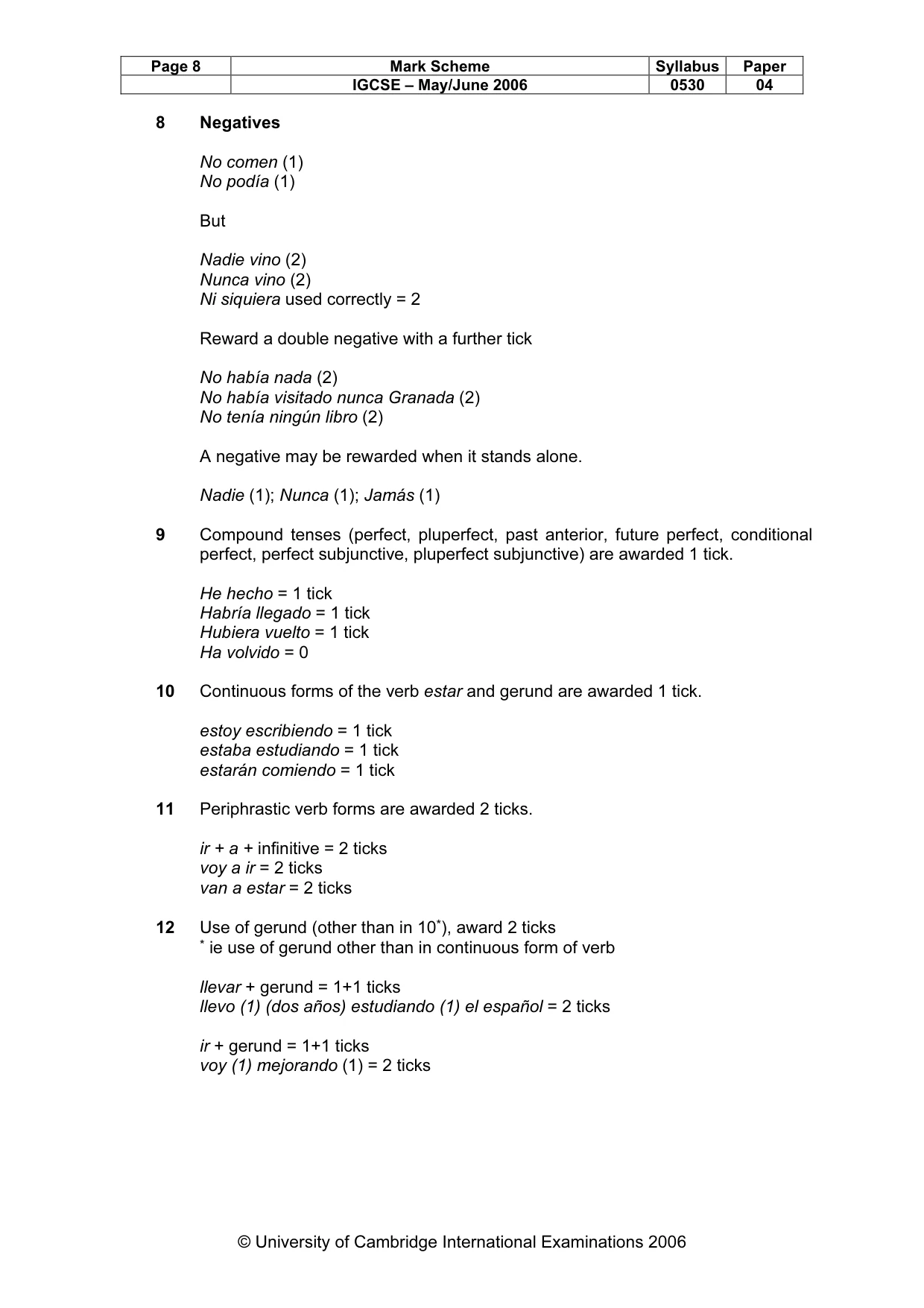
Page 8 Mark Scheme Syllabus Paper IGCSE – May/June 2006 0530 04 © University of Cambridge International Examinations 2006 8 Negatives No comen (1) No podía (1) But Nadie vino (2) Nunca vino (2) Ni siquiera used correctly = 2 Reward a double negative with a further tick No había nada (2) No había visitado nunca Granada (2) No tenía ningún libro (2) A negative may be rewarded when it stands alone. Nadie (1); Nunca (1); Jamás (1) 9 Compound tenses (perfect, pluperfect, past anterior, future perfect, conditional perfect, perfect subjunctive, pluperfect subjunctive) are awarded 1 tick. He hecho = 1 tick Habría llegado = 1 tick Hubiera vuelto = 1 tick Ha volvido = 0 10 Continuous forms of the verb estar and gerund are awarded 1 tick. estoy escribiendo = 1 tick estaba estudiando = 1 tick estarán comiendo = 1 tick 11 Periphrastic verb forms are awarded 2 ticks. ir + a + infinitive = 2 ticks voy a ir = 2 ticks van a estar = 2 ticks 12 Use of gerund (other than in 10*), award 2 ticks * ie use of gerund other than in continuous form of verb llevar + gerund = 1+1 ticks llevo (1) (dos años) estudiando (1) el español = 2 ticks ir + gerund = 1+1 ticks voy (1) mejorando (1) = 2 ticks
Mark scheme, page 10
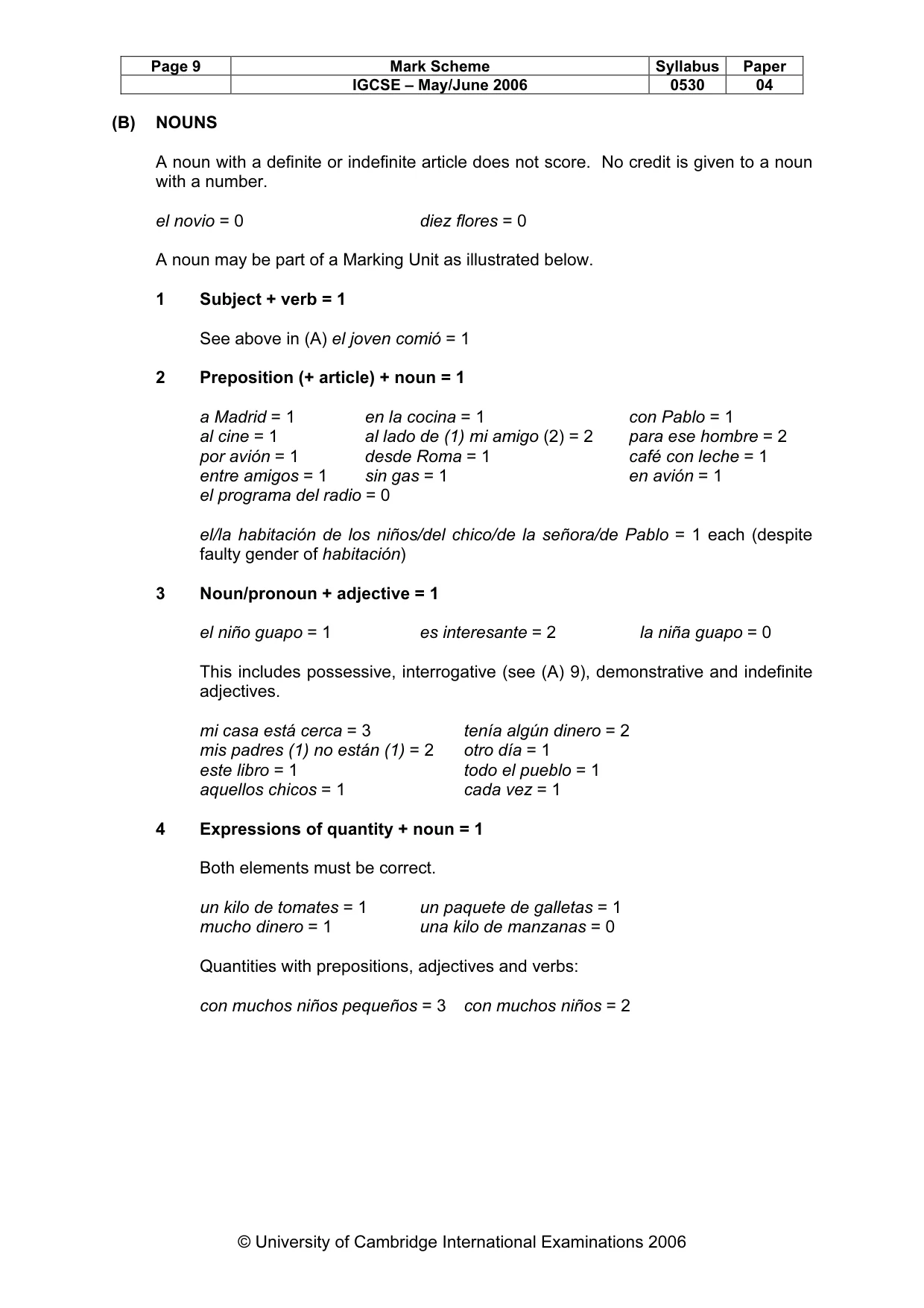
Page 9 Mark Scheme Syllabus Paper IGCSE – May/June 2006 0530 04 © University of Cambridge International Examinations 2006 (B) NOUNS A noun with a definite or indefinite article does not score. No credit is given to a noun with a number. el novio = 0 diez flores = 0 A noun may be part of a Marking Unit as illustrated below. 1 Subject + verb = 1 See above in (A) el joven comió = 1 2 Preposition (+ article) + noun = 1 a Madrid = 1 en la cocina = 1 con Pablo = 1 al cine = 1 al lado de (1) mi amigo (2) = 2 para ese hombre = 2 por avión = 1 desde Roma = 1 café con leche = 1 entre amigos = 1 sin gas = 1 en avión = 1 el programa del radio = 0 el/la habitación de los niños/del chico/de la señora/de Pablo = 1 each (despite faulty gender of habitación) 3 Noun/pronoun + adjective = 1 el niño guapo = 1 es interesante = 2 la niña guapo = 0 This includes possessive, interrogative (see (A) 9), demonstrative and indefinite adjectives. mi casa está cerca = 3 tenía algún dinero = 2 mis padres (1) no están (1) = 2 otro día = 1 este libro = 1 todo el pueblo = 1 aquellos chicos = 1 cada vez = 1 4 Expressions of quantity + noun = 1 Both elements must be correct. un kilo de tomates = 1 un paquete de galletas = 1 mucho dinero = 1 una kilo de manzanas = 0 Quantities with prepositions, adjectives and verbs: con muchos niños pequeños = 3 con muchos niños = 2
Mark scheme, page 11
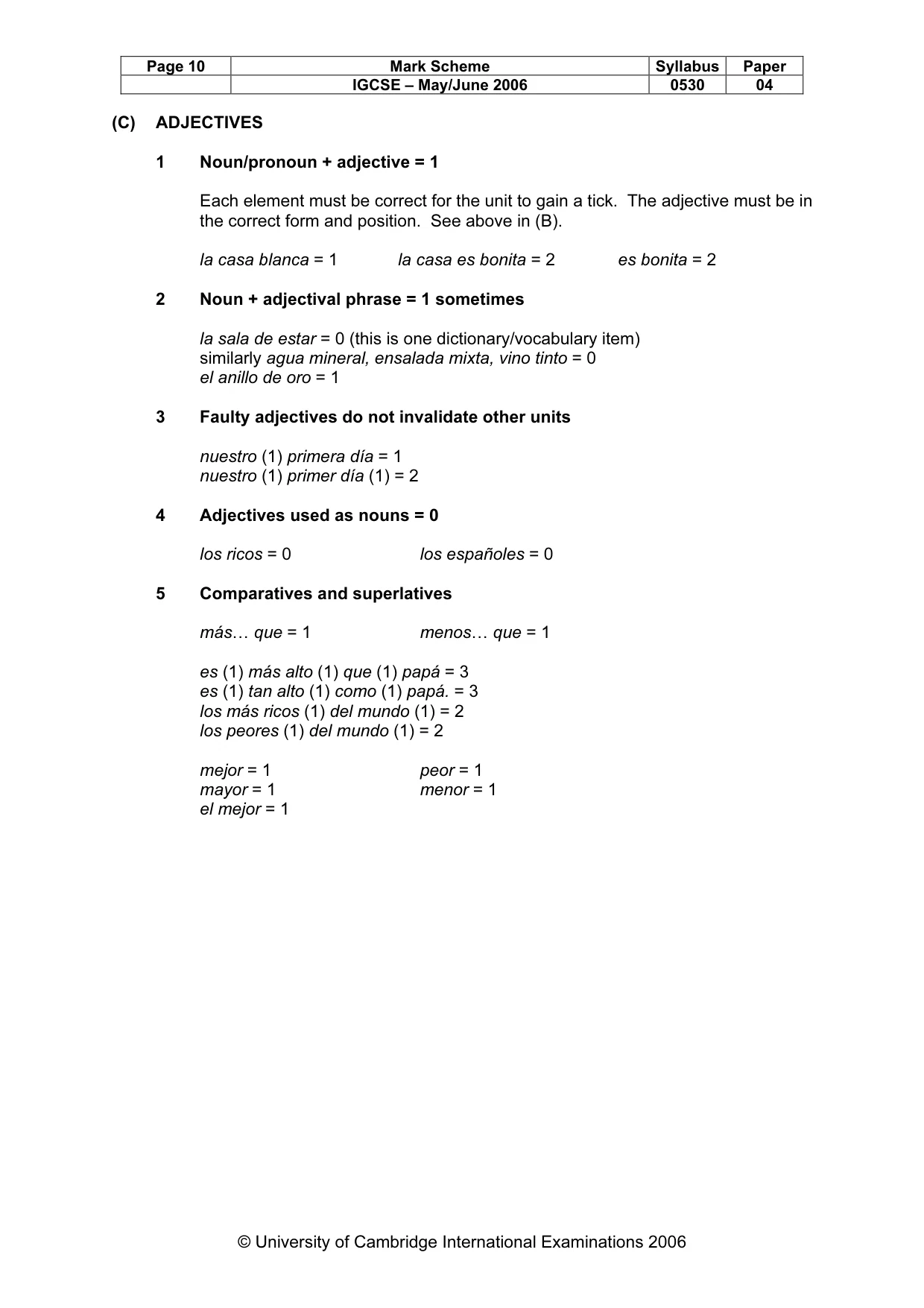
Page 10 Mark Scheme Syllabus Paper IGCSE – May/June 2006 0530 04 © University of Cambridge International Examinations 2006 (C) ADJECTIVES 1 Noun/pronoun + adjective = 1 Each element must be correct for the unit to gain a tick. The adjective must be in the correct form and position. See above in (B). la casa blanca = 1 la casa es bonita = 2 es bonita = 2 2 Noun + adjectival phrase = 1 sometimes la sala de estar = 0 (this is one dictionary/vocabulary item) similarly agua mineral, ensalada mixta, vino tinto = 0 el anillo de oro = 1 3 Faulty adjectives do not invalidate other units nuestro (1) primera día = 1 nuestro (1) primer día (1) = 2 4 Adjectives used as nouns = 0 los ricos = 0 los españoles = 0 5 Comparatives and superlatives más… que = 1 menos… que = 1 es (1) más alto (1) que (1) papá = 3 es (1) tan alto (1) como (1) papá. = 3 los más ricos (1) del mundo (1) = 2 los peores (1) del mundo (1) = 2 mejor = 1 peor = 1 mayor = 1 menor = 1 el mejor = 1
Mark scheme, page 12
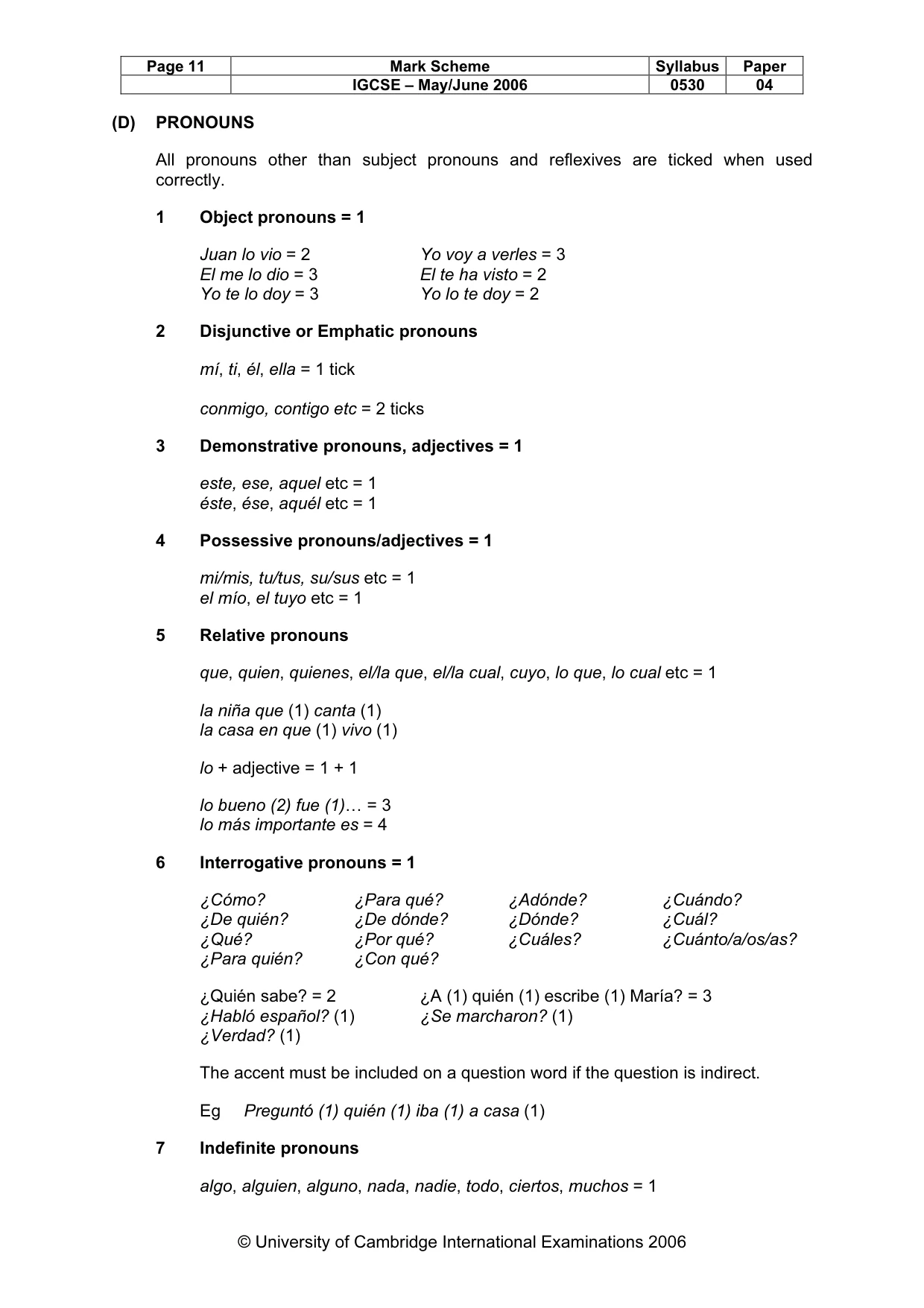
Page 11 Mark Scheme Syllabus Paper IGCSE – May/June 2006 0530 04 © University of Cambridge International Examinations 2006 (D) PRONOUNS All pronouns other than subject pronouns and reflexives are ticked when used correctly. 1 Object pronouns = 1 Juan lo vio = 2 Yo voy a verles = 3 El me lo dio = 3 El te ha visto = 2 Yo te lo doy = 3 Yo lo te doy = 2 2 Disjunctive or Emphatic pronouns mí, ti, él, ella = 1 tick conmigo, contigo etc = 2 ticks 3 Demonstrative pronouns, adjectives = 1 este, ese, aquel etc = 1 éste, ése, aquél etc = 1 4 Possessive pronouns/adjectives = 1 mi/mis, tu/tus, su/sus etc = 1 el mío, el tuyo etc = 1 5 Relative pronouns que, quien, quienes, el/la que, el/la cual, cuyo, lo que, lo cual etc = 1 la niña que (1) canta (1) la casa en que (1) vivo (1) lo + adjective = 1 + 1 lo bueno (2) fue (1)… = 3 lo más importante es = 4 6 Interrogative pronouns = 1 ¿Cómo? ¿Para qué? ¿Adónde? ¿Cuándo? ¿De quién? ¿De dónde? ¿Dónde? ¿Cuál? ¿Qué? ¿Por qué? ¿Cuáles? ¿Cuánto/a/os/as? ¿Para quién? ¿Con qué? ¿Quién sabe? = 2 ¿A (1) quién (1) escribe (1) María? = 3 ¿Habló español? (1) ¿Se marcharon? (1) ¿Verdad? (1) The accent must be included on a question word if the question is indirect. Eg Preguntó (1) quién (1) iba (1) a casa (1) 7 Indefinite pronouns algo, alguien, alguno, nada, nadie, todo, ciertos, muchos = 1
Mark scheme, page 13
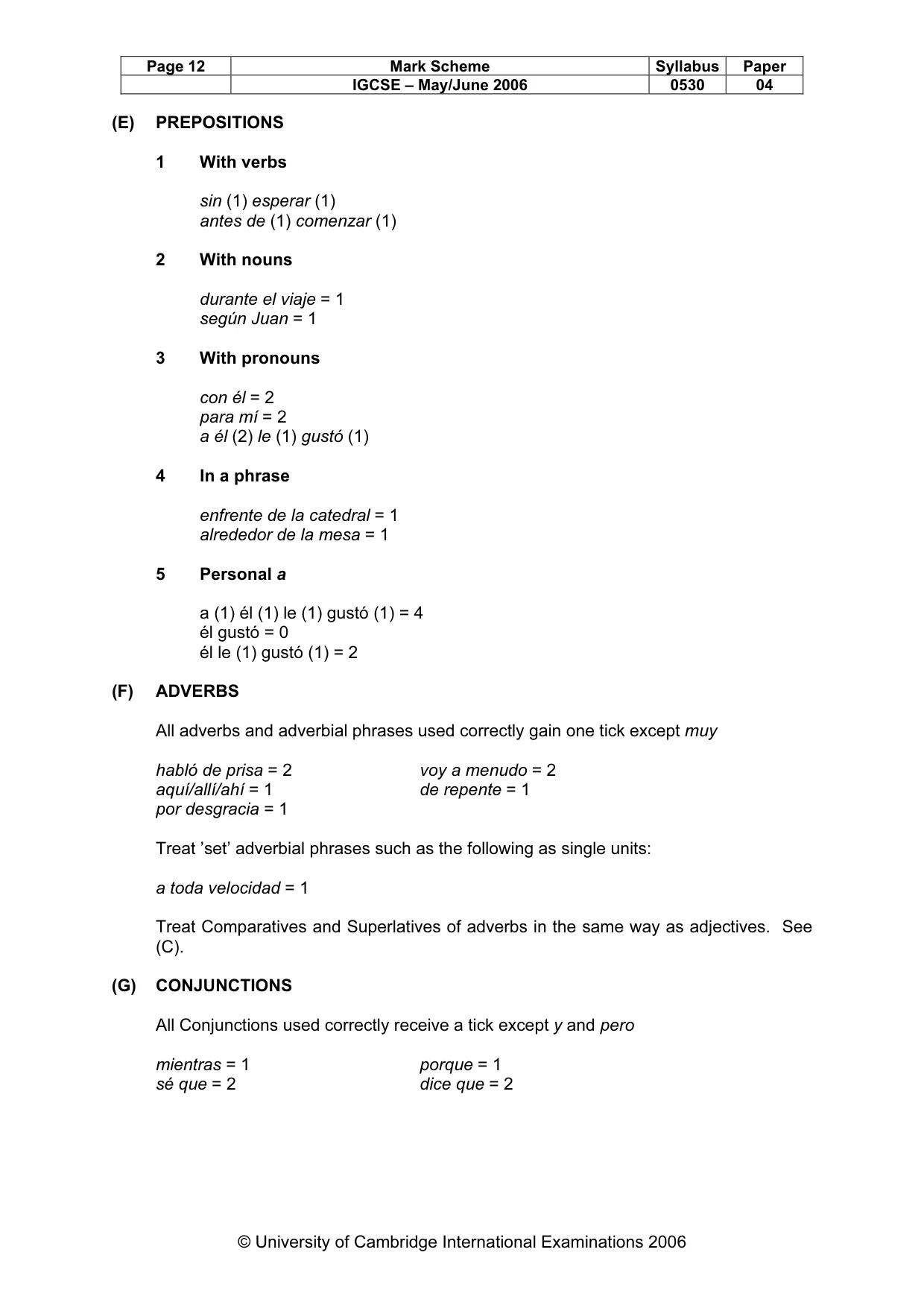
Page 12 Mark Scheme Syllabus Paper IGCSE – May/June 2006 0530 04 © University of Cambridge International Examinations 2006 (E) PREPOSITIONS 1 With verbs sin (1) esperar (1) antes de (1) comenzar (1) 2 With nouns durante el viaje = 1 según Juan = 1 3 With pronouns con él = 2 para mí = 2 a él (2) le (1) gustó (1) 4 In a phrase enfrente de la catedral = 1 alrededor de la mesa = 1 5 Personal a a (1) él (1) le (1) gustó (1) = 4 él gustó = 0 él le (1) gustó (1) = 2 (F) ADVERBS All adverbs and adverbial phrases used correctly gain one tick except muy habló de prisa = 2 voy a menudo = 2 aquí/allí/ahí = 1 de repente = 1 por desgracia = 1 Treat ’set’ adverbial phrases such as the following as single units: a toda velocidad = 1 Treat Comparatives and Superlatives of adverbs in the same way as adjectives. See (C). (G) CONJUNCTIONS All Conjunctions used correctly receive a tick except y and pero mientras = 1 porque = 1 sé que = 2 dice que = 2
Mark scheme, page 14
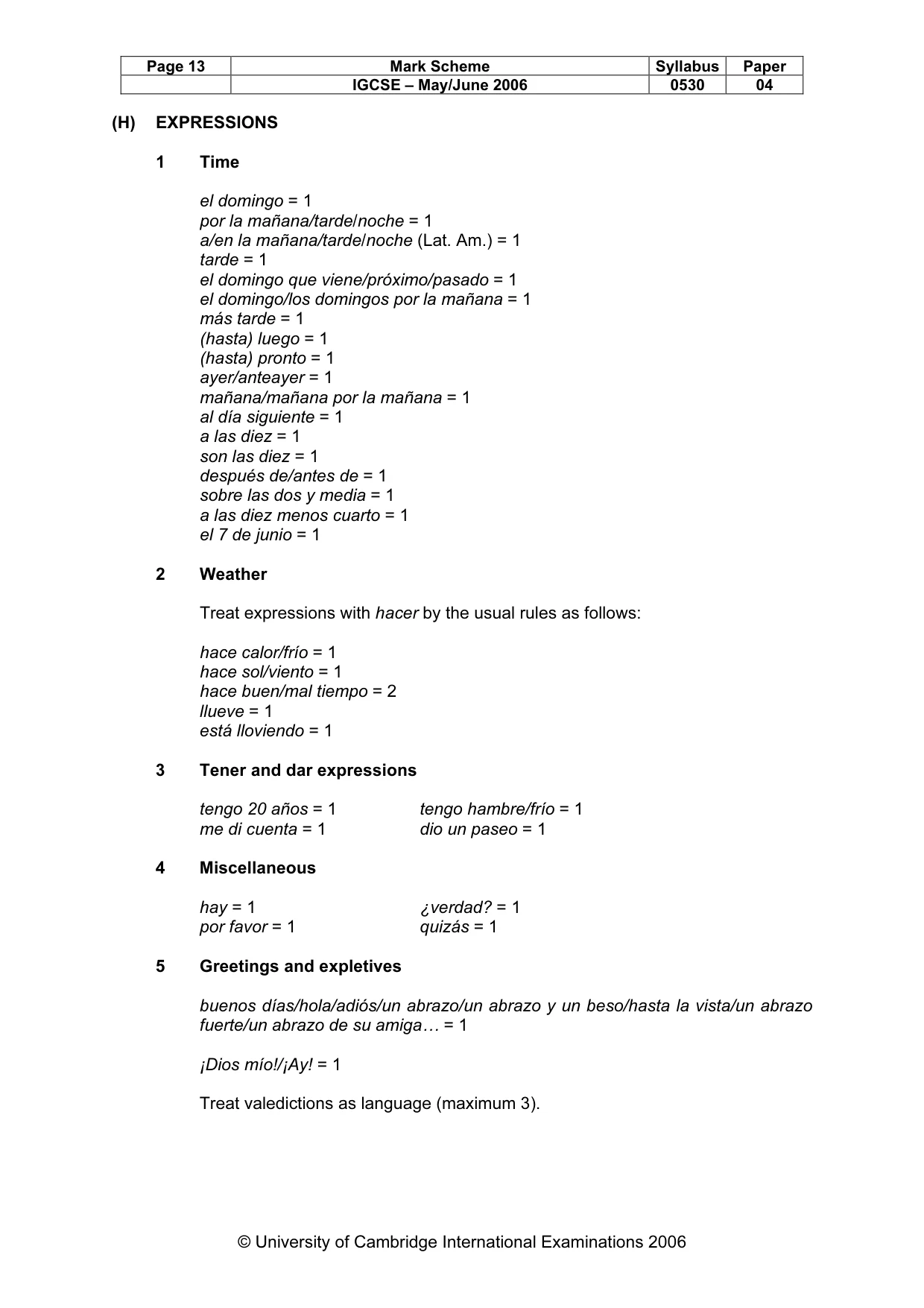
Page 13 Mark Scheme Syllabus Paper IGCSE – May/June 2006 0530 04 © University of Cambridge International Examinations 2006 (H) EXPRESSIONS 1 Time el domingo = 1 por la mañana/tarde/noche = 1 a/en la mañana/tarde/noche (Lat. Am.) = 1 tarde = 1 el domingo que viene/próximo/pasado = 1 el domingo/los domingos por la mañana = 1 más tarde = 1 (hasta) luego = 1 (hasta) pronto = 1 ayer/anteayer = 1 mañana/mañana por la mañana = 1 al día siguiente = 1 a las diez = 1 son las diez = 1 después de/antes de = 1 sobre las dos y media = 1 a las diez menos cuarto = 1 el 7 de junio = 1 2 Weather Treat expressions with hacer by the usual rules as follows: hace calor/frío = 1 hace sol/viento = 1 hace buen/mal tiempo = 2 llueve = 1 está lloviendo = 1 3 Tener and dar expressions tengo 20 años = 1 tengo hambre/frío = 1 me di cuenta = 1 dio un paseo = 1 4 Miscellaneous hay = 1 ¿verdad? = 1 por favor = 1 quizás = 1 5 Greetings and expletives buenos días/hola/adiós/un abrazo/un abrazo y un beso/hasta la vista/un abrazo fuerte/un abrazo de su amiga… = 1 ¡Dios mío!/¡Ay! = 1 Treat valedictions as language (maximum 3).
Mark scheme, page 15
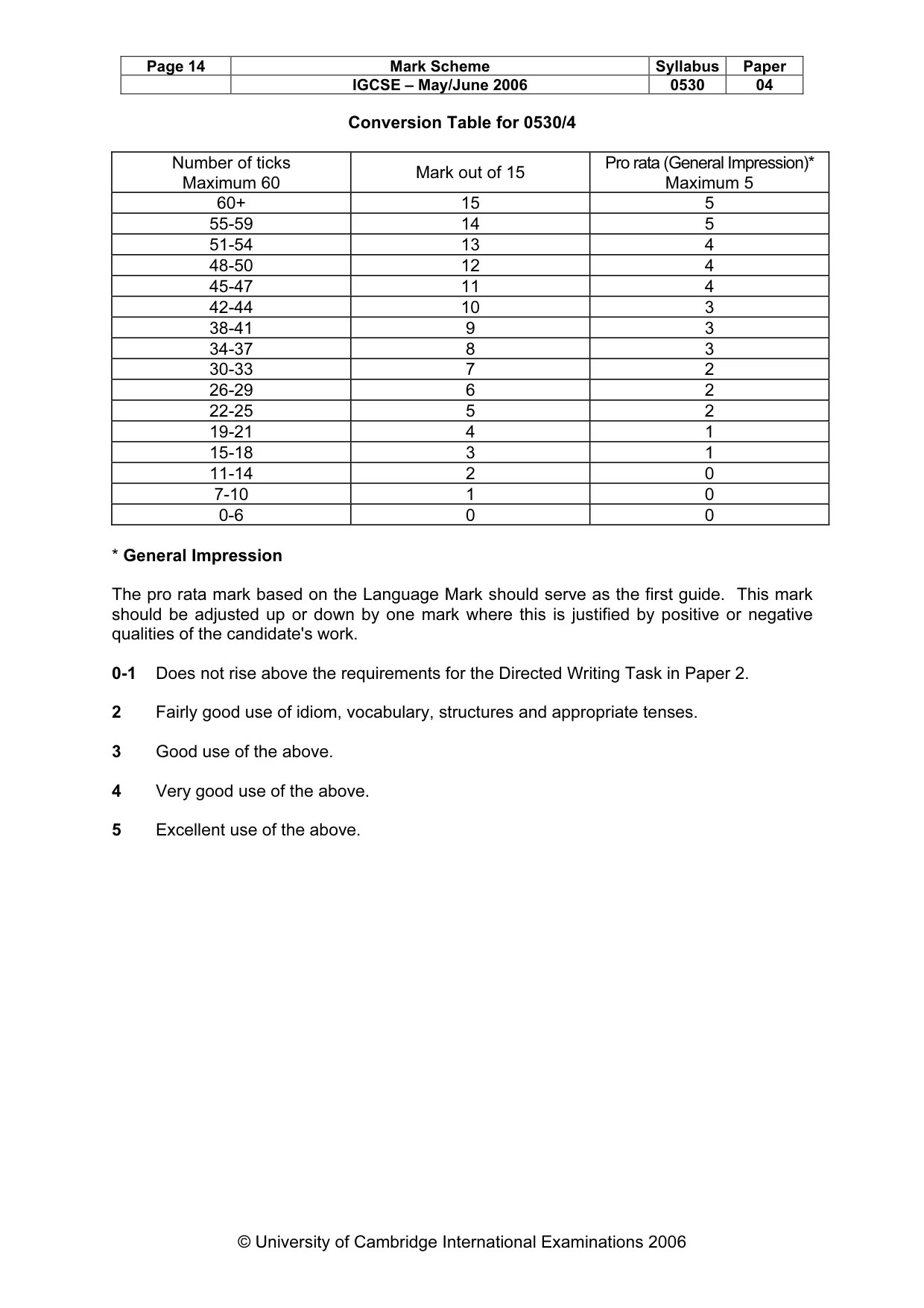
Page 14 Mark Scheme Syllabus Paper IGCSE – May/June 2006 0530 04 © University of Cambridge International Examinations 2006 Conversion Table for 0530/4 Number of ticks Maximum 60 Mark out of 15 Pro rata (General Impression)* Maximum 5 60+ 15 5 55-59 14 5 51-54 13 4 48-50 12 4 45-47 11 4 42-44 10 3 38-41 9 3 34-37 8 3 30-33 7 2 26-29 6 2 22-25 5 2 19-21 4 1 15-18 3 1 11-14 2 0 7-10 1 0 0-6 0 0 * General Impression The pro rata mark based on the Language Mark should serve as the first guide. This mark should be adjusted up or down by one mark where this is justified by positive or negative qualities of the candidate's work. 0-1 Does not rise above the requirements for the Directed Writing Task in Paper 2. 2 Fairly good use of idiom, vocabulary, structures and appropriate tenses. 3 Good use of the above. 4 Very good use of the above. 5 Excellent use of the above.
What you needed in this session
Cambridge’s own grade thresholds for 2006 May/June, Paper 4 · Variant 1. A higher threshold means an easier paper — the bar moves with how the cohort did.