Cambridge IGCSE Sciences - Co-ordinated (Double) 0654 — 2020 May/June Paper 5 · Variant 2
0654/52/M/J/20 · 7 questions · 60 marks · ≈68 min
The question paper and its mark scheme, free to read here and free to download. This is Cambridge’s own paper, exactly as it was sat.
Question paper16 pages



Mark scheme9 pages
Answers below. Sit the paper first if you are practising.
Questions as text
Q1 · You are going to investigate an enzyme used in the extraction of apple juice
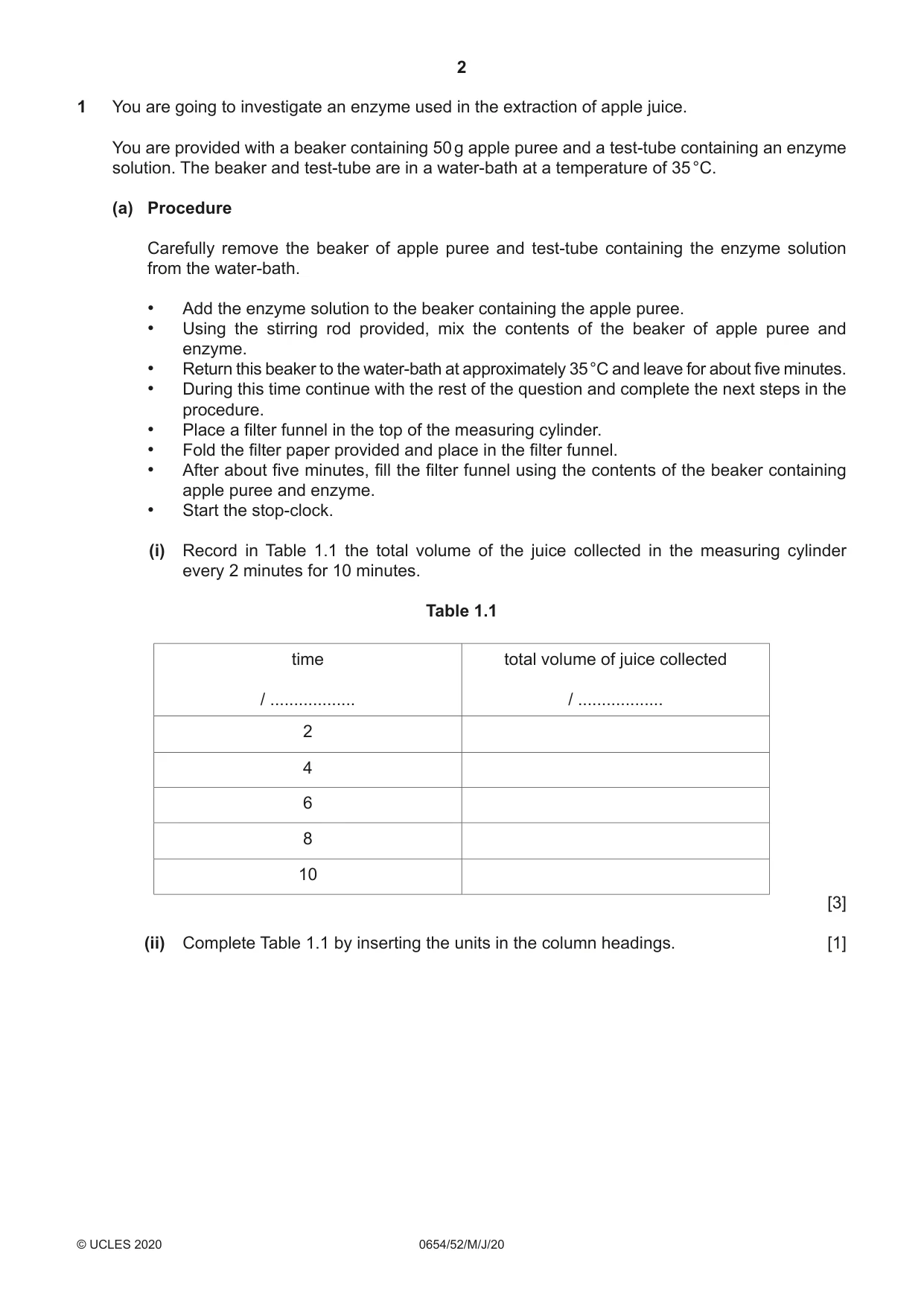
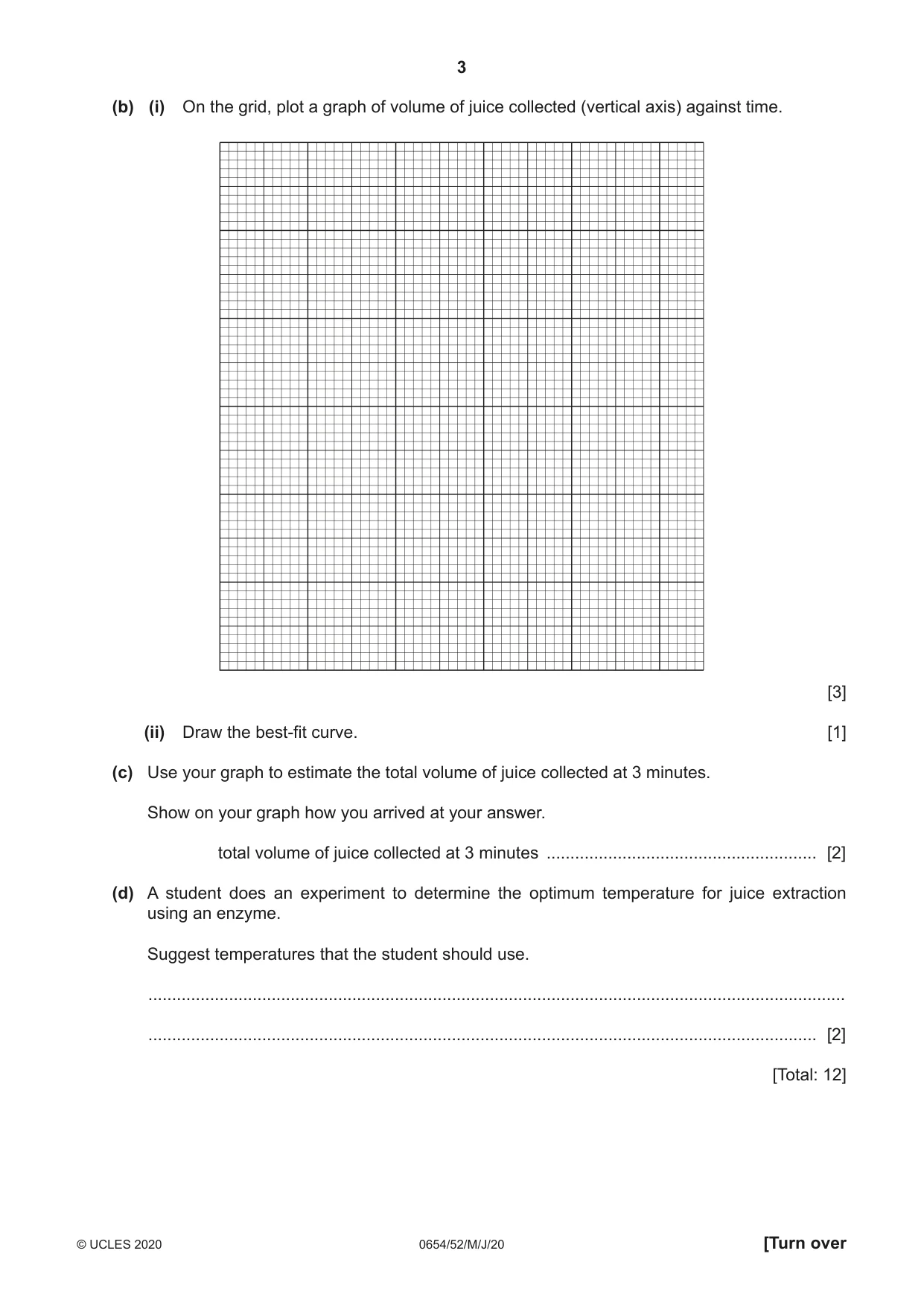
1 You are going to investigate an enzyme used in the extraction of apple juice. You are provided with a beaker containing 50 g apple puree and a test-tube containing an enzyme solution. The beaker and test-tube are in a water-bath at a temperature of 35 °C. (a) Procedure Carefully remove the beaker of apple puree and test-tube containing the enzyme solution from the water-bath. • Add the enzyme solution to the beaker containing the apple puree. • Using the stirring rod provided, mix the contents of the beaker of apple puree and enzyme. • Return this beaker to the water-bath at approximately 35 °C and leave for about five minutes. • During this time continue with the rest of the question and complete the next steps in the procedure. • Place a filter funnel in the top of the measuring cylinder. • Fold the filter paper provided and place in the filter funnel. • After about five minutes, fill the filter funnel using the contents of the beaker containing apple puree and enzyme. • Start the stop-clock. (i) Record in Table 1.1 the total volume of the juice collected in the measuring cylinder every 2 minutes for 10 minutes. Table 1.1 time total volume of juice collected / .................. / .................. 2 4 6 8 10 [3] (ii) Complete Table 1.1 by inserting the units in the column headings. [1] (b) (i) On the grid, plot a graph of volume of juice collected (vertical axis) against time. [3] (ii) Draw the best-fit curve. [1] (c) Use your graph to estimate the total volume of juice collected at 3 minutes. Show on your graph how you arrived at your answer. total volume of juice collected at 3 minutes ......................................................... [2] (d) A student does an experiment to determine the optimum temperature for juice extraction using an enzyme. Suggest temperatures that the student should use. ................................................................................................................................................... ............................................................................................................................................. [2] [Total: 12]
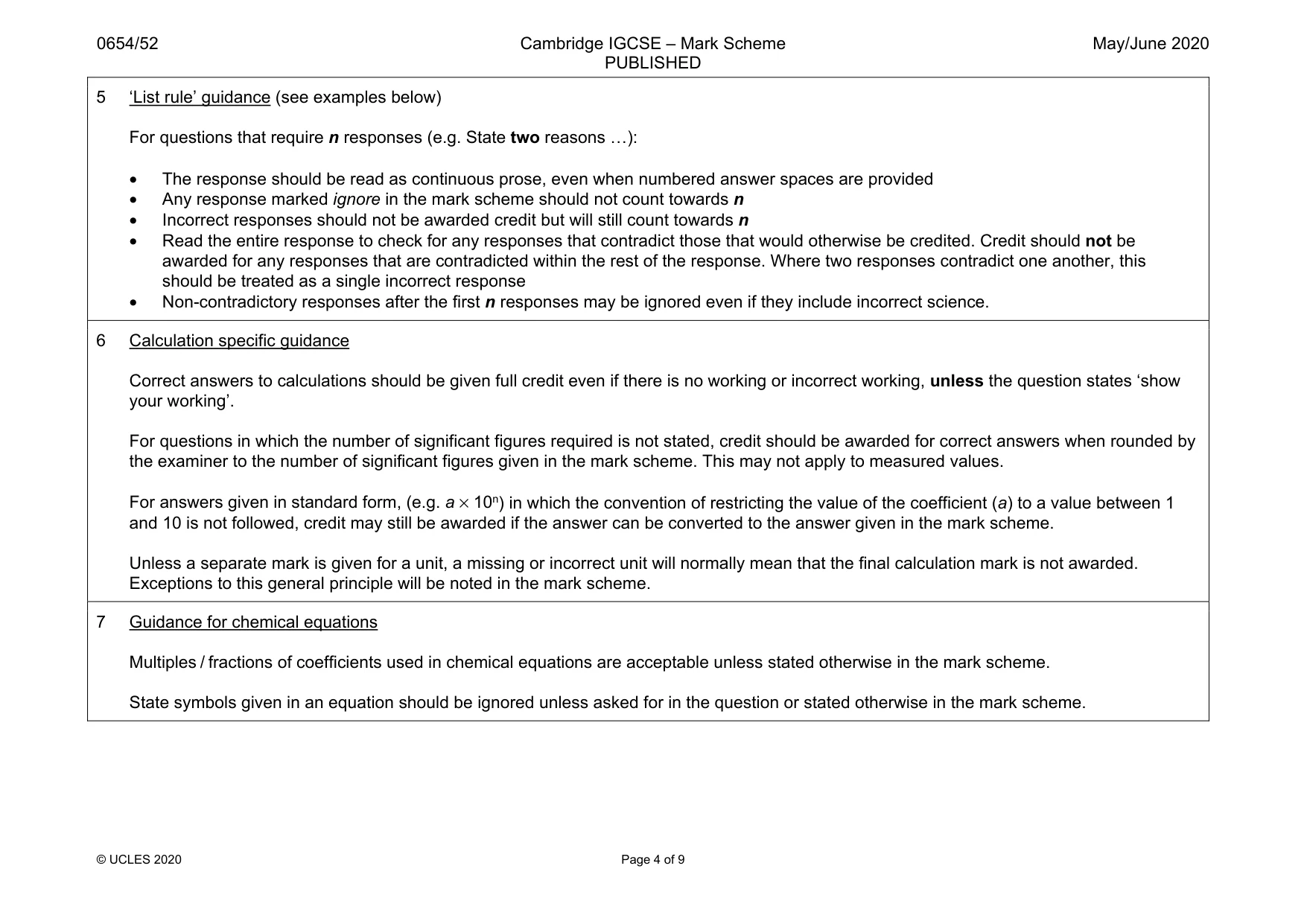
Mark scheme: 1(a)(i) value recorded at two minutes; full set of results; shows evidence of slowing down at 10 minutes; 3 1(a)(ii) mins and cm3 ; 1 1(b)(i) axes correct way round and labelled with quantity and unit; appropriate linear scales where the plotted points use at least half of the grid ; all points plotted correctly ± half small square; 3 1(b)(ii) curve of best fit ; 1 1(c) correct reading from graph; graph marked, preferably with horizontal and vertical lines from 3 mins to the line and other axis ; 2 1(d) at least three values; values quoted and includes values above and below 35; 2
Q2 · You are going to investigate the nutrient content of apple puree and bread
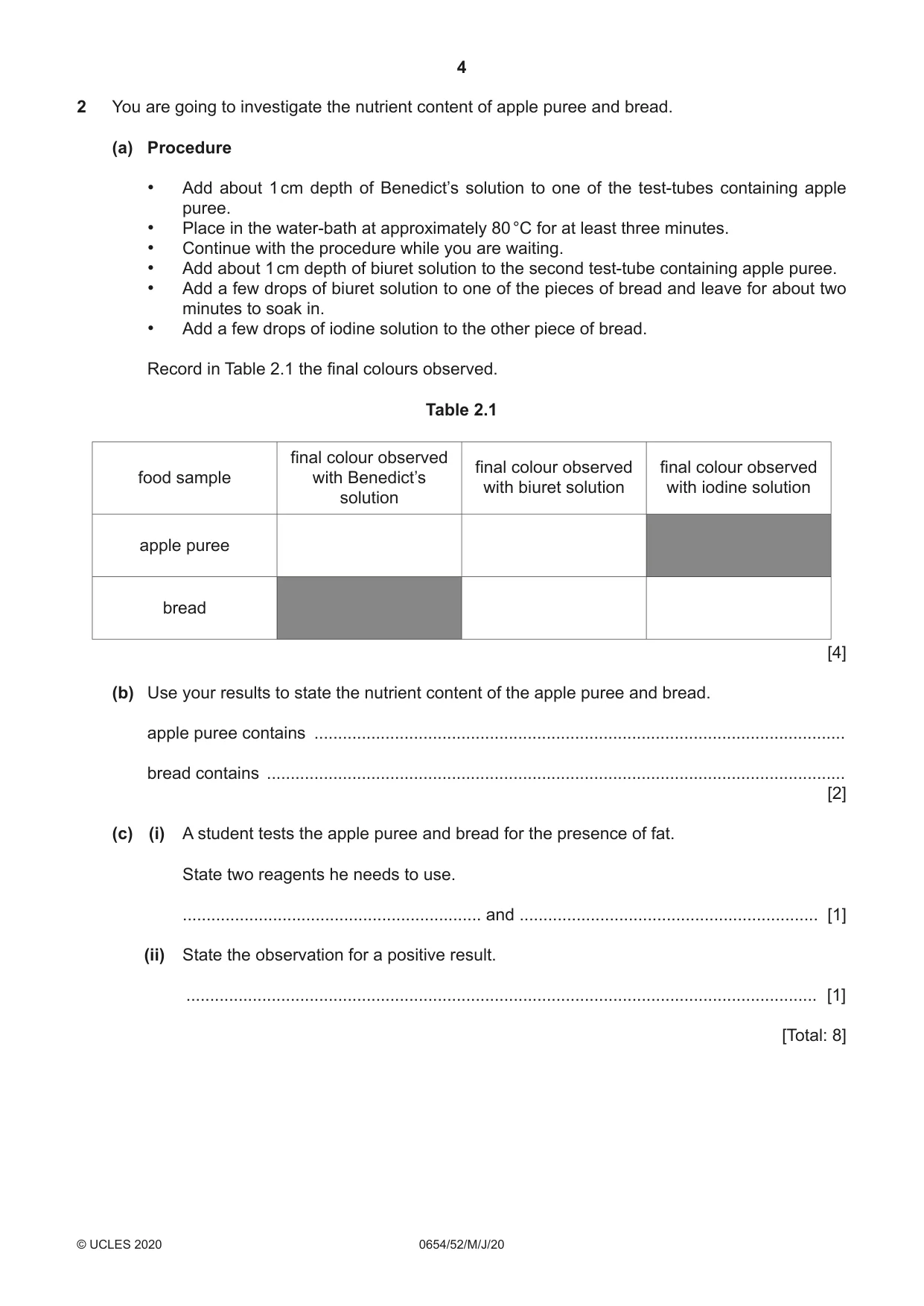
2 You are going to investigate the nutrient content of apple puree and bread. (a) Procedure • Add about 1 cm depth of Benedict’s solution to one of the test-tubes containing apple puree. • Place in the water-bath at approximately 80 °C for at least three minutes. • Continue with the procedure while you are waiting. • Add about 1 cm depth of biuret solution to the second test-tube containing apple puree. • Add a few drops of biuret solution to one of the pieces of bread and leave for about two minutes to soak in. • Add a few drops of iodine solution to the other piece of bread. Record in Table 2.1 the final colours observed. Table 2.1 final colour observed final colour observed final colour observed food sample with Benedict’s with biuret solution with iodine solution solution apple puree bread [4] (b) Use your results to state the nutrient content of the apple puree and bread. apple puree contains ................................................................................................................ bread contains .......................................................................................................................... [2] (c) (i) A student tests the apple puree and bread for the presence of fat. State two reagents he needs to use. ............................................................... and ............................................................... [1] (ii) State the observation for a positive result. ..................................................................................................................................... [1] [Total: 8]
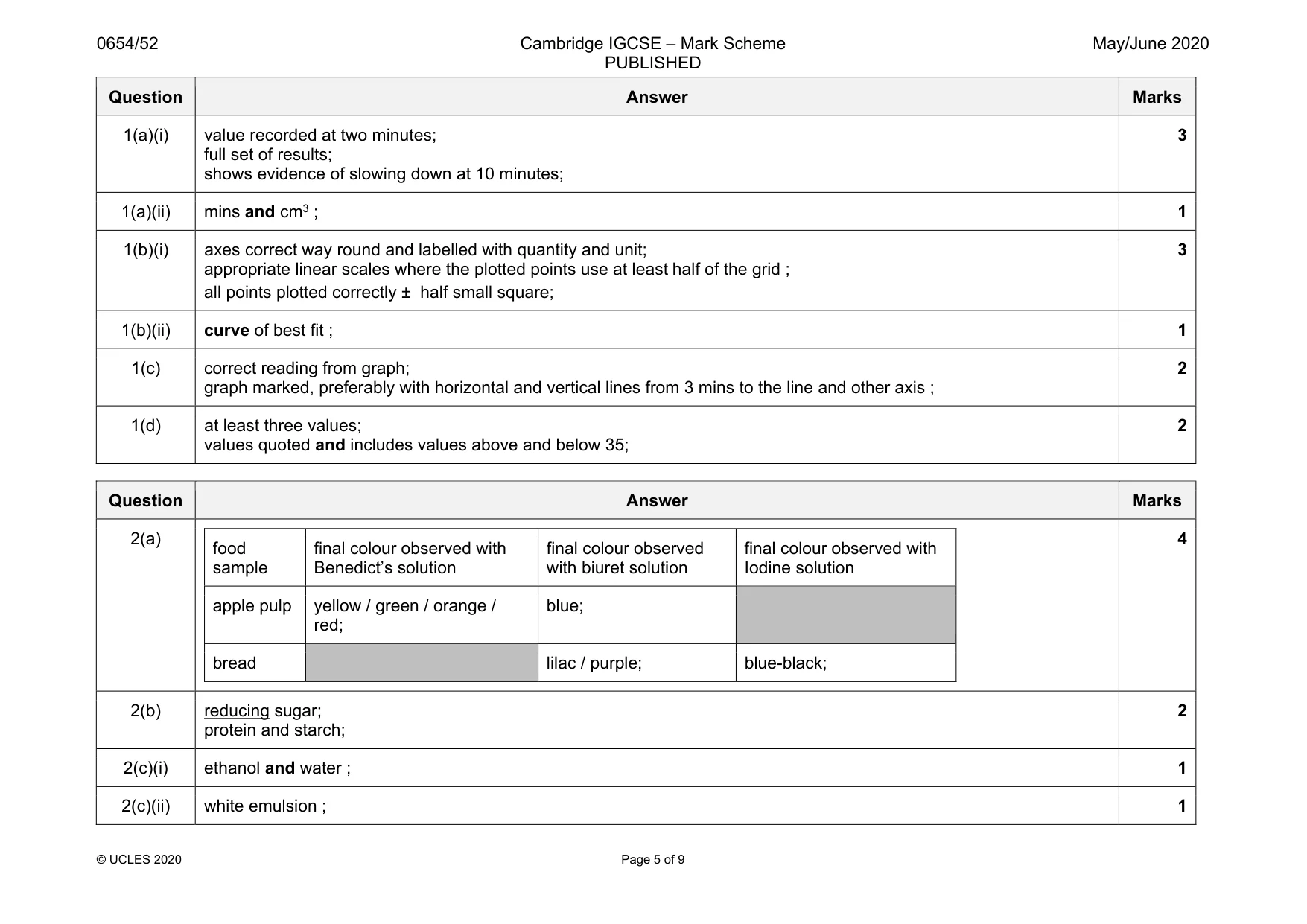
Mark scheme: 2(a) food sample final colour observed with Benedict’s solution final colour observed with biuret solution final colour observed with Iodine solution apple pulp yellow / green / orange / red; blue; bread lilac / purple; blue-black; 4 2(b) reducing sugar; protein and starch; 2 2(c)(i) ethanol and water ; 1 2(c)(ii) white emulsion ; 1
Q3 · In this investigation you are going to identify four solutions, J, K, L and M
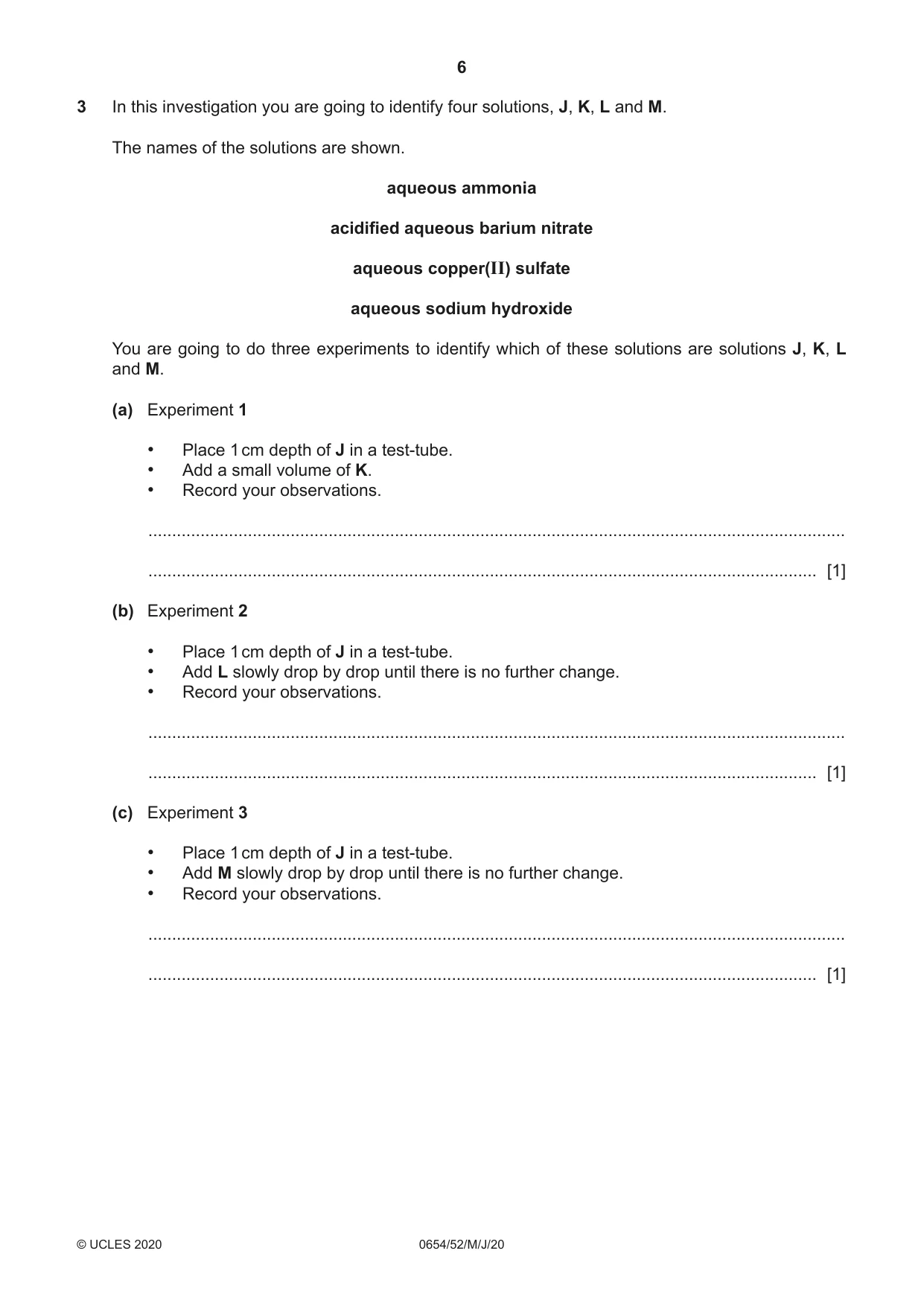
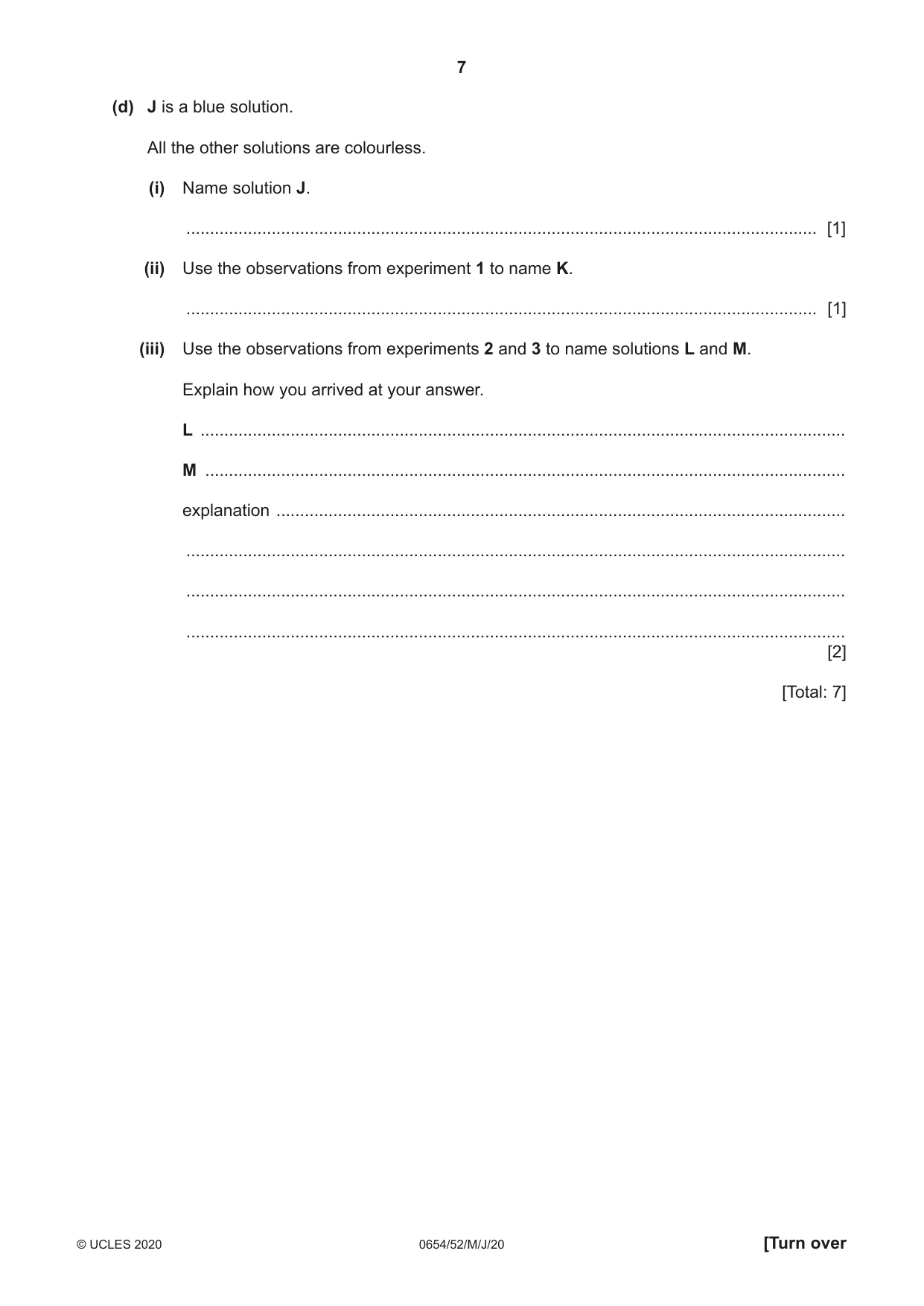
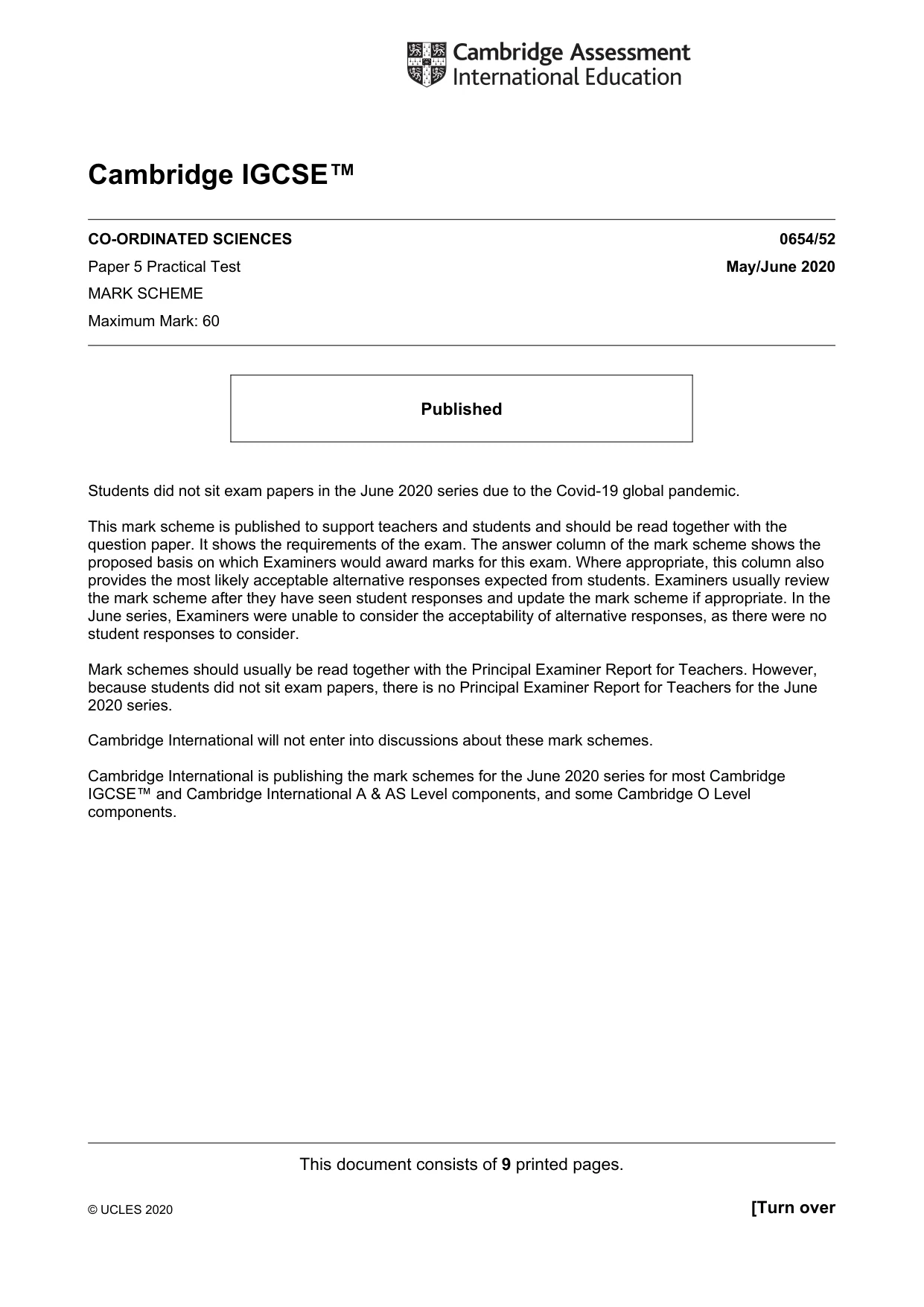
3 In this investigation you are going to identify four solutions, J, K, L and M. The names of the solutions are shown. aqueous ammonia acidified aqueous barium nitrate aqueous copper(II) sulfate aqueous sodium hydroxide You are going to do three experiments to identify which of these solutions are solutions J, K, L and M. (a) Experiment 1 • Place 1 cm depth of J in a test-tube. • Add a small volume of K. • Record your observations. ................................................................................................................................................... ............................................................................................................................................. [1] (b) Experiment 2 • Place 1 cm depth of J in a test-tube. • Add L slowly drop by drop until there is no further change. • Record your observations. ................................................................................................................................................... ............................................................................................................................................. [1] (c) Experiment 3 • Place 1 cm depth of J in a test-tube. • Add M slowly drop by drop until there is no further change. • Record your observations. ................................................................................................................................................... ............................................................................................................................................. [1] (d) J is a blue solution. All the other solutions are colourless. (i) Name solution J. ..................................................................................................................................... [1] (ii) Use the observations from experiment 1 to name K. ..................................................................................................................................... [1] (iii) Use the observations from experiments 2 and 3 to name solutions L and M. Explain how you arrived at your answer. L ........................................................................................................................................ M ....................................................................................................................................... explanation ........................................................................................................................ ........................................................................................................................................... ........................................................................................................................................... ........................................................................................................................................... [2] [Total: 7]
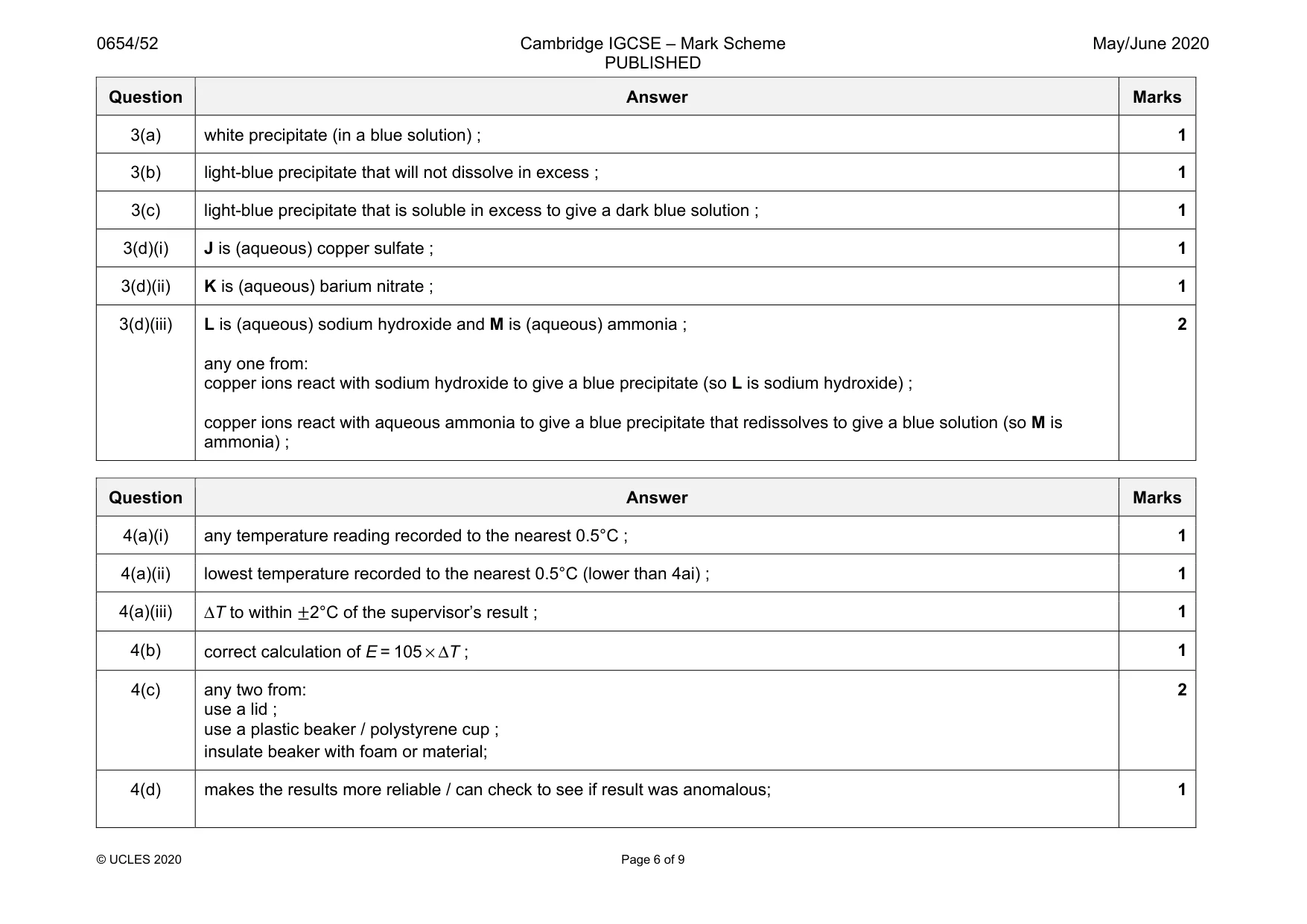
Mark scheme: 3(a) white precipitate (in a blue solution) ; 1 3(b) light-blue precipitate that will not dissolve in excess ; 1 3(c) light-blue precipitate that is soluble in excess to give a dark blue solution ; 1 3(d)(i) J is (aqueous) copper sulfate ; 1 3(d)(ii) K is (aqueous) barium nitrate ; 1 3(d)(iii) L is (aqueous) sodium hydroxide and M is (aqueous) ammonia ; any one from: copper ions react with sodium hydroxide to give a blue precipitate (so L is sodium hydroxide) ; copper ions react with aqueous ammonia to give a blue precipitate that redissolves to give a blue solution (so M is ammonia) ; 2
Q4 · You are going to investigate the amount of thermal energy (heat) absorbed when a sample…
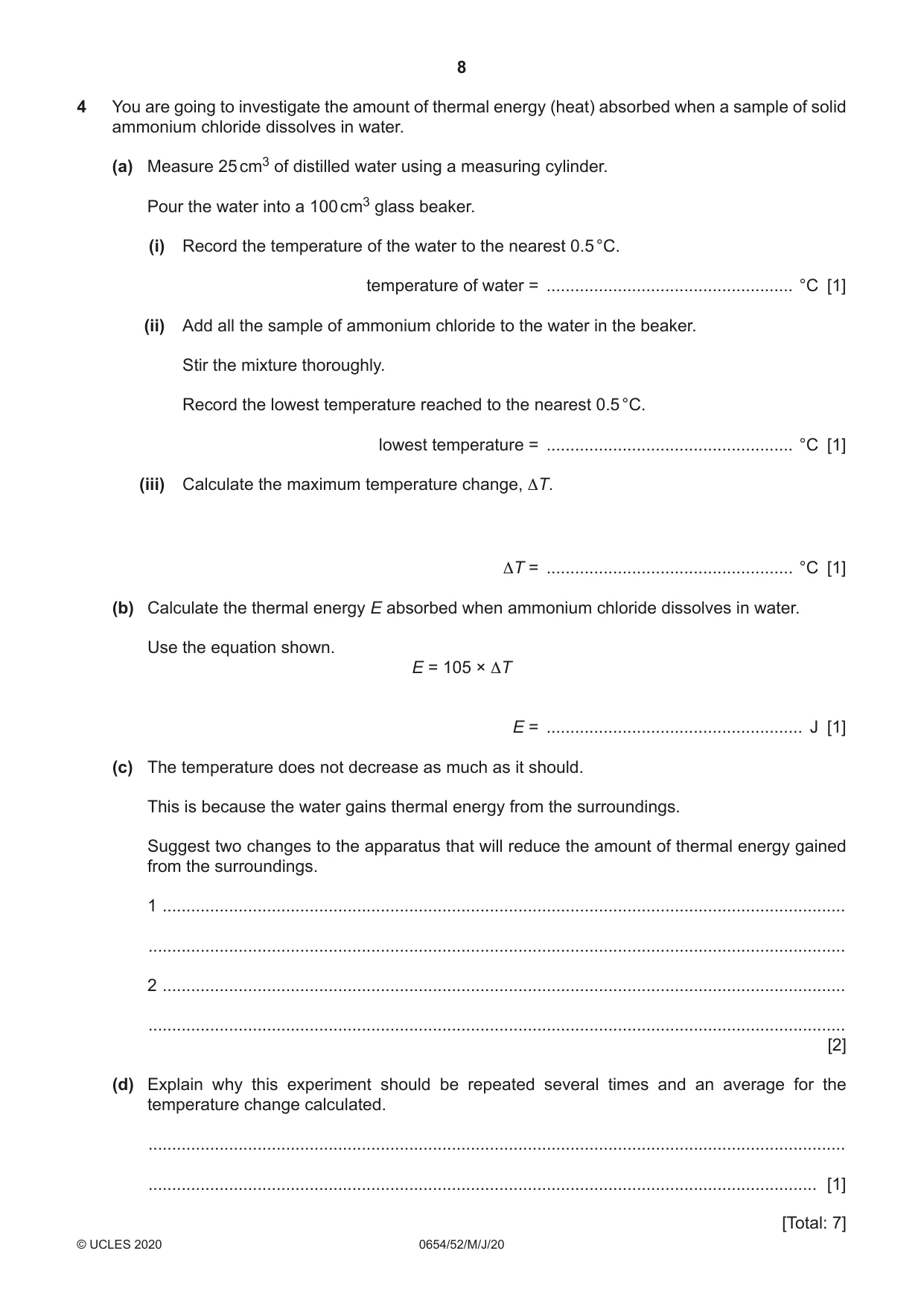
4 You are going to investigate the amount of thermal energy (heat) absorbed when a sample of solid ammonium chloride dissolves in water. (a) Measure 25 cm3 of distilled water using a measuring cylinder. Pour the water into a 100 cm3 glass beaker. (i) Record the temperature of the water to the nearest 0.5 °C. temperature of water = .................................................... °C [1] (ii) Add all the sample of ammonium chloride to the water in the beaker. Stir the mixture thoroughly. Record the lowest temperature reached to the nearest 0.5 °C. lowest temperature = .................................................... °C [1] (iii) Calculate the maximum temperature change, ∆T. ∆T = .................................................... °C [1] (b) Calculate the thermal energy E absorbed when ammonium chloride dissolves in water. Use the equation shown. E = 105 × ∆T E = ...................................................... J [1] (c) The temperature does not decrease as much as it should. This is because the water gains thermal energy from the surroundings. Suggest two changes to the apparatus that will reduce the amount of thermal energy gained from the surroundings. 1 ................................................................................................................................................ ................................................................................................................................................... 2 ................................................................................................................................................ ................................................................................................................................................... [2] (d) Explain why this experiment should be repeated several times and an average for the temperature change calculated. ................................................................................................................................................... ............................................................................................................................................. [1] [Total: 7]
Mark scheme: 4(a)(i) any temperature reading recorded to the nearest 0.5°C ; 1 4(a)(ii) lowest temperature recorded to the nearest 0.5°C (lower than 4ai) ; 1 4(a)(iii) ΔT to within ±2°C of the supervisor’s result ; 1 4(b) correct calculation of E = 105 × ΔT ; 1 4(c) any two from: use a lid ; use a plastic beaker / polystyrene cup ; insulate beaker with foam or material; 2 4(d) makes the results more reliable / can check to see if result was anomalous; 1
Q5 · A student investigates the thermal decomposition of copper carbonate
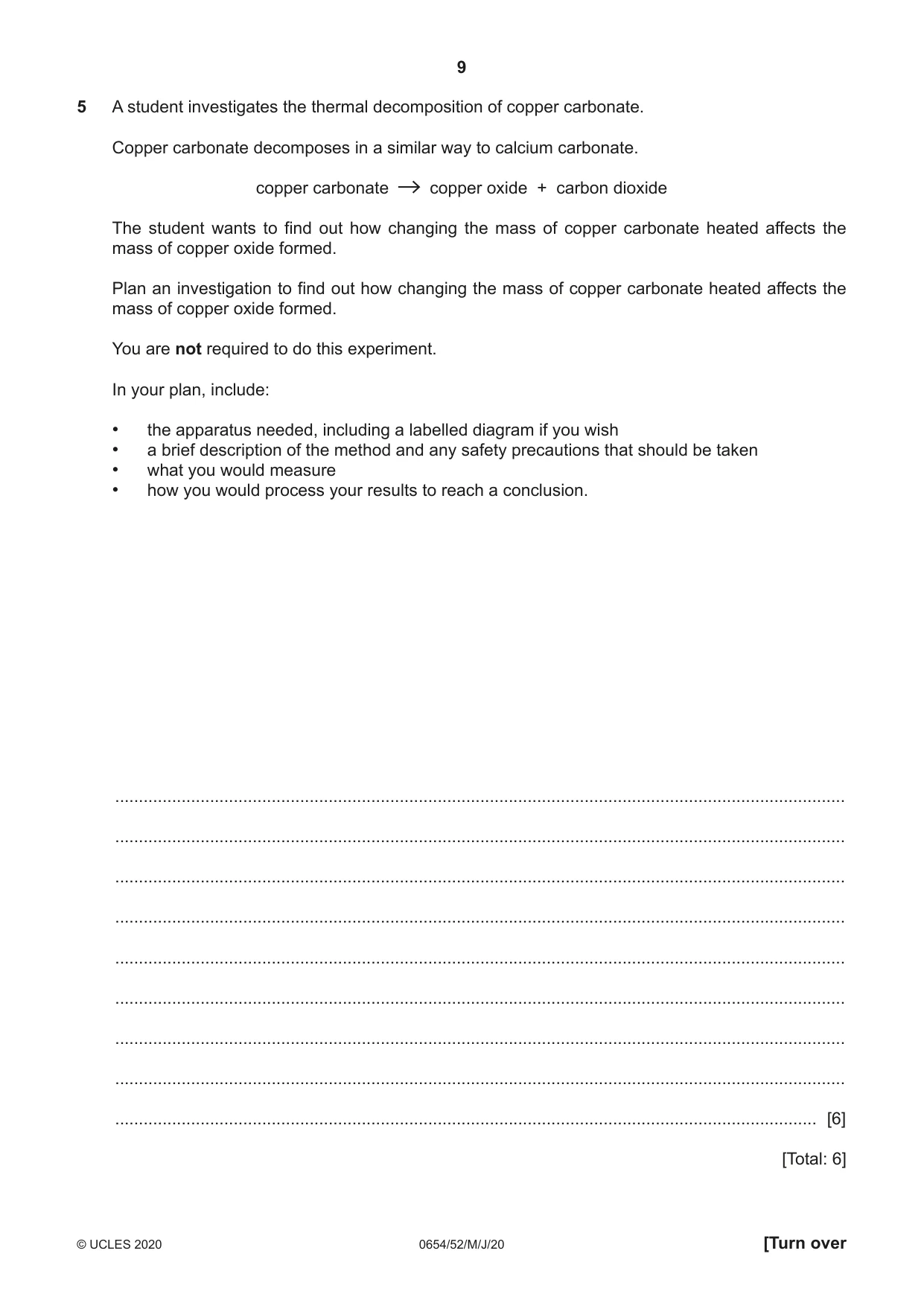
5 A student investigates the thermal decomposition of copper carbonate. Copper carbonate decomposes in a similar way to calcium carbonate. copper carbonate copper oxide + carbon dioxide The student wants to find out how changing the mass of copper carbonate heated affects the mass of copper oxide formed. Plan an investigation to find out how changing the mass of copper carbonate heated affects the mass of copper oxide formed. You are not required to do this experiment. In your plan, include: • the apparatus needed, including a labelled diagram if you wish • a brief description of the method and any safety precautions that should be taken • what you would measure • how you would process your results to reach a conclusion. .......................................................................................................................................................... .......................................................................................................................................................... .......................................................................................................................................................... .......................................................................................................................................................... .......................................................................................................................................................... .......................................................................................................................................................... .......................................................................................................................................................... .......................................................................................................................................................... .................................................................................................................................................... [6] [Total: 6]
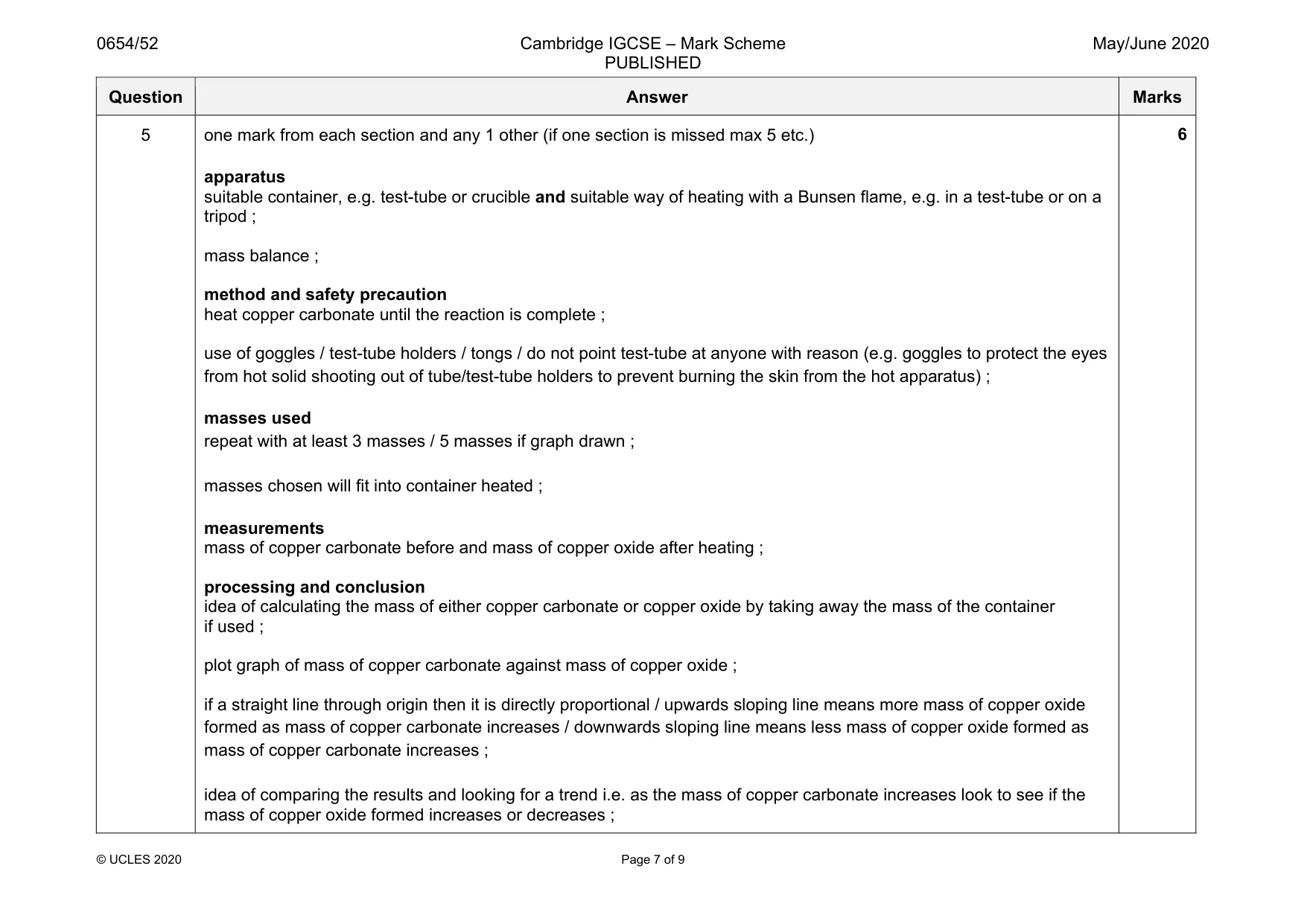
Mark scheme: 5 one mark from each section and any 1 other (if one section is missed max 5 etc.) apparatus suitable container, e.g. test-tube or crucible and suitable way of heating with a Bunsen flame, e.g. in a test-tube or on a tripod ; mass balance ; method and safety precaution heat copper carbonate until the reaction is complete ; use of goggles / test-tube holders / tongs / do not point test-tube at anyone with reason (e.g. goggles to protect the eyes from hot solid shooting out of tube/test-tube holders to prevent burning the skin from the hot apparatus) ; masses used repeat with at least 3 masses / 5 masses if graph drawn ; masses chosen will fit into container heated ; measurements mass of copper carbonate before and mass of copper oxide after heating ; processing and conclusion idea of calculating the mass of either copper carbonate or copper oxide by taking away the mass of the container if used ; plot graph of mass of copper carbonate against mass of copper oxide ; if a straight line through origin then it is directly proportional / upwards sloping line means more mass of copper oxide formed as mass of copper carbonate increases / downwards sloping line means less mass of copper oxide formed as mass of copper carbonate increases ; idea of comparing the results and looking for a trend i.e. as the mass of copper carbonate increases look to see if the mass of copper oxide formed increases or decreases ;
Q6 · You are going to find the focal length f of a lens by measuring the magnification of the…
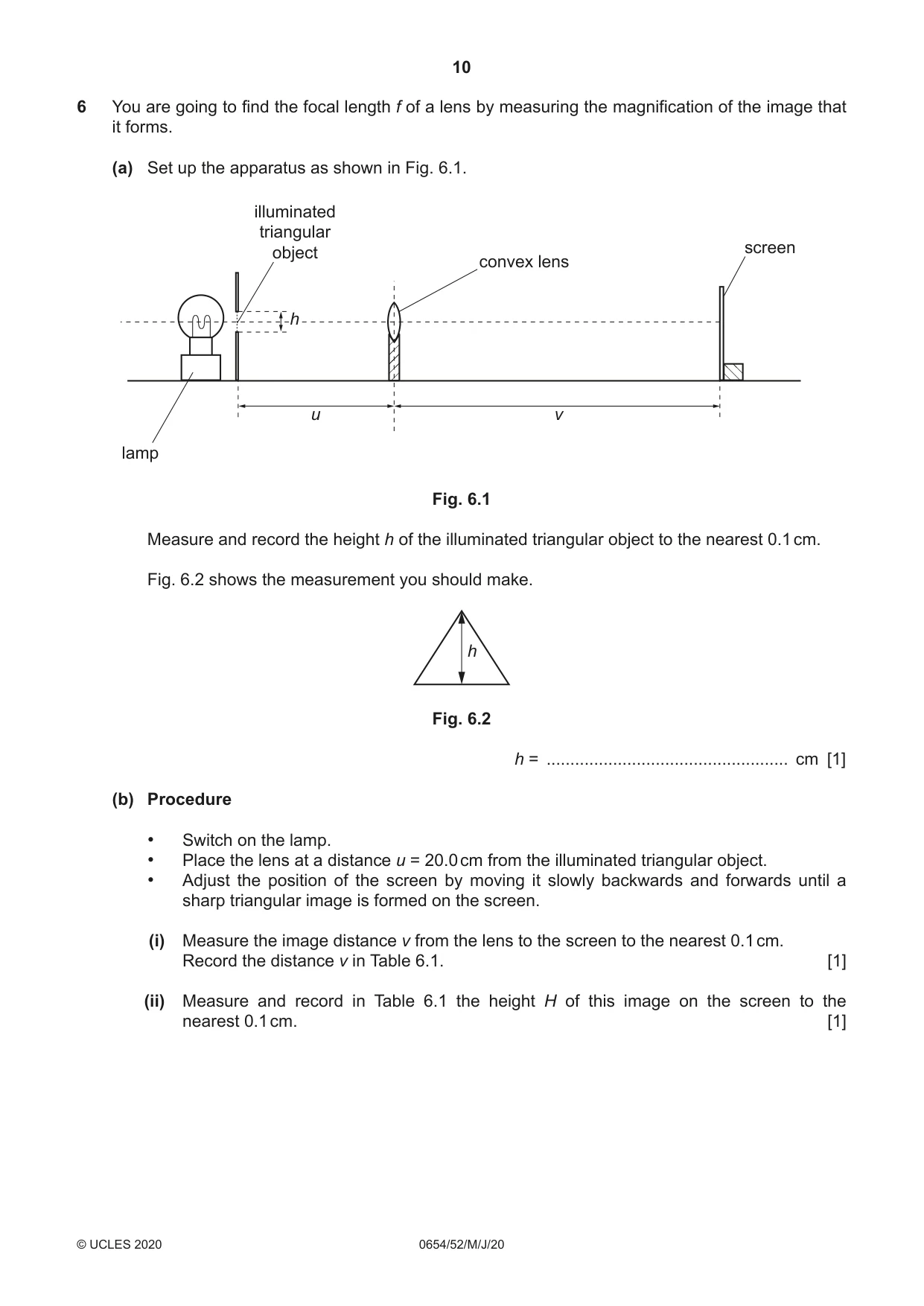
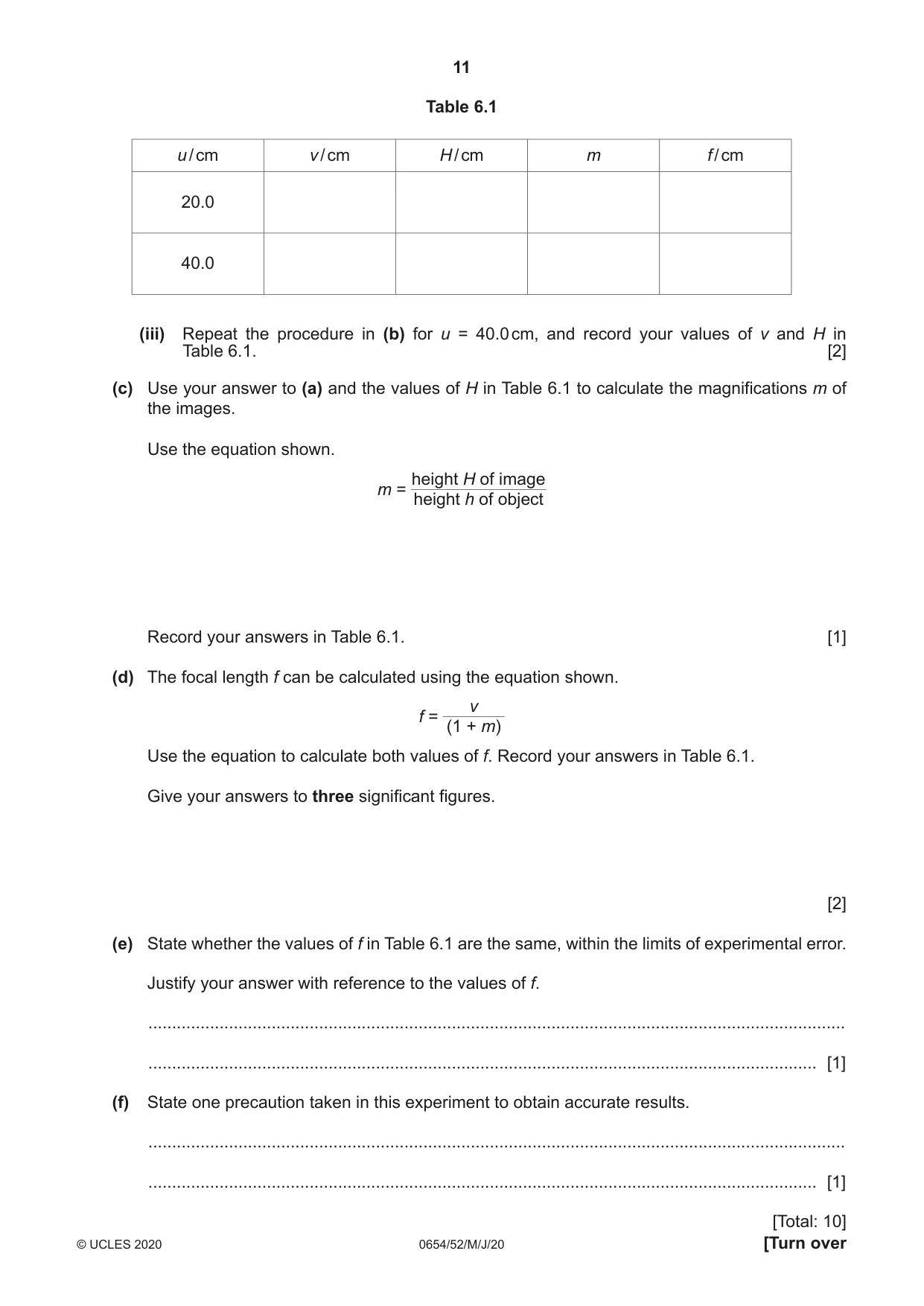
6 You are going to find the focal length f of a lens by measuring the magnification of the image that it forms. (a) Set up the apparatus as shown in Fig. 6.1. illuminated triangular object screen convex lens h u v lamp Fig. 6.1 Measure and record the height h of the illuminated triangular object to the nearest 0.1 cm. Fig. 6.2 shows the measurement you should make. h Fig. 6.2 h = ................................................... cm [1] (b) Procedure • Switch on the lamp. • Place the lens at a distance u = 20.0 cm from the illuminated triangular object. • Adjust the position of the screen by moving it slowly backwards and forwards until a sharp triangular image is formed on the screen. (i) Measure the image distance v from the lens to the screen to the nearest 0.1 cm. Record the distance v in Table 6.1. [1] (ii) Measure and record in Table 6.1 the height H of this image on the screen to the nearest 0.1 cm. [1] Table 6.1 u / cm v / cm H / cm m f / cm 20.0 40.0 (iii) Repeat the procedure in (b) for u = 40.0 cm, and record your values of v and H in Table 6.1. [2] (c) Use your answer to (a) and the values of H in Table 6.1 to calculate the magnifications m of the images. Use the equation shown. height H of image m = height h of object Record your answers in Table 6.1. [1] (d) The focal length f can be calculated using the equation shown. v f = (1 + m) Use the equation to calculate both values of f. Record your answers in Table 6.1. Give your answers to three significant figures. [2] (e) State whether the values of f in Table 6.1 are the same, within the limits of experimental error. Justify your answer with reference to the values of f. ................................................................................................................................................... ............................................................................................................................................. [1] (f) State one precaution taken in this experiment to obtain accurate results. ................................................................................................................................................... ............................................................................................................................................. [1] [Total: 10]
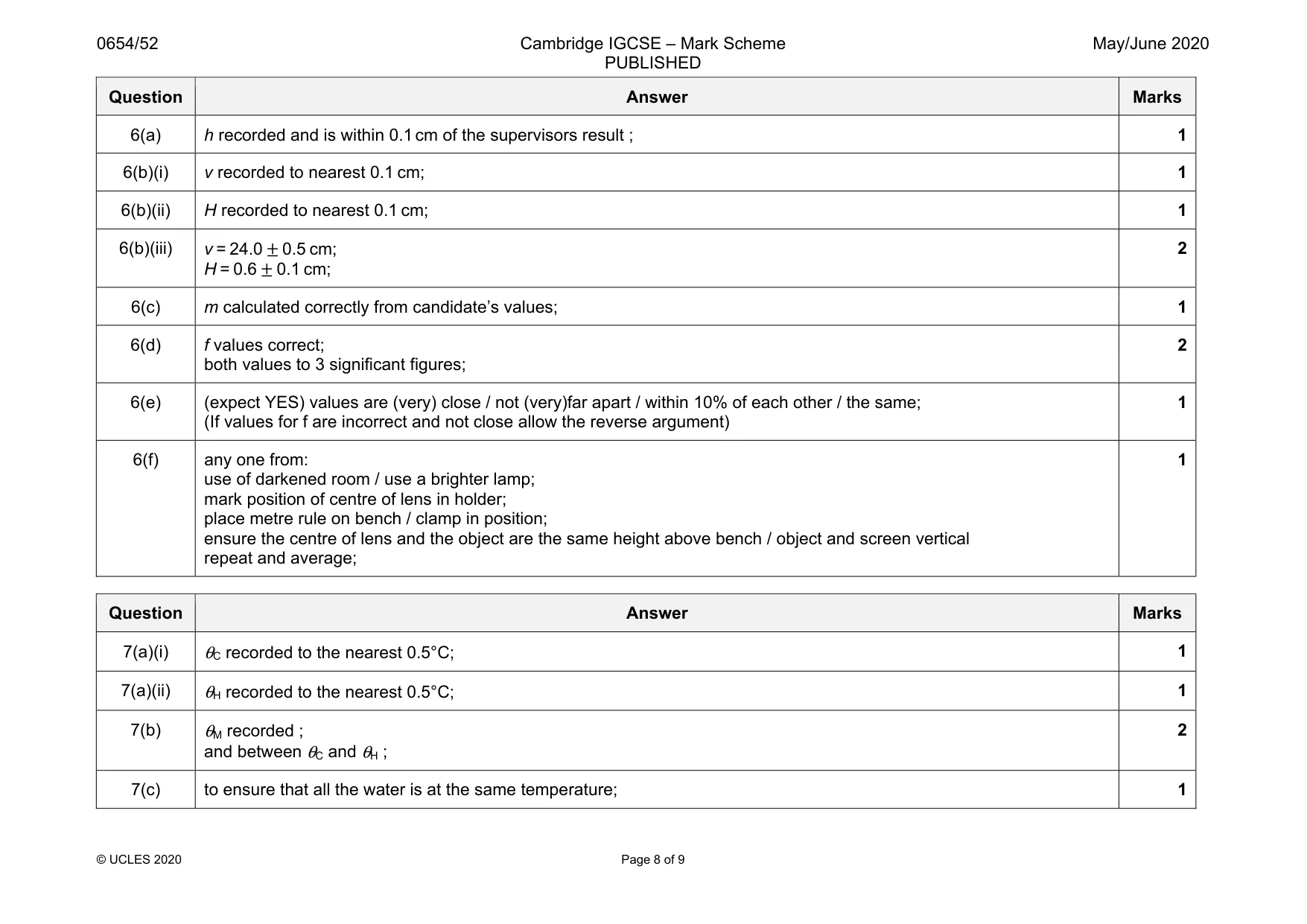
Mark scheme: 6(a) h recorded and is within 0.1 cm of the supervisors result ; 1 6(b)(i) v recorded to nearest 0.1 cm; 1 6(b)(ii) H recorded to nearest 0.1 cm; 1 6(b)(iii) v = 24.0 ± 0.5 cm; H = 0.6 ± 0.1 cm; 2 6(c) m calculated correctly from candidate’s values; 1 6(d) f values correct; both values to 3 significant figures; 2 6(e) (expect YES) values are (very) close / not (very)far apart / within 10% of each other / the same; (If values for f are incorrect and not close allow the reverse argument) 1 6(f) any one from: use of darkened room / use a brighter lamp; mark position of centre of lens in holder; place metre rule on bench / clamp in position; ensure the centre of lens and the object are the same height above bench / object and screen vertical repeat and average; 1
Q7 · You are going to determine the thermal energy lost from a beaker of water when hot and…
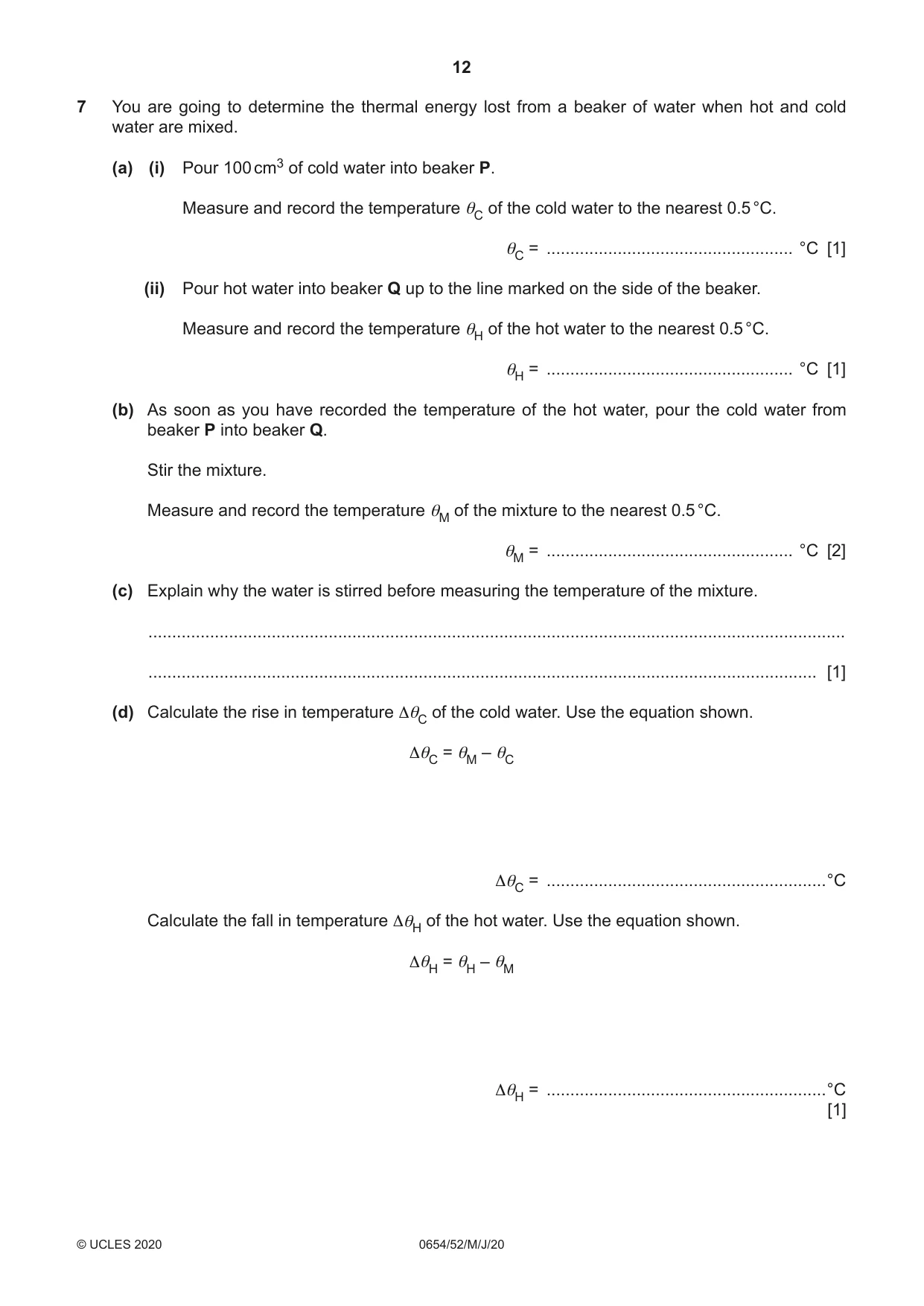
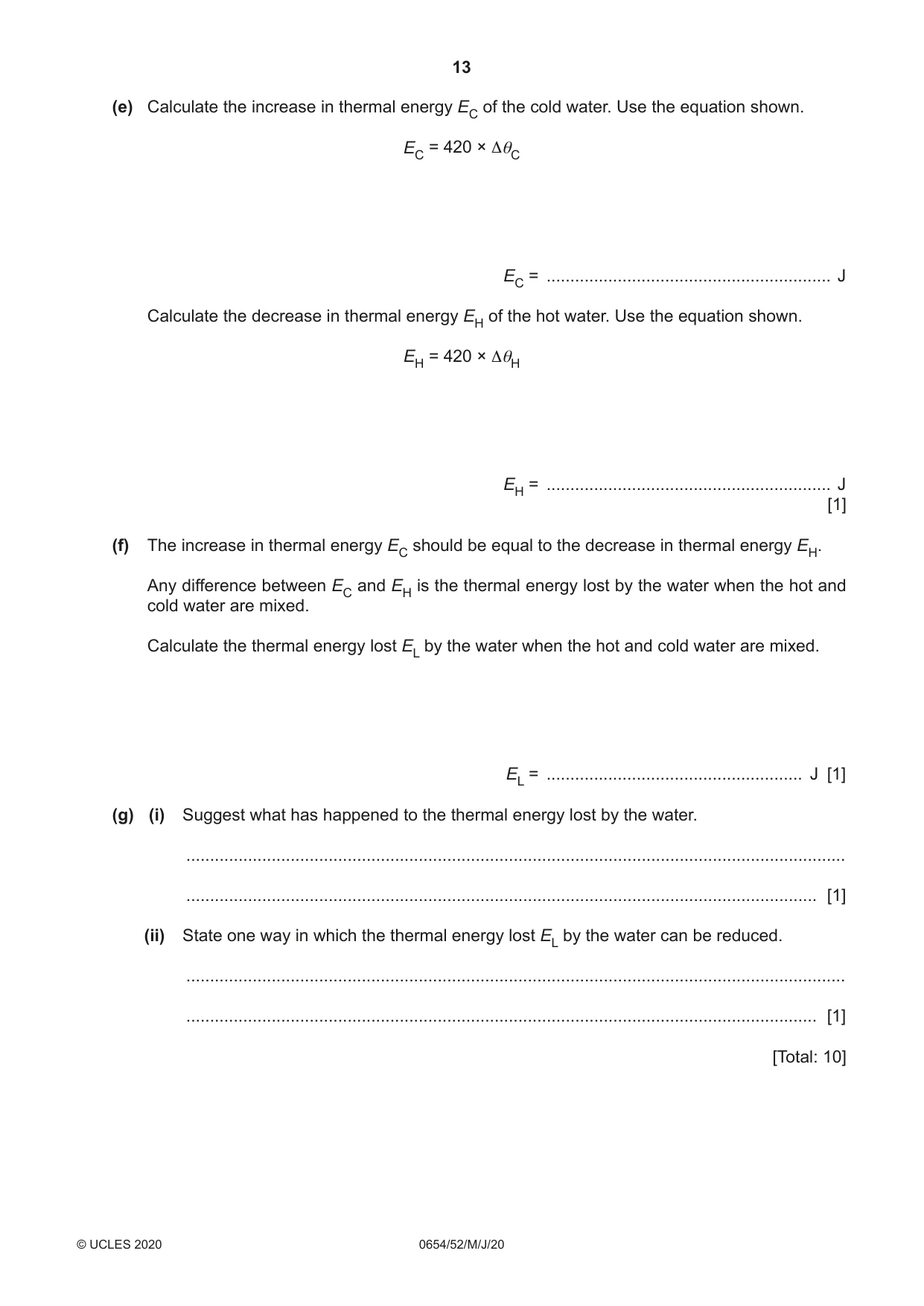
7 You are going to determine the thermal energy lost from a beaker of water when hot and cold water are mixed. (a) (i) Pour 100 cm3 of cold water into beaker P. Measure and record the temperature θC of the cold water to the nearest 0.5 °C. θC = .................................................... °C [1] (ii) Pour hot water into beaker Q up to the line marked on the side of the beaker. Measure and record the temperature θH of the hot water to the nearest 0.5 °C. θH = .................................................... °C [1] (b) As soon as you have recorded the temperature of the hot water, pour the cold water from beaker P into beaker Q. Stir the mixture. Measure and record the temperature θM of the mixture to the nearest 0.5 °C. θM = .................................................... °C [2] (c) Explain why the water is stirred before measuring the temperature of the mixture. ................................................................................................................................................... ............................................................................................................................................. [1] (d) Calculate the rise in temperature ∆θC of the cold water. Use the equation shown. ∆θC = θM – θC ∆θC = ...........................................................°C Calculate the fall in temperature ∆θH of the hot water. Use the equation shown. ∆θH = θH – θM ∆θH = ...........................................................°C [1] (e) Calculate the increase in thermal energy EC of the cold water. Use the equation shown. EC = 420 × ∆θC EC = ............................................................ J Calculate the decrease in thermal energy EH of the hot water. Use the equation shown. EH = 420 × ∆θH EH = ............................................................ J [1] (f) The increase in thermal energy EC should be equal to the decrease in thermal energy EH. Any difference between EC and EH is the thermal energy lost by the water when the hot and cold water are mixed. Calculate the thermal energy lost EL by the water when the hot and cold water are mixed. EL = ...................................................... J [1] (g) (i) Suggest what has happened to the thermal energy lost by the water. ........................................................................................................................................... ..................................................................................................................................... [1] (ii) State one way in which the thermal energy lost EL by the water can be reduced. ........................................................................................................................................... ..................................................................................................................................... [1] [Total: 10]
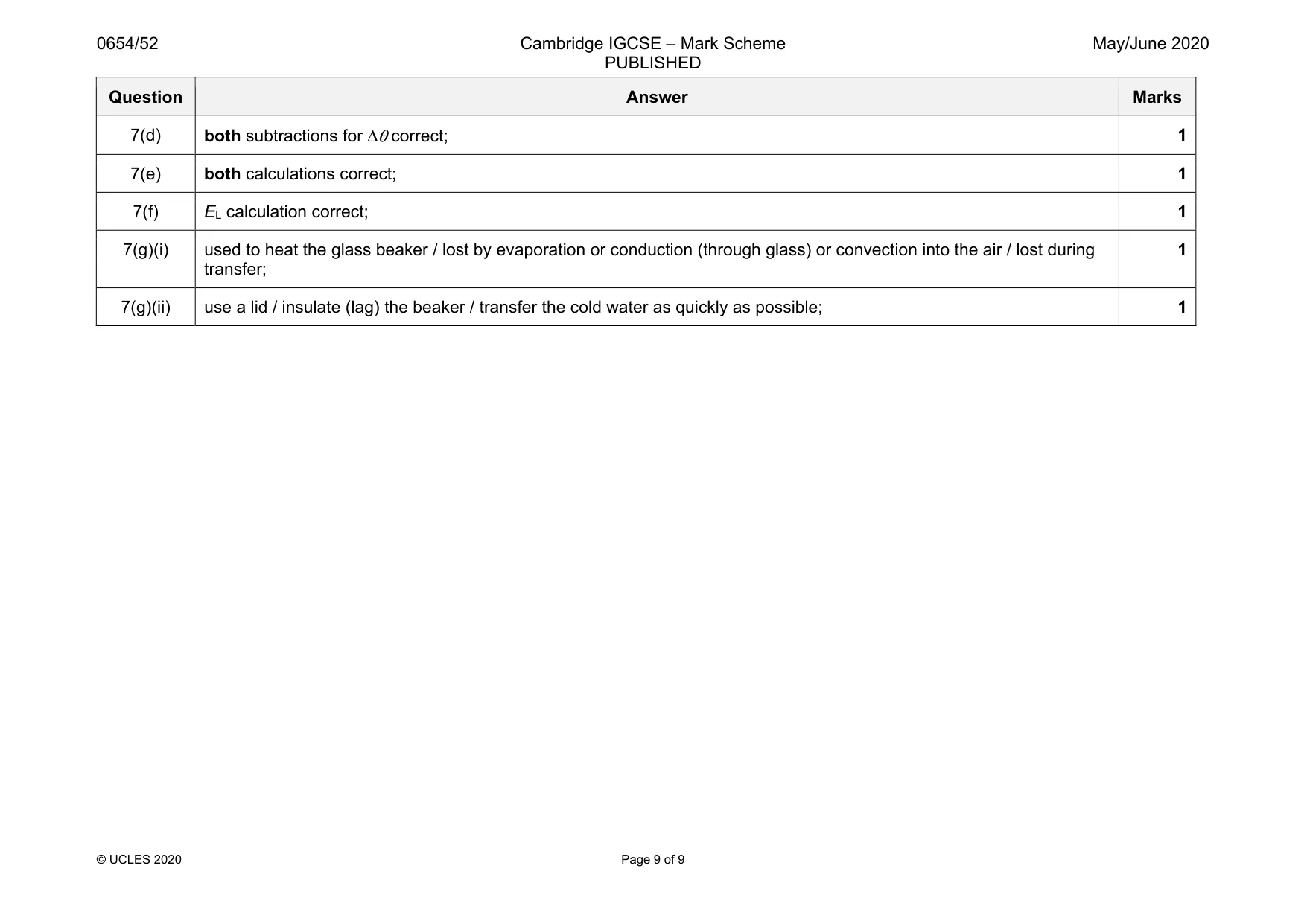
Mark scheme: 7(a)(i) θC recorded to the nearest 0.5°C; 7(a)(ii) θH recorded to the nearest 0.5°C; 1 7(b) θM recorded ; and between θC and θH ; 2 7(c) to ensure that all the water is at the same temperature; 1 Question Answer Marks 7(d) both subtractions for Δθ correct; 1 7(e) both calculations correct; 1 7(f) EL calculation correct; 1 7(g)(i) used to heat the glass beaker / lost by evaporation or conduction (through glass) or convection into the air / lost during transfer; 1 7(g)(ii) use a lid / insulate (lag) the beaker / transfer the cold water as quickly as possible; 1
What was in this paper
The subtopics covered by these 7 questions, and how many questions each got. Open one in a new tab to see every Cambridge question on it.